(The Telegraph) – A suspected man questioned over bombings that killed 269 people in Sri Lanka is seeking asylum in the UK.
The unnamed asylum seeker, from Sri Lanka, was arrested over allegations that he was involved in the 2019 Easter bombings in the country.
The blasts killed six Britons, including a mother and her two children.
The man, who has been granted anonymity, left Sri Lanka in 2022 after being arrested and released on bail over the attacks, in which suicide bombers targeted luxury hotels and churches.
He arrived in the UK in September 2022 and claimed asylum a month later. He told an immigration tribunal that, since leaving Sri Lanka, police officers had attended his family home and that he fears persecution” if he returns home. It is understood he denies the allegations.
His asylum claim for his wife and himself was initially rejected by the Home Office, but he won an appeal against the decision at an upper immigration tribunal and his case will now be reheard.
Last week, Shabana Mahmood, the Home Secretary, announced major reforms to the asylum system, making refugee status temporary and giving ministers powers to return migrants to their home country once it was deemed safe.
Ms Mahmood is also overhauling immigration appeals by replacing judges with adjudicators and limiting illegal migrants and foreign offenders’ ability to exploit human rights laws to fight deportation.
Some 38 foreign tourists were killed in the Easter Sunday bombings in 2019. Among them were Britons Anita Nicholson, 42, and her children, Alexander, 14 and Annabel, 11, who died in an explosion at the Shangri-la Hotel in Colombo.
Lorraine Campbell, an IT director, retired firefighter Bill Harrop and his wife Dr Sally Bradley also died in a blast at the Cinnamon Grand Hotel.
It is believed that the eight suicide bombers were associated with an Islamist militant group named National Thowheeth Jama’ath.
An upper tribunal judgment said: [The Sri Lankan] had applied for protection on his own behalf and on behalf of his wife. He says that on Jan 5 2022 he was arrested and questioned in connection with the Easter bombings, which took place in Sri Lanka on April 21 2019.
He says that he was released only on the payment of a substantial bribe and was subject to reporting conditions. He left Sri Lanka for the United Kingdom on Sept 2 2022 and an arrest warrant was issued thereafter on Sept 15 2022.
He says that the police have attended his family home in Sri Lanka, and he fears persecution if returned to Sri Lanka.”
The upper tribunal heard that his original case had been dismissed by the first-tier tribunal.
The Sri Lankan argued that the first-tier tribunal made mistakes. He said the judge was biased” and that the arrest warrant was not issued until after he left Sri Lanka, which the judge failed to appreciate”.
Claire Burns, the deputy upper tribunal judge, found that the previous hearing had made a series of errors, including it being missed that the man had been released on bail following an arrest warrant. Judge Burns denied that any previous judges were highly prejudiced” in their approach.
The facts of the case will be reheard at the first-tier tribunal at a later date.
Judge Burns concluded: I find there will need to be a complete rehearing wherein the judge will make findings about the credibility of [his] account and given the nature and extent of the fact finding, the appeal should therefore be remitted to the first-tier tribunal.
The judge erred in law in his analysis of the documentary evidence as set out above, and so for that reason the decision must be set aside.”
A Home Office spokesman said: The Government rejected this asylum claim to ensure this suspected terrorist never sets foot on British soil. We stand to robustly defend this decision through the courts.
Last week, the Home Secretary announced the most sweeping reforms to tackle illegal migration in modern times which will make Britain a less attractive destination for illegal migrants and will make it easier to remove and deport them. As part of this, we are reforming human rights laws and replacing the broken appeals system.”
Comments Off on Man questioned over Easter bombings seeks asylum in UK
The Valachchenai Magistrate’s Court today (25) ordered the Chairman and three others implicated in the removal of Archaeology Department signboards and directional boards to re-install the removed boards in their original locations.
The court released the four suspects—including Valachchenai-Koralepattu Pradeshiya Sabha Chairman S. Sudhakaran—on personal bail of Rs.100,000 each, totalling Rs. 400,000.
The counsel for the suspects argued before the court that, according to the Local Government Ordinance, permission must be obtained from the relevant local authority to erect any sign or name board.
He claimed the local body removed the Archaeology Department’s boards because they lacked this necessary approval.
However, Assistant Director of Archaeology for Batticaloa and Ampara, Anushan Munasinghe, who appeared for the Archaeology Department, countered this argument.
He stated that under the Antiquities Ordinance (Act No. 24 of 1998, amending Act No. 9 of 1940), the Department is not required to obtain permission from the relevant local authority to erect archaeological name or signboards.
He further confirmed that the Department had complied with the law by displaying the information in all three languages.
Considering the arguments presented, the Magistrate ordered the suspects to re-establish the boards at the original sites.
This work must be completed before December 15.
Furthermore, the Valachchenai Police were ordered to submit a progress report on the reinstallation to the court on the same date, December 15th.
Comments Off on Court orders reinstallation of removed archaeology boards
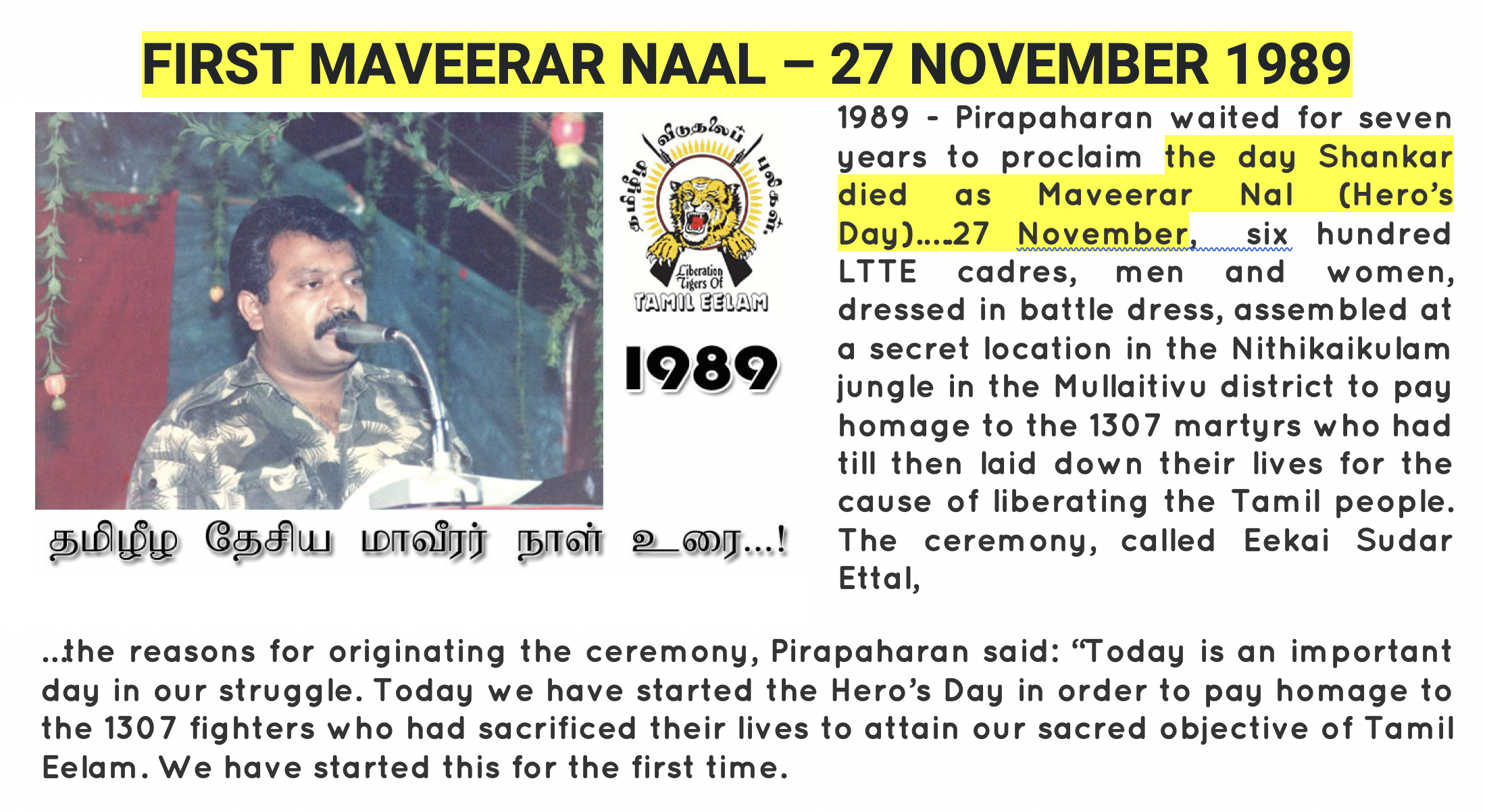
Maaveerar Naal has increasingly been presented—especially by diaspora activists—as a cultural or humanitarian day of mourning for Tamils. However, the historical origins, rituals, and political functions of Maaveerar Naal reveal that it was created and institutionalized by the Liberation Tigers of Tamil Eelam (LTTE) not as a Tamil national day of remembrance, but as an exclusively LTTE‑centric event. We examine the structure, symbolism, and ideological role of Maaveerar Naal, promoted by pro‑LTTE networks to keep alive the quest for separatism which has now progressed to political attempt having failed the terrorist attempt.
Maaveerar Naal is not representative of Tamil civilians. It was, and remains, a political ritual designed to reinforce LTTE identity, glorify armed militancy, and sustain diaspora mobilisation. The continued use of LTTE symbols, uniformed imagery, coordinated rituals, and selective commemoration raises legitimate national security, ideological, and ethical concerns. Maaveerar Naal is not relevant or applicable for non-LTTE Tamil civilians or non-LTTE Tamil militants.
Maaveerar Naal (Great Heroes Day) began as an LTTE‑created event.
The date—27 November—was chosen to honour the death of the first LTTE combatant, Lt. Shankar.
Prabhakaran institutionalised the day to create a cult of martyrdom” central to LTTE identity-building.
When Jaffna university commemorates Maaveerar Naal on 27 Nov – they are glorifying terrorists
When academics professionals politicians commemrate Maaveerar Naal on 27 Nov – they are glorifying terrorists
When students, youth living in Sri Lanka or overseas commemorate Maaveerar Naal on 27 Nov – they too are glorifying terrorists
When diplomats & headso f INGOs or foreign politicians take part in Maaveerar Naal on 27 Nov – they are definitely glorifying terrorists – shame on them
1.1 LTTE Exclusivity
Maaveerar Naal commemorates only LTTE cadres.
It does not honour:
Non-LTTE civilian Tamil victims
Victims of other Tamil militant groups (TELO, EPRLF, EROS, PLOTE)
Tamil political leaders assassinated by the LTTE
Tamils killed by LTTE
Muslim or Sinhalese victims of LTTE attacks
This selective memory reveals the ideological nature of the event.
1.2 Ritualised Political Messaging
The commemorative structure includes:
LTTE flags and insignia
Red‑and‑yellow LTTE colour themes
Video/photographic displays of LTTE cadres
Speeches glorifying martyrdom
The 6:05 pm ritual aligned with Lt. Shankar’s time of death
These elements are not markers of cultural mourning; they are symbols of political identity and militant continuity.
The first known photographic and documentary evidence of Maaveerar Naal comes from LTTE’s own publications.
These confirm the event’s unmistakeably LTTE‐centric, militarised origins.
1989 – First small‐scale commemoration held in LTTE‐controlled areas.
Documented in LTTE newsletters and memorial leaflets featuring Prabhakaran, Shankar, and early Black Tigers.
1991 – LTTE’s official magazine Viduthalai Pulikal” carries full-page spreads of the event.
Images show:
– rows of uniformed LTTE cadres
– LTTE flag backdrops
– heavy emphasis on Prabhakaran’s leadership
– the first use of lamp-lighting rituals.
1992 – LTTE’s Thuyilum Illam” (martyrs cemetery) photographs appear for the first time with formal tomb‐stones.
1993 – The first *mass* Maaveerar Naal event is recorded in LTTE’s international newsletters.
These feature:
– military parades
– Prabhakaran’s portraits
– heavy recruitment messaging
– coordination with LTTE overseas branches.
These primary LTTE sources establish beyond dispute that Maaveerar Naal was conceived, branded, and promoted by the LTTE itself as a militant organisational event – not a Tamil cultural remembrance.
Rebutting Key LTTE / Pro‑LTTE Arguments
2.1 Maaveerar Naal is a cultural day of mourning for Tamils.”
Rebuttal: It is a commemorative day only for LTTE members. No Tamil civilian victims are included. Families from other Tamil militant groups are deliberately excluded by the LTTE. These families are not allowed to publicly mourn their dead sons & daughters. Universities including academics” and diaspora groups that frame this as a Tamil Mourning Day” are misrepresenting history and contributing to separatist sentiment.
2.2 LTTE were freedom fighters, not terrorists.”
Rebuttal: Multiple governments and organisations across the world designated the LTTE as a terrorist organisation because of its systematic use of suicide bombings, civilian massacres, assassinations, and coercion. The continuance of the global ban even after 2009 demonstrates that the designation is based on evidence.
The quest for separatism continues.
Terrorism ended but not separatism – now being pushed by political means.
2.3 LTTE did not use child soldiers.”
Rebuttal: International human rights organisations documented widespread recruitment of minors by the LTTE. Forced conscription campaigns targeted Tamil families, some repeatedly. Indoctrination included training rituals and, , distribution of cyanide capsules. These practices underline the militarised social control exercised by the LTTE.
Every family was mandated to donate” a child by Prabakaran’s orders.
Adele Balasingham trained children from late 1970s to mid 1990s – several books authored by her proudly admits to such training.
No global legal action has been taken against her for these crimes while she freely lives in UK.
Children’s fundamental rights were robbed.
2.4 LTTE did not endanger civilians or use them as human shields.”
Rebuttal: Independent UN reports record:
LTTE prevented civilians from escaping
LTTE shot civilians attempting to flee
LTTE embedded military infrastructure among civilians
Civilians were forced to dig trenches and serve as labour
UNSG made several appeals to LTTE to release civilians & children which LTTE ignored.
These acts constitute grave violations of humanitarian law.
2.5 Assassinations blamed on LTTE were propaganda.”
Rebuttal: LTTE’s political assassinations are well-documented by Tamil politicians, rival militant groups, independent analysts, and eyewitnesses. Victims include leaders of TELO, EPRLF, PLOTE, TULF, Sri Lankan officials, Muslim leaders, and even Tamil civilians. The pattern shows an organised effort to eliminate all political rivals.
2.6 Diaspora commemorations are harmless and protected speech.”
Rebuttal: Commemorations remain structured around LTTE symbols.
When organisers insist on using LTTE flags, cadet portraits, Prabhakaran’s speeches, or militarised aesthetics, these events become political mobilisation platforms for a banned organisation—not neutral cultural rituals.
2.7 Suicide cadres were heroes, not terrorists.”
Rebuttal:Suicide bombings targeting civilians and public spaces cannot be framed as honourable warfare. The LTTE’s systematic use of suicide attacks—including on economic, political, and civilian targets—constitutes an intentional strategy of terror. Heroic framing through Maaveerar Naal rituals reinforces radicalisation among youth.
2.8 LTTE governance structures show it was a state-like administration.”
Rebuttal: While the LTTE established courts, police units, and tax systems in areas under its control, these institutions were tools of coercion. Dissenting Tamils were abducted, imprisoned, tortured, or killed. Forced recruitment and extortion contradicted the claim of a protective parallel government.
2.9 LTTE fought humanely; the State alone is responsible for civilian deaths.”
Rebuttal: LTTE-specific crimes—preventing escape, embedding among civilians, forced labour—are directly linked to civilian casualties. Survivor testimonies repeatedly describe LTTE brutality against civilians seeking safety.
LTTE’s initial killings began by attacking border villages killing even pregnant mothers & slitting necks of babies.
LTTE committed ethnic cleansing by ordering eviction of Sinhalese & Muslims living in the North in order to claim North belong only to Tamils”.
2.10 Fundraising and front organisations are exaggerated claims.”
Rebuttal: The persistence of LTTE symbolism in diaspora events, political lobbying, and digital propaganda demonstrates an active ideological network. The commercialisation of Maaveerar Naal (souvenirs, coordinated campaigns, media productions) evidences ongoing mobilization and the profit making nature of the LTTE diaspora.
2.11 LTTE empowered women; allegations of female abuse are false.”
Rebuttal: LTTE recruitment of women was militarisation, not liberation. Many female cadres—including minors—were coerced into frontline combat and suicide missions. Uniformed representation does not equate to empowerment, particularly within a violent, authoritarian movement.
2.12 International criticism of LTTE is biased or political.”
Rebuttal: HRW, UNICEF, UN investigative bodies, and independent human rights researchers documented LTTE abuses through field evidence, interviews, and survivor testimonies. The consistency of these findings across multiple independent institutions undermines claims of political targeting.
2.13 Cracking down on LTTE cemeteries is repression of Tamil mourning.”
Rebuttal: As the LTTE is a proscribed terrorist organisation, the State is legally bound to prevent the public display and eulogizing of its terror symbols. The concern is not mourning but the political glorification of a banned militant movement. If Maaveerar Naal were a genuine communal mourning event, it would include all Tamil victims—not exclusively LTTE fighters as well as not disallow family members of other Tamil militant groups to publicly mourn their dead.
2.14 Tamil victimhood justifies LTTE violence.”
Rebuttal: Historical grievances do not grant any movement the right to commit war crimes, recruit children, assassinate civilians or political rivals, or use suicide terrorism. A legitimate political cause does not legitimise illegitimate methods. Majority of LTTE’’s victims were ordinary people who had done no harm to LTTE.
2.15 Academics say it is cultural, not militant.”
Rebuttal: A number of diaspora‐aligned academics attempt to reframe Maaveerar Naal as a Tamil grief tradition.” However:
No Tamil cultural text, ritual, or historical practice predating LTTE mentions Maaveerar Naal.
No other Tamil militant group commemorates on this date.
All known rituals—6:05pm torch lighting, roll call of LTTE dead, LTTE flags, Prabhakaran speeches— were *invented* by the LTTE.
Academic attempts to Tamilise” Maaveerar Naal are modern reinterpretations, not cultural traditions.
These reinterpretations serve:
diaspora political mobilisation
legitimisation of LTTE’s past violence
pressure campaigns against Sri Lanka internationally
None of these claims withstand comparison with LTTE’s own printed and photographic record.
The Ideological Structure of Maaveerar Naal
Maaveerar Naal is not simply memorialisation—it is an ideological project.
Its key functions include:
Myth‑making and glorifying martyrdom”
Consolidating a loyal cadre identity
Mobilising diaspora youth
Reinforcing separatist narratives
Maintaining LTTE’s political relevance post‑2009
Keeping LTTE kitty going – the project has become a lucrative business for a handful
This ideological apparatus explains why the LTTE invested systematically in cemeteries, monuments, week-long rituals (Maaveerar Vaaram), and symbolic choreography.
LTTE Families are also given special names and treated above all other Tamils.
The LTTE invested more in cemeteries, uniforms, and commemoration rituals than any other militant group in South Asia. This was deliberate psychological conditioning to create a generational identity tied to martyrdom.
The systematic documentation of each cadre’s death in LTTE publications (with photos, biographies, battlefield descriptions) shows that Maaveerar Naal was the central pillar of LTTE propaganda.
The Political and Security Implications Today
The persistence of Maaveerar Naal, often in LTTE colours, has several implications:
Radicalisation risk:Youth are exposed to romanticised militant narratives. Many have not lived in terror times to feel the fear of LTTE terror.
Diaspora mobilisation:Networks use symbolism for political lobbying & international lobbying.
Historical distortion:The exclusive commemoration misrepresents Tamil suffering. Many Tamils suffered at the hands of LTTE – their narratives never get any public hearing.
Security concerns:Glorification of a proscribed group encourages extremist continuity.
This is not an issue of Tamil identity; it is an issue of repackaged militant glorification.
All those siding with the LTTE post-2009 are not siding with ordinary Tamils who genuinely want to live in peaceful coexistence.
Maaveerar Naal events abroad follow an identical script every year—flags, Prabhakaran portraits, uniformed LTTE children, and coordinated slogans—demonstrating central direction, not spontaneous community grief.
These are political mobilisations, not cultural gatherings.
Towards a Balanced Framework of Remembrance
A legitimate Tamil remembrance framework would:
Honour Tamil civilians killed byall actors
Include victims of multiple Tamil political movements
Acknowledge massacres of Muslims and Sinhalese by LTTE
Not go to Geneva & put posters claiming LTTE is our Savior”
Maaveerar Naal, as currently practised, does not meet these criteria.
Maaveerar Naal is not a neutral or cultural day of mourning; it is a political ritual created by a proscribed terrorist organisation to reinforce its identity and ideology. Its exclusive commemorative structure, militant symbolism, and ongoing mobilisation functions contradict claims of cultural harmlessness. Understanding the origins, purpose, and ideological implications of Maaveerar Naal is essential for any serious conversation on reconciliation, national security, and historical truth in Sri Lanka.
A path to genuine communal remembrance must be inclusive, civilian‑centred, and free of militant nostalgia. No one is stopping a mother or father of a terrorist mourning their dead son or daughter but that mourning does not need terrorist paraphernalia nor terrorist slogans & terrorist organizing.
A remembrance day that excludes Tamil victims of LTTE violence is not Tamil; it is LTTE. Any framework for true Tamil remembrance must break from LTTE symbolism entirely.
A message every Sri Lankan elected Government must take note of without appeasing terror outfits & their foreign campaigners.
Shenali D Waduge
Comments Off on Maaveerar Naal, LTTE Commemoration, and the Politics of Selective Memory
The Vatican bears a high degree of historical accountability for the Portuguese Inquisition in the colonies because it provided the initial religious and legal justification for Portuguese imperial expansion and the subjugation of non-Christian peoples, even though the specific actions of the Inquisition were largely administered as a state-controlled institution.
Vatican’s Role and Justification
Papal Bulls:
A series of 15th-century Papal Bulls (e.g., Dum Diversas in 1452, Romanus Pontifex in 1455) formed the “Doctrine of Discovery” which granted Portugal the right to “invade, search out, capture, vanquish and subdue all Saracens and pagans and any other unbelievers” and take their territories and property. These bulls provided the religious mandate and moral authority for the subsequent colonial ventures and forced conversions in places like Goa and Ceylon (Sri Lanka).
Establishment of the Inquisition: The formal Portuguese Inquisition was established in 1536 by the order of Pope Paul III (Cum ad nihil magis). While the Grand Inquisitor was appointed by the Pope, they were selected by the King of Portugal, making the institution a hybrid of church and state authority.
Missionary Influence: Prominent Catholic figures, such as Saint Francis Xavier, explicitly petitioned the Portuguese King for the establishment of the Inquisition in Goa to punish “crypto-Jews” and ensure the “purity” of the Catholic faith among new converts.
State Control and Implementation
The Portuguese Inquisition in Goa (established in 1560) was an arm of the Portuguese state, operating with considerable institutional independence from direct, day-to-day papal control compared to the medieval inquisition. The Crown used it as a tool for social control, wealth confiscation, and to enforce loyalty to the Portuguese Empire, targeting Hindus, Muslims, and New Christians who continued their former practices in secret. In Portuguese occupied Ceylon the Buddhist Sinhalese were the main victims of the Reign of Terror unleashed by the Portuguese.
Father S.G. Perera in his book ‘A History of Ceylon for Schools’ divides the Portuguese presence in the island as falling into three distinct stages
a) Portuguese – Sinhalese alliance (1505 – 1551)
b) Portuguese Protectorate of Kotte (1551 – 1597)
c) Portuguese Domination (1597 – 1658)
Learned Historians and commentators now generally regard the arrival of the Portuguese in the year 1505 as the beginning of the Dark Age in the history of Sri Lanka. The Portuguese, through a policy of cunning statecraft and ruthless terror were able to govern the coastal areas of the island for most of the next 150 years, until the Dutch replaced them in 1658.
Sir James Emerson Tennent refers to the Portuguese conduct in Sri Lanka in these terms-
There is no page in the story of European colonization more gloomy and repulsive than that which recounts the proceedings of the Portuguese in Ceylon. Astonished at the magnitude of their enterprises, and the glory of their discoveries and conquests in India, the rapidity and success of which secured for Portugal an unprecedented renown, we are ill-prepared to hear of the rapacity, bigotry and cruelty which characterized every stage of their progress in the East. They appeared in the Indian seas in the three-fold character of merchants, missionaries and pirates. Their ostensible motto was amity, commerce and religion. Their expeditions consisted of soldiers as well as adventurers, and included friars and chaplain majors. Their instructions were to begin by preaching, but, failing, to proceed to the decision of the sword.” (10)
The Sinhalese historian Paul E. Peiris observes :
They found in Ceylon a contented race and a fairly prosperous country ….. and it is melancholy to reflect that they succeeded in producing nothing but chaos. Out of a long list of high – born Hidalgos whom Portugal sent to Ceylon, it is difficult to point to one name as that of an enlightened statesman and high – principled administrator….
No stately fabric remains to compensate for that religious fanaticism to which ample witness is borne by the devastated ruins of those lovely structures which the piety of generations had strewn over the country… Their bequest to the Dutch was a colony of half –castes, a failing agriculture, a depopulated country, and a miserable and ill – conditioned people… They had in Ceylon an opportunity almost unique in the experience of European nations in the East, but their moral fiber had proved unequal to the occasion…”.(11)
G.P.Malalasekera in his Ph.D. dissertation which was later published as a book under the title ‘ The Pali Literature of Ceylon’ makes the following comment in lucid language on the high handed methods employed by the Portuguese in pursuit of their colonial objectives which included conversion of the people of the country into Christianity and the concomitant repression of Buddhism:
, Every stage of their progress was marked by a rapacity, bigotry, cruelty and inhumanity unparalleled in the annals of any other European colonial power. Their ferocity and their utter indifference to all suffering increased with the success of their army; their inhuman barbarities were accompanied by callousness which knew no distinction between man, woman and child; no feeling of compassion was strong enough to stay their savage hands in their fell work. To terrify their subjects and bring home to them the might of the Portuguese Power, they committed atrocities which had they not been found recorded in the decades of their friendly historians, seems too revolting to be true. Babes were spitted on the soldier’s pikes and held up so that their parents might hear the young cocks crow. Sometimes they were smashed to pulp between millstones, while their mothers were compelled to witness the pitiful sight before they themselves were tortured to death. Men including Buddhist monks were thrown over bridges for the amusement of the troops to feed the crocodiles in the river, which eventually grew so tame that at whistle they would raise their heads above the water in anticipation of the welcome feast.” (12)
see
Repression of Buddhism in Sri Lanka by Portuguese (1505 – 1658)
The modern Vatican has not issued a specific apology for the Goa or Ceylon Inquisitions. However, Pope John Paul II made a general, sweeping apology in 2000 for the historical sins and violence committed by the Catholic Church throughout its history, including the Inquisitions at large.
While some contemporary Catholic figures and historians argue that the actions in the colonies were primarily state-driven abuses of papal authority for political purposes, critics maintain that the Vatican’s foundational authorization (the Papal Bulls) makes it inherently accountable for the resulting atrocities. In 2023, the Vatican formally repudiated the “Doctrine of Discovery” as not part of Catholic faith, a step toward acknowledging the harm caused, but stopped short of a full apology for historical actions.
Conclusion
The Chapter covering Sri Lanka’s Demand from Portugal for an Apology, Restitution in Integrum ( legal term that means “restoration to the original condition”), Catharsis, Atonement, Repatriation of stolen artifacts, and Reparations, is not closed yet.
Comments Off on What is the level of accountability of the Vatican for the genocidal Portuguese Inquisition conducted in Ceylon, Goa, and other parts of the Portuguese Empire in Asia?
All persons are equal before the law and are entitled without any discrimination to the equal protection of the law. In this respect, the law shall prohibit any discrimination and guarantee to all persons equal and effective protection against discrimination on any ground …….
Don Juan Dharmapala’sconversion to Christianity and subsequent actions are widely considered a significant betrayal of Buddhism and Sinhalese sovereignty. Key lessons from this historical period emphasize the dangers of foreign dependence, the importance of safeguarding national heritage and religious freedom, and the need for strong, independent leadership.
The Betrayal: Key Actions and Consequences
Dharmapala, the last king of Kotte, became reliant on Portuguese military support. This led to actions perceived as a profound betrayal
Several specific actions by Don Juan Dharmapala are regarded as a betrayal:
In 1557, he converted to Christianity, becoming the first Asian king to do so and renouncing his traditional role as protector of Buddhism. In converting to Roman Catholicism he took the name of Dom João Dharmapala Peria Bandara, and collaborated in the repression of Buddhism.
As a ruler under Portuguese influence, he allowed the destruction of significant Buddhist temples, including the Kelaniya Temple and the Sunethra Devi Pirivena. Some temple properties were given to Franciscan friars, and churches were built on the sites of destroyed temples.
He attempted to transfer temple properties to foreign individuals and Franciscan friars.
Surrender of Sovereignty: In 1580, having no heir, he signed a “Deed of Gift” bequeathing his kingdom to the King of Portugal upon his death, surrendering Sinhalese sovereignty.
Perhaps most controversially, he designated the King of Portugal as the heir to his kingdom, effectively surrendering sovereignty to a foreign power.
Aristocracy Conversion: Many Sinhalese aristocrats followed the King’s lead and converted to Christianity, further weakening the traditional Buddhist establishment.
Lessons to be Learnt
The historical narrative surrounding Don Juan Dharmapala offers several enduring lessons:
The Peril of Foreign Dependence: Over-reliance on foreign powers can lead to the loss of national independence and cultural identity. Strong, independent leadership is crucial to avoid becoming overly reliant on foreign support, which can compromise national independence.
Safeguarding Religious and Cultural Heritage: Protecting indigenous religions and cultural heritage from external forces is crucial for national identity. Leaders have a critical role in safeguarding cultural and religious heritage, as demonstrated by the negative impacts on Buddhist institutions during Dharmapala’s rule.
The Need for Resilient Leadership: Leaders must prioritize national interests and public welfare.
Nations must be vigilant against foreign influence, particularly from those with imperialistic goals, to protect sovereignty and traditional values.
· Consequences of Betrayal: Actions seen as betraying the people’s faith and heritage lead to lasting rejection and criticism.
The widespread resistance to Dharmapala’s actions highlights the power of popular resistance and the resilience of national identity against colonial pressure.
Internal unity is vital for national integrity, as divisions can create opportunities for foreign intervention.
Political decisions can have long-term impacts for generations, as seen in how Dharmapala’s choices influenced centuries of Sri Lankan history under colonial rule.
Don Juan Dharmapala is seen as the embodiment of villainy and evil conduct among the countless number of rulers of Sri Lanka since time memorial. The Bad Guy in the saga of Sri Lanka.
Colombo, Sri Lanka, XpressJobs has signed a Memorandum of Understanding (MOU) with theAnanda College Old Boys’ Association (ACOBA) to introduce a dedicated job board for A/L students and recent school leavers, marking the company’s first-ever partnership with a school.
Picture 1 (Left to Right) : Mr. Kalana Dias (Joint Secretary: ACOBA), Mr. Samitha Seneviratne (Executive President: ACOBA), Mr. Chathum Henegama (CEO: XpressJobs), Dr. Oshadie Korale (COO: XpressJobs)
About Anana College & Its OBA
Founded in 1886, AnandaCollege is one of Sri Lanka’s most respected national schools, renowned for academic excellence, leadership, discipline, and national contribution. The ACOBA remains one of the country’s strongest alumni bodies, known for its large membership and active role in school development.
About XpressJobs
XpressJobs has grown into Sri Lanka’s leading recruitment tech platform, consistently redefining how companies hire and how talent discovers opportunities. Known for being a market trend-setter, XpressJobs introduced some of the country’s most impactful hiring innovations, including advanced filtering, application tracking systems (ATS), online assessments, and AI-powered recruitment assistants.
With over 11,000 companies relying on its solutions and more than 6 million applications processed, XpressJobs has become a trusted partner across every major industry. The platform continues to push the boundaries of digital recruitment, bringing speed, intelligence, and transparency to the hiring experience for both employers and jobseekers.
A Special Partnership Led by an Old Anandian
This MOU holds special significance as XpressJobs CEO Chathum Henegama is a proud Old Anandian. Returning to support the school that shaped him, Henegama described the project as deeply personal.”
This partnership is a powerful example of an Old Anandian coming back to uplift the next generation,” said Mr. Samitha Seneviratne, Executive President of the ACOBA. This job board will open doors, provide real-world exposure, and strengthen the Anandian network for years to come.”
Job Board for A/L Students and Old Anandians
The new Ananda Job Board, powered by XpressJobs, will provide a seamless experience for both A/L students and Old Anandians seeking opportunities. Fully integrated with the ACOBA member base of over 12,000 members, the platform allows users to access internships, trainee roles, remote jobs, entry-level positions, and selected industry categories supported by XpressJobs.
While the initial focus is on helping younger Anandians, especially post–A/L students, gain exposure, build skills, and make informed career decisions, the platform is also built to support the wider ACOBA community. As the system evolves, more job categories and industry sectors will be added, ensuring that Old Anandians across different career stages can access meaningful opportunities through a unified, purpose-built job ecosystem.
Introducing the First Digital Anandian CV Pool”
The MOU also establishes a digital Old Anandian Candidate Pool, allowing the ACOBA to: Track graduating batches, Identify emerging talent, Support job placements, and Strengthen alumni networks. This marks the first structured system to map the skills and aspirations of young Anandians.
A New Chapter in School–Industry Collaboration
XpressJobs has previously partnered with several universities, but this is its first school-level initiative. The collaboration highlights the power of alumni leadership and showcases an Old Anandian-led startup giving back to its roots. For Ananda College, it is a forward-thinking step toward preparing students for real-world careers. For XpressJobs, it is a significant opportunity to empower youth, starting with the school that shaped its CEO.
Comments Off on XpressJobs Partners with Ananda College OBA to Launch Job Board for School Leavers
Lt Col Anil Amarasekera. (Rtd.) Puselahena Estate, Kindelpitiya, Millewa,
23rd November 2025.
Hon Sajith Premadasa, The Leader of the Opposition, The National State Assembly, Sri Jajawardenapura, Kotte.
Dear Mr.Sajith Premedasa,
You have made a statement in India that you intend to fully implement the Thirteenth Amendment to the Constitution when you form a government in Sri Lanka. I as a senior citizen intend to caution you against implementing such a decision which would amount to opening a Pandora’s Box. The Ven.Mahanayake Theros too had in a joint statement previously requested President Ranil Wickramasinghe not to do so.
The Indo Lanka accord signed on 27th July 1987 that was forced on Sri Lanka by India through gunboat diplomacy is illegal according to articles 51 and 52 of the Vienna Convention on the law of Treaties. India also failed to implement some of the provisions therein such as disarming the terrorists and as such the Indo Lanka Accord can be considered as repudiated. Therefore do you consider the 13th Amendment enacted on 14th November 1987 in accordance with the Indo Lanka Accord to have any validity?
When the 13th Amendment was challenged in the Supreme Court, while Chief Justice Sharvananda, Justice E.A.D Athukorale, Justice Percy Colin-Thome and Justice H.D. Thambiah in their determination said that a referendum was not necessary for its enactment, Justice R.S.Wanasundara, Justice O.S.M Seneviratne, Justice L.H.De Alwis and Justice H.A.G de Silva in their determination said that this Amendment cannot be enacted sans a referendum. Though Justice Parinda Ranasinghe in a separate verdict conceptually agreed with the Chief Justice Sharvananda, he dissented on article 154G (2) (b) and (3) (b) which he said should be approved at a referendum. He refused to suggest any amendment to the said articles 154G (2) (b) and (3) (b). The subsequent amendment made to the said articles at the committee stage was not subjected to the scrutiny of the Supreme Court. Therefore putting together Justice Parinda Ranasinghe’s verdict with that of Chief Justice Sharvananda can be interpreted as incorrect and if so the 13th Amendment has been enacted sans the approval of the Supreme Court that makes it controversial if not illegal.
The ruling given by Chief Justice Sharvananda that the Provincial Council bill be passed after the 13th Amendment became law was also ignored by the then government which took a vote on the Provincial Council bill two days before the 13th Amendment received the speaker’s certification on 14th November 1987. Therefore the Provincial Council bill too has been enacted illegally.
In or about 1995 the Chandrika Kumaratunga Government introduced the devolution proposals that was commonly known as the Package. It was to campaign against the package and to educate the masses regarding the danger of devolving political and administrative power from the centre to the periphery that the National Joint Committee (NJC) was established by Retired Supreme Court Judge Mr. R.S. Wanasundera. The NJC also established the Sinhala Commission to inquire into the grievances of the Sinhala majority. Two reports were published by the Sinhala Commission to educate the international community in this regard.
The NJC advocated the view that political and administrative power should be decentralised from the centre to the periphery but should never be devolved. Many organizations including political parties such as the UNP and the JVP joined with the NJC and when these devolution proposals were tabled in the National State Assembly on 8th of August 2000 all approach roads to the parliament was blocked by protesting masses and President Chandrika Kumaratunga had to use helicopters to fly her MP’S to parliament. It was Mr. Mahinda Rajapaksa who walked from the parliament to the Batheramulla junction to inform the people that the devolution proposals had been postponed indefinitely and for the protesting people to disperse which they did peacefully.
The English meaning of decentralization and devolution of power seem very similar when looked at superficially. However the important fact that needs to be realized when it comes to the governing power of a country is that decentralization amounts to the transfer of that power from the central government to a local authority be it a region, a province or a district while devolution is on the other hand the removal of central government power and handing that power over to a region, a province or a district. Therefore decentralized power if misused by a region, a province or a district could be recalled by the central government while devolved power cannot be recalled by the central government if misused by a region, a province or a district. Taking into consideration the difficulty or virtual impossibility for a central government to recall devolved power to a region, a province or a district let us consider the possible repercussions of such an eventuality in this country with several simple examples.
Firstly let us consider irrigation which is the life blood of the farming community in the northern and eastern provinces. Once this subject is devolved to a province, if the provincial administration fails to maintain the reservoirs (Wewas) and irrigation canals in the Sinhala villages, there is nothing the central government can do to help the Sinhala cultivators in distress. The only alternative left for them would be to leave those villages in the northern and eastern provinces and migrate to some other province.
Secondly let us consider the subject of health. Once this subject is devolved to a province, if the provincial administration fails to provide adequate funds to maintain the rural hospital buildings serving the Sinhala community or fails to provide adequate doctors, nurses and other staff or even medical supplies to rural hospitals in their area, the Sinhala villagers will have no other alternative left other than to leave the province and to migrate to some other province where these facilities are available.
Thirdly let us consider the subject of education. Once this subject is devolved to a province, if the provincial administration fails to appoint the teachers needed to schools in Sinhala villages and also does not allocate adequate funds to maintain and repair school buildings in the Sinhala villages, there is nothing that the central government can do in this regard. The Sinhala population will therefore leave the province and migrate to some other province where good education facilities are available for their children.
These are only three simple examples that I have provided to bring to your attention the danger of devolving power to the provinces. However the situation would be the same with regard to distribution of electricity, repair of roads, purchase of agricultural produce and many other such subjects, if there is devolution of power to a province where the Sinhala population is a minority. Therefore while devolution will only hasten the division of the country by creating administrative avenues to encourage the migration of the Sinhala population from the northern and eastern provinces of the country to other provinces, decentralization of power will not encourage such action as these powers can be withdrawn by the central government if found to be misused by any provincial council.
Mr. C.V.Wigneswaran a former Chief Minister of the Northern Province has said that the full implementation of the 13Th Amendment is good but that he will not look back until a federal constitution is promulgated. He is trying to apply Samuel James Veluppillai Chelvanayakam’s policy of ‘little now more later’ with an intention to first federate a unitary state through the full implementation of the 13th amendment. The federated state will subsequently be divided to establish Eelam, which is the final objective of the separatists. If Wigneswaran and likeminded separatists succeed to achieve during peace what they failed to achieve through three decades of war, all the sweat, blood, tears and toil expended by the security forces sometimes even by sacrificing their very life and limb to defeat the separatists would have been in vain.
This ‘little now more later’ policy has been applied with great success by racist Tamil politicians since independence. They first succeeded in making Tamil a language of the minority community an official language in par with Sinhala which is the language of the majority community in this country. Tamil incidentally is not an official language even in India where the majority of the Tamil population live in this world. Through the enactment of the 16th Amendment these racist Tamil politicians succeeded in making Tamil the language of administration in the northern and eastern provinces for the maintenance of public records and transactions of all business by public institutions. Should the Sinhala majority continue to allow this ‘little now more later’ policy to continue?
Therefore in the interest of the Sinhala minority that is living in the northern and eastern provinces, please do not entertain any idea to fully implement the 13th Amendment to the Constitution that would result in the federation of the unitary state of Sri Lanka.
Yours sincerely,
Lt Col Anil Amarasekera. (Rtd.)
Comments Off on Letter to the Leader of the Opposition
Ananda College played a pivotal role as the hub of the Buddhist Revival movement in Sri Lanka, primarily by offering a modern English education rooted in national and Buddhist values, thereby counteracting the dominance of Christian missionary schools during the colonial era.
Key Contributions
Pioneering Buddhist Education: Established by Colonel Henry Steel Olcott and the Buddhist Theosophical Society (BTS) in 1886, Ananda College provided a formal English education for Buddhist children, which was previously lacking. This directly challenged the colonial practice of using education for Christian conversion and denationalization.
Fostering National Identity and Culture: The school actively promoted the study of local languages (Sinhala and Tamil), Pali, Sanskrit, Buddhism, and traditional arts, instilling a strong sense of national pride and a “Ceylonese” identity in its students. This was a significant departure from other elite schools that often disparaged indigenous culture.
Producing Influential Leaders: The college produced generations of leaders and prominent figures in various fields, including politics, academia, the military, and the judiciary, who were instrumental in the post-independence national renaissance and the assertion of Buddhist and national values in public life.
Key Figures in the Revival:
Colonel Henry Steel Olcott: The American founder who, inspired by the Panadura Debate, arrived in Sri Lanka to safeguard Buddhism and establish a network of Buddhist schools, including Ananda College.
Don Baron Jayatilaka (Sir D.B. Jayatilaka): As the first Sinhala Buddhist principal, he was a key pioneer of the Buddhist revival and education movement, later becoming a high-profile national statesman.
P. de S. Kularatne: During his “golden era” as principal (1918-1943), he expanded the school significantly, got university curricula revised to include local languages and Buddhism as subjects, and fostered an environment of patriotism and independent thinking among students.
L.H. Mettananda and G.P. Malalasekera: Both served as principals and were ardent nationalists and leading figures in the All Ceylon Buddhist Congress, further promoting Sinhala Buddhist identity and education at Ananda and at a national level.
Venerable Hikkaduwe Sri Sumangala Thera and Venerable Migettuwatte Gunananda Thera: These revered monks guided the founders and provided the necessary spiritual and intellectual backing for the movement.
Symbolic Importance: The school’s motto, “Appamādo Amathapadan” (Heedfulness leads to emancipation), and the prominent “Budu Medura” (shrine room) within the college premises serve as constant reminders of its core Buddhist mission and values.
Ananda College effectively created a new tradition of Buddhist education that successfully combined modern English instruction with a strong, proud Buddhist and national ethos, empowering the local population and providing the intellectual backbone for the national independence movement.
The Buddhist Revival was one of the great landmarks in the history of Sri Lanka during the 19th and 20th centuries. It was followed by a Buddhist Renaissance in the Post-Independence period when the state machinery was regained by the downtrodden people after nearly 500 years of Euro-Christian colonial rule. Ananda College established in 1886 played a pivotal role in the Buddhist Revival. It was the hub of Buddhist resistance to the spread of missionary education, denationalization of Buddhist children, and Christian conversion. This school produced outstanding students and outstanding principals. Don Baron Jayatilaka, who was the third principal of Ananda College (1898 – 1907), was one of the pioneers of the Buddhist Revival movement and Buddhist Education. In 1890 he was appointed by the Buddhist Theosophical Society (BTS) as the principal of the Kandy Buddhist High School in Kandy (Dharmaraja College). He was a high-profile national statesman. His dedication to the cause of Buddhism and the uplift of Buddhist education is worthy of recall by a grateful nation. This talk intends to highlight the contribution made by D.B. Jayatilaka to the development of Buddhist education and the Buddhist revival in Sri Lanka.
Comments Off on The Role of Ananda College in the Buddhist Revival of Sri Lanka
A spice derived from the dried inner bark of evergreen trees, cinnamon’s warmth and versatility shine in sweet and savoury dishes alike
Pastry chef Steve Hodge likes to make cinnamon toast – a quick snack for his kids at home. He spreads room-temperature butter on freshly toasted bread and then sprinkles a mixture of equal parts cinnamon and sugar on top.
When it’s nice and warm, the sugar kind of melts and infuses with the cinnamon. The flavour is unreal,” observes Hodge, the owner of Vancouver-based Temper Chocolate & Pastry.
For many, the smell of cinnamon evokes the flavours of autumn and winter, including apple pie, pumpkin pie, cinnamon rolls, eggnog and mulled wine. Hodge says that’s because the woody spice has a warmth to it.
Charlie Bites from Temper Chocolate & Pastry. Photo: Jimmy Jeong
Cinnamon has a lot of great flavours because there’s an earthy, woody taste to it,” he says. If you were to smell or chew on a cinnamon stick, there is a spiced note to it.” He adds that, depending on what ingredients you cook with, cinnamon can enhance the flavours of other spices, contribute a subtle sweetness to spicy food and even provide a hint of acidity.
This woody spice comes from the inner bark of trees in the genus Cinnamomum. True cinnamon” (Cinnamomum verum), or Ceylon cinnamon, comes from Sri Lanka, formerly known as Ceylon. However, most of the world’s cinnamon production – about 90 per cent – comes from related species grown in Indonesia, Vietnam and China. Ceylon cinnamon has a lighter, milder and sweeter flavour compared to the stronger, spicier and more pungent taste of other varieties.
Ceylon cinnamon is also called true cinnamon”. Photo: Handout
While cinnamon is commonly used in baking, it is also found in savoury dishes like soups and curries. The spice is added to everything from breakfast cereals to hot chocolate and ice cream. Studies exploring cinnamon’s health benefits suggest it may help support healthy blood pressure, blood sugar and metabolism, and reduce inflammation.
Here in Asia, the spice is synonymous with Chinese five-spice powder, fiery Indonesian and Malaysian rendang, and the festive Korean punch known as sujeonggwa. In the West, of course, cinnamon is known for its association with apple pies. When Hodge makes them, he uses Granny Smiths, explaining that the spice balances the apples’ sharp acidity.
When combining cinnamon and chocolate, Hodge says sweeter and creamier is better.
When you add cinnamon to dark chocolate, it’s too overpowering. It becomes dry in your mouth,” he observes. We [use] milk chocolate to bring out the cinnamon flavour but still have a nice balance of sweetness.” He says the spice also works well with white chocolate.
Cinnamon pairs well with milk chocolate. Photo: Jimmy Jeong
Hodge likes to use cinnamon in his shop’s savoury items too.
We make a Cubano sandwich [a roast pork, ham and cheese sandwich] at Temper, and when we cook the pork in the braising liquid, we use lemons, limes and cinnamon sticks,” he explains. The cinnamon gives a nice, earthy note to the pork, and also helps add a little bit of sweetness to the acidity of the lemons. So it has a nice after-note when you eat it – it’s not overpowering.”
At home, most people have cinnamon in powder form in their pantry, but Hodge says freshly grated cinnamon sticks have a more pungent flavour. Which you use depends on the recipe. For baked goods, the powder is best, and for soups and stocks, a whole cinnamon stick will suffice.
When it comes to Indian cuisine, Desi Indian Lounge executive chef Balvant Ajagaonkar says cinnamon is one of the five basic spices in addition to cumin, coriander, turmeric and cardamom.
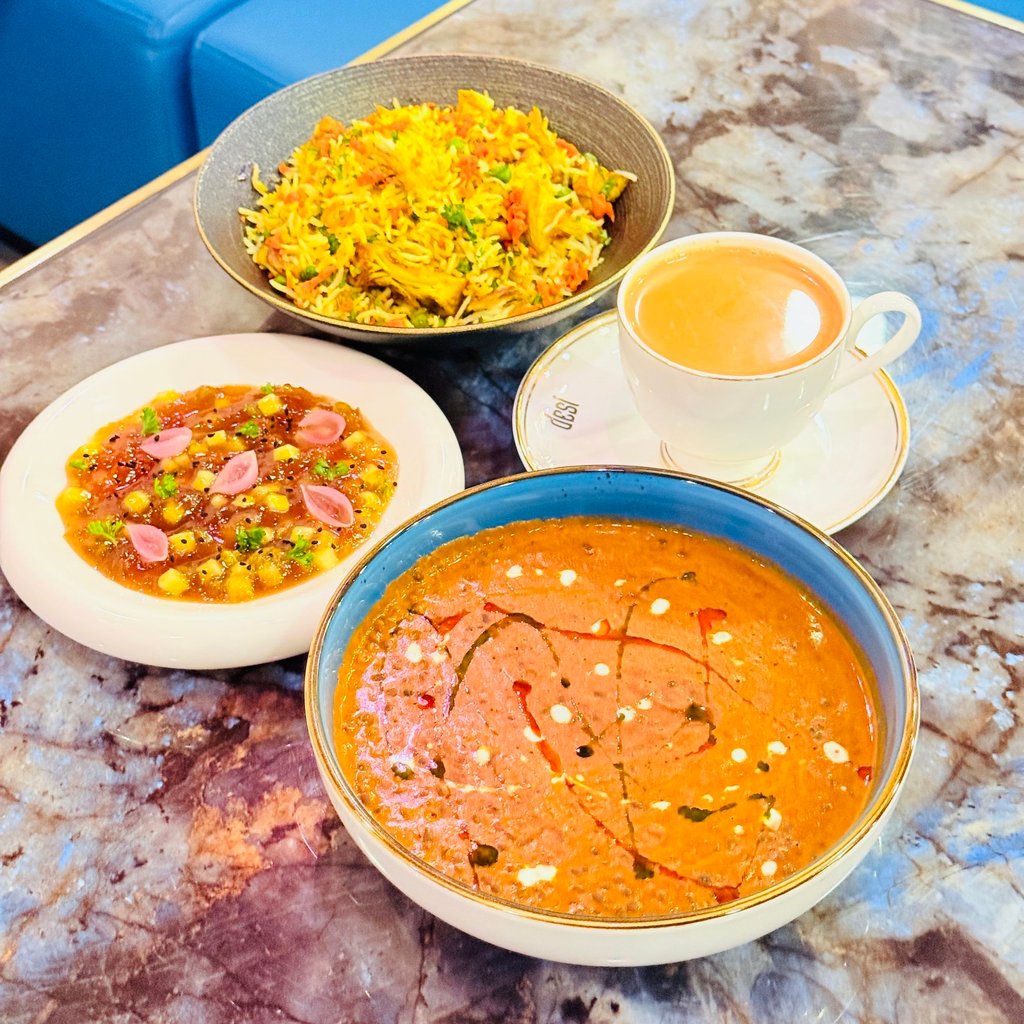
Chutney, daal, pulao and masala chai – all incorporating cinnamon – at Desi Indian Lounge in Vancouver. Photo: Handout
When you make basic gravies and curries, you temper or heat the oil and then add spices like cinnamon, green cardamom, cumin seeds, coriander seeds and bay leaves to release the fragrance,” explains the Vancouver-based chef. Cinnamon has a warm and strong flavour, but you need to know how to use it and in what quantity; we use less of it relative to other spices. When we use it in curries like garam masala, we use it in a powder form, but not too much,” he cautions.
Advertisement
He says a cinnamon stick is usually roasted in a pan or oven with other spices before they are all ground. In rice dishes, we add cinnamon to biryani rice and pulao,” he says. We first temper the spices with ginger and garlic to release the flavours before adding the rice and water. If you’re using a whole cinnamon stick at the beginning, it releases the flavour slowly. But before we serve the dish, we take out the cinnamon stick because it’s not edible.”
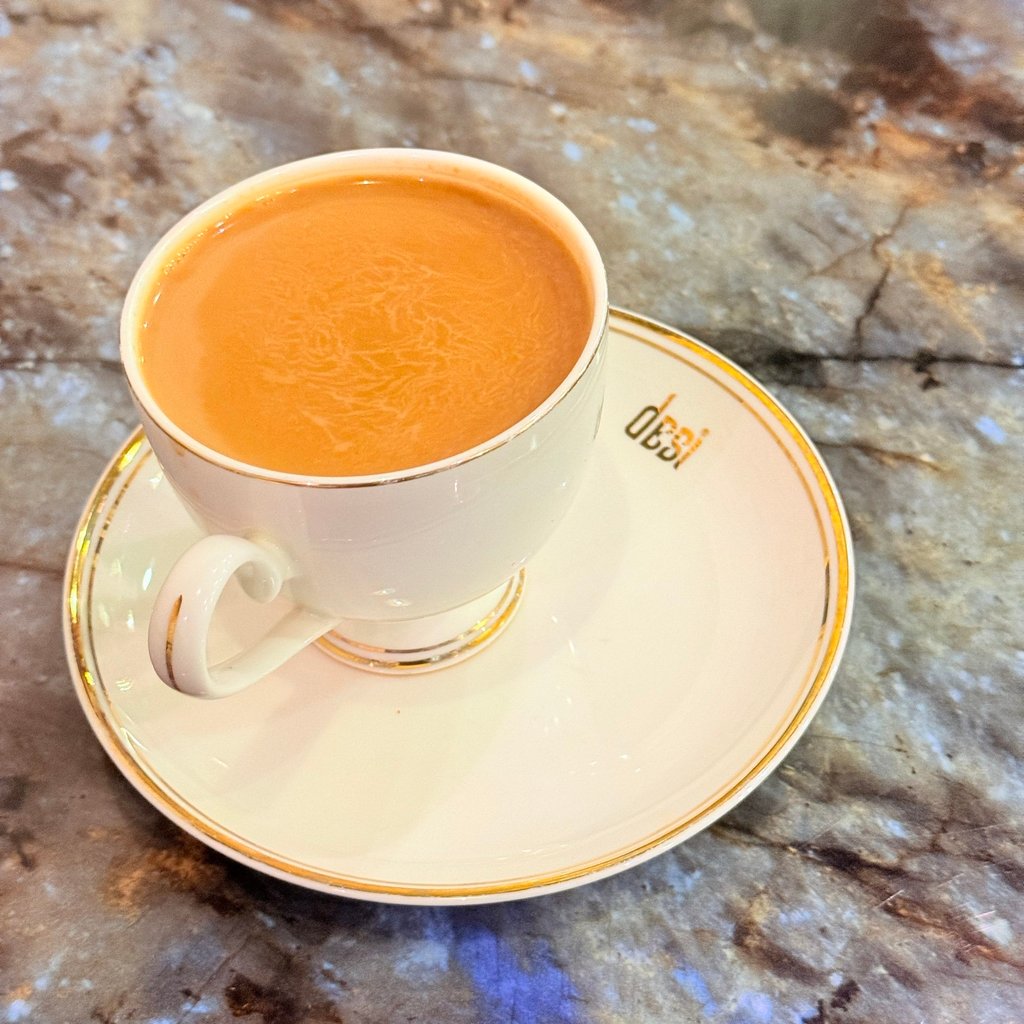
Masala chai, like the one served at Desi Indian Lounge, includes cinnamon. Photo: Handout
Ajagaonkar explains that the spice is also added to chutneys like pineapple and apple, while in desserts cinnamon is in shakarpara, a dough that’s baked or deep fried. Other cinnamon-flavoured desserts include cinnamon apple raisin pudding, pistachio and cinnamon lime kulfi, and halva with apple cooked with cinnamon and other spices. Cinnamon sticks are also used to make chai.
For most Cantonese people, cinnamon is combined with star anise, cardamom and tangerine peels to make lo sui or master stock to slowly braise proteins like tofu, goose wings and eggs.
However, many Cantonese also have a negative association with cinnamon, as it is used in Chinese medicine. The bitter medicinal taste of such medicines creates a bias that Cinnabon Hong Kong director Steven Yang Tsuen-men is trying to counter.
We [Chinese] don’t really have a sweet use of cinnamon like the Western world does,” he explains.
One batch of Cinnabons has 20 grams of Makara cinnamon from Indonesia. Photo: Handout
When he talks to potential customers who immediately dismiss cinnamon, Yang asks about their food preferences to find out where their aversion lies, and most of the time is able to persuade them to try the well-known American brand of cinnamon rolls started in Seattle, Washington, in 1985.
Advertisement
I tell them that they don’t like cinnamon because it’s very strong when they [first] smell it. If you take freshly ground cinnamon, it definitely has a very sharp taste. But once you bake it with butter, margarine and frosting and everything, it’s the sweetness that comes out,” he says.
Cinnamon also goes well with, or in, coffee. Photo: Handout
When the Cinnabon founders were developing their recipe, Yang says, they experimented with 100 different types of cinnamon and eventually settled on Makara cinnamon from Indonesia, which has a higher concentration of essential oils, giving it a more pronounced cinnamon flavour. Each tray of half a dozen Cinnabon rolls uses 20 grams of Makara cinnamon.
They tried different recipes, but they found that this type of cinnamon has the kind of sweetness and scent that [perfectly complements] the fluffy roll with its frosting,” he says.
Comments Off on The rich history of cinnamon, from Ceylon to Cinnabon
The Pattern seen worldwide is now on Sri Lankan soil
Across the West, gender ideology and early sexuality teaching are now facing major reversals due to: • child mental-health damage, • parental backlash, • confusion created among young children, • the explosion of gender distress cases, • the rise of irreversible medical harm.
Yet UNFPA, UNICEF, UNESCO and WHO continue pushing thesame failed modelinto developing nations — throughfunded projects, teacher training, and disguised curriculum wording.
The same failed gender and sexuality programs causing mental health crises in Western countries are now being introduced in Sri Lanka through UN-backed teacher training and NGO programs.
Sri Lanka is now inPhase 3 of their global model:
teacher training →pilot districts →curriculum integration.
The Camouflage Strategy — The Core of the Deception
UN agencies never begin with the words gender ideology” or Comprehensive Sexuality Education (CSE).” knowing the opposition by parents, religious leaders & entities concerned about children.
Instead, they use soft, harmless-sounding terms that appear culturally acceptable but are designed to contain the same content once embedded.
Internationally known camouflage terms include:
Notice how locals tapped to roll out the programs are also using these terms.
Their usage immediately exposes their allegiance.
· Life-skills education
· Skills for wellbeing
· Healthy relationships
· Gender-transformative pedagogy
· Body autonomy
· Inclusion & diversity
· Menstrual health & body literacy
· Adolescent development
· Safe and enabling school environments
· Youth empowerment
· Social-emotional learning
· Digital citizenship
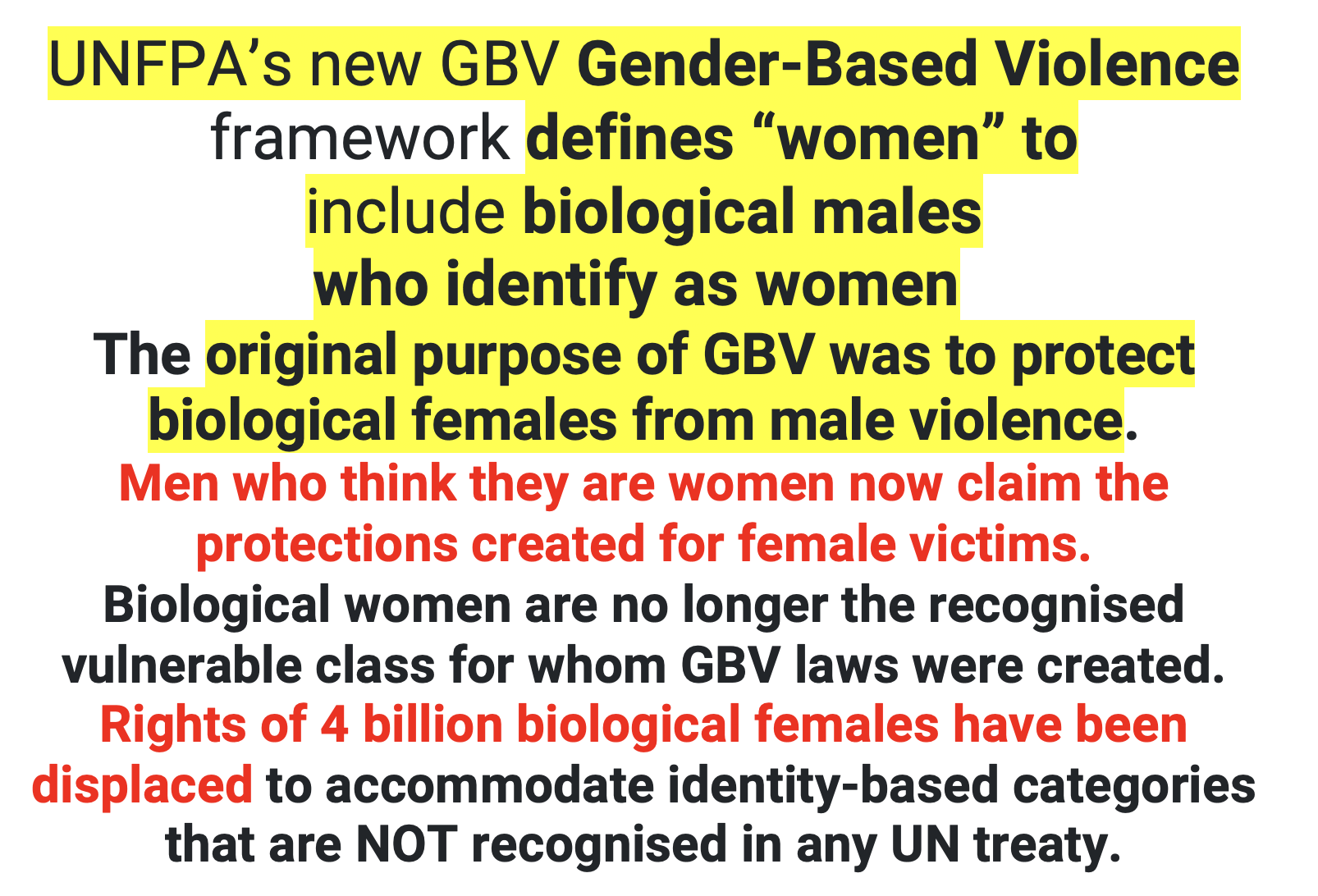
· Violence prevention (GBV)
Each of these terms links directly back to UNESCO’s International Technical Guidance on Sexuality Education (ITGSE) — the global blueprint for CSE.
Thus, what is presented as life skills”contains: • gender norms, • identity, • attraction/orientation, • pleasure, • relationships, • rights-based sexuality topics. — but in reality once approved the teachers will teach about masturbation, using condoms, early sexual experimentation etc.
This is how CSE infiltrates curricula without announcing itself.
This is why UN agencies must be questioned on why they are involved in curriculum design for Sri Lanka at all.
Chronological Timeline: The Sri Lankan insertion took place in a clear sequence
2014
· IPPF CSE Framework (2014):
Teaching about sexual pleasure and masturbation is essential for adolescents’ understanding of sexuality”(p. 12).
2018–2021 — Global Blueprint Finalized
· UNESCO, UNFPA and WHO publish and promote the revised ITGSE. This is the single most influential document behind every Comprehensive Sexuality Education project worldwide (note not sex education but sexuality education)
· Education should address gender identity, sexual orientation, and sexual rights of adolescents” (p. 22) ITGSE (UNESCO, 2018)
2019–2021 — South Asian Push Begins
· UNESCO CSE Regional Advocacy:
Sri Lanka participates in regional consultations. This is the first point of penetration.
This single sentence is the MOST IMPORTANT fact. It proves CSE is already in the school system via teacher training.
2022–2024 — NGO & District Pilot Programmes expand
· FPA Sri Lanka (IPPF member), UN-funded NGOs and private donors run: • youth SRHR (Sexual and Reproductive Health and Rights) clubs, • school sessions, • vocational institute programmes, • digital SRHR literacy projects.
The IPPF CSE Framework explicitly instructs teachers to cover ‘sexual pleasure’ (IPPF, 2014, p. 12)
Sexual and Reproductive Health and Rights (SRHR)is presented by UN agencies (UNFPA, UNICEF, WHO, UNESCO) as a harmless health or rights package.
ButSRHR is actually a broad political and ideological frameworkused to insert highly sensitive sexual, gender, and identity content into policies, schools, teacher training, and health systems without openly naming it.
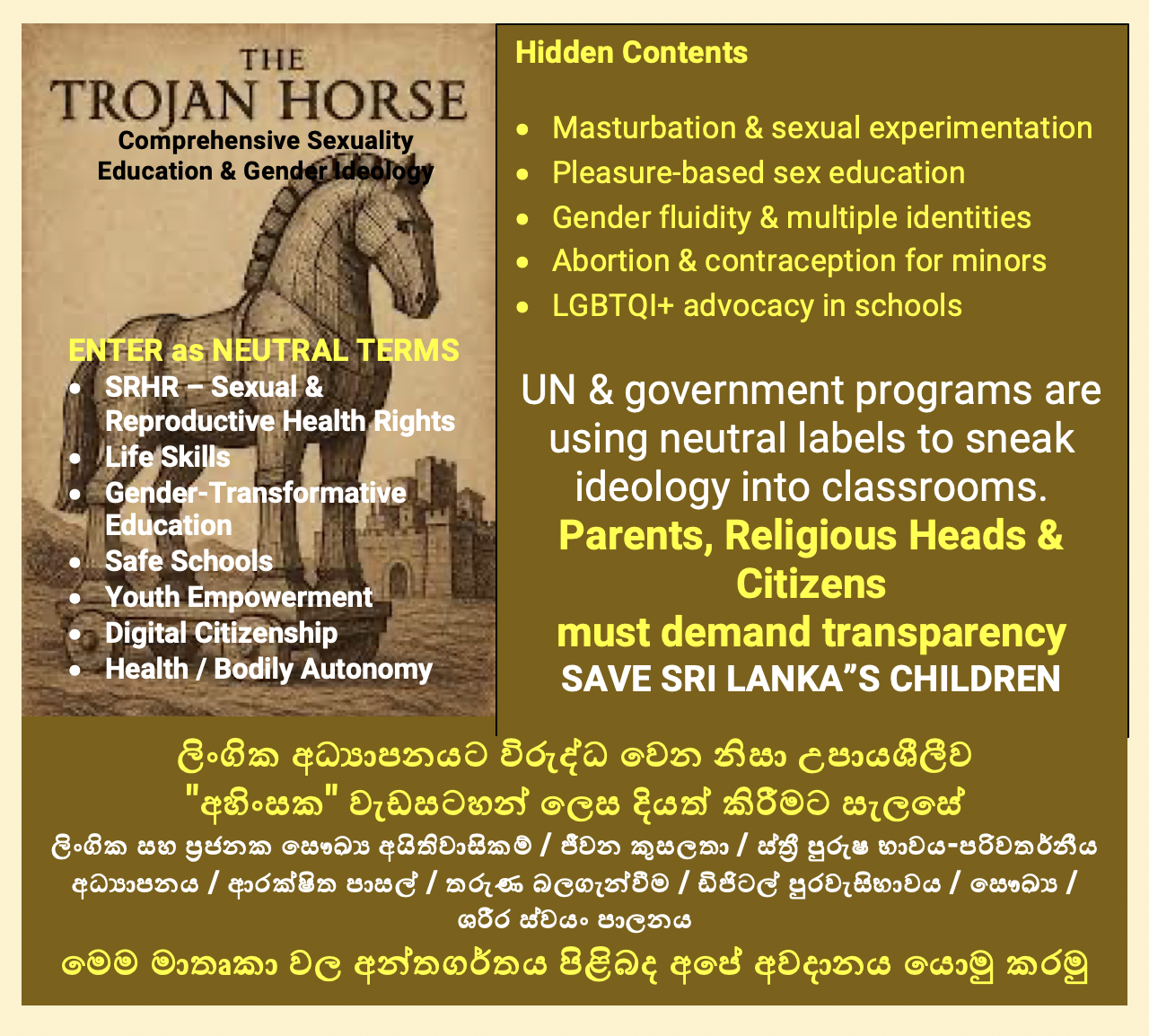
This is whySRHR is called a Trojan Horse— the term hides what is inside.
What SRHR actually Includes (Hidden Contents)
Below is the internationally accepted content of SRHR according to UNFPA, WHO, UNESCO, and IPPF documentation.
These are not assumptions — these are their own definitions.
1. Comprehensive Sexuality Education (CSE)
· Pleasure-based” sex education
· Promotion of sexual rights” for adolescents
· Content related to masturbation, sexual behaviours, and exploring sexual identities”
· Materials encouraging acceptance of all sexual orientations & gender identities
· Concepts that normalize adolescent experimentation and consent” narratives
Reproductive health services without parental consent
The Modus Operandi:
How UN Agencies Insert Gender Ideology into Schools, Step by Step
This is thecomplete mechanism, used worldwide and now visible in Sri Lanka.
Step 1 — Use of Soft Terms (Camouflage Phase”)
UN agencies avoid the word CSE” because it triggers public resistance. Instead they introduce broad terms that later allow sexuality/gender content to be added quietly.
Key terms used in Sri Lanka:
· Life-skills
· Gender-transformative education
· Safe schools
· Adolescent wellbeing
· SRHR (sexual & reproductive health & rights)
· Menstrual hygiene & body autonomy
· Healthy relationships
· Youth-friendly services
· Digital safety and citizenship
These are inserted into: • policy briefs • teacher guidelines • donor project reports • trainings • workshops
Step 2 — Train Teachers FIRST (Cascade Model)
This isalwaysStep 2 globally.
First train teachers →thenchildren.
UNFPA confirms:554 teacherstrained across6 districtson CSE + life skills.” This is acapacity-building pipeline.
Teachers trained will later: • deliver lessons, • influence school clubs, • modify existing subjects, • accept NGO-led student sessions.
These teachers will then influence students and school culture, embedding content without parental knowledge
The public never sees the training manuals.
Step 3 — Insert NGOs into Schools (Community Delivery Model)
This also matches the recent Tourism Authority incident — NGOs quietly training an entire sector to normalize LGBTQIA+ ideology.
Step 4 — Pilot Districts (Test Before National Rollout)
UN agencies NEVER start nationally. They pilot in 4–6 districts, gather data, then argue: Students benefited — therefore scale up.”
This happened with: • the 554 teachers, • youth SRHR clubs, • district workshops with FPA Sri Lanka.
Once pilots are established, integration becomes evidence-based.”
Step 5 — Curriculum Integration (Final Objective)
After enough teachers and NGOs are trained, UN agencies quietly move to: • influence curriculum revisions, • provide technical assistance,” • supply sample lesson plans, • insert modules into Health Science, Life Skills, Civics, and Social Studies.
The wording in syllabi remains soft… …but the content aligns with ITGSE (CSE blueprint).
This is the final takeover stage.
Why this is deceptive — The Core Argument
The deception lies in:
1.Changing the label but keeping the same content
2.Using harmless terminology to hide controversial concepts
3.Training teachers first — before parents are aware
4.Entering schools through foreign-funded NGOs — bypassing national approval
5.Piloting in districts where resistance is low or oversight is weak
6.Gradual integration — so no one notices the shift
8.Funding tied to acceptance of ideology forcing Govt to compromise welfare of Sri Lanka’s children for Govt funding.
This is not transparent. This is not democratic. This undermines sovereignty. And this exposes Sri Lankan children to ideological experimentation.
The Silence of Authorities: A Disturbing Failure
The Ministry of Education, NIE, and NEC have a legal and moral duty to protect children from unapproved curriculum content.
The Ministry of Education, NIE, and NEC are legally bound by the Constitution of Sri Lanka and Penal Code to protect children from unapproved curriculum content
All officials are constitutionally and legally obligated to protect children.
Failure to act constitutes dereliction of duty under the Constitution and Penal Code, potentially exposing them to legal consequences.
They cannot keep silent claiming they are simply doing their job.
Yet none have:
· published the teacher-training materials
· disclosed the training approval process
· provided the names/districts of the 554 teachers
· clarified curriculum changes
· revealed NGO entry mechanisms
· consulted parents or religious bodies
Parliament has been silent. Media has been silent.
Even the teachers taught who should have realized the dangers are silent. No oversight committees have intervened.
When agencies quietly influence curricula while sitting inside drafting committees, this becomesforeign ideological capture.
A National Duty to Expose the Process
This exposé has now documented: • the exact chronology • the global-to-local pipeline • the camouflage terminology • the NGO entry mechanisms • the teacher training evidence • the district-based delivery • the curriculum integration strategy • the silence of local authorities
Sri Lanka must urgently demand: * transparency * release of all training materials * full disclosure of curriculum edits * removal of foreign agencies from drafting committees * public consultations * protection of cultural, religious and constitutional values * safeguarding of children
If the West is reversing gender ideology because of its proven harm, Sri Lanka must not allow those same failed experiments to be imposed on our children through deceptive wording and foreign funding.
Multiple Trojan Horses being rolled exposing Sri Lankan children to ideologically-driven experimentation” or potential harm to mental and social wellbeing.
UN agencies usea portfolio of entry points, each appearing neutral or beneficial:
1. SRHR – Sexual & Reproductive Health Rights (IPPF CSE framework)
· Officially: health and rights”
· In practice: includes CSE content, sexual behaviors, sexual rights for adolescents, LGBTQI+ identity concepts, contraception, abortion information.
2. Life Skills / Skills for Wellbeing (UNESCO ITGSE)
The Buddha outspokenly criticized and banned animal sacrifice, a prevalent practice in Vedic traditions of his time, which significantly paved the way for the ideal of vegetarianism in India. His emphasis on compassion (karuṇā) and non-violence (ahimsa) toward all sentient beings formed the ethical foundation for this shift.
Opposition to Animal Sacrifice
The Buddha rejected the large-scale, bloody sacrificial rituals (like the aśvamedha) performed by some Brahmins and royalty, viewing them as cruel, wasteful, and a source of negative karma. He taught that true sacrifice was an internal, spiritual act of giving (dāna) done with a pure intention, rather than an external rite involving the slaughter of animals.
Stance on Vegetarianism
While the Buddha explicitly condemned killing or causing others to kill, his rules for the monastic community regarding diet were pragmatic due to their reliance on alms:
The “Three-fold Pure” Rule: Monks were permitted to eat meat if they had not seen, heard, or suspected that the animal had been specifically killed for their meal. This rule was designed to prevent monks from being a direct cause of an animal’s death and to graciously accept whatever food the lay people offered to gain merit.
Right Livelihood for Lay People: For lay followers, the Buddha proscribed certain professions, including being a butcher, hunter, fisherman, or engaging in the meat trade. This encouraged a social environment where intentional killing for food was minimized.
Rejection of Mandatory Vegetarianism: The Buddha notably refused a proposal by his cousin Devadatta to make vegetarianism mandatory for all monks, considering it an extreme ascetic practice that did not align with the Middle Way.
Historical Impact
The Buddha’s teachings, alongside those of Jainism, fostered a strong ethic of non-violence in Indian society. This led to a greater acceptance of vegetarianism, particularly among certain Hindu sects and the general population over time. The first Buddhist emperor of India, Ashoka, implemented policies reflecting these values, including banning animal sacrifices and restricting the killing of certain animals in his royal kitchens, further cementing the ideal of vegetarianism in Indian culture.
Thus, the Buddha’s strong opposition to animal sacrifice and his emphasis on compassion were pivotal in encouraging the widespread embrace of vegetarianism in India as a moral and spiritual ideal.
Several Indian states have passed legislation to ban animal sacrifice, including Rajasthan, Gujarat, Karnataka, Kerala, Puducherry, and Telangana
. Other states, such as Chhattisgarh and Delhi, have prohibitions against the slaughter of agricultural cattle.
Chhattisgarh: Prohibits the slaughter of agricultural cattle and the possession of beef.
Delhi: Prohibits the slaughter of agricultural cattle.
Several Indian states have enacted specific legislation to ban animal sacrifice, particularly within the precincts of public religious places or in public congregations and processions
.
Several states and union territories in India have specific laws against animal sacrifice, often focusing on public religious spaces. These include
Gujarat
,
Karnataka
,
Kerala
,
Puducherry
(a Union Territory), and
Telangana
.
Andhra Pradesh
also has similar legislation.
Odisha
has laws concerning cow slaughter, which may relate to animal sacrifice
Himachal Pradesh
. While briefly banned public animal sacrifices in 2014, the order was later lifted. The High Court in Tripura banned animal sacrifice in temples.
Additionally, the central Prevention of Cruelty to Animals (PCA) Act, 1960, criminalizes unnecessary animal suffering. However, a clause in Section 28 of the PCA Act permits killing animals according to religious requirements, which can complicate legal interpretations. More details on specific state laws can be found on Animal Legal & Historical Center.
India | Animal Legal & Historical Center
This law, specific to the state of Gujarat in western India, prohibits animal sacrifice within the precincts of places of public r…
Animal Legal & Historical Center
Source: AI Overview
Comments Off on The Buddha opposed Animal Sacrifice paving the way for India to embrace Vegetarianism.
Living in SriLanka for a few weeks I am stunned that we have no real development programmes that can convert the idle hours of our poor – the unemployed, into an income and in that process also produce some item that we import. This process will also really create foreign exchange for the country, by obviating imports.
Instead of being developmental we have Asesuma doling out dollars to the needy.
Milk, cheese and many food items are costlier than in the UK- in other words the people cannot buy their requirements. They are bound to forego a meal.
This is simple thinking. We once did it earlier and I am certain we have the resources and ability to do it again. We have a vast number of public servants, for whom we have found work in doing petty things. Why not we marshall them to get into production.
Even the Government Agents of the 22 Districts have no job since 1978. They had vast duties till then. In 1965 what happened was that Prime Minister Dudley Senanayake wanted them to take charge of paddy production and gazetted them as Deputy Directors of Agriculture, Agrarian Services and Cooperatives, the three Departments that attended to paddy cultivation. To enable the Govt Agents to devote their total time to Paddy Production the Government posted a senior officer, the Additional Government Agent to whom the GA was expected to hand over all his normal duties. ( I served as the Additional GA at Kegalla, ) In 1978 when Premier JR Jayawardena came he took back the GA away from paddy production and the GA shunted themselves back to do some work in the Katcheri, some work that the GA had already given to the Additional GA.
I am aware that my idea will create critics- so I will get down to specific instances of success in production.
Let me firstly think of what the Divisional Secretary at Kotmale did in the Divisional Development Councils Programme of 1970-1977. I am sorry I have forgotten his name. He with the youths in Kotmale collected all the waste paper he could find and churned them into rough paper and cardboard.
In my days in Bangladesh, creating the youth self employment programme we used to address hundreds of youths, motivating them to get down to make something for sale and we provided them with a lunch packet that came packed in a paper and cardboard and a few of the youth participants were carefully collecting the paper and card board, packing them to take home where they churned them into cardboard. It was a laboreous process, but they sold the cardboard they made to make a living. Now let us think of what we do today and what we have been doing ever since the days of JR Jayawardena- the Neoliberal days. Since 1978 we have been collecting all the waste paper we can find and we sell it to India and get a few coppers. I saw for myself the waste cardboard being transported this week in Nugegoda. That is not all. We buy the paper and cardboard that India has made out of the waste cardboard we imported and pay them in pounds. And we have been doing this from 1978, Really we need to have our heads examined,
Take paddy production. In 1956 to 1959, The Prime Minister Dudley Senanayake took over paddy production and directed that the GAa had to direct the three departments that dealt with paddy production- the Department of Agriculture, Cooperatives and Agrarian Services. . It was though his tremendous effort that we became self sufficient. Since 1978 we broke up our paddy production. We sold off- privatized the production of high yielding seeds and today the private seed farms sell the seed at a high price. The paddy cultivators find some seed to plant. Gone are the days when we planned production- finding high yielding seeds, motivating farmers to use fertilizer etc. . The Agrarian Services Department which through cultivation committees organized paddy production was almost totally wiped out. The latest was promoting some 2300 Agricultural Overseers- one year trained in agriculture to the rank of Grama Niladhari and this deprived the villlage base of the Department of Agriculture, built over decades. Today the Department of Agriculture has an Agricultural Instructor at the divisional level and he has to attend to around 150,000 or more farmers which he cannot do. Further the World Bank and the IMF decided that the agricultural officers should not use any institutions like cooperatives and should contact farmers direct and we agreed to follow it and thus an agricultural instructor can only meet about twenty to fifty farmers out of a mass of around 100,000 or more. Thus the World Bank and the IMF broke down out agricultural extension system and we follow that till now.
Thus today there is absolutely no village level officer or any public institution to attend to paddy production. The Agrarian Services which had cultivation committees was booted out and what is left today is a few offices that sell some grams of fertilizer. A few officers in clean sarees will weigh a few pounds of fertilizer and they talk big about it. Cultivators work guided by the rains and instances where they fail to plough and cultivate in time are many which cause problems like harvesting getting into the rainy season. Then they blame the rains.
It is high time that the Ministry of Agricuture looks into this and create a programme whereby farmers can cultivate in time. Unless this is done today or in the future we will have to be importing thousands of tons of rice every season- twice a year. Anyhow no programming of any sort can be done now as there is no staff at village level. And meanwhile the Agricultural Instructor creates some statistics. He has no overseers as President Premadasa made all agricultural overseers Grama Niladharis. The Ministry of Agriculture has no staff at village level to plan or do anything. Thus reams of paper are used in air conditioned rooms and programmes are written and everyone is happy. Meanwhile every season we import thousands of tons of rice.
Let me now get back to my boots as the GA at Matara in 1971- 1973, some fifty years ago. Then the Government of Premier Sirimavo implemented a new Programme to create production- the Divisional Development Councils Programme. It was really Dr N.M’s programme. We enlisted hundred of youths on small farms and trained them in agriculture and industries. To direct this programme they head hunted the greatest economist of the day professor HAdeS Gunasekera and created a special ministry directly under the Prime Minister. In my district, Matara, we established a large number of small farms training youths and also established a boatyard that made seaworthy boats. I wanted to set up more industries but the Ministry did not approve. We clashed because the Ministry did not want me to do new industries. So on my own I established a Crayon Factory.
Luckily I had a chemistry hons graduate as Planning Officer. We took over the science lab of Rahula College. Matara from six in the evening to midnight and my officers were experimenting to find the art of making a crayon. We were at it every night and at the end of the third month found the recipe and method of making a crayon. Then I commandeered the Morawaka Cooperative Union to set up a Crayon Factory which we fixed in two weeks working 24 hours a day. The President of the Coop Unon was Sumanapala Dahanayake, the member of Parliament for Deniyaya. We made crayons to fill two large rooms in two weeks and to get legitimacy we invited the Minister for Industries to open sales. We had to buy colours in the open market as the Ministry if Industries said that their funds were not for cooperatives.
We had placed some informants in the Ministry of Industries and found that the Ministry of Imports was about to make an allocation to import crayons and Sumanapala Dahanayale and I met the Minister for Imports and showed him the crayons we made., He was so surprised with the product that he gave us an allocation of foreign exchange to import colours. He stopped the import of crayons. I had to agree to set up a Crayon Factory in his electorate Kolonnawa.
Let me stop this real story of how we once created employment and made things we import today. I can go on but I think I have made my point home.
Let this small summary make our new masters think of what can be done to make our youths entrepreneurs making what we import today. What they make when it supplants import amounts to their making dollars.
We old hands are there ready to help if only the new Government wants to go ahead and correct our economy to move from import and sell, causing us to fall into debt and instead create entrepreneurs that will produce what we need- they will be creating not only items but when used will obviate imports thus creating dollars.
We need not beg for dollars as we will be making them ourselves.
Time for deep thinking
Garvin Karunaratne
former GA Matara, Ph.D. Michigan State Univewrsity
21/11/2025
Comments Off on Begging for dollars is demeaning and we can get away from it
What Exactly Is the Gender Recognition Certificate?
The Gender Recognition Certificate (GRC) in Sri Lanka is not a law, not a statutory instrument, and not a legal entitlement.
It is merely an administrative document issued by the Ministry of Health through Circular No. 01-34/2016, authorising a change of gender marker on certain official documents such as the NIC or birth certificate.
Key Facts
It is an administrative approval, not created by Parliament.
It has no statutory forceand does not create legal rights.
It is managed through an internal process of the Mental Health Directorate.
It operates only so long as the Ministry chooses to implement it.
This means the GRC is legally unstable, constitutionally vulnerable, and administratively inconsistent.
Administrative Circular vs Statutory Right
Statutory rights
Created by Bills/Acts in Parliament
Binding & changed by repeal or amendments only
Administrative Circulars
Issued by Ministry/Dept
Not enforceable in court & can be reversed
Cannot alter Acts or Constitutional provisions
Can be withdrawn / cancelled easily
Administrative circular CANNOT change a person’s legal sex or alter rights related to birth sex, marriage, divorce, penal offences, prisons, adoption, inheritance etc
Yet the GRC attempts to do exactly that.
Why the GRC Is Potentially Ultra Vires(Beyond Legal Authority)
The Ministry of Health has no legislative power to alter legal sex. Only Parliament can do so.
The Registrar General, Police, Prisons Department, and Judiciaryare bound by laws passed by Parliament — not by health circulars.
The GRC therefore:
Creates a de facto legal sex change without legal authority
Directly conflicts with existing laws, especially:
Penal Code 365 / 365A
Marriage Registration Ordinance
Prison Ordinance
Evidence Ordinance
Birth and Death Registration Act
Any GRC-based decision can be challenged and struck down in court.
Criminal Justice, Public Safety & Law Enforcement Risks
Prisons & Detention
A GRC male holder claiming to identify as a woman may demand placement in female facilities. This creates:
Safety risks
Privacy violations
Legal contradictions
Internationally documented abuse cases.
Identity Manipulation & Evasion
Because the GRC can be obtained administratively:
Offenders can exploit identity changes
Cross-province evasion is possible – commit a crime / obtain GRC & live in another province.
Criminal record matching becomes difficult
Penal Code Conflict
Sections 365 and 365A apply to biological sex.
An administrative gender change does not alter legal criminal responsibility, but it creates ambiguity that defence lawyers may exploit.
Implementation Timeline
2006– First circular recognising transgender persons (circular cannot be located)
Why the UK Supreme Court Ruling (2024) is relevant for Sri Lanka
In For Women Scotland Ltd v. Scottish Ministers (2024), the UK Supreme Court delivered a landmark judgment with direct relevance to Sri Lanka’s GRC debate.
Core Determination of the UK Supreme Court
The Court held that:
Sex” in the Equality Act 2010 means biological sex — not the sex recorded on a Gender Recognition Certificate.
Key Legal Outcomes
A GRC does not change biological sex in law.
Public bodies must usebiological sex when applying laws and policies concerning:
single-sex spaces
prisons
healthcare wards
searches
safeguarding
A GRC cannot override laws that depend on biological sex.
Transgender persons remain protected under gender reassignment,” but that protection doesnot entitle them to override sex-based rights of others.
Even in a country with aParliament-approved Gender Recognition Act, the GRC is legally limited and cannot redefine biological sex.
Why this supports Sri Lanka
If even the UK — with:
aGender Recognition Act (2004),
a detailed legislative scheme passed in Parliament, and
judicial oversight,
still rules that a GRC cannot change biological sex, then Sri Lanka, which has no Act, no legal framework, and only an administrative circular, cannot allow a GRC to alter or contradict:
Penal Code
Marriage and family law
Prison and detention policy
Birth registration
Gender-based protections
Constitutional interpretation
The UK’s highest court confirms a foundational principle:
Legal sex = Biological sex. Administrative documents cannot change it.
This makes the Sri Lankan GRC — issued merely through a Ministry circular — legally indefensible and constitutionally incompatible.
Marriage After Administrative GRC = Deception (Sri Lanka & International Context)
Sri Lanka’s Gender Recognition Certificate (GRC) is purely administrative, with no statutory force. Under the Marriage Registration Ordinance, legal marriage requires biological male and female partners.
If a person uses a GRC to present themselves as the opposite sex and enters marriage:
Theymisrepresent their legal sex,
Conceal a fundamental factaffecting consent, and
Create grounds for the marriage to beannulled as voidable for deception.
International Examples:
UK (R v McNally, 2013):Non-disclosure of biological sex in sexual relationships can amount to fraudulent deception.
Singapore (Lim Ying v Hiok Kian Ming, 1991):Marriage annulled when a spouse presented as the opposite sex.
Australia & Ireland:Legal disputes arose over marriage and rights based on administrative gender recognition.
Even if a GRC exists administratively, it cannot override birth certificates or statutory marriage law. Churches and civil authorities therefore have a valid legal basis to challenge such marriages as contrary to law and public policy.
No consultation with AG, Justice Ministry, Registrar General
Created a de facto sex-change mechanism
Human Rights Commission
Promoted GRC without examining:
Penal Code conflict
Constitutional conflict
Religious/cultural implications
Mental Health Directorate
Designed sensitive medical procedures without statutory mandate
Created a database (TNR) with no legal privacy protections
Oversight Failures by Public Officials
No one assessed:
Criminal evasion risks
Marriage & family law conflict
Prison placement conflict
Identity fraud
Cultural/moral implications
Warnings Ignored
Religious leaders (e.g., Cardinal Malcolm Ranjith) warned about foreign ideological influence — ignored.
Recommendations
Immediate
Suspend GRC issuance pending legal review
Forensic audit of TNR privacy risks
Inter-ministerial committee with Justice, AG, Police, Prisons, Registrar General
Medium-Term
Draft legislation (if policy continues) with:
strict eligibility
non-self-ID processes
judicial oversight
criminal accountability clauses
Long-Term
Align with Constitution
Protect public morality (Article 27(14))
Ensure child protection priority
Guarantee law-enforcement clarity
Sri Lanka’s GRC system is administratively created, legally weak, constitutionally questionable, and highly vulnerable to misuse.
International experience — especially the 2024 UK Supreme Court ruling — confirms that biological sex remains the legal foundation of sex-based protections, identity, and public administration.
A mechanism of such magnitude cannot be introduced through a Ministry circular.
It requires Parliament, public debate, legal safeguards, and constitutional clarity.
Until then, the Sri Lankan GRC remains a legally unstable administrative instrument with serious national implications.
Shenali D Waduge
Comments Off on How Legal Is the Gender Recognition Certificate (GRC) in Sri Lanka?
For the first time in history, a UN agency is attempting to erase the biological foundations of human rights. UNFPA — created to protect men and women based on biological sex — is now redefining these categories without mandate, without science, without democratic consent, and without a single treaty backing its actions. By replacing sex with gender identity” inside the Gender-Based Violence (GBV) framework, UNFPA is stripping 4 billion biological women of sex-specific safeguards built over decades of struggle and sacrifice. Simultaneously, it dissolves the rights of 4 billion biological men, who are now recast as identity holders” rather than a sex-based class with distinct societal, familial, and reproductive roles.
This is not a policy adjustment.
It is the largest, quietest, and most dangerous re-engineering of human rights standards in UN history.
And it is happening with:
no approval from member states,
no amendments to binding treaties,
no vote in any parliament,
no scientific basis,
and no public consultation.
Yet governments remain silent, and the UN system is complicit, allowing UNFPA to rewrite legal sex categories through administrative programming — something even the UN General Assembly never authorized.
The question is unavoidable:
How can the UN allow one agency to dismantle the sex-based rights of humanity’s entire population — 8 billion people — without any legal authority or global consent?
UNFPA’s Original Mandate was entirely Sex-Based
UNFPA was established in 1967 to protect reproductive health for men and women — meaning biological sex categories only.
Even in 1997, the UNFPA Executive Director confirmed that reproductive rights belong to both men and women — again referring only to biological males and biological females.
What GBV originally meant — Sex-Based, Not Identity-Based
1993 – UN Declaration on the Elimination of Violence Against Women Introduced the term gender-based violence.”
At this time gender” was used as a synonym for biological sex, not identity.
Humanitarian definition (pre-2005):
An umbrella term for harmful acts based on socially ascribed differences between males and females.”
Not identities. Not self-declared categories.
1995 – Beijing Platform for Action
Violence against women” = gender-based violence directed toward women.” At the same conference, UN delegates explicitly agreed that ‘gender’ does NOT mean gender identity.
This is the most important legal fact.
CEDAW General Recommendation 19 Defined GBV as violence directed against a woman because she is a woman,” and framed GBV as sex-based discrimination.
None of these definitions included:
transgender,
non-binary,
gender-diverse,
or self-identified categories.
When did Men and Boys enter GBV?
The IASC Guidelines (2005) acknowledged that men and boys may also be victims.
This still meant: • violence against biological men by biological women, • violence against biological men by other biological men,
NOT: • men identifying as women, • women identifying as men.
GBV always referred to sex.
THEN CAME ….
The Great Shift: When Sex-Based became Identity-Based (Without Permission)
Sex-based → Gender-based → Identity-based. This shift was never approved by any UN treaty body.
From 2005 onward, UNFPA began replacing sex with gender identity,” using: • GBV programs • school curricula • DEI-style workplace policies
UNFPA’s 2005 Focusing on Gender” report is the first UNFPA document where gender” = identity, not sex.
The 2018–2025 Gender Equality Strategies expand gender” to include:
transgender
non-binary
gender-diverse persons
None of these categories exist in any UN treaty.
THE CORE PROBLEM:
UNFPA HAS NO LEGAL MANDATE TO REDEFINE MAN OR WOMAN
The Yogyakarta Principles (2006) — the only document attempting to define gender identity — are: • NOT UN law • NOT binding • NOT ratified • NOT adopted by any Member State
They have zero legal standing.
No UN treaty: • defines gender identity • equates identity with biological sex • authorizes agencies to replace sex categories
UNFPA is acting ultra vires — beyond its mandate — and using GBV frameworks to pressure nations into accepting identity categories without parliamentary approval.
Originally, All UN Rights Frameworks were Sex-Based
For decades, UN policy referred only to:
Sexual Discrimination / Sex-Based Discrimination
This always meant discrimination against: • Women because they are female • Men because they are male
Foundational assumptions: • Sex” = biological male or biological female • Rights were written for sex, not identity • GBV = violence against women due to sex-based vulnerability
There was: • no gender identity • no SOGI • no non-binary category
Even gays, lesbians, and bisexuals remained either male or female.
How UNFPA Shifted from Sex → Gender → Identity (Without Mandate)
From 2005–2006, UNFPA executed a 3-step redefinition:
Replace sex discrimination” with gender discrimination.”
This quietly moved protection from biological reality → ideology.
Expand gender” to include SOGI and self-identity.
No treaty authorizes this.
Insert identity categories into GBV.
Transforming GBV — originally protection for biological women — into a catch-all identity category.
Now GBV includes: • transgender identities • non-binary • gender-diverse • male-bodied people identifying as women
This replaces biological sex with identity.
Why this Is a Distortion — Not a Policy Update
It Removes Sex-Based Protections for 4 Billion Women
GBV existed because women face: • pregnancy-related risk • sexual violence • trafficking • FGM • sex-based biological vulnerability
Once sex is replaced with identity, women lose their dedicated legal protection category.
It Forces Identity into Women’s Spaces
UNFPA redefines GBV as: Harmful acts based on a person’s gender.”
UNFPA redefines gender as self-declared identity.
This means GBV now covers: • women • men • transwomen • non-binary • gender-diverse
RESULT: • male-bodied individuals counted under violence against women” • women’s shelters become mixed-sex • female statistics become contaminated
This is female erasure.
It Violates International Law
Treaties that govern states:
CEDAW — protects biological women only (changed only after 2008 through unofficial reinterpretation)
ICCPR — no gender identity
CRC — no identity replacing sex
CAT — no identity-based categories
In 2024, Sri Lanka’s Supreme Court confirmed in the Gender Equality Bill that biological sex remains the legal category.
UNFPA has zero authority to: • redefine men or women • create new sex categories • impose SOGI frameworks • alter school syllabi • override constitutions
The LGB vs TQIA++ Distinction
LGB (based on biological attraction): • does NOT require redefining sex • does NOT alter legal categories
TQIA++ (based on identity): • requires rewriting the meaning of male and female • depends on erasing sex • uses GBV to enter female protections
This is ideological — not democratic.
UNFPA’s Overreach Is Illegal, Unscientific, and Dangerous
UNFPA bypasses: • national parliaments • treaty ratification • public consultation • parental rights • biological science
UNFPA cannot override state constitutions — ECOSOC agencies have advisory power only.
This is the largest violation of women’s rights in UN history.
The Evidence Is Irrefutable
UNFPA has replaced biological sex with ideological identity — a category: • no parliament approved, • no treaty defines, • no scientific field recognizes as equal to sex.
By inserting identity into GBV, UNFPA is: • erasing sex-based protections • rewriting man” and woman” • displacing women from their own rights • violating CEDAW • overriding constitutions • imposing unratified norms on sovereign states
Yet the global system remains silent.
Why are governments not defending the sex-based rights of their citizens?
Why is the UN allowing an administrative agency to override 193 Member-State treaties?
Why are the rights of 4 billion women and 4 billion men being erased without debate or consent?
UNFPA will permanently replace biological sex with identity ideology in: • global law • education • health systems • workplace policy • GBV protection mechanisms
This is the most profound human rights violation of the 21st century.
The world must act now.
Stop the erasure of biological women.
Stop the dismantling of sex-based protections.
Stop UNFPA’s unlawful, unscientific, and undemocratic redefinition of humanity.
If UNFPA wishes to extend rights to TQIA++ individuals, it must create a separate category — not hijack, erase, or override the sex-based rights of 4 billion females and 4 billion males.
No UN Member State has ever voted to replace sex with identity.
Shenali D. Waduge
Comments Off on TOP UNFPA: Using “Gender-Based Violence” to erase Biological Women — A Violation of the Rights of 4Billion Women
This statement highlights historical events involving European powers—the Inquisition, the Holocaust, and colonialism—and the subsequent impact on Europe’s moral standing in the eyes of peoples in Asia, Africa, the Middle East, and elsewhere. These events are well-documented historical facts and the resulting perspectives from the affected regions are a subject of ongoing historical and post-colonial studies [1].
The Inquisition: While not a single event, the various Inquisitions (mostly active in the late 15th to 19th centuries) were a series of institutions within the Catholic Church that prosecuted perceived heresy. Their methods, which included torture and executions, are widely condemned today and are often cited as a historical stain on Europe’s religious and legal history [1].
The Holocaust: This systematic, state-sponsored persecution and murder of six million Jews by the Nazi regime and its collaborators is considered one of the most horrific atrocities of the 20th century. While perpetrated by a specific European regime, it is a significant historical event that raises profound questions about European morality and is a central part of global historical memory [1].
Colonialism: European colonialism spanned centuries and involved the exploitation of resources, the subjugation of indigenous populations, and widespread violence across Asia, Africa, and the Americas. The profound negative impacts of colonialism—including economic exploitation, cultural erasure, and political instability—continue to shape the perspectives of post-colonial nations and inform the view that Europe’s historical actions were “rapacious” [1].
The sentiment that these events have “debased the moral authority of Europe” in the eyes of people from the affected regions is a widely expressed viewpoint in post-colonial discourse, international relations, and cultural studies [1]. These historical injustices have led to lasting skepticism and criticism regarding Europe’s claims to moral superiority or universal values.
Comments Off on European involvement in the Inquisition, Holocaust and rapacious colonialism worldwide has debased the moral authority of Europe in the eyes of peoples of Asia, Africa and Middle East, among others.
NDB Bank has entered into a strategic partnership with EduViz International, a global education consultancy, to further strengthen its Student File proposition, designed to make overseas education more seamless, secure, and accessible for Sri Lankan students. The Memorandum of Understanding (MoU) was officially signed by Mr. Sanjaya Perera, Senior Vice President – Personal Banking and Customer Experience, and Mr. Zeyan Hameed, Vice President – Retail Banking, representing NDB Bank, and Mr. Kasun Kaluarachchi, Founder and CEO of EduViz International.
Through this partnership, NDB continues to play a pivotal role in empowering Sri Lankan youth to pursue world-class education by offering comprehensive and reliable financial solutions. The Bank’s Student File service enables students to conveniently handle tuition fees, and other education-related financial transactions through a streamlined, CBSL-compliant process. It ensures faster fund transfers, greater transparency, and complete peace of mind for parents and students embarking on their overseas journeys.
EduViz International, is a global education consulting organisation dedicated to guiding students toward their academic and professional aspirations. Built on the principles of honesty, transparency, and personalized support, EduViz has successfully helped over 1,000 students reach top universities around the world. Their team of advisors offers end-to-end assistance from university selection and application management to visa processing and pre-departure support ensuring a truly seamless transition to international education.
Commenting on the partnership, Mr. Sanjaya Perera, Senior Vice President – Personal Banking and Customer Experience at NDB, stated, At NDB, we are proud to be a part of every student’s journey toward global success. Our partnership with EduViz International reflects our commitment to making overseas education financially accessible and hassle-free for Sri Lankan families. With our trusted Student File service, we aim to provide students with the financial confidence and convenience they need as they pursue their dreams abroad.”
Adding his thoughts, Mr. Kasun Kaluarachchi, Founder & CEO of EduViz International, shared, At EduViz, we believe education is a life-changing experience. Partnering with NDB Bank allows us to offer students not only the right academic guidance but also the financial assurance needed to step confidently into their future. Together, we are simplifying the process and ensuring that every aspiring student receives holistic support, both educationally and financially.”
This partnership marks yet another step in NDB’s journey of supporting Sri Lanka’s next generation of global achievers. By working hand-in-hand with international education partners like EduViz, NDB continues to redefine the banking experience for students, making overseas education truly seamless, empowering, and future-ready.
Comments Off on NDB Bank Partners with EduViz International to Empower Students Pursuing Global Education
A vast number of people gathered to participate in the Joint Opposition’s ‘Maha Jana Handa’ (Voice of the People) mass rally held in Nugegoda.
Reporters noted that the city of Nugegoda was completely filled with people.
Large crowds converged on the rally site along the access roads leading from High-Level Road, Nawala Road, Pita Kotte, Jubilee Post, and Old Kottawa Road.
The rally started this afternoon (21). A large group of political figures attended the event, including National Organiser of the Sri Lanka Podujana Peramuna (SLPP) and Member of Parliament (MP) Namal Rajapaksa, Chairman of the United National Party (UNP) Vajira Abeywardena, Deputy General Secretary of the UNP and former Minister Harin Fernando, Professor G. L. Peiris, MP Chamara Sampath Dassanayake, Leader of the Pivithuru Hela Urumaya (PHU) and former Minister Udaya Gammanpila, and former MPs and Ministers such as Nimal Siripala de Silva, Anura Priyadarshana Yapa, Tiran Alles, Premnath C. Dolawatte, Sanjeewa Edirimanna, and Sugeeshwara Bandara.
Speaking at the rally, National Organiser of the SLPP and MP Namal Rajapaksa stated that the opposition will unitedly work to overthrow the current government at the first possible opportunity. He also added that the opposition is currently building up a massive force against the present government.
Addressing the crowd, Leader of the PHU and former Minister Udaya Gammanpila announced that steps would soon be taken to bring the entire opposition, including the Samagi Jana Balawegaya (SJB), onto a single stage.
The Deputy General Secretary of the UNP and former Minister Harin Fernando spoke, claiming that the Janatha Vimukthi Peramuna (JVP) inflicted the most damage upon the country in its 76-year history.
Comments Off on Nugegoda overflows as thousands join opposition’s rally