The Russians have decided there is no way to negotiate an end to this. No one will negotiate in good faith; therefore we must crush the enemy. And that’s what’s coming.” Colonel Douglas MacGregor (9:35 minute)
Strictly speaking, we haven’t started anything yet.” Vladimir Putin
The war in Ukraine is not going to end in a negotiated settlement. The Russians have already made it clear that they don’t trust the United States, so they’re not going to waste their time in a pointless gabfest. What the Russians are going to do is pursue the only option that is available to them: They are going to obliterate the Ukrainian Army, reduce a large part of the country to rubble, and force the political leadership to comply with their security demands. It’s a bloody and wasteful course of action, but there’s really no other option. Putin is not going to allow NATO to place its hostile army and missile sites on Russia’s border. He’s going to defend his country as best as he can by proactively eliminating emerging threats in Ukraine. This is why Putin has called up an additional 300,000 reservists to serve in Ukraine; because the Russians are committed to defeating the Ukrainian army and bringing the war to a swift end. Here’s a brief recap from Colonel Douglas MacGregor:
Landmark days, like the 1st of January and, more importantly for us in Sri Lanka, the Aluth Avurudda in the month of Bak (that’s April), are about renewal, discarding of hang-ups and errors, and a fresh page. We are now done with 2015. The year 2016 is ours to inhabit, revel in and decorate. It is ours to mess up too.
Landmark days, like today, are made of kiribath, some decorations, greeting cards and everyone wishing everyone else makes for good cheer. That’s all nice but in the end is but thin cover that other imperatives dissolve and pretty fast too.
The year that left us or which we left, like all years, was yet another endorsement of the ata lo dahama. Individuals, collectives and institutions were all subjected to the perennial vicissitudes; profit-loss, joy-sorry, praise-blame, and fame- obscurity. It is unlikely that things will be any different in 2016, except for the shape and wrapping these things arrive in.
Still, it is as good a moment as any to take stock, jot down some home-truths and make a few recommendations.
TO THE POLITICIAN:‘You are required to represent those who voted for you and not those who funded your campaign or are ready to give you commissions for favours wrought from power-abuse. Those among you who are in government do not own this country, her resources, heritage, labour-power and culture, but are only temporary custodians. Those in the opposition are required to point out flaw, offer constructive criticism and alternatives and mobilize people towards correction. Your internal squabbles are boring. All of you would do well to reflect now and then on your mortality.
TO THE PUBLIC SERVANT:‘Your salaries are paid by the people and not the politician, even if the largesse” of the latter can impact, positively or negatively, your spending capacity and job-frill. You may not be getting the salary you deserve but you are required to produce value equivalent to what you do get. We understand that you probably have a family to look after, but urge you to take the long view, Sansaric if you will or, if you believe in a hereafter of divine make, then recommend reflection on Judgment Day. In short, we suggest that conscience” is of greater worth than the urge to maximize benefit. Politicians come and go but the public remain. We salute those of you who do your job, unmoved by brickbats and bouquets, carrying the deadweight that is the incompetence, arrogance and theft-intent of your colleagues. We hope they become more responsible. In any event, we are watching them. They too are mortal.’
TO THE PROFESSIONALS: You are doing a thankless job and we appreciate. We deplore, however, those of you who prey on the miseries, impoverishment and ignorance of those who seek your professional help. There are those among you who deserve the tag ‘itu deviya’ but there are also others who are like Shylock and worse, like Antonio and Portia extracting far worse than a pound of flesh in the name of ‘justice’ or necessary service. We journalists belong to the same tribe called ‘Professionals’. We are conscious of our mortality.’
TO THE BUSINESS COMMUNITY: ‘We do understand and appreciate the role you play in providing goods and services. We do understand that profit is an important driver. We are not unaware that in all sectors you operate, there are those among you who engage in white collar crime, who are aware of and are not shy about slipping through legal and other loopholes and are willing and able to grease palms when convenient. We know you have things to sell and know that not all things you sell are necessary and not all things do what they claim to be. We applaud your enterprising spirit, but implore you to act like the responsible corporate citizen you claim to be in your annual reports. You are mortal and moreover, will not take your bucks to the hereafter.
TO THE BIKKHU, THE AYER, THE MAULAVI, THE PASTOR ETC: ‘With all due respect, live the word you speak, administer to the non-material needs of your respective flocks, take inspiration from the lives of your teachers and be worthy of respect and veneration. All this, not on account of the garb you wear or the temple you reside in but the fact of embodying to the best of ability or your karmic endowment, the word you speak.
TO THE PEOPLE OF THIS NATION:‘This country is yours and if it is flawed in leader and institution that is partly reflection of your inadequacies, including apathy, lack of courage and sloth. This country is yours in both its making and breaking, its slippages and renewal. Spit on it and you spit on yourself. It is yours to make fragrant, yours to defile. This nation is yours. This nation is you.
Let 2016 be a year where we take concrete steps towards becoming a society based on community (including workplace) accountability, all united to protect our lands, airs and seas, and most importantly, the sweat of our labor!
*’This is a appropriately changed version of ‘The Nation’ editorial, January 1, 2011
We are a few hours away from the year 2013. The world has not ended and the signs are it will not. Strangely, the end of the world sometime in late December was the most looked forward to event of the entire year, beating by a fair margin the Olympics, the US Presidential Election and the T-20 World Cup. Well, it looks like Doom’s Day prophets have called it a day. For now.
A calendar year is ending and a new year beckons. It’s naturally a moment to look back and look ahead, to think about the what-have-we-done and also the what-should-we-do. If the whole world’s-end hoopla taught us anything, it must be that we are collectively ignorant. We just don’t have the ability to predict. And if anyone is to be blamed it is ourselves.
Now it is not the case that the world has been spared natural disasters. Earthquakes, cyclones, tsunamis, droughts, floods, famine, epidemics and such are not unknown to the world. Our ancestors saw and suffered. They also knew war. . And the wars they fought, won and lost, were nothing like the conflagrations the world has known in the past century. What they didn’t have then was ‘development’.
There was a time when we had seasons: when we knew when it would rain, for how long, in what quantity and where. We knew about inter-monsoonal rains. Again, our ancestors knew enough about rainfall and where the rain would fall and where it would not. So they planned for drought. They built sophisticated irrigation systems. They knew enough about ecology to be circumspect in how they engaged with the natural world, especially since they were equipped with technological know-how capable of causing much destruction to ecosystems.
‘Development’ changed all that. ‘Modernity’ changed all that. ‘Modernism’ and ‘Develomentalism’ changed all that. Capitalism and Communism in their various articulations changed all that. These things spawned hordes of profit collectors and do-gooders (some naïve, some now) who wanted to modernize and develop societies that were deemed to be archaic and underdeveloped.
Things that worked were called ‘traditional’ or ‘crude’. Values and customs that built civilizations and sustained societies were tagged ‘heathen’. Those who did not require salvation were sought to be ‘saved’. And when it became clear that ‘the good life’ comes at a cost (environmental degradation to the point of ecosystem collapse and frenzied competition for resources resulting in wars), the do-gooders, so-called, said ‘people need to have choices’. They should, in other words, be able to choose between 10 brands of footwear, each brand offering a range of choices for the ‘sophisticated’ consumer. The consumer, at the end of the day, is much like his or her less needy ancestors, endowed with just two feet.
But everything we see, hear, taste, touch and smell come with three tags: loba (greed), dosha (envy/hatred) and moha (delusion/ignorance). They come with an invite: ‘Come, embrace and embrace tight!’ Delusion is a pernicious operative for it persuades us to destroy all that we have in the belief that this is a necessary condition for obtaining what we don’t have and didn’t need but have come to believe we must have in order to secure meaning in our lives. We throw away what we have (traditional knowledge, climate-specific seeds, ethics of giving and sharing etc) to obtain membership in a throw-away society; so that we can be called ‘developed’ and ‘modern’, where the tag-giver deliberately leaves out the obvious suffix, ‘fools’.
The world did not end as predicted, but there are many worlds that are ending or rather are being ‘ended’. That process should be stopped. We have ‘developed’ for quite some time now and have very little to brag about. Perhaps it is time to undo certain things. Perhaps it is time to un-develop.
Union minister Jitendra Singh’s statement in Parliament on the Ram Setu kicked off a political storm, with the Congress’ Chhattisgarh Chief Minister Bhupesh Baghel saying last Saturday that the Bharatiya Janata Party must apologise for misleading” the nation on the issue.
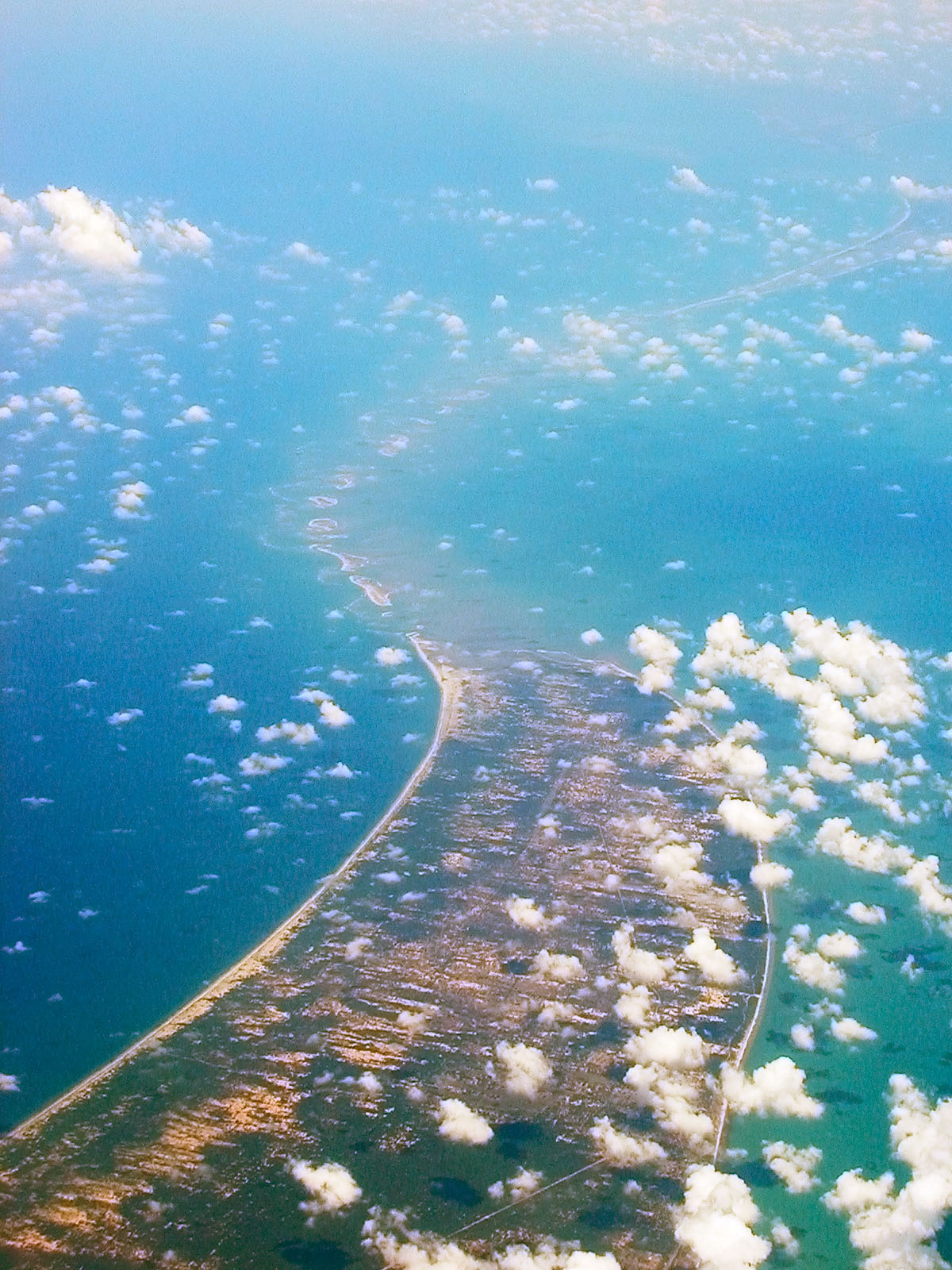
Ram Setu or Adam’s Bridge is a chain of limestone shoals between Rameswaram island off India’s south-eastern coast and the Mannar island off Sri Lanka’s north-western coast. Popular Hindu belief attributes its construction to the god Ram, according to events in the epic Ramayana.
Replying to questions on whether the existence of the Ram Setu can be proven through satellite imagery, Singh had stated on Thursday that such images cannot provide direct information about the origin and age of this structure (Ram Setu)”.
This latest back and forth adds to a long-standing political contentions between the BJP and the Congress over the nature of the Ram Setu’s existence – whether it is natural or human-made – triggered in the mid-2000s by the proposed Sethusamudram Shipping Canal Project. This canal would damage the formation which, the BJP claims, carries cultural and historical significance for many Indians.
What are the BJP and Congress arguing?
In Parliament, Earth Sciences Minister, Jitendra Singh explained there were limitations in exploring the Ram Setu through satellite imaging. Referring to the Ramayana, he said its history dates back to about more than 18,000 years and that bridge, if you go by the history, was about 56 kilometres long”.
Singh added: To some extent through space technology, we have been able to discover pieces and islands, some kind of limestone shoals, which of course can’t be accurately said to be remnants of parts of a bridge. But they have certain amount of continuity in location through which some surmises can be drawn.”
In response, Baghel attacked the BJP government saying, When the same thing [was] said during Congress rule, BJP called us anti-Ram. Now this Ram bhakt says in Parliament that they do not have strong proof (of Ram Setu).”
Citing a news report, former Madhya Pradesh chief minister and Congress leader Kamal Nath also said the Modi government had admitted that no solid evidence has been found for the [Ram Setu’s] existence”.
He further accused the BJP of hurting religious sentiments: This statement by the BJP government is an attack on the faith of crores of people of Hindu society. Lord Ram is the centre of the faith of the people.”
The BJP hit back at the Congress. The party’s Member of Parliament Rajyavardhan Singh Rathore and Manoj Tiwari said the Congress was twisting” the government’s statements – suggesting that the minister had not drawn any such conclusion.
Aerial view of the Ram Setu. Credit: CC-by-SA PlaneMad/Wikimedia
How did Ram Setu first emerge as a political debate?
This political debate on the Ram Setu is not new. The topic first became contentious when the Congress-led United Progressive Alliance government pushed forward the Sethusamudram project in 2005. The plan was first conceived of by the British in the 19th century and underwent several iterations with regards to the alignment, including one by the BJP-led National Democratic Alliance government in 1999.
The project would require dredging the seabed to create an 83-km-long deep-water shipping canal connecting the Palk Bay and the Gulf of Mannar situated between India and Sri Lanka. The water in the area is shallow, hindering navigation by large ships. The proposed canal would provide ships a continuously navigable marine route around the Indian peninsula as an alternative to having to go around Sri Lanka. This, the project’s proponents suggest, would cut travel time and boost economic growth.
What makes the matter contentious is that the canal’s alignment, as approved by the Congress government, cut across the Ram Setu.
This led the BJP and various Hindu organisations to oppose the project as the dredging would damage the the bridge.
Hindutva opposition
The BJP and other right-wing organisations have cited Hindu beliefs about the Rama Setu to oppose the project. They cite the Ramayana, the ancient epic, as mentioning that the Ram Setu was built by Lord Rama and his vanar sena” orarmy of monkeys. This bridge, according to the epic, was used by them to cross over into Lanka to rescue his wife Sita. Because of this, the BJP and other organisations say that the Ram Setu must not be damaged.
Representative image of UPA chairperson Sonia Gandhi (centre), then Indian prime minister Manmohan Singh (right) and BJP leader Lal Krishna Advani. Credit: STR/AFP Photo
On the other hand, in 2007 during the United Progressive Alliance government, the Archaeological Survey of India, which reports to the Culture Ministry, had filed an affidavit before the Supreme Court stating that Ram was a mythical character and that the Ramayana had no historical basis. Therefore, the government agency said there was no historical or scientific evidence to establish the Ram Setu is a human-made bridge. However, the affidavit was later withdrawn by the Congress government following protests by the BJP.
In 2018, the BJP-led Union government submitted before the Supreme Court that it will not touch the Ram Setu and would find an alternate alignment for the canal. But the project remains stayed as the matter is pending before the Supreme Court.
Some politicians, such as BJP leader and former Union minister Subramanian Swamy, have sought a national heritage monument status for the Ram Setu to ensure it is not compromised, even as the project remains in cold storage.
… thank you for making Scroll.in the digital-only news organisation with the widest reach in India.
We request you to support our award-winning journalism by making a financial contribution towards the Scroll Ground Reporting Fund. The fund will ensure we can continue to ask the questions that need to be asked, investigate what needs to be uncovered, document what must not go unrecorded.
Dr Sudath Gunasekara(SLAS) Former Secretary to Prime Minister Mrs Sirimavao Bandaranayaka
Gentlemen what have you done to the Kandyan Sinhala people,for 75 years since 1948, who protected this country for you and all of us, for 443 years from foreign enemies (1815-1948), other than closing down the only organization they had at least ‘to seek protection from an unexpected rain’ as the famous Sinhala adage goes The Department of Kandyan Peasantry Rehabilitation” on 1st Jan 2014. by the then Podu Jana Peramuna government by Basil Rajapaksha, the then Minister in charge of the subject.?
I pause this question to you in the backdrop of a news item that the present government has already taken action to improve upcountry plantation workers lives amid Indian push” under the directions of the President, unilaterally taken, based on wrong information and Indian lobbying.
I hold it as a Buddhist that improving the lives of any one in this country, from a humanitarian point of view is indeed commendable and definitely gracious. But if it is done at the expense of the native Sinhala people, the founders of civilization on this land, then such traitorous action should be condemned outright and fourth with, without any regard as to who has taken it. Improving the lives of people means many things. Basically, it can be land, shelter, food, water supply, clothing, medicine, education and employment.
In this essay I would like to confine to the two basic needs of land and shelter which usually go together. This land now being handed over to Indian Tamils who were brought here by the British after 1839 and on which houses are built with Indian funds was owned by either the crown of the Sinhale Kingdom or by our ancestors. Therefore, this land was ours and even today it is our life. Therefore, we vehemently protest and strongly oppose any steps taken by any government giving it to any foreigner. When it comes to these Tamils one can say, no!no! they are also citizens of this country. Yes, they are. But they are not the sons of this soil. I maintain that they are only political citizens. As they have been given citizenship by one politician at his own will (JR in under JR/Rajiv Accord of 29 July 1987)) due to pressure from India and due to political compulsion created by the greed for their vote. This land, the land of the Sinhala nation from the beginning of history must be first made available to their pre-emptive native owners. It should not be given to any foreign country as it was once done on 2nd March 1815.But at present this land once supposed to have been given back to the natives in 1948 is again given to Indian Estate labour only, thereby creating mono Tamil settlements all over the hill country. When the pole cat is thrown out of the door the skunk crawls in through the window, as Americans say. This process will create a ring of mono Tamil settlements right round the central hills extending to all areas where Tamil people live such as Kegalla, Ratnapura, Galla, interior Matara, Monaragala, Bibila, Passara Badulla, Kandy, Matale and even Kurunegala.
The resulting demographic changes will definitely lead to far reaching geopolitical changes followed by unpredictable consequences to the Sinhala nation in the near future. The district representation and the preferential voting system will make it worse as minority ethnic groups always vote for their candidates only. If this trend continues without taking precautionary measures immediately, the day this country becoming the 29th State of India is not that far. Once the 29th State is created the new Lankanadu and Thamilnadu will join hands and declare the Eelam which Pirapaaharan failed to realize for 30 years. With that the 1963, Jawaharlal Nehru, declaration on secessionism in India will also come to an end
The next step is declaring whole of India as the EELAM as forecasted by the EELAM theorists. It is this Eelaamist strategy every politician in India including Jayaprakash Naraayan has to realize at least now, before they try to exert their policeman influence and interfere with the internal politics of this country.
Once this is done the curtain will fall on the 2500-year-old Lanka and the Sinhala Buddhist civilization on this planet. This in short is what I predict will happen one day, if this ongoing Tamil settlement programme in the hill country is not arrested in time.
The only way to avoid this disaster
It was the native Sivhela (who later became Sinhala) people who defended this country against South Indian invasions from Ram-Ravana’s times in the yore and more recently from three ruthless colonial invaders namely Portuguese, Dutch and the English for 443 years. But attempting to solve the problems of the Indian labour with no concern for the plight of the Bhumiputhras is like trying to improve the lives of a neighbor’s family, without first have a look at his own kitchen and see that his own wife and children are not starving. I cannot think of a better advice than this I could give to the governments messing up with these short-sighted political agendas with utter disregard to one’s own country and the nation.
We, the patriotic Sinhala people of the Kanda Udarata lodge our strongest protest against this decision of giving special treatment to Tamils of Indian origin purely for petty political consideration, for which they will never be grateful as amply proved by all past experience, without paying any attention to first, rectifying the historical injustices done to the natives by colonial invaders by forcibly grabbing their ancestral land and forcing them to flee to the eastern jungles to save their lives followed by brutal and horrendous crimes against them for decades. The 1818 historic Uva uprising and the 1848 Matale rebellion by the Kandyan populous against the British rule were the best evidence where the native Sinhalese displayed their burning patriotism and gallantry against the repressor to save the motherland. Torrington in 1848 got down a large number of sepoys to quell the native freedom fighters in the Matale rebellion.
In fact, coming on to the present-day Tamil problem on the hills, actually speaking all these South Indian laborers should have been repatriated to India or taken to England at the time of British leaving this country in 1948. as all of them were legally British citizens at that time. As such this is another crime committed by the colonial British against Sri Lanka and the Sinhala nation for which they alone are directly responsible. Therefore, the government of this country should demand the British government first to repatriate these Indian labourers or take them to UK.
It is a big tragedy that our politicians of the day have not realized that danger at that time, whereas, all other countries like Burma, Mauritius, Tanganyika and Malaysia issued an ultimatum to all Indians to leave those counties. But Sri Lanka never did it and they are the people to whom the Government is now planning to hand over the ‘Geographical Heartland of Sri Lanka” THE HADABIMA (as I have named it) making a free pathway for India to walkover and to convert this Island to be the 29th State of India with no effort and replace British colonialism with Indian expansionism. Indian imperialism will definitely be worse than the British because they will do everything to compensate for their failures starting from the Ramaayana days.
It is in this backdrop I declare shame on those politicians who betray the Motherland and millions of sons of the soil who descend from the patriotic Brave Kandyan Sinhala freedom fighters”, who fought against three colonial invaders, Portuguese, Dutch and the English for 443 years and died in tens of thousands and sacrificed everything they had including their own mother earth and the right to live, to protected this Island for us to live today.
Not all present-day Indian Labour in Sri Lanka have a 200-year-old domicile history in this country as the Cabinet paper says.
The first batch of Indian laborers comprising 2,719 persons from what is now known as Tamil Nadu, came in 1839. By 1910, this number had ballooned to 409, 914 to work on Coffee and Tea plantations opened up by the British on lands that belong to the native Sinhalese forcibly acquired by the British invaders through draconian laws. As such to say these estate labourers have a 200-year history is wrong. I wonder who gave this wrong information to the cabinet, that by February 2023, it will be 200 years since the arrival of the first generations of the Up-Country Tamil community to Sri Lanka. In fact not all the present day Tamils living in these areas are descendants of the early immigrants as most of them have left the country from time to time.
To say that they have enormously contributed to the economy of this country is also absolute false.
The South Indian brought as indentured labour worked for their British masters right through out as slave coolies for very low wages and helped them to enrich the British coffers. Whatever these coolies had saved they transferred all that to South India annually in the form of Sterling Pounds and gold every year in their routine annual trips to their mother land. (For details see Tennakon Wimalananda (Dravida Munnethra Kasagam Vyaparaya haa Sinhahalayagei Anagathaya) So, it is very clear that it was Briton and India who had benefitted and not Sri Lanka from their labour. Therefore, to say that they have been contributing to the national economy of this country for 200 years is a blatant lie.
Their biggest contribution they made was to the British economy to enrich their coffers and to build their Empire and the rest was sent to India. As such they have contributed only to British and Indian economy. On the other hand, as far as this country is concerned, they were a big liability to the country’s economy right from the beginning as all their food requirements were also imported using money generated in this country. They were also heavily subsidized by the government on food, medicine, and all other facilities at the expense of the country’s economy. This also had a negative effect on the country’s economy. Importing wheat flour and rice in large scale to feed these laborers in a big way was a sad legacy we have inherited from that time. This again badly affected the domestic paddy production and local economy. Besides, Sinhala people also became accustomed to and became dependent on cheap imported rice and flour for the first time in history of this country. In this context I would like to ask the question from any one as to what positive contribution these people have done to this country’s economy or development.
What is worse is none of them has a love for this country. Though they earn their daily bread here, they all ways worship mother India, their gods and their politicians. Thus, they were and are 100 % Indians for all intent and purposes. As a school going small boy (12-15), I have seen even the barber saloon in the small town was always decorated with massive photographs of Indian politicians like Gandhi, Nehru, Subhas Chandra Bose and Indian Gods like Saraswathi, Ganesh and Hanuman. Thus, not only those who lived on the plantation areas but even those who lived in the townlets and cities lived mentally in India, although physically they were here and also earned their bread on Sri Lankan soil.” Even though they have got Sri Lanka citizenship on paper, thanks to our unpatriotic and vote-centric politicians, they still continue to be Indians for all intents and purposes for generations. The fact that Fifty percent of the man days lost to strikes were from the plantation industry proves the love they have towards this country. My personal experience tells me that these Indian Tamils who live here are, metaphorically, a set of people who pray long life to the ocean after having drunk water from the well. (ලිඳෙන්වතුරබීලාමුහුදටආවඩනමිනිසුකොටසක්)
My question to our crazy unpatriotic politicians who cry for the rights of the estate labour Tamils of Indian origin and approves urgent Cabinet papers based on false information is, what have you people done on earth to restore the birth rights of the Sons of the Kandyan Sinhalese whose ancestors have fought, died or got killed in tens of thousands and sacrificed all their rights including their mother land and the right to live during 344 years, starting from 1505, other than closing down the only organization ”The Kandyan Peasantry Commissioners Department”(even though it was also teethless and powerless) they had at least to protect their heads against an unexpected rain, on 1st Jan 2014. By Basil Rajapaksha of the Podu Jana Peramuna government. This is nothing but blatant betrayal of the motherland and the sons of the soil for which they will be never be forgiven. Shame on you who betray the motherland and the nation for a petty consideration of a vote, stained with blood of murdering a nation
I have no objection for improving the lives of upcountry plantation workers or any other segment of the society. Because that is one of the major social obligations of a state in any given country especially so in Sri Lanka being a Buddhist country. But why this Indian push’ on one particular group living in a specific geographical area in this country, as the news item says, unless they have some ulterior motive behind it. Is the hill country, where these Tamils of Indian live is already an area belonging to India, is a moot question.
The most important and the basic issue in opening up of large-scale settlements in the Hill country.
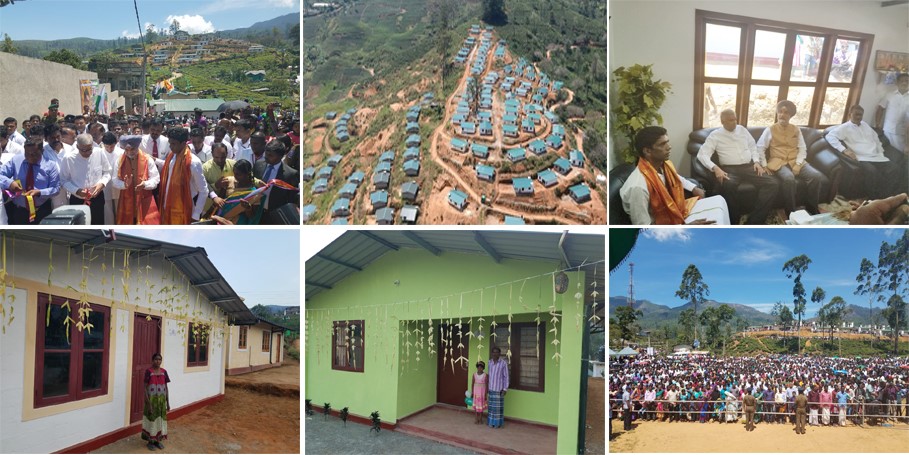
I would like to open this argument, for the need to protect the central hill country, and against its destruction caused by bad land utilization practices and by opening up of large scale settlements, as it is going on now, haphazardly conceived, on steep hilltops and slopes ( as shown by the following settlement recently opened up in Bogavanthalaava) that entail road construction and site clearings for community services like health centers, schools, temples, marketing centers and playgrounds etc (for narrow political expediency) that cause further destruction, with the opening passage of my paper, I wrote some time back under the caption The Central Hill Country: The ‘Hadabima’ (Heartland) of Sri Lanka A New Geographical Interpretation”
(Posted on December 2nd, 2017 Lankaweb.)
I pause the question to every man, woman and child in Sri Lanka as to what will happen to you, if your heart stops. Obviously, the answer is you will die. Similarly, one day, if the rivers that have their sources in the hill country, cease to flow, the curtain will fall on the survival of the entire life system in the Island together with its civilization due to lack of water, arising from deforestation, land degradation and bad land use practices on the central hills”
It is in this logical perspective that we should try to understand the critical importance of protecting the central hill country as the country’s geographical heartland” (HADABIMA) with the same care and caution that we take to protect our own hearts.)
The Central hill country of Sri Lanka provides the only source for all 103 rivers in the country. These rivers that flow down to the sea throughout the year in all directions keep the entire life system in the country alive. If these rivers cease to flow due to deforestation and bad land utilization practices followed by soil erosion and land degradation in the upper water sheds, one day, the rivers will cease to flow. The day they cease to flow the entire life system and the civilization of the whole Island will also cease to exist. Thus, the physical stability of the central hill country determines and dictates the fate of the entire life system and the civilization of this country.
The perennial flow of these rivers depends on the physical stability of the upper watersheds, even if it rains throughout the year. When it comes to settlements on the hill country lands, the most important and the basic issue is the need to protect the physical stability of the region as the survival of the entire life system and the civilization of this country wholly depend on its physical stability. It is the major and perhaps the only source of the entire water needs of the country. Besides this basic issue, there are some other critical issues like its geo strategic importance in relation to the security of the State, as it has been aptly proved throughout history of this Island nation and also other broader geopolitical considerations as well, that has to be seriously taken in to account before we jump in to taking decisions regarding any large-scale settlement scheme or any other sporadic settlements on this hilly terrain.
1 The first consideration is maintaining the physical stability of the central hills. Any activity on these hills must never jeopardize and destroy the physical stability of the central hill country above 1000 ft msl The geographical Heartland” of this Island nation that determines and dictate the survival of the entire life system in the Island and its civilization as it provides the main source of water and the biggest natural reservoir for the water needs of the whole country. We also have to remember that it also constitutes the main and the only water shed that provides the source for all the 103 three rivers that supply water to the whole country.
2 Geostrategic considerations
Other than the crucial importance of this part on the Island in relation to the Islands physical sustainability there is another extremely critical issue related to its geostrategic value in the islands geopolitical map of this part of the Island as it had been proved throughout history for which reason it must be kept completely free from any outside interference of any sort or any foreign settlements.
3 Geopolitical implications
A solid mono Tamil settlement right at the center of the Island with strong Indian control will have serious geopolitical implications ensuing due to major demographic changes. Therefore, such mono Tami settlements should never be allowed to exist as the degree of vulnerability of even a unilateral declaration of an independent state cannot be ruled out particularly in view of the current Tamil agitation for a separate Tamil state in the North and the east.
Now that all estate Tamils have been given Sri Lanka Citizenship the only way to circumvent this disaster is to establish mixed settlement in this part of the country to avoid such threats.
4. Harmonious ethnic reconciliation and total integration.
It is as a lasting solution to all these 3 issues in mind that I propose the following land use pattern to be adopted for the central highland of Sri Lanka in general, to overcome any future calamity.
This programme will also entail removal of all settlements on land above 3500 ft
The resulting new mixed settlements are finally expected to be integrated socially and culturally. That will also put an end to Indian interference in the central hill country of Sri Lanka at least.
Under this programme it is proposed that,
1 Declare all land above 5000 strictly protected and conserved forest (thanchi kele as it was during the ancient times)
2 All lands between 3500-5000 be confined to largescale tea plantations. Buildings within this area should be limited to only factories and allied staff quarters.
3 1000- 3500 mixed settlements of S&T on 2 ½ acre mixed farms of the HADABIMA model; Agriculture &livestock. This ring right around the hill country will provide the labour required for the tea plantations between 3500-5000as well.
In these settlements there will be complete social integration without any Indian interference, as it is done today. The integrated Tamils are not expected to be Indian Tamils any more, (if they want, they could be called Ceylon Tamils as an ethnic group, but not as a nation) where all will be equal and ultimately, they are expected to be another vibrant segment of the Sinhala society like the community inhabiting the SW coastal sector in the Island, who are said to be immigrants from South India during the early and mid-Kandyan Kingdom period.
Those who refuse to accept this settlement model should go back to their motherland South India. Either they should integrate with the native Sinhalese or go back to India. No one can live here as Indian or any other country’s citizen) They also have another option. That is, they can demand British citizenships as they were also British citizens when British left this Island in 1948.Because this had been the motherland of the Sinhala people at least for the past 2500 years. It is only in this country that each ethnic group assumes to be identified as a separate nation. In all other nation states like UK, America Russia India or Australia for example or any other you have only one nation. It is only in this country one finds this human joke. I attribute this situation to none other than the country’s politicians who have been running this country since 1948. Without a vision or a mission.
A separate state
In the event we fail to adopt this system, the Indian estate Tamils will eventually claim a separate State and in all probability, they will form a federation with the Tamils in the East and North. In fact, there had been a plan to open up a highway from Nuwara Eliya to Batticaloa during the Thondaman’s time. (Senior). The way how things are going on ultimately the Central Hill Country captured by the British in 1815 will be re captured by the plantation Tamils of Indian origin in no time, India will declare this Island the 29th State of India as Jayaprakash Narayan recently opined. Finally, it will be worse than the British occupation. And eventually the Sinhala nation will disappear from the surface of this planet.
It is in view of this imminent danger, that I propose all Sinhala politicians to support the above proposal unanimously to protect not only the Heartland of the Island but also the life system and the civilization of the whole country.
The singing of the national anthem in Tamil has led to two opposite reactions, for and against. There is also a conciliatory approach which said the Tamil version, could be sung in Tamil, in Tamil majority population area but when it comes to state and national functions it must be sung in Sinhala.
Others were less tolerant. A national anthem is a symbol of the identity of a nation, it is a symbol of unity. The Sinhala national anthem is composed with due regard to the auspicious nature of the words. Today the north is all Tamil, and they have with all impunity sung the national anthem in Tamil, they complained.
Why can’t the Tamils learn to sing the national anthem in Sinhala? If they are able to learn other languages in the countries they live in now, why can’t they learn Sinhala? They do not ask that the national anthem of the countries they now live in be translated to Tamil so they can sing it with fervor and loyalty, Sinhala supporters said angrily.
The legal angle was explored. Ladduwahetty said that the Constitution only provided for the Sinhala version of the anthem. Article 7 of the constitution makes it clear that the national anthem cannot deviate from the words and music given in the schedule and the words in the schedule are in Sinhala. Article 7 is an entrenched provision which cannot be amended, repealed or tampered with. President Sirisena has permitted the national anthem to be sung in Sinhala and Tamil in 2016. Is this a violation of the constitution Ladduwahetty asked.
The singing of the national anthem in Tamil in 2016 was challenged in Supreme Court as a violation of the Constitution. Shortly after the National Anthem was sung in Tamil on 4 February 2016, a legal challenge was mounted against the move. A Fundamental Rights petition was filed in the Supreme Court. After considering submissions by all parties concerned, a three-judge bench in November 2016 refused to grant leave to provide with the petition, reported Jeyaraj.
Centre for Policy Alternatives (CPA) filed an intervenient petition in the case. A communiqué issued by the CPA stated as follows: Sanjeewa Sudath Perera and two others filed a petition dated 26 February 2016 in the Supreme Court challenging the decision to sing the national anthem in Tamil at the official Independence Day celebrations in 2016. The petitioners argued that singing the Anthem in Tamil was contradictory to Articles 7 and 12 of the Constitution which relate to the National Anthem and rights to equality and non-discrimination respectively.
On 4 March 2016, CPA and its Executive Director Dr. Paikiasothy Saravanamuttu filed an intervention petition which argued that singing the National Anthem in Tamil was constitutional. The petition first referenced Articles 18 and 19 of the Constitution which state that Sinhala and Tamil are Official and National Languages of Sri Lanka. Furthermore, unlike subordinate legislation such as acts of Parliament, the Constitution contains no provision which stipulates that the Sinhala text shall prevail over the Tamil. As such, the words and music of the National Anthem in the Tamil language are constitutionally recognised by Article 7 read with the Third Schedule of the Tamil version of the Constitution.
The intervention petition further referenced Article 12 of the Constitution claiming that a declaration that the National Anthem be sung only in Sinhalese would be a direct violation of Article 12 which in turn would be a violation of the fundamental rights of Tamil-speaking citizens. The CPA also supported two additional intervention petitions that supported the constitutionality of singing the National Anthem in Tamil.
The Supreme Court took up the case on 18 November 2016, discussing whether the petitioners made a strong enough case for considering the petition in court. During discussions, the DSG referenced Articles 18 and 19 of the Constitution recognising both Sinhala and Tamil as official and national languages and that the singing of the anthem in Tamil was not in violation of the Constitution. The Court therefore decided that the petitioners had not disclosed a case to be considered and subsequently their case was dismissed.” concluded Centre for Policy Alternatives .
Canada had four languages ,English, French, Inuit and a bilingual version where the middle verse is in French, beginning and end is in English. South Africa has five official languages, Xhosa, Zulu, Sesotho, Afrikaans and English. The national anthem had four stanzas. First stanza is in Xhosa and Zulu, two lines each, next stanza in Sesotho, third in Afrikaner, fourth in ‘English,
Those against the Tamil version dismissed these examples. They stated that now Sri Lanka had joined South Africa, Canada, Switzerland, New Zealand and Fiji as a country having two national anthems. Sri Lanka need not take the new nations such as Canada, New Zealand and South Africa as examples. They were countries which had ethnic issues which were in some cases, still simmering.
Instead those opposing the Tamil anthem turned to Singapore and India. In Singapore, though Mandarin is the majority language, national anthem is in Malay. In India the national anthem is sung in only one language . It is a patriotic song written in Sanskritised Bengali by Tagore , adopted as the national anthem. It is not even in the official language , Hindi. But all Indians sing it regardless of whether they understand it or not. India stipulated that all schools in India have to start the day with the national anthem.
Those supporting the Tamil version stated that there is nothing in the constitution against the anthem being accurately translated in word and spirit and set to the same music and sung in Tamil. Tamil is an official language. The Anthem has been translated and sung in Tamil soon after it was adopted by the government [ in the 1950s]
Independence Day celebrations in 2020 saw the National Anthem being sung in Sinhala only. Tamil was excluded. The Tamil Separatist Movement ran to the UNHRC. The United Nations High Commissioner for Human Rights Michelle Bachelet mentioned it in her 17-page report to the United Nations Human Rights Council (UNHRC) in2021.
Ethnic and religious minority communities are left behind and excluded in Sri Lanka Bachelet said. Among instances noted by the UN Human Rights Chief in this regard was the exclusion of the National Anthem in Tamil. The report stated: The Government declined to include the National Anthem in the Tamil language on national occasions, such as the Independence Day celebrations, on 4 February 2020, despite the preceding years’ practice of singing it in two languages as a significant gesture towards reconciliation.” Such an approach has serious negative implications for reconciliation, peace building and religious tolerance, and carries the seeds of future violence and conflict, Bachelet concluded.
The Tamil Separatist Movement uses emotional arguments to support its case for a Tamil version of the national anthem. Here is a selection:
A National anthem is meant to unite and that doesn’t mean singing it in one language in a multi language society where diversity is recognized and accommodated in the constitution.
The Sinhala only national anthem was designed to divide rather than unite, to widen the psychological gulf the majority and the minorities and drive home the lesson that minorities are not so welcome interlopers in a Sinhala country.
There is greater chance of inculcating a sense of Lankan patriotism in Tamil/Muslim children when they are allowed to sing the national anthem in their own language rather than parrot it in a language they barely understand. Tamil could understand the meaning instantly when they sing it in Tamil.
People who insist that Tamils speaking people should be forced to sing our national anthem in Sinhala. This is to demonstrate their superiority to the numerically weaker Tamils. Nationalists want to ram the Sinhala national anthem down the throat of our Tamils speaking brethren. They are showing tribalism.
Tamils cannot think of themselves as Sri Lanka when the national anthem is in a language that they cannot understand said one supporter. He suggest including aTamil verse in the national anthem. It will also help chauvinistic Sinhalese to remember that there are people other than the Sinhalese living in this country.
If we truly believe that we are the children of one mother we must provide the opportune for the Tamil speaking people to sing our national anthem in theirmother tongue.’ said one supporter, forgetting that children of one mother will not be speaking in two different languages.
We must voluntarily learn the national anthem in each other’s language, so we can all sing it together.
Listening to the singing of the national anthem in either or both language is indeed a moving experience. It is most moving when it is sung in our mother tongue or both languages.
What the opponents of singing it in Tamil advocates is to force Tamils to recite it and even mispronounce words without understanding it. Or worse, compose a song for themselves with different sentiments. ( Concluded)
President Ranil Wickremesinghe has called all parties to get together and solve what he calls the ‘ethnic-problem’ that has remained ‘unresolved’ for decades. Meanwhile, parties that claim to represent ‘Tamil interests’ have put forward a set of demands: a) stop ‘land grabs in the Northern and Eastern Provinces by armed forces the state institutions while releasing all lands so acquired earlier by them in those two provinces, b) hold provincial council elections forthwith after implementing all provisions in the Constitutions and other laws in respect of power devolution, and c) implement power devolution under a federal framework through a new Constitution are the three demands.
Any private lands acquired by the state for military purposes should be returned to original owners provided that doing so does not compromise strategic interests. It is hard to imagine that there are ‘strategic interests’ that are vital that such an exercise should be ruled out. Using state lands for state-purposes is of course another matter.
State operations may one day be carried out entirely in virtual space. Maybe state institutions would one day be moved to floating facilities in the sea or in the sky. Until then, they need land and there’s no logic in demanding that they should be located in or out of a particular province. Calling it ‘land grab’ is downright silly. The use of the term ‘land grab’ is interesting. A Freudian slip, in fact, considering the entire discourse of Tamil nationalism, sorry, chauvinism.
Holding provincial council elections, on the face of it, is a legitimate demand. However, it is strange that these very parties have been conspicuously silent about elections not being held for years! It’s almost as if they’ve never been serious about devolution of power. More importantly is the fact that provincial council were set up illegally via a constitutional amendment forced on Sri Lanka by India in a do-it-or-else manner following the infamous dhal-drop by that country’s Air Force.
The third demand is fine: power devolution under a federal framework through a new constitution. Anyone (including Tamil chauvinists who were vociferous approvers of terrorism and terrorists) has the right to demand anything. Whether such demands can be met is another matter. They can and should be considered. That’s what one expects from a functioning democracy. There should be mechanisms for this and if such don’t exist then they need to be put in place.
There’s a problem though. Why federalism? Why devolution? On what basis? Grievances, did someone say? What grievances? And, if such do exist, what logic dictates ‘devolution’ as the one and only way of resolving them? Well, Tamil chauvinists are pretty thin on all this. History is not on their side. Archaeology is not on their side. Demography is not on their side. Geography is not on their side. And even economics is not on their side.
There are serious problems with Tamil nationalism and nationalists. Substantiation is not their thing. Ask them to do so and they twiddle their thumbs. Talk history and they dodge. Talk about demography and they pretend people and land don’t go together. Talk solutions and they start shifting goalposts. Talk economics and the logic or otherwise of devolution (the Western Province has close to 75% of the country’s GDP and if we played devolution-logic to the letter we would see the continued relative impoverishment of certain districts and provinces) and they will talk about human rights violations. Talk about human rights violations and they act as though it all happened in 2009 and that the LTTE was a band of angels. Insist and they mutter ‘Darusman Report.’ Ask a few pointed questions about veracity of claim and they rant and rave about something else in the manner of artful dodgers.
Thus, when they demand devolution under a federal framework they are talking absolute rubbish. Not too long ago, i.e. in November 2019, the people of this country voted at a presidential election. The winner and the candidate who came second together polled 94% of the vote. Both pledged to uphold the unitary character of the state. The Tamil National Alliance supported one of these candidates, Sajith Premadasa. So what talk of federalism? If they were so principled, shouldn’t those in the TNA and other ‘Tamil’ parties have disassociated themselves from any individual or party that did not espouse their cause or at least claim that they will consider a ‘federal’ constitution?
The Tamil National Question. That’s what they like to call it. Question. That’s the key word here. Tamil chauvinists do have a problem, a question. They really don’t care about ground realities. They don’t care about history. They don’t care about demography. Yes, we need to say these things again and again, simply because the biggest question about Tamil Nationalism is this: ‘why is the word ‘substantiation’ not in their vocabulary?’ Why cannot they come out with the true dimensions of grievances and explain how ‘devolution’ and/or ‘federalism’ resolves these? Why do they talk of ‘unity’ when that word is not ‘constitutionable’ and why do they fail to acknowledge that close to 100% of the voting population was not interested in federalism? All these are questions. All questions that Tamil nationalists must answer but will respond with the kind of navel-gazing that they’ve indulged in for decades which of course did nothing in improving the well being of anyone, including Tamil people in this country.
That’s the ‘Tamil Question’ then — simply a misnomer, a proposition of a racist and a land-grabber. So when Wickremesinghe wants all parties to come together to resolve the ethnic-conflict, he should first get them to agree on the truth about this ‘ethnic conflict,’ which includes the lie that has been the political foundation of racist, chauvinistic, land-grabbing Tamil politicians and parties for decades. As for the demands of ‘Tamil’ parties, the time has come to politely tell them, ‘how about an audit of history or histories claimed, how about talking demography and geography, how about discussing voter behaviour and how about dumping the 13th Amendment because it was forced on Sri Lanka by the neighbourhood thug?
Yes, more than one question. Easily answered. All of them. And, in answering, something could happen to the so-called Tamil Question — a problem of chauvinistic Tamils which can be easily resolved if the chauvinistic Tamils closed shop. Shouldn’t have taken decades. Need not take the five weeks left until the 75th Independence Day celebrations. Five seconds should do.
By Dr Tilak S Fernando – Ceylon Today on 29 December 2022
This article is based on our forefathers, excellent engineers and artisans with exceptional skills. How many of our present generation is conversant with Sri Lanka engineers’ activities in the bygone years who have amazed the whole world?
During the remarkable Parakramabahu reign, the construction of the tallest buildings commenced. King Mahasen also did the most significant structures. The world’s first hospital was constructed during BC 367- 437 during King Pandukabhaya’s reign. No wonder foreigners became dumbstruck when these were built between the second and fourth centuries using metal veins.
Sri Lankan ancestors created Palaces following the ancient masterpieces of Ramayana during the Ravana epoch. During the Gampola era, Sri Lankan forefathers produced the world’s first pair of spectacles, a unique design known as ‘ Diyatrippu.’ Wood carving craft came up during the Ravana epoch. According to Ramayana, Sri Lankan ancestors designed aeroplanes during the Kingdom of Ravana. ‘Dandumonara’ was a typical example before the Wright brothers invented the plane in 1903.
Sigiriya is today well known as one of the world’s wonders. The history of Sigiriya goes back to King Kasyapa’s epoch. The King built a Palace on an ancient rock, and today it has become the most historical place in Sri Lanka. It is popular because of the ‘Lion’s entrance’, the verses written on stone, the mirror wall, and old pictures drawn on rocks are preserved to date. The top of the rock has been converted into an ancient Palace. Numerous water sprinklers spread through pipes in the waterpark attract visitors. Usually, these sprinklers operate during the rainy season.
Steel Industry
In ancient Sri Lanka, steel technology was widespread. Artisans made high-quality steel by melting iron and using up to 70-degree wind power and the heat-suction method. 4th, ‘Buwaneka Bahu King’, who captured the Gampola Kingdom, suddenly went blind. When the King could not see anymore, an ancestor of the Royal family (Gunasoma) invented a pair of ‘Dithareppu’ spectacles for the King. It took only nine days for Gunasoma to manufacture Dithareppuspectacles. These spectacles had a cooling effect on the eyes, and anyone who used those ‘specs’ would not suffer from cataracts, It was said. ‘Reading glasses’, in general, became popular in the 16th century in Europe.
Sri Lankan forefathers were versatile in many ways. They were involved with ‘thunder’ technology too. They invented a unit named ‘Wajra Chungbatta’ to protect the Gem at the peak of the historical Stupa at Ruwanweli Seya. Jetawanaramaya and Abayagiriya followed next. Sri Lankan irrigation was usually done at the base of waterfalls. Sri Lankan forefathers took pride in art management and developed a colossal technical civilisation.
Mahaweli Excavation.
When foreign engineers built the Mahaweli project recently using modern and up-to-date satellite technology for excavation, they experienced a technical setback in constructing a dam in Maduru Oya. Suddenly, they came across a dam built during the Anuradhapura epoch. At the opening ceremony of the Maduru Oya waterway, foreign engineers paid the highest tribute to Sri Lankan forefathers, who had created a barrier many centuries ago. They wondered how Sri Lankan ancestors managed to create a dam using their (ancestors’) ancient techniques! Foreign engineers were naturally flabbergasted when they saw Sri Lankan forefathers creations.
Ancestral engineers created gigantic reservoirs such as the ‘Maha Parakramabahu Samudra’. Moreover, when King Parakramabahu built this reservoir, he urged his subjects ‘not waste a single drop of water that falls out of the skies but make use of every drop rather than allowing it to flow into the ocean”. Our forefathers created the most superior water management systems in 1155. During this period, there were 4,000 waterways, and irrigation technology became a vital feature to befit the dry zone as new development.
Sri Lankan engineers – built Yoda Wewa as a supreme technological design. They designed a unique structure to prevent water overflow from lakes named the ‘Bisokotuwa’. No country has a gradient of one inch to a mile for drainage.
They built the world’s first multi-storey building at ‘Lowamahapaya’ during the King Dutugamunu era, which was an abode for Buddhist monks and consisted of nine levels. It had a length of 400 ft and a width of forty stone pillars. On the first floor, it contained 1,600 stone pillars. Its roof was made out of copper sheets.
Sri Lankan ancient engineers constructed the first hospital in the world in Mihintale, Anuradhapura and Medagiriya. Jetawanaramaya dagoba was built with burnt bricks to a height of 120 metres, which is regarded as the highest stupa globally.
The majority decision
The majority of the people believe that the advancement of the world took place in the West! Nevertheless, Sri Lanka had a much more advanced civilisation when the western civilisation was in the ‘crawling’ stages. Many folks keep admiring and flattering the West because they cannot realise what a great nation Sri Lanka has been! Suppose Sri Lankans wish to pave the way for the future generation as an independent, self-sufficient and advanced nation; Lankan should have the fortitude to realise how Sri Lanka was conquered by every foreign power and plundered all Sri Lanka’s assets.
Our forefathers created craftsmanship in both Wood and Stone. The unique design that remains so far is ‘Sandakadapahana’ amongst the present generation. Sri Lankan forefathers had travelled by air and also communicated with the Universe! Today the Universe has become the vogue among folks, especially with astrologers and future predictors. There are so many holy men and women today who seem to communicate with the Universe. They do come out with the fact that the Universe has been furious with humans for years because the present generation pays no heed to nature!
Every reader of this column will be able to fathom the talent Sri Lankan forefathers possessed just by looking at or visualising the ruins of the Anuradhapura and Polonnaruwa era and gazing at the gigantic stupas. It is hard to know how our forefathers got the symmetricity of buildings and massive constructions such as stupas. Wonder whether they had unique equipment to measure!
Colombo, Dec 30 (EFE).- Sri Lanka stepped up its fight against dengue on Friday as the country recorded its highest number of infections since 2019, following a fresh outbreak in recent weeks.
Health officials recorded over 75,000 dengue cases this year, more than double the number of infections from last year, when around 34,000 people caught the disease.
An average of 200 to 300 cases were recorded each day in the past four weeks, prompting a two-day intensive drive to control the outbreak.
The authorities asked the people to destroy mosquito breeding areas found in their homes, workplaces, and public spaces.
Schools across the island were asked to check their premises and remove breeding spots before the new term began on Jan. 2.
As this situation continues to develop, we are facing a huge risk of a large number of dengue cases being reported across the country,” the health ministry said in a statement on Thursday.
In 2020, the country registered 31,000 cases.
Experts attribute fewer cases in the last two years to Covid-19 restrictions during which schools were closed.
The reduction in numbers was seen in many other dengue-endemic countries because the Covid restrictions actually reduced dengue transmission,” the head of the global dengue program Neelika Malavige told EFE.
Many children (in schools) are bitten by dengue-infected mosquitoes (and it) did not happen during COVID years because schools were closed,” Malavige said.
The progressive end of the restrictions coincided with unexpected monsoon rains that lashed the country this year, prompting a new wave of dengue infections.
Sri Lanka experiences two dengue seasons – April-July and November-February.
It coincides with the rainy season. This is the pattern observed for many years. So, we are seeing the same this year,” Malavige said.
So, we do have a big dengue issue in Sri Lanka, which is similar to what is seen in many dengue-endemic countries.”
For this reason, the alterations in the rainfall cycle caused by climate change aggravate the problem, promoting outbreaks of the disease out of season, as happened in 2022.
Experts say climate change is aggravating the dengue spread in many countries.
In a video message last week, WHO Director-General Tedros Adhanom Ghebreyesus said climate change fuels the spread of antimicrobial resistance and infectious diseases like cholera, malaria, and dengue.
With the increase in environmental temperatures, the vector densities in dengue-endemic countries increase, and also the mosquitoes expand into new geographical locations,” Malavige said.
Increased temperatures also increase vector competence for transmission. So, climate change is likely to make things worse.”
The spike in infections is straining Sri Lanka’s below-par health system.
The National Investigation Agency of India arrested a member of terrorist organisation Islamic State (IS) who was in touch with the mastermind of Easter bombings in Sri Lanka Zahran Hashim, for his links with suspects in October 23 blast in Tamil Nadu.
Prof. Ashu Marasinghe, former advisor to President Ranil Wickremesinghe has sent a letter of demand claiming Rs.500 million and one billion rupees as damages from former Parliamentarian Hirunika Premachandra and Adarsha Karandana respectively for allegedly making a defamatory statement regarding him during a press conference held on December 23.
This letter of demand has been sent through Attorney-at-law Malin Rajapaksa urging both Hirunika and Adarsha to pay a sum of Rs.1.5 billion as damages within 14 days. It has warned that legal action will be instituted if the money is not paid within two weeks.
A video recording of Prof. Ashu Marasinghe allegedly showing him sexually abusing a dog had gone viral after it was released by SJB former Parliamentarian Hirunika Premachandra to the media.
Attorney-at-law Malin Rajapaksa said he was instructed by his client that statements made to the media were absolutely false and was a distortion of the truth.
Minister Kanchana Wijesekera insists on a CEB tariff hike in January of about 60% to 65%. Already there has been a steep increase of the electricity tariff and the proposed increase above the present increase will heap more burdens on the consumer who is finding it difficult to make ends meet. One cannot object to a level of tariff which covers the actual cost. But CEB should share with the public the breakdown of the cost. That cost should not exclude the cost of inaction, corruption and mismanagement of the CEB. It cannot disregard the cost of cancelling the Sampur project which was a joint venture with the Government of India and was in the final stage of being implemented. The loss on the delay in activating the Kerawalapitiya plant and the scam on the New Fortress deal should not be discounted.
More importantly the cost breakdown cannot disregard the delay in entering into power purchase agreements or not approving renewable energy projects with a capacity of a total 4080 MW, which includes hydro power project with a capacity of 580 MW not approved for 6 years, wind energy projects of 769 MW, solar power generation projects of 2538 MW and biomass projects of 196 MW. This has been done when mini hydro energy costs Rs 4.97 per unit and renewable energy only 16.90 per unit of electricity whereas a unit of electricity generated with fossil fuels costs over Rs 60 per unit.” (Speech of Minister Kanchana Wijesekera at Column 436 of the Hansard of June 9, 2022)
CEB claims that we have exhausted the prospects for more major hydroelectric projects. One wonders whether they have examined the potential in run of the river projects. There are run of the river projects in operation in many countries in Asia. USA is a leader in ROR projects with projects like Chief Joseph dam with 2620 MW and Dalles dam with 1878 MW. World Bank Group support for Hydro electric projects between 2003–2008 was 48% for ROR rojects. https://documents1.worldbank.org/curated/en/846331468333065380/pdf/490170NWP0Box31directionshydro
The delay in approving renewable power generation projects had been due to a provision in the Renewable Energy law that projects must be selected through a tender procedure. The question is why this provision was not amended from July 2013 when the Attorney General pointed out the constraint.
It seems that there were others than the Diesel mafia who benefitted from shutting out renewable energy projects.
In fixing the subsidized tariff of Rs 8 for consumption below 30 the alternate cost of kerosine oil lamps should have been taken into account which is Rs 365 per liter.
At least 18 children have died after consuming a syrup manufactured by Indian drugmaker Marion Biotech Pvt Ltd, Uzbekistan’s Ministry of Health says.
The ministry said 18 of 21 children who took the Doc-1 Max syrup while suffering from an acute respiratory disease died after consuming it. It is marketed on the company’s website as a treatment for cold and flu symptoms.
A batch of the syrup contained ethylene glycol, which the ministry said is a toxic substance. The syrup was imported into Uzbekistan by Quramax Medical LLC, the ministry said in its statement released on Tuesday.
It also said the syrup was given to children at home without a doctor’s prescription, either by their parents or on the advice of pharmacists, and at doses that exceeded the standard dose for children.
It was not immediately clear whether all or any of the children had consumed the suspect batch or had consumed more than the standard dose, or both.
Indian health ministry officials said they were aware of the report from Uzbekistan but declined to comment, according to a report by India’s Hindu newspaper.
India on Tuesday launched inspections of some drug factories across the country to ensure high quality standards, the Reuters news agency reported.
The Uzbek fatalities follow similar ones in The Gambia, where the deaths of at least 70 children have been blamed on cough and cold syrups made by New Delhi-based Maiden Pharmaceuticals Ltd. Both India’s government and the company have denied the medicines were at fault.
India is known as the ”pharmacy of the world”, and its pharmaceutical exports have more than doubled over the past decade to $24.5bn in the past fiscal year.
The Uzbek health ministry said it had dismissed seven employees for negligence for not analysing the deaths in a timely manner and not taking necessary measures. It said it had taken disciplinary measures against some specialists”, without specifying what role the specialists had.
It is also withdrawing the Doc-1 Max tablets and syrups from all pharmacies.
Chairman of Beliatta Pradeshiya Sabha, Siril Munasinghe and his elder brother, who were arrested and produced before the courts for allegedly stealing several lengths of GI pipes worth nearly Rs. 250,000, have been remanded in custody.
At least 11 GI pipes which were intended for a community water project had been stolen last night (Dec.28) and the Chairman of the Pradeshiya Sabha and his brother were accused and arrested by the Beliatta police this morning (Dec.29), following a complaint regarding the incident.
Accordingly, Tangalle Magistrate’s Court ordered the two suspects to be remanded until January 03, 2023.
Former president of the students’ union of Peradeniya University has been arrested over the assault on Prof. Athula Senaratne.
The arrest was made by the Criminal Investigations Department (CID) today.
On December 22, Peradeniya Magistrate’s Court recently an order calling for the immediate arrest of Withanage.
Meanwhile, the studentship of the current president of Peradeniya University’s students’ union Chamod Sathsara and the former president of the students’ union Anuradha Withanage was temporarily cancelled on Tuesday (Dec. 27).
On December 11, Prof. Senaratne was assaulted by a group of students near his official residence and was hospitalised due to injuries.
It was revealed that the altercation had taken place due to an argument a few students had had with the Professor, stating that his son’s car had collided with a parked motorcycle. Subsequently, a group of nearly 300 students had attacked Prof. Senaratne, while also damaging his residence.
Twelve other students who were arrested over the assault have been further remanded until January 04, 2023, after being presented in an identification parade before the court on December 22.
Sri Lanka Thaaye, the Tamil version of the Sri Lankan national anthem, is an exact translation of Sri Lanka Matha and is sung to the same tune, observed DBS Jeyaraj.
Sri Lanka’s national anthem sings of patriotic praise to the country alone and not to any race, religion, caste, creed or community. Hence, the Tamil people found no reason to reject or protest against the national anthem. Once the meaning of the Sinhala words was known no Tamil found it objectionable. With an appropriate translation available the Tamils of Sri Lanka found themselves singing the national anthem with emotion, gusto and fervour in their mother tongue, said DBS Jeyaraj.
The Tamil version was first broadcast officially on Radio Ceylon” on February 4th 1955. In Delft, on Independence Day 1955 Bradman Weerakoon, GA Jaffna was asked to hoist the national flag. School children sang the National anthem ‘of course in Tamil.’
Ananda Wanasinghe recalled that Rama, a close friend of mine from Nelliyadi Central College tells me of singing national anthem it in Tamil at the beginning of assembly and at all other school functions. He adds that it was sung with emotion, pride, and honour.
Prof K. Sivathamby said a Tamil translation of the national anthem was been in existence since 1950, composed by N. Nallathamby. UNP said in a statement, that in 1950 there had been a competition to select the best Tamil translation of the song Namo Namo Matha and Nallathamby had won it.
DBS Jeyaraj said the 1950 committee under Wijeratne, had agreed to a Tamil translation. M.Nallathamby, a teacher at Zahira College, Colombo was entrusted this task and a neat, precise translation was done. This version was extensively used in official functions in the pre-dominantly Tamil speaking Northern and Eastern provinces, he said.
Haris de Silva said that there are records to show that In 1951 Governor General Sir Oliver Goonetilleke had submitted a memo to cabinet saying that Namo Namo Matha had been sung in Sinhala and Tamil at the independence celebrations. He attached a Tamil translation by K. Kanagaratnam, Acting minister of education and an English translation by CWW Kannangara ‘our representative in Indonesia ‘and one by S. Paranavitane. Cabinet had wanted Sir Oliver to consult GG Ponnambalam, who had had nothing to say on the matter.
On February 4th 1952, Namo Namo Matha” was sung at Independence Day ceremonies as the official national anthem. The Tamil version Namo Namo Thaaye” was sung in Independence Day functions at the Jaffna, Vavuniya, Mannar, Trincomalee and Batticaloa kachcheries, said Jeyaraj.
On March 12th 1952 the Government published huge advertisements in Sinhala, Tamil and English newspapers announcing that Namo Namo Matha” was the national anthem. The Sinhala and Tamil versions were published in the Sinhala and Tamil newspapers respectively the English newspapers had Sinhala words written in English.
The booklet issued in 1952containing the anthem had translations in English and Tamil. In that year Cabinet had wanted the Tamil translation improved. This was done by K. Kanagaratnam.
In 1953 a gramophone disc was also cut for the Tamil version of the national anthem. While the melody and music was the same as that of the Sinhala version the Tamil words written by Nallathamby were sung by two women Sangari and Meena.
When Sir John Kotelawela visited Jaffna in 1954 the Tamil version of the national anthem was sung at functions felicitating the Prime minister, said Jeyaraj. Then when Queen Elizabeth II was visiting in 1954 it had to be decided which version was to be sung first.
The Tamil version thereafter started to come and go, its appearance at the Independence Day celebrations fluctuated. It was sung when the UNP was in power and ignored when the SLFP came in.
In the 1960s the Cabinet decided that the National anthem will only be in Sinhala. Prime Minister Sirimavo Bandaranaike had walked out of a function in the north when the national anthem had been sung in Tamil.
In the 1970s the Tamil translation came back. The 1978 Constitution listed the national anthem in its schedules. The Nallathamby translation was included as the Tamil translation following an appeal by K.W.Devanayagam. He said that Muslims and Tamils living in the north and east who spoke mostly Tamil wanted the Tamil version for use in schools and occasions.
Thereafter in Jaffna Vavuniya, Trincomalee and Batticaloa the Tamil version was played at functions attended by Tamils. The Sinhala version was played at functions attended by the Sinhala community. When both parties attended, they avoided the lyrics and only played the tune.
I think that during the Eelam war (1983-2009) the Tamil version was not played at Independence Day ceremonies. I cannot recall hearing it sung. After the war ended, The Sunday Times reported on 12 December 2010 that the Cabinet of Sri Lanka headed by PresidentMahinda Rajapaksa had decided not to feature the Tamil translation of Sri Lanka Matha at official and state functions.
At three functions at Kilinochchi, army had stopped the singing of Tamil versions, reported Sunday Times. They ordered the recorded Sinhala version to be played and it was. They had also distributed the Sinhala version of the national anthem to schools and told them that in future they should use the Sinhala version.
With the change of government in 2014, the Tamil version came back. In March 2014 President Maitripala announced that there would be no bar to singing the national anthem in Tamil. National anthem was sung in Tamil at the end of the Independence Day proceedings in 2016. The singers were students of Bambalapitiya Ramanathan Hindu Ladies’ College and Colombo Vivekananda College.
The Tamil translation was sung at the three Independence Day functions under Yahapalana government of 2015-2018. It was sung at the end of the ceremony, after the main activities were done and just before the assembly dispersed. The Sinhala version was sung at the beginning of the ceremony.
When Pohottu came to power in 2019, the Tamil translation was dropped. It was not sung at the Independence ceremonies of 2020 and 2021. I do not think it was sung in 2022 either. But the government has decided to sing the anthem in Sinhala and Tamil at the forthcoming Independence Day celebrations of 2023.
When the National anthem was sung in Tamil at the end of the Independence Day proceedings on 4.2.2016 there were mixed reactions in both the Sinhala camp and the Tamil camp. After several decades, the National Anthem was being sung with official approval at the State-sanctioned commemoration of independence, enthused Jeyaraj.
The singing of the National Anthem in Tamil at the Independence Day event 2016 has conveyed a strong symbolic message to Tamil-speaking people that they and their language are an integral part of evolving Sri Lanka. This has made all those Tamils desiring to live as equals in a united, undivided Sri Lanka very, very, very happy he continued..
Other Tamils did not agree. If Tamils thought that they had gained a status on par with the majority race they are wrong. They were shown to be second class. The Tamil version was sung last, they said.
The singing of the national anthem in Tamil at the Independence Day in 2016 surprised many people, said Jehan Perera. In Hambantota they did not like it. Some did not even know that Tamil was a national language. It came as a shock them. ( Continued)
Getting Ukraine to join NATO was the key to inciting war with Russia. We didn’t get it at the time. (But) Now it’s obvious. Vladimir Putin invaded Ukraine because he didn’t want Ukraine to join NATO. Putin certainly had other motives as well; people always do, but that’s the main reason Russia invaded. The Russians don’t want American missiles on their border. They don’t want a hostile government next door. Now that is true, whether you are allowed to say it aloud in public or not. It has been true for a long time. A lot has been written about this over many years by serious people. No one who knows anything and is honest, will tell you Putin invaded Ukraine simply because he is evil. Putin may be evil, he certainly seems to be, but he also has strategic motives for doing that, whether you agree with those motives or not. That is irrelevant. Those are the facts.” Tucker Carlson, Fox News
Tucker Carlson is right about Ukraine. NATO membership for Ukraine was clearly a provocation aimed at luring Russia into an invasion. And, it worked, too. Putin could not take the risk of having a hostile government next door” or American missiles on his border,” so he acted to preempt those threats by sending the tanks across the border on Febrary 24, 2021.
‘The USA is never going to pay its debts. It doesn’t have to.
Its debts are in its own currency. The US can simply print it.
The African debt is not in its currency. The African debt is in US dollars.
Africa has to earn the US dollars. And the only way Africa can earn its US dollars
is not to be assassinated for growing its own food & becoming independent
and doing something the US does not like.
The principle underlying the foundation of the World Bank (IBRD)
is that no country should grow its own food. Africa & the Third World
should only grow export crops: export in order to have an oversupply
of cocoa & other tropical raw materials. To keep down the price,
they must buy their grain from US or Europe.
So that if they do something we don’t like
we can do what the US tried to do to China in the 1960s.
We can sanction them.
We can say we are going to starve you, we are not going to export any grain to you.
So owing their foreign debt in dollars, means that they have to somehow sell
something the US wants, not something they want.
The most evil organizations in the world today, are the World Bank & IMF.’
Michael Hudson (Random Notes, SuperImperialism)
‘Central Bank Independence’ is explicitly designed
by states and capital working together
to protect the making of global capitalism
from the progressive tendencies of democratic pressures
on elected governments, including by their own people.
Central Bank Independence has now been made ‘a touchstone
for the restructuring of all states in context of capitalist globalization’
(ee Focus, The Big Business of the Independent)
Question, questions and more questions – What does Sri Lanka’s Central Bank have to do with the powerful US Federal Reserve, the US International Monetary Fund, & the US Treasury Market Practices Group – ‘a private cartel of 24 Wall Street companies’? Why are they so interested in making Sri Lanka’s Central Bank ‘independent’ of the country’s sovereign elected body – Parliament – as announced this week? (see Random Notes)
• Why does the German government have a German official representing German industry parked inside Sri Lanka’s Export Development Board premises? Will a Swiss exporter join them too? (see eeQuotes)
• What’s behind this week’s announcement: that the government is withdrawing from providing fertilizer to cultivators, allowing the private sector to sell fertilizer? From where is the UN Food & Agriculture Organization (FAO) getting the funds to ‘assist’ this transition in that rather sensitive role, where the ‘food crisis’ is repeatedly being blamed on the banning of imported chemicals and going ‘organic’? Numerous other countries are undergoing food ‘crises’. Did they all ban fertilizer ‘overnight’? And why is the FAO and the World Food Program (WFP) garnering so, so many headlines in the media? Is it because USAID is now the largest donor to the WFP?
The WFP Sri Lanka this week laid out the red carpet for (the latest Yankee banana in town) Dustin Shiau, Senior Regional Program Officer of the US Agency for International Development (USAID)’s Bureau for Humanitarian Assistance (BHA). Prolix job title! Shiau first scurried to sensitive Mullaitivu, which USAID claims is the most affected by hunger due to ‘high food prices and reduced incomes’. Shiau, a he-male expert on ‘pregnant and breastfeeding mothers and people with disabilities’, wishes ‘to better understand their nutritional needs’.
Shiau also participated in a ‘mapping exercise in Moratuwa – an area susceptible to weather-related natural disasters’ – using Geographic Information System (GIS) software ‘to identify where the most vulnerable communities may be hardest-hit during an emergency.’ Is the government about to sign that SOFA agreement (see ee Quotes), which allows US boots on the ground? Will they enter through Moratuwa or their Kollupitiya Junction beachhead?
Meanwhile, the Japanese-dominated Asian Development Bank (ADB) is giving ‘paddy farmers’ a Rs20,000 allowance each (Rs8 billion in total). What exactly must these cultivators buy, or grow? Sushi? Recall how Sri Lanka was made dependent on US wheat (see ee Quotes, Random Notes).
• When and how did corporations get to insert their ‘executives’ (agents?) into UN bodies, without permission from the General Assembly? The UN Secretariat surreptitiously signed a strategic partnership with the World Economic Forum in June 2019. Why has the English media, always so keen to splash UN press releases as news, not reported this? Is this corporate dollarizing the reason why the UN acts like it’s no longer accountable to its member states.
The UN this week somehow found several million dollars (not for fuel, fertilizer or food, but) to enforce their human rights resolution against Sri Lanka, mainly pushed by the white (& honorary white) ‘international community’ (see below). Yet, after the US withheld funding from UN programs it disliked, it drained the UN regular budget – the ‘backbone of funding for the one-country-one-vote multilateral processes of intergovernmental cooperation & decision-making’.
All of these moves accelerated with the 1990s ‘withdrawal’ of the USSR. We’re told, the ‘neoliberalism’ of ‘triumphant capitalism’ took over, increasing the power of corporations amidst the deregulation of the state. With corporations avoiding taxes to nation-states, multilateral institutions, which depend on government donors, kept being defunded (Random Notes, Whisperer Advisors!).
• The answers, answers, answers to all these questions could be provided by the all-new Sri Lanka Institution of Economics & Trade Institute (SLIEIT) set up by the SL cabinet this week, to ‘educate policymakers & public officials’. The media after all loves to blame politicians as genetically corrupt, so let’s see whether a, SLIEIT BA could override DNA.
However the sphinx-ish sounding name itself is rather profound: an ‘Institution Institute’? And ironic: SLIEIT echoes ‘Sly-it!’ or ‘Sleight’: which means ‘using dexterity or cunning, especially so as to deceive’.
The foremost reason for SLIEIT is apparently due to the demands of the IMF: For whom answers to our questions may therefore not be a priority. Indeed the reason for SLIEIT, our merchant media insists, is ‘successive governments have amended the 2003 Fiscal Management Responsibility Act 3 times after failing to meet, in particular the budget deficit rule, which has never been complied with up-to-date’. A stronger new Public Financial Management Act, will be imposed next year, appointing an Inspector General of Finance (IGF!, not IGP!).
Next a new Monetary Law Act will ‘relieve the Central Bank from any provisions requiring to fund excessive budget deficits through monetary expansion (money printing), which has led to high inflation and deprecation of the Rupee. So why are the US government’s Wall Street fronts so interested in our shortcomings aka deficit? (Random Notes)
• United Nations groupies in Sri Lanka are thrilled that the money-hungry UN has allocated $3.4 million (Rs1.2 billion) to enforce the latest Human Rights Council (UNHRC) resolution on ‘promoting reconciliation, accountability and human rights’ in the country. The SL government maintains UNHRC Resolution 51/1, presented without Sri Lanka’s consent, was adopted this October.
The bloody garrotting of the head of one of several ‘leading’ companies (financial, insurance, real-estate) on Thursday, found amidst the gothic crypts of Borella’s Kanatte – the country’s most expensive real-estate – will be just as quickly entombed and diverted by our mafia media.
No questions are being asked yet as to why ‘a member of one of the leading business families in the country’ would lend Rs1.4 billion to a ‘cricket commentator’ & ‘former sports presenter’, to ‘invest in a well-known company’ in Sri Lanka. Is cricket the real English laundry? The story also reveals that the municipal cemetery’s security has been outsourced to a private company. It’s left to the rumor mills to wonder about corporate investment in money laundering and drug dealing. Such are not the preserve of those given rustic nicknames like Makandure Madush, etc, who regularly mete out and meet bloodier ends, and evoke sprawling repeated headlines. Could we now know who they really work for? Not everyone can afford life insurance or assurance. Nor will Kolomba Hatha, Flower Road, or Palmyrah Avenue, modify otherwise distinguished Trinitian or Thomian Christian names. However, fertilizer-importer Maharaja’s NewsFirst, a vehement critic of the present President, suggests Dinesh Schaffter was a powerful witness to the Presidential Commission of Inquiry investigating the infamous ‘Treasury Bond Scam’. Wheels within wheels. Footnotes within footnotes.
• Some of the country’s biggest thieves, their fathers, mothers, siblings & faithful servants, 57 of them, calling themselves ‘concerned citizens’, wrote a very interesting letter on (remember this date) 7 March 2022, to Sri Lanka’s Monetary Board, which governs the Central Bank.
These letter-writers lamented the ‘severe’ shortage of foreign exchange and consequent fuel, food & pharmaceutical shortages. Their sorrow was on behalf of ‘small & medium-sized businesses who are fighting existential challenges’. They demanded the government submit to the US-controlled IMF and its bitter medicines of devaluation, and hike fuel & electricity prices (which would surely sink their beloved cutlis-making SMEs!).
These ‘concerned citizens’ included present CB governor Nandalal Weerasinghe & former CB governor Indrajit Coomaraswamy, both whom worked under and with disgraced CB governor & bond-scammer Arjuna Mahendran. Both Weerasinghe & Coomaraswamy were involved in passing the Foreign Exchange Act No 12 in 2017. This FE Act moved banker Rajendra Theagarajah, Ceylon Chamber of Commerce chair, to thrill: ‘The concept of foreign-exchange control has now disappeared from our dialogue.’
So, why then lament the ‘severe shortage’ of Dollars 5 years later? Yet Theagarajah is also a signatory of the March 7 letter. The other signatories include the regularly celebrated economic experts in the daily (should we say, unrelenting) media. They include the economists Nimal & Amal Sanderatne (Father & Sons Ltd), WAW Wijewardena, Srimal Abeyratne, Shantha Devarajan, etc. They include bankers, fake industrialists (Thulhiriya-thief MAS’ Sharad Amalean, Ceylon Tobacco’s Suresh Shah, later appointed chair of the SoEs Restructuring Agency in Sept 2022), supposed scholars (we won’t bother naming these imposters), NGO royalty (Sarvodaya’s nepotist Ariyaratne Jr), BASL’s Geoff Alagaratnam & PC Kanag Isvaran, US-funded Verite’s de Mels, US-funded Advocata chair Murtaza Jafferjee (in May appointed by then-PM & Minister of Finance Ranil Wickremasinghe to form an ‘Economic Stabilisation Dialogue’ between the Ministry of Finance & ‘independent’ economists) and his Koralawella frontman Dhana Fernando. Murtaza’s fellow Borah merchants, Abbas & Hussein Esufally, Advertisers (Neela Marrikar, chair of Japan’s Dentsu Grant, daughter of Reggie Candappa) etc. It truly is an assemblage of the media-loved economic lightweights. Yet the Assembly of God’s twins, aka Footnote Cliquer Harsha & Eran & 3rd-ball Kabir – always so horrified and always headlined by the media – did not sign the letter.
• On March 31, 3 weeks after these eminents wrote the Monetary Board, ‘demonstrators’ attacked the residence of then President Gotabaya Rajapakse, sparking the so-called Aragalaya. On that very day, US Envoy Julie Chung visited the President’s Mirihana residence, got down on her knees, and raised her hands. She said she was a Roman Catholic and prayed to her god, via Rome and Washington, to invoke relief for the President. She ‘apologized’ for what had happened that day. When the President decided to remove the protestors, envoy Chung prevented it, claiming it would stall the IMF loan. The President was visibly moved (we’re told) by her devotion. Chung then delivered the US ultimatums for the President to implement (see ee Sovereignty, US envoy controlled both Aragalaya, GR)
Meanwhile, as Wikipedia’s doctored Aragalaya (2022 Sri Lanka Protests) article records: ‘Twitter hashtags including #GoHomeGota and #GoGotaGo’ were soon force-multiplied into ‘trending’ by such imperialist redoubts as the ‘USA, Singapore, and Germany’.’
On April 3, the cabinet resigned. Letter-writer Weerasinghe replaced CB Governor Ajith N Cabraal on April 7. On May 9, ruling party MPs offices & residences were attacked & burned, across the country. On May 18, the new CB Governor announced independent Sri Lanka’s first financial default. On July 9, the President’s palace was allowed to be attacked & ransacked…
An open letter to Director General of Agrarian Services
I make reference to this subject, which is directly affecting the food security and safety, as well as the national security of our country in the future.
Rice, being our citizens’ staple food over many centuries, plays an important role in our country’s food production chain, which is totally dependent on the limited paddy lands laboriously created by our ancestors. Apart from those paddy lands built by our earlier farmers, no new land is being turned into a paddy land by anyone at present. Therefore, the paddy fields are not increasing, while the population is constantly increasing, making it essential to fully use the paddy lands currently at hand.
In such a backdrop, it is imperative to maximise the use of paddy lands for the sole purpose of producing high quality rice, and develop, cultivate and protect them for the benefit and protection of our future generations. That will also prevent looming famines or food crises in the years to come.
Amidst such circumstances, crooks all over the country target and purchase precious paddy lands as a cheap land acquisition option, and then tactfully convert such paddy lands into lands of other permanent economic crops, by landfilling and first cultivating temporary or biennial crops, such as sweet potatoes or innala”. After a season or two, they then start cultivating permanent economic crops like cinnamon, by completely and permanently destroying paddy lands in a way that those lands can never be used for cultivating rice again. This is a hidden systematic process to destroy our paddy lands, so is rice production as a result of it. Compared to buying other lands, paddy lands are much easier and cheaper to buy; and then these crooks keep them for a few years, purposely without cultivating them, in order to get degraded fertile paddy fields from grade A and B to grade C. Then, with the support and recommendations of their political henchmen in local Agrarian Societies, they make requests for approval to the Agrarian Services Department through their local officials, to allow them to cultivate temporary crops other than rice. This is tactfully done in the pretext of making maximum use of the land, but after a season or two, they gradually start growing other cash crops such as cinnamon and coconut, changing the appearance and condition of a muddy land into a solid land, in a way it is not recognisable by anyone thereafter or cannot be turned into a paddy field again. Then, they get the assistance of local Agrarian Services Centre officials to remove the particular land from the Paddy Lands Register, maintained by the local Agrarian Services Centre. However, this can easily be detected if a deed of a land is checked carefully, as it mentions whether the land is a solid land or a muddy land.
Nowadays, in front of our residence located at Pollewwa, Batapola in the 75 C Batapola North G.N. division, one can easily find such a centuries-old, valuable paddy land being tactfully ditched and landfilled, under the pretext of growing sweet potatoes. After a season or two, this crook namely Dayananda (commonly known as Naathaya of near Pollewwa Tyre Works junction, Pollewwa, Batapola, will start permanently growing cinnamon and coconut in this land, completely changing the current face of the muddy land into a dried solid land. Thereafter, no one will be able to use this paddy land for paddy cultivation. This criminal had done the same thing before, several times, and why the authorities can’t identify his cunning tactics is very much doubtful.
Many years ago, he did the same thing to the priceless paddy field in front of the house of Katta Bandu in the same manner, first growing a cultivation of innala”; then after one year, not only turning the entire land into a cinnamon mixed cultivation, but also a part of the main road from the Atabhagaha Junction to the Pollewwa Junction. He, then, did the same thing to the paddy field behind the Grama Niladhari office, and in front of the house of Thekola Mudalali, by filling and cultivating coconut in the side of the Karrijja Bubula Road. Due to the fight given by this Mudalali until his death, he could not completely fill the muddy land as he did earlier. Now, he has moved to a new location again after a few years of silence. It is surprising why the local Agrarian Services officials are purposely allowing these crooks not to cultivate their paddy lands by making them barren.
These lands can be given to innocent farmers who can cultivate them successfully. It is revealed that several requests made by local farmers to get these paddy lands were turned down by the officials, without any valid reason. This childless, barren family keeps another two valuable paddy lands near Ilukpollewwa (near the ex-Batapola coroner’s residence) without cultivating them for over 10 years. Several attempts were made by them to build a road in the middle of one of the two paddy fields, and to cultivate cinnamon by making a bed on the part of the paddy field. Due to the pressure from the residents near them, they had stopped working further on them. It is said that the public funds of the Ambalangoda Pradeshiya Sabha was wrongfully used for building this private road with the support of VC and a PS member of the same Pradeshiya Sabha. . It is known that the TO of the Pradeshiya Sabha had also been misled by pretending this road to be an extension to the Karijja Bubula Pradeshiya Sabha Road connected to the Pollewwa – Pathraketiya by-road. This family maintains a strong connection with the assistant commissioner of Agrarian Services, at the Galle Office, who recommends and approves any kind of request made by them, citing justifiable reasons. People used to say that even the Commissioner General cannot prevent these malpractices from taking place, until this commissioner serves in the Galle district office.
Sir, by granting permission and allowing them these paddy lands to be used for cultivation, other than paddy cultivation, will ultimately create a lack of paddy lands in the country for adequate rice production in the future. It is very pathetic that we allow this to happen in an area situated in the wet zone, where we can cultivate paddy in two seasons successfully. It is, indeed, our utmost responsibility to preserve and protect what our ancestors made possible by hard work and left us in the same manner intact for our future generations. Otherwise, they will curse on you and us, for neglecting our priorities for personal reasons and temporary gains.
Hon. Sir, it is very essential that you personally intervene, investigate and take necessary legal actions to prevent these crooks, destroying the future of our children, in disguise of cultivating other crops in paddy lands and then systematically and tactfully turning them to the lands of cash crops. Under any circumstances, please do not allow the provincial or local Agrarian Services officials to grant permission for such good-faced, but long-term harmful activities. Also look into the weak points in the law, which are often amply being misused by the crooks like”Naathaya for their ravenous for wealth and temporary success.
I kindly request you to inform all officials under your purview, not to entertain these criminal elements in their respective areas, under whatever influence made by any affluent person, due to personal connections.
I strongly believe that you will thoroughly investigate as to how this crook has been granted permission once again to completely destroy another paddy land, without looking into his previous criminal record of destroying paddy lands; and those who are allegedly involved in this crime should be dealt with in accordance with the law of the land. Please treat this as an urgent and serious matter of significance that requires your personal intervention, and thorough investigation. Just calling a report from the local officials, who are also the supporters of these scrupulous activities will do nothing, but provide further encouragement to the culprits to follow the same path again and again.
In conclusion, I do admire and appreciate your dedication and commitment in serving our life-blood like farming community by providing strong leadership and correct guidance.
Twenty-six more Sri Lankan students have arrived in Pakistan to study in Pakistani universities at BS, MS and PhD levels under Allama Iqbal Scholarships for Sri Lankan Students. The students arrived at Jinnah International Airport, Karachi, and Allama Iqbal International Airport, Lahore.
These scholarships are part of the comprehensive educational programme entitled Pakistan-Sri Lanka Higher Education Cooperation Programme (HEC). The Sri Lankan students will pursue their BS, MS, and PhD studies in public sector universities of Pakistan. The scholarships are being offered in all major disciplines, including Medicine, Engineering, Business Studies, Natural Sciences, Social Sciences, etc.
Students were selected through a competitive selection process keeping in view their basic eligibility criteria for enrolment in Pakistani public sector universities. The incoming Sri Lankan scholars were given a warm welcome at Lahore regional center of Higher Education Commission (HEC).
New Delhi: The National Investigation Agency (NIA) on Wednesday arrested a member of terrorist organisation Islamic State (IS) who was in touch with the mastermind of 2019 Easter Day bombings in Sri Lanka, for his alleged links with suspects in the October 23 blast in Tamil Nadu’s Coimbatore
Coimbatore: Emergency services personnel at the site after an LPG cylinder exploded inside a car, in Coimbatore, Sunday, Oct. 23, 2022. One person was charred to death in the incident. (PTI Photo)(PTI10_23_2022_000181A) (PTI)
New Delhi: The National Investigation Agency (NIA) on Wednesday arrested a member of terrorist organisation Islamic State (IS) who was in touch with the mastermind of 2019 Easter Day bombings in Sri Lanka, for his alleged links with suspects in the October 23 blast in Tamil Nadu’s Coimbatore.
The federal agency also arrested another man, identified as Sanofar Ali, for allegedly taking part in plans to carry out terror attacksin the country.
NIA officers familiar with the developments said IS member Sheikh Hidayatullah was allegedly in touch with Maulvi Zahran bin Hashim, the mastermind of the deadly Easter Sunday bombings in Sri Lanka on April 21, 2019 that claimed over 250 lives.
Both Hidayatullah and Sanofar Ali were arrested from Tamil Nadu, an NIA officer said.
Investigations have revealed that the accused persons had entered into a criminal conspiracy in the interior of forested regions of Asanoor and Kadambur areas of Sathyamangalam forest, Erode district, in February 2022,” NIA said in a statement. The meetings were led by previously arrested accused Umar Farooq and participated by deceased accused Jameesha Mubeen (died in Coimbatore blast), along with Mohammed Azharuddin ,Sheikh Hidayatullah and Sanofar Ali, where they conspired to prepare for and execute terror acts.”
Jameesha Mubeen, who was questioned by NIA in 2019 for alleged terror links, was charred to death in suspicious circumstances after the LPG cylinder inside a Maruti 800 he was driving exploded near Kottai Eswaran temple in Coimbatore’s Ukkadam on the morning of October 23. The incident took place around 200 metres from a police patrol.
The deceased was registered as the prime accused in the blast case. The state police had invoked the stringent Unlawful Activities (Prevention) Act (UAPA) in the case, which was later handed over to NIA.
According to NIA officers cited above, Hidayatullah, who has been propagating IS ideology since 2017, was earlier arrested along with Azharuddin in June 2019. He was released on bail in 2020. Azharuddin from Ukkadam and leader of Kerala-Tamil Nadu IS module is currently in jail for the Sri Lanka bombings.
All the above accused were inspired by Hashim, who masterminded and executed the Sri Lanka bombings — in which 252 people were killed — and planned to carry out similar attacks in two south Indian states at that time.
Prior to the Sri Lanka bombings, Hidayatullah and Hashim were in touch through a Facebook page KhilafahGFX”, according to NIA’s charge sheet filed against Hidayatullah in 2019.
Irrespective of where he makes his next home, Rajapaksa will have the Sword of Damocles hanging over his head, eluding a retreat from the prying eyes of the public.
The year 2022 proved tumultuous for Gotabaya Rajapaksa, Sri Lanka’s eighth executive president. Here’s a man who was swept into power with an unprecedented mandate to protect sovereignty and the interests of the majority, only to be unceremoniously ousted in less than two years by the same people who elevated him to high office.
The populist leader offered a ‘system reset’—a heady concoction of allegations like international conspiracies, islamophobia, and minority hatred were the ingredients of his political campaign. Gotabaya epitomised identity politics and had people eating out of his palm for a while. His popularity even surpassed that of his brother, Mahinda, considered the most popular leader in present-day mainstream politics.
His misplaced trust, poor judgement and hasty decision-making may be history now, but there are unresolved issues even a fleeing president cannot avoid. He appears to have made a complete U-turn to return to his adopted home, the United States, after the controversial relinquishing of his American citizenship to stand for presidency in 2019.
On Boxing Day 2022, Rajapaksa and his wife left for the US via Dubai. Sources close to Rajapaksa said the 73-year-old ex-president wishes to spend his premature retirement with his son. The turn of events, barring some differences, may resonate with other dictators and their eventual fall from grace.
In another era, another dictator and kleptocrat (known for brutality and corruption) who branded his rule as ‘constitutional authoritarianism’ had to use his powerful connections at the US State Department to make a home in Hawaii. He too undertook massive infrastructure projects that increased the nation’s foreign debt, drove high inflation and triggered a crushing debt crisis that brought people to the streets. He too was known as anti-communist, anti- Muslim, and anti-citizen.
Gotabaya and the entire Rajapaksa clan have several lessons to learn from the dark legacy of the Philippines dictator Ferdinand Marcos Sr. and his lavish wife, joint holders of the Guinness World Record for the largest-ever theft of government resources. The recent legacy of the Rajapaksas drives comparisons with the infamous Marcos’ of the Philippines—including how they made nations bleed and sought refuge elsewhere.
Irrespective of where he makes his next home, Rajapaksa will have the Sword of Damocles hanging over his head, eluding peaceful retirement or a retreat from the prying eyes of the public. Relinquishing public office is only a partial response to the call for accountability. Rajapaksa owes the nation answers on multiple counts, ranging from human rights abuses during the final phase of the war, journalists’ murders, systemic corruption, and the complete collapse of the economy due to gross mismanagement.
An authoritarian leader who brooked no opposition until he was driven out, Gotabaya infamously engineered anti-democratic Constitutional amendments to enable his brothers to control the political destiny of the Sri Lankan people. The 20th Amendment removed the two-term restriction on executive presidency and enabled dual citizens to hold political office. Gotabaya will be (dis)credited for elevating the family power project to Asia’s largest nepotism initiative, completing state capture by brothers, sons and nephews. Through this, democratic gains made through the 19th Amendment that depoliticised key public institutions were reversed without remorse.
Gotabaya returned home in 2005 after his brother Mahinda was elected president, to serve as the powerful and hand-picked defence secretary. He renounced his American citizenship under a cloud of doubt, to run for presidency in November 2019.
Sixteen years later, he is on his way back to the US, where his wife Ioma is a permanent resident. Angry citizens have driven him from home and presidency while the world has watched the grand spectacle of an unwelcome president flitting from country to country.
Gotabaya Rajapaksa may now want to repair the relationship with his former home which had repeatedly faulted him for lack of accountability, governance and transparency.
The return of the prodigal may also inspire reactions similar to those experienced by Ferdinand Marcos, who was welcomed with a surfeit of lawsuits. On the other hand, it could be a quiet return home, which will depend on the understandings reached on his behalf by the Sri Lankan government. But to most Sri Lankans, he represents a festering cancer of family rule that had made Sri Lanka bleed.
Gotabaya Rajapaksa may be eager to put his past behind and move on. Unfortunately, the people of Sri Lanka cannot do so with ease. Their lives have been turned topsy-turvy and beyond recognition with no hope of a better morrow. The people may be too tired to protest. But this silence is one pregnant with suffering and seething anger, for they know what became of those who dared to protest: violent attacks and flimsy litigation. There had been no public explanation or a plan of action that included the recovery of any stolen assets.
When Marcos fled Manila with his wife and entourage, he was given a safe passage and lived in the lap of luxury in Hawaii, spending his ill-gotten wealth. Yet, he was greeted with a series of lawsuits. His wealth could not even secure him a burial in the Philippines’ soil until years after his death.
What works in the Rajapaksas’ collective favour is the incumbent president who has ensured not just their safety and well-being but also their return to mainstream politics, excluding Gotabaya. Instead, he is supported to make a new home elsewhere, while others have a fresh political playground to mess with the future of 22 million people. There is no doubt that Sri Lankans here and abroad will keep a keen eye on what becomes of Gotabaya in his new life in the United States and whether the US’ system of justice may have its wheels turned now that he is no longer a serving president. People are bound to also watch how President Wickemesinghe may further facilitate the Rajapaksa clan to avoid being answerable to the people for grand corruption, kleptocracy and rights violations.
Should we also watch the United States carefully? We should. A country that has consistently questioned the regimes of Mahinda and Gotabaya Rajapaksa should now demonstrate its own commitment to fighting kleptocracy, economic crimes and rights abuses. The proof is in the pudding.
Dilrukshi Handunnetti
Executive Director of the Colombo-based Center for Investigative Reporting and a lawyer by training
A witty decoding of the acronym NATO is ‘’no action talk only’. In our country there is not even talk on some critical and palpable issues which are writ large. A few weeks back a think tank of the Peradeniya University pointed out that with an expected annualised export income of $ 16.3 billion in 2022 ($ 13.3 billion in merchandise exports and $ 3 billion in services exports) the country is being deprived of a staggering $ 6.8 billion in 2022 alone on the non-remittance of the total value of exports by exporters.
Governor Central Bank has appealed to exporters to repatriate export proceeds in full within the stipulated period. How very considerate. It cannot be ignored that out of the export earnings held back the country has paid for the import of the raw materials and the poor workers have also contributed in sweat and tears to the total value of exports. The Minister of Justice claims that a new Foreign Exchange Act is the solution to ensure that exporters adhere to the rules.
The Government believes that it is through a political solution that an economic solution could be found and spent a great deal of time and energy in enacting the 21st Amendment to the Constitution which inter alia has created a National Council to recommend economic solutions when the need is for a professional planning unit. The Parliament is yet to agree on the appointed members of the new Constitutional Council which is the other major proposal of the 21st Amendment. Meanwhile the opposition is clamoring for the local government election declaring that a change of government is the solution to all problems despite local govt elections do not automatically change the government.
Meanwhile the rupee has been devalued, the cost of living has rocketed up and the economy is in a free fall. There is hunger and malnutrition. The country is facing another imminent social upheaval the consequences will be disastrous.
The President wants to introduce laws to ensure food security. The Minster of Justice wants to bring in a new Exchange Control Act. At the same time the country declares it is bankrupt and goes with the begging bowl to the IMF for a mere 2.9 billion dollars when there is an estimated 6.8 billion dollars due from exporters to be brought back to the country during this year only.
Yet, neither the economic pundits, the so-called think tanks, academics, media nor the politicians even talk about this staggering amount of dollars legally due to the country. We are not even NATO.
This essay gives a quick resume of the story of Sri Lanka‘s national anthem and then records the developments up to 2021 regarding the Tamil version.
A ‘national anthem’ is a western invention of the 18th century. European countries acquired ‘national anthems’ during this period. The British national anthem simply asked God to save the king and send him victorious, happy and glorious. The composer is unknown. It was adopted as the national anthem in 1745. The national anthem of France, La Marseillaise was originally a war song, adopted as the national anthem in 1795.
The subject of a national anthem for the soon-to-be-independent Ceylon came up in State Council in 1941, said historian Haris de Silva. Lanka Gandharva Sabha organized a competition to find a national anthem. The panel of judges was SLB Kapukotuwa, LLK Gunatunga, Lionel Edirisinghe, PB Elangasinghe, OH de A Wijesekera, and Multiyear EA Abeysekera.
The competition was held on January 31, 1948. Among the entries were Namo Namo Matha by Ananda Samarakoon and Sri Lanka Matha Pala Yasa Mahima by P. B. Illangasinghe and Lionel Edirisinghe. Samarakoon was then in India holding an exhibition of his paintings his wife and brother had submitted Namo Namo Matha” for the competition.
The song by P. B. Illangasinghe and Lionel Edirisinghe won the competition but the public protested since Illangasinghe and Edirisinghe were on the panel of judges. Their song was broadcast over Radio Ceylon” on the morning of Independence Day as the national song but it was not sung at the official Independence function.
Attention then turned to Namo Namo matha. Tissa Kariyawasam said Namo Namo Matha was sung at the 1948 Independence celebration by the students of All Saints Girls’ School trained by the Rev Fr Marcelline Jayakody who was a violinist. (Sunday Island. 2.2.03 p 3). There is however no corroboration of this statement.
The composer of Namo Namo Matha, Ananda Samarakoon was born on January 13, 1911 in a small village, Liyanwela, near Watareka in the Padukka area. His parents, Samuel Samarakoon and Dominga Pieris were Christians. The son was christened George Wilfred.
He attended Christian College, Kotte (now Sri Jayewardenepura MMV).In 1934; he joined the staff of Christian College, as a teacher of art and music. In1936, he went to Shantineketan and studied art under the famous Bengali artist Nandalal Bose, and music and singing under Shanti Devi Gosh. He came back in 1937 without completing his course and started teaching. Upon his return George Wilfred became known as Ananda Samarakoon. In 1940, he joined the staff of Mahinda College, Galle.
Ananda Samarakoon had composed Namo Namo Matha in 1940 as a patriotic song for the pupils of Mahinda College, Galle, where he was the singing teacher. Vini Vitharana said he had been a student at Mahinda College Galle, at the time. Samarakoon had ‘got the boys to sing it’.
Dr. Nihal Karunaratne of Kandy said that Samarakoon had presented a painting to his mother and on the back of the painting had pasted a paper cutting of an article published in the Sunday Times where had had said that the song Namo Namo Matha was composed by him in 1940 when he was a teacher at Mahinda. He had composed it to instil patriotism in the students.
Namo Namo Matha became popular and began to be seen as a potential national anthem. In 1946 the song was recorded for the HMV gramophone company. Being a fine singer himself Samarakoon recorded the song with his partner Swarna de Silva, the sister of famous flautist Dunstan de Silva.
The song became famous after a 50 member choir from Musaeus College; Colombo sang it on a public occasion. It was also broadcast on Radio frequently. Namo Namo Matha” though without official recognition was now becoming popular as a de-facto” national anthem.
The song was included in a book of poems published by Samarakoon called Geetha Kumudini”. Samarakoon was unable to pay the printing costs and instead gave the printer RKW Siriwardena the copyright to the songs. When the song was selected as the national anthem, Samarakoon did not get the prize of Rs 2500, awarded to the winner. It went to the publisher who had published it in the song book and insisted that he must get the money. Attorney general decided in his favor.
In 1950 the then Finance minister JR Jayewardene presented a cabinet memorandum that the widely popular Namo Namo Matha” be formally acknowledged as the official anthem. Prime Minister DS Senanayake set up a select committee under the Home Affairs and Rural Development minister EAP Wijeratne to decide the matter. The committee considered Namo Namo Matha” and some other lyrics and recommended that Samarakoon’s song should be the national anthem.
However, the committee wanted a slight change in the words. The song had originally been composed when the country was under the British. Now the island was independent. Therefore the 10th line needed altering. Samarakoon, who was in India, was summoned to Ceylon by Sir Edwin Wijeratne. He returned home and agreed to change the line. Wijeratne then presented a cabinet paper in August 1951, recommending Namo Namo Matha” as the national anthem.
A Cabinet memorandum of 22.11.1951 proposed that Namo Namo Matha be accepted as National anthem. It was unanimously approved by cabinet and formally adopted on November 22nd 1951.
Namo Namo Matha was first sung as Ceylon’s official national anthem at the Independence Day ceremony in 1952.The music score was provided by George Perry, bandmaster of the 1st battalion of the Ceylon Light Infantry, attached to the army head quarters.
In 1952 the song was printed as a booklet with translations in English and Tamil. Instructions were issued as to how and where it was to be played. There were three versions, whole, abridged, and abbreviated and the occasions where each version was to be used was given.
Namo Namo Matha was now being sung as the official anthem but there was no uniformity in the melody or manner of singing. Different choirs and singers were rendering it in different ways.
In 1953 standards were set for the singing of the national anthem. A Committee of 8 persons including GDA Perera, Deva Suriya Sena and Ananda Samarakoon was appointed. They decided on standards for indigenous, western and band versions.
This committee set out guidelines as to how the anthem should be sung and also defined the exact tune for it. The melody was a refined version of the original tune composed by Samarakoon.
The indigenous version was demonstrated by the School for the Blind, trained by Saranagupta Amarasinghe. The western version was by the Radio Ceylon orchestra, band version by the army band.
The reputed firm Cargills, then agents for HMV (His Masters Voice) was given the order to make records of the national anthem. The version sung by the School for the Blind accompanied by the army band was recorded by HMV in 1954.
In 1956 the government acquired the copyright. It paid Rs. 2500 to PKW SIriwardene, the publisher of Kumudini, in which the song first appeared in print. Once again, Samarakoon did not get anything.
Towards the end of the 1950s there was a controversy over the gana in the first line of the anthem. A ‘gana’ is the placing of the first three syllables. Critics said the Gana” at the beginning of the national anthem, Na-mo-na” was inauspicious and that was the cause of all Sri Lanka’s troubles.
As criticism mounted over the national anthem, Ananda Samarakoon defended himself against the charges. He engaged in many newspaper debates and also spoke at public meetings in defence of Namo Namo Matha”. In February 1961 the government changed the line to “Sri Lanka Matha, despite Samarakoon’s strong opposition.
At the time, Samarakoon was facing financial difficulties. Although he conducted a regular program on the Educational service run by Radio Ceylon” his creative compositions did not meet with much commercial success. He produced a song and dance pageant Amaraneeya Lanka” in 1957 but it was a major flop. The onslaught against Namo Namo Matha” added to his troubles. Samarakoon committed suicide in April 1962, leaving a note complaining that his anthem had been mutilated.
Tissa Kariyawasam noted in 2003 that the first letter was changed because ‘na’ was considered inauspicious. This was nonsense, he said. Namo thassa bagawatho’ also began with the same letter. ( Continued)