The New Booker Prize Winner 

October 22nd, 2022

Senaka Weeraratna 

The new Booker Prize winner appears to be a Empire Loyalist or one with multiple loyalties. Like Arundhati Rao, another Booker Prize winner, who is Anti Majoritarian to the core and whose pastime is repeatedly attacking Hinduism and other Sanatana Dharma religions. To the vast majority of Hindus Arundhati Rao is a traitor to the cause of India.

While Sri Lanka and Sri Lankans all over the world would be happy to note that a Sri Lankan born writer had won the Booker Prize, which is a great honour for the country, they would not be so happy to note that the same

Prize winner had no hesitation in calling Sri Lanka a failed State.

He also referred to ‘ race – baiting’ in Sri Lanka. A totally unnecessary remark. This is understandable. 

To win laurels from the British Raj and their agents e.g. Booker Prize organizers, a contestant for the Booker Prize has it would seem required to engage in self deprecating statements.

Salmon Rushdie, a Booker Prize winner did the same. He ridiculed the religion that he was born to and its practices. Later he published ‘Satanic Verses’  attacking the Prophet to the applause of the Western media who defended it on the ground of ‘ free speech’. 

Winning Prizes from the colonial masters in return for defaming your own country and your own people is a mean thing. It can lead to foreigners and tourists developing a negative view of us which is undeserving. 

As a matter of deep seated practice the Booker Prize is never awarded to African and Asian writers with decolonized minds and to those who speak against ‘ White Racism’, and had supported the freedom fighters and the vast anti colonial movements that finally led to the ending of Western colonial rule and illegal occupation of Asia. 

Writers have a right to space to write and share their views while being considerate to the sensitivities of the readers. In this instance the writer went beyond  expectations in his acceptance speech and shamed himself by unduly condemning the political happenings in his own country of birth. That is not the forum to run down one’s own country. An Englishman can be expected not to stoop so low in the midst of a foreign gathering.

Senaka Weeraratna 

ජන සභාසංකල්පය, පන්සලහාපොලිසිය – part l

October 22nd, 2022

චන්ද්‍රසිරි විජයවික්‍රම, LL.B., Ph.D.

(පුදන කොටම කාපි යකා කියන්නාක් මෙන්, ජනාධිපති රනිල් – හිටපු කතානායක කරු ජයසූරිය යන දෙදෙනා විසින් කඩිමුඩියේ දියත් කරන්නට යන ජන සභා වැඩසටහන පැහැදිලි පදනමක් රහිත ව්‍යපෘතියක්වීම නිසාම, එය වැරදිලෙස වටහාගත් සභානායක සුසිල් ප්‍රේමජයන්ත විසින් එය ආණ්ඩුක්‍රම ව්‍යවස්ථාවට එකඟ නැතැයි ප්‍රකාශ කලේය. ජන සභා සිස්ටම් එකක් මඟින් ලංකාවේ පක්ෂ දේශ-පාලකයින් විසින් 13-A මර උගුලද ඇතුළු, රටට කල සමාජ, ආර්ථික, සදාචාර, පරිසර යනාදී නොයෙක් මාදිලියේ බොහෝ කරුම වලින් සාමකාමී ලෙස ගැලවීමට ඉඩ සළසා ගත හැකිය. මෙම කාරණය 2005 සිටම වරින් වර අවස්ථා කීපයකදීම ලංකාවෙබ් හරහාත්, කෙළින්ම ඊමේල් මඟිනුත්, පුද්ගලිකව හමුවීත් රටේ පාලකයින්ටත්, කොමිෂන් සභා දෙකකටත් පෙන්වා දෙන ලදී. මේ නිසා මෙම ලිපි මාලාව විශේෂයෙන් කරු ජයසූරිය මහතාගේ අවධානය පිණිස පිළියෙල කරණ සවිස්තරාත්මක සංදේශයක පලවෙනි කොටසය).

සිස්ටම් චේන්ජ් කතාවේ කෙටි ඉතිහාසය

යම් රටක, සමාජයක පවතින සිස්ටම් එක චේන්ජ් කිරීම පහසු නැතත් එය ලෝකයේ මානව සංහතියේ ඉතිහාසයය. පොලොව වටේ ඉර කැරකෙනවා යන කතාව මත ගොඩ නැඟුණ <ලෝක සිස්ටම් එක>  දැන් අමතකය. ලංකා දිවයිනේ සිස්ටම් ගැන කතා කිරීමේදී 1551 දී දොන් ජුවන් ධර්මපාල රටේ ක්‍රිස්තියානි රජු වීමත් සමඟ ඇතිවූ ක්‍රිස්තියානි සිංහල පරම්පරා අමතක කල නොහැකිය. දිවයින අල්ලාගත් සුද්දන්ට දිගටම උපකාර කලේ මේ සිංහල ක්‍රිස්තියානී කල්ලිය. 1818, 1848 කැරළි හා 1915 මුස්ලිම්-සිංහල කෝලාහලය නිදසුන්ය. කෝල්බෘක් සාමි විසින් 1832 දී ලංකා කොලනියට හඳුන්වා දුන් (පසුව මැකෝලි සාමි විසින් 1835 Education Minute යනුවෙන් ඉන්දියාවේදී නිල වශයෙන් එලිදැක්වූ) ලිබරල් ධනවාදය හා කළු සුද්දන් පැලැන්තියක් බිහිකිරීම, යටත් විජිත පාලන ක්‍රමය නමැති සිස්ටම් එකේ මූලික ලක්ෂණයක් විය.

සිංහල බෞද්ධයින් මිස වෙන ජනවර්ගයක් රටේ ඉංග්‍රීසි පාලකයින් හා ගැටුණේ නැත.  1802 සිට ලංකා කොලනියේ ඉතිහාස කතාව ඉංග්‍රීසි පාලකයා හා පන්සල අතර ඇතිවූ නිරන්තර හීතල සුද්ධයක් නොවේද කියා සිතෙන්නේ එකිනෙක හා බැඳුණ එවැනි ගැටුම් අවධි දුසිමක් පමණ හඳුනාගත හැකි නිසාය (1948 න් පසු සිදුවූයේ බලයට ආ කළු සුද්දන් පන්සල් රැවටීමය). කෝල්බෘක් සිස්ටම් එක හා  වලානේ සිරි සිද්ධාර්ථ නාහිමියන් විසින් 1841 දී රත්මලානට වැඩමකර ආරම්භකල පරම ධම්මචේතිය මඟින් බිහිවූ සිංහල බෞද්ධ සිස්ටම් එක අතර ගැටුමේ එක් තීරණාත්මක අවස්ථාවක් වූයේ 1873 පානදුරා මහා වාදයය. එහි ආභාෂය අනුව ඉදිරියට යමින්, අමද්‍යප ව්‍යාපාරය වැනි විරෝධතා වලට පණදීමට වඩා ඔබ්බට යමින්, පවතින යටත් විජිතවාදී සිස්ටම් එක චේන්ජ් කිරීම පිණිස මුලින්ම <ගිහි දේශපාලන> සටනක් දියත් කලේ  අනාගාරික ධර්මපාලතුමාය. සුද්දන්ගේ පාලන තන්ත්‍රය <පර සුද්දගේ>   ක්‍රියාවක් යයි ඔහු අභියෝග (challenge) කලේය. ඔහුව රටින් එලවා ගැනීමට සුද්දන් හා කළු සුද්දන් ක්‍රියාකලේ ඒ නිසාය.

ඔහුගේ මඟ අනුගමණය කරමින් කළුකොඳයාවේ ප්‍රඥාශෙඛර හිමිපාණෝ පොලිසිය සමඟ එකතුව අපරාධ මර්දන හා ග්‍රාම ප්‍රතිසංකරණ නමින් ජාතික ව්‍යාපාරයක් දියත් කලේය (1933-1948). මෙම සාර්ථක වැඩ සටහන සුද්දන් හා ස්වදේශ කටයුතු ඇමති ඩී. බී. ජයතිලක, කෘෂිකර්මාන්ත ඇමති ඩී. ඇස්. සේනානායක යන ඇමතිලා දෙදෙනා විසින් බකල් කලේය. පලාත් පාලන ඇමති SWRD ද කරඇරියේය (2004-2010 කාලය තුල සර්ථක ලෙස, පක්ෂ දේශපාලකයාගේ  ඇඟිලි ගැසීමෙන් තොරව, ක්‍රියාත්මකවු ගැමිදිරිය වැඩසටහනටද අත්වූයේ එවැනි ඉරණමකි).

1956 අප්‍රේල් මස සිදූවූයේ නිහඬ මහජන විප්ලවයක් යයි සැළකිය හැකිය. 1953 අගෝස්තු හර්තාලය නිසා අසනීපවූ අගමැති සර් ජෝන්ට රට භාර දී ගියේය. බටහිර ගැති ආණ්ඩුවක් දෙදරා ගියත්, කුඹුරු පණත, බස් ජනසතුව, සිංහල රාජ්‍ය භාෂාව වැනි ක්‍රියා ධනපති පන්තියට තර්ජනයක් වුවත් පවතින සිස්ටම් එක වෙනස්වූයේ නැත. 1959 අගමැති SWRD ඝාතනයත් සමඟ පක්ෂ දේශපාලන තට්ටුමාරු ක්‍රමය ආරම්භවිය. 1962 පොලිස්-නේවි ක්‍රිස්තියානි කුමන්ත්‍රණය 1956 අපේ ආණ්ඩුව සංකල්පය බෞද්ධ මධ්‍යම ප්‍රතිපදාවට අනුව ක්‍රියාවට නොනැගීමේ ප්‍රතිඵලයකි

1971 කැරැල්ල සිස්ටම් චේන්ජ් එකක් කරන්නට සිතුවේ පන්ති පහක් උගන්වාය. ඊට හවුල්වූ වික්ටර් අයිවන් දැන් කියන්නේ එය මෝඩ වැඩක් බවය. එයට විසඳුමක් ලෙස ගෙනා 1972 ජනරජ ව්‍යවස්ථාව රටේ මුළු පාලන තන්ත්‍රයම පක්ෂ දේශපාලකයින්ගේ ග්‍රහණයට නතුකලේය. ඒ අවධියේ ගත් මහජන හිතවාදී තීරණ (රාජ්‍ය සංස්ථා සංකල්පය වැනි) නුසුදුසු දේශපාලන හෙංචයියලා දමා කෙළෙසා ගත්තේය. උදාහරණයක් වශයෙන්, ජනතා කොමිටි සංකල්පය යටතේ ඒවාට පත්කලේ තම  පක්ෂයේ නුසුදුසු පංචස්කන්ධය. මේ නිසා විරුද්ධ පක්ෂ ඒවා ජනතා කොටි ලෙස හංවඩු ගැසුවේය (1988/9  JVP කැරල්ලට පසුව 1990 දී තරුණ අසහනයට අදාලව කොමිෂන් වාර්තාවක් පිටවිය).

1978 දී JRJ විසින් ගෙනා සිස්ටම් චේන්ජ් එකෙන් ලැබුණ එකම යහපත් ප්‍රතිඵලය නම් තිස් අවුරුදු යුද්ධය නිමකිරීමට ඇත්ත වශයෙන්ම ඕනෑකමක් ඇති අයෙකුට විධායක ජනාධිපති ධූරය නමැති බලයක් හිමිවීමය. ඒ හැරෙන්නට 1978 සිස්ටම් චේන්ජ් එක යටතේ ක්‍රමයෙන්, හැම පැත්තකින්ම, රට අඝාධයට වැටුණේය.  2000 වර්ෂයේ ගෙනා ව්‍යවස්ථාව රට කැබලිකිරීමේ ප්ලෑනක් විය. මෙම ප්ලෑන 2018/19 දී ඔරුමිත්තනාඩු කෙටුම්පත වශයෙන් මතුවිය.

1978 ට පෙර රටේ පැවති චන්ද ක්‍රමය වෙනස් කිරීම, ගම් සභා ක්‍රමය අහෝසිකිරීම යන තීරණ මඟින් භූමිය මතුපිට නියෝජිත ප්‍රජාතන්ත්‍රවාදය (territorial democracy) විනාශ විය.  1999 දී අභයවර්ධන කොමිෂම (Local government reforms commission) මඟින් නිර්දේශකලේ 1988 දී ගෙනා විකාර ප්‍රාදේශීය සභා ක්‍රමය වෙනුවට ආපසු ගම් සභා හා වෝඩ් චන්ද ක්‍රමයට යන ලෙසය. 2006 දී උගත් පාඩම් හා සංහිඳියා කොමිසම (LLRC) මඟින් බිම් මට්ටමින්  ජනතාවට පාලන බලය පැවරීමට නිර්දේශ කලේය. මෙය බොරුවට හෝ කොපිකිරීමක් 2018 දී ඔරුමිත්තනාඩු කෙටුම්පතේද දක්නට ලැබුණි. 2020 දී රොමේෂ් ද සිල්වා කොමිටියද මධ්‍යම-පර්යන්ත සම්බන්ධතා (center-periphery relations) යන මාතෘකාව යටතේ මහජන අදහස් විමසුවේය. එය ගත්තේ පලාත් සභා මර උඟුල් පාරද, ජන සභා පාරද යන්න රට තවම දන්නේ නැත.

මෙවැනි පසුබිමක්, ඉතිහාසයක්, යටතේ ජන සභා සංකල්පය පිළිඹඳව ආණ්ඩුවේ බලවත් අවධානය යොමුවුනේ ගෝල් ෆේස් අරගලයෙන් මතුවූ  සිස්ටම් චේන්ජ් කතාව නිසාය. <ගෝටා ගෝ හෝම්> කතාවට පසු සිස්ටම් චේන්ජ් ලෙස කරන්නේ කුමක්ද යන්න පිළිඹඳව අන්ද මන්දව සිටි ඔවුන්ට, ඉන්පසුව මෙම මහජන සභා අදහසේ තිබූ <සිස්ටම් චේන්ජ්> වටිනාකම නිසියාකාරව අවභෝධව නොතිබූ බව ඔවුන් අතරින් යම් තරමකින් හෝ පරිණතභාවයක් පෙන්වන පැතුම් කර්නර් පවා, නිර්පාක්ෂික, නිරාගමික, බහුජාතික මාතෘකා ගැන මිස, ජන සභා ගැන කතා නොකිරීමෙන් පෙනේ. ජන සභා සංකල්පය බෞද්ධ මධ්‍යම ප්‍රතිපදාවට අනුකූලය. මීට පෙර ජනාධිපති සිරිසේන විසින් බෞද්ධ රාජ්‍ය ප්‍රතිපත්ති ගැන නිතරම කතාකලා මෙන් නව ජනාධිපතිවරයාද කූඨදන්ත සූත්‍රය අනුව ක්‍රියාකරණ බව පාර්ලිමේන්තුවේදී ප්‍රකාශ කලේය.

ගෝල්පේස් දාර්ශනිකයින් රොත්ත

ගෝල්පේස් අරගලය, හාල් මිල වැඩිකිරීම නිසා ගිනිගත් 1953 හර්තාලයට සමානය. මිනිස්-අලි ගැටුම් වලින්, පෝර දියව් පෙලපාලි වලින්, ගෑස්, ඩීසල්, පෙට්‍රෝල්, විදුලිය කැපීම් නිසා ඇතිවූ මහජන නැඟිටීම, නිර්මාල් දේවසිරි විසින් ප්‍රංශ විප්ලවයට සමාන කලේය. වික්ටර් අයිවන් මෙන් 1971 JVP කැරල්ලේ සිටි ජයදේව උයන්ගොඩ ගෝල්පේස් ආවේ තරුණයින්ගෙන් පාඩම් ඉගෙන ගැනීමටය. මොවුන් මුලදී අහිංසක ලෙස අරගලයට ආ තරුණයින් නොමග යැව්වේය.  එසේ නැත්නම් ඔවුනුත් රැවටුනේය. අරගලය වනාහි රට කැබලි කිරීමේ  ව්‍යාපාරකාරයින්ගේ කුමන්ත්‍රණයක් බව, නොබෝදා බූකර් තැග්ග (Booker prize-2022) දිණු ෂෙහාන් කරුණාතිලක පවා අවභෝධ කරගෙන නැත. අරගලය නිසා රටේ ජනවර්ග එක්සත් වුනා යයි ඔහු කල ප්‍රකාශයෙන් ඔහුට තෑග්ග දුන් එංගලන්තයේ පිරිස සතුටු වනවා නිසැකය. එහෙත් රට කැඩීමේලා ඉදිරියෙන්ම ඉන්නේද මෙ බූකර් ගනයේ පිරිස්මය. බොරු එක්සත් කතාවෙන් ෂෙහාන් මිදෙන්නේ කවදාද?

ජන සභා උන (Jana Sabha fever)

නව ජනාධිපති මේවන විට තෙවරක්ම මහජන සභා (ජන සභා) පිහිටුවීම ගැන කතාකර ඇත. සැප්තැම්බර් 11 දා සමන්තා පවර්ට (USAID) ඔහු කියා සිටියේ කරු ජයසූරිය හා වික්ටර් අයිවන් විසින් ග්‍රාම සේවා වසම් 14,000 යොදා ගනිමින් ජන සභා පිහිටුවීමේ සැලැස්මක් සදමින් සිටිනා බවය. ඉන් පසුව ඔක්තොබර් 7 දා ආණ්ඩුවේ මාධ්‍ය ප්‍රධානීන් සඳහාවූ වැඩමුළුවේදී ඔහු කරු ජයසූරිය මහතා විසින් ජන සභා පිහිටුවීම නැවතත් සඳහන් කලේය. ඔක්තෝබර් 9 දා වෘත්තීයවේදීන් සමඟ කල සාකච්චාව ලංකාසීනිව්ස් වල මෙසේ පලවිය.

ජනතාව බලාපොරොත්තු වෙන්නේ මොකක්ද කියලා හිතලා ඒ අනුව අපි කටයුතු කළයුතුයි. ජනතාවට ගම් මට්ටමේ දේශපාලනය එපා වෙලා තිබෙන නිසා අද අලුත් සංකල්පයක් අපි පිළිගන්නවා. ආණ්ඩුව නොවේ හිටපු කතානායක කරු ජයසූරිය මැතිතුමා ජන සභා ක්‍රමය ඉදිරිපත් කරලා තිබෙනවා. හැම ඡන්ද කොට්ඨාසයකම ඒ ගමේ තිබෙන පොදු සංවිධාන එක් කරලා එක් කමිටුවකින් ඒ වැඩකටයුතු කරන්න. ඒවට තමයි ජනසභා කියන්නේ. ඒ ක්‍රමය හොඳයි. මීට පෙරත් මේ ක්‍රමය තිබුණා ග්‍රාමෝදය මණ්ඩලය හැටියට. ඒක ආණ්ඩුවට සම්බන්ධ එකක්, මෙය ආණ්ඩුවට සම්බන්ධ නොවන එකක්. මේ ජන සභා වැඩසටහන අපි ක්‍රියාත්මක කරන්න බලාපාරොත්තු වෙනවා.

ජනසභා ක්‍රියාත්මක වන විට ප්‍රාදේශීය සභා එක්ක සම්බන්ධීකරණය තියෙන්න ඕන. ප්‍රාදේශීය සභාවට ජන සභා ඉවත් කරන්න ඉඩ දෙන්නේ නැහැ. කොහොමද අපි එකට වැඩ කරන්නේ කියලා සැලසුම් කරන්න ඕන. ප්‍රාදේශීය සභා ක්‍රමය ගැන ප්‍රශ්න ගණනාවක් තිබෙනවා. බොහෝ ප්‍රාදේශීය සභාවලින් ලාභයක් ලැබෙන්නේ නැහැ. ඒවත් යැපෙන්නේ බදු මුදල්වලින්. මුදල් ලබා ගන්න නගර සභා, ප්‍රාදේශීය සභා ඒවා පඩි ගෙවන්න යොදවනවා. එහෙනම් අපිට මේ ක්‍රමය ගැන හිතන්න තිබෙනවා.

නමුත් පසුගිය සැරේ අපි ප්‍රාදේශීය සභා මන්ත්‍රීවරු හාරදහස, අටදහස කළා. රට ඉල්ලුවේ නැහැ, පක්ෂ නායකයින් එකතු වෙලා මේ වැඩකටයුත්ත කළා. එහෙනම් අපිට දැන් තිබෙන්නේ ඊළග ඡන්දයට කලින් මේ අටදහස, හාරදහස බවට අඩු කර ගන්න.

මේ ප්‍රකාශ වලට පසුව ලැබුණ අළුත්ම ආරංචිය වන්නේ (ඔක්තෝබර් 12 දින Daily FT වෙබ් පත්‍රය) ජාතික ජන සභා කාර්යාලයක් පිහිටුවීමටත්, ඔබ හා වික්ටර් අයිවන් මහතා විසින් ඉදිරිපත් කලා යයි අනුමාන කලහැකි ඉලක්ක හයක් පිළිඹඳවත් කැබිනට් අනුමැතිය ලැබුණු බවය. මෙම ඉලක්ක වලට අනුව සිතෙන්නේ < ජන සභා සංකල්පයේ > නියම බලාපොරොත්තුව වන බිම් මට්ටමින් ජනතාව බලවත් කිරීම (empowerment) වෙනුවට, මෙම අළුත් ජන සභා මඟින් කරන්නට යන්නේ මධ්‍යම රජය විසින් ගන්නා තීරණ වලට හවුල්වීම, සහභාගිවීම, හා දායකවීම (involvement, participation & contribution) යන කාරණා බවය.  මෙය පවතින අසාර්ථක පක්ෂ දේශපාලන රාජ්‍ය පරිපාලන ක්‍රමයට පැලස්තර දැමීමක් නොවන්නේද? අරගලකාර යම් පිරිස් ඉල්ලා  සිටියේද මෙවැන්නක් නොවේ.

ගමේ ජනතාවට හයිය දීලා ගම් මට්ටමින් රට ගොඩනගන අලුත් වැඩපිළිවෙලකට දොරටුව විවෘත වෙලා තියෙනවා. දේශපාලන න්‍යායන් ගෙන් තොරව ගමේ බලය අප තහවුරු කරගත යුතුයි. ගමේ බලය ආර්ථික පරිපාලනය බවට පත්කරගත යුතුයි. ගමේ බලයේ අතිරික්තය රට පුරා ගමන් කිරීමේ වැඩපිළිවෙළ දියත් කළ යුතුයි.

අගමැති දිනේෂ් ගුණවර්ධන, කළුතර දිස්ත්‍රික් සංවර්ධන කමිටු රැස්වීමේදී ඔක්තෝබර් 17

ජන සභා යනු විලවයකින් තොර විප්ලවයකි

මධ්‍යම ව්‍යවස්ථාදායකයක් විසින් ශක්තිමත් විධායක ජනාධිපති පාලන ක්‍රමයකට අනුකූලව ජාතික ප්‍රතිපත්ති සම්පාදනය වියයුතුය යන මතය ගැන විවාදයක් නොමැත. එහෙත් දූෂිත පක්ෂ දේශපාලන ක්‍රමයක් යටතේ මේ වනවිට රට වැටී සිටිනා අඝාධයෙන් ගොඩ ඒම නමැති ව්‍යායාමයේදී, ජන සභා විසින් කල හැකි හා කලයුතුව ඇත්තේ මීට වඩා වෙනස් ජාතික <දේශ-පාලන>  ගණුදෙණුවකි. පක්ෂ දේශපාලකයාගේ ඇඟිලි ගැසීමකින් තොරව මෑත කාලයේ සිදුවු සාර්ථක ලෙස කරගෙන ගිය එක්තරා ආකාරයක <ජන සභා ක්‍රමයක්> වූයේ දේශපාලකයින් විසින් කඩාකප්පල් කල ගැමි දිරිය වැඩ සටහනය (2004-2010). Development Projects : Community Development and Livelihood Improvement “Gemi Diriya” Project – P074872 (worldbank.org) සම්මුතිවාදී දේශ-පාලන ක්‍රමයක් යටතේ සැදුනු, පක්ෂ දේශපාලකයාගෙන් මිදුන, ස්වාභාවික මායිම් සහිත ජන සභා පද්ධතියක් හරහා මිස මහජනයා බලාපොරොත්තුවන අන්දමේ සිස්ටම් චේන්ජ් එකක් සිදුවීමට ඔබලාගේ යෝජිත ඉලක්ක අනුව අවකාශයක් නැත යනු මගේ අදහසය. ජන සභා නියෝජන ක්‍රමයකින් බිහිවෙන ජාතික  ජන සභා කවුන්සිලයක්, දෙවන සෙනේට් සභාවක් වශයෙන්, මධ්‍යම ව්‍යවස්ථාදායකයේ ක්‍රියාවලියට අනුගත කල යුතුය.

Balkanization of Sri Lanka & Victor Ivan’s plan යන මාතෘකාවෙන් 2022 අගෝස්තු 21 හා 28 දිනවල මෙම ජන සභා සංකල්පයට අදාල ලිපි දෙකක් Daily FT කතෘ මඟින් මා විසින් වික්ටර් අයිවන් මහතාට යැවුවේ, තුන්වන ලිපියකින් රට තුල ජන සභා මාවත මඟින් සාමකාමි විප්ලවයක් කල හැකි ආකාරය පැහැදිලි කරදීමේ අභිප්‍රායෙනි.  මට එසේ සිතුනේ ඔහු විසින් ලියන ලිපි, පොත් යනාදියේ මෙම බිම් මට්ටමින් මහජනයා බලවත් කරන ජන සභා සංකල්පය ගැන සළකා බලනවා මා දැක නැති නිසාය (ඔහුගේ Sri Lanka overcoming the crisis: Victor Ivan proposes comprehensive plan (newswire.lk 3/26/2022)  වාර්තාව මීට හොඳ නිදසුනකි). ඒ නිසා මෙම සංදේශය මඟින් එම කාර්යය ඉටු කරන්නට හැකිවේ යයි සිතමි.

මීට පෙර දේශපාලකයින්ට ඉදිරිපත්කල සංදේශ

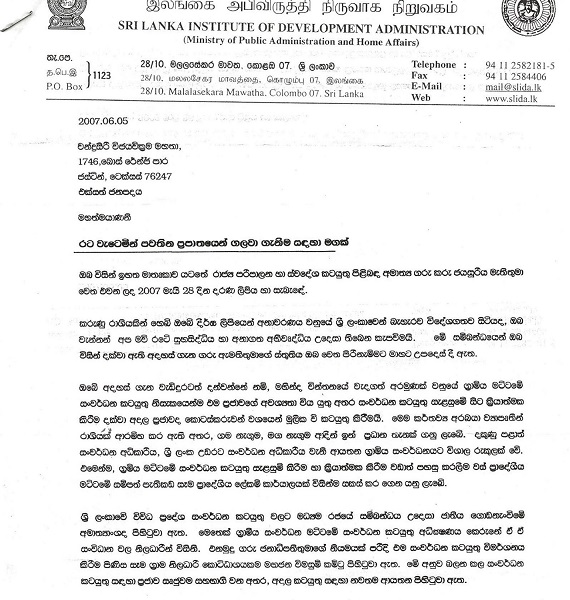
ඔබතුමාට මෙම භාරධූර ජාතික මෙහෙවර භාරදීම සම්බන්ධයෙන් මා සතුටට පත්වෙන්නේ ජන සභා අදහසේ වටිනාකම සම්බන්ධයෙන් සංදේශයක් දැනට බොහෝ කලකට පෙර (2007/5/28) මා විසින් ඔබතුමා මහින්ද රාජපක්ෂ ආණ්ඩුවේ  ස්වදේශකටයුතු ඇමතිව සිටියදී ඉදිරිපත් කල නිසාය. <රට වැටෙමින් පවතින ප්‍රපාතයෙන් ගලවා ගැණීම සඳහා මඟක්> යන එම සංදේශයෙන් යෝජනාකලේ ග්‍රාම සේවක වසම් මට්ටමින් දත්ත රැස්කරමින් පක්ෂ දේශපාලනයෙන් තොර ගම් මට්ටමේ මහජන ව්‍යාපාරයක් ගොඩ නැඟීමේ අඩිතාලමක් දැමීමය. ඒ සම්බන්ධයෙන් ඔබගේ නිලධාරියෙක් (ටී. එම්. කේ. බී තෙන්නකෝන්, අධ්‍යක්ෂ, ශ්‍රී ලංකා සංවර්ධන පරිපාලන ආයතනය), එවූ ලිපියේ මුල් පිටුව මෙහි පහතින් කොපිකර ඇත.

ලංකාවේ දැනට තිබෙන යමෙකුගේ මනස අවුල්කරණා සුළු අකාරයේ විවිධ දේශපාලන, ආර්ථික, සමාජීය, සදාචාරය, විනය ගරුක බව, ජනවාර්ගික හා පරිසර විද්‍යාත්මක ප්‍රශ්ණ වලට මූලික විසඳුමක් වශයෙන් ජන සභා සංකල්පයේ ඇති වටිනාකම ලංකාවේ දේශපාලන නායකයින්ට පෙන්වා දීමට 2005 සිටම මම උත්සාහ කළෙමි. 2005 දී මහින්ද චින්තනය ඇට්ලස් නමින් මෙම අදහස ජනාධිපති මහින්දට යවන ලදී. 2010 දී මහින්ද චින්තනය දෙවන භාගය නමින් යැවූ සංදේශයද බීරි අලින්ට වීනා ගැයීමක් විය. 2011 දී ලංකාවට පැමිණ උගත් පාඩම් හා සංහිඳියා කොමිෂම (LLRC) ඉදිරියේ මෙම ජන සභා අදහස ඉදිරිපත් කරණලදී (එම වාර්තාවේ ගම් මට්ටමින් ජනතාවට බලය පැවරීම ගැන නිර්දේශ කර තිබුණේය). මෙම අවස්ථාවේදී මහින්ද ජනාධිපතිව හමුවු අතර ඔහු විසින්  එම සාකච්චාවට ලේකම් ලලිත් වීරතුංගව  කැඳවා මෙම අදහස ගැන ක්‍රියාකරණ ලෙස දැණුම් දුන්නේය. මේ අතරතුර බැසිල් ඇමති විසින් ජන සභා අධ්‍යක්ෂක ජෙනරාල් කෙනෙක් පවා පත් කර (කොළඹ විශ්ව විද්‍යාලයේ ධම්ම දිසානායක මහතා) යම් සූදානමක් පෙන්වුවත් අන්තිමේදී දිවි නැඟුම (සමුර්ධි බලකාය) නම් ව්‍යපෘතියක් ආරම්භ කරන ලදී. 2015/9/18 දිනැති සිරිසේන ජනාධිපතිවරයාට යැවූ සංදේශය (සාමකාමී සහජීවනය හා රටේ තිරසර සංවර්‍ධනය උදෙසා බිම් මට්ටමින් ගතයුතු ප්‍රථම පියවර) ඔහුගේ සම්බන්ධීකරණ නිලධාරීන් ඔහුට පෙන්වූවාද කියාවත් මට සැකය.

මෙහිලා  ඉන්පසු  සිද්ධිය වන්නේ ගෝඨාභය 2019 චන්ද ප්‍රකාශනයේ ජන මූල සභා පිහිටුවීමට දුන් පොරොන්දුවය. රොමේස් ද සිල්වා ව්‍යවස්ථා කෙටුම්පත් කොමිටියට මා විසින් 2020/ 11/ 20 දින ඉදිරිපත් කල සංදේශයේ ජන සභා සංකල්පය පිළිඹඳ සංක්ෂිප්ත විග්‍රහයක් මෙන්ම, 13 -A සංශෝධනය හරහා රට කැබලි කැබලිවී යාමට ඇති ඉඩකඩ ජන සභා ක්‍රමයක් යටතේ මගහරවා ගතහැකි අන්දම පැහැදිලි කරදෙන ලදී. 

රටවල් කඩන UN සාම හමුදා

ජන සභා සම්බන්ධයෙන් පක්ෂ දේශපාලකයින් මෙතෙක් අනුගමණය කල  ක්‍රියා පිළිවෙල පැලැස්තර දමා තවදුරටත් ගෙනයාමේ විශාල අවදානමක් ඇත. වසර 75 ක් පුරා සිදුවු මිස් මැනේජ්මන්ට් නිසා රටේ දැනට තිබෙන ලොකු කුඩා සෑම සිස්ටම් එකක්ම ග්‍රීස් නැතිව මලකඩකෑ රෝද සහිත යන්ත්‍ර සූත්‍ර වැනිය. JVP-පෙරටුගාමි කොටස් රටපුරා ගම් මට්ටමින් පවතින කසිකබල් පාලක/පාලන ක්‍රමයට විරුද්ධව ජනයා සංවිධානය කරමින් සිටී. සරත් ෆොන්සේකා කියන්නේ සාමකාමි අරගලයකට ඔහු <මඟ> පෙන්වන බවය. වෙනත් බොහෝ කොටස් යූටියුබ්-ෆේස්බුක් සමාජ ජාලා හරහා ජනයා කුලප්පු කිරීම හා නොමඟ යැවීම ගජරාමෙට කරගෙන යයි. මේ අතර මෙතෙක් කරණ ලද අධර්මිෂ්ට පක්ෂ දේශපාලනය නිසා හිට්ලර් ක්‍රමයකට යාමට (ලීක්වාන් ගනයේ) අධ්‍යාත්මක ශක්තියක් නැතිකම  හා වල්බූරු නිදහස නමැති-බොරු ප්‍රජාතන්ත්‍රවාදයකට ආවැඩීම යන වරණ දෙක අතර <ආණ්ඩු තන්ත්‍රය>  හෙවත් පවතින අබලන් සිස්ටම් එක අතරමංව සිටී.

බංකොලොත් වුන රටකට නැවත ගොඩගැනීමට සෑහෙන කාලයක් ගතවේ.  මේ කාලය තුල රටේ සාමාන්‍ය ජනතාවට නොයෙක් දුෂ්කරතා වලට මුහුණ පෑමට සිදුවේ. මෙම කාරණය උපයෝගීකරගෙන රටේ කලබල ඇතිකර අවිචාරමත් සමයක් (anarchy) බිහිකර ගැනීමෙන් වාසි ගන්නට හැකියයි සිතන නොයෙක් කොටස් සිටී. අවසානයේ සිදුවන්නේ මේ අය සිතන දේ නොව විදේශ බලවේග වල න්‍යායපත්‍ර වලට අනුව UN සාම හමුදා පැමිණ රට විනාශවී යාමය.  මෙම ව්‍යසනයෙන් රට මුදවා ගැනීමට හැකි ප්‍රබලතම සිස්ටම් චේන්ජ් එක වනුයේ. නිසි ආකාරයට,  විද්‍යාත්මක ලෙසට ජන සභා ක්‍රමයක් ක්‍රියාවට නැංවීමය. මේ සඳහා අපගේ සිංහල බෞද්ධ ශිෂ්ටාචාරයෙන් බොහෝ උදාහරණ සැපයේ.

මීලඟ දෙවන කොටසින් රට ගොඩගැනීමට උපකාරවන අන්දමේ ජන සභාවක් සදන ආකාරය විස්තර කෙරේ.

Why is Saudi Arabia Defying the US?

October 22nd, 2022

By John Perkins

Why is Saudi Arabia suddenly defying the United States, after five decades of a strong alliance? It’s a question I’ve been asked frequently in recent days.

Here’s the answer.

I describe in my books the deal that I helped forge in the early 1970s that created this alliance. Known as the Saudi Arabian Money Laundering Affair (SAMA), it can be summarized as consisting of the following five agreements:

  1. Saudi Arabia will invest most of the petrodollars made from selling oil to the world in US treasury securities;
  2. The US Treasury Department will use the interest from these securities to hire US corporations to modernize (westernize”) Saudi Arabia, building petrochemical plants, ports, highways, and entire cities;
  3. Saudi Arabia will maintain oil prices at levels acceptable to Washington and American oil companies;
  4. Oil will be traded on international markets only in US dollars (the power of the dollar had been jeopardized when President Nixon took it off the gold standard in 1971 because the US was unable to pay foreign debts in gold – this fourth agreement essentially established a new standard for the dollar, the Petro-standard); and
  5. The US will guarantee to defend and protect the royal family of Saudi Arabia and keep it in power as long as the above four agreements are honored.

For 50 years Saudi Arabia honored the first four agreements.

As is well known — the US honored the fifth. It flew members of the Saudi royal family out of the United States after 9/11 when all flights had officially been prohibited. It turned a blind eye to evidence that the royal family had sanctioned the assassination of Jamal Khashoggi, a Washington Post columnist and critic of the Saudis.  It launched Operation Desert Storm against Iraq when Saddam Hussein threatened Kuwait and, by implication, Saudi Arabia. And it took many other less known, behind-the-scenes actions to maintain the alliance forged by SAMA.

So what happened? Why is Saudi Arabia no longer responding to Washington’s wishes and instead cutting back on petroleum production and thereby helping Russia earn income vital to its war in Ukraine? The answer is more complicated than the obvious one – that Saudi Arabia simply wants to increase the price of oil.

First of all, it’s important to recognize that SAMA was established in the early 1970s when the United States was the world’s most powerful economic and military power. As I write in my new book, Confessions of an Economic Hit Man, 3rd EditionChina’s EHM Strategy; Ways to Stop the Global Takeover:

For us in those days (the 1970s), the threat to America’s global dominance was Communism and the Soviet Union. Most of the Middle East (including Saudi Arabia) opposed both. Kings and dictators were not about to accept Marxism. Muslims were against atheism. The Soviet invasion of Islamic Afghanistan further encouraged Middle Eastern Muslim leaders to partner with the US.

Today, US hegemony is seriously threatened by China’s skyrocketing economic and military power, the Communist Soviet Union has been replaced by a monarch-like regime in Russia, and US wars in Islamic Afghanistan and Iraq have angered traditional Muslim leaders in Saudi Arabia and elsewhere. The US is no longer trusted to keep its previous agreements because many were discarded during the Trump administration. Furthermore, the ability of the US Congress to reach compromise is seen by the Saudis, as well as much of the rest of the world, as proof of America’s inability to perform as a functioning democracy. 

Adding insult to injury, the Petro-standard is being threatened for the first time in fifty years. China is already buying oil from Russia with yuen. And, according to the Wall Street Journal:

Saudi Arabia is in active talks with Beijing to price some of its oil sales to China in yuan, people familiar with the matter said, a move that would dent the U.S. dollar’s dominance of the global petroleum market and mark another shift by the world’s top crude exporter toward Asia.

Another important factor: Although the alliance between China and Russia is somewhat fragile, this alliance impacts many other countries. Five nations that are major economic drivers on their continents are united under the very powerful BRICS bank (Brazil, Russia, India, China, and South Africa). Saudi Arabia is dependent on these five countries and their neighbors through a complex network of oil and other trade agreements. Riyad is not likely to jeopardize these agreements by continuing to bend to Washington’s wishes.

Why is Saudi Arabia defying the US? 

A cartoon shows a Saudi prince holding an old-fashioned balancing scale in one hand. Hanging from one arm is the US flag; from the other, China’s flag. China’s clearly outweighs the US’s. 

Unfortunately, the Saudi prince could be replaced by leaders in many Asian, African, Latin American, and Middle Eastern nations.  From Saudi Arabia’s standpoint, its decision to abandon SAMA is pragmatic. It is also a symbol of the shifting sands of global power

POHOTTU AS USA’ S PROXY Part 9E

October 22nd, 2022

KAMALIKA PIERIS

USA has continued to invade, bomb and kill in foreign countries, undeterred by the Vietnam defeat in 1975. US methods are now  more sophisticated USA now uses smart bombs and drone-guided missiles instead of B-52s and napalm,  but US  is as brutal and ruthless  as ever, said critics.

 US says it is waging war for humanitarian” reasons,  but US  is utterly indifferent to the welfare of the public in the country it has invaded.US shows contempt and arrogance toward the people it is trying to ‘save’ and   its wars have much savagery, said critics.  

Critics have argued that the US has waged wars in violation of international law. There is no legal justification for US interference in other countries they said. These wars have been made on shaky grounds. They have been launched without the permission or knowledge of the US Congress and the wars lack a clear military objective. They are waging war inside a foreign country and the reason given is ‘self-defense.’  

 The United States attempts to establish fragile, dependent regimes to serve its global hegemony have crippled regional countries’ efforts to independently explore their development paths and caused a series of disastrous consequences, said critics.

Such acts of toppling the governments of other countries by force, interference in the internal affairs of other countries, and forcible export of the so-called “democracy” not only violated the basic norms of international relations such as prohibiting the use of force and non-interference in internal affairs, but also seriously violated the rights of the people of the relevant countries to choose their own development paths as well as their basic human rights, said critics.

The wars launched by the US in the 21st century were mainly in Middle East. USA’s forced transformation of Afghanistan, Iraq, Syria and Libya has disrupted political order, and destroyed social and national cohesion in these countries, declared China. These wars have had an adverse effect on the population in those countries.  In Iraq US used depleted uranium munitions in large quantities, causing enormous damage to the health of the local population.

USA waged war in Afghanistan from 2001 to 2021.  US wanted to crush the Taliban. Instead Taliban won and US withdrew in 2021. The Afghanistan war went on for six months more than the Vietnam War (1955–1975) so it is USA’s longest war. It was also USA’s second spectacular failure.

US took   the war into every corner of Afghanistan as well as across the border into Pakistan, said analysts. US army   carried out night raids on Afghan villages and these devastated the villages. On Aug. 29, 2021, a drone attack by the U.S. military in Kabul, the capital of Afghanistan, killed 10 local civilians, including seven children.

US army had also engaged in behavior offensive to Muslims, such as urinating on corpses, taking fingers and other body parts of murdered Afghans as trophies,” and burning the Koran at Bagram Air Base.

Brown University’s Costs of War Project (est. 2011) pointed out that more than 174,000 people died directly in the war in Afghanistan, of whom more than 47,000 were civilians. According to the United Nations High Commissioner for Refugees (UNHCR), 2.6 million Afghans have fled abroad and another 3.5 million were displaced.

US invaded Iraqon the bogus charge that Iraq had weapons of mass destruction. War lasted from 2003 to 2011. Then in 2014 at the request of Iraq, US sent soldiers to Iraq to train Iraqi and Kurdish forces to fight ISIS. This was followed by an agreement to station 5,200 soldiers in Iraq. But in 2020, the Iraqi Parliament ordered all foreign troops to leave the country. US President Trump objected and threatened Iraq with sanctions.

The Iraq War caused regime change, social unrest and prolonged conflicts in Iraq.  Baghdad, the capital of Iraq, was plunged into a state of anarchy, and the Iraq Museum, which is listed by UNESCO as one of the top 11 museums in the world, was plundered of 170,000 artifacts. The Director of the Museum openly blamed the US military.

US-Iraq war had many civilian deaths. In 2007, employees of the American Blackwater Company,   which had been under contract to US, carried out a massacre in Nisour Square in Baghdad, killing 14 civilians, including two children, and injuring at least 17 others.

On Aug. 12, 2005, a U.S. armored patrol vehicle shot at people coming out of a mosque in the suburban town of Ramadi, killing 15 Iraqis, including eight children, and injuring 17 others. On Nov. 21 of the same year, the U.S. troops stationed in Iraq opened fire on a civilian vehicle in northern Baghdad, killing a family of five, including three children. Nine of the 13 hospitals In Mosul, Iraq’s second largest city were destroyed.

According to Statista, a global statistical database, from 2003 to 2021, about 209,000 Iraqi civilians died in wars and violent conflicts, and about 9.2 million Iraqis became refugees or were forced to leave Iraq.

US has involved itself in the Syrian Civil war from   very beginning in  2011 US  supplied aid and intelligence  to the rebels fighting  President  Assad. CIA  established an extensive program to train and equip the rebels.

Since 2014, the United States has conducted periodic airstrikes and maintained hundreds of troops in Syria as part of its war against Islamic State (IS), al-Qaeda   and Syrian government forces. In 2015, the United States sent a small number of ground troops to train, advice, and assist the Syrian Democratic Forces (SDF) in their fight against IS. Since 2016, US army has also fought Iranian-backed militia groups such as Kait’ib Hezbollah, Kait’ib Sayyid al-Shuhada and Russian mercenaries.

Since 2016, the US has controlled al-Tanfbase, in a remote area of Syria, near where the borders of Syria, Jordan and Iraq meet. U.S. troops are stationed there. US troops are also in Hassakeh.

In 2017, USA and Syria fought vigorously. There was a missile strike on Shayrat Airbase. In 2017, the U.S. military attacked Raqqa. On March 18, 2019, U.S. drones killed at least 64 civilian women and children in an attack on the town of Baghouz on the Syrian-Iraqi border.

In 2021 there were 900 U.S. soldiers operating in Syria, according to the U.S. Department of Defense. In February 2021 US ordered airstrikes against Iranian-backed militia groups in eastern Syria in response to attacks against U.S.troops. In February 2022, the U.S. military launched a raid in Syria’s Idlib province, killing at least 13 people, including six children and three women.

The New York Times reported that based on an investigation of classified Pentagon documents, it had found that frequent U.S. airstrikes in Syria caused a large number of civilian casualties. They were due to “mistargeting.” Times noted that the Pentagon covered up these actions and did not punish those responsible.

According to data released by the United Nations, U.S. military intervention has claimed at least 350,000 lives in Syria, displaced more than 12 million people, and left 14 million civilians in urgent need of humanitarian assistance. The Syrian refugee issue has been called by the United Nations “the biggest refugee crisis of our time.”

US has no plans to retreat from Syria but analysts observed that Islamic State (IS) has now turned to long-term, low-intensity insurgency, and there is now the question whether the US can fight this and indeed, whether it should continue at all. 

US has also waged war in another way. The United States is the only “sanctions superpower” in the world, said critics. According to the US Treasury 2021 sanctions review, the United States has had more than 9,400 sanctions in effect by the 2021 fiscal year. In 1996, it issued the Iran and Libya Sanctions Act of 1996, forbidding foreign companies from investing in Iran’s and Libya’s energy industry.

The unilateral sanctions imposed by the United States against countries in the Middle East and elsewhere have hurt the ordinary people, and seriously undermined development   U.S. government imposed unilateral sanctions on Iran, Syria and other countries, during COVID-19 pandemic,   making it difficult for the sanctioned countries to obtain medical supplies needed to fight the pandemic. Iran was unable to import essential medicines and medical equipment, and that has seriously affected the health of millions of Iranians.

From 1980 to 1992, the United States imposed unilateral sanctions on Libya, and from 1992 to 2003, it made US allies also impose unilateral sanctions against Libya. The World Bank said the Libyan economy has lost 18 billion dollars due to sanctions, while an official Libyan estimate put the loss at 33 billion dollars.

Since 1979, the United States has imposed various unilateral sanctions on Iran. US imposed more and more sanctions on Iran as the years went by. Iranian President Hassan Rouhani said U.S. sanctions imposed by the Trump administration cost Iran at least 200 billion U.S. dollars in economic losses.

United States imposed brutal unilateral sanctions on Iraq with severe consequences. From August 1990 to May 2003, sanctions cost Iraq 150 billion dollars in losses of oil revenues. To date, Iraq’s per capita annual income has fallen short of its 1990 level (7,050 dollars).

In addition, the sanctions have caused a serious humanitarian disaster in Iraq, with the infant mortality rate doubling and the under-five mortality rate increasing sevenfold. Iraq’s education, health and social security systems were destroyed, and its literacy rate fell from 89 percent in 1987 to 57 percent in 1997.

After withdrawing its troops from Afghanistanin 2021, the United States has not only imposed economic sanctions on Afghanistan, but also frozen billions of dollars of foreign exchange reserves of the Afghan central bank, bringing the Afghan economy to the brink of collapse and worsening the life of the people. World Food Program officials pointed out that the U.S. economic sanctions on Afghanistan has exacerbated the local food crisis.

POHOTTU AS USA’ S PROXY Part 9F

October 22nd, 2022

KAMALIKA PIERIS

During the course of   its various wars, United States   has committed crimes that seriously violate international law,    announced China. They include war crimes, crimes against humanity, arbitrary detention, and torture of prisoners.

American aggressiveness over the past decade has an absolutely criminal character, agreed other analysts. The US has the worst history of war crimes in the world they said. US has had a horrifying record of human rights abuses added others.

US is guilty of dropping bombs on innocent targets. It excelled in aerial bombardments, said Stearns.   US dropped the first atomic bombs on Hiroshima and Nagasaki in 1945.  US continued to drop bombs thereafter. US has dropped over 3000 tons of depleted uranium through its bombs.

There is a long list of bombing, from Nagasaki, to   Guatemala, Korea, Indonesia, Cuba, Congo, Peru, Vietnam, Cambodia,  Libya, Nicaragua, Iran, Bosnia, Sudan  and Afghanistan, said Shenali Waduge.

In 1971, 800,000 tons of bombs were dropped by the United States on Laos, Cambodia, and Vietnam.  In 1973 US sent B-52s over Hanoi and Haiphong, destroying homes and hospitals, killing unknown numbers of civilians.

From 2001 to 2017, bombs and missiles have rained down on the people of Iraq, Afghanistan, Pakistan, Yemen, Libya, Syria and Iran, said critics. In 2011, US dropped bombs on at least 100 targets in Libya.America has conducted 108 air strikes in Somalia since 2017, killing some 800 people, said Economist. In 2019, US had an air strike in Iraq against Iranian militia, which killed 25 and injured over 50. 

A United Nations report released in September 2019 noted that many of the airstrikes carried out by the U.S.-led coalition in places like Syria “did not take the necessary precautions to distinguish between military targets and civilians.” United States has widely used air strikes to carry out so-called “anti-terrorism” operations, which often killed civilians “by mistake,” injured innocent people, and arbitrarily deprived them of the right to life, said China.

US sold weapons in large quantities, to its proxies in the Middle East and they used them indiscriminately causing large-scale humanitarian disasters. The US army was also guilty of killing civilians.

In Iraq at Mahmudiyah in 2006 two daughters, 14 years oldAbeer Qassim Hamza al-Janabi and 6-year-old sister Hadeel Qassim Hamza al-Janabi, mother Fakhriyah Taha Muhasen, father Qassim Hamza Raheem, and were murdered by US soldiers. The two remaining survivors of the family, 9-year-old brother Ahmed and 11-year-old brother Mohammed were at school during the massacre and were orphaned by the event.

In Kandahar, Afghanistan, in 2012, Staff Sergeant Robert Bales killed 16 Afghan civilians and wounded six others in the Panjwayi District of Kandahar ProvinceAfghanistan. Nine of the victims were children, and eleven of the dead were from the same family.

US army had been found guilty of rape. Wikipedia said that U.S. military personnel raped Okinawan women during the Battle of Okinawa in 1945.

In Iraq in , 2006, a 14-year-old Iraqi girl named Abeer Qassim Hamza al-Janabi was raped and subsequently murdered in the family home in Yusufiyah, a village to the west of the town of Al-Mahmudiyah, Iraq.  Five soldiers from the 502nd Infantry Regiment were charged with rape and murder.

In 2006, Congress found that CIA had engaged in widespread torture. There has been torture of inmates in secret US prisons. In 2003, the U.S. military, in serious violation of international human rights law, blatantly abused detainees at Abu Ghraib prison in Iraq. A group of soldiers committed a series of human rights violations including physical and sexual abuse against detainees in the Abu Ghraib prison

The abuses came to public attention with the publication of photographs of the abuse by CBS News in April 2004. The incidents caused shock and outrage, receiving widespread condemnation within the United States and internationally.

United States established Guantanamo Bay detention camp (est.2002) to lock up a total of nearly 780 “terrorists” from the Middle East and elsewhere total, many of whom have been held without bringing any criminal charge. More than 30 people, old and frail, remain in the prison, who are deprived of liberty for long periods of time and subjected to endless mental and physical torture. USA admitted before the UN Committee against Torture that they had ‘crossed the line’ at its CIA site at Guantanamo, reported the media.

In Guantanamo, U.S. personnel also harassed its Muslim prisoners, by desecrating the Quran throwing the Quran into toilets, tearing to pieces or burning the Quran under the guise of searching for weapons, and having female guards spy on naked prisoners in bathrooms, which sparked collective protests and even caused mass suicides among the detainees.

In September 2021, the U.S. prison and prisoner abuse practices at Bagram Air Base in Afghanistan were exposed by the media. U.S. forces inflicted “torture, cruel treatment, outrages upon personal dignity, rape and sexual abuse” on detainees for a long time, including putting at least 30 prisoners in a cage, leaving tortured prisoners to die in concealed areas, parading naked prisoners with blindfolds, among others.

War crimes charges were made against the USA troops in Afghanistan, reported BBC. The US armed forces and the CIA are alleged to have committed the war crimes of torture and cruel treatment, outrages upon personal dignity and rape and other forms of sexual violence in Afghanistan.

The ICC Prosecutor alleges that members of the US armed forces and the CIA had used the following torture techniques against detainees – incommunicado detention and prolonged and continuous solitary confinement, sensory deprivation, sensory overstimulation,  exposure to extreme heat or cold, exploitation of phobias and cultural, religious and sexual taboos, sexual humiliation or insults, offensive use of items of religious significance, imposition of stress positions designed to induce muscle fatigue, suspension from the ceiling, food deprivation, slamming against a wall, cramped or close confinement by placing detainees in boxes, sexual violence, including by means of rectal rehydration or rectal feeding applied with excessive force; and suffocation by water, or the practice of water boarding, placing of detainees in icy water baths.

In November 2017, the Prosecutor of the International Criminal Court (ICC) had requested authorization from the Pre-Trial Chamber of the ICC to initiate an investigation into allegations of war crimes committed by the USA in Afghanistan since 2003. This was initially rejected.

The Prosecutor filed an appeal against that decision.  On 5 March 2020, the Appeals Chamber of the ICC decided unanimously to authorize the investigation against the USA. An investigation of alleged war crimes by the US and others in the Afghan conflict can go ahead, ruled the ICC.

 ICC chief prosecutor said that US may have committed war crimes in Afghanistan, as a deliberate policy, She spoke of war crimes of torture and related ill treatment by US military forces in Afghanistan and secret detention facilities operated by the CIA. This ICC war crimes probe against the USA had been in the pipeline for more than two years, observed critics in 2020.

Attempts to investigate these crimes were blocked by the US.  US said it was not a signatory to the Rome Statute and could not be investigated without a UN Security Council order or consent of USA.

Though USA is not a member of the ICC and therefore does not come under its jurisdiction, Afghanistan is a member of ICC and any crime conducted on its territory can be brought to the ICC regardless of the nationality of its perpetrator, said ICC. Afghanistan joined the ICC in 2003 and it is on this basis that the ICC has claimed jurisdiction over deeds alleged to have been committed in Afghanistan by US armed forces and the CIA, said the media.

 The US establishment has reacted sharply to the initiative of the ICC Prosecutor. US Secretary of State Mike Pompeo said in 2019 that they are determined to protect American and allied military and civilian personnel ‘from living in fear of unjust prosecution’ for actions taken to protect America. If the ICC persists in this course of action, they will impose travel bans on judges and personnel of the ICC and will also take further steps like economic sanctions. President Trump said that any attempt to target American, Israeli or allied personnel for prosecution by the ICC will be met with ‘a swift and vigorous response’.

US armed forces have committed war crimes, as defined in the ICC and Geneva conventions, in the various US wars. But USA has made sure that it cannot be prosecuted. The main agency dealing with war crimes was the International Criminal Court (ICC). The US is not a signatory of the ICC and does not recognize its authority over American citizens.

US went out of its way to protect its military personnel accused of committing war atrocities. USA signed some 100 bilateral immunity agreements with a number of countries, prohibiting the surrender to the ICC of officials, military personnel and US employees US also threatened to veto UN peacekeeping mission unless its troops were granted immunity from prosecution by the ICC. No American has been indicted in ICC, said TIME.

In 2002, USA passed the American Service-Members’ Protection Act which was specifically aimed at the International Criminal Court. It prohibits any U.S. citizen or institution from cooperating with the International Criminal Court and prohibits the transfer of U.S. classified national security and law enforcement information to that court. It even bans the provision of U.S. military assistance, (with specified exceptions) to the government of a country that is a party to the court.

The American Service-Members’ Protection Act authorizes the President to bring about the release from captivity of any U.S. military personnel or covered allied persons who are being detained or imprisoned by or on behalf of the ICC and authorizes the US President to use all means necessary to do so. The phrase ‘use all means necessary’ enables the US government to resort to force to obtain the release of a US citizen or an ally who happens to be in the custody of the ICC. It authorizes military force to free military personnel held by ICC, observed critics. 

The US Congress has also passed two other laws relating to this matter, the Foreign Operations Act and the Patriot Act.  U.S. government, the U.S. judiciary, and American citizens are strictly prohibited from cooperating in any international investigation into the US Armed Forces. American citizens are subject to severe penalties if they directly or indirectly accuse the US Armed Forces. Ambassador John Bolton, who represented the United States at the United Nations, has stated that any officer of the International Criminal Court will be directly imprisoned if he or she investigates the US Armed Forces.

නිදහස් අධ්‍යාපනයේ පියාට අපි කෘථිගුණ සැලකුවේ මෙහෙමයි

October 22nd, 2022

සටහන :අසිරු වේදිත කරුණාරත්න. මුහුන පොතින් උපුටාගැනීමකි

දෙවියකු සේ පූජනීයත්වයට පත්විය යුතු වුවත් 1956 දි විශ්‍රාම යාමත් සමඟ කන්නන්ගර මහතාට ලබන්නෙ අභාග්‍යවත් කාලයක්. දේශපාලනඥයකු ලෙස තම පැවැත්ම වෙනුවෙන් තනතුර භාවිත නොකළ බැවින් විසි වසරකට අධික කාලයක් ව්‍යවස්ථාදායකය නියෝජනය කළත් ජිවිතයේ සැඳෑ කාලය ගෙවීමට තරම් හෝ ආර්ථිකයක් එතුමා සතු කරගෙන නොතිබූ නිසා 1961 ඔක්තෝබර් මස 26 දින කථානායක ආර්.එස්. පැල්පොල මහතා වෙත ලිපියක් යවමින් කන්නන්ගර මහතා ඉල්ලා සිටින්නේ තම ජීවිතයේ අවසාන කාලය ජීවත්වීම සඳහා තමනට පිං පඩියක් ලබා දෙන ලෙසයි.

‘රජයේ ඉහළම රාජ්‍ය සභාවල සියවස් කාලකටත් වැඩි කාලයක් සේවය කිරීමෙන් පසුව මා දැනට පත්වී තිබෙන අසරණ තත්ත්වයන් නිසා හදිසි මූල්‍යමය ආධාරයක් අපේක්ෂාවෙන් මේ ඉල්ලීම ඔබතුමා වෙත ඉදිරිපත් කරන බව ගෞරවාන්විතව දන්වා සිටිමි. ආයෝජනවලින්, නිවාසවලින්, ඉඩකඩම්වලින් හෝ වෙනත් ප්‍රභවයන්ගෙන් මට කිසිදු පෞද්ගලික ආදායමක් නොලැබෙන බැවින් මා වසර ගණනාවකම යැපුණේ මගේ මිත්‍රයන්ගෙන් ලැබුණු පරිත්‍යාගවලිනි. මගේ සෞඛ්‍යය රැකගැනීම සඳහා කළ යුතු අත්‍යවශ්‍ය වියදම් වෙනුවෙන් ගෙවිය යුතු බිල්පත් දිනපතා ගොඩගැසෙමින් පවතී.

මිත්‍රයන්ගෙන් හා නැදෑයන්ගෙන් සහනාධාර යැදීම සියවසකින් තුනෙන් එකක් තරම් වූ කාලයක් තිස්සේ රජයේ ඇමැති තනතුරක් දැරූ මා වැන්නකුට කිසිසේත් තරම් නොවන බවට ඔබතුමා ද එකඟ වනු ඇත යනු මාගේ විශ්වාසයයි. රජයෙන් ක්ෂණික සහනයක් අපේක්ෂාවෙන් මගේ මේ ආයාචනය ඔබතුමා වෙත ඉදිරිපත් කරන්නේ අද මා මුහුණ පා සිටින අවාසනාවන්ත තත්ත්වය නිසා ය. එසේම සියවස් කාලකට වැඩි කාලයක් තිස්සේ මගෙන් කිසියම් ගෞරවයකට හා පිළිගැනීමකට ලක් වූ සේවයක් ඉටු වී ඇති බව ද මා අදහස් කරන නිසාත් ය.” යනුවෙන් එතුමා ඉතා අසරණව ඉල්ලා යවා තිබේ.

මේ ඉල්ලීමට ප්‍රතිචාර දක්වමින් එතුමාට පාර්ලිමේන්තුවෙන් රුපියල් දසදහසක මුදලක් ගෙවූ අතර පසුව මසකට රුපියල් 500 බැගින් පින් පඩියක් පිරිනැමූ බවත් පසුව බලයට පැමිණි රජය යටතේ එ් මුදල රුපියල් 1000 දක්වා වැඩි කරන ලද බවත් සඳහන් වේ..

රටටම නිදහස් අධ්‍යපනය දී පාසල් ගොඩ නැංවුවත් සිය මිනිපිරිය පාසලට ඇතුළත් කිරීම සඳහා මිනිපිරිය සමග විශාකා විද්‍යාලයේ පෝලිමේ සිට ගෙන සිටීමට එතුමාට සිදුවූ බව සඳහන් වේ. අවසාන කාලයේ ජීවත්වීමට නිවාසයක් හෝ නොතිබුණු කන්නංගර මැතිතුමා අවසානය කාලය ගත කර තිබෙන්නෙ සිය දියණිය බැංකු ණයකින් ගත් නිවසක. රෝගී වූ එක් අවස්ථාවක ප්‍රතිකාර සඳහා අවශ්‍ය මුදල් නොමැති වීම නිසා සිය මගුල් මුද්ද පවා උකස් කිරීමට එතුමාට සිදුවී තිබේ. එසේ ඉතා කනගාටුදායක ලෙස අවසාන කාලය ගෙවූ කන්නන්ගර මැතිතුමා 1969 සැප්තැම්බර් 23 වැනිදා කොළඹ මහරෝහලේදී මෙලොවින් සමුගන්නෙ අමතක කර දැමූ පුද්ගලයකු වශයෙනි.

නිදහස් අධ්‍යපනයේ ප්‍රතිඵලලාභීන් සේවය කළ රෝහලේ සාමාන්‍ය ඇඳක් මත එතුමා සිය දිවියේ අවසානය ගත කළත් ඒ නිදහස් අධ්‍යාපනයේ පියා බව කිසිවකු හෝ නොදත් නිසා කිසිවෙකු ඒ ගැන අවධානය යොමු කර නොතිබූ බවත් ඔහුගේ උපැස් යුවළ හා පාවහන් යුගලය කිසිවකු හෝ සොරකම් තිබූ බවත් එතුමාගේ මිනිපිරිය පසුකාලීනව සඳහන් කර තිබිණි. ලක්ෂ සංඛ්‍යාත දුගී දරුවන්ට අධ්‍යාපනයෙන් ඉහළට පැමිණ ජීවිතය සාර්ථක කර ගැනීමට මඟ පෙන්වූ, සැබෑ ලෙසම ජාතිය ගොඩනැඟූ විශිෂ්ට යුග පුරුෂයකුට ජාතිය කෘත ගුණ සැලකුවේ ඒ අයුරිනි.

සටහන :

අසිරු වේදිත කරුණාරත්න.

Monkey Appears At Funeral To Mourn The Man Who Showed Her Kindness -“We have feelings and so do other animals.”

October 22nd, 2022

By Stephen Messenger Courtesy The dodo.com

Earlier this week, after a sudden illness, 56-year-old Peetambaram Rajan passed away in the Batticaloa region of Sri Lanka.

But though there appears to be few details about his life recorded online, the reaction of those Rajan left behind suggest his was one teeming with love.

And not just for people.

https://www.facebook.com/ayathuray.rajasingam.9/videos/504886768166121

According to the Tamil Mirror, Rajan was known to be an animal lover. Every day, he was reportedly visited by a local gray langur whom he’d offer treats.

However, Rajan evidently did more than just quell her hunger. It seems he touched her heart as well.

On Tuesday, as Rajan’s grieving family gathered to pay their final respects after his passing, they were joined by an unexpected visitor — the monkey he had befriended in life. And she was in mourning, too.

Given the trusting relationship the langur had with Rajan, it should come as no surprise that she would be saddened to learn he’d passed away.

Though, at times, there may appear to be a divide between people and other animals — our feelings of love and loss are much the same.

“There is no doubt that many animals experience rich and deep emotions,” writes animal behaviorist Dr. Mark Bekoff in Psychology Today. “It’s not a matter of if emotions have evolved in animals but why they have evolved as they have. We must never forget that our emotions are the gifts of our ancestors, our animal kin. We have feelings and so do other animals. Among the different emotions that animals display clearly and unambiguously is grief.”

Report on minor children’s care mandatory for women aged below 45 when migrating: SLFEB

October 22nd, 2022

Courtesy The Daily Mirror

The report regarding the welfare arrangements of the underage children of women under 45 years of age is compulsory when leaving the country for foreign employment, the Sri Lanka Foreign Employment Bureau (SLFEB) said.

Addressing the media, the number of Sri Lankans leaving the country for foreign employment has increased, with the majority of them being women, and a significant number of them being mothers.

Accordingly, the SLBFE has decided not to grant permission for mothers with children under two years of age, as mothers should pay special attention to the care and education of their children, she said.

Moreover, the SLBFE has decided to call for a report on the welfare arrangements of their underage children. A circular will be issued making the practice compulsory. Affidavits are not required in this instance.

The Bureau further said that the decision was taken as a step for the protection of their children and to continue with their successful education.

During the period of the employment overseas, it will help to identify the family members who are responsible for the welfare and protection of those children.

The women who are under 45-years of age should obtain their report on the child welfare program from the respective Divisional Secretariat where they are residing. To obtain the Divisional Secretariat report, those people must first obtain the Grama Niladhari (GN) certificate from where they are residing.

If they are not residing in the registered electorate, they should submit their reports through the GN officer where they were last registered.

The child welfare program report is not necessary for people who plan to leave the country again within nine months from the date of arrival. This opportunity will be granted only to those women who went abroad and returned to the country after registering with the SLFEB.

If the nine months from the date of arrival exceeds, those women must provide the child welfare program report prior to their next departure.

A special committee has been appointed by the Ministry Secretary to rectify the issues that had taken place in the case of residence or any other issue when issuing the report. (Chaturanga Samarawickrama)

Personal income tax likely to come in to force from Nov 1

October 22nd, 2022

Courtesy The Daily Mirror

The newly-gazetted personal income tax will be implemented from November 1, after the approval by the Finance Committee of the Parliament and the signature of the Speaker.

Minister Ranjith Siyambalapitiya said this while speaking at a press conference in Ruwanwella. Earlier, a gazette notification was issued amending the Inland Revenue Act.

Accordingly, any individual with gross monthly earnings of Rs. 100,000 or above, would be liable to pay Income Tax. The top marginal personal income tax rate is gazetted as 36%.

COPA inquires about failure to maintain rice reserves in the country

October 22nd, 2022

Courtesy Adaderana

The Committee on Public Accounts (COPA) has looked into maintaining a special rice reserve of 8,000 metric tons in accordance with the Colombo declaration of the SAARC Organization and the 16th Summit meeting.

The committee also probed the rice reserves of 100,000 metric tons not being maintained in the warehouses owned by the Food Commissioners Department of Sri Lanka all over the island in accordance with the cabinet decision dated 27/8/2008.

The COPA members inquired about the failure to maintain the aforesaid reserves despite the fact that 06 warehouses numbered 1, 7, 8, 9, 10 and 13 in Veyangoda warehouse complex were modified in a scientific and natural manner. 292 million rupees have been spent from 2012 to 2019 to modify these warehouses.

Discussions in this regard took place at the COPA which met on Thursday (Oct. 20) under the chairmanship of MP Kabir Hashim.

The meeting was called for by the Food Commissioners Department of Sri Lanka to examine the audit report on the maintenance of rice reserves and the performance of storage utilization.

The officials mentioned that their department requested for adequate provision from the treasury, but due to non-receipt, it was not possible to maintain the above-mentioned reserves. It was also revealed that on an average, to maintain 100,000 metric tons of rice, about Rs. 22 billion per year is required.

Officials stated that even though a storage complex capable of storing 250,000 metric tons has been scientifically modified, it has not been able to store the number of reserves equal to its maximum capacity so far and that the World Food Programme and rice aid received from other countries have already started to be stored.

The committee also informed the Secretary to the Ministry to conduct proper research on the existing government food warehouse complexes across the country and collect data and submit a report containing specific information about the ownership of the warehouses within a month.

Irregularities in giving the warehouse complexes owned by the Food Commissioner Department to other government or private institutions on rental basis and monthly rent collection issues were discussed at the COPA. The committee informed that with the support of the Attorney General’s Department, the relevant agreements should be prepared as necessary.

COPE directs Auditor General to probe LRC’s land transfers

October 22nd, 2022

Courtesy Adaderana

The Committee on Public Enterprises (COPE) has requested the Auditor General to conduct a special investigation into the transfer of ownership of lands by the Land Reform Commission (LRC) for the past 20 years.

The request was made by the COPE chairman, Prof. Ranjith Bandara during its meeting which looked into the irregularities in land transfers.

WHAT WAS THE ECONOMIC POLICY OF THE ARAGALAYA?

October 21st, 2022

BY EDWARD THEOPHILUS

Various reasons contributed to beginning the unsuccessful ARAGALAYA in 2022, which focused on either capturing the government or changing the government policy towards the people suffering from economic difficulties.  Capturing a government that was elected by a democratic election could be considered illegal in terms of law and gaining political power in a country using an undemocratic way could not be considered an equitable or ethical way of changing the government. Modern democratic values are working not only in Sri Lanka but also in other countries. Therefore, ARAGALAYA had ethical and moral issues at the beginning that are questionable. 

Compare to the previous ARAGALA in Sri Lanka, the major reason for the failure of this ARAGALAYA was leaders failed to present their economic policies and convince the people that their economic policy would have a positive impact on the economy and will gain clear benefits for people. Without knowing the real leaders of ARAGALAYA, people couldn’t trust the way it was going on and people surrounding Colombo gathered at Galle Face ground like buffaloes that came out from sheds that hadn’t reflect the democratic values and acceptable economic policies that would be beneficial to people. The fundamental weakness of ARAGALAYA was it failed to justify policies that they would do and the policies which contained justice.  

The country indeed had problems relating to business and the living concerns of people. Such problems would have been solved by the government using the right economic policy that has been planned considering broader factors and would successfully organise related activities by the leaders of ARAGALAYA. These vital activities were not done by the leaders of ARAGALAYA and the failure of leaders was the main contributing factor to its unsuccess. In this situation, there was a higher risk that was not considered by leaders.  Generally, people doubted the economic policy of young people who have no experience and never studied past economic downturns. In addition, certain people had different objectives, for example, a family living in Australia had a secret religious agenda that was not disclosed to people. In that background, the struggle was a misleading activity the general public didn’t know whether the struggle was a justifiable matter of the public

The increase in productivity in all sectors of the economy and the aggrandisement of the volume of foreign exchange reserves were vital issues that needed urgent attention and other economic problems related to macroeconomic concerns must have been highlighted by them as in the economic policy. They were major issues of ARAGALAYA and leaders lacked understanding of these factors they must have thought in the way university students are thinking without practical experience.

Many people in the country have no clear understanding of how to solve the problems and the leaders of ARAGALAYA should have explained to people why they were so concerned about the economic problems and that they can solve problems by implementing trusted policies. The ARAGALAYA in 2022 was not described the specific economic policy which will positively impact the economy. People even did not know who were the leaders of the struggle. The vital factor in modern society is that struggles could gain benefits if there are reserved assets and when there are no such preserved assets physical materials would not come to support the struggle. 

In 1971, Rehana Wijeweera specifically stated that we will uproot tea plantations and replace them with Tapioca which would be an input-boosting industrial input with factories. Using cassava for industrial input would not be a substitute for the tea economy as it generates billion of foreign exchange and casava cannot do it.  People at that time (1971) knew that such policies would not work for the country. Wijeweera whether policies were right or wrong publicly stated but in such a way modern leaders should have expressed economic policies that have not happened during the struggle. How the policies of struggle leaders would practically impact the macroeconomy to solve problems of people did not express and the struggle showed it was a clear attempt to cheat power.

It was not a productive and acceptable policy action to the public and the policies of Wijeweera were questionable to people at that time and the public was reluctant to associate with JVP. The open talks of Wijeweera were more respected by people than the rough leaders of the modern struggle. Many people state that the Aragalaya has not finished and people were invited to participate in several rallies but they did not participate, only a few people participated, who were hardcore Marxists and after tear gas and water cannon treatment all left the ARAGALAYA. It should note that struggles would not succeed in the modern era because the government has the more strong firepower and the other matter was many of the participants of the struggle were amatory criminals who attempted to popularize by ragging innocent students. Rohana Wijeweera 1971 openly rejected erotic criminals in universities and had human values.

People did not know who were the leaders of modern ARAGALAYA and what were their economic policies of them. Could leaders of ARAGALAYA respond to people and able to act in response to modern weapons of arm forces? Schoolkids in Grades 10 and 12 know economics better than leaders of ARAGALAYA and people can trust the economic piece of advice of international financial institutions such as IMF, WB, Asian Development Bank and ADA.   

Sri Lanka has complicated political issues with many political parties, which are based on selfish dispositions and religions in the country are working against the teaching of the religious inventors. Political parties should attempt to stop misleading people and create a production economy in all sectors such as agriculture, industry, construction, services and information technology. It is the right thing to do than commanding struggles. If a 10% production increase in all sectors of the economy, current problems could be defeated and people would gain economic benefits at a normal level and then the economy could be expanded by new investments.

Mr Ranil Wickremasinghe is working well, however,  the ruins of the Rajapaksa strive to regain power for Namal Rajapaksa and put their hands on Wickremasinghe’s policy further intending to regain power. As James Dusenbery stated aggregate consumption of Sri Lanka is influenced by the demonstration effect and destroyed the foreign exchange reserves. During the Rajapaksa regime spending more money on imports reflected the worse nature of the demonstration effect in Sri Lanka. Many urban people borrow money and purchase luxury goods and services as a result of the demonstration effect. The worse situation is that the government should invest funds in road development and many others. It is difficult to change consumption patterns and the government needs to neglect people in the lower-income category who are below the poverty line.

2023 මාර්තු පැවැත්වීමට නියමිත ඡන්දයක් අද කල්දාන්නේ කොහොමද?මැතිවරණ කොමිසම – විපක්ෂය නැති බිල්ලෙක් මවනවා

October 21st, 2022

රජිත් කිර්ති තෙන්නකෝන්

වත්මන් පළාත් පාලන ආයතන 2023 මාර්තු 20 දින විධිමත් හා නිත්‍යානුකූල ලෙස බලාත්මකය. ‘ඡන්දය කල් දමන බවට‘ රටේ මතයක් හදන්නට පක්ෂ කිහිපයක් උත්සහ කරති.   2021 සැප්තෑම්බර් සිට 2022 ජනවාරි දක්වා ඡන්දය කැඳවීමේ නිත්‍යානුකූල අවස්ථාව අතහැර දැමූ මැතිවරණ කොමිසම ද දැන් නැති බිල්ලෙක් මවන්න හදනවා‘  යැයි හිටපු ආණ්ඩුකාර රජිත් කීර්ති තෙන්නකෝන් පවසයි.  

2018 මාර්තු ස්ථාපනය කළ පළාත් පාලන ආයතනවල නිල කාලය 20212 මාර්තු අවසන් වීමට නියමිතව තිබුණි. එදා දේශපාලන බලවතාගේ අනුග්‍රහය එයට නොලැබුණි.  2022 ජනවාරි මාසයේ එවකට සිටි අමාත්‍යවරයා පළාත් පාලන කාලය කාලය වසරකින් දීර්ඝ කළේය. ඊලඟ ඡන්දය නියමිතව ඇත්තේ 2023 මාර්ත හෝ අප්‍රේල් ය. මැතිවරණ කොමිසමට 2021 සැප්තෑම්බර් ඡන්දය කැඳවා අවශ්‍ය නම් 2022 ජනවාරි ඡන්දය තැබිය හැකිව තිබුණි. එදා රට බංකොලොත් නැත. කෝවිඩ් ද නැත. ඉන්ධන පෝලිම් ද, විදුලි කප්පාදු ද තිබුණේ නැත. වත්මන් සියළු කොමිසන් සභා නිදාගන්නෙත්, ඇහැරෙන්නෙත් ‘කේජු කෑල්ල කටින් ගත් මිහිරි කුරුළු නාදයට‘ අනුවයි. 

අද රටේ සියළුම කොමිසන් සභා ක්‍රියාත්මක වන්නේ ‘ලොස් ඇන්ජලීස් සිට නැගෙන මිහිරි කුරුළු නාදයට‘ ය. දළ ගලවලා, අං කපලා හීලෑ කරන තියෙන කොමිෂන් සභා යටතේ ඡන්දය තියන්න අවශ්‍ය පිරිසට එයින් සිදුවන හානිය හෝ ප්‍රතිඑලය ගැන කිසිදු අවබෝධයක් නැත.

ලක්ෂ හතරක් තරුණයිට මොකද වෙන්නේ?

2022 පෙබරවාරි 1 පටන් ගත් වයස 18 ට අඩු තරුණයින් ලියාපදිංචිය අගෝස්තු 1 වන විට අවසන් කළ හැකිව තිබුණි.  මෙවර වෙනදා මෙන් ගෙයින් ගෙට ගොස් ඡන්ද කොළ පිරවීමක් නොවීය. එවිට සැප්තෑබ්බර් 1 ට ඡන්ද පොත සහතික කළ හැකිව තිබුණි.  අද ඡන්දයක් තිබ්බොත් අරගලයට සම්බන්ධ වුණ, නායකත්වය දුන්න අවු. 18 සහ 19 තරුණ පිරිසෙන් ලක්ෂ  හතරකට ඡන්ද අයිතිය අහිමි වන බව කියවේ.  මෙය සත්‍යයක් විය නොහැකිය. මන්ද වසරකට අලුත් ඡන්ද ඇත්තේ ලක්ෂ දෙකක් පමණී.  2021 ජූනි 1 සිට 2022 ජූනි 1 දක්වා වයස 18 සම්පූර්ණ වූ තරුණයින් 150,000 කට ආසන්න පිරිස මේ වන විට ලියාපදිංචි කර තිබිය යුතුය.  එය සිදු කර නොමැති නම් එහි වගකීම වත්මන් මැතිවරණ කොමිසම ගත යුතුය. රටේ තීරණ ගැනීමේ අයිතිය ලැබිය යුතුයි.  තරුණ කෝටාව, ජාතික සභා තරුණ නියෝජනය,  ජන සභාවට මේ සියල්ලම තරුණයින්ට දොර අරින්නටය. ඡන්ද ලැයිස්තුවෙන් දොර වැසීම වැලකිය යුතුමය.

අමතක කළ ඡන්ද සංශෝධන යෝජනාව

දිනේෂ් ගුණවර්ධන මහතා ගේ සභාපතීත්වයෙන් වූ ඡන්ද ක්‍රම සංශෝධනය පිළිබඳ රීම් කාරක සභා වාර්තාව එය හදපු කමිටුවම විසින්ම පරාජය කළේය. එයට මම මාගේ උපරිම දායකත්වය පාර්ලිමේන්තුව වෙත ලබාදුනිමි.  සජබ, මු.කො., ජවිපෙ, ද්‍රජාස එය පරාජය කළ නමුත් තමන්ගේ විකල්ප යෝජනාව ඉදිරිපත් කළේ නැත.

වත්මන් පළාත් පාලන ඡන්ද ක්‍රමය ඛෙදවාචකයකි. විකාර රූපී ඡන්ද ක්‍රමයකි. මුදල් නාස්තියකි. විපක්ෂයට කාන්තා සභිකාවියන් බහුතරයක් බලහත්කාරයෙන් පටවා ක්‍රියාකාරී විපක්ෂයක් නැති කරන අසාධාරණ ක්‍රමයකි. පළාත් පාලනයේ විසඳිය යුතු ගැටළු කිහිපයකි.

1.      සභිකයින් 8711 ක් වන සංඛ්‍යාව හාර දහස බැරිනම් 5000 අඩු විය යුතුය.  මන්ද, සභිකයින්ට වැටුප් හා දීමනා ගෙවන්නවත් ආදායම් නැති ආයතන 38 ක් ඇති නිසාය.    

2.      කාන්තා නියෝජනයේ පීඩණයෙන් විපක්ෂය ගැලවිය යුතුය.  උදාහරණයකට මොණරාගල එජාපයේ කොට්ඨාශ දිනපු කාන්තාවේ එක් අයෙකි.  පුරුෂයින් 19 ක් ලැයිස්තුවෙන් නම් කරන විට, එජාපයට කාන්තාවන් 28 ක් පත් කරන්නට සිදු විය.  මොණරාගල පොහොට්ටුවේ මුළු මන්ත්‍රී සංඛාව 11₄ කි. පත්කළ එක් මන්ත්‍රීවරියක් පමණී.   ත්‍රිකුණාමලයේ පදවි ශ්‍රී පුර ප්‍රාදේශීය සභාවේ කාන්තා නියෝජනය 67% ක් එජාපයේ ය.  පොහොට්ටුවේ 10% කි. සභාවේ කාන්තාවන් පිරවෙන්නේ පරාජිතයාගෙනි.  කාන්තා නියෝජනයේ පදනම විපක්ෂයට බර පටවමින් මුළුමනින්ම විනාශ වී ඇත.

3.      2018 දී ඉවත් කළ තරුණ කෝටාව නැවත ගෙන ආ යුතුය. දිස්ත්‍රික්ක සංවර්ධන සභාව, තරුණ කෝටාව තුලින් 38 කට වැඩි පාර්ලිමේන්තු මන්ත්‍රීවරුන් බිහිවිය. එම අවස්ථාව නැවත ඇති කළ යුතුමය.

4.      මනාප ක්‍රමය නැති ඡන්ද ක්‍රමයක් රටම ඉල්ලන ඡන්ද වෙනසකි.  එය අවශ්‍යමය.

5.      කොට්ඨාශ සඳහා අතුරු මැතිවරණ පැවැත්වීමත්, දුෂිතයන් එළවීම එනම් දුෂණ චෝදනා එල්ල වූ සභිකයින් නැවත කැඳවීමේ ක්‍රමයක් (සභික ධූරය අහිමි කිරීම) පළාත් පාලන ඡන්ද ක්‍රමයට ඇතුළත් කළ යුතුයි.  පළාත් පාලනයේ බැරි දුෂිත මන්ත්‍රීවරුන් ඉවත් කිරීම නැතිනම් කවදාවත් පාර්ලිමේන්තු මන්ත්‍රීවරයෙකුට කළ නොහැකි වනු ඇත.

දැන් මේ යෝජනා 5 ම අතහැර පිරිසක් පළාත් පාලන ඡන්දය තියන්නට විපක්ෂයේ මන්ත්‍රීවරු මහජන පෙත්සම් අත්සන් කරන්නට යෝජනා කරති! ඡන්ද කල් දානවෝ, ඡන්ද කල් දානවෝ හීනෙන් මෙන් කියති.

2015 පාර්ලිමේනත්තු ඡන්දය, 2018 පළාත් පාලන ඡන්දය, 2019 ජනාධිපතිවරණ, 2020 පාර්ලිමේන්තු මැතිවරණය ලංකා ඉතිහාසයේ පැවති නිදහස් ම හා සාධාරණම මැතිවරණ බව අවිවාදාත්මක ය.  එය සිය සිදු වූවේ එදා පැවති ස්වාධීන කොමිසන් සභා නිසාය.  22 මගින් නැවත ඒ ස්වාධීන්තවය කොමිෂන් සභා වෙත ලබා දී ඡන්දය පැවැත්විය යුතුය.

සීමා නිර්ණය ගොනී බිල්ලා

තවලිංගම් මහතා ගේ සීමා නිර්ණය කොමිසම මාස 3 කින් ද, අශෝක පීරිස් මහතා ගේ කමිටුව මාස 6 – 7 කින් ද, සීමා නිර්ණය කළේය. යෝජිත පළාත් පාලන ආයතන 22 ක නීමා නිර්ණය දින දෙකකින් අවසන් කළ (උදා. දකුණ) පළාත් සභා ද වේ. අද සීමා නිර්ණය කමිටුවේ සභාපති මැතිවරණ ඔස්තාර් මහින්ද දේශප්‍රිය මහතා ය. ඔහුට එය මාස 3 කින් කළ හැකිය.  

ලංකාවේ ආණ්ඩුකරණයේ දැවැන්ත වෙනස්කම් රැසක් පාමුල සිටී.  ජාතික සභාව හදන්නට ගතවූවේ සති  3 කි.  ජන සභා ලේකම් කාර්යාලය හදන්නට දින 38 කි. 22 ට හදා පාර්ලිමේන්තුවට ඉදිරිපත් කරන්න ගත වූවේ මාස 2 ½ කි. ඡන්ද ක්‍රමයේ වෙනසකට අවශ්‍ය කුඩා කාලයකි. 

1983 මැයි 18 හා 20 දිනවල එකවර ඇතුරු මැතිවරණ හා පළාත් පාලන ඡන්ද තිබූනේය.  අවශ්‍ය නම් 2023 මාර්තු 20 න් පසු ඕනෑම දවසක පාර්ලිමේන්තු මැතිවරණය ද, පළාත් පාලන ඡන්දය ව්‍යවස්ථාවට අනුකූලව එකවිට පැවැත්විය හැකිය!

අපේ රටට තෝරාගැනීම් දෙකක් තිබේ.  එකක් දිගින් දිගටම මේ වැරදි, ඛෙදවාචකයක් වූ, විෂම ඡන්ද ක්‍රමය පවත්වාගෙන යා හැකිය.  දෙවැන්න, කෙටි කලක් තුල (මාර්තු මාසයට පෙර) මේ දුෂ්ඨ ක්‍රමයේ මැතිවරණ ක්‍රමයේ අඩුපාඩු සකස් කර අවශ්‍ය නම් එකව වරම පාර්ලිමේන්තු හා පලාත් පාලන ඡන්දය පැවැත්විය හැකිය.

පුද්ගලිකව මම පෙනී සිටින්නේ ප්‍රතිසංස්කරණ කඩිනමින් ක්‍රියාත්මක කර ගැනීම සඳහා මිස මේ දුෂ්ඨ ජරාජීර්ණ ක්‍රමය පවත්වා ගැනීමට  නොවේ! ඡන්ද කල් දැමීමට ද නොවේ!!  

රජිත් කිර්ති තෙන්නකෝන්

The Crisis facing the Buddhist World

October 21st, 2022

Senaka Weeraratna

The Buddhist World lacks an effective mechanism to help save a Buddhist Nation in Danger

https://www.vifindia.org/article/2017/may/27/the-crisis-facing-the-buddhist-world

Colombo, Sri Lanka — The crisis facing the Buddhist world is neither a decline in religious conviction nor an apprehension that truth underpinned by rational argument and new scientific discoveries will one day overtake and outstrip the core teachings of its founder which is a perennial fear bordering on despondency that characterizes several other competing religions, but the lack of an effective institutional mechanism that can lend support when a Buddhist institution, Buddhist community or even a pre-dominant Buddhist nation is in danger.

We see the lack of substantial networks of support driving threatened Buddhist nations or Buddhist communities into a sense of despair and hopelessness at times of emergency. Traditional Buddhist countries such as Thailand, Myanmar, Sri Lanka, Cambodia, and Laos are now under severe pressure to distance themselves from extending state patronage to Buddhism and erase their Buddhist country identity and embrace a secular identity with no such pressure being applied to countries in other parts of the world such as the Middle East or the Catholic belt of Europe.

Despite a 2500-year-old history that makes Buddhism one of the oldest religions in the world, a worldwide presence that makes it a global religion, and a way of life grounded in wisdom and compassion that attracts the envy of other civilizations, Buddhism still retains its biggest constraint i.e. lack of effective protections. It is a historical fact that Buddhism has lost more territory and space in Asia, its traditional homeland, in the last one thousand years than any other religion. It is also a hard fact that this process is ongoing with no sign of abatement and no effective measures developed to counter it.

Buddhism’s biggest appeal of being an eternally passive, non – confrontational, peace-loving religion that lacks a central place to direct its affairs in the international arena unlike in the case of say the Vatican (sovereign state enjoying both temporal and spiritual power) or the World Council of Churches ( powerful and well – funded with influence reaching to four corners of the world) or the Organisation of Islamic Cooperation (promoting Muslim solidarity in economic, social, and political affairs), has become Buddhism’s Achilles’ heel. Its organizational bases are relatively powerless when compared to the aforesaid entities. For example, the Organisation of Islamic Cooperation (OIC) is the second largest inter-governmental organization after the United Nations which has a membership of 57 states spread over four continents. The Organization is the collective voice of the Muslim world and is committed to safeguarding and protecting the interests of the Muslim world. It has its headquarters in Saudi Arabia.

Rising Challenges to Buddhism

The issue of rising challenges to Buddhism to the extent of undermining its very existence as the pre-dominant religion of a nation hardly merits much attention in discussions of International Buddhist Organisations, International Buddhist Conferences, or among National Governments in countries with predominant Buddhist populations and corresponding state and constitutional obligations to protect and foster Buddhism.

Traditional Buddhist countries now find themselves force-fed with ideas that are foreign to Asia, that had been given birth primarily in a Western setting and related to the interplay of dynamics of European societies but are nevertheless required to be uncritically accepted and transplanted in Asian societies without due consideration being given to the social tensions that would be generated in transplanting such ideas. To de-link state patronage to Buddhism is one such pressure brought on by various religious interests that during the heyday of colonialism enjoyed exclusive patronage from colonial rulers.

The solidarity that countries in Buddhist Asia showed towards each other in the distant past i.e. pre-colonial era, has greatly evaporated or become non–existent. The sense of kinship of being fellow travelers in a spiritual journey overarched by Buddhist precepts and bonded by common religious beliefs and foundations no longer acts as a reference point to summon or render assistance even between Buddhist peoples based in neighboring countries at times of need.

Recent events, for example, attacks on Buddhist Temples in Bangladesh or the crisis in Myanmar hardly drew concerted attention or action in other Buddhist countries in the form of assisting our co-religionists facing an existential plight.

Areas of growing concern

1) Religious conversions

Countries preserving Indian Civilizational religions e.g. Buddhism, Hinduism, Jainism, etc. are seen as soft and easy targets for manipulation and religious conversion of their people, and in turn replacement of centuries-old traditional culture with new cultures subservient to foreign interests. The resulting change in religious demography brings pressure on the State to disassociate itself from Buddhist values that underpin the stability of the society, legal framework, and moral direction of the country.

2) Mass Media

The mainstream Mass Media in the English language in pre-dominant Buddhist countries which act as the window to the world hardly makes any contribution towards creating any Buddhist public opinion or providing a voice reflecting Buddhist concerns. Instead, it acts as a group largely hostile to the creation of any such Buddhist opinion and thereby sacrificing the interests of the wider majority of the country’s people. One hardly reads newspaper editorials in support of a Buddhist cause. Instead, Buddhists find themselves repeatedly fed with a regular and steady diet of lectures on ‘human rights, ‘rule of law’ ‘democracy’ non – violence’, and ‘peace and reconciliation despite no such intransigence on their part at a major level.

There appears to be a calculated move to place Buddhists, metaphorically speaking, in the ‘dock’, make Buddhists feel guilty of alleged crimes or misconduct, and then extract more and more concessions totally out of proportion to what Buddhists enjoy as a religious minority in non – Buddhist countries.

3) Status of Buddhism as an official religion

Reciprocity is the norm that governs diplomacy or the grant of religious concessions. Buddhism hardly enjoys official status as a religion in Europe or in the Middle East. Freedom of religion is honored in the breach when it comes to acceptance of Buddhism as an official religion in these parts of the world. In Europe, only Russia and Austria recognize Buddhism as an official religion.

4) Hidden Agenda of ‘Secularism’

The proponents of secularism in Sri Lanka like in India are those clearly bent on repudiating the civilizational ethos of this country. Their main objective is to marginalize Buddhism from public – political and social – life. In the West, we find that secularism had stood for rationalism, universalism, and humanism. In Asia, secularism is being used as a smokescreen and a shield to push Indian civilizational religions such as Buddhism and Hinduism away from the center stage and replace them with religions and ideologies that were introduced much later in time to these lands.

In pre-colonial Sri Lanka, there was never any conflict between the State and organized religion. It is essentially a European phenomenon. What we are now faced with is an increasing challenge to an ancient, indigenous Buddhist civilization that is gentle, accommodating, and pacifist by later introduced religious cultures that have a track record of intolerance and violence and close association with colonialism and a self-declared objective of world conquest. They use the language of human rights and freedom of religion but their goals are very much political and predatory. They support the country’s adversaries in the international arena to engage in the game of finger–pointing, naming, and shaming our leaders and people. It is also a battle for the moral conscience of Sri Lanka which our people and rulers have worked so hard relentlessly to keep over many centuries as an expression of our indigenous religious beliefs and outlook.

League of Buddhist Nations

During the last five hundred years or so, since the beginning of the western colonial era, the governance and steering of the world were very much in the hands of powerful western nations using their mono religio- cultural framework as terms of reference in policy making and implementation of policy. That era is now drawing to a close. Sino – Indic civilizations will take over from euro-centric civilizations. The question is not whether but when. The old world will give rise to a new world and revert to Asia its traditional leadership role of the world.

Buddhism is well-integrated and deep-seated in both the Chinese and Indian cultures. To the Buddhists in Asia, the challenge is to develop new structures and institutions that reflect current realities. It would be feasible for countries with pre-dominant Buddhist populations to consider developing closer ties with each other in the spheres of economic, cultural, trade, and investment. The Organisation of Islamic Cooperation (OIC) provides a role model for the Buddhist world to adopt and establish at the summit level an equivalent body to give voice and make representations on behalf of the Buddhists.

Buddhist heritage countries such as China, Japan, Korea, Thailand, Myanmar, Vietnam, Taiwan, Cambodia, Laos, Bhutan, Nepal, and Sri Lanka among others should engage in increasingly close cooperation in international affairs and regularly meet like the European Union or the OIC in the form of a League of Buddhist Nations. Sri Lanka as a traditionally Buddhist country with the longest continuing Buddhist history in the world is eminently well qualified to take an initiative in this direction.

Buddhist Television Channel on par with BBC, CNN, and Al – Jazeera

The Buddhist voice is relatively speaking largely unheard in the international arena. Buddhist nations which are embattled or threatened by more powerful vested interests have to rely on International news agencies or foreign Television Channels such as BBC, CNN, or Al – Jazeera which have different policy objectives and are largely unsympathetic or sometimes even prejudiced towards the Buddhist cause, to air their position. This is an unsatisfactory situation. The time has come for the Buddhist world to seriously consider the inauguration of a Buddhist Television Channel on par with the aforesaid major TV Channels.


Putin’s Winter Offensive

October 21st, 2022

  Courtesy The Unz Review

Every dead Russian and Ukrainian in this war, every family anywhere in the world that suffers the consequences of this war, every business that shuts down because of the economic damage this war is causing and the increased risk of nuclear annihilation, it’s all US Govt made.” Twitter @KimDotcom

Proxy War (def)– a war instigated by a major power which does not itself become involved.

Ukrainian gains on the battlefield have been met by a widely-anticipated Russian escalation. On September 21, in a rare national address, Russian President Vladimir Putin announced the mobilsation of 300,000 reservists who would be called to serve in the war in Ukraine. In recent weeks, the Russian army has suffered a number of setbacks due to its lack of sufficient manpower in the battlespace. Simply put, the Russians did not have enough combat troops to carry out their mission or to defend the vast area that has recently been annexed by Moscow. Russia’s Special Military Operation was never designed to seize and occupy great swaths of Ukrainian territory. In essence, the SMO was a police operation aimed at locating and eliminating the Ukrainian forces that had been bombarding and killing ethnic Russians living in east Ukraine. After numerous clashes with advancing NATO-trained battalions, it’s clear that Russia needs significant reinforcements to roll back Ukrainian forces and impose a security buffer around its new provinces. Russia’s critics see the under-staffing as an indication of military incompetence but, in fact, Moscow is merely adapting to a fluid situation in which both parties continue to raise the stakes. Here is an excerpt from a post by Big Serge at Substack that helps to clarify what’s going on:

Cull Story

Putin’s Winter Offensive, by Mike Whitney – The Unz Review

ගෝඨාභය තවමත් ලංකාවේ ජනාධිපති.. ඉල්ලා අස්වීමේ නීති ගැටළුවක්.. ප‍්‍රබල නීති ගැටළුවක් මතුවේ…

October 21st, 2022

උපුටා ගැන්ම ලංකා සී නිව්ස්

තවමත් ආණ්ඩුක්‍රම ව්‍යවස්ථාවට අනුව මෙරට ජනාධිපතිවරයා ගෝඨාභය රාජපක්ෂ මහතා බව ජනාධිපති නීතීඥ ටිරන්ත වලලියද්ද මහතා පවසයි.

ඔහු පවසන්නේ ගෝඨාභය රාජපක්ෂ මහතාගේ ඉල්ලා අස්වීමේ ලිපිය මීට බලපා ඇති බවය.

අන්තර්ජාල නාලිකාවක් සමඟ සාකච්ඡාවකට එක්වෙමින් ඒ මහතා මෙම අදහස් පල කර ඇත.

පාර්ලිමේන්තුවේ මන්ත්‍රීවරුන් 225 දෙනාම මේ වන විට ආණ්ඩුක්‍රම ව්‍යවස්ථාව උල්ලංඝනය කර ඇති බවටද ඔහු චෝදනා කරයි.

How Sri Lankan-Kiwi writers are defying the odds and making their mark

October 21st, 2022

Chamanthie Sinhalage-Fonseka Courtesy Stuff

Chamanthie Sinhalage-Fonseka is a Sri Lankan-born New Zealander based in Auckland, where she lives and works as a public relations consultant.

OPINION: “Man wins top literary prize to convince parents he didn’t need to do medicine,” a Sri Lankan Aucklander tweeted in response to the announcement of this year’s Booker Prize winning author, Shehan Karunatilaka.

If you’re Kiwi of any kind of Asian heritage, you’ll probably recognise the reference immediately: we aren’t hugely represented in creative industries, but when we do, it’s often an act of rebellion against tradition and family.

There is a Sinhalese phrase that I heard a lot growing up: kala keroth mala. It translates roughly to: creative pursuits will lead you to ruin and failure” – or, more literally: do arts and die.

READ MORE:
Losing my appetite as I ponder the plight of my homeland
How Sri Lanka’s worsening crisis is making itself felt in New Zealand
‘An icon who showed what was possible’: Literary world’s sadness at Keri Hulme’s death

So, of course, if you are a creatively inclined Sri Lankan-Kiwi, you go hard because you know there’s no going home.

Shehan Karunatilaka holding the Booker Prize 2022 award for his second novel The Seven Moons of Maali Almeida.
KATE GREEN/GETTY IMAGESShehan Karunatilaka holding the Booker Prize 2022 award for his second novel The Seven Moons of Maali Almeida.

Sri Lankan-born Karunatilaka’s win of the most prestigious literary prize in the English-speaking world this week was a real moment for Sri Lankan creatives everywhere, but especially so for Sri Lankan-Kiwi creatives in Aotearoa.

Karunatilaka is not only Sri Lankan, but arguably Kiwi too, having attended secondary school and university in New Zealand. Digesting and dissecting his win with my Sri Lankan-Kiwi friends this week, there is an overwhelming feeling that he’s been where we’ve been, and he feels like he’s one of us.

Of course, the feeling of one of us” isn’t limited to Sri Lankan-Kiwis or Asian-Kiwis.

Karunatilaka has said he is in the process of moving back to New Zealand. When that happens, he’ll be an addition to our Booker-winning landscape along with Keri Hulme and Eleanor Catton.

At the same time, while Karunatilaka represents the zenith of Sri Lankan literary talent in 2022, it would be remiss to assume he’s an outlier as a literary Sri Lankan or literary Sri Lankan-Kiwi.

Michael Ondaatje described his writing style as being shaped by Ceylon’s oral traditions of “tall stories, gossip, arguments and lies at dinner”.
STUART C. WILSONMichael Ondaatje described his writing style as being shaped by Ceylon’s oral traditions of tall stories, gossip, arguments and lies at dinner”.

In fact, Sri Lankans have now won the Booker more times than the Cricket World Cup.

Remarkably, 2022 also marks 30 years since Sri Lankan Michael Ondaatje won the Booker Prize for The English Patient (although I maintain Running in the Family is his true masterpiece).

Though now a migrant to Canada, Ondaatje famously described his writing style as shaped by Ceylon’s oral traditions: “tall stories, gossip, arguments and lies at dinner”.

Back home, Sri Lankan-Kiwi writers are coming into their own as part of the modern New Zealand storytelling identity.

Chamanthie Sinhalage-Fonseka is a Sri Lankan-born New Zealander based in Auckland.
DAVID WHITE/STUFFChamanthie Sinhalage-Fonseka is a Sri Lankan-born New Zealander based in Auckland.

The five writers below are a sample of the depth and variety developing amongst New Zealand writers of Sri Lankan heritage today.

No two writers are the same, though in typical Sri Lankan-Kiwi fashion, they all definitely go hard, pairing their writing with interesting and ambitious day jobs.

Five Sri Lankan-Kiwi writers to watch

Brannavan Gnanalingam

Brannavan Gnanalingam has, in true creative Sri Lankan fashion, juggled a law career with a writing one.
SUPPLIEDBrannavan Gnanalingam has, in true creative Sri Lankan fashion, juggled a law career with a writing one.

Born in Colombo and brought up in Lower Hutt, 39-year old Brannavan Gnanalingam has seven novels to his name.

A three-time Ockham finalist (two shortlists and one long list) and recipient of the 2021 Ngaio Marsh Awards for his novel Sprigs, his writing draws widely and acutely from personal experience and observation both as a Kiwi and a Sri Lankan.

In true Sri Lankan creative fashion, outside of his absolute domination of the local literary scene, he is a lawyer and litigator at a major New Zealand law firm. (He is also a regular contributor to Stuff and Sunday magazine in the Sunday Star-Times.)

Himali McInnes

Dr Himali McInnes, author of The Unexpected Patient.
ALEX CARTERDr Himali McInnes, author of The Unexpected Patient.

Himali McInnes proves you can be Sri Lankan-Kiwi and have it all, by being both a doctor and a writer. An accomplished essayist and short story-writer, her 2021 book The Unexpected Patient: True Kiwi stories of life, death and unforgettable clinical cases explores the bonds that are forged between practitioner and patient in unique situations, from terrorist attacks to the brink of death to supernatural connections.

Jehan Casinader

Jehan Casinader, journalist, TV presenter and public speaker.
STUFFJehan Casinader, journalist, TV presenter and public speaker.

Sri Lankan-born New Zealander Jehan Casinader writes when a disaster strikes, most people run away – but journalists run towards it”.

The television presenter, public speaker and journalist takes the inherent rebellion of Kiwi-Asian creative pursuits up another notch by tackling one of the most taboo of Asian cultural topics: mental health.

His book This is Not How it Ends is both a personal memoir of his own journey of depression and a contribution to New Zealand’s growing male mental health kaupapa.

Romesh Dissanayake

Romesh Dissanayake is an up and comer in literary circles and a talented chef to boot.
./STUFFRomesh Dissanayake is an up and comer in literary circles and a talented chef to boot.

Romesh Dissanayake’s ostensibly Sinhalese name belies his Sri Lankan-Korean-Russian-Kiwi heritage.

An up-and-comer, his name is popping up in literary magazines, anthologies and writers’ festivals.

Like the others in this list, Dissanayake is no one-trick pony. A talented Wellington-based chef, he is also known for running Sri Lankan-themed pop-up dinners in the capital. He named the dinner series SEELA, after his rebellious, full-of-life Sri Lankan grandmother.

Andrew Fidel Fernando

Kiwis who are serious about cricket will likely recognise Andrew Fernando’s name. A prodigious and prolific writer on Cricinfo from a young age, this Auckland-raised Sri Lankan is now based in Colombo – a returnee of the diaspora, covering the country on the ground.

His book Upon a Sleepless Isle: travels in Sri Lanka by Bus, Cycle and Trishaw was the recipient of the 2019 Gratiaen Prize – Sri Lankan’s highest English-language literary honour which, incidentally, was won by one Shehan Karunatilaka in 2008.

Help maintain healthy debate

New Zealand would be a boring place if we all agreed on everything, right? We’re better off when a diverse range of perspectives are given equal footing.

The column you’ve just read is a small part of that. Stuff is committed to representing all angles of Aotearoa, and fostering smart, informed conversations.

If freedom of expression is important to you too, please make a contribution to support more columns like this.

India commits to strengthen defence cooperation with Sri Lanka

October 21st, 2022

Courtesy The Hindustan Times

Sri Lankan state minister of defence Premitha Bandara Tennakoon met Union defence minister Rajnath Singh, minister of state for defence Ajay Bhatt, defence secretary Ajay Kumar, Chief of Defence Staff General Anil Chauhan and the three service chiefs

Sri Lankan state minister of defence Premitha Bandara Tennakoon with Indian chief of defence staff General Anil Chauhan (right). (ANI Photo)

India has reiterated its readiness to continue supporting Sri Lanka in the defence sphere during a meeting between the visiting Sri Lankan state minister of defence Premitha Bandara Tennakoon and minister of state for defence Ajay Bhatt.

Tennakoon is visiting India with a three-member delegation comprising army and navy officers to participate in the biennial global defence exhibition DefExpo2022. This is the first high-level visit from the Sri Lankan side since bilateral ties hit a rough patch over the visit of a Chinese surveillance to Hambantota port in August.

Besides meeting Bhatt, Tennakoon and his delegation also had interactions with Union defence minister Rajnath Singh, defence secretary Ajay Kumar, Chief of Defence Staff General Anil Chauhan and the three service chiefs of India.

During the meeting with Bhatt on October 17, the Indian side reiterated its readiness to continue to support Sri Lanka in the defence sphere”, according to a readout from the Indian high commission in Colombo.

India will continue to strengthen its multi-dimensional cooperation with Sri Lanka for mutual benefit and also for enhancing regional peace, security and stability,” the readout added.

This is the second time in the past year that a Sri Lankan minister has participated at an event inaugurated by Prime Minister Narendra Modi. Ministers from Sri Lanka were part of the event to mark the inaugural international flight to Kushinagar airport in October 2021.

Speaking at DefExpo2022, Tennakoon hailed the India-Sri Lanka partnership in defence and highlighted the importance of the defence industrial base in augmenting security policy.

India and Sri Lanka have maintained bilateral engagements in defence despite the challenges posed by the Covid-19 pandemic. The SLINEX naval exercise and the Mitra Shakti army exercise are held every year alternatively in India and Sri Lanka, and both armed forces collaborate closely in dealing with common security challenges such as drug and human trafficking, the readout said.

The Colombo Security Conclave – which brings together senior security officials from the Maldives, Mauritius, India and Sri Lanka – has emerged as a key platform to address security issues at a regional level. In August, the first Dornier reconnaissance aircraft provided by India was inducted into the Sri Lankan Air Force to enhance the country’s maritime surveillance capabilities.

However, ties between Colombo and New Delhi hit a rough patch when the Yuan Wang 5, a Chinese vessel with extensive surveillance capabilities, docked at the Hambantota port, which is controlled by the Chinese. Since then, officials from both ties have worked to restore ties to an even keel.

India and Sri Lanka also cooperate closely in training and capacity building in the defence sphere. Indian military establishments, including the National Defence College, have produced leaders of the Sri Lankan armed forces. Every year, 1,500 to 1,700 slots are allocated to Sri Lankan personnel, which amounts to an outlay of around ₹500 million to ₹550 million (more than $6 million). Similarly, Indian military officers are hosted by the armed forces of Sri Lanka, including for specialised training modules in fields such as counter-insurgency.

Both sides also cooperate on humanitarian issues, as reflected by joint efforts to avert large-scale environmental damage, expeditious supply of liquid medical oxygen and other materials, repatriation of around 700 Indian nationals with the assistance of Sri Lanka’s armed forces during the pandemic.

The futuristic partnership between the two neighbours underscores India’s ‘Neighbourhood First’ policy as well as Security and Growth for All in the Region (SAGAR) doctrine,” the readout said.

TN fisherman shot at by Indian Navy near Sri Lanka border, state writes to PM

October 21st, 2022

Courtesy The Hindustan Times

The Indian Navy on Friday shot at a fisherman while trying to intercept a suspicious boat” in Palk Bay, near the maritime border with Sri Lanka, with the Tamil Nadu government identifying the injured man as resident of the state and writing to Prime Minister Narendra Modi over the issue.

The Tamil Nadu government identified the injured fisherman as K Veeravel, a resident of Vanagiri village in Mayiladuthurai district. Chief minister M K Stalin has announced a compensation of ₹20 lakh for Veeravel and wrote to PM Modi asking him to direct security forces to exercise caution.

A statement tweeted by the defence ministry’s PRO in Chennai said that during the early hours of October 21, a suspicious boat” was observed by the Indian Navy ship on patrol in Palk Bay.

Despite repeated warnings the boat did not stop,” the statement read. The ship, as per standard operating procedures, fired warning shots to stop the boat. One of the crew onboard the suspicious boat is reported to have sustained an injury. The injured person was administered first aid by the ship and evacuated by an Indian Navy Chetak helicopter,” it added.

The injured person has been shifted to the Government Hospital, Ramanathapuram for further medical management. His condition is reported to be stable. An Inquiry has been ordered to investigate the incident,” the PRO tweet stated.

Veeravel sustained injuries to the abdomen and thigh but is in a stable condition, according to officials familiar with the matter. District authorities and the state’s fisheries minister, Anitha Radhakrishnan, met him at the hospital in Madurai.

Union minister of state L Murugan, who was in Chennai on Friday said he would comment on the matter only after the investigation is complete.

We have asked for an investigative report to identify the person who shot the fishermen,” Murugan said, adding that they will review if Veeravel falls in the ambit of the ministry’s group insurance scheme.

We have been insisting that fishermen attach a GPS because sometimes, we have instances of them crossing the border. We will know what happened in this specific instance only after completing the investigation,” he said.

Veeravel was among a group of ten fishermen (seven from Tamil Nadu and three from Karaikal in Puducherry) who had ventured for fishing in a Karaikal-registered mechanised fishing boat, said one of the officials mentioned above, asking not to be named.

Announcing the compensation for Veeravel, CM Stalin said: I am deeply shocked and saddened to learn that Mr Veeravel has sustained serious injuries after being shot by the Indian Navy this morning… I have ordered for him to be provided special medical treatment.”

Later in the day, he wrote to PM Modi Stalin on Friday wrote to Prime Minister Narendra Modi about the incident.

I am extremely saddened by this incident that has happened by an act of the Indian Navy. You are well aware of the plight of Indian fishermen being ill-treated by Sri Lankan security forces. But, when our security forces resort to similar acts, it creates a sense of despair and insecurity in the minds of the downtrodden fisher folk,” he wrote.

I request your intervention in this matter and request you to direct the Indian Security Agencies to exercise extreme caution and restraint while dealing with Indian fishermen in Indian waters,” he added.

UK will consider any request to support inquires.

October 21st, 2022

Courtesy The Daily Mirror

While claiming that the Metropolitan Police have not deployed any officers in support of the Sri Lankan investigation into the 2019 Easter Sunday bombings in Sri Lanka, Britain on Wednesday said that Metropolitan Police ‘will consider any request to support an overseas investigation where it is proportionate, necessary and legal.’

In response to a written question by a Labour Parliamentarian whether the Metropolitan Police are taking steps to support the investigation into the 2019 bombings in Sri Lanka, Minister of State (Home Office) (Security) Tom Tugendhat informed the UK Parliament that Metropolitan Police have not deployed any officers.

However, he said that the Home Office works closely with policing partners to support requests from international partners across the full spectrum of policing.

The Metropolitan Police counter-terrorism command dispatched a team of specialists to Sri Lanka in 2019, including family liaison officers, to support the families of British victims and assist with the repatriation of deceased British nationals. A programme run by Interpol involved the training of 30 Sri Lankan forensic specialists and police officers by UK experts in disaster victim identification,” the Minister stated.

Earlier, President Ranil Wickremesinghe said he will seek the assistance of the police authorities of the UK in order to complete the investigation into the Easter Sunday attacks of 2019. (Sunil Jayasiri)

Third reading of 22nd constitutional amendment passed in Parliament

October 21st, 2022

Courtesy Adaderana

The third reading of the 22nd Amendment to the Constitution has been passed in Parliament by a majority of 173 votes.

Announcing the result of the vote on the third reading of the bill, the Speaker of Parliament Mahinda Yapa Abeywardena informed the House that 174 had voted in favour of the bill while only MP Sarath Weerasekara voted against it.

Meanwhile it is reported that 44 Members of Parliament including former Prime Minister Mahinda Rajapaksa were absent during the vote. 

Earlier, the second reading of the 22nd Amendment to the Constitution Bill was passed by a majority of 178 votes.

During the division, 179 parliamentarians in total voted in favour of the bill while it received only one vote against it, with SLPP parliamentarian Sarath Weerasekara deciding to oppose the bill.

The two-day parliamentary debate on the second reading of the 22nd Amendment to the Constitution Bill commenced on Thursday (Oct. 20). At the end of the debate today, a vote was called on the bill.

The 22A draft bill was approved for its second reading at the Ministerial Consultative Committee on Justice, Prison Affairs and Constitutional Reforms held on Oct. 04.

Later, the Committee on Parliamentary Business, which met under the chairmanship of Speaker of Parliament Mahinda Yapa Abeywardana, decided to schedule the debate for Oct. 20 and Oct. 21.

The constitutional amendment is expected to empower parliament over the executive president and annul the 20A to the Constitution, which had given unfettered powers to President after abolishing the 19th Amendment.

Under the 22A, the President, the Cabinet of Ministers and the National Council will be held accountable to the parliament. Fifteen Committees and Oversight Committees are also accountable to parliament.

The 22A comprises features of both the 19th amendment introduced by the Yahapalana Government and the 20th amendment brought forth under the presidency of Gotabaya Rajapaksa.

According to the draft Bill, a Constitutional Council will come into effect which will consist of members including the Prime Minister, the Speaker of Parliament, the Opposition Leader, a Member of Parliament appointed by the President, two members nominated by both the Prime Minister and the Opposition Leader. The council will be chaired by the Speaker.

The Public Service Commission, the National Police Commission, the Audit Service Commission, Human Rights Commission, Commission to Investigate Allegations of Bribery or Corruption, Finance Commission, Delimitation Commission and the National Procurement Commission shall be responsible and answerable to the parliament. However, Election Commission is not.

As per this amendment, no person shall be appointed by the President unless such appointment has been approved by the council upon a recommendation made to the council by the Head of State in instances of appointing the Chief Justice and the judges of the Supreme Court, the president and the judges of the Court of Appeal, the members of the Judicial Service Commission other than its chairman.

The same is applicable when appointing the Attorney General, the Auditor General, the Inspector-General of Police, the Central Bank Governor, the Parliamentary Commissioner for Administration and the Secretary-General of Parliament.

The 22A abolishes the ability of a dual citizen to be appointed as a Member of Parliament.

It also includes provisions of the 20th amendment that the number of Cabinet Ministers shall not exceed 30 and the number of ministers who are not members of the Cabinet and Deputy Ministers shall not exceed 40.

However, if a recognized political party or an independent group which obtains the highest number of seats in parliament forms a national government, the number of ministers in the Cabinet, the ministers who are not in the Cabinet and Deputy Ministers shall be determined by the parliament.

Committee report on restructuring energy sector to be submitted to National Council soon

October 21st, 2022

Courtesy Adaderana

Minister of Power and Energy Kanchana Wijesekera has informed the National Council that the report of the committee for the restructuring of the energy sector would be submitted within two weeks.

At the same time, the minister stated that the National Council is also expected to be informed about the proposed measures to be taken for the various energy generation projects proposed to be launched by the Sri Lanka Sustainable Energy Authority and the Ceylon Electricity Board.

The National Council met yesterday (Oct. 20) under the chairmanship of Speaker of Parliament, Mahinda Yapa Abeywardena, Prime Minister Dinesh Gunawardena and the Chief Opposition Whip Lakshman Kiriella.

Institutions such as the Ceylon Electricity Board (CEB) and Sri Lanka Sustainable Energy Authority (SLSEA) were called before the National Council where the officials presented ideas and proposals related to the progress of the energy sector.

MP Namal Rajapaksa, as the chairman of the National Council sub-committee to identify short- and medium-term programs related to the National Policy, and Patali Champika Ranawaka, the chairman of the National Council sub-committee on identifying short and medium-term programs related to Economic Stabilization briefed the National Council about the progress and the expected future work of the committees.

Ministers Kanchana Wijesekera and Nasir Ahmed, State Ministers Indika Anuruddha and D. V. Chanaka, MPs Pavithradevi Wanniarachchi, Johnston Fernando, Sagara Kariyawasam, Asanka Navaratne, Rishad Bathiudeen, M. Rameshwaran and Sivanesathurai Santhirakanthan were present at the Council meeting held.

Sri Lanka’s NCPI-based inflation goes up to 73.7% in September

October 21st, 2022

Courtesy Adaderana

The Department of Census and Statistics (DSC) has released the National Consumer Price Index (NCPI) and the inflation rate for the month of September 2022.

The NCPI for all items for the month of September 2022 is 256.2 and it records an increase of 5.8 in index points compared to the month of August 2022 for which the index was 250.4. This increase represents an increase in expenditure value of Rs. 1879.94 in the ‘Market Basket’.

For September 2022, month-on-month change was recorded as 2.3% compared to August 2022.

The overall rate of inflation as measured by NCPI on year-on-year basis has increased to 73.7% in September 2022 from 70.2% in August 2022. In July, this was reported as 66.7%.

With respect to September 2021, the reported inflation for the month of September 2022 was mainly due to the higher price levels that prevailed in both food and non-food groups.

Accordingly, the Year-on-Year inflation of the food group increased to 85.8% in September 2022 from 84.6% in August 2022 and the Year-on-Year inflation of the non-food group increased to 62.8% in September 2022 from 57.1% in August 2022.

NCPI Based Inflation September 2022 by Ada Derana on Scribd

Construction sector reps meet President to discuss issues, request to form special task force

October 21st, 2022

Courtesy Adaderana

A discussion on the challenges faced by the construction sector and proposed plans to address these issues was held at the Presidential Secretariat under the patronage of President Ranil Wickremesinghe on Thursday (Oct. 20).

The problems faced by the construction sector under the current economic situation were discussed at length and special attention was paid to the delays in the construction of middle-income housing projects as well as road construction projects.

During the discussions, attention was also paid to the issues that have arisen about the contractors, banks and other financial institutions.

The President has drawn the attention of the officials to the program to be followed for the maintenance of the construction sector and job security in the sector while proposing the appointment of a committee to discuss the matter further and make recommendations.

Those engaged in the construction sector also requested the President to establish a special task force to uplift the construction sector.

Minister Bandula Gunawardena, State Minister Lasantha Alagiyawanna, Senior Presidential Adviser on National Security and Chief of Presidential Staff Sagala Ratnayake, President’s Secretary Saman Ekanayake, Senior Economic Advisor to the President R.H.S. Samarathunga and heads of institutions related to the construction sector were present at this discussion.

Refusal of MIR through eyes of transformation

October 20th, 2022

D Rajaratnam

News of Central Bank’s decision on refusal to link up with MIR clearing and settlement system was broadcasted in Lankan media in subdued tone and mediocre coverage. Restraint largely owing to a decade of hard work by United States to build partnership with local media than lack of importance. Nor that we hear substantial political voice raising concern. There are no Think Tanks like Advocata or Verite to argue a case for MIR system analogous to IMF. The decision has a direct bearing on our national interest and security as the nation in concern has been an unequivocal ally and security guarantor of Sri Lanka in the international stage.

Payment systems are the veins and arteries of financial system as the cross boarder trading grew west developed a secure massaging system to communicate between financial institutions that came to be known as SWIFT replacing manual Telex massaging. Like any other organ in western structure SWIFT was strategically promoted around the world realizing the leverage it would hold one day. Sri Lanka adopted SWIFT between Lankan banks around 2003 though we used them before for international transactions (CB Report 2003). Through time like the Dollar it morphed into a potent weapon at the hands of Washington.

China & Russia has been challenging this financial edifice by developing a parallel structure. Union Pay built by China is now largest payment system yet lacks outreach to match juggernauts Visa and MasterCard. Interbank payment systems CIPS (China) and MIR/SPFS compete with SWIFT and US Dollar clearing CHIPS. MIR and CIPS offer complete suite of clearing and settlement service not only massaging. It cuts middlemen and directly converts Rouble or Yuan to local currency enabling trade and commerce between the nations. System hence foster bilateral relationship. SWIFT on the other hand headquartered in ‘neutral’ Switzerland. It complements well with other products and services that western world dominates such as currency, markets, payment cards and Investment Banks. Severing MIR system therefore has flow on effect on decoupling Lanka’s economic reliance on Russia while enhancing dependency on western bloc.

Nature of the imperialism that we see today is complex to understand. It is more about dependency and leverage than direct control, based on a development of purported common value system that is often defined by hegemon. To this end Washington and its alliance has built a loyal fraternity comprise of Think Tanks, professional bodies like Ceylon Chamber of Commerce, Chartered Institute, funded legal fraternity, most importantly been giving advice to Central Bank through multilateral organisations in the likes of IMF. Many top management administrators in Central Bank poses US Doctoral degrees with scholarships awarded. Playbook of Lanka’s economic pathway bear stamp of Washington Consensus. An ‘independent’ CB may steer to become ‘dependant’ CB on Washington Consensus.     Pertinent point west transforms institutions not individuals and then relies on institutions to self-sustain the ideology.

Lately through USAID and IREX has been encroaching media space. Training journalist under MEND program and befriending media moguls are all part of craftily building influence which her opponents lack. Bulwark in the MIR (or any Chinese project) mostly comes from aforesaid fraternity augmented by ethno-religious divisions. Not long ago Aeroflot dispute created headlines how a law firm went out of its way to detain a plane. A convoluted equilibrium where local disharmony meets US geopolitical interest. In short when China was busy transforming the landscape of Colombo US focused on transforming the society. Lately published strategy paper Integrated Country Strategy” is unambiguous in naming the obstacles. Ethno-nationalism long played a role in resenting western influence over non-allied policy which it sees as an impediment. As a counterweight Lanka’s ethnic issue found refuge in western polity (analogous to Uygur Muslim for China or Rohingya in Burma). The Idea of ‘home grown’ economic model does not fit well neo-liberal economic theory. If continued nation would get completely absorbed into western orbit away from any emerging power bloc. In modern world such obstacles can only be overcome by transforming a society who would see the World in a given prism, by observation what is happening in Lanka!!

D Rajaratnam

Debunking Tamil Homeland myth with 5 questions

October 20th, 2022

Shenali D Waduge

Divide & Rule was a key component of colonial rule. Illegally taking over lands and territories, planting fictitious history, infesting minds with hate and violence is part of a legacy that continues unabated. Sadly, historians have failed to take these false claims and nullify them. They have been silenced by political correctness”. However, it is time people begain asking the questions and demanding answers. How can 2 provinces that were created only by British in 1833 be claimed ‘original habitats” of Tamil people? How can Indian Malabars claim a separate homeland in Sri Lanka? How can a South Indian customary law applicable only to those inhabitants be the customary law in Sri Lanka? How did the Colonial Missionary created Dravida Nadu movement become a Tamil Eelam movement & what is their ultimate plan? Lets have you start asking yourselves these questions too!

Question 1: How can Tamil Eelam Homeland lobbyists claim 2 provinces as their homeland” making use of the 2 provinces created in 1833 by colonial Britain?

It is very clear that while the first Kingdom of Anuradhapura, 2ndkingdom of Polonnaurwa also included North Sri Lanka, the last kingdom of Kandy too included part of North & explains why the Kandyan king despatched his army to defend his people from the Portuguese. The last battle for the defense of Jaffna before it fell to European powers was fought not by a Tamil army but by Sinhalese men sent by the King of Kandy.

Portuguese historian Father Queroyz says as long as Rajapure (Anuradhapura) was the capital of Ceylon, the whole island was subject to one kng” If it was so with Anuradhapura, it was so with the rest of the capitals. When the Portuguese arrived in 1505 there were 15 ‘kinglets’ subject to the King of Kotte of which Jaffnapatao kinglet was one of the 15 kinglets” were independent or separate from the rest.

To quell the lies let us first turn to the maps.

The 1st kingdom was in Anuradhapura.

The 2nd kingdom was in Polonnaruwa

The last kingdom was in Kandy

The kings of these kingdoms were the sole ruler of the entire Island.

These 3 maps clearly show there was no separate or independent Tamil Kingdom and the so-called ‘separate’ area being claimed as a Tamil homeland” was ruled by the Sinhalese kings.

A separate kingdom must provide evidence of food/water supply (agriculture), a system of government, cultrure, belief & traditions, a written language, structures/monuments – the Kingdoms of Anuradhapura & Polonnaruwa leave us to cherish the worlds first man-made irrigation & water tanks, even animal hospital – these exist even to this day, where are those of a so-called Eelam Kingdom?

There were no separate independent kingdoms in Jaffna or anywhere else

There were no provinces.

Provinces were created by the Colonial British in 1833

Thus, there was nothing called Northern or Eastern province until 5 provinces was created in 1833 by Colonial Britain.

Therefore, how can the Eelam lobby claim to have ruled 2 provinces that did not exist until the colonial British demarcated them in 1833?

This is a key argument to debunk the demarcation of a bogus Tamil Eelam Homeland.

Question 2: How can Indian Malabars rechristened as Ceylon Tamils in 1911 claim a separate homeland in Sri Lanka?

There is no record in ancient Sinhalese chronicals, Tamil chronicals or even records of Portuguese, Dutch or British to claim an ethnic group called Ceylon Tamils” were living before they landed. All of the colonial records refer to both Tamils & Muslims as Malabars”. Malabars was the term given to people who came from the Malabar coast of South India or Coromandel coast also in South India. Malabars were indigenous to South India. Therefore, anyone termed Malabar were descendants from South India. Thus, the Tamils living in Sri Lanka were referred as Malabars by the Portuguese, the Dutch & the British.

The term Ceylon Tamils” was coined only in 1911 when Sir Ponnambalam Ramanathan who was registrar of census, inserted Ceylon Tamils instead of Malabars. The term Ceylon was coined by the British only after the Kandyan Convention in 1815.

Malabars cannot claim any homeland” in Sri Lanka as they were immigrants from the Southern coast of India. Their homeland is in South India.

The quest for self-determination in India for Tamils started in India.

The same ethnic group cannot claim 2 homelands in 2 sovereign countries (or plan to annex Sri Lanka to create a Greater Dravida Nadu)

Question 3: Tamil caste system originates from South India – If Malabars are from South India, Vellalas & Thesawalamai Law is also – how can customary laws applicable to foreigners become mandatory customary law in Sri Lanka.

We have established Malabars are not indigenous to Sri Lanka but to South India.

The Vellalas are a low caste in South India but became the upper elite caste/class in Sri Lanka, not stopping there, the Vellala’s went on to oppress their own, dictating how other castes should function at kovil, funerals, weddings etc. If Tamils are marginalized or discriminated it is by the Vellala Tamils and not the Sinhalese. The Thesawalamai law encoded by the Dutch in 1706 claiming to be Tamil customary law is actually not applicable to all Tamils but to only Malabar inhabitants from Jaffna. What is the % of Tamils covered by this definition and how many Tamils does this law exclude – if so why should this be referred as a customary law for ALL Tamils when it is not so, more importantly, the Thesawalamai law is applicable to Malabar inhabitatnts in Jaffna only. Malabars are from South India. Vellala’s are a caste originating from South India. How can anyone quote these to claim homeland theories.

It is good for Tamils to realize who is discriminating them instead of falling prey to propaganda. How far has the caste system marginalized Tamils against each other, is a question Tamils themselves need to honestly answer. When Tamils are not welcome into Tamil homes, when even cutlery & crockery are differentiated, when even kovils disallow their own, when people are reluctant to share a toilet with their own – is this not discrimination?

Question 4: If the Dravida Nadu term was coined by colonial Missionaries, isn’t the Tamil Eelam quest (an offshoot of the Dravida Nadu movement) a similar Missionary infused agenda?

There was no term called Dravidian until it was coined by the Church.

The Church missionaries after creating the term Dravida went to great lengths to promote a fictitious history.

The Dravidian theory was an artificial theory implanted by the Church & it is possible the same was done to create a Tamil Eelam notion to separate both Tamil Nadu & Sri Lanka along ethno-linguistic lines.

Bishop Caldwell plugged the South Indian languages of Telugu, Tamil, Malayalam, Kannada as Dravidian languages.

If the Dravidian movement was led & controlled by the Global Church, is it a surprise that the Tamil Eelam lobby has the blessings of the Church apparatus as well? It is the Tamil Christians/Catholics who are mainly operating this quest.

1939 commenced the Dravida Nadu for Dravidians” a quest for a separate sovereign & federal state.

1940 Dravida Nadu map was released

1947 Britain rejected appeals for a separate Tamil state which led to Dravida Nadu Secession Day being passed on 13 July 1947 demanding an independent Dravida Nadu. 2 years later in Sri Lanka, ITAK was created seeking a separate Tamil state in Sri Lanka.

1960 Dravida Nadu Separation Day which led to the Tamil Nadu Liberation Army while the Tamil Eelam movement in Sri Lanka resulted in Tamil militancy with LTTE taking leadership.

Dravida Nadu was replaced with Tamil Nadu for Tamils” then We Tamil Movement” which led to demand for an independent Tamil Nadu which Government of India stopped by legislative enactments in 1963.

The demands for Dravida Nadu were identical to demands by LTTE during Thimpu talks in 1985.

If Dravida Nadu movement & map was created by the Global Church was the map of Tamil Eelam also their creation?

This implies that both movements (South India & Sri Lanka) did not originate from the people but from one external source – the Church.

Question 5: If the eelam” area was borrowed from colonial British map, if Global Church planted the Dravida Nadu movement & Greater Tamil Eelam initiative, if Malabars, Vellalars, Thesawalamail all are imported from South India is it so difficult to realize that Tamil Militancy was also exported from India to Sri Lanka to pass on India’s headache to us?

The Jain-Commission interim report following LTTE’s assassination of Rajiv Gandhi, memoirs by the IPKF former commanders and even former Indian High Commission to Sri Lanka J N Dixit prove a RAW hand in Tamil militancy in Sri Lanka from training, to supplying of weapons to even logistics support & funding.

These lies are what lays the foundation for a bogus homeland quest which is kept alive because of the benefits to key players promoting it. The geopolitical & conversion motives are clear. Unfortunately so-called academics and historians have been party to the lies or felt shy to negate these with historical facts & arguments.

So lets bring these to the open & demand facts not propaganda.

Shenali D Waduge

Rehabilitation: the broad and narrow, global and local

October 20th, 2022

Malinda Seneviratne

Rehabilitation is a word that presumes a previous state of perceived acceptance or agreement. Its etymology is interesting and revealing, deriving from re– again” or to turn” and habitare– make fit” which in turn comes from the Latin habilis– easily managed, fit.” In other words, rehabilitation is about restoring someone or something to a previous state; someone who has or something that has strayed from the norm is reined back into a controlled/controllable space or social architecture.  

This space or arrangement obviously has rules which if infringed upon warrant disciplining of one form or another.  One may argue that this is a necessary evil because complex societies ‘must have’ states or structures of governance, rulers and the ruled and therefore rules of engagement where certain freedoms are conceded to institutions of authority for smooth functioning of society. A lot of loaded terms there of course not least of all because arrangements are less agreed upon than are imposed, historically speaking.

Shehan Karunatilleka, who won the Booker Prize for his ‘The Seven Moons of Maali Almeida,’ in his acceptance speech is reported to have said “the ideas of corruption, race baiting and cronyism have not worked and will never work.” Congratulations are due — Shehan’s ‘Chinaman’ was epic in my opinion and I am sure this latest novel has the same flourish and brilliance in story-telling. A review will have to wait.

That said, parenthetically, his assertion is decidedly odd. What, after all, has history been if not the triumph and sustained development of that which he says has not worked and insists will never work?  Vinod Moonesinghe’s comment is apt: ‘This is proof that good writers are not necessarily the best historians. Just looking at the Histories of Britain, the USA, France, Canada, Australia, Germany, and Japan should be enough to disprove Karunatilaka’s statement. Their very success was based on exactly corruption, race baiting and cronyism. Indeed, it went further – the wealth of these countries was based on slavery and what Marx called “primitive capitalist accumulation” – grand larceny on unheard-of scales. Perhaps Shehan was referring to the victims for whom such things certainly do not work and will never work.

This is the problem of the status quo, things as they are and things to which people and things are required to return or be returned and therein contained. The underlying assumption is that what exists is good or is better than any alternative. This is why rehabilitation is seen as a must. The Europeans massacred people, perpetrated genocide, erased cultures and forced cross and bible on people to obtain and thereafter preserve a status quo. Rehabilitation is the unspoken cuss word of evangelism at gun point or extraction of compliance by preying on vulnerabilities. It is the unspoken dogma of IMF-WB-WTO operations on behalf of corporate capital and, as of now, the strategic interests of the USA (the EU is now, after ‘Ukraine,’ a vassal entity).

Let’s say, for argument’s sake, that in less pernicious contexts, some level of cogency is necessary and therefore the errant need to be contained. Such needs are typically felt more acutely during and in the aftermath of a conflict, especially a bloody one. In Sri Lanka, in recent times, two conflicts demanded rehabilitation. The first, the UNP-JVP conflagration in the late eighties where the UNP-led government set up torture chambers all over the country, K-points they were called (K for ‘Killing’). Less informal were the facilities available for dealing with terrorist suspects, but atrocities there were, especially during the first two decades of the struggle against the LTTE (hardly ever talked of, and no one asks ‘why not?’).

A formal rehabilitation process was in place by the time the LTTE was militarily defeated. Those who surrendered or were captured (and this included hundreds of child soldiers) were offered education and marketable skills and reintegrated into society. There were no formal provisions for monitoring them thereafter to my knowledge, but it is safe to assume that tabs were kept, defensible to a point considering the nature of the threat and the history of the LTTE.  

A legal entity, therefore, one may argue, is better than not having one. That however is where the applause for the draft bill for a Bureau of Rehabilitation must stop.  

The stated objective is to ‘rehabilitate drug dependent persons, ex-combatants, members of violent extremist groups and any other groups of persons who request or [are] required by law to be provided treatments and rehabilitation by adopting various therapies in order to ensure effective reintegration and reconciliation through developing socio-economic standards.’ [Part I, Section 3 and 4(b)].

The draft refers to a minister but does not state the ministry. The draft merely says ‘the ministry to which the Bureau is assigned,’ perhaps because ministries are made, broken and dissolved as per the prevailing political culture, but that’s not an excuse given the gravity of the exercise. We do know that the subject was previously handled by the Commissioner General of Rehabilitation, under the President, and using the Public Security Ordinance and Prevention of Terrorism Act. How drug-dependency, essentially a medical condition that ought to come under the purview of the Ministry of Health is coupled with public security and terrorism is mind boggling.

The drafters seem to have inserted vague language and this is what is most worrisome. What, for example, are ‘any other groups’? Who decides who requires rehabilitation? Yes, it says ‘required by law’ but then again, there is the quiet insertion of ‘requests’. In practice, people, especially those who are seen by the state as somehow being out of the loop, can be persuaded to request rehabilitation, especially in tense (or worse) political contexts.

Part I, Section 4 (d), under ‘powers, duties and functions,’ allows the Bureau to mobilise those who are undergoing treatment or rehabilitation for activities that ‘productively enhances the economy.’ No mentioned of such people being given the option to refuse such deployment here. That’s a green light for a prison-industrial complex akin to the one perfected by the USA!

The document also empowers the Bureau to monitor those who have been ‘reintegrated into society after treatment and rehabilitation.’ This, again, could be understood in the case of ex-combatants in the immediate aftermath of a bloody conflict, but the text is open-ended. There’s no provision for closure on such surveillance. Why should anyone who has been certified as rehabilitated be watched thereafter and until he/she dies?

The Bureau can set up any number of centers for rehabilitation (legally sanitized K-Points?) and will keep all records confidential (makes sense in the case of drug-dependents, ex-combatants, but then again what if these are facilities that are expressly political?).

What is most disconcerting is that the President, upon the minister’s request designate all security forces ‘as authorised members of the forces who may exercise, perform and discharge the powers, duties and functions under this Act’ as long as the specifics are gazetted. [Part III, Section 17]. No caveats as to context here, even if context were excuse enough. In other words, what the Premadasa regime did in 88-89 would now be given legal standing. Wouldn’t make a difference to the victims, except for the veneer of accountability offered by ‘legality’ which, history has shown, can easily be shoved aside (remember the Bill Against Vexatious Prosecution passed by the United Kingdom to make it possible for the military to kill, torture, destroy and displace with impunity?).

Indeed, Part V, Section 21 (2) has given a carte blanche to the Council administrating the Bureau to get away with anything as long as there is good faith. Well, that’s pretty subjective. The White Man’s Burden, for example, could be dismissed as a good-faith thing and so too the forcible conversion of ‘heathens’ or thrusting the 13th Amendment down Sri Lanka’s throat. How about redress for error (generous word, that)? Moreover, the minister can make any regulations to carry out and give effect to the principles and provisions of the Act and such will stand until and unless Parliament does not approve three months later. Coupled with ‘good faith’ this could allow all manner of violations which the victims cannot protest or obtain redress for.

The draft bill, taken in totality, is strewn with powers, provisions and caveats that are all about disciplining and punishing with impunity. Rehabilitation is a sanitizer, essentially. Sinister, certainly.

malindawords.blogspot.com

Economy collapse due to wrong policies: Minister Ramesh Pathirana

October 20th, 2022

Courtesy The Daily Mirror

The country’s economy started to collapse with wrong policy decisions, Industries Minister Ramesh Pathirana said addressing the panel discussion of the Sri Lanka Ceramics and Glass Council yesterday.

The discussion was on the quality, affordability and self-reliance of the sanitaryware industry.
We are a people who maintain a lifestyle that we cannot afford as a country and personally, we used to spend as much as we could,” he noted.

The Minister said the country started collapsing after massive amounts of debt were added to the country due to the above characteristics.

He said the wrong policy decisions that were made regarding borrowing and non-borrowing debt also caused the country to end up in the current situation.

“The Government has to pay an annual trade balance of 10 billion USD, including 22 billion USD on imports and 10 or 12 billion USD from exports.

With the open economy of the country since 1977, the current debt has become unsustainable,” he said.
“We are wrong. We took a decision that should not have been taken in principle. That is the fact that we will not borrow again. There was another decision made with the fact that we would not take loans again.
If there is something that can be produced in this country, a decision was taken to support the production of it -both in agriculture and industry. However, this improvement was lost in this critical situation of the country, ” he said.

He said after the current Government came to office, it had stopped importing vehicles as USD 2 billion was spent annually on importing vehicles into the country.

“We knew that the country was going to face foreign exchange issues and that there was a vehicle assembling industry in the country which could be developed. Therefore, a decision was taken to introduce a long-term policy to the automobile industry,” the Minister said. (Chaturanga Samarawickrama)

Rs. 6,900 mn loss from urea tender: Gulf Trade and Investment Board Head

October 20th, 2022

Courtesy The Daily Mirror

The government has incurred a loss of Rs. 6,900 million by awarding the tender to a company that submitted the highest bid during the tender process for the import of urea under World Bank assistance, Sri Lanka Gulf Trade and Investment Board (SLGTIB) Chairman Mohan Perera said.

Addressing the media, he said that the UAE-based company, which submitted a bid for US$ 595 for one metric ton of urea, but it was not awarded the relevant tender and it was awarded to another company. 

The company that submitted a tender for US$ 1,000 had agreed to supply for US$ 850, and there is a US$ 40 million deficit in comparison with the last tenderer, Perera said.

Three months ago, before the Russia-Ukraine war, the Falco company said that the consignment purchased from Ukraine and transferred to another country could be supplied at the old price without the production certificate.

But Mohan Perera said that if required, with all the certificates, urea can be provided from Oman and Turkmenistan for US$ 695 per metric ton.

However, he further said that he is capable of supplying a bag of urea for Rs. 12,500 inclusive of all taxes. (Chaturanga Samarawickrama)

Justice Minister calls for CID probe on facebook post that he arranged special treatment to Thilini Priyamali

October 20th, 2022

Courtesy The Daily Mirror

Lodging a complaint with CID, Justice Minister Wijedasa Rajapksha has urged the CID Director to conduct an investigation into the false and malicious Facebook Post alleging that he as the Minister of Justice and Prison has given special treatment to remand prisoner Thilini Priyamali.

The Justice Minister maintained that the dissemination of the said untruthful and malicious post via electronic media regarding a pending case has caused a severe prejudice to the entire legal system. 

The Justice Minister further said dissemination of such information would also affects the integrity of the Judicial System and the Criminal Justice process in Sri Lanka.

While attaching the copy of the post and the details of the person who posted the alleged false allegation, Justice Minister has urged the CID Director to conduct an inquiry at his earliest convenience and report the matter to Fort Magistrate’s Court for further action.

In his complaint, the Justice Minister said it tarnishes the legal system of Sri Lanka and creates a prejudice on the minds of the people at large since the matter refers to an ongoing case in the Fort Magistrate’s Court. (Lakmal sooriyagoda)


Copyright © 2026 LankaWeb.com. All Rights Reserved. Powered by Wordpress