
ඉවසීම අවසන් වී ගලිගමුවේ හිමි – ඕස්ට්රේලියාවේ ඉඳන් සියල්ල එළියට දායී – හාමුදුරුවෝ කරන්නේ බිස්නස් ??
November 5th, 2025ආන්දෝලනයට ලක්වූ දෙහිවල ගල්කිස්ස මහ නගර සභාවේ පිළිම වහන්සේ යළි නගර සභාව කරා වැඩම කරවයි
November 4th, 2025Exploring Drug Addiction
November 4th, 2025Dr Ruwan M Jayatunge M.D., PhD
Drug addiction is a complex condition that affects individuals physically and psychologically. To fully comprehend this condition, it is essential to examine the interplay of biological, environmental, and social influences that contribute to its onset and progression, as well as to inform effective treatment strategies.
Drug addiction is a chronic, relapsing brain disorder. Addiction is recognized as a complex and persistent condition that affects the brain, characterized by compulsive engagement in rewarding stimuli despite adverse consequences. This condition is not merely a matter of willpower or moral failing; rather, it involves significant alterations in brain structure and function, particularly in areas responsible for decision-making, impulse control, and emotional regulation.
The chronic nature of addiction means that individuals may experience cycles of relapse and recovery, often requiring ongoing treatment and support to manage their condition effectively. Understanding addiction as a brain disorder emphasizes the need for a comprehensive approach to treatment, which may include behavioral therapies, medication, and support groups, all aimed at helping individuals regain control over their lives and reduce the risk of relapse.
The Nature of Drug Addiction
Drug addiction is characterized by the compulsive use of substances despite the presence of harmful consequences, as noted by Hyman (2005). This complex condition arises from a multitude of factors, as highlighted by Shaghaghy et al. (2011). McLellan and his colleagues (2000) frame addiction as a disease of the brain, while Leshner (1997) describes it as a chronic and relapsing disorder that results from intricate interactions between biological predispositions and environmental influences.
Some experts emphasize that addictions are deeply rooted in personal experiences, often intertwined with feelings of pain, distress, and negative emotions, and frequently linked to adverse experiences during early childhood. The ramifications of drug addiction extend beyond the individual, leading to significant disruptions in behaviour that can isolate the person from their community, resulting in marginalization or even incarceration (Volkow et al., 2004).
Cravings Associated with Drug Addiction
Craving is frequently characterized as a personal and subjective experience, often influenced by specific situational contexts. It is particularly susceptible to being triggered by cues that have been previously linked to drug use, highlighting its situational specificity.
Furthermore, research indicates that cravings can endure long after an individual has stopped using the addictive substance, as noted by Tiffany and Conklin (2000). Volkow and colleagues (2004) elaborate on this phenomenon by explaining that drug use initiates a cascade of changes within neuronal circuits that govern saliency and reward, motivation and drive, memory and conditioning, as well as control and disinhibition.
These adaptations lead to an increased and enduring saliency associated with the drug and its related cues, which ultimately diminishes the sensitivity to other significant events in daily life, including natural reinforces. This shift in focus underscores the profound impact of addiction on an individual’s perception and prioritization of experiences.
Addiction and Brain Reward Systems
Compulsive drug use is a defining characteristic of addiction and recent studies indicate that the development of compulsive drug use may be a reaction to adaptive reductions in the brain’s reward systems (Kenny, 2007). Addiction is closely associated with the brain’s reward systems, which play a crucial role in driving behaviors that enhance survival.
This complex network of neural structures is responsible for producing feelings of pleasure and reinforcement, thereby encouraging actions that are vital for our well-being. When it comes to drug addiction, it can be understood as a chronic condition that fundamentally alters the brain’s natural reward mechanisms. In this context, substances of abuse can effectively hijack these systems, leading to compulsive behaviors and a diminished capacity to experience pleasure from everyday activities. As a result, individuals struggling with addiction often find themselves trapped in a cycle of seeking out drugs to achieve the pleasure that their brain no longer associates with normal life experiences, highlighting the profound impact of addiction on both mental and physical health.
The Formation of Addiction Memory
The concept of Addiction Memory (AM) is pivotal in understanding the mechanisms behind relapse and the persistence of addictive behaviors. This memory is intricately linked to drug-related cues, which significantly contribute to cravings for substances. According to Boening (2001), personal Addiction Memory can be seen as a unique disruption in an individual’s cognitive processing, characterized by the selective integration of “feedback loops” and “comparator systems” within neuronal information pathways. This memory is not merely a cognitive construct; it becomes embedded in an individual’s personality at the molecular, neuronal, and neuropsychological levels, particularly influencing episodic memory (Boening, 2001).
The Psychosocial Impact of Drug Addiction
As described by Abrams and colleagues (1968) drug addiction is shaped by various social and psychological factors, extending beyond mere biological explanations and underscoring the complex nature of addiction. The psychosocial ramifications of addiction are extensive and deeply impactful, manifesting in significant psychological turmoil such as heightened anxiety, pervasive depression, and emotional detachment.
These internal struggles often lead to severe social repercussions, including the disintegration of personal relationships, unemployment, and even homelessness, which can ripple through entire communities, creating a broader atmosphere of distress. Individuals grappling with addiction frequently suffer from diminished self-esteem and skewed perceptions of reality, which can exacerbate their condition. Families are not immune to these effects; they endure considerable stress, profound grief, and may even find themselves entangled in antisocial behaviors or criminal activities as a means of coping. Ultimately, the psychosocial effects of addiction are complex and far-reaching, influencing not only the individual battling substance use but also their familial ties, social networks, and overall mental well-being.
Abstinence vs Harm Reduction
The debate between abstinence and harm reduction in the context of drug addiction prevention is a complex and multifaceted issue that reflects differing philosophies on how best to address substance use disorders. Abstinence-based approaches advocate for complete cessation of drug use, emphasizing the importance of total sobriety as the primary goal for individuals struggling with addiction. Proponents argue that this method fosters a clear and unequivocal standard for recovery, often supported by various treatment programs that focus on the psychological and social aspects of addiction.
In contrast, harm reduction strategies prioritize minimizing the negative consequences associated with drug use rather than insisting on total abstinence. This approach recognizes that while some individuals may not be ready or able to stop using drugs entirely, they can still benefit from interventions that reduce risks, such as needle exchange programs, supervised consumption sites, and access to naloxone to prevent overdose.
By focusing on practical solutions that improve health outcomes and promote safer practices, harm reduction seeks to engage individuals in a non-judgmental manner, ultimately aiming to empower them to make informed choices about their substance use. The ongoing discourse between these two paradigms highlights the need for a nuanced understanding of addiction, as well as the importance of tailoring prevention and treatment strategies to meet the diverse needs of individuals affected by substance use.
Treatment Measures in Drug Addiction
Effective treatment for drug addiction encompasses a variety of approaches, with medication-assisted detoxification playing a crucial role in the initial stages of recovery. This medical intervention helps manage withdrawal symptoms and reduces cravings, thereby facilitating a smoother transition into rehabilitation. In addition to pharmacological support, psychological interventions are essential for addressing the underlying issues associated with addiction.
Techniques such as cognitive-behavioral therapy (CBT) are particularly beneficial, as they help individuals identify and modify negative thought patterns and behaviors that contribute to substance use. Eye Movement Desensitization and Reprocessing (EMDR) is another valuable therapeutic option, especially for those who have experienced trauma, as it aids in processing distressing memories. Dialectical Behavior Therapy (DBT) offers skills for emotional regulation and interpersonal effectiveness, which are vital for maintaining long-term sobriety.
Furthermore, motivational interviewing serves to enhance an individual’s intrinsic motivation to change, while spiritual therapy can provide a sense of purpose and connection that many find helpful in their recovery journey. Together, these diverse treatment modalities create a comprehensive framework for overcoming addiction and fostering lasting recovery.
Preventive Approaches
Addressing drug addiction within society necessitates a multifaceted strategy that integrates prevention, early intervention, accessible treatment options, and robust community support systems. Central to this approach is the promotion of education and awareness, which plays a crucial role in informing individuals about the risks associated with substance abuse and the importance of making informed choices. Additionally, fostering healthy lifestyles is essential, as it encourages individuals to engage in activities that promote physical and mental well-being, thereby reducing the likelihood of turning to drugs as a coping mechanism. Furthermore, providing comprehensive treatment and recovery support is vital for those affected by addiction, ensuring they have access to the resources and guidance needed to navigate their recovery journey successfully. By combining these elements, society can create a supportive environment that not only prevents drug addiction but also aids in the recovery of those who are struggling.
Decriminalization of Drugs
Hill and team (2025) highlight that the criminalization of personal drug possession proves to be both ineffective and detrimental and this approach not only fails to address the underlying issues. The decriminalization of drugs presents a promising strategy to undermine the drug trade and diminish the power of organized crime. By shifting police focus from penalizing drug users to preventing crime, law enforcement can adopt a more effective and community-oriented approach. It is crucial to develop comprehensive treatment programs that emphasize harm reduction as a preliminary step before encouraging complete abstinence.
A leading example of successful drug decriminalization is Portugal, which has implemented a health-centered model that eliminates criminal penalties for personal possession while significantly enhancing health and social services. Other nations, such as the Netherlands, have also explored similar frameworks. Furthermore, the introduction of health education initiatives can play a vital role in discouraging youth from drug use. Numerous developed countries that have adopted decriminalization policies have reported favorable outcomes, highlighting the potential advantages of this transformative shift in drug policy.
Personal Communications and Acknowledgments
· Professor Mark D. Litt -, Ph.D. Professor of Psychology University of Connecticut
· Dr. Ilan Nachim -Addiction Consultant Toronto Canada
· Dr. Ivan Perusco -University Health Network at Toronto Western Hospital
· Dr Neil Fernando – Practicing Psychiatrist Sri Lanka
· Dr. Manoj Fernando- Senior Lecturer and Head of Health Promotion at Rajarata University
References
Abrams A, Gagnon JH, Levin JJ. Psychosocial aspects of addiction. Am J Public Health Nations Health. 1968 Nov;58(11):2142-55. doi: 10.2105/ajph.58.11.2142. PMID: 5748877; PMCID: PMC1229048.
Hill K, Dunham K, Doneski K, Sue KL, Thakarar K, Butner JL. In Support of the Decriminalization of Personal Drug and Paraphernalia Use and Possession: Position Statement of AMERSA, Inc (Association for Multidisciplinary Education, Research, Substance Use and Addiction). Subst Use Addctn J. 2025 Jan;46(1):4-12. doi: 10.1177/29767342241277619.
Hyman, S.E. (2005). Addiction: A Disease of Learning and Memory. Am J Psychiatry: 162:1414-1422. doi:10.1176/appi.ajp.162.8.1414.
Kenny, P. J. (2007). Trends in Pharmacological Sciences, Volume 28, Issue 3, 135 – 14.
McLellan, A. T., . Lewis, D. C., . O’Brien, C. P ., Kleber H. D. (2000). Drug dependence, a chronic medical illness: Implications for treatment, insurance, and outcomes evaluation. Journal of the American Medical Association 284(13): 1689-1689.
Shaghaghy, F., Saffarinia, M., Iranpoor, M., & Soltanynejad, A. (2011). The Relationship of Early Maladaptive Schemas, Attributional Styles and Learned Helplessness among Addicted and Non-Addicted Men. Addiction And Health.3(1-2): 45–52.
Tiffany ,S.T., Conklin, C.A. (2000).A cognitive processing model of alcohol craving and compulsive alcohol use. Addiction. 2:S145-53
Volkow, N.D., Fowler, J.S, Wang, G.J.(2004). The addicted human brain viewed in the light of imaging studies: brain circuits and treatment strategies.Neuropharmacology. 1:3-13.
Death of Queen Sirikit evokes memories of Thai Royalty as patrons of Theravada Buddhism and the priceless 800-year-old Thai – Sri Lanka Buddhist Relations
November 4th, 2025Senaka Weeraratna
Thailand’s Queen Mother Sirikit
Thailand’s Queen Mother Sirikit passed away on October 25 at the age of 93.
She is the mother of the King of Thailand King Vajiralongkorn Sirikit. She was Queen of Thailand from 28 April 1950 to 13 October 2016 as the wife of King Bhumibol Adulyadej.
She had visited Sri Lanka (then Ceylon) in 1950 along with His Majesty King Bhumibol Adulyadej. On this trip they had visited the Deepaduttaramaya Purana Raja Maha Viharaya, the oldest temple in Colombo, and planted a madara tree which flourishes to this day.
The Embassy of Thailand in Colombo opened a Condolence Book and two VIPs namely the former President Ranil Wickremesinghe and Foreign Minister Vijitha Herath signed the condolence book at the Embassy of Thailand, among others. He extended the condolences from Sri Lanka to the Royal Family, the Government, and the people of Thailand.
The Regional Centres of the World Fellowship of Buddhists based in Sri Lanka namely the Sri Lanka Regional Centre of WFB, All – Ceylon Buddhist Congress (ACBC), German Dharmaduta Society, Secretariat for the Uplift and Conservation of Cultural, Economic and Social Standards (SUCCESS) and Sri Lanka Dharma Chakkra Child Foundation will undoubtedly join the writer in expressing our profound sorrow and sadness over the death of Her Majesty Queen Sirikit and conveying our heartfelt and deepest sympathies to members of the bereaved family of Her Royal Highness, the Government and people of Thailand.
One of the notable gifts of Thailand to the progress of Buddhism worldwide is the sustenance of the World Fellowship of Buddhists (WFB) movement by maintaining its Headquarters in Bangkok and funding its activities. This is largely due to the keen interest and support given by the late King Bhumibol Adulyadej and the Thai Royal family for the ongoing work of the WFB. It was during the early part of King Bhumibol’s 70-year-old reign (1946 – 2016) that the WFB was formed in Colombo, Sri Lanka in 1950 under the vision and able guidance of its founder Dr. Gunapala Malalasekera. The Headquarters was moved from Colombo to Rangoon in 1958 and thereafter to Bangkok in 1963 and it has continued to remain in Bangkok pursuant to a decision taken by the WFB in 1969 to make Bangkok the permanent venue of the Headquarters of the WFB.
World Fellowship of Buddhists (WFB)
The WFB will be commemorating the 75th Anniversary of the Establishment of The WFB (1950 – 2025) at the 31st General Conference, which will be held from 4th to 7th December B.E. 2568 (2025), in Bangkok, Thailand. The current President of the WFB is Mr. Phallop Thaiarry.
Buddhist Ties between Sri Lanka and Thailand
Sri Lanka and Thailand have forged strong and long-lasting ties that go back to over 8 centuries. They share a common faith in Theravada Buddhism which is the predominant belief system in both countries. Both are heirs to a proud history and high achieving Buddhist civilization. However, there is one significant difference. Sri Lanka was subject to European colonial rule for almost 450 years (1505 – 1948). Thailand was very fortunate being the only country in Asia that was never invaded or occupied or came under the jackboot of colonial rule. Consequently, the Thai people were never uprooted from their Buddhist heritage, customs and traditions. The monarchy, civil and military Governments of Thailand have continuously supported Theravada Buddhism.
The historic Sri Lanka – Thai relationship covers religion, arts and culture. When Buddhism in Thailand was in recession, assistance was offered by Sinhalese monks from Sri Lanka, and this goodwill was reciprocated when the situation changed a couple of hundred years later. In other words, the highlights of the Sri Lanka – Thailand ties are the rendering of unequivocal support on a viable give and take basis at critical moments in the history of the two nations. It was Sinhala Buddhist monks from Sri Lanka then resident at Nakhon Si Thammarat in the South of Thailand at the invitation of King Ramkhamhaeng that introduced the Sihala (Sinhala) Sangha Sect (also known as Lanka Wongse Buddhism or Lankavamsa) to Thailand when it had its capital at Sukhothai. Sinhala Sangha sect rapidly spread to Chiangmai, Lamphun and Sajjanalaya – all in Northern Thailand. This undoubtedly was Sri Lanka’s greatest gift to Thailand. Lanka Wongse Buddhism thereafter spread all over Southeast Asia.
The ties between these two sister Buddhist nations reached a decisive moment in 1753 when the Thai people had an opportunity to return the favor to Sri Lanka when King Boromkot based in Ayutthaya sent Phra Upali and others to revive the higher ordination tradition in Sri Lanka, after the ordination lineage in this island had been broken by the Portuguese Inquisition under the orders of the Kings of Portugal and the blessings of the Vatican, which included wholesale destruction of Buddhist Temples, construction of Catholic Churches on top of sites of destroyed Buddhist Temples, killing of Buddhist monks and forbidding the practice of Buddhism in the Portuguese occupied territories of Sri Lanka.
Padroado (Portuguese word for ‘Patronage’)
Padroado refers to a historic system of patronage where the Portuguese monarchy, and later the Spanish crown with Patronado, received privileges from the Pope to administer Catholic Churches and missions in their colonial territories. In exchange for the right to nominate bishops and control church matters, the monarchs were obligated to financially support and organize the missions, including sending missionaries and building churches. This system merged religious and political power in the colonies for centuries, with Portugal officially abolishing its role in 1928 (AI Overview)
The Dutch too promoted their religion using both stick and carrot. All this had the effect of weakening Buddhism’s hold on the Sangha and public. Through the great sacrifice of Phra Upali, the higher ordination tradition was reintroduced to Sri Lanka, and it was followed by the establishment of the Siam Nikaya. We, the people of Sri Lanka, must be grateful immensely to Thailand for this huge contribution. It is left to one’s imagination to determine what the position of Buddhism would have been in Sri Lanka without properly ordained monks when the British occupied Sri Lanka in 1796.
Historical chronicles record the frequent nursing of this fraternal relationship by several Thai Kings at a time when Sri Lanka was under colonial rule and was lacking in an effective and proper Buddhist leadership.
Thakur Phanit author of Book ‘Thai – Sri Lankan True Friendship: Close and Cordial Relations in Buddhism’
A former Thai Ambassador to Sri Lanka, Hon Thakur Phanit wrote a book entitled ‘Thai – Sri Lankan True Friendship: Close and Cordial Relations in Buddhism’.
Thai Buddhist writer Pairuth Plangdee says as follows:
” It is interesting to learn that whereas the major Nikaya of
Buddhism in Sri Lanka is known as Siam Nikaya, Buddhism in
Thailand is called Lankavamsa. This is due to a historical fact that
Thailand received Theravada Buddhism from Sri Lanka during the
Sukhothai period in the 12th Century of the Common Era and has
maintained a canonical tradition and an unbroken ordination lineage since.
In contemporary Thailand, Buddhism is the state religion of
the country. Under the Constitution, the King, as a symbol of the
nation, must be a Buddhist. The Crown and the State have always
been involved in supporting and assisting the Ordained Sangha and
in promoting Buddhism among the people. According to the
census (2016), with a total population of 63 million, approximately 94%
of Thais are Buddhist. As of 2002, there were 32,000 monasteries,
265,956 monks and 87,695 novices in the Kingdom. Besides
numerous forest monasteries where monks may go for extended
meditation, there is a monastery in nearly every village and there
are many more monasteries in the cities, Schools are often located
on monastery grounds, and the Sangha is actively involved in the
efforts of the State to raise the educational level of the people as
a whole. Buddhism and the Sangha, therefore, are deeply
intertwined with the daily lives of the people of Thailand.”
http://pairut0052.blogspot.com/
His Majesty, the late King Bhumipol was the ninth monarch of the Chakra Dynasty. Being a devout follower and Patron of Buddhism, he has played a pivotal role in the protection and promotion of Buddhism. He has been ordained in a Thai Monastery in 1956. He has abided by the Dasa Raja Dhamma (The Ten Virtues of the King) principles in Governance. In Thai culture the ruler must act like a Dhamma Raja (Righteous King). He has called for the use of Dhamma principles in economic affairs by espousing Sufficiency Economics for appropriate conduct and way of life. He has funded the re-construction of the Buddhapadipa Temple in London to serve as a residence for Theravada Monks from Thailand when they are engaged in Dharmaduta work in Europe. The late King has also patronized the construction of the King Rama IX Golden Jubilee Temple in Bangkok, such that it could become a model for Temple constructions that match the standards of community and environmental protection.
Dipaduttamaramaya Temple in Kotahena
This is the oldest Temple within the Colombo city limits being built in 1775. It was the temple of the famed orator Ven. Migettuwatte Gunananda Maha Thera and Ven. Waskaduwe Subuthi Maha Nayaka Thera. Migettuwatte Thera was the Chief Incumbent of the temple.
Dipaduttamaramaya also enjoys the status of being considered the official temple of the Thai Monarchy in Sri Lanka. Ven. Waskaduwe Sri Subhuthi Maha Nayaka Thera was a great Pali Scholar. The scholar monk was highly respected both within and outside Sri Lanka. He served as an advisor to Kings of Siam and Burma while being the Chief Monk of the Abhinavaaramaya Temple in Waskaduwa (later renamed as the Sri Subuthi Viharaya in his honour). Sri Subuthi Maha Nayaka Thera exchanged letters with the governing elite of these two countries.
It was Sri Subuthi Maha Nayaka Thera who was instrumental in getting the British Vice – Roy of India to place the bones of the Buddha complete with inscriptions found in the premises occupied by Mr. Peppe, the English landowner, under the care of King Chulalongkorn of Siam.
Prince Prisdang Chumsai, grandson of King Rama the Third of Thailand after reading the letters from Ven. Sri Subhuthi developed a serious interest in Buddhism.
Prince Prisdang (rtgs: Pritsadang); 23 February 1851 – 16 March 1935) became a Thai diplomat for some time. He was born in Bangkok, as M.C. Prisdang Xumsai, a grandson of Rama III. He was educated in Singapore and in England, subsequently graduated with all the top awards from King’s College London in 1876. The event was reported in The Times of London, July 7, 1876.
In 1881 he established the first permanent Siamese Embassy in England presenting his credentials to Queen Victoria in 1882. Over the next five years he became Ambassador to eleven European countries and the United States of America. King Rama V sought from Prince Prisdang his opinion on how to deal with predatory European countries consistently seeking new colonies for exploitation. In response Prince Prisdang and his associates prepared a draft democratic constitution which required the monarchy to be subject to constitutional law and formation of a cabinet of Ministers. Siam was not yet ready for such radical proposed change and the Prince was therefore recalled to Bangkok where he worked as a civil servant until 1890.
He fell into disfavor with the monarchy subsequently and decided to go into exile. He went to Sri Lanka to become a Buddhist monk under the watch of Sri Subuthi Maha Nayaka Thera who acted as his preceptor. Prince Prisdang Chumsai was ordained in 1896 as Ven. P.C Jinavarawansa Thera -a disciple of the Nayaka Thera- eventually he was made the Chief Incumbent of the Dipaduttamaramaya Temple in 1904, thus becoming the first foreign monk to become an incumbent of a Buddhist temple in Sri Lanka. He also laid the foundation for the construction of the Rathna Chaitya.
Ven. P.C. Jinavarawansa Thera
Dipaduttamaramaya became known as the ‘Thai Temple’. Ven. P.C. Jinavarawansa Thera established a close rapport and friendship with the people of the area and was referred to as the ‘Kumara Hamuduruwo’ (Prince monk).
The Prince monk returned to Bangkok in 1911 to attend the funeral of King Rama V (King Chulalongkorn) where he was forced to disrobe as a pre-requisite to view the remains of the late King and lived thereafter in relative obscurity until his death in 1935.
The Life and Time of Prince Prisdang
http://www.geocities.ws/RainForest/Vines/8769/Prisdang.htm
The biography of Prince Prisdang has been published in a book entitled ‘Bones around My Neck – The Life and Exile of a Prince Provocateur’ by Tamara Loos ( Cornell University Press : 2016)
http://www.cornellpress.cornell.edu/book/?GCOI=80140100295130
Excerpts from the Blurb
Prince Prisdang Chumsai (1852–1935) served as Siam’s first diplomat to Europe during the most dramatic moment of Siam’s political history, when its independence was threatened by European imperialism. Despite serving with patriotic zeal, he suffered irreparable social and political ruin based on rumours………….Tamara Loos pursues the truth behind these rumours, which chased Prisdang out of Siam. Her book recounts the personal and political adventures of an unwitting provocateur who caused a commotion in every country he inhabited.
Prisdang spent his first five years in exile from Siam living in disguise as a commoner and employee of the British Empire in colonial Southeast Asia. He then resurfaced in the 1890s in British Ceylon, where he was ordained as a Buddhist monk and became a widely respected abbot. Foreigners from around the world were drawn to this Prince who had discarded wealth and royal status to lead the life of an ascetic. His fluency in English, royal blood, acute intellect, and charisma earned him importance in international diplomatic and Buddhist circles. Prisdang’s life journey reminds us of the complexities of the colonial encounter and the recalibrations it caused in local political cultures.”
Various members of the Thai Royal Family have over a period of time visited and extended patronage to the Dipaduttamaramaya Temple. Former rulers, King Rama VIII and King Rama IX, the Princess Mother, Queen Sirikit, Queen Rambhai Barni, Princess Galyani Vadhana Krom Luang Naradhiwas Rajanagarindra, Princess Chulabhorn and Prince Prem Purachatra are some of the Thai dignitaries to have visited the Temple during the last century. Several Thai government officials and Prime Ministers e.g. Yingluck Shinawatra, and other eminent Thai professionals have also made it a point to visit the Temple.
Another Thai connection to this Temple is the Saplings planted by King Ananda Mahidol, King Bhumibol Adulyadej and Princess Chulaborn on three different occasions. These Saplings gracefully epitomize in a natural and non – harm manner, the depth and feeling of the Thai links to the Temple.
Sri Paramananda Raja Maha Vihara in Galle
Sri Paramananda Raja Maha Vihara is situated in Elliot Road, Galle (lately renamed as Woodward Road in honour of F.L. Woodward, a former Principal of Mahinda College). It is alsoknown as ATAPATTAM VIHARAYA” because of the octagonal shaped roof. The Vihara was founded by Ven. Bulathgama Sri Sumanathissa Dhammalankara Thera on a beautifully located piece of elevated land overlooking Elliot Road and over one acre in extent. This land was gifted by Buddhist Philanthropist D.F. de Silva to the monk.
Atapattam Vihara (alternate name for Sri Paramananda Raja Maha Vihara) because of the Octagonal shaped roof.
Ven. Bulathgama Sri Sumanathissa Dhammalankara Thera
A Pioneer of the Buddhist Revival Movement in Sri Lanka
Corresponded with two Thai Kings (King Rama IV and King Rama V)
Ven. Bulathgama Sri Sumanathissa Dhammalankara Thera (circa 1880)
Photo taken at the Studio premises of P.B. Karolis in Wakwella Road, Galle at the time of the visit of Henry Steele Olcott and Ms. Helena Blavatsky to Galle in May 1880.
Buddhist Philanthropist D.F. de Silva (Devendra Frederick de Silva)
D.F. de Silva (Devendra Frederick de Silva) (One of the Richest Men in Galle in the late 19th Century)
Ms. Helena Blavatsky (Left) with D.F. de Silva (Right) (circa May 1880).
Photo taken on the studio premises of P.B. Karolis, Wakwella Road, Galle.
Rare images in family photos
- Colonel Olcott and Madame Blavatsky’s historic visit to the island in 1880
P. B. Karolis (Pioneer Photographer in the South of Ceylon)
By Yomal Senerath-Yapa
https://www.sundaytimes.lk/230129/75th-independence/rare-images-in-family-photos-509909.html
Sri Paramananda Raja Maha Vihara is situated on land donated by D.F. de Silva to Ven. Bulathgama Thera in Elliot Road, Galle to build the Temple. D.F. de Silva died in 1904.
A framed photograph of D.F. de Silva with damaged glass was found at the Sri Paramananda Temple.
Sri Paramananda Raja Maha Vihara is of high historical importance in the bilateral relations between Thailand and Sri Lanka. In 1897, King Chulalongkorn of Thailand paid a visit to Sri Lanka, on his way to Europe. While in Sri Lanka, he visited a number of Buddhist Temples and one of those was Sri Paramananda Raja Maha Vihara Temple. On April 19, 1897, King Chulalongkorn of Thailand laid a foundation stone for the construction of Chulalongkorn Dharmashala (Memorial Hall) at this Temple. This unique Hall with wood carved pillars is considered as the largest Dharma Shäla (Dhamma Hall) in South Asia.
Portrait of King Chulalongkorn (King Rama V)
at the Temple
Framed Picture of King Chulalongkorn (King Rama V)
with his wife Her Majesty the Queen
Two Framed Pictures of Ven. Bulathgama Sri Sumanathissa Dhammalankara Thera (left)
and King Chulalongkorn (King Rama V) (right) stand next to each other.
Chulalongkorn Dharmashala (Memorial Hall)
Chulalongkorn Dharmashala
Wood carved pillar in the Chulalongkorn Dharmashala
The Thai King also visited the Gangarama Purana Viharaya in Galle on the same day. The Chulalongkorn stone pillar was erected at the Temple to be a monument that would remind both Thais and Sri Lankans (Sinhalese) of the King’s memorable royal visit to the Gangarama Purana Viharaya in Galle.
The Chulalongkorn Dharmasala at the Sri Paramananda Raja Maha Vihara is now used for various significant religious ceremonies. In 2007, to commemorate the 110th anniversary of King Chulalongkorn’s visits to Europe via Ceylon, Ven. Phra Rajrattanabhorm of the Intraviharn Temple, Bangkok, presented King Chulalongkorn’s statue to the temple which has been installed in front of the Chulalongkorn Dharmashala.
The Temple is also important to Thai – Sri Lanka relations because of King Chulalongkorn’s (Rama V) visit to the Temple. Many Thais regularly visit these two Temples in Galle and have become dayakayas.
In January 1993, His Royal Highness Crown Prince Maha Vajiralongkorn (son of the late King King Bhumibol Adulyadej) paid an official visit to Sri Lanka and also visited Sri Paramananda Raja Maha Vihara Temple where he planted a tree to commemorate his visit.
On 5 February 2015, at the Royal Thai Embassy, Colombo, H.E. Mr. Nopporn Adchariyavanich, Thai Ambassador to Sri Lanka, handed over a donation of nearly 4 lakhs of Sri Lankan Rupees or equivalent to 100,000 baht from Ministry of Foreign Affairs of Thailand to Ven. Mederipitiye Somarathana Thero, Chief Incumbent of Sri Paramananda Raja Maha Vihara,for the maintenance and upkeep of the Temple.
Press that printed Sri Lanka’s oldest newspaper in Sinhala ‘Lanka Lokaya’
The Printing Press that printed Sri Lanka’s oldest newspaper in Sinhala, the Lanka Lokaya”, over 156 years ago in Galle, is now a burnt wreck at the Purana Giniwella Viharaya in Kathaluwa. The fire that brought this historic equipment down is a subject of wide-ranging speculation. Was it an accident or an act of arson? Whatever the explanation it has caused sadness among Buddhists in both Sri Lanka and Thailand.
Getting down the Printing Press to Sri Lanka from London was the brainchild of Ven. Bulathgama Sri Sumanathissa Dhammalankara Thera, the founder and Viharadhipathi of Sri Paramananda Vihara in Minuwangoda, Galle, who, with the wholehearted backing and financial support of King Rama IV (King Mongkut) of Siam, had got down the machine from London with the help of a friend. The first issue was printed in June 1860, from a house in Fort, Galle. It was at a time when Buddhism in Sri Lanka was at the crossroads.
The British Colonial Govt. was giving encouragement to Christian missionary activity in setting up missionary schools and converting Buddhists to Christianity. James de Alwis in his writings in the mid – nineteenth century speculated that Buddhism in Sri Lanka would collapse within 50 years. It was faced with overwhelming odds. The press was totally in the hands of Christian Missionaries and the colonial establishment. Derogatory Attacks against Buddhism and Buddhists went unreplied.
It was at such a stage that the Press virtually gifted to the Buddhists of Sri Lanka via Bulathgama Thera by the Thai King Rama IV played a key salvaging role. The dispirited Buddhists saw in the coming of help from Thailand a huge morale boost. Besides printing the ‘Lankalokaya”, the press was used to print answers and replies arising from the Panadura vadaya” and ‘Badegama vadaya’ controversies. A copy of the first issue can still be seen today at the Kumara Maha Viharaya in Kumarakanda, Dodanduwa.
The Press and ‘ Lanka Lokaya’ gave the spark for the Buddhist Revival Movement. Bulathgama Thera also played a key role in this revival. He understood the necessity for a Sinhalese publication to revive Buddhism in the country. In 1860, the first Sinhalese newspaper in Ceylon, Lankalokaya, was published in Galle by the newly established Lankopakara Press. Though it is recorded in the newspaper edition that the first editor was a lawyer, William Perera Ranasingha and that Mudliyar DWK Jayawardena was the publisher, the spirit behind the enterprise was Ven. Bulathgama Sri Sumanatissa Dhammalankara Thera who had the blessings of the Thai King Rama IV. The Lankalokaya was priced at six pence and was published on the 10th and the 24th of each month.
It did a salutary service for the cause of Buddhism at that time. This historic printing press which played a significant role in the Buddhist revival movement later ended up at the Kathaluwa Giniwella Purana Viharaya, until a fire destroyed the building in which the printing press had been housed. It occurred in November 2012. Although it was said that an electricity leak caused the fire, some locals say that there is considerable doubt about this explanation especially because of an earlier attack on the Temple in year 2004
According to a Report in the Island Newspaper
Vandals had entered the Giniwella Purana Vihara in Kataluwa, Galle, and destroyed a set of murals that had been recently painted with sponsorship from the Royal Netherlands Embassy. The vandals entered the temple through the roof on April 15, 2004, and desecrated the murals. The paintings had been part of the Giniwella Temple Project, in which three Dutch artists together with over 70 people from the area had combined skills to depict sacred Buddhist events on the temple walls. Buddhist clergy had also been involved in painting the murals, described as a stunning mixture of classical Sri Lankan fine art and Western (Renaissance) techniques. The artists had been working full-time for more than six months and had painted the murals on a voluntary basis. The damage was estimated to be four million rupees. A press release from the artists said that the destruction was irreversible and that it was unlikely that restoration would take place at a later stage.
Hence, a valuable piece of artwork, unique to Sri Lanka and the entire Buddhist world, has been lost to the Buddhist people of Sri Lanka,” the statement lamented.
Vandals had hacked away parts of the wall in at least 83 places, causing damage particularly to the heads of painted people. Images affected include depictions of Buddhist monks”
See
Vandals destroy murals at Giniwella Purana Vihara
http://www.island.lk/2004/04/18/opinio07.html
Such acts of arson and destruction are directed at destroying the Buddhist heritage of Sri Lanka which is taking place on an increasing basis without raising public alarm or suspicion.
Although the printing machine was damaged, it is said to be in a repairable condition. The Dayaka Sabha of the Temple is reportedly planning to house the printer in a new building.
A former Thai Ambassador to Sri Lanka Hon. Thakur Phanit in an illuminating article entitled ‘ What happened to the printing machine that King Rama IV gave to a Sri Lankan monk 155 years ago’ published in the ‘ WFB Review’ Vol. 5 No. 2 May – August BE 2559 (2016) says as follows:
” It can be said that from BE 2404 – 2405, the Sri Lankan Sangha and Buddhists had a modern printing machine in Sinhala language for propagation of Buddhism and also to fight against the attacks on Buddhism by the missionaries in Sri Lanka. This was possible because of the royal grace and intuition of King Rama IV who had spent his personal asset purchasing the printing machine from England and sent it to Sri Lanka.
Hon. Thakur Phanit when he was Ambassador to Sri Lanka wrote a Book entitled ‘ Thai – Sri Lankan True Friendship: Close and Cordial Relations in Buddhism’ which carried a picture of this Printing Machine that King Rama IV (King Mongkut )had gifted to Ven. Bulathgama Sri Sumanathissa Dhammalankara Thera. King Rama IV (King Mongkut) had exchanged letters with Ven. Bulathgama Sri Sumanatissa Dhammalankara Thera as early as November 17, 1851, only six months after the King’s accession to the throne.
Phra Upali Maha Thero Museum, Wat Thammaram
Thailand and Sri Lanka, Siam and Ceylon, Ayutthaya and Kandy. The ties between these two sister nations go back 260 years. In 2013, Museum Siam, the National Discovery Museum Institute, in collaboration with the Thai Foreign Ministry, opened an exhibition entitled Origin of Siam-Lanka Wongse: Upali’s Pilgrimage, 260 Years of Siamese Heritage in Sri Lanka”, to honour the Dharmaduta mission of Phra (Ven.) Upali Maha Thera.
Beyond commemorating the 260th anniversary of the establishment of Siam Nikaya [Siam-Lanka Wongse] in Sri Lanka, the exhibition reveals the history between two nations that have aided each other and created a long-lasting relationship through a common religion,” Prime Minister’s Office Minister Santi Prompat said at the opening ceremony.
The exhibition elucidated this historic expedition, recounting Phra Upali’s perilous five-month journey across the Indian Ocean. The story of Phra Upali’s epic voyage across the Indian Ocean and his Dharmaduta Services in Sri Lanka is a part of the folk lore of both Thailand and Sri Lanka. Phra Upali passed away in Sri Lanka after spending three years to revive the higher ordination tradition in Sri Lanka.
In a seminal article on this subject entitled ‘Buddhist Relationship between Sri Lanka and Thailand: A Case Study of Exhibition Design of Phra Upali Maha Thero Museum, Wat Dhammaram, Ayutthaya, Thailand’ Dr. Sarunya Prasopchingchana (History Department, Burapha University, Thailand) explores in depth the perilous journey of Upali Maha Thera and his entourage to Sri Lanka.
It can be clearly ascertained that the Siamese deputation of monks tasked with performing the Upasampada (higher ordination) in the island of Lanka, made a huge sacrifice to the point of endangering their lives on an arduous journey in the cause of the Buddhist Dhamma (Law, or Truth).’ Their achievement, lauded for its subsequent record of vitality, was seen in the firm regrinding of Buddhist Religion on this earth. Of the 18 monks making up the Upali deputation, only 7 monks returned to the homeland.” (His Highness Prince Damrong Rajanybhab, on the Establishment of the Siam Nikaya Sangha on Lanka, 1914, Upali Maha Thero Museum, Wat Dhammaram,)
Wat Dhammaram in Ayutthaya sent Upali Maha Thera to Sri Lanka along with 17 other monks. The Royal decree of King Boromkot called upon Upali Maha Thero to lead a group of Thai monks to Sri Lanka. Their mission was to restore Buddhism which was in a sharp decline owing to many problems including the lack of a well-established Buddha Sasana which by that time had been largely destroyed by foreign invasions and colonial rule which forbade the practice of Buddhism in Portuguese occupied territory. The Dutch also discouraged the practice of Buddhism adopting more subtle means to lure Sinhala Buddhists to turn against their religion, culture and indigenous heritage. In such a context Upali Maha Thero had a very important role to play in restoring Buddhism and re-establishing the Buddha Sasana in Sri Lanka.
For eleven of the 18 Thai monks it was a one-way street as they never returned to Ayutthaya. But the Buddhist mission from Thailand was a resounding success. Upali Maha Thera and his brother monks established Sri Lanka’s largest Buddhist order i.e. Siam Nikaya. During his mission in Sri Lanka, Upali and his brother monks ordained several thousand monks and novice monks which helped to strengthen and consolidate Buddhism in the country. He also founded the Siam Nikaya in Sri Lanka which has continued until the present day.
To mark the commemoration for the 260th anniversary of the establishment of Siam Nikaya in Sri Lanka by Upali Maha Thero, in 2013, the Thai Government donated 10 million baht to construct the Upali Maha Thero’s Museum in a renovated Wat Thammaram Temple in Ayutthaya. The Government of Sri Lanka donated a wooden statue of Upali Maha Thero which is 180 centimeters high to the Museum.
What are the other accomplishments of Upali Thera’s Mission in Sri Lanka?
Phra (Ven.) Upali reintroduced the study of the Pali language as well as many other monastic practices such as Buddhist lent, or Khao Phansa. The Buddhist revival, thus, contributed to a literary resurgence and a dissemination of the Buddha’s teachings”.
”Origin of Siam-Langka Wongse” underscores the similarity in religious practices between Thailand and Sri Lanka, including preparing new bhikkhu robes in one day”.
”Not many Thai people know of Phra Upali’s efforts in bridging our two countries. The exhibition serves to inform the public of the starting point of a strong relationship bound by the Buddhist faith”.
Thai Scholar Sarunya Prasopchingchana lists them as follows:
Phra Upali Maha Thera and his monastic mission accomplished a great many deeds of resuscitation of Buddhism. Among the important accomplishments are: (Phra Upali Maha Thero Museum, Wat Thammaram) Upasampada:
1)The higher ordination was performed for over 700 monks and 3,000 samaneras for Lankan faithful.
2) Laying of boundary (Sima) stones: Previously the upasampada ordination in Lanka was performed on a watercourse, using watery surface as the boundary, or so-called Nadi-sima or Udaka-Khepa-sima.
3) Restoring rites and rituals: Examples included such rites as long disappeared in Lanka, which were Vassavasa (Rains Retreat), pavarana-kamma (voicing of one’s supposed offences at the end of the Vassa), and Kathina robes ceremony.
4) Advice on the Tooth Relic Procession: The big change was made from the deities leading the procession to the Tooth Relic, a most precious symbol of the Buddha, leading both gods and men instead.
5) Reviving Paritra prayer recitation: The prayer Theravada-style, which had long disappeared, was reintroduced, worthy of the land which was the prime mover of the tradition in the first place.
6) Mastering the Khmer scripts: Because all Siamese sacred scriptures were written in Khmer letters, and in order to accurately translate from Khmer to Sinhalese there is the necessity to learn the Khmer scripts first.
7) Developing Buddhist education system: The development was geared towards all bhikkhus (monks) of Lanka. Introducing the vipassanadhura: Siam’s Phra Visuddhacariya Thera and Phra Varananamuni Thera, experts in vipassanadhura (burden of insight meditation), taught the responsibility and techniques.
8) Introducing Sangha administrative system: The administrative hierarchy from the Sangharaja as head of the Buddhist trinity. Ven. Welivita Saranankara Thera was honoured as the first Sangharaja of Siam Nikaya in Lanka”.
In 1755 a second Thai monastic mission led by Phra Visuddhacariya Thera and Phra Varananamuni Thera, was sent to Sri Lanka as a replacement of the first mission. King Boromkot also sent another 97 set of scriptures with the mission to make sure that Buddhist scholarship remained the pillar of Buddhism.” (see article by Sarunya Prasopchingchana)
http://repository.kln.ac.lk/xmlui/bitstream/handle/123456789/11494/141-152.pdf?sequence=1
The exhibition of Phra Upali Maha Thero Museum, Wat Thammaram at Ayutthaya clearly showed that Thailand and Sri Lanka have been despite many challenges including foreign interference, maintaining healthy Buddhist religious and cultural ties for over 800 years from the Sukhothai period to date.
His Majesty the late King Bhumibol Adulyadej earnestly helped to maintain and foster these Buddhist links between Thailand and Sri Lanka, and Thailand and the rest of the world. He and Queen Sirikit won the hearts of the entire Buddhist community with their noble work and services. The Buddhist public of Sri Lanka stand side by side with the people of Thailand in this hour of sorrow of the recent death of Queen Sirikit.
May the Great King Bhumibol Adulyadej and his beloved wife Queen Sirikit attain Nibbana
Senaka Weeraratna
Sri Lanka ready to tap Mannar Basin’s $267Bn oil and gas potential
November 4th, 2025Courtesy The Daily Mirror
Colombo, November 4 (Daily Mirror) – Sri Lanka is planning to open international tenders during the first week of next month, calling for bids for oil and gas exploration and development in the Mannar Basin, an official said.
The government earlier invited tenders to select a consultancy firm with expertise to manage the international bidding process for upstream petroleum development. However, an official of the Petroleum Development Authority said that the government will proceed to call for fresh tenders for exploration and development in the Mannar Basin, with or without the appointment of a new consultant.
According to a 2021 press release issued by the Parliamentary Media Unit, oil and gas resources valued at around US$267 billion are available in the Mannar Basin.
The official, who wished to remain anonymous, said that multinational and national oil companies from across the world are expected to participate in the tender process, which will remain open for four to five months.
The government, led by the National People’s Power (NPP), has sought to expedite the process. Four wells in the Mannar Basin will be opened for development. Cairn Lanka Limited, a subsidiary of an Indian firm, drilled two exploration wells in the Mannar Basin in 2011 and discovered natural gas in the Barracuda and Dorado fields.
Sri Lanka gazetted a national policy on natural gas in September 2020, outlining strategies to create domestic demand and providing operators with options to commercialise offshore gas. In addition, the Petroleum Resources Act No. 21 of 2021 was introduced to regulate exploration and production activities.
Oil companies from countries such as Qatar and India have already expressed interest in participating in Sri Lanka’s oil and gas exploration and development projects.
The Sri Lankan government remains confident that the petroleum resources identified in its territorial waters will have commercial value.
පුවක්දන්ඩාවේ නන්දලාල් අර්ජුන මහේන්ද්රන්ගෙ අවතාරයක්! මහබැංකුවේ මහවංචා මෙන්න!
November 4th, 2025විපක්ෂයේ කකුලෙන් අදින විපක්ෂ කණ්ඩායමක් ගැන විශේෂ හෙළිදරව්වක්
November 4th, 2025Udaya Gammanpila
Saudi national sentenced for assaulting Sri Lankan Airlines flight attendant
November 3rd, 2025By Bhagya Silva Courtesy Daily Mirror
Colombo, Nov. 3 (Daily Mirror) – Colombo Chief Magistrate Asanga S. Bodaragama today imposed a three-month suspended prison sentence for five years and a fine of Rs.10,000 on a Saudi Arabian national who pleaded guilty to assaulting a Sri Lankan Airlines flight attendant on board a flight.
The incident had occurred on the morning of October 26, onboard Sri Lankan Airlines flight UL 266, which was arriving at the Katunayake Airport from Riyadh, Saudi Arabia.
The suspect, Alshahila Abdul Kima had attempted to go to the lavatory while the aircraft was preparing to land. Despite repeated announcements made by the flight attendants instructing all passengers to remain seated with their seat belts fastened, the suspect ignored the instructions and attempted to stand up, resulting in a verbal altercation and subsequently a physical confrontation.
The flight attendants immediately informed the pilot in command, and upon landing at Katunayake, airport police officers arrested the Saudi national.
When the suspect was produced before the Colombo Magistrate’s Court the following day, the police informed the court that remaining seated with seat belts fastened during landing was mandatory under aviation safety regulations and that the suspect had violated this rule by attempting to go to the lavatory, leading to the confrontation. At that time, the Magistrate granted bail to the suspect.
Two arrested for threatening a Buddhist nun
November 3rd, 2025Courtesy Hiru News
Wattala Police arrested two suspects connected to a video circulating on social media which shows two individuals scolding and threatening a Buddhist nun.
The arrested suspects are two men aged 57 and 67, residents of the Wattala area.
Police stated the incident occurred yesterday (2) near the Rathnawalee Hermitage in the Kerawalapitiya area of Wattala.
The arrested suspects are scheduled to be produced before the Welisara Magistrate’s Court today (3).
Why is The US & EU in a Mighty Hurry to Digitally Map Sri Lanka?
November 2nd, 2025e-Con e-News

blog: eesrilanka.wordpress.com
‘Before you study the economics, study the economists!’
e-Con e-News 26 October – 01 November 2025
*
‘Who will own the data? Who will own the infrastructure?
Who will regulate & govern? &, who has the technological
capabilities to define the development of this technology?’
– Shiran Illanperuma & Vijay Prashad (see ee Focus)
*
The US & EU governments seem to be in an awful hurry to digitally scan Sri Lanka. The US-funded economic thinktank Verité’s Sri Lanka Economic Policy Group member Mick Moore is insisting on maps that ‘uniquely identify all properties using aerial imagery… Geographic Information Systems (GISs) [that] collect standardised external data & photographs without entering buildings.’ Moore’s pretext is the ‘weak’ collection of ‘Property Taxes in Sri Lanka’, with such mapping offeringa ‘More Effective ValuationMethod’(see ee Quotes). Moore is apparently an expert on tax evasion, including by multinational corporations (MNCs). But he is yet to map how England’s Unilever, or Ceylon Tobacco Co or ICI-CIC have evaded their duties to Sri Lanka’s treasury for over 100 years, right here. Moore was anointed an ‘Officer of the Most Excellent Order of the British Empire (OBE) for his services to international development’. As we deduced before, ‘development’ is a euphemism to replace ‘colonialism’ concocted by one of Unilever’s many Public Relations (PR) agencies – so we can well imagine who Officer Moore’s tax expertise is designed to serve.
Meanwhile, the pretext for the European Union (EU) to demand the mapping of Sri Lanka is that the new EU Deforestation Regulation (EUDR), ‘prohibits the import & export of goods produced from deforested land’. Really? So, how have all these plantations been set up? By conserving immaculately virgin growth! The EU claims it is funding a Sri Lanka Ministry of Plantations’ ‘national program to survey & map all smallholder rubber lands across Sri Lanka’. Here, the pretext for digital mapping is that ‘all rubber & related products entering the European market must be certified as deforestation-free’ (see ee Quotes).
*
Two weeks ago, Sri Lanka’s Supreme Court dismissed 2 fundamental rights petitions filed by former Minister Wimal Weerawansa and others, to annul the Memorandum of Understanding (MoU) signed with India on a controversial digital identity card project. India’s National Institute for Smart Government is about to implement Sri Lanka’s national digital identification system. ‘The bidding for this project was restricted to Indian firms’, observes Shiran Illanperuma & Vijay Prashad (I&P) in their incisive investigation into ‘AI & Digital Sovereignty’ (see ee Focus). Raising concerns ‘over the security of data as well as the neglect of local talent and capabilities,’ they ask, ‘Should local firms be given priority when developing digital infrastructure? If they lack experience or expertise, how best can policy be shaped to address these deficiencies?’
I&P also point to Elon Musk’s Starlink being granted a license to operate internet services by the Telecommunications Regulatory Commission of Sri Lanka (TRCSL). Even President AK Dissanayake has ‘raised national security concerns that local authorities have no access to Starlink’s data system’. While the capitalist mass media has fabricated Musk as a brilliant individual entrepreneur, I&P point to his links to military intelligence spooks in the USA (not to mention England & still white-dominated South Africa), and how Starlink ‘operates without authorisation in countries such as Cuba & Venezuela’, which the US keeps threatening to imminently invade. Myanmar’s military recently freed more than 2,000 workers held in ‘scam camps’ near Thailand’s border, and confiscated 30 Starlink terminals. Musk’s SpaceX then belatedly claimed that it cut satellite communication links to more than 2,500 devices ‘illegally being used in Myanmar’. Really! So, someone bought, smuggled & deployed 2,500 devices in Myanmar without Starlink’s prior knowledge? Then how perceptive are they?
*
‘Tech companies like Google, Amazon & OpenAI
are pouring billions into nuclear start-ups like
Kairos Power, X-Energy & Oklo to help power
their data centers for artificial intelligence.’
– see ee Security, How China Raced Ahead
*
And, lo and behold, Artificial Intelligence (AI) turns out to be not that ‘artificial’ at all, says I&P. There would ‘No AI!’ without the labour (‘blood, flesh & bone’) of millions of workers in Africa, who mine the requisite minerals and label the data of the Large Language Models (LLMs) at minimal wages, and make OpenAI’s ChatGPT & Google’s Gemini possible. I&P point to the ‘3 Global North companies – SubCom, Alcatel Submarine Networks, Nippon Electric Co – [that] produce 87% of the undersea cables through which the internet operates.’
They also point to the 3 US companies – AWS, Azure, Google Cloud – [that] own 68% of the world’s cloud infrastructure.’ In October, Sri Lanka’s Government Cloud (LGC) services were ‘disrupted’, midst a plethora of expensive conferences and resulting media on cybersecurity. Meanwhile, we are yet to learn how and why the ‘disruption’ really occurred. The LGC services include, ‘the Police Clearance System of the Department of Police’. The vital question, I&P ask, remains: ‘Who will own the technology, how will it be used, and in whose interests?
The cloud disruption in Sri Lanka occurred midst the US administration issuing another travel warning to tourists visiting Sri Lanka, of an imminent threat of violence, terrorism, & landmines! Landmines, supposedly cleared just months earlier, were then suddenly uncovered in Jaffna (as ee noted, 18 Oct 2025). Many of the cloud services being provided in Sri Lanka are linked to US and their subordinate colonial pitbulls like England and Israel, etc. So, what’s the hurry to map Sri Lanka? Is it in case they wish to reproduce their attempted annihilation of occupied Palestine?
It is then no surprise to learn from I&P that the 68-page long draft report by the 2024 Committee to Formulate an Artificial Intelligence Strategy (CFSAI) for Sri Lanka, does not dare even mention the words ‘sovereign’ or ‘sovereignty’! I&P declare that, ‘apart from China, the Global South does not have the capital or the technology to develop a sovereign, or even semi-sovereign, digital infrastructure’, and calls for the ‘Global South’ (which ee sees as yet another imprecise misnomer like ‘Third World’ & ‘Western’) to develop a united technological response to this clear and crying necessity. They then detail certain steps that have to be taken by Asian and African and no-Anglo-American organizations to counter this almost monopoly power (see ee Focus).
*
This ee Focus also looks at some curious market research by the Indian company 6Wresearch that forecasts Sri Lanka’s industrial machinery & equipment market, for 2025-31. They claim that the dominant players in this market in Sri Lanka are led by the USA and their colonial satrapies Japan & Germany. These include ‘international brands’ like: the USA’s Caterpillar Inc and Deere & Co, Japan’s Komatsu and Hitachi Construction Machinery Co, and Germany’s Liebherr-International AG. The USA’s Caterpillar Inc holds the largest share in the Sri Lankan market. ‘These companies are investing in R&D to produce innovative & efficient machinery & equipment to expand their reach within the market.’ And the 6Wresearch report promises ‘actionable intelligence & reliable forecasts tailored to emerging regional needs’ (see ee Focus). Of course, this research makes no mention of the private vehicles (by Tata & Toyota) imported at great cost to the economy, which have little impact on our productive capabilities. Our question remains: why Sri Lanka cannot demand that these companies ‘make’ these industrial goods here? Instead, we accumulate vast debts (much of which we will have to pay back in 2028 – our moment of reckoning it seems, see ee Quotes), so we need to continue to echo SBD’s lament about a ruling class that refuses to make even a pin: ‘How long can this keep going on?’
6wResearch shows that Sri Lanka’s core industry has been hijacked. ee has led the way in Sri Lanka in pointing out that our national priority has to be about formulating a plan & program to develop modern industrialization. This can only be achieved by a strong socialist state led by peasants & workers; the private corporations who monopolize the nation’s resources, simply refuse to develop the country. We have also pointed out, in line with Karl Marx’s determinations, that modern capitalism has long (since the 1860s!) been about making machines that make machines…
*
‘The economic doctrine [that] no manufacturing industries
should be developed in the colonies, has undoubtedly
continued to influence [the world] division of labour
even after the colonies became independent.’
– SBD de Silva
This ee continues Chapter 3 of SBD de Silva’s classic The Political Economy of Underdevelopment. Last ee’s SBD excerpt pointed to the popularized canard that Sri Lanka’s home market is too small to develop industrialization. He observed that the settler colonies started out with even smaller markets than Sri Lanka has. In this ee Focus, SBD contradicts the widespread notion that European industrialization was a consequence of colonialism. SBD tracked how our countries became providers of raw materials to those countries, but he insisted that certain industries had been developed in Europe long before the Europeans began such large-scale draining of natural resources from our countries. He declared, ‘It is technological developments in the metropolitan countries which created the demand for primary products.’ Their further industrialization then caused a technological disparity with much of Asia & Africa, which SBD believed could only be overcome by a ‘Tokugawa solution’. Tokugawa refers to the ruling shogunate in Japan (1603-1867), during which an industrial bourgeoisie arose in that Asian country, by blocking the entry of foreign merchants and their goods. Yet SBD de Silva also prioritized the changes in the internal social structures that enabled Japan’s accumulation of capital.
Once the European and their settler colonial governments took a technological lead, policies such as shipping policy & freight rates strengthened the disparities between countries (freight rates were set not just by distance, but also due to monopoly or collusion, navigation laws, differential inward & outward cargoes). He then noted the crucial role that tariffs play in protecting their processing industries, and why, for instance, it became cheaper to export copra rather than coconut oil. Finally, he explained how it is the location of the investor that promotes industrialization. While there is constant call for FDIs (foreign direct investments), SBD would always ask, ‘Investment for what?’ Sri Lanka’s main problem is that it is controlled by absentee investors, who want quick returns and have no interest in the long-term development of the country. He then showed the type of accounting frauds that companies such as England’s Lipton’s were able to practice in Sri Lanka. He also noted, how, due to the labour-intensive nature of the plantation system, even a slight wage increase in the plantations results in a major reduction of profits.
*
‘A garment sector worker in the US earns approximately
$15.5/ hour (US Bureau of Labor Statistics 2023),
whereas a worker in Sri Lanka performing
the same task would receive $0.73/hour’
– Dhanusha Pathirana
The wages paid in the labour-intensive clothing trade in Sri Lanka provide a ‘stark & concrete’ illustration of unequal exchange in the world, writes Dhanusha Pathirana in this ee Focus. He points out how the sustained prosperity of the imperialist world is ‘predicated on the vast systematic appropriation of labour & resources from the Global South’. While, economists like to talk about theories about ‘comparative advantage’ and getting better prices for our products, he squarely locates this suppurating ‘drain’ of surplus through the unequal wages paid to workers in our world. Unlike many analysts, he seeks to provide a ‘path’ to break dependency by targeting certain sectors like the garment trade. While Pathirana ignores SBD de Silva’s declaration that, even if the ‘drain’ is blocked and the surplus is retained in Sri Lanka, there is no class in Sri Lanka dedicated to accumulation; even while being optimistic that this ‘government placed into power by the masses against the established political & economic order’ is ‘uniquely positioned’ to gather a regional coalition to pursue justice for the Global South, harnessing its rising economic power. But what would justice entail? Equal exploitation?
*
‘The CIABOC (Commission to Investigate Allegations
of Bribery or Corruption)… is mulling over a proposal
by some of those arraigned, or to be arraigned before
it on charges of bribery or corruption, that they simply
pay back the pocketed loot and carry on.’
– Sunday Times Editorial
ee found a curious editorial in last week’s Sunday Times of how the ‘pay & commute’ system that exists for traffic fines, relate to corrupt practices inherited from England’s colonial Establishment Code, where its FR (Financial Regulations) provide for certain public servants to pay their way through serious offences. There is also no benefit, apparently, only expense, for the state to prosecute certain criminal practices.
Talking about the ‘corruption’ of politicians alone is a big ‘beeg’ business for media and for envoys of certain countries. Not a week goes by without a lecture from the US or German or EU gaggle about how corrupt & black we are, and how pure & green & white they are. Corruption is apparently pigmented. Not a week goes by without them threatening some Asian or African or non-Anglo-American country, or the whole world, with annihilation. How green & carbon-conscious & eco-friendly are their wars? Or how clean, the continued underdevelopment & impoverishment of our countries? They feel they do not need to tell us.
This ee Focus therefore continues Gustavus Myers’ 1917 History of Tammany Hall. This excerpt describes the workings of the USA’s main municipality, where a city boss had the direct power to appoint and supervise many departments with expenditures of many millions of dollars annually. Myers described the rise of the ‘procurement’ business, where supplies were purchased without tender, contracts inflated by fictitious valuations, documents falsified, and payrolls padded with ‘names’ who never do any work, nor are qualified to do so, and, where despite the proving of ‘maladministration, remissness and grave abuses’, politicians kept being reinstalled and re-elected. Defective supplies and streets and transportation lines were laid on irregular routes to profit real-estate schemes, blocking court trials, with criminal officials declared incompetent rather than corrupt. Despite officials being declared ‘reformers’, amidst miles of headlines about the evils of corruption, no high officials were ever indicted and convicted.
Yet, as the Canadian Communist Stanley Brehaut Ryerson noted: Myers’ major problem was his empiricist focus on corruption (naming names & the crimes behind their fortunes) as the root of all evil, to the exclusion of deeper analyses, of the ‘collective capitalist’. ‘Corruption and the suborning of the state for the private enrichment of elites has been the constant corollary of ‘free enterprise’ since its inception.’ It is not only the who & where but how the nation’s wealth is produced socially by millions and hijacked for private enrichment through public misery. To maintain their private power, capitalists have to concentrate & centralize their monopolies, not only in ‘transport but also production itself enables an alliance between government and the stock-exchange,’ which formed the ‘basis for the state monopoly capitalism that was to emerge’ in the 20th century. Ryerson concluded: ‘Myers’s handling of the workings of this process is marked by both the enthralling ‘detective-story’ quality of the exposures – & a theoretical weakness. Capitalism is not corruption alone…’ (see ee 17 May 2025)
*
________
Contents:
*
Islam’s response to the digital feminism trend
November 2nd, 2025Rahma Roshadi, Indonesia
In recent years, support for women has grown rapidly, especially through social media. This trend is not only followed by women themselves but also by men who feel the need to express solidarity on gender issues.
On platforms such as Instagram, TikTok and X, hashtags and campaigns promoting women’s empowerment can go viral within hours. This wave of attention creates the impression that society is entering a new era where women are finally receiving greater recognition.
Yet behind all the noise lies a serious question worth pondering. Is this support truly born out of a deep awareness of women’s rights and status? Or is it merely the product of a passing social trend – an echo without substance, lacking a solid foundation?
The wave of digital feminism
The rise of digital feminism is one of the most striking signs of the social media era. We are witnessing a global movement that encourages women to share experiences of violence and discrimination that had long been hidden.
At the grassroots level, many women’s communities now use social media to raise awareness about reproductive health, domestic violence and the need for fairer employment opportunities.
On the positive side, the advocates of digital feminism believe that it has opened a space for women to speak out. Those who were previously silenced now have channels to express themselves, find support, and even build networks of solidarity across borders.
The digital world offers women the chance to create, to shape public opinion, and to contribute from the comfort of their homes. It is undeniable that this space has driven social change and opened public conversations on issues once considered taboo.
At the same time, there is a downside that must be recognised. Many campaigns end up limited to slogans and hashtags, with no real follow-up. The phenomenon of jumping on the bandwagon” is common. Support is voiced while an issue is trending, but quickly disappears once public attention shifts. For some, such support is more about appearing relevant or gaining social validation than showing genuine commitment to the cause of women.
Hazrat Khalifatul Masih Vaa, in his address at the Lajna Imaillah UK Ijtema 2025, drew attention to this very point. The world today often portrays women as weak, which makes online campaigns for women appear even more widespread – sometimes joined by men as well.
Yet, Huzooraa explained, many of these statements remain shallow, as they show little effort to highlight women’s true positive potential. Too often these movements are coloured by a desire for unrestrained freedom, grounded only in human logic rather than deeper values.
Gender equality in Islam
Looking back through history, Islam from the very beginning brought forward progressive teachings regarding gender relations. The Holy Quran explicitly states that men and women are equal before God in matters of faith, deeds and reward.
Whoso acts righteously, whether male or female, and is a believer, We will, surely, grant him a pure life; and We will, surely, bestow on such their reward according to the best of their works.” (Surah an-Nahl, Ch.16:V.98)
Islamic history also records many remarkable women who played significant roles in society. Khadijara bint Khuwaylid, the first wife of the Holy Prophet Muhammadsa, was a successful businesswoman who laid the financial foundation of the family and a vital supporter of the early mission of Islam.
Aisha bint Abu Bakrra is remembered as one of the greatest narrators of hadith and a leading authority in Islamic jurisprudence of her time.
Nusaybahra bint Ka‘b is known as a valiant fighter who took up arms to defend the Holy Prophetsa on the battlefield.
Rufaida al-Aslamiyyah is often recognised as the pioneer of medical and nursing practice in Islamic history. These examples affirm that Islam has never closed the door for women to take active roles in social, economic, intellectual and even political spheres.
Huzooraa, in various sermons, has emphasised that Muslims, in particular Ahmadi women, can proudly declare that over 1,400 years ago Allah and His Messengersa had already established the equality and freedom of women.
Thus, the concept of gender justice is not something foreign or newly imported into Islam; it has always been an integral part of the faith.
On the other hand, the modern feminist ideology that developed in the West often advances the spirit of absolute freedom and complete equality, which at times clashes with Islamic principles.
Feminism frequently insists that men and women must be identical in every aspect, including social roles and family responsibilities. Yet Islam emphasises not sameness, but balance – between rights and duties. We must be discerning, because what appears to be the same” is not always fair or balanced.
For example, Islam establishes that the father is responsible for providing for the family, while the mother is not burdened with this obligation, even though she fully retains the right to own and manage her own wealth.
If the principle of being the same” were applied, then women too would be forced to provide financially in all circumstances. That may seem equal, but it is not balanced, as it ignores women’s biological and psychological burdens, such as pregnancy and childrearing.
Another example can be found in the laws of inheritance. Men receive a larger share, not because they are more noble, but because financial responsibility rests on their shoulders. By contrast, whatever a woman inherits is entirely her own property, with no obligation to spend it on the family.
If equal shares” were enforced, women would still enjoy their wealth, while men would remain financially responsible for dependents. This would in fact create imbalance, not fairness.
If the principle were simply the same,” then men and women would be expected to follow identical dress codes. For instance, men would also have to cover their hair and wear long-sleeved clothing every day, or women would be free to dress in relatively more revealing outfits. That might appear equal, but in reality it is not balanced – especially when cultural practices vary widely from one country or region to another.
Islam, however, does not operate in this way. It emphasises balance. Women are instructed to observe modest dress, while men are commanded to lower their gaze.
Both are directed towards the same goal: preserving dignity and preventing moral corruption. Yet the form of instruction is tailored to each gender’s circumstances. It is not about being identical,” but about being proportionate.
This debate often surfaces in public discourse. Some argue that Islam restricts women’s freedom, while others insist that Islam in fact honours women by granting them protection and placing them in a dignified position.
Misunderstandings usually arise because religious teachings are read through the lens of patriarchal culture or interpreted selectively, without appreciating the principles of justice and balance that lie at the heart of Islam.
Relevance in today’s era
In the digital age, the challenges faced by Muslim women have become increasingly complex. On one hand, the online world opens vast opportunities for self-expression, entrepreneurship and outreach. Many Muslim women today are active as educators, online business owners and content creators who share positive messages. They prove that the sharia does not restrict creativity or participation, so long as moral values and dignity are preserved.
On the other hand, the trend of feminism based solely on the logic of absolute freedom has begun to influence the younger generation. There is a tendency to view certain Islamic teachings – such as the obligation to observe modest dress or the concept of family leadership – as unjust restrictions. Yet a deeper reflection reveals that these rules were in fact established to safeguard women and to uphold social balance.
For this reason, it is vital for Muslim women to approach gender-related trends with wisdom and discernment. Genuine support is marked by consistency, grounded in knowledge, and expressed through meaningful action within society. By contrast, support that remains at the level of slogans or hashtags will soon fade away without leaving any real impact.
From the perspective of tawhid (oneness of God), all human beings are equal before God, and true distinction lies in righteousness, not in gender. With this principle, gender bias and discrimination can be reduced, while affirming that the struggle of women is not merely about demanding rights, but also about fulfilling their devotion to Allah.
Surely, men who submit themselves [to God] and women who submit themselves [to Him], and believing men and believing women, and obedient men and obedient women and truthful men and truthful women, and men steadfast [in their faith] and steadfast women, and men who are humble and women who are humble, and men who give alms and women who give alms, and men who fast and women who fast, and men who guard their chastity and women who guard [their chastity], and men who remember Allah much and women who remember [Him] – Allah has prepared for [all] of them forgiveness and a great reward.” (Surah al-Ahzab, Ch.33: V.35)
This verse highlights the fundamental spiritual equality of both men and women. Each has the same opportunity to attain a lofty rank in the sight of Allah. One’s worth is not determined by gender, but by the level of piety and righteous deeds they perform.
More specifically, the key to realising gender justice in Islam lies in education. The family, as the smallest unit of society, plays a central role in instilling egalitarian values and mutual respect from an early age.
Children – both boys and girls – need to be taught that they are equal before Allah, and that every role they take on should be carried out with a deep sense of responsibility.
Identity, spirituality and the future
To conclude, Ahmadi Muslim women need not feel inferior, nor feel compelled to seek validation by imitating modern feminist trends.
From the very beginning, Islam has affirmed the noble status of women and granted them wide scope for participation.
The real challenge lies in reviving these values amidst entrenched patriarchal cultures and the currents of global ideologies that can at times be misleading.
Huzooraa has said that the establishment of Lajna Imaillah was so that the piety and potential of its members may shine brightly and be recognised by the world. Thus, Ahmadis must raise their standards of spirituality and morality, devote themselves wholly to Allah the Almighty, and stand firmly upon truth. (Ibid.)
We must remain conscious that worldly goals are not the ultimate purpose of life. The moral quality expected of every Ahmadi is to continuously strive to strengthen their faith.
It is not sufficient to merely utter the shahadah; true conviction requires a wholehearted effort to live by the commandments of Allah, for every believer will inevitably face trials and challenges.
Study and reflect upon the Holy Quran – consider the more than 700 commands of Allah: what He enjoins and what He forbids.
Every Ahmadi must elevate the standard of their faith and their prayers, and also keep in mind the Lajna pledge that is so often recited in Jamaat gatherings. If this pledge is truly lived, then surely divine blessings will descend upon you.
Participate in jamaat activities with a spirit of obedience. Hold firmly to this identity and this beauty, so that we may stand apart with a distinct character from the rest of the world.
If Ahmadi women live by all these teachings, then they are not only reforming themselves, but also becoming those who purify the world from the chaos that surrounds it. To achieve such a lofty goal, however, requires great sacrifice. (Ibid.)
Amidst the strong currents of digital feminism, Muslim women have a unique opportunity to show that their struggle is not merely a passing viral trend, but rather a lifelong journey rooted in faith.
By upholding the just and balanced teachings of Islam, they can demonstrate that true gender justice is not simply unbounded equality, but rather honour, responsibility, and dignity – bestowed with the pleasure of Allah.
” ආණ්ඩුව නර්ස් නෝනා විකෘති කිරීම අකුළා ගනී…” 😉😊🤠සම#රිසි සෙල්ලමත් මග නවතී
November 2nd, 2025SEPAL – short clips
චාමර බඩා – උඹ දැන් බම්බු ගහපං ගිහිං – උඹලගේ නඩුවලට මේ චාමර බය වෙන්නේ නෑ
November 2nd, 2025Please don’t underestimate Chamara Sampath. He is a multi talented, experienced, knowledgeable politician. Sri Lankans are lucky to have patriotic leaders like Chamara to stand up for their rights.
Opposition MPs security is now in President’s hand?
November 1st, 2025Courtesy Daily Mirror
Colombo, November 1 (Daily Mirror)- In the wake of controversy surrounding the security of opposition MPS in Parliament, Inspector General of Police Priyantha Weerasooriya has informed the Opposition MPS that the matter involving their security will be referred to President Anura Kumara Dissanayake and the Public Security Minister for further action.
The matter concerning the security of opposition MPS was discussed during a meeting convened by Speaker Jagath Wickramarante yesterday, and attended by the IGP, Opposition Leader Sajith Premadasa and a group of opposition MPS following a request made by the opposition.
Security of all government and opposition MPS was removed after the National People’s Power (NPP) government came to power, which they called as a policy decision.
However, with the escalation of murders committed by organised criminal gangs, which includes the recent killing of SJB’S Weligama Pradeshiya Sabha Chairman Lasantha Wickramasekara, the opposition demanded security for their MPS. According to the Communications Department of Parliament, the opposition has requested for security for all opposition MPS, for which the Speaker has said that the IGP had been informed to take necessary action regarding the requests that had already been made by some MPS for security.
He had also told the MPS that he had acted regarding the MPS’ request for security despite the government’s policy decision on their security and pointed out that actions had already been
taken to provide security to some MPS.
Opposition MPS have pointed out that, as the first step, opposition MPS must be provided with security to carry out their political activities without any hindrance in a safer environment and take further action after obtaining a threat assessment report as the next step.
SJB MP Jagath Vithana, who is reported to have received death threats as revealed by the IGP, told reporters after the discussion that Inspector General of Police Priyantha Weerasooriya expressed regret over the statement he had made in Kandy.
MP Vithana said the IGP informed him that he had threats from several groups and assured to pay special attention to the matter.
Only 38.7% Sri Lankans believe government can curb corruption: Survey
November 1st, 2025Courtesy The Daily Mirror
Colombo, November 1 (Daily Mirror) – Only 38. 7 per cent of Sri Lankan people believe that the current government will be effective in addressing corruption, a report of a survey has revealed.
Sri Lanka Barometer (SLB) National Public Opinion Survey on reconciliation, accountable governance and active citizenship conducted by Strengthening Social Cohesion and Peace in Sri Lanka (SCOPE), a project co-funded by the European Union, German Federal Foreign Office, has revealed that 38.7 per cent believe that the current government will be effective in addressing corruption.
Also, the survey has revealed that only 12.5 per cent believe that the previous governments were effective in dealing with corruption.
As per the survey, 48.5 per cent understand the meaning of reconciliation as unity and positive relations between groups, making an increasing convergence towards a relationship-based understanding of reconciliation.
Referring to the subject of reconciliation, Deputy Minister of Religious and Cultural Affairs Muneer Mulaffer who was speaking during a ceremony held to mark the closing of the project, said correct information is essential for the reconciliation process to be a success. Misinformation will destroy reconciliation. Also, one cannot depend on third-party information when it comes to ensuring reconciliation,” the Deputy Minister said.
European Union Ambassador to Sri Lanka and the Maldives Carmen Moreno hailed SCOPE for its role in helping build bridges between institutions, communities and individuals. European Union is proud to have supported this effort to strengthen social cohesion. As Sri Lanka continues its journey, the lessons and partnerships forged through SCOPE will remain a lasting contribution,” he said.
German Ambassador to Sri Lanka Felix Neumann said Germany attaches great importance to open dialogue, reconciliation and learning from the past.
2025 IMF ඉලක්ක සපුරනු බෑ.. අපේක්ෂිත සංචිතය ඩොලර් බිලියන දෙකයි… තවමත් දශම එකයි…
November 1st, 2025උපුටා ගැන්ම ලංකා සී නිව්ස්
ජාත්යන්තර මූල්ය අරමුදලේ නිර්දේශ අනුව 2024 වසරේ අප සතුව ඩොලර් බිලියන 6ක විදේශ සංචිතයක් තිබිය යුතු බව හිටපු අමාත්ය, පිවිතුරු හෙළ උරුමයේ නායක උදය ගම්මන්පිල පවසයි.
ඔහු පෙන්වා දෙන්නේ එම සංචිත ප්රමාණය හිටපු ජනාධිපති රනිල් වික්රමසිංහ කජු කමින් ලෝකෙ වටේ ඇවිදිමින් ගොඩනඟා තිබූ බවයි.
2025 වසරේ ඩොලර් බිලියන 8ක විදේශ සංචිතයක් ගොඩනගා ගතයුතු වුව ද තවමත් ඇත්තේ බිලියන 6.1ක් බවත් අලුතින් එකතු වී ඇත්තේ බිලියන දශම එකක් පමණක් බව ද උදය ගම්මන්පිල පෙන්වා දෙයි.
ඩොලරයේ අගය දැනටමත් රු. 300 ඉක්මවා ඇති බවත් සංචිත ඉහළ නංවා ගැනීමට මහ බැංකුව ඩොලර් මිල දී ගතහොත් ඩොලරයේ ඉල්ලුම තවත් වැඩි වී එහි වටිනාමක තවත් ඉහළ යනු ඇතැයි ද ඔහු වැඩි දුරටත් ප්රකාශ කරයි.
ඔහු මේ බව ප්රකාශ කළේ අන්තර්ජාල නාලිකාවක් සමග පැවති සාකච්ඡාකදී ය.
One Year On, Anura Seems Unstoppable Except by an Economic Blunder
November 1st, 2025Dilrook Kannangara
Anura completes a year in office and compared to all his predecessors, he is more popular than he was at the time of his election. He and his party seem to be working to a plan that covers their political requirements and people’s aspirations. From personal experience in Sri Lanka, people across the ethnic and religious divide seem to be more united today than ever before. Despite economic hardships, people seem to be happier than the past 20 years and show an increasingly indifferent attitude to politics and political change. However, Anura, just like his predecessors since 1993, has failed to fix the economy. This will come to bite him in a couple of years’ time. For this reason, the NPP will not be able to retain the same number of seats at the next parliamentary election. It will be a drop. This is not to say anyone else can fix the economy; none can.
Taking on the Underworld is Risky Business
No Sri Lankan government took on the underworld and the narcotics mafiosi in a sustainable effort to rid them both until 2025. The NPP regime, backed by their 2/3 in parliament, has embarked on the risky business of confronting both. If things go to plan it will be a bigger victory for the nation than 2009 but if things don’t go to plan, a few key individuals might pay for it with their life. Getting the police and the judiciary to be as tough as the ruling party on drugs and the underworld is a tough ask. They may not share the same enthusiasm for fear or favor.
As happens across the world, the underworld fights back, first amongst themselves and then against authorities when it is seriously confronted. A temporary surge in underworld killings is normal during this phase. However, despite the best efforts of authorities, key underworld figures may find legal loopholes and will be back in the society after lengthy court proceedings.
International Legitimacy
The biggest achievement of Anura and his ruling party is their international legitimacy which Sri Lankan governments failed to achieve since 1977. After Sirimavo, Anura is the only leader who has earned the respect of the East and the West. His fellow Cabinet minister also seem to get that recognition and respect around the world. Unlike in the past the Sri Lankan expatriate community is not divided today. They still do have petty political differences but despite that there is no hate or intense dislike of the national leadership. This is a first for Sri Lanka. It has a positive impact on foreign investments and in tourism.
As a result, the time and resources some previous regimes spent on PR initiatives in foreign countries without much effect are not required. As expected, Sri Lanka suffered once again at the UNHRC but that didn’t translate to any ethnic confrontation this time which is a welcome development. Unlike in the past, the regime does not seem to have been rattled by it either.
Outpouring Public Affection in the North, South, East, West and Center
For the only time in Sri Lankan history, the current regime top leaders are getting noticeable public affection from all parts of the island. This may be temporary but it is unprecedented. Political parties that demanded separate nations and political solutions have understandably gone silent (for now).
Economic Development is Where the Fairy Tale Ends
However, the fairy tale ends when in comes to economic development. Sri Lanka’s real economy is still behind 2018 and next year’s projected growth is just 3.1% which is miserable. It has to be at least 8% for people to feel real economic growth. The economy alone will decide if Anura succeeded or failed. Public opinion and outpouring affection are worthless if the president fails the economy.
One Year On, Anura Seems Unstoppable Except by an Economic Blunder
November 1st, 2025මන්ත්රීවරු පැහැරගත් අය හොයාගන්න කිසි ෂර්ලෝක් හෝම්ස් කෙනෙක්ට බැරිවුණා
November 1st, 2025Podcast Center
මේකත් ක්ලීන් ශ්රී ලංකා වගේම පඩ ෂෝ එකක්ද?
November 1st, 2025මාලිමාවේ ජගත් මනුවර්ණ ඇතුළට මාලිමාව දෙදරයි
November 1st, 2025UN WATCHDOG ACCEPTS COMPLAINT AGAINST UNHRC ACCOUNTABILITY MECHANISM ON SRI LANKA,
October 31st, 2025‘Ceehalé World Heritage Foundation’
The United Nations Office of Internal Oversight Services (OIOS) has formally confirmed that it has reviewed a complaint concerning the UN Human Rights Council’s external accountability mechanism on Sri Lanka and has taken appropriate action.” The acknowledgment was issued to one of the complainants on 23 October 2025.
The Office of Internal Oversight Services (OIOS) is the internal oversight body of the United Nations (UN).
The Office assists the Secretary-General in fulfilling his oversight responsibilities in respect of the resources and staff of the Organization through the provision of internal audit, investigation, inspection and evaluation services.
The complaint was filed on 16 September 2025 by the ‘Ceehalé World Heritage Foundation’ NGO along with three Sri Lankan citizens. The submission argues that the external mechanism on Sri Lanka — created outside the normal channels of the UN Charter and without state consent — raises serious questions of legality and due process within the UN system itself.
OIOS does not provide further updates once internal action has commenced, citing confidentiality requirements. However, the acknowledgment marks the first known instance of a Sri Lankan civil society complaint on this issue being formally registered and acted upon inside the UN oversight structure.
One of the complainants, Sri Lankan lawyer and author Dharshan Weerasekera, said:
Since 2015, I have tried through every proper channel to raise legal concerns about the UNHRC’s approach to Sri Lanka. Twice, those efforts went nowhere. This time, the UN has taken notice. It reminds us that even a single citizen can still prompt accountability at the highest levels of the international system.”
The submission includes a comprehensive package of documents setting out the legal basis for the complaint and supporting analysis. These materials were developed over several years of research, including prior attempts to challenge aspects of the UN process in both domestic and international forums.
The complainants state that their objective is to ensure the UN’s own rules governing the powers of its human rights institutions are respected, and that all member states — including Sri Lanka — are treated within the boundaries of the UN Charter.
The complaint itself, along with all relevant supporting documents, is available as an eBook on the ‘Ceehalé World Heritage Foundation’ website.
Further information and documentation can be made available to media upon request.
නඩු වාර්තාව තම අභිමතයට වෙනස් කර චූදිතට ජිවිතාන්ත සිරදඬුවම් නියම කළ විනිසුරු ශ්රේෂ්ඨාධිකරණයට පත්වුවහොත් හෘදය සාක්ෂියේ නිදහසට වෙන බලපෑම….
October 31st, 2025වෛද්ය තිලක පද්මා සුබසිංහ අනුස්මරණ නීති අධ්යාපන වැඩසටහන.

චූදිතයෙකුට ජීවිතාන්ත සිරදඬුවම් නියම කිරීමට හැකිවන පරිදි තනි අභිමතයට නඩු වාර්තාවේ සාක්ෂි සටහන් වෙනස් කළ විනිසුරු ශ්රේෂ්ඨාධිකරණයට නිර්දේශ/ අනුමත කිරීම, යුක්තිය ඉටු කිරීම සහ ජනතාවගේ අයිතිවාසිකම් ආරක්ෂා කිරීමේදී සළකා බැලීමට ජනාධිපතිට සහ ආණ්ඩුක්රම ව්යවස්ථාව සභාවට එම නඩුවට පෙනී සිටි නීතීඥවරයා විසින් 2025.10.25 දින ඉල්ලීමක් කර ඇත. එකී මහාධිකරණ නඩුව විභාග කළ විනිසුරුවරයා මුල් අවස්ථාවේ සිටම සාධාරණ ලෙස නඩුව විභාග නොකිරීම හේතුවෙන් චූදිතගේ ඉල්ලීම මත එම නඩුව වෙනත් විනිසුරුවරයෙකු වෙත මාරු කර ගැනීම සඳහා 1978 අංක 2 දරන අධිකරණ සංවිධාන පනතේ 46 වගන්තිය යටතේ අභියාචනාධිකරණයට ඉල්ලීමක් කර තිබූ බවත්, එම ඉල්ලීම සිංහල භාෂාවෙන් ඉදිරිපත් කර තිබූ බවත්, එවකට අභියාචනාධිකරණ සභාපති විනිසුරුතුමා සහ තවත් විනිසුරුතුමෙකු විසින් සිංහල භෂාවෙන් පෙත්සම ඉදිරිපත් කළ හැකිද යන්න විමසීමට තීරණය කර ඇත. සිංහල භෂාවෙන් අභියාචනාධිකරණයට පෙත්සම ඉදිරිපත් කළ හැකිද යන්න විමසීමට අභියාචනාධිකරණය තීරණය කිරීමට එරෙහිව ශ්රේෂ්ඨාධිකරණයට විශේෂ අභියාචනා අවසර ඉල්ලීමක් ඉදිරිපත් කිරීමෙන් පසු මහාධිකරණ නඩු කටයුතු අත්හිටුවීමට ශ්රේෂ්ඨාධිකරණය විසින් මුල් දිනයේම නියෝග කළ බවත්, සිංහල භාෂාවෙන් ගොනු කළ පෙත්සම විභාග කරන ලෙස ශ්රේෂ්ඨාධිකරණය විසින් අභියාචනාධිකරණයට පසුව නියෝග කර ඇති බවත් එම ඉල්ලීමෙන් ජනාධිපතිවරයාටත්, ආණ්ඩුක්රම ව්යවස්ථාව සභාවටත් පෙන්වා දී ඇත. ශ්රේෂ්ඨාධිකරණ නියෝගය අනුව අභියාචනාධිකරණය විසින් මහාධිකරණ විනිසුරුවරයා මාරුකර ගැනීමට සිංහල භාෂාවෙන් ගොනු කළ පෙත්සම විභාග කළ අතර, පෙත්සමේ ඉල්ලා තිබූ සහන වලින් කොටසක් ප්රදානය වීම මත මහාධිකරණ විනිසුරුවරයා ඉදිරියේම නඩුව විභාග කිරීමට එකඟ වී එම අභියාචනාධිකරණ නඩු කටයුත්ත අවසන් වූ බවත්, අභියාචනාධිකරණ නඩුව අවසන් වීමෙන් පසු මහාධිකරණ විනිසුරුතුමා ඉදිරියේ නඩුවේ විභාගය නැවත ආරම්භ කළ පසු චූදිත විසින් තමා වෙනුවෙන් සාක්ෂි ලබා දීමද සිඳුකළ බවත්, චූදිත වරදකරු කිරීමට හැකි වන පරිදි නඩු වාර්තාවේ සාක්ෂි සටහන් වෙනස් කිරීමට එම විනිසුරුවරුතුමා සිය තනි අභිමතයට පමණක් ක්රියා කර 2019 අප්රේල් 24 දින චූදිතව ජීවිතාන්තය දක්වා සිර දඬුවම් නියම කර තිබූ බවත් නීතීඥවරයා විසින් ජනාධිපතිවරයාටත්, ආණ්ඩුක්රම ව්යවස්ථාව සභාවටත් පෙන්වා දී ඇත. එම නඩු තීන්දුවට එරෙහිව අභියාචනා පෙත්සම ඉදිරිපත් කිරීමෙන් පසු අභියාචනය විභාග කළ අභියාචනාධිකරණය විසින් මහාධිකරණ විනිසුරු විසින් සිය තනි අභිමතයට නඩු වාර්තාවේ ඇති සාක්ෂි සටහන් වෙනස් කර චූදිතව ජීවිතාන්තයට සිරදඬුවම් නියම කිරීම දෝෂ සහිත බව තීරණය කර 2021.03.08 දින චූදිත නිදොස් කර නිදහස් කිරීමට තීන්දු කර ඇති අතර එම නඩුවේ තීන්දුව Abdul Hameed Mohamed Lafeer v The Attorney General [CA HCC/133/2019] අමුණා ජනාධිපතිවරයාටත්, ආණ්ඩුක්රම ව්යවස්ථාව සභාවටත් ඉදිරිපත් කර ඇත. කොළඹ මහාධිකරණ විනිසුරුවරයා විසින් සිය අභිමතයට නඩු වාර්තාවේ ඇති සාක්ෂි සටහන් වෙනස් කර චූදිතව ජීවිතාන්තයට සිරදඬුවම් නියම කිරීම අභියාචනාධිකරණය විසින් ඉවත් කරන තෙක් චූදිත අභියාචක (නිර්දෝෂී තැනැත්තා) වසර 2කට ආසන්න කාලයක් (2019-2021) බන්ධනාගාරගත වී සිටි අතර රෝගී තත්ත්වයේ පීඩා විදිමින් සිට ඔහු එකී අභියාචනා තීන්දුවෙන් නිදහස ලබා කෙටි කාලයකින් මිය ගිය බවත් එම නීතීඥවරයා ජනාධිපතිවරයාටත්, ආණ්ඩුක්රම ව්යවස්ථාව සභාවටත් පෙන්වා දී ඇත. තමන් ඉදිරියේ විභාග කළ නඩුවක චූදිතට ජීවිතාන්තය දක්වා සිරදඬුවම් නියම කිරීමට හැකි වන පරිදි සිය තනි අභිමතයට නඩු වාර්තාවේ ඇති සාක්ෂි සටහන් වෙනස් කළ එම විනිසුරුගේ වැරදි ක්රියාව හේතුවෙන් ඇති වූ සංකූලතා, වෛද්ය ප්රතිකාර නිසි පරිදි නොලැබීම ආදී හේතු මත එම නිර්දෝෂී සේවාදායකයා අභියාචනාධිකරණ තීන්දුවෙන් නිදහස ලැබීමෙන් පසුව මිය යාමෙන් පසු මිය ගිය සේවාදායකයාට යුක්තිය ඉටු වීමට ඇති අවස්ථාව අඩු වුවද එම නීතීඥවරයාගේ හෘදය සාක්ෂියට අනුව එකී කරුණු දැක්වීම සිදුකරන බවත් පෙන්වා දී ඇති අතර, එකී වරද කළ විනිසුරුවරයා මේ වන විට අභියාචනාධිකරණ විනිසුරුවරයෙකු හෙයින් ශ්රේෂ්ඨාධිකරණ විනිසුරුවරයෙකු ලෙස නිර්දේශ කරන්නේද හෝ අනුමත කරන්නේද, යුක්තිය ඉටු කිරීම සහ ජනතාවගේ අයිතිවාසිකම් ආරක්ෂා කිරීම සම්බන්ධයෙන් සළකා බලන ලෙසත් ගරු ජනාධිපතිතුමාගෙන් සහ ආණ්ඩුක්රම ව්යවස්ථා සභාවෙන් ඉල්ලා ඇත. මෙම ඉල්ලීමට හේතුවී ඇති එකී අභියාචනාධිකරණ විනිසුරුවරයා ශ්රේෂ්ඨාධිකරණයට පත් කිරීමට මේ වනවිටත් ජනාධිපති වෙත නම් කර ඇති බවට විද්යුත් මාධ්යයේ පුවතද ජනාධිපතිතුමාට සහ ආණ්ඩුක්රම ව්යවස්ථා සභාවට යොමු කර ඇත. මෙම ඉල්ලීමේ පිටපත් ශ්රී ලංකා නීතීඥ සංගමයේ සභාපති, පාර්ලිමේන්තු මහලේකම්, වැඩබලන මහ ලේකම්, ආණ්ඩුක්රම ව්යවස්ථා සභාව,ජනාධිපති ලේකම් සහ නීතිපති වෙත යොමු කර ඇත. තමන් ඉදිරියේ විභාග කළ නඩුවක චූදිතට ජීවිතාන්තය දක්වා සිරදඬුවම් නියම කිරීමට හැකි වන පරිදි සිය තනි අභිමතයට නඩු වාර්තාවේ ඇති සාක්ෂි සටහන් වෙනස් කළ එම විනිසුරුගේ වැරදි ක්රියාව නිවැරදි කිරීමට අභියාචනාධිකරණයේ විනිසුරුවරුන් ක්රියා කළද එම විනිසුරුවරුන් සමඟ නඩු විභාග කිරීමට එකී වැරදි කළ විනිසුරුද සම්බන්ධ වන තත්ත්වයක් අනාගතයේ උද්ගත වීම සාධාරණ අපේක්ෂා ඇති පුරවැසියන්ගේ අපේක්ෂා කඩකරවන තත්ත්වයක් පැන නගී. නඩු වාර්තාවේ වෙනස්කම් කර දඬුවම් නියම කර ඇති බව අභියාචනාවේදී විනිශ්චය කරන විනිසුරුවරුන් සමඟ නඩු වාර්තාවේ වෙනස්කම් කර දඬුවම් නියම කළ විනිසුරු ද නඩු විභාග කිරීමට අසුන් ගැනීම බුද්ධ ශාසනය සුරක්ෂිත කිරීමේ ආණ්ඩුක්රම ව්යවස්ථාවේ 9වන ව්යවස්තාවටද, හෘදය සාක්ෂියේ නිදහසටද අහිතකරය. එසේම මේ නෛතික ක්රියාවලිය සම්බන්ධයෙන් අධ්යයනයක යෙදීමට කටයුතු කරන ලෙස ඉල්ලා කොළඹ විශ්ව විද්යාලයේ නීති පීඨයේ පීඨාධිපති, කලා පීඨයේ පීඨාධිපති, ශ්රී ලංකා නීති කොමිසමේ සභාපති, අධිකරණ ඇමතිවරයාට සහ අධිකරණ අමාත්යාංශයේ ලේකම් වෙතද, නීතීඥ ප්රජාවගෙන්ද ඉල්ලීම් කර ඇත. වෛද්ය තිලක පද්මා සුබසිංහ අනුස්මරණ නීති අධ්යාපන වැඩසටහන. දුරකථන 0342256066 (2025.10.30)
High Commissioner of Sri Lanka to the UK Nimal Senadheera presents his credentials to King Charles III
October 31st, 2025By Janaka Alahapperuma
The High Commissioner of Sri Lanka to the United Kingdom Nimal Senadheera, presented his Letter of Credence to His Majesty King Charles III on 28th October 2025.
High Commissioner and other diplomatic officers were escorted by Ms. Eleanor Mackewn, Assistant Marshal of the Diplomatic Corps, to the Palace in the traditional horse-drawn carriages of the Royal Mews, in keeping with the distinguished protocol accorded to new Heads of Mission.
During his audience with His Majesty the King, High Commissioner Senadheera conveyed the warmest felicitations of the Sri Lanka President Anura Kumara Dissanayake, alongside best wishes for his good health and well-being. The discussion focused on deepening and intensifying the longstanding political, economic and cultural relations between Sri Lanka and the UK, and also with the Commonwealth.
High Commissioner Senadheera was accompanied by his spouse, diplomatic officers including Deputy High Commissioner Mrs Manorie Mallikaratchy, Defence Advisor Brigadier Dilantha Fernando, Minister Counsellor Mrs Hiruni Rajapakse and Minister Consular Chaturika Sankapali.
In the evening, a Vin D’honneur was hosted at Sri Lanka House for Members of the Houses of Parliament, representatives of the UK Government, members of the diplomatic corps in the UK and the British Sri Lankan community to celebrate the occasion. In his address, High Commissioner Senadheera expressed gratitude for the support extended by the UK government since his assumption of duties and emphasised the aspiration to further strengthen bilateral relations.
High Commissioner Nimal Senadheera is a senior officer in the Sri Lanka Administrative Service (SLAS) with an extensive career spanning several decades with wide experience in public policy and administration, diplomacy, and education.
Sri Lanka says tourists not required to obtain Electronic Travel Authorisation anymore – What it means for Indian travellers?
October 31st, 2025Sri Lankan Ambassador to India said that all ETA and visa issuance services would continue to function as they were before October 15.
Courtesy Financial Express
Sri Lanka on Thursday withdrew the requirement for tourists to obtain an Electronic Travel Authorisation (ETA) prior to arrival. The decision was earlier implemented by the country’s Department of Immigration and Emigration from October 15.
The earlier announcement making ETA mandatory for all short-stay visitors from all countries from 15 October 2025 has been revoked until further notice,” Sri Lankan Ambassador to India Mahishini Colonne posted on X. She added that all ETA and visa issuance services would continue to function as they were before October 15.
Sri Lanka eyeing 5 lakh Indian tourists in 2025
The decision to withdraw ETA comes as Sri Lanka intensifies efforts to attract five lakh Indian tourists in 2025, with a special push toward wedding and MICE (Meetings, Incentives, Conferences and Exhibitions) tourism.
We are expecting five lakh tourists from India in 2025,” said Buddhika Hewawasam, chairman of the Sri Lanka Tourism Development Authority in September. Indians are travelling beyond Colombo and Bentota to explore the central highlands and attractions like the Ramayana Trails,” he added.
Sri Lanka largest source market is India
The rollback of the ETA rule is expected to make travel smoother for Indian tourists planning to visit the island nation. By reverting to previous visa procedures, an extra administrative step for Indian tourists will be removed, in turn improving travel flexibility.
India has been Sri Lanka’s largest source market, accounting for over 31% of total visitors in the month of September and over 20% in the first eight months of 2025. In 2024, 4.16 lakh Indians travelled to the island nation, contributing significantly to its post-pandemic tourism recovery.
Currently, the average spend per tourist per day is $170. We are targeting $180 this year,” Hewawasam said, adding that the tourism board will support Indian travel agents with venue sourcing, coordination and special packages.
Sri Lanka is the second most expensive country in South Asia to live in
October 31st, 2025Courtesy The Daily Mirror
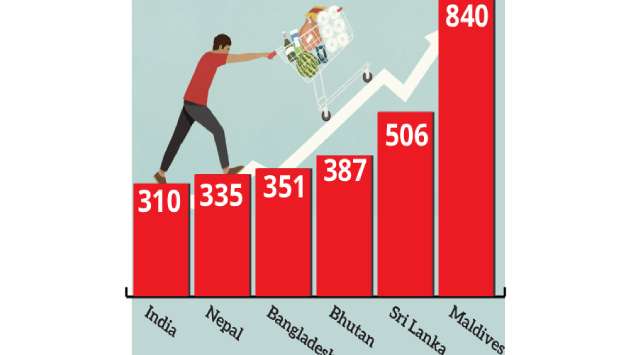
- Cost of living for an individual being $506 or Rs. 153,899 excluding rent to live a comfortable life
- Maldives is considered the most expensive SAARC country to live in comfortably with a cost of $840.4 per person
- For a family of four living in the city of Colombo, the monthly costs are Rs. 570,997 excluding rent to live comfortably. This includes the cost of childcare, groceries, outings, dining, school fees, house expenses, vehicle expenses etc
Colombo, Oct. 31 (Daily Mirror) – Sri Lanka is the second most expensive South Asian Association for Regional Cooperation (SAARC) country to live with cost of living for an individual being $506 or Rs. 153,899 excluding rent to live a comfortable life according to Numbeo, a user-generated cost-of-living statistics website.
According to the website for a family of four living in the city of Colombo, the monthly costs are Rs. 570,997 excluding rent to live comfortably. This includes the cost of childcare, groceries, outings, dining, school fees, house expenses, vehicle expenses etc.
Numbeo is the world’s largest cost of living database and a crowd sourced global resource for quality of life data. It provides insights into cost of living. According to the site Maldives is considered the most expensive SAARC country to live in comfortably with a cost of $840.4 per person.
With people being burdened by both higher taxes and increased cost of living due to higher prices, the Central Bank’s ‘Annual Economic Review 2024’ notes that based on the National Consumer Price Index (NCPI), the estimated average monthly household consumption expenditure increased by 1.6 percent from Rs. 103,383 in 2023 to Rs. 105,063 in 2024.
Nevertheless, this highlights a notable easing compared to the 74.9 percent increase recorded in 2022 compared to 2021, as well as the 16.5 percent increase in 2023 compared to 2022. In such situations, families increasingly resort to negative coping mechanisms when it comes to managing their spending.
According to Central Bank of Sri Lanka (CBSL) data from September 18, 2024 to 18 September 2025, the average price per kilogramme for nine commonly consumed vegetables rose from Rs. 225 to Rs. 321.10, representing an overall increase of 42.7 percent.
” මහින්දට සමාන වෙන්න හදන අහිංසක අනුර…” 😂🤣😐🤠 පව් අනේ එයා
October 31st, 2025MP Archchuna keeps sword for safety after denied security
October 31st, 2025Courtesy Hiru news
Jaffna District Member of Parliament Ramanathan Arjunan states that despite receiving death threats, he has not been provided with security by the government, and therefore, he keeps a sword for his protection. He says he has informed the Speaker of Parliament and the Inspector General of Police (IGP) about this.
The MP pointed out that he had previously requested security in writing on two occasions due to threats to his life, but received no response from the government.
The MP mentioned that he requested a pistol for his protection but was denied authorisation by the government for that as well.
Following that, he requested a ‘Spray Gun’ used for animal protection, but again, he received no response from the government.
Therefore, MP Ramanathan Arjunan further stated that he now keeps a sword for his own safety, which is always kept in his motor car, and that he has taken steps to inform the Speaker and the IGP of this situation.