Lankans want both elections and a strong leader untrammelled by elections

February 14th, 2022

By P.K.Balachandran Courtesy NewsIn.Asia

Colombo, February 14: A survey conducted by the Colombo-based  Centre for Policy Alternatives (CPA) in September-October 2021, found that while the majority of Sri Lankans were wedded to the principle of elections, they were also hankering for a strong leader who is not inconvenienced by elections.”

An overwhelming majority (92.2%) were in support elections as a way of choosing the rulers. However, 75% favored a strong leader. From an ethnic perspective it was mostly respondents from the Sinhala and Tamil communities who said that there should be a strong leader who did not have to worry about elections. Up Country Tamils and Muslims  opposed the strong leader principle.

Exactly half of the respondents (50.3%) were of the opinion that more powers should be given to parliament by reducing the powers of the President.

An overwhelming majority (87.4%) said that all major decisions that concerned the country should be taken by experts rather than politicians. Nationally, a majority of respondents (60.7%) were of the view that there should be more experts as opposed to politicians in the government.

There appeared to be overwhelming support for the military as a result of its efforts to mitigate the COVID-19 crisis in the country. However, when asked as to whether the country should be governed by the military, a substantial majority (70.8%) said no”.

There was however considerable support in the military handling public affairs at a time of crises. This view was held particularly by the Sinhala community (60.5%), as opposed to those from the minorities (Tamils 30.5%, Up Country Tamils 30.2% and Muslims 25.2%).

On giving decision-making powers to religious leaders, a majority of respondents (76.3%) disagreed that major decisions should be taken by religious leaders.

A majority of respondents (64.1%) said that it is unlikely that during its term in office, the Gotabaya Rajapaksa government would lift the country from the economic crisis it has been in.

There appears to be a certain degree of skepticism about the government’s plans to bring about a new constitution. Nearly 40% were of the view that a new constitution was unlikely.

Fertilizer Question

A majority of respondents (72.1%) were of the opinion that even though chemical fertilizers are not good for one’s health, until a viable solution is found, chemical fertilizers should continue to be used to some extent. Only 23% of the respondents were of the view that chemical fertilizers must be completely stopped, immediately.  

Foreign Investment

Nearly 45% of the respondents felt that the government should allow foreign companies to invest in the country, as an increase in trade would benefit everyone. But 37.5% said that due to exploitative practices of foreign companies, the government should not allow foreign investment in the country.

On household income, a significant proportion of respondents (75.1%) indicated that their household income got worse. This is felt most among the Up Country Tamil community (63.6%) which indicated a drop in income. A significant majority of respondents (58.8%) from the Up Country Tamil community indicated that their political party affiliations resulted in their being unfairly treated when receiving government subsidies.

Ethnic Relations

Nearly 48.6% were of the view that their association with persons from other ethnic groups had remained the same when compared to what it was two years ago. Nearly 30% of the respondents claimed that it had got worse. Up Country Tamils (47.3%) and Muslims (40.5%) reported that inter-ethnic relations had got worse.

Nearly 37% of the respondents believed that freedom to criticize the President and other political leaders had decreased, whilst nearly 32% of the respondents claimed that it had remained the same. Muslims (51.9%), Up Country Tamils (51.5%) and Tamils (50.3%) claimed that there had been a decline in the level of freedom to criticize the President and other political leaders when compared to what it was during the previous government.

Muslims (50.4%) and Up Country Tamis (56.6%) and Tamils (45.3%) said that it had become difficult to criticize the military. Only 25.3% of the Sinhalese felt so.  

Whilst a majority of respondents (58.2%) were of the view that the government would maintain good foreign relations, nearly one third of the respondents indicates that the government would not. From those who indicated that the government would not maintain successful foreign relations, it was mostly respondents from the Muslim community (40.2%) who held this view.

Rebalancing India-China, The Sri Lanka Way

February 14th, 2022

By N SATHIYA MOORTHY Courtesy Rediff

Colombo seems to be veering to the middle path between China and the US on global matters, but in regional matters of strategic security, it is increasingly identifying with India, points out N Sathiya Moorthy.

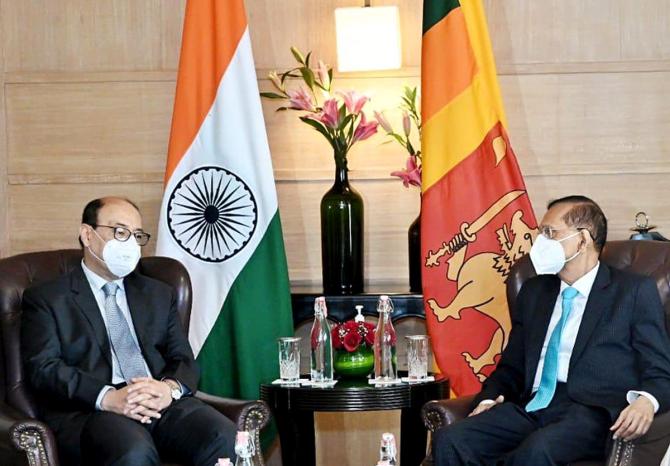
IMAGE: Foreign Secretary Harsh Vardhan Shringla calls on Sri Lanka Foreign Minister G L Peiris in New Delhi, February 8, 2022. Photograph: ANI Photo

In New Delhi recently, Sri Lanka’s Foreign Minister G L Peiris told interviewers that bilateral ties are moving from a ‘transactional’ to a ‘strategic’ phase.

It was a line drawn out from the position paper of his nation’s high commissioner, Milinda Moragoda, who has also been flagging the idea since his taking over last year.

The bilateral ties have jumped nautical miles ahead in recent months, say, beginning with the Indian private sector Adani Group getting management stakes in the West Container Terminal project in Colombo port.

Earlier, India was peeved at President Gotabaya Rajapaksa’s government cancelling the tri-nation MoU for joint development of the port’s Eastern Container Terminal, also involving Japan, signed by the previous government of his political rivals.

Sri Lanka’s forex and economic crises have cemented bilateral ties as never before in recent years.

The steep fall in tourism, beginning with the 2019 Easter Sunday serial blasts followed by the COVID-19 pandemic, which also drained internal remittances from Sri Lankans employed overseas — they all had returned home — caused the forex crisis.

The economic crisis is a legacy issue and every government since Independence should take the blame.

To this, President Gota made his contribution in the form of overnight ‘organic farming’ policy, starting with import-ban on items of daily need like turmeric from Tamil Nadu.

Anti-Rajapaksa economists saw it as an honourable way of covering up the impending forex crisis, as applicable to import ban on other goods.

Sooner than later, it translated as previously-undisclosed import of ‘organic fertiliser’ from China.

Beijing’s tactless usury of demanding and obtaining $6.4 million in scarce forex after Sri Lankan farm scientists had rejected the imports as ‘sub-standard’ has made China overnight unpopular among large sections of Sri Lanka’s rural population, who are dependent on farming.

Coupled with that is the instant delivery of chemical fertiliser to save standing crops in vast, if not all the areas, has enhanced India’s image as a friend-in-deed among multiple sections.

The knowledgeable are convinced, now as always, that India’s terms won’t be usurious in any which way.

Sri Lanka could count on New Delhi to relax terms further in unforeseen circumstances such as a tsunami now and a pandemic another time.

Today, there is greater appreciation for India extending about $2.5 billion in aid than when India volunteered Covid-related medical assistance to all neighbours.

The COVID gift package had included medical kits in the early stages, followed by vaccines and oxygen.

Today’s forex-related aid includes $ 1 bn in loan for importing essentials, including food and medicines, and $500 million for importing oil to keep the Sri Lankan machinery going.

However, the greater attraction involves the hurried Sri Lankan clearance of the delayed deal for the joint development of the British era Trincomalee oil tank farms — 99 tanks, total one-million tonne capacity.

Indian expectations are that Colombo would not use motivated protests and court cases to scuttle the project on a later date — or, allot the 24 Trinco tanks retained by the public sector Ceylon Petroleum Corporation to scuttle the project on a more convenient day, as was the case with such others in the past.

Minister Udaya Gamanpilla has since told the Sri Lankan parliament that India had expressed a desire to participate in oil and gas exploration in Sri Lankan waters. Incidentally, when Norway mapped these waters for oil wealth two decades ago, Sri Lankan critics termed as their hidden agenda for playing facilitator to ethnic talks between the government and the LTTE.

The Peiris-Moragoda use of the term ‘strategic’ possibly refers to creating a joint ‘strategic oil reserve’ for both nations to benefit from.

Refurbishing the tanks is going to cost India billions, and the physical security of the farms, both from internal and external threats, on land and sea alike, can be expected to be entrusted to the Sri Lankan forces, particularly the Navy.

The nation’s armed forces had sought and got the right when the previous government handed over the southern Hamabantota port territory to China in a debt-to-equity swap-deal after the earlier government of then president Mahinda Rajapaksa — now Sri Lanka’s prime minister — had got into a usurious construction contract with the Chinese.

Minister Peiris’s maiden visit in this term as foreign minister after taking over in August was delayed by the pandemic, though he had met his Indian counterpart Subrahmanyam Jaishankar on the sidelines of the United Nations.

Sri Lanka’s Finance Minister Basil Rajapaksa, another brother of President Gota, visited New Delhi not very long ago, where one of his engagements was a uniquely co-hosted meeting by his counterpart Nirmala Sitharaman and Dr Jaishankar.

Incidentally, the two ministers and also High Commissioner Moragoda have also met National Security Advisor Ajit Kumar Doval, indicating that there were other aspects of ‘strategic’ relations that the two nations were engaged in.

It had all begun with Doval’s Colombo visit of November 2020, when the two nations along with common neighbour Maldives elevated their existing yet non-operational Maritime Security Agreement into a ‘Maritime and Security Agreement’ with all its import.

After Peiris’s Delhi visit, an Indian media interview with him is now talking about preliminary talks for the purchase of two India-made Dornier fixed-wing aircraft, which New Delhi had deployed and also donated to the Maldives some time ago for maritime surveillance.

If it happens, the request-and-offer, or offer-and-acceptance as the case may be, should mark the first time New Delhi is supplying military use aircraft, though for not-exactly military purposes, after deciding not to supply lethal war material at the height of the ethnic war in Sri Lanka.

Following the end of the ethnic war in the country, Sir Lanka, since 2011, is the third arm of what originally commenced as the two-nation, bi-annual Dosti Coast Guard friendship exercises.

The last such joint exercise was conducted in Maldives in November 2021. It will be interesting to note if common Ocean neighbours, Mauritius and Seychelles are invited, and participate in the next edition of Dosti.

In between, the two nations participated as observers at the NSA-level talks, and the likelihood of their joining the Maritime and Security Arrangement, with Colombo as the secretariat, among the other three nations cannot be ruled out.

With thr US in Diego Garcia in the middle and India’s tri-Services Andamans Command and the upcoming Lakshadweep unit forming the natural flank along with French Reunion, a strong cooperative Indian Ocean Region security arrangement can blockade the mouth of the Indian Ocean for adventurous navies intent on harm.

Evaluating the emerging situation, the ministry of external affairs created a new division on the Indian Ocean Region some years back, overseeing affairs with the Maldives and Sri Lanka, Mauritius and Seychelles.

More recently, it expanded the Indian Ocean Region division to include western Indian Ocean nations, namely, Madagascar, Comoros and Reunion.

This does not automatically mean that these nations, especially Madagascar and Comoros, are with India on matters the Indian Ocean Region. Instead, it is India’s way of looking at the Indian Ocean Region south of its land territory as a single unit on matters of maritime development, security and consequent concerns.

In Delhi, Peiris also extended invitation for Prime Minister Narendra Modi to attend the BRICS Summit in Colombo next month.

If Sri Lankan media speculation comes true and Modi attends the summit — possibly with a bilateral on the sidelines — then, India would have upturned predecessor Manmohan Singh’s last-minute cancellation from the 2008 CHOGM, though the comparison should end there.

It also remains to be seen if BIMSTEC would follow the ASEAN precedent of offering the seat to Myanmar, but not to the ruling junta.

The subdued bilateral euphoria of the present is to be accompanied by the Indian vote at yet another UNHRC resolution on Sri Lanka in March, after New Delhi had abstained a year ago.

Beginning last year’s Resolution 46/1, the West-initiated resolution has gone beyond the original war crimes probe to include every day violations, the likes of which deviate from the original and are also committed by other States, including some of the resolution-movers.

The West, starting with the US as prime mover, has since begun painting India with the same Sri Lankan brush, when it comes to more recent allegations of non-war crimes human rights violations.

Under Modi especially, India has been moving slowly but surely to the centre-stage on the Sri Lankan ethnic issue.

It has more to do with competitive Sri Lankan Tamil politics over the non-acceptance of the India-facilitated power devolution package under the Thirteenth Amendment to the Sri Lankan constitution than New Delhi’s security concerns of the China kind.

Then, there is the irreconcilable fishermen’s dispute between the Tamil-speaking coastal population in the two nations.

It would continue to be a thorn in the flesh for both nations, but for starters, Colombo has to display a certain level of maturity in ensuring that the Sri Lanka Navy does not continually harass the Indian fishers crossing the IMBL, as it acts as a constant dampener to bilateral ties.

Non-regional diplomats posted in the two countries and also the international media are the culprit, but they should be given least opportunity in the matter.

Bilateral ties have three major impediments.

One, of course, is China, and the other two relate to the ethnic issue and the fishers’ dispute, the latter bilateral in form and content.

Colombo has since sought to address the former.

The return of institutionalised foreign policy — or the foreign policy returning to the institutional mechanism, to whatever extent possible under the circumstances — has meant that Sri Lanka is able to articulate its India-China bi-polar approach in a better way than any time in the past.

In Delhi media interviews, Peiris reiterated that they would go to India, China, Bangladesh or any other bilateral partners first to address the forex and fiscal crisis, before considering the IMF.

It’s not about the IMF’s all-American character as often inadequately understood.

Though the minister did not explain it, the left-leaning leadership in Colombo is anxious to avoid politico-electoral unpopularity attending on IMF conditionalities nearer home compared to their populism.

To this, Sri Lankan street opinion may have now added Chinese usury, which was felt in every rural home, too, after the ‘fertiliser scam’.

It was unlike the two Hambantota deals — construction and swap — and also the upcoming Colombo Port City, which were mostly urban politico-economic issues.

The China-funded projects mostly relate to urban or economic infrastructure, including the upcoming Colombo Port City and expressways that do not impact the vast rural population directly.

Over the past close to a decade, they have also been taking away Sri Lankan jobs in their millions, hence family incomes.

Colombo seems to have understood what is wrong with their China-centric economic policy, which has proved to be too costly for Beijing’s uncomplicated political and diplomatic support at the UNHRC and the UN, if and when it’s hauled up over there.

Against this, Indian projects, though infrastructure-related at present, are expected to massively boost domestic jobs and family incomes.

No one in Sri Lanka can dream of India demanding its territory in lieu of debt, or blacklisting a public sector bank for non-payment for substandard fertiliser, on the government’s advice.

The message has to be taken across, but no one in Sri Lanka has any doubt that if the present forex/economic crisis were to continue for unforeseen reasons again, India would be as mean a lender, which anyway it has never been, given the concessional terms and the comforting hope of rescheduling as has happened now with two pending debts, totalling $ 900 mn, if it came to that.

There now seems to be greater clarity and acceptance in Indian government circles that they needed to take Colombo at its words, on ‘development funds from all, strategic ties only with India’.

The coming months especially will (have to) provide evidence to this also to the Indian strategic community and to the larger world.

At some point, India also needs to re-evaluate unilateralism in defence and strategic affairs, without prior consultation or post facto information for smaller neighbours, on the nation’s extra-regional defence and security pacts — with the erstwhile Soviet Union during the Cold War and the US-led West, since.

The latest is the Quad, Indo-Pacific duo, where Sri Lanka seems to be moving closer to the EU-led Indo-Pacific, instead.

The EU initiative itself is a product of absence of prior consultation and later-day communication between the US and its European allies.

Clearly, Colombo seems to be veering to the middle path between China and the US on global matters, but in regional matters of strategic security, it is increasingly identifying with India, as it has been declaring through the past decade-plus-half but not as convincingly as at present.

There is a long way to travel together, but a new beginning has been made, after all!https://imasdk.googleapis.com/js/core/bridge3.498.2_en.html#goog_1561762740

N Sathiya Moorthy, veteran journalist, political analyst and author, is Distinguished Fellow and Head-Chennai Initiative, Observer Research Foundation.

Ahead of 49 Geneva sessions: FM questions UK duplicity; UN interference in parliamentary functions

February 14th, 2022

By Shamindra Ferdinando Courtesy The Island

Prof.Peiris addressing armed forces and police officers at the National Defence College (NDC) (pic courtesy FM)

Foreign Minister Prof. G. L. Peiris has questioned the conduct of the British government, a member of the Geneva-based United Nations Human Rights Council, in addition to being the leader of Sri Lanka Core Group at the UNHRC, the extraordinary efforts it had made to suppress wartime dispatches from Colombo.

Prof. Peiris underscored the irrationality in the British action as they were reportedly so keen to establish the truth, pertaining to unsubstantiated war crimes allegations directed at the then political leadership and the military.

The Foreign Minister said so addressing a selected group of armed forces and police officers at the National Defence College, Kollupitiya.

Prof. Peiris addressing the officers on the invitation of Maj. Gen. Amal Karunasekara, Commandant of the NDC, Prof. Peiris explained how the British worked overtime to prevent a senior member of House of Lords Michael Wolfgang Laurence Morris from securing classified documents.

At the onset of the discourse, Prof. Peiris acknowledged that Sri Lanka was high on the Geneva agenda at the forthcoming 49th session of the UNHRC scheduled to commence just two weeks later.

The controversial dispatches authored by Lt. Colonel Anthony Gash, the then Colombo-based Defence Attaché dealt with the ground situation on the Vanni front (January to May 2009) as troops surrounded the remaining fighting cadre of the LTTE.

Sri Lanka brought the war to a successful conclusion on May 19, 2009 on the banks of the Nanthikadal lagoon.

Emphasising the importance of the British dispatches sent simultaneously as the fighting was taking place on the Vanni east front, Prof. Peiris asked whether the British questioned the credibility of their own employee based in Colombo.

The UK succeeded the US as the leader of Sri Lanka Core Chair in June 2018 in the wake of the then President Donald Trump quitting the UNHRC calling the UN body a cesspit of political bias. The US returned to the Geneva body in the wake of Joe Biden’s election as the President.

Prof. Peiris discussed why Lord Naseby hadn’t been able to secure the dispatches until he sought the intervention of the Information Commissioner’s Office in terms Freedom of Information Act 2000. However, the Foreign and Commonwealth Office (DCO), the custodian of the classified documents pertaining to the Vanni war, released a heavily censored section of them, Prof. Peiris said, questioning the British motive. The Foreign Minister emphasized that the British documents would have helped those really concerned about accountability issues to ascertain the Vanni situation.

Declaring that he had perused the heavily detracted British diplomatic cables, Prof. Peiris explained how they helped Sri Lanka to prepare its defence. A particular cable questioned the very basis of the UN allegation pertaining to the death of over 40,000 civilians during the final phase of the ground offensive.

During the course of the one-hour lecture, Prof. Peiris assured the military that in terms of international laws applicable to wars/conflict Sri Lankan personnel couldn’t be hauled up before international war crimes court under any circumstances. Twice Foreign Minister Prof. Peiris emphasized there was absolutely no danger or risk in them being subjected to such action as the international law was very clear in this regard.

Prof. Peiris served as the foreign minister during 2010-2015 President Mahinda Rajapaksa’s presidency. President Gotabaya Rajapaksa brought him back as the FM last August in place of Dinesh Gunawardena.

Prof. Peiris also dealt with what he called critically important work undertaken by an international Advisory Council appointed to assist the Presidential Commission to Investigate Complaints Regarding Missing Persons. The Advisory Council comprises three legal luminaries namely the late Sir Desmond de Silva (chairman), Sir Geoffrey Nice, and Prof. David Crane.

Referring to current international ‘flashpoints,’ Prof. Peiris expressed shock and dismay over the way a section of the international community had responded to the Sri Lanka accountability issue. Prof. Peiris was harsh on the creation of a special mechanism to gather information on Sri Lanka against the backdrop of UN Human Rights Commissioner Michelle Bachelet declaration that they have developed an information and evidence repository with nearly 120,000 individual items already held by the UN.

A resolution adopted in March 2021 allows the UN to collect, consolidate, analyze and preserve information and evidence, and to develop possible strategies for future accountability processes for gross violations of human rights or serious violations of international humanitarian law in Sri Lanka, to advocate for victims and survivors, and to support relevant judicial and other proceedings.”

Questioning the credibility of the Geneva process Prof. Peiris asked how evidence and individual items that hadn’t been subjected to examination whatsoever could be used against Sri Lanka.

How could unsubstantiated claims made under the condition of anonymity be accepted without being verified?” Prof. Peiris asked, accusing Geneva of what the academic called cynical violation of the basic law.

Reiterating Sri Lanka’s commitment to the UN processes, Prof. Peiris questioned the necessity of a special mechanism at the UN’s expense in spite of the availability of UPR (Universal Periodic Review) to inquire into the conduct of all countries. Alleging that war winning Sri Lanka had been singled out and treated unfairly, Prof. Peiris said that the human rights issue was being used as a tool to interfere in domestic affairs.

Prof. Peiris pointed out that Geneva was even interfering in the functions of the Parliament. Referring to Geneva resolutions and statements from therein, Prof. Peiris said: the devolution of power, reorganisation of the armed forces, reorganization of the police force, the balance of authority between the Central government and the Provincial Councils, the Prevention of Terrorism Act and its reforms are matters that should be decided by the Parliament and the people of Sri Lanka.

Instead of giving local mechanisms much needed support, the UNHRC was pushing to impose solutions, Prof. Peiris said, declaring such measures weren’t durable.

Prof. Peiris stressed the importance of the role played by mechanisms-namely the OMP (Office of Missing Persons), OR (Office of Reparations) and ONUR (Office of National Unity and Reconciliation) in current efforts to address accountability issues. Reference was also made by Prof. Peiris to the Truth and Reconciliation Commission of South Africa while explaining the work undertaken by Commission of Inquiry (CoI)  appointed under the chairmanship of sitting Supreme Court judge Abdul Hameed Dileep Nawaz to investigate, inquire into and report, or take required actions, regarding the findings of the former Commissions, or Committees, that investigated human rights violations, serious violations of International Humanitarian Law (IHL) and other such offences.

Declaring that Sri Lanka was ready to cooperate fully with UNHRC, Prof. Peiris said that Geneva couldn’t substitute the Parliament.

Sajith will be common candidate as people want him to lead – Tissa Attanayake

February 14th, 2022

Courtesy The Daily Mirror

Leader of Opposition Sajith Premadasa will be the common opposition candidate for the next presidential elections as SJB believes that people want him to lead the nation, its National Organizer Tissa Attanayake said today.

Attanayake told a press conference that the SJB believes that people will endorse Premadasa’s candidacy and that all opposition political parties will back him. We feel that Mr. Premadasa will be the person who will be backed by all opposition political parties and the people,” he added.

Responding to the challenge given to his party by the SLPP to come for an election, Attanayake said SJB is even ready for a presidential or a general election. A Presidential election  or a general election could be held next year if the President wishes and we are ready for any elections,” he said.

Also he said the local government elections and the provincial council elections can be held this year. (Yohan Perera)

Basil assures EPF and ETF will not be subjected to 25% Surcharge Tax

February 14th, 2022

Courtesy Adaderana

Finance Minister Basil Rajapaksa has explained and assured the Cabinet of Ministers that 11 funds including the Employees’ Provident Fund (EPF) and the Employees’ Trust Fund (ETF) will be exempted from the one-time tax surcharge of 25% proposed in the 2022 Budget.

It had been proposed in the 2022 Budget to impose a 25% Surcharge Tax on individuals or companies earning an annual taxable income of Rs. 2,000 million or more.

It is to be a one-time tax payable by high value taxpayers in 2022 for their income in the tax year of 2020/21 while the objective of this special tax was to raise the necessary revenue to finance the Government expenditure programs for the year undisturbed.  

Concerns were subsequently voiced by experts, opposition politicians as well as members of the government itself that the Employees’ Provident Fund (EPF) and the Employees’ Trust Fund (ETF) would also be subjected to this 25% surcharge tax as any fund that exceeds Rs. 2 billion taxable income would be subjected to this surcharge tax.

However, making a special statement to Ada Derana today the Minister of Finance Basil Rajapaksa said he assured the Cabinet during its meeting this evening that 11 funds including the EFP and the ETF will not be subjected to this surcharge tax. 

He said that clearly at the time the government expected to generate a revenue of around Rs. 100 billion from this surcharge tax and that accordingly they identified 69 companies and individuals who will be subjected to this tax.

He said that at no point did they expect to include the EPF or ETF into this tax. Rajapaksa said there are 11 funds including the EPF and ETF and that they never intended to include any of them into this tax surcharge. 

However, the Inland Revenue Act No. 24 of 2017 of the previous government has identified these 11 funds as income tax paying institutions. Therefore, there was an opinion among the public that this would be a surcharge.” 

He said that they have explained in the Cabinet meeting that all 11 funds will be exempted from this tax.

Ceylon Chambers urges govt to reconsider

Meanwhile the Ceylon Chamber of Commerce today also noted serious concerns on the provisions of the Surcharge Tax Bill that has been gazetted recently to implement the budget proposal on same.

The Chamber said it provided many alternative recommendations for the implementation of the Surcharge Tax by considering either an income tax surcharge of 10% from all taxpayers, an income tax surcharge at varying rates depending on the level of income, credit to be carried forward for paying the one-off tax or the imposition of the tax on a prospective basis. 

Any of these alternatives could have raised the targeted revenue while minimizing the burden on the private sector during this extremely challenging period in the country, it said.

Further, the Chamber in its representations, specifically requested to avoid application of the Surcharge Tax at Group level considering its unfair impact on smaller subsidiaries and minority shareholders. This method of application at the Group level could be a serious deterrent to local and foreign investors who consider entering into joint ventures with large conglomerates, it emphasized.

Therefore, the Ceylon Chamber of Commerce requested the Government to reconsider some of these provisions before it is submitted for approval by Parliament and extends its support to develop alternative proposals to ensure the revenue targets are met.

Covid-19: Sri Lanka reports 1,231 new cases and confirms another 36 coronavirus deaths

February 14th, 2022

Courtesy Adaderana

The Health Ministry says that another 1,231 persons have tested positive for Covid-19 in Sri Lanka within today (14).

This brings the country’s official Coronavirus caseload thus far to 629,347 while presently a total of 18,158 patients infected with the virus are under medical care. 

The Director General of Health Services has confirmed another 36 coronavirus related deaths for February 13, increasing the death toll in the country due to the virus to 15,844.

The deaths reported today includes 20 males and 16 females, according to the figures released by the Government Information Department. 

Six of the victims are between the ages 30-59 years while the remaining 30 are abed 60 years and above. 

COULD SRI LANKA BECOME A COMPETITIVE ECONOMY IN ASIA

February 13th, 2022

BY EDWARD THEOPHILUS

An economic symposium conducted in Colombo a few years ago especially focused on vital issues related to the country. The issues discussed were foreign debt, regulation, export performance and attracting foreign investment also included. Sound advice and views of economists were encouragement for competition, reducing the cost of debt service and promoting exports to achieve a higher volume of foreign reserves. The major issue relating to the foreign exchange has been an inability to balance the incoming and outgoing foreign exchange flow.

After the COVID-19 pandemic, Sri Lanka and other countries of the world encountered significant economic backwardness and many countries show reluctance to talk about it. For example, lockdowns harm the economy because movements of people contributed a considerable volume of value to the circular flow, and COVID-19 and associated virus control measures limited the contribution to the economy. Employment opportunities have been limited and people are scared to go to market and spend. The World Bank (IBRD) recently mentioned the situation. Developed nations show apprehensiveness to talk about the outlook, most probably, investors would have considered that economic backwardness might create an unexpected risk to the world economy through stock markets. Economic policymakers have no answers, but the reality is they need to adapt to the environment, especially taking steps to control spending instead of sticking to Keynesian theory. Spending controls are admissible to Sri Lanka because the linkage of spending has no positive link back to the economy. The funds for government spending find from borrowing and such a process blows many macroeconomic disadvantages.    

The issues focused on the conference were significant issues not only in Sri Lanka alone but also in many third-world countries. Common people have less understanding of the issues they could understand from popular news in print and social media. The political motivation of the country has been aligned to spending without discipline since the 1960s. The major macroeconomic attention of the conference was based on three vital aspects: competitiveness, government fiscal stability, and maintaining long-term sustainable economic growth. These three aspects were interconnected with economic reforms, which stuck to the general rhetoric of the international financial institutions such as IMF, World Bank, and Asian Development Bank towards developing countries since the ending of the cold war in the early 1990s.

Sri Lanka already identified several issues related to economic competitiveness during the 1977 general election and the government budget presented for 1978 by Ronnie de Mel highlighted some of these issues in the budget speech with complicated corruption in the country. Corruption in the country has been a factor that affects the cost of investors and the complexity of corruption becomes a hard task to eliminate during the past several decades. The vicious aspect of corruption is politicians and public bureaucrats with politicians involved in corruption.

Corrupt practices of bureaucrats and politicians have no party difference and all are equally corrupt. The right of the universal franchise is used by political parties to work against the economic rights of the public and capitulate the rights of ordinary people and the free investment capabilities of entrepreneurs. The elected government in 1977 started several policy measures for trade liberalization and market-oriented economic policies, as they were essential conditions under the environment of that time. The liberal policy initiation of Sri Lanka and radical changes intended in the economy in Sri Lanka were kicked off before Australia introduced such competitive measures into the economy. However, today Sri Lanka is behind all other countries, two major reasons for the situation were corruption and the population policy that has not been implemented with a clear prognosis to maintain 15 million population in the country like in Singapore and ethnic issues massively contributed to an increasing population when the economic contribution has been stagnated. If the size of the population is 15 million, the value of per capita GDP would be more than the US $8000 and it might be $15000 to purchase power parity.

There were many criticisms against Sri Lanka’s policy initiatives and later rapid economic progress achieved in the country found out that the market economic policies were the right strategies to the country despite much criticism made by left political parties for purely political advantage misleading the public. The advantage of liberal policies was opening the market for investment, and the response from the political sector did not provide measures for controlling corruption from the operation. The difference between Singapore and Sri Lanka has been this factor to achieve international competitiveness. Economic and social policy markers did not motivate to eliminate vicious corruption and explain the situation to the political administration. The total value of corruption in Sri Lanka could estimate to be US $100 billion or more and if the value of corruption adds to the economy, it would be competitive beyond the Indian region and the productivity from debts would add a massive value. If the market policy was implemented without corruption, the per capita GDP could have been counted as US $ over 20000 and more investment would have come to the country as a competitive state in Asia. The other vital point is if the value of corruption in the country after the independence added to the foreign reserves Sri Lanka rupee would have a strong monetary unit in Asia and the foreign reserve volume in the like in Taiwan would be more than the US $100 billion.   

Although Sri Lanka started a competitive policy framework, it was lacking positive controls for good governance and economic disciplines when compared to Singapore, Malaysia, or Australia, there should have been undertaken market economic system with strong economic disciplines. The elected governments since 1990 have not been attempted to abolish the fundamental policy directions of the economy started in 1978 despite the market economic system rhetorically used as a feature to blame in the political platforms by opposition political parties before electing them to office. The backsliding of open economic policies was a major challenge and the hardest task for elected governments since the 1990s.

Contrast the politically motivated propaganda in public meetings and newspapers and social media, the government with leftist ideology will continue market policies in the country as it appeared such policies generated economic benefits to the country. The public of Sri Lanka did not want to go back to the inward-looking policies of the so-called Bandaranaike era, which created queues and black markets for each essential item. Although the prices were higher under the market economy, scarcity was not an issue and the producers too gained the right price for their products at an open market.

The trade competition of Sri Lanka involved many sectors of the economy supporting the market-oriented equilibrium rather than an artificial counterpoise maintained by the Bandaranaike regime with a massive scarcity. Deregulation of several key markets was the initial requirement of beginning market policies to give support for efficient operation. The major market was the financial market, which comprises trading banks, non-bank financial intermediaries, investment banks, stock markets, and superannuation markets. The regulatory authority in the financial system is the Central Bank and practically, it has not been operated as a regulator and it was forced to participate in market operations such as superannuation, rural credit and development financing. In contrast to this, the regulatory authority (Central Bank) works as a market player in the superannuation market with a monopoly and it should have done to maintain a strong regulation system with good supervision. The weak market operations have been involved with a heavily regulated labour market and a rigid trade union system in the country, the government has failed to crack down the trade union system which operates as a barrier to investment and maintaining product quality. 

The budget speech of 2015 and the government policy initiatives of the good governance regime reflected a tiny attempt to deregulate the financial system, but it has appeared that the effort was becoming purely unsuccessful because the contract between the president and the Prime Minister concerning policy implementations and crooks associated with market operation stole the system for personal advantages. This situation gave a powerful push to the election of Gotabhaya Rajapaksa in 2019 and the minister of finance in the new government has not taken effective steps to eliminate corruption and open for competitiveness. Many so-called educated guys who showed the ability to run the operation proved that they are highly corrupt personnel with a mask to show off.

COULD SRI LANKA BECOME A COMPETITIVE ECONOMY IN ASIA PART 2

February 13th, 2022

BY EDWARD THEOPHILUS

Bulky ownership of the banking market of Sri Lanka is in the government hand. This includes as Bank of Ceylon, Peoples Bank, National Savings Bank and several development banks, investment banks and long-term financial institutions such as mortgage and national development banks. As the government is not in a position to provide capital for state banks, they are in a difficult situation to profitably manage and provide investment support to the private sector and public enterprises. There are few banks under private ownership with a small capacity to finance the development thrust of the country, but they are also depending on the government business services subject to direct or indirect control measures of the government. The existing competition within the banking market appears to be like in house conflict between family members with many regulations. It is also observed that banks are working as a secret cartel when referring to decisions making process of interest rate and bank charges, application of procedures and many other matters. In this environment, the banking market in Sri Lanka restrains attracting foreign investments to compete and provide greater benefits to customers. The efficient operations with the ability to provide financial services for domestic investments and foreign investors in expanding export market.

Recently, I have examined annual reports of government banks and found that profit figures of these banks comprise  Rs Billions of exchange revenue, which automatically made of declining the foreign value of Sri Lanka rupee. This automatic process is quite easier because of a weak economy in the country, the foreign value of domestic currency declines every day generating rupee profits from existing foreign assets.  This exchange profit is not a result of the quality of management stewardship of banks. 

The billions of risk assets of banks were funded by borrowing from either domestic or foreign sources, issuing debt instruments at a higher rate of interest.  As the government guarantee ensures the safe return of funds to investors and debt instruments mark at a higher rate of interest, foreign and domestic investors will subscribe to them. The bank management indulges this situation as a higher achievement covering actual truth to the government and customers. In this situation why Sri Lanka’s government is reluctant to consider alternative options for capitalizing banks.

The technique of banks generating liquidity for lending business has become a serious repercussion for indebtedness of the country. It has already created structural issues in the economy with a possibility of austerity measures to be insisted by international financial institutions when they support the country. The other serious issue of the banking system is that it has not made realistic credit lost provisions after successful risk asset reviews, which is the global strategic technique that is used to realistically estimate the required volume of specific and general provisions for total credit portfolios.

When examining credit portfolios of banks, obviously they are comprising a large volume of non-performing credits, in which the pace of bad debt is possibly over 15% but the bank management calculates interest earning for these non-performing credits adding it into the banks’ revenue component as provided paper profits. If there are 15% non-performing credits in the aggregate lending portfolio of a bank, it means that the bank is not making profits from its lending business. 

When these interest revenue and exchange profits are transferred to the treasury, they will use for government spending. That means paper money will be added to the country increasing inflation. There are several reasons to increase non-forming credits in the banking system of Sri Lanka, but I do not know to explain them in this article as it has limited space.

The other visible issue in the government bank imperatives is that many subsidiaries are attached to individual banks and these subsidiaries eat a considerable portion of bank profits.  Why did these subsidiaries created is a hard question to answer, sometimes ago it was a pattern of the management of government banks that when a top banker retires from the service, he or she creates a subsidiary using bank funds as initial capital?  The purpose of the subsidiary was to continue in the service by the retired person indirectly enjoying banks’ facilities. Before creating subsidiaries, banks never evaluated the viability of subsidiaries from a different point of view.  The government banking system also promoted opening branches overseas or creating subsidiary branches overseas purely for management indulgence purposes rather than profitability or investment diversification purposes.  Sometimes, the purpose of creating subsidiaries appears to be contained undisclosed dishonest elements to a certain extent.  This type of management is not successfully supervised or controlled by the top management of banks. It is quite possible to assume that politicians or regulators have no clear understanding of this type of risky manipulation in the government banking system.

Sri Lanka needs to maintain strong domestic and international confidence in its payment system.  During the last several years there has been a major news item in international media about the financial crisis and the public confidence in the payment system of various countries. Although it was not a serious issue, bad debt in the banking system created distress in many countries. If such a situation incurs in Sri Lanka, it is difficult to imagine what would be the probable results in the country.  There had been several financial failures in the country since the beginning of the 1980s.  Some people, who were badly affected by failures, are still cursing to some organizations and their management as they lost the savings of a lifetime.  The style of the management of financial institutions needs to reflect how they support to secure the payment system of the country.

Although the investment regulations in the country indicate that investors are allowed to borrow working capital from the domestic banking system, the current banking system is unable to provide the required volume of credits to investors as they expect at a competitive rate.  The capacity of domestic banks to provide lending support for foreign investors is highly confined to a lower level than investors expected in the country.  In this connection, Sri Lanka’s trading banks cannot ignore BIS regulations, which insist on the capital requirement base on risk-weighted assets.   In this background, how could Sri Lanka become competitive in the financial market to attract foreign investments for expanding export earnings?

The answer to these vital issues would be dependent on the strengthening of Sri Lanka’s banking system with a portion of foreign capital injections and gradually privatizing the government banks for broadening the ownership as it was done in Australia for government banks under the microeconomic reforms in the 1990s. The banking system of Sri Lanka is in a serious distressful situation because the government and domestic industries look for finance from banks rather than using other alternative sources. Sri Lanka needs to consider how Asian countries resolved problems promoting the Asian Bond Market.  The distress of banks in Sri Lanka could be reduced by 50% by promoting an effective domestic bond market among industries and provincial governments. To be succeeding the bond market, it needs support from the government or regulatory authority by offering the guarantee for bond investment.

The superannuation market of Sri Lanka remains in the government hand which controls entire operations of the market such as basic administration, investments, regulation and all other related activities. This market is comprised of employee’s provident fund, employee’s trust fund and pension fund while several small funds related to finance and insurance institutions’ employees prevail under the control of individual institutions.  The operative controls and the management of funds are performed by the Central Bank of Sri Lanka, which is the regulatory authority and it is playing the role of market operations.  No country allows the regulator to play market operations as the role of the regulator is to fundamentally regulate the market for efficient and effective operations and to maintain its stability, integrity and confidence of investors.  The management of the superannuation market in the modern era becomes a highly risky task as the volatility in investment markets such as investment in stocks or many other lending-related activities are subject to contain a high risk. The decline in oil prices has badly affected investment returns of super funds.  In this situation, the government might have thought that superfunds must be on its hand rather than allowing it too risky players.

The entire superannuation system of Sri Lanka has become an investment source for treasury and Central Bank bonds, which are sources for government spending.  In other words, the government of Sri Lanka indirectly uses the superannuation market to finance the budget deficit and payment for foreign debts. Generally, the superannuation systems in developed and emerging market economies use to promote private investments through the stock market.  It does not mean that the investments of the superannuation market should be direct only to risky investments in stocks, the investment managers need to set a diversified portfolio in which a reasonable component could be given to investment in government bonds.  The problem in the current system is that money generated by the government of Sri Lanka from issuing bonds seems to be spent for recurrent expenditures to maintain loss-making public enterprises or corrupt spending in provincial governments and expensive government services that are not essential to the country.

Sri Lanka desperately needs an average of 10% of annual economic growth, which supports double the economy within less than seven years.  The current expenditure pattern of the government would not support strong fiscal stability to the government unless it is focused to have a balanced budget or an excess budget over the expending. The government of Sri Lanka provides too many services to the community, which is addicted to government services at free of charge, or a subsidized price rather than paying for the value or user-pay price like payments for quality services.  The traditional left politics has created a false consciousness among the members of the community on private services.  There is no comparative logic in left political ideology against private sector services.

Public investment management is under the hand of government henchmen, who have no either qualifications or skills or experience in managing such organizations.  They do not know to review the operational capability, efficiency and efficacy of organizations management and make a productive policy structure to the organizations.  This situation has been in Sri Lanka since the so-called socialist revolution in 1956 and no elected government has been taken successful action to solve the problem, but all political parties were using the issue like a beggar’s wound to gain power but the system is allowed to continue creating problems in the economy without nationhood attitudes. 

The trade union system of Sri Lanka is an invisible hand of left politics, which had supported certain individuals to be a part of the elected parliament without an intention to take over the power to fix the problems.  The broad objectives of the trade union systems of the world are expanding focus on broader areas such as generating productivity in the workplace, safeguarding workers’ rights as well as industrial democracy and equal opportunity, strengthening employees’ capacity, knowledge and skills and so on.  In this situation, it is essential to educate trade union officials on the government policy and the possible positive impact of the government policy on members of trade unions.  The best example for this situation is the proposed reforms on the superannuation market, which focuses to establish a strong independent organization to manage superfund’s removing from the current status, which is a hostage of the regulatory authority. However, the effort of the government was dead in the labour room as the government did not educate trade unions on the policy matters before presenting them to the parliament.

Sri Lanka may be a country with higher basic literacy, but the financial literacy of people is weaker compared to Western countries and the ability of citizens to comprehend financial transactions and constructively participate in the economic and financial decision-making process is limited to a tiny extent.  In this situation educating the general public, workplace employees, as well as politicians are key aspects to the success of developing the competitive economic environment in the country.  Newspaper reporting in Sinhala, Tamil and English media demonstrate that politicians always talk rubbish on political platforms, which are reported to the public by newspapers without considering the negative impact to the community.  The role of politicians should be comprised of educating the public on government’s policy matters for a successful implementation of policies rather than making attention to drawing stories on political platforms.          

International competitiveness is a circuitous notion that involved a variety of factors but product quality, cost of production and cost leadership are major contributing factors to maintaining international competitiveness.  In many instances, the product quality and the other factors are not compromising because when the product quality is higher, the cost of production should be lower.  Concerning the quality aspect, many Western countries believe that they could maintain a competitive leadership in the world as the product quality of Western countries assumes to be higher.  Despite this notion, China and other Asian countries were able to achieve competitive leadership defeating the Western world using the natural ability of Asian countries to make products at a lower cost using fairly cheap labour.  It can be observed that China maintains international competitiveness using a group of factors rather than sticking to a single factor.  In this connection, Sri Lanka needs to learn a lot and also needs to select areas where the country could be competitive when compared to other countries in Asia.

Attracting foreign investment to Sri Lanka using factors that are competitive with other countries is vital and in this sense, it is necessary to align to service industry rather than industrial productions which consume more capital or high-quality labour.  Under the economic diversification programs since 1965, Sri Lanka identified several subsectors of the economy such as tourism, foreign employment and many others. It appears that the government policy has not much focused on the service sector.  For example development of port services, tourism, real estate services, and leisure activities would be in a highly competitive environment unfortunately Sri Lanka is losing this opportunity due to international politics under the present government, which got away from the Chinese alliance which can make a positive impact on the development of competitive services.

කැමිලාට මහ රැජන වෙන්නජනතාව ඉඩ දෙයිද?

February 13th, 2022

බ්‍රතාන්‍ය ඉංජිනේරු ගාල්ලේ දෙව්සිරි පී හේවාවිදාන ලන්ඩන් නුවර සිට ලියයි උපුටා ගැන්ම  අරුණ පුවත්

ලෝකයේ ඉතා ප්‍රසිද්ධ හා ජනප්‍රියතම රජු හෝ රැජන වන්නේ අන් කිසිවකු නොව බ්‍රිතාන්‍යයේ දෙවැනි එළිසබෙත් මහ රැජනයි. පසුගිය වසරේ මහා බ්‍රිතාන්‍ය පුරාම ජනතා ආදර කැමැත්ත පිළිබඳ පැවැති ඡන්ද සමීක්ෂණයේදී ජනතාවගෙන් 75%ක්මතමන් ඉතාම කැමැති රජ පවුලේ සාමාජිකයා මහා රැජන බවට ප්‍රකාශ කර තිබේ. විලියම් කුමාරයා ජනප්‍රියත්වයේ දෙවැනි තැනට කේම්බ්‍රිජ් ආදිපාදවරිය වශයෙන් හැඳින්වෙන කේට් කුමරිය තුන්වෙනි තැනටද තේරී තිබුණි. මෙහි පුදුම කරුණ නම් මීළඟට බ්‍රිතාන්‍යයේ රජකම හිමි 77 හැවිරිදි චාල්ස් කුමාරයාට කැමැත්ත ප්‍රකාශකොට ඇත්තේ 17%ක් පමණක් වීමය. ජනප්‍රියත්වය හිණිමගේ පාමුලට වැටී ඇත්තේ චාල්ස් කුමරුගේ බිරිඳ කැමිලා බෝල්ස් පාකර් ය. ඇයට කැමැත්ත ප්‍රකාශ කර ඇත්තේ රටේ ජනගහනයෙන් 7%ක් වීම ගැන අපි කාටවත් පුදුම නොසිතෙන්නේ චාල්ස් සහ ඩයනාගේ කසාදය කඩාකප්පල් කළ විවාහක ගැහැනිය වශයෙන් බ්‍රිතාන්‍ය ජනතාවගෙන් වැඩි පිරිසක් තවමත් ඇයට වෛර කරන නිසාය.

1947 ජූලි 17 දා ඉපදුණු කැමිලා චාල්ස් කුමරුට වඩා මාස 17 කින් වැඩිමහල්ය. 1970 දී බ්‍රිතාන්‍යයේ ඉහළ පැළැන්තියේ අය විනෝදයට සෙල්ලම් කරන පෝලෝ ක්‍රීඩාවකදී චාල්ස් කුමරුට කැමිලා මුල්වරට හමුවිය. චාල්ස් කුමරු සමග උකුළු මුකුළු කරමින් සතුටු සාමීචියේ යෙදුණු ඇය කුමාරයාණෙනි ඔයාගේ සීයාගේ තාත්තගේ අනියම් පෙම්වතිය වෙලා හිටියෙ මගේ අත්තම්මගේ අම්මා බව දන්නවාද? හින්දා අපි දෙන්නටත් අනියම් නෑකමක් තියෙනවනේයැයි විහිළුවට මෙන් කියා ඇත. මෙය අසා කොක් හඬලා සිනාසුණු චාල්ස් එහෙම නම් මමත් ඔයාව මගේ අනියම් ගර්ල් ෆ්‍රෙන්ඩ් කරගන්නම් කියා විහිළුවෙන්මඋත්තර දී ඇත. ඉන්පසු චාල්ස් හා කැමිලා දෙතුන් වරක්ම හමුවී එකිනෙකාට ප්‍රේම කරන්න පටන් ගති.

නමුත් එම ප්‍රේමය ලියලන්නට දෛවය ඉඩ දුන්නේ නැත. මහ රැජන හා පිලිප් කුමාරයා බලාපොරොත්තු වූ පරිදි චාල්ස් කුමාරයා නාවික හමුදාවට බැඳුණි. ඈත පළාත්වල නාවික කඳවුරුවලට වරින්වර මාරුවෙමින් පුහුණු වූ චාල්ස් කුමාරයාට තම ප්‍රේමය අමතක කරන්නට වූයේ ඔවුන් දෙදෙනාට හමුවීමට අවස්ථාවක් නොතිබුණ නිසාය.

1973 දී නාවික හමුදා නිලධාරියකු ලෙස පිට වූ චාල්ස් කුමාරයාට දැනගන්නට ලැබුණේ තමාගේ පරණ පෙම්වතිය කැමිලා, ඇන්ඩෲ පාකර් ඇයට වඩා අවුරුදු 7 ක් වැඩිමල් හමුදා නිලධාරියකු සමග විවාහ වී ඇති බවයි. මෙහි පුදුමය වූයේ ඔහු එයට කලකට පෙර චාල්ස්ගේ වැඩිමල් සොයුරිය වූ ඇනා කුමරියගේ පෙම්වතා වීමයි. ඇන්ඩෘෘ හා කැමිලාට දරුවන් දෙදෙනකු ලැබුණි. මේ පවුල් දෙක කොතරම් සමීප වූවා දැයි කියනවා නම් කැමිලාගේ දෙවැනි පුතුගේ කැපකරු පියා වූයේ චාල්ස් කුමාරයා ය.

ඉන් කලකට පසු චාල්ස් සේරා ස්පෙන්සර් නමැති තරුණ ආර්යාවක් සමග පෙමින් බැඳුණි.

නමුත් චාල්ස්ට රාජකාරිය සඳහා ඈත මුහුදේ යුද නෞකාවල මාස ගණන් එක දිගට සේවය කරන්නට සිදුවීම නිසා චාල්ස් හා සේරා ස්පෙන්සර්ගේ ප්‍රේම සම්බන්ධතාවටද කොකා හැඬෙව්වේය. 1980 වසරේ සේරා ස්පෙන්සර් ආර්යාවද වංශවත් තරුණයකු සමග විවාහ වීය. එතකුදු වුවත් චාල්ස් සේරාගේ මිත්‍රත්වයට එයින් හානි වූයේ නැත.

දෛවයේ හැටි. විවාහක සේරා තම 18 හැවිරිදි නංගී චාල්ස් කුමාරයාට සෙට් කළේය. සේරාගේ නංගී ඉතාමත් රූමත් තරුණ ආර්යාවක් නිසා චාල්ස් කුමරු සේරාගේ ආශිර්වාදය මැද්දේ ඇයගේ නංගිට පෙම් බැන්දේ 1980 අග භාගයේදීය.

1981 ජූලි 29 දා ලෝකය පුරා මිලියන 750 ක් සජීවීව නරඹද්දී 33න් හැවිරිදි චාල්ස් කුමරු 19 හැවිරිදි සේරාගේ නංගී හෙවත් ඩයනා ස්පෙන්සර් කුමරිය සමග ශාන්ත පෝල් දේවස්ථානයේ දී විවාහ වීය. මුළු ලොවම එදා මේ යුවළට හද පතුලෙන්ම ආසිරි පැතුවේය. ඩයනා කුමරිය 1982 දී විලියම් කුමරුද 1984 දී හැරී කුමාරයාද මෙලොවට බිහි කළාය.

ඩයනා කුමරියට මුළු ලෝකයම එක හිතින් ආදරය කළේය. 1984 වර්ෂයේ පමණක් ලෝකයේ සඟරා ලක්ෂ එකහමාරකම පිට කවරය සැරසී තිබුණේ ඩයනාගේ පින්තූරයෙනි. ඩයනා හා චාල්ස් කුමරු බ්‍රිතාන්‍යයේ හෝ විදේශ රටවල් නිල සංචාරය කළ හැම විටම ලක්ෂ ගණන් ජනතාව ඩයනාව දකින්නට පැමිණියෝය.

මුළු ලෝකයම ඩයනාට වශීව සිටියත් ඩයනාට ආදරය නොකළ එකම එක පුද්ගලයකු ඇයගේ ජීවිතයේ සිටියේය. ඒ අන් කවුරුවත් නොව ඇයගේ සැමියා වූ චාල්ස් කුමාරයාය. කිසිම පිරිමියකුට තමන්ගේ ප්‍රථම ආදරය කිසිසේත් අමතක කළ නොහැකි යැයි කතාවක් තිබේ. ^wfka ug;a tfyuh’ kuq;a පින් සිද්ද වෙයි uf.a ìß| රුවිනීට නම් tA nj lshkak tmd.&

චාල්ස් කුමාරයාට වූයේද එයමය. ඔහු 1986 දී විවාහක කැමිලා සමග නැවත වරක් පරණ පෙම් සම්බන්ධතාව පටන්ගත්තේය. තම සැමියාට හොරෙන් කැමිලාද, ඩයනාට හොරෙන් චාල්ස් කුමාරයාද ඉහළ පෙළේ යහළුවන්ගේ ගෙවල්වල දී එකට හමුවීය. ඔවුන්ගේ රහසිගත ප්‍රේමය දිගින් දිගටම දලු ලෑවේය. අන්තිමේ දී ඔවුන්ගේ ප්‍රේමය යහන්ගත වීම දක්වාම දික් වීය.

මේ රහස් සම්බන්ධය ආරංචි වී ඩයනා අතිශයින් දුකට පත්විය. තම දරුවන් දෙදෙනාගේ පියා මෙවැනි අනියම් ප්‍රේමයක පැටලෙයි යැයි ඇය කිසි විටෙකත් සිතුවේ නැත. කෑම අරුචිය හැමදේම එපා වීම යන රෝගවලින් පෙළෙන්නට පටන් ගත් ඇය අන්තිමේදී මානසික් ආතතියට ලක්විය. රජ පවුලේ අනික් සාමාජිකයනුත් තමන් කොන් කරන බවත් චාල්ස්ගේ අනියම් පෙමට ඔවුන් පවා යටින් උදව් කරන බවත් ඇයට වැටහුණාය.

වරෙක වංශවත් මිතුරකුගේ ප්‍රිය සම්භාෂණයකදී ඇයට හදිසියේ කැමිලා පාකර් හමුවිය. ඉතා වේදනාවෙන් හා කෝපයෙන් ඇය ළඟට ගිය ඩයනා මෙසේ කීවායහිතන්න එපා ඔයැයි චාල්සුයි නටන නැටිලි මම දන්නේ නැහැයි කියා. ඔක්කොම මට ආරංචියිකීය.

එයට පිළිතුරු වශයෙන් කැමිලා මෙසේ කීය. ඔබට ජීවිතයේ අවශ්‍ය ඕනම දේ ලැබිලා තියෙනවා. මුළු ලෝකයම ඔබට ආදරේ කරනවා. ඔබට ලස්සන පුතුන් දෙදෙනෙක් ඉන්නවා. තව මොනවද ඔබට අවශ්‍ය”. ඩයනා ඇයට මෙසේ පිළිතුරු දුන්නාය. ඔබ දෙදෙනාට මාව ලොකු බාධාවක් වීම ගැන මට කනගාටුයි. මම මෝඩයකුට ගණන් ගන්න එපා. මගේ සැමියා මට ආපසු අවශ්‍යයි.” ඩයනා කුමරිය අඩි හප්පා ප්‍රිය සම්භාෂණයෙන් පිටව ගියාය.

චාල්ස්ගේ මේ හොර ප්‍රේම සම්බන්ධය ලොවට හෙළි වූයේ ඔහු තම පෙම්වතිය සමග පෙම්බස් දොඩන හා ලිංගික කරුණු බොහොමයක් අඩංගු හඬපටයක් ඔස්ට්‍රියා හා ජර්මන් පුවත්පත් දෙකක පළ වූ පසුය. මුළු බ්‍රිතාන්‍යම කැමිලාව පිළිකුල් කරන්නට පටන් ගත්තේ එදා සිට ය.

1992 දෙසැම්බර් 9 දා බ්‍රිතාන්‍ය පාර්ලිමේන්තුව අමතා විශේෂ ප්‍රකාශයක් කරමින් එවකට අගමැති ජෝන් මේජර් කියා හිටියේ ඩයනා කුමරිය හා චාල්ස් කුමාරයා වෙන් වීමට තීරණය කළ බවය. නමුත් ඔවුන් තම පුතුන් දෙදෙනා එකමුතුව ඇති දැඩි කිරීමට තීරණය කොට තිබේ. දික්කසාද වීමට දෙදෙනාගේ කිසිම අදහසක් නැති නිසා චාල්ස් කුමරු රජවනදාට ඩයනා කුමරියට රැජන වීමට නීතියෙන් කිසිම බාධාවක් නැතැ ”යි අගමැතිවරයා වැඩිදුරටත් ප්‍රකාශ කළේය.

මේ අර්බුදයේ දී ඩයනාට රජ පවුලෙන් උපදෙසක් ගැනීමට සිටියේ රැජනගේ සැමියා පිලිප් කුමාරයා පමණි. ඒ දිනවල රටේ පැවැති කතාව වූයේ චාර්ල්ස් ඩයනා අර්බුදයේ දී මහරැජන පවා චාල්ස්ගේ පැත්ත ගත් බවයි.

මුළු ලොවම ආදරය කළ ඩයනා තම දරුවන් දෙදෙනා සමග කෙන්සින්ටන් මාලිගාවේ තනිව ජීවත් වූවාය. පාළුව හා තනිකම ඉවසා ගැනීමට බැරුව ඇයත් පෙම්වතුන් ඇසුරු කරන්නට පටන් ගති. එවකට ප්‍රසිද්ධ රගර් ක්‍රීඩකයකු,හමුදා නිලධාරියකු, ප්‍රකට ශල්‍ය වෛද්‍යවරයකු වරින් වර ඇයගේ පෙම්වතුන් වූහ. චාල්ස් දිගින් දිගටම තම විවාහක පෙම්වතිය වූ කැමිලාගේ පහස පැතුවේය.

1995 දී Andrew Parker Bowels හමුදා නිලධාරියා හා කැමිලා දික්කසාද වූහ. එම වසරේ නොවැම්බර් මාසයේ ලක්ෂ සංඛ්‍යාත රූපවාහිනී ප්‍රේක්ෂකයන් ඉදිරියේ ඩයනා කුමරිය Martin Bashir නමැති නිවේදකයා සමග තමාගේ විවාහය දෙදරා යාම ගැන දීර්ඝ සම්මුඛ සාකච්ඡාවකට සහභාගි වීය. ඩයනාගේ දික්කසාදයට එක හේතුවක් වූයේ කැමිලා දැයි යන පැනයට ඇය දුන් පිළිතුර ලෝක ප්‍රචලිත විය.

Well there was three of us in this marriage, so it was bit crowded.”අපේ විවාහයේ තුන්දෙනෙක් හිටියා. නිසා එතන පොඩි තදබදයක් තිබුණායැයි ඇය වචන දහසකින් කිවයුතු දේ ඉතා කෙටියෙන් පැවැසුවාය.

ඉන්පසු පුවත්පත් හා මාධ්‍ය තුළින් චාල්ස් කුමාරයා හා ඩයනා කුමරිය අමිහිරි යුද්ධයක එළඹී සිටියෝය.

මෙහෙම එකිනෙකාට දොස් පවරමින් ප්‍රසිද්ධියේ සටන් කරනවට වඩා නීත්‍යනුකූලව දික්කසාද වීම හොඳ නැද්දැයි මහරැජන ඔවුන් දෙදෙනා කැඳවා විමසීය. එතුමියගේ ඉල්ලීමට අවනත වෙමින් 1996 අගෝස්තු මාසයේ ඩයනා කුමරිය විශාල වන්දියක් ලබාගෙන චාල්ස් කුමාරයාගෙන් දික්කසාද විය. කෙන්සින්ටන් මාලිගාවේ පරාණ බුක්තියද ඇයට හිමි විය. එයට හුවමාරුවක් වශයෙන් තමාට හිමිව තිබූ Her Royal Highness රාජකීය උත්තමාවිය යන නම්බුනාමය හා බ්‍රිතාන්‍යයේ රැජන වීමට ඇති අයිතිය ඇය ආපසු භාර දුන්නාය. ඩයනා කුමරියට ඉතිරිවූයේ Princess of Wales වේල්ස් කුමරිය යන පදවිය පමණි.

පැරීසියේ දී පැපරාසියන්ගෙන් බේරීමට තම අරාබි පෙම්වතා සමග මෝටර් රථයකින් පලා යද්දී ඩයනා කුමරිය බරපතළ රිය අනතුරකට ලක් වී එතැනම මිය ගියේ 1997 දීය. මුළු බ්‍රිතාන්‍යම මහා මළ ගෙයක් විය. 1997 සැප්තැම්බර් 6 වනදා ඩයනා තම අවසන් ගමන යන අන්දම ලොව පුරා මිලියන 2500 ක් පමණ ජනතාවක් කඳුළු සලමින් බලා සිටියහ.

විවාහක චාල්ස් සමග හොර සම්බන්ධයක් ඇතිකර ගැනීම නිසා කැමිලාද ඩයනාගේ මරණයට අනියම් ලෙස වගකිව යුතුයැයි බ්‍රිතාන්‍ය ජනතාව ඇයට චෝදනා එල්ල කරන්නට විය. ඩයනාගේ විවාහය කඩාකප්පල් කරමින් ඇය මරණය කරා ගෙන ගියා කියමින් The Sun පත්‍රය කැමිලාව හැඳින්වූයේ ජාතියේ අංක එකේ හැතිරියලෙසය.

ඩයනාගේ අවමඟුලෙන් මාස හයක් යන තුරුම පොලිසිය කැමිලාගේ නිවසට දිවා රෑ ආරක්ෂාව සැපයීය.

ජනතාව කොතරම් විරුද්ධ වුවත් චාල්ස්ට අවශ්‍ය වූයේ කෙසේ හෝ තම පළමු පෙම්වතිය තමාගේ බිරිඳ කරගැනීමටය. නමුත් මහ රැජන එයට කැමැත්ත දෙන තුරු ඔහුට බොහෝ කලක් බලා සිටින්නට සිදුවිය. අන්තිමේදී ඔවුන් දෙදෙනා මුල් වරට හමු වී වසර 35කට පසු 2005 අප්‍රේල් 8 දා චාල්ස් සහ කැමිලා සාමාන්‍ය උත්සවයකින් (Civil Ceremony) විවාහ විය. ඇයට රාජකීය උත්තම කොන්වල් ආදිපාදවරිය (Her Royal Highness The Dutchess fo Cornwall) නම්බු නාමය රැජන විසින් පිරිනමන ලදී.

වන විටත් චාර්ල්ස් ඔය ගෑනි බැන්දට අපිට කමක් නැහැ. නමුත් අපි නම් ඕකිට කවදාක්වත් රැජන කියන්නේ නැතැයි ඩයනා අනුගාමිකයෝ දිගින් දිගටම පත්තරවලට ප්‍රකාශ කරන්නට වූහ.

අන්තිමේදී ඔවුන් සැනසීම සඳහා බකිම්හැම් මාලිගාව විශේෂ නිවේදනයක් නිකුත් කරමින් කියා සිටියේ චාර්ල්ස් කුමාරයා රජ වූ විට කැමිලාව හැඳින්වෙන්නේ Princess Consort හෙවත් සහකාර කුමරිය යනුවෙන් බවත් කිසිවිටක ඇයට රැජින පදවිය නොලැබෙන බවත්ය. මෙම ප්‍රකාශය බොහෝ කැමිලා විරෝධීන්ගේ කනට මී පැණි වක් කරන්නාක් මෙන් වීය.

කැමිලා පාකර් යනු වටිනා රජ විවාහයක් කඩාකප්පල් කළ දුෂ්ට ගැහැනියක් බවත් ඇය රටේ රැජන වන්නේ නැතිනම් තමන්ට සැනසිල්ලේ නිදාගත හැකි බවත් ඔවුන් ප්‍රීතියෙන් ප්‍රකාශ කළහ.

විවාහයෙන් පසු කැමිලා චාර්ල්ස් කුමාරයාගේ High Grove මාලිගාවේ වාසයට ගියාය. තමා රජ වූ පසු කැමිලාට ලැබෙන්නේ Princess Consort පරිවාර කුමරිය යන පදවිය පමණක්වීම ගැන චාර්ල්ස් සතුටු වූයේ නැත. එනිසා කැමිලා කවදා හරි තම රාජ්‍ය මහේෂිකාව (Queen Consort) කර ගැනීමට චාර්ල්ස් යටි කූට්ටු වැඩ පිළිවෙළක් ක්‍රියාත්මක කළේය.

ඩයනා කුමරිය වියෝ වූ දා සිට බ්‍රිතාන්‍යයේ වැඩි පිරිසක් තම බිරිඳට වෛර කරන බව හොඳටම දැන සිටි චාර්ල්ස් කුමරු ඇය ජනතාව අතර ජනප්‍රිය නිලධාරී මණ්ඩලයක් පත්කළේය. ඔවුන්ගේ මෙහෙයුම වූයේ කෙමෙන් කෙමෙන් කැමිලාටත් ඩයනා කුමරියට ලැබී තිබුණ ජනප්‍රියතාව ලබා දීමය. ගොඩනැගිලි විවෘත කිරීම, තෑගි ප්‍රදානෝත්සව උත්සවවල ප්‍රධාන අමුත්තා වීම, පැළ සිටුවීම, රෝහල් පාසල් හා ළමා නිවාසවල සංචාරය කිරීම, විවිධ පුණ්‍ය ආයතනවල අනුශාසක ධුරය දැරීම වැනි කාරණා සඳහා දිවයිනේ දස අතින් ඇයට ආරාධනා ලැබුණේ එහි ප්‍රතිඵලයක් වශයෙනි.

මේ අන්දමට විවාහයෙන් පසු අවුරුදු 16ක් තිස්සේ කැමිලා තමා ජනතාව හිතන තරමේ නපුරු ගැහැනියක් නොව ඉතා කරුණාවන්ත හා දයාබර මවක් බව රටට අඟවන්නට දැඩි උත්සාහයක යෙදුණි.

චාර්ල්ස් කුමාරයා රජ වෙනදා තමාට රාජ්‍ය මහේෂිකාව හෝ රැජන විය හැක්කේ එළිසබෙත් මහ රැජනගේ හිත දිනාගත්තොත් බව කැමිලා හොඳින් වටහා ගෙන සිටියේය.

එයට අමතරව කැමිලා හොඳ ලේලියක් මෙන් එළිසබත් මහ රැජනට හා පිලිප් කුමරුට නිතර නිතර සත්කාර කරමින් ඇයගේ තනිවට සිටිමින් ඇයගේ හිත දිනාගන්නට වෑයම් කළාය.

රැජනට හා පිලිප් කුමරුට අන්තිමේදී කැමිලා තරම් හොඳ ලේලියක් ලොව නැතැයි කියා හිතෙන තරමටම ඇය ඔවුනට නැතුවම බැරි හිතවතියක් හා උපස්ථායිකාවක් බවට පත්ව සිටියාය.

බ්‍රිතාන්‍යයේ මහ රැජන වශයෙන් අභිෂේක ලබා අවුරුදු හැත්තෑවක් පිරුණු පසුගිය පෙබරවාරි 6 ඵෙතිහාසික දිනයේ මහ රැජන ජනතාවට නිකුත් කළ පණිවුඩයේ මෙසේද සඳහන් වීය. මගේ පුතා චාර්ල්ස් කුමාරයා බ්‍රිතාන්‍යයේ රජකම භාර ගන්නා දිනයේ දී ඔහුගේ බිරිඳ කැමිලා රාජ්‍ය මහේෂිකාව වශයෙන් හඳුන්වනවා දැකීම මගේ ලොකුම අභිප්‍රායයි.

රාජ්‍ය මහේෂිකාව යන පදවියේ සැඟවුණු අරුත රැජන යන්නයි.

එළිසබෙත් රැජන මේ හදන්නේ චාල්ස් කුමරු රජවන දවසේ පරිවාර කුමරිය නමැති ගෞරව නම් පමණක් ලැබෙන්නට සිටින Camilla Parker කොන්වල් ආදිපාදවරිය පස්සා දොරින් රැජන කිරීමටයි ” කියමින් ඩයනා කුමරියගේ අනුගාමිකයෝ දැනටමත් තම බලවත් විරෝධය පාමින් සිටිති.

අපේ ඩයනාට ඔය හැතිරිය කරපු දේවල් අමතක වෙන්න මොකද අපි මැරිලා ඉපදුණාද. කැමිලා මහ රැජන කරොත් අපි ඒකට විරුද්ධව මහ පාරට බහිනවා.” යි ඔවුන් දැනටමත් තර්ජනය කරති. නමුත් කැමිලාට දැන් හරි ජොලිය. මහ රැජන ඇයට විශාල තල්ලුවක් දී ඇත. මතු දවසක තම සැමියා චාර්ල්ස් කුමරු බ්‍රිතාන්‍යයේ රජ වන දවසේ තමාට මහ රැජනගේ මව පැලඳි කැරට් 105හේ ඉන්දියානු කොහිනුර් දියමන්තිය ඇතුළු දියමන්ති දහසකින් සැදුණු රන් ඔටුන්න හිස පලඳා ගැනීමට හැකිවනු ඇතැයි හිත යටින් හිතමින් ඇය බලවත් උද්දාමයට පත්ව සිටිනවා ඇත.

බ්‍රිතාන්‍යයේ කිරුළ අත්හැරීමට දෙවැනි එළිසබෙත් රැජන තවම ලැහැස්ති නැත. ලෝක ඉතිහාසයේ දීර්ඝ කාලයක් කිරුළ දැරූ රජතුමා වශයෙන් වාර්තා ලබා සිටින්නේ 1643 සිට වසර හැත්තෑ දෙකක් එක දිගට රජ කළ ප්‍රංශයේ දාහතරවැනි ලුවී රජතුමාය. එම වාර්තාව බිඳ හෙළීමට නම් එළිසබෙත් මහ රැජන තව අවුරුදු දෙකහමාරක් රජ කළ යුතුය.

දැනට අනූපස් වන වියේ සිටින මහ රැජන චාර්ල්ස් කුමාරයාට රජකම භාරදී කැමිලා නිසා රටේ අනවශ්‍ය අර්බුදයක් මතු කරනවා වෙනුවට තව අවුරුදු දෙකක්වත් එතුමිය බ්‍රිතාන්‍ය කිරුළ දරනු ඇතැයි ජනතාව ඉතා ආදරයෙන් බලාපොරොත්තු වෙති.

මතු දවසක තම සැමියා චාර්ල්ස් කුමරු බ්‍රිතාන්‍යයේ රජ වන දවසේ තමාට මහ රැජනගේ මව පැලඳි කැරට් 105හේ ඉන්දියානු කොහිනුර් දියමන්තිය ඇතුළු දියමන්ති දහසකින් සැදුණු රන් ඔටුන්න හිස පලඳා ගැනීමට හැකිවනු ඇතැයි හිත යටින් හිතමින් ඇය බලවත් උද්දාමයට පත්ව සිටිනවා ඇත

Is India Bangladesh’s True Friend And Well Wisher?

February 13th, 2022

Jubeda Chowdhury from Dhaka, Bangladesh

Is India Bangladesh’s  true friend and well wisher? It is a question of century. How India and Bangladesh can become a real friend in South Asia? India and Bangladesh can show the world how neighbouring countries can become all-weather friends. Bangladesh-India bilateral relations are a role model in the world in terms of relations among neighboring countries. They are deep and have evolved over time. India is seen as Bangladesh’s true friend.  

On December 6, 1971, India granted diplomatic recognition to Bangladesh as an independent and sovereign country. The same day, Bhutan recognized Bangladesh. India has stood by Bangladesh since the Liberation War started. It provided shelter and food to one crore refugees, training and arms to the freedom fighters and all assistance to the Bangladesh government-in-exile. After India’s recognition, Pakistan was quickly defeated in a joint offensive by the Mukti Bahini, the Bengali independence militia, and Indian forces on December 16. The date is very important for Bangladesh. 

This relationship has expanded in many different ways in a spirit of friendship, understanding and mutual respect. Under the visionary leaderships of Prime Ministers Narendra Modi of India and Sheikh Hasina of Bangladesh, the two countries have become partners in a “shonali adhyaya” (golden chapter).

Bangladesh celebrates the birth centenary of the Father of the Nation, Sheikh Mujibur Rahman, and 50 years of independence. This year is also the 50th year of Bangladesh-India diplomatic relations. On December 6, for the first time, Bangladesh and India celebrated ‘Friendship Day’ in 16 countries.

Foundation of ties

Sheikh Mujibur Rahman and Indira Gandhi laid the foundation of bilateral relations through a 25-year Friendship Treaty in 1972, which his daughter, Sheikh Hasina has consolidated and diversified. Bangladesh has become an important partner of India due to its ‘Neighbours first’ policy

After the Treaty of Friendship, a trade agreement was signed in 1973 and the Mujib-Indira border agreement in 1974. After Mujibur Rahman’s assassination in 1975, social, political, economic and commercial relations between Bangladesh and India deteriorated. After 21 years, when the Awami League came to power, an atmosphere of trust and expectation was created again.

This led to the historic Ganges water agreement. After Sheikh Hasina returned to power in 2009, bilateral relations again improved. Since Modi took power in 2014, the two Prime Ministers have taken relations to a new height. The seven-year-old enclave exchange, maritime demarcation and other unresolved issues began to be resolved. 

Sheikh Hasina has reiterated her commitment to further strengthen the mutual ties. The anniversary has given us an opportunity, she said, to think about the basis of the bilateral relations and the way forward. Now it is necessary to focus on connectivity, trade, business and communications among the people. 

In a tweet on Friendship Day, Modi said: Together we are remembering and celebrating 50 years of friendship. I look forward to continuing to work with … Sheikh Hasina to broaden and deepen our ties.”

A year-long programme has been chalked out to celebrate the 50th anniversary of diplomatic relations. Bangabandhu-Bapu digital exhibitions are being held in different cities of the two countries. The two leaders unveiled stamps commemorating Bangladesh-India friendship. Exchange of visits of veterans of war, inspection of ships, sports events, and cultural and other programmes are being organized.  

Milestone year 

The last year was significant for Bangladesh and India. Modi visited Dhaka on March 26-27. Indian President Ram Nath Kovind will decorate the closing ceremony of Victory Day. Sheikh Hasina may be the Chief Guest on India’s Republic Day.  

Revolutionary changes have been made in the communication system of the two countries to make the economy dynamic. Dhaka, Kolkata and Khulna-Kolkata passenger train services and rail services for transporting goods from Chilhati in Nilphamari to Haldibari and Dhaka-Siliguri in West Bengal and Dhaka-Kolkata, Dhaka-Agartala, Dhaka-Siliguri-Darjeeling bus services have been introduced. In March, the Prime Ministers inaugurated the Sabroom Bridge over the Feni river, which connects Ramgarh in Khagrachari to Tripura. With the 1.9 km bridge, new business doors have been opened.  

Under the Protocol on Inland Water Transit and Trade (PIWTT) agreement, there are plans to connect the Sonamuri-Daudkandi route of the Gumti river and the waterway from Dhulia-Godagari to Aricha on the Padma. Cargo transportation activities have been started from Chittagong port to Tripura. But some pending issues such as the Teesta water-sharing issue and killings on the border should be resolved as soon as possible.  

India will provide training and technical assistance to Bangladesh through military experts.  India was the first country to provide free vaccines to Bangladesh to battle Covid-19. Amid a shortage, an Oxygen Express entered Bangladesh with 180 tonnes of oxygen. 

Sheikh Mujibur Rahman had said on February 8, 1972 in Calcutta: India-Bangladesh friendship will remain intact forever. No power in the world can separate it. Occasionally some anti-independence, fundamentalist forces try to destroy the relations between the two countries. But their efforts will not succeed. Because the basis of Bangladesh-India friendly relations is trust and confidence. This relationship is written in the blood through the great liberation war.”  India and Bangladesh can show the world how neighbouring countries can become all-weather friends.  

ලෝක සාමය යනු ප්‍රචණ්ඩත්වයෙන් තොර ලෝකය පිළිබඳ අදහසක් – අග්‍රාමාත්‍ය ආර්යා ශිරන්ති වික්‍රමසිංහ රාජපක්ෂ මහත්මිය

February 13th, 2022

අග්‍රාමාත්‍ය මාධ්‍ය අංශය

ලෝක සාමය යනු ප්‍රචණ්ඩත්වයෙන් තොර ලෝකය පිළිබඳ අදහසක් බව අග්‍රාමාත්‍ය ආර්යා ශිරන්ති රාජපක්ෂ මහත්මිය ලෝක සාම සමුළුව 2022 (කොරියානු අර්ධද්වීපයේ සාමය සඳහා වූ සමුළුව) අමතා ඊයේ (12) ප්‍රකාශ  කළාය.

විශ්ව සාම සම්මේලනයේ (UPF) ආරාධනාවකට අනුව වීඩියෝ තාක්ෂණය ඔස්සේ දකුණු කොරියාවේ සෝල් නුවර පැවැත්වෙන ‘‘ලෝක සාම සමුළුව 2022’’ ට එක්වෙමින් අග්‍රාමාත්‍ය ආර්යාව මේ බව අවධාරණය කළාය.

දින තුනක් පුරා පැවැත්වෙන මෙම ලෝක සමුළුව පසුගිය 11 වැනිදා ආරම්භ වූ අතර ලෝකයේ රටවල් 150කට වැඩි සංඛ්‍යාවක සාමය සඳහා කැපවන ආගමික නායකයන්, රාජ්‍යතාන්ත්‍රිකයන්, සාම ක්‍රියාකාරීන්, මාධ්‍යවේදීන් සහ විදේශ ප්‍රතිපත්ති විශ්ලේෂකයෝ රැසක් ඒ සඳහා එක්ව සිටිති.

අග්‍රාමාත්‍ය ආර්යා ශිරන්ති වික්‍රමසිංහ රාජපක්ෂ මහත්මිය ලෝක සමුළුව 2022 අමතා මෙසේ ද කීවාය.

ලෝක සාමය බොහෝ අවදානමකට ලක්ව ඇති අවස්ථාවක සාමය පිළිබඳ අදහස් බෙදා ගැනීමට ආරාධනා කිරීම ගැන ඔබට ස්තුතිවන්ත වෙමි.

විශ්ව සාම සම්මේලනය වැනි සංවිධාන ආරම්භ වීමේ ප්‍රතිඵලයක් ලෙස මනුෂ්‍ය වර්ගයා මුහුණ දෙන සියලු අභියෝගවලට එරෙහිව සටන් කරමින්  අනාගතය සඳහා  බලාපොරොත්තුවන සම්පූර්ණ සාමය උදාකරගත හැකි බව මම තරයේ විශ්වාස කරමි.

විශ්ව සාම සම්මේලනය (UPF) යනු සැමට නිදහසේ ජීවත් විය හැකි සාමකාමී  ලෝකයක් ගොඩනැගීමට කැප වූ පුද්ගලයන්ගේ සහ සංවිධානවල ගෝලීය ජාලයකි.

ඉවසීම තුළ ඇතිවන සහයෝගීතාවය ආචාර ධර්ම පද්ධතියක ප්‍රගතිය සඳහා ඉවහල්වන අතර එය සෞභාග්‍යය උදාකරයි.

විවිධ ආගම්වලට අයත් මිනිසුන් අතර වෙනස්කම් ඇති නොවීම තුළ අවංක යුක්තිය මෙන්ම විශ්වීය සාමය සඳහා පිළිගත හැකි ප්‍රවේශයක් ගොඩනැගෙයි.

ලෝක සාමය යනු ප්‍රචණ්ඩත්වයෙන් තොර ලෝකය පිළිබඳ අදහසකි. එහිදී ජාතීන් සාමයෙන් සහ සමගියෙන් එකිනෙකා සමඟ කටයුතු කිරීමට උත්සාහ කරයි.

විශ්ව සාම සම්මේලනය මේ දක්වා කොරියානු අර්ධද්වීපයේ සාමය ප්‍රවර්ධනය කිරීමට විවිධ ආකාරවලින් සැලකිය යුතු උත්සාහයක් ගෙන තිබේ. ආගම් සහ සංස්කෘතික  භූමිකාව ප්‍රතිසංවිධානය කිරීම සහ ඊළඟ පරම්පරාවේ නායකයින් වර්ධනය කිරීමත්, කාන්තා නායකත්වයන් අත්හදා බැලීම සහ නිසි බලගැන්වීමත් ලෝක සාමය සඳහා අගයක් එක් කර තිබේ.

ලෝක සාමය යනු තවත් ආකාරයකින් ප්‍රකාශිත සතුට පිළිබඳ සංකල්පය සහ අදහසයි. සියලු ජාතීන් සහ ජාතීන් අතර නිදහස  සාමය උදා කිරීමටත් ගැටුම් සහ යුද්ධ අවම කිරීමටත් දායක වී ඇත.

ලෝක සාමයේ පැවැත්ම  රටවල් සහ ජාතීන් අතර අභ්‍යන්තර ගැටුම් ද අවම කරයි.

ආර්ථික වර්ධනය සහ මානව වර්ධනය වෙනුවෙන් අප ගන්නා සාම මාවත  ගෝලීය සාමය ගොඩනැගීම මෙන්ම සමාජ සමෘද්ධිය උදෙසා පැහැදිලිවම දායක වී තිබේ.

සාමය සහ සංහිඳියාව නොපවතියි නම් හෝ නිසි ලෙස ස්ථාපිත නොවූයේ නම් ආර්ථික ස්ථාවරත්වය සහ සංස්කෘතික වර්ධනය සාක්ෂාත් කරගත නොහැකි වනු ඇති බව මාගේ විශ්වාසයයි.

තවද, සාමය ගොඩනැංවීම සඳහා භාවිතා කරන ක්‍රියාකාරකම් පිළිබඳ ඉතා සියුම්ව විග්‍රහ කර ගත යුතු අතර, කල්පවත්නා සාමය සඳහා වන මාර්ගය හොඳින් සැලසුම් කර පරිපූර්ණ ප්‍රවේශයකින් සැලසුම් කළ යුතු වේ.එක්ව ඉදිරියට යෑමේ කැමැත්ත අනුව  සහෝදර සහෝදරියන් ලෙස කරට කර සිටිමින් අපට සාමය සඳහා අපගේ බලවේගය ඉදිරියට ගෙන යා හැකිය.

කොරියානු අර්ධද්වීපයේ සාමය ඔවුන්ගේ දේශසීමාව තුළ සහ ඉන් පිටත සිටින සෑම දෙනාගේම ජීවිතය වෙනස් කරන එකක් බව මම නැවත වරක් සිහිපත් කිරීමට කැමැත්තෙමි.

මෙම ලෝක සමුළුව 2022 තුළින් අපට එක්ව නිවැරදි සාමකාමී අනාගතයකට නැවුම් ලෙස ඉදිරියට යාමේ ප්‍රවේශය තවත් තීව්‍ර කර ගත හැකිය.

මෙහි සිටින ඔබ සැම ඔබගේ කුසලතා මනුෂ්‍යත්වය සහ එහි අභිවෘද්ධිය වෙනුවෙන් කැප කරනු ඇතැයි විශ්වාස කරමි යැයි අග්‍රාමාත්‍ය ආර්යාව ප්‍රකාශ කළාය.

මධ්‍ය මහා විද්‍යාල විශ්ව විද්‍යාල පද්ධතියට අනුබද්ධ කර උසස් අධ්යාපන පහසු කම් ඉහළ දමමු 

February 13th, 2022

ජයන්ත හේරත්

ශ්රී ලංකා ජනගහණයෙන් 98%කට දැන් විදුලි සැපයුම  ඇත. එය 1970 ගණන්වල තනි ඉලක්කම්වලට

සාපේක්ෂව දැවැන්ත ප්රගතියකි. මුළු ජනගහණයටම   අන්තර් ජාලා ස්මාර්ට් ෆෝන් සැපයුම ඇත. එය 1980 ගණන්වල 80,000 ට සාපේක්ෂව විශාල ප්රගතියකි.

උසස් අධ්යාපනය සඳහා එම 98-100% ඉලක්කය සාක්ෂාත් කර  ගැනීම වැදගත්ය.

අපට  ප්රායෝගික ඉක්මනින ක්‍රියාත්මක  කළ හැකි ප්රතිපත්ති සහ විසඳුම් අවශ්යයි.

දේශපාලන පක්ෂ තුල ප්රායෝගික එනම් ක්ෂණිකව  ක්රියාත්මක කළ හැකි ප්රතිපත්ති සහ විසඳුම් තිබිය යුතුය.

රජයක් හෝ පක්ෂයක් ශ්රී ලංකාවේ විශ්වවිද්යාල ප්රවේශය වැඩි කිරීමට ප්රායෝගික  ක්රම සහ විධි

සෙවීම කෙරෙහි අවධානය යොමු කළ යුතුය.

උදාහරණයක් ගනිමු.  2020 දී සිසුන් 194,297 ක් විශ්ව විද්යාලවලට ඇතුළත් වීමට සුදුසුකම් ලබා ඇත.

43,000 ක් පමණක් ඇතුළත් කර ගැනීමට උසස් අද්යාපන අමාත්‍යාංශය කටයුතු කරයි .

සිසුන් පිරිසක් ඇමරිකානු ඩොලර් ගෙවා උසස් අධ්යාපනය සඳහා විදේශ රටවලට පිටත් වෙති

මෙය ඉතා හොඳය.

විශාල පිරිසක් උපාධියක් ලබා ගත නොහැකිව අනාථ  වෙති. මෙය වටිනා තරුණ මිනිස් සම්පත අපතේ යැවීමකි.

විශ්ව විද්‍යාල යට ප්‍රවේශ වන සිසුන්  සංඛ්යාව අඩුම තරමින් ලක්ෂය  දක්වා වැඩි කිරීමට රජය

දේශපාලන පක්ෂ, පුද්ගලික අංශය හෝ මිලිටරිය කුමක් කළ යුතුද?

දැනට රට පුරා තිබෙන තිබෙන මධ්‍ය මහා විද්‍යාල, උසස් පෙළ පාසල් සහ කාර්මික විද්‍යාල 100 ක් උපාඩි ප්‍රදාන කරන ආයතන බවට උසස් කිරීම එක විසඳුමකි. එක ආයතනයකට සිසුන් 100 ක් බඳවා ගැනීමෙන් නව සිසුන් 10,000 කට අද්යාපන කටයුතු දිගට කර ගෙන යා හැක. එක ආයතනයකට සිසුන් 1000 ක් බඳවා ගැනීමෙන් නව සිසුන් 100,000 කට අද්යාපන කටයුතු දිගට කර ගෙන යා හැක.

උසස් පෙළ පාසල් සහ කාර්මික විද්යාල විශ්ව විද්‍යාල වලට අනුබද්ධ කිරීම ඇමෙරිකා එක්සත් ජනපදය සහ ජපානයේ භාවිතා කරන ජනප්‍රිය ක්‍රමයකි.

ඔබේ අදහස් ප්රතිපත්ති යෝජනා බෙදා ගන්න. ඔබේ පක්ෂය නිවැරදි දිසාවට ගන්න.

විජයග්රහණය ඇත්තේ සටනේය.

Scribe beaten to death in India, three arrested, PEC demands stringent punishment

February 13th, 2022

Nava Thakuria

Geneva: Press Emblem Campaign (PEC), the global media safety and rights body, demanded stringent punishments to perpetrators of the murder of a young scribe in central India’s State of Uttar Pradesh some days back. Condoling the demise of Sudhir Saini (30), the PEC also urges the UP government in Lucknow to adequately compensate the reporter’s impoverished family.

It may be mentioned that Sudhir, who worked for a local newspaper titled Shah Times, was physically attacked by three individuals while travelling by a car in Saharanpur locality on 26 January 2022. They had a quarrel with Sudhir, who was on a two-wheeler, following an issue of overtaking the vehicle. The car passengers not only stopped the reporter, but also thrashed him and finally threw to a water channel.

Seriously wounded Sudhir was taken to a nearby hospital by the locals, where he succumbed to injuries. The eye-witnesses provided vital inputs to the police about the vehicle and those passengers. The police team accordingly arrested Jahangir, Farman and Mannan accusing them of murdering the reporter, who was only son to the elderly parents.

It’s so unfortunate that the life of a promising scribe had ended in such a way. India continues to be a dangerous country for working journalists as the populous nation lost six journalists to assailants last year,” said Blaise Lempen, secretary-general of PEC adding that year 2021 witnessed murders of 79 media workers in 29 countries, where Afghanistan emerged as the most dangerous country with 12 journo-casualties, followed by Mexico (10) and Pakistan (7).

Days back, another young scribe named Rohit Kumar Biswal died in a landmine blast, informed Nava Thakuria, PEC’s India representative.

Biswal (40), who used to work for an Oriya daily titled Dharitri, stepped on the mine planted by left-wing rebels in Odisha’s Kalahandi locality and died on the spot. The incident took place on 5 February as the reporter went to cover a local election related developments where the ultra-left extremists threatened people to boycott the forthcoming polls.

Man Stoned to Death Over Alleged Desecration of Quran in Pakistan as Police Fail to Protect Him

February 13th, 2022

Courtesy Sputnik

Last December, hundreds of Islamists lynched and set fire to the body of a Sri Lankan factory manager in Pakistan’s Sialkot district after he removed stickers of an extreme right-wing party featuring Quranic verses from factory machinery. Prime Minister Imran Khan had called the incident a “day of shame for Pakistan.”After Punjab police failed to save a man who allegedly burned pages of the Quran from the fury of hundreds of villagers in the district of Khanewal, Pakistan PM Imran Khan on Sunday demanded the local authorities ensure the “full severity of the law” is imposed on those responsible for the mob lynching.

“We have zero tolerance for anyone taking the law into their own hands, and mob lynchings will be dealt with [the] full severity of the law,” Khan said on Sunday.Khan also sought a report from the Punjab police concerning the officers who “failed in their duty” to protect the factory manager.On Saturday, hundreds of people gathered in the remote village of Mian Channu village in the district of Khanewal following an announcement from the mosque that a middle-aged man had torn pages from the Quran pages and burned them.Police said officers rushed to the scene and arrested the alleged perpetrator. However, the crowd snatched the man from police custody and lynched him.In a series of tweets, the police claimed that they demanded that the angry crowd hand over the man, but to no avail.”The suspects hung his body from a tree which spread immense fear,” the police report said, adding that the body was recovered hours later.Punjab Province police have launched massive raids across the region and detained 62 suspects so far. A case against 33 known suspects and 300 unknown people has been registered.

“Punjab government must immediately take action against the Police that watched it happen & the perpetrators. Laws exist – the Police must enforce these laws and not allow mobs to rule the day,” Shireen Mazari, federal minister for Human Rights, said.The incident is a stark reminder of the lynching of Priyantha Kumara, a Christian from Sri Lanka who was set on fire by mobs in the Sialkot district of Pakistan on 3 December 2021.Kumara had allegedly removed stickers linked to an extreme Islamist party from inside the factory where he worked as a manager. The perpetrators claimed that Quranic verses were featured on these stickers.

Mohini, the-She-Devil, Insisting Her Baby on Nepal

February 13th, 2022

By Shivanthi Ranasinghe Courtesy Ceylon Today

Mohini, the-She-Devil, Insisting Her Baby on Nepal

Mohini is an old popular ghost story. Apparently, she convinces men who are on the road at odd times to hold her baby until she adjusts her wraparound cloth. However, the minute the man picks the baby Mohini transforms into a fearsome monster. The story is so thrilling with the man either getting frightened to death or unhinged that no one pays attention to the baby’s fate. It becomes obvious that the baby was just an illusion used to trap the man into a defenceless position. 

A perfect parallel can be drawn between this timeless ghost story and the Millennium Challenge Corporation (MCC), which came into being through an act of the US Congress soon after 9/11. This was supposedly to be the improved version of the already functioning but inefficient USAID that is mired in endless red tape and suffering from a superiority complex. 

The stated objective was to neutralise the growing global hostility against the US from developing nations. The MCC was to be the modus operandi that was to offer grants to countries that meet a certain set of criteria. These grants were to fund development projects that would be led and administered by the host countries. It is noteworthy though this criteria was not honoured in the grants offered to Sri Lanka and Nepal. Instead, violating its own criteria, the US was to administer these projects.  

The USD 480 million grant offered to Sri Lanka discussed two projects. One was to create an economic corridor that would cut across the Island from its East coast to the West coast. The second was to improve public transport systems and upgrade provincial roads so farmers can get their goods to market. It also offered to provide secure land titles to smallholder farmers and other Sri Lankan landholders.

The USD 500 million grant offered to Nepal is to set up a 400KV transmission line along with related infrastructure allowing Nepal to trade in electricity with India. Nepal too is to contribute USD 130 million to be used in the maintenance of the country’s most important highway.

Impossible Conditions 

On the face of it, these grants appear to be innocent — quite like the baby entrusted on unsuspecting men by Mohini. However, not only the US intended to be the boss of these projects, the US also reserved the right to exit from the agreement at any time of their choosing, without taking responsibility for the repercussions. Even though Nepal contributes USD 130 million, Nepal as the supposed beneficiary is not allowed a say on the project’s administration. 

The conditions that the bald eagle’s MCC talons extract are highly subjective and would not be easy for the recipient country to honour. For instance, the Grant insists on the host to uphold its human rights values. 

Most unfortunately, human rights have become a highly politicised tool to bludgeon countries with weaker economies into the bidding of economically stronger countries. The western nations are forever stoking disharmony and instability in other countries. They thus at their convenience deliberately misinterpret crucial steps taken by other Governments to strengthen national security as an undermining of human rights. 

A case in point would be the allegations levelled at Sri Lanka by entities as the UNHRC over the arrest and detention of radicalised Muslim youth since the Easter attack. Intent on discrediting Sri Lanka, this effort to eradicate Islam extremism has been misconstrued as marginalisation and intimidation of minorities. 

The MCC Compact (MCCC) was announced by the then Finance Minister Mangala Samaraweera just four days after the Easter attack. He thought the USD 480 million was the golden nugget we got out of this attack. If the timing of the announcement was in bad taste, then the congratulatory mood of the Yahapalana Government Ministers was worse. 

This sequence of events brings forth an important question: could there be a link between the Easter attack and the MCCC? Even the best laid plans can go awry and it appears that it is so with the Easter attack as well. To date, motive has not been established and thus we do not know if those who planned these attacks even achieved their goals. 

However, if we allow ourselves to consider the alternate reality, we may be able to appreciate the harrowing trap we narrowly escaped. That is, 

n instead of the calm and peace that prevailed in the aftermath, had riots followed;

n Suppose these riots allowed those who were behind the Easter Attack to launch the other acts of violence that they had prepared to unleash; 

n In the midst of this confusion and violence that the MCCC was signed. 

Had this sequence followed, then the country would have been in an unenviable twist with extremism and terrorism back in action. We would have been unable to move a finger with US threatening to pull the plug on the MCCC if we do not manage our internal affairs as per their dictation. 

Even without such speculation, it is obvious that the MCC would be a ruse. Even if the projects under the Grant were managed by the host country, that country would not be able to escape from foreign powers meddling into internal matters through other guises as human rights concerns. As Governments these countries would be unable to meet their obligations to the people and would have to be on bended knee and bowed head to the US until the project is completed. However, whether the misadventures for the recipient countries would end with the MCC projects is questionable. 

Hidden agendas

These grants, offered to both Sri Lanka and Nepal, had a time limit of five years. At the end of the five years, irrespective of the project’s status, the Grant ceases. If the project fails to be completed by this time, the full weight of the incomplete project would be on the recipient country. This however is likely to be the least of the country’s concerns. 

For instance, granting land titles to smallholder farmers and other landholders was only seemingly humane in intent. In actuality, the real agenda was quite devilish. 

Most of Sri Lankan farmers and landholders are living off Government property for generations without owning an inch of land to their names. Thus the property that they live on cannot be divided among their children nor offered as mortgage to a bank to seek monetary assistance. They also do not have the freedom to grow the crop of their choosing. Therefore, gifting them with a title deed to the land they have been living for generations appears to be a most humane act. 

However, a farmer needs more than a land to his name to establish his independence. The Government policies too must be conducive to the farmers’ requirements. As these farmers are now cultivating Government land, the State is obliged to provide or subsidise seeds, fertiliser, technology and even control market prices. 

Once the farmer has his own land, whether supporting the farmer will continue to be an obligation a Government is willing to undertake will depend entirely on its beliefs. The UNP, headed by Ranil Wickremesinghe and in which Opposition Leader Sajith Premadasa was its deputy, do not see the point in supporting agriculture in Sri Lanka. As far as the UNP is concerned, agriculture is a failed venture in Sri Lanka despite 60 per cent of the population engaged in the agrarian industry. 

The Yahapalana Government that was in power at the time the MCCC was trying to make its way into Sri Lanka certainly did not support the farmer. Instead, as ardent followers of neo-liberal principles their policy was to allow market forces to act freely. Hence, importing food products at cheaper prices than protect the domestic farmer was logical to these politicians. 

The economic corridor that the MCCC was trying to push into Sri Lanka was not for small or medium enterprises or farmers. It was for conglomerates. This means that our farmers would have to compete against corporate farmers sans Government support. 

Had Sri Lanka accepted the MCCC, the likely scenario would end with the farmer struggling to get a fair price for his produce. Between the cheaper imports and produce from corporates enjoying economies of scale, the small farmer would not be able to compete and survive. 

As the owner of the land, the farmer would be able to mortgage it. However, without a good return on investment whether he will be able to release it from the bank is highly doubtful. Consequently, the alternative before the farmer would be to sell his land to a corporate or allow it to be foreclosed by the bank. This would be later auctioned by the bank to corporates. 

This will leave the farmer landless. A repetition of the displacement of our citizens that took place with the Waste Land Ordinance by the British forced occupiers. Our farmers without land to cultivate would be forced to work as labourers in the corporate sector ushered in by the MCCC. 

The MCCC might have delivered on the two projects as specified in it. However, it does not take a genius to realise that the yield would be poisoned fruits. 

Why is Nepal balking over MCC? 

It was Nepal that pursued the MCC Grant since 2012. Nepal finally qualified for it in 2014. The MCC was signed in 2017 and a Government entity Millennium Challenge Account-Nepal (MCA-Nepal) was set up to implement the account. 

However, since then the Nepali Government and people had shown extreme reluctance over the Compact. Hence, despite pressure from the US the Nepali Government had been sitting on it. This was only presented to Parliament in 2019. Even though more than two years have lapsed since then, this remains without being ratified in Parliament. 

The US is getting impatient and has even set the deadline to have it ratified by 28 February. The US has assured the Nepali Government that it has the freedom to accept it or reject it. With the same breath the US warned Nepal of dire consequences if they reject this Compact. The US has promised that in such an event all aid with the US interest that Nepal has been enjoying thus far will cease. In a thinly disguised veiled threat, the US has even indicated that their attention will lock on Nepal’s human rights records. 

Nepal’s hesitation is truly surprising as Nepal had been enjoying the US patronage since 1947. With the ‘Quit India’ movement, Nepal needed a strong force to replace the departing British. US, who was concerned over the rising communism, became a willing partner as Nepal’s neighbour, Tibet is a country that has strategic interest to China. 

Over the years, with tensions between India and China rising, Nepal feared for its sovereignty. Hence, Nepal found it a relief to have US’s strong support. Therefore, when MCC was been signed, the Nepalis did not blink. 

This all changed when then-Acting Deputy Assistant Secretary for South Asia David J Ranz and then Assistant Deputy Secretary of State Alice Wells made the mistake and revealed that the MCC is an integral part of the Indo-Pacific Strategy to neutralise China. It was this point that alarmed Nepal. 

The fact that Nepal is risking the wrath of the US indicates a change in perspectives with regard to global power. For obvious reasons, Nepal does not want to be caught in this power struggle. However, there is more to the story. 

Nepal’s reluctance must be viewed alongside the diplomatic boycott US is calling over Olympics Winter 2022 to be held in Beijing. Only 14 nations have backed US. Even New Zealand has pinned their absence on Covid-19 and not the boycott. This is a contrast to Moscow Summer Olympics in 1980 when 66 countries, including athletes, headed the US led boycott. 

Mohini & the MCC

Countries like Sri Lanka and Nepal are also like Mohini’s victims. Instead of strengthening the home front, we loiter trying to latch onto a superpower. Conversely, countries like China worked with single-minded determination to be where they are today. It is not its size or population for tiny morsels like Singapore too have grown to be formidable forces. 

Like Mohini uses a baby, the MCC too is enticing countries like ours with projects that if we agree to carry will leave us in a helpless mess. Just like this ghost story where a beautiful young woman transforms into a devil, we will see the US’s monstrous side as they will hound and harry us into their bidding while they adjust the geopolitical powers to their liking. 

We have to be grateful to this Government for letting the MCCC to lapse without  signing it. This was done despite the pressures exerted from bodies as the UNHRC. Consequently we can expect a few punches at this forthcoming session as well. That is alright for we will survive. 

Today, Nepal is in a similar situation we were in 2019-2020. Hopefully, Nepal will draw inspiration from Sri Lanka and stand its ground. After all, the projects that the MCC is promoting have anyway been in Nepal’s pipeline. 

(ranasingheshivanthi@gmail.com)

WindForce Powers into 2022 with New Plants

February 13th, 2022

Courtesy Adaderana

  • Solar Universe in Vavunathivu adds 10MW; Hiruras Power in Mannar 15MW
  • 3Q Group consolidated revenue LKR 3.6 Bn; bottom line increase of 4% YoY
  • Hydro power revenue up by 25%; solar has growth of 22%

WindForce PLC, the largest renewable energy developer in Sri Lanka which released its 3Q results for 9 months ending 31st December 2021, reinforced its commitment for greener energy choices by also unveiling plans for commissioning of a 10MW solar power plant in Vavunathivu in May, and 15MW Hiruras Wind Power Plant in Mannar by the end of the year.

In the 3rd Quarter 2021/22 financial results, the Group recorded a consolidated revenue of LKR 3.6 Bn, with Profit After Tax posting an increase of 4% to LKR 2.05 Bn from LKR 1.97 Bn YoY. WindForce, which debuted on the Colombo Stock Exchange in April 2021, has since declared an unprecedented dividend pay-out of LKR 1.76 Bn.

WindForce, one of the first companies in Sri Lanka to enter solar power generation saw its foresight reap astute results when the solar sector posted a significant growth of 22% in the comparable nine months.  This was due to notable contributions by the newly commissioned Tororo Solar Plant in Uganda in August 2020 and the newly acquired rooftop solar plant, Sky Solar (Pvt) Limited in September 2021.

The hydropower sector saw an impressive volume increase of 28% in hydropower generation which is reflected in the YoY revenue growth of 25%.  The consistently high rainfall experienced in catchment areas augmented a commendable performance by the Terraqua International, Energy Reclamation, HPD Power and Peak Power Delta plants which all benefited from the favourable weather conditions.

The wind sector recorded a higher output generation compared to last year but with both Daily Life and PowerGen entering its second tier in operation and seeing a drop in tariff rate, a 10% revenue decline YoY in the nine month period is observed.

WindForce, named the Fastest Growing Renewable Energy Company in Sri Lanka 2021 by GBO is adding a pioneering initiative into its newly acquired Solar Universe which is a triparty deal with Vidullanka PLC and HiEnergy Services (Pvt) Limited.  In its bid to introduce global best practices in sustainable energy to Sri Lanka, WindForce is initiating a pilot Agrivoltaic Plant infusing Agrovioltaic technology which has the potential to add significant benefits for farmers, especially in mitigating climate risk and global warming impacts.  Agrivoltaic systems place solar panels above agricultural crops, and provides a good ratio between the use of arable land and production of solar power.

WindForce has also launched the initial stages of construction of the 15MW Hiruras Wind Power Plant in Mannar.  The plant, billed for completion by end 2022, will use state-of-the-art gearless technology, which allows a greater efficiency and is in line with global standards on Wind production.

With this additional capacity, WindForce will add a total output capacity of 25 MW to the national grid this year, resulting in a saving of over 10 million litres of fuel annually and in tandem, the saving of valuable foreign exchange, while furthering energy security in the country.

Sri Lanka-India ties at high point – Prof. GL Peiris

February 13th, 2022

Courtesy Adaderana

In an interview to The Indian Express, Sri Lanka’s foreign minister G L Peiris said India and Sri Lanka had reached a high point in their relations, and that concerns about the Chinese presence in his country had been consigned to the past”. 

Peiris, who was in Delhi from February 6-8, said the fishermen’s issue – Indian fishermen trespassing in Sri Lankan waters and getting arrested – was now a serious” flashpoint in ties with India. 

He also blamed the Tamil National Alliance for the hiatus” in the implementation of the 13th Amendment because of its support to the previous Maithripala Sirisena government’s decision to change electoral laws.

Read excerpts of the interview below:

Thank you for doing this interview, Mr Peiris. What introduced you to New Delhi?

We need to take inventory of the present scenario, consolidate the achievements which have already been made with regard to remodeling the character of the connection, elevating it from a transactional stage to strategic partnership.

What components are you making an attempt to place in place with the intention to elevate it to a strategic relationship?

The foremost factor is a realisation in each international locations that nearer integration of the financial system of India and Sri Lanka is of mutual profit to each.. For instance, ports and harbours are each essential for us. We need to develop Colombo and Hambantota as a transshipment hub, digital hub, manufacturing hub and so forth.

More than 70 per cent of that is transshipment is from or to India. So, India is pivot and lots of the Indian ports are Adani-owned, Adani-connected. The dredging work on the West Container Terminal [of Colombo Port, being developed by India’s Adani group, after Colombo cancelled a previous agreement with India for developing the East Container Terminal, subsequently handed over to China] will start within the subsequent two or three months and the important thing participant is Adani. There is little doubt that larger connectivity with Indian ports is completely important.

The similar is true of the electrical energy sector. Third is oil petroleum and fuel. India is the world’s third largest client of oil. It will likely be potential for Sri Lanka to safe oil at extra aggressive and decrease charges, if we act along with India moderately than in isolation. Recently the Tricomalee oil tank farm transaction [with India] was accomplished. You’re speaking 99 tanks – the storage capability is beneficial for India and for Sri Lanka as a result of when the world market costs are low we are able to buy oil and retailer it.

Then there’s Indian funding in tourism. One third of the vacationers who come into Sri Lanka are from India and there’s the Ramayana prepare which we’re engaged on that thrilling idea. And we hope to develop about 52 potential tourism websites to draw extra Indian vacationers and odd vital Indian funding into the hospitality sector.

Also prescribed drugs. In Sri Lanka we’ve got three funding zones for the manufacturing of prescribed drugs. We are already producing saline to be used in Sri Lanka. There’s additionally a marketplace for pharmaceutical merchandise made in Sri Lanka, within the Maldives in East Africa. Indian corporations have a really substantial substantial experience in pharmaceutical manufacturing. So, it’s a promising space for Indian funding. There’s additionally meals processing cement.

Did these particular sectors determine in your conversations right here in Delhi?

I had an in depth assembly with [External Affairs Minister] Dr. S. Jaishankar yesterday (February 7), and we mentioned all these potential areas for collaboration. Now {that a} sturdy basis has been laid, we mentioned intimately a few of what we may do additional collectively for mutual benefit. And I adopted up in the present day with a really fruitful dialogue with the nationwide safety adviser Shri Ajit Doval. We have mentioned specifics about the place we’re and the way we proceed additional.

Can you present some extra perception into these specifics?

The underpinning is a elementary consideration that people- to- individuals connectivity is in the present day very sturdy between the 2 international locations. There are a number of Memoranda of Understanding within the pipeline, considered one of which has to do with $15 million fund which Prime Minister Modi has arrange for the event of Buddhist temples, the event of the Buddha Sasana in Sri Lanka.

Buddhism, after all, is the best reward that India provides Sri Lanka. It is a really sturdy bond between the general public of the 2 international locations.

India is a tried and examined pal that’s all the time there for us. It is not only the present monetary package deal. When COVID-19 hit us, India was the primary on the scene with 500,000 vaccines. When we had that very surprising maritime catastrophe, the oil spill, India doused the flames of that ship. Otherwise the calamity would have been way more severe proportions.

Then we’ve got present fiscal difficulties, now for the time being notably international alternate difficulties. India got here up with a package deal to assist us which consists of a number of pillars as they had been referred to as. The first was a line of credit score 1 billion US {dollars} for the acquisition or meals and pharmaceutical merchandise (nonetheless being negotiated). The second pillar was oil safety that’s $500 million revolving funds made accessible to us by the ExIm Bank of India. The third pillar needed to do with the steadiness of funds 515 million US {dollars} with the Asian clearing union for which we got a deferral and sought foreign money swap of 400 million. In whole roughly 1.9 billion US {dollars}, which helped us enormously to tide over this momentary interval of problem.

So this this entire monetary package deal that you simply outlined – the fourth pillar was the Trincomalee oil storage settlement?

No the fourth pillar was substantial Indian funding into Sri Lanka the personal sector. Now the Trincomalee oil tank farm was actually part of the power safety pillar, as a result of it was going to assist retailer oil and the association was labored out that’s there are 99 tanks in all — 24 for the Ceylon Petroleum Corporation, 14 for Lanka Indian Oil Corporation. The 61 remaining can be a three way partnership through which Sri Lanka would have 51% and India would have 49%

Would you agree with the studying that this was a quid professional quo for the monetary help?

No, it was not a quid professional quo as a result of Indian help has been accessible constantly over the past 15 years. There have been as many as 11 Indian traces of credit score, primarily for the event of our railway sector. As not too long ago as January 2022, there was the railway that was resumed between Colombo and Kankesanthurai. That is with Indian diesel engine a number of items. So that’s not right. It shouldn’t be as if if you’ll do that for us, after which we’ll begin releasing the funds that you simply want.

In the well being sector, the Indian ambulances [given] so a few years in the past, there was no quid professional quo.

Then Prime Minister Modi’s water programmes, sanitation within the faculties – this was a dire requirement. So that was accomplished about 5 months in the past when [foreign secretary] Harsh Shringla got here to Sri Lanka. Then we’ve got the Grama Shakti programme, underneath which about 45,000 homes had been handed over to households. In all these examples thhere was no quid professional quo, no strings or situations connected to guys.

The Trinco oil farm goes to require some huge cash. Each of these tanks goes to price thousands and thousands of {dollars} to refurbish and get began. Have there been any dialogue with India about this cash goes to be raised? And how is Ceylon Petroleum Corporation going to boost the cash for its facet of the deal in these 14 years?

The very first thing was to get the transaction accomplished. Now the essential contours of which were agreed upon, however there are nonetheless a few steps to be taken. But these are the minor steps, the lease agreements must be executed. So we at the moment are targeted on these preparations, which must be accomplished earlier than the factor truly will get off the bottom.

CPC additionally has to boost cash for its share of 14 tanks. It may increase cash from a international participant. Does that must be in session with India?

No, we haven’t obtained to the stage of contemplating intimately preparations of that nature, as a result of it truly is just a little untimely. We must get all of the authorized preparations in place, which is now nonetheless not been accomplished. We’ll try this after which we’ll deal with the operational preparations.

You spoke about cooperation within the power sector. There was purported to be an settlement between NTPC and Sri Lanka to begin a photo voltaic farm solar energy farm in Sampur [near Trincomlaee]. Is that coming by means of?

That’s additionally underneath dialogue. Immediate issues within the pipeline – one is that this $15 million MOU about Buddhist temples, then we’ve got one other one between the Sushma Swaraj Institute of Foreign Service right here and the Bandaranaike Diplomatic Training Institute, then there’s one more one a few 4000 metric ton, floating dock. There are a number of within the pipeline. And we hope to finish as many of those as potential.

There can also be proposal for the acquisition of two Dornier plane. There isn’t any finality, nothing has been agreed upon. There are proposals and counterproposals and it’s a matter underneath dialogue. There isn’t any settlement or finality.

In about two weeks time the Sri Lankan Finance Minister Mr Basil Rajapaksa will likely be coming right here once more [he last visited in December 2021] to agency up all of that. Then we count on Dr. Jaishankar to go to us across the second or third week of March. And it’s nonetheless not confirmed, not confirmed in any respect. But we hope that it could be potential for the Indian Prime Minister Shri Modi to return to us for the BIMSTEC summit on March 31. Sri Lanka is presently the chair of BIMSTEC, we’re handing over to Thailand. The summit is in a hybrid format. Leaders who can come will achieve this others can take part on-line. There’s a lot that has occurred throughout the previous couple of months [on the India-Sri Lanka front] that there may very well be an actual substance to that go to.

Regarding BIMSTEC, there’s a problem about Myanmar’s participation. What dialog have you ever had with India on the invitation to Myanmar? Where does BIMSTEC stand on that?

It can be mistaken for Sri Lanka to make a unilateral choice. We wish to do it in a collegial spirit, you already know, discuss to all the opposite international locations and attempt to arrive at a consensus on what would all of them love to do. It’s a really tough scenario. So we wish to seek the advice of with everybody, come to a conclusion that a lot of the international locations are prepared to simply accept, after which make that call recognized to others and have an inner session earlier than asserting a closing choice. And that appears the fitting option to sit about it.

On the Sri Lankan financial scenario, there’s been a number of debate about going to the IMF or not going to the IMF. Is that one thing that you’re contemplating?

There isn’t any agency choice to that impact that there was some session, however that’s all technical issues. The IMF has made an announcement they’d that they’d be completely happy that they’ve used the phrase prepared. They stand prepared to help if approached by Sri Lanka, however Sri Lanka has not made any overtures to the IMF.

During your go to to Delhi, did you additionally search any assurance from the federal government of India on the upcoming session on the United Nations Human Rights Council, which is able to happen this month finish?

In September final 12 months, there was an oral replace [on the situation in Sri LAnka]. Now, on the 49 session which begins on the twenty eighth of February, there will likely be a written report. In the 51st session in September, there will likely be a complete report by the advert hoc mechanism, which has been established underneath the Office of the High Commissioner for Human Rights Michelle Bachelet.

We will likely be given a complicated copy on February 14 and we’ve got 5 days through which to reply proper. But we’re in shut contact with the Indian authorities. And India may be very a lot conscious of all of the progress that has been made within the current previous, notably with regard to the work which has been accomplished on the bottom by the so referred to as Local mechanisms, such because the Office of lacking individuals, the Office of reparations, the workplace of National Unity and Reconciliation, the SDG Sustainable Development Goals 16 Council and the Human Rights Commission of Sri Lanka.

In truth, about two weeks in the past, in Colombo, I addressed all of the members of the diplomatic group. Each of those establishments was requested to make their very own presentation concerning the work which they’ve accomplished, not expectations or plans for the long run, higher outcomes which had been proven on the bottom seen, verifiable, measurable outcomes.

Isn’t this a U flip from what we noticed when President Rajapaksa stated we’re withdrawing from the earlier commitments to the Human Rights Council. Is this since you’re frightened concerning the withdrawal of preferential tariffs by the EU, which will likely be an enormous setback to your financial system?

We didn’t repudiate obligations. We are members of the UN. We can’t reject the Office of the High Commissioner. We withdrew from co- sponsorship of the decision. This was a decision introduced by the US and another international locations [in 2015] and the then international minister of Sri Lanka Mr Mangala Samaraweera determined to co sponsor. So that was a moderately extraordinary scenario. The nation was co sponsoring a decision that was very strongly vital of its personal armed forces. So when the federal government modified in November 2019, President Gotabaya Rajapaksa took the place that we can not try this. We due to this fact withdrew from the co-sponsorship of the decision.

But there are some issues that we should do, not underneath compulsion, for example, the reform of the Prevention of Terrorism Act.

There are considerations about how far reaching these reforms are.

That criticism may be very unfair … [I]t might be convincingly established to the satisfaction of any dispassionate observer that there actually is a elementary distinction between the 2. So it’s a vital enchancment on the prevailing regulation. I’m not saying it’s excellent, however it’s actually a considerable advance on the prevailing regulation. And we’ve got additionally made it plain that we’re doing it in two levels, we’re making ready a totally new regulation. But since that’s going to take a while, among the pressing amendments must be delivered to parliament earlier than the excellent laws is
prepared.

Why not abolish it altogether?

No, that may be accomplished as a result of all through civilization, there was an try and strike the fitting steadiness between safety and liberty. You can not completely jettison safety in pursuit of liberty or vice versa, the important problem is to strike to treatment an equilibrium between the 2. And the the scenario in Sri Lanka within the area on the earth is such that safety can’t be forgotten about. The new laws brings SriLanka in step with worldwide requirements till the excellent laws is prepared and we’re engaged on that and will probably be delivered to Parliament as quickly as potential.

On the EU GSP, how involved are you about that?

If GSP plus is withdrawn from Sri Lanka, which which we think about exceedingly unlikely – however let’s take the hypothetical chance that it will occur — who’s going to bear the brunt of it? The most weak segments on the Sri Lankan inhabitants, specifically ladies working in garment factories. 90% of the workers working in garment factories are ladies, they’ve accustomed to a way of life. Many of them are supporting their households, they’re educating themselves. All of this will likely be affected. Then the fishing communities, as a result of there are 7,100 gadgets that discover their method into the markets of Western Europe underneath the GSP plus scheme, and it’s price roughly 3.5 billion US {dollars} per 12 months to Sri Lanka. So should you take it away, it’s not a punitive measure in opposition to the federal government, it’s a punitive measure directed in opposition to the poorer sections of the Sri Lankan communities least in a position to bear that added burden. It merely is mindless.

One of the one of many points that has come up repeatedly between India and Sri Lanka, and one which Sri Lanka has not been in a position to settle, is the Tamil political query. Doesn’t it fear Sri Lanka that this stays a supply of pressure between the 2 communities , with a possible of turning into a much bigger concern sooner or later?

The thirteenth Amendment is an integral a part of Sri Lanka’s Constitution of 1978. The primary characteristic of the thirteenth modification is a division of powers between the central authorities and the provincial councils. What has occurred now, for the final two years? There have been no provincial council elections. As we communicate, now, there’s not one single elected member of a provincial council. Does that imply the features of province or councils have reverted to the middle? When you come to consider it, a tremendous growth in constitutional historical past in any a part of the world. Without legislating one phrase the thirteenth modification has been nullified. Who is accountable? None apart from the Tamil National Alliance. Why do I say that? The administration of 2015 to 2019 didn’t maintain these elections. They knew that they’d be routed, it could be a very humiliating defeat. So they had been decided to not maintain that election. At the identical time, they couldn’t defy the courtroom order [that the election should be held]. So then they hit on an ingenious resolution. The resolution was to say, Okay, we’ll maintain the election, however the electoral system is unacceptable.. we’ve got to alter the electoral system. They abolished the system that existed, however intentionally avoided substituting it with a brand new system. So you intentionally create a lacuna, a hiatus. How are you able to maintain the election [when] there’s no electoral system. So it’s a self induced self created downside for no different objective, then pushing aside the elections indefinitely.

The TNA was at the moment an uncritical supporter of that authorities. A two thirds majority was given by the TNA, they’d 16 seats. It is supreme irony for the individuals who created that scenario and disadvantaged all of the individuals of Sri Lanka, not solely the North and the East, however all people of the fitting to have their elected representatives and provincial councils. Having accomplished that intentionally now to enchantment to the Government of India. to extricate them from this predicament, are you able to consider a greater instance of supreme irony? They created the scenario.

But they’re additionally saying that thirteenth modification shouldn’t be sufficient, and now there’s a have to transcend that…

Yes. But no matter was given was nullified. completely and completely, by this aware and deliberate motion state and now, they’re asking for extra, no matter there was they destroyed. It’s now right down to zero.

So what’s the method ahead?

There is a choose committee of Parliament which is functioning underneath the chairmanship of the chief of the House. And the mandate of that committee is to make suggestions concerning the reform of electoral legal guidelines in any respect ranges, that’s parliament, provincial councils and native authorities. It is making appreciable headway it’s assembly generally twice, 3 times every week.

But there’s additionally the opposite growth of 1, one nation one regulation even that has created some unease that it will be extra centralizing.

Whatever the brand new structure goes to be, no person is aware of but. Whatever kind that’s going to take, if it will be extra centralizing, moderately than devolving that’s pure hypothesis. Because the preparation of the draft is the duty of a committee of specialists. And the draft of the brand new Constitution, they’ve been engaged on this for a few 12 months and so they’re now reaching the ultimate levels of their work, however they haven’t submitted their report back to the federal government. So all of the hypothesis concerning the nature of the proposed Constitution, its primary provisions, it’s all conjecture, pure guesswork.

India has stated Sri Lanka should implement the thirteenth modification. Did the problem come up within the in your conversations now?

No, as a result of the electoral reforms are nonetheless work in progress.

Is the thirteenth Amendment going to be a part of the brand new Constitution? There are calls for that it ought to be struck out?

Well, there are a selection of factors of view. That is democracy. We can not cease it. So there are totally different factors of view, some will need it strengthened, some will need it weakened – there can be a range of views emanating from totally different sections of society.

The committee’s personal suggestions usually are not a matter that’s recognized for the time being, as a result of the report remains to be being ready by the committee has been submitted.

Sri Lanka is in the course of this rivalry between China on one facet with which it has very shut relations, and India, which has an enormous downside with you Chinese presence iin Sri Lanka. We have seen that. Now the Quad has introduced issues nearer Sri Lanka…

That’s not a brand new downside, however rivalry has been there for a very long time. That is a part of the geopolitical realities of the Indian Ocean. Itt’s is a truth of life, it is a matter that we’ve got discovered to deal with over a really lengthy interval. And for us, it’s not actually a vexed downside. Because there isn’t a exclusivity in Sri Lanka international relations. There’s no exclusivity,

But it did develop into an issue. You had tensions with India earlier than this speedy interval of the final three months over exactly this.

That is because of sure misconceptions. There is, after all, the Belt and Road Initiative with China. And there isn’t a denying that this has resulted in vital advantages for Sri Lanka, particularly with regard to the event of infrastructure, highways or railroad programs, ports and harbours and so forth. India was by no means threatened. There was this notion, which didn’t accord with the truth. Because if there was Chinese funding into the nation, so was the Indian funding into the nation. Indian funding. What concerning the resort sector, as I stated, the ITC, then this HCL holdings that’s very giant. Don’t overlook that India is the second largest buying and selling accomplice of Sri Lanka, and the third largest supply of funding into Sri Lanka. So if there’s a Chinese footprint, there’s additionally an Indian footprint. And we had by no means, underneath any circumstances, enable any nation to make use of Sri Lankan territory or territorial waters or facets to the detriment of every other nation that may be a pal of Sri Lanka’s. So India by no means had motive to really feel threatened. But in any case, now India is a really energetic participant in our financial system. And as I see it, we don’t suppose that there was actually a rational foundation for these apprehensions. Because there’s something very particular about Sri Lanka’s relationship with India. It has a particular high quality about it. So it was inconceivable that Sri Lanka would have allowed our nation for use in opposition to India, it was by no means ever going to occur. But now in any case that’s consigned to the previous, as a result of there’s very vigorous cooperation with India in an entire vary, an enormous array of financial actions throughout the spectrum. We at the moment are reaching a excessive level within the relationship. The one flashpoint is a fisheries concern. Yeah. But other than that, it’s an unreservedly optimistic relationship at this cut-off date.

Source: The Indian Express

–Agencies

Sri Lanka yet to find a firm power-sharing mechanism after war ended – former President

February 13th, 2022

Courtesy Adaderana

Former President Maithripala Sirisena says that despite 12 years passing since the end of the conflict, Sri Lanka has still not found a firm power-sharing mechanism or fulfilled total reconciliation as expected by international standards.

He said this while delivering the keynote address at the 2022 World Summit for Peace on the Korean Peninsula which was held in Seoul, South Korea. The former Sri Lankan President attended the summit at the invitation of former UN Secretary-General Ban Ki-moon. 

Sirisena said that Mr. Ban Ki-Moon as the Secretary-General of the UN did his utmost to bring peace, reconciliation, democratic control of the situation after the conflict in Sri Lanka was over in May 2009. 

I believe in peace and avoidance of war, and conflict should not be the answer to any aberrations. What we require at such a point is confidence-building between parties and rebuilding the economies,” he said. 

Therefore, Sri Lanka stepped into reconciliation, basing our actions on the internationally acclaimed four pillars of reconciliation,” the SLPP parliamentarian said.

He said the international community anticipated and demanded extremely revolutionary and immediate remedial actions. They are lofty expectations, but unfortunately, the expected speed does not reflect in the execution of reconciliatory mechanisms.” 

He said Sri Lanka’s was a conflict of more than 25 years and Korea is about 70 years. Sirisena said reconciling competing interests and horrific pasts do not happen quickly, because scars are deep-rooted and thus adamancy rules. Egos prosper.” 

Hence, patience is required, which the former President said reminds him of the statement made by the Japanese business tycoon Konosuke Matsushita Storms may pass, patience is a virtue.”
 
Our conflict was over in May 2009. Still, twelve years later we have not found a firm power-sharing mechanism or fulfilled total reconciliation as expected by international standards.” 

He said the experiences in the unification of Germany and Vietnam show how two contrasting political ideologies could positively merge. It could happen even in Korea similarly since the two political systems differ, he added. 

Sirisena said though such conflicts may occur regarding Korea, one may reconsider the situation in the light of common language, culture, traditions, living patterns which are binding glues for sustainable integration.


Keynote Address by President Maithripala Sirisena:

Excellencies, Distinguished Participants, Ladies, and Gentlemen, I am happy to be here at this Summit and to deliver a Keynote address. Thank you.

When a South Korean invite is mentioned, beyond the invitation, Sri Lankans reminisce the long-standing friendship between our two countries. As a sibling, South Korea has treated us especially in the fields of economic assistance, investments, technology, employment for our labor, youth affairs, and international transactions. At the outset, I mention them with great happiness and gratitude.

To start with, let me with deep respect recognize the hosts – Excellency Ban Ki-Moon, the former UN Secretary-General, whom I have personally known well since 2015, Cambodian Prime Minister Excellency Samdech Hun Sen, Dr. Thomas G Walsh, the Chairman, Universal Peace Foundation (UPF), and the Director-General of the UPF, Dr, Yun Young-ho.

Secondly, as a lover of peace, I recognize the pious objective of the Summit, which is of universal concern, which is Peace on the Korean Peninsula.”

Thirdly, I respectfully recognize the intended outcome of the Summit, which in simple terms is to bring together collective experiences, wisdom, and insights critically required to build mutual understanding, sustainable peace, and prosperity to the world.

In addition, I recognize the setting of the Summit in Seoul. In addition to the beauty of Seoul, it is because of the historical importance of reunification of Korea- the North and South. There is a long history of efforts to unify the divided two geographical units, created by internal and external involvements. This status has created economic downturns and suffering, especially in the North, though revival has happened voluminously in the South.

This had been the case in some other non-reunified troubled countries too. Unified states have triumphed. The German experience is a good example of collapsing of the separating wall and building a strong economy. Vietnam exhibited another novel political institutional arrangement, and now a bubbling economy. These two countries achieved unification in two ways.

I quote Kohler, a commentator who stated four takeaways from the German experience of reunification: They were: First: Get ahead of developments, prepare to expect the improbable, and have the guts to lead, second: Keep your promises and make sure others are aware of it. Three: Foreign policy begins at home, and, finally, do not go it alone. I hope those who are following unification would note these learned lessons.

Due to the potential political and economic downturn, sometimes certain populations resist unification. It happens mostly in the sector or unit where economic status is affluent. Studies have proved this status even in the case of Koreas. It is due to migration that may be caused by a unification exercise that could negatively affect the lives of the affluent people. However, economic affluence is also predicted due to unification. In such a background, some argue that other factors such as shared history, culture, language, traditions, etc. should motivate unification.

The historical perimeters of the two Koreas are complex, though well known to this noble audience. I may approach the issues from our experiences in Sri Lanka, less known to many over here. It is because the Summit expects sharing collective experiences, wisdom, and insights.

Our ethnic communities were united for generations throughout the history of Sri Lanka. Though there were aberrations in relationships, total segregation was prevented, and they remained as friends, upon culture, religion, traditions, and beliefs-wise, etc. When foreign powers were ruling Ceylon, which is now known as Sri Lanka, especially towards the mid-twentieth century, our leaders fought unitedly for independence from the British, irrespective of the languages they spoke, religions they professed, ethnic groups they belonged to.

However, due to several domestic reasons, sometimes fueled by foreign influences who wished to divide and rule, hatred, jealousy, animosity was developed, and unity was compromised and jeopardized. This led to political conflicts which were later converted to violence against the state and to open violence in the streets, cities, villages, and jungles. Though we are a small island of 65,000 square kilometers the demand by an ethnic terrorist group was for a separate state. Certain arrangements were made by our governments several times to settle this issue, and even had a ceasefire brokered by Norway in 2002, but ultimately everything failed. This is another lesson we can share on failures one could experience, on the way to peace or unification.

This type of failure is observed even in the Korean environment. I may quote a commonly known episode to prove my stand. The spring and summer of 2018 saw an extraordinary rapprochement between the two Koreas. It led to successive face-to-face meetings. They culminated with a visit of South Korean President Moon Joe-in to Pyongyang. This visit followed several joint declarations, agreements, hotlines, and other confidence-building measures, including an inter-Korean liaison office in Kaesong, close to the demilitarized zone. It was the first full-time communication channel and was an ‘embassy’ between the two sides, still at war. In June 2020 it was blasted by North Korea, which resulted in blasting much of the progress made in two years. This is the complexity and unpredictability one experiences in unification or finally peacebuilding.

The terrorists in Sri Lanka did similar things to us and consequently the peace processes we carried out failed. Instead of peacemaking, we did battle it out. It is not a good lesson to learn., because war is the bitterest treatment of people. However, this is the way politics, war, egos, personalities sometimes react to certain peacebuilding, reunifying efforts.

Excellency Ban Ki-Moon as the Secretary-General of the UN did his utmost to bring peace, reconciliation, democratic control of the situation after the conflict was over in May 2009. I believe in peace and avoidance of war, and conflict should not be the answer to any aberrations. What we require at such a point is confidence-building between parties and rebuilding the economies. Therefore, Sri Lanka stepped into reconciliation, basing our actions on the internationally acclaimed four pillars of reconciliation.”

Of course, the internationals anticipated and demanded extremely revolutionary and immediate remedial actions. They are lofty expectations, but unfortunately, the expected speed does not reflect in the execution of reconciliatory mechanisms. Ours was a conflict of more than 25 years. Korea is about 70 years. Reconciling competing interests and horrific pasts do not happen quickly, because scars are deep-rooted and thus adamancy rules. Egos prosper. Hence, patience is required, which reminds me of the statement made by the Japanese business tycoon Konosuke Matsushita Storms may pass, patience is a virtue.” Therefore, step-by-step movement may be preferred here too. But what we need is not a step backward, but always a consistent step forward.

The economic impact on us was severe and we are still paying for such sectarian behavior. This too is not only a lesson to us in Sri Lanka. Many experiences are observed in proximity and far away too. United efforts always give better yields. Of course, the need may arise for people to sacrifice certain conveniences and comforts enjoyed before reunification or peacemaking, especially in socio-economic spheres. This was the German experience just after the unification and will happen elsewhere too.

However, governments, bilateral and multilateral internationals must find solutions to integrate, make peace, unify quarreling groups, militaries, and countries. It is because war, conflict does not have winners. There are no short or instant solutions. Ours is an excellent example. I have learned that there had been studies done even in Korea and opposition to reunification has been observed. Though short-term difficulties could be observed, one must look at the long-term effects.

Our conflict was over in May 2009. Still, twelve years later we have not found a firm power-sharing mechanism or fulfilled total reconciliation as expected by international standards. The experiences in the unification of Germany and Vietnam show how two contrasting political ideologies could positively merge. It could happen even in Korea similarly since the two political systems differ. Though such conflicts may occur regarding Korea, one may reconsider the situation in the light of common language, culture, traditions, living patterns which are binding glues for sustainable integration.

Possession of resources and technology to manufacture long-range missiles and shoot them from deserts or sub-marines, etc. is insufficient for integration or unification. Threatening nuclear attacks is insufficient for the same. What good such missiles and nuclear armaments serve the people positively? Similarly, it is not drawing a line on the 38th latitude. Marking boundaries based on surveyor’s lines have not solved issues with our neighbors as seen even today from the Radcliffe Line between India and Pakistan, and Chief British negotiator, Sir Henry McMahon’s line dealing with the boundaries of Tibet, China, Bhutan, and even India. Conflicts continue for decades and even today on these boundary lines. Again, I say, it is not an easy task, especially when such threatening warmongering hawks control decision-making.

I may quote the greatest Indian next to Lord Buddha- Mahatma Gandhi who said, Was not war itself a crime against God and humanity, and therefore, were not all those who sanctioned, engineered and conducted wars, war criminals?” We have the choice in front of us. Do we sanction, engineer, and conduct wars and become war criminals or go by Martin Luther King Junior who said It is not enough to say we must not wage war. It is necessary to love peace and sacrifice for it?”

Let us swear that we will not be warmongers and war criminals but peacemakers and sacrifice in whatever way required because the effects will be universal and benefit humanity forever with bestowed peace. I remain wishing sincerely that such a strong willingly sacrificing group will emerge also from this Summit.

Thank you very much for listening to me patiently.

Basil to visit India again to finalize agreements

February 13th, 2022

Courtesy Adaderana

Finance Minister Basil Rajapaksa is expected to visit India once again within the next two weeks to finalize the agreements on the financial assistance extended by the neighboring nation. 

Speaking to reporters in Anuradhapura, Sri Lanka’s Foreign Minister Prof. G.L. Peiris said that the Finance Minister’s recent visit to India for talks was highly successful and delivered fruitful results for the country. 

He said that India’s has pledged USD 2.4 billion in financial assistance to Sri Lanka and that Minister Basil Rajapaksa had created the foundation for this during his last visit. 

He said Sri Lanka will first receive a USD one billion loan from India to import goods from the country such as food and medicine. 

Prof. Peiris said finance minister Rajapaksa will travel to New Delhi once again within the next two weeks or so in order to sign the final agreement on that loan. 

This all goes to show that due to the success of our foreign policy, we will not be isolated when facing these problems,” he added. 

COVID: Sri Lanka confirms 1,150 new cases and 31 deaths

February 13th, 2022

Courtesy Adaderana

The Director General of Health Services has confirmed another 31 coronavirus related deaths for February 12, pushing the country’s death toll due to the virus to 15,808.

The deaths reported today include 20 males and 11 female patients while two of the victims are below the age of 30 years.

Eight of the deceased are between the ages 30-59 years while the remaining 21 are aged 60 years and above. 

Meanwhile the Health Ministry reported that another 1,150 persons have tested positive for Covid-19 within today (13).

This increases the total number of confirmed cases of the virus registered in the country so far to 628,116 while over 17,000 infected patients are currently undergoing treatment. 

Garlic scam at Welisara Sathosa Warehouse: “How can a whistle-blower become a suspect?” – Hard talk | Daily Mirror

February 12th, 2022

Mahinda Gunasekera Toronto, Canada

Honourable Minister,

This appears to be a politically spun web to make the whistle blower a suspect in a clear case of wrong doing by the corrupt officials and politicians in charge of the operations at the Lanka Sathosa by cooking up some false allegations against Mr. Thushan Gunawardena, former Executive Director of the Consumer Affairs Authority who initiated action to expose the racket taking place involving a consignment of 56,000 kg of Garlic that had been sent to the Sathosa Warehouse.  The LINK to the article carried in the Daily Mirror on February 7, 2022 is given below for your easy reference:
LINK:  https://www.dailymirror.lk/hard-talk/Garlic-scam-at-Welisara-Sathosa-Warehouse-How-can-a-whistle-blower-become-a-suspect/334-230566#.YgB0fYabJfw.mailto


Mr. Thushan Gunawardena who is a well educated person having held a responsible position in a large establishment overseas had left his employment to come and work in Sri Lanka at the request of Mr. Gotabhaya Rajapakse who at the time was making preparations to contest the post of President of Sri Lanka.  He had come to discover that a corrupt set of officials, politicians and their relatives working at Sathosa along with a mafia of corrupt traders were carrying on a well organized racket of supplying items to Sathosa, having these condemned as being unfit for human consumption, and thereafter taking back the stock and reselling the same lot at twice or three times the price at which they take the condemned stock back to Sathosa thereby cheating the consumer of receiving these goods at reasonable prices.

In fact, I watched another video discussion with Chamuditha where representatives of the original importers of the Garlic said that two containers of the 17 or so containers of Garlic brought to the country by them awaiting clearance pending release of US Dollars to cover the LC’s opened for same had been taken over by the mafia of suppliers with the knowledge or complicity of the Customs authority and shipped to Sathosa to be repurchased after the bogus condemnation and resold at an excessive price back to Sathosa for distribution to the public. They too have complained of the unauthorized release of part of their shipment of imported Garlic, and are today under death threats they assume is from the mafia of traders to the three executives of the importing firm and their families asking them to withdraw their case.  Chamuditha Samarawickrema had also previously interviewed Mr. Thushan Gunawardena after he had taken steps to report the racket to investigating authorities at the initial stages on being tipped off by an unnamed source, and his having documents to prove the charges.

The whistle blower who acted in good faith later becoming a suspect in the whole affair is subsequently stopped from boarding a plane at the Katunayake airport at the Immigration Desk in the Departure Lounge, and his baggage already delivered by him at the airlines counter has to be offloaded from the plane, and he is compelled to cancel his prearranged trip overseas.

It is a disgrace that such corruption and racketeering takes place in Sri Lanka with the knowledge of politicians who are influential enough even to have the Police name the original whistle blower who took action to have the matter investigated declared a suspect and his freedom of movement to be so blocked and baggage to be pulled out of the airplane.  Even he did state that he had death threats coming to him over the telephone apparently by the racketeering mafia of traders or the politicians involved who wish to cover up their being exposed of corrupt dealings at Sathosa. I find it difficult to understand how the Police proceed to make this gentleman a suspect without even notifying him purely on the basis of senior politicians interfering in the work of the service.

Mr. Thushan Gunawardena did state in one of his video interviews that he had even brought his detections to the attention of H.E. the President, Mr. Gotabhaya Rajapakse, and made suggestions to having the establishment reorganized to run for the benefit of the consumer.  I too personally wrote to H.E. the President asking him to have the Sathosa audited in respect of all operations and take action to clean up all irregularities and get rid of the wrongdoers.  Trust you will look into this matter on an urgent basis and ensure that the Police follow the rules in the conduct of their affairs without bending the rules to wrongly frame persons to please their political superiors.

Yours sincerely,

Mahinda Gunasekera
Toronto, Canada

SINHALADEEPA  (Sri Lanka) AS SWITZERLAND OF THE EAST -Reply to Dr. Jehan Perera

February 12th, 2022

Jayantha Liyanage, General Secretary – Sinhaladeepa Jathika Peramuna

I refer to the article that appeared in the Island Newspaper dated 08.02.2022 titled First step cannot be the last especially if reversed at the start”, by Dr. Jehan Perera from the National Peace Council (NPC) states the following.  Leonard Wolf, the British civil servant, who wrote” Village in the jungle” saw the newly independent country as a future Switzerland of the East if it found a way to share political power amongst its different ethnicities and regions in the way that Switzerland had.

Switzerland was created about 700 years ago by an agreement.  Four groups of people from four different countries agreed to create Switzerland. Before that, the mountainous area had no ancient civilization. The four groups are all white people with a common religion, By contrast Hela – Sinhaladeepa has an ancient civilization, hence a unique Sinhala nation.

The minority ethnic groups presently living in Sinhaladeepa namely the Tamils, Moors and Burgers are not indigenous ethnic groups. The Tamils are descendents of south Indian invaders, slave labors brought for tobacco, coffee and Tea cultivations by the Dutch and the British and illegal encroachers (Refer to Nehru – Kothalawala Pact for evidence) The Moors, the Arab descendents who came to Sinhaladeepa as traders but failed to return or assimilate into the local culture. Their loyalty is only to their religion and has no respect for any other religion or culture.

It was British who gave those foreign ethnic groups legal rights after the year 1815 under their Divide & Rule” policy to keep the infighting between the indigenous Sinhalese people and the minority ethnic groups. The Tamils, Muslims & Burgers have acquired the present citizenship under a governmental system enforced by the British. The British ruled this country, by the power of their advance military technology and a legal & an administrative system that was designed to protect the British political servants (D.S & SWRD family clans), the Burgers, the Tamils and the Muslims while keeping the majority Sinhala Buddhist community under a perpetual subjugation and discrimination.

When about 75% of the Burgers & Tamils were the civil servants and military officers in 1956, then that was a plural society for the coup leaders of 1962. When the indigenous Sinhala Buddhists regain their rights, then that is Sinhala Buddhist dominance. The NPC with foreign funding was trying to divide the county during the 30 year LTTE terrorist war by propagating the idea that there should be a political solution with the LTTE. Had the LTTE won the war, Sinhaladeepa would have become a hell to live with and not the Switzerland of the East. If the Tamils were granted self-rule even now, the North would revert back to a society based on feudal cast system. The low cast Tamils would be treated like animals. 

Now Dr. JP is trying to propagate a new Switzerland dream by highlighting Swiss prosperity. This is nothing but trying another avenue to infuse a false dream to the majority of the people who are already trapped in a political vicious circle created by the two bogus Sinhala leaders, namely D.S & SWRD and now protected by the highly corrupted present MGB regime.  

Sinhaladeepa does not need to become a Switzerland or a Singapore. The Sinhala people can find their own Hela Ravana civilization once again. If the members of the NPC are unhappy living here, then they are free to leave to Switzerland of the west.  Over to you, Dr. JP.

Jayantha Liyanage, General Secretary – SJP – 10.02.2022.

විරාගයේ අරවින්ද පිලිබඳ භෙළිදරව්ව

February 12th, 2022

වෛද්‍ය රුවන් එම් ජයතුංග

විරාගය නවකතාව සිංහල සාහිත්‍යයේ හැරවුම් ලක්‍ෂයක්ලෙස සැලකිය හැකිය  මාර්ටින් වික්‍රමසිංහ, විරාගයේ අරවින්දගේ චරිතය ඔහුගේ අභ්‍යන්තර අධ්‍යාත්මය ගැඹුරට හාරමින් සජීවී ලෙස නිරූපණය කරයි. අරවින්ද ගේ හැඟීම්, සවිඥානික සහ අවිඥානික මනෝවිද්‍යාත්මක ගැටුම් කතුවරයා විසින් සාහිත්‍ය ශෛලියකින් විස්තර කරයි. විරාගය සිංහල සාහිත්‍යයේ ප්‍රථම සහ හොඳම මනෝවිද්‍යාත්මක නවකතාවලින් එකක් ලෙස සැලකිය හැකිය.

මානව චරිත විනිවිද දැකීමේදී මාර්ටින් වික්‍රමසිංහ විශිෂ්ට විය. නිදසුනක් වශයෙන්, ඔහු පියල් (ගම්පෙරළියේ) ඉදිරිපත් කරන්නේ ජීවන අරගලයක් හරහා පෞද්ගලික වර්ධනයක් අත්විඳින වටකුරු චරිතයකි. පියල් යනු Type A වර්ගයේ පෞරුෂයකි – අභිලාෂකාමී, ඉහළ තත්ත්‍වය ගැන සැලකිලිමත්, සංවේදී සහ නොඉවසිලිමත් ය. අනෙක් අතට සවිමන් කබලාන (යුගාන්තයේ) යනු සෞභාග්‍යයේ ඉණිමඟට නැගීමට ආත්මාර්ථකාමී අවශ්‍යතා ඇති ආත්මාර්ථකාමී බුද්ධිමය ව්‍යාපාරිකයෙකි. විරාගය තුළ මාර්ටින් වික්‍රමසිංහ හඳුන්වා දෙන්නේ අරවින්ද නම් වූ විෂම, සංවේදී නමුත් සාපේක්‍ෂ වශයෙන් ක්‍රියාශීලී නොවන වීතරාගී චරිතයකි.

අරවින්ද සහරුසියානු සාහිත්‍යවේදී ඉවාන් ගන්චරොව් විසින් හඳුන්වා දෙන  Oblomov  චරිතය අතර යම් සමානකම් ඇත –  Oblomov    1859 දී ප්‍රකාශයට පත් කරන ලද නවකතාවකි. ඊල්‍යා ඉලිච් ඔබ්ලෝමොව් යනු කිසිවක් ඉටුකර ගැනීමේ අභිලාෂය සොයා ගැනීමට නොහැකි සහ වැදගත් තීරණ ගැනීමට නොහැකි බව පෙනෙන රුසියානු වංශාධිපතියෙකි. අරවින්ද මෙන් ඔබ්ලොමොව්, ඔල්ගා ඉලින්ස්කායා කෙරෙහි තම ආදරය ප්‍රකාශ කිරීමට අපොහොසත් වේ. අරවින්ද සහ ඔබ්ලොමොව්  “Oblomovism”    ලෙස හඳුන්වන ආවේණික ලාමකතාවක් බෙදාහදා ගනී. Oblomovism යනු උදාසීනත්වය සහ උදාසීනත්වය කෙරෙහි ඇති නැඹුරුවයි. ඔබ්ලොමොව්ගේ චරිතය ශෝකයෙන් පෙළෙන මිනිසෙකුගේ නැඹුරුව නියෝජනය කරයි. අරවින්දගේ චරිතයේ ද එවැනි ප්‍රවණතා තිබේ.  

මාටින් වික‍්‍රමසිංහයන්   අරවින්දගේ අභ්‍යන්තර පෞරුෂය මානය  විස්තර කරයි. අරවින්ද යනු දෙගිඩියාවෙන් හා ආවර්ජනය කරන අභ්‍යන්තරිකයෙකි. ඔහු උත්තේජනයේ බාහිර මූලාශ්‍රවලට වඩා අභ්‍යන්තර හැඟීම් කෙරෙහි අවධානය යොමු කරයි. ඔහුගේ සංයමයෙන් හා අභ්‍යන්තර මානසිකත්වය ඔහුගේ ඉරණමට මඟ පෙන්වයි. ඔහු දුර්ලභ චරිතයක් වන අතර ඔහුගේ  චිත්තවේගීය, අන්තර් පුද්ගල, අත්දැකීම්, ආකල්ප සහ අභිප්‍රේරණ විලාසයෙන් සාමාන්‍ය පුද්ගලයන් ගෙන් වෙනස් වේ. 

වික‍්‍රමසිංහයන්  විස්තර කළ පරිදි අරවින්ද යනු ජීව විද්‍යාත්මක සහජ බුද්ධියට සහ සංස්කෘතික පීඩනයට කොටු වූ දැහැමි චරිතයකි. අරවින්දගේ චරිතයේ සංකීර්ණත්වය සිංහල බෞද්ධ ගැමි සම්ප්‍රදායට අනුව හැදී වැඩුණු මිනිසෙකුගේ අභ්‍යන්තර ලෝකය සහ නාට්‍යාකාර පරිවර්තනයකට තුඩු දෙන ඔහුගේ සැඟවුණු ජීව විද්‍යාත්මක ආශාවන් ඉටු කර ගැනීමට අරගල කරන ආකාරය හෙළි කරයි. සාමූහික සංස්කෘතියක ජීවත් වන ඔහු ඉහළ අනුකූලතාවයක් පෙන්නුම් කළේය. මීට අමතරව අරවින්දට විශ්වාසයක් නැති, පහසුවෙන් කලකිරීමට පත්වන සහ සබඳතාවලදී අනාරක්‍ෂිත ය. එහෙත් ඔහු තුල දෙබිඩි බවක් නොමැත.

John Donne පැවසූ පරිදි කිසිම මිනිසෙක් දූපතක් නොවේ. මිනිසා සමාජ ජීවියෙකු වන අතර, එබැවින් ඔහුගේ සහජ අවශ්‍යතාවයන්ගෙන් එකක් වන්නේ අනෙකුත් මිනිසුන් සමඟ අන්තර් පුද්ගල සම්බන්ධතා ඇති කර ගැනීමට ඇති ආශාවයි. වෙනත් වචන වලින් කිවහොත් සමාජීය වීම සියලු මිනිසුන්ට මූලික වේ. කෙසේ වෙතත්, ජීව විද්‍යාව සහ සමාජය මිනිසුන්ට ඇති එකම බලපෑම නොවේ: සංස්කෘතියේ බලපෑම ද මීට අයත් වෙයි. සිංහල බෞද්ධ ගැමි සංස්කෘතිය අරවින්ද කෙරෙහි විශාල බලපෑමක් ඇති කළේය. ඔහුගේ අදහස්, සදාචාරය සහ හැසිරීම හැඩගැසී ඇත්තේ ප්‍රචණ්ඩත්වයෙන් තොර, සුඛෝපභෝගී නොවන සහ ශක්තිමත් සදාචාර ප්‍රතිරාවය කරන සංස්කෘතියකිනි.

මාර්ටින් වික්‍රමසිංහ සංස්කෘතියේ වැදගත්කම සහ පුද්ගලයාට එහි බලපෑම දැන සිටියේය. සංස්කෘතික අන්තර්ක්‍රියා, සංස්කෘතිකමය වශයෙන් තීරණය කරන ලද හැසිරීම් සහ පුද්ගල ලක්ෂණ ගැන ඔහු දැන සිටියේය. වික්‍රමසිංහ අරවින්දගේ හැසිරීම් රටාව පාලනය කළ සමාජ සංස්කෘතික සාධක පෙන්වා දෙයි.

සංස්කෘතිය යනු මනුෂ්‍යත්වයේ සාමාන්‍ය ප්‍රකාශනයයි, එහි නිර්මාණශීලීත්වයේ ප්‍රකාශනයයි. සංස්කෘතිය අර්ථය, දැනුම, කුසලතා, කර්මාන්ත, ශිෂ්ටාචාරය සහ වටිනාකම් සමඟ සම්බන්ධ වේ. සංස්කෘතිය සහ සිරිත් විරිත් විවිධ ප්‍රජාවන් තුළ සමාජ ක්‍රමයේ කේන්ද්‍රස්ථානය වේ. Hogan (1996) විසින් විස්තර කරන ලද පරිදි සමාජ භූමිකාවන්, ජීවිත සිදුවීම් සහ සමාජ පරිසරයන් ජීවන ගමන් මග තුළ වෙනස් වන අතර, එවැනි සාධක මූලික පෞරුෂ ලක්ෂණ කෙරෙහි වැදගත් බලපෑම් ලෙස යෝජනා කර ඇත. අරවින්ද ගේ ජීවිතය සහ පෞරුෂය සිංහල බෞද්ධ ගැමි සංස්කෘතික හා සදාචාර සම්ප්‍රදායන් අනුව හැඩගැසී ඇත. කෙසේ වෙතත් අරවින්ද්ගේ ළමා වියේ අත්දැකීම් සහ ජීවිතයේ සිදුවීම් ඔහුව තවත් පරිවර්තනය කළේය. සංස්කෘතිය සහ ළමා අත්දැකීම් ඔහුගේ සදාචාරාත්මක හැසිරීම් වලට බලපායි.

ඇතැම් සමාජ විද්‍යාඥයින්ට අනුව සදාචාරය යනු සංස්කෘතික වශයෙන් කොන්දේසි සහිත ප්‍රතිචාරයකි. මානව සදාචාරය ප්‍රධාන පරිණාමීය අනුවර්තනයකි. සදාචාරාත්මක හැසිරීම යනු පරිණාමීය අතීතයක උරුමය වන අතර එහි දී සමාජ ගැති ලෙස හැසිරෙන පුද්ගලයින් අනෙකුත් කණ්ඩායම් සාමාජිකයින්ට වඩා ඉහළ යෝග්‍යතාවයකින් යුක්ත වන අතර එබැවින් ඔවුන්ගේ සමාජ ගැති හැසිරීම පරාර්ථකාමී නොවන ආත්මාර්ථකාමී ය.  මෙම සන්දර්භය තුළ  මාර්ටින් වික්‍රමසිංහ    ප්‍රශ්නයක් මතු කළේය: යහපත් ජීවිතයක් යනු කුමක්ද? තපස (asceticism)  පිළිපැදීම ද ලෞකික සැප අත්හැරීම ද එසේත් නැතිනම් එය වැළඳ ගැනීම ද? අරවින්ද තවුස්බව උත්සාහ කරන නමුත් ඔහුගේ ජීව විද්‍යාත්මක ඉල්ලීම් ක්‍රියාත්මක වන විට ඔහු න්‍යායික සදාචාරය සහ සජීවී සදාචාරය අතර මාරු වෙමින් අවසානයේ සදාචාරාත්මක අපැහැදිලි භාවයට පත් වෙයි. එහෙයින් අරවින්ද  තපස  අසාර්ථක විය.

ලෞකික උපකල්පනවලට අනුව අරවින්ද අසාර්ථකය. වෛද්‍යවරයකු වීමේ ඔහුගේ අභිලාෂය රුධිර භීතිය සහ මළ සිරුරු විච්ඡේදනය කිරීමට ඇති අකමැත්ත ඔහුගේ ඉලක්කය හඹා යෑමෙන් වළක්වන ලදී. අරවින්ද  ගේ නෙක්‍රොෆෝබියාව (Necrophobia)  නොහොත් ශවභීතිකාව සැඟවුණු නොනවතින බියක් ලෙස අනුනාද විය. අරවින්දගේ ඉරණමට බලපාන සමාජ සාධක ගණනාවක් තිබේ. ඔහුගේ පියාගේ අකල් වියෝව සහ පසුව ඇති වූ ආර්ථික ගැටලු නිසා ඔහුට අධ්‍යාපනය අතහැර සුළු රැකියාවක් කිරීමට සිදු විය. එබැවින් ඔහුගේ සමාජ හිණිමඟට නැගීමේ අභිලාෂය කඩාකප්පල් විය. සරල නොවැදගත් ජීවිතයක් ගත කිරීමට අරවින්දට බල කෙරේ. අභ්‍යන්තරව ඔහු ව්‍යාකූල වෙයි.

අරවින්දගේ මුල් ජීවිත අත්දැකීම් සංකීර්ණ වූ අතර ඔහු වඩාත් කැමති බැඳීම් චරිතය වූයේ ඔහුගේ පියාය. නවකතාවට අනුව අරවින්දට තම මව සමඟ ඇත්තේ සීතල සම්බන්ධයකි. කුඩා කාලයේ අරවින්දගේ අනාරක්ෂිත බැඳීම ඔහුට විශාල බලපෑමක් ඇති කළ බව විශ්වාස කිරීම සාධාරණ ය. අරවින්ද කවුද? ඔහු සදාචාරාත්මක ස්වපීඩාකාමීයෙක් ද ?   (moral masochist)   මෙය බරපතල ප්‍රශ්නයකි. සමහරවිට අරවින්දට දඬුවම් කිරීමේ අවිඥානික අවශ්‍යතාවක් තිබුණු බවට උපකල්පනය කල හැකිය.  නවකතාව පුරාවටම පාඨකයන්ට අරවින්දගේ ක්‍රියාවන්හි ස්වයං වධ හිංසා සහ ස්වයං කඩාකප්පල්කාරීත්වය ( self-sabotage)  සොයාගත හැකිය. අරවින්දට මග පෙන්වූයේ අවිඥානික වරදකාරී හැඟීමයි. එය උමතු ස්නායු රෝගයක ආකාරයක් ලෙස මතු වේ.

ලැකාන් අවධාරණය කරන පරිදි උමතු ස්නායු රෝගය මනෝ ව්‍යාධියක් ලෙස සායනිකව වරදවා වටහා ගත හැක. රොසෙන්බර්ග් (1968) පවසන්නේ මානසික අවපීඩනය උමතු ස්නායු රෝගයේ පොදු සංකූලතාවයක් බවයි. නවකතාවේ විස්තර කර ඇති පරිදි අරවින්ද තම ජීවිතයේ අවසාන අවධියේදී විෂාදයේ  (Clinical Depression) ප්‍රධාන රෝග ලක්ෂණ පෙන්නුම් කළේය. අරවින්දට   චිත්තවේගීය වේදනාව විඳදරාගැනීමට අවිඥානික masochistic ආශාවක් ඇත.ඔහුගේ සදාචාරාත්මක ස්වපීඩා කාමය දෘශ්‍යමාන ලක්ෂණයකි. ඔහුට අන් අයගෙන් විවේචනයට ලක් වීමේ අවිඥානක අවශ්‍යතාවයක් ඇත. ඔහුගේ වැඩිමහල් සහෝදරිය ඔහුට පරුෂ වචනයෙන් බැන වදින විට අරවින්ද දක්වන්නේ දැඩි උදාසීනත්වයකි. ඊට අමතරව ඔහු බතීට සහ ඇගේ මවට තම නිවසේ රැඳී සිටින ලෙස ආරාධනා කරන්නේ දැනටමත් ගමේ කුණු කටකතා පැතිර යන බව දැනගෙනය.

ඔහුගේ පෙම්වතිය ,සරෝජිනී තම ආදරය  අරවින්දට ලබාදී ඔහු සමඟ ජීවත් වීමට (living-together) කැමැත්ත දුන් විට අරවින්ද සදාචාරමය උභතෝකෝටිකයකට මුහුණ දෙයි. ආගමික හා සංස්කෘතික සම්ප්‍රදායන් අනුගමනය කරමින් ඔහුට එකට ජීවත්වීම පිළිගත නොහැකි විකල්පයකි. සමාජ සංස්කෘතික හා ආගමික තහංචි අරවින්දට රැඩිකල් තීරණයක් ගැනීමට සහ ඔහුගේ පෙම්වතිය සමඟ සිටීමට බාධා කරයි. එහෙත් ඇයට යෝජනා කිරීමට ඔහුට වෙනත් ශක්‍ය විකල්පයක් නොතිබුණි. අරවින්ද අභ්‍යන්තර සහ බාහිරව ලිංගිකත්වයෙන් ඉවත්ව ගියද, ඔහුගේ අවිනිශ්චිතභාවය විශ්වාසයේ ඌනතාවය සරෝජිනී සමග සම්බන්ධතාවය අනතුරේ හෙළීය.  සරෝජිනී   ඔහුගේ හොඳම මිතුරා සමඟ විවාහ වන අතර අරවින්ද ඔහුගේ ජීවිතයේ ඉතිරි කාලය හුදෙකලාව ජීවත් වෙයි. 

මේ අවස්ථාවේදී වික්‍රමසිංහයන්  පෙන්වා දෙන්නේ අරවින්ද සරෝජිනීට වඩා අඩු ආත්ම විශ්වාසයක් පෙන්නුම් කරන බවයි. ගැහැණු ළමයෙකු ලෙස සරෝජිනී දෙමාපියන්ගෙන් සහ අරවින්දගේ ඥාතීන්ගෙන් විරුද්ධත්වයට මුහුණ දුන් විට එකට ජීවත් වීම  යෝජනා කිරීමට තරම් නිර්භීත වූවාය. නමුත් අරවින්ද අක්‍රිය හා අපැහැදිලි වෙයි. ඔහු අවිනිශ්චිතය. එය අලුත්වැඩියා කළ නොහැකි තරමට ඔවුන්ගේ සම්බන්ධතාවය බිඳ දමයි.  සරෝජිනී තම හොඳම මිතුරා වූ සිරිදාස සමඟ විවාහ වූ විට අරවින්දට තිබුණේ ඉරිසියාවක් නොව හද කම්පාවකි. ඔහු අතීතය අමතක කර වර්තමාන වෙහෙසකර ජීවිතයට හැඩගැසීමට උත්සාහ කරයි. ඔහු තම ජීව විද්‍යාත්මක ආශාවන් යටපත් කර තාපසයෙකු මෙන් ජීවත් වේ.

අරවින්ද ක්‍රමක්‍රමයෙන් පෞරුෂ වෙනස්වීම්වලට මුහුණ දුන්නාද? Seivewright, Tyrer and Johnson (2002) පෙන්නුම් කරන්නේ ස්නායු ආබාධවලදී පෞරුෂ තත්ත්වය වෙනස් විය හැකි බවයි. අරවින්ද තුළ ක්‍රමක්‍රමයෙන් පෞරුෂ වෙනස්වීම් සිදු වන අතර අවසානයේ ඔහු චිත්තවේගීය වශයෙන් හිරිවැටුණු – නිද්රාශීලී චරිතයක් බවට පත් වේ. අරවින්දට ඔහුගේ අවසන් වසරවල උදාසීනත්වය (apathy)  සම්බන්ධ සලකුණු ගණනාවක් තිබේ. උදාසීනත්වය සාමාන්‍යයෙන් නිර්වචනය වන්නේ පෙළඹවීමක් නොමැතිකම සහ දෛනික ජීවන කාර්ය සාධනයේ ක්‍රියාකාරකම්වල අඩුවීමක් ලෙසිනි. ඔහුට උත්සාහයක් නොමැතිකම, ඉලක්කගත හැසිරීම් අඩුවීම, වෙනස් නොවන බලපෑම් සහ ධනාත්මක හෝ සෘණාත්මක සිදුවීම්වලට චිත්තවේගීය ප්‍රතිචාරයක් නොමැතිකම දක්නට තිබේ.සරෝජිනී අහිමි වූ පසු  අරවින්දගේ උදාසීනත්වය වැඩි විය. අරවින්ද සමාජ හුදකලාව මෙන්ම චිත්තවේගී හුදෙකලාව අත්විඳියි. සමාජ ක්‍රියාකාරකම්වලට සහභාගී වීමට අරවින්දගේ ආශ්වාදය අඩු වී ඇත.  ඔහුගේ චිත්තවේගීය වෙන්වීම සහ උදාසීනත්වය melancholic මානසික අවපීඩනය නිසා විය හැකිය. 

අරවින්දට  සීමා සහිත සමාජ-ලිංගික දිශානතියක් ඇති බව පෙනේ.සීමා සහිත සමාජ-ලිංගික දිශානතියක් ඇති පුද්ගලයින් අනියම් ලිංගික හැසිරීම් වල යෙදීමට අඩු කැමැත්තක් දක්වයි; ඔවුන් ආදර සහකරුවන් සමඟ ලිංගිකව හැසිරීමට පෙර වැඩි ආදරය, කැපවීම සහ චිත්තවේගීය සමීපත්වයට කැමති වෙති.   අරවින්දගේ   ලිංගික අවරෝධනය sexual repression ඔහුව හුදකලා පුද්ගලයෙකු බවට පත් කරයි.   අරවින්දගේ අවරෝධනයට වරදකාරීත්වය පදනම් කරගත් ඉතිහාසයක් ඇත. එය  ඔහුගේ  සිංහල බෞද්ධ ගැමි සංස්‌කෘතික සම්ප්‍රදායන් මගින් තවත් ශක්තිමත් වෙයි.  

ප්‍රංශ දාර්ශනික Michel Foucault විශ්වාස කළේ බටහිර සමාජය 17 වැනි සියවසේ සිට 20 වැනි සියවසේ මැද භාගය දක්වා ලිංගිකත්වය යටපත් කළ බවයි. බ්‍රිතාන්‍ය යටත් විජිතයක් ලෙස ශ්‍රී ලංකාව වික්ටෝරියානු සදාචාරයේ බලපෑමට ලක් විය. වික්ටෝරියානු සාහිත්‍යයේ ප්‍රබල සදාචාරය අවධාරණය කළ ද, 1956 දී මාර්ටින් වික්‍රමසිංහ විරාගය තුළ ලිංගිකත්වය පිලිබඳව නිර්භීතව කතා කළේය. අරවින්දගේ පෙම්වතිය වන සරෝජිනී වික්ටෝරියානු සදාචාරයට සහ ආකල්පවලට අභියෝග කලාය. වික්‍රමසිංහ, සරෝජිනීගේ චරිතය හරහා ස්ත්‍රී ලිංගිකත්වය සහ සංවේදන විස්තර කරයි. එහෙයින් සරෝජිනී ඒ යුගයේ සාමාන්‍ය ගැමි දැරියකට වඩා දියුණු චරිතයක් බව පාඨකයාට වැටහේ.

සරෝජිනී ඔහු හැර ගිය පසු අරවින්දට ලෞකික සැප සම්පත් හෝ ධනය රැස්කිරීමේ ආශාවක් තිබුණේ නැත. ඔහුගේ පාළුව සහ නොස්ටැල්ජියාව වර්ධනය වීමට පටන් ගනී. ඔහුට ලිංගිකත්වය අහිමි විය. අරවින්දගේ තනිකම නිසා ඔහු, තමන් ගේ තරුණ සේවිකාවක් වන බතීට සමීප විය. ඔහු ඇය කෙරෙහි සැඟවුණු කාමුක ආශාවක් ඇති කර ගැනීමට පටන් ගනී. බතීගේ අලංකාරය ඔහුගේ  අවරෝධනය   කළ අන්තර්ගතය මතු කරවයි. අරවින්ද සදාචාරය සහ ජීව විද්‍යාත්මක සහජ බුද්ධිය අතර අරගල කරන අතර එය ඔහු තුළ බලාපොරොත්තු සුන්වීමක් ඇති කරයි.

බතී කුඩා කාලයේ අරවින්දට තිබුණේ පිය සෙනෙහසකි. එය ක්‍රමක්‍රමයෙන් කායික ළෙන්ගතුකමක් නොමැතිව සැඟවුණු ආශාවකට පරිවර්තනය විය. කෙසේ වෙතත් සමාජයෙන් ආචාරධර්ම සහ සදාචාරාත්මක පීඩනය හේතුවෙන් ඔහු තම කාමුක ආශාවන් යටපත් කළේය. මෙම තත්ත්වය මනෝවිශ්ලේෂණ මෙවලම් භාවිතයෙන් පැහැදිලි කළ හැකිය. මෝසෙස් සහ ඒකදේවවාදය තුළ, ෆ්‍රොයිඩ් පෙන්වා දුන්නේ ආචාර ධර්ම ආරම්භ වන්නේ “දෙවියන් වහන්සේ කෙරෙහි යටපත් කරන ලද සතුරුකම හේතුවෙන් දැනෙන වරදකාරී හැඟීමකින්” බවයි.

බතී ඔහුගේ ජීව විද්‍යාත්මක ආශාවන් අවදි කරන බව ඔහු සොයා ගත් විට, ඔහු ක්‍රම ක්‍රමයෙන්  සමාජ තහනම බිඳ  දමමින් ඇයට  ළං වීමට උත්සාහ කරයි. බතී සහ අරවින්ද අතර විශාල සමාජ සහ වයස් පරතරයක් ඇත, කෙසේ වෙතත් ඔහුගේ කාමුක ආශාවන් මෙම වෙනස්කම් වසන් කරයි. එහෙත් බතී මේ සඳහා දැඩි ප්‍රතිරෝධයක් පෙන්නුම් කරයි.  එය ඇතැම් විට රළු හැසිරීම් මගින්  ප්‍රදර්ශනය කරයි. බතීට පෙම්වතෙක් සිටින බව දැනගත් අරවින් ද      කෝපයට පත් වේ. අරවින්දගේ ලිංගික ඊර්‍ෂ්‍යාව යනු කාංසාව, කනස්සල්ල, දුක, කෝපය, වෛරය, පසුතැවීම, දොස්, තිත්තකම සහ ඊර්‍ෂ්‍යාවෙන් පිරුණු සංකීර්ණ චිත්තවේගී තත්ත්වකි. බතී ඔහුගේ නිවසේ රැඳී සිටීම ප්‍රතික්ෂේප කිරීම සහ ඇගේ පෙම්වතා සමඟ විවාහ වීමට ඇය ගත් තීරණය අරවින්දව තවත් අසතුටට පත් කරයි. බතීගේ නික්මයාම  ඔහු තුල  ත්‍යජනයක්  ( abandonment) සනිටුහන් කරයි  . බතී ඔහුගේ පසුබිම් වස්තුව විය. දැන් වස්තුව නැතිවී තිබේ . අරවින්දට තම ලිංගිකත්වය දෙවැනි වරටත් ප්‍රකාශ කිරීමට නොහැකි විය.    

මේ අවස්ථාවේදී අරවින්දගේ කායික හා මානසික සෞඛ්‍යය අනතුරේය. ඔහුගේ වරදකාරිත්වය සහ තමා විසින්ම ඇති කර ගත් දුක් වේදනා වර්ධනය වේ. චිත්තවේගීය අර්බුදය මනෝ කායික මෙන්ම කායික රෝගයන්ට  මග පාදයි. සරෝජිනී සහ බතී අහිමි වූ පසු අරවින්ද තුළ යම් යම් මානසික අවපීඩන අංගයන්  ගොඩ නැගෙන අතර    ඔහු තවදුරටත් සමාජ සබඳතාවලින් ඈත් වෙයි. ඔහු මානසික සහ කායික හුදකලාව අත් විඳියි.  ඔහු විදූරණ (alienation) හැඟීම් සමඟ පොරබදමින් සිටී. අරවින්ද දරුණු ලෙස රෝගාතුර වූ විට බතී නැවත පැමිණේ. ඇය තම මහලු ස්වාමියා පියෙකු මෙන් රැකබලා ගනී. ඇයට ඔහු කෙරෙහි ඇත්තේ පිය සෙනෙහසකි. මේ අවස්ථාවේදී අරවින්දගේ හැඟීම් ඉමහත් ලෙස හිරිවැටෙයි. ඔහු බතීගේ රැකවරණය ලබමින් සිටියදී මිය යයි.

වික්‍රමසිංහගේ විරාගය අර්ථ විරහිත බව සහ විකාර බව ඉස්මතු කරයි. ප්‍රංශ දාර්ශනික  ඇබෙයාර් කැමූ විසින් වර්ධනය කරන ලද absurdity  සංකල්පය වික්‍රමසිංහ ග්‍රහණය කර ගන්නට ඇත. කැමූ අර්ථ විරහිතභාවයට හා   absurdity   සඳහා  එරෙහිව සටන් කිරීම සඳහා පාරභෞතික කැරැල්ලක් යෝජනා කළේය. අරවින්ද තම පාරභෞතික කැරැල්ල දියත් කළේ පෙම්වතිය අහිමි වූ විටය. නමුත් ඔහු අසාර්ථක විය.අරවින්ද සමාජයෙන් ඈත් වූ අතර සමාජ සම්ප්‍රදායන් සහ සමාජ ආයතන පිළිබඳව විවේචනාත්මක විය. ඔහුගේ විරසකය නිහඬ විරෝධයක් විය. සමාජ සංස්කෘතික තහංචි අනුගමනය කරමින් ඔහු සිය ජීව විද්‍යාත්මක ආශාවන් යටපත් කළේය. එහෙත් ඔහුව කොටු කර ගත් සමාජ හා සංස්කෘතික බිත්තිවලට එරෙහිව සටන් කිරීමට ඔහුට සදාචාරාත්මක තන්තු තිබුණේ නැත.  

ඔහුගේ ජීවිතයේ අවසාන අවධියේදී අරවින්ද අර්ථ විරහිතභාවය සහ ඔහුගේ ඉරණම පිළිගත්තේය. අවසානයේ අරවින්ද මිය යන්නේ තම අභ්‍යන්තර ආශාවන් පුරවා ගත නොහැකි හුදකලා මිනිසෙකු ලෙසය. ද්‍රව්‍යමය ජීවිතයෙන් අසාර්ථක වුවද ඔහු කිසිඳු බියකින් හෝ චකිතයකින් තොරව තම මරණයට මුහුණ දුන්නේය.  අවසානයේ අරවින්ද වීරයෙක් වෙන්නේ මරණ සාංකාව පරාජය කිරීමෙනි.

වෛද්‍ය රුවන් එම් ජයතුංග 

බෞද්ධ ජනරජ ප්‍රවාදය – 57 වැනි කොටස-‍බෞද්ධ විනිශ්චය

February 12th, 2022

ආචාර්ය වරුණ චන්ද්‍රකීර්ති

යම් ආරවුලක්, ව්‍යාකූල තත්ත්වයක්, වරදක් සම්බන්ධයෙන් විනිශ්චය ලබාදීමට අධිකරණවල පිහිට පැතීම අතීතයේ සිට ම සිදුවිය. ත්‍රිපිටකය තුළින් ද අධිකරණ ක්‍රම පිළිබඳ කරුණු දැනගත හැකි ය. විනය පිටකයේ චුල්ලවග්ග පාළියෙන් අධිකරණ වර්ග සතරක් පිළිබඳව විස්තර දක්වා තිබේ. විවාදාධිකරණය, අනුවාදාධිකරණය, ආපත්‍යධිකරණය, කාත්‍යාධිකරණ යනු එම අධිකරණ වර්ග සතරයි. එම අධිකරණ මූලික වශයෙන් අදාළවන්නේ භික්‍ෂූන්වහන්සේලාගේ විනයට ය. කෙසේ වුව ද, එම ක්‍රම තුළින් ඉගෙනගත හැකි දෑ ද බොහෝ වෙති.

ඛුද්දක නිකායේ මහානිද්දේසපාළිය තුළ මොසවජ්ජ” (මුසාවාදය) යන වචනය විග්‍රහ කරනු ලැබ ඇත්තේ අධිකරණයක සාක්‍ෂි විමැසීමේ අවස්ථාවක් නිදර්ශන වශයෙන් දක්වමිනි. මෙලොවැ කිසිවෙක් සභායෙහි සිටියේ හෝ ගම් සභායෙහි සිටියේ හෝ නෑයන් මැද සිටියේ හෝ සේනා මැද සිටියේ හෝ රදොල් මැද සිටියේ හෝ ශාක්‍ෂියට කැඳවනු ලදුයේ ‘එව එම්බා පුරුෂය, දන්නා දැය කිය’යි ශාක්‍ෂි අසන ලදුයේ හෙතෙම නො දනිමින් හෝ ‘දනිමී’ කියයි, දනිමින් හෝ ‘නො දනිමී’ කියයි, නො දක්මින් හෝ ‘දක්මී’ කියයි, දක්මින් හෝ ‘නො දක්මී’ කියයි; මෙසේ තමා නිසා හෝ මෙරමා නිසා හෝ ධනය නිසා හෝ මඳ වූ අල්ලසක් නිසා හෝ දැනැ දැනැ බොරු කියයි. මේ ‘මොසවජ්ජ’ යී කියනු ලැබෙයි” කියා එහි දැක්වෙයි.

ආරවුලක්, ව්‍යාකූල තත්ත්වයක්, වරදක් පිළිබඳව විනිශ්චයක් ලබාදීමේ දී මැනැවින් කරුණු විමැසිය යුතු බැව් ත්‍රිපිටකයෙහි අන්තර්ගත මෙවැනි කරුණු තුළින් පැහැදිළි වෙයි. එහෙයින්, ත්‍රිපිටකය සහ අටුවා ග්‍රන්ථ හොඳින් විමර්ශනය කර ජනරජයේ අධිකරණ ක්‍රමය ස්ථාපනයකිරීම අපහසු කාර්යයක් නොවේ.

සුළු ප්‍රමාණයේ ආරවුල් ගම් සභා මට්ටමේ දී ම විසඳාගත හැකි ය. එවැනි කාර්යයක් සඳහා අවශ්‍ය විනිශ්චය සභා මෙම ප්‍රවාදයෙන් යෝජිත ගම් සභා සහ නාගරික සභා ආශ්‍රිතව පිහිටුවිය හැක්කේ ය. ආරවුල් සහ වැරැදි වර්ධනයවීමට ඉඩ නො දී මුල් අවස්ථාවේ ම ඒවා විසැඳීම එම ආයතන විසින් කළ යුතු වෙයි. ඒ සඳහා වන වගකීම් ගම් සභා සහ නාගරික සභා වෙතට ම පැවැරිය හැක්කේ ය.

ජාතික මට්ටම දක්වා වර්ධනය නොවුණු සෑම වියවුලක් ම කෝරළ මට්ටමේ දී විසඳා අවසන්කිරීමේ හැකියාව ජනරජයේ අධිකරණ පද්ධතිය විසින් වර්ධනය කරගත යුත්තේ ය. මෙම ප්‍රවාදයෙන් යෝජිත කෝරළ බුද්ධි මණ්ඩලය” සහ එයට අනුබද්ධ නීති අංශය වෙත ඒ පිළිබඳ වගකීම් පැවැරෙයි.

ආරවුල්, ව්‍යාකූල තත්ත්වයන් සහ වැරැදි පිටුදැකිය හැක්කේ ඒ ඒ කාරණය තනි තනිව විමර්ශනයට ලක්කිරීමෙන් පමණක් නොවේ. දැනට පවතින අධිකරණ ක්‍රමය තුළ කෙරෙනුයේ විනිශ්චයට භාජනය වන කාරණය සමඟ සෘජුව බැඳුණු මතුපිට සාධක පමණක් විමසීම ය. යම් විත්තිකරුවකු විසින් වරද කර තිබේ ද, ඔහුගේ හෝ ඇයගේ මානසික තත්ත්වය කෙබඳු ද වැනි කරුණු වරදක් පිළිබඳ විනිශ්චයක දී සළකා බැලෙයි. එයින් ඔබ්බට ගොස් අදාළ වරදට පසුබිම් විය හැකි සමාජ – ආර්ථික කරුණු විමසීමක් වර්තමාන අධිකරණ ක්‍රියාදාමය තුළ සිදු නොවෙයි.

විනිශ්චයට අදාළ කාරණයට පසුබිම් වූ හේතු” විමර්ශනය සඳහා ප්‍රමුඛත්වයක් බෞද්ධ විනිශ්චය තුළින් ලබාදිය යුතු ය. මෙම කාර්යය නො කර එක ම වරද නැවත නැවතත් සිදුකිරීම වැළැක්විය නො හැකි ය. බටහිර ඕස්ට්‍රේලියානු ජනපදයේ සිදුවන මනුෂ්‍ය ඝාතන අතරින් සියයට 48 ක් ගෘහස්ථ ආරවුල් මුල් කරගෙන ඇතිවන බවක් පසුගිය දා වාර්තාවිය. මෙවැනි කරුණු හඳුනාගත හැක්කේ ඒ පිළිබඳ නිශ්චිත විමර්ශනයක් සිදුකෙරෙන්නේ නම් පමණකි. අදාළ විමර්ශන සහ ඒ අනුව කරනු ලබන නිරීක්‍ෂණ නොමැතිව විනිශ්චයට ලක් කරනු ලබන කාරණයට පසුබිම් වූ හේතු හඳුනාගත නො හැකි ය. හේතු හඳුනා නොගෙන අදාළ වැරැදි නැවත නැවත සිදුකිරීම නො වැළැක්විය හැක්කේ ය.

බෞද්ධ විනිශ්චයේ අරමුණ වනුයේ සමාජය සුවපත්කිරීම ය. මේ සඳහා වන විසඳුම් නිර්මාණය කරගැනීමට නම් සෑම ආරවුලකට, ව්‍යාකූල තත්ත්වයකට, වරදකට අදාළ පසුබිම් හේතු සෙවීම සිදුකළ යුත්තේ ය. මෙම කාර්යයේ වගකීම ගම් සභා සහ නාගරික සභාවලට ද, කෝරළ බුද්ධි මණ්ඩලයේ නීති අංශයට ද පැවැරෙයි. එම නිරීක්‍ෂණ ද සැළැකිල්ලට ගෙන විනිශ්චය ලබාදීම අධිකරණවල වගකීම වන අතර, මෙවැනි ආරවුල්, ව්‍යාකූල තත්ත්වයන් සහ වැරැදි නැවත නැවතත් ඇතිවීම වැළැක්වීම සඳහා විසඳුම් යෝජනාකිරීම කෝරළ බුද්ධි මණ්ඩලයේ සහ අදාළ අනෙකුත් ආයතනවල වගකීම වෙයි.

මේ ආකාරයෙන් හඳුනාගන්නා විසඳුම් ක්‍රියාවට නැංවීම ජනරජයේ සෑම මට්ටමක ම පවත්නා ආයතනවල වගතීම වන අතර එයට අදාළ දැනුම විධිමත් සහ අවිධිමත් ආකාරවලින් සමාජගතකිරීමේ වැඩපිළිවෙළක් ද ක්‍රියාත්මක කළ යුත්තේ ය. මෙම කටයුතුවල සාර්ථකත්වය මැන බැලිය යුත්තේ ආරවුල්, ව්‍යාකූල තත්ත්වයන් සහ වැරැදි නැවත නැවතත් සිදු නොවන බව තහවුරුකිරීමෙන් පමණකි.

ආචාර්ය වරුණ චන්ද්‍රකීර්ති

Sri Lanka-India ties at high point, concerns about Chinese presence in country ‘consigned to past’: G L Peiris

February 12th, 2022

Written by Nirupama Subramanian Courtesy The Indian Express

Peiris said the fishermen’s issue – Indian fishermen trespassing in Sri Lankan waters and getting arrested – was now a serious” flashpoint in ties with India.

Sri Lanka’s foreign minister G L Peiris with External Affairs Minister S Jaishankar. (PTI/File)

In an interview to The Indian Express, Sri Lanka’s foreign minister G L Peiris, who was in Delhi from February 6-8, said India and Sri Lanka had reached a high point in their relations, and that concerns about the Chinese presence in his country had been consigned to the past”. Peiris said the fishermen’s issue – Indian fishermen trespassing in Sri Lankan waters and getting arrested – was now a serious” flashpoint in ties with India. He blamed the Tamil National Alliance for the hiatus” in the implementation of the 13th Amendment because of its support to the previous Maithripala Sirisena government’s decision to change electoral laws.

Roshan Mahanama and proof of vaccination

February 12th, 2022

By Dr D. Chandraratna Courtesy The Island

Issuing a statement to the media Mr Mahanama has urged the airport authorities to take steps to mitigate inconvenience to passengers in the future. According to his word our ex-cricketer has taken two out of the three vaccines in the UK.

In the media statement he has released, he states that, ‘ I took my second and third vaccinations in the UK. Having been responsible and taking the vaccine on time did not necessarily help me, as the health authority in Sri Lanka refused to issue me the full vaccination certificate as I had not taken the second and third vaccines in Sri Lanka’. What appears to a cursory observer is that the Sri Lankan authorities correctly refused him to board the plane as he had not presented the certificate that he should have obtained from the UK authorities which is Mahanama’s responsibility. It is unfair to blame Sri Lankan health for it is the responsibility of the traveller to do so. Mahanama ought to be aware of the incident involving the world’s Number One Tennis player Novak Djokovic in Australia. No one is above the law as the Australian Prime Minister has said.

There is always some friction between the strict adherence to the rule and the exercise of appropriate discretion in instances when formal law becomes an obstacle in the speedy delivery of justice. But here is a clear and impersonal rule which was correctly adhered to by the BIA authorities.

Mahanama’s request to the BIA authorities to do otherwise does not make sense other than asking them to adjust the rule to his particular circumstance which borders on corrupt practice.

On a personal note, I remember that while on a UN assignment, at the Male airport, an airport police officer ‘planted’ a European traveller and his family and stood them in front of me, breaking the long line of tired passengers waiting for clearance. Slightly aggrieved, I mentioned this to my host who came to the airport to take me to the hotel. The host took the matter so seriously that the police officer was given a warning, I was later informed by letter. It has been mentioned that some countries need to reduce discretion and impose more rules while others should do the reverse. But Sri Lanka is not in the latter category because we have often noticed that discretion minus accountability ends up as corruption, which we must contain in order to be modern.

Mahanama has every right to assert his stance and is free to use every opportunity to seek redress. But the big picture must be kept in mind. The purpose of the rule is to make transparent the society’s rules and to use them even handed. The vast procedural apparatus which is the speciality of the legal profession is a means to deliver such even handed justice.

We do understand that procedures at times take precedence and stymies the substantive ends of justice. Such worship of procedure over substance is a source of political decay in modern democracies but worst is the case when rules are bent to suit individuals.

We know that in our country powerful interest groups can take advantage of existing procedures narrow gains and hinder broad public interest. In those circumstances public interest claims fail to receive adequate representation.

In developing countries it is often the case that those in authority favour friends and family members in violation of procedures.

Striking health workers ignore court ruling, vows to meet govt. challenge

February 12th, 2022

By Rathindra Kuruwita Courtesy The Island

Striking health sector trade unions yesterday (11) declared that they wouldn’t call off their trade union action in spite of a Court ruling issued the previous day. Top spokesperson for the trade union grouping Government Nursing Officers Association (GNOA) head Saman Rathnapriya emphasised that they hadn’t been informed of enjoying orders issued by Court.

District Judge of Colombo Aruna Aluthge has issued two enjoining orders preventing unions from continuing its trade union action.

We have only heard of such an order from the media. We were not called before the Court; nor have we been informed of such enjoining orders. Trade union action is a right guaranteed by the Constitution. If we had been called before the courts, we would have explained why we were doing this,” the former UNP National List MP said.

Countrywide hospitals were severely affected by the strike, launched on 07 Feb.

Rathnapriya said that if the Court had actually issued enjoining orders and his union had been officially informed of them, it would convene a meeting of their executive committee and taken a decision.

The College of Medical Laboratory Science (CMLS) President, Ravi Kumudesh, told The Island that they would file a case against the Secretary to the Ministry of Health, Maj. Gen. Sanjeeva Munasinghe for failing to take tangible measures to prevent them resorting to trade union action.

This strike could have been easily averted. We had given ample time for the government to address our seven demands. However, they did nothing. Secretary to the Ministry of Health could have discussed with us during the past three months. He ignored the demands of 65,000 health sector professionals and that is what has led to a union action. He is responsible for the inconvenience that the people are experiencing,” Kumudesh said.

The CMLS head said that, they were ready to meet any attempts of oppression head on. Instead of making false allegations to undermine legitimate trade union action, the Health Ministry must solve the issues faced by its employees, Kumudesh said.

Now, they are claiming that a person has died at Bibile and they are trying to blame us. Apparently, an ultra sound scan had to be performed and those who perform ultra sound scans are not on strike. If the life of a patient was lost due to conducting surgery, under inadequate facilities; those who took that decision must be held responsible.”

Meanwhile, the Minister of Health Keheliya Rambukwelle said that he expected the health workers to return to duty, respecting the Court order.

Sri Lanka identifies 1,162 new cases of Covid-19 and death toll moves up with 23 new fatalities

February 12th, 2022

Courtesy Adaderana

The Health Ministry says that another 1,162 persons have tested positive for Covid-19 today, as the daily count of new cases continues to rise in the country.

This brings the tally of Covid-19 cases registered in the country thus far to 626,966. 

According to official figures, 594,738 positive cases have recovered.

Following the new development, the number of virus-infected people who are undergoing treatment moved to 16,451. Meanwhile, the death toll stands at 15,777.

The Director-General of Health Services has confirmed 23 new coronavirus-related fatalities for February 11, moving the death toll in the country from the virus to 15,777.

This includes 12 males and 11 females, according to the Department of Government Information.

Four of the deceased were in the age group of 30-59 years. Another one was aged below 30 years and the remaining 18 victims were aged 60 years and above

රාජකාරියට නොපැමිණෙන සුව සේවකයින් සේවය හැරගියා සේ සැලකේ – නීතිඥ ප්‍රතිභා මහානාමහේවා 

February 12th, 2022

Hiru News

Strikes – another form of terrorism

February 11th, 2022

S. Akurugoda

A leading news item appeared in the Divaina dated 08 February 2022, under the title (translated to English) The people must stand up against strikes – Dr Rukshan Bellana” has quite rightly exposed the hidden agenda of the strikes are being carried out by some trade unions affiliated to political parties (https://divaina.lk/ මේ-වර්ජනවලට-එරෙහිව-ජනතාව/) .  As per the news item, Dr. Rukshan Bellana, President of the Government Medical Officers’ Forum, has told that the health service is maintained by the taxes levied on the people of the country and if they have any problems, a civilized society will not allow them to take the patients hostage without resolving them through negotiations. He also said that this was being done as a trade union struggle to do what the political parties wanted and that the trade unions affiliated to the political parties’ should be banned and that the people should unite against such rallies. He said that some of the trade union-based instances and attempts to base themselves on various demands such as going to parliament from national lists and requesting ministerial posts in ministries.

Although Dr Bellana has not named the individuals who are currently posing as trade union leaders, we are fully aware of how a trade union activist attached to the health sector entered the parliament for a week or two via the national list for his political services rendered to the Yahapalana government. What he did to the duty free vehicle license thus obtained has become an interesting issue. The easiest way to find out how they even contributed to the continuation of terrorism in the past is to search their records on line. Interestingly, I found a list of names of the trade union activists attached to the Health services among the list of politicians, so-called civil societies and trade union activists, who were promoting LTTE as an integral part of ‘the solution’ and campaigning in support of the CFA in 2006, in a pro LTTE website (https://www.tamilnet.com/art.html?artid=19261&catid=13).  

Freedom to involve in strikes were very limited (or not at all) for the government employees prior to 1956. As a result of granting some freedom to the government and public sector employees affiliated to political parties  in 1956, we remember how trade unions of ‘comrades’ political parties who called upon workers to ‘establish an administration of the working class’  started strikes throughout   the country even for extremely minor issues.  While addressing a public meeting during the 1960 elections held after the assassination of SWRD,  Mrs Sirimavo Bandaranike  stated how  those ‘comrades’ parties, ‘politically killed him without physically killing’  (‘’nomara maruwa’’)  her husband by promoting strikes.  By allowing politicians of successive governments to interfere with the appointments of various positions within the public service, the government servants and their trade unions are politically divided to an uncontrollable extent today. I remember, as a former employee, how those ‘comrades’ started their first ever strike in the then Ceylon Steel Corporation in 1969 and how they attempted to achieve their dream of ‘an administration of the working class’ by chasing away forcefully the non union members and the leading administration including the Chairman and the General Manger from the site, after their failed strike and return back to work. Some of the officers had to runaway for fear of life and finally, the then the Minister of Industries Mr Phiip Gunawardana had to interfere and ensure their safety for them to reenter the Corporation site.

Although right to strikes is considered as a human right and recognized in almost all so-called democratic champion countries, they have introduced legislations to regulate the strike actions. In particular; they impose limitations for the strikes of workers in public essential services, such as health, security, movements, assistance and welfare, education, and communications. 

In the UK, strike action organized by a trade union is legal provided some tough conditions are met. For example: The union must have conducted a lawful ballot of all the members it believes will be called upon to take part. In Australia, there may be a right to strike in limited circumstances, but in practice there is no right to strike, except for exceptional circumstances.

Under Australian laws, strikes can only happen during bargaining. At all other times they are unlawful.

Even during bargaining there are too many hurdles. Before workers can take a bargaining strike they must prove that they are genuinely trying to reach agreement, hold a secret ballot, give their employer three clear days notice of the strike etc.  If a strike happens outside of bargaining then workers and their unions face dire consequences.

The employer can:

  • Gets an automatic order from the Fair Work Commission requiring a return to work. 
  • Get injunctions from Federal and State Courts.
  • Discipline workers or sack them.
  • Sue unions and workers for contempt of court if orders or injunctions are not followed to the letter.
  • Sue the workers and their union under various laws for fines up to $10,800 for workers and $54,000 for unions.
  • Seek compensation against workers and their unions for lost revenue.

Even if the employer doesn’t want to take legal action, government agencies, such as the Fair Work Ombudsman and the Australian Building and Construction Commission can initiate such actions.

I spent  almost half of employment life outside Sri Lanka including African and Pacific regions, I have not come across or even seen a single strike in those countries similar to what is going on in Sri Lanka. Considering the inconvenience caused to the general public, while accepting the right to strikes, the government should take necessary steps to regulate   the strike actions, at least, in public essential services similar to what the other countries do in the world.

S. Akurugoda


Copyright © 2026 LankaWeb.com. All Rights Reserved. Powered by Wordpress