The daily count of COVID-19 cases confirmed in Sri Lanka moved to 754 today (December 10) as 187 more people were tested positive for the virus, the Epidemiology Unit said.
This brings the total number of confirmed cases of coronavirus reported in the country to 571,426.
As many as 544,200 recoveries and 14,573 deaths have been confirmed in Sri Lanka since the COVID-19 outbreak.
More than 12,600 active cases in total are currently under medical care, official figures showed.
MP Anura Kumara Dissanayake today (December 10) made a staggering revelation during the parliamentary session regarding the agreement signed for the transferring shares in West Coast Power Limited (WCP) – the owner of Yugadanavi Power Plant – and to develop a new LNG receiving, storage and regasification terminal.
According to the JVP leader, the relevant deal was not signed with the United States-based New Fortress Energy Inc. but with another company.
The lawmaker said they had been urging the government for more than a month to table this agreement in the parliament but to no avail. Power Minister Gamini Lokuge said he would present it to the House next week, but I hadn’t seen him in the parliament ever since. As far as I know, this agreement had not been presented either to the Cabinet of Ministers or the House.”
Tabling the agreement in the parliament, MP Anura Kumara said it has been inked between the Sri Lankan government as the seller and the NFE Sri Lanka Power Holding LLC as the buyer.
The Cabinet approval was given to sign the agreement with the New Fortress Energy, however, it has been signed with NFE Sri Lanka Power Holding, a company affiliated to the New Fortress Energy, he noted.
This has completely misled the Cabinet of Ministers, he alleged.
The Court of Appeal today directed to consider the petition filed by the Inspector General of Police (IGP) seeking an inquiry into the dangerous incidents caused by the importation of substandard gas, on 14 December.
The order was issued while considering the petition filed by civil society activist, Attorney-at-Law Nagananda Kodithuwakku before the Court of Appeal today.
Minister Bandula Gunawardena, State Minister Lasantha Alagiyawanna, and the Chairman of the Consumer Affairs Authority as well as the Director of the Sri Lanka Standards Bureau have been named as respondents.
When the petition was called, Nagananda Kodithuwakku, Attorney-at-Law, informed the court that the lives of nearly 6 million people were in grave danger due to the current gas crisis.
He also requested the court to consider the petition expeditiously.<br /><br />After considering the submissions made by both parties, the Court of Appeal ordered that the petition be heard on 14 December.
The court also directed that Litro Gas Company, the IGP, Ministers Bandula Gunawardena, Lasantha Alagiyawanna, and others be named as respondents.
Meanwhile, gas-related incidents were reported from several parts of the island today as well.
Although the front page of the agreement stated that the sale of shares in the Yugadanavi power plant will take place, it will include the transfer of the monopoly power of supplying LNG to all power plants in the country to New Fortress Energy.
Also, the Leader of the Jathika Jana Balawegaya, Parliamentarian Anura Kumara Dissanayake revealed in Parliament today (10) that the Ministry of Finance has signed the agreement with the New Fortress Energy Company and not with another company which has been approved by the Cabinet.
Hiru News inquired from the Secretary to the Ministry of Finance S.R. Attygalle regarding the allegation made by Anura Kumara Dissanayake.
He noted that NFE Sri Lanka Power Holdings LLC is the Sri Lankan mediator of New Fortress Energy as the signing of an agreement between the two countries requires the intervention of a local company.
The
conflict between India and China had not been reported in extended history as
we understood, and it recorded in the current era after the independence in
1947, why was an unending conflict originated was also a difficult question to answer,
and whether it will be ended soon or later is a vital matter for both countries.
The experience of the international arena since the cold war provoked the
relationship between India and China. Many analysts doubt the reason for the antagonism
and contributory factors to originate between the two countries. Outsiders of the
Sino-Indian region could read that the Tibet uprising and granting asylum to Dalai
Lama by India would have originated the difference between the two countries.
What was the major reason to grant political asylum to Dalai Lama by India was
a complicated issue that should be critically analysed by interested personnel.
Dalai
Lama was a spiritual leader of Tibet Buddhism, and China has refused to accept
the leadership of Dalai Lama, whose policies are related to religion and
political administration. The communist policies of China may have contradicted
the philosophy of Dalai Lama and the international operations of Dalai Lama
show he is the peaceful and attractive orator who talks about secular matters
attractive way and indirectly he does international politics against China.
When
the conflict was cradled, the answer to the question showed simple, howbeit was
entrained after 1959, and why it has been continuing is a tough question to
answer, but from the point of view of the Sino side it is not a simple matter.
Many international power blocs are reluctant to talk about the issue and policies
implemented, showing that they don’t know about the issue. The common practice
is when a conflict incurred between two countries, the UNO intervene and come
to an agreement between two countries and settle the problem, however, when the
original armed conflict incurred in 1962, China was not a member of the UNO and
it could assume that the situation existed may have contributed to a long-term
problem between the two countries. After entering China to the UNO and gaining
VETO power, the problem should have been solved as the conflict concerned with
many surrounding countries.
According
to published literature, there were no strong hints to explain the difference
between China and India. China followed communism that had not been strong
respect for religious philosophies and it would have been the influential
factor for continuing the problem. The international power blocs may have been
indirectly influencing both sides. The recorded history about conflicts between
China and India suggested that a lack of international authority with the
membership of the UN would have the biggest weakness to continue the problem.
There might exist written documents concerning the problem, but researchers had
no opportunities to read them.
It
is possible to assume that China and India had maintained peace between the two
countries despite conflicts that would have incurred and not been recorded for
historians’ analysis in later periods. During the early Communist era, the disagreement
had and Russia was with the side of India and supplied weapons to it, disregarding
the philosophical unity between Russia and China. India was a market for
weapons in Russia and the relationship was used to gain weapons by India.
People in the region know that Russia advised India to play a police role in
the Indian ocean despite the proposal of a Peace Zone by Sri Lanka. When
laterally thinking the uniting of South Indian, China and Russia would be an
excellent market for international trade and political differences between
these countries have prevented the opportunity.
When
logically thinking, it is easy to assume that the conflict between India and
China is a hegemony-related problem than any other. The south Indian region was
a united country with India, and the hegemony of India was challenged by
Chinese actions that were a displeased matter to India. The best lesson to be
learned by Sri Lanka is when a small country has no economic power, that
country cannot go over the power giants and needs to learn how to live
peacefully like small countries around Russia. The best example was given by Mr.J.R.Jayawardane,
the Indo-Lanka agreement in 1987 was a way of learning to live without surrendering
to India. International analysts showed that after the July riots in 1983 Ms.Indira
Gandhi wanted to take over Sri Lanka, notwithstanding the intention of Ms.Gandhi,
her advisors found India cannot find a regime to control the country despite
the intention there a population of over 90% of Sri Lanka which was against the
Indian intention.
Potential
conflict between China and India was prevented by the British government during
the colonial era, as many analysts assumed, the British government did not want
to engage in a war with China, and such conflicts would have badly affected the
relationship between China and UK. The British administration before the
independence in 1947 did not promote anti-Chinese attitudes in the colony in
support of Indian people and the UK had a concern about Hong Kong which was a
part of China.
The
UK was a small country with a lower population, and China was a large country
with massive human resources. The other vital aspect that should keep in mind
is that the British government did not want to take its war with China on
account of a colony’s problem. The
colonial history indicates that colonial countries had been acquired by the UK
by tactical agreements rather than embarking on expensive wars. For example,
the Kandyan Kingdom of Sri Lanka had been acquired by giving up armed struggle
and manipulating the Kandyan Convention, which was written in an unknown
language to Sinhalese. The attitudes of Indians
and Chinese were nonidentical and associated with the human culture of the
areas located. In this situation, it is quite possible to assume that Sino-Indian
conflicts were eluded by British rule.
The
role played by India after the independence led to a severe conflict based on the
demarcation between the two countries and early 1960s, there was an armed conflict
between India and China. The war generated considerable damage to India. Sri
Lanka intervened on behalf of both countries to cease the armed struggle, but
it did not create a long-term wave of peace between the two countries. However,
the intervention of Sri Lanka halting the armed struggle between India and
China was a historical gesture between India and China, as well as a reflection
of the neutral international relationship of Sri Lanka with neighbouring
countries.
Economic
activities of China have been positively changed and promoted by Western
nations as the administration Deng Shia-o Peng helped the Western countries to
expand the market and China to change the attitudes about market economic
system becoming the most favoured Nation of the USA during the regime of Bill Clinton,
based on many reasons that were economic and security related.
Sri
Lanka has become a victim of the Sino-Indian conflict and has been in a
difficult situation developing economic policies. Sri Lanka needs quick
attention to the foreign exchange shortage problem. In addition, Sri Lanka
needs to attract foreign direct investment and supports for product quality
improvement. For these two areas, Chinese supports are crucial and Indian
attitudes show it wants to take over current Sri Lanka’s successful development
programs and some analysts question the investments of Adani are helping Sri
Lanka or an attempt to maintain Indian hegemony over Sri Lanka. When the
policymakers associate with Chinese and Indian investors, they have critical
abilities to negotiate what Sri Lanka expects.
China
was an influential country and has trillions of GDP, of which a small portion could
spend as economic aids which are not grants but support for generating foreign
exchange, employment, and much economic support to Sri Lanka. After the Korean War
in the 1950s, China supported Sri Lanka through the Rice-Rubber pact, the
economic impact of the pact was tremendous and economic advisors supported by
the Western nations (Prof Dudley Seers) criticised the pact presenting a market-related
argument stating that Sri Lanka could have purchased rice at a lower price and
sell rubber at a higher price in the open market if there wasn’t pact between
Sri Lanka and China.
After
the Rice-Rubber Pact, China helped Sri Lanka frequently, India objected to
these Chinese bits of help, and frequently, India objected to Chinese supports other
countries such as Pakistan, Bangladesh, and Nepal. The major argument of India
was the Chinese aids would threaten the security of India, but how foreign aids
would denounce the security of India has not been clearly explained. Chinese
supports to these South Asian countries does not promote taking weapons against
India and most probably it restricts the marketability of Indian goods and
services. Truly, it is an economic threat, but not a security threat. The
economic relationship between Western countries and China also may be a threat to
India, but it is not expressed because it might be a joke among educated
people.
When
the Finance Minister, Mr. Basil Rajapaksa visited recently India, it has
reported that India agreed support Sri Lanka to purchase Indian products and
the credit facilities could be used only to purchase goods and services of
Indian origin.
Hegemony
is in this world since the beginning and neither Sri Lanka nor India nor China
could stop hegemony that should not use for economic activities of people.
During his first courtesy call on Prime
Minister Mahinda Rajapaksa since recently assuming duties in Sri Lanka as the
new Ambassador of Japan, Ambassador Mizukoshi Hideaki said that the Government
of Japan is interested in attracting skilled workers from Sri Lanka.
In the past few years, Sri Lanka and Japan
signed two MoUs on both low-skilled and specified-skilled worker recruitment to
Japan. According to the Foreign Ministry, under the Specified Skilled Worker
Recruitment Program (SSWRP), 14 job fields have been allowed to recruit
employees from Sri Lanka to Japan.
The Prime Minister reiterated that there is a
growing interest among Sri Lankans to both learn the Japanese language as well
as to seek employment opportunities in Japan.
During the meeting, Ambassador Mizukoshi also
said he would like to focus on investment promotion during his tenure.
Currently, there are approximately 75 enterprises with Japanese investments
operating in Sri Lanka. During the past 15 years, they have cumulatively
invested about US$ 382 million, providing more than 12,000 employment
opportunities.
The two delegations also discussed the
recently opened projects that were funded by the Japanese Government, including
another phase of the Bandaranaike International Airport development project,
the Golden Gate Kalyani bridge and the Kandy city wastewater management
project.
Geneva/Guwahati, 9 December 2021: Afghanistan and Mexico
are the most dangerous countries for media work this year, the Press Emblem
Campaign (PEC) said in its annual report in Geneva on Thursday in view of Human
Rights Day. Since 1 January, 76 media workers have been killed in 28 countries
around the world.
Afghanistan leads with 12 assassinations, ahead of Mexico
where 10 journalists were killed. Among the most dangerous countries are
Pakistan (7), India (6), Yemen (4), Democratic Republic of Congo (3) and the Philippines (3 killed).
Two deaths were recorded in Azerbaijan, Bangladesh,
Brazil, Burkina-Faso, Colombia, as well as in Ethiopia, Kenya, Nigeria, Somalia
and Turkey. Finally, one victim has been identified in the following countries:
Ecuador, Gaza, Georgia, Ghana, Greece, Guatemala, Haiti, Lebanon, Netherlands, Syria, and the
United States of America.
Of the 76 journalists murdered, 29 were in war zones
(Afghanistan, Azerbaijan, Burkina Faso, DRC, Ethiopia, Gaza, Somalia, Syria,
and Yemen). Terrorist groups were responsible of at least 20 murders
(Afghanistan, Burkina Faso, Pakistan, Somalia and Yemen), an increase compared
to previous years.
The PEC strongly condemns these attacks and calls for
those responsible for these crimes to be brought to justice. By region, Asia,
with 39 dead (+6), is ahead of Latin America 17 (-10), Africa 14 (+5), Europe 5
(+2) and North America 1 (+1).
The number of journalists killed decreased by 8%
compared to the same period of last year, a slight improvement. Improvement has
taken place in Latin America outside of Mexico, deterioration is observed in
Africa and Europe. Mexico and Afghanistan have been among the most dangerous
countries for journalists for many years, but the rise in Africa is
particularly worrying”, commented PEC Secretary General Blaise Lempen.
In Europe, the targeted killings of 3 journalists, in
Greece, Georgia and the Netherlands is a very sad development. In Burma (Myanmar) after the
coup and in Afghanistan after the departure of the NATO troops, press freedom
has registered a very serious setback.
Over the last 5 years, Mexico has recorded the highest
victims (66), ahead of Afghanistan (53), then India (40), Pakistan (35), Syria
(29), the Philippines (21), Iraq (18), Yemen (17), and Somalia (16). In ten
years, from 2012 to 2021, 1150 journalists were killed, or 115 per year, 2.2
per week, according to figures from the PEC.
One positive development, says PEC President Hedayat
Abdel Nabi is that the awareness across the globe has become more widespread
due to the enthusiastic engagement of media colleagues to spread the message of
media protection and the safety of journalists as well as press freedom.
India has recently lost Buddhinath Jha (journalist cum
Right to Information (RTI) activist, also known as Avinash Jha), whose body was
found in Madhubani locality of Bihar on
12 November. The Benipatti-based family claimed that Buddhinath was offered a
lot of money (as bribes) by some illegal healthcare clinic owners, but he did
not listen to them. Later he received a number of threatening calls from
unknown persons,” said Nava Thakuria, PEC’s India representative.
Prior to him, the populous country lost five journalists
namely Ashu Yadav, Sulabh Srivastava, Ch. Keshav, Manish Kumar Singh and Raman
Kashyap to assailants this year. Indian photojournalist Danish Siddiqui was
killed in Afghanistan. India’s two neighbours Pakistan and Bangladesh reported
(7 and 2 respectively) media casualties, however Bhutan, Nepal, Tibet (China),
Maldives, Sri Lanka and Myanmar have not reported any incident of journo-murder
till date this year.
Special Representative to the Prime Minister on Religious Harmony and Middle East, Hafiz Tahir Mehmood Ashrafi Thursday said the Ulema and religious scholars and other segment of society would observe ‘day of condemnation’ today (Friday) to condemn lynching of Sri Lankan national in Sialkot on accusation of blasphemy. In a statement, he said the Ulema, belonging to different sects, would condemn the lynching of foreigner in their Friday sermons, besides sensitizing the masses the blasphemy laws. Ashrafi said the time was ripe for nation to play its role against those using religion and sacred names for advancing their personal agenda.He said the state of Pakistan has already given its verdict. The people would have to stand side by side with the government and national security agencies to eradicate the scourge of extremism. Ulema and Mashaikh conventions were being organized across the country and awareness campaigns on blasphemy laws were being launched in educational institutions.
The Punjab Forensic Science Agency has conducted a photogrammetric test of 34 prime suspects arrested for lynching Sri Lankan national Priyantha Kumara over alleged blasphemy in Sialkot on December 3.
So far, 139 people have been arrested by the police. The anti-terrorism court on Wednesday remanded the accused into police custody for 15 days.
According to the police, the 34 prime suspects were brought to the Punjab Forensic Science Agency for the photogrammetric test. The forensic examination was conducted of the suspects’ faces from the videos obtained from the attack.
The photogrammetric test is a forensic technique that is useful to have an accurate 3D reconstruction of a crime scene, especially in cases where position, distance and perspective are important. It extracts measurements from photographs.
The authorities said that results will be available within a few days and will be used in investigations and challan (police investigation report).
Priyantha was attacked by a mob that beat up, murdered, and then burnt his body on the Wazirabad Road.
The Sialkot District Police Officer (DPO) said that Punjab Chief Minister Usman Buzdar is overseeing the case and investigations himself.
‘No more misuse of religion’
On Tuesday, a ceremony was held in the Prime Minister Office to express solidarity with the family of Priyantha Kumara and to appreciate the courage of Malik Adnan who tried to shield Priyantha by putting his own life on the line.
Addressing the ceremony, the premier said, I have decided that from now on if anyone uses the religion, especially in the name of Rehmatul-lil-Alameen Prophet Muhammad (PBUH) to commit injustice, we will not spare them.”
People from all walks of life have condemned the incident and demanded strict punishment for the culprits.
Sri Lanka-Pakistan ties
On December 6, Sri Lankan High Commissioner in Pakistan Vice Admiral Mohan Wijewickrama condemned the incident and said that he was satisfied with Pakistan’s response to the killing. The incident won’t affect friendly ties between the two countries.”
We are very sure that the incident itself was not targeting our country, our religion, or our race. It was an incident in isolation.”
Sialkot chamber
On the other hand, the Sialkot Chamber of Commerce and Industry has raised $100,000 for the family of Priyantha Kumara.
The incident has shaken us and we can’t condemn it enough,” said Qasim Malik, president of the chamber, in an exclusive interview to SAMAA TV.
Priyantha Kumara Diyawadana is a name that will be remembered in Pakistan for a long time. Or will it? Our short-term memory is just that, short! Lest we forget, only recently the Sri Lankan was dispatched to hell (Urdu vernacular: jahanam raseed kar diya) by a mob of steadfast faith (pukhta emaan). Social media is rife with disgusting images and videos of this episode, accompanied by these gems of Urdu phrases! Will this bother us for long? Of course not! After all, we are a resilient nation, which can bounce back from any mishap-as long as it has not happened to us-with the elegance and aplomb of a graceful ballerina!
We may not be self-sufficient in oil and gas, we may not be self-sufficient in valuable metals, we may not be self-sufficient in alternative energy but we are definitely self-sufficient in being shocked and outraged! If it were to become a competitive sport, I am sure we would bag a gold medal in the next Olympics! We need to make sure that we export any spare shock and outrage so that the trade deficit can be narrowed. Take that Imran Khan! In one fell swoop, I have given you the recipe to brighten up the economic outlook in the country. Where are your precious economic czars now? Other things, you ask that can help with the current account deficit? How about the expression of sadness? This time around it was the Punjab Chief Minister’s turn to articulate his. Fitting really, he seems rather sad any day of the week and twice on Sundays! Ordering of an inquiry is another thing we have in spades. It just seems that the investigating agencies are just waiting for an inquiry to be ordered before they will kick into action. One can picture the law enforcement machinery standing at the ready, wait for it, wait for it, wait for it. There! We have a tweet ordering an inquiry. Let’s get to it! Go, go, go!”. Tweets, messages, press conferences – templates at the ready and utilised so quickly and efficiently that one marvels at the speed at which the functionaries work, alas only in such cases and not when it comes to truly uplifting the poor masses of this country. With all these templates flying around, the only caution that needs to be taken is to avoid ‘copy and paste’ errors. One doesn’t want to look foolish condemning an incident that happened last year! Being a copycat also needs brains (nakal ke liye bhi aqal ki zaroorat hoti hai).
We need to make sure that we export any spare shock and outrage so that the trade deficit can be narrowed.
Also in abundance is the art of condemnation from the celebrity-sphere: religious, drama, film, entertainment and talk-show hosts. In-between their megaevents they get time to express their grief and lament the state of affairs in this country. Before jet setting to their next exotic destination to mingle with their ilk. I am reminded of a Bollywood film in which Kadar Khan – the great Indian dialogue writer and comedian – portrays a rich industrialist and poses for a photograph with a poor kid while offering him grapes. Once the picture is taken, he takes the grapes back and says, you are done, now go” (tera hogaya, ab chal).
Finger-pointing is another one of our plentiful hallmarks and something that is a dime a dozen in the land of the pure! Cue random leaders accusing everyone and everything from international conspiracy (berooni saazish) to hidden hands (khufiya haath) to governmental weakness (hukumati kamzoori). One wonders about the last one when walls upon walls in Pakistan display remedies for all sorts of ‘kamzoori’!
Another copious element is journalists and OpEd writers – including yours truly – falling over each other to fill up the nation’s dailies with hard-hitting articles on what went wrong What should/could/would be done Who to blame.Who said self-mockery was dead!
Why should higher officials of government and law enforcement agencies be left behind This quarter also displays a cacophony of noise with phrases such as no one will be spared (kisi ko nahin chorhein ge) and things will be taken to their logical end (mantaqi anjaam tak pahunchayein ge). Failing that, a lot of transfers will be afoot and anticipated recipients of such orders will already be telling their families to pack up and be ready to move at a moment’s notice!
With so much surplus, export-grade commodities, I fail to understand our widening trade deficit and ever ballooning current account deficit. Maybe I am missing something because I am only a mere mortal while those running our country deities of the highest order. Amidst all this, I was asking myself, who will be responsible for all this carnage? Then the answer dawned upon me, NO ONE because that which belongs to everyone, belongs to no one!
The writer is Director Programmes for an international ICT organization based in the UK and writes on corporate strategy, socio-economic and geopolitical issues
Brigadier (Retd) Atif Shafique Courtesy The Daily Times (Pakistan)
Much has been written, reported, said and talked about the horrendous incident in which a Sri Lankan national working in a factory in Sialkot was brutally killed and his body was burnt in the middle of Wazirabad road. Police arrested a number of accused offenders and authorities made solemn pledges to dispense justice. All said and done, people have serious doubts about any positive results and the furor will peter out with time as has happened in the past in many gruesome incidents. Only hollow statements, some rubble rousing rallies, perfunctory resolutions in the National and provincial assemblies, some more soft worded condemnations by religious scholars and routine babbling by inter-faith harmony committees, will stir a storm in the teacup and that is all. Then there would be a criminal silence till another such incident awakes us, though temporarily, from our deep slumber.
The incident needs deep soul-searching because the malady of radicalisation and extremism is deep-seated in society. This propensity has been pampered by influential quarters for the last many decades. Resultantly, the myopic mindset has become acceptable to a large segment of the public. Axiomatically, these monsters have grown bigger and bolder with each passing day. The example of the incident of 14th August at Minar-e-Pakistan and many more such acts on the night of 13th / 14th August are indicators of how low the morality of the society has gone down.
It is no rocket science to find out the root causes of this widespread frustration, intolerance and inhumane behaviour. One major factor which stands out is that the public is starved and deprived of all kinds of positive opportunities to vent out their energies nor there is any quality entertainment. In the late 70’s the increased role of religious pandits and then in the ’80s during Zia’s regime this present-day extremist, intolerant and fanatic religious cult was created and over time it kept growing and now it has almost become a Frankenstein monster. Lynching is nothing new in the name of religion in Pakistan, it is only that we have short-lived memories. Between 2012 to date over 10 to 12 different incidents of this brutal kind occurred and nothing happened to those involved after initial arrest etc. They were let off subsequently as the legal procedure allowed them an easy exit.
Lynching is nothing new in the name of religion in Pakistan. It is only that we have short-lived memories.
Follow up of the recent incident also shows a similar trend where the victim is considered to be a defaulter and the aggressors are being treated as heroes at the local level. The statements given by our various politico-religion leaders also indicate this same mindset.
The youth is rudderless and uncontrolled due to lack of opportunities, may it be vocational, entertainment, educational or cultural development. Our political, as well as religious leaders, is hell-bent to increase violence and agitation in the country to suit their goals and desires, At the same time, media houses have also joined this stream. The issue instead of being mellowed down is being highlighted to an extent where even if one wants to put off the anger and retaliation on hold is rather being incited by repeated discussions on various media modes. PEMRA is not taking notice of this toxic trend.
No religious leader or scholar has come upon air to talk about the need to be patient and tolerant the stance is quite perturbing. The reports of the accused being treated as heroes by the local community is also a point to ponder. The unsolved earlier cases of lynching may be the reason which encourages people to repeat such unethical acts.
The state in my opinion has failed to create the desired awareness amongst the masses. The so-called change in the name of the creation of Riasat-e-Madina appears to be no more than a slogan as no practical action/step can be seen on the ground. Even if there is no visible change on the political front due to the claimed negative role of the oppositions, where are the steps to create balance, tolerance, equality and provision of Justice??? Why do we only blame the previous governments? Three and half years or so have elapsed, why no step has been taken to improve upon the above-cited issues.
To blame only the government is also not correct, we all are included in this. It is very easy to sit down, criticize the system and point out the mistakes but in actual fact how many of us actually get out of our cosy homes and drawing rooms and initiate practical steps, may be only a few odd, but that doesn’t work. I feel that we all as individuals must seriously see and act in the fields where we can influence regardless of our political liking and disliking, we must try to bring awareness to people around us in our immediate circles. The need of the time to develop a sincere understanding / creating a sense of tolerance towards all and try to follow the law. Our educational institutions of all kinds must launch an immediate program to soften up the mindset of our future generation and clarify that to punish the criminal is the responsibility of the state. The punishing of the accused by public and mob is forbidden legally,m, socially religiously as well as ethically. We must not resort to taking the law in own hands (of course this has to be augmented by judicial reforms at the earliest). We must ensure that the religion is not made a tool to gain personal/collective/political aims. The true sprite of Islam must be highlighted.
The need of the hour is to launch a massive drive at public level to create awareness, opportunities, and provide options for all the public to get out of the tense environment and get busy in healthy and constructive activities or else we will continue to see the incidents where in matter of minutes already socially, culturally and economically deprived masses turn into a mob on just one slogan and within minutes the situation gets out of control, where anything can happen. We all must act now if we want to see change or else incidents like Minar-e-Pakistan and Sialkot will keep happening in days to come unfortunately.
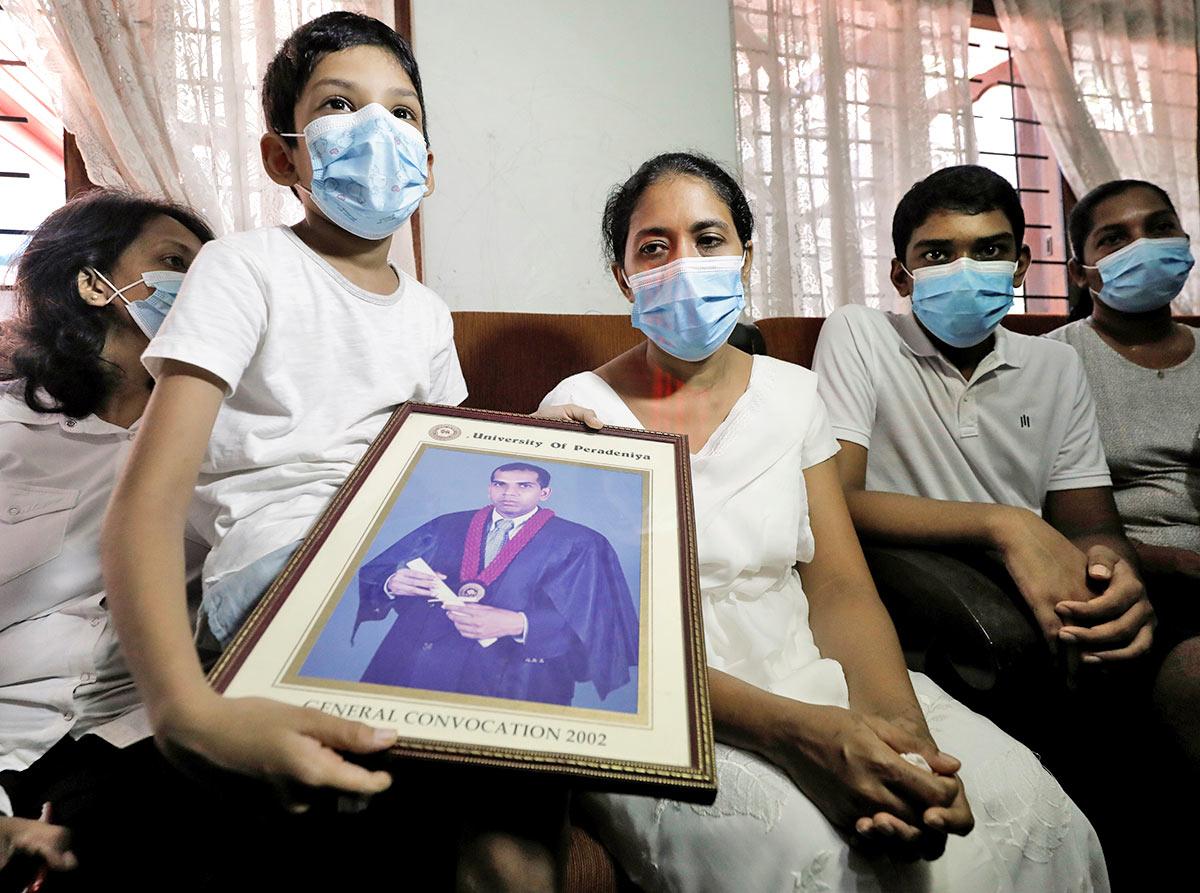
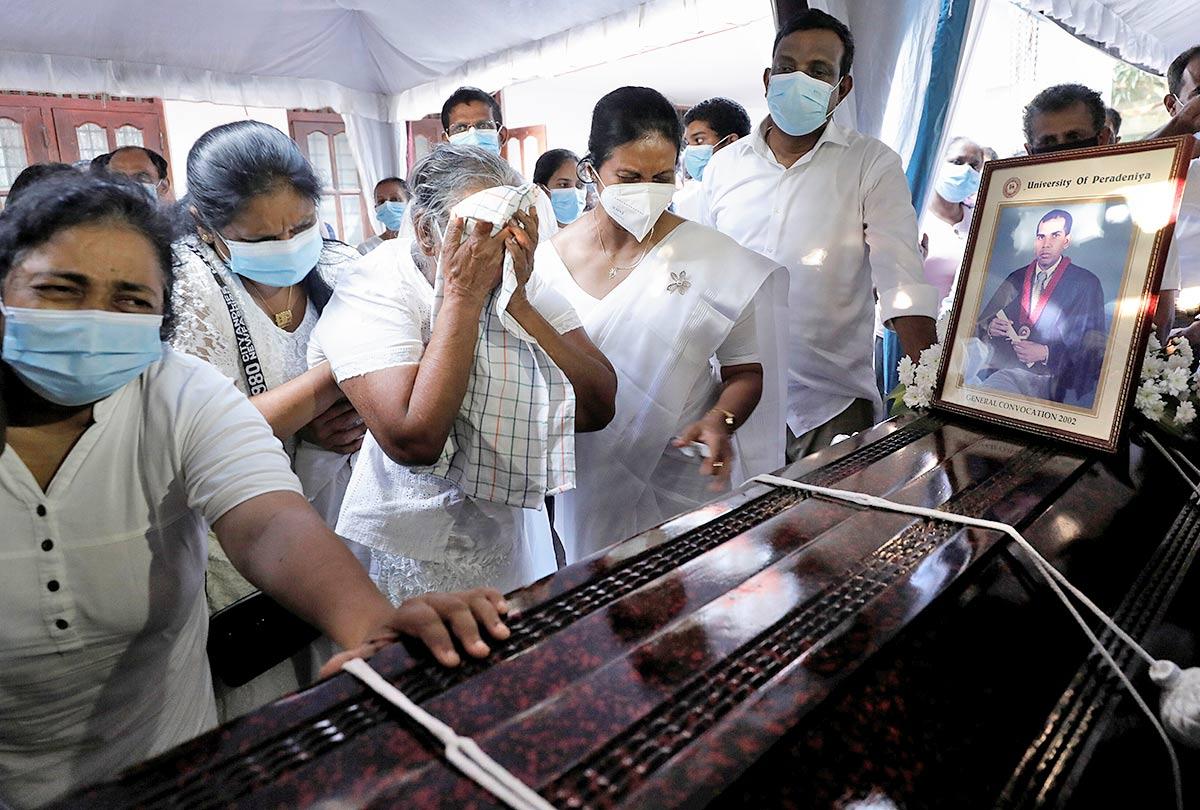
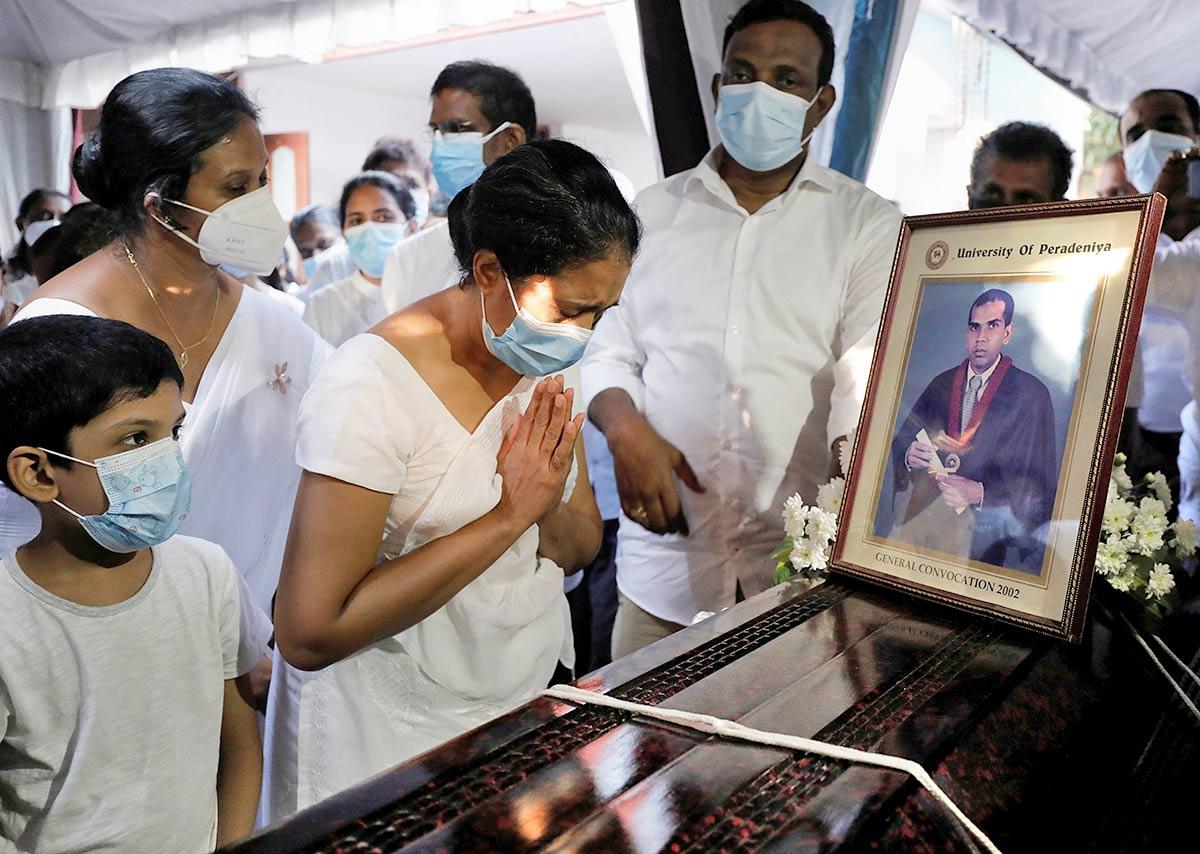
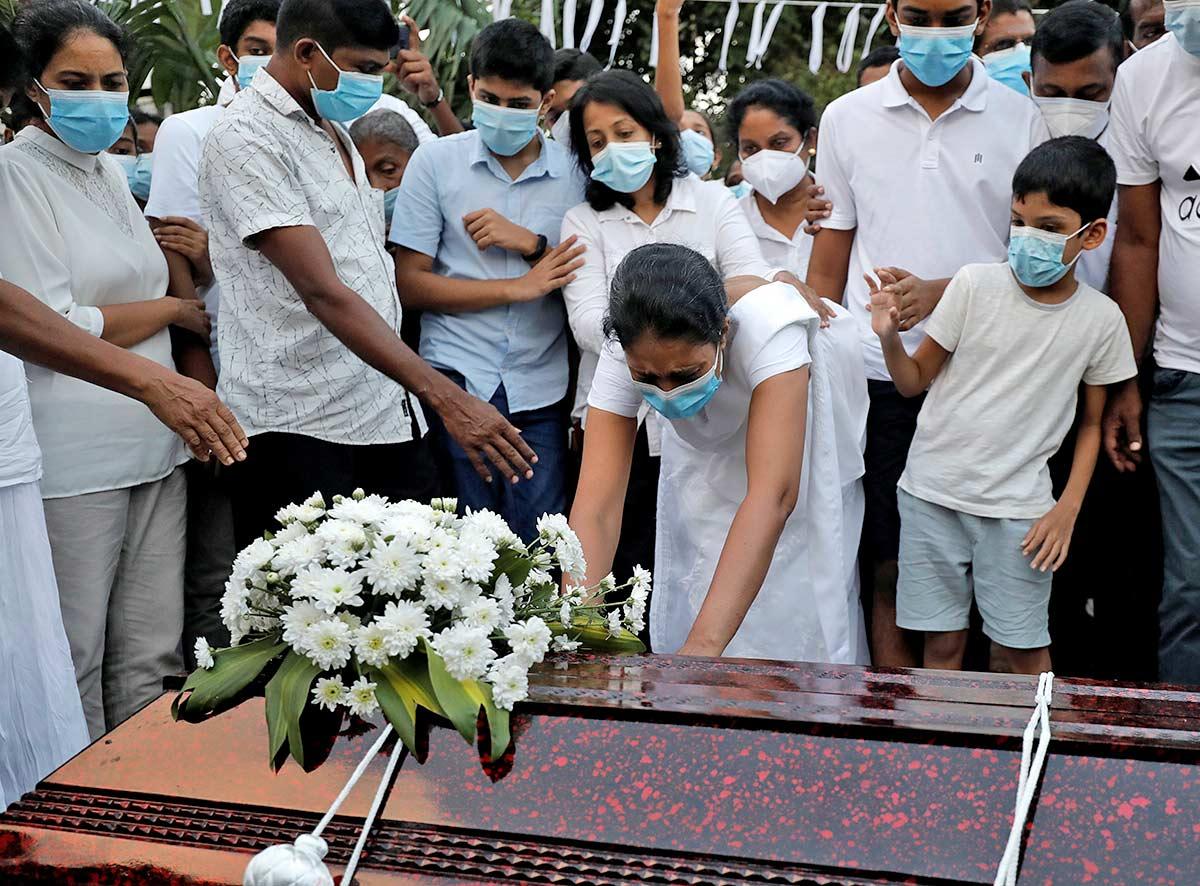
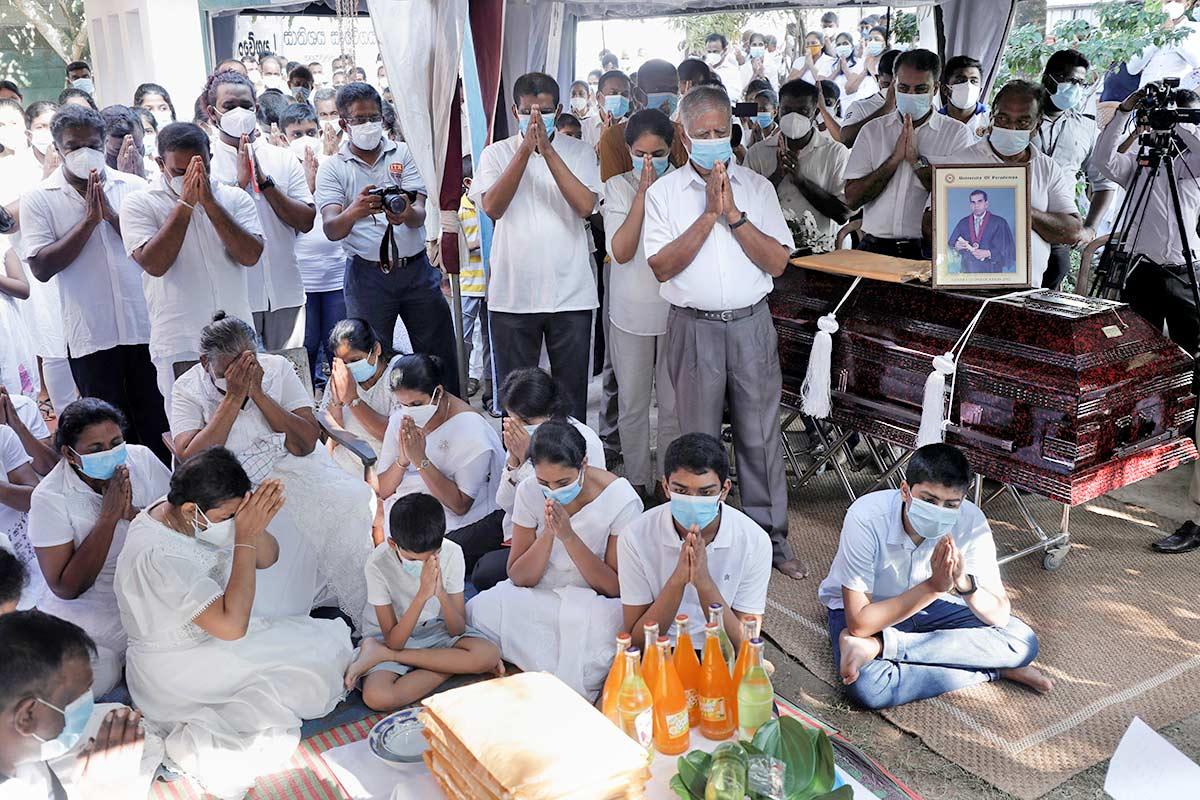
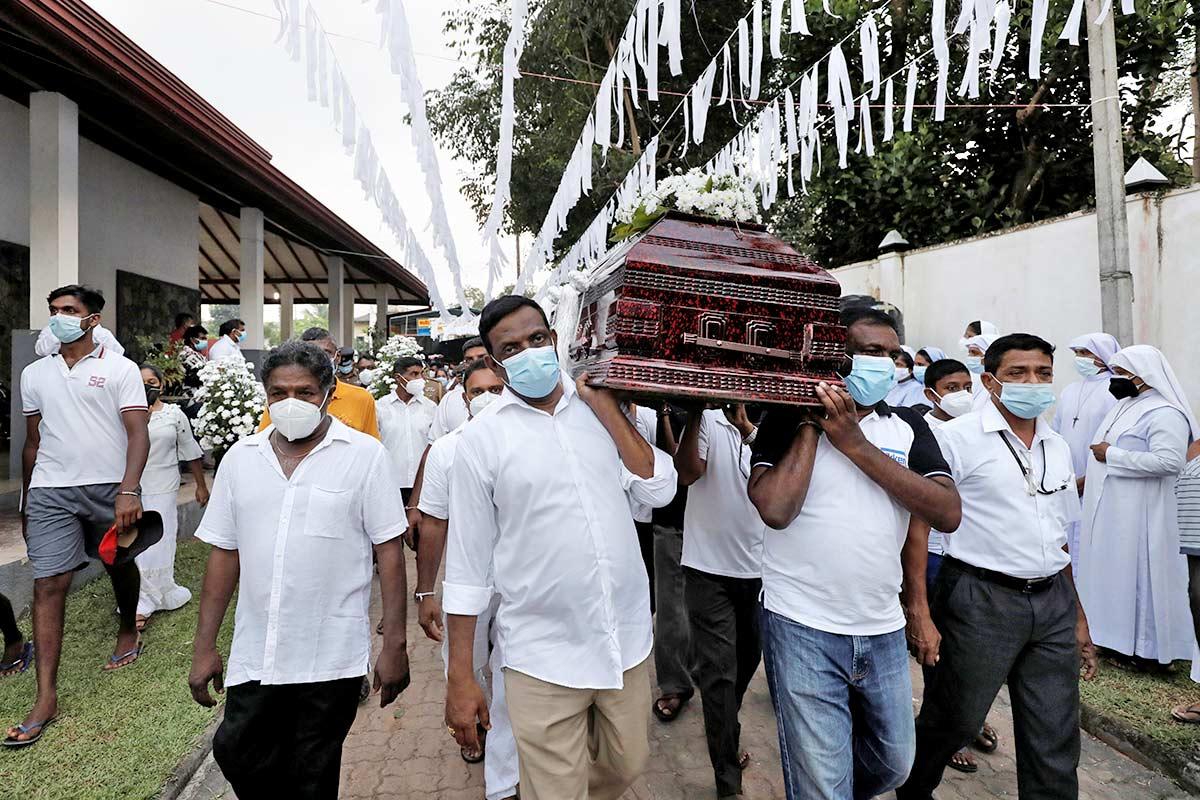
Priyantha Kumara, the Sri Lankan national who was lynched by a mob in Pakistan’s Punjab province on December 3 over allegations of blasphemy, was buried according to Buddhist and Catholic rites at Ganemulla, a suburb north of Colombo, on Wednesday, December 8.
Please click on the images to view Priyantha Kumara’s final journey.
IMAGE: Nilushi, Priyantha Kumar’s wife, with her sons, aged 14 and 9, at the funeral. Nilushi has appealed to the Pakistan government for justice and compensation for her husband’s killing. All Photographs: Dinuka Liyanawatte/ReutersSponsoredMore from around the webRecommended by
IMAGE: Priyantha Kumara’s mother weeps at her son’s casket during the funeral. Kumara had gone to Pakistan in 2011 after he got a job as a mechanical engineer at an apparel factory in Faisalabad. After a year, he joined Sialkot’s Rajco Industries as its general manager and was the only Sri Lankan national working in the factory.
IMAGE: The Sri Lankan cabinet on Tuesday approved Sri Lankan Rs 2.5 million (about Rs 935,000) as compensation to Nilushi and her family.
IMAGE: Priyantha Kumara was brutally lynched before his body was set on fire. The murder by Islamic radicals has shocked the world.
IMAGE: The Sri Lankan parliament, President Gotabaya Rajapaksa and Prime Minister Mahinda Rajapaksa have condemned the brutal killing and expressed hope that Pakistan Prime Minister Imran Khan’s government would bring the guilty to justice.
IMAGE: Ruling and Opposition MPs in the Sri Lankan parliament have demanded an apology from Pakistan’s Defence Minister Pervez Khattak for his insensitive remarks on the lynching. Khattak on Monday said the ghastly lynching by a mob in Sialkot should not be linked to the Pakistan government’s recent decision to lift the ban on the extremist Tehreek-e-Labbaik Pakista, saying ‘murders take place’ when young people get emotional. Shocking!
Recently the surgeon Dr. Athula Withanage translated into Sinhala for the first time, ‘Evgeni Onegin’ a Russian romantic novel written in verse and a masterpiece of the great Russian poet Alexander Pushkin. Simultaneously, he translated it into English, making it the 46th English translation. This achievement by
Dr. Athula Withanage can be hailed as a historical event as it was declared impossible to achieve by many authors in the past including the great translator, Oruwala Bandu. This was because of cultural differences and the era (1880) when it was written, as well as the different meaning Alexander Pushkin gave his own poetic words. Dr. Withanage escaped the shackles of rhyming by producing the masterpiece in Sinhala using the unique form of ‘Nisandas Kavi’. The books were presented to the First Secretary of the Russian Embassy in Sri Lanka and the Director of the Russian Centre, Anastasia Khokhlova at the Russian Centre Book Festival on 27 October 2021. This commendable literary mission was hailed as a historical event.The State Russian Language Institute in Moscow was named after Alexander Pushkin.
Dr. Withanage is currently working as a Senior Surgeon at the Malabe Neville Fernando Hospital. He worked in Wales (UK) for over thirty-one years, attached to the UK’s National Health Service. On his retirement, he visited Sri Lanka on a holiday and met with the late Dr Neville Fernando, who invited him to deliver a lecture at the Neville Fernando Auditorium. Later,
Dr Neville Fernando invited Dr Withanage to help his team to write the curriculum for the surgical faculty and for some guidance in perfecting the state of the art new theatre complex. With his knowledge and experience in the UK, Dr Withanage was able to do so.(At the construction stages of the Hospital). Although he accepted a temporary position because of his commitments in the UK for teaching at the RCS (Surgical Membership in England) and WIMAT( The leading Centre for the Welsh Endoscopy Training and Laparoscopic Colorectal Training Scheme) of Cardiff University. Later, he decided to stay in Sri Lanka because of the plight of the SAITM students faced at that time.The Sri Lanka Government took over the Management of the Hospital, at the request of the late Dr. Neville Fernando, to help the poor and the needy. At that time the Hospital was operated as a private teaching hospital. Anyone visiting the Neville Fernando hospital can see how methodically wards are assigned and the overall layout of the hospital.
Latent Talents
Dr. Athula Withanage did his medical degree in Russia on a Sri Lankan Government Scholarship. He had to first learn Russian before he commenced his medical studies. After graduating from Russia, he achieved FRCS recognition from England, Scotland, and Ireland. He holds the record as the only Sri Lankan to take part in a stage play in Ireland ( ‘Citi’), where he wrote down the dialogue in Sinhala as he could not speak a word of Irish. Dr. Athula Withanage is a versatile character committed to the Sinhala Culture like his brother, the late Bandula Withanage, an actor, writer, author, and drama producer.
Dr. Athula Withanage is exceedingly talented. After spending many hours in the hospital theatre attached to the NHS UK, he started writing books for relaxation and to keep his mind away from the stresses of surgical life. After one of the operations of a senior citizen, which ‘everyone thought he would certainly fail,’ the patient miraculously survived somehow. After a full recovery, the patient came to see Dr. Athula Withanage with a gift of a massive wall clock. After presenting the gift to the doctor, the old gentleman said: Thank you, doctor, you gave me life and time on this earth, and I am symbolically giving you the time!”
Dr. Athula Withanage has published many books in Sinhala and English. His first medical novel Living Capsule” was published by the Regency Press in London and New York. ‘Living Capsule’ dealt with a clinical problem any surgeon had to battle. In Sri Lanka, he published an educational book for doctors in every field of medicine called Wound Care and Management,” which sold out among the medical fraternity like hotcakes, at the book festival at BMICH year 2020!
Latest Novel
The plot of his latest novel ‘The Pond, Butterflies, and the Rainbow’ wraps around a doctor who oversees the COVID-19 ward during the pandemic. The author goes into graphic details about the intricacy of surgery on COVID-19 patients and the universal precautions one must take. He reflects the deadliest nature of the virus and the agony the staff go through, and how it affects their own lives. He must have acquired knowledge on
COVID-19 after being apportioned to the ward, as a surgical consultant, in the Neville Fernando Hospital unit, the country’s second-largest unit at the height of the third cluster.
The book presents a rich and heart-warming portrait of an exceptional single parent doctor-father and his love for his seven-year-old daughter. In his vision, the father relates his Peradeniya University experiences and comes across an orphaned girl in the university library, who had been unsuccessful in her examination twice? Out of sympathy, he offers her help, but seemingly it leads to a romantic encounter. Out of the blue, the girl becomes pregnant while both are under-graduates. The boy’s father becomes irritated on hearing his youngest son’s romantic pranks, and finally, the son gets ostracised from the family, but tragedy strikes later on the happy-go romantic capsule. The young infant becomes his primary responsibility and later he becomes overprotective of his daughter.
While working in the COVID-19 ward at the hospital, a scuffle breaks out with a patient there, who was fully infected and who tries to enter a geriatric ward. In trying to save the elderly and vulnerable in the ward, the doctor, too, gets contaminated by the wound caused by the assailant during the scuffle and quarantined. Fortunately, he spends fourteen days in the same hospital. During his quarantine period, a young nurse comes to his rescue to look after his young daughter voluntarily. The daughter and the nurse become good pals to the extent she calls the nurse ‘mum’ at the end. Seemingly, the doctor being a bachelor for four years becomes involved romantically with the young nurse. He once explains to his daughter, when she urged him not to go to work, that he had taken an oath (Hippocratic Oath) when he qualified as a doctor, and he must maintain that promise. Therefore, he was committed to after the sick and was unable to abandon patients for any reason.
Meanwhile, at the hospital, in a suicidal attempt a patient jumps out of the third floor of the hospital. The doctor without thinking and due to instant reflex action takes the risk and goes down on a drainpipe to save her. Unfortunately, the pipe collapses, and the doctor falls in a dramatic rescue attempt, while so many watch, and some curse him for taking unnecessary risks.Many bystanders urge him not to take a risk.
Medical Experience
Being a medical man with experience, the author writes graphic accounts in his unique style of the dangers of the COVID-19, and how some of the general public’s behaviour. He points out how the Media and newspapers blame doctors and health workers for not recognising the risk everyone takes in dealing with COVID-19 affected patients. He also criticises the Media for insulting and blaming the doctors at the slightest mistake when a doctor or health workers commit mistakes and how the Media attack and criticise. In his personal experience he says Media, or the public never appreciate the dedicated service done by the health authorities or the departmental staff while they save many patients daily.
The author displays his literal genius by his rich and heart-warming portrait of a medical man and a loving father. He makes the reader at various stages, laugh, cry with the sentiment, and sympathise with emotion-filled with warmth. Finally, the author opens his heart to the reader how the doctor becomes triumphant.
Dr. Athula Withanage is an excellent surgeon who spends more time with patients in listening to patients, a habit he learned in England. He never cares for money and most of the operations he undertakes are free of charge from poor and the helpless. When he concentrates on writing novels, he understands how to bring heroic visions to life. ‘The Pond, Butterflies, and Rainbow’ is a beautiful inspiring romantic story. The author has brought the beautiful heart-warming narration to a climax with subtle elegance.
The writer is confident that
Dr. Athula Withanage’s latest English novel”The Pond, Butterflies, and Rainbow, based on the Sinhala story ‘Ran Dola” will become one of the most up to date novels for book lovers in this era of the COVID-19 pandemic, and create a new form of COVID-19 literature.
SLPP MP Gevindu Cumaratunga says a section of the ruling coalition is pursuing political strategies contrary to the mandate received by the Sri Lanka Podujana Peramuna at the 2019 presidential and 2020 parliamentary elections.
MP Cumaratunga also strongly criticised the conduct of the Parliament as the highest institution in the country on the basis of continuing manipulation of the National List to accommodate those who had been rejected by the electorate and appointed outside the respective National Lists of political parties. The parliament consists of 196 elected and 29 appointed members.
The MP explained how the UNP schemed in the late 80s to manipulate the entire process to introduce the National List. Reference was made to the appointment of defeated candidate Ranil Wickremesinghe on the UNP National List and Basil Rajapaksa on the SLPP National List.
SLPP National List MP Cumaratunga who is also the President of the Yuthukama civil society group questioned rationale in pushing for the holding of the much delayed Provincial Council polls as quickly as possible.
The MP summoned a media briefing after he was denied the time to address the Parliament during the debate on the Justice Ministry vote. The lawmaker found fault with the government for its failure to unveil the Draft Constitution before President Gotabaya Rajapaksa completed two years in office. Cumaratunga is one of the MPs who had pledged his support to the battle against the highly questionable deal on the Yugadanavi Power Station that is now before the Supreme Court.
The civil society activist emphasized that Provincial Council polls shouldn’t be held under any circumstances until the introduction of the new Constitution. Lawmaker Cumaratunga said that the country received an assurance from Justice Minister Ali Sabry, PC that the draft Constitution would be presented within two years. Therefore, the delay couldn’t be accepted though the global epidemic Covid-19 caused immense problems.
MP Cumaratunga emphasized that he didn’t want to discuss other matters as the media briefing was especially called to address some specific issues namely the new Constitution and some matters related to the Justice Ministry.
Alleging that the Provincial Councils system in its present form violated the unitary status of the country, MP Cumaratunga said that in line with the mandates received at two national elections, the proposed new Constitution should do away with all those Amendments introduced in the wake of the Indo-Lanka Accord of July 1987 meant to appease separatist sentiments.
Responding to media queries, lawmaker Cumaratunga said that those who voted for the SLPP at the 2019 presidential and 2020 parliamentary elections expected President Gotabaya Rajapaksa to fulfill the pledges given.
Commenting on the enactment of the 20th Amendment in Oct 2020 with an overwhelming 2/3 majority, MP Cumaratunga said that the country expected a new Constitution. Acknowledging the need for what he called an interim constitutional measure in the wake of 2019 presidential election victory, MP Cumaratunga said that he expected the proposed draft Constitution to include the valuable provision to prevent dual citizens with divided loyalties entering Parliament. Cumaratunga said that particular provision introduced trough the 19th Amendment had been neutralized by the 20th Amendment. Therefore, that provision should be brought back.
The post-war Sri Lanka needed a Constitution that reflected Sri Lanka’s triumph over terrorism. Similarly, elections reforms were required to abolish the current Proportional Representation system that encouraged, promoted and strengthened corruption at every level, he said.
Lawmaker Cumaratunga questioned the appointment of Ven. Galagodaatte Gnanasara as the head of Presidential Task Force (PTF) appointed to promote ‘One Country, One Law Concept.’ The civil society activist said that though he appreciated the concept the appointment of Ven. Gnanasara undermined the very concept President Gotabaya Rajapaksa promoted.
Towards the end of the briefing, Cumaratunga discussed how the incumbent government violated the Constitution by creating ministries in excess of the constitutional stipulation that restricted the number of cabinet ministers to 30 and State Ministers and Deputies to 40. The MP expressed appreciation to engineer Kapila Renuka Perera for seeking the Supreme Court intervention in that regard. Lawmaker Cumaratunga said that the 19th Amendment brought in restrictions on the number of ministers at a time the public agitated against top heavy government.
The outspoken MP fiercely criticized those within the government who believed in a so-called national government to overcome constitutional restrictions imposed on the number of ministers. The Yuthukama Chief warned such measures would cause rapid deterioration of the government and erode public confidence on the SLPP administration.
Alleging that former Justice Minister Rauff Hakeem had stopped conduct of classes for law students in Sinhala, MP Cumaratunga said that incumbent minister Sabry stopped conducting of Law College examinations in Sinhala. The MP said that the government should be ashamed of the situation. The MP also pointed out that Supreme Court judgments were delivered only In English and even the Parliament was deprived of a Sinhala copy in respect of major issues such as the ruling on the Colombo Port Commission Bill.
There are 1,374 waste disposal sites in the Kelani River area from Seethawaka to Peliyagoda, Environment Minister Mahinda Amaraweera said.
The Minister expressed these views while participating in an inspection tour of the Kelani River today to inspect the places where the Kelani River is polluted.
The observation tour was organized in collaboration with the SL Navy, the Central Environmental Authority and a number of other agencies.
The Central Environmental Authority (CEA) has conducted an island-wide survey covering the entire river network of our country. According to the results of that survey, the Kelani River is the most polluted river in the whole country, and more than 80% of the population of Gampaha and Colombo meet their drinking water needs from this river. The Minister stressed.
“There are 103 rivers in our country. According to the island wide survey conducted by the CEA, 10,733 places are found to be polluted the entire river network. The Kelani River is the most polluted river of them all. The Minister said the Kelani River collects pollutants at 1374 places, including 797 polluting sites in the Colombo city area and 577 places in the Gampaha district. Therefore, I suggested that steps need be taken to give priority to the second largest River next year under the Surakimu Ganga programme, he said.
“We also give priority to the conservation of the Menik and the Walawe Rivers. Accordingly, out of the funds allocated for the year 2021, this year, we have allocated funds for financial projects in all 24 districts. However, we will be executing a number of projects that will involve the purification of the Kelani River by 2022. That is why this observation tour is being conducted today,” said the Minister.
Pakistani national Malik Adnan, who received the highest bravery award from his Prime Minister Imran Khan for shielding Priyantha Kumara from the unruly mob in Sialkot last Friday, revealed yesterday that Priyantha was unaware of what was written in the posters pasted on the factory walls as it was in the Urdu language and discarded it unknowingly.
Hours after he received the award from Imran Khan, Adnan told Daily Mirror from Sialkot that he was in shock at what had happened last Friday and was unable to accept that Priyantha had been killed in such an inhumane manner.
He said he dedicated his award to Priyantha’s children and the Sri Lankan public and urged the people of both nations not to let this hamper the relations between Sri Lanka and Pakistan. Adnan said Priyantha Kumara was employed as the General Manager at the Rajco factory and he was hardworking, dedicated and honest and mentored many of those who worked under him.
Recalling the horrific incidents last Friday, Adnan said that when Priyantha arrived at the factory premises he saw the posters on the wall and removed it as he always maintained that there should not be anything pasted on the factory premises. After discarding the posters in the bin, he went into his office. Some of the factory workers immediately began an agitation within the premises saying the posters bore religious significance and some of the workers started gathering people from outside.
Seeing the chaos, Adnan said he rushed outside and attempted to reconcile with the group, by stating that if Priyantha had committed a sin he would be dealt with by the authorities and no one should take the law into their own hands. However, the mob started getting bigger at which point, Adnan prevented them from heading towards Priyantha’s office. Amidst the chaos, he informed Priyantha to seek refuge on the roof of the factory.
However, as the mob kept increasing and after receiving serious injuries, Adnan said some of the perpetrators rushed to the roof after which Priyantha was beaten up. Adnan could not explain what happened thereafter since he too had sustained injuries after being severely beaten up by the mob. I tried my best to protect him. But soon as the mob kept increasing it went beyond my control. I was very badly injured,” he said.
I am still in shock and am unable to accept that Priyantha is no more. We lost a good man and a good mentor,” Adnan said. Adnan returned back to work yesterday and said there was a silence that surrounded the factory. Workers were unable to work due to being in shock and Priyantha’s loss had left a dull ache among the team members.
Upon receiving the bravery award from Prime Minister Khan in Islamabad on Tuesday, he was informed by the Prime Minister that Adnan was a role model to all Pakistani citizens as he had put his own life at risk to protect a foreign national. He said while Priyantha’s murder was felt among all Pakistani citizens, he urged the Sri Lankan people not to let this hamper the bilateral relations between the two countries and said several of those involved had been arrested. In the face of some evil, there are good Pakistani’s as well,” he concluded. (JAMILA HUSAIN)
Finance Minister Basil Rajapaksa says the importation of vehicles and recruitment of public sector employees will not be carried out in 2022.
Addressing an event, the lawmaker stressed that the government will have to impose restrictions on the aforementioned. Accordingly, new vehicles will not be imported and approval will not be given for recruitment to the public sector next year, he added.
Minister Rajapaksa urged the public sector authorities not to ask for new staff members. He stated that there is not enough workspace at some divisional secretariats for the employees.
Increasing the number of staff members will not improve the efficiency, he added.
Speaking further, the finance minister said an increase in foreign reserves was observed last year, but it drastically dropped this year due to the decrease in remittances sent by the migrant workers.
The country annually sends about 230,000 migrant workers overseas, but this figure shrunk to 53,000 last year, he added. However, more than 100,000 migrant workers are sent abroad now, Minister Rajapaksa continued, adding that the government’s target is to increase this number to 300,000 next year.
President Gotabaya Rajapaksa says there is a mismatch between the education generally on offer in Sri Lanka and what is necessary for the country to develop in the 21st century.
This is why I have constantly called for educational reforms, especially in our tertiary education system,’’ said President Gotabaya Rajapaksa, addressing the General Convocation of Sir John Kotelawala Defence University at the BMICH today (09).
I strongly believe that no matter the degree programme followed by university students, they must all graduate having gained at least some proficiency in information technology. They should also receive exposure to other skills necessary for success in today’s world, including critical thinking, entrepreneurship, and English language skills,” the President further said.
I am pleased to note that several of these reforms have already been implemented by our universities, and that more are to be introduced next year. One of the early accomplishments of my administration was increasing the number of places for students in universities throughout Sri Lanka by ten thousand,” President Rajapaksa added.
Even with this increase, however, there will still be thousands of students who cannot access university education in Sri Lanka despite passing their Advanced Level examinations. This is because there just isn’t enough capacity within the state university system to accommodate all qualifying students. We need to create more opportunities for our young people to study at universities in Sri Lanka.”
There is absolutely no reason why these universities should only be state universities. Almost all the best universities in the world are not state universities. Most are structured as independent self-governing entities, charitable institutions, or nonprofit organizations focused on education,” the President said.
The old objection about higher education institutions outside the state universities being education shops that sell degrees is nonsensical,” the President further said.
The 32nd General Convocation of Sir John Kotelawala Defence University was held today. One PhD Graduand, 227 Master’s Graduands and Postgraduate Diploma holders from the Faculty of Graduate Studies, and 1,180 Bachelor’s Degree holders from different faculties of KDU were among the 1,408 graduands who received parchments at this year’s convocation.
President Rajapaksa presented special awards to Cadet Officer S.H. Rodrigo as the Best Army Officer, Lieutenant S.D Karunasena as the Best Naval Officer, Fg Off S.K.S. Rukshan as the Best Air Force Officer. The sword of Honour for the Best All-Round Performance of Intake 34 was awarded to Lt L.D.I. Liyanaarachchi.
Minister Keheliya Rambukwella, Ambassadors and High Commissioners, Defence Secretary and Secretaries of other ministries, Chief of Defence Staff and Commanders of the Armed Forces, the Inspector General of Police, Director General of the Civil Defence Force and other Heads of the Security Sector, Chancellor of General Sir John Kotelawala Defence University General Gerard de Silva, Vice Chancellor Major General Milinda Peiris and the members of the academic and non-academic staff were also present.
The writ application filed by former PM Ranil Wickremesinghe against the recommendations of the Presidential Commission to Investigate into Political Victimization has been fixed for consideration on January 28, 2022.
The petition was taken up before the Appeals Court bench consisting of Judges Nishshanka Bandula Karunaratne, Devika Abeyratne and D.M. Samarakoon today (Dec. 09).
In his petition, the UNP leader and parliamentarian requested the court to issue a writ order quashing the panel’s recommendations against him and also sought an interim order preventing the implementation of the recommendations until the hearing of the petition is concluded.
Mr. Wickremesinghe stated that information had been reported that the respondents had carried out an investigation into the Anti-Corruption Committee Secretariat which was established during the period of the Good Governance Government and that subsequently, the media had reported on several recommendations presented by the commission that would also have an effect on him.
He pointed out that the commission has not presented any charge sheet against him and that it had also not adequately inquired for explanations from him either. The former Prime Minister also noted that the Anti-Corruption Committee Secretariat was established based on a decision taken by the then Cabinet of Ministers and that all of its expenses had been incurred in accordance with the law.
Mr. Wickremesinghe accused the Presidential Commission of Inquiry of conducting investigations in an unlawful manner and in violation of the legal principal of natural justice while also stating that its recommendations are severely prejudicial towards him.
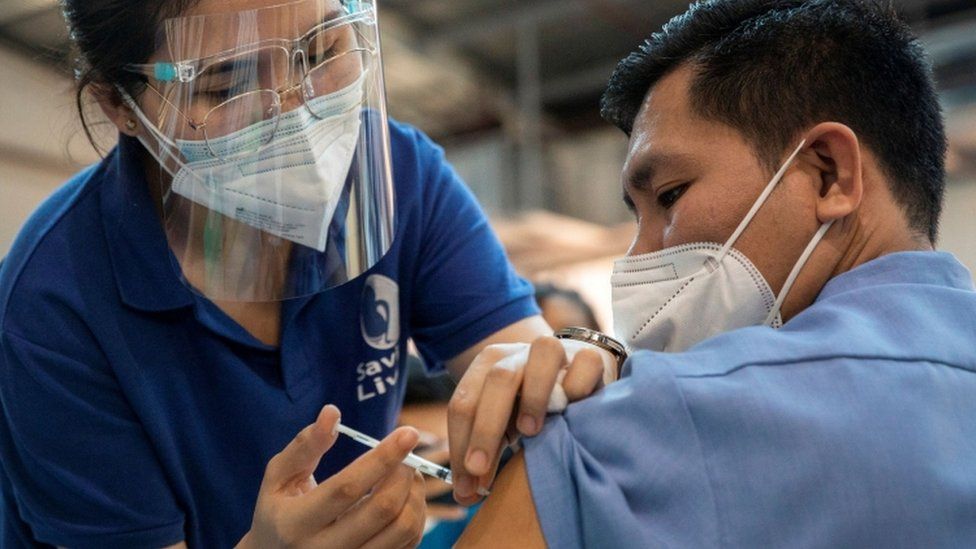
The booster dose of the Pfizer-BioNTech COVID vaccine will be administered to people aged above 30 years from tomorrow (December 09) within the city of Colombo.
The Colombo Municipal Council (CMC) said SMS alerts would be sent to all eligible vaccine recipients.
The Health Ministry reported that another 236 persons have tested positive for the novel coronavirus today, pushing the daily count of new cases to 744.
The new cases of Covid-19 reported today includes one returnee from overseas.
Meanwhile the tally of Covid-19 cases confirmed in the country increase to 570,672 while approximately 12,294 infected patients are undergoing treatment currently.
The Director-General of Health Services has confirmed 22 more novel coronavirus-related deaths for December 08, increasing the death toll in the country due to the virus pandemic to 14,555.
According to the figures released by the Govt. Information Department, the deaths reported today include 13 males and 09 females.
Six of the patients are between the ages 30-59 years while the remaining 16 are in the age group of 60 years and above.
China’s medical regulator has approved Brii Biosciences’ antibody combination Covid-19 treatment for adults and adolescents, making it the first therapy of this kind given the green light in the country.
The BRII-196/BRII-198 combination is intended to treat mild Covid-19 and common types” of the disease in patients with high risk of developing severe illness, the National Medical Products Administration said in a statement.
The neutralizing antibody cocktail was approved for both adults and minors aged between 12 and 17 years.
Brii Biosciences claimed the recent Phase 3 trial of the BRII-196/BRII-198 cocktail has demonstrated a statistically significant reduction” of 78% to hospitalization or death in non-hospitalized clinically vulnerable patients.
The company, which has two offices in China and two in the US, recently applied to the US Food and Drug Administration for emergency use authorization for the antibody treatment. Similar cocktails from Regeneron Pharmaceuticals and Eli Lilly are already approved in the US.
“Ensuring as many people as possible are fully vaccinated with the first two dose series and a booster remains the best course of action to prevent the spread of Covid-19,” he said.
However, Pfizer and BioNTech noted that the results were preliminary and said they would continue to collect data and “evaluate real-world effectiveness”.
They added that they were developing an Omicron-specific vaccine which would be ready for delivery within 100 days, pending regulatory approval.
Both the Pfizer/BioNTech research and a new South African study – not yet peer-reviewed – found that the vaccine might result in far fewer neutralising antibodies against Omicron than against the original Covid strain.
Pfizer/BioNTech, however, said a third dose boosted those antibodies by a factor of 25, making the level of protection comparable to that of two doses against other variants.
More than just antibodies
Multiple studies have now shown Omicron is better than other variants at evading part of the immune system.
But what does this mean?
The studies have focused on neutralising antibodies that stick to the virus and stop it infecting our body’s cells.
If these are less effective then it could increase the chances of you catching Covid, but it is far too soon to quantify how likely that is to happen.
There are also signs that a third dose or a mix of past infection and vaccines would minimise the risk.
The vaccines are still highly likely to protect most people against severe disease because they train far more of the immune system than just neutralising antibodies.
T-cells, which kick in once an infection is under way, are better at dealing with variants as they can attack different parts of the virus.
However, a large and sudden wave of Omicron could still cause problems even if it is mild for most people.
If the few who will get severe Covid all get infected with Omicron around the same time, then it could put pressure on hospitals again.
There is no significant data yet on how the Moderna, Johnson & Johnson and other jabs hold up against the new variant.
The WHO’s emergencies director Mike Ryan earlier said there was no sign Omicron would be better at evading vaccines than other variants.
“We have highly effective vaccines that have proved effective against all the variants so far, in terms of severe disease and hospitalisation, and there’s no reason to expect that it wouldn’t be so” for Omicron, Dr Ryan told AFP news agency.
Omicron was first identified in South Africa, where there is now a surge in the number of people catching Covid multiple times.
UK Prime Minister Boris Johnson’s spokesman said early signs suggested Omicron could be more transmissible than the current Delta strain.
But Omicron’s ability to cause severe disease is not yet clear.
The WHO’s Dr Ryan said initial data suggested Omicron did not make people sicker than the Delta and other strains, but instead pointed towards it being less severe.
Dr Anthony Fauci, the top US infectious diseases expert, said early evidence suggests Omicron could be more transmissible but less severe.
There have been more than 267 million cases of coronavirus and more than five million deaths around the world since the pandemic began, according to data from Johns Hopkins University.
It is Bangladesh that paved the way
to build a peaceful North East India. As a regional state, Assam is benefitting
from that. Bangladesh has played a vital role in curbing terrorism for the
region. Bangladesh’s handing over Alpha militants to India has freed Assam from
separatism and extremism. Bangladesh wants Peace and harmony with its
neighbors. Bangladesh doesn’t believe in anarchy, chaos. So, North East India should
always be grateful to Bangladesh for this. Bangladesh doesn’t like any internal
or external conflicts across the world. For ensuring this, Bangladesh signed
the ‘Chittagong Hill Tract Peace Accord’ with the insurgents in the CHT in
1997. It also repatriated a number of Chakma refugees in its own land earlier.
Bangladesh has already responded to
major security issues that have long been of concern to India. Bangladesh has
handed over a large part of India’s northeastern rebels to India. These rebels
were carrying out anti-India operations from the soil of Bangladesh. Major Anup
Chetia, a member of the United Liberation Front of Assam (ULFA) rebel group,
was a major headache for the Indian security authorities. Bangladesh also
handed him over to India. The activities of this foreign-backed terrorist and
insurgent groups were banned strictly by Bangladesh. Bangladesh is a true
well-wisher of North East India. All North-East Indian provinces especially
Assam should realize this.
However, Bangladesh and India are
bordering countries. Bangladesh and India have a warm, deep and diverse
relationship. Both countries are celebrating the 50th anniversary of bilateral
relations. Assam is also a partner in this relationship. Bangladesh shares its
borders with five Indian provinces including Assam. As the largest state in the
Northeast Region (NER) of India, Assam shares nearly 263 kilometers of the
border (land and riverine) with Bangladesh. Given the size, population, and
location, Assam’s participation in trade and commerce with Bangladesh is
important for the Indian government. Thus, Assam is an important factor for
Bangladesh.
Most of the Bangladesh-India border
is with West Bengal. This Bengali-speaking region of India is also predominant
in terms of commercial activities. Although the other three Indian states share
borders with Meghalaya, Assam and Tripura, Bangladesh does not have good trade
or economic relations with them. But North-Eastern states of India including
Assam should focus the strength and potentials of bilateral trade ties between
Bangladesh and North East India. Assam should realize this with special
attention. Bangladesh is going to a south Asian economic miracle. It is
true. So, it would be beneficial for Assam to bolster the trade ties with Bangladesh.
Assam should utilize the all potentials between Bangladesh and Assam.
Bangladesh could benefit from growing trade and connectivity ties. Assam can be
a partner with Bangladesh in this connection. Assam can benefit from
Bangladesh’s economic rise. Connectivity between Assam and Bangladesh can
provide benefits for Nepal, Bhutan to some extent Myanmar, Thailand, Laos.
(Bangladesh-India-Myanmar-Thailand connectivity potential)
Transit through Bangladesh is very
important as it is isolated from the northeastern part of India. That is why it
has to build cooperation in the development of Bangladesh. The full use of
Chittagong and Mongla ports will open the door to Southeast Asia. Connectivity
through railway, riverway and air would boost up the region.
Both parties should set up ‘Border
Huts’ on the Bangladesh border— where people on both sides of the border will
be able to sell a variety of goods in their own currency. People from both
parties would be beneficiaries ultimately. Both the governments think that this
kind of border hut will be very popular among them. India and Bangladesh can
set up a border hut in Dhubri Lowers Assam’s Dhubri district along the
international border. Ultimately the people of Sylhet and Assam can benefit
from using this.
Bangladesh and Assam can set up more
land tariff stations along the border. This will encourage international trade
by land and increase trade volume. Sheola, Balla, Bholaganj land tariff
stations could boost up and accelerate the transborder trade.
Tourist exchange between Bangladesh
and Assam can be a potential sector. Bangladeshi tourists can visit Assam
through their borders. Assam should strengthen the past ties between the people
of Assam and the people of greater Sylhet on the border. Both parties should
strengthen connectivity between the two countries by re-opening long-suspended
rail, road and waterway connections. Famous for having an international trade
center, Sutarkandi is the international border of India and Bangladesh. Through
this space, the export of fruits, silicon and coal is done. The place is
situated in the district of Karimganj, Assam. On the other hand, Malini Chara
tea garden, Bichana Kandi, Ratargul Swamp Forest, Jaflong, Shaha Jalal Dargah,
Sri Mangal, etc. can be tourist spots for Assamese.
Inaugurating
the Bangladesh-India ‘Friendship Bridge’ jointly with Indian Prime Minister
Narendra Modi on March 9, 2021, Prime Minister Sheikh Hasina remarked that
regional connectivity not only strengthens the friendship between Bangladesh
and India but also builds strong trade ties. The Prime Minister of India
expressed the view that such a link between Bangladesh and India would be very
important for the trade of North East India including Assam and Bangladesh as
well. For Bangladesh, the bridge will not only facilitate trade with India but
also with Bhutan and Nepal through India’s Northeast region. Bangladesh’s
increasing trade relations with Bhutan and Bangladesh through Maitree Setu is
going to make ICP Sabroom as well as ICP Agartala commercial and logistic hubs
of international trade in South and Southeast Asia. Meanwhile, a new
cross-border rail link between Dhaka and Siliguri was opened by Prime Minister
Sheikh Hasina and her Indian counterpart Narendra Modi during the latter’s
visit to Dhaka on March 26. Passengers from Dhaka can travel up to the
northeastern states of India easily when the train service begins. Now,
Bangladesh-Assam-Tripura can open such kinds of railway links to boost up the
connectivity.
Bangladesh and India have signed a
Memorandum of Understanding (MoU) for the construction of a high-speed diesel
pipeline from Numaligarh in Assam to Parbatipur in Bangladesh, a joint venture
between Numaligarh Refinery Limited and Bangladesh Petroleum Corporation. As an
indication of goodwill, an initial consignment of 2,200 tonnes of diesel has
already been transported from Siliguri in West Bengal to Parbatipur in 50
wagons by the Indian Railways. The decision to build the pipeline was taken
during Modi’s last visit.
There might have some problems (NRC)
between Assam and Bangladesh. But these problems should be addressed and
resolved diplomatically and politically. Bangladesh and Assam should reap the
benefits from strengthening trade and connectivity ties. There are huge
potentials an increase in exports of goods from Sylhet and Bangladesh in the
northeastern Indian state of Assam and vice versa. Assam can put its
contributions to Bangladesh. Assam can make the Indian central government
understand and urge to stop border killings along the India-Bangladesh border,
sign the Teesta water-sharing deal as soon as possible, support Bangladesh in
case of Rohingya crisis solution.
The ports in Bangladesh need to be
linked with Assam through Brahmaputra-Barak-Padma-Meghna riverine waterways to
facilitate the economic growth of the region and restore rail connectivity
between North East and Bangladesh.
Sylhet has a long relationship with Assam. Bangladesh’s bilateral
relations with the seven sister states, including the northeastern Indian states
of Assam and Meghalaya, need to be maintained as in the past. Only then will
there be an expansion of trade and commerce of Bangladesh including Sylhet with
the seven sister states including Assam. Assam and Bangladesh can work together
in the garment, health tourism, IT and education sectors. Bangladesh and Assam
can also work together in the sector of counter-terrorism approach, human
tariffing, illegal narcotics business, etc.
According to influential Hindustan Times, In the future, with
coordination between MEA and the Assam government, the state can push for
greater connectivity with Bangladesh via rail, road and air along with a focus
on organic food, silk, crude oil, fisheries, tourism and work-permits for
skilled youth. Along with Bhutan and Myanmar, Bangladesh forms a key triangle
around Assam. The Union government must encourage and help Assam take advantage
of its geographical proximity with these three countries.
Basically, there are huge potentials in the sector of trade,
connectivity, people-to-people contact, cultural diplomacy between Assam and
Bangladesh. Bangladesh and Assam should reap the potentials. Now it’s time for
Bangladesh and Assam to be beneficiaries. As Bangladesh paved the way peace
process in North East India including Assam, now North East India should pave
the way in serving the demand of Bangladesh.
By P.K.Balachandran/Daily Mirror Courtesy NewsIn.Asia
Princeton University Social Anthropologist Prof. Gananath Obeysekere has said that Theosophists led by Col. Henry Steel Olcott introduced a protestant” and purified” form of Buddhism in Ceylon when Buddhists in the island were demoralized” by the disestablishment” of their religion by the British rulers. But Obeysekere’s view is challenged by Peradeniya University historian Prof. P.V.J. Jeyasekera.
In his book: Confrontations with Colonialism:Resistance, Revivalism and Reform Under British Rule in Sri Lanka 1796-1920 Vol. 1, Jayasekera fully acknowledges that the Theosophists played a stellar role in the Buddhist liberation movement against the Colonial regime, especially in the field of education. And as Whites, they were a very useful interface between the Sinhala Buddhists and the White Colonial regime both in Colombo and London. But he points out that their attempts to reshape the doctrinal aspects of Buddhism were not successful due to opposition from Buddhists.
The Ceylonese Buddhists would not allow any amendment of their notion of Buddhist doctrines. In fact, at one stage, a leading Buddhist monk, Migettuwatte Gunananda, even questioned Olcott’s understanding of Buddhism and challenged him to come for a debate. Olcott is said to have fled to India the night before the debate.
What the Ceylonese Buddhists were seeking was religious independence and protection, as per the Kandyan Convention of 1815 which the British had signed with the Kandyan chiefs. The Buddhists wanted an end to discrimination, marginalization, and the hegemony of State-backed Christianity. The Buddhists did not want political power. All they wanted was a fair share of State funds for their development. Their grievance was that while the regime was collecting taxes from the Buddhist majority, spending was mostly on the minority Christian religious and temporal institutions.
Almost throughout the 19 th., Century, the British Colonial administration and Christian missions were in collusion to keep the Buddhists down through discriminatory laws and regulations. Jayasekera points out that, unlike in India, Christian goals were part and parcel of the policy of British Colonial governance in Ceylon.
The Buddhists could not even hold Peraheras in areas with a strong concentration of Christians. When the Kotehena Buddhist-Catholic riots took place in 1883, Governor James Longden knew that they were instigated by the Catholics, but the government report blamed the Buddhists without a fair investigation. The British tried to take away control of endowed lands from the temples through the Buddhist Temporalities Ordinance of 1889. This aroused the ire of the Siam Nikaya and conservative Buddhists.
In the 1870s, the Buddhists started boycotting government and missionary-run schools as they were allegedly foisting Christianity on Buddhist students. Even Governor Longden admitted that the instruction in the State and aided schools indirectly helped the Christian missionaries.”
Dr. Jayasekera says that at least till 1858, a Ceylonese had to be at least a nominal Christian” to secure government employment from the highest to the village level. Government schools were theoretically secular, but even they were, in many cases, run by Christian missionaries. In missionary-run schools, students were told that Buddhism was nothing but dark superstition”. The accent was on ‘moral advancement’ (through Christianity) rather than secular advancement. The Buddhists tried to open their own schools, but the rules were such that it was a very difficult task for an economically deprived community.
It was in this scenario that Olcott and his colleague Helena Blavatsky arrived in the island in May 1880 with the intention to boost the prospects of Buddhism, which, to them, was the panacea for the troubled world. Theosophists, whose founders were Whites from Europe and America, had been pressing fellow Whites to give attention to the Eastern peoples’ religions and metaphysical speculations. The Theosophists’ motto Universal Brotherhood” was breaking national, ethnic and religious barriers.
In Ceylon they were welcomed enthusiastically. Olcott and Blavatsky impressed all by becoming Buddhists soon after their arrival. The Buddhists found it very useful to have a White champion of Buddhism who had an understanding of Western ways and a conception as to how Buddhism could move towards modernity,” Obeysekere said of Olcott. The Theosophists roused the Buddhists to practical action,” he added.
Olcott was very hard on Christianity, describing it as a demoralizing theology” and a blight in Asia”. But such a characterization of Christianity did not find favor with Ceylonese Buddhists as they had already established the excellence of Buddhism in the Great Debates” in the 1860s and 1870s. The Buddhists were more concerned about the structure of subordination imposed on their faith by colonialism” and needed some help to end it, Jayasekera points out. Hikkaduwe Sumangala Thera and Migettuwatte Gunananda Thera successfully diverted the Theosophists attention from doctrinal matters or religious eclecticism to issues of colonial discrimination on religious grounds, Jayasekera adds.
The Theosophists were meant to open schools. Ananda College in Colombo was one among many they opened, and the well-known Theosophist C.W.Leadbeater was its first Principal. According to the Buddhist Theosophical Society, Col. Olcott attracted a large circle of able and enthusiastic workers. He indicated the steps that were necessary to transform the new found enthusiasm into practical action. He would not allow any obstacle to stand in his way. Antagonist propaganda only strengthened his resolve.
He believed indigenous solutions to problems and believed in taking people along with him. When he worked on the Buddhist Catechism for school students, he consulted leading monks. He suggested having a Buddhist flag and assisted in selecting a design. He urged Buddhists to seek a public holiday for Vesak. Realizing the need for propaganda he established a newspaper, Sarasavi Sandaresa.
An Interface
Olcott was an intermediary between the Ceylonese Buddhists and the Colonial Secretary in London. The six demands he put to the Colonial Secretary were: 1) Catholics accused of instigating the 1883 Kotehena riots be brought to trial; 2) Buddhists be guaranteed the right to observe their religion freely; 3) Vesak —the full moon day on which the Sinhalese commemorate the Buddha’s birth, enlightenment, and death—be declared a public holiday; 4) All restrictions against the use of tom-toms and other musical instruments in religious processions be removed; 5) Buddhist registrars be appointed; 6) The question of control over Buddhist temporalities be resolved.
Olcott was able to win several concessions: The Catholics riot instigators were to be brought to trial and there would be a Proclamation of Religious Neutrality. Vesak was declared a public holiday on April 28, 1885, and officials promised to allow the use of musical instruments in religious processions.
Bane of Casteism
The Theosophists were for education for all” as part of their creed of Universal Brotherhood”. Olcott was dismayed that caste considerations were inhibiting the development of the Karavas, Salagamas and Durawas, though enthusiasm for Buddhist resurgence was higher in these castes than among the Kandyan Goyigamas.
Inspired by Theosophists, the Buddhist Defense Committee, the Buddhist Theosophical Society and the Young Men’s Buddhist Association accommodated people from all castes. Even in conservative Kandy, Karava businessmen from the south, dominated bodies organized by Theosophists, Jayasekera says.
However, a section of Buddhists feared conversion to ‘occultism’ which was a foundational creed in Theosophy. But one of its leaders, Annie Besant, assured that Theosophy did not believe in conversion and C.W. Leadbeater, Principal of Ananda College explained that the Theosophists were essentially interpreters of the East to the West.
Olcott and Anagarika Dharmapala, who were close collaborators, eventually broke up on the Buddha Gaya issue. Olcott left the Maha Bodhi Society and Dharmapala described Theosophy as jugglery of words.” In the end, Olcott described the Siam Nikaya as reactionary”. Olcott was dismayed that his Buddhist Catechism, which he had formulated after consultation with all including the Siam Nikaya, ceased to be used. The clergy felt that it was both superfluous and beyond the mandate for the Theosophists.
THE attackers were all young. Many of those who watched the gruesome spectacle were teenagers. No one showed any sense of shock at the bestiality that was taking place. Several were busy filming the ghastly scene rather approvingly. There was not even a feeble voice of protest when the attackers set on fire the body of the dead Sri Lankan factory manager.
What happened in Sialkot last week demonstrates the radicalisation of a society that condones violence in the name of faith. The crowd that had gathered seemed immune to the grisly nature of the crime. The fury of the attackers was frightening. Some of them might be punished but it is the impunity for rising religiously inspired violent extremism that will keep producing tragedies like Sialkot.
It may have been a most horrific incident but the country has been increasingly witnessing killings in the name of faith. The issue of blasphemy comes in handy for zealots and criminals. The state’s policy of appeasement and in some cases using religion out of political expediency has contributed hugely to the rise of violent extremism.
It’s the weaponisation of faith that has been the main reason for the spread of such brutality in society. The attackers and the mob in Sialkot were not driven by their youthfulness and emotions, as our defence minister wants us to believe. Pervez Khattak’s appalling remarks show the mindset that dominates our political culture. He may have sounded extremely crude but that is how many in government and outside rationalise criminality in the name of faith.
What happened in Sialkot was just a trailer of the horror that awaits us.
Our youth has been growing up watching murderers like Mumtaz Qadri being hailed as a great Muslim hero. His larger-than-life portraits are seen in marketplaces. Lawyers and even a retired high court judge were among those supporting him during his trial. Hundreds of thousands of people attended his funeral and his grave in Islamabad’s suburbs has been turned into a shrine.
How can one forget a PTI provincial minister visiting Qadri’s grave? The video of him paying homage to the man who killed the Punjab governor went viral on social media. There appears to have been no questioning of this act by the party leadership. The defence minister’s comments represent the same mindset. There may be many others in the ruling party ranks with the same views on such violent incidents.
A few years ago, the country had witnessed the gruesome murder of a young university student by his classmates on campus. Falsely accused of blasphemy, Mashal Khan was beaten and shot to death because of his views. Even some university administration members were accused of inciting the students.
The courts freed many of the suspects. Their release was celebrated. The shock over the grisly incident soon vanished. Meanwhile, there is hardly any talk about how a Christian couple was thrown alive into a furnace on baseless charges of blasphemy.
This year, a temple was vandalised after allegations of a seminary being desecrated by a Hindu child. Just a few days before the Sialkot lynching, a mob set on fire a police station in Charsadda for sheltering a mentally disturbed man suspected of committing blasphemy. The mob wanted to burn him alive. Many other cases of violence against the Ahmadi community go unreported.
This culture of violence and rising religious intolerance cannot be attributed to emotions running high among young people. Religious extremism is entrenched so deeply that it threatens to rip apart the entire social fabric. Downplaying the seriousness of this societal disease will lead to greater disaster.
The Sialkot incident took place soon after the government surrendered to an extremist group that justifies violence in the name of faith. The capitulation happened after the TLP destroyed public property and allegedly killed policemen. Shockingly, a senior PTI leader went to greet the TLP leader after his release from detention. This shows the confusion within the ranks of the ruling party over the issue of how to deal with extremist groups.
Such a weak-kneed approach by the government towards extremism allows incidents like the Sialkot tragedy to happen. Apparently, some among the attackers were inspired by the extremist group. Reportedly, there were also chants of TLP slogans after the lynching. It’s a frightening situation indeed.
Now with the mainstreaming of the group, the danger of youth, particularly those less educated and coming from marginalised ranks, turning to extremism is growing. A weak state, unable to stop the spread of a retrogressive mindset has turned the country into a breeding ground for violent extremism. What happened in Sialkot was just a trailer of the horror that awaits us.
Notwithstanding its pledge to punish the perpetrators of the crime, the government doesn’t seem willing to address the main issue of radicalisation that results in incidents like the Sialkot tragedy. While he tweeted his condemnation of the incident the prime minister has not said much about the threat of religious extremism. One expected the prime minister and other senior government leaders to take the issue more seriously.
The prime minister claims to lead the global campaign against Islamophobia in the West. But he has failed to learn from the response of the prime ministers of Canada and New Zealand to the attacks on Muslims in their countries. Many more Muslims and non-Muslims become victim to retrogressive interpretations of faith that give rise to intolerance in this country.
It would be better if the prime minister focused on fighting extremism at home rather than taking the cause outside. The prime minister who is so fond of addressing the nation on every issue is not very vocal on the most serious threat to national cohesion and security. His own increasing emphasis on religiosity is disturbing. It has added to the problem. There is an urgent need to build a national narrative on fighting this menace before it is too late. The country will have to pay a huge cost for more Sialkot-type violence.
The writer is the author of No-Win War — The Paradox of US-Pakistan Relations in Afghanistan’s Shadow.
RAWALPINDI – Taking note of the heinous lynching of a Sri Lankan citizen at Sialkot, the Corps Commanders Conference unequivocally affirmed zero tolerance for such elements so as to eradicate extremism & terrorism from the country.
Chief of Army Staff (COAS) General Qamar Javed Bajwa chaired the meeting where global, regional and domestic security milieu were discussed, said ISPR in a statement.
Expressing satisfaction over security measures along the borders, COAS emphasised on maintaining high vigil to guard against any threat.
Referring to the brewing humanitarian crisis in Afghanistan, COAS said continuous support and timely international humanitarian assistance is imperative for not only peace Afghanistan but also for stability of the region at large.
Expressing satisfaction over ongoing training activities in the Army, COAS said objective evaluation of doctrine & training is necessary to evolve & meet emerging challenges in a technology driven future battlefield.