Sialkot tragedy cannot be defended, Pakistani Americans say

December 6th, 2021

Courtesy Dawn

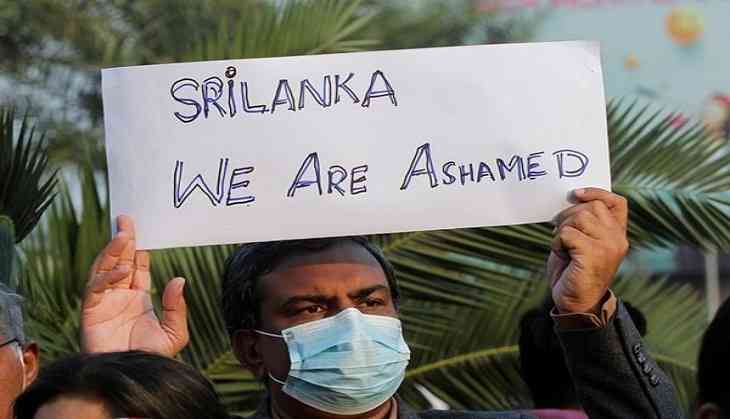
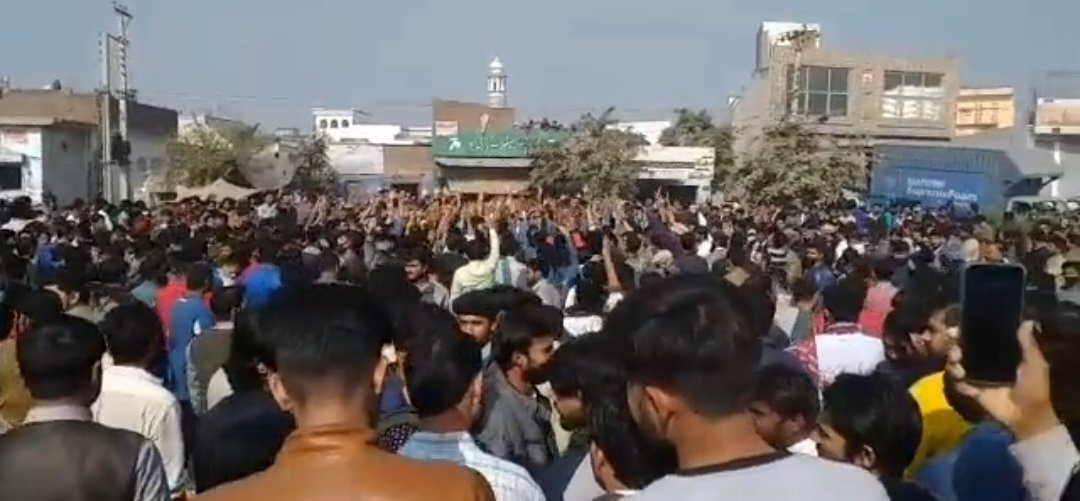
A man along with others carries a sign, condemning the lynching of the Sri Lankan manager of a garment factory after an attack on the factory in Sialkot, during a protest in Lahore, on Dec 4. — Reuters

WASHINGTON: The Sialkot tragedy will have a horrible impact on our efforts to promote Pakistan in the US Congress,” says Dr Rao Kamran Ali, who heads the Pakistani American Political Action Committee.

Wajid Hassan of the Pakistani American Congress fears that this incident will have a long-lasting effect. Every time we go and talk about Pakistan, they will ask about the Sialkot incident.”

Agha Hasnain, a Pakistani runner who has run 135 marathons in each of the 50 US states, says that whenever he gets a chance, he talks about Pakistan after an event. But now, it will be very difficult to do so. This is unbelievably bad news for Pakistan.”

President PTI Washington, DC Junaid (Johnny) Bashir says he is ‘devastated.’ We need to act now, arrest all those responsible and ensure that all of them are punished.”

Khawar Shamsul Hassan, a Pakistani American entrepreneur, agrees. It is the perceived and real absence of law and order and accountability that emboldens the extremists to do such things,” he says.

The incident has jolted the Pakistani American community like the Peshawar school tragedy did in 2014. From Los Angeles, California, to Baltimore, Maryland, Pakistani Americans have posted hundreds of thousands of messages on social media, expressing their grief, anger and fear.

They have turned the country into a madhouse,” says Bushra Ahmed of Baltimore. Who will bell this insane cat?” asks Ras Siddiqui of Sacramento, California.

Mr Hassan of the Pakistani American Congress, who is from Seattle, Washington, says his group has been lobbying for Pakistan for the last eight years. Every now and then, something happens that tarnishes the country’s image,” he says.

This indicates that we have no tolerance for religious minorities in Pakistan. It will have a negative impact on everything, from tourism to investment,” he adds. American lawmakers will be asking about it every time we go to discuss Pakistan with them.”

He thinks that it will also impede Pakistan’s effort to come off the FATF gray list and will be mentioned in international reports on religious intolerance as well.

Dr Khalid Abdullah of the Physicians for Social Responsibility NGO suggests reconsidering policies and laws that encourage such violence. Burning someone alive! No, people are not going to forget it anytime soon. We have crossed the limits of narrow-mindedness.”

Dr Ali of Pak Pac, who lives in Dallas, regrets the failure of the Pakistani state in curbing such activities. When something so horrible happens, something that is also evidence-based, it is difficult to deal with,” he says. TLP committed such atrocities before too. Then it made a truce. It went back to violence and made another pact with the authorities! How long will this continue?” he asks. This must stop.”

We are so ashamed! No word can describe our feeling,” says Mr Bashir of PTI, who lives in Virginia. Americans already have a bad image of Pakistan, and this makes it worse. The only way to deal with it is to give exemplary punishment to the perpetrators.”

Mr Hasnain, the runner from Virginia, says his daughter showed me the news and asked: ‘What’s happening in Pakistan?’ I said those are foolish people. But she, ‘that’s not an answer. Tell me how they let this happen?’”

Our state has backed down many times in the face of street power and that sends the wrong message. This must stop now,” says Mr. Hassan, the entrepreneur from Maryland.

PM chairs high-level civil-military huddle on national security after Sialkot lynching

December 6th, 2021

Courtesy Dawn

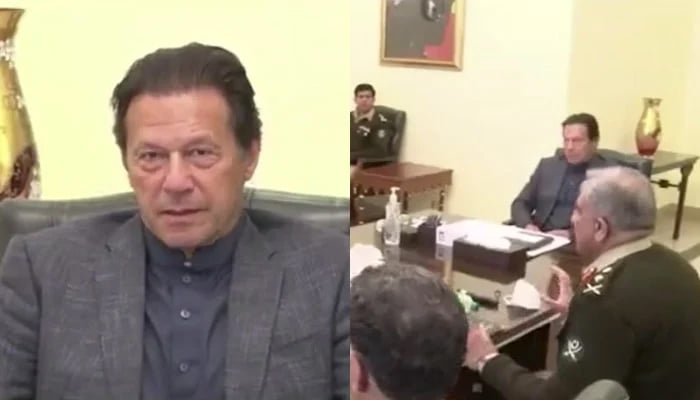
Prime Minister Imran Khan presides over a meeting on Monday called to review the overall security situation in the country. — Photo courtesy Prime Minister's Office
Prime Minister Imran Khan presides over a meeting on Monday called to review the overall security situation in the country. — Photo courtesy Prime Minister’s Office

Prime Minister Imran chaired a high-level meeting of the country’s civil and military leadership on Monday to review the overall security situation in Pakistan after the brutal mob lynching of a Sri Lankan national in Sialkot last week.

The meeting was attended by Chief of Army Staff General Qamar Jawed Bajwa, National Security Adviser Dr Moeed Yousuf, Information Minister Fawad Chaudhry, Interior Minister Sheikh Rashid Ahmed, Punjab Chief Minister Sardar Usman Buzdar and other senior military and civil officers.

According to a statement issued by the Prime Minister’s Office, the participants resolved to bring the perpetrators involved in the Sialkot lynching to justice.

A mob comprising hundreds of protestors, including the employees of a factory where Priyantha Kumara worked as a manager, had tortured him to death on Friday and later burnt his body over blasphemy allegations.

Subsequently, a first information report was registered against 900 workers of Rajco Industries, and scores of suspects have been arrested since then.

According to the the PMO, the participants of today’s security meeting were of the view that individuals and mobs could not be allowed to take the law into their hands and such incidents could not be tolerated.

The country’s civil and military leadership expressed serious concern over Kumara’s lynching, stressing the need for implementing a comprehensive strategy to curb such incidents and ensuring “strict punishment” for all the perpetrators, the PMO said.

It added that the participants also acknowledged the act of bravery by one of Kumara’s colleagues, Malik Adnan, who was seen confronting a group of angry men in an attempt to save the former in a video of the incident.

“Malik Adnan […] endangered his own life to save Priyantha Kumara,” the PMO’s statement said, adding that the participants of the meeting also conveyed their deepest condolences to the family of late Kumara.

Widespread condemnation

The condemnation of Kumara’s killing in today’s meeting was the latest expression of disapproval of the incident by the country’s leadership. The incident has drawn a strong reaction and widespread condemnation from across the country.

ReadNo one is responsible for lynching the Sri Lankan national in Sialkot. Absolutely no one

Hours after the incident was reported on Friday, Prime Minister Imran Khan had condemned the “horrific vigilante attack” on the Sri Lankan man, calling it “a day of shame for Pakistan”.

“Let there be no mistake all those responsible will be punished with full severity of the law,” he had tweeted.

Similar sentiments were expressed by President Arif Alvi, other politicians, diplomats and activists.

Amid countrywide outrage over the incident, Human Rights Minister Dr Shireen Mazari also said today that the government had decided to review the National Action Plan (NAP) on counter-terrorism in the wake of the brutal lynching of Kumara.

Speaking exclusively to Dawn.com, the minister rued the recurrence of such incidents and called for “strict government action”, terming it the “need of the hour”.

Sialkot lynching: Govt plans to implement ‘comprehensive strategy’ to curb untoward incidents

December 6th, 2021

Courtesy The News

Govt expresses serious concern over cruel act of killing a Sri Lankan national in Sialkot, aims to bring perpetrators to justice

Prime Minister Imran Khan chairs a meeting to review overall security situation in the country in Islamabad on December 6, 2021. — PM Office

ISLAMABAD: The government on Monday decided to implement a comprehensive policy to control violence after a mob lynched a Sri Lankan national in Sialkot.

Last week, hundreds of people, including workers from the factory, had tortured the foreigner, Diyawadanage Don Nandasri Priyantha, to death and later burnt his body over blasphemy allegations.

According to a statement issued by the PM Office, the decision to implement the strategy came during a meeting chaired by Prime Minister Imran Khan in Islamabad, where the overall security situation in the country came under review.

“The meeting expressed serious concern over the cruel act of killing of Sri Lankan national Priyantha in Sialkot and expressed the resolve to bring the perpetrators to justice,” the statement read.

The participants of the meeting were of the view that individuals and mobs cannot be allowed to take the law into their hands and such incidents cannot be tolerated.

“Therefore, a comprehensive strategy shall be implemented to curb such incidents and strict punishments to all the perpetrators shall be ensured,” the statement said.

During the meeting, the participants praised the bravery and courage of Malik Adnan who endangered his own life to save Diyawadanage and conveyed deepest condolences to the family of the deceased.

The meeting was attended by Information Minister Fawad Chaudhry, Interior Minister Sheikh Rasheed Ahmed, Chief of Army Staff General Qamar Jawed Bajwa, National Security Advisor Dr Moeed Yousaf, Chief Minister Punjab Sardar Usman Buzdar, senior military and civil officers.

Remains sent off to Colombo

Earlier today, the remains of the factory manager were sent off to Colombo. Sri Lankan embassy officials arrived at the hospital to escort Priyantha’s body to the airport and laid flowers over it.

Priyantha’s last rites will be performed upon the arrival of his body in Sri Lanka.

Twenty-six suspects arrested in connection with the lynching of the Sri Lankan factory manager have been remanded into police custody.

The police presented the suspects before an anti-terrorism court earlier in the day and requested their remand for interrogation.

During the hearing, the names of the suspects were called out to mark their presence. All the suspects responded to their names except for one, named Shoaib alias Gonga (speech impaired).

The investigation officer informed the court that Shoaib is speech impaired.

The police requested the court to grant 15-day remand of the suspects for interrogation which the court accepted and ordered the investigation officer to present them on December 12.

So far, a total of 131 suspects have been arrested in connection with the Sialkot lynching case.

The incident

Priyantha, working as a manager at a private factory in Sialkot, was lynched on Friday by a mob after being accused of blasphemy.

The gruesome incident was dubbed by PM Imran Khan as “a day of shame for Pakistan”.

Workers of a garment industry, located on Sialkot’s Wazirabad Road, had alleged that the foreigner had committed blasphemy. He was subsequently lynched and his body set on fire.

The mob had also vandalised the factory and blocked traffic, according to the police.

The brutal murder drew widespread condemnation from senior government functionaries, including the prime minister and president, as well as the military’s top leadership, who promised to bring all those involved to the book.

Remains of Priyantha Kumara arrives in Sri Lanka from Pakistan

December 6th, 2021

Courtesy Adaderana

The remains of Sri Lankan national Priyantha Kumara, who was lynched by a mob in Pakistan’s Punjab province, reached the island a short while ago. 

The body was repatriated on Monday, even as Pakistani authorities arrested more suspects involved in the grisly incident that shocked people across the world.

The remains were airlifted by SriLankan Airlines flight UL 186 at 12.30 p.m. from Lahore and arrived at the BIA in Katunayake at 5.00 pm via UL 186 from Lahore (12.30 pm).

The remains will be handed over to his next of kin today (06) at the BIA, the foreign ministry said.

The wooden coffin has the words: Human remains of late Don Nandasri P Kumara Diyawadanage. From Lahore to Colombo”, transcribed on it.

A mob of over 800 men, including supporters of hardline Islamist party Tehreek-e-Labbaik Pakistan (TLP), attacked a garment factory and lynched its general manager Priyantha Kumara Diyawadanage and set him on fire over allegations of blasphemy on Friday last in Sialkot district, some 100 km from Lahore.

The officials of the Sri Lanka High Commission arrived here early Monday morning and the body was handed over to them at the Lahore airport by Punjab minorities minister Ijaz Alam. The body was transported on the Sri Lankan Airlines flight,” a Punjab government official told PTI.

Meanwhile, Punjab Police claimed to have arrested seven more prime suspects allegedly involved in the lynching of 49-year-old Kumara.

A total 131 suspects, including 26 main ones, have been arrested so far. The 26 prime suspects have played a key role in inciting the people, lynching Kumara and setting his body ablaze,” the Punjab Police said in a tweet on Monday.

Some 15 prime suspects were presented before the Anti-Terrorism Court Gujranwala on Monday where they were remanded in police custody for 15 days.

According to police, after brutally killing Kumara, the mob also wanted to kill the factory owner and set the building on fire.

The mob wanted to set on fire the entire factory after lynching Kumara. A group of charged workers headed towards the residence of the factory owner to kill him, but timely action by police prevented further violence,” Sialkot District Police Officer Omar Saeed said.

Earlier, narrating the sequence of the gruesome incident, Inspector General Police (Punjab) Rao Sardar Ali Khan had said: A mob of over 800 men gathered and attacked the factory at 10 am Friday after reports emerged that Kumara had torn a sticker/poster inscribed with Islamic verses and committed a blasphemy. They searched for him and found him on the rooftop. They dragged him, beat him severely and by 11.28 am, he was dead and the body was set on fire by the violent mob.”

Kumara was working as general manager in Rajko industries, which deals in sportswear, for the last seven years.

The horrific incident sparked outrage across Pakistan with all sections of the society condemning it and calling for the culprits to be punished.

According to the post-mortem report, nearly all bones of Kumara were broken and his body was 99 per cent burnt in the horrific lynching incident.

Kumara had gone to Pakistan in 2011 after he got a job as a mechanical engineer at an apparel factory in Faisalabad. After a year, he joined Sialkot’s Rajco Industries as its general manager and was the only Sri Lankan national working in the factory.

He is survived by his wife and two sons aged 14 and 9.

–With agencies inputs.

Litro releases new stocks of LP gas cylinders with new seal

December 6th, 2021

Courtesy Adaderana

Litro Gas Lanka Limited has commenced the distribution of domestic LP gas cylinders, conforming to the requirements of the Consumer Affairs Authority (CAA). 

The CAA said that the new stock of LP gas cylinders can be identified by the shrink bundling film of the gas cylinder valves (the polythene seal), which will carry a red logo on a white background (See the image above). 

Following a discussion held yesterday with State Minister Lasantha Alagiyawanna, Litro Gas Lanka Limited and Laugfs Gas PLC, the two largest suppliers of LP Gas in Sri Lanka, had agreed to resume the supply of domestic LP gas, conforming to the guidelines of the Consumer Affairs Authority (CAA).

The Consumer Affairs Authority on December 04 gave its approval to release liquefied petroleum gas (LPG) to the market under three conditions.

A decision was taken to commence distribution of domestic gas with effect from yesterday (December 05) under the following three conditions:

01. Not releasing previously imported LP gas stocks to the market.

02. Adding Mercaptan (also known as methanethiol) to new stocks before they are released to the market, enabling the consumers to identify any leaks by its odorant.

03. Testing one per every 100 gas cylinders during the manufacturing process, serializing and producing them to the CAA.

Meanwhile incidents related to gas cylinders continue to be reported from various parts of the country. 

Sri Lanka’s daily count of Covid cases hits 741 and confirms another 23 deaths

December 6th, 2021

Courtesy Adaderana

The Health Ministry reported that another 173 persons have tested positive for Covid-19 today, increasing the daily count of new cases detected to 741.

The coronavirus cases confirmed today includes two returnees from overseas, according to the Epidemiology Unit of the ministry. 

Sri Lanka’s total count of Covid-19 cases reported climbs to 568,423 with this while over 11,000 infected patients are currently undergoing treatment in the island. 

The Director General of Health Services has confirmed another 23 coronavirus related deaths for November 05, raising the country’s death toll due to the Covid-19 pandemic to 14,484.

The deaths reported today include 15 males and 08 female patients while three of the deceased are between the ages 30-59 years. The remaining 20 victims are in the age group of 60 years and above. 

Douglas Wickremaratne is no more.

December 5th, 2021

Garvin Karunaratne  

I first met Douglas Wickremaratne  somewhere in 1984/85 when we were searching for a speaker for a debate on the ethnic problem to be held at the University of Cambridge.  I was then working in Cambridge and we Professor  Atula Ginige and a few others  were in charge of the Sinhala side to make a presentation. We heard about Douglas and called on him in London to invite him to speak on occasion. Douglas  readily agreed and also suggested another speaker Dr Cappie Kannangara, who was approached. Dr Cappie  too readily agreed. 

In the  morning of the day for the debate, It was a bad start as though Cappie came to Cambridge, he  had to get back as his brother in law Denzil Peries had suddenly died at a restaurant meal. Denzil was the Editor of the South, a journal  that had recently unearthed with photographic evidence  that Indira Gandhi, the Prime Minister of India had established training camps for the LTTE cadres and this had been given prominence in the Issues of The South.  I had to step in place of Cappie and we were worried  as our team looked weak without Dr Cappie.  

However at the debate Douglas excelled in speaking. His speech was organized well and full of facts all rattled from memory without a scrap of paper. His was a store of knowledge of how the ethnic problem commenced, full of historical detail of how facts had been misrepresented. There was pin drop silence as he spoke. Douglas excelled in presenting facts- it was a flow that kept listeners mesmerised.  In  answering the questions raised, Douglas was on the ball with specific details of the carnage caused by LTTE attacks on unarmed civilians and even novice monks at Arantalawa. Douglas was always the winner in arguments. 

That occasion  brought us close together and whenever we wanted to discuss the ethnic problem we in South London always invited Douglas, who always came dead on time, at his expense.  

There were occasions when he would telephone me in the morning to join him in a few hours to be present in a Room at the Houses of Parliament where members of parliament were being briefed by LTTE supporters. Douglas as usual  always won the day whenever he spoke. He was then actually doing the task that should have been done  by the High Commission for Sri Lanka which was more in slumber than awake. 

Douglas was in many years requested to be present at Geneva at the UNHCR Sessions and I am aware that he accomplished himself creditably well on all those occasions.  

Douglas was a close admirer of Ven. Elle Gunawsansa Thera . 

His life was an innings well done, a glorious service to the Motherland he dearly loved. He dedicated his life for the country in every respect.  

My condolences are for his wife and children. 

May life be short in Samsara for Douglas. It has to be so for a personage who dedicated his time and energy, unreservedly,  for the cause of his Motherland 

Garvin Karunaratne  

5 th December 2021 

IJU expresses concern over sedition charge against Silchar journalist

December 5th, 2021

Nava Thakuria

Hyderabad, 5 December 2021: Indian Journalists Union (IJU) expresses concern over the slapping of sedition charges against a journalist from Assam’s Barak valley and urges the authority to withdraw the case against Anirban Roy Choudhury.

The Silchar-based editor of digital outlet BarakBulletin faces sedition charges over an editorial and the young scribe has been summoned by the police to be present at Silchar Sadar police station on Monday morning, following an FIR,  lodged by Santanu Sutradhar of All Assam Bengali Hindu Association.

It is shocking that the news portal editor has been booked under sedition charges targeting his freedom of expression guaranteed by our Constitution. There are other laws to deal with such issues, but no way it should go with sedition,” said IJU president K. Sreenivas Reddy and secretary general Balwinder Singh Jammu.

The complaint was filed on 1 December claiming that the editorial comprised elements to hamper the cordial relationship between the Bengali speaking residents of Barak valley and the Assamese community in Brahmaputra valley of Assam. Considering the sensitivity of it, he protested against the scribe’s public support to Pradip Dutta Roy, who is presently under judicial custody.

Dutta Roy, the convenor of Barak Democratic Front, was arrested on  27 November last following his ultimatum to erase Assamese language from the hoardings put in Barak valley. Mentionable is that even though Assamese is recognised as the official language of Assam, there are provisions for using Bengali in Barak valley that comprises three districts.

සුද්දගෙ නීතිය අපිට එපා – හයවෙනි කොටස

December 5th, 2021

 චන්ද්‍රසිරි විජයවික්‍රම,  LL.B., Ph.D.

‘එක රටක්-එක නීතියක් කියන්නේ ලස්සන සටන් පාඨයක්’ – අලි සබ්‍රි, අධිකරණ ඇමති

‘The first thing we do, let’s kill all the lawyers’ William Shakespeare

එක රටක් යන්න අත්හැරදමා, එක නීතියක් නමැති බරව කකුල කරට ගැනීම

ලංකාවේ නීතිඥ ප්‍රජාව එක රටක්-එක නීතියක් යන සංකල්පය නිසියාකාරව අවභෝධ කරගෙන නැති බවට හොඳම නිදසුනක්  අධිකරණ ඇමති අලි සබ්‍රි විසින් නොවැම්බර් 28 දා දිවයින ඔන්ලයින් යූටියුබ් සාකච්චාවේදී  රටට ලබා දුන්නේය. ඔහු සිතන්නේද, එක නීතියක් යන්නෙන් අදහස් කරන්නේ, ‘තරාතිරම නොබලා හැමදෙනාටම නීතිය එක සමානව භූමියේ ක්‍රියාත්මක  කිරීම’ යන්නය. ඔහු කියන මේ කතාව දෝෂ සහිතය. ඉන් එකක් නම්  දැනට තිබෙන නීති එක ජනවර්ගයකට පමණක් වාසි ගෙන දෙනවා නම් ඒ නීති ක්‍රියාවට නැඟීම නීතියේ ආධිපත්‍යයද යන්නය. දෙවැනි කරුණක් නම් මේ නීති රටට හා අනිත් ජනවර්ගවලට හානිදායක නම් ඒවා ඉවත් නොකිරීම නීතියේ ආධිපත්‍යය යයි කියන බටහිර ඩොලර් විජ්ජාව හරහා මානව අයිතිවාසිකම් රැකදීමද යන්නය.

සමහර මුස්ලිම් ශාරියාවාදී නීති රටේ ඒකීය භාවයට කෙළින්ම හානිකරය. තේසවලමෙයි කොටස් වැනි, තවත් සමහර නීති,  එක රටක් යන හැඟීමක්  රටේ දෙමළ ජනයාගේ සිත් තුල, රට තුල, වර්ධනය වීමට මානසික භාධකයකි (disincentive). කෛරාටික පක්ෂ දේශපාලකයින් මේ කාරණා නොතේරෙනවා සේ හැසිරීම තේරුම් ගත හැකිය. එහෙත් රටේ අධිකරණ ඇමති එසේ නීති බබෙක් සේ කතාකිරීම ජනයා, විශේෂයෙන් සාමාන්‍ය මුස්ලිම් ජනයා නොමඟ යැවීමක් නොවේද?

සල්ලි තියෙනවා නම් ඕනෑම ගොනෙකුට යුද්ධ දිණන්න පුළුවන්  (ලක්ෂ්මන් කිරිඇල්ල), තොප්පිගල කියන්නේ නිකම්ම කැලයක්, පොසොන් කියන්නේ ලංකාවට සිදුවූ ප්‍රථම ආක්‍රමණය (රනිල් වික්‍රමසිංහ), අලිමංකඩ කියා පාමංකඩ යනවා (රවි කරුණානායක)  යන ගොන් කතා අසා ඇති රටකට, අලි සබ්‍රි නම් මුස්ලිම් අධිකරණ ඇමති, එක රටක්-එක නීතියක් කියන්නේ <ලස්සන සටන් පාඨයක්> යයි කීම, විජේදාස රාජපක්ෂ නම් සිංහල අධිකරණ ඇමති, <ලංකාව සිංහල බෞද්ධයාගේ රට යයි කියන්නේ කෙසේද> කියා අසනවාට වඩා බරපතල දේශපාලන ප්‍රකාශණයකි. පුදුමයට කරුණ නම් සබ්‍රි, විජේදාසගේ  නීතීඥ ගෝලයෙක්ද වීමය. ඔහු (සබ්‍රි) කුඩාකාලයේ පාසැලේදී පූජාවලිය කියවා ඇතත් නැතත්, ඔහුගේ යටිහිත ශාරියාකාරයින් හා සිංහල බෞද්ධයා අතර (rational thinking) අතරමංවී ඇතිබව මෙය දෙන සංඥාවය.

එක රටක්-එක නීතියක් යනු එකම කාසියේ පැති දෙකය. එක රටක් නැතිව එක නීතියක් අර්ථ ශූන්‍යය. බලු වලිගයක් පමණය. සිංහල බෞද්ධ ජනයාගේ පැත්තෙන් එය වනාහි 1815 ට කලින් සිටම ඔවුන්ට අහිමිකල අයිතිවාසිකම් හා ඔවුන්ට ලෝකයේ ඇති එකම ඉඩම් කැබැල්ල කැබලි කිරීමේ සුද්දන්ගේ හා කළු සුද්දන්ගේ මහාවංශ විරෝධී ව්‍යාපාරය නමැති කුළුගොනා අංදෙකෙන්ම අල්ලා ගැනීමකි. බොරු නිදහස ලබා අවුරුදු 74 කට පසුව, 1956 දී <අපේ ආණ්ඩුව>  විසින් වත් කරන්නට අසමත්වූදේ, 2021  අගදී සිදුවීම කොළඹ කළුසුදු පැරඩයිම් මාරුකිරීමේ ඓතිහාසික පියවරකි.

ලංකාවේ දුෂ්ට ත්‍රිකෝණය හා නිතීඥ වෘත්තිය

කොල්වින්ලා, පොන්නම්බලම්ලා දක්ෂ නීතීඥයින් ලෙස  සැළකුණේ පවතින නීතියේ ඉඩැස් අතරින් රිංගා නඩු දිනූ නිසා නොවේද? ගොයම් කොලය කියන්නේ කමතේ වීපිඳුරු ගොඩට නොව ගොයම් ගසේ කොලයකට යයිද, සතාසිවම් නොව වංගෙඩිය මිනීමරුවා කියාද තීරණයවන්නේ සබ්‍රිලාගේ නීතියේ ආධිපත්‍යය නමැති ටෙක්නිකල් කුණුකූඩය අනුවය. දේශපාලකයා-නිලධාරියා-කොම්පැනි/එන්ජීඕකාරයා යන දුෂ්ඨ ත්‍රිකෝණයේ රඟ පාන ප්‍රධානම චරිත වන්නේ ලොකු කුඩා නීතීඥ පිරිසය. මොවුන් ගෙන් මහජනයා සූරා නොකන අය ඇත්තේ ඉතා සුළු පිරිසකි.  නීතිය නමැති මකුළු දැලට අසුවන්නේ මැස්සන් වැනි දුබලයින්ය. රවි කරුණායකලා, රාජිතලා වැනි රාජාලියාලා දැල පසාරුකරගෙන ගැලවී යන්නේය. මීට හවුල්වන නීතීඥ භට පිරිස් තමන්ගේ කුට්ටිය කඩා ගනී. සමහරු ගාස්තු වෙනුවට මාලද කඩා ගනී.

අඩුතරමින් තිරන්ත වලලියද්ද වත් හොරු නොවන හොඳ ගොඩට වැටෙනවාද කියා මට සැක සිතෙන්නේ ඥානසාර හිමියන් වෙනුවෙන් ඔහු පෙනී නොසිටි නිසාය. සුප්‍රීම් උසාවියේ නඩුකාරයින් තුන් දෙනෙකුගෙන් දෙන්නෙක් උන්වහන්සේට ඇපෑලක් ඉදිරිපත් කිරීමට ඉඩදීම ප්‍රතික්ෂේප කලේය. මේ දෙන්නාගෙන් එක් අයෙක්වූ ප්‍රසන්න ජයවර්ධන ඔහු බාර් ඇසෝසියේසන් එකේ උපසභාපතිව සිටියදී බොදු බල සේනාවට විරුද්ධව දැඩිලෙස  ක්‍රියාකල අයෙකි. මොහු එම නඩුවෙන් ඉවත් නොවීම හෝ ඉවත් නොකිරීම ස්වභාව ධර්ම නීතියට අනුව  හාමුදුරුවන්ගේ මානව අයිතිවාසිකම උල්ලංඝනය කිරීමකි. (තීන්දුව දී වැඩිකලක් යන්නට පෙර ඔහු හදිසියේ මියගියේය. ඔහු ගැන පලවූ ගුණ වර්ණනා, රට පාවා දුන් මංගල සමරවීරට කල ප්‍රශස්ති ගායනා  වැණිමය). සබ්‍රි මේ ගැන වචනයක්වත් කතා නොකලත් රන්ජන් රාමනායක නිදහස් කර ගන්නට නීති වෙනස් කිරීමට පවා සූදානම් බව දියවන්නා හෝටලයේදී ප්‍රකාශ කලේය.

නීතිඥ වෘත්තිය සමාජයකට ඉතා වැදගත් සේවයක් කල ආයතනයක් බව ගාන්ධි දකුණු අප්‍රිකාවේදී සිටම පෙන්වා දුන්නේය. කළුසුද්දෙක් නොවී ලෝක මට්ටමෙන් සේවයක් කල අයෙක් නම් වීරමන්ත්‍රි මහතාය. නීතිඥ වෘත්තිය සමාජයකට ඉතාවැදගත් සේවයක් කල ආයතනයක් බව ගාන්ධි දකුණු අප්‍රිකාවේදී සිටම පෙන්වා දුන්නේය. කළුසුද්දෙක් නොවී ලෝක මට්ටමෙන් සේවයක් කල අයෙක් නම් නීතිඥ  සී. ජී. වීරමන්ත්‍රිය. ඔහු නීති විද්‍යාල සබන් පැක්ටරියෙන් වෙනස්වූ අයෙකි. නීතිඥයින් වශයෙන් ඇමෙරිකන් මහජනයා වෙනුවෙන්, ඔවුන්ට අළුත් අයිතිවාසිකම් ලබාදීම සඳහා උසාවියේ නඩු හරහා ක්‍රියාකල එක් අයෙක් නම් ක්ලැරන්ස් ඩැරෝය (1857-1938). මොහු ගැන ලියා  ඇති එක පොතක්වත් ලංකාවේ නීතිඥයින්/නඩුකාරයින් කියවනවා නම් කෙතරම් අගේද? (Clarence Darrow for the defense: a biography, by Irving Stone, 1941). මෙවැනි තවත් උදාහරණයක් නම් දෙවරක්ම ඇමෙරිකාවේ උපජනාධිපති අපේක්ෂකයා වීමට ගිය විලියම් ඩග්ලස් (1898-1980) නම් සුප්‍රිම් උසාවි නඩුකාරයාය. ඔහු විසින් දුන් නඩු තීන්දු මහජනයාට අළුත් අයිතිවාසිකම් ගෙන දුන්නේය (Wild Bill: the legend and life of William O. Douglas by Bruce Murphy, 2003).

ලංකාවේ නීති වෘත්තිය ගැන ඇත්තේ බලවත් කලකිරීමකි.  බාර් ඇසොසියේසන් එකත්, සමහර නඩුකාරයිනුත් ඩොලර්  සහනාධාර ලබන්නේ ඇමෙරිකාව අධිකරණ ක්‍රමය උසස් කිරීමට උපකාර කරනවා යන කතාව උඩය. සුප්‍රිම් උසාවි නඩුකාරයෙකුගේ පුතෙක්වූ එස්. එල්. ගුණසේකර විසින් ලියනලද, Lore of the Law and Other Memories, S. L. Gunasekara (2011) පොතේ ඉහල මට්ටමෙන් සිදුවන පිටකසා ගැනීම් ගැන නොයෙක් උදාහරණ සපයා තිබේ. සුගන්ධිකා ප්‍රනාන්දු යන තරුණ නීතීඥවරියට, නිතීඥ වරිගයේ හොර ක්‍රියා එලිකිරීම නිසා දැඩි පීඩනයකට පත්ව නිහඬවීමට සිදුවිය. නාගානන්ද කොඩිතුවක්කු නම් කාගෙන ඉදිරියටම යමින් සිටී.

සබ්‍රිලාගේ ක්‍රියාකලාපය තක්සේරු කල යුත්තේ කුමණ පසුබිමක් යටතේද යන්න පෙන්වා දීම ඉහත ජේද කීපයේ අරමුණය. කුලියට සල්ලි වලට, සාධාරණ, අසාධාරණ  නීති වලින් රිංගා යාමට  උසාවියට බඩගානවාට වඩා වැඩි දෙයක් උතුම් නීති වෘත්තියකට ඇත. ඒවා මෙසේය. මෙය දැනට අවුරුදු 30 කට පෙර ලියූ ලිපියක ඇති සටහනක සිංහල අනුවාදයකි. මෙය වඩා පහසුවෙන් වටහා ගැනීමට පහත දැක්වෙන ලින්ක් එකට යන්න.

 LankaWeb – One country-one law project

නීති ශාස්ත්‍රය (legal system)

එක නීතියක් යනු සබ්‍රිලා කියන ආකාරයේ තරාතිරම නොබලා නීතිය ක්‍රියාත්මක කිරීම යයි විග්‍රහ කිරීම අඥාන හෝ ජනයා හිතාමතාම රවටන උපක්‍රමයකි. නීතිය ක්‍රියාත්මක කිරීම යනු රටක සමස්ථ නීති පද්ධතියේ එක අංගයක් පමණය. මෙම නීති සමස්ථය ප්‍රායෝගික නීති විද්‍යාව (applied law) යන මාතෘකාව යටතේ පැහැදිලි කල හැකිය.  මූලික වශයෙන් එහි කොටස් තුනකි. (A) නීති ක්‍රියාවට නැඟීම (implementation /procedural), (B) නීති  සැදීම (creation/substantive) හා (C) නීති අධ්‍යාපනය/ පර්යේෂණ (teaching/research) යනුවෙනි.

(A) යටතේ (1) නීතිය බල ගැන්වීම (enforcement) හා (2) අර්ථ නිරූපණය කිරීම (interpretation) යයි අවස්ථා දෙකකි.  බලගැන්වීම කරන්නේ නිලධාරීන්, නඩු පවරන්නන් හා රෙගුලාසි ක්‍රියාත්මක කරන්නන් යන තුන් කොටසය (officers, prosecutors, regulators). ඔවුන් ගන්නා පියවරවල් පිලිවෙලින්, දඩ ගැසීම/ අත් අඩංගුවට ගැනීම, නඩු පැවරීම හා රෙගුලාසි ක්‍රියාවට නැඟීම යනාදී වශයෙනි (fine/arrest, prosecute, regulate).  මෙම කටයුතු ඒ සඳහා තිබෙන සම්පත් ප්‍රමාණය හා සමාජයේ ආකල්ප අනුව අගයනු/ තක්සේරු (assessment) කරණු ලැබේ (resources, values

[legal culture]

).

අර්ථ නිරූපනය කරන්නේ උසාවි හා නීතීඥයින් විසිනි. එහිදී උසාවි නීති සැදීමේ කාර්යකුත් (law-making), නීතිඥයින්  සැකයෙන් තොරව ඔප්පු කිරීමේ වගකීමත් (burden of proof) උසුලයි. මෙහිලා තක්සේරු කිරීමක් සිදු වන්නේ ශාක්ෂි (evidence/facts) හා විශේෂඥ ශාක්ෂි  (expert witness) අනුවය (විද්‍යාත්මක උසාවි? Science court).

(B) නීති සැදීම (creation/substantive) යටතේ (1) නීති සම්පාදනය (legislative endowments) හා (2) නීති සම්පාදන ක්‍රියාවලිය (legislative process) යනුවෙන් කොටස් දෙකකි. මහජන නියෝජිතයින් (legislators) නීති පණවති (enact). අධිකාරීන් (regulators) ඒවා ක්‍රියාවට (enforce)  නංවති. පර්යේෂකයෝ (researchers) නීති න්‍යාය/සංකල්ප (theory/concepts) ගොඩ නගති. කෙතෙක් දුරට මෙම කටයුතු ඉෂ්ටවේද යන්න, නීතියේ කාර්යක්ෂමතාව ලෙස අගයනු ලැබේ (compliance/efficacy of law).

නීති සම්පාදන ක්‍රියාවලියේදී විශේෂඥයින් (experts) සිවිල් සංවිධාන (interest groups), අවශ්‍ය දත්ත/තොරතුරු (empirical data) සැපයීම හා යුක්තිය/සාධාරණත්වය (justice/equity) ඉටුකර ගැනීමට මැදිහත්වේ. නීති පැණවීමේ අවශ්‍යතාවය (pre-impact) හා එසේ පැණවූ නීතිවලින් වන බලපෑම (legal impact) මඟින් මෙම කටයුතු අගයනු ලැබේ.

(C) කොටස සඳහා හොඳම නිදසුණ නම් එක රටක්-එක නීතියක් පිළිඹඳ කාරණාව සම්බන්ධයෙන් සුවිශේෂ දැණුමක් ඇති ඥානසාර හිමියන්ගේ සභාපතිත්වයෙන් පත්කර ඇති ජනාධිපති කාර්ය සාධක බලකායය. මේ සම්බන්ධයෙන් දැනටමත් උතුරේ ටී.එන්.ඒකාරයින්ගේ දුර්මත වලට හාමුදුරුවන් නිසි පිළිතුරු ලබාදුන්නේය. උන්වහන්සේට මේ සම්බන්ධයෙන් ඇති ක්ෂේත්‍ර හා ශාස්ත්‍රීය දැණුම ඉදිරියේදී උලමා සභාවට සිය අදහස් නිවැරදි කරගැනීමට හේතූ උපකාර වනු නිසැකය.

චන්ද්‍රිකා ජනාධිපතිනිය විසින් වරක් විදේශ කටයුතු අමාත්‍යාංශය හැඳින්වූයේ හොර අඹුවන්ගෙන්, දූෂිතයින්ගෙන්, පිරි ආයතනයක් ලෙසය. නීතිපති දෙපාර්තමේන්තුව හා අධිකරණ අමාත්‍යාංශයද විශේෂයෙන් රටේ සිංහල බෞද්ධ ජනයාට හිසරදයකි. ඔවුන් ජීවත්වන්නේ කළ් සුද්දන්ගේ ලෝකයකය. නීතිඥ සංගමය පාපයකි. වෛද්‍යය වෘත්තිය මෙන් නොව, නීතිය (නීති විද්‍යාව ) ඕනෑම කෙනෙකුට ලේසියෙන් ග්‍රහණය කරගත හැකි විෂයයකි. එය රොකට් සයන්ස් එකක් නොවේ. නොයෙක් විධිවිධාන සංග්‍රහ (procedures) මඟින් එය ජනතාවගෙන් ඉවත්කර තිබේ. උසාවියක් ඉදිරියට යෑම බිම්බෝම්බ ඇති බිමකින් යෑම වැනිය. නිතිය පිළිඹඳ මූලික දැණුමක් පාසැල් සිසුන් ඇතුළු හැම පුරවැසියෙකුටම ලබාදිය යුතුය. හැකි සෑම විටම ආරවුල් විසඳීමේ ක්‍රියාවලියෙන් නීතිඥයින් ඉවත් කල යුතුය. ඔවුන් කරන්නේ ප්‍රශ්ණ  තවතවත් දිග් ගැස්සීම හා අවුල් කිරිමය. නොයෙක් අන්දමේ සමථ මණ්ඩල ප්‍රවර්ධනය කල යුතුය.

මෙම ලිපි පෙල මෙම ලිපියෙන් අවසාන කරන්නට මුලදී සිතුවත් අලි සබ්‍රිගේ අනිසි කතාව නිසා එය වෙනස් කරන්නට සිදුවිය. මේ නිසා නීතිය-භූගෝල විද්‍යාව-බුදු දහම යන ත්‍රිත්වයේ (ත්‍රිකෝණයේ) නීතිය පිළිඹඳ පාදය පමණක් කෙටියෙන් සළකා බලන ලදී. යම් රටක නීතිය යනු තරාතිරම නොබලා නීතිය ක්‍රියාත්මක  කිරීම යයි සිතීම අයිස්බර්ගයක මුහුදු වතුරේ උඩින් පෙනෙන තුඩ දෙස බලනවා වැනිය.

සමස්ථ නීති පද්ධතියම, සිස්ටම් එකම, රෙපයාර් කලයුතු මලකඩ කෑ වාහනයක් වැනිය. මෙම පද්ධතියට ඉතිහාසයක්ද තිබේ. ඉතිහාසය යනු අතීත භූගෝල විද්‍යාවය. අතීත භූගෝල විද්‍යාවට පටහැනිව පැණවූ නීති වත්මන් භූගෝල විද්‍යාවටද පටහැනිය. සුද්දට රට තිබුණා නම් මීට වඩා හොඳයි කියා මහජනයා කිව් කාලයක් තිබුණේ කළුසුද්දන් ඉතිහාසය හා භූගෝල විද්‍යාව යන දෙකම අනාගත් (mismanagement) නිසාය.

පුදුමයට කරුණ නම් මෙහිදී නාගානන්ද කොඩිතුවක්කු හා අලි සබ්‍රි අතර ඇති සමානකමය. නාගානන්දගේ බිත්තර බාස්කට් එකත් නීතියේ ආධිපත්‍ය නැතිකම ගැනමය.

නීති විද්‍යාව, භූගෝල විද්‍යාව හා බුදු දහම සමඟ පාහන දම්වැල් වන්නේ ගැලපීමේදී නීති විද්‍යාවේ පදනමවන  මූලධර්ම  තුනක් විසින්ය. ඒවා නම් (1) රීසනබල්නස් ඩොක්ට්‍රින් (2) සද්භාවය (මෙන්ස් රියා, චේතනාව ) හා (3) ස්වභාව ධර්ම රීතිය (rules of natural justice).

මීලඟ ලිපියේ ඇති සටහනෙන් පෙන්වා  දෙන්නේ මෙම මූලධර්ම බුදු දහමට හා භූගෝල විද්‍යාවටද පොදුවන ආකාරයය. වෙනත් ආගම් හා වෙනත් විෂයයන් අතර මෙවැනි සම්බන්ධයක් තිබේදැයි කීමට දැනුමක් මට නැත.

Pension for Politicians for what service they do to the country?

December 5th, 2021

Dr Sudath Gunasekara. Mahanuwara. 5.12.2021. 

Members of Parliament (MP) have to serve 10 years hereafter to qualify for pension as opposed to five years at present. (2022 Budget speech)

While welcoming that policy decision of the Government who can say that this is not another election gundu to deceive the people aimed at the proposed Provincial Council Elections? If the Government was really honest and concerned about public good what it should do is to abolished this joke immediately, particularly in view of the present hard times the country is undergoing at the moment, as Canada had done it in 1995, without continuing an unwanted bonanza to trap politicians cunningly used as bait by party leaders, that blead the nation.

The Mike Harris government eliminated MPPs’ pension plans following the 1995 provincial election. Even it is allowed in exceptional cases like in Canada, a pension to a politician should be paid only after 65 years in recognition of his /her distinguished service to the nation when they are disabled to earn a living.

Why pay pensions to politicians at all who volunteer and swear to serve the people at elections and on the contrary rob and destroy the entire nation after they come to power. It is to hoodwink

The Government in its Budget speech has proposed that MPP will be eligible for a pension only after completing 10 years continuous service” This too in my view is not warranted and justified at all, particularly in this country where they come to politics for unusual power and amaze wealth and rob public assets and moneys in unproper ways. They don’t even declare their assets before nomination or even after deliberately to make room to justify their illegal earnings if someone questions their assets afterwards. What is more ludicrous is their claim for a pension also in spite of the enormous financial benefits and privileges they get from the day the get elected compared with what the politicians in pre 1970 period got. For example, an MP those days got only an allowance of 5oo Rupees, a Junio Minister Rs 750 and a Minister Rs 1000 a month. They also did not get official vehicles or any other allowance or duty-free vehicle permits or official residences in Colombo or other payments like attendance and other extra packages like special allocations for their seats (in spite of the fact none of these people have and electorate as they are only District MPP which has made representative democracy a big fast)  

My question is under these circumstances why pay a pension at all to any politician in this country Because paying a pension to any politician is contrary to all basic principles related to the principle of paying pensions accepted all over the world. Because the origin of the idea of paying a pension has begun in the world first for people over 70 years in old age for the continuous service, they have rendered to the nation who are disabled to make their living, as a mark of gratitude for the devoted service they have rendered to the nation or the company for life.  Those days it was public service and not self -service as it has come to stay today.

The man behind the initiative called The Old Age and Disability Bill” was Otto von Bismarck.  of the German Empire. Germany was thus the first European country to establish a fully-fledged pensions system for workers aged 70 or more. The limit was lowered to 65 in 1916.June.

In 1875, The American Express Co. created the first private pension plan in the U.S. for the elderly and workers with disabilities. Early pension benefits were designed to pay out a relatively low percentage of the employee’s pay at retirement and were not designed to replace the employee’s full final income.

In this country it was started by the colonial Government to make a payment to their employees in their old age for the dedicated service they had rendered to the Empire. Subsequently it was extended to retired public servants who had completed 35 years of satisfactory service in the public service. As such there was full justification for a man or a woman who has devoted his or her service to the nation in her or his whole life while debarring any other job while one is in engaged in public service as his or her only income for living comes to an end the day, he/she retires. But it should be noted that to get that benefit they had also to contribute a certain percentage monthly from their salary for which the Government contributed a certain percentage. Therefore, in fact they are paid from a reserve fund maintained by the Government out of funds they have contributed throughout their service. What is more is they have to complete 35 years of service to get qualified to get that pension. When someone retires prematurely the pension is feezed until he.she reaches the age of 55. This clearly shows that there is a very sound rationale for paying a pension to a retired public servant and it is fully justified both rationally and ethically.

 Now let us examine the rationale of paying a pension to a politician in this country. Paying pensions to politicians in this country was started in 1977 by the JR Jayawardhana Government. Curiously it was the first legal enactment of that so-called Democratic Socialist Government of JR. passed by Act No 1 of his government as a priority, as if it was the most burning public issue” his government had to solve. Doesn’t this show the degree of concern and commitment our politicians have towards the welfare of the people who elevate them to high position by electing them with a 5/6th majority in 1977 hoping to get a better deal than from the previous Government of Mrs Bandaranayaka.

What is more hilarious and despicable is this piece of legislation marked the turning point in Sri Lankan political culture where the interests of the politicians overtook those of the people.

 in a country that inherited a rich legacy of public good enshrined in the concept of the Buddhist teaching Bahujana hitaaya Bahujana sukhaaya” (for the good of the many and for their happiness at large) for 2500 years.

What is even more despicable is that it was awarded to all politicians who complete 5 years service” irrespective of whether they served the people or not. The funniest part of it was the payment of that pension to his /her spouse after the death of the MP. Further his family will get another pension or even more if his or her son or daughter had been appointed as the Private Secretary, Public Relation Officer etc which has now become a rule of the day.

the day, a tradition that had come to stay as a political privilege. Payment of pensions under this scheme was made with retrospective effect and it was payable even to politicians who served in the State Council, if they were living at that time with arrears.

Only one man refused to accept this blood money in the history of Parliament. He returned it to Speaker. The man mentioned here was my good friend M.S. Themis the 3rd MP for Colombo Central in 1956.He was the first person and perhaps the only man to return it. I know it for certain as I was the one who prepared the covering letter to the Speaker.  

This piece of legislation was also a complete violation   of the Pension minute which nobody dared to challenge or even question up to date either in a court of law or Parliament that is said to be the Supreme lawmaking body in the country. Isn’t it interesting to note how our Law makers make laws and for whose benefit they make them in this so-called supreme legislature of the country expected to make laws for good governance for the good of the people and the good of the country at large?

JR did not stop at that. He did everything to enhance the fabulous benefit package to MPP with immediate effect. He dramatically increased salaries, increase payments for attending Parliament, official vehicles with duty free vehicle permits were also provided, which they could sell in the open market and make a fabulous fortune. Official quarters in Colombo were also given where as they had to be in Colombo only for 8 days a month. Unlimited job permits for MPP to give employment for their party supporters only, monopoly of tavern license, business permits and government contracts, LRC land nationalized by Mrs B for a song and government Import permits.  The sky was the limit to such privileges. Here I stop the list for brevity and lack of space. All this was done to buy over the MPP to maintain the majority in Parliament to embellish and consolidate his dictatorial position as the Executive President which perhaps he thought is a lifetime job, but unfortunately not.

 The same corrupt and highway robbery situation still continues in incremental scale without being openly questioned or challenged by anyone in the ‘People’s Parliament. So much so today the whole system of governance in this country has become a veritable national liability.

 JR also increased the number of MPP in Parliament from 196 to 225 by introducing a thing called a National list to provide a place in Parliament for their kith and kin and family friends as backdoor MPP bypassing the elections and thus making Representative Parliament a ”Non-representative thereby making representative democracy a big fast and a hilarious joke. Instead of reducing it to 165 the previous number that would have save billions for national development and reduced IMF and other foreign loans thereby reducing the annual budget deficits and avoiding bankruptcy.

On the top of this JR also signed an Agreement with Rajiv Ghandi completely handing over the North and East comprising 1/3 of the land of the country and 2/3rd of the coastal belt together with the maritime territory adjacent to it as the Traditional Historical Homeland of the Tamil people completely forgetting the fact that the only Traditional Historical Homeland of Tamil people on earth exists only in Tamilnadu South India. (See Rajiv /JR Indo Lanka Accord of 29th July 1987 for a full list of JR’S betrayal ) Thereby he committed an unpardonable criminal offence against the Sinhala Buddhist nation by selling 1/3 of the homeland of the Sinhala nation that had been their motherland from the inception of known human history and also thereby making the way for annihilating the Sinhala nation and the Mother  land of the Sinhala nation as he had once predicted in his public speeches where he said the Sinhala nation will be extinct  in another 25 years. This Accord that conceded 1/3 of the land and 2/3rd of the coastal belt with all its marine resources as the Historical Traditional Home land of the Tamils of South India who were the eternal enemies of this Sinhala nation, in short was the biggest betrayal by any politician in the entire history of this Island Nation from the beginning of history. The only relief is that this Accord as well as the !3th Amendment were illegally entered in to under emergency by the blessing of the Gods, fortunately that could be annulled at any moment by a patriotic leader blessed with a strong spine and the courage to do it as it was an absolute travesty of history.

What was even more traitorous was the Agreement to establish 9 Provincial Councils co-terminus with the British made Provinces to divide the country in to nine independent governing units making the way for the establishment of Future EELAM -the dream land of Prabhaharan to erase the 2500-year-old Sinhala Kingdom from the surface of this earth. If the provisions of the Provincial council are implemented to the letter that will be the death-knell of territorial integrity and the Ekathchatra status of this land nation

Each of these Provinces to be governed by a Governor, a board of 5 Ministers headed by a Chief Minister and an army of Provincial councilors of about 700 low grade politicians supported by a some 14,000 Pradesiya Sabha (double the number that was there before. Politically this system lead to quasi-Federal status leading to a Federal state to begin with, with (1) a Tamilnadu comprising the North, East, Central, Sabaragamuwa and Uva only for Tamils,( as it was once stated by A.J. Wilson the Son-in-Law of Chelvanaayagam),amalgamated under the provisions in the Rajiv/JR  Accord  for amalgamation  2 or more Provinces comprising 2/3 of the area of the Island, a mono Tamil state and the balance 1/3 for a multi racial community including Sinhalese, Tamils, Muslims and all others, leading to a virtual pickle and an eternal battle ground of ethnic, religious and social crises and a hotch-potch of International conflicts in view of it’s strategic geo=political importance that will finally lead to the extinction of the  2500 year old Sinhala Buddhist civilization from the surface of this earth.

What is more depressing is already this provincial council system has wasted trillions (Koti- Prakoti) of public funds for the upkeep of these superfluous new political creations for nor benefit to the country but benefited only the politicians, from 1987 to date . It has been said that 85% of national tax collection is spent for the upkeep of politicians and so-called public officials in this country leaving only 15 % left for all other work concerning the country and 21millions citizens. I do not propose to say a word about the lawlessness, corruption and international debts to the tune of 56 billion US $ as at present dragging the country to the bottom of abject poverty and bankruptcy converting this once proud nation and second richest country in South East Asia second only to Japan by 1948, loans even from Bangladesh and Maldives the latest.

This is the pathetic situation in to which this proud and rich nation which gave Sterling loans even to the British Empire in early 1950s has been put by our politicians who are supposed to have ruled this Island nation from 1948 up to date and ruined by separatists Tamils and Muslims with their Tamil and Muslim dream lands on this Land of the Sinhala nation from the dawn of history.

And mind you it is to this kind of politicians who have robbed the nation hook, line and sinker and also those who continue to do the same game and jointly responsible for making this country a debt ridden and begging country this peracetic and good for nothing governments continue to give a fat pension extracting from the beggar’s bowl

In this back drop as for me, I strongly oppose a single scent been given to any politician as a pension. In addition, I also suggest that all extraordinary benefits like palatial official mansions and all other benefits like official vehicles, security and all other extra benefits be withdrawn forthwith before the masses march in thousands and forcibly take over all these public assets as a protest against what they have done to this country and the Sinhala nation over the past 73 years.

 This includes all politicians including the ex-Presidents and their rich widows. However, I am not against for paying a pension to an honest politician like C W.W Kannangara who has devoted his entire life for the service to the people and the country and who had done an indelible and memorable service to the nation, after passing a resolution in Parliament to that effect. That will definitely prevent self- seeking wealth mongering people doing politics and limit it to men and women of outstanding character, dignity and commitment to the service of people the noble wove of any honest politician should be.

Finally I propose first, the immediate abolition of the pension scheme to all politicians and second, appointment of a powerful Presidential or a Public Commission to enquire in to the illicit and illegitimate earnings of all politicians at all levels starting from 1977 up to date and confiscate all illicitly earned assets proved, both at home and abroad such as Pandora assets and credit all that wealth to the General Treasury Account so that people will get back all their wealth robbed by politicians at least from 1977 onwards so that all those who aspire to be politicians in future in this country will begin with a new political vision opening the doors to a new political culture setting a Sri Lankan model for the entire world and once again restore the ancient glory of the Sinhala nation.

The people’s voice against the killing of George Floyd clearly shows that the Blacks in United States are a great deal ahead in seeking the justice in demanding the right to equality before the law…!

December 5th, 2021

Aruna Laksiri Unawatuna (Attorney-at-Law)

The people’s voice against the killing of George Floyd clearly shows that the Blacks in United States are a great deal ahead in seeking the justice in demanding the right to equality before the law…! *
[Aruna Laksiri Unawatuna (Attorney-at-Law)]

The ruling power of the British Crown in the United States was brought to an end when the Declaration of Independence was pronounced in 1776 with the American Revolutionary War (1775-1783). It was recognized as a free state by the Treaty of Paris in 1783.

The racial laws for the weak and the powerful which were separately introduced by the British for the countries that they governed; South Africa, India, Sri Lanka and also United States including other countries as colonies.

Unlike the other British colonial countries, the United States was the only nation in the world to disarm the British with an armed revolution but there was a huge tragedy in its society because of the strong establishment of laws for confirming racial discrimination and oppressing the oppressed which were introduced by the British.

As a result, great personalities such as President Abraham Lincoln (1865) and Nobel laureate Martin Luther King, Jr. (1968) sacrificed their lives to the bullet, and the persistence of such assassinations expose the dark areas of the rule of law in the United States.

Another such brutal murder which was committed by police officers in Minneapolis, Minnesota, USA by torturing a black man named George Floyd (46) to his death on May 25, 2020, has achieved to create a stir in public opinion in all countries.

Although there have been many horrific murders all around the world, the murder of the black man named George Floyd by depriving him of air for nearly 9 minutes, even after he begged for a breath reminds us especially of the massacre of Jews by the Nazis using the gas chambers preventing them from breathing during the 2nd World War, and it was clearly a cruel act against humanity.

Although there are many protests in the United States of America and other countries around the world for equality disregarding the white-black discrimination while implementing legal actions regarding this cruel murder which was done by preventing breathing, the nature of the protests of the Blacks of the United States against the brutal murder of George Floyd proves us that they are far more ahead than the people of other countries which had been colonized by the British in demanding the right to equality before the law.

Unlike the people of former British colonies such as Indians and Sri Lankans, Blacks in the United States are well-versed in English, so they have the legal literacy to read the laws of the United States and the judgements of its Supreme Court.

Therefore, without the operation of anyone else the Blacks in the United States have the legal literacy to independently utilize the knowledge gained through it and obtain a successful procedure against the legal discriminations taken against them.Because of that strong legal power, Blacks in the United States will have the opportunity to seek justice for George Floyd’s murder.

Unlike the Blacks in the United States, the Sinhalese who are the majority of the Sri Lankans are a community who are neither free nor able to access legal literacy. All necessary and important legal matters in Sri Lanka are handled and decisions are made in English language which is used only by a minority and not in Sinhala, the language of the majority. As a result, the legal literacy of the Sinhala majority in Sri Lanka is very low and they do not have the knowledge to act legally against the actions that the powerful people take against them.

The Sinhalese in Sri Lanka do not know how to obtain freedom through legal activities, unlike the Blacks in the United States can obtain freedom through legal activities. While being ignorant of the law is not an excuse (Ignorantia juris non excusat), the Sinhalese are not allowed to know the law.

Although the People’s Voice against George Floyd’s cruel murder testifies that Blacks in the United States are far ahead in demanding equality before the law, it cannot be said how much more time it will take for the majority of Sinhalese in Sri Lanka to demand equality before the law.

* This is an English translation of an article written on June 7, 2020 about the strangulation of a black man named George Floyd in Minnesota, USA, and the facts contained in that article are important to resolve the recent murder of a Sri Lankan in Pakistan.

[මෙය ඇමෙරිකාවේ මීනිසෝටා හී දී ජෝර්ජ් ෆ්ලොයිඩ් නම් කලු ජාතිකයාව හුස්ම සිරකර ඝාතනය කිරීම සම්බන්ධයෙන්  2020 ජූනි 07 වැනි දින ලියූ ලිපියේ ඉංග්‍රීසි පරිවර්ථනයක් වන අතර පසුගියදා පකිස්ථානයේදී ශ්‍රී ලාංකිකයෙකු ඝාතනය කිරීමේ සිදුවීම නීතිමය ලෙස විසඳා ගැනීමට එම ලිපියේ ඇති කරුණු වැදගත් වේ.]

ක්‍රීඩා සාහිත්‍යයට ප්‍රමුඛත්වය ලබාදෙමින් ක්‍රීඩා සංස්කෘතිය රැකගැනීම උදෙසා මෙවැනි ක්‍රීඩා සාහිත්‍ය සම්මාන උළෙල පැවැත්වීම ඉතා කාලෝචිතයි. -අමාත්‍ය නාමල් රාජපක්ෂ මහතා –

December 5th, 2021

තරුණ හා ක්‍රීඩා අමාත්‍යාංශය, සංවර්ධන සම්බන්ධීකරණ හා අධීක්ෂණ අමාත්‍යාංශය,ඩිජිටල් තාක්ෂණ හා ව්‍යවසාය සංවර්ධන රාජ්‍ය ආමාත්‍යාංශය.

තරුණ හා ක්‍රීඩා අමාත්‍ය නාමල් රාජපක්ෂ මහතාගේ ප්‍රධානත්වයෙන් තරුණ හා ක්‍රීඩා අමාත්‍යාංශයේ ඩන්කන්වයිට් ශ්‍රවණාගාරයේ දී ඊයේ (03) දින පැවති ශ්‍රී ලංකා ටෙලිකොම් මොබිටෙල් සබුද්ධි ක්‍රීඩා සාහිත්‍ය සම්මාන උළෙලට සහභාගී වෙමින් අමාත්‍යවරයා මේ බව පැවසීය.

පදක්කම් දිනන ක්‍රීඩක ක්‍රීඩිකාවන්ගේ දස්කම් ජනතාව අතරට ගෙනයන ක්‍රීඩා මාධ්‍යවේදීන්, ක්‍රීඩා සාහිත්‍යවේදීන්, ක්‍රීඩා සාහිත්‍ය සම්බන්ධව පර්යේෂණවල නියැලෙන්නන්, ක්‍රීඩා විද්‍යාර්ථීන් ඇගයීමට ලක්කිරීම හා ක්ෂේත්‍රයේ නවකයින් දිරිමත් කිරීමේ අරමුණින් මෙම සබුද්ධි ක්‍රීඩා සාහිත්‍ය සම්මාන උළෙල පැවැත්විණි.

මෙහිදී ක්‍රීඩා සාහිත්‍යයට කරනු ලබන සේවාව වෙනුවෙන් විද්‍යුත්, මුද්‍රිත හා සමාජ මාධ්‍ය යන අංශ තුනටම අදාළව සම්මාන පිරිනැමීම සිදුවිය.

සබුද්ධි සාහිත්‍ය කවය විසින් දෙවන වරට සංවිධානය කරනු ලැබූ මෙම සම්මානඋළෙල ශ්‍රී ලංකා මොබිටෙල් ආයතනයේ අනුග්‍රාහකත්වයෙන් පැවැත්වුණු අතර මෙහිදී  2020 ඔක්තෝම්බර් මස 01 දා සිට 2021 සැප්තැම්බර් 30 දක්වා අතර කාලයට අදාළව උක්ත ඇගයීම් සිදු කර තිබිණි.

මේ සඳහා සම්මානලාභීන් තෝරාගැනීම ක්‍රීඩා අමාත්‍යාංශයේ ක්‍රීඩා වෛද්‍ය ආයතනයේ අධ්‍යක්ෂ ජනරාල් වෛද්‍ය ලාල් ඒකනායක මහතාගේ සභාපතීත්වයෙන් යුතු විනිශ්චය මණ්ඩලයක් මගින් සිදුවිය.  

එහිදී අමාත්‍යවරයා මෙසේ පැවසීය.

”දෙවන වතාවට පැවැත් වූ මෙම සබුද්ධි ක්‍රීඩා සම්මාන උළෙලේ දී සම්මාන ලැබූ සියලුදෙනාට පළමුවෙන්ම මා සුබ පතනවා.

ක්‍රීඩාවේ දීර්ඝ ඉතිහාසයක් ගොඩනැගීමට සහ ක්‍රීඩාවට විශාල දායකත්වය ලබාදිය හැකි සම්මාන උළෙලක් බවට මෙම සම්මාන උළෙල පත් වේ යැයි මා විස්වාශ කරනවා.

‘ක්‍රීඩාවේ නියැලෙන ළමයින්ට ඉගෙන ගන්න අමාරුයි’ යැයි සමාජය තුළ වැරදි මතයක් තිබෙනවා. නමුත් එම මතය අද වනවිට තුරන් වේගෙන යනවා. එය ඉතාමත් ඉක්මනින් තුරන් විය යුතුයි.

ක්‍රීඩාව තුළින් දරුවාගේ විනය ගොඩනැගෙනවා වගේම යම්කිසි ඉලක්කයක් හා බලාපොරොත්තුවක් කරා ගමන් කිරීමේ අවකාශය නිර්මාණය වෙනවා.

බුද්ධිමත් ක්‍රීඩා චරිත (Intelligent Sports Characters) නිර්මාණය කිරීම අපිට තිබෙන ලොකුම අභියෝගය වනවා. දත්ත සංකලනය (Data Analysis) මත  ඉදිරියට යන අද ලෝකයේ ක්‍රීඩාව තාක්ෂණයෙන් පරිපූර්ණයි.

ක්‍රීඩකයෙක්, ක්‍රීඩිකාවක් තමන්ගේ උපරිම දක්ෂතාවයට යනවිට ඒ උපරිම දක්ෂතාවයෙන් ජාත්‍යන්තරය ජයගන්න පුලුවන් දරුවෙක් බවට පත්වීමට නම් ඔහුට හෝ ඇයට කායික මානසික ශක්තිය වගේම ක්‍රීඩාව, සමාජය සහ පොත පත කියවීම මගින් හොද දැනුමක් තිබිය යුතුයි.

එසේ දැනුමක් තිබෙන ක්‍රීඩකයෙක් හෝ ක්‍රීඩිකාවකට ලෝකයේ තිබෙන නවීන පුහුණු රටාවන්ට අනුගත වී ජාත්‍යන්තර ඉලක්කයන් හඹාගෙන යාමට හැකියාව ලැබෙනවා.

පාසල් මට්ටමින් අධ්‍යාපන අමාත්‍යාංශය සමග ඉතාමත් සමීපව කටයුතු කරමින් පාසල් ක්‍රීඩා පද්ධතිය තුළ දැවැන්ත පෙරළියක් නිර්මාණය කිරීමට අපි නිරන්තරයෙන් උත්සහ කරනවා. මේ වනවිටත් අපි පාසල් ක්‍රීඩා සංගම් සමග සාකච්ඡා කර ඉතාමත් සාධනීය හා ගුණාත්මක තැනකට පැමිණ තිබෙනවා.

ක්‍රීඩක ක්‍රීඩිකාවන්ට පාසල් මට්ටමේදී තාක්ෂණික උපදෙස් නිවැරදිව ලබාදීමෙන් ඔවුන් ජාතික මට්ටමට පැමිණීමෙන් ජාත්‍යන්තර මට්ටමේ ක්‍රීඩක ක්‍රීඩිකවන් බවට පත් කළ හැකියි.

වර්තමානයේදී ක්‍රීඩාවේ ඉහළට යාමට වයස බලපාන්නේ නැහැ. එදා ලෝකයේ ටෙනිස් ශූරයන් වයස අවුරුදු 30, 35 ක්‍රීඩකයින් දැක්කේ. අද අපි දකිනවා වයස අවුරුදු 18, 19 දී දැවැන්ත ජයග්‍රහණ කරා දරුවෝ යනවා.

ජාත්‍යන්තර තරගාවලි සහ ඒවායින් ජයග්‍රහණය කරන දරුවෝ දිහා බැලුවාම වයස බලපාන්නේ නැහැ. අවුරුදු 20, 21 කියන්නේ දක්ෂ ක්‍රීඩකයෙක්ට ලෝකශූරයෙක් බවට පත්වෙන්න පුලුවන් වයසක්.

පසුගිය කාල සීමාවේ තිබුණු මානසිකත්වයෙන් මිදී නව තරුණ ක්‍රීඩකයින්ව ඉදිරියට ගෙනවිත් ඔවුන් දිරිගන්වන්න අපි කටයුතු කළ යුතුයි.

ක්‍රිඩා සාහිත්‍ය කියන කාරණය අපේ රටේ තිබෙන විශාල අඩුවක් ලෙස දකිනවා. පොතපත කියවා දැනුම ලබාගැනීමට අවකාශය නොමැති වීම, ක්‍රීඩාව පිළිබදව කියවීම සදහා ඇති පොත පත අඩුවීම, විදෙස් භාෂා වලින් ලියවුණු පොත පත කියවීමේදී භාෂා ගැටලු ඇතිවීම වැනි කාරණා නිසා සිංහල හෝ දෙමළ භාෂාවෙන් ලියවුණු පොත් පත් කියවීමට අපි පෙළඹෙනවා. ක්‍රීඩාව පිළිබඳ  පොත්ෙපත් අඩුවීම හේතුවෙන් ක්‍රීඩකයින් බොහෝ අපහසුතාවලට පත් වෙනවා.

මෙවැනි සම්මාන උළෙල හරහා ක්‍රීඩාව හා බැදුණු සාහිත්‍ය පොත්පත් රචකයින් දිරිගන්වන්න පුලුවන් වේ යැයි අපි විස්වාශ කරනවා.

වොලිබෝල් ඉතිහාසය පිලිබදව පොතක් එලිදැක්වීමට පසුගිය දිනක මා සම්බන්ධ වූවා. එය වොලිබෝල් ක්‍රීඩාවේ ප්‍රවර්ධනයට වගේම එම ක්‍රීඩාව පිළිබදව උනන්දුවක් දක්වන අයට කළ ගෞරවයක් ලෙස හදුන්වන්න පුලුවන්.

මෙලෙස අනෙකුත් ක්‍රීඩාවලත් එම සංගම් හරහා මෙවැනි පොතපත එළදැක්වීමේ නව ප්‍රවණතාවයක් නිර්මාණය වේ යැයි විස්වාශ කරනවා.

ලබන වසරේදී මෙම සම්මාන උළෙලට ක්‍රීඩාව සම්බන්ධව කෙටි චිත්‍රපට සදහා සම්මානයක් එක්කිරීම සුදුසු යැයි මා යෝජනා කරනවා.

අපේ අසල්වාසී රටවල් කෙටි චිත්‍රපටි වලින් පටන්ගෙන දැන් රිදී තිරයේ චිත්‍රපටි දක්වා වර්ධනය වී තිබෙනවා. අපිටත් පුලුවන් ක්‍රීඩාවේ හරය කෙටි චිත්‍රපට හරහා ඉදිරිපත් කරන්න. ඉතාමත් කටුක අත්දැකීම් සමග ඉතාමත් අමාරුවෙන් ක්‍රීඩා මාධ්‍යවේදීන් තම කාර්‍ය කරගෙන යනවා.

උදාහරණ ලෙස ඩන්කන්වයිට් මහතාගේ කතාව,  1996 ලෝක කුසලානය ජයග්‍රහණය කිරීම, සුසන්තිකා ජයසිංහ මහත්මියගේ කතාව, වර්තමානයේ පැරා ක්‍රීඩක දිනේෂ් ප්‍රියන්ත මහතාගේ කතාව වැනි කතා කේන්ද්‍රකරගත් කෙටි චිත්‍රපට මෙම උළෙලට එකතු කරගත්තොත් ඉදිරි කාල සීමාව තුළ මෙය තවත් සාර්ථක වේ යැයි මා විස්වාස කරනවා.

මෙම සම්මාන උළෙල සදහා ඉදිරියේදීත් ක්‍රීඩා අමාත්‍යාංශය, ක්‍රීඩා සංවර්ධන දෙපාර්තමේන්තුව හැකි උපරිම සහයෝගය ලබාදෙනවා.  ඒ තුළ රාජ්‍ය අනුග්‍රහය සහිතව ඉතාමත් සාර්ථකව මෙම සම්මාන උළෙල කරගෙනයාමේ හැකියාව ඔබට ලැබේවි.

ක්‍රීඩා ක්ෂේත්‍රය තුළ ජාත්‍යන්තර ජයග්‍රහණ සදහා අවශ්‍ය වැඩපිළිවෙලක් අපි නිර්මාණය කර තිබෙනවා. එහි ප්‍රතිඵල අපිට අද දකින්න තිබෙනවා.

කෙටිකාලීන, මධ්‍යකාලීන හා දිගු කාලීන ව එම ප්‍රතිඵල ලබන විට ඒ තුළ අපේ රටේ විනයගරුක ක්‍රීඩා සංස්කෘතියක් නිර්මාණය කළ යුතුයි. ක්‍රීඩා සංස්කෘතිය නිර්මාණය කළ යුත්තේ කලාව, සංගීතය සහ ලේඛනය යන සියල්ලෙහි ම එකතුවෙන් බව අප සැම දන්නා කාරණයක්.

මාධ්‍ය තුළ පලවෙන  ක්‍රීඩා සම්බන්ධ ලිපි මගින් ක්‍රීඩා ක්ෂේත්‍රය පිළිබඳව උනන්දුවක් ඇතිවෙනවා වගේම ක්‍රීඩාව විෂයක් විදියට හදාරන්න්නට එය මනා පිටුවහලක් ද වනවා.

ක්‍රීඩා ආර්ථිකය පිළිබදව විශේෂ අවධානයක් යොමු වූ කාල සීමාවක ක්‍රීඩා සාහිත්‍යයට ප්‍රමුඛත්වය ලබාදෙමින් ක්‍රීඩා සංස්කෘතිය රැකගැනීම උදෙසා මෙවැනි ක්‍රීඩා සම්මාන උළෙල පැවැත්විම හාමෙවැනි කාරණා සම්බන්ධව සමාජය දැනුම්වත් කිරීම ඉතාම කාලෝචිතයි.

එම දැනුම්වත් කිරීම කළ හැක්කේ මාධ්‍යවේදී ඔබටයි. ඔබ ඒ දැනුම්වත් කිරීම් කළහොත් පමණයි ක්‍රීඩාව තුළ ක්‍රීඩා සංස්කෘතිය ගොඩ නැගෙන්නේ.

ක්‍රීඩාව අයිති දේශපාලඥයින්ටවත්, අමාත්‍යවරයාටවත්, පවත්නා ආණ්ඩුවටවත් නොවේ. මේ රටේ සෑම පුරවැසියෙකුටම ක්‍රිඩාව අයිතියි.

ක්‍රීඩාව ගොඩනැගීමේ වගකීම අපි සැවොම සතුයි. ඒ සදහා අවශ්‍ය ප්‍රතිපත්තිමය තීන්දු ගන්න අපි සුදානම්. ඉදිරි කාල සීමාව තුළ ඔබ අප අපේක්ෂා කරන වෙනස කරා අපිට ගමන් කළ හැකි බවට ඒ තුළ අපිට විස්වාසයක් තබා ගත හැකියි

ශ්‍රී ලංකා ටෙලිකොම් මොබිටෙල් ආයතනයට මේ සදහා දායකවීම පිළිබදව අපි ස්තූතිවන්ත වෙනවා” යැයි අමාත්‍යවරයා පැවසීය.

මෙම අවස්ථාවට මහාචාර්ය අර්ජුන ද සිල්වා, තරුණ හා ක්‍රීඩා අමාත්‍යාංශයේ ලේකම් අනුරාධ විජේකෝන්, ක්‍රීඩා සංවර්ධන දෙපාර්තමේන්තුවේ අධ්‍යක්ෂ ජනරාල් අමල් එදිරිසූරිය, ජාතික පුස්තකාල සභාපති සොනාල් ගුණවර්ධන, ශ්‍රී ලංකා  ශ්‍රී ලංකා ටෙලිකොම් සභාපති රොහාන් ප්‍රනාන්දු, ජනරාල් දයා රත්නායක යන මහත්ම මහත්මීහු ඇතුළු පිරිසක් සහභාගී වූහ.

මාධ්‍ය ඒකකය.

තරුණ හා ක්‍රීඩා අමාත්‍යාංශය, සංවර්ධන සම්බන්ධීකරණ හා අධීක්ෂණ අමාත්‍යාංශය,ඩිජිටල් තාක්ෂණ හා ව්‍යවසාය සංවර්ධන රාජ්‍ය ආමාත්‍යාංශය.

Pakistan Church leaders condemn lynching of Sri Lankan national, demand justice

December 5th, 2021

Courtesy Catchnews

The Pakistani church leadership has condemned the killing and burning of the body of a Sri Lankan Christian by a Sialkot mob on Saturday.

As many as 124 people have been arrested in the lynching of a Sri Lankan export manager by dozens of factory workers in Sialkot.

The gruesome killing of Priyantha Kumara, who was working in a sports garments manufacturing factory as a general manager for the last 10 years, on blasphemy allegations had shocked and pained the entire country, said Church of Pakistan Moderator/President Bishop Dr Azad Marshall and Roman Catholic Archbishop of Lahore Sebastian Francis Shaw.

“Mr Kumara’s cold-blooded murder has left us all grieving. Our hearts and prayers go out to his family and to the Sri Lankan people on this great tragedy. As Pakistanis, our heads hang in shame,” they were quoted as saying by The Nation newspaper.

On Friday, a mob had tortured Diyawadana to death before burning his body in Sialkot over alleged blasphemy. The incident took place in the Wazirabad Road area.

Local media reports said the workers of private factories attacked the export manager of the factory Diyawadana and burnt his body after killing him, Dawn newspaper reported.

According to Bishop Marshall, the public outcry over the Sialkot incident showed that a huge majority of Pakistani citizens were opposed to growing extremism and intolerance in society.

Meanwhile, the National Commission on Human Rights (NCHR) has demanded a speedy and impartial probe into the lynching of Sri Lankan factory manager Priyantha Kumara Diyawadana in Sialkot.

“We, at the commission, are deeply perturbed by the brutal mob violence and blatant violation of human rights, especially against a guest in our country. It is unfortunate that the commission is issuing its very first introduction statement over such a horrific incident that has shaken the whole nation,” the statutory body was quoted as saying by Dawn newspaper.

(ANI)

Pre-designed plot led to lynching of Lanka manager in Pakistan factory: Report

December 5th, 2021

Courtesy Gulf News

PM Imran Khan assures Lankan President of strict action against culprits


Lanka factory manager pakistan sialkot Priyantha Kumara
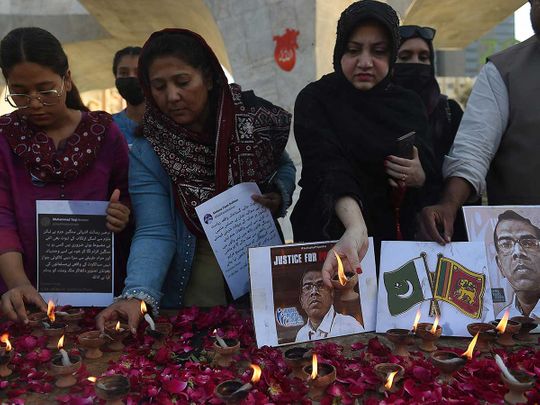
Members of the Human Rights Council of Pakistan place oil lamps to pay tribute beside a photograph of late Sri Lankan factory manager Priyantha Kumara, in Karachi on December 5, 2021, after he was beaten to death and set ablaze by a mob who accused him of blasphemy.Image Credit: AFP

Islamabad: Two primary suspects, Farhan Idrees and his colleague Usman Rasheed, whom the Sri Lankan general manager of a factory in Sialkot city of Punjab province used to chide for poor output and indiscipline, incited their colleagues to lynch him over ‘blasphemy’, says an interim police report on the torture and murder of Priyantha Diyawadana Kumara.

They disliked 49-year old Priyantha Kumara, a textile engineer by qualification, for being strict in enforcing discipline.PauseUnmuteLoaded: 10.92%Fullscreen

Later, both of them also admitted in interviews with TV channels on the spot that they had killed the ‘blasphemer.’

Background

As per details, on December 3, Priyantha Kumara was dragged out of the factory onto the road, kicked, tortured and beaten to death with iron rods and sticks by hundreds of workers over blasphemy charges. Later, his body was set on fire by the mob.

According to details, Kumara had removed a poster of the erstwhile banned Tehreek-e-Labbaik Pakistan (TLP) from the outer wall of the factory ahead of a whitewash of the building.

Lanka factory manager pakistan sialkot Priyantha Kumara
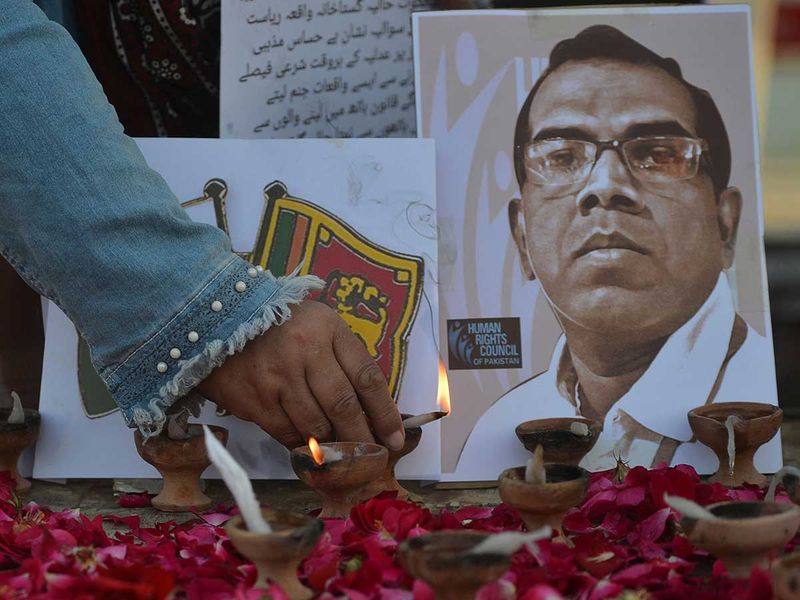
A member of the Human Rights Council of Pakistan places an oil lamp to pay tribute to Sri Lankan factory manager Priyantha Kumara in Karachi on December 5, 2021, after he was beaten to death and set ablaze by a mob who accused him of blasphemy.Image Credit: AFP

This gave the disgruntled men an opportunity to settle scores with their boss and they circulated a rumour that he had committed blasphemy.

The incident drew international condemnation from around the world calling upon Prime Minister Imran Khan and his party’s government in Punjab to take strict action against the culprits.

Immediately after the murder of the factory manager in Sialkot, known as the industrial hub of the country, Prime Minister Imran Khan in a tweet had assured justice to the family of Priyantha Kumara saying he was personally monitoring the investigation.

PM Khan talks to Lankan President

In another tweet, PM Khan informed that he had spoken to Sri Lankan President Gotabaya Rajapaksa and conveyed our nation’s anger & shame to the people of Sri Lanka at the vigilante killing of Priyantha Diyawadana in Sialkot. I informed him 100+ ppl arrested & assured him they would be prosecuted with full severity of the law.”

Spoke to Sri Lankan President Gotabaya Rajapaksa today in UAE to convey our nation’s anger & shame to people of Sri Lanka at vigilante killing of Priyantha Diyawadana in Sialkot. I informed him 100+ ppl arrested & assured him they would be prosecuted with full severity of the law— Imran Khan (@ImranKhanPTI) December 4, 2021

More than 100, including primary suspects, detained

The Punjab police also arrested more than 100 factory workers including the two primary suspects accused of torturing Priyantha Kumara with the help of the closed-circuit TV cameras (CCTV) footage.

Six more people were arrested on Sunday for alleged involvement in the lynching of Priyantha Kumara.

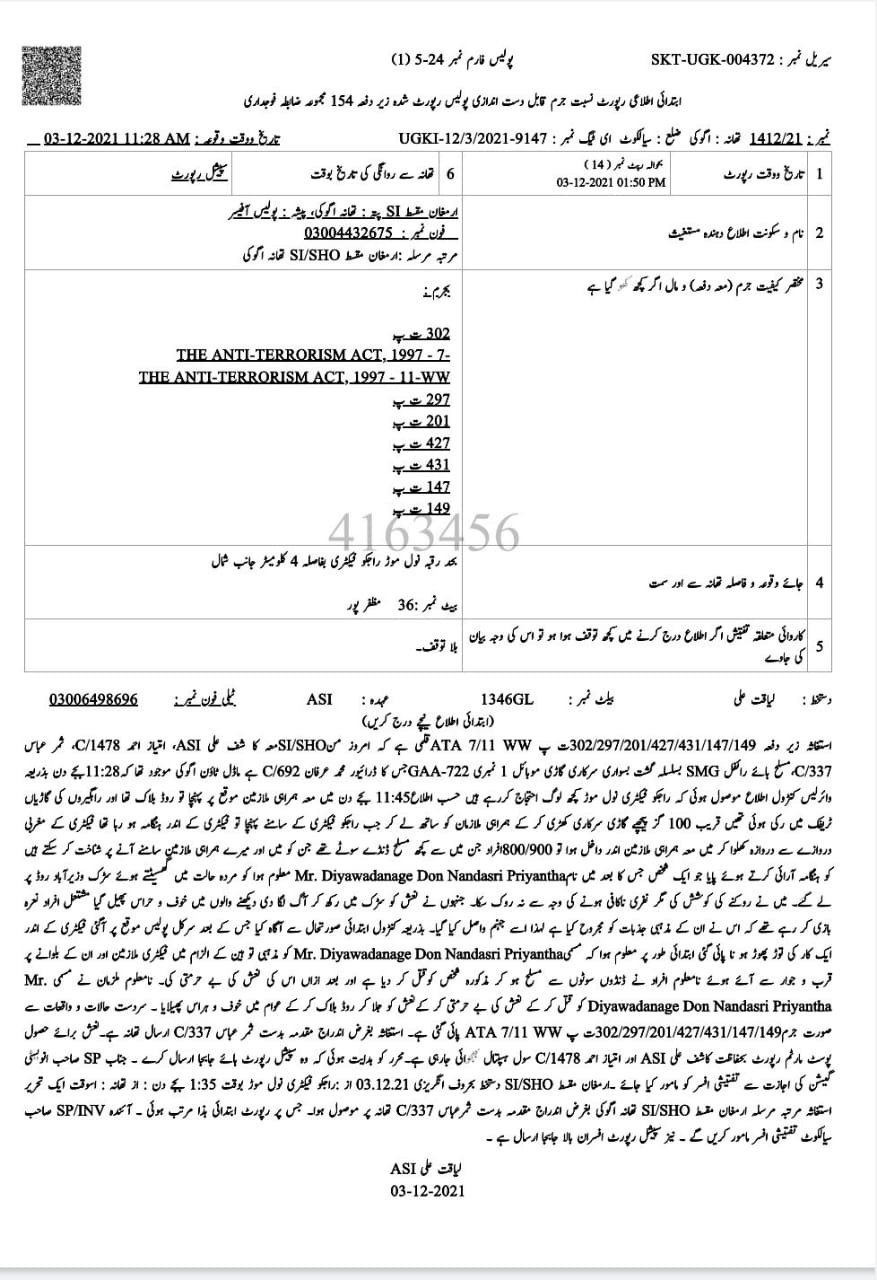
The First Information Report (FIR) was registered against 900 workers of Rajco Industries on the application of Uggoki (Sialkot) Station House Officer (SHO) Armaghan Maqt under various sections of the Pakistan Penal Code (PPC) including the Anti-Terrorism Act (ATA).

According to the FIR the protesters had slapped, kicked, punched and hit Kumara with sticks in the SHO’s presence, and dragged him out of the factory on Wazirabad Road where he died.

Police helpless before the mob

The SHO said he was helpless in front of the mob owing to shortage of personnel.

According to District Police Officer (DPO) Omar Saeed Malik raids were still being carried out to arrest more suspects. More than 300 factory workers have been identified in the CCTV footage for involvement in the gory act and the police teams have been constituted to find them, he said.

A day earlier, Chief Minister of Punjab Buzdar had stated that the investigation was being taken forward in a scientific manner.

 Sri Lankan factory manager Priyantha Kumara pakistan
Nilushi Dissanayake (C) the wife of Sri Lankan factory manager Priyantha Kumara who was beaten to death and set ablaze by a mob in Pakistan, sits with friends and relatives at her residence in Ganemulla near Colombo on December 5, 2021.Image Credit: AFP

Wife seeks justice

Kumara’s grieving wife, Niroshi Dasaniyake, has pleaded with both Pakistani and Sri Lankan leaders for justice for her slain husband.

My husband was an innocent man. I found out from the news that after working abroad for so long he had been brutally murdered. I saw on the internet how inhuman the killing was. I appeal to the Sri Lankan president and the Pakistani prime minister and president to conduct a fair investigation so my husband and our two children get justice,” she said in a statement.

Kumara and his family had been living in Sialkot for the last seven years.

Bravery award for Sialkot worker who tried to shield Priyantha ‘Was trying to save humanity,’ Malik Adnan speaks to SAMAA

December 5th, 2021

SAMAA | 

Prime Minister Imran Khan has announced a bravery award for a Sialkot factory worker who tried to shield Priyantha Kumara from the mob before the Sri Lankan national was lynched and his body was set on fire on Friday.

Malik Adnan has told SAMAA TV that he was trying to save humanity.

A video of Malik Adnan, who is a production manager at the Rajco Industries, trying to shield Priyantha Kumara went viral on Saturday. 

The video shows Adnan pleading with the mob and shielding Priyantha, especially his head from the attacks, as the Sri Lankan national clings to his legs.

Wearing a red sweater, Adnan leans over Priyantha as the mob tries to snatch the Sri Lankan national to “throw him down.” Many of them are heard saying “he would not escaped today.”

Another video recorded at what appears to be the factory courtyard shows Adnan trying to convince the factory workers to spare Priyantha from lynching. This video was recorded before the mob went to the rooftop.

Some social media users claim Adnan held the mob back for a total of 45 minutes.

PM salutes the bravery

PM Khan on Sunday saluted Adnan’s “moral courage and bravery” and acknowledged that he put his life on the line.

The prime minister announced Tamgha-e-Shujaat, the fourth-highest bravery award in the country, for Malik Adnan.

“On behalf of the nation I want to salute moral courage & bravery of Malik Adnan who tried his utmost to shelter & save Priyantha Diyawadana from the vigilante mob in Sialkot incl endangering his own life by physically trying to shield victim. We will award him Tamgha i Shujaat,” the prime minister said in a tweet.

Tried to save humanity and country’s image

Malik Adnan on Sunday spoke to SAMAA TV’s Shehzad Ahmed.

“We tried to save humanity, everyone should… I put my life on the line so that my country’s image is not tarnished.”

Narrating the Friday’s events at the Rajco Industries, he said, “We were in a meeting and suddenly I received a call that Priyantha sahib has repimanded someone and people are rushing towards his office.

“We came out and stood at the stairs [in front of Priyantha’s office] but those people outnumbered us. They pushed us away and entered the building. Meanwhile, Priyantha sahib was going towards the rooftop where there are solar panels.

“They [the mob] surrounded him there and started beating him. By that time I got there and we tried to shield him by leaning over him and doing everything else we could possibly do but…”

Adnan said he is thankful to Prime Minister Imran Khan for “presenting my behaviour as a positive [image of Pakistan] to the world” and announcing the award for him.

Other faces of humanity

To protect Adnan’s identity, SAMAA TV has blurred his face.

He uses the plural ‘we’ instead of singular ‘I’ in his conversation for people who tried to protect Priyantha Kumara.

Reports say a few other factory workers also tried to protect Priyantha Kumara after he exchanged heated arguments with a group of workers and was accused of blasphemy.

They hid him on the rooftop but the mob found him.

BBC URDU report claimed four workers who tried to protect Priyantha were wounded during the scuffle and now their families fear reprisal attacks from the mob.

The Police in Sialkot have arrested 124 people so far including 19 prime suspects, who allegedly incited others for violence.

At least 800 unidentified people have been nominated in the FIR registered after the lynching incident.

Those who appeared on CCTV footages or viral videos were arrested.

Priyantha Kumara was among thousands of Sri Lankan managers working in Pakistan. Factory owners prefer them over locals for a reason.

Daily count of coronavirus cases moves to 746 and 21 more Covid-19 deaths

December 5th, 2021

Courtesy Adaderana

The Health Ministry says that another 160 persons have tested positive for Covid-19, pushing the daily count of new cases detected to 746.

The new cases confirmed within today includes 04 returnees from overseas.

This brings the tally of coronavirus cases registered in the country thus far to 567,682 while over 11,000 infected patients are currently undergoing treatment across Sri Lanka. 

The Director General of Health Services has confirmed another 21 coronavirus related deaths for November 04, increasing the death toll in the country due to the virus to 14,461.

The deaths confirmed today include 14 males and 07 females while three of the victims are between the ages 30-59 years. The remaining 18 are in the age group of 60 years and above. 

Tamil oppressors denied Tamils justice, equality and dignity

December 4th, 2021

H. L. D. Mahindapala

Jaffna burst into  history under violent and tragic circumstances. It began when Megaha of Kalinga, South India, invaded and occupied Jaffna in 1215. He opened his reign with ruthless terror. His violence knew no limits. The historical records reveal that he destroyed non-Saivite shrines, smashed Buddhist temples, and gouged the eyes out of heretics. His lasting contribution, apart from setting up a new state,  was to establish the culture of political violence in Jaffna. The violent culture he established never left Jaffna. This explains why he is known in the history of Jaffna as Megaha the Tyrant. Variants of his intolerant, fascist culture  ruled Jaffna from 1215 to 2009 – the last year of Velupillai Prabhakaran. Prabhakaran who ran the North with an iron-fist was also the last in the line of Megaha political culture.  The successors of Megaha — Sankili, the Vellala casteist supremacists and Prabhakaran — took to the Megaha violence like duck to water. His successors in turn wrote the darkest chapters in the history of Jaffna. It was also tragic because the fascist violence of the Jaffna Tamil rulers denied dignity, justice, equality, and basic human rights to the Jaffnaites. Those who followed Megaha put the knee to the throat of the Jaffnaites and never let them breathe freely.

Jaffna was a multi-ethnic society, with a sizeable community of Sinhala-Buddhists. Sporadic pogroms expelled the Sinhala-Buddhist and the Muslims. It was the Tamils, in particular, who remained as the common victims of the violent Tamil regimes. Some low-caste Tamils were denied even the right to walk in day light. The turumbas, for instance, were allowed to walk only in the night. The Sudra Vellalas, the ruling caste, imposed the daylight ban on the turumbas to keep them away from their sight : they enforced this casteist rule to prevent even an accidental meeting of a turumba. The sighting of a turumba was supposed to pollute the purity of the Vellala eyes. Denial of basic human rights was a part of Jaffna Tamil culture. Collectively, the casteist culture dehumanised Jaffna society. The Sudra Vellala casteism was designed to impose Vellala supremacy by controlling every aspect of Jaffna life. In the absence of political power during colonial times, Vellala supremacy was imposed through casteist laws that controlled the lives of the low-castes from the womb to the tomb. It was a typical Gramscian scenario of exerting power through culture/ideology.

On top of Thesawalamai which legalised fascist casteism, including slavery, Hinduism authorised the oppression  of Tamils by the Tamils as the sacrosanct way of life. Vellala casteism was the governing cultural/ideological force of the ruling elite to maintain their power. The Sudra Vellalas reduced the low-caste to a subhuman outcast unfit for human society. The worst enemies of the Tamils were the Tamil rulers.  The Vellala oppressors of Jaffna never gave the Tamils dignity, justice, equality or basic human rights. Though there was deplorable inter-ethnic violence in the post-Independent era, the minorities had better living conditions when they were with the Sinhala-Buddhists than under Tamil rule. For instance, the Muslims migrants who settled down in the North and in the South found greater security under the Sinhala kings than in the North. Whenever there was any ethnic  cleansing of the Muslims in the North they rushed to seek protection in the South. The last expulsion of Muslims from Jaffna was in October 1990. They were given only two hours to leave Jaffna. The Muslims found refuge in the South.

Overall, the Jaffna Tamils too had better opportunities and living conditions in the South than in Jaffna. Wellawattam” and Cinnamon Gardens were affluent havens for the Tamils who left Jaffna. The Jaffna Tamils, who were suppressed, oppressed and enslaved by its traditional religio-cultural laws, were liberated for the first time only in the free and open society of the South in the post-Independent era. Excluding the other” was an incurable malady buried deep in the Tamil psyche. The Megaha cult of hate politics, injected into the Tamil political culture, drove the two communities apart. Jaffna was never inclined to co-exist peacefully with the other”. Electoral politics in particular thrived on demonising the Sinhala-Buddhists. S. J. V. Chelvanayakam, Thanthai (the Father of the Tamils”) refused to buy a house in Colombo arguing that the free and cosmopolitan life-style of the South would drag his children away from their Tamil roots in Jaffna.  He preferred to buy two estates in the hills populated by the Indian Tamils. (p. 9 – S. J. V. Chelvanayakam and the Crisis of Sri Lankan Tamil Nationalism, `1947 – 1977, A Political Biography, A. Jeyaratnam Wilson.)

A cadjan  curtain was thrown round Jaffna to prevent the subversive forces of modernity undermining and dismantling the oppressive Vellala fascism. The main thrust of the Jaffna rulers and the Vellala supremacists throughout the feudal, colonial and modern times was to keep Jaffna as an exclusive ethnic and casteist enclave under Vellala hegemony. Humane politics seldom ruled Jaffna. The Muslims and Buddhists were persecuted by Tamil Saivite extremists at the drop of a fez. The Sinhala settlers in Jaffna rebelled against tyrannical Tamil kings. In the South the minority Tamils, Muslims and Christians coexisted peacefully. The first communal clash in the South occurred in 1939 when G. G. Ponnambalam made his provocative speech denigrating Sri Lankan  history and the Mahavamasa. Unlike in the South, Tamil-Sinhala clashes occurred in Jaffna from 1215 – i.e., from the birth of Jaffna.

Jaffna is noted for regular pogroms against the Buddhists and Muslims. Expelling of Sinhala-Buddhists and ethnic clashes in Jaffna occurred from time to time under intolerant Jaffna rulers from the 13th century onwards. The violent Mega cult did not hesitate to expel the Sinhala-Buddhists and Muslims from Jaffna. The Sinhalese in turn joined hands with the Vanniyar chieftains and fought  the rulers of Jaffna. The Tamils too revolted against Tamil rulers who oppressed and supressed them. Mono-ethnic extremism, casteist oppression and Saivite religious fury made Jaffna a hot bed of political violence. The most revered religious guru of Jaffna, Arumuka Navalar, told his Saivite followers to kill blasphemers and if they can’t, hire someone else to do it. Chelvanayakam who was hailed as the Gandhi” of Jaffna, steered the declaration of war in the Vadukoddai Resolution from A to Z. He went along with the violence exploding in Jaffna in the 70s. He garlanded the statue of Sivakumaran – the Tamil militant who attempted to assassinate a Police Superintendent. In the Sinhala-Buddhist South the power struggle was confined mainly to elitist rivals, leaving aside the JVP uprisings. In the North the people at the grassroot level rebelled against their tyrannical rulers at the top from feudal times. Jaffna was not the peaceful haven that it is painted to be. Violence in the peninsula did not receive much attention because its history was hidden.

Not much attention has been paid either to the fact that the North and the South were ruled by two different political cultures. Sociologist agree that the caste system in the South, influenced by Buddhism, was milder and humane unlike the Northern caste system which was cruel and inhuman. The hegemonic role of the Vellala supremacists too have been swept under the carpet. The one-man regime of Prabhakaran that ruled the North during 33 years of the Vadukoddai War gives a taste of the violent political culture that ruled Jaffna throughout its history. Prabhakaran’s quasi-state is the highest achievement of Tamil politics. Is Prabhakaran’s fascism rule the alternative to the  parliamentary democracy of the South? The liberalism of the South amply demonstrates, with all its infirmities, the two different political cultures. The South was an open, democratic, multi-cultural, multi-ethnic, tolerant and liberal society. The North was a closed, authoritarian, mono-ethnic, mono-cultural, intolerant, ill-liberal society. 

Besides, a political feature generally ignored by the analysts is that there were two states that ruled the nation in the post-Independent era. In the South there was a parliamentary democracy, with, of course, the usual infirmities that haunt democracies.  In the North it was a one-man fascist regime bent on hunting its political opponents, most of whom were the Tamils. The LTTE regime had all the trappings of a state which was, in reality, nothing but a ruthless killing machine. For instance, it had law courts  that dispensed laws made to sustain the one-man regime in power. No professional or respectable Tamil lawyer, including those Tamil lawyers like R. Sampanthan and M. Sumanthiram, who complain bitterly about Tamils not having  dignity, equality and justice in the Sinhala state”, practised law in the Tamil courts  of Prabhakaran’s quasi-state. Isn’t it because they found dignity, equality and justice only in the courts of the Sinhala state” and not in Prabhakaran’s Tamil courts? Would the Tamil leaders send their children   to study law in Prabhakaran’s Law College or would they enroll them in the Law College in Colombo? What respect would C. V. Wigneswaran have earned if he served as a judge in Prabhakaran’s courts? What justice did Tamil parents get from Prabhakaran’s courts when they went to court seeking the release of their children abducted by Thamil Chelvam? Did the Tamils find justice in the Sinhala courts” or in the Tamil courts? From the beginning (i.e, 1215) the Tamil rulers never led the Tamils down the path of liberalism. They showed no capacity to run a democratic government. They had a penchant for running only fascist states riddled with violence. From Megaha to Prabhakaran the pattern never changed.

In the Jaffna political culture, the individual was denied his/her right to be human. Under the Pol Potist Tamil rulers, or under the facist casteism of the Vellalas, the oppressed Tamils hardly had the opportunity to experience even a modicum of human dignity, equality and justice. Even in colonial times the dominant Vellalas invoked the Thesawalamai law to impose their casteist hegemony. It gave them the right to exploit their fellow-Tamils as slaves. Jaffnaites had their first taste of human dignity, officially, under the law, only after S. W. R. D. Bandaranaike enacted the Prevention of Social Disabilities Act of 1958. It dismantled the powers of the oppressive Vellalas to rule over a slave-owning system. No other ruler – colonial or native — dared to challenge the casteist supremacy of the  entrenched Vellalas. The Dutch legalised the Theswalamai laws in 1707. It empowered the Vellalas to impose their casteist customs and laws and rule with ruthless force. Even after the British banned slavery in 1844 the Vellala supremacists continued to impose the Thesawalamai laws through devious means. The Vellalas fought to retain their power in the legislature and in the courts. For instance, Sir Ponnambalam Ramanathan went on a special mission to London to convince the British of the importance of preserving the caste system for internal stability.

Jaffna became humane only in the post-Independent years and that too was interrrupted by the reign of Prabhakaran. He revived and re-imposed the Megaha cult of violence which turned Jaffna into a Pol Potist regime. In the end, it was left to the Security Forces to restore democracy in the North. Nandikadal brought not only peace but also liberation and dignity to the Tamils of Jaffna. Tamil leaders like R. Sampanthan and M. Sumanthiram are able to walk, with their heads held high, and pursue their politics with dignity because the Security Forces liberated the North. Today the Tamils are entitled to criticise the President without fear of any reprisals. Under their Tamil Thaliavar, (Leader), whom they anointed as the sole representative of the Tamils”, they did not have a chance to utter a word against him. They lost their dignity when  they consented to accept his authority knowing that they will not get justice, respect or equality. They regained their dignity to act as independent human beings  only under the Sinhala state” which they denigrate and blame wherever they go. 

The denial of dignity, justice, equality and human rights by the Tamil overlords of Jaffna to their fellow-Tamils makes a mockery of their bogus complaint that they have lost their dignity, equality and justice under the Sinhala state”. The topsy-turvy caste system of Jaffna which elevated the lowest Sudra Vellala to the highest in the caste hierarchy created a political culture that warped Jaffna society. From 1215 to 2009 – except for the brief spell from 1948 to 1976 when Jaffna was a part of the democratically elected multi-ethnic, multi-cultural state —  the indigenous settlers of Jaffna lived either under the insane fury” (Yalpana Vaipava Malai) of Tamil tyrants or the hegemony of the Vellala supremacists who imposed fascist casteism to enslave a segment of Jaffna.  With all its infirmities the democratic state of Sri Lanka gave its citizen optimum freedom even when it was fighting two wars – one in the South against  the fascist JVP and the other in the North against the fascist LTTE. The Tamils accepted, with the connivance of the NGOs and INGOs, all the humiliating indignities under their Pol Potist Leader. Tamil leaders like Douglas Devananda narrowly escaped the fate that befell Alfred Duraiyappah and Appapillai  Amirthalingam, only because the mysterious forces that protect him are far superior to Prabhakaran. Right now, Tamils owe everything – including  the right to dissent  — to the rescue mission of the Security Forces that saved them from living in permanent state of fear and humiliation in the Tamil state of Eelam.

The moral choice before them is clear: are they willing to live with the kind of dignity, justice and equality dished out by Prabhakaran, their Divine Leader, or do they prefer the dignity, justice and equality in the Sinhala state”? What were the rights of the Tamils guaranteed by the Prabhakaran? For instance, was the right of the Tamil children to go to school and return home to their parents guaranteed  by the Tamil state or by the Sinhala state?” Was R. Sampanthan’s right to go to Parliament and speak without fear or favour guaranteed by the Tamil state or by the Sinhala state”? Why didn’t  Sumanthiram practise law in Prabhakaran’s Tamil courts if he sincerely believed that the Sinhala stat” does not deliver justice to the Tamils? Was C.V. Wigneswaran’s right to deliver judgment based on the finest legal principles guaranteed by the Sinhala state” or in Prabhakaran’s courts? The list is unending. Underlying all these issues is the question of making a moral choice between the state that would guarantee the highest degree of dignity, justice and equality and the state that is politically incapable of delivering these basic essentials. After all, the Tamils were fighting for their dignity, justice, equality and security. When a state has to forcibly recruit under-aged children to fight its futile war how much of dignity, justice, equality and security prevailed for the glory of Tamils in their Tamil state?

In other words, the moral choice was crystal clear: should the Tamils opt to live in a multi-cultural democracy with human rights, however imperfect it may be, or live in a mono-ethnic Tamil fascist state without even a minimum of human rights? To go for Tamil rights at any cost in a fascist state – and there was no other option under Prabhakaran – was to live as mono-ethnic slaves deprived of basic human rights. What is equalling galling, is that over the centuries the Tamils have proved that they were totally incapable of running a liberal state, guaranteeing human dignity with the right to walk in daylight. The political culture was so perverse that they denied to human beings the right given to cattle and dogs. They have no political experience either of running a democratic state. They have specialised in  fascism but not in liberalism. There has been no redeeming feature in Tamils politics except wallowing in mono-ethnic rhetoric and Tamil fascism. The moral option in Tamil politics has been to find an alternative to Megaha-Prabhakaran cult of fascist violence. Though the initial ideology on which the Vadukoddai War was launched focused on  choosing between Sinhala-Buddhist state and a Tamil-Hindu state it was becoming increasingly clear, as the violence intensified and  dragged on, that the greater choice was between democracy and fascism. The mindless violence of Prabhakaran killing Tamils took the shine away from the ideals of Tamil nationalism”. Besides, towards the end when Prabhakaran knew he was losing he was forced to fight for his own survival than that of the Tamil nation”.  He chose to fight until the last Tamil left for Canada, not to negotiate a settlement to save the lives of the Tamils trapped in a futile war. He dug his own grave with his intransigence and arrogance.

It was also clear that saving Prabhakaran was not going to save the Tamils, or the security of the Tamils, or their thirst for peace after 33 years of war that was going nowhere. All attempts to negotiate a settlement, even with international guarantees, failed. Prabhakaran refused to abide by negotiated settlements. The only option  open to achieve peace and security was to remove him from the political equation. The Vadukoddai War had gone long enough and the time had come to end it. The only way to achieve peace was to neutralise the killing machine of Prabhakaran. Morality was in ending the war and restoring peace. Anything short of that was moral hypocrisy.

It at this critical moral juncture that the Centre for Policy Alternative (CPA) stepped in to save Prabhakaran. It was obvious even in the last stages of the war that Prabhakaran was committed to Chelvanayakam’s doctrine of fight to the end.” In a speech delivered in Batticoloa on May 11, 1975 Chelvanayakam said: ”There is no other alternative for the Tamils to live with self-respect other than fight to the end for a Tamil Nad ( i.e. a Tamil State)”. ( p.127 – Ibid). The only difference between Chelvanayakam and Prabhakaran was that the latter was more honest in his politics than the former.  Chelvanayakam posed as a saintly Gandhian in Parliament in Colombo and stoked the fires of war in Jaffna. Chelvanayakam’s actions, particularly in the 70s, confirm that he was a committed war-monger who tried to cover up his belligerence with Gandhian  poses and utterances.  When in the 70s the violence of the Tamil youth was escalating, his thinking was shifting to a fight to the end”. Amirthalingam, his deputy, and M. Sivasithamparam were hand in glove with the militant youth gearing up to fight to the end”. By 1975 Prabhakaran had killed his first Tamil victim – Alfred Duraiyappah. Chelvanayakam, the Gandhian, had prepared Jaffna ideologically, to wage the Vadukoddai War which was officially declared under his chairmanship in Vadukoddai on May 14, 1976. It didn’t take long for Prabhakaran to decimate most of the 37 rival militant group and take over Jaffna. With his early military successes, he attained a divine status. He was anointed as Surya Devan”. At the political level he was hailed as the sole representatives of the Tamils”. No Tamil had reached such giddy heights of power in Jaffna.  His arrogance and intransigence grew proportionately. Drunk with power he was determined to fight to the end”. He refused to read the signs of the time. And then, almost overnight he  came down from hero to zero at Nandikadal. He had come to a dead end. He had outlived his usefulness. The inevitable was moving  inexorably to happen: he had to be removed for the Tamils to move forward.

It is at this decisive point that Pakiasothy Saravanamuttu, head of the CPA, staged his best tragi-comic act. He was leap-frogging from one Western capital to another to stop the war. He knew that Prabhakaran was trapped and only international intervention could save him. So, he went jumping from one Western city to another to prevent the impending carnage, he said. Pah! He could not reveal, of course, that his farcical exercise was to save Prabhakaran and not the lives of Tamils sandwiched between two warring forces.  Like all the moral hypocrites running politicised NGOs, he took cover under the noble principles of human rights. If he was genuinely concerned about stopping the war to save lives why didn’t he feel the urgency for 32 years and seven months when Prabhakaran was killing more Tamils than all the others put together? Why did he start jumping up and down only in the last five months of the war, from January 2009 to May 2009, when Prabhakaran was facing  certain defeat? He was quite smug and content with the progress of the war when Prabhakaran was scoring military successes. He felt no urgency to stop the war when Prabhakaran was winning ground. His heart began to bleed only when Prabhakaran was losing territory!

The moral hypocrisy of intellectuals like Saravanamuttu is appalling. It is easy to see through his theatrics: he was attempting to use moral principles to save an immoral political criminal. After that, can he be trusted to do anything honest?

The Economic Woes of today(2021) go back to 1977, when we followed the neoliberal policies laid down by the IMF

December 4th, 2021

By Garvin Karunaratne  

The IMF has successfully taken Sri Lanka to its grave.  

In 1976, Sri Lanka did not owe a single dollar to anyone. In 1977 Sri Lanka held SDR 170 million in its foreign exchange budget. That was the last year we held a credit. Since then it is not a credit but a foreign debt.  

Today, five decades later, the banks hold no dollars and importers are finding it difficult to obtain dollars from their banks. The dollar shortage has created a shortage of goods of all types and with the Government easing control of prices, the sky is the limit even for essential food. Bakery owners have voiced that they cannot obtain flour etc. The earnings of people have not increased and therefore  people will be unable to buy essential supplies. I am sad to be aware that many families have to depend on one meal a day. Pauperization is very severe.  

The causes for the present  situation go back to a decision Sri Lankan leaders made five decades ago. President Jayawardena and my close friend, Ronnie de Mel, the Minister of Finance were fooled by the IMF.  

When President Jayawardena sought the help of the IMF in 1977, the IMF insisted that funds would be given only on the condition that the country would follow the Structural Adjustment Programme provisions. The provisions laid down were that Sri Lanka had to liberalize the spending of foreign exchange- allow those who could afford- the rich to spend dollars as they wished,  free imports without any restrictions and the IMF readily provided dollar loans. The foreign funds loaned to us was in this process, shunted back to the donors- the Developed Countries, fattening their banks with profits,  leaving the debt saddling our country. The IMF even provided grace periods where the loan instalments and interest need not be paid- the IMF actually ‘bribed’ the then leaders as they could freely spend and leave the burden of repayment to their successors! That is truly what the IMF did! 

The IMF also laid down that the Public Sector should not attend to any commercial tasks. With this dictate the Government had to call off all public sector work on development. It was the Public Sector that brought about development   To mention a few-the Marketing Department activities- its Cannery that made Sri Lanka self sufficient in all fruit preparations was closed down and imports took its place. The Vegetable & Fruit Purchasing & Sales Scheme that assured high prices to producers and also made available goods at low prices to consumers was abolished.  The textile manufacturing units – 96,000 handloomers, powerlooms and textile mills were privatized or abolished and a country that produced all its textiles came to import instead.  In the pre 1977 period we never imported a single rail carriage or bus or lorry. We imported the chassis and built them ourselves. Local enterprises closed down because the bank interest rate was jacked up to 25%, which made enterprises uneconomical to run. I am not exaggerating as I was a key administrator attending to development tasks in the pre 1977 era, working in the Marketing Department, in the Agrarian Services and in Small Industry. .  

Going on this path the foreign debt increased to $ 6 billion  by 1994, when the UNP rule ended. There was no going back because Sri Lanka had abolished or crippled the infrastructure  that had ushered in develoment. Stalwart administrators who brought  

about development were confined to the barracks. . There was unemployment and poverty.  

The foreign debt increased to $ 20 billion by 2009, to $ 30 billion by 2012, to $ 42.9 billion by the end of 2014. 

Following the IMF advice the foreign debt is at $ 56 billion today to service which  the country has to find $ 4.8 billion a year. The country does not earn that amount and is forced to obtain foreign loans to service the debt, which means that the debt is immediately increased by another $4.8 billion. Upto now Sri Lanka has paid up its dues but the day is not far when it will be forced to default and tell the IMF that we have gone on the path you told us to follow and have lived on loans and this is why we have built up the foreign debt. It was your wrong advice that led us to this predicament. 

The IMF has been told again and again that their structural adjustment provisions only serves any country that follows it to become further indebted.  

In 1992, in an  address to the South Asian Forum at the University of London I happened to point out that foreign aid, if accepted in a non-developmental manner… can lead to a situation of  chronic debt, widespread poverty” .I pointed out that a country that did not owe a single dollar in 1976 had a foreign debt of $ 5 billion by 1989, with high unemployment due to flooding the country with imports, allowing the rich to spend dollars, that the country did not have and totally dismantling the administrative infrastructure we had to bring about development. This warning went unheeded.  

In 1997, my book: Microenterprise Development:… The Way Out of the World Bank & IMF Stranglehold, the first book to criticize the IMF, detailing how Sri lanka got into debt  playing poodle to the IMF,  was published by Sarasavi. It proved that the IMF was taking Sri Lanka to its grave. This  documents a presentation by me to the economic dons at Peradeniya, my first and last assignment as a Visiting Lecturer! To them,  I was talking nonsense. Till now(2021) our economic dons have sidetracked teaching the neoliberal economics of the IMF that has taken Sri Lanka to its grave. It is time that our President rules that our premier universities should undertake detailed studies into the predicament that Sri Lanka’s economy  faces today and find remedies. .  

In 2000, the foreign debt was $ 9 billion, definitely on the increase. In 2006, I have proved that the IMF ruined Sri Lanka’s economy in my book: How the IMF Ruined Sri Lanka & Alternative Programmes of Success(Godages). George Axinn, Assistant Dean of International  Studies at Michigan State University, in his Foreword stated: It is hoped that this timely book will enable international organizations  to arrest the trend of failures.” 

Not an outsider  like me, but authoritative capitalist sources like the Wall Street Journal and the Economist have also been pointing out that the IMF’s advice to our countries was actually taking poor countries  more into debt and ushering poverty and destitution…  

The Wall Street Journal of 22/2/2001 comments: 

The IMF drill is as follows: A Third World poor country  with a pegged currency is working towards taming its inflation.  . Instead of a growth formulae it gets the IMF’s old austerity dosage which slows down the economy. The Banks begin to falter in paying their old debts. The IMF  recommends yet more medicine- devaluation,  making the bank predicament and capital flight worse. The currency slumps and the banks are now in real trouble… Is this anyway to run an international monetary system?” 

This warning by the Wall Street Journal was in 2001, when Sri Lanka’s debt was around  $ 9 billion. The IMF went on heedless.  

The Economist, the epitome of capitalist journals hauled the IMF over the coals in 2002: 

Over the years these institutes- the IMF and the World Bank have often handed poor advice and squandered many billions of dollars on loans that helped Governments to postpone necessary economic and political reform…. The World Bank has achieved little for its $ 500 billion loans during the past half century, besides saddling very poor countries with huge debts  that should now, mostly be forgiven”(The Economist: 18/24, May 2002) 

Two decades have passed since this warning was made by the Economist.  

In fact President Nestor Kirchner of Argentina in his address at the United  

Nations General Assembly on 21/9/2004, said: 

An urgent tough  and structural redesign of the IMF is needed to prevent  crisis and help solutions. The IMF must change that direction it took from being a lender for development to a creditor demanding priviledges”  

The immediate reply he got  from the seven  superpowers  was a firm warning  that Argentina had to come to  an immediate debt restructuring agreement with creditors and President Kirchner was forced to abide. Nestor Kirchner and the next President Christina Kirchner fully paid the dues to the IMF and subjected people to austerity. Christina Kirchner was defeated by Mauricio Macri who followed the IMF policies in 2015 and  was rewarded by loans of $ 44 and $ 57 billion, the latter obtained even without Parliamentary approval.  Mauricio Macri was defeated in the 2019 elections but his successor had to agree to repay the loans taken by Maurico Macri later on in 2022 and 2023. 

In short the IMF actually ruins the economies of Third World countries. My 2017 book: How the IMF Sabotaged Third World Development  documents how the Third World countries that had self reliant economies and were not in debt were made indebted.  

In fact FullSpate says:  

these two agencies have become two of the strongest proponents of today’s form of globalization process whereby all the countries of the world are forced  to open their markets, thereby maximising  the opportunities for the largest  and most powerful companies  in the world. This means an  insistence upon free markets that disregard the consequences for local communities  and their traditional ways of life. The poor African countries  that previously subsidized  agricultural activities  in remote rural areas When they needed help from the IMF  they were forced to stop these subsidies  and let the local markets operate without  government intervention.”  

This also encapsulates what has happened to Sri Lanka today. Sri Lanka has allowed the  rich to spend foreign money  it did not have and has been living on loans given by the IMF and its associated creditors since 1977. Since 1977 Sri Lanka  has been ruled entirely by the IMF dictates and in the process has run up a debt of $ 56 billion, to service which in 2021 the Government had to obtain  $ 4.8 billion on loan. 

Already the leaders have said that they would not default on debt payments. The next payment of some $ 4.8  billion will be due in 2022 and the crucial question that crops up is as to whether it is morally right  for further loans to be raised to pay up the next of $ 4 to $5 billion and to place the burden on the people- for them to go through austerity, when the fault lies with the IMF and not with the people.  

Certain Cabinet Ministers have suggested that the Government should go to the IMF for funds but this has been shot down by the majority of Cabinet Ministers who had said that the IMF will insist on the Government following further restrictions, which will be non developmental. Minister Cabral had rightly stated that if we seek the help of the IMF they will insist on increasing interest rates, depreciate the Rupee, reduce public servants, sell State Assets, curtail pensions, which action are not necessary”(CeylonToday:26/11/2021) This will take the country further down to destitution.  

I have had to point out that since 1977, the Government has failed to control its foreign  exchange. The Central Bank voiced that it does control only the local Rupee. The Central Bank was actually forced to make this statement when on 25/1/2001, the two State banks- the Peoples Bank and the Bank of Ceylon had to pay a large oil bill and their collection of dollars was insufficient. They had to go hat in hand to the foreign banks that had collected dollars and strangely that foreign bank had increased the price of dollars to as much as Rs 106 to the dollar when the price had been only Rs 86.00.that morning The State banks had no alternative other than to buy the dollars at the higher price. This caused an immediate devaluation. 

Getting back to today, it is important to note that even today the Government gets into the Treasury only the foreign funds collected by the Bank of Ceylon and the Peoples Bank which is only a fraction of the foreign exchange that comes in.  The dollars collected by other banks and the private exchange dealers do not get to the Government Treasury. Instead the other banks and private dealers fix their own rates of purchase and sale prices. Importers are said to be  buying dollars at rates like Rs 275 to the dollar! The Government instead of collecting all the dollars that come in,  allows the banks and private dealers to collect the dollars sell them, profiteering as they wish, and go begging for foreign fund from Bangladesh- from the Middle East and Minister Basil is on the run to beg from India. 

What can be done? We have to step back to the time before we started following the IMF- that was from the day we became independent- from 1948 till the IMF took charge at the end of 1976. We were not a country in debt to anyone. We carefully collected all dollars coming in to the Treasury and did not have banks and private currency dealers collecting dollars, fixing their own rates of exchange, and making profits as they please.  We did allocate dollars for essentials first and thereafter made small allocations to import non essentials but useful items life fridges, cars etc. No dollars   were   given for foreign studies. This was how we managed and that is essentially the blue print we have to follow to get out of the current quagmire.   

It was the IMF that advised us to spend and live on loans and the IMF has to take the blame and as advised by the Economist decide to forgive the debts we owe.  

The country had two budgets- a foreign exchange budget  and a Rupee budget.  The foreign exchange  budget was entirely fed by dollars which we carefully collected from exports and tourists etc. The Rupee budget was fed from taxes and printed Rupees.  

I happened to be in the thick of the administration in the pre 1977 period as a high ranking officer of the Administrative Service. Once in 1970 I was in charge of allocating foreign exchange to small industrialists  and every small industrialist was given an allocation to import items that were required for manufacturing what the country needed. Small Industries were highly developed and our country produced all its textiles. When I was the Government Agent, some Divisional Secretaries had to manage powerlooms.  They were adept at it and our Hakmana Poowerloom suiting was even sought by people from London, UK. 

What has to be done: Collect all the dollars and handle the totality of development.  

Instead of importing consumer goods that are today in short supply, we should be making them. In 1971, my officers slaved for three months from six to midnight closeted in the science lab at Rahula College, to find the recipe to make crayons and Member of Parliament Sumanapala Dahanayake, in his capacity as the President of the Morawaka Cooperatives,  under my personal supervision,  established Coop Crayon in two weeks working on a 24 hour a day basis. Coop Crayon was equal in quality to the Reeves crayons and my blood boils today when I see Crayola Crayons on sale in Sri Lanka!. That Coop Crayon became  the flagship industry of the Divisional Development Councils Programme, of 1970-1977. 

 The country has administrators and politicians who can undertake this task, bringing incomes to the people and making what the country needs. It will usher in an economic revival which is eagerly awaited today. It is a task that can be accomplished.  

I can vouch for success, as I did establish the Youth Self Employment Programme of Bangladesh, a task which the ILO had failed earlier,  within nineteen months as the Commonwealth Fund Consultant to the Ministry of Labour and Manpower, and also trained Bangladeshi youth directors and youth workers in economics and extension methods to manage after my two year consultancy ended. This Programme is  today the premier employment creation programme the world has known, having guided three million youths to become self employed.  Bangladesh does not dance to the tune of the IMF! 

Garvin Karunaratne, Ph.D. Michigan State University,  

5 th December 2021 

Author of: 

Microenterprise Development..The Way Out  of the IMF and the World Bank and IMF Stranglehold(Sarasavi:1997) 

How the IMF Ruined Sri lanka & Alternative Programs of Success(Godages:2006) 

How the IMF Sabotaged Third World Development(Godages/Kindle:2017) 

Bhutan And Bangladesh Can Benefit From Growing Trade Ties

December 4th, 2021

MD Pathik Hasan

South Asian neighbors Bangladesh and Bhutan have a harmonious relationship on the strength of their mutual interest, shared history and culture. On December 6, 1971, Bhutan and India became the first countries to recognize the independence of Bangladesh. Bangladesh-Bhutan ties started to deepen from this period. Bhutan and Bangladesh can work together in the sectors of information and communication technology, agriculture, horticulture and fisheries to enhance trade and investment relations between Bangladesh and Bhutan.

Bangladesh and Bhutan have excellent relations in various fields including trade investment, communication, education, cultural exchange, people-to-people contact, tourism.

Bhutan is a loyal, true friend of Bangladesh. The people of Bangladesh are always grateful to the government and people of that country for their unwavering support and cooperation in the war of liberation in 1971. Bilateral relations between Bangladesh and Bhutan are very good. Over time, this relationship is reaching new heights.

Bangladesh and Bhutan signed the ‘Preferential Trade Agreement (PTA)’ on December 06, 2020. This is Bangladesh’s first priority trade agreement or PTA with any other country in the world.

As per this agreement of Bangladesh with Bhutan, 100 products of Bangladesh will get duty free facility in Bhutan and 34 products of Bhutan will get duty free facility in Bangladesh. As a result, trade relations between the two countries will increase further.

According to the Export Promotion Bureau of Bangladesh, trade between the two countries in 2018-2019 is 56.90 million US dollars.

Bhutan imports vegetables and fruits, minerals, construction materials, boulder, limestone, coal, pulp and chemicals from Bangladesh. On the other hand, garments, furniture, food items, medicines, plastics and electrical products made in Bhutan are exported from Bangladesh.

Duty-free market facility

Since 2010, Bangladesh has been providing duty-free market access to Bhutan on 18 products. Besides, 90 products of Bangladesh are getting duty free market facilities in the Bhutan market. Bhutan is the largest exporter of stone to Bangladesh. Bangladesh is Bhutan’s second-largest export market.

All ports of Bangladesh can be potential for Bhutan

According to Bangladeshi media outlets, PM Sheikh Hasina commented that Bhutan can use Bangladesh’s Chittagong, Mongla, Payra seaport and Syedpur airports including river ports of Bangladesh if it wants. They can also set up warehouses anywhere in Bangladesh if they want to facilitate inland transport.

Bhutan wants to use our river routes from Chittagong and Mongla ports in Bangladesh to take goods to Dhubri port in India. Bhutan is very close to Dhubri, so they want to use the rivers of Bangladesh to transport goods there. Bangladesh has shown a positive attitude towards bringing and taking goods through Roumari-Chilmari.

Besides, Bangladesh has initially agreed to allow Bhutan to import and export goods by rail. To this end, the Rohanpur-Singabad rail route between Bangladesh and India will be launched.

Three land ports can bring the potential for both countries

At one time trade with Bhutan was done only through Burimari land port. However, Bangladesh has now allowed the use of land ports at Tamabil, Banglabandha and Nakugaon as an initiative to increase trade by land.

Traffic between the four countries

There has been a discussion between Bangladesh, Bhutan, India and Nepal (BBIN) on the movement of passenger, private and freight vehicles by road. Once the agreement is completed, the residents of the four countries will get many benefits while moving from one country to another. However, the other three countries agreed to the agreement, but due to the environment, the Bhutanese parliament has not yet agreed to the agreement.

Hydropower exports

Most of the total hydropower generated in Bhutan is not needed. Bangladesh has shown interest in buying this electricity.

However, Bhutan’s Prime Minister Lotay Tshering stressed the need for trilateral talks to bring it through India during his visit to Bangladesh in March 2021.No agreement has been reached yet, but it has been discussed at various meetings between the two countries.

The Prime Minister of Bangladesh Sheikh Hasina and the Prime Minister of Bhutan Lotay Tshering have emphasized building the necessary infrastructure to avail the maximum benefits of the Preferential Trade Agreement (PTA) signed between Bangladesh and Bhutan. The two Prime Ministers discussed cooperation between the two countries in various sectors including trade and connectivity.

Bhutan and Bangladesh have already agreed to operate naval routes between the two countries to expand Bangladesh-Bhutan trade. Bhutan and Bangladesh also emphasized building more seaports. Besides. A bilateral or tripartite memorandum of understanding would be potential for the construction of cooperative hydropower plants.

Lotte Schering requested one-time full-term visas and multiple-entry facilities for Bhutanese students studying in Bangladesh. Prime Minister Sheikh Hasina agreed with the Prime Minister of Bhutan on the issue and directed the concerned parties to take necessary steps in this regard.

Bangladesh can cooperate with Bhutan in the IT sector including broadband internet. Bangladesh and Bhutan can work together in international forums including the United Nations.

The visit of Bhutanese Prime Minister Lotay Tshering was very important. Because this year marks the fiftieth anniversary of Bangladesh’s diplomatic relations with Bhutan as well as the golden jubilee of Bangladesh’s independence. At any rate, this is a very important and historic event for both countries. During his visit to Bangladesh, the Prime Ministers of the two countries reviewed the overall aspects of bilateral relations and expressed interest in enhancing mutual cooperation in various fields of potential.

Sheikh Hasina and Lotay Tshering discussed trade and investment, roads, rail and air communication, hydropower, bilateral and multilateral cooperation, health, education, agriculture, culture and increasing people-to-people contacts between the two countries. During this time several bilateral memoranda of understanding have been signed between the two countries. Earlier, the Preferential Trade Agreement (PTA) was signed between Bangladesh and Bhutan on December 6 last year; Which is of special importance in the expansion of inter-trade between the two countries.

Press Statement by the Muslim Civil Society Alliance

December 4th, 2021

Muslim Civil Society Alliance

The Muslim Civil Society Alliance (ACJU, MCSL, NSC, YMMA) is shocked and condemns the cold blooded murder of fellow Sri Lankan brother Mr Priyantha Diyawadana by a rabid mob, accusing him of blasphemy. He was a Sri Lankan expat worker and General Manager of a factory of the industrial engineering company Rajco Industries in Sialkot, Punjab, Pakistan. This is an extremely shameful and barbaric crime and should not be tolerated. Extra judicial vigilantism cannot be condoned at any cost by anyone, no matter which religion, ethnicity or nationality they belong to.

The Muslim Civil Society Alliance (MCSA) condemns this horrific killing, and appreciates the swift action by the Prime Minister of Pakistan, Hon. Imran Khan and his administration in ordering the arrest of the perpetrators of this crime. We understand  that over 75 have been already arrested and an investigation report has been called for within 48 hours. We sincerely hope that Pakistan will set an example to the world that extremist vigilantes will face tough judicial action. We call upon Prime Minister Imran Khan to bring the perpetrators of this heinous crime to justice, and to compensate the family adequately for their loss.

We extend our deepest condolences to the family of brother Priyantha. May he attain the supreme bliss of Nirvana.

Hilmy Ahamed Vice President

2 suspects ‘confess’ to police they lynched Sri Lankan factory manager in Sialkot

December 4th, 2021

Courtesy The International News

Punjab government has sent an initial investigation report to Prime Minister Imran Khan, sources say

SIALKOT: Two key suspects have “confessed” to the police of their involvement a day earlier in the torture and killing of a Sri Lankan factory manager, well-placed sources told Geo News on Saturday.

During initial interrogation, the two suspects, identified as Farhan and Talha, “admitted” their role in the brutal attack on the foreign national, the police sources said.

A day earlier, Priyantha Kumara, who had been working as a manager at a private factory on Wazirabad Road in Sialkot, was tortured to death and his body set on fire by a mob over allegations of “blasphemy”.

Sources privy to the investigation said the Punjab government has presented an initial report to the prime minister.

Police have arrested 13 key suspects involved in the attack with the help of other managers of the factory where the incident took place. The suspects have been shifted to an undisclosed place for further investigation.

Those who incited the mob have also been taken into custody by police, the sources added.

Briefing the media on the progress made so far, Special Assistant to Chief Minister on Information Hasaan Khawar said as many as 118 people, including 13 key suspects, have been arrested for the cold-blooded murder.

Khawar said the suspects were arrested with the help of 160 videos that yielded 12 hours of footage.

He said the provincial government has formed 10 teams to arrest all suspects involved in the murder.

The Sri Lankan manager had already died when police received the first telephone call regarding the incident, he said.

The Punjab government spokesperson said police and the civil administration will take the investigation to its “logical end”.

He revealed that the Sri Lankan national had been living alone in the country.

Speaking on the occasion, the inspector general of police for Punjab said police negligence was not a factor in the brutal murder.

He said the district police officer (DPO) and a superintendent of police (SP) had to reach the crime scene on foot as roads were blocked in the area on that day.

Kumara ‘apologised for misunderstanding’

As per the preliminary report turned in by the provincial government, a dispute had emerged when Priyantha Kumara removed some posters from the walls of the factory at 10:28am. The posters were reportedly inscribed with the name of the Holy Prophet (PBUH).

Shortly after, the factory owner reached the spot and resolved the issue. Kumara had apologised for the misunderstanding on his part.

After Kumara made the apology, the matter was reportedly considered settled and the factory workers had dispersed.

However, some workers then incited their colleagues to attack the manager.

Within a few minutes, a mob formed and set on the victim within the premises of the industrial unit, eventually killing him.

A total of 13 security guards were present in the factory as the brutal attack was occurring. None of them tried to rescue the victim or disperse the mob, said the report.

Kumara’s body was later dragged outside the factory and burned.

Police received a phone call at 11:28am about the incident, officials said. A police party reached the site within 12 minutes, they added.

Heavy contingents of police were later dispatched to the crime scene to round up and arrest suspects.

At least 800 booked under ATA over Sialkot lynching

December 4th, 2021

Courtesy The Express Tribune

Policy say initial report of incident submitted to PM Imran; 112 suspects detained so far

sialkot mob lynches sri lankan national

SIALKOT:

The police have arrested a prime suspect and booked at least 800 people under the Anti-Terrorism Act a day after a mob tortured a Sri Lankan man, employed as a manager in a factory on Wazirabad Road, Sialkot, to death and set his body on fire.

The police said Farhan Idrees, the key suspect, has been detained.

They said hundreds of people armed with sticks and batons were present inside the factory at the time of the murder of the foreign national, Priyantha Kumara.

After the murder, the mob dragged his body on the streets, the police said, adding that it failed to stop the crowd due to a lack of strength.

As per the initial investigation, the police said that the Sri Lanka citizen was killed over allegations of blasphemy. They added that they were investigating the matter from all angles.

Meanwhile, an initial report of the incident has been submitted to Prime Minister Imran Khan by the Punjab Police. As per the report, at least 112 suspects have been detained who were identified with the help of the factory managers. The provocateurs have been arrested as well.

A copy of the FIR available with The Express Tribune.

The detained suspects have been moved to unknown locations, they said, adding that investigation was still underway.

Separately, the body of the deceased has been handed over to the police after post-mortem for legal formalities.

In a statement, cleric Mufti Taqi Usmani condemned the killing of the foreign national over blasphemy allegations. He said blasphemy was a grave crime” but the evidence to prove the blasphemy charges must be beyond doubt.

The Sialkot incident has tarnished the image of Pakistan and Muslims across the world, he added.

He expressed concerns over the violent state of affairs in Pakistan, saying instead of using force, the government should table the matter before parliament to resolve such issues. He also urged the protesters to use peaceful means instead of destroying national properties and violence.

Lynched over ‘blasphemy’

The nation was shell-shocked and disgusted on Friday when a Sri Lankan national was brutally lynched and his body was set on fire by a mob in Sialkot. The sickening incident outraged the nation as the civil and military leaders denounced it as horrific” shameful” and extra-judicial vigilantism”.

President Arif Alvi said the vigilante attack has nothing to do with religion, while Prime Minister Imran Khan promised that those responsible will be punished with the full severity of the law”.

The gut-wrenching incident took place on Sialkot’s Wazirabad Road, where workers of private factories brutally lynched the Sri Lankan national.

Several gruesome video clips shared on social media showed a mob beating the victim while chanting slogans against blasphemy. Other clips showed his body set ablaze, as well as the overturned wreckage of what was said to be his car.

Many in the mob made no attempt to hide their identity and some took selfies in front of the burning corpse. The police claimed that the grisly incident took place inside the factory premises and there was no way of knowing about it before that time.

Postmortem report, videos reveal new details on Sialkot lynching

December 4th, 2021

SAMAA |  

The body has been moved to Lahore

Postmortem report, videos reveal new details on Sialkot lynching
Outside the Sialkot Chamber of Commerce, people pay homage to Sri Lankan national Priyanatha Kumara who was lynched by a mob on Friday.

The preliminary postmortem of Sri Lankan national Priyantha Kumara reveals that he died of a severe blow to his head and most of his limb bone had been shattered before the body was set on fire.

The report and additional videos that surfaced on Saturday have revealed new details on the lynching. It emerged that at least one colleague tried to shield Priyanatha from the mob.

The body of Priyanatha has been moved to Lahore on the way to Islamabad, where it would be handed over to the Sri Lankan High Commission.

The Sri Lankan national was lynched by a mob of factory workers and others on Friday over alleged blasphemy allegations. He worked as exports manager at Rajco Industries’ unit located at Wazirabad Road.

Factory employees first killed him and then dragged his body out to set in on fire. The grisly events were recorded on mobile cameras.

Postmortem report

The postmortem report reveals the final moment of Priyanatha Kumara, who had been working in the country for over a decade.

According to the report, Priyantha’s skull received multiple hits and a severe blow then went deep into his brain causing the death.

The mob broke almost all of the limb bones, according to SAMAA TV.

About 99% of the tissues were damaged with burns and wounds. The body was burnt except for the lower legs.

Following the legal formalities and postmortem, the police have escorted the body to Lahore under security. The body will be handed over to Sri Lankan High Commission in Islamabad.

The Sri Lankan High Commission staff will accompany the body to Colombo, according to reports by the Sri Lankan media outlets.

The real cause of heated exchange

The mob had accused Priayanatha of blasphemy after he allegedly tore down some posters of a religious outfit pasted to the factory walls.

However, a police investigation on Saturday revealed that Priyanatha and workers had a heated exchange over another issue, SAMAA TV reported.

The report says that an inspection of the Rajco Industries by foreign companies was due and the deceased had ordered the complete overhaul and maintenance of the factory machines.

According to the police, the manager and workers first got into a heated argument at 10:00am on Friday that escalated to violence.

It says some of the workers had been fired for derelict.

Following the dispute, the workers staged a protest in the factory and alleged that Priyanatha Kumara has committed blasphemy.

The protest suspended the traffic in the area and the crowd gradually grew larger.

The report has been submitted Chief Minister Punjab Usman Buzdar.

Poice has obtained 12 hour CCTV footage recorded by 160 CCTV cameras in the factory.

Colleagues try to shield Priyanatha

Priyanatha Kumara went to the rooftop of the Rajco Industries factory to escape the mob. PHOTO SAMAA TV

New videos and reports emerged on Saturday suggesting that after the mob re-entered the factory following the protest on the road, Priyanatha run to the rooftop to save his life.

Videos show that mob surrounds him on the rooftop amid an array of solar panels.

At least one colleague tries to shield Priyanatha from the mob as the Sri Lankan national clings to his legs.

SAMAA TV‘s Shehzad Ali, who visited the factory on Saturday, says there were a few other factory workers who tried to protect their manager.

BBC URDU report says at least four workers were proactively trying to rescue the manager. They had told him to flee to the rooftop, but the mob somehow detected him there.

The four were wounded during the scuffle.

The violent mob continues to attack saying the manager will not escape today.”

The man shielding the Sri Lankan national was later identified as Malik Adnan, the production manager at Rajco Industries.

They reportedly threw him down from the top.

His body was later dragged out of the factory to the main road and then set on fire.

The mob continued to record videos and take selfies with the burning corpse.

After the lynching, the mob vandalized the properties and cars outside the factory.

The attack has caused outrage in Pakistan and Prime Minister Imran Khan termed the lynching a day of shame for the country.

Police have arrested over 120 people, including the 13 prime suspects.

The Sialkot Chamber of Commerce and Industry paid homage to Priyanatha Kumara by lying flowers before his photo. It has condemned the horrible act and resolved to formulate policies to avoid any such incidents in future.”

You may also like

At a press conference in Lahore, Punjab Inspector-General Rao Sardar Ali Khan briefed journalists and media on the investigations into the case. During the last 24 hours, we have conducted raids in over 200 areas of the city and arrested nearly 120 men,” IG Rao said.

‘Sri Lankan donated us 35,000 eyes, but we lost sight’-Former Spence Hospital head Dr Brohi speaks to SAMAA

December 4th, 2021

SAMAA |  –

‘Sri Lankan donated us 35,000 eyes, but we lost sight’

Dr Niaz Brohi

Pakistan is the largest recipient of eye donations from Sri Lanka, having received at least 35,000 corneas since 1967, says Dr Niaz Brohi a leading ophthalmologist of the country.

He is a member of the Sri Lanka Eye Donation Society from Pakistan.

Ever since a mob lynched the Sri Lankan national Priyanatha Kumuara in Sialkot on Friday, Dr Brohi says he has been grief-stricken like many others in the country. We hang our heads in shame,” he says.

He has written to the Sri Lanka Eye Donation Society to offer condolence.

Brohi, a former head of the famous Spencer Eye Hospital in Karachi, has performed several cornea transplants so far.

Speaking to SAMAA Digital, he said Sri Lanka has donated 83,200 corneas to different countries in the world.

Brohi claims Pakistan is the largest recipient of Sri Lankan cornea donations having received 40% of them. Since 1967, the Sri Lanka Eye Donation Society has donated 35,000 eye corneas to Pakistan, he said.

You may also like

Pakistan’s first cornea transplant was carried out at the Spencer Eye Hospital by Dr MH Rizvi, and the cornea was donated by Sri Lanka, he says.

He lamented the Sialkot incident once again and then said, Sri Lankan donated us eyes, but we have lost sight.”

Pakistan: More than 800 booked for lynching Lankan national

December 4th, 2021

Courtesy The Telegraph

Representational Picture

In a shocking incident on Friday, angry supporters of Tehreek-e-Labbaik Pakistan lynched Priyantha Kumara Diyawadana over allegations of blasphemy 

Over 800 people have been booked under terrorism charges while 13 prime suspects are among 118 arrested so far in the horrific lynching of a Sri Lankan national over allegations of blasphemy in Punjab province of Pakistan, a top police official said on Saturday, as pressure mounted on the government to bring the guilty to justice.

In a shocking incident on Friday, angry supporters of the hardline Islamist party Tehreek-e-Labbaik Pakistan (TLP) attacked a garment factory and lynched its general manager Priyantha Kumara Diyawadana before setting his body on fire over allegations of blasphemy. Advertisement

Diyawadana, who was in his 40s and hailed from Kandy city, was working as the general manager in the Rajko industries (dealing in garments and sportswear) in Sialkot district, some 100km from Lahore, for the last seven years. 

Lankan anger

The Lankan parliament and Prime Minister Mahinda Rajapaksa on Saturday condemned the lynching and hoped that Prime Minister Imran Khan will keep his commitment to bring all those involved to justice and ensure the safety of the rest of the island nation’s expat workers. 
A preliminary report of the incident was shared with the media by Inspector General of Police (Punjab) Rao Sardar Ali Khan and the Punjab government spokesperson Hasaan Khawar here on Saturday. 

CBSL announces series of benefits to encourage expats sending remittance via official channels

December 4th, 2021

Courtesy Adaderana

The Central Bank of Sri Lanka (CBSL) has announced a series of benefits to ensure that more migrant workers send remittances to the island via official channels.

Speaking at a media briefing today (December 04), the CBSL Governor, Ajith Nivard Cabraal listed some of the benefits the bank hopes to introduce, such as insurance and pension schemes.

Apart from export earnings and tourism receipts, the foreign remittance inflow which is the hard-earned money of the Sri Lankan migrant workers plays a major role in strengthening the country’s economy.

In such a backdrop, the CBSL has observed a fall in foreign remittances over the past months, with USD 300 million in October alone.

The main suspicion is that people may be using unofficial and sometimes questionable channels to send money, bypassing proper mechanisms.

With this in mind, the CBSL established the Foreign Remittances Facilitation Department on November 03.

Today, it was announced that the bank is taking further measures to incentivize the migrant workers to use proper channels to send money.

Addressing the media briefing, Cabraal said: We will strengthen this sector in three areas. Firstly, we will facilitate the overseas travel of Sri Lankans. The number of people leaving the county for employment reduced over the past two years. The situation gradually started to become normal since the last month. That is why we saw a large congestion at the passport office and that’s the pressure build-up of two years.

We have taken steps to facilitate those travelling abroad, after discussions with the government and the passport office. We have created facilities for migrants to open accounts when leaving the country and send money via those accounts. The banking system is proving to be a strength for this purpose. We have taken steps to establish branches of banks at the passport office. The second one is that once arriving there, facilities are needed to send money to the island. There were certain issues when remitting money to Sri Lanka. Measures are put in place by the Central Bank and the country’s banks to improve facilities to overcome such issues.”

Cabraal also noted that the CBSL hopes to provide more benefits when the migrant workers send remittances. Accordingly, Rs. 10 above the rate will be paid this month to those who send remittance via official channels.

He further stated: Measures are being taken to introduce pension and insurance schemes for those who send money, by discussing with the Labour Department. We are also taking steps to increase the duty-free allowances for them. We expect to provide loan facilities to the dependents via the banks as well. Additionally, steps are taken by banks to provide benefits at their level.”

In this backdrop, the CBSL yesterday said it has received information that some Sri Lankan expatriates send remittances to their dependents on the island nation – knowingly or unknowingly – through various racketeers.

The CBSL noted that it is aware that there have been instances where certain brokers collect foreign currency from Sri Lankan employees in other countries and credit the accounts of their dependents in Sri Lankan Rupees by way of cash or transfers through the financial system.

The public may not be aware that they are committing offences punishable in terms of law for the violation of the provisions of the Prevention of Money Laundering Act, the CBSL said in a notice published on its official Facebook page.

Further, available information indicate that these transactions could be linked to drug trafficking and other illegal activities, it read further.

Accordingly, the CBSL informed all Sri Lankans residing abroad and their dependents not to fall victim to illegal operators.

They were also advised to ensure that they remit their foreign remittances to Sri Lanka only through banks and through financial institutions which are supervised by the CBSL or other international banks and financial institutions.

Domestic LP gas distribution to begin tomorrow under 3 conditions

December 4th, 2021

Courtesy Adaderana

The Consumer Affairs Authority (CAA) today gave the nod to release liquefied petroleum gas (LPG)to the market under three conditions.

In a statement, the Authority’s chairman Major General (Rtd.) Shantha Dissanayake said the gas samples collected under the supervision of the committee appointed to monitor the two ships that imported LPG stocks along with Industrial Technology Institute, Sri Lanka Standards Institution and CAA, were referred to the laboratory of the Ceylon Petroleum Corporation (CPC) yesterday.

Accordingly, based on CPC’s test reports and the recommendations of the relevant technical committee, a decision was taken to commence distribution of domestic gas with effect from tomorrow (December 05) under the following three conditions:

01. Not releasing previously imported LP gas stocks to the market.

02. Adding Mercaptan (also known as methanethiol) to new stocks before they are released to the market, enabling the consumers to identify any leaks by its odorant.

03. Testing one per every 100 gas cylinders during the manufacturing process, serializing and producing them to the CAA.

The gas companies are required to make the technical committee aware of the fulfilment of these requirements before releasing the products to the market, in order to ensure quality.

The companies should allow the said committee to monitor the gas manufacturing process at any given moment, the statement noted.

The CAA further stated that ships carrying LP gas have anchored at the Colombo Port and that samples tested from all ships comply with the required standards.

Daily COVID infections count reaches 740 and 20 deaths

December 4th, 2021

Courtesy Adaderana

The daily count of COVID-19 cases confirmed in Sri Lanka moved to 740 today (December 04) as 199 more people were tested positive for the virus, the Epidemiology Unit said.

This brings the total number of confirmed cases of coronavirus reported in the country to 566,936.

As many as 542,010 recoveries and 14,440 deaths have been confirmed in Sri Lanka since the COVID-19 outbreak.

More than 10,486 active cases in total are currently under medical care, official figures showed.

The Director-General of Health Services has confirmed 21 more coronavirus-related deaths for December 03, increasing the death toll in the country due to the virus pandemic to 14,440.

According to the figures released by the Govt. Information Department, the deaths reported today include 17 males and 04 females.

Six of the patients are between the ages 30-59 years while the remaining 15 are in the age group of 60 years and above. 

Exploding Gas Appliances in Sri Lanka

December 3rd, 2021

Sarath Bulathsinghala

4 Dec 2021

The ‘experts’ – the politicians, the administrators, and the businessmen are trying to ‘rediscover the wheel’! A few days ago, we witnessed parliamentarians, administrators, and perhaps businessmen with vested interests in the ‘gas saga’ sitting together to find solutions for the gas explosions happening throughout Sri Lanka.

Is this the best coterie of ‘wise men’ who can come up with solutions for what is happening? The country would have expected the Institution of Engineers investigating almost now a month of Guy Fawkes ‘fire works’ happening throughout the island.

Why not follow the best practices from the rest of the world without ‘pussy footing’ around the problem? The ‘experts’ look like an assembly of beggars trying to make porridge around a campfire, only a few having anything worthwhile to contribute in terms of real experience!

From what has happened already the evidence for gas fires and explosions point to the following:

  • Loss making Gas companies resorting dubious business practices
  • Recently an abundance of leaking gas bottles released to the users
  • Absence or near absence of added smelling agent
  • Collection of leaked gas confined spaces in houses or other places of gas use – gas being heavier than air!
  • Presence of gas igniting mediums eg: unsafe electrical wiring, electrical switches, mobile phones, simply match sticks used for initiating gas ring fire for cooking or even hot surfaces left after cooking initiating fires or explosions

All this is happening while the rest of the world is using gas safely and happily without concern or untoward incident. Gas has been in use for lighting, heating, transportation and power generating purposes for nearly two centuries. Over the years the world has mastered how to obtain gas from natural sources – ground based natural gas (methane) , or from petroleum manufacturing – LPG (Propane, Butane etc) . They have also mastered how to store, transport (over land, sea and air) and use gas safely in widely different places and climes – in business, transportation, industry and in households.

Liquefied petroleum gas (LPG or LP gas) is also referred to by its constituent names – propane or butane. LPG are hydrocarbon fuel gases used for heating, cooking, hot water and vehicles. Most countries have either 100% propane (Australia & USA), an LPG gas mixture of 60:40 propane:butane (NZ & Belgium) or percentage of propane and butane in LPG around 35:65 propane:butane LPG gas mixture (India, Spain & Hungary). Thus, the much talked about ‘doctoring’ of the mixtures now in vogue among the ‘frogs of the Diyawanna Oya doesn’t seem to have much traction in the science of gas mixtures technologically speaking!  PROBLEMS LIE ELSEWHERE TO BE FOUND OUT BY REAL EXPERTS AND NOT BY THE PRETEND TO BE QUALIFIED, THE BARELY QUALIFIED, THE RARELY QUALIFIED AND THE NOT QUALIFIED!

The safe and best practices have been used and are working well elsewhere in the world with little danger to users. It is worthwhile to note that behind every safety practise now in use, there are many of victims, some still among the living with horrid tales to tell and others as dearly departed, leaving only sad memories for those left behind to suffer not only their personal loss but also the loss of entire livelihoods.  

For safe practises, it is not only the dead and the injured that are counted – ALSO THE ‘NEAR MISSES’! Every ‘NEAR MISS’ IS CONSIDERED ALMOST AS A REAL INCIDENT FOR IT COULD HAVE GONE ONE WAY OR THE OTHER – MAIMED, DEAD OR ‘ESCAPED WITHOUT INCIDENT’! So far in Sri Lanka the reported incidents discounting fake news are only ‘near misses’! This is no cause to celebrate for death was only inches away for those who escaped grave injury or death! Also in Sri Lanka, it is not readily apparent that near misses are taken seriously enough to give due recognition and consideration. This is unfortunate! Most left in the category of God’s will, Good Luck or Good Karma!

In industry, it is usual when untoward incidents take place for engineers to come together an analyse the cause of the incident and come up with solutions to completely eradicate or if not find ways to mitigate the possibility of such incident happening again. One such investigative method is called a HAZOP ( Hazard and Operability)  study. During this investigation, simple questions are asked and answered leading to intelligent insights and methodologies to improve the process or mitigate danger to acceptable level where entire elimination of the problem is not cost effective.

In the case of the above incidents, carrying out a simple HAZOP involving the gas bottle, its accessories and the gas burning device study would suffice. Each of the components should be studied asking relevant questions.

Hazops

Can it happen? – leaks, fires, explosions

How do you know? – smell; gas hose connections damaged, substandard; hissing noise or soap bubble test;

Does it matter? – If matters, can the leaks if any be stopped, what regulatory measures should be implemented by law and by the vendors? Role of the governmental safety watchdogs?

For the gas bottle: The design specifications of the gas bottle – holding capacity litres, weight, maximum and all pressure limits of the bottle, storage and handling methodologies;

LPG cylinder can blast if it is continuously kept exposed to immense heat or fire. In houses, LPG cylinder will not just get blasted on its own. first there will be a LPG leak from the O ring/ faulty regulator or leaky cylinder (rare). then the gas will mix with air, form a combustible mixture and when it comes in contact with a spark or naked flames, the gas explodes. But then also LPG cylinder itself will not get blasted.” – Gautam Das, Indian Oil Corporation.

The graph above shows how the bottle pressure varies according to the ambient temperature, (the pressure within being simply a function of the ambient temperature).  All bottles are normally designed to withstand 5 times or more pressure than what these gasses in any combination of can generate within, 100% Propane being the highest. They are normally equipped with a pressure relief valve in case the pressure goes high due to temperature hikes.

For the gas mixture: what gases were used and their properties, individually and in mixture. The effects of usage at different proportions – the experiences worldwide. Most countries have either 100% propane (Australia & USA), an LPG gas mixture of 60:40 propane:butane (NZ & Belgium) or percentage of propane and butane in LPG around 35:65 propane:butane LPG gas mixture (India, Spain & Hungary).

From high pressure to low pressure at the user’s end:  the accessories used – pressure relief valve and pressure regulators etc, when replaced last, whether within the warranty period?

For the gas utensil: domestic cooker mostly : what make, all connectors including gas hose from the pressure regulator to the gas ring; how old, within any warranty or not? whether maintained well?

However, in Sri Lanka they have to contend with dubious business and political interests too in arriving at ‘solutions’! The situation in Sri Lanka in regard to the ‘leaking gas bottles and blowing gas appliances’ should be understood in this context. Are we in Sri Lanka following the best practices followed elsewhere in the world? If not where have we gone wrong? Do we have to ‘rediscover’ the wheel in Sri Lanka or follow already well established safety protocols in use elsewhere in the world without wasting much needed capital?

https://www.elgas.co.nz/resources/elgas-blog/252-how-much-pressure-is-in-lpg-propane-cylinders-in-what-state/

https://www.elgas.co.nz/resources/elgas-blog/245-how-lpg-works-gas-bottles-regulators-appliances-vaporizers

ඩග්ලස් වික්‍රමරත්න මහතා

December 3rd, 2021

Senaka Weeraratna

I am very sad to hear of the passing of Douglas Wickremeratne. He was in touch with me by forwarding posts until the last. I used to reciprocate. 

He has a huge claim for gratitude of Sri Lanka and it’s patriotic people for the stand he took in 1983 when he alone stood up to fight the disinformation campaign of the country’s detractors in London. His brave stand triggered others to come out in support of national unity, territorial integrity and an undivided Sri Lanka. He gave leadership to this cause  particularly among Overseas Sri Lankans. 

In Melbourne, we formed the Overseas Sri Lankans’ Organization for National Unity (OSLONU) under the leadership of Professor C.G. Weeramantry who was the first President of OSLONU. Dr. Ranjith Hettiarachi and H.L.D. Mahindapala were the Joint Secretaries. It grew into a sizeable body to counter anti – Sri Lanka propaganda world wide. We used to liaise constantly with Douglas Wickremeratne. Even the Govt. of Sri Lanka gave him top recognition and VIP treatment whenever he visited Sri Lanka at that time. Because he was performing better than any of our diplomats stationed overseas. 

He is a real hero by any definition. He is an old Anandian with a firm commitment to the ‘ Rata, Jathiya, Agama’. A person of great moral courage.

He deserves a National Salute because such people are rare. A man with a back bone and spine is not easy to find. 

The adage ‘ Come the hour, Come the man’ is strikingly illustrated in the manner of Douglas Wickremeratne stepping forward to defend Sri Lanka in the hallowed portals of elite British institutions and Universities, and convince others of the lesser heard side of the story.

May Sri Lanka and the Govt. of Sri Lanka find the strength to show remembrance and gratitude at a public level to this great national Hero.

May he attain the supreme bliss of Nirvana.

In sorrow

Senaka Weeraratna

Various Interviews dating from 1983 by Douglas Wickramaratne

Copyright © 2026 LankaWeb.com. All Rights Reserved. Powered by Wordpress