The Ministry of Health says that 398 persons have tested positive for Covid-19 within today (26).
This includes two persons who had returned from overseas.
Meanwhile the tally of confirmed cases of coronavirus climbs to 583,649 with this.
9,329 patients infected with the virus are currently undergoing treatment across the island.
The Director General of Health Services has confirmed another 13 coronavirus related deaths for December 25, moving the country’s death toll due to the virus to 14,884.
The deaths reported today include 09 males and 04 females while four of the deceased are between the ages 30-59 years. The remaining nine patients are aged 60 years and above.
The
North and East was a part of the
Buddhist civilization of the Anuradhapura kingdom. It was part of the
Rajarata and came directly under the rule of the Sinhala king. Inscriptions show that Abhayagiri had
monasteries outside Anuradhapura. Abhayagiri had monasteries at Kantarodai in
Jaffna, and at Nedunkerni and Ottimalai in Vanni.
With the rise of the Tamil Separatist Movement, Buddhists feared
for the Buddhist ruins in the north and east. They wanted them listed and shown
on maps. Several persons then started to list the Buddhist sites in the north. M. H. Sirisoma, Asst. Archaeological
Commissioner prepared a map of Buddhist sites in 1963. This was much valued and greatly used. It is still cited as a pioneer contribution.
In 1983, Cyril Mathew prepared a 167 page
document, titled An appeal to UNESCO to safeguard and preserve the cultural
property in Sri Lanka endangered by racial prejudice, unlawful occupation or
willful destruction.” it is a privately published monograph, carrying the
address. Barnes Place, Colombo 7.”
Cyril
Mathew’s book has a large map which shows the location of the Buddhist sides of
the north and east. Map lists 21 places
in Jaffna, 4 in Mannar, 105 in Vavuniya and Mullaitivu.’ The book also contains
information on 24 selected sites, with supporting documents, showing the
destruction of these Buddhist monuments. Among the monuments destroyed he lists
Kurundanmalai where in 1981 there was an attempt to turn the image house into a
Hindu kovil. A siripatula found there was used as a base to light camphor.
Further, the
stupa at Nellikulam in Vavuniya had been leveled and cemented and a trident
placed there. A Hindu kovil has been
constructed in the vihara premises at Mohantankulam in Vavuniya. The entire
area, including ruins has been fenced in and turned into a large cattle shed,
said Cyril Mathew. A Hindu kovil was to
be set up at Samalankulam in Vavuniya.
Cyril
Mathew’s book ends with a set of photographs showing the damage caused to
several Buddhist monuments in the north and east. The photographs include a
wantonly damaged Buddha image from Etambagaskada. Cyril Mathew acknowledged the
support of several others in preparing this document. He speaks of the support
and cooperation he received from colleagues, friends and well wishers. (See
last page)
Ellawela
Medhananda explored and wrote up his findings on the north and east starting in
2003 and continuing into 2013. He
provided maps of the sites he visited.
In 2007, the periodical Buddhist Times”
provided a list of Buddhist sites in north and east. Jaffna had 21, Mannar had
4, Vavuniya and Mullaitivu had 104, Trincomalee had 81, Batticaloa had 22, and
Ampara had 41. A total of 274 sites, said Buddhist Times. Kantarodai in
Jaffna was a large area, now it is reduced to a small area, Buddhist Times” added.
In November 2010, Sri Lanka Archeological Society presented
a talk by Muditha Karunamuni on exploration and conservation of archaeology
sites in north and eastern provinces. North and east is packed with Sinhala
Buddhist monuments, he said and showed maps to indicate this. .Muditha observed that some Buddhist remains
were deliberately destroyed. These included Etambagaskanda, and Kandikulam in
Vavuniya. Delft had Buddhist ruins including a chaitya. As long as navy was at
Delft these ruins would be safe, Muditha observed.
In 2010 the Department of Archaeology
initiated a survey of the Buddhist sites in the north. Vasana Premachandra of
the Department of Archaeology gave a talk before the Archaeological Society in
2019 on the findings of this project. In July 2020, Vasana, together with Kalpa Asanga, who had led the team in Vavuniya,
gave an expanded version of the talk to the Institute of Archaeology and
Heritage Studies, Colombo. That talk can be viewed on https://www.youtube.com/watch?v=zNeaiDsTBoY
From these
two talks, we learnt about the Buddhist monuments project carried out in 2010 by
the Department of Archaeology in the north. In 2010, the Department of Archeology
sent a team to the North, to map out the Buddhist remains in Mullaitivu, Kilinochchi,
Vavuniya, Mannar and Jaffna. Their task was to find and list all the Buddhist
monuments they found and bring those
areas under the authority of the Department of Archaeology. The purpose was to protect
these archaeological sites from possible damage by the development projects planned
for the Northern Province.
The
Department obtained a grant from UNDP
and started work in 2010.The UNDP
grant ended in 2014, but the
project continued to 2015.The team paid 14 visits to
the Northern Province, staying 10 days per
month. We were unable to walk the full area of a site, as we should, said
Vasana. The army did not allow us to do so. We were confined to the areas the army
permitted us to go, but this included high security forested areas as well.
However, they were able to cover 80% of Mullaitivu area and 60% of Vavuniya.
The team first looked at the 44 known sites, but more sites emerged and the project went on to discover a total of 379 sites. They found 48 in Jaffna 16 in Kilinochchi 175 in Mullaitivu 60 in Mannar and 80 in Vavuniya.
We were the
first civil unit to go into these areas after the war, Vasana said. It was very
difficult. There were no local informants. Also the Department of Archaeology
had not been active there for the last 30 years. Therefore, the team did not
follow the usual procedure of working with the administrators serving in that
district.
Instead, they worked in consultation with the army,
who were firmly in control in the north. The army had three regional commands at
Jaffna, Wanni and Mullaitivu. The archaeological team worked closely with the
brigades under these Commands. The brigades consisted mainly of infantry battalions.
The army had been very supportive. They made sure that the team was
comfortable. The army had given up their rooms to the archaeological team and
had built toilets for the female members. The navy and the civil arakshaka Balakaya had also helped. .Vasana and Kalpa
expressed grateful thanks to the armed forces for their support.
The army and
the archaeological team had worked together very harmoniously. There was much dedication and cooperation on
both sides in executing the project. The army was also very helpful in the
actual search. ’They would call us to come and look at the things they had
found.’
Once the team
had identified a site as a Buddhist archaeological site, they erected an Archaeological
Department column there. This concrete column was very heavy, but officers
carried it willingly. The team also set boundary stones and put up a board announcing
in all three languages that the place
was now an archaeological site. Back in Colombo, the team recorded their
findings in three ‘district books’. They also had a large collection of photographs.
The team
prepared maps containing the location of these sites. These maps were given to
the other Departments to be included in their maps of the north. The locations were
also put on the Department website https://archaeologysl.maps.arcgis.com/home/index.html. Wont these
ruins disappear in ten years, now that they have been identified,” asked the
audience. Vasana replied ‘that is why we have put them on the website, so now
they cannot do away with them’.
The team
obtained GPS positions for all the sites. The team was asked, when you give GPS
locators won’t that help people to destroy these places. The team replied that most of these places
are in high security forests or high
security zones, also we have not publicized the GPS locations.
Vasana said ,
in answer to a question from the
audience ,that the Department did
not take the Sangha along to inspect
sites. If we took them that could have created problems”. The only bhikkhu who
had explored the area successfully was Ellawela
Medhananda
The team
found various types of evidence in these Buddhist sites. The team found a
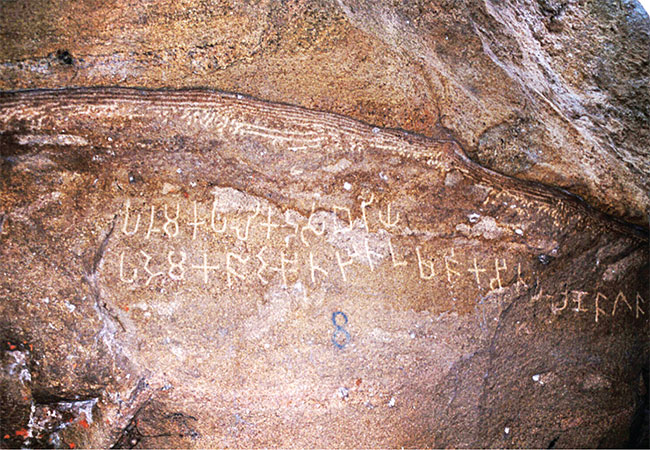
ketarama with brahmi script at Konagaharayan kulam and Vedikumarimalai cave temple. They found
a karanduwa of a stupa at Marandankurni, a huge vihara complex, with stupa
mound at Sonanochcha kulam, a siripatula at Periyamadu Muttumani Ambal kovil, a
pabbata vihara at Mutiyankattakulam and a guard stone at Kokilai. In Mullaitivu, the ruins spread over large areas. There were remains of stupa and
many image houses. The Buddhist sites found in Mullaitivu and Mannar were mainly Anuradhapura period , some were early
Anuradhapura, some middle Anuradhapura .
In Mullaitivu the team found 175
archaeological sites, but not all were Buddhist, some were pre-Buddhist. The team found 44 huge ( ‘visala’) monasteries
, 34 sites where the Buddhist ruins could be identified and another 55 where
they could not identify what the function of the Buddhist ruins was.
Here are some
of the findings at Mullaitivu. Ambakamun ruins had a standing Buddha statue,
stupa mound and ruins of monastery. At Andankulam the team found Buddhist ruins
in 4 places there was a stupa 6 meters tall circumference 20 meters, a Buddha statue
and asanaya. There was a monastic complex at Janakapura.
Kachchidu had a large ruin complex, with
Buddha statue and asana. Kalvilan was a monastery.
At Kalvilan,
villagers had built houses over the whole monastic site using material from the
Buddhist ruins. Various religious objects were found in the houses such as siripatula
gala for washing clothes near the well. The team spoke to the villagers and persuaded
them to part with these religious objects. Ruins were found in a paddy field at Kalvilan.
Kanyarkovil had Buddhist ruins. At Kiribbanwewa there was a seat
and a cave with ketarama . The site also had two pre-brahmi
inscriptions. Koddiyamalai site held two caves with ketarama . There has been a huge monastery at Kokavil. A complete guardstone was
found .. Rupavahini is there now. Komalamunai had a huge stupa mound; it has been
a monastic complex.Kumbakarna malai also appears to have been a huge monastic
complex. There were lots of ruins.The team thought this was probably Kumbaselaka
vihara. Kurundavashoka vihara in Komalamunai site had a moonstone and steps.
Mutiankattikulam has been a huge monastery. The team found a korawakgala and asana there. A stupa had emerged
in the wewa when the water went down. The Oddusuddan area had lots of
Buddhist ruins spread about the area, as
at Keridamadu, Kachchilamadu, and Muniyan Kaddikulama. Materials from Buddhist
ruins were used for the Oddusuddan kovil.
Buddhist
pillars were seen beside the Sivapuram Sri
Malai Kovil also stone edict dated to 8 to 10 AD which has been published. .‘Vannammaduva had a complete Buddhist statue
in Samadhi, the army took it and it is now kept in the army camp.
Buddhist
sites were found in several places in Mannar. Maligapitti had lots of ruins
with a stupa mound. Place is surrounded
by houses. A Buddha statue was found
near Murungan, also a stupa in a banana plantation. Buddhist ruins
were found near Murungan hospital including siripatula, an inscription and
stone columns. The inscription and siripatula
were used for patients to sit on. There were
Buddhist sites at Mardamadu Pudalpitti, Neeravi kulam and Pokkaravanni .A. Buddha statue was found at Koviyamadu.
The army had placed it inside a hut and were looking after it.
The team found
6 firmly established monasteries in
Mannar. They were monastic complexes. They belonged to the Anuradhapura period, but the team
did not have the time to accurately
identify which Anuradhapura period they belonged to. The large complexes were
always near water. The
team also found a vast number of inscriptions in Mannar which were not known
earlier. The script used in the northern
inscriptions was the same as the script
found in the southern inscriptions.
In 2016, the Integrated Strategic Environment Assessment for the Northern Province of Sri Lanka (ISEA-North) 2016-2017 prepared a map of the Buddhist remains in the north.
The Maya writing system was used in what is now Mexico and Central America for almost two thousand years, until after the arrival of Cortés. It was written in bark paper books, carved on public monuments and inscribed on personal objects of pottery, bone and jade. The invading Spanish outlawed the script and burned thousands of books, systematically wiping out literacy in the Maya script and severing the Maya people from the written record of their own extraordinary past.
n the nineteenth century the texts began to re-emerge, as buried cities and fantastic inscriptions were discovered in the jungles and rare Maya books plundered by the Spanish were re-discovered in the libraries of Europe. Early scholars decoded the complex Maya calendar and identified glyphs for gods, planets, animals, colors and directions. But prejudice and misconceptions about the nature of the Maya people and their script kept the meaning of the texts a mystery for over a century more.
Over the past few decades, a diverse group of epigraphers and historians, ethnographers and archaeologists, astronomers and linguists, artists and amateurs, have finally unlocked the secrets of the glyphs. Today over ninety percent of the script is understood.
For the six million modern day Maya, this recovered history, poetry and mythology is an extraordinary source of pride and identity. Maya students are now learning to read hieroglyphs, and parents who for centuries named their babies after Christian saints are now naming their children after ancient Maya kings.
Destruction started with Spanish Inquisition, Catholic priest Diego de Landa, destroyed Mayan language and culture.
This is only an example of destructive power of church Intolerance Meme, idea of Jewish religion started few centuries before the birth of Jesus, and was continued by Christians in 3 rd and 4 th centuries AD. The Intolerance is based on same Islamic Principle as only Yahweh is god, and anyone who worships other gods is committing a sin and thus okay to murder and destruct temples. Although Christian continued their policy after 1 st world war with greed of money and visa to Europe and USA and thus converting Hindus and Muslims all over world, but their terrorist legacy is still carried by their brother Islamist. Remember there is no difference between IBRAHIM AND ABRAHAM. Their intolerance justifies atrocities in Yahweh’s name: Murder, slavery, forced conversion, suppression and destruction of other religions, racism, and many other immoral acts.
Now let us see the secularism. As in Modern India, where Hindus let all religions come, same foreign religion overtake and start destruction of same secular Hindus. Same story was repeated in Mayan era when Mayan incorporated Christian God in their Temples, in name of secularism, and started conversion machine ,of Mayan converts” who incorporated the Catholic Yahweh/Jesus/Spirit, along with the various saints and angels, into their own traditional religion, he became furious and that resulted in torture and death across the Yucatan region. He set goal to wipe out all knowledge of the Mayan religion and was successful. After Fifty years in 1699, Spanish soldiers burned a town that had the last school of scribes who knew the Mayan hieroglyphs. By 1720, everything was finished, murdered, destroyed who knew Mayan language.
The Roman Catholic church’s response? Diego de Landa’s crime was that he carried out an inquisition without authorization and was punished for house arrest for few years and then promoted to Bishop of Yucatan, same city he destroyed. Remember, he was not punished to destroy Mayan language, temples, murder , atrocities. That is what Roman church is.
After two hundred years, and an international team of linguists, anthropologists, archeologists, mathematicians, an architect, and one twelve-year-old child prodigy hieroglyphics expert, were able to restore left over and deciphered almost 90% of stone inscribed language.
Bangladesh
got its independence from Pakistan in 1971 after a bloody struggle. Pakistan
had been exploiting then East Pakistan systematically and Islamabad’s economy
was built on the money of the Bengali-majority areas. However, the newly
independent nation of Bangladesh came into existence under the charismatic
leadership of its great founding father Bangabandhu Sheikh Mujibur Rahman in
1971, signaling the ultimate triumph of the Bengali identity.
Bangladesh
inherited a shattered economy and a completely broken infrastructure. It was
described as a hopeless economic disaster by many economic experts and world
leaders such as then US Secretary of State Henry Kissinger, who called it a
Bottomless Basket” in 1974. Nobody believed that Bangladesh could survive
economically as an independent country. Today the world is both surprised and
delighted to see the phoenix rising from the ashes.
But
the path was not so smooth. The war-ravaged country faced some hard realities
and went through economic struggles. Mujibur Rahman tried his level best to
make Bangladesh his promised ‘Golden Bengal’. But miscreants played the spoiler
and assassinated him to serve their interests instead of the national interest.
So, the promised dream of a great ‘Golden Bengal’ did not materialize then.
The
people of Bangladesh suffered for years as the country saw political ups and
downs from time to time. But now the picture has changed. Bangladesh is now
growing and rising. Its Prime Minister Sheikh Hasina is trying to fulfill her
father Sheikh Mujibur’s dream of ushering in a Golden Bengal’. Credit must be
given not only to Sheikh Hasina but also to the hardworking people of Bangladesh.
Pakistani media appraise Bangladesh.
Rare appreciation from Pakistan is the grudging recognition of Bangladesh’s
success story.
Dawn, One of Pakistan’s
prestigious newspapers, published an article on December 16 (Day of Golden
Jubilee of Bangladesh) titled ‘The Bangladesh Story’written by Pakistani
Prime Minister Imran Khan’s Advisor for Institutional Reforms and
Austerity Ishrat Husainwho served as the dean of the Institute of
Business Administration, University of Karachi and the Governor of the State
Bank of Pakistan. According to the article,’ The Bangladesh story is an
attractive one. How can a country so vulnerable to natural calamities
outperform its much larger, better-endowed neighbours — India and Pakistan — in
most socio-economic indicators?’ He showed the 6 fact-findings in his article
why Bangladesh is moving forward such as cultural homogeneity with the same
language, ethnicity, and a shared history and practically no religious, sectarian,
tribal, and feudal divisions, the unitary form of government, women
empowerment, a continuity in economic policies, projects, and programs despite
having bitter political rivalries, efforts to liberalize trade, open its
economy, bring in foreign technical know-how and provide generous cash and
non-cash incentives to exporters, sustained high growth. Pakistan’s other popular and leading
daily ‘Pakistan Today’ (whose founding editor was Pakistan’s veteran journalist
and minister Arif Nizami) published an excellent article on December 24 titled ‘Why and how
Bangladesh is moving forward?’ written by Jubeda Chowdhury. Jubeda
Chowdhury’s well-written article describes the pros and cons (a-z) of the
economic growth model and system of Bangladesh. To understand the pace of
economic growth of Bangladesh, I suggest all to read the article carefully.
Another leading daily ‘The News
International’ published also published an article on December 21 titled’ The West Pakistan
Model’ written by Mosharraf Zaidi. In his article, he analyses and
compares the Bangladesh Model of economic growth and the West Pakistan Model’.
It is pertinent to mention that Pakistani magazine
“South Asia” published a total of seven stories highlighting the
success and achievements of Bangladesh and Prime Minister Sheikh Hasina in
March.
Sheikh
Hasina’s contribution
Of
course, PM Sheikh Hasina has made a great contribution because, without an
able, dynamic and prudent leadership, the country would not have emerged as a
rising star. She is still striving hard to make Bangladesh prosperous and
developed within 2041.
Indeed,
Bangladesh is now a prime example of a South Asian economic miracle. Many
countries and international organizations are appreciating the economic rise of
Bangladesh.
Even
Pakistani journalists are praising Bangladesh’s economic growth in their
reports, editorials, opinions, etc. One of the leading dailies, Express
Tribune, published an article on October 5, 2021, titled The Meteoric Rise of
Bangladesh”. According to the article, Bangladesh has shown unexpected
and very impressive economic development. The GDP growth rate surpassed
Pakistan’s in 2006 and since then it has outperformed Pakistan every year and,
to the surprise of leading economists, is today one of the world’s fastest-growing
economies. The GDP per capita of Bangladesh is close to India and exceeds that
of Pakistan”.
A
Pakistani economist, Abid Hasan, a former adviser to the World Bank, wrote an
article in another leading Pakistani daily, The News International, titled ‘Aid
from Bangladesh’. on May 24, 2021. In his article, he said Pakistan may end up
seeking financial assistance from Bangladesh by 2030. It is the economic growth
achieved by Bangladesh that has earned such grudging praise from a Pakistani
economist.
Advice
for Pakistan PM
Noted
Pakistani journalist Zaigham Khan, while taking part in a television talk show
Awaam on Capital TV in September 2018, advised Pakistan Prime Minister Imran
Khan to follow the development model of Bangladesh to ensure Pakistan’s progress
and development. He said Pakistan should be modeled on Bangladesh instead of
faraway Sweden. This was because PM Khan had made grand promises that he would
turn Pakistan into a developed country like Sweden.
A
professor of the University of Karachi, Moonis Ahmar, wrote in an article
titled How and why is Bangladesh better off than Pakistan today?” in
Express Tribune on March 21, 2021 that four factors that contributed to
transforming Bangladesh from an international beggar” to an economically vibrant
country” are leadership, innovation, planning, and ownership.
Even
Pakistan Today, The Pakistan Observer, The Frontier Post – all major English
dailies – have published articles lauding the economic growth of Bangladesh.
They said the country’s economy was booming under the leadership of its PM
Sheikh Hasina. The Pakistan Observer felt Bangladesh was going to be the next
South Asian economic superstar. Pakistan Today acknowledged Bangladesh’s
tremendous effort to boost its economy over the past few years.
While
the Pakistani media has been asking its government to follow Bangladesh’s
model, it remains a sore point that Bangladesh -then East Pakistan, its eastern
wing – was an exploited colony of Pakistan.
Bangladesh
is now ahead of Pakistan in many indexes. It is a matter of considerable
surprise that Pakistan is now praising Bangladesh. Although Bangladesh is now
just 50, Pakistan is 74 years old. Had Pakistan not exploited Bangladesh
economically for 24 years (1947-71), it would have gone further ahead. However,
Pakistan praising Bangladesh reflects both the reality and success of
Bangladesh.
The Health Ministry says that another 529 persons have tested positive for Covid-19.
The new cases confirmed today includes one returnee from overseas.
This brings the total number of Covid-19 cases registered in the country to 583,251 while presently approximately 9,252 infected patients are undergoing treatment.
The Director General of Health Services has confirmed another 19 coronavirus related deaths for December 24, increasing the death toll in Sri Lanka due to the virus to 14,871.
The deaths confirmed today include 07 males and 12 females, according to the latest figures released by the Govt. Information Department.
One of the victims is below the age of 30 years while two are between 30-59 years. The remaining 16 patients are above the age of 60 years.
It is reported that Secretary to the President Dr. P.B. Jayasundara has sent a letter to the President stating that he will resign from the post of Secretary to the President after 31 January.
In that letter, Dr. Jayasundera has requested the President to release him from the post of Secretary to the President after 31 January.
It is reported that this article mentions all the difficulties faced by Dr. P.B. Jayasundara during his tenure as Secretary to the President.
Some of the decisions taken by Dr. P.B. Jayasundara as the Secretary to the President were severely criticized by various senior officials, including the Ministers and Members of the present Government.
Addressing
a gathering of jurists in Sinhala at a function in Colombo, justice minister
Ali Sabry said (December 12): To me as minister for justice, and to us all as
citizens of this country, people are the most important factor. It is because
of them that this (legal) profession exists; judges sit because of them.
Ultimately, the interest of the people must take priority over everything
(else). I don’t think I will (Ali Sabry chuckled as he said this) seek to go to
parliament again…. I state this without any fear.. I will revert to my
preferred occupation, that of supporting the judiciary…. We know that some laws
of this country have not been updated for over a hundred years. This task (of
modernising outdated laws) is our key focus… Some thirty committees are engaged
in this work (at present)….”. Then the minister talked about the perennial
problem of law’s delays. He claimed that even the Mahanayake Thera, when he
called on him, asked him to do something about the monks having to visit courts
frequently (due to the slowness of court procedures): We’ll introduce a small
claims court as found in other countries; cases that involve less than (Rs) 2
million need no prolonged examination of evidence, except in special instances.
A method for resolving these cases through an affidavit system will be put in
place. This is to relieve pressure on the district courts”. (Explanations in
parentheses are mine. I hope I have interpreted the minister’s meaning
correctly. C.O.O.L in the title is a re-arranged acronym for One Country One
Law)
The
present ruling alliance, the SLPP, led by President Gotabaya Rajapaksa and
Prime Minister Mahinda Rajapaksa sought election on the main platform of One
Country One Law. However sincerely both reached out to the Tamil and Muslim minorities,and
had never practiced discrimination against them in the past, the level of
support expected from them was not forthcoming.This was due to the influence
that certain communalist Tamil and Muslim politicians exercise over those
minorities. It was a fact that the two brothers came to power chiefly on
the strength of the SLPP-ideology-inspired Sinhala votes. But, as could be
expected, they assured the minorities that their interests would not be ignored
in any way; they invited all of them to participate in nation building with the
majority community. Steps were taken to ensure that Tamils and Muslims are
fully represented in the administration. The key ministry of justice was given
by the president to national list MP Ali Sabry. No minister in the
cabinet has to do more with the implementation of One Country One Law concept
than Ali Sabry.
Surprisingly,
he is now talking as if he has forgotten that all important (at least
purportedly so) goal of the government, for which it got the strongest ever
electoral mandate. One may think that Ali Sabry is having the last laugh! He
implies that even the monks, the most vehement advocates of One Country One
Law, are now only complaining about the chronic problem of law’s delays, which,
of course, is not a political issue! The One Country One Law ideal involves
politics, as it is opposed by a minority of communal and religious extremists.
The
appointment of a whistleblower Buddhist monk, who had earned a bad reputation
due to his own lack of basic self-restraint and discipline (in spite of his
cause being a genuine justifiable one), as head of a presidential task force is
as questionable and as irrational as the president’s later appointment of a
trade union leader monk as the Vice Chancellor of the University of Colombo;
but that is a different matter. Bracketing Ali Sabry with the controversial
monk could not be accidental. Though the two are handling closely allied
subjects, they are diametrically opposed to each other in their education,
religious beliefs, and personal attributes. Probably they were coupled together
to neutralize each other, or just to make a mockery of the One Country One Law
project.
But
extremists are a vanishing tribe nowadays, for there are signs that indicate
that these communalists will go out of circulation by the time of the next
elections, replaced by the emerging progressive younger generation of Tamil and
Muslim politicians, just as the old guard politicians of the two major national
parties will be ousted by an alliance of smaller patriotic parties and groups
led by a refurbished JVP further strengthened by the return to its fold of its
earlier stalwarts,and also accompanied by a rejuvenation of its leadership. The
concluding paragraph of an article of mine entitled JVP at a crossroads”
published in The Island Midweek Review on March 7, 2018 was as follows: The
JVP must take a long, hard look at its wasteful past and subject itself to
serious reform as a party. It must get rid of its outdated ideologies and
outmoded leaders. It must not condemn the voters as idiots for not voting for
them. Most important, the JVPers must find political allies with whom they can
coexist and serve the nation.”
(I
would now use the term ‘save’ for ‘serve’ in the last sentence.)
I
imagine that such a broad alliance will absorb emerging young political
activists of all communities including Uvindu Wijeweera (son of JVP founder
Rohana Wijeweera), Amith Weerasinghe, Dan Priyasad, Arun Siddhartan et al, and
non-extremist ordinary young Muslim, and ex-Muslims such as Rishvin Ismath (who
has fearlessly appeared on national TV channels, speaking against Islamists,
risking his life for the sake of the country). Such a winning alliance must
have the last laugh. The One Country One Law ideal must be left for them to
realise.
That
was a sort of anticipatory digression. Let me return to the Ali Sabry factor
that is the subject of this piece. A retrospective survey is necessary at this
point. About a year ago,
Media
secretary Viraj Abeysinghe of the Ministry of Health issued a press statement
warning against spreading false information allegedly concocted by certain
politicians and websites regarding the subject of whether to bury or burn the
bodies of persons who had succumbed to the COVID-19 infection
(lankacnews-Sinhala/December 28, 2020). It notified that the Ministry was
turning its attention to some ‘politically motivated fake news’ stories
featuring powerful politicians connected with the government. The statement
further said that for the time being (daenata) cremation alone was done
on the instructions of all the expert reports received by the Ministry until
then. Very much the same news was carried in Hiru TV News (9:55 pm/December 27,
2020). We felt that this, despite the provisionality expressed by ‘daenata’,
was signalling an end to needlessly prolonged dilly-dallying on the part of the
authorities about an issue where evidence-based science ought to have had
the last word.
Interviewed
by two You Tube channels (Hari TV/Lahiru Mudalige/December 16 and Konara
Vlogs/Avishka Konara/December 23, 2020) Ali Sabry PC, Minister of Justice,
stressed that his struggle was to build bridges rather than walls between the
communities. For over eight months by then he had been advocating burial of
bodies of Muslims who had died of Covid-19, ignoring the decree of the
competent authority, the DGHS (Director General of Health Services). The DGHS
was acting on the advice of the local experts who knew best what was suitable
for our country in the then existing context, i.e., cremation. The reputed
lawyer was the legal consultant of (current president) Gotabaya Rajapaksa at
least for fifteen years from the latter’s defence secretary days; he had
successfully defended the latter against false charges of various kinds
fabricated by political opponents. Sabry’s aim of establishing intercommunal
harmony had been laudable, and he might be sincere in his efforts in that
direction, but how sincere was yet to be demonstrated. This was because it was
puzzling that he repeatedly warned that young Muslims were likely to be pushed
towards extremism by what they’d perceive as a denial of their right to freedom
of religion if the health authorities did not allow the burial of bodies of
Muslims claimed by Covid-19. His totally nonsensical stand on the sensitive
issue (that had to be left for science, but not religion, to resolve) was
likely to give a fillip to extremists and other miscreants opposed to the
government to create trouble. M.L.A,M. Hizbullah, State minister and later
Eastern Provincial governor under the previous yahapalanaya, made a similar
warning, which was not warranted by the then prevailing ground realities, not
long before the 2019 April 21 Easter Sunday terror bombings by Islamists.
During
the first interview mentioned above, Ali Sabry made the patently false claim
that the Aluthgama and Digana incidents drove young Muslims to extremism,
whereas the truth was the reverse of that, as borne out by evidence. (These
incidents must be investigated even belatedly to discover the factual situation
that then obtained. The disastrous policy of political correctness that led to
the submergence of the truth on those occasions then seemed to be at work once
again.) Sabry referred to how the UK responded to incidents of Islamic
extremist violence as a model to follow in dealing with the same problem in Sri
Lanka: the UK government reached out to the mainstream Muslim minority and
acted to win their confidence and support in order to contain Islamic extremism
in that country. That was a false analogy. He implied that Sri Lanka had to do
the same (as if Sri Lanka has not been doing exactly that for centuries) or ‘we
must kill all Muslims and put them into the sea!’ (The violent imagery in his
speech was an indication of the commotion in his own mind resulting from his
subliminal awareness of guilt as he felt compelled to lie in that situation for
political expediency within his own community. His persistent advocacy of
burial against the lawful directives of the DGHS revealed his anxiety to avoid
displeasing pious Muslims who insisted on burying their dead as per strict
Muslim funeral rites.) It was reported that he threatened to resign from his
ministerial post on this issue, but that he was persuaded to stay on, which to
the genuinely concerned sounded fishy, no doubt.
Ali
Sabry had been sounding the warning mentioned above (about possible unrest
among Muslim youth over the ‘no burial only cremation’ problem since early
April 2020. He apparently believed that he was undergoing a sort of public
trial by being blamed by both the Muslim community on the one hand who felt
aggrieved by the compulsory cremation rule imposed on all citizens by the
health authorities for the safe disposal of bodies of Covid-19 victims and the
numerically strong nationalist faction on the other led by the monks, who
insisted] that the rule should not be relaxed to satisfy the whims of one
particular group of people thereby endangering the lives of the whole
population through the possible release of the still inadequately understood
novel coronavirus from the interred bodies to the country’s water table, which,
in many places in Sri Lanka, is not very deep, and lies close to the surface.
The controversial Gnanasara Thera (who is now heading the presidential task
mentioned) was an exception: he spoke up for Muslims who wanted to bury; the
monk said that the Muslims’ demand for burial should be allowed.
Ali
Sabry should know better than most that there has been no lack of
reaching out to the mainstream Muslim minority either by the majority community
or by the successive governments. Muslims as a community are mainly engaged in
business. Seventy-five per cent of their customer base comprises Sinhalese,
making it possible for Muslim businesses to thrive normally, though there’s
been just condemnation, among the citizenry including the majority Sinhalese,
of worsening Islamist extremism in recent years. Be that as it may, it is not
simply because Sabry had served president Gotabaya in the past as his
implicitly trusted personal legal service provider that he was made a national
list MP by the SLPP and honoured and empowered with such a very important key
portfolio.
‘One
country One law’ was the rallying cry that inspired patriotic Sri Lankans at
both the presidential and parliamentary elections to vote for the SLPP, which
won with the largest margins. As minister of justice Sabry has been entrusted
with the task of supervising the making of a new constitution that is designed
to achieve that epoch making change (namely, One Country, One Law) among other
things. Gotabaya made no bones about the fact that he won the presidency almost
exclusively on the strength of Sinhalese votes, as already hinted above; most
Muslims and Tamils chose not to respond positively to his call for support at
the presidential election. His bluntness was a reflection of his characteristic
candour, which had then not been compromised by the hypocrisy of political
correctness, his older brother’s blunt weapon, that fails more often than it
succeeds. But Gotabaya did not hold any grudge against those who rejected
him, for in the same breath president elect Gotabaya said that he was elected
as president of all the citizens of the country and that he would serve in that
post without discriminating against any citizen. There is no doubt about the
fact that he meant what he said. By appointing Ali Sabry to the powerful post
of Minister of Justice, the president incidentally reassured the Muslims that
he would not exclude them from his vision of prosperity and splendour for the
nation.
But
Ali Sabry did not budge an inch from his original unqualified opposition
to the mandatory burning of bodies of Muslim victims of Covid-19 over which he
expressed his disappointment in a Facebook post, something mentioned in an Al
Jazeera news report/April 3, 2020, with the authorities’ decision which, he
alleged, ignored the WHO guidelines that allow both burial and cremation. Were
we to believe that our experts chose to overlook the WHO guidelines without a
rational explanation? Sabry deliberately ignored the various reservations that
clearly qualified the WHO guidelines, leaving the authorised specialists of any
member country to modify those recommendations as appropriate for local
conditions and ground realities. The basic assumption that he seemed to be
operating on, regarding the burial problem, was wrong. For all intents and
purposes, he pretended to wrongly believe that the health authorities insisted
on making no exception for Muslim dead in this case because that was what the
monks wanted. Ali Sabry was the last person that rational people would
expect to demand that Muslims should be allowed to bury their loved ones dead
from the novel coronavirus while cremation was the only safe method ordered by
the Director General of Health Services (DGHS).
This
is not a happy thing to say about arguably the most important and influential
minister in the cabinet, being the closest companion of the president, next to
the prime minister, who is the president’s own brother. It was inconceivable
how Ali Sabry was capable of (no doubt unintentionally) justifying the berserk
behaviour of some virus-infected Muslims (as seen in their show of
insubordination, noncooperation, physical harassment of the health workers
trying to help them including spitting at them (with the malicious intention of
spreading the infection); cases were reported of some Covid-19 positive tested
individuals spitting out of the windows of buses carrying them to quarantine
centres in vicious attempts to spread dreaded infection). Such demonstration of
unprovoked anger is based on the false pretext of alleged discrimination
against them by the government in the matter of mandatory cremation of Corona
dead as prescribed by the responsible health experts to prevent the escape of
the deadly virus with many unknowns into the environment. The virus is no
respecter of people’s religious sensitivities. If the Director General of
Health determined that cremation was the only option for Sri Lanka in the
prevailing emergency, all citizens were obliged to accept that and act
accordingly.
Why
didn’t Ali Sabry make an effort to explain to the agitating Muslims and to the
misinformed Muslim world in general, who have never been enemies of Sri Lanka,
that this blown-out-of-proportion controversy over the burial or cremation
issue had nothing to do with the monks or the government or the health
authorities or the army and police officers (the last mentioned having been
co-opted into the Covid containment operation only as ancillary personnel
employed for a strictly logistical purpose to serve under the DGHS, the
government appointed competent authority, who gives leadership to the whole
enterprise, which involves every single citizen of the country).
The
cremation imperative was not an arbitrary decision taken by the government to
spite the Muslim minority under pressure from the monks as misleadingly
suggested by the hostile foreign NGO elements, Islamists, a handful of
misguided Muslims, and the irresponsible SJB-led opposition. The DGHS was not
acting capriciously either; his recommendations were based on a scientific
rationale collectively defined by a group of experts belonging to a number of
different but relevant fields of study in the best interest of all resident Sri
Lankans and foreign visitors. Ali Sabry seemed to be more concerned about
remaining in the good books of the handful of Islamists and their sympathisers
than about the feelings of the ninety-five per cent of the population who are
against them. Was he in the thrall of the five percent? The fate of the goal of
One Country One Law under Ali Sabry as Minister of Justice is not difficult to
guess.
(Note
to Lankaweb readers: The latter two thirds of this article a timely
rehash of a previous article of mine published here: Even you, Minister Ali
Sabry?”. Readers, please bear with me for repeating myself.)
The appointment of a presidential task force mandated to draft relevant legislation aimed at operationalising the ‘One Country, One Law’ concept precipitated howls of protests. The howlers weren’t exactly from those opposed in some way to a single corpus of rules; rather they by and large belonged to that small set of people who are either inclined to object to anything that any government proposes or to see demons in anything proposed by governments headed by people with the name Rajapaksa.
One has to wonder if the objectors would have been as livid had the President appointed anyone other than Rev Galabodaaththe Gnanasara Thero to head the said task force given his volatile (soft word) history. That aside, it is indeed intriguing that those who swear by secularism have issues with the notion. Moreover, it must be emphasized that the ‘One country, one law’ concept is not owned by the President. It is in fact co-owned — Sajith Premadasa as the presidential candidate of the Samagi Jana Balavegaya was in agreement with Candidate Gotabaya Rajapaksa.
The numbers tell a story about the sentiments of the voting population. A total of 6.9 million voted for Gotabaya Rajapaksa while Sajith Premadasa obtained 5.7 million votes. That’s 12.6 million. There were altogether 35 candidates. They either echoed this vision in their manifestos and rhetoric or were silent. In other words, at least 12.6 million people or 94.24% of the total number who cast valid votes (52.25% for Gotabaya and 41.99% for Sajith), voted for candidates who believed that Sri Lanka is a SINGLE COUNTRY and therefore should have ONE LAW for all. In fact if the other 33 candidates were asked ‘are you for or against?’ the chances are that the vast majority would say ‘for.’ We could then stop with ‘so there!’ That however would be simplistic if only because the devil would be in the details. Moreover we are talking about a nation so fractured along many lines that grief and anxiety have to be understood as key elements of the political soil in which the idea has to be planted, fertilized and tended.
Grief and anxiety are not value-free. They are infected with ideological and outcome preferences. They can and are often inflated by the allegedly aggrieved and anxious. They are also pooh-poohed by those opposed to such grievers. We have, in fact, contesting anxieties and griefs. Laws can be and ought to be dispassionate but their enactment and enforcement fuel emotion. If the task force has as objective a set of rules that make for healing then we need to be sensitive to these emotions, political though the articulator are and pernicious though their fuelling could be.
Which community (ethnic, religious or political) in this country is free of anxiety? Is there any community that is not aggrieved? Can any community say ‘our anxieties are greater and we are more aggrieved’? Will any community admit ‘we are less aggrieved and less anxious’? Will anyone say ‘we inflicted suffering and we are responsible for grief and anxieties experienced by others’? The ‘yes’ and/or ‘no’ answers to such questions will give us some sense of the political terrain in which resolution-efforts of any kind (this one included) have to be planted. It’s not really an amazingly fertile soil that we are talking about. It is toxic and toxicity is deliberately enhanced by one and all, with the best of intentions or, as is more often the case, with vile intent.
To me, at some fundamental level, it is about one’s sense of belonging. Laws are controlling mechanism to which a population must submit. If the submission is done willingly (because there’s something to gain in the social contract) it’s all good. However if the law or a set of laws are discriminatory or else privilege a community other than one which you belong to (or identify with), displeasure if not anxiety and grief will ensue.
Do we need to list all the grievances and all the anxieties? When will we start recognising that we have caused grief and anxiety to others? When will we acknowledge that we have deliberately and even perniciously inflated angst and ridiculed that of others? When will selectivity be acknowledged? When will we say ‘we too are guilty of various crimes of omission and commission’?
What the Task Force is going to come up with, we cannot predict. We do know that the President appointed a committee of experts to draft a new constitution. One must assume that the committee has been busy drafting and that it has taken into account the popular sentiments of the people, the relevant histories and most importantly the fact that ‘One country, one law’ has been agreed upon by the vast majority of the voters. The Task Force ought to be in communication with this committee simply because its mandate, technically, is a sliver of the task assigned to the said committee.
The Task Force can insist, the committee can give weight but parliament and the people must in the final instance agree. That’s a process of law-formulation. On face value it seems an easy thing to do. At the end of it you’ll get new laws or you’ll have to live with what that currently exists. Either way, there’s no guarantee that the resolution desired will be obtained.
We have heard the pros and cons of this and that offered and refuted by one community or another. That’s the easy part and it’s the easy thing that we’ve done for decades. Understandable of course because that’s what politics is all about. It is hard to rise above all that. We look for ‘truth’ and talk of ‘reconciliation’ but what we end up doing is toss around half (or less) truths and insist on resolutions that sort out our anxieties and in some way alleviate our griefs, never mind what they could do to others.
So yes, we’ve talked for decades. And we’ve footnoted or erased much more than we’ve written. If Rev Gnanasara Thera and the Task Force he leads recognizes this and initiates a discussion along these lines it would be good. Indeed it would give much needed credence to the process. Even if it does not result in scripting formal rules relevant to the idea (One country, one law), it will take us quite a distance along the road to solidarities that have evaded us for too long.
Christmas
2021 approached with several restrictions from the Sri Lankan Health
authorities due to Covid-19. Over two billion people celebrate the birth of
Christ on 24 December every year. Christmas is the most joyful season in the
year. Generally it’s an occasion for the family to reunite and everyone in the
family joins for either lunch or dinner on Christmas: the menu is Turkey with
stuffing, mashed potatoes, gravy, cranberry sauce, and vegetables.
Other
types of poultry, roast beef, or ham come to the dining table as extras. For
dessert its pumpkin or apple pie, raisin pudding, Christmas pudding, or
fruitcake. The Christmas tree a must for Christians, embellishes every home
with decorations that include bells, reindeer, candles, candy canes, garland,
stockings, wreaths, snow globes, and angels irrespective of their faith.
Christmas
in Sri Lanka 2021
This
Christmas is affected
by the high cost of living: the public were spending frugally due to the sharp
increase in the cost of living, the floods, and the Covid-19 pandemic. The
pandemic forced the Government to shut down the country several times, the
Government’s dollar reserves weakened, declining the economy critically.
The
common folk, particularly the farmers screamed about a bump on the ride, while
a few privileged VIPs got their hands up and enjoyed the gallop by holidaying
in Nuwara Eliya, and others by travelling abroad during the festive
season. On top of everything the LP gas explosions had a damaging clout on the
Government; while, a person died from the gas explosion.
Christmas
arrives as
usual at the end of the year to celebrate what Jesus Christ advised the
mortals:
Not to
concentrate purely on accumulating wealth, but to realise that all living
beings devise ideas originating within a person’s heart to
tarnish him unless the person’s heart is pure, and mind is cleansed
(Mark 7:21-23).”
What
Jesus Christ expected
Christians,
especially on Christmas, need to follow love and compassion what Jesus
Christ preached. But it is ridiculous how people globally become victims
of a commercial hype. Christmas,
of course, comes but once a year, and Christians declare year on year,
especially at mid-night Christmas Eve Mass, never to get bogged down in
commercial extravaganzas again! Yet they forget about it after a few
months.
In that
sense during the festive season, Christmas turns into a contagious disease. It
becomes evidently clear with the congested traffic, shops and supermarkets and
jewellery shops packed to capacity to increase their turnover. People behave so
ludicrously as if the world is going to end! But this year Christmas is
different with the
soaring cost of everything – from vegetables to all household goods and
materials in the building industry bearing an unreasonable price hike the
buying spree has abated.
Foreign
countries
Other
countries celebrate Christmas in style, irrespective of their religious faith,
and get into the festive mood with decorations. The compulsory Christmas tree
adorns the home with tinsels from the beginning of the month of December and
remains until seven days after Christmas.
Another
aspect of Christmas is the display of the vast amount of Christmas cards
received by households as a means of exhibiting their circle of friends. Even
mature folks begin to act like babies by playing alongside kids on Christmas
with children’s electronic battery operated toys! The international shopping
malls and streets around get illuminated with scores of electric bulbs during
the festive season, akin to Vesak celebrations, spreading the splendour of
Christmas.
Christmas
tree
The
history of the Christmas tree glittering with lights and decor goes back to
ancient Egypt and Rome, which continues to date. America managed to bring the
candlelit Christmas tree for the first time in 1800.
Subsequently,
the candlelit Christmas tree became fashionable in Germany. In 1846 London
news-stands illustrated Queen Victoria of Britain and Prince Albert with their
children around a Christmas tree.
Before the birth of Christianity plants and
trees remained green throughout the year. Many countries believed that
evergreen plants kept away ghosts, evil spirits, and illness.
Christmas
started its celebrations universally since the 4th Century. Ever since, the
young children were conditioned to believe in the ‘ jolly old man’,
called Father Christmas, with white whiskers, wearing a red robe,
and a large sack containing gifts, visiting at homes at midnight through the
roof or chimney.
The
term Father Christmas originated from St. Nicholas, the Patron Saint of
schoolchildren, after the death of Jesus. During the 17th century, Dutch
Protestant settlers in New Amsterdam (New York) replaced St. Nicholas
(Sinterklaas) with the name of the generous magician called Santa Claus.
Pre-Christmas
In
preparation for Christmas, entrepreneurs concentrate on electronic contraptions
and greeting cards printed in many forms to boost their income.
At no
other time during a year hypocrisy becomes so rampant. People spend money on
Christmas presents and send Christmas cards even to immediate neighbours
whom they meet daily. Sir Henry and John Horsley designed the first
Christmas card with three panels – the outer two panels displayed people caring
for the poor, and the centre panel displayed a family enjoying Christmas
lunch.
Currently,
card manufacturers produce millions of Christmas cards throughout the world to
increase their revenue. Felling down trees annually for this purpose does
an irreparable harm to the environment. The mince pie is regarded as a part of
the British culture for hundreds of years with Christmas lunch. Currently, over
£5 million (Rs 136,000,000) worth of mince pies, along with £2 M (Rs
55,000,000) million Christmas puddings get sold out during Christmas in the UK.
Jesus
was born an ordinary man and led a simple life by travelling from place to
place. Despite his teachings of kindness and forbearance, evil forces are
at large leading towards disorder and a chaotic situation. Christ demonstrates
how to be tolerant, even during his traumatic moments on the cross by loving
and forgiving the very people who sentenced him to death! Therefore,
enjoyment during Christmas should not be a commercial fun fare to kill pigs and
disembowel chicken and bring these as succulent dishes to the Christmas lunch
table, but to decorate people’s hearts with love, compassion and human
feeling for one another and to ward off the worst impending disasters that
are predicted in the future.
Colombo, Dec 24 (AdaDerana) – The Colombo Stock Exchange (CSE) set a new record today (December 24) as the All Share Price Index (ASPI) surpassed 12,000 points for the first time in history.
The ASPI closed at 12,070.68 points at the end of trading today (November 16), marking an increase of 1.00% (119.45 points) from the previous day.
The previous highest was recorded last month when the index closed at 11,008.33 points on November 16.
More than 175 million shares were traded overall within the day and the market turnover is recorded as Rs. 2.84 billion.
Meanwhile, the S&P SL20 closed at 4,255.63 points today, up by 0.14% from the previous day.
Today’s trading session was carried on for 90 minutes and was closed at 12.30 p.m. due to the additional half-holiday declared by the CSE in view of the Christmas festival.
During the past few weeks, wives, cooks at various hotels and restaurants and other family members were shocked by gas explosions originating from the domestic liquid petroleum (LP) gas cylinder. From 1 January to 5 December 2021 there were 244 explosions. President Gotabaya Rajapaksa appointed an eight-member committee to investigate the recent report of LP gas cylinder fires and to submit their recommendations within three days. The Committee, after the initial investigation, recommended the following guidelines for the public to follow.
The Committee’s recommendations:
(1) To ensure the gas cylinder purchased has no leaks at the point of purchase.
(2) A gas leak needs to be reported to the local police and the investigating committee by calling 011 5 811 927 or 011 5 811 929.
(3) To refrain from using various methods that are not scientifically proven.
(4) Leaks must only be tested by experts recognised by the committee.
(5) No gas cylinders exploded in the recent explosions.
(6) To ensure the regulator is not of inferior quality.
(7) To ensure the regulators come under SLS W1180 and hoses SLS 1172.
(8) A regulator’s lifetime is (maximum) five years and hoses up to two years.
(9) To pay attention to the distinctive odour of the gas coming out of cylinders.
(10) Not to remove any accessories (such as Valves, Rubber Hoses).
(11) To ensure there is a free flow of air around the cylinder.
Inconvenience and misery
Apart from the inconvenience caused to the public, one needs to consider the number of consumers injured directly due to gas explosions. Three persons were wounded on 4 November. On 16 November, another explosion took place in a Ratnapura Restaurant. On 20 November, a fast-food restaurant in Colombo 7 was entirely devastated by a fire caused by a gas leak. On the 29th of November, ten separate explosions took place in Hatton, Malliappuwa, Jaffna, Kilinochchi, Embulpitiya, Mawanella and Matara. The Committee consisting of an eight-member panel appointed by the President should investigate these explosions and consider who is responsible for paying compensation for such incidents where the whole kitchen area became violently shattered in various places? However, State Minister Alagiyawanna assured that on the 10th-night news coverage, the Government would pay compensation.
On 5 December, Ceylon Today carried a full-page advertisement from Laugfs Holdings. They defended the recent LP Gas cylinder mishaps due to ‘Improper Handling & ‘faulty Equipment ‘. They maintain they always follow the specifications in connection with LP gas and metal cylinders. Laugfs Holdings state they recheck their equipment against all given Government standards to ensure the customer safety.
Their advertisement admits that a few fire incidents took place on LP gas leakages across the country in the recent past. However, the social and other Media carried misleading information on such leaks, directly accusing gas companies of the composition of LP gas filled in a cylinder. Nevertheless, Laugfs Holdings claim that the recently reported incidents did not occur due to the composition of LP gas in the cylinders. They always follow the Government’s technical data, quoting SLS 712-1998 for LP gas and SLS 1178-2013 for gas cylinders.
Gas explosions!
LP gas is resourceful, ecosystems friendly, effective and a safe way to cook. Sri Lankans have used LP domestic gas since 1970. Gas companies, namely Litro and Laugfs, were blamed for amending the percentage of Propane and Butane inside the cylinder. These companies have come out stating that
explosions have occurred mainly due to leakages from ‘ faulty regulators and from connecting hoses from the gas cylinder to the cooker, but not the cylinder itself!”
Although gas companies and policymakers try to brush the issue under the carpet and place the entire blame on the consumer, what is relevant is that the recent explosions are far too many to ignore. Today everyone who gets near the LP gas cylinder does so in fear. Some women wear helmets when they use gas cookers! After the recent explosions, even the coconut shells used in clay ovens have rocketed in price. Are we to gradually approach the basic ancient techniques of cooking?
Nevertheless, the village folk would not mind going back to the ancient cooking methods of using the traditional hearths, commonly known as the lipa, but how can the wealthy folk who live in townships with modern facilities manage? Their only alternative is to spend the extra money and convert their cooking appliance to electricity. Here again, on the 4 December, the whole of Sri Lanka had a power outage in several areas of the country for six hours, placing the country in pitched darkness! It was allegedly due to a suspected mechanical failure or sabotage by some engineers working to rule linked to electricity unions. Under the circumstances, how could the consumer find an alternative?
Origination of LP Gas
In 1970 Sri Lanka used LP gas for the first time, with 30 per cent Propane and 70 per cent Butane. Authorities considered such a combination would be the best ratio because the mixture of Propane and Butane inside a gas cylinder would be liquid under compression. If there are leaks in the pressure system, the cylinder’s absolute pressure will exert on the cooker, resulting in a fire! Therefore, experts advise that it is not the material’s fault, thus becoming the full responsibility of the decision-makers to ensure what is the safest composition for the consumer.
What amazes the consumer is that from 1970 onwards, LP gas was used but no one experienced explosions of this nature as seen recently within the last two months! So far, there have been ten explosions per day. What is interesting to note is the Laugfs Company says the composition of 50 per cent of Propane and 50 per cent of Butane does not bring an additional income to the company. One tends to raise the question as to why did the gas companies alter the original percentages of Propane and Butane? According to Media reports Litro Gas has a composition in the ratio of 20 per cent Propane and 80 per cent Butane.
Journalist receives a writ notification
A journalist who exposed these gas explosions was summoned to appear in Court. The writer points out that journalists when there is a climate of fear, have a commitment towards their vocation and their conscience to throw light on whatever injustice in the interest of the public! How can society, companies, or the Government be helped if they keep quiet? Journalists must point out that whenever a Government or company goes off the rails to inform the public about their mistakes. They contribute to developing a moral society. Each person is socially and economically free to act. Similarly, journalists’ maintaining a voluntary silence tends to be suicidal and undermines the brotherhood of a journalistic fraternity.
LP gas importers enjoy a monopoly in deciding the percentage of Propane and Butane configuration to be used because boiling points differ in each country due to climatic conditions. Meanwhile, the Director of Engineering at the Engineering Standards Division (SLSI) states that measurements used for the quality of domestic LP Gas in Sri Lanka are outdated! There is no Standard Measurement of the composition of LPG in Sri Lanka.” Therefore, his recommendation is to take immediate action to change the existing antiquated laws and systems.
Finally, The Consumer Affairs Authority directed the two major LP gas distributors to supply new LP gas cylinders with coloured polythene seals depicting their logo in different colours. – e.g. Litro Gas with a red logo on a white seal and Laugfs with a blue on a yellow background. The consensus is the new gas cylinders need to be re-filled with fresh LP gas, but neither company has changed their colour on the gas cylinders yet. Consumers hope the new method will be safer to use. However, the Committee observed, valves, hoses, clips, and cookers should not be substandard but recommended by the Sri Lanka Standards Institute.
The latest is the Government wants to take the two LP gas distributors, namely Litro and Laugfs, to Courts and seek a decision. Meanwhile, the Nation sits on a time bomb in a volatile situation until the Courts decision is reached.
The evidence assembled by C.R. Panabokke, in ‘Evolution of the Indigenous Village Irrigation Systems of Sri Lanka’ (2010), shows the transition from rainfed to irrigated agriculture took place mainly in the 3rd century BCE. A study by Rukshan Jayawardena, ‘Ancient Irrigation and Related Settlements of the Early Historic Period’ (1997) yields useful information on the growth of irrigated agriculture during this period. There is no reliable evidence to indicate that rice was grown on the island during the ‘pre-Vijayan’ period. First came the village tank. Then came ‘irrigated’ rice cultivation in the field below the tank. By the beginning of the 2nd century BCE, the village tank had become an integral feature of the undulating terrain of the dry zone (Nicholas, C.W. History of Ceylon, Vol. 1, 1959).
Low-humic gleys
As in the past the soils now used for rice cultivation are mainly the poorly-drained low-humic gleys (LHGs), which occupy the valley bottoms and can be puddled. Since the well-drained reddish brown earths (RBEs), which occupy the mid and upper slopes of the dry zone landscape, cannot be puddled like the LHGs, they are unsuited to rice cultivation. In Sri Lanka the valley bottoms are called lowlands, whereas the mid and upper slopes of the undulating topography are called uplands. There is no hard evidence of rice having been grown under rainfed conditions in the dry zone uplands (RBEs) in the protohistoric period.
The evolution and spread of small village irrigation systems in Sri Lanka could be viewed as an internal development that occurred over a long period of time in response to the distinctive agro-ecological features of the dry zone, which were by no means uniform. As noted above, it was the lack of any form of shallow groundwater that necessitated the surface storage of water in the north-central dry zone – the cradle of civilization in Sri Lanka.
A typical village in the NCP consists of the village tank and a paddy field below it. Many experts, including Panabokke, have stated that without artificial storage of water, human existence in the NCP would have been impossible. The village tank provided water for multiple uses during the prolonged dry season, including agriculture. It enabled farmers to combine cultivation of kurakkan, gingelly and other seasonal food crops in the ‘rainfed’ uplands during the Maha season with rice cultivation in the ‘irrigated’ lowlands during the Yala season. This was a major technological breakthrough that greatly enhanced the food production potential of the north-central dry zone in the 3rd century BCE.
Nuwan Abeywardana, R.L. Brohier, R.A.L.H. Gunawardana, R.W. Levers, Rukshan Jayawardena, Madduma Bandara, C.W. Nicholas, C.R. Panabokke, Henry Parker, A.M.P. Senanayake, Sudharshana Seneviratne, M.U.A. Tennakoon, and many others, through their scholarly research, have deepened our understanding of how and why the tank village emerged as the basic unit of settlement in the dry zone in ancient times. Even today, these settlements dotting the hard rock basement terrain of the dry zone continue to play a vital role in preserving its economic integrity and cultural identity. A recent study indicates there are about 10,000 functional village tanks originating from the ancient water-harvesting system in the island (Abeywardana, Nuwan; Bebermeier, Wiebke; and Schutt, Brigitta, Ancient Water Management and Governance until Abandonment, and the Influence of Colonial Politics during Reclamation, 2018).
Tank Cascade System
A tank cascade system could be defined as a chain of small tanks organized within a micro-catchment of the dry zone in Sri Lanka. The tanks in the upper catchment store water from a seasonal stream and convey it to other tanks downstream. The village tank is the lynchpin as it collects water from all the other tanks in the cascade system. The water stored in this manner is used for agriculture as well as other community activities. The proper functioning of the village tank therefore depends critically on the condition of all the other interconnected tanks which drain into it. When they fall into a state of disrepair, the system breaks down.
The number of cascade systems varies significantly from one river basin to another. For example, the Mee Oya river basin has only one associated cascade system. The Malwathu Oya river basin, on the other hand, has 179 associated cascade systems (IUCN Sri Lanka, , 2016). High priority should be given to ensuring the sustainability of the village tank settlements as they have been the backbone of civilization in the dry zone since the 3rd century BCE. Most of the entrenched problems pertaining to management and organization of small tanks identified in a report by Saleha Begum (Minor Tank Water Management in the Dry Zone of Sri Lanka, 1987) continue to remain unresolved.
The narrow inland valley systems carved out on the basement rock terrain is a distinctive feature of the areas comprising Sri Lanka’s dry zone, especially the North-central and North-western provinces. The small tank cascade system is found mainly in these regions, where the undulating landscape is crisscrossed by these inland valleys. This is a good example of the skill-level reached by the local ‘scientific’ community in such areas, in the form of irrigation engineering, soil and water management, and agronomy in the 3rd century BCE.
It is important to note that this development did not occur suddenly; rather, it was an ‘evolutionary’ process that occurred over a long period of time. A key feature of this process is that it produced the kinds of innovations that were suited to the various environmental conditions in the dry zone. Clearly, adaptation and sustainable development were concepts that were not only well understood but also practiced by the pioneers of small-scale irrigation and water management in Sri Lanka.
Due to the sustainable management structure set up within society, the small tank systems existed intact for more than two millennia…Different layers of management strategies were implemented, blending centralized larger irrigation schemes with locally controlled small irrigation systems. Buddhist temporalities were used to link the hinterland with the main settlements…” (Abeywardana et al, 2018).
Tamil Nadu also boasts of a modest small-tank cascade system, but whether it borrowed the technology from Sri Lanka or vice versa is not clear. An overview of this system is provided in a report by Krishnaveni, M.; Sankari, Siva; and Rajeswari A. (Rehabilitation of Irrigation Tank Cascade System Using Remote Sensing GIS and GPS, 2011). The physical and cultural landscape of Sri Lanka differs significantly from that of Tamil Nadu. Hence, in terms of future research, a study that compares the historical evolution and organizational structure of the tank cascade systems in these two regions would be a useful activity to undertake.
Caption Pic 1:
Tank cascade system. (Image courtesy: Paranage, K. [2018]. ‘Understanding the Relationship between Water Infrastructure and Socio-Political Configurations: A Case Study from Sri Lanka’)
The main Opposition Samagi Jana Balavegaya (SJB) has called for a thorough inquiry into the conduct of sacked Agriculture Secretary Senior Prof. Udith K. Jayasinghe by Auditor General W.P.C. Wickramaratne and other relevant authorities.
Matale District lawmaker Rohini Kaviratne on behalf of the SJB said that the truth couldn’t be suppressed by sacking Prof. Jayasinghe. Accusing Prof. Jayasinghe of importing liquid nano urea from India at a cost very much higher than in the Indian market in the wake of a stock of Chinese carbonic fertiliser being rejected, MP Kaviratne alleged that the sacked official was the main culprit.
Prof. Jayasinghe said that he was quite surprised by the SJB’s allegations. I have absolutely no idea why the Opposition directed a spate of accusations at me,” Prof. Jayasinghe said, adding that he, too, wanted to know what he did wrong and why. When pointed out the SJB held him responsible for ruination of the agriculture sector, Prof. Jayasinghe said that he would like to know how he achieved that in less than six months.
Prof. Jayasinghe was appointed the Agriculture Ministry Secretary in early June this year. At the time he received the appointment, Prof. Jayasinghe served as the Vice Chancellor of the Wayamba University. President Gotabaya Rajapaksa replaced Prof. Jayasinghe with D.M.L.D. Bandaranayake this week.
The former UNPer said that the government should explain the appointment of five Secretaries to the Agriculture Ministry since the last presidential election in Nov 2019.
Making a reference to the Secretary of another ministry owning property in Australia, lawmaker Kaviratne said that the government couldn’t address the issue by sacking the Agriculture Ministry Secretary.
MP Kaviratne said that Prof. Jayasinghe questioned the role played by Ven. Atureliye Rathana and President of the Government Medical Officers’ Association (GMOA) Dr. Anuruddha Padeniya in promoting carbonic fertilizer though he was actually the main person who promoted the interests of those private companies engaged in fertilizer imports.
MP Kaviratne pointed out that having declared in May 2021 what the government called a green agriculture development strategy, the Agriculture Ministry in June 2021 called for global bidding for organic fertiliser. Subsequently, on August 11, 2021 the Agriculture Ministry named the Qingdao Seawin Biotech Group Co., Ltd. as the supplier of 99,000 metric tons of carbonic fertilizer to Sri Lanka, MP Kaviratne said.
Responding to another query, MP Kaviratne emphasized that the government couldn’t absolve itself of the responsibility for the opening of a Letter of Credit and the immediate shipping of the first consignment even before the National Plant Quarantine Centre (NPQC) cleared the test samples. Referring to a statement issued by the Chinese company dated Oct 26, 2021 that dealt with the fertliser crisis, MP Kaviratne said that the supplier quite clearly acknowledged that the NPQC received product samples the same day (Sept 23, 2021) China shipped the organic fertilizer.
MP Kaviratne said that a wider investigation was required to expose all those who had profited immensely at the expense of the country. The outspoken MP said that China went to the extent of blacklisting People’s Bank in the wake of the issuance of an enjoying order by the Commercial High Court of Colombo in respect of the payment for the rejected stock of fertilizer.
The SJB MP urged those responsible to investigate why over a month after the government did away with the ban on agro-chemicals not a single product had been imported. Who got the Registrar of Pesticides removed and why, MP Kaviratne asked, warning the government that once President Gotabaya Rajapaksa opened the new session of Parliament on January 18 the Opposition intended to raise that issue.
The ruination of the agriculture sector couldn’t be blamed on the recently sacked Secretary alone, the MP said. She pointed out that the prorogation of the Parliament soon after the passage of the Budget for 2022 had been influenced by the devastation in the agriculture sector as a result of hasty abolition of agro-chemical use, the Yugadanavi betrayal, the deteriorating balance of payments crisis and the rising cost of living.
Having promised political stability and security, the incumbent dispensation had mercilessly destroyed every sector, MP Kaviratne said, the political leadership should accept the blame for the fertliser crisis.
The MP alleged that an Acting appointment had been made after the removal of the Registrar of Pesticides Dr. J.A. Sumith to pave the way for a certain company to receive the agro-chemicals tender. The SJB lawmaker urged the government to come clean on the issues at hand.
Responding to questions, MP Kaviratne said that the government couldn’t divert public attention from the CID recording statements from several persons, including the Editor of ‘Aruna’ Mahinda Illeperuma regarding the accusations directed at Dr. P.B. Jayasundera, Secretary to the President as regards the opening of an account at a particular branch of the People’s Bank to pave the way for nano urea imports from India. She pointed out that Gamini Senarath, Secretary to the Prime Minister Mahinda Rajapaksa, too, issued a statement following various allegations made pertaining to carbonic fertiliser imports from China.
The MP pointed out that the government had so far refrained from giving any specific reasons for Prof. Jayasinghe’s removal.
The Central Bank of Sri Lanka (CBSL) said on Wednesday that measures being taken at present would ensure that by end of 2021, official reserves would remain above US dollars 3 billion. Thus the government and the Central Bank remain confident that expected inflows will materialise and the reserve position will remain at comfortable level throughout the year 2022.
The full text of the CBSL statement is as follows.
Despite the headwinds of the economic impact of COVID-19 and challenges posed by adverse developments in the external sector, the Sri Lankan economy showed resilience throughout 2021.
Also, Sri Lanka successfully met its debt obligations by repaying foreign loans, including the payments of the International Sovereign Bonds. Since the beginning of the year both the Central Bank and the Government have been actively pursuing possible avenues to replenish official reserves, with an emphasis on encouraging non-debt flows, so that the existing foreign debt could be managed in a sustainable manner. These efforts were accelerated since October 2021 with the announcement of the Six-Month Road Map for Ensuring Macroeconomic and Financial System Stability, which set out envisaged targets for build up of official reserves in the near term.
As articulated in the Six-Month Road Map, number of foreign exchange inflows are envisaged in the very near term. Major foreign exchange inflows to the Central Bank include SWAP facilities with Middle Eastern and other regional central banks amounting to about US dollars 2.0 billion.
The government is also in the process of securing government to government financing, syndicated loans as well as loans from multilateral organisations. In addition, the expected foreign exchange facilities that were negotiated during the high-level visits abroad made by authorities are also progressing well.
Further, the interventions made by the Central Bank on several facets of the foreign exchange market, such as incentive scheme introduced for workers’ remittances, and the repatriation and conversion requirements on account of exports proceeds will improve the liquidity in the domestic market, thereby enabling the Central Bank to build up official reserves further.
With the recent rise in departures for foreign employment and exponential growth observed in tourist arrivals, the external sector is expected to recover well in the period ahead and the pressures observed at present are expected to moderate with increased inflows to the economy.
****
CBSL extends additional incentives for inward workers’ remittances
The Central Bank of Sri Lanka (CBSL), having considered the requests made by Sri Lankans
working abroad, has decided to continue the payment of additional Rs. 8.00 per US dollar for
worker remittances, paid in addition to the incentive of Rs. 2.00 per US dollar under Incentive Scheme on Inward Workers’ Remittances”, for such workers’ remittances channelled through Licensed Banks and other formal channels and converted into Sri Lankan rupees, until 31.01.2022.
The decision to continue this additional incentive of Rs. 10.00 per US dollar is in response to the favourable developments observed in workers’ remittances so far during December 2021.
Further, CBSL has also decided to bear the transaction cost incurred by Sri Lankans working
abroad up to a defined limit when remitting their money to Sri Lanka through exchange houses and / or banks.
Accordingly, a large segment of Sri Lankans working abroad would now be able to remit their money to Sri Lanka without any charges. The operating instructions in this regard including the date of commencement will be issued by CBSL in due course. -CBSL
Sri Lanka had not sought financial support from the International Monetary Fund (IMF) during a just concluded staff team visit to Colombo.
IMF’s mission chief for Sri Lanka, Masahiro Nozaki told Daily Mirror via email that the staff is still ready to discuss the option if requested.
Nozaki said a staff team from the IMF visited Colombo from December 7–20 to conduct the 2021 Article IV consultation with Sri Lanka.
Under Article IV of the IMF’s Articles of Agreement, the IMF holds regular bilateral discussions with all member countries to review economic developments and policies.
Following approval by IMF Management the IMF’s Executive Board discusses a Staff Report based on these discussions, Nozaki said.
The Cabinet had this week discussed an IMF bailout but had not reached a decision if to seek financial support from the global agency.
The Government is, so far, refusing to accept the conditions put forward by the IMF for a bailout package.(Easwaran Rutnam)
Sri Lankan Prime Minister Mahinda Rajapaksa, who is on a two-day spiritual visit to India, on Friday offered prayers at the famous hill shrine of Lord Venkateswara in Tirumala in India’s Andhra Pradesh along with his wife Shiranthi Rajapaksa.
PM Rajapaksa came to India on Thursday to pay his visit to the temple city of Tirupati.
He was accorded a warm welcome by the joint executive officer of Tirumala Tirupati Devasthanams (TTD) Veerabrahmam and chief vigilance and security officer Gopinath Jatti as he arrived at the temple gate.
After darshan, the priests performed a ritual associated with seeking blessings of Lord Shiva at the Ranganayakula Mandapam.
Andhra Pradesh’s deputy chief minister Narayana Swamy was also present during the Lankan prime minister’s Tirumala temple visit.
While taking a tour of the temple, PM Rajapaksa also deposited money into the ‘Hundi’ and the couple was presented with a memento, New Year calendar and diaries by authorities.
PM Rajapaksa visited the temple in February 2020 when a special ‘pooja’ was performed at the Devasthanam on the first anniversary of his current term.
The Health Ministry reports that 573 new cases of coronavirus have been detected in the country within today (24).
This includes two persons who had arrived from overseas, the Govt. Information Department said in a release.
Meanwhile this brings the tally of Covid-19 cases confirmed in Sri Lanka thus far to 582,722.
Presently approximately 9,020 patients infected with the virus are undergoing treatment across the island.
The Director-General of Health Services has confirmed 20 more coronavirus-related deaths for December 23, increasing the death toll in the country due to the virus pandemic to 14,832.
According to the figures released by the Government Information Department, the deaths reported today include 12 males and 08 females.
Six of the patients are between the ages of 30-59 years. The remaining 14 are in the age group of 60 years and above.
Minister of Agriculture Mahindananda Aluthgamage has assured that there would not be a food shortage in the country next year.
He says certain statements warning about a looming food shortage cannot be accepted as 90 to 95 percent of paddy fields in each district have already been cultivated now.
The minister’s remarks came after a statement made by Udith K. Jayasinghe, the former Secretary to the Agriculture Ministry sparked controversy.
Mr. Jayasinghe was subsequently removed as the agriculture secretary and Mr. D.M.L.D. Bandaranayake was appointed to the post.
Speaking to the media later, Mr. Jayasinghe said he is not aware of a specific reason for his sacking and that he is yet to be notified in writing of the move.
Meanwhile, SJB Parliamentarian J.C. Alawathuwala says the subject ministers should be sacked from their posts instead of ministerial secretaries, in order to resolve the prevailing issues.
Former Secretary to the Ministry of Agriculture Prof. Udith K. Jayasinghe stated that there was a fraud in importing nano fertilizer at a higher price.
He pointed out that a bottle of nano liquid fertilizer, which could have been bought for USD 5.25, has been bought for USD 10.
Meanwhile, farmers are still complaining that their crops are being destroyed due to the substandard fertilizer that was provided by the government.
Farmers in Welikanda, Susirigama, and Malinda villages in the Mahaweli B zone in the Polonnaruwa district have been affected in this manner.
This is due to the fact that the paddy cultivations cultivated under the Maha season this year have turned yellow, and the growth has slowed down.
Farmers in these areas have cultivated paddy in an area of nearly 1000 acres.
Although the government provides organic liquid fertilizer for these crops, farmers refuse to use them due to their substandard quality.
Meanwhile, the National Agrarian Union today (24) responded to the statement made by Agriculture Minister Mahindananda Aluthgamage that there will be no food shortage in the country.
Senaka Weeraratna Vice – President Justice for Animals and Nature
A man
preaches peace. He is world renown as ‘Prince of Peace’. Yet, ironically his
birthday anniversary is celebrated worldwide with unlimited bloodshed of
defenseless animals.
Turkeys,
cattle, pigs, goats, lambs, rabbits, and bird kinds such as ducks, hens,
roosters, fowls are all lined up and forced to lay down their precious lives
for human feasts on account of the ‘Prince of Peace’ – Jesus Christ.
Shame
on followers of Jesus Christ. Their idol deserves better than blood shed of
innocent animals as a gift for his birthday anniversary.
Killing
for Christmas
No
Merry Christmas for poor animals. In fact, Christmas is the worst period in the
calendar year for them. It is a sad reflection on humanity if the purpose of
Christmas is seen as to give Joy for humans to feast on animal flesh, and in
contrast, total misery for animals to suffer and die for the sake of feeding
humans. Christmas is hardly a win – win religious festival vis a vis, say, for
example, Vesak, where no animal is forced to sacrifice its precious life to
celebrate a religious festival. Buddhism is a life – affirming religion.
Nevertheless, Christmas is an apt time for
reflection on our civilizational values because it is the season where hundreds
of thousands of innocent animals undergo extreme suffering, exploitation, and
death. Millions of turkeys are slaughtered for Christmas dinner, along with
ducks, geese, pigs, lambs, and chickens. In western countries, puppies and
kittens are given away as presents, then often neglected or discarded by new
owners when the novelty has worn off. Rabbits and foxes have their
fur stripped from them to be turned into clothing and accessories.
The undeclared war that is being waged everyday
against countless millions of non-human animals all over the world with hardly
any opposition from the Abrahamic religions, takes on an aggravated turn during
the Christmas season. These practices are deeply unsettling to anyone who
values compassion and respect for the life of others. We cannot remain silent.
A human
being is an animal, a part of nature. But we single ourselves out from the
rest of nature. We classify other animals and living beings as nature, as if we
ourselves are not part of it. Then we pose the question, How should I deal
with Nature?” We should deal with nature the way we deal with ourselves. . . !
Harming nature is harming ourselves, and vice versa.” (Thích Nhất Hạnh )
The
greatest moral challenge faced at Christmas being a religion-based festival is
to make it slaughter – free. Violence towards innocent animals on a mass scale
is not an ethically correct way to celebrate the anniversary of the birth of
the founder of a religion renowned as the ‘Prince of Peace’.
Why
does not the Christian Clergy give voice to the suffering of animals? Why are
they deaf to the screams of animals inside slaughter – houses?
We
in Sri Lanka can set an example to the rest of the world by making Christmas a
slaughter-free day. The biggest beneficiaries would be the innocent
animals.
To
remain mute in the face of mass murder of animals to celebrate Christmas makes
the silent crowd complicit in this horror event.
Extend the spirit of goodwill to animals this Christmas
by avoiding meat altogether on Christmas Day. That will be a unique and truly
noble gesture.
Bangladesh is now one of the world’s developing economies. In 2015,
Bangladesh graduated from Least Developed Countries (LDC) status and became a low-middle-income
country. Many Asian, European and American economists are positive that soon
Bangladesh will become one of the middle-income countries in the world. Today,
Bangladesh is moving forward at a good pace in various indicators of the
economy.
The country, once infamously labeled a bottomless basket case” in
1972 by then US Secretary of State Henry Kissinger, is rapidly advancing in
national growth, per capita national income, export income, foreign exchange
reserves, electricity, communication, economic and social infrastructure which
are essential for development. India, Pakistan, Sri Lanka, Nepal, Maldives,
Bhutan, and even Afghanistan can follow Bangladesh’s economic growth model.
Despite the global coronavirus pandemic, the per capita national
income of Bangladesh is positive. According to various local and international
media outlets, in the fiscal year 2019-2020, the per capita income of
Bangladesh was USD 2064. And in the fiscal year 2020-2021, it went up to USD
2228. In the fiscal year 2018-2019, the Gross Domestic Product (GDP)
growth of Bangladesh was 8.15 percent. And in the2019-2020 fiscal, this growth
has been 5.24 percent. According to an Asian Development Bank (ADB) report, in
the 2020-2021 and 2021-22 fiscal year, this growth is expected to be 6.8
percent and 7.2 percent respectively even amidst the Covid-19 pandemic.
Under Prime Minister Sheikh Hasina, Bangladesh is on the highway of
development today. Bangladesh has fulfilled the various conditions of the
United Nations and is qualified to enter the list of developing nations.
According to a 2020 survey, Bangladesh is the 41st largest economy in the world
and one of the 11 countries being considered emerging for future development.
According to the Center for Economic and Business Research (CIBR),
a British economic research institute, Bangladesh will be the 34th largest
economy by 2025, 26th by 2030 and 25th by 2035 if its economy continues to grow
and develop like it is now,
Growth of exports, remittances
While the global economy is in the grip of coronavirus and
stagnant, Bangladesh’s economy is moving forward, albeit at a relatively slow
pace. And one of the strong factors behind this move is the growth of
Bangladesh’s overall export earnings, the growing inflow of remittances and the
positive flow of per capita national income. The other South Asian economies
can follow the Bangladesh model of quickly overcoming economic stagflation
during the Covid-19 period.
According to a survey by the World Bank’s Multi-Donor Trust Fund the
Global Knowledge Partnership and Development, Bangladesh ranks 8th among the
top ten countries in the world in terms of remittance flows by 2020. At
present, Bangladesh’s remittance reserves are over USD 45 billion and it ranks
45th in the world in terms of remittances. According to an EPP statistic, in
the first ten months of the 2020-2021 fiscal year, Bangladesh’s export earnings
were USD 32.07 billion, an increase of 8.75 percent over the same period last
year.
This rise and progress of Bangladesh’s economy is now a surprise to
the whole world. People all over the world are now amazed at the progress
Bangladesh has achieved.. State thinkers, economists and the mainstream media
of various countries are now praising Bangladesh. They are monitoring the country’s
economic development strategy. Some countries are also considering whether this
development strategy can be followed or implemented in their countries.
Another US daily, the Wal-Mart Journal, recently wrote that
Bangladesh’s economy is now the ‘fastest horse’ in South Asia. Mike Hard, a
commentator for the Washington Post, writes that at one time South Korea was
cited as an example of development. Now Bangladesh has occupied that slot.
Praise from India
The remarkable economic successes that Bangladesh has achieved are
reflected in various reports published by national and international news
outlets. Before presenting the 2021-2022 budget, India’s Finance Minister
Nirmala Sitharaman said in February that there was a lot to learn from
Bangladesh on increasing export earnings in certain sectors.
The Economic Survey presented by her commented, ‘Bangladesh has
emerged as an important exporter in the international arena. Between 2011 and
2019, the country’s compound annual growth rate was 7.8 percent, 0.9% higher
than India and 0.4% higher than the rest of the world.”
India has also been attracted to the growing per capita national
income of the people of Bangladesh. By end of 2020, the IMF had forecast that
Bangladesh would surpass India in terms of per capita national income. Towards
the end of 2020, the IMF predicted that Bangladesh would surpass India in terms
of per capita national income. And that has happened. On June 1, Blumberg
headlined, “South Asia now needs to look at the region’s stars.”
Needless to say, this star is Bangladesh. ‘
According to a report in the Indian online journal The Print on May
26, Bangladesh has built up deep ties with its neighbors, from sending India
Covid-19 epidemic relief supplies to Sri Lanka’s economic crisis through loan
assistance.
Moreover, Bangladesh is one of the 40 countries that sent relief
twice in the second wave of coronavirus to India. On May 8, Bangladesh sent
10,000 medicines to India. Later on, on May 16, Bangladesh also sent 2,072
boxes of antiviral drugs and Covid protection materials to India.
It may be noted that Bangladesh recently agreed to exchange USD 200
million with Sri Lanka. This money will go a long way in strengthening the Sri
Lankan economy. The currency exchange process will also help Colombo overcome
the huge debt crisis. Through this initiative, it is clear to the outside world
that Bangladesh is currently on a strong economic footing.
Praise from Pakistan
The rise and development of Bangladesh’s economy have also
attracted the attention of Pakistani intellectuals. Abid Hassan, a former
adviser to the World Bank’s Pakistan program, compared the situation in
Pakistan with Bangladesh’s economic accomplishments in an article in the
leading Pakistani daily The News International. He said even 20 years ago, it
was unthinkable that by 2020, Bangladesh’s per capita GDP would be higher than
Pakistan’s. He felt if Pakistan maintains its disappointing performance, it may
have to seek aid from Bangladesh by 2030.
If Bangladesh can pay USD 20 million to Sri Lanka, waive the IMF’s
Bangladeshi share of money from Somalia and Sudan, help Indonesia with Covid-19
medical equipment, shelter a large number of Rohingya refugees from Myanmar, it
can also extend financial help to Pakistan. This requires a change in
Pakistan’s mentality.
The Canada-based think tank International Forum for Rights and
Security recently published a report on Bangladesh and Pakistan. It has been
shown there that Bangladesh is ahead in all areas of the index.
So, it is expected that if the Bangladesh government can continue
to handle the Covid-19 epidemic in the same way as it has done in the past,
then in 2035 Bangladesh will be the 25th largest economy in the world and in
2041 emerge as a developed and prosperous country, fulfilling the dream of its
founding father Sheikh Mujibur Rahman.
South Asian countries such as India, Pakistan, Sri Lanka, Nepal,
Maldives, Bhutan even Afghanistan are very close to Bangladesh geographically.
The nature and trends of socio-economic factors in Bangladesh and other South
Asian states are almost alike, although Bangladesh is an overpopulated
country. There is also the burden of the Rohingya refugees on Bangladesh.
Bangladesh is developing despite having many other problems such as Covid-19,
climate change, etc. The other South Asian countries would be the gainer if
they follow the Bangladeshi approach and model of economic management and
system.
The Head of the Catholic Church of Sri Lanka Malcolm Cardinal
Ranjiths’ proposal to keep the shops closed that sell the spirits of cheer
(supposedly) during Christmas has met with stiff criticism coming from many
members of the public
Well on its own, it is always a sensible thing to do: to keep the
consumption of spirits down to a possible minimum, even during festivals such as
Christmas. After all, we Sri Lankans are said to be amongst the top
that drink their guts out, who cannot be easily out drunk by even the world’s
top drinkers, say Russians, for example.
Now there are some customs and habits, be them cultural,
religeous, social or other that can become so ingrained in the collective
mentality of people, who belong to a particular creed, it is not easy, to ask
them to stop it and forget the spirits but still stick to the cheer.
And if the time of the year is also synonymous with a specific custom, where it
is practised with gay abandon, even if going past the point of moderation
often, it is still not fair by many, who do enjoy a ‘drink’ not because they
are alcoholics, but sticking to a tradition going back for many
years.
So let us try our best, drink moderately in celebration of the
‘Birth of Jesus’, while not forgeting the ‘have nots’, who cannot afford to
have a decent meal, let alone a ‘drink’ that you and I the ‘haves’ can afford.
Sri Lanka and India discussed ways in which the
two countries could further enhance bilateral cultural relations when Sri
Lanka’s High Commissioner to India Milinda Moragoda met with Minister of State
for External Affairs & Culture of India Smt. Meenakashi Lekhi.
The meeting between the High Commissioner of
Sri Lanka and the Minister of State for External Affairs & Culture of India
was held in a very cordial manner. The discussion focused on further enhancing
bilateral cultural relations, in particular through promoting Theri Sanghamitta
and Sita of Ramayana, the two iconic figures who played unique roles in the
relations between India and Sri Lanka.
Both dignitaries noted that Theri Sanghamitta
and Sita of Ramayana were two extraordinary historical figures that have
contributed much to Indo-Lanka relations and agreed to explore ways and means
to promote modern bilateral cultural ties revolving around them.
Collaboration possibilities between Sri Lanka
and the National Museum of New Delhi and the National Gallery of Modern Art
were also discussed at this meeting. High Commissioner Moragoda invited State
Minister Meenakashi Lekhi to undertake a visit to Sri Lanka as well.
High
Commissioner Moragoda also shared a copy of his policy document, the
“Integrated Country Strategy for Sri Lanka Diplomatic Missions in India
2021/2023”, which includes a detailed road map
for bilateral cultural cooperation, and a copy of the Hindi version of
the booklet “The History of the Mahabodhi Temple in Bodh Gaya”,
published by the Anagarika Dharmapala Trust, to the State Minister.