Jeff Bezos describes how while he was at Princeton the smartest guy in the batch was a Sri Lankan. He goes on to say how ‘Yoshantha” helped him come to a major self realization.
Sri Lankan children sits on tree branches as they access their online lessons from a forest reserve in their village in Bibila, Sri Lanka, July 2, 2021.AP Photo/Eranga Jayawardena
BOHITIYAWA, Sri Lanka — Getting online school lessons for residents of a remote Sri Lankan village requires a trek through dense bushes sometimes visited by leopards and elephants.
The teachers and about 45 schoolchildren in Bohitiwaya then climb more than 3 kilometers (2 miles) to the top of a rock to find an internet signal.
Information technology teacher Nimali Anuruddhika uses the signal to upload lessons for her students who haven’t been able to go to school because of the COVID-19 pandemic. The students who also live in the village make the same climb to download online lessons sent to them by their teachers.
Not all have mobile devices or laptops, with four or five children sharing one device.
Their parents, most of whom are farmers, often accompany their children. H.M. Pathmini Kumari, who accompanies his sixth-grade son, said the children climb the rock twice a day and their safety is a big concern for parents.
Sri Lankan children walk down a mountain after attending their online lessons in a forest reserve in Bohitiyawa village in Meegahakiwula, Sri Lanka, July 2, 2021.
The village in the central-eastern part of the island country lacks basic amenities and its children had been studying in a government school, now closed, that is about 16 kilometers (10 miles) away.
In the village of Lunugala, about 60 kilometers (37 miles) away, adults escort schoolchildren to a mountaintop treehouse in a forest reserve. It’s about 10 meters (30 feet) high and has internet access. They take turns uploading their homework and downloading lesson plans.
Sri Lankan teacher Ajith Attenayake holds his mobile phone as he uses it to share online lessons with students from a tree house on a mountain in a reserve forest in Lunugala, Sri Lanka, July 3, 2021.
Schools in Sri Lanka have been closed for the most part since March 2020.
Authorities say they make every effort to provide all children access to education, but Joseph Stalin, who heads the Ceylon Teachers’ Union, says at most 40 percent of the country’s 4.3 million students can participate in online classes. The majority lack access to devices or connectivity.
Sri Lankan students sharing one smart phone attend their online classes from a tree house on a mountain in a reserve forest in Lunugala, Sri Lanka, July 3, 2021.
Sri Lanka’s government on Monday began a campaign to vaccinate all teachers with a view to reopening schools soon.
Most writers have referred to compost as organic fertiliser, which is technically incorrect. Incorporation of compost into agricultural lands is not new. It is an age-old practice. The nutrient content of compost is about 2%, which is negligible compared to what inorganic fertilisers yield, e. g. to get the same amount of nitrogen obtained from 100 kg of urea one needs 2300 kg of compost. Therefore, it is not possible to compare compost manure with inorganic fertiliser.
Compost at best is a soil conditioner, which improves the physical properties of a soil and is complementary when used in conjunction with inorganic fertiliser. Benefits of the use of compost are manifold. Foremost amongst them are: Improves water holding capacity;
Improves cation exchange capacity meaning availability of nutrients to plants; Improves aeration; Improves the tilth of the soil. Enhances the soil microflora important in healthy plant growth.
As a lot has been said by others, I will not attempt to elaborate on a comparative analysis.
It is important to bear in mind that compost has no set standard. It can vary from one source to another. Somebody has advocated the use of poultry manure in large doses. It is very acidic and rich in phosphates. It can also contain undigested antibiotics, used widely in the industry. These things can get washed away and enter water bodies, which eventually enter the human body, Danger!
It must also be said that some writers adopted a hunt with the hound and run with the hare kind of attitude when dealing with the subject. They tried to soften the deadly blow by saying that it should have been a phased-out transition going up to 20 years for a complete change. How come? Even in 100 years, inorganic fertilisers can never be replaced with compost. It will be a futile attempt. As most of us know, if the ban on importation of inorganic fertilisers and agrochemicals continue, the first victim would be the tea industry, followed by all short-term crops, like vegetables, including potato, rice and so many others. We easily could once again be another first in the world. Records would tumble for the asking.
On a different note, a big noise was made recently that the sugar industry is switching over to compost as fertiliser! The writer spent about 30 years in the sugar industry, in different capacities as research manager, plantation manager, general manager, advisor and, until recently, as consultant. The present plight of the industry is quite pitiable. We recorded sugar recoveries of 8.5-9% from certain plantations, which now yield bearly 6%. It means a drop of 2.5-3 tons of sugar from every 100 tons crushed. Considering that they crush about 250,000 tons, the loss is about 7500 tons of sugar and Rs. 750 million. Sizable indeed. The recovery in certain factories today is a little over 5%.
Sugar is made in the field by the cane, and the factory only extracts it. Sugar does not accumulate automatically in the cane. It has to be managed, and the fertiliser plays an important role in it. The type of fertiliser applied and its timing are vital. Compost, besides other constraints, cannot do this. I will not dwell further on sugar. It is a different kettle of fish.
The media, both print and electronic, are agog with news re the sudden ban on importation of chemical fertilisers including agro-chemicals to this country for the Maha kanna, with its alleged unavailability for this Yala. Attributed to hoarding by businessmen, a not unexpected result of being in a hurry. Being a Tea small holder, who has not been able to apply fertiliser, I anticipate a dwindling yield as far as leaf is concerned, and have been informed as to this reality already.
There may be a case, if the decision to this effect was made, that it is the country’s economy that cannot withstand the dollar needs for importation. The haste however is reprehensible. What is unfortunately being touted is that, such chemical fertiliser is responsible for the chronic kidney disease found in the North-Central, North-Western, Uva and Eastern provinces, is yet, not evidence based. Taking a stand ‘I will not retract such an order, under any circumstance’ smacks of a lack of flexibility for alternative strategies, a downright paucity of thought.
Upcountry tea growing areas, and even mid-country tea areas, have no chronic kidney disease despite heavy use of fertiliser and agro-chemicals. The labour costs to substitute for weedicide etc are prohibitive. Add this to a reduction in yield, the backbone of our ‘Ceylon Tea’ will be a ‘once upon a time’ memory once our markets are lost. The water quality in the deep water table in the affected areas may have something to do with this. Abyssinian wells driven in by a Danish project several decades ago in the dry zone, may have some bearing in my opinion as the initial cases were reported from Padaviya. Having a high-powered discussion with our local Association of Nephrologists, is bound to bring some sense to this controversial decision.
Discussing with independent professionals with a lifetime experience on the subject at hand, and a discussion with representatives of stake-holders, before any decision is made, would be the way to go. This decision has had such far-reaching consequences to so many cultivators.
I heard a few days ago a Minister of the current regime saying that the prevalence of cancer has increased and that the ban on fertiliser and agro-chemicals are justified. Governance requires pragmatic decision making, I am sure the Minister would agree. Cancer as he extrapolates, is not a subject you can mouth empirical platitudes. If the Minister is really interested in reducing the prevalence of cancer, why not mitigate or ban the rampant use of ‘Bulath, chunam and ericanut ‘ . The ‘hape’ is responsible for the number one cancer in the country, Mouth cancer, and also allegedly to be a contributing cause for cancer of the food-pipe, another cancer rampant locally.
In the last regime we had the President banning Asbestos as it is linked with cancer. Asbestos factory workers and those involved with refurbishing are at risk both of inhalation and cancer, Crocidolite, i.e. blue asbestos in particular have risks. When we consider that in Asia most roofs are constructed with Asbestos on account of its relatively low cost, banning would sound hasty. The cancer it is said to cause, is a Mesothelioma, is a very rare entity in Sri Lanka. Fortunately, a weevil in our tea exports jammed this injudicious ban.
The moral of the ‘story’ is, people who aspire to high office must be open to independent professional advice.
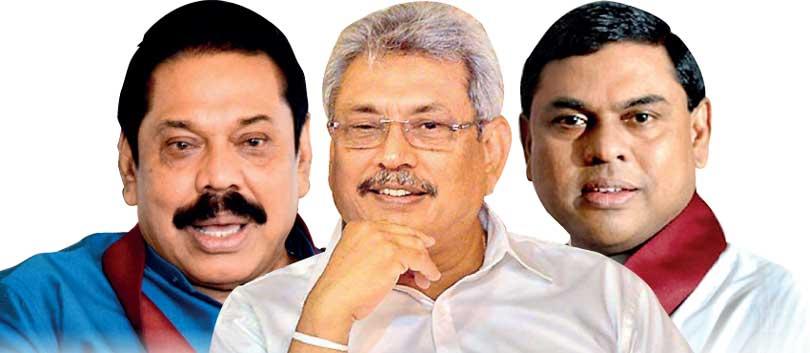
Sri Lankan politics has been a good deal of family business. It was not even the Sri Lanka Freedom Party, the progenitor of the SLPP that started it; D.S. Senanayake, the first prime minister flouted an implicit understanding of the succession and undercut two party seniors, S.W.R.D. Bandaranaike and Sir John Kotelawala to pass the mantle to his son Dudley. Sirimavo Bandaranaike’s ascension to power with the only conceivable qualification being the widow of the dead prime minister opened up a new phase of dynastic politics, but it was not just she who did it. The UNP fielded the widow of Gamini Dissanayake, Srima, but lost the election to another dynastic offspring, Chandrika Kumaratunga. Ranil Wickremesinghe, nephew of J. R. Jayawardene is also not the first one to destroy the party to keep the leadership within the family environs. Sirimavo Bandaranaike refused to cave in after the ignominious defeat in 1977 and having lost her civic status, and as a result ineligible to contest, she led a campaign of sabotage to defeat the SLFP candidate for the presidential election of 1982, Hector Kobbekaduwa. The Rajapaksas, of course, took the familial tradition of Sri Lankan politics to a new high. Rajapaksa brothers returned home from their residency in the United States to take up key government positions, and with a presidency for life almost within grasp after the 18th Amendment, the first family controlled half of the budget allocations during the second half of Mahinda Rajapaksa presidency.
Therefore, when Basil Rajapaksa was appointed the Minister of Finance last week, having entered Parliament to fill the national list slot vacated by Jayantha Ketagoda (who resigned to make room), It made at best a timid progression in the dynastic enterprise. Now the four Rajapaksa brothers are president, prime minister, minister of finance and minister of irrigation. (A key slot or two is missing, the Speaker and probably the Chief Justice). However, if anything, what should interest a political observer is that Basil Rajapaksa’s advent took place at a time that the popular approval of the government is at an all-time low. If there is an election, a credible opposition could win-only that the current main opposition is a long way off becoming one.
Basil himself is in a catch 22 situation. The presidential ban on chemical fertilizer is downright absurd But, walking back on it would mean the loss of the face of the President
Governments lose popularity while in power, however, the rapid collapse of popularity of the government should concern its stakeholders. Even the pro-government television channels, who tend to shun the criticism of the president – probably because some thinks he is above reproach, and others, with grim memories, do not want their media stations torched- are airing snippets of public disgruntlement.
Some might argue that the change of fortune of the government was predicted for much of the hype of Gotabaya Rajapaksa and the SLPP was harnessed through whipping up fear psychosis, anti-minority dog-whistling and vague economic policies.
However, the government could have carried on much longer, while harnessing these primordial energies. The collapse of popularity is in part due to factors beyond its control: Pandemic. But, to a good deal, it is also due to its own making and mismanagement, not just the pandemic. In international comparison, Sri Lanka’s handling of the Covid-19 is not bad after all, as much as it isn’t exemplary. But that hasn’t registered in the popular opinion, in part because, they were made to believe in the superior military efficiency in fighting the pandemic. Still, the party could still have gone on, had not been the tremendous economic shock of the pandemic and the mismanagement of the government finances.
To make matters worse, it is the quintessential SLPP voters, the proverbial 69 lakhs, that face the brunt of the economic shock as food prices skyrocketed and the cost of living has soared. The economy is in a slump though in statistics it grew by 4.3% in the first quarter of 2021 recovering from a contraction of 1.8% last year. The spike of the pandemic in the second quarter would dent the supposed uptick in the first quarter.And the debt servicing is a challenge with US$ 29 billion to be paid from now and 2026, against US$ 4.4 billion of existing foreign reserves. Money printing would further devalue the Rupee, which trades in parallel markets for 225-230 per US$! Enter Basil
Basil Rajapaksa enters the fray as the government has made a mess of the whole business of governance. SLPP underlings say, with an aura of authority that he has seven brains.
Basil is no Raghuram Rajan. His two brothers feel it is safer to share the government among the sibling, than those lacking the bloodlines. His brothers also consider him as the smarter one in the family.
Therefore, while Basil may not make economic miracles or the long term microeconomic stability, neglect to which for too long is at the core of Sri Lanka’s fiscal troubles, he can perhaps fix some of the self-inflicted follies of the government. Indeed, there were initial signs that he was trying exactly that.
Social media and political circles buzzed with reports that the government was planning to lift the ban on the import of chemical fertilizer, a major grievance of the farmers, who have held countrywide protests. Basil Rajapaksa should know these protests are only a prelude to a major showdown, which would be played out after the harvest when the farmers realize that a shortsighted policy had cost them, in the most optimistic estimate, a quarter of the harvest. That is large enough to push many of them to poverty. However, the President’s office responded with a swift rebuttal. There is no change in the policy, President’s spokesman said. Basil himself is in a catch 22 situation. The presidential ban on chemical fertilizer is downright absurd. But, walking back on it would mean the loss of the face of the President. Consider another prospect: Sri Lanka’s looming debt and foreign exchange crisis. It would be whimsical to argue that the country could ride it without going for an IMF programme.
But, that is an anathema to the President, who might desire to tinker with the foreign reserves until his term ends, though how feasible that calculation itself is open to question. The government provides no convincing plan to service debt after mid next year.
But, Basil Rajapaksa, who might be harbouring presidential ambitions may not want to procrastinate a crisis that will explode closer to the next presidential election. Nor would anyone desiring the presidency wants to inherit a system that was made infinitely worse by his or her own volition.
But, can the new finance minister convince his brothers to go for an IMF programme, before the situation becomes progressively worse? Unlikely. Though Sri Lanka will go to IMF only after all the hell broke loose.
Another prospect, though not as consequential as the above two scenarios, but still important in terms of foreign policy. Can Basil Rajapaksa nudge the government to reach out to the US government to restart the Millenium Challenge grant of US$ 480 million? Whether the US is still interested in cooperation in the wake of rights concerns is a different question. Those are typical dilemmas that Basil Rajapaksa would face.
He confronts not just a crumbling economic system, but also a dogmatic rule of his siblings. Probably, his ‘seven brains’ might be of little use when his hands are tied.
The Epidemiology Unit of the Health Ministry reports that another 522 persons have tested positive for COVID-19 in Sri Lanka, moving the daily total of new cases to 1,404.
This brings the total number of confirmed cases of coronavirus reported in the country to 277,519.
As many as 247,569 recoveries and 3,574 deaths have been confirmed in Sri Lanka since the outbreak of the pandemic.
The Epidemiology Unit’s data showed that 26,417 active cases are currently under medical care.
Sri Lanka yesterday (July 12) recorded the highest number of COVID-19 vaccines administered within a single day, according to the Epidemiology Department of the Ministry of Health.
Accordingly, a total of 232,526 vaccine doses have been administered yesterday.
State Minister of Production, Supply, and Regulation of Pharmaceuticals Prof. Channa Jayasumana stated that 173,988 first doses and 40,276 doses of the China-produced Sinopharm vaccine were administered yesterday.
Further, 13,357 doses of the Sputnik V vaccine, 4,725 of the Pfizer vaccine, and 18 doses of the AstraZeneca (Covishield) vaccine have been administered as well.
Sri Lanka yesterday commenced the vaccination of teachers and non-academic staff of schools island-wide. The process is to be carried out continuously for two weeks.
Children’s education is among the
hardest hit by the COVID-19 pandemic throughout the world. Prolonged school
closure and limited access to distant learning has deprived children of their
universal right to education, particularly in poorer countries”
-UNICEF
The COVID pandemic has accentuated
a disparity that already exists between facilities that are available for
poorer children in semi urban and rural areas, and those in more urban and
affluent situations.
While standards of educational
institutions are different to what they were some years ago, there are many
schools amongst the nearly 12,000 schools in Sri Lanka which lack even basic
teaching needs, and worse, even essential facilities like decent toilets, water,
electricity and other amenities. Often what is taken for granted in an urban
central school, is a luxury in many rural schools.
Opportunities for a quality school
education was never on a level playing in the country, and in a practical sense
it has been a very challenging exercise to make it so. Over the years, the
disparities that exist between those who have or had opportunities for a
quality education irrespective of where they lived, or their socio economic
conditions, and those who did not, and still do not, have been bridged to some
degree. Yet, inequity does exist.
There are many school children who
do not have basic needs such as exercise books, pens, pencils and other basic
requisites they require for their education, although they receive text books
from the State. Poverty levels, general socio economic conditions of parents or
guardians of children, orphaned children or those with one parent without an
adequate income to send every child to a school, is nothing unusual not just in
rural settings, but even in urban settings.
In this context, school closures
due to the pandemic and many children losing out on an education for extended
periods of time, unfortunately, is not a new phenomenon for some children who
have faced this situation with or without a pandemic on account of other socio
economic factors. The new manthra of online education for school children in
Sri Lanka is and has been foreign to many children, as the COVID pandemic
itself. However, now, thanks in a way to COVID itself, an opportunity has
arisen to introduce a mechanism for the country which could act as the leveller
of opportunity for all children irrespective of their socio economic status, and
where they live, by way of online education.
It is of course easier said than
done to bring a degree of universality to the concept and practice of online
education to school children throughout the country. The very reasons that
impacted on a universality prior to COVID, plus many other reasons makes this
difficult, particularly in the short to medium term.
In Sri Lanka, and in almost all
countries in the world, online education for school children was not a priority
policy consideration until COVID struck the world. No doubt it may have been
happening to varying degrees in different countries and in different settings
dictated to by a variety of reasons, including geography and physical access to
schools.
The COVID pandemic struck in this
climate and children at all stages of schooling got affected irrespective of
their fortunes or the lack of it. This misfortune has not been confined to Sri
Lanka, and the BBC reckons that some 147 million children have got affected in
South Asia.
In a report titled Coronavirus:
How the lockdown has changed schooling in South Asia by Shruti Menon in BBC Reality Check on the 21st September 2020 (https://www.bbc.com/news/world-south-asia-54009306), Menon says many South Asian
countries lack a reliable internet infrastructure and the cost of online access
can be prohibitive for poorer communities. The UN says at least 147 million
children are unable to access online or remote learning. In India, only 24% of
households have access to the internet, according to a 2019 government survey. In
rural parts of India, the numbers are far lower with only 4% of households
having access to the internet. Bangladesh has better overall connectivity than
India. It’s estimated that 60% can get online, although the quality of
broadband internet is often very poor. Nepal’s
latest Economic Survey report says that of the nearly 30,000 government
schools, fewer than 30% have access to a computer, and only 12% can offer
online learning.
Save the Children contends that children
have lost more than a third of their school year to the pandemic and they have also said there
are huge discrepancies in access to learning in wealthier nations as well
during the pandemic- reliefweb.int/report/world/children-have-lost-more-third-their-school-year-pandemic-save-children
Save the Children
says that students in the U.S. for example are more disconnected from the
internet than students in other high-income countries, which likely also
impacted their access to remote learning. Only two EU countries have lower
levels of internet access than the U.S. – Bulgaria and Romania. At the
start of the pandemic, upwards of 15 million students from kindergarten through
to high school in U.S. public schools lacked adequate internet for distance
learning at home. Other wealthier countries also struggled to provide equal
online alternatives for school-based learning. In Norway, while almost all
youth between 9 and 18 years old has access to a smartphone, 30 percent did not have access to a PC at home. In the Netherlands, one in five
children do not have a PC or tablet for home learning”.
New analysis by Save the Children of data for 194 countries and different
regions shows that children in Latin America and the Caribbean, and South Asia,
missed out on almost triple the education of children in Western Europe.
Broken down at regional level, the difference in lost days of education
becomes painfully clear, Save the Children said:
Both in Latin America and the
Caribbean, and South Asia, children went through around 110 days without any
education;
Children in the Middle East lost 80
days of education;
Children in Sub-Saharan Africa lost
an average of 69 days;
In East Asia and the Pacific,
children lost an average of 47 days;
In Europe and Central Asia, children
lost out on an average of 45 days;
In Western Europe alone, it was 38
days.
Inger Ashing, CEO of Save the Children, said: Almost a year after the
global pandemic was officially declared, hundreds of millions of children
remain out of school. 2021 must be the year to ensure that children do not pay
the price for this pandemic. As schools closed and remote learning was not
equally accessible for all children, the biggest education emergency in history
widened the gap between countries and within countries, Save the Children said.
The divide grew between wealthier and poorer families; urban and rural households;
refugees or displaced children and host populations; children with disabilities
and children without disabilities
In
this context, voicing concerns over the limited reach of remote learning
exacerbated with regional inequalities, UNICEF has urged countries to
prioritise the safe-reopening of schools considering that in their assessment, 66%
of children are unable to get remote learning are from south Asia, Africa
The
situation in Sri Lanka is quite consistent with what has been happening in many
countries in the world, although one wishes it wasn’t. The penchant to find
fault with the government for not providing online education to the entirety of
the country within a short period of time is both unfair and unrealistic
considering the challenges faced that are not uncommon to many other countries.
Sarah Hannan writing in the Morning on
the 23rd of May in an article titled Online and distance learning
for students: Pandemic education still a
challenge, has quoted theCeylon Teachers’ Union (CTU) General
Secretary Joseph Stalin as saying that switching to online and distance learning
has not only affected students in the rural schools but also most students in
urban schools as well. Stalin had added that certain directors from the zonal and divisional
education offices are threatening teachers stating that if they fail to conduct
online lessons, their salary increment letters would not be signed, pointing
out that it is unfair by the teachers, as they have not been provided with the
necessary equipment or with the necessary internet data facilities to conduct
lessons.
He had gone onto say that moreover,
teachers have not even been given training to conduct online lessons. We had
two Covid-19 waves during which these pain points could be addressed, but that
has not taken place so far. In a popular school in Colombo, teachers are
requested to share lessons using WhatsApp from 7.30 a.m. to 1.30 p.m. and they
have been asked to conduct lessons through Zoom from 5 p.m. to 9 p.m.
In regard
to the situation in rural schools, Mr Stalin had noted that the situation is
even worse. For instance, if there are three children in a family and lessons
are to be conducted in the present manner, these three children will need three
phones. What we have also observed is that many parents are even
inconvenienced by phone shops, as they are charging them exuberant amounts to
obtain printouts from their phones of the assignments that are being shared
through WhatsApp and to even install or configure the apps that are used for
online education,” Stalin added.
The context in which
one looks at online education is important in forging a future for this
technology driven development. There are some factors that needs to be
considered
The
situation in Sri Lanka is not very different to that in many other countries,
developed as well as developing countries.
Disparities
in education opportunities was a reality well before the COVID Pandemic
although the divide between those who had better opportunities and those who
did not had been bridged to some degree over time. Online education was not
going to bring redress to this situation within a few months.
Online
teaching methods and abilities are at a nascent stage in Sri Lanka and many
teachers are not familiar, equipped and trained to engage in online education
especially in semi urban and rural settings
Connectivity
and internet access limitations in the country. This is a major impediment even
if online teaching abilities were at a high level. People walking around
outside their homes and looking for areas to get connectivity in their mobile
phones in not uncommon in rural areas, and even in areas not far from Colombo.
It is not a rare phenomenon as some who are ignorant of grass root realities may
be inclined to think.
Lack
of necessary tools like smart mobile phones as a minimum, and laptops, tablets
etc for students. In households with three or four school going children, this
is a major challenge in most parts of the country.
While
the introduction of TV for teaching is growing, the ability for a household to
cater to the needs of more than one school going child is again a challenge.
There
does not appear to be a comprehensive national policy and a practical
implementation plan to further online education while adhoc arrangements seem
to be the practice.
All of above points out for the need to come to terms with
some realities while the COVID pandemic and the restrictions consequential to
that last. Firstly, the inequity in online education opportunities, access,
lack of tools, teacher non preparedness and the reality that some students will
be missing school education for varying periods. The challenge for authorities
is as to how this situation could be addressed and the lost time recovered when
a degree of normalcy returns and children are able to go to their schools.
The second challenge is how the country could gear itself to
use a combination of this methodology and the physical presence in a school to become
a norm rather than the exception in time to come. Universities are
progressively moving in this direction and so are the special Mahindodaya
schools being set up in the country. Use of the TV medium is very likely going
to be a preferred standard approach in schools supplementing face to face
teaching. How much and how well this is to be done in some 12000 schools will
be a major challenge.
Associated with the second challenge is the next challenge,
which is how teachers could be equipped, trained and their capacity built to
conduct online teaching. For some teachers this will be a generation challenge.
The fourth challenge which underpins all other challenges is
the technology itself and access to it. Possessing a smart mobile phone doesn’t
automatically enable access although without one access will not be possible.
The bandwidth needed to cater to a vast population that will require fast and
uninterrupted internet access, transmission towers that will enable such a
proliferation, and the economic cost of data, besides the cost of purchasing
several smart phones in households with several users and the ability of many
families to afford such an expense, will be significant.
Use of the TV as a medium for online education is attractive
although conducting interactive sessions will require access to the internet
and the use of appropriate software to enable interactive sessions. Delivering
lessons using the TV medium is less complex. However, for any type of delivery
and interactive sessions will require a vast number of TV sets both in schools
and in homes.
Online teaching is a strategy that has to be considered from
a long term perspective, and it is best for the country if a committee of
experts in this field, in teaching as well as in technology, and certainly not
politicians, give consideration to all challenges and come up with a proposal
that includes short term, medium and long term objectives and milestones,
resource requirements, both technology related and human resource related, that
could guide the country towards a successful future in online teaching.
There are usual protests and
disruption by the disruptive cabal against the progressive Kotelawala Defence
University (KDU) Bill. These are the elements that always disrupt Sri Lanka’s
progress and hinder equal rights to citizens. They rely on twisted logic that
free education” equals only government provided education and no other
education”.
Free education was never meant to
monopolize education. Instead, it was introduced to compete with paid education
and allow those who could not afford paid education, a pathway to education.
Imposing
free education or no education” is inhuman, violates fundamental
rights, driven by jealousy and regressive. Anyone should be able to gain
education by paying for it. The state must look beyond the dysfunctional free
university system (ranked very poor in the world due to the quality of
graduates they produce today) to create a mechanism to produce worthy
professionals who support the nation. With very limited resources in
comparison, KDU has rendered a yeoman service to the nation in the fields of
defence, medicine, engineering, construction, etc. It makes perfect sense to
invest in the KDU and provide all that is needed for its progress.
Then there is the age-old question
of private medical colleges. Sri Lanka is the only country in the world (with
universities) that does not have private medical colleges. Petty jealousy and
mafia business of a section of the society denies the right to education of
others. National policy must not pander into jealousy of a rotten section of
the society! Surely Sri Lanka can do better than this.
The funniest part is the absence of
any serious fundamental rights case at the Supreme Court against the KDU Bill.
If it is so bad, it must be in violation of at least one law of the country!
The truth is it is as harmless as the free education bill almost a century ago.
The participation of certain Tamil
elements brings a racist tint to the protest as well. Racism is not a valid
concern in any decent court of law. There is no militarization of education.
Military personnel are also entitled to education. Only tribal racists deny
that right who must not be entertained in a civilised society.
The so called educationalists and
teachers are setting a very bad an uneducated example to others by disregarding
pandemic laws and codes of behaviour.
President Gotabaya’s government must
push on with the KDU Bill. All right thinking and progressive people must
support it. The island nation needs far many professionals and many more
tertiary education centres than it has. This is a progressive move that failed
since the 1980s as past leader were hung up on short term politics. President
Gotabaya must push on and get the Bill passed. Future generations of Sri
Lankans will thank, if not venerate him for it.
Ven. Attaragama Pagnalankara Thera visited the CID today to lodge a complaint regarding an incident that was being shared on social media in connection to the exploitation of a 15-year-old-girl.
Ven. Attaragama Pagnalankara Thero expressed views addressing the media.
The Chittagong Port Authority (CPA) yesterday took some decisions, including prioritising berthing for Colombo-bound feeder vessels, aiming at clearing out exports piling up at private inland container depots (ICD).
It will also give priority berthing to feeder vessels carrying export-laden containers.
It also decided to permit two feeder operators to ply three new feeder vessels on the Chattogram-Colombo route.
The CPA proposed that the Bangladesh Garment Manufacturers and Exporters Association (BGMEA) should convince their international buyers to not nominate a few selective shipping companies for carrying their export cargoes.
They should rather nominate more shipping companies to avoid a monopoly situation, they said.
It also proposed that Bangladesh’s ambassador to Sri Lanka could talk to authorities there for taking steps so that export containers can get speedy access to mother vessels from the Colombo port.
The decisions came at a meeting between the CPA and stakeholders, including representatives of foreign shipping companies or main-line operators (MLOs) and freight forwarders.
CPA Chairman Rear Admiral M Shahjahan chaired the meeting at the CPA conference room.
As of yesterday, 15,533 twenty-feet equivalent units (TEUs) of export-laden containers were waiting at 17 ICDs to be shifted to the Chattogram port for shipment, according to the Bangladesh Inland Container Depots Association (Bicda).
Shipment of these export containers are getting delayed due to a global shortage of empty containers and space shortages in mother vessels from transhipment ports.
A good number of these export containers are designated to be transported through Colombo.
The CPA in the meeting also decided to allocate more berths for container vessels as well as to immediately shift a portion of empty containers, not useable to carry export cargoes, from the ICDs to the port for forced shipments aiming at creating space in the ICDs for storing more export-laden containers.
In the meeting, CPA Director (Traffic) Enamul Karim said currently 5,326 TEUs of export-laden containers, a major portion of the stockpiled export containers in the ICDs, were owned by one shipping company, Maersk Line, said sources that attended the meeting.
A representative of Maersk Line Bangladesh at the meeting said 75 per cent of their export-laden containers were sent via transhipment to the port of Colombo while the rest through Singapore and Tanjung Pelepas.
These export-laden containers cannot be shipped timely as the feeder vessels are facing delays in transporting those to the transhipment ports due to acute vessel congestion there, he informed the meeting.
The CPA chairman in the meeting said they very often allocate 11 berths instead of the existing 10 for container vessels and would also consider allocating an additional berth if required.
Mediterranean Shipping Company (MSC) Deputy General Manager Ajmir Hossain Chowdhury mentioned that they had earlier applied for the CPA’s permission for operating two more feeder vessels on the Chattogram-Colombo route in addition to its current five.
Chowdhury said the CPA chairman verbally assured approving their application.
The CPA chairman urged the MLOs to implement a common carrier agreement (CCA) with other feeder vessel operators not nominated to carry their export-laden containers so that export shipments can be made quicker.
He also requested the MLOs to implement a direct interchange (DI) with each other so that alternative MLOs that were not facing a shortage of empty containers can be nominated to carry exports.
The CPA also decided to carry out forced shipment of 20-feet empty containers currently lying idle in the port yards.
It also decided to immediately shift a good portion of 20-feet empty containers, which were not required for carrying exports, and 40-feet empty containers owned by the MLOs that do not provide shipping services towards US and European ports and have service in regional ports only, the export destinations of Bangladesh, from the ICDs to the port for forced shipment.
This was to enable the ICDs to create some space to receive more export cargoes that were waiting on trucks and trailers in queues in front of the ICDs.
BSAA Chairman Syed Md Arif, Bangladesh Freight Forwarders Association Director Khairul Alam Sujan, Maersk Line Country Head Angshuman Mustafi, CMA CGM Head of Operations Enamul Haque, feeder operator and Head of Operations at GBX Logistics Muntasir Rubayat, and Secretary to Bicda Ruhul Amin Sikder were present among others.
Sri Lanka’s great liberal democratic experiment has now been overcome by authoritarian populism.
THE 2019 presidential election will be a watershed in Sri Lankan history. The Rajapaksa regime was decisively defeated in both the 2015 presidential and parliamentary elections. Since then, remnants of the regime have persevered to rebuild. Rejected nationally and isolated internationally, their crafty politics, ideological consolidation and political mobilisation ensured a powerful political base among the Sinhala constituencies. While the minorities, worried about their future, voted overwhelmingly against presidential candidate and former defence secretary Gotabaya Rajapaksa, the Sinhala political base, built by the Rajapaksas, has brought them back to power.
Road to power
THE Rajapaksa camp took the risk of forming their own party, the Sri Lanka Podujana Peramuna, which has now engulfed the Sri Lanka Freedom Party. They built a base in their Sinhala constituencies by engaging the rural population and lower middle classes. They spoke to the discontent with a long-neglected drought and deteriorating economic situation. They turned the corruption discourse that had damaged them in power back onto the incumbent government, as the Central Bank bond scandal exposed the newly appointed Central Bank governor and provided an irredeemable blow to the promise of ‘good governance’.
They tested their strength and gained confidence with the local government elections of 2018, where their newly constructed party machine made a landslide victory in the Southern constituencies. They kept the parliament at boiling point with no-confidence motions, and even attempted a parliamentary coup, with president Maithripala Sirisena appointing Mahinda Rajapaksa as prime minister. They capitalised on the Easter attacks, and claimed to be the only actors who can address national security, even as the president and prime minister pointed fingers about the security lapses that could have averted the disaster. Not only did they miss no opportunity to attack the government over the last four years, but also worked incessantly on the ground to build up their base, whether with the disgruntled Sinhala rural masses, the bureaucrats comfortable with their politics of patronage, the business classes that sought to gain from their economic policies or the chauvinist social movements that thrived on their backing for majoritarian and xenophobic politics. With the presidential election victory, the Rajapaksa juggernaut now looks well poised to consolidate power for the long haul.
Each of the gains of the Rajapaksas was in fact a failure of the Sirisena-Wickremesinghe government. The coalition government was rocked by infighting, and its aloof leadership with grand projects of trade liberalisation and foreign investment neglected people’s everyday concerns. With the global Islamophobic discourse on the rise, the government did little to confront the chauvinist forces that ideologically mobilised the Sinhala constituencies by constructing the Muslims as the new enemies. Amid acute joblessness, soaring living costs, mounting household debt and people’s still rural livelihoods, coupled with fear since the Easter terror attacks, the people turned to a ‘strong leader’ for relief from gripping insecurity. These are the grounds on which Sri Lanka’s great liberal democratic experiment of 2015 has now been overcome by authoritarian populism.
If the neoliberals under Ranil Wickremesinghe lost the plot on the economy, there was nevertheless liberal progress with state and social institutions. Militarisation and surveillance in the country, in the north and east in particular, was considerably reversed with democratic space providing room for freedom of expression and protests. Military-held lands in the north were released to their private owners. The judiciary regained independence. The media and social movements gained the confidence to critique the state. The excessive powers of the executive presidency were clipped and independent commissions for human rights and right to information were strengthened.
In this context, the normalisation away from an excessive security mindset hung over from the war years were undone by the Easter attacks, and the room for scrutiny of the security apparatuses are now shutting down. Independence of institutions is also now at risk: either through legislative moves with consolidation of power in the parliament or through crass politicisation. These are blows to the democratic space gained over the last five years.
It is those concerns that brought the loose set of actors opposing the return of a Rajapaksa regime. What was necessary, however, was a strong coalition that also addressed fundamental political-economic concerns, but that was not to be with the Janatha Vimukthi Peramuna seeking to build a third force and United National Party leader Wickremesinghe seeking to undermine his party’s candidacy to ensure his own leadership of the party.
Electoral outcomes
IN THIS context, the electoral map reveals certain divisions. The Tamil- and Muslim-heavy regions of the north and east, the UNP and up-country Tamil strongholds of the central highlands, and the minority-heavy and UNP strongholds around Colombo voted for Sajith Premadasa, while the vast majority of the other electorates voted for Rajapaksa.
The electoral map may immediately hint at a polarised country along ethno-nationalist lines, but a deeper look into the politics of each region may reveal different dynamics. The voter turnouts in the northern constituencies were much higher than in the past, despite neither candidate addressing their aspirations and a crass call from the Tamil nationalist fringe for boycott of the elections. In voting overwhelmingly for Premadasa, the northern constituencies have entered the realm of national politics seeking to shape it as opposed to the decades-long approach of exclusionary politics that refused to even consider national changes. Similarly, while the simplistic narrative of the Sinhala voter supporting a majoritarian regime may be tempting, in reality it is perhaps the lower and middle class economic disenchantment and youth disillusionment that ensured a mass vote for Rajapaksa.
While the responsibility for the defeat of the liberal democratic experiment of 2015 falls squarely on Wickremesinghe and Sirisena, salvaging what is left of that democratic space now becomes the task of the dispersed actors and forces that have to regroup ahead of the imminent parliamentary elections. The Muslim and Tamil minority parties that sought to keep the Rajapaksas at bay, the failed third force experiment of the JVP with allied left forces and the various social movements now have the unenviable task of defending the democratic space from an authoritarian populist regime about to consolidate power.
Sri Lanka’s dollar bonds bounced back at the end of last week, following news that the country’s central bank is ready to repay debt set to mature this month.
The Epidemiology Unit of the Health Ministry reports that another 568 persons have tested positive for COVID-19 in Sri Lanka, moving the daily total of new cases to 1,488.
This brings the total number of confirmed cases of coronavirus reported in the country to 276,026.
As many as 246,241 recoveries and 3,533 deaths have been confirmed in Sri Lanka since the outbreak of the pandemic.
The Epidemiology Unit’s data showed that 25,715 active cases are currently under medical care.
The
cue for writing this piece came from The Island editorial of (Saturday) June
26, 2021 entitled Presidency should be straitjacketed”, which is about the
current controversy over the presidential pardon given to former SLFP MP
Duminda Silva who had been convicted and sentenced to death for his alleged
involvement in the murder of four persons in 2011. The Island editorial
reflects the prevalent negative take on the Duminda Silva pardon.There is
reason for it. The editor notes, incidentally, with qualified approval, the
fact that the US ambassador has also expressed her displeasure at the
presidential pardon granted to the former MP, but in the same breath he asks
her whether the US respects the Sri Lankan judiciary, recalling how it tried to
save Prabhakaran who had been tried in absentia and sentenced to jail for
masterminding the 1996 Central Bank bombing which left 91 innocent people dead
and dozens grievously injured, and caused much material damage to the
nation. The editorial concludes with the sensible suggestion that The
constitutional provision that enables the Executive President to pardon
convicts will continue to be abused, and what needs to be done, we repeat, is
to prune it down. Before the ongoing protests peter out, a campaign should be launched
to achieve that end.”
(The
following is a personal opinion of mine apropos the matter in question. I am
articulating it as a senior Sri Lankan domiciled abroad who is a layperson
where legal problems are discussed; it is offered to the interested readers for
what it is worth. I would like to state here that, according to my lights as an
ordinary person relying on expert opinion and common sense, the President is
beyond reproach in this connection. Granting the pardon is his constitutional
prerogative, and so it can’t be called in question. And he cannot be accused of
having interfered with the judiciary, because he hasn’t. He has pardoned
Duminda Silva while he still remains convicted of the crime for which he was
punished; by asking for and receiving a pardon, the latter has accepted the
guilty verdict. So, that remains intact. The President has done no wrong, but
had his and Duminda’s advisors done right (neither side had done so,
apparently, for some mysterious reason), he could have been saved the necessity
to grant a pardon in this instance, because the exposure, via the shocking
Ramanayake tapes, of a pre-verdict conspiracy to convict the accused Duminda
Silva willy nilly provided fair grounds for him to successfully appeal, as he
could and should have done, for a seven member bench of supreme court judges to
consider his acquittal on the basis that he didn’t get a fair trial (as argued
by a well known legal luminary named in this article). Let me take this
opportunity to say a word of consolation to the two families caught up in this
tragic flow of events. As a compatriot and a fellow human, I deeply empathise
with them, understand their suffering and share their pain. I am also aware of
the similar suffering of the other three bereaved families. Metta to all!)
I,
for one, endorse the idea of subjecting the institution of presidential pardon
to some kind of accountability guarantor in order to prevent its possible
abuse, but with the important reservation that this ‘pruning’ or
‘straitjacketing’ should not undermine the efficacy of the executive pardon as
‘an act of grace’ which the term denotes (thelawdictionary.org).
An executive/royal/presidential pardon can be used to provide relief for a
convicted person who is subsequently deemed to deserve it: for example, a death
raw prisoner like Duminda Silva himself who came to be seen by the public as an
unsuspecting victim of a miscarriage of justice in terms of evidence that
emerged at least four years after sentencing. The Island editor’s
forthright observation that Ranjan Ramanayake’s telephone recordings that
contain his conversations with judges and senior police officers on criminal
investigations and court cases, during the yahapalana days, have not
only revealed how politicians exert influence on some members of the judiciary
and the police but also caused an erosion of public confidence in the judiciary
and the police”
has been directly prompted by the revelation of a conspiracy that had been
plotted to pervert the course of justice against Duminda Silva. The clear case
of a breach of natural justice had to be remedied. But the grant of a
presidential pardon to him in order to provide a remedy seems to have been
effected in an extremely problematic manner.
It
is appropriate, before proceeding, to briefly outline the background to the
Duminda Silva pardon episode, which is regrettably entangled with the underhand
politics of certain adversaries with an anti-Buddhist religious quirk according
to a prominent monk, who are exploiting it to score political gains. Duminda
Silva, popular among his supporters as a benefactor of the poor, who hails from
a philanthropist business family, was first elected to the Western Provincial
Council in July 2004 as a member of the United National Party (UNP). It was in
2005 that the first term of the United People’s Freedom Alliance (UPFA)’s
Mahinda Rajapaksa as president started. Duminda Silva defected to the Sri Lanka
Freedom Party (SLFP), the principal partner of the UPFA, in 2007. The UNP
charged that he did so in the hope of escaping justice in respect of some
criminal cases pending against him, in addition to getting the Asia
Broadcasting Corporation (ABC)’s licence restored. (The ABC is today listed under
Rayynor Silva Pvt Ltd which runs five radio channels and the Hiru TV. Rayynor
is Duminda’s brother.) Duminda was re-elected as a provincial councillor in
April 2009. Then, in the April 2010 parliamentary election, he was elected as a
Colombo district MP under the UPFA.
It
appeared that MP Duminda Silva was involved in a fierce personal rivalry with
MP Bharatha Laksman Premachandra, a fellow member of the SLFP/UPFA. During the
relatively unimportant local government election of 2011, the two of them,
while leading their respective groups of supporters during canvassing, came
face to face, and apparently, there was a violent clash between them. A
shooting took place in which both got injured, Premachandra fatally. Silva
suffered serious head injuries. Three others from Premachandra’s group also
died. This happened on October 8, 2011. The latter was hospitalized in
Singapore. A magistrate’s court issued an arrest warrant on Silva on November
15, 2011.
On
September 8, 2016, a High Court Trial-at-Bar found Duminda Silva and four
others guilty of murdering four people including Premachandra. But the decision
of the court was not unanimous since Judges Padmini Ranawake and Charith Morais
decided on a guilty verdict on five of the suspects, while Judge Shiran
Gunaratne acquitted all suspects of all charges. However, before the
verdict was announced, there were allegations that Judge Gooneratne was
involved in a conspiracy to acquit the main accused Duminda Silva. The
Wikipedia claims that Sri Lankan media carried details of this alleged
involvement of Judge Gooneratne. The High Court decision was appealed against at the Supreme Court.
A five-judge bench of the Supreme Court unanimously upheld the the three-judge
High Court verdict, and its ruling was announced on October 11,
2018.
What
is given above was mostly derived from the Wikipedia. The particular page was
last edited on June 28, 2021. However, it should be remembered that the entries
about Sri Lanka, as usual, cannot be regarded as free from bias (in favour of
the previous markedly pro-west yahapalanaya and against the more independent
current administration that replaced it). There is no reference to the
Ramanayake tapes (a fact, not a rumour) to countervail the negative comment on
Judge Shiran Gunaratne. The Wikipedia should not be blamed for this, because
interested fair-minded and knowledgeable citizens can appropriately update
these pages if they want to set the record straight in the national interest.
Regrettably, there is no foolproof remedy for the relentless misinformation
against Sri Lanka spread through the Wikipedia and other international media
such as the CNN, Al Jazeera, and the BBC. But this is a different matter, and
should be dealt with separately. However, it needs to be explained how the
Duminda affair has been mishandled by both the parties concerned (i.e., the two
groups of advisors separately representing the pardoner and the
pardoned).
On
the day of Poson (June 24, 2021) President Gotabaya Rajapaksa pardoned 93
prisoners including 16 Tamil prisoners convicted of terrorist crimes. This is
in accordance with Article 34 (1) of the existing Sri Lankan constitution,
which invests the President with the power of granting a pardon either
free or subject to lawful conditions” to any offender convicted of any offence
in any court within the Republic. Article 34 (1) runs as follows:
The
President may in the case of any offender convicted of any offence in any court
within the Republic of Sri Lanka-
grant a pardon, either free or subject to lawful conditions
grant any respite, either indefinite for such period as the
President may think fit, of the execution of any sentence passed on such
offender
substitute a less severe form of punishment for any punishment
imposed on such offender; or
remit the whole or any part of any punishment imposed or of any
penalty or forfeiture otherwise due to Republic on account of such
offence:
Provided that where any
offender shall have been condemned to suffer death by the sentence of any
court, the President shall cause a report to be made to him by the Judge who
tried the case and forward such report to the Attorney-General with
instructions that after the Attorney-General has advised thereupon, the report
shall be sent together with the Attorney-General’s advice to the Minister in
charge of the subject of Justice, who shall forward the report with his
recommendation to the President.”
The
gratuitous dragging in of the Poson as a symbol of Buddhist compassion and
mental serenity into the graceful act of releasing long suffering prisoners was
rendered suspicious because its sincerity was somewhat compromised by the
inclusion of the special case of the controversial Duminda pardon. Undoubtedly,
it was not meant to reflect positively on the President, whoever (among his
advisors) contrived it. The release of the Tamil prisoners was hailed as
a long overdue positive step towards so-called reconciliation by the agents of
certain hegemonic interventionist powers who are pursuing their respective
geopolitical agendas at the expense of hapless ordinary Sri Lankans’ human
rights, democracy, national security, independence, political stability, and
economic wellbeing. They raised a howl of protest when the imprisoned
whistle-blowing BBS leader monk (the neglect of whose prior warnings led to the
Easter bombings that killed over 270 and injured some 500) was given a well
deserved pardon by the previous president. Amidst the hardly grateful accolades
over release of convicted terrorist offenders, not unexpectedly, alarm bells
started ringing among Sri Lanka’s critics when, shortly after that, a special
presidential pardon was granted to Duminda Silva, ex-SLFP MP who had been convicted
of murder and sentenced to death by a three judge bench in 2016, later
confirmed by a five judge supreme court bench in 2018.
The
informed legal opinion at present seems to be that Duminda Silva could have
easily secured quite lawful exoneration on the basis that he had been
denied a fair trial. This would have been better for Duminda Silva because a
mere presidential pardon does not absolve him of guilt proven in a court of law
‘beyond reasonable doubt’; now the guilty verdict will remain for life. If he
enters parliament (the path towards which has now been cleared of all
impediments by the free pardon), he will be an embarrassment not only to that
august body, but to the whole government and the country. I am not a lawyer,
but only a layman using common sense; I am repeating here what well known
defence lawyer Tirantha Walaliyadda PC recently explained, which I hope I have
understood correctly (Please see below). As far as I know he has a reputation
as a senior lawyer who has shown active concern over a long period of time for
upholding and preserving the independence of the judiciary and the integrity of
the law enforcement authorities and lawyers. He once wrote: The Judiciary, law
enforcement, and the Bar comprise the backbone of the democratic system”
(‘Murder of the Judiciary’/Colombo Telegraph/September 1, 2012).
Incontrovertible
evidence to prove that Duminda Silva did not get a fair trial came to light
relatively recently when MP Ranjan Ramanayake’s privately and arbitrarily
recorded secret telephone exchanges, which had taken place before the
announcement of the 2016 three-judge High Court Trial-at-Bar decision, between
him, High Court Judge Padmini Ranawake, and former CID director SSP Shani
Abeysekera, together conspiring to get a guilty verdict, meaning a death
sentence, passed on Duminda Silva. (By the way, Shani Abeysekera has been
described as a ‘Sherlock Holmes’ by the Sri Lanka bashing press!) These tapes
were freely broadcast over the local electronic media, and widely bruited about
by the print- and online-based press. For the commonsensical Sri Lankan
public, any refusal to grant Duminda Silva a presidential pardon would have
been incomprehensible, the possible legal ramifications of such a pardon being
generally beyond their ken. Duminda Silva’s popularity among the common people
of his constituency was bound to turn his further incarceration into a cause of
public outrage. In this connection, the President cannot be accused of having
interfered in matters of the judiciary; he has only exercised his presidential
prerogative to free a convicted prisoner. He must have thought about the
public perception that prevailed that Silva had been subjected to a miscarriage
of justice as revealed by the Ramanayake tapes.
As
the law now stands (See Article 34.1 quoted above), the President’s pardoning
of Duminda Silva cannot be questioned. The executive pardon is a useful
institution when applied in the manner and spirit intended. Shouldn’t the
presidential pardon prerogative be taken as an effective check on the power of
the judiciary (which itself is open to manipulation by corrupt elements among
the law enforcement authorities, i.e., investigating police officers and
prosecuting and defending lawyers); in other words, the constitutional
provision for granting presidential pardons is a legitimate means of
bringing about a balance between the judiciary and the executive in the
interest of the public weal. Like the other branch of government, namely, the
legislature, these two are manned by humans, but humans are not
infallible. An act of grace is a useful way to restore fairness where it seems
to have been denied to an accused person due to human fallibility. To preclude
the possibility of misapplying the presidential pardon prerogative (
which is nothing if not an an act of grace) to help politically important
offenders to evade justice (the pardon of convicted rapist Gonawala Sunil by
JRJ, that the Island editorial mentions, is a case in point), the fallible
human being who wields executive power as president on behalf of the people can
be made accountable to them through a simple amendment to the existing
constitution according to the aforementioned lawyer Tirantha Walaliyadda
PC.
This
needs reference to a ‘Colombo Today’ video uploaded to the You Tube
(2021-07-02) of a press conference called by Mrs Sumana Premachandra (widow of
murdered Bharatha Lakshman) to protest against the grant of a presidential
pardon to Duminda Silva, who had murdered her husband and three others in cold
blood” (‘amu amuwe’ as she put it). She declared that she will hold the
President responsible for any harm done or threat posed in the future to the
lives of herself, her daughter, and any other members of her family as a result
of this act of his. She also warned about the likely deleterious national and
international consequences of the move. Mrs Premachandra stated that the
Bar Association of Sri Lanka (BASL) and her daughter former MP Hirunika
Premachandra had written to the President about the matter and were awaiting a
reply. She thanked the US ambassador and the UNHRC for expressing concern about
the pardoning of Duminda Silva. Mrs Premachandra said that she would, however,
desist from taking it to Geneva as the ultimate sufferers of the consequences
of such a move would be the poor people of Sri Lanka. Then she invited PC
Tirantha Walaliyadda to connect via zoom, who, she said, had done a lot to
bring Duminda Silva to book when the latter was abroad after the crime. It is
apparent that Walaliyadda addressed them from his office.
In
his terse remarks, the normally outspoken veteran lawyer stressed three
points: (1) By asking for and receiving the pardon, Duminda Silva
accepted his guilt over the four murders, thereby condemning himself to a lifelong
status of convicted murderer. He thus unnecessarily forfeited the valuable
chance he had to successfully appeal for a seven-judge supreme court bench to
consider his acquittal on the ground of having been denied a fair trial, which
would have been good him personally and saved the President the embarrassment
of a presidential pardon that potentially set the outside world laughing
(though he didn’t violate the constitution by granting the pardon). (2) The
President did not interfere with the judiciary as charged in certain quarters.
He just used his lawful presidential power to pardon him, while leaving the
guilty verdict that had been passed on the pardoned intact. However, Duminda
Silva, though permanently stigmatized for a heinous crime, can become an MP and
participate in law making, or even get a ministerial post and perform executive
duties! Will the people be ready to accept laws passed by such a parliament?
What will happen if this sort of thing goes on without being checked? (3) The
matter is grave, but there is a simple solution. Just introduce a minor
amendment to the constitution which would require the president to present to
Parliament the day following the grant of a pardon a written explanation
setting out the reason/s why it was granted. The document must go to the
Hansard. Its effect will be felt at the next election. No parliamentary debate
is possible or required, because a presidential pardon cannot be set aside by
parliament. This will stop any future abuse of the presidential pardon institution.
PC
Walaliyadda expressed dismay that the President who is not a lawyer has not
been properly guided by his advisors. My concern, like that of any fair-minded
Sri Lankan, is about how the President could stick to a course of action with
single-minded doggedness, while trustfully relying on the recommendations of
such advisors, particularly at this critical juncture.
The
EU/US & UK believe themselves to be & demands us to believe, they are
paragons of virtue & models of human rights. This supremacy-mindset created
Hitler who told the Jews how to behave & annihilated those that refused to
do so. Germans and Germany were held collectively accountable for the crimes of
Hitler & to this day Germany continues to pay reparations. A similar
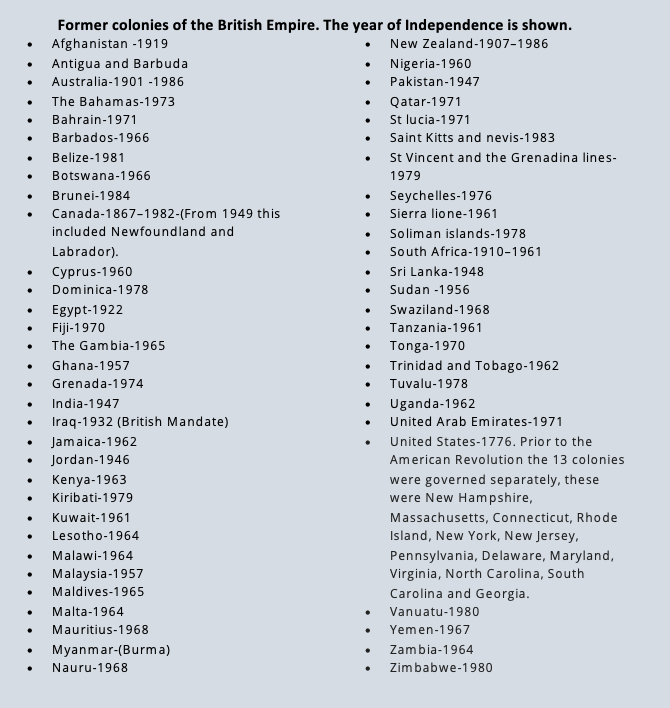
supremacist policy was adopted during EU/US & British colonial rule which continues
in neocolonial form. However, these nations without atoning for their sins,
have no right to be pointing fingers.
European
colonizers committed grave acts against humanity that come nowhere near the
UN-defined war crimes & crimes against humanity terminology. Without
accounting for these crimes how can the European Bloc/ UK & US present
themselves as paragons of virtue championing human rights?
Papal Bulls divided the world initially between Spain &
Portugal in 1492 and from there onwards till 19thcentury the Europeans colonized Americas, Asia & Africa and
built their nations plundering territories already inhabited. These war
criminals were glorified & celebrated with annual national holidays –
Christopher Columbus Day! None of the former colonizers wish to revisit their
colonial imperial past. Their schoolbooks do not feature any of its nefarious
acts overseas. Why? Whatever is spoken is only to show off how they ruled with
iron fist.
The
white man speaks with a forked tongue
Spain
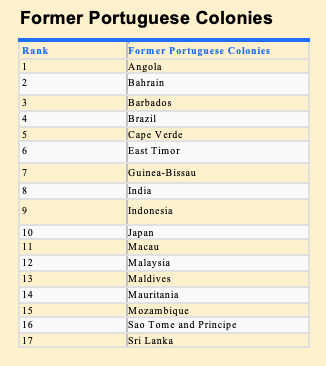
held control over 35 colonies across the world. Portugal’s empire extended
across 50 countries for trade, to spread Catholicism & ‘civilize’ natives
and influence the political, economic & social systems of countries they
colonized. Even by 2013, France controlled 2.7million people in former colonies
that began from 1605.
Civilizing Mission”
Completely
ignoring that the lands and territories the Europeans descended upon had rich
and ancient cultures of their own, the Europeans set out to ‘civilize’ these
natives by replacing native traditions/customs/cultures with European language,
laws etc. This is nothing but cultural genocide. The natives had to give up
their religion & embrace Catholicism/Christianity in order to receive
education/jobs or be ‘accepted’ by the Europeans. How many in the West think
like Jules Ferry higher races have a right over the lower races, they have a
duty to civilize the inferior races”. How did the whites become a ‘higher race’
– what makes whites think they are a ‘higher race’ and who gave them th right
to ‘civilize’ people?
The
white rulers annihilated the spirituality of the natives simply because they
didn’t pray to the white God”.
The
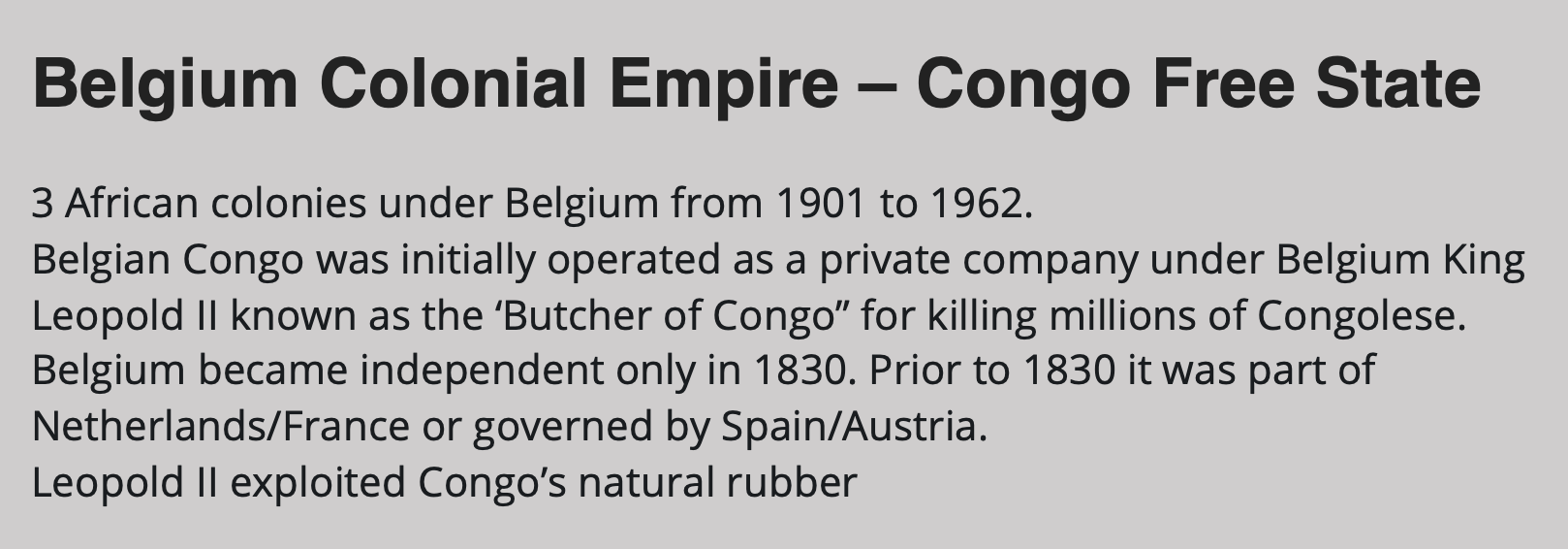
Butcher of Congo – Leopold II of Belgium killed millions of Congolese. Where is
the accountability for these crimes? These were state-sponsored religiously
approved mass murder!
The
colonials left a legacy of ethnic groups created by cohabitating with natives.
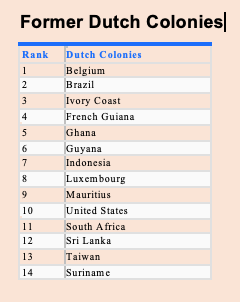
The Dutch departed the colonies creating ethnic groups of Dutch ancestry –
Boers in South Africa (Afrikaaners 10million), Burghers in Si Lanka, Indo
people in Indonesia, Creoles in Suriname where Dutch remains the official
language. US Presidents Theodore & Franklin Roosevelts were of Dutch
origin.
What West did and is doing to
Africa
Cannon Fodder
Natives
became used for sepoy armies that were set out to crush their own people who
rebelled against the Europeans. Many natives were made to fight during the
World Wars.
When US/UK & EU preach to
the world against modern day crimes – where is their accountability for
Rape/Mass Murder/Torture & Disease during colonial rule
Arms,
legs and hands were cut off natives that did not listen to white rule or pay
taxes. 14 countries continue to pay France colonial taxes!
Women,
children & elderly were given small pox-infected blankets & faced
death.
When US/UK & EU preach to
the world against human rights – where is their accountability for Slavery,
Apartheid and racism that still exists.
Millions
of Africans were transported as slaves. Cape Verde under Portugal became an
entreport for human cargo & shipped as goods. Can Portugal preach about
modern day human trafficking? How many are given lesser salaries &
positions because of their color even today?
When UN & Western Nations
draft resolutions on Cultural Genocide – they suffer amnesia over their crimes
some of which still continues.
Ancient
structures were bulldozed and replaced with European churches. The gold &
other valuable crystals, minerals etc were stolen to build Europe while ancient
heritage and artefacts adorn European museums where they earn from tourists and
not a penny is given to the nations from whom they stole these artefacts.
When UN & West draft
resolutions on Protection of Ancient languages they ignore their crimes upon
ancient languages
How
many of the ancient people (Incas Mayans, Aztecs) languages have been
annihilated and in turn the official languages of some former colonies remain
colonial. Some of Spain’s former colonies continue to use Spanish as official
language. Jamaica, Philippines (late 1500s to 1898), Belize & Trinidad
opted not to continue with Spanish.
Education
was given to those who forfeited their mother tongues, adopted European
education/language and attire. To only these colonial jobs were offered.
When US/UK & EU demand
media /freedom of speech–what are they doing against Julian
Assange, Edward Snowden & Chelsea Manning & scores of others they want
mummed.
When US/UK & EU preach
democracy– have they counted the number of democratically elected leaders
they have ousted & replaced with despots & dictators or the number of
rebel groups, insurgents & terrorists they not only train and fund but
covertly arm as well?
It
is time the world knew about the uncensored versions of the history committed
by EU/US & UK. A history that they wish to brush aside by pushing their
crimes under the carpet or diverting attention to other countries &
deceitfully presenting themselves as champions of human rights.
EU/US
& UK cannot demand accountability from any nation before they voluntarily
apologize and compensate for their crimes during colonial rule & under
international systems they control & govern today.
Over
500 years of crimes can only be remembered and prevented but take a good look
at all of the conflicts around the world today. What are the countries fueling
these conflicts? What are the countries supplying the arms/ammunition &
training? What are the countries that are illegally occupying countries?
Surprise, surprise, – they are the very EU, British & US that committed
crimes then and are continuing the crimes even now while pretending to be
angels.
Canada
loves to accuse countries of ‘genocide’ while hiding its genocidal past with a
simple ‘sorry’ while daily graves of murdered children emerge. EU & Western
nations shy from referring to Spain killing over 50million natives of Peru to
less than 2million as not genocide but take pains to cry ‘genocide’ by Hitler
or Milosevic (though only 2500 bodies were found against hyped up genocide
claims)
The
need for EU, Britain and US to stop presenting themselves as ‘saviors’ &
start owning up for their crimes against the world’s peoples and environment is
not simply to hold them accountable for colonial crimes but to make the world
realize that over 500 years of colonialism & imperialism has resulted in
unimaginable and irreversible outcomes – fertile lands & ecosystems
destroyed (today EU & Co preaches about climate change), ancient languages
and cultures annihilated, ancient cultures, customs and traditions buried,
people’s identities and spirituality stolen, turning simple people & their
simple lives upside down, brainwashing their minds and remoulding them through
education, nature raped for cosmetic gain, animals hunted for sport and to add
to injury public memory replaced by glorifying the perpetrators with bogus
history. Not only has Britain admitted to burning & hiding colonial crimes
committed by them, the Europeans did the same. King Leopold burnt all documents
related to his rule I will give them my Congo, but they have no right to know
what I did there”.
Europe,
Britain & US are built on the riches stolen from the colonies. Colonialism
dramatically changed land & marine ecosystems and transformed economic
growth & who would dictate its future growth.
Colonialism
turned everything and everyone into commodities with a price. Humanity &
compassion was just for the coffee table.
The
stolen metals, slaves, plantation commodities built European economies and
bankrolled the industrial revolution. The international systems created by them
ensured that their will ruled. To make the non-whites happy, they made room for
non-whites who thought, acted & spoke like the white-man to hold global
positions amongst them. You hardly find an outspoken non-white amongst the
whites but plenty of non-whites who think they are white and take pride in
looking down on their own!
Notice
how West embraces India that bows down to Western dictates but vilifies China
because China is dictating how China rises & shines on global stage on
China’s terms & not the Wests!
EU
US & UK must account for their sins before pretending to be angels &
demanding we treat them like angels.
The
Eelam war is not the noble war it is made out to be. It is
treason. Treason is considered to be “the highest of all crimes”. Treason”
means criminal disloyalty to the state. When war is waged against the state, it
is known as High Treason. War is considered the most serious offense that can
be committed against a government. The punishment for those charged with
treason is death or imprisonment, including life imprisonment. A person who commits treason is known in law
as a traitor. Another word used
for traitor is Quisling.
Most
countries have laws against high treason. In the USA
attempting to overthrow the government through waging war against the state is
considered high treason. It carries a
sentence of death or imprisonment, also fines. Treason trials were held during
the American
Civil War. Britain has a separate Treason Act.
In Vietnam,
any Vietnamese citizen acting in collusion with a foreign country with a view
to causing harm to the independence, sovereignty, unity and territorial
integrity of the Fatherland, the national defense forces, the socialist regime
or the State of the Socialist Republic of Vietnam shall be sentenced to capital
punishment, life imprisonment of between twelve and twenty years of
imprisonment.
Sri
Lanka’s Constitution prohibits
waging war against the state. Chapter 20 and 21 of the Constitution of Sri
Lanka (updated to 2021) says:
157A. (1) No person shall, directly or indirectly, in or outside
Sri Lanka, support, espouse, promote, finance, encourage or advocate the
establishment of a separate State within the territory of Sri Lanka.
157A. (2) No political party or other association or organization
shall have as one of its aims or objects the establishment of a separate State
within the territory of Sri Lanka.
157A (4)
Where any political party or other association or organization has as one of
its aims or objects the establishment of a separate State within the territory
of Sri Lanka, any person may make an application to the Supreme Court for a
declaration that such political party or other association or organization has
as one of its aims or objects the establishment of a separate State within the
territory of Sri Lanka.
161(4) where
a Member directly or indirectly, in or outside Sri Lanka, supports, espouses,
promotes, finances, encourages or advocates the establishment of a separate
State within the territory of Sri Lanka, any person may make an application to
the Court of Appeal for a declaration that such member has directly or
indirectly, in or outside Sri Lanka, supported, espoused, promoted, financed,
encouraged or advocated the establishment of a separate State within the
territory of Sri Lanka.
Waging war
against the state is a criminal offence under the Penal Code of Sri Lanka. Chapter VI of the Penal code deals with
‘Offences against the state’.
Section 114 says, Whoever wages war against the Republic, or
attempts to wage such war, or abets the waging of such war, shall be punished
with death, or imprisonment of either description, which may be extended to
twenty years, and shall forfeit all his property.”
Section 115 says Whoever conspires to deprive the People of the
Republic of Sri Lanka of their Sovereignty in Sri Lanka or any part thereof, or
conspires to overawe, by means of criminal force, any of the organs of
Government, shall be punished with imprisonment and shall also be liable to a
fine.”
LTTE
committed high treason in the Eelam Wars. LTTE took arms against a sovereign
state. They conducted a protracted civil
war, lasting over 30 years. Such treason would lead to severe punishment in any
other country, said. Rohan Gunaratne . Analysts
observed that elsewhere in the world, High Treason is punishable by death. Also
nowhere in the world would a group like the LTTE, be allowed to hold
regular memorial services and erect monuments as they are doing today in Jaffna.
The
call for Eelam is also a treasonable
activity said critics. Ven. Keppetiyagoda Siriwimala of Rajopawanaramaya, Getambe,
Peradeniya, said C.V.Wigneswaran,
former Supreme Court judge, should be arrested for calling for a separate
government for the North and East. (2016) Jayantha Gunasekera said any call for separation should be
cause for high treason with penal sanctions.
In addition to Treason, there is also the
charge of Sedition. Sedition is defined as “conduct or speech inciting
people to rebel against the authority of the state.” Any attempt to conduct civil war, arm citizens against any
other part of the country, is Sedition.
Sedition is limited to the offense of
organizing or encouraging opposition to government through speech and writing.
The publication of seditious writing (seditious libel”) or the utterance of
seditious speech (seditious words”) are considered crimes. Today , even the display of a flag of separatist
movement is also considered sedition.
There is now
a call in Sri Lanka for a law against ‘sedition’. There is no such law against
sedition at present. The government should pass a sedition act to charge and
prosecute anyone supporting separatism
said Rohan Gunaratne.
We must introduce
a new ‘Sedition Act’, said K Godage. It is also absolutely important to have a
Sedition Act. Malaysia and Singapore have Sedition Acts.Any
word or action which is deemed to encourage Separatism must be made a criminal
offence and any political party deemed to support Separatism should be banned. The
encouragement of Seditious tendencies must be made punishable with a minimum of
ten years rigorous imprisonment, Godage said.
In 1976,TUF
leader A Amirthalingam, together with other leading Tamil politicians M.
Sivasithamparam, V. N. Navaratnam, K. P. Ratnam and K.
Thurairatnam were distributing leaflets in Jaffna giving the Vaddukoddai Resolution
passed by the TULF in that year and saying that they intended to work towards a separate
state. They were arrested under the Emergency Regulations, taken to Colombo and
tried for sedition. At the trial at bar case 72 Tamil lawyers including
S. J. V.
Chelvanayakam and G. G. Ponnambalam spoke for
the defence.
The action
was of course, clearly seditious, therefore the defence focused on a ‘point of law’,
the way the Emergency was proclaimed. The Tamil lawyers also used the opportunity, to make a case for
Tamil self determination. The High Court at Bar, on September 10, 1976, upheld the
objection of the defence on the validity of the Emergency Regulations. Appapillai
Amirthalingam, the Secretary General of TULF, was discharged of charges of
possessing and distributing seditious literature.
The State challenged this decision before the Supreme Court. Attorney
General Siva Pasupati appealed for a revision of the High Court-at-Bar order in
the case against Amirthalingam. On December 10, 1976, the five-judge Bench, by
a unanimous verdict, held that the proclamation of the state of Emergency was
valid. Soon after the Attorney General announced that the Government will not
be preceding the case against the four ITAK leaders relating to the possession
and distribution of seditious literature. (High Court Trial-at-Bar No. 1 of
1976, S.C. Application No.658 of 1976 and S.C. Application No. 650 of 1976)
Nallaratnam Singarasa
was convicted by the High Court on five charges that he, between 1 May 1990 and
31 December 1991 together with LTTE leaders like Sornam and Pottu Amman,
conspired to overthrow the lawfully elected government and attacked Army camps
in Jaffna Fort, Palaly and Kankesanthurai. The charges against him had been
brought under the Emergency Regulations and the Prevention of Terrorism Act. He
was sentenced to 50 years rigorous imprisonment.
Singarasa
appealed against his conviction to the Court of Appeal, which dismissed his
case on 6 July 1999, but they reduced his sentence to 35 years RI. Singarasa
then sought special leave to appeal from the judgment of the Court of Appeal. A
Bench of the Supreme Court comprising of Justices Mark Fernando,
Wadugodapitiya, and Wijetunga refused special leave to appeal on 28 January
2000.
Sinharaja then went to UNHRC in Geneva,
obtained support for his case and returned to Supreme Court, where his appeal
was once again rejected. In doing so, Supreme Court was rejecting both
Sinharasa’s defense and also the advice sent to them from UNHRC on how to look at this case. Sinharasa was a
test case for the Tamil Separatist Movement. (Continued)
Reuters reported that Samaraweera pledged
that the new Government would welcome Chinese investors. President Maithripala
Sirisena has unnerved China with his re-examination of certain projects that
China has invested in, including a $1.5 billion ‘Port City project in Colombo.
Reuters said that India, which lost out to
China in infrastructure development on the Indian Ocean island, was in
particular worried about the security threat posed by Chinese ownership of
land, aggravated by the docking of Chinese submarines in Colombo last year.
Last week, Sri Lanka said it would reconsider the outright transfer of a parcel
of land to China under the port city deal signed by the previous Government,
amid concern it could be used for by the Chinese navy.
Speaking in Beijing after meeting his
Chinese counterpart, Mangala Samaraweera said he did not discuss the port issue
directly, and the Government was not only looking into Chinese projects.
Anything relating to Chinese investment will be shared and discussed with the
Government of China before we take any final decision,” Samaraweera told a news
conference, citing what he told his Chinese counterpart. Sri Lanka will always
welcome Chinese investment and it would now be an even safer place in which to
invest, he said.
We are trying to ensure that there is a
level playing field for all investors and a conducive environment for
investment based on the restoration of the rule of law, democracy, good
governance and transparency,” Samaraweera said. All proposals in future will
be considered totally on merit.”
Samaraweera is in China to prepare for an
expected visit by Sirisena next month. Chinese Foreign Minister Wang Yi said
China remained a good partner of Sri Lanka. China is willing to continue being
a trustworthy and reliable development partner… and will also keep doing its
best to provide assistance for Sri Lanka’s social and economic development,”
Wang said. India had grown increasingly wary of former President Mahinda
Rajapaksa’s pursuit of closer ties with China, which became a key supporter of
the island’s economy after its 26-year-civil war ended in 2009.
Reuters ststed thast China has built a
seaport and airport in the south of the country, raising fears it is seeking
influence in a country with which India has traditionally had deep ties.
India’s concern grew after the Rajapaksa Government allowed the Chinese
submarines to dock in thje Colombo port.
China moots trilateral cooperation
with India and Sri Lanka
China has proposed trilateral cooperation
involving India and Sri Lanka for regional stability as the new government in
Colombo sought to re-balance its ties with China, preferring to follow a
“non-aligned” policy. “China is open-minded about trilateral
cooperation between China, India (and) Sri Lanka,” Chinese Foreign Minister
Wang Yi said during a joint press conference with Sri Lankan counterpart
Mangala Samaraweera. “I want to say both India and Sri Lanka are China’s
cooperative partners in South Asia,” Wang said.
Samaraweera is the first Sri Lankan
official to visit Beijing since president Mahinda Rajapaksa’s defeat in polls
this January bhy a western, Indian terrorist diaspora steered conspiravy. China
made significant investments in Sri Lanka during Rajapaksa’s tenure, raising
concerns in India.
The two ministers had a lengthy talk focussed
on the new political alignment in Sri Lanka following the fall of the Rajapaksa
government. Samwarweera, however, did not comment on the trilateral proposal by
China.
Wang said China wants progress in
relations between all three countries, including ties between New Delhi and
Colombo. “The relevant parties may continue to explore discussions about
such cooperation in future to think about what are practical ways and means in
pursing such cooperation,” Wang said. “We believe that China and
India may leverage their respective strength in playing a positive role in
helping Sri Lanka advance its social development,” he said. “I
believe sounder interaction and pursuit of common interests among the three
countries is in the best interest of the three countries and also in best
interest of regional peace, stability and prosperity,” Wang replied to a
question. He also said China and India stay in contact over a large number of
regional and global issues. “We would certainly like to have consultations
with the Indian side regarding pursing trilateral cooperation in future or
cooperation involving more parties,” Wang said. Describing India as a
neighbour and a relative, and China a close friend, Samaraweera said his
government prefers to follow a “non-aligned policy with good relations
with all the countries in the interest of the Sri Lankan people.” Wang,
for his part, spoke about the support extended by the Rajapaksa government for
the revival of the multi billion dollar ancient Maritime Silk Road (MSR)
proposed by Chinese President Xi Jinping.
Mangala organises a visit to China
by Sirisena
Jubilant over ousting the former
President Mr. Mahinds Rajapaksa through Ranil Chandrika guidance from 2013,
starting with TNA/Diaspora/UNP Singapore meetingh in 2013 and ending with a
massive western/hegemonic Indianc and diasdpora conspiracy floated with
hitherto never seen in thew world feake news and smear campaign Mangala
Samaraweera visited China early February, a few days after getting installed
backstabber Sirisena as the President of Sri Lanka, made a two dahy visit to
China mainly to pave the way for Sirisena to undertake a visit to China. Followimg boot lickings and groundwork done
buy this Goblin, Sirisena made an official visit to Chima from 25th
March to 29th March, 2015.
Durimng this visit, Sirisena held
bilateral talks witn Chinese President Xi Jinping
and also attended the Bo Ao Forum in Hainan on 28-29 March.
In the bilateral talks,
President Xi Jinping emphasized that Sri Lanka is a close neighbor and China
has always regarded Sri Lanka as important in its neighbourhood policy. He said
China’s cooperation with Sri Lanka is based on mutual benefit and China does
not attach any political conditions. China and Sri Lanka understand and support
each other on matters of territory and sovereignty. Xi Jinping pointed out that
China wants to deepen economic cooperation and infrastructure investment in Sri
Lanka through Chinese enterprises; that China wants to expand military
cooperation through exercises; and, coordinate in international as well as
regional affairs. China hoped that Sri Lanka will increase its collaboration
with China in SAARC.
Sirisena affirmed that his government will carry forward the friendly relations and will adopt more effective measures to promote friendship and cooperation between the two countries. He said that the Maritime Silk Road (MSR) had established relations between two countries in ancient times and that the 21st century MSR will further strengthen ties between China and Sri Lanka. On the recently suspended Colombo Port project, he said the project has been suspended temporarily and there was no fault with the Chinese side. He expressed his gratitude towards China for their help in building Hambantota port and welcomed more investment from Chinese enterprises.
The two sides signed the
following MoUs:
Settling of FTA negotiations.
(President Sirisena showed his country’s interest in genuine
progress” on the FTA. Two sides will be soon convening the third round of FTA
negotiations.)
Chinese grant assistance to establish a hospital, a special laboratory
and a modern pharmaceutical laboratory, institute for research and treatment of
chronic kidney disease which is an acute health problem in Sri Lanka.
Five MoUs were signed in the areas of public health, trade and
commerce, agriculture and human resource development.
Development of coconut industry.
Refurbishing of the Superior Courts complex in Colombo
Cooperation on tourism industry.
China’s offer of 2000
training opportunities for young scientists from Sri Lanka in the next five
years.
China – Sri Lanka bilateral
trade exceeded $3 billion in 2013. China is Sri Lanka’s second largest source
of imports after India and is Sri Lanka’s biggest source of foreign direct
investment (FDI). It has provided development loans for projects such as the Hambantota
Port, Sri Lka’s first four-lane expressways , and for a new National Theatre.
In a media briefing by
accompanying Ministers, it was stated that:
China will provide a grant
worth more than US$ 300 million to the health sector in Sri Lanka and a grant
of Sri Lanka Rs.4 billion to refurbish the Courts complex;
President Xi Jin Ping has
conveyed to President Sirisena the idea of setting up a Silk Route Fund through
which Sri Lanka would benefit.
Separately, press report
said that China had agreed to write off US $30 million from the construction of
Outer Circular road negotiated during Rajapaksa’s regime.
Mangala
invites Chinese FM for 3 days visit to Sri Lanka.
Managala Samaraweera, addressing the joint
media conference at the conclusion the Chinese Foreign Minister Wanfg Yi’s 3c
day visit to Sri Lanka which had been undertaken on an invitation extended by
Mangala Samaraweerra said that Sri Lanka valued the long-standing friendship
and cooperation with China, dating to ancient times.
He said Discussions were held regarding
the Silk Road initiative put forward by China. Sri Lanka reiterated its
participation in this initiative, as it is in line with the government’s
initiative to make Sri Lanka the hub of the Indian Ocean trade,”
He also said Sri Lanka and China had
agreed to further enhance cooperation in trade, ..which we hope will be
achieved with the early conclusion of the FTA between our two countries.”
Sri Lanka also welcomes the active
support from Chinese enterprises to the development of Sri Lanka’s economy,”
Minister Samaraweera said.
Samanraweera called for the settlement of
South China Sea disputes through constructive dialogue, consultation and
cooperation, in accordance with international laws and practices,” and said
that Sri Lanka was appreciative of China’s efforts to promote such dialogue,
to maintain peace and security in the region, while upholding the rule of law
in interstate affairs.”
In response, Chinese Foreign Minister Wang Yi said China looked forward to
follow through with strategic planning on bilateral relations made by the
leaders of the two countries during previous visits.
No matter what changes to the
international situation and domestic agenda, our strategic and cooperative
partnership will continue to develop,” he emphasised.
He said China intended to make the 21
Century Maritime Silk Road a priority, and would work with Sri Lanka …to
better align our development strategies to include your 5-year development
plan, so that we can come up with a comprehensive blueprint for our future path
of cooperation, and help Sri Lanka build itself into a shipping centre in the
Indian Ocean…”
The Foreign Minister said that Sri Lanka
and China would continue work towards mutual benefit, and that China would
focus its aid on ports, highways, railways, airports and other mega projects,”
and work towards a common development and shared prosperity.”
He disclosed that Sri Lanka and China had
agreed to resolve the South China Seas issue through dialogue, and would work
closely on marine cooperation. Foreign
Minister Wang Yi also promised more frequent high-level contact between the two
countries.
Statemenmt issued by Mangala on
Chinese FM’s visit
It has been an honour and a great
privilege to welcome to Sri Lanka the Minister of Foreign Affairs of the
People’s Republic of China, H.E. Wang Yi. The visit is significant as it was
the first high level visit and the first visit by a Foreign Minister of China,
following the formation of the National Unity Government in Sri Lanka.
Sri Lanka has also made several high level
visits to China in the recent past, with H.E. President Maithripala Sirisena
making a State Visit to China in March 2015, a mere three months after being
elected and then it was followed by the Visit by Prime Minister Ranil
Wickremesinghe to Beijing. I myself had the pleasure of visiting China
four times in one year, and the last being to the CICA Conference (Conference
on Interaction and Capacity Building Measures in Asia) held a few months ago.
I am confident that the visit by the
Foreign Minister will further enhance the warm and friendly bilateral relations
between our two countries and pave the way for stronger ties in all spheres of
cooperation between Sri Lanka and China.
We have just concluded a very productive
discussion regarding the consensus reached by the leadership of our two
countries during the recent high level bilateral visits and also on issues of
mutual interest. I extended Sri Lanka’s appreciation for the assistance given by
China for several infrastructure and other mega projects in Sri Lanka. This is
consistent with the Strategic Cooperation Partnership between our two
countries.
Sri Lanka deeply values the long -standing
friendship and cooperation with China, dating back from ancient times.
Discussions were also held regarding the
Belt and Road initiative put forward by China. Sri Lanka reiterated its
participation in this initiative, as it is in line with the Government’s
initiatives to make Sri Lanka the hub of the Indian Ocean trade, a position it
occupied in the ancient past. We discussed the 21st Century Maritime Silk
Road for greater economic cooperation, which is viewed as a road of friendship,
economic cooperation, socio and cultural exchange and connectivity.
We also agreed to further enhance
cooperation in the field of trade, which we hope will be achieved with the
early conclusion of the FTA between our two countries. Sri Lanka also
welcomes the active support from Chinese enterprises towards the development of
Sri Lanka’s economy.
While recognizing the need to maintain
peace and security in the region, we also agreed on the importance of
maintaining peace and stability in the South China Sea. In this regard, Sri
Lanka calls for the settlement of disputes and differences through constructive
dialogue, consultation and cooperation by the parties concerned in accordance
with international laws and practices.
Sri Lanka also appreciates China’s efforts
and readiness to promote such dialogue in order to maintain peace and security
in the region while upholding the rule of law in inter-state affairs.
We agreed that regular high level
interactions at all levels will pave the way for a stronger relationship, which
will benefit our countries and our peoples.
By Noor Nizam – Peace and Political Activist, Political Communication Researcher, SLFP/SLPP Stalwart, Convener “The Muslim Voice” and Member “Viyathmaga”, July 11th., 2021.
The Muslim
community, especially the younger generation should not miss this
great opportunity to intergrate with the government in power, Insha Allah.
The Advent of Basil to parliament
begins a “New Era” of Politics. Will follow with Socio-Economic,
Agricultural development, prosperity, peace and harmony.
“The Muslim Voice” always
believed that Basil was able and will do these, Insha Allah.
“The Muslim Voice” always
propogated this move forward because “the Musim Voice” has worked
very closely with Basil for many years in politics and we have confidence in
him.
The Muslim community in Sri Lanka cannot
have a better friend in the government than Basil.
The Muslim
community, especially the younger generation should not miss this
great opportunity to intergrate with the government in power.
“The Muslim
Voice” calls upon all Muslim politicians, Political activists and
Community leaders to forget the differences and start to intergrate with the
government in power, support and work with Basil, not expecting positions and
perks, but keeping in mind the political gains the Muslim community can benefit
from such a relationship in the future and the contributions the Muslims can
make towards making Sri Lanka a better place to live for all communities with
dignity and equality, Insha Allah.
Maybe God AllMighty Allah has
blessed Basil to become the next president of Sri Lanka in 2024, if Gotabaya
Rajapaksa will not contest, Insha Allah.