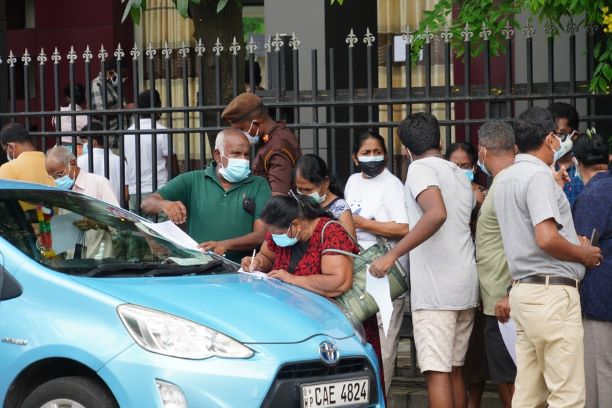
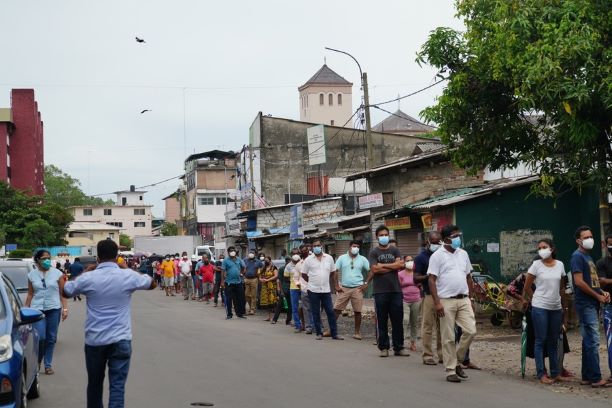
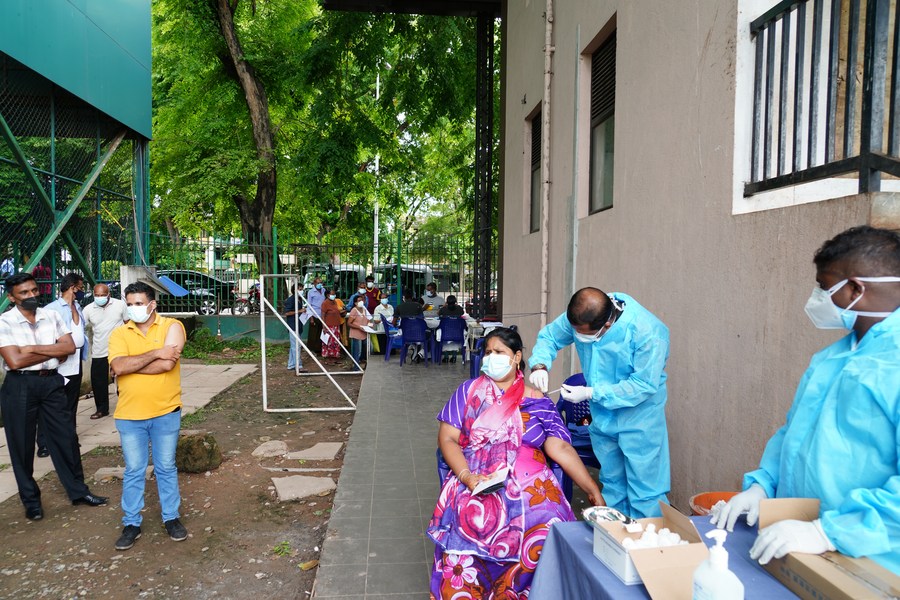
The Epidemiology Unit of the Health Ministry reported that 784 more persons have tested positive for COVID-19 in Sri Lanka on Sunday (May 18), as the daily count of new cases moved to 2,518.
This brings the total number of confirmed cases of coronavirus reported in the country to 147,720.
According to the Government Information Department, 2,478 of the new cases reported today are associated with the New Year coronavirus cluster. The remaining 40 were identified as arrivals from foreign countries.
As many as 121,145 recoveries and 1,015 deaths have been confirmed in Sri Lanka since the outbreak of the pandemic.
Epidemiology Unit’s data showed that 25,560 active cases are currently under medical care.
The government has agreed with all the determinations and amendments of the Supreme Court with regard to the Colombo Port City Economic Commission Bill, said Minister Keheliya Rambukwella.
Therefore, it could be passed in the parliament with a simple majority, the Minister added.
The determinations of the Supreme Court were presented to the parliament today (May 18) by Speaker Mahinda Yapa Abeywardena.
The Court had found that several clauses of the Bill were inconsistent with the Constitution.
However, these clauses can either be amended or passed in the parliament with a special majority or in a referendum, the Supreme Court determined.
In its 62-page determination on the Bill, the Supreme Court had also included how the concerning clauses can be amended.
The verdict of the court was handed down by Chief Justice Jayantha Jayasuriya and Supreme Court Justices Buwaneka Aluvihare, Priyantha Jayawardena, Murdu Fernando, and Janak de Silva.
Today, 21st
May 2021 is the 29th death anniversary of this unassuming colossus
who perhaps had done more for the people of Sri Lanka than many others before
him and after him
The only thing necessary for the triumph of evil is for good
men to do nothing – Edmund Burke
Edmund Burke was an influential Anglo-Irish politician, orator
and political thinker, known for publicly expressing his opposition to the
French Revolution. Born in Dublin in 1729, Burke went to London to study law,
but soon gave this up and pursued a literary and political career. He became a
member of the parliament in 1765 and had a 30-year career as a political
theorist and philosopher. Later praised by both conservatives and liberals,
Burke believed that the government should be a cooperative relationship between
rulers and subjects. He also said that most men in a nation are not qualified
to govern it, stating that those who are elected to represent the people should
possess a greater level of wisdom than the public. The past is important,
but change is inevitable so, in order to keep a balance between the new and the
traditional, society needs to learn how to adapt. Therefore, we should
construct civilization by giving weight to our ancestors, but also consider
ourselves and the needs of future generations.
This article is
not about Edmund Burke. It is about one of Sri Lanka’s greatest sons, Tikiri
Bandara Ilangaratne or T B Ilangaratne, who in so many ways epitomised the
values that Burke believed in during his time. His revolutionary policies and
the people owned public institutions he created or helped to create
demonstrated in no uncertain manner that he was never a man who stood in
silence when it came to public policy and governance for all and not a favoured
few. TB Ilangaratne, a family man, a novelist, poet, union leader and
politician, born on the 27th of February 1913, passed away peacefully
on the 21st of May 1992 having lived a life dedicated to a selfless service
to the people of Sri Lanka.
One enduring characteristic of T B
Ilangaratne was his unassuming nature, his simplicity and his affinity to his
family that never faded throughout his life. He and his wife, Tamara Kumari
Ilangaratne or TKI as she was fondly referred to, ran a home which had been more like a community hall
and there had always been a pot of rice and a simple meal in the home as
everyone who had visited, and there had been many from the two electorates
represented by TBI and TKI, had never left their home hungry. They had never
been any discrimination on status or any other discriminatory practice and
whoever having a meal had been served at the main dining table. Being a crowded
household, children of TBI and TKI, and their cousins and friends who had been
regular visitors, sometimes had their meals either in the kitchen or in our
rooms. The family home had been one of joy and had been full of very meaningful
life.
Both TB Ilangaratne
and his wife, as members of Parliament, along with other members of Parliament
at the time, unlike those today who find it difficult to even walk, let alone
travel in public transport, had not been given fleets of vehicles. They were
entitled only to public bus and train passes, and unless they had their own
transport, which the Ilangaratne’ s did not have, their only mode of transport
to and back from their respective electorates had been public transport.
Despite these
challenges, TB Ilangaratne had one motive throughout his life and that was to
be of service to others, in particular to those who were left behind by the
legacy of colonialism and supremacy of money for a few at the cost of
exacerbating the plight of those who were left behind by that few. His
achievements in introducing far reaching policy reforms in independent Sri
Lanka, which continued till the end of the seventies, have to be looked at
through such a prism.
His vision and
approach to policy settings paved the way for others to emulate and set the
direction for a fairer Sri Lanka and opening opportunities for those had been
denied such opportunities.
Throughout
his life and especially during his political career, he was a person who not
only thought or just empathised with people in society, who were poor,
homeless and the lower middle class who were left behind by the Colonial
administrations and then by those who took over from them, but actually
introduced ground breaking policies to raise the standards and hopes of such
people.
Besides the
accolades that he got, which were many and richly deserved, he was also at the
butt end of the nastiest characteristics of many fellow countrymen who assigned
all manner of derogatory labels to him, which were totally unjust and untrue.
Not only was he subject to such vilification, even his family was not spared
and they had to endure these on behalf of a husband and father who did and
always did, what was in the best interest of the mass of Sri Lankans who were
left out of the post-colonial Sri Lankan dream.
In the days
before the advent of social media, these vilifications were spearheaded by
interested parties including the monopoly media who were the servants of the
masters at that time, masters who had been affected by the far reaching public
policy changes introduced by T B Ilangaratne.
His life’s
philosophy and his political philosophy were no different to each other.
Simplicity and equal opportunities for everyone irrespective of ethnicity,
religion, caste or any other discriminatory practices, guided his thinking. In
this respect, he saw common ground with the left movement in the country and
the leaders of the left movement. His socialist orientation and outlook brought
him very close to a scholarly Buddhist Monk, Venerable Walpola Rahula who had
his early education at the Vidyalankara Pirivena, and who maintained close
links with the University. There is no doubt that Ven Rahula had a lasting
influence on T B Ilangaratne and they remained lifelong friends.
These socialist
leanings had irked Mr D S Senanayake and his fellow supporters in the
government of the day. Mr Senanayake was the first Prime Minister of the
country then known as Ceylon, who was in the 1940s, the Leader of the House of
Representatives. They were seeing the Buddhist clergy as being a threat to
their power, and influence with the rich segment of the polity.
The Vidyalankara Declaration
In the early
part of the 1940s, the leading Buddhist Monks of the day had taken a stand to campaign
for broad basing the public policy settings of the country and to extend the
country’s social structure to the majority people in the country who had been
left behind by a few who controlled most aspects of the country’s economy. This
was no ethnic or religion based campaign although the leading Buddhist Monks
had taken it on themselves to launch such a campaign on behalf of the wider
mass of people of the country. In this regard, Monks led by Yakkaduwe Pangnarama,
Kiriwattuduwe Pannassara, Walpola Rahula and others and lay persons like young
T B Ilangaratne had taken the lead to introduce what was referred to as the
Vidyalankara declaration which articulated a new vision for the country.
Politicians,
businessmen and women, and others belonging to the governing class led by Mr D
S Senanayake who was then the Leader of the House of Representatives had been
vehemently against this declaration and the call to action by the Buddhist
Monks. The animosity between Mr Senanayake and
his supporters and the Buddhist clergy had intensified to the extent that they
had prevented Monks like Venerable Rahula from receiving their daily mid-day
meal. It is at this point that the role played by TB Ilangaratne comes into
focus, as he, although a poor clerical hand at the time, had arranged with well-wishers
to supply the mid-day meals to Ven Rahula and other Monks. Ven Rahula had
mentioned special mention of this effort on the part of TB Ilangaratne and their
friendship flourished.
Ven Walpola Rahula was a scholar and a
writer. He became the Professor
of History and Literature of Religions in the North Western University in the
US, the first Bhikkhu to hold such a chair in the Western world. He later
became a Professor Emeritus at the same university and in 1964, the Vice
Chancellor of the Vidyodaya University in Sri Lanka (now Sri Jayawardhanapura
University)
Navaratne Rajakaruna Wasala Tikiri Mudiyanselage Tikiri Bandara
Ilangaratne was
born on 27 February 1913 in Tumpane, Hataraliyadda, Waligodapola, as the fourth
child in a family with seven siblings. His father was a well-known general
practitioner of traditional ophthalmology. He began attending school in 1917 at
Galagedera Vidyalaya and received his secondary education from St. Anthony’s College, Kandy. Ilangaratne wrote three plays
while in school (Akikaru Putha, Himin and Anda
Nanda). On September 4, 1944, Ilangaratne married Tamara Kumari Aludeniya in Gampola. Tamara Kumari
Ilangaratne (TKI) was elected as the member for Kandy (1949-1952) and Galagedara (1970-1977). They had four children
Udaya, Sandhya, Rohana, and Upeksha.
He was a Member of Parliament for Kandy, Galaha, Hewaheta and Kolonnawa in Colombo district. He served as
the Sri Lankan Cabinet Minister of Labour, Housing, Social Services, Finance,
Commerce, Food, Trade and Shipping, Public Administration & Home Affairs
and he also functioned as the Acting Head of State during Mrs Sirima
Bandaranaike time as Prime Minister in a career spanning more than three
decades.
As extensive as his political experience and achievements were, he was
also well known for his literary talent and authored several classic novels and
is best known for writing Amba Yahaluwo (1957), a popular
children’s novel. His novels Tilaka Saha Tilaka, Lasanda, Nedeyo,
Sasara, Niwena Ginna, Nayana and Kale Mal have been adapted into movies. Amba
Yahaluwo and Vilambheetha were made into a television
serial.
Altogether he has written 50 Sinhalese novels, and 2 English novels –
Matchmaker and Amba Yahaluwo which were also translated to French. He also
translated Tale of Two cities written by Charles Dickens to Sinhala as
Denuwara Kathawa”.
Early Days
T B Ilangaratne left school after passing the London matriculation exam
upon which he joined the government service as a clerk in the General Clerical Service. In 1941, he tried his hands at
acting playing King Dhatusena in the play of the same name by Gunasila
Witanansa and in the movies Radala Piliruwa” and Warada Kageda”.
He then contested and won the Kandy
electorate in the 1947 general election as a Socialist candidate, but was
unseated as a result of an election petition. At the request from the people of
Kandy, his lifelong friend, companion and wife, Tamara Kumari Ilangaratne affectionately
referred to as TKI contested at the by-election and became the MP for Kandy. An
election petition may have got rid of T B Ilangaratne, but the people of Kandy
did not.
TB Ilangaratne joined the editorial board of Lankadeepa newspaper
writing the political column under the pen name Andare” while his wife TKI continued
as a member of Parliamentary opposition.
It was around this time that S W R D Bandaranaike, who would become
Prime Minister in 1956, left the government of D S Senanayake and joined the
opposition. T B Ilangaratne recognised and wrote of this move of Mr
Bandaranaike as the greatest political sacrifice he had made. He invited S W R
D Bandaranaike to address a socialist group of Kandy headed by Queens Counsel
Mr Sri Nissanka and himself. At the meeting S W R D Bandaranaike announced his
vision to follow a middle path and expressed his desire to join hands with T B
Ilangaratne to form a new political party.
The seeds for the birth of the Sri Lanka Freedom Party were sown and Mr
Bandaranaike’s vision became a reality when both T B Ilangaratne and his wife,
as convenors and founder members together with 42 others formed the Sri Lanka
Freedom Party. This included D A Rajapaksa, the father of Mahinda and Gotabaya
who were to become Presidents and Heads of State of the country, and another
sibling, Chamal, a Speaker of the Parliament of Sri Lanka, and Basil, a cabinet
minister himself. The key role played by T B Ilangaratne and TKI in the
formation of the SLFP and leading it to one of the most stunning political
victories is perhaps not known to many.
In 1959 S W R D Bandaranaike, a visionary who gave a life and
purpose to the very ordinary common man” fell to an assassin’s bullet,
although the conspirators to the assassination were people engaged in
commercial activity who had lost out on some deals, which were unprincipled,
unethical and not in the national interest, and rightly turned down by Mr
Bandaranaike. The chief conspirator, former chief priest of the Kelaniya Raja
Maha Viharaya, Mapitigama Buddharakkitha, was tried and convicted and sentenced
to life imprisonment, and he died in prison while serving his sentence.
In the immediate post S W R D Bandaranaike cabinet, T B Ilangaratne
assumed duties as the Minister of Home Affairs, which included the department
of police that investigated the assassination and which eventually led to the
conviction of the assassin and the conspirators.
He contested and was elected in the general elections of March 1960 and July 1960 from Hewaheta. He was appointed Minister of Commerce,
Trade, Food and Shipping by Sirima Bandaranaike who became Prime Minister having
led the Sri Lanka Freedom Party in the July election. In 1963, he was
appointed Minister of Finance and then Minister of Internal and
External Trade in 1964.
T B Ilangaratne lost his seat in the 1965 general election. He however returned to Parliament from
a by-election in 1967 from the Kolonnawa electorate and sat in the opposition. He was
re-elected in the 1970 general election from Kolonnawa and was appointed to
the cabinet with the portfolios of Foreign and Internal Trade, thereafter,
Trade and Public Administration and Home Affairs. In 1974 he served briefly as
the acting Prime Minister. Ilangaratne retired from politics on April 12, 1986.
There is a
strong possibility that TB Ilangaratne’ s very significant and unparalleled
achievements are not known to many as such interested parties have for years,
carried out a successful campaign to hide them from the public and vilify him
for activities he was never part of or had any association with.
His
achievements are overwhelming, and amongst the major achievements not mentioned
so far in this article are the following.
Declaring a holiday on account of the May Day and recognising this
as a special day for workers, establishment of the Employees Provident Fund. The Employees’ Provident Fund (EPF) was established
under the Act No. 15 of 1958 and is currently the largest Social Security
Scheme in Sri Lanka. With an asset base of Rs. 2,540 billion as at end 2019,
the EPF today has become a huge “Peace of Mind” for the employees of
institutions and establishments of the Private Sector, State Sponsored
Corporations, Statutory Boards and Private Business.
The adoption of the Labour Disputes Act, Creation of Shops and Office
Employees Act, Passing of Maternity Leave Act, providing light work to pregnant
mothers, Implementation of the Workers’ Compensation Act, Establishment of the
National Wages Commission, Establishment of Vocational Training Centres, Abolition
of the right of employers to dismiss employees abruptly, facilitate trade union
representatives to attend foreign conferences.
Some of the institutional work he was responsible for
were, nationalisation of private petroleum companies such as Royal Dutch Shell, Mobil gas, Caltex and Esso
transferring its assets to the newly formed Ceylon Petroleum Corporation, and
its refinery to refine crude oil, nationalization of insurance and the establishment
of the Insurance Corporation, establishment of the People’s Bank, establishment
of the National Lotteries Board, adoption of the Shipping Corporation Act, establishment
of Sathosa, launching the Oberoi Hotel created under the Sathosa establishment,
establishment of State Trading General Corporation (now known as Rajawasa),
establishment of the State Tractor Corporation, establishment of the State
Textile Corporation (Salu Sala),
establishment of the Consolidated Export Corporation (Consolexpo), establishment
of Co-operative Services Commission, establishment of the National Fruit Board,
establishment of the National Pricing Commission, creating a price control
department to protect consumers, transfer of dried fish importation business to
the State (CWE) on account a gold
smuggling racket amongst some private importers, to the CWE
He is also credited as the first Finance Minister to present
the national budget in Sinhala, the reason for this being the budget in Sinhala
were to open the doors for entrepreneurs from the cities as well as villages to
Sri Lanka’s economic opportunities, and to broad base the naturally agro based
country and to create opportunities for students to study economics in the
Sinhala language as such opportunities were restricted to those who studied in
the English medium up until then. He was also responsible for widening Tea
exports, hitherto restricted to Britain, directly to the rest of the world,
breaking the monopoly of Oil imports restricted to England, and opening importations
to the Middle East and Russia.
It would not be
misplaced to assign any other label than what Mahatma Gandhi said of great men
– You must be the change you
wish to see in the world”, to T B Ilangaratne.
He epitomised that and he was always the change he wished to see in Sri Lanka. His singular achievements, his dedicated service to the country
he loved, demonstrates this beyond any doubt. He is assured of an honoured
place in Sri Lanka as a man for all seasons and a visionary leader for
generations to come.
Palestinians will yet again commemorate the
Nakba (‘catastrophe’), a term that refers to the ethnic cleansing of Palestine
in 1948 and the Palestinians’ loss of their homeland. The mass expulsion of
Palestinians was overwhelming in its scope. Arab Palestine was erased and
replaced with Jewish Israel. It is estimated that between 750,000 and 900,000
Palestinians were expelled from their homes and became refugees in the
aftermath of the 1948 Arab–Israeli War. About 500 villages were destroyed and
Palestinian cities were purged of their Arab residents. Only 160,000
Palestinians remained in what became Israel – Dr
Lana Tatour, Adjunct Lecturer at the School of Social Sciences, University of
New South Wales
The West as well as Russia and China have looked
on with feigned disdain while Israel has continued the dispossession of
Palestinians from their own homeland since the creation of the state of Israel
in 1948. While the UN has over the years passed several resolutions clearly
identifying Israel as the aggressor, and its actions as illegitimate, it has
only demonstrated the impotence of the UN, and the triumph of meanness over
what is just.
Today, Israel, and the world in deep slumber,
looks at rockets fired from Gaza as the cause of a conflict while conveniently
overlooking the fact that it is an ongoing reaction to the real cause that
began in 1948.
In a wide ranging article written in 2018, Dr
Lana Tatour (PhD, Politics and International Study), a Palestinian scholar, and
an Adjunct Lecturer at the School of Social Sciences, University of New South
Wales and specialising in postcolonial/settler colonial studies, indigeneity,
and civil society and resistance, Dr Tatour tracesthe ongoinghumiliation of Palestinians since the mass dispossession that began in
1948.
Dr Tatour’s article, a history of Palestinian
Dispossession (https://overland.org.au/previous-issues/nakba70/essay-lana-tatour/) is quoted in full here to give readers a glimpse at this
historic debacle heaped upon the Palestinian people by Israel and the world’s
economic and military powers.
The article begins with the following insult to the
injury heaped on the Palestinian people.
The year 2018 has so far been a good one for
the State of Israel, which has just celebrated its 70th anniversary. Yesterday,
the US embassy was transferred from Tel Aviv to Jerusalem following
Trump’s unprecedented
recognition of Jerusalem as ‘the
eternal capital of the Jewish People’.
Today, Palestinians will yet again commemorate
the Nakba (‘catastrophe’), a term that refers to the ethnic cleansing of
Palestine in 1948 and the Palestinians’ loss of their homeland. The mass
expulsion of Palestinians was overwhelming in its scope. Arab Palestine was
erased and replaced with Jewish Israel. It is estimated that between 750,000
and 900,000 Palestinians were expelled from their homes and became refugees in
the aftermath of the 1948 Arab–Israeli War. About 500 villages were destroyed
and Palestinian cities were purged of their Arab residents. Only 160,000
Palestinians remained in what became Israel.
But Nakba Day is as much about the present as it
is about the past. The Nakba is an ongoing national and personal tragedy.
Generations of Palestinians have been born into destitution, statelessness and
occupation, and Palestinian claims to self-determination and sovereignty
continue to be curtailed by Israel and the international community.
It is increasingly apparent that Israel’s
occupation of the Palestinian territories is not a temporary situation
but rather a permanent one. Israel has
yet to give up its aspirations for a Greater Israel and the takeover of
Palestinian land, with Jewish settlements continuing to proliferate and expand.
The illusion of temporality enables Israel to seize Palestinian land while
engaging in a futile peace process as a strategy to stall for time and make
facts on the ground.
Since the occupation of the West Bank in June
1967, Israel has established more than 160 settlements there in violation of
international law. Today, between 600,000 and 750,000 Jews – 10 per cent of
Israel’s Jewish population – live in settlements in the West Bank and East
Jerusalem.
Occupied East Jerusalem is gradually being ethnically
cleansed of its Palestinian inhabitants. Since
1967, Israel has revoked the residency status of at least 14,959 Palestinian Jerusalemites.
These people are now criminalised and banned permanently from living in their
native city. In addition, for more than a decade, Israel has prohibited the
movement of Palestinians between the West Bank and the Gaza Strip, cementing
the geographical divide between the two.
The United Nations has described
Israel’s policies in the West Bank as ‘creeping annexation’, and Israeli
ministers have begun publicly
calling for the annexation of parts of the West Bank. Under the
Oslo Accords, the West Bank was divided into three areas: Area A (under
Palestinian control), Area B (under Israeli and Palestinian control) and Area C
(under full Israeli civil and military control). According to the agreement,
Area C – which constitutes 60 per cent of the West Bank – was supposed to be
transferred to the Palestinians at a later stage, but this never happened.
Instead, in recent years Israel has escalated its land grab and population
transfer policies in Area C and Jewish settlements have undergone significant
expansion.
According to the Israeli human rights
organisation B’Tselem, Israel now has effective
ownership of the majority of land in Area C. Further,
while Israel has been building an average of 1500 homes for Jewish settlers
every year, only 33 building permits for Palestinians were approved by Israel
in Area C between 2010 and 2014. None were approved in 2015. Dozens of
Palestinian communities in the Jordan Valley and the South
Hebron Hills are today facing forced transfer. They are
subjected to daily violence by the Israeli army and Jewish settlers. Israel’s
policy is to make Palestinian life unbearable. Palestinian villages are denied
access to basic services such as water and electricity, and Israel forbids
building schools and health clinics. Water tanks and hundreds of EU-funded
structures (including modular homes and schools) have been demolished in recent
years, in what the EU has described as a violation of international law.
Colonial policies of dispossession and ethnic
cleansing also extend to the Palestinian citizens of Israel. As a result of
massive expropriation of land and state policies of Judaisation, Palestinian
land ownership in Israel is estimated to be only 3.5 per cent. A major internal
colonial frontier is now the Naqab (or Negev, the southern region of
Israel/Palestine), where the Palestinian Bedouin indigenous population faces
state plans that threaten the destruction of about 40 villages and the forced transfer
of tens of thousands of Bedouin citizens
of Israel to state-planned townships – the Israeli equivalent of reservations.
Last month, the Bedouin village of Al-Araqib, which has become a symbol of
Bedouin resistance, was demolished for the 127th time. The Bedouin village of
Umm al-Hiran will be demolished next month and the new Jewish settlement of
Hiran will be built on its rubble. Adalah, the legal centre for Arab minority
rights in Israel, has described Israel’s plan for Umm al-Hiran as being
‘reminiscent of the darkest of regimes such as apartheid-era South Africa’.
The Israeli regime is one based on racial
distinction and racial hierarchy in the treatment of Palestinians and Jews. As
Ahmad Tibi, a Palestinian member of the Knesset (the Israeli Parliament), once
commented, ‘Israel is democratic for Jews, but Jewish for Arabs’. The legal
system and the administrative and bureaucratic apparatus work to facilitate
Jewish privilege in all areas of life.
The human rights organisation Adalah has documented more
than 60 laws that discriminate against the Palestinian
citizens of Israel and limit their political, civil, socio-economic, cultural,
land and due process rights.
Only a few days ago, the Knesset, Israel’s
parliament, passed on first reading the new and controversial
Nationality Law, which formally enshrines
Israel as the nation-state of the Jewish people. The law legalises the
establishment of Jewish-only settlements and rescinds the formal status of the
Arabic language as an official language of the state. In reality, this law is
not news. It merely consecrates the existing reality of the Palestinian
citizens of Israel. More fundamentally, the law encapsulates the Zionist
viewpoint that Jews – wherever they are in the world – are the only rightful
owners of the land and the only population in the state that is entitled to
self-determination, while Palestinians are portrayed as aliens in their own
homeland.
The two-state solution is dead (arguably, it was
never really an option). It is time to recognise that we already are in a
one-state condition.
Israel exercises sovereignty over the whole of
historical Palestine and it governs the entire population in this territory,
Palestinian and Jew alike. And yet Israel operates multiple regimes of
citizenship, rights and control. While the Jewish population enjoys political and
civil rights, the vast majority of Palestinians are denied those same rights.
Even Jews in the diaspora enjoy more rights to the land than do the
Palestinians who actually live in their homeland or were expelled from it 70
years ago.
For decades, Israel has enjoyed impunity for its
violations of international law and human rights. It should be apparent that a
state that removes Palestinians from their homes in order to build settlements
for Jews is a settler-colonial state. A state that denies political and civil
rights to Arabs because they are Arabs is a racial state. A state that shoots
unarmed civilian protesters who are under illegal and inhumane siege is a
criminal state”.
The following concluding remarks in Dr Tatour’s
article presents the essence of the cause that has been boiling since 1948, and
which periodically releases reactions in the form of rockets from Gaza. Quote For
many in the West, the dispossession and continued exile of Palestinians is
still seen as a legitimate price to pay for sustaining the Jewish state. A
century has passed since the Balfour Declaration, which recognised Jewish
nationalism while referring to Arabs as nationless ‘non-Jewish communities’ in
Palestine. Palestinians are still struggling to be acknowledged as natural
subjects of rights to freedom and self-determination. If anything, the recent
protests (the Marches of Return) in the besieged Gaza Strip – where 70 per cent
of inhabitants are refugees – demonstrate that the quest for dignity and for
the right of return is at the heart of the Palestinian struggle” unquote
Dr Tatour presents the solution that will end
this dispossession and humiliation of Palestinians and an end to the rocket
barrage that is fired from Gaza – The time has come to pursue a
democratic, de-colonised and de-racialised state in historical Palestine – a
state that will guarantee full equality to the whole of its population (Jews,
Palestinians, immigrants, refugees and asylum seekers). It is time
for Palestinians to demand ‘one person, one vote’. And it is time for the
international community to support this just demand.
The test of decency, justice and fair play over
meanness will pass muster only if Western nations, China and Russia, Japan and
India, collectively tells Israel that enough is enough and supports a solution
on the lines proposed by Dr Tatour. If not, it would be conclusively clear that
the mean has inherited the Earth.
The Human Rights Council
of the UN is, as its name indicates, the UN body which deals with human rights.
However, UNHRC does not rank as one of the principal UN organizations. UNHRC is
designated a subordinate body of the UN. It is not therefore, a powerful
body”.
The UN Human
Rights Council was created in 2006 to replace UN Commission on Human rights, by
Resolution 60/251.
Resolution 60/251, stated that
UN decides to establish the Human Rights Council, based in
Geneva, as a subsidiary organ of the General Assembly. The Assembly shall
review the status of the Council within five years ( clause 1)
The Council shall be responsible for promoting
universal respect for the protection of all human rights and fundamental
freedoms for all, without distinction of any kind and in a fair and equal
manner. (Clause 2)
The work of the Council shall be guided by the
principles of universality, impartiality, objectivity and non-selectivity,
constructive international dialogue and cooperation, with a view to enhancing
the promotion and protection of all human rights, civil, political, economic,
social and cultural rights, including the right to development; (clause 4)
the work of the Council shall be
transparent, fair and impartial ( Clause 12)
HRC has three regular sessions per year, in March, June and
September. HRC can also hold a special
session at any time, to address human rights violations, if one third of the
HRC panel requests it. That was how the 11th Special Session of the HRC was
convened in 2009 to consider the situation in Sri Lanka, just one week after
the conflict came to an end.
The UNHRC is empowered, through its Universal Periodic
Review (UPR) to examine the HR status of all 193 UN Member States. The human
rights position of all UN member countries come up before the HRC on periodic
review, every four years. The dialogue between UNHRC and the member state are recorded in UNHRC documents ( forget title) . I have looked at them. No member state ever admitted guilt.
They had explanations, excuses and where necessary, there was outright
rejection of the charges.
UNHRC can pass resolutions
on a country, on majority vote, whether that country likes it or not. But the
Resolution will not have legal force. No
resolution of the UNHCR can have direct legal consequence UNHRC can only make recommendations, said Palitha
Kohona. UNHRC lacks the power to act
against countries. UNHRC cannot cannot
impose sanctions. It does not have that power either.
Subhas
Gujadhur and Toby Lamarque were asked to make an assessment of the HRC
Resolutions issued over the years. Their report was published as The evolution
and future direction of the UN Human Rights Council’s resolution system’ (2015). They found that Resolutions
relating to specific countries, were a mere 7% of its total output, the rest
were on themes. The country resolution
were confined to 12 situations, mainly
Israel but also Sri Lanka. The authors noted that the 10 highest ranked countries for HR
violations were not in this list.
Most of the
resolutions were introduced by USA and
the European Union, 56% by EU and 20% by USA. The Council’s willingness to address
country-specific human rights violations is therefore heavily dependent on just
two Western powers, the EU and the US. When one considers the scale of human
rights violations that have taken place since 2007, it is clear that, by only
addressing fourteen situations, the Council is guilty of neglecting its responsibilities, said
Gujadhur and Lamarque .
The
resolutions brought by the west mainly target developing countries,
particularly those in Asia and Africa, said Sri Lanka’s Pathfinder Foundation. The west decides which country should be hauled
before it and who should undertake the task. Sri Lanka was handled by Canada in
the 1980s and by USA and UK in 2017.
Certain third world countries have grouped together to counter this. It was
this group that supported Sri Lanka during the special session in May 2009,
said Pathfinder.
Pathfinder
observed that the developed countries in the west and the oil rich Gulf
countries are rarely, if ever, summoned before HRC. The sole exception to this
is Israel. HRC has passed many resolutions against Israel, to the fury of
Israel. In 2017, HRC adopted 5 such resolution in one session despite
opposition from US and UK. Israel and
Cuba have ignored UHRC Resolutions.
UNHRC is not well off financially. UNHRC receives only 3.7 per
cent of the UN regular budget. This is insufficient for the work of the UNHRC and
donors have to step in. UNHRC web page
called for donations in 2017. IN 2020 it was announced
that UN is having a financial crisis,
and had cut down the funds given
to the UNHRC. UNHRC has had to reduce
some of its activities such as lunch time meetings.
Two thirds of the UNHCR budget comes from voluntary
contributions from
Member States and other donors. in 2017,
the leading donors were United State of America (USD 450,360,2382), Germany (476,918,6683)
European Union (436,036,9864),
Japan (152,359,7735) United Kingdom (136,219,3706) Sweden (111,958,9457)
Norway (98,941,9568).
In 2019 the leading donors were United States of America (1,706,832,053,
and 33,898,591) Germany (390,479,234 )Sweden
(142,556,147, and 22,687,329),Japan (126,466,093 and 29,780,084) United Kingdom
(122,408,890) Norway (94,345,776) Denmark (91,641,152)Netherlands (72,362,386).
Because they provide most of the funds Western
countries have a hold on the HRC, said critics. They control appointments to
the HRC and OCHRC. Most of the staff in the HRC are
white. There are unusually high numbers
from US, UK, France, Germany, and Italy
in the HRC . Some junior staff are paid
directly by member countries.
Countries have objected to the imbalanced representation in the HRC and
OHCHR.During the 2012 session, Sri Lanka, along with Cuba and Pakistan
successfully sponsored a resolution seeking transparency in funding and
staffing the UNHRC.
They
complained that that 80% of the UNHRC’s funding requirements are supplied by
powerful nations such as the United States and its allies. And key positions in the UNHCR are mostly held
by persons who have served in the
foreign services of such countries. This
affects the impartiality of the UNHRC, they said.
The structure
of the UNHRC will lead to problems, sooner or later. UNHRC consists of a
rotating body of UN member states, sitting in judgment over the rest. This
creates two UN groups, HR pure and HR guilty”. This is the only UN body, in
my view, which has got itself into this situation.
Resolution 60/251 tries to solve this problem by declaring ‘When
electing members of the Council, Member States shall take into account the
contribution of candidates to the promotion and protection of human rights, may
suspend the rights of membership in the Council of a member of the Council that
commits gross and systematic violations of human rights. (Clause 8)
In 2016, some
member countries of the HRC objected to China, Russia, Cuba and Saudi Arabia
holding seats in the HRC. ‘Too many repressive regimes have found a place on
the United Nations Human Rights Council, We must vote in countries that they have good human rights records’,
said UK sanctimoniously.
At the
plenary session of the HRC in 2016, an NGO called UN Watch protested about the
inclusion of China, Russia and Cuba in the Council. Cuba promptly brought in a point of order. An
NGO has no right to adversely comment on the composition of the HRC, said
Cuba. Cuba will obstruct if the NGO
tries to do so again. China, Russia, Pakistan, Venezuela, agreed with Cuba that
they had every right to sit on the HRC. USA, UK, Netherlands and Canada disagreed. (https://www.youtube.com/watch?v=nAOAEsI8HdA)
UN General Assembly has, from
the start, had its doubts about this new Council. The Organization is still under observation.
When the UNHRC was created, the UN General Assembly decided that the work and
functioning of the new HRC should be reviewed five years after it had come into
existence, and the review should take place at the level of the General
Assembly. At this review, the status of the Council would also be considered.”
The first review of the UHRC took place in 2011.The General
Assembly decided to continue the Human Rights Council as a subsidiary body and to re-examine its position at a date no sooner than ten years and no later than
fifteen years from 2011. (Resolution 65/281 of 17.6.2011.) This means that
UNHRC will come up for review before the UN General Assembly in 2021 or between
2021 and 2026.
It is likely that at this
second review, a firm decision will be taken whether to continue with the UNHRC
or not. This means that at present, the future of the UNHRC is uncertain. It is
certainly not a powerful, entrenched body of the UN. (continued)
Right Honourable Prime Minister, Honourable Ministers, Premier of Ontario, Honourable Members of the Federal Parliament/ Ontario Legislature and GTA Mayors,
A private member’s bill by one MPP Vijay Thanigasalam of the PC Party, apparently an active supporter of the internationally designated terrorist movement known as the Liberation Tigers of Tamil Eelam (LTTE) so designated by the UNSC Resolution Number 1373 of September 2001 and proscribed by 32 countries including Canada, USA, UK, India, the EU, etc., as seen from material carried in his Facebook which he has since been deleted following exposure, presented this Bill with a host of false statements which are unproven and unsubstantiated, which unfortunately was passed into law on May 6, 2021 without even hearing the objections presented by the public, thereby seriously affecting the integrity of the laws of this province of Canada. Furthermore, the Ontario Provincial Legislature does not have the authority to determine the actions of any party in an armed conflict anywhere as being ‘genocidal’ in nature, as this authority rests with the United Nations following the Genocide Convention held in 1948 as per the ruling given by the International Criminal Court following the adoption of the Resolution by the Member States of the UN. The UN nor any of its agencies has to date declared the military actions taken against the separatist terrorist movement, the LTTE, as being genocidal in nature.
This opens the door for an officially recognized Tamil Genocide Education Week from May 11th to May 18th each year in Ontario Schools allegedly committed by the Sri Lankan authorities during the latter stages of the armed conflict between the security forces of the Sri Lankan Government and the armed terrorist forces of the LTTE concluded on May 18, 2009 with the defeat of 30 years of terrorism and the dawn of an era of peace and the restoration of the ‘Right to Life’ which had been hijacked by the terrorists that targeted both the military and civilians in the country. This is bound to cause intense pain, and suffering among the children in Ontario schools from the rest of the constituent communities making up the Sri Lankan nation such as the Sinhalese, Muslims, Malays, Burghers, including Tamils that opposed the terrorist ways adopted by the LTTE such as suicide bombings, ethnic cleansing, night attacks on remote villages with machetes and guns, etc.. They could even become victims of harassment and violence in the school environment.
The armed conflict was thrust on the Sri Lankan state by the armed separatist terrorist group that sought 30 percent of the island’s land and 66 percent of the coastline and adjacent territorial waters of the Indian ocean in the north and east for 12.8 percent of Tamils of whom less than half lived in the region with a larger number living outside in mixed ethnic surroundings, by cutting off drinking and irrigation water at the Mavil Aru anicut in Sri Lanka to 30,000 farming families dependent on same for almost 2 weeks in July/August 2006 compelling Sri Lanka to use her Army to restore water to the affected people. Refer the Human Rights Watch report of March 15, 2006, wherein it is stated that the LTTE extorted large sums of money from expat Tamil individuals and businesses to launch their so called final war of liberation. The LTTE forces were later forced to withdraw from their bases on the northwest coast and the Vanni to their strongholds in the northeast compelled the Tamil civilians to accompany the retreating LTTE forces to be exploited for their labour, conscripted to replace fallen cadres and used as a human shield. Sri Lanka rescued a total of 295,873 persons including 12,600 Tamil Tiger fighters who surrendered, kept them in welfare camps in Vavunia, fed them 3 meals a day, provided medical and psychological treatment, access to education, vocational training and new livelihood skills, and resettled them in their former villages after demining the land of nearly 1.5 million landmines, restoring infrastructure including building a 1,000 schools, hospitals, roads, replacement homes, re-establishing the rail links by replacing almost 150 km of rail track destroyed by the Tamil Tigers within a space of about 1 – 3 years.
The Justice Maxwell Paranagama Commission on Missing Persons in Sri Lanka was assisted by a team of international legal and military experts in matters relating to International Humanitarian Law (IHL) and War Crimes issues in respect of the military operations against the LTTE, where they concluded that the Sri Lankan forces had not violated IHL or committed war crimes. These experts were internationally recognized authorities, many of whom had served as legal advisers or prosecutors in the International Criminal Courts.The team of experts was led by Right Honourable Sir Desmond de Silva, QC. (UK) , together with Professor Sir Geoffrey Nice QC. (UK), Professor David M. Crane (USA), Mr. Rodney Dixon, QC. (UK/ South Africa), Professor Michael Newton (USA) Vanderbilt University, Professor William Fenrick (Canada), Professor Nina Jorgensen of Harvard University, Mr. Paul K. Mylvaganam (UK) and Major General Sir John Holmes, DSO, OBE, MC (UK) former head of the British SAS. The ignorance inscribed within this simpleton reading is underlined when set in contrast with an assessment provided after a careful review in 2015 by the retired SAS officer*, Major General Sir J.T. Holmes after: the SLA did not rush in, but instead took its time to plan and adapt its tactics to take account of the civilian presence. It was, in the view of the author, an entirely unique situation and the fact that 295,000 people escaped alive is in itself remarkable.” Refer the blogsite of Prof. Michael Roberts of Adelaide, Australia for more pertinent information: https://thuppahis.com/2018/10/16/the-western-worlds-cumulous-clouds-of-deception-blanketing-the-sharp-realities-of-eelam-war-iv/.
The Tamilnet, a propaganda arm of the LTTE reported total of 7398 being killed during the period January 1 to May 18, 2009, the UN Resident Representatives Office said that 7721 had been killed between September 2008 and May 13, 2009, the US embassy in Colombo estimated 5,000 deaths, while Col. Anthony Gash the UK Military Attache in Colombo reported a total of between 7,000 and 8,000 to the FCO in the UK saying that about 2,000 of whom were done to death by the LTTE per Lord Naseby of UK, the Sri Lankan Government carried out a census using Tamil school teachers and public officials as enumerators to arrive at a figure of 7,432 deaths due to the conflict. The ICRC reported having ferried 18,439 injured for treatment to hospitals outside the final battle theatre, which number is usually 2 to 3 times the number killed based on global averages. MPP Thanigasalam cites the figure of 40,000 deaths estimated by UNSG’s personally appointed panel not sanctioned by the UNGA or UNSC headed by Marzuki Darussman which later recommended that the information mainly gathered from pro-LTTE supporters be locked away for 20 years till 2031, the UN’s Charles Petrie’s internal review of the Darussman report where he estimated 70,000 deaths, the LTTE propagandist Yasmin Sooka’s estimate of 100,000 deaths, and yet others who like Darussman and the rest estimated a total of as much as 146, 679 deaths from outside Sri Lanka without visiting the country. These figures quoted by the MPP are fictitious and not proven, and therefore cannot form part of the legislation.
It has been established that half the LTTE fighters did battle in civilian attire deliberately to blur the distinction between combatant and genuine civilian. They prevented these Tamil civilians from leaving to safety during two 48 hour ceasefires implemented by the Sri Lankan forces in February and April 2009, and in fact fired on those that attempted to flee their control killing large numbers, which was captured by UAV’s and shown to foreign diplomats based in Colombo. Nor did they agree to surrender despite numerous offers made by the state to ensure the safety of the internally displaced Tamil civilians, expecting western countries to intervene and spring them to an African country to continue their terrorist warfare in pursuit of a separate state.
It is hoped that the political leaders of Canada will rectify this serious anomaly in the law and restore Canada’s honour and integrity.
I am deeply concerned about the latest outbreak of
hostilities within the Israeli-Palestinian region, which has already caused
untold suffering for the people on both sides of the conflict. Apart from
causing much harm and misery to the people living within the territories
concerned, including the deaths of many children, this is a conflict that has
the potential to spill over into the neighbouring region, thus igniting a
conflagration that would have catastrophic consequences for the entire world.
The creation of the question of the Palestinian people
was a direct consequence of colonialism and the fact that the people of this
region had no control over their own destinies when the seeds were sown for the
conflict that we experience today.
As a long-time supporter of the Palestinian cause and
the Founder President of the Sri Lanka Committee for Solidarity with Palestine,
I have always held the position that the Palestinian people’s legitimate right
to statehood must be upheld. The preservation of the rights of the people is
important for the assertion of their identity as a distinct people. For a
durable solution to the Palestine question, it is imperative to recognize the
legitimate and sensitive security concerns of both the Palestinian and Israeli
peoples.
Sri Lanka stands by its position that it is only by the
peoples of Israel and Palestine living side- by-side in peace, security and
mutual recognition, with all matters resolved permanently through negotiations,
that the legitimate aspirations of both parties and sustainable peace can be
achieved – a truism highlighted by the latest outbreak of hostilities.
It is my sincere belief that the Israeli-Palestinian
region is Holy Land that is sacred to people of
many faiths from around the world, in fact to all of humanity. As such,
I earnestly urge both sides to show
restraint and de-escalate hostilities and commence negotiations for a
ceasefire.
Mahinda Rajapaksa
Prime Minister of the Democratic Socialist Republic of Sri Lanka
Colombo, May 16: This article will attempt to juxtapose the challenge of defeating terrorism that Sri Lanka faced and succeeded in May 2009 being the only country to defeat terrorism, with the challenge as well as potential we face to defeat a pandemic the world cannot.
We defeated terror militarily and used Buddhistic compassion to pardon the entire fighting force of the internationally proscribed terrorist organisation that was the LTTE. Because of the clear and swift decision taken by the President Gotabaya Rajapaksa who was then the Defence Secretary, around 12,500 human beings who were one time terrorists are today honouring the Sinhalese Buddhist ethic of humanism and leading normal lives with their families.
We still have not got the needed global recognition for this humanistic feat that is a basic construct of the psyche of the nation’s ancient Buddhist civilisation.
Today, we are faced with a pandemic that has confused the Western world. It is a literal war that the world is confronted with.
Western science which is around 500 years old is today struggling with vaccines; the only option it sees for tackling a disease which first attacks the lungs and then the human body.
The extent to which the disease impacts the person concerned is dependent on the person’s immunity; which can be described as a combined force of mind-body composition, influenced greatly on the food a person consumes and the mental make-up of the person.
The so-called developed West known for having regular flu infections every winter season and known for a fast food diet are among the worst affected regions of the world.
In Sri Lanka we can see that majority of the persons are asymptomatic which means our immunity (despite us not having the original kind of traditional diet of our ancestors) are still nevertheless protected by the basic rice and curry which we consume (despite the chemicals – and probably due to the many herbs we use and the karapincha which remove the toxins from the food).
Diet
Because of the Indian situation currently with regard to Covid-19, maybe it should be pointed out that the Sri Lankan diet is very different to the Indian diet.
Today we live in a world governed by an education system introduced to spearhead the force of industrialisation which began around the 18th century which changed social and economic values of the Western world.
Much of the world including Sri Lanka which has been the victim of colonisation for over four centuries have lost almost all of the ancient sciences which mystifies the modern world.
In Sri Lanka these sciences ranged from engineering to architecture and medicine – these ancient sciences unlike today were bound to all of nature based on the basic premise that we are all part of nature.
The ancient holistic knowledge system that combined ethics with knowledge imparted through the Gurukula tradition of countries such as Sri Lanka is what created accomplishments as this nation’s hydraulic civilisation which to date would baffle the most knowledgeable water engineering expert.
Calamity
It is a calamity that engineering is taught in this country to ape the Western science of engineering where few current Sri Lankan engineers would be able to explain through what they learn in their professional training at Lankan universities, how the ancient water engineering was done atop the world marvel of Sigiriya.
Likewise no Western so-called specialist will be able to explain how rocks were melted thousands of years ago and carved in ancient structures of this nation.
Yet, the world is today encased with the view that there is only one ‘science’ and those such as oil tycoon John Rockefeller started the trend of influencing Western medical science and the education system which taught it and today we have as a result the medical ‘industry.’
This Covid-19 pandemic; the new war in the world, threatens Sri Lanka, like everyone else.
It is a war no country has yet defeated and vaccines made with Western science based technology has not yet annihilated it.
Vaccine
Reports are now emerging in different parts of the world that those who have taken the vaccine are infected with this virus and likely Western scientists are currently working on investigating this phenomena.
Sri Lanka and India are countries which are heir to ancient medical knowledge – Deshiya Chikitsa – Sinhala Wedakama also known as Hela Wedakama is the pre Ayurvedic medical science of Sri Lanka a country referred to in ancient times as Hela Deepaya.
This science is one that is connected with the AyurVeda (Ayu meaning life) and (Veda meaning knowledge/science) that was discovered through the mental ‘labs’ of the minds of ancient Rishis, Yogis and bikkhus; individuals who perfected their awareness/consciousness and thereby merged with the universal consciousness.
Attire
Today Ayurvedic doctors in India and Sri Lanka who wear the Western attire are studying ancient 2nd century CE texts such as the Charaka Samhitha may or may not contemplate that those such as Charaka who authored these texts were sages who were able to come up with the knowledge concerned only because their minds were directly attuned to the universal oneness.
In trying to understand this, we all can pardon ourselves in not being able to, because we have been trained from babyhood to have a totally different mental construct.
We are now ‘industrialised’, ‘technologised’ machine like beings who owing to the dark years of colonisation, have been consciously and subconsciously, subtly and overtly trained to believe that what was ours was ‘backward’, ‘unscientific’ and ‘superstitious.’
Many in Sri Lanka may not know that from December 2019, at the very beginning of the virus spread in the world that there were Sri Lankan traditional physicians who were investigating into this Covid-19 disease.
Illnesses
They were examining whether the thousands of ways of curing respiratory and immunity attacking illnesses that Sri Lanka has with the diverse herbs and plants – much of it ordinary food, can be carried out for this virus and take it out of the system at the very first stages when it shows ‘semprathishyawa’ signs.
Due to lack of recognition of physicians and lack of opportunity for them to clearly discuss such matters openly these efforts were mostly confined to themselves. We are therefore still confined to the fear psychosis of Covid-19.
Despite many of Sri Lanka’s plant varieties facing near extinction due to the seven decade chemical industry after effects, these traditional physicians in every district were actively doing their own research by March 2020 gathering the rarest of herbs.
This writer who was researching for a book and several academic research papers on Lanka’s traditional physicians/ancient methods, from 2015 directed my research in March 2020 towards Covid-19 and traditional physicians.
Silence
There were many issues they faced when trying to solve the saga of Covid-19 through ancient science and around over 98 percent chose silence and obscurity.
Among the earliest traditional medicine based researchers/physicians who were searching for herb compositions for Covid-19 are senior traditional physician D. D. Hettiarachchi of Ganemulla, Physician-bikkhus such as Ven. Algamawaththe Sumanawangsha Himi, Embuldeniya Weda Mahattaya (who is also a systems engineer who created a traditional vaccine equivalent based on his success in treating Dengue for over 10 years) traditional physician Kalutharage Sampath and traditional physician Amila Sanjeewa.
Physician D. D. Hettiarachchi was one of the first physicians to send to countries such as Italy his medicines which prevented the spread of Covid-19 among Sri Lankans in Italy.
Embuldeniya Wedamahattaya is today courted by many countries who wants him to share his knowledge with them.
Herbs
Other earliest traditional medicine researchers who discovered that many simple herbs that we use as everyday food such as ginger, garlic, onion, turmeric, karapincha, pepper, bees honey and lime could boost immunity to a very high degree and possibly safeguard against any respiratory ailment, did not come out to the Lankan media and speak out because they did not want to be misunderstood or face any protocol based complications at a time when the word ‘health’ is dominated by the Western scientific ideology.
Sri Lanka is one of the few Buddhist countries which still retain the tradition where almost every temple has Buddhist bikkhus learning and practising the ancient medical science that survived a nation prior to Western science and several monks took it upon themselves to provide herb compositions to safeguard the immunity of anyone who came to the temple.
Prisons
Some young wedamahattayas such as Amila Sanjeewa of Gampaha and Kalutharage Sampath managed to use social media and other contacts to communicate that they have sent their medications to quarantine camps and prisons.
They produced written evidence of stopping the spread of the virus in these places and won the trust of many persons who gave these written evidences.
Some such as Amila Sanjeewa robustly promote their success through social media and many others do not.
Algamawaththe Sumanawangsha Himi had created a herbal mask and also at the initial stages of the virus spread last year created preventive and curative medications (which he has stopped now) and when contacted stated he does not need ‘publicity.’
Ven. Sumanawangsha thera is the author of the book Maha Sinhale Thel Beheth Potha and is to shortly release an entire compilation of the Yanthra Manthra Shasthra and has created a national body for promoting traditional knowledge of Sri Lanka for all Sri Lankans and especially among the youth.
Traditional
The vapor inhalation method of Sri Lanka’s traditional medicine system promoted by Hela Suwaya and supported by MBBS doctors such as Dr. Kumudu Dahanayake was used in quarantine centres with excellent results. There are written records of these.
Those such as Dhammika Bandara who is not a traditional physician or a registered physician, who were practicing ancient methods of using the assistance of unseen forces were also using herbs to boost the immunity and providing in liquid form to those who wished.
Just like it is being revealed now pertaining to the Covid-19 vaccine, this kind of method worked and it also did not at times.
This writer is yet to study the vaccine successes and failures and hope to do so for an article in the near future.
Just for the record the number of traditional physicians of Sri Lanka – Weda Mahattayas/Weda hamines run up to thousands and there are several weda sangam such as the Deshiya Waidya Krama Surekeeme Sangwidanaya.
Some of the wattorus (herb compositions) used by many traditional physicians have once been general knowledge to the average person of this country.
Blinded by chemical based imported substances which passes off for food in the supermarkets, few Sri Lankans today would know the immense immunity enhancing medicinal value of herb based food such as our traditional tubers/yams/traditional rice spices, the hundreds of varieties of mallung leaves, garlic, ginger and coriander and it is possibly this ignorance that has made us demand ‘medicines for Covid-19 with the expectation of an instant medicine as in the Allopathic Western medical system.
These Western medicines are known to only control non communicable diseases in many instances- such as diabetes, but has no cure.
Western medicine has no complete cure for diabetes or cancer or dengue but where all three ailments, including heart blocks are curable (nittawata suwa kirima) in traditional medicine of Sri Lanka as many, many actual records show.
By the 17th century Sri Lanka had passed the strongest phase of its Deshiya Chikitsa knowledge proliferation which ebbed and waned according to different monarchs and their interest in promoting the nation’s vein of survival; its health.
Yet it is in the 17th century that Robert Knox, the sailor who spent 19 years in captivity in Ceylon explained in his memoirs compiled as An Historical Relation of the Island Ceylon, that every person was a physician in this land and that the forests were their pharmacy.
All of Sri Lanka now has a duty to the ancestors of this country who strived to protect the medicinal heritage of this country to ensure its sustenance at this crucial stage.
We do not need experts to talk about it – we need people to use its expertise although this expertise may have dwindled to a large extent.
Stating that all those who are young and trying to promote it are ‘frauds’ is not the way forward and Ayurveda and Deshiya Chikitsa physicians must be encouraged to be united and encourage each other.
It is known that the ancient Sri Lankan Armies had specific diets and the heirloom rice of the nation such as Kalu Heeneti was one of the foods used for strength and immunity of the fighting forces of the country.
It has to be reiterated that prior to the advent of Western medicine in this nation, there was a thin line dividing food and medicine. At that time we did not have the illness manufacturing chemical industry.
Today, if there is ever a time to revive our traditional identity and educate ourselves on it, it is now. We have to do away with the mere theorisation of ‘our heritage’.
Our heritage, our intangible cultural heritage is needed now. The same premise we used to defeat terrorism should be used to defeat the terror of modern pandemics which our ancients may have used the term ‘deiyange ledak’ to describe.
Indeed it looks as if this virus is a curse from nature itself to the modern man which has raped and exploited mother earth.
The world is weary of education that is only used to destroy nature and what is happening now is true to the two warnings made by the ancient Kogi tribe within the past 30 years.
They warned that nature will reciprocate to man how man has abused nature in the name of development.
The answer to this calamity seems also to be only through nature. One of the few medical systems that are retained in the world in its original form is in Sri Lanka – Deshiya Chikitsa – Sinhala Wedakama which although having both similarities and differences with Ayurveda remains one of the few ancient medical systems in the world which can stand alone in its unique and still non unindustrialised connection to the natural world.
India Ancient Ayurveda is today almost completely technologised and industrialised which while also having its good side (such as instant pill based remedies using herbs) nevertheless is a far cry from what Sri Lanka has – the still surviving knowledge of age old practices that are deeply connected with mother earth; the ultimate bestower of the herbs that create the difference between life and death, illness and wellbeing.
Compassion
Hence what Sri Lanka now needs is the same fearlessness and the same assertiveness it showed in defeating terrorism militarily and the same compassion it showed to those engaged in terrorism by de-radicalising these terror brainwashed human beings and re-integrating them with society as no nation in the world has done.
Sri Lanka now has a similar opportunity to de-radicalise Lankan minds from believing that Western science is the only science and to empower and embolden the army of its traditional physicians to heal the nation, to advice the nation on how to use the methods and knowledge of the ancient science of Deshiya Chikitsa (Sinhala Wedakama/Hela Wedakama) for national wellbeing and economic security as no nation in the world has done.
To do this we need not look at any nation for emulation. We did not emulate other nations or depended on their advice when we ended terrorism.
It is Sri Lanka’s fortune to have as President the same man who as Defence Secretary used bold decision making.
From 2015 to 2019 Sri Lanka’s traditional medicine was destroyed systematically. Now is the chance to change that.
This article is best ended with the wisdom of Ven. Alagamawaththe Sumanawanse thera who calls for unity of the different medical systems practiced in the country for fighting the national battle on Covid-19.
Nagisithiya heka eksath wee, Bedi Giyoth Rata yayi sun wee.” This is the same logic we used for defeating terrorism and for trust-building in the aftermath of military victory achieved on 18th May 2019.
Ailments
There are strengths and weaknesses in each medical system in how it can treat different ailments.
For example if we look at this Covid-19, one of the ways it attacks is by creating breathing difficulty where oxygen is needed – hence we can use the Western method in providing oxygen for such a situation faced by a patient and then use the traditional herbs according to the complications of the patient.
There are many ways how this integrated method can work for other ailments.”
Army Commander General Shavendra Silva says that travel restrictions will be imposed across the island from 11.00 p.m. on Friday (May 21) to 4.00 a.m. on Tuesday (May 25).
He stated that island-wide travel restrictions will be imposed once again from 11.00 p.m. on Tuesday (May 25) to 4.00 a.m. on May 28 (Friday).
The Director-General of Health Services confirmed that Sri Lanka has reported 19 more deaths related to the COVID-19 pandemic on Wednesday (May 17).
As per the Department of Government Information, the reported deaths had occurred between May 10 and May 17.
They are identified as residents of Boralesgamuwa, Medakimbieeya, Waskaduwa, Maggona, Kalutara, Payagala, Moratuwa, Ambepussa, Galle, Rambukkana, Polgolla, Katuwana, Padukka, and Dambulla.
Accordingly, the total number of deaths due to Covid-19 infection in Sri Lanka has risen to 981.
The Epidemiology Unit of the Health Ministry reports that another 854 persons have tested positive for COVID-19 in Sri Lanka, moving the daily total of new cases to 2,433.
This brings the total number of confirmed cases of coronavirus reported in the country to 145,202.
As many as 119,629 recoveries and 962 deaths have been confirmed in Sri Lanka since the outbreak of the pandemic.
The Epidemiology Unit’s data showed that 24,611 active cases are currently under medical care.
The Ministry of Health says that a decision has been taken to direct COVID-19 infected patients to treatment facilities or intermediate care centres closest to their residences, for the necessary treatment.
The decision has been taken after considering the severe stress that affects individuals and their families when they become infected with the virus.
The decision was taken during the meeting of the Special Action Task Force Review Committee which was held this morning (17), chaired by Minister of Health Pavithra Wanniarachchci and attended by State Minister of Primary Health Care, Epidemics and COVID Disease Control Sudarshani Fernandopulle.
The committee has also taken the following decisions:
To provide necessary medical equipment and assign health staff including doctors and nurses to the treatment centres currently being constructed by various government and non-government organisations, apart from the Health Ministry.
To direct staff from hospitals and health centres with extra staff to these COVID treatment centres.
To accelerate the process of importing stocks of vaccines necessary to administer the second dose of COVID vaccines.
To increase Rapid Antigen testing in the field parallel to PCR testing for identify COVID-19 infected patients.
By Nikhil Inamdar and Aparna Alluri Courtesy BBC News
It took 31-year-old Sneha Marathe half a day to book an appointment online for a Covid vaccine.
“It was a game of ‘fastest finger first’,” she says. “The slots filled up in three seconds.” But the hospital cancelled her slot at the last minute: they had no vaccines. Ms Marathe went back to try for another appointment.
All 18-44 year-olds in India have to register on the government’s CoWin platform to get vaccinated. With demand for jabs far outstripping supply, tech-savvy Indians are even writing code to corner elusive appointments.
Ms Marathe can’t code, but she is among millions of Indians who are on the right side of the country’s digital divide – unlike hundreds of millions of others who don’t have access to smartphones or the internet, currently the only route to a jab.
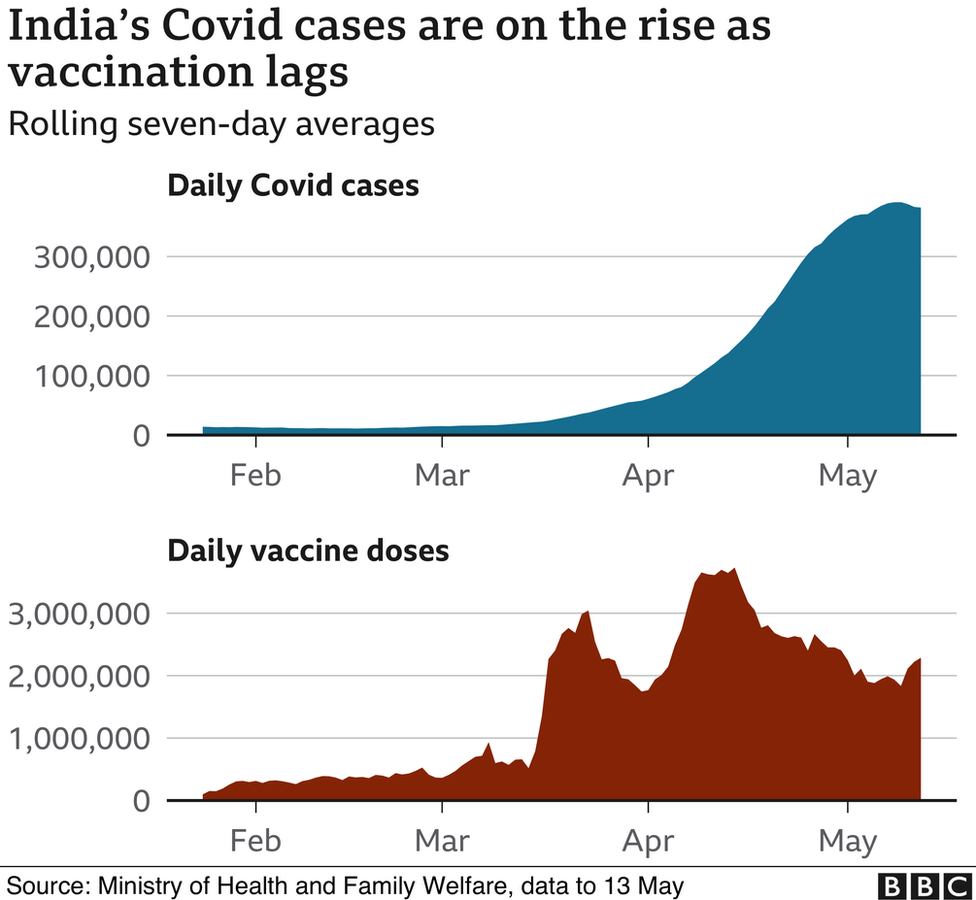
Prime Minister Narendra Modi’s federal government has opened up vaccinations for some 960 million eligible Indians without having anything close to the required supply – more than 1.8 billion doses.
Worse, the severe shortage comes amid a deadly second Covid wave and warnings of an impending third wave.
A cocktail of blunders – poor planning, piecemeal procuring and unregulated pricing – by Mr Modi’s government has turned India’s vaccine drive into a deeply unfair competition, public health experts told the BBC.
How did the world’s largest vaccine manufacturer, often dubbed the “pharmacy of the world” for generic drugs, end up with so few vaccines for itself?
A piecemeal strategy
“India waited till January to place orders for its vaccines when it could have pre-ordered them much earlier. And it procured such paltry amounts,” says Achal Prabhala, a co-ordinator with AccessIBSA, which campaigns for access to medicines in India, Brazil and South Africa.
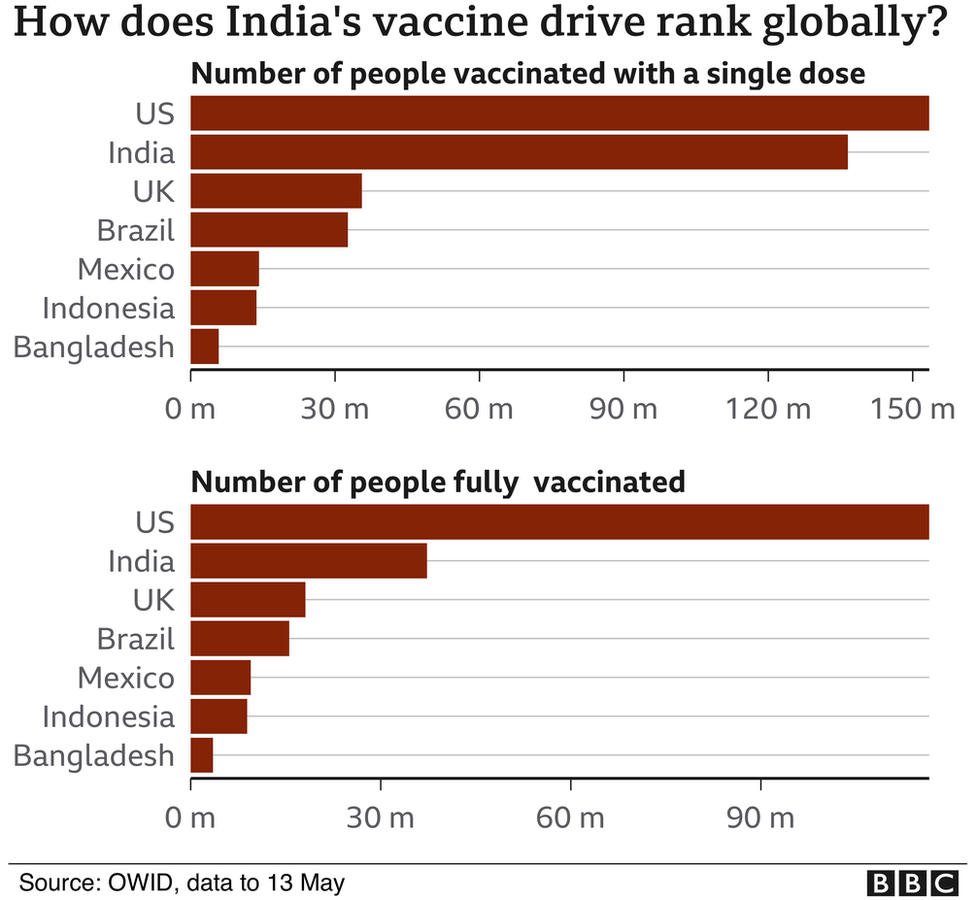
Between January and May 2021, India bought roughly 350 million doses of the two approved vaccines – the Oxford-AstraZeneca jab, manufactured as Covishield by the Serum Institute of India (SII), and Covaxin by Indian firm Bharat Biotech. At $2 per dose, they were among the cheapest in the world, but not nearly enough to inoculate even 20% of the country’s population.
Declaring that India had defeated Covid, Mr Modi even took to “vaccine diplomacy”, exporting more jabs than were administered in India by March.
Contrast that with the US or EU, who pre-ordered more doses than they required nearly a year before the vaccines became available for immunisation.
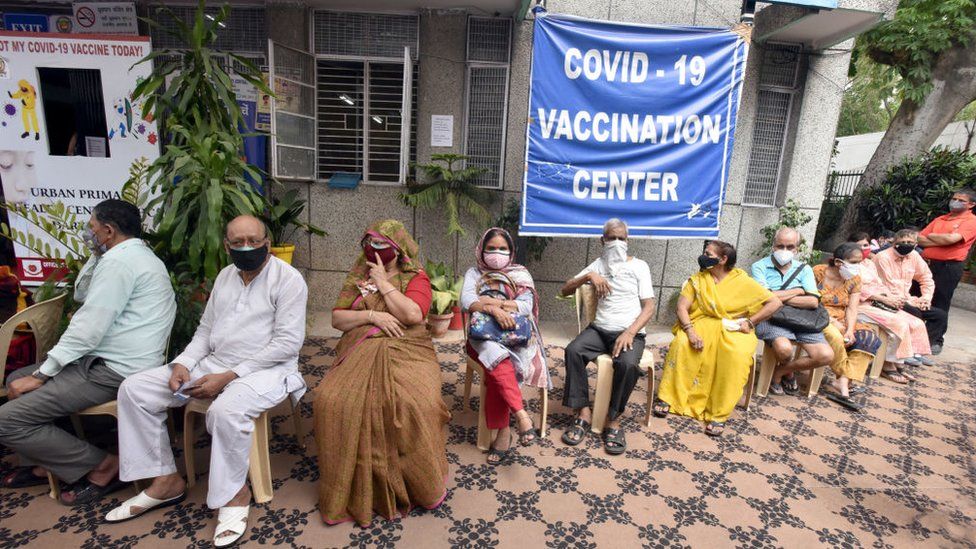
image captionSome 100 million Indians over the age of 45 are still waiting for their second jab
“This guaranteed vaccine manufacturers a market, gave them certainty to forecast supply and sales, and ensured that some of these governments got large quantities as quickly as possible, once the vaccines were ready,” Mr Prabhala says.
Unlike the US and the UK, India also waited until 20 April – well into the second wave – to extend a $610m financing line to SII and Bharat Biotech to boost production.
Another failure, according to Malini Aisola, co-convener of the All India Drug Action Network, was the decision not to enlist the vast swathe of India’s manufacturing capabilities – biologics factories, for instance, that could have been repurposed into vaccine production lines.
Again, four firms, including three government-owned ones, have only recently been given rights to make Covaxin, which is partially publicly-funded.
On the other hand, by early April, Russian developers of Sputnik V, had inked manufacturing deals with a host of Indian pharma companies, which are set to produce the vaccine.
A fractured market
As the sole buyer initially, the federal government could have held far greater leverage over pricing, Ms Aisola says.
“Centralised bulk procurement would have allowed the price to come down from $2. Instead it has gone up,” she adds.
This is because since 1 May, it has been up to individual states and private hospitals to broker their own deals with manufacturers.
Opposition parties have called it a “scam”, saying the federal government had abdicated its responsibility, opening up “debilitating competition among states”.
States have to pay double – $4 – the federal government’s rate for a dose of Covishield and four times as much for Covaxin – $8. This was after the two companies lowered prices for states as a “philanthropic gesture”. States are also competing for scarce stocks alongside private hospitals, which can pass on the costs to customers.
The result: a veritable free market for vaccines that have been developed and manufactured with both public and private funding. At private hospitals, a single dose can now cost up to 1,500 rupees ($20; £14).
Several states have now announced plans to import other vaccines from Pfizer, Moderna and Johnson & Johnson. But no manufacturer is able to guarantee supply in the next few months since richer countries have pre-ordered stocks.
Sputnik V has been approved, but it’s still unclear when the vaccines will be rolled out.
Should India’s vaccines cost so much?
Some have accused SII and Bharat Biotech of “profiteering” during a pandemic, especially after receiving public funding.
But others say they took substantial risks and that the fault lies with the government. India is the only country where the federal government is not the sole buyer, and one of the few where vaccinations are not free.
But public health experts agree that SII and Bharat Biotech need to be more transparent about their manufacturing costs and their commercial contracts.
Ms Aisola says SII needs to disclose how it spent the $300m it received from the international Covax scheme and the Gates Foundation, funding which was meant to finance vaccines for low-income countries. SII has failed to do so, partly because India banned exports. The company is also fielding a legal notice from AstraZeneca for defaulting on its promise to send 50% of its supply to low-income countries.
Public health experts are also calling for scrutiny of the Indian government’s contract with Bharat Biotech, especially since the Indian Council of Medical Research has said it “shares” intellectual property (IP) for Covaxin, which it developed along with the company. But the jab costs more – often double – than Covishield.
“They say they share IP but what sort of an agreement did they sign? Does it give them [the government] the right to override any clauses in case of an emergency?” asks Dr Anant Bhan, a public health expert.
While India has supported waiving the patents on foreign-made vaccines, it has made no move to suspend it for Covaxin.
Contrary to its international position, it has opposed suggestions from opposition leaders to invoke compulsory licensing and allow other pharma companies to manufacture the approved vaccines, saying these measures would prove “counterproductive”.
Dr Bhan agrees that at this stage it would take time to transfer technology and build capacity in other pharma companies – but he also says it’s unclear why none of this was attempted earlier.
Vaccinating even 70% of India’s 1.4 billion people was always going to be a long exercise in planning and patience. But given the country’s strong record on immunisation, it was not an impossible task, Dr Bhan says.
However, why the government chose to rely on just two companies who can now control supply and dictate prices is a question that few have answers to.
Hemasiri Perera is among the few people with
extraordinary qualities I have met in my life. He was a practising Buddhist and
I would call him a true renunciant though a layman.
I came to know Mr. Perera in Winnipeg, Canada
where he migrated with his loving wife Prema to spend their retirement with
their daughter Nirosha.
He was a student of Henegama Central College,
in the Gampaha District and was the first from this school to enter University.
His mathematics teacher in school, now living in Winnipeg, Mylvaganam
Subramaniam remembers him as a hosteller, a hardworking and well-dressed
student. We conducted a Zoom meeting with Mr. Perera on his birthday on March
13, 2021 and Mr. and Mrs Subramaniam too joined to wish him.
In 1964, he graduated from the University of
Peradeniya. As a student he was at Jayathilaka Hall. During his
university days he was an outstanding table tennis player. He was a versatile
character with multidisciplinary knowledge but as he was following subjects related
to a statistics degree, his batchmates called him Stat Perera. After
completing his degree Mr. Perera worked as an Assistant Lecturer at the
University of Vidyalankara. For a short time, he was an Economic Advisor to the
Lanka Steel Corporation.
Until his retirement, he worked as Director of
the Coconut Research Institute, Lunuwila and at the Coconut Development
Authority, Colombo. He was a consultant to the United Nations Development
Programme (UNDP) and several other UN agencies as well as quite a few countries
on behalf of the Government of Sri Lanka.
He was the author of two Sinhala books – Gami
Andarayak (Rural Anecdote) and Udella, Ma Ena Thuru Bala
Sitee (Mammoty, Waiting for Me). In the latter he illustrated the
historical and current conditions in countries such as the Netherlands, France,
England, Indonesia, India and Pacific Islands. While in Sri Lanka recently, he
was busy with trying to publish his third Sinhala book about new management
skills.
He has also published seven books in English
on the coconut industry in Sri Lanka drawn from his experience gained from his
decades within the coconut sector looking at aspects of economics, desiccated
coconut, coconut cultivation in Hambantota District, domestic marketing,
productivity and high yielding varieties. These publications and his extensive
knowledge made us identify him as a walking encyclopedia.
The Sri Lankan Association of Manitoba (SLAM)
utilised his extensive knowledge to script and train performers in a drama and
folklore performance highlighting Sri Lankan heritage. Mr. Perera’s talents
were in evidence at the grand annual event held during the Sinhala and Tamil
New Year celebrations. Sometimes he joined in singing folk songs as well. His
capabilities helped us to relive our good old memories of home and showcase our
rich culture among Canadian communities. Subsequently, he joined the Sri Lankan
55+ Seniors Group and in 2018 was elected as a Board Member. He was re-elected
to the Board in 2020.
He also joined the South Side Seniors – the
senior’s group of the Trinity United Church and was very popular among non-Sri
Lankan members too. When the co-chair of the Church Seniors Group came to know
the sad news of his passing on April 7, they conducted a remembrance service
for him.
Mr. Perera who had been in Sri Lanka for more
than one year to attend to some domestic matters, fell ill at this time and was
looked after with utmost care by his second son Priyantha. His eldest son
Channa is working in Singapore for more than three decades and is closely
associated with Ven. (Dr.) Omalpe Sobitha Nayaka Thera, Chief Incumbent of the
Bodhiraja Viharaya in Singapore. Ven. Sobitha Thera in fact visited to bless
him and conducted a Pansukulaya (Buddhist funeral service) as well.
Colombo, May 16 (Xinhua/newsin.asia/Economynext): People in Colombo and other parts of Sri Lanka are queuing up to get jabs of China’s Sinopharm COVID-19 vaccine.
As on May 16, Sri Lanka had 140,000 Covid positive cases and 941 had died.
Currently, Sri Lanka has a stock of close to 600,000 Sinopharm doses which were given free by China ahead of the World Health Organization’s approval.
Till Saturday, 348.619 first doses and 2435 second doses of Sinopharm had been administered. Only Chinese nationals had been given the second dose of that vaccine.
People fill in forms prior to receiving the Sinopham vaccine in Colombo. Photo: Tang Lu/Xinhua
Sri Lanka is expecting three million Sinopharm doses. Negotiations held with the Chinese authorities to obtain three million doses of Sinopharm vaccine have been successful and the government has made plans to commence the vaccination programmes in other provinces too as soon as the vaccines are received,” the President’s office said.
Till May 15, 350, 000 security forces personnel and frontline health workers had been given the second dose of the India-made COVISHIELD vaccine from India. Since India has expressed its inability to continue supply, the Sri Lankan government is exploring the possibility of importing its equivalent from other countries. According to official sources, a reply from these countries is expected in the next couple days.
In the meanwhile, the 15,000 doses of the Russian vaccine Sputnik V had arrived and they are being administered in the densely populated Western Province. Another 85,000 doses are expected soon, the government said.
Long queue on the roadside in Colombo to take Sinopharm vaccine. Photo: Tang Lu/Xinhua
On May 8, Sri Lanka’s Health Ministry began administering the Sinopharm vaccine to local nationals, soon after the World Health Organization (WHO) approved it for emergency use worldwide.
The vaccines were administered at the Panadura Health Office in Kalutara District, in the outskirts of capital Colombo, an area which has reported a rising number of COVID-19 patients in recent days.
Speaking at the launch of the vaccination drive, State Minister of Production, Supply, and Regulation of Pharmaceuticals Channa Jayasumana thanked the Chinese government for sending the Sinopharm vaccines to Sri Lanka and said this would add to the efforts of the Sri Lankan government to vaccinate at least 70 percent of its population against the COVID-19 virus by the end of the year.
A lady receives a jab of Sinopharm. Photo: Tang Lu/Xinhua
Today is a very special day for the Panadura MoH office. We want to thank the Chinese government as well as the WHO for approving the Sinopharm under emergency use. Today we began administering the Sinopharm in the Panadura area and want to thank President Gotabaya Rajapaksa for approving to start this program from the Kalutara district,” Jayasumana said.
State Minister of Primary Health Care, Epidemics and COVID Disease Control Sudharshani Fernandopulle, also said at the launch of the vaccination drive that with the WHO and the National Medicines Regulatory Authority (NMRA) approving the Sinopharm vaccine under emergency use in Sri Lanka, authorities will now look to get more vaccines from China to vaccinate the local population.
Today we began administering the Sinopharm vaccine in the Panadura Health office for locals above the age of 30 years and below the age of 60 years. From tomorrow we will also identify the areas which have reported the highest number of COVID-19 patients in recent days and will begin to administer the Sinopharm vaccines in those areas as well,” Fernandopulle said.
She said some of the areas worst affected by the COVID-19 virus were Colombo, Kalutara, Gampaha, Kurunegala, Kandy, and Matale, and authorities were making arrangements to vaccinate the people in these areas as soon as possible.
The best way to protect yourself from the COVID-19 virus is to vaccinate the people and this government led by President Gotabaya Rajapaksa is aiming to vaccinate the population in Sri Lanka as soon as possible,” Fernandopulle said.
The President is confident that Sri Lanka will be able to successfully manage the current situation through vaccination, similar to the successful results achieved in the United States, the United Kingdom and a number of European countries through vaccination,” a statement from his office said.
Sri Lanka’s COVID-19 death toll saw an uptick today (May 16) as the Director-General of Health Services confirmed 21 more victims.
As per official data, new fatalities have moved the total to 962.
The deaths were reported from Anuradhapura, Motaruwa, Mirigama, Nebada, Badulla, Bulathsinhala, Imaduwa, Muruthgahamula, Ingiriya, Gelioya, Jaffna, Handapangoda, Habaraduwa, Emibilipitiya, Nakiyadeniya, Galle, Kadawatha, Mahaiyawa, Hali-Ela and Kalutara South areas.
Among the deceased is a 37-year-old from Badulla. He had been transferred from Bandarawela Hospital to General Hospital in Badulla where he died today due to septic shock with multiorgan failure, COVID pneumonia, pulmonary edema and diabetes.
COVID pneumonia was identified as a cause of death of majority of the victims, according to reports.
The Epidemiology Unit of the Health Ministry reported that 543 more persons have tested positive for COVID-19 in Sri Lanka on Sunday (May 16), as the daily count of new cases moved to 2,275.
According to the Government Information Department, 2,212 of the new cases reported today are associated with the New Year coronavirus cluster. The remaining 63 were identified as arrivals from foreign countries.
This brings the total number of confirmed cases of coronavirus reported in the country to 142,746.
As many as 118,322 recoveries and 962 deaths have been confirmed in Sri Lanka since the outbreak of the pandemic.
Epidemiology Unit’s data showed that 23,462 active cases are currently under medical care.
A request has been made to prioritize Divisional Secretaries, Divisional Staff Officers, Samurdhi Development Officers, Agriculture Officers, and Grama Niladharis in the country’s COVID-19 vaccination drive.
Speaking to the media in Dambulla today (16) the Minister of Public Services, Provincial Councils, and Local Government Janaka Bandara Tennakoon stated that he had made a written request to the Minister in charge of the subject.
He further says that under the current situation in the country, the aforementioned officers do a great service whilst taking risks.
Meanwhile, the All Ceylon Government Medical Officers’ Association has also written to Health Minister Pavithra Wanniarachchi urging her to put an end to all political influence that violates the priorities in administering the COVID-19 vaccine.
General Secretary of the Association, Dr. Jayantha Bandara says that family members – at least those who live in the same house – of all health staff should be considered as risk groups and prioritize in the vaccination process.
He further says that the COVID-19 vaccination program in Sri Lanka has become a highly corrupt operation with various interventions.
Dr. Bandara added that politicians, as well as high officials, are using their powers to vaccinate their relatives and friends outside the priority lists.
When
the first Israeli airstrike hit Gaza on Monday nine children and 13 others were
killed, according to Washington Post. (Monday 10, May, 2021). By
Saturday the death toll had risen to over hundred and 33 of them were
children. Simultaneously, Taliban bombs exploding in Kabul on Tuesday killed 85
Muslim school girls, according to CNN. What’s the
difference? How can we condemn the Israelis when the Muslims are committing the
same crime of killing Muslims? Can Muslim violence descend to a more
inhuman level than in Kabul? In Africa? In Sri Lanka?
How
can we condemn the Israelis when our own Tamils committed the biggest
crime of their history : they killed more Tamils than all the others put
together? How can we condemn the Israelis when the Sinhala terrorists in
the fascist JVP showed no mercy in killing the Sinhalese? One has to
expect beastly behaviour from the enemies but not from your own kind. In moral
metrics, the crime of Muslims killing Muslim children is greater than the
Israelis killing the children of their inveterate enemies. This principle
applies to Tamils and Sinhalese as well.
This
is written not to exculpate the Israelis of their heinous crime of
deliberately killing civilians to punish Hamas sending rockets to Jerusalem.
Those who watched the Israeli airstrikes bringing down civilian high-rise
buildings where civilians, including children, live will agree that Benjamin
Netanyahu, Prime Minister of Israel, has been and continues to be a
cold-blooded killer. The Jews who were the victims of ethnic hatred throughout
Christendom – just not under the Nazis — have no moral right to engage in
war crimes, crimes against humanity and, specifically, crimes against
another ethnic community. They were victims who suffered continuously in Christian
Europe because the Christians hated the Jews as Christ-killers.
The
irony is in the way the Jews have turned their wrath against the Muslims who
are not guilty of such crimes against the Jews and with whom they
have to live in the Middle East, particularly in Palestine, whether
they like it or not. Ethnic crises invariably remind us of the central
issue that is plaguing global politics: how can communities competing for
territory, power, dominance, equality, dignity, justice, liberty etc., co-exist
peacefully? Invariably it boils down to a minority vs majority issue. Is
there a recipe to resolve the tensions and conflicts between these two
competitors? Each zone of conflict comes with causes and personalities specific
to its time and place. History repeats itself in each case but with variations.
As
for Netanyahu, the Prime Minister of a minority that became a majority, is
going down the same path of the Nazi majority that oppressed and persecuted his
minority when they were living in the holocaustic past. Of course, he is
displaying not his power but the power of his ally, America. American
morality stinks to high heaven when it says that Israel has right to
defend itself. Does that right include killing children and non-combatant
housewives indiscriminately? Also, why didn’t America apply the same principle
to Sri Lanka? Why did Ambassador Robert Blake ask the Rajapakse regime to stop
the war or face charges of war crimes? Will the American ambassador in
Israel apply the same bullying tactics to restrain Netanyahu? Besides, why is
it vindictively pursuing a policy of punishing Sri Lanka for restoring
peace and ending a brutal war saving thousands of lives? Why hasn’t the foreign
minister of France and UK jointly rushed to Tel Aviv to stop the war like the
way they did when the Sri Lankan forces were at the gates of the Tamil
Tigers? Why is Israel, condemned umpteen times by the UN and yet face no
serious consequences? Why is Israel given favoured treatment and why is
Sri Lanka given the middle finger by the US? Is American foreign policy driven by
morality or by stupid — not enlightened — self-interest?
In
all this what is most unbearable and heart-rending is the plight of the
children. Why must children pay for the sins of the adults? Why must children
be abducted from schools in Africa by Muslim terrorists? Why did the
Tamil terrorists too go to the extreme of forcibly abducting Tamil children and
throwing them as fodder into the frontlines of their futile war? Pakiasothy
Saravanamuttu, that vexatious litigant, never took the Tamil leadership
to court holding them accountable for committing war crime
and crimes against humanity. The paper Tigers in the Tamil diaspora are
passing resolutions of genocide in Ontario, accusing the GOSL, when the killer
of the greatest number of Tamils was the leader they backed all the way. They
financed the biggest massacre of Tamils by Tamils.
The
genocide of Tamils is unacceptable. But that was committed by the Tamil Pol
Pots with the consent of Tamil diasporans who financed it from the beginning to
Nandikadal. Boosted by the backing of the Diaspora, Tamil Pol Pots ran berserk
with blind hatred of the other”. They began by decimating the established,
conservative Tamil leadership and unable to face the horror of it the Tamil
diaspora the Tamil diasporans have accused the Sinhala state” of killing
Neelan Tiruchelvam and even Appapillai Amirthalingam. They also financed the
massacres of Muslims and Sinhalese. They knew that S. C. Chandrahasan,
the son of S. J. V. Chelvanayakam had said that Prabhakaran had killed more
Tamils than all the others put together. V. Ananadasangaree, the head of
the TULF, too had confirmed that Prabhakaran had killed more
Tamils than anyone else. And now that their guilt has caught up with
them, after losing the war they financed, they are making a desperate bid
to wash their guilt away by passing the buck to the Government of Sri
Lanka (GOSL.)
Muslims
targeting their co-religionists in divided sects, or perceived enemies like the
Christian worshippers on Easter Sunday 2019 in Sri Lanka, too are driven by
blind hatred which knows no limits. In their minds killing is pathway to
heaven and virgins therein, waiting to open their legs. Killing is
pursued as a signature sign of their prowess to dictate terms to their enemies.
It is a mindless strategy that has taken them nowhere, so far. For instance,
where has it taken them in Sri Lanka except into the bad books of the nation?
They have successfully degraded the respected the word Muslim” into the
equivalent of Tamil Tigers – a dirty word.
Killing
because they have money to buy the wherewithal and mobilise fanatics willing to
kill or die in the process of killing is not a tactic that will deliver
them their caliphates or glorify Islam. Glorification of Islam with territorial
conquests is a thing of the past. Israel too is employing
this tactic. The latest explosion in Palestine was caused by the
far-right Jewish activists moving to capture Sheik Jarrah, the territory
occupied by the Muslims in Jerusalem. They were out to evict the Arabs
forcibly from East Jerusalem in the hope of making the whole of Jerusalem
their capital, freed from Arabs. It is pure ethnic cleansing. It is
unacceptable. It is unpardonable. They became the Wandering Jews because
they had no home, or territory to call their own. Now that they have some
territory, they are doing to the Arabs what the Christians did to them. How
fair and just is that?
Once
I spent one night in the kibbutz of Kiryat Shmona. In the morning my
Jewish escort told me, pointing. quite proudly, to the open fields
without any people, that the Jews opened fire on the fellaheen who were
farming in the neighbourhood and drove them away. The Jews then
took over their lands. Well, that is similar to the expulsions of the
Muslims from Jaffna by the LTTE in 1990. The Muslims did not go to Maldives, or
Saudi Arabia. They came to live with the Sinhalese in the south – and they
still do.
This
is not an essay to explore the whole gamut of the ethics of violence. Dayan
Jayatillleka has made a daring attempt to do so in his book Fidel’s
Ethic of Violence, exploring, as he says, the moral dimensions of
the political thoughts of Castro. That, of course, needs a
separate chapter on another day. But this theme of violence being
played out in Palestine right now opens the opportunity to explore some
aspects of the violence that had rocked Sri Lanka in the
post-independent period and even before because it is a theme exploited by the
intellectuals to add fuel to fire with their tendentious theories and partisan
politics. It has been a very controversial issue in which some schools of
thought have identified only one party — namely, the
Sinhala-Buddhists — and flayed them as the sole provocateur, promoter,
perpetrator and pursuer of violence. The general argument of these schools goes
like this: Sri Lanka is a Buddhist country and why is there so much
violence in it? It is this question that launched
the controversial book from Harvard University written by Prof. S. J.
Tambiah, Buddhism Betrayed? Religion, Politics and Violence in Sri
Lanka.
Coming
with the imprimatur of authoritative Harvard it had a clout which other
public intellectuals did not. It was to be the definite reference point for
other scholars and they did fall for the anti-Sinhala-Buddhist line spelt
out by Tambiah. By the time he wrote his text demonising Sinhala-Buddhist
history and culture, there was nothing original in his selected theme. The
original authorship of demonising Sinhala-Buddhist culture goes to G. G. Ponnambalam
who caused the first ethnic conflagration in 1939 with his crude
denunciation of Sinhala-Buddhist culture. All Tamil politics and ideologies
operated within the framework laid down by him. No Tamil ideology
operated outside his triad of (1) demonising Sinhala-Buddhist
culture (2) demanding disproportionate territory and power and (3) crying their
heads out, claiming to be victims of majoritarianism. Tambiah too adhered
to this pattern. In other words, he fell in line with the anti-Sinhala-Buddhist
politics of the NGOs, left-wing academics, and the applauding Tamil claque. He
was aided and abetted by Lal Jayawardana and his wife Kumari Jayawardana,
the inveterate anti-Sinhala-Buddhist academic. Lal Jayawardana, who was
then the head of the World Institute for Development Economic
Research (WIDER) of the United Nations University rewarded Tambiah
handsomely, with funds from WIDER.
Tambiah
did a cheap job which any sophomore could have done. Putting together
anti-Sinhala-Buddhist data was not a difficult task considering the fact that
most of the research was done for him partly by Kumari Jayawardana
and her fellow-travellers like H. L. Seneviratne and C. R. de Silva. They saw a
Sinhala-Buddhist under every bed waiting to spoil their political honeymoons.
Everything went wrong, everything that failed was blamed on Sinhala-Buddhism.
Here’s what a fairly competent historian like Nira Wickramasinghe wrote about
the failure of the Left movement: The trajectory of the left, as movement and
as idea, can also be read as the gradual decline in
ideological terms of a democratic and secular project unable to sustain
the assault of the hegemonic forces of Sinhala Buddhist
exclusivism.” — Pathways of the Left in Sri Lanka, Marshall
Fernando and B. Skandakumar, Editors.
This
ignores the basic fact that the Left died of self-inflicted wounds. The
splits that divided the Left into micro-mini fragments on fake
theoretical differences, which, in reality, were masks to cover the
self-serving power struggles of the aspiring leaders, were one of the
primary bases that led to the collapse of the Left. The working class too
were led astray with strikes of rival unions that were politically oriented
more than feeding the economic needs of the
workers. Marxist leaders were hoping to
climb into power on the back of the workers. Their revolution was
confined to paralyse elected governments with strikes. In the end the
Marxists joined the very capitalist class they condemned. They misled the
workers from the beginning. The promised revolution never came and when
the perverted version of the revolution came through the fascist
JVP the Marxist fathers of the Revolution condemned it as a CIA plot. When the
revolution came they were hanging on to seats in the SLFP cabinet
and they were naturally inclined to protect their ministerial
position than the revolution. The people disillusioned with their
alliance with the capitalist class threw them out lock, stock and barrel. But
our Left-wing intellectuals, wearing tinted glasses, blame it on the hegemony
of Sinhala Buddhism”.
Demeaning
and demonising the majority has been the standard stock in trade of our public
intellectuals. It was not so all the time. There was a time in the pre-Vadukoddai
Resolution period when some leading Tamil theoreticians recognised the value,
power and glory of Sinhala-Buddhism. Prof. A. J. Wilson, for instance,
commended Sinhala-Buddhism as the force that sustained democracy. It
was Calvin Woodward, an
American scholar, in his review of Wilson’s book, Politics in Sri
Lanka, 1947 – 1973, states: The uniqueness of Sri Lanka, Wilson
points out, is that it (Sri Lanka) has faced challenges without veering from
the democratic path. Certainly then, the key to the future lies in
an understanding of the past. How and why, in other words, has the democratic
experiment been able to work so well in Sri Lanka? The author investigates this
and concludes that the political stability so far maintained in Sri Lanka
is due mainly two factors, one of indigenous origin and the other the result of
Western implantation. Primary is the Buddhist ethos and the doctrine of
tolerance. This, according to Wilson, has acted to dissuade the majority
community from unduly imposing itself on the minorities and encouraged it to
respect the fundamental rights and distinctions of others in the plural
society.” (p. 72 – The Ceylon Journal of Historical and Social
Studies – Vol III, July-December, 1973, No.1.)
But he too flipped. He too later joined the mob and blamed
Sinhala-Buddhism as a force inimical to minorities, peace and progress. Another
one who somersaulted was Prof. K. Indrapala, the first professor
of history in Jaffna University. He obtained his Ph. D by writing a
thesis on history in which he acknowledged that the Jaffna settlers
arrived in 12 – 13th centuries from S. India. This was
not acceptable to the Tamils who claimed in the Vadukoddai
Resolution – the most authoritative political manifesto of the Tamils –
that they were there from the dawn of time. He was virtually
chased out of the Jaffna University. He later attempted to make amends by
producing another history in which the Tamils go back to
prehistoric times.
They were re-writing history according to the needs of contemporary
politics and not according the way it happened. History has been an
explosive force both in Sri Lanka and Israel. For instance, the move to evict
the Arabs by far-right Jews began when the courts declared
that the land occupied by the Arabs in Sheik Jarrah belonged
to the Jews before 1948. Disentangling the knotted threads of history is
not an easy task even to the courts or the experts.
History looms large in politics. Netanyahu’s military manoeuvres are aimed
at erasing the history of the Arabs and make Jerusalem the
exclusive capital of the Jews. Each move he makes is also to
diminish the two-state solution for the two communities. Inch by inch
he has been gaining ground. Donald Trump gave him the greatest gift
that any Jew could expect : Jerusalem as their capital. Now the far-right
Jews are moving to clean up the whole city. They are bent on ethnically
cleansing Jerusalem to make it the exclusive sacred city of the Jews.
The
Palestinians have been retreating reluctantly and helplessly accepting
each gain of the Israelis as the new normal. The two-state theory too is
diminishing its force. Israel has succeeded in normalising relations with a
string of Arab states to the dismay of Palestinians. Trump
administration did the backdoor work to strengthen Israel’s position in the
Middle East. The emerging scenario is not the most positive for the
Palestinians. They end up getting the worse end
of the deal with each military offensive. Their misery increases. So,
does the glory of Israel. To be an Arab in Israel today is like being an insect
in one of Kafka’s novels. It is nightmarish, humiliating and
positively oppressive. Muslims in Sri Lanka should go down on their
knees and thank God that they are not in Israel, in particular
Jewish-occupied Palestine.
The hype around scariants” is overblown. But we also shouldn’t be too complacent.
On May
10, the World Health Organization added a new virus to its list of covid-19
variants of global concern. The variant, B.1.617, is being blamed for the
runaway infections in India. It is the fourth addition to a list that also
includes variants first identified in the UK, South Africa, and
Brazil. There is some available information to suggest increased
transmissibility,” said Maria Van Kerkhove, WHO technical lead on covid-19, at
a briefing.
With each new variant comes growing unease. News stories about double mutants” and
dangerous variants” stoke fears that these viruses will be able to evade the
immune response and render our best vaccines ineffective, sending us back into
lockdown. But for the moment the virus hasn’t fundamentally changed,” says
Kartik Chandran, a virologist at Albert Einstein College of Medicine.
Vaccines may become less effective over time, but there’s no
evidence that we’re on the brink of catastrophe. I don’t think that there’s an
imminent danger that we’re going to go back to square one,” says Thomas
Friedrich, a virologist at the University of Wisconsin School of Veterinary
Medicine. We should be concerned, but not freaked out.”
Here are five reasons why we can be cautiously optimistic.
1. Vaccines work, even against troublesome variants
Early reports suggested that the current crop of covid-19
vaccines might not work as well against some of the variants, including the one
first identified in South Africa (B.1.351). In lab
tests, antibodies from vaccinated individuals couldn’t neutralize the virus as
effectively as they could the original virus. But real-world data out of Qatar suggests that the Pfizer vaccine works quite well,
even against B.1.351. Full vaccination offered 75% protection against
B.1.351 infections; that’s less than the 95% efficacy reported in the trials
for the original virus but still a miracle,” says Andrew Read, a disease
ecologist at Pennsylvania State University. These vaccines are so good. We’ve
got so much room to play with.”
Some
variants do seem to be better at dodging our immune system, at least in lab
experiments. For example, a small study posted on May 10 shows
that the newest variant of global concern — B.1.617— is more resistant to
antibodies from people who have been vaccinated or have previously been
infected. Despite that, all 25 people who had received shots from Moderna or
Pfizer produced enough antibodies to neutralize the variant.
2. The immune response is robust
Scientists
testing vaccine efficacy often focus on antibodies and their ability to block
the virus from infecting cells. In lab experiments, they mix blood from people
who have been infected or vaccinated with cells in a dish to see if antibodies
in the blood can neutralize” the virus. These experiments are easy to
perform. But antibodies are a very narrow
slice of what the immune response might be” in the body, says Jennifer Dowd, an
epidemiologist and demographer at the University of Oxford.
Immune cells
called T cells also help keep infections in check. These cells can’t neutralize
the virus, but they can seek out infected cells and destroy them. That helps
protect against severe disease. And data from people who’ve had covid-19
suggests that T-cell response should provide ample protection against most of
the SARS-CoV-2 variants.
3. When vaccinated people do get infected, the shots protect
against the worst outcomes
A vaccine that can block
infection is wonderful. But the most important thing is to keep people out of
the hospital and out of the ground,” says Friedrich. And there’s good evidence that the current vaccines do exactly
that. In South Africa, one dose of the Johnson & Johnson vaccine provided 85% protection against
covid-19-related hospitalizations and deaths. At the time, 95% of cases were
caused by the B.1.351 variant. In Israel, where
B.1.1.7 has become the dominant strain, two doses of Pfizer offered 97%
protection against symptomatic covid-19 and hospitalizations linked to
covid-19.
4. The same mutations keep popping up
Once
the virus enters a cell, it begins to replicate. The more copies it makes, the greater the likelihood that random
errors, or mutations, will crop up. Most of these copying errors are inconsequential.
A handful, however, might give the virus a leg up. For example, a
spike-protein mutation known as D614G appears to help transmission of
SARS-CoV-2. Another, E484K, might help the virus evade the body’s antibody
response. If the viruses carrying these advantageous mutations get transmitted
from one person to the next, they can start to outcompete the viruses that lack
them, a process known as natural selection. That’s how the B.1.1.7 variant,
which is more transmissible, became the predominant strain in the US.
In the case of SARS-CoV-2, the mutations that improve the
virus keep popping up in different parts of the globe, a phenomenon known as
convergent evolution. We are seeing the same combinations evolving over and over
and over again,” says Vaughn Cooper, an evolutionary biologist at the
University of Pittsburgh. Imagine a game of Tetris, Cooper writes in a recent story for Scientific
American. A limited number of building blocks can be assembled
in different ways, in different combinations, to achieve the same winning
structures.”
Cooper and
some other researchers see this evidence of convergent evolution as a hopeful
sign: the virus may be running out of new ways to adapt to the current
environment. It’s actually a small deck of cards right now,” he says. If we
can control infections, that deck of cards is going to remain small.”
5. If the effectiveness of the vaccines begins to wane, we
can make booster shots.
Eventually, the current vaccines will become less effective.
That’s to be expected,” Chandran says. But he expects that to happen
gradually: There will be time for next-generation vaccines.” Moderna has already begun testing the efficacy of a
booster shot aimed at protecting against B.1.351 (first identified in South
Africa). Last week the company released the initial results.
A third dose of the current covid-19 shot or a B.1.351-specific booster
increased protection against the variants first identified in South Africa and
Brazil. But the new variant-specific booster prompted a bigger immune response
against B.1.351 than the third dose of the original shot.
That’s
a relief for a couple of reasons. First, it demonstrates that variant-specific
boosters can work. I think the feasibility of these RNA-based vaccines to
produce boosters is the achievement of our lifetime,” Cooper says.
But there’s another, more obscure reason to celebrate these
early results. Some researchers have worried that a booster shot aimed at one
of the variants might amplify the immune response against the original virus
instead. This phenomenon, known as original antigenic sin, sometimes occurs
when the body is exposed to a virus that is similar, but not identical, to one
it has already encountered. This can happen with repeated influenza exposures.
It can also occur in response to vaccination. So the fact that the Moderna
booster worked better than a third shot of the original formula provides some grounds
for optimism that antigenic sin won’t be as much of a hurdle in fighting
SARS-CoV-2.
New trials on mixing different types of vaccines are
underway. Could vaccine
combinations help stop variants from bypassing our immune systems?
But while we don’t need to panic, now is also not the time
for complacency. Just because the current crop of variants seems to be
relatively tame doesn’t mean every new variant will be. The odds are that
we’re going to see a lot more of the same kinds of thing that we’ve already
seen,” Chandran says. But very rare things can happen and do happen,” he adds.
And if those rare things confer a tremendous improvement in success, they may
only need to happen a couple of times.”
The surge in India is especially
concerning. That’s giving the virus a lot of chances to pull the evolutionary
slot-machine handle and maybe come up with a jackpot,” Friedrich says. And
while vaccine rollout has been going well in many rich countries, poorer
countries may not have widespread access to vaccines until 2022 or even later.
We have these amazing vaccines,” Chandran says. We need to figure out a way
to get them to everybody.”
Hazrat Mirza Masroor Ahmad calls on Muslim nations to
show a united front and to stand against the cruelties and injustices being
perpetrated on the Palestinians
The World Head of the Ahmadiyya Muslim,
Community, the Fifth Khalifa (Caliph), His Holiness, Hazrat Mirza
Masroor Ahmad has strongly condemned the cruelties being perpetrated upon the
Palestinian people by Israel during his Eid-ul-Fitr Sermon delivered on 14th
May 2021.
Speaking from
the international headquarters of the Ahmadiyya Muslim Community, at the
Mubarak Mosque in Islamabad, Tilford, His Holiness condemned the use of unjust
force inflicted in recent days by the Israeli State against Palestinians and
their attempts to evict Palestinian families from their homes in Sheikh Jarrah.
Hazrat Mirza Masroor Ahmad said:
Today, we must sincerely pray for the
Palestinian people who are currently being subjected to grave cruelties. In
recent days, when they went to pray in the Al Aqsa Mosque they were brutally
attacked and beaten by the state authorities. Similarly, they are being forced
out of Sheikh Jarrah, a small neighbourhood, which is their own land.”
Hazrat Mirza Masroor Ahmad continued:
The (Israeli) police are using tear gas
and bullets and now airstrikes have started. They say they are targeting their
enemies and militants but in reality, horrific and unjust cruelties are taking
place and innocent civilians are being attacked. There have also been media
reports that that the Israeli police have denied wounded people access to
medical aid and treatment.”
Praying for the Palestinians, Hazrat Mirza Masroor Ahmad said:
May Allah have mercy
on the oppressed and may He bring the oppressors to justice.”
His Holiness also spoke of how the United States State Department
had thus far failed to condemn the killings of nine innocent children on Monday
by Israeli airstrikes. Since then, many more innocent Palestinians had been
killed.
His Holiness referenced reports published by Human Rights
organisations including Human Rights Watch and Amnesty International highlighting the
discriminatory policies and cruel treatment inflicted upon the Palestinian
people.
His Holiness also referred to media reports describing the current
situation.
Hazrat Mirza Masroor Ahmad further said:
An article in the Israeli newspaper
Haaretz states: ‘This is the unique version of justice that is practiced around
here: What’s mine is mine forever, and what’s yours – is also mine forever.’
This is exactly how the rights of the Palestinians are being usurped. May Allah
the Almighty have mercy upon them. This Eid (Ramazn Festival) has brought
mountains of grief, rather than joy for the Palestinians. May Allah transform
their grief into joy and may they be able to live their lives in peace and
serenity.”
Hazrat Mirza Masroor Ahmad continued:
May the Palestinian people
find leaders who can guide them in the right way. Certainly, Muslim countries
should come together and play their role to protect the Palestinians and other
Muslims who are being oppressed in the world. However, the Muslim world is
divided and there is a complete lack of unity amongst the Muslim nations.
Certainly, in this instance, the Muslim countries have failed to show the
reaction they ought to have. They have given weak statements, whereas if they
had all come together and given a united statement it would have had far
greater impact and carried much more weight.”
Concluding, Hazrat Mirza Masroor Ahmad said:
May Allah grant sense and wisdom to the
Muslim leadership. May He also give sense to the Israelis that they may refrain
and withdraw from their injustices. Further, may Allah guide the Palestinians
who are suffering from a lack of leadership if there is any injustice from
their side – though in reality, this is not the case. If they (the
Palestinians) are using sticks they are being subjected to heavy missiles and
sophisticated weaponry, which is something I have mentioned before as well.
There is no comparison in terms of the force being used by both sides. We must
therefore pray for the Palestinians. May Allah the Almighty better their situation
and create the means for their freedom and may they continue to hold on to
their rightful places and land that were allotted to them in the initial
treaty.”
His Holiness also reminded Ahmadi Muslims to pray for the wider
world during his Eid sermon and said that they should pray for all needy people
in the world and those being subjected to injustices.
Colombo, May 15 (Bloomberg) – Sri Lankan government debt is leading gains in Asian dollar bonds this year as investors bet that the nation will avoid defaulting on its short-term notes, with the help of a Chinese funding facility.
Italian investment manager AcomeA SGR S.p.A., which added to its holdings of the nation’s debt securities last quarter, sees the bonds as continuing to offer attractive yields, even if most of the gains have already been made.
The Sri Lankan notes have returned 15% this quarter, extending year-to-date gains to 25%, the best performance for any Asian nation’s U.S. currency debt in 2021, a Bloomberg Barclays index shows. They lost 31% last year, the worst showing in the region.
Sri Lanka received a $1.5 billion currency swap line from China in March that eased fears over the government’s ability to pay its debt after having been cut deeper into junk in 2020 by S&P Global Ratings and Moody’s Investors Service. The nation, which is struggling with a resurgence in Covid-19 cases that threatens its tourism industry, has at least $2.5 billion of dollar notes maturing before the end of July 2022, including a $1 billion bond due in a little over two months.
The yield on that debt security is indicated around 16%, while a July 2022 note offers 20%, according to data compiled by Bloomberg.
Given the latest improvement in the short-term liquidity conditions, we prefer to hold the shorter-end tenors,” said Piero Cingari, fixed-income strategist in Milan, who helps manage 2.9 billion euros ($3.5 billion) of assets at AcomeA.