The Ministry of Health says that a decision has been taken to conduct at least 15,000 polymerase chain reaction (PCR) tests per day in the country.
The decision was taken at a meeting of the Special Review Task Force of the Health Ministry, held under the patronage of Minister Pavithra Wanniarachchi.
Three individuals who had received the Oxford-AstraZeneca COVID-19 vaccine in Sri Lanka have died of blood clotting, Minister of Health Pavithra Wanniarachchi told the Parliament today (April 21).
In response to a question raised by Opposition Leader Sajith Premadasa, the Health Minister stated that Sri Lanka has reported a total of six cases of blood clotting among those who were administered the AstraZeneca jabs.
Several countries including Norway, Thailand, Austria and Iceland temporarily suspended the rollout of AstraZeneca vaccine, but have now resumed the procedure. Meanwhile, Denmark recently announced that it would permanently stop administering AstraZeneca jabs.
Speaking further, Minister Wanniarachchi stressed that according to the health experts of the World Health Organization no direct links between the AstraZeenca vaccine and blood clotting have been found.
As per the estimates, blood clotting incidents were reported only in 4 – 6 people per million, the Health Minister added.
She went on to note that the World Health Organization has approved the administration of AstraZeneca vaccine.
The government has introduced a special 24-hour hotline (0112 3415989) for the members of the public to inform the authorities if they are suffering from any discomfort or side-effects after receiving the vaccine, Minister Wanniarachchi added.
Before
start work in Colombo Port City, I published several articles explaining how it
positively impacts the economy of Sri Lanka. The concept of port city
development has been attracted in many countries and some are successful others
are not successful as expected. Sri Lanka needs to invent new strategies for
its development and growth and, the port city may be one that could be
successfully used with many limits.
Before beginning it was a dream when it graduating a reality many
antagonisms emerged with different political opinions and unknown forces and
motives. When looks at many criticisms
of different personnel it shows that people have no good understanding of the
concept many are groping in dark. The highest risk associated with the concept
of the port city is economic socks which may come from internally or externally
in the future due to various reasons especially economic reasons. The government of Sri Lanka must plan how to
absorb socks and otherwise, the entire country may relegate to obscurities or
it may be a colony of bondholders. Many critics have not clearly explained this
situation people to understand.
The
Colombo Port City development should be in the way how Hong Kong had been
developed under British rule. Investors might not interest in the negative
attitudes of some people. The priority of investors in the port city will be
returns for the investment and the government needs developing policies for
satisfying investors. Some people may have an opinion that investors should
donate money, it would not happen. If
the government attempts to satisfy opposition it would not be an economic
development project and it should be a social service project.
Hong
Kong project had many features and even money laundering activities may have
befallen as a result of development and it is difficult to implement a project
which purely associates with saints’ activities. The administration process
needs to develop sharp teeth control malpractices. The opposition critics have
not questioned the control process and its strength the preventing malpractice.
However, the government has no purpose
to devote the project money laundering purposes, and when the project
monitoring if it identifies money laundering activities the government can
cover loopholes through amending legislation. This is the general practice in
the world.
The
other vital aspect is the government should plan to retire the debt burden
using the benefits of the port city and a higher rate of revenue generated from
the city must use for investment in the rural economy. People have no idea about has the government
planned for these purposes and as long as the government hides its plan the
port city will be a talking point of opposition and other analysts. The concept
of a port city should not give a negative message to people and it needs support
from people. When it looks at the history of Hong Kong’s development it cannot
find information that Chinese people had been considering the points that
opposition is looking at now in Sri Lanka. The attitudes of Sri Lankans are
criticizing matters that are unknown to them rather than studying points. Criticisms
are seeming to be assumptions, but not realities. The reality of the Colombo
Port city project could be known after five years. People must understand that
there is a global competition to attract investment and those who give more
encouragements to investors they would choose to invest.
The
most significant aspect of the project is what is the projected revenue and how
it planned to spend the revenue. This
information has not been presented to the public. According to my views, 25% of
revenue should be invested in rural infrastructure development, and 50% of
revenue must use to increase the volume of foreign reserves of Sri Lanka. If
75% of revenue will be generated from the project uses for the two areas it
would support solving structural problems of the country. The balance of 25% could be used to retire
debt. If this way uses the revenue from the project the Colombo Port City would
generate positive outcomes for Sri Lanka.
Compared
to many projects in the world, the Colombo Port city project is tiny and it is
opening the economy outside. Total employment opportunities would be generated
might be less than 25000 and it will not be a massive project that will be the
solution to all economic problems of the country. As it is reported that the
economic growth of China would be more than 15% in this year there is no doubt
the Chinese economy will be double within five years and Sri Lanka should
attract more benefits from Chinese growth and it should work like Taiwan to
strengthen the economy.
India
and Western countries may not like this vision and they aren’t like to possible
changes incur to Sri Lanka with the support of China and they may have
displeased toward Sri Lanka. However, the Colombo Port City Project will be
beneficial to India where can accommodate project supports and other services
such as exports to Sri Lanka. Therefore, India must look at the port city
development project as an indirect incentive for the country.
April 21, 2019 is destined to be marked as a date which will
live in infamy.
Paraphrasing President Franklin D. Roosevelt when he
delivered the famous infamy speech on December 08, 1941 soon after the attack
on Pearl Harbour by Japan,,
posterity may well designate April 21, 2019 as the
Blackest day and the ‘ Pearl Harbour’ moment in the contemporary history of Sri
Lanka.
A total of 267 people were killed, including at least 45
foreign nationals,three police officers, and eight bombers, and at least 500
were injured. Three churches and three luxury hotels in Colombo were
targeted in a series of coordinated Islamist terrorist bombings.
This is the Second Death Anniversary of the biggest mass murder
on a single day in Sri Lankan History. It should be a day of reflection for
everyone living in this country and everyone of Sri Lankan origin living
overseas.
Where did we go wrong? How did this happen? are searching
questions many will ask.
It was a watershed moment. Those who had lived on a diet
of Multi- culteralism and Reconciliation, especially the security
forces were deluded to drop their guard and encouraged to do so by the
country’s top political leaders eternally greedy for the votes of the country’s
ethnic and religious minorities.
For Reconciliation to succeed there must be sincerity between
the contending groups. It will never succeed if one party is driven by the
scriptures and their belief system to look down on disbelievers and use
violence on them, if need be.
Zaharan and his co – suicide bombers were acting perfectly in
tune with their convictions of what their belief system and the holy scriptures
had wanted them to do as a matter of duty against the disbelievers.
In their twisted belief system there was no space for the
non – Muslim. Either you convert or you die.
It must be said that the vast majority of Muslims in Sri Lanka
are peace loving and have lived in harmony side by side with non –
Muslims.
Nothing should happen to them and they should be fully protected
by the State.
The Presidential Commission of Inquiry conducted a thorough
probe, interviewed a large number of witnesses, including Cabinet
Ministers.
During the evidence gathering a Senior Police Officer has said
that about 15,000 people mostly from the Eastern Province had fore knowledge of
the impending attack. Almost all the Muslim Ministers probably knew of it and
several of them are believed to be ardent supporters of Zaharan.
The conflict between believers and disbelievers which is spelled
out in the Islamic scriptures and highly pronounced in the traditional Muslim
countries, has now entered Sri Lanka in a dramatic fashion.
The violence directed against disbelievers, their places of
worship e.g. attack on the Buddha Statue in Mawanella on December 25, 2018 are
all interconnected and can no longer be ignored except at the risk to one’s
life and the lives of dear ones of the disbelievers.
The aim of some radical groups in Abrahamic faiths is to achieve
in the current Theravada Buddhist countries the same result achieved in the
past thousand years in several former Buddhist countries of displacing Buddhism
and replacing it with either Islam (or Christianity)
Maldives, East Pakistan now Bangladesh, Indonesia, Afghanistan,
Malaya, Bactria, Taxila, were once Buddhist States.
But no longer.
Buddhism has lost much ground to Abrahamic religions in Buddhist
Asia.
The existentialist fears therefore among Buddhists in Asia are
quite legitimate and valid.
The security forces of the country must now become pro – active
instead of being reactive as in the past.
The country cannot afford another Easter Sunday Massacre.
Innocent disbelievers must be protected from violence at the
hands of radical believers of Islam who carry out even extreme commands set out
in their scriptures without a critical reflection.
Shirley D’Alwis, the first University Architect, died in harness. He was working day and night to complete the job entrusted to him – the preparation of the buildings he had designed and started constructing – for the university to be shifted to its intended site in Peradeniya. After a long and protracted battle of the sites” fought in the legislature and in the media, the State Council had finally decided in September 1938 that the proposed University of Ceylon was to be a unitary and residential university and that it should be sited in the land to be acquired from the New Peradeniya Estate, a tea and rubber plantation on the lower Hantana range on the banks of Mahaveli Ganga. It was a picturesque site with the tree clad hilly terrain sloping down from the Hantana range to the river bank.
The colonial administration in Ceylon enlisted the services of Sir Patrick Abercrombie, an eminent British architect who was serving in the Royal Institute of British Architects, to create the site plan for the university which he did tastefully, with an eye for a classical site design, obviously having Greek precedents in mind. It was such a wonderful site plan, created with such imagination that Sir Ivor Jennings, who had arrived in the island to take over the job of establishing a university was stunned by the envisaged architectural magnificence. Now let us hear this from Sir Ivor himself:
The first public holiday after my arrival in Ceylon in March 1941 was Good Friday and I seized the opportunity to pay my first visit to Peradeniya. I went alone and told nobody I was going…..I drove along the Old Galaha Road until I reached the plateau we now call the Convocation Hill. Climbing through the incipient jungle was no easy matter and I knew not whether there were snakes. Sitting on a tree stump on the banks of the Mahaveli Ganga I spread Sir Patrick Abercrombie’s site plan before me. I began at last to see the magnificence of the scheme. There was no doubt about it. Mr. D.R.Wijewardene was right. This would be a great university.” (The Road to Peradeniya, p.178)
Sir Ivor wanted to see the site from other angles as well and he crossed the river and went to the area where the New Gampola Road was being built. I climbed up to the railway bridge and walked along to Nanu Oya. It is from that point where the New Gampola Road is being driven through, that the finest view of the site may be obtained. In a few years’ time the view from the Nanu Oya Bridge will be one of the most famous in the world.” ( italics added)
That was Sir Ivor’s heartfelt view. He was categorical in stating that this would be one of the most beautiful university campuses in the world. Furthermore, the statement shows his great enthusiasm and the fervent hopes he had for the university he was going to create.
Let us now come back to our tribute to the man who built the university.”I borrow this phrase from Sir Ivor’s Obituary on Shirley D’Alwis which was published in the Ceylon Daily News of 24 September 1952. I quote below the last paragraph of Sir Ivor’s tribute:
He will have his monument which will last to the end of time. We often spoke of what would happen in a hundred years, not as an exercise in imagination, but as part of our normal jobs, for he was as conscious as the members of the University of the permanence of University institutions. He died knowing that centuries hence young men and women of his own people would ask themselves ‘who built this University’ and that since Universities are proud of their history and do not let it die, somebody would answer, ‘A man named Shirley D’Alwis’.” (Italics added)
In the tribute above to Shirley D’Alwis, it is clear that the ‘monument’ Sir Ivor mentions, refers to the University buildings themselves. We know from another source, namely, Ian Goonetillleke’sForeword to The Road to Peradeniya that Sir Ivor was known to his own family as a man who never displayed his emotions.” But obviously he was moved by the sudden demise of Shirley D’Alwis whose creative genius and untiring toil he would have admired. No doubt therefore, Sir Ivor would have taken the lead in proposing and constructing the sober and dignified monument in D’Alwis’ honour that is situated at the first roundabout in the Peradeniya Campus.
Heritage
In Peradeniya we have an architecturally proud set of buildings worthy of the traditions of this country and Shirley D’Alwis goes down in the history of modern architecture in Sri Lanka as the pioneer in blending the past with the present in architectural designing. Independent Sri Lanka in the post 1948 era was in fervent search of traditions and in restoring the cultural links we had lost during colonial times. We were looking for national idioms in painting, music, theatre and so on. Monumental works such as the drama Maname appeared only in the mid 1950’s. But Shirley D’Alwis had successfully recovered the strands of ancient architectural tradition way back in the 1940’s when we were preparing for independence.
Shirley D’Alwis was educated at S. Thomas’ College, Mt. Laviniaand proceeded to the University of Liverpool from where he obtained his training as an architect. He joined the Public Works Department in Sri Lanka on his return from the U.K.
Intellectuals in Sri Lanka in the early decades of the 20th century were agitating for the establishment of a university so that the young men and women of the country could receive their tertiary education in the country itself instead of going abroad for the purpose, which only a few could afford to do. Furthermore, the leaders of the university movement like Ananda Coomaraswamy, D.B Jayatilleke and Ponanbalam Arunachalam were keen that the envisaged university would be a repository of learning worthy of the cultural heritage of the land.
In order to address these agitations, the colonial government established a University College”, as an affiliate of the University of London in 1921. This was an interim measure. The subject of a national university was debated in the country’s legislature and as mentioned earlier, the Peradeniya site was finally selected.
It was in this context that Sir Patrick’s services were obtained by the colonial authorities in 1940 to prepare the site plan. Thereafter the Public Works Department of Ceylon was entrusted with the work of designing and constructing the University buildings and in 1946, ShirleyD’ Alwis of the PWD was appointed the University Architect”. This was a decision that proved to be a momentous one, for what D’ Alwis created became, in itself a symbol of Sri Lanka’s potential for creating anew from the foundations which we had inherited from the past.
National Identity
Writing about Ceylon’s first University” in 1948 (to The Souvenir 0f the Pageant of Lanka’) Shirley D’ Alwis calls the site an Amphitheatre of hills dominated by the majestic Hantana range…. An inspiring one with its rushing boulder hewn torrents, its highly moulded hills and varied foliage.”
Shirley D’ Alwis was trained in Liverpool , just as Sir Patrick had been, and his teacher was Sir Charles Reilly. By this time Shirley had already obtained his Fellowship from the Royal Institute of British Architects. But above all he was inspired to look for indigenous models for the buildings he was to design for the first national university of Ceylon – which was on the threshold of independence in a few years to come.
D’ Alwis says in his article that the dominant note in the lay-out is the traditional Sinhalese openness and spaciousness as found in Anuradhapura” He adds further, Anuradhapura has often been quoted as showing the same freedom of grouping and planning as Ancient Greece. There is the same delight in the naturalistic setting, the same desire to place in it formal units of buildings in sharp contrast, but so freely and nicely placed so that the irregularity of the site is not lost”.
In fact he was thinking mostly of the Maha Vihara area, and perhaps the Vessagiriya site as well. But if we think further, isn’t the same dominant features of siting and the effortless blending with the natural surroundings apparent in Sigiriya, another creation of the Anuradhapura architects who were employed by King Kassapa in the 5th century. What is most striking in this context is the fact that D’Alwis with his sensitive feel for the national heritage, was able to identify the essential features of architectural designing in what has been called The golden age of Sinhalese art”
The university Architect was keen that the buildings he was designing should be sited, taking full advantage of what nature had provided in abundance in Peradeniy. The whole site was landscaped and turned into magnificent open glades planted with foliage, fruit and flowering trees”. Also, the valleys are planted with ferns and in the streamlets which fussily flow in them cascades and waterfalls have been designed. Occasionally a stream is trapped to form a pond where water lily and the lotus thrive.” All this goes to explain how much trouble the architect took to design a beautiful campus in which man made structures blend harmoniously with what nature could provide. I cannot help making the observation that even after so many years of neglect and unconcern about the care with which the University Park was conceived and constructed, a visitor could still enjoy the beauty of the place.
While D’ Alwis knew that going back to the roots was a desirable principle as a whole, he was aware of the pitfalls involved. He was alive to the need to cater to modern requirements. He added therefore to bedeck such essentially modern buildings with a thin veneer of archeological detail, would produce a grotesque sham.” He therefore chose to turn to the grand monuments of ancient Sri Lanka for inspiration, for which he had the freedom as the university architect. We learn from other sources that money was not a problem,as the university project received the fullest support from the Minister of Works, J.L Kotalawela and the Leader of the House D.S Senanayake who was soon to be the first Prime Minister of independent Ceylon. It was Sir Ivor’s personal contact with these powerful politicians that helped in the matter. (K.M de Silva, D.S.Senanayake : A Political Biography. 2017 p-86)
It became necessary” wrote D Alwis, to turn to the mighty dagobas standing in their paved platforms” to design the larger buildings. If we are to mention some of these buildings designed by Shirley D Alwis’, the star products of his inspired designing are the Senate building and the A Room (Arts Theatre), and the B Room of the Arts Faculty. If we go by the drawings that are available, the Convocation Hall (which he designed but never came into being) was in the same grand design. The Senate building is raised on granite pillars – following the designing of the Lova Maha Paya, the Brazen Palace of Anuradhapura. The B Room with its double pitched roof typical of Kandyan architecture, is so pleasing in its appropriate blending of parts big and small and its pleasant overall effect that it reminds me of a classical poem such as the Selalihini Sandesaya.
The Mulachari
In my view, Shirley D’ Alwis was the first modern architect in Sri Lanka to attempt expressing the national identity through his architectural designs. He was persistent in his search for the most fitting feature for this or that detail in his buildings. For example, the grills in the Halls of Residence and the Senate building are reminiscent of some grills found in the Vata Da Ge, buildings of Medirigiriya and Polonnaruva.We can see the utilization of the Gajasinghe balustrades, the Koravak Gal and the railing motifs of Anuradhapura in the bridge spanning the Kuda Oya (near Arunachalam Hall) and so on. His sense of appropriateness, the principle of aucitya in Sanskrit aesthetics, was such that there is never any inappropriate blending of these classical motifs. One can only marvel at this man’s highly refined taste. (I think a separate illustrated volume should be compiled dealing with a detailed description of his art.) Even on the last day of his life he was planning to go to Anuradhapura to check on a certain structural detail he wanted to include in a certain building. Sir Ivor writes in the Annual Report for 1952, where he reports Shirley’s death (an unusual step, for the Vice Chancellor prefixes his report with the phrase Although he was not an employee of the university we should report the death of the University Architect, Shirley D’ Alwis”). According to Sir Ivor, he was working in the VC’s office when an urgent call came from the office of the University Architect, to where he rushed and found D’Alwis collapsed while at work. He was conscious, and his last words were some indistinct references to ‘my buildings’. This was the man who worked day and night to provide for us a set of buildings which, as things of beauty, will remain a joy for ever.”
In his autobiography, referring to the work of constructing the buildings in Peradeniya, Sir Ivor often writes about the laborious processes involved because there was hardly any modern machinery and work was mostly through manual labour. We must remember that D’Alwis was assigned the job in 1946 and was expected to complete it within a few years. Obviously, keeping to deadlines as the University Architect was compelled to do, would have pressed heavily on D’Alwis. At first the deadline was 1950, then it was postponed to early, 1952 and then to mid ’52 and finally to September when the most substantial shifting from Colombo took place with the students of the Faculties of Oriental Studies and Arts coming into residence, and the establishment of the Vice Chancellor’s office in Peradeniya . But D’Alwis did not live to witness that day.
The term mulachari refers, as we learn from Ananda Coomaraswami’s Medieval Sinhalese Art, to the the chief architect.” Here we are reminded of the legendary Devendra Mulachari who is accredited with the construction of the Magul Maduwe, audience hall of the Kandyan kings. If Shirley D’ Alwis was alive today, deeply respectful as he was for our cultural heritage, I believe that he would have loved this epithet being used after his name.
Acts of Vandalism
While dealing with the monumental contribution of Shirley D’Alwis I need to draw the attention of concerned readers to two acts of vandalism on the original plan that occurred in recent years. Although Sir Ivor believed that normally universities are proud of their histories”, some of the later university communities of Peradeniya, have been both ignorant and negligent of the proud history of their university. Why I call them ‘ acts of vandalism’ will be apparent when the reader goes through the accounts I have given. The first was the usurpation in mid 1990’s of the site that was designated for the Convocation Hall. D’Alwis wrote in 1948 …the University buildings are grouped in a logical sequence of academic function. The Convocation Hall was the climax of the group as it is for the students’ academic career. The dominating feature of the site is the plateau, which has been treated as the acropolis on which the principal buildings stand- the Convocation Hall at one end the Library at the other – connected by the long Administrative Building.”
The logical sequence is obvious: After studying in the Faculty and obtaining intellectual enrichment in the library, which is the repository of learning, the student goes through the examinations, facilitated by the administration, and he/she reaches the climax of the student career, the obtaining of the Degree which is formally awarded in the Convocation Hall. This highly appropriate‘ logical sequence’ envisaged by the original planners was wantonly shoved aside to build an extension to the Senate Building which is ugly inside as well as outside and totally incongruous with the dignified classical beauty found in the original section.
The second instance of vandalism, as I call it, came in the early years of the 21st century with the infantile ‘modernization’ of the Senate Room which brazenly destroyed the principles on which D’ Alwis based his work. The Senate Building was purposely designed on the principle of using natural ventilation which the Anuradhapura architects utilized so effectively in the Brazen Palace. Placed as it is parallel to the Mahaweli Ganga and the Hantane Mountain Range, the long administrative building raised on granite pillars, has, at its centre (on the second floor) the Senate Room. Here, when the large windows were open on either side, the winds wafting from the Mahaweli Ganga on the South and the breezes from the Hantane Range on the North would mingle to create natural ‘Air Conditioning’ as D’ Alwis would have intended. We who were fortunate enough to sit in that room, prior to the sealing off of the windows with blinds drawn, and the installation of artificial air conditioning, can only nostalgically think of the shutting off of a beautiful view and fresh air which was our privilege in the past.
Now I have to go back again to Sir Ivor, who had stated quite innocently, since universities are proud of their histories.” Was he mistaken as far as his own creation, Peradeniya was concerned? The above acts of vandalism seem to indicate that we have at times been remiss in this regard. In 2017, when we are celebrating the Diamond Jubilee of Peradeniya, I can only have this pious hope: let the Peradeniya University Community wake up even now and start being concerned about their rich and unique heritage.
When we are celebrating the Diamond Jubilee of the University of Ceylon (Peradeniya), there is another note that has to be added, particularly with reference to Sir Ivor’s remarks about Shirley D’ Alwis being fortunate enough to have a monument to remember him. Now in this Diamond Jubilee year, the grateful university community has made arrangements to erect a statue to commemorate Sir Ivor Jennings, the founder Vice Chancellor of this University. We should add something more. Not only is he the Founder Vice Chancellor of the first national university of our country, but he is also the father of University education in Sri Lanka and worthy of being commemorated by every university in our country.
A NOTE: The writer [dharmadasa.kno@gmail.com] gratefully acknowledges the assistance of Mr. N.T.A de Alwis, former Deputy Librarian in Peradeniya, in tracing the Obituary of Shirley D’Alwis by Sir Ivor Jennings
Ivor Jennings’ final walk through Peradeniya Campus, 1954(?) and a statue recognizing his central palace in its conception & design at the
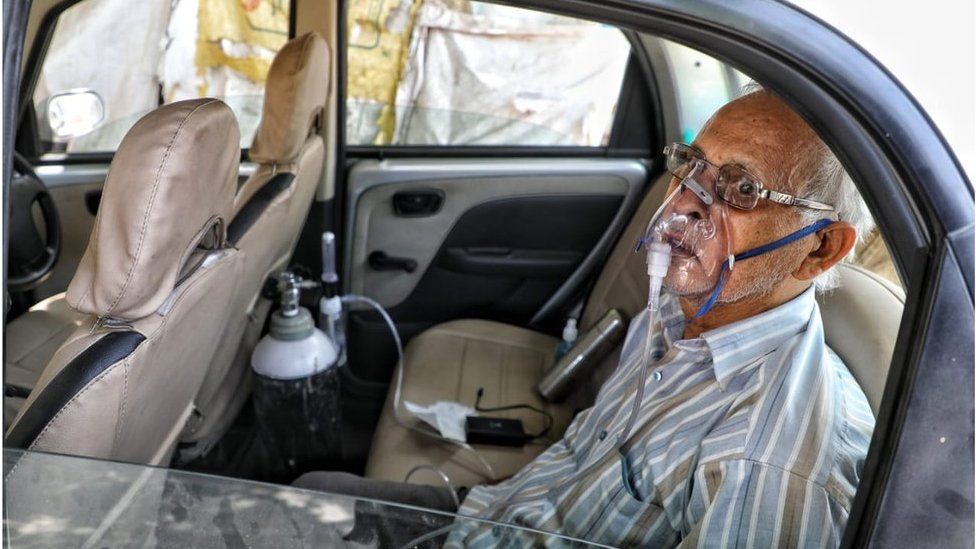
image captionSushil Kumar Srivastava was photographed sitting in his car, strapped to an oxygen cylinder in Lucknow city
India is reeling under a severe second wave of Covid-19 and many states are struggling to cope with the rising numbers. Uttar Pradesh, India’s most populous state, is among the worst affected in the country and its people are suffering even as authorities insist the situation is under control, reports the BBC’s Geeta Pandey.
Kanwal Jeet Singh’s 58-year-old father Niranjan Pal Singh died on Friday in an ambulance while being ferried from one hospital to another. They had been turned away by four hospitals for a lack of beds.
“It was a heart-wrenching day for me,” he told me on the phone from his home in Kanpur city. “I believe if he had received treatment on time, he would have lived. But no-one helped us, the police, the health authorities or the government.”
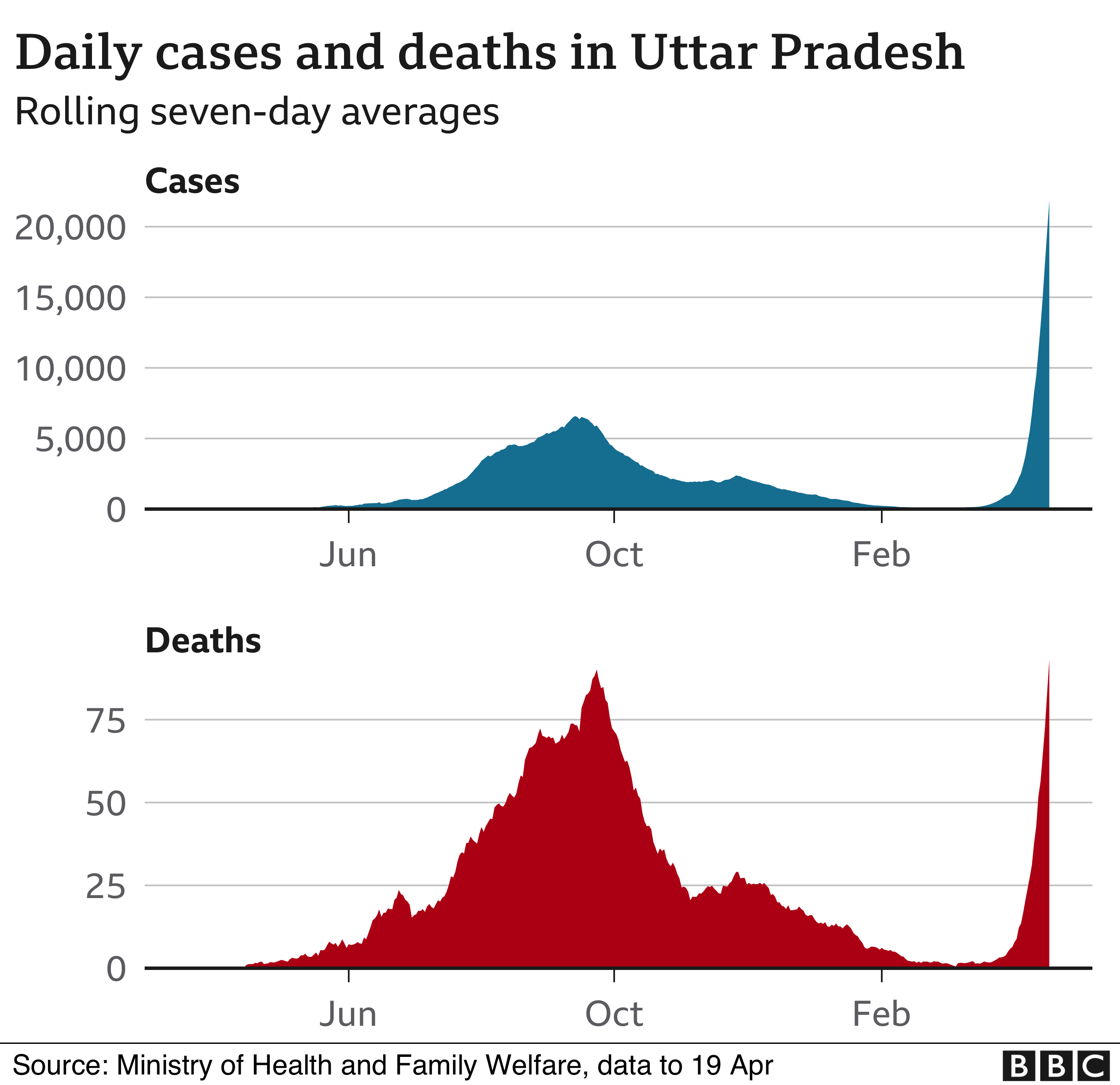
With a total of 851,620 infections and 9,830 deaths since the pandemic began last year, Uttar Pradesh had not done too badly during the first wave that ravaged many other states. But the second wave has brought it to the brink.
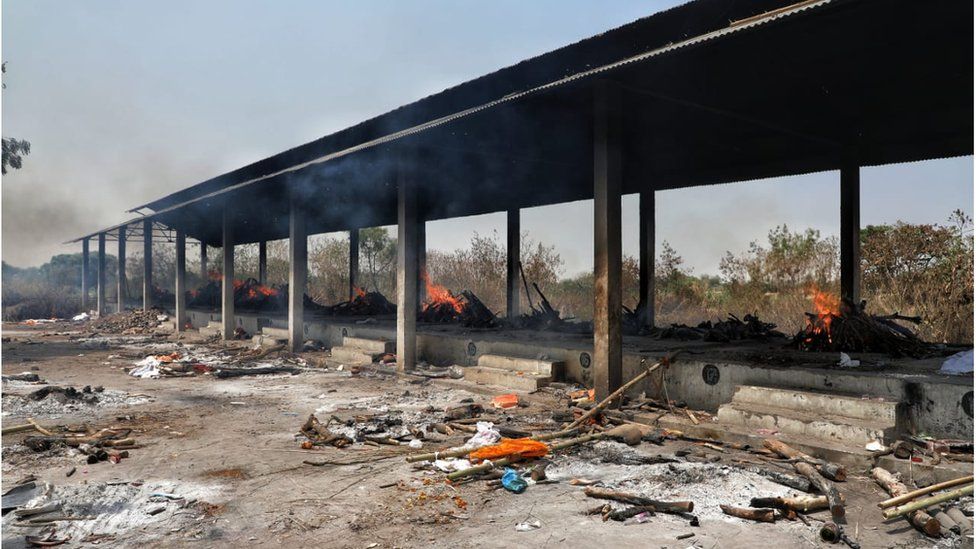
Authorities say the situation is under control. But disturbing images of overcrowded testing centres, hospitals turning away patients and funeral pyres burning round the clock at cremation grounds in the state capital, Lucknow, and other major cities such as Varanasi, Kanpur and Allahabad have made national headlines.
With 240 million people, Uttar Pradesh is India’s most populous state. Home to every sixth Indian, if it was a separate country, it would be the fifth largest by population in the world, just behind China, India, US and Indonesia – and bigger than Pakistan and Brazil.
The state is also politically India’s most important – it sends the largest number of MPs – 80 – to parliament, including Prime Minister Narendra Modi who, although from another state, contests from here. However, this political influence has brought it little development.
The state has 191,000 active cases at the moment and thousands of new infections are being reported daily – though numbers are believed to be much higher – and this has put the state’s creaky health infrastructure firmly in the spotlight.
Among the sick are the state’s Chief Minister Yogi Adityanath, several of his cabinet colleagues, dozens of government officials and hundreds of doctors, nurses and other health workers.
Over the past few days, I have spoken to dozens of people from across the state, and heard grim stories.
Videos shared by a local journalist in Kanpur show a sick man lying on the ground in the parking lot of the government-run Lala Lajpat Rai hospital. A little distance away, an elderly man sits on a bench. They are both positive for Covid, but the hospital has no beds to accommodate them.
Outside the government-run Kanshiram hospital, a young woman wept as she said that two hospitals had refused to admit her sick mother.
“They’re saying they have run out of beds. If you don’t have a bed, put her on the floor, but at least give her some treatment. There are lots of patients like her. I’ve seen several people like me being turned away.
“The chief minister says there are adequate beds, please show me where they are. Please treat my mother,” she said, sobbing inconsolably.
‘No-one came’
The situation in the capital, Lucknow, is equally dire.
Sushil Kumar Srivastava was photographed sitting in his car, strapped to an oxygen cylinder while his desperate family drove him from one hospital to another. By the time they found a bed for him, it was too late.
When I called his son Ashish, he said he was too devastated to talk. “You know what’s happened. I’m in no condition to talk,” he said, his voice breaking.
Retired judge Ramesh Chandra’s handwritten note in Hindi, requesting help after the authorities failed to remove his wife’s body from their home, was shared by hundreds of people on social media.
“My wife and I are both corona positive. Since yesterday morning, I called the government helpline numbers at least 50 times, but no-one came to deliver any medicines or take us to hospital.
“Because of the administration’s laxity,” he wrote, “my wife died this morning.”
Personally, it’s come as no surprise to me that the state is struggling to deal with the coronavirus pandemic as it wreaks havoc on its people.
For years, I have despaired at the poor medical facilities in the state – it’s where my ancestral village is located and I know the struggles of finding a doctor or an ambulance even in normal times.
With a raging pandemic, the struggles have become harder.
In the holy city of Varanasi, which is also PM Modi’s constituency, long-time resident Vimal Kapoor, whose 70-year-old mother Nirmala Kapoor died from Covid in a hospital last Thursday, described the situation as “bhayavah” – frightening.
“I have seen too many people dying in ambulances. Hospitals are turning away patients because there are no beds, chemists have run out of essential Covid drugs, and oxygen is in short supply.”
Mr Kapoor said when he took his mother’s body to the cremation ground, he encountered a “lashon ka dher” – a pile of bodies. The cost of wood for the pyre has gone up three times and the wait for a spot for cremation has risen from 15-20 minutes to five-six hours.
“I have never seen anything like that before. Wherever you look, you see ambulances and bodies,” he said.
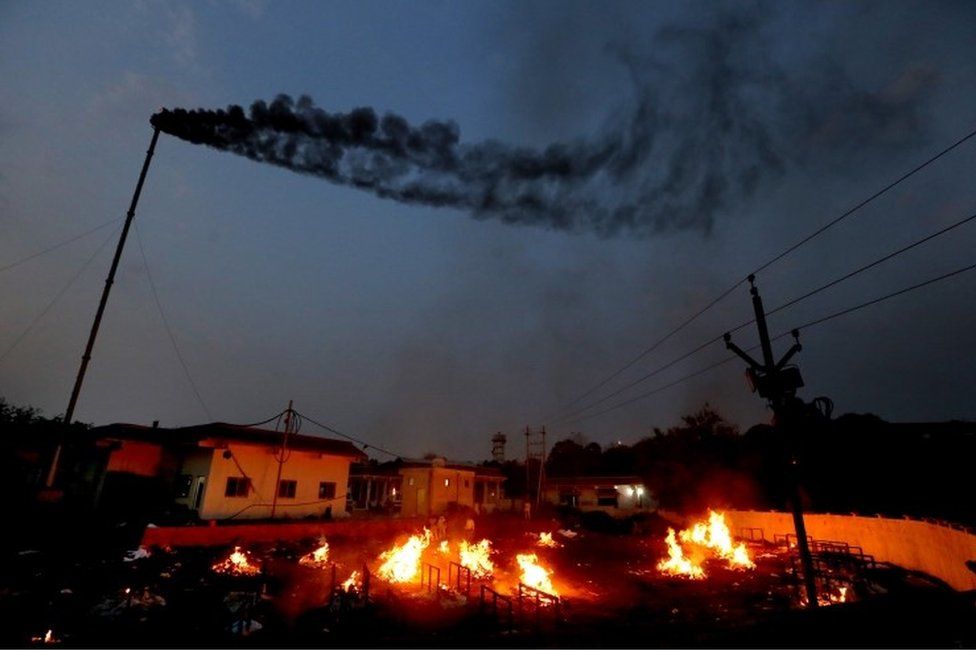
image captionCrematoriums in Lucknow have been busy with funeral pyres burning round the clock
Stories of deaths and families devastated by Covid-19 abound as infections continue to gallop – on Sunday, the state recorded 30,596 new cases, it’s highest-ever single-day tally.
Even that, activists and opposition politicians say, does not give a true picture of the infection’s spread. They accuse the state of keeping its case and death count low by not testing enough and not including data from private laboratories.
And there seems merit in their claim. Many people I spoke to said either they had failed to get tested or their positive results had not been uploaded on the state government site. From Lucknow, 62-year-old Ajay Singh sent me his wife’s positive test report which finds no mention in the state records.
And neither Mr Singh who died in Kanpur, nor Mrs Kapoor’s mother who perished in Varanasi, were included in the state’s tally of pandemic casualties – their death certificates did not mention coronavirus as the cause of death.
Indian media has also questioned the government data – with reports of a mismatch between the official number of deaths and the bodies at crematoriums in Lucknow and Varanasi.
Anshuman Rai, director of Heritage Hospitals – a private group that runs medical collages and hospitals in the state – describes the situation as “extraordinary”.
“The reason why services are cracking is because too many health workers, including doctors, nurses, ward boys and lab technicians are falling sick.
“At a time when we should be working 200%, we are not even able to do 100% because the health sector is totally manpower dependent.”
Critics, however, blame the state and the federal government for failing to anticipate the second wave.
They say there was a lull between September and February when the health services and infrastructure could have been augmented, the state could have created oxygen banks and stocked up on medicines, but they squandered the opportunity.
And with the virus spreading rapidly, things are unlikely to get better anytime soon.
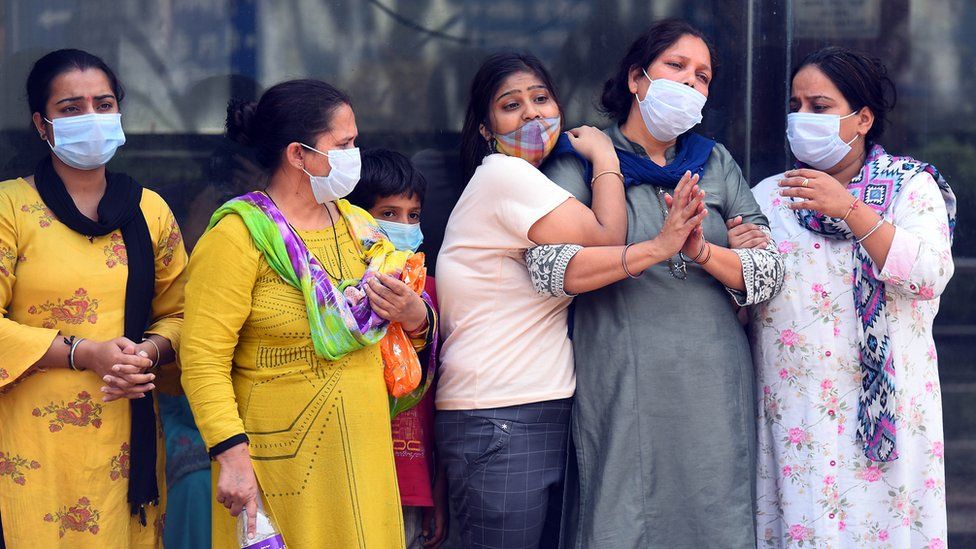
image captionFamily members of a person who died of Covid-19 react during a cremation
In early March, India’s health minister Harsh Vardhan declared the country was “in the endgame” of the Covid-19 pandemic.
Mr Vardhan also lauded Prime Minister Narendra Modi’s leadership as an “example to the world in international co-operation”. From January onwards, India had begun shipping doses to foreign countries as part of its much-vaunted “vaccine diplomacy”.
Mr Vardhan’s unbridled optimism was based on a sharp drop in reported infections. Since a peak of more than 93,000 cases per day on average in mid-September, infections had steadily declined. By mid-February, India was counting an average of 11,000 cases a day. The seven-day rolling average of daily deaths from the disease had slid to below 100.
The euphoria at beating the virus had been building since late last year. Politicians, policy makers and parts of the media believed that India was truly out of the woods. In December, central bank officials announced that India was “bending the Covid infection curve”. There was evidence, they said, in poetic terms, that the economy was “breaking out amidst winter’s lengthening shadows towards a place in sunlight”. Mr Modi was called a “vaccine guru”.
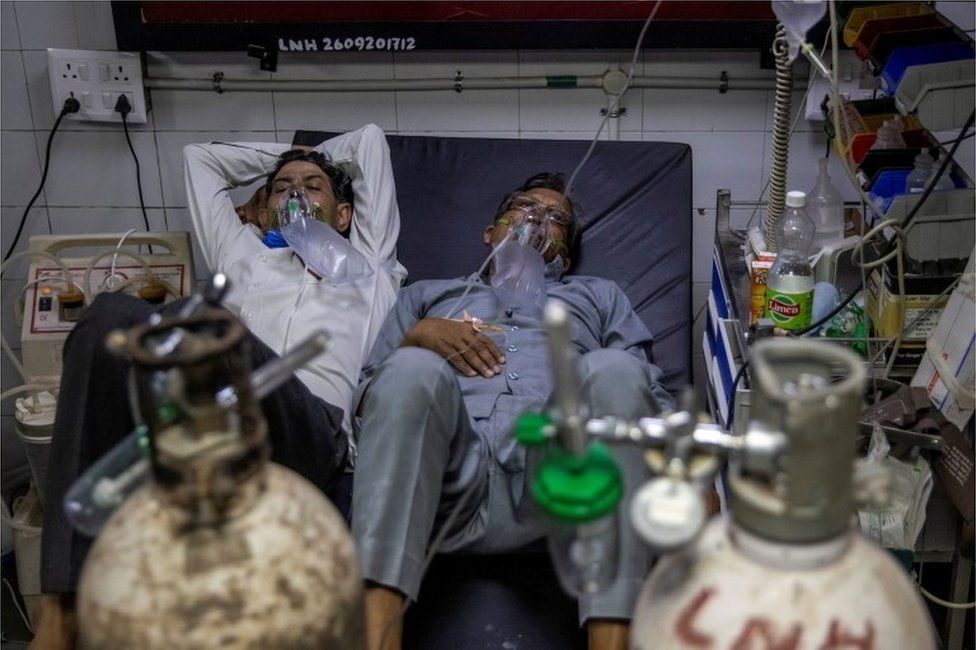
image captionHospitals are overflowing with patients, often two to a bed
At the end of February, India’s election authorities announced key elections in five states where 186 million people were eligible to vote for 824 seats. Beginning 27 March, the polls would stretch over a month, and in the case of the state of West Bengal, be held in eight phases. Campaigning had begun in full swing, with no safety protocols and social distancing. In mid-March, the cricket board allowed more than 130,000 fans, mostly unmasked, to watch two international cricket games between India and England at the Narendra Modi stadium in Gujarat.
In less than a month, things began to unravel. India was in the grips of a devastating second wave of the virus and cities were facing fresh lockdowns. By mid-April, the country was averaging more than 100,000 cases a day. On Sunday, India recorded more than 270,000 cases and over 1,600 deaths, both new single-day records. If the runway infection was not checked, India could be recording more than 2,300 deaths every day by first week of June, according to a report by The Lancet Covid-19 Commission.
India is in now in the grips of a public health emergency. Social media feeds are full with videos of Covid funerals at crowded cemeteries, wailing relatives of the dead outside hospitals, long queues of ambulances carrying gasping patients, mortuaries overflowing with the dead, and patients, sometimes two to a bed, in corridors and lobbies of hospitals. There are frantic calls for help for beds, medicines, oxygen, essential drugs and tests. Drugs are being sold on the black market, and test results are taking days. “They didn’t tell me for three hours that my child is dead,” a dazed mother says in one video, sitting outside an ICU. Wails of another person outside the intensive care punctuate the silences.
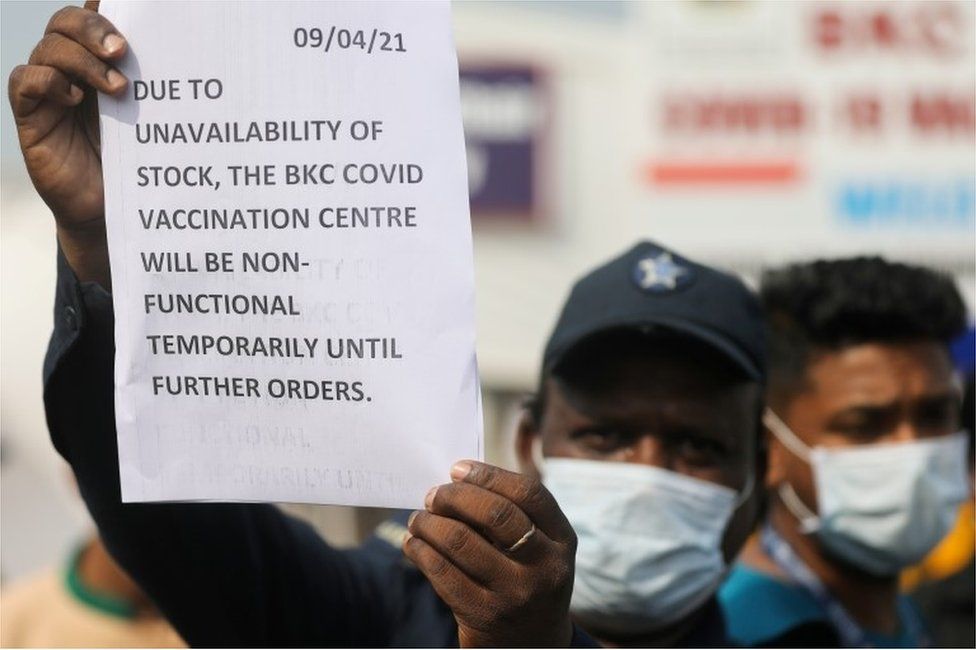
image captionIndia is facing a shortage of vaccines even as it ramps up its inoculation drive
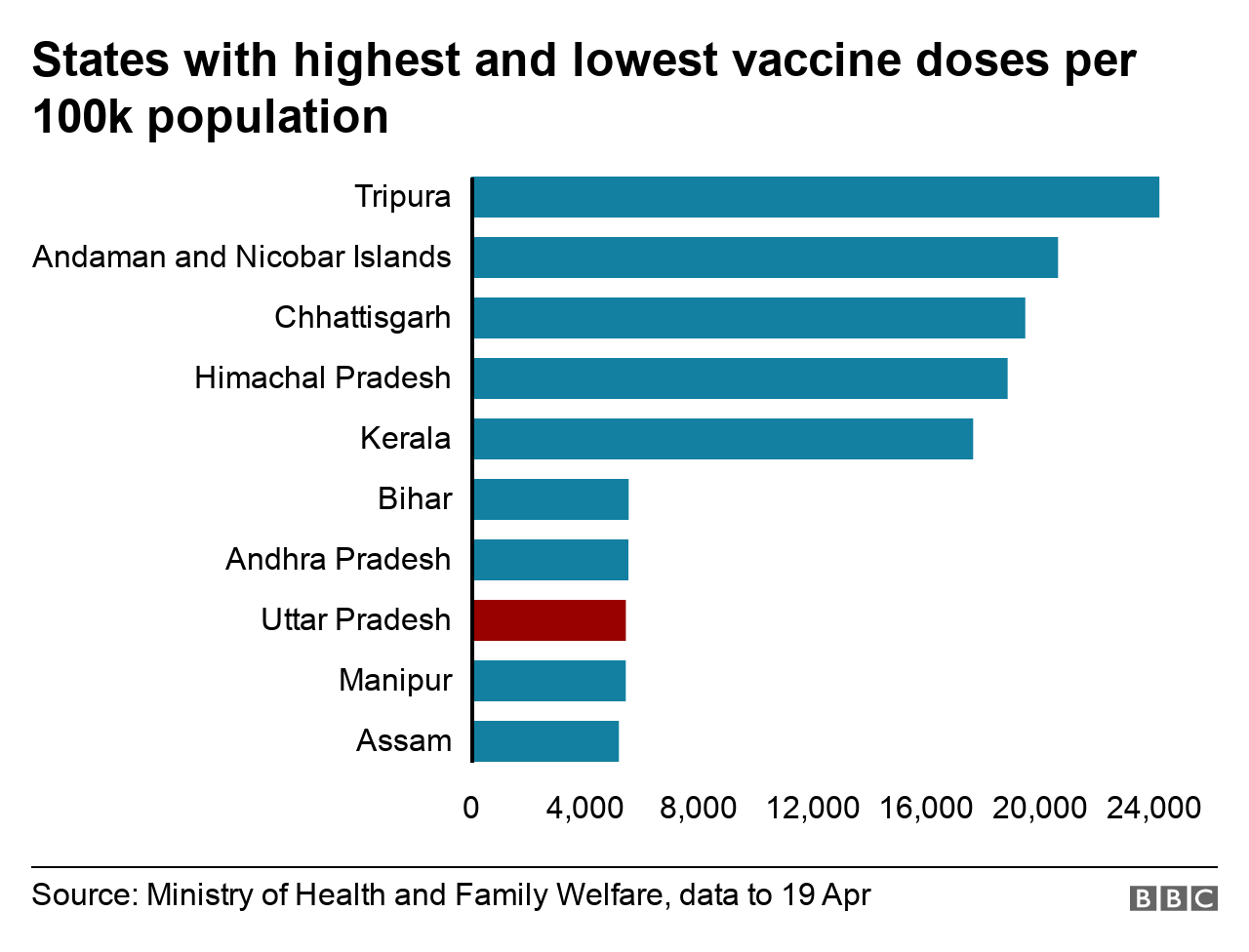
Even India’s mammoth vaccination effort was now struggling. In the beginning, the rollout had been embroiled in a controversy over the efficacy over a home-grown candidate. Even as the country ramped up the drive and administered more than 100 million doses by last week, vaccine shortages were being reported. Serum Institute of India, the country’s – and the world’s – biggest vaccine maker said it would not be able to ramp up supplies before June because it didn’t have enough money to expand capacity. India placed a temporary hold on all exports of the Oxford-AstraZeneca coronavirus vaccine, because the doses were needed urgently at home, and allowed imports of foreign vaccines. Even oxygen was likely to be imported now to meet the surge in demand.
Meanwhile, almost in a parallel universe, away from the death and despair, the world’s richest cricket tournament was being played behind closed doors every evening, and tens of thousands of people were following their leaders to election rallies and attending the Hindu festival of Kumbh Mela. “It is beyond surreal, what is happening,” Shiv Visvanathan, a sociology professor, told me.
Experts believe the government appears to have completely dropped the ball on the second wave of infections that was about to hit India.
image captionRelatives performing funerals of Covid victims in the city of Bhopal
In mid-February, Tabassum Barnagarwala, a journalist with the Indian Express newspaper, flagged a seven-fold rise in new cases in parts of Maharashtra and reported that samples from the infected had been sent for genome sequencing to look for imported variants.
By the end of the month, the BBC reported the surge and asked whether India was facing a new Covid wave. “We really don’t know what the cause of the surge is. What is worrying is that entire families are getting infected. This is a completely new trend,” Dr Shyamsunder Nikam, civil surgeon of an affected district in Maharashtra, said at the time.
Experts now say that crowing about India’s exceptionalism in “beating” the epidemic – younger population, native immunity, a largely rural population – and declaring victory on the virus turned out to be cruelly premature. “As is typical in India, official arrogance, hyper-nationalism, populism and an ample dose of bureaucratic incompetence have combined to create a crisis,” said Mihir Sharma, a columnist for Bloomberg.
India’s second wave was fuelled by people letting their guard down, attending weddings and social gatherings, and by mixed messaging from the government, allowing political rallies and religious gatherings. With infections declining, fewer people were taking the jabs, slowing down the vaccination drive, which had aimed to inoculate 250 million people by the end of July. In mid-February, Bhramar Mukherjee, a biostatistician at the University of Michigan, tweeted that India needed to “accelerate the vaccination drive while the case counts are low”. Nobody quite took notice.
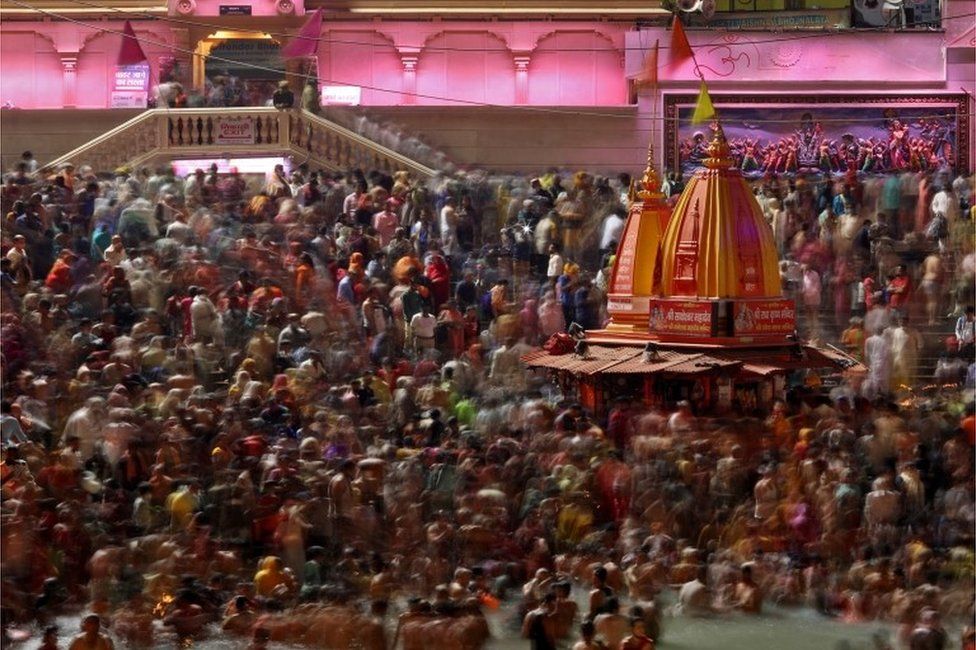
image captionDevotees at the Kumbh Mela festival on 14 April, when India recorded more than 184,000 new infections
“There was a feeling of triumphalism,” said K Srinath Reddy, the president of the Public Health Foundation of India. “Some felt we had achieved herd immunity. Everyone wanted to get back to work. This narrative fell on many receptive ears, and the few voices of caution were not heeded to,” he said.
A second wave may have been inevitable, but India could have “postponed or delayed it and lessened its impact,” said Gautam Menon, a professor of physics and biology. Like many other countries, India should have begun careful genomic surveillance in January to detect variants, Mr Menon said. Some of these variants could be driving the surge. “We learnt of new variants in February from reports from Maharashtra. This was initially denied by authorities,” Mr Menon added. “This was a significant turning point.”
What are the lessons of this public health crisis? For one, India should learn not to declare victory over the virus prematurely, and it should put a lid on triumphalism. People should also learn to adapt to short, local lockdowns in the event of the inevitable future spikes of infection. Most epidemiologists predict more waves, given that India is evidently still far away from reaching herd immunity and its vaccination rate remains slow.
“We cant freeze human life,” Professor Reddy said. “If we can’t physically distance in the crowded cities, we can at least make sure everyone wears a proper mask. And wear it properly. That’s not a big ask.”
Travel to England is banned for anyone who has been in one of the countries in the past 10 days, except for UK citizens and residents, who have to isolate on arrival at government-approved hotels for 10 days.
What are the criteria for going on the red list?
The decision is based on Joint Biosecurity Centre risk assessments, which include:
how good a country’s testing structures are, including checking for variants of concern
how many cases those systems have identified
whether people in that country have been catching new variants at home or the cases have come from overseas
evidence of whether that country has exported cases of new variants to other countries, including to the UK
how good the country’s travel links with the UK are
The first point on the list is important, because the genome sequencing needed to identify new variants is very sophisticated and relatively rare.
But just because a country has found new variants, or has many cases of coronavirus, it will not necessarily be on the red list.
On 13 April, the World Health Organization identified:
82 countries where the variant identified in South Africa had been found, of which only 21 were on the red list
52 countries with the variant identified in Brazil, of which 14 were on the red list
Why were Pakistan and Bangladesh put on the red list before India?
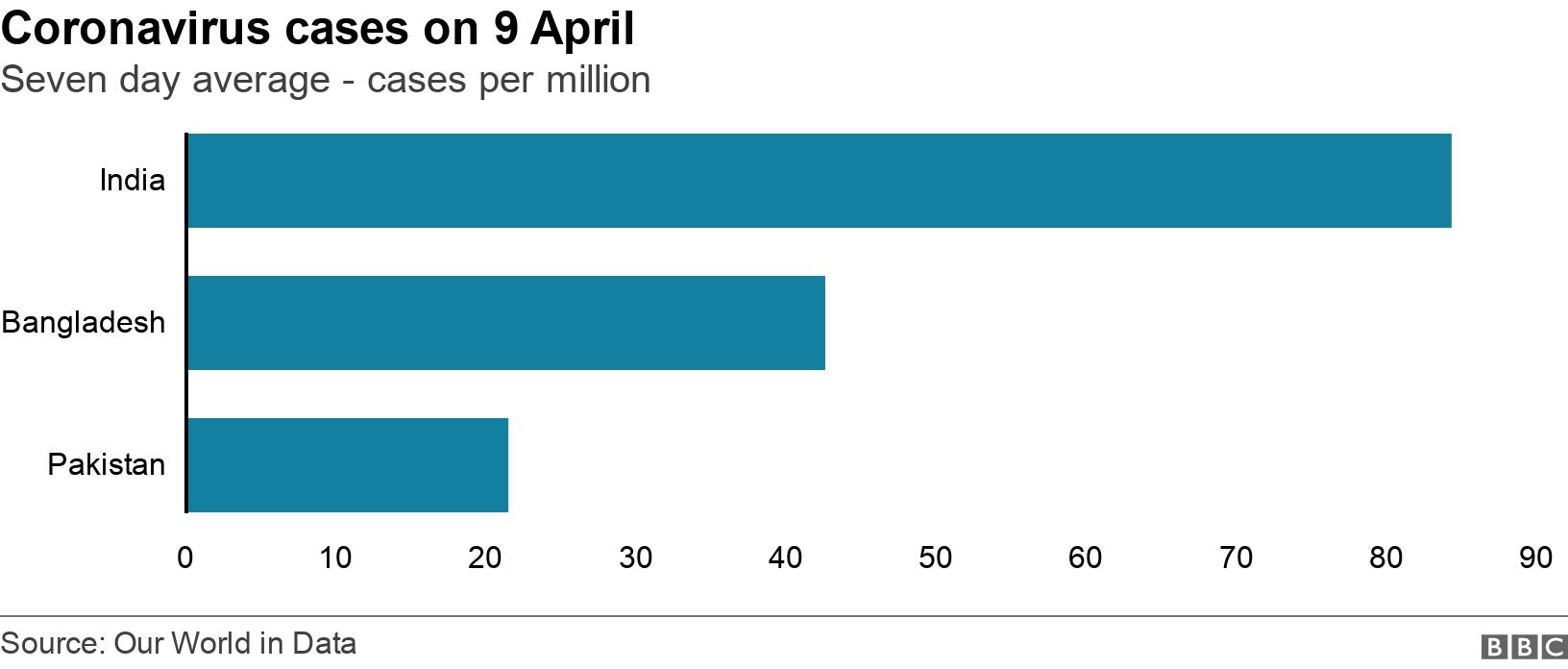
Bangladesh, which had the South Africa but not the Brazil variant, and Pakistan, which had neither, were added to the red list on 9 April.
But India, which had both as well as a new variant, was not added for another two weeks.
On 9 April:
Pakistan had a seven-day average of 21 cases per million people
Bangladesh had twice as many
India had four times as many
In late March, India’s health authority said 771 variants of concern had been detected in a sample of almost 11,000 positive cases – a fraction of the millions of cases recorded in the country.
India has a greater sequencing ability than Pakistan or Bangladesh, although it is far behind the UK, which does about half of the world’s sequencing.
We asked the government why India wasn’t added before. Its response did not directly answer the question but said the red list was kept “under constant review”.
“Nobody knows the full criteria – but there may be a political element because the UK wants a trade deal with India,” Dr Simon Clarke, associate professor in cellular microbiology, at the University of Reading, said.
“It’s not always a data-driven decision,” he added, giving the example of Somalia, which is on the red list but has one of the lowest official rates of infection and deaths in the world.
The Civil Aviation Authority said that in February 2021, 50,000 passengers travelled between India and the UK, which is an average of just under 900 a day in each direction.
How many cases of the new India variant have been found?
Announcing the decision on India, Health Secretary Matt Hancock said the government had now found 103 cases of this new variant in the UK.
He said: “the vast majority have links to international travel and have been picked up by our testing at the border”.
The samples are now being analysed to see whether this variant spreads quicker or whether it has resistance to vaccines.
The UK’s former chief scientific adviser Prof Mark Walport told the BBC that the new variant found in India was becoming the dominant variant and said: “what’s absolutely clear is that this variant is more transmissible in India”.
On adding India to the red list from Friday 23 April, he said: “These decisions are almost inevitably taken a bit too late in truth.”
“We don’t find pleasure in this,” he said. “We don’t celebrate a man going to jail. We would rather have George Floyd still here.”
Leading a group of civil rights leaders in prayer, Sharpton recalled other black victims at the hands of white police officers and noted the funeral of 20-year-old Daunte Wright, fatally shot by police just last week, is just two days away.
He said the verdict was proof that “if we don’t give up, we can win some rounds” and the fight will keep going until major police reform is passed at the federal level.
Yearlong talks yield $500m loan thought to carry ‘geopolitical conditions’
Signs advertise Colombo Port City: The development is said to give Beijing sweeping powers to oversee projects for the financial hub worth $1.4 billion. (Photo by Yuji Kuronuma)MUNZA MUSHTAQ, Contributing WriterApril 20, 2021 16:42 JST
COLOMBO — China appears to be tightening its strategic grip on Sri Lanka, wooing the debt-ridden South Asian nation with a fresh $500 million loan as Colombo wrestles with a deepening economic crisis.
In March, Sri Lanka’s foreign reserves dropped to $4.05 billion, their lowest in over a decade, with tourism plummeting following the onset of COVID-19. Public coffers also took a massive hit as export earnings and foreign remittances dropped drastically due to the pandemic. The dwindling foreign reserves also caused the currency to plunge to 203 Sri Lankan rupees to the dollar, a record low.
The island’s tightening financial straits, however, eased a bit last week after China Development Bank extended a loan of $500 million, the second tranche of a $1 billion bailout Colombo sought from Beijing last year as the coronavirus struck. The latest loan comes just weeks after China approved a $1.5 billion currency swap with Sri Lanka.
Negotiations for the second tranche took a year. According to Sri Lanka’s Secretary to the Treasury S. R. Attygalle, the signing of a memorandum of understanding was delayed because the pandemic prevented the two countries leaders from meeting to ink the deal. Sri Lankan Finance Ministry officials, however, attributed the delay to “intense” negotiations.
Although the loan agreement looks straightforward on paper, with a maturity period of 10 years and a grace period of three years, China appears to have obtained informal assurances from Colombo that it will drop any plans to renegotiate the 99-year lease of Port of Hambantota, and that it will fast-track controversial legislation thought to give sweeping powers to China to oversee Colombo Port City, a $1.4 billion “financial hub” to be built on an artificial island off the coast of Sri Lanka’s largest city.
Analysts believe the agreement for the second tranche may also have been delayed by a downgrade by all three big ratings agencies of Sri Lanka’s sovereign debt, and discussions over possible collateral for the loan. However, Sri Lanka’s ambassador to China, Palitha Kohona, maintained there was no discussion of collateral in the talks.
Just days after President Gotabaya Rajapaksa was elected in 2019, he told an Indian journalist that the lease of the Hambantota Port for 99 years, a deal made by the previous administration under President Maithripala Sirisena, was a mistake and that he would renegotiate it.
But Kohona, who last week signed the $500 million loan agreement on behalf of Colombo, told Nikkei Asia that the Hambantota Port deal is a commercial deal, however ill advised, entered into by the previous administration, adding, “Any adjustment will need to take this and other politico-economic factors into account.”
“This type of bilateral assistance is not dictated by economic conditions but by geopolitical conditions,” the former deputy governor of central bank, W.A. Wijewardena, told Nikkei. “Seeking support from China is not an unusual move by the country. But given the magnitude of the problem — it must meet an external debt obligation of $8 billion within the next 12 months with a dwindled foreign reserve — this assistance is just a drop in the sea.”
Sergi Lanau, deputy chief economist of the Washington-based Institute of International Finance, said that continuing to borrow from abroad is not a bad option if done in moderation as part of a plan to reduce overall vulnerability. In such a scenario, he recommends that Sri Lanka work with the International Monetary Fund. “Economic policy adjustments are needed in a world where issuing bonds and attracting tourists is much harder. Agreeing on a policy plan with the IMF gives confidence to investors and other official creditors, and makes it easier to borrow at reasonable cost,” he told Nikkei.
But Ambassador Kohona insisted that it was always a struggle to seek assistance from multilateral lenders, given their propensity to toe the line set by Western donors. “But, China does not impose such conditions for financial assistance,” he said.
As the government tried to fast-track passage of the Colombo Port City Economic Commission Bill in parliament, at least 19 petitions were filed with the Supreme Court challenging the constitutionality of the bill. Petitioners included opposition political parties, the Bar Association of Sri Lanka, Transparency International and several other civil organizations. They claim the Port City Commission set up by the bill is detrimental to Sri Lanka’s territorial integrity and sovereignty.
Luo Chong, a spokesperson of the Chinese Embassy in Colombo, stressed that Port City is crucial for Sri Lanka, calling it an important project to attract foreign investment. “We are waiting for parliament to pass the bill. I don’t know about the agenda of certain political parties and NGOs, which are also saying the Port City will be a Chinese colony, but this is a domestic issue and we are not concerned about it,” he told Nikkei.
Chong said that when special economic zones were set up in other parts of the world, including Singapore and Dubai, there were no such issues. He said that anyone can invest in Port City, and that the company handling the project has already signed more than a dozen memorandums of understanding with companies from China, the United Arab Emirates, Singapore, the U.K. and ASEAN countries.
LAHORE: A 14-member delegation comprising senior Buddhist monks from Sri Lanka arrived in the provincial metropolis Monday to undertake a week-long religious pilgrimage to various Buddhist heritage sites in the country.
The Buddhist monks started their journey with a visit of the Lahore Museum which houses some of the finest remains of the Gandhara civilization and rare Buddhist relics including the ‘Fasting Buddha’ and ‘Sikri Stupa’ dating back to the 2 BC.
The visit has been arranged by the High Commission of Pakistan in Colombo, Sri Lanka, with a view to promote religious tourism in Pakistan by showcasing historic city and warm hospitality of the host nation.
Pakistan is home to the ancient Buddhist civilization which has remained hidden from the eye of the world over the years. The senior Buddhist delegation is led by venerated Dr Walpole Piyananda (Abbot and president, Dharmavijaya Buddhist Vihara, USA) and will visit Islamabad, Taxila, Shahbaz Garhi, Takht-e-Bhai and Jehanabad (Swat) besides two-day visit to Lahore.
The Buddhist delegation will also hold meetings with the officials of the ministry of religious affairs and interfaith harmony and meet with President Dr Arif Alvi, Prime Minister Imran Khan and Foreign Minister Shah Mehmood Qureshi during their visit to the federal Capital.
India supports the call of international community for the Sri Lankan government to fulfill its commitments on devolution of political authority including through early holding of elections to provincial councils, according to S. Jaishankar, India’s External Affairs Minister.
This also covers the commitment of ensuring that all the provincial councils are able to operate effectively in accordance with the 13th Amendment to the Constitution of Sri Lanka, Dr. Jaishankar has stated in his letter sent recently to the AIADMK’s Member of Parliament (Rajya Sabha) M. Thambi Durai.
The Minister’s reply was in the context of the AIADMK leader raising the Sri Lankan Tamil issue in the Rajya Sabha last month in the context of a resolution adopted by the United Nations Human Rights Council.
Pointing out that the position of India was conveyed during the deliberations on the motion at the Council, Dr. Jaishankar said the country voted in abstention at the UNHRC but it made a strong statement” as Explanation of Vote, stressing our abiding commitment to aspirations of the Tamils of Sri Lanka for equality, justice, peace and dignity.” It had also urged the Sri Lankan government to carry forward the process of reconciliation, address the aspirations of the Tamil community and continue to engage constructively with the international community.”
During the consideration of the resolution at the Council on reconciliation, accountability and human rights in Sri Lanka, he said India had remained closely in touch” with all countries and made a statement at the interactive debate on February 25, outlining its position.
Assuring Mr. Thambi Durai that all efforts are being made to ensure that the safety and interests of Tamils in Sri Lanka are fully safeguarded,” the Minister said the country attaches high importance” to the matter.
Sri Lanka confirmed 05 new COVID-related fatalities today (April 20) as the death toll from the pandemic climbed to 625, says the Department of Government Information.
Details of the victims are as follows:
01. An 85-year-old woman from Mattakkuliya area: She was tested positive for novel coronavirus while receiving treatment at the Colombo National Hospital and was later transferred to Mulleriyawa Base Hospital where she died on April 16. The cause of death was recorded as heart attacks and blood poisoning along with COVID infection.
02. A 67-year-old woman from Panadura area: She had been under medical care at a private hospital in Colombo when she was confirmed to be coronavirus-positive. She was subsequently moved to the Mulleriyawa Base Hospital where she passed away on April 17. She died of COVID pneumonia, acute kidney damages, breathing difficulties, hypertension and diabetes.
03. A 66-year-old man from Ratnapura area: He was moved to the Homagama Base Hospital after testing positive for novel coronavirus at the Ratnapura Teaching Hospital. He died on April 19 due to COVID pneumonia, diabetes and high lipid levels in blood.
04. A 59-year-old man from Jaffna: He died on April 19 while receiving treatment at the Jaffna Teaching Hospital. The cause of death was cited as complicated COVID pneumonia with bacteria infection and multiple organ failure.
05. A 90-year-old woman from Horana. She has passed away at her home on April 17. COVID infection was recorded as the cause of death.
The Cabinet of Ministers have approved the drafting of legislation to protect against the spreading of false and misleading statements through the internet.
The government says that the spread of false information on the internet poses a serious threat and is seen as being used to divide society, to spread hatred and to weaken democratic institutions.”
Various countries have already taken steps to legislate in order to address this problem, it said.
The government said that steps should be taken to provide access to accurate information to citizens and civil society by introducing a new law to protect society from the harm caused by false propaganda on the internet.
Accordingly, the Cabinet of Ministers have granted the approval for the resolution tabled by the Minister of Justice and the Minister of Mass Media to advice the Legal Draftsman to draft a bill for the relevant issue.
Veemansa Initiative, an independent think tank recently held a Webinar on the proposed Colombo Port City Economic Commission Bill and related subjects.
Based on the deliberations at the webinar and
the follow-up analysis, it was evident that the Colombo Port City Project, a
100% foreign investment venture plans to attract a diverse group of secondary
investors.
A prime target of the project is the financial
sector in order to project Sri Lanka as an internationally competitive
Financial Centre.
In this regard, the establishment of regional
headquarters of international banking giants and other financial sector
enterprises is expected to be realized in the initial stages.
Further consideration based on the
presentations at the Webinar, it was evident that Sri Lankas existing rules and
regulations, including anti-money laundering regulations and monitoring
mechanism, is well equipped to counter any possibilities of money laundering or
any other illegal transaction. Sri
Lanka’s Anti Money Laundering and Countering the Financing the Terrorism regime
comprises of three pieces of legislation.
A. Convention of the suppression of terrorist
finance Act
b. Prevention of money laundering Act of 2006
In order to provide and monitor financial
transactions, a Financial Intelligent Unit was established in 2006 under the
Ministry of Finance and Planning. This unit currently functions as an independent
institution within the Central Bank of Sri Lanka. The overall objective of this
unit is to combat money laundering, terrorist financing and related crime
scenes in Sri Lanka in line with international standards and best practices. It
is observed that with such stringent regulations and implementing framework,
the Colombo port city will never become a money-laundering centre.
If any such potential exists in Colombo, it
should be equally applicable to Dubai, Singapore and Hong Kong.
During the follow-up discussions, it was noted
that Chinese Special Economic Zones, even with substantial liberalization of
the financial transactions have successfully managed to prevent money
laundering or related activities.
Discussions at the Webinar also highlighted
the generation of foreign exchange earnings and new employment opportunities
for highly skilled manpower.
According to the presentations of the
government, taking into consideration the emerging demand for such human
resources, reforms in the education sector has been proposed.
Professor Bo Chen was focusing on the
potential for developing the Colombo Port City with state-of-the-art
technologies to make it a smarter and greener city. In this regard, the emergence
of new business and employment opportunities are envisaged.
Veemansa Initiative plans to conduct further
discussions and analysis on the implementation of Colombo Port City in the
months and years to come.
For more information: – Luxman Siriwardene, Managing Director –
Veemansa Initiative (0773660520)
Colombo, April 19: A five-Judge Supreme Court Bench will take up the petitions filed against the Port City Commission Bill today (April 19) and the verdict is likely to end the controversy over the Bill and open the path for the Government to take required steps to modify the Bill if the Supreme Court rules that any of its clauses contravenes the Constitution.
The Court will also decide if the Bill could be passed by a simple majority or a two-thirds majority in Parliament or further approval at a national referendum and/or approval by Provincial Councils is required.
The early passage of the Colombo Port City Commission Bill governing a reclaimed extension to the capital’s central business district is vital for the economy as it would pave the way to sell 20 plots of land bringing about 5 billion US dollars of investment to Sri Lanka.
The Bill, titled Colombo Port City Economic Commission Bill, was tabled in Parliament last week, outlining proposed laws for the US$ 1.4 billion-Port City being built on reclaimed land at Colombo’s seafront.
Three opposition parties, the Samagi Jana Balawegaya (SJB), the (JVP) and the UNP, a foreign funded NGO and some labour organizations have challenged the constitutional validity of the proposed legislation.
SJB MP Dr. Harsha de Silva said that while his party wants the Port City project to succeed, for its potential to catalyze fin-tech and high-end knowledge services-driven growth in the country, a solid legal framework is essential. He pointed out that for this long-term project to succeed it must be consistent with the Constitution of Sri Lanka.
The Sri Lanka Podujana Peramuna (SLPP) Government took effective steps to expedite the Port City project, which would attract US$ 15 billion in investments, and emerge a leading business, retail, residential and tourist destination in South Asia. A joint venture with the State and China Harbour Engineering Company has readied 100 hectares of land ready for construction. In the next five year strategic plan, 20 plots in a total of 60 hectares of land adjacent to Colombo’s central business district have been identified for pilot projects.
Extensive powers
The Colombo Port City Economic Commission Bill envisages giving extensive powers to approve investments without going to the Board of Investment, give tax breaks and regulate businesses in the most far-reaching ‘one-stop-shop’ designed so far. It is expected to address several problems in Sri Lanka’s ease of doing business indicators that had kept back foreign direct investments.
A spokesman for CHEC Port City Colombo (the joint venture) said that 40 out of 74 buildable plots of land are allocated for commercial development which will bring investments and business activities while 34 plots are for residential use. Out of 269 hectares reclaimed, China Harbour will get 113 hectares; 91 ha will be common areas vested in the Government and the balance 60 odd hectares are land the Government can sell and earn revenue from.
In designing the Port City plan, significant emphasis was given to creating a vibrant business hub, because of its extension to the existing central business district of Colombo.
It is no secret that Sri Lanka’s current economic growth would not be sufficient to drive demand. Therefore, businesses had to be attracted to Phase One to drive activity. Sri Lanka is primarily seeking foreign investments through dollar inflows, but domestic businesses would also be allowed to buy land to gain a foothold within the Port City.
Land sales will initially drive construction activity and later commercial activity as businesses take up floor space. Residential land sales will begin after the business plots are sold, CHEC spokesman said.
The Port City will also be protected from the liquidity injections and policy errors of the Monetary Board of Sri Lanka that lead to frequent currency crises and exchange controls by being ‘dollarized’ with multiple currencies. The law envisages an offshore financial center as well as other business activities.
Hospitality and tourism
International trade, logistics operations, hospitality and tourism are considered natural strengths of Sri Lanka. The Colombo Port City has identified ICT/ BPM, offshore banking, private equity, wealth management and investment banking as priority sectors, the spokesman stated.
However, all these plans can commence only after the legal aspects are cleared in accordance with the Supreme Court decision on the petition. Then the Port City Bill, as it is or with amendments, if any, could be proceeded with.
Chinese Defense Minister’s Visit
Sri Lankan leaders will get another important opportunity to discuss investment possibilities from China during the forthcoming visit of China’s Defense Minister General Wei Fenghe later this month. Although the talks would focus on defense cooperation, the visit of the Minister will provide a forum for bilateral discussions on trade, investment and other areas of cooperation as this would be the highest level visits undertaken by a Chinese Government official since the Gotabaya Rajapaksa Government was sworn in power in November 2019.
Top level exchanges between China and Sri Lanka will take place in the near future as President Rajapaksa is likely to pay his long-awaited visit to China. Earlier this month, President Rajapaksa, during a telephone conversation with Chinese President Xi Jinping, confirmed that he would undertake a formal visit as soon as travel restrictions ease due to the COVID-19 pandemic.
These high-level visits would be of immense value for attracting investments to the Colombo Port City Special Economic Zone (SEZ), which is expected to create a conducive and competitive environment in attracting FDIs.
Urban Development via SEZs is not unique to Sri Lanka and there are many successful SEZs in the world. SEZ’s have been a useful tool for developing nations to upgrade infrastructure, human capital and institutional frameworks and test out policies and their impact before they are selectively implemented outside the SEZ in the rest of the country.
Tax relief
Taking lessons from successful SEZs, Sri Lanka too decided to offer relief from various forms of taxation on businesses and individuals who qualify. The Port City SEZ offers superior infrastructure; has streamlined administrative processes that would result in ease of doing business.
The
burqa ban announcement caused a stir among Muslims, who saw it as yet
another attack on their community. In the past few months, the government has
undertaken a number of controversial measures under the banner of fighting
extremism, which have increasingly intimidated the Muslim population and
disregarded rule of law principles – Farzana Haniffa, Head of the Department of Sociology at the University of Colombo
writing in the Al Jazeera on the 12 Apr 2021
The Justice and the Law Society (JATL) of the University of
Queensland is a vital organisation within the TC Beirne School of Law. An
active society with diverse membership, JATL performs an important role in
promoting awareness of social justice issues in the law. In a well-researched
and informative article titled Debate on the Burqa” (http://www.jatl.org/blog/2014/10/19/debate-on-the-burqa), the multiple facets associated with the
origins and contemporary debate on the Burqa is
examined in detail. It is strongly recommended that this article is read
in full by anyone interested in the debate surrounding Burqa. The following
passage summarises the contemporary ethos surrounding a dress that has caused
so much controversy, as well as a misunderstanding of the origins and the
religious reasoning behind the Burqa.
The article says, quote Reflecting on practices across the Muslim
world, it is apparent that Muslim women’s dress clearly comes with political,
religious and cultural messages that an observer can decode. Dress can be seen
to align the wearer with a Salafi (fundamentalist/literalist) or with a
modernist interpretation of Islam. It can signify a political direction either
in support of, or against, secularism, or Islamisation, or Western cultural
dominance through colonisation, or globalisation. It also can reflect a
cultural identity and tradition.
In Afghanistan, a woman wears the light hues of the burqa and secludes
herself (purdah) to demonstrate her and her family’s honour and respect for
social order. On the Arabian Peninsula she wears a black Abaya as a
reflection of Salafi traditonalism, which generally restricts her
movements in public non-segregated spaces. In conservative Wahhabi-informed
Saudi Arabia all women, Muslim or non-Muslim are required by law to wear an
Abaya in public places with religious police (muttawa) employed to enforce it. In
Malaysia, she wears the vibrant colours of traditional baju kurung with tudong
and is not constrained by notions of purdah as Malay women have for centuries
worked with and alongside men.
However, these identifications are not static. For example, the spread
of Salafi Islam from Saudi Arabia to Southeast Asia has meant that some
Malaysian women who want to show their identification with that world‑view now
don black Abaya and Niqab. Wearers of face coverings also believe it brings
them closer to God and personifies their piety, spirituality and the highest
possible personal level of modesty.
Conversely, there are reports of young Iranian women testing the
boundaries of compulsory chador dress code by adopting tighter fitting clothing
and minimal or loose headscarves. In democratic Muslim Indonesia, what Muslim
women wear is at the forefront of religious and legislative debate both
nationally and particularly in the provinces which now have the legislative
power to set and enforce their own dress codes and morality programs” unquote.
The following passage in the above quoted excerpt is relevant in
examining the impact of the Burqa in Sri Lanka. the spread of Salafi
Islam from Saudi Arabia to Southeast Asia has meant that some Malaysian women
who want to show their identification with that world‑view now don black Abaya
and Niqab”. It can be argued that the spread of Salafi Islam from Saudi
Arabia has indeed influenced Sri Lankan Muslims as well considering that the
extent of self- expression and the linking of a dress towards Islamic piety and
modesty has grown and taken hold in parts of Sri Lanka perhaps in the last few
decades more than ever before. Fifty years or so ago, this statement by Muslim
women, in some instances on their own accord, but arguably at the dictates of
men in many other cases, was not so apparent to many who lived in Sri Lanka then.
Salafism
is explained well by Jonathan A C Brown in an article on Salafism published in
the Oxford Bibiliographies (https://www.oxfordbibliographies.com/view/document/obo-9780195390155/obo-9780195390155-0070.xml). Brown states in the
introduction, quote News reports often
mention the Wahhabi movement” or Wahhabi Islam” without providing any
context. This controversial modern Islamic movement actually represents part of
a larger phenomenon in Islamic thought: Salafism.
The Salaf are the pious forbearers of Islam, usually understood as the first three generations of the Muslim community (as opposed to the Khalaf, or the later generations). The Arabic adjective Salafi and the English noun Salafism taken from it are complex terms that refer to a trend in Islamic thought that places particular emphasis on a return to the piety and principles of the Salaf as the only correct understanding of Islam.
Although all Muslim scholars look to the Salaf as role models, the majority believe that the institutions and historical developments that scholars have accepted within thought and practice over the centuries represent legitimate expressions of Islam. Establishing and adhering to schools of law (madhhab), adopting the Near Eastern traditions of Greek logic and speculative theology, and the emergence of Sufi brotherhoods were all accepted by mainstream Sunni and Shiʿite scholars.
The Salafi strain in Islamic thought, however, has questioned the authority and legitimacy of these developments, preferring to emphasize of role of hadith and the literal ways of the Salaf over such historical adoptions. Although this conservative and iconoclastic trend has always existed in Islamic thought, it is most commonly identified with two periods: the burgeoning of classical Salafism with the 14th-century scholar Ibn Taymiyya (d. 1328), and the Salafism of the 18th-century movements of revival and reform.
This early modern incarnation of Salafism in turn gave birth to two trends in Salafism that have flourished until today. Despite their common use of the term Salafi, these two modern movements are in fact very different, and they will be referred to here as modernist Salafism and traditionalist Salafism. Both classical Salafism and modern Salafism have clashed with the mainstream of Islamic thought, which will be referred to, for the sake of convenience, as Sunni or Shiʿite orthodoxy. Due to its controversial nature, writings on Salafism often feature heavy biases that need to be taken into consideration. Furthermore, there is scholarly disagreement over whether the term Salafism really represents a unified phenomenon; that is, is the Salafism” of Ibn Taymiyya really the Salafism of Ibn ʿAbd al-Wahhab (d. 1792) or Muhammad ʿAbduh (d. 1905)”, unquote.
Those
who take the view that there is Muslim extremism” in Sri Lanka and the Burqa
is associated with such extremism, should take note of Brown’s statement, done
with considerable research, that Salafism is a movement towards what some
Islamic scholars believe as the trend in Islamic
thought that places particular emphasis on a return to the piety and principles
of the Salaf as the only correct understanding of Islam.
Whether this is so or not is really a matter for Muslims
and something that should be discussed and debated, understood or rejected by
Muslims themselves. Salafism, or for that matter, any other branch of the Islam
faith or any segment of any other religion, could be called extremist should
they take the view that non-believers or non-adherents have no place in society
and therefore should be sidelined or eliminated through coercion or violence.
But, a movement that takes the view that they represent the real piety and
principles of Islam, cannot be called an extremist movement for this reason.
Extremism, whether it is Islamic, Christian or
Buddhist is taken as a deviation from an assumed or imaginary norm” that these
religions teach or their founders pronounced. These norms are highly
interpretable as there no direct recordings of what the founders of these
religions said in order for present day generations to understand what the norm
is or might have been.
What many Buddhists appear to believe and
practice today can be described at best as ritualistic, and not consistent with
the teachings of Buddha. Rituals are cultural practices and not practices
desired, encouraged or dictated by Buddha, but they cannot be called extremist
practices. In Sri Lanka, there is a movement that believes Prince Siddhartha
Gautama was a Sri Lankan and not an Indian and he became Buddha in Sri Lanka.
Could one call this movement or those steeped in ritualism extremist? Misguided
perhaps, but not extremist.
In this context, determining or defining what religious
extremism means is difficult, and it will mean different things to different
people.
In an ideal world where logic, and internal,
universal, human characteristics like love and compassion to one self and
others, rather than a belief in an external divinity for one’s presence,
actions and reactions, it would have been easier to desist from any form of
self-defined extremism.
Life amongst human beings is far more complex,
and therefore a universally accepted understanding of what religious extremism
is also very complex.
Perhaps one could approach religious extremism
from a different point of view. Whatever the professed religion of a human
being is, and whatever they understand and believe as the teaching of that
religion is, all human beings live in a society, large or small, more diverse
or less diverse, and of all hues and colours, political beliefs and cultural
practices. Each such society will be at peace within it and with others, if the
constituents of that society maintains a balance or an equilibrium within it,
and which can only come about if the constituents accept that there has to be
compromise with each other in recognition of the diversity of opinion, beliefs,
and practices within that society. Diversity within a society is a healthy sign
if that diversity is viewed from a broader societal point of view rather than
only as an advancement of individual practices of one segment within it.
Besides this, if each constituent is able to
consider the point of view of another from that other constituent’s
perspective, it would greatly help to ease tensions that arise within a
society. It would also help if people belonging to different faiths could
ponder for a moment how the founders of their faiths would look at today’s practices
by their followers and how close or distant they are from the founder’s
teachings. The founders may find that interpretations of their teachings and
cultural edifices that have been built on such interpretations have taken over
the essence of their teachings.
In Sri Lanka, it is perhaps time that the
constituents of all religious faiths examined the premise of diversity with
mutual regard and respect for that diversity, but, whether individual segments
within the Sri Lankan society have looked at only their religious practices
without consideration of how others may view such practices.
The Burqa and Salafism too should be looked at
in this context. People of all religious faiths should be able to coexist with
each other in the Sri Lankan society that has as little turbulence a possible.
Words, action and behaviour that encourages turbulence should be questioned by
the very people who create that turbulence. This applies to people of all
faiths, and it would mean some compromises being made, not on the principles of
the faiths, but the practices of the faiths, as increasingly, the growth of
practices that does not seem consistent with the principles of different faiths
appears to be on the rise.
The most
sneering, contemptuous opposition to SWRD came from the English speaking elite
drawn from all communities. SWRD was
scorned for changing his religion to Buddhism, getting into national dress,
hobnobbing with his social inferiors and supporting a low level, backward,
indigenous language, Sinhala which should be trampled into oblivion.
SWRD Bandaranaike faced much ridicule during his short
period as Prime Minister. No politician has ever had so bad a press in any part of the world
as Bandaranaike said DB Dhanapala No
other leader had such a hostile press like Bandaranaike, agreed analysts.
SWRD was lampooned and criticised. He was pictured as a weak-kneed political opportunist, which he was not. He
was consistently maligned and libeled this side of the law, Dhanapala said.
The English press was the most vitriolic. The Lake
House and Times groups targeted SWRD relentlessly. The only
exception was Lankadipa, also owned by Times.
The
English press also ridiculed the 1956 government. Lake House led the campaign.
Lake House had clout. Lake
House sneered at any state venture and wanted to sow discord in the MEP, said
Meegama.
It
was not difficult to mock the 1956 Government. Bandaranaike was pushed to and fro by the various forces he had courted at
one time or other. This provided fine copy for the journalists.
His erratic and zigzagging rule was reviewed weekly in the popular column
“Island in the sun’ in the Sunday
Observer. It was written by the editor,
Tarzie Vittachi under the pseudonym, Flybynight, with cartoons by Collette. People used
to eagerly await the delivery of the Sunday Observer to read the Flybynight
columns and view the cartoons by Collette. Collette drew cartoons that ridiculed
Bandaranaike. Sales of Sunday Observer rocketed. These pieces
were later published as ‘Trials of transition in the Island in the Sun’.
SWRD was
called Electric Eel in this series. His efforts to improve the country were
sneered at. The Electric Eel has not ever taken a decision from strength, only
from weakness, said Flybynight. The Electric Eel
used to say that island was going through a period of transition. This was his
alibi for everything, his government corruption, incompetence, and cowardliness,
continued Flybynight.
Lake
House was also against Philip. From
the start Lake House was against Philip.
They set up him as a sinister figure, said Meegama. The Lake House group was clever at
manipulating persons, but they found Philip difficult to manipulate.
Flybynight
called Philip the Black Panther. He was the fiercest of the pack in the island in
the sun, said Flybynight. The Black
Panther is the most formidable obstacle we have to our achieving mastery of
this island, he said. Philip’s
wife, Kusuma Gunawardene was described as a sort of Gas House Gertie, ‘a rough
and roistering termagant.’
Black Panther
said he would have several pits dug all
over the country and he would put into them the bones of all the animals he or
his tribe has killed anyone could take the bones gnaw them and return them to
the pits, went on Flybynight.
The animals
in the island in the sun are fed up with the Black Panther’s policy of
violence, hatred against the weaker group of animals. They were now yearning
for a breathing space in which peace and sanity can return once more to their
accustomed haunts, concluded Flybynight.
The pair
responsible for the Island in the Sun series in the Observer did not benefit
from their work. Tarzie left Sri Lanka suddenly in 1960. He said Sydney de
Zoysa had it in for him and his children had been threatened. Collette drew the newly
widowed Sirimavo pregnant and in bed with NM Perera. Collette left the country
when Sirimavo was elected Prime Minister in 1960.
This
criticism of the MEP group, starting with SWRD and Philip, was not a
spontaneous activity. This was a part of a carefully developed modus operandi
to bring disrepute on the MEP government, to help bring the MEP government down
and return the country to its pro-US stance.
There was
also another strategy, which commenced in 1956 and continued to this day, the
tactic of character assassination though slander. Bandaranaike’s sexual orientation
was commented on. I recall hearing this quietly said in the 1950s. There was no
evidence to support it, and the motive was clearly malicious.
The other politician singled out for attack, was T.B.Ilangaratne
(1913- 1992) who was Minister for Labour, Housing and Social services in the
MEP government .He brought in several progressive items of legislation. He introduced
the Labor Tribunal act no 62 of 1957. He
had been a clerk in the Kandy Kachcheri before starting his political career.
Ilangaratne
was accused of owning hotels in Switzerland. This was carefully planted
propaganda by UNP. A UNP stalwart told me later that this was carefully
planted propaganda,” said a contributor
writing to Sunday Times.( Sunday Times 9.11.14 p
12).
They
developed a story. A Sri Lankan who had
gone to Zurich had seen in the lobby of the hotel where he had stayed a big
portrait of Ilangaratne on the wall. And was told that was the portrait of the
owner of the hotel. Ilangaratne had no account in the
Swiss bank, no hotels in Sweden with or without his photograph as claimed
maliciously by the then opposition and interested media, said Daily News in
2015.
It was also
said that he had built a palatial house in Gampola. A commission of inquiry
went to see the house and found half built house belonging to another. Ilangaratne
was exonerated of all charges. I found that he had lived in a modest house in
the interior of High Level road close to Nugegoda. He was reported to have lived mainly on the
royalties of his books, said GaminiGunawardena.
(Continued)
The
Pathfinder Foundation (PF) together with VISA Inc are conducting a series of
discussions on promoting digitalization and financial inclusion in Sri Lanka.
The PF, a non – partisan research and advocacy think tank is known to play a
catalytic role in research and analysis aimed at contributing to economic
policy reforms in Sri Lanka. In this endeavor, over the years, the Foundation
has established a wide and effective network of academics, experts, senior
government officials and policy – makers to promote economic reform in the
country.
VISA Inc,
along with its partners, have been working towards promoting digitalization and
financial inclusion in the country. Their objective is to work towards
introducing new technologies like contactless payments in Sri Lanka. However,
the current pandemic has brought to the fore some key issues as well as
opportunities and VISA would like to utilize this to create awareness and
support digitalization in sectors, which are still heavily reliant on cash.
VISA believes that areas such as MSME, Transit and Tourism will play a critical
role in determining the recovery of Sri Lankan economy.
This
initiative is spearheaded by Mr. Rajendra Theagarajah, Senior Visiting Fellow,
Pathfinder Foundation and renowned banker,
who, with his 36 years of experience in banking, both locally and
internationally, is a veteran in the financial services sector.
Together the Pathfinder Foundation and VISA will conduct
discussions with key stakeholders from industry, government, regulatory and
think tanks in areas such as Micro, Small, Medium Enterprises and Small and
Medium Enterprises (MSME & SMEs); AgriTech and FinTech and Tourism. The workshops would investigate opportunities
for Lankan businesses to develop themselves into strong sustainable enterprises
playing their intended role in contributing to real economic growth in Sri
Lanka.
The final output of the discussion series will be a Roadmap
summarizing the problems facing the sector, possible solutions, role of the
policy makers and role for private sector and MSME/SMEs, AgriTech & FinTech
and Tourism.
The
Roadmap will be presented to key government officials. The findings unlike many
forums will not lament on subsidies and need for more protection but will
examine the real ‘pain points’, highlight past successes stories that have overcome
hurdles even during extreme domestic downturns so that a positive message of
‘can do’ rather than ‘why cannot do’ will be presented.
The heroin consignment seized by the NCB has a street value of ₹340 crore in India, and ₹1,750 crore in the international market, an official of the federal drug enforcement agency said.By Shishir Gupta, Hindustan Times, New Delhi
The Narcotics Control Bureau (NCB) on Monday seized nearly 340 kg of heroin from a Sri Lankan shipping boat and arrested five people for drug trafficking in Kochi, people familiar with the matter said.
Initial interrogation of the five men has led the NCB to believe that the Sri Lankan boat had picked up the drug consignment from a red-coloured Iranian boat. The NCB hasn’t clarified the intended destination of the drug consignment.
Officials said the Indian naval ship Suvarna intercepted the Lankan boat DU Shashila” in the high seas of the Indian Ocean on suspicion of drug trafficking and brought the boat to Kochi’s Mattancherry Wharf for an extensive search by the NCB.
Each of the 340 packets had been stamped with a crown symbol with the words KING 2021”, a practice followed by drug trafficking syndicates to brand their merchandise, NCB said.(Sourced)
SLPP Chairman Prof. G.L. Peiris says that the proposed Colombo Port City Economic Commission Bill is consistent with the Constitution. Prof. Peiris, who is also the Education Minister, insists the Bill received the sanction of the Attorney General.
Prof. Peiris explained to the media the circumstances under which the incumbent government had initiated the proposed Bill. He did so having briefed Ven. Dr. Ittapane Dhammalankara Thera as regards the current political developments, at the Sri Dharmaloka Maha Viharaya, Rukmale, Pannipitiya, on Saturday (17).
President Gotabaya Rajapaksa recently presented the Colombo Port City EC Bill to the Cabinet of ministers. The 76-page Bill provides for the establishment of an EC authorised to grant registrations, licences, authorisations, and other approvals to carry on businesses and other activities in the Special Economic Zone (SEZ) to be established within the Colombo Port City.
Responding to government member Dr. Wijeyadasa Rajapakse’s bombshell accusations that the proposed Bill when enacted in parliament would transform newly reclaimed land adjacent to the Galle Face Green to sovereign Chinese territory, Prof. Peiris emphasized the responsibility on the part of the President in respect of the implementation of the project. Declaring that even an amendment couldn’t be moved without specific approval of the President, Prof. Peiris said all reports pertaining to financial matters, too, should be submitted to the President.
The former law professor also challenged those opposed to the proposed Bill claiming that the police and the military would be excluded from performing duties in the reclaimed land. One-time External Affairs Minister insisted that the police and the military enjoyed the right to exercise powers in terms of the country’s law in case of violations.
The minister said that the government was keen to create an environment conducive for foreign direct investment. However, those who now decried the Colombo Port City EC Bill conveniently forgot the formation of the ‘Greater Colombo Economic Commission’ (GCEC) under a new draconian Bill introduced by the then President J.R. Jayewardene.
Prof. Peiris said unlike JRJ’s Bill, the one proposed by the incumbent government adhered to the Constitution hence the approval from the Attorney General.
Prof. Peiris alleged that the JRJ’s Act paved the way for GCEC to take decisions pertaining to newly formed Export processing Zones (EPZ) and basically conduct its affairs outside the purview of the parliament. Claiming that those who exercised the required powers could transfer funds to and from accounts and anyone violating the secrecy faced jail terms, Prof. Peiris stressed that even the judiciary couldn’t intervene in some matters pertaining to this particular Act introduced in 1978.
According to Prof. Peiris, in 1992, the then President Ranasinghe Premadasa further strengthened the law by depriving the public an opportunity to obtain a restraining order from a court in respect of the all-powerful Commission.
Prof. Peiris accused the UNP and its breakaway faction, the Samagi Jana Balavegaya (SJB) and other interested parties of propagating lies against the project as part of their overall political strategy. The minister acknowledged that the UNP was among those who moved the Supreme Court against the proposed Bill.
Since former Justice Minister Rajapakse strongly condemned the proposed Bill at a hastily arranged media briefing at Abayaramaya under the auspices of Ven Muruththettuwe Ananda thera, several Ministers and State Ministers, Keheliya Ranbukwelle, Mahindananda Aluthgamage, Prof. G. L. Peiris, Namal Rajapaksa, Ajith Nivard Cabraal responded to their colleague on behalf of the government.
A five-member bench of the Supreme Court will begin hearing the petitions today (19).
Among those who filed cases against the proposed Bill were President of the Bar Association Saliya Pieris, PC, former lawmaker Wasantha Samarasinghe on behalf of the JVP, civil society activists, Gamini Viyangoda and K.W. Janaranjana on behalf of Purawesi Balaya and the Center for Policy Alternatives (CPA).
Viyangoda questioned the government’s motive in depriving the public ample time and space to challenge the constitutionality of the Bill.
Purawesi Balaya spokesperson said that the disputed Bill had been placed on the Order Paper of Parliament on the 8th of April 2021, at a time when the sittings of the Supreme Court were suspended for the vacation. In terms of the Constitution any citizen seeking to challenge a Bill on the grounds that it is inconsistent with the Constitution has to do so within one week of being placed on the Order Paper of Parliament, which in this instance is the 15 th of April 2021. The petitioner said between the 8 th April 2021 and 15 th April 2021, there were the weekend and three public holidays intervening, thereby giving any citizen seeking to challenge the Bill, only two working days to obtain legal advice and representation.
Those who complained bitterly over urgent Bills exercised the same strategy as regards the controversial Bill, the civil society activist said. Responding to another query, Viyangoda said that if the government was confident the Bill didn’t violate the Constitution, it could have been properly discussed at their parliamentary group meeting before being presented to the cabinet of ministers.