Colombo, February 7 (newsin.asia): Indian sources acknowledged on Sunday that India has expressed its strong” concern about the location of three Chinese renewal energy projects in Sri Lanka’s Northern Province barely 48 km from Rameswaram in Tamil Nadu.
The sources said that the projects were security a threat to India which is just across the narrow Palk Strait.
The local media had reported that the three renewable energy projects are to be located in Delft, Analativu and Nainativu, which are islands off the coast of Jaffna in North Sri Lanka. The projects had been approved by the Lankan Cabinet on January 18.
The energy project’s local partner, the Ceylon Electricity Board, had entered into a joint venture with MS/Sinosar-Etechwin of China. Funds for the US$ 12 million project are to come from the Asian Development Bank. The award to the Chinese company was recommended by the Cabinet-Appointed Standing Committee on Procurement.
International competitive bids were called to install hybrid renewable energy systems in the three islands utilizing accessible energy resources to improve the efficiency of the prevailing energy network. Sri Lankan sources said that the location were chosen as the Governor of the Northern Province Ms.P.S.M.Charles had been pressing for power projects due to the energy shortage in her war-devastated domain.
Sri Lankan government told the Indians that the Indian company which bid for the project did not submit a competitive proposal and that the bid were evaluated by the ADB independently of the Sri Lankan government.
Colombo asked India to submit competitive proposals and added that its companies could bid for other projects in the Northern Province.
But India’s concern was strategic and its security against Chinese snooping. Sri Lankan authorities however say that India should not cite security” as a reason for blocking Sri Lanka’s projects beyond reasonable limits as doing so infringes Sri Lanka’s sovereignty.
Sri Lanka’s confirmed COVID-19 infections count crossed the 69,000-mark (February 07) as 410 more persons were tested positive for the virus.
Accordingly, Sri Lanka has reported a daily total of 772 cases today.
Following the new development, total COVID-19 cases confirmed in the country have soared to 69,348.
According to the Epidemiology Unit, more persons who were previously infected with the virus were discharged from hospitals today upon returning to health, thereby, the country’s recoveries count has reached 63,401.
In the meantime, 5,596 active cases are still under medical care at multiple hospitals and treatment centres.
The death toll from the virus outbreak meanwhile stands at 351.
To understand
contemporary national politics and its complex combinations and permutations it
is imperative that any student of politics must first get a firm grasp of the
two political cultures that divides the North and the South. The gap is much
wider than the Palk Straits that separates us from India, thankfully. For
instance, the Tamils have never tasted equality, dignity, liberty, justice and
peace under any of the Tamil rulers starting from the time of Sankili who went
down to Mannar and massacred 600 innocent Tamil Catholics on the eve of
Christmas 1544 to Velupillai Prabhakaran (2009) who massacred 600 Sri Lankan
policemen who surrendered to him. The Tamils got their first taste of these
cherished liberal values only under what they called the Sinhala state”, or
Sinhala-dominated state” – two terms used interchangeably to label it as a
racist state.
From the time
of the rise of oriental despotic rulers in the 14th century in
Jaffna – Marx defined Asiatic kings who had centralised control of water in
hydraulic societies as despotic rulers” — and the subsequent rise of Vellala
sub-rulers under the Portuguese, Dutch and British colonial masters, to the
final rise of Prabhakaran, the average, grassroot Jaffna Tamil (I am
excluding the Vellalas, the oppressive subalterns of the colonial rulers)
never had the political or social space to experience dignity, equality,
liberty, justice and peace in Jaffna. The Dutch who legalised slavery in
1707 by codifying the customary law in the Tesawalamai, with
the consent and advice of the Vellala mudliyars, laid the legal foundation for
the exploitation of the Tamils as slaves. The Vellalas treated slaves as
subhuman pariahs. The rest, of course, is the history of Tamil tyranny that
denied Tamils their basic rights to be human. In some cases, they were even
refused the right to walk like all other human beings in the sunlight in case
the low-caste despicables polluted the pure eyes of the Vellalas. The last
mission of even distinguished Sir. Ponnambalam Ramanathan was to the Colonial
Office in London in the late twenties (he died in November 26, 1930) to lobby
the colonial masters to preserve and enforce Vellala casteism as a means of
maintaining law and order.
The classic
characteristics of a Jaffna Tamil despotic ruler was demonstrated amply in
our time by Velupillai Prabhakaran – the Thalaivar” (leader) who
forcibly abducted under-aged Tamil children to fight in his futile war. He
fought a brutal war committing war crimes and crimes against humanity.
Nevertheless, Tamils have no qualms about hailing him as their hero though they
know that he has killed more Tamils than any other force. He began
his war by first decimating the Tamils at the top layer. His first victim was
mild-mannered, gentle Alfred Duraiyappah, the Mayor of Jaffna, and the best of
the Tamil leadership and ended by killing the innocent Tamils at the lower
level – i.e., the mass of Tamils who were fleeing from him into the safe hands
of the Security Forces in the final days of the LTTE. Prabhakaran’s greatest
achievement was in refining the killing machine of the Tamils into one of the
deadliest weapons in the 33-year-old war.
In the 20th-21
centuries Prabhakaran’s Pol Potist regime demonstrated convincingly that he had
inherited the traditional and incurable Tamil despotism from his tyrannical
ancestors. In every step he took he displayed his inability to use power for
the good of the Tamil people. President Chandrika Kumaratunga offered him all
the power he needs to rule the North and East without elections for ten
years. Ranil Wickremesinghe offered him practically all what he wanted with
international guarantees. Rajiv Gandhi offered him the Chief Ministership. He
rejected them all. His ambition to be the sole representative of the
Tamils was a pathological obsession with him. Together with his ingrained
intransigence, he was bent on using power to glorify himself and not the people
whom he promised to liberate.
The eventual
cause that led to his fall was his failure to understand how to use power even
to save himself. He knew how to enforce brutal power but not to govern
democratically or peacefully. He knew how to kill Tamils but not to save them.
He had all the chances and the power to end the blood-letting in the last
stages. But he insisted on fighting knowing the human cost, particularly to the
helpless Tamils sandwiched in between the retreating Tigers and the advancing
Security Forces. He knew and relied only one methodology : terror. If he won he
could have maintained his grip on power only through brutal force because he
neither had the mental makeup nor the skills and the capacity to govern
as a democratic leader. Prabhakaran relied and survived, like his predecessors,
essentially on fascist terror. Tamil leaders have proved from the
beginning that they cannot be trusted with power to deliver their
own people with even a modicum of dignity, equality, justice and peace.
Prabhakaran ran
a quasi-state with an army, navy, air force, police and courts but he never
gave them any dignity, justice, equality, liberty or peace. Dissident Tamils
and those who were perceived to be a threat to the Tamil state were hunted and
killed. Those who survived had to find refuge either abroad or in the
Sinhala state” they had vilified. Douglas Devananda, the leader of the EPDP,
was one of the lucky ones who survived 13 successive attacks on him.
Clearly, the available evidence points to the undeniable fact that
the Tamils are not fit to rule themselves, though they clamour for
a separate state. Their history of running states in feudal and modern
periods have proved that they were not motivated by the ideals of giving
their people dignity, liberty, equality, justice and peace. Their sole objective
has been to acquire power and use it to keep their own people under the heel of
the ruling elite with brutal force.
Prabhakaran was
driven, slowly but surely, to his self-made end by his increasing
arrogance, intransigence and ignorance. He dug his own grave in believing that
he was invincible. Tamil triumphalism reached stratospheric heights with each
killing or massacre perpetrated by Prabhakaran. They believed that every death
of a Sinhalese – or even a dissident Tamil — was another step forward towards
Eelam. As recorded in the Yalpana Vaipave Malai the Tamil
regimes have survived on mass massacres of Tamils, ethnic cleansing of Muslim
and Sinhalese minorities, legalised slavery of imported Malabaris and brutal
fascist force. Ethnic cleansing and mass massacres entered the history books
for the first time through Tamil tyranny.
So, when the
Indian government presses the GOSL to grant dignity to the Tamils etc.,
they have to go for a reality check and consider seriously whether there is any
justification in their demand. It is time that the South Bloc in Delhi learnt
some Sri Lankan history before writing press communiques to their Foreign
Minister. The latest press communique reveals that they do not know the
basics of SL politics. Their foreign policy is based on the political pap
fed to them by the Tamil lobby. Besides,
inter-state diplomatic manoeuvres cannot resolve complex differences, or
maintain harmonious relations if the dominant party seeks to dictate
terms on the lies of one single community bent on achieving their
aspirations” at the expense of all other communities. In any
case, it is superfluous for India to preach to Sri Lanka on how to treat its
minorities when the minorities have been given the highest degree of
recognition, respect, and dignity only in the 73-years of independence.
No Tamil
migrant in the diaspora can boast of a place higher than what they had and have
in Sri Lanka. Which Tamil can boast of a star representing them in the
American flag? Which English currency will recognise Tamil as an official
language? Why do Tamil undergraduates pay for their degree abroad –
including Tamil Nadu, the only homeland of Tamils — while the Tamils in
Sri Lanka get free education from kinder to uni? The Tamils of the estates, as
elsewhere, get the best of medical treatment free in Nuwara Eliya public
hospital in the Tamil language (I was once a patient in it) which no Tamil in
America and Australia can get. Donald Trump and the Republican have been raving
and ranting against free medical and educational facilities even for the
Americans, let alone the Mexicans and the Asians.
So, the Indian
government has to specify, instead of repeating the propaganda of the Tamil
lobby, in what respects the Tamils of Jaffna have been denied dignity,
equality, peace and justice. Has the GOSL been unable and unwilling to go along
with India too to satisfy the grievances” and aspirations” of the
Tamils? Didn’t they sign the Indo-Sri Lanka Accord to satisfy India’s
grievances” and aspirations” too in addition to those of the Tamils?
Besides, at the end of the day, the GOSL has to sell to the Sri Lankans the
demands of India to find a final solution. GOSL has to tell the Sri
Lankans that we have to give the Tamils what they demand because of this, this
and this. In doing so the Indian government also must evaluate how the Tamil
state of Prabhakaran and the previous regimes delivered dignity, equality,
peace and justice to the Tamil people and prove that the Tamils were
better off under their Tamil regimes than under the Sinhala state”. The
Indian government must prove to the Sri Lankan people that Sri Lanka has (1)
treated the Tamils worse than Prabhakaran’s state and (2) that the GOSL has
denied the Tamils their dignity, equality, peace and justice which they had
under Tamil regimes. It is in the interests of India to give a valid rationale
on the basis of the treatment received by the Tamils at the hands of the GOSL
and any Tamil state that had given the Tamils a better deal than the GOSL.
The historic
switch to liberal politics from semi-feudal, semi-capitalist, fully-fledged
colonial period took place in the third decade of the 20th century.
It was the decade that Ceylon, as it was known then, was granted
universal franchise. It was the first path-breaking step in the
modernising and democratisation of Sri Lankan political landscape.
After that it was one leap after another into the evolution of
constitutions, economic reforms, revision of antiquated laws and creation
of new bureaucratic structures to build one of the best democratic
welfare states in the developing world. The resilience of the
elected state to withstand the demonic and the destructive forces that
assaulted the democratic centre is in itself a remarkable achievement. The
Sinhala state” even fought their longest war within a democratic framework. The
Tamils fought with the advantage of waging a war led by a Tamil tyrant who was
unrestrained by democratic norms – and lost. The absolute obscenity of Tamil
political culture is that they not only denied religious freedom to others they
even denied religious freedom to their own Hindus to worship their common
God/gods inside Hindu kovils. That is intolerance and dehumanising Vellala
supremacy at its abominable height.
Herein lies the
fundamental difference between the two political cultures of the North and the
South. The South has been open, liberal and democratic. The North closed it
cadjan curtain to keep the outside world out and to rule it with the
iron-fisted ideology of Vellala supremacy. The South welcomed and
embraced practically all the new waves and cults that were sweeping the
globe – from Marxism to born again Christian cults and religious extremists
linked to Wahabists, Hussein, and Gaddaffi. With all its imperfections the
Southern institutions maintained the essence of democratic and liberal
values that respected and gave dignity and space to multi-cultural,
multi-ethnic entities. The North was fiercely committed to mono-ethnic,
mono-cultural supremacy in the name of minority rights. The South was the
home base which baked the cake for all multi-ethnic talent to shine abroad, as
stated famously by Lakshman Kadiragamar, the brilliant Tamil liberal who was
brutally killed by the Tamil Pol Pot. In contrast to him, the other Tamil
leader, S. J. V. Chelvanayakam, refused to buy a house in Colombo fearing that
his children will be corrupted by the open, liberal and cosmopolitan culture of
the South which produced the best of Tamils, from Kadiragamar to Neelan Tiruchelvam.
He bought an estate in the hills not to protect and promote the welfare of the
Indian Tamils but to exploit them for his profit. Jane Russell in her study of
communalism (Communalism Under the Donoughmore Constitution – 1931 – 47)
described this condition as the peninsularity of the Jaffna mind” (p.
8). The Tamils came down and colonised the South as government servants
(example: Wellawattam), professionals, businessmen and generally made it
the base to extract the maximum for their benefit. As the old adage goes,
the Jaffna Tamil son shone in Colombo while the father gathered the harvest in
the North!
While
protecting, defending and developing the core values of the majority the
Sinhala-Buddhist bourgeoisie, the driving force of the nation, either
corrected after making the initial mistakes or worked jointly with all
communities to maintain a fine political balance to regain and restore
harmony in inter-ethnic relations. Maintaining that fine balance was the
prime necessity in the post-colonial era. There were, of course, some
missteps that could have been handled differently. But the ambience for
political reconciliation was worsened by the lumpen Marxists, partisan
intellectuals hired by the NGOs, and extreme communalists whose counter-productive
and disruptive politics threatened to destabilise and reduce Sri Lanka into a
failed nation. As against these forces, the resilience of the
Sinhala-Buddhist bourgeoisie to recover, rise and stabilise the nation from
time to time has been a remarkable feat. The latest was the historic electoral
victories of the two Rajapaksa brothers. In the end the major inter-ethnic
issues have been contained (temporarily) to a tolerable level. It is the
minorities who ran berserk with violence that paid the highest price for their
blood-thirsty politics.
The
creative, innovative, resilient, and revolutionary achievements of the
Sinhala-Buddhist bourgeoisie are themes for future sociological
researches to explore for post-graduates aspiring to add Ph Ds to the tail-end
of their names. They will discover that from international cricket to
winning unwinnable wars the record has been glorious. But the greatest of
them all is in maintaining a democratic welfare state against all
adversities. The victory belongs to the vilified and demonised
the Sinhala-Buddhist bourgeoisie.
The Marxists,
the NGOs, the hired hacks in academia riding in the bandwagon of NGOs, and the
Tamil lobbies have been in the forefront of demonising the
Sinhala-Buddhist bourgeoisie as chauvinists”, racists”, majoritarianists’,
reactionaries”, or with slogans coined by the Marxists like Dudley-gay
bud-day masala-vadai”, etc. The Marxist intellectuals and their political
allies who led the front against the Sinhala-Buddhist bourgeoisie
failed to move the masses with their revolutionary theories the way
Sinhala-Buddhist bourgeoisie moved the nation to create non-violent social
revolutions on historic scales. No single Marxists could draw the milling
crowds that lined up day and night for Dudley Senanayake lying in state. Though
the Marxists demonised the Sinhala-Buddhist bourgeoisie the irony is that
they ended up in the embracing the very forces they hated and vilified. Where
does this leave the Kumari Jayawardenas, Jayadeva Uyangodas, the odd ball
Kumar David and our political scientist Dayan Jayatilleke? Those who could
march with armed Dharmapalas” could swing the nation to act as a
monolithic force while those who worshipped Gramsci and Che Guevara
have to creep into the bourgeois camps to find their daily bread
and some butter.
President
Gotabaya Rajapaksa’s Independence Day speech assumes an in-depth meaning and a
great political significance in the background of the last two election
which signifies the rise of the new Sinhala-Buddhist bourgeoisie who were in
the forefront of the political campaigns. These two elections mark the
powerful rise of the Sinhala-Buddhists once against under the leadership of the
Rajapaksas. President Gotabaya Rajapakse defined it precisely and neatly when
he reminded the nation: I am a
Sinhala-Buddhist leader and I will never hesitate to state so. I govern this
country according to Buddhist teachings. Within the Buddhist philosophic
tradition of peaceful coexistence which gives the respect to all religions and
ethnicities, every person in this country irrespective of their ethnic or
religious identification has the right to enjoy the freedom as equals under
the nation’s legal framework.”
These are
resounding words that goes deep into the heart and soul of the
Sinhala-Buddhists. These are bold and daring statements which no other head of
state had made before. Though every single Sinhala-Buddhist leader knew that he
was the representative of the Sinhala-Buddhists no one dared to claim
that title, fearing that it would alienate the minorities. The odd thing in Sri
Lankan politics is that every other minority entity had the right to come
out in the name of their ethnic community except the Sinhala-Buddhists.
Not even S. W. R. D. Bandaranaike, the leader who spearheaded the first
nationalist wave in 1956, ever dared to claim to be the leader of the
Sinhala-Buddhists though he headed the Sinhala Maha Sabha.
The Rajapaksas
came at a time when the Sinhala-Buddhists had no leader. The Tamils had India
to fall back and the Diaspora manipulating the West. The Muslims boasted that
they had the whole of the Arabic bloc to back them. The majority had Sinhala
leaders who went to Geneva, joined hands with the West, and moved
resolutions against the nation, agreeing to roast the Sinhala-Buddhist soldiers
who fought and liberated the Tamils from their fascist tyrant. It is the
alienated, isolated, deserted and humiliated Sinhala-Buddhists who rallied
behind the Rajapaksas and President Gotabaya paid his due respects to the
Sinhala-Buddhists who trusted him and elected him. But he went out of the
way to emphasize that he was also the President who would protect the
minorities and their rights as framed in the constitution. In other
words, he was not going to abandon the Asokan ideal of a Buddhist state
which is to make the land fit for all”, as stated in the Mahavamsa.
That is from
the domestic angle. There is a foreign dimension to it also. President’s speech
is also a studied and guarded response to India’s demand that the Tamil should
be treated with dignity, equality, justice and peace. Read as a whole he
is telling India that it has been the Sinhala-Buddhist tradition to protect the
rights of the minorities. What he said about the minorities needs repeating. He
said : Within the Buddhist philosophic tradition of peaceful coexistence
which gives the respect to all religions and ethnicities, every person in this
country irrespective of their ethnic or religious identification has the right
to enjoy the freedom as equals under the nation’s legal framework.”
In other words, he was telling India, quite diplomatically, don’t come to
teach grandmothers how to suck eggs. He is saying that we have been
giving protection to the persecuted minorities throughout our history and we
are not going to deviate now.
He also took a
swipe at the traitors” in the opposition. He pinpointed the traitorous
elements (who) always band together and seek to marshal domestic and
foreign forces against the leadership that upholds the indigenous way of
life and the country’s sovereignty.” True to his past record, the failed
leader of these forces, Ranil Wickremesinghe, did not attend
the Independence Day parade. He attends it only when he is holding high office
to bask in the power and glory of state ceremonies. So, he went out of his way
to hold his own Independence Day ceremony. He went to garland the statue
of grand old D. S. Senanayake, the Father of the Nation.
This is where
things went wrong for him, according to some Right-wing cynics. When he
was about to garland the statue DS” had stopped him. Shocked by this Ranil
nearly fell off the ladder.
Then wagging a
finger DS” asked him: Did I get independence for you to go to Geneva and
betray the nation and the soldiers who fought to save the nation?”
Ranil was
flummoxed. He didn’t’ have a ready answer. In his confusion he had stuttered,
according to UNP sources, and mumbled: I didn’t go to Geneva. I must
find out who did it. I will appoint a committee and let you know the
answer when I come next time.”
A man is not called wise because he talks and talks again;
but is he peaceful, loving and fearless then he is in truth called wise. Even
as a solid rock is unshaken by the wind, so are the wise unshaken by praise or
blame – Buddha
It appears that
labelling oneself as a Sinhala Buddhist and the country as a Sinhala Buddhist Nation
is the national ethos while saying or implying that all others in the country
are accommodated in the island because of the generosity of this national ethos.
The purpose in writing
this article is with the hope that it will generate some amount of
contemplation and discussion as to who a Sinhalese is and who a Buddhist is,
and perhaps who they should be. A question worth pondering is whether an outer
garment matters more than the inner self of the person wearing that garment.
Historically, culturally
and demographically, Sri Lanka has deep seated roots in it being predominantly
of Sinhala Buddhist composition. There is no doubt that the Sinhala Buddhist
orientation dominates the cultural ethos in the country.
Prior to the advent of
the Sinhala race as believed and chronicled by the Mahavamsa itself, there were
other human beings inhabiting the island when Prince Vijaya set foot in the
country. If the Mahavamsa account is correct, they were not Sinhala people as
Vijaya and his retinue is credited for the beginning of the Sinhala race.
The Sinhala race that Vijaya’s
retinue began were mixed from the outset, as they produced their progeny with
females who then inhabited the island and who were not Sinhala women. There is
no record that Vijaya brought females from where he came.
Besides the then
inhabitants not being Sinhala, neither were they, nor Vijaya and his retinue,
Buddhist as Buddhism had not arrived in Sri Lanka then.
So, the conclusion one
can derive, assuming the Mahavamsa account is correct, is that the Sinhala race
began after Vijaya and his retinue, who were not Sinhala people when they
arrived but Bengali’s from Sinhapura, set foot in the island, settled in with
the locals and produced the progeny who then were called Sinhalese. Interestingly,
it is recorded in the Mahavamsa that Prince Vijaya in fact married a princess
from India and they had no children, although it is also recorded there that he
had two children with Kuveni, but they had apparently perished without trace.
Given these accounts
from the Great Chronicle, the Mahavamsa, mostly folklore, it is interesting to
note the origins, at least genetically, of the Sinhalese people.
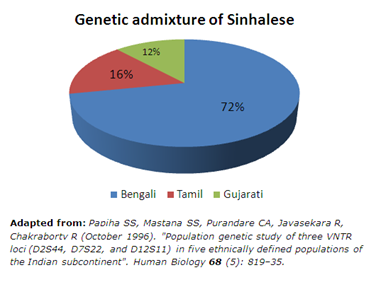
The Wikipedia states
that quote, All studies agree that there is a significant relationship between
the Sinhalese and the Bengalis and South Indian Tamils and that there is a
significant genetic relationship between Sri Lankan Tamils and Sinhalese, them
being closer to each other than other South Asian populations. This is also
supported by a genetic distance study, which showed low differences in genetic
distance between the Sinhalese and the Bengali, Tamil, and Keralite volunteers. The Up Country Sinhalese
(mountainous region) and Low Country Sinhalese have different genetic
phenotypes according to observations, with the up country Sinhalese looking
slightly more Caucasoid, compared to the low country Sinhalese, who’s castes
are known to have origins in South India, although no formal study has been
conducted on such matters. The vast genetic diversity of the Sinhalese has
intrigued anthropologists on their genetic origins”, unquote
While there are many studies done on the genetic mix of the Sinhala race, the following perhaps is generally representative of historical mix and consistent with historical records of migrations into the island.
From these accounts, other research
materials, and subsequent events, it does appear that the Sinhala race is a
mixed race with genetic inclusions from many other races. This is not to say
other races have genetic purity and a single genetic source. Most if not all races
in the world, particularly where movement of people from one area to another
and from one habitation to another occurred, there was mixing of races and
todays genetic research technology easily identifies genetic mixing in
individuals.
The
genetic mix of the Sinhala race makes them perfect candidates in a contemporary
sense to show a greater understanding and accommodating of other races whose very
genetic origins reside in them, and as Aristotle said, begin believing that the
whole is greater than the sum of all parts.
Sinhala
people are a spontaneously generous, kind and unselfish people. It is worth
pondering whether this is still the case in a general sense or whether or not
there has been a shift away from these noble characteristics, and towards a
more inward looking, less tolerant race, and if so, what or who has influenced
such a shift.
Sinhalese
and Buddhism
The
Mahavamsa again records how the Sinhala race had protected Buddhism whenever
there was a threat to Buddhism. Many Buddhist also go by the belief that Buddha
himself had stated that Buddhism will thrive in Sri Lanka and it will be
protected by the Sinhala people. It is unclear how Buddha could have said this
as the Mahavamsa also reportedly records that Buddha passed away the day Vijaya
arrived in Sri Lanka. The Sinhala race had not begun then for him to make that
prediction although the proponents of this story also say that Buddha had the supreme
mental ability to make such predictions. Such an ability would liken him to a
God, and Buddha was emphatic at all times that he was a human being. If indeed
Buddha had said that the inhabitants of the island would protect Buddhism,
then, that would have made more sense as it would have included all other races
in Sri Lanka.
The
question also arises as to how Buddhism could be protected and whether one is
talking about the Dhamma or the Buddhist Institution.
Ven Bhikkhu Thittila in the February 1958
issue off the Magazine
the Atlantic (The Meaning of Buddhism-Fundamental principles of
the Theravada doctrine) offers this view about the teachings of Buddha All the
teachings of the Buddha can be summed up in one word: Dhamma. It means truth,
that which really is. It also means law, the law which exists in a man’s own
heart and mind. It is the principle of righteousness. Therefore, the Buddha
appeals to man to be noble, pure, and charitable not in order to please any
Supreme Deity, but in order to be true to the highest in himself. Dhamma, this
law of righteousness, exists not only in a man’s heart and mind, it exists in
the universe also. All the universe is an embodiment and revelation of Dhamma.
When the moon rises and sets, the rains come, the crops grow, the seasons
change, it, is because of Dhamma, for Dhamma is the law of the universe which
makes matter act in the ways revealed by our studies of natural science”.
Ven
Bhikkhu Thittila states further that the teaching
founded by the Buddha is known, in English, as Buddhism. It may be asked, who
is the Buddha? A Buddha is one who has attained Bodhi; and by Bodhi is meant
wisdom, an ideal state of intellectual and ethical perfection which can be
achieved by man through purely human means. The term Buddha literally means
enlightened one, a knower”
If
one is to call oneself a Buddhist, surely there cannot be an argument that
Buddhism is or should be about the Dhamma and about what is in one’s mind. It
is oxymoronic to associate the Dhamma with the institution as an institution
cannot protect what is in a person’s mind. It is the Dhamma itself, and living
by the tenants of the Dhamma that one can protect one’s mind, and therefore the
Dhamma.
As Bhikkhu Thittila say
further this doctrine finds its highest expression in metta, the
Buddhist goal of universal and all-embracing love. Metta means much
more than brotherly feeling or kind-heartedness, though these are part of it.
It is active benevolence, a love which is expressed and fulfilled in active
ministry for the uplifting of fellow beings. Metta goes hand in hand
with helpfulness and a willingness to forego self-interest in order to promote
the welfare and happiness of mankind. It is metta which in Buddhism
is the basis for social progress. Metta is, finally, the broadest and
intensest conceivable degree of sympathy, expressed in the throes of suffering
and change. The true Buddhist does his best to exercise metta toward
every living being and identifies himself with all, making no distinctions
whatsoever with regard to caste, colour, class, or sex”.
It is perhaps timely to
reflect on the nature and characteristics of who a Sinhala Buddhist is and
perhaps should be. Do they live by the Dhamma and do they practice Metta? Can
the Dhamma be protected by the Buddhist Institution in Sri Lanka? Or is the
institution a determinant of the political fortunes of individuals and
political parties and the notion that Buddhism needs protection, a strategic
survival ploy of the Institution? Is this a symbiotic relationship that has
mutual benefits?
History and the environment
has created an identity called a Sinhala Buddhist as no one is that at birth.
That identity could learn to live by the Dhamma or live by institutional
dictates. It is no doubt a huge challenge for any individual as the environment
pushes one towards the institution and away from the Dhamma. The institution
fosters the opposite of Dhamma as the Dhamma is a threat to the institution.
This challenge becomes even greater when national political leaders espouse the
cause of Buddhist institutions, and foster and promote the display of the outer
garments and not govern to strengthen the inner selves of the people.
On 27 January 2021, the Office of the UN High Commissioner for Human Rights issued a report on behalf of the Commissioner, titled ‘Promotion [of] Reconciliation, Accountability and Human Rights in Sri Lanka.’ As we can typically see from recent activities of this Office, the report is more of a political report than a human-rights one.
A credible human rights report should be unbiased and objective, focusing on human rights and human rights violations of the people without dragging on political matters or preferences. The purpose of such a report for the Human Rights Council should be to enlighten the member countries about the facts and evidence of the past or the present to engage in a constructive dialogue with the country concerned, and recommending necessary steps to promote human rights, reconciliation, and accountability.
Especially of a country where extremism and terrorism have been recurrent problems, such reports should particularly be careful not to give excuses (uda geddi) directly or indirectly for such movements to reemerge.
It is not clear who has written this report, although some pretends it was written by the Commissioner herself. Of course, she should take the responsibility. It would have been better on the part of the Office, in the name of transparency, if the author/s have been revealed. Then the Commissioner could have been excused.
The Focus
There is a clear focus in the Report on the year 2020 where a new government was elected by the people overwhelmingly right or wrong. Criticizing such a government is primarily a matter for the people in the country and is a political matter even for outsiders. Even in the Summary itself it says,
The High Commissioner is deeply concerned by the trends emerging over the past year, which may represent early warning signs of a deteriorating human rights situation. The report highlights that developments over the past year have fundamentally changed the environment for advancing reconciliation, accountability and human rights in Sri Lanka, eroded democratic checks and balances and civic space, and reprised a dangerous exclusionary and majoritarian discourse.”
There is no mentioning of the terrorist attacks in April 2019 or the government crisis in October 2019 (to say the least) which in fact marked the deteriorating security and human rights situation in the country. It appears that the human rights ‘advocates’ at the Commissioner’s Office do not accept that peoples’ security in a country (let alone national security) is a necessary condition for the protection and promotion of human rights. This is a fundamental defect in the ‘Western’ thinking of human rights to my experience and knowledge on the subject.
It may be the case that the Commissioner’s Office is angered or prejudiced by Sri Lanka’s decision to withdraw from the previous co-sponsorship of the Human Rights Council resolutions in February 2020. Apparently, that is why the year 2020 is marked. The paragraph 2 of the Report expresses this dissatisfaction.
It must be understood that in independent and sovereign countries there can be different views on the matter of ‘co-sponsorship’ and if this understanding is lacking on the part of the Commissioner’s Office, there cannot be proper understanding of human rights or freedoms. In this case of a country.
Distorted Historical Context
Part II of the Report tries to give a distorted and even a dangerous picture of the origins of insurrections, armed conflicts, and violence in Sri Lanka. Paragraph 7 begins with the following sentence.
Sri Lanka’s armed conflict emerged against the backdrop of deepening discrimination and marginalisation of the country’s minorities, particularly the Tamils.”
Mind you, there was an armed conflict in 1971 without any connection to the Tamils or discrimination against the Tamils. Most of these armed conflicts emerged (1971, 1983-2009, 1987-89) because of political objectives (or aspirations) above and beyond social grievances. Or otherwise, there were democratic and peaceful means to rectify them although arduous and slow.
The phrase ‘against the backdrop’ in the statement may appear sobering the implied connection between the ‘armed conflict’ and ‘discrimination of minorities.’ However, it is a direct or indirect justification of the LTTE’s ‘armed conflict.’ It is also not correct to characterize the ‘armed conflict’ as between two equal contenders. Those were armed insurrections against a democratically elected government.
The report refers to that again more explicitly again in implicit justification. It goes like the following.
The 30-year war between the Government and the Liberation Tigers of Tamil Eelam (LTTE), as well as earlier insurgencies in the south, were marked by persistent and grave human rights violations and abuses by both parties, including extrajudicial killing, widespread enforced disappearances, arbitrary detention, torture and sexual violence that affected Sri Lankans from all communities. (My emphasis).
Could the resort to arm struggles by the LTTE or the JVP be justified by human rights violations? In my opinion ‘No’ particularly in a democratic or even in a semi-democratic country. Although the statement says, ‘violation and abuses by both parties’ what is mentioned here are ‘extrajudicial killings’ ‘enforced disappearances’ ‘arbitrary detention’ ‘torture and sexual violence,’ usually referred or attributed to a State.
Political Bias
Most alarming in the Report is the obvious political bias expressed in favor of the last government and against the present government. This should not be the case in a human rights report. Paragraphs 15 and 16 are very clear on this matter. First para begins:
It was at this juncture that a national unity Government, formed in January 2015, made important commitments to confront the past, strengthen democratic and independent institutions, and end impunity.”
This is a clear example that the Commissioner or the Commissioner’s Office has a clear political bias over political matters, party politics and democratic governmental changes within a sovereign and an independent country. While pointing out some inconsistencies and delays, the Report further states:
Nevertheless, Sri Lanka seemed to be on a new path towards advancing reconciliation, accountability and human rights. The developments since November 2019, however, have reversed that direction and, instead, threaten a return to patterns of discrimination and widespread violations of human rights experienced in past decades. (My emphasis).
In Section III, there are six subsections devoted to political matters apart from human rights issues and violations. There is no question that there are ongoing human rights issues and violations, and the governmental structures undoubtedly impinge on them. These are common to many countries including Western nations in different degrees.
The task of the Commissioner’s Office or the UN would be to involve member countries in a constructive dialogue without preferring defeated governments/parties, and without involving in political polemics. Otherwise, there are serious doubts whether the Commissioner or the Commissioner’s Office aiding and abetting defeated governments, terrorist groups like the LTTE or the JVP ostensibly in the name of human rights.
As an academic representing the World University Service (WUS) before the UN Commission on Human Rights and the Sub-Commission during 1984-1991, the present situation at the Human Rights Office in Geneva appears extremely sad. I have never seen an extremely political report such as the present during that time.
Colombo, February 6: The United Nations Human Rights Council (UNHRC) accuses Sri Lanka of being in a ‘state of denial about the past’, details how the failure of domestic mechanisms has further entrenched impunity, exacerbating victims’ distrust in the system. Among a litany of failures, the report addresses the rollback of 2015 reforms that offered more checks and balances on executive power, the erosion of judicial and institutional independence, and the failure to reform the security sector and remove and hold to account those responsible for alleged grave crimes and human rights violations. The Government has decided to reject the report submitted by the United Nations High Commissioner for Human Rights on Sri Lanka.
In an interview with the Daily News, Dr. Rohan Gunaratna who is an Honorary Professor at the General Sir John Kotelawala Defence University and Senior Advisor to its Department of Defence and Strategic Studies, Sri Lanka, discussed aspects of the UN report and Sri Lanka’s stand and course of action required to be taken.
The following are excerpts from the interview:
Q. As an international expert, how do you view the latest UN report on Sri Lanka?
. The UN report on Sri Lanka reflects that successive governments have not handled the human rights challenges prudently. It is still not too late for the Sri Lankan Government to create a team of specialists to provide guidance and direction as well as engage the UN system, especially the UNHRC. Unless the Government develops a professional approach, the existing situation will be mishandled and will lead to the loss of valuable time, opportunities and resources. The Government needs not only a whole of Government but a whole of society approach. The Sri Lankan conflict was meticulously documented and the data can be used to verify and validate the allegations made and implied in the report. Without further loss of time, the Government should create a proactive interagency mechanism with specialists from the Foreign Ministry, Defence Ministry, intelligence community, NGOs and the media to address the very issues raised in the report. After establishing a secretariat with competent and dedicated staff, the Government should create a 24/7 monitoring and response capability.
Sri Lanka was the first country to defeat an insurgent and terrorist group in the early 21st century. As a modern war, the Sri Lankan Security Forces – LTTE conflict was meticulously documented by several parties. The Sri Lankan Government should share the above documentation with the UN and also release significant information through a portal run by the Security Forces. The reports should include the United Nations Country Team Assessment of Casualty Figures that was never released publicly. According to this vital report, a total of 7,721 were killed and 18,479 were injured from August 2008 to May 13, 2009. This includes both civilians and LTTE terrorists. Furthermore, the UNICEF Supported Family Tracing and Reunification Unit issued a report that stated, as of June 2011, 2,564 tracing applications have been recorded out of which 676 are related to children and 1,888 to adults. The UNICEF stated that 64 percent tracing requests were reported by parents as having been recruited by the LTTE.
The LTTE international network provided a fictitious figure of 40,000 that the UN report has reproduced several times without authentication. The report of the Secretary-General’s Panel of Experts on Accountability in Sri Lanka, referred to by some as the Darusman Report, lost credibility in Sri Lanka after it reproduced the fictitious figure 40,000. An indelible lesson learnt from Sri Lanka’s experience is that international organizations, especially the UN, should not reference a death toll without verification and validation. It is within the capability of the UN to build a database of the dead that is transparent and open to scrutiny. The Sri Lankan Government should counter any individual or organisation repeating the fictitious numbers generated by the LTTE notorious for using its front, cover or sympathetic organisations to influence the human rights lobby. In response to the LTTE propaganda campaign, the Sri Lankan Government should create strategic communication capabilities within Army, Navy, Air Force, Police, Intelligence Services, and the Foreign Office. Unfortunately, neither the Foreign Office nor the Security Forces have understood the national imperative to raise the specialist capabilities to rebut the false information produced by the LTTE international network.
Q. As an expert on terrorism with vast experience on this topic, do you agree with these allegations against the Sri Lankan Security Forces accusing them of human rights violations?
A. The focus of the UN report is on accountability, the cornerstone of the human rights framework. Accountability is responsibility, answerability and enforceability. Accountability is the obligation of the Government to take responsibility for their actions, answer to those affected, and put in place a mechanism to monitor and take measures if the established standards are not complied. In the Sri Lankan context, the Government had a robust mechanism where several departments worked closely with UN agencies including the UNICEF, ICRC, diplomatic missions, international and domestic NGOs, and the media. There is sufficient documentation appreciating the Government’s commitment of sending food, medicine and other essential supplies to 399,785 civilians held hostage by the LTTE. The LTTE used the civilians as a cover to fire at the Sri Lankan military, a practice the LTTE is notorious for, including when it fought against the Indian Peace Keeping Force. There is also an abundance of documentation that the civilians ran away from the LTTE in the direction of the Security Forces. This includes testimony that the LTTE fired at the civilians breaking away from the LTTE human shield and fleeing in the direction of the Security Forces. The Security Forces provided water, food and medicine before transporting the Internally Displaced Persons (IDPs) to welfare centres because the LTTE had mined large areas of land and also each person had to be screened.
A total of 12,735 LTTE leaders and members surrendered or were identified by Tamil civilians or government investigators/intelligence. The former terrorists were given an amnesty, rehabilitated, and, reintegrated. As it prevented the revival of the LTTE, the rehabilitation programme of Sri Lanka is considered one of the three top programmes in the world. The then Defence Ministry Secretary Gotabaya Rajapaksa gave full access for a period of five years to a team of psychologists led by distinguished professors Arie W. Kruglanski and Michele J. Gelfand to interview the entire detainee population. In addition to the meticulous records maintained by the Bureau of the Commissioner General of Rehabilitation (BCGR), debriefing of the former terrorists are with the Police Special Branch, Criminal Investigations Department, Terrorism Investigations Division, Military Intelligence Directorate and the State Intelligence Service. The records provide the most comprehensive account of LTTE atrocities, the ethnic cleansing of Sinhalese and Muslims from the North and the East, the attacks on the Sinhala and Tamil villages, the massacres and bombings of civilians in the South, the assassination of civilian and military leaders including two world leaders, and the international network of the LTTE that supported and enabled three decades of terrorism in Sri Lanka. The Government should not share publicly the names of the rehabilitated and reintegrated LTTE terrorists as they are living happily with their families. However, they will be of exceptional value in bringing to justice those who supported, especially funded the LTTE in Sri Lanka.
Any investigation should focus on the sources of allegations and counter allegations. The key question that should be posed is who has brought these allegations? Although the LTTE domestic organisation was dismantled, the LTTE international network survived. The LTTE international network that engaged in propaganda and lobbying, extortion and fundraising, procurement of arms and dual-use technologies, and clandestine shipping of arms from North Korea to Sri Lanka transformed. The LTTE international network today masquerade as human rights champions in Western capitals and in Geneva. Similarly, the Tamil National Alliance (TNA) that espoused separatism, works in Geneva with key LTTE fronts. The Yahapalanaya regime delisted eight of 16 LTTE front organisations overseas and 269 terrorist activists from 424 listed under the UNHCR 1373. With the recovery of the LTTE database, its financiers overseas were listed based on evidence that has never been disputed. The terrorist fronts delisted by the Yahapalanaya regime were the Global Tamil Forum (GTF), British Tamil Forum (BTF), National Council of Canadian Tamils (NCCT), Tamil Youth Organisation (TYO), World Tamil Coordinating Committee (WTCC), Canadian Tamil Congress (CTC), Australian Tamil Congress (ATC), and Tamil National Council (TNC). The delisting of the fronts led to the revival of the LTTE at home and LTTE resurgence in the West. The time is right to relist the delisted fronts and to investigate, charge, and prosecute LTTE functionaries including propagandists, financiers, procurement and logistics officers living overseas.
Q. Successive governments in Sri Lanka gave assurances to repel the Prevention of Terrorism Act (PTA) and introduce new anti-terrorism laws. Why has this not happened?
A. The PTA was developed in 1979 by the then President J.R. Jayawardena’s administration as a response to terrorism which was prevailing at that time in the Jaffna Peninsula.
Its offences reflect the nature of terrorist activities which were taking place in that part of Sri Lanka at that time.
It is reliably known that State legal advisors were briefed of the type of criminal activities which were being unleashed at that time by a comparatively young group of terror organisations including the LTTE.
Based on the threat at that time a legal and policy framework was crafted to deal with the assassination of Tamil politicians, government officials, informants, bank robberies, explosions and making speeches resulting in racial hatred. At that time, there were no attacks on civilians. In addition to examining the counter terrorism legislation of the UK, India and Pakistan, they reviewed emergency regulations to deal with the 1971 insurrection, the 1962 military coup, and the Criminal Justice Commissions Act. The PTA was enacted for a year as he believed that the terrorist threat could be eliminated by the end of the year. The PTA of 1979 law repealed the proscription of the LTTE and other terrorist groups in 1978. During that year, the threat grew and the Parliament gave the PTA another three years. As the threat persisted, the Parliament made it a perpetual law.
Today, the threat landscape has changed. The PTA does not capture the killing of civilians except witnesses. The PTA covers only specified persons: public servants, policemen and politicians. The PTA is not potent to deal with the Easter Sunday attack, the type of attacks the world including Sri Lanka is likely to suffer if national security is neglected. If the Counter Terrorism Act (CTA) had been enacted in a timely manner during the Yahapalanaya regime, the Easter massacre could have been prevented. If not prevented, the State could have used the CTA to deal with those involved in the Easter attack. Unfortunately, the Yahapalanaya Government was weak and the then Opposition onslaught prevented the bill from becoming a law. In the Sri Lankan culture of confrontational politics, there was no bipartisanship on national security and foreign policy. The Opposition wrongly said the CTA was a US and European draft when 22 top-level Sri Lankan Government officials and one private human rights lawyer had worked on it. The legislative draft reflected the unanimous view of all 22.
The bill was drafted by a group of Sri Lankan legal, military, police, intelligence and administrative personnel of whom except one, all were public officials. Their final report which was presented to the then Prime Minister had been unanimous. They had twin objectives. One was to develop a modern counter terrorism law which could be effectively used to deal with all contemporary forms and manifestations of terrorism. The other was to ensure compatibility with human rights norms and to prevent abuse. After the Easter attack, it is apparent that the PTA is not the most efficacious in dealing with all forms and manifestations of terrorism. What is conspicuously absent in the PTA is an offence called terrorism and acts. As religious extremism is the backdrop for the unleashing of violence, that is per se terrorism. Furthermore, with terrorism emerging as a global play, if anyone is planning attacks against Sri Lanka from overseas or its nationals in Sri Lanka are planning to mount attacks overseas, the State can act. The CTA is a contribution towards the global effort on terrorism. The CTA is also efficacious against LTTE networks, cells and individuals overseas planning abetting and instigating terrorism in Sri Lanka. The CTA gave universal jurisdiction to Sri Lankan law enforcement and courts to deal with terrorism both from a national and global perspective.
Q. The UN High Commissioner urges the authorities to immediately end all forms of surveillance…” What is your opinion?
A. A government with no capacity to surveil terrorist and criminal suspects will suffer from terrorism and crime. Sri Lanka suffered from the Easter Sunday massacre as a direct result of the Yahapalanaya Government leaders instructing the Directorate of Military Intelligence to call off its surveillance operations. The result was the loss of 264 lives, both Sri Lankans and foreigners, and another 592 maimed and injured. The Easter Sunday massacre was the worst terrorist attack Sri Lanka suffered since 2009. It will be fatal for Sri Lanka if its security and intelligence services stop its surveillance operations. In the US, Canada, Australia, New Zealand, UK and in continental Europe, there are over 100,000 terrorist suspects under watch.
Sri Lanka’s security was compromised by its leaders during the Yahapalanaya regime. Rather than curbing Islamization and Arabization, Wickremesinghe advocated a reconciliation model of governance to enlist the Muslim vote. Similarly, instead of countering separatism, Mangala Samaraweera delisted LTTE entities enlisting the Tamil vote. As Prime Minister of the Yahapalanaya regime, Wickremesinghe instructed the Directorate of Military Intelligence to dismantle the operational capabilities designed and developed to detect terrorists and disrupt attacks. Instead of securing Sri Lanka, Wickremesinghe took guidance from the UNHRC, human rights bodies, Western capitals and Western diplomats in Colombo lobbied by the LTTE and TNA to investigate the Security Forces. With the restrictions placed on the Security Forces, the lack of direction and guidance by both Wickremesinghe and Sirisena, the birth, growth and attacks by the Islamic State was inevitable and imminent.
In addition to expanding its security and intelligence capabilities both in Sri Lanka and overseas in the coming decade, the Sri Lankan Government should respond to the current and emerging threats by introducing a national service. Furthermore, the Government should propose an intelligence and a National Security bill.
Q. The US Justice Department has charged three Sri Lankans with supporting terrorism for their participation in the Islamic State-claimed Easter attacks on churches and hotels in 2019. Sri Lanka is still to charge anyone despite numerous investigations. What is your opinion?
A. The Easter Sunday massacre is an act of international terrorism. It was a complex terrorist attack involving multiple targets. The Criminal Investigations Department, Terrorism Investigations Division and other entities have worked with the Attorney General’s Department to investigate and indict the Islamic State detainees. The AG will review the findings of the Presidential Commission of Inquiry on the Easter Attacks. The Presidential Commission concluded their proceedings only in January 2021. While the focus of the police investigation was on bringing the perpetrators and the support network that enabled the terrorist attack to justice, the Presidential Commission will propose far-reaching changes to prevent the next attack.
The far-reaching changes should include reforming the mosque and Madrasa, where Muslims learn about other faiths, and, learn to respect them. Even after the Easter Sunday massacre, the continuing spread of Salafism especially its Saudi version Wahhabism was highlighted at the Presidential Commission on the Easter Sunday attacks. The Government should put in place a system to screen foreign preachers and also accredit local preachers practicing in Sri Lanka. As long as foreign ideologies supplant local and traditional Islam, exclusivism, extremism and terrorism will persist. With the second commemoration of Easter Sunday massacre coming up, the Muslim leadership should move to reform the religious space. Although the ideology of Salafism/Wahhabism known as Tawheed in South India and Sri Lanka originated from Saudi Arabia, most of the Gulf countries have been smart. They have regularised the management of mosques, Madrasas and all Islamic organisations. Today, no sermons without the approval of the religious authority appointed by the Government could be delivered. The sermons should be devoid of political subjects. There should be no anti-government propaganda in religious institutions.
The madrasas should be brought under the Education Ministry. Similarly, there should be a common syllabus. The Gulf countries have been able to modernise their Madrasas with a regulated curriculum. Until Easter Sunday, successive governments in Sri Lanka left it to the Muslim leaders to take tough decisions on religious reform due to political considerations. Sadly, the situation has deteriorated from bad to worse. A segment of the Sri Lankan Muslims continues to take inspiration from Saudi Arabia but behave more regressively. Muslim political and clerical leadership should develop a zero-tolerance approach to exclusivism and extremism. They should stop the political, religious and cultural radicalisation by reforming the Madrasa and the mosque sermons to produce a new generation of Muslims. They should reject the Middle Eastern ideologies and fashion that is supplanting the Sri Lankan Muslim heritage.
Q. In your view what steps could and should the Government take in order to encourage reconciliation between the various communities in the country?
A. National unity is national security. If the bridges between communities are not restored, exclusivism will lead to extremism and extremism to terrorism and violence. The way forward is to replace the segregated education system with national schools, introduce religious knowledge to all schools, delist ethnicity and religion-based political parties, and integrate communities. To deter anyone from insulting another person’s ethnicity and religion, formulate a maintenance of ethnic and religious harmony act, and also an online falsehoods and manipulations act.
Sri Lankan politicians have exploited ethnicity and religion for their personal and political agendas. They have created disharmony between communities and compromised national security. The most notorious was the TULF that created the separatist ideology that some elements of the TNA continue to espouse by igniting racial passions. The Government has to take firm action on anyone trying to glorify Prabhakaran, the LTTE and the dead terrorists. The Government should reach out to the Tamil communities overseas and engage them to join in the socioeconomic development programmes of Sri Lanka.
Circus Pacifica, Apollo Circus and of course the amazing Chinese Circus — readers of an earlier generation will no doubt remember these. The Apollo Circus however planted itself on Pedris Park for quite awhile, but the others were rare.
Perhaps the antics of politicians, political parties, activists of various persuasions and of course the NGO rat pack compensated. They have entertained us even as they went about their charades, clowning, sleight of hand, somersaults and such, prompting quite a few oohs and aahs from an audience that wasn’t exactly applauding in unison.
We could never look forward to the real circuses. We didn’t have to anticipate with bated breath the political circus. However, there’s one which comes around every year around February. The Geneva Circus.
There are essentially two scripts: one to be used when a US-friendly or rather servile-to-the-USA government is in power and the other when the regime is not willing to play ball with eyes closed. In the first case, we get co-sponsored anti Sri Lanka resolutions, soft deadlines, much forgiving and forgetting. The run-up to the UNHRC sessions are not marked by Washington-led media outfits badmouthing Sri Lanka. The separatist groups abroad are in ‘go-easy’ mode. Human rights outfits barely murmur ‘concerns.’ Their local counterparts go into hibernation and the slumber is so deep that they don’t have the eyes to see any wrongdoing.
Well, we are not in that situation right now. It’s ‘the other guys’ in power and perforce it’s the second script that’s being played. This is how it goes.
It begins with the collection/construction of evidence. There are claims that strangely (and by now predictably) are filed without substantiation. Non-movement on agreements that are no longer valid will be noted. There will be a lot of striving and straining to enumerate ‘minority grievances,’ and to this end, the local lackeys in political and NGO circles will do their bit. Statements will be issued by the representatives of nations that have clout in Geneva (the U.S. ‘Cesspool of bias’ description notwithstanding). All ‘concerns’ raised will be duly documented. Human rights outfits, international and local, silent for months, will suddenly find voice.
‘Sri Lanka’s human rights situation has seriously deteriorated under the administration of President Gotabaya Rajapaksa, Human Rights Watch said in its World Report 2021.’
That’s Human Rights Watch. Absolutely predictable. It comes with ‘evidence.’
HRW claims that security forces have increased intimidation and surveillance of human rights activists, victims of past abuses, lawyers, and journalists.’ If activists and claimants of past abuses, political operatives who conveniently wear the lawyer or journalist hat are upset about outcome preferences that haven’t materialized feel some anxiety and want to call it ‘intimidation’ or ‘surveillance’ that’s their right. A state cannot be faulted to be cautious, especially given a 30-year war against terrorism and a jihadist movement that unleashed terror on civilian targets that matched the worst of the LTTE. We don’t even know if there was intimidation or surveillance. We do know that ‘intimidation’ is frequently fabricated, posted on dubious websites and photo-shopped into newspaper cuttings. We know that such ‘evidence’ is sent to the right addresses where the relevant householders lap it all up gleefully.
HRW is upset about Sri Lanka withdrawing from the resolutions co-sponsored by a more than mischievous minister on behalf of a government operating absolutely against popular will on the relevant issues. However, when the wording is regurgitated, it does sound ominous. It’s as though Sri Lanka has decided that truth-seeking, accountability and reconciliation are irrelevant. That’s hardly the case. Well, not ‘Reconciliation = Eelamist Agenda’ certainly, but those who preferred THAT version were booted out by the voter. HRW has missed the incontrovertible truth that even those who pushed that version, did an about turn, pledging in two major elections to uphold the unitary character of the state. As for the devolution element of reconciliation, not even its most ardent advocates seem interested in provincial councils.
So it’s natural that the HRW feels a reversal in ‘gains of the previous government.’ HRW feels that minorities are ‘more insecure, victims of past abuses fearful, and critics wary of speaking out.’ That’s what Meenakshi Ganguly, the South Asia director of the outfit says. It’s cut-and-paste stuff, nothing more.
If ‘security’ is about a separatist agenda moving in the ‘right direction,’ sure, that’s not happening. ‘Victims of past abuses,’ she says — well, such as? Critics? Does she mean those who were unofficial adjuncts of the political camp that lost? They are wary, are they? ‘Wary’ is certainly a politically more useful descriptive than, say, ‘devastated by political defeats.’
There is certainly a more military presence in government. Systemic flaw and woeful incompetence by officials haven’t really helped the President get things done, especially in a pandemic context. It’s no secret that it is the security forces and the State Intelligence Service that have sacrificed the most, working tirelessly around the clock, to support the efforts of the medical teams fighting Covid-19. The retired officers (they are civilians now, let us not forget) haven’t done worse than those they replaced as heads of certain key institutions. In fact, in certain cases, they’ve managed to streamline operations, cut costs and get things done.
HRW says ‘they were, like the President, implicated in war crimes.’ Here we go again! Accusation treated as established fact in a political project which is not described as such, naturally. HRW makes much of the USA announcing that General Shavendra Silva was ineligible to enter that country. Oh dear! The USA passes judgment and that’s the last word? This is the point where the clowns do their turn. Loud applause and much laughter follow!
HRW talks of a ‘false accusation on social media that Muslims were deliberately spreading the virus.’ Lots happen on social media. Some take it seriously, some don’t. HRW seems to have done some surveillance and cherry-picked. Good for HRW.
HRW does better on the issue of burials/cremation. The Government has not sanctioned burial. Yet. The issue has been politicized by multiple parties, Muslim politicians included. Maybe HRW is not interested in delving into the details and the complexities, but the Government could (still) act in ways that alleviate the apprehensions of the Muslim community.
The High Commissioner for human rights, Michelle Bachelet has also made the expected noises, flagging ‘freedom of expression’ issues related to what she calls ‘criticism of the government’s handling of the Covid-19 situation.’ This is not the time to be mischievous and some certainly were, and that, Bachelet and HRW will not agree, can have serious impact on the entire population. The nice thing about it is that neither HRW nor UNHRC has to do the cleaning up when the smelly stuff hits the fan.
Ganguly ends with some poetry. Nice. ‘Concerned governments should do all they can to prevent Sri Lanka from returning to the ‘bad old days’ of rampant human rights violations. Governments need to speak out against abuses and press for a UN Human Rights Council resolution that addresses accountability and the collection and preservation of evidence.’
Concerned governments, she says. Does she mean the USA, UK and those in the EU? Laugh, ladies and gentlemen. That’s what you do when the circus comes to town!
Yes, the EU too. The EU has, as expected when the Geneva Circus is around the corner, ‘raised concerns’ on human rights. The wording is identical, almost: inclusiveness, reconciliation and fair treatment of minorities.’ The EU office has also tweeted that it is ‘saddened by the destruction of the monument at the Jaffna University.’
What’s the story there? Students cannot put up structures at will on state property. If the monument was sanctioned, the person who gave permission was the first culprit. However, having allowed it or turned a blind eye to it (as the case may be), it is wrong to arbitrarily raze it to the ground. The Vice Chancellor opined that it was an obstacle to reconciliation. The students’ response (‘we tell the Sinhala Government” that we don’t want to fight a war, we just want to honor our dead’) seems to justify his position, but that’s a different matter.
If students want to celebrate brutes, that says a lot about the students. However, if it’s about remembering kith and kin, that’s another matter altogether. If that’s the case, though, why make a political fuss about it? Why turn it into a circus?
The VC has since done a U-Turn and even laid the foundation for a replacement monument. The government missed a trick here. It could have engaged the students. It could have discussed the possibility of a monument before which anyone could grieve, especially the near and dear for the temperature of their tears are the same and truer than those shed by the politically motivated. Could have, should have, still can do. Never too late.
There are circuses and circuses. Some International, some local. We had the US Ambassador finding her voice after a long silence to express dismay over the assault on the Capitol Building in Washington DC. ‘We will continue to try to be more perfect,’ she pledged. So, the USA and everything in that country including racism, police brutality and a foreign policy that’s only about securing markets, plundering resources and bombing countries to the middle ages if that’s what pursuing strategic interests entails, is ‘perfect.’ That’s the claim. Laugh ladies and gentlemen!
This week also saw an incarceration drama. Ranjan Ramanayake was sentenced to a four year prison term for contempt of court. Naturally, the opposition cried ‘foul.’ Ranjan’s ethics are obviously of the kind that makes ‘foul’ a weak descriptive. He did rant and rave in ways that others did not. He did insult the judiciary. He demanded an independent judiciary but was caught on tape (his own) promising to intercede on behalf of a judge, taking her case to the then Prime Minister Ranil Wickremesinghe (yes, under whose watch HRW and the UNHRC says ‘there was progress’!).
Was there political motivation at work in the court decision? We don’t know. We can speculate though. Speculation on this count was fueled by the acquittal of Sivanesathurai Chandrakanthan allies Pilleyan, former Chief Minister, Eastern Provincial Council and leader of the Tamil Makkal Viduthalai Pulikal (TMVP).
Ranjan in, Pilleyan out! How horrendous! That’s the line the Opposition took.
Well, Pilleyan belonged to a terrorist organization. That’s bad. He was accused of murder. That’s not good. However, on that particular charge, his innocence has to be presumed until and unless proven guilty. He was held for five years without trial. Five years! That’s when the government which HRW and Bachelet believes ‘made some progress.’ Those making a song and dance about Ranjan’s sentence and about ‘the lawyer’ Hejaaz Hizbullah being held without trial over suspected involvement in the Easter Sunday attacks, weren’t upset over Pilleyan’s incarceration.
Five years was long enough to find the evidence, but apparently the Attorney General couldn’t make a case. That, or he bowed to political pressure. The former indicates that his predecessor was playing politics with justice. The latter, if that’s the case, doesn’t cover the current Attorney General in glory. However, all this is speculation. We really don’t know.
Maybe investigations regarding Hizbullah are incomplete. He’s been under custody for many months. Not yet ‘years.’ Years, however, is the time-slice in the case of LTTE cadres currently in detention. Neither the previous regime nor this has moved to bring matters to a close. It would be a horrible travesty of justice if they are finally released ‘due to lack of evidence’ or an unwillingness to continue with the prosecution (either of which could be the case with respect to Pilleyan). Not a laughing matter, ladies and gentlemen .
We had the President slipping in Ampara over the last weekend. To be fair by him, the President has been badgered endlessly by Harin Fernando from day one. The President responded in jest, but what he said was not really funny. He alluded to Prabhakaran and how that terrorist’s life ended. Unnecessary. Unbecoming. Harin is, relatively, small fry and his political track record is so sketchy that responding to him constitutes a salute, an undeserved one.
Harin claimed he knew about the Easter Sunday attack AND DID NOTHING ABOUT IT! Gotabaya Rajapaksa, during the election campaign, conducted himself well. He didn’t utter one word about his fellow candidates. He focused on his program. He slipped. That’s no laughing matter either, even though people are making a mountain out of a molehill here.
There was noise over the East Terminal of the Colombo Port. The unions and several political parties objected. They met with the President. The talks were disappointing, they said. The President said it will not be sold. He said it’s a joint venture with a minority control for the Indian port development company. He didn’t say that the same company is building a competitor-port in Kerala. Obviously there’s ‘understanding’ that’s not been put into words and made public.
Obviously the (virtual) sale of the Hambantota Port by the previous regime has constrained the President vis-a-vis Indian ‘concerns’. The President has gone on record to say that India’s national security concerns will not be compromised by Sri Lanka. There’s a cheque being cashed by India but we don’t know what we got in return. The vaccine? That’s a laugh — in any case 99.5% of the infected recover, the vaccine is still an unknown quantity and there are alternatives out there in the vaccine market. A (nominal) buffer in Geneva? Possible but again, we do not know. Such things are not said. Arms are not twisted in public.
A government besieged (as this one is) has few options. Geneva is a circus but not one where the Sri Lankan delegation will get to laugh. The Government has one trump. Not Donald. The people.
I am addressing this note to you as I believe that you are man of the world with a road map for the Nation. I have listened to your pre-election speeches, delivered in Australia, and read your orations, in Sri Lanka, which outlined your vision for the country and the nation. And, I still believe that you have a lot to contribute to the Nation.
I am rather puzzled with two recent propositions made by you which fly in the face of the picture of you, I had in my mind. Still. I have implicit trust in you as I am of the view that which I discuss below will receive your close scrutiny.
Grasping the Nettle, I may point out that your proposal to ‘amend the Antiquities Ordinance, repealing the provisions therein, preventing the courts from releasing persons charged with or accused of related offences on bail” (article in The Island by K Tiranagama) reminds me of the attempts of some to hunt with the hounds and run with the hare. As you no doubt agree the Antiquities are part of our living history which we have to protect and handover to our future generations. As a small country, we have been cheated by a number of invaders who pillaged our invaluable treasures of historical value and stole many others which are now stored in prestigious museums of the West. Your efforts to tackle the prison congestion by tinkering with the Antiquities Ordinance is not acceptable to a nation which is at the receiving end of systematic robbery of her artifacts by the colonial powers and, at present, by the greedy and the well-planned destructive forces,
So, Hon Minister, you should consider looking elsewhere, if your objective is to reduce the prison congestion. If at all, you should introduce stringent measures to the Antiquities Ordinance to deter persons from robbing the nation’s history. We hear that yearly over 750 complaints are received annually by the police and the Dept of Archaeology, about vandalism directed at our antiquities. If you do implement your misdirected proposal, such vandals will have a field day.
The second proposal which is equally, or more, damaging, is included in the gazette notification no 2208/13 -2020 issued on council of legal education dated 30.12.21/which says.
Part I : Sec. (I) – GAZETTE EXTRAORDINARY OF THE DEMOCRATIC SOCIALIST REPUBLIC OF SRI LANKA – 30.12.2020 5A (d) the Special Entrance Examination shall be held during a specified month as determined by the Council, of the year preceding the year of entry to the Sri Lanka Law College. (2) immediately after rule 28 thereof, by the insertion of the following new rule:- ” 28A. (1) All courses conducted at the Sri Lanka Law College shall be conducted in the English Medium.
Why should the law be taught only in English, vitiating the Official Language Act? As you no doubt agree law affects everybody in Sri Lanka and the opportunity should be made available to the average Sri Lankan to understand and to act according to the law. Once the education is provided in English only, as per the proposal, the whole legal machinery, including the hearing of court cases, will be conducted in English only. You may remember how the ordinary villager Silindu, in the well know novel Village in the Jungle” had to face justice when he had to look up and accept the judgement against him, delivered in English, a language which he did not comprehend! There will be many more Silindus in Sri Lanka who will have to come to the courts and suffer in silence to the dictates in English if the proposed scheme comes into operation. The law had been taught in the Sinhala language for more than 25 years and is not a subject to be used internationally, except with regard to special occasions which can be handled even by using official translators as in the case of eminent international leaders who are not conversant in English. You are only attempting to turn the clock back to the colonial period. Please reconsider and revert to the existing system in providing legal education as per the Official Language Act
Ahead of the 46th sessions of the Geneva-based United Nations Human Rights Council (UNHRC) scheduled to begin later this month, newly elected US President Joe Biden’s Democratic Party has raised Sri Lanka accountability issues in a recently submitted Resolution, with the focus on appointment of military officials, including that of Gen. Shavendra Silva as the Commander of the Army.
The UNHRC consists of 47 countries divided into five groups. The UK took over Sri Lanka matter in the wake of the US quitting the UNHRC in June 2018. It now heads the Sri Lanka’s Core Group.
Silva, the first General Officer Commanding (GoC) of the celebrated 58 Division was named the Commander of the Army by President Maithripala Sirisena.
Sirisena’s successor, Gotabaya Rajapaka, appointed Silva the Chief of Defence Staff (CDS) and subsequently promoted him to the rank of General.
Democratic Party Congressman Brad Sherman, a ‘very’ close associate of professional activists within the Global Tamil Diaspora has tabled a Resolution in the U.S. Congress charging President Gotabaya Rajapaksa administration of engaging in harassment and intimidation of human rights defenders and enforced disappearances, and protecting war criminals, Daya Gamage, former political specialist of the US State Department said.
Bradley James Sherman is the US Congressman representing California’s 30th congressional district since 2013.
The author of Tamil Tigers’ debt to America Gamage explained how the change in US administration had started to bring in ‘initial bearing’ on Sri Lanka with Congressman Sherman making a move. Gamage said that the US stand on the accountability issues should be examined against the backdrop of a statement attributed to Foreign Secretary Admiral Jayanath Colombage that the political change wouldn’t have any bearing on Sri Lanka.
Gamage said that in spite of the US not being a member of the UNHRC, it would throw its full weight behind the push for a new Resolution to be moved at the forthcoming sessions.
Here are four areas the Congressional Resolution on Sri Lanka has touched:
Whereas the Government of Sri Lanka has promoted high ranking military officials suspected of forcibly disappearing persons and bearing responsibility for war crimes, including Lieutenant General Shavendra Silva, and has failed to hold accountable other current military officials accused of war crimes.
Whereas, during the 26-year civil war ending in 2009 between government forces and the Liberation Tigers of Tamil Eelam, tens of thousands of Tamils were forcibly disappeared by the police, military, and paramilitary operatives
Whereas, according to a 2020 United Nations Special Rapporteur’s report, no observable progress has been made on pending cases, including habeas corpus applications into the disappearance of Tamil Tigers and members of their families who surrendered during the final days of the war”.
Whereas lawyers, human rights defenders, and victims involved in cases of enforced disappearances face intimidation, harassment, and violence, particularly since Rajapaksa became President.
The Island learns that since the initial government reaction to the US slapping travel ban on Gen. Shavendra Silva and his immediate family members an year ago, the government hadn’t made representations to the US or UNHRC. The government ignored an opportunity to take up the Army Commander’s issue in the wake of the recent declaration made by the then US Secretary of State Mike Pompeo regarding the Army Commander’s matter. When the media raised the US travel ban on the Army Commander at a joint media conference given by Pompeo and Foreign Minister Dinesh Gunawardena, the one-time CIA Chief said All right. Thank you. I think there were three questions there. The last one, look, it’s a legal process in the United States. We’ll always continue to review it. We want to make sure we get it technically, factually, and legally right. We’ll continue to do that.”
Well informed sources said that the UK spearheading the moves for a new Resolution at the UNHRC had told the Sri Lankan government in no uncertain terms that it was determined to go ahead with the project. Sources said that Secretary of State for Foreign, Commonwealth and Development Affairs and the Minister for South Asia Lord Ahmad of Wimbledon explained their stand to Minister Gunawardena and the Sri Lankan High Commission in London.
Tamil political sources said that they had the required support to secure a new Resolution at the forthcoming session. Sources said that a petition forwarded by three Tamil political parties represented in parliament to UNHRC members as well as the HR Commissioner received approval from those who mattered. Sources pointed out that the HR Commissioner’s latest report on Sri Lanka took the Tamil parties’ petition into consideration.
There is a mechanism in place to vaccinate all Sri Lankans within three months and to become the first country in the world to complete that task, Secretary to State Ministry of Primary Health Care, Epidemics and COVID-19 Disease Control Dr. Amal Harsha de Silva said yesterday.
He told Daily Mirror the Government had identified locations to set up 4,000 centres where the general public could be vaccinated.
With this system in place, we hope that Sri Lanka will be able to complete the vaccination programme within three months and be named as the first State to do so.
The Secretary underlined that this would depend on the availability of vaccines into Sri Lanka because there is a higher demand for vaccines but less supply.
We have already placed an order for 18 million of Covishield vaccine from India. Apart from that, we have had talks with Russia and China to bring vaccines. Also, we have taken steps to allocate two million of Pfizer vaccines,” Dr. de Silva said.
He also said that if mass inoculation was completed, it would reduce the huge amount of money that had to be spent on PCR testing.
We spend a sum of Rs.100 million per day for PCR testing,” he added. (Sheain Fernandopulle)
The Director General of Health Services confirms eight (08) more Covid-19 related deaths have been reported increasing the death toll due to the virus in Sri Lanka to 351.
The victims include a 77-year-old woman from Kochchikade, who was identified as Covid-19 positive while being treated at the Negombo District Hospital and was later transferred to the IDH. She had passed away today (06) due to shock caused by blood poisoning, Covid-19 pneumonia and kidney disease.
A 73-year-old woman from Kadawatha, who was transferred from Colombo North Teaching Hospital to Mulleriyawa Base Hospital after being identified as infected with the virus, had passed away on February 05. The cause of death is listed as heart condition, Covid-19 pneumonia and kidney disease.
A 56-year-old male from Moratuwa had passed away at the Mulleriyawa Hospital on February 05 due to Covid-19 pneumonia and cancer.
An 83-year-old male from Kelaniya had passed away today at the Dankotuwa Hopsital. He had been transferred to the hospital from the Welisara Hospital after being identified as Covid positive. The cause of death is reported as heart and raspatory issues caused by Covid-19 infection and complication related to liver disease.
An 85-year-old male from Colombo 14 had died on admission to the Colombo National Hospital on February 04. The cause of death is cited as Covid-19 pneumonia.
An 82-year-old female from Colombo 13, who had been transferred from Colombo National Hospital to Homagama Base Hospital, had passed away on February 05 due to Covid-19 pneumonia, high blood sugar levels and kidney failure.
A 76-year-old female from Maharagama had been transferred from the private hospital in Colombo to Mulleriyawa Base Hospital after testing positive for the virus. She had passed away at the hospital on February 04 due to kidney damage caused by the worsening of a kidney disease and Covid-19 pneumonia.
A 48-year-old male from Mundalama had passed away while being treated at the Maharagama Apeksha Hospital on February 05. The cause of death is reported as Covid-19 pneumonia.
The Ministry of Health says that 383 new cases of novel coronavirus have been identified increasing the tally of positive cases reported within the day to 726.
All are new cases are close contacts of patients from the Peliyagoda cluster.
The total number of Covid-19 cases from the Minuwangoda, Peliyagoda and prisons clusters has increased to 64,575 with this.
Pregnant women and children aged below 18 years will not be vaccinated against COVId-19, says Chief Medical Officer of Health of Colombo Municipal Council Dr. Ruwan Wijayamuni.
He noted that people should not have undue fears about getting themselves vaccinated.
Speaking to media today (February 06), Dr. Wijayamuni said people with chronic health conditions and those who suffer from high blood pressure, diabetes and heart diseases should not be afraid of receiving the vaccine.
However, individuals with severe allergic reactions must inform the respective medical officer before receiving the vaccine, he stressed.
Further, Dr. Wijayamuni said a total of 875 health workers and other officials engaged in COVID-19 prevention efforts in Colombo were vaccinated by the end of yesterday (February 05).
After receiving the vaccine, they showed mild fever, loss of appetite, body aches, joint pains and mild headaches, but no severe complications were reported, he stated.
When the vaccine is administered, the body produces antibodies against the SARS-CoV-2, Dr. Wijayamuni explained. After receiving the vaccine, even if come across a person infected with COVID-19, our body will begin producing antibodies against the virus when we are contracting the virus.”
Majority of the people need to be vaccinated in order to increase the level of immunity in the community for preventing the transmission of the virus, Dr. Wijayamuni pointed out.
World Health Organization chief Tedros Adhanom Ghebreyesus called on more pharmaceutical companies on Friday to share manufacturing facilities to help ramp up the production of COVID-19 vaccines.
The WHO also said its technical advisers would meet next week to assess versions of the AstraZeneca vaccine from the Serum Institute of India (SII), the largest vaccine maker, and from South Korea’s SK Bioscience ahead of a possible WHO emergency listing.
Speaking at an online news briefing from Geneva, Tedros said almost 130 countries with a combined population of 2.5 billion people were yet to administer any vaccines, and repeated his plea for rich nations to share doses with poorer countries once they have vaccinated health workers and older people.
But we also need a massive scale-up in production,” the WHO director-general said.
Last week, Sanofi announced it would make its manufacturing infrastructure available to support production of the Pfizer/BioNTech vaccine. We call on other companies to follow this example.”
France’s Sanofi said last week it would fill Pfizer’s vaccine from July, aiming to help supply more than 100 million doses this year amid massive demand.
Other companies are already getting on board, as well.
Switzerland’s Novartis struck a similar deal for the Pfizer shot, while Germany’s Bayer signed on to help CureVac.
Emergency Approval
The WHO has so far approved a single COVID-19 vaccine for emergency use, the shot from Pfizer and its German partner, BioNTech.
That could be expanded soon, with the independent WHO advisory group meeting on Feb. 15 to look at versions of AstraZeneca and its partner Oxford University’s shot being made by the Serum Institute of India and SK Biosciences in South Korea.
This data only came to us a few weeks ago,” Mariangela Simao, WHO assistant director-general for vaccine access, said of the upcoming assessment, adding the group must analyse not only AstraZeneca’s core data”, but also data from sites where the vaccine is being made, of which there are eight, before issuing its recommendation.
Investigations will be carried out into certain banks debiting money without informing account holders, says State Minister of Finance and Capital Market and Public Enterprise Reforms Ajith Nivard Cabraal.
Complaints regarding similar incidents have been received, the State Minister said adding that strict action will be taken against such banks.
Cabraal noted that he expects to propose new rules in the future to prevent unfair moves taken by certain banks.
By P.K.Balachandran/Weekend Express Courtesy NewsIn.Asia
Muthuvel Karunanidhi’s decision to support the Liberation Tigers of Tamil Eelam (LTTE) to the hilt when he was Chief Minister of Tamil Nadu between January 1989 and January 1991 had several adverse and wide-ranging consequences. The Dravida Munnetra Kazhagam (DMK) government, which he headed, was sacked citing collusion with the LTTE, when it had completed only two years of its five year term.
Peaceful Tamil Nadu had become the scene of assassinations. And the cause of the Sri Lankan Tamils, which Karunanidhi claimed to uphold as the Tamizh Ina Thalaivar (Leader of the Tamil Race), suffered a huge setback.
It was during that time that the Tigers’ war against the Indian Peace Keeping Force (IPKF) in North and East Sri Lanka was at its height and the violence and lawlessness across the Palk Strait had spilled over to peaceful Tamil Nadu. The leeway given to the LTTE by the DMK regime enabled the militant group to massacre the leadership of the rival Lankan Tamil group, the Eelam Peoples’ Revolutionary Liberation Front (EPRLF), in Madras on June 19, 1990.
The government’s indulgence paved for the assassination of former Prime Minister Rajiv Gandhi in the State on May 21, 1991. The man who led the squad which massacred the EPRLF leadership, the one-eyed Sivararsan, was to mastermind the assassination of Rajiv Gandhi. The Tamil Nadu police had allowed Sivarasan and his squad to escape to Sri Lanka in 1990 in defiance of orders from Delhi to catch them. Sivarasan would came back to plot the killing of Rajiv Gandhi.
But Rajiv’s assassination resulted in a loss of sympathy and support for the Sri Lankan Tamils and the Tigers in Tamil Nadu. New Delhi began to distance itself from the Sri Lankan Tamil cause. Eventually, all this enabled the Sri Lankan armed forces to crush the LTTE and the Eelam movement in May 2009.
An insider’s account of this sordid saga is found in a recent book entitled: Service Uninterrupted: Memoirs of M.M.Rajendran (Har-Anand Publications, New Delhi, 2020, INR 700).
Rajendran was Chief Secretary in the TN government when Karunanidhi was Chief Minister. Rajendran says that the Central Indian intelligence agencies were constantly complaining to the Tamil Nadu government about the LTTE’s activities but to no avail. The agencies therefore took up the matter with the then Prime Minister V.P.Singh. Despite being a political ally of Karunanidhi’s, Singh conveyed his displeasure to him. But this too had no effect because Karunanidhi was convinced that if he had to be the Leader of the Tamil race” he had to support the Tigers. Rajendran’s suggestions to be tough on the Tigers fell on deaf ears.
However, undaunted, Rajendran continued to ask the then Director General of Police (DGP) to take action against the LTTE. Strangely, Rajendran does not mention the DGP’s name which was P.Dorai. He refers to him only as DGP”. The DGP gave shortage of men and inadequate fire power as excuses for inaction. Significantly he did not ask for enhancement of facilities. There were clear indications that a section of the police was hand in glove with the Tigers with the government’s and the political leadership’s tacit consent.
As feared, at a checkpoint on a road between Ramanathapuram and Mandapam, LTTE cadres brazenly shot dead two policemen who had tried to stop their vehicle. Rajendran ordered the DGP to nab the culprits, expecting him to avenge the killing of fellow policemen. But there was little or no action. The killers were allowed to go to Madurai smoothly and check into the posh Pandyan Hotel. When told about this lapse, the Chief Minister was nonchalant. So were the DGP and the Home Secretary (R.Nagarajan).
On June 19, 1990 the day EPRLF leader Padmanabha and 12 of his colleagues were massacred in Kodambakkam, a heavily populated area in Madras, Karunandhi and Rajendran were in Delhi for a meeting with Prime Minister V.P.Singh. Such an assassination in Tamil Nadu was new and was clearly too much for Karunanidhi. He spoke to Singh in private and came out saying that the PM desired stern action.
Rajendran immediately called the DGP and ordered a manhunt. But when he came to Madras the next morning and met the top brass, including the Home Secretary (Nagarajan) he found that no action had been taken. He told them that some militants were holed up in a house near the State police HQ and ordered a pre-dawn swoop. But the next day he was told that the inmates had scooted.
Two things became clear from this episode, namely, the DGP was not feeding me with full information and secondly no explanation was forthcoming as to how they could have escaped when the police were maintaining road blocks on all the roads,” Rajendran writes.
Earlier, in March 1990, when the IPKF was returning to Madras at the end of their mission in Sri Lanka, the Indian navy had invited Karunanidhi to a function at the harbor to welcome the soldiers. Although Prime Minister V.P.Singh had requested Karunanidhi to attend the reception, he boycotted it saying that the IPKF was a Indian Peace Killing Force” (having killed Sri Lankan Tamils in the fight against the LTTE).
Singh was not at all pleased with Karunanidhi’s stance, but did not give in to the demand of the opposition Congress party and the All India Anna Dravida Kazhagam (AIDMK) led by Jayalalitha to sack his government.
However, there was a sea change when Singh lost power in November 1990 to Chandrashekhar, who was supported by Congress. With the anti-LTTE Subramanian Swamy as a minister in his cabinet, Chandrashekhar firmly told Karunanidhi that the LTTE’s activities should be curbed effectively. He even threatened to set the Navy and the Coast Guard against the LTTE and demanded that the Tamil Nadu government cooperate. Karunanidhi agreed but sought permission to allow medicines to be ferried on humanitarian grounds. The Prime Minister reluctantly agreed, Rajendran recalls.
On returning to Madras, Karunanidhi instructed the DGP to tighten measures against the LTTE on the lines suggested by the PM. But a few days later it came to Rajendran’s notice that the Prime Minister had expressed unhappiness that the instructions given to the CM in a closed door meeting had been leaked to the LTTE. Chandrashekhar suspected the Tamil Nadu government’s complicity in this.In January 1991, Chandrashekhar felt constrained to dismiss the DMK government on the grounds that it was not maintaining confidentiality.
Prior to his dismissal, Karunanidhi had lost confidence in Rajendran. Perhaps the Chief Secretary’s consistent efforts to get the police to contain the LTTE did not endear him to Karunanidhi. Rajendran was sent off to be Chairman of the Tamil Nadu Electricity Board. However, Rajendran managed to get transferred to the Central government. Later he became Governor of Odisha.
The DGP (P.Dorai) was in a soup as he was suspected to have scotched proceedings against the killers of the leaders of the EPRLF. When Home Secretary R.Nagarajan was arrested allegedly for instructing the police to go easy on the Tigers, DGP Dorai feared that Nagarajan would squeal and that he too would be arrested. In December 1991, Dorai died under mysterious circumstances. Though a Christian, his body was cremated and no post mortem was done according to India Today. Home Secretary R.Nagarajan was eventually acquitted for lack of evidence.
The Colombo High Court today served indictments against former Minister Ravi Karunanayaka and PTL owner Arjun Aloysius over a Bribery case.
The case filed by the Bribery Commission was taken up before Colombo High Court Judge Aditya Patabendige today.
The two accused were released on a cash bail of Rs. 500,000 and two sureties of Rs. 5 million each after serving the indictments.
The Bribery Commission had filed indictments on six counts against former Minister Ravi Karunanayaka and PTL owner Arjuna Mahendran over purchasing an apartment in Kollupitiya in 2016.
After allegations about railway carriages were manufactured in China, the Chinese company involved in the project said these carriages were delivered in 2008, and after the warranty period of 3 years, in 2011 they were handed over to Sri Lanka railways for normal operation.
National Machinery Import & Export Corporation (CMC) said, after the commercial agreement with Sri Lanka Railways in 2007, these 100 railway carriages were manufactured in accordance with contract requirements and railway technical standards, and delivered in 2008.
After the warranty period expired in 2011, they were handed over to Sri Lanka Railways for normal operation.With active support from Sri Lanka Railways, this batch of carriages has been successfully operating in Sri Lanka for more than 12 years, with completely reliable quality and performance.
The company said, The fundamental reason is that these carriages are in urgent need of maintenance after being used for more than 12 years
Long-time operation without effective maintenance has led to the serious aging and wear of spare parts including the brake system. After more than 12 years, the brake system, coupling and buffer device, and suspension system are now in urgent need of overhaul and maintenance.
It is necessary to replace vulnerable parts and upgrade them in accordance with new technical standards for safe operation.
Chinese company is willing to work with Sri Lanka Railways
Disregarding the truth that CMC has fully fulfilled contractual obligations and that these carriages have been successfully operating for many years with outstanding performance, this false news attributes mistakenly related actions of Sri Lanka Railway Drivers Union to faulty brake systems and claims that they pose a threat to passengers.
This kind of ungrounded accusation damages the reputation of Chinese companies and products, while doing no good to the operational safety and long-term development of Sri Lanka railways.
As carriages supplier, CMC has closely cooperated with Sri Lanka Railways for many years. The reason to make this clarification is that we hope this false news will not influence the long-term good cooperation CMC has established with Sri Lankan partners.
And if Sri Lanka Railways needs, CMC is very willing to offer assistance in later maintenance and upgrading of carriages.
We believe that through our joint efforts, Sri Lanka Railways will be able to properly solve these operational problems and continue to provide safe and reliable services to the public.
In response to internet media reports about India asking for the settlement of US $ 400 million currency swap as an act of retaliation for the cancellation of the port project, the Indian High Commission said a rollover facility for the settlement of had been granted for the Central Bank of Sri Lanka till February 1, and further extension was impossible without Sri Lanka having successfully negotiated staff level agreement for an IMF programme.
A spokesman of the Indian High Commission who commented on such media reports said, We have seen speculative reports about the US$ 400 million settlement of currency swap facility by Central Bank of Sri Lanka (CBSL). In this respect, it is pointed out that Reserve Bank of India (RBI) and CBSL had concluded a US$ 400 million currency swap agreement on July 24, 2020 under the SAARC Currency Swap Framework. This swap facility was drawn by CBSL on July 31, 2020 for an initial period of three months,”
He said a three -month rollover was provided at CBSL’s request till February 1, 2021, and further extension would require Sri Lanka having a successfully negotiated staff level agreement for an IMF programme.
Sri Lanka does not have at present. The Central Bank settled the swap facility with the Reserve Bank of India as scheduled and this was clarified by the Central Bank on February 5, 2021,” he said.
He also said India abides by all of its international and bilateral commitments in letter and spirit.
Bilateral relations with India hit a new low recently after the government reneged from a committee made in 2019 under the previous rule to develop the East Container Terminal of Colombo Port through an equity sharing arrangement . India conveyed its displeasure on this issue formally the Sri Lankan leaders last Tuesday. (KelumBandara)
Sri Lanka has registered 399 more positive cases of Covid-19 today (February 05), the Ministry of Health confirmed.
Department of Government Information said 393 of the newly-identified patients are close contacts of earlier cases detected from the Peliyagoda cluster. The remaining 06 are arrivals from the United Arab Emirates (UAE).
Thereby, Sri Lanka has detected 735 new positive cases of COVID-19 within the day.
As per statistics, the total number of Covid-19 infections confirmed so far in the country now stands at 67,850.
Recoveries from the virus meanwhile climbed to 61,461 earlier today, as 894 more patients regained health.
However, 6,046 active cases are still under medical care at selected hospitals and treatment centres located across the island.
Total lives claimed by the pandemic outbreak sits at 343 at present.
Total COVID-19 related deaths recorded in Sri Lanka climbed to 343 today (February 05) as four more persons fell victim to the virus.
According to the Department of Government Information, all four victims are over the age of 60.
One of them is a 75-year-old man from Colombo 03 area who died at his home on February 02. The cause of death was cited as COVID-19 pneumonia and high blood pressure.
Meanwhile, an 89-year-old man, a resident of Nawala area, died at the National Institute of Infectious Diseases (NIID) on February 04. He had been transferred from Dr Neville Fernando Teaching Hospital. COVID-19 pneumonia, chronic kidney disease, blood poisoning, chronic heart disease and diabetes have been recorded as the cause of death.
A 72-year-old man from Bogawantalawa also succumbed to the virus on February 04. He had been transferred to Anuradhapura Teaching Hospital from Dickoya Base Hospital after testing positive for COVID-19. Reportedly, he died of heart failure caused by COVID-19 pneumonia.
In addition, a 63-year-old woman who was living in Mattakkuliya area died on February 04 due to blood poisoning, multiple organ failure caused by COVID-19 pneumonia. She had been under medical care at the Homagama Base Hospital at the time of her passing, after being transferred from Colombo National Hospital.
President Gotabaya Rajapaksa today (February 05) inaugurated the construction work of the 28km-long ‘Irrigation Tunnel’ which will be the longest irrigation tunnel in South Asia upon completion.
The event took place at Palugaswewa in Anuradhapura, the President’s Media Division (PMD) said.
The tunnel will be built under the first phase of the North Central Province Maha Ela Project, in parallel to the ‘Waari Saubhagya’ (Irrigation Prosperity) programme to rehabilitate 5,000 tanks.
The North Central Province Maha Ela Project is being implemented as the 6th and final phase of the Mahaweli Development Scheme.
The objective of the project is to divert water from Moragahakanda and Kalu Ganga reservoirs to Rajarata.
It is designed as an eco-friendly development programme. Excess water from Moragahakanda and Kalu Ganga reservoirs is carried to Yakalla along a 65km long canal.
Three sanctuaries have to be passed through when constructing the canal, the PMD said.
Irrigation tunnel is being constructed in order to prevent damage to the environment and wildlife. The tunnel which starts from Elahera Konduruwewa ends at Palugaswewa Mahamigaswewa.
The President has instructed relevant officials to complete the North Central Province Maha Ela project, which was earlier scheduled to be completed in six years, within the next four years, by 2025.
The cost of the tunnel, funded by the Government of Sri Lanka and the Asian Development Bank, is USD 244 million, according to the PMD.
The lack of safe drinking water has been a major reason for poverty and kidney disease of the people living in the North Central, Northern and Eastern Provinces. After the completion of the project, 25,000 families in 13 Divisional Secretariat Divisions in the North Central Province will be benefited.
A total of 43,000 hectares are expected to be cultivated during the Yala and Maha seasons by supplying water to 1200 small tanks.
The inauguration ceremony to mark the construction work of North Central Province Maha Ela Irrigation Tunnel under the Irrigation Prosperity’’ was held at Mahamigaswewa, Anuradhapura.
At the auspicious time this morning, the President who unveiled the plaque amidst the chanting of Seth Pirith by the Maha Sangha carried out the maiden earth digging.
Addressing the gathering, Minister of Irrigation, Chamal Rajapaksa said that the objective of the present government is to use every drop of water falling from the sky and flowing into the sea to cultivate the fields by following the path of the former kings.
Siripala Gamalath, State Minister of Development of Common infrastructure Facilities of Settlements and Canals in Mahaweli Zones, said that the Vistas of Prosperity and Splendour” is making a reality a dream of the Rajarata people to receive water for drinking and cultivating purposes when water flows through the North Central Province Maha Ela, thereby transforming their lives for the better.
The Maha Sangha of Tri-Nikayas, Cabinet Ministers, State Ministers including the State Minister of Irrigation Development, Anuradha Jayaratne, People’s Representatives of the North and North Central Provinces, Secretaries to Ministries and Government Officials also graced the event.
Russia has offered to assist Sri Lanka with manufacturing Sputnik V COVID-19 vaccines, says Dr. Amal Harsha de Silva, the Secretary to the State Ministry of Primary Health Services, Pandemics and COVID Prevention.
In a statement, he said the Chairman of State Pharmaceuticals Corporation (SPC) Dr Prasanna Gunasena is making necessary arrangements to procure the Russian vaccine.
Dr. Harsha de Silva added that the President had made a request from the Russian government with regard to vaccine procurement. In response, Russia has offered to help Sri Lanka to manufacture them within the country.
Sri Lanka also plans to purchase 2 million doses of Pfizer-BioNTech vaccines, Dr. Harsha de Silva noted.
According to an interim analysis of Phase 3 trial results of the Russia-developed Sputnik V vaccine, it is 91.6% effective against symptomatic COVID-19 and 100% effective against severe and moderate disease.
Sputnik V vaccine is a two-dose adenoviral vector vaccine and its doses are administered 21 days apart.
The vaccine’s production has been funded by the Russian Direct Investment Fund (RDIF), which is also responsible for selling it globally.
The vaccine is already approved in Russia, Belarus, Serbia, Argentina, Bolivia, Algeria, Venezuela, Paraguay, Turkmenistan, Hungary, UAE, Iran, Guinea, Tunisia, Armenia and the Palestinian territories.
As per reports, Sputnik V has been administered to more than 2 million people worldwide so far.
Sri Lanka has settled its currency swap facility with the Reserve Bank of India as scheduled, the Central Bank of Sri Lanka (CBSL) announced today (05).
Sri Lanka has undergone 3 phases of mass killings against unarmed civilians. These were no individual incidents or spur of the moment killings. These were all premeditated murder. Colonial crimes in then, Sinhale covers the period from 1505 to 1948. All developing nations were subject to mass genocide, plunder by the very countries relentlessly preaching about human rights completely ignoring their violations of it for 500 years. The next period of gruesome murder came with 2 JVP insurrections in 1970s and 1980s. The people must know how JVP roasted people on tyres or tied them to lampposts naked. The third phase of mass pre-meditated murder came with the LTTE killings that initially started by killing Tamils and then went on to kill innocent villagers and thereafter to a brutal attack using sophisticated weaponry supported by the LTTE diaspora. The Armed Forces of Sri Lanka defeated the ground force of the LTTE in May 2009, yet the LTTE diaspora that provided material support continues their bogus campaigns. Interestingly, they are located & operating from the very countries that committed mass colonial crimes. When they fund lies demanding truth, we must present the truth and expose their lies – the War Crimes Museum is showcase to the world their crimes. This is crucial as Sri Lanka is never given any empathy in the international arena which the countries that committed mass crimes since 1505 control. Therefore, we must have a national initiative to absolve us of false allegations and the War Crime Museum will enable Sri Lanka to set the story straight. Sri Lanka must obtain assistance from the countries that played no role in either of these 3 murderous phases of our past.
Colonial Crimes (1505 to 1948)
Colonial crimes by West are so heinous that none of the crimes taking place today come anywhere near what these colonial invaders committed. Infecting natives with disease (small pox), throwing native babies to crocodiles, pounding people to death, killing elephants even pregnant elephants for sport, enjoying breakfast while watching natives being hung, burning down entire villages, killing livestock with intent to make natives die of hunger are just a handful of gruesome crimes committed by the White Man today presenting himself in international halls as the crusaders and angels of peace and human rights.
Their 24×7 jargon of human rights, democracy, freedoms, transparency, justice and what not did not exist across 500 years of their rule taking over nations already inhabited and declaring it theirs claiming to having ‘discovered’ them. The Papal Bulls giving this right exist to this day.
Ironically, these very countries refuse to put their crimes to the dock and will not atone for a single murder committed under orders of their King/Queen/Church.
The manner these countries use the UN to accuse countries they ruined with their divide and rule policies is unbelievable. The manner they control media and global publicity necessitates that the third world correct the factually incorrect history being created as future generations will not know what took place.
These are the very countries preaching about Acknowledgement & Accountability. Sri Lanka must make the 3 countries Portuguese, Dutch & British that occupied Sri Lanka, acknowledge their crimes and account for their crimes. The cultural genocidein all colonies must also be accounted for.
Two insurrections took place by the JVP starting in the 1970s and then again in 1980s. How the JVP started, who were behind its creation, why and for what reason is important and will answer to the present political role they play. Obviously, they have an external influence with funding and instructions coming and modus operandi also decided. The key point to take note was that the JVP has been used to divide & destroy the Sinhala Buddhists. Brainwashing youth in universities, the JVP movement aimed at ensuring cream of Sinhala Buddhists diverted from making a name for themselves using their education/talents and instead put them on the roads to protest. This game plan continues to this day. The insurrections resulted in the loss of lives of thousands of Sinhala Buddhist talented youth who would have been good leaders had they not been brainwashed to rebel. Thus, whoever funded JVP ensured that Sinhala Buddhists got killed by Sinhala Buddhists when the JVP attacked the Armed Forces and their families.
This period for Sinhalese in particular was one of fear. A man on a bicycle throwing a piece of paper was enough to put an entire town in darkness. The chit carried a threat that any house with lights on would be torched and occupants killed. This was a period Sinhalese families lived in fear for the safety of their children. No one knew who came to houses and took away youth, never to return. People will remember the streets smelling of burnt tyres with an unknown person burning on it. People will remember men naked tied to lampposts. The people must know how many Buddhist clergy were killed, how many buses and trains were torched, how many professionals were killed by the JVP and even gangs under patronage of the ruling government. These were all premeditated acts of murder and the lists of people killed during this period is available and JVP crimes must be made available in a Museum for the present and future generations to see. Today, the JVP is pretending to be a chameleon, changing colours by presenting itself in different names to fool the masses but JVP has yet to come clean on its crimes and this needs to be presented to the people and the world to know what the innocent citizens went through during this gruesome period post-independence.
The third phase of brutal murder came after the unknown Tamil New Tigers formed in 1972 by Prabakaran rechristened itself LTTE in 1976 and hijacked the separatist quest from the Tamil leaders who indirectly played a role thinking they could take over the mantle after LTTE was able to declare a separate state with the gun. Unfortunately, LTTE’s leader had other plans and the cream of the Tamil leadership was slowly eliminated by him leaving weasels willing to tow his line and TNA was happy to play lead role as LTTE’s political party.
It is important for the world to know who supported Tamil political quest for separatism and whether the same entities supported the LTTE terror quest too. LTTE began killing Tamil leaders first, then Tamil public servants like Tamil policemen and thereafter only did LTTE turn its guns on the Sri Lanka Armed Forces. The first attack by LTTE on villagers were with the brutal attacks on the Kent & Dollar Farms cutting pregnant mothers and infants to pieces. Thereafter, for 3 decades over 300 LTTE attacks took place virtually every day, every month, every year.
The country only heard ambulances screeching past carrying almost dead casualties to hospitals. Parents fearfully said goodbyes to their children leaving for schools or husbands going to work. No one knew whether they would return.
Today, the UN is demanding to know how LTTE was killed pretending they want to know how ‘civilians’ were killed, but what did this UN or UNHRC do about LTTE killings since 1980s?
All that the diplomats and the UN did was to issue a lukewarm statement and ask the GoSL to have tea with the tigers!
Today, the same UN/UNHRC is passing resolutions chanting accountability, truth, justice but where were they when real civilians were being targeted as an act of premeditated murder by LTTE.
The last phase took place inside a war zone where areas were demarcated for civilians. But who were the civilians because LTTE had its own civilian armed force trained to kill and were just as brutal as their uniformed force.
But, when LTTE attacked passenger buses, trains, public places etc they planned to kill, they planned in advance – why did the UN/UNHRC not give due attention to these murders. Have they even documented the LTTE attacks upon real civilians since 1980s?
Today, the hilarious factor is that the LTTE Diaspora, the very entity that provided LTTE material support throughout LTTE’s murderous past is dictating to the UN & Diplomats how GoSL should be punished for eliminating LTTE. They are all making the mockery of the truth.
It is for this reason that Sri Lanka must have a War Crimes Museum and put every murder committed by LTTE for the world to see for themselves because the future generations are unlikely to know any truth reading reports by UN/UNHRC to what took place in Sri Lanka.
Therefore, this Government owes the victims justice by erecting a War Crimes Museum and documenting every victim killed by LTTE since 1980s.
At the same time, alongside the War Crimes Museum there should also be a Peace & Unity Hall to present to the world how our people lived in peace and unity before 1505 and how that peace & unity was destroyed by colonial invaders via their divide and rule policies.
History will be witness to showcase not a single incident where Tamils or Muslims faced wrath under the Sinhale kings before 1505.
The Peace & Unity Hall must highlight all of the happy ventures that the communities in Sri Lanka indulge in. As per the UN/UNHRC & diplomatic reports, anyone who has not been to Sri Lanka will think the communities are daily killing each other. This is totally untrue and a fabrication.
Go to any public or private workplace and see how people work in unity. The people share food, go to parties, go shopping and have fun together. As humans, everyone has differences, but differences do not mean communities are 24×7 at loggerheads. Most of the incidents that have taken place have some form of external interference and hanky panky. Therefore, we must have a Peace & Unity corner to highlight how ordinary people live together peacefully. The best example of this is how everyone unites each time there is a natural calamity and everyone chips in to help others.
The GoSL must allocate land for this War Crimes/Peace Museum and talented architects and IT experts must come forward to propose how this can be set up – we can have video versions, digital 3D/4D, documents/articles archived, erections of key attacks by LTTE, lists of people killed/assassinated y LTTE. The objective is for people who had thus far digested the lies of LTTE propaganda to see the real version and to know the truth.
LTTE diaspora fund lies demanding truth, Sri Lanka must present the truth and expose their lies – the War Crimes Museum will showcase to the world LTTE crimes.
This national initiative must absolve us of false allegations and the War Crime Museum will enable Sri Lanka to set the story straight.
We should not delay this any further. When LTTE Diaspora are going to the extent of funding foreign MPs and UN Officials to parrot their lies, Sri Lanka must respond by showcasing to the world the truth via actual incidents that took place.
Similarly, the countries pointing fingers at Sri Lanka will also have to respond to the colonial crimes committed as a government rule/orders, while JVP pretending to be angels must also be made to account for their mass murder of innocent people. Inadvertently, the ruling party of that period will also have to face the tune for their crimes as well.
Every period that mass crimes has taken place must be covered and such mass crimes and murder took place only during colonial occupation, 2 JVP insurrections and 3 decades of LTTE terror.
If funding is an issue, GoSL must reach out to countries that helped Sri Lanka end LTTE & who played no role in funding LTTE, for support.
The Diplomats and UN officials and members of the international community always enjoy visiting the TNA every time they come to Sri Lanka and even invite TNA to their countries as well. At the same time these diplomats and UN officials spend a lot of time speaking about human rights, children’s rights and a plethora of other rights associated with children. We know that 30% of LTTE comprised of children. If LTTE had a strength of 10,000 of this 3000 would have been children. It also meant that 30% of casualties & fatalities would have also been children. How many times has TNA, most of whom were fathers and mothers themselves tried to prevent child recruitment by LTTE?How many TNA members had their children sent overseas for foreign education but kept mum about less-privileged Tamil children being kidnapped and turned into child soldiers. How happy is the UN and diplomats with TNA inspite of keeping mum about Tamil children turned into child soldiers?
HRW Sri Lanka: Tamil Tigers Forcibly Recruit Child Soldiers
The TNA and many others will not like to admit that the recruitment of Tamil children as child soldiers had a key criterion.
These Tamil children were from low caste Tamil homes and they were from impoverished Tamil families.
The reason why the LTTE child soldiers were taken from low caste impoverished Tamil homes was
Tamil low caste families could never go against LTTE holding guns
Tamil low caste families could not say much in a highly caste-oriented Tamil society
Tamil low caste families had little hope of getting justice from Tamil high caste/class officials who cared not what happened to these low caste children.
Tamil low caste families had to silently watch and weep as their children were taken never to return
The flip side of this was that low caste Tamil children turned into child soldiers became very aggressive as the gun gave them a power over their own society. This was a bonus for the LTTE. Every Tamil low caste child brainwashed to hate, became more ferocious than anyone else as they carried a grouse against society. Their new found ‘freedom’ via holding a gun and their ability to scare society gave them a power they could never achieve in society given their caste status.
If anyone is questioning the caste aspect of the LTTE child soldiers or even LTTE ground force, it is certainly a good research study academically.
Prabakaran himself was a low caste and many of his key advisors were also. They all found a power via the gun that they could never obtain from society.
It is good for the diplomats and the UN to run through the speeches, statements by TNA since 2008 which will confirm that TNA spoke not a word about the people LTTE were keeping as hostages and human shields and every statement was cloaked to give a window of hope to the LTTE and an opportunity for the LTTE for some breathing space.
TNA did not ask LTTE to release a single child soldier, ever!
Thus, TNA did not rescue a single child from being kidnapped from school, from returning home from school, or from being kidnapped going to school because the TNA and the LTTE Diaspora needed these children to advance their own agendas.
When these children died, of course they were sad, not because the child was loss but because it meant they would have to finance another child to be trained as a child soldier.
Imagine how many Tamil low caste and poor Tamil children would have perished during hostilities with a national army, or during training or being shot dead for trying to flee LTTE camp?
Imagine how many of these Tamil low caste and poor children lost their entire childhood living in the jungles, not having the love of their parents, not having a proper meal, even satisfying the sexual appetites of the senior LTTE combatants while inside bunkers for months?
Is the UN and diplomats not bothered about this?
Imagine the agony of the teenage female child soldier having to suffer monthly period pains and other female agonies without a mother or friend to share these with.
This ordeal that these Tamil low caste children underwent took 30 years and where was Navi Pillay, Radhika Coomaraswamy, Yasmin Sooka, Michelle Bachelete to save them?
Where were all those women who love publicity speaking about child rights and freedoms but only subjecting those to mikes and pieces of paper. Did they carry out any international campaign strong enough to take action against LTTE to stop recruiting child soldiers.
What is hilarious was that many of the NGOs and INGOs stationed in the North while LTTE ran a defacto rule, had their offices right next door to LTTE offices and they would have seen enough of LTTE child soldiers even entering their own offices, but did they report these to the UN? Did they demand that action be taken to stop child recruitment? Did they do anything worthwhile to actually stop child soldier recruitment when they could?
These questions are asked because after a 30 year conflict ended, the UN has suddenly woken up and is asking Sri Lanka how it ended terrorism and finding fault with ending it too but this same UN watched children been turned into killers and did nothing about it.
More importantly, from 1970s to 1999 Adele Balasingham a nurse from Australia was not only training Tamil children to kill but she also taught them how to commit suicide biting a cyanide capsule given at the end of the training. This nurse committed 2 crimes against humanity but the UN is not bothered to go after her and the UK issuing demarches against Sri Lanka are silent about this nurse happily living in the UK.
So where was the UN for these Tamil low caste and poor children?
What did UN do about turning children into child soldiers?
Imagine if LTTE recruited 500 children a year for 30 years that would have meant 15,000 child soldiers. Out of this number how many are alive?
We know that in May 2009, 594 child soldiers surrendered to the armed forces. The GoSL did what the UN did not do in 30 years. The GoSL gave a Presidential Pardon and then put them through education and skills development. Gokulan a one-time child soldier is today a singing star much loved by all Sri Lankans.
Did UN create a single Gokulan in all of the 30 years UN claimed to assist Sri Lanka?
We implore the UN and the diplomats to stop patronizing Sri Lanka unfairly.
Too bad the LTTE is no more, too bad the LTTE Diaspora that funds many international programs are angry. GoSL and the Armed Forces ended a brutal terror movement. Yes, there has been casualties during the last phase. Both sides were not engaged in firing roses. The LTTE were given chances to lay down arms and surrender. They chose not to. They chose their fate. How many soldiers have LTTE killed when they surrendered to them? How many unarmed Sri Lankan Police did LTTE kill?
It is unfortunate that the UN and diplomats seem to be more bothered about how and why LTTE died totally ignoring that the Sri Lankan citizens are living life without fearing LTTE suicide missions and bombs. It’s time for the UN and the diplomats put an end to this ‘how did LTTE die’ song pretending they are only interested in civilian deaths. They know very well that the LTTE had a trained civilian armed forces – their deaths cannot be presented as civilian deaths.
So until UN and clearly differentiate who was LTTE who was a civilian – the UN cannot be issuing any red notices to Sri Lanka’s Armed Forces.