The concept of
Post Combat Depression (PCD) is not new. There are many historical records to
provide that combatants manifested depressive symptoms after the war. The
feeling of guilt and despair plays a major role in post-combat depression. For
instance, King Dutugamunu went into a depressive type of reaction soon after
the Wijithapura battle. The king’s emotional worries were later healed by a
monk. Similarly, Napoleon Bonaparte developed depression while he was in exile
on the island of St Helena.
Post combat
depression is evident among some combatants who were exposed to traumatic
battle events. Apart from common depressive signs, PCD is usually characterized
by unresolved mental conflicts, survival guilt, negative interpretation of
combat events, and a pessimistic outlook on the post-combat environment.
The component of depression was evident to Dr. Mendez Da Costa who introduced
the term Irritable heart during the US Civil War and Lt Col (Dr) Fredric Mott
who coined the term Shell Shock during World War One.
Sometimes
depression is obvious among the servicemen who were exposed to traumatic combat
events. In addition to depressive symptoms, they can have anxiety-related
features. In common, terms depression is a medical condition leading to
persistent feelings of worthlessness, hopelessness, guilt, agitation, and
indecisiveness. Depression can occur following negative life events, physical
illnesses such as thyroid imbalance or diabetes mellitus.
Post combat
depression (PCD) usually takes place mostly as a result of traumatic combat
experiences with negative cognitive interpretations. A depressed soldier
experiences deep unshakable sadness and diminished interest in most of the
personal, as well as military, activates. Depression can dramatically impair a
soldier’s ability to function in field situations. A soldier who develops
severe depression may appear so confused frightened and unbalanced.
Depression is
a mood disorder in which pathological moods and related vegetative and
psychomotor disturbance dominate the clinical picture. The term Post combat
depression has been used for the first time in the publication PTSD Sri Lankan
Experience” and described as a group of symptoms such as anhedonia (feeling of
sadness and loss of ability to experience pleasure) low energy, decreased
libido, reduced life interests, somatic pain, alienation, numbing, self-blame
and survival guilt that is experienced by combat soldiers after exposing to
traumatic battle events.
Depression
causes a disturbance in a soldier’s feelings and emotions. They may experience
such extreme emotional pain that they consider or attempt suicide.
Learned Helplessness in the Battle Field could be described via Psychologist
Seligman’s research work. Seligman (1975) was studying the effects of learned
helplessness, which is associated with depression. He studied the series of
escape mechanisms of doges when exposed to electric shock. In this study, many
doges did not attempt to escape although there were escape paths. Instead, they
suffered eclectic shocks and remained helpless. Seligman stated that learned
helplessness is a factor in depression. The learned helplessness model proposes
that the depressive posture is learned from past situations. Soldiers on the
battlefield act in a certain way as Seligman doges when exposed to traumatic
events. Sometimes they do not take any positive measures to change their
situation. Also, they hardly take measures to detach from depressive
components. Beck (1979, 1983) hypothesized that depression-prone
individuals possess negative self schemata which he describes as a cognitive
triad”. Combatants with PCD often have a negative view of themselves may be as
a result of the acts that they have committed on the battlefield or may be due
to low recognition of post-military service by society. They see their
environment as overwhelming filled with obstacles and failure. Also, they have
a pessimistic outlook of the future.
Many soldiers
become emotionally shattered witnessing the death of their buddies. Sometimes
they hold responsible for the deaths of their friends. These soldiers always
question their conscience. Often they say to themselves it’s unfair for me to
live since I could not save their lives or they have gone because of my error,
I don’t deserve to live, etc. These are the common self-blame patterns that can
be seen among the soldiers with PCD. They carry the memories of their dead
comrades for decades. Many depressed soldiers use natural defenses
against self-attacking shame by striking out at others, attacking others by
being critical, sarcastic, or abusive. Alcohol and substance abuse can be a
prevailing feature of PCD. Depressive behavior clearly has a powerful
interpersonal impact. The affected servicemen have deteriorated interpersonal
relationships in the battlefield. On certain occasions, the combatant’s family
members too feel this distance and coldness.
Depression
represents a masochistic lifestyle. Soldiers with post-combat depression suffer
from a lack of assertion and outwardly directed aggressiveness. Aggression
turned inward mechanism is a universal explanation for depressed behavior.
Freud’s concept of aggression turned inward model or depressed affect is
derived from retroflection of aggressive impulses directed against an
ambivalently loved internalized object was actually formulated by his student
Carl Abraham. As the psychoanalyst, Carl Menninger elaborates suicide is a
murder in 180 degrees. Soldiers are taught to be aggressive. Killing is a part
of military training. Therefore aggressive tendency and will to kill the enemy
is an accepted component in the military culture. Sometimes this
outward-directed aggression turns 180 degrees and PCD soldiers shoot
themselves. Frequently soldiers with post-combat depression go in to various
types of self-harm including risk-taking behavior.
At the height
of the depression, they can take their own lives. Very often these soldiers use
their weapons to commit suicide. Undiagnosed and untreated depression can
lead to many complications on the battlefield. At the height of the depression,
combatants with PCD can go into fugue states. When they are under fugue states
they become numbed and can be disoriented.
This is the
story of a soldier who went into a fugue state as a result of overwhelming
depression during the Eelam War. This combatant was found by a group of
soldiers when he was wandering and heading towards the enemy lines. When questioned
he had no idea how he came out of his bunker. In addition, there was no trace
of his weapon. Probably he must have dropped it in the jungle. When he was
referred for a psychiatric assessment, he denied any kind of substance abuse.
There was no history of dissociative disorder. But he was depressed following
the deaths of his platoon members. His depression was undiagnosed and untreated
until he went into the depressive fugue.
Physical
injuries, Disabilities, and PCD go hand in hand. A large number of soldiers who
sustain physical injuries and become disabled can go into post-combat
depression. This category describes depression that occurs in response to a
major life stressor or crisis. Stressful events such as physical injury and
disability often appear to be triggered by the temperamental instability that
precedes clinical episodes.
PCD can be
treated with medication and psychotherapy. Antidepressants are effective in
PCD. Psychotherapy is an effective treatment for PCD. Cognitive Behavior Therapy
or CBT focuses on the identification of distorted perceptions that patients may
have of the combat and themselves changing these perceptions and discovering
new patterns of action and behavior. PET or Rational Emotive Therapy helps to
change the irrational and illogical thoughts such as survival guilt held by the
combatants. RET is an approach that focuses on altering the client’s patterns
of irrational thinking to reduce maladaptive emotions and behavior.
How did the 2 court of appeal judges and the 2
supreme court judges who refused Ven. G’s permission to appeal, miss this video
clip?
Six lawyers and a
monk: importance of impotence
Posted on January 22nd, 2019 – Lankaweb
Part II-continuation
It is strange why the monk’s lawyers did not
present the video clip above as evidence. It is also strange why the two
monks who gave evidence on behalf of the monk said contradictory stories, which
the judges used against the accused monk. The evidence used by CA was what the
three lawyers said in the court and not the video tape recorded at the scene
when it took place. Lawyers are not supposed to coach prospective
witnesses to tell lies, but under an adversarial system of litigation, lawyers
have a duty to examine the witnesses in advance, assess their evidence, and
decide not to use them if their evidence is going to harm the accused instead
of helping hm. The use of such evidence by a court to impute criminal intention
is a case of cutting pork on a leg of pork.
Balu
Theendu and BBS
When S B Dissanayake was sent to jail for
branding SC decisions as balu teendu (decision by dogs?), his intention was
crystal clear. He did not apologize. On the pending case against Ranjan
Ramanayaka for condemning the court system as corrupt, his purpose in doing
that is fuzzy. When Nagananda Kodituwakku goes to SC with briefs against SC
judges, Chief Justice, or the AG, no one said his purpose was not noble. The
way BBS monk was trapped using clause 105 of the constitution is unique. The
magistrate Ranga Dissanayake had a dialogue with the monk and the monk accepted
his mistake, gave an explanation as to why he had to talk, and apologized twice
and went on to ask the judge in the Gandhian style to impose appropriate
punishment for his behavior. All this is on the video clip.
The magistrate could have fined him, imprison
him for the day, warn him or sent him to jail for a longer duration. The
magistrate was aware that he was dealing not with a solitary monk, but a kind
of national entity. He would have settled it in a casual manner, if not for the
intervention of the AG dept lawyer Dileepa Peiris and the JVP-connected lawyer
Upul Kumarapperuma, who appeared for the wife of an allegedly disappeared
person, Ekneligoda. With their intervention, the magistrate lost his
judicial independence and discretion. A minor incident became a national issue.
The facts of the case, the reaction of the
magistrate as recorded on the video, do not justify his subsequent opinion,
that the monk should be punished severely, and for that purpose he wanted to
report the monk’s behavior to CA, because he has no power to impose a
punishment like 19 years of rigorous imprisonment. In S.B. Dissanayake’s case
the complaint was by ordinary citizens, perhaps motivated by partisan politics.
In BBS case, it was instigated by two biased lawyers who found a golden
opportunity to trap the monk for his work in exposing the black-whites’ game.
It is clear from the evidence gave by the magistrate that he had to make a case
in narrating what had happened, so that he could justify why he wanted to
report the incident to CA for severe punishment instead of a lighter punishment
that he could have given then and there. The lawyer for the monk argued on this
basis, but CA refused to accept it. The million-dollar question is why the
court did not see the video clip, which makes court’s position untenable!
Objective/Subjective
Test
It is a common belief that a judge usually has
an opinion formed already about the case pending before him and gathers facts
and evidence that he could use to justify his decision. Often, words and
statements in the judgement provide hints as to the way a judge’s mind was
working. The following are examples reflective of the subjective nature of the
judgement (the statements copied from the judgement are categorized; my
comments are in italics below each category).
*1. High quality of
lawyers as witnesses
[Magistrate] was severely cross examined;
[SSC] was severely cross-examined at length; [private attorney] faced continuous
questioning by the accused’s attorney.
The judgement states the three lawyers who
gave evidence against the monk faced three different levels of testing. What
did the judges expect to achieve by these adjectives on cross examination of
the witnesses? Did the court mean that the accused’s side faced only mild/soft
cross examination?
Dileepa Peiris and Upul Kumarapperuma
corroborated magistrate’s evidence.
The three lawyers who
were directly responsible for the filing of the case are not going to do
anything different than corroborating!
*2. accused
corroborated Magistrate’s evidence
a. accused’s lawyer and his two witnesses
denied accused saying impotent but accused admitted it;
b. accused’s two witnesses lied;
c. accused lied.
These statements
demonstrate that the monk was honest, but his lawyer made some technical
errors. For example, no lawyer will use/call witnesses who will put the accused
in trouble. Unless the court is determined to teach a lesson to the
accused, these are so trivial in a case like this. This is not a murder trial.
*3. accused said
magistrate was a good magistrate, if so, why would magistrate gave bad evidence against the accused?
When AG’s lawyer asked
this tricky question, the monk could not give an answer. But CA used it against
the monk.
This change of
magistrate’s mind was due to the two lawyers who influenced the magistrate to
act at the time of the incident. The issue was not a good magistrate became a
bad magistrate. The issue should be why the monk’s mind changed at that moment.
It was his loss of hope of the release of accused soldiers, whom he considered
as national heroes. His sudden loss of mind and body control was triggered by
the tear drops of re-remanded soldiers fell on his hand. See how one incident
could be twisted to get the outcome one wants!
*4. address was not in
the form of plea-
a. not a peaceful dialogue;
b. addressed the court in high tone being emotionally aroused;
c. accused tried to intimidate magistrate to
reverse his order;
this is white man’s law. We do not accept this
law. Therefore, give bail to these war heroes.
The monk did not intervene when the case was
being heard. He did not disrupt that case. He spoke after it was over, and the
remand prisoners were taken out. The video clip does not justify, what
the court was imagining. Again, was this an incident/offence warranting a
rigorous jail term of 19 years? Unlike what S.B. Dissanayaka or Ranjan
Ramanayaka said the remark about the white man’s law is a political comment not
directed at courts or judges.
(Note that the court also accepts emotional
element coming within the exception of grave and sudden provocation in criminal
law).
*5. impotent
government’s some officers/impotent officers (obscene words)
sit-down, you, impotent state lawyer (to
Dileepa Peiris)
this type of treacherous government officers
The monk was accused
of uttering these words. Other than the words directed at Dileepa Peiris, there
was no insult to an individual but to the government in general. Napunsakaya in
Sinhala usage does not mean impotent in its biological English language meaning,
but as one who is a puppet without principles in its sociological context. A
barren person is not called a napunsakaya in Sinhala. A man acting like a woman
and vice versa is called a napunsakaya. Judges should have obtained experts’
advice in this regard.
http://www.colombotoday.com/54927-23/
https://www.youtube.com/watch?v=iwUhCS25hhE
*6. JVP
connection/protection of Buddhism
CA went on to state
that lawyer Kumarapperuma (Ekneligoda’s wife’s lawyer) said that he was not
anti-Buddhist and that his links with JVP (he contested 2015 election as a JVP
candidate) has nothing to do with the truthfulness of the evidence he gave. He
was the only non-state lawyer against the accused. By this statement CA
whitewashes Kumarapperuma’s evidence used as another corroboration of
magistrate’s evidence.
*7. Only lawyers can
address the judges in court
CA was clearly erroneous here. Any accused can
represent himself in a court of law; Any person can address a court with
permission. The accused monk even though he has no direct link with this case
was representing the close relatives (their wives) of the remanded war heroes.
They went to his temple and begged the monk repetitively to do something for
their relatives in remand for months without any charges filed against them.
The monk was the only outlet they had to disclose the political nature of the
arrests. After all, there are some doubts as to whether Ekneligoda is hiding in
Dubai. His disappearance is used for political purposes by a napunsaka
government.
Conclusion
Any reasonable person watching the video clip
attached cannot help but have doubts about the way the Court of Appeal handled
the BBS case, and the harsh punishment given to a public service monk.
The president has referred the appeal for his
pardon to AG for advice. An AG’s Dept. who marched overboard to fix this monk
cannot expect to be impartial in this regard.
Therefore, the lawyers of the monk need to
make either a fundamental rights appeal or a fresh appeal to the president to
release the monk from prison. There are strong reasons to doubt the legality
and reasonableness of the CA decision. (cwije77@outlook.com/wijeychandra@gmail.com)
Next: Part 4 -The Lore of the Law and other
memories
On account of its strategic location, Sri Lanka is a key battleground
of geopolitical rivalry, said Asoka Bandarage. Sri Lanka is now in the
crosshairs of dangerous power games among the big powers, said Lasanda
Kurukulasuriya.
Sri Lanka
must pursue an independent foreign policy, said Palitha Kohona. It must protect
the territorial integrity, sovereignty, independence and economic advancement
of Sri Lanka. We must maintain good relationships with USA, China and India,
but that should not mean we should sacrifice our independence, Kohona said. We
need an effective foreign policy, which ensures our security, safeguards our
territorial integrity and sovereignty, said Sudarshan Seneviratne.
Pohottu has
announced its foreign policy. As a sovereign, free, independent nation, Sri
Lanka’s foreign policy will remain neutral and non-aligned, declared Pohottu. Sri Lanka
will maintain
friendly relations with all countries. Sri Lanka‘s relations with one country will
be absolutely independent of ties with another country. Also, Sri
Lanka will not give total control of a national strategic asset, port,
airport or anything, to a foreign country, concluded Pohottu.
President Gotabaya
Rajapaksa’s declaration to conduct foreign policy without compromising the
country’s independence and sovereignty is praiseworthy. Though a small nation,
in saying so, he has upheld Sri Lanka’s dignity, said critics.
But this will
not be easy. US is wooing Sri Lanka and asking Sri Lanka to join US in the next
war. The alarmed intelligentsia have now started to look for ways of getting
out of the awful possibility of getting entangled in a US-China war started by
USA.
The best solution for getting out of this dilemma would be to
return to Non-Alignment, they said. National
Joint Committee of Sinhala Organizations said,
‘We believe that Sri Lanka should follow a foreign policy of
Non-alignment.’ Sri
Lanka should follow a non aligned
position, said Palitha Kohona.
We should recover our earlier position in the NAM,as a pioneer of the Non-Aligned
Movement. Some senior NAM diplomats
still have sympathetic feelings towards Sri Lanka, Kohona concluded. As a small
state without a large military, Sri Lanka should adhere to a strict non-aligned
foreign policy in its relations with great powers, said Ganeshan Wignaraja.
That may not
be possible, said critics. With the signing of ACSA, we are no longer
non-aligned, announced Tamara Kunanayagam. A military alliance already exists between
the US and Sri Lanka. The ACSA
Agreement, signed by the Yahapalana government is still in force. Pohottu has not
made any changes to it, said Tissa Vitarana.
By signing
ACSA in 2007, and renewing it in 2017, Sri Lanka has committed its strategic
entry points, ports and airports, as well as our armed forces, our military
installations, food, oil, and spare parts, to the US for its war against China,
said Tamara Kunanayagam.
The ACSA
agreement also provides for the training of Sri Lankan troops by the USA and
their use when necessary. Thus, without actually setting up a USA military base
in Sri Lanka, those needs can be fulfilled through the ACSA agreement, said
Tissa Vitarana.
ACSA allows
the USA to make use of any airport or harbor in Sri Lanka. Thus, the USA can
continue to make use of Katunayake for its big transport planes to bring its
heavy armaments and take them across to Trincomalee to be loaded on to their
aircraft carriers for use in the whole Indo-Pacific region, continued Vitarana.
After ACSA
Sri Lanka will be asked to help in implementing the Indo-Pacific policy of USA.
Sri Lanka will have to work with India, Australia, Japan and the USA. The link
between India and Sri Lanka will be strengthened and the needs of the USA will
be achieved through this route, concluded Vitarana. It is now known that Indian
Prime Minister Modi has asked Sri Lanka to join the Quad.
The joint
military exercises of Sri Lanka with India and the USA are going on. There are regular
defence dialogues, Navy exercises and training in India for the Sri Lankan
Armed Forces. India, the Maldives and Sri Lanka have agreed to establish a
Regional Maritime Security Secretariat (RMSS) in Colombo, staffed by the Sri
Lankan Ministry of Defence personnel, to coordinate all aspects of maritime
security between the three countries. If
this is encouraged, we will become a part of the Indo-Pacific Alliance which is
mainly focused against China.
The
terminology use by Pohottu has come in for criticism. Pohottu also says its foreign
policy will be determined by India First”.
Since India has militarily aligned with the US, what does ‘India first’
mean asked critics.
During the
recent visit of the US Secretary of State Mike Pompeo, Pohottu is stated to
have reiterated its commitment to a free and open Indo-Pacific”. Now
that’s one heavily coded expression for war against China, said Tamara.
Further, Sri
Lanka’s commitment to America’s Indo-Pacific” strategy is a violation of the
United Nations Charter and of the principles of the Non-Aligned Movement. It is
a commitment to war, not a commitment to peace, Tamara added. In fact,
there is no such thing as an ‘Indo-Pacific’, Tamara concluded.
Sri Lanka wants
to maintain its neutrality and does not wish to be caught up in the major power
games, said Jayanath Colombage. Analysts are doubtful. What does ‘neutrality’ in
foreign policy actually mean, they asked. Staying neutral can mean tacit approval, said
Tissa Vitarana. ‘Neutrality’ and
‘non alignment’ do not go together either, said Tamara Kunanayagam.
Pohottu has
found another escape route. Sri Lanka wants to revert to UN Declaration on the
Indian Ocean as a Zone of Peace. President Rajapaksa wants to see Indian Ocean
a Zone of peace. As far as Sri Lanka is concerned, Indo-Pacific” is too
big for us, even the Indian Ocean is too big for us since we are a small
country, said Jayanath Colombage.
The Sri Lankan government should ensure that
the UN Declaration on the Indian Ocean as a Zone of Peacebe implemented immediately. This is a declaration which Sri Lanka
itself initiated, said Tissa Vitarana on
behalf of LSSP.
However, there
are no Indian Ocean organizations based in Colombo, though Colombo is the
centre of the Indian Ocean. The Secretariats of Indian Ocean Rim association
(IORA) and the Indian Ocean Commission (IOC) are located in Port Louis, the
capital of Mauritius. India
established the Information Fusion Centre for the Indian Ocean (IFC-IOR) making
the Sri Lanka Maritime Rescue Co-coordinating Centre (MRCC) insignificant, taking
away any Indian Ocean role for Sri Lanka.
Sri Lanka is now wooed by three countries, US, India and
China.
Colombo has witnessed
heightened engagement from Beijing, New Delhi and Washington over the past few
months.
Yang Jiechi , Chinese
former Foreign Minister and current Politburo member visited in
October 2020. Mike Pompeo , US Foreign Minister, visited in November. Then came
Ajith Doval, India’s National Security
Advisor. Indian
Foreign Minister, Dr. S. Jaishankar visited
in January 2021.
Other countries
area also interested. Pakistan’s Prime Minister Imran Khan is expected to lead a
high-level delegation to Sri Lanka In February 2021. There were also visits
from the Foreign Ministers of Russia, Japan and Pakistan.
This series of high-level visits to Sri Lanka, especially
those of US, China and India, would
indicate, even to a layman, the existence of real and competing interests of
these nations in Sri Lanka. It will require great determination to ensure that
we are not drawn into a position of conflict with China, said Tissa Vitarana.
One solution, at least on paper, is to turn to other countries, avoiding US. We believe in multiple alignments instead
of a singular alignment with a particular country said Colombage. Sri
Lanka should establish good relations
with countries other than the USA, said
the intelligentsia. I think that the government should now seek new allies said Chandraprema in his
column ‘Political Watch ‘
There are other countries to turn to, we are not without friends said K Godage. We have other friends, he
said. We have close relations
with Iran and Russia in addition to China. China, Iran and even Libya would give us aid
without humiliating conditions. Iran has been
helpful, not only with military supplies but also with interest free loans.
Iran also supplied us with our crude oil requirements, continued Godage.
During the Eelam war some
countries not only rejected Sri Lanka’s request for arms but also prevented
aircraft carrying urgently needed item from flying over their airspace. Western
bloc countries, particularly UK US France, Germany threatened to reduce their
aid. But Sri Lanka did not yield to their demands. Instead Sri Lanka persuaded
other countries to provide it with military assistance. Russia, Poland, China,
Israel, Pakistan, Japan, India and Czech Republic helped.
Russia, Pakistan and China gave military assistance. Pakistan gave
arms. And sent its military officials to advise on counter insurgency tactics. Russia
provided military hardware, as well as much required training. When US stopped selling Bushmaster guns to Sri
Lanka, we were able to get our guns from Russia. Poland agreed to allow its
port to be used to ship the material.
The support of China and Russia means support at the UN. China and
Russia have seats in the UN Security Council and they both have power of veto. If the US reduced its contribution
to the UN, then Russia and China would step in. China and Russia supported Sri
Lanka at UNHRC in Geneva. If not for
China, Pakistan and Russia, Sri Lanka would have been isolated in Geneva during
the Rajapaksa administration, said Shamindra Ferdinando.
Moscow now
had the upper hand in Syria, Ukraine and Libya. Gwynne Dyer said it is
difficult to describe Russia’s current political style. It is certainly not a
democracy, although there are regular elections. It’s definitely not Communist,
although most of the regime’s senior figures were Communists before Russia
started on its capitalist path. It’s not a monarchy, although Putin behaves
like one. He has been in power for twenty years and is surrounded by a court of
extremely rich allies and cronies.
What is important for Sri Lanka is that Russia
is a rising power and it is prepared to stand by Sri Lanka. In December 2020, Russian
Ambassador declared Russia’s firm support to Sri Lanka at the upcoming UNHRC
sessions in Geneva in March 2021, and to defeat any motion filed at the forum
by interested parties and Tamil Diaspora lobbies. Russia was now a member of
the United Nations Human Rights Council. The Ambassador urged Sri Lanka to participate
in two International Security forums to be held in Russia in the summer of
2021.
The Russian Ambassador
said in December 2020 that the Sputnik V vaccine manufactured by the world
famous Gamaleya Research Institute in Moscow to counter the COVID-19 pandemic
is to be sent to Sri Lanka. A Memorandum of Understanding and Framework
Agreement have been signed between the two countries for its distribution.
There is also a plan to partner this vaccine with the Oxford
University/AstraZeneca COVID-19 vaccine to boost immunity further. (Continued)
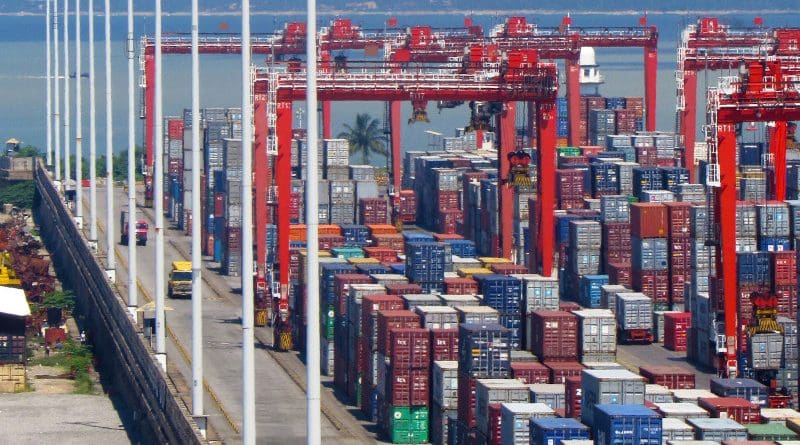
Containers stacked at Sri Lanka’s Colombo port. Photo Credit: Rehman Abubakr, Wikipedia Commons
Japan Overseas Infrastructure Investment Corporation (JOIN) and India’s Adani Port are among foreign and Sri Lankan companies seeking a stake in the container terminal
The Sri Lankan government has asked stakeholders in Colombo Port’s East Container Terminal (ECT) project to come up with a joint proposal to share a 49% stake in it.
The Chairman of the Sri Lanka Ports Authority (SLPA), Maj.Gen. (Rtd) Daya Ratnayake, said that the SLPA will have 51% stake in the company to be formed to build and run the terminal and the remaining 49% will be held by a group of foreign and local companies.
These non-SLPA stakeholders have been asked to come up with a joint proposal to share a 49% stake in it.
He refuted news reports that 49% will be held exclusively by the Adanis of India.
He also trashed a report that the government-appointed committee to look into the investment pattern had rejected the demand of the workers’ unions that India should be kept completely out of the project.
All those who have a stake in the port are welcome to pitch in with their proposals, Gen. Ratnayake said.
Joint Proposal
Sri Lankan and foreign companies, which are interested in investing in the ECT, have been asked to come up with a joint proposal. This would then be taken up by the cabinet appointed negotiating committee. The committee’s recommendation would be submitted to the cabinet for discussion and a decision.
The process is on. It has reached the half-way mark,” Gen.Ratnayake said.
The SLPA chairman further said that the Adanis from India and the Japanese investment company the Japan Overseas Infrastructure Investment Corporation (JOIN), would be among several foreign and Sri Lankan shareholders in the ECT company.
JOIN
The Japan Overseas Infrastructure Investment Corporation (JOIN) gathers and analyzes information about business opportunities and acts as an intermediary between foreign and Japanese companies. To this end, JOIN has entered into Memorandums of Understanding (MOUs) with various overseas partners to promote cooperation and exchange of information, JOIN’s website said. JOIN has already executed infrastructure projects in India, Brazil, Vietnam and Myanmar among other countries since 1994.
Adanis
The Adan iGroup has emerged as India’s largest private port operator, running 11 ports and terminals across Gujarat, Odisha, Goa, Andhra Pradesh, Tamil Nadu and Kerala. It accounts for about 22% of India’s total port capacity, and handles over 200 million tonnes of cargo a year.
Unlike the major ports controlled by the government, they can take quick decisions and have always been customer-oriented,: the website says.
The Adani group bought a 75% stake in Krishnapatnam Port in Andhra Pradesh, helping it improve its market share to nearly 27%. It also purchased Odisha’s Dhamra Port in 2014 and Tamil Nadu’s Kattupalli Port in 2016.
Sri Lankan Companies
There are Sri Lankan companies which could take a stake in the ECT. John Keells could be one them. John Keells already operates the South Asia Gateway Terminal (SAGT) in Colombo port along with the SLPA and other internationals companies.
SAGT has 60% Sri Lankan shareholding. It is backed by John Keells Holdings, APM Terminals, SLPA and Peony investments (subsidiary of Evergreen Marine Corporation).
Trade Unions
23 trade unions have been agitating and demonstrating against granting any stake to India or an Indian entity in the ECT. They are supported by the left-nationalist Janata Vimukthi Peramuna (JVP), a section of Buddhist monks, and influential sections of the government. But President Gotabaya Rajapaksa has been keen on involving India in the Colombo port for economic as well as geo-political reasons.
Gotabaya feels that India’s interests should be served to maintain a balance in Sri Lanka’s relations with the two regional powers – India and China.
China has already been given the Hambantota port on a 99 year lease. A Chinese company runs the Colombo International Container Terminal (CICT) with an 85% stake. This has created tension in New Delhi.
The economic reason for wanting to involving India in the ECT project is that 66% of Colombo port’s business is accounted for by Indian transshipment. President Gotabaya is believed to be going along with Indian Foreign Minister S.Jaishankar’s contention that India has a natural interest in the development and security of Colombo port and therefore it could seek a presence in it.
The Sri Lankan Foreign Secretary Adm. Jayanath Colombage recognizes that Sri Lanka comes under India’s defense umbrella and that Sri Lanka should not pose a threat to India’s security. Alarm bells had gone off in Delhi when a Chinese submarine visited Sri Lanka in 2014 and docked in the Chinese-run terminal.
When President Gotabaya visited a village a few days ago, he disabused the village folk of the notion spread by the port unions, that 49% of the stake in the ECT will be given to India or to an Indian company. He clarified that there would be other investors beyond India and Japan. The President also told the people that the previous government (headed by Ranil Wickremesinghe) had already signed a Memorandum of Cooperation with India and Japan on the ECT in 201I9 and that this bilateral agreement could not be annulled.
The Sri Lankan government has said it will not comply with a United Nations report on Sri Lanka which demands the country stop forcibly cremating Muslim COVID-19 victims.
Cabinet spokesman Keheliya Rambukwella said that Colombo is not prepared to take any steps which will harm the sovereignty of the nation.
Yesterday UN human rights experts said the policy of forced cremations ran contrary to the beliefs of Muslims and other minorities in the country, and could foment existing prejudices, intolerance and violence.
The imposition of cremation as the only option for handling the bodies confirmed or suspected of COVID-19 amounts to a human rights violation. There has been no established medical or scientific evidence in Sri Lanka or other countries that burial of dead bodies leads to increased risk of spreading communicable diseases such as COVID-19,” said the experts.
As of January 21, 274 COVID-19 related deaths have been reported in Sri Lanka, with a significant number of the deaths belonging to Muslim minorities. All of the bodies were cremated, including babies.
The decision to make cremation mandatory followed advice by the chief epidemiologist who claimed that burials could contaminate ground drinking water.
However, the World Health Organization has reiterated there is no evidence to suggest that cremation prevents the spread of the disease, while the College of Community Physicians of Sri Lanka and the Sri Lanka Medical Association issued statements recently clarifying that there has been no proof that burial of COVID-19 dead bodies constitutes a public health hazard.
While we must be alert to the serious public health challenges posed by the pandemic, COVID-19 measures must respect and protect the dignity of the dead, their cultural and religious traditions or beliefs, and their families throughout,” the experts said.
We deplore the implementation of such public health decisions based on discrimination, aggressive nationalism and ethnocentrism amounting to persecution of Muslims and other minorities in the country,” added the experts. Such hostility against the minorities exacerbates existing prejudices, intercommunal tensions, and religious intolerance, sowing fear and distrust while inciting further hatred and violence.
We are equally concerned that such a policy deters the poor and the most vulnerable from accessing public healthcare over fears of discrimination,” the experts said, adding this would further negatively impact the public health measures to contain the pandemic.
But government spokesman Rambukwella told reporters today that Sri Lanka has a right to address human rights issues in a manner that it deems fit. He added that Sri Lanka will not implement the UN Human Rights Council Resolution as it is not in the best interest of the country.
Sri Lanka is on the agenda of the 46th Session of the UN Human Rights Council set to take place in Geneva between February 22– March 19.
Co-Cabinet Spokesperson Minister Keheliya Rambukwella says the government will look into and take necessary actions regarding any violations of human rights that have taken place during the country’s civil war period.
His remarks came during the press briefing held this morning (January 26) to announce the Cabinet decisions.
The government is of the opinion that justice must be served if human rights violations have taken place. We expect to take the rights decisions and to take necessary actions if someone has been wronged,” he added.
On the 21st of January, President Gotabaya Rajapaksa appointed a special three-member Commission of Inquiry (CoI) to investigate, inquire into and report or take necessary actions on findings of preceding commissions or committees on alleged human rights violations, serious violations of International Humanitarian Law (IHL) and other such offences in Sri Lanka.
The commission, chaired by Supreme Court Judge A.H.M.D. Nawaz, consists of retired IGP Chandra Fernando and retired District Secretary Nimal Abeysiri.
They have been authorized to conduct investigations and inquiries and to transmit the interim reports to the President when necessary.
President directed the commission to submit the final report with its investigations, inquiries and recommendations within a period of six months.
The appointments came weeks before the 46th session of the United Nations Human Rights Council which is scheduled to be held from 22 February to 19 March 2021.
A special mutation of SARS-CoV-2, the virus which causes Covid-19, has been detected in Sri Lanka, says the Director of Department of Immunology and Molecular Medicine of Sri Jayewardenepura University, Dr. Chandima Jeewandara.
He made these remarks issuing a special statement today (January 26).
This mutation of the virus is different from the strain previously identified in Sri Lanka, he said adding that it has similar characteristics to the strain that swept across in England, Switzerland, Germany, Denmark and Iceland.
Dr. Jeewandara noted that this Covid-19 variant found in Sri Lanka is also highly transmissible.
Sri Jayewardenepura University, as per a request from the Health Ministry and the Epidemiology Unit, has been carrying out genetic sequencing of Covid-19 positive samples, he said.
During sequencing, the researchers have found a special mutation (N439K) of the SARS-CoV-2 among the patients detected within the past two weeks. It is of B1258 lineage, he added.
Health authorities have been informed on the matter, Dr Jeewandara said, requesting the general public refrain from undue panic.
Although this genetic mutation is highly transmissible and allows the virus to evade monoclonal antibodies, reports have shown that it does not have an impact on vaccine immunity, he explained.
Researchers analysing the samples meanwhile uncovered a 100% Sri Lankan lineage of Covid-19 (B1411), according to Dr. Jeewandara.
Foreign Affairs Minister Dinesh Gunawardena stated that a detailed draft of the response to the charges mentioned in the report submitted by the UN High Commissioner regarding Sri Lanka will be submitted to the Human Rights Commission in Geneva tomorrow (27).
Meanwhile, President Gotabaya Rajapaksa appointed a 3-member Commission of Inquiry (CoI) to investigate, inquire into and report or take necessary actions on findings of preceding Commissions or Committees appointed to investigate into human rights violations, serious violations of International Humanitarian Law (IHL) and other such offences.
The Extraordinary Gazette notification pertaining to this was issued on the 21.
Supreme Court Judge A. H. M. D. Nawaz was appointed as the Chairman of the Commission. Retired Inspector General of Police Chandra Fernando and retired District Secretary Nimal Abeysiri were the other members.
The Commission was entrusted with following responsibilities:
Find out whether preceding Commissions of Inquiry and Committees which have been appointed to investigate into human rights violations, have revealed any human rights violations, serious violations of the international humanitarian law and other such serious offences;
Identify what are the findings of the said Commissions and Committees related to the serious violations of human rights, serious violations of international humanitarian laws and other such offences and whether recommendations have been made on how to deal with the said facts;
Manner in which those recommendations have been implemented so far in terms of the existing law and what steps need to be taken to implement those recommendations further in line with the present Government policy; Overseen of whether action is being taken according to (b) and (c) above
The Commission has the authority to make required inquires and investigations and to present interim reports where it is necessary to the President. All Government officials have been directed to provide required assistance and information when requested by the Commission.
The final report of the Commission should be handed over to the President within 6 months since the date of the appointment of the Commission. The background to the establishment of the Commission of Inquiry was given in the Gazette.
The decision taken by the Government of Sri Lanka to withdraw from co-sponsorship of 40/1 Resolution on Reconciliation, Accountability and Promotion of Human Rights Sri Lanka and its preceding resolutions 30/1 and 41/4 was announced at the 43rd Session of the United Nations Human Rights Council.
Even though Sri Lanka withdrew from the co-sponsorship of the aforesaid resolutions, the policy of the Government of Sri Lanka is to continue to work with the United Nations and its Agencies to achieve accountability and human resource development for achieving sustainable peace and reconciliation. The Government is also committed to ensure that, other issues remain will be resolved through democratic and legal processes and to make institutional reforms where necessary to ensure justice and reconciliation.
The Government identifies as a fundamental requirement to pursue a non-aligned foreign policy that protects the sovereignty of Sri Lanka in achieving the objectives stated in the Government Policy Statement.
Since the Commissions and Committees that have been appointed to investigate into alleged violations of human rights and humanitarian laws and have made recommendations, the 3-member Commission is entrusted with the task of investigating them and making recommendations on necessary actions to be taken.
The Prime Minister instructed the authorities to expedite the repatriation of foreign workers who are expecting to return to Sri Lanka.
The Prime Minister made this observation at a discussion held at Temple Trees on the repatriation of Sri Lankan workers abroad, according to the Prime Minister’s Media Unit.
Piyankara Jayaratne, State Minister of Foreign Employment Promotion and Market Diversification; Gamini Senarath, Secretary to the Prime Minister; Yoshitha Rajapaksa, Chief of Staff to the Prime Minister and the Chairman of the SriLankan Airlines Ashok Pathirage participated in the discussion.
State Minister Piyankara Jayaratne has pointed out that a large number of Sri Lankan expatriate workers who are faced with economic hardships are unable to return to Sri Lanka.
Accordingly, the Prime Minister said that steps will be taken to bring these workers back to Sri Lanka as soon as possible in consultation with the Presidential Task Force.
Accordingly, the discussion also focused on granting the necessary permits for the passenger planes carrying these workers and the possibility of performing their PCR tests.
Prime Minister Mahinda Rajapaksa has stated that the Presidential Task Force will focus on whether such workers can be allowed to quarantine themselves according to the space available in their homes.
About 32,000 Sri Lankan workers have been repatriated so far and another 22,483 are expecting to return to their homeland.
SriLankan Airlines Chairman Ashok Pathirage stated that air travel facilities have been provided to these workers so far considering the space available at the quarantine centers.
Fact 1:India will always interfere in Sri Lanka’s internal affairs
Fact 2:India will always attempt to destabilize Sri Lanka
Fact 3:International Relations is based on no permanent enemies, no permanent friends, only permanent interests. Permanent friends & enemies change from time to time.
Fact 4:All nations know the value of Sri Lanka’s geopolitical positioningexcept Sri Lanka’s leaders & advisors
Fact 5:Sri Lanka has a dismal record vis a vis signing agreements.
Fact 6:Sri Lanka doesn’t know the art of saying ‘no’ diplomaticallycausing foreign policy blunders and fall outs with appeasement policies.
Fact 7:Sri Lanka must look at the Commercial & Geopolitical significance of ECTfrom Sri Lanka’s lens not India’s wish list.
Fact 8:Sri Lanka must look at the global developments. Sri Lanka must strategize for future. No country wants to develop another country above their own.
Fact 9: Whether ECT is given to India or not India will continue with Fact 1 & 2
Fact 10:Since India will continue with Fact 1 & 2 by not giving ECT to India, Sri Lanka would have saved a strategic port with commercial and geopolitical value.
Let’s understand above better
Unfortunately, India suffers a major malady in thinking that its job description includes the requirement to eternally poke its nose into Sri Lanka’s internal affairs and carry out covert and overt operations to destabilize Sri Lanka.
This is a historical malady – South India attempted to invade Sri Lanka 18 times, we don’t need to remind India of its role in Tamil armed militancy, providing logistics support and even the manner illegal immigrants have been encouraged to enter Sri Lanka as well as the flouting of international laws violating Sri Lanka’s airspace and territorial waters.
The next floated argument is that we cannot afford to make India angry. Today’s wars are not with armies, it is using covert and overt ways to destabilize countries and our intel agencies must be put on alert.
Destabilizing & interference in the internal affairs of Sri Lanka is a modus operandi followed by all Indian governments that come into power. India little realizes that with every attempt to make Sri Lanka vulnerable there are plenty of sharks pretending to come to Sri Lanka’s aid but in reality use Sri Lanka as a ground to eventually destabilize India.
Our warnings that India will be subject to the balkanization fate of the Soviet Union & Yugoslavia have fallen on deaf ears. Whatever our feelings about India, we do not wish to see India balkanized and we continue to hold the dharmic unity of Hindu-Buddhist ties.
With resources of the world declining, with people’s greed and corruption increasing the world has become a centre stage for a plethora of criminal acts that has split the world into ‘haves & have nots’ and the gap is widening. The ‘have’s’ are plagued by an insatiable greed to acquire and this constitutes the ‘permanent interests’ of all countries in a quest to grab land and resources.
With this reality, Sri Lanka must ask itself how far it is protecting its assets and resources from being grabbed under whatever nomenclature the attempts are framed.If we lose these resources and assets we become boarders in our own land and we are at their mercy.We do not wish to be enslaved in our own land. This is nothing a proud nation with a proud history wants to even think of. Leaders are elected to make sure such a scenario does not happen. Thus, it is important to realize that diplomatic and international relations means we do not have permanent friends or enemies but Sri Lanka must protect its interests and not barter those interests. Any government that doesn’t know how to, gets unseated from power! The voters demand list comes first! Voters don’t elect governments to please other countries.
Historically, Sri Lanka has been the centre for invasions and take overs primarily due to its location. Why is the world so interested in Sri Lanka – ‘it’s our location, stupid’.Sri Lanka is the belly button of the world. Unfortunately, this has yet to get drilled into the minds of politicians and policy makers. Or they prefer to barter this for their personal luxuries.
We had 18 unsuccessful invasions by South India thanks to the proud defense capabilities of those who proudly defended our island nation. We had 3 European invaders who made a mockery of our leaders. Their divide and rule policies were stupendous and the outcome of these are alive and thriving to this day. Agreements were always one-sided and to Sri Lanka’s disadvantage.
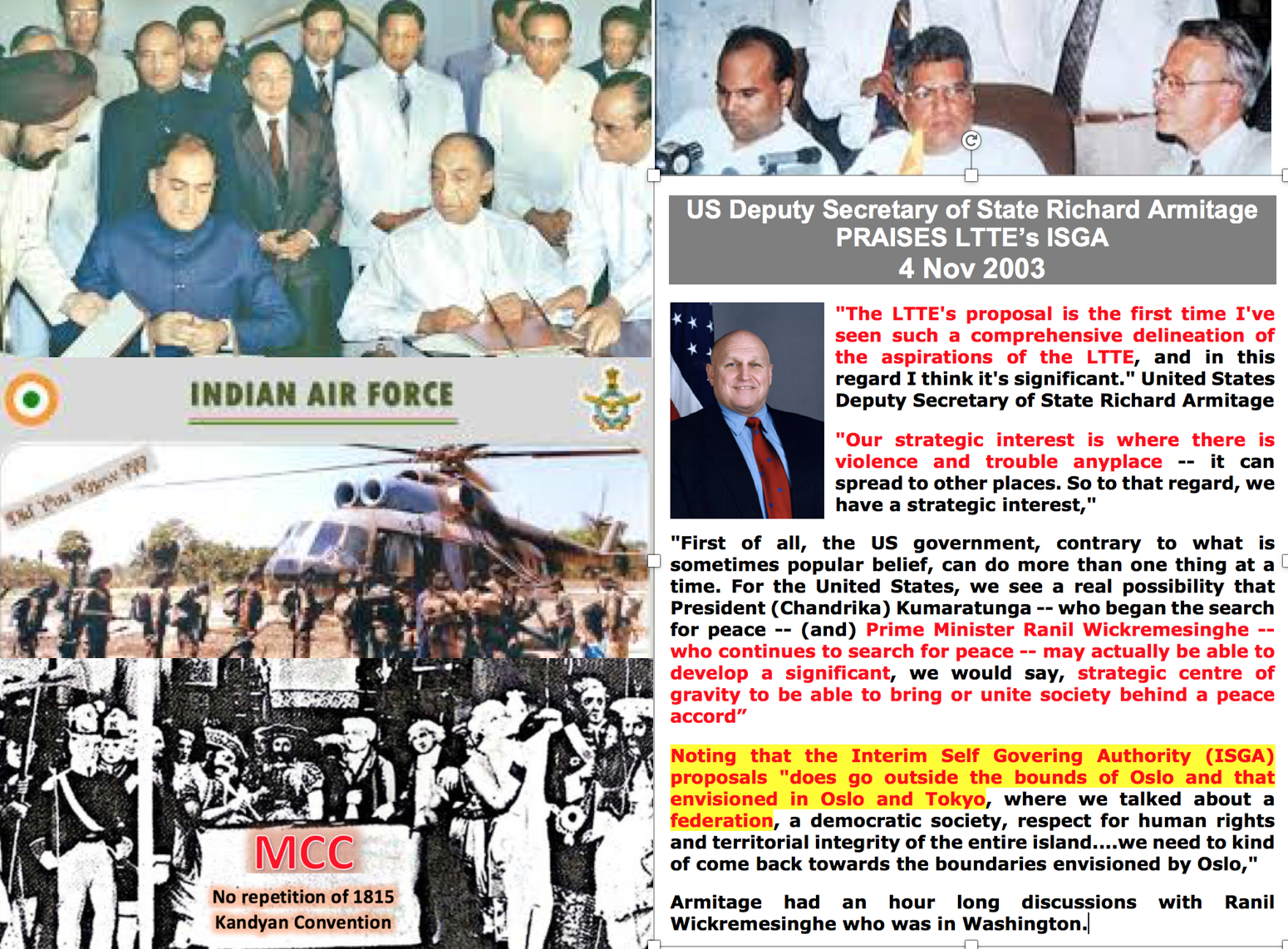
The Sinhale king fell prey to the Portuguese virtually handing over the entire island as a gift to the Portuguese (Don Juan traitor), the Sinhale king fell prey to the Dutch thinking they were better than the Portuguese, the Sinhale chieftans fell prey to the British (similar to how the Parliament betrays the people) and we have seen how post-independence pacts like 2002 CFA, proposed ISGA/PTOMs, proposed Union of Regions, ECTA, CEPA, IOC, MCC etc have served no advantage to Sri Lanka, except maybe the one’s negotiating these deals from our end. It is as a result of the poor record sheet in agreement negotiations that the Sri Lankan public are skeptical about the present ECT agreement which abounds in controversies and facts kept disclosed from the public.
Sri Lanka’s foreign policy success by far arguably prevails during the period of Mrs. B who remains a much respected world leader to this day. A key aspect of her foreign policy was her ability to say ‘no’ nicely but sternly. When policies are not sternly but diplomatically conveyed, it opens the arena for all sorts of double dealings and treble troubles. This is what Sri Lanka faces in not following the simple policy of Mrs. B.
It is in trying to please all that we end up even displeasing those we are trying to please as well as the general public. So in the end, everyone is not happy with the outcome. A government is elected to please the citizens not foreign countries at the cost of displeasing the citizens.
By trying to please countries we have lost much. We gave petrol to India to make India happy but India wasn’t happy and wanted more. We signed ACSA to please US, but US demands more. We signed away Hambantota to please China & when these countries know that we are ready to give up our own to please them, their demand list will grow. We have given away so much. We have very little to now call our own. To please others our politicians have given away our assets and what have we got in return?
The ECT is one such important and valuable asset which the citizens do not wish to part with because they know India will never be satisfied with the 49% and will be eternally demanding more. Ultimately, we would end up with no asset or resource to call our own and even the people will end up being bartered.
All this does not help Sri Lanka realize any of its potentials or help to raise Sri Lanka’s profile. No country will want to develop another country before developing its own. Countries are wooing other countries to tap and grab their resources to take back home to develop their own countries. Is this too hard to understand? Is it so difficult to have our own strategize our future without always outsourcing it to external parties?
The crux of the issue vis a vis ECT is that whether 49% is given to India or not, India will continue to interfere in Sri Lanka’s internal affairs and destabilize Sri Lanka. This means, we could have lost 49% stake in our best port and this would likely be used as part of attempts to destabilize Sri Lanka.
Therefore, knowing this, wouldn’t it be better to politely and diplomatically say ‘no’ to India & Adani as Sri Lanka is unlikely to see any benefit by giving 49% to Adani, the very party developing India’s ports, to give India a competitive edge over Sri Lanka.
Why would India wish to nominate Adani to develop our Port if it will negate commercial value for India’s port that Adani is building for India?
Sri Lanka’s geopolitical positioning gives automatic preference to the world’s shipping lines as they can take advantage saving time and fuel by calling at Colombo Port. Our service too is far superior to what SAARC nations offer. We only need to increase the depth so we can cater to the bigger ships that would be calling at our Ports in the future.
Have those planning to give 49% to India/Adani not thought of an eventuality of things going sour? In such an eventuality, have they thought of the course of action to be taken?
The people’s decision is based on the record sheet of our neighbor and putting caution first. If the government does what the people want, the people (patriotic) will come forward to defend their nation. The politicians rarely defend the nation. They are the cause of most troubles plaguing the country. But, when the country needs to be defended, the People will come forward to do so. Politicians need not fret about that.
Sweet dreams are made of this
Who am I to disagree
I travel the world and the seven seas
Everybody’s looking for something.
Some of them want to use you
Some of them want to get used by you
Some of them want to abuse you
Some of them want to be abused….
Sweet dreams are made of this
Who am I…
Eurythmics,1983 (written for future
Ranjan/s?)”
I
was sent to jail for 19 years on false charges. If you see the Video tape
recording of what happened between me and the magistrate on that unfortunate
day, you can see how I was framed.”
Ven.
Galagodaatte Gnanasara (Bodu Bala Sena), February 2019.
Pillayan
Out-Ranjan In
‘Recently
acquitted Pillayan says while he stayed in Sri Lanka and fought for Eelam, Shanakia
Rasamanickam (SR) went to Australia and came with an English education.’ This
TNA’s young (born in Sept. 1990) Batticaloa district MP, SR says, Ven.
Gnanasara was sent to jail for only 2 years, for insulting/threatening Pradeep
Ekanaligoda’s wife, whereas Ranjan (R) was given 4 years for using his freedom
of speech right! (Manjula Vlog, 1/22/21). This is an example of how 3rd
generation federalists are also in the game of distorting facts intentionally,
unknowingly, or stupidly. Ven. G was not punished for what SR thought. SR also
tried to connect ‘Pillayan out with R in’ dirty distortion for political gain. But
DSB Jeyaraj says the two incidents are totally different cases, and it is
unfair to try to link the two outcomes (Daily Mirror, 1/24). Then comes Lucien
Rajakarunanayake, who pours out his grieving heart to R, the freedom of speech
crusaders. Where was this preacher when Ven. G was hunted down as if the monk
was a highway robber? (Island, 1/23).
For such Ranjanites, the Sunday Divaina editorial on 1/17, Ranjan, Saradiyel, Robinhood and Savdam gema,” was the best medicine one could offer.
Beauty is in the eye of the beholder. The
difference between those who see R as a yahapalana-created saint cum culprit,
and the Divaina editorial or DBSJ’s, is that the former group is blinded by an Orumitthanadu
dust. There ought to be a clear and simple separation between reasonable
natural mind and an irrational politically biased game. Between part 1 of this
essay and the writing of this second part, what I saw and heard were evidence
confirming my hypothesis: ‘that R’s Bitter Truth project was nothing but, a plot
floated by the yahapalana international, now fallen into the laps of SJB and
Harin Fernando, a Ranjan clone in the making.’ Chapa Bandara, the journalist,
with whom R once proposed joint social projects, is now convinced that R is a
political assassin (1/18). This supports my hypothesis about R.
Those who are genuinely worried about the ‘welfare’
of R, should try to tell the truth nothing but the truth. The society in Sri
Lanka is corrupt to the core, and judiciary must be having its share of black
sheep. But a corrupt society cannot be redeemed by introducing novel corrupt practices.
The rule, killing all bed bugs because of a bite by one bug, cannot be applied to
all judges, lawyers, teachers, or officers. System errors must be handled
systematically, not by fumigating them with poison gas. R’s entire enterprise was a criminal, immoral
game based on invading and stimulating the darker sides of human mind. Without
thinking of this aspect, attempts by black-white lovers of R to pass the buck
to defects in law and judges, crooked politicians etc. is hypocrisy with secret
agendas, such as balkanization of Sinhale. How many of such lovers thought
about these system defects, when Bodu Bala Sena raised the need to get rid of
the Suddage Neethiya (white mans’ law), when the Ven. G was cruelly
treated, a thousand times worse than what R is now faced with.
DBS Jeyaraj discussed the case of acquittal of
Pillayan, and I challenge any R supporter to write, for example, a brief to the
supreme court by way of pointing out the defects in the judgement against him.
The damage R did to the Sinhala Buddhists in Sinhale is impossible to measure.
Simply because a yahapalana lobby is behind R, judges cannot reduce the
sentence given, to satisfy this lobby. A new law can be passed, but without
retrospective effect to let R escape. Considering the social gravity of the
damage done by R, any sympathy based, politics-oriented, leniency will seriously
harm supreme court’s reputation. R’s case is not a solitary incident of an
utterance by an eccentric bachelor. See
how it had happened. PM RanilW had a meeting at TT on 21/8/2017 to discuss the topic
of removing minister of justice, Wijedasa Rajapakshe, for NOT interfering with
the judiciary! R came out of that meeting after listening to lot of badmouthing
against some judges who were considered as ‘headaches’ blocking their secret
agenda. R was the pit bull assigned or himself volunteered to spit out this
venom at the gates of TT, playing the ‘One Shot’ role before the media. This
and his continuation of this hammering of the judiciary was part of the plan to
import foreign judges to hear tiger-related cases. How could a supreme court
ignore such extra-judicial evidence, causally linked to a meeting at the TT, to
satisfy a new version of the old yahapalana ghost? How on earth one could
interpret SC decision on R as curtailing his freedom of speech?
Judiciary and the Sinhala Buddhists
The treatment of Sinhala Buddhist voter as if he
was that same proverbial kind-hearted woman, by Sinhala politicians, became an
open game of attacking and arresting Buddhist monks during yahapalana time
(2015-19). Orumitthanadu agent Ranjan and BBS leader Ven. Gnanasara played
opposite roles during and after that time. Unlike R, Ven. G had the entire establishment
and politicians of all parties eyeing for his pound of flesh for exposing their
selfish games. He had to hide away from his temple to escape threats to his life.
Then finally, one government lawyer and one JVP lawyer, were able to trap him
using one magistrate. The nationally loved monk was given 19 years of RI for a
discussion he had with the magistrate of which a video tape is readily available
(and linked below).
A lengthy essay I prepared in 2019 about this
unjust conviction titled, Six lawyers and a monk: importance
of impotence.” is retrieved from the achieved data base of the Lankaweb web site,
is copied below especially for the attention of the two golden brains of Abraham
Sumanthiran and Ali Sabri in the Diyawanna boutique. The critique of the
judgement without discussing the background (context) behind it is of a lesser
value, because the black-white lobby behind R, should be given an opportunity
to develop their case for an appeal based on law and facts and not on cheap partisan
politics.
===================== Six lawyers and
a monk: importance of impotence
Posted on January 22nd, 2019
C.Wijeyawickrema, LL.B., Ph.D.
Introduction
[six lawyers = AG/DSG+2 AC judges
+Magistrate+ Senior St. Co.+ JVP attorney; monk = Ven. Galabodaatte Gnanasaara]
Inspire public trust and confidence.”
Nobody disputes the motto of the Supreme
Court (SC) and the Court of Appeal (CA) copied above, which is applicable
universally to any court of law in the world. The question, however, is that
judges entrusted with this noble task are mere mortals, not saints. For
example, a recent case handled by these two courts in Sri Lanka did not make
lot of people (specially Sinhala Buddhist) comfortable. The decision given by
CA on the contempt of (Homagama magistrate) court case against the BBS leader
Ven. Galabodaatte Gnanasara (GG) is laden with several minor (factual) and two
major (legal) problems.
Subsequently, the petition submitted to
the SC seeking its permission to make an appeal was dismissed by it in a very
unfortunate manner, reminding one the famous rule of natural justice, ‘not only
must justice be done; it must also be seen to be done.’ One of the judges who
disallowed the petition was an active opponent of BBS in the recent past when
he was an officer of the (publicly anti-BBS), Sri Lanka Bar Association.
In America, there are hundreds of law
school law journals, in which one can find essays critically analyzing court
decisions. Such scholarly work helps everybody, including the judges. In USA,
continuing education is mandatory for judges. I do not know if Sri Lanka
has law journals or if there are any good faith efforts by legal professionals
to constructively dissect court decisions. For such service one does not have
to be a lawyer. If democracy requires voters to be vigilant, an intelligence
check on judges’ decision-making process is a healthy sign of a people-centered
judicial system, because a judge could make a kabaragoya a talagoya or vice versa with
the magic (subjective?) power of interpretation.
Today, we see only one such effort from
an applied law (efficacy of law) perspective. Public interest lawyer Nagananda
Kodituwakku has challenged former CJs, SC judges, AG’s Dept., and Bar
Association officers for improper and unprofessional behavior. He was not
afraid of contempt of court threats, but other lawyers are afraid to sit next
to him at SC proceedings because they fear such ‘bad association’ could affect
their pocketbooks, sooner or later, when they appear before judges with their
clients. Ravaya’s Victor Ivan has written a courageous (documentary) book, ‘the
silence of the court,’ which disclosed antics of the legal establishment from
lower to the highest level. Then there are examples of rash outbursts by
juvenile politicians, who spoil the cake. There is no question that some of our
courts of law are under severe stress, partly due to their own misbehavior.
Only one soul named, Victor Tennekoon, former CJ, left his job with his and his
court’s dignity/integrity intact.
I began to write this essay, long before
the political crisis started after, the October 26, 2018 bombing of his
yahapalana prison by prisoner Maithripala Sirisena himself, which dragged both
SC and CA into a dirty political arena. What this means is that courts are
compelled to weigh political facts (not law) and make subjective judgements on
whether the president acted fairly and not arbitrarily. Inherent in this task
is the reality that one side to the dispute will be unhappy and angry with the
judges! Despite these darker clouds on the horizon, I think what I wanted to
write must proceed because it is an important story the country should not
forget.
Background of BBS case
The first thing we do, let’s kill all
the lawyers”– Shakespeare.
A discussion of background information
relating to this case is helpful in our task of analyzing the decision of CA in
its objective and subjective context. Many statements in the judgement reveal
the judges’ personal ‘bias’ (prejudice) against the accused in his role as the
leader of BBS. The behavior of the AG’s dept. during yahapalana years, has
given people the impression that it is a politically bias agency operating
against the Buddhist monks targeting those who are actively engaged in
socio-political problems created by the black-white politician class. It looks
like the anti-Buddhist arrogance of this agency is contagious, going against
the Sinhala Buddhist heritage in the island. For example, in the case that sent
Ven. Galabodaatte Gnanasaara to jail, the public record of the Court of Appeal,
mentions AG as Hon. AG,” and Ven. Gnanasaara (GG) just as Galabodaatte
Gnanasaara.” Why did it not cite GG as Ven. GG?” (or at least as monk GG). Is
this a trivial matter? I do not think so. Do they treat other religious clergy
the same disrespectful way, in the rare case of one of them become an accused?
(rarely, because they do not ‘fight’ publicly on social issues).
How does this attitude operate at the
street-level or one step above? On 19th November 2018, at the old parliament
building, a small group of monks came to hand over a petition to President
Sirisena appealing him to pardon Ven. GG. A man from president’s office came
out and told the monks that they could see the president at the end of
December! After this crazy response, the police used tear gas and water canon
to disperse the crowd. Later, at a meeting arranged by Tilanga Sumathipala, the
president apologized to the monks, and said that he was not informed of the
monks’ arrival to hand over the petition. Neither was he consulted by the
police before using tear gas against the monks. How shoddily some officers of
the government (judges and/or court clerks, civil officers, police officers in
this case) treat the monkhood in the country is evident without doubt. The
monks experience more than other sections, the dirty side of suddage neethiya (white mans’ law).
Balu kuudu (dog cages) and AG’s Dept.
Ven. Bengamuwe Nalaka said recently
(Oct. 2, 2018) that the AG’s Dept. and the police, intentionally fabricated a
false case against Ven. Ganansara. The public record is that the officers of
the Bar Association also hated BBS. In fact, the latest news (Oct. 5) is that
SC judge Prasanna Jayawardena (with Nalin Perera agreeing and Eva Wanasundara
opposing) who decided against Ven. G’s appeal was an ardent ‘enemy’ of BBS when
he was VP of the Bar Association. This is against the principles of natural
justice. He should have recused from hearing this appeal. More importantly,
unless a full bench of SC is activated, BBS case now has no judicial option,
despite the fact courts only implement the judicial power of the people (of Sri
Lanka).
Monks and laymen are careful not to add
the courts into this allegation. Their formula is perhaps based on what Mrs.
Chandrika said some time back that balu sena will be put in balu kuudu (dogs
and dog cages).” As discussed later in this essay, if the AG’s Dept. studied
the facts of the case carefully, using the video clip evidence, the CA would
not have made the two fatal errors in its judgement that I have found.
AG’s Dept. should have advised the court not to proceed with the case. But this
was a case of lawyers from different state entities working in collaboration to
fix from their perspective, a ‘notorious’ monk, and their biased minds must
have missed the legal theories supporting the monk. It also depends on how
these lawyers as citizens of this country view, sometimes critical, role monks
have played in the 2,500-year-old history of this island. The history records
how a king of Kandy wanted to kill Velivita Sri Saranakara Sangaraja, for
opposing his behavior, and agitating for his ouster. A person who has no
knowledge of the Sinhala Buddhist heritage cannot appreciate the roles played
by monks such as Migettuwatte Gunanada, Gangodawila Soma or presently, Ven. GG.
It is no secret that ever since BBS
started (May 2012) its militant Buddhist movement (militant in Gandhian and MLK
(USA) sense), not just anti-Buddhists but the entire black-white political
establishment in the country, including the officers of the Bar Association,
hated it, and wanted to ‘kill” it just like somebody killed (December 2003),
the previous Buddhist awakening started by the late Ven. Gangodawila Soma. Ven.
Soma got trapped due to his human weakness (a desire to get a worthless Ph.D.,
secretly arranged, via a Sinhala Christian Russian agent). Similarly, the whole
country knew very well that enemies were waiting in the dark to get Ven.
Gnanasara ‘trapped,’ sooner than later. The monk himself knew about this danger
and of late acted cautiously both as a private individual and as the BBS
leader, but tear drops fell on his arm from one of the helpless soldiers
worshipping him after the Homagama magistrate re-remanded them on war crimes
charges, the monk’s heart melted taking momentary control over his brain!
Ironically, law recognizes this kind of
emotional reaction known as the defense of grave and sudden provocation, but
the monk was destined to be disallowed that universal benefit. A judge who
understands almost mechanically (like we brake automatically at traffic red
lights) the application of this defense in a murder trial, depending on his
perceptions and attitudes may not realize the applicability of that defense in
the case of a monk devoted his life to protect Sinhala Buddhists’ lost rights
in the country. Even if AG Dept. either forgot or ignored the relevance of this
defense to this accused’s case, the judges of CA have a statutory duty to
examine the applicability of this defense in mitigating his punishment. The
facts in this case would have taken a totally different shade if the accused
were given the benefit of this universal defense.
Law is [not] an ass!
I read the decision of the Court of
Appeal (CA) on this case, and the moment I saw how the case was listed on the
CA website, I was greatly perturbed. I found two factual errors made by the two
CA judges, that go to the heart of the prosecution’s case. Law is not an ass,
but some lawyers and judges make law an ass, because they too are human. It
was only a few days ago that Ms. Sugandhika Fernando revealed that the Bar
Association president U. R. de Silva, in his pep talk to a new set of female
lawyers preached, that they should use one or two of their 64 mayams (feminine cahrma/tricks?) to
get favors (such as early hearing dates for their clients) from judges. What a
disgrace to womanhood and to the legal system!
The USAID recently commenced a
million-dollar project to ‘modernize’ (to Americanize it along with its
notoriously defective justice system?) the justice system in Sri Lanka. They
even gave a separate grant to the SL Bar Association. American help to
modernize can mean different things to different people. A coherent, open,
responsive, and effective justice program (CORE) means what? Are they
giving computers or try to brain-wash targeted personnel? Would they promote
legal scholars or lawyers writing critical analyses on court decisions that
they think incorrect?
I felt the CA decision was defective,
and I think the BBS monk should file a fundamental rights violation case
against the CA, because the SC had already refused to give permission to file a
normal appeal. I wonder how SC did not see the two glaring errors that I saw in
the CA judgement. If a monk like Ven. GG could be treated like this what must
be happening to hundreds of others? Depending on how one looks at the
role of BBS as a national movement, one could decide whether the monk is
politically guilty or not, but a court of law must be objective and decide
cases based on facts, and in this case, facts are in the public domain.
Naked title
Galagodaaththe Gnanasara Vs.Hon.
Attorney General-Hon. P Padman Surasena (P/CA), Shiran Gooneratne (decided on
August 8, 2018).” This is how the Court of Appeal website lists the case
against the Bodu Bala Sena (BBS) leader Ven. Gnanasara. He was given a
punishment of 19 years of rigorous imprisonment for ‘insulting’ the Homagama
magistrate Ranga Dissanayake. In another recent case, a complaint by a monk
relating to the pollution of Tissa wewa, decided on September 4, 2018, the citing
style was Venerable Halmillawe Saddhatissa Thero and others Vs R. M.
Wanninayake and others-Hon. Mahinda Samayawardhena. (J).” In each case a monk
was involved in a public affair. It was not about rape or murder by a monk.
In the first case, what was the reason that the term ‘Hon.’ was used for
the legal eagles while the monk’s name was listed nakedly as ‘Galagodaaththe
Gnanasara?’ Who made this decision? Who decides who is a ‘Hon.’? The
Hansard is full of ‘Hons.’ But one reason why a monk is addressed as
‘Venerable,’ is because his robe represents part of the Triple Gem in Buddhism.
It was because of this national norm,
that in the previous case of monk Vatareka Vijitha, the magistrate did not ask
the monk Gnanasara to stand in the accused’s box. On this incident, the lawyer
for the monk Vatareka, Maithri Gunaratane, now a new political party leader,
complained that the magistrate was violating human rights of his client by
allowing the accused to sit in a separate chair instead of the, hira kooduwa for the accused!
Another female Tamil magistrate went beyond this, and arranged a chair
covered by a white cloth for an accused monk to sit, and there was no objection
from the Tamil lawyers. Thus, reasonable judicial discretion is a
prerogative of judges. In this regard, one must note that the Homagama
magistrate, used his discretion to report the Ven. Gnanasara to the Court of
Appeal, because, he said that he did not have authority to impose a punishment,
severe enough, for the criminal offence committed by the monk!
Hon vs. Ven
Coming back to the Hon-Ven issue, only
such scenario in the world (if one video tapes the ceremony of how a layman
becomes a monk) where a son worships his mother first, and a few minutes later
that mother in turn worships her son, is associated with the concept of
monkhood in Buddhism, which was above the kingship of Sinhale for 2,500 years.
The queen of England is below a monk in Buddhist hierarchy of politics.
Semantics apart, if judges are ‘Hon.’ and the AG is ‘Hon.’ irrespective of the
fact whether the holders of the respective positions are qualified, honest, or
moral, the same standard or same courtesy should be applied to the concept of
monkhood. Lowering the dignity bestowed upon one concept (the yellow robe),
intentionally, inadvertently, or due to stupidity or ignorance, automatically
lowers the dignity offered to the other (learned counsels wearing a black coat
with a pocket on the back) especially, when it happens next to each other in
the same sentence.
Judges cannot be immune from the
currents and cross currents occurring in Sri Lanka, especially since 1978. The
thinking that courts decide cases within the framework of case law and legal
case books, was abandoned as far back as in 1954 in the landmark case of Brown
Vs. Board of Education, when extra-judicial sociological evidence was accepted
by the U.S. Supreme Court in overruling its own 70-year-old previous decision.
Besides, judges are human and can never be objective because everything in this
world is relatively linked to a continuum running from subjective to objective.
Courts need to understand that they are part of the society and bound by the
societal norms. If somebody attached to CA thinks that calling or citing the
name of a monk without the traditional honorific is acceptable, he should be
required to attend mandatory continuing education classes. It is no different from
other incidents such as the title, Budunge
Rastiyaduva, or Mrs. Chandrika’s radio drama, Nirvastram Paraman Sukan
(nakedness is ultimate happiness?)
Two
Fatal errors
Publicly disrespecting a monk without
using the honorific Ven could be an unfortunate attitude of some judges, but it
is no reason to suspect the specific intent of the two judges who handled this
case. Instead, one must see if there are specific facts which are clearly
erroneous. It is now an accepted fact that even an eyewitness account could be
different from reality. Thus, several persons witnessing an incident could look
but ‘see’ it differently, depending on their status of mind, ideology,
perception, angle of vision, distance etc. Referees of football games now use
video footage as a recording of the absolute truth for instant correction of
their mistakes. Placebo effect means mind has controlling power over matter.
Videotaping (and CCTV) technology has
become a savior of life and liberty in the modern world. The CA decision states
that (1) the monk Gnanasara did not apologize to the magistrate and (2) he
called the AG dept lawyer a ‘napunsakaya.’
But the video clip attached prove otherwise. It shows the monk
apologizing to the magistrate not once but twice in no uncertain terms. The
intention to insult a court is a deciding element in a contempt of court
hearing, and the CA judgement is unacceptable with this contrary, concrete
evidence. The derogatory term was used as ‘this napunsaka government,’ and not
as ‘this govt lawyer.’
It is strange why the monk’s lawyers did
not present this video clip as evidence. It is also strange why two monks
who gave evidence on behalf of the monk said contradictory stories, which the
judges used against the accused monk. The evidence used by CA was what the
three lawyers said in the court and not the video tape recorded at the scene
when it took place. Lawyers are not supposed to coach prospective
witnesses to tell lies, but under an adversarial system of litigation, lawyers
have a duty to examine the witnesses in advance, assess them, and decide not to
use them if their evidence is going to harm the accused instead of helping hm.
The use of such evidence by a court to impute criminal intention is a case of
cutting pork on a leg of pork.
Balu Theendu and BBS
When S B Dissanayake was sent to jail
for branding SC decisions as balu teendu
(decision by dogs?), his intention was crystal clear. He did not apologize. Or
on the pending case against Ranjan Ramanayaka for condemning the court system
as corrupt, his purpose in doing that is not clear. When Nagananda Kodituwakku
goes to SC with briefs against SC judges, Chief Justices, or the AG, no one
said his purpose was not noble. The way BBS monk was trapped using clause 105
of the constitution is unique. The magistrate Ranga Dissanayake had a dialogue
with the monk and the monk accepted his mistake, gave an explanation as to why
he had to talk and apologized twice and went on to ask the judge in the
Gandhian style to impose on him appropriate punishment for his behavior if it
was judge’s wish. All this is in the video clip. The magistrate could have
fined him, imprison him for the day, warn him or sent him to jail for a longer
duration. The magistrate was aware that he was dealing not about a solitary
monk, but a kind of national entity. He would have settled it in a casual
manner, if not for the intervention of the AG dept lawyer Dileepa Peiris and
the JVP-connected lawyer Upul Kumarapperuma, who appeared for the wife of an
allegedly disappeared person, Ekneligoda. With their intervention, the
magistrate lost his judicial independence and discretion. A minor incident
became a national issue.
The
series against England was umpired by world renowned our own Kumar Dharmasena
with not to renowned Ruchira Palliyaguru. Throughout the series, the
UMPIRES CALL” haunted Sri Lanka.
The
two umpires were far too strict for the Sri Lankans, perhaps unwilling to be
seen and criticised bias against England. But the professionals need not
be act in that manner.
Many
of the deliveries of Lasith Embuldeniya were not properly read by both umpires,
resulting stand in Skipper Chandimal to call for DRS. We now have clear
evidence of at least on 6 occasions, Sri Lankan bowlers were denied the
wickets, as the appeals were turned down prompting review, consequently judged
UMPIRES CALL even though the ball clearly hitting the wicket. Had umpires
correctly judged the deliveries and England appealing as a result, clearly
demonstrate the correct decision of the umpires. The number of incidents
were far too many to ignore.
In
the long list of missed opportunities ( or wrong decisions of the umpires), the
lucky survivors continued to make strong innings. The list includes
Joe Root, Dan Lawrence, Jos Butler,Jonny Bairstow in the two match
series. If situation of this nature takes place in
either England or Australia, the public anger will be instant.
Under
difficult conditions in Galle pitch, Sri Lankans played well in both matches,
but invisible forces twisted our hands.
The storming
of the U.S. Capitol in Washington on January 6, 2021 has made a significant
impact on the domestic politics of the USA. It is seen as a possible sign of things to come.
The Capitol attack was preceded by several other similar events. There
was a white supremacist rally, in
Charlottesville, Virginia in 2017. White
supremacists marched through the streets chanting racist and anti-Semitic
slogans. In the 2000 Presidential election, the recount in Florida was disrupted by Republican Party agitators. In April 2020, armed protesters
went to the State Capitol in Michigan to protest Covid 19 lockdown. They were
in a violent mood.
Arieh Kovler,
a political consultant who studied extremist Trump messages anticipated the
attack. On January 6, armed Trumpist militias will be rallying in DC, at
Trump’s orders,” he wrote on Twitter on December 21st. It’s highly likely that
they’ll try to storm the Capitol after it certifies Joe Biden’s win.”
These people were sharing maps of Washington
D.C, said Kovler. They had a map of the tunnels in the basement of the Capitol,
and they were talking about how they’re going to stop Congress from
leaving. They imagined there was going
to be mass executions of Congressmen, said Kovler. Others who had also seen the Twitter feeds
had emailed the Washington DC police warning them of a possible siege.
Analysts say
much of the activity on January 6 was chaotic, disorganized and indicative of a
spontaneous riot.Many did not know what to do when they got into the Capitol
building. However,
analysts observed”The people who made up the herd did not appear
organized, but within them clearly there were people who were organized. You
had a riotous mob and within that you had domestic terrorists who were clearly
planning something.
There were
attackers in organized columns. A woman shouting instructions on a megaphone. More
than a dozen men wearing assault force-type garb push up the Capitol steps in a
line, cutting through the dense crowd toward the building’s doors. Several
carried zip ties that could be used to restrain hostages. Attackers had said
things like Hang Mike Pence, find lawmakers and bring them to justice.
The
participation of the militia, the discovery of pipe bombs planted nearby, and
the apparent threats to capture members of Congress and the Vice President,
were signs of plotting. There was planning and coordination, said analysts.
There appears
to have been communications between those inside the building and outside, as
well. It is possible that the attack was
planned, with help from insiders. Many, who broke into the offices of top
legislators such as Speaker’s office, appeared to know how to navigate the
maze-like Capitol.”They knew where to go. Somebody on the inside of those
buildings was complicit in this,” analysts said.
It was also
noted that groups of Trump supporters had toured the Capitol for
“reconnaissance” a day before the attack. They could only have gained
access to the Capitol complex from a Member of Congress or their staff.
Analysts also
added if the intruders were Black Lives Matter the security services would have
picked off the intruders before they reached the entrance. Instead, many police
were supportive, taking selfies with the invaders, removing barricades, and
ignoring the rioters’ antics, reported the media.
The attack on the Capitol cast its shadow on the inauguration of
the new President. Some did not attend as they were worried about security.
Others had come wearing bullet proof vests. The Capitol attack was not pushed
under the carpet, by the media at the inauguration, as one would expect. It was given prominence at the function
itself. It was mentioned in the very first speech by Senator Amy Klobouchar.
The NBC coverage of the proceedings, continually recalled the
attack on the Capitol, Video clips of the event were shown. NBC ended its
coverage saying that there have been 120 arrests, 350 under investigation and
the FBI was going ahead with arrest for possible sedition, conspiracy, or
murder.
US remains tense and
anxious. US recognizes the attack on the Capitol as a significant event in
American politics and it is not something that can be attributed to Trump
alone. 70,000 voted against Biden. There is genuine fear as to the power of
this group. The roads used by the President on inauguration day were fenced in,
including the route to Arlington cemetery. Television observed that this type
of protection is usually associated with places like Kabul, not Washington.
US is now
considered a deeply divided nation. There is disagreement regarding the
Presidential vote. Only Sixty-five percent of Americans believe Biden was
legitimately elected as president, 147
republican House and Senate members had voted to overturn the Presidential
election even after the attack on the Capitol, said Economist.
An NBC poll
found that Americans were deeply polarized, they felt divided, pessimistic and
worried about the future. Country is
facing an economic crisis, said one commentator .US suffers from unemployment and homelessness
though is more hidden than in say, India.
The Hindu said, Biden would do well to remember, as he goes about
dismantling the Trump legacy, that 74 million people voted for his opponent,
and Trump has encouraged them to believe that the election was stolen. If the
Capitol building attack was an indication of the unhinged rage seething below
the ostensibly peaceful transfer of power, it may not be long before the
America of economically disenchanted white privilege again rears its head in a manner
that today’s political victors find unsavory,” concluded Hindu.
There is a
growing far right, white supremacy militia
movement in the U.S. There are
more than 180 armed militias today. There is one
colored militia the NFAC, the rest are white. They are more open, better armed, that
the earlier KKK.
The Proud
Boys ,a leading militia, is a far-right
white supremacist group. It is patrols Maga [Make America Great Again]
marches across the country. “American Wolf”
militia from the Washington state
can be seen out on patrol during Black Lives Matter rallies. They are against
the Black Lives Matter movement. They
are also against the creation of a socialist society in US. Had they made such a statement in Sri Lanka, they
would have been lynched themselves.
In Wisconsin armed right wing militia swaggered openly in public
spaces, unchecked, during Presidential election time. In Michigan they were against lockdown. They
said that
government could not tell them what to do. They had wanted to kill the Governor as well.
During
the US Presidential election of
2020 militia groups were parading in the
streets of America’s city, fully armed.
Emboldened by President Trump’s aggressive rhetoric, far-right vigilante
groups have been training with firearms, patrolling the streets and even
planning high-profile kidnappings, reported the media. They are well
organized. They are armed. They carry their weapons openly and make it clear they’re not
afraid to use them”. If the election does not turn out their way
there could be violence, feared the media.
The violence
that resulted was the storming of the Capitol building and the militia were
there. Militias such as the violent Three Percenters, Oath
Keepers and Proud Boys, participated in the attack on the Capitol. Some had
traveled to Washington from as far as Hawaii., reported the media.
There is
another angle to these militias. TIME has noted that these militias go to Ukraine for training. Ukraine’s
Azov Movement, has been recruiting and training American citizens for years,
reported TIME. Ukraine’s Azov Movement, was an obscure militia in 2014. After
the Ukraine ‘revolution’ of 2014, it
has now blossomed into a full scale training unit with a vast arsenal of
weapons to train on. White supremacy militias come over from USA for the
training
But Azov has
grander own plans. Azov mission is to form a coalition of far right groups
across Europe, with the ultimate aim of taking power throughout Europe, said TIME. Azov plans to
lead the white nations of the world on a
final crusade for their survival against
Jews and Muslims.
The US has its admirers in Sri Lanka .They
are providing us with howlers. Cassandra compared the Capitol invasion with two
events in Sri Lanka Parliament. The first is the opening of Parliament chamber to members of
the public in 1956.
There is difference which Cassandra has
missed. The Sri Lanka public were not storming Parliament to kill and destroy,
they came to rejoice. this was Ape Aanduwa, voted in full of hope and the public wanted to see where the decisions were
made. SWRD correctly allowed them to come in. The second event was simply an antic carried out by
the MPs themselves inside the chamber. There is no comparison
between it and the Capitol invasion.
Another commentator said that after the Capitol invasion, there was no call in the US to change the constitution, and the military did not influence the voting.
The biggest howler of all was the reference to Trump.
This commentator said that after Trump lost, the US showed
charity and gave Trump the Presidential helicopter and the Presidential Plane to go home in. The writer
compared it with the treatment given to Sarath Fonseka by Mahinda
Rajapaksa . This is nonsense. Donald
Trump remained President of the United State of America until the new President was appointed. It is in his
capacity as President of the United
States that Trump used the official planes. NBC
TV showed the plane arriving at Florida,
recording Trump’s last few
moments as President.
It is advisable
for Sri Lanka to look at the larger picture when it comes to world politics even if it may not impact directly
on the Bay of Bengal. Two new power blocs have emerged in the Middle East. Saudi Arabia, UAE, and Egypt on one side and
Turkey, Iran, and Qatar on the other reported analysts. These
are sort of pro and anti-US power blocs.
These rivalries are now bleeding into
the Arabian Sea said analysts. ” Saudi Arabia, United Arab Emirates (UAE),
Turkey, and Iran are active in the
Arabian Sea.
Iran holds a
pivotal position in the Middle Eastern frontier. If sanctions against Iran are relaxed, Iran
would play a much larger economic role in the oil trade. The recently concluded
Abraham Pact between UAE, Israel and Bahrain backed by Saudi Arabia was
intended to deter Iran.
It will not
be easy to deter Iran. In January 2021, Iran’s Revolutionary Guards test-fired
long-range ballistic missiles against targets in the Indian Ocean in a two-day exercise .The missiles were fired from central Iran
at targets located in the northern Indian Ocean and destroyed them from 1,800 kilometers
away. The exercise also featured a drone attack on a missile defence system and
the launch of a “new
generation” surface-to-surface ballistic missiles. The launch showed Iran
was ready to respond to any “ill will” by its enemies, warning that in
such cases “they will be targeted and destroyed by our missiles”.This
was a message to USA.
Two of these
countries, Iran and Saudi Arabia have a connection with Sri Lanka. That is why
Sri Lanka must watch events in the Arabian Sea. Saudi Arabia
and the U.S. are strategic allies. Saudi
Arabia has links with extremist
Muslim organizations in Sri
Lanka. Iran and USA are enemies Iran has
supported the government of Sri Lanka.
President
Biden clearly intends to continue US policy of opposing China. Biden said
Chinese President Ji was a thug. China returned the compliment. As US
President Biden took oath of office in Washington, China sanctioned 28 US persons who have “gravely interfered in China’s
internal affairs, undermined China’s interests, offended the Chinese people and
seriously disrupted China-US relations.”
The list
includes Mike Pompeo ,Trump trade advisor Peter Navarro, national security
advisor Robert O’Brien, assistant secretary for East Asian and Pacific affairs
David Stilwell, health secretary Alex Azar and UN envoy Kelly Craft, Trump
national security advisor John Bolton and former senior advisor Steve Bannon. The
officials and their family members will be prohibited from entering mainland
China, Hong Kong and Macau, the foreign ministry said. The companies and institutions associated
with them are also restricted from doing business with China,” said China.
Also as Biden
became President in US, China sent
eight Chinese bomber planes and four fighter jets into Taiwan’s air space, followed by a further 15 including 12 fighter jets the next day. China usually sent
reconnaissance aircraft, this time China sent fighter jets and bombers. It was sending
a message to USA. USA responded. US replied that it firmly supported Taiwan’s independence and would not budge from that position.
Biden intends to continue US policy of ‘DOING ASIA” and plans to do so,
using India. Biden has nominated at least 20 Indian Americans, including 13 women, to
key positions in his administration. This list is of course led by Kamala Harris, the Vice President of the USA. As many as 17 of them would be
part of the powerful White House complex. This is something new for this small
ethnic community that constitutes one per cent of the country’s population,
said the media.
Three other
South Asians will also hold key positions. Pakistani-American Ali Zaidi as
Deputy National Climate Advisor White House; Sri Lankan American, Rohini
Kosoglu as Domestic Policy Advisor to the Vice President and
Bangladeshi-American Zayn Siddique, Senior Advisor to the White House Deputy
Chief of Staff.
However, former US Secretary of state, Henry
Kissinger, a very experienced official, thinks that US should not go to war
against China because if it does
so, US will lose. China has the military
capability to strike USA directly, on
land, bypassing ocean warfare. US does
not have the military strength to fight China in the South China Sea, Bay of
Bengal and elsewhere, either.
USA knows
this and plans to fight the US-China war
using a coalition, the Quad, which includes the armies of USA, India Australia
and Japan. But This Quad may dissolve before war starts. China is baiting
both countries. There is the Senkaku island issue with Japan. But Australia and Japan can finally be persuaded to leave the Quad and join China.
The Quad will then become a Duo , India
and USA. China and Pakistan will then simultaneously attack India on its northern and western borders. This will prevent India from
participating in any war other than its own. USA will be left to fight alone.(Continued)
Experts say herd immunity is said to have been developed in a population segment if 50-60 per cent of those are found to have the presence of antibodies in a sero-prevalence survey.
New Delhi: The results of fifth round of sero-prevalence survey in the national capital indicate that people of Delhi could be heading towards attaining herd immunity against coronavirus infection
Official figures from the health ministry say only 6.33 lakh people have been found infected in Delhi. But the survey indicates that the total figure could be well over 1 crore, sources said.
In one district, the sero-prevalence rate is between 50-60 per cent, indicating a large number of people have developed antibodies, so we can say the city is moving towards attaining herd immunity,” a source said without disclosing the name of the district.
Herd immunity implies that in any set of people in a community, after becoming affected by the virus, a lot many of them become immune to it, on account of antibodies developed in response to it. And, hence, such people become a protective layer between the infected person and unaffected people, thereby breaking the chain of viral transmission.
This is the fifth such exercise that was conducted here, but the Delhi government has not given any official version on it.
The first sero-prevalence, done from June 27-July 10 by the Delhi government in association with the National Centre for Disease Control (NCDC), had used 21,387 samples and found that around 23 per cent of the people surveyed had an exposure to the novel coronavirus.
The exercise in August showed 29.1 per cent people had antibodies. Also, 79 of 257 people who had tested COVID-19 positive and then recovered, and were part of the sero-prevalence survey done in the first week of August, however, did not have the antibodies against the virus, according to a report released later.
In the survey in September and October, the figures stood at 25.1 per cent and 25.5 per cent in October.
The exercises were undertaken for a comprehensive assessment of the COVID-19 situation in Delhi and to formulate strategies based on its findings.
Health Minister Satyendar Jain recently said the pandemic situation in the city is now under control.
Delhi recorded 148 fresh COVID-19 cases on Monday, the lowest in nine months, even as the positivity rate stood at 0.31 per cent.
This is also the the fourth time, the number of daily cases has stood below the 200-mark in January.
The infection tally in the city rose to 6.34 lakh and the death toll mounted to 10,813 with five new fatalities, authorities said on Monday.
Coronavirus is continuing its spread across the world with almost 100 million confirmed cases in 191 countries and more than two million deaths.
The virus is surging in many regions and countries that had apparent success in suppressing initial outbreaks are also seeing infections rise again.
Which countries have vaccinated the most?
Several coronavirus vaccines have now been approved for use, either by individual countries or groups of countries, such as the European Union and the WHO.
Of the 53 countries administering vaccines and publishing rollout data, 43 are high-income nations and 10 are middle-income. None are low-income nations.
Some countries have secured more vaccine doses than their populations need, while other lower-income countries are relying on the global vaccine plan known as Covax, which is seeking equitable distribution.
WHO director-general Tedros Adhanom Ghebreyesus has said that the prospects for an equitable distribution of vaccines were at “serious risk”. He added: “The world is on the brink of a catastrophic moral failure.”
The map above, using figures collated by Our World in Data – a collaboration between Oxford University and an educational charity – shows the total number of doses given per 100 people, mostly first doses.
Most of the jabs approved for use so far rely on two doses, given more than a week apart.
The US and China have given the most doses overall – the US more than 20 million and China more than 15 million – while the UK has administered more than six million doses.
But when breaking the figures down by population, looking at doses administered per 100 people in the 10 countries giving the most vaccinations, Israel, the UAE and the UK top the list. They have administered about 41, 25 and 10 doses per 100 people respectively.
Most countries are prioritising the over-60s, health workers and people who are clinically vulnerable.
Colombo, January 25: In all likelihood, Sri Lanka will face a tough resolution at the March session of the UN Human Rights Council (UNHRC) in Geneva as the draft report of the High Commissioner for Human Rights (OHCHR) indicates.
Admittedly, what Colombo has received is only a draft of the OHCHR’s case against Sri Lanka. It is to be modified with the comments of the Lankan government. And what will emerge eventually might be milder, having taken into account the rebuttals of the Lankan government based on its case that the allegations of war crimes are essentially unsubstantiated and one-sided. Nevertheless, the final document is expected to be sharply critical of Colombo.
One of the main reasons for this will be the Gotabaya Rajapaksa government’s tough posturing on the rights issue and its forthright opposition to meddling by foreign governments and agencies like the UNHRC in its internal affairs. Colombo has told the OHCHR in no uncertain terms that it will no longer co-sponsor any resolution against itself. Such an assertion, by itself, could weaken any chance of a compromise. Earlier, co-sponsorship had led to a significant dilution of the resolution, cushioning Lanka against hard demands on sensitive matters like setting up accountability mechanisms with foreign participation.
The second factor toughing the resolution will be the Tamils’ unity. For the first time, the Tamil political parties in Sri Lanka have given a joint list of demands to the international community. These demands are the most radical, to date. They have demanded that Sri Lanka be hauled before the International Criminal Court (ICC) which means taking its case to the UN Security Council.
The third factor is the heightened role of the Tamil Diaspora ensconced in Western democracies. The well-to-do and well-connected Diaspora is not only lobbying with the powers-that-be in various Western countries but are also financially backing the Tamil parties back home in Sri Lanka. According to Tamil political sources, money is no issue and over 500 websites and blogs propagate the Tamils’ case worldwide.
The fourth factor is the change of guard in the White House. Donald Trump, who cared little for human rights, has been replaced by Joe Biden who has put promotion of human rights on top of his agenda. He will bring the US back into the UNHRC. He will play a key role from behind the scenes if the US is not yet a member. Western nations will be US proxies in the council.
Current Draft
The current draft report of the High Commissioner says that it is vital that the Human Rights Council takes further action on Sri Lanka for three important reasons: Firstly, the failure to deal with the past continues to have devastating effects on tens of thousands of survivors — spouses, parents, children, and other relatives — from all communities who continue to search for the truth about the fate of their loved ones, to seek justice and are in urgent need of reparations. Secondly, the failure to advance accountability and reconciliation undermines the prospects for sustainable peace, human and economic development in line with the 2030 Agenda and carries the seeds of repeated patterns of human rights violations and potential conflict in the future. Finally, the trends highlighted in this report represent yet again an important challenge for the United Nations, including the Human Rights Council, in terms of its prevention function.”
The draft points out that by withdrawing its support for resolution 30/1 and related measures, and by repeatedly failing to undertake meaningful action across the full scope of that resolution, the (Lankan) government has largely closed the possibility of genuine progress being made to end impunity through a domestic transitional justice process.”
It goes on to state that the members have the option of referring Sri Lanka to the International Criminal Court. They can investigate and prosecute international crimes committed by all parties in Sri Lanka before their own national courts, including under the principles of extraterritorial or universal jurisdiction, it added.
The High Commissioner encourages Member States to work with OHCHR, victims and their representatives to promote such avenues for accountability, including through opening investigations into possible international crimes, and to support a dedicated capacity to advance these efforts.”
Member States can also apply targeted sanctions, such as asset freezes and travel ban against State officials and other actors credibly alleged to have committed or be responsible for grave human rights violations or abuses, as well as support initiatives that provide practical benefits to victims and their families,” the draft said.
Further, the draft calls upon all Lankan security agencies to immediately end all forms of surveillance and harassment of and reprisals against human rights defenders, social actors, and victims of human rights violations; promptly, thoroughly, and impartially, investigate and prosecute all allegations of gross human rights violations and serious violations of international humanitarian law; and remove from office security personnel; and other public officials credibly implicated in human rights violations; establish a moratorium on the use of the Prevention of Terrorism Act for new arrests until it is replaced by legislation that adheres to international best practices; and establish standard procedures for the granting of pardons or other forms of clemency by the President, including subjecting it to judicial review and excluding grave human rights and international humanitarian law violations.
Not Mandatory And Yet Potent
However, UNHRC resolutions are not mandatory. Principally, they serve to name and shame recalcitrant countries. Member States’ actual policies or executive decisions will be based on political, economic and geo-political factors and compulsions and not on the resolutions per se.
Nevertheless, a tough resolution helps twist a recalcitrant State’s arm and wrest various concessions from it in the political, economic and geo-political sphere. The March 2021 resolution on Sri Lanka may be made to hang like the Sword of Damocles on the country. It could be used to squeeze various kinds of concessions from it.
An important factor in this regard will be the attitude of the Biden Administration. President Biden will put moral pressure on Sri Lanka while abjuring abrasive threats. India’s stand too will be a critical factor. India is a regional power and Sri Lanka’s immediate and only neighbor. It has issues with Sri Lanka, the most important of which is its bid to get the Colombo Port’s East Container Terminal (ECT). India wants a foothold in the port for geo-strategic reasons because the Chinese are already operating a terminal there. But the Sri Lankan government is under pressure from the nationalist (anti-Indian) lobby not to give it to India. Currently there is an uneasy stalemate on this matter.
In addition, India has political issues with Lanka. There is a strong move in Sri Lanka to dilute or do away with the system of devolution which was introduced in 1987 as a result of the India-Sri Lanka Accord of that year to solve the Tamil question. Indian Foreign Minister, Dr.S.Jaishankar, had personally conveyed to the Lankan President last month, Delhi’s view that Sri Lanka should abide by the devolution system as contained in the 13 th. Constitutional Amendment in its own interest.
If India-Lanka relations deteriorate, India’s support for Sri Lanka in international forums will be in doubt. Sri Lanka can, of course, turn to China and Pakistan for succor and these two countries will definitely come to the island nation’s aid. But this may further exacerbate tension with India. And China might use Sri Lanka’s vulnerability to wrest more economic and geopolitical rights than it already has.
Colombo, January 25 (Counterpoint): Sri Lanka is gearing up for a hard battle at the 46 th.,Session of the UN Human Rights Council (UNHRC) in Geneva in February –March. While the core group, comprising UK, Canada, Macedonia, Germany and Montenegro, are working on a draft consensual resolution”, the High Commissioner for Human Rights, Michele Bachelet, has sent a draft of her report to the Sri Lankan government for its comments.
Sri Lanka is presently working on Bachelet’s report to rebut its claims point by point. In Colombo’s view, the High Commissioner’s contentions are based on one-sided reporting by interested parties and are not substantiated by hard evidence.
With Sri Lanka having declared that it will not co-sponsor any resolution against itself, the core group and Sri Lanka have agreed that the text of the consensual resolution will be decided by both sides.
In all probability, the High Commissioner’s final report will be a somewhat modified version of the original. But it will still be a bitter pill for Sri Lanka to swallow. Besides, it is inconceivable that Sri Lanka and the core group will arrive at a consensual draft resolution” when most of the core group of countries (UK, Canada and Germany) are hosts to a large and politically influential pro-LTTE Diaspora.
Reasons for UNHRC’s Tough Stand
One of the main reasons for the UNHRC’s tough stand is the Gotabaya Rajapaksa government’s hard posturing on the human rights issue and its forthright opposition to meddling by foreign governments and agencies like the UNHRC in Sri Lanka’s internal affairs.
Colombo has told the Office of the High Commissioner of Human Rights (OHCHR) in no uncertain terms, that it will no longer co-sponsor any resolution against itself. Such an assertion, by itself, would weaken any chance of a compromise. Earlier, co-sponsorship had led to a significant dilution of the resolution, cushioning Lanka against hard demands on sensitive matters like setting up war crimes accountability mechanisms with foreign participation.
The second factor toughing the resolution will be the Tamils’ newfound unity. For the first time, the Tamil political parties in Sri Lanka have submitted a joint list of demands to the international community. These demands are the most radical, to date. The Tamil parties have demanded that Sri Lanka be hauled up before the International Criminal Court (ICC) which means taking its case to the UN Security Council.
The third factor is the heightened role of the Tamil Diaspora ensconced in Western democracies. The well-to-do and well-connected Diaspora is not only lobbying with the powers-that-be in various Western countries but are also financially backing the Tamil parties back home in Sri Lanka. According to Tamil political sources, money is no issue in the anti-Sri Lanka campaign both in the island and overseas. Over 500 websites and blogs propagate the Tamils’ case worldwide.
The fourth factor is the change of guard in the White House. Donald Trump, who cared little for human rights, has been replaced by Joe Biden who has put promotion of human rights on top of his agenda. The Biden Administration will bring the US back into the UNHRC. At any rate, it will play a key role from behind the scenes with the core group as its proxy.
Current Draft Report
The current draft of the High Commissioner’s report is very hard hitting. It says that it is vital that the Human Rights Council takes further action on Sri Lanka for three important reasons: Firstly, the failure to deal with the past continues to have devastating effects on tens of thousands of survivors — spouses, parents, children, and other relatives — from all communities who continue to search for the truth about the fate of their loved ones, to seek justice and are in urgent need of reparations. Secondly, the failure to advance accountability and reconciliation undermines the prospects for sustainable peace, human and economic development in line with the 2030 Agenda and carries the seeds of repeated patterns of human rights violations and potential conflict in the future. Finally, the trends highlighted in this report represent yet again an important challenge for the United Nations, including the Human Rights Council, in terms of its prevention function.”
The draft points out that by withdrawing its support for resolution 30/1 and related measures, and by repeatedly failing to undertake meaningful action across the full scope of that resolution, the (Lankan) government has largely closed the possibility of genuine progress being made to end impunity through a domestic transitional justice process.”
It goes on to state that the members have the option of referring Sri Lanka to the International Criminal Court. They can investigate and prosecute international crimes committed by all parties in Sri Lanka before their own national courts, including under the principles of extraterritorial or universal jurisdiction, it added.
The High Commissioner encourages Member States to work with OHCHR, victims and their representatives to promote such avenues for accountability, including through opening investigations into possible international crimes, and to support a dedicated capacity to advance these efforts.”
Member States can also apply targeted sanctions, such as asset freezes and travel ban against State officials and other actors credibly alleged to have committed or be responsible for grave human rights violations or abuses, as well as support initiatives that provide practical benefits to victims and their families,” the draft said.
Further, the draft calls upon all Lankan security agencies to immediately end all forms of surveillance and harassment of and reprisals against human rights defenders, social actors, and victims of human rights violations; promptly, thoroughly, and impartially, investigate and prosecute all allegations of gross human rights violations and serious violations of international humanitarian law; and remove from office security personnel; and other public officials credibly implicated in human rights violations; establish a moratorium on the use of the Prevention of Terrorism Act for new arrests until it is replaced by legislation that adheres to international best practices; and establish standard procedures for the granting of pardons or other forms of clemency by the President, including subjecting it to judicial review and excluding grave human rights and international humanitarian law violations.
Not Mandatory But Potent
However hard UNHRC resolutions may be, they are not mandatory. Principally, they serve to name and shame recalcitrant countries. Member States’ actual policies or executive decisions will be based on political, economic and geo-political factors and compulsions and not on the resolutions per se.
Nevertheless, a tough resolution helps twist a recalcitrant State’s arm and wrest various concessions from it in the political, economic and geo-political sphere. The March 2021 resolution on Sri Lanka may be made to hang like the Sword of Damocles on the country. It could be used to squeeze various kinds of concessions from it. A variety of sanctions imposed by individual countries are possible.
An important factor in this regard will be the attitude of the Biden Administration. President Biden will in all likelihood put moral pressure on Sri Lanka while abjuring abrasive threats. India’s stand too will be a critical factor. India is a regional power and Sri Lanka’s immediate and only neighbor. It has issues with Sri Lanka, the most important of which is its bid to get the Colombo Port’s East Container Terminal (ECT) in the face of nationalist opposition and the Lankan government’s hesitancy. Currently, there is an uneasy stalemate on this matter.
India has political issues too with Sri Lanka. There is a strong move in Sri Lanka to dilute or do away with the system of devolution which was introduced in 1987 following the India-Sri Lanka Accord to solve the Tamil question. Indian Foreign Minister, Dr.S.Jaishankar, had personally conveyed to the Lankan President last month, New Delhi’s view that Sri Lanka should abide by the devolution system as contained in the 13 th. Constitutional Amendment in its own interest” and as a bilateral treaty obligation.
If India-Lanka relations deteriorate, New Delhi’s support for Sri Lanka in international forums will be in doubt. Sri Lanka can, of course, turn to China and Pakistan for succor, and these two countries will definitely come to the island nation’s aid. But this may further exacerbate tension with India. And China might use Sri Lanka’s vulnerability to wrest more economic and geopolitical rights than it already has. Sri Lanka will thus have a lot of tight rope walking to do in the coming months. The scenario calls for deft diplomacy rather than bravado.
Sri Lanka has welcomed its first batch of visitors from Germany, the Netherlands and Switzerland, after reopening its borders to foreign tourists last Thursday, following a 10-month pandemic-induced closure.
The lifting of the ban on all commercial travellers, bar those from the UK which is currently under lockdown amid a virus surge, comes after a successful pilot project to test the waters ahead of the country’s full reopening. Started on December 28, the month-long pilot project involving Ukraine tourists ended on Sunday with a total of 1,700 arrivals.
All foreign visitors, except UK travellers, can now enter Sri Lanka under strict health protocols
A Sri Lankan Tourism official said on Sunday that since the reopening of the Bandaranaike International Airport (BIA) and the Mattala International Airport (MRIA) for commercial travel, the country has seen a trickle of arrivals”, but is hopeful that interest would catch up” down the road.
As of Sunday, less than 100 tourists including a group of five travel agents and two journalists whose agenda is to examine Sri Lanka’s potential for wellness holidays, have arrived in the country. A group of Chinese visitors are due to arrive this week, while the country expects to start receiving Russian tourists from next month, with SriLankan Airlines resuming flights to Moscow from February 15. To date, 15 airlines have scheduled regular flights to Sri Lanka.
As Sri Lanka reopens its doors to the world, every effort has been made to ensure that the island country is safe, secure and serene” for visitors, Sri Lanka Tourism chairperson Kimarli Fernando told a conference in Colombo on Thursday. She said breaching the health guidelines could amount to an offence, urging travel and tour agencies to inform their clients of the strict regulations in place and to ensure no violations occur during their tours.
Under the health guidelines, visitors need not serve a mandatory quarantine on arrival, but they must obtain a visa online, and a mandatory Covid-19 insurance cover costing US$12, which covers US$50,000 worth of hospital or medical bills for a month. All visitors must also present a valid PCR test taken 96 hours before arrival.
Travellers also have to pre-purchase PCR tests online prior to setting foot in the country. Each test costs US$40. The first test will be taken on arrival at their hotel, and the second, after five to seven days or at the onset of symptoms. A third test is required for visitors staying between 10-14 days.
A pre-confirmed booking at a safe and secure certified hotel is also required for the first 14 days. A quarter of the room inventory in these hotels will be kept vacant to be used as health facilities in case tourists have to self-quarantine.
Sri Lanka’s main source markets are India, the UK, Russia and China. The country attracts around two million tourists a year, but officials said no targets have been set for this year.
As of Saturday, Sri Lanka has reported 57,587 cases of Covid-19 and 280 related-deaths.
By Ifham Nizam and Rathindra Kuruwita Courtesy The Island
The Forest Conservator General has estimated the cost of restoring a section of the Kallaru Forest Reserve, which suffered extensive damage due to the establishment of a village, at Rs. 1.07 billion. The Court Appeal has ordered that SJB MP Rishad Bathiudeen, responsible for clearing part of the forest reserve bear the total cost of the reforestation programme.
Sources close to Bathiudeen said he would file an appeal against the Appeal Court decision in the Supreme Court in the coming days.
Commenting on the estimate, Attorney-at-Law Ravindranath Dabare, who filed the petition in 2015 challenging the destruction of a section of the forest reserve said that they were ready to accept the calculation if the Forest Conservation Department felt it could replant the cleared forest area with that estimated sum.
It’s the responsibility of the Forest Conservation Department to replant the cleared area. Last year, the Court of Appeal ruled that a vast extent of the reserve forest has been cleared and used for the resettlement of IDPs, in breach of the provisions of the Forest Conservation Ordinance”.
The court also ordered the Conservator General, Department of Forest Conservation to take action against the illegal removal of the forest cover and illegal re-settlement of IDPs.
Dabare also said that Bathiudeen had the right to appeal but they were ready to go on fighting until those who destroyed a section of the forest were made to pay for what they had done.
The Forest Conservator General was then ordered to calculate the costs of the tree planting programme and inform Bathiudeen of the expenses within two- months after delivering the judgment. Bathiudeen has to pay the sum calculated by the Conservator General within one month after he is informed. Bathiudeen has to bear the full cost of the tree planting programme under the polluter pays principle since according to the evidence before Court he was instrumental in using the reserve forest land for the resettlement of the IDPs.
The judgment was delivered by the Court of Appeal two-judge bench comprising Justices Janak de Silva and Nissanka Bandula Karunaratne.
The petition filed by the Center for Environmental Justice (CEJ) said that around 1500 Internally Displaced Persons (IDPs’) families had been illegally settled in Kallaru sanctuary area in violation of the Forest Conservation Ordinance.
Delivering the order the two Justices said that Section 7 of the Forest Conservation Ordinance (as amended by Act No. 65 of 2009) prohibited fresh clearing, clearing or breaking up any land for cultivation or any other purpose, erection of any building whether permanent or temporary or occupation of such building and constructing any road in a reserve forest.