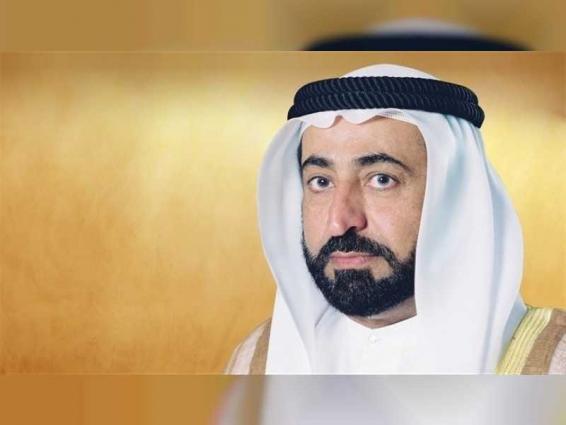
SHARJAH, (UrduPoint / Pakistan Point News / WAM – 03rd Apr, 2020) H.H. Dr. Sheikh Sultan bin Muhammad Al Qasimi, Supreme Council Member and Ruler of Sharjah, directed the Department of Islamic Affairs in Sharjah not to bury any of the victims of the new coronavirus disease, COVID- 19, in Al Saja’a area in Sharjah, and to confirm that none of the victims had been buried in the mentioned area or other areas in Sharjah.
The directives of H.H. refute what a tendentious video clip embedding that burial of COVID- 19 victims are taking place in the said area.
The SharjahGovernmentMedia Bureau,SGMB, called on the public to be accurate and to take information from their official sources only, and not to circulate rumours, and avoid spreading baseless news, pointing out that the relevant official authorities take their role in accordance with the law against the people who published such videos.
Denmark will dig up millions of mink culled over fears of a coronavirus mutation to avoid a future environmental disaster, the Danish government confirmed.
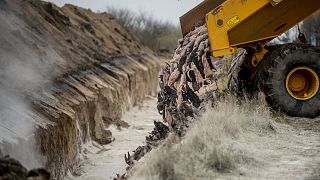
Some four million mink will be exhumed from mass graves and incinerated to prevent potentially hazardous pollution.
The Social Democrat minority government reached an agreement with other parties in the Danish parliament to have the mink exhumed and disposed of at local waste incinerators, ministry officials confirmed in a statement on Sunday.
It is set to take place in May when the potential risk of COVID-19 infection from the dead animals will have passed.
“Six months sounds like a long time, and I would have liked to have seen it go even faster, but it is clearly the safest solution, as we avoid staff being exposed to infection during excavation and at the same time avoid the dead and infected mink being transported over greater distances,” Rasmus Prehn, Minister of Food, Agriculture, and Fisheries, said in the statement released by the ministry.
The move comes as the bodies of the buried animals have begun to resurface because of the gases produced as they decay.SPONSORED CONTENT”Silence, serenity and peace”: Sir Bryn Terfel’s Christmas messageThe Metropolitan Opera in New York’s series of pay per view online concerts does Christmas well with concerts from operatic stars. It’s online format is a solution they found to geMusica, in partnership with Rolex
In November, the Danish government controversially ordered the slaughter of the country’s entire mink population after a mutated strain of coronavirus was detected, decimating the EU’s largest fur industry overnight.
Denmark breeds mink for their fur with Danish pelts prized around the world for their quality. The industry employs 6,000 Danes and is worth over half a billion euros in exports annually.
Over 15.4 million have been killed so far since November 4.
Samples of the mutation taken from one farm cluster were found to be resistant to antibodies, sparking fears that vaccines would be ineffective against it.
Following the cull, four million of the dead animals were hastily buried in trenches on military land near Holstebro and Karup in western Denmark.
The choice of burial sites near a bathing lake and a drinking water source has caused alarm with local residents raising concerns over contamination.
“The Danish Environmental Protection Agency is constantly monitoring the situation, and the agency is already conducting investigations to initiate remedial measures so that damage to the environment and groundwater is minimised,” officials said.
The first transmission of the coronavirus mutation was detected in farmworkers on mink farms in the Netherlands in April. Since then, cases of infections from minks to humans have been reported at farms in Denmark, France, Italy, Spain, Sweden, Poland, and Lithuania.
The cull in Denmark caused a polemic after a government minister admitted there was no legal basis for the action.
Agriculture minister Mogens Jensen stood down on November 18 after making the admission while the opposition also called for the resignation of prime minister Mette Frederiksen.
Following a visit to a family-run mink farm in Kolding in central Denmark, which was devastated by the cull, Frederiksen made a tearful apology for her government’s handling of the crisis.
The Danish parliament on Monday passed a bill that provided a legal basis for future culls, a temporary ban on the reintroduction of mink to the country as well as compensation for farmers who have lost their herds and livelihoods.
In a tweet posted following the vote, Pegn said: “The Danish mink breeders have sacrificed their life’s work for the common good. We owe them a big thank you. Thus, it is very gratifying that L77 has now been adopted so that there can be clarity about bonuses and replacements!”
The forensic doctors at the Karapitiya Teaching Hospital in Galle stated that if the body of the patient who died due to COVID that is being kept at the morgue is not cremated, they will withdraw from their duties.
Forwarding a letter to the Police Inspector at the Galle Headquarters, Health Services Director General Asela Gunawardena stated that the body of the patient in question must be cremated as per the Gazette Notification issued previously.
The deceased was an 84-year-old male resident of Deddugoda, Galle who died on 19 December.
However, considering the problems that arose in this regard, the Galle Additional Magistrate recently ordered that the body be kept at the Karapitiya Hospital morgue until a decision is taken by the Government Expert Committee.
The police were informed to seek the advice of the Director-General of Health Services in this regard.
Accordingly, Health Services Director General informed the Police Inspector at the Galle Headquarters in writing today.
As per the Gazette Notification issued by the Government on 11 April, the body of the COVID infected patient must be cremated at a temperature of 800 to 1200 degrees Celsius for a period of 45 minutes for complete combustion.
Meanwhile, the expert committee appointed by the government to inquire into the proposal to bury the bodies of those who died of corona infection had a discussion with the Minister of Health and other authorities today (23).
The Ministry of Health and the Expert Committee have exchanged views and the final report is to be prepared accordingly.
Director of Operations of the Airport and Aviation Services of Sri Lanka, Shehan Sumanasekara stated that the national carrier of Maldives will commence scheduled flights to Sri Lanka from today (23).
Accordingly, scheduled flights operated by Air Maldives will fly into Mattala Rajapaksa International Airport (MRIA).
According to Sumanasekara, the project is part of the project to develop MRIA under ‘an exotic tourism destination’.
Speaking further he added that they are in the process of lining up other airlines to commence scheduled flights in the same manner in the near future.
Despite UK government assurance that PCR tests can be adapted rapidly to respond to the new variant, Sri Lankan academics are scaremongering and spreading rumours that the Genetic variants of the new Covid virus strain from UK cannot be detected by PCR tests
UK Government says that Labs have been issued with guidance to adapt processes to ensure that PCR tests can detect this variant.
However, Professor Neelika Malavige of the Department of Microbiology at the University of Sri Jayewardenepura stated some genetic variants of the new Covid virus strain identified in the UK cannot be detected by PCR tests.
This was commenting to the Hiru news team regarding the virus variant.
The virus has now spread to several countries, including Australia, Denmark, the Netherlands and Italy.
As a result, more than 40 countries have taken steps to suspend flights to Britain, according to foreign media reports.
COVID-19 (SARS-CoV-2): information about the new virus variant (Courtesy UK Gov website)
Data from Whole Genome Sequencing, epidemiology and modelling suggest the new variant ‘VUI – 202012/01’ (the first Variant Under Investigation in December 2020) transmits more easily than other variants.
We currently have no evidence that the variant is more likely to cause severe disease or mortality – but we are continuing investigations to understand this better.
The way to control this virus is the same, whatever the variant. It will not spread if we avoid close contact with others. Wash your hands, wear a mask, keep your distance from others, and reduce your social contacts.
Is there any evidence that the variant is more serious?
We currently have no evidence that this variant causes more severe disease or higher mortality – but we continue to study cases to understand this better. We know that mortality is a lagging indicator and we will need to continually monitor this over the coming weeks.
Why is this more transmissible?
We know that mutations in the spike protein, the part of the virus that makes it infectious, can change how the virus interacts with human cells. However, we do not yet know the mechanism for this increase in transmission.
The evidence shows that infection rates in geographical areas where this particular variant has been circulating have increased faster than expected, and the modelling evidence has demonstrated that this variant has a higher transmission rate than other variants in current circulation.
How long has this variant been in circulation?
All viruses mutate over time and new variants emerge regularly.
Backwards tracing using the genetic evidence suggests this variant emerged in September 2020 and then circulated at very low levels in the population until mid-November.
The increase in cases linked to the new variant first came to light in late November when PHE was investigating why infection rates in Kent were not falling despite national restrictions. We then discovered a cluster linked to this variant spreading rapidly into London and Essex.
Evidence of increased transmissibility was provided to NERVTAG and ministers on December 18.
Is this variant resistant to the Pfizer vaccine?
There is currently no evidence to suggest that the Pfizer vaccine would not protect people against the new variant.
Further laboratory work is currently being undertaken as a priority to understand this.
How widespread is the variant geographically?
144 Lower Tier Local Authorities have identified at least 1 case genomically, although the vast majority of cases identified are in London, the South East and the East of England.
Can tests detect this new variant?
Labs have been issued with guidance to adapt processes to ensure that PCR tests can detect this variant.
PCR tests can be adapted rapidly to respond to the new variant.
As a small child, Shreen Abdul Saroor remembers getting up before dawn with her father to spy on the masses of migratory birds that would visit her island.
The birds were on their way down the Central Asian flyway — a migration path that crosses 30 countries from Siberia to the Indian Ocean.
“We would hide somewhere and … we don’t make any noise,” Ms Saroor recalls.
Up to a million birds stop at Mannar Island, off the north-west coast of Sri Lanka, to feed during the winter.
The Vankalai Bird Sanctuary on the southern tip of the island is protected by the Sri Lankan government and has been internationally recognised under the Ramsar Convention for its importance to both local and migratory birds.
Ms Saroor also remembers climbing the swollen trunks and gnarled branches of the baobab trees — trees synonymous with Africa, Madagascar and Australia’s Kimberley, but also found incongruously on her tiny island.
“Even though I fondly remember these baobab trees, one thing that I really remember is how … [members of the militant separatist group the Tamil Tigers] put the mutilated heads of the Indian peacekeeping forces on those trees.”
A baobab tree, native to northern Africa brought to Mannar Island by Arab traders.(Supplied: Renuka Senanayake)
The Liberation Tigers of Tamil Eelam fought a 30-year civil war with majority Sinhalese Sri Lankan military, in an attempt to create an independent Tamil Hindi homeland in the north and east of the country.
Ms Saroor had already left the island to study in Colombo in 1990 when the Tamil Tigers forced her remaining family off Mannar Island, along with all the other Muslim residents.
“Everybody overnight became refugees,” she says.
Since the war ended in 2009,many displaced Mannar Islanders have returnedto re-establish themselves in fishing and farming communities. But the trauma still lingers and there are tensions over land.
Against this backdrop, an Australian company has a plan to mine Mannar’s sands.
There are fears for the island’s fragile ecology, agriculture and fishing areas — and islanders are worried they could be displaced all over again.
Company’s drilling triples estimate of island’s minerals
Mannar is the biggest island at the base of a narrow chain of limestone shoals known as Rama Setu or Adam’s Bridge, which stretches 48 kilometres north-west to join India.
The island is 26km long by 8km wide and has rich deposits of the mineral ilmenite in its sand.
Ilmenite is the main source of titanium dioxide, a valuable white pigment used in things like paints, ink, plastics and cosmetics.
Adam’s Bridge is steeped in mythology, but scientists say the geological forces that created it are also responsible for its rich mineral deposits.(Supplied: NASA)
In 2018,Perth-based company Titanium Sands advised the Australian Securities Exchange (ASX) it entered an agreement with Srinel Holdings Ltd to explore the extent of the island’s ilmenite reserves.
In May this year, the company announced their exploratory drilling had tripled the previous estimate — to a total of just under 265 million tonnes.
Managing director of Titanium Sands, James Searle, says the company is looking to mine an area of the island that is 2km wide and about 8km long.
“On an annualised basis that’s probably … in the region of between 10 and 16 hectares.”
But some Sri Lankan scientists and environmentalists say they have been inadequately informed about the project.
‘The machines are moving in’
Ms Saroor’s younger brother is one of those who have made it back to the island, where he has a coconut estate.
“The first time I heard about this Titanium Sands mining is from him,” Ms Saroor says.
“He called me frantically and said there are machines moving in and out of those areas.”
Companies that Titanium Sands acquired started preliminary assessment with small-scale drilling on the island in 2015.
Throughout the totality of their study, which included a scoping study completed this year, the company drilled more than 3,000 exploratory holes with the deepest going down to 12 metres. The majority were between 1 and 3 metres.
According to Dr Searle, there has been no drilling in built-up areas of the island.
“The population on the island is largely concentrated in a town down the landward end of the island, called Mannar Town. There are other coastal villages, other settlements around the island,” he says.
“Our exploration work is only being undertaken on areas where there is no habitation and where there is no active agriculture.”
Mannar Island is an important ground for an abundance of bird species.(Supplied: Renuka Senanayake)
It’s some of those undeveloped areas of Mannar Island that concern ecologist Sampath Seneviratne, who studies Mannar’s birds.
“Flamingos must be the most charismatic and sought-after in terms of beauty,” he says. “[But] spoon-billed sand piper, one of the rarest birds in the world and one of the most iconic species that are on the verge of extinction right now, has been recorded in Mannar.
“These birds require highly productive places to feed during their migration and during their winter stopover. So if the productivity drops, they can’t use Mannar, they have to go [to] other places.”
According to Dr Seneviratne, a public notice is usually issued when companies are given permission for mining exploration in Sri Lanka.
But he and his colleague at the Wildlife Protection Society only found out from a friend in Australia about the drilling, and they were surprised that local environmental groups knew nothing of the project.
“It was a big shocker, because how did people like us working in [Mannar] not know this?” he asks.
Mannar is world renowned for its bird life.(Supplied: Renuka Senanayake)
Company accused of illegal conduct by Mines Bureau
Earlier this year in June, Titanium Sands was accused of illegal conduct in local Sri Lankan media reports.
The Sri Lankan Geological Surveys and Mines Bureau (GSMB) — the government body responsible for issuing mining and exploration licenses in Sri Lanka — reportedly said the company’s exploration was unlawful.
The GSMB told local media that under Sri Lankan law, Titanium Sands couldn’t legally acquire the rights to explore Mannar by purchasing the company (Srinel Holdings Ltd) that previously held the licenses.
But Dr Searles says the GSMB was “incorrect” and was responding to misleading social media posts.
“The legal advice and the legal structures are in total compliance with the Sri Lankan regulations,” he says.
The ABC contacted the GSMB but did not receive a response.
In November, a committee was put together by the Sri Lankan Ministry of Industry to look into the claims of illegal drilling.
Titanium Sands presented its case to the Ministry of Industry, but Dr Searle says he hasn’t heard anything further.
“I reiterate again that the licenses are held in a fashion which is in total compliance with the legal requirements in Sri Lanka
At the time Science Friction went to air there was no information on the company website about the committee’s enquiries into the project.
Asked why, Dr Searle responded:”We received enquiries on all manner of things and we don’t consider it to be significant.”
The company has since added a statement that says it “is not being investigated” although they have “provided information to the committee” which they say confirms the validity of their licences.
It also stated that the company has “no intention of pursuing a project that potentially impacts a Ramsar-designated area”.
Mannar ‘promoted as a promising resource’
Environmental scientist and senior director of the Centre for Environmental Justice, Hemantha Withanage, says he is concerned he hasn’t heard anything about the committee’s enquiries since the Sri Lankan federal election in August.
But, he says, the picture Titanium Sands is painting for their shareholders is not all it seems to be.
“On their website, they’re promoting Mannar Titanium Sands as a promising resource,” Mr Withanage says.
“How can somebody promote like that, without going through the environmental impact assessment process and getting the government approval?”
“We are very, very concerned about what this company is going to do in Sri Lanka,” he says.
Locals say they are worried about the impact the mine will have on the environment.(Supplied: Renuka Senanayake)
But an environmental impact assessment and public consultation are the next steps in the process, according to Dr Searle.
“That would eventually [lead to], we hope, granting of mining licences and ultimately development of the project,” he says.
Mining would ‘dramatically transform’ the ecosystem
Mineral sands mining is considered to have a fairly low impact on the environment compared to some other forms of mining.
The process doesn’t involve chemical separation of minerals such as in gold mining, or digging vast open-cut pits such as with coal.
Titanium Sands published material online showing the location of their resources including exploratory drill holes near the coast.
The location of exploratory drilling done on Mannar in 2016 -2017, showing some of the mineral reserves (shaded brown).(Supplied: Titanium Sands)
Daniel Franks, program leader of the development minerals strategic program at the University of Queensland, says Titanium Sands’ scoping study, released to the ASX in June this year, reveals the size of the planned mine is extensive and includes areas just a few metres from the beach.
If the operation was based in Australia, the company would be unlikely to be granted permission to mine those areas, says Professor Franks, who is not involved in the project.
“Mining to such a wide extent would dramatically transform the ecosystem. It would also limit the land uses that the community already has for the island,” he says.
“If it was in Australia, which is the home company of the project partners, it would face some pretty steep obstacles to regulatory approval.”
Mining near active beaches can disturb coastal morphology and removing vegetation can leave sand dunes vulnerable to erosion.
Managing director Dr Searle stresses that his company may not end up being able to mine all the resources they’ve identified, should the mine go ahead.
He says the company doesn’t intend to mine near beaches on Mannar, and that there is no economic incentive for the company to do this.
“Those areas along the shoreline are of no interest to us whatsoever because we consider them to be environmentally sensitive. We are much more interested in the interior, one to three kilometres away from the nearest coastline.”
But Professor Franks says the company’s assertion that it has no plans to mine near the beach “appears contrary to the scoping study released to the ASX” and that an update to the ASX might be in order.
Titanium Sands insist they don’t plan to mine near beaches.(Supplied: Renuka Senanayake)
Ms Saroor is also afraid the mine could damage the island’s groundwater.
“Mannar gets the smallest amount of the rain in the whole of Sri Lanka. So we totally depend on groundwater,” she says.
Professor Franks says the extent to which a sand mine could disturb the groundwater on Mannar depends on how deep Titanium Sands digs into the ground.
“I think there is a potential to impact groundwater systems. We’ve seen that in Australia where there’s indurated layers in the sand, that are impermeable and that can hold water,” he says.
“But I think the bigger impact is just the surface disturbance that’s going to happen across the island.”
Dr Searle, however, says the project will not affect groundwater or disturb beach areas.
“If it was to affect the groundwater, we wouldn’t be doing it,” he says.
“How you can make a statement that [this type of operation] would not be permitted in Australia is farcical.
“This sort of operation … has occurred over the last 50 to 60 years [in Australia] with an excellent environmental record.”
‘The people on the ground have the right to say no’
Rather than displacing people, Dr Searle says the mine will create between 200 and 600 jobs and that 95 per cent of those employed would be Sri Lankan people.
But Ms Saroor, who is now an award-winning human rights activist, is concerned about the impact on a community recovering from war.
She believes Titanium Sands should not add to the trauma of a community that is still rebuilding.
“At the end of the day, they are investing in Sri Lanka to make profit,” she says.
“So, my message would be to them to make sure not to profit out of a community that has been suffering in the last 30 years of the war.
“Think about the impact not only on the environment, but also on the people, and [then] make their decision.”
Mr Withanage of the Environmental Justice Centre says he could support the project, if it can be proven to be done in a way that benefits the local community and earns its social licence.
He says the final decision on whether the mine goes ahead needs to rest with the Mannar people.
“It’s not the Australian citizens who are going to make that decision.
“It is the Sri Lankan citizens going to that place, Sri Lankan government agencies, Sri Lankan courts… So they have to make that information available to Sri Lankans first.
“Australians are just going to buy the shares. The people on the ground have the right to say no.”
Government revenue as a percentage of GDP has steadily
fallen down over the past three decades to close to 11%. The government has to
prove all services it provides and repay loans and interest from this revenue.
Debt repayment and interest expenses alone equals total government revenue. For
the rest of government expenses, it has to borrow again. The only way to
overcome this debt trap is to increase government revenue.
However, taxing income (income tax, PAYE) is counter
productive as it takes away people’s money that would otherwise go into
consumption (short term economic growth) and savings (long term economic
growth). Taxing consumption (VAT, turnover tax, SNL, NBT) shrinks the economy
as people cannot afford higher consumption.
There is a way to both increase government revenue and
while not burdening those who shoulder the economy. That is to tax space – land
and occupied area. It must be done based on average land value of each GN
division, land or building extent and a percentage. A building with multiple
floors will have the land area multiplied by the number of floors. Colombo City
will have a higher value per 1 square meter of land than a rural area. Obviously,
people occupying sizable land in Colombo City have the means of paying their
due share of tax. This will net all tax frauds and those who evade tax. It will
also force them to put their high value assets to economic use. A tax-free
threshold must be introduced so that most land and basic living space will not
be taxed. Obviously, government land and government department owned land will
not be taxed.
It will prune out unprofitable and environmentally
destructive industries and replace them with highly productive industries.
Along with the introduction of the land tax, the
government can remove income taxes and reduce VAT which will stimulate economic
growth. Land tax will tax some foreign and Diaspora land owners who don’t pay
their due share of tax in Sri Lanka. Land tax must not be covered under double
tax agreements. The tax must be tied to the property and not the owner. Not
paying the land tax over a few years should lead to confiscation of the land.
It will increase state revenue to 15% of the GDP and help
the government payoff debt without hurting the economy.
At the same time the government must take a tough
decision to confiscate all private property currently leased to the government.
Rent and lease payments the government pays to private owners is exuberant and
it is a rip off. The saving would be substantial. Going forward the government
must construct its own buildings for all government departments, ministries,
etc. In fact, the government must construct buildings and rent them out to private
businesses and houses which will generate an income for the government without
having to do anything else.
Paying off the debt will continuously save an enormous
amount of state revenue which can go to development. Once that happens, the
land tax can be revoked and replaced with the current regime of taxes.
With several
countries having started COVID-19 vaccination, the United Nations has assured
Sri Lanka its support for procuring, distributing and administering of the
vaccine.
This pledge
was made today during a meeting between Prime Minister Mahinda Rajapaksa and a
U.N. delegation comprising of U.N. Resident
Coordinator Ms. Hanaa Singer, WHO
Representative Dr. Razia Pendse and UNICEF Representative Mr. Tim Sutton.
We are fully
committed to support Sri Lanka in these challenging times,” Ms. Singer said.
The U.N.
delegation and Sri Lankan officials agreed that vaccination at such a mass
scale will require a whole-of-government approach to ensure Sri Lanka’s
preparedness for the delivery and administering of the vaccine once it arrives.
In many countries,
we are seeing a dangerous second wave of COVID-19,” Prime Minister Rajapaksa
said. It seems that vaccines will be the only measure that can bring an end to
this pandemic.”
In April this
year, a global collaboration called Access to COVID-19 Tools ACT-Accelerator”
was established to accelerate the development, production, and equitable
access to COVID-19 diagnostics, therapeutics, and vaccines.” Under this
program, the COVAX Facility” will offer vaccine doses for at least 20% of an
eligible countries’ population,
which will initially consist of high-risk groups.
Mr. Sutton
stressed the importance of preparedness and creating awareness among the
public. He also told the Prime Minister that while UNICEF is already assisting
with procurement during the initial phase, it can also assist the Government
with vaccine procurement beyond the initial 20%.
Dr. Pendse
briefed the meeting on the global vaccine landscape and stressed that even with
the vaccine, people will still need to take precautions.
It’s still a new vaccine,” Dr. Pendse
said. It protects people from dying, but we don’t know how much it will reduce the
transmission.”
One of the
key messages that emerged from the meeting from all officials is that people
cannot become complacent even after receiving the vaccine. While studies are
ongoing, doctors say it’s still not certain how long the vaccine’s protection
will last. Furthermore, according to doctors, it’s also uncertain whether the
vaccine completely removes the virus or just reduces the viral load. If it’s
the latter, a vaccinated person is still able to infect others.
Even with
vaccination, the public is still strongly encouraged to continue wearing a
mask, washing hands and maintaining adequate physical distance.
Covid-19 infections registered in Sri Lanka crossed the grim milestone of 38,000 as 167 more persons were tested positive today (22), the Health Ministry said.
The Government Information Department stated that the newly-identified patients are close contacts of earlier cases linked to the Peliyagoda fish market.
In addition, 260 more including 35 from the prison cluster were confirmed as active coronavirus cases earlier this evening. Thereby, 427 infections in total have been identified so far within the day.
As per Epidemiology Unit data, the total number of Covid-19 infections confirmed in the country to date now stands at 38,059.
Recoveries from the virus meanwhile climbed to 29,300 earlier today, with 618 more patients returning to health.
However, 8,578 active cases are still under medical care at selected hospitals and treatment centres located across the island.
Sri Lanka has also witnessed 181 deaths related to Covid-19.
The World Health Organization (WHO) says it is studying variants of the coronavirus found in Britain and South Africa, adding there is no evidence they are deadlier or more severe than any more common strains, and the best thing people can do is work to suppress transmission.
During the agency’s regular briefing at its Geneva headquarters, officials said they continue to receive data about the variants and there are reports from Britain the new strain there can be transmitted more easily.
WHO Director-General Tedros Adhanom Ghebreyesus told reporters they are working with scientists to understand how these genetic changes affect the way the virus behaves. He stressed this is nothing new, saying, Viruses mutate over time; that’s natural and expected.”
Tedros said suppressing the spread of the virus as quickly as possible can help the most.
The more we allow it to spread, the more opportunity it has to change,” he said, adding that all governments and citizens should take all necessary precautions to limit transmission.
WHO technical lead Maria Van Kerkhove was quick to add there is no link between the variant in South Africa and the one in Britain and that they are different. She said they have just shown up at the same time.
What has not changed, Van Kerkhove said, is the method by which the virus spreads, and social distancing is still the best way to avoid it.
The virus spreads between people who are in close contact with another,” she said. That’s still the same. There are detailed investigations that are under way, and we will let you know if anything in that space changes. But the virus likes people who are in close contact with one another.”
Meanwhile, Michael Ryan, the WHO’s health emergencies program executive director, said that at this stage, there’s no evidence that this virus will change the severity, the diagnostics or the value of vaccines going forward.”
Sri Lanka has decided to ban all flights from the United Kingdom in a bid to prevent the new variant of Covid-19 spreading across South England.
President’s Media Division (PMD) said the move will be in effect from today (22).
A group of passengers from the UK, scheduled to in the country today, will be subjected to 14-day quarantine procedure at selected hotels under the observation of health authorities. They will be placed under home-quarantine for 14 more days.
Crews of cargo flights from the UK will also be referred to the quarantine procedure, the PMD said further.
France, Germany, the Netherlands, Belgium, Austria and Italy initially went on to restrict flights from the UK, after British Prime Minister Boris Johnson announced the cancellation of Christmas shopping and gatherings in Southern England over the new coronavirus variant.
Now, more than 40 countries including India, Russia, Canada and Hong Kong are following similar actions.
According to John Hopkins University data, the UK has confirmed more than 2 million infections. Meanwhile, fatalities from the virus stand over 67,000 in the European island nation.
UN envoy to Sri Lanka Hanna Singer has stated that she fully supports to obtain the coronavirus vaccine in Sri Lanka.
The Prime Minister’s Office stated that she stated her support during a discussion held with the Prime Minister Mahinda Rajapaksa this afternoon.
World Health Organization (WHO) Country Coordinator Dr Razia Narayan Pendse and UNICEF Representative Tim Sutton were also present at the discussion.
Prime Minister Mahinda Rajapaksa has stated that he and his government are committed to the success of the coronavirus eradication program in Sri Lanka.
Meanwhile during today’s discussion chaired by the President, attention was drawn to importing of coronavirus vaccine to the island.
Accordingly, Lalith Weeratunga, Principal Advisor to the President, has been authorized to coordinate the necessary actions in consultation with the Sri Lankan health authorities after conducting a study on the vaccine, according to the President’s Media Division.
The groups to be vaccinated will be decided on the basis of need and priority, and it was decided at the meeting to collect data on locations and groups at high risk of spreading the coronavirus, including estates, apartments and hostels.
The suspect involved in selling 30 new born babies, arrested from Matale, over child trafficking charges – Police Spokesman.
The suspect is a 47 year old and has been promoting himself on facebook. He was arrested yesterday and will be produced in court.
Police media spokesperson stated that the suspect has been trading babies for financial gain and has been avoiding the police.
The person who led a large scale child trafficking racket in Sri Lanka has been arrested in the Matale – Ukuwela area.
That was during a raid carried out by the Police Children and Women’s Bureau.
Further investigations have revealed that he had canvassed through Facebook for women who had got pregnant due to various reasons. He had then got the pregnant females to come and then under agreement had taken the babies after they were born.
He had then sold the infants after they were born to a third party.
Speaking at the Cabinet press briefing today (22), Cabinet Spokesperson, Minister Keheliya Rambukwella stated that the Government is not looking to abolish the Public Utilities Commission of Sri Lanka (PUCSL), but to appoint an alternative organization similar to that.
He explained that within a year, the Government has observed major incompetencies with the PUCSL which they hope to correct with the alternative option.
He added that the new organization will be appointed following the discussions with the Finance Ministry as well as the President’s Office which would also decide the powers that will be vested with the new organization.
Meanwhile, Chairperson of National Coalition for the Protection of Consumer Rights (NCPCR), Ranjith Vithanage stated that the PUCSL was a place where the electricity consumer could complain regarding the difficulties they face and that an organization that worked towards stopping the ‘power mafia’
Addressing in the same media briefing, Consumer Organization for Rights National Organizer Kelum Amarasiri gave examples where the PUCSL worked towards the betterment and the benefit of the electricity consumer.
He claimed that the authorities are trying to abolish the Commission as the PUCSL has managed to stop the unnecessary buying of electricity units in two occasions in the past year.
Ideological extremism leading to terrorism is a growing national security threat to Sri Lanka. The ideological extremism is being nursed by politico-religious & ethno-religious extremist groups who have covertly placed themselves in influential public & private roles. These extremisms take place openly & covertly in a synchronized action plan unaware to all. A covert buying-time new-social order program combined with manipulations by non-Muslim change agents is the threat that Sri Lanka has to deal with.
It’s all in the text
How did Islam become militant? The interpretation of the text.
This means – so long as the texts cater for misinterpretation there is always scope for Islam to be manipulated by both Muslims & non-Muslims using Muslims. The belief that Islam is superior to all is the key element that both extremist Muslim groups and extremism advocating non-Muslim groups tweak to their advantage & action plans. Manipulating Islam has been key & Muslims have been easy bait.
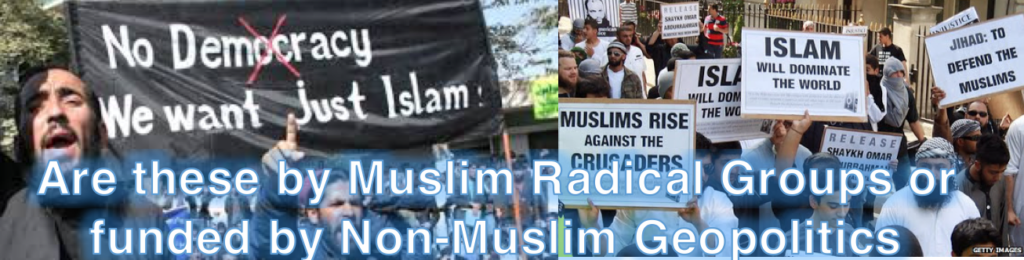
Scenario 1:Extremist Muslim groups misinterpret Islam to draw Muslims into violent jihad
Scenario 2:Non-Muslim groups covertly fund/train extremist groups to use Muslims against Non-Muslims & even Muslims (Islamic terror groups have killed more Muslims than non-Muslims)
Scenario 3:Same non-Muslim groups covertly fund/train non-Muslims to attack the extremist Muslim groups they are indirectly funding & supporting.
In all 3 scenarios – peacefully-living Muslims are caught between wishing to live in an inclusive society or being indoctrinated into violence and extremism because they are told they must follow their Book.
No country where ideology has risen to extremist ideology and thereafter to jihadi terrorism has found peace.
So long as Muslims are bound by elements that manipulate Islam, the cancer will spread to infest the minds of new recruits or converted non-Muslim recruits.
Rise in Islamic ideological extremism shows that moderate-Muslims are either not addressing the issue or are themselves being drawn into the extremist ideology – the justification for this has been a ready-made excuse that the actions of non-Muslims have led moderate-Muslims to become extremists. Ulema Council is today hijacked by extremism promoting group from the traditional Muslims that ran it.
This means that non-Muslims have to either agree and accept all that the ideological extremists demand as the handful of remaining moderate-Muslims threaten to become ideological extremists.
With the unlikelihood of ideological extremists declining, what safeguard and solution do non-Muslims have to preserve their country, territory, culture and heritage from jihadi ideological extremisms that are being fueled also be non-Muslims with geopolitical agendas?
Non-Muslim use of Islamic extremism for geopolitical agendas
With nations having significant representation of Muslims, it has become an easy ploy to disturb nations using Islam to create anti-Government forces and anti-National themes in other countries or spur Muslims to demand exclusive rights with intent to divide Muslims and view them as being anti-National. Countries can give enough of examples how Muslims have been easily aroused to make demands angering the rest of the citizens in countries. Ironically, the radical Islamic extremist groups can be easily engaged for they use these scenarios to increase their following while non-Muslim groups using Muslims for their geopolitical means do so to take advantage for their plans. Eventually, radical Islamic groups & the non-Muslims that sponsor radical Islamic groups and radicalized Muslims turn Muslims into extremists. Muslims have been easy bait for Muslim radical groups & non-Muslim radical groups.
Why do Muslims become bait to Muslims & non-Muslims? How do Muslims become bait?The answer to both is Islam. Islamic groups have learnt how to radicalize Muslims for their advantage and non-Muslims know what parts of Islam can be used to radicalize Muslims. However, Muslims must realize that their own people who are radicalizing them are doing greater damage to Muslims and Islam than the non-Muslims who are manipulating Islam & Muslims to their advantage. The Book gives ways for Muslims to tactfully deal with every situation to the advantage of the Book.
Muslims who wish to have nothing to do with Muslim groups who radicalize Muslims by manipulating Islam because they know Muslims can easily be subdued to bow down to Islam must be identified by Muslims and exposed by Muslims and Muslims must refuse to fall prey to them.
Who are these groups
Who are their leaders
What are the names of these organizations/institutes/schools/madrassas
How do they operate
Who funds them
What are the tactics and tricks they use?
The Government must also find answers
The answers can help in drawing mitigation options to countries grappling to find ways to protect the national security of their nation while also not stigmatizing part of their citizens.
What role can non-Muslim moderates play?
It is presumed that there are Muslims who are
Aware of radical Muslim groups & individuals manipulating Islam
Aware of how these radical Muslim groups & individuals are manipulating Islam
Wish to have nothing to do with these groups
Compelled to silently accept because they must bow to the Book
Obviously, given the power of the extremism in numbers these moderates prefer not to collide. But tacitly colluding with extremism by their silence will not help.
What are the realities that exist?
The international community wage’s war on terror ignoring that the intel units of their countries are nurturing the extremisms & even funding terror – naming and shaming selected perpetrators will never solve the problem. Who funded & supported Al Qaeda & all of the Al Qaeda linked terror groups?
The need for non-Muslim majority nations, their governments & the citizens to realize that Islam is not just a religion but an entire social order.It is virtually a Constitution.It tells how the Muslims have to behave when they are a minority and how to subtly acquire their way to becoming a majority numerically. Their positions at various levels give them targets to accomplish this social order. In such a scenario, countries & their governments must clearly declare that the National Constitution must prevail over any Islamic Constitution & these have to be clearly conveyed with legislative & legal provisions. When Muslims establish their positions in prominent roles they begin to seek the wishes of their Book (though not explicitly told) and when these are not given there is another group ready & waiting to draw their people to Islamic extremism bordering terrorism. The waiting method must be dealt parallel with nations clearly establishing laws and initiatives to ensure the covert operation does not lead to extremism/terrorism. We are yet to know the reason for 21/4 and we are now told denying burial will result in extremism/terrorism. Notice how these demands are taking shape.
Only a handful of Muslims who understand this overall larger picture yet follow their faith at a personal level & wish to have nothing to do with any groups that manipulate the Book. This understanding is self-found, nothing that can be taught. For non-Muslims, it is important to understand the mechanisms in place to build a social order tacitly – anyone in prominent roles are subtly drawn into this fold as they have to first bow down to the Book. This is a reality non-Muslims and non-Muslim majority countries & their governments must understand & ensure protections & safeguards are taken.
The most unfortunate and exasperating situation for non-Muslims is the manner corruption has weakened and diluted countries opening doors to extremism bordering terrorism. Operational role of the Book has found it easy to bribe & get their way. This has led to unnecessary social animosities & strife. The corrupt see no larger picture and even if they did, their greed for handouts take over doing right by the Nation & all citizens.
How easy is it for Muslims to understand that the manipulations of the Book, quoting the Book has not created any peaceful nation ruled by the Book while non-Muslims knowing the ultimate outcome for non-Muslims if only the rulings of the Book prevails, naturally negatively react every time demands of the Book gains prominence. Middle path is not the solution as scope for manipulating this scenario is also given. The moment the scenario is mapped out the response is to denigrate the message through a well-funded campaign of name-calling (hate speech-racist-fundamentalist using all of the terms in vogue). This will happen no sooner this article is read.
Therefore, non-Muslim nations have to make clear that National Law & National Constitution is above ALL and only that will prevail without allowing scope for the rise of groups (Muslim & non-Muslim geopolitical) manipulating the Book as they know Muslims will bow down to ONLY the Book. This is what Muslim extremists are taking advantage of and this is also how geopolitical bullies have used the Book to create a set of jihadi extremists/terrorists for their geopolitical maneuverings.
The issue is something Sri Lanka cannot ignore or regard lightly. It encompasses an entire social order that creates a shadow system within the system buying time until the objective is reached.
Sadly, those who remember how life was before 1980s with no Islamic extremism/terrorism wonder if Muslims & non-Muslims can return to that friendly period without living in doubt & animosities where new cultures, new dress, new trends, exclusive demands & self-isolating behaviors never existed. We must strive to bring this back by removing all elements that stand in the way of friendship. For this effort – it takes the genuine effort of all.
It
seems large sums of funds spent by all governments to combat Covid has not
produced the beneficial results. Average persons continue to disregard
the health warnings and put lives at risk.
To
attract tourists $, Sri Lanka and its Tourism Minister is planning to open the
Airports on the Boxing Day. To put it in a nutshell, this is an
absolute madness.
All
hardwork done by the health authorities in Sri Lanka during first phase had now
been forgotten. Putting tremendous pressure on limited resources in the
health sector, the Ministers must face the reality instead of playing for the
gallery.
To
assume things are getting back to normal is not real. If the gates are
opened for the festive seasons, Sri Lanka will be at the receiving end of further
increasing the number of positive cases, in a very short period of time.
The
method of systematically isolating selected streets, suburbs has
failed.
We
urge to refrain from opening the Airport and enforce complete lockdown of
the country, prior to the festive season.
This
decision is needed urgently instead of sending wrong signals to Sri
Lankans and prospective foreign tourists to Sri Lanka.
Sri
Lanka can no longer boast about the positive image established
during the first phase of Covid spread.
People are asking – Are there any other worlds like ours
out there – with life and people – or are we alone in the universe?
We
know that the stars we see are large, hot and dangerous; and the many
exo-planets,” we have found so far orbiting those stars, are rocky bodies,
varying from barren and fiery hot to extremely cold. Space is just a few
degrees above absolute zero (-273o) So, what are the
requirements for life to exist on a planet – and will it be like us?
Many
instruments and telescopes have been sent into space to get information about
our surroundings in space. We are learning about our Solar System, our galaxy
and even the stars and galaxies in the wider, great cosmos. We are looking
further and further out into the universe. There are many people, world-wide,
interested in learning about what is out there: astronomers and scientists of
course, but also people such as school science teachers and even fictional film
makers. We see our sun, the stars and galaxies above, and wonder what they
are?” Slowly the Astronomical community from all around the world are giving us
answers and our knowledge is increasing.
We
can now reach to the moon, but can we travel further and land on another,
hospitable planet outside our solar system? Some people think we should leave
earth because of all the damage and pollution we have created here – we need a
new home! The hunt for a new planet to call home” is on!
So
now, looking for habitable planets has become a major activity among certain
groups, and by using telescopes and cameras, people have found thousands of
planets orbiting their suns – but, unfortunately, until now, they all have one
or more drawbacks which makes life on them impossible.
What
are the conditions needed for life to survive, grow and develop? Well, if we
take our planet as an example, it seems a whole range of particular, and
demanding conditions are needed, all occurring simultaneously, as follows:
REQUIREMENTS
FOR LIFE TO SURVIVE AND FLOURISH:
The first
requirement is to find a planet which circulates its host sun in its habitable
zone, the so called Goldilocks Zone” – not too hot, not too cold.
A second
requirement is to find a rocky planet with water – again, not too little
but also not too much, so as to allow some dry land for habitation.
A third
requirement is to find a planet with breathable atmosphere, without poisonous
gases. Our type of life needs enough oxygen and neutral nitrogen with no
poisonous gases mixed in.
A fourth
requirement is that the host sun should not be violent. Most suns are
violent, and some are extremely violent. For example, the current thinking is
that all suns shed their outer layers occasionally. Millions and trillions of
tons of red-hot molten rock are blasted out into space which we call a Nova”.
These cataclysmic occurrences happen to all suns, the frequency ranging
from once a year, to just once in millions of years – we are still studying the
stars, suns in our universe, and learning about how the different types
function.
Also,
we know that all suns occasionally blast out smaller ejections of hot rock and
dust which we call Coronal Mass Ejections (CMEs). These are lesser events but
very dangerous, too, and can damage anything nearby. Our earth has experienced
these and they can, and do, knock out local electric power grids in places.
Luckily for us, our sun is fairly stable and only occasionally flings out large
CMEs, (But look at planet Mercury – the closest to our sun – it has been
thoroughly trashed!) However, our sun has allowed life to form over thousands,
if not millions of years, allowing our development and for us to become
conscious of our world, the Solar system, and now, even the Universe!
The fifth
requirement is protection from all the harmful rays coming from
the sun and also, on occasions,
coming from the cosmos or universe (space). Some planets have a liquid iron
core deep inside. If this rotates it can create a magnetosphere and this will
act as a magnetic shield to ward off those harmful rays. These rays are small
particles of matter, chiefly protons and electrons, but also harmful Gamma
rays.
A sixth
requirement is for a suitable gravity. Our planet has gravity. We don’t know
exactly how this arises, but this should not be too strong, too.
Another,
seventh most helpful feature is that we live on a sphere formed by
tectonic plates. These float on the hot liquid rock below and move around with
the edges grinding and rubbing up against each other. These plate movements
renew land surfaces grown old which also help life to renew and exist. At the
junctions of these plates are volcanos which also spew out lava with bad gases.
Our planet and its surface is impermanent, so providing new rocky landscapes
for life to grow and develop on.
An eighth
requirement is protection from plunging rocks – comets, meteors and, asteroids.
If a planetary system has orbiting rocks or asteroids which may descend and
strike a habitable earth, there needs to be other planets located in suitable
positions which can help shield it from such comets and asteroids.
These
eight rather specific requirements as given above, are for supporting life on
any planet. To find another planet which has all these eight features will be
very difficult. You can get a small feel for the immensity of the task if you
see all these factors lined up to form a probability – a miniscule probability
– but to our delight there are billions and trillions of stars with planets in
orbit, which can give us hope of finding one or even two, benign, kind
environments similar to ours!
And
what if we finally find a planet with attractive life-supporting features –
will we travel there only to find a civilization already in occupation – with
helicopter gunships and drones hunting down escaped prisoners? The more things
change, the more they stay the same”, is the saying.
OUR
PERSPECTIVE:
The
truth is we see our sun as normal: it is our world, it is all we see, after
all. But there are clues that, on the contrary, it is special. Astronomers have
categorized stars. Our sun is a ‘G’ type Dwarf, occurring in 2.7 percent of all
suns. It is unusually quiet. It flares (Novas) rarely, other stars flare more
frequently, and perhaps, a thousand times greater. Could our star be very
special – allowing life to develop over millions of years? Also, we think
we have all the requirements on earth for life to survive – but could there be
alternatives to our form of life?
Our
Earth’s orbit is in our sun’s Goldilocks Zone, and we even have a moon that
stabilizes our rotation. It prevents wild oscillations and gives us gentle
tides. Our Moon is too large to have been captured naturally scientist say.
Also, its rock and materials are different from those of Earth. It is
positioned at the exact distance to fully eclipse the Sun, exactly – an almost impossible,
billions-to-one chance occurrence. Someone has done this.
Our
planet is billions of years old. It has a long and as yet unknown history! We
are not alone in the universe – the moon tells us so!
Colombo, December 21: In the final phase of the separatist war when the European Union threatened Sri Lanka with withdrawal of the GSP plus duty concessions, President Mahinda Rajapaksa called a meeting. Rajapaksa asked Minister G L Peiris how much the country would lose due to the withdrawal of GSP plus. The Minister said it would be roughly US$ 250 million. Rajapaksa’s instant reply was: Let them withdraw GSP plus we cannot sell the sovereignty and territorial integrity of our country for US$ 250 million”.
So GSP was withdrawn and the war continued until terrorism was eliminated and the country’s unity preserved.
The above incident was recalled to understand Sri Lanka’s current position with regard to the withdrawal of the US$ 480 million grant proposed by the Millennium Challenge Corporation (MCC), an aid agency set up by the US Congress.
Last week, the United States Embassy in Colombo issued a statement saying that the MCC Board had decided to discontinue the proposed SL Rs. 89 billion development assistance grant ‘due to lack of partner country engagement’ without explaining it.
The truth is that it was not a question of ‘lack of engagement’. At every meeting between the Government and the MCC representatives including US Embassy officials, there were firm assertions from the Sri Lankan side about reservations over many clauses in the draft agreement. Sri Lankan officials pointed out that some of the clauses were contrary to the constitutional provisions and the Government could not sign such an agreement.
Proposal to renew 1995 SOFA
Furthermore, it was evident that although the US$ 480 million grant was meant for a transport project and an agricultural-land project, it came with a proposal to renew a 1995 Status of Forces Agreement (SOFA) with the US. The proposed draft included several unacceptable conditions including visa-free movement facility to US security and defense personnel to travel in and out of Sri Lanka.
The MCC Agreement was approved by the previous Government of Ranil Wickremesinghe in the last year of his tenure. But he was unable to get approval from Parliament. There was widespread resistance among people who believed it compromised the nation’s sovereignty and national security.
Last year when the MCC issue was debated, President Gotabaya Rajapaksa gave a firm assurance that the MCC agreement will not be signed under his Administration. The MCC agreement will not be signed even in my dreams,” the President said setting aside any doubts in any quarter. In a interview, Gotabaya said that it was Sri Lanka which reminded the US on human rights recently. He reiterated the government’s policy of protecting the sovereignty of the country.
When the MCC proposal was discussed during the former government, the SLFP General Secretary Dayasiri Jayasekara, who was a Minister, pointed out the proposed Land Bill, which aimed at facilitating the MCC Agreement, had many questionable provisions, which eroded the previous safeguards to ensure that arable land was protected from commercialization.
Jayasekara questioned why the government had linked the State Land Bill to the MCC $480 million grant, which will provide funding to measure land to establish a Land Bank in Sri Lanka, and also set up the Colombo-Trincomalee economic corridor.
Why did the Government ask for funds from the MCC? Why are they working on this with a US entity? If the Government wants to have a central place where all land details are recorded, why ask it to be funded by a foreign organization? As an island, Sri Lanka has limited land resources and they need to be protected. A similar piece of legislation was presented by the UNP Government in 2003, and at the time the Supreme Court said a two-thirds majority in Parliament was needed, along with a referendum. That is how serious this is,” Jayasekara pointed out.
He argued that several recommendations made by then President Sirisena, i.e. to maintain existing inheritance laws, prevent the break-up of large tracts of land, and ensure that the Mahaweli project is exempt from being covered by the new regulations, were not included in the document moved in Parliament two years ago.
The law states that when changes are recommended, they have to be included in the proposed legislation, and presented to the cabinet a second time before being presented to Parliament. These regulations ensure transparency and protect public interest. They give the public time to go before the Supreme Court to check whether the legislation is against the Constitution. But that has not happened here,” Jayasekera said.
Bill on restriction of transfer of land
The proposed Bill on the restriction on transfer of land states: Notwithstanding any provision to the contrary in any other written law, the transfer of title of any land situated in Sri Lanka, shall be prohibited if such transfer is:
(a) To a foreigner.
(b) To a company incorporated in Sri Lanka under the Companies Act where any foreign shareholding in such company, either direct or indirect, is fifty per cent or above.
(c) To a foreign company, unless exempted as provided in section 3.
Section 3 states the exemption from the application of the provisions of section 2 as follows:
(1) The provisions of section 2 shall not apply to:
a) Any land the title of which is transferred to a Diplomatic Mission of another State within the meaning of the Diplomatic Privileges Act or to an International, Multilateral or Bilateral Organization recognized in terms of that Act.
b) A condominium parcel specified under the Apartment Ownership Law.
In October this year, the US Embassy wanted the MCC proposal to be included in the discussions with the US Secretary of State Mike Pompeo. However, Foreign Minister Dinesh Gunawardena gave the firm message that Sri Lanka is determined to keep a fine balance in its international affairs and used the visit of the US Secretary to give the same message in no uncertain terms that, for Sri Lanka ‘Independence and Sovereignty come first in Foreign Relations’. Finally Pompeo said in an interview that it was for Sri Lanka to decide on the MCC agreement.
There is ample evidence of adverse clauses in the MCC Agreement. Prof. Lalithasiri Gunaruwan, who headed the four-member committee appointed by President Gotabaya Rajapaksa to examine the MCC proposal, said the MCC agreement would have undermined Sri Lanka’s status as a sovereign country.
At every step, Sri Lanka firmly stated that sovereignty of Sri Lanka could not be bartered away to any country. When this policy was clearly told, one wonders what the US Embassy meant by ‘lack of partner country engagement,’ unless it is another way of saying, We failed to coerce Sri Lanka to agree to our terms”.
Colombo, December 21 (newsin.asia): Sri Lanka would want certain key socially relevant economic rights to be included in the agendas of foreign grants for human rights promotion in the country, a top government source said.
He was commenting on the proposed US grant of US$ 1.75 million to US$ 2 million for promoting freedom of association and freedom of assembly in Sri Lanka, announced by the US Department of State Bureau of Democracy, Human Rights and Labor (DRL) on December 18.
The source had not seen the offer yet, but added that, as a general principle, such offers from foreign countries would be welcome if they were meant to promote human rights as prioritized by Sri Lanka. Given the urgent development needs of the masses, Sri Lanka’s concept of human rights gives top priority to socio-economic group rights like the right to education, livelihood, health, housing and security. If any or all of these five goals find inclusion in an aid offer, we will have no hesitation in allowing it,” the source said.
Interestingly, the US offer comes in the wake of the withdrawal by the US of a grant of US$ 480 million under the Millennium Challenge Corporation (MCC) Compact citing indifference on the part of the Lankan government. The US last week withdrew the offer stating lack of engagement on the part of the partner country,” namely Sri Lanka. The money would now go to an eligible country.
Sri Lankan nationalists, including a Presidential Commission, were of the view that a part of the MCC scheme relating to land was unsuited to local traditions and that it abridged the country’s sovereignty.
Details of the US Offer
The website of the U.S. Department of State, Bureau of Democracy, Human Rights and Labor (DRL) announced on December 18 that it is to hold an open competition for organizations interested in submitting applications for projects that advance and protect freedom of association and freedom of assembly in Sri Lanka.
The 2020 Human Rights Report, the UN Special Rapporteur on the Rights of Freedom of Association and Peaceful Assembly noted that although the country had a comprehensive legal framework governing the right to freedom of peaceful assembly, it was scattered in different sets of laws and regulations which seem to be interchangeably enforced, ” the statement said.
DRL seeks proposals for programs that utilize legal mechanisms and the judicial system to ensure these legal protections are enforced and these rights are respected in Sri Lanka. Proposals should assess the use of policies, laws and programs on democratic political competition, civil society, and media freedom that are being put into place in Sri Lanka under the new government.
Additionally, proposals should provide legal and organizational support to organizations and individuals facing undue government restrictions, pressure, inspections, and censorship to ensure they can continue to operate, as well as foster civil society-led strategic litigation to advance the protection, fulfillment, and respect of human rights.
Program approaches may include but are not limited to: Strengthening the role, status and capacity of defense lawyers and legal professionals; Expand the capacity of judicial watchdog organizations to monitor, document, and advocate in support of fair judicial process and court decisions; Develop public-awareness and advocacy campaigns that can be implemented via multiple media and social platforms; Assist small NGOs or informal advocacy organizations with innovative methods of civic engagement at the community level.
The proposed program must also address how it will ensure coordination with existing civil society networks, as well as ongoing civil society-led strategic litigation and advocacy efforts; all proposals must demonstrate that they do not duplicate existing efforts.
Proposed programming must be responsive to immediate needs on the ground, must be in line with the U.S. Government’s democracy, governance, and human rights goals in Sri Lanka; and should contribute to and support Sri Lanka’s efforts to strengthen democracy, governance, and human rights in the country.
All programs should aim to have impact that leads to reforms and should have the potential for sustainability beyond DRL resources. DRL’s preference is to avoid duplicating past efforts by supporting new and creative approaches.
This does not exclude from consideration projects that improve upon or expand existing successful projects in a new and complementary way.
Programs should seek to include groups that can bring perspectives based on their religion, gender, disability, race, ethnicity, and/or sexual orientation and gender identity. Programs should be demand-driven and locally led to the extent possible.
Exceptions
Activities that are not typically allowed include, but are not limited to: The provision of humanitarian assistance; English language instruction; Development of high-tech computer or communications software and/or hardware; Purely academic exchanges or fellowships; External exchanges or fellowships lasting longer than six months; Off-shore activities that are not clearly linked to in-country initiatives and impact or are not necessary per security concerns; Theoretical explorations of human rights or democracy issues, including projects aimed primarily at research and evaluation that do not incorporate training or capacity-building for local civil society; Micro-loans or similar small business development initiatives; Initiatives directed towards a diaspora community rather than current residents of targeted countries.
This notice is subject to availability of funding, DRL said.
Colombo, December 21 (Daily Mirror) – Sri Lankan authorities have gone on alert over the new strain of COVID-19 which scientists have warned is spreading rapidly in the UK, causing more serious illness, the Daily Mirror learns.
Health officials from the Ministry of Health said they were monitoring the situation closely and had been updated of the new variant through the WHO website and although there was no cause for immediate concern, authorities here were on alert.
We are on alert but we have not officially declared anything because Sri Lanka is only receiving repatriation flights coming in from the UK, bringing in the local nationals who are working there. Anyway, they go into quarantine for 14 days,” a senior Health Ministry official told Daily Mirror.
Once we open the airport only we have a little bit of a risk but other than that there will not be any problem at the moment. However we are on alert,” the official added.
Sri Lanka is all set to open the Bandaranaike International Airport on Dec. 26 and will soon welcome tourists into the country under strict health guidelines.
The WHO in a message on its official Twitter account said yesterday they were in close contact with the UK officials on the new COVID-19 virus and they will continue to share information and results of their analysis and ongoing studies. We’ll update Member States and public as we learn more about the characteristics of this virus variant and any implications,” the WHO said.
In the meantime, we continue to advise people to take all protective measures to prevent the spread of the COVID-19 virus and comply with national authorities’ guidance,” the WHO said.
Countries such as the Netherlands has already introduced a ban on passenger flights from the UK because of the new variant which will remain in place till Jan 1. (jamila Husain)
The Director-General of Health Services has sent a letter to the Minister of Justice Ali Sabri regarding the bodies of COVID-19 victims.
This was in response to the proposal to place the bodies of Muslims who died of COVID-19 infection in refrigerated containers until a definite decision is made regarding their burial.
The Director-General, through his letter, has requested for 05 refrigerated containers to be provided to the Chief Judicial Medical Officer’s Offices in Colombo, Kalutara, Kandy, and Negombo and the Ashraf Memorial Hospital in Kalmunai.
Meanwhile, containers that can refrigerate corpses have been provided to the Colombo Chief Judicial Medical Officer’s Office.
Accordingly, the bodies of Muslim COVID-19 victims were placed in these containers today (21).
State Minister for Money, Capital Market & State Enterprise Reforms Ajith Nivard Cabraal stated that the Government intends to follow a fair and a consistent tax policy without killing the proverbial ‘golden goose.’ Speaking exclusively to Indeewari Amuwatte at the ‘@HydePark’ program on Ada Derana 24, the State Minister expressed the following:
The most important thing about revenue is that it must be possible for people to pay because the government revenue is actually your expenditure. If the government is collecting more and more taxes it means the ordinary people of this country have to pay more and more, businesses will have to pay more and more. So, the government has to be conscious of this balance. If you were to deprive the base of the possibility of it to grow, it would be like this proverbial ‘killing of the golden goose that laid the golden eggs.’ What this government has done is to have reasonable tax rates with reasonable percentages being imposed. So that people can still part with the part of their income and not be significantly deprived of their own capacity to invest further.”
“We want to have a tax regime which is fair and which is consistent. We have a consistent policy where people can take investment decisions. That is very vital that people are able to take long term investment decisions, because through those decisions we can activate the economy very easily. At the same time, we expect the taxes to be paid by the people who are doing business in the country. That is why we want to plug all the leakages as well. If there is a leakage that is occurring, it is the interest of the government to ensure that those leakages are plugged and those are not able to function in the future, so that, whatever is done in Sri Lanka, is a legitimate business which is yielding revenue to the government. With that kind of strategy I think we can ensure that the revenues will be consistent and government coffers will be improving.”
Speaking further, Cabraal emphasized on the importance of addressing the revenue losses from illicit industries.
“What you mean by illicit industry is actually smuggling. If they were to pay taxes on the products that they are manufacturing or distributing and if the proper taxes are being paid then that industry will become legitimate. Overall we do recognize that in the case of liquor, tobacco and other items, where the duty element is there, the government may be losing some revenues and those needs to be addressed.”
When you have income which is not declared there is a great possibility that it can be channeled to other illegal avenues as well. It is in the interest of all to ensure that the proper revenues are collected by the government and that all the avenue of through which revenues are coming into the country are legitimately accounted for. Very often we have seen terrorism financing or money laundering has taken place from monies that have been generated by illegal means. It is fairly a complex problem which needs to be tackled by all parties and at the same time we got to ensure that we come down hard on those who go on these types of activities as well.”