Colombo, December 20 (Sunday Times) – The Government has started talks with the World Bank to secure a Rs. 10 billion loan for the purchase of a vaccine against COVID-19, The Sunday Times reported quoting a Senior Government official.
The official said the Government was seeking a soft loan while also looking at the possibility of obtaining funding from the Asian Development Bank (ADB) and the European Union (EU) for the purchase of the vaccine required for a large part of the population.
Sri Lanka has been so far assured of being provided a vaccine for 20 percent of its population under an international initiative in which the United Nations agency, the World Health Organisation (WHO) is also involved.
Prof. Channa Jayasumana, State Minister of Production, Supply and Regulations of Pharmaceuticals, told the Sunday Times the cost for the proposed imports would largely depend on the type of vaccine to be imported according to its cost-effectiveness.
Whilst the year was impacted heavily with COVID-19 restrictions and issues, it achieved some milestones in its growth and formed a solid base on which to work from in 2021 and beyond once COVID-19 restrictions are lifted.
The company is committed to developing the Mannar Island project in an environmentally sustainable manner
Titanium Sands Ltd (ASX:TSL) remains focused on recommencing drilling to finalise the release of numbers contained in a scoping study and moving the environmentally-friendly Mannar Island Heavy Mineral Sands Project in Sri Lanka into its next phase.
Whilst the year was impacted heavily with COVID-19 restrictions and issues, the company has achieved some milestones in its growth and formed a solid base on which to work from in 2021 and beyond once COVID-19 restrictions are lifted.
The company is committed to creating opportunities for residents of Mannar Island and Sri Lanka while adhering to the guidelines in place so that the will not have a detrimental impact on the environment.
Describing 2020 as a volatile year mainly due to COVID-19, the company thanked shareholders for their ongoing support and faith in the project and hopes to provide meaningful updates” as COVID restrictions are lifted.
Milestones achieved
Milestones achieved in the year include:
➢ Indicated resource upgrade to 90.03 million tonnes at 6.6% total heavy mineral concentrate (THM) with 66% in the indicated category;
➢ Reverse aircore results show major depth resource potential, identifying heavy mineral concentrations down to 9 metres beneath the entire 8 kilometres domain to mineral resource zone;
➢ Further assay results show extensive depth resource potential, with aircore drill holes demonstrating heavy mineral down to at least 10-11 metres in an area on 18 square kilometres of the existing shallow resource;
➢ TSL resource triples to 264.93 million tonnes at 4.38%;
➢ Positive scoping study results show potential for a robust long-life major dredging project;
➢ Project upgrade with garnet added to the mineral resource estimate;
➢ Placement and share purchase plan which saw firm commitments for $2.2 million received for the placement; and
➢ Share Purchase Plan from existing shareholders raised a further $167,000 via a share placement plan (SPP).
The Mannar Island project is an exploration-stage project on the 26 kilometres by 6 kilometres-wide Mannar Island in northwest Sri Lanka, joined to the mainland by a 3-kilometre-long road causeway.
Titanium Sands Ltd has been exploring and defining areas of heavy mineral sand concentration on the island since December 2018.
Exploration has involved shallow hand auger drilling and light mechanised drilling, both of which have very low to zero environmental impact.
The project is at an early stage and is being progressed under exploration licences granted on the basis that the proposed exploration activities should not have a detrimental impact on the environment.
Any mining or major development project in Sri Lanka must move through numerous regulatory steps, including demonstrating compliance with the Sri Lankan Environment Act and a public consultation process.
Granting of a mining licence, terms of investment, export licences, operational licences and other regulatory compliance can only occur once the project has been sufficiently defined by studies that include comprehensive environmental impact and management assessments.
COVID-19 impact
Since March 2020, Sri Lanka has, like the rest of the world, been dealing with the COVID-19 pandemic.
While the country has experienced relatively low levels of infection and death, a recent increase in positive cases has prompted the re-imposition of restrictions on domestic travel including to and from Mannar Island.
The situation remains uncertain but it is hoped exploration will be able to recommence before travel restrictions are fully lifted.
Commissioner Ayob Khan Mydin Pitchay said he was puzzled why the threats were made against him as he was no longer the E8 head.PHOTO: THE STAR/ASIA NEWS NETWORK
JOHOR BARU (THE STAR/ASIA NEWS NETWORK) – Johor police will be working closely with its Selangor counterpart after death threats were made against state police chief Commissioner Ayob Khan Mydin Pitchay.
Datuk Ayob, who was previously head of the Special Branch’s Counter-Terrorism Division (E8) at police headquarters before being promoted to Johor police chief in February this year, said investigations were ongoing to identify the suspect, believed to have links with the Liberation Tigers of Tamil Eelam (LTTE).
“I received the threats two weeks ago from a man who contacted my personal assistant claiming that three LTTE members from Selangor were coming down here to kill me.
“The person gave detailed information about me and even knew my home address,” he said when met after attending an event on Sunday (Dec 20).
Commissioner Ayob added that he was puzzled why the threats were made against him, as he was no longer the E8 head.
“I am unsure why the threats have been made, as it’s been more than a year since I left Bukit Aman and I do not know why this issue resurfaced again,” he added.
Bernama news agency reported the senior policeman as saying: “We believe these people (suspects) are locals, because the call was made to a personal assistant in my office using Bahasa Malaysia, and we are investigating the case now.
He added: “There are rumours that the LTTE want to be removed from the list of terrorist groups… or maybe there are certain parties that want to take the opportunity to play up the LTTE issue again.”
The LTTE is a defunct terrorist group that was based in Sri Lanka, with symphathisers in Malaysia and other countries.
At present, albeit in a different context, there is another westward strategy from the Eastern Pacific theatre. It is that of the US Pacific Command in Hawaii along with Japan, Australia and other like-minded allies.Sri Lankan navy at Sri Lanka’s 72nd Independence Day — 4 February 2020, Colombo. Photo: Ishara S. Kofikara — AFP via Getty
Sri Lanka was never at war with Japan during World War II. Japan was at war with the allied forces and Sri Lanka (then Ceylon) happened to be a base operation for the British Eastern Command. Four months after the Pearl Harbour surprise attack by the Japanese in the Pacific theatre which altered US Foreign Policy, another similar attack took place in the Indian Ocean. On Easter Sunday morning of 5 April 1942, Sri Lanka came under attack. The geostrategic locations of Hawaii and Sri Lanka were identified and rightly assessed by the Japanese-German strategic officers — such as Vice Admiral Nomura and Admiral Kurt Fricke, Chief of Staff of the German Maritime Warfare Command (Seekriegsleitung) — as the perfect launchpad to springboard their sphere of influences.
British Prime Minister Winston Churchill remarked that the Japanese attack, carried out in Sri Lanka by their Fast Aircraft Carrier Strike Force under the command of Vice-Admiral Chuichi Nagumo, was a decisive moment in the Second World War. This was due to the significant threat Allied Forces would face from losing Sri Lanka — a clear geographical advantage will fall to the enemy to expand to India, the Middle East and Africa. This was explained by historian, Sir Arthur Bryant as ‘a Japanese Naval victory in April 1942 would have given Japan total control of the Indian Ocean, isolated the Middle East and brought down the Churchill government.’ Unlike Pearl Harbour, which was a surprise attack, the British Eastern command in Sri Lanka was prepared ahead. The westward Japanese expansion strategy was suppressed and ended in Sri Lanka, marking a decisive moment in the Second World War.
At present, albeit in a different context, there is another westward strategy from the Eastern Pacific theatre. It is that of the US Pacific Command (USPACOM) in Hawaii along with Japan, Australia and other like-minded allies who subscribe to ‘shared values’ of a rules-based order, against a rising China — where Sri Lankan geolocation is revisited with its strategic importance. In view of China’s acts of aggression and to protect these shared values, Admiral Philip S. Davidson, commander of the USPACOM from Hawaii, sends a clear message: Maldives and the US recently agreed to a security cooperation framework to deepen engagement and cooperation in support of maintaining peace and security in the Indian Ocean. India’s support for this new effort is just one example of how like-minded nations can support one another in pursuit of our common vision for the region,” referring to the success of Australia’s participation alongside India, Japan, and the US in MALABAR 2020, a joint naval exercise. With multiple military alliances taking place in the Indo-Pacific theatre, Sri Lanka is also provided with the choice of stepping into the alliance, with a clear warning to abide by the ‘rules-based order’ and not with the aggressor China. Sri Lanka’s closest neighbour, India, ‘has also entered into a series of partnerships with like-minded countries in the Indo-Pacific, such as Australia, Japan, and the United States, to offset the growing Chinese influence as well as to enhance India’s own capabilities,’ argues Rajeswari Rajagopalan.
Sri Lanka executes a binary foreign policy and it is important to understand the implications of being part of both — one for economic benefit and another for security.
Indian High Commissioner to Colombo, HE Gopal Baglay, in a recent interview explained, I am happy to note the recent articulation by Sri Lanka of the ‘India-first’ policy, particularly in the realm of security,” further expressing India’s commitment to a rules-based order in the Indo-Pacific and appreciating Sri Lanka’s view as a free, open and inclusive Indo-Pacific [being] as important for Sri Lanka as it is for India. It is a matter of great happiness to hear similar views articulated in the senior echelons of the Government of Sri Lanka, including at plurilateral occasions.” It is also worth understanding that the senior echelons have also proscribed with China’s BRI and recently endorsed the CCP model of development, which is not really a free and open model. Sri Lanka executes a binary foreign policy and it is important to understand the implications of being part of both — one for economic benefit and another for security. A hedging foreign policy could weaken its alliance posture with external powers and gravitate towards an external conflict not by choice but by default. Sri Lanka needs to move beyond the binary choice between the US and China, disaggregating strategic competition, case-by-case. One such way is to establish strategic alliances with ‘middle powers’ to move out of the binary path.
Geo-intelligence alliances in the Indo-Pacific
The US has expanded its intelligence budget according to the Director National Intelligence, and is clear on the Chinese threat as he stated, if I could communicate one thing to the American people from this unique vantage point, it is that the People’s Republic of China poses the greatest threat to America today.” Multiple alliance geo-intelligence pacts will be signed in the coming months and the Five Eyes structure revisited.
From the Pacific theatre, Japan — an important partner — will join the five eyes intelligence-sharing network. The new Japanese Prime Minister Suga has pushed Japan to do so, where for the first time, a nation from the eastern theatre will join the military-intelligence alliance. The Five Eyes, established in 1941 with Australia, Canada, New Zealand, the United Kingdom and the United States, played a key role in signal intelligence gathering and analysis during the Cold War. In the present context, Japan’s entry as the sixth eye would complement the strategic alliance as the other five, including Australia, anticipate increasing security concerns vis-à-vis China. This was further strengthened through the recent military partnership, the Reciprocal Access Agreement (RAA) with Japan and Australia.
Multiple alliance geo-intelligence pacts will be signed in the coming months and the Five Eyes structure revisited.
Promoting India’s subregional agenda with its critical island littorals in the Indian Ocean, the 4th National Security Advisor-level trilateral Maritime Security Cooperation meeting trilateral Maritime Security Cooperation meeting between India-Sri Lanka-Maldives was successfully concluded. Its last meeting in 2014 was stalled due to strong bilateral relations of the littorals with China. At the recent trilateral in Colombo, an important intelligence sharing agreement identified the areas of terrorism and cybersecurity as common security threats.” This is a definite improvement since the last high-level Indo-Sri Lanka Defence Dialogue held at the Defence Ministry in Colombo with the two Defence Secretaries, where the subject area of terrorism or extremism was excluded from the agenda. It is significant that this was held on 8 April 2019, weeks before the 21 April Easter Sunday Attacks.
The head of the delegation for the trilateral from India was the country’s National Security Advisor Ajit Doval. On the sidelines of the trilateral, a meeting between President Gotabhaya Rajapaksa and Doval took place, where multitudes of security challenges for both nations were discussed. It was Doval back in 2014 who flagged to then-Secretary Defence Rajapaksa, that the Chinese submarine presence would be a threat to India’s interests. Since then, there has been a strong personal level connection between the two. Institutionalising this relationship is an important step for Indo-Lanka security ties. Due to India’s strong security alliance with the US inclusive of multiple security agreements, Sri Lanka will be made a partner in the future similar to the Maldives, with a view to share intelligence not only on counter-terrorism but also to keep (the US threat number one) China deterred.
Civilisational powers
In a great power rivalry where several geographical theatres could be used from Central Asia, the Arctic, the Middle East to the Indo-Pacific, there are factors to show the US-China tension would be more visible in the Indo-Pacific. During the Cold War, the pivotal defending geography from the Soviets was Berlin in Europe and today it is about defending Taiwan in East Asia.
Three ancient civilisational powers in Asia — India, China and Iran — will directly impact the geopolitics of the Indo-Pacific. These nations have a civilisational imprint on their geographies where neighbouring nations are overshadowed by their influence. Iran holds a pivotal position in the Middle Eastern frontier whose year began with the assassination of Iranian top military officer Soulamani and ended with the killing of the architect behind Iran’s nuclear program Mohsen Fakhrizadeh-Mahabadi. The coordinated assassination of Fakhrizadeh in Teheran was a direct signal to the incoming US President Biden, to stay away from the Iran Nuclear deal to carry forward the status quo. The assassination was aimed to secure the recent ‘Abraham pact’ with the UAE, Israel and Bahrain backed by Saudi Crown Prince Mohammed bin Salman. The attack came days after the covert Israeli-Saudi-US meeting that reportedly took place in Neom.
Three ancient civilisational powers in Asia — India, China and Iran — will directly impact the geopolitics of the Indo-Pacific.
Two geopolitical pressure points will impact two regions in the coming year. First, the Middle East with its Abraham pact to deter Iran. Second, in the Indo Pacific region to deter China. If sanctions are relaxed, Iran would play a much larger economic role in the oil trade and support its proxies in the same manner. If China is not contained by the US and its allies, it will continue to influence through its economic, security and CCP political model. From multiple military intelligence agreements crisscrossing geographies, expanding towards the sixth eye to contain China, with binary choices to nations like Sri Lanka, the year 2021 will begin with an elixir to the global populace suffering from a pandemic and a heated Cold War in the Indo-Pacific theatre.
A Russian tour group has been granted permission to visit Sri Lanka and will be the first batch of tourists to enter country after the reopening of the airport on December 26, Civil Aviation Authority of Sri Lanka (CASL) Chairman Upul Dharmadasa said.
He said this Russian tour group consists of more than 200 people, will be the first to arrive at the Bandaranaike International Airport (BIA) and at the Mattala Mahinda Rajapaksa International Airport (MRIA) respectively.
Mr. Dharmadasa said the airport authorities and the travel agents have been informed of this and instructed to take necessary actions, such as disinfecting the airport premises, organising customs and immigration formalities, hotels reservations by travel agents and arrange buses for the tourists.
Death toll from Covid-19 outbreak in Sri Lanka has climbed to 176 as five more virus-related fatalities were confirmed today (20), the Director-General of Health Services says.
One of the victims is a 71-year-old male from Panagoda area who died of blood poisoning and Covid-19 pneumonia. He was transferred from Pimbura Base Hospital to Mulleriyawa Base Hospital where he died on December 18.
Another man, aged 52, has also fallen victim to Covid-19 pneumonia. He passed away on December 17 while at his home in Colombo 08.
The third victim is a 71-year-old woman from Colombo 12 area. She was transferred from Colombo National Hospital to Pimbura Base Hospital where he died on December 19. The cause of death was recorded as cancer and blood poisoning due to Covid-19 infection.
A 44-year-old man residing in Colombo 02 meanwhile died of lung infection exacerbated by Covid-19 infection. He was transferred from Colombo National Hospital to National Hospital for Respiratory Diseases (NHRD) in Welisara. According to reports, he has passed away on December 19.
The fifth victim was identified as a 49-year-old man from Bandaragama area. He died on admission to Horana Base Hospital on December 19. The cause of death was cited as chest infection caused by Covid-19 virus.
Covid-19 infections registered in Sri Lanka crossed the grim milestone of 37,000 as 330 more persons were tested positive today (20).
The Government Information Department stated that 322 of the newly-identified patients are close contacts of earlier cases linked to the Peliyagoda fish market. In addition, 08 from the prison cluster were also confirmed to be positive for the virus.
With the new development, total positive cases detected within the day stand at 592.
As per statistics, Covid-19 infections confirmed in the country to date have reached 37,261.
Recoveries from the virus meanwhile climbed to 28,267 earlier today, with 715 more patients returning to health.
However, 8,823 active cases are still under medical care at selected hospitals and treatment centres located across the island.
Sri Lanka has also witnessed 171 deaths related to Covid-19
Globally, there is a hurry to grab land & resources and it is a factor that any Third World country/Govt must be aware of. On the guise of development and aid, international agencies try to push their plans via $ carrots. These programs are often binding of countries to allow access to external persons & provisions to even own data. Future interventions will be via ownership of data and conquering by computers than sending foreign armies. This implores governments to not only secure the country’s data systems but also protect the citizens land rights.
Bim Saviya Fraud Deeds & Protecting Our Land
Bim Saviya better known as Act 21 of 1998 was an Australian law enacted in 1858 when British immigrants conquered Australia declaring the land of the people as Res Nullius – no man’s land.
Why has Sri Lanka introduced this law?
Act 21 is a cut & paste of the Australian, without any stake holder involvement simply because World Bank recommended it & international aid agencies gave funds to implement it.
Governments agree to anything for funds
International aid agencies use a country’s need for loans as a carrot to plug programs beneficial to them. World Bank introduces Bim Saviya & Aid Agencies agree to fund its implementation. MCC came to be introduced to Sri Lanka in the same scenario with millions shown as a carrot. MCC selected Bim Saviya as part of its land project as it was part of an overall global land grab plan by international aid agencies. Bim Saviya had nothing advantageous to Sri Lanka and it was to take over 100 years to fully implement. Performance Report of Bim Saviya by the Commissioner General of Land Title Settlement for 2018 clearly establishes this. But international agencies introduced Bim Saviya with a purposeful intent and whether it is MCC or another aid program, bim saviya will play a key role as it is advantageous for external parties & fraudsters & not genuine land owners.
Bim Saviya is a foreign law, given with foreign funding imposed on us demanding that we remove our existing own laws & follow a foreign land law. Bim Saviya allows foreign aid agencies and foreign parties to be given access to all land records with absolute grant of intellectual property rights of the e-register.
Sudden decision by cabinet to remove Caveat
With a nod, the Cabinet removed the caveat provision inspite of numerous committees discussing how to amend existing land laws etc.
The news reported that Last wills can be attested by the Public trustee without lawyers.
Bim Saviya removes the judicial powers and the lawyers work relating to court actions regarding writ applications.
Owners have no remedy to be informed if forged deeds are getting registered Legal profession and lands in the country are facing revolutionary & shocking changes & as a result it is more than possible that condominiums will come up on lands belonging to innocent people forged and taken as Bim Saviya prevents recourse to the law to regain the land rights.
Where is the Land Reform Commission?
The Justice Ministry has commenced numerous committees to propose reforms to land laws in Sri Lanka without turning to the already available Law Reform Commission who are tasked to do just that. While all these discussions are taking place the Attorney General’s Department and the Land Ministry are busy writing new laws and making changes. A communication fallacy certainly prevails. By the time the discussions by Justice Ministry committees conclude the AG’s Dept & Land Ministry would have already implemented their own land reforms which can be contrary to what the Justice Ministry is proposing or completely opposite to what the Land Reform Commission would propose!
While all this is taking place, our learned cabinet without notice to the committees or public are able to completely annul statutory laws as was done with the caveat.
Cabinet must annul Act 21 of 1998/Bim Saviya
MCC declares the project of transferring from deed to bim saviya will cost GoSL millions & MCC was to grant funds to transfer just 10 out of the 45 land registries to bim saviya.
Cabinet needs to annul – Section 33 of Act 21 of 1998 which reduces the power of the judiciary to entertain cases from those affected by land fraud.
As perSection 33 – a Bim Saviya certificate entered into the e-land register by a forged party will make him/her the original owner of the land. The aggrieved original land owner cannot seek court intervention to regain the land and property. He has to be happy with compensation given by the Registrar who maintains a statutory Assurance Fund.
GoSL does not need to borrow millions to please foreign organizations & their program recommendations.
GoSL has no money to create an Assurance Fund to compensate land owners who find their lands fraudulently taken from them.
Cabinet is bound to protect land rights of Citizens
With Cabinet suddenly repealing caveats, the Cabinet is now bound to secure the land rights of owners.
How can Cabinet solve land fraud & protect land rights of citizens?
Revive Deed System & Annul Bim Saviya.The Deed system complies with the Constitution of Sri Lanka & Section 23 of the Electronic Transaction Act of 2006 which prohibits fully automation of Land Transactions. Thus, the owners deed must remain with owner while the owner’s registration number will operate the e-register.
Cabinet nod to protect owners unable to put caveats as GoSL has removed caveat registrations. Just as cabinet has given the nod to do away with the caveats which is a boon to the fraudsters forging deeds, the cabinet must now give the nod to stabilize the rights of owners to prevent land fraud. The cabinet must immediately consider registering the owners identity and photos of owners as required by the Financial legislations of the Central Bank.
GoSL must amend Registration of Documents Ordinance Section 7 & make the registrar responsible to accept only original deeds & reject forged deeds. A new law has been introduced for Trust Deeds so laws to safeguard land owners for Other Deeds has to be immediately implemented.
Implement the Central Bank Financial Transactions Act– Cabinet passed the Central Bank Financial Intelligence Unit proposed Regulations for Land Transactions. The Financial Transaction Act 6 of 2006 statute specifies how to identify land owners to prevent forgery and how to prevent money laundering. In the recent gazette of 21 April 2017 (2015/56) there is biometric or photo identity at the time of signing deeds which should be archived so that CID has better evidence than mere witnesses who say they know the owner. Witnesses to deeds is a poor & outdated identification system as they could also be dead or not in the addresses stated in the deeds.
Continue with existing deed system with improvements– With the COVID crisis engulfing Sri Lanka, the GoSL is in no position to be bearing the cost of Bim Saviya which will take 100 years to implement according to the report of theCommissioner General of Land Title Settlement in 2018. When the deed system already exists there is no requirement for Sri Lanka to adopt a new foreign land law that was developed for Australia by immigrants to replace the laws that existed by Natives.
Amended Trust Ordinance Section 19A / Act 6 of 2018 prevents fraud & money laundering – all land owners must be entitled to this privilege as they cannot depend on the notary. Central Bank monitors all Trust Deeds. A Trustee shall keep records of all such information as may be prescribed, on the identity of the following at the time of creation of an expression of Trust under Section 6 & every3 months these are verified & updated.
Trustee himself
Co-Trustee (if any)
Author of the Trust
Beneficiary
Anyone engaged in the execution of the Trust in the capacity of an agent, a legal representative, a manager, an investment advisor or a tax advisor, an accountant
Amended Trust Ordinance Section 19C holds all responsible for land transaction & if found guilty by a Magistrate, is liable to a fine not exceeding Rs. 200,000 or imprisonment for a term not exceeding 2 years or both (fine & imprisonment)
Remove practice of accepting illegible signatures of owners in deed system. Land owners must identify themselves & their signatures must be valid to make a deed valid.
The Central Bank has prepared the necessary laws for Trust Deeds. The same security & safeguard provisions must be applicable to all land transactions by the GoSL. The Cabinet must immediately provide a solution having suddenly removed the caveat without alternative option for genuine land owners wishing to secure their land via a caveat.
It is unfortunate that the legal fraternity of Sri Lanka are not coming forward to point out the discrepancies and the volatile situation arising out of impulsive short-sighted advice given to the Government/Cabinet by advisors” unaware of the problems likely to arise out of annulling statutes via a sudden cabinet proposal.
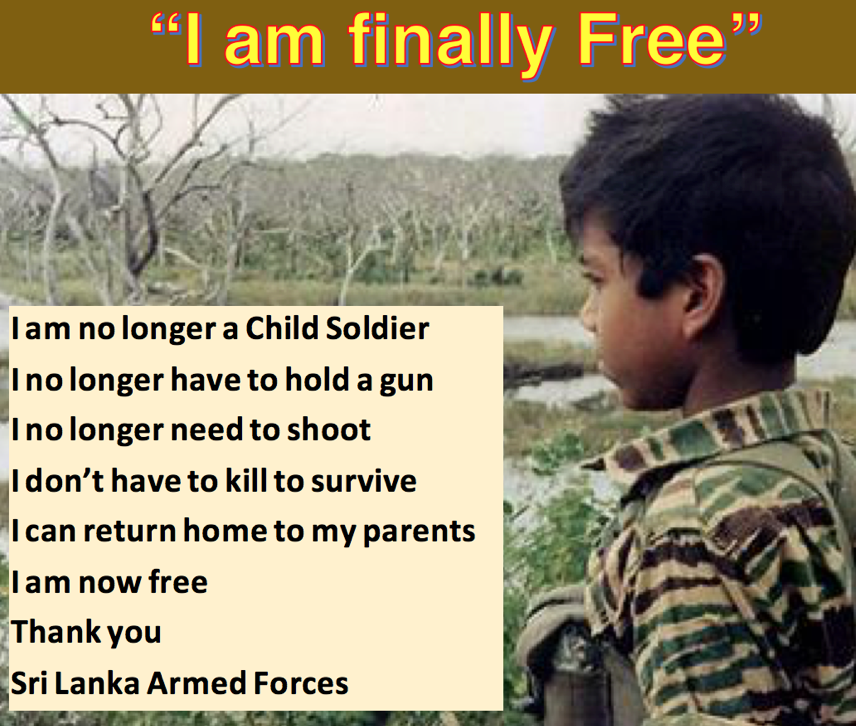
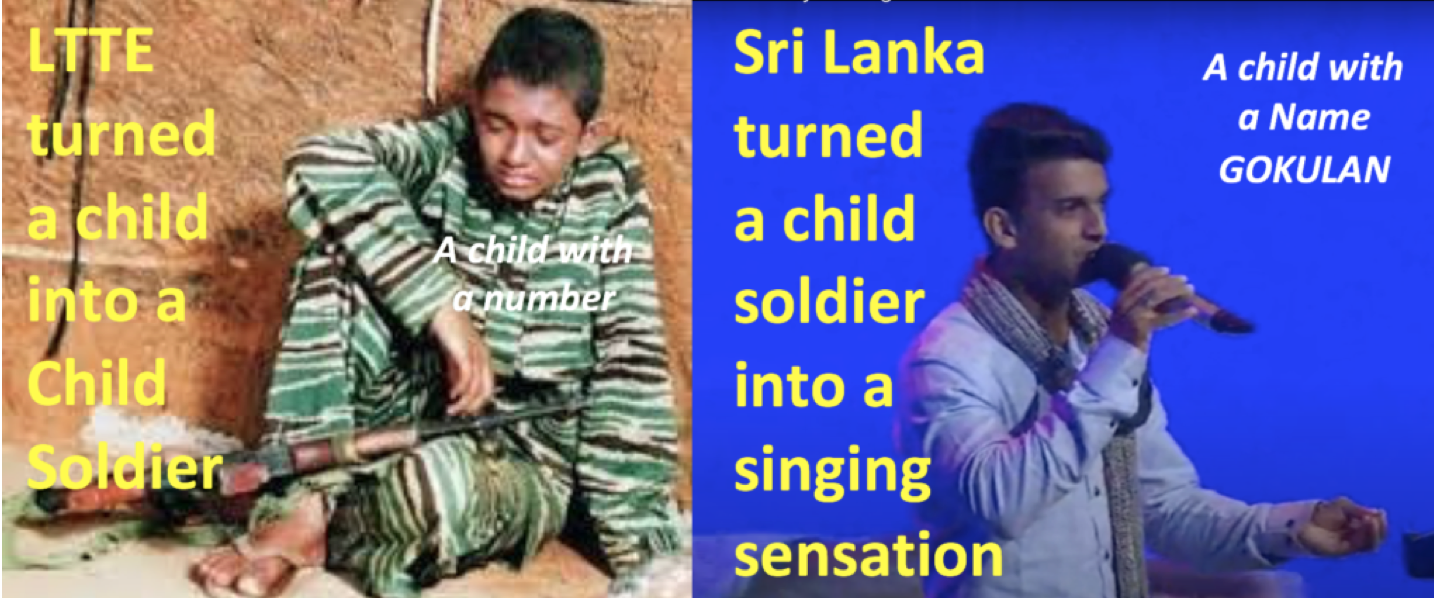
While the international community is preoccupied demanding to know how & how many LTTE were defeated instead of being happy that LTTE was defeated, Sri Lanka has chosen to concentrate instead on developing Sri Lanka & giving a life to those that had been living in fear of LTTE. Gokulan a former child soldier became a singing sensation and now Sri Lanka is proud that we have another sensation – V Viyaskanth the 18 year old cricket sensation from Jaffna. Had Prabakaran & LTTE prevailed Viyaskanth would be bowling grenades and batting with an AK47 instead of the amazing leg spinner he has become.
Vijayakanth Viyaskanth was born on 5 December 2001. Months before the Norwegian brokered infamous Cease Fire Agreement of February 2002 that officially gave territory to terrorists. The CFA was used to not only regroup but carry out a massive propaganda campaign to collect funds and plan to attack the Sri Lanka Armed Forces with venom. It was also a period that the LTTE increased recruitment of child soldiers as evident in UNICEF figures inspite of claiming to release child soldiers. It was as a result of closing the Mavil Aru anicut and committing a war crime by cutting off water to some 40,000 farmers in the East that the Armed Forces was called in to open the anicut. This eventually led to the liberation of Eastern Province of LTTE. By 2006, Vijayakanth Viyaskanth would have been just 5 years old. LTTE was militarily defeated in May 2009 when Viyaskanth was just 8 years. LTTE recruited children as young as 7years to be child soldiers denying these Tamil children their right to live happily with their parents and their fundamental right to education and freedom of movement.
If LTTE was not defeated in 2009, Viyaskanth would have been turned into a child soldier with no hope of ever becoming a cricket sensation.
It is believed that 30% of LTTE comprised children. Just imagine how many of them faced death as children for no reason, forced to kill and commit suicide biting a cyanide capsule. Aunty Adele that vicious Australian nurse comes to mind. She was the main trainer of children from 1970s to late 1990s when she returned to UK and where she lives happily. The UK that has banned LTTE in UK seems not bothered that the woman who trained children to kill and commit suicide is living in UK and no attempt is made to even question her role in LTTE.
How many LTTE child soldiers had their dreams dashed – how many of these LTTE child soldiers could have become lawyers, engineers, doctors, accountants, teachers, principals, entrepreneurs & sports stars? Instead hundreds and thousands of them ended up holding a gun, biting a cyanide capsule and living in the jungles. What kind of life was this for children? The silly tamashas that LTTE diaspora hold annually are just sham shows just for publicity when in reality not a pound or dollar have gone to the families of these dead child soldiers.
LTTE Diaspora – Indoctrinating hate into the minds of innocent children
Do these Tamil children living overseas singing happy birthday for Prabakaran know what life was like for the Tamil children who were Prabakaran’s child soldiers? These kids are blowing candles – Prabakaran’s child soldiers were blowing people to pieces.
The LTTE Diaspora overseas who carried out the propaganda for LTTE should feel ashamed. While their children went to private/public schools, university and landed themselves top jobs and wore branded clothes and went on holidays – back home fellow Tamil children of poor and low caste homes were kidnapped, taken to bogus LTTE ‘orphanages’ and trained to kill and commit suicide. While LTTE diaspora enjoyed life digging into the LTTE money kitty and educating their children, the low caste and poor Tamil children had to suffer in the jungles of Mullaitivu. The only clothes they wore were the LTTE uniform that was often unwashed for months.
19 May 2009 must be celebrated annually by GoSL & citizens of Sri Lanka as freedom for Tamil children. No longer are they kidnapped and turned into LTTE child soldiers.
Had LTTE prevailed instead of being defeated in 2009, this young cricket sensation would have been no cricket star but a 18 year old child soldier.
For all those in the international community bragging about reconciliation and accountability – a question for them is what have their finger pointing and demarches produced other than giving the opportunity for LTTE Diaspora to light the LTTE Flower over UK Parliament!
Sri Lanka on the other hand has proudly produced plenty of stars like Gokulan and Viyaskanth. Of the 594 child soldiers who surrendered to the Sri Lanka military in 2009, all were given a Presidential Pardon and then put through school and given training in whatever livelihood they wished to enter.
11 years after LTTE defeat, Tamils can be happy to see how North has progressed from what North was under LTTE rule. When LTTE was making $300m annual profits, what comforts did LTTE or the LTTE diaspora give the Tamil people living in the North. Only a handful that supported LTTE enjoyed all the fruits of the LTTE terror reign. At least one family member lives overseas but it was only after LTTE defeat that they could freely help their families back home. Previous times all living overseas, whether they liked it or not had to give tithes to the LTTE kitty on a monthly basis. So whether LTTE diaspora or LTTE supporters like to admit it or not, their lives changed for better after LTTE demise. The only lot disheartened by LTTE defeat are the selfish lot who preferred to enjoy the LTTE kitty only amongst themselves without sharing with the rest of the Tamil community in particular the poor & low caste.
Returning to our young 18 year old cricket star Vijayakanth Viyaskanth, who made his debut for Jaffna Stallions in the recently concluded IPL cricket tournament, all of Sri Lanka wish him for a bright future. We are all fond of and proud of the other cricket sensation Muttiah Muralitharan. These are all national treasures.
While petty minds attempt to divide people, Sri Lanka would rather concentrating on building people rather than building obstacles.
It
was really a marvelous addition to my knowledge that sometimes the dead also
attend conferences and participate in discussions; this horrible reality was revealed
upon me when I was going through a report of the EU DisinfoLab. This Brussels-based
NGO is an organization working to combat disinformation against the European
Union. It claims on its webpage that it is an independent non-profit organization
and it focuses on tackling sophisticated disinformation campaigns targeting the
EU, its member states and core institutions. The recently issued report is on
the Indian Chronicles. Commenting on the report, the Aljazeera said that it has
unearthed a 15-year-old operation run by an Indian entity that used hundreds of
fake media outlets and the identity of a dead professor to target Pakistan.
The
EU DisinfoLab said in its investigation-report, Over the last months, we took
a deeper dive, with a specific focus on the Commission to Study the
Organization of Peace (CSOP). We soon realized that this US-based NGO –
accredited to the United Nations Economic and Social Council (ECOSOC) – had
become inactive in the late 1970s before being resurrected in 2005. Shockingly,
we discovered that the organization had not only been revived, its former
Chairman and grandfather of international law in the US”, Louis B. Sohn who
passed away in 2006, seemingly attended a UN Human Rights Council meeting in
2007 and participated in an event organized by Friends of Gilgit-Baltistan” in
Washington D.C. in 2011.” The report pointed out that India has been engaged in
such type of activities for the last fifteen years. For accomplishment of her
heinous plans India has not only got direct control of more than 10 NGOs
accredited to the UN Human Rights Council but also established more than 750
fake media outlets in 119 countries along with getting registration of more than
550 website domain names. And the most criminal action performed is that of
impersonation of EU institutions and of resurrection of the dead people, media
and NGOs. This still ongoing operation started in 2005 and since then is being led
by the Srivastava Group and amplified by an Indian news agency Asian News
International commonly known as the ANI; says the report. From the day one, the
main targets of this operation are Pakistan and China though other nations
having conflicting relations with India have also not been spared. The sole
purpose has ever been to promote anti-Pakistan and anti-Chinese feelings with
the help of disinformation tools and ultimately to get more support from
international institutions such as the UN and the EU.
The
government of India has ever been a staunch follower of the fake-news
tradition. On 10th March 2020, the Aljazeera said commenting on
increasing number of Covid-19 cases, India‘s battle against the corona-virus
has many obstacles – large crowds, a stretched health system and inadequate
infrastructure but beyond these, familiar foes are rearing their heads:
misinformation and fake news. Through its vast social media networks, a wave of
inaccuracy is spreading on corona-virus. From offering unverified home remedies
to tackle the virus, to floating fake advisories asking people to avoid foods
such as ice cream and chicken and sharing conspiracy theories, Indians’ phones
are being flooded with misinformation.” The situation became so pathetic that
Mr.Modi had to make an appeal to the citizens, asking them to not heed to ‘rumours’
surrounding COVID-19. But before the citizens could listen to the appeal of Mr.
Modi the country’s stock exchange had plunged to its lowest level since 2010;
certainly as the result of fear of the disease; the fear born out of fake news and
rumors.
The
same fake-news tradition was followed by the Indian ‘sarkar’ on 29th
September 2019 when it claimed that it had made surgical strikes deep into
Pakistan Administered area of Azad Kashmir. The BBC sent its reporters to visit
the area where all this ‘so-called’ surgical strikes were claimed to have taken
place. The reporters said in their report, Despite the use of the term
‘surgical strikes’ the Indians definitely did not airdrop commandos to hit
‘launching pads of militants’ inside Pakistani-held territory, or conduct
ground assaults deep into the Pakistan-administered side. A similar advance by the Indians in the
Dudhnial area of Neelum valley further north was beaten back by the Pakistanis. Indian troops could not have hit a target
and returned alive as the climb required was too steep.” The reporters said that they could not get
any confirmation of the Indian media reports that Lashkar-e-Taiba camps in the
Khairati Bagh village of Leepa valley and the western end of Dudhnial village
in Neelum valley had been hit on 29 September. But unfortunately, during all
those days, the Indian media and Mr. Modi both had been drumming louder and
louder the song of India’s successful surgical strikes on Pakistan.
The
DisinfoLab says India has been spreading fake-news with the help of different
bogus media outlets for the last fifteen years but the fact of the matter is
that India is playing this childish game for the last 73 years. Moreover its
targets are not only Pakistan, China or EU; almost all it neighboring countries
including Nepal, Sri Lanka, Bangladesh and Myanmar are its targets. So a
friendly suggestion for the EU is that it must not feel lonely. However, after
the report of the EU DisinfoLab, the world would no doubt look towards the
countries which have since long been dealing, treating, supporting, honoring
and favoring India on the basis of her claim of being the Largest Democracy. Certainly,
the report of the EU DisinfoLab gives us a lot of food for thought.
Colombo, December 18 (Daily News): Gone are the days of military blocs. The new-in is multilateral platforms for economic, trade and strategic cooperation. Sri Lanka became a founder member of the South Asian Association for Regional Cooperation (SAARC) with much hope of becoming a major economic beneficiary. Before long, these hopes started to recede due to unresolvable differences between two of SAARC’s main members, India and Pakistan.
Then Sri Lanka as well as other smaller members of SAARC started to look for alternative bodies for multilateral economic cooperation. Two such regional associations offered substantial potential for economic cooperation – the Bay of Bengal Multi-Sectoral Technical and Economic Cooperation (BIMSTEC) and the Indian Ocean Rim Association (IORA).
BIMSTEC is an association of Sri Lanka and six other nations of South Asia and Southeast Asia with a population of 1.5 billion people and having a combined Gross Domestic Product (GDP) of US$ 3.5 trillion according to 2018 data. BIMSTEC member states are Bangladesh, Bhutan, India, Myanmar, Nepal, Sri Lanka and Thailand. Except for Myanmar and Thailand, all others are SAARC members and hence BIMSTEC is referred to as the mini-SAARC or SAARC minus Pakistan, Afghanistan and the Maldives.
Fourteen priority sectors of cooperation have been identified and several BIMSTEC centers have been established to focus on those sectors. A BIMSTEC free trade agreement is under negotiation.
IORA is a proactive inter-governmental organization with an ever-growing importance within the Indian Ocean region. Strengthening the ties that bind Member States whose shores are washed by the Indian Ocean, IORA remains committed to building, expanding and understanding mutually beneficial cooperation through a consensus-based evolutionary and non-intrusive approach in the rapidly changing environment faced by the region.
Today, IORA is a dynamic organization of 22 Member States and 10 Dialogue Partners, with an ever-growing momentum for mutually beneficial regional cooperation through a consensus-based, evolutionary and non-intrusive approach. Home to nearly 2.7 billion people, Member States are rich in cultural diversity and in languages, religions, traditions, arts and cuisines.
President Gotabaya Rajapaksa said in his policy statement ‘Vistas of Prosperity and Splendour’ that given the fact that economic power is now shifting towards Asia, our focus will be on developing strong bonds and reciprocal commercial ties and trade relationships with our Asian neighbors. We must work closely with India, other SAARC and BIMSTEC nations, China, the US, the EU, Japan, Canada, South Africa, Australia, Russia and Britain.”
To put this policy into practice, there are many options available. The most recently formed regional grouping of interest to Sri Lanka is the Regional Comprehensive Economic Partnership (RCEP), a free trade agreement between 10 ASEAN countries and China, Japan, South Korea, Australia, and New Zealand. This pact when ratified will come to represent 30 percent of the world GDP, impacting almost half of the world population and, most significantly, a multilateral trade agreement where China is a leading party.
The agreement allows for a common set of rules of origin to qualify for tariffs reduction with other RCEP members. This means less procedures and easier movement of goods. That should encourage multinational firms to invest more in the region, including building supply chains and distribution hubs.
India formally withdrew from RCEP in 2019 due to domestic demands; however despite the November 15, 2020 agreement on the trade deal, India still has an option of joining RCEP. Indian economic analysts believe that a post-pandemic world economy gasping to revive, a new regime in America come January with a strong possibility of rejoining multilateral platforms for trade and strategic cooperation, and the vision of a new India are some of the paradigms to be kept in mind before passing any judgment on what works best in India’s favor at this juncture.
India not joining RCEP has been received with mixed responses domestically with those opposing the government’s stance stating that an isolated India in the South East Asia neighborhood and India’s sensitivity to Chinese imports may be more out of geopolitics than economic considerations.
Before India’s decision to pull out of the China-dominated RCEP process in the latter stages of an eight-year negotiating process, Sri Lanka’s own ambitions to tie up with RCEP seemed fairly straightforward. Accounting for approximately 10 percent of the country’s exports and 30 percent of its imports, RCEP – comprising the 10-member ASEAN countries, along with China, Japan, South Korea, Australia and New Zealand – qualifies on economic rationale alone.
Institute of Policy Studies (IPS) Executive Director Dr. Dushni Weerakoon is of the view that the RCEP, which is the world’s largest regional trade bloc on Sri Lanka’s doorstep, raises fresh questions about how the country will navigate its most recent Asia-centric re-positioning.
Unlike other regional trade pacts to which Sri Lanka is a signatory – such as SAFTA, BIMSTEC and APTA – the RCEP offers deeper integration, she pointed out, and added that it is much more comprehensive in its coverage of import tariff cuts, with tariff reductions on about 80 to 90 percent of current tariff lines, albeit with exceptions for politically-sensitive agricultural sectors.
As new members would be selected 18 months after the RCEP agreement comes into effect, Sri Lanka is not likely to submit an immediate application to join the grouping.
However, Liu Yang Sloan of the International Research Center for NeoChina Socialism said Sri Lanka will receive the fullest support of China when it submits an application for RCEP membership. He said that Sri Lanka could be developed into a RCEP hub to link West Asia to the grouping.
RCEP is a smarter way for Sri Lanka to attract the global companies to come to Sri Lanka and develop the business here with special focus on the socio-economic revitalization in the developing countries of South Asia, ASEAN and Africa, where almost 50 percent of the world’s total population – 3.5 billion – reside,” Sloan said.
The broad tenets of the RCEP agreement aim to achieve zero tariffs on 90 percent plus traded goods between partnering countries in a decade and half. The economic impact may be dulled by the knowledge that most of these trading partners already have bilateral free trade agreements in place. Indian economists are of the opinion that the geopolitical impact of RCEP, given a heavy Chinese presence and an ambition to create a counter block to the US-led CPTPP (Comprehensive and Progressive Trans-Pacific Partnership) should not be overlooked.
India’s imports of Chinese semi-finished goods and heavy machinery have had a positive impact on Indian industries creating jobs and increasing competitiveness. Those who support the Government’s moves of withdrawal have equally strong positions on how importing these goods from China leads to job losses for the unskilled in India. In the post-pandemic Indian economy, a huge chunk of jobs has to be created for this unskilled category.
IPS researchers stated that Sri Lanka, especially in the wake of Covid-19, is looking to India and China for economic assistance, most notably on debt relief, but also for Foreign Direct Investment (FDI) and market access for its exports. China’s share of Sri Lanka’s total outstanding foreign debt at 9.6 percent in 2019 towers over that of India (2.4 percent). But both are key sources of FDI, with China leading at 16.7 percent of total FDI stock, followed by India at 12.9 percent.
As Dr. Weerakoon pointed out, with a functioning bilateral FTA on goods with India already in place, concluding a similar FTA with China too, limited to goods only, is one option available for Sri Lanka. Such FTAs with the two biggest countries in Asia will serve Sri Lanka as useful pointers to a steady integration process, including with ASEAN economies, with an eye on RCEP membership in the longer run.
As Sri Lanka’s long-term economic interests are very much tied into closer integration with the Asian region, this would be the most practical Asia-centric road map available for Sri Lanka.
Growth rebounded to 1.5% in 3Q reflecting great recovery of the economy after the economic contraction in 1Q and 2Q of this year signaling a near normalcy, therefore, the predicted robust turnaround of 5.5% growth for next year is not an ambition, it is an achievable goal, State Minister of Money and Capital Market and State Enterprise Reforms said on Wednesday.
We are quite optimistic about the 4Q recovery consolidating upward growth next year”, he said.
The state minister made these comment while speaking at the 4th Annual Asia Securities Sri Lanka Investment Conference held on a virtual format.
Throughout the third quarter in 2020, the country experienced the normalisation of business activities and return to new normalcy in the day-to-day life of the people. In fact, Sri Lanka has found the right balance between controlling the spread of the virus, protecting the health of the people and reactivating the economy. The trick here is to adopt health and safety protocols and mechanisms ensuring minimum risks to health and creating maximum favourable space for accelerated economic activity:, he said.
By and large, the recovery and growth drivers are structurally similar to playing test match cricket. This is why the government sticks to policies that create a firm set of macro conditions in terms of interest rates, exchange rate and enabling investment opportunities. All these need to be monitored like instrumentation and controls on a dashboard of a vehicle. If one turns askew, others might too. So, they have to be carefully monitored constantly. When all these macro conditions are in place, we should be able to persuade and attract foreign investments to the country. If that happens 5.5% growth won’t be an ambition, it will be an achievable goal for 2021.”, minister Cabraal said.
Six more COVID-19 deaths pushed the coronavirus fatality count in Sri Lanka to 171, the Department of Government Information confirmed.
A 39-year-old woman from Colombo 14 has passed away today (19) at the Infectious Diseases Hospital (IDH) in Angoda after being transferred from the Colombo National Hospital upon diagnosis as a COVID-19 patient. The cause of her death has been determined as blood poisoning, multi-organ dysfunction, and COVID-19 related pneumonia.
A Weeragula resident – a 68-year-old male – has succumbed to a chest infection yesterday (18) upon admittance to the Wathupitiwala Base Hospital.
Another male, aged 77 years and a resident of Colombo 15, passed away from high blood pressure, diabetes, and COVID-19 related pneumonia. He had passed away on December 17 upon admittance to Colombo National Hospital.
A 76-year-old male has also died upon admittance to Colombo National Hospital on December 17. The cause of death is recorded as COVID-19 related pneumonia.
Meanwhile, an 86 year old female resident of the Kiriwattuduwa area has succumbed to a cardiac arrest caused by high blood pressure and a chest infection caused by COVID-19. She had passed away at her home yesterday.
A female resident of Bandaragama, aged 83 years, has also passed away at her residence yesterday. The cause of her death has also been determined as a cardiac arrest caused by high blood pressure and a chest infection caused by COVID-19.
The Government Information Department says that another 123 persons have tested positive for Covid-19.
All new cases are close contacts of Covid-19 patients from the Peliyagoda cluster.
This brings the total number of coronavirus cases from the Minuwangoda, Peliyagoda, and prison clusters to 32,998.
The tally of Covid-19 cases reported within the country thus far has risen to 36,667 while the number of total recoveries has climbed to 27,552.
Presently a total of 8,950 infected patients are being treated at hospitals.
Sri Lanka’s Covid-19 numbers saw another surge today (19) as 495 more persons were tested positive for the virus.
The newly-identified patients were identified as close contacts of earlier cases linked to the Peliyagoda fish market.
One of them was detected in random rapid antigen tests carried out on people leaving the Western Province, Army Commander Lieutenant General Shavendra Silva said. A total of 750 persons who were moving out of the provincial limits have been subjected to rapid antigen testing today.
As per statistics, the total number of Covid-19 infections confirmed in the country to date now stands at 36,544.
Recoveries from the virus meanwhile climbed to 27,552 earlier today, as 491 more patients regained health.
However, 8,827 active cases are still under medical care at selected hospitals and treatment centres located across the island.
Sri Lanka has also witnessed 165 deaths related to Covid-19.
London (CNN)Parts of Britain will go back into lockdown during Christmas after a newly identified strain of Covid-19 proved to spread more quickly than previous strains of the virus.UK Prime Minister Boris Johnson on Saturday announced a series of stricter coronavirus restrictions, tightening rules around household mixing that were due to be relaxed over Christmas in London and southeast England. The PM broke the news Saturday that London and the southeast of England, where cases are surging, will go into Tier 4 restrictions, similar to a lockdown, on Sunday.”The spread is being driven by the new variant of the virus,” Johnson said in a hastily called press conference. “It appears to spread more easily and maybe up to 70% more transmissible than the earlier strain.”England’s chief medical officer, Professor Chris Whitty, warned Saturday that a newly identified variant of Covid-19 “can spread more quickly” than previous strains of the virus. Analysis from Luke McGee
It was only on Wednesday that Boris Johnson was attacking the leader of the opposition, Keir Starmer, for wanting to “cancel Christmas,” before delivering a press conference in which he informed the public that if they wanted to celebrate Christmas with loved ones, on their head be it.
This sudden change of policy just days before Christmas and three days before Johnson’s special Christmas rules came into effect is a political minefield for a Prime Minister whose handling of the pandemic has been attacked by all sides.
For his opponents, a U-turn this late in the day will typify Johnson’s habit of resisting taking hard action, which they attribute to his reluctance to be the bearer of bad news. Critics can reasonably point to multiple examples of the PM ignoring Starmer’s calls to introduce stricter measures, only to do exactly that days or weeks later.
For his critics inside the Conservative Party who have been uncomfortable with impinging on people’s freedoms and liberties since the start of the pandemic, this is more evidence that Johnson is an indecisive leader beholden to his scientific advisers.
And to the public, whether they believe it was down to his inaction or indecision, Johnson will now always be remembered as the PM who canceled Christmas for so many. Downing Street must now pray that this urgent action is enough to prevent what many suspected would happen: thousands more deaths on top 65,000 the UK has already experienced.”This is now spreading very fast,” Johnson warned. “It is with a very heavy heart that I say we cannot continue with Christmas as planned.”Johnson outlined that in areas under the toughest restrictions, there will be no possibility for household mixing over Christmas. In areas under Tier 3, mixing will now be restricted to Christmas Day.Alert Level 4 restrictions will be brought forward to apply across Wales from midnight, the country’s First Minister Mark Drakeford announced Saturday, meaning that “festive bubbles” can be formed only on Christmas Day, PA Media reported. Under Alert Level 4, people must stay at home except for very limited purposes, and must not meet with other households or meet people they do not live with, while many businesses are required to close.As recently as this week, Johnson reiterated his pledge to relax rules over the Christmas period, allowing up to three households to mix for five days. But as of Saturday, the entire nation is being asked not to travel and those under the highest level of restrictions, will not be allowed to travel abroad except for work purposes.Keir Starmer, leader of the opposition Labour party, criticized the government’s handling of the crisis, saying: “Many people will be heartbroken by the news that their Christmas plans are being ripped up.”I’m really frustrated because I raised this with the Prime Minister on Wednesday, and he dismissed that. He went on to tell people to have a ‘merry little Christmas,’ only three days later, to rip up their plans,” he said on Sky News.According to Whitty, the new variant is responsible for 60% of infections in London, which have nearly doubled in the last week.Earlier, he said “urgent work” is underway to establish whether the new strain, prevalent in the southeast of England, can cause a higher mortality rate.”There is no current evidence to suggest the new strain causes a higher mortality rate or that it affects vaccines and treatments although urgent work is underway to confirm this,” Whitty said in a statement.Boris Johnson is facing two hellish weeks. Critics fear his weak leadership could seriously harm the UKAs with other new variants or strains of Covid-19, this one carries a genetic fingerprint that makes it easy to track, and it happens to be one that is now common. That does not mean the mutation has made it spread more easily, nor does it not necessarily mean this variation is more dangerous.Multiple experts in the genetics and epidemiology of viruses are noting that this one could be just a “lucky” strain that’s been amplified because of a superspreader event; it could be the mutation somehow makes it spread more easily without causing more serious illness; or it could just be by chance.The government’s scientific advisory group for Covid-19 has also warned the new strain is a “real cause for concern,” and called for urgent action. On Twitter, Jeremy Farrar said, “Research is ongoing to understand more, but acting urgently now is critical. There is no part of the UK & globally that should not be concerned. As in many countries, the situation is fragile.”Whitty also urged people to take more precautions. “Given this latest development it is now more vital than ever that the public continue to take action in their area to reduce transmission,” he said.
Whenever the nation
faces a dire situation, the majority goes to the forefront to save the nation,
put up with inconveniences and difficulties, willingly makes sacrifices and
co-operates with the government in power. But the minorities always pull from
the foot with petty tribal thinking. Sri Lankan minorities, as a community,
have never made sacrifices for any national cause. Most times they behave as if
they are guests or parasites to make things even more difficult at dire
situations.
Sri Lanka currently
treads delicately over many teething issues. Whatever the political views are
and whatever the ethnic tribe one belongs to, everybody must cooperate with the
government or at the very least not add any more problems.
The Demand to Bury
COVID-19 Muslim Dead and Worse
Sections of the
Muslim community have demanded that the government allows the burial of
COVID-19 dead from the Muslim community. There is sufficient evidence to say
dead bodies contaminate ground water for a certain period of time. Further, not
many experiments have been done yet to know for sure that burial of Coronavirus
victims does not contaminate ground water. Why take the risk? Muslims are not
the only people who prefer burial to cremation. Christians and Jews also have
the tradition to bury their dead. But they cooperate with the government policy
without disrupting as they take a communal view of the matter, not a petty
racist and tribal view. Why can’t Muslims do same?
Then it lends to
insanity. Sending Muslims corpses to Maldives is a very expensive and needless
exercise. It borders insanity.
To make matters
worse, a section of Catholic priests staged a silent protest against the
decision to cremate all COVID-19 dead. They are fishing in troubled waters.
The Demand to
Investigate War Crimes
A section of Tamils
notoriously detached from ground realities in the north are gearing up for the
UNHRC sessions in March 2021 to bring in war crimes charges against Sri Lanka
once again. Is it the most opportune time to do so when the country is battling
so many challenging issues that also mean life and death to Tamils like
COVID-19 and economic crises? They have cleverly timed their tribal display for
2021 as they know that two pro-Sri Lanka giants, Dr Sarath Weerasekera and Dr
Channa Jayasumana will not be going to Geneva this time.
COVID-19 crisis and
its response clearly showed the futility of provincial councils and devolution.
Had the PCs remained operational, the COVID-19 crisis would have been worse as
the central government would have been hands-tight in swiftly dealing with the
situation.
The Demand to
Increase Wages of Plantation Workers
As if the above two
extortion demands are not enough the other minority has also started agitations
to increase their already world’s highest tea plantation workers’ wages. If the
government gives into their demands the entire industry will collapse as
plantation companies cannot afford it. A powerful minister from the Indian
Tamil community recently stated that a few dozen factories have closed down in
Nuwara Eliya district which has affected the economy of his tribe’s people. Of
course! Not only his tribe, all tribes in the island are under severe economic
hardships. The solution is not robbing Peter to pay Paul. The solution is a
collective economic march forward and sacrifices in the interim.
Minorities Must Count
Their Blessings in Comparison
Instead of making
extortionist demands just because they can, minorities must count their
blessings. Muslims in Sri Lanka are far better off than their relatives in
India in terms of economic, political, security and religious advantages. India
does not even allow the production of bovine beef and certainly does not allow
the interference of Islamic Law with the Indian law. Tamils in Sri Lanka are
far better off then Tamils in India and Malaysia in terms of education,
business, economic prosperity, rights and privileges and the ability to
influence national leaders. Indian Tamils are obviously way better off then
their unfortunate counterparts in South India.
Instead of
appreciating the better life they all have in Sri Lanka, they have become
greedy to grab anything and everything only for their survival to hell with the
rest. Tamils and Muslims must thank the Sinhala military for preventing Tamil
Eelam. Had Tamils succeeded in creating Tamil Eelam it would have been the
poorest nation on earth with no education, no business (other than agriculture,
fisheries, human trafficking and sex trade), no healthcare (Sri Lankan
government was the sole provider of healthcare even to Tamil terrorists) and no
administrative functions (Northern and Eastern Provincial Councils run on
subsidized funds from the others). Pushing the limits too much will result in
Sinhalese giving up saving minorities from their own minority cannibalistic
groups.
From 2012, Reconciliation and Accountability have been the twin pillars of the series of Resolutions that emerged from the UN Human Rights Council in Geneva. Perhaps, the thinking of those who developed the formula of linking Reconciliation with Accountability was guided by the notion that an effective accountability process that holds some members of the security forces and the associated leaders accountable and punished would somehow ease the humiliation of defeat, and make the painful processes of healing and eventual reconciliation more tolerable.
In general, this notion presumes that retributive justice would promote reconciliation. The presumption of such an outcome is not an assured given because the possibility exists for the positions of the parties hoping to reconcile to harden to a point of defeating the intended objective of reconciliation if retributive processes and their outcomes are perceived as being vindictive. Thus, the contemplated accountability exercise has the potential to be counterproductive depending on the context in which it is conducted.
SRI LANKAN EXPERIENCE
In the case of Sri Lanka, this theory could not be put to the test because the retributive process could not even get started. The reason for this being that those who devised the process overextended themselves and wanted the accountability process to be so effective that they conceived only a judicial mechanism that involved foreign judges, prosecutor etc. would achieve the intended objectives. The fact that such an arrangement would involve amending existing Laws and provisions in the Constitution, to the extent of requiring a two-third approval by Parliament and approval by the People at a referendum, escaped their attention.
This was brought to the attention of the Human Rights Council in March 2019 by the then Foreign Minister Tilak Marapana.
The Government of Sri Lanka at the highest political levels, has both publicly and in discussions with the present and former High Commissioner for Human Rights and other interlocutors, explained the constitutional and legal challenges that preclude it from including non-citizens in its judicial processes. It has been explained that if non-citizen judges are to be appointed in such a process, it will not be possible without an amendment to the Constitution by 2/3 of members of the Parliament voting in favour and also the approval of the people at a referendum”.
This gave the present Government legitimate grounds to withdraw from the co-sponsorship of UNHRC Resolution 30/1 in terms of Article 46 of the Vienna Convention 1969, which in essence states that a State may invalidate its consent to a Treaty if it violates a rule of its internal law of fundamental importance such as a Constitution of a sovereign State.
CURRENT SITUATION
Currently, the accountability process is at a stand-still because of the failure of the approach adopted. However, what exists is a collective body of material available in Reports prepared externally by the Panel of Experts appointed by the UN Secretary General and by the Office of the Human Rights Commission in Geneva together with internal Reports of Commissions of Inquiry appointed by the Government of Sri Lanka such as the Lessons Learnt and Reconciliation Commission (LLRC), and the Paranagama Commission that included International Experts.
This body of material has been reviewed from two distinct perspectives. Since the mandate to the LLRC was primarily to promote national unity and reconciliation among communities, its Report gives emphasis to Human Rights as reflected in paragraphs 5.2 and 5.3 cited below. On the other hand, the other Reports reflect a perspective that is based on International Humanitarian Law (IHL) as the applicable Law since the conflict had reached the threshold of a non-International Armed Conflict. Consequently, the material reviewed from a Human Rights perspective is bound to be different to a review based on IHL. Of the several reasons for this difference the most significant is that the LLRC viewed the conflict as between a State (GoSL) and a non-state actor (LTTE), thereby holding the State to a higher level of accountability than the LTTE, while under the perspective of IHL, responsibilities are shared equally as parties to an Armed Conflict. This makes the conclusions drawn from the respective perspectives different.
Paragraph 5.2 states: Being a party to the following seven core international human rights instruments, Sri Lanka has given obligations under these Conventions through legislative measures, including the Constitution as well as executive and administrative measures”
Paragraph 5.3 states: Sri Lanka therefore has constitutional and international obligations for the effective national implementation of these core conventions both during times of peace and war, and in the latter situation, together with applicable International Humanitarian Law…”.
It is therefore evident from the foregoing that the LLRC emphasis is on Human Rights with applicable International Humanitarian Law’ during times of war. Had the LLRC recognized that it was a non-International Armed Conflict from the day the Cease Fire Agreement was signed as two parties recognized nationally and internationally to the conflict, the accepted applicable Law should have been International Humanitarian Law coupled with seriously derogated Human Rights during an Armed Conflict. This interpretation is reflected in the Sri Lankan Constitution and in the relevant Conventions during an Emergency as in the case of an Armed Conflict. The failure of the LLRC to recognize that it was a non-International Armed Conflict is the significant reason for its perspective to be different to the other Reports cited above.
LLRC’s INTERPRETATION of ACCOUNTABILITY
The material presented below are extracts from Chapter 9 of the LLRC Report titled Summary of Principal Observations and Recommendations”. Since the two primary charges against the Government and the Security Forces are the excessive use of force and the inadequacies in the delivery of humanitarian aid, the two related sub-section from the LLRC Report presented below are: (1) Measures to safeguard civilians and avoid civilian casualties” and (2) Supply of humanitarian relief, including food and medicine to civilians in conflict zone”.
Measures to safeguard…and No-Fire Zones”:
Paragraph 9.4: In evaluating the Sri Lankan experience in the context of allegations of violations of IHL, the Commission is satisfied that the military strategy that was adopted to secure the LTTE held areas was one that was carefully conceived, in which the protection of the civilian population was given the highest priority…”
9.7 Having reached the above conclusion, it is also incumbent on the Commission to consider the question, while there is no deliberate targeting of civilians by the Security Forces, whether the action of the Security Forces of returning fire into the NFZs was excessive in the context of the Principle of Proportionality…”
COMMENT: The two fundamental principles of International Humanitarian Law are: Distinction and Proportionality. Without Distinction as to who is a combatant and who is a civilian to question whether the military response was proportionate or excessive cannot be ascertained. Since the LLRC Report admits that the LTTE shed their uniforms during the final states of the conflict, the question of distinguishing a civilian from a combatant is not possible, which means the principle of Proportionality cannot be applied. Furthermore, the comment that the Security Forces were RETURNING fire to the NFZs” makes clear that it was the LTTE in the NFZs that initiated the firing. Despite the obvious presence of LTTE combatants, the LLRC Report makes no reference to them and refers to ALL as civilians.
Therefore, to categorize ALL in the NFZs as civilians and to question whether the return of fire was excessive in the context of the Principle of Proportionality that has no applicability in the particular circumstances, is seriously flawed.
In regard to Hospitals/Makeshift Hospitals paragraph 9.12 (b) of the LLRC report states: None of the persons making representations was able to state with certainty that they were in a position to definitely confirm that the shells which fell on the hospitals, originated exclusively from the side of the Sri Lankan Army or from the LTTE…Another ex-LTTE cadre…stated that the Puthumatthalan hospital was in fact accidentally shelled by the LTTE for which they had subsequently apologized”.
Supply of Humanitarian Relief
Paragraph 9.15: The Commission notes that the supply of food to the civilians held by the LTTE up to early 2009 was at reasonably adequate levels…However, these adequacy levels appear to have declined during the months of February, March, April and the first half of May 2009…”
Paragraph 9.16: It must be acknowledged that the maximum quantities of food supplies, that were possible…due to the collective efforts of the Government of Sri Lanka, in particular the GAs and the Security Forces as well as international agencies such as the ICRC and WFP, and other volunteers who had provided selfless service on the spot in the No Fire Zone”.
The impression conveyed in the above comments is that the Government of Sri Lanka was responsible for and obligated to supply humanitarian relief to All in the No Fire Zone. Since it was not possible to separate combatants from civilians, this meant supplying humanitarian aid including medical supplies to the LTTE and engaging with them in an Armed Conflict, simultaneously. Such a flawed expectation is a result of the confused perspective adopted by the Commission as to the role of the Government. How could the Government be a party to the conflict and be a provider of humanitarian aid both at the same time?
COMMENT: Had the LLRC accepted IHL as the applicable Law, they would not have held the Government of Sri Lanka accountable for the decline” in the supply of relief. The reason for including the Government in the list of those responsible for the supply of humanitarian relief is because their understanding of the Government’s responsibilities was misplaced. The Commission fails to acknowledge that the Government as a party to the Armed Conflict, should not be expected to supply aid of any kind to the LTTE. Instead, what the Government was expected to do was ONLY to facilitate free passage of humanitarian aid to those affected by the Armed Conflict as per ICRC Rules 55 and 56 (Vol. 87, Number 857 March 2005).
Rule 55: The parties to the conflict must allow and facilitate rapid and unimpeded passage of humanitarian relief for civilians in need, which is impartial in character and conducted without any adverse, distinction, subject to their right of control”
Rule 56: The parties to the conflict must ensure the freedom of movement of authorized humanitarian relief personnel essential to the exercise of their functions. Only in the case of imperative necessity may their movements be temporarily restricted”.
PROPOSED STRATEGY
There are two basic approaches that Sri Lanka could take in presenting its case before the forthcoming sessions in Geneva. One approach is to plead its case by presenting all the available evidence from sources such as that of Lord Naseby, UN Reports, opinions of experts in the Paranagama Commission Report and any other sources challenging the alleged claims in the UNHRC Resolution 30/1. The other is to challenge the alleged violations on the basis of International Humanitarian Law, backed up with support material referred to above. Of these two approaches there is a greater likelihood of the latter approach being more acceptable because it has a more credible basis than the former.
CONCLUSION
When Sri Lanka placed on record at the March 2019 UNHRC sessions that it was withdrawing from the co-sponsorship of UNHRC Resolution 30/1, it undertook, among other undertakings, to appoint a Commission of Inquiry to review the reports of previous Sri Lankan COIs which investigated alleged violations of Human Rights and International Humanitarian Law, to assess the status of implementation of their recommendations and to propose deliverable measures to implement them in keeping with the new Government’s policy”.
The plea to anyone engaged in fulfilling the commitment stated above is to declare at the very outset that its review of reports of previous COIs is based on the fact that the conflict in Sri Lanka that ended in May 2009 was a non-International Armed Conflict, as recognized by international law. Consequently, the review process should bear in mind that the applicable Law is International Humanitarian Law together with derogated Human Rights Laws as reflected in International Covenants and in Sri Lanka’s Constitution during an Emergency. Therefore, the alleged violations presented in these Reports should be assessed in the context of these Laws, backed up with support material such from UN Reports, evidence presented by Lord Naseby, opinions of experts in the Paranagama Commission Report, and by the ICRC, etc.. Since the Additional Protocol II of 1977 is accepted as part of Customary Law and the fact that it embodies all recognized provisions of non-International Armed Conflict, the provisions of the Protocol should guide the review process of alleged violations committed collectively or individually.
The review process should also identify which recommendations in the Commission of Inquiry Reports relating to Reconciliation are deliverable in keeping with Government policy. In this regard one measure that would make a significant difference to Reconciliation is to demand tangible outcomes from the Office of Missing Persons, bearing in mind that their work could be constrained by the non-cooperation of Member States if they fail to disclose the identities of persons missing from Sri Lanka and who are now living in their countries under altered identities.
The forthcoming sessions in Geneva would be a defining moment for Sri Lanka in its relations with the UNHRC. Therefore, the Government should conclude its review process well in time, in order to enable it to canvas support among the members of the UN Human Rights Council on the basis of the legitimacy of the approach taken and bring closure to Accountability. At the same time the UN Human Rights Council should permit Sri Lanka the time and space to address Reconciliation through processes that each country has to fashion because its uniqueness is special to every country, and no country or International Agency has a universal formula to bring about Reconciliation among communities in a country.
Researchers find 25 per cent of almost 3,000 key workers have high T-cell levels
Antibody surveys have consistently found no more than 6 per cent test positive
Study finds no one with high T-cell responses got Covid in the next four months
Natural immunity to the coronavirus could be twice as common as experts believed, according to a Public Health England study.
Researchers at PHE found T-cells – a key part of the immune system – in a far higher number of people than expected.
The cells are vital for destroying human cells that have been infected with coronavirus to stop them going on to infect others – antibodies and other parts of the immune system can’t get to the virus once it gets this far in.
The research, among 2,847 key workers from the NHS, police and fire service in June, found that 25 per cent of participants had high levels of T-cells which recognised Covid.
That is far higher than the results of antibody surveys, which have consistently found no more than six per cent test positive for having had Covid.
And it is likely to be even higher now that the country has experienced a second wave of infections.
Experts at Cambridge University’s MRC Biostatistics Unit estimate 7.37million people have caught the coronavirus already in England, and therefore would likely have immunity.
The PHE study, however, suggests the proportion of people with some level of immunity could be around one in four, which would equate to twice as many people at 14million or more.
Research among 2,847 key workers from the NHS, police and fire service in June, found that 25 per cent of participants had high levels of T-cells which recognised Covid (stock image)
Until now much of scientists’ attention has been focused on antibodies, which neutralise a virus before it enters the body’s cells.
T-cells, in comparison, target and destroy cells that are already infected by the virus.
Crucially, the researchers found that none of those with high T-cell responses became infected with Covid in the following four months – suggesting this part of the immune system is an effective protective factor.
WHAT ARE T CELLS?
T cells are ones produced by the immune system to help the body destroy invading viruses and to remember how to do so if someone gets infected again.
When the body is invaded by bacteria, a virus or parasites, an immune system alarm goes off, setting off a chain reaction of cellular activity in the immune system.
T lymphocytes (T cells) are white blood cells that are a major part of the immune system.
They are part of the adaptive immune system, which is considered the more specialised response. They use past interactions to remember foreign threats and how to attack them.
The adaptive immune system kicks in after the innate immune system, which is the immediate response to a virus, or ‘first line of defense’.
There are several different types of T cells, some of which are better understood than others:
Killer T cells directly kill the body’s own cells that have already been infected by a foreign invader, while helper T cells stimulate other parts of the immune response – such as B cells.
B cells are also part of the adaptive immune system. They help make antibodies which are specific to each pathogen.
Antibodies are able to block the novel coronavirus by attaching to it and marking it for destruction by other immune cells.
They also found that only half of those who had high T-cell responses had any identifiable Covid antibodies, suggesting some immunity may exist without antibodies.
Dr Peter Wrighton-Smith, of Oxford Immunotec, the company that developed the T-cell test, said: ‘The implication is that there is a population of people who are protected from Covid who are not being picked up by the antibody studies.’
He stressed that the people in the study were all frontline workers so were more likely to have been exposed to Covid.
The researchers believe this could suggest two possibilities. One theory is that antibodies fade very quickly after someone recovers from Covid – but T-cells are longer lasting.
Another is that people are left with immunity after suffering from similar coronaviruses – such as those which cause the common cold – even if they have never been infected with Covid itself.
But Dr Wrighton-Smith added: ‘We are not picking up all cases with the antibody surveys – so more people may be protected than we thought.’
Dr David Wyllie, a consultant microbiologist at Public Health England and the lead author of the study, said: ‘Four months into the study, 20 participants with lower T-cell responses had developed Covid-19, compared with none among individuals with higher T-cell responses.
‘This suggests individuals with higher numbers of T-cells recognising SARS-CoV-2 may have some level of protection from Covid-19, although more research is required to confirm this.’
Professor Karol Sikora, a cancer expert at the University of Buckingham, was one of the first to raise the importance of T-cells early on in the pandemic.
In a video posted on Twitter last night he said: ‘This is really good news. This means almost certainly the T-cell response is innate – it is [triggered] by something people have been exposed to in the past.
‘So when corona comes along they are not susceptible.
Blood testing surveys by Public Health England suggest that levels of antibody immunity, which is different to T-cell immunity, are lower than 10 per cent in all regions of England. Graph shows the percentage of people testing positive for antibodies
‘It suggests more people have protection than antibody surveys estimate, but also many probably have residual immunity to Covid-19 from other infections.
‘T-cells have been overlooked for too long. This proves that has to change.’
But Dr Rupert Beale of the Francis Crick Institute in London, said the issue may be to do with the antibody tests used.
‘About a quarter had highly reactive T cells, more than half of them had serological evidence of prior infection using tests that would be about 70 per cent sensitive – so only a very small proportion of adults (less than 10 per cent, maybe much less than 10 per cent) would be protected by pre-existing T cell immunity.’
UP TO 1 IN 10 RECOVERED COVID PATIENTS ‘COULD CATCH IT AGAIN’
People who have already had Covid-19 ‘should not be blasé’ about the virus because up to one in 10 people could catch it again, a top scientist has warned.
Professor Danny Altmann, an immunologist at Imperial College London, said on Monday that the rate of coronavirus reinfection is ‘quite a lot higher’ than data suggests.
His comments came as Prime Minister Boris Johnson went into a fortnight of self-isolation after coming into close contact with an MP who later tested positive.
Professor Danny Altmann
The PM claimed he is ‘bursting with antibodies’ after ending up in intensive care during his own severe bout of Covid-19 in the country’s first wave.
Professor Altmann, however, said although the risk of catching the disease again is ‘low’, it could happen to as many as one in 10 people and recovered patients should still take it very seriously.
Scientists have reported a handful of cases of coronavirus reinfection — but the circumstances around them are often hazy. Most scientists investigating the topic agree that it’s unlikely survivors will be struck down again within a year.
The Imperial expert said there had been around 25 ‘hard confirmed cases’ in the world of people catching Covid-19 twice, but that researchers think it is far more common.
And those who do get reinfected are likely to be protected from a severe bout of the disease, experts say. But whether it is more or less serious, Professor Altmann said, is still a topic for debate.
‘I read a lot about people saying one can’t be reinfected or there’s practically zero risk of reinfection,’ he said on BBC Radio 4’s Today programme.
‘That’s not quite true because, of 50million plus cases of infection in the world, we have more than 25 hard confirmed cases of reinfection, which you might say is negligible, but that’s because academically we set the bar quite high for defining reinfection.
‘You have to be SARS positive and then negative and then positive again and [with] different virus sequences and things.
‘Anecdotally, I think most of us think the rate of reinfection is quite a lot higher than that but not enormous.’