KAMALIKA PIERIS
Part
18 of this series contains short updates on matters discussed earlier. This
essay provides an update on celebrations of the Eelam War.
In July 2020, a group of Jaffna undergraduates
celebrated Black Tiger Day on a Sunday night. Leading activists of several
student bodies organized the event. Student participants were asked to offer
flowers and light candles in front of pictures of the dead Black Tigers.
The
Black Tigers are members of the LTTE Suicide Squad. They were inspired by the
Lebanese Hezbollah bombing of the US marine barracks and French paratrooper HQ
bombings in Beirut in 1983. The first Black Tiger, Vallipuram Vasanthan, drove a
truck laden with explosives into the Army camp at Nelliady, Jaffna on 5 July
1987, killing and injuring 40 Sri Lankan soldiers. But the soldiers fought back and LTTE was
unable to take the camp.
In September
2020, the north decided they wished to commemorate the death of Thileepan”, Rasaiah Parthipan. Thileepan had held a
death fast on 11 September, 1987, to secure a five-point charter of demands
including the setting up of an LTTE-dominated Interim Administrative Council
for Northern-Eastern province, as part of the India-Sri Lanka Accord. The
authorities refused to accept this. Thileepan refused to give up his fast and
died after 11 days on 26 September, 1987. He
was a cancer patient and was not in a condition to undertake a fast. The fast took place in a specially built
dais near the Nallur Kandaswamy Kovil.
In
November, 2020, the law courts banned an event to commemorate
Thileepan in Vavuniya .The organizers made a second request which was also
refused. Northern parliamentarians wrote to the
government, asking to put up a statue to Thileepan. They said that that
commemorating the dead in the North is a human right and that they should be
granted permission to commemorate the war dead. If the government did not permit this then
there would be a hartal in the north.
This hartal
was held. TNA, Tamil People’s National Alliance, All Ceylon Tamil Congress and
the Eelam People’s Revolutionary Liberation Front participated. The police said that despite the
Hartal, all government departments and establishments were open and
despite a reduction in the number of private busses, the SLTB buses had
operated as usual. Shops in the
Vavuniya, Ampara, and Trincomalee remained open. However, some of the schools
had closed early due to the absence of teachers and relatively fewer students
attended.
Former Member
of Parliament M.K.Shivajilingam was arrested by the police in Kopay for
organizing an illegal celebration in memory Thileepan. Shivajilingam had sought permission to hold
the commemoration ceremony at the Thileepan memorial in Nallur, but the Jaffna
police got a court order banning it on the grounds that a leader of a banned
organization like the LTTE could not be commemorated and glorified.
Jaffna magistrate dismissed the argument that
Yahapalana government had had allowed the commemoration and banned the ceremony. However, Shivajilingam secretly changed the
venue of the commemoration to Kondavil and performed a ceremony there. He was
arrested and was subsequently released on bail.
Shivajilingam
was also arrested by the Valvettithurai police over celebrating the birthday of
Prabhakaran. Shivajilingam had been
detained almost every year for organizing ‘Mahaviru Day’ to glorify Velupillai
Prabhakaran. Shivajilingam though leader of rival organization, TELO, was related to Prabhakaran.
Mahaveer day
was held on the 27th of November every year to commemorate the LTTE cadres
who had lost their lives in the conflict. Commemoration had been held
continuously for period of over thirty years without interruption. Yahapalana
government had allowed it.
There were
plans to hold Mahaviru ceremonies in the north, as usual, in November; 2020. Military
and police intelligence services reported to Pohottu that plans were underway
to hold public gatherings and commemorative meetings across the Northern
Province from November 21-27.They wanted court orders prohibiting this. The
Pohottu government opposed the celebration of Mahaveer.
Attorney
General’s Department sent officers to make submissions at Mullaitivu,
Kilinochchi and Jaffna Magistrates’ Courts to prevent of Mahaviru Day. Courts upheld their submissions and ordered
the prohibition of any form of commemorative events to mark
the ‘Maveerar Naal’ or Great Heroes’ Day, on the grounds that they would pose a
health risk in view of the COVID-19 pandemic.
Police had
obtained a Court order for 14-days banning all protests and hartals in the North
and East in commemoration of any LTTE member. Kopay and Jaffna Police moved
motions separately seeking to stop preparations by Tamil political parties and
civil society groups in cemeteries where LTTE cadres had been buried. Jaffna
Magistrate issued the order.In Mallakam, Chavakachcheri,
Trincomalee, Mannar, Vavuniya, Kilinochchi, Mullaitivu and Batticaloa, courts
issued similar orders.
Restraining
orders have been obtained from the respective Magistrate’s Courts against LTTE
commemoration day to prevent celebrating and people who are living in Northern
Province had been informed regarding this.
There were
petitions against this order. The Jaffna High Court dismissed four petitions
filed in the court seeking a writ order to prevent Police and the health
authorities stop Mahaviru commemoration.
Attorney
General’s Department and Mullaitivu police then filed a motion to get the ban
extended. Mullaitivu Magistrate’s Court extended its ban on 46 persons
preventing them from holding LTTE commemoration events in Mullaitivu district
till 30th of November.
The
prohibition was not completely successful, Mahaviru was celebrated.Police
arrested 51 persons. Four people were
arrested by the Eravur Police for promoting LTTE Mahaviru commemorations
through the social media. The respondents’ lawyers said that remembering loved
ones who were killed in the separatist war was the basic right of the Tamil
people. Some of their own relatives were among those who fought for the Tamil
cause.
Senior lawyer
N. Srikantha told Court that he had the right to remember one of his close
relatives who died in the war and added that dead people could not be
considered as members of an organization which was defeated militarily a decade
ago.
Nobody
raises questions when the JVP remembers its fallen comrades and displays
pictures of Rohana Wijeweera in berets. But when the Tamils remember their
dead, the issue of terrorism is brought up, complained the Tamils.
Former
Northern Province Chief Minister C.V. Wigneswaran, MP, said that although the
Mahaviru Day” had been banned on a court order. Lamps would be lit in every
household in the Jaffna District in their memory.
MP Sarath Weerasekera
complained in Parliament that MP Sumanthiran had attended a remembrance service
of Pandithar, an LTTE leader. He had gone to the home of Pandithar’s mother, in
Valvettithurai, where he lit a lamp to commemorate the fallen LTTE leader.
MP
Sumanthiran explained. Sammanthurai Maheswari was one of my clients. I appeared
for her in a case at the Jaffna High Court where the learned judge told me that
she could not conduct remembrance in
public places but was allowed to remember her son who was killed in 1985
privately at home. I went there on that day and explained to my client the
instructions given by the judge.
The dead
person was a LTTE leader. He was a killer, said Weerasekera. Yes, he was a
member of the LTTE. Nevertheless, he was her son. Every mother has a right
to remember her children replied Sumanthiran.
The mother
can remember her son there is no problem, but an MP cannot go to such a place,
said Weerasekera. Sumanthiran pointed out that JVP was allowed to remember
Rohana Wijeweera in the streets of Colombo. LTTE tried to divide the country,
JVP did not, replied Weerasekera. The discussion ended with both persons
calling each other ‘racists’.
Pro-LTTE
activists in the United Kingdom are planning to commemorate ‘Heroes Day’ in
honor of their dead cadres on a grand scale announced critics in November 2020. They have put up posters, flags, banners and
cutouts of the slain LTTE leader Velupillai Prabhakaran mostly near Tamil-owned
shops in preparation for the annual event.
Despite a
strong protest by Sri Lanka’s High Commissioner in London, to the British
authorities, pro-LTTE groups in London went ahead with the planned ‘Great
Heroes Day’ commemoration on a grand scale.
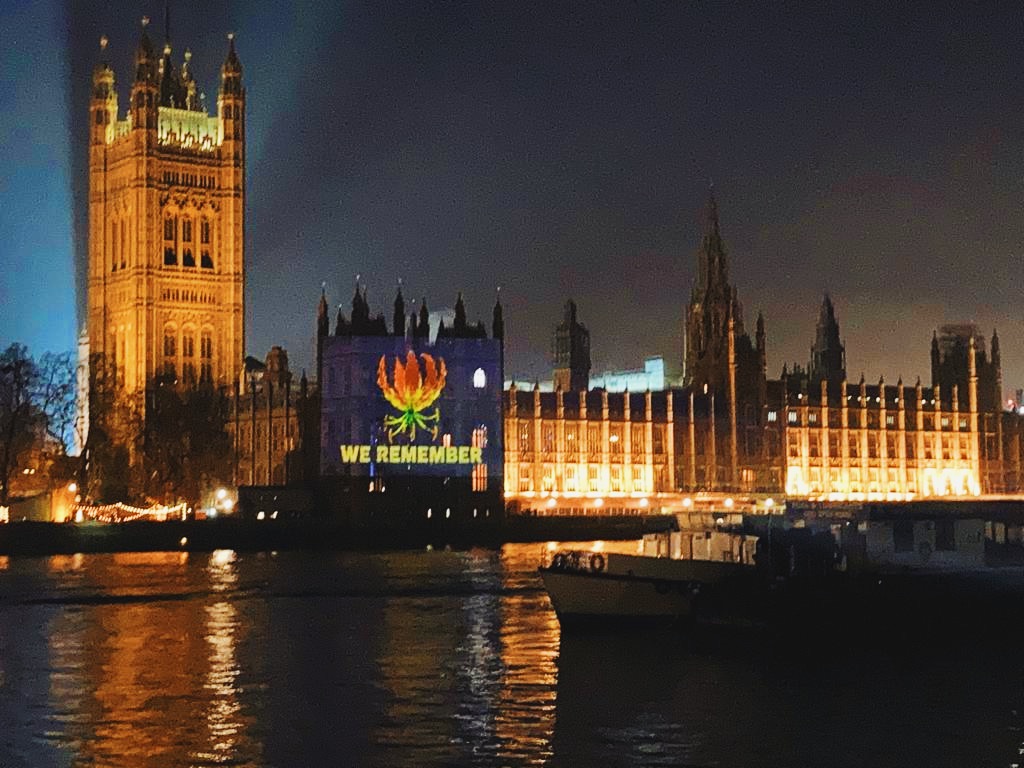
On the night
of November 26, LTTE activists used high-powered laser beams to project on the
British Parliament building an image of a flower considered by the terrorist
group as their ‘national symbol of Tamil Eelam’ with the words ‘We remember’
underneath it.
On November
29, they hired a hall in East London for the celebrations. The venue was
decorated with LTTE flags and garlanded photographs of LTTE fighters killed in
the war were placed at the entrance to the hall. Makeshift tombstones draped in LTTE flags
and garlands scattered the floor of the hall. However,
due to Covid-19 restrictions in the country, only 15 people participated in the
commemoration.
LTTE activities
have been stepped up in the UK following the open judgment by the Proscribed
Organizations Appeals Commission to allow the appeal made by the Transnational
Government of Tamil Eelam challenging the decision of the UK Secretary of State
for Home Affairs to proscribe LTTE. (continued)