The Ceylon Chamber of Commerce (CCC) has commended the Government of Sri Lanka and the national negotiation team for securing a further reduction in the reciprocal tariff rate imposed by the United States on Sri Lankan exports—from 30% to 20%.
In a statement issued by the Chamber, Chairperson Krishan Balendra described the development as a positive outcome of sustained diplomatic engagement.
While this is clear progress reflecting the value of sustained engagement and strategic diplomacy, it is now important to use this window of opportunity to work towards a long-term arrangement that ensures more stable and competitive market access for our exporters”, Balendra stated.
The Chamber extended its appreciation to the officials involved for their proactive and strategic efforts, particularly in engaging with the U.S. Government and the Office of the United States Trade Representative (USTR) to secure this outcome.
As Sri Lanka continues along the path to economic recovery, the Ceylon Chamber urged the government to work collaboratively to address remaining non-tariff barriers and to create a more enabling environment for bilateral trade and investment.
The statement emphasized that deepening commercial ties in a mutually beneficial manner will be critical to enhancing Sri Lanka’s export competitiveness. It also underscored the importance of diversifying the country’s export portfolio and expanding market access through strategic trade agreements.
The Chamber reaffirmed its commitment to supporting the government through practical engagement, industry-informed input, and clear representation of private sector priorities.
One is tempted to ask whether it is on purpose that president Anura Kumara Dissanayake has given the portfolio of Buddha Sasana, Religious and Cultural Affairs to Hiniduma Sunil Senevi who is alleged to come from a non-Buddhist background, instead of to a more acceptable MP with the requisite qualifications for the job, chosen from his massive parliamentary majority. This impression was reinforced in me when I heard the news that SJB MP Dayasiri Jayasekera speaking in parliament during a heated exchange on July 22 made an improptu reference to Sunil Senevi’s deputy Gamagedara Dissanayake of the NPP, also present in parliament at that time, identifying him as the Buddhist monk who threatened the lay custodian of the Sri Dalada Maligawa in Kandy, the Diyawadana Nilame, by holding a kris knife to his neck when a group of JVP cadres attacked the foremost Buddhist shrine on February 8, 1989. MP Dayasiri Jayasekera was refuting the claim that no records pertaining to that attack exist, made by the Minister for Public Security and Parliamentary Affairs Ananda Wijepala in reply to a question earlier put to him by another SJB MP, Rohini Kavirathne. YouTuber Abheetha Edirisinghe (SL Leaders), on July 23, 2025, revealed more information about the Deputy Minister for Buddha Sasana, Religious and Cultural Affairs: Gamagedara Dissanayake was in robes then as a monk known as Thibbotuwawe Gnanarathana of Deepaduttaramaya of Doragamuwa, Wattegama, Pathadumbara. It’s not known whether he still remains a Buddhist or not..
By appointing such characters to be in charge of Buddha Sasana affairs, is president Anura Kumara Dissanayake flaunting his secularistic nonchalance towards the pivotal Article 9? Not likely, in my opinion. Having been in continuous parliamentary politics for twenty-five years, thanks exclusively to the support that the voters, the majority of whom are Sinhalese Buddhists, have extended to him to date, he would be the last to cock a snook at the place of special recognition given to Buddhism by the Constitution.
Article 9 is listed under Chapter 2 of the Constitution which is exclusively devoted to Buddhism. The importance of the area of governance covered by that term (Buddhism) is underscored by the fact that it is placed next to the topics of primordial importance: ‘The People, the State and Sovereignty’ described in Chapter 1. Article 9 (coming under Chapter 2) states: ‘The Republic of Sri Lanka shall give to Buddhism the foremost place…….’. It is not possible that the president wants to openly show contempt for Article 9 because he knows too well that it is totally compatible with secular democracy, and that it does not give Buddhism the status of a state religion that would impinge on the rights of adherents of minority religions.
But what about the neophyte MPs of his alliance, the NPP, who got swept into parliament in November 2024 on the crest of a popular wave of electoral support generated by his, realistically speaking, less than unqualified success at the presidential election held hardly two months before, in September? Though the parliament is filled with them, even the ruling party hierarchy look down upon most of them as ‘paa pisi’ (door mats) and ‘pol leli’ (dry coconut husks). My personal opinion is that these abysmally ignorant self-styled secularists or so-called ‘niragamikayas’ of the JVP/NPP, given little significance for policy-making, have seriously misunderstood the meaning of ‘secular’ as merely ‘niragamika’ (Sinhala: without any religious affiliation). The Sinhala term is actually derived from Sanskrit; it is a combination of the two elements nir + agamika, which these newly elected parliamentarians might understand, depending on their level of general knowledge, cultural and linguistic sophistication, and common sense, as ‘without any religion’ or ‘rejecting religion altogether’, or ‘non-religious’, or ‘areligious’, or ‘irreligious’, and hence, happily ‘amoral’, or even ‘immoral’!. They also seem to labour under the additional misconception that Buddhism is your typical religion with all the inherent negative attributes usually associated with all normal religions such as dogmatic beliefs that must be accepted as incontrovertible truths and followed without questioning, otherworldly attitudes that obstruct a person’s material advancement and that accommodate unconscious antisocial self-centredness.
But Buddhism is essentially a nonreligious, moral ethical philosophy (that is, Buddhist spirituality has no connection with religion). It nevertheless needs to assume the religious cultural form of a conventional religion in order to survive among actual religions. Very much the same thing may be said about Hinduism, in spite of the apparently chaotic and obscurantist (= that which prevents knowledge of facts) nature of its practical popular forms. But here I am taking you towards the deep end. Let’s swim back to the safer side.
Historically speaking, Buddhism emerged in the spiritual matrix of Hinduism. We shouldn’t forget that Siddhatha Gautama who became Buddha was born a Hindu. Hinduism and Buddhism are not religions (Ask the famous Sadhguru/Jagadish Vasudev of Tamil Nadu, founder of the Isha Foundation, Coimbatore, South India). Hinduism and Buddhism professed as religions by over eighty percent (80%) of the Sri Lankan population are the most secular (liberal democracy) friendly, and, at the same time, mutually compatible spiritual traditions that together make for peaceful coexistence among the diverse ethnic/religious communities within multifaith Sri Lanka. Secularism is no threat to Hindus, nor to Buddhists. (Actually, solidarity between these two groups is the key to Sri Lanka’s national unity.)
But unfortunately, it is a group of young Buddhist monks who rail against secularism the loudest, believing that it means total rejection of religious values in politics and in general civil society, while their Hindu, Christian, and Muslim counterparts, knowing the truth about secularism in governance, hold their peace.
Nevertheless, we cannot ignore these ‘embattled’ young monks’ patriotic intentions. They must be taught about the importance of secularism (= keeping religion and other matters separate from each other) in governance, civil administration, art, entertainment, in fact, in all spheres of human activity. AI offers the following definition: ‘Secularism is the principle of separating religion from other aspects of life, particularly government and public institutions. It advocates for a society where religious belief is a private matter and the state does not favor or discriminate against any particular religion. Secularism promotes freedom of thought, conscience, and religion for all, ensuring that individuals can hold diverse beliefs without facing coercion or disadvantage’.
However, in the real world, religion does not always manifest itself as a strictly private matter. Religions become socio-political markers that identify separate ideological groups of people. It is a well known fact that religions promote herd mentality among individuals within a larger group. It makes them conform to beliefs, morals and ethics, and attitudes of the majority (within a community), though they do not privately subscribe to those beliefs, attitudes, etc. So, religions have great political power. In the world today, for example, Christianity and Islam are both politically powerful in different, sometimes, mutually hostile ways, as in Western and Middle Eastern countries respectively. A common observation is that secular democracy is more prevalent in the Christian West than in the Islamic Middle Eastern states. However, secular democracy is strongest in the Hindu and Buddhist majority countries including India, Sri Lanka, Thailand, etc. Hinduism and Buddhism do not seek world dominance. They only offer a firm moral anchor for individuals and groups based on non-violence, wisdom, and universal compassion.
A memorable instance that showed the efficacy of this attitude was when Finance Minister J.R. Jayawardane of Ceylon (Sri Lanka) who attended the San Francisco Peace Conference held in 1951 made a powerful speech in which he quoted from the Dhammapada: ‘Hatred is never appeased by hatred in this world – By non-hatred alone is hatred appeased. This is an ancient Truth’, and made a passionate appeal on behalf of Japan, which was struggling after its defeat at World War II; he requested that the demand for war reparations be disclaimed; he said his own country was not going to accept any such compensation money from Japan. Jayawardane’s words were a clarion call for the humane treatment of Japan by the victorious side as well as a morale booster for that country. The grateful Japanese built a statue of J.R. Jayawardane in his honour at the Kamakura Temple in Kanagawa in Japan, which is being carefully maintained even today.
Though today we tend to look upon secularism as something modern imported from the West, a glance at our own history shows that from the very beginning, even before the advent of Buddhism, our rulers adopted a secular mode of governance that was nevertheless subject to wholesome moral standards where Brahman priests and later Buddhist monks played only an advisory role for the king, speaking up in the interest of public good, but never took part in governing. The Dasa Raja Dharma or the Ten Kingly Virtues are the moral and ethical duties of a ruler, which emphasize compassionate governance, social justice, and the well-being of the people. They are relevant not only for political leaders, but also for anyone in a position of authority, including business leaders and managers’, as an AI summary explains. No religion is involved here. These are secular principles of good governance. If only Anura Kumara Dissanayake cared to look at what these ten tenets of righteous government are, he would have improved his performance in no time.
In this article (published in two parts), I dwelt on the misunderstood concept of ‘secularism’ that vitiates the JVP/NPP government’s handling of Article 9 of the Constitution. However, the main thrust of president Anura Kumara Dissanayake’s address at the inauguration of the 74th Upasampada Vinayakarma ceremony of the Ramanna Nikaya was to stress his determination to stamp out the evil of ‘nationalism’ that he seems to have identified as what has been plaguing independent Sri Lanka in the form of the so-called curse of the past 77 years. He appears to be trying to impress on his avowedly secularist party ranks, as well as the meddling outsiders (with strategic geopolitical designs on our country) who are looking over his shoulder, the strength of that resolve.
But he cannot be unaware of the fact that the Sinhala neologism ‘jaatikavadaya’ was coined about two decades ago as an equivalent to the English term ‘nationalism’ perceived then (at least among us Sri Lankans) as a positive concept identical with patriotism. His current definition of nationalism as an evil that should be suppressed is in accordance with America’s negative interpretation of the concept of ‘nationalism’ in respect of nations/countries that independently choose to promote their own national interests without shaping their foreign policy to subserve ‘the five vital interests’ of the world’s only superpower. This is an idea that I owe to senior American public intellectual, social activist, and former linguistics professor Noam Chomsky.
Critics have begun to ask whether Anura Kumara Dissanayake’s erroneous substitution of jaativadaya (racism) for jaatikavadaya (nationalism), is a self-conscious ploy to please the Tamil diaspora in the West who secured for him and the alliance he leads the majority of the Tamil votes in the North and the East provinces at the presidential and parliamentary elections held respectively in September and November, 2024, as would be obvious to any unbiased observer.
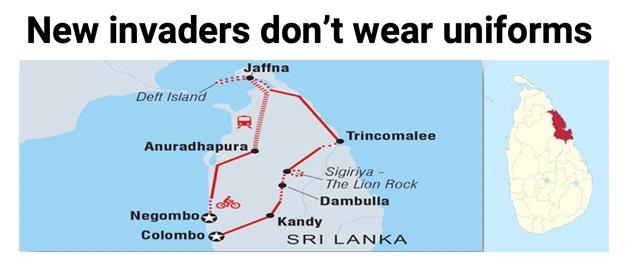
India’s strategic colonization of Sri Lanka’s Eastern Province—centered around Trincomalee—is not a coincidence but the result of decades-long encirclement through war, diplomacy, economics, and cultural erasure. What began as military intervention in the 1980s has transformed into economic domination and spiritual displacement. Today, India holds de facto control over Sri Lanka’s most valuable port, energy assets, and sacred lands—threatening not just sovereignty, but national identity.
Phase 1: The Pretext – Trincomalee Targeted (1980s)
· India’s real aim wasn’t Tamil rights — it was blocking U.S., Chinese, Israeli, or Pakistani access to Trincomalee, South Asia’s best natural harbor.
· The 1987 Indo-Lanka Accord, forced on Sri Lanka, merged the North & East (which even Prabhakaran opposed) — giving India a foothold to protect” the East.
· India sent in the IPKF, claiming to keep peace, but laying the foundation for future control.
Behind the mask of Tamil protection, India secured a strategic grip on Trincomalee.
Phase 2: 2002 Ceasefire – The Trap Is Set
· Norway brokered a ceasefire between Prabhakaran and PM Ranil — with India quietly backing it.
· India used the peace to return economically without military risk.
· Viewing Prabhakaran as a barrier to the East, India quietly backed his elimination in 2009 — clearing the path for its interests.
Strategic Land Grab Begins:
· In 2003, Lanka IOC gained 14 Trinco oil tanks, 150+ fuel stations, and fuel import rights under PM Ranil.
· Profits flowed to India — with no reinvestment or local benefit.
· India mapped out ports, pipelines, and a power grid — but waited for the right moment.
India used the ceasefire not for peace — but for positioning.
Phase 3: Post-War Expansion (2009–2019)
With Prabhakaran gone,India moved swiftly:
· Secured political influence in the Tamil-majority East
· Expanded IOC’s footprint
· Blocked China from entering Trincomalee
· Funded housing, roads, and rail — only through Indian firms
· Accelerated power grid and pipeline plans via MoUs
Soft power became hard control.
Phase 4: The Takeover (2020–2025)
Sri Lanka’s crisis became India’s opening. Influence turned intocontrol:
· 75 of 99 Trinco oil tanks now under Indian control or joint venture
· Sampur Solar Plant (1,000+ acres) run by India’s NTPC
· Trinco Port co-developed with India, UAE, and CPC
· Industrial zone, grid, and fuel pipeline linkEast Sri Lanka to Tamil Nadu
Sri Lanka’s core energy and port assets are now under Indian control or co-management.
Land Grab by the Numbers:
Through JVs, leases, and aid,” India has locked in operational control over thousands of acres in Trincomalee and Sampur.
Trincomalee Oil Tank Farm (TOTF) • 75 of 99 tanks under Indian control or JV • ≈ 2,350 acres
Sampur Solar Power Project • Joint NTPC–CEB project • ≈ 800–1,000 acres
Proposed Indian Industrial Zone • Linked to port/logistics • ≈ 400–600 acres
Trincomalee Port & Logistics Zone • Joint India–UAE–SL development • ≈ 2,500–3,000 acres
Total Land Area:6,050–7,950 acres
Roughly 10–12 square miles—larger than Colombo—is now tied to Indian control.
What’s at Stake?
· Energy Blackmail: If relations sour, India can cut fuel, electricity, and port services — crippling Sri Lanka within days.
· Loss of Sovereignty: Vital decisions on energy, trade, and ports shift from Sri Lanka’s leaders to foreign MOUs and Indian boardrooms.
· Enclave Economy: Trincomalee risks becoming an Indian-controlled zone — with few jobs, little access, and no local say.
· Military Threat: Dual-use energy projects could mask surveillance or naval bases.
· Strategic & Spiritual Loss: A double colonization — erasing national identity and sacred heritage.
The Bitter Irony
· India armed militants, fueled conflict, then posed as peacekeeper and investor—only to quietly absorb the East through legal deals, JVs, and loans.
· Now a QUAD partner with the U.S., India uses Sri Lanka as a geopolitical pawn in the Indo-Pacific.
Trincomalee is not just land — it’s power, security, and survival.
Imagine this: South Asia’s most valuable harbor… our backup oil reserves… solar power, ports, and industries — all locked under India’s long-term grip.
· If India turns hostile, fuel stops, power fails, and vital shipments halt.
· If conflict rises, India already controls logistics — right on our soil.
· Want to build our own systems? We’ll need foreign permission, since the land and pipelines aren’t ours anymore.
Trincomalee isn’t just land. It’s freedom — or dependence
Eastern Sri Lanka — Sacred Buddhist Heritage at Risk
Trincomalee, Sampur, and the Eastern Province are more than economic zones — they’re the ancient Buddhist heartland of Sri Lanka, home to ruins, viharas, and sacred sites over 2,300 years old.
Girihandu Seya — Sri Lanka’s First Dagoba
· Located in Thiriyaya, north of Trincomalee, it is Sri Lanka’s earliest stupa.
· Built during the Buddha’s lifetime by merchant brothers Trapusa and Bahalika, his first lay disciples.
· According to tradition, the Buddha gave them hair relics, which they enshrined here with local help.
· This site predates Mahinda Thera’s arrival and Anuradhapura’s official Buddhist conversion by over 250 years.
Other Buddhist Heritage Sites in Eastern Sri Lanka
· Seruwila Mangala Raja Maha Viharaya — stupa housing sacred Buddha relics
· Velgam Vehera (near Trincomalee) — historic Buddhist monastery
· Deegavapi (Ampara) — visited by the Buddha
· Kanikaaravelika Samuddha Maha Viharaya (Kuchcheveli) — mentioned in ancient Pali texts
· Gokanna Vihara — ancient temple in Trinco port, destroyed by Portuguese; replaced by Koneswaram Hindu temple, signaling Buddhist heritage erasure
· Lankapatuna Vihara — arrival site of Princess Hemamala with Buddha’s Sacred Tooth Relic (4th century AD)
· Neelagiri Maha Seya (Lahugala) — one of the East’s largest stupas
· Sembimale Raja Maha Vihara — part of ancient meditation hermitage network
· Buddhangala Aranya Senasanaya (Ampara) — active forest monastery with 1,500+ years continuous occupation
· Kiliveddi Siriwaddana Bodhiya (Seruwila) — sacred Bodhi tree
· Muhudu Maha Viharaya (Pottuvil) — built 2,000+ years ago by King Kavan Tissa
· Magul Maha Vihara (Lahugala, Ampara) — dates to King Kavantissa’s reign (205–161 BC)
Many face covert attempts to reclassify or convert them into Hindu kovils—erasing Buddhist history under the guise of multiculturalism.
Numerous inscriptions, ruins, and cave temples prove an unbroken Buddhist presence here long before any Tamil settlement.
Why this matters Constitutionally
· Article 9 of Sri Lanka’s Constitution gives Buddhism the foremost place and obliges the State to protect and promote the Buddha Sasana.
· Article 16(1) ensures all existing laws—written and unwritten—remain valid, including those protecting Buddhist heritage.
· Trincomalee and the Eastern Province are not just strategic or economic areas; they are sacred to the nation’s Buddhist identity.
· Failure to protect the Buddha Sasana here could be a constitutional violation, not merely political negligence.
Threats to This Heritage
· Indian-led development risks excluding Sri Lankans from sacred lands, especially if Trincomalee and Sampur become quasi-sovereign enclaves.
· Unchecked foreign infrastructure and pipelines could encroach, neglect, or erase protected Buddhist sites over time.
· Demographic and political engineering—through Tamil homeland claims and foreign-funded reconciliation” projects—threatens to wipe out Sinhala-Buddhist heritage in the East.
· India’s Prime Minister, a Hindu nationalist, cannot mask these threats with symbolic reverence for Buddhism while advancing policies that erode Sri Lanka’s Buddhist heartland.
Key Argument
India’s investments in the Northern and North-Western provinces aren’t goodwill — they’re a calculated corridor of control, ensuring direct logistical access to Trincomalee from South India.
Consider this:
· From Tamil Nadu (Rameswaram) to Jaffna– ~50 km (20 mins by sea)
· Jaffna to Trincomalee– ~230 km (by new roads India helps develop)
· Colombo to Trincomalee– ~270+ km (by road)
India can now reach Trincomalee faster than Sri Lanka’s own government can, from its capital Colombo
What Sri Lanka Must Urgently Do
1. Audit and renegotiate MOUs — restore national terms in fuel, ports, and energy deals.
2. Rebuild CPC capacity — end dependence on IOC.
3. End monopoly leases — reclaim control of Trincomalee tank farms and ports.
4. Ensure local benefit — enforce profit sharing, local hiring, and national oversight.
5. Return to a Non-Aligned Policy — avoid becoming India’s satellite or a U.S. pawn.
Beware the Illusion of Partnership
India’s global behavior shows it cannot be trusted—even by major powers. Starting 1 August 2025, the U.S. will impose a 25% tariff on Indian goods, with additional penalties over trade with Russia (Reuters, July 30, 2025). If India breaks commitments with the U.S., how can Sri Lanka trust it with our ports, energy, and sacred lands?
Sri Lanka may remain politically independent—but risks becoming an economic colony of India if no action is taken.
If Trincomalee is lost, Sri Lanka’s independence becomes a formality.
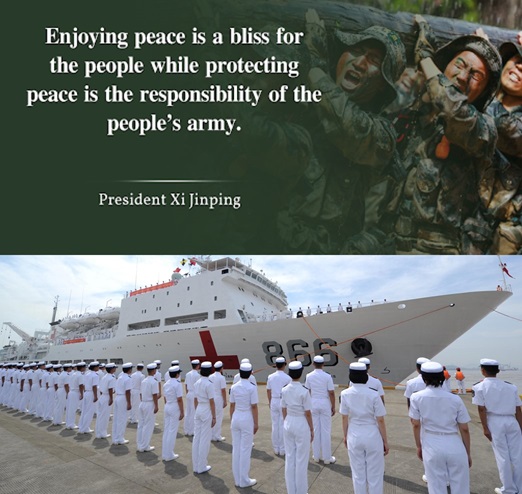
On the 98th anniversary of the founding of the People’s Liberation Army (PLA), the Chinese Embassy in Colombo delivered more than a message of military celebration — it reaffirmed a growing truth in Sri Lanka’s foreign policy: China is a friend who has stood with us — quietly, powerfully, and respectfully.
A Force that Heals, not Harms
While some nations arm proxies and destabilize neighbors to assert control, China sends hospital ships — like the Peace Ark, which treated over 5,000 Sri Lankans, performed surgeries, and extended the hand of healing. That is not just military diplomacy — that is humanitarian solidarity.
India, in contrast, has left behind a bitter trail: from training Tamil militants in the 1980s to meddling in Sri Lanka’s internal affairs under the guise of regional stability,” often enforcing its will through covert operations, forced deals, and political interference.
Respectful Partnership vs Strategic Pressure
The PLA’s modernization is not about dominance but capacity-building. As the Chinese envoy stated, China builds no alliances to threaten, targets no third country, and seeks no confrontation. It offers confidence without coercion — unlike India’s Neighborhood First” policy that often means India First, neighbors later.”
Sri Lanka has seen how India weaponizes trade, diplomacy, and debt — through infrastructure-airport-harbor-port deals, political manipulation, and acting as a gatekeeper to Western powers. These are not claims, but facts India cannot deny.
In contrast, China provides military training, humanitarian support, cultural solidarity and consistently defends Sri Lanka’s sovereignty on international platforms like the Geneva Human Rights Council. No conditions. No lectures. Just solidarity.
Two Neighbors, Two Approaches
China and India represent two fundamentally different foreign policy models. One respects Sri Lanka’s independence. The other seeks to influence it.
Where China’s ambassador fosters partnership and trust, India’s engagement often feels like coercion disguised as cooperation. This distinction is vital: Sri Lanka must choose friends based on mutual respect and reliability, not mere geography.
A Consistent Diplomatic Ethic
Under Ambassador Qi Zhenhong, the Chinese Embassy has deepened these time-tested ties — from humanitarian aid and technical training to respectful defense cooperation. In a region where some diplomats act like proconsuls, China’s representative has behaved like a true partner, not a puppet master.
History with India: Respect must be Mutual
Sri Lanka acknowledges its deep and ancient cultural, religious, and economic ties with India — bonds we continue to respect & strengthen. Sri Lanka has never taken action that threatens India’s security. Yet, India has repeatedly undermined Sri Lanka’s sovereignty — backing separatism, manipulating internal politics, and seeking dominance rather than friendship.
Respect must be mutual. Friendship cannot be one-sided or coerced.
This is not an attack on India, nor a blind embrace of any global power. It is a sober reflection on how Sri Lanka has been treated — and how it deserves to be treated. We value our civilizational ties with India, but friendship must never become dominance. Nor is this blind praise of China; we judge all nations by their conduct. In diplomacy, proximity is not loyalty, and distance is not distrust.
Our guiding principle is simple: we stand with those who respect our sovereignty — not those who compromise it.
Critics speak of debt traps” — but forget who truly dictated terms, who benefited from rushed deals, and who pressured Sri Lanka in its moments of weakness. Unlike others, China has never demanded policy in return for aid. That is the real difference.
China’s higher moral ground in Diplomacy
Unlike certain regional powers that treat Sri Lanka as a geopolitical playground — arming insurgents, imposing political solutions, and dictating terms — China has consistently demonstrated principled diplomacy. It never exploited Sri Lanka’s vulnerabilities or used proximity as pressure.’
While others rely on surveillance, backdoor deals, and regime manipulation, China has shown that true friendship respects sovereignty. It does not subvert it.
This ethos is reflected in the actions of its present envoy and the strength of bilateral ties.
Sadly, Sri Lanka’s political leadership has often failed to see this difference — or been too compromised to respond with equal dignity and clarity.
A Shared Vision for a Peaceful Asia
President Xi’s vision of a shared future for humanity, rooted in peace and cooperation, aligns with Sri Lanka’s hopes for stability after decades of foreign interference.
China does not demand allegiance — it offers partnership.
In contrast, India’s record is full of double standards: preaching peace while backing division, talking unity while meddling in regime changes abroad.
From Zheng He to Peace Ark — A Timeless Friendship
Centuries before modern diplomacy, Admiral Zheng He sailed peacefully to Sri Lanka. Today, the Peace Ark carries that legacy forward. From the pilgrimages of Monk Faxian to strategic cooperation today, China has never treated Sri Lanka as a backyard — only as friend.
Let us choose our Friends by their Deeds, Not Their Distance
It’s time Sri Lanka sees the difference clearly:
One neighbor uses proximity to dominate.
The other uses friendship to empower.
With China, we built ports. With India, we nearly lost them.
China healed. India armed.
China helped end terrorism. India enabled it.
Let history judge not who claimed to help — but who truly did.
As the Chinese envoy rightly said: History is like a mirror, seeing the road ahead.” For Sri Lanka, that road must be walked with true friends — not false allies.
Since 1970 or so all parties in this country have been extremely corrupt. Then, in the past 35 years we became one of the most corrupt countries in the world. Because the politicians are so corrupt, public servants too became corrupt; they also engaged in all forms of bribery and corruption.
This phenomenon favoured the NPP at the 2024 Presidential and Parliamentary elections, as NPP leaders had boasted a good record in relation to honesty. Thus, people voted for them en-mass.
The people’s only hope was that NPP will rescue them from the enormous social and economic plight that the country was in and bring forth prosperity to them
What people wanted was NPP to rebuild this nation, the last thing they wanted was NPP to put them into more turmoil.
Why cannot the NPP government provide relief to the innocent sugar cane farmers of Sevanagala? Why is the government so slack and lethargic in this?
Is NPP acting like Gota’s government?
In 2019 people voted for Gota resoundingly (69 million). They genuinely believed that he would fix the country’s problems and make it prosperous. Gota failed the people miserably; they threw him out within two years of coming to power. Will the same fate fall upon this NPP President and the NPP government?
Let us hope not.
If it is a Yes, it will be disastrous for the nation – a loss for all people.
In the last 10 months, the incidents of Container Gate, nepotism, appointment of lackeys to country’s top jobs have caused a dent in the Government’s honesty record. But, people are still willing to give the government a chance – they still hold that overall the government is good and honest.
But, the way the NPP’s senior leadership and some Ministers behave has raised doubts in the people’s mind about NPP’s Integrity, foresight, wisdom, efficiency, administration, intellect, empathy, patriotism etc.
Let us hope that the NPP President (AKD) and his government will rectify their grave mistakes and become successful. This paper is written in that spirit.
When JR came to power in 1977 with a 5/6 majority, it immediately showed good results to the people. Thus, people were happy until the ugly incident in 1983.
Even before the last Presidential election, NPP indicated that upon its leader becoming the President, he will not rule the country alone but with his team.
Is this happening now?
If yes, this is the reason for the government’s present downfall.
We have a Parliamentary Executive that consists of the President and the Cabinet. The topmost government officials are considered part of the Executive.
In such a context, NPP cannot expect to run the country from Pelawatte. The government should be run from the Echelon’s Square, by the Executive President.
Though NPP tries to emulate China and Vietnam (they are Leftist countries that practice Capitalism); it must realise that ours is more than a French style Presidency.
Our President has enormous power, some are like dictatorial.
The late US President Harry Truman had the sign ‘the buck stops here’ placed on his desk.
The same rationale applies to our President.
JR drafted the current Constitution in order to be like the strong leader Lee Kwan Yew. JR failed because of the war (he did relatively well until 1983).
Our President must know what is good and bad for the nation. He must not be scared to take good decisions – in the best interests of the country.
Does the President lack the ticker to be the country’s leader (unable to run the country under his total command and control, in true leadership spirit – something that is demanded by our Constitution?)?
If Yes, he is not leadership material.
The NPP promised masses that under its regime all looted money ($) will be returned to Sri Lanka and the looters will be prosecuted. This was their strongest point during the two election campaigns.
This is one of the main reasons why people voted for them.
Are they genuinely doing this now? No.
Ranjan Ramanayake stated ‘brother, all 225 are friends”. According to him, the JVP is included in the 225.
NPP is now not Leftist, but strong Liberal
Unlike Rohana Wijeweera’s JVP which was Leftist, the NPP leadership under AKD is strong Liberal.
That is ok.
But, the NPP’s Liberalistic comments/conduct in criticizing the need to uphold traditions and values is a real cause for concern.
According to NPP’s pre-elections rhetoric, traditions must be dismantled as they inhibit the society’s forward march.
For the first time, singing Jayamangala Gatha at a Presidential Inauguration Ceremony was not allowed by NPP. This was a major blow to the country’s Buddhists. Even during the ‘British Raj’, Jayamangala Gatha was not estopped by them at state functions.
Unlike the US, Australia which are strong Liberal democracies; we are a strong conservative society (democracy).
People here know who they are/where they came from and why they are here. History is very important to us. We do not want History to be suppressed and/or faked.
We (Sinhalese, Tamils, Muslims and Burghers) are proud of our cultures, customs and traditional ways of life.
NPP must not try to change everything overnight.
This is a civilization that has existed for 2500 years.
Sri Lanka is a country founded on a Sinhala Buddhist foundation. Sadly many Buddhist priests do not have the guts to say this openly. Several Muslim and Christian leaders (including the Cardinal) have been bold enough to state in public loudly that Sri Lanka is a Sinhala Buddhist country.
Accepting this does not mean others are 2nd class.
We all live like children of one mother. It should be that way.
Contrary to what Rohana Wijeweera, Somawansha Amarasinghe preached, the current NPP seems to believe that Sri Lanka is not a Sinhala Buddhist nation. They have indirectly elaborated this before and after the 2024 elections.
Will the NPP accept the fact that the Sinhalese have the right to live in all parts of the North and the East? We need answers to this question now.
Since recently, NPP leaders have started visiting/worshiping Buddhist temples. This is somewhat hilarious. It is well known that JVP has been an atheist party.
Are they doing this to canvass the Sinhala Buddhist vote? NPP must be truthful with the electorate.
We must not forget that the JVP of Rohana Wijeweera and Somawansa Amarasinghe has been a Marxist party.
Would the NPP continue to preserve the Article 9 of the Constitution? Would they support the State giving patronage to Buddhism or not? People ought to know this.
Why did upon coming to power NPP abolish the Buddhasashana Ministry?
NPP has slipped away from answering whether or not they would implement the 13th Amendment fully (giving land and police powers to provinces), or even give 13+.
Up to what extent would they go in supporting the 13A or 13+?
Does NPP want to legalise prostitution? True, a licensing regime could give security and protection to prostitutes, but once sex work is recognized as an occupation people could travel in droves especially from villages to big cities to formally work in the new industry. This is what has happened to one of our friendly countries in South East Asia. Legalizing prostitution (licensing brothels) means Colombo becoming the Bangkok of South Asia? (Thailand is 95% Buddhist, it is Asia’s topmost tourist destination (over 40 million tourists a year – 20 times more than us). In places like Bangkok, Pattaya, Phuket, Chiang Mai one can see how scantily dressed Thai women (and men), in selected areas, openly solicit foreign tourists for sex. They smoke cigarettes and drink alcohol in open. Sadly, this trend seems to be spreading to Laos, Cambodia and possibly to Vietnam (all Buddhist countries). Is this what we want in Sri Lanka?
Is it possible that NPP could legalise same sex relationships? Will they legalise same sex marriages? A possibility under NPP, not by any other political party. Then, we will be the South Asia’s first to have legally recognised same sex couples/families. Strong liberal political parties like the NPP, Peratugamis (previously leftist) should realise that we are a conservative society, the concept of same sex relationships/marriages is ‘foreign’ to people here. Such things may happen in the West, just because of that we must not emulate them. Sri Lanka is certainly not ready for same sex relationships/marriages.
We all can remember that before the 2024 elections a senior NPP (JVP) stalwart stated that in order to promote tourism NPP will organise a procession where women in seminude (exposing their breasts) will walk from Galle to Colombo. This person now holds a senior Cabinet Minister position. We are seeing so many antics from him, when will the NPP remove him from the Cabinet?
The current NPP leaders must not forget that under Somawansa Amarasinghe’s leadership it worked hard to preserve the country’s sovereignty and territorial integrity. It was the JVP that challenged the merger of the Northern and Eastern provinces in the Supreme Court. The JVP was successful on that occasion.
Today’s JVP (NPP) Liberal policies are poles apart from the Leftist policies of Rohana Wijeweera and Somawansa Amarsinghe.
Today’s NPP policies are most attuned to the philosophies and concepts of the Peratugamis, Lionel Bopage, Jayadewa Uyangoda, the late Victor Ivan et al. And we all know what they are!
Short Answer:Yes, collectively they can—but only if they unite with strategic clarity and economic coordination.
Long Answer: The world is no longer unipolar. While the U.S. under Trump (or any hardline leader) may project dominance through sanctions, military alliances (NATO), or economic tools (SWIFT, dollar reserve), the rest of the world now holds more than half of global GDP, resources, and population.
China and India are economic powerhouses with massive domestic markets.
EU is a regulatory superpower with enormous trade weight.
Russia has energy leverage, especially over Europe and parts of Asia.
Latin America, ANZ, and Africa offer strategic resources and emerging markets.
But here’s the catch: disunity, ideological divides, and dependency on the US dollar system are the key weaknesses of the anti-Trump bloc.
🇺🇸 Can the USA Live Without the Rest of the World?
Short Answer:Temporarily, but at a steep cost.
The U.S. economy depends heavily on:
Global supply chains (especially for tech, minerals, and consumer goods)
Allies for military basing and intelligence
Export markets for its agriculture, tech, and defense sectors
The trust in the dollar and US financial system
If the rest of the world decouples or even partially de-dollarizes, the American cost of living would spike, global confidence would erode, and the “Empire of Trust” would fracture.
😡Is Trump’s Skill Really ‘Deal Making’? Or Fear-Based Dominance?
Trump’s so-called deal-making” isn’t negotiation in the traditional diplomatic sense—it’s power posturing, often with:
Unilateralism (leaving agreements like the Paris Accord, Iran Deal)
Tariff wars (with China, even Europe)
Threats to allies (e.g., NATO funding demands)
Transactionalism, not partnership
He often treats allies like clients, and adversaries like rivals in a real estate deal. It’s not diplomacy; it’s intimidation wrapped in nationalism.
🐓Why Is Global Leadership Acting Like ‘Headless Chickens’?
Good question—and one many citizens and analysts ask.
Reasons include:
Fear of economic retaliation (sanctions, tariffs)
Overreliance on US tech/finance systems (e.g., SWIFT, Visa, Apple, Google)
Political chaos or indecision in other countries
Lack of a Unified Alternative Power Centre
Many leaders are reactive, not strategic—allowing Trump’s antics to control the global narrative.
👁️🗨️“The Open Secret”
Trump did not build America’s global dominance. It was built over:
Post-WWII economic architecture (Bretton Woods, IMF, World Bank)
Military presence and security guarantees
Cultural soft power (Hollywood, tech, innovation)
Trade dominance through dollarized systems
Trump simply exploits this inherited power for his personal political theatre, often reducing complex global relationships to a TV-style standoff.
🔮 Who Will Blink First?
If Trump returns and others remain disunited: the world might blink—again.
But if the rest of the world learns to coordinate, build regional systems, invest in alternative trade/tech alliances: America will have to adjust its tone or risk genuine isolation.
✊ Final Reflection
The statement is not just political critique—it’s a Call to Action.
The world needs:
Real leadership rooted in cooperation, not fear
A multipolar balance of power
Resilience from within—less dependence on any one nation’s ego
In line with the World Day Against Trafficking in Persons, the International Labour Organization (ILO), in partnership with the Ministry of Labour, launched a three-day training programme for law enforcement officials focused on forced labour yesterday (Jul 30) at the Taj Samudra Hotel in Colombo.
Among the distinguished participants were Mr. S.M. Piyatissa, Secretary to the Ministry of Labour; Ms. Nadeeka Wataliyadda, Commissioner General of Labour; Mr. Anoop Sathpathy, Officer in Charge, ILO Country Office for Sri Lanka and the Maldives; Mr. Nizam Insaf, Specialist, Fundamental Principles and Rights at Work, ILO Decent Work Technical Support Team, New Delhi. Also in attendance were officials from the Ministry of Labour; representatives of the International Labour Organization; officers from the Department of Labour, Department of Police, and Bureau of Foreign Employment; the Head of the officials committee of the National Anti-Human Trafficking Task Force; and the secretary and members of the coordinating committee of the National Anti-Human Trafficking Task Force.
As an integral part of this programme, the National Anti-Human Trafficking Task Force (NAHTTF) introduced a dedicated training module on human trafficking, developed with the guidance of the Attorney General’s Department. The module is designed to train government officers with a special focus on enhancing frontline prevention and detection.
Speaking at the inauguration, the Defence Secretary and Chairman of the National Anti-Human Trafficking Task Force Air Vice Marshal Sampath Thuyacontha (Retd) emphasized the strategic importance of the initiative, calling Labour Inspectors the eyes and ears on the ground” in the fight against trafficking linked to forced labour. He noted that trafficking often hides behind exploitative recruitment practices, wage withholding, and coercive contracts, and that the nature of Labour Inspectors’ day-to-day responsibilities places them in a strong position to detect such hidden abuses and trafficking cases.
He said that, This is not a formality it is a strategic intervention. Your inspections can be the key to protecting someone’s freedom.”
The initiative underscores the deep connection between labour violations and human trafficking, reinforcing the need for vigilance, coordination, and inter-agency collaboration. It also aligns with the broader objectives of the National Anti-Human Trafficking Task Force, which brings together ministries, law enforcement agencies, and international partners to strengthen identification, referrals, and victim protection mechanisms.
In closing, the Secretary reminded the participants of the human cost of trafficking and urged all stakeholders to act with commitment and compassion: Behind every case is a human being – someone’s son, daughter, parent, or friend. Let us be the ones who make that difference,” he said.
NDB Bank has strengthened its presence in Dubai with the appointment of Mr. Akila Bogahawatta as its dedicated remittance representative, underscoring the Bank’s commitment to Sri Lankan expatriates in the UAE. Mr. Bogahawatta will serve as a one‑stop liaison for all NDB remittance services, helping customers select the fastest and most cost‑effective channels to send money home.
NDB offers multiple remittance options to suit everyone’s needs. Through Western Union, senders can arrange instant cash pickups at any NDB branch or authorised agent, such as Singer (Sri Lanka) PLC, Regional Development Bank, Sarvodaya Development Finance, and CDB Finance, simply by providing a Money Transfer Control Number (MTCN) and valid ID. For direct account credits, NDB Qik Remittance delivers funds securely to any NDB or third‑party bank account in Sri Lanka, complete with real‑time confirmation and minimal paperwork.
To reach customers in over 200 countries, NDB partners with global networks including Federal Exchange, UREMIT, Mastercard, Instant Cash, and Mondial Bony Service. These collaborations ensure that remitters can choose their preferred provider and track each transaction from sender to beneficiary via SMS or email updates.
Additionally, NDB’s Remit Saver Account transforms remittances into long‑term savings. This tailored account offers higher interest rates, NEOS mobile and online banking access, e‑statements on request, preferential fixed‑deposit rates, and complimentary insurance coverage, allowing families to grow their savings and plan for the future.
Sri Lankans in the UAE depend on reliable remittances to support loved ones and build financial security back home,” said Mr. Bogahawatta. I look forward to guiding our customers through every step of the process, ensuring they benefit from NDB’s speed, transparency, and dedicated support.”
Sri Lankans in Dubai can reach Mr. Bogahawatta on WhatsApp at +971 505 707 866 or by phone during UAE business hours. They may also visit NDB’s branches in Sri Lanka, authorised agent locations, or log in to NEOS mobile banking to explore the full range of remittance services that power families and communities across the island.
Colombo: Sri Lankan authorities have arrested 122,913 individuals for drug-related offenses between Jan. 1 and July 29, 2025, according to a statement released by the Ministry of Public Security and Parliamentary Affairs on Wednesday.
During this period, law enforcement officials seized large quantities of drugs, including more than 928 kg of heroin, 1,396 kg of crystal methamphetamine (ICE), 11,192 kg of cannabis, 27.8 kg of cocaine, and 381 kg of hashish, the ministry said.
The ministry added that on Tuesday, Sri Lankan authorities conducted a special nationwide operation involving 6,695 personnel, during which officers searched 10,128 vehicles and 7,734 motorcycles.
Sri Lankan authorities have intensified efforts to crack down on drug trafficking and related crimes this year, the ministry said.
Discussions held with US authorities aimed at reducing the higher reciprocal tariff rate announced by US President Donald Trump have not been successful thus far, Minister of Industry and Entrepreneurship Development Sunil Handunneththi has acknowledged.
Although several discussions were held with US authorities, Sri Lanka has been unsuccessful in striking a deal to reduce the reciprocal tariffs announced by the US President, Minister Handunneththi conceded.
According to the announcement made by US President Trump, an additional 30% tariff will be imposed on Sri Lankan exports entering the US market from tomorrow (Aug 1).
The Minister said they are still hopeful of a better deal pertaining to tariffs, although it takes effect from tomorrow.
A virtual discussion was also held last week between President Anura Kumara Dissanayake and U.S. Trade Representative (USTR) Jamieson Greer regarding the further reduction of trade tariffs imposed by the United States on Sri Lankan exports.
The primary objective of the virtual meeting was to discuss the further reduction of proposed trade tariffs on Sri Lankan exports and to further strengthen trade and investment relations between the two nations.
The Secretary to the Ministry of Finance, Dr. Harshana Suriyapperuma, along with senior officials from the Office of the United States Trade Representative, also participated in the discussion.
Meanwhile, according to economist Dhananath Fernando, the reduction in US reciprocal tariff on exports from Sri Lanka to 30% from previously announced 44% is positive news for local businesses, considering the rates imposed on the country’s competitors. He said however the rate is a substantial increase from the existing 10% duty.
Fernando noted with the increase in the tariff rate, the consumer spending in the US will see a notable drop which will result in the reduction in demand for imported products.
Therefore, the new tariff will reduce the export volume of Sri Lanka which has also been highlighted by the World Bank in a recent report, economist Dhananath Fernando said.
According to Fernando, the real challenge Sri Lanka faces is the tariff imposed by the US on its competitors such as India, Vietnam, Thailand, Indonesia and Bangladesh.
Deputy Minister of Defence, Major General (Retd) Aruna Jayasekara has highlighted the deep-rooted friendship between Sri Lanka and China, forged through centuries of cultural exchange and strengthened over 68 years of formal diplomatic relations.
The Deputy Minister of Defence made these remarks while addressing the event held to mark the 98th Anniversary of the founding of the Chinese People’s Liberation Army (PLA).
Addressing the event, the Deputy Minister commended the PLA’s 98 years of remarkable history, resilience, and evolution in overcoming the diverse challenges of modern warfare and security.
He also recalled the landmark state visit of the President to China in January this year. The Deputy Minister stated that the visit reaffirmed the shared values of independence, self-reliance, solidarity, and mutual assistance as enshrined in the historic Rubber-Rice Pact, while paving the way to further deepen the Strategic Cooperative Partnership between the two nations.
Deputy Minister Aruna Jayasekara also expressed profound appreciation for China’s steadfast defence cooperation with Sri Lanka, acknowledging its invaluable assistance during the three-decade conflict and its active role in post-conflict development initiatives that uplifted the livelihoods of war-affected communities.
Meanwhile, the Deputy Minister commended the PLA’s continued support in capacity building, training, and professional exchange programmes, particularly in strengthening the operational capabilities of the Sri Lankan tri-forces.
National Development Bank PLC (NDB) was recently named Sri Lanka’s Best Digital Bank for SMEs at the Euromoney Awards for Excellence 2025, reaffirming its leadership in delivering progressive, technology-driven, and focused solutions that align with the nation’s strategic development priorities.This recognition reflects the bank’s strong commitment to empowering Sri Lanka’s SMEs in their transition to the digital space, one that is locally grounded yet aligned with global standards.
Euromoney, a leading provider of competitive intelligence and benchmarking insight for the global banking and finance industry, recognize institutions demonstrating innovation, performance, and leadership in their respective markets. Winners are selected following a thorough process comprising written submission by applicants, interviews by Euromoney analysts and independent market research. NDB’s selection as the Best Digital Bank for SMEs is a powerful endorsement of the Bank’s long-term digital vision, strategic execution, and its role in strengthening Sri Lanka’s entrepreneurial ecosystem.
Commenting on this prestigious accolade, Kelum Edirisinghe, Director and CEO of NDB Bank, stated, This award is testimony to the extensive work we have poured in over the past years to support the most critical segment of our economy. It is true to our founding purposes and comes at a time when digital transformation is not just a strategic direction but a necessity for resilience and competitiveness. It also reflects our belief in the potential of the country’s SMEs and our role as a partner in their long term journey. With NEOS BIZ and TradeLinc, we are going beyond traditional banking, we’re empowering businesses with the digital tools they need to be agile, efficient, and future-ready”.
He also stated that: NDB Bank’s recognition as Sri Lanka’s Best Digital Bank for SMEs further strengthens its position as a pioneer in the financial services industry, delivering impact-driven, inclusive and customer-centric solutions that not only enhances business operations but also positively contributes to the nation’s economy. Through its continued focus on innovation and meaningful partnerships, the Bank remains fully committed to re-shaping the future of SME banking in Sri Lanka”
At the heart of this achievement are two groundbreaking platforms one being NEOS BIZ and the other Trade Linc, developed and refined to offer SMEs the tools they need to thrive in a rapidly evolving business landscape. NEOS BIZ, the first-of-its-kind SME banking mobile application in Sri Lanka, has transformed how entrepreneurs manage their finances. Whether a business is a sole proprietorship, partnership, or limited liability company, NEOS BIZ empowers owners to carry out day-to-day financial transactions in real time, assign user roles, monitor outgoing payments, and authorize transactions with robust security controls. With features like maker-checker validations, real-time payment alerts, and flexible user permissions, the platform gives SMEs the convenience, agility, and confidence to operate and scale more effectively.
NDB’s proprietary supply chain finance platform, TradeLinc, is redefining how businesses manage supplier and distributor relationships. Developed entirely in-house, TradeLinc streamlines and digitizes these interactions, enabling SMEs to access working capital faster while offering buyers extended payment terms and enhanced operational efficiency. This innovation is a key driver of NDB’s success in empowering Sri Lanka’s SME sector.
With both NEOS BIZ and TradeLinc, NDB has created a digital ecosystem tailored to the needs of entrepreneurs navigating a complex economic environment. The platforms address both the transactional and strategic needs of SMEs, from managing day-to-day operations to accessing scalable financing and building supplier networks.
By the grace of Allah, over 350 new chapters (jamaats) were established around the world. In addition to this, the seed of Ahmadiyyat was sown for the first time in over 1,500 new locations. Congo-Kinshasa led in the establishment of new jamaats, followed by Benin, Congo-Brazzaville, The Gambia, Liberia, Nigeria, Ghana, Senegal, Guinea-Bissau, and Kenya, among many others.
Construction of mosques and mission houses
The construction of mosques continued apace, with 134 mosques being added during the year, comprising both newly constructed and acquired properties. These were established in numerous countries, including the USA, Bangladesh, India, Malaysia, Germany, Belize, and across many nations in Africa, such as Uganda, Ghana, Tanzania and Nigeria, etc.
Furthermore, 86 new mission houses were established. Uganda and Benin each established 10 new mission houses, with significant numbers also being added in Kenya, Ghana, the USA, and Canada.
Publication:
Several key books of Founder of the Ahmadiyya Muslim Community Hazrat Mirza Ghulam Ahmad, peace be on him, were translated and published in English, and the translation of the Holy Quran were reprinted. Moreover, the Holy Quran has now been published in 78 languages. The English translation of the first volume of the commentary of Sahih al-Bukhari (Hadis – sayings of Prophet of Islam) has also been published. Many of the books written by Ahmadiyya Caliphs (Khulafa) were translated and published in numerous languages.
Reports reaching us from 86 countries indicate the publication of over 350 different books, pamphlets, and folders, with a total print run of around 1.8 million. A collection of Answers to Everyday Issues by Ahmadiyya Khalifa Hazrat Mirza Masroor Ahmad has also been also published in book form.
India
Books have also been translated and published in various languages of India.
Central Desks, presses and digital initiatives
The various central language desks, including the Arabic, Russian, Bangla, French, Turkish, Indonesian, Farsi, Swahili, Spanish and Chinese desks, all reported significant progress in translating and publishing literature.
The Alislam.org website enhanced its Quran search engine, launched a mobile app for prayer times and qiblah direction, and expanded its digital library, which now features 221 English e-books.
The Central IT Department continues to service 35 central departments.
Other organisations and departments
Waqf-e-Nau (the children who are dedicated for the faith before their birth). The total number of waqifeen-e-nau has reached 85,489.
Leaflet distribution: Over 8 million leaflets were distributed in 109 countries, reaching an estimated 25 million people.
Press and media: The Press and Media office secured 190 news items in mainstream outlets, reaching over 30 million people through platforms such as Sky News, The Independent, ITV, The Telegraph, and BBC, etc.
MTA (Muslim TV Ahmadiyya) International: Broadcasting 24/7 through 8 channels, MTA now operates with 555 volunteers. The MTA studio in Ghana has become the first to operate entirely on solar energy.
Humanitarian services: The IAAAE continued its work in providing clean water and developing model villages. Majlis Nusrat Jehan runs hospitals and schools across Africa, having treated thousands of patients this year. Humanity First is now established in 66 countries and has provided aid to over 800,000 people, including Palestinians affected by the conflict in Gaza.
Bai‘ats (pledges of allegiance)
Despite challenging circumstances in some parts of the world, His Holiness announced that by the grace of Allah, more than 249,000 people from 111 countries and over 500 different nationalities entered the fold of Ahmadiyyat. This represented an increase of over 10,000 from the previous year.
Ahmadiyya Khalifa then narrated numerous faith-inspiring incidents showcasing the various ways people are guided to the truth of Ahmadiyyat.
Moreover, Ahmadiyya Khalifa also shared many other incidents, detailing how people were guided through personal research, the righteous example of Ahmadis, the acceptance of prayers, and true dreams.
Conclusion
In his concluding remarks, His Holiness Hazrat Mirza Masroor Ahmad emphasised that the continuous progress of the Ahmadiyya Muslim Community (Jamaat) is in itself a magnificent sign of its truth. He presented the words of Founder of the Ahmadiyya Muslim Community Hazrat Mirza Ghulam Ahmad – Promised Messiah, peace be on him, who said:
Thus, had this undertaking been the work of man, it would certainly have been obliterated by their strenuous efforts. Can anyone furnish an example where such intense endeavours were directed against a false claimant, yet he was not ruined; rather, he advanced a thousand‑fold? Is this not, then, a magnificent sign that those very efforts were made so that the seed once sown might perish from within and leave no trace upon the face of the earth? Yet the seed sprouted, swelled and became a tree; its branches spread far and wide, and now the tree has grown so vast that thousands of birds find repose upon it.” (Nuzul‑ul‑Masih, Ruhani Khazain, Vol. 18, pp. 380‑384)
Ahmadiyya Supreme Head urged every Ahmadi to become a role model of piety and a silent preacher through their excellent conduct, so that the flag of Islam Ahmadiyyat may be raised swiftly across the entire world.
83.(b) a Bill for the amendment or for the repeal and replacement of or which is inconsistent with the provisions of paragraph (2) of Article 30 or of paragraph (2) of Article 62 which would extend the term of office of the President or the duration of Parliament, as the case may be, to over six years,
by A. Abdul Aziz,Sri Lanka Correspondent, Al Hakam, London.
Largest Islamic Convention in United Kingdom concludes.Ahmadiyya Khalifa His Holiness Hazrat Mirza Masroor Ahmad announced that 249408 people had joined the Ahmadiyya Muslim Community during the past year
The Jalsa Salana (Annual Convention) of the Ahmadiyya Muslim Community in the United Kingdom concluded on Sunday 27 July 2025 with faith inspiring addresses by the World Head the Ahmadiyya Muslim Community, the Fifth Khalifa (Caliph), His Holiness Hazrat Mirza Masroor Ahmad.
The three day Convention began on Friday 25 July, with the Friday Sermon and the first session started with raising of the black and white flag of the Ahmadiyya Muslim Community alongside the Union Flag. Ahmadiyya Khalifa delivered the inaugural address on Taqwa (righteousness), a prerequisite for true success:
Ahmadiyya Khalifa in his second day address put forward a testament to continued divine support to the Community and highlighted a year of global progress. During his address, Ahmadiyya Khalifa announced that 249408 people from 111 countries and over 500 different nationalities entered the fold of Ahmadiyyat. This represented an increase of over 10,000 from the previous year, His Holiness added. Earlier on Saturday, His Holiness also addressed the female members of the Community on the rights and responsibilities of women.
One of the highlights of the three-day Convention was the pledge of allegiance, known as Bai’at that took place on Sunday afternoon (27 July), {last day of the event} where the participants pledged allegiance to Hazrat Mirza Masroor Ahmad as the Fifth Khalifa (Caliph) of the Promised Messiah – Hazrat Mirza Ghulam Ahmad(peace be upon him).
The participants formed a human chain leading to the Khalifa as they repeated the words of the pledge in unison. ThIS event concluded with silent prayer led by His Holiness Hazrat Mirza Masroor Ahmad.
During the concluding Session on Sunday (27th July 2025) Mr. Rafiq Ahmad Hayat, President (Amir), Ahmadiyya Muslim Jama’at UK, introduced the recipient of the 2025 Ahmadiyya Muslim Prize for the Advancement of Peace: Nicolo Govoni, Still I Rice NGO President & CEO.
Short speeches were delivered by Distinguished Guests. Greetings on Video Messages shown and text messages were read out.
A special message from King Charles to the attendees of the (Convention) Jalsa Salana UK 2025 was then read out by Mr. Rafiq Ahmad Hayat, President (Amir), Ahmadiyya Muslim Jama’at UK. It reads:
BUCKINGHAM PALACE.
Please convey my warmest thanks to the Members of Ahmadiyya Muslim Community in the United Kingdom for their loyal greetings, sent on the occasion of their Annual Convention (Jalsa Salana), which is being held this week end at Hadeeqatul Mahdi, Oaklands Farm.
I much appreciate your continued support and I was interested to learn of the any people this year’s convention will bring together, all in the spirit of unity and peace to highlight the wonderful work of your community. In return, I send warmest good wishes to all those who are present for a memorable event.
Charles R.
25th – 27th July, 2025.
Prior to this, Secretary of External Affairs of Ahmadiyya Community read out the Message sent by Honorable Prime Minister Sir Keir Starmer, that reads:
10 DOWNING STREET
LONDON SW 1A 2AA.
THE PRIME MINISTER
I am delighted to send my very best wishes to the UK’s Ahmadiyya Muslim Community for your Jalsa Salana event.
The Jalsa Salana gathering each year in Alton is a significant event for the Ahmadiyya Muslim Community; not just in this country, but around the world. I am aware of the immense contribution that the Ahmadiyya Muslim Community makes and I am very much impressed by your message of peace, non-violence, respect for all and hatred for none. This event provides a wonderful opportunity to promote unity, harmony and mutual respect.
I am extremely grateful to the Ahmadiyya Muslim Community for all that you do to bring people together, to help those in need, and for your long history in raising millions of pounds for charitable causes across the country.
I would like to especially greet His Holiness Hazrat Mirza Masroor Ahmad as he presides over the proceedings, and send my warmest regards.
I wish every one who attends Jalsa Salana over the weekend a joyous time.
(Signed) Sir Keir Starmer
In his concluding address on Sunday evening (27 July 2025) Ahmadiyya Khalifa addressed in depth on Recognizing the Promised Messiah and Mahdi.
In the end Ahmadiyya Khalifa announced 46,061 people attended this three-day Convention (Jalsa Salana), which took place at Hadeeqatul Mahdi in Alton, Hampshire, United Kingdom. The convention ended with silent prayer led by Hazrat Mirza Masroor Ahmad, Head of the Worldwide Ahmadiyya Muslim Community in Islam.
NDB Bank recently continued its island-wide SME engagement efforts by hosting a focused digital transformation forum in Avissawella. Held with the participation of a diverse group of SME Business Banking clients from the region, the event served as a platform to highlight NDB’s continued commitment to strengthening and uplifting Sri Lanka’s small and medium-sized business sector through tailored digital solutions—most notably the NEOSBIZ app.
The forum spotlighted NEOSBIZ, NDB’s pioneering mobile banking platform developed specifically for SMEs, and demonstrated its powerful capabilities in driving financial efficiency, transaction security, and seamless business operations. The event provided attendees with hands-on exposure to the app, showing how it empowers business owners to manage everything from bulk payments to employee salaries, QR transactions, and real-time fund tracking—all through one intuitive platform.
Senior representatives from NDB Bank led the discussion, sharing insights on the bank’s long-standing focus on SME development, and the evolving importance of digitisation in ensuring long-term resilience and scalability. The sessions also explored how businesses can use NEOSBIZ to streamline workflows, monitor performance, and embrace real-time decision-making in an increasingly competitive environment.
The forum in Avissawella follows a string of similar events hosted across the island by NDB Bank as part of its broader effort to empower entrepreneurs with access to the latest financial tools. These regional activations are designed to educate, engage, and equip SMEs to thrive in the digital era, helping them shift away from traditional paper-based systems and embrace faster, safer, and more accessible banking methods.
As a key stakeholder in Sri Lanka’s SME ecosystem, NDB Bank remains steadfast in its mission to accelerate financial inclusion and digitally-enabled growth for entrepreneurs across the country. Through NEOSBIZ and its wider portfolio of SME-focused services, the Bank continues to bridge the gap between ambition and access, delivering lasting value to the backbone of Sri Lanka’s economy.
NDB Bank is the fourth-largest listed commercial bank in Sri Lanka. The Bank was named Sri Lanka’s Best Bank for Corporates at the Euromoney Awards for Excellence 2024, and was also awarded Domestic Retail Bank of the Year – Sri Lanka and Sri Lanka Domestic Project Finance Bank of the Year by Asian Banking and Finance Magazine (Singapore) Awards 2024. NDB is the parent company of the NDB Group, comprising capital market subsidiary companies, together forming a unique banking and capital market services group. The Bank is committed to empowering the nation and its people through meaningful financial and advisory services powered by digital banking solutions.
The 17th International Defence Industry Fair (IDEF 2025), one of the world’s premier defence exhibitions, was held under the auspices of the Presidency of the Republic of Türkiye, hosted by the Turkish Ministry of National Defence, and organized by the Turkish Armed Forces Foundation (TAFF). This prestigious event provided a global platform for showcasing cutting-edge defence technologies and fostering international collaboration in the defence sector.
IDEF 2025 took place from 22 to 27 July at the Istanbul Expo Centre, where the Deputy Minister of Defence, Major General Aruna Jayasekara (Retd) undertook an official visit to the Republic of Türkiye at the invitation of Mr. Bilal Durdali, the Deputy Minister of National Defence of Türkiye.
During his visit, Major General Jayasekara (Retd) engaged in discussions with several senior defence officials from Türkiye. Notable among them were Deputy Ministers of National Defence Mr. Bilal Durdali and Mr. Musa Heybet, Commander of the Turkish Land Forces General Selçuk Bayraktaroğlu, Commander of the Naval Forces Admiral Ercüment Tatlıoğlu, and Commander of the Air Force, Air General Ziya Cemal Kadıoğlu.
The bilateral discussions focused on exploring avenues to enhance defence cooperation between Sri Lanka and Türkiye. Both sides reaffirmed their commitment to strengthening mutual ties through cooperative initiatives.
Officials from the Ministry of Defence of Sri Lanka also accompanied the Deputy Minister during the visit.
We sincerely apologize for the publication of inaccurate information in our recent post titled “ලංකාවේ විශ්ව විද්යාල දක්ෂයන්ට බය ඇයි ? dated 18h July 2025 authored by Dr Gamini Vithana
Upon review, it has come to our attention that certain facts presented were incorrect and may have led to misunderstanding or misrepresentation of the subject matter.
The University of Colombo has informed us that there is no Department of Psychology at the University of Colombo and even department of Psychiatry has not recently called for applications from PhD holders in Psychology.
Lankaweb deeply regret any confusion, inconvenience, or harm it may have caused to the individuals or organizations affected, as well as to our readers who trust us for accurate and responsible reporting.
We are committed to upholding the highest standards of accuracy and integrity. The content in question has since been deleted, and we have taken steps to ensure a more rigorous fact-checking process going forward.
We value the trust of our audience and reaffirm our dedication to transparency and accountability.
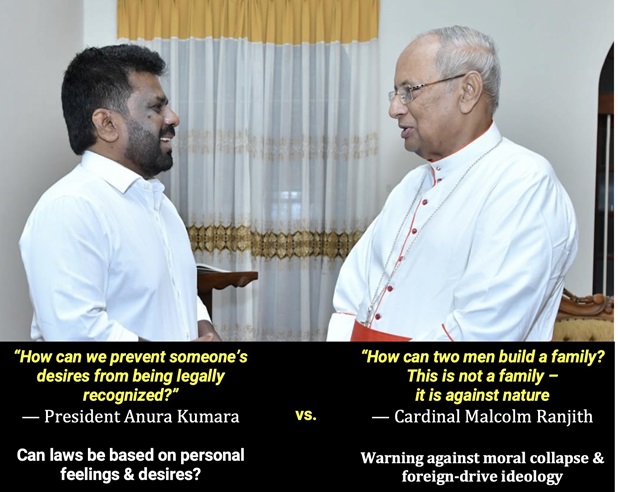
Cardinal Malcolm Ranjith’s recent statement warning against legalizing same-sex marriage and LGBTQIA+ ideology in Sri Lanka is not merely a religious outcry — it is a national alarm echoed by the majority of the populace heard across party lines, faiths, and generations. The President’s response echoes the opposite, and demands a far more urgent rebuttal.
This line of reasoning — that people’s feelings and desires should shape national laws — is not just morally irresponsible. It is legally untenable, socially dangerous, and constitutionally reckless & one unexpected of a sitting President.
The President’s statement reveals Public Pulse Ignored
The President’s statement reveals a growing disconnect from the Public Pulse. Across temples, homes, and classrooms, the people are speaking — but the President refuses to listen.
The people are asking: Who gave you the mandate to rewrite our morality?
I. Why feelings are not a Foundation for Law
The rule of law exists to regulate feelings and desires — not to indulge them.
Foundational Legal Principle: Fiat justitia ruat caelum” — Let justice be done though the heavens fall.
The law does not bend to individual emotions or private preferences. It stands as a collective boundary that separates moral order from personal chaos. If desire becomes law, then every criminal, every addict, every predator can claim it’s how I feel” as justification.
Where does this end?
· If LGBTQIA+ ideology is accepted on the basis of feelings,” what of the adult who desires a minor?
· What of the thief who feels” entitled to someone else’s wealth?
· What of the person who identifies” as a cat, tree, or dragon and demands state accommodation?
· A murderer who feels” he has a right to kill or a rapist who feels he has a right to rape.
· Or a sibling who desires incestuous marriage?
· Shall necrophiliacs and zoophiles next demand legal recognition of their feelings”?
Laws exist not to cater to personal feelings but to protect the most vulnerable — including children and future generations — from harm disguised as personal desire.
Is the President prepared to amend the Penal Code every time someone’s feeling” is hurt by its prohibitions?
If so entire law books have to be abolished!
II. Why Laws exist: Order, Not Indulgence
In ancient times, there were no gates, no judges, no CCTV, no police. That simplicity was built on common moral values and social trust. People knew right from wrong. Good from bad.
But today, laws, regulations, and courts exist to contain:
· Human impulses
· Unethical conduct
· Harmful desires
To dismantle the law in the name of individual feelings is to abolish civilization & create chaos and confusion.
Legal Maxim: Ubi jus ibi remedium” — Where there is a right, there is a remedy.
But rights do not emerge from feelings. They arise from duties, natural law, social harmony, and public interest.
III. LGBTQIA+ is not a Human Rights issue — It’s an Ideological Trojan Horse
The attempt to mask Western-funded gender ideology as a human rights campaign must be exposed for what it truly is: ideological colonization.
Cardinal Malcolm Ranjith’s warning echoes what many Buddhists, Hindus, and Muslims also fear: a global, donor-driven agenda to deconstruct family, religion, and national identity.
As the Cardinal rightly said, this government is playing with fire.
IV. Constitutional and Legal Grounds to Reject the LGBTQIA+ Push
Sri Lanka is not bound by any international treaty to:
· Recognize same-sex marriage
· Teach transgender ideology in schools
· Repeal Sections 365/365A
· The 2024 Gender Equity Bill-Supreme Court determination issued by the new Chief Justice clearly nullifies any attempt to legalize homosexuality or promote LGBTQIA ideology in Sri Lanka as being against the Constitution & social & moral standards of this Nation & its civilizational history.
In fact, our Constitution (Article 9) upholds the primacy of Buddhism and the moral guidance of the Buddha Sasana — for both Sangha and laypersons. This includes upholding public morality, social stability, and cultural integrity.
The Penal Code Sections 365 and 365A, amended in 1995 and 2006, were designed to protect children from same-sex sexual abuse — not to criminalize private adult conduct to satisfy their sexual urges/feelings. These laws are protective, not discriminatory.
To repeal them under international pressure is not progress.” It opens the door to legal ambiguity that endangers children — weakening protections against same-sex sexual exploitation and grooming of minors.
V. Legal Authority against Foreign Meddling
Sri Lanka is under no obligation to accept ideological demands from the UN, IMF, or Western embassies a fact the current Government will have to accept like it or not.
· The Vienna Convention on Diplomatic Relations (1961) prohibits foreign interference in domestic legislation.
· The UN Charter (Article 2.7) states: Nothing shall authorize the United Nations to intervene in matters which are essentially within the domestic jurisdiction of any state.”
Thus, UN Special Rapporteurs, Western embassies, and donor agencies have no legal mandate to dictate Sri Lanka’s education content, legal codes, or moral direction dangling various carrots in front of the President or his Govt.
VI. Reject the slippery slope of ‘Rights Based on Desires’
If laws are changed every time someone says, This is how I feel,” I have a right to how I feel – the law must accommodate my feelings” then the law loses meaning. Society collapses into chaos.
This is not inclusion — this is institutionalized confusion.
Children are now being told they can be cats, genderless, or anti-human. This is not progress. This is identity psychosis, financed by foreign billionaires and enabled by complicit leaders. Do parents raise children to be indoctrinated to thinking & behaving like a cat or a tree?
Parents deserve the right to raise their children free from ideological confusion — children must not become pawns in foreign-funded social experiments.
VII. A Call to All Religious and Civic Leaders
President Dissanayake’s views must be publicly challenged before his feelings” become the law.
· No one voted to erase Sri Lanka’s cultural identity.
· No leader has the right to legalize moral decay.
If a president says law must follow desire,” then he is no longer fit to uphold law.
VIII. A President disconnected from the People
President Dissanayake did not win the mandate of the people to change our moral and cultural foundation.
His rule of desire” statement represents the promotion of a dangerous external ideology — one that the majority of Sri Lankans reject across every religious, ethnic, and political lines.
He has betrayed the people’s trustby siding with foreign-funded ideologues over Sri Lanka’s civilizational heritage.
If a President chooses desire” over duty, he is no longer leading. He is indulging.
This is no longer just about LGBTQIA+. This is about a government — hijacked by foreign influence — attempting to socially re-engineer an entire civilization without public consent.
IX. Religious Leaders must act now — Silence is Complicity
Cardinal Malcolm Ranjith has courageously sounded the alarm. Now it is time for:
· The Mahanayakas of the Buddhist clergy
· The Muslim Ulema Councils
· The Hindu Kovils and Saiva institutions
· Catholic communities
to issue publicjoint declarationsrejecting the President’s remarks.
This is no longer about gay rights.” This is abouta government willing to rewrite law to indulge lust and confuse children— while threatening national identity, child protection, and moral governance.
When faith leaders speak as one, the nation cannot be divided.
X. A National Movement of Conscience must begin Now: Hold MPs Accountable
We call on all Members of Parliament:
· Where do you stand?
· Will you stand with the moral values of the people — or the dangerous ideology of rule by desire”?
We call on teachers, parents, lawyers, artists, youth leaders, and monks:
· Raise your voice in schools, temples, villages, and cities.
· Do not be silent as your country is ideologically colonized.
We call on the media:
· Will you question the President’s justification of desire as law?
· Will you inform the people — or censor the truth?
This isnot a partisan issue. This is a civilizational issue.
If the President will not defend our children, our culture, or our Constitution — the people will.
We the people, of all faiths and backgrounds, say NO:
· No to foreign ideological colonization
· No to rewriting laws to suit emotional whims
· No to foreign-funded psychological reprogramming of our children
· No to silence from our leaders
Let the Cardinal’s warning echo in temples, mosques, churches, and classrooms:
We defeated terrorism with unity. Now we must defeat ideological colonization with the same courage.
Let us rise — not with hatred, but with heritage.
Let us teach our children not confusion, but clarity.
Let us build a nation that honors truth, not temporary trends with lifelong damage.
Silent Agents, Sold Nation: How Sri Lanka’s Sovereignty Is Being Traded by Its Own A deep dive into how political elites are enabling foreign capture of Sri Lanka’s national assets — one MoU, one silent betrayal at a time. Sovereignty is not always lost in battle. Sometimes, it is surrendered in silence — through secret agreements, quiet betrayals, and elites playing both sides. In Sri Lanka today, while citizens focus on elections, inflation, and survival, a far deeper crisis is unfolding: the systematic outsourcing of national power, ports, energy, data, and even defense — signed away without debate, disclosure, or consent. This is not merely bad governance. It is a managed, deliberate transfer of control — enabled by politicians, officials, and so-called experts who appear loyal, but may already be promised a place in foreign-funded think tanks, global panels, or corporate boards. What we’re witnessing is not political incompetence. It is elite capture in its most dangerous form: soft colonization disguised as cooperation, and betrayal disguised as leadership. This exposé uncovers the global pattern, shows how it’s playing out in Sri Lanka, and what the people must now do to resist — before it’s too late.
Global examples: How former leaders became foreign agents
Former Secretaries who joined Think Tanks or Advisory Boards
Jim Mattis (Secretary of Defense, 2017–2018)
After resigning in December 2018, Mattis returned to Stanford’s Hoover Institution, becoming the Davies Family Distinguished Fellow in May 2019, focusing on national security research and writing. He also serves on the board of General Dynamics and works as a senior counselor at The Cohen Group
Mark Esper (Secretary of Defense, 2019–2020)
Since leaving office, Esper holds the Distinguished Chair at West Point’s Modern War Institute, serves on the board of the McCain Institute, joined the Atlantic Council’s board and advisory bodies at GLOBSEC, and co-chairs commissions on defense innovation, including software‑defined warfare
Condoleezza Rice (Secretary of State, 2005–2009)
Rice is currently Director of Stanford’s Hoover Institution, a senior fellow at Stanford’s FSI, and sits on advisory boards including the Aspen Institute, the George W. Bush Institute, and the Washington Institute for Near East Policy
John Lehman (Secretary of the Navy, 1981–1987)
Lehman is on the Board of Trustees for the Foreign Policy Research Institute (FPRI), a U.S. foreign policy think tank
William S. Cohen (Defense Secretary, 1997–2001):
Senior counselor at CSIS, advisor to US‑India/US‑China Business Councils, board member of CBS
Thomas Pickering (Under-Secretary of State / career diplomat, later advisor levels)
Though not a cabinet secretary per se, Pickering has served in ambassadorial and senior State positions and post-retirement has joined advisory boards at the International Crisis Group, Center for the Study of the Presidency and Congress, American Academy of Diplomacy, Stimson Center, and others
Robert Rubin (Treasury Secretary, 1995–1999):
Co‑founder of The Hamilton Project, senior counselor at Centerview Partners; former Chairman of Council on Foreign Relations
Timothy Geithner (Treasury Secretary, 2009–2013): Chairs Yale’s Program on Financial Stability, serves on CFR board, is President at Warburg Pincus
Steven Mnuchin (Treasury Secretary, 2017–2021): Launched a Washington-based investment fund targeting sovereign wealth capital
Janet Yellen (Treasury Secretary, 2021–2025): After stepping down, joined The Brookings Institution and holds roles on boards like the Pacific Council on International Policy
All of these individuals transitioned after leaving office into roles where they advise or lead policy‑oriented institutions.
There are numerous others from earlier administrations—such as Madeleine Albright, Henry Kissinger, George Shultz, Edmund Muskie, and Robert Rubin—who similarly joined think‑tank advisory boards (e.g. Center for National Policy) after retiring.
Note: as of July 2025, the Pentagon has suspended all participation in think tank forums, impacting former Defense secretaries like Mattis, Esper, and Lloyd Austin from engaging publicly at major policy conferences
Prominent International Former Ministers & Leaders
Florence Parly (French Minister of Armed Forces): Trustee at the International Institute for Strategic Studies (IISS) alongside other global figures
Lord Mark Malloch‑Brown (UK Deputy Secretary‑General, UN): President of Open Society Foundations; board member of the UN Foundation and the Royal Africa Society
Kanwal Sibal (India, Foreign Secretary 2002–2003): Contributor to major Indian newspapers and serves in policy forums (Board of Leaders”)
Maria van der Hoeven (Dutch, Minister of Economic Affairs; former IEA Executive Director): Advisory board of UN Energy for All”; board member of Total; fellow at Clingendael think tank and Rocky Mountain Institute
Pierre Vimont (France, former Ambassador / EU service): Senior Fellow at Carnegie Europe; served diplomatic & advisory roles post-office
Kim Campbell (Canada, former Minister & Prime Minister 1993): Fellow at Harvard’s Kennedy School, trustee of Council of Women World Leaders, leadership program founder, Board Member Club de Madrid
Mark Green (USA, former USAID Administrator): After government service became President & CEO of the Wilson Center; board advisor at Bush Institute and others
Glen S. Fukushima (U.S. Assistant Secretary of Commerce 1990): Senior Fellow at Center for American Progress; vice-chair of SIPC board
Carl Bildt (Sweden, former Foreign Minister / Prime Minister): Distinguished fellow at CIGI; advisor to Ukraine reforms and international policy firms; columnist for Project Syndicate
Notable Trends
Widespread revolving door” from public office to high-level advisory, think tank, or corporate board roles.
Defense and economic secretaries are particularly sought after for corporate and policy posts.
Recent U.S. policy shifts: as of late July 2025, the Pentagon has banned senior officers from participating in think tank events
Think Tanks: The Soft Power weapon nobody sees
How Think Tanks & Policy Boards Influence Government Policy
1. Post-Retirement Placements & Influence
When a former Secretary or Minister joins a think tank or corporate board:
They bring insider access, relationships with sitting officials, and deep knowledge of policy frameworks.
They often help shape the agenda of the institution they join, influencing research focus, policy papers, and media appearances.
These outputs are then cited by lawmakers, presented at Congressional hearings, or used to legitimize controversial policy proposals.
Example:
Jim Mattis joining the Hoover Institution (which advocates strong U.S. military posture) after stepping down — Hoover regularly issues policy papers that are circulated in Pentagon and Hill circles.
Many of these former officials worked with or received briefings from think tanks or interest groups while still in office.
Potential Conflicts of Interest:
These entities may have lobbied them indirectly—through briefings, closed-door panels, position papers, private dinners, etc.
Once the official retires and joins them, the move raises suspicions of a soft landing” or quid pro quo.
Example:
Robert Rubin (former Treasury Secretary) later chaired the Council on Foreign Relations (CFR), which was frequently consulted by Clinton administration economic teams.
Steven Mnuchin reportedly fielded Wall Street lobbying and briefings from firms that later participated in his post-office investment fund.
3. Think Tank Reports as Lobbying Tools
Think tanks:
Produce policy recommendations that align with certain donor or corporate interests.
Hold invitation-only briefings with government officials.
Offer testimony in congressional hearings and publish op-eds that influence public perception.
Example:
The Brookings Institution and Atlantic Council have been repeatedly cited in Congressional sessions on foreign policy and energy, often shaped by corporate sponsors.
Former officials like Mark Esper and Condoleezza Rice were part of panels shaping national security or energy policy even while their affiliated think tanks received donations from defense contractors or oil companies.
Do Think Tanks lobby Secretaries while in Office?
Yes — though not always formally:
Soft Lobbying:
Policy briefings,” expert panels,” roundtables,” and research symposia” are indirect influence mechanisms.
Think tanks often funded by corporate interests frame these as neutral academic engagements.”
Backchannel Influence:
Staffers from Brookings, AEI, CSIS, Atlantic Council, etc., have private access to officials under the guise of knowledge-sharing.”
These think tanks often anticipate or pre-build connections with secretaries nearing retirement.
Evidence of influence while in Office
Investigative reporting (e.g. from The Intercept, Politico, New York Times) has shown that:
Defense Secretaries received input from think tanks funded by weapons manufacturers.
Treasury Secretaries were influenced by economic forecasts from institutions funded by investment banks or lobbying arms of multinational corporations.
Example:
In 2020, The Intercept revealed that Brookings, Atlantic Council, and CSIS accepted millions from defense contractors while influencing Pentagon planning through retired generals on their boards.
Revolving Door Examples
Former Official
While in Office
Post-Retirement Role
Potential Conflict
Jim Mattis
Defense Sec (briefed by Hoover, CSIS)
Hoover fellow, General Dynamics board
Defense ties while managing military procurement
Robert Rubin
Treasury Sec (consulted CFR & banks)
CFR Chair; economic policy influencer
Wall Street links during deregulation efforts
Condoleezza Rice
NSA/State Dept (worked with think tanks)
Hoover director; boards of oil firms
Oil and military overlap during Iraq War
Mark Esper
Defense Sec (worked with McCain Institute)
McCain Institute & Atlantic Council
Arms sales policy overlaps with sponsor priorities
Florence Parly (France)
Defense Minister (worked with IISS panels)
IISS Trustee
Close defense industry-military think tank ties
Key Policy Mechanisms influenced by these entities
Foreign Policy: Through narrative shaping and elite influence (e.g., Atlantic Council pushing NATO expansion)
Defense Budgeting: Think tanks funded by Raytheon, Lockheed, Boeing promote higher spending and tech upgrades
Trade & Regulation: Economic policy boards often backed by Wall Street or tech lobbies
Sanctions & Cyber Policy: Specialized panels (e.g. at Center for a New American Security) influence US sanctions regimes
Ethical Questions Raised
Transparency: Are former officials disclosing their prior interactions with the same entities they now serve?
Undue Influence: Are public policies being skewed to favor donors of these institutions?
Accountability: Are decisions made in the public interest or under influence of future job prospects?
National Security Risks: Do foreign-funded think tanks compromise decision-making?
Let us consider the Sri Lanka context:
Sri Lanka’s Silent MoUs: What they Signed, what they hid
Why are politicians & officials silent on sovereignty erosion?
Due Process bypassed
Major agreements (e.g., Trinco Oil Tank Farm, renewable energy grids, Adani port, defense MoUs, and now even Maritime Rescue Coordination) have been signed without Cabinet-wide discussion, public disclosure, or Parliamentary debate.
Despite their impact on sovereignty, security, and national assets, political parties offer lukewarm, ambiguous responses.
Some even echo foreign talking points — “strategic partnerships,” “regional integration,” “economic necessity.”
Red Flag: If sovereignty-impacting agreements bypass democratic process with no institutional resistance, it suggests either willful silence, collusion, or pre-assigned roles in a larger game.
Are Politicians/Officials acting as post-handover Agents”?
Likely. Here’s how it works globally — and now in Sri Lanka:
The Playbook of Proxy Rule through elites
Stage
Modus Operandi
1. Grooming
Selected politicians, bureaucrats, think tankers are invited abroad, given scholarships, or hosted at forums (e.g., Pathfinder, NITI Aayog panels, U.S. Track II events).
2. Seeding Influence
Foreign embassies, multilaterals, or donor entities fund local NGOs, advisors, experts” who gradually enter policy advisory roles.
3. Silent Agreements
Deals are signed with non-disclosure, and no resistance from either opposition or government — they pretend to protest, but never legally challenge or reverse them.
4. Post-Handover Rewards
Those who “played along” are offered post-retirement or post-political office roles: consultancy, speaking roles, board seats in foreign-funded think tanks, UN bodies, or private sector firms.
Signs this is happening in Sri Lanka
Cross-party silence on sovereignty sellouts — NPP, SJB, SLPP, UNP all avoid meaningful opposition to Indian control over ports, energy, and even coastguard functions.
No audit or public explanation of MoUs — Why are even major infrastructure MoUs not tabled in Parliament or reviewed by oversight committees?
Same bureaucrats rotate across parties — Officials who once signed deals under one regime resurface under another, continuing the same pattern.
Retired diplomats/officials appear in think tanks — Some join foreign-funded institutions, advisory panels, or Western/Indian forums with little national accountability.
Are their public statements just roleplay to fool citizens?
Very likely. The behavior of politicians on national topics mimics what is called managed opposition”:
They make token statements to appease public concern.
Yet do not mobilize protests, initiate legal action, or block implementation.
Instead, they use divisive distractions — ethnic tensions, religious issues, or personal scandals — to divert attention.
Result: The people think something is being done,” when in reality, the betrayal is being institutionalized quietly.
Silent understandings: The unspoken pact
There appears to be a tacit understanding among elite political and bureaucratic circles:
You don’t challenge our external partners, and you’ll be taken care of after office.”
Don’t expose the deals — pretend there’s debate, but don’t take real action.”
Give the people a villain to blame (the other party), but ensure the foreign plans continue no matter who is in power.”
This explains why:
Even the Left (NPP) is silent on Indian military MoUs.
The Right (SLPP/UNP) is silent on land, ports, energy being handed over.
The SJB only raises issues when politically convenient, not as a sustained national interest defense.
What Can Be Done?
Track affiliations of politicians/officials post-retirement.
Who joins foreign think tanks, banks, or regional advisory roles?
Expose think tank–foreign donor networks.
Who funds Pathfinder Foundation, Advocata, Verité Research?
Demand public release of all MoUs and treaties.
Table them in Parliament or sue for disclosure under RTI.
Mobilize nonpartisan civic resistance.
Public campaigns must name and shame the silence.
A country can lose its sovereignty without a shot being fired — all it takes is silent betrayal, managed opposition, and a people kept in the dark.”
Sri Lanka’s sovereignty is not being lost by war — but by political actors acting out a script, ensuring that no matter who wins elections, the foreign agenda prevails.
Country
What Happened
Lesson for Sri Lanka
Greece
Politicians signed EU bailouts without public review
Lost ports (Piraeus), sovereignty eroded
Ukraine (pre-2014)
Oligarchs & foreign advisors privatized land & industries
Foreign-funded regime change followed
Zambia
Silent MoUs with China on mines & infrastructure
Debt trap, loss of assets
Afghanistan (Ashraf Ghani era)
U.S.-backed govt was packed with silent foreign agents
Govt collapsed instantly
Sri Lanka (NOW)
Energy, ports, defense handed over via silent MoUs
Mass silence = complicity
This is a tested playbook — we are the next test case.”
The Silent Agents Among Us: How Sri Lanka’s Sovereignty Is Being Traded Behind Closed Doors”
A nation is not lost when it is defeated by war — it is lost when its guardians silently sell it piece by piece, while pretending to protect it. ❞
Sri Lanka is under siege — not by foreign armies, but by deals signed in silence, with the complicity of local elitesfrom all political parties. While citizens focus on elections, economic hardship, and survival, a much deeper betrayal is underway. Our lands, ports, power, data, and even security functions are being quietly transferred — often without public debate, Parliamentary scrutiny, or legal review.
The tragedy? Not a single party or political leader has truly stood up. Their so-called resistance is lukewarm, vague, and often conveniently timed. Behind this silence may lie a far more disturbing truth: some of these individuals are already promised a seat at the table of those pulling the strings.
What’s Really Happening?
Since 2024, a surge of agreements — mostly with India and certain Western interests — has targeted strategic assets:
Energy grids, now entering joint control under India-backed companies
Ports and harbors, gradually transferred under the guise of cooperation”
Defense coordination, allowing foreign militaries access to critical maritime zones
Data and IT infrastructure, being centralized with foreign-managed platforms
Disaster management and coastal control, falling under Indian-led frameworks
Yet there’s no uproar. No mass resignation. No court challenge. Not even a united public campaign by any party — not NPP, not SJB, not SLPP, not UNP. Why?
Are These Leaders the “Silent Agents” of a Foreign Script?
Let us be blunt. There appears to be a quiet understanding across party lines:
Don’t challenge the real foreign agenda
Play out token opposition
Ensure the betrayals are irreversible
Get rewarded later — with global postings, think tank seats, board positions, or advisory roles
This is not speculation. It is the same global pattern we’ve seen in:
Greece, where the port of Piraeus was sold quietly to China under bailout” politics
Zambia, where silent deals left generations in debt slavery
Afghanistan, where the US-backed government collapsed like sand because its elite was serving others
Ukraine (pre-2014), where foreign-funded NGOs and ministries set the stage for geopolitical collapse
The Betrayal, Explained in Simple Terms
Imagine your father sells your house — the land your family lived on for generations — and tells you it’s to ‘modernize.’ He promises you’ll be safe, but the contract was signed in another language, and the buyer now controls the front gate. You’re still in the house, but only until you’re told to leave. That’s Sri Lanka today.”
This is not just poor governance. It is managed betrayal. The politicians who signed these agreements pretend they had no choice, but in reality, they may have secured their future at the cost of ours.
Why the Silence from All Parties?
Because the role of most politicians today is not to protect sovereignty — it is to maintain the illusion of democracy while foreign interests take root.
That’s why:
Opposition parties don’t demand MoU disclosures
Government MPs don’t explain why land or energy are being sold
No party has published a full audit of foreign agreements in the past 10 years
This is scripted theater. The people are the audience. The deals are already done backstage.
So, What Can the People Do?
Step One is Awareness. Step Two is Resistance.
We must:
Name the betrayal: This is not development.” It is soft colonization.
Identify the silent agents: Who are these politicians, advisors, officials, and experts” tied to foreign-funded institutions?
Demand full transparency: Every agreement, MoU, and secret clause must be tabled before the people.
Refuse to be distracted: Ethnic issues, cultural debates, and election drama are designed to keep us blind.
This is Not a Political Crisis. It is a Sovereignty Crisis.
Sri Lanka is not being taken over by invaders with guns. It is being handed over by our own, with pens and silence. They sign away our ports, power, and national authority in the name of diplomacy — and we applaud them because we are kept in the dark.
This article is a call to every citizen, youth, monk, mother, soldier, and worker:
Your country is not being sold. It’s already sold — unless you rise now.”
Elite Capture Model in Sri Lanka: 5 steps to Betrayal
Model: No Bribe Needed — Just Future Rewards”
STEP 1: Soft Grooming During Office
Tactic: International Exposure & Intellectual Flattery
Examples:
Central Bankers (2021–2024): Regularly invited to Harvard Center for International Development; introduced to modern monetary frameworks” aligned with IMF.
List Sri Lankans invited to: World Bank, IMF side events or think tanks like Pathfinder, advocating debt-for-climate swaps” or SOE reform.
NPP representatives (2023): Quietly engaged by Indian policy groups (Observer Research Foundation, NITI Aayog) for youth governance” forums and non-aligned regionalism” discussions.
Legal officials: Invited to UN OHCHR or ICRC Humanitarian Law” programs which later shaped how they viewed 2009 war accountability.
Psychological hook: You’re not a local leader anymore. You’re a global thinker.”
STEP 2: In-Office influence and secret deals
Tactic: Decisions made via external Experts” or via MoUs unseen by the People
Examples:
35 Indo-Sri Lanka agreements (Dec 2024–Apr 2025): Nearly all signed without full Cabinet or Parliamentary debate. The Trincomalee Tank Farm, West Container Terminal, and land–energy–power sectors were committed through MoUs, often drafted abroad.
BOI officials in 2023-2025: Consulted Indian embassy-linked advisors on investment zones and offered them security jurisdiction without public debate.
Lands Ministry officials (2022–2024): Pushed World Bank-supported cadastral surveys and e-title registration enabling foreign leasehold bypasses.
Ministry of Power: Restructuring and selling off CEB units in line with ADB/IMF blueprints, not public mandate.
Every national resource becomes open for investment” — without public approval.
STEP 3: Post-Office Gratitude — No bribe, just career rewards
Tactic: The Payoff” happens Only After they leave office
Examples:
Former diplomat or foreign secretary (2020–2022): Now sits on UN Development Advisory Board & boards of private think tanks in Singapore and India.
Ex-Foreign Minister Mangala Samaraweera (prior to death): Rewarded with media space, international praise, post-retirement roles in international forums.
Former CBSL advisors: Appointed to UNDP, WB or think tank fellowships after pushing through” restructuring policy while in office.
High-profile lawyers involved in post-war legal reform: Now on international arbitration panels or special envoys.
We didn’t take money — we just got prestigious jobs later.”
STEP 4: Maintaining influence through Think Tanks
Tactic: Stay relevant as expert” to push same policies
Examples:
Pathfinder Foundation: Hosts ex-officials and military brass promoting closer Indo-Lanka military/economic integration.
Lakshman Kadirgamar Institute: Publishes thought pieces by ex-diplomats advocating balanced foreign policy” that’s pro-West/India.
Multiple Sunday newspapers and webinars: Regularly feature former decision-makers subtly justifying past choices.
Today’s traitor is tomorrow’s public intellectual.”
STEP 5: Silencing dissent and demonizing Nationalists
Tactic: Frame Critics as Regressive,” Extremist,” or Xenophobic”
Examples:
Media-funded commentators attack those opposing Indo-Lanka agreements as fearmongers” or racists.”
Social media pages (funded by EU/US embassies) amplify liberal-progressive figures who mock cultural nationalism.
Academics who question the IMF narrative are called anti-development” or accused of spreading fake news.”
Religious leaders who resist LGBTQIA decriminalization branded as hate preachers,” ignoring cultural context.
The new colonial weapon isn’t a gun — it’s public shaming.
Summary
Stage
Tactic
Sri Lankan Examples (2020–2025)
1. Grooming
Foreign trips, elite invitations
CBSL officials, legal officers, NPP advisors
2. In-office MoUs
Quiet agreements, donor scripts
India deals, WB/ADB reforms, land registry
3. Post-career payoff
Jobs/fellowships after exit
UN panels, think tanks, board roles
4. Echo chamber
Think tank/media recycling
Pathfinder, Verité, newspaper columns
5. Silencing critics
Media + NGO narrative control
Anti-nationalism slurs, social media smears
What we should now do with this knowledge:
Publicly audit foreign trips and think tank affiliations of current officials.
Expose each MOU and its implications before they are implemented.
Demand full transparency on privatization and investment deals.
Name and document this elite capture” model in Sinhala/Tamil — so ordinary people can recognize it.
Support nationalist legal scholars, monks, civil society who expose this soft-colonial playbook.
A nation is not betrayed in one grand act — but in a thousand silent signatures, made by those entrusted to protect it.
Sri Lanka is not under military siege. It is under elite capture. The betrayal is not foreign invasion — it is internal collusion. The traitors wear no uniforms — they wear suits, give speeches, and smile for the cameras.
They signed the MoUs. They bypassed Parliament. They echoed foreign scripts. They silenced dissent. They prepared their escape routes — think tanks, panels, board seats.
This is not incompetence. It is calculated surrender — executed by silent agents across all major parties, hiding behind development,” strategic partnerships,” and regional integration.”
While the people suffer economic hardship and hope for change, the real power is being outsourced — ports, power, land, data, even defense coordination. The betrayal is bipartisan. The silence is coordinated. The agenda is foreign.
This is not democracy. This is soft occupation.
People must now
1. Name the Betrayals: This is not modernization. It is managed surrender. Stop calling traitors visionaries.”
2. Demand Transparency: Table every MoU and agreement in Parliament. No deal should be valid unless seen and debated by the people.
3. Track the Agents: Record where our former leaders go — which think tanks, boards, or foreign missions they join. Expose who funds them. Follow the money trail.
4. Educate the Nation: Translate and spread this Elite Capture Model to every home, temple, classroom, and village — so no one is fooled again.
5. Reject the False Drama: Political theater is a distraction. While they debate slogans, they sign away sovereignty. Unite beyond party lines — this is not left vs. right, it is traitors vs. patriots.
“Sri Lanka is not being conquered by foreign armies. It is being handed over by its own elite — one silent MoU at a time.”
Let history record this moment clearly: If we do nothing, we will be the generation that watched our nation be sold — not by war, but by whispers in air-conditioned rooms.
The time to resist is NOW. Not through violence, but through exposure, legal action, public vigilance, and unyielding civic courage.
Let no traitor hide behind a smile or a title again.
NDB Bank, in collaboration with the National Credit Guarantee Institution Limited (NCGI) and Hatch Works, recently hosted a focused awareness session at Hatch Innovation Hub in Colombo to introduce Sri Lankan startups to the benefits of the NCGI-backed loan guarantee facility. This initiative marked a significant step in expanding access to finance for emerging entrepreneurs, particularly in the IT and technology sectors.
The session was attended by over 40 startups and small to medium-sized enterprises (SMEs), with representation spanning diverse industries including agriculture, manufacturing, digital solutions, and services. The key objective was to shed light on the National Credit Guarantee mechanism—an empowering facility that enables entrepreneurs to access business loans without the need for traditional collateral. Once a business is backed by the NCGI guarantee, the guarantee itself serves as the security for the loan, significantly improving access to finance for early-stage businesses.
Representing NDB Bank at the session were Nilendra Vithanage, Chief Manager and Zonal Head – Business Banking, and Sudesh Fernando, Senior Manager – SME Refinance. The National Credit Guarantee Institution was represented by Jude Fernando, Chief Executive Officer, and Himansu Wickramasinghe, Head of Guarantee Administration. Hatch was represented by its Chief Executive Officer, Mevan Peiries.
As a pioneer in financial inclusion and SME empowerment, NDB Bank is committed to supporting entrepreneurs at every stage of their growth journey. The Bank has remained steadfast in its mission to provide tailored financial solutions that meet the unique challenges of startups, particularly in fast-growing innovation-led sectors like IT. With the support of NCGI and forward-thinking incubators such as Hatch, NDB is expanding its reach to foster the next generation of Sri Lankan entrepreneurs who are set to shape the country’s economic future.
Commenting on the initiative, Nilendra Vithanage of NDB Bank noted, Our partnership with NCGI and Hatch is a reflection of our unwavering belief in the potential of Sri Lankan startups. We understand that access to finance remains a key barrier for many new businesses, especially those without traditional assets or collateral. The NCGI guarantee transforms this dynamic, and we are proud to be enabling access to opportunity.”
This collaboration between NDB, NCGI, and Hatch is expected to continue in the months ahead, with plans to extend further knowledge-sharing sessions and financial accessibility programs to entrepreneurial communities across the island. Together, these institutions are building a more inclusive startup ecosystem, one where innovation is supported, and financial solutions are accessible, secure, and sustainable.
NDB Bank is the fourth-largest listed commercial bank in Sri Lanka. The Bank was awarded Domestic Retail Bank of the Year – Sri Lanka and Sri Lanka Domestic Project Finance Bank of the Year by Asian Banking and Finance Magazine (Singapore) Awards 2024, and was named Sri Lanka’s Best Bank for Corporates at the Euromoney Awards for Excellence 2024. NDB is the parent company of the NDB Group, comprising capital market subsidiary companies, together forming a unique banking and capital market services group. The Bank is committed to empowering the nation and its people through meaningful financial and advisory services powered by digital banking solutions.