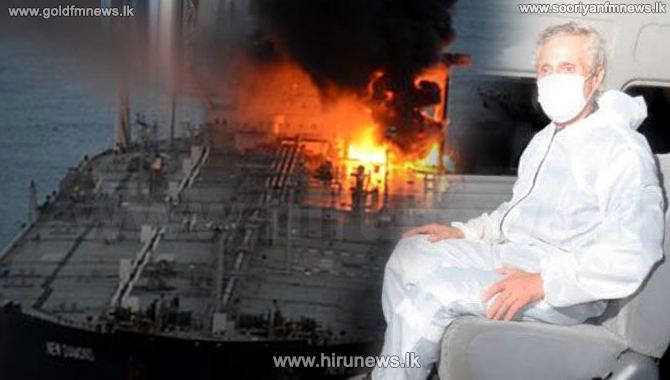
Oil Slick Spotted Near Burning VLCC Off Sri Lanka

September 8th, 2020

Courtesy gCaptain

A Sri Lankan Navy boat sprays water on the New Diamond, a very large crude carrier (VLCC) chartered by Indian Oil Corp (IOC), that was carrying the equivalent of about 2 million barrels of oil, after a fire broke out off east coast of Sri Lanka September 8, 2020. Sri Lankan Airforce media/Handout via REUTERS

By Waruna Karunatilake COLOMBO, Sept 8 (Reuters) – Sri Lanka’s navy said on Tuesday that an oil slick had been spotted a kilometre from a loaded supertanker off the country’s east coast, as efforts to extinguish a fire on board continued.

Sri Lankan officials are working to assess any damage to the environment and marine life from the incident, which began on Sept. 3, when a fire initially broke out in the engine room of the New Diamond supertanker.

The first fire aboard the ship, which was chartered by Indian Oil Corp to import some 2 million barrels of oil from Kuwait, was put out, but a second one broke out on Monday.

The ship has tilted slightly towards where the fire broke out due to the large amount of water sprayed to douse the fire,” Sri Lanka Navy’s spokesman Indika de Silva told Reuters, adding: Oil in the engine room appears to have leaked out to the sea”.

The New Diamond was being held some 40 kilometres (25 miles) east of Sri Lanka, while firefighting boats sprayed it with water, de Silva added.

An Indian Air Force plane stationed at the international airport in Hambantota had also dropped a specialized chemical mixture on the slick to control it, the Sri Lankan navy said in a statement.

The latest fire was on the right side of the vessel near the funnel and was not near the tanks holding the crude oil, Silva said earlier, adding it was still burning.

A salvage team was working at the site and additional assets, salvage personnel and fire fighting equipment” were on the way, he said.

Sri Lanka has deployed scientists and experts from its Marine Environment Protection Authority (MEPA), with one team examining the area around the ship and another coastal areas for signs of pollution, Jagath Gunesekara, deputy General Manager of MEPA, said. (Additional reporting by Arjuna Ranawana; Writing by Nidhi Verma and Zeba Siddiqui; Editing by Christian Schmollinger and Alexander Smith)

Bombay HC refuses bail to Finnish woman arrested for helping Sri Lankan national illegally migrate to Europe

September 8th, 2020

Courtesy The Hindustan Times

The Bombay high court last week refused bail to a 60-year-old Finnish national arrested for helping a Sri Lankan national to illegally migrate to Europe.

Justice Sarang Kotwal rejected the bail plea of Miira Mirva Helena Pasma observing that there were strong circumstances against her.

Pasma was arrested after Sri Lankan national Kuhapriya Thevarasa was found carrying a forged French passport issued in the name of Pasma on June 28, 2019, at Mumbai airport. Thevarasa was stopped from boarding a flight to Frankfurt after the airline staff suspected immigration stamps on her passport and handed over to the Sahar police.

Preliminary investigation revealed that Thevarasa had entered the airport with a ticket for Ahmedabad, whereas Pasma had a French passport and a ticket and boarding pass for the Frankfurt flight. Pasma allegedly passed on the forged passport with purportedly fake immigration stamps to Thevarasa after she cleared immigration check. Thevarasa attempted to board the Frankfurt flight based on the forged documents, whereas Pasma took a domestic flight to Ahmedabad, where she was apprehended on June 30, 2019.

Pasma’s interrogation revealed that she had come in contact with an agent who along with others was illegally sending Sri Lankan nationals to European countries from Mumbai, and Thevarasa’s parents had paid the gang Rs. 14 lakh. Pasma, who claimed to be a teacher was promised to be paid 1,500 Euros for helping Thevarasa migrate to Europe.

Both of them were then booked by Sahar police for offences punishable under sections 370 (dealing any person as a slave), 465 (forgery), 468 (forgery for cheating), 471 (using as genuine a forged document), 419 (cheating by personation), 420 (cheating) read with section 34 (common intention) of Indian Penal Code.

Pasma had moved HC for bail contending that the offences of human trafficking and cheating were not attracted in the case, as no one was being trafficked for exploitation and there was no dishonest inducement for cheating anybody.

Justice Kotwal agreed that there was no material to support the charge of human trafficking, but there was material supporting other charges levelled against the 60-year-old.

The offence is serious. The immigration officers of this country were deceived. Indian territory was used by these two accused for their gain,” said the judge.

HC refused to take a sympathetic view of the fact that she was behind bars for about 14 months and the trial has not started yet. Unfortunately, the trial could not start immediately, but, the Court cannot be oblivious to the current situation which has arisen because of COVID-19 pandemic. All the under-trial prisoners are similarly awaiting trial.”

Fires of communalism were fanned by anti-Sinhala-Buddhist ideologues

September 8th, 2020

H. L. D. Mahindapala

The abuse of history has been one of the major contributory factors that led to the exacerbation of the North-South relations. If our political/social scientists had balanced the mono-ethnic extremism of the North with the Southern forces rising against the provocative politics  of the peninsula (Example: 12% Jaffna Tamils demanding 50% of power at the centre) and given both the due weightage, the communal conflagration that kept the nation burning for 33 years could have been avoided. Instead the anti-Sinhala-Buddhist ideologues in academia and NGOs played foul by manufacturing and reinforcing the mono-causal perspective that pointed the finger only at the Sinhala-Buddhists. This  ideological thrust deflected the attention  away from the demonic  juggernaut that came rolling down from the North and destroyed everything in its wake.

Prof. S. J. Tambiah’s Buddhism Betrayed?: Religion, Politics  and Violence in Sri Lanka is a typical example of blaming only the Sinhala-Buddhists. This mono-causal theory does not fit into a universe consisting of multi-factorial causes. Tambiah’s attempt to brush aside the complexities and reduce the North-South conflict to a  single cause is a cheap exercise that appealed to the partisan ideologues committed to separatism. Tambiah went overboard to convince the world that all the evils originated only from Buddhism.

Woven into this was the other theory that claimed majoritarianism is the worst evil under the Sri Lankan sun. They refused to accept that minoritarianism can be – and has been – an evil worse than majoritarianism. In fact, the current global stability has been threatened by minoritarianism targeting majoritarianism and vice versa. It has replaced the Cold War rivalry that plagued the post-World War II period. Tambiah ignores the rise of minoritarianism as a destabilising force driven by mono-ethnic tyranny and focuses only on majoritarianism which fought the longest war within a democratic framework. The one-eyed view of Tambiah questions his claim to be multi-dimensional analyst. His book is such a juvenile exercise that any academic mug could have written a similar book titled Christianity Betrayed?, or Judaism  Betrayed?, or Gandhism Betrayed?, oreven Marxism  Betrayed?.

It is no great intellectual feat to string together a few negatives of any given subject and call it This-and-that Betrayed? Besides, history is one big mass grave in which the dry bones of noble ideals lie scattered with no one caring two hoots about it. Clearly, Tambiah’s academic exercise to pick only on Buddhism, ignoring the parallel Hindu forces of the North fathered by Arumuka Navalar, a caste fanatic, does not elevate him beyond that of a partisan charlatan.

The parallel force in the South was led by Anagarika Dharmapala who, like Navalar, was an anti-Christian, anti-Western reformist whose primary objective was to restore the traditional values of the indigenous people suppressed by the colonial masters. The difference, however, is that Navalar’s revision of Saivism, which was a political move to anoint the Vellalas as the Brahmin aristocracy of Jaffna, perverted the political culture of Jaffna, empowering the Vellalas as the God-given rulers of Jaffna. The Vellala-approved Tesawalamai, which codified the customs of Jaffna, also legitimized the  owning and exploitation of slaves. These Tamil  pariahs (outcasts) were reduced to subhuman slaves. The Vellala struggle was to retain the feudal and colonial privileges, positions and perks which they feared would decline with the sun going down in the British raj.

As the Vellala power and glory began to crumble under the invasive forces of modernity they took to mono-ethnic extremism as a last resort to survive in the competitive electoral politics, particularly in the post-Donoughmore period.  Vellala casteism, legitimized by Navalar’s Saivism, was no longer viable to retain their supremacy. Jane Russell delineates this phase in  her brilliant study of communalism under the Donoughmore constitution. ( Communal Politics under the Donoughmore Constitution, 1931 – 1947).  Mono-ethnic  extremism  was the only defence left to retain their grip on peninsular politics.  Eventually, the Vellala devotees of Navalar abandoned the non-violent mainstream – a path endorsed by casteist Navalar —  and declared war in the Vadukoddai Resolution (May 1976) to preserve their casteist supremacy. It was this struggle that led them all way, via Vadukoddai, to Nandikadal, the Waterloo of the Vellalas.

As opposed to this, Anagarika Dharmapala’s Buddhist revival advanced all the way to the latest triumph of the Rajapaksas raising non-violent democracy to its  peak. With all its imperfections, the triumph of the democracy in Sri Lanka is attributed to the power of tolerant Buddhism to nurture and foster a democratic culture. This was the original conclusion of Prof. A. J. Wilson, son-in-law of the father of Tamil separatism. (See below).  Going against this reality, after the Tamils took to separatism, Prof. Tambiah manufactured a mono-causal history partly to demonise the Sinhala-Buddhists as the prime cause of the raging ethnic conflict, partly to cover up crimes committed by the Tamil Vellalas against their own people in the feudal and colonial times, and partly to legitimize the fascist regime of Vellala supremacists, born out Hindu ideological distortions, indoctrinated by Arumuka Navalar. Manufacturing a mono-causal theory to point the finger only at one side in a conflictual situation where the ubiquitous opposites in history collide is, in the first place, against the known laws of history. Second, history happens only as a dialectical clash of two or more conflicting forces. The reverberating sounds of history do not echo in the passages of time with a one-hand clap.

The traumatic and the catastrophic events that shook the nation from the declaration of war at Vadukoddai in May 1976 to Nandikadal in May 2009 need not have occurred if the Vellala leadership had greater concern for the Tamil people. The tragic ending in Nandikadal exposes the short-sighted politics of a leadership that used its people to achieve their  goals. Their strategy was to create a bogeyman in the South and market mono-ethnic extremism as the only way out for the Tamils. They never offered the Tamil people alternative ideologies — liberal, socialist or any other  varieties of Marxism – that prevailed in the South. The ideologues who ganged up to manufacture their version of history constructed only a one-eyed narrative of blaming only the Sinhala-Buddhists. According to them the Yal Devi went only to the North and never came down. 

Take, for instance, the case of Dayan Jayatilleka who never fails to advertise that he is a political scientist”. If Prof. Tambiah is at the high-end of anti-Sinhala-Buddhist gang Dayan is at the very low end, parroting what his gurus had told him. Wearing his tinted blinkers made in Gramsci’s factories in Italy, he is wont to attack the Sinhala-Buddhists, naming in particular Anagarika Dharmapala, the anti-colonial reformist who awakened the Sinhala-Buddhists to the corrosive effects of the Christianized, Westernized and alien forces imposed by the imperial masters.

Dayan has failed to give equal weightage to the parallel forces unleashed in the North by the Saivite revisionist, Arumuka Navalar – the most pernicious casteist fanatic who is the demi-god of the Vellalas. He fathered Vellala casteist fascism that turned his devotees in Jaffna into relentless and merciless oppressors of the Tamil people. This high priest of Vellalaism told his Saivite followers that it is their duty to kill those who revile” Siva. And if they can’t kill they should hire someone else to do it for them. (p. 80 – The Bible Trembled, The  Hindu-Christian Controversies of Nineteeth Century Ceylon, R. F. Young and (Bishop) S. Jebanesan). Imagine, for instance, what Dayan Jayatilleka and his fellow-ideologues would have done if Anagarika had told the Buddhists to kill those who had reviled” the Buddha. Wouldn’t he have danced the kavadi to the drum beat of goo-ooo-rung, goo-ooo-rung in the streets of Colombo condemning it?

Dayan’s pseudo-political science is yet to give due weightage to the Vellala factor that over-determined the North-South relations from the colonial period. He has, in his abysmal ignorance, failed to weave in the decisive and destructive Vellala factor that collided with the Southern forces reacting to the Vellala grab for power in the dying days of colonialism. At the centre of the North-South conflict has been the Vellala thrust to grab disproportionate power at the expense of other communities. Dayan was blinded by various shades of Eurocentric theories, particularly Marxism, that hardly worked at the grassroot level in Sri Lanka. He could not get out of that box and come to grips with the mono-ethnic extremism of the North – the sole source of power of the Vellalas — winding its way inexorably to the Vadukoddai Resolution and, consequently to Nandikadal.

Like all anti-national political pundits, he fancies that if he throws in a few quotes from Gramsci, Althusser, Marx, Lenin etc., he could lasso the multifarious forces that  had bedevilled Sri Lankan politics and keep them under his control in his ideological stables. He believes that the solution lies in theoretical mumbo-jumbo spun in Eurocentric ideological factories. But how many Gramscis, Althussers and Lenins marched all the way to the polls that swept the Rajapakses into power? Which theory of our pundits predicted the annihilation of the UNP, or the rise and rise of the Rajapaksas? The presidential and the Parliamentary elections debunked the theoreticians parading as political scientists”. The Eurocentric theoreticians were among the victims of the Rajapaksa tsunamis that swept the nation.

This is only one example of how our political/social scientists blacked out the destructive forces that came down from the North and destroyed the ground laid for peaceful co-existence by the Founding Fathers of independence. Better political/social scientists than Dayan have played the ignominious role of betraying the fundamental principles of scholarship. They had no qualms in abandoning their own findings/theses at the end of years of research and plugging anti-Sinhala-Buddhist propaganda to buttress their partisan political agenda. I shall deal with more of it later. 

Before that let me first deal with the manner in which distorted history played its subversive  role in post-colonial politics. Each time history was dragged into the political arena it either ran into verbal fireworks with the clash of theories and interpretations, or exploded in bloody violence like the fireball that rolled all the way down to Nandikadal. In fact, the very first communal explosion that ripped the uninterrupted inter-ethnic harmony of centuries occurred when the up-and-coming leader of rising Tamil communalism, G. G. Ponnambalam, launched his attack debasing the Mahavamsa and the history of the Sinhalese in June 1939 in Nawalapitiya. Lashing out at the Sinhalese as a race of hybrids” he denigrated them as nobodies in the history of the nation. It didn’t take long for inter-ethnic clashes to ignite in the neighbourhoods of Passara, Nuwara Eliya, and Maskeliya.

Next month S. W. R. D. Bandaranaike was able to form a branch of the Sinhala Maha Sabha in Nawalapitiya. At the inaugural meeting he said: The Nawalapitiya Sinhala Maha Sabha should erect a statue of Mr. Ponnambalam as we should be grateful to him for provoking the formation of this Sinhala Maha Sabha.” (p.256 – Communal Politics under the Donoughmore Constitution, 1931 – 1947, Jane Russell, Tisara Prakasakayo, 1982.)

This was the time when Ponnambalam was going around whipping up support for his 50 – 50” demand. The ruling Vellalas who formed the power elite in Jaffna backed Ponnambalam to the hilt. The anti-caste, anti-communalist Jaffna Youth Congress, the one and only movement of the North to reject Tamil communalism, was critical of Ponnambalam. The Youth Congress, which was a formidable force in the twenties, stated: There has been plenty of false propaganda and exaggeration on both sides. Mr. Ponnambalam has been singing the glories of the Tamil race from public platforms, and by implication and direct statement casting slurs upon the Sinhalese people. Communalists flourish on one another. It is the existence and utterances of a Ponnambalam that provide the means for the rise to popularity and power of a Bandaranaike, and it is the latter’s acts and utterances that the former used to whip up a following.” (Ibid – pp. 255-6).

Jane Russel points out that 1938 and 1939 mark the nadir of communal relations in Ceylon”. (Ibid – 234). And she noted: In March 1938, G. G. Ponnambalam and D. P. R. Gunawardena came to blows in the corridor outside the chamber (of the State Council).” (Ibid – p. 257). Footnote to this said: The victor to this pugilistic contest was, not surprisingly, D. P. R. Gunawardena”.

Any serious study of Jaffna will confirm that despite the boasts of the greatness of the Jaffna Tamils they lack not only substantial evidence to back it up but also a historical consciousness comparable to that of the Sinhalese. So when Jaffna launched the separatist movement in 1948 it became an urgent political necessity to manufacture a history that could substantiate their political agenda. The history” contained in the Vadukoddai Resolution is a clear example of Tamils making history on the run. The frantic rush to make a new history was inevitable because the Tamils, unlike the Sinhalese, did not have a sense of history. Writing on the attitude of the Sinhalese and the Tamil towards their past, E. Valentine Daniels, Associate Professor of Anthropology, University of Michigan, said that the Sinhalese privilege history, whereas the Sri Lankan Tamils privilege heritage.” (p. 1.– Three Dispositions Towards the Past: One Sinhala, Two Tamil, Social Analysis, No.25:22-41, 1989).

Besides, the Mahavamasa, Chulavamsa, Deepavamsa point to the deep historical consciousness of the Sinhalese. The Tamils have not produced any comparable records of their past. In fact, the colonial masters had to urge them to produce a history for their guidance. The best known, Yalpana Vaipava Malai, was produced by poet Mylvakanam, because the Dutch Governor asked him to do so. Nobody asked the historian Mahanama to write the Mahavamsa. He did so in medieval times because he inherited the historical consciousness from his ancestors. It was in their blood. It was different with the Tamils of Jaffna. In the 20th century the Vellala casteist supremacists were desperately in need of a history not only to maintain their casteist grip on peninsula politics but also to extend their power beyond the boundaries of Jaffna.

They needed history to sanctify, justify and legitimize political violence which they launched in the end to achieve their elusive Eelam. The South too used history to justify their violence. But it has been more reactive than provocative. For instance, only the North has officially resorted to violence consciously and deliberately to achieve their political goals by declaring war against the South in the Vadukoddai Resolution (1976). No other leadership of any other community has officially declared war on a mono-ethnic ideology to achieve self-serving political goals at the expense of other communities.

The ending of Vadukoddai violence in Nandikadal confirm that history returns again and again to renew and reinforce the flow of the mainstream, dismissing fanciful and futile interpretations of theoreticians. History refused to be boxed in by narrow, self-serving theories. The most deplorable  part is the role played by the intellectuals. Re-reading Prof. Tambiah’s Buddhism Betrayed?, particularly in the light of subsequent events, makes you wonder about the integrity of intellectuals and their capacity to contribute gainfully to the welfare of people, particularly to people trapped in conflict situations. Dayan’s theories too can be dismissed as hollow sounds of an empty vessel. Whether it is on Cuba, his ideal state, or on Sri Lanka, his political theories and somersaults question not only his intellectual honesty but also his failure to grasp some of the essentials of the ground realities.

It is the betrayal of their own principles and the sacred standards set for sound scholarship that make the anti-Sinhala-Buddhist academics/theoreticians a bunch of hired hacks selling their talents to the highest bidder in the political market. Take the case of Prof. A. J. Wilson, son-in-law of the father of Tamil separatism, S. J. V. Chelvanayakam. In his early career he began by commending Buddhism as the force that has stabilised Sri Lanka and fostered democracy. Here’s what Calvin Woodard, an American scholar, wrote in a review of Wilson’s, Politics in Sri Lanka, 1947 – 1973, (Mac Millan Press, 1974): The uniqueness of Sri Lanka, Wilson points out, is that it has faced these challenges without veering  from the democratic path. Certainly then, the key to the future lies in an understanding of the  past. How and why, in other words, has the democratic experiment been able to work so well in Sri Lanka? The author investigates this and  concludes that the political stability so far maintained in Sri Lanka is due mainly to two forces, one of indigenous origin and the other the  result of Western implantation. Primary is the Buddhist ethos and the doctrine of tolerance. This, according to Wilson, has acted to dissuade the majority community from unduly imposing itself on the minorities and encourage it to respect the fundamental rights and distinctions of others in the plural society. Similar in effect to the Western notion of compromis, the doctrine of tolerance has facilitated compromise and  provided essential underpinning in society to the parliamentary system.” ( pp. 72-73, The  Ceylon Journal of  Historical and Social Studies, Vol III, July-December, 1973, No.2).

It should be noted that this was written after S. W. R. D. Bandaranaike, who is generally vilified by the Tamil ideologues as the evil force that unleashed Sinhala-Buddhism as a dominant political force.  Wilson’s ideological somersault is unacceptable. Yes, one could  take it from a prostituting politician selling himself to win votes but not from an intellectual who was the best-informed on the facts and issues of the day. Is there any intellectual integrity left in Wilson for turning against his own scholarly judgement? Is marrying the daughter of S. J. V. Chelvanayakam, the father of Tamil separatism, a valid reason for turning against the Sinhala-Buddhists?

Following in his father-in-law’s footsteps he too began to accuse the Sinhala-Buddhists of  being creatures of the Mahavamsa. Abandoning his own scholarly judgement, he had no compunction in using pop slogans like Mahavamsa mentality” to denigrate the Sinhala-Buddhists. Obviously, he has not read that masterpiece which declared that the ultimate objective of history was to make the island a fit-dwelling place for men” and  not for any particular community, certainly not for the Sinhala-Buddhists. This is another deplorable case of our intellectuals distorting history to serve their political ends.

This brief outline is only a part of the history of the anti-Sinhala-Buddhist  ideologues who had no compunction in selling  their souls for self-serving politics. Eventually these intellectuals reaped in Nandikadal the  hate politics they sowed in Vadukoddai. The tragedy is that they still keep on harping on the futile politics of blaming the Sinhala-Buddhists without examining seriously and honestly where they went wrong and why. How long are they going to keep on blaming  the Sinhala-Buddhists for their political blunders that took them nowhere?

Not knowing what to do next they are bent on going  back to their fathers’ and grand-fathers’ politics like G. G. Ponnambalam who talked of two nationalities” in Parliament on the opening day. I wrote this as prelude to deal with his attempt to go back in time to his grandfather’s divisive politics. Incidentally, his grandfather asked only for fifty-fifty” not a nation. Tamil nation” was a latter-day concoction. I shall go into some aspects of his politics in the next contribution.

To hide embarrassment to comrade Sooka/ITJPSL, LTTE diaspora campaigns against Sri Lanka’s Defense Attache in UK

September 8th, 2020

The International Truth & Justice Project (Sri Lanka) administered under EU funded Foundation for Human Rights in South Africa, has apologized to Brig. Ravindra Dias for wrongfully using his picture claiming it to be Maj. General Suresh Salley, the Director of Sri Lanka State Intelligence Service. This apology came 2 months after a letter of demand was sent by attorneys representing Brig. Dias to Sooka & ITJP(SL) on 6 July 2020. A sum of Rs.5,000,000 has also been demanded from Sooka and/or ITJP(SL). Naturally, the LTTE lobbyis embarrassed & what do they do about it – pluck out the name of Sri Lankan High Commissions defense attache & demand UK declare Brig. Bothota ‘persona non grata’ knowing he is anyway returning to Sri Lanka having completed his tenure. This they plan to turn into a major tiger achievement. Were these tiger lobbies in slumber for 2 years that Brig. Bothota was serving as defense attache in UK? How is it that after 2 years they suddenly remember Brig. Bothota is a ‘war criminal’ only after egg has got thrown at their comrade.  Sooka & ITJP(SL)’s troubles are not over. Obviously, this looks to be a shoddy damage control tactic by the tiger lobby in the light of the embarrassment Sooka has had to face and there’s more to come as well. Maj. Gen. Suresh Salley is also taking Sooka & ITJP(SL) to court.

There is nothing to be surprised about the inaccuracies & fallacious information of this tiger comrade. The Ban Ki Moon Panel of Expert Report of 2011 is littered in it.

The Sooka bandwagon gets agitated at the mention of Rajapakse’s and they must surely be having no sleep now that the Rajapakse’s are holding the top positions of Government, elected by the People to do so.

Just as Maj. Gen. Suresh Salley became a Sooka/ITJP(SL) target after his promotion, Brig. Bothota is now target after 2 years of serving as Sri Lanka’s defense attaché to UK’s Sri Lanka high commission and returning after tenure is over. In both cases, Sooka/ITJP has woken up from slumber having forgotten that Maj. Gen. Suresh Salley was in service before 2009 & after 2009 while Brig. Bothota has been in UK for the past 2 years.

There are some confusions that remain unanswered.

The Foundation for Human Rights South Africa is a EU funded entity to look into human rights issues in South Africa & South Africans.

Yasmin Sooka was Executive Director from 2001 to September 2019.

The International Truth & Justice Project has no mention in the Foundation for Human Rights website but in the ITJP(SL) website it claims ITJP(SL) is administered by FHR.

Does this mean the ITJP(SL) is also funded by EU?

If so, can EU explain why human rights funding for South Africa should have Sri Lanka project plugged into it?

Sooka was Executive Director of Foundation for Human Rights from 2001 to September 2019.

Thereafter Hanif Vally who served as Deputy Director was made Director and a facebook post on 31 August 2020 has promoted Hanif Vally as Foundation for Human Rights’ Executive Director.

31 August 2020 – Facebook post from Foundation for Human Rights mentions Hanif Vally as the FHR’s Executive Director

So the questions are

  • Who is funding ITJP(SL) which is administered within FHR – if not EU, who?

https://www.fhr-mirror.org.za/?ccm_paging_p_b2194=3

https://itjpsl.com

  • If Hanif Vally is new Executive Director for FHR and not Sooka, how is ITJP(SL) continuing to have Sooka as Executive Director? https://itjpsl.com/assets/press/English-PRESS-RELEASE-1-june-2020Suresh-Sallay-promotion.pdf#english
  • What is the connection with EU funded FHR & ITJP(SL)
  • If ITJP(SL) is administered through FHR – how can Sooka continue as its Executive Director and why is Hanif Vally not ITJP(SL)’s Executive Director.
  • Though Sooka left FHR as its Executive Director in September 2019 there has been 13 reports since September 2019 on Sri Lanka. 9 ITJP reports in 2020 alone.
  • If Sooka has left FHR as Executive Director is she still continuing the ITJP within the FHR or has ITJP been transferred elsewhere, if so, where to? ITJP’s latest report continues to be part of the FHR so we now question whether Sooka is still part of the FHR to continue ITJP work in which case EU, South African Government & FHR would need to provide Sri Lanka an explanation.

We would like some answers, please

In the meanwhile, the UK Government should not get too excited over the recent tiger communiques, this is just a face saving exercise by them to cover up the embarrassment in having to apologize to a Sri Lankan military officer by diverting attention to demanding the declaration of persona non grata of Sri Lanka’s defense attaché who is anyway departing UK as his tenure has ended.

Shenali D Waduge

It’s a lift-off: Russia’s ‘Sputnik V’ Covid-19 vaccine LAUNCHED into public circulation

September 7th, 2020

Courtesy RT

It’s a lift-off: Russia’s ‘Sputnik V’ Covid-19 vaccine LAUNCHED into public circulation

The first batch of Russia’s pioneering coronavirus vaccine Sputnik V has been greenlighted for public use and has already entered civilian circulation, the Russian Ministry of Health has announced.

The vaccine, developed by Moscow’s Gamaleya Research Institute of Epidemiology and Microbiology, has undergone necessary quality tests” and has entered civilian circulation,” the ministry said in a short statement on Tuesday.

More batches are on their way to be distributed across Russian regions, it added.

The announcement marks another milestone in the development of Gam-COVID-Vac, better known by its trade name Sputnik V. The immunization was registered on August 11 after successfully completing its Phase 1 and Phase 2 clinical trials, making Russia the first country to officially unveil its own coronavirus vaccine.

ALSO ON RT.COMSputnik V questions ANSWERED: Head of team financing world’s first Covid-19 vaccine explains formula to critics

The vaccine’s developers have faced allegations of rushing” Sputnik V to the market and cutting corners in the process, with skeptics pointing to the small number of trial subjects. Russian researchers have denied those charges, arguing that the trial for the vaccine, which is currently undergoing post-registration studies, was designed much more efficient and based on better assumptions,” than, for instance, the rival AstraZeneca trial. That allowed the Sputnik V trials to be carried out on a fewer number of volunteers, they said.

Earlier this week, one of the most respected medical journals, The Lancet, published Sputnik V’s Phase 1 and Phase 2 clinical trials, while noting that longer-term trials are still necessary to attest its quality.

Meanwhile, Moscow Mayor Sergey Sobyanin has revealed that Sputnik V’s post-registration trials in Moscow could last from two to six months. The mass vaccination program in the city, which has borne the brunt of Russia’s Covid-19 outbreak, is expected to start in late 2020 or early 2021.

ALSO ON RT.COMRespected British medical journal The Lancet publishes study showing Russia’s ‘Sputnik V’ Covid-19 vaccine to be 100% effective

Think your friends would be interested? Share this story!

Sputnik V questions ANSWERED: Head of team financing world’s first Covid-19 vaccine explains formula to critics

September 7th, 2020

Courtesy RT

Kirill Dmitriev is the CEO of the Russian Direct Investment Fund – one of the world’s leading sovereign funds with a reserve capital of $10 billion under its management.Since the launch of the Sputnik V vaccine, developed by scientists from Moscow’s Gamaleya Center, Russia has seen immense interest and expressions of hope from many countries and has received requests for 1 billion doses.

However, it has also faced criticism and questions from some Western countries and companies, especially those developing their own vaccines—often based on technologies yet to be proven for safety and efficacy, such as mRNA or monkey adenoviral vector-based platforms. Following the publication of the results of the Phase 1 and Phase 2 clinical trials of Sputnik V in The Lancet, last week, we would like to address some issues that have been raised and ask a few questions of our own. 

Question 1: Did you steal your vaccine?

No, we did not steal it. The vaccine uses a unique two-vector human adenovirus technology which no-one else in the world currently has for COVID-19. Vectors are engineered viruses, unable to reproduce, which carry genetic material from the spike of coronavirus. Our technology employs two different human adenoviral vectors, Ad5 and Ad26, for a first and a second injection. This technology helps to overcome pre-existing immunity to adenoviruses. Russia has benefitted from modifying for COVID-19 an existing two-vector vaccine platform developed in 2015 for Ebola fever, which went through all phases of clinical trials and was used to help defeat the Ebola epidemic in Africa in 2017. ALSO ON RT.COMRussia’s Covid-19 vaccine effective against any dose of virus, says developer, mass vaccination to start around New Year

Admittedly, after some initial hype this question was dropped even by Russia’s most strident critics, because it had no grounds. But it is still important to highlight it since we saw attempts to paint the Russian vaccine in a negative light even before it was registered.

Question 2: When will the Phase 1 and 2 clinical trials results be published?

They were published on September 4 in The Lancet, one of the oldest and most respected medical publications in the world, after going through a thorough peer review process. This is just the beginning of a series of publications. The key points of The Lancet article are:

  1. Phase 1-2 clinical trials of Sputnik V showed no serious adverse events (SAE, Grade 3) under any of the criteria, while the incidence of serious adverse events for other candidate vaccines ranged from 1 to 25 percent.
  2. All participants in the clinical trials for Sputnik V generated a stable humoral and cellular immune response. The level of virus-neutralizing antibodies of volunteers vaccinated with Sputnik V was 1.5 times higher than the level of antibodies of severe COVID-19 patients who had recovered from COVID-19. In contrast, British pharmaceutical company AstraZeneca demonstrated the level of antibodies of its volunteers under its clinical trial at a level virtually equal to the level of antibodies of those who had recovered from coronavirus. T-cell immunity with both types of CD4+ and CD8+ special cells was formed in all volunteers participating in clinical trials of the Sputnik V vaccine. These special cells recognize and disrupt the cells infected by SARS-CoV-2 and form the basis for long-term immunity.
  3. Specialists from the Gamaleya Center managed to prove the effectiveness of the human adenoviral vectors platform, despite concerns that vaccinated people could have pre-existing immunity to human adenoviruses. The optimal safe dosage has been determined, which allowed an effective immune response to be achieved in 100 percent of those vaccinated in trials, even in those who have recently had an adenovirus infection. Concern about the pre-existing immunity for adenoviral infections was the main reason for the emergence of alternative methods such as monkey adenoviral vector or mRNA platforms that have not been studied and tested over
    many years. The proven efficacy of Sputnik V reduces the need for hasty development of such platforms at the expense of safety.
  4. Through the use of two different vectors – based on human adenovirus serotypes Ad5 and Ad26 – in two separate shots, it is possible to achieve a more effective immune response. Whereas in the case of using the same vector for two shots, the immune system launches defense mechanisms and begins to reject the drug in the second injection. Thus, the use of two different vectors in the Sputnik V vaccine avoids a possible neutralizing effect and provides for a stronger and more durable immune reaction.

ALSO ON RT.COMRespected British medical journal The Lancet publishes study showing Russia’s ‘Sputnik V’ Covid-19 vaccine to be 100% effective

Question 3: Were there too few participants in Phase 1-2 trials of Sputnik V?

On the surface the Sputnik V trial with 76 participants seems smaller in size compared to 1,077 people that, for example, AstraZeneca had in its Phase 1-2 studies. However, the design of the Sputnik V trial was much more efficient and based on better assumptions. AstraZeneca ran its trial from the beginning with a one-shot model but that was a false assumption since only a two-shot model can provide a long lasting immunity as AstraZeneca conceded following the trials. As a result of wrong initial assumptions, AstraZeneca tested the two-shot model only on 10 people out of 1,077. Overall, the number of people who received two injections in the Sputnik V trial exceeded the similar number in AstraZeneca trial by 4 times. Most media missed this point.

Question 4: Will there be clinical trials on more people?

The post-registration studies involving more than 40,000 people started in Russia on August 26, before AstraZeneca has started its Phase 3 trial in the U.S. with 30,000 participants. Clinical trials in Saudi Arabia, United Arab Emirates (UAE), the Philippines, India and Brazil will begin this month. The preliminary results of the Phase 3 trial will be published in October-November 2020.

Question 5: Why has the Sputnik V vaccine already become eligible for emergency use registration?

Because of the very positive results of the Phase 1-2 trials and because the human adenoviral vector-based delivery platform has been proven the safest vaccine delivery platform over decades including through 75 international scientific publications and in more than 250 clinical trials.

The scientists provided convincing data on safety of use of human adenoviral vaccines and medicines worldwide based on studies since 1953. According to records, more than 10 mln U.S. military personnel have received human adenoviral vaccines since 1971. A cancer treatment, Gendicine, based on human adenoviral vectors has been administered to more than 30,000 people in China in the course of 15 years. Clinical trials of vaccines based on human adenoviral vector technology using the same vectors as Sputnik V, have already involved more than 25,000 people worldwide. Since 2015 more than 3,000 people were administered human adenoviral vector-based vaccines against Ebola fever and Middle East Respiratory Syndrome (MERS) created in the Gamaleya Center.

So Russia registered the vaccine because it had a, previously approved, safe and efficient human adenovirus delivery platform for other illnesses. Since the registration of Sputnik V in Russia, other countries also announced plans to follow the Russian approach for emergency use registration of their vaccines. Sinovac Biotech’s vaccine received a similar approval in China. The government of the United Kingdom and the head of the US Food and Drug Administration (FDA) Stephen Hahn have signaled the potential for fast-track registration for British and American vaccine makers, respectively, despite their earlier reservations.ALSO ON RT.COMExtensive Russian research project suggests you CANNOT get Covid-19 twice unless you have a serious underlying medical condition

Question 6: Does anyone else use similar technology for their vaccines?

Some other companies are using human adenoviral vector-based platforms for their COVID-19 vaccines. For example, Johnson & Johnson uses only an Ad26 vector and China’s CanSino only Ad5 while Sputnik V uses both of these vectors. The work of Johnson & Johnson and CanSino not only validates the Russian approach but also shows Sputnik V’s advantage as studies have demonstrated that two different vectors produce better results than one.

Our Questions

With all this in mind, Russia, as a clear established leader in vaccine research and having developed the safest and the most effective COVID-19 vaccine, has some questions of its own for Western vaccine makers who use mRNA and monkey adenovirus vector-based technologies. We can now ask the critics: Why do you look at the speck of sawdust in your brother’s eye and pay no attention to the plank in your own eye?”

Question 1: Are there any long-term studies of mRNA and monkey adenovirus vector-based technologies for carcinogenic effects and impact on fertility? (Hint: there are none)

Question 2: Could their absence be the reason why some of the leading pharmaceutical firms making COVID-19 vaccines based on these technologies pushed the countries buying their vaccines for full indemnification from lawsuits if something goes wrong?

Question 3: Why is Western media not reporting on the lack of long term studies for mRNA and monkey adenoviral vector-based vaccines?

Human vaccine or monkey vaccine

The monkey adenovirus and mRNA vaccines have never been used and approved before and their research is lagging the proven human adenoviral vector-based platform by at least 20 years. However, their developers have already secured supply contracts worth billions of dollars from Western governments and may potentially apply for fast-track registration—while receiving full indemnity at the same time. There are many advantages in mRNA technology, which can play an important role in the future, but long-term safety checks are not yet among these advantages. The fatal flaw of monkey adenoviral vector-based and mRNA vaccines is that even Phase 3 trials do not answer questions on long term risks of these vaccines while such questions on human adenoviral vector-based vaccines have been successfully answered.ALSO ON RT.COMAs world’s first Covid-19 vaccine, Sputnik V, enters third phase trial, elderly scientists successfully test it on themselves

At least some executives are open about that. AstraZeneca’s senior executive Ruud Dobber called it a unique situation where we as a company simply cannot take the risk if in … four years the vaccine is showing side effects. In the contracts we have in place, we are asking for indemnification.”

We believe it is important to make people aware of the risks involved in approval of novel, untested solutions such as mRNA or monkey adenovirus vector-based platforms. We appreciate the planned pledge of safety” by pharmaceutical companies to be announced shortly but hope that it pledges not only to ensure short term results but also pledges commitment to ensure that there are no increased long term risks of cancer and infertility due to their vaccines. This information will help to safeguard people’s health and demonstrate long term thinking.

Not all vaccine platforms are created equal

To conclude: not all vaccine platforms are created equal. While post-registration trials are yet to be completed, Sputnik V is built on the safest and proven available platform and has received its emergency use registration in full compliance with Russian law and procedures. Several actors in the West are also considering early emergency use registration, but for vaccines built on unproven novel approaches.

We hope that our questions on long term risks will be answered as well as other questions that unproven vaccine platforms may raise in the future. The worst pandemic in a century has all of us urgently searching for solutions. But we would hope our critics hold themselves to the same standards of rigor, safety and transparency as they have held for the Russian vaccine. After all, we need to address the pandemic jointly, with full transparency and without biases.

The statements, views and opinions expressed in this column are solely those of the author and do not necessarily represent those of RT.

Sri Lankan Economy Further Disrupted by Covid 19 – Work.lk Founder

September 7th, 2020

Team at E-Future Tech Systems

E-Future Tech Systems (Pvt) Ltd Celebrates 3rd Anniversary with a Bang 

In addition to ensuring a safe and healthy working environments, Sri Lankan businesses must innovate and adapt workplaces as the Covid-19 Global Pandemic has brought forward a transition in to on-line work practices while creating new vistas for freelancer and team-sharing platforms, said Anjana Rathnayake, founder of work.lk, jobpal.lk and rubik.lk which continue to disrupt the job market and the gig economy.

The Covid 19 Global Pandemic has directly and indirectly affected over billions of both formal and informal workers. Compared to pre-crisis levels (Q4 2019), a 10.5 per cent deterioration is now expected, equivalent to 305 million full-time jobs, International Labour Organization (ILO) has cautioned. This is a staggering 14 times the population of Sri Lanka, and is much higher than the previous projections, due to the prolongation and extension of lockdown measures all over the world. Although Sri Lanka has been safe so far due to far-sightedness of the Government, the ‘new normal’ birthed by Covid 19 is here to stay whether we like it or now,” said Rathnayake, Director / CEO of E-FutureTech Systems (Pvt) Ltd, which celebrated its 3rd anniversary recently.

As a result of the economic crisis created by the pandemic, almost 1.6 billion informal economy workers (representing the most vulnerable in the labour market), out of a worldwide total of two billion and a global workforce of 3.3 billion, have suffered massive damage to their capacity to earn a living, as per ILO. According to Forbes, Twitter, Facebook, Google and many other global giants are transforming and redefining their enterprises towards enabling a majority of employees to continue or shift towards to working from home. According to Gartner Survey in March 2020, 74% of CFOs expect to shift some employees to remote work permanently. These new trends have forced Sri Lankan employers also to adapt and redefine how their employees work,” he added. 

Jobpal.lk is a first fully-fledged job platform offering seamless solutions between job seekers and employers that does not charge employers and as such it revolutionized the job market,” said Rathnayake.

An engineer with over 11 years of experience at a leading telecommunication operator in Sri Lanka, Rathnayake following his entrepreneurial instinct and passion to innovate, quit his job and gave birth to E-FutureTech Systems (Pvt) Ltd in June 2017.

Our main target segment or value proposition would be the jobseeker category. In addition to offering the basic services of searching for jobs and applying for vacancies absolutely free of charge, the applicants may opt for our premium service, where Jobpal Team would apply for jobs aggressively on behalf of the jobseeker,” said Rathnayake. On average over 1,000 new vacancies are posted on jobpal.lk monthly.

E-FutureTech in 2018 launched work.lk, which is a freelance marketplace open for a range of services from high tech services such as web or mobile development to documentation related work like content writing, proof reading, translations, data entry to even day-to-day household work such as gardening, plumbing, painting, masonry, electrical etc. Currently Work.lk has over 70,000 registered Service Providers.

Due to its innovativeness and creativity both jobpal.lk and work.lk won numerous accolades such as SLT Zero One Awards, e-Swabhimani Award for Inclusion and Empowerment.

Our innovativeness and creativity is the number one of reason why, although so many online recruitment and freelancer portals have sprung up in Sri Lanka, we are cut above the rest as our core business is catering to the needs of the jobseekers and service providers,” he said.

Currently, vacancies and gigs could be posted free of charge, while Team E-FutureTech keeps in constant touch with employers and service seekers to obtain all available vacancies and services, both local and foreign, in order to better serve jobseekers and service providers.

In November 2019, in order to assist teachers and lecturers to conduct online classes, E-FutureTech launched, the first Sri Lankan-owned  Rubik.lk- Learning Management System (LMS)  where course content in English, Sinhala or Tamil media can be made available on the platform. Rubik.lk features all the necessary facilities needed to conduct a complete online class backed with both online and offline payment options. Rubik.lk saw a massive surge in usage during the Covid-19 Pandemic which restricted access to traditional classes.

In addition in January 2020, E-FutureTech launched its own e-Commerce platform – 999.lk where electronic items, fashionables and  wearables, health & beauty products, home & garden items and phone accessories could be purchased online at affordable prices.

Venturing into electronics and automation engineering sector, E-FutureTech in December 2018 started Divor Automations (Pvt) Ltd as a subsidiary of E-FutureTech with the leadership of Sithira Ariyapperuma who is the CEO of Divor Automations who himself is a Mechatronics Engineer. Divor Automations specializes in embedded systems, IoT solutions, automation, process management, electronics and automation consultancy.

Marking its third anniversary in 2020, E-FutureTech Systems (Pvt) Ltd will announce the launch of its own visual content production house with a further view to disrupt how visual content is consumed in Sri Lanka in the near future.   

ශ්‍රී ලංකාවේ ව්‍යාපාර කෝවිඩ් 19 වසංගතයට මුහුණ දීම සඳහා නව්‍යකරණය විය යුතුය

September 7th, 2020

ෆියුචර් ටෙක් සිස්ටම්ස්   කණ්ඩායම

ෆියුචර් ටෙක් සිස්ටම්ස් තෙවන සංවත්සරය උත්කර්ෂයෙන් සමරයි

කෝවිඩ් 19 ගෝලීය වසංගතය හේතුකොටගෙන ඇතිවු නව වාතාවරණයට මුහුණදීමට ශ්‍රී ලාංකීය ව්‍යාපාර ආරක්ෂිත හා සෞඛ්‍ය සම්පන්න සේවා පරිසරයක් සහතික කරලීමට අමතරව, ව්‍යාපාර නව්‍යකරණය හා සේවා ස්ථාන සහමුලින්ම පරිවර්තනයක් සිදුකළ යුතු බව work.lk, jobpal.lk සහ rubik.lk නිර්මාතෘ අංජන රත්නායක මහතා පවසා සිටි.

කෝවිඩ් 19 ගෝලීය වසංගතය විධිමත් හා අවිධිමත් සේවකයින් බිලියන ගණනකට සෘජුව හා වක්‍රව  බලපෑම් එල්ල කර ඇත. පූර්ව අර්බුද මට්ටම්,  එනම් 2019 සිව්වන කාර්තුව හා සසඳන විට, කෝවිඩ් 19 ගෝලීය වසංගතය හේතුකොටගෙන ලෝකයේ රැකියා නියුක්තිකයන්ගෙන් සියයට 10.5කගේ රැකියා අහිමිවිමක් අපේක්ෂා කරන අතර, ඒ් අනුව මිලියන 305කගේ  පූර්ණ කාලීන රැකියා අහිමිවිමට ඉඩ කඩ ඇති බව ජාත්‍යන්තර කම්කරු සංවිධානය අනතුරු අඟවා තිබේ. මෙය ශ්‍රී ලංකාවේ ජනගහනය මෙන් 14 ගුණයක් වන අතර  එය ලොව පුරා අගුලු දැමීමේ පියවරයන් දීර්ඝ කිරීමේ හා ඇඳීරි නීතිය ව්‍යාප්ත කිරීමේ ප්‍රතිඵලයක් ලෙස මුල් ප්‍රක්ෂේපනවලට වඩා ඛෙහෙවින් ඉහළ අගයක් ගනී. ශ්‍රී ලංකා රජයේ දුරදක්නාබව කරණ කොටගෙන ශ්‍රී ලංකාව මේ දක්වා ආරක්ෂිතව පැවතුනද, කොවිඩ් 19 විසින් බිහි කරන ලද ‘නව සාමාන්‍යය තත්ත්වයන්ට’ (New Normal) අප කැමති වුවත් නැතත්  හැඩගැසිය යුතුයි,” යැයි සිය තෙවන සංවත්සරය පසුගියදා සමරනු ලැබූ ඊ-ෆියුචර් ටෙක් සිස්ටම්ස් පුද්ගලික සමාගමේ අධ්‍යක්ෂ / ප්‍රධාන විධායක නිලධාරී රත්නායක මහතා පැවසීය.

ශ්‍රී ලංකාවේ ප්‍රමුඛ පෙළේ ජංගම දුරකථන සමාගමක වසර 11කට වැඩි පළපුරුද්දක් ඇති ඉංජිනේරුවෙකු වන අංජන රත්නායක මහතා සිය ව්‍යවසායකත්වය පිළිබඳ සහජ බුද්ධිය හා නවෝත්පාදනයන් කෙරෙහි ඇති දැඩි ඇල්ම අනුගමනය කරමින් සිය රැකියාවෙන් ඉවත් වී 2017 ජුනි මාසයේදී ඊ-ෆියුචර්ටෙක් සිස්ටම්ස් (පුද්ගලික) සමාගමට උපත ලබා දුන්නේය.

අපගේ ප්‍රධාන ඉලක්කය වන්නේ රැකියා අපේක්ෂිතයන්ගේ අවශ්‍යතා සපුරාලීමයි. රැකියා සෙවීම සහ පුරප්පාඩු සඳහා අයදුම් කිරීම යන මූලික සේවාවන් නොමිලේ පිරිනැමීමට අමතරව, අයදුම්කරුවන්ට අපගේ වාරික සේවාවන් තෝරාගත හැකිය. එහිදී, ජොබ්පෑල් කණ්ඩායම රැකියා අපේක්ෂිත තැනැත්තා වෙනුවෙන් ක්‍රියාශීලී ලෙස රැකියා සඳහා ඉල්ලුම් කිරීම සිදු කෙරෙන අතර සාමාන්‍යයෙන් නව පුරප්පාඩු 1,000 කට වැඩි ප්‍රමාණයක් මාසිකව  ජොබ්පෑල්හි පළ කරනු ලැබේ,” යනුවෙන් රත්නායක මහතා සඳහන් කළේය.

2018 දී ඊ-ෆියුචර්ටෙක් සිස්ටම්ස් විසින් work.lk දියත් කරන ලද අතර එය මෘදුකාංග හෝ වෙබ් නිර්මාණය   වැනි තාක්ෂණික සේවාවන්හි සිට ලිවීම, සෝදුපත් කියවීම, පරිවර්තන, දත්ත ඇතුළත් කිරීම වැනි ලියකියවිලි ආශ්‍රිත කාර්යයන් දක්වා පුළුල් පරාසයක සේවාවන් සඳහා මෙන්ම  ගෙවතු වගාව, ජලනල කාර්මික, පින්තාරු කිරීම, පෙදරේරු, විදුලි යනාදී එදිනෙදා ගෘහ කටයුතු සඳහා ද විවෘත වෙළඳපොලකි. දැනට මෙහි ලියාපදිංචි සේවා සපයන්නන් 70,000 කට අධික සංඛ්‍යාවක් සිටී.

නව්‍යත්වය හා නිර්මාණශීලිත්වය work.lk සහ jobpal.lk, SLT Zero One සම්මානය සහ  ඊ-ස්වභිමානි සම්මානය වැනි සම්මාන ගණනාවක් දිනා ඇත.

ශ්‍රී ලංකාවේ බොහෝ අන්තර්ජාල හරහා බඳවා ගැනීම් සහා වෙබ් බොහොමයක් බිහි වී ඇතත්, සෙස්සන් අභිබවා අපගේ අපි රැකියා සොයන්නන්ගේ සහ සේවා සපයන්නන්ගේ අවශ්‍යතා සපුරාලීමට සමත්ව ඇති මූලික හේතුව ලෙස අපගේ නව්‍යත්වය  හා නිර්මාණශීලිත්වය පෙන්වාදිය හැකි,” යැයි ඔහු පැවසුවේ ය.

මේ වන විට, පුරප්පාඩු සහ රැකියා අවස්ථා නොමිලේ පළකළ කළ හැකි අතර, රැකියා අපේක්ෂිතයන්ට සහ සේවා අපේක්ෂිතයන්ට වඩා හොඳ සේවාවක් ලබා දීම සඳහා දේශීය හා විදේශීය වශයෙන් පවතින සියලුම පුරප්පාඩු සහ සේවාවන් ලබා ගැනීම සඳහා ඊ-ෆියුචර් ටෙක් සිස්ටම්ස් විසින් සේවා යෝජකයන් හා සේවා සපයන්නන් සමග නිරන්තර යෙන් සම්බන්ධතා පවත්වනු ලැබේ.

2019 නොවැම්බරයේදී ගුරුවරුන්ට සහ කථිකාචාර්‍යවරුන්ට මංගත (Online) දේශන පැවැත්වීමට සහාය වීම සඳහා ඊ-ෆියුචර් ටෙක් සිස්ටම්ස් විසින් ඉංග්‍රීසි, සිංහල හෝ දෙමළ මාධ්‍යවලින් පාඩම්මාලා අන්තර්ගතයන් ලබා ගත හැකි පළමු ශ්‍රී ලාංකික ඉගෙනුම් කළමනාකරණ පද්ධතිය  වන  rubik.lk දියත් කරන ලදී. අන්තර්ජාලය හරහා මෙන්ම මංගත නොවන ගෙවීම් විකල්පයන් සහිතව, මංගත පන්ති පැවැත්වීම සඳහා අවශ්‍ය සියලු පහසුකම් මෙමගින් සපයනු ලබන අතර  සාම්ප්‍රදායික පන්තිවලට ප්‍රවේශ වීම සීමා කළ කොවිඩ් 19 වසංගතය තුළ මෙම මෙවලම භාවිතයේ  සුවිශාල වර්ධනයක් දක්නට ලැබුණි.

ඊට අමතරව, 2020 වර්ෂයේදී ඊ-ෆියුචර් ටෙක් සිස්ටම්ස් විසින් තමන්ගේම ඊ-වාණිජ අවකාශයක් වන 999.lk හඳුන්වා දෙන ලද අතර, එමගින් ඉලෙක්ට්‍රොනික් උපකරණ, විලාසිතා සහ පළඳනාවන්, සෞඛ්‍ය සහ රූපලාවන්‍ය නිෂ්පාදන, නිවාස හා ගෙවතු උපකරණ සහ දුරකථන උපාංග, අන්තර්ජාලය හරහා පහසු මිලට මිලදී ගැනීමේ හැකියාව පවතී.

ඊ-ෆියුචර් ටෙක් ආයතනය ඉලෙක්ට්‍රොනික් හා ඉංජිනේරු අංශයට පිවිසෙමින්  2018 දෙසැම්බර් මාසයේදී ඩිවෝර් ඔටෝමේෂන්ස් (පුද්ගලික) සමාගම ඊ-ෆියුචර් ටෙක්හි අනුබද්ධිත ආයතනයක් ලෙස එහි  ප්‍රධාන විධායක නිලධාරි සිතිර අරියප්පෙරුම මහතාගේ නායකත්වයෙන් දියත් කරන ලදී. ඩිවෝර් ඔටෝමේෂන්ස් (පුද්ගලික) සමාගම වනාහි ස්වයංකරණය විසඳුම්, ක්‍රියාවලි කළමනාකරණය, ඉලෙක්ට්‍රොනික හා ස්වයංක්‍රීය පද්ධති උපදේශනය පිළිබඳ විශේෂ ප්‍රාගුණ්‍යකට හිමිකම් කියයි.

2020 දී සිය තෙවන සංවත්සරය සනිටුහන් කරමින් නුදුරු අනාගතයේ දී ශ්‍රී ලංකාව තුළ දෘශ්‍ය අන්තර්ගතයන් පරිභෝජනය කරන ආකාරය නවමු මානයකට යොමු කිරීම සඳහා වැඩිදුර දැක්මක් සහිතව ඊ-ෆියුචර් ටෙක් සිස්ටම්ස් විසින් තමන්ගේම දෘශ්‍ය අන්තර්ගත නිෂ්පාදනායතනයක් දියත් කිරීමට බලාපොරොත්තු වේ.

SRI LANKA BEING THE FIRST “VOLUNTEER” TO RESCUE BURNING OIL TANKER NEW DIAMOND SHOULD PURSUE A COURSE OF ACTION DEEMED PROPER TO BUY THE 270000 MT OF CRUDE OIL AND 170000 MT OF DIESEL IN THE SALVAGED TANKER.

September 7th, 2020

By Noor Nizam – Peace and Political Activist, Political Communication Researcher & SLFP/SLPP Stalwart, September 6th., 2020.

The law of salvage is a principle of Maritime Law whereby any person who helps recover another person’s ship or cargo in peril at sea is entitled to a reward commensurate with the value of the property salved. Maritime law is inherently international, and although salvage laws vary from one country to another, generally there are established conditions to be met to allow a claim of salvage. The law of salvage is the result of the Latin negotiorum gestio concept. In the circumstances of the “SALVAGING” the Super Oil Tanker MT. New Diamond off the coast of Ampara in the Eastern Province, Sri Lanka is fully qualified to make this legitimate claim.

Sri Lanka should make the best of this great achievement in maritime history where the Sri Lankan authorities (Government, Sri Lankan Navy, Air Force and the Ports Authority ) took control of dosing the fire under tremendous stress and averted a great world disaster to maritime environment in the Indian Ocean, which was expressed by Dharshani Lahandapura, the chair of Sri Lanka’s Marine Environmental Protection Authority (MEPA), that an oil spill from the ship would be “one of the biggest environmental disasters not only in the region but in the world”. 

Dosing this fire and bringing it under control, as it is now by the Sri Lankan team is being praised by many developed nations in the region. It is only correct that Sri Lanka which has the “FIRST CALL” on the salvage of this Oil Tanker MT New Diamond  owned by Liberia-based Porto Emporios Shipping Inc., for being the first “VOLUNTEER” to go to it’s rescue, in accordance with “The International Convention On Salvage, IMO 1989”, should pursue a course of action deemed proper to buy the 2700 MT of the crude oil and the 1700 MT of diesel in the tanker, once it is fully salvaged and anchored in a safe point. The ship was chartered for the voyage by the Indian Oil Corporation which will try to claim the crude oil and the diesel without giving an option to Sri Lanka to buy the salvage cargo.

With the ongoing new developments of this crisis and the intervention of International players and high profile business and technical experts arriving in Sri Lanka and moving to the disaster zone where the Oil tanker is floating, held by a tugboat, many proposition are being suggested to make sure that there will “NOT” be further losses to the owners of the vessel, even at the cost of great loss to Sri Lanka and our eastern coastal environment threatened by oil spills. Because Sri Lanka has never experienced such a disaster in the past and Sri Lankan officials have not much “ON-THE-JOB TRAINING” in this area, they can be “DUPED” by these so-called international experts to agree to terms and conditions of the “Salvage” claims “DETRIMENTAL” to Sri Lanka’s benefits of “GAINS”. Therefore Sri Lankan Officials should move forward in this matter very cautiously and carefully to get the maximum benefits for our “MAATHRUBOOMIYA”. This does not undermine the ability and capabilities of our officials, but only just to ring a bell of warning.

Immediately the fire was announced and the Sri Lankan Navy, Air Force and the Ports Authority took control of dosing the fire under tremendous stress, while the Indian coast guard, the 2 Russian ships docked at the Hambantota habour joined and later a tug boat hired by the owners came into the scene, the undersigned with farsighted thought made comments in this medium that the the Government of Sri Lanka and or it’s authorities responsible for this should register the claim of salvage” immediately with the owners of the Oil tanker. This was because The Sri Lankan government (Navy, Air Force and the Ports Authority) were incurring a lot of expenses and engagement of manpower resources to save this great valuable oil tanker and the crude oil in it from a great environmental disaster as was stated by the Sri Lanka Navy on Sept. 4th, 2020.

පාර්ලිමේන්තු සභාවක් මොකට ද?

September 7th, 2020

ආචාර්ය වරුණ චන්ද්‍රකීර්ති

අපේ රටේ විධායකයට අදාළ විධිවිධාන පනවලා තියෙන්නේ ආණ්ඩුක්‍රම ව්‍යවස්ථාවේ 7, 8 සහ 9 කියන පරිච්ඡේද තුනේ. 7 වැනි පරිච්ඡේදයෙන් කියන්නේ ජනතාව විසින් තෝරා පත් කරගන්නා විධායක ජනාධිපතිවරයා ගැන. 8 වැනි පරිච්ඡේදයෙන් කියන්නේ ඒ ජනාධිපතිවරයා විසින් පත් කරන අමාත්‍ය මණ්ඩලය ගැන. 9 වැනි පරිච්ඡේදයෙන් කියන්නේ රාජ්‍ය සේවය ගැන. ඉතින් මේ බෙදීම ඉතාමත් පැහැදිළි එකක්.

ආණ්ඩුක්‍රම ව්‍යවස්ථාවේ 7, 8 සහ 9 කියන පරිච්ඡේද විධායකය” කියලා නම් කරලා තියෙන එකෙනුත් ඒවායේ අන්තර්ගත විධිවිධානවල ස්වභාවය පැහැදිළි වෙනවා. ජනරජයේ විධායකයට අදාළ විධිවිධාන ඒ පරිච්ඡේදවල තියෙනවා කියලා ඒකෙන් අපි තේරුම් ගන්නවා.

හැබැයි එහෙම කියපු පමණින් ජනරජයේ විධායකයට අයිති හැම විධිවිධානයක් ම ඒ පරිච්ඡේද තුනට සීමා වෙලා නෑ. විධායකයට අයිති විධිවිධාන සෑහෙන ප්‍රමාණයක් ආණ්ඩුක්‍රම ව්‍යවස්ථාවේ අනිත් පරිච්ඡේදවලත් සඳහන් කරලා තියෙනවා. උදාහරණයක් විදිහට 11 වැනි පරිච්ඡේදය අපිට සළකා බලන්න පුළුවන්. ඒ පරිච්ඡේදයෙන් පොදුවේ කියැවෙන්නේ පාර්ලිමේන්තුව ගැන. ඒත් පාර්ලිමේන්තුව රැස්කිරීමට, වාරාවසාන කිරීමට සහ විසුරුවා හැරීමට ජනාධිපතිවරයාට පුළුවන් කියලා ඒ පරිච්ඡේදය පටන් ගන්න තැන ම කියනවා. ඒකට අදාළ 70 වැනි ව්‍යවස්ථාව තරම් සාකච්ඡාවට ලක්වෙච්ච වෙනත් විධිවිධානයක් අපේ ආණ්ඩුක්‍රම ව්‍යවස්ථාවේ තියෙනවා කියන්න බෑ. ජනමත විචාරණවලට අදාළ විධිවිධානත් එහෙමයි.

අධිකරණයේ පත්කිරීම්වලට ජනාධිපතිවරයා සම්බන්ධ වෙන විදිහ කියන්නේ ඒකට අදාළ 15 වැනි පරිච්ඡේදයෙන්. 129 (1) අනුව්‍යවස්ථාවේ හැටියට ශ්‍රේෂ්ඨාධිකරණයේ උපදේශක බලය ක්‍රියාත්මක කරන්න පුළුවන් වෙන්නේ ජනාධිපතිවරයා මැදිහත් වුනොත් විතරයි. මේ විධිවිධානය තියෙන්නේ 16 වැනි පරිච්ඡේදයේ. ඒ කොහොම වුනත් 15 වැනි පරිච්ඡේදය අධිකරණය” කියලාත් 16 වැනි පරිච්ඡේදය ජ්‍යෙෂ්ඨ අධිකරණ” කියලාත් නම් කරලා තියෙනවා. මේ නම් කිරීම්වලට අදාළ වෙන්නේ ඒවායින් ආවරණය වෙන විධිවිධානවල මූලික ස්වභාවය.

අපේ ආණ්ඩුක්‍රම ව්‍යවස්ථාවට 2001 අවුරුද්දේ හඳුන්වලා දීපු සංශෝධනත් එක්ක කොමිෂන් සභා වගයක් පිහිටෙව්වා. ඒ කොමිෂන් සභාවලට සභාපතිවරු හරි සාමාජිකයෝ හරි පත් කරනවා නම් ඒ විදිහට පත් කරන්න ඕන අයව ජනාධිපතිවරයාට නිර්දේශ කිරීම” සඳහා ආණ්ඩුක්‍රම ව්‍යවස්ථා සභාව කියලා එකකුත් හැදුවා. මේ ආණ්ඩුක්‍රම ව්‍යවස්ථා සභාවට අදාළ විධිවිධාන හඳුන්වලා දුන්නේ 7 සහ 8 පරිච්ඡේද අතරට එකතු කරපු අලුත් පරිච්ඡේදයක් මාර්ගයෙන්. ඒ අලුත් පරිච්ඡේදය 7අ කියලා නම් කරන්නත් කටයුතු කළා.

7, 8 සහ 9 කියන පරිච්ඡේද තුන විධායකය” කියලා නම් කළත් 2001 අවුරුද්දේ එකතු කරපු මේ පරිච්ඡේදයට එහෙම නමක් දුන්නේ නෑ. ඒත් ආණ්ඩුක්‍රම ව්‍යවස්ථාවේ විධායකය ගැන සඳහන් පරිච්ඡේද ගොනුව ඇතුළට ඒ පරිච්ඡේදය ඇතුළත් කිරීමෙන් මේ ආණ්ඩුක්‍රම ව්‍යවස්ථා සභාව” ජනරජයේ විධායකයට අයිති එකක් කියලා ගම්‍ය කෙරුනා.

2010 අවුරුද්දේ දී සම්මත කරගත්ත 18 වැනි ව්‍යවස්ථා සංශෝධනයේ දී ඊට කලින් වතාවේ එකතු කරලා තිබුණු ආණ්ඩුක්‍රම ව්‍යවස්ථා සභාව” කියන ආයතනයේ නම පාර්ලිමේන්තු සභාව” කියලා වෙනස් කළා. ඇති කරලා තිබුණු කොමිෂන් සභාවලට සභාපතිවරු හරි සාමාජිකයන් හරි පත් කරද්දි මේ පාර්ලිමේන්තු සභාවෙන් නිරීක්‍ෂණ” ඉල්ලන්න පුළුවන් විධිවිධානයක් ඒ වතාවේ ව්‍යවස්ථාවට ඇතුළත් කළා.

මේ සංශෝධනයේ දී අදාළ 7අ පරිච්ඡේදය විධායකය” කියලා නම් කරන්නත් කටයුතු කළා. 2001 ඉදිරිපත් කරපු සංශෝධනයේ දී ගම්‍ය කරපු කාරණය ඒ මාර්ගයෙන් තහවුරු කළා. ඒ කියන්නේ 7අ පරිච්ඡේදයත් ජනරජයේ විධායකයට අයිති එකක්.

2015 දී 19 වැනි සංශෝධනය” කියන ව්‍යවස්ථා මංකොල්ලය සිද්ද වුනා. ඒ වෙලාවේ පාර්ලිමේන්තු සභාව” වෙනුවට නැවත වතාවක් ආණ්ඩුක්‍රම ව්‍යවස්ථා සභාව” කියන ආයතනය බලාත්මක කළා. ඒ වතාවේ දී මේ සභාවට පවරපු බලය තවත් වැඩි කළා අදාළ 41ආ (1) සහ (2) විධිවිධානයෙන් කියැවුනේ කොමිෂන් සභාවල සභාපති හරි සාමාජිකයන් හරි ඒවායේ වැඩ බලන්නෙකු හරි පත් කරද්දි සභාවේ නිර්දේශය” නොසළකා ජනාධිපතිවරයාට ඒක කරන්න බැරි බවක්.

ඊට අමතරව අදාළ විධිවිධාන ඇතුළත් පරිච්ඡේදය (7අ) තවදුරටත් විධායකයට අදාළ පරිච්ඡේද ගොනුවේ ම තියා ගන්න එකත් 19 වැනි සංශෝධනය” කියන ව්‍යවස්ථා මංකොල්ලයේ දී සිද්ද වුනා.

මේ වෙද්දි 20 වැනි ව්‍යවස්ථා සංශෝධනයත් ගැසට් මාර්ගයෙන් ප්‍රසිද්ධ කරලා. 2010 දී වගේ ම මේ වතාවේදීත් පාර්ලිමේන්තු සභාව” හඳුන්වලා දීලා. ඒකට අදාළ විධිවිධාන 2010 අවුරුද්දේ පනවපු ඒවාට සමානයි. කොමිෂන් සභාවල සභාපතිවරු හරි සාමාජිකයන් හරි පත් කරද්දි මේ පාර්ලිමේන්තු සභාවේ නිරීක්‍ෂණ” ඉල්ලන්න ජනාධිපතිවරයාට පුළුවන්.

ඒ වගේ ම, මේ වතාවේත් ඒ 7අ පරිච්ඡේදය විධායකය” කියලා නම් කරලා. ඒ හින්දා මේ වතාවේ ඉදිරිපත් කරන සංශෝධනයෙනුත් අමුතු වෙනසක් සිද්ද නොවෙන බව පැහැදිළියි. 2001 දී සංශෝධනය 2010 දී වෙනස් කරපු විදිහට ම, 2015 දී කරපු වංචාව 2020 දී වෙනස් කරලා.

මේ පසුබිමේ ඉඳගෙන අපිට විධායක ජනාධිපති ධූරය ගැනත් මේ විදිහට පත් කරන පාර්ලිමේන්තු සභාව” (ආණ්ඩුක්‍රම ව්‍යවස්ථා සභාව) ගැනත් කරුණු විමසා බලන්න පුළුවන්. ඒත් ඊට කලින් මේ සභාව ඇති කරන්න හේතු වෙච්ච දේශපාලන කරුණු අපි තේරුම් ගන්න ඕන. ඒ හින්දා අපි මුලින් ම ඒකට අදාළ ඉතිහාසය ගැන කතා කරමු.

1978 ව්‍යවස්ථාවෙන් විධායක ජනාධිපති ධූරය හඳුන්වලා දුන්නාම ඒකට විරුද්ධ වෙච්ච පාර්ශ්ව දෙකක් හිටියා. ජාතිකවාදී කඳවුර සහ වාමවාදී කඳවුර නියෝජනය කරපු අය තමයි ඒ විරෝධය ඉස්මතු කළේ. විධායක ජනාධිපති ක්‍රමයේ තියෙන ඒකාධිපති ලක්‍ෂණ ගැන කියමින් තමයි ඒ විරෝධය මතු කළේ. ඒත් එක්සත් ජාතික පක්‍ෂය මුල් කරගත්ත දක්‍ෂිණාංශික ලිබරල්වාදී කඳවුර විධායක ජනාධිපති ක්‍රමය වෙනුවෙන් පෙනී හිටියා. කොහොම වුනත් විධායක ජනාධිපති ක්‍රමයට විරුද්ධව විශාල ජනමතයක් හදන්න ඒකට විරුද්ධ වෙච්ච පාර්ශ්ව දෙකට පුළුවන් වුනා. ඒ ජනමතය හින්දා ම විධායක ජනාධිපති ක්‍රමය අහෝසී කරනවා” කියන පොරොන්දුව දේශපාලන වේදිකාවේ ප්‍රධාන තේමාව බවටත් පත් වුනා.

1987 දී පළාත් සභා හඳුන්වාදීමත්, 1988 දී 15 වැනි සංශෝධනයෙන් සමානුපාතික නියෝජන ක්‍රමයේ සීමාව අටෙන් එකේ සිට විස්සෙන් එක දක්වා අඩු කිරීමත් හින්දා දේශපාලනයේ අලුත් වෙනසක් ඇති වෙන්න පටන් ගත්තා. මේ ව්‍යවස්ථා සංශෝධන කරපු ගමන් ම මිනිස්සු ඒ වෙනස අවබෝධ කරගත්තේ නැති බවත් කියන්න ඕන.

පළාත් සභා ක්‍රමය හින්දා රටේ ඒකීයභාවයේ යම් වෙනසක් සිද්ද වුනා. 154උ ව්‍යවස්ථාවේ විධිවිධාන හින්දා පාර්ලිමේන්තුවේ ආධිපත්‍යය සීමා වීමෙන් තමයි ඒ තත්ත්වය ඉස්මතු වුනේ. ඊට අමතරව 15 වැනි සංශෝධනයේ ප්‍රතිඵලයක් විදිහට පාර්ලිමේන්තුවේ බහුතරයක් නැති ආණ්ඩු ඇති වුනා.

මේ වාතාවරණය තුළ රටේ දේශපාලන ස්ථාවරභාවය බරපතල විදිහට අනතුරට ලක්වෙලා තියෙන බව දැන ගත්ත ජාතිකවාදී කඳවුරේ අය විධායක ජනාධිපති ක්‍රමයට කැමැති වෙන්න පටන් ගත්තා. මේ අය විධායක ජනාධිපති ක්‍රමයට කැමැති වුනේ දේශපාලන ස්ථාවරභාවය සඳහා ඒක අවශ්‍ය නිසා මිසක් ඒ ක්‍රමය තුළ තියෙනවා කියලා හඳුනා ගත්ත ඒකාධිපති ලක්‍ෂණ” හිටපු ගමන් නැති වෙච්ච හින්දා නෙවෙයි. එහෙම වුනත්, විධායක ජනාධිපති ක්‍රමය අහෝසි කරනවා” කියන පොරොන්දුව නම් නැති වුනේ නෑ.

ජාතිකවාදී කඳවුර නියෝජනය කරන අය විධායක ජනාධිපති ක්‍රමයට පක්‍ෂ වෙද්දි දේශපාලන සමීකරණයේ අලුත් වෙනසක් ඇති වෙන්න පටන් ගත්තා. මේකට මූලික විදිහට බලපෑවේ රනිල් වික්‍රමසිංහ මහත්තයාගේ දේශපාලන අසාර්ථක භාවය. 1999 සහ 2005 ජනාධිපතිවරණවලට තරග කරපු රනිල් මහත්තයා ඉතා වැදගත් සත්‍යයක් අවබෝධ කරගත්තා. ඒ තමයි තමන්ට කවදාවත් මේ රටේ ජනාධිපතිවරයා බවට පත්වෙන්න බෑ කියන සත්‍යය. ඒත් එක්කම එතුමාත් විධායක ජනාධිපති ක්‍රමය අඩපණ කරන සටනට අවතීර්ණ වුනා.

ජාත්‍යන්තර වශයෙන් වාමවාදී කඳවුර බිඳ වැටී තිබීමත් දේශීය වශයෙන් පණ අදිමින් සිටීමත් නිසා අපේ රටේ වාමාංශිකයෝ ලිබරල්වාදයට එළිපිට ම කත් අදින පිරිසක් බවටත් පත්වුනා. මේ ප්‍රවනතාව පරිපූර්ණත්වයට පත් වුනේ රනිල් මහත්තයා ඇතුළු ලිබරල් අන්තවාදීන් සහ ජනතා විමුක්ති පෙරමුණ අතර සහවාසයෙන්. ඒත් එක්කම විධායක ජනාධිපති ක්‍රමය අවසන් කරනවා” කියන පොරොන්දුව මේ අලුත් ප්‍රේමවන්තයන්ගේ ප්‍රධාන ම දේශපාලන සටන් පාඨය බවටත් පත්වුනා.

ඉතින් ජාතිකවාදී කඳවුරේ අය සහ වාමවාදී කඳවුරේ අය එකතු වෙලා වර්ධනය කරපු, ඒ වගේ ම ලිබරල් ප්‍රේමවන්තයන් විසින් දඩමීමා කරගත්ත ප්‍රධාන දේශපාලන අදහසක් විදිහට විධායක ජනාධිපති ක්‍රමයට විරුද්ධ මතවාදය” අදටත් අපේ මිනිස්සුන්ගේ හිත්වල රජ කරනවා. ජාතිකවාදී – වාමවාදී සහ වාමවාදී – ලිබරල් දෙපාර්ශ්වයේ ම දායකත්වය හින්දා මේක රටේ හැම කෙනෙක්ගේ ම අවධානයට ලක්වෙච්ච මාතෘකාවක් කියන එකත් අපි අමතක කරන්න හොඳ නෑ.

ආණ්ඩුක්‍රම ව්‍යවස්ථා සභාව” එහෙමත් නැතිනම් පාර්ලිමේන්තු සභාව” කියන ආයතනය උපදින්නේ මේ මනස උඩ කියලා අපි අමතක කරන්න හොඳ නෑ. විධායක ජනාධිපති ක්‍රමය තුළ ඒකාධිපති ලක්‍ෂණ තියෙනවා කියන එක හැම පාර්ශ්වයක් විසින් ම පිළිගත්ත කාරණයක්. ඒත් රටේ දේශපාලන ස්ථාවරභාවය සළකලා ජාතිකවාදී කඳවුර මේ ක්‍රමයට පක්‍ෂ වෙලා ඉන්නවා. ජාතිකවාදීන් මේ ඇත්ත අමතක කළ යුතු නෑ.

ඒ ස්ථාවරයේ ඉන්න කෙනෙක් විදිහට මේ ලිපිය ලියන මමත් දැන් තියෙන මේ විධායක ජනාධිපති ක්‍රමයට කැමැතියි. ඒත් එක්කම ජාතිකවාදීන්ට අලුත් වගකීමක් පැවරිලා තියෙන බවකුත් මම හිතනවා. රටේ දේශපාලන ස්ථාවරභාවය ආරක්‍ෂා කරන ගමන් ම මේ ජනාධිපති ක්‍රමය ජාතිකවාදයේ අවශ්‍යතා වෙනුවෙන් යොදවා ගන්නේ කොහොම ද කියන එක තමයි ඒ වගකීම. දැනට මේ වැඩේ සිද්ද වෙන්නේ සමාජ – සංස්කෘතික පෙළැඹවීම්වලට ජනාධිපතිවරයා අවනත වීම මත මිසක් ව්‍යවස්ථාපිත බැඳීම් මත නෙවෙයි.

සමාජ – සංස්කෘතික පෙළැඹවීම්වලට අවනත නැති කෙනෙක් ජනාධිපති ධූරයට පත් වුනොත් අපිට මොකක් වෙයි ද? මේ අවදානම නැති කරගන්න පුළුවන් මොන විදිහට ද?

අපි මිලින්ද මොරගොඩ මහත්තයාගේ කාරණය ගැන හිතලා බලමු. මිලින්ද මොරගොඩ මහත්තයා ඉන්දියාවේ මහ කොමසාරිස් තනතුරට පත් කරද්දි ඒ සඳහා බලපාපු නිර්ණායක මොනවා ද කියලා අපි දැනගෙන හිටියේ නෑ. ඒවා ගැන අපි අදටත් දන්නේ නෑ. අපිට තියෙන ඇගැයීම්වල හැටියට මොරගොඩ මහත්තයා ඒ තනතුරට සුදුසු නෑ. ඉතින් මෙතැන ආරවුලක් ඇතිවෙලා තියෙනවා.

ඉදිරියටත් මේ වගේ ආරවුල් ඇතිවෙන එක වළක්වන්න පුළුවන් වෙන්නේ මොන විදිහට ද? පාර්ලිමේන්තු සභාව” (ආණ්ඩුක්‍රම ව්‍යවස්ථා සභාව”) මාර්ගයෙන් මේකට අදාළ මාර්ගයක් පාදා ගන්න පුළුවන් කියලා මම හිතනවා. මේක කරන්න පුළුවන් වෙන්නේ ජනාධිපතිවරයාගේ සමහර තීරණ සඳහා නිර්ණායක සපයන ආයතනයක් විදිහට මේ පාර්ලිමේන්තු සභාව” පිහිටුවීමෙන්.

ජනාධිපතිවරයාගේ තීරණ සඳහා නිර්ණායක සපයන ආයතනයක් විදිහට මේ සභාව පිහිටවපු ගමන් ම ඔක්කොම ප්‍රශ්න විස‍ඳෙන්නේ නෑ. ඒත් ඒ හරහා එහෙම විසඳුමක් වෙනුවෙන් ඉදිරි පියවරක් තියන බව අපි තේරුම් ගන්න ඕන. ඒ විතරක් නෙවෙයි. විධායක ජනාධිපති ක්‍රමයේ ඒකාධිපති ස්වරූපය” පිළිබඳව ඇතිවෙලා තියෙන විරෝධාකල්පය දුරු කරන්නත් ඒ හරහා අපිට පුළුවන් වෙනවා.

අදාළ නිර්ණායක සපයන මේ සභාව පිහිටුවන්න ඕන ව්‍යවස්ථාදායකයට අයත් ආයතනයක් විදිහට මිසක් විධායකයට අයත් ආයතනයක් විදිහට නෙවෙයි. මේ සභාවට නියෝජිතයන් පත් වෙන්න ඕන පාර්ලිමේන්තුවෙන් විතරයි. කිසිම ජනමතයක් නැති මිනිස්සු මේකට පත් කරන එකේ තේරුමක් නෑ. ඒ වගේ ම, මේ සභාවට ජනාධිපතිවරයාගේ නියෝජිතයෙක් පත් කරන්න ඕන බවක් මට නම් හිතෙන්නේ නෑ. විශේෂ හඳුනාගැනීමක් හරහා උපලේඛනයකට ඇතුළත් කරපු තනතුරුවලට මිනිස්සු පත් කරද්දි ජනාධිපතිවරයා විසින් සළකා බලන්න ඕන නිර්ණායක සම්පාදනය කරන වැඩේ මේ සභාවට කරන්න පුළුවන්.

ඒ කොහොම වුනත් අවශ්‍ය අවස්ථාවල දී තම අභිමතය පරිදි ක්‍රියා කිරීමේ බලයක් ජනාධිපතිවරයාට තියෙන්න ඕන. ඒ වගේ ම, ඒ ආකාරයේ විශේෂ අවස්ථා හැම වෙලාවේ ම ඇති වෙන්නේ නැති බවත් අපි දැන ගන්න ඕන.

පාර්ලිමේන්තු සභාව” (එහෙම නැති නම් ආණ්ඩුක්‍රම ව්‍යවස්ථා සභාව”) කියන්නේ අපි තවත් පුළුල් විදිහට ගැඹුරින් කතා කරන්න ඕන මාතෘකාවක්. එහෙම නැතුව 20 වැනි සංශෝධන යෝජනාවේ අඩංගු කරුණුවලින් විතරක් සෑහීමකට පත් වෙලා ඒක සම්මත කරගන්න කල් අපි බලාගෙන ඉඳීමෙන් රටට වැඩක් වෙන එකක් නෑ. මේ වගකීම අපි අතපසු කළොත් විධායක ජනාධිපති ක්‍රමයට එරෙහි ජනමතය තව තවත් වර්ධනය වෙලා රට ආයෙත් අස්ථාවර තත්ත්වයකට පත් වීමේ ලොකු ඉඩකුත් තියෙනවා.

ඉතින් මේ ගැන අපි තව තවත් කතා කරමු.

ආචාර්ය වරුණ චන්ද්‍රකීර්ති

ශ්‍රී ලංකාව ගෝලීය නවෝත්පාදන කේන්ද්‍රස්ථානයක් බවට පත් කරනවා – අග්‍රාමාත්‍ය මහින්ද රාජපක්ෂ මැතිතුමා පවසයි

September 7th, 2020

අග්‍රාමාත්‍ය මාධ්‍ය අංශය

ශ්‍රී ලංකාව ගෝලීය නවෝත්පාදන කේන්ද්‍රස්ථානයක් බවට පත් කිරීම සඳහා  නව රජය තොරතුරු හා සන්නිවේදන තාක්ෂණ ක්ෂේත්‍රයට ප්‍රමුඛත්වය දී ඇති බව ගරු අග්‍රාමාත්‍ය මහින්ද රාජපක්ෂ මැතිතුමා අද 2020.09.07 දින පැවසීය.

ඉන්දියාවේ තෙවැනි විශාලතම තොරතුරු තාක්ෂණ සමාගම වන එච්.සී.එල් (HCL) ටෙක්නොලොජීස් හි පළමු ගෝලීය බෙදාහැරීම් මධ්‍යස්ථානය ශ්‍රී ලංකාවේ ආරම්භ කිරීමේ අවස්ථාවට එක් වෙමින් අග්‍රාමාත්‍ය මහින්ද රාජපක්ෂ මැතිතුමා අරලියගහ මන්දිරයේදී මේ බව අවධාරණය කළේය.

අග්‍රාමාත්‍ය මහින්ද රාජපක්ෂ මැතිතුමා කළ කතාව මෙසේය,

එච්.සී.එල් ටෙක්නොලොජීස් සිය පළමු ගෝලීය බෙදාහැරීමේ මධ්‍යස්ථානය ශ්‍රී ලංකාවේ ආරම්භ කිරීමේ අවස්ථාවට ඔබ හා එක්වීමට ලැබීම මහත් සතුටක්. ජාතියක් වශයෙන්, එච්.සී.එල් වැනි බහුජාතික තාක්‍ෂණික දැවැන්තයෙකු පිළිගැනීමට ලැබීම අපට ගෞරවයක්. එපමණක් නොව, මෙම මධ්‍යස්ථානය අපගේ තරුණ තරුණියන්ට ලබා දෙන අවස්ථාවන්ට ස්තූතිවන්ත වෙමි.

ඔබ දන්නා පරිදි, නව රජය දැනුම හා තාක්ෂණය පදනම් කර ගත් සමාජයක් ඔස්සේ  ශ්‍රී ලංකාව ගෝලීය නවෝත්පාදන කේන්ද්‍රස්ථානයක් බවට පත් කිරීම සඳහා තොරතුරු හා සන්නිවේදන තාක්ෂණ අංශයට ප්‍රමුඛතාවය දී තිබෙනවා.

අපගේ දැක්ම ශ්‍රී ලංකාව තාක්ෂණික වශයෙන් පුළුල් ඩිජිටල්කරණ ප්‍රතිපත්තියක් යටතේ ක්‍රියාත්මක කිරීමයි.  ඒ අනුව පුරවැසි කේන්ද්‍රීය ඩිජිටල්කරණය වූ රජයක් පිහිටුවීම, තොරතුරු තාක්ෂණ ව්‍යවසායකත්වය ප්‍රවර්ධනය කිරීම ඇතුළු තවත් බොහෝ වැඩසටහන් සඳහා නව රජය කටයුතු කරමින් සිටී.

එවැනි පසුබිමක අද මෙවැනි මධ්‍යස්ථානයක් ආරම්භවීම විශාල වැදගත්කමක් දරනවා. එච්.සී.එල්. ටෙක්නොලොජීස් වැනි ගෝලීය තොරතුරු හා සන්නිවේදන තාක්ෂණයේ ප්‍රමුඛයෙකු ශ්‍රී ලංකාවට සම්පතක්. ශ්‍රී ලංකාව නැවත ව්‍යාපාරයට” පැමිණ ඇති බව මුළු ලෝකයටම එය ප්‍රබල පණිවිඩයක්.

එච්.සී.එල්. ටෙක්නොලොජීස් හි කළමනාකාරිත්වයට සුබ පැතීමට සහ මෙම වැදගත් උත්සාහය සඳහා මාගේ සුබ පැතුම් පිරිනැමීමට මම මෙය අවස්ථාවක් කර ගනිමි.

මෙම අවස්ථාවට ශ්‍රී ලංකාවේ ඉන්දීය මහ කොමසාරිස් ගෝපාල් බාග්ලේ, ශ්‍රී ලංකා ආයෝජන මණ්ඩලයේ සභාපති සුසන්ත රත්නායක, එච්.සී.එල්. නිර්මාතෘ ශිව් නාඩාර්, එච්.සී.එල්. සභාපති හා විධායක නිලධාරී විජයි කුමාර්, මහත්වරු හා ලොව පුරා විසිරී සිටින එච්.සී.එල්. ටෙක්නොලොජීස් හි විධායක නියෝජිතයින් ඇතුළු පිරිසක් එක්ව සිටියහ.

Remarks by Prime Minister Mahinda Rajapaksa for the Inauguration of HCL Technologies’ First Global Delivery Center in Sri Lanka

September 7th, 2020

Prime Minister’s Media Unit

His Excellency the High Commissioner of India, Chairman of the BOI, Honorable Executives of HCL Technologies, and all those who are virtually joining us today.

It gives me great pleasure to join you on the occasion of HCL Technologies inaugurating its first Global Delivery Center in Sri Lanka. As a nation, we are not only honored to welcome a multinational technology giant such as HCL, but we are also thankful for the opportunities that this center will offer our youth.

As you know, the new Government has prioritized the ICT sector and establishing a knowledge and technology based society to make Sri Lanka a global innovation hub. In addition to implementing a comprehensive digitization policy for the country, the Government is also working on a number of other related programs, including setting up a Citizen Centric Digital Government, establishing a digitally-inclusive Sri Lanka and promoting IT entrepreneurship.

In this backdrop, today’s event is of great significance. The presence of a global ICT leader such as HCL Technologies is not only an asset to Sri Lanka, but it also sends a strong message to the entire world that Sri Lanka is back in business,” having successfully contained the global pandemic.

I take this opportunity to congratulate the management of HCL Technologies and extend my very best wishes for this important endeavor.

“බුදුපුත් සුරක්ෂා සෞඛ්‍ය රක්ෂණාවරණය“ ඔක්තෝම්බර් 01 දා සිට ක්‍රියාත්මක කරන්න අග්‍රාමාත්‍යතුමාගෙන් උපදෙස්

September 7th, 2020

අග්‍රාමාත්‍ය මාධ්‍ය අංශය

මෙතෙක් ක්‍රියාත්මක නොවූ බෞද්ධ ස්වාමීන් වහන්සේලා 15000 ක් ආවරණය වන බුදුපුත් සුරක්ෂා සෞඛ්‍ය රක්ෂණාවරණ වැඩසටහන ලබන ඔක්තෝම්බර් මස 01 වනිදා සිට ආරම්භ කරන්නැයි ගරු අග්‍රාමාත්‍ය මහින්ද රාජපක්ෂ මැතිතුමා අද 2020.09.07 දින උපදෙස් ලබා දුන්නේය.

නව රජය පිහිටුවීමෙන් පසුව අරලියගහ මන්දිරියේ පැවති, බුද්ධ ශාසන අරමුදලේ 84 වෙනි පාලක මණ්ඩල රැස්වීමට එක් වෙමින්, අරමුදලේ සභාපතිවරයා වශයෙන් අග්‍රාමාත්‍යතුමා මේ බව ප්‍රකාශ කළේය.

ඒ අනුව බුදුපුත් සුරක්ෂා සෞඛ්‍ය රක්ෂණාවරණ වැඩසටහනට බුද්ධ ශාසන අරමුදලෙන් රුපියල් මිලියන 40 ක මුදලක් ආරම්භයේදී ප්‍රදානය කිරීමට අග්‍රාමාත්‍යවරයා උපදෙස් දුන්නේය. ඊට අමතරව මෙම අරමුදලට රජයෙන් රුපියල් මිලියන 50ක මුදලක් දායක වේ. මෙම අරමුදල වැඩි දියුණු කිරීමට අවශ්‍ය කටයුතු සූදානම් කරන ලෙස ද ගරු අගමැතිතුමා උපදෙස් දෙන ලදී.

මෙම හමුවේදී අග්‍රාමාත්‍යතුමාගේ උපදෙස් පරිදි පහත දැක්වෙන තීරණවලට එළැඹිණි.

  1. මෙතෙක් වයස අවුරුදු 100 ට වැඩි ස්වාමීන් වහන්සේලා වෙනුවෙන් පමණක් ලබා දුන් වෛද්‍ය ගාස්තු හා රැක බලා ගැනීම ක්‍රමවේදය අවුරුදු 90 සීමාව දක්වා ගෙන ඒම.
  2. වසර 03ක කාලයකට සාමනේර හිමිවරුන්ට ලබා දෙන ශිෂ්‍යත්ව සංඛ්‍යාව 800 සිට 1500 දක්වා ඉහළ දැමීම සහ රුපියල් 750 ක්ව පැවති එම ශිෂ්‍යත්ව මුදල රුපියල් 1000 ක් දක්වා ඉහළ දැමීම.
  3. අඩු පහසුකම් සහිත විහාරස්ථානවල සනීපාරක්ෂක කටයුතු වෙනුවෙන් ලබා දුන් රුපියල් ලක්ෂයේ මුදල  ආචාර්යය දිවියාගහ යසස්සි හිමියන්ගේ විශේෂ ඉල්ලීමකට අනුව රුපියල් එක් ලක්ෂ පනස් දහස දක්වා වැඩි කිරීම.
  4. දිවයින පුරා පවත්වාගෙන යනු ලබන සාමනේර භික්ෂු ආයතන 20ක් වැඩි දියුණු කිරීම.
  5. චීන රජයෙන් පිරිනමන, චීන භාෂා පුහුණුව සඳහා කොවිඩ්-19 වසංගත තත්ත්වය පාලනය වූ වහාම ස්වාමීන් වහන්සේලා 100 නමක් යොමු කිරීම.
  6. පන්සල් ආශ්‍රිතව පවතින විශ්‍රාම ශාලාවලින් මුදල් අය කිරීම සිදු නොකිරීම හා දායකයින් විසින් ලබා දෙන මුදලක් පමණක් ලබා ගැනීම.
  7. ස්වාමීන් වහන්සේලා සඳහා භාෂා ඉගෙනීමේ (දමිළ විශේෂිතව) වැඩසටහන් ආරම්භ කිරීම.

මෙම අවස්ථාව සඳහා පාලක මණ්ඩල සාමාජික ආචාර්යය දිවියාගහ යසස්සි හිමි, විපක්ෂ නායක සජිත් ප්‍රේමදාස, අග්‍රාමාත්‍ය ලේකම් ගාමිණී සෙනරත්, බුද්ධ ශාසන, ආගමික  හා සංස්කෘතික කටයුතු අමාත්‍යංශයේ ලේකම් මහාචාර්ය කපිල ගුණවර්ධන, බුද්ධ ශාසන අරමුදලේ ලේකම් ඩබ්.ටී.එච්.රුචිර විතාන, බුද්ධ ශාසන අරමුදලේ මහා භාරකාරතුමිය නීතීඥ ජී.කරවිට, මහත්ම මහත්මීන් එක්ව සිටියහ.

20ත්…,19ය ව්‍යවස්ථා කුමන්ත්‍රණයේම දිගුවක් වුවත් 20ට සුදුහුනු ගාන ආචාර්යවරු….!

September 7th, 2020

අරුණ ලක්සිරි උණවටුන B.Sc(Col), PGDC(Col), නීතිඥ 

“විස්සේ හරි වැරැද්ද” මැයෙන්  ආචාර්ය වරුණ චන්ද්‍රකීර්ති විසින් ලියන ලද ලිපියක් 2020.09.07 දින www.lankaweb.com වෙබ් අඩවියේ පළ වී තිබේ.

එකී ලිපියේ දැක්වෙන පහත ඡේදයන් සැළකීමේදී 19ය සහ 20 ගැන මෙන්ම ආණ්ඩුක්‍රම ව්‍යවස්ථාවේ 70 වන ව්‍යවස්ථාව සහ 2002 දී පාර්ලිමේන්තුවට ඉදිරිපත් කළ 19ය සහ එයට අදාල ශ්‍රේෂ්ඨාධිකරණ විනිසුරු 07 දෙනාගේ තීරණය පිළිබද මූලික අවබෝධයක් නොමැතිව හෝ එම කාරණා යටපත්වන ලෙස එම ලිපිය රචනා කර ඇති බව පෙනේ.

එකී ලිපියේ සදහන් ‘අපි‘ යන ඔහු සමග සම්බන්ධ අනෙක් අයගේ ස්ථාවරයද එය විය හැකි හෙයින් ඒ ලිපිය මගින් දක්වන කරුණු මගින් 19ය සහ 20 සම්බන්ධයෙන් රටවැසියන් සහ ආචාර්යවරයා දක්වන ‘අපි’ යන පිරිස නොමග යාහැකි හෙයින් මෙම පිළිතුර යොමුකර පැහැදිලි කිරීම කරමි.

උපුටා ගැනීම

“විස්සේ හරි වැරැද්ද” මැයෙන්  ආචාර්ය වරුණ චන්ද්‍රකීර්ති විසින් ලියන ලද, 2020.09.07 දින www.lankaweb.com වෙබ් අඩවියේ පළ වී ඇති ලිපියෙන්…..

“19 වැනි සංශෝධනය” කියන නමින් හඳුන්වපු ව්‍යවස්ථා මංකොල්ලයට කාරණා දෙකක් පදනම් කරගෙන අපි තරයේ ම විරුද්ධ වුනා. මූලිකව ම, ඒ වැඩේ ආණ්ඩුක්‍රම ව්‍යවස්ථාවට පටහැනි, නීති විරෝධි වැඩක්. ඒ කාරණය විස්තරාත්මක විදිහට අපි පැහැදිළි කරලා තියෙනවා.”

“දෙවනුවට අපි අවධාරණය කළේ මේ ව්‍යවස්ථා මංකොල්ලය හින්දා ඇති වෙච්ච දේශපාලන අස්ථාවර බව. 2018 ඔක්තෝබර් මාසයේ ඉඳලා 2019 අවුරුද්දේ ජනාධිපතිවරණය පවත්තන කල් රට මුළුමනින් ම අකර්මන්‍ය වුනා. ආරක්‍ෂක මණ්ඩලය රැස්වුනේ නෑ. අයවැයක් සම්මත කරගත්තේ නෑ. මහ බෝමබ පිපුරුම් මාලාවකින් විශාල පිරිසක් මිය ගියා. සංචාරක ව්‍යාපාරය කඩාගෙන වැටුණා. සමාජ – ආර්ථික හැම පැත්තකින් ම රට එක තැන පල්වෙන්න පටන් ගත්තා.”

“2019 නොවැම්බර් ජනාධිපතිවරණයෙන් පස්සේ තවත් අර්බුදයක් ඉස්සරහට ආවා. එදා ඉඳලා අද වෙන කල් රටට ආරක්‍ෂක ඇමැතිවරයෙක් නැති වෙලා. මේ විදිහට ඉස්සරහට යන්න රටකට බෑ. ඉතින් 19 වැනි සංශෝධනය” කියන මංකොල්ලය පිටු දකින මේ 20 වැනි ව්‍යවස්ථා සංශෝධනය අනිවාර්යයෙන් ම කළ යුතු දෙයක්.”

“යෝජිත 20 වැනි ව්‍යවස්ථා සංශෝධනය දිහා බලද්දි මේ කියපු කරුණු අමතක කරන්න බෑ. 19 වැනි සංශෝධනය” කියන ලියැවිල්ලෙන් ඇති කරපු ව්‍යවස්ථා පිළිකාව මේ 20 වැනි සංශෝධනය හරහා නැති කරන්න පුළුවන්. ඒ හරහා රටට යම් ආකාරයක ස්ථාවරභාවයක් ලබා දෙන්නත් පුළුවන්. ඒ හින්දා මොන අඩුපාඩු සහ වැරැදි තිබුනත් මේ ව්‍යවස්ථා සංශෝධනය කෙරෙන්න ඕන දෙයක් කියලා මම හිතනවා.”

……….උපුටා ගැනීම අවසන්.

ඉහත කාරණා අනුව පැහැදිලි වන්නේ 19ය එම ආචාර්යවරයාට අනුව මංකොල්ලයක් බවයි. ඒ මහතා ‘මංකොල්ලය’ යන්න ජනවහරින් යෙදුවේනම් මිස දණ්ඩ නීති සංග්‍රහයේ මංකොල්ලය (Robbery) යන අර්ථයට මේ ක්‍රියාවලිය ගැනෙන්නේ නැත. (අවශ්‍යනම් දණ්ඩ නීති සංග්‍රහයේ 379 වගන්තිය කියවාගෙන වරදක අඩංගු විය යුතු මානසික සහ කායික අංග ගලපා ගත හැකිය.)

19ය “මංකොල්ලයක්” නොව කුමන්ත්‍රණයකි (Conspiracy – pc 113A) සහ වංචාවකි.(Cheating- pc 398) එනම් 19ය මගින් ආණ්ඩුක්‍රම ව්‍යවස්ථාවේ 70වන ව්‍යවස්ථාව සංශෝධනය කිරීමට 2015 දී නීතිපති දෙපාර්තමේන්තුව දායක වී ඇත්තේ වර්ෂ 2002 දී ශ්‍රේෂ්ඨාධිකරණ විනිසුරුවරු 07ක් විනිශ්චය කර ඇති (RES JUDICATA – a matter already decided) නෛතික කාරණය නොතකමිනි. එනම් 2002 දී 19යට දුන් ශ්‍රේෂ්ඨාධිකරණ තීරණය උල්ලංඝනය කරමිනි. මේ සම්බන්ධයෙන්  www.lankaweb.com මෙන්ම දිවයින ඉරිදා සංග්‍රහය, www.neethiyalk.blogspot.com මගින් දීර්ඝ ලෙස සාකච්ඡාවට ලක්කර ඇති හෙයින් නැවත මෙහි සදහන් නොකරමි. අවශ්‍ය වෙතොත් ලිපිය කියවන පාඨකයන්ට මේ ලියම්කරුගේ විද්‍යුත් ලිපිනය ඇමතීමෙන් අදාල ලිපිවල අන්තර්ජාල සැබැදියන් ලබා ගත හැකිය.

මෙහිදී කිව යුත්තේ 2015 ඉදිරිපත් කළ 19ය මගින් ශ්‍රේෂ්ඨාධිකරණය විසින් 2002 දී
විනිශ්චිත කරුණක් (Res Judicata), ඊට පිටින් ගොස් නීතියක් කිරීමට උත්සාහ ගෙන ඇති බවත්, 
ආණ්ඩුක්‍රම ව්‍යවස්ථාවේ 80 ව්‍යවස්ථාවේ දැක්වෙන නීතියක් විය යුතු මාර්ග 2ක පිළිබද අවබෝධයෙන් තොරව ආචාර්යවරයා “විස්සේ හරි වැරැද්ද” ලිපිය ලියා ඇති බවත්, 
එම ලිපිය, 20 මගින් ආණ්ඩුක්‍රම ව්‍යවස්ථාවේ 70වන ව්‍යවස්ථාව ජනමතවිචාරණයක් නොපවත්වා සංශෝධනය කිරීමට ගන්නා ව්‍යවස්ථා විරෝධී උත්සාහය එනම් 2002 දී 19ට ලබාදුන් ශ්‍රේෂ්ඨාධිකරණ විනිසුරු 07 දෙනාගේ තීරණයට පටහැනිව 70වන ව්‍යවස්ථාව සංශෝධනය කිරීමට වත්මන් රජය 20 හරහා ගන්නා වැරදි උත්සාහය පිළිබද  අනවබෝධයෙන් හෝ සැගවුණු න්‍යාය පත්‍රයක් අනුව කටයුතු කරන බවයි.

“එනම් විස්සේ හරි වැරැද්ද” මැයෙන්  ආචාර්ය වරුණ චන්ද්‍රකීර්ති විසින් ලියන 2020.09.07 දින www.lankaweb.com වෙබ් අඩවියේ පළ වී ඇති ලිපියෙන් ශ්‍රේෂ්ඨාධිකරණ විනිසුරුවරු 07ක් විසින් 2002 දී 19 යට ලබා දුන් ඒකමතික විනිශ්චය නොතකා එම ලිපිය ලිවීමෙන් 2015 සහ 2020 නීතිපතිවරු ආණ්ඩුක්‍රම ව්‍යවස්ථාවේ 70වන ව්‍යවස්ථාව සංශෝධනය කර ගැනීමට කර ඇති වැරදි
ක්‍රියාවන් අනුමත කිරීමක් කර ඇත. ඒ විස්සේ හරි වැරැද්ද” ලිපියට 70 ව්‍යවස්ථාව සංශෝධනය කිරීමට 20න් ගන්නා ශ්‍රේෂ්ඨාධිකරණ තීරණ උල්ලංඝනය කරන උත්සාහය ගැන කිසිවක් ලියා නොදැක්වීමෙනි. 


ඒ නොදන්නාකමද? එසේත් නැත්නම් 19යේ කුමන්ත්‍රණයේ/ වංචාවේ දිගුවක්වන 20ට දයක වීමට ඇති කැමැත්තද? ජනතාවට ඉදිරියේදී පැහැදිලි වනු ඇත.arunaunawatuna@gmail.com

Wigneswaran’s folly

September 7th, 2020

By P.K.Balachandran/Daily Express Courtesy NewsIn.Asia

Provocative statements by the former Northern Province Chief Minister will only serve to harden the majority community stand on 13th Amendment

Wigneswaran’s folly

Colombo, September 7: Controversial and provocative statements made by the Tamil Makkal Thesiya Koottani (TMTK) MP and former Northern Province Chief Minister C.V.Wigneswaran are likely to result in a hardening of the majority Sinhala community’s stand on the contentious 13 th.Amendment of the Sri Lankan constitution.

The 13 A, enacted in 1987 at India’s insistence, gives Sri Lanka’s provinces a modicum of autonomy through devolution of power. However, the dominant view among the Sinhalas has always been that the 13A was an imposition by India and that it should be cast away at the earliest. But the Tamils, who bitterly opposed the 13A from 1987 to 2009 (in that period they were hooked on the dream of securing a fully independent Tamil Eelam) are now wanting it desperately.

The Tamils are now seized by the fear that the current Gotabaya Rajapaksa government is capable of jettisoning the 13A lock, stock and barrel, depriving the Tamils of what little autonomy they have under 13A.

To the Sinhala majority, the 13A smacks of federalism, which is anathema because it is equated with secession and separation. In this context, Wigneswaran’s statements during and after the parliamentary elections are accentuating the entrenched anxieties among the Sinhalas. He has gone beyond the routine demand for federalism and greater devolution of power, to demand the right to self-determination” which he says should be exercised through an internationally supervised referendum among the Lankan Tamils.

Addressing a meeting in Kilinochchi last weekend, Wigneswaran went to the extremity and appealed to former cadres of the Liberation Tigers of Tamil Eelam (LTTE) to join the TMTK. He praised their commitment to the cause of Tamil liberation (namely an independent Tamil Eelam) and said that such commitment to a goal is necessary now if the Tamils are to secure their rights. Wigneswaran recalled that when TNTK was formed, he had invited the ex-cadres to take over the leadership of the party.

Wigneswaran criticized other Tamil parties like the Tamil National Alliance (especially its core, the Ilankai Tamil Arasu Katchi) for disregarding the former LTTE cadres and for keeping quiet in parliament when Sinhala MPs like Sarath Foneska and Manusha Nanayakkara were berating him for making Tamil nationalist remarks. While Manusha Nanayakkara demanded that Wigneswaran’ statements not be entered in the Hansard, Fonseka even said that he would have to have to face the wrath of the Sinhalas.

Daily News quoted Fonseka as saying: Denigrating the motherland in this House is a violation of the honor of this august Assembly. According to Wigneswaran, the oldest language in this country is the Tamil language. That means, according to him, the Sinhala people came to this country after the Tamils. I would like to remind him that we would never bow our heads to anyone who attempts to undermine the Sinhala nation and any such attempt to undermine the Sinhala nation would fail. Anyone who does so would not be able to exist in this country. Wigneswaran must remember that there were people in the past too, who tried to undermine the status quo of the Sinhalese. There was A. Amirthalingam who was in Parliament who instigated the Tamil youth against the Sinhalese. Finally, he got a bullet from the very same Tamil youth. Then there was Prabhakaran who thought that he could create a separate state in this country. You saw what happened to him. Unfortunately, despite his attempts, Wigneswaran cannot be Prabhakaran as he is too old to emulate Prabhakaran; he has no time left for it. Hence, I urge him to be satisfied with what he has and never try to undermine the Sinhalese. If you try to do that you’ll face unpleasant consequences and you will repent for your folly.”

Wigneswaran complained that when such threats to his life and limb were being made in parliament, other Tamil MPs were silent. Later, in an interview to the Sunday Observer, Wigneswaran said that if the Tamils do not get self-determination they will all become Sinhalas in 15 to 20 years. He pointed out that in Negombo and Puttalam such a loss of Tamil identity and absorption into the Sinahala community is already taking place.

While the Gotabaya Rajapaksa government plans to integrate the various ethnic and religious communities in Sri Lanka by ensuring equitable economic development and non-discriminatory policies, Wigneswaran has said that Tamils are not for economic sops” but political autonomy.

On the alleged threat to the 13 th.Amendment he said that the Tamils would invoke India’s help as the 13A was the brainchild of India. But invoking India’s help will only further alienate the Sinhalas who consider the 13A and the India-Sri Lanka Accord from which it stemmed as an imposition by the Big Brother across the Palk Strait at a time when Sri Lanka was weak with no friends to run to for help.

The 13A is opposed not only by Sinhala nationalists but by Sinhala intellectuals and the Sri Lankan media. These consider the Provincial Councils and the administrative set up in the provinces to be a White Elephant.

All Tamils parties, barring the Eelam Peoples’ Democratic Party (EPDP) led by Minister Douglas Devananda and a section of the Eelam Peoples’ Revolutionary Liberation Front (EPRLF) led by A.Varadarajaperumal and Pathmanaba, opposed the 13A vehemently. The then powerful Tamil United Liberation Front (TULF) led by stalwarts like A.Amirthalingam also opposed it and refused to contest the first election to the united Northern and Eastern Province held in 1988. To the Tamil parties then the 13A was too little too late”. Their eyes were set on an independent Eelam promised by the LTTE.

But now, after the crash of the independent Eelam dream, the Tamil parties are anxious over the fate of the 13A because the present Gotabaya Rajapaksa government enjoying a two thirds majority in parliament has the strength and the will to abolish it if it chooses to do so.

However, the government is unlikely to jettison the 13A wholesale. In the new constitution to be drafted, elements of the 13A will be kept while some unimplemented and unimplementable provisions like the grant of police and land powers to the provinces will be struck off. The Sri Lankan political class even in the Sinhala-majority South, sees the Provincial Councils (PCs) as a stepping stone to parliament. The PCs are an intermediate stage between elected local government institutions and parliament. They provide an avenue of political mobility.

The Provincial Councils are likely to stay albeit in an attenuated form, despite the fact that that the Minister for Provincial Councils and local government Rear Admiral (rtd) Sarath Weerasekara is a strong and consistent votary of the abolition of the 13A on Sinhala nationalistic grounds.

However, given the Sinhala majority’s opposition and the increasingly provocative Tamil nationalistic statements of Wigneswaran, the government might be compelled to take a tough nationalistic line on the 13A. If it is not abrogated altogether, there is danger of its being crippled and the powers now with the Provincial Councils might revert to the Central government. And Wigneswaran will be partly responsible for that.

SLMC agreed to Zahran’s policies before the 2015 General Election: Shibly Farook

September 7th, 2020

Courtesy The Daily Mirror

Sri Lanka Muslim Congress (SLMC) had agreed to a policy statement submitted by National Thowheed Jamaat (NTJ) Leader Zahran Hashim to the representatives of five political parties before the 2015 General Election, former SLMC Provincial Councilor Shibly Farook today admitted at the PCoI probing Easter Sunday attacks.

Testifying before the Commission Farook said that the SLMC had agreed to most of the policies Zahran had mentioned in his statement before the 2015 General Election.

Earlier, Secretary to the Alhaj Abdul Jawaadh Alim Waliyyullah Trust, Mohammed Zailan informed the Commission that Zahran had signed agreements with the representatives of five political parties including United People’s Freedom Alliance (UPFA) and United National Party (UNP) before the 2015 General Election.

He said that representatives who signed the agreement on behalf of the parties are M.L.A.M. Hizbullah (UPFA), Shibly Farook (SLMC), A.L.M. Ruby (UNP), and Abdul Rahman from National Front for Good Governance (NFGG).

The Commissioners then questioned former MP Shibly Farook with regard to visiting Zahran’s brother Rilwan at the Kattankudy hospital following a clash between UPFA, NFGG and SLMC supporters after the 2015 General Election.

Responding to the question the witness said that during a clash that occurred on August 21, 2015 four people had been injured and Rilwan was one of them.

Mr. Farook added that on August 22, 2015, former minister Rauff Hakeem and himself visited the four injured persons and the attacked NTJ mosque and hotel in Kattankudy.

“The clash occurred between former Easter Province Governor Hizbullah’s supporters and NFGG, UPFA, SLMC supporters. These people had attacked a hotel in Kattankudy and the NTJ mosque. Former Minister Hakeem and myself visited all these places after the clash,” the witness said.

The video shown to the witness during the proceedings also revealed that during the visit to the NTJ mosque, former Minister Rauff Hakeem and the witness, had met Zahran Hashim and both parties had a discussion.

“Why did you go to that NTJ mosque earlier?,” the Commissioner questioned the witness. The witness was unable to answer that question.

During the testimony, Farook also admitted that a key member attached to Zahran’s team, Army Mohideen, had been working under him before the 21st April, 2019 coordinated terror attacks. (Yoshitha Perera)

President calls for removal of taxes imposed on gem and jewelry industry

September 7th, 2020

Courtesy Adaderana

President Gotabaya Rajapaksa has directed relevant officials to remove the 14% income tax levied on profits earned by gem and jewelry manufacturers and the 15% import tax on gold.

The income tax concession given to the gem and jewelry industry from 1971 was removed from the income tax policy introduced in 2017. This created a situation where the actual income earned from the export of gems and jewelry was not disclosed, states President’s Media Division.

In 2018, a 15% tax was imposed on gold imports. These taxes have led to a rise in jewelry prices. Relevant taxes should be removed immediately and steps should be taken for the betterment of the gem and jewelry industry,” the President said.

The President made this observation at a discussion held at the Presidential Secretariat this afternoon (07) on the upcoming plans of the State Ministry of Gems and Jewelry Related Industries.

At the meeting, 14 proposals put forward by State Minister Lohan Ratwatte to address the issues related to Sri Lanka’s difficulty in becoming the center of the world market for gems were discussed at length.

PM on making Sri Lanka a global innovation hub

September 7th, 2020

Courtesy Adaderana

Prime Minister Mahinda Rajapaksa says that the new government has prioritized the ICT sector and establishing a knowledge and technology based society to make Sri Lanka a global innovation hub.

In addition to implementing a comprehensive digitization policy for the country, the government is also working on a number of other related programs, said Prime Minister Rajapaksa.

These include setting up a Citizen Centric Digital Government, establishing a digitally-inclusive Sri Lanka and promoting IT entrepreneurship, he added.

The Premier made these remarks addressing the inauguration ceremony of Indian technology company HCL Technologies’ first global delivery center in Sri Lanka. HCL Technologies is the third largest IT company in India.

The ceremony that took place virtually, included guests joining from around the world, including the High Commissioner of India to Sri Lanka Gopal Baglay, Chairman of the Board of Investment Sri Lanka Susantha Ratnayake, HCL Founder Shiv Nadar, and President and Chief Executive Officer of HCL Technologies Vijay Kumar.

He further said that the presence of a global ICT leader such as HCL Technologies is not only an asset to Sri Lanka, but also sends a strong message to the entire world that Sri Lanka is back in business,” having successfully contained the global pandemic.

Over 6,000 persons occupy quarantine centers – NOCPCO

September 7th, 2020

Courtesy Adaderana

Over 6,000 persons are currently occupying the tri-service-managed quarantine centers, the National Operation Centre for Prevention of COVID-19 Outbreak (NOCPCO) said.

Accordingly, 6,610 individuals are undergoing the mandatory quarantine process at 63 quarantine centers (QC).

As of this morning (07), 38,359 individuals in total have been sent back home after the quarantine process.

A total of 32 quarantined individuals have left for their homes today following subject to PCR tests.

Among them, 04 persons are from Nipuna Bossa QC, 06 are from Passara UDMI QC, 01 from Hotel Mount Lavinia QC, 09 from Heikiththa QC, and 12 persons are from Hotel paradise QC, said NOCPCO.

Meanwhile, 626 individuals, associated with the Treatment and Rehabilitation Centre for Drug addicts at Kandakadu have left so far after recovery.

A total of 14 infected persons, connected to the Rehabilitation Centre are still under treatment.

Within yesterday (06), 1,820 PCR tests have been carried out across the country while the total PCR tests conducted so far stands at 239,907.

Colombo HC issues summons on Rajitha and two others

September 7th, 2020

Courtesy Adaderana

The Colombo High Court today issued summons on former minister Dr. Rajitha Senaratne and two others to appear before the court on October 29, over the case filed regarding the leasing of the Modara fisheries harbor.

The other two defendants in the case, former Chairman of the Ceylon Fisheries Harbour Corporation (CFHC) Upali Liyanage and its former Managing Director Neil Ravindra Munasinghe, have also been issued summons.

The Bribery Commission last month filed indictment against the former minister and the other two defendants, for allegedly causing losses to the state when leasing out the Modara Fisheries Harbour in 2014.

The indictment had been filed under section 70 of the Bribery Act and on five charges.

They are accused of causing losses to the government by persuading the Director Board of the Ceylon Fisheries Harbour Corporation to lease the Modara Fisheries Harbour to a private company for an insufficient sum between the period from August 01 and November 01, 2014.

The case was taken up today (07) before High Court Judge Pradeep Hettiarachchi, who ordered to issue summons on the defendants to appear before the court on October 29. 

What’s the point of commissions? – Ali Sabry

September 7th, 2020

Courtesy Adaderana

Minister of Justice President’s Counsel Ali Sabry says that Independent Commissions have created a confusing situation within the country in the past few years.

Speaking at an event held in the Wettamakada area in Kalutara yesterday (06), the Minister said that they have come to serve and not make amendments and write books.

He says that the 19th Amendment to the Constitution is removed to create an environment where the President can work better.

By vesting power with the Police Commission through the 19th Amendment should reduce the number of crimes, he points out.

Did the rate of crimes go up or down with the Independent Police Commission? The Government Analyst’s Department is assigned under me and I have spoken with them.

In 2015, 6,700 drug samples had been brought in. In 2016, 7,900 were brought in. In 2018, 11,000. Last year it was 16,000. There are 14,000 samples brought in by this moment this year.”

Sabry says that providing security for people is more important than appointing commissions.

Is there a point to all these commissions? No point compiling reports. Are we to eat commissions? It is not the commissions that are important but providing security for people.”

Through the 19th Amendment, there were two drivers for the bus. The President and the Prime Minister both ask for power.”

He questions the use of commissions pointing out that the 2019 Easter Sunday attacks could not be prevented despite their 97 intelligence reports available.

The IGP still couldn’t be sacked. The Acting IGP is still there.

What is to be done if an IGP cannot be removed despite obtaining 6,900,000 votes, if an attack cannot be prevented with 90 intelligence reports, if drug-related court cases have gone up to 16,000 from 6,700?

Should we continue making reports? Or should we build this country?

As a responsible Minister, I declare that we, as a government, will not hesitate to take any steps necessary to eradicate terrorism in the country and to protect your children from the drug menace.”

19 A has no reason to remain in the Constitution of Sri Lanka, 20A is a welcome alternative. But 13 A remains yet to be removed.

September 6th, 2020

By Charles.S . Perera

When the people had sanctioned the removal of UNP  from  Parliament , there was no reason to keep 19A any more in the Constitution. It was introduced by Maithreepala Sirisena- Ranil Wickramasinghe duo on the19th April,2015, by Ranil Wickramasinghe to remove the executive powers of the President and make the Presidency a Ceremonial office, and as  he knew that he would never be the President of Sri Lanka, to have the executive powers of the President  conferred on himself as the Prime Minister of Sri Lanka. Maithrpala Sirisena was duped to accept it.

19A mutilated the Constitution and made democracy meaningless. 19 A was a tool in the hands of Ranil Wckramasinha to make a mockery of Parliamentary Democracy.  JVP  participated in it with Ranil Wickramasinghe hoping to reap benefits from it to remove the influence of Rajapaksas in the parliamentary politics in the country, and become the second main political party In Sri Lanka.  With 19A in the Constitution Prime Minister Ranil Wickramasinghe became powerful and acted as a pseudo Dictator controlling every aspect of Governance, the Executive, the Legislature and the Judiciary,  making the Speaker of the House his  Cabin Boy. 

He had the Parliament for himself for  four and a half years . He had his  buddies around him to do his biddings. Arjun Mahendran as the Governor of Central Bank, Ranjan Ramanayake to control the Judiciary, Rishad Budyudin and  Rauf Hakim to keep his Muslim  vote bank safe. He had the Temple Trees for himself  where he was working with  Foreign enemies of Sri Lanka  to prepare trade agreements ,  and agreements with China to sell the National treasures. When he was sacked by the  President he would not leave and was sure he could get a judgment in his favour and he had it  one of the Supreme court Judges Sarath de Arbrew asserting  that the Parliament cannot be dissolved before four and a half years ? That was the 19A in the hands of  the Prime Minister  Ranil Wickramasinghe. 

Sajith Premadasa was also hoping that 19A  would remain, so that  he may some day use parts of  the 19 A for his own benefit.  JVP  had established a special committee to accuse Mahinda Rajapaksa, his family and his supporters for theft, Bribery and corruption.  The JVP Parliamentarian for Anuradhapura Wasantha Samarasinhe  we saw carrying loads of files to the office of the Commissioner of Bribery and Corruption , while Anura Kumara Dissanayaka was  sitting with the Prime Minister at a committee to decide who should be arrested by FCID- Prime Minister’s special police force.

This degenerative 19A  personal political tool of Ranil Wickramsinghe is finally to be removed. What a relief for the people of this country. 

Now  the proposed 20A,may be it has restored all or some of the powers JR Jayawardhana had written into the Constitution in 1978; but President Gotabaya Rajapaksa is not  JR Jayawardhana.  President Gotabaya Rajapksa is a man with a head full of good ideas to take Sri Lanka forward, therefore he has to have enough space to work out his plans and lay them down  for execution. What he wants is not an administrative bureaucracy . He wants a team to work with. 

The Sunday Times Political Editor  wrote soldier-turned-politician Gotabaya Rajapaksa , yes he was a soldier, a soldier who won a war against terrorism. He  now wants to be a President to win a political and a financial war to bring back security, peace, and prosperity to Sri Lanka.  Therefore 20A would be a tool for him to act confidently to achieve success in his effort.

However the 20 A is only an interim amendment,  before the introduction of a new Constitution to Sri Lanka. Therefore there is no real reason for the opposition political parties to have heart attacks for something that would not last more than perhaps one year.

But there is another matter with regard to the Amendments to the Constitution that should not be overlooked; it is the 13th Amendment. There is no question why it should not GO- removed from the constitution  for the good of all  free thinking people of Sri Lanka. 

In fact it should have been removed from the Constitution of Sri Lanka  in March  1990 wben the last Contingent of Indian Peace Keeping Force left Sri Lanka.

One cannot understand why even the President Mahainda Rajapakse did not say  no to 13A then , instead of talking about a 13 plus on more than one occasion.  13A was a part of  the India Sri Lanka Accord signed  in August ,1987.  There were two parties to the India Sri Lanka Accord in which India agreed to  guarantee and enforce  the cessation of  terrorist  hostilities  provided the Government of Sri Lanka agreed to enter  the 13th Amendment ( which had been prepared by India) to the Sri Lanka Constitution.  Sri Lanka promptly introduced the 13th Amendment to the Constitution by the President JR Jayawardhana  forcing the  parliamentarians to vote in favour of it. 

Therefore the Government had already kept its part of the Accord , but the Government of India failed tot keep its part of the Accord,- to guarantee and enforce the cessation of terrorist hostilities, as the Indian Peace Keeping Force could not stop  the LTTE hostilities.  Hence  legally the India Sri Lanka Accord ceased to exist when the IPKF left Sri Lanka having failed to keep its terms.

Therefore the President Mahinda Rajapaksa could have then said that Sri Lanka is no more bound by the India Sri Lanka Accord signed in August,1987, and the 13A would be removed from the Constitution.  This is the mistake on which Abraham Sumanthiran of TNA  now play and  the Sunday Times reports that :

Abraham Sumanthiran told the Sunday Times, It would be the biggest mistake if the Government abolishes 13A. It is based on a bilateral agreement signed with India. This was signed to provide solutions to issues of the Tamils. We understand sections in the government are campaigning to abolish 13A which provides for the Provincial Council. That would be a grave error the Government will be making. TheProvincial Council system in the North and East was non-functional for a long period, but in the other provinces the PC system was working. In the other provinces, there have been no calls for the abolition of the Provincial Councils. We will totally oppose any move by the Government to scrap 13A and the Provincial Council system.”

The bilateral agreement  signed with India Sumanthiran speaks of, is now not a legal document.  It is  not valid anymore and the 13th Amendment to the Sri Lanka Constitution can now be removed from the Constitution. That cannot be contested neither by TNA, nor by India.

Therefore Mr. President please remove the 13the Amendment from the Sri Lanka Constitution.

Wiggy stop stoking communal tension

September 6th, 2020

Asoka Weerasinghe (Mr.) Kings Grove Crescent . Gloucester . Ontario  .  Canada 

5 September 2020

Mr. C.V. Wigneswaran
Leader, TAMIL MAKKAL THERSIYA KUTTANI
Sri Lanka Parliament
Kotte
Sri Lanka

Dear Mr. Wigneswaran (Wiggy):

What’s going on Wiggy?  You have exposed yourself indirectly that you bombed your Grade 8  Ceylon History’ subject and failed it miserably, at Royal College, by giving  a helluva-go to usurp the Wanniyalaeto (Veddha) community’s rightful place as the indegenous peoples of Ceylon on behalf of your Tamils. You bluntly say that you Tamils were the first indigenous people that walked on the kabook earth of Sri Lanka. Prove it Wiggy.  Let us read your thesis.  Give me/us a break.

Sheesh…..come again, Wiggy! What a string of masala wade, with little shrimps fried painfully curled on top that I see around your neck. You have shown me how bankrupt you Tamils are.

Wanting to own a few hectares of  the best real estate of toddy-palm country saying to the world – “see there is no one else living here, other than us Tamils.” So you sweep to ethnic cleanse the land not with eikle brooms but with hand grenades, kalashnikovs, live bullets and machetes and then tell the world, “we were also the indigenous peoples who lived in the North and East among the snakes, elephants, sloth bears, leopards, mosquitoes and no one other human being. And we also speak the oldest language in the world –Tamil.   Whoopee-do!

How you Tamil-nasties, ethnic-cleansed the North, by kicking out between 1971 and 1981, 27,000 Sinhalese who lived in the North for generations.   Then stoned and chased 400 Sinhalese lecturers and undergraduates in October 1977 from the Jaffna campus, who were brought in a convoy of buses escorted by the army and police under a hail of missiles of rocks and stones. Now you are telling that you were the first people in the North under the scorching Jaffna-Kilinochchi sun.

 What a way to own a piece of land to call it your mono-ethnic-racist- separatist Tamil state , Eelam.    I say,  “Boo! Bully You,” to the separatist Tamils.

As for the Indigenous Veddas, let me tell you where I am coming from when I defend their place in Sri Lanka’s Human- history and their dignity.

Wiggy, I have an immense affection for indigenous peoples who were given a bad rap by the invaders, especially the white-man.  It was in 1970 that I was employed by Canada’s National Museums Corporation in Ottawa, to help build 15 brand-new Exhibition Halls at the Victoria Memorial Museum.   Four of them were of the Indigenous peoples.  The People of the LongHouse (Iroquois Indians); The Buffalo Hunters (Plains Indians); Inuit (The Eskimos) and The Children of the Raven  (West Coast Cultures like the Haida). 

I knew nothing about them when I started  on the job.  But I read  about them , understood them. and I met them.  I grew a great affinity towards them and developed a great sympathy for them. They commanded my respect, and believe me I gave them back their dignity and the rightful place in Canadian Human History in the National Museum of Man for every visitor to read.

And you take my word Wiggy.  Unless you know the truth about our Indigenous peoples, the Veddhas,  I want you to take a step back, and zip up your lips.  You are not going to destroy the dignity of these beautiful indigenous Wanniyalaetoes of ours.  You bet, you will hear from me as often, like the Kataragama coconut-bashing-cracks when cracking the nuts, to break all negative qualities  to find a new pure soul with all goodness, as you sure need it.  You bet.

Wiggy, I have now added, you,  C.V.Wigneswaran as another bankrupt Tamil-politician  “a crap-shooter through the eye of a needle” trying to gain prominence as a legitimate Tamil in my Motherland , Sri Lanka.  Your name is behind Appapillai Amirthlalingam’s in my records  who got caught as a God-damn liar when he told to some Canadian parliamentarians in the late 1980s, when he swore to Robert Wenman the Conservative MP for Fraser Valley in British Columbia,  that , “We Tamils never asked for a separate State, carved out of the North and East of Sri Lanka.”  I huffed and I puffed and told Robert, I don’t believe you.  I doubt Amirthalingam would ever say that.

“Asoka, I got him recorded on tape.  Come home and I will show it to you”

So I went to Robert Wenman’s home at Hog’s Back the following evening.  He took me to his basement and ran the VHS tape projecting the image onto a white wall.  And there was Amirthalingam standing in his white vetti, and uttering those words with all honesty and innocence as a celestial seraph.  “Robert,  this rascal is an unconscionable liar.  I will bring you some material published in black and white to prove that I am right when I call him a “Bloody uncouth liar”. And I will come by you two evenings later and you tell me what you concluded about this Tamil politician who is lobbying for their Eelam and introduced by the Canadian Speaker of the House of Commons to the MPs. and he takes a bow of honour standing in the gallery.”

Well…well…Wiggy, the final outcome was, Robert Wenman, the Conservative MP for Fraser Valley in British Columbia tells me, “Asoka I am very embarrassed.  I want to tell you truthfully, that this guy took us down the garden path into a black Hell-hole.  I apologize to all you Sinhalese-Canadians for commenting on this issue without making an effort to understand their cunning when lobbying for my support.   I took copies of what you gave me and distributed among a few of my colleagues, who have now got quite a different notion of these Tamil separatists in Canada. They are frauds!”

This stupid, unsophisticated, humbuggery, and crude act will tell the world that your  racist disingenuous  Tamil politicians would stoop  low to anything to claim that the northern hectares of the best realestates of toddy-palm country were yours, the  Tamils.  What poppycock,Wiggy.  What stinking barrels of jardi!

Here is a story, that you may not know whether to laugh at, or cry or look up and spit at yourself, ashamed of being made to look a stupid Tamil by your own people. Ha! and a former Supreme Court Justice.

Let me roll back the years to 1986.  The month was September, and the day, Sunday the 21st.  It was around 8:30 in the evening and the place was a small  bungalow in Vanier, East Ottawa, and the address was 405 Dollard Street.

That was the  day when Ronald Regan  (Republican) was President of the US; and Margaret Thatcher was Prime Minister of the UK.  That was the day when most of Sri Lanka’s cricket hungry people were rooting for your Mother-India, to win the First Cricket Test against Australia, and let off a great sigh of relief when the match was tied at the end.  Australia First Innings  (574 – 7 dec. Dean Jones 210, David Boon 122) & Second Innings ( 170 – 5 :David Boon 49) vs India First Innings 397  (Kapil Dev 119) & 347 (Sunil Gaveshkar 90). Tied.

That was the evening when Yours truly was interviewed and recorded on camera by Robin Benger,  for the  CBC’s National on Sri Lanka’s High Commissioner, former Sri Lanka’s Army Commander, “Bull” Weeratunga,  who was hounded day in and day out, as a Tamil torturer by the Ottawa Tamil separatists, led by the Roman Catholic priest from Vuvuniya, a Tamil, Fr. Philip Ratnapala,  in a black cassock with his white collar starched towards heaven.

After the almost one-hour interview was recorded and the camera was switched off and on his way out of the door Robin turned to me and asked, “So I will see you tomorrow morning, won’t I”).  

“Why should I Robin, what is going on?”  “Why, don’t you know. They are flying over a Tamil refugee from Paris, a Baby Para (Pararajasegaram) who says that the former Army Commander “Bull” Weeratunga, the present High Commissioner for Sri Lanka in Canada, supervised when he was tortured by the army soldiers.  There will be a Press Conference  tomorrow (Monday, Sept. 22) morning at the Holiday Inn on Queen Street/Kent Street at 10 in the morning.”  And he gave me the room number.

“Robin, I will make an effort to be there” was my response.

Knowing that I will be confronted by Philip Rathnapala who hated my guts, I asked Lionel Edirisinghe, a dear friend of mine, who worked close to the Holiday Inn, whether he could join me in this venture.  “Sure”, he said. “Let’s meet at the Holiday Inn’s foyer at 9:55 in the morning and walk up.  Lionel all what I want you to do for me is that, if I am beaten up by the Tamils and taken to Hospital, please call Jeannie at work and tell her what happened and that I am in hospital.  Here’s her office telephone number,  613-995-xxxx.”

On Monday morning, at 9:55 I was in the Foyer of the Holiday Inn.  Lionel  hadn’t arrived, and I walked up to the room where the Press Conference was going to take place.  The room was chocker- block full of media people, with video cameras, boom microphones and handheld  mics et cetera.   Father Philip Ratnapala in a black suit  wearing a clerical shirt fitted with a white collarino starched towards heaven was sitting at a table near the entrance.  Beside Ratnapala was an Asian looking man sitting beside him who I presumed was Pararajasegaram.  No sooner Philip spotted me, he pointed his finger at me and told his security men, “I don’t want him here.  He is not a media reporter.” 

Two burly Tamils crowded me. and held onto my upper arms.  Wiggy, I never liked intimidation, specially when it happens to be from Tamils.  No bloody way.  Since it was an open meeting I looked at these two burly Tamils and said, “Yes, I am from the media reporting for a Sri Lanka paper.”   “Show me your credentials” spoke Ratnapala.

No sooner did I start to fumble my pockets in search of a non-existent  media card, Dr. Elugupillai a nuclear-physicist, the head honcho of the Eelam separatist movement in Ottawa, walked in. Seeing the commotion  he wanted to know what was going on. The cameras focused on me and started to roll.  Elagu was told by Ratnapala that he did not want me in the room, Elagu placed his right arm on my shoulders and said, “No, Asoka can stay”, and walked me into the room. Although Elagu and I were antagonists, we were civil to each other, and I liked him in a funny sort of a way.  I will certainly break bread anytime with him.

Lionel Edirisinghe walked into the room about 20 minutes after the Press Conference started.

Wiggy, this Press Conference was a sham, a Canadian-Tamil Blaney Gong Show of Tamil Humbugs. One more proof positive that you Tamils were bankrupt, unable to prove that you all had every right, ethnologically, ethnographically,  historically, archaeologically, anthropologically  that the North and East, toddy-palm  country’s  best real estate belonged to you Tamils.  Wiggy,  you know as well as I know, that you Tamils  don’t have a snowball chance in hell to prove it. 

After about 40 minutes into the press conference, I walked out in disgust, and Lionel followed me.  Five reporters came running after us and caught up with us by the elevator.

Who are you Sir, why are you leaving, are you Sinhalese, Sir”, were some of the questions thrown at us.

“I am Asoka Weerasinghe, and he is Lionel Edirisinghe. We are leaving with absolute disgust.  All what you heard from these Tamils were complete lies.  All of them who spoke to you were humbugs.  And we are not Sinhalese and both of us are Canadians.”

Listen Wiggy, switch on your hearing aids, as I want  you to hear the rest of my story clearly. As it  will prove to you that you Tamil separatists are crass-puss-vedilla -liars, and God damn Humbugs to boot.  And you Wiggy, the  Justice of the Supreme Court, and the former Chief Minister of the mainly Tamil Northern Province should be ashamed of yourself.  And if I were you, I would rub off that red third eye of yours that clearly identifies you as a Tamil.

Around 3:30 that afternoon  the phone in my office rang.  And the caller says – “Sir, may I speak with Mr. Asoka Weerasinghe.”  “Yes, this is he.”  “Mr. Weerasinghe, I am Dan Ledger, a senior reporter for the Canadian Press.

Will it be possible for me to meet up with you to get a handle on the High Commissioner “Bull” Weeratunga story, that he is a Tamil torturer, and your take on Baby Para’s torture story.  I saw you at the Press Conference this morning, and Victor Parson’s our Deputy Bureau Chief, told me that  if I want to find out the true story, speak with Asoka Weerasinghe as he will tell you the facts and truthfully.”

So we met at noon the following day at the Japanese Village on Kent Street.  “Make a note of the following information which will destroy any credibility you Tamils ever had. Wiggy.”   During our conversation I asked,  “Dan, did you wonder  what the heck was going on at the Press Conference.   You reporters  ask  Baby Para a two sentence question in English.  These two sentences in English were translated into Tamil by a translator in three sentences.   Baby Para responds to the three Tamil sentence question, in Tamil in four sentences. And those four Tamil sentences were translated for the media’s ears in English in 25 to 30 sentences.  And it happened every time. Did you notice that, Dan?  As if they had  a planned script of their story, hoping that it would pick up ink  as a news story in the newspapers the following morning.  A news story crucifying High Commissioner ‘Bull’ Weeratunga as a Tamil torturer, violating codes of Human Rights.  And hoping that it would have been a good reason for Canada to declare him a persona non grata and getting him recalled.    Thus embarrassing Sri Lanka and her Foreign Ministry. Hmmmm…cunning rascals.”  Lucky for Sri Lanka, that happened to be a “Puus vedilla.”

“Funny you brought it up Asoka.  After the Tamil press conference in Ottawa in the morning they had another one in Toronto in the evening.  We sent our most senior reporter to cover it for Canadian Press.  What transpired was the same.  The final three sentences in Tamil by Baby Para, had a 30 sentences translation  in English.  And our reporter had found out that the Tamil translator couldn’t speak a word of Tamil.”  “Forget it,” he reported back. It  was a strange farce and a scam  led by the Roman Catholic priest Philip Ratnapala.  There won’t be a report on Baby Para’s intervention  to nail  Sri Lanka High Commissioner “Bull” Weeratunga, the former Army Chief as a torturer,”  I was told.

That was it Wiggi.  You are the legal man, the one time Supreme Court Justice.  And I hope that you see what I see in those Tamil separatists…a bunch of Dodos…what an embarrassing bunch of morons, a bunch of arrack spiked-kanji drinking tipsy fools.   Go figure that one out, Wiggy.

As that little bird that flew onto my windowsill and asked me…

“The little birdie with a yellow bill
sat upon my windowsill,
cocked his shining eye and said
about the separatist-Tamils
“What a bunch of pea-brain heads.”

So, I know…I know..Wiggy…when you Tamils are bankrupt you try any which way to claim the Northern Toddy-palm country hectares for your mono-ethnic, Tamil racist state, Eelam, that you will hold onto any weak straw to anchor yourself, and try any shenanigan, nevermind  whether you look a bunch of fools and scammers. When you yourself suffer from a false historical perspective, it doesn’t look good for the future generations of your Tamil clan in Sri Lanka.

With the Baby Para’s laughable  side cameo, in that bit of theatre, you all looked like clowns of the Chelva-Ponna Circus.  Aren’t you getting tired of it.  Haro..hara !

And here is my personal message to you Wiggy –  I am a true Sinhalese patriot still romancing my Mother Lanka and still attached to her with the umbilical cord, and on a Mission in Canada.  That no one, absolutely no one is going to harm her  unfairly, and that  includes You…So get off my back!

My advice to you Wiggy, is to take a step back, and cut your mythical dream of living in your Eelam inside the island of Sri Lanka.

Be safe, and do wear a mask when you step out of your house.

Sincerely,

Asoka Weerasinghe (Mr.)

“පාංශු” සිනමා සිත්තම : සංහිඳියාවේ සභ්‍යත්වය ලෙස

September 6th, 2020

බන්දුල චන්ද්‍රසේකර

විසාකේස චන්ද්‍රෙස්කරම්ගේ  පාංශු” මෙරට සිදු වු දේශපාලන සංසිද්ධියක් විෂය කරගත්  සිනමා නිර්මාණයකි. 1988⁄89  දේශප්‍රේමී”  නැගිටීම, කුරිරු රාජ්‍ය මර්දනය හා පුද්ගල අතුරුදහන්වීම් සහ දේශපාලන ඝාතන එහි පසුබිම් කතාව වේ.

අතුරුදහන් වූ කැරලිකරුවෙකුගේ මවකගේ (බබා නෝනා) දෘෂ්ඨියෙන් දිග හැරෙන කතා තේමාව සහ සිද්ධි සමූහය, එම කැරලිකාර පසුබිමට වඩා ඉන් වසර 6 ට පසු එළ‍ඹි පශ්චාත් කැරලිකාර කාලපරිච්ඡේදය පාදක කොට ගනී.  එනම්, කැරැල්ලේ වින්දිතයන් සහ චෝදනාකරුවන් ඇතුළු විවිධ පාර්ශවයන්ගේ සමාජ පසුබිම සහ දුක් දෝමනස්සයන් සිනමා රූපී පැහැයෙන් එහි අඩංගුය. යුක්තිය සඳහා වූ අරගලය මෙන්ම යළි ජීවිතය ජීවත්කිරීමේ අති මානුෂීය කතා පුවතද  පාංශු” හි තේමාවට ඇතුළත් ය.  

නිශ්චිත දේශපාලන පසුබිමක සිදු වු මෙම සිද්ධි දාමයෙන් අනතුරුව,  ඊට විවිධ ලෙස ප්‍රතිචාර දක්වන රාජ්‍යය: ආරක්ෂක අංශ, යුක්තිය පසිඳලීමේ ආයතන පමණක් නොව ආගමික සංස්ථාව, දේශපාලන පක්ෂ ඇතුළු පුළුල් සමාජ සත්තාව ම මෙම සිනමා සිත්තමේ සිතුවම් අතර වේ. එම සිතුවම්, හුදෙක් රූපමය නොවී එහි දේශපාලන සහ තත්කාලීන මාතවාදී  අර්ථයෙන් ම සිතුවම් ව තිබීම, නිර්මාණකරුවාගේ පුළුල් දෘෂ්ඨිය කියා පෑමකි ! 

දේශපාලන ප්‍රචණ්ඩත්වය සහ සන්නන්ධ නැගිටීම්, 88/89 යුගයට පමණක් සීමා නොවිණ. උතුර- දකුණ, ජාති- කුල- ආගම් භේදයකින් තොරව තරුණ ලේ හැලුණු ඛේදනීය ඉතිහාසයක් අපේ රටට ඇත. එය මේ දිවයිනට පමණක් සීමා නොවුණු ඉතිහාසයකි. මේ කුමන අරගලයක්, කවර දේශපාලන අපේක්ෂාවක් මුල් කරගෙන, කොතැන ඇති වුව ද එහි ප්‍රචණ්ඩත්වය ගැබ්ව ඇත්නම්, එය මානුෂීය වටිනාකම්වල සීමාවෙන් ඔබ්බට යෑම වැලැක්විය නො හැක්කකි. රාජ්‍යය යනු මතවාදය මෙන්ම මර්දනීය යන්ත්‍රයක් බැව් ඉතිහාසය අනේක වාරයක් ඔප්පු කර හමාරය. එහි පාලකයා කවරෙක් ද, මතවාදය කුමක් ද යන්න තවදුරටත් වැදගත් කරුණු කාරණා නොවේ. එසේ නොවන පරමාදර්ශ ලෝක ඉතිහාසයේ නොමැත.

ලෝකේ සෑම අරගලයක්ම, කැරලිකරුවන්ගේ ජයග්‍රහයන්ගෙන් කෙළවර වූ වීර කාව්‍යයන් නොවේ. බොහෝ අරගල, පරාජිතයන්ගේ මෙන්ම වින්දිතයන්ගේ  නැතහොත්  ඔවුන්ගේ සමීපතම ලේ ඥාතීන්ගේ, සහෘදයන්ගේ තවත් අවිහිංසක අරගලයක ඇරඹුමකි. ඒ, මානව නිදහස හා යුක්තිය උදෙසා වු වීශ්වීය අයිතිය පිළිබඳ ඇති සාපේක්ෂ මැදිහත්වීම් නිසාය. නැතහොත්, දියුණු මානව ශිෂ්ඨාචාරයක් හා සහ්‍යත්වයක් සඳහා වූ උසස් වටිනාකම්, අප විසින් නැවත නැවතත් රැකගනිමින් ප්‍රතිශ්ඨාපනය කිරීම දියුණු මිනිස් අරගලයක් වී ඇති නිසාය. කළ යුතු නිසාය. අති දුෂ්කර ගම්මානයක ජීවත්වන බාබා නෝනාට ද එය සාධාරණය. මානව අයිතිය පිළිබඳ විශ්ව ප්‍රකාශය නො කියූ වුව ද,  තම පුතු කෙරෙහි වු අනුපමේය දාරක ස්නේහයෙන් යුතුව වුව ද, බාබා නෝනා සිදු කරන්නේ  එම දේශපාලන අරගලය යි. මානව නිදහසේ සදාතනික සටනයි!

එහෙත් ඇයි? මේ අහිංසක රෙදි අපුල්ලන මෑණියෝ තම දරුවා පැහැරගෙන ගොස් අතුරුදහන් කළ (ඝාතනය කළ) ආරක්ෂක නිළධාරියා උසාවියේ දී පැහැරගැනීමේ    චෝදනාවෙන් මුදවා හැරීමට අනුබලයක් වන්නේ? තම වෛරයට සහ පිළිකුලට බදුන් වූ ඝාතකයාගේ ගැබ්ගත් යොවුන් බිරිඳට අවසානයේ දී පැන් පොදක් දී ඇගේ කන්නලව්ව ඇසීමට තරම් හිත් දෙන්නේ? තම පුතුගේ වෙඩි පහරින් මිය ගිය විරුද්ධ මැතිවරණ අපේක්ෂිකාවගේ නව යොවුන් දියණියට මල්වර දිනයේ තම කුල උරුමයෙන් ගෙන ආ වතාවත් සිදුකර ශුභාශිංසන පතන්නේ ? මේ සියල්ලට පිළිතුර, ඇගේ අරගලය පාවා දීම ද? මානව හිමිකම් නීතිඥයකු මෙන්ම සාහිත්‍යකරුවෙකු වූ විසාකේස චන්ද්‍රසේකරම්, තම වෘත්තීය ජීවිතය ද එහි සදාතනික වටිනාකම් ද සිනමාකරුවෙකු ලෙස පාංශු” හි බාබා නෝනාගේ චරිතයෙන් පාවා දී ඇත් ද?  මගේ පිළිතුර නම් නැත. නැත යන්න ය.

තම අතුරුදහන් වු පුතා වෙනුවෙන් යුක්තිය සොයන බාබා නෝනා, ඇගේ වෛරීය සිත සංහිඳියාව කෙරෙහි පහදවා ගන්නේ, නිමක් නොමැතිව තම පුතු සොයන ගමනේ රෝහලක දකිනා, බෞද්ධ චරිතාපදානයේ කියවෙන සංකල්පීය සතර පෙර නිමිති” නිසාවෙනි. ඈ කුමන මානසිකත්වයෙන් පසු වුවද, කුල පීඩනයෙන් පමණක් නොව ද්‍රරිදතාවයෙන් පීඩා වින්ද ද රටේ පොදුජන සංස්කෘතික විඥාඥයෙන් මීදීමට ඇයට  නොහැකි වන්නේ ය. ජීවිතය පිළිබඳ ගැඹුරු යථාවාබෝධය, බෞද්ධාගමික දර්ශණය, ඈගේ ඇට මිදුලු තෙක් කිඳා බැස ඇති නිසාය. එය විසාකේස ට අනුව නම්, ඇයගේ වැඩවසම් මනස ඇයට ම වද දීමකි. (ඔහු අගෝස්තු 23 අනිද්දා පුවත්පතට ලබා දුන් සම්මුඛ සාකච්ඡාව). නමුත් එවන් ඌණීත අර්ථ දැක්වීමකට ගොනු කිරීමට හැකි යැයි මම නොසිතමි. එවන් සීමා නොවුණු ඉසව්වක් දේශපාලන අර්ථයෙන් ම මෙහි නොවේ ද?

ප්‍රචණ්ඩත්වයෙන් පිරි යුද්ධයක හෝ කැරැල්ලක වින්දිතයන් සහ චෝදනාකරුවන් යනු අපට අභිමුඛවන පුද්ගලයෝම නොවෙති. මන්ද, එය සෘජු පුද්ගල ගැටුමකට එහා ගිය මතවාදී ගැටුමකි. සංස්ථාපිත යාන්ත්‍රික ගැටුමකි. එහි ඝාතනයට ලක්වූවන් මෙන්ම ඝාතකයෝද උන් නොවුන් ගේ පුද්ගලික ගණු දෙණුවක් බේරා ගැනීමට ගැටුණා යැයි කිව හැකි ද? ඔහුනොවුන් මෙහෙය වූ බාහිර හෝ අදිසි බලවේගයක් වීද?  ඒ නිසාම, රාජ්‍යය ජනතාව ජීවත් කරන සේ ම තවත් විටෙක එම ජනතාවම මරා දමනු ලබන්නේ ඒ අර්ථයෙන් ම ය. පාලකයෙක් බලයෙන් පහකොට තවත් පාලකයෙක් බලයේ පිහිටුවද, නඩත්තු කරන්නේ රාජ්‍යයම යන අර්ථයම ය.  ගැටුම් පාර්ශවයන්ගේ අමිහිරි බේදණීය අතීතය යළි යළිත් පාපොච්චාරණය කරගනිමින් හෝ වැළලී ගිය මානව නිදහස, යුක්තිය යළි ප්‍රතිශ්ඨාපනය කිරීම යුක්ති යුක්තය. එහෙත්, සංහිඳියාවට මග විවර වනුයේ අනෙකා කෙරෙහි තමා ඇති කරගන්නා ජීවිතාබෝධය මතය. පාංශු” සිනමාව ඒ ගැඹුරු දර්ශණය අප ඉදිරියේ තබා ඇත. විසාකේස චන්ද්‍රසේකරම් ඒ අර්ථයෙන් විශිෂ්ඨ සිනමා නිර්මාණකරුවෙකි.

අතිශය කුරිරු අභ්‍යන්තර බේදුම්වාදී ත්‍රස්තවාදී ගැටුමකින් පසුවත් අප ඒ සියළු වින්දිතයන් කෙරෙහි සාධරණ යුක්තියක් ලබාදී නොමැත්තේ, පාංශු” සිනමා සිත්තමෙන් සිතුවම්වන සහ්‍යත්වය, අපගේ දේශපාලන ශබ්ද කෝෂයට සහ ක්‍රියාකාරිත්වයට මුසු කරගැනීමට අපගේ දේශපාලඥයන් තවමත් අපොහෝසත් වී ඇති නිසාය.

බන්දුල චන්ද්‍රසේකර

banchasekara@gmail.com

Statement of the National Joint Committee on the Proposed 20th Amendment and the Urgent Need to Repeal the 13th and 16th Amendments

September 6th, 2020

National Joint Committee

The National Joint Committee wish to salute the principled stand taken by Honourable Sarath Weerasekera Minister of Provincial Councils and Local Authorities, that he is against the Provincial Council system and would endeavor its abolition. We hail the Honourable Prime Minister’s bold decision to advise the President under the existing provisions of the Constitution to appoint Honorable Sarath Weerasekera for this office, when it was public knowledge that Mr. Weerasekera was always against the thirteenth amendment and the Provincial Council system introduced by this amendment. We believe that entrusting both Provincial Councils and Local Authorities in one ministry is not an accident but a step that can facilitate to restructure the Provincial Council System and empower the Local Authorities.

We have always opposed the thirteenth amendment and call for its abolition even now, however if that is not favored at this moment, the existing Provincial Council system should be at least restructured. Thus, it is the duty of the Minister of Provincial Councils and Local Governments to dismantle the existing Provincial Council system and empower the Local Authorities so that the Provincial Councils if at all could consist of representatives from the Local Authorities. The Minister should ensure that elections for Provincial Councils are done away with completely. It would be a tremendous waste of public resources to conduct elections and spend large sums of money to pay for salaries and grant benefits to members of the Provincial Councils.

Provincial Councils have been an utter waste of resources of the state with nine boards of Ministers entrusted with executive power in addition to the Cabinet of Ministers at the center. We see no justifiable reason to have ten Ministers of health, one in the center and nine in the provinces. The same applies in the field of education with ten Ministers of education. Provincial Councils have been used by politicians of both sides of the political divide to nurture their sons and daughters, nieces and nephews and to be a practicing ground for them to enter Parliament, and take their place when their parents, uncles and aunts retire from politics. It is repulsive that a section of the Government have orchestrated a campaign against Honourable Weerasekera to achieve their petty personal desires. It is unfortunate, that a spouse of a Cabinet Minister too has joined this selfish campaign.

The abolition of the Provincial Council system presently existing would be in line with the President’s policy; One County-One Law. The existing system with legislative power vested in the Provincial Councils would run counter to this very policy of the President. Under the thirteenth amendment, not only that, Provincial Council could enact legislation that would be effective over Central Government legislation, but the Parliament would not be in a position to amend or repeal Provincial Council legislation without two third support in Parliament. It is necessary that we restore supremacy of Parliament. Even if a Provincial Council is vested with such legislative power, the Parliament should be in a position to amend or repeal such legislation with a simple majority. Vesting Provincial Councils with police and land powers is a threat to national security and the very existence of the structure of the state. Even to date the provisions pertaining to the amalgamation of provinces exist. The National Joint Committee strongly urge the Government to rectify these misplaced clauses in the Constitution when enacting the proposed twentieth amendment, without waiting till a new Constitution is drafted.

If it is the view of the Government that the abolition of the nineteenth amendment is so urgent we see no justifiable reason why it should not forthwith repeal the thirteenth and the sixteenth amendments and the proportional representation system of elections presently existing, in as much as the Government came into power with a mandate to rectify these errors. The National Joint Committee is astonished at the decision of the Government to amend Article 53 of the Constitution which mandatorily requires Ministers to take the oath against supporting and promoting a separate state,     (i.e the 7th Schedule introduced by the sixth amendment) and by restricting it to the original oath prescribed in the fourth schedule. Article 61D of the proposed amendment too require the public officers to take the fourth schedule oath that existed in the original Constitution and not the oath prescribed in the seventh schedule introduced by the sixth amendment.

We are not in favor of repealing the provisions which bar dual citizens from being Members of Parliament and the removal of the ceiling placed on the number of Ministers. We see that there is an attempt to accommodate extremists who are citizens of other countries in Parliament and in the Cabinet without taking the required oath under the sixth amendment. We do not expect a Government that came into power with the nationalist vote just a few weeks ago to act in this manner. We are also against the abolition of the National Procurement Commission which can lead to corruption. We are supportive of the abolition of objectionable provisions in the nineteenth amendment but regret that provisions of the eighteenth amendment and certain provisions that existed prior to the nineteenth amendment are being reintroduced to the Constitution by the twentieth amendment.

We consider that the introduction of the provisions relating to enactment of urgent bills within 24 hours which was misused by all previous governments should not be incorporated in the twentieth amendment. The structure introduced by both the eighteenth amendment and the proposed twentieth amendment without the safeguards of checks and balances is an unwise move. Whilst we have the utmost confidence in the President and would not doubt for a moment that he would abuse power, our experiences with the past compel us to urge the Government to have sufficient checks and balances whilst empowering the President to manage his administration. We favour the restoration of the powers of the President including his right to select his Ministers and administrators including Members of these numerous Commissions established by law. However it is our considered view that all appointments should be approved by Parliament. We see no danger in such an exercise as no President can function without the support of Parliament. Although we were against the dubious constitutional council, it does not mean that we support the elimination of checks and balances from the Constitution.

We also note with regret that the government intends to appoint an Ambassador to the Republic of India with cabinet status. We do not consider this as a prudent move especially in view of the conduct of the proposed appointee in the past. Placing Sri Lanka’s Ambassadors on par with a Cabinet Minister will undermine the authority of the foreign minister and other officials that would represent Sri Lanka overseas. Adopting a policy to favour India in preference to other states is totally unacceptable. Therefore we urge the government to reconsider the twentieth amendment and these misplaced decisions relating to external affairs of Sri Lanka.

Lt Col. Anil Amarasekera (Retd.) 
Mr. K. M. B. Kotakadeniya (Retd. Senior DIG)
Co-Presidents National Joint Commission

ජාතික ලැයිස්තු මන්ත්‍රී ධුරයට රනිල්ව යෝජනා කරයි… – අර්ජුන

September 6th, 2020

මාධ්‍ය නිවේදන -අර්ජුන රණතුංග හිටපු අමාත්‍යවරයා

එක්සත් ජාතික පක්ෂයට හිමි  ජාතික ‍ලැයිස්තු මන්ත්‍රී ධුරය එහි නායක රනිල් වික්‍රමසිංහ මහතාට ලබා දිය යුතු බවට හිටපු අමාත්‍ය අර්ජුන රණතුංග මහතා පවසයි. අද (6) එම පක්ෂයේ 74 වැනි සංවත්සරයට එක් වෙමින් සිරිකොත පක්ෂ මූලස්ථානය ඉදිරිපිටදී මාධ්‍යයට අදහස් දක්වමින් ඔහු මේ බව කියා සිටියේය. එහිදී අර්ජුන රණතුංග හිටපු අමාත්‍යවරයා වැඩිදුරටත් පැවසුවේ ජාතික ලැයිස්තු මන්ත්‍රී ධුරය ලබා ගැනීමට එජාප නායක රනිල් වික්‍රමසිංහ මහතා ප්‍රතික්ෂේ කර සිටින නමුත්  නව තත්ත්වයන් හමුවේ එම මන්ත්‍රී ධුරය රනිල් වික්‍රමසිංහ මහතාට ලබා දීම වඩාත් සුදුසු බවට තමන් පෞද්ගලිකව සිතන බවයි.

”පාර්ලිමේනතුවට විසිවැනි සංශෝධනය ඉදිරියේදී ගෙන එනවා. ඒ අවස්ථාවේදී විසි වැනි සංශෝධන ගැන ගැඹුරින් සාකච්ඡා කරන්න, අදහස් දක්වන ඒ ගැන ගැඹුරු අවබෝධයක් තියෙන කෙනෙක් ඉන්න ඕන. මම පෞද්ගලිකව හිතන විදියට ඒ සඳහා සුදුසු ම පුද්ගලයා රනිල් වික්‍රමසිංහ මහතා. එතුමාට ව්‍යවස්ථාව ගැන පුළුල් අවබෝධයක් තියෙනවා. ඒ නිසා තමයි අපි එතුමාට කිව්වේ ජාතික ලැයිස්තු මන්ත්‍රී ධුරය ගන්න කියලා. එතුමා නම් ජාතික ලැයිස්තු මන්ත්‍රී ධුරය ප්‍රතික්ෂේප කරලා තියෙනවා. අපිත් මුලින් කිව්වා ගන්න එපා කියලා. නමුත් දැන් මම කියන්නේ මේ විසිවැනි ස‍ංශෝධනයත් එක්ක එක්සත් ජාතික පක්ෂයෙන් ජාතික ලැයිස්තු මන්ත්‍රී ධුරයට සුදුසු ම කෙනා රනිල් වික්‍රමසිංහ මහතා කියලා…”යි ද එයට හේතු පැහැදිලි කරමින් අර්ජුන රණතුංග මහතා පැවසීය. ඔහු දැක්වූ අදහස් ඇතුළත් සම්පූර්ණ විඩියෝ පටය පහත ලින්ක් එකෙන් ලබා ගන්න…

https://wetransfer.com/downloads/8962b4d723e9a8814419958a5be338e620200906101114/8658076c2e388d7671ad4860844a44ce20200906101135/139a7f

විස්සේ හරි වැරැද්ද

September 6th, 2020

ආචාර්ය වරුණ චන්ද්‍රකීර්ති

 19 වැනි සංශෝධනය” කියන නමින් හඳුන්වපු ව්‍යවස්ථා මංකොල්ලයට කාරණා දෙකක් පදනම් කරගෙන අපි තරයේ ම විරුද්ධ වුනා. මූලිකව ම, ඒ වැඩේ ආණ්ඩුක්‍රම ව්‍යවස්ථාවට පටහැනි, නීති විරෝධි වැඩක්. ඒ කාරණය විස්තරාත්මක විදිහට අපි පැහැදිළි කරලා තියෙනවා.

දෙවනුවට අපි අවධාරණය කළේ මේ ව්‍යවස්ථා මංකොල්ලය හින්දා ඇති වෙච්ච දේශපාලන අස්ථාවර බව. 2018 ඔක්තෝබර් මාසයේ ඉඳලා 2019 අවුරුද්දේ ජනාධිපතිවරණය පවත්තන කල් රට මුළුමනින් ම අකර්මන්‍ය වුනා. ආරක්‍ෂක මණ්ඩලය රැස්වුනේ නෑ. අයවැයක් සම්මත කරගත්තේ නෑ. මහ බෝමබ පිපුරුම් මාලාවකින් විශාල පිරිසක් මිය ගියා. සංචාරක ව්‍යාපාරය කඩාගෙන වැටුණා. සමාජ – ආර්ථික හැම පැත්තකින් ම රට එක තැන පල්වෙන්න පටන් ගත්තා.

මේ සමස්ත බිඳ වැටීමට මුළුමනින් ම හේතු වුනේ විධායකය සහ ව්‍යවස්ථාදායකය කියන අංශ දෙක ම දුර්වල වීම. 19 වැනි සංශෝධනය” කියන මංකොල්ලය හින්දා ජනාධිපති ධූරය අඩපණ කරලා තිබුණා. බහුතරය අහිමි වෙච්ච හින්දා ව්‍යවස්ථාදායකයත් අකර්මන්‍ය වුනා. ජනාධිපති ධුරයත් දුර්වල කරලා, පාර්ලිමේන්තුවත් අස්ථාවර වුනා ම රට පාලනය කරන්න පුළුවන් ද? මේ ගැන හොඳින් හිතලා බලන්න.

2019 නොවැම්බර් ජනාධිපතිවරණයෙන් පස්සේ තවත් අර්බුදයක් ඉස්සරහට ආවා. එදා ඉඳලා අද වෙන කල් රටට ආරක්‍ෂක ඇමැතිවරයෙක් නැති වෙලා. මේ විදිහට ඉස්සරහට යන්න රටකට බෑ. ඉතින් 19 වැනි සංශෝධනය” කියන මංකොල්ලය පිටු දකින මේ 20 වැනි ව්‍යවස්ථා සංශෝධනය අනිවාර්යයෙන් ම කළ යුතු දෙයක්.

පාර්ලිමේන්තුව උත්තරිතර තැනක් කියන එකත් ජනාධිපති ධූරය රාක්‍ෂයෙක් විදිහටත් හඳුන්වන එකත් එක ම පිරිසක් විසින් පුන පුනා කියවන කතන්දරයක් විතරයි. ඒ ආයතන ඇති කරලා තියෙන්නේ අපිට ඕන වැඩ ඒවා ලවා කරවාගන්න. ඒත් 1978 ආණ්ඩුක්‍රම ව්‍යවස්ථාවෙන් විධායකයත් ව්‍යවස්ථාදායකයත් අනවශ්‍ය විදිහට එකට සම්බන්ධ කරලා තියෙන හින්දා ඇති වෙච්ච මහ අවුල් ගොඩකින් අපේ රට පීඩාවට පත් වෙලා.

පාර්ලිමේන්තු මන්ත්‍රීවරු අතරින් ඇමැතිවරු පත් කරන ක්‍රමයක් ක්‍රියාත්මක වෙද්දි ව්‍යවස්ථාදායකට යන්නේ නීති සම්පාදනයේ හැකියාවක් තියෙන අය විතරක් නෙවෙයි. ප්‍රාදේශීයව මිනිස්සුන්ට නායකත්වයක් දෙන්න පුළුවන්, හොඳ විධායක හැකියාවක් තියෙන අයත් පාර්ලිමේන්තුවට යනවා. උදාහරණයක් විදිහට පාලිත තෙවරප්පෙරුම මහත්තයා ගැන හිතලා බලන්න. එතුමා ප්‍රාදේශීය මට්ටමෙන් සෑහෙන වැඩ ප්‍රමාණයක් කරන්න පුළුවන් නායකයෙක්. ව්‍යවස්ථා සම්පාදක හැකියාවක් එතුමාට තියෙනවා කියලා හිතන්න අමාරුයි. ඒත් පවතින ක්‍රමය ඇතුළේ ඒ වගේ අයත් ව්‍යවස්ථාදායකයට තේරී පත් වෙනවා..

යම් දවසක අලුත් ව්‍යවස්ථාවක් හදා ගන්න කල් මේ තියෙන අවුල් මැද්දේ ඉස්සරහට යන්න අපිට සිද්ද වෙනවා. එහෙම හදන අලුත් ව්‍යවස්ථාවකින් විධායක බලය සහ ව්‍යවස්ථාදායක බලය මුළුමනින්ම වෙන් කරන්න පුළුවන් නම් ගොඩක් හොඳයි. ජනාධිපතිරණයට සමාන්තරව ඇමැතිවරු පත් කරගන්න ක්‍රමයකුත්, ප්‍රාදේශීය සභා තව තවත් ශක්තිමත් කරන ක්‍රමයකුත් හඳුන්වලා දෙන්න පුළුවන් නම් ගොඩක් වටිනවා. ඒ වෙනුවෙන් හදන ව්‍යවස්ථාවකින් ජනතාවගේ විධායක බලය” නියෝජනය වෙන්න ඕන ජනාධිපතිවරයා, අමාත්‍ය මණ්ඩලය, රාජ්‍ය සේවය සහ ප්‍රාදේශීය සභා කියන ආකාරයෙන් කියලා තමයි මට නම් හිතන්නේ. ඒත් එච්චර ලොකු වෙනසක් අපේ රටේ වෙයි කියලා හිතන්න අමාරුයි.

යෝජිත 20 වැනි ව්‍යවස්ථා සංශෝධනය දිහා බලද්දි මේ කියපු කරුණු අමතක කරන්න බෑ. 19 වැනි සංශෝධනය” කියන ලියැවිල්ලෙන් ඇති කරපු ව්‍යවස්ථා පිළිකාව මේ 20 වැනි සංශෝධනය හරහා නැති කරන්න පුළුවන්. ඒ හරහා රටට යම් ආකාරයක ස්ථාවරභාවයක් ලබා දෙන්නත් පුළුවන්. ඒ හින්දා මොන අඩුපාඩු සහ වැරැදි තිබුනත් මේ ව්‍යවස්ථා සංශෝධනය කෙරෙන්න ඕන දෙයක් කියලා මම හිතනවා.

මේ ලිපිය ලියන්නේ ඒ ස්ථාවරයේ රැඳිලා, මේ යෝජනාවේ තියෙන අඩුපාඩු කීපයක් පෙන්නලා දෙන අදහසින්.

ව්‍යවස්ථාදායක සභාව” කියලා ආයතනයක් විධායකය මැද්දට රිංගෙව්වේ 17 වැනි ව්‍යවස්ථා සංශෝධනයෙන්. 1978 ආණ්ඩුක්‍රම ව්‍යවස්ථාවේ 7, 8 සහ 9 පරිච්ඡේද වෙන් කරලා තියෙන්නේ විධායකය වෙනුවෙන්. ඒත් 2001 අවුරුද්දේ චන්ද්‍රිකා නෝනා බය කරලා කලබලේට සම්මත කරගත්ත 17 වැනි ව්‍යවස්ථා සංශෝධනයෙන් විධායක – ව්‍යවස්ථාදායක අච්චාරුව තවත් අවුල් කළා. ඒ වෙලාවේ ඇති කරපු ආණ්ඩුක්‍රම ව්‍යවස්ථාදායක සභාව” විධායක ආයතනයක් විදිහට ව්‍යවස්ථාවේ 7 සහ 8 පරිච්ඡේද දෙක අතරට රිංගෙව්වා. මේක මහා අවුලක්.

රාජ්‍ය ආයතනයකට විධායක බලයක් ලැබෙන්නේ ජනතාවගේ විධායක බලය” යම් කාලයක් සඳහා පවරාදීමෙන්. ජනතාවගේ විධායක බලය” ක්‍රියාත්මක කරවන්න ජනතාව විසිත් ජනාධිපතිවරයාව තෝරා පත් කරගන්නවා. ඒ විදිහට ජනතාව විසින් තමන්ට පවරපු විධායක බලය අභිනියෝජනය කරලා ජනාධිපතිවරයා විසින් ඇමැතිවරු පත් කරනවා. ජනතාව විසින් පාර්ලිමේන්තුවට විධායක බලයක් පවරන්නේ නෑ. ඉතින් බලයේ උපත පිළිබඳ ඒ මූලික කාරණය සළකන්නේ නැතුව විධායක ආයතනයක් විදිහට ව්‍යවස්ථාදායක සභාව” පිහිටුවීම විශාල වැරැද්දක්.

පාර්ලිමේන්තු මන්ත්‍රීවරු කිහිප දෙනෙක්ගෙන් සහ කිසිම ජනතා නියෝජනයක් නැති පිරිසකුගෙන් සමන්විත වෙන මේ ව්‍යවස්ථාදායක සභාව” දැන් ක්‍රියාත්මක වෙන්නේ ජනතාවගේ විධායක බලය” සීමා කරන ආයතනයක් විදිහට. 20 වැනි ආණ්ඩුක්‍රම ව්‍යවස්ථා සංශෝධනයෙන් ඒ බාධා අයින් කරනවා. ඒ වෙනුවට පාර්ලිමේන්තු සභාව” කියලා ආයතනයක් හඳුන්වලා දෙනවා.

ඒත් තවදුරටත් මේ පාර්ලිමේන්තු සභාව” විධායක ආයතනයක් විදිහට ම පවත්වා ගෙන යෑම 20 වැනි සංශෝධනයේ තියෙන විශාල වැරැද්දක්. මේක ස්ථාපිත කරන්න ඕන ව්‍යවස්ථාදායකයට අයිති ආයතනයක් විදිහට. ඒකට අදාළ විධිවිධාන ඇතුළත් පරිච්ඡේදය පනවන්න ඕන ආණ්ඩුක්‍රම ව්‍යවස්ථාවේ 11 වැනි සහ 12 වැනි පරිච්ඡේද අතරට. ඒත් මේ 20 වැනි ව්‍යවස්ථා සංශෝධනයේ දී ඒ කාරණය ගැන සැළකිලිමත් වෙලා නෑ.

අපේ රටට අවශ්‍ය අමාත්‍යංශ මොනවා ද කියලා නිශ්චිතව අඳුරගන්න බැරිකමක් තියෙනවා නම් තමයි ඒකට අදාළ විධිවිධාන විවෘත විදිහට පනවන්න වෙන්නේ. ඒත් එහෙම බැරිකමක් මේ රටේ උගතුන්ට සහ අදාළ බලධාරීන්ට තියෙනවා කියලා හිතන්න අමාරුයි. ජනාධිපතිවරණයට ඉදිරිපත් වෙද්දි වියත්මග” කියලා නම් කරපු සංවිධානයක් මුල් කරගෙන ජනතාව ඉස්සරහට ගිය හින්දා ඒ වියත්තු ලව්වා ම ගෝඨාභය මහත්තයාට මේ වැඩේ කරවා ගන්න පුළුවන්. ඉතින් අපේ රටේ විධායකය මෙහෙයවන්න පත් කරන්න ඕන ඇමැතිවරු ගණන පිළිබඳ උපරිමය අයින් කළත් අපිට අවශ්‍ය අමාත්‍යංශ මොනවා ද කියලා නම් කරපු උපලේඛනයක් ව්‍යවස්ථාවට එකතු කරන්න බැරිකමක් නෑ. ඒත් මේ 20 වැනි ව්‍යවස්ථා සංශෝධනයෙන් ඒ වැඩේ කරලා නෑ.

17 වැනි ව්‍යවස්ථා සංශෝධනයෙන් සහ 19 වැනි සංශෝධනය” කියලා නම් කරපු කොල්ලයෙන් ස්වාධීන” කොමිසන් සභා හඳුන්වලා දුන්නේ විධායක බලයට සීමා පනවන අදහසකින්. විධායක බලය උරුම කරගත්ත නැති ආයතනවලින් එහෙම කරන එක වැරැදියි. ඒ ගැන මේ ලිපියෙන් කරුණු කිව්වා.

එහෙම වුනත් මැතිවරණ කොමිසන් සභාවේ කාර්යය ඊට වඩා වෙනස් එකක්. අපේ ආණ්ඩුක්‍රම ව්‍යවස්ථාවේ 3 වැනි ව්‍යවස්ථාවෙන් සහ 4 (ඉ) අනු ව්‍යවස්ථාවෙන් පනවලා තියෙන විදිහට ජනතාවගේ ඡන්ද බලය” ක්‍රියාත්මක වෙන්න ඕන ජනතාවගේ ව්‍යවස්ථාදායක බලයට, ජනතාවගේ විධායක බලයට සහ ජනතාවගේ අධිකරණ බලයට සෘජුව ම අනුගත නොවෙන විදිහකට. ඒ හින්දා සුවිශේෂිත ස්වාධීනත්වයක් උරුම කරගත්ත ආයතනයක් විදිහට මැතිවරණ කොමිසන් සභාව පිහිටුවන්න ඕන.

මේ දක්වා ක්‍රියාත්මක වෙන මැතිවරණ කොමිසන් සභාව ඉතාමත් අත්තනෝමතික විදිහට වැඩ කරපු බව රහසක් නෙවෙයි. ඉතින් 20 වැනි ව්‍යවස්ථා සංශෝධනයෙන් කරන්න තිබුණේ මේ අත්තනෝමතික බව නැති කරන ක්‍රමයක් හඳුන්වලා දෙන එක. මැතිවරණ කොමිසන් සභාවේ සාමාජික පිරිස හතක් හෝ නවයක් හෝ දක්වා වැඩි කරලා මේ වැඩේ ලේසියෙන් ම කරන්න තිබුණා. ඒත් මේ අවශ්‍යතාව ඉටු කරන්න 20 වැනි ව්‍යවස්ථා සංශෝධනය අසමත් වෙලා තියෙනවා.

19 වැනි ව්‍යවස්ථා සංශෝධනය” කියන මංකොල්ලයෙන් ආණ්ඩුක්‍රම ව්‍යවස්ථාවේ 30 (2) සහ 62 (2) අනු ව්‍යවස්ථා විකෘති කරලා තියෙන්නේ ආණ්ඩුක්‍රම ව්‍යවස්ථාවේ 83 (ආ) අනු ව්‍යවස්ථාව උල්ලංඝනය කිරීමෙන්. 83 (ආ) අනු ව්‍යවස්ථාවේ විධිවිධානවල හැටියට 30 (2) සහ 62 (2) අනු ව්‍යවස්ථා වෙනස් කරනවා නම් ඒ සඳහා ජනමත විචාරණයක අනුමැතිය ඕන කරනවා. ඒ හින්දා 19 මගඩියෙන් කරපු ඒ වෙනස් කිරීම තවදුරටත් ව්‍යවස්ථාව ඇතුළේ තියාගන්න බෑ. ඒත් මේ වංචනික ක්‍රියාව නිවැරැදි කිරීමක් 20 වැනි ව්‍යවස්ථා සංශෝධනයෙන් යෝජනා වෙලා නෑ.

මේ විදිහෙ අඩුපාඩු හින්දා, 20 වැනි ව්‍යවස්ථා සංශෝධන යෝජනාවෙන් මහජන අපේක්‍ෂා අවශ්‍ය තරමින් ඉෂ්ට වෙනවා කියන්න අමාරුයි. 19 වැනි සංශෝධන පිළිකාවෙන් ඇති කරපු හානිය ආණ්ඩුක්‍රම ව්‍යවස්ථාවෙන් ඉවත් කිරීමේ අංගසම්පූර්ණ යෝජනාවලියක් බෞද්ධ ආරක්‍ෂක සභාව විසින් ඉදිරිපත් කළා. පසුගිය ජනවාරි මාසයේ දී ඉදිරිපත් කරපු ඒ යෝජනාවලිය සළකා බැලීමක් මේ සංශෝධන ක්‍රියාවලියේ දී සිද්ද වෙලා නෑ. ජාතික බලවේගවල උදව්වෙන් බලයට ආපු ආණ්ඩුවක් විසින් ඒ යෝජනා මාලාව නොසළකා හැරීම ඉතාමත් කණගාටුවට කාරණයක්.

ඒ යෝජනා මාලාව නොසළකා හැරියත් අදාළ නිවැරැදි කිරීම් නිසි විදිහට කරලා තියෙනවා නම් සතුටු වෙන්න පුළුවන්. ඒත් මේ ලිපියෙන් පැහැදිළි කරපු විදිහට මේ 20 වැනි සංශෝධනය පරිපූර්ණ කටයුත්තක් නෙවෙයි. මේ වැරැද්ද නිසා අනාගතයේ දී ඉස්මතුවෙන්න පුළුවන් අනතුරු සුළුපටු නෑ කියන එකත් අපි තේරුම් ගන්න ඕන.

ආචාර්ය වරුණ චන්ද්‍රකීර්ති

මානව හිමිකම් රකිමින් ලෝකයේ දරුණුම ත්‍රස්තවාදීන් පිරිසක් පුනරුත්ථාපනය කළ රට ලෙස ශ්‍රී ලංකාවට පිළිගැනීමක් ලැබුණා – අග්‍රාමාත්‍යතුමා දිවංගත චන්ද්‍රසිරි ගජධීර මහතාගේ වර්ෂ පූර්ණ ගුණානුස්මරණ උත්සවයේදී කියයි

September 6th, 2020

අග්‍රාමාත්‍ය මාධ්‍ය අංශය

ලෝකයේ දරුණුම ත්‍රස්තවාදී පිරිසක් කිසිඳු ගැටළුකාරී තත්ත්වයකින් තොරව පුනරුත්ථාපනය කර නැවත සමාජයට යොමු කරවීමට හිටපු අමාත්‍ය ගජධීර මහතාගේ නායකත්වය ඉතාම වැදගත් වූ බව ගරු අග්‍රාමාත්‍ය මහින්ද රාජපක්ෂ මැතිතුමා අද 2020.09.06 දින දිවංගත චන්ද්‍රසිරි ගජධීර මහතාගේ වර්ෂ පූර්ණ ගුණානුස්මරණ උත්සවයට සහභාගී වෙමින් ප්‍රකාශ කළේය.

මානව හිමිකම් රකිමින් ලොව දරුණුම ත්‍රස්තවාදීන් පුනරුත්ථාපනය කළ රට ලෙස ශ්‍රී ලංකාවට ලොව ඉදිරියේ  පිළිගැනීමක් ලබා ගැනීමට හැකියාව ලැබුණු බවත්, ඒ සියල්ල සඳහා දිවංගත චන්ද්‍රසිරි ගජධීර මහතාගේ දේශපාලන උගත්කම හා මහත්මා ගුණය හේතු වූ බවත් ගරු අග්‍රාමාත්‍යතුමා කියා සිටියේය.

යුද්දේ ඉවරවෙන කාලෙ වෙන කොට චන්ද්‍රසිරි ගජධීර මහතාබන්ධනාගාර පුනරුත්ථාපන ඇමැති. එතුමාට භාර වුණා මේ රටේ දහතුන්දාහක් පමණ වන එල්.ටී.ටී.ඊ සාමාජිකයින් පුනරුත්ථාපනය කරන්න. ඒක ඉතාම වගකීමක් ඇතිව කළ යුතු රාජකාරියක් වුණා. එතුමාගේ කාලය තුළ කිසිම ප්‍රශ්නයක් ඇතිවෙන්නේ නැති විධියට දහතුන්දාහක් එල්ටීටීඊ සාමාජිකයින් පුනරුත්ථාපනය කරලා නිදහස් කළා. යැයි ද අග්‍රාමාත්‍යතුමා සඳහන් කළේය.

මාතර උයන්වත්ත එච්. කේ. ධර්මදාස ක්‍රීඩාංගනයේ පැවති මෙම වර්ෂ පූර්ණ ගුණානුස්මරණයට එක් වෙමින් අග්‍රාමාත්‍යතුමා චන්ද්‍රසිරි ගජධීර මහතාගේ රුව සහිත ඡායාරූපයකට පුෂ්පෝපාහාර දැක්වීය.

ගරු අග්‍රාමාත්‍යතුමා කළ සම්පූර්ණ කතාව මෙසේය,

චන්ද්‍රසිරි ගජධීර මැතිතුමාගේ වර්ෂ පූර්ණයට සම්බන්ධ වෙනකොට මට මේ රටේ දේශපාලන ඉතිහාසය මතකයට එනවා. මේ රටේ වාමාංශීක දේශපාලනයේ පුරෝගාමී චරිතයක් තමයි මාතර එස්. ඒ. වික්‍රමසිංහ මැතිතුමා. කොමියුනිස්ට් පක්ෂයේ පුරෝගාමී නායකයා වුණෙත් එස්. ඒ. වික්‍රමසිංහ මැතිතුමා. දකුණේ දේශපාලනයට එස්. ඒ. වික්‍රමසිංහ මැතිතුමාගෙන් ලැබුණ ආභාසය කවදාවත් අමතක කරන්න බෑ. අද අපි ගුණානුස්මරණයේ යෙදෙන චන්ද්‍රසිරි ගජධීර මැතිතුමා එස්. ඒ. වික්‍රමසිංහ කියන ප්‍රගතිශීලී දේශපාලන නායකයාගේ අඩිපාරේ ගමන්ගත්ත කෙනෙක් කියලා මම කියන්න ඕනේ.  

චන්ද්‍රසිරි ගජධීර අදහස්වලින්, වැඩකටයුතුවලින් වගේම හමේ පාටිනුත් මාතර දිස්ත්‍රික්කයේ මාතර ලකුණ කියලා මම කියනවා. අද වියත් දේශපාලනය ගැන ලොකු උනන්දුවකින් අපේ රටේ කතාබහ කරනවා. හැබැයි චන්ද්‍රසිරි ගජධීර මීට දශක හතරකට පහකට කලින් ඉඳන්ම මේ රටේ වියත් දේශපාලනය නියෝජනය කරනවා. ඒ විතරක් නෙමෙයි එතුමා මහත්මා දේශපාලනයත් නියෝජනය කළ බව මම කියන්න ඕනේ. දේශපාලනයේ දී වියත්කම ඉතාම වැදගත්. උගත්කමත් ඉතාම වැදගත්. ඒ වගේම මහත්මාකමත් අත්‍යවශ්‍යයි කියලා මම නූතන පරපුරට මතක් කරන්න ඕනේ. චන්ද්‍රසිරි ගජධීරගෙන් අපේ අද දේශපාලනය කරන අය තේරුම් ගත යුතු දේ තමයි වියත්කම වගේම මහත්මාකමත් දේශපාලනයට අත්‍යවශ්‍යයි කියන එක.

චන්ද්‍රසිරි ගජධීර විද්‍යෝදය විශ්වවිද්‍යාලයේ උපාධිධරයෙක්. සරසවියේ ඉන්නකොටම තමයි දේශපාලනය කරන්න පටන්ගත්තේ. එතුමා සරසවියේ ලංකා ජාතික ශිෂ්‍ය සංගමයේ නියෝජිතයෙක් හැටියට දේශපාලනයට ඇවිත් උපාධිය ලබාගත්තා. ගුරුවරයෙක් හැටියට රජයේ සේවයට බැඳුණා. රජයේ සේවයේ නිරතව සිටියත් දේශපාලන අදහස් තිබුණේ වමේ ව්‍යාපාරයත් එක්ක බද්ධවෙලා. 1988 මාතර නාගරික මන්ත්‍රීවරයා හැටියට තමයි මහජන දේශපාලනය ආරම්භ කළේ.  1994 එතුමා පාර්ලිමේන්තුවට මුලින්ම තේරී පත් වුණා. 1994 ආණ්ඩුව කියන්නේ අවුරුදු 17ක් තිබුණ එක්සත් ජාතික පක්ෂ ආණ්ඩුව ගෙදර යවපු ආණ්ඩුව. අපිට මතකයි ඒ ආණ්ඩුව ගෙදර යවන්න ඉතා විශාල කැපකිරීමක් අපි වගේම වමේ ව්‍යාපාරයේ කොමියුනිස්ට් පක්ෂයත් සමසමාජ පක්ෂයත් කළා. චන්ද්‍රසිරි ගජධීර ඉතාම දරුණු භීෂණයක් මැද්දේ වෙඩි උණ්ඩ මැද ප්‍රජාතන්ත්‍රවාදය තහවුරු කරන්න කැපවුණු මාතර නියෝජිතයෙක් බව මම මතක් කරලා දෙන්න ඕනේ.

චන්ද්‍රසිරි ගජධීර වියතෙක්, උගතෙක් වුණාට ඒක ආභරණයක් කරගත්තේ නෑ වගේම මහත්මාකම තමන් ළඟ තියෙනවා කියලා රටට කියන්න ගියෙත් නෑ. ඒ වියත්කම, උගත්කම ගැන ප්‍රචාරය කර කර ඉන්නේ නැතිව ඒකෙන් රටට වැඩක් කළා. මහත්මා දේශපාලනඥයෙක් කියලා පෝස්ටර් දාගන්නෙ නැතිව මහත්මයෙක් වගේ දේශපාලනය කළා. ඒ හින්දා එතුමාගේ නාමය හැමදාමත් අපේ හදවතේ රැඳිලා තියෙනවා.

චන්ද්‍රසිරි ගජධීර තනතුරු මුල්කරගෙන හිතුවේ නෑ. ඔහු දේශපාලනය මුල්කරගෙන තමයි හැමතිස්සෙම හිතුවේ. මට ඒකට දෙන්න හොඳ උදාහරණයක් තියෙනවා. ගජධීර 1994  දී පාර්ලිමේන්තුවට ආවා. ඊට පස්සේ නියෝජ්‍ය ඇමැතිවරයෙක් බවට පත්වුණා. 2001 පළාත් පාලන ඡන්දෙදි අපිට මාතර නගර සභාව ජයග්‍රහණය කරවන්න හොඳ නියෝජිතයෙක් ඕනේ වුණා. අපි ඒ වෙලාවේ ආරාධනා කළා ගජධීරට නගරාධිපති ඡන්දෙට ඉදිරිපත් වෙන්න කියලා. එතුමා තමන් දරපු මන්ත්‍රීකම්, ඇමැතිකම්, තනතුරු ගැන හිතුවේ නෑ. එතුමා දේශපාලනය වෙනුවෙන් නගර සභා ඡන්දෙට ඉදිරිපත් වෙලා නගරාධිපති තනතුර භාරගත්තා. ඇමැතිකමක් දරපු කෙනෙක් දේශපාලනය වෙනුවෙන් ඒ වගේ තීරණයක් ගන්න අවස්ථා තියෙන්නේ ඉතාම කලාතුරකින්. ඒ නිසයි මම කියන්නේ ගජධීර තනතුරට වඩා දේශපාලනය ගැන හිතපු කෙනෙක් කියලා. ඊට පස්සේ මැතිවරණයේ දී එතුමා මාතරට තරග කරලා පාර්ලිමේන්තුවට ඇවිල්ලා කැබිනට් ආමාත්‍යවරයෙක් හැටියට ආයෙත් වැඩ කළා.

චන්ද්‍රසිරි ගජධීර කැබිනට් අමාත්‍යවරයෙක් හැටියට වැඩ කරපු වකවානුව මට හොඳට මතකයි. යුද්ධය සිද්ධවෙච්ච කාලේ එක්සත් ජාතික පක්ෂයේ මන්ත්‍රීවරු කණ්ඩායමකුත් එක්ක අපි ජාතික ආණ්ඩුවක් ගොඩනගලා තිබුණා. චන්ද්‍රසිරි ගජධීර ඒ ජාතික ආණ්ඩුවේ ස්වදේශ කටයුතු නියෝජ්‍ය ඇමැතිවරයා විධියට වැඩ කළා. එතුමාගේ ඇමැතිවරයා වුණේ යූ.ඇන්.පීයෙන් ඇවිත් අපිත් එක්ක එකතුවෙලා හිටපු මන්ත්‍රීවරයෙක්. ඇමැතිවරු සහ නියෝජ්‍ය ඇමැතිවරු අතර කවදත් පොඩි සීතල යුද්ධයක් තියෙනවා. ඇමැති එක පක්ෂයකිනුත් නියෝජ්‍ය ඇමැති තවත් පක්ෂයකිනුත් වැටුණොත් ඒ යුද්දේ තවත් බරපතළ වෙනවා. ඒත් චන්ද්‍රසිරි ගජධීර දේශපාලන වශයෙන් හිතන්න පුළුවන් පරිනත පුද්ගලයෙක් නිසා තමන්ගේ ඇමැතිවරයාත් එක්ක කිසිම ගැටුමක්, ආරවුලක් ඇතිකරගන්නේ නැතිව ඉතාම හොඳින් වැඩ කළා විතරක් නෙමෙයි තමන්ගේ ඇමැතිවරයාගේ ප්‍රශංසාවටත් ලක් වුණා. එහෙම කරන්න පුළුවන් වුණේ ගජධීරගේ තිබුණ මහත්මා ගතිගුණය නිසා.

එතුමා යුද්දේ ඉවරවෙන කාලෙ වෙන කොට බන්ධනාගාර පුනරුත්ථාපන ඇමැති. එතුමාට භාර වුණා මේ රටේ දහතුන්දාහක් පමණ වන එල්.ටී.ටී.ඊ සාමාජිකයින් පුනරුත්ථාපනය කරන්න. ඒක ඉතාම වගකීමක් ඇතිව කළ යුතු රාජකාරියක් වුණා. එතුමාගේ කාලය තුළ කිසිම ප්‍රශ්නයක් ඇතිවෙන්නේ නැති විධියට දහතුන්දාහක් එල්ටීටීඊ සාමාජිකයින් පුනරුත්ථාපනය කරලා නිදහස් කළා. ලෝකයේ දරුණුම ත්‍රස්තවාදී පිරිසක් කිසිම ප්‍රශ්නයක් ඇතිවෙන්නේ නැති විදියට හොදටම පුනරුත්ථාපනය කරලා නැවත සමාජයට යොමු කරවන්න ගජධීරගේ නායකත්වය ඉතාම වැදගත් වුණා. ඒ නිසාම අපිට එබඳු ත්‍රස්තවාදී පිරිසක් මානව හිමිකම් රකිමින් පුනරුත්ථාපනය කළ රට හැටියට පිළිගැනීමක් ලබා ගන්නත් පුළුවන් වුණා. මේ සේරම කරන්න පුළුවන් වුණේ ගජධීරගේ දේශපාලනය, උගත්කම හා මහත්මාකම නිසයි.

මෙම අවස්ථාව සඳහා අමාත්‍ය ඩලස් අලහප්පෙරුම, රාජ්‍ය අමාත්‍ය කංචන විජේසේකර, පාර්ලිමේන්තු මන්ත්‍රීවරුන් වන වීරසුමන වීරසිංහ, නිපුන රණවක, හිටපු අමාත්‍ය ඩිව් ගුණසේකර, වයඹ පළාත් ආණ්ඩුකාර රාජා කොල්ලුරේ මහත්වරුන්, චන්ද්‍රසිරි ගජධීර මහතාගේ පවුලේ සාමාජිකයින් ඇතුළු විශාල පිරිසක් එක්ව සිටියහ.

අග්‍රාමාත්‍යතුමාගේ ඉල්ලීමට අනුව බිත්තර මිල හෙට සිට රුපියල් දෙකකින් අඩු කරයි

September 6th, 2020

අග්‍රාමාත්‍ය මාධ්‍ය අංශය

අග්‍රාමාත්‍ය මහින්ද රාජපක්ෂ මැතිතුමා  කළ ඉල්ලීමකට අනුව හෙට 2020.09.07 දින සිට බිත්තර මිල රුපියල් 2.00 කින් පහළ දැමීමට සමස්ත ලංකා බිත්තර නිෂ්පාදකයන්ගේ සංගමය තීරණය කර ඇත.

සමස්ත ලංකා බිත්තර නිෂ්පාදකයන්ගේ සංගමයේ නිලධාරීන් හා අග්‍රාමාත්‍ය මහින්ද රාජපක්ෂ මැතිතුමා අතර හමුවක් තංගල්ල කාල්ටන් නිවසේදී 2020.09.05 දින පැවැත්විණි.

මෙම හමුවේදී අග්‍රාමාත්‍ය මහින්ද රාජපක්ෂ මැතිතුමා පාරිභෝගික ජනතාවට සහන සැළසීම වෙනුවෙන් බිත්තර මිල පහල දමන්නැයි කළ යෝජනාවට ප්‍රතිචාර ලෙස සමස්ත ලංකා බිත්තර නිෂ්පාදකයන්ගේ සංගමය මෙම තීරණයට එළැඹිණි.

ඒ අනුව හෙට සිට සුදු බිත්තරයක් රු.18.00 කට හා රතු බිත්තරයක් රු.18.50 ක මිලකට බිත්තර නිෂ්පාදකයන්ගෙන් ලබා ගත හැකිය.

නිෂ්පාදන වියදම අධික වුවද  බිත්තර නිෂ්පාදකයන් වෙනුවෙන් අග්‍රාමාත්‍යතුමා ප්‍රමුඛ රජය ලබාදෙන සහනවලට ප්‍රතිචාර දැක්වීමක් ලෙස මෙසේ බිත්තර මිල පහළ දැමීමට තීරණය කළ බව එම සංගමයේ සභාපති ආර්.එම්. සරත් රත්නායක මහතා පැවැසීය.

රටේ සමස්ථ බිත්තර නිෂ්පාදනයෙන් සියයට 70ක් වයඹ බිත්තර නිෂ්පාදකයන්ගේ සංගමය හරහා බෙදා හැරෙන අතර, අඩුකළ මිලට බිත්තර බෙදාහැරීමට එම සංගමය සුදානම් බව අග්‍රාමාත්‍යතුමාට මෙම හමුවේදී දැනුම් දුන්නේය.

බිත්තර මිල ඉහළ යෑමට ප්‍රධාන හේතුවක් වී ඇත්තේ කුකුළු පැටවකුගේ මිල රු. 350.00ක තරම් ඉහළ මිලක් පවතින නිසා බවත්, එම මිල රු.175.00ක් දක්වා අඩු කර දෙන්නැයි සමස්ත ලංකා බිත්තර නිෂ්පාදකයන්ගේ සංගමය අග්‍රාමාත්‍යතුමාගෙන් ඉල්ලීමක් කළේය.

ඊට ප්‍රතිචාර ලෙස ඒ මොහොතේම මෙම විෂයභාර කෘෂිකර්ම අමාත්‍ය මහින්දානන්ද අලුත්ගමගේ මහතා සහ පශු සම්පත් ගොවිපළ ප්‍රවර්ධන හා කිරි බිත්තර ආශ්‍රිත කර්මාන්ත රාජ්‍ය ඇමැති ඩී.බී. හේරත් මහතා සම්බන්ධකරගත් අග්‍රාමාත්‍යතුමා, සමස්ත ලංකා බිත්තර නිෂ්පාදකයන්ගේ සංගමයේ මෙම ඉල්ලීම පිළිබඳව වහා අවධානය යොමුකර ඊට අවශ්‍යය පියවර ගන්නා ලෙස දැනුම් දුන්නේය.

මෙම අවස්ථාවට සමස්ත ලංකා බිත්තර නිෂ්පාදකයන්ගේ සංගමයේ සභාපති ආර්.එම්. සරත් රත්නායක මහතා, අධ්‍යක්ෂ මණ්ඩලය, බිත්තර නිෂ්පාදනයේ නිරත ගොවි මහතුන් ඇතුළු නිලධාරින් පිරිසක් එක්ව සිටියහ.

20 මගින් 70.1 ව්‍යවස්ථාව සංශෝධනය කරන්නට යාමේදී රජයට වැරදි නීති උපදෙස් ලබා දීමෙන් 2015 සහ 2020 නීතිපතිවරු ශ්‍රේෂ්ඨාධිකරණ තීරණවලට සහ 1988 ශ්‍රේෂ්ඨාධිකරණ රීතිවලට ගරු කර නැද්ද?

September 6th, 2020

නීතිඥ  අරුණ ලක්සිරි උණවටුන B.Sc(Col), PGDC(Col), 

මෛත්‍රීපාල සිරිසේන ජනාධිපතිවරයා 33.2.(ඈ) අනුව්‍යවස්ථාව අනුව 2018 නොවැම්බර් මස 09 වැනි දින අංක 2096/70 දරන අතිවිශේෂ ගැසට් පත‍්‍රය මගින් පාර්ලිමේන්තුව විසුරුවාහැරි අවස්ථාවේ  ශ්‍රේෂ්ඨාධිකරණය 2018.12.13 දින තීන්දු (Judgement) කරන ලද්දේ 70.1 ව්‍යවස්ථව අනුව වසර 4 1/2 ක් යන තෙක් පාර්ලිමේන්තුව විසුරුවීමට නොහැකි බවයි.

ජනාධිපතිවරයා වසර 4 1/2  කට පෙර පාර්ලිමේන්තුව විසුරුවීම ශ්‍රේෂ්ඨාධිකරණය විසින් අවලංගු කිරීමෙන් 2015 දී පාර්ලිමේන්තුවට ඉදිරිපත් කළ 19ය මගින් 70.1 ව්‍යවස්ථාව සංශෝධනය වී ඇති බවත් වෙනත් ව්‍යවස්ථා එනම් 33.2.(ඈ) අනුව්‍යවස්ථාව අභිබවා 70.1 අනුව්‍යවස්ථාව බලවත් බවත් තහවුරු වූ අතර, ඒ අනුව පැහැදිලිවම 2002 දී 19යට දුන් ශ්‍රේෂ්ඨාධිකරණ විනිසුරුවරු 7 දෙනාගේ තීරණය අනුව ජනමතවිචාරණයක් නොපවත්වාම 2015 දී, 70.1 ව්‍යවස්ථාව සංශෝධනය කරගෙන ඇත.

2002 දී පාර්ලිමේන්තුවට ඉදිරිපත් කළ 19වන සංශෝධන පනත් කෙටුම්පත සම්බන්ධයෙන් ශ්‍රේෂ්ඨාධිකරණ විනිසුරුවරු 7දෙනා ලබාදුන් ඒකමතික තීරණය උල්ලංඝනය කරමින් 2015 දී 70.1 ව්‍යවස්ථාව සංශෝධනය කරගෙන ජනාධිපතිවරයාට පාර්ලිමේන්තුව විසුරුවීම වසර 4 1/2 දක්වා සීමාකර ඇත. 

(80.3 ව්‍යවස්ථාව අනුව අවස්ථාවෝචිතව ජනාධිපතිවරයා 2015 දී 19යට සහතිකය යොදා නැති හෙයින් 19ය මේ දක්වා නීතියක් නොවන බව, ලියුම්කරුගේ අදහස වුවත් මේ වනවිට එය නීතියක් ලෙස සළකා රජය විසින් ආණ්ඩුක්‍රම ව්‍යවස්ථා සංශෝධනයක් පවා ඉදිරිපත් කර ඇත)

2015 නීතිපති දෙපාර්තමේන්තුවේ සිටි ප්‍රධානීන් ශ්‍රේෂ්ඨාධිකරණ තීරණවලට ගරු නොකර ශ්‍රේෂ්ඨාධිකරණ තීරණ උල්ලංඝනය වන අකාරයට එවකට පාර්ලිමේන්තුවට, මෛත්‍රීපාල සිරිසේන ජනාධිපතිවරයාට,  රජයට සහ කථානායකවරයාට උපදෙස් දීම නිසා මේ තත්ත්වය ඇති වී තිබේ.

කෙසේ වෙතත් 2018 දී මෛත්‍රීපාල සිරිසේන ජනාධිපතිවරයා පාර්ලිමේන්තුව විසුරුවීම ශ්‍රේෂ්ඨාධිකරණය විසින් අවලංගු කිරීමෙන් සනාථ වන්නේ 70.1 ව්‍යවස්ථාව වසර 4 1/2 ක් දක්වා සංශෝධනය වී ඇති බව ශ්‍රේෂ්ඨාධිකරණ ද පිළිගෙන ඇති බව වන අතර රජය විසින්ද එය පිළිගෙන විසිවෙන ආණ්ඩුක්‍රම ව්‍යවස්ථා සංශෝධන පනත් කෙටුම්පත ගැසට් පත්‍රයේ පළ කර වසර 4 1/2 සංශෝධනය කිරීමට යෝජනා කර ඇත.

එය වඩාත් හොදින් තහවුරු වන්නේ යෝජිත විසිවන ආණ්ඩුක්‍රම ව්‍යවස්ථා සංශෝධන පනත් කෙටුම්පතේ 14 වන වගන්තිය මගින් 70.1 ව්‍යවස්ථාව  සංශෝධනය කර වසර 4 1/2 නැවත වසර දක්වා සංශෝධනය කිරීමට  යෝජනා කිරීමෙනි.

දැන් පැන නගින ගැටලුව වන්නේ, 2002 දී 19යට ලබාදුන් ශ්‍රේෂ්ඨාධිකරණ විනිසුරුවරු 07 දෙනාගේ ඒකමතික තීරණය උල්ලංඝනය කරමින් සහ ජනමතවිචාරණයක් නොපවත්වා 2020 ඉදිරිපත් කරන විසිවන ආණ්ඩුක්‍රම ව්‍යවස්ථා සංශෝධනය මගින් 70.1 ව්‍යවස්ථාව සංශෝධනය කරන්නේ කෙසේද? යන්නයි. ( අඩු කරන්නේ කෙසේද? යන්නයි)

2015 දී ජනමතවිචාරණයක් නොපවත්වා 70.1 ව්‍යවස්ථාව සංශෝධනය කිරීමට සහාය දීමෙන් මෙන්ම 2020 දී ද නැවත ජනමතවිචාරණයක් නොපවත්වා 70.1 ව්‍යවස්ථාව සංශෝධනය කිරීමට සහාය දීමට නීතිපති දෙපාර්තමේන්තුව කටයුතු කිරීම සිය ව්‍යවස්ථාපිත යුතුකම ඉටු කිරීමෙන් බැහැරව ක්‍රියා කිරීමකි.

මේ ආකාරයට දිගින් දිගටම ශ්‍රේෂ්ඨාධිකරණ තීරණ උල්ලංඝනය කරමින් ආණ්ඩුක්‍රම ව්‍යවස්ථාව සංශෝධනය කිරීමට ගියහොත් නීතියේ පාලනය යන්න විහිලුවක් වනවා මෙන්ම, නීතිපති දෙපාර්තමේන්තුවේ ශ්‍රේෂ්ඨාධිකරණ තීරණ නොතකන පාලනයට ජනතාවට යටත්වීමටද සිදුවේ.

2002 ශ්‍රේෂ්ඨාධිකරණ තීරණය උල්ලංඝනය කරමින් ජනමතවිචාරණයක් නොපවත්වා

70.1 ව්‍යවස්ථාව සංශෝධනය කිරීමට 2020 දී ගෝඨාභය රාජපක්ෂ ජනාධිපතිවරයාගේ රජයට සහාය දීම ශ්‍රේෂ්ඨාධිකරණයේ අධිකාරයට කර ඇති බලවත් අභියෝගයකි. එය පැහැදිලිවම නීතිපති දෙපාර්තමේන්තුවේ අදාල නීතිඥවරුන්ගේ වෘත්තීය විෂමාචාරයකි. 

මේ සම්බන්ධයෙන් නීතිපති දෙපාර්තමේන්තුවේ අදාල නීතිඥවරු ආණ්ඩුක්‍රම ව්‍යවස්ථාවේ 105.3 ව්‍යවස්ථාවේ විධිවිධාන යටතේ 2002 දී 19යට දුන් ශ්‍රේෂ්ඨාධිකරණ තීරණය පිළිබද අවධානය යොමු නොකර, රජයට නිවැරදි උපදෙස් ලබාදීමෙන් බැහැරවයාමෙන් ශ්‍රේෂ්ඨාධිකරණයට අපහාස කිරීමේ අනතුර/ වරද සිදුකරගෙන ඇත. 

එමෙන්ම 1988 ශ්‍රේෂ්ඨාධිකරණ රීති (නීතිඥවරයන් සදහා වූ වෘත්තීය පැවැත්ම සහ ආචාර ධර්ම පිළිබද) රීතිවලට අනුගතව 3, 15, 18, 18(අ), 51, 62 රීතිවලින් දක්වා ඇති වෘත්තීයට අදාල විනය සහ ආචාර රීතිවලින් බැහැරව යමින් රජයට නිසි උපදෙස් ලබා දීමටද ඔවුන් ක්‍රියා කර නැති අතර විශේෂයෙන් ආණ්ඩුක්‍රම ව්‍යවස්ථාවේ 70.1 ව්‍යවස්ථාව සම්බන්ධයෙන් ශ්‍රේෂ්ඨාධිකරණ විනිසුරුවරු 07 දෙනෙකු 2002 දී ලබා දී ඇති ඒකමතික තීරණය සම්බන්ධයෙන් ගෝඨාභය රාජපක්ෂ ජනාධිපතිවරයාව හෝ රජය දැනුවත් කර නැති අතර මෙය බලවත් වෘත්තීය විෂමාචාරයකි.

නීතියේ පාලනය යනු ශ්‍රේෂ්ඨාධිකරණ තීරණවලට ගරු කිරීමද ඇතුලත් වේ.

ඒ අනුව 70.1 ව්‍යවස්ථාව සංශෝධනය කරන්නට යාමේදී ජනාධිපතිවරයාට සහ රජයට වැරදි නීති උපදෙස් ලබා දීමෙන් 2015 සහ 2020 නීතිපතිවරු ශ්‍රේෂ්ඨාධිකරණ අධිකාරයට සහ 1988 ශ්‍රේෂ්ඨාධිකරණ රීතිවලට ගරු කර නැත්තේ 2002 දී ශ්‍රේෂ්ඨාධිකරණ විනිසුරුවරු 07 දෙනෙකු ලබා දී ඇති ඒකමතික තීරණය පිළිබද අවධානය යොමු නොකර උපදෙස් ලබා දීමෙනි.

විසිවෙනි ආණ්ඩුක්‍රම ව්‍යවස්ථා සංශෝධන පනත් කෙටුම්පත සම්බන්ධයෙන් ආණ්ඩුක්‍රම ව්‍යවස්ථානුකූලත්වය පිළිබදව ශ්‍රේෂ්ඨාධිකරණයේ අභියෝගයට පත්වුවහොත් ශ්‍රේෂ්ඨාධිකරණ විනිසුරුවරු 07 දෙනෙකු හෝ ඊට වැඩි විනිශ්චය පීඨයක් ඉදිරියේ මේ නීතිමය තත්ත්වය අභියෝගයට පත්වීමට ඉඩ ඇති අතර එහිදී ශ්‍රේෂ්ඨාධිකරණය ලබා දෙන තීරණය ( Determination of The Twentieth Amendment to the Constitution) ලංකාවේ නීතියේ පාලනයේ කැඩපත වනු ඇත.

arunaunawatuna@gmail.com


Copyright © 2026 LankaWeb.com. All Rights Reserved. Powered by Wordpress