Two books written by retired Defense Secretary Major General Kamal Gunaratne were launched at the Kularatne Hall of Ananda College, Colombo today, released under the patronage of the President.
The English translation of the book “Gotabhaya” written by the Defense Secretary as well as the novel ‘Underworld’ based on a series of true events were released at this event.
Meanwhile, the commemoration of the late Minister Chandrasiri Gajadeera was held under the patronage of Prime Minister Mahinda Rajapaksa at the Uyanwatta Stadium in Matara today.
By P.K.Balachandran/Daily Express Courtesy NewsIn.Asia
Sri Lanka is well and truly in the vortex of Indian Ocean geo-politics, and the three new envoys to Beijing, New Delhi and Washington -Dr. Palitha Kohona, Milinda Moragoda and Ravinatha Aryasinha, will have their work cut out for them in their new stations
Colombo, September 6: Sri Lanka is in the process of sending new envoys to three of its most important diplomatic stations, Beijing, New Delhi and Washington. Dr.Palitha Kohona goes to China, Milinda Moragoda to India and Ravinatha Aryasinha to the US. All three have had distinguished careers in diplomacy and administration, and all three are cerebral and nationalistic.
But work is cut out for them in their stations. Sri Lanka is now well and truly in the vortex of Indian Ocean geo-politics. Gone are the days when it only had India to contend with. With the outbreak of Eelam War IV in 2006, The Western bloc led by the UN, US and EU stormed into the Lankan scene, taking up war-related human rights issues at the UN to Colombo’s discomfiture. The EU stopped its GSP Plus tariff concessions to Sri Lanka with an intention to cripple its economy and force it to toe the Western line.
But the entry of China in 2010 gave Colombo much needed relief. It could now turn to Beijing for political and financial support denied by the West. But China’s entry was not an unmixed blessing. It created intense anxiety and hostility in New Delhi and worry in the Western capitals. Between 2010 and 2014, an expansionist China under President Xi Jinping had become a bugbear for the entrenched powers, especially the US.
Meanwhile, in November 2019 and August 2020, Sri Lanka had overwhelmingly elected a President and a parliament wedded to nationalism which was being challenged by regional and global powers eyeing the island for its strategic importance in the Indian Ocean Region. Sri Lanka became a truly international political arena in which various powers were jockeying for positions.
While China has already established a large footprint in Sri Lanka with its massive infrastructure projects, Beijing’s rivals have been trying to stem further inroads saying that Chinese projects have landed Sri Lanka in a debt trap. Simultaneously, the US is coming up with its own version of Xi Jinping’s Belt and Road diplomacy. It is putting pressure on Sri Lanka to sign the Millennium Challenge Corporation Compact (MCC) for a grant of US$ 480 million for infrastructural development. But Colombo is wary about the compact’s impact on the country’s sovereignty.
The extreme nationalistic Sri Lankan opinion is that the MCC compact, as it stands, is an assault on the country’s sovereignty, and therefore, it should not be rejected outright. But a more moderate nationalistic opinion (perhaps shared by President Gotabaya Rajapaksa) is that the compact should be welcome if the offending clauses are removed. But the million dollar question is: will the US accept the Presidential committee’s proposal to amend the clauses, which are perhaps universally applied by the MCC across the world?
Ravinatha Aryasinha, Sri Lanka’s Ambassador-to-be in Washington will have the unenviable task of convincing the State Department that amendments are required for the sake of US-Lankan friendship and future economic and geo-political cooperation. But he would have to keep in mind that Sri Lanka cannot antagonize the US beyond a point because the US accounts for 26% of Lanka’s exports.
With the US beginning to sanction Chinese companies, and with the prospect of sanctions widening in scope as tension in the South China Sea mounts in the coming months and years, China’s investments and economic activities in Sri Lanka might have to take hits which would be detrimental to Sri Lanka. China is the only credible financer of major infrastructure projects in Sri Lanka and that is unlikely to change in the foreseeable future.
Sri Lanka will have to maintain a balance in its relations with Washington and Beijing if it has to protect itself from crossfire.
Milinda Moragoda, who is heading to New Delhi, has an equally challenging task as India is as keen as the US to see that Sri Lanka, right at its doorstep, does not leave its orbit to become a Chinese satellite. Even as it is portraying itself as the” development agent in South Asia, India is aware that it does not have the deep pocket that China has. It is therefore seeking relevance as a prime security provider” and as the first responder” if there is any distress call from Sri Lanka stemming from either a natural or a man-made disaster. Indeed, India has been a first responder on many occasions in the past.
But India has certain expectations from Sri Lanka which the latter is unable to meet. For geo-strategic cum economic reasons, India wants to have a stake and a part in running the Eastern Container Terminal in Colombo port. This is partly to keep an eye on the Chinese who have been running a container terminal in the same port. Equally importantly, Colombo port is India’s transhipment hub. India has also been eyeing the Mattala and the Palaly airports and the Kankesanthurai and Trincomalee harbors.
India had been given 99 giant oil storage tanks in Trincomalee out of which it is using only 15. Sri Lanka is asking for some of the other tanks for its use. But the Indians are insisting on the formation of a joint venture to run the other tanks. There is now a stalemate on this issue. Sri Lanka’s nationalists leaders, swept to power by two successive nationalistic waves, have adopted the policy of not giving away national assets” to foreign entities. This is preventing the Gotabaya government from yielding to India’s demands. Maintaining and building Indo-Lankan relations against this background will be a challenge for the Rajapaksa government and High Commissioner Moragoda.
Dr.Palitha Kohona in Beijing will have to be mindful of the on-going cold war between the US and China and the standoffs and skirmishes on the Sino-Indian border. All three countries, India, China and US, are important for Sri Lanka. When push comes to shove, each of them would expect Colombo to toe its line, putting Sri Lanka in a fix. But a well-thought out, finely designed approach which is also expressed with finesse, should see Sri Lanka through knotty situations.
The three handpicked envoys have the intellectual acumen, the experience and finesse to pull it off. And most importantly, they are backed and led by one of the most cleared headed and practical Presidents of Sri Lanka, Gotabaya Rajapaksa.
By Manjula Fernando/Sunday Observer Courtesy NewsIn.Asia
“The genuine grievance of our people is the non-settlement of their political issues. Not the denial of economic sops!” the former Northern Province Chief Minister said.
Colombo, September 6: Maintaining his penchant for making controversial statements, the former Northern Province Chief Minister C.V.Wigneswaran told the Sunday Observer in an interview that if the Tamils of Sri Lanka do not get the right to self-determination they will become Sinhalese within 15 to 20 years.
Here are excerpts:
Q: You maiden speech in Parliament last week is still making news. At the end of your five year term as an MP how do you want your people to remember you, is it as a newsmaker or someone who delivered on his promises?
A: As someone who delivered on his promises.
Q: What are your plans to serve your people?Will you be confined to addressing issues of people in the North and the East only?
A: The North-Eastern people are the ones who were badly affected by the conflict and who due to the indifference shown towards their problems by the Central Government have still not been able to rise from their penury-stricken environment. Therefore, I would work with them. But all people who are suffering, whether they are Sinhalese, Tamils or Muslims, if they need my help I would strive to help them within the constraints which have been placed before me.
Q: Can you list the issues that you would like to focus on as an MP?
A: Political issues first, economic issues next and social issues third, in that order.
Q: It seems that you have chosen a path of communal politics which is very popular in this part of the world, yet you have done very little to address the genuine grievances of the people. Your comments?
A: It is because the successive Central Governments have not focused their interest and attention on the amelioration of the conditions of the people of the North and the East that we have been forced to take up their cause.
The genuine grievance of our people is the non-settlement of their political issues. Not the denial of economic sops! Economic sops would not solve the long term problems of our people. When we speak of the needs and aspirations of our people why do you Southerners view it as communal politics? When the Government wants to give priority to Sinhala and Buddhism why did you not identify that as communal or parochial politics?
Q: Why do you believe self-determination as the only solution for the Tamils’ issues? Are you certain that this is what the people in the North aspire to?
A: Why did we want Independence from the British? Because we wanted to resurrect our heritage, give prominence to our language and culture and live a life in consonance with our individualised, indigenous background and lead a way of life which was peculiar to us. The same considerations move us to ask for self-determination now. We find that the Central Government wants to control us by keeping the armed forces here, keeping us under their thumb without giving the elbow space for us to act freely, expropriate our resources, change the demography of the North and the East and Sinhalise and Buddhisticise the North and the East.
If we do not have the right of self-determination which we are entitled to under the UN Covenant on Civil and Political Rights, Tamil speaking people of the North and the East will become Sinhalese within 15 or 20 years. Already the people from Negombo to Puttalam who were Tamil speaking when I was a child, have now become Sinhalese. The Tamils of Anuradhapura in the Old Town where I lived as a boy have become Sinhalese. Many people of recent Indian origin have become Sinhalese. The only way to preserve our individuality is to become entitled to the right of self-determination so that the people of the North and the East would look after themselves while being part of the Sri Lankan polity.
As for your other question, certainly the people of the North and the East want self-determination. Since TNA did not work towards self-determination our people temporarily embraced a National Party and a proxy for another National Party. But that is temporary.
Q: ITAK suffered a setback at the last two elections. What is your take on that? Shouldn’t you be more effective against the Government as a unified front than a scattered bunch?
A: They alienated themselves from the people. There was contradiction between what they promised to the people and what they did after being elected.Unity will come automatically when the Government resorts to anti Tamil activities.
Q: You have been accused of doing very little to serve the people while holding the office of Northern Chief Minister. Do you refute this claim? Why?
A: I have been brought up not to let the left hand know what the right hand did. I had worked at my office throughout the five years about 15 – 18 hours a day during all seven days of the week except when I was busy elsewhere. At the end of my period of office we prepared a booklet containing all that we did. That booklet is available to see what we did during our time.
The persons who set up this canard against me were those who were not given permission to setup certain projects in the North. One such person wanted to setup a Leather Factory in Mannar. Our officials pointed out that leather needed lot of water to clean and water was scarce in Mannar and that a poisonous substance comes out of the leather in the process of cleaning and it could harm the environment in Mannar. I refused to give permission. Later we learnt that he had been refused permission earlier in the Hambantota district as well. So, you must be careful in coming to conclusions about me.
Let me point out another thing. My Chief Minister’s Ministry was placed first among all the Ministries (including that of the then Prime Minister) and Departments throughout the Island numbering over 850 for proper management of our finances in 2016. The next year too we were within the first three. This was an award given by the Central Government for excellent financial management. Would they give such an award to one who did not serve the people?
Of course, I refute your silly claim. Because that is not the truth. But I thought boasting about ourselves to the outside world was childish and therefore did our work with efficiency but with no fanfare. That is the truth.
Q: Is it possible to give a short note on your views on the 20th Amendment?
A: I received a copy of the Draft 20th Amendment only this evening. The 20th Amendment lays the foundation for dictatorship.
The checks and balances against the President’s powers are now to be removed. He could hereafter hold Ministerial posts.
He could appoint Ministers like the Prime Minister. The restrictions on persons having Dual Citizenship entering Parliament is to be removed. Hereafter they could contest Elections.
Minimum Age to become President has been reduced to 30 years.
A number of Independent Commissions is to be withdrawn.
After one year, the Parliament could be dissolved. On the whole the President’s powers have been enhanced. We are to go back to J.R.Jayewardene’s type of Presidency which could do anything except to make a man a woman and vice versa!
Q: Is it true that you took a vow at the LTTE memorial in Mullivaikkal after your election to Parliament? Why did you think it was necessary ?
A: After the Election and before coming to Colombo I did go to Mullivaikal to pay my respects to the vast innocent humanity who were killed by Governmental Forces around May, 18, 2009.
I prayed for peace for their troubled Souls. As a single individual I may not be able to do much. But my prayers may bring good results. I hoped that the very thought of those killed would prevent me from getting tricked by the powers that be who had previously tricked our representatives.
Q:You don’t call the LTTE a terrrorist group. But they were classified as a dangerous terrorist entity by the FBI in the US and the UN too has a similar classification for the LTTE. They pioneered the suicide belt, they used if not pioneered female human bombs, recruited Tamil children as soldiers according to UNICEF and assassinated two state leaders among many other Tamil intellectuals. Could you comment ?
A: Keppetipola Dissawe was classified by the British as a dangerous criminal. We pay homage to him as a National Hero. Why? The British were intruders who came from outside and expropriated our resources, destroyed our places of worship, took our lands and so on.
Therefore Keppetipola though belonging to the higher strata in society, he joined the rebels in Uva and fought the British. We call him a hero.The British if they were familiar with the term terrorist would have called him a terrorist.
The LTTE consisted of many brilliant minds who if allowed to study further would have been an asset to this country and the world at large. What made Prabakaran? He was a child when he heard about the atrocities which were committed on the Tamil People in 1958.
Thereafter, he heard of many atrocities by the Sinhalese majority which made him fully believe that a proper violent response was necessary. The Military was sent to the North around 1961, I believe under Col. Udugama, only because the Tamils protested peacefully against the wrongs done by the Governments of that time.
Policeman Bastiampillai’s sadistic brutalities on the youth were well known at that time. He was a paw in the hands of the Government.
Leave America alone.. They formulated a word ‘terrorist; and called any one whom they did not like a ‘terrorist’. Who christens a murderer a terrorist?
Is it not the Government? Is it not the Attorney General? When anyone rose against ’State Terrorism’ they were conveniently christened as terrorists.
Classifications by Foreign Governments and Institutions are done on the basis of what a Government makes out to them. You speak of wrongs by the LTTE forgetting the wrongs done by the State and the State Forces. Suicide bombers and human bombs were the ultimate response to the brutality of the State Forces. If so-called State Leaders were targets find out what they had done prior to their becoming targets. Please do not call one set as terrorists when the miscreants were others. They were greater terrorists.
Prime Minister Mahinda Rajapaksa said on Friday that punitive action will be initiated against all persons who failed to avert the devastating 2019 Easter Sunday terror attacks, based on the findings of the ongoing Presidential Commission of Inquiry into the carnage.
Notwithstanding their positions and standing in society, we will file legal action against those identified by the Commission for their failure to prevent the coordinated scourge of terror”, the premier assured.
The Prime Minister was responding to Malcolm Cardinal Ranjith’s public statement that justice should be meted out to the Easter Sunday victims and those responsible for the dastardly attacks brought to book without shedding crocodile tears over the incident”.
Speaking during his homily for the National Day of the Sick at the basilica of Our Lady of Lanka in Tewatte last week, the Cardinal said the presidential commission investigating the Easter Sunday bombings has only identified the public faces of those who failed to prevent the attack, but the people behind the scenes, who funded these attacks, who planted the bombs, have not been found”.
If any government tries to hide and release the culprits without punishing them, I will oppose that government”, he said.
We will ensure justice”, Rajapaksa stressed, while adding that however mighty and powerful those responsible for preventing the grisly attacks may be, they will be made to face the full force of the law”.
It was a grave lapse on the part of those in authority to have ignored intelligence warnings on the imminent terrorist attacks, which plunged not only the Catholic community but the entire country into unspeakable grief, the Prime Minister noted.
The fire onboard the crude oil tanker MT New Diamond has been completely doused, the Commander of Sri Lanka Navy confirmed.
However, there still remains a risk of the ship catching on fire again due to the temperature of its current location, the Commander told media following a meeting held with the Attorney General today (06).
The tanker MT New Diamond had been sailing 38 nautical miles off Sangamankanda Point east of Sri Lankan seas at around 8.30 am on Thursday (03), when the unfortunate turn of events unfolded.
Joint operation to control the fire engulfing the oil tanker, which was caused by an explosion of a boiler in the main engine room, was launched responding to a distress signal received by the Navy.
Initially, a group of emergency relief serving ships was promptly dispatched to the location for relief assistance.
According to the distress signal received by the Maritime Rescue Coordinating Center in Colombo, the oil tanker in eastern seas had been manned by 23 crew members including 05 Greek and 18 Philippine nationals and is registered under the Panamanian Flag (IMO-9191424).
Thereby, 22 of the crew members aboard the oil tanker were rescued; however, the preliminary information from the ship’s crew confirmed that a Filipino seaman on board had died in a boiler explosion.
The tanker was transporting 270,000 metric tons of crude oil from the port of Mina Al Ahmadi in Kuwait to the Indian port of Paradip when it faced with this unfortunate situation. It is also reported that 1,700 metric tons of diesel required for the use of the tanker have been stored onboard.
The disaster relief operation was also joined by several vessels and aircrafts of the Indian Coast Guard and the Indian Navy, as well as the Sri Lanka Air Force.
On Friday (04) evening, the distressed tanker was towed away into safe waters and by Saturday (05), the ship had reached 40 nautical miles (about 74 km) away from the shore.
Considering this calamity as an urgent matter of national importance the Sri Lanka Ports Authority, Hambantota International Port Group, Colombo Dockyard Limited, Ceylon Petroleum Corporation, Indian Oil Corporation, and Ceylon Petroleum Storage Terminals Limited provided AFFF fire extinguishing chemicals to the Navy through the mediation of Marine Environment Protection Authority.
The owner of the ship took steps to appoint a foreign private company with expertise in disaster relief while working closely with the Sri Lankan and Indian authorities.
At the intervention of the owner of the ship, 10 British and Dutch experts including rescue operation specialists, disaster evaluators and legal consultants arrived at the Mattala International Airport this morning.
Apart from the missing seaman who is believed to be dead, the one undergoing treatment at hospital and distressed ship’s captain, the rest of crew is currently safe onboard Sri Lanka Navy ships in isolation and arrangements will be made for them to be reunited with their families by telephone.
Marine Environment Protection Authority warned that if crude oil starts to leak from vessel it could possibly lead to the largest environmental disaster in the world and not just in the region.
However, Sri Lanka Navy previously confirmed that there is no danger of the ship leaking oil into the sea.
The World Health Organization says that it did not expect widespread immunisation against the novel coronavirus until mid-2021, tempering hopes just as research revealed encouraging early results from a Russian vaccine.
The virus which has killed nearly 870,000 people worldwide continues to spread, with Italy’s flamboyant former prime minister Silvio Berlusconi now in hospital after becoming the latest high-profile figure to test positive for Covid-19.
Across the world, governments are hoping to announce a vaccine as soon as possible against the virus, which has infected well over 26 million people, upended millions of lives and wreaked havoc on the global economy.
The UN health agency welcomed the fact that a considerable number” of vaccine candidates had entered final stage trials, which typically involve tens of thousands of people.
But in terms of realistic timelines, we are really not expecting to see widespread vaccination until the middle of next year,” WHO spokeswoman Margaret Harris said.
And WHO chief Tedros Adhanom Ghebreyesus said the agency would not endorse a vaccine if it is not effective and safe.
‘Trials too small’ Russia has already approved a vaccine, and research published in The Lancet medical journal on Friday said patients involved in early tests developed antibodies with no serious adverse events”.
But scientists cautioned the trials were too small — just 76 participants — to prove safety and effectiveness.
Washington has also urged US states to get ready for a potential vaccine rollout by November 1, sparking concerns President Donald Trump’s administration is rushing to begin distributing a vaccine before the November 3 election.
Under normal procedures, test administrators must wait for months or years to verify that vaccine candidates are safe and efficacious.
But there has been massive pressure to roll out a vaccine quickly as the pandemic continues to take its toll.
President Vladimir Putin recently announced that a team of Russian scientists had developed a COVID-19 vaccine and that it had been approved for use by the regulators.
President Vladimir Putin recently announced that a team of Russian scientists had developed a COVID-19 vaccine and that it had been approved for use by the regulators – at least, in Russia.
However, the announcement caused consternation among scientists and clinicians in the rest of the world as human trials for the vaccine – nicknamed Sputnik V – had only started a couple of months before Putin’s announcement.
The results of the phase one and two human trials of this vaccine have just been published in The Lancet. So what have we learned?
First, let’s look at what type of vaccine this is. The vaccine platform” used in this study used adenoviruses. These common cold viruses, called Ad5 and Ad26, are made safe and are incapable of growing in the body. They only function to deliver the genetic code of one of the novel coronavirus proteins, called the spike protein, into a cell.
By injecting people with these modified adenoviruses, the immune system is stimulated to respond to the spike protein at the time of immunisation, and hopefully to respond for many years in the future, if the immunised person is exposed to the COVID-causing coronavirus, known as SARS-CoV-2.
This is not a Sputnik moment
The vaccine platform the Russians are using is not novel. Some of the leading COVID-19 vaccines use adenoviruses, including the Oxford University vaccine and an Ad26 vaccine developed by Johnson and Johnson. Following successful animal trials, both are now being tested in humans. CanSino Biologicals, a Chinese company, has also shown that its Ad5 vaccine is safe and induces immunity against the coronavirus in humans.
However, the Russian group has shown that their stable, freeze-dried preparation of the vaccine works to the same extent as their frozen liquid vaccine preparation. This is important for shipping and deploying a vaccine.
The Lancet paper outlines acceptable safety data, even with the high dose used. These safety results are not unexpected as the safety of several adenovirus-based vaccines for different diseases has been demonstrated in earlier research.
So it’s safe, at least in healthy people aged 18 to 60, but does it work – does it protect against COVID-19?
The Russian group showed that their vaccine induces high levels of antibodies that can bind to the spike protein. But a more important measure is the level of antibodies that are functional. That is, can the antibodies prevent, or neutralise, infection of a virus into a cell?
The levels of neutralising antibodies were quite low in this study, compared with other published vaccine trials. So too were the T cell responses (the other arm of the immune system’s adaptive response).
One interpretation of this is that these vaccines do not induce good neutralising protection. Alternatively, the methods used to measure these immune responses may not have been optimal. In the absence of international reference standards, we can’t tell if this vaccine is better or worse compared with others.
Crucially, as with other COVID-19 vaccine clinical trials, we don’t know if that level of neutralisation is enough to protect from infection and how long these antibodies remain in the blood. The publication shows responses only up to one month after immunisation. The ultimate question of whether these vaccinated people are protected against COVID-19 was not a focus of this paper.
Ready for mass roll-out?
Despite the positive results of the small phase one trial of the Sputnik V vaccine, it needs to be tested in a much larger group of people before it can be used on an entire population with confidence.
All vaccines need to be tested in large numbers of people, of different ages and ethnicities, in phase three clinical trials. Phase three trials are necessary to gain a high level of confidence that the vaccine protects against infection. They also help to tease out rare side effects that may not be evident in a small group of healthy volunteers. This final stage of testing is not one that can or should be left out.
Unfortunately, the Sputnik moniker highlights the politicisation of earnest scientific and medical efforts to develop vaccines against COVID-19. This vaccine nationalism” is a source of much concern for everyone in the vaccine field who understands the power of vaccines to eliminate disease, but only when used with the acceptance of the population.
The
43 page draft amendment No.20 for the constitution is now in the public
domain. Most of us thought the amendment might be couple of pages, as
there was not enough time from the date of general election to draft an
elaborate amendment.
Surprisingly,
The Gota, Mahinda, Basil chemistry had produced a masterpiece draft
legislation, which goes beyond some of the basics of 1978 original
constitution. It was not possible to compile a draft like this in a
couple of days. Therefore, we can safely conclude by looking at the depth
of the draft, that it had been prepared by constitutional experts since
President Gotabaya assumed office. We all thought Prof. G L Pieris would be
given the Ministry of Constitutional Affairs or Justice, but it did not
happen. As we know now, G L Pieris has already done the job of drafting
20th amendment with others well before the formation of the
government.
Not
only Mr Ranil Wickremasinghe, many others, including some writers of the
international and local media, including Lankaweb advocated the end
of Executive Presidency. Months before the Presidential Election, many
argued that the EP was a useless role, there is hardly anything in it to
contribute to the nation. But the national had the answers to the
critics.
With
the passage of 20A, Executive Presidency will be stronger than ever
before. Importantly, non-performing Cabinet and State Ministers will be
at the receiving end of marching orders if they fail to achieve targets of
performances.
Similarly,
there is scope within 20A, for the President to appoint Deputy Ministers, an
enlarged version of State Ministers. The President will also be able to
appoint any MP who is not a member of the Cabinet of Ministers to a ministerial
portfolio.
45.
(1) The President may, from time to time, in consultation with the Prime
Minister where he considers such consultation to be necessary – (a) appoint
from among Members of Parliament, Ministers who shall not be Members of the
Cabinet of Ministers;”
This
means, the President will be able to appoint any MP ( an olive branch to the
Opposition MPs ) as a Minister.
46.
(1) The President may, from time to time, in consultation with the Prime
Minister, where he considers such consultation to be necessary, appoint from
among the Members of Parliament, Deputy Ministers to assist the Ministers of
the Cabinet of Ministers in the performance of their duties.”
The
President will also be able to widen the scope of Deputy Ministers with
the amendment.
The
20 amendment, is just not a draft piece of legislation to do away with the 19
amendment. It is a road-map for the new constitution.
A
key feature of the 20A is the clear delegation of powers to the Cabinet of
Ministers, Deputy Ministers, with a system of check and balances to evaluate
the performance in determining the measurement of outputs as a return on
investment.
The
days ministers enjoyed the perks and made no contribution to the nation will be
buried. Each Minister will have to face the President in the performance
evaluation meetings, where actual results will be compared with the planned
outcomes.
The
Ministers will not be able to get away with excuses. The President
himself will visit the Project Sites before evaluation meetings, meet the
villagers, obtain their comments. So, it is possible some ministers
may even resign voluntarily, as they cannot bear the Heat in the Kitchen.
Availability of Basil Rajapakse to assist the President and the PM directly
will further strengthen the team work. These are the expectations of the
Nation.
C. Wijeyawickrema චන්ද්රසිරි විජයවික්රම, LL. B., Ph.D.
Ven. Prof. Kotapitiye Rahula Thero,
Our perception and opinion and knowledge are all based on
the amount and quality of information we have about phenomena
As a panchaskanda, not free from loba-dwesha-moha, your
opinion on Milinda Moragoda or on Amin of the Ulema Sabaha is a world
of your own that you have developed.
Please see the world I have developed with just two examples.
These essays and more are available from the Lankaweb site or from the Colombo
Today website.
Over 700 students from 19 schools in Sri Lankan capital city received stationery and panda school bags
An official of the Chinese embassy handing over a panda school bag to a student.Photo: Ajith Perera/Xinhua)
COLOMBO, Sept. 3 (Xinhua) — Over 700 students from 19 schools in Sri Lankan capital city have received gifts of stationery and panda school bags from the Chinese embassy to Sri Lanka.
Students from different religious communities were joyful at the ceremony receiving the gifts on Wednesday.
Due to the Sri Lankan government’s health guidelines for the COVID-19 pandemic, only about 100 students and their teachers were allowed to gather at the auditorium of the Al Hidaya school, the venue of the gift-giving ceremony.
School kids with their Panda bags. Photo: Tang Lu/Xinhua
Local organizers of the event said the students chosen for receiving the gifts were grade-10 students.
Organizers said the stationery provided by the Chinese embassy bears love and affection from the Chinese people.
Hu Wei, Chargé d’affaires of the Chinese embassy to Sri Lanka, handed over the gifts to the students, called on them to work hard.
Happy kids leave the venue with the kits. Photo: Tang Lu/Xinhua
Videos related to the anti-epidemic cooperation between Sri Lanka and China and the joint construction of the Belt and Road” projects in Sri Lanka were also shown at the ceremony.
Hu Wei said the COVID-19 had caused huge problems to countries around the world, while it also highlighted the traditional friendship between China and Sri Lanka.
I hope that the students will study hard, grow up sturdily, and join the tide of friendship and practical cooperation between China and Sri Lanka when they grow up, making their own contributions to the development of the country,” Hu said.
Dr.Kohona comes to the job armed with a distinguished record in academics, international law and practical diplomacy. He has advanced degrees from three countries and experience as a civil servant with the Australian and Sri Lankan governments and the UN.
Colombo, September 5 (newsin.asia): Dr. Palitha T. B. Kohona, a former Sri Lankan Foreign secretary and Permanent Representative of Sri Lanka to the United Nations in New York, is tipped to be the country’s Ambassador to China, reliable sources said.
Asked about it, Dr.Kohona would neither confirm nor deny the posting.
Once he is formally nominated to the post by the Sri Lankan President Gotabaya Rajapaksa, it has to be cleared by the High Posts Committee of parliament. In this case, clearance is expected to be a mere formality.
In the current and developing regional and international geo-political context, the posting in Beijing will be a very critical one for Sri Lanka. The strategically located Indian Ocean island nation has become an arena of Big Power rivalry with China, the US, Japan and India in the fray.
While China has already established a large footprint in Sri Lanka with its massive infrastructure projects, Beijing’s rivals are trying to stem its further inroads saying that the Chinese projects have landed Sri Lanka in a debt trap. The US is coming up with its own version of Xi Jinping’s Belt and Road Diplomacy. It is putting pressure on Sri Lanka to sign the Millennium Challenge Corporation Compact for a grant of US$ 480 million for infrastructural development. But Colombo is wary about the compact’s impact on the country’s sovereignty.
Recently, the US State Department clamped visa restrictions on select officials of the China Communications and Construction Company (CCCC), the parent organization of the China Harbour and Engineering Company (CHEC) which is building the mammoth US$ 1.4 billion Colombo Port City. The State Department had gone a step further and appealed to all governments dealing with the CCCC to be wary of its role in China’s questionable activities in the South China Sea.
Dr.Kohona will also have to be mindful of the on-going military standoff between immediate neighbour and South Asian power India, and leading investor China. China and India are economic and strategic rivals in Sri Lanka and a clash between them even in remote Ladakh will have its impact on Sri Lanka. India is wanting to match China’s presence in the Colombo port (which is in the form of the Colombo International Container Terminal) by swinging a deal to manage the East Container Terminal in collaboration with Japan.
Rivalries of this sort are likely to increase rather than decrease in the months and years to come. Therefore, Sri Lanka and its envoys in Beijing, New Delhi and Washington will have a delicate task on hand requiring a lot of tight rope walking.
Distinguished Academic And Diplomatic Background
Dr.Kohona comes to the job armed with a distinguished record in academics, international law and practical diplomacy. He has advanced degrees from three countries and experience as a civil servant with the Australian and Sri Lankan governments and the UN.
Coming from Matale in Central Sri Lanka, Dr. Kohona received his primary and secondary education at St Thomas’ College, Mount Lavinia, near Colombo. He obtained a LLB (Hons) in Sri Lanka, LLM from the Australian National University on International Trade Law and a Doctorate from Cambridge, UK, for his thesis entitled: ‘The Regulation of International Trade through Law,’ subsequently published by Kluwer, Netherlands. He is also an Attorney-at-Law at the Supreme Court of Sri Lanka.
Dr.Kohona was Secretary, Ministry of Foreign Affairs of Sri Lanka from 2006 to 2009. He then went to the UN to be the Permanent Representative of Sri Lanka to the UN in New York till 2015. In 2013, he was elected Chair of the UN General Assembly’s Sixth Committee (Legal). He was Co-Chair of the UN Working Group on Biological Diversity Beyond National Jurisdiction, and Chair of the UN Committee on Israeli Practices in the Occupied Arab Territories.
Earlier, between 1995 and 2006, Dr. Kohona was Chief of the United Nations Treaty Section in New York. At the UN he was responsible for introducing major managerial innovations and was awarded the UN 21 PIN for superior performance and efficiency. He managed the computerisation of the UN treaty database which contains over one million pages of information and which now receives over 1.5 million hits per month from around the world.
Dr. Kohona initiated the UN treaty training project as part of an outreach programme for familiarizing countries with the UN treaty collection. He also initiated the UN Treaty Event, now held during the General Assembly, which has become a regular feature in the UN calendar. Given his proactive approach to UN reform, he was assigned to the results-based budgeting spearhead group and to a range of other groups working on Secretariat reform.
Service In The Australian Government
Prior to joining the UN, Dr. Kohona was with the Australian Department of Foreign Affairs and Trade. His last position there was as head of the Trade and Investment Section of the Department. Previously he had been assigned to Australia’s Uruguay Round negotiating team with specific responsibility for the institutional mechanism and the dispute settlement unit. In 1989 he was posted to the Australian Permanent Mission in Geneva with specific responsibility for environmental issues.
In Geneva he chaired the negotiating group that developed the compliance mechanism under the Montreal Protocol to the Convention on the Ozone Layer and was a member of the Working Group on the liability mechanism under the Basel Convention on Hazardous Wastes. In 1988 Dr. Kohona led the Australian delegation to the UNCTAD Trade and Development Board.
Return To Sri Lanka
He returned to Sri Lanka at the invitation of President Mahinda Rajapaksea. During the Sri Lankan Peace Process facilitated by Norway and backed by the UN, US. EU and Japan, he was Secretary-General of the Government Peace Secretariat (2006). As Secretary General Dr. Kohona participated in two rounds of peace negotiations with the LTTE in Geneva and led the delegation to a session in Oslo.
Dr. Kohona was a member of the Sri Lankan delegation to the UN General Assembly in 2006 and 2008. He had led official level delegations to a range of countries to discuss bilateral and multilateral matters. More recently, he had been working with President Gotabaya Rajapaksa’s outreach organization Viyathmaga (Professionals for a Better Future).
Sufi Scholar in Sri Lanka have raised alarm on radical groups. Sufi scholar is receiving threats from Wahhabi groups. According to reports, 48 radical islamic groups are active in the country.
Government is to go ahead with the construction of the Ruwanpura Expressway (E06), with instructions being given by the Minister of Highways Johnston Fernando, to expedite the commencement of its work.
The expressway will begin from the Kahatuduwa exit point of the Southern Expressway to Pelmadulla and will he 73.9km long. First phase from Kahatuduwa to Ingiriya will be 23.4km while the second phase will from Ingiriya to Ratnapura and is expected to 21km in length.
The first phase is estimated to cost Rs 80 billion and is to be constructed by a local contractor.
Russia’s Sputnik-V” Covid-19 vaccine produced an antibody response in all participants in early-stage trials, according to results published on Thursday (03) by The Lancet medical journal that were hailed by Moscow as an answer to its critics.
The results of the two trials, conducted between June and July and involving 76 participants, showed 100 per cent of participants developing antibodies to the coronavirus and no serious side effects, The Lancet said.
Russia licensed the two-shot jab for domestic use last month, the first country to do so and before any data had been published or a large-scale trial begun.
The two 42-day trials – including 38 healthy adults each – did not find any serious adverse effects among participants, and confirmed that the vaccine candidates elicit an antibody response,” The Lancet said.
Large, long-term trials including a placebo comparison, and further monitoring, are needed to establish the long-term safety and effectiveness of the vaccine for preventing Covid-19 infection,” it said.
The vaccine is named Sputnik-V in homage to the world’s first satellite, launched by the Soviet Union. Some Western experts have warned against using it before all internationally approved testing and regulatory steps have been taken.
But with the results now published for the first time in an international peer-reviewed journal, and with a 40,000-strong later-stage trial launched last week, a senior Russian official said Moscow had faced down its critics abroad.
With this (publication), we answer all of the questions of the West that were diligently asked over the past three weeks, frankly with the clear goal of tarnishing the Russian vaccine,” said Mr Kirill Dmitriev, the head of the Russian Direct Investment Fund, Russia’s sovereign wealth fund, which has backed the vaccine.
All of the boxes are checked,” he told Reuters. Now… we will start asking questions of some of the Western vaccines.”
Mr Dmitriev said at least 3,000 people had already been recruited for the large-scale trial of the Sputnik-V vaccine launched last week, and initial results were expected next month or November.
Commenting on the results of the early-stage trials, lead author Naor Bar-Zeev of the International Vaccine Access Centre, Johns Hopkins Bloomberg School of Public Health in the US, said the studies were encouraging but small”.
Dr Bar-Zeev, who was not involved in the study, said clinical efficacy for any Covid-19 vaccine has not yet been shown”.
Governments and big pharmaceutical firms are racing to develop a vaccine to end the Covid-19 pandemic, which has killed more than 850,000 people globally and infected around 26 million.
More than half a dozen drugmakers are already conducting advanced clinical trials, each with tens of thousands of participants and several, including Britain’s AstraZeneca and US drugmakers Moderna and Pfizer, expect to know if their Covid-19 vaccines work and are safe by the end of this year.
The Lancet said the early-stage trials suggested the Sputnik-V vaccine produced a response in a component of the immune system known as T cells.
Scientists have been scrutinising the role played by T cells in battling coronavirus infection, with recent findings showing these cells may provide longer-term protection than antibodies.
The vaccine, developed by Moscow’s Gamaleya Institute, is administered in two doses, with each based on a different vector that normally causes the common cold: human adenoviruses Ad5 and Ad26.
Some experts have said that using this delivery mechanism could make a Covid-19 vaccine less effective, since many people have already been exposed to the Ad5 adenovirus and developed immunity to it.
In China and the United States, about 40 per cent of people have high levels of antibodies from prior Ad5 exposure. In Africa, it could be as high as 80 per cent, experts have said.
Dr Denis Logunov, one of the vaccine’s developers at the Gamaleya Institute, told Reuters the vaccine uses a strong enough dose of Ad5 to overcome any earlier immunity, without compromising safety.
The booster dose, based on the rarer Ad26 adenovirus, provides further support because the likelihood of widespread immunity to both types in the population is minimal, he said.
Russia has said it expects to produce between 1.5 million and two million doses per month of its potential Covid-19 vaccine by the end of the year, gradually increasing production to six million doses a month.
Three more persons tested positive for COVID-19 today (05), taking total number of positive cases confirmed in the country to 3,121.
The Department of Government Information confirmed that the latest cases include 02 arrivals from India and 01 inmate at the Kandakadu Rehabilitation Centre.
According to statistics, only 191 active cases are currently receiving medical care at hospitals.
In the meantime, the number of recoveries from the disease in Sri Lanka moved up to 2,918 as 11 patients were discharged from hospitals earlier today.
Sri Lanka has thus far witnessed 12 deaths due to the virus outbreak.
The Presidential Commission on Inquiry (PCoI) probing the incidents of political victimization has issued summons on former State Minister Vijayakala Maheswaran and Kumaran Sarvananda, who contested the General Election 2015 from the United National Party (UNP).
They are scheduled to appear before the Presidential Commission on the 17th of September.
The PCoI decided to summon this duo based on a complaint filed by Police Constable Gnanalingam Mayuran who was previously attached to the Chunnakam Police.
Gnanalingam, who testified before the Presidential Commission today (05), had claimed the former State Minister was directly involved in the release of Mahalingam Shashikumar alias Swiss Kumar, the main suspect in the murder and gang rape of Sivaloganathan Vidya.
He also alleged that Maheswaran can also be behind the imprisoning of five police officers including himself over the death of a suspect who had fled from the police custody. The suspect, accused of a robbery that took place in Chunnakam area, had drowned while making his escape.
One of the important lessons emerging from the COVID-19 pandemic is the importance of maintaining a centralized healthcare system President Gotabaya Rajapaksa has said.
Although the administrations of most of Sri Lanka’s state-run hospitals are vested with the Provincial Councils, fortunately there were enough hospitals nationwide under the management of the Health Ministry that could be utilized without difficulty during the height of the pandemic, the President said further.
Had we been in a situation where healthcare was a subject completely devolved to the Provincial Councils, the efficacy of Sri Lanka’s response to the pandemic may have been quite different,” the President pointed out.
Our recent experience reinforces the importance of maintaining responsibility for certain functions with the central Government. Education is another vital area of public life that can be similarly described”.
President Rajapaksa made these remarks delivering the keynote address at the launch of Good Intern Programme 2020” two-day workshop at Manelwatta Nagananda International Buddhist Studies Institute in Bollagala Kelaniya today (05).
The workshop organized by Government Medical Officers’ Association (GMOA) is attended by 680 medical graduates awaiting internship. Today’s workshop is the 8th in the series. More than 100 Professors and Medical Consultants will share their thoughts during the workshop.
Commencing his address, the President said Sri Lanka was successful in containing COVID-19 pandemic primarily to due decisive, early action taken by multiple arms of the Government, and the truly outstanding efforts of our health personnel.
The outstanding success Sri Lanka achieved in this endeavour came at a time when even some of the most developed countries in the world were unable to respond adequately to the pandemic. Due to a variety of factors, ranging from a delayed response by their Governments, to the lack of universal health insurance, the unpreparedness of their healthcare institutions, the lack of sufficient testing, to the inadequacy of their management systems, the spread of the virus could not be contained in several developed nations”.
President said he commends, pay tribute to, and express his sincere gratitude to all healthcare professionals and others who contributed to Sri Lanka’s response to the COVID-19 pandemic.
Sri Lanka’s success in dealing with the COVID-19 pandemic has been justly commended by international institutions including the World Health Organization (WHO) and the UNICEF, as well as many foreign nations, international commentators and individuals,” the President pointed out.
One of the core pillars of development is the maintenance of a healthy population. Achieving certain public health goals remains a core responsibility of the Government. I am determined to work towards creating a healthy nation during my tenure as President of this country.”
While there is certainly a need to further strengthen the state healthcare system, I believe it is time that we encourage greater use of the facilities we have within this system said the President adding that some innovative thinking towards absorbing state generated funds into the public healthcare system will ultimately benefit the citizens.
The mandate given to the Government by the people at the Parliamentary Elections just a month ago makes it very clear that the Sri Lankan public is hungry for development and tired of excuses,” the President added.
Secretary to the Ministry of Health Major General (Retire) Sanjeewa Munasinghe, medial officers, President of the GMOA Dr. Anuruddha Padeniya and its members and delegates of Society for Health Research and Innovation had attended the inaugural session.
Later, President called on the Chief Executive of Manelwatta Nagananda International Buddhist Studies Institute and Chief Incumbent of Kelaniya Manelwatta Vihara Ven. Dr. Bodagama Chandima Thero.
The Thero gifted the President a replica of Jaya Sri Maha Bodhi.
President posed for a group photo with Bhikkunis of Buddha Shravika Educational Center in Manelwatta Vihara and children of Dharmachakra Lama Padanama.
Before
elected to the president position, Mr. Gotabaya Rajapaksa broadly talked about
technical vocational education and training (TVET). After the general election
in 2020, the president has appointed two state ministers for education reforms
and TVET system development, in addition to the minister of education. TVET system has spread in many countries as
it directly related to economic development and growth, many western countries
spend billions of US dollars for TVET, and UNESCO has developed policies and
procedures for TVET, which is the most vital aspect of education reforms in
many countries. Although developed countries spend billions of dollars on TVET
system many developing countries including Sri Lanka spend an insufficient
amount on the TVET system and have not developed necessary regulation and awareness
for people.
Promoting
vocational education and training in Sri Lanka concentrated in the report of
Matching Employment Expectations and Opportunities by Prof.Dudley Seers and
When Mr.IMRA Irriyagolla was the minister of education in 1965 concentrated in
education reforms outlining to TVET, however, left politics in the country went
against vocational education in high schools without giving reasons for the
opposition. The views against Vocational
Education in High Schools had been used by JVP to attract rural students in the
1970s in universities and high schools to attract students for their vicious
actions. It was wrong and now JVP has achieved the results of vicious actions
in the past and stupid thinking at present. (To get a simple understanding of
vocational education please read Hennigan, J (2001), The Business of
Vocational Education. ERIC Digest, ED 467982, Eric Clearing House for Community
Colleges, Los Angeles, CA).
About
three decades ago vocational education was relatively new to secondary schools
and traditionally, high schools have been charged with the delivery of a broad-based
general education. General education is
defined as the creation and acquisition of knowledge irrespective of uses to
which it may be subsequently put. Vocational education is defined as the
acquisition of knowledge relevant to employment. The role of vocational
education is to stress the acquisition of demonstrable skills (competencies)
and positive attitudes towards employment and the application of values in the
work environment.
Crittenden
(1996) distinguishes between general and vocational education on the
characteristics of each. Vocational
education concerns with broadening understanding related to human vocations
along with the major theoretical perspectives on various vocations. Crittenden (1996) further explains that
theoretical perspectives are selected for their relevance to practice and are
studied in so as they contribute to more efficient performance and, if the
conception of the program not too narrowly utilitarian, to greater insight and
understanding regarding a practice.
There
are diverse views on general education and vocational education. Famous
education policy-maker in Australia Keating, M (1996) explained two terms
concentrating characteristics of each including common to both. VET has
distinctive features such as a discrete segment of learning, or modules and
assessment based on demonstration of specified competencies, but its
identifying characteristics is that is directed towards the need of the
industry and the workplace: the authority for VET lies with industry, which
sets its standards. General education overlaps
with VET, but in its more traditional academic forms, it is just as different
from traditional academic subjects based on the abstract form of knowledge and
learning”
As
Prof. Keating (1996) indicated the relationship between vocational education
and general education can be shown as follow.
TRAINING VOCATIONAL GENERAL
EDUCATION EDUCATION
Industry
Training Key Competencies Subjects
Workplace
directed Theory and Practice Academic
Modules World of Work Abstract
Why
should high school deliver vocational education may be a question because the
traditional delivery of education is to consists of general education. Parents
in Sri Lanka have specific desires to educate kids to be medical doctors or
engineers (some parents were beguiled by crooks in overseas soil engineers and
saw doctors for marriages), The current
economic issues, especially unemployment in school leavers force Sri Lanka to
adopt vocational education in high schools and other reasons such as increase
retention rate of students in high schools until complete year 12 (G.C.E
Advanced Level) in a more diverse student cohort in high schools, the collapse
of the full-time employment, and to use high school students for flexible
workforces, increase in the influence of the world of work on senior secondary
school curriculum and changing the traditional attitudes on high school
education are argued factors in many countries.
There
is a wide debate on offering vocational education in high schools, education
experts argue that vocational education is technocratic, specific, practical,
and managerial while the general education is democratic, egalitarian,
critical, and collaborative. The desire of kids in Sri Lanka shows that kids
want to engage in employment soon after secondary education and unemployed
young people have become victims of a political issue in the country and after
1970 school levers had to go behind politicians to find a job, which is a
fundamental right irrespective of politics.
When
a high school converts as a technical high school that needs to incorporate the
VET curriculum, which is written in a competency-based training format and
teachers in general education have difficulties adapting CBT curriculum that
indicates a broader aspect of curriculum features (Course, Module, Duration,
Module Code, Introduction, Rationale, Curriculum principle, Purpose of Module/
Course, Pre-Requisites, Relationship to Competency/ Industry Standard,
Conditions to Offer, Learning Outcomes, Assessment Criteria, Contents, Teaching
Strategies, Assessment Methods, Teaching/ Learning Resources) and teachers need
to train for CBT teaching and assessment.
The
other significant issues are resources in schools. To successfully offer
vocational education in secondary schools need resources that the ability to
meet the minimum human and physical resources requirements. High schools need workshops and workshop
managers to offer VET courses (Certificate 1 and Certificate 2 consistent with
UNESCO standards). If industrial firms
are closer to the high schools, schools can get assistance from industrial
firms if the school maintains successful industry relationships or there are
closer high schools with resources co-operatively use workshops in schools
transporting students. In this process, there are safety procedures that
teachers have to maintained and evaluate.
With
resources, the other issue is the ability of schools to implement flexible
timetables. According to my experience, many high schools are divided into
general education areas and vocational education areas. Students study general
education until 12.00-noon and after lunch students transfer to the vocational
area and study until 4.00 pm vocational programs. Flexible delivery is commonly
used when offering the VET curriculum.
According to flexible delivery, the training is provided the way that
best meets the needs of individuals. Self-placed learning, flexible entry, and
exit, RPL (Recognition of Prior Learning) are recognized. As the private
tuition business is strong and beguiled parents offering vocational education
in high schools might be objected by private tuition business.
Students
in VET in high schools need contextual learning and assessment that means
students are assessed and learned in school and workplace and VET certificates
need to certify student’s competencies, in simple what can perform by
certificate holders. Vocational training massively supports students to perform
well in higher education and to gain multi-skills. Many developed countries offer double degrees
like MBBS and Bachelor in Nursing.
Many
countries in the world have developed a more authentic work setting and a
project approach is made to assess students.
According to my experience, the project approach is highly successful in
many countries because students like it.
Students gain practical skills on how to develop projects incorporating
team views, allocating project roles, applying knowledge and skills, project
quality, application of values (safety, do your best, inclusion, etc.). Most of these value education is lacking in
Sri Lanka.
However,
there is criticism from the American environment. While this vocational education in high
schools approach is admirable its effectiveness is limited as it lacks the
authenticity of context. In the USA Committee for Economic Development has
levied a serious indictment on many school-based VET programs stating that they
are almost worthless and a cruel hoax on young learners looking to acquire
marketable skills. The commission
advised to re-directed to re-shape programs.
I
have training experience in Sri Lanka and hope that vocational education in
high schools could be used to enhance productivity and changing the attitudes
of parents, employees, and the quality of people.
[This article was first published in the Daily News of 04 June 2013. I have requested republication in Lanka Web as the issues discussed are relevant today as they were then].
QUO VADIS, NORTH?
When the Indo-Sri Lanka Peace Accord was signed in July 1987 it was hailed as New Delhi’s biggest diplomatic coup, which had immense strategic value”. Indeed. The conditions imposed on Sri Lanka were intended to end the freedom it enjoyed in having independent defence, foreign affairs and regional administration policies.
A significant outcome of the Accord was the establishment of the provincial council for North and East. Crouched as a means for nurturing the distinct cultural and linguistic identity in the Northern and Eastern provinces, which were “areas of historical habitation of Tamil speaking people”,
it was Rajiv Gandhi’s answer to the separation demanded by the LTTE. It was in spite of experiencing persistent problems with its state system ever since independence that India forced the 13th Amendment on Sri Lanka.
Growing pressure to reorganize states on ethnic and linguistic lines had grown to such an extent that not long after independence, in 1953, India was forced to create the state of Andhra for Telegu speaking people. And now there are signs of further disintegration with the Talangana region clamouring to break off from Andhra Pradesh. There is also mounting pressure in the tribal areas of Bihar, Malayalam speaking areas of Southern and Western parts and Tamil Nadu. A movement also persists to this day within Tamil Nadu to secede from the union.
Northern Province street scene
In Sri Lanka, even before the ink was dry, the Accord was getting unravelled. With severe dissention within the government and outside, it was passed by Parliament with a curfew in force. While Rajiv Gandhi knew that JR did not have much choice in it, his greatest fear was Prabhakaran rejecting it.
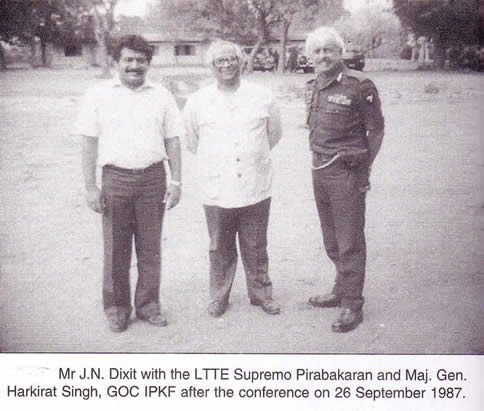
It was strange that Gandhi was entertaining such concerns when he portrayed the PC as the way to meet aspirations of the Tamils people. However, to prevent any embarrassment by a display of resentment Gandhi sent an Air Force Helicopter to Jaffna to fetch Prabhakaran and his political adviser Anton Balasingham, to New Delhi, on July 28, 1987. That was the night before the accord was to be signed. They were held at the Ashok Hotel before being ushered to a meeting with Gandhi.
Prabhakaran was indeed outraged by the proposal. He rejected the idea of PCs in place of Eelam. But for Gandhi this was the furthest he could go. With the persistent threat from Tamil Nadu to break off, a separate Tamil state next door was the last thing India needed.
Current situation
Gandhi coaxed and bribed the LTTE supremo with the promise of new arms and ongoing funding. When none of it worked he appealed to Prabhakaran to remain silent at least till the agreement came into force. For India there was a lot at stake.
But Prabhakaran could not contain his anger for long at Gandhi’s audacity to undermine his long cherished dream. Before the week was out he called a public meeting in Jaffna and told the people this was not what he wanted but what has been thrust upon him.
When a big power decided this was the way things happen, there was nothing we could do”, Prabhakaran lamented. And that was the day Rajiv Gandhi became a marked man.
The fact that the Northern Provincial Council remained confined to the statue book for 26 years shows that it was not a deal wanted by any one, other than India. The forthcoming CHOGM has forced the issue once again.
There is growing pressure from many quarters for elections to the Northern Provincial Council as a key step in reconciliation. Foremost among them is India, along with some major powers and NGOs.
There are different reasons for different groups to push for elections but for all of them any measure that discredits the government and ties it up in knots was an achievement.
For India it is unfinished business, which has become even more critical after China entered the scene in recent years. Besides that, is the need to satisfy the demands of Tamil Nadu politicians especially in the lead up to a general election next year.
At the same time the Diaspora, through its funding and promise of electoral support, is manipulating several Western governments. The clearest example of this is Canada, which preferred to paint itself into a corner without attending CHOGM. It was prepared to forego the opportunity to display its muscle as a founding member of the Commonwealth in preference to wooing its Tamil electorate.
The other prominent groups include NGOs whose livelihood depends on ‘discovering’ human rights abuses and this group also includes sections of the United Nations. They have to keep the pot boiling to ensure the continued flow of backhanders from foreign regimes to destabilise vulnerable governments.
The current legal spat between an NGO and the Norwegian government when such a deal went sour, shows how the system involving big money, works. Then of course there are a number of opposition parties within the country for whom this issue is bread and butter.
These ongoing manoeuvres make one thing clear: it does not mean that once the elections are held the pressure will cease. By definition all these interlocutors have to move on to another, since that is the only way to justify their existence. Should the government simply yield to these demands and hold elections or consider the issue carefully to implement an option that serves the best long-term interest of the country?
There are enough reasons to show that Sri Lanka will be greatly disadvantaged if the Provincial Council system is perpetuated with an election to the Northern PC.
For geographically large countries such as the United States, India and Australia establishing decentralised systems of government is not only desirable but also essential. In most of these countries administering the periphery from the centre is difficult and inefficient. Reaching some distant places from the centre in an emergency will take several hours.
By comparison Sri Lanka is minute. For instance in terms of area it is only 0.002 per cent of India and in relation to population it is only 0.02 per cent. There is no place in the country that cannot be reached by air within one hour. In recent years new technology and a good roading network have made the country even smaller.
In this situation another layer of provincial government only adds inefficiencies and works as an unnecessary drain on public resources. The government currently provides Rs 130 billion of direct funding to Provincial Councils each year, while the councils themselves collect another Rs 38 billion in local taxes.
Without a comparable return such a large-scale burden on taxpayer funds only tends to divert valuable resources away from productive uses. Apart from the waste of funds the more invidious cost to the country is the red tape, corruption and the delays that such a system generates.
Apart from increased wastefulness there is another fundamental economic issue involved here. Achieving high rates of growth is a major national objective of the Rajapaksa government. That requires the optimum use of available resources, land, labour, technology and capital. While the last three are mobile and can be moved around and supplemented with imports, the first, land resource, has a finite limit and is immovable.
Hence the best way to gain optimum output from land is to take the other resources, in particular labour, to where land is available. The critical requirement here is land availability. The 2012 census shows the distribution of population by district and the population densities of each.
(Table 1)
It shows more than half the districts have population densities less than the average for the country of 309/km². Population density in Moneragala, for instance, is 79 which is 25 per cent of the average.
Mullativu with 35/km² has the lowest density of 11 per cent of the average. In other words Mullativu has almost four times the land area of the Colombo district but only 0.04 per cent of its population.
The effect of this divergence is that districts such as Colombo are so densely populated that people tend to get in each other’s way while places such as Moneragala and Mullativu are crying out for more labour, for their growth is hampered by the shortage. Of course the availability of other resources is critical but all those can be brought in from outside unlike land.
If the objective of high economic growth is to be achieved the central government should be able to move resources around the country to help maximise national gains. Provincial Councils, on the other hand will not be seeing land under their control from the same national viewpoint. By definition what they will want is to protect their patch.
Land and police powers will further reinforce that trend.
In this regard it is worth noting that in Paragraph 6.104 of its report the LLRC makes a far-reaching recommendation:
Any citizen of Sri Lanka has the inalienable right to acquire land in any part of the country, in accordance with its laws and regulations, and reside in any area of his/her choice without any restrictions or limitations imposed in any manner whatsoever.
The land policy of the government should not be an instrument to effect unnatural changes in the demographic pattern of a given Province. In the case of inter provincial irrigation or land settlement schemes, distribution of State land should continue to be as provided for in the Constitution of Sri Lanka”.
The most important advantage of a unitary administration is that its decisions, by very nature, are to promote national interest and not parochial advantage. Even without granting land and police powers devolution could hamper government management of the country.
This is clear from India’s experience. For instance the Indian central government has been forced to make compromises due to the need to maintain state government political support for the centre. In some instances the centre may be made completely impotent by a regional administration by injudicious use of authority.
As a recent example of this it has been said that during the last Indian general election the plane carrying Congress Party leader, Sonia Gandhi was not given permission to land in Uttar Pradesh, a state under the control of the opposition.
Does not address issues
There is a perception abroad that giving greater autonomy to the northern province will lead to reconciliation. This is not a realistic expectation. One reason is that only a minority of Tamils live in the northern province.
The latest census data on population for 2012 shows the total Sri Lankan Tamil population in Sri Lanka as 2.27 million or 11 per cent of the total population.
Out of this the Tamil population in the Northern Province is 0.98 million or 43 per cent. In other words less than half the Tamil population live in the five administrative districts comprising the Northern province and the rest live among the Sinhalese and Muslims and other communities in other parts of the country.
The Indo-Sri Lanka Accord indirectly recognised the dispersion of the Tamil population by declaring as the rationale for setting up the provincial administration the facilitation of the return of Tamils living in other areas to these enclaves. But what has happened is quite the opposite. The 2012 census data confirms this.
(Table 2)
In all but four districts the number of Sri Lankan Tamils living in the south increased significantly between 1981 and 2012. This was in spite of having a Tamil administration under the LTTE and despite declaring the region as Tamils only by Prabhakaran by ousting all Muslims and Sinhalese.
There are a number of implications of the movement of Tamils to other areas in increasing numbers.
a) The needs of those living in the north and those dispersed elsewhere are different. Addressing reconciliation on the basis of the situation of a minority of Tamils who live in the north will therefore be ineffective;
b) Restricting the Council territory to Tamils would invariably be the stance with the representatives of the PC after the elections. This is evident even without granting land powers, from TNA MPs currently campaigning against return of the Sinhalese and Muslims ousted by Prabhakaran.
c) When Tamil citizens of the country use their democratic right to live anywhere in the country it would be inequitable to artificially restrict non-Tamil citizens settling in the northern province.
d) Elections will be counter to the recommendations of the LLRC, which was intended to provide a sound basis for reconciliation. One of the conditions it proposed was that Devolution of power should not privilege or disadvantage any ethnic community, and should not be discriminatory or seen to be discriminatory by the people belonging to any ethnic community within the country”. As noted earlier it also reiterated that any citizen of Sri Lanka has the inalienable right to acquire land and live in any part of the country.
Recommendations of the LLRC
The LLRC recommendations are widely recognised, within the country as well as by the international community, as a suitable basis to bring about reconciliation. The Commission had far reaching proposals relating to devolution of power in the eight paragraphs 9.229 to 9.237.
They include the following:
a. Devolution should essentially promote greater harmony and unity and not disharmony and disunity among the people of the country. The promotion of this ‘oneness’ and a common identity should be the principal aim of any form of devolution while protecting and appreciating rich diversity.
b. Need to ensure that the people belonging to all communities are empowered at every level.
c. Devolution of power should not privilege or disadvantage any ethnic community, and should not be discriminatory or seen to be discriminatory by the people belonging to any ethnic community within the country.
d. Empowerment of the people should take place within the broader framework of the promotion and protection of human rights.
e. Empowering the Local Government institutions to ensure greater peoples’ participation at the grass roots level.
f. The lessons learnt from the shortcomings in the functioning of the Provincial Councils system should be taken into account.
g. Provide for safeguarding the territorial integrity and unity of Sri Lanka whilst fostering its rich diversity.
h. An additional mechanism to be considered is the possibility of establishing a Second Chamber comprising Representatives from the Provinces.
i. Any power sharing arrangement needs to have inbuilt mechanisms that would effectively address and discourage secessionist tendencies and safeguard the sovereignty and integrity of the State.
LLRC also cautioned that all parties must commit themselves to finding solutions internally through negotiation with each other. The report noted that the Tamil leaders should take account of the unnecessary internationalization of the ethnic issue and the external pressures exercised by the Diaspora and its impact on the negotiations for a political settlement.
The perceptions of external threat and intervention, the Commission noted, can create a sense of insecurity that can seriously impede the progress towards an acceptable solution. It also reiterated the need to launch a good faith effort to develop a consensus on devolution, building on what exists – both, for maximum possible devolution to the periphery especially at the grass roots level, as well as power sharing at the centre.
This consensus should be one that will enable peoples’ participation in governance decisions affecting them and avoid costly and unnecessary duplication of political, bureaucratic and other institutional structures that hamper efficient, cost-effective and transparent governance.
Four important considerations relating to Provincial Councils emerge from the recommendations of LLRC:
1. Safeguarding the territorial integrity and unity of Sri Lanka whilst fostering its rich diversity.
2. Ensure that any power sharing arrangement has inbuilt mechanisms that would effectively address and discourage secessionist tendencies and safeguard the sovereignty and integrity of the State.
3. Build on what exists – both, a) for maximum possible devolution to the periphery especially at the grass roots level and to ensure greater peoples’ participation, b) as well as power sharing at the centre.
4. To accommodate provincial viewpoint in legislative decision-making consider the possibility of establishing a Second Chamber comprising Representatives from the Provinces.
What is evident from these is the incompatibility of the 13th Amendment with LLRC recommendations. For instance 13A does not allow for maximum devolution of power to the periphery – the grass roots level. The peripheral unit it defines is the Province. Nor does it accommodate power sharing with the centre. Neville Ladduwahetty has provided more details in a recent article.
It is important that the government takes note of the LRCC recommendations for they are seen, both within and outside Sri Lanka, as the key to reconciliation. The President has echoed many of the views expressed by LLRC. In the 2013 budget speech he underlined the need for A change in the prevailing Provincial Council system to make devolution more meaningful to our people.
Devolution should not be a political reform that will lead us to separation but instead it should be one that unifies all of us. It should not involve high spending and complex governance structures that will impose further burden on people.” The President also identified the issues that people are concerned with. Everybody who met me from all corners of Sri Lanka whether they were Tamils, Muslims or Sinhalese, asked for greater access to education, health, employment opportunities, better living and equal standards across the nation. The elimination of provincial disparities using national standards is the main weapon through which national reconciliation can be promoted.
This government remains committed to ensure that these aspirations of our people will be fulfilled”. The point to note is that the delivery of these expectations of the pubic is best undertaken by the central government and not any regional administration.
The significance of the Northern PC Elections
The particular significance of the Northern Provincial Council elections is that the area covered is the same territory the LTTE was claiming as the base for Eelam, a separate state. During the three decades of confrontations the Tamil National Alliance (TNA) represented the terrorist group in parliament.
Since its defeat there has been no official group representing the LTTE although its agenda continues to be promoted by the TNA. If the group wins the forthcoming elections, as it has been predicted, it would amount to giving official recognition to continue the LTTE agenda.
It would turn out to be the rallying point for all the country’s enemies. That is why the Defence Secretary’s recent warning that having paid a heavy price in the battlefield to eradicate the LTTE, it would be foolish on our part to create conditions for a new war”, resonates with the public.
Is there a better way?
We are in a bind right now. International pressure to hold northern elections has come to a head with several forces bent on cashing in on the vulnerability of the government leading up to the CHOGM. India’s leaning on Sri Lanka resembles somewhat the pressure applied on JR Jayawardene prior to signing of the Accord in 1987. But the present government is not in a similar sticky situation since it has other options.
There are some key points that need to be recognised in any decision the government takes. The first is whatever the choice, it has far reaching implications for the country in the long term. Hence it is important to base it on maximising the nation’s benefit rather than as an expedient to respond to external pressure.
Secondly a measure that satisfies the critics will only create a temporary lull in interference, for by very nature they will move on to another issue. Thirdly, President Rajapaksa has the rare capability to make the change since he has the vision and commands the support of the parliament and the public.
The crisis offers the opportunity to make the gains made in 2009 enduring. Although there has been considerable criticism of devolving power to Provincial Councils and holding elections no one has disagreed on the principle of devolution.
In fact the LLRC has underlined the need for devolution as a means of helping in the reconciliation.
But what it recommends is that power should be devolved to the grass roots level in a way that discourages secessionist tendencies and safeguard the sovereignty and integrity of the State”.
The Northern Province will be a competing entity as it was coveted by the LTTE as their base for Eelam. Devolving power to the District will meet both conditions laid out by LLRC: giving power to the grass roots level and discouraging secessionist tendencies and safeguard the sovereignty and integrity of the state.
The LLRC also suggested considering the possibility of a second chamber to involve the people at the periphery in decision making. This is debatable for there is already such representation in parliament through the existing electoral system.
LLRC itself did not put forward the idea as a recommendation but as a matter for consideration. What is required in devolving power to grass roots level is a clear definition of the role and responsibilities of District Councils and to ensure that no amalgamation of District Councils is possible. They could be empowered to meet the expectations of the public in relation to health, education and other services as the President identified in the budget speech.
Writer is an economist, author and freelance journalist. He can be contacted at donwije@yahoo.com
Avant Garde Chairman Nissanka Senadhipathi said he was prepared to operate a floating hospital and surgery to facilitate the repatriation of Sri Lankan migrant workers.
Senadhipathi said that he is currently in discussion with Sri Lankan authorities to initiate the proposed programme.
“About a month earlier, a plan was in place to repatriate migrant workers in an emergency situation such as this one. Therefore communications and documentation were in place to prepare cruise liners as floating hospitals or corona centres,” he said.
Senadhipathi said discussions are underway to launch cruise liners with the capacity to carry 10,000 persons. If the President approves the suggested project, the cruise liners would be sent to several Middle Eastern countries where the ships would be docked at ports of the respective countries. The ships would serve as floating quarantine centres for a period of 14 days, following which, migrant workers would be offloaded in Sri Lanka after PCR tests.
“We had several discussions as to what could be done in the event the situation worsens. I have discussed these measures with the UAE Embassy as well as the Foreign Secretary. We have suggested for at least ten thousand migrant workers to be quarantined aboard four of such ships,” Senadhipathi added. (Kalani Kumarasinghe)
Samagi Jana Balawegaya (SJB) MP and Tamil Progressive Alliance (TPA) leader Mano Ganesan yesterday said there were aspects of the 20th Amendment which he cannot agree with, but would agree with the clause under which those with dual citizenship are allowed to come into Parliament.
There are some aspects of the 20th Amendment which I don’t agree to but there is nothing wrong in the clause under which, those who hold dual citizenship are allowed to come into Parliament,” he said.
There is nothing wrong in those who hold dual citizenship coming into Parliament,” Mr. Ganesan said. This is the ideology of TPA which I lead,” he told journalists.
There is nothing wrong in former Minister Basil Rajapaksa coming into Parliament as he anyway holds the remote control of this government. Let him come and control the government openly,” Mr. Ganesan added.(Yohan Perera)
The owners of the crude oil tanker MT New Diamond”, which was engulfed by flames on Thursday morning (03) off Sri Lanka, have handed over the vessel to an international salvage company.
A team of the company is set to arrive in Sri Lanka on Monday (07), the chairperson of the Marine Environment Protection Authority (MEPA) said.
At around 8.30 am on Thursday (03), the oil tanker, carrying 270,000 metric tons of crude oil, had been sailing 38 nautical miles off Sangamankanda Point east of Sri Lankan seas, when the unfortunate turn of events unfolded.
Sri Lanka Navy (SLN), Sri Lanka Air Force (SLAF), Sri Lanka Ports Authority (SLPA), the Indian Navy and the Indian Coast Guard are engaged in a joint effort to control the fire raging in the oil tanker, caused by an explosion of a boiler in the main engine room.
The Navy has rescued 22 of the 23 crew members aboard the oil tanker, however, the preliminary information from the ship’s crew confirmed that a Filipino seaman on board had died in a boiler explosion.