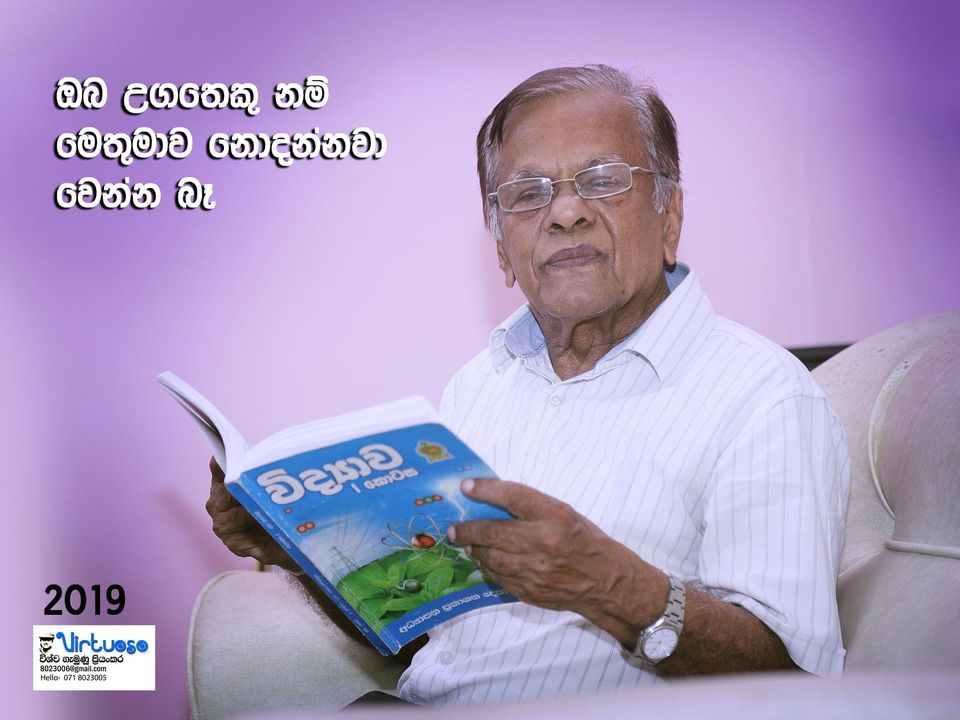
අපට විද්‍යාත්මක චින්තනය ඉගැන්වූ කේ ආරියසිංහ ගුරුතුමා

September 16th, 2020

වෛද්‍ය රුවන් එම් ජයතුංග

විද්‍යාව ඉගැන්වූ දක්‍ෂ ගුරුවරු තිදෙනෙක් මුණ ගැසීමට සහ ඔවුන් ගෙන් ඉගෙනුම ලැබීමට මට භාග්‍ය ලැබුණි. පිළිවෙලින් ජී .ගෞතමදාස , පී.ඩී.ඩබ් ජයවර්ධන සහ කේ ආරියසිංහ යන මහතුන් මෙසේ නම් කල හැකිය. කේ. ආරියසිංහ මහතා අපට විද්‍යාව ඉගැන්වූයේ ප්‍රගති විද්‍යායතනයේය. එතුමාගෙන් ඉගෙනුම ලැබූ දහසක් වූ වෛද්‍යවරු ඉන්ජිනේරුවරු සහ විවිධ විශේසඥයෝ අද ලෝකය පුරා තම සේවය ප්‍රජාවට ලබා දෙති. 

කේ. ආරියසිංහ මහතා අපට දුන්නේ විද්‍යා දැණුම පමණක් නොවේ. විද්‍යාත්මක චින්තනයටද ආරියසිංහ මහතා අපව හුරු කලේය. එතුමාගේ පන්ති වලදී බොහෝ විට සිසුන්ට පත්‍රිකා ලැබුනු අතර එහි විවිධ ප්‍රශ්න තිබුනේය. මේ ප්‍රශ්න සාමාන්‍ය ජීවිතයේ අප මුහුණ දෙන ඒවාය. එම ප්‍රශ්න විද්‍යාත්මකව විශ්ලේෂණය කිරීමට එතුමා අපව යොමු කලේය. උදාහරණයක් ලෙස 1981 වැනි කාලයක එතුමා අපට දුන් ප්‍රශ්නයක් මට තවමත් මතකය. දිගු ගමනකින් පසුව මෝටර් ර්ථයක ටයරයක පීඩනය අඩුවේද ? වැඩිවේද ? මේ ප්‍රශ්නයට අප හතර අතේ කල්පනා කලෙමු. එවැනි ප්‍රශ්න මගින් එතුමා අපට  තර්කාණුකූල ලෙස සිතීමට  හුරු කලේය. මේ තර්කාණුකූල විද්‍යාත්මක චින්තනය විශ්ව විද්‍යාලීය ජීවිතයේදී පමණක් නොව සාමාන්‍ය ජීවිතයේදී අපට උපකාර විය. 

කේ. ආරියසිංහ මහතාට ද්වී භාෂා කුසළතාව තිබේ. එතුමාට සිංහලෙන් මෙන්ම ඉංග්‍රීසි භාෂාවෙන් විද්‍යාව ඉගැන්වීමේ හැකියාවක් ඇත. අද කාලයේ එවැනි හැකියාවක් ඇත්තෝ සීමිතය. තවද කේ. ආරියසිංහ මහතා සිසු විනය පිලිබදවද සැලකිලිමත් විය. වෙනත් ටියුෂන් කාරයන් මෙන් පන්තියේ විනය උලංඝනය කිරීමට උඩ ගෙඩී දීම , දෙපිට කැපෙන කතා සිසුන්ට කීම වැනි දේ එතුමා නොකලේය. ඇත්ත වශයෙන්ම අප පාසලටත් වඩා ප්‍රගති ආයතනයේදී හොඳින් හැසිරුනෙමු. 

සාමාන්‍ය පෙළ කාලයේ සිටම මට විද්‍යාත්මක ලිපි ලිවීමේ පුරුද්දක් තිබුණි. වරක් මගේ ලිපියක් කියවූ කේ. ආරියසිංහ මහතා මාව ලේක් හවුස් ආයතනයට රැගෙන ගොස් නවයුගය කර්තෘට හඳුන්වා දුන්නේය. එසේම ලේඛන කලාවට මට දිරි දුන්නේය. එතුමා ශ්‍රී ලංකා විද්‍යා ලේඛකයන් ගේ සංගමයේ සභාපති වූ අතර එම සංගමයට මාව බඳවා ගත්තේය. මේ වන විට බොහෝ පොතපත ලියා ඇති මා හට ලේඛන කලාවේ අයන්න ආයන්න ඉගැන්වූයේ කේ. ආරියසිංහ මහතා බව මා කෘතවේදීව කියමි. 

කේ. ආරියසිංහ මහතා සිසු සිසුවියන් පරම්පරා කීපයකට ඉගැන්නුවේය. එතුමා හුදු විද්‍යා ගුරුවරයෙකු නොවේ ; කේ. ආරියසිංහ යනු විරල ගනයේ වෘත්තාන්තකි. අධ්‍යාපන පහන් ටැඹකි. ඒ පහනින් ආලෝකය ලැබුවෝ බොහෝ දෙනෙකි. එම ආලෝකය තවමත් වර්තමාන ශිෂ්‍ය පරම්පරාවට ආලෝකය ලබා දෙයි. 

වෛද්‍ය රුවන් එම් ජයතුංග

දේශීය හස්ත කර්මාන්තය වඩාත් ප්‍රචලිත කිරීමට රටක් ලෙස ඒවා පරිහරණය කළ යුතුයි- ගරු අග්‍රාමාත්‍ය මහින්ද රාජපක්ෂ මැතිතුමා.

September 16th, 2020

අග්‍රාමාත්‍ය මාධ්‍ය අංශය

දේශීය හස්ත කර්මාන්තය වඩාත් ප්‍රචලිත කිරීමට නම් එම නිෂ්පාදන අලෙවි කිරීම මෙන්ම, රටක් ලෙස ඒවා පරිහරණය කළ යුතුව ඇතැයි අග්‍රාමාත්‍ය මහින්ද රාජපක්ෂ මැතිතුමා අද 2020.09.16 දින පැවැසීය.

වේවැල්, පිත්තල, මැටි, ලී බඩු සහ ග්‍රාමීය කර්මාන්ත ප්‍රවර්ධන අමාත්‍යංශය, ජාතික ශිල්ප සභාව, එක්ව ශ්‍රී ලංකා ඉඩම් සංවර්ධනය කිරීමේ සංස්ථාවේ සහයෝගයෙන් සංවිධානය කළ SHILPA THURSDAY විශේෂ හස්ත කර්මාන්ත  අලෙවි ප්‍රදර්ශනය  විවෘත කිරීමේ අවස්ථාවට එක් වෙමින් ගරු අග්‍රාමාත්‍ය මහින්ද රාජපක්ෂ මැතිතුමා මේ බව සඳහන් කළේය.

SHILPA THURSDAY අලෙවි ප්‍රදර්ශනය සෑම බ්‍රහස්පතින්දා දිනකම බත්තරමුල්ල, දියත උයන පරිශ්‍රයේදී පැවැත්වීමට නියමිතය.

ගරු අග්‍රාමාත්‍ය මහින්ද රාජපක්ෂ මහතා එහිදී කළ සම්පූර්ණ කතාව මෙසේය,

ජාතික ශිල්ප සභාව සංවිධානය කළ අත්කම් වෙළඳපොළ විවෘත කිරීමට අවස්ථාවක් ලැබීම පිළිබඳව සතුටු වෙනවා. අපි අපේ රජයන් යටතේ බලයට පත්වන සෑම අවස්ථාවකම දේශීයත්වයට මුල් තැන ලබා දුන්නා, යැයි  කියන එක මා අමුතුවෙන් කිව යුතු කාරණයක් නොවේ.

පසුගිය කාලයේ ආපස්සට ගිහිල්ල තිබුණු දේශීය කර්මාන්ත අපිට ආපසු ගොඩනගන්නට අවස්ථාවක් ලැබීම පිළිබඳව අපි සන්තෝෂ වෙනවා. ඒ වගේම රාජ්‍ය අමාත්‍යවරයා මේ පිළිබඳව දක්වන උනන්දුව ගැන අපි එතුමාට අපේ ස්තුතිය පුද කරනවා.

දේශීය හස්ත කර්මාන්තය වඩාත් ප්‍රචලිත කරන්න නම් අපි මේ නිෂ්පාදන අලෙවි කිරීම වගේම, අපි ඒවා පාවිච්චි කිරීම කළ යුතු වෙනවා. එහෙම නම්, ඒ සඳහා මෙවැනි වෙළදපොළවල් තිබීම තුළින් වඩාත් උනන්දුවක් දක්වන්ට හා මේවා ප්‍රචලිත වෙන්නට එය හේතුවක්.

අද විශේෂයෙන්ම ගමේ ශිල්පීන්ට තිබෙන විශාල ප්‍රශ්නය තමයි බැංකු ණයක් ගන්න එක. ඔවුන්ට තමන්ගේ කර්මාන්තය දියුණු කර ගැනීමට හෝ ඉදිරියට ගෙන යාමට මුදල් අවශ්‍යතාවය තිබෙනවා. ඔවුන්ට ණයක් ගැනීමේදී මීට වඩා ලිහිල් ප්‍රතිපත්තියක් අනුගමනය කළ යුතු යැයි මම  විශ්වාස කරනවා.

ඒ වගේම අද මහජන බැංකුවේ සභාපතිතුමා මෙතන ඉන්නවා. මෙවැනි ප්‍රදර්ශන තියෙන අවස්ථාවලදී ඔවුන්ගේ බැංකුවේ, ළඟම ශාඛාව හෝ එහෙම නැත්නම් තාවකාලික ශාඛාවක් මෙහි විවෘත කරලා මේ කලා ශිල්පීන්ට අවශ්‍ය වන මුදල් ප්‍රමාණය, එහෙම නැත්නම් ණය  සහනාධාරයක් ලබා ගැනීමට අවස්ථාව ලැබෙනවා නම් මෙම කලා ශිල්පීන්ට මීට වඩා එය ප්‍රයෝජනයක් වෙයි කියලා මම විශ්වාස කරනවා.

හැම බ්‍රහස්පතින්දාවකම මේ ස්ථානයේ මෙවැනි වෙළඳපොළක් විවෘත කිරීමට තීන්දු කිරීම පිළිබඳව මෙම අමාත්‍යංශයට මම සුබ  පතනවා, යැයි අග්‍රාමාත්‍යතුමා පැවසීය.

මෙහිදී, බංග්ලාදේශයේ රැකියාවල නිරත වන, ශ්‍රී ලාංකිකයින්ගේ ශ්‍රී ලංකා මිත්‍රත්ව සංගමය විසින් කොවිඩ් අරමුදල සඳහා රුපියල් ලක්ෂ පහක මුදලක් පරිත්‍යාග කිරීම ද සිදු විය. එම සංගමයේ සභාපති  සම්පත් එරුගෙපොළ මහතා විසින් එම මුදල් ගරු අග්‍රාමාත්‍යතුමා වෙත භාර දුන්නේය.

මෙම අවස්ථාව සඳහා කර්මාන්ත අමාත්‍ය විමල් වීරවංශ, වේවැල්, පිත්තල, මැටි, ලී බඩු සහ ග්‍රාමීය කර්මාන්ත ප්‍රවර්ධන රාජ්‍ය අමාත්‍ය ප්‍රසන්න රණවීර, වේවැල්, පිත්තල, මැටි, ලී බඩු සහ ග්‍රාමීය කර්මාන්ත ප්‍රවර්ධන රාජ්‍ය අමාත්‍යාංශයේ ලේකම් එම්.ඒ.බී.වී. බණ්ඩාරනායක, ජාතික ශිල්ප සභාවේ සභාපති සුදත් අබේසේකර, බංග්ලාදේශ තානාපති මොහොමඩ් අලි ඛාන්, මහජන බැංකුවේ සභාපති සුජීව රාපක්ෂ  ඇතුළු මහත්ම මහත්මීන් රැසක් එක්ව සිටියහ.

නැගෙනහිර පළාතේ පවතින ගැටලු හා සංවර්ධන කටයුතු සම්බන්ධයෙන් මෙතෝදිස්ත සභාවේ පූජක පියතුමන්ලා හා රජයේ නිලධාරීන් පිරිසක් අග්‍රාමාත්‍යතුමා හමුවෙති

September 16th, 2020

අග්‍රාමාත්‍ය මාධ්‍ය අංශය

නැගෙනහිර පළාතේ පවතින ගැටලු හා සංවර්ධන කටයුතු සම්බන්ධයෙන් මෙතෝදිස්ත සභාවේ පූජක පියතුමන්ලා හා රජයේ නිලධාරීන් පිරිසක්අග්‍රාමාත්‍ය මහින්ද රාජපක්ෂ මහතා සමඟ අද (2020.09.16) දින අරලියගහ මන්දිරයේදී සාකච්ඡාවක නිරත වූහ.

නැගෙනහිර පළාතේ තිරුක්කෝවිල්, කල්මුණේ, අම්පාර යනාදී ප්‍රදේශයන් හි පාසල්, නිවාස, රෝහල්, ගමනාගමනය, අධ්‍යාපන යන ක්ෂේත්‍රයන් හි පවතින ගැටළු සම්බන්ධයෙන් මෙහිදී සාකච්ඡා කෙරිණි.

අම්පාර නගර සංවර්ධනය, ඇඟළුම් හා වෙනත් කර්මාන්තශාලා සහිත කාර්මික පුරයක් ඇති කිරීම, පසුගිය කාලයේ නැවතී ඇති ගමනාන්ත දක්වා නව බස්රථ සේවාවන් ආරම්භ කිරීම, දේවස්ථාන නියාමනයක් සහිතව ගොඩනැගීම, කිතුණු ආගමික ගුරු පුරප්පාඩු පිරවීම හා දරුවන් කිතුනු පාසල්වලට ඇතුළත් කිරීමේදී ඇති වන ගැටලු සම්බන්ධයෙන් මෙහිදී වැඩිදුරටත් සාකච්ඡා විය.

අග්‍රාමාත්‍යතුමාගේ ප්‍රධානත්වයෙන් පැවති මෙම හමුවට පී.එස්.චමීර සිල්වා පියතුමා සහ  අග්‍රාමාත්‍ය ලේකම් ගාමිණි සෙනරත්, අතිරේක ලේකම්වරුන් වන චමින්ද කුලරත්න, ඇන්ටන් පෙරේරා, අධ්‍යාපන අමාත්‍යාංශ ලේකම් මහාචාර්ය කපිල පෙරේරා, බුද්ධ ශාසන, ආගමික කටයුතු හා සංස්කෘතික කටයුතු අමාත්‍යාංශ ලේකම් මහාචාර්ය කපිල ගුණවර්ධන, ක්‍රිස්තියානි කටයුතු දෙපාර්තමේන්තු අධ්‍යක්ෂ චතුරි පිංතු, නැගෙනහිර පළාත් නියෝජ්‍ය ප්‍රධාන ලේකම් එච්. ඊ. එම්. ඩබ්ලිව්. ජී. දිසානායක, නැගෙනහිර පළාත් අධ්‍යාපන ලේකම් අයි. කේ. ජී. මුතුබණ්ඩා යන මහත්ම මහත්මීන් පිරිසක් එක්ව සිටියහ.

Research should be focused to resolve issues affecting the general public. – State Minister Dr. (Mrs.) Seetha Arambepola.

September 16th, 2020

State Minister of Skills Development, Vocational Education, Research and Innovation

Dr. (Mrs.) Seetha Arambepola , State Minister of Skill Development, Vocational Education, Research and Innovations stated that scientific research should be carried out identifying the issues encountered by the general public and aimed at resolving such issues The Hon. Minister expressed these views recently during an observation visit she paid to the Industrial Technology Institute at Malabe.  

She paid special attention to the ongoing research and value added products being developed by the institution, employing latest research technologies and inaugurated the construction of the final phase of the Herbal Products Laboratory being  developed under the China – Sri Lanka joint bio technology laboratory project, on the premises of the research complex.

 The Hon. Minister further expressing her views said

Scientists at our Institutions are tirelessly engaged in scientific research with much dedication. We have to find out the degree of contribution towards the upliftment of the living standards of the general public and strengthening the economy of the country. These research should provide sustainable solutions to the issues being encountered by the general public”

Therefore it is vital that efficient coordination between all research Institutions under the Ministry is established ensuring close links with mutual understanding. This makes it easy to find solutions for common issues through research. I intend to invite a programme to have a round table discussion with all research Institutions under the purview of the Ministry. The exchange of knowledge among institutions is vitally important. Sometimes, research of similar nature are carried out at various institutions. A research would commerce at a particular institution while a research of similar nature has continued up to a certain extent. Since this is a waste of time and money, it is my opinion that it is more productive if such research could be continued from the point another institution stopped it.”

The Hon. Minister gave instructions to officials to initiate necessary measures to utilize the knowledge gained form research to introduce new products to the public and also to transfer such technologies to several entrepreneurs targeting the creation of a network of industries.    

Dr. Sirimal Premakumara, Chairman of ITI, stated that since Sri Lanka is a country rich in valuable and rare herbs, the said laboratory will be made use of to produce herbal pills, capsules, syrups and various local medical compounds employing high end technologies to add value to these local herbs and that a grant of US dollars 600,000 has been received from the Chinese Government for the purpose of setting up of this laboratory.

Prabod Udugama

Media Secretary to the Hon. State Minister of Skills Development, Vocational Education, Research and Innovation.

ජනතාවට බලපාන ගැටළු හඳුනාගනිමින් ඒවාට විසඳුම් සෙවීමට පර්යේෂණ සිදුකළ යුතුයි. – රාජ්‍ය ඇමතිනී සීතා අරඹේපොල

September 16th, 2020

නිපුණතා සංවර්ධන, වෘත්තීය අධ්‍යාපන, පර්යේෂණ හා නව නිපැයුම් රාජ්‍ය අමාත්‍ය අංශය

ජනතාවට බලපාන ගැටළු හඳුනාගනිමින් ඒවාට විසඳුම් සෙවීමට විද්‍යාත්මක පර්යේෂණ සිදුකළ යුතු බව නිපුණතා සංවර්ධන, වෘත්තීය අධ්‍යාපන, පර්යේෂණ හා නව නිපැයුම් රාජ්‍ය ඇමතිනී සීතා  අරඹේපොල මහත්මිය පැවසුවා ය. අමාත්‍යවරිය මේ බව පැවසූවේ පසුගිය දින මාළඹේ කාර්මික තාක්ෂණ ආයතනයේ නිරීක්ෂණ චාරිකාවකට එක්වෙමිනි. මෙම නිරීක්ෂණ චාරිකාවේ දී එම ආයතනය තුළ සිදු කෙරෙන පර්යේෂණ කටයුතු හා  නව පර්යේෂණ දැනුම තුළින් නිර්මාණය කරන ලද අගය එකතු කළ නිෂ්පාදන අමාත්‍යතුමියගේ විශේෂ අවධානයට යොමු වූ අතර, පර්යේෂණ සංකීර්ණයේ ස්ථාපනය කෙරෙන චීන ශ්‍රී ලංකා ඒකාබද්ධ ජෛව තාක්ෂණ විද්‍යාගාර ව්‍යාපෘතිය යටතේ, නිර්මාණය වන ශාකසාර ඹෟෂධ නිෂ්පාදන පර්යේණාගාරයේ අවසන් අදියරේ  ඉදිකිරීම් ආරම්භය ද අමාත්‍යතුමියගේ ප්‍රධානත්වයෙන් සිදුකෙරිණි.

මෙහි දී වැඩි දුරටත් අදහස් දැක් වූ අමාත්‍යවරිය මෙසේ ද පැවසුවාය.

අපේ පර්යේෂණ ආයතන වල විද්‍යාඥයින් මහත් පරිශ්‍රමයකින් විද්‍යාත්මක පර්යේෂණ කරනවා. එම පර්යේෂණ හරහා ගොඩනැගෙන දැනුම පොදු ජනතාවගේ ජීවන තත්වය ඔසවා තැබීමට කොතරම් බලපානවා ද, රටේ ආර්ථිකය ශක්තිමත් කිරීමට ලබා දෙන දායකත්වය කොතරම් ද  යන්න විමසා බැලිය යුතුයි. මෙම පර්යේෂණ වල ඉලක්කය  විය යුත්තේ ජනතාවගේ ගැටළු වලට තිරසාර විසඳුම් ලබා දීමයි.”

   මේ සඳහා අමාත්‍යාංශය යටතේ ඇති සියලු පර්යේෂණ ආයතන හොඳ සම්බන්ධීකරණයක් අනන්‍යොන්‍ය අවබෝධයක් සහිතව එකට වැඩ කිරීම ඉතා වැදගත්. ඒ තුළින් පොදු ගැටළුවට පර්යේෂණ මගින් විසඳුම් සෙවීමට පහසු වෙනවා. අමාත්‍යාංශය යටතේ ඇති සියලු පර්යේෂණ ආයතන එක් මේසයකට කැඳවා සාකච්ඡා කිරීමට මම වැඩපිළිවෙළක් සකස් කරනවා. ආයතන අතර දැනුම හුවමාරු කිරීම ඉතා වැදගත්. ඇතැම් විට එකම ආකාරයේ පර්යේෂණ විවිධ ආයතන තුළ සිදු කෙරෙනවා. එක් ආයතනයක් තුළ යම් මට්ටමකට අවසන් කර ඇති ආකාරයේම  පර්යේෂණයක්, තවත් ආයතනයක් මුල සිට ආරම්භ කරනවා. එය කාලය සහ මුදල්  අපතේ යෑමක් බැවින්, යම් පර්යේෂණයක් එක් ආයතනයක් නැවතූ සන්ධිස්ථානයක සිට තවත් ආයතනයකට ආරම්භ කළ හැකි නම් එය ඵලදායී බවයි මගේ හැඟීම.” යනුවෙන් ප්‍රකාශ කළාය.

 පර්යේෂණ හරහා සොයා ගන්නා නව දැනුම තුළින් නිෂ්පාදනයක් බිහි කරන්නේ නම් ඒවා වාණිජකරණය කිරීමෙන් ජනතාව අතරට ගෙනයාමත්,  තාක්ෂණ පැවරුමක්  කරන්නේ  නම් ව්‍යවසායකයන් කිහිප දෙනෙකුට පැවරීමෙන් කර්මාන්ත ජාලයක් බිහි කිරීම වැදගත් බැවින් ඒ සඳහා අවශ්‍ය පියවර ගන්නා ලෙස ද අමාත්‍යවරිය නිලධාරීන්ට උපදෙස් දුන්නාය.

ශ්‍රී ලංකාව ඉතා වටිනා ඖෂධීය ශාක වලින් අනූන රටක් බැවින් එම වටිනා දේශීය ඖෂධීය ශාක වලට අධි තාක්ෂණය හරහා අගය එකතු කළ ශාකසාර පෙති, කරල්, සිරප් සහ විවිධ වූ  ඖෂධීය සංයෝග ඉදිරියේ දී මෙම පර්යේණාගාරය තුළ නිෂ්පාදනය කිරීමට නියමිත බවත් මෙම පර්යේෂණාගාරය වෙනුවෙන් චීන රජය මගින් ඇමරිකානු ඩොලර් ලක්ෂ 6ක මුදල් ප්‍රතිපාදන හිමි වී තිබෙන බවත් කාර්මික තාක්ෂණ ආයතනයේ සභාපති, ආචාර්ය සිරිමල් ප්‍රේමකුමාර මහතා ප්‍රකාශ කළේ ය.

ප්‍රබෝද් උඩුගම

ගරු නිපුණතා සංවර්ධන, වෘත්තීය අධ්‍යාපන, පර්යේෂණ හා නව නිපැයුම් රාජ්‍ය අමාත්‍යතුමියගේ

මාධ්‍ය ලේකම්.

ගව ඝාතනය නැවැත්වීමට රජයෙන් සම්මත කෙරුණු යෝජනාව බලගන්වමු.

September 16th, 2020

සතුන් හා සොබාදහම සඳහා යුක්තිය සංවිධානය

සියලූ වෘත්තීයමය හා සිවිල් සංවිධාන වෙත,
පූජ්‍ය ස්වාමීන් වහන්ස, ගරු පූජකතුමනි,

මහතාණෙනි, මහත්මියනි,

ගව ඝාතනය නැවැත්වීමට රජයෙන් සම්මත කෙරුණු යෝජනාව බලගන්වමු.

මේ මස 8 දින ආණ්ඩුපක‍ෂ මන්තී්‍ර කණ්ඩායම විසින් මේ රටේ ගව ඝාතනය සපුරා නැවැත්වීම සඳහා ගන්නා ලද ඒකමතික
තීරණය සදාචාර ගරුක හා යුක්තිධමය අගයන සියලූ දෙනාගේ ම අමන්දානන්දයට හේතුවන්නක් බව අමුතුවෙන් කිවයුත්තක් නොවේ. අනගාරික ධමපාලතුමන්, අතිපූජ්‍ය මඩිහේ පඤ්ඤාසීහ මහනාහිමියන් ඇතුළු ගිහි පැවිදි උතුමන් විසින් දසක ගණනාවක් තිස්සේ සිදුකරන ලද මහා අරගලයෙහි ජයග්‍රාහී ප්‍රතිඵලය ඒකාන්තයෙන් ම ලැඛෙන බවට, ඉහත සඳහන් තීරණය සුභදායී පෙරනිමිත්තක් බව ද නිගමනය කළ හැකිය.

එතෙකුදු වුවත් ගරු අග්‍රාමාත්‍යතුමන් ප්‍රධාන ආණ්ඩුපක‍ෂයේ මන්තී්‍රවරුන් විසින් ගන්නා ලද එම ප්‍රශංසනීය තීරණය සෘජු ප්‍රතිපන්න ලෙසත්, අභීත ලෙසත් කි්‍රයාත්මක කරලීම සඳහා මහජනතාවගේ ආශීර්වාද පූවක සහයෝගය අත්‍යවශ්‍ය වන්නක් බව අමුතුවෙන් කිවයුතු නොවේ. මේ උතුම් අපේක‍ෂාව ඉටුකරගැනීම සඳහා ඔබ සංවිධානයේ ද පූණ අනුග්‍රහය පිරිනැමෙන බව අපගේ විශ්වාසය යි. එවන් සංවිධානයන්හි නියෝජිත හමුවක් කැඳවා අදාල ඉදිරි කටයුතු සාර්ථක ලෙස සංවිධානය කරගැනීම සම්බන්ධයෙන් තීරණ ගැනීමට අදහස් කෙළෙමු.

ඒ අනුව 2020 සැප්තැම්බර් 20 ඉරුදින පෙ.ව. 8.30 ට නාරාහේන්පිට ඇල්විටිගල මාවතේ අංක 566 සංඝ මූළස්ථානයේදී පැවැත්වෙන සාකච්ඡා සභාවට පැමිණ සහභාගි වන ලෙස මෙයින් කාරුණිකව ආරාධනා කරමු.

ඉදිරි කි්‍රයාමාර්ග පිළිබඳ නිගමන ගැනීමට පහසුවන අයුරින් ඔබ සංවිධානයේ වගකිවයුතු නියෝජිතයන් දෙදෙනෙකු මේ සඳහා සහභාගි කරවනු මැනවි. දුරබැහැර නිසා ඔබට සහභාගි වීමට හැකියාවක් නැතිනම් පහත සඳහන් අංක වලට සහ විද්‍යුත් ලිපිනයට අදහස් ලිඛිතව දන්වා එවන්න.

මෙයට,
ආචාර්ය පූජ්‍ය ඕමල්පේ සෝභිත හිමි
සභාපති
සතුන් හා සොබාදහම සඳහා යුක්තිය සංවිධානය
රකිත හේවාවිතාරණ
සභාපති
අනගාරික ධම_පාල හ`ඩ සංවිධානය
ආචාර්ය ඒ. ටී. ආරියරත්න
සර්වෝදය නිර්මාතෘ/සම්මානිත සභාපති
වෛද්‍ය ලංකා ජයසූරිය දිසානායක
සභාපති
ඉන්දිරා පිළිකා භාරය
විශේෂඥ වෛද්‍ය අනුරුද්ධ පාදෙනිය
සභාපති
රජයේ වෛද්‍ය නිළධාරීන්ගේ සංගමය
අයිරාංගනී ද සිල්වා
සභාපති
සත්ව සුභසාධන භාරය
සම්බන්ධීකරණය :
ිරේණුකා ඩී. නාගොඩවිතාන – 0714441810 ිනීතීඥ පාලිත සුභසිංහ – 0714278375
ිනීතීඥ චන්දන පෙරේරා – 0750170835 ිනිල්මිණි වැලිවිට – 0778246308
ඊමේල් : වමිඑසජැ4්බ?ටප්සකගජදප
තැපැල් : zජස්ටිස් ෆෝ ඇනිමල්ස් ඇන්ඩ් නේචර්Z, 13 එA. ඕෂන් ටවර්, දුම්රියපල පාර, කොළඹ 4

India and Sri Lanka discuss skills development

September 16th, 2020

Courtesy NewsIn.Asia

Training the trainers was a key aspect of the talks between the Indian envoy and the Lankan State Minister of Skills Development.

Colombo, September 16 (Indian High Commission): The High Commissioner of India Gopal Baglay on Tuesday met the State Minister of Skills Development Dr. Seetha Arambepola, to discuss ways to deepen partnership between the two neighboring countries in areas such as capacity building and skill development.

Discussions were hinged on aspects such as training of trainers in vocational institutes in Sri Lanka, strengthening infrastructural capabilities of these institutes and generating interest among school-going children and youth in advanced space technologies.

It was decided that both sides would work towards early realization of augmenting existing capacities and creating newer ones in chosen fields in an expeditious manner.

Guided by ‘Neighborhood First’ Policy, the Government of India offers capacity building modules across a range of fields to Government Officials and other eligible Sri Lankan citizens every year. Under the Indian Technical and Economic Cooperation Programme, around 400 slots are reserved for Sri Lanka annually. Shortlisted personnel from Sri Lanka receive unique, fully-funded training programs under this rubric.

In addition, several other customized modules are also organized by the Government of India. It also provides scholarships to more than 200 Sri Lankan students each year to pursue courses spanning from under graduate to doctoral studies in various academic streams in prestigious institutes in India including IITs and NITs. To support students from disadvantaged backgrounds, financial assistance is provided to around 650 students from among Universities and Schools in Sri Lanka.

The Government of India is also committed to strengthening infrastructure in educational institutes in Sri Lanka. Accordingly, infrastructural activities in several institutes across the island are being undertaken as High Impact Community Development Projects.

Those who commemorate terrorists should be given maximum punishment: Terrorism expert Dr.Rohan Gunaratna

September 16th, 2020

Courtesy NewsIn.Asia

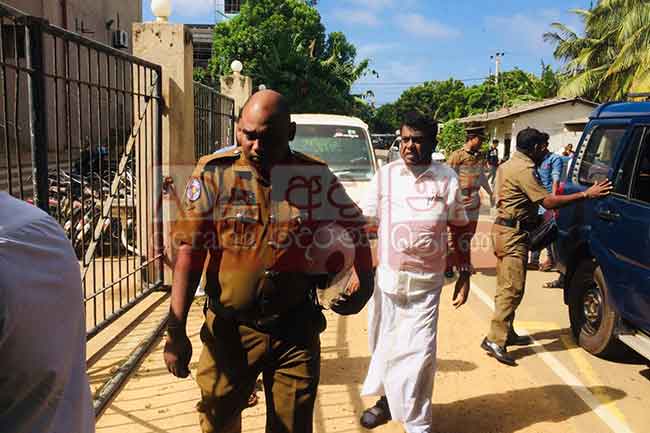
He was commenting on former MP M.K. Shivajilingam’s commemorating the 33 rd anniversary of the fast-unto-death undertaken by Thileepan, a member of LTTE chief Prabhakaran’s inner circle

Those who commemorate terrorists should be given maximum punishment: Terrorism expert Dr.Rohan Gunaratna

Colombo, September 16 (newsin.asia): Dr.Rohan Gunaratna, an international expert on terrorism who is now Honorary Professor at the Sir John Kotelawala Defense University, Sri Lanka, has called for the arrest and trial of pro-LTTE Tamil leader and former MP, M.K.Shivajilingam and others who glorify terrorists.

They should be given the maximum punishment to deter others from following their destructive path,” he told newsin.asia on Wednesday.

Dr.Gunaratna was commenting on Shivajilingam’s arrest in Kondavil in Jaffna for defying a court injunction and commemorating Thileepan’s fast-unto-death against an alleged failure of the Indian and Sri Lankan governments to implement certain provisions of the India-Sri Lanka Accord of July 1987.

Maximum punishment should be given as there is a public interest in this case. It will deter others funded by LTTE front organizations in the Tamil Diaspora from reviving the separatist agenda of the LTTE. Collective and decisive leadership is vital to restore stability and security, the foundation of ethnic and religious harmony in Sri Lanka,” Dr.Gunaratna argued.

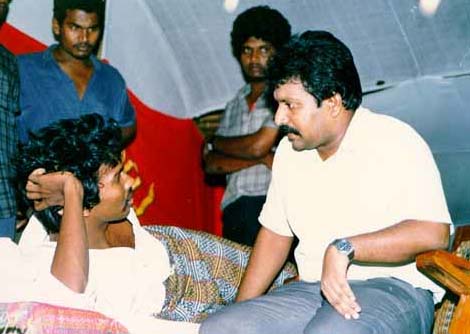
LTT supremo Prabhakaran with the fasting Thileepan

The LTTE’s propaganda and paraphernalia should remain banned forever just as Germany banned Nazi symbols and activities after World War II, he suggested, pointing out that it is LTTE propaganda that fosters an environment for LTTE plots, plans and preparation aimed at revival.

Fast-Unto-Death

Thileepan had sat on a fast-unto-death on September 11, 1987, to secure a five-point charter of demands including the setting up of an LTTE-dominated Interim Administrative Council for the Tamil dominated Northern-Eastern province as part of the India-Sri Lanka Accord to resolve the ethnic issue.

With both Colombo and New Delhi going by the letter of the agreements already entered into, and refusing to accept the LTTE’s fresh demands, Thileepan refused to give up his fast and died after 11 days on September 26, 1987.

Shivajilingam, who is related to Prabhakaran, had sought permission to hold the commemoration ceremony of the fast-unto-death at the Thileepa memorial in Nallur, but the Jaffna police got a court order banning it on the grounds that a leader of a banned organization like the LTTE could not be commemorated and glorified.

The argument that the previous United National Party (UNP)-led government had allowed the commemoration, did not cut ice with the Jaffna magistrate, who acceded to the police request to ban it.

However, Shivajilingam secretly changed the venue of the commemoration to Kondavil and performed a ceremony there on Tuesday. He was arrested and was subsequently released by a court on bail.

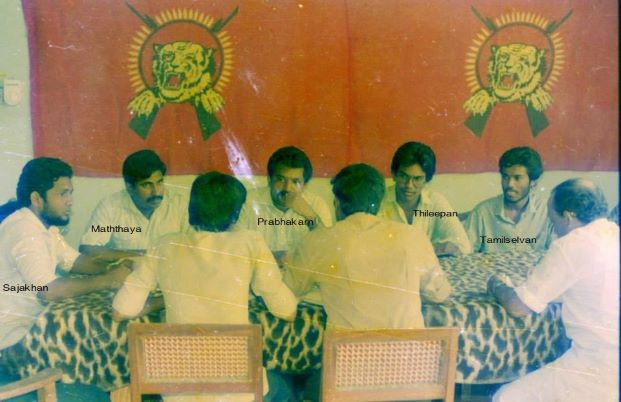
LTTE top brass in September 1987. Thileepan is on Prabhakaran’s left

How democracy is exploited

Commenting further on the incident, Dr.Gunaratna said: After the US declared victory in Afghanistan and Iraq, terrorism re-emerged because the terrorists’ support infrastructure remained intact. The tolerance of democracies revived violence.”

Therefore he recommended that the security and intelligence platform in Sri Lanka’s north and east should continue for one generation until the separatist ideology disappears.

Research demonstrates that if there is looseness (government neglect) as opposed to tightness (government vigilance), terrorist groups exploit the gaps and loopholes and come back. The groups and personalities that glorify terrorism should be identified and punished to deter future violence,” Dr.Gunaratna said.

Most terrorist groups abuse the freedom of expression to promote their vicious ideology to radicalize the youth into a culture of hate and violence, he added.

If a democracy permits display of terrorist paraphernalia and allows the dissemination of propaganda, the next step will be protests and demonstrations breaking out into violence. Like the Islamic State and al Qaeda, LTTE glorified death. If commemoration and celebration of death is permitted, it will lead to a culture of destruction.”

According to Dr.Gunaratna, there have been a dozen plots by the LTTE to revive since the end of Eelam War IV in May 2009. Most of the LTTE plots were supported by LTTE fronts overseas. The number of plots increased due to the delisting of LTTE fronts overseas by the Yahapalanaya government in 2015, he pointed out.

Thileepan memorial

Relist the Delisted Entities

Dr.Gunaratna noted that the ideology of separatism is fading but there are a few trying to revive it. Most Tamils both in Sri Lanka and overseas have left the LTTE and its erstwhile proxy the Tamil National Alliance (TNA). However, a few racist politicians continue to promote the separatist agenda,” he said.

It is essential for the government to relist the delisted LTTE fronts overseas as some of them are operating in Sri Lanka, the expert stressed

Need for economic development

Dr.Gunaratna recommended that the Northern and Eastern provinces be economically developed and the Sri Lankan identity should be promoted.

The best strategy to counter racism is for Sri Lanka to develop a proper national education policy where Sinhalese, Tamils, and Muslims study together,” he said.

He warned that without regulating the ethnic and religious space, Sri Lanka can never have social harmony, political stability and economic prosperity.

(The featured image at the top shows Shivajilingam after he was released on bail by a Jaffna magistrate)

Committee to probe SLMC

September 16th, 2020

Courtesy Ceylon Today

Minister of Health Pavithra Wanniarachchi has appointed a five-member committee to look into the activities of the Sri Lanka Medical Council (SLMC).

The five-member committee comprises Specialist Dr. Hemantha Perera, former Dean of the Ragama Medical Faculty Professor Prishantha Wijesinghe, Specialist Dr. Anula Wijesundera, Specialist Dr. Maithree Chandraratne and Specialist Dr. Darshana Sirisena.

They have been advised to compile an independent report and present it to the Minister, with the latter looking to overhaul the SLMC shortly afterwards.

Speaking after appointing the committee, Wanniarachchi said, The SLMC is an independent body that has been formed through an Ordinance aimed at protecting the rights of the patients as well as rendering a quality service to the public. 

The SLMC is tasked with monitoring the quality of the service rendered by medical practitioners as well as their performance. 

As per the provisions contained in the Medical Ordinance, the final arbiter of all decisions taken by the SLMC is the subject Minister. I have received a spate of complaints concerning the SLMC’s conduct. One of the core issues had been regarding turning the SLMC into an independent institution and removing all obstacles placed in its path to provide a transparent service to the public. 

Among other issues raised regarding the SLMC recently had been the decision taken by this body to withdraw the registration of a few internationally recognised universities, the continued delay in electing officer bearers to the SLMC, the decision taken to register certain medical practitioners who had not even met the basic qualifications of the SLMC, the continuous delay in holding examinations to register students who had obtained overseas medical degrees, and the hearing of complaints within the SLMC while overriding its own laws and regulations.

Govt took swift steps for economic recovery: Ajith Nivard Cabraal

September 16th, 2020

Courtesy Ceylon Today

The present Government took three immediate steps to restore the economy which had been destroyed by the previous Government, and took steps to stabilize the rupee, reduce all taxes and reduce interest rates on bank loans, the Minister of State for Finance, Capital Markets and Public Enterprise Restructuring, Ajith Nivard Cabraal stated.

He stated this addressing the investors’ pavilion organized by Softlogic today (16).

The Minister further said that the present Government took these swift actions after coming to power in 2019, and despite the strong criticism in this regard, the results have proven to be successful.

According to Cabraal, the previous Government had projected revenue of Rs 2,200 billion (2.2 trillion) in 2019, but they could only get Rs 1,800 billion (1.8 trillion), even after raising all taxes and imposing burdens on the people.

The Minister said that by reducing taxes and interest rates, the Government would be able to generate additional revenue through the freedom of entrepreneurs to do business and the country’s economic growth could be achieved through this business growth.

State Minister Cabraal said that unless the economy recovers in a country where it has collapsed, tax revenue can never be expected to recover effectively, and the attractive tax rates they had hoped for could not be achieved due to the unnecessary tax burden imposed by the previous Government.

Stricken tanker’s captain to face charges in Sri Lanka

September 16th, 2020

Courtesy MailonLiune

Sri Lanka will file negligence and pollution charges against the Greek skipper of an oil tanker that leaked fuel off the island nation’s coast after a week-long fire, authorities said Wednesday.

Some of the 1,700 tonnes of heavy fuel oil aboard the New Diamond poured into the Indian Ocean, prompting a large effort to contain a slick that was roughly two kilometres (1.2 miles) in length.

Its 270,000-tonne cargo of crude oil was unaffected by the fire.

“There is sufficient evidence to prosecute the skipper under the marine pollution act as well as the penal code for criminal negligence,” a spokeswoman for Attorney-General Dappula de Livera told reporters in Colombo.

Much of the slick has been cleaned up and no further fuel has leaked from the vessel since Friday. For now, there are no signs of the slick reaching the coast.

The Panamanian-registered tanker’s owners would also be slapped with a $1.88 million fire-fighting bill, de Livera said in a statement.

The vessel is owned by Liberian-registered Porto Emporios Shipping Inc and managed by Greek ship owner, New Shipping Limited, according to the Sri Lankan navy.

Compensation would also be sought from the owners for the cost of any environmental clean-up and damage, the statement added.

Sri Lanka has meanwhile asked the ship’s owners to tow the 330-metre (1,100 foot) tanker beyond its exclusive economic zone, which extends 200 nautical miles (370 kilometres) from its coast.

The nation’s environmental authorities fear a marine disaster if the tanker is allowed to transfer its oil to another ship in the country’s waters.

The stricken tanker is currently located some 70 nautical miles east off the Sri Lankan coastal town of Batticaloa.

The ship issued a distress signal in early September while en route to the northeast Indian port of Paradip when a boiler exploded killing a Filipino crewman

The vessel’s remaining 22 crew, including the captain, were rescued and are in quarantine at a hotel in the southern port city of Galle under the supervision of the navy.

Former SIS Director blames his superiors for not acting on intelligence conveyed to them

September 16th, 2020

Courtesy The Island

The State Intelligence Service (SIS)  had not been aware that National Thowheed Jamaat (NTJ) had direct links to the ISIS, by the time it received information from a foreign source warning of a possible terrorist attack on April 09, 2019, former SIS Director SDIG Nilantha Jayawardena yesterday told the PCoI probing Easter Sunday attacks.

SDIG Jayawardena made this statement while being cross-examined by Anura Meddegoda, PC, who appeared for former IGP Pujith Jayasundara.

However, the SIS had found that the NTJ had the intention to carry out a terrorist attack and stressed on the need to arrest NTJ activists, on several occasions, SDIG Jayawardena said.

A commissioner then asked SDIG Jayawardena whether it had occurred to him to ask former Defence Secretary Hemasiri Fernando to summon the National Security Council (NSC) or to contact former President Maithripala Sirisena over the intelligence warning of a suicide attack by Zahran and his associates.

SDIG Jayawardena said that he had not made such a request and had no authority to summon the Security Council. However, I informed the Defence Secretary, the CNI, the IGP, and heads of various specialist security units like the DMI, the CID, the TID, etc.”

It did not cross my mind to tell the Former Defence Secretary to summon the NSC or inform the former President. All I wanted was to stop the attacks. That was the only thing on my mind at that moment. That’s why I told officials with the necessary powers to act.”

Complete 100,000 kms of road development project by 2024: President tells officials

September 16th, 2020

Courtesy The Daily Mirror

President Gotabaya Rajapaksa has instructed the officials to complete the national programme to develop 100,000 kilometres of roads by 2024, the President’s Media Division said.

Speaking at a meeting held at the Presidential Secretariat to discuss the future plans of the State Ministry of Rural Roads and other Infrastructure Development, President Rajapaksa yesterday said each citizen has a right to obtain easy and comfortable access to roads.

He also said the programme to develop roads should be done without harming the environment.

Fmr. SIS Director refutes Maithri’s claims

September 16th, 2020

Courtesy The Daily Mirror

Former Director of State Intelligence Service (SIS) SDIG Nilantha Jayawardena today rejected claims made by former President Maithripala Sirisena for not informing the National Security Council (NSC) that Zahran Hashim was a terrorist and a threat to the country’s security.

SDIG Jayawardena made this remarks while responding to a question raised by Shamil Perera PC who appeared for Archbishop Cardinal Malcolm Ranjith during the cross-examination.

In an interview conducted by a leading TV channel, former President Sirisena said that he was only told of Zahran Hashim as an extremist and not a terrorist.

Showing a video clip of the interview, Shamil Perera PC questioned the witness whether SIS Director had accepted the claims made by the former President.

Responding to the question SDIG Jayawardena said that at the NSC meetings he had clearly informed all the superiors in the country that Zahran Hashim was promoting the Islamic State (IS) ideology in the country and the so-called individual would be a grave threat to the stability of the country’s security.(Yoshitha Perera)

Sri Lanka dismisses UN rights chief’s comments on 20A as unwarranted, pre-judgemental

September 16th, 2020

Courtesy Adaderana

Sri Lanka says the comments of the UN High Commissioner for Human Rights Michelle Bachelet on the proposed 20th Amendment are unwarranted and pre-judgmental, based on presumption.

https://youtu.be/WTQckbsfPnI

This was highlighted in the statement delivered by Sri Lanka’s Acting Permanent Representative to the UN in Geneva, Dayani Mendis during the General Debate under Agenda Item 2 at the 45th Session of the UN Human Rights Council on Tuesday (15).

The High Commissioner on Monday (14) said the proposed 20th amendment to the Constitution may negatively impact on the independence of key institutions, including the National Human Rights Commission.

The draft 20th Amendment to the Constitution submitted through the Parliament will be discussed, debated, following a complete democratic process, where all stakeholders will have the opportunity to present their views, Sri Lanka noted in its statement.

Further, Sri Lanka stressed that the new government remains committed to the assurances given before this Council in February this year as the island nation withdrew from the co-sponsorship of Resolution 30/1. 

Sri Lanka also hit back at the references made to false and unsubstantiated allegations leveled against senior military officials being appointed to key positions of institutions. Bachelet had stated the pardon given in March to a former Army sergeant convicted of participating in unlawful killings; appointments to key civilian roles of senior military officials allegedly involved in war crimes and crimes against humanity; and moves within the police and judiciary to thwart the investigation of such crimes, set a very negative trend.”


The full statement made by Sri Lanka during the General Debate is produced below:

Madam President,

Sri Lanka wishes to respond to the references made by the High Commissioner for Human Rights to Sri Lanka in the ‘Global Human Rights Update’ on 14 September 2020.

As this Council is aware, since February/March this year, the entire world was challenged by the COVID-19 pandemic, a health crisis of a global scale, which had impacted many aspects of governance in many countries, and Sri Lanka was no exception.

We hope that this Council would appreciate that Sri Lanka while successfully containing the spread of COVID-19 through a balanced, multi-sectoral approach, and despite this challenge, held its commitment to the democratic processes, and conducted Parliamentary elections successfully and peacefully, last month, which the EU has acknowledged.

Madam President,

Sri Lanka made it clear even as it withdrew from the co-sponsorship of Resolution 30/1, that it will remain committed to achieve reconciliation, accountability and human rights within the framework of the Sri Lankan Constitution, through a domestically designed and executed process in line with the Government’s policy framework. Sri Lanka would like to state further that the new Government which assumed office with the election of the new Parliament on 5 August remains committed to the assurances given before this Council in February this year.

The draft 20th Amendment to the Constitution submitted through the Parliament will be discussed, debated, following a complete democratic process, where all stakeholders will have the opportunity to present their views. Therefore, the GoSL is of the view that High Commissioner’s comments on the proposed 20th Amendment are unwarranted and pre-judgmental, based on presumption.

The GoSL wishes to state that the pardon to the former Army sergeant was granted in terms of the powers and provisions of the Constitution of Sri Lanka.

Madam President,

The Government rejects the references made to false and unsubstantiated allegations leveled against senior military officials being appointed to key positions of institutions. Sri Lanka has consistently refuted the credibility of these allegations and wishes to highlight that the domestic processes such as the LLRC and Paranagama Commissions that examined these allegations particularly with regard to the last stages of the conflict, have not found substantive evidence against any of the senior military officials referred to in this regard.

In the absence of any substantive proof, Sri Lanka considers that the continued arbitrary accusations on crimes or crimes against humanity made against these senior military officials are unacceptable and a violation of the principles of natural justice.

In conclusion, with regard to allegations of surveillance and intimidation, the Government has already publicly refuted these allegations, and is committed to protecting and promoting freedom of expression and civil society space, and ensure that complaints received on alleged attacks against journalists, human rights defenders and civil society are investigated and prosecuted.

The prime focus of this Government is to ensure national security, and to uphold the rule of law and order in the country for all its citizens, with the aim of creating an environment where any citizen can live freely without any fear for the safety of themselves and their families.”

In line with the above policy framework, the Government is committed to achieve the Sustainable Development Goals of the UN, with a determination to uplift the lives of all its citizens and ensure that there is no threat to peace, reconciliation or development in Sri Lanka.

Thank you.

AG submits Rs 340 million interim claim to lawyers of ‘MT New Diamond’ owners

September 16th, 2020

Courtesy Adaderana

The Attorney General has submitted an interim claim of Rs 340 million to the lawyers representing the owners of the ‘MT New Diamond’ oil tanker, for the costs incurred by the Sri Lankan government in the assistance rendered to the ship and other related matters.

The AG’s Coordinating Officer State Counsel Nishara Jayaratne stated that the claim was presented today (16) in writing seeking compensation for the costs related to the assistance rendered by all parties including the Sri Lanka Navy (SLN), Sri Lanka Air Force (SLAF), Sri Lanka Ports Authority (SLPA), Colombo Dockyard PLC (CDPLC), Marine Environment Protection Authority (MEPA) and Department of Coast Conservation, to extinguish the fire onboard the oil tanker, and other related matters.

She stated that the claim was submitted to the owners of the oil tanker seeking a compensation of Rs 340 million and that this estimation of costs was prepared only for the costs incurred up until yesterday (15).

Meanwhile she added that an estimate regarding the threat to the marine environment as a result of the oil leakage related to the incident will be submitted within the next couple of days after the relevant reports are received from the Marine Environment Protection Authority (MEPA).

The AG’s Coordinating Officer further stated that compensation is expected to be sought for the total amount of the costs incurred by all parties based on a complete estimate and that this estimate cannot be submitted until the oil tanker exits Sri Lankan waters.  

තරුණ අරගලයේ අමිහිරි මතකය…

September 16th, 2020

උපුටා ගැන්ම FB

1971 අප්‍රේල් කැරැල්ල ගැන සඳහන් කරන විට ප්‍රේමවතී මනම්පේරි නාමය ද නිතැතින්ම කියැවෙන්නේ, ඇය හමුදා ප්‍රධානියෙකුගේ අණ පරිදි නිරුවත්කොට, මහමග ඇවිද්දවා ඉතාමත් කෲර අන්දමින් වෙඩි තබා ඝාතනය කිරීම නිසාය. 1970 වර්ෂයේ කතරගම අවුරුදු කුමරිය වශයෙන් අභිෂේක ලබා සිටි ප්‍රේමවතී මනම්පේරි මෙනෙවිය ඝාතනය කර දැනට වසර 47 ක් ගතවී ඇතත් එම සිදුවීම අදත් ජනතාවගේ සිත්වලින් බැහැරව නැත.

කතරගම වන සත්ව දෙපාර්තමේන්තුවේ මුරකරුවකු වශයෙන් සේවය කළ හෙන්ද්‍රික් අප්පුහාමිගේ හා ලීලාවතී ඔබේසිංහ යන අයගේ වැඩිමහල් දියණිය වූ ප්‍රේමවතී මනම්පේරි ඝාතනයට ලක්වන විට 22 වැනි වියේ පසුවූවාය. කතරගම විද්‍යාලයේ දීප්තිමත් සිසුවියක වූ ඇය, විද්‍යාලයේ එකල අ.පො.ස සාමාන්‍ය පෙළ විභාගයෙන් විෂයන් සියල්ල උසස් අන්දමින් සමත් වූ අතර කතරගම ප්‍රදේශයේ සිටි උගත් බුද්ධිමත් තරුණියක ලෙසට ද, ප්‍රදේශවාසීන් අතර පිළිගැනීමට ලක්ව සිටියාය.

ධර්මාචාර්ය විභාගයට මුහුණ දුන් අතර එයින්ද ඉහළින්ම සමත්ව කතරගම දහම් පාසලේ දහම් ආචාර්යවරියක ලෙස සේවය කරන්නට ද අවස්ථාව ලැබුවාය.කතරගම අවුරුදු කුමරිය වශයෙන් අභිෂේක ලබන්නට තරම් රූසපුවකින් යුක්තව සිටි ඈ කතරගම සිට තිස්සමහාරාමය දක්වා වූ මහා මාර්ගය අසල වූ නිවසක පදිංචි වී සිටියාය.

අවුරුදු කුමරිය ලෙස ඔටුණු පැලඳීමත් සමග බොහෝ පිරිමින්ගේ ඇස් ඇය දෙසට යොමුවීම නැවැත්විය නොහැකි විය. මේ අතර ප්‍රේමවතී දෙස ගිජු බැල්මෙන් බැලූ තවත් අයෙකු ද වූයේය. අවුරුදු උත්සවය දා ප්‍රේමවතීට වේදිකාවේ දී සුබ පැතූ එවකට කතරගම පොලීසියේ ස්ථානාධිපතියි.

ඒ උත්සවය අවසන් වී දින කිහිපයකට පසුව ස්ථානාධිපති ප්‍රේමවතී මුණ ගැසුණේය. ඇය කෙරෙහි තමාගේ මනාපයක් ඇති බවට ප්‍රකාශ කර සිටියේය. එසේ ඔහු දින කිහිපයක්ම බලපෑම් කරමින් ප්‍රේමවතී හමුවීමට පැමිණිය ද ඇය කතරගම ස්ථානාධිපතිව ගණන් නොගත්තාය. ස්ථානාධිපති සැරසෙන්නේ තමාගෙන් අයුතු ප්‍රයෝජන ගෙන තමාව වනසන්න යැයි ප්‍රේමවතී හොඳින්ම වටහාගෙන තිබුණාය. ඇයගෙන් පිළිතුරක් නොලද තැන හොඳයි මම බලාගන්නම් යයි ස්ථානාධිපති කේන්තියෙන් පවසා පිටත්ව ගියේය.

එකල රාජ්‍ය බලය හෙබවූ සිරිමා බණ්ඩාරනායක අගමැතිනිය බලයෙන් පහකර රටේ පාලන බලය සියතට ගැනීම රෝහණ විජේවීර ඇතුළු ජවිපෙ කැරලිකරුවන්ගේ ඒකායන අරමුණ වී තිබුණු අතර ඒ අනුව 1971 අප්‍රේල් මස ආයුධ සන්නද්ධ කැරැල්ලක් දියත් කරනු ලැබිණි. ඔවුහු ඒ සඳහා දිවයිනේ පිහිටි පොලිස් ස්ථාන කිහිපයකටම එකවර ප්‍රහාර එල්ල කළහ. ජවිපෙ විසින් එලෙස ප්‍රහාර එල්ල කරන ලද පොලිස් ස්ථාන අතර එක් පොලිස් ස්ථානයක් වී තිබුණේ කතරගම පොලිස් ස්ථානයයි.

කතරගම පොලිස් ස්ථානයට එල්ල කළ පළමු ප්‍රහාරය යම් තරමකට සාර්ථක වී තිබුණද, එය කැරලිකරුවන් බලාපොරොත්තු වූ තරමින්ම සාර්ථක ප්‍රතිඵල අත්කර දී නොතිබුණේය. 1971 අප්‍රේල් 05 වැනිදා සිට 15 වැනිදා දක්වා කතරගම තම පාලනයට යටත්කරගෙන තිබූ කැරලිකරුවෝ හමුදාව පැමිණීමත් සමග පසුබැස්සහ.

කතරගම හමුදා පාලනයට නතුවීමත් සමග යටපත්ව තිබූ කේන්තිය මතුවී ඒමෙන් පොලිස් ස්ථානාධිපති අර කැරලි නායිකාව අරගෙන යන්න ඕනෑ යයි පොලිස් භටයන්ට කීවේය.

දිනය අප්‍රේල් 16 වැනිදා වෙලාව පෙ.ව. 9 පමණ වී තිබුණි. ප්‍රේමවතී මනම්පේරි සුපුරුදු පරිදි නිවසේ රැඳී සිටියාය. අම්මාද ඇය අසලින් සිටි අතර තම නිවස දෙසට පැමිණෙන වාහනයක හඬක් ඇසුණේය. පැමිණ තිබුණේ කතරගම පොලිස් ස්ථානයේ ජීප් රථයයි. නිලධාරීහු දෙදෙනෙක් වාහනයෙන් බැස ගොස් ප්‍රේමවතීව කොණ්ඩෙන් ඇදගෙන ජීප් රථය ඉදිරියට ගෙන ආහ.

ප්‍රේමවතීගේ අම්මා හිස අත්බැඳ කෑගැසුවාය. සහෝදර සහෝදරියන් හඬා වැටුණහ. නමුත් පොලිස් නිලධාරීහු ප්‍රේමවතීව අත්නොහැරියහ. ප්‍රේමවතී පටවාගත් පොලිස් රිය පැමිණ නතර වී තිබුණේ කතරගම ලංගම විශ්‍රාම ශාලාවේ හමුදා කඳවුර වෙතය.

කතරගම ප්‍රදේශයේ ජවිපෙ ප්‍රධානම පෙළේ කැරලිකාර නායිකාවක් බවට ප්‍රකාශ කරමින් ප්‍රේමවතී මනම්පේරිව භාරදෙන ලද්දේ, කතරගම හමුදා කඳවුරේ ස්වේච්ඡා භටයකු හා ලුතිනන්වරයකු වන ඇල්ෆ්‍රඞ් විජේසූරිය නම් නිලධාරියාටය.

අප්‍රේල් කැරැල්ලේ කතරගම ප්‍රදේශයේ ප්‍රේමවතී මනම්පේරීගේ දායකත්වය පිළිබඳව ඇය අත්අඩංගුවට ගැනීමෙන් පසු ලුතිනන් විජේසූරිය ඇයගෙන් දැඩි ලෙස ප්‍රශ්න කරන ලද නමුත් අඩු තරමින් පන්ති පහට සහභාගිවී තිබේදැයි යනුවෙන් කරන ලද ආරෝපණය පවා ඇය එකලෙසම ප්‍රතික්ෂේප කළාය.

1971 අප්‍රේල් 17 වැනිදා කතරගම පූජා නගරයේදී ඇයව නිරුවත් කොට දෑත් ඔසවා මා පන්ති පහට සහභාගි වූවායි කියමින් මහ පාරේ ගමන් කරන ලෙසට කරන ලද අණ හමුවේ පවා ඇය කැරැල්ලට දායකත්වය දැක්වූ බවට කරන ලද ආරෝපණය පිළිගත්තේ නැත.

ඈ වීදිය මැද්දෙන් මිනිසුන් ඉදිරියේ ලැජ්ජාව නොඉවසිය හැකිව මහමග හඬමින් ගමන් කළාය. ඇයට පිටුපසින් ගිනි අවිය මානාගෙන ලුතිනන් හා තවත් සොල්දාදුවන් දෙදෙනෙකු අණ දෙමින් ගමන් ගත්හ.

අසල පිහිටි ගුණසිරි හෝටලයේ හුන් දෙතුන් දෙනෙක් ඇස් අදහාගත නොහැකි ඒ දර්ශනය දෙස කුතුහලයෙන් බලා කම්පාවී ඉවත බලාගත්හ. එක අතක් හෝ පහත් කොට විළි වසාගන්නට තැත් කළ හොත් වෙඩි තබන බවට කාමුක සෙබළා අනතුරු හඟවා තිබුණ ද, ප්‍රේමවතීගේ දකුණත මිනිසුන් ඉදිරියේ ලිහිල්ව පහත් වන්නට විය. ඇය එසේ කළේ ලැජ්ජාව නොඉවසිය හැකිව මහ හඬින් හඬමිනි.

තුවක්කුව පත්තු විය. ප්‍රේමවතී මදක් වැනෙමින් දෑතින්ම විළිවසා ගනිමින් මොහොතක් සිට ඇද වැටී ඇඹරුණාය. නිරායුධව, නිර්වස්ත්‍රව වෙඩි තබා බිම හෙළනු ලැබූ තරුණියට නැවත ද තුවක්කුව එල්ල විය.

වෙඩි හඬ දෙක තුනක් පිටවිය. ලේ ගලාගෙන ගියේය. මහ පොළවේ හතර රියන් වළක් කැපී අවසාන වනතෙක් ප්‍රේමවතී මනම්පේරි නොසැලී උන්නාය. ඇයට ප්‍රාණය තිබෙන්නට ඉඩක් ඇතැයි කිසිවෙක් නොසිතූහ. එහෙත් තරුණියට පණ තිබෙන බවත්, ඇය හුස්ම ගන්නවා පමණක් නොව සිහින් හඬින් කෙඳිරි ගාන බවත්, ඇය වළදමනු සඳහා දෑතින් හා දෙපසින් එල්ලා ගෙන වළ සමීපයට ගෙන යද්දී තේරුම් ගත හැකි විය.

නැවතත් සාහසිකයන්ගේ රයිපලය ඇගේ හිසට එල්ල විය. ප්‍රේමවතීගේ සිරුරේ හිල් නොකළ එකම තැන වූ හිසද ඔවුන් හිල් කළ හෙයින් හිසින්ද ලේ ගලා ගියේය. ප්‍රේමවතීව එම ස්ථානයේදී වළ දැමිණි.

ඝාතනය සියැසින් දුටු ඩෙස්මන් වයිට් මහතාගේ තොරතුරු දැනුම්දීමෙන් පසුව මේ පිළිබඳව පරීක්ෂණ ඇරඹුණේය. 1971 මැයි 24 වනදා ප්‍රේමවතී මනම්පේරිගේ මිනිය ගොඩගෙන පරික්ෂණ පවත්වන ලදී.

පසුව මේ පිළිබඳ නඩුව හම්බන්තොට මහේස්ත්‍රාත්වරයා විසින් ගාල්ලේ අපරාධ නඩු අධිකරණය වෙත යොමු කරන ලදී. ඒ අනුව මෙම නඩුව විභාග කරනු ලැබුවේ ශ්‍රේෂ්ඨාධිකරණ විනිසුරුවරයකු වූ ඩී. කිව්. ඇම්. සිරිමාන්න මහතා විසිනි. පැමිණිල්ල මෙහෙය වූයේ රජයේ නීතිඥ කෙනත් සෙනවිරත්න මහතාය.

නඩු විභාගය අවසානයේදී පළමු විත්තිකාර ලුතිනන් ඇල්ෆ්‍රඞ් විජේසූරිය හා දෙවන විත්තිකාර සැරයන් රත්නායක චෝදනාවන්ට වරදකරුවන් වූ අතර ඔවුන්ට වසර 16 ක සිරදඬුවමක් නියම විය.

පසුව ඔවුන් එම තීන්දුවට එරෙහිව අපරාධ අභියාචනාධිකරණය වෙත අභියාචනයක් ඉදිරිපත් කළෝය. ඒ. සී. අලස් (සභාපති) වී. තාමෝදරම් හා ඩී. විමලරත්න යන ශ්‍රේෂ්ඨාධිකරණ විනිසුරුවන් හමුවේ එය විභාගයට ගනු ලැබූ අතර එහිදී කලින් තීන්දුවම අනුමත වූ අතර සිරදඬුවම්වල වෙනසක් නොවීය.

වසර 16 ක සිරදඬුවමක් විඳිමින් සිටි විජේසූරිය ඊට වසරකට පසු බන්ධනාගාරයේදී හෘදයාබාධයකින් මිය ගියේය. සිරදඬුවම් විඳ නිදහස් වී පැමිණි රත්නායක දෙවිනුවර සිය නිවසේ සිටිය දී 1988 – 89 භීෂණ සමයේදී ජවිපෙ සාමාජිකයන් විසින් පිහියෙන් ඇන ඝාතනය කළ බව වාර්තා විය..

මිනිසුන්ගේ පහත් ආශාවන් සපුරාලීමට අකමැති වූ අහිංසක තරුණියකට තම ජීවිතයෙන් වන්දි ගෙවීමට සිදුවුණේ එලෙසිනි.

ඇගේ චරිතය ඉතිහාසය පුරා සදාකල් පවතිනු ඇත. ඇයට හිමි ඒ තැන ලබාදීම යුක්තිගරුක පුරවැසියන් වශයෙන් අප සැමගේ යුතුකමයි.

එම්. තාරික්

Will Moragoda deliver a ‘Sri Lanka First’?

September 16th, 2020

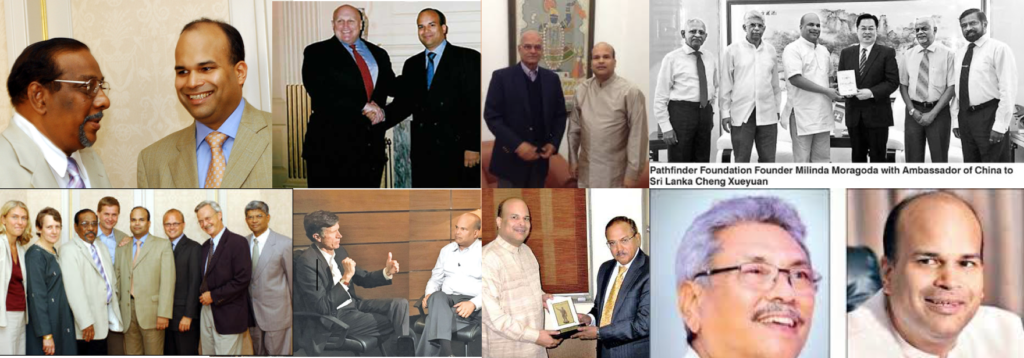
With much thought and strategy Sri Lanka has appointed Moragoda as Sri Lanka’s High Commissioner to Delhi iced with cabinet ranking, the first such fringe benefit afforded to a high commissioner. No doubt, Sri Lanka is thinking the Moragoda magic will provide much relief to Sri Lanka, given the appointment is being made against tremendous objections.

So what will Sri Lanka be expecting from Moragoda

·     Will Moragoda be able to subdue America’s bullying of Sri Lanka in Geneva and shut the trap of the UNHRC Head who is following her predecessors issuing statements on Sri Lanka’s internal affairs – complete violation of UN Charter and her mandate.

·     Will Moragoda be able to get America, his land of birth to withdraw UNHRC Resolutions and bring to nought all of the bogus allegations against Sri Lanka since 2012. 

·     Will Moragoda be able to tell America to keep its $480m ‘gift’ disbursed across 5 years as Sri Lanka’s housemaids remit more annually! 

·     Will Moragoda tell India to stay clear off Sri Lanka’s territorial waters and not damage the ocean bed and destroy marine life using internationally banned bottom trawlers?

·     Will Moragoda politely tell Delhi to inform its Colombo mission to stop trying to rope in locals to be their eyes and ears and this same applies to the US mission in Colombo. Both nations are flouting diplomatic protocols with impunity.

·     Will Moragoda get Delhi to link the Tamil Eelam quest to the Tamil Nadu self-determination quest

·     Will Moragoda get Delhi to stop illegal immigration by Tamil Nadu?

·     Will Moragoda get Delhi to stop Kerala ganja, illicit narcotics from being smuggled into Sri Lanka from North and Mannar coast?

·     Will Moragoda get Delhi to agree to annul Indo-Lanka Accord of 1987, not protest or object to repeal 13a and the PC system?

·     Will Moragoda tell Delhi that Sri Lanka does not wish to sign ECTA or CEPA and all former trade agreements require to be re-negotiated given the imbalance in trade and one-sided benefits. 

·     Will Moragoda also tell Delhi that it makes no sense for Sri Lanka to give ECT development to India when India is likely to shift 70% of India’s transshipment that Sri Lanka currently handles to India’s new port in Tamil Nadu.

·     Will Moragoda tell India & US that since both nations objected to China’s submarines entering Sri Lanka, Sri Lanka wishes they too follow same policy! 

·     Will Moragoda tell Delhi that Sri Lanka will follow a National Policy of ‘Sri Lanka First’ and an international policy of ‘Friends with all & Enemy with none’.

·     Can Moragoda tell both US & India that Sri Lanka does not wish to be a punching bag or a playground for quad battles and any such should be taken elsewhere as Sri Lanka agrees with Non-Aligned Movement Charter and Indian Ocean Rim countries that Indian Ocean should be a ‘Zone of Peace” not a ‘Zone ending up in Pieces’.

·     Will Moragoda deliver the Rajapakse Doctrine” that encompasses the expectations of the 69lakh voters that voted for the President in November 2019.

Let’s see what the Moragoda magic can achieve, given that the powers that be are 100% certain that he is Sri Lanka’s Man Friday to deliver Sri Lanka’s wish list and he would be functioning in Sri Lanka’s interest putting ‘Sri Lanka First’ above US or India.

The leadership has nominated him inspite of opposition in a strategic appointment claiming to be in Sri Lanka’s best interest. 

Only time will tell. But, Moragoda has to deliver. Deliver to no one else, but to Sri Lanka’s advantage & favor.

Moragoda has to deliver to the expectations of those that selected & appointed him but indirectly not forsaking the 69lakhs that appointed the leader who has nominated him. 

The people don’t want this Government or its President to fail and those that are now carrying his baton should not disappoint him or the Nation. 

Shenali D Waduge

A Reply to Harsha de Silva

September 15th, 2020

By Charles S.Perera

It is strange to see the present ragtags-the remnants of the former Yahapalanaya who ridiculed democracy, and devastated the country politically,economically, and socially for four and half years,  now thundering in the parliament and out side about a disappearing democracy they in fact seem to know nothing about.

Among the remnants  of the Yahapalanaya now in the opposition are some who are supposed to be educated. But the question is, are they wise.  Wisdom is not what you put inside as knowledge, but what comes out from that accumulated knowledge. But these yahapalanaya remnants lack that wisdom to think and evaluate circumstances from past experiences.  These are the ones who came to parliament in 2015 thanks to the traitorous midnight escape of Maithripala Sirisena from SLFP to the opposition to be their common Presidential Candidate.   If not for Maithripala Sirisena  none of them would have been in parliament  then or now. 

But they have no gratitude for that.  The yahapalanaya remnants are now seeking  their own salvation by throwing on to scaffold President Maithripala Sirisena who enabled them to become  parliamentarians,  as responsible for the massacre of  Easter Sunday. Aren’t they all init under the doctrine of  collective responsibility ?

These partners of the former Yahapalanaya little realise they as members of the Yahapalanaya  are all responsible for that massacre of the innocents, more Harin Fernando who now breys louder than ever, forgetting that he had failed in his duty to God and Country, by  having failed to inform the Archbishop what his father had warned him not to do that Easter Sunday.

There is Harsha de Silva with a doctorate to decorate his name, who talks without reflecting or trying to understand the real issue with the presentation of the  20th Amendment. He as an intelligent man should not be swayed by emotions. When he led the footnote group at the COPE he showed how much he is involved in all the degenerative political maneuvers of the RanilW led Yahapalanaya-the Bank robbery, mismanagement of the government, Easter massacre, involvement in the MCC, Singapore Trade Agreement,  selling of Hambantota Harbour,  negotiating to sell the Colombo Port East Terminal to India etc.

Lets see what Harsha de Silva  with a doctorate tells about 20A. He speaks about removing the National Procuration Commission and curtailing the powers of the Auditor General which he says is inviting corruption. If he would read the 20A alongside the Constitution he would see that removal of the 19th Amendment has put the Constitution to what it was before the introduction of the 19th Amendment. The functions of the Auditor general will continue as it had been before. In tender procedures new transparent methods with modern  technology could be adopted.

The difficulties arise also  from the fact that the opposition has not placed the same trust on the President Gotabaya Rajapaksa as the large majority of people have placed their trust on him, as evidently shown through the Presidential and then the Parliamentary Elections. The Opposition should respect the large majority of the people who voted to elect the President,  and then give a near two third majority at the parliamentary elections.. 

The Opposition led by Sajith Premadasa who is known to think differently takes his position as the leader of the Opposition on the belief that the  Parliament is a place to criticise the Government and to show the people that what the President is doing is not in the interest of the country and the people but to look after the interest and the benefits of the Rajapaksa family.

 If the members of the opposition have peanut sized  brains they will know that in the Parliament there is no family, but parliamentarians elected by the people. The people know this and they are no more concerned with this family talk” except those supporting the UNP, and the SJB.

Harsha de Silva and his former yahapalanaya colleagues  should get out of their box to understand that the democratic  role of the opposition in parliament is other than being aggressive and jumping to criticism. They should instead  follow Ranil’s Lichchavi approach which unfortunately he failed to put into practice. The Parliament should be a place where there is an intellectual approach to any problem giving place to a rich  dialogue , discussion, constructive criticism, suggesting different approaches to the problem under discussion. 

This approach even the JVP leader Anura Kumara Dissanayaka seems not to know.  He spent 28 minutes in the well of the parliament shouting at the speaker and those who raised objections  taking pride in the fact that he  is the person who has made many speeches and stood up long haranguing  accusing the members of the government. He seemed to be happy with his role which for an outsider is really foolish. He spoke nothing of value or interest.  These parliamentarians have to change their attitudes and become responsible members of the opposition. They should contribute memorable speeches, make workable suggestions  without talking like hooligans.

Harsha de Silva was not even sure of his facts.  He was speaking  in praise of the 19A and its procurement guidelines, conceding that there were issues regarding the Procurement Commission. If there are issues why not adopt a new transparent system outside Commissions.  Why always think in terms of corruption when the emphasis should be on using efficient foolproof methods that will eliminate corruption.

Harsha de Silva is not true to himself when he says that the public should not buy into the view  that the 19th Amendement was a barrier to effective governance and economic growth. Harsha de Silva in trying to defend 19A is displaying his inability to evaluate the circumstances that led to the failure of Yahapalanaya. With 19A Yayhapalanaya could neither continue to govern,  nor  go forward with the absurdity of the it. If Harsha de Silva is now singing hosannas to 19A as an effective efficient piece of legislature he is not worthy of the Doctorate he  adds before his name. It is here Harsha de Silva should show his intelligence. 19A was an obstacle and a  failure- the Commissions were not functioning as they should, Commissions made wrong appointments, there was an inefficient  parliament not functioning for the benefit of the people, taking wrong decisions, signing wrong contracts, and the President could not dissolve it. It had to continue on its path of destruction   for four and a half years. Was that democracy ? Has one heard of such a parliament anywhere else in the world ?  

And that is what Harsha de Silva supports and praises and tells the people not to buy into the view that the 19Amendment  was a barrier to effective government and economic growth.  Harsha de Silva where did you see effective governance  and economic growth during the past four and a half years from 8 January 2015 ?  You display your inability to see things as they were and try to fool the people, Harsha de Silva.

The 20A then he criticises without giving adequate reasons imaging things reading beyond the text. He imagines what the Parliamentary Committee to replace the Constitutional Council  proposed in the 20A would be like imagining how it would function and how the President would react to observations made by the committee.  Are these valid arguments against 20A ?

These are meaningless arguments. He could make suggestions which are more democratic. He says that SJB and the government differ on the need to have civil society persons. But have the civil society representatives been useful during the last four years ? They were  accused of being NGOs.

In jumping to criticise the 20A, Harsha de Silva  takes an aggressive path instead of making suggestions to change the Amendment . Why stand against it when the 20A is only a proposal and you expected to make suggestions to change it ?  The Opposition will stand against it , de Silva says, but  that is the wrong way of looking at it . Why stand against it ? Is it because you take the role of the  opposition,  as a role  to  stand against  proposals by the Government ? Harsha de Silva,   in democracy there should be constructive criticism, discussion and compromise ? That is how it should be with the 20th Amendment. 

But Harsha de Silva says that he is  against the 20th Amendment.  If one starts having already decided where one  stands on the  20th Amendment,  then democracy cannot function as it should. One should instead start with an open mind looking at the issue  objectively. That should be the quality of a good politician. 

The theoretical relationship between compromise and democratic regimes (is) that … of arriving through discussion at political agreement with one’s opponent …”

The Government had explained that the 20th Amendment removes the 19th Amendment, to make the constitution what it was before the 19th Amendment was introduced.  Therefore the Auditor General will function with all legal paraphernalia as he did before the introduction of the 19th Amendment. In that there is no weakening of the Auditor General’s functions.

Harsha de Silva is creating mental images of what would happen and jumping to conclusions. If he gives more thought to facts,  and figures out  issues intelligently he will see that nothing has changed after removal of 19A except that the constitution has gone back to what it had been before.  There is no rule that says a member of the opposition should be the heads of COPE and COPA. 

Harsha de Silva is merely criticising for the sake of criticism.  He as an experienced politician and with a Doctorate in addition should know that the opposition has to allow the Parliamentary Democracy to Function. The President and the Government have been elected for five years and they should be allowed to continue to rule the country for the scheduled period of time. The opposition is not to put barriers against the government, with the intention of toppling it. 

But an intelligent leader of the Opposition would  contribute for  a healthy political dialogue , discussion and compromise to come to political agreement. 

Harsha de Silva accuses the government is deploying 20A under a smokescreen to fool the people.  The people understand , but it is the opposition that seems to have not understood.

Harsha de Silva and Yahapalanaya  had tried in different ways from the day the President was sworn in,  to stop the President from taking up his duties to carry forward his proposals for the development of the country. Even today the role of the opposition has taken a different path from democracy,  to hinder the President from continuing to rule the country.

Now the latest gimmick to embarrass the government on 20A is demanding who is the author of the Amendment. as  it is on that, the validity of the Amendment depends.  These are normally prepared by the legal draftsman based on the instructions issued after Cabinet approval.  Therefore the cabinet as a whole helped in the preparation of the 20th Amendment.

Wigneswaran up against a wall of scholarly opposition

September 15th, 2020

By Rohana R. Wasala

It seems to me that the former NPC CM and present Jaffna District MP octagenarian C.V. Wigneswaran has taken to dispensing racist hatred in order to wipe out the Sinhalese race as a pest. It is funny, but regrettable that he indulges himself in this sort of thing. But since the Sinhalese are not what he pretends them to be, his blasts of unprovoked hate will only irk them a bit, but will certainly fail to cause them any harm if sense and sanity prevail. All his anti-Sinhalese Buddhist assertions that are made without any basis in fact are so silly and childish that I, a fellow Sri Lankan of his belonging to the Sinhalese majority, think that he should be causing much embarrassment to the sensible members of his own Tamil community. But we cannot ignore the fact that there certainly is method in Wigneswaran’s madness. Fraudulent and frivolous though his claims are,  in the interest of natural justice as well as authentic  knowledge about our true history, they should not be allowed to go unchallenged. 

That is why a prominent, internationally recognized Sri Lankan archaeologist, who has been conducting excavations for delving into our buried history and prehistory, over the past thirty years, promised, in the latest (September 7) episode of a series of NethFM Radio interviews (also subsequently broadcast on the You Tube) called ‘Unlimited History’ to disabuse Wigneswaran of his misconceptions in a proper scientific manner in the near future, despite the extreme pressure of work due to the project which the archaeology professor is currently engaged in. The scholar meant is Professor Raj Somadeva, who deems it his responsibility to give Wigneswaran an adequate answer. 

Wigneswaran told a Sunday Observer interviewer (September 6): ‘The genuine grievance of our people is the non-settlement of their political issues. Not the denial of economic sops! Economic sops would not solve the long term problems of our people. When we speak of the needs and aspirations of our people why do you Southerners view it as communal politics? When the Government wants to give priority to Sinhala and Buddhism why did you not identify that as communal or parochial politics?’ The pot calling the kettle black! I think Wigneswaran must be invited to confront his young co-ethnic Arun Siddharthan on a TV discussion for an answer. But he will not dare do that, not only because the young man who is the grandson of a toddy tapper by profession, as he proudly claims, but because he will have a hard time explaining to him why, he, as NPC Chief Minister he returned all the development funds the government sent for his province unutilized each year during the five years he held  that post, while the poor voters who elected him suffered without even the barest essential infrastructure and other needs after the devastation caused by the war.  I am not sure whether Wigneswaran deserves the honour of being challenged by a reputed archaeologist.

The following argument of the MP is from the same source: ‘If we do not have the right of which we are entitled to under the UN Covenant on Civil and Political Rights, Tamil speaking people of the North and the East would become Sinhalese within 15 or 20 years. Already the people from Negombo to Puttalam who were Tamil speaking when I was a child, have now become Sinhalese. The Tamils of Anuradhapura in the Old Town where I lived as a boy have become Sinhalese. Many people of recent Indian origin have become Sinhalese. The only way to preserve our individuality is to become entitled to the right of self-determination so that the people of the North and the East would look after themselves while being part of the Sri Lankan polity’. 

Could all the Tamil speaking people of the North and the East become Sinhalese within that short period if the few thousands of war-displaced Sinhalese are resettled in those areas (but there is still no talk of the issue being addressed)? Throughout history many Tamils who came from South India to Sri Lanka as traders, guests, invaders or mercenaries merged into the Sinhalese community; so did many Muslim men who arrived in Sri Lanka to do business. Many of the Tamils in Jaffna today are degraded descendants of the original Sinhalese who were living there when the first permanent Tamil settlements appeared in the north only in the 13th century, after the expulsion (in 1236) of the invaders led by Magha of Kalinga (not a Tamil), who, with his 24,000 strong army of Kerala and Tamil  mercenaries devastated (1215 CE) Polonnaruwa, the seat of the Sinhalas’ flourishing hydraulic civilization and ruled there for 21 years. Some of the fleeing soldiers settled down in the north without returning to India. What became of Magha is not known. There was no Tamil north before the Magha invasion which, though it was repulsed, permanently destabilized the island kingdom. 

Even during the recent thirty year separatist war there were Tamils who changed their identity to Sinhalese, while living among the Sinhalese in the South for work as well as for protection from Prabhakaran or equally likely for avoiding detection by security forces for involvement in terrorist activities.  If the reverse of this happened, it would be natural too. But Tamil supremacist Wigneswaran’s fears of immediate bastardization of Tamils through admixture with the Sinhalese are not well founded.

In any case, the Sinhalese account for nearly 75 % of the Lankan population. It is a historical fact that Sri Lanka is the unique homeland of the Sinhalese who gave the island its name ‘Sinhale’, just like Tamil Nadu is the homeland of the Tamils. The Sinhalese do not demand or enjoy any special rights that the minorities do not enjoy because they are non-Sinhalese. Well over 70% of Sri Lankans are Buddhists. It is the practice in secular democratic countries around the world including the USA, UK, Norway etc to give special recognition to the religion of the majority, while ensuring the same freedom of belief and worship for people of other religions without any discrimination. It is globally appreciated that no other religion is more tolerant towards other faiths than Buddhism. 

Wigneswaran falsely claims that Tamil is the oldest living language in the world. A glance at the Web is enough  for anyone to dispute this claim, because there are dozens of other candidates (than Tamil) for the title of ‘the oldest living language’ among the world’s over 7000 different languages. Whether Tamil is the world’s oldest language or not, it has no bearing on the fact the Sinhalese are descendants of the oldest humans who lived on this island. We have overwhelming written, epigraphical and archaeological evidence scattered across the length and breadth of the island to prove that Tamil speakers were definitely not the earliest inhabitants of the island. The first homo sapiens who lived there so many millennia ago were the ancestors of the Sinhalese. However, they could have been conquered by a north Indian prince as claimed by the Vijaya legend. But the main body of people were the indigenous tribes who in the course of time came to collectively constitute the Sivhela nation.  

Fresh archaeological evidence, unearthed, for example, at the Pahiyan Rock near Kalutara in the Western province, shows that the caves there provided shelter to humans who used bows and arrows tipped with polished bones to kill small arboreal mammals like monkeys for food some 48,000 years ago. The tribal people who lived there and in other parts of the island then and in the following millennia had to have communicated in their own indigenous language/s. These early forms of verbal communication, in the long course of unrecorded history, must have gradually evolved into Sinhala, ‘the language of ‘dipe danan’ ‘the islanders’ that the missionary Mahinda Thera used to address the courtiers and the commoners of Sinhaladweepa when he arrived from modern Sanchi in India in 236 BCE. This evolution had taken place only within the island, completely independent of Tamil or other foreign language. The system of vocal sounds in Sinhala is the most distinctive feature that separates it from Tamil and other Dravidian languages. For the Tripitaka of Theravada Buddhism to have been committed to writing on ola leaves in the 1st century BCE at Alu Vihara, Matale in central Sri Lanka, the Sinhala writing system had to have been advanced enough. 

Wigneswaran stated,a month or two ago, in a different context from the Sunday Observer interview referred to above, that there had existed a historical Tamil state in the north; he also stated that the Sinhalese language originated in the sixth or seventh century CE. That is, his opinion is that the Sinhalese language came into existence only after the birth of Christ. This only betrayed abysmal ignorance. Wigneswaran was immediately contradicted by archaeology professor Raj Somadeva alluded to at the beginning, an alumnus of Sweden’s top ranked Uppsala University (for research and education). Professor Raj Somadeva is the head of the Postgraduate Institute of Archaeology of the University of Kelaniya, Sri Lanka. He is a scholar who is engaged in archaeological excavation and exploration, devoting himself to efforts that even go beyond the demands of his profession, in order to divulge Sri Lanka’s ancient history. He has made many findings based on his own absolutely independent excavations and studies using his expert knowledge. Particularly, as a result of his research into a history that goes back far beyond the two thousand five hundred years of written history, the Ravana legend is being revealed to have an element of truth; it can no longer  be dismissed as mere fiction. Professor Somadeva who found the Sinhala antiquity of Sri Lanka has proved with evidence that the country was known as Sinhaladveepa in the past and that Tamils and other races arrived there for trade

This is how Professor Somadeva responded to Wigneswaran then, drawing upon his archaeological  explorations: Firstly, it must be said that his statement is a completely baseless fabrication. I say so based on my academic background. According to the oldest available literary sources with which we can interact, the language known as Sinhala or Sihala was in circulation in Sri Lanka even at the time of the arrival of Mahinda Thera. It is recorded in the sources that Mahinda Thera preached the Dhamma in the language of the ‘dipe danan’ (people of the island). We can understand what this language was from taking into account the fact that erudite monks compiled a series of books or atthakatas (commentaries) to elucidate abstruse points in the Dhamma. These commentaries were called ‘Sihalatthakata’s. In some instances, the Sihalatthakata tradition has been referred to as ‘porana atthakatas’ (ancient commentaries). These commentaries were called Sihalatthakata because they were written in Sinhala. It is easy to understand that books written to explain difficult matters in the Dhamma to the male and female lay Buddhists (upasaka upasikas) were composed in Sinhala, because it was the language of the islanders.

Wigneswaran has stated that Tamils have lived in this country from pre-Buddhist times. Here we must be clear about what is meant by the term ‘Dravida’. It is the same as what is meant by the term ‘Dravidian’ in English. It denotes a language family, not any racial identity. The Dravidian language family is an extensive one. It includes many languages. Tamil is only one of them. Professor Somadeva describes a gold foil document found in the Jaffna peninsula: What is shown here is the oldest metal foil with writing (found in Sri Lanka). It is a gold foil. It was discovered at Vallipuram in the Jaffna peninsula. This gold sheet record in Brahmi script was written during the reign of king Vasabha (69-111 CE). It was made to record (for posterity) that the minister Irshigiri who was in charge of Nagadeepa built a vihara named Piyagunkatissa there.”  Professor Somadeva authoritatively establishes with archaeological evidence that the history of ancient Sinhalese goes back to the era of Ravana. A social media comment about him runs as follows: Many who fought for Kuragala were inspired by a sense of nationalism. But it may be stated confidently that the most crucial attacker in the Kuragala controversy was Professor Somadeva. His Kuragala report is an academic contribution that no person or group could reject. It is not a figment of his imagination. It is a document written after deep study.  Savants of our time like Professor Raj Somadeva provide proper guidance for  the Sinhalese who strive to protect the country and the nation out of mere emotional impulse to launch into an intelligent and comprehensive struggle.”

Professor Somadeva made this remark about Wigneswaran’s ‘federal’ idea: Although any other matter may be changed or interpreted to suit (the whims of) an individual or group, subjecting history to the influence (of such distortions ) could generate unexpected long-term complications. Very recently, I read in a newspaper a statement made by a certain politician. I understand that the statements relevant to your questions to me are parts of the same agenda. Everyone has a right to hold and defend personal opinions. This applies in respect of the federal idea, as well. However, it is my view that intelligent politicians must understand that  history cannot be federalized”. (I found much of this information from internet sources.)

Postscript 

Professor Somadeva answered Wigneswaran from a program recorded at a rock surface in the wilderness close to Wattegama Viharaya about 20 km from the main Monaragala town in what was the ancient Ruhuna. The program was broadcast on NethFM Radio and on You Tube today (September 15). Some students from the Postgraduate Institute of Archaeology (University of Kelaniya) taking part in excavations in progress under the supervision of the professor in the area and some local villagers were among the audience. They were in the process of identifying and copying some ancient rock inscriptions in the place. The scenic rocky place is overlooking a vast plain covered with jungle surrounded by mountains. There are a large number of ancient ruins and inscriptions scattered in the locality, according to Dr Somadeva. In the vicinity of the place where they were sitting, there were ruins of what they thought was an ancient Buddhist monastery complex. 

About Wigneswaran’s assertion that Tamils were the earliest inhabitants of the island, Dr Somadeva refuted this claim by referring to the use in archaeology and anthropology of information found through modern genetic methods to analyse fossilized specimens such as human bones for tracing the routes along which human populations spread radiating from Africa. It has been established that Tamils had reached the region today known as Pakistan in prehistoric times, only to be gradually pushed downwards to south India, where they are today. This happened when white skinned peoples from the Caucasus region (including Turkey, Iran, etc)  overran northern India and established their power there. As Dr Shiran Deraniyagala has shown through his excavations at Pahiyangala caves, that place had been inhabited by early humans over 48,000 years ago! However, this does not mean that the indigenous population had remained pure free from admixture with tribes travelling from India, because 9000 years ago India and Lanka formed a continuous landmass.  Genetic hybridity of races was the norm.

To say that one language is older than another, one should be equipped with knowledge derived from various related disciplines such as philology and linguistics (which Wigneswaran did not possess). In the case of the relative histories of Sinhala and Tamil in Sri Lanka, although the early Sinhala language inscriptions written in the Brahmi script are found, there are no Tamil words in such inscriptions, which suggests that Sinhala has a longer history in the island than Tamil. Dr Shiran Deraniyagala developed the the idea for his Harvard University PhD thesis that the indigenous community divided into two branches as Veddah and Yaksha about 10,000 years ago. This means that the Veddas and Sinhalas share a common ancestor, and Tamils were not the earliest inhabitants of the island of Sinhale. 

The hour or so long three-part You Tube video (Unlimited History – Episode 24), is worth watching.

රජයේ දැඩි හා ක්සනික අවධානය යොමුවියයුතු කරුණු කීපයක්

September 15th, 2020

ආචාර්ය සුදත් ගුණසේකර

15.9.2020

1 පරාජිත මන්ත්‍රීවරුන් නිල නිවාසවලින් ඉවත්ව නොයාම

2 අපරාධකරුවන්ට මැතිසභයට එන්ට අවසර දීම

3 මන්ත්‍රීවරුන් ඇතුළු කිසිම කෙනෙකුට තීරුබදු රහිත වාහන ලබා දීමට අවසර නොදීම

1 පරාජිත මන්ත්‍රීවරුන් නිල නිවාසවලින් ඉවත්ව නොයාම

මෙම ප්‍රශ්නය ඉතා දිගුකලක් තිස්සේ ඇදෙන කරුණකි. මේ මිනිසු නේද රටේ නීති හදන්ට චන්දදායකයින් විසින් උත්තරීතරයයි කියන පාර්ලිමේන්තුවට යවල තියෙන්නේ.මොවුන් හැසිරෙන්නේ ඉන්ට හිටින්ට තැනක් නැති පාර්ලිමේතුවට එන්ත ඉස්සර පාරේ හිටපු හිගන්නෝ වගේ. ඉතින් මේ අය ඔය මහ සභාවේදී නීති හැදුවේ කාගේ යහපතටද කියලා දැන් අපට හිතාගන්ට පුලුවන්. පාර්ලිමේන්තුවේ ඉන්න කාලෙට නිල නිවාස දීම වෙනම කරුනක්. නමුත් පැරදුනාට පස්සේ මොන නිල නිවාසද.

අපට තෙරුම් ගන්ට බැරි මේ ර්ටේ නීතියක් නැද්ද මොවුන් මේ රජයේ ගෙවල් වලින් එලියට දාන්ට කියන එකයි.හරි විදියට නම් චන්දෙන් පැරදුනදාම අඩුම ගානේ පහුවදා හෝ  මොවුන් මේ ගෙවල් වලින් ඉවත් විය යුතුයි නේද?.රාජය පරිපාලනේ මොකද කරන්නේ මෙ තක්කඩින් මේවායින් අදලා දාන්නේ නැතිව. ඒකත් හරියෙට තීරුබදු රහිත බලපත් වසර පහකට අන්සතු කරන්ට බෑ කියලා චක්‍ර ලේඛන හදලා හමස්පෙට්ටියේ දාගෙන අදාල වාහනෙ රට තියෙද්දීම බලපත්තර්ය විකුනන්ට ඉඩ දීලා බකන් නිදාගෙන ඉන්නව වගේම නේද. කෝ මේ රටේ නීතිය. ඒක තියෙන්නේ අසරණ පොඩි මිනිසුන්ට විතරයි, මැති ඇමැතිවරුන්ට දේශපාලකයින්ට සහ ලොකු මිනිසුන්ට ඒ නීතිය නෑ. උන් මිනීමරුවත් .හිරේ හිටියත් , එල්ලුම්ගහට නියම උනත් විශේස  සැලකිළි. කෝ නීතිය කෝ නීතියේ දෙවගන. ඇය අමු හෙලුවෙන් මහදවල් මහ පාරේ ඇවිදිනවා.

මේ ව්හිළුවව ජනාධිපති වරයාටවත් නොපෙනෙන්නේ ඇයි? දෙවියන්ටනම් ඔවා පේන්නෙම නෑ දැන්. මොකද උනුත් පුද පූජා පඩුරු අරන් මේ තක්කඩින්ගේ පැත්තේ නිසා. දේවාලෙට ආධාර නොදෙයි කියල බයට.

2 අපරාධකරුවන්ට මැතිසභයට එන්ට අවසර දීම

මේක මහ පුදුම රටක්. හිරේ හිටියත් , එල්ලුම්ගහට නියම උනත් කුමන අපරාධයට සම්බන්ධ උනත් මන්ත්‍රීවරුන්ට ඒ නීතිය නෑ..

උසාවියේ තීරණයත් උන්ගේම  වාසියට. මේ රටේ සින්හල මිනිසුන්ට තියෙන්නේ සුද්දගේ රෝම ලන්දේසි නීතිය මිසක් සින්හලයාගේ නීතිය නෙවේ නෙ.ඒ අනුව උසාවියේ තීරණ හරි මොකද මිනිහෙක් මරණ දඩුවමට නියම උනත් ඇපල් ගත්තොත් එකේ තිරණය එනතුරු නිවැරැදි කාරයාලු. ඇත්ත වශයෙන්ම  සිදුවිය යුත්තේ එය නොවේ. අඩුගානේ නිවැරැදිකාරයා කියල ඉහල උසාවියෙන් තීරණය කෙරෙනතුරු හෝ ඔහු වැරැදිකාරයකු වසයෙන් සැළැකීම නොවේද වඩා සාධාරන ක්‍රමය. අවුරුදු 5 ක් හිරේ ඉන්න සිවනේසන්, චන්ද්‍රකාන්තනුත් පාර්ලිමේන්තුවට එනවා. මරණ දන්ඩනයට නියම කල රත්නපුරේ චොකා මල්ලිත් පාර්ලිමේන්තුවට එනවා. අපේ ප්‍රස්නය තියෙන්නේ මේ වගේ මිනිසු පාර්ලිමේතුවට ගිහින් හදන නීති හදන්නේ කාගේ යහපතටද කියන එකයි. ඉතින් මේ රටේ ජනතාවගේ අතේ පරමාධිපත්තිය තියෙනවා කියන්නේ මොන පචයක්ද

ධර්මිස්ට රජයක් හදනවා කිය බලයට ආපු  ජේ ආර්  ජයවර්ධනගේ  1977 පාර්ලිමේන්තුවේ සම්මතකරගත්ත අන්ක 1 පනත මොකක්ද. මන්ත්‍රිවරුන්ට අවුරුදු 5 න් විශ්‍රාම වැටුපක්පෙන්සිඔන් එකක් හදා ගැනීම නේද. ඒකෙන්ම තේරෙනවානේද මේ අය ඔය දේවාලේ නීති හදන්නේ කාගේ යහපතටද කියල.ඊට පස්සේ ඉදිරිපත්කරපු සශෝධන පනත් 17 න් ම කලේ මන්තීවරුන්ගේ බලතල සහ වරප්‍රසාද වැඩිකරගැනීම සහ ජේ ආර් ගේ රජයේ බලය ආරක්ශා කරගැනීම සහ වැඩිකර ගැනීම නොවේද. හැබැයි ඔවුන් කියන්නේ මේ රටේ තියෙන්නේ ප්‍රජාතනතරවාදය කියල. හැබැයි හොදට ඇස් ඇරලා බැලුවොත්  මේ රටේ තියෙන්නේ පරජා තන්තන්තරවාදයක් මිස  ඔය කියන ජාතියේ ප්‍රජාතන්තර වාදයක් නම් නොවේ කියන එකයි මම නම් හැමදාම කියන්නේ. 

3 මන්ත්‍රීවරුන්ට තීරුබදු රහිත වාහ්බලපත්තර ලබා දීම

මේ සෙල්ලම ඉස්සරවෙලාම පටන්ගත්තේ ජේ ආර්ගෙ කාලයේ. ඒ මන්ත්‍රීවරුන් සන්තෝසකරල තමන් කරන ඔනෑම දේකට ඔවුන්ගේ චන්දේ ලබාගන්ට.පසුව ඒ පහසුකම රජයේ උසස් නිලධාරින්ටත් දුන්නා. ඊට පස්සේ තමහිතවතුන්ට,  හාමුදුරුවරුන්ට ආදී අයටත් දුන්නා. මෙසේ කිරීමෙන් ඔහු බලාපොරුත්තු උන එකම දේ ඒ අයගේ චන්දේ ලබාගැනීම පමණයි. රටේ ආර්තිකයට  එයින් ඇතිවන පාඩුව ගැන හීනෙන්වත් හිතුවේ නෑ. මන්ත්‍රීවරුන්ට සහ නිලධාරින්ට එවා දුන්නේ  මහජනයාට සේවය කරන්ට කියල.අවුරුදු පහක් යනතුරු ඒවා අන්සතු කරන්ට බෑ කියල චක්‍රලේකයකුත් නිකුත් කලා හැබැයි මැති ඇමැතිවරුන් පමණක් නොවේ නිලධාරිනුත් ඒ කොන්දේසිය අමුඅමුවේ උල්ලන්ගනය කරලා  ඒ බලපත්තර ඔක්කොම ලක්ස ගනන් වලට වික්කා. විකුනලා ලක්ස ගනන් සල්ලි හොයාගත්තා. හැබැයි ඒ කිසිවෙකුට දඩුවම් කලේ නෑ. ඒ කියන්නේ ඒ කිසිවෙක් මේ වාහන ජනතා  සේවයට යෙදුවේ න කියන එක නේද?. මට මතක හැටියට 1977 සිටම සෑමම් රජයක්ම මේ ජාතික අපරාධය කලා. එයින් රටට අහිමිවු විදේශ විනිමය කන්දරාව, පාරවල්වල ඇතිවූ වාහන තදබදය සහ ඊටත්වදා රටතුල වර්ධනය වූ  දූසනය සහ සමාජයේ පිරිහීම මෙතෙකැයි කිවහැක්කේ කාටද.  ඒ නිසා අදාල පුද්ගලයින්ට ඇතිවූ නිලගාය නැමැති භයානක රෝගය.  වසර 40 කට ආසන්න කාලයක් සිදුකල මේ ජාතික මහා අපරාධය නැවතත් කරන්ට යන්නේ ඇයි යන්නයි මගේ ප්‍රස්නය. මා පමණක් නොවේ මේ රටට ආදරය කරන සියලුදෙනාම මේ ප්‍රස්නය රජයෙන් අහනවාට මත කිසිම සැකයක් නෑ.

 එමනිසා මේ ජාතික අපරාධය දැන්වත් නතර කරන්නයි මම මේ රජයෙන් ඉල්ලා සිටින්නේ.

මම අහන්නේ ඇයි 1977 ට පෙර මෙන් අදටත් තම රාජකාරිය කිරීම සන්දහා වාහනයක් අව්ස්ය පුද්ගලයින්ට ඒ සදහා රජයෙන් නයමුදලක් දෙන්ට බැරි  එහෙම කලාම රජයට සතයක්වත් මෙවැනි කෝලම් වලට වැයවෙනේ නෑ. ඒ වගේම නිලරත, රියදුරු ආදී  අවස්යතාවන් ඇති වෙන්නේද නෑ එතකොට ඒ සදහා වැයවෙන කෝටි ප්‍රකෝටි ගානක් මුදලුත් ඉතිරිවෙයි නේද

 එමනිසා මැති ඇමැති වරුන්ට පමණක් නොවේ කිසිම කෙනෙකුට තීරුබදු රහිත වාහන බලපත්තර නොදිය යුතුය යන්නයි මගේ යෝජනාව. රටේ ආර්තිකයට සහ මාර්ග පද්ධතියට දරාගත හැකි පරිදි සීමාවන්තුළ වාහන ආනයනය කලාට වරදක් නැත.   

හැබැයි  එසේ කළයුත්තේ රටේ ආර්තික සන්වර්ධනයට අවස්ය යාන වාහන, යන්තර සුත්තර යනාදිය පමණි. එවැනි ක්‍රමයක් වුවද කළයුත්තේ දැඩි මූල්ය පාලනයන්ට යටත්වය.

Ontario Bill 104 2019 for creation of “ Tamil Genocide Education Week” Leading Upto 18th May Annually

September 15th, 2020

Dr. Chula Rajapakse MNZM FRCP/FRACP Specialist Rheumatologist, Wellington , New Zealand. Spokesperson, United Sri Lanka Association Wellington New Zealand .

Dear Members of Ontario Parliament,

I write to you as a contributor to a webinar on 16/8/20 organised by the ” Ontario Centre for Policy Research” on the alleged Tamil Genocide in Sri Lanka and the  Mullivaikal Massacre, that has formed the basis of the above bill.  Mullivaikal  in Mulativu Sri Lanka , is where the final battles that laid to rest three decades of brutal terrorism in SL  were  fought in May 2019. In these the  Sri Lankan forces  defeated decisively  the Terrorist, The Tamil Tigers in battles acknowledged  widely as clean . The massacre that is being alleged is a Tamil civilian casualty figure of 40,000 or more in the last few weeks of the battles in Mullivaikali .

The real casualty figure assessed by the UN resident representative in SL at the time , Sir John Holmes was around 7000 or less, consistent with the collateral damage expected from the magnitude of the battle . These numbers have been confirmed in the documents tabled by Lord Naseby in the British House of Lords in October 2017 and by the census carried out by the Tamil University teachers , a few months after the end of the war. The absence of the expected two to three times that number of war wounded, lack of any traces of burial or disposing of that  number of war dead, the findings of the internationally supervised Paranagama commission into missing persons from the war,  and many other investigations have al led to the same conclusion

Far from being massacred by Sri Lankan forces, nearly 300,000 Tamil civilians who had been held captive by the Tigers  as human shields at gun point and often shot at to prevent escape,  for months to protect themselves   from the advancing Sri Lankan security forces, streamed into the hands of these very same security forces , as the pictures below show, the moment they were rescued from the Tigers at Mullivaikal . This is hardly the response one would expect if they had been  just subjected to a  Miullivaikal massacre, as the Tiger Diaspora allege, through the  Bill 104 .

These allegations therefore have no factual basis at all and are the construct of the international Tiger Diaspora,  that supported  Tiger terror ion Sri Lanka  for 3 decades with funds and propaganda . 150,000of them are based in Canada especially in the Ontario region and are behind the sponsoring  of this bill . Tamil Tigers used terror in Sri Lanka to create a monoethnic Tamil state of  Elam which would have  consisted of two thirds  of Sri Lankas coast line and one third of the land area of Sri Lanka, that would be the home to  just 8% of Sri Lanka’s present population. Having failed at war, now the Tiger Diaspora are resorting to  a complex web of deceit and deception, to garner western support to pressurise Sri Lanka to relent into giving them Elam.

The initial  genesis of  this demand lies in the fact that the Tamils were the privileged minority during one hundred and fifty years of Divide & Rule” British colonial administration . Following independence in 1948 , the consequent loss of these colonial privileges were seen  by some Tamils as discrimination and presented as such to fellow Tamils to induce them into violence and Terror. This misrepresentation also had a fertile  soil in the well meaning western  minds, prepared to accept allegations of minority discrimination” , without too much inquiry. These formed the basis of allegations of  Tamil discrimination” that has now been further exaggerated beyond  belief, to Tamil Genocide”, to justify the call for Elam.

Through this  bill  the  Tiger Diaspora aims to incorporate and reinforce, using Canadian state funds,  these baseless allegations into the Toronto school curriculum and other think tanks in Canada , to make it an unchallenged fact eventually.

Please read the attached transcript of my presentation at the webinar referred to  that explains further  why these  allegations are baseless and why the bill should be defeated out right . Presenting it is a clear misuse of sacred democratic freedoms of Canada and if ratified will seriously undermine ethnic reconciliation now going on in Sri Lanka.

Thank you very much for your support and cooperation in defeating this bill.

Yours Sincerely,

Dr. Chula Rajapakse MNZM FRCP/FRACP
Specialist Rheumatologist, Wellington , New Zealand.
Spokesperson, United Sri Lanka Association Wellington New Zealand .

14. 9.20

How the 290,000 victims waded into the hands of the Sri Lankan Troops at the end of the war in May 2009, straight after the alleged Mullivaikal   ( Mullativu) Massacre of Tamils by the Sri Lankan troops.

How credible is it that if they were the victims of a Massacre, they would stream back into the arms of those who were responsible for the massacre

.

What the Sri Lankan troops really did for these civilians : including  Tiger leader Prabakarans parents ,whom they looked after for several years thereafter, till they passed away from natural causes

How the Sri Lankan Troops Rehabilitated over 30,000 surrendered Tiger combatant cadres & Incorporated Them As Responsible  Citizens, Into Civil Society

The Power Game

September 15th, 2020

By Garvin Karunaratne 

The Power fiasco is not over yet. Listening to the utterances by State Ministers over the Television it is clear that they  have been outsmarted. 

Perhaps an old Paper of mine published sometime back will provide details for the State Ministers to arm themselves for the next bout.. 

HOW TO DETERMINE THE SECURITY THREAT TO INDIA?

September 15th, 2020

BY EDWARD THEOPHILUS

The security threat to India is a quite complicated archetype and many people confuse with the term the security threat to India. The major reason people get confused about the nature of the threat is specifically delineated and people have a feeling it like a groping in the dark.   Since Indian independence in 1947 Indian bureaucrats manipulated and accused any support to surrounding countries from China as a security threat to India which accused Chinese aided projects in  Nepal, Pakistan, and Sri Lanka, and Bangladesh. There has not been logic in the manipulation. 

The term security treat could be defined and applied in many ways, during the cold war India played a police role on account of Russia, and when the economic power of Russia declined and the Soviet Union divided to different countries India had to change the police role, but the economic role has become more important. India has a severe economic challenge first many surrounding countries have determined import substitution and domestic production of agricultural produces. In this environment, India has no options but to manipulate the security threat against the economic policies of surrounding countries.   It seems that the term security threat is used to attract investment from outside to surrounding countries, to India rather than a military threat to India from China or any other country.

Generally, a security threat to a country could come in various ways such as political, economic, social, cultural, religious, and many other ways. Print media in Sri Lanka broadly discuss the appropriate policy guide to foreign relations and a famous legal advisor, Mr.Neville Ladduwahetty mentioned in his recent article published in Daily News that neutrality” is the appropriate policy guide to foreign relations.  The term neutrality is a complicated term and how the concept of neutrality should be practically applied in a complex environment is a problem to many.  The concept of neutrality is applied in respect of India only or with other countries in the region or the other countries of the world may be a problem. During the cold war era, certain foreign policy analysts delated view that no country can stick to Non-Alignment according to the developments of the modern world, and all countries need to follow NON-NEUTRAL POLICY”. Logically all countries in the world must align to a power bloc.

Academics I spoke to had a problem explaining the difference between the terms Neutrality” and Non-Align”, and some stated that the two terms have a similarity of meaning and in practice, there may be contrariety.  Sri Lanka has been a giant of Non-Align policy since the Bandung summit and India has also been active in the association of Non-Align nations. When there was a conflict between India and Pakistan creating a separate country, Bangladesh,  Sri Lanka faced obscurity handling foreign relations between India and Pakistan, both countries were members of the Non-Align movement. As a first-year university student after the JVP conflict in 1971, I observed that Prime Minister, Mrs. Sirimavo Bandaranaike was handling the problem very successful way. Some people stated that Mrs.B used her relationship with the Nehru family to tackle the issue, and how did she ignore Mr.Yahiya Khan’s behavior was unknown to people of Sri Lanka.    I also heard that Mrs.Sirimavo Bandaranaike intervened to settle a conflict between India and China. Nobody explained to me the strategy used by Mrs.B.   What kind of policy guide was practiced by Mrs. Bandaranaike, Neutrality” or Non-Alignment”.

The idea of the SECURITY THREAT TO INDIA would have practically considered on both occasions, and how it was determined by the foreign policy-makers is hard to describe.

After the COVID 19 pandemic, the world has faced a different environment.  The truth is the military research, and invented weapons have failed to fight with the pandemic.  More people have died from the pandemic than any war recorded in history. Although India and China can treat any country by military means, both countries cannot threaten the pandemic. In this situation,  what is the use of military power, and what is important neutrality, or non-alignment? The security threat to India’s concept has failed to stop the pandemic in India.

My feeling is if India, China, and the surrounding countries work together the security threat from the pandemic could be challenged or stopped if they spend trillions of dollars to strengthen the immune system of people instead of military power.              

PAKISTAN: Blasphemy as Pretext

September 15th, 2020

Sanchita Bhattacharya Research Fellow, Institute for Conflict Management Courtesy SOUTH ASIA INTELLIGENCE REVIEW

On September 8, 2020, a Sessions Court in Lahore, Punjab, sentenced a Christian man, Asif Pervaiz, to death, after convicting him of sending text messages containing blasphemous content”. The court order issued by Additional Sessions Judge Mansoor Ahmad Qureshi said Pervaiz would first serve a three-year prison term for misusing” his phone to send the derogatory text message. Then he shall be hanged by his neck till his death.” He was also fined PKR 50,000. Asif Pervaiz has been in custody since 2013, fighting blasphemy charges that were levelled against him by the supervisor of the garment factory he once worked at. The supervisor had accused him of sending derogatory remarks about Prophet Muhammad to him in a text message. Following the sentence, Asif’s lawyer, Siaf-ul-Malook, however, stated, “He [Asif] denied the allegations and said that this man was trying to get him to convert to Islam.”

On August 23, 2020, several individuals lodged separate complaints for blasphemy” against journalist and human rights activist, Marvi Sirmed in different parts of the country, including Lahore (in Police Stations of Ravi Road, Faisal Town and Garden Town) and Jhang (Kotwali Police Station) in Punjab Province; Karachi, in Sindh Province; and Islamabad with the Federal Investigation Agency (FIA). According to the information received, on August 22, 2020, Sirmed allegedly posted a satirical Tweet from her personal account, referring to the many enforced disappearances of human rights defenders and government critics in Balochistan Province, Pakistan.

On August 13, 2020, Police filed a case against actor Saba Qamar and singer Bilal Saeed under Section 295 of the Pakistan Penal Code (PPC), pertaining to blasphemy, for shooting a music video inside Wazir Khan Mosque in Lahore of Punjab Province. The case was registered at the Akbari Police Station of Lahore on the complaint of advocate Farhat Manzoor. Manzoor filed the complaint following the release of a clip of the video on August 8. Both Qamar and Saeed have published statements apologizing on their respective social media accounts.

On June 10, 2020, Sajjad Soomro, Assistant Professor of Shah Abdul Latif University, Khairpur, Sindh, was arrested by Police under blasphemy charges from his house in Ali Murad Mohalla, Khairpur city. He was arrested on a complaint by Ghulam Nabi, a Police officer who accused him of having spoken against Islam and against religious seminaries in the country.

According to varying media reports, at present there are more than 4,000 cases pertaining to blasphemy registered across Pakistan, since 1986.  As reported on September 2, 2020, at least 42 cases pertaining to blasphemy were registered across Pakistan in the month of August 2020 alone. Most of those facing blasphemy allegations are members of religious minorities.

Individuals who are prosecuted for blasphemy are routinely denied fair trial guarantees: blasphemy-related proceedings are excessively protracted; prior to trial accused persons are commonly denied bail and are held in custody for extended periods of time awaiting trial; and while detained, they are often held in solitary confinement for prolonged periods.

More worryingly, individuals accused of blasphemy continue to be vulnerable even after formally coming within the ambit of the criminal justice system, and are in constant danger of being attacked and killed by religious fanatics and terrorists. Unfortunately, as reported on December 24, 2019, there have been 75 such extrajudicial executions in Pakistan, since 1986.

Most recently, on July 29, 2020, Tahir Naseem, a US citizen and an Ahmadi, accused of blasphemy, was shot dead inside a District Court in Peshawar, Khyber Pakhtunkhwa, in the presence of security and the presiding judge. A video of the attacker, identified as Faisal Khan, in handcuffs, shouting angrily that his victim as an “enemy of Islam” was available in various social media platforms. Faisal Khan was taken into custody on the spot. Regrettably, a rally was organised in his favour in Peshawar on July 31. Thousands of Pakistanis rallied to show their support for Faisal. Those who rallied, carried signs praising Khan for the killing, calling for his immediate release from jail and saying he killed Naseem because the government was too slow in sentencing blasphemers to death. Though Pakistan is one of 13 countries where blasphemy is punishable by death, no one has been hanged so far.

Mashal Khan, a student, was lynched and killed by his own hostel mates at Abdul Wali Khan University in the Mardan District of Khyber Pakhtunkhwa, in broad daylight on April 13, 2017, after being accused of blasphemy.

Renowned qawwal (Sufi singer) Amjad Sabri (45) was killed in a targeted killing incident in the Liaquatabad Town of Karachi, the provincial capital of Sindh, on June 22, 2016. Tehreek-e-Taliban Pakistan (TTP)-Hakimullah Mehsud faction ‘spokesperson’ Qari Saifullah Mehsud claimed responsibility for the attack. In 2014, the Islamabad High Court had issued a notice in a blasphemy case against Amjad Sabri along with two TV channels for the playing of a qawwali during a morning show. The traditional qawwali sung by Amjad Sabri had mentioned religious figures, which was deemed offensive.

Salman Taseer (the then Governor of Punjab Province) and Shahbaz Bhatti (the then Federal Minister of Minority Affairs) were brutally murdered in 2011 for questioning violence linked to allegations of blasphemy. Taseer was killed on January 4, 2011, by one of his own body guards, Malik Mumtaz Hussain Qadri, who had reportedly been incensed by the Governor’s efforts to secure marginal amendments to the Blasphemy Law, as also his advocacy of Asia Bibi. Bhatti was killed on March 2, 2011, by unidentified militants, who fired 30 bullets at him and managed to escape. Pamphlets from two self-styled TTP factions, Fidayeen-e-Muhammad and al Qaeda Punjab Chapter, were found at the incident site, which declared, “anyone who criticises the blasphemy law has no right to live”. Asia Bibi, a Christian was the most prominent ‘blasphemy’ prisoner in recent times, was accused of blasphemy by neighbours, who objected to her drinking water from a particular well. The charge in 2009 lead initially to a death sentence in 2010, followed by years in indefinite detention. Subsequently after years of suffering, on January 29, 2019, Pakistan’s Supreme Court upheld her acquittal on blasphemy charges and subsequently she left Pakistan due to the risk to her life, and on May 8, 2019, reached Canada.

Regrettably, not only the accused, but judges and lawyers associated with blasphemy cases also face danger. According to a February 27, 2020, report, a former judge who spoke on condition of anonymity, said that magistrates in Pakistan’s lower courts remain very vulnerable to intimidation in blasphemy cases, given that they often live among the communities they serve. Due to the risk of being labeled blasphemers themselves if they acquit, they tend to always convict”. It is common for lawyers to be threatened to stop defending those accused of blasphemy. Saif-ul-Malook, Asia Bibi’s lawyer and renowned Human Rights lawyer of Pakistan has faced several death threats, and was offered asylum in the Netherlands. As reported on June 12, 2019, he and his family are under Pakistani Police protection. Earlier, on May 7, 2014, Rashid Rehman, a Human Rights lawyer, was killed in his office, in Multan, Punjab, after he had been repeatedly threatened to stop defending Junaid Hafeez, a lecturer at Bahauddin Zakariya University, accused of blasphemy.  

In the early phase after the birth of Pakistan, there were no legal provisions for religious discrimination. Nevertheless, deviations occurred during the military rule of Zia-ul-Haq (1978-1988) and the most debatable laws, Section 295-B of PPC, (blasphemy against the Holy Quran) was introduced in 1982, and Section 295-C, PPC (desecration against Prophet Muhammad) in 1986. In 1992, the government of Nawaz Sharif, went a step ahead and introduced the death penalty for a person held guilty of blasphemy under Clause 295-C of the PPC. The clause thus reads,

Whoever by words, either spoken or written, or by visible representation or by any imputation, innuendo, or insinuation, directly or indirectly, defiles the sacred name of the Holy Prophet Muhammad (peace be upon him) shall be punished with death, or imprisonment for life, and shall also be liable to fine.

The Freedom of Thought Report, 2019, explaining the situation of victims of blasphemy law noted:

Most blasphemy cases are either brought by those wishing to undermine minority groups or by those wishing to eliminate individuals against whom they have a grudge… Mullahs will often come to court to intimidate the judiciary, and obtaining a lawyer to ensure a fair trial is often impossible. Those accused of blasphemy, and who have been acquitted by the courts, often either flee Pakistan… Clerics and radicals have been found to have brought forward cases of blasphemy after fabricating evidence.

The strange combination of a weak democratic government and Islamised blasphemy laws in Pakistan has given the perpetrators of violence impunity to openly threaten, mobilise, attack and kill others in the name of blasphemy. The violence in the name of Blasphemy Law is increasingly consuming Pakistani society from within, giving validity to terrible crime and human rights violations in a country that is ranked 152nd out of 164 countries in the 2020 Global Peace Index. Unfortunately, the climate of hate and revenge has worsened violence in all possible forms.

ERASING THE EELAM VICTORY Part 17 C7

September 15th, 2020

KAMALIKA PIERIS

The two JVP insurgencies of 1971 and 1987 have not been looked at deeply or analytically. Commentators have concentrated on describing what the JVP did, not why they did it.  Commentators treat the JVP with great indulgence, calling the JVP an idealistic, romantic youth movement.

 Dharman    Wickremaratne said that, as a working journalist, he had associated with many JVPers. They had a broad vision, much energy and strong voices, he said.  Neville Jayaweera and S. Nadesan were also sympathetic. These commentators have only looked at the JVP student and youth base, observed analysts. JVP was not a youth rebellion at all, said Chandraprema. The youth were merely used by the JVP.

Analysts also suggested that the JVP movement arose primarily   due to the poverty and unemployment in the country.  It is these two factors that drove the youth to JVP, said analysts. That is not so. The poor and unemployed did not run to the JVP. The JVP came after them. JVP was a shrewd, externally directed movement, which needed an obedient cadre. They got one without any difficulty.

In recruiting cadres, JVP made contact with most downtrodden and desperate    persons. These were indentified and JVP made contact with them and convinced them that they should support JVP. JVP focused on the lumpen proletariat and used them for their own purposes, said Chandraprema.

JVP knew to exploit the envy and anger of those who could not make it, those who were unemployed or in low paying jobs with no hope of advancement for their children. JVP gave them ‘the psychological factor of hope’, said Chandraprema. The notion of revolution gave the youth a zest, he added. There was also disenchantment with the traditional left, pointed out Wiswa Warnapala. When Wijeweera was discharged from prison in 1970, he was treated as a hero and garlanded.

JVP also used caste. In 1971, JVP had support from Karawa, Wahumpura and Batgam in the south. Govigama, Navandanna and Berava did not support, said analysts. Mahawatte village consisted mainly of  Batgama, Wahumpura, Durawa, Nakathi castes and most of the villagers supported JVP. Menikhinna consisted mainly of Batgam caste and was a hot bed of JVP activity.

Initially, there was much sympathy for JVP in villages, said Rohan Gunaratna. Many people had genuine sympathy for JVP because they too when they were young, had experienced the frustrations articulated by JVP.  The lower and lower middle class thought JVP offered a better alternative to UNP and SLFP. They had high expectations from JVP. There was also the feeling that unemployed and underprivileged youth had the right to revolt, observed Chandraprema.

Some writers, using their imagination, saw this as ‘the first revolutionary organization of the Sri Lanka peasantry’. JVP was trying to convert a rural backward peasantry to a revolutionary force, they said.

JVP leaders however, did not come from the unemployed group or the lower classes. They came from the middle class.  They were educated and employed. This is to be expected. An uneducated group could not lead an insurgency. There were professionals among the JVP leaders. Lalith Chandrasiri was an electrical Engineer of Steel Corporation. Viraj Fernando was a mechanical engineer at Steel Corporation.

Some were in stable employment. Somawansa Amarasinghe was a technical assistant in Irrigation Department. Jude Anthony was electrical technician at St Anthony’s Consolidated. Wijepala (1971 insurgency) was an employee of Colombo Port commission. Beli sira” was a bullock cart renter at Hambantota.     One member in the   Womens division was a teacher, another was a local government employee, and a third had worked in Singapore.

The JVP Politburo of 1980 had seven University graduates or drop outs, observed Rohan Gunaratna.  The JVP top rankers also included graduates and University drop outs. J.G. Wijegunasekera was a graduate in mass communications, University Kelaniya. Upali Jayaweera had graduated from University of Kelaniya with an honors degree in economics. Saman Piyasiri has been in University of Kelaniya. Lalith Wijeratne (Aravinda) studied in the Arts Faculty at University of Peradeniya.

The JVP leadership became politicized due to various factors. Ananda Idamegama was an engineering student at Peradeniya suspended for assaulting pro UNP students.  Shantha Bandara had studied at Trinity College, Kandy and Ananda College Colombo.   He was in the Science Faculty, Peradeniya, and was secretary of Socialist Students Union.  He was suspended from the university   few months before his final exams.

JG Wijegunasekera was an active trade unionist at Coconut Cultivation Board, and Small Industries Board.  He was dismissed after the 1980 strike. Upali Jayaweera applied for dozens of jobs, but could not get a job because of his leftist leanings. Palitha Dissanayake was a school boy when he went to prison in 1971. He became a full time JVPer.

JVP seems to have had good intelligence and knew to sniff out sound recruits. Upali Jayaweera was the son of village headman, his mother was a school teacher, his brother was an engineer and Upali was in the Medical Faculty. He went back home when University closed in 1987. He was approached   when reading at the Nuwara Eliya Public Library.

 His potential was immediately seen. Upali was appointed leader for Maskeliya, and was sent to University of Colombo for training, as Peradeniya   University representative from Medicine, together with the representatives for English, science and arts.  Rohan Gunaratne was impressed by Upali Jayaweera, and said Upali would have commanded the party, if he lived.

JVP posed as a Marxist party. But no one took their Marxism seriously. Wijeweera was not supported by either Russia or China, the two leading Communist powers. Wijeweera‘s own Marxism was always suspect. Wijeweera changed from Leninist to Trotskyite in 1973. 

 Wiswa Warnapala   heard Wijeweera address students at Peradeniya In 1971. Wijeweera was all revolutionary rhetoric, gestures, and gesticulations, said Wiswa. Wijeweera traversed the entire course of the history of revolution and referred to all revolutionary ideologies in the world. Wijeweera‘s own revolutionary ideology was a hotchpotch of all these ideologies without a clear cut strategy. His ideology was, in Marxian terms, not ideology at all, said Wiswa.

My assessment was that this man, with neither ideology nor political strategy would put the youth of the country into serious trouble, concluded Wiswa. In one   manifesto Wijeweera had said that if a person wrote to the government in French he would get a reply in French.

Dr.  Wasantha Bandara   had maintained secret links with Rohana Wijeweera throughout 1984-1989 period. During regular secret meetings with Rohana Wijeweera, Bandara said he realized Wijeweera was not in full control of the operations undertaken by the JVP.

Indradasa said Wijeweera was ‘a person easy to control,’ though his speeches sounded fiery.   Facing the camera for a video statement when arrested, the expression on his face was one of disappointment and dismay, said Indradasa. He had spoken in a shattered voice, with emotion.

When he was captured in 1971, Wijeweera was very docile, unlike his public image, said Chandraprema. He had told everything about everybody while trying to hide his own liability for the insurgence. His statement went to 400 pages, in 1989 he was brief, said Chandraprema.

JVP was a hard headed cynical  organization under a ruthless leadership, said critics. Noble sentiments were lacking. There was a lack of heroism and moral uprightness in the JVP, said Chandraprema.. The JVP leaders were never idealistic.  Rank and file may have had idealistic  views’ but not the leadership.

JVP had boasted of their simple life style. Then  in September 1989 Rupavahini showed the public the mansions, cars, and personal luxuries including  foreign aphrodisiacs used by the top JVP leadership.

For the JVP high command , self protection came first. When they ordered villagers out on a demonstration, JVP got those they disliked to march first so they were the first to get killed. JVP leaders stayed  in the rear,  they never went in the front.  They were safe from fire. They had followed this from the time they started forced demonstrations, said Chandraprema. An enterprising officer had once got a helicopter to fire at the rear of the procession.

In 1989 JVP did not display much bravery in captivity. Top leadership  told all within 24 hours. They were captured within  less than 24 hours of each  other. JVP was only willing to kill for a cause but not to die for it,  critics observed.   Analysts noted that the junior cadres were much better,  under interrogation .They did not sing even under torture. I do not think this was due to courage and loyalty, they probably  knew very little  about the  organization .

JVP had two levels of activity, open and secret. One genuine, the other bogus. They had two parallel political agendas  to match this, one for the public and another for the  insiders  in the party. The entire organization was conspiratorial, said Wiswa Warnapala.

JVP ‘s  public agenda said the JVP wanted  to create a socialist revolution which would benefit the masses.  This bogus agenda was  put forward to win  the popular support   JVP needed  in order to capture political power. The  cadres were told that the public agenda was  an  ‘upakrama’. Whenever a party cadre showed any uncertainty over the dual strategy, the answer was eka upakramayak,  sahodaraya”

The secret  agenda, which was the real one,  was armed seizure of power by a trained cadre of young men. JVP  while holding meetings for the  public was secretly arming.  They were  getting ready to kill. Emphasis was on weapons and training . It was to be  a Fascist type putsch, said Wiswa Warnapala. 

JVP only had short term plans, not long term ones, observed Chandraprema, indicating that  JVP was  only a tool obeying its handlers. JVP ‘s task was to bring the country to a grinding halt through terror and killing.

JVP had foreign contacts and foreign support. Ananda Idamegama  had contact with foreign ministries in Colombo. DJV had  trained a few of its members in India. In 1985 Amnesty International  issued a report on Sri Lanka taking the side of the JVP.  When an armed gang  abducted eight bhikkhus of the Manawa Hithawadi Organization in 1988  Somawansa phoned Amnesty  international  in London.  BBC  filmed an attack on JVP at University of Sri Jayewardenepura and showed it as  ‘island of terror’. When JVP were arrested there were Habeas corpus applications. These were paid for by applicant’s relatives or by an aid  organization . 

Early in the 1971 JVP insurgency,   it was rumored that  JVP was receiving covert aid from a foreign source. Godahewa  stated firmly that JVP had received funds in 1971   and named Middle East, Thailand and Japan.  It was obvious that the JVP was receiving some form of external aid in the period 1977-83 , said Chandraprema.

JVP tried to show that all funds were obtained locally,  through membership fees,  donations,  robberies.  JVP robbed cash from banks and petrol sheds. Dalandagama Maho   cooperative petrol shed, Polgahawela  and Galagamuwa  petrol sheds were robbed in 1986. In 1988, Digana Peoples Bank  was robbed of Rs 8 million, Wellawatte Peoples Bank robbed of  Rs 20  million in  cash. JVP robbed cash and jewellery from Marandagahamula Peoples Bank in 1987, and Wallewatte Peoples Bank in 1989. A pay roll of Rs 4 lakhs was robbed in Balangoda.  Another pay roll from Kalebokka was taken in 1989.

But JVP could not have funded its two  insurgencies  in this ad hoc manner. JVP had heavy expenses. Some Rs 1,000,000 to Rs 1,200,000 was needed  as  payment to full timers . Two activists in Kandy were given Rs120,000 and 150,000 .   Money was also needed to lease houses,  purchase and maintain vehicles.  In the late 1980s  JVP  bought three houses. Araliyawatte in Lilambe area Wariyapola, the house at Gonapola junction Batuwita and the mansion Katugaha Walawwa in Neluwa near Attampitiya road . When Shanta Bandara  was captured    Rs. one million  had been offered for his release.

After the 1989 defeat, the JVP was rescued by its foreign contacts. The foreign links of the JVP came to light only then, said Godahewa. This fact has not received the publicity it deserves., India’s RAW had arranged to provide accommodation and other assistance in India to fleeing JVP cadres.  Nearly 400 were given sanctuary. In April 1989 Somawansa’s wife and son had been sent to Japan, then    UK via Kerala,  Thailand and Italy.’

The sole Politbureau member to escape, after the 1987 insurgency,  was  Somawansa Amarasinghe. He  left in March 1990. The media said  Somawansa Amerasinghe was assisted by RAW  to safely flee Sri Lanka, and he was initially given refuge in India. Shamindra Ferdinando said Somawansa was helped by a section of the government to escape to India where Indian authorities looked after him before facilitating his migration to the UK.

  In UK Somawansa had run a special international JVP cell. This was used,  very successfully to conduct special meetings in different countries in Asia, on behalf of the JVP. According to Dharman Wickremaratne, Somawansa had traveled to Italy via France and thereafter to Switzerland.. Somawansa  lived in Paris and London  for 12 years and  returned to Sri Lanka to  lead the JVP in 1994.  ( Continued)

අත්අඩංගුවට ගන්නා මත්ද්‍රව්‍ය ජාවාරම්කරුවන් විසින් නීති විරෝධීව උපයා ගන්නා ලද දේපල හා මුදල් රජය භාරයට ගැනීම සම්බන්ධව අග්‍රාමාත්‍යතුමා ප්‍රධානත්වයෙන් සාකච්ඡාවක්

September 15th, 2020

අග්‍රාමාත්‍ය මාධ්‍ය අංශය

මත්ද්‍රව්‍ය ජාවාරම් ඇතුළු නීති විරෝධීව එක් රැස් කර ගත් මුදල් සම්බන්ධව ඉදිරි කටයුතු කිරීම පිළිබඳව නීතිපති දෙපාර්තමේන්තුව, ශ්‍රී ලංකා පොලීසිය සහ අනෙකුත් අදාළ රාජ්‍ය ආයතනවල උසස් නිලධාරීන් පිරිසක් ගරු අග්‍රාමාත්‍ය මහින්ද රාජපක්ෂ මැතිතුමා සමඟ 2020.09.14 දින අරලියගහ මන්දිරයේදී සාකච්ඡාවක නිරත වූහ.

නීති විරෝධී ලෙස උපයා ගත් මුදල්, රථ වාහන, ඉඩම්, නිවාස, ගොඩනැගිලි, යනාදියට අදාළ පුද්ගලයන් අත්අඩංගුවට ගෙන රිමාන්ඩ් බන්ධනාගාර ගත කිරීමෙන් පසුව ද නඩු විභාගය අවසන් කර දේපල රාජ සන්තක කරන තෙක් ඒවා ඔවුන් විසින්ම භුක්ති විදීම හා ඒවායෙන් මුදල් ඉපයීමත්, එම මුදල් හා දේපල තවරදුටත් නීති විරෝධී අරමුණු සඳහා යෙදවීම වැළැක්වීම සඳහාත් ගත යුතු ඉදිරි පියවර සම්බන්ධව සාකච්ඡා කිරීම මෙම සාකච්ඡාවේ මූලික අරමුණ විය.

අත්අඩංගුවට ගන්නා පුද්ගලයින් නීති විරෝධී ලෙස උපයා ගත් මුදල් හා දේපල රාජසන්තක කිරීම සම්බන්ධව කටයුතු කිරීමට පෙර මුල් අවස්ථාවේදීම එම දේපල රජය භාරයට ගැනීමට කටයුතු කිරීම සම්බන්ධව මෙම හමුවට එක් වූ නිලධාරීන් අග්‍රාමාත්‍යතුමාගේ අවධානය යොමු කළේය.

මුදල් විශුද්ධි කරන පනත සහ 2006 අංක 06 දරණ මුදල් ගනු දෙනු වාර්තා කිරීමේ පනතේ ප්‍රතිපාදනයන් සම්බන්ධව මෙම හමුවේදී දීර්ඝ ලෙස සාකච්ඡා කළ අතර එම පනත් අවශ්‍ය සංශෝධනයටන්ට ලක් කිරීම සහ දැනට තිබෙන  ප්‍රතිපාදන ප්‍රකාරව කටයුතු කළ හැකි ආකාරය සම්බන්ධව නිලධාරීන් විසින් කරුණු දක්වන ලදී.

ඒ අනුව තිබෙන ප්‍රතිපාදන මත වහාම කටයුතු කිරීමටත්, අවශ්‍ය නීති සංශෝධනයට ලක් කිරීම සලකා බැලීමටත් තීරණය විය.

මෙම අවස්ථාව සඳහා අග්‍රාමාත්‍ය ලේකම් ගාමිණී සෙනරත්, ආරක්ෂක ලේකම් විශ්‍රාමික මේජර් ජනරාල් කමල් ගුණරත්න, අධිකරණ අමාත්‍යංශ ලේකම් එම්.එම්.පී.කේ.මායාදුන්නේ, වැඩ බලන පොලිස්පති සී.ඩී.වික්‍රමරත්න, මහ බැංකුවේ මූල්‍ය බුද්ධි ඒකකයේ අධ්‍යක්ෂ චනෝකා මොහොට්ටි, නීතිපති දෙපාර්තමේන්තුවේ ජ්‍යේෂ්ඨ නියෝජ්‍ය සොලිස්ටර් ජනරාල් හරිප්‍රියා ජයසුන්දර මහත්ම මහත්මීන් ඇතුළු නිලධාරීන් විශාල පිරිසක් එක්ව සිටියහ.

20 වෙනි ආණ්ඩුක්‍රම ව්‍යවස්ථා සංශෝධනය අධ්‍යයනයට පත් කළ කමිටුව අග්‍රාමාත්‍යතුමාට වාර්තාව භාර දෙයි

September 15th, 2020

අග්‍රාමාත්‍ය මාධ්‍ය අංශය

20 වෙනි ආණ්ඩුක්‍රම ව්‍යවස්ථා සංශෝධනය අධ්‍යයනය කිරීමට පත් කළ කමිටුව විසින් අදාළ වාර්තාව අද 2020.09.15 දින අරලියගහ මන්දිරයේදී අග්‍රාමාත්‍ය  මහින්ද රාජපක්ෂ මැතිතුමාට භාර දෙන ලදී.

කැබිනට් අමාත්‍යවරුන්, රාජ්‍ය අමාත්‍යවරුන් හා පාර්ලිමේන්තු මන්ත්‍රීවරුන්ගෙන් සැදුම්ලත් අදාළ කමිටුවේ සභාපතිත්වය දරනු ලැබුවේ කැබිනට් අමාත්‍ය මහාචාර්ය ජී.එල්. පීරිස් මහතාය.

විසි වෙනි සංශෝධනය සම්බන්ධයෙන් කළ අධ්‍යයනයේදී හඳුනාගත් අලුතින් එක් කළ යුතු හා සංශෝධනය කළ යුතු කරුණු සම්බන්ධයෙන් අදාළ කමිටු සාමාජිකයන් අග්‍රාමාත්‍යතුමා දැනුවත් කළේය.

20 වෙනි ආණ්ඩුක්‍රම ව්‍යවස්ථා සංශෝධනය සම්බන්ධයෙන් අධ්‍යයනය කිරීමට අග්‍රාමාත්‍යතුමා මෙම කමිටුව පසුගිය දා පත් කර තිබිණි.

දරුවන් 46 දෙනෙකු සමඟ සිරගතව සිටින මව්වරුන් පිළිබඳ වාර්තාව අග්‍රමාත්‍යතුමාට භාර දෙයි

September 15th, 2020

අග්‍රාමාත්‍ය මාධ්‍ය අංශය

සිරකරු  සුභසාධක දිනය වෙනුවෙන් නිකුත් කරන සමරු කොඩිය අග්‍රාමාත්‍ය මහින්ද රාජපක්ෂ මැතිතුමාට පැළඳවීම අද 2020.09.15 දින අරලියගහ මන්දිරයේදී සිදු විය.

ජනාධිපති විශේෂ ව්‍යාපෘති අධ්‍යක්ෂ සිරකරු  සුභ සාධක සංගමයේ  හිටපු උප සභාපති, හිටපු පාර්ලිමේන්තු මන්ත්‍රී ආර්.ඒ.ඩී. සිරිසේන මහතා, අග්‍රාමාත්‍ය මහින්ද රාජපක්ෂ මැතිතුමාට සමරු කොඩිය පැළඳුවේය.

කොඩි අලෙවි කිරීමෙන් ලැබෙන මුදල් සෘජුවම සිරකරු සුභ සාධනය වෙනුවෙන් වැය කිරීමට නියමිතය.

ජාතික පුවත්පතක පළ වූ, මත්ද්‍රව්‍ය ජාවාරම් ඇතුළු විවිධ අපරාධ සම්බන්ධයෙන් චෝදනා ලැබ දරුවන් 46 දෙනෙකු සමඟ සිරගතව සිටින මව්වරුන් පිළිබඳ වාර්තාව බන්ධනාගාර ප්‍රතිසංස්කරණ හා සිරකරුවන් පුනරුත්ථාපනය පිළිබඳ රාජ්‍ය ඇමතිනී  සුදර්ශනී ප්‍රනාන්දුපුල්ලේ මහත්මිය  මෙම හමුවේදී අග්‍රාමාත්‍යතුමා වෙත භාර දුන්නාය.

එම වාර්තාවේ සඳහන් කරුණුවලට අදාළව දරුවන් සම්බන්ධයෙන් කළ හැකි විශේෂ වැඩසටහනක් සොයා බලන ලෙසත්,  ඔවුන්ට නිදහස ලබාදීමට හැකි නෛතික පසුබිම සොයා බලන්නැයි ද අග්‍රාමාත්‍යතුමා අමාත්‍යවරියට උපදෙස් දුන්නේය.

අග්‍රාමාත්‍යතුමා මෙම හමුවට එක්ව සිටි බන්ධනාගාර හා පුනරුත්ථාපනයට අදාළ, විෂය භාර ප්‍රධානීන් සමඟ දැනට බන්ධනාගාර තුළ පවතින දුෂ්කරතා සම්බන්ධයෙන් ද සාකච්ඡාවක නිරත විය.

දැනට රිමාන්ඩ් බන්ධනාගාර ගතව සිටින මත්ද්‍රව්‍යයට ඇබ්බැහි වූවන් පුනරුත්ථාපනය කිරීමේදී ඔවුන් නිසි ක්‍රමවේදයක් යටතේ වැඩබිම්වලට යොමු කිරීමට පියවර ගන්නැයි අග්‍රාමාත්‍යතුමා විෂය භාර අමාත්‍යතුමියට උපදෙස් දුන්නේය.

ඒ අනුව මත්ද්‍රව්‍යවලට ඇබ්බැහි වූ රැඳවියන් ගොවිපළ හා කර්මාන්තශාලාවලට යොමු කර, නිසි පුනරුත්ථාපන ක්‍රමවේදය සපිරූ යහපත් පුද්ගලයන් ලෙස  සමාජගත කිරීමට අවශ්‍ය වැඩපිළිවෙළක්  අධිකරණ අමාත්‍යංශය සමඟ  ඉදිරියේදී සාකච්ඡා කොට සකස් කරන්නැයි අග්‍රාමාත්‍යතුමා  අවධාරණය කළේය.

මෙම අවස්ථාවට බන්ධනාගාර ප්‍රතිසංස්කරණ හා සිරකරුවන් පුනරුත්ථාපනය පිළිබඳ රාජ්‍ය ඇමතිනී  සුදර්ශනී ප්‍රනාන්දුපුල්ලේ මහත්මිය, ජනාධිපති විශේෂ ව්‍යාපෘති අධ්‍යක්ෂක සිරකරු  සුභ සාධක සංගමයේ  හිටපු උප සභාපති, හිටපු පාර්ලිමේන්තු මන්ත්‍රී ආර්.ඒ.ඩී. සිරිසේන, බන්ධනාගාර කොමසාරිස් ජනරාල් තුෂාර උපුල්දෙනිය, බන්ධනාගාර කොමසාරිස් (පාලන) චන්දන ඒකනායක මහත්වරු ද එක්ව සිටියහ.

සමස්ත ලංකා බෞද්ධ මහා සම්මේලනයේ 14 වැනි බෞද්ධ සාහිත්‍ය උත්සවයට අග්‍රාමාත්‍යතුමා එක්වෙයි

September 15th, 2020

අග්‍රාමාත්‍ය මාධ්‍ය අංශය

සමස්ත ලංකා බෞද්ධ මහා සම්මේලනය 14 වැනි වරටත් සංවිධානය කළ බෞද්ධ සාහිත්‍ය උත්සවය සඳහා අද 2020.09.15 දින ගරු අග්‍රාමාත්‍ය මහින්ද රාජපක්ෂ මහතා එක්විය.

බුද්ධ ශාසන, ආගමික හා සංස්කෘතික කටයුතු අමාත්‍යංශය හා එක්ව සංවිධානය කළ, මෙම බෞද්ධ සාහිත්‍ය උත්සවය කොළඹ 07, බෞද්ධ සම්මේලන ශාලාවේ දී පැවැත්විණි.

පරිවර්තන, පර්යේෂණ, නව ප්‍රබන්ධ, ගී කාව්‍ය නිර්මාණ, ශාස්ත්‍රීය පරිවර්තන, ළමා සාහිත්‍ය, ජනශ්‍රැති පර්යේෂණ ඇතුළු බෞද්ධ සාහිත්‍ය ඔපවත් කරන කෘතීන් උදෙසා මෙහිදී අග්‍රාමාත්‍යතුමා අතින් සම්මාන හා ත්‍යාග ප්‍රදානය කෙරිණි.

බෞද්ධ මහා සම්මේලනයේ හිටපු ජ්‍යේෂ්ඨ සභාපති, මහාචාර්ය ගුණපාල මලලසේකර, බිතු සිතුවම් ශිල්පී සෝලියස් මෙන්දිස් සහ බ්‍රහ්මචාරී වලිසිංහ හරිස්චන්ද්‍ර මැතිතුමන්ලා සිහිපත් කරමින් මෙහිදී විශේෂ ගුණානුස්මරණ සම්මාන ප්‍රදානයක් ද සිදු විය.

ජ්‍යේෂ්ඨ මහාචාර්යවරුන් වන සුනිල් ආරියරත්න, මහින්ද සෝමතිලක, මහාචාර්ය අසංක තිලකරත්න, ආචාර්ය මාලිනී ඩයස්, විශාරද නන්දා මාලිනී ඇතුළු මහත්ම මහත්මීන් රැසක් සම්මානයට පාත්‍ර වූහ.

මෙම  අවස්ථාවට අමරපුර ශ්‍රී ධර්මරක්ෂිත නිකායේ ශ්‍රී ධර්මරක්ෂිතවංශාලංකාර රාජකීය පණ්ඩිත ශාස්ත්‍රපති අති පූජ්‍ය තිරිකුණාමලයේ ආනන්ද මහානායක ස්වාමීන්වහන්සේ, අති පූජ්‍ය විද්‍යා චක්‍රවර්තී ශාස්ත්‍රපති පූජ්‍ය එල්ලාවල මේධානන්ද නායක ස්වාමීන්වහන්සේ, කොළඹ විද්‍යෝදය පරිවේණාධිපති රාජකීය පණ්ඩිත දර්ශනපති අතිපූජ්‍ය බලංගොඩ සෝභිත නායක ස්වාමීන්වහන්සේ ඇතුළු මහා සංඝරත්නය ප්‍රමුඛ, රාජ්‍ය අමාත්‍යවරුන් වන විදුර වික්‍රමනායක, සරත් වීරසේකර, සමස්ත ලංකා බෞද්ධ මහා සම්මේලනයේ සභාපති ජගත් සුමතිපාල මහත්වරු ඇතුළු සම්භාවනීය අමුත්තන් රැසක් එක්ව සිටියහ.


Copyright © 2026 LankaWeb.com. All Rights Reserved. Powered by Wordpress