By P. K. Balachandran/Daily Express Courtesy NewsIn.Asia
Among the main reasons is opposition within the ruling party and alliance
Colombo, September 14: The ruling Sri Lanka Podujana Peramuna’s (SLPP) decision to revisit the draft 20thAmendment (20A) to the Constitution follows multiple dissensions over it both within the party and its alliance. Although the draft 20A was cleared by the Cabinet without objections and was even published in the gazette, the moment it came to the public domain, it ran into very rough weather inside the SLPP, the SLPP-lead alliance, the Opposition and the media.
This resulted in Prime Minister Mahinda Rajapaksa appointing a committee to go into the controversial issues and submit a report to him by September 15.
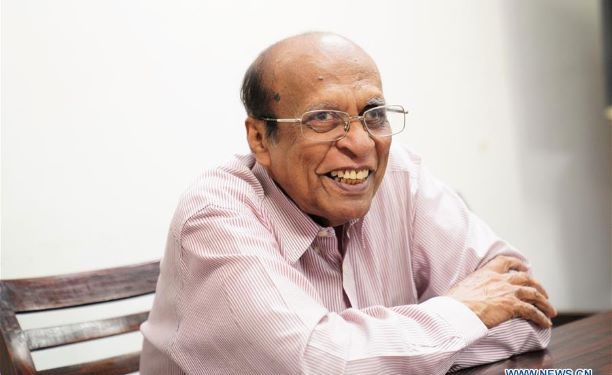
President Gotabaya Rajapaksa would have been surprised when the Sinhala nationalist theoretician and Mahinda Rajapaksa acolyte, Dr. Gunadasa Amarasekere, and a Sinhala nationalist lawyer, Manohara de Silva, protested against some of the provisions of the draft 20A. Left with no option, Gotabaya was compelled to tell them he would issue an alternative draft.
There is yet no clarity about what the Sinhala nationalist lobby exactly wants, but many suspect it fears the lifting of the ban on dual citizens standing for elections could lead to the infiltration of the pro-West Sinhala Diaspora and the pro-Tamil separatist Tamil Diaspora. Some like National Freedom Front leader Wimal Weerawansa, who are said to be against SLPP honcho and dual citizen Basil Rajapaksa, do not want him to be in Parliament again. The last time he was in, he took up the Economic Affairs portfolio and became Sri Lanka’s Economic Tsar, second only to the then president Mahinda Rajapaksa in power.
The general complaint against the draft 20A appears to be that it was prepared in a non-transparent and hurried manner by a set of lawyers close to President Gotabaya and associated with his organization ‘Viyathmaga’, which is a collection of non-political intellectuals and professionals. These non-political intellectuals generally have a dim view of politicians and consider politics, elections and parliaments full of the hoi polloi as a hindrance to good governance, justice, efficiency and national progress.
The draft 20A also represents the notion that the Executive Presidency should be an all-powerful office without any effective checks and balances, all for the sake of efficiency. It nullifies Parliament as a checking mechanism and envisages it only as a needed to pass laws and money bills. The Prime Minister and the Cabinet (all members of Parliament) will only be implementing agencies with little or no role in policy making or in appointments to key offices of state.
According to some MPs, this is not at all liked even by members of the ruling SLPP as they would be rendered powerless if all powers are given to the Executive President. The situation will be even more difficult for them if the President is a recluse, not easily accessible.
It is also said that Prime Minister Mahinda Rajapaksa is aggrieved, though he has not openly objected to the draft 20A. Perhaps his silence was meant to test the political waters or let the polity speak for itself. However, the moment he found that the 20A, in its present form, had created resentment, even in the SLPP’s own ranks, he set in motion a corrective mechanism and set up a committee to go into the issue.
Commenting on the reported objections from a section of the Buddhist clergy, a leading Tamil MP said perhaps, the Sangha fears that Sinhala-Buddhist nationalism would be appropriated by the armed forces and that the monks might have to kowtow to the new military standard-bearers of Sinhala-Buddhist nationalism.
Colombo District MP Mano Ganeshan said while Sinhala-Buddhist nationalists might want to deny the minority Tamils and Muslims their political rights, they are committed to preserving democracy for the Sinhala Buddhist majority. They see the draft 20A as a threat to the democracy they have been enjoying for the last 70 years.
The Sri Lanka Freedom Party (SLFP) leaders, who are allies of the SLPP, worry that with the 20A, their role in the government will be further eroded. Top minister Nimal Sripala de Silva has reportedly warned some opposition MPs that attempts might be made to buy them off in time for voting on the 20A. The SLPP leader asked them not to yield to blandishments from the SLPP.
The SLPP now has 149 MPs, but it needs 150 at the barest minimum to get the 20A passed by the required two thirds majority. According to Ganeshan, the SLPP’s managers are fishing for at least ten MPs from the opposition and are ready to take even Muslims, who they have been avoiding since the Easter Sunday blasts in 2019. But till date, there is little or no sign of any crossovers from the opposition.
To exploit the current predicament of the ruling SLPP for the benefit of the Opposition, and in the absence of any effort by the Samagi Jana Blawegaya leader Sajith Premadasa to act, former Speaker and UNP leader Karu Jayasuriya, initiated a mass movement to oppose the 20A.
Everybody recognizes that the 19thAmendment has its flaws. The incumbent government could have amended some of its clauses to get rid of the dysfunctional aspects, and we in the opposition would have supported the move. But it is wrong to replace it with a draconian and dictatorial 20A. The solution to the ills of the 19A is not 18A plus,” Ganeshan said recalling the 18A of 2010 by which the then President Mahinda Rajapaksa got extraordinary powers.
The 18A was repealed and 19A was enacted in 2015 by the United National Party-led government.
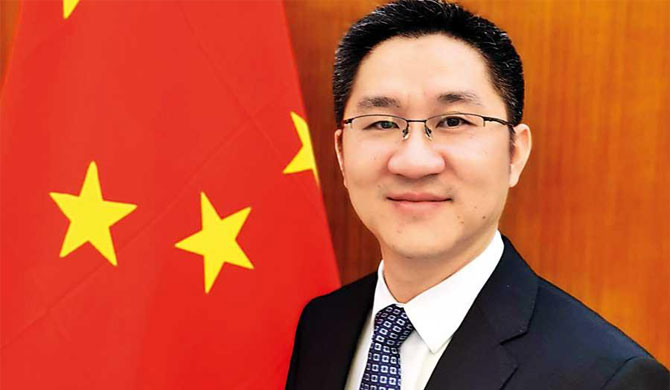
China never forces Sri Lanka to choose sides and is happy with the latter’s friendship with its neighbors, Hu Wei told Kelum Bandara of Daily Mirror.
By Kelum Bandara/Daily Mirror
Colombo, September 14: The Acting Chinese Ambassador to Sri Lanka, Hu Wei, spoke to Daily Mirror about the present status of bilateral relations between China and Sri Lanka and responded to questions about controversial issues relating to China’s relations with the US and India. Here are Excerpts:
*How do you analyze the present status of Sino-Lankan bilateral relations?
I think it might be the best time of our bilateral relation in history. During the past half of the year, both the countries suffered a lot from the COVID-19 pandemic. Our bilateral relations have stood the test of difficulties again, and got even stronger. One best thing in the pandemic is that we learnt much more about our friendship. The two peoples supported each other during the past few months. With mutual support, we managed the situation better than other countries.
*In my recent interview with Foreign Secretary Jayanath Colombage, he spelled out that Sri Lanka will reach out to China for economic cooperation. However, he said Sri Lanka would never compromise strategic security concerns of India. How does China view it?
First of all, every independent country should not compromise its own national interests for others. As far as Sri Lanka’s concerned, it should be Sri Lanka First. Secondly, China is a best friends and partner of Sri Lanka when we talk about economic cooperation. But actually our friendship is far beyond that. Our relationship is based on strategic partnership cooperation, not economic development only. As you know, we supported each other even during the past few months in the fight against the pandemic. Numerous amounts of urgent medical supplies including more than 73,000 testing kits, 4.5 million face masks, 54,000 Personal Protective Equipment (PPE) have been donated after the coronavirus outbreak in Sri Lanka, which were not only from Chinese central government, but also from local governments, companies, organizations and ordinary people. During the past decade, in the international arena, China always defended Sri Lanka for many key issues. We should not limit our cooperation to economic relations only. It is much more colorful, broader and deeper than that.
*When you say strategic partnership cooperation, what do you mean by it?
As strategic partners, we should have a better understanding with each other. We support each other in matters of our core interests and defend each other. Whenever Sri Lankan government comes to China during difficult times, we will definitely help. If China need support in bilateral or multilateral issues and come to Sri Lanka, we receive similar solidarity from the island. It is a comprehensive partnership.
*How do you look at the security aspect in this case?
Sri Lanka, as an independent country, has normal security cooperation with all the neighboring countries no matter it is India, China or any other countries. We respect it. We are also open to it.
*Now, both China and Sri Lanka have contained COPVID-19. How do you see the potential for economic cooperation?
It is already on the way. We should not wait. Even during the past few months, even before the general election, both sides gave mind to strengthening economic cooperation, particularly to help the revival of economy in Sri Lanka. The embassy tried to extend cooperation both in finance and investment. We have already made some positive progress. In March, Sri Lanka needed some urgent loans to settle external borrowings and fight the pandemic. The China Development Bank provided a very concessionary loan of US $ 500 million within 10 days. There is another big investment of some US $ 300 million lined up in Hambantota, a big tyre manufacturing centre, under very positive negotiation. A lot of rubber is needed for tyre manufacturing. More than 2,000 direct and indirect jobs would be created for Sri Lanka.
*How big is demand for Sri Lankan rubber in China?
In China, there are already quite a few tyre manufacturing centres. But there is still a huge demand in the domestic and international markets. The only thing to worry about is whether Sri Lanka can provide enough rubber supplies to meet the demand.
*What is the current status of Colombo Port City Project?
It is a US $ 1.4 billion project. It has generated a lot of jobs as you see. They have already reclaimed land from the sea. For the past few months, despite the COVID-19 pandemic, a lot of infrastructure work has been done. According to the master plan, an international financial centre will come up as a pioneer. We are waiting for the enactment of legislation by Sri Lankan Parliament for the next phase of development.
*Recently, the United States imposed sanctions on China Communications Construction Company. It is the parent company of China Harbour Engineering Company which constructed the port city. Will it affect work here?
The Colombo Port City is Sri Lanka’s largest Foreign Direct Investment. US $ 1.4 billion is only for Phase 1. For the second phase in next two decades, there will be another US $ 13 billion investment and creating more than 83,000 jobs. It will be the new engine for economic revival of Sri Lanka.
Some subsidiary companies of CCCC are blacklisted, but China Harbour Engineering Corporation itself is not on the list as far as we learn. What more important is, I don’t think we need to worry about it too much. The Colombo Port City is a joint project in Sri Lankan territory, not in the US. Such unilateral sanctions from the US that severely intervene other sovereign countries’ internal affairs have no international legal effect at all and will not be accepted.
In 1950s, China and Sri Lanka signed the remarkable Rubber-Rice Pact” to break the blockade of the US. Its legacy is still guiding us. I do have confidence in current Sri Lankan government. The President and the Parliament were elected by the people. I believe they understand what people need and will firmly safeguard the national sovereignty and interests. If a government cannot even protect the largest foreign investment which benefits greatly the country and people, who will come for future investments? We have no reason to doubt about it. Colombo Port City project will be a new version of Rubber-Rice Pact” to break the western blockade. We will definitely succeed again.
*In the Indian media, we see a lot of criticism of projects involving China. Earlier, there was an idea for talks involving Sri Lanka, China and India on matters of concern. How receptive are you to that idea?
We should not be driven by some biased media. We are open to the idea of regional cooperation in Sri Lanka and the region. As a true friend, China never says China First and force Sri Lanka to choose sides. We don’t want to do so. We are happy that our friend is making friends with others, especially with its neighbors. That is normal and healthy international relations.
*Border tension is high between India and China. Will it have ripple effects in the region?
China and India are in close communication through diplomatic and military channels over the recent developments in the border areas. I do not wish to go into further details. While you will hear many stories from the other side, I would just like to emphasize one fact: during the past decades China has already solved the border issues with 12 out of its 14 neighboring countries through friendly and peaceful negotiations, not via conflicts and wars. After boundary demarcation, borders are not lines of tension anymore. They become bridges to connect two countries and two peoples together. We’ve developed the border areas with most of our neighbors successfully. China never seeks hegemony over its neighbors.
*Your idea on the impact of the U.S- China trade war on Sri Lanka?
I don’t think there is any big impact. You may have heard some stories from the western media about many foreign companies’ relocating from China to other countries. It’s not true. There are indeed some companies that moved out of China. It is not because of the so called trade war, but due to stricter regulations in China for environment protection and labour protection. Most of the international companies chose to stay in China because they cannot find a better or safer place than China especially after COVID-19 breakout. The US-China Business Council which represents more than 200 American companies with decades of experience in China, found that in its latest survey that its U.S. member companies remain focused on a long-term commitment to China, with 83% viewing China as the number one, or in the top five, priorities for global strategy, and almost 70% saying they are optimistic about the commercial prospects of the market over the next five years. 87% of the companies indicate they have no plans to move production operations out of China. Actually, in the second quarter of this year, the GDP growth of China is 3.2 percent, which marks the best performance compared with other major economies and provides more confidence to all the international companies in China.
*What is the next step of Sri Lanka – China cooperation on the Belt and Road Initiative (BRI)?
After the parliamentary elections, Sri Lanka has established a very strong government with two–thirds majority. This might be the best time for our cooperation. We can proceed with cooperation faster and broader. We can attract more investment from China to help Sri Lanka promote its economic and social developments.
*What do you push for more- infrastructure development or industrial zones?
To be frank, Sri Lanka needs both. In China, we say if you want to get rich, build the road first. Transportation is vitally important. Now It only takes two and half hours to reach Hambantota from Colombo thanks to the southern expressway. In the past, it might be more than seven hours. Industrial development is also very important for the whole nation, which is one of the biggest experience China learned from its 40 years reform and opening up. The potentials of Sri Lanka’s industrialization is huge.
*Is there any Chinese investment lined up for the construction of the central expressway and the Colombo-Ratnapura expressway?
As far as I know, Chinese companies and financial institutes are well engaged in the Central Expressway. Some of them are also interested in the Ratnapura part.
*Earlier, your President Xi Jinping invited President Gotabaya Rajapaksa to visit Beijing. Now, both the countries have contained COVID-19. Is there any possibility for such a visit to take place?
There is surely a possibility. President Gotabaya Rajapaksa’s visit to China is always on the top of priority list for both sides. Under current situation, we need to find a convenient time for both sides. Before that, some minister level visits may take place first to warm up, which is a normal practice for state visit. At the moment, Sri Lanka’s border is closed for visitors. We expect that there would be some flexible arrangement for the warming-up visits before the state visit.
*When it comes to the concept of free and open Indo-pacific policy advocated by the west, what does China expect?
We have no problem with free and open navigation. We are always supportive of it but sorry to see it has been used as an excuse to attack other countries especially China. The U.S. has not only set up its Indo-pacific command with over 300,000 personnel, but also deployed their military bases in the Indian Ocean. China doesn’t have any command or military base in the region. Who is threatening the free and open region, and who has more reason to worry about it?
*What do you expect Sri Lanka to do in this regard?
Sri Lanka with a unique strategic geo-political location, should adhere to free and open navigation. I think the island should stick to its sovereignty, independence and not accept any foreign interference . That is the key to its national interests.
*Is there any plan for the implementation of the next phase of the Hambantota port project?
As I mentioned, we have investments coming up. There is also bunkering business opened recently. Even HSBC set up Express Banking Centre there last month. We do have confidence in the bright future of the project.
*What are the plans for people to people exchanges?
That is also one of the most important things we are expecting to do. After the pandemic, there will be more and more people to people exchanges. Both the President and the Prime Minister told me that Sri Lanka was expecting more Chinese tourists. We also expect Chinese people to choose Sri Lanka first if they intend to travel abroad.
*In you view, what is unique about Sri Lanka?
First of all, the general perception among Chinese people is that Sri Lanka is a friendly country. That is the most important part. Chinese people are sometimes very cautious. They think about safety and security first when they choose their destination. In Sri Lanka, of course, we also have a lot of beautiful views.
*Finally, Sri Lankan government asks for a debt moratorium from China. Are you responding positively?
To be frank, I don’t think debt moratorium is a good option for Sri Lanka. It might only solve a small percentage of existing problems but with huge prices. Sri Lanka has a very good reputation of settling its debts although there are a lot of foreign debts. The island always honours its debt commitments, which is highly appreciated and should be cherished. The reputation helps Sri Lanka a lot in the international financial markets to get more assistance and confidence. Furthermore, investment is a much better option which could not only bring direct income for Sri Lankan government, jobs for Sri Lankan people, but also rebuild international confidence on Sri Lanka. As a true friend , China will always try to help in all the possible manners.
A major overhaul of Sri Lanka’s diplomatic service is well overdue. The new Government aims to re-organise and make significant changes in overseas diplomatic missions abroad. According to news Media in the Sunday newspapers, the reorganisation will come into effect within a month.
Those diplomats who had been in service for too long, and who are over sixty years of age, and be over the age of sixty on 4 October 2020 will have to get back. It should also include minor staff (such as handymen, drivers and office assistants), sent from Sri Lanka, who have passed their retirement age. There have been cases in the past due to favouritism or nepotism where retired people were sent to overseas missions to circumvent their resident visa in the UK. A case in point was an educated chap sent to London as a handyman who could not even change a fused bulb!
A diplomat is appointed to a foreign country by the Ministry of Foreign Affairs in Sri Lanka and maintained by the Government. His salary is paid in foreign currency according to the Sri Lankan salary structure. Still, other supplementary privileges such as housing allowance, entertainment allowance, and all other tax-free services including duty-free petrol, free telephone and exemption from TV licence fees etc., compensate for his salary in rupee conversions.
Development
The responsibility of the Diplomatic Corps is to maintain inter-Governmental relations with other Nations and diplomats of other countries to improve trade relations, tourism, exports and imports. Their function includes seeking assistance through periods of difficulty on the supply of arms and ammunition during conflicts (such as during the Separatist War in Sri Lanka). Diplomats also receive unique advantages and immunities to ensure efficiency in carrying out their duties on a mutual understanding. They are immune to prosecution for any criminal offence, overseas Missions become inviolable and a diplomatic mission cannot be entered unless the diplomatic privilege is waived.
The diplomatic facility is often part of the Government service. In Sri Lanka, it forms a constituent part of the Foreign Ministry. Diplomats are supposed to use tact and diplomacy to aid effective communication, especially during negotiation, when attempting to be persuasive or assertive. Tact and diplomatic skills centre on an understanding of other people and being sensitive to their opinions, beliefs, ideas and feelings. They need to use thoughtful methods to aid effective communication.
Reformation
During the reorganisation, some of the new diplomatic appointments will be hand-picked personally by President Gotabaya Rajapaksa. They include individuals of standing, well qualified and after assessing their background and taking into consideration Sri Lanka’s Sovereignty, National Security and Implementation of the ‘Saubaghagye Dekma’ policy. Among them is a ‘founder cum a CEO of a Company Conglomerate,’ which is a resident in Los Angeles, USA. The Presidential Secretariat issued a statement (news item) to refrain from protesting about the new appointments because selections were made personally by President Gotabaya Rajapaksa taking loyalty to the Nation into careful consideration.
Rotten Eggs
In the Forces, be it the Police, STF, Prisons and other Governmental Departments there are bound to be rotten eggs in the basket. Similarly, it happens in the Diplomatic service too. There have been instances where the same Ambassador/High Commissioner overstays longer than the contractual period (it might be the fault of the Ministry of Foreign Affairs). In the case of the UK Foreign Office, stringent actions was taken by the British Foreign Office once due to non-return of diplomatic officers at the Sri Lanka High Commission once their tour of duty expired.
The fundamental problem stemmed from diplomatic officers, and non- diplomatic grade (so-called home-based staff) sent to London with families having school-going children. Once the families arrive in London (at the expense of the Sri Lanka Government), children get admitted to British seats of learning. The problem arises when such children get through ‘A’ level examinations or enter universities. In such circumstances diplomatic parents become reluctant to abandon their children in foreign environments. It is a natural feeling for which parents maybe pardoned. Parents, therefore, have no alternative but to seek any menial job to be with their children disregarding their former diplomatic status.
Political Asylum
There was a time when even diplomatic officers were allowed to seek ‘political asylum’ in the UK. Such conditions have since changed. Diplomatic officers could stay in Britain as long as the London Mission employed them. It was due to a loophole in the British Immigration Law when diplomatic officers arrived in London, the Immigration Officer at the Heathrow Airport stamped in their passports only the date of arrival. All other visitors had a clause stating: The condition attached to the United Kingdom is at this moment varied to require the holder not to remain in the United Kingdom later than… …” It enabled the diplomatic staff to live within the UK as long as they wished, but could not leave the UK or re-enter had they left the diplomatic service. When they decided not to return, they forego the guarantee given to the Sri Lanka Government and lose out on their pension rights.
The most expensive outlay the Government had to bear was the rent paid on diplomats’ accommodation. Late Lakshman Kadirgamar then Minister of Foreign Affairs had a vision to buy suitable quarters for diplomatic staff in all overseas countries. The Foreign Minister’s wishes were supported only in one or two countries, and the allocated funds were returned to the Treasury. However, the Government managed to procure a residence for the High Commissioner in the UK at St. John’s Wood, North London.
It was the only purchase made out of the Foreign Minister’s proposal. The investment comprised of an additional three bed-room house used by the seller’s gardener. A practical choice made by a junior secretary, who had newly arrived in London, who decided to convert the gardener’s cottage as his accommodation. It helped Sri Lankan diplomats, who succeeded him, to use it for years on end up to this day. In doing so, it allowed the Government to save thousands of Foreign Exchange from draining out of the diplomats’ housing budget in London. Nevertheless, some senior diplomats preferred to live in luxury apartments with swimming pools etc., and paying exorbitant rents, when their children were in University hostels. The Government’s monthly outlay on London diplomat’s accommodation was approximately £72,000 a month in the 1980s.
Missed opportunities
What the responsible Officials at the Sri Lanka High Commission in London needed was to seek funds from the Bank of Ceylon, London Branch, to stand as a guarantor seek mortgages from British Banks/Building Societies to solve the accommodation problem of diplomats. But they missed the chance. It was a period when the UK went through an economic depression and the housing market slumped.
The late President R. Premadasa had an alternate opinion to solve the accommodation problem in London. He wanted to convert the un-used basement at 13, Hyde Park Gardens (High Commission building) into several flats. To fulfil his dream, he sent construction workers from Sri Lanka and transformed the vast basement into several apartments, thus solving the accommodation problem for diplomats to a certain extent.
Selection to Foreign Service
The Ministry of Foreign Affairs conducted a special examination to select Diplomatic officers for the overseas posts with a low pass-rate of test-takers. Even out of those who passed the exam, some officers did not show any knowledge of communicative English to promote trade and commerce, technology or friendly relations in the UK. They were unable to intermix with diplomats of other nations in London due to the language barrier. Instead, it was shameful on the part of some diplomatic officers getting involved in social intercourse by inviting their friends (in the same office) for a weekend ‘rice and curry sessions’ and vice versa.
COVID-19
COVID-19 perhaps made a global change to the diplomatic corps. As the COVID-19 pandemic spread like wildfire, many Sri Lankans in foreign countries pleaded with President Gotabaya Rajapaksa to bring them home. It was because Sri Lanka acquired International recognition for controlling the pandemic by maintaining a centralised health care system effectively.
The President advised all foreign Missions to register those who wanted to return home in a recurring schedule. It made some of the Embassies work at full tilt and arrange everyone’s return systematically. Some Sri Lankans being over-anxious to return home, behaved irrationally blaming the Sri Lankan Embassy officials.
The Sri Lanka embassy in Rome is a typical example where embassy staff were working heartily and enthusiastically to help the stranded Sri Lankans in all parts of Italy to return home due to the spread of COVID-19. Although the Sri Lankan Embassy in Rome and Consulate General of Sri Lanka, Milan, complied with the President’s order, yet, some Sri Lankans in Italy have gone on record for blaming and cursing the embassy staff out of their frustration.
The COVID-19 pandemic changed the attitudes of people globally and made them think and act differently. President Gotabaya Rajapaksa’s wise decision to overhaul the entire diplomatic service abroad is timely. One hopes the new set of diplomats and those who are already in service enthusiastically pull up their socks and follow the instructions of President Gotabaya Rajapaksa, who is a strict disciplinarian and who commits himself personally to working towards the welfare of every citizen.
The writer confirms and stands by his statements written about the Sri Lanka High Commission in the UK during the 1980s. He was living in London for many decades and experienced activities of the Sri Lanka High Commission in London, particularly by working as an additional London Correspondent for Sri Lankan newspapers. Many articles written about the Sri Lanka High Commission in London appears in his tilalksblog.com, under the ‘Bandia Series’.
It’s high time we made use of the power of intelligence, gifted by God and discard fake concepts of political deception and obfuscations of scriptural texts, rooted, consecutively, in communal violence and religious racism. The Tamil voters, in the void of destructive racist politics and power-greedy opportunism, must understand that their peace and prosperity is a possibility, in the main, with the unity of the Sinhala Buddhist absolute majority.
Prime Minister Mahinda Rajapaksa, with the blessings of the President of Sri Lanka has courageously pioneered the initiative of proposing the cow slaughter ban. This is clearly the hands of friendship stretched out in cooperation and communal unity. The proposal comprises not only communal, but also religious unity, since the value of the cow slaughter ban is well analysed and thoroughly elucidated in Buddhism and Hinduism both being dignified global religions.
Division destroys and unification builds. Unity is impossible by electing leaderships weakened by imbecility. That was what the Tamil and Muslim voters were engaged in, when electing strengthless and irresolute leaders of governance, demoralised by the absence of patriotism, respect and love for the rights of the original community and ever ready to brutally betray the community, Nation and religion.
They enjoyed the fruits of weak leadership after the election of ‘good governance’. The Tamil and Muslim voters should be intelligent enough, not to underestimate the majority of the original community in this country. They are well capable of uniting, if and when really needed. The best examples were the last Presidential and General Elections. They successfully defeated even the system of proportional representation, branded to have been the judicial messiah, which constrains the absolute majority in Parliament.
Now, the Nation has elected a powerful and courageous leadership, well capable of naming things, for what they truly are. Hence, this is the best chance for Tamil voters to reshape their racist deception, inculcated by a politics of racist opportunism and be reframed into an innovative, farsighted, non-racist and profit-making vision. Spring was brought to the North subsequent to the eradication of the exacerbation of the LTTE terrorism by the SLPP founded by the Chairperson of the Economic Prosperity Task Force of Sri Lanka, Basil Rajapaksa.
It is true that Sri Lanka, notwithstanding the presence of its multi-ethnicity and multi-religiosity, predominantly is the land of the Buddha. The title, ‘The Land of Buddha’, the pearl of the Indian Ocean has won to own, by the strength of the firm Buddhist roots, gripped in Heladiva, for an unbroken colossal period of more than 2,500 years, when no other community or religion ever existed in this land, to a degree, to the exclusion of the Tamils. The Dharma or the Teachings of Buddha is, one of the most beautiful and doctrinally deep, intelligently logical, above and beyond blind belief religions in the world, enriched with absolute tolerance of other religions and multi-culturalism, though some extremist groups of so-called religions try to abuse the innocence of its tolerance, to destroy Buddhism itself.
First Commandment
The first Commandment among the universal precepts of Buddhism is ‘Thou shall not kill’, which no other religion contains as its first Commandment and hence, it perfectly demonstrates the depth of its innocence and the altitude of loving-kindness it showers, towards life and the environment in general. And this is where; the killing of innocent animals to gratify the human greed of flesh consumption flexes its ignominious muscle of disgrace to the total contravention of wondrous ethics, compassionately elucidated by the Buddha.
Real Culprits
Animals are killed for consumption in the presence of a demand for their flesh. In the absence of a demand, no sane-thinking person is crazy to kill animals for joyous entertainment. Therefore, the actual sin of slaughtering animal’s falls, not on the butcher, but on the greedy community, whose insistence for flesh is the real cause that causes the slaughter. Thus, the sinful responsibility for killing innocent animals is to be ascribed to those, who are gripped by the greed of demanding flesh.
Who demands blood-oozing out flesh? Muslims can be pardoned. Their religion and tradition is not specific in prohibiting flesh. The Tamil banning focuses on the cow, though many Tamils are vegetarians. But, the Buddhists, in this respect have no excuse whatsoever. They simply are not supposed to kill and devour animal flesh!
Attacking Muslims
Some religionists, who seasonally or on an ad-hoc basis propagate the stoppage of cow slaughter, design attacks against Muslims. For example, when a Buddhist priest set himself on fire and sacrificed his life, demanding the abolition of cow slaughter, an anti-Buddhist tendency of attacking Muslim abattoirs and flesh-selling outlets erupted across the country. A team with two Buddhist monks came to the office of the current writer as well and demanded to join them in the charging campaign.
It was categorically refused and they were compassionately explained that the true path to stop the cow slaughter is not attacking those who slaughter the animal. Instead by conquering oneself of the greed in one’s own mind for ‘stinking’ flesh, through the realisation of its atrocious sinfulness and as a result relinquishing the consumption of flesh of innocent animals in general and cow-flesh in particular.
Why?
If people stop buying flesh, animals would not be killed, just to heap their flesh up in a corner until it will be spoiled with bundles of worms rolling around, defiling the environs with an unbearable stench. The majority of this country is Sinhala Buddhists. If they honestly observe the first Commandment of Buddha earnestly, 80 per cent of the cow-slaughter would stop with no necessity to attack anyone, proving the world, the beautiful silence, innocence and non-violence, elucidated by the Buddha.
Powerful Lesson
If the 80 per cent of Sinhala Buddhists would refrain from eating flesh in general and from devouring beef in particular that benevolent act would trigger an enormous energy, which will inject the power of compassionate kindness in to the hearts of all communities, including Muslims, who’s religious and community traditions allow flesh consumption. They will begin to think and re-think. To intelligently analyse and re-analyse, what they, up to now knew and believed in. Adoubt in what they were confident hitherto would spring up and the question, Can 80% of the populace of this island be wrong?” will begin to flex its muscle. This along can play the role of the catalyst, making ignorant people aware of the truth, innocently teaching a powerful lesson to flesh consumers, in the void of attacking them.
Blatant Lie
It is said that the Buddha discoursed that under certain circumstances a Buddhist is allowed to eat meat: If One did not kill the animal oneself, If one was not an accomplice to the slaughtering and one knows well that the animal was killed not for oneself.
This is totally disrespectful to such an innocent teacher of wisdom as Buddha. It is totally and utterly impossible. A beautiful human-being, who never sinned even in his dreams, will not teach such spiritual rubbish! Which indirectly coax spiritually uninstructed common people, to consume flesh? The Buddhist priests, who teaches such criminal nonsense, are either ignorant or if not, willfully selfish. Some priests are ignorantly trapped in this ecclesiastical hogwash innocently, blindly believing in what the seniors preach and believing in some limited scriptural writings. Such scriptures must be destroyed to save Buddha from disrepute, they cause. Thus, such brutal explications should not be applied in our beautiful discussion here.
Mother Cow
The cow is virtually our second mother. It feeds us as our moms feed us by converting her blood to milk. The milk of the cow is not meant for us humans, but for its own calves. Yet, we get it. Then, the milk is not an end by itself. It is used to make lots of other products, we consume and relish like butter, cheese, gee, curd, fresh cream, ice cream and what not. It works in our fields. The bull carries our loads. Its dung is used as the manure. It is an innocent animal. It causes us no harm nor harms anyone else. It depends on grass for its survival. How can we slaughter this innocent animal and eat its flesh without remembering, pondering and feeling that we eat and devour our own Amma’s flesh? I am shocked. Perpetrating this heinous crime, can one call himself a human being? Hence, let’s drop eating cow-flesh.
Immediate Counter-argument
Flesh-lovers, who trust that animals are in this world, for them to kill and eat, on being encountered with the present suggestion, forthwith bring forth the following argument: Why must only beef be dropped? If flesh of other animals like goats, hens, rams etc. can be eaten, then why not beef?” The question seems to be logical, but not right. The appearance of its logicality is in the intelligence of one’s mind but the empirical existence of its righteousness is in the wisdom of the heart. The mind cannot feel.
The mind alone cannot make a being, a human-being. It is the heart, with its beautiful feeling and perceptions that makes a being, a man. Hence, the answer, for the intelligence of such people, who counter with the above argument, is that, the fundamental objective of this innocent and humble proposal is, not to eat only beef and continue to consume other flesh types. But, to respectfully and compassionately initiate an inception or beginning, to stop the most cruel and brutal type of flesh-eating and then,…. to generate a psychic foundation of self-respect and self-reliance, to relinquish the consuming of other-flesh types and be, if possible, a vegetarian. Hence, lets drop eating cow-flesh.
Buddhist and the Follower of Buddha‘s Dharma
The majority of this island is Buddhists. The First Commandment of Buddha is ‘Thou Shall Not Kill’. My suggestion is Please don’t be a Buddhist, but, be a follower of the Buddha”. Until one becomes a follower of the Dharma of Buddha, one is destined to continue the animalistic instinct of devouring innocent animals’ flesh. While eating, you, not only eat its flesh, but also suck the blood of the animal. Now, what is the difference, between you and a vampire? One can become a Buddhist by means of a passport or an Identity Card or by being born in to a so-called Buddhist family. Yet, one cannot be a follower of the Buddha, without observing the Dharma, He taught.
Then, if one violates the First Commandment, elucidated by the Buddha, he cannot self-identify and proclaim to the world that he is a Buddhist. He is an anti-Buddhist and his religion is not the Dharma, as was educated by Buddha. Therefore, by giving up eating beef, we can set a beautiful start to becoming an authentic Buddhist, who follows the existential contents of Dharma. Hence, let’s drop eating cow flesh.
Negativities of Flesh Consumption
By eating flesh a Buddhist becomes an anti-Buddhist. Further he also becomes a hypocrite. It converts one’s stomach in to a graveyard, wherein dead bodies are buried. It reduces one in to a person of anger. Without anger one cannot eat others’ flesh. The stupidity of intelligence cannot grasp the depth of this truth. One needs to be wise. It ruins one with the contamination of hatred. Without hating one cannot eat others flesh. It empowers one’s greed. It makes one selfish and self-centred. Without greed one cannot eat others flesh.
The stupidity of intelligence cannot grasp the depth of this truth. One needs to be wise. It depicts that one is deluded. It is only someone who is deluded, who can eat flesh. With the right knowledge one cannot eat others flesh.
The stupidity of intelligence cannot grasp the depth of this truth. One needs to be wise. It causes pain and agony to the animal. That pain and agony, energetically are deposited in the dead flesh. Thus one becomes the eater of pain and agony. Naturally, one cannot be a happy person.It causes fear and fright in the animal. That fear and fright energetically are deposited in the dead flesh. Thus one becomes the eater of fear and fright. Naturally, one cannot be a life fulfilled person. Direct killing or indirect influencing to kill is a shameful sin. Eating animal flesh indirectly influences the slaughter of animals. Thus, one becomes a shameless sinner.There are thousands of negativities. I shall not waste your time. The above are only few.
About the writer:
Dr.Gamini Ilangakoon is a Lawyer, specialising in International Treaty Laws
According to the latest external trade data released by the Central Bank, country’s trade deficit narrowed in July 2020, with a more than expected rebound in merchandise exports and notable reduction in merchandise imports.
Sri Lanka’s external sector recovered further in July 2020 supported by an increase in merchandise exports and increased workers’ remittances amidst reduced merchandise imports.
Several notable achievements were observed in spite of the COVID-19 pandemic. Earnings from merchandise exports surpassed US$ 1 billion in July for the first time since January 2020 and recorded a positive year-on-year growth for the first time since February 2020.
As expected, merchandise imports remained subdued with the continuation of restrictions imposed on the importation of non-essential goods.
The deficit in the trade account narrowed by US$ 509 million in July 2020 to US$ 209 million, from US$ 717 million in July 2019, as exports increased while imports recorded a decline.
Also, on a cumulative basis, the trade deficit narrowed by US$ 844 million to US$ 3,470 million during the period January-July 2020 from US$ 4,314 million in the corresponding period of 2019.
Meanwhile, terms of trade, i.e., the ratio of the price of exports to the price of imports, declined by 4.1% (year on year) in July 2020 as export prices declined at a faster pace than the decline in import prices.
Exports
Earnings from merchandise exports continued to increase to US dollars 1,085 million in July 2020 from US dollars 894 million that was recorded in June 2020, with the gradual recovery of both domestic and global supply and demand chains and efforts by the government to support the export industries. On a year-on-year basis, earnings from merchandise exports recorded a growth of 8.7 per cent in July 2020. This positive growth observed for the first time since February 2020 emanated from increased earnings from all three major categories of exports, namely, agricultural, industrial, and mineral exports.
Earnings from agricultural exports increased significantly in July 2020 on a year-onyear basis. Except unmanufactured tobacco and seafood, all subcategories of agricultural exports recorded increases. Earnings from tea recorded a growth for the second consecutive month in July 2020, with higher average export prices and volumes, compared to July 2019. Earnings from spices increased with the higher export volumes of all sub categories of spices, while earnings from coconut products increased with higher average export prices of kernel products and higher export volumes of non kernel products. Meanwhile, earnings from minor agricultural products increased, led by higher exports of arecanuts. In contrast, earnings from seafood exports declined resulting from reduced demand for seafood from major export destinations including the USA.
Industrial exports recorded a growth in July 2020, year-on-year, for the first time since February 2020. This increase was due to increased earnings from exports related to food, beverages and tobacco, plastics and articles thereof, animal fodder, rubber products and printing industry products. With the considerable increase in earnings from personal protective equipment (PPE) such as face masks and protective suits, which are categorised under other made up articles, earnings from textiles and garments declined only marginally by 1.4 per cent in July 2020, led by lower garments exports to the USA and the EU. Meanwhile, despite a marginal decline in tyre exports, earnings from rubber products increased, led by exports of surgical and other gloves. Earnings from other subcategories of industrial exports including petroleum products, gems, diamonds and jewellery, base metals and articles and machinery and mechanical appliances declined during the month of July 2020.
Earnings from mineral exports increased in July 2020, year-on-year, led by higher earnings from ores, slag and ash exports along with earths and stone exports.
The export volume index improved by 26.1 per cent while the unit value index deteriorated by 13.8 per cent, in July 2020, indicating that the increase in exports was driven entirely by higher export volumes, compared to July 2019.
Imports
The year-on-year declining trend observed in expenditure on merchandise imports since March 2020 continued in July 2020 as well, recording a decline of 24.6 per cent, to US dollars 1,294 million. Expenditure on all major import sectors declined in July 2020. This reduction is partly attributed to the measures taken by the government to restrict the importation of selected non-essential goods.
The expenditure on intermediate goods imports declined in July 2020, year-on-year, led by fuel imports (-36.3 per cent) and the importation of textiles and textile articles (- 20.7 per cent). The reduction in expenditure in fuel imports was due to the refined and crude oil imports with lower petroleum prices in the international market. The average import price of crude oil declined to US dollars 46.23 per barrel in July 2020, compared to US dollars 68.73 a year ago. Import volumes of refined petroleum also declined, while higher volumes were recorded in crude oil and coal imports in July 2020 compared to July 2019. Meanwhile, the reduction in import expenditure of textiles and textile articles was led by lower imports of fabrics and yarn. Further, expenditure on all other sub categories under intermediate goods also declined in July 2020 compared to July 2019.
The expenditure on investment goods declined notably, with decline in all sub categories in July 2020, on a year-on-year basis, resulting from the restrictions imposed by the government to curtail import expenditure. Accordingly, expenditure on machinery and equipment (mainly engineering equipment, electronic equipment, telecommunications devices and machinery and equipment parts), building material (mainly iron and steel and articles thereof, plastic, rubber and glassware, ceramic products and cement) and transport equipment (mainly commercial vehicles such as tankers and bowsers and auto-trishaws) declined in July 2020 when compared with July 2019.
The expenditure on consumer goods declined led by non-food consumer goods imports, although the expenditure on food and beverages increased. As a result of import restrictions, the non-food consumer goods imports declined with lower expenditure on all sub categories except telecommunication devices (mainly mobile phones) and medical and pharmaceuticals. Expenditure on personal vehicle imports declined considerably by 93.6 per cent in July 2020, the lowest monthly outlay since December 2009. Meanwhile, import expenditure on food and beverages increased in July 2020, led by import of sugar, fats and oils (mainly coconut oil) and vegetables (mainly lentils).
Both the import volume index and the unit value index declined by 16.1 per cent and 10.1 per cent, respectively, in July 2020, indicating that the decrease in import expenditure was driven both by lower volumes and lower prices when compared to July 2019.
Sri Lanka can use its unique locational advantage to become one of the world’s leading maritime hubs, President Gotabaya Rajapaksa said today (15).
He pointed out that development goals could be achieved speedily by developing the ports in the country while emulating the world’s most advanced ports as examples.
The President emphasized the need to develop the country’s ports to a higher level that would make them capable of attracting world’s largest cargo ships each with a capacity of 24,000 containers.
He made these remarks during a discussion held at the Presidential Secretariat today (15) on the future activities of the State Ministry of Warehouse Facilities, Container Yards, Port Supply Facilities and Boat and Ship Building Industry Development, the President’s Media Division (PMD) said.
The President further noted that the port system should be developed to cater to the needs of international vessels plying close to the country and in parallel to these initiatives Ports in Colombo, Galle, Trincomalee, Kankesanturai and Oluvil should be developed.
The development of the Eastern and Western Terminals of the Colombo Port should be accelerated. A special attention was paid to upgrading the reshipment handling capacity, offering warehouse facilities and container terminals as well as supply facilities of international standards.
It was also discussed to construct new warehouse facilities in areas such as Ratmalana, Peliyagoda and Veyangoda to promote Colombo Port as a Transshipment Hub.
The government should intervene to construct fuel storage tanks and supply fuel to the vessels, the President said while authorizing the construction of a docking bay in Beruwala to facilitate the launch of large boats into the sea.
It is necessary to expand manufacturing, repairs and maintenance of ships and boats aiming the global market. The expansion of facilities to exchange naval staff centering main ports is also important’, President highlighted.
Minister Rohitha Abeygunawardena, State Minister Jayantha Samaraweera, Head of the Presidential Task Force on Economic Revival, Mr. Basil Rajapaksa, Secretary to the President P.B. Jayasundera, Secretaries of both Cabinet and State Ministries, Heads of the Line Institutes and entrepreneurs in the shipping industry were present at the discussion.
The total number of positive COVID-19 cases confirmed in the country reached 3,271 as six more arrivals tested positive for the virus today (15).
In the meantime, the number of recoveries from the disease in Sri Lanka moved up to 3,016 as 11 persons infected with the virus were discharged from hospitals upon recovery.
The Epidemiology Unit says that 242 active cases are currently under medical care.
Sri Lanka has thus far witnessed 13 deaths due to the virus outbreak.
The Presidential Commission of Inquiry (PCoI) investigating the Easter Sunday Attacks, heard evidence on Monday (14) from two former intelligence service chiefs – Senior DIG Nilantha Jayawardena and Retired DIG Sisira Mendis – who exposed a lack of responsibility and leadership in the country’s national security establishment.
During their individual testimonies, the subject of whose responsibility it was to take up the foreign intelligence warning of an imminent attack and the intelligence coordination meetings chaired by the Defence Secretary were disputed by both parties.
Testifying before the PCoI on Easter Sunday terror attacks for the 5th day, the former National Intelligence Chief was questioned on the letter of forewarning which was sent by the Director of State Intelligence Service Nilantha Jayawardena.
In response, Mendis told the Commission that he had received the letter marked Top Secret” in the morning on the 8th of April 2019 and that it noted a possible imminent attack by National Thowheed Jama’ath led by Zahran Hashim.
When the Additional Solicitor General asked the witness to divulge his religious faith, Mendis said he is a devout Buddhist and that his wife is a Roman Catholic.
Mendis was then questioned on the steps taken upon learning from the letter on the 8th of April that important churches could be targeted.
He replied: As soon as I received the letter in the morning on April 08, I tried to meet then-Defence Secretary Hemasiri Fernando, but it was futile. However, I was able to mee with him in the evening. During that meeting, I informed him of the foreign intelligence which raised a possible attack on churches.”
Then-Defence Secretary had stated, Let’s make Nilantha raise this during tomorrow’s intelligence coordination meeting.
The Additional Solicitor General has then inquired the witness whether the Director of State Intelligence was informed of the matter to which the witness replied, I forgot to inform that. However, it is the responsibility of State Intelligence to raise the piece of intelligence which was first received by him.
The Additional Solicitor General then asked if the former SIS chief Nilantha Jayawardena had expected some instructions from the chief of the National Intelligence by forwarding the initial piece of intelligence.
The witness responded that although he was the national intelligence chief, the SIS chief was not under him. He was under the Defence Secretary. Hence, I don’t know what instructions should be given to him. Besides he is the most senior officer in charge of the country’s main organization, which provides intelligence. He has never sought instructions from me.”
Meanwhile, former Director of SIS Nilantha Jayawardena appeared before the PCoI on Easter Sunday terror attacks where he was cross-examined by President’s Counsel Anura Meddegoda, representing IGP Pujith Jayasundara.
The witness was asked if he did not get the impression that Catholic churches frequented the most by people could be targeted since the initial foreign intelligence noted the possibility of an attack on important churches.
The response of Jayawardena was that he did have such an impression and thus informed the police department of intelligence information.
The chairman of the Commission then asked the witness as to why the term important churches” contained in the initial piece of information was revised to popular churches.
To this, the witness replied that although such a change was made during his translation, copies of the initial piece of intelligence were attached to the documents which were forwarded to the chief of the National Intelligence and the IGP.
He added, I also informed that ringleader Zahran Hashim is linked to the Kattankudy blast prior to the Easter Sunday terror attacks.”
Jayawardena went on to say, had the relevant officials taken the warning of a possible imminent attacks contained in the foreign intelligence, received on April 04, seriously, they could have asked him whether it is the same Zahran Hashim mentioned in the foreign intelligence who is linked to the Kattankudy motorcycle blast.
Yet no one made such an inquiry prior to the attacks,” he added.
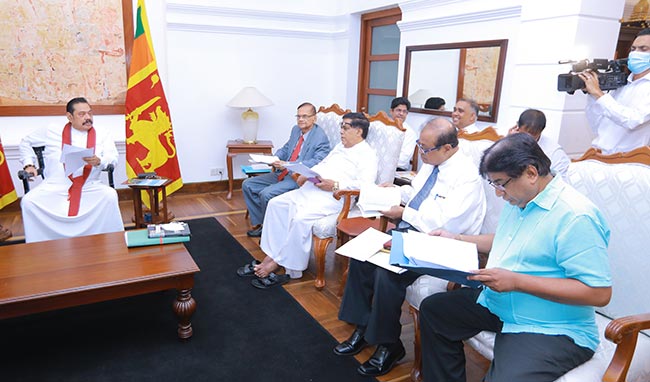
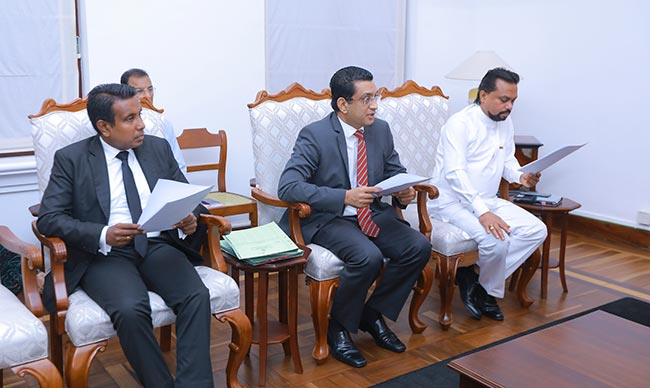
The committee appointed to study and review the draft bill of the 20th Amendment to the Constitution handed over its report to Prime Minister Mahinda Rajapaksa at Temple Trees today (15).
The nine-member committee comprised of Cabinet Ministers, State Ministers and MPs is chaired by Minister of Education Professor G.L. Peiris.
The committee members briefed the Prime Minister on what needs to be added and amended, as identified by them during the review of the draft bill, the PM’s Office said.
PM Rajapaksa recently appointed the committee to study the proposed draft bill and make recommendations while its members had met yesterday (14).
The report is also expected to be tabled at the meeting of the Cabinet of Ministers scheduled for tomorrow (16).
The committee, chaired by Minister of Education Prof. G.L. Peiris, also consists of Cabinet Ministers Udaya Gammanpila, Ali Sabry, Nimal Siripala de Silva, Wimal Weerawansa, and State Ministers Susil Premajayantha, S. Viyalendran as well as MPs Dilan Perera, and Premanath C. Dolawatte.
When the Working Committee of the UNP met yesterday
at Siri Kotha to decide who will succeed the Leader, Ranil
Wickremesinghe, the voting was decisive: 28 voted for Ruwan Wijewardene and 10
voted for Ravi Karunanayake, according to informed Party sources. It was
a secret ballot. Shamal Senarath prepared the ballot papers. After the count
Ranil did not declare the results officially.
The meeting began around 4.p.m with the Working
Committee targeting the 20 A. It was after that the issue of the next
leadership came up. Ranil began by saying that he had announced his
intention to step down and according to Party rules it is necessary to appoint
a successor. The Working Committee was meeting today to pick the new
leader. He was not going to name his choice. This meant that he was going to be
neutral.
The first to open fire was Ravi Karunanayake. He
led the attack pointing the finger directly at Ranil for not backing him. He
told him bluntly that he had worked for him loyally and served the Party to the
best of his ability. He said that he had also acted his Assistant Leader and he
had all the qualifications. Pointing a finger at Ranil he asked : What is
wrong with me? Why can’t I be the leader?”
Vajira Abeywardena urged the Ranil to name his
nominee for the deputy leader as that would end any controversy. He said that
no one will oppose his nominee. We will all vote for your nominee” he
said.
Lakshman Wijemanne said that Ranil had said
that he would step down and it is time that he appointed Karu Jayasuriya as the
Leader.
Ranil Wickremesinghe replied that this was nor the
time to discuss the leadership issue. The meeting was held to discuss
only the deputy leadership. There is time to discuss the question of
leadership, he added.
Navin Dissanayake said that Ranll has the power to
appoint General Secretary, Chairman, Treasurer and he also could nominate the
Deputy Leader. And, therefore, he should nominate a deputy leader. Why
don’t you do that?” he asked.
But Ranil that he was not going to nominate anyone.
Ranil also asked the other contenders about their
stand on the deputy leadership. Arjuna Ranatunga, Ranga Bandara, Daya Gamage,
Akila Vajia Abeywardena, who had put out publication to boost his chance,
had declined at the last minute, leaving the contest open for Ruwan and
Ravi. At this point Ruwan Wijewardene was asked by Ranil what his position was
on this issue.
Ruwan explained that he has come forward at
the request of the people and he had to respect their wishes. They had asked
him to lead the Party in this critical hour. He said that it was a
request that he could not turn down. He said he was ready to take on the
responsibilities of restoring the Party to its former glory.
Ranil in his speech said that the issue of Deputy
leader has been settled. There is still time to discuss future steps. The
question of leadership will be discussed at a later time.
According to the Party constitution the term of the current Working Committee will end in December. A new Committee will be appointed by the new leader.
The meeting lasted till about 6.30. It has
virtually ended the leadership issue that has plagued the Party in recent
times, which culminated in Sajith Premadasa running away with the majority to
form his wing of the UNP. However, political sources noted that Ranil
Wickremesinghe will not step down from the leadership yet. He will remain as
leader till end of the year. One of his mission in the interim will be to groom
the new leader and ease him into his chair.
The Working Committee did not discuss the issue of
Ranil being kicked upstairs into the UNP seat waiting to be filled by a Party
nominee.
On the surface level it looks as if Ranil has
thrown his weight behind his nephew. But the numbers that worked of Ruwan
indicate that the Working Committee has democratically elected the best of the
two candidates. Between Ravi and Ruwan there was no other option – not to the
Working Committee that has faced the worst defeat in the history of the UNP.
What happened to the UNP at the Presidential and Parliamentary elections was
stunning. It is like the entire population getting together and levelling the
Himalayan mountain to sea level. The task before the new leader is to
raise the Party from the bottom to it former height. Rejuvenating the Party and
regaining its historic status is the immediate task of the Party. To achieve
this the UNP needs not only a new face but a clean face.
To his everlasting credit it must admitted that
Ranil Wickremesinghe, the departing leader of the UNP, has done two great deeds
for the nation : 1. He established the ambulance service with the help of the
Indians and 2. Put his weight behind the election of Ruwan Wijewardene as the
new leader of the UNP. He had the choice of backing Ravi because the latter was
his No.2 at the Right-wing International Democratic Union (IDU). Ravi, indeed,
was the clone of Ranil in matters that were foreign. Both of them were the Sri
Lankan representatives at the IDU. That is the closest political alliance
linked by a Right-wing party to the Right-wing of the Western establishment.
The Communist Party had links to the Second Comintern under Stalin. Ranil
and Ravi were hoping that they could reap substantial international and
economic benefits being a part of the Bush-Howard-Thatcher gang. But it didn’t
work they hoped it would.
Besides, Ravi’s is not the kind of material that
would the inspire the nation to follow him. His image was ruined with his
involvement in the Bond scandal. He was also linked to the issue of money he
received from the convicted LTTE wheeler-dealer in New York, Raja Rajaratnam.
Ruwan,
on the contrary, has the credible and unsullied record behind his image.
If the UNP is to go anywhere it has to be on the back of one who can take it
back to its roots of the Senanayakes. And who in the UNP can fit into that role
other than Ruwan, the great-grandson of DS”?
The other day, locked down in Sri Lanka because of the
Corona, I ran out of the Starbucks
Coffee I had brought with me. Being a coffee connoisseur, the tastes of Island, Hariischandra and
Wijeya Coffee did not satisfy me. I have yet to find Soul Coffee. They are all the same- the same taste as half
a century ago. They were all pure coffee, not blended to different tastes. I
went to Coffe Bean, the leading coffee maker in Colombo that has a countless
number of coffee outlets in Colombo .
Most of those joints only sold the coffee as a drink and ultimately they
directed me to go to their headquarter store on Ward Place . At Ward Place they offered me a pack of
coffee beans imported from the USA- at
Rs 2400. That was a pack of 8 ozs. That size of
packet is sold at around five
pounds at Starbucks in London and Island Coffee sells this quantity for around five hundred rupees
They ground the coffee and it tasted good.. I made inquiries.. The
coffee beans, all roasted to taste, had
been imported from the USA- California, Camarillo CA 93012. California does not
produce coffee. So the coffee comes from a non producing country to us, a
coffee producer! Coffee beans come
mainly from African countries. the pack is sold in Califorrnia for around seven dollars come to us and gets
sold to us at Rs 2400 the equal of some ten pounds.
Sri Lanka instead of growing coffee has been importing from China,
Malaysia, Thailand all countries visited by me where I have been struck with
how they organize their agriculture. We also import from Mid East countries
that do not grow coffee.
That is where our foreign exchange has been going since 1977. Once
we did produce the best coffee in the
world. On my irrigation inspections in Kitulgala long ago I have seen coffee
bushes full of coffee beans, bright red in colour. I have not seen that much of
luscious growth anywhere else. I have also seen similar coffee in coffee bushes
at Kotmale when I worked in Nuwara Eliya. But now Kotmale has been axed by the Kotmale Dam- all to produce some 200 MW of power- some power that we could
have easily produced from some 70 wind
turbines scattered in Kotmale itself and the luscious productive land in Kotmale and the charming people would
have been saved. But that is another story. See my Paper: Sitawaka Hydro Project: in Lanka Web11/8/19. to understand the
nuances in our development order where we sacrifice what development and
production we have and more we justify doing it. I am sad that Sri Lanka had no
leaders who could avoid getting bluffed by interested influentials and I hope
that our new President will tackle problems efficiently. That brain that
tackled the LTTE will I am dead cert will stand up to that task.
Kitulgala is our coffee
belt. We do need to ban the import of
coffee which our President has done, I
think. Simultaneously we have to encourage the picking of coffee pods from the
existing coffee bushes, immediately get going with encouraging the coffee
growers to put some manure and cow dung, and wear a mask and additional clothes
when plucking because coffee bushes are also full of mosquitoes . There has to
be a village organization to activize the coffee growers and also the
Government must offer a guaranteed
price to buy coffee-like what we did in the Marketing Department in the Fifties
when we offered guaranteed prices for many items that we imported- that was in the Fifties and when
production increased we ended that scheme. But now we have no organization to
buy the produce. Both the Marketing
Department and the worthwhile sections of the Agrarian Services have been axed
at the dictate of the International Monetary Fund that the Government should
not attend to any commerce.
We do talk big about having guaranteed prices but the IMF axed the
organization that we had built to implement that scheme. Motoring around Sri
Lanka today I often spot the Agrarian Services stores- now overgrown with
shrubs, neglected. Then they were places
vibrant with life, where the multipurpose cooperatives that purchased produce
from producers and handed over. It is easy to talk of guaranteed prices but we
should know that we do not now have the officialdom to purchase the produce.
Take paddy we talk big about what we collect every season, but we forget that
the benefit of the premium price has fattened the trader. The paddy producers have
no cooperative stores to hand it over and sell to the traders for a song who
hands it over to the government stores and benefit from the premium price. And
our economic sleuths in our Ministries fail to grasp that the producer is left
in the lurch while the traders benefit. The main aim of a guaranteed premium price is to help the
producer gain a premium price so that he will be encouraged to grow more.
Once in the Fifties working in the Agrarian Services in charge of
the Anuradhapura District I had ten smart and able, very vibrant divisional
officers, who could even sell ice to the Eskimoes. Under them I had some fifty
trained overseers and they manned two hundred and ninety eight cultivation
committees- where farmers would meet very often and get coaxed by me and my
team to use fertilizer, improved seed and that was how the Green Revolution
brought Sri Lanka to the brink of self sufficiency in paddy- all while
implementing a scheme to offer rice at reduced rates to the needy- a target
that had never been achieved in any country. Then I had the organization,. In
fact then I remember we did import maize and I offered to produce all the maize
that was imported in one season. One word from me and my giants- they were real
giants and I was proud of them, would have mobilized the people through the
vibrant cultivation committees.. The Government did not approve my suggestion
and we worked only on paddy. Now we talk. The Government has to bring back the
Marketing Department and the sections of the Agrarian Services that were axed.
There is no other way.
Let us use our expertise to see what can be done for coffee. To
start with sad to say the Department of
Agriculture is dead at the village level today. They have no organization at
the village level and no men. This
happened some twenty eight years ago in 1992 when President Premadasa in one of
his unguarded moments promoted all
Agricultural Overseers, some 2400 of them to the rank of Grama Niladhari. The
specialists in agriculture the trained overseers all became white collar
workers as Grama Niladharis, pushing pens on paper instead of working in the
villages.
Sad to say till today there is no field level overseer trained in
agriculture. Today the closest trained agricultural officer works at the divisional
level. This officer has a few thousands
of farmers to cater to = the needs of
some 3500 farmers in Ranorawa and as much as 13,000 farmers in Yodakandiya,
(From patriot Ranith Mulleriyawa : The Island 04/06/2013) In short today our
specialist agriculture department has no base and as far as organizing be it
coffee or any other crop our officers can plan on paper and send it to the
divisional level. After that there can be no action whatsoever other than the
Agricultural Instructor at the divisional level
meeting a few farmers and writing something back to the District
Agricultural Officer. Then the statistics get transformed to documents on
glazed paper and ably documented. The
Department of Agriculture, figuratively
is a monster with provincial ministers,
secretaries and directors with no legs, producing only reams of reports without
a base!
So ends anything in agriculture, be it coffee, potatoes, maize or
any other crop.
What we need immediately for Coffee is a guaranteed price and an
organization to help the producer to produce more. There has also to be
subsidies offered to get people to plant more coffee bushes. Further it is
necessary that some government
organization gets cracking to the task
of finding how coffee can be blended to taste. Therein comes what I directed in
Matara as the Government Agent in 1971. Our President has got the State
Ministers on the move. It is necessary to get the mass of Government Agents and
their vast staffs amounting to thousands cracking. Perhaps what I did at Matara
may offer ideas.
I wanted to find the art of making a crayon to establish an
industry. We requisitioned the science lab at Rahula Collage every evening from
six to midnight and we- my Planning
Officer, a chemistry graduate and katcheri officers were hard at work helped by the
science teachers of Rahula to find the art of making crayons. It took a myriad
of experimental trials and we did find the art of making crayons in three
months. Then we dragged in the cooperatives
to establish Coop Crayon, which was a great success. Sumanapala Dhanayake the Member of Parliament
for Deniyaya happened to be the President of the Coop Union at Morawaka and I can in nostalgia recall getting down to
make crayons. It was done in double quick time-in three weeks working on a 24
hour basis- on most days I too broke rest.
It was hailed as great success by the Minister of Industries Mr
Subasingfhe and crayons were sold islandwide. That is what we immediately
require for coffee- someone to experiment. Recently I stayed a few nights in a
leading star resort in Anuradhapura and got to know the chief chef. I had a
chat with him trying to entice him to blend coffee with a flash of vanilla and
the likes to get different tastes. I can do no more- only talk. The Government
has to take the lead to find the blends and get cracking in production so that we can chase away Nescafe from our
shores and save our valuable foreign exchange and also creating employment for
our own people..
In the days of Sirimavo we
did have that organization – the Divisional Development Councils, the brain of
Dr NM at work. Dr NM is no more. . Our
President is kindly requested to get cracking with a programme like the DDCP, a
better one which will get down to work in producing what we need and thereby
save foreign exchange as well as finding employment for our people. Stopping
imports is the first step. This has to be supplemented with a production base which we do not have. My own work the Youth Self Employment
Programme does flash in my mind. Then I
was marching with the Youth Officers in the villages and marshes of Bangladesh,
guiding vocationally trained youths to establish ventures and they did succeed.
Today the Ministry of Youth Development has
reformed to a role of guiding
youth to establish enterprises and mind you by now three million of them are at
work- the largest employment creation programme the world has known. . My Paper
Youth Employment: A Prime Necessity” in Lanka Web: 11/10/2019 tells it all. . (www..lankaweb.com/news/items/2019/10/11/youth-employment-a-prime-necessity)
We need new thinking for Sri Lanka to emerge under our new
President.
I hope this paper will somehow reach the eyes of our new leaders.
Garvin Karunaratne, , Ph.D in Non Formal Education and
Agricultural Economics (Michigan State University) garvin_karunaratne@
hotmail.com
Former Senior Assistant Commissioner of Agrarian Services and G.A.
Matara
Almost 41 years ago the first
president of this country who had a long nose introduced a constitution which
he boasted himself that he is capable to do anything in his power as the
president, except converting man to a woman and women to man. he belong to
present day demised UNP political wing of Sri Lanka.
People well aware
the person in the above description. In those days there was a political
analysis from well respected politicians of this country.They request not to
appoint the above personal to take power of the country. And not to take back
the country from the person after all as well. It is because his legacy &
ideology will inflict much damage to country. The truth was his constitution
was not designed to develop the country, or ensure security, safety, law and
order of Sri Lanka. In a nutshell it was not a constitution to build the
Sri Lanka our nation want to own. That constitution was made to become
himself a little less status of a dictator. Otherwise, we would have been a
proud nation in the world map by now. But our nation had the potential to be
nation of such a glory in the world stage. Instead above presidents
constitution brought curse to our nation. The curse represented in many forms
to our country and its beautiful people of Tamils & Sinhalese. Some of them
were 30 years long civil war, fragile economy, cultural devastation. During his
time of ruling; Prof. Ediriweera Sarathchandra was attached with bicycle chains
and dragged on the way, He falsely intervened to judiciary to abolished the
civil rights of world first lady premier Mrs. Sirimavo Bandaranayake. So that
politician was a dictator to our motherland. I will not write down his name
because he had done enormous tragedy to our beautiful country. The above person
on the stage publicly addressed what is the use of learning history of the
country” So the history subject was gradually removed from the books. Today
history and anthropology are vital subject to learn because they are creative
subjects for new inventions. Apple computers hires engineers who learned
history & anthropology those people need for creativity & inventions.
Some of the people will agree with me of that rulers rule was disgusting, but
others will not, however that was the truth of his rule and legacy. Finally, he
died suffering from a simple cold. Over the past yahapalana government his follower
Ranil Wickramasinghe did the similar devastation to this country with his
colleague Maithree. Both the people must retire from politics of this country
and they are already convicted on the people judiciary.
19th
amendment created commissions and they have been boasting of that achievement.
Even present day speaks of the value of those commissions. But those
institutions useless if they failed to protect security of the country. The
police chief is held accountable for public security and he failed to deliver
his security obligations to public in his capacity as the police chief and he
himself had been in favor of politicians. The president cannot terminate his
employment due to commissions involvement. Justice ministers came out with
statistics the increasing numbers starting from year 2015. Doses the
commissions do anything to reduce the increasing numbers? Democracy is not a
company for few favoured people of the country. Democracy should be for the
deserving people of this country. The commissions and 19th amendment
was unable to ensure the safety of this country. Ranil and the gang defending
each other for power. I am aware Ranil created a parliamentary committee to
investigate Pascu Sunday attach. It was a jolly good investigation to pass time
and forgotten the incident and they did that way. What was the outcome? Just
after the meeting people in front of the committee of investigation those each
other discussing and enjoying coffee in the back.What was the outcome of those
cowards in this country? They have been playing games and enjoying the innocent
people deaths of the massacre. The investigation was a clear slap on the face
of Cardianl Malcom Ranjith. People have seen those videos and So called
Fonseka, Ravi Karunanayake, A. Marasinghe was there with others. It was a
complete joke for the people of this country. First of all most of those
parliamentarians have been convicted in the peoples court doing crimes against
the humanity. Eg. Ravi karunanayake was
in the committee as a member. Should he be in any committee of this country?
Arjuna Ranatunga
wants Ranil wrickramasinghe to be name as the national list member to current
legislative assembly. Arjuna Ranatunga want to be the leader of United National
Party as well. I feel so sad about this person. He was a brilliant cricketer of
our country. He brought big cricket win to our country. Sri Lankan people
respect him a lot as he was the only person who brought that prestige to our
nation. There is no doubt about it. In those days he was a national hero t.
Then he entered into politics. Mr. Ranatunga it was a mistake that he entered
into politics of this country. He needs to understand that he was fallen from a
cliff and ruined his entire flushing respect he had earned from the people of
this country. Now he is nothing in this country. People who earned respect
doing some great performance better to stay and maintain that prestige and away
from politics, which he or she doesn’t know in depth. People of this country do
have a huge respect to our legendary Muttiah Mulidharan and please stay as the
way you are right now and keep your earned respect and don’t let it spoiled by
entering into politics of this country. Same tragedy happen to Sanath
Jayasooriya. Arjuna Ranatunga never ever help to develop cricket in this
country but he critisizied incidence with giving solutions. I believe if he
stayed in cricket he would have been a great person in cricket world in this
country as well as abroad. I thing he was not capable or he didn’t have such a
vibrant personality to be a veteran cricketer after all.
We urge the
government to implement 20th constitutional change and make the way
to president to continue his work for the country. People of the country always
behind this government. Until the new constitution drafted; executive
presidency is a must to this country to remove all the constitutional mockery
to be removed which had been introduced by so called Yahapalana regime.
Yahapalanaya trying their best to convince people that they won democracy in this
country through commissions and introduced a democracy nowhere in this world.
But it was not, simply it was a fake gang democracy in the country to satisfy
certain interested groups of the country and abroad. Dual citizenship is not a
problem to discuss anymore. There is nothing wrong having dual citizenship.
Many civilized countries in the world accept dual citizenship and has achieved
much development because of those people. For example I want to serve my
country in my field of studies, which will be more beneficial to public. If I
could do that service that would have been outstanding to deserving people of
the country. General public will be benefited out that service in every where
of the country. So when it comes to dual citizenship; it need to be find out
intention of the personal. Most expatriate want to serve their motherland, and
it will be much more progressive to our motherland. I do not understand Harsha
de Siva so reluctant to dual citizenship. I personally unhappy of this person
as he is not doing to the country out of his academics. He has become a cheap
politician in this country.
Deforesting of
wanathavilluwa hurts a lot as I am a person of loving and caring to forest
reserves of the country. We have seen in our own eyes person called Abu
Bhakkar Insaffe a provincial politician bribing some media people when they
actively making photos of the area. We have a minister and so many institutions
to protect and nurture the nature but trees have been cut down and vandalized
after all has been done media public those pictures. It is heart breaking to
see all these, as they are going on with this president’s government. We are
quite worried of national forests
devastation. The ministerial intervention to protect them not adequate enough.
The person may be punished upon the investigation of cut down trees but with
the devastation; the contribution to ecological balanced will never be able to
back to normal again. Please introduced heavy fines and life imprisonment for
ecological damages of this country. Unfortunately, most of them done by
politicians of this country. These are
heinous crimes to the country. If Wanathavilluwa forest reserve was protected
and educated people the valued trees would have been protected. It would have
been turn to a park of protected trees of scarce trees in world” this could
have been the concept to earn money from tourist attraction and earn
money.
Media has surfaced
the huge deforestation pictures, and again 5 acres of land has been cut down?
Who is responsible for these activities. The forest and wild life minister does
media briefing to punish those people who are responsible. But Mr. Minister
your primary jobs is protect those forest reserves before cutting them
down. If you are the minister your prime
job is to protect them. If you are unable to do so please resign from your job
let president to appoint a suitable person to the ministerial position. It is
quite sad and you must be regret as the minister has been unable to protect
those valuable trees preventing cutting down. It seems like people need to take
a different approach to protect our forest reserves. The best way to protect
the forest reserves is organize community watch groups. If they were to find
out information involving to cut down forest reserves they must complain
municipalities & police and the president. I know he is tough on issues of
environment. Most information we hear through media quite difficult as most
rare but expensive Burutha, Kaluwara trees have being cut down. I believe people
involved into such big forest devastation is doing with the political help of
the Puttalam district. Please jail those criminals in life time imprisonment
without a payroll. Sanath Nishantha Perera says the land which has been cut
down trees, E.G Burutha , palu , and Kaluwara belong to deserted and isolated
piece of land. This person sometime ago fall into trouble with
environmentalist, and the environmentalist lady came up very rightly against
him as he was defending the act of forest devastation. This person must be
aware when it come to environment; they are sensitive subjects to people. We
know this person is lying, and he is undermining the whole heart focused
efforts of protection of the environment. The argument here is we accept right
live of people but we want accept cutting down trees of the environment and
then justifying the act of damaged caused by commenting false claims. The
Previous government Bathudeen did same to Wilpattu. This is bad as it is
happening again, and we are so unfortunate to experience the environment
tragedy with this government as well. Please don’t let forest reserves
devastation an incident of Water Gate” to topple the present government of Sri
Lanka.
Dharshana
Haundungoda has a typical way of blog presentations. If he is criticizing the
government from his point of view; it has to be the view of the general public.
Otherwise you will not be able to make a living through your presentations.
Love your country, stand for the country when you criticize incidents or people.
I remember your discussion with Ranil wickramasinghe, if you were to educate
people public and if you were a patriot of country; you could have ask a valid
questions, which always right to ask from Ranil Wickramsinghe. The question is
this. Do you think Hon. Ranil Wickramasinghe the decision to appoint Arjun
Mahendran as the governor of central bank was a correct decision in midst of a
protest? You could have dig into more question knowing more about him.
Unfortunately, you never did it. If you want to make a living from media you
need to make sure to be patriot to your country and try to represent people’s
honest feelings through media.
The Ranil Maithree
wickramasinghe government was not a single entity. There were many people &
parties belong to that rule. There were huge media journalist panel campaign
parallel to support them. One of the key members of the group was the soft
spoken Sarath Wijesooriya, Late Maduluwawe Sobitha, Gamini Weyangoda,
Jayampathi wickramaratna with Sumanthiran of constitution council for
constitutional change, NGO, Foreign ambassadors of this country, American
Embassy, etc. All of those were involved to that rule. They were campaigning
democracy and rule & discussions in media. The key people in those
discussions were Mr. Janaranjana, Gamini Veyangoda. There was looming
instability through out the country Janaranjana, and Gamini Veyangoda, soft
spoken Sarath Wijesooriya was trying to convince democracy they achieved over
Mahinda Rajapakse government. However, at the same time a huge influx of public
at Madamulana, wanting them to come back Mahinda into politics in the country.
Political
commentator Chameera Perera at Dawasa program has promoted something which is
detrimental to our country. Chameera Perera belong to same members of the group with late Maduluwawe
sobitha who tried to made Rotti” by mobilizing the people against the
Rajapakse government. Keerthi Thennakoon alson was commenting against
constitutional change. I am surprised of these people are they working for the
people of this country or some others. People mandated the government to
do the change, and that change is inevitable. I want to highlight Roshan
Watawala to promote good things happening in this government. Igniting and mobilizing public to an unknown
freedom is bad, that is not the good practice of media freedom. Please try to
identify good things happening in this government & discuss that good
activity with a panel of expertise which will be more benefit to people of this
country. Sri Lankan media institutions and their media personal need
more trainingon how to identify what is reporting, distinguish good
reporting form bad. They always compete with other media channels to gain more
ratings only. The defense ministry and forces in full operational to counter
& eradicate underworld and drug business and its spreading in the country.
Just to let everybody know; 3 decades ago when first heroin addicted person
identified the reporting was amazing. I do not remember the name of the
reporter. But it was the most informative information to public as we were not
aware about habit forming drugs and their abuse. The reporter reported The
seed has planted in a fertile soil so we need to be vigilant of its danger to
this country”. Please understand how dangerous the underworld and drug use in
this country by now. The whole country is falling line with the government
effort with unconditional support to eradicate the drug problem and underworld
activities in this beautiful country. Please report that everyday if you are
falling line with the pulse of the people of this country.
What is the use of
all the sacrifices people have been asked to go through and are making if the
likes of MCC come to pass. People will be made vassals in their own country.
The nation is being encouraged to save, to grow, to be more self-reliant, to be
more disciplined. All these for whose gain? Can the authorities be more honest
with the people and let them know the specific advantages and benefits they
will receive in the event MCC and the sister agreements come into effect? They
have no moral right to talk with foreign powers behind the back of the people
like the previous regime. They have no right to engage dubious individuals with
shady pasts to decide on the future of our Motherland.
It is obvious the
Americans want to use Sri Lanka as a staging post for their war like activities
in the region according to the Indo-Pacific Strategy, they intend setting up to
counter the Chinese influence in the region. If all these come to pass Sri
Lanka will be left a desolate land desecrated and violated by the US soldiery
as has happened in so many other countries before. China too has a role to
play by not unnecessarily involving Sri Lanka in a power struggle not of their
making.
The world has
witnessed similar before when the US went to Vietnam, Cambodia and Laos to save
the East from Communism. We saw what happened when Yugoslavia was destroyed and
the resulting carnage – all in the name of restoring democracy. We saw what
happened when the US led forces invaded the Middle East to save the world from
Saddam Hussein that finally led to 9/11 and another invasion of Afghanistan and
Iraq leading to ISIS destabilizing a swathe of countries and their citizenry.
We saw the effect of ‘colour revolutions’ that ultimately ended up creating
divided nations and more human misery. The established order however distasteful
has now being replaced by a state of disorder leading to more human misery than
ever before. Now we see all those people affected by the US led Western
Christian Powers, invading the European heartland as refugees. In other words,
they have messed up the world and now they are reaping an immigrant invasion.
We have to ask the
people of Okinawa, Subic Bay, the Panamanians, Honduras, Chargossians, Haiti,
Hawaii Porto Ricans and similar others
how much they love the Americans. Have they left any of those countries in any
better shape since the American involvement in those countries? Finally, we
have to ask if all those people who shout to heavens Black Lives Matter” how
they feel about their own country?
The US intend
setting up a land corridor from Colombo to Trincomalee through which they can
move all their war logistics and Sri Lanka will never be the same again. The
reason for land titles and improvements to the road infrastructure are all to
benefit the invader – for him to buy land and then use the road facilities to
move about freely all over Sri Lanka – no passports. no visas, not subject to
Sri Lanka law. Even the British during World War II referred to the Americans
as – “overpaid, overfed, over dressed, oversexed and over here”!
This very same
thing happened to Hawaii and today the Hawaiians are second class citizens in
their own country. To
sell country down the drain for a mess of pottage amounting to less than $500
Million Dollars is a crime like no other in the history of Sri Lanka!
Furthermore, this
is an issue which should be tackled in consultation with all other countries in
the region. Definitely an American presence of this scale does not bode well
for anybody – not in Sri Lanka – not in South Asia!
The reason the
previous Yahapalanaya led by Ranil W sold Hambantota to the Chinese is a fait
accompli to make MCC happen! This to give an excuse to the Americans, Indians
and others of their ilk to ask for a pound of flesh from Sri Lanka to even out
the balance of forces.
The Chinese loan
for the construction of the Hambantota Port was ~$1.5 Billion. Now for a
consideration of less than that amount we have handed over not only the Port
per se but also an indescribably a valuable piece of real estate on which the
port sits on a supposed to be lease that can go up to 198 years! There is
nobody living today to witness what will happen to this land with a title that
goes in history beyond 2600 years. What sort of a deal is this? Those involved
must be brought to book and sent to prison!
RANIL W WAS TASKED
TO MAKE SRI LANKA A FAILED STATE. DURING THE LAST 5 YEARS THAT WAS HIS MAIN JOB
SET UP BY HIS TASKMASTERS IN WASHINGTON AND TO WHICH HE AND HIS COHORTS SO
WILLINGLY SUBSCRIBED IS NOW MORE THAN OBVIOUS. HE MADE ARRANGEMENTS TO BRING
DOWN THE ECONOMY WITHIN WEEKS OF GRABBING POWER – RESULT BOND SCAMS! HE MADE
ARRANGEMENTS TO DESTROY SRI LANKA’S SECURITY STRUCTURES – RESULT EASTER SUNDAY
ATTACKS AND RISE OF JIHADISM! ATTACK ON AGRICULTURE – RESULT IMPORT DEPENDENT
NATION. ALL THIS CAME TO PASS. FORTUNATELY FOR SRI LANKA, THE ORDINARY SRI
LANKANS – MAJORITY SINHALA BUDDHISTS PREVAILED AND BROUGHT ABOUT A CHANGE OF
GOVERNMENT AND A RESOUNDING WIN FOR POHOTTUWA AT THE PRESIDENTIAL ELECTION AND
LATER AT THE PARLIAMENTARY ELECTIONS NOT WITHSTANDING THE PANDEMIC! ARE ALL
THESE SACRIFICES TO NO AVAIL!
All those who voted
for Pohottuwa never envisaged that they will have to face an issue so dire and
traitorous such as the MCC sell out so early in this administration. This would
out rank even Ranil W’s Central Bank Bond Scam several fold if it ever come to
pass! May wise counsel prevail!
Only way is to
strengthen Sri Lanka’s armed forces and begin national conscription. Only a
strong Sri Lanka that can withstand the outside forces as well as provide
security guarantees to India on her southern flank and to other nations in the
region. It is strange how India is going to benefit from going into a
partnership with the US, Japan and Australia to counter China. India should
very well understand that the ultimate end game of the US led Western Christian
Powers is to balkanize India – a country that is aspiring to be eventually as
powerful as China in the coming decades.
It is in the best
interests of India and China to keep Sri Lanka neutral. Sri Lanka, just like
Singapore should be afforded the wherewithal to become powerful militarily and
keep the sea lanes south of Sri Lanka in the Indian Ocean safe for all comers
including the US, Japan, Australia and other nations of the world.
CHINA IS NOT
HELPING ANYBODY INCLUDING THEMSELVES IN HER STEAMROLLER DRIVE TO ‘COLONIZE’
OTHER NATIONS USING HER ECONOMIC STRENGTH. WHAT HAPPENED TO OTHER EMPIRES WILL
BEFALL CHINA TOO IN THE END. BEING A NATIONS WITH MUCH WISDOM AND A KNOWLEDGE
AND EXPERIENCE FROM HISTORY, CHINA SHOULD REFRAIN FROM BECOMING ANOTHER BULLY
AND A FOLLY!
All compounded
things are impermanent! Anichchawata Sankhara! – Lord Buddha
Dr. Chula Rajapakse MNZMFRCP(UK)FRACP( Aust/NZ)Wellington New Zealand
The about 10% Tamil minority in Sri Lanka were the privileged
minority of one hundred and fifty years of
Divide and Rule” British Colonial administration, while the about 75%
Sinhalese majority were the oppressed and disadvantaged majority, as they posed the greatest threat to the colonial
administration.
Thus at independence, nearly 90%of Engineers and Surveyors and 60% of doctors, and a vast
majority of the civilian administration were from the 10% Tamil minority. The
first Sri Lankan to act as head of state in post independence Sri Lanka was a
Tamil, Justice C Nagalingam , i1954 as
acting Governor General. The first army commander in post independent Sri Lanka
was a Tamil, Brigadier Anton Muthucumaru . The longest serving attorney general
in SL was a Tamil, Siva Pasupathy. Till the time of the LTTE uprising in July
1983, that forced, many Tamils to flee SL as refugees to the west, lest their
children would be forcefully conscripted into the LTTE ranks, the level of
Tamil representation in all walks of Sri Lanka life was way more than the 10-12% Sri Lankan Tamils
represented of the islands population.
This is hardly the picture of Tamil discrimination they had by now
started orchestrating in the west and to the world
When the British left Sri Lanka
in 1948, attempts were made to redress the disadvantages of the Sinhalese especially
in education. This led to the inevitable loss of the privileged status of
Tamils and the over representation of Tamils in all walks of Sri Lankan life,
especially in the much sort after positions. This was seen as and deliberately
presented by some Tamils as discrimination to both fellow Tamils and the
western world, ready to believe any
claim of ‘’discrimination of a
minority” . This led to the call in 1976 by some Tamils the TULF n Vadukuddai
Northern SL, for a separate state
of Elam consisting of 2/3rds of the coast line and 1/3 of the land of Sri Lanka , for this now 12% minority. This
really reflected the privileged mind set, they still had.
They tried to draw support for this avaricious objective by claiming Elam
to represent the Traditional Homeland of Tamils” . This picture of A Collection of Buddhist Shrines Dating Back
To 3rd Century BC , still evident in the heart of Jaffna peninsula and
other Buddhist archeological monuments scattered
through out Sri lanka is witness to the
fact that all of Sri Lanka was homeland to it’s Buddhist Sinhalese civilisation
for 2500 years, as the Mahavamsa records. Tamis , Arabs & Malays were able
to settle in various parts of SL , due to the kind & welcoming disposition
inherent to Buddhism, acknowledged many times recently by no less a person than
Cardinal Malcolm Ranjith, head of the Roman catholic Church In SL
In 1983 this separatist Elam movement
became a brutal terrorist war against the rest of Sri Lanka, waged by the LTTE,
( Liberation Tigers of Tamil Elam)., at one stage labelled the world’s most
brutal by the FBI US, no less. They drew support in finance and propaganda
for their bloody campaign from an Internationally based Tiger Diaspora, that
had by then become well established in the west , especially in the UK, Canada
and USA, cleverly exploiting their claim of
Minority Discrimination”, to hoodwink their unsuspecting host
countries. Their hosts were ready believe these claims , without any evidence
being supplied to support these claims, accepting it as the inevitable for a
minority in a third world country.
The making of Sinhala, the mother tongue of the 75% majority in 1956, as
the state language was one major complaint of the 12% Tamil minority. In most
countries, much lesser percentage of the majority community would have been
adequate to justify this. Not so for this minority used to 150 years of
colonial privileges. The provisions of the Reasonable use of Tamil act that
enshrined the right of every Tamil child to receive a free state education in
the Tamil medium upto end of tertiary education, no different from a Sinhalese
child, the right of every Tamil citizen to address the government for their
wants in Tamil and receive a response in the same language, the provision for
the courts in the Tamil majority districts to conduct their affairs in Tamil,
and the right for any Tamil to compete for entry into the public service
without any knowledge of Sinhalese provided they gained competence upto some
level a few years later, did not satisfy the avaricious appetite of this once privileged
group. Additionally this requirement to gain competence in Sinhalese , after
joining however was not a requirement in
professional fields like in medicine . Now Both Sinhalese & Tamil are state
languages on par with each other.
After three decades, the brutal terrorism
of the Tigers came to an end on 19th of May, 2009, when all
of the LTTE Terrorists were laid to rest on the banks of Nandikadal Lagoon in
Mullaitivu. This victory was thanks to
the transformation of what was once ceremonial security forces to a truly
professional service, conforming to the highest standards, as was widely
acknowledged .
However, the internationally based Tiger Diaspora, that supported
the Tigers with finance and
propaganda throughout, were left entirely unscathed as was their Billion dollar war chest
amassed through Distortion (misinformation to justify tiger terror so
enable collections in the west), Extortion , ( forcibly compelling
Tamils whom the diaspora helped to achieve refugee status in the west to
contribute large portions of their social service handouts and forcibly
taxing” by then well established Tamil
businesses in the west) and Drug & Human Trafficking (Tiger Diaspora groups
have been exposed of being guilty of this
many times). With this burgeoning war
chest no longer required for arms purchases, they had plenty of resources to
procure cash trapped TV stations like Channel 4
UK to produce infamous films like Sri Lanka Killing Fields”, to
discredit SL and their war achievements. A New York times critic described this
as a collection of video strips, un authored and unlocated held together by a partial commentary that
led the viewer to attribute all the ills shown, to be acts of the SL Security
forces. Much of these strips have since been shown to be Tamil Tigers, clad in
the uniforms of captured soldiers committing atrocities on these victims
This new phase of discrediting the war efforts after the annihilation of the Tiger fighters in SL
in May 2009, was clearly a well planned move that was executed within days of the fall of the Tigers in Sri
Lanka, by this well resourced , powerful
and devious Tiger Diaspora, to discredit
the Security Forces, by claiming that
their victory had been achieved at the expense of gross human rights violations
alleging an unacceptable loss of Tamil civilian lives of any thing between 40,000 -100,000 in the last few weeks of the war. They claimed
this to be the result of indiscriminate & even directed fire at fleeing
civilians. Though all the evidence was that nothing was further from the truth,
& that the civilian toll was of the order of 7000, , they persisted in orchestrating these Tiger
Diaspora allegations internationally
with Joseph Goebbelian zeal, as they had done with all their false propaganda
through the earlier three decades, till these were believed in the west .
The assessment of the UN representative based in Colombo at the end of
the war Sir John Holmes was that the Tamil civilian casualties were about 7000
at most. This number was confirmed a few
months later by a census carried out by the Tamil University Teachers, as the probable number
Tamil civilian casualties. Wiki leakes
leaked information also revealed
that defence attaches in both the UK and US embassies at that time had
confirmed these numbers in their dispatches to their various countries and had
also mentioned that but for the care taken by the SL security forces to
minimise Tamil civilian casualties, the war would have been over well before
and with less SL security forces casualties. Besides, it made no sense for the
SL forces to attack civilians and then a few weeks later for these same
civilians, nearly 300,000 of them to flee straight into the arms of the security
forces to escape from the Tigers who had held them as hostages to use as human
shields against the advancing SL forces. These were all confirmed by these
civilians once in the safe haven of the camps arranged by the SL forces. Even
more these civilians were resettled in their homes within a few months after
the war , once the SL forces had risked their lives to demine these areas ,
heavily mined by the retreating Tigers.
All of these were confirmed by documents tabled in the British House of
Lords in 2017 by Lord Naseby , who after a long battle accessed some of these
original dispatches from the UK H/Commission in Colombo. Additionally the
Paranagama Presidential Commission tasked with investigating allegations of missing
ersons, cleared SL forces of been
complicit of systematic or direct killing of civilians . Additionally these findings were endorsed by
a panel of several internationally well known panel of legal experts on war
crimes, headed by Sir Desmond de Silva QC from UK
The Tigers derived their story of
40,000 casulaties or more initially
from Gordon Weiss claiming from
unnamed sources who later retracted it under questioning . He was an UN employee based in Colombo in May 2009,
who was after boosting sales of his book. The major boost for the claim came
from the Darusman commission Report. This commission having only interviewed the Tigers and Not SL
sources, suggested this number as a credible allegation” but refused to reveal
the source of this information for thirty years. So much for it’s
credibility This commission was
appointed by the then UNSG to report to him on accountability provisions in SL,
without the authority of the UN or UNSC and against the specific wishes of two
of its members, Russia and China and hence not a UN report. However ,
this did not deter the Tiger Diaspora from orchestrating this as a UNreport to add muscle to
their allegation. This label UN
Report”has since stuck
It did not take long for them to go a notch higher making these evidence of Tamil Genocide , even more appealing
to the unsuspecting liberal western minds. This allegation of Tamil Genocide has been
craftily orchestrated since , even luring unsuspecting and misinformed western liberal parliamentarians to make this call, on
their behalf,. This we saw most recently in May’20 with the Mayor Columbine from Canada and NSW state
parliamentarian Mr Hugh McDermott from
Australia, to coincide with the 11th anniversary of the fall of the
Tigers.
If this is to be countered the first requirement would be making this information on the truths behind
the Tamil Genocide Claim , widely known in the west, especially, Canada, UK and US , amongst it’s
media and politicians , state and
federal. These would then need to be orchestrated repeatedly, at
every opportunity and creating opportunities, just like the Tiger Diaspora has
done with misinformation.. These message would need to be repeated using modern
media of email and others . Messages should
be short where the bold titles conveys
the main message, and repeated frequently. Eye balling the title is what most
would do and that should convey the main message The aim would be to achieve a default position in the minds of these
recipients and institutions that Tamil Genocide has no factual basis”
and that it was post independence loss of privileges enjoyed under British colonial rule, was what was presented
as discrimination”.
The next requirement is to highlight the motivation among
a large section of the Diaspora, to continue to paint a negative
picture of Sri Lanka and a risk to
their safety in SL if they were sent back to SL, even if there is none , as
their continuing to enjoy western privileges
as refugees , depends on this.
On the other hand these should be coupled with information on life of
Tamils in Sri Lanka now , showing the freedoms and opportunities they enjoy
back in SL. A truly tri lingual Sri. Lanka would help the cause immensely. The
Covid crisis has exposed the potential for TV & E teaching & learning and could be utilised to achieve this and so
win – win for all.
The third requirement should be to focus spot light on
The Tiger Diaspora, the funders of terror in Sri Lanka for over thirty years that saw the loss of
over 300,000 lives , , now sitting snug in the comfort of their western
homes. The call should be for a commission of inquiry, initially perhaps a
Presidential Inquiry in Sri Lanka with a view to ultimately having them brought
before courts, even international courts. This should provide something to keep
them occupied, and away from orchestrating unsubstantiated calls of Tamil
Genocide. There should also be an investigation to see if legal avenues could
be used to curb the ongoing baseless allegations of Genocide, as a violation of
the basic human rights of the accused , not to be subjected such ongoing
baseless accusations
This three pronged approach should be coordinated and driven from Sri
Lanka, utilising expatriates on the ground for advice , ideas and to execution . The expatriates should use
their clout with the vote to get the message across to their rulers , as
the Tiger Diaspora has done so effectively.
Almost certainly, these should be driven by a dedicated devision in the Foreign Ministry in the
Government in SL , prepared for the long hall of a few decades. That was
how long the battle with the sword took
to win and this battle with the pen would be more devious and could be even
more prolonged . It is certainly more challenging than the battles on the field
,& against a very wily opponent.
There should be a realisation in Colombo that, left unchecked or
countered half-heartedly, the Tiger Diaspora has the capacity to undermine the
SL administration’s best developmental
efforts, for a long time to come, using mislead western governments, and UN
agencies, to aid them in this ,as we have seen since 2009.
However, these efforts,
should not detract from ongoing efforts
at Integration rather than segregation as the answer to SL’
ethnic issues. Being truly trilingual and encouraging a fusion culture,
perhaps fusion dances of the two cultures Barata Natyam and Kandyan Dancing , as we have in NZ who always sing the National
anthem in two languages English &
Maori are some thoughts.
B.A.Hussainmiya suggests integration of the dispersed cottage industry to enable it to grow both stylistically and economically.
Colombo, September 14 (newsin.asia): In the latest round of Ministerial appointments made by the new Gotabaya Rajapaksa government in Sri Lanka, the Batik industry has been given an elevated status. For the first time, it has been bought under a separate State Ministry.
This is meant to encourage improvements in the Batik industry. Accordingly, several plans are afoot and programs are underway to make it a national level industry to appeal to all sections of the community.
The State Minister for Batik, Handloom, and Local Apparel Products Dayasiri Jayasekara is envisaging the introduction of mandatory wearing of Batik or handloom apparels by government employees once a week, as a step to promote local apparels.
In order to achieve this, the prices of Batik and handloom apparels are expected to be reduced to make them affordable for all employees. By the same token, the Ministry proposes to take steps to stop the import of fabrics, garments, textiles, batik, and handloom products.
The Ministry considers it important to develop the Batik industry on par with that of Indonesia, Malaysia, and Thailand to make it one of the major money spinners.
Brought by the Dutch from Indonesia
Batik originated in Indonesia and was introduced to Sri Lanka by the Dutch. But the Batik industry in Sri Lanka has developed into a unique form of textile art exclusive to the country. It is a small-scale industry bringing economic benefits primarily from foreign customers. It is now the most visible of the island’s crafts with galleries and factories, large and small, in many tourist areas. Rows of small stalls selling Batiks can be found all along Hikkaduwa on the Galle Road. Mahaweva is famous for its Batik factories.
Batik was originally a fashion statement among the Kandyan elite at the time of the Kings. Aristocratic ladies of the central Lankan kingdom were skilled practitioners of Batik. Soon Batik was introduced to the artisan classes, who developed tapestry, regional flags and traditional clothes for the aristocrats. But Batik was limited to being a cottage industry until the late 1970s.
Batik clothes remain a fashion dress among certain classes in Sri Lanka who can afford them. The designs and patterns employed in Sri Lankan Batik are unique and exclusive to Sinhala culture. But Batik has to come out of this elitist cocoon to be an industry in the proper sense of the term. It has to become a national industry. As in Indonesia, which is the mother of Batik, Sri Lanka has to exploit all her special natural resources from raw material to skills to create a niche.
What is Batik?
The word batik means wax painting.” It is both an art and a craft, which is becoming popular in the West as a wonderfully creative medium. Batik is a process known as resist dyeing”, in which the surface design on cloth is applied with a semifluid substance (wax, in the case of Batik) that resists dye. When the substance is removed the resulting negative space” or motif contrasts with the dye. Repeated applications of resist and dye create a complex design.
Resist dyeing has a broad geographic distribution, historically found in all continents except on the Pacific Islands and Australia. The resist substances include mud, pastes (rice, peanut, cassava, or bean), starch, hot resin, paraffin, and beeswax. Monochromatic palettes of white (cloth color) and dark brown such as the bogolan mud cloths of Mali, or white and indigo as in the Batiks of the Blue Hmong are common, and motifs tend to be geo-metric such as those found in West Africa, Turkistan, the Middle East, mainland Southeast Asia, and south China. In Indonesia, particularly in Java, Batik has developed intricate styles not found elsewhere, and its sophistication is mirrored in the use of Batik cloths in Indonesian dresses.
Batik is historically the most expressive and subtle of the resist methods. The ever widening range of techniques available offers the artist the opportunity to explore a unique process in a flexible and exciting way. Contemporary Batik, while owing much to the past, is markedly different from the more traditional and formal styles. For example, the artist may use etching, discharge dyeing, stencils, and other tools for waxing and dyeing; wax recipes with different resist values; and work with silk, cotton, wool, leather, paper or even wood and ceramics.
The rise of fine Batik in Indonesia hinged on the availability of imported high thread count cotton fabric from Europe after the industrial revolution. Women create resist patterns on this cloth by gliding molten hot wax from a copper stylus called a canting, which barely touches the cloth; coarse cloth would cause snags and wax drips. Both the surface and the underside of the cloth are waxed, so that the pattern is complete on both sides of the cloth. After each waxing, the cloth is dyed, and then boiled to remove the wax. Then another element of the design is waxed and the process is repeated.
The use of a stylus to create a hand-drawn Batik pattern is called tulis (writing”); the creation of tulis batik takes as much as two weeks for the waxing and a little over a month by the time the final dye bath is completed. Care must be taken to keep it from cracking the wax, as this indicates poor craftsmanship.
Although Indonesia has emerged as one of the important homes of the Batik trade followed by Malaysia and Thailand, Batik making has a long history elsewhere. No evidence of very old cotton Batiks have been found in India but frescoes in the Ajanta caves depict head wraps and garments which could well have been Batiks. In Java and Bali, temple ruins contain figures whose garments are patterned in a manner suggestive of Batik.
By 1677 there is evidence of a considerable export trade, mostly of silk from China to Java, Sumatra, Persia and Hindustan. In Egypt, linen and occasionally woolen fabrics, have been excavated bearing white patterns on a blue background. These are the oldest known dating from 5th century A.D. They were made in Egypt or Syria. In central Africa resist dyeing using cassava and rice paste has existed for centuries in the Yoruba tribe of Southern Nigeria and Senegal.
Indonesia, particularly the island of Java, is where Batik has reached the highest peak of excellence. The Dutch brought Indonesian craftsmen to teach the craft to Dutch warders in several factories in Holland from 1835. The Swiss produced imitation Batik. A wax block form of printing was developed in Java using a cap.By the early 1900s the Germans had developed mass production of Batiks. There are many examples of this form of Batik as well as hand-produced work in many parts of the world today. Computerization of Batik techniques is a very recent development.
A tailor gives finishing touches in a Batik factory
Suggestions for Sri Lanka
Finally, I have some suggestions to make for Sri Lanka: Today, Batik textile manufacturing in Sri Lanka is deeply rooted in the local culture and many a local artist has embraced it as his own, developing unique wax resist and dying techniques to create Batik designs that are unique to Sri Lanka.
Currently, the Eastern province is famous for producing good quality handloom clothes with vibrant colors. The sarongs woven there are increasingly in demand among the higher echelons of society. However, based as it is mostly in areas dominated by Muslim culture, the clothes woven do not have human or animal motifs. But the Batiks produced in Sinhalese areas have no such restrictions. They carry paintings of humans and fauna as design motifs. For example, Kandy Perahara scenes depicting Kandyan dancers and elephants are a popular motif in the Kandyan Batik clothes.
I suggest that the government broad bases the production of Batik clothes. Indeed the Eastern province Muslim weavers can also get engaged in the Batik industry by creating their own motifs avoiding depictions of human figures. For example, they can employ geometrical motifs as it is done in Indonesia or floral motifs that can appeal to many consumers. It is ideal if the Eastern handloom industry can absorb Batik making techniques to produce a hybrid textile culture. This I believe can add to the value of this industry both economically and stylistically.
By P.K. Balachandran/Ceylon Today Courtesy NewsIn.Asia
The inspiring story of the Sri Lankan armed forces’ make over done by Defense Secretary Gotabaya Rajapaksa is told in a gripping way by the current Defense Secretary Maj.Gen.(Rtd) Kamal Gunaratne.
Colombo, September 14: In 2005, when Gotabaya Rajapaksa took over as Sri Lanka’s Defense Secretary at the request of the newly elected President Mahinda Rajapaksa, the country’s armed forces were in a depleted, ill-equipped and dispirited state. They were being outwitted and outmaneuvered by the intrepid and innovative LTTE.
The Lankan Army, Navy and the Air force were short of manpower and suitable equipment. Their strategies and tactics were ill-suited to the new challenges posed by the LTTE, which kept coming up with innovations in asymmetric warfare to the discomfiture of the Lankan tri-forces.
Successive Governments contributed to the mess by their lackadaisical policies on war and peace, and by being subservient to external powers that poked their noses with their own ends in view. Adding insult to injury, a Sri Lanka which was battling for survival was being hammered internationally for denying minority and human rights.
But come Gotabaya Rajapaksa to the helm as Defense Secretary, a sea change occurred in strategy, tactics, manpower, leadership, training and equipment. With the full backing of President Mahinda Rajapaksa and Treasury Secretary Dr. P.B. Jayasundera, Lanka’s demoralised armed forces were energised to the optimum. Continuous battlefield successes boosted troop morale and helped increase recruitment.
Gotabaya’s strategy of shelving the defensive approach and replacing it by an uninterrupted and multi-pronged assault on the enemy sealed the fate of the LTTE in less than three years.
How all this was done is related in a gripping way by Major General Kamal Gunaratne, a former field commander and the present Defense Secretary, in his new book Gotabaya” published last week by VijithaYapa.
Army
That the Army, the main armed force, was under-manned was known for quite some time. Gotabaya knew that successive Governments feared that the country would not be able to afford a large Army. But he was convinced that spending adequately on men and material now would result not only in the elimination of the scourge of terrorism but also save money for the country by ridding it of recurring war expenditure and a prolonged disruption of the economy.
But convincing the decision makers was not easy. President Rajapaksa and Treasury Secretary Jayasundera subjected Gotabaya to searching questions but were soon won over by the force of Gotabaya’s arguments. General Gunaratne notes that the rapport between the trio was so good that never once did Gotabaya return empty handed from the weekly Defense Council meetings.
The Army size was increased immediately from 70,000 to 120,000 and eventually to 300,000. This helped it conduct multi-pronged and continuous operations to hem in and crush the LTTE. Gotabaya even got the much smaller and expensive equipment-dependent Navy and Air force to recruit an extra 10,000 and 5,000 men respectively,so that these men could help hold captured territory while the Army kept going on the offensive. Thanks to the Api Venuven Api propaganda offensive launched by Gotabaya to instill pride in soldiering, recruitment burgeoned.
Choosing Army Chief
The other important task was to get a suitable Amy Commander. Gotabaya felt that Major General Sarath Fonseka was the kind of pushy and hard as nails type he wanted at the helm in place of the incumbent Lieutenant General Shantha Kottegoda. But there were three issues: Kottegoda was a friend and Mahinda wanted him to complete his term. Besides, Fonseka was on the verge of retirement. But the goal-oriented Gotabaya would not let these factors stand in his way. He got Fonseka, and Mahinda compensate Kottegoda by sending him off as Ambassador to Brazil. After the change of guard, Gotabaya, in consultation with Fonseka, changed personnel at various levels based on competence rather in place of seniority.
The next item on Gotabaya’s agenda was to see that India did not interfere and stop the war as it did in 1987 when it stopped the Vadamarachchi operation and saved the LTTE from an early death. He contacted the Indian High Commissioner Alok Prasad and suggested the formation of a Troika” of very senior Indian and Sri Lankan officials to coordinate relations.
Due to the close cooperation fostered by the Troika, the Mahinda Rajapaksa Government was able to conduct the war uninterrupted till the end, whilst maintaining cordial relations with India,” General Gunaratne writes.
Gotabaya got the Army Infantry Fighting Vehicles (IFV) so that they could move speedily and without being killed by enemy fire. He also got Baktar Shikan missiles from Pakistan and Green Arrow missiles from China to destroy LTTE positions from more than a kilometer away. Five Chinese radars were secured to pin point enemy targets for the Army’s guns.
To eliminate middlemen, streamline purchases and cut out corruption, the Defense Secretary set up Lankan Logistics and Technologies. In an earlier era, due to middlemen in cahoots with politicians, the forces were issued American M16s assault rifles in preference to T-56s, though the former was more expensive and had failed to perform under Sri Lankan climatic conditions. Later the M16s were replaced by the cheaper and better performing T-56s. When the Army asked for Russian Armored Personnel Carriers with a 30 mm cannon, the Government got Chinese T063 2 APCs with only a medium machine gun. Centralised purchases by Lanka Logistics helped end inappropriate buying of that sort.
President Gotabaya Rajapaksa appoints Maj.Gen.(Rtd) Kamal Gunaratne as Defense Secretary
Air Force
The Air force too was poorly quipped and under-manned. Its men were not trained to handle modern equipment. It needed a huge upgrade”. Since most of the serviceable aircraft were old, their ability to stay in the air was limited which affected their combat usefulness. Ground troops expecting air support were often disappointed with help from the Air force.
Gotabaya knew that equipping the Air force or Navy was going to be very costly. But with the cooperation of Treasury Secretary Dr. Jayasundera, Gotabaya bought four new MiG-27 ground attack aircraft and sent four grounded MiG -27s overseas for overhauling. All the Kfir fighters were sent for overhauling. With the help of techno-savvy Air Chief Air Marshal Roshan Goonetileke, Gotabaya secured Unmanned Aerial Vehicles (UAV) for pin point target spotting and reconnaissance of enemy territory. He got laser guided bombs for ground attack aircraft. An integrated UAV and ground located monitoring system enabled sharing of real time intelligence. To train pilots and airmen, Gotabaya imported Chinese trainer aircraft.
Navy
Though Sri Lanka is an island, and the LTTE was getting sustenance from and shelter in Tamil Nadu across the Palk Strait, successive Lankan Governments did not take the Navy seriously. Dvora Fast Attack Craft were acquired from Israel but soon the LTTE Sea Tigers ungraded themselves to be a potent combat force” using fast and better gunned craft and also suicide boats. Navy chief, Admiral Wasantha Karannagoda, was asked what he wanted immediately. Karannagoda said he wanted increased fire power and a gun system which could fire accurately when the vessel was being tossed about. The stabilised fire control system” was expensive but Gotabaya sanctioned its purchase and also got this and other equipment made locally. The request for 30 mm guns in place of the 25 mm guns were granted to enable Navy vessels to fire from a greater distance. To relieve the Navy of the burden of ferrying troops and civilians between the North and the South, Gotabaya used a passenger vessel Jetliner”.
Fonseka vs Karannagoda
While the Army and the Navy were improving their performance by leaps and bounds, there was one insurmountable problem before Gotabaya – the unseemly quarrel between Army Commander Fonseka and Navy chief Karannagoda. They were both from the same school, Ananda College, and were friends there. But as commanders they could not see eye to eye. At one point the Army and the Navy were poised for an armed battle with each other on Mandaithivu island which was prevented only by Gotabaya’s intervention, General Gunaratne recalls.
When all else failed, Gotabaya resorted to spiritual intervention and invited the two warring chiefs to a sermon by Ven Uduwe Dhammaloka Thero at Temple Trees. But this too had no effect. Finally, Gotabaya gave up. But he saw to it that at every other level, the Army and the Navy cooperated. Admiral Karannagoda told General Gunaratne later that Gotabaya should be given an award for managing the antagonism and preventing it from affecting the war effort in any way.
The committee chaired by Minister of Education Professor G. L. Peiris which was appointed to look into the 20th Amendment to the Constitution, will study it in depth before making recommendations, Minister Peiris today said.
Cabinet ministers Udaya Gammanpila, Ali Sabry, Nimal Siripala de Silva, Wimal Weerawansa and State Ministers Susil Premajayantha, S. Viyalendran and MPs Dilan Perera and Premanath C. Dolawatte were appointed as the committee members by Prime Minister Mahinda Rajapaksa.
Speaking at a news briefing today, Minister Professor Peiris said the government was open to criticisms made over the 20A.
As the committee, we will thoroughly analyse the 20A and will give recommendations and conclusions to the Prime Minister tomorrow. The findings will be submitted to the Cabinet on Wednesday. The 20A was brought to find solutions to pressing issues. A completely new Constitution is the need of the hour but it is a time consuming process,” he said.
He said the Constitution of Sri Lanka which is over 40 years old had not been changed along with the changes that took place in the society. In a new Constitution, Minister Peiris said reforming the electoral system will take priority.
Today, voters find it difficult to meet the representatives they elected to discuss their grievances, since the MPs represent an entire district. We should consider a new electoral system which is a combination of the first-past-the-post electoral system and proportional representation at 70 to 30 percentage respectively. We need to ensure an elected representative represents a constituency so that he or she can heed to the people’s plights in the area,” Minister Peiris said.
He also said by-elections are needed to test the popularity of the government and a threshold on election campaign expenditures to create a level playing field.
Ranil Wickremesinghe will continue as the leader of the United National Party at least till early January despite his earlier announcement that he is ready to resign and appoint a new leader, senior party sources told Daily Mirror yesterday just after a secret ballot elected former Gampaha District MP Ruwan Wijewardene as the UNP’s new Deputy Leader.
Ruwan Wijewardene contested for the post with Ravi Karunanayake, and he won through the secret ballet with 28-10 votes. Sources said the deputy leader will now be prepared by Wickremesinghe and other senior members to eventually take over the party after Wickremesinghe steps down from the post.
“As of now there is no certain date that Ranil will step down but it is expected he will hand over the leadership by early January and Ruwan will eventually take over. The party wanted a young leader and Ruwan was elected by receiving majority votes,” a source said. Ruwan was appointed to the post after the UNP claimed that it fell vacant following the suspension of Sajith Premadasa after he was appointed the leader of the Samagi Jana Balawegaya.
Ruwan will continue to maintain the same powers as what Sajith held in the party. Initially the Working Committee of the UNP decided to elect a new leader by Sept.6, when the party celebrated its 74th anniversary, but continuous talks between the seniors and contenders failed. Last week, the party held discussions continuously with a final breakthrough made over the weekend by shortlisting the candidates between Ruwan Wijewardene, Ravi Karunanayake and Arjuna Ranatunga.
Former MP Ruwan Wijewardene has been elected as the Deputy Leader of the United National Party (UNP).
He was reportedly elected to the position following a secret ballot held during the UNP’s Working Committee meeting today (14).
Former Minister and UNP Vice Leader Ravi Karunanayake had also contested for the position.
Former State Minister Ruwan Wijewardene had obtained 28 votes while Karunanayake had received 10 votes.
Wijewardene had previously held the position of Deputy General Secretary in the UNP.
The position of UNP Deputy Leader was previously held by incumbent Opposition Leader Sajith Premadasa, who was stripped of the post after he became the leader of the ‘Samagi Jana Balawegaya’ (SJB).
President Gotabaya Rajapaksa has instructed officials to implement a short-term and long-term plan in collaboration with the public, private sectors and small-scale farmers to meet the local demand for liquid milk.
The President stressed the need to improve grass cultivation, dairy cow breeding and research institute services in order to achieve the set targets expeditiously.
President Rajapaksa made these remarks during a discussion held at the Presidential Secretariat today (14) on the future activities of the State Ministry of Livestock Farm Promotion and Dairy and Egg Related Industries.
Less than 40% of the country’s annual liquid milk requirement is produced locally. As a result, people are deprived of the opportunity to consume nutritious fresh liquid milk. The President has pledged to increase liquid milk production in the next decade in his National Policy Framework ‘Vistas of Prosperity and Splendour’.
The Government intends to expand the research activities that would help in introducing new breeds of dairy cattle suitable for different geographical areas of the country.
During this meeting the cultivation of high-quality grasses and cattle feed production to increase the production of milk, was discussed at length.
Small scale dairy farmers provide 85% of the total liquid milk production. ‘They should be strengthened and steps should be taken to increase the percentage’, said Mr. Basil Rajapaksa, the Head of the Presidential Task Force on Economic Revival. Farmers are discouraged due to the rising cost of production per liter of milk.
Mr. Basil Rajapaksa pointed out the need to provide dairy farmers cattle feed including grasses under concessionary rates. It was pointed out that farmers should be encouraged at the institutional level to produce animal feed needed for both the public and private sector.
While highlighting the importance of involvement of the Central Environmental Authority in resolving issues related to animal husbandries, the President said that these measures should not be a burden on the farmer.
Mr. Basil Rajapaksa said animal farms run traditionally should not be closed down based on complaints by the public without conducting an investigation.
Measures have been taken to rear 15,000 milking cows with the assistance of 15 estate companies with the aim of increasing the dairy production, Minister of Agriculture Mahindananda Aluthgamage said.
Expanding the production of chicken and eggs and diverting large scale producers to the export market was also discussed during the meeting. Investors of the private sector said they anticipate foreign exchange earnings of USD 16 million in 2020 by exporting eggs, chicken and related products.
Secretary to the President P. B. Jayasundera, Secretaries to Cabinet and State Ministries, heads of line institutes and several private-sector investors were also present during the meeting.
Nine more novel coronavirus cases have been identified increasing the total number of confirmed cases reported in the country thus far to 3,262.
According to the Govt. Information Department, five passengers who arrived from United Arab Emirates (UAE) and another four arrivals from Bangladesh tested positive for Covid-19.
Accordingly, 28 new cases have been confirmed so far today (14).
244 patients infected with the virus are currently being treated at hospitals while the total number of recoveries in the country has climbed to 3,005.
The United Nations human rights chief said on Monday that she is troubled that the new Government of Sri Lanka is swiftly reneging on its commitments” to the Human Rights Council since it withdrew its support for resolution 30/1.
U.N. High Commissioner for Human Rights Michelle Bachelet also warned that the proposed 20th amendment to the Constitution may negatively impact on the independence of key institutions, including the National Human Rights Commission.
The comments from Michelle Bachelet came in her global human rights update during the 45th session of the U.N. Human Rights Council in Geneva, during which she encouraged the Council to give renewed attention to Sri Lanka.
The pardon given in March to a former Army sergeant convicted of participating in unlawful killings; appointments to key civilian roles of senior military officials allegedly involved in war crimes and crimes against humanity; and moves within the police and judiciary to thwart the investigation of such crimes, set a very negative trend.”
The surveillance and intimidation of victims, their families, human rights defenders, journalists and lawyers should cease immediately,” she said.
I encourage the Council to give renewed attention to Sri Lanka, in view of the need to prevent threats to peace, reconciliation and sustainable development.”
Excerpt of statement by UN High Commissioner for Human Rights Michelle Bachelet:
In Sri Lanka, I am troubled that the new Government is swiftly reneging on its commitments to the Human Rights Council since it withdrew its support for resolution 30/1. Among other developments, the proposed 20th amendment to the Constitution may negatively impact on the independence of key institutions, including the National Human Rights Commission. The pardon given in March to a former Army sergeant convicted of participating in unlawful killings; appointments to key civilian roles of senior military officials allegedly involved in war crimes and crimes against humanity; and moves within the police and judiciary to thwart the investigation of such crimes, set a very negative trend. The surveillance and intimidation of victims, their families, human rights defenders, journalists and lawyers should cease immediately. I encourage the Council to give renewed attention to Sri Lanka, in view of the need to prevent threats to peace, reconciliation and sustainable development.”
The person who passed away at the Chilaw Hospital earlier this evening (14) has been identified to have been infected with COVID-19, confirmed the Department of Government Information.
The deceased is a 60-year-old seaman who had been undergoing quarantine after returning from abroad, according to Dr. Sudath Samaraweera of the Epidemiology Unit of the Health Ministry.
He had arrived in Sri Lanka from Bahrain on the 02nd of September; however, he had not been identified as COVID-19 patient at the point of arrival.
On 09th of September, he had been admitted to the Chilaw Hospital over an illness. According to the Government Information Department the nearest cause of death is considered to be a heart attack.
This is the thirteenth death reported in Sri Lanka from the coronavirus pandemic, the According to the Government Information Department said.
Sri Lanka has, so far, reported a total of 3,234 COVID-19 infections within the country. Among them, 3,005 have completely recovered from the infection.
As per the Epidemiology Unit, 217 active cases are currently under medical attention at selected hospitals across the country.
Congratulations
to you on being designated to china as Sri Lankan Ambassador. I watched the
Sirasa Pathekade program by Asoka Dias interviewing you. President
Gotabaya has quite rightly picked the right person to the right position. Mr.
Kohana has already identified his role and Sri Lankans can be assured that he
will perform his duties to the best of his ability.
I
Remember having met him in Colombo when the LTTE at its peak, as a
representative of one of the foreign organisation based in Melbourne against
LTTE. SPUR org had many a discussions over the LTTE problem with
him during this time. I can recollect Mr. S.L. Gunasekera too among the other
patriots I met during that period. Because of the time constraints at the above
interview, Dr Kohana touched his plan only on at macro level. As a dual citizen
living in Australia (Melbourne),I wish to bring another area at micro level to
your focus where Sri Lanka can expand (if not started yet) and that is
selling Education’ to Chinese students. Australia has made one of their most
lucrative income earning investments in the past before
Covid-19. Australia was in forefront before COVID-19 in attracting
foreign Chinese students to their Australian Universities but it
has come to a halt due to both China and Australia are currently at
logger heads both politically and economically.
Australia’s world- class international education sector contributed $34 billion
to the local economy last year, an increase of 15.3 per cent. Minister for
Education Dan Tehan said Australia hosted a record 690,000 international
students in 2018 who paid tuition fees and spent money on living costs.”
Sources-GOOGLE. The above quote is just to give you a glimpse of how lucrative
business it is. So, let us make hay while the sun shines. This would be
the ideal time for Sri Lanka to walk into Australian shoes and start a
new investment strategy in selling education to the stranded Chinese students.
Open up a few of our top level universities to them. Invite them to join our
Universities. He can discuss this with the Minister of Higher Education
Dr, G.L.Peiris in promoting this concept.
Australian
Universities were providing following educational programs like Basic English
courses for novices and beginners, business and accounting degrees and
post-degrees; diplomas in many fields etc. and there is a big vacuum in
these fields now where our universities can fit in. The Sri Lankan
Foreign Student Agencies can throw some light into this too. So my request to
you is to give this matter a serious thought and grab this opportunity.
DEW Gunasekera said that the Lankan communists convinced Colombo to sign the Rubber-Rice Pact with China in 1952 and to recognize Communist China in 1957
Colombo, September 13 (Xinhua): China’s Belt and Road Initiative (BRI), of which Sri Lanka is an early participant, is beneficial to developing countries and creates multi-polarity in world affairs.
Former General Secretary of the Communist Party of Sri Lanka (CPSL) D.E.W. Gunasekera told Xinhua that the China-Sri Lanka ties have reached a new high due to the implementation of the BRI and massive Chinese investment in infrastructure and energy projects in the island country.
BRI, a reference to the Silk Road Economic Belt and the 21st Century Maritime Silk Road, is aimed at building a trade, investment and infrastructure network that connects Asia with Europe and Africa along the ancient trade routes.
Gunasekera, who served as the general secretary of the CPSL for 16 years until his resignation in August, said China’s development has enabled a multipolar world with new economic centers emerging in Africa, Latin America and Eurasia.
A new continent called Eurasia is emerging due to the Belt and Road Initiative,” Gunasekera said. The Asian economy is the vanguard of the world economy.”
Cooperation with China is imperative for developing countries like Sri Lanka so as to safeguard national interests and make use of China’s massive market, Gunasekera said.
He said that the CPSL played a significant role in convincing the then government of Sri Lanka to sign the Rubber-Rice Pact with China in 1952, and establish the formal diplomatic ties with China in 1957.
Commenting on China’s development, Gunasekera recalled that he was part of a CPSL delegation to visit Shenzhen in 1980s, when only basic infrastructure had been built in the fishing village in south China, which has now been transformed into a global technology hub.
Prime Minister Mahinda Rajapaksa has taken steps to appoint a committee comprising of parliamentary representatives to study the 20th Amendment to the Constitution.
The committee comprising of Cabinet Ministers, State Ministers, and Members of Parliament will be chaired by Ministers of Education Prof. G. L. Peiris.
Cabinet Ministers Udaya Gammanpila, Ali Sabry, Nimal Siripala de Silva, Wimal Weerawansa, and State Ministers Susil Premajayantha, S. Viyalendran have been appointed to the committee.
In addition, parliamentarians Dilan Perera, and Premanath C. Dolawatte have been added as members of the committee.
The report of the committee is scheduled to be handed over to the Premier on September 15.
Multiple cases being fought over the fate of the $300-million Altair project declared as a ‘flagship foreign investment project’ in the island nation
wo strands of a bruising court battle are looming on either side of the Palk Strait as a clutch of top builders from Calcutta mount legal challenges to claw back at a prestigious development in Colombo.
Multiple cases are being fought before the company law court in India and the commercial court in Sri Lanka over the fate of the $300-million Altair project which has been declared as a ‘flagship foreign investment project’ in the island nation.
The first round in what appears to be a long battle has gone to the challenger Jaideep Halwasiya who was granted a stay by the National Company Law Appellate Tribunal (NCLAT) over his ouster from the board of the Indian firm which used to be the main promoter of the Sri Lankan subsidiary which is building Altair.
However, Halwasiya may have to toil hard to maintain the early lead as the Commercial High court of Colombo is ready to hear a case filed by the Indian parent to challenge the manner in which it has been reduced to a minority in Altair after the Supreme Court of Sri Lanka paved the way for the hearing on September 8. The Commercial High Court in Colombo could hear the matter as early as Monday or Tuesday while the NCLAT order was delivered on September 4.
The dispute
At the heart of the dispute is a change in ownership of the Sri Lankan company, Indocean Developers Pvt Ltd (IDPL), the promoter of Altair.
Calcutta-based AA Infraproperties (AAI) used to own 100 per cent share of IDPL. Its stake is now down to 13.84 per cent after Halwasiya issued fresh shares to entities linked to him.
South City Projects (Kolkata) Ltd, which holds 87.5 per cent in AAI — the remaining 12.5 per cent is with Halwasiya — claims that the issuance of shares in IDPL was an act of fraud perpetrated by Halwasiya to wrest control of Altair.
SCPL, which is owned by top city builders Sushil Mohta, Pradeep Sureka, Jugal Khetawat, Rajendra Bachhawat and Emami Group, has in turn lost control of Altair — two towers leaning one over another overlooking the sea — which is nearing completion after at least two years of delay.NCLAT order
A bench comprising acting chairperson Bansi Lal Bhat overturned an order of NCLT, Calcutta, which declined to grant an interim stay to Halwasiya plea to challenge his removal from AAI via an extraordinary general meeting of January 4 and the induction of three additional directors by an AGM on September 24, 2019.
While returning the matter to the lower court, NCLAT observed: We are of the opinion that the impugned order suffers from (a) grave legal infirmity besides factual frailty. (The) Same cannot be supported. The appeal is allowed and the impugned order is set aside. Appointment of respondents No. 4 to 6 as directors and removal of the appellant as the director is stayed till the decision on the company petition by the tribunal.” AAI had sought to remove Halwasiya from the board after the change in shareholding of IDPL came to light. Battlefield Colombo
AAI had moved Commercial High Court in Colombo to challenge the dilution of their equity interest in IDPL. However, it now appears that the court has to first adjudicate on who represents AAI after the NCLAT order. There is only one director representing the interests of South City promoters after the appointment of three directors were stayed. The other director is Halwasiya himself.
AAI is challenging the validity of a power of attorney purportedly granted to Halwasiya in 2019 to represent the Indian parent in Sri Lanka.
With climate uncertainty, humanitarian emergencies in the region are poised to grow. India must invest in regional frameworks for disaster management and take the lead in setting up a road map for greater cooperation
On September 3, a fire broke out in a large crude carrier MT New Diamond off the eastern coast of Sri Lanka. The Indian Oil Corporation (IOC)-chartered ship was carrying 270,000 tonnes of oil en route to Odisha and was helped by the Indian Coast Guard (ICG) and Navy to douse the fire, rescue crew members, and prevent an oil spill. India’s response was initiated through the South Asian Cooperative for Environment Protection (Sacep) for coordinating pollution response in the South Asian Seas region. In 2018, India signed an MoU with Sacep assigning the ICG as the competent authority for implementation under the initiative.
This response is unique in that it was evoked through a regional framework for addressing environmental emergencies. Historically, a key feature of India’s humanitarian assistance and disaster relief (HADR) strategy has been the emphasis on bilateral engagement with the affected country. This year, for instance, Indian assistance to tackle the MV Wakashio oil spill in Mauritius and the help provided to countries in the wake of the Covid-19 pandemic have both technically been bilateral in nature. An often-cited reason for this is India’s insistence on respecting territorial sovereignty while extending relief measures. The emphasis on bilateral emergency assistance has impeded the development of a regional mechanism for disaster relief in India’s neighbourhood.
In the aftermath of the 2015 Nepal earthquake, India launched its biggest-ever relief operation. Although successful, the operation garnered criticism from a few quarters in Nepal who accused it of hindering other international efforts. Moreover, the international response featured bilateral assistance from six different South Asian countries but lacked a coordinated relief effort, including from the South Asian Association for Regional Cooperation (Saarc) and the Bay of Bengal Initiative for Multi-Sectoral Technical and Economic Cooperation (Bimstec).
As seen in the MT New Diamond case, India’s neighbours would probably approve of the deployment of Indian military assets through a regional agreement as opposed to a unilateral relief operation on their soil. In a recent Brookings India policy brief, Neighbourhood First Responder: India’s Humanitarian Assistance and Disaster Relief, I highlight the bilateral and regional dimensions of emergency assistance provided by India in its neighbourhood over the last 20 years.
Saarc has codified disaster management by adopting the comprehensive framework on disaster management in 2006 and establishing the Saarc Disaster Management Centre (SDMC) as part of its mandate. In 2011, Saarc approved the Agreement on South Asia Rapid Response to Natural Disasters (SARRND), which formalised a policy for a cooperative response mechanism in the region. Also, the Saarc Food Bank was established in 2007.
Under Bimstec, India has been leading efforts towards the Environment and Disaster Management” priority area and established the Bimstec Centre for Weather and Climate as a platform to share information and build capacities on disaster-warning systems.
While these are commendable initiatives, there is still a long way to go towards building an effective regional disaster relief mechanism. This is best exemplified by the fact that despite having an official policy in the form of SARRND, no Saarc-level contingent has ever been deployed during emergencies in the region. Similarly, in Bimstec, although member-countries have shown a willingness to work together on relevant issues, there is a large gap to fill in terms of establishing operating procedures for joint relief campaigns.
With climate uncertainty, humanitarian emergencies in the region are poised to grow. India must invest in regional frameworks for disaster management and take the lead in setting up a road map for greater cooperation. Building capacities through training and joint exercises and coordinating comparative advantages for collective action will help India leverage goodwill among its neighbours through its disaster relief programmes.
Saneet Chakradeo is a research analyst at the Centre for Social and Economic Progress (formerly Brookings India)The views expressed are personal