Ruwanweliseya Stupa (Ruwanveli Seya Stupa), the foremost of the supremely glorious ancient living monuments of Sinhalese Buddhist Heritage at the city of Anuradhapura .
The new Crest Gem placed atop the historic Ruwanweli Maha Seya was unveiled recently. The unveiling ceremony of the Crest Gem was attended by the Mahanayake Thera of the Malwatte Chapter Ven. Thibbatuwawe Sri Siddhartha Sumangala Maha Nayake Thera.
The replacement of the old Crest Gem, the Pinnacle of the Maha Seya is being gold plated. Both the Crest Gem and the Pinnacle are more than 80 years old. The previous Crest Gem was found cracked and discoloured.
Sri Lanka, bested by China, came in second in terms of COVID-19 epidemic prevention measures, economic recovery and international cooperation out of 108 countries surveyed by the Yicai Research Institute, part of the country’s largest financial media group Yicai Media Group.
Nine out of the top 10 countries were in the Asia-Pacific region, namely South Korea, Sri Lanka, Myanmar, Thailand, Vietnam, Cambodia, Australia and New Zealand, according to the report released. Ghana was in third place.
Germany was the highest-scoring European country, coming in 23rd, with Austria, Greece and Switzerland also among the continent’s better performers.
The US and Brazil, both countries with leaders who initially downplayed the problem and with lower levels of co-operation by the public, ranked 98th and 89th respectively.
Sweden, which opted for the controversial policy of herd immunity, came in at number 90.
The Yicai Research Institute used the SEIR epidemiological model to predict the state of the pandemic in different nations, classing them as Susceptible, Exposed, Infectious or Removed, as well as its own self-developed ‘social network-based virus transmission model.’
Countries with strict epidemic prevention policies, such as China, South Korea and Italy, all had the pandemic under control and logged less than one newly confirmed case in July, the models showed, which based their calculations on earlier disease trajectories and with the assumption that asymptomatic cases continued to be present.
For those countries that had the outbreak under control in its early stages and then saw new clusters emerge all had more than one new infection in July, indicating that consistent epidemic prevention and control measures are essential.
Until an effective vaccine is widely available, the novel coronavirus will co-exist with humans, the report concluded. Effective governance that responds quickly using technological means and which can depend on public support is an effective strategy to deal with the pandemic.
When in two successive
silent revolutions the Sinhala-Buddhist voters confirmed, with pencilled
crosses, their commitment to regain their lost hopes and heritage and usher in
a new age, the stunned political scientists and other assorted pundits, mainly
in the media, did not know what hit them. What threw them off balance, in
the first place, was the sheer magnitude and the force of the Sinhala-Buddhist
wave that swept the nation. Second, the two silent revolutions debunked their
fictitious theories about the power of the minorities to sit in the middle and
dictate terms to both major parties. Third, they were aghast at the sudden
collapse of the cardboard edifice they constructed under the Yahapalana regime
with the minorities and NGOs. Fourth, the Right-wingers allied to the
minorities and NGOs were all swept aside and thrown into a black hole from
which no light emerged to guide them out of it.
The fifth also stands out
as a key factor: the violence and the arrogance of the minorities, particularly
the burst of Muslim terrorism combined with Wahabist extremism and
Middle-Eastern money, threw the Christian Sinhalese into the arms of the
Buddhist Sinhalese. Together they formed a formidable monolith for the first
time. Here ethnicity overtook religion. To a great extent the arrogance and the
violence of the aggressive minorities galvanised the majority to form a
defensive coalition against them. The minorities dug their own grave with their
overblown identitarian politics. Sixth, the West-oriented NGOs, undermining the
traditional roots with imported neo-Liberalism, threatened the security of the
majority who reacted decisively by cutting them down to size. Decades of
investments in anti-Sinhala-Buddhist campaigns – billions in rupees —
went down the drain. These unelected interventionists were playing a key
role as self-appointed stake holders and leading the Yahapalanaya away from
the promised Ven. Sobitha-way into betrayals in Geneva. Last but not the least,
the political theorists and pundits have no theory to explain or counter the
new phenomenon empowered by the people to dismantle the anti-national
structures, including the debilitating provisions in the Constitution,
and find constructive ways to a new age
Whacked by these multiple
forces the disoriented political scientists fell off their theoretical perch.
Their paralytic reaction has been two-fold. First is to demean the
historic victory with abuse. For instance, the best that Dayan Jayatilleka, who
never fails to remind that he is a political scientist, could do was to declare
that armed Anagarika Dharmapala” has returned to power. Not many moons ago he
was there with the Armed Dharmapalas” reading their messages that fanned
the Mahinda sulanga” at Nugegoda. He backed the Eliya” to the hilt to bring
the Armed Dharmapalas” to power. In fact, he discarded his favourite
Gramsci, Althusser, Marx and Lenin for the Dharmapalas”. He was one of the
leading hurrah-boys of the Dharmapalas”. But after he sold his soul for
a diplomatic post he did bis usual somersault and turned against
the Dharmapalas” accusing them of being armed” villains organised to destroy
democracy. So, don’t be surprised if he now comes up with his next
cock-and-bull theory that Mao came into power either through Buddhist
meditations or Armed Dharmapala-ism”!
Then there is Pakiasothy
Saravanamuttu who obscenely unzipped his little organ, Ground View,
to attack the elected President in four-letter filth. His
fellow-anti-Sinhala-Buddhist pun(k)dit, Prof. Quadri Ismail, was given the
licence in his little organ to say : F… you, Mr. President!”. Prof.
Quadriped Pismail also labelled the Sinhalese as ar.e holes”. Defeated Paki”
is now offering obscenities as political alternatives for good governance
from his Centre for Policy Alternatives. The new political phenomenon has
sent him and his catchers” reeling not knowing how to respond to it. We are in
a period of adjustment transiting from the decadent and the antiquated to the
new and the promising. And the clueless Quadripeds are struggling to figure out
why all their theories, structures, and strategies have left them in the middle
of nowhere. Unable to come to come to terms with the new realities their
response so far has been to throw abusive filth at it.
The second response is
fear-mongering. The anti-Sinhala-Buddhists are screaming their heads off saying
that there is a dictator waiting in the corner somewhere to take over the state
and destroy democracy. These are the phantasmagorial fears of infantile
nincompoops in NGOs crying about a goni billa” stalking them to
gobble them up in time. Ever since J. R. Jayewardene (JR) changed the
Westminster model into a De Gaullist Presidential system the fear-mongers
in the Left – e.g., Dr. N. M. Perera, Dr. Colvin R. de Silva etc.,
–have been crying from roof tops about a dictator
waiting to come out of JR’s Constitution like a genie locked inside a corked bottle.
But it has been like waiting for Godot – there is a great deal of talk
with no one sighting this ghost.
Nevertheless, it is worth
pausing to consider whether the lurking fears have some grounds to worry about.
Yes, there is on the surface. To understand their fears let’s imagine the
following scenario:
One fine day, (let’s
imagine it’s a day in November 2019), a retired Lt. Colonel sweeps into power
in an island called See Long. Overnight the Lt. Colonel becomes the
Commander-in-Chief. He is in total command. He has no parliament to check his
powers. So, he has no need to restrain himself in any way. It’s open sesame for
him. He has no prime minster to snipe at him and push him around demanding, for
instance, more powers to import from Singapore a foreign banker when there are
absolutely competent and distinguished bankers in See Long to do the job.
He has no Cabinet either to
curtail his power either in framing policies or in implementing
them. In fact, he has no rival political force to oppose him
with any formidable clout. There is no Left. There is no Right. Nor is the
usually aggressive North there to take on the dynamic Centre that is command.
He is the Lord of all he surveys. He even appoints his trusted
lieutenants in the Army to key positions. They have been disciplined and
trained to carry out his orders to last letter and spirit of the law dictated
by him. There are no checks and balances. He is the unwritten constitution
making the laws as goes along to meet the needs of the battles he needs to
fight. He fights the biggest threat to our time, Covid-19, with a
fine-tuned military force behind him. He runs the administration with military
precision. He goes right down to the basement to examine the root causes for
corrective action. And he delivers. He and his military loyalists are marching
into the New Age in civvies.
Without any parliament he
is, indeed, immune from the restraints of the constitution. All key
institutions are at his beck and call. The Executive is way above the
Legislature which, in reality, is non-existent. The wings of the civil society
are clipped and kept out of governing structures. He doesn’t have to
violates the principle of the separation of powers because he combines in
his person all the powers he needs to act. The decision-making powers are
concentrated in his hands with no one having the wherewithal to object or
oppose.
According to principles of
classical political science these are all hall marks of a pure and simple
military junta the likes of which are found in plenty in S. America. But
if we come down from our imaginary See Long to reality the reader would have
concluded, quite correctly, that I was describing no other place but Sri Lanka.
I was portraying the rise and rise of Lt. Col. Gotabaya Rajapakse to be the
Commander-in-Chief and his subsequent consolidation of political power.
But the features I have
highlighted are all surface features. There is no military junta beneath it
running a dictatorship. To this day no one has called it a military
dictatorship, nor an authoritarian regime. Not the American Ambassador.
Not the British High Commissioner. Not the New York Times. Not
the London Times. In fact, ex-Prof. Jayadeva Uyangoda another
political scientist with a Ph. D., says that he will not call it a
dictatorship. If he could he would have been the first to damn the Rajapaksa
regime. All what he can say is that if their favoured 19 A is amended it would
lead to an authoritarian regime.
According to all signifiers
we should be living under a military junta with jackboots
throttling our throats. All the classical features of a military junta are
operative and yet it has not turned the state into a dictatorship. I cannot
think of another viable political entity like that of the Rajapaksas
which is functioning successfully within the defined domains of democracy
though it is armed to the teeth with all the powers to turn into a
military junta. Faced with this new phenomenon the baffled political
scientists with Ph. Ds (Phoney Doctorates) have resorted to
fear-mongering. They are crying their heads off about a bogeyman rising
in the shape of 20 A to hijack democracy.
With Mahinda Rajapaksa
winning 145 seats the two brothers have gathered unfettered powers in their
hands. With power concentrated on an unprecedented scale in their hands the
Rajapaksa brothers are situated in a position to make or break the nation. And
yet they have acted so far with great restraint and only within the limits of
the prevailing democratic norms. They are seasoned enough to know that
the power given to them is a responsibility and not a licence to violate
the will of the people. They have witnessed the horrendous follies of our time
to know the disastrous consequences of Ranil Wickremesinghe signing the CFA
with Prabhakaran without the consent of the president, parliament, party
or the people. If this isn’t a dictatorial act what is?
They also know what
happened to Mangala Samaraweera who pushed through 30/1 in Geneva selling the
nation without telling his Prime Minister, the Parliament, the Party or the
people. These are blunt and naked acts of dictators and not those of elected
representatives of the people fulfilling the democratic will. Both are
dictatorial acts under any definition. In abusing the hallowed precedents and
practices of the Westminster system Ranil has demonstrated that it is possible
to use democratic procedures and powers to act dictatorially dismissing all
recognised checks and balances. Ranil’s unpardonable act was to legalise and
reinforce the fascist dictatorship in the North, though it was done in the name
of peace which never happened. His signing the CFA with Prabhakaran was not
only dictatorial but also treacherous. Fortunately, the invisible hand that
guides this nation shot it to pieces.
The cry now is that
democracy is being used to kill democracy. They fear that the Rajapaksas have
the numbers to re-do 19A – one of the failed experiments of the Sirisena-Ranil
regime – and introduce 20A with adequate powers to serve the impending
challenges facing the new age. If the Courts clear the path and dismiss the
objections laid before it will be merely a matter of time for it to
go through. The nation is faced issues far greater than 20A. It is, for
instance, the challenging economic issues in the post-Covid-19 period that
makes 20A a vital necessity. Tough times need tough responses and 20A will be a
necessary aid to clear the way through obstacles until the nation arrives at a
steady state. It is clear that 19A did not raise the nation to new
heights. It brought down the nation to rock bottom. An alternative is necessary
and 20A should be considered as a viable alternative.
What is objectionable,
however, is not so much the exploitation of circumstances for political gain
but the hypocritical role of those who have lined up as the saviours of
constitutional propriety.
Take the case of ex-Prof.
Jayadeva. He is crying that 20A could spell the end of democracy in Sri
Lanka.” He added: There should be a limit to political power. 20A seems to
have followed the model of the colonial state we had in Sri Lanka before 1931.”
Here’s cracker from him:
This is a Government by a single leader or small group who have absolute
power. I don’t know whether people have really understood what this means to
them. Unfortunately, they will realise it after a couple of years, when they
suffer the consequences of such a political change. It would be a very costly
learning process,” he warned. (Daily Mirror – 18/9/2020).
Now let’s get back to the
time when Velupillai Prabhakaran gave him an audience in the Vanni. He went on
this pilgrimage with Bishop Kennneth Fernando and Charlie Abeysekera,
another NGO activist whose sympathies were with the Tamil fascist state. The
three of them returned, glowing with the pride, as if they had been
at the Second Coming of Jesus. They ate a few biscuits and drank
the orange barley given to them by the cruellest and the biggest killer
of Tamils and held a joint press conference in Colombo parading as the
privileged and chosen Three Kings of the Orient at the crib in Bethlehem on the
first day of Christmas. They white-washed the Surya Devan’s” image and painted
him as the living Prince of Peace. Tamil fascism had fascinated them. They took
upon themselves the mission of polishing Prabhakaran’s image and they gave him
a clean certificate as a man committed to serve peace and not war.
This ex-Professori, who is
now so deeply involved in constitutional issues and preaching high morality to
the Sinhala state. He is worried that the Government is run by a single
leader”. How many leaders did Prabhakaran have in his government? He is
also worried that there should be a limit to political power”. He argues that
20A seems to have followed the model of the colonial state we had in Sri Lanka
before 1931.” By any chance, did he advice Prabhakaran that he should limit his
political power as too much power can lead to a colonial state like the
one we had in Sri Lanka before 1931?
And, OMG, did he warn
Prabhakaran that his powers could spell the end of democracy” in North and the
East? Besides, he is sharp enough as a political scientist to ask some relevant
questions. Did he raise one single constitutional issue with Prabhakaran? Or
ask him why he abducts Tamil children to fill his depleted cadres? Or whether
his brutal violence can pave the path to his Evil-lam? No. Not at all.
They were there at the press conference to give a gloss to Tamil fascism. They
were willing to go along with Prabhakaran and back him to the hilt in his
demand for more devolved power without any constitutional guarantees.
Daily Mirror (DM) asked him if
national security concerns had given rise to 20A, Prof. Uyangoda said both
internal and external security was important to a country. It is not that 19A
compromised national security. It is the people who headed the government who
failed when the Easter Sunday attacks occurred,” he opined.” Compare this
to his condemnation of Sinhala-Buddhism and praising S. J. Tambiah’s book
Buddhism Betrayed? Why didn’t he use the same logic and condemn Tambiah
and say that it is not Buddhism that failed but the people who headed it?
He was joined in the DM by Paki”
Saravanamuttu, a vexatious litigant who goes to Court against the Sinhala
state”, posing on the steps of the Hulftsdorp either taking his dark
glasses out or putting them on. But he never once took Prabhakaran
to court for crimes against humanity and war crimes. After all
Prabhakaran had courts and he could have at least fought on behalf
of the Tamil children abducted by the Tamil oppressor in the courts in Vanni.
He wouldn’t do that. Instead he went jumping from Western capital
to another trying his level best to save Prabhakaran from impeding death
in the last days of the war. He was bent on making the world believe that
his intention was to save the Tamils trapped inside the war zone. But
he knew jolly well that his main motive was to save Prabhakaran and make
him live to fight another day. Stopping the advance of the Sri Lankan forces
was the only way to save Prabhakaran. He failed and when the Sinhala state
triumphed” he accused them of triumphalism”. He blamed the Sinhala state” for
saving democracy and peace.
Both examples prove that
our partisan intellectuals are, at best, mediocre pigmies who will not be able
to see the wider horizons even if they are made to stand on
ladders. Their opposition to 20A is predictable. Their prediction that
20A will lead to dictatorship is as remote as Ranil’s chances becoming the next
President. However, it may strengthen the hands of the Rajapaksas to guide the
nation out of the economic tsunamis that are likely to hit the
nation sooner or later. The post-Covid 19 crisis is waiting to happen,
according to informed market sources. If the crisis comes the best of
strategies will need power to steer the nation out of it. The
doom-and-gloom criers predicting the end of the world will exploit 20A for
political gain. That is inevitable. On the brighter side, Sri Lanka has
come out of many crises without deviating from parliamentary democracy.
The chances of democracy crumbling under the weight of 20A is a far-fetched
bogey. If Sri Lankan could come out of Prabhakaran’s Tamil fascism, riding it
like a roller-coaster, then there is all the reason to believe that we can
overcome the next economic crisis waiting to happen. Crises never ceased to
lash the nation. But the power to overcome has always been greater.
It was reported in the news media
that the Cabinet has approved the erection of a Nelson Mandela Statue in
Colombo, without government funding.
Currently it is planned to be installed at the Colombo Public Library
premises. The request has been made by the South African High Commission in
Colombo.
Is this the
burning need of the country today?
There is no doubt that Nelson Mandela was
a great leader. Mahatma Gandhi is regarded as the greatest human being lived in
the 20th century. Nelson Mandela followed Gandhi’s nonviolent
approach.
Nelson Mandela was successful in
dismantling the apartheid system which was brutal, repressive and
discriminatory.
Nelson Mandela brought emancipation to the
native blacks of South Africa.
Overall, Nelson Mandela was a very good
man. His remarkable personality was mostly about benevolence, grace and genuine
sense of forgiveness. His sense of
justice was immense. His sense of equity was absolute. For Nelson Mandela, politics was a matter of
principle and of steadfast purpose.
But in Sri Lanka, is it a must that we
erect a Statue of him in Colombo?
What is the special connection that Nelson
Mandela had with Sri Lanka to erect his statue here?
He had never visited Sri Lanka.
Did Nelson Mandela help Sri Lanka to eliminate
the brutal LTTE terrorism from Sri Lanka? This is not documented.
Nelson Mandela’s presidency
began in May 1994. According to Counter-Terrorism expert, Rohan Gunaratne,
Tamil Tigers advanced their
activities in South Africa after 1995. They began to operate a series of camps
where armed and unarmed combat training was given to the LTTE. According to
him, the hardliners of the South African National Congress provided Tigers with
military hardware, finance and political support.
According to Mr Gunaratne When South
Africa’s High Commissioner based in Delhi, Jerry Matsila met with President
Kumaratunga for three hours, he advanced the LTTE agenda of persuading Colombo
to agree to the good offices of South Africa.”
It is a well known fact that during the
war South Africa refused to proscribe LTTE as a terrorist organization. Furthermore,
it refused to remove Sri Lanka from the list of countries to which South Africa
has banned arms sales.
There is no evidence that Nelson
Mandela directly approved assistance to the Tigers.
But, it is not a secret that Tigers did
receive support and sympathy from South Africa, during his regime.
And, lots of innocent people in Sri
Lanka died from LTTE terrorism.
We should not forget that Nelson Mandela’s
close friend and ally, the South African Anglican archbishop Desmond Tutu
openly supported Tamil separatist sympathysers.
Do we really need to erect a Nelson
Mandela statue in Colombo?
Again, is this the burning issue face
by the country today?
How do vote-declining and fast-becoming irrelevant political parties and politicians return to limelight? Simple, they dig out a dead LTTE and create a tamasha and then try to force people to rally around them. So what’s the latest propaganda stunt this time round. Digging up one Thileepan, who committed suicide or rather put on death fast by LTTE leader because he did not have long to live in view of a wound in the stomach. He was the perfect recipe to twist his death & turn him into a martyr. The story not told, is that Thileepan’s fast was not due to any protest against Sri Lanka, but against India for not listening to LTTE’s 5 demands. This was in 1987. It’s now 2020. To have to dig out dead Thileepan goes to show bankrupt TNA & pro-LTTE politicians are. From the countable presence it is clear they have no followers, but their stunts are disturbing the peace and their demands for hartals and shop closures (from 27 Sept to 10thOct) are going to affect the purses of people already suffering from covid-19 financial difficulties. The people of the North and East must realize that these dramas come after handsome handouts are deposited to the organizers bank accounts. It is time the People question how much these TNA politicians and pro-LTTE supporters are being paid for their dramas.
Its 2020. How many shop owners in North or East of Sri Lanka are bothered today about Thileepan of LTTE fasting to death & want to close down their shops from 27thSeptember to 10thOctober. Is 2 weeks of closing their shops going to bring Thileepan back to life? Throughout these 14 days how much money will these shop owners lose with no business?
Will TNA & pro-LTTE elements organizing these hartals compensate the shop owners?
Are the shopowners aware that handsome handouts are given to those organizing these tamashas?
Who are these bankrupt attention seeking politicians?
ITAK head – Mavai Senathirajah
ITAK Sivajilingam
TNA Srikantha
TULF Sridaran
EPRLF Suresh Premachandran
TULF Gunaratnam Subhash
PLTE balachandan Kadjadeepan
North Walikaman PC Head Shanmugalingam Sujwan
ITAK Saranawabawan
TULF Wishwalingam
Wanni district MP Sriskantharajah
Vavuniya district MP Senadirajah
Former MP Sathyalingam
Just look at the sorry picture
These people are game to undertake the most ridiculous stunts because they are rewarded. But what about the shop owners who are forced to go on hartal & lose out daily income? These innocent shop owners do not make any daily earnings and imagine the daily loss for 14 days. How selfish can politicians be.
It is time the Tamil people put their foot down and bring to an end these theatrics. Thileepan or any other LTTE can commit suicide but that is out of their choice. The people want to move on with their lives.
Every year some dead LTTEr cannot be plucked out from the grave and people asked to shut down their shops so that Tamil politicians can get some media attention.
Since the word reconciliation has drawn
much attention both at home and abroad in political circles as a necessary tool
of peaceful co-existence in this country, I opined to express few thoughts as
to how this could be achieved in this country as an everlasting socio-political
solution.
Reconcile is to make friendly again after
estrangement. This is a very difficult process, especially for a set of people
who had been behaving and acting as enemies for a long time. It is a new term
invented by the Western world in social and political science, I think, used in
present day international to force the different ethnic or religious groups in
their former colonies, to come to terms, pretending to unscramble a scrambled
egg by them to perpetuate the tension among different social and ethnic groups
in order to continue their exploitation rather than making friends among the
different groups. It is evident that these minority groups have been created
and pampered by the colonial rulers in their vicious strategy of divide and
rule. It is noted that there was no need for such tactics in time prior to the
advent of colonial rule in these countries as none of these countries had such
divisions as they all functioned as single nations.
Ours is a very good example to this model
where we had one nation which the British identified as Ceylonese (Sinhalese)
which means the people of the Sinhale. Both Tamils and Moors living in this
country at that time were only a part of that one nation, the people of the
Sinhale-(Sinhalese) as it was recorded in the Kandyan Convention of 1815. There
is no evidence where these minorities were called nations as they are referred
to in present day times. In this context I would rather prefer for them to
replace this word reconciliation with co-existence which means exist together
though professing different ideologies” This would be an ideal solution where
all people in a given country can live together as one nation with different
religious, ethnic or racial ideologies. Where, unity in diversity could be the
hallmark and the common denominat0r that unite the nation.
Each country has its own political, social
and cultural system evolved over a long period, very often invented and developed
by one distinct ethnic group, though in its historical evolution it could
undergo to changes due to interaction between the natives and foreigners either
as invaders or visitors coming as traders or immigrants both legitimate and
illicit, Sinhalese being the district group in our case. But the fact remains
that the original native system remains as the solid foundation of the distinct
identity of that country other than incases of complete annihilation by
invaders. The insularity and its openness to a great Oceans on all sides and
its location right at half way of the great East- west oceanic route in the Indian
Ocean has made it a place of frequent visitors throughout history. But Sri
Lanka remained as an uninterrupted Kingdom with a 2500 year long unique and
unbroken history of Sinhala Buddhist civilization. from 543 BC at least. This
hall mark remains as the solid foundation of this Island nation even in spite
of nearly 14 centuries of recurrent Indian invasion from 2nd Century BC to 12th
century AD or even from the days of Ramayana in the distant past and nearly 317
years of (partial) Western invasions and occupation and 133 years of full
occupation by the British. Throughout this long history Sinhala people have
been the Bhumiputras of this Island. They
were the people who founded the civilization, developed and defended it against
all foreign invasions throughout history.
Sinhala people comprising 75 % of the total
population still form the dominant ethnic group while Tamil and Moors form only
12% an d7 % of the population in spite of gross and continued discrimination against
the Sinhalese by the colonial invaders and India. Peaceful co-existence in this
country between different ethnic groups therefore has to be worked out in this
backdrop, using the above historical backdrop and the different ethnic
proportions. In this backdrop, in my opinion, peacefully co-existence in this
country could only be achieved through the following realistic and pragmatic
approach..
1 Sinhalese
1 They are the original settlers who
inhabited this Island people and this had been the motherland of the Sinhala
nation at least from 543 BC if not more. They are the people who created the
unique civilization on this land and defended it throughout history against all
invaders and as such it belongs to them as their only motherland in the world.
Therefore they are the only people who can claim this country as their
historical motherland and all others are foreigners come to this country from
time to time under different circumstances, either as invaders, traders ,
mercenaries or illicit immigrants and illegally remained
2 Tamils
2 Of the Tamils the first category now
called Lanka Demala named by Arunachalam in 1911 (Malabars) are the assortment
of the descendants from the left out who invaded this country from 2nd C BC up
to 1815 and Sinhala people who were
living in those areas converted to Tamil by Tamil rulers from time to time,
descendants of Tamils brought by Gajaba,
those who have come illicitly and
remained as traders from time to time, Malaba slaves brought by Portuguese,
Dutch and British between 1505 to 1948 from South India and Indian mercenaries
brought to fight against the Kandyans by the British in 1818 an s1848
3 Second category Estate Tamils Slaves
brought by British to work on their plantations in the upcountry and left behind
illicitly when they left in 1948 and those who have come on temporary visas to
do business and mainly living in western parts of the country.
All these Tamils have their original
Motherland in Tamilnadu South India. Even today they regard Tamilnadu as their
Motherland while they only live here and earn their living as such luxuries are
not found in South Indai. Even India treat them as Indians for all intent and
purposes, while all governments since the so-called 1948 Independence have
miserably failed to solve this problem as Burma did it 1947 when they got
Independence from the British.
3 Muslims
Descendants of those who have come on trade
from time to time from South India and Arab countries, in the Middle East or
Malaysia, people illicitly brought and
settled in the NW, SE and other areas by Muslim politicians in recent times who
are planning for capturing this country and settled in pockets all over the
country especially the eastern province where their ancestors fleeing from
Portuguese massacre in 1560s were settled as refugees on sympathetic and
humanitarian grounds by King Senarat of Kandy and now dreaming to convert this
land in to an Arab country. Unlike the Tamil , though they worship Mecca , none
of these people have a motherland to go back. That is why they are trying to
capture this country and make it an Arab land by vandalizing Buddhist
archaeological sites all over particularly in the East and areas like
Mavanella, Kuragala and Devanagala
My Challenge to all minorities in this
country
I challenge any Tamil or Muslim or any
other minority member to get back to South India or any Arab country as the
case may be which they worship as their motherlands and
1 Contest and win a seat in Parliament in
that country
2 Show me any country anywhere in the world
where they will be treated with the kind of equality, dignity or self-respect
as equals of the citizens of that country as they claim here
3 Or prove me any country in the world
where minorities are given the kind of privileges enjoyed by them in this
country,
4 Or where they are not discriminated as
against the natives and not treated as third grade or even lower grade citizens
5 or tell me a country where they can claim
a separate State for them
6 Or show me a country anywhere in the
world where they can transact correspondence in their own language
7 And finally tell us any country where
they are allowed to flout the law of that country with impunity other than Sri
Lanka
Before they proceed any further telling the
world that they are discriminated by the Government of this country and genocides
is committed against the.
Sri
Lanka is known as a notorious country for changing its Constitution.
There were claims that Ceylon cannot be developed under the Soulbury
Constitution, until Art. No. 29 was amended and scrap the Senate and Rights
of Appeal to the Privy Council of England .
When
Late Mr Lew Kwan Yew was in power, media asked him, Why don’t you change the
Constitution?. Without referring to a specific nation, he replied:
there is one country which changed its Constitution so many times since its
Independence, still in a mess. I don’t need to change my Constitution,
but if I want to do something, then I know which Article on which Page to use”.
The
No. 20 used as an amendment has so far been unsuccessful. In
June 2015, the Yahapalana government approved a draft to enact amendment no.20,
aimed at:
(a)
.increasing
the number of MPs to 237
(b)145 Parliamentarians to be elected under the first past the post system, 55
under the district proportional representation system and 37 from the
national list.
JVP,
a sleeping partner of the Yahapalana opposed it, as it will adversely affect
the minor parties.
Then,
JVP brought its own No.20 in 2019 with the backing of UNP, TNA and
SLMC to abolish Executive Presidency in March 2019. That too did not go
the distance.
Now
the focus is on the efforts to amend the Amendment No.
19. Mr Wimal Weerawansa during the most recently concluded general
election made No.l9 a headline placards carried by his supporters,
demanding scrapping of Amendment No. 19. He further said that I
am not speaking so much about No. 19, because No. 19 is my preference ( MANAPA)
number”. This was in July 2020 and we are now in Sept 2020, it is amazing
politicians forget the past in less than 3 months!
President
Maithreepala Sirisena was elected by the public mandate for a period of 6
years, under the 18 th Amendment. Under 19 th amendment, it was
curtailed to 5 years, without obtaining the consent of those who elected him
to high office for 6 years. The Transfer of Powers of the
Executive President to the Prime Minister , The Speaker and Independent
Commissions were carried out by-passing the Voters consent.
Tinkering
on the edges, the dubious manipulations were carried out at Committee
Stage to by-pass the referendum. The reason to by-pass the referendum was
too obvious, that well over 50% of the voters were not likely to give executive
powers to a Prime Minister of the day, who did not possess even a
simple majority in the Parliament!
This
was a Legislative Conspiracy, to twist the arms of Voters, without reaching out
to them. Will it be argued that 19A was an act of mala-fides, ( an
act of bad faith and intent to deceive)?
In
2002 the attempt to amend the Article 70 of the Constitution to remove the
powers of the President to dissolve the parliament one year after inauguration
did not proceed, as seven Supreme Court Judges unanimously decided that such an
amendment must be passed by a special majority ( meaning two thirds) plus
approved by the people at a referendum.
Where
did the Speaker derive constitutional and transitional
legislative authority to sign amendment No. 2015 draft into
Law ?
Did Speaker violate
the Art.79 ss.80.2 in 2015 by signing a lopsided half-backed legislation into
Law to give Executive Powers to his political party Leader?
The
General Public have a very simple question with a very simple
solution. That is: If 19 amendment is not valid, why the hell we
need 20th amendment, lets stop at 18!
Is
there still room to challenge the 19A and who will come forward?
The total number of positive COVID-19 cases confirmed in the country reached 3,349 as eight more arrivals from foreign countries tested positive for the virus today (26).
In the meantime, the number of recoveries from the disease in Sri Lanka moved up to 3,186 as 28 persons infected with the virus were discharged from hospitals upon recovery earlier today.
The Epidemiology Unit says that 150 active cases are currently under medical care.
Sri Lanka has thus far witnessed 13 deaths due to the virus outbreak.
“It will be the main income generator for the future of Sri Lanka,” Prime Minister Mahinda Rajapaksa said.
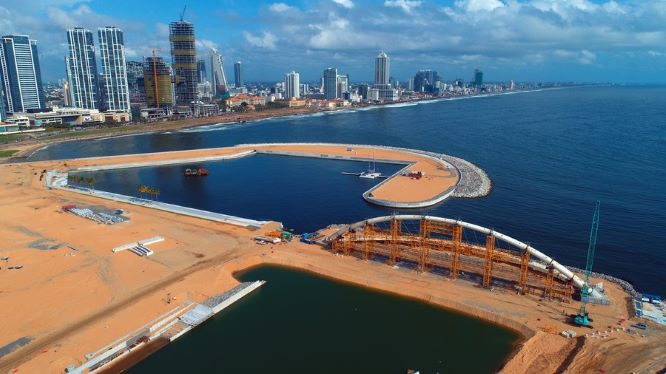
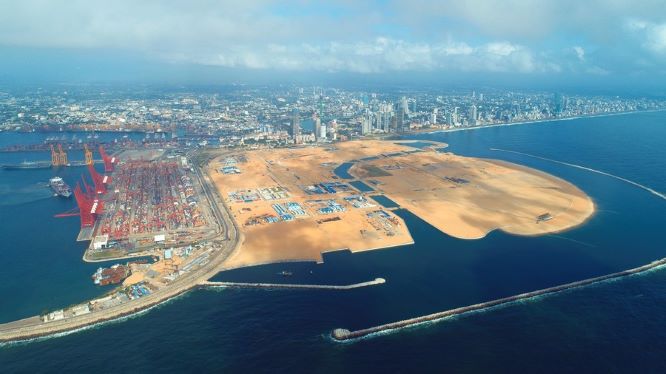
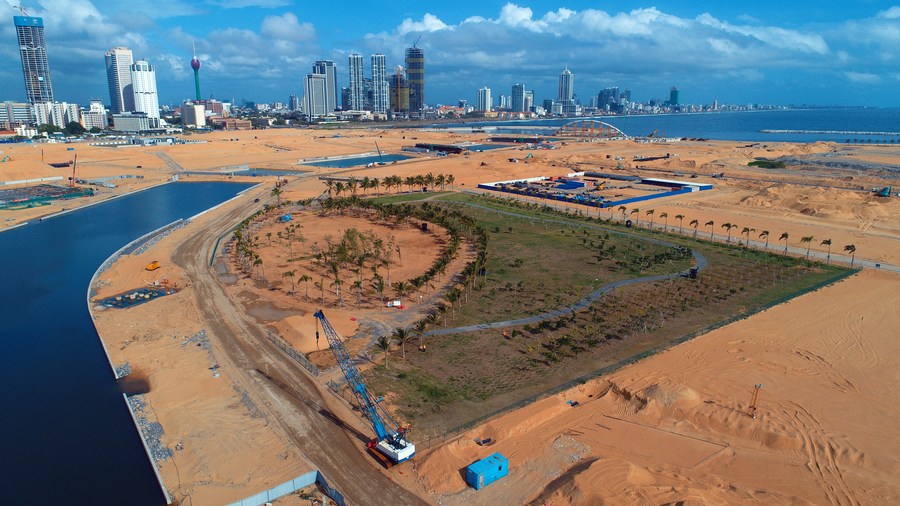
COLOMBO, Sept. 26 (Xinhua) — In September 2014, Chinese President Xi Jinping and then Sri Lankan President Mahinda Rajapaksa jointly inaugurated cooperation project Colombo Port City, which planned to reclaim 269 hectares of land from the sea to build a brand-new central business district (CBD) integrating finance, tourism, logistics and information technology for Sri Lanka’s capital Colombo.
Six years have passed, and now the largest foreign direct investment (FDI) project in Sri Lanka’s history is emerging as a city of the future set to reshape local and regional economy.
On Sept. 17, Rajapaksa, now Sri Lanka’s prime minister, joined the celebration of the sixth anniversary of the project’s groundbreaking ceremony, where he called Colombo Port City a landmark project.”
It will be the main income generator for the future of Sri Lanka” to create 83,000 direct jobs and many more indirect job opportunities for Sri Lankans, he said.
Expressing special thanks to China for the investment, he said, We used to hear many times that Sri Lanka had been losing its soil to sea erosion. However, by this project, Sri Lanka’s land area got expanded, and for the first time in history, newly reclaimed Port City land is now part of Sri Lanka.”Video Player00:0003:46
EMERGING FROM SEA
As a flagship joint project between Sri Lanka and China within the framework of the Belt and Road Initiative, Colombo Port City has powered through a turbulent six-year period, overcoming numerous challenges, including the Easter bombings in April 2019 hitting three luxury hotels near the project and affecting the country’s tourism, as well as the COVID-19 pandemic impacting the country less than a year later.
Yue Yeqing, assistant general manager of China Harbor Engineering Company (CHEC) Port City Colombo (Pvt) Ltd., a branch of CHEC undertaking the project, told Xinhua that the initial phase of land reclamation was completed two months ahead of schedule in 2019.
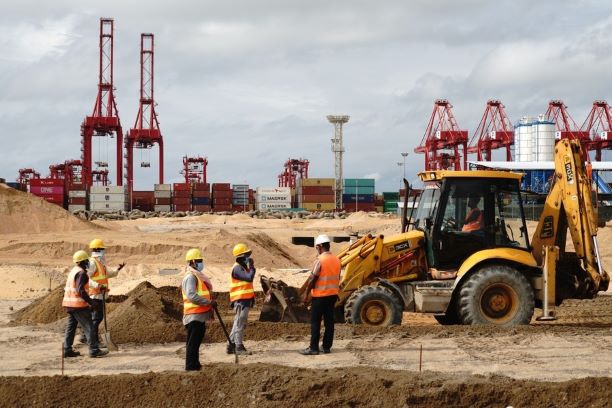
Since then, buildings of roads, bridges, pipe networks and green parks in the city have been implemented step by step, said Li Zenghui, engineering manager at CHEC.
It is expected that all the municipal engineering in construction will be completed in 2021,” Li said.
An artificial beach has already been completed and may open to the public soon, saplings have been planted to test the soil for a planned park, and yacht piers in the marina section of the project have already begun to operate, Li added.
Amid the COVID-19 pandemic, Yue’s company has introduced stringent health protocols to guarantee the smooth construction of the project.
Colombo Port City , sept 26, 2020
Because this land is close to the core area of the Colombo CBD, we are very confident that we can create a new CBD area for Sri Lanka,” Yue said.
We hope to develop and construct this project together with investors from all over the world, so that the Port City will contribute immensely to the future of Sri Lanka,” he added.
BOOSTING ECONOMIC GROWTH
In the eyes of government officials, business insiders and experts, Colombo Port City has great potential for improving Sri Lanka’s macroeconomic fundamentals and providing jobs.
Ajith Nivard Cabraal, state minister of money and capital market and state enterprise reforms, told Xinhua that the project has great potential for boosting Sri Lanka’s economic development.
The investments that Port City could attract will have an impact on our overall bottom line. The fact that the project will generate economic activities will directly benefit our growth scenario and employment,” Cabraal said.
The outside world will look at Sri Lanka with a lot more interest when we have projects of this nature,” he said, adding that the Colombo Stock Exchange (CSE) will also gain impetus when large foreign entities relocate to the city and channel investments through the capital market.
Colombo Port City Sri Lankan workers on the job
Dimantha Mathew, head of research at Colombo-based investment bank First Capital Holdings PLC, said the project is important for Sri Lanka which is trying to establish itself as a regional financial hub.
We expect that major investment banks and finance services will set up at the Port City first, which will attract other business entities and facilitate new deals and investments. There could be a major benefit towards the CSE,” Mathew said.
If we can make the Port City successful and attract the required foreign investments, that will invariably have a major positive impact on our foreign reserves and balance of payments,” Mathew said.
According to a report in 2019 by PricewaterhouseCoopers (PwC), the project will have a significant impact on the national economy,” as it may generate 210,355 jobs, and add 0.7 billion U.S. dollars to the FDI, 11.8 billion dollars to gross domestic product, and 0.8 billion dollars to government revenue every year.
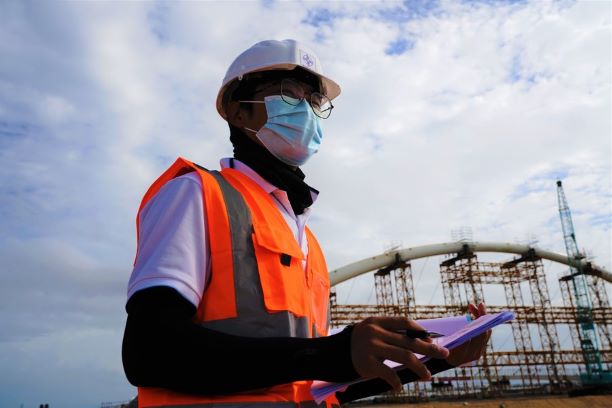
Colombo Port City. A Chinese engineer wearing a protective mask
UNIQUE ECONOMIC ZONE
The Sri Lankan government is now planning to build Colombo Port City into the country’s first special economic zone for services. And Thuci Aluwihare, head of strategy and business development at CHEC Port City Colombo (Pvt) Ltd., showed great confidence in such a plan.
We believe that the Port City will be in a good position to compete with some of the advanced markets and economies in the world due to the fact that Sri Lanka is an emerging market with a lot of potential for growth,” Aluwihare said.
While there are many financial service centers in the world, Sri Lanka has the advantage of being within a four-hour flight radius of major cities in South Asia and East Asia, he said.
Colombo Port City, trees are coming up
Besides, Colombo has been ranked the most livable city in South Asia for years, and has a pool of affordable talents, he said, adding he hopes the project will create high-quality employment opportunities to arrest the brain drain of some 10,000 skilled and professional workers who leave the country every year for better opportunities overseas.
Noting that Colombo Port City is the first planned city in Sri Lanka and South Asia, Aluwihare said the project has focused on sustainable development to minimize resource usage, and has provided developers and investors with international standards to adhere to.
According to a study by Colombo-based think tank the Lakshman Kadirgamar Institute, Colombo Port City compares favorably with similar special economic zones in terms of sustainability and accessibility.
Sri Lanka performs well overall in terms of supply-side factors such as the provision of electricity. The country compares comparatively strongly in terms of graduates’ skill set, which is an important determinant for Port City’s success,” the study said.
Rajapaksa also expected Colombo Port City to become the main financial and economic hub for Sri Lanka and South Asia.
The project (is) rather not for the present, but it is more for the future generation to be born,” he said.
(Video reporter: Tang Lu; Video editor: Ma Ruxuan)
Underworld figure ‘Kosgoda Tharaka’, who is remand custody has made a statement to the Criminal Investigation Department that a Prison Commissioner had allegedly received monetary gifts from notorious underworld criminal Makandure Madush, while Madush was staying in Dubai, Deputy Solicitor General Dileepa Peiris said.
Deputy Solicitor General made this statement before the Galle Magistrate Harshana Kekunawela yesterday when the case in relation to posing death threats on prison officials was taken up yesterday.
Accordingly, the DSG said they hoped to record statements from the relevant Prison Commissioner and the notorious criminal Makandure Madush in order to verify the credibility of the statement.
Deputy Solicitor General further said that ‘Kosgoda Tharaka’, who had been named as the first suspect regarding the making of death threats on Prison officials, is currently being interrogated by the CID.
What Sri Lanka wants is not a democracy of the press, the
freedom to write, the freedom to criticize the government, freedom to
demonstrate. What we want is a democracy of the people for their right to live
in peace and security, have the minimum of a decent living condition, right to
have access to water, security of employment, a good health service, bring up a
family, and have good service from an uncorrupt government.
Sri
Lanka is 72 years away since its Independence. We are still talking about
a democracy. What did we have before Independance and beyond? We were ruled by
Kings and there were periods when Sri Lanka prospered under some kings. There
were the Nobles who helped the king in ruling the country maintaining law and
order. The people were grouped according to their skills, a caste system
where each one occupied tasks allocated to them .
Rhys
Davis says that the West learnt what they call democracy from the east. The
Buddha himself had a gread organising skill. Lord Buddha had a great
following and his disciples came from all walks of life. They had to be trained
into being the followers of the Buddha Dhamma. It was a difficult task
which he attended to with great perspicacity. He made known the Dhamma
through discourses and set out rules of conduct for his disciples
and followers.
Therefore,
what we call democracy in relation to politics was not unknown to the Sinhala
people. Or as a matter of fact to entire nations the world over. But it
is only when we come to politics we speak mostly of democracy. The imported
notion of democracy existed from Independence and differed from one
ruling system or government to another. That is why now in TV political
discussion the opposition to the Government compare their period of rule as a
period where there was a greater democracy compared to the government
they replaced.
Therefore
this political democracy of varying standards will continue. But what we should
examine is under which democracy the people were better off, more secure and
protected, spent peaceful lives. When it is put through such an
examination, one would see that democracy becomes meaningless if the
people had been neglected and left on their own to meet the rising cost of
living, lack of protection, fear of an underworld etc., and a drug
menace.
Sri
Lanka today is not what it was 72 years ago. Today Sri Lanka under
President Gotabaya Rajapakse ,is not what it was five years before under the
Sirisena-Ranil duo. But yet the rejected government of the past says that there
was democracy during the five years before. Why then were they rejected
by the people ? Because this democracy is what the educated Colombiens and the
Colombo press moguls want, it is different from what the people outside in
towns and villages want.
Whatever
notion different people have about democracy, it is since Independence there
had been something that had been accepted from the west called democracy.
It came from the Colonial rulers who did not rule democratically. It has in
reality given nothing to the people. Sri Lanka continued to be a
developing country yet with that absurd democracy becoming a
barrier for progressive development of the country, changing governing systems
from time to time.
The
present day media specially the Capital Maharajaa Organisation, News First,
Dawasa, Satana, Face the Nation, journalists have their own notion of
democracy which they try to promote against the President Gotabaya Rajapaksa.
In a recent political debate in Satana a journalist insisted that an invitee
should accept that compared to the periods of government before
Yahapalanaya, there was democracy under Yahapalanaya.
If
they were to think that there was no democracy under President Mahinda
Rajapaksa from 2005 to 2015, they cannot deny that there was a remarkable, or
if they want, an apparent development of the country during that period
breaking away from the path of a developing status, to a county on
the path of progressive development with highways , high-rise buildings,
beautification of towns, parks and cleansed lakes.
If
these democracy fans insist that despite all that it was a period
without democracy, the price was worth it, and there should be more
periods of governments in Sri Lanka without democracy for it to really step
into a developed country status.
In
that sense too the 20th Amendment is welcome though it irks Sajith Premadasa,
Anura Kumara Dissanayake and their followers wearing blinders. The word
democracy” , a sacred OM” to the opponents of the government, had
been introduced by former colonial masters to keep the country poor and
undeveloped. It is getting out of the blinder that will make developing
countries take the risk and forge ahead to enter a new path of
development.
It
is enough that we had been floundering in the darkness of under
development for the last 72 years making every effort to keep the crown
of democracy on our heads. One government rules for five years and
takes the government forward according to its idea of development, and then
when it is defeated another comes to change everything that the other
government had done to introduce a new system for the next five years, the
circle continues and we are always where we were at the beginning.
It
is time that it changes. China, Russia,Malaysia, Singapore, Vietnam and
Bangladesh are not countries holding democracy in high favour, but they
have developed to a far greater extent than we have done holding on
to this precious democracy.
At
least now we want a man at the helm, who would not bend to pressure but
continue to do what is good for the country and the people who have placed
their confidence on him to do what he thinks is correct. Therefore the President
should be given all the powers of an executive President .
The
pseudo democrats of the Samagi Jana Balavegaya , Janatha Vimukthi Peramuna
say Yahapalanaya gave real democracy to Sri Lanka. But did it give
the people of Sri Lanka what they really wanted, which was not
democracy but a decent living standard, education for their children,employment
, clean water to drink, roads,pathways and a drug and a crime free
country ? No, statistics show quite a different story.
President
Gotabaya Rajapaksa wants to give the people what they really want. For that the
Executive President wants a free hand to move without ugly undemocratic
manifestations in the well of the august assembly of the representatives of the
people-the Parliament,by the undisciplined infantile members of the
Opposition, distorting facts in the 20th Amendment.
Sri
Lanka has an honest, disciplined visionary leader in President Gotabaya
Rajpaksa , who had demonstrated his devotion to the country and the
people, who risked his life for them. None other political leader even
with dynamos, and paternal genes had ever made such a sacrifice or risked one’s
life for the Country. Sajith Premadasa the Opposition Leader who
denounced the 20Amendement saying it is to give executive power to an
individual had never lifted a gun in defence of Sri Lanka.
That
individual, Sajith Premdasa and his supporters often refer to is
the President of Sri Lanka. His personal identity is submerged when he
holds the high office to which the people have hoisted him.
President
Mahinda Rajapkse put the country into the correct path of development, but
ungrateful people were forced by coercion and enticement by local
and foreign enemies of Sri Lanka to reject him at the Presidential elections of
2014.
The
20th Amendment is essential at this hour of Sri Lanka’s history as we should
think of a different people friendly political system, as the past systems have
failed to give the necessary leadership to Sri Lanka with its glorious
historical past to surmount difficulties to achieve new heights of
development.
Therefore,
the President should have immunity, be free to face and stop unpatriotic
self interested opposition in a parliamentary system by even
dissolving the parliament if it becomes necessary, to have patriotic Sri
Lankans with even dual citizenship who may want to come back and
help in the development process of Sri Lanka.
The
20A does not suppress the Audit department or the Auditor General . They will
be there carrying out their allotted functions. Therefore there should not be
any difficulty in having the 20Amendment passed in parliament as a
temporary measure until a new Constitution is written and presented.
Some
ask what is the impediment to carry on the government without removing the 19th
Amendment. The impediment is that the 19th Amendment does not fit into the new
thinking of the new Government. The Yahapalanaya may not have had any
impediment in carrying on it destructive path of bankrupting Sri Lanka with the
hastily adopted 19A, but that is the past and that 19A does not fit into the
present path that is being hacked, despite opposition by political
reactionaries , towards a better , sure and an efficient advancement
of prosperity to illumine a country that has been thrown into an
abyss of political, financial and social darkness.
There
were two critics Jayadeva Uyangoda who admits of a hurried reading of the
20th Amendment, which was enough for him to writes what he always wrote
against President Mahainda Rajapaksa with added venum trying to put
President Gotabaya Rajapaksa into a garb of a Dictator. He may have
written that without reading the 20th Amendment at all. The other Dayan
Jayatillake does more or less the same thing but with greater venom,
having missed the diplomatic boat to a European destination. Most of what he
writes is frilled with his quotes from his intellectual reading material or
seen & heard in the cinema. They are both prophets of doom and not
worth commenting on their rantings.
Finally 20 Amendment is to the Constitution of Sri Lanka, we do
not want UN or Commonweal or any International interference. It would be an
insult to our sovereignty; independence and our Judiciary. Sri Lanka can
settle its matters on its own.
After the Southern Expressway was opened (aka Southern
Highway), a poor villager in Kurundugaha Hethapma told the writer that to
celebrate the opening he prepared and treated his fellow villagers with Kiribath.
The writer met him again several years after.
He asked the villager whether or not he was benefitted by the expressway
and how many times he had used it. The villager responded saying that he was
not benefitted from it and he did not travel on it a single occasion. He was still happy that there existed the
Southern Expressway next to his village.
On our return journey to Colombo, I said to my friend who
was the driver (he owns a latest model BMW sport utility v), that we must open
up the expressways to motorcycles, three wheelers and InterCity Buses
(including SLTB) (poor man’s vehicles), (subject to conditions). A frequent traveler on the expressway, he was
visibly moved and very upset. He slowed down and fiercely asked me You must be
kidding”? I said No”.
I consider that the villager raised an important issue. These expressways were built from their money
too. We are all paying off the massive debts that the governments have borrowed
to build the expressways.
But, only about 20% of the country’s population – those
who own a car/vehicle reap the benefit of them. A few luxury buses (who charge
a higher fare) are allowed to carry passengers on expressways; meaning the poor
who does intercity travel on ordinary buses are excluded.
These three categories (motorbikes, three wheelers and
InterCity Buses) comprise more than 60% of Sri Lanka’s registered vehicles.
The fact that Sri Lanka’s expressways are confined only
to high income earners is a clear anomaly.
It is discriminatory too.
This should not be the way.
Currently only the wealthy and the upper middle class
exclusively use them, solely for their benefit. Even among them, some find it difficult
to pay the expressway tolls that are high.
I explained to my friend that though vehicles do ply on expressways,
most of the time they are empty. In the
night, expressways are like ‘ghost towns’. This is not so in developed
countries. They are busy all the time.
Vehicles ply on our expressways intermittently. The
volume of traffic is definitely insufficient. On the other hand the roads that
feed the expressways (ie, High Level Road, Galle Road, Negambo Road etc) are
jam-packed with vehicles especially with motorbikes, three wheelers and intercity
buses.
I said to him that not only my idea will open up
expressways to poorer sections of our society, it will also become a healthy source
of revenue for the government (the government is hugely cash strapped).
It will be a massive injection of new funds to government
coffers. Also, my scheme is a solution to the country’s ever increasing traffic
problem. The traffic on the main roads will significantly reduce as a result.
I explained to him that it is true that some of the poor
man’s vehicles may not be able to travel at the maximum speed of 100 km per
hour, but it is not a serious issue. For
three wheelers, we can restrict the maximum speed at 60 km per hour.
It is not a must that vehicles should drive on the
expressways at the maximum speed. We are a small island nation, we can reach
any destination by road within a relatively short period of time. What is
important is the smooth flow of traffic on expressways.
It is true that due to the addition of these new category
of vehicles the existing traffic flow could slow down, but it is not a
significant problem. As the expressways are without traffic lights/traffic cops,
vehicles will continue to ply uninterruptedly. The latter is the most important
point.
The three wheelers could be passenger carrying or owner driver
ones. There are a very large number of
owner driver three wheelers in the country. In villages almost every house has
a three wheeler now. They will all get a huge boost from this scheme.
Given that our expressways are largely empty, these poor
man’s vehicles should be able to easily maneuver on them. The benefit to the
country and the people will be immense.
The benefit will outweigh any negative effects.
I said to my friend that during very busy periods (Sinhala
New Year, Christmas holidays) the three wheelers and motorbikes could largely
be confined to the left lane or their access to the expressways can be completely
stopped.
My friend laughingly said that countries like Australia
and New Zealand would never allow such a scheme and I should be mad for suggesting
something like that. He emphasized that expressways are exclusive for ‘good
vehicles only’, and it was the intention of the government that built them. His
definition of good vehicles meant sedans (cars), wagons, vans that only a very
limited number of people drive in Sri Lanka, and luxury buses.
I told him that one of the main intentions of the
government in establishing expressways was to reduce the country’s traffic
problem but the expressways have thus far failed to achieve this. I showed him
that in contrast the bottlenecks created by the expressways have exacerbated the
major cities’ traffic congestion, especially, Colombo.
I told him that Sri Lanka is a poor country and the
government has an obligation to look after the interests of the poor. The new government’s
policy of ‘Saubaghyaye Dakma’ is to incorporate all citizens, including the
poor.
In regards to Australia and New Zealand, I told him that motorcycles
and intercity buses are already allowed to run on their expressways and they do
not have three wheelers. I told him that even cyclists, huge container lorries
are allowed on their expressways. These two countries have only banned certain
land vehicles (like tractors) and pedestrians from entering the expressways. Their
highways are always busy (24/7) and earn terrific incomes for the governments. I told him that the situation in most western
countries is similar. They build their highways for all peoples, not just to a privileged
few.
I further told him that the fact our expressways are largely
‘dead and sleepy’ is a reason for the frequent serious traffic accidents on them
(speedy and drowsy drivers).
My friend (a ‘Colombian’) was visibly upset and accelerated
his speed.
Happy Soma Global Spiritual Art Center -Sunil Gamage-Director
Happiness is the
highest good everybody want to achieve. It is possible for everybody and it is
inside everybody. We are not reaching out there either because of one or both
of the following reasons. Either we are ignorant or we do not have the simple
understanding of ourselves. The self indulgence and self control are opposing
urges that must be in balance.when they are in balance, we can experience our
happiest lives and better mental health.
Engaging ourselves is fundamental to happy
life. The demands of our lives and by extension of our self discipline, have a
way of introducing on our happiness. Self-control has a way of keeping us aligned with long-term goals and is essential to our success and
well-being. self-control matter when we are
trying to achieve a goal, like trying to lose weight or succeed in a college
class. Do we relax or do we go to work out?
Self-control makes us happier, healthier people.
The dominant description about self-control, that it leads to
a happy and satisfied life by enabling us to put our goals ahead of momentary
pleasure, was the whole story. People who
are living happy and satisfied lives are able to experience pleasure without
being distracted by intrusive thoughts. They can just do something they enjoy
and be fully in the moment with it.our ability to experience pleasure, our devotion to
happiness as a way of life is just as
important to our happiness in life as our self-control.
The ability
of happy oneself
The ability
of a person to enjoy happiness without being bothered by intruding thoughts. The
idea was to see how people differ in their ability to simply indulge in relaxation or enjoyment. Those who could do
that reported greater happiness & well being. Some people don’t
enjoy happy moment as a success, or feeling they really enjoyed themselves, was
indeed being disturbed. E.G thinking about the sport I am not doing. Those
thought about conflicting long term goals undermine the immediate need to
relax. Trait happy capacity predicts successful happy goal pursuit in
everyday life. So the person who is better at enjoying himself also more likely to make enjoying himself
& goals.
Pertaining to happy
People able to enjoy themselves when pursuing
enjoyment tended to have a higher sense of well-being in both the short and
long term. Even more importantly, people with a higher happy capacity were also less likely to
suffer from depression and anxiety.The key to happiness is not about forgetting
self control and go wild. It is about understanding self indulgence and self discipline.
Most importantly in pursuit of happiness and long term goals need not not to be
conflict one another. Happiness and long term goals both could be compliment
each other by achieving well being and good health. It is important to find
right balance in everyday life. In this case finding time to self care is
paramount important. Planing time for fun would be one way. So the planning periods of enjoyment with
time limits so that they are clearly distinguished from other activities.
Enjoying
ourselves
Use self
control to turn attention away from adverse thoughts to happy. The first is
essentially mindfulness. Most of us think mindfulness is relaxation. It is in
deep sense; it involves great deal of self control. The more we practice and
get good at mindfulness, the more relaxed we get. The better we
get at mindfulness, the more present we become with what we are doing at the
time. And that makes us much better at having fun. For some people mindfulness is a thought apart from concrete realities. So
alternative psychological techniques could be used called internal dialogue. If
the thought intrude to anybody’s fun, then having quick chat with it.
Tip: Self care- Through investing time, money,
or attention to improve some aspects of own well being is especially important
in stressful times.
Sri Lankan police on Friday arrested three people suspected of trapping and killing an endangered leopard and trying to sell its meat as a cure for asthma.
The trio were detained after police raided their home following a tip-off that they had used a snare to catch the creature in the central highlands.
“They cut the head off and killed the animal after it got caught in the snare on Thursday,” chief inspector Dushantha Kangara told AFP by phone.
He said the suspects had thrown the leopard’s head in the forest and removed the carcass to sell the animal’s skin, meat and other body parts.
Several leopards have been trapped by snares in the region, some 175 kilometres (110 miles) east of Colombo.
Kangara said there was a popular belief that leopard meat could cure asthma.
Police seized 17 kilos (37 pounds) of leopard meat from the three suspects.
There are believed to be fewer than 1,000 leopards in the wild in Sri Lanka, and harming the big cat is punishable by up to five years’ jail.
Wildlife conservationists have asked the authorities to ban snares and to prosecute those who use them.
The final PCR test carried out on the Russian national, who was detected with COVID-19 yesterday (24), has confirmed him to be negative for the virus.
This was confirmed by the PCR test conducted at the Hambantota Hospital today, the Commander of the Army Lieutenant General Shavendra Silva said.
One of the 15 crew members of a Russian airline, who arrived in the country on the 13th of September, was identified as COVID-19-positive yesterday in a PCR test carried out at a private hospital, prior to their departure. They had been staying at a hotel in Polhena, Matara.
The Russian crew member who was detected as a positive novel coronavirus case was subsequently admitted to the Hambantota General Hospital. The first PCR test carried out on the Russian national had come out negative for COVID-19.
However, the hospital officials decided to conduct another test on the Russian, which confirmed that he is clear of the virus.
The rest of the 14 crew members had departed for Russia from the Mattala International Airport last night, according to reports.
The Government Medical Officers’ Association (GMOA), however, emphasized that the staff of the hotel where the crew members have violated the novel coronavirus prevention procedures and an investigation should be conducted on directing them to a hotel when there are government-approved quarantine facilities.
Former State Minister of Defence, Deputy UNP Leader Ruwan Wijewardene testified before the Presidential Commission of Inquiry (PCoI) probing the Easter Sunday terror attacks on Thursday (24).
Responding to a question raised by the panel, he said the former Prime Minister Ranil Wickremesinghe often times left during the National Security Council meetings.
He also revealed that former President Maithripala Sirisena had instructed the commanders of the Tri-forces not to meet with the former Prime Minister if they are summoned in his absence.
The Minister of Justice Ali Sabri stated in Parliament today that the present government will not make calls and exert pressure on the judiciary like the previous government.
He was responding to a question raised by Samagi Jana Balawegaya MP Chaminda Wijesiri regarding the case of Dr. Safi Sahabdeen who worked at the Kurunegala Hospital.
The Sinhale National Organization states that a committee should be appointed to ensure justice to all parties affected by the judgments that were created by fabricating false evidence during the period of good governance.
It’s General Secretary Ven. Madille Pannaloka Thero stated this at a press conference held in Colombo today.
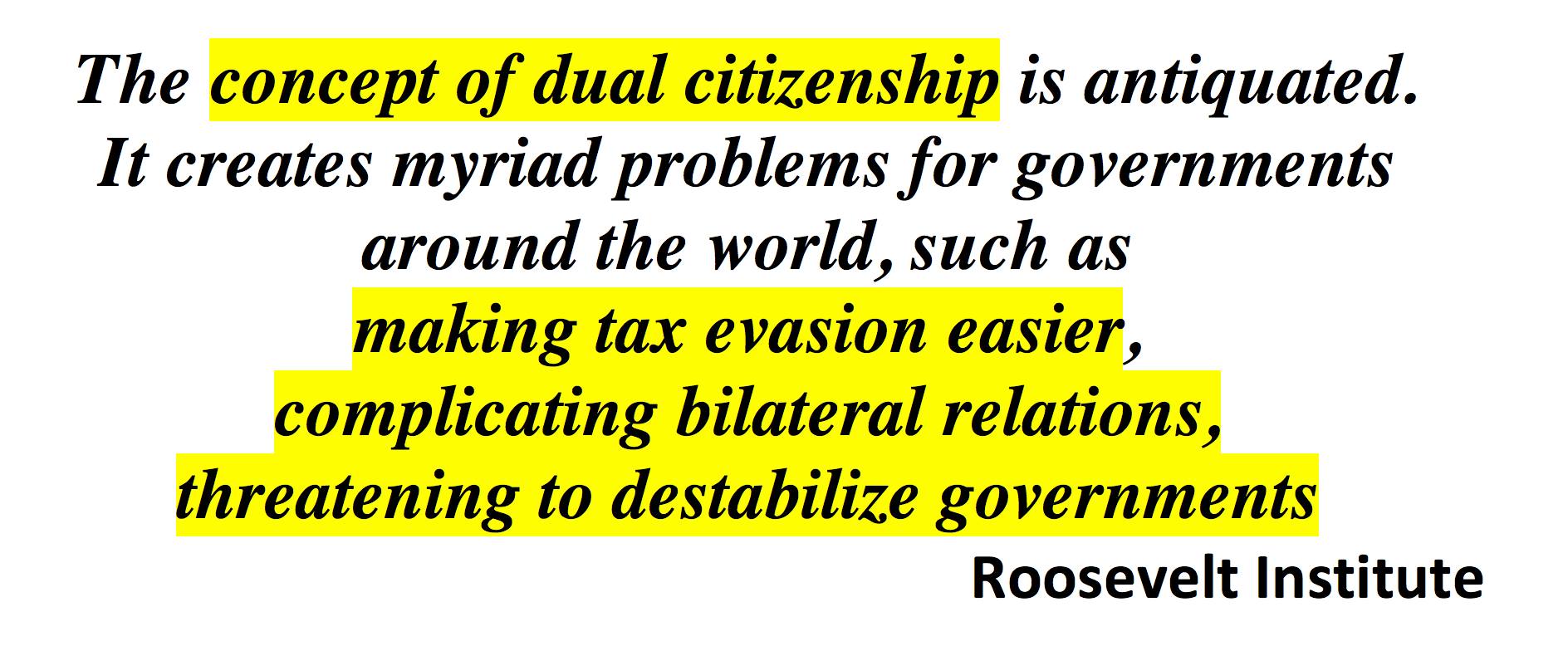
19A inclusion of Dual Citizenship was specifically targeted at preventing Gotabaya Rajapakse from contesting Presidential Elections and requiring to revoke citizenship which created a thorny situation with US declaring him and Shavendra Silva as war criminals. Geetha Kumarasinghe had to forfeit her Parliamentary seat as she was honest enough to declare she was a dual citizen while Gotabaya Rajapakse revoked his dual citizenship in order to contest elections. That gesture won him the Presidency with an overwhelming majority. With 19A we came to accept the need to have law makers declare allegiance and loyalty to one nation – the nation they desired to represent in Parliament as People’s nominees. As such, the majority of the people accept the 19A provision for a MP to not be a dual citizen when contesting Parliamentary elections. Nevertheless, that Basil Rajapakse is a dual citizen and does not wish to forfeit his dual citizenship is part reason for many to argue in favor of 20A allowing dual citizenship holders to contest. We should not take legislative clauses considering the needs or wishes of one person because we are neglecting to look at the bigger dangers of 20A continuing to allow dual citizens to contest elections. Present constitutional amendments must not ignore the global dynamics and geopolitical sensitivities lurking in Asia & the risks & threats to Sri Lanka. Therefore, constitutional amendments must seek to solidify and strengthen Sri Lanka’s sovereignty not weaken it.
We all know that the LTTE thrived as a result of the support it received from the West.
We all know that all of the LTTE fronts are today operating from the West
We also know that even throughout LTTE terror reign the West did their utmost to ensure LTTE terror was treated as a cancer – providing temporary cures like negotiations, peace talks and ceasefires but no permanent solution.
We also know that the LTTE terror rule was used as a camouflage buying time for West and its allies to set up Plan B of their imperial expansion for Asia.
This was how 2009 elimination of LTTE coincided with US ‘rechartering’ their strategy for Asia.
This was how US used bogus arguments to draft UNHRC Resolutions against Sri Lanka
This was how US got UN to pressure Sri Lanka to succumbing to internal domestic changes that were all advantageous to them.
This was how US and allies began weakening Sri Lanka.
All this while, the LTTE Diaspora were given wings to magnify their bogus stories and create an international anti-Sri Lankan image and subject the National Army to ridicule as war criminals.
Look at the many international players that are linked to LTTE Diaspora today retained by LTTE Fronts with the strength of the LTTE kitty. That LTTE kitty has enabled them to tap top lawyers, authors, UN officials, human rights activists, religious organizations & leaders and even foreign politicians. When foreign parliaments are given to hold LTTE events what more is there to say!
All of these LTTE Diaspora leaders were nowhere to be seen when Prabakaran was alive. Many dead scared of the LTTE leader and many hiding in the background and being groomed to take over the international role once LTTE leader was eliminated. This obviously has to have foreign nod of approval and involvement. This is why we see LTTE Diaspora do as they like and what they like and Canadian, US, UK, European or other Governments do nothing about them or against them. Only India realizing that there is a threat to India quickly takes action against LTTE trying to raise their heads in India. One person who is a frequent visitor to Indian jail is Vaiko.
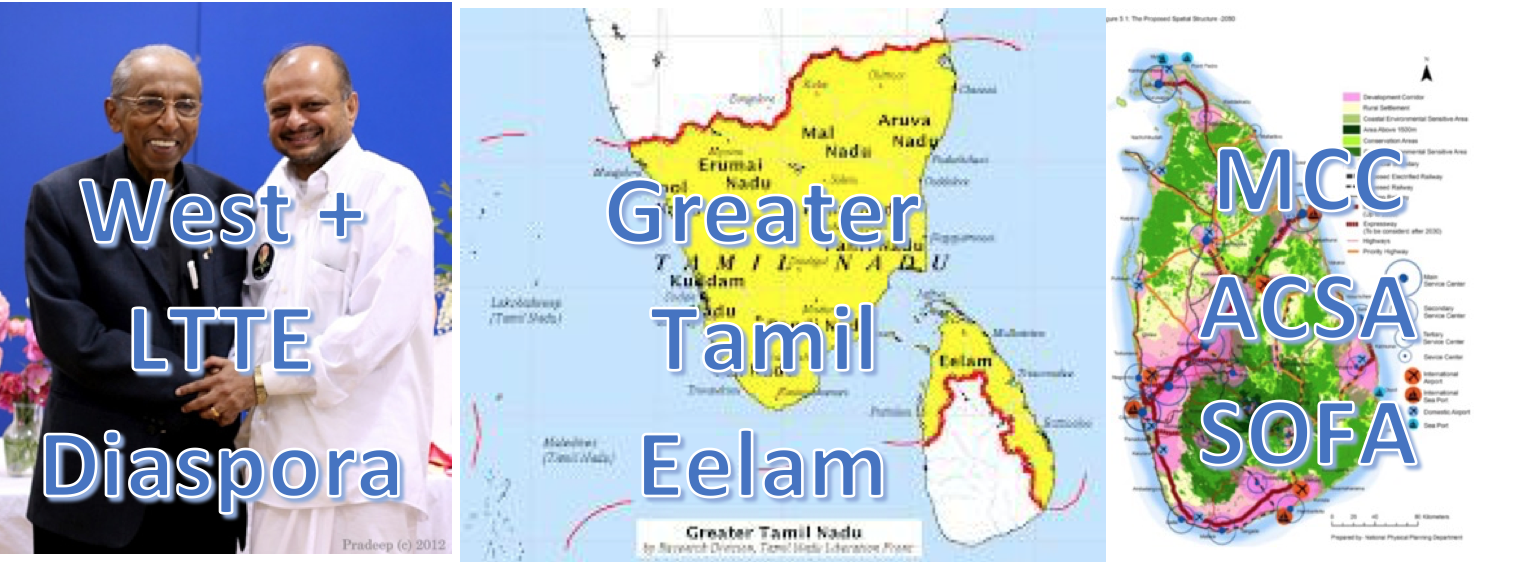
If 20A allows dual citizens to contest it also means all of the LTTE Diaspora will be arriving to contest elections in Sri Lanka.They will also be manipulating the investment opportunities being opened up and manipulate the land privatization provisions in MCC and in all probability will be the fronts of US & allies to buy up Sri Lanka and create the Eelam that they had been espousing with the gun for 30 years and failed.
It is in the West’s gameplan to continue to hold the hand of the LTTE Diaspora and enter Sri Lanka & Tamil Nadu where the Greater Eelam will mean the breaking up of India in time to come.
Let’s also keep in mind that Tamils from Tamil Nadu were the favorites of colonial British. They were transported as indentured labor to all corners of the world – Caribbean, South Africa, Malaysia, Singapore etc. This bond is continuing still. LTTE’s international headquarters was in London. The office was opened by Bishop Rayappu Joseph. The Church & Christian/Catholic NGOs played a major role in LTTE terror. The post-LTTE in both Sri Lanka & South India are dens of evangelical conversions today. These are all with a bigger plan in mind and aspire to use new converts as the West’s foot soldiers. India, we assume must be worried though shying from taking action lest that should deter its friendship with the West. But that friendship is shortlived and India will soon find out a fragmented India sans super power status will end up with bits and pieces of India playing vassal to the West’s agenda. No more will India be able to dictate terms to anyone.
What is the new role of the LTTE Diaspora?Well if foreigners are banned from acquiring land, the LTTE Diaspora dual citizens will step in as alternative. The LTTE illegal kitty (money laundering, credit card scams, human smuggling, hawala system etc) is more than enough to acquire North and East. The bravado’s shown by a rejuvenated Wigneswaran signals a new gusto in plans and new modus operandi tasked to them. This will soon gather momentum in all of the countries that LTTE Diaspora exerts its pressure in a marriage of convenience with the foreign politicians and officials of international organizations.
Sri Lanka is only facilitating their Eelam and there onwards Greater Eelam with the 20A & Dual Citizenship.The Basil-factor is not as important to take cognizance of than the possibility of ACSA (now signed) – MCC (rolled out incrementally) – QUAD partnerships throttling even the signatories – militarization of Asia & the Indo-Pacific Ocean – Port development aligned to this bigger objective – diplomatic and military strategic partnerships connecting the dots to result in a weakened India and a vulnerable Sri Lanka, all perfect ingredients for the vultures to descend & devour.
Nationalists in both India & Sri Lanka must be concerned.
Mahinda Rajapakse, the savior of Sri Lanka must realize the impending dangers. Gotabaya Rajapakse must also read the writings on the wall. The country has been kept diverted debating on dual citizenship & 20a but only from the spectrum of Basil Rajapakse, this has completely ignored the serious situation that will result if 20A + Dual Citizenship will mean the LTTE Diaspora descend, enter Parliament, purchase land and declare Eelam in Sri Lanka & expand that to Greater Eelam with the patronage & help of West. India’s partnership in Quad & Indo-Pacific & permanent seat in the Security Council will end up a red herring that India foolishly fell for. South Asia will come under Western hegemony & Sri Lanka a base.
Edward Henry Pedris
is one of Sri Lanka’s least recognized National Heroes. He was killed by the British more than 105
years ago in Welikada Prison, on the charge of Treason.
True a statue of him
was unveiled by the Prime Minister Premadasa in 1987, and a playground and a
stadium were named after him on that same day; very little national level commemoration
of this Great hero takes place in the country. There is scant discourse about
his heroism among the populous and his brave life story has been taken away
from school history books.
Is this because he
was never a politician and did his struggles against the British on his own,
solitarily? Also, that the Pedris family has not sought publicity about their
dead member?
Pedris was charged
with Treason, Shop breaking, Attempted murder and Wounding with
intent to Murder.
An incident happened on 1 June 1915,
near Pedris’ shop in Main Street, Pettah, where a Muslim gang had advanced
towards him to attack him or set fire to his shop. During this time the Sinhala – Muslim riots
had erupted
in many parts of the country. Pedris had come out of the shop with a gun and
had fired six shots into the crowd. No Muslims were killed or injured except the
Police Constable Senevirathne who was injured in the head.
There had been absolutely no other
involvement of Pedris in the riots though allegations were made in the trial
that he had instigated a mob to travel from Peliyagoda to Colombo to attack
Muslims. Pedris in his defence stated that
he as a Commissioned Officer settled certain disputes between the Sinhalese and
the Muslims.
The riots had been very brutal with over
100 Muslim deaths mainly in Gampola, Kandy and Mathale. The Police and the
military had shot dead over 100 Sinhalese who were accused of killing Muslims
and looting Muslim shops.
To Pedris’ utter misfortunate during
this time he and his family had come to the adverse attention of the British
authorities. Pedris had left an arrogant lifestyle and the British and their
Sinhalese cohorts fiercely despised him.
Pedris was a young man born into an
elite Sinhala Buddhist family. His
father, Duenuge Disan Pedris, a native of Galle was a very wealthy businessman,
who among other business ventures had shops in Pettah. Pedris was educated at
Royal and St Thomas’ colleges. He represented both Royal and St Thomas’ at
cricket. He must be the only person to
have represented both schools in Royal- Thomian cricket matches.
Young Pedris was an excellent marksman
and he was enlisted as a commissioned officer of the Colombo Town Guard. At the
time of the riots he held the rank of Captain.
Prior to his death he was de-commissioned by the British rule in Sri Lanka.
Pedris excelled in horse riding too. He had
a wide knowledge about horses. A Russian Prince from the Tsar dynasty had presented him a horse named Rally”. Pedris rode this horse with the composure of a
Prince, and the British and their Sinhalese cohorts hated this.
There had been several clashes of young
Pedris with the British hierarchy. In one incident, at a Cinema Hall a white
man had demanded that Pedris gave him his seat.
Pedris had refused and belittled the British saying that he had paid for
his seat.
It is fair to infer that news about young
Pedris had reached Governor Sir Robert Chalmers.
Chalmers, a racist, was an introvert and a recluse. He was ruthless
in eliminating enemies. Under his
command, Brigadier Malcolm went on a killing spree of Sinhalese in areas where the
riots took place – notably in Colombo and the upcountry.
Chalmers was basically scared that the
Sinhalese would use the riot to overthrow the colonial administration.
During this time the World War 1 was in full swing. The
British suspected that there were prominent Sinhalese businessmen in Colombo
who had close trade links with Germans. It is believed Pedris family was
one. Over the riot, two of Pedris’
cousins – Albert and Edwin Wijesekera, who were leading businessmen, were taken
into custody and were imprisoned in
Jaffna.
When the riot occurred, the German cruise
ship ‘Emden’ had berthed in Colombo and
Colombo businessmen had conducted trading
with it.
It is believed that Sir Solomon Dias
Bandaranaike, the Maha Mudaliyar, father of SWRD Bandaranaike, was not in good
terms with the Pedris family and he may have had a part in creating the ill feeling
between the British administration and Pedris family. Except hearsay, there is no concrete evidence
to prove this. Bandaranaike was the Chief Advisor and Chief Native Interpreter to the Governor. Basically, he held the highest native
position under the British administration. Prior to him his father and
grandfather had also held the same or similar positions for the British
administration.
Governor Chalmers and the Inspector
General of Police, Herbert Layard Dowbiggin, were adamant that Henry Pedris
must die. They wanted to use Pedris to
teach other national leaders a lesson. Pedris was seen as an easy, soft target.
A military court, comprised of three
military judges was convened and Pedris was tried on 1 July 1915; a death
sentence was passed on him on the same day.
He did not have appeal rights. A
request for clemency was made to King George V by the family and several others
but that was rejected.
On 7 July 2015 Pedris was killed by a
firing squad.
Even immediately prior to his death,
Pedris showed bravery.
After he was sentenced to death, he
demanded that he should be shot by a Punjabi firing squad, and not by a white
British firing squad. He stated that Punjabi
soldiers were Non-Christian and Asian. His request was granted. A Punjabi firing squad was rushed to Sri
Lanka.
When blindfold was afforded to him,
Pedris rejected it. He faced death
without any fear. Until he was twice
shot to death, he held his head high.
A remarkable incident took place at the
time of the execution. The Additional District Judge of Colombo, Arthur Charles Allnut, a graduate of
the Oxford University and a member of the Ceylon Civil Service had ordered that
the 86 Sinhala Buddhist nationalists who were detained in Welikada Prison at
that time (over the Sinhala/Muslim riots) should witness the shooting of
Pedris. Thus they were lined up in the
verandah outside of the L-Hall of Welikada
Prison, and were compelled to watch Henry Pedris being shot to death. Among the inmates were DS Senanayake, DR
Wijewardane, FR Senanayake, Edwin Wijeyeratne, DB Jayathilaka, Dr Cassius
Pereira, Dr WA De Silva, ET De Silva, FR Dias Bandaranaike, Dr CA
Hewavitharana, H Amarasuriya, AH Molamure and AE Goonesinghe.
Over the Sinhala/Muslim
Riots, the British had also detained Anagarika Dharmapala the Great, in a
different location (he had nothing to do with the riots; when the riots
happened he was in India). Until early
1920s, Anagarika Dharmapala the Great was held under house arrest in Calcutta. He was the longest held political prisoner
over the riots. The objective was to teach him a lesson so that he will curtail
his anti-imperialist struggle/rhetoric and that he will be psychologically
drowned (Anagarika Dharmapala the Great was Sri Lana’s Mahatma Gandhi). The British were partly successful in achieving
both these objectives. The writer has elaborated the altercation that Anagarika
Dharmapala the Great had with Governor Chalmers in a previous article (see ‘Why Anagarika Dharmapala is important to India, particularly
to the Indian Buddhist? –Chanaka Bandarage, ‘New Buddhist’, India July 2015 edition, pp
23 -28; reproduced in Lankaweb, July 29, 2015)
The cream of the country’s nationalist
leaders were arrested. This is evidence that the British were using the Sinhala
– Muslim riot as a pretext to punish them.
Furthermore, the immense fear that the British had that attempts may be made
during that time to overthrow their regime.
Even a person with no legal knowledge
would realise that Pedris had done nothing to commit Treason. Basically, he had done no offence to deserve
such a harsh punishment – the death sentence.
Pedris was buried in Borella Kanaththa.
The father, who owned several burial plots in Borella Cemetery managed to bury
him one of those plots. The British was
unaware of this. Later, the family built a large commemoration plaque in his
memory. It exists to this day.
Pedris’ father died as an extremely
dejected man. His main hope was that his son would take over his vast business
empire one day. That dream was
shattered. He lost his two sons-in laws
as they were also incarcerated in Welikada and Jaffna jails. The parents out of
their own money built Isipathanarama Viharaya in Colombo 5 and offered it to
Maha Sangha. They did many other meritorious constructions in memory of young Pedris including
the Pilgrims Rest in Polonnaruwa. The mother, Mallino, died as a Dasa Sil Upasikawa. In 1920 she
gifted valuable land to Mallikarama Temple in Dematagoda.
Young Pedris was only 27 when he was mercilessly
killed by the British.
JVP was given
a new lease of life when the UNP came to power in 1977. Under the previous SLFP
government JVPers were brought before the Criminal Justice Commission, (CJC) a
special tribunal set up through a special Act of Parliament. JVPers were
charged with waging war against the lawfully elected government, breaking the
peace, loss of human life, possession of arms and explosives.
The CJC had
been permitted to accept evidence that would otherwise have been inadmissible
under the Evidence Ordinance. The UNP
government of 1977 declared that this was a violation of justice. The UNP
government repealed the Criminal Justice Commission Act and all the JVP
convicts including Rohana Wijeweera, became free in 1978.
Once they
were freed, JVP started its usual activities, such as meetings. The police
challenged the JVP at every possible turn.
When the police intervened at the Tissamaharama JVP mass rally in 1978
JVP complained to JR and Premadasa.
JVP was
allowed to register as a political party in 1981. The first
elections the JVP contested were DDC elections.
JVP contested four seats in the District Development Councils election
in 1981, and won two. The seats were Colombo,
Gampaha, Galle. I was unable to find out what the fourth was , probably Matara. JVP participated in the
District Development Council (DDC) elections of 1982 too.
JVP then started to regularly contest the two major national
elections, General and Presidential. JVP made sure that it had a presence,
however small, in each election. Rohana Wijeweera contested the Presidential
Elections in 1982 and obtained 4.16% of the votes cast. He received more votes than Colvin R. de
Silva.
The next significant election, for the
JVP, was the General election of 2000. The General
election of 2000 clearly showed how well the JVP had recovered, when it won 10
seats in the parliament, said Nirmal Ranjith Dewasiri, as opposed to the one
seat it secured at the 1994 election, and recorded 6 per cent out of the total
valid votes,.
JVP
further broadened its voter base at the following election in 2001, with 16
seats and 9.10 per cent of the vote. There was every sign at this juncture of
JVP emerging as a serious threat to the existing hegemonic two-party system,
especially with its growing ability to attract the support of the semi-urban
middle classes, said Dewasiri.
But at the 2015 general election JVP only got
4.87 % and six seats. One reason was the
rush to Hansaya. The Joint Opposition openly stated that the JVP was there to
support the Yahapalana government. The Joint Opposition called them ‘Rathu
Ali’. Verité Research however had ranked four of the six JVP MPs among
the top five MPs for their work ethic.
The General
elections of 2010 and 2015 showed a link between JVP and UNP. It would
be pertinent to mention that the UNP-led coalition, that backed former Army Commander
Gen. Sarath Fonseka and Maitripala Sirisena at 2010 and 2015 presidential
elections, respectively, included the JVP, said Old
Soldier
JVP cuddled up to the UNP. the UNP and JVP are
now almost conjoined. JVP often provides the
crucial support to decide between victory and defeat and survival for
the UNP government in parliament, concluded
Old Soldier”.
At the
Presidential election of 2019, Anura Kumara Dissanayake, head of JVP, only got
3.16% of the total votes. This is the lowest percentage JVP has got so far,
commented analysts. He was supported by 29 organizations including civil society organizations, at a
media briefing.
JVP only
obtained 3.84% of the total vote at the General election of 2020. This election
showed that the JVP support base was shrinking said Island editorial. Analysts observed that a sizeable segment
of UNP votes had gone to the JVP, which means the true JVP vote is less than
even 3.84%.
Of the six
seats JVP had in the 2015 Parliament, JVP could retain only three of them in
2020.These were in Colombo and an ]adjoining urban centre’ at Gampaha. JVP lost badly in the areas that
constituted the heartland of its militancy such as Matara, Galle, Hambantota
and Moneragala. The present-day JVP leaders have lost their hold on the
Wijeweera belt, which stretches along the southern littoral, said the Island
editorial.
These
election results show that voters still
haven’t forgiven the JVP for atrocities during the 1971 and 1987-89
insurrections, said critics.JVP replied we are far
ahead of the rest. We fielded the best qualified candidates with unblemished records”.
Our movement is honest, free of corruption and committed to working for the
betterment of the country. The people know that, but that is still not enough
for them to vote for us. .
The JVP has
managed to survive as a political party with parliamentary representation only
because of the proportional representation system. JVP would not have had a snowflake’s chance in
hell of making it to Parliament under a first past the post system, said
Chandraprema, bluntly.
For the 2020
general election, the JVP formed a new party, the Jatika Jana
Balavegaya. This is nothing more than an
‘alias’ for the JVP . The three seats won by this JJB were taken by Anura
Kumara Dissanayake, Head of the JVP , followed by Vijitha Herath.
Another
new thing in the 2020 election was that a set of University academics got together and urged the public to vote for the JVP
Balavegaya. Several of them came from leftist parties and were open
supporters of Separatism.
These
academics made a strong appeal for the
JJB which they called NPP. Only the NPP has a sound plan to save this
country, they said.” The NPP was formed with the hope of saving the
country from its present predicament and people should extend their support by
voting for it..”
The academics stressed the need for electing honest, capable candidates as MPs to solve the problems and threats the people were faced with. .” The NPP has experts and academics who have drafted a credible programme for Lanka’s economic future. NPP has the only Parliamentarians with an unblemished record of financial integrity, incorruptibility and devotion to their tasks in the last three decades have been MPs elected from the JVP, they chorused. The academics said that The NPP will be a strong voice and the only real force standing both inside and outside parliament for a democratic polity and against dictatorship.
JVP is not a
popular party. The JVP have huge floats of
Karl Marx and Lenin in their May
Day processions to hide the fact that
they have very few supporters marching with them. Bu it is determined to
keep going.
JVP has its memorials. This is not well known.60 students at Sri Jayewardenepura University were
killed, including two female students in
the 1987-89 insurgency. An exhibition
and a musical program were held to commemorate them in 1992 and in 2008. A
memorial too was erected. The chief guest at the event was the mother of one of
the victims, medical student Wenura Edirisinghe.
JVP has
absolutely no economic or development plan
for the country. They never had. This is seen over and over again in their
numerous, verbose, utterly empty utterances.
Sometimes it is nonsense. Here is an example. When JVP was asked what its development plan was, JVP
replied, ‘We need to
give priority for education and create a new structure with education. That is
the way out of all miseries. Education is the base for that.’
JVP gets much attention in Parliament and on
television today, because Its leader Anura Kumara Dissanayake keeps speaking
and speaking , holding audience
attention, using long sentences, in
slow measured tones. His statements are without exception completely empty . I once listened to him give
a speech at a function. He spoke for
some time and avoided saying anything of substance.
There
are indications that JVP have not abandoned their terrorist tactics. Gamini
Samaranayake drew attention to the JVP
controlled Inter-University Student Federation, IUSF. This name is only a
cover, he said. The IUSF is a ‘terrorist movement’. The IUSF was very active during
the Yahapalana period.
JVP supports separatism. JVP
said in 2015 that seats in the new parliament must accommodate
fair representation for the ethnic and religious minorities. DJV had links with
the international community which supported devolution , said Sampanthan.
Analysts
have shown connections between JVP and LTTE . JVP was the Sinhala twin
of the LTTE said Rohan Gunaratna. The original JVPers, such as Victor Ivan, have consistently taken a separatist or
anti-national stance. For years Ravaya argued that the LTTE couldn’t be
militarily defeated and did their best to demoralize troops and sabotage the
efforts of the security forces.
The
NPP programme calls for devolution of political and administrative power to the
regions, The Tamil and Muslim minorities in this country have been in distress
for decades and been taken for endless rides by the two main parties. The NPP
is a trustworthy ally The NPP demands
release of political prisoners, protection of Muslims from injury and insult,
establishing a new Truth and Reconciliation Commission, empowering the
Commission on the Disappeared to deliver justice to families of victims,
releasing military occupied lands, terminating ethnic based colonization and
economic upliftment of war affected areas. said Kumar David, speaking on behalf
of the JVP in 2020.
in 2011 it was reported that JVP had 13 international branches in UK, US, Italy, France,
Cyprus, Sweden, South Korea, Australia,
Japan, Saudi Arabia, UAR, Qatar and Oman. This did not surprise those suspicious of the JVP .Many consider JVP to be
a tool used by foreign handlers.
Nalin de Silva observed on two
separate occasions, in 2004 and 2010 that JVP was a western tool. JVP was being used
by the western forces, he said.
JVP is an agent of the west and is attempting to create trouble in the
country, he declared.
Wimal Weerawansa said in 2010, that JVP is run with the help of
funds given by some foreign embassies. JVP
was getting huge sums from US and Norway to support Fonseka in Presidential
election ,he added.
JVP are
outrageous hypocrites, said ‘Old Soldier’. They may mystify some with their verbosity, but who
and what do they represent? Could they be working as a proxy for a shadow
organization, he asked in 2019.
JVP
has its admirers. The JVP has come a long way since its two armed insurrections
and the passing of the leadership from the old school and discredited past of
Somawansa Amarasinghe to the younger generation of Anura Kumara Dissanayake,
said JVP admirers.
JVP bashing
should end said K. Siriweera writing to Island”. In parliament, at political meetings and elsewhere, JVP members are criticized for
incidents that took place in the 1971-89
period. Anura Kumara Dissanayake and his
group were not involved in these criminal acts. Further they have shown
excellent behavior since they came into the political scene. It is sickening to
see politicians who are involved in anti social activities shout about events
that happened decades ago to demonize a group who are thousand times better
than them, concluded Siriweera.
JVP admirers
are in a minority. ‘Old Soldier’ has summarized what most of the public think of the JVP . The JVP has a blood soaked, murderous and
genocidal history, he said.. The JVP
brutalized a generation twice, once in 1971 and then in 1989-90.
Their favourite method of murder was by
slitting the throat. Their preferred way was not with a knife but with a blade,
slowly, enjoying the agony of the victim. They
then hanged the head of the murdered on a pole, gate, and fence or placed it on
a wall.
After their first abortive attempt in 1971,
they brought the country to a virtual halt in 1989-90 by placing ‘death notice’
chits in work places and murdering innocents all over the South. They attempted
to destroy the state by attacking the armed forces and police, the state
administrative structure and staff, including the judiciary, health services,
education, transport and national infrastructure amongst other things.
Apparently this was their way of showing their opposition to the invading IPKF
and the LTTE’s campaign of terror. They did not however threaten or attack IPKF or LTTE ,but turned on the Sinhalese
people exclusively, continued Old Soldier.
The JVP believes that by swamping the people
with other issues, the people will forget its gory year of murdering that
dehumanized a peaceful Sri Lanka . Sri Lanka
must never forget how the JVP ordered the closing down of hospitals and
made death threats to the doctors and staff if they attempted to work. They threw
the entire health system into disarray. It caused the deaths of hundreds if not
thousands of seriously ill patients adding to the 60,000 deaths they were
responsible for by murder, said Old Soldier
Though Wijeweera died, some leaders escaped.
They got back into society. They pretend to follow democratic politics fooling
many but not all, and biding their time. They have survived by cunningly
playing one political party against the other. [The behavior
of their supporters]
protesting and blocking roads and government offices almost daily and making it
almost impossible for universities to function, should give more than a glimpse
of what will follow, ended Old Soldier,
writing in 2019. ( Concluded)