BUILDING A VALUE EDUCATION STRUCTURE BASED ON AUSTRALIAN VALUES

September 21st, 2020

BY EDWARD THEOPHILUS

President Mr. Gotabaya Rajapaksa concerns education reforms, and I posted several articles on this website, regarding the reforming agenda, and my concern was directed to declining values in Sri Lanka’s society.  If value education included the curriculum with primary, secondary, and TVET education that could be used accelerating economic development, and growth, and to create value respected society in the country. Value education should be practiced from early childhood education to university education, and it is a broader practice.  Many problems in Sri Lanka are a result of lacking value practice in society. In any society, there may be less than 2% of people who don’t respect values, and it might associate with the Gene of a person.

Value education is a practical aspect of education that direct the development of positive attitudes, the education reforms agenda has become a talkative strategy than practical initiatives, and it seems that leaders in reforms are retired administrator, who were working in the 19th century. Now the job is a way of making money in the retired status than developing essential policy forms in the 20th century.  

Early in the first decade of the year 2000, after the 9/11 attack, the Australian Prime Minister and the Opposition leader opened a new debate on Australian values, and the Opposition leader suggested that not only migrants to Australia but also temporary visitors should be required to sign a statement at the time of applying for the visa that they will respect Australian values during the stay in the country. Some people expressed views that the debate appeared to be targeting migrants from certain countries, but it was a view only not a truth.  Many instances, original cultures, and social behavior of some people socked society, and tragedies experienced by the western world since the 9/11 attack and showed the way to suspect a certain type of religious, social, or cultural behavior of people may be a threat to Australian values.

Easter Sunday attack in Sri Lanka preceded to suspect activities and behavior of Muslims in Sri Lanka as a threat to peace-loving religious communities, and the response of many Muslims reflected that they were in a double stand or playing a double game in the society. Previous experience broadcasted that when there were cricket matches between Sri Lanka and Pakistan, although some Muslims who were citizens of Sri Lanka took the side of Pakistan and barracked against Sri Lanka.  It was not illegal behavior but the majority Sinhala people felt that it was disloyal to the country. When Sri Lanka lost games with Pakistan Muslims lighted firecrackers and enjoyed. It was a giving signal that when a tragedy occurred in the country some Muslims enjoyed rather than sharing the sorrow of the tragedy with the majority of the community. The behavior of some Muslims in Sri Lanka showed they did not respect values, and they are not consistent with even Muslim religious values.  Values are not against religions and they are consistent with all religions, which respect human dignity and equity. 

As civilized and educated people we must understand that people are individually and collectively different from birth and after death, they will become equal as ash or soil, which is the ultimate reality of the matter.  Many behavioral theories that support to confirm the reasons to be at variance with behavior.  Aristotle stated that people are different from size, shape, colors, and many other things, but people do share something universal, which is called HUMANESS”, that exists regardless of any human differences, and this is the reality of a human being.

People are born to deviating cultures and societies, which may not their choice, but it believes that it was the fate or the choices of God.” Buddhism and Hinduism interpret this as a result of Karma in a previous life.

What are values?  There are various definitions of values. Sometimes, we can see that the term value is used to refer to the inherently good things. For example, trust, fidelity, and love are good in society.  The term value also refers to as conviction, standard, which are used as a guide for behavior or making judgments about goodness, appropriate or integrity of actions, policies, or plans.  Different kinds of values see in society and values are not acceptable to other societies.  For example, the values of white society during the apartheid era in South Africa were not acceptable to democratic societies. One important thing concerning the values is that a person believes, respects, or adhere to think his or her values are superior and others inferior.  This is a cause for the origination of conflicts in society.

The ultimate reality of value is congruous although the culture or society may differ from each other due to climatic or people in various areas of civilization or stages of economic growth stated by Rostow.ww.  It was shown that some Australian politicians were dictating migrants, visitors, and citizens that they must respect Australian values, but no politician explained or initiated to educate migrants, visitors, and others about Australian values, which are not rhetoric, should respect and implement in society.  The other important point is politicians attempt to dictate values to migrants and visitors, but not for businessmen and investors.  Why do politicians think that money is more important than values? They think selling uranium to China or any other country where they do not respect Australian values to money is ok, whatever happen to values.

Politicians in Sri Lanka also behave similar way, for example, the nature of the behavior of politicians when destroying forest and trees they were either to looked for meaningless answers or blamed to private landowners thinking the destroying government forest is harmful but forest given to private investors by a leasing agreement is not harmful to the value of securing the environment.  If money comes to pocket it would not harmful when the environment is destroyed.

People should be aware of values, otherwise, they cannot obey them.  Without educating them about values mere rhetoric appears as the other side of the coin of white Australian policy.  Therefore, understanding Australian values would be supported to easily integrate into Australian society.  In Sri Lanka, there is no value structure to educate in schools, TVET institutions, and universities.  Disrespecting values and destroying values are obvious day to day experiences among students in Sri Lanka.

Education systems in many countries have integrated value education into the school curriculum. In the USA, Chile, South Africa, Vietnam, Colombia, and the Netherlands, value education is a specific part of primary and secondary curriculums.  This means school children in those countries gain a full understanding of their values in addition to general education in schools.  In Sri Lanka, value education is not a part of the school curriculum. Religious education has included school curriculums, but it is a deviation of educating students according to religions.  Value education is a common curriculum without religious differences and students in all religions study together.  In Sri Lanka, there is a value system called SARADHARMA”, they do not consist of democratic values, sometimes, SARADHARMA” demonstrates a strategy to attract respect to clergy and elders.  Respect is a value but it doesn’t mean that values limit the practical role to a limited group, it expands to a broader arena including the religion of self and others, etc.             

The National Framework of Value Education in Australian schools gives two views on values.

  • The principles and fundamental convictions, which act as general guides to behavior, and the standards, which particular actions are judged as good or desirable (Halstead &Taylor, 2000).
  • The deals that give significance to our lives that are reflected through the priorities that we choose and, that we act consistently” (Hill 2004).

Sri Lanka needs to develop a value structure to educate in schools and many Buddhist values such as Mercy, Compassion, Pity, Apprehension, and benignant could be included in the value structure. Religious values are similar in all religions.

There are nine Australian values in the framework for the school curriculum and they can adapt to value structure in Sri Lanka.

  1. Care and Compassion – caring for self and others Care and compassion are vital values in any society.
  2. Do your best – Seeking to accomplish something worthy and admirable, trying hard, and pursuing excellence.
  3. Fair Go – Pursuing and protecting the common good where all people are treated fairly for a just society.
  4. Freedom – Enjoying all the rights and privileges of Australian citizenship free from unnecessary interference or control and stand for the rights of others.
  5. Honesty and Trustworthiness – Being honest, sincere, and seeking the truth.
  6. Integrity- Acting by principles of moral, ethical conduct and ensuring consistency between words and deeds.
  7. Respect – Treating others with consideration and regard, respect another person’s point of view.
  8. Responsibility – Being accountable for one’s actions, resolving differences in constructive, non-violent, and peaceful ways, contributing to society, and civic life, and taking care of the environment.
  9. Understanding -Tolerance and Inclusion – Being aware of others and their cultures, accepting diversity within a democratic society, being included, and including others.

Australian values are recognized for education in schools and common to every in the society.

Sri Lanka needs a Building a value Education structure to educate commonly students.

(The author acknowledges the reference made to the National Framework for Values Education in Australia published by Department of Education, Science, and Training)

Are Gota and Basil Conspiring with the US to Set-up Eelam Where Prabhakaran Failed? (Part 1)

September 21st, 2020

by The Sri Lanka Study Circle 

In 2009 the people of Sri Lanka led by their Commander in Chief Mahinda Rajapakse and his Army, ably led by Sarath Fonseka, decimated Prabhakaran and his gang of proxy – terrorists who were attempting to carve out a portion of Sri Lanka to set up the State of ‘Eelam’.  

As analysed by several foreign and local intelligence agencies, the terrorists were backed by America and acted as mercenary soldiers for the Americans who considered Sri Lanka critical for the American domination of South Asia. 

The Defence Secretary at the time, providing excellent Administration to the anti-terrorist effort, was Lt Col Gotabe Rajapakse who had retired prematurely from the Army, about 15 years before, on completing the minimum number of years required, to secure a pension.  

While the war continued unabated, Gota had thereafter worked in the Sri Lanka Mercantile sector for about 7 years, before migrating to America, where he obtained American citizenship, after rejecting outright his Sri Lankan citizenship and pledging loyalties exclusively to America.  

Gota returned to Sri Lanka in 2005 to craft the ‘Administration’ required for brother Mahinda’s anti-terrorist campaign.  

During this time however, Gota reassured the Americans of his loyalty to America and its interests by retaining his US Citizenship.  

In 2007 Gota secretly negotiated with the American Government and committed Sri Lanka to America’s military interest and expansionism in the region by signing the first ACSA Agreement. 

With the decimation of Prabhakaran and his ‘invincible’ clique of proxy terrorists, the American plan to dominate South Asia received a major body blow. 

The Americans perforce had to rechart a new strategy and this they did when the US bi-partisan Senate Committee for Foreign Relations, sent a special team to evaluate the damage caused to US Foreign Policy in the region with the decimation of the terrorists.  

The John Kerry Report Sri Lanka: Recharting US Strategy after the war” was the result of that evaluation and was submitted to the US Senate in December 2009, just 6 months after the proxy-terrorists were wiped out. 

‘Pivot-to-Asia’, enunciated in 2009 by Obama, was the new strategic plan that evolved in the wake of the collapse of US Foreign Policy, following the eradication of  proxy-terrorism in Sri Lanka;   

Operation ‘MCC -Sri Lanka’ happens to be just one, but crucial, phase of that overall strategic Plan of US, ‘Pivot-to-Asia’   

The objective of Operation ‘MCC-Sri Lanka’ is: To create the State of Eelam by establishing a bridge-head along Line Trincomalee-Colombo.  

What the Americans failed to achieve after 30 years of terrorism, they now appear confident that they could now achieve it through Gota.  

The Americans failed because of the commitment and courage of the people, the political leadership provided by Mahinda Rajapakse and the military leadership and acumen of Sarath Fonseka. 

The question today on many lips is, ‘Are Gota and Basil, acting at the behest of America, attempting to carve out of Sri Lanka a State of Eelam? 

Considering the perceptions and expectations of the people before the Elections, the answer to that question would have been a shocked, No”.  

In 2019, Gota deceived a 6.9 Million people by posing off as the champion of the anti-MCC movement. On assuming office, he changed; today, Gota’s actions are deafeningly louder than his words. 

Gota and Basil – using, the MCC, the proposed Amendment 20 to the Constitution, the mechanism of ‘Dual Citizenship’ and Sri Lanka’s Gazette of 10th September 2020 – appear to be setting the stage to establish a State of Eelam carved out from Sri Lanka.

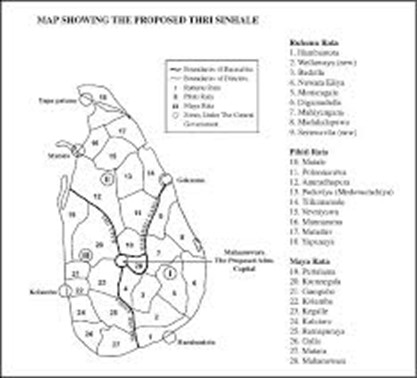
Sri Lanka 2050 

The above map, which visually divides the country into a North and a South, conveys the notion of Eelam, the territory North of the divide; this map comes very close to the Eelam map of Prabhakaran and was presented by MCC team leader, Steve Dobrilovic, at a meeting of Bank Lawyers at Temple Trees in September 2018. 

 U R De Silva, who has immodest hopes of inspiring youngsters, was at this meeting at Temple Trees; it is unlikely that he even inspired a toad on that day, when he chose to remain silent when shown the US map of Sri Lanka-2050, as was simultaneously shown to all others present.  

The Eelam area is clearly defined in the US map; the Eelam border with ‘Sri Lanka’ would be the two electric fences, on either side of the electrified railway line running between TCO and CBO, that perforce would have to be constructed to protect human and elephant lives. 

The electrified railway line, a massive project by any yardstick, will be constructed by Japan, the cornerstone of US military policy in the Pacific.  

Interestingly, one of Gota’s American associates – another disloyal Sri Lankan – an adventurist businessman dealing in real-estate too, is Gota’s ambassador designate to Japan.   

The electrified railway line runs through the ‘TCO- CBO’ Corridor, much of which is State Land. Undoubtedly, prior to the construction of the railway line, there would be lucrative real-estate business and subsequently there is scope for a great deal of railway contracts.  

Amendment 20 is to be presented in Parliament on 22 Sep 20. If Amendment 20 is passed, as it is, it would empower the Diaspora terrorists having dual citizenship, with tremendous political power.  

Amendment 20 would enable Americans of the likes of Raj Rajaratnams, the Emmanuels, the Rudra Kumarans, the Hooles of the world to consolidate power in the local political councils in the North and the East and enable some of these Americans to enter Parliament and aspire for posts carrying the biggest responsibility. 

Thus, political power in the North and East (the territory North of the TCO – CBO Corridor) would be in American hands, Americans holding extreme ethnic ideologies. 

Parliament too would have its fair crop of American extremists.   

From the latest reports emanating from the Western Capitals, hordes of diaspora terrorists are lining up, pawing the ground and waiting to ‘invade’ the country on the passing of Amendment 20 in Parliament.   

/to be contd

ERASING THE EELAM VICTORY Part 17 C 10

September 21st, 2020

KAMALIKA PIERIS

JVP   was   out to create a failed state. Firstly, it set out to weaken government authority at village level.  In 1971 insurgency, JVP killed government representatives in the village, such as GA postmaster, station master, and co-op manager. The first killing took place in Tangalle.

In 1987 insurgency, even Grama sevakas were not welcomed in the villages. JVP issued threats to government officials, followed by killing of such officials and their families. In April 1989 unprecedented number of government officials, grama sevaka, and security forces were killed. It did not matter whether they were UNP or SLFP.

We had a small family estate at Mawaramandiya, near Kadawatha,    said Garvin Karunaratne. the community leader of the area was one Wijesinghe. He was the President of the Cooperative society and was helpful to anyone that wanted anything done. He happened to be close to the leaders of the United National Party but he helped everyone irrespective of political party affiliations. I too visited his home when anyone known to me in the area had to face a problem with the government.

 He was hacked to pieces one night. The JVP had held him guilty of attending the funeral of a victim of its violence. Wijesinghe had arranged for a proper funeral to take place. The JVP order was that no funeral be held and the body be carried below the knee level and buried incognito. Wijesinghe’s murder sent creeps through everyone in the area. His brothers too left the village and his death left a power vacuum never to be filled ever again.

JVP also embarked on a comprehensive agenda to destroy the economy. JVP was instructed by its handlers, obviously, to create difficult economic conditions that would make the public rise against the state. A senior academic had designed the blueprint for this economic destruction to be implemented by JVP.

JVP succeeded in doing this, and by October 1989 the economy had been crippled. JVP and its handlers hoped that the resulting hardship would turn the public against the government. However,   this did not happen. Instead the academic who had    designed the plan fled the country with his family when the insurgency failed.

A group wishing to take over and run a country does not start by ruining its economic infrastructure as JVP did. The JVP burnt down 245 out of 545 agrarian service centers in the country along with paddy stocks and storage facilities in 1987-89.

Garvin Karunaratne, former GA Matara elaborated on this aspect. The JVP insurrection of 1986 to 1987 too took a toll of the rural areas, he said. Thanks to the JVP, the well to do people in the rural areas, the estate owners, the rice millers, lorry owners and traders all left the rural areas for the cities.  

In my subsequent visits to Matara I met many a rice miller and many a merchant who were the live wire in their rural habitat in Kamburupitiya, Hakmana etc. They had got rid of their rural possessions and migrated to the Matara town.

Many people who had been living happily on their estates left for good. Some have never stepped into their estates since the JVP uprising of 1987-1989. They have allowed their workers to manage the estates are satisfied with whatever returns they got.

The development of the rural areas requires the services of every entrepreneur and entrepreneurs come from the rich families with enough money to invest. They are not in the rural areas now. That was the legacy left by JVP with their two insurrections concluded Karunaratne.

JVP carefully and methodically hit the key sectors in the economy. Tea estates in the Uva Badulla areas and coconut and rubber estates in the south were badly hit. Over 2,09,000 kilograms of tea were destroyed by the JVP in the central provinces. The JVP targeted the transport sector  and  this paralyzed the country and brought it to a standstill. Public and private transport  was reduced to such low levels that food shortages threatened.

The two tactics used by JVP   to hit the economy were orders to close factories and work places and secondly, order to workers to strike. In 1987 Ramya Weerakoon’s apparel business was contacted by the JVP. Little notes were delivered to the security guard in the factory by JVP errand boys, she said.  Close the factory today with full pay for workers the notes said. A slip usually came on Friday or Monday, Ramya recalled.

If the two adjoining factories were also losing, she also closed her factory. The days of lost production hit them hard but they had to obey. A factory owner had defied the JVP order and they ordered him to shut down for a week. Another factory in Horana was burned down.

Between 1987 and 1989, JVP called many strikes. In September 1988, JVP ordered nationwide strikes with widespread compliance. Shops, transport, hospitals and government services were shut. Bank, Postal and telecommunications virtually halted. On 15 August 1989, the JVP called for a total island wide general strike on Indian Independence Day.

Some 90,000 tea plantation workers in the southern Ratnapura district went on a week-long strike from 7 September 1989 in response to a JVP call. Neither the imposition of emergency nor the threat of dismissal had any effect on the workers, possibly because of the terror the JVP inspired. The striking workers also could not be dismissed as that might have resulted in a wave of sympathy strikes in other sectors.

Employees of the government road transport service went on strike, demanding higher wages. They were later joined by the private run mini-buses and railways crippling the public transport.

The transport strike was followed by several token and one-day strikes. On 26 June 1989 the JVP called for a 24 hour general strike to sympathize with the 52,000 striking transport workers. Telecommunications and postal workers had walked out of their posts in support of the bus workers demands. Port workers and state sector workers staged a wildcat strike. Oil refineries remained closed due to JVP instigated strikes.

Twelve key trade unions had announced that they would launch agitations to seek Sri Lankan Rs. 2,500 as basic minimum wages, the amount which was being offered to the Jan Saviya families under the poverty line. The JVP had instigated these strikes.

JVP also took an anti India stance.    Wijeweera, set a deadline of 14 June 1989 for a complete boycott of Indian goods, departure of all Indians of Sri Lankan and Indian origin.

This call  had a devastating effect on the economy and bring the country to a standstill. Not only is Sri Lanka dependent on India for certain essential goods, there were eighteen private and public sector Indian companies operating in Sri Lanka, including state Bank of India, Indian Overseas Bank, Indian Airlines  Air India,  Pugoda Textiles, Bombay Dyeing and the Taj group of hotels. Over 70 per cent of the state Transport Board buses were of Indian make and the Sinhala drivers could not defy the JVP boycott call. (Continued)

ලෝක සාම දින පණිවිඩය

September 21st, 2020

මහින්ද රාජපක්‍ෂ ශ්‍රී ලංකා ප්‍රජාතාන්ත්‍රික සමාජවාදී ජනරජයේ
අග්‍රාමාත්‍ය

සියලු ජාතීන් සහ ජනයා අතර සාමය නැමැති පරමාදර්ශය ශක්තිමත් කිරීමට වෙන් කළ දිනය වන ලෝක සාම දිනය අදට යෙදී තිබේ. දශක තුනකට අධික කාලයක් තිස්සේ පැවතුණු බෙදුම්වාදී ත්‍රස්තවාදය පරාජය කළ රටක අග්‍රාමාත්‍යවරයා වශයෙන් ලෝක සාම දිනයට පණිවිඩයක් නිකුත් කරනු ලබන්නේ මහත් ආඩම්බරයකින් හා අභිමානයකිනි.

1981 වසරේ දී එක්සත් රාජධානියේ සහ කොස්ටරීකා රාජ්‍යය ඉදිරිපත් කළ යෝජනාවක් අනුව, ජාතීන් අතර සහ ජන ප්‍රජාවන් අතර සාමය ප්‍රචලිත කිරීම සඳහා එක්සත් ජාතීන්ගේ සංවිධානය විසින් ප්‍රකාශිත ජාත්‍යන්තර සාම දිනය, 1982 වසරේ සිට සෑම වසරකම සැප්තැම්බර් 21 වන දා සමරනු ලබයි.

ජාතීන් අතර මිත්‍රත්වය, සහයෝගීතාව දිගුකාලීන සම්බන්ධතාව පදනම් කර ගෙන මානව හිතවාදීව අන්තර්ජාතික වශයෙන්, ආර්ථික, සමාජීය, සංස්කෘතිය ප්‍රවර්ධනය අරමුණෙන් සමරනු ලබන සාම දිනය, සාමය හා සාමය පිළිබඳ සංස්කෘතියක් ගොඩනැගීමේ අඩිතාලමයි. 

මුළු ලොවම කොවිඩ්-19 වසංගතයට එරෙහි සටනක නියැළී සිටින මොහොතක අන් කවරදාටත් වඩා අප එකිනෙකාට සතුරන් නොවන බව පසක් කර තිබේ.

අනාගතයේ සාමකාමී ලෝකයක් සහතික කරලීම සඳහා සාමය සඳහා වූ ලැදියාව සෑම මිනිසෙක් තුළ තිබිය යුතු වැදගත් අපේක්ෂාවකි. සාමය වෙනුවෙන් වැඩ කිරීම ද සෑම පුද්ගලයෙකුගේ ම වගකීමකි. දශක තුනකට අධික කාලයක් පුරා ජාතීවාදී ත්‍රස්තවාදයෙන් බැට කෑ ශ්‍රී ලාංකික අප සදාචාරාත්මක මිනිස් කොට්ඨාසයක් ලෙස පළමුව තම අධ්‍යාත්මික සාමය ළඟා කරගැනීමට කටයුතු කළ යුතුය.

ශ්‍රී ලංකාව තුළ නව පුනරාගමනයක් සනිටුහන් කළ යුගයක, ලබා ගත් නිදහස නොනැසී පවත්වාගෙන යාමටත්, අනාගත පරපුරට සමෘද්ධිමත් ශ්‍රී ලංකාවක් උරුම කර දීමත් අප සැමගේ  ජාතික වගකීමකි. වර්තමානයේ හිස ඔසවන්නට වෙරදරණ ජාතික හෝ ආගමික බෙදුම්වාදයේ විවිධ ස්වරූපයන් අභිමුව එකී අවස්ථාවන් අප බුද්ධිමත්ව තේරුම් ගත යුතුය.

අප ලබා ගත් සාමය සියලු ජාතීන් වෙනුවෙන් ඉදිරියට රැක ගැනීමටත්, ලොවට පරමාදර්ශී රටක් ලෙස භෞතික සහ අධ්‍යාත්මික සංවර්ධනය කරා ශ්‍රී ලාංකිකයන් ලෙස සාමය මූලික ගමනක යෙදීමට මෙවර ලෝක සාම දිනයේදී පෙළ ගැසෙමු.

මහින්ද රාජපක්‍ෂ ශ්‍රී ලංකා ප්‍රජාතාන්ත්‍රික සමාජවාදී ජනරජයේ
අග්‍රාමාත්‍ය

APPOINTMENT OF ASOKA MILINDA MORAGODA AS THE HIGH COMMISSIONER FOR THE REPUBLIC OF INDIA WITH SPECIAL CABINET RANK

September 21st, 2020

National Joint Commission

15th September 2020.

The Committee on High Posts
Parliament of the Democratic Socialist Republic of Sri Lanka
Parliament Approach Road,
Sri Jayawardenepura
Kotte

APPOINTMENT OF ASOKA MILINDA MORAGODA AS THE HIGH COMMISSIONER FOR THE REPUBLIC OF INDIA WITH SPECIAL CABINET RANK

We would like to bring to your notice the shocking and appalling points relevant to the above mentioned appointment which the Government of Sri Lanka does not seem to have taken into consideration in selecting the candidate Milinda Moragoda

Allegations of Corruption, Abuse of Power and Working for the American Government as an informant when working in the Sri Lankan government (to put it in simple language he is an American spy in the Sri Lankan political establishment). We would like to bring to your notice what is said in ”Wikipedia”” about Milinda Moragoda regarding his  Corruption, Abuse of Power and Spying for the American Government while working in the Sri Lankan Government

https://en.wikipedia.org/wiki/Milinda_Moragoda

Milnda Moragoda as a Government minister in the UNF government proposed that Sri Lanka move out of the Non-Align Group and form a Group of Nations Aligned to his masters the USA. Had this happened this would have had serious repercussions to Sri Lanka Foreign Policy and Security. The website referred below gives information in this regard.

http://www.dailymirror.lk/breaking_news/milinda-proposed-pro-us-group-to-counter-wikileaks/108-15409

We would also like to bring to your notice that MIlinda Moragoda is a dual citizen (i.e. a citizen of USA and Sri Lanka) while his spouse is an American citizen by birth. His appointment as the Sri Lankan High commissioner for India therefore is in violation of the constitution of Sri Lanka where under amendment 19A Dual Citizens cannot be a MP, and since MP’s are public representatives of the people, accordingly we interpret that High Commissioners and Ambassadors of the country who are representatives of the people cannot have dual loyalties.

USA is a superpower that has hegemonic and invasive designs on Sri Lanka and has intentions to evict Chinese interests from Sri Lanka as part of their Indo-Pacific Quad lateral Axis consisting of India, USA, Australia, & Japan. Therefore we believe that appointing Milinda Moragoda to a country which is part of this axis, would seriously compromise the foreign relations with other power blocs in bi-polar world such as China, Russia, Pakistan, Iran, Cuba etc.

Major General Kamal Guneratna (Retd) the current Secretary to the Ministry of Defense in his magnum opus, Rana Maga Osse, states that Minister Milinda Moragoda had tried to convince General Guneratna to give up a forward position at the request of the LTTE and had bluntly declared that the Army could never defeat the LTTE. General Guneratna, in his book, quotes Milinda Moragoda as having told him that the Army could never win this war. He had further declared that although, the army had waged war for about 20 years, it could never bring the war to a successful conclusion. He had also said since the Army couldn’t achieve success, in the future, the government was going ahead with negotiations. 

In a matter of concern which needs to be checked out by your committee it is alleged that during the Peace Talk Process with the LTTE Milinda Moragoda was promoting a request made by the LTTE for Air Topology Maps of Sri lanka” that are highly classified under National Security. The request came through Milinda Moragoda on behalf of the LTTE in the pretext that these details were needed for the Twin Otter Aircraft flight that brought Anton Balasingham which landed in Iranamadu Tank runway. It was flown by two Canadian Pilots. This request for Air Topology Maps of Sri lanka” by Milinda Moragoda on behalf of the LTTE was refused by the MOD as it would pose a grave national security risk by making Sri Lanka extremely vulnerable to air attacks by her enemies.  However, we have been reliably made to understand that Milinda Moragoda had subsequently approached the Civil Aviation Authorities and they had provided the full set of Air Topology Maps which Moragoda had handed over to the LTTE. It is said that these maps were used by the LTTE to carry out the Air Attacks on the City of Colombo. That being the case, if this allegation is proven to be true and accurate then Milinda Moragoda has a history of being instrumental in giving out Nationally Classified Secret Information to the enemy of Sri Lanka and it is our contention that such a person is in no way suitable to represent Sri Lanka in a country like India.

In view and consideration of the information given above the National Joint Committee is of the firm view that Milinda Moragoda is no longer suitable to any position in the government of Sri Lanka, due to his dual citizenship, his allegiances to USA and track record of treacherous action against Sri Lanka.

We hope the members of this committee will consider our representation and prevent Milinda Moragoda from taking the position of High Commissioner of India with special Cabinet rank.   

Thank you

Yours faithfully.

Lt Col. Anil Amarasekera (Retd.)  Mr. K. M. B. Kotakadeniya (Retd. Senior DIG) Co-Presidents National Joint Commission

The Constitutional Council should go

September 21st, 2020

Chanaka Bandarage

The Constitutional Council (CC) is a 10 member constitutional authority tasked with maintaining the Independent Commissions and monitoring their affairs.

The CC is aimed at depoliticising the public service.

The CC was first established in 2000 under the Seventeenth Amendment to the Constitution. In 2010 President Mahinda Rajapaksa replaced it with a Parliamentary Council, under the Eighteenth Amendment. After Maithripala Sirisena was elected as the President, the then Prime Minister Ranil Wickramasinghe presented reforms to reinstate a new Constitutional Council in 2015 under the Nineteenth Amendment.

Five independent commissions are established under the CC. They are the Public Service Commission, Election Commission, National Police Commission, Bribery or Corruption Commission, Human Rights Commission and the Finance Commission.

No doubt that establishing them (CC and the 5 Independent Commissions) was done in good faith. The objective was to minimise the Executive’s influence over those vital bodies and depoliticise the public service.

Are these objectives good?  Have we achieved them?

The answers to these two questions are Yes and No respectively.

As stated before the composition of the CC consists of ten members. Three of them are ex- officio members and the rest are appointed. As per Chapter VIIA, Article 41, of the Nineteenth Amendment to the Constitution, members of the CC consists of the following:

(a) the Prime Minister;

(b) the Speaker of the Parliament;

(c) the Leader of the Opposition;

(d) one person appointed by the President;

(e) five persons appointed by the President, on the nomination of both the Prime Minister and the Leader of the Opposition; and

(f) one person nominated by agreement of the majority of the Members of the Parliament belonging to political parties or independent groups, other than the respective political parties or independent groups to which the Prime Minister and the Leader of the Opposition belong, and appointed by the President.

The CC makes the important appointments such as the Elections Commissioner, Public Service Commissioner, the Chief Justice, Attorney General, Chairman and members of the Police Commission, Bribery or Corruption Commissioner etc.

A simple glance at the CC’s mechanism shows that it is a mess.

Do we really need it?

Why should we go to such a lengthy extent to create a CC that comprised of 10 members?

It is like instead of driving on the Galle Road from Colombo to reach Galle, one taking the circuitous route of Ratnapura, Embilipiitya, Tangalle and Matara to arrive in Galle.

Though the end result is the same – the process to appoint personnel to the Commission is   bizarre and cumbersome.

One would argue that despite the difficulties, we could achieve a system that this independent and impartial.

The writer agrees with this argument.

But, unfortunately the manner in which the CC has operated in the past has shown that they have not been independent nor impartial.

The CC seems to have acted to please those who had appointed them in those plum positions.

A CC and Independent Commissions may work well to a degree in  a country like UK, France or New Zealand, but unfortunately not in Sri Lanka where corruption is rampant.  If the object is to depoliticise the public service, the best way to achieve this is by way of trying to eliminate bribery and corruption that is so endemic in our system. The existing laws must be enforced to the letter.

The fact that majority of the lay members are appointed directly or indirectly by the government shows that the process has lapses. Those members are likely to side with the government. Others would side with the party that appointed them.  Sadly, this is the human nature.

Recent examples have shown that CC had rarely rejected nominations submitted to it by the governments (except on very few occasions). After the present government came to power in November 2019, every single nomination submitted to it had been promptly approved. 

This shows that CC had operated in a way to ‘rubber stamp’ the nominations sent to it by the government.  Then, why should we maintain such a complex and an arduous process; at such an enormous expense?

When looking at the 5 Commissions, it has been obvious that some of the Commissions have not operated independently at all. They have worked according to the whim and fancy of the politicians. They have worked quite partially towards the incumbent governments.  A leading Sri Lankan website alleged that a Chairman of one of the key Independent Commissions solicited huge personal favours from the country’s Chief Executive.  There had been media reports that recommendations made by the Police Commission had not been carried out by the Police Chiefs. There had been stories of impropriety by the Commissioners of the Independent Commissions.

It is significant that at least 6/10 members of the CC are lay people – not MPs elected by the people.  Then what legal or moral authority do they have to go on to make such important appointments (to fill vacancies of the country’s most important public service positions)? 

Again, why should such an unelected body of people be given such enormous power?  Isn’t it contrary to the accepted principles of representative democracy?

The President, is the head of State of Sri Lanka. She/he is elected by the people at a Presidential Election. But she/he is not even a member of the CC!

The President should have the free hand to appoint personnel that she/he wants. Otherwise how can she/he fulfills the promises made to the people at the Presidential election? Why should the President be deprived of the opportunity to appoint personnel that she/he wants in the public service? It is his/her government (this is akin to a father being denied the opportunity of disciplining his children and that task given to an outsider).

It is the standard practice adopted in most democracies – the elected head of state fills the appointments of the important government positions (eg. President of the USA, Prime Minister & the Cabinet of the UK/Australia). These countries do not have CCs.

If the President makes wrong decisions she/he could be ousted at the following Presidential election.

Re other provisions of draft 20A, the writer shall express his views/position in a separate article, to be published in Lankaweb. While the writer intends to make a comprehensive analysis about them, for the time being states that it is good that the President’s term of office will continue to remain for 5 years and that his/her limit to hold the office is restricted to two terms.  The writer states that the Nineteenth amendment removed some of the immunity available for the President (Article 35 (3), and that this should remain the same.  

The writer is an International Lawyer

zx102@bigpond.com

How Your Banks Made Money From Slavery | Empires of Dirt

September 21st, 2020

VICE

VICE World News host Zing Tsjeng explores how the City of London and its financial institutions profited from slavery in America long after the slave trade was abolished. Empires of Dirt is a show about Europeans getting rich at the expense of everyone else. VICE World News host Zing Tsjeng uncovers the ugly history of the European colonial empires they don’t teach us in schools. Countries around the world were looted for their treasures, people were oppressed and exploited and European powers relentlessly profited. The far-reaching repercussions of colonialism are all around us, from our financial institutions to the food we have in our cupboards at home – and it’s about time we took notice. Watch the next episode from Empires of Dirt, in which we look at how Britain stole $45 trillion from India during its long and oppressive rule: https://youtu.be/x_jGPf764d0

US absence from UNHRC makes passing resolution against Sri Lanka problematic

September 21st, 2020

P.K.Balachandran/Daily Express Courtesy NewsIn.Asia

When the US was there and sponsoring resolutions, as it did between 2012 and 2014, they got sufficient votes. But since the US has opted out of the UNHRC, the onus of getting a resolution passed will be on less powerful countries.”

Colombo, September 20: The absence of the US in the United Nations Human Rights Council (UNHRC) is going to make it difficult for the Sri Lankan Tamil lobby to get a resolution against Sri Lanka passed in the March 2021 session of the Council when the current resolution expires.

Informed political sources said that geo-political realities in the absence of the US will militate against any resolution censuring Sri Lanka.

When the US was there, and sponsoring resolutions as it did between 2012 an 2014, they got sufficient votes. But since the US has opted out of the UNHRC, the onus of getting a resolution passed will be on less powerful countries. These do not have the clout to get it passed,” a source said.

The resource, which did not want to be named, recalled that when the European Union wanted to sponsor a resolution in 2011, it realized that it did not have enough backers in the Council. So, it backed out. It was only when the US took up the case in 2012 that the Council could pass a resolution against Sri Lanka. Every time the US backed the resolution, it was passed. From 2015 onwards till the previous Lankan government fell in 2019, Sri Lanka co-sponsored the resolutions (against itself) and they were passed without a vote.

We realize that it will be futile to introduce a resolution if there is no guarantee that it will be passed. Therefore, we are discussing the matter with the Core Ggroup led by UK and Germany and plan to engage African, Asian and Latin American countries also,” said a leading Tamil politico.

We are counting on the strong statements made by the High Commissioner Michele Bachelet and the representatives of the Core Group,” the Tamil leader added.

However, other sources said that Bachelet seemed to have let Sri Lanka off the hook in her latest speech. She delivered a ‘watered down’ statement on Sri Lanka merely calling on the Council to give renewed attention to that country, said one media report. Another said she spluttered.”

In her statement to the 45th session of the Human Rights Council which was held a few days ago, Bachelet merely referred to the commitments made by the government in Sri Lanka adding that the Council would give renewed attention to that country in view of the need to prevent threats to peace, reconciliation and sustainable development.”

Unlike in the past, the High Commissioner stopped short of calling for international investigations hinting that the Council might move forward with a watered down engagement with Sri Lanka.

In a similar development, the UK’s International Ambassador for Human Rights, Rita French, delivering a statement on behalf of the Core Group comprising Canada, Germany, North Macedonia, Montenegro and the UK, expressed its strong solidarity with Sri Lanka’s civil society, and human rights defenders, and called on the government to take all steps necessary to allow them to operate freely.

But at the same time, French appreciated Sri Lanka’s continued commitment to fostering reconciliation, justice and peaceful coexistence among Sri Lanka’s diverse communities.”

This kind of blowing hot and cold does not send an encouraging signal to the Tamil lobby, itching to fix the Gotabaya Rajapaksa government. The government, backed by a two thirds majority in parliament, is increasingly using army personnel in civilian jobs and had recently banned the commemoration of an LTTE hero Thileepan who had fasted unto death 33 years ago on September 26, 1987.

On UNHRC’s bi-annual ritual of making unsubstantiated allegations against Sri Lanka

September 21st, 2020

By Sugeeswara Senadhira/Ceylon Today

Repetition of unsubstantiated allegations in session after session puts in question not just the credibility of the UNHRC’s sources of information but the credibility of the UNHRC itself

On UNHRC’s bi-annual ritual of making unsubstantiated allegations against Sri Lanka
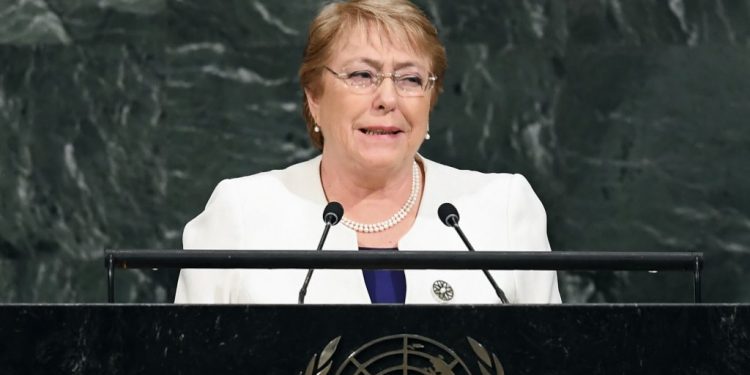
Michelle Bachelet, UN Human Rights High Commissioner)

It has been a practice during the last two decades, especially since 2009 for the United Nations Human Rights Council (UNHRC) to wake up from its slumber on the eve of its September and March sessions and pick up some issue or the other in Sri Lanka to express ‘concern’.

Continuing the ‘Sri Lanka baiting’, last week at the opening of the UNHRC session, High Commissioner Michelle Bachelet expressed concern about the impact the 20th amendment to the Sri Lankan Constitution would have on the independence of key institutions including the Sri Lanka Human Rights Commission. She decided to jump the gun and make a stern statement, when the actual fact is what the government has put in the gazette is merely a draft proposal which will have to be debated in parliament, amended if necessary and be approved by a two-third majority before it becomes a constitutional amendment.

Sri Lanka strongly refuted the UN human rights chief’s remarks on the proposed 20th amendment as being unwarranted and pre-judgmental”. The draft amendment submitted through parliament will be discussed and debated following a complete democratic process in which all stakeholders will have the opportunity to present their views. Furthermore, it is for the elected law makers of Sri Lanka to decide on what is good for the country and not for an external institution that has been admonished severely for its bias by several countries including the United States.

If the Human Rights Council is going to attack countries that uphold human rights and shield countries that abuse human rights, then America should not provide it with any credibility,” American Ambassador Nikki R Haley said while announcing the US withdrawal from the Council.

In her reference to Sri Lanka last week, Bachelet charged that senior military officials accused of war crimes” had been appointed to key civilian governmental positions and alleged that attempts at the police and judiciary levels were made to thwart investigations into the said war crimes”, which she said set a very negative trend”.

It is a pity that her officials failed to bring to her notice the success of containing the COVID-19 pandemic by the Health Ministry headed by Major General Sanjeewa Munasinghe, a medical practitioner who was the head of the Army Hospital. UNHRC must clarify the demerits, if any, of appointing such a capable military officer as Secretary to the Ministry of Health.

We hope that this council would appreciate that Sri Lanka, while successfully containing the spread of COVID-19 through a balanced, multi-sectoral approach, and despite this challenge, held its commitment to the democratic processes, and conducted parliamentary elections successfully and peacefully, last month, which the EU has acknowledged,” Sri Lankan envoy told the Geneva forum.

Responding to Bachelet’s remarks, Sri Lanka’s acting Permanent Representative said that even as Sri Lanka withdrew from the co-sponsorship of Resolution 30/1, it made it clear that it will remain committed to achieving reconciliation, accountability and human rights within the framework of the Sri Lankan constitution through a domestically designed and executed process in line with the government’s policy framework.

Among other areas that came under Bachelet’s criticism was an alleged surveillance and intimidation of victims, their families, human rights defenders, journalists and lawyers. She called for an immediate end to such activities.

In response, Sri Lankan delegate said that the government has already publicly refuted these allegations and is committed to protecting and promoting freedom of expression and civil society space, and ensuring that complaints received on alleged attacks against journalists, human rights defenders and civil society are investigated and prosecuted.

The prime focus of the incumbent government is to ensure national security, and to uphold the rule of law and order in the country for all its citizens, with the aim of creating ‘an environment where any citizen can live freely without any fear for their safety and that of their families.’

It is indeed unbecoming for the HR High Commissioner to level false and unsubstantiated allegations against military officials in Sri Lanka, when the government has consistently refuted the credibility of these allegations and repeatedly pointed out that domestic processes such as the Lessons Learnt and Reconciliation Commission (LLRC) and Paranagama Commissions which examined these allegations particularly with regard to the last stages of the conflict, have not found substantive evidence against any of the senior military officials referred to in this regard.

In the absence of any substantive proof, Sri Lanka considers that the continued arbitrary accusations on crimes or crimes against humanity made against these senior military officials are unacceptable and a violation of the principles of natural justice,” Sri Lankan representative told UNHRC.

Bachelet’s statement clearly showed the ignorance of the international body about the ground situation in Sri Lanka. It is indeed erroneous that more attention has not been paid to the false information given by agencies including the OHCHR, which is required to seek the truth.

Bachelete has conveniently forgotten the need for allegations to always be subjected to the due process of investigation in accordance with established legal procedures. They should not be hastily credited to support unfounded assumptions.

While the people in North and East Sri Lanka demand more devolution of power and the imperative need to address their grievances, the Human Rights Council laments that Sri Lanka is yet to set up the special judicial mechanism to try so-called ‘war criminals.’ The action by the Sri Lankan Security Forces during the conflict was against a group designated as the most ruthless terrorist organization in the world by many countries, and not against any community. All communities in Sri Lanka were united against terrorism, and are working in unison towards reconciliation and economic progress.

Sri Lanka’s Ambassador to Russia Plans Getting Vaccinated With Sputnik V

September 21st, 2020

Courtesy Sputnik

MOSCOW (Sputnik) – Sri Lanka’s Ambassador to Moscow Meegahalande Durage Lamawansa said on Monday he planned getting inoculated with Russia’s vaccine against COVID-19, dubbed Sputnik V, in the near future.

“I am ready to receive Sputnik V vaccine in the near future, as soon as I come back from Sri Lanka. The vaccine is now going through Phase 3 trials, I would be happy to take part in it”, Lamawansa said.

“As a doctor, I want to add that although some countries have recently recorded some decrease in the spreading of COVID-19, the global community should remain vigilant and unite effort to establish full control over the new infection”, the ambassador noted.

Russia became the first country to register a vaccine against the virus that causes COVID-19 in early August. The country has since reached agreements with more than 20 countries to deliver over a billion doses of the vaccine and agreements with five nations for the mass production.

According to the Russian health ministry, Sputnik V is safe and has proven to be capable of building immunity against the virus. The vaccine is yet to complete the required Phase 3 of clinical trials.

Modi-Rajapaksa virtual summit on September 26

September 21st, 2020

Suhasini HaidarMeera Srinivasan Courtesy The Hindu

Prime Minister Narendra Modi shakes hands with Sri Lanka's Prime Minister Mahinda Rajapaksa in New Delhi. File Photo.

BRI a functional machinery in global economic recovery: Sri Lankan expert

September 21st, 2020

By Xian Jiangnan (People’s Daily Online)  

The continuation of protectionism by America, the largest economy body in the world, will only result in further contraction of the world economy and aggravation of unemployment, poverty and deprivation, said Luxman Siriwardena, president of the Sri Lanka-based Pathfinder Foundation.

In a recent interview with People’s Daily Online, Siriwardena said that the unilateralism and protectionism currently being championed by the American administration goes against the values the West has promoted since the end of World War II.

When I was undertaking graduate studies at an American university in the 1980s, it would have been totally unacceptable for any of the economic professors to believe that the protectionism in trade and investment would enhance the welfare of the international community,” he recalled, sharing that since the establishment of formal China-Sri Lankan diplomatic relations, China has been the most reliable, all-weather friend of Sri Lanka.

In recent years, Sri Lanka has taken an active role in the Belt and Road Initiative (BRI), which, he stressed, is the most logical development strategy for Sri Lanka.

The successful completion of the three major development projects in Sri Lanka under the BRI, namely Colombo Port City Project, Hambantota International Port and proposed Hambantota Industrial Zone, will have a transformative impact on the Sri Lankan economy.

In the post-pandemic era, the BRI is a functional machinery which can substantially contribute to the recovery of the global economy,” he noted, voicing hope that the initiative will have more inclusive and comprehensive programs encompassing a larger amount of countries.

While this is a decisive year for China to complete the building of a moderately prosperous society in all respects and to end extreme poverty, according to Siriwardena, China’s development has been unprecedented” in the history of the entire world.

The process has been inclusive in the sense that China has uplifted hundreds of millions of people out of poverty while achieving advancement in science, technology and culture,” he said, adding that China has addressed the social, economic and environmental dimensions of the 2030 Agenda for Sustainable Development in the recent past, citing the pollution management in the city of Beijing as an example.

Looking ahead, Siriwardena said the two countries will enhance their cooperation in various fields, such as COVID-19 pandemic control and prevention, investment in manufacturing, logistics and services, infrastructure as well as economic digitalization, and people-to-people exchanges.

Faced with the COVID-19 pandemic, Siriwardena pointed out that both China and Sri Lanka have managed to control the virus with relatively minimal loss of life, and praised China’s commitment to distribute the vaccine to the rest of the world, which will contribute to the vision of building a community of health for all in the near future

NEWSAthaulla: Those responsible for MR’s defeat had a hand in Easter Sunday attacks

September 21st, 2020

By Shamindra Ferdinando Courtesy The Island

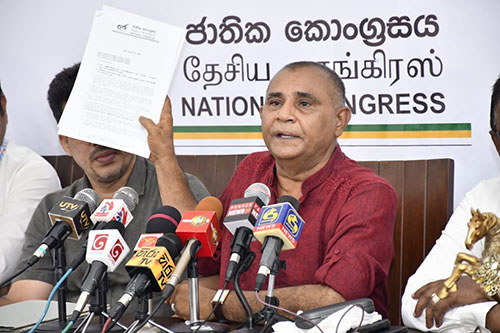
MP A.L.M. Athaulla displays a copy of a letter he sent to the then President Maithripala Sirisena and PM Wickremesinghe underscoring the need to do away with the 19th Amendment(Pic courtesy National Congress)

… assures support for 20 A

Those who had a hand in engineering President Mahinda Rajapaksa’s defeat at the 2015 presidential election were behind the 2019 Easter Sunday attacks, National Congress MP A. L. M. Athaulla, told a media briefing at his Thalakotuwa Gardens road residence, Narahenpita yesterday (20).

Digamadulla District MP blamed 2014 organised attacks on Muslims in Aluthgama, Beruwela and Darga Town also on the same group hell bent destabilising the country. Instigating ethnic violence was part of their strategy, a one-time UPFA Minister said, urging all communities to be vigilant of despicable efforts to undermine political stability.

Athaulla said so when The Island asked him whether he subscribed to SLMC leader Rauff Hakeem’s recent declaration that the Easter Sunday attacks had been carried out by another force and not the National Thowheed Jamaat or its leader Zahran Hashim.

One-time Justice Minister Attorney-at-law Haleem alleged that the NTJ had been hired to carry out the operation.

SLMC leader Hakeem made the aforesaid claim on September 7 before the Presidential Commission of Inquiry (P CoI) probing Easter Sunday attacks.

Athaulla said that President Gotabaya Rajapaksa would ensure a thorough investigation into Easter Sunday attacks. The MP also expressed confidence in the progress made by the PCoI which the National Congress leader said could reveal the truth.

When The Island pointed out that former Deputy Inspector General (DIG) in charge of the Eastern Range Edison Gunatilleke had recently accused Athaulla, former UPFA politician M H M Hisbullah et al of their involvement with extremists and terrorists, a smiling Athaulla said that there was absolutely no basis for such claims. He challenged Gunatilleke to prove his accusations. Athaulla said he didn’t even know Gunatilleke or even remember calling over the phone.

Lawmaker Athaulla questioned why Gunatilleke had waited so long to complain of political interference in police investigations. Declaring that he was among those politicians who received top level security, including bullet proof vehicles due to serious threats to his life, Athaulla denied ever working against the interests of the country.

Asked whether the unsubstantiated accusations had been levelled against him in a bid to deprive him of a possible cabinet portfolio, the National Congress leader replied in the negative.

Responding to a spate of media queries regarding the SLPP not accommodating him in the cabinet, Athaulla emphasized that he never asked for a cabinet portfolio nor would ever request for one.

MP Athaulla said that their responsibility would be to ensure required consensus in parliament to pave the way for the 20th Amendment in place of the 19th Amendment enacted at the onset of the treacherous yahapalana administration in 2015.

At the commencement of the media briefing, MP Athaulla said that the National Congress had backed the then President Mahinda Rajapaksa three conditions. We asked for the eradication of terrorism. We also sought the demerger of the Eastern Province from the North during President Mahinda Rajapaksa’s presidency and those demands were met.”

Athaulla said that the only request yet to be fulfilled was a Constitution that met aspirations of all Sri Lankans.

He said that the National Congress believed President Gotabaya Rajapaksa, who had been the Defence Secretary during the war and the war winning President Mahinda Rahapaksa, now the Prime Minister, would succeed in introducing a new Constitution. Referring to the 19th Amendment, MP Athaulla pointed out that the controversial piece of legislation caused chaos with political parties having to seek intervention of the Supreme Court to ascertain how powers were shared.

When The Island pointed out that even the SLPP hadn’t been able to settle differences among various sections as regards the 19th Amendment, lawmaker Athaulla said that he was confident the Rajapaksas wouldn’t do anything to harm the country. He denied any ambiguity over his party’s support for the 20th Amendment.

The country couldn’t afford to have the President and the Prime Minister from different political parties under any circumstances, the former minister said, warning of dire consequences in foreign interventions in the making of the new constitution.

Referring to the high profile Oslo peace bid in 2002-2003 during Ranil Wickremesinghe’s tenure as the Prime Minister, Athaulla insisted that constitutional reforms introduced at the behest of foreign powers wouldn’t address local issues. The former minister said that the country’s strategic location attracted foreign interests therefore the country needed to be cautious.

Reiterating his backing for the 20th Amendment, MP Athaulla urged the government to take tangible measures to introduce a new Constitution. Underscoring the importance of the proposed new Constitution being a Sri Lankan effort, Athaulla recalled how the TNA and the SLMC had facilitated foreign intervention.

The former minister dismissed the Opposition’s claims as regards SLPP bid to do away with independent commissions. Independent commissions weren’t certainly independent, the MP alleged, pointing out that they didn’t do their job.

Athaulla however side-stepped a query regarding the 20th Amendment proposing to abolish restrictions on dual citizens contesting parliamentary polls.

Govt. reiterates no decision to withdraw 20A Says amendments can be made at committee stage

September 21st, 2020

Lahiru Pothmulla Courtesy The Daily Mirror

The government today reiterated that it has no decision to withdraw the 20th Amendment to the Constitution but said if needed, amendments to it can be made at the committee stage in Parliament.

Speaking at a news briefing held at the SLPP head office, SLPP Chairman and Minister Professor G.L.Peiris said the opportunity is available to make amendments to the piece of legislation at the committee stage.

The 20A which was included in the Order Paper of Parliament on September 17 will be presented to Parliament tomorrow (22). Within a week of tabling the 20A in Parliament, interested parties have the opportunity to challenge it in the Supreme Court. The Court has to decide within three weeks, whether challenged provisions are inconsistent with the Constitution. Afterwards, during the committee stage in Parliament, the 20A can be amended,” Minister Peiris said.

When asked whether the recommendations and conclusions made by the Prime Minister appointed committee, which was headed by Minister Peiris, to study the 20A would be considered during the committee stage, he said, If that’s what the majority wants.”

The minister reiterated the independent commissions would not be abolished but said, according to the 20A, the appointments to the commissions will be made by the President after considering the observations made by a Parliamentary Council. 

We expect UN not to interfere in domestic affairs of states: President

September 21st, 2020

Courtesy Adaderana

President Gotabaya Rajapaksa says that Sri Lanka expects that the United Nations will place due emphasis on non-interference in the domestic affairs of other states.

The President expressed these views in a pre-recorded statement, at the High-Level Meeting to Commemorate the 75th Anniversary of the United Nations today (21).

At a time when the world is facing a common and an unrivaled threat, the United Nations We Need”, I am certain, will place due emphasis on the sovereign equality of States, respect for territorial integrity and non-interference in their domestic affairs”, President said.

President said that he firmly believes that partnerships fostered between the Member States and the UN continue at their best when no country is held hostage to the interests of a few.

UN Member States agreed in June 2019 that the UN will mark its 75th anniversary with a one-day, high-level meeting of the UN General Assembly on Monday, 21 September 2020 on the theme, ‘The Future We Want, the UN We Need: Reaffirming our Collective Commitment to Multilateralism’.

The President of the 75th Session of the General Assembly Volkan Bozkir made the opening statement at the meeting where leaders and delegates of 180 countries made their representations.

The world is plagued by the unprecedented COVID-19 pandemic, which has jeopardized our economies, health systems, and indeed our societies, just within a few months”, President Rajapaksa observed.

Sri Lanka was able to successfully face the challenge of COVID-19 through proactive intervention. We established the National Action Committee for Preventing COVID-19 even before the first patient was detected in Sri Lanka. Our approach synchronized the military, health as well as civilian authorities of national and regional levels.

Sri Lanka’s recovery rate stands at over 90% well above the global recovery rate.  Our success story owes much to our reliance upon ‘tracing and quarantine’, which was our greatest strength, President stressed.

Sri Lanka is hopeful that we of the United Nations would rededicate ourselves in efforts to strengthen this great institution to ensure the future we want. We owe our peoples and future generations no less”.

The full text of the statement by President Gotabaya Rajapaksa is as follows:

Mr. President,

Mr. Secretary-General,

Excellencies,

Ayubowan!

Your Excellency Volkan Bozkir, I congratulate you on being elected as the President of the 75th Session of the General Assembly.

 I am deeply honoured to represent the people of Sri Lanka on this historic occasion.

Unfortunately, the world is not what the founders of this august body envisaged 75 years ago.

The world is plagued by the unprecedented COVID-19 pandemic, which has jeopardized our economies, health systems and indeed our societies, just within a few months.

Sri Lanka was able to successfully face the challenge of COVID-19 through a proactive intervention. We established the National Action Committee for Preventing COVID-19 even before the first patient was detected in Sri Lanka. Our approach synchronized the military, health as well as civilian authorities of national and regional levels.

Sri Lanka’s recovery rate stands at over 90% well above the global recovery rate.  Our success story owes much to our reliance upon ‘tracing and quarantine’, which was our greatest strength.

Sri Lanka has not reported a single case arising within the local society for over a month now.

Excellencies,

Sri Lanka has committed to the 2030 Agenda of Sustainable Development. Poverty alleviation through an agri-based production economy is a major goal of my Government.

The steps that we had initiated earlier this year for enhancing local production, partial restrictions on imports as well as assisting small and medium scale entrepreneurs paid their dividend.

As we celebrate 65 years of UN membership this year, Sri Lanka is pleased to have contributed significantly to United Nation’s agenda, ranging from peacekeeping operations to programmes of its specialized agencies.

At a time when the world is facing a common and an unrivalled threat, the United Nations We Need”, I am certain, will place due emphasis on the sovereign equality of States, respect for territorial integrity and non-interference in their domestic affairs.

Excellencies,

I firmly believe that partnerships fostered between Member States and the UN continues at their best when no country is held hostage to the interests of a few.

Sri Lanka is hopeful that we of the United Nations would rededicate ourselves in efforts to strengthen this great institution to ensure the future we want. We owe our peoples and future generations no less.

Thank you.”

Bribery Commission files indictments against Ravi and Arjun Aloysius

September 21st, 2020

Courtesy Adaderana

The Commission to Investigate Bribery or Corruption (CIABOC) has filed indictments against former Minister Ravi Karunanayake and the Perpetual Treasuries Limited owner Arjun Aloysius at the Colombo High Court.

Karunanayake has been charged under Section 19 (c) of the Bribery Act for taking up residence –all the while serving as the Finance Minister– at ‘No. 5 PH2, Monarch Housing Complex’ acquired under the Walt & Row Associates (Pvt) Ltd, where the second accused of the case Arjun Aloysius is a director, during the period from 12th February to 30th September, 2016.

The indictments allege that defendant Aloysius had paid a sum of Rs 11.68 million, through cheques of Walt & Row Associates (Pvt) Ltd and Purchasing Capital Company, for the said house.

Arjun Aloysius, the second accused in the case, has also been indicted under Section 19 (c) of the Bribery Act for aiding and abetting the process.

Accordingly, the total number of indictments filed against the two defendants in this case is six.

Wigneswaran a serious threat to peace and reconciliation

September 20th, 2020

H. L. D. Mahindapala

Needling the South with provocative anti-Sinhala-Buddhist hate speech led the North all the way to Nandikadal. So why is C. V. Wigneswaran going down the same old path of divisive and  destructive politics? What does he hope to gain when the mightiest collective forces of the Jaffna Tamils failed to divide the nation under various constitutional formulas by basing their strategy on anti-Sinhala-Buddhist extremism? Besides, his hate speech is  loaded with toxic distortions of known realities which stand in the way of future reconciliation and  peaceful co-existence. It is apparent that he is merely re-enacting the inflammatory role of Hanuman who, in the Mahabaratha, set fire to the nation by gradually extending his flaming tail each time it ran out of fuel.

But Wigneswaran is not alone in propagating anti-Sinhala-Buddhist hate speech. He is, in fact, the latest avatar of a Jaffna-centric ideology that began  with G. G. Ponnamabalam, the father of the anti-Sihala-Buddhist ideology, who first lit the fires of communal passions  with his provocative attack on the Mahavamsa and the Sinhala-Buddhist history. It happened in June 1939 in Navalapitiya and communal riots spread quickly to the neighbouring towns. Since then the anti-Sinhala-Buddhist ideology used to sustain the mono-ethnic extremism of the North has never ceased. Projecting the image of the Sinhalese as the bogey man  threatening  the existence of Tamils has been an essential ingredient for the perpetuation and promotion of mono-ethnic extremism in the North. It has dominated the post-colonial period and dragged the nation through hell fires of death and destruction.

Ponnambalam’s anti-Sinhala-Buddhist ideology gathered momentum incrementally over the years and exploded in its most virulent form when the Tamil leadership officially declared war on May 14, 1976 at Vadukoddai and urged the Tamil to take up arms and never cease until they achieve Eelam. What the Vellala elite who held the reins of power from feudal times did not realise was that they were handing over power for the first time to untried and untested youth who went berserk with the gun. Velupillai Prabhakaran was the first-born child of the Vadukoddai Resolution. He is the ultimate manifestation of the anti-Sinhala-Buddhist ideology bred by Ponnambalam. It was his ideology that led to the longest war with disastrous consequences, particularly to the Tamils.

Tamil leaders never deviated from the anti-Sinhala-Buddhist ideology that sustained them in competitive electoral politics. They had nothing else to offer their electorate. They never offered alternative ideologies like socialism, liberalism, democratic humanism, pluralism etc. The rainbow colours of a multi-cultural and pluralistic society never arched over the skies of Jaffna. From  one end  of the political spectrum to the other Tamil leadership competed with each other promising to deliver more and more of mono-ethnic  extremism demonising the Sinhala-Buddhists and nothing else. The Tamils who lived by the sword of anti-Sinhala-Buddhist ideology also died by it.

It was constructed, defined and set in  motion  when Ponnambalam began his campaign demanding 50% of power to be the equal of the majority Sinhala-Buddhists. Of course, he knew that there was no rational basis on which he could convince the British that a minority of 12% could demand 50% of  power. He had to construct a rationale to justify his disproportionate claim. So, he opted for the strategy of proving that the Tamils were equal, if not superior to the Sinhalese. Mark you, it was also a time when the British  surveyors, archaeologists, and civil servants were digging  into the past and discovering  the glories of the ancient  and medieval Sinhala-Buddhist history. The unearthed discoveries were showering the Sinhalese with an aura of greatness. The grandeur emerging from the buried past was making the Sinhalese look like giants of a great civilisation. The political implication was clear : if they could have built and governed a civilisation of such magnitude then they could easily govern Sri Lankan without the British. The politics of Sinhala nationalism was resting on monumental history.

This placed the Tamils in a virtual vacuum. They had no history of comparable magnitude to base their arguments for such a grossly exaggerated claim of 50% of power to a minority of 12%. In making his over-blown demand, totally out of proportion,  Ponnambalam had to fight not only the political realities of the day but also the overwhelming presence of a past casting long shadows over the national scene. History was not on the side of the Tamils. Ever since then the Tamils have been labouring  to  rewrite history to fill in the blanks and deny the horrors staring  in their face.

In Ponnambalam’s time, the biggest icon in their history that began in the 10th century was Sankilli – a pathological killer of the Tamils and the first recorded ethnic cleanser of Muslims and Sinhalese from Jaffna. On the Christmas eve 1544 he marched down to Mannar and massacred 600 Tamil Catholics, including pregnant women and children, who refused to recognise him as the sole representatives of the Tamils”. The Tamil Catholics owed allegiance to the King of Portugal. Since then the intolerant and inhuman Sankili culture of Tamils killing Tamils became a permanent feature in peninsular  politics.

Prabhakaran emerged as Sankili’s avatar in the 20th century. History didn’t repeat itself as a farce the second  time in Jaffna. Prabhakaran went all out to outdo Sankili. To drive the Muslims out of Jaffna Sankili threw pig’s head into Muslim wells. Prabhakaran, on the contrary, forced them out with a gun pointed to their heads. His megalomania drove him to crush any form of dissent. He  feared his  own people. He slaughtered Neelan Tiruchelvam, Amirthalingam, Uma Maheswaran etc., etc., the cream of Tamil leadership, all because he feared them. S. C. Chandrahasan, son of the father of separatism, S. J. V. Chelvanayakam, and V. Anandasangaree, the President of TULF, are on record saying that Prabhakaran had killed more Tamils than others put together. With a monstrous history of a bloody past, where the Tamils were  deprived of their basic human rights under the Vellalas, the Tamils were desperately in need of a face-lift to make them look good, a defence that would make them look respectable in the eyes of the world. Not having one, Ponnambalam in his time discovered that attack is the best form of defence. 

It was in this setting that Ponnambalam came out swinging against the Mahavamsa and the history of the Sinhala-Buddhists. His strategy was to downgrade Sinhala-Buddhist history in order to prove the superiority of Tamil history. The most popular phrase was to condemn the Sinhala-Buddhists as racist bigots  obsessed with the Mahavamsa mentality”. It became the pop phrase even among the anti-Sinhala-Buddhist Sinhala intellectuals to denigrate those who defended the historical heritage that made Sri Lanka great.  The Mahavamsa mentality” was a phrase used frequently to demean anything and everything that restored to the Sinhala people the heritage they lost under nearly 500 years of colonialism. The Mahavamsa mentality” was also blamed for resisting the divisive politics of the Tamils claiming 50% for just 12%. But none of the intellectuals dared to speak of Jaffna jingoism” leaping from one extremism  to another until it pushed the Tamil people like lemmings over the cliff to their self-destruction. 

Ponnamabalam’s strategy was to attack the past and the present of the Sinhalese for him to advance his claim of 50-50” – a mathematical formula that runs counter to all known democratic principles of  governance. Except in authoritarian regimes all institutions – from  the state to non-governmental institutions — are run on majoritarian consensus with, of course, guarantees to minority rights. But Ponnambalam could not wage a frontal attack on the established and universally accepted principles of democracy. So, he resorted to two deviant tactics: 1. he attacked the past of the Sinhalese to downgrade its value as a legitimate force to inherit power. 2. downgrade the Sinhalese as a majority that discriminates against the minority. The Soulbury Commissioners listened to him on this issue of discrimination and dismissed it as hogwash. The attack on Sinhala-Buddhism was not an issue canvassed at the Commission. However, it became the main  political tool used by the Tamil extremists in the public domain to make the Sinhalese the bogeyman – the cause of all evils of the Tamils. It  still rides  in peninsula politics bedevilling national politics.

From the time of G. G. Ponnambalam in the thirties to  C. V. Wigneswaran, this has been the consistent theme propagated to downgrade not only the Sinhalese, their main target, but also the low-caste Tamils of Jaffna, regional Tamils in Batticoloa and the Indian coolies” in the central hills and even the Tamil-speaking Muslims. Jaffna-centric arrogance and intransigence have been two of the perverse strands that runs through peninsular politics. It is most regrettable that Wigneswaran continues  to harp on the racial superiority of the Tamils in the post-Nazi era. He knows that it  has bred and continues to breed racial hatred with all its tragic consequences. Of course, he  has right to praise his language and culture. What  is unacceptable is when he uses it to devalue Sinhala-Buddhism. His attempt to place Jaffna Tamils at a level far superior to Sinhalese by condemning their history is not  only unhistorical but also provocative playing into the hands of extremists on both sides. It is also counter-productive and it has not led them anywhere except to Nandikdal.

What is worse, it is a hollow claim not  worthy of a man who sat as a judge in the Supreme Court. He repeats that the Tamils (meaning, of course, the high-caste Vellalas) are great because he speaks Tamil, the  oldest language in the  world. His other tack is to denigrate the Mahavamsa and Sinhala-Buddhist  history because it  is the Ponnambalam-Wigneswaran way of making Tamils look superior to the Sinhalese. But both are cheap political tactics that had worsened the North -South inter-ethnic relations. Take, for instance, his claim to be superior because he speaks Tamil, the oldest language in the  world, as opposed to the Sinhala language which he says came into being around 5th century. But this is a silly boast of a vacant mind. No one  denies the antiquity and the  greatness of the Tamil language and its culture. But how can he claim to be great by parroting a language created by another country, another nation? The greatness belongs to the Tamils of S. India who created it and invested it with all its richness. Wigneswaran, or any Tamil in Jaffna, has nothing to do with it. The Wigneswarans are nothing but mediocre  parrots trained to repeat the language that came out of the creative genius of Tamils of S. India. The imitative Jaffna mediocrities had not contributed anything great to  the glory of the Tamil language or its culture. So, when Wigneswaran talks of his greatness because  he  speaks the Tamil language he is fooling himself and not  impressing the  world. Everyone knows that he  is trying to shine in borrowed feathers. Wigneswaran and his anti-Sinhala-Buddhist extremists are pretending that they are the Einsteinian giants of Tamil culture. The more he opens his  mouth to boast about his greatness because he speaks Tamil the more he exposes his mediocrity. 

The Sinhalese, on the  other hand, minted a new language of their own rejecting the dominant classical languages of their time. Sanskrit, Pali and Tamil were already established vehicles for all religious, social and  intellectual uses. The strength  of the Sinhala language is that it never surrendered to these overwhelming linguistic forces of its  time. Rejecting all these languages the Sinhalese created their own linguistic medium for inter-personal communication and expression of their spiritual and philosophical thoughts. If the Tamils came first, and if their language was superior, and if they were the geniuses they claim to be how come they failed to make their language the lingua franca of the nation? Why did the Sinhala language and the Sinhalese triumph over the Tamil geniuses? How did the young Sinhalese beat the old Tamil settlers? Repeating ad nauseam that Tamil language is great because it is one of the oldest doesn’t make it great because of its age. Languages that came later have delivered greater achievements for the  advancement  of mankind.

The Sinhalese, for their part, have proved that it is their language that has served them more than any other language that came with the migrants. Besides, if Wigneswaran wants to prove that his Jaffna culture is great then he  has to match it with the achievements of the Sinhalese and not  bask in the glory of S. India. It is because he can’t that he keeps on attacking  the Mahavamsa – a classic that is the envy of the culturally bankrupt Tamils of Jaffna. Incidentally, if he rejects the Mahavamsa then he has to reject the Tamil historical record, Yalpana Vaipava Malai, written by poet Mylvakanam, in 1736 for the benefit of the Dutch Governor, Jan Maccaras. In his own twisted way, Mylvakanam acknowledges Vijaya and his Sinhala followers as one of the original founders of the nation.

As I know it, Wigneswaran is a clueless political speculator who is hanging on to his obsessions with Tamil greatness mainly because he has no other viable political ideology to make his mark in politics. Sometime back when he was challenging  everyone to debate with him on this issue I accepted his challenge. Then he backtracked. He asked me to present to him my arguments for him to check with academic authorities before agreeing to debate. I asked him whether he, as a prosecuting lawyer, went to court and asked the defence lawyer to reveal his case to him before going to trial. That is Wigneswaran, the great defender of Tamils who does not know whether  he is coming or going. Obviously, he is not sure of his case. Now he is asking for a commission to investigate and adjudicate on what happened in history. He does not know his own Tamil history. He is still learning. In the meantime, he  is playing the Tamil card purely to score points over his political competitors in Jaffna.

He relies entirely on one argument: he is great, the Tamils of Jaffna are great – nay superior to the Sinhalese! – because of the Tamil language. If Wigneswaran claims greatness on a borrowed language shouldn’t the Sinhalese be placed on a far superior scale of greatness for having created a new language and  with it given the world a new culture and a  new civilisation? What have the Jaffna Tamils done in their sterile settlement since the 10th century that can match the achievements of the Sinhalese?

What is more, the Tamils who boast of their great history is yet to produce an authoritative history of Jaffna. The first task of Jaffna University, established in 1972, should have been to produce a scholarly study of its past. More so, because history  has been abused to mislead people into Nandikadal. But it has not done so to this day. Giants of historiography with the stature of Prof. Kingsley de Silva have not yet graced the halls of learning in the Jaffna University.  K. Indrapala, the first professor of history of Jaffna, had to  leave the University in a hurry because his  original thesis on which he obtained his doctorate, was rejected by the politically hostile forces that proclaimed the Tamils were the original settlers from the dawn of time”. Indrapala said that the Malabaris who migrated from S. India decided to remain as permanent settlers only in the 10th century.

The intellectual level of Wigneswaran makes it obvious that the future of reconciliation and even peace is at great risk. If the political thinking of the Tamils is to remain at Wigneswaran’s level we can certainly look forward to another bloody Nandikadal. If Wigneswaran thinking came from a cheap politician trying to win the most number of preferential votes one could turn a blind eye, though repugnant. But when Wigneswaran  fails to distinguish between fact and fiction a serious question arises: How on earth did he pass judgment, fairly and objectively, in the Supreme Court of Sri Lanka? Considering the way he is handling the available evidence before us all shouldn’t there be a commission appointed to review his judgments?

ERASING THE EELAM VICTORY Part 17 C 9

September 20th, 2020

KAMALIKA PIERIS

In both JVP insurgencies, 1971 and 1987, JVP tried to infiltrate all four security services, police, army, navy and air force.  The 1971 insurgency this was not very successful in this. Only about ten persons became   JVP supporters in each of the four services in 1971 said Chandraprema., Some joined the JVP when the insurgency ended.  However, Godahewa observed that several members of the armed forces were recruited into the JVP and used very discreetly.

Wijeweera had tried to recruit   army personnel who were thought to be loyal to SLFP, but they were not interested.  Wijeweera was more successful with the navy. Wijeweera targeted the Sri Lanka navy from the very beginning. A list of navy personnel were submitted to him by a contact.   Wijeweera met this group at Trincomalee navy base and spoke to them,   probably in 1965. And a group of JVP navy men” was created. Many naval personnel attended the JVP classes in 1966 and 1967. Naval ratings who were close to Wijeweera were among the instructors at the JVP training camps.

Able Seaman H.M. Tillekeratne was the ‘Coordinating Officer’ between the Navy and the JVP, and the JVP was planning to appoint him as North-East commander if they seized power.     He was in the habit of regularly travelling between the Elara Camp and the Trincomalee Naval Base.  He was conducting political classes for some Navy personnel. 

The notion that in 1971 the JVP was only interested in taking over police stations is incorrect. This was only a cover. Even then, the target was the armed forces and the military installations. During the 1971 insurgency, JVP took over the Anuradhapura air strip and was eyeing the one at Vavuniya. JVP planned to establish military units in each police area in the country. 

JVP was also planning to take over Trincomalee by sending JVPers parading as football players to start the insurgency there. Towards the end of March, 1971, the Trincomalee Naval Base received a letter from the Peradeniya University requesting to arrange a football match between university students and Navy personnel on the naval base grounds n Trincomalee on April 5. The letter also requested the Navy to arrange for the university team to spend the night at the base, since it was difficult for them to return to Peradeniya the same day after the match.

The naval authorities were wary.  The Navy decided it was not safe to allow a football match between the Navy and University team at Trincomalee. The university authorities were informed that the naval base grounds could not be given for the match.

JVP planned to take over the navy bases in Jaffna or at least their weapons. Sailors who supported the JVP has been posted to the armories there. Within 48 hours of the JVP uprising Superintendent of Police Jaffna, received a message from Colombo of a suspected move to put sleeping tablets into the water filters at the Elara Camp’s officers mess. The police took immediate action. They arrested Tillekeratne and after a squirmish, shot him dead.

After Tillekeratne’s death, police searched his personal belongings and found secret documents, and several bottles of sleeping tablets which were to be put into the water filters of the Elara Camp’s officers’ mess. Tillekeratne’s plan was to seize all weapons and ammunition from the camp’s magazine, before joining his JVP comrades, after making naval officers unconscious.”

Since the army and navy had refused to go over to the JVP wholesale, it was necessary to somehow put them out of action during the 1971 insurgency. JVP had planned to put laxatives and sleeping pills into the food in the army and navy camps.  They   were   going to introduce an ayurvedic laxative, japala seeds, which tasted like coffee. If taken in excess it could even cause death by dehydration. This was known as the ‘japala plot’. The army was aware that something of the sort had been planned. Around March 1971 army officers who were in camp had heard that there was a threat to poison them, said one commentary.

One of the tasks assigned to the JVP in 1987-89 was to    weaken the Sri Lanka army and divert military attention away from the Eelam war. The first targets of the JVP in 1987 were, therefore, armed forces and police.

JVP planned this well. An Increasing number of youth were reported,   when arrested, in 1987, to have in their possession detailed maps of army camps, important government institutions, and residences of government politicians. One youth had several maps of the Panagoda army camp. It was obvious that JVP   was planning large scale strike against the state, noted Chandraprema.

Saman Piyasiri, head of the DJV, had plans of vital military installations, photographs and documents, in his house when he was taken into custody.  The photos included installation of the military police headquarters Sri Lanka.

JVP launched their attacks on military establishments at the height of the Eelam wars. On 15 April 1987, JVP attacked the Pallekele Army Camp in Kandy. Lead by a former soldier, under the directions of Shantha Bandara. JVP successfully raided Pallekelle and took off with firearms and ammunition. JVP   seized 12 Type 56 assault rifles, seven sub-machine guns and ammunition. The daring and ingenuity of the Pallekelle raid in early hours of New Year day showed the imprint of a well organized movement, said Godahewa. 

When the 1987 Vadamarachchi campaign was turning out well, three days after the Indian ‘parippu’ drop, JVP launched two armed attacks on the Katunayake air force base and Kotelawala Defence Academy,  removing a valuable haul of weapons from each.  They had support inside the Air force base    and were able to take away eleven T56 and 15 submachine guns.

 In Oct 1987 JVP  attacked Kallar army camp in Trincomalee and  after a   20 minute gun battle, over ran the camp and took away a huge amount of  weapons, six T56, three LMG spare barrels,  This was the JVP ‘s Largest haul of weapons to date. The Kallar army camp was near Mahindapura in Serunuwara in the Kantalai police division

In Jan 1988 JVP attacked the army training camp at Kumbukke in Horana. In April 1988 there was a second attack on Katunayake Air Base and JVP took away weapons and ammunition. In November 1988 JVP attacked the Pannala National Air Force training camp .The arms haul from Pannala was bigger than those from Kallar. At Pannala JVP was helped by an air force deserter.   There was also an unsuccessful attack on Panagoda army camp.

In the period 1987-1989, soldiers were killed not only by the LTTE but also by the JVP. JVP targeted and   killed members of the armed forces. In 1988, a soldier of Gemunu watch was beheaded when he was on leave at Weeraketiya. In 1989 two soldiers were knifed at Tyre Corporation,  two NIB officers were gunned down in Timbirigasyaya  and a soldier who came to celebrate New Year at Navagamuwa was killed on his way to see an Avurudu play and his severed head displayed. Many STF officers were killed when they came home on visit or on sick leave.

In 1988 JVP ambushed an army commando unit sent out on to track down JVP killers at Kirula in Hungama area. Three commandos died. In April 1989, there was a spate of landmine blasts in Embilipitiya, four soldiers were killed. There were    landmines in Hungama, Tissamaharama, Angunokolapelssa, Kamburupitiya, Urubokka, and Middeniya as well. Land mine in Medirigiriya killed four police officers.

JVP specially targeted the Counter Subversive Unit (CSU) set up to hunt them down. CSD operatives were handpicked as targets, their homes were burned and loved ones killed.  In 1987 PC Sapukotana of Matara police was stabbed and killed. This was the beginning of a series of attacks on CSU operatives, said Gunaratna.   Peliyagoda CSU sub inspector Wickremasinghe was   killed as he was driving. In December 1987 JVP shot dead the Director of the CSU, Terrence Perera. CSU  did not develop after his death.

JVP  humiliated the armed services. In October 1988 an army detachment was attacked with stones by demonstrating school children in Ambalantota. Family members of security forces were made to walk at the head of JVP demonstrations, so that they would be the first to be killed if the force opened fire.

From 1984 onwards JVP had infiltrated the armed forces. JVP infiltration of armed service in 1987-89 was more successful than in 1971 observed Chandraprema. DJV had a registry with names of over 700 service personnel from police, army, navy and air force who held membership in JVP or supported it. The registry also showed how to contact them. 

JVP successfully infiltrated the lower rungs of the police and armed services. Three policemen attached to Kandana and Middeniya police     stations were JVP activists. At Athurugiriya a soldier killed tenother soldiers in the night. A pro JVP  police officer had infiltrated the military police of the army. JVP also had a military officer in the Ops Combine   audio visual unit. He had given JVP the names and addresses of officers engaged in anti JVP operations.

There was  another benefit from the infiltration. JVP infiltration helped to retard army attacks on the JVP. There was   at least a degree of hesitation, said Rohan Gunaratna. The government found that the army was not that eager to go after the JVP in March- April 1987 said Chandraprema. 

Infiltrating the army was not difficult as persons were recruited to army and police without full screening in 1984, said Godahewa. But the army soon realized that its lower rungs had been infiltrated. There were acts of indiscipline and appropriation of arms. The army suspended its training of one batch of recruits suspecting that they were JVPers. And the batch recruited in 1986 to the army was not sent for training until they were fully screened.

The JVP was able to get some service men to desert, mainly from the lower and middle grades. There were over 150 desertions, between 1984-1987   and there were     250 desertions from 1987 onwards, said Chandraprema.  They were asked to bring a weapon with them but   most of the desertions took place without weapons.

These deserters were useful to the JVP .The military campaign in the south was started by three deserters from the army.  Another deserter, a ‘trained ex army man,’ led the operation at Pallekelle. Army deserters had trained JVP in three locations in Kandy district.

However, JVP was unable to infiltrate the armed forces in the number needed to generate large scale desertions.  JVP  even approached those who were suspended from the army.  In 1988 JVP asked the security forces to desert and join JVP.    In late June 1989 the JVP repeated its call to the armed forces to defect from the State by July 29, 1989, but large-scale desertions did not happen.

JVP had also hoped for a large scale mutiny of army. JVP were waiting for forces to mutiny and come to their side but this did not happen, though JVP waited a long time, said Chandraprema.

 JVP then decided on strong arm tactics. JVP issued threats to members of the armed services and police that they should resign or be killed. JVP threatened the families of service personnel who did not desert.  Police officers investigating JVP activity also got death threats. Letters were sent to OIC of police directing them to release suspects already taken into custody. Due to JVP threat many in the army retired or  left the service.

JVP radio repeatedly warned that August 1989 was the deadline for security forces personnel of all ranks to desert or face the consequences which was death.  In  the Ranabima bulletin of 21st April 1989, JVP specially threatened the families of those active in counter-insurgency operations, the  Rapid Deployment Force (RDF) and the Special Task Force (STF). Chandraprema observed that a similar threat had  been made in 1988 as well.

 In 1989 JVP carried out their threats. JVP already had the addresses of captains, lieutenants, and second lieutenants. Over hundred homes of military men were set on fire in south and northwest.   JVP killed 122 members of families of security forces and police in the most brutal fashion. Some were hacked to death, some were burned alive in their homes which were set on fire. JVP  made no   allowance for old people or children.

One such case was the murder of mother, brother, sister in law and two nephews of a DIG ( Udugampola) who was serving in the south. They were shot and whilst still alive, their residence was set on fire with them inside. The IGP had said he wanted to finish off the JVP.

JVP’s decision to kill family members of the security forces and to destroy their property was the main factor in changing the security forces’ approach towards the JVP. The security forces became very angry.  Among the public also, there was a wave of indignation against JVP. JVP had made an irrevocable and fatal mistake.

No one in the JVP took responsibility for the decision to kill servicemen. They all denied it when  they were arrested. JVP’s deputy leader Gamanayake had said that this threat was not intended to be carried out, but only to neutralize active sections of the security forces.

No sooner had they issued death threats to the families of the servicemen, posters appeared all over the country under the name of vigilante group, Deshapremi Sinhala Tharuna Peramuna, announcing, Ape ekata thope dolahak!”

Deshapremi Sinhala Tharuna Peramuna also circulated a note to the families of the JVPers, which read as follows:

“Dear father/Mother/Sister,

“We know that your son/brother/husband is engaged in a brutal murder under the pretence of patriotism. Your son/brother/husband, the so-called patriot, has cruelly taken the lives of mothers like you, of sisters, of innocent little children. In addition he has started killing the family members of the heroic Sinhalese soldiers who fought with the Tamil Tigers and sacrificed their lives, in order to protect the motherland.

“It is not amongst us, ourselves, the Sinhalese people, that your son/brother/husband has launched the conflict in the name of patriotism? Is it then right that you, the wife/mother/sister of this person who engages in human murder of children should be free to live? Is it not justified to put you to death? From this moment, you and all your family members must be ready to die. May you attain nirvana! Deshapremi Sinhala Tharuna Peramuna.”

Then came the counter attack. There were ruthless series of counter terrorist groups, PRRA, Black cats, Yellow cats, Rajaliya, Ukussa. They killed  JVPers and dismembered the bodies and hung placard round their necks warning similar fate to others..

‘In October 1989 after Capt T.E. Nagahawatte, the Assistant Registrar of the Peradeniya University, who was also a volunteer soldier was killed by two gunmen inside the University premises, eighteen heads were found the next day placed neatly around the University pond. The headless corpses had been placed in various postures in the vicinity. Bodies kept appearing by the dozen in the rest of the country, as well.’

The army also attacked the JVP. A Sri Lankan Army official said ‘we have learned too many lessons from Vietnam and Malaysia. We must destroy the insurgents completely. We have no choice. ‘  At Embilipitiya  the  Army intercepted JVP letters at the post office itself, so no extortion letters reached the public. The public appreciated the army effort. By December 1989 all members of the new JVP committee were taken in,  the last was  taken in January 1990. (Continued)

මුන්ට පිස්සු හිමියනේ!

September 20th, 2020

චන්ද්‍රසේන පණ්ඩිතගේ 

ඉන්දියාවේ දඹදිව වැඩ විසු බුදුරජානන්වහන්සේ දෙසු ධර්මස්කන්ධය තමන්ගේ ධර්මය කොටගත්,70%ක ජනතාවක් වාසය කරන ශ්‍රී ලංකාවේ, තවත් ජන කණ්ඩායමක් පෘතුගීසින් මෙරටට ගෙන ආ රෝමානු කතෝලික ධර්මය තම ධර්මය කරගෙන ඇත. තවත් ජන කණ්ඩායමක් ලන්දේසින් මෙරටට ගෙන ආ රෙපරමාදු ධර්මයද  තමන්ගේම ධර්මය කරගෙන සිටි. එංගලන්තයේ උපත ලැබූ එංගලන්ත සබාවේ ධර්මය හා මෙතොදීස්ත සභාවේ ධර්මය තවත් මෙරට වසන ජන කණ්ඩායමක ධර්මයයි. මේ අතර ඉන්දියාවේ ආරම්භවූ හින්දු ධර්මය තමන්ගේ ධර්මය ලෙස සලකන තවත් ජන කණ්ඩායමක් එම ධර්මය තම ධර්මය කරගෙන ඇත. ඒ ආගමික සංස්කෘතීන්ට මෙරට ජනතාව අනුගතවී ඇති ආකාරයයි.

මෙරට ඇත්තේ රෝම ලන්දේසි නීතියයි. එය රටපුරාම බල පැවැත්වෙන නිතිය වේ. ඒ අප සතු නීතියයි.

මෙරට ඇත්තේ එංගලන්තයේ වෙස්ට්මිනිස්ටර් පාර්ලිමේන්තු සම්ප්‍රධායට අනුව ගොඩනගාගත් පාර්ලිමේන්තුවකි.ඒ අපේ දේශපාලනයේ එක උපාංගයකි.

මීළඟට ඇමෙරිකාවේ ජනාධිපති ක්‍රමයට සමාන ජනාධ්පතිවරයෙකු මෙරට ස්ථාපිත කිරීමට ජේ. ආර්. ජයවර්ධන මහතාට අවශ්‍යවී, එම ක්‍රමයද ස්ථාපිත කොට ඒ ආකාරයේ ජනාධිපති වරයෙක්ද අපට නිර්මාණය වී ඇත.

ඒ අතර ඉන්දියාව බලහත්කාරයෙන් මෙරටට පැන පළාත් සභා ක්‍රමයක්ද ස්ථාපිත කොට ඇත.

දැන් අපේ දේශපාලනයේ ඔලුව ඇමරිකන් ක්‍රමයේ වන අතර, කඳ එංගලන්ත වෙස්ට්මිනිස්ටර් ක්‍රමයට නෑකම් කියමින් සිටි තත්වයක් යටතේ කකුල් ඉන්දීය පළාත් සභා ක්‍රමයට ගැට ගසා ඇත.

අපේ දේශපාලන දර්ශනයන් හැම  එකක්ම බටහිර දාර්ශනිකයින් ගෙන් ලබාගත් දැනුමෙන් යුක්තය.

අපි ඉගෙන ගන්නේ මොනවාද? ඉතිහාසය හා සාහිත්‍ය හැරුනවිට හැම දෙයකටම ඇත්තේ විදේශීය ඥාතිත්වයයි.

මෙවන් තත්වයක් පතින විට අපේ විනිශ්චකාර්යින්ද බටහිර රාජ්‍යන්ට ගොස් පුහුණුව ලබා එන තත්වයක් තුලදී.

අපේ එවුන් ද්විත්ව පුරවැසියන් පාර්ලිමේන්තුවට ගියහොත් සිදුවිය හැකි හානිය සම්බන්ධව මහා දේශනා පවත්වමින් සිටි.

ස්වාමිනි! මුළු රටම විදේශීන්ට විවිධ ගිවිසුම් මගින්ද ගැට ගසා ඇති මේ අවදියේ, අපිට දේශප්‍රේමී සටන්කරුවෝ තවමත් බිහිවෙන්නේ,ඇමරිකන් ජාතික හෙන්රි ඕල්කොට් ප්‍රමුඛ ශ්‍රී ලාංකිකයින් විසින් ගොඩනැගු පාසල් වලිනි.

අපි දේශප්‍රේමී කවි මතුරන්නේ, ටිබෙට් ජාතික මහින්ද හිමි ලිවූ කවිය.

අවුරුදු 30ක යුද්ධය පවතී සමයේ අපේ එකද කලාකරුවෙක් සටන් කරන රණවිරුවන්ගේ චිත්ත ධෛර්ය වදන එකද ගීයක් ගායනා කලේ නැත. ඒ අපේ කලාවයි.

එවන්තත්වයක් තුල ද්විත්ව පුරවැසිභාවය හිමියා බිල්ලෙක් ලෙස මවා පාන වංචාවට අසු නොවන්න  ඔබට හොදින්හිතන්න.ඔබට සත්‍ය මනාව වැටහේවි. රට රකින්න

විදේශයන්හි පුරවැසියන්ව ඉන්න අපේ ජනතාවනි පෙරමෙන්ම පෙරට එන්න..
ද්විත්ව පුරවසියෙනි පෙරට එන්න.
රටට ආදරය කරන ජනතාවෙනි අත්වැල් බදාගන්න.
බොරුව හා වංචාව පරදවන්න

තුන්සින්හලේ නැවතත් පිහිටුවීම

September 20th, 2020

සී. ඇම්. මද්දුම බණ්ඩාර  සම්මානිත මහාචාර්ය, පේරාදෙණිය විශ්වවිද්‍යාලය

 පළාත් සභා ක‍්‍රමය ගැන වර්තමානයේ පවතින නිහඬ සමාජ අසන්තුෂ්ටිය තුළින් උත්පාදනය වන නව චින්තනයක් ක‍්‍රමයෙන් මෝදුවෙමින් පවතින අයුරු දැකීම සාමාන්‍ය පුරවැසියන්ගේ අමන්දානන්දයට හේතු වේ. මේ සම්බන්ධයෙන් මීට දින කිහිපයකට පෙර, අග‍්‍රාමාත්‍යතුමන් විසින්ද, පසුව පළාත් සභා ඇමැතිවරයා විසින් ද, කරන ලද ජනමාධ්‍ය ප‍්‍රකාශ වලින් පැවසුන චින්තනය, (ලංකාදීප සැප්තැම්බර් 10 වන දින) මේ රටේ අනාගතය කෙරෙහි බෙහෙවින් වැදගත් සන්ධිස්ථානයක් ලෙස සැලකිය යුතුව ඇත. විශේෂයෙන්, එතුමන් රටේ අනාගතය ගැන දරන ප‍්‍රායෝගික චින්තනය බෙහෙවින් අගය කළ යුතු වේ.

 ශ‍්‍රී ලංකාවේ දැනට පවතින පළාත් 9 මීට වසර 130ට පෙර (1889) අවසන් වරට ව්‍යවස්ථාපිත වූ, යටත්විජිත අරමුණු සපුරාලීම සඳහා ඉදි වූ, පාලන යාන්ත‍්‍රණයක් බව අපි පසුගිය දශක 03 තුළ විවිධ අවස්ථාවල පුනපුනා කියා සිටියෙමු. ඒ වෙනුවට අපේ මාතෘ භූමියට සහ ස්වභාවික සම්පත් පදනමට අනුකූල වූ, රටේ චිරස්ථිතිය බවට හා අනාගත සංවර්ධනයට මං පාදාන්නා වූත්, අද රටට ගැළපෙන පාලන ව්‍යුහයක්, නිර්මාණය විය යුතු බවට අපි අවධාරණය කළ සිටියෙමු. ඒ අනුව දැන් තිබෙන පළාත් සංඛ්‍යාව වෙනුවට ඊට වඩා තුන් ගුණයකින් අඩු අතීතයේ සිට අප උරුම කරගෙන ආ රුහුණු, මායා, පිහිටි නම් වූ පාලන බල ප‍්‍රදේශ තුන පාදක කර ගත් ප‍්‍රාදේශීය රටාවක් නිර්මාණය කර ගැනීම කෙරෙහි අවධානය යොමු කළ යුතු කාලය දැන් එළෙඹ ඇතැයි අගමැතිතුමා පවසන අදහස ඉතා කාලෝචිත වේ.

 * සාමුහික ජනමතය

 edifea2මීට පෙර විපක්ෂ නායකව සිටි ආර්. සම්බන්ධන් මහතා ද, අගමැතිතුමා දරන මතයට සමාන්තර අදහසක් පාර්ලිමේන්තුවේ දී ප‍්‍රකාශ කරන ලදී (2015 ජනවාරි). එතුමා කියා ඇත්තේ ලංකාව වැනි පුංචි රටකට පළාත් තුනේ සිට පහ දක්වා ප‍්‍රමාණයක් හොඳටම සෑහෙන බවයි. එහෙත් පළාත් මායිම් බෙදීම වෙනත් විදිහකට කිරීමේ යටි අදහසක් එතුමා තුළ තිබෙන්නට ඇත. කෙසේ වූව ද, ලංකාව වැනි කුඩා රටකට පළාත් තුන හතරක් හොඳටම සෑහෙන බවට එකඟතාවක් ප‍්‍රධාන ජන කාණ්ඩායම් අතර පවතින බව මෙයින් ගම්‍ය වේ. තවද, පසුගිය රජය කාලයේ පැවතුණ ව්‍යවස්ථා සංශෝධන පිළිබඳ ජනමත විමසීමේ සභාව (නීතිඥ ලාල් විජේනායක කමිටුව) මඟින් ද, ශ‍්‍රී ලංකාව සෑම පළාතකටම මුහුදු වෙරළ තීරයක් පිහිටන සේ ගංගා ද්‍රෝණි අනුව පළාත් පහකට පමණ සීමා කිරීම යෝග්‍ය බව නිර්දේශ කොට ඇත. මෙම වර්ධනය වෙමින් පවතින සාමුහික ජන කතිකාව ක‍්‍රියාත්මක කරලීමට සුදුසු ස්ථාවර දේශපාලන, වාතාවරණයක් දැන් ගොඩනැගී ඇති බව අපගේ විශ්වාසයයි.

 අගමැතිතුමන් ඉදිරිපත් කර ඇති, අප ඉතිහාසයෙන් උරුම කරගෙන හා රුහුණු, මායා, පිහිටි නම් වූ ත‍්‍රිවිධ බල ප‍්‍රදේශ ව්‍යුහය, ප‍්‍රායෝගිකව නිර්මාණය කළ හැකි ආකාරය මෙම ලිපියෙන් තරමක් දුරට විග‍්‍රහ කිරීමට අපේක්ෂා කෙරේ. එය සාක්ෂාත් කර ගත හැකි යථාර්ථයක් බවටත්, ඒ සඳහා ඉතිහාසයෙන් පාඩම් ඉගෙන ගත අයුරුත්, මෙහිදී පැහැදිලි කර දැක්වීමට ප‍්‍රයත්නයක් දරනු ලැබේ. මේ සම්බන්ධයෙන් පළමුවෙන්ම පැරණි රටවල් බෙදීමේ පදනම ලෙස සැලකුණු ගංගා, ද්‍රෝණි උපයෝගී කරගෙන පිළියෙල කරන ලද සිතියමක් මෙහි දක්වා ඇත (සිතියම බලන්න). සිතියෙමෙහි එක් එක් ප‍්‍රදේශයට ඇතුළත්වන භූමි ප‍්‍රමාණයෙන් පෙන්නුම් කර ඇත. තවද අදාළ වගුවක් මඟින් ජන සංඛ්‍යාවල ජනගහනයේ දළ ජනවාර්ගික සංයුතිය ද පෙන්නුම් කර ඇත (2012 ජන සංගණනය). ප‍්‍රදේශ සංඛ්‍යාව අවම කිරීම සඳහා පවතින ජන අභිලාෂයන් සැලකිල්ලට ගෙන මීට පෙර අප විසින් කරන ලද යෝජනාවලට වඩා වර්තමාන මතය වඩාත් ප‍්‍රායෝගික විය හැකි බව අපගේ හැඟීමයි.

 * ඇසෙන ඇතැම් ප‍්‍රශ්න

 ශ‍්‍රී ලංකාව වැනි ප‍්‍රමාණයෙන් කුඩා රටකට, ප‍්‍රාදේශීය බල ප‍්‍රදේශ අවශ්‍ය වන්නේ ඇයි ද යන ප‍්‍රශ්නය සමහරු අසති. ඈත අතීතයේ සිටම එබඳු ප‍්‍රදේශකරණයක් ස්වභාවිකව සිදුවීමට ඓතිහාසික හේතු සාධක පැවතුණි. විශේෂයෙන් මේ රට කුඩා දිවයිනක් වුවද, එහි පවතින විවිධත්වය අතිමහත්ය. භූමි ලක්ෂණ, දේශගුණය, ගහකොළ, සතාසිව්පාවා මෙන්ම ජනතාව අතර ද මෙය මැනවින් පෙනේ. ‘‘ ඒකීය’’ නොව ‘‘එක්සේසත්’’ සංකල්පයක් ගොඩනැඟුණේ මේ විවිධත්වය එක් චක‍්‍රයක් යටතට ගෙනඒම පිණිසය. යටත්විජිත පාලකයන්ගේ අගනුවරින් පාලනය වන සංකේන්ද්‍රිත පාලනයක් ගොඩනැගුණේ ඉතිහාසයේ පසුකාලවලදී ය. ඊට පෙර ‘‘මහරජ’’ මුළු රටටම අධිපතියා වූ අතර ‘‘යුවරජවරු’’ ප‍්‍රාදේශීය පාලනයට යෙදවීම හා ඊට පහළ මට්ටම්වලදී දිසාවේවරු වැනි ප‍්‍රාදේශීය පාලකයෝ ද, පැන නැගුණහ. මේ නිසා රටේ සමස්ත ධනය, බලය, හෝ පෙර නායකත්වය එක් පෙදෙසකට එක් අගනගරයකට ඒකරාශී වීම සීමා වූ අතර, දුර බැහැර ගම්බිමවල පවා ජීවන මට්ටම් එතරම් පහළට නොවැටි සමාන්තර තත්ත්වයක පවතින්නට ඉඩ තිබුණි. යට දැක් වූ දේශජ ප‍්‍රාදේශීය පාලන තන්ත‍්‍රයකට, රටේ ස්වභාවික සම්පත් පදනම් කොටගත් ප‍්‍රදේශ සීමා උපයෝගි කර ගැනීමට ඒ අනුව හැකිවිය. මෙසේ පිහිටි රටත්, මායා රටත්, දැදුරු ඔය නිම්නයෙන් වෙන් විය. එමෙන්ම පිහිටි රටත්, රුහුණු රටත්, වෙන් වූයේ මහවැලි නිම්නයෙනි. රුහුණු රටත්, මායා රටත්, වෙන් වූයේ බෙන්තොට ගෙඟනි.

 නිදහසින් පසු ජල සම්පත් සහ භූමිය, සංවර්ධනය සඳහා කැපවී ඇති මහා ආයෝජන වෙන සියලූ අංශ අභිබවා සිටී. එම ආයෝජනවලින් නිසිඵල ලබා ගැනීමට නම් ප‍්‍රදේශ සීමා නිර්ණයේදී සොබාවධර්මයෙන් අප උරුම කොටගෙන ඇති සම්පත් යොදවා ගැනීම අදටද මනාව ගැලපේ. විශේෂයෙන් ලෝක දේශගුණ විපර්යාස නිසා ඇතිවන දේශගුණ අවිනිශ්චිතතා උග‍්‍රවෙමින් පවතින මෙවන් සමයක, අතීත ඥානය සොයා යෑමට නැඹුරු වීම බෙහෙවින් යුක්ති යුක්ත වේ.

 * සිතියම් විග‍්‍රහය

 ඉහත සඳහන් පරිදි සිංහලයේ එක් එක් රටවල මායිම්, භූමිය මත නිර්ණය කිරීමේදී, අතීත සම්ප‍්‍රදාය අනුව යමින් ජලපෝෂක ප‍්‍රදේශවල සීමා ඒ සඳහා යොදවා ගන්නා ලදී. මේ සම්බන්ධයෙන් අදාළ වූයේ මහවැලි ගඟ, දැදුරු ඔය සහ බෙන්තොට ගඟ යන සාම්ප‍්‍රදායික ගංගාධාරයන්ය. එසේ බෙදා ගත් කළ රුහුණු රටට දිවයිනේ මුළු බිම් ප‍්‍රමාණයෙන් 31.02% ක් ද, මායා රටට 14.78% ද, පෞරාණික පිහිටි රටට හෙවත්, රජරටට 54.19% ක් ද, ලැබුණි. පිහිටි රටෙහි භූමියෙන් අතිවිශාල ප‍්‍රමාණයක් අදත් වනාන්තර, වන ජීවි ක්‍ෂේම භූමි සහ වැව් ජලාශවලට ද යට වී ඇත. රුහුණු රටෙහි ද, ජාතික වනෝද්‍යානවලට විශාල බිම් ප‍්‍රමාණයක් වෙන් වී ඇත.

 අයත් වන ජන සංඛ්‍යාව 2012 ජන සංගණනයට අනුව රුහුණු රටට දිවයිනේ මුළු ජන සංඛ්‍යාවේ 20.16% ක් ද, මායා රටට 38.21% ද, පිහිටි රටට 41.63% දඅයත් විය. පිහිටි රටෙහි ජනසංඛ්‍යාවෙන් 33.46%ක් දෙමළ සහ මුස්ලිම් ජනයා වීම විශේෂයෙන් කැපීපෙනේ. රුහුණු රටෙහි ද මුළු ජනසංඛ්‍යාවෙන් 25.54%ක් එම ජන වර්ගවලට අයත් විය. රුහුණු, මායා, පිහිටි යන ත‍්‍රි සිංහලයේ සෑම රටකම සිංහල ජනයා මුළු ජනගහනයෙන් තුනෙන් දෙකකට වඩා වැඩි වේ. තවද අතිවිශාල සිංහල ප‍්‍රතිශතයක් එනම්, 84.73% ක් මායා රටේ වෙසෙන බව, සංඛ්‍යා ලේඛනවලින් පැහැදිලි වේ. ඉහත දැක්වූ සංඛ්‍යා දිස්ත‍්‍රික් මට්ටමින් ගණනය කර ඇති හෙයින් ග‍්‍රාම නිලධාරි වසම් මට්ටමින් ගණනය කිරීමේදී සුළු වෙනස්කම් පෙන්වීමට ඉඩ ඇත. ඉහත සඳහන් සිතියම් විග‍්‍රහයෙන් මැවෙන මහා චිත‍්‍රයෙන් ගම්‍ය වන බලපෑම් විවිධ අය විසින් රුචි පරිදි විවරණය කළ හැකිය. එහෙත් සමස්තයක් ලෙස ගත් කල එය රටේ දේශපාලන ස්ථාවර බවට මෙන්ම ආර්ථික දියුණුවට ද, ජනවාර්ගික සංහිඳියාවට ද, ස්වභාව සම්පත් සංරක්ෂණයට මෙන්ම ස්වභාවික ව්‍යසන මඟ හරවා ගැනීමට වඩා මහෝපකාරි විය හැකි බව අපගේ විශ්වාසයයි.

 (සිතියම් විද්‍යාත්මක මෙන්ම සංඛ්‍යා තොරතුරු සම්පාදනය කර ගැනීමේදී, පේරාදෙණිය සරසවියේ ජ්‍යෙෂ්ඨ කථිකාචාරිණි කුමුදුනි කුමාරිහාමි මෙනෙවියට ද, ස්වභාවික සම්පත් සංසදයේ අසේල බණ්ඩාර මහතාට ද, ජාතික ආපදා මධ්‍යස්ථානයේ හිරාන් තිලකරත්න සහ රංජිත් විජේසේකර මහතුන් ද, ලබාදුන් නොමද සහාය බෙහෙවින් අගය කරමි)

My commens on the above article

Sudath Gunasekara

Mahnuwara 20.9.2020.

මෙම ලිපියෙන්  ඉදිරිපත්ව ඇති යෝජනාව එකහෙලා අනුමත කරමි. මන්ද මා සැමදාම දැරු අදහසත් මෙයම බැවිනි.මෙම ලිපියේ කතුවරයා මෙන්ම මාද භුගෝල විද්යා සිස්යයෝ වෙමු. එතුමා සරසවියෙන් පිටවූයේ 1983/4 පමණයයි සිතමි. මා පිටවූයේ 1962 වසරේදීය. එතුමා විස්වවියාල මහාචාර්ය වරයෙකු වීය. මා ශ්‍රී ලන්කා පරිපාලන සේවයට බැදුණු අතර එම විසය පිලිබද සුවිශේසී දැනුමක් සහ වසර 35 ක අත්දැකිම් සමුදායක් ලැබූවෙක්මි. අප දෙදෙනා අතර ඇති වෙනස එපමණි. ජාතික ප්‍රස්න වලදී  මතවාද හා සන්කල්පික වශයෙන් අපි දෙදෙනාම සිටිනුයේ එකම පදනමේය.

එබැවින් මෙම යෝජනාවට එකන්ග වීම ඉතා පහසුය.අනෙක අපි දෙදෙනාම මේ යෝජනාව ඉදිරිපත් කරන්නේ රටේ හා ජාතියේ යහපත වෙනුවෙන් මිස වෙනත් කිසිම අරමුනකින් නොවේ. එක්සේසත් රාජ්යක් වශයෙන් රට ශක්තිමත් වීම , ස්ථාවර රාජ්ය පාලන ක්‍රම්වේදයක් නැවතත් මේ  රට තුල ස්ථාපිත කිරීම, සුද්දා විසින් මේ රට බෙදා පාලනය කිරීම සදහා කෘතීම ලෙස බෙදු රට නැවත සින්හලේ රජවරුන් විසින්  ඔවුන්ගේ තුන්කල් දක්නා ණුවනින් භූමියේ යථාර්තයන් සහ රාජ්ය පාලනයේ පහසුව සහ කාර්යක්ශමතාව  පදනම්කොටගෙන රටේ සම්පත් උපරිම අන්දමෙන් ප්‍රයෝජනයට ගැනීම සදහා ඇතිකරන ලද තුන් සින්හලේ නැවතත් පිහිටවිය යුතු බව මා කියන්නේ දශක තුනකටැත් වැඩිකලක් තිස්සේය.මේ පිළිබද මවිසින් සින්හල සහ ඉන්ග්‍රීසියෙන් ලියනලද ලිපි රාශියක්පුවත්පත්වල සහ ළන්කාවෙබ් පුවත් අඩ්වියේ නිතර පලවී ඇත. ඒ හැම ලිපියකින්ම තුන් හෙලේ ඇති  භූ දේශපාලන සන්කල්පයේ ඇති යථාර්ථය,ස්වාභාවික, දේශපාලනික, ආර්තික හා සමාජික වටිනාකම් සහ අපගේ අභිමානනීය අතීතයේ නැවුම් සුවන්ද සහ ස්ථාවර අනාගතයක පදනම ඉතා පැහැදිලව මවිසින් මා දන්න පමණින් පෙන්වාදී ඇත මේ රටේ හා ජාතියේ අඛණ්ඩ පැවැත්ම සන්දහා තුන් සින්හලය නැවතත් ලක් පොලව මත ස්ථාපිත කිරීම අත්තවසයෙන්ම මගේ එක් වැදගත් සිහිනයකි. එහි මායිම් දැදුරු මහවැලි සහ බෙන්තොටම විය යුතු යයි මම නොකියමි. දැදුරු ඔය සහ බෙන්තොට ගන්ගා කාලීන වශයෙන් වෙනස් වීමේ වරදක් මම නොදකිමි. මන්ද අතීතයේදිද මේ මායිම් වරින් වර සුළුවශයෙන්වෙනස්වු අවස්ථා ඇති බැවිනි. එහෙත් මහවැලිගන්ගනම් කිසිසේත්ම වෙනස් නොවිය යුතුය යන්න මගේ දැඩි ස්ථාවරයයි. තවද මහවැලිගන්ග මෙන්ම මායිම්සදහා තෝරාගන්නා අනෙක් ගන්ගා දෙකද මද්යම කන්දුකරයෙන්ම ආරම්භවන ඒවා වියයුතුය .මන්ද තුන් රටටම මේ රටේ සමස්ථ ජීවී පද්ධතියේ මෙන්ම ශිස්ඨාචාරයේ පදනම වන සියලුම ගන්ගාවන් ආරම්භවන දේශයේ හදවතවන මද්යම කන්දුකරයේ සමාන අයිතියක් අනිවාර්යෙන්ම තිබියයුතු නිසාය.

තුන් සින්හලේ සහ යෝජිත පරිපාලන දිසා 27 ක් සන්දහා  මවිසින් යෝජනාකොට ඇති  මායිම් දැක්වෙන සිතියමද මීට අමුණා ඇත.

Source: Sudath Gunasekara 1991

ඔබගේ ලිපියේ දක්වා ඇති පරිදි අගමැතිතුමා සහ පලත්පාලන ඇමතිතුමාද මේ අදහස අනුමත කොට ඇතිබව මාගේ ඉමහත් අමන්දානන්දයට හේතු වෙයි.

අපගේ මාතෘ භූමියට සහ සින්හල ජාතියට ශුභ අනාගතයක් උදාවීමේ පෙර නිමිත්තක් වශයෙන් මම එය දකිමි.

කුඩා සහ මධ්‍ය පරිමාණ ව්‍යවසාය ක්ෂේත්‍රය අද අප රටේ ආර්ථිකයේ කොඳුනාරටියයි – ගරු අග්‍රාමාත්‍ය මහින්ද රාජපක්ෂ මැතිතුමා

September 20th, 2020

අග්‍රාමාත්‍ය මාධ්‍ය අංශය

කුඩා සහ මධ්‍ය පරිමාණ ව්‍යවසාය ක්ෂේත්‍රය අද අප රටේ ආර්ථිකයේ කොඳුනාරටිය වී ඇති බව” ගරු අග්‍රාමාත්‍ය මහින්ද රාජපක්ෂ මැතිතුමා අද 2020.09.20 දින පැවසීය.

හම්බන්තොට මාගම් රුහුණුපුර ජාත්‍යන්තර සම්මේලන මධ්‍යස්ථානයේ පැවති  කුඩා සහ මධ්‍ය පරිමාණ ව්‍යවසායක සංවර්ධන සම්මන්ත්‍රණය – 2020” සඳහා එක්වෙමින් අග්‍රාමාත්‍යතුමා මෙම අදහස් පළ කර සිටියේය.

කොවිඩ්-19 බලපෑමට ලක් වූ කුඩා හා මධ්‍ය පරිමාණ ව්‍යවසාය නගා සිටුවීම සඳහා රජයක් ලෙස පසුගිය කෙටි කාලය තුළ සහනදායී ණය පොලී අනුපාත හඳුන්වා දෙමින් කාරක ප්‍රාග්ධන අවශ්‍යතා සහ ණය ඇපකර සපුරාදීමට හැකි වූ බව ද අග්‍රාමාත්‍ය මහින්ද රාජපක්ෂ මැතිතුමා මෙහිදී අවධාරණය කළේය.

මෙම අවස්ථාවේදී කොවිඩ් – 19 කුඩා සහ මධ්‍යම පරිමාණ ව්‍යවසාය යෝජනාවලිය සහතිකලත් කළමනාකාර ගණකාධිකාරී ආයතනයේ සභාපති හා කුඩා සහ මධ්‍ය පරිමාණ ව්‍යවසායක සංවර්ධන කමිටුවේ සම්බන්ධීකාරක මහාචාර්ය ලක්ෂ්මන් ආර්. වටවල මහතා විසින් ගරු අග්‍රාමාත්‍යතුමා වෙත භාර දෙන ලදී.

කුඩා සහ මධ්‍ය පරිමාණ ව්‍යවසායන් වෙනුවෙන් ණය ඇපකර ආයතනයක් පිහිටුවීම, ආදායම් බදු සහන ලබාදීම, කම්කරු නීති සංශෝධනය සහ අපනයනය සඳහා අවශ්‍ය ආයතනයක් පිහිටුවීම යනාදී කරුණු මෙම යෝජනාවලියට ඇතුළත් ය.

ගරු අග්‍රාමාත්‍යතුමා  කළ සම්පූර්ණ කතාව මෙසේය,

මේ ශාලාවේ මෙවැනි සම්මන්ත්‍රණයක් පවත්වන්න හැකිවීම පිළිබඳව ප්‍රථමයෙන් සතුටු වෙනවා. පසුගිය වසර පහේ මේ සම්මන්ත්‍රණ ශාලාවේ වී ගබඩා කළේ නැති නිසා, අද ඔබට එය පාවිච්චි කරන්න හැකියාව ලැබිලා තියෙනවා.

පළමුවන ප්‍රාදේශීය කුඩා සහ මධ්‍ය පරිමාණ ව්‍යවසායක සංවර්ධන සම්මන්ත්‍රණය  ආරම්භ කිරීම සඳහා මා හට ආරාධනා කිරීම පිළිබඳව, සහතිකලත් කළමනාකාර ගණකාධිකාරී ආයතනයේ සභාපති හා කුඩා සහ මධ්‍ය පරිමාණ ව්‍යවසායක සංවර්ධන කමිටුවේ සම්බන්ධීකාරක මහාචාර්ය ලක්ෂ්මන් ආර්. වටවල මහතාට ස්තුතිවන්ත වෙනවා.

වෘත්තීය ආයතන, වාණිජ මණ්ඩල, වාණිජ බැංකු සහ කර්මාන්ත පිළිබඳ විශේෂඥයන්ගෙන් සමන්විත මෙම ආයතනයේ, කුඩා සහ මධ්‍ය පරිමාණ ව්‍යවසායක සංවර්ධන කමිටුව පිහිටුවීම, ඉතා කාලෝචිත ක්‍රියාවක්. එය, ඇත්ත වශයෙන්ම කුඩා සහ මධ්‍ය පරිමාණ ව්‍යවසායකයන් හට කරනු ලබන වැදගත් සේවාවක්.

කුඩා සහ මධ්‍ය පරිමාණ ව්‍යවසාය අංශය අද අපේ රටේ ආර්ථිකයේ කොඳුනාරටියයි.  එය, අප රටෙහි සෑම අංශයකම නියෝජනය වීම සතුටක්. අපගේ දළ ජාතික නිෂ්පාදනයෙන් සියයට 52 ක් සඳහා එම අංශය දායක වෙනවා. සමස්ත රැකියාවන්ගෙන් සියට 45 ක් ඊට අයත්. එසේම, එම අංශය, දිවයිනේ මුළු ව්‍යවසායක සංඛ්‍යාවෙන් සියට 75 කින් සමන්විතයි.

හම්බන්තොට දිස්ත්‍රික්කයේ පිහිටි බැංකු නවයක ගනුදෙනුකරුවන් 300 ක් පමණ  මෙම වැදගත් සම්මන්ත්‍රණය සඳහා එක්වීම මම ඉතා අගය කරනවා. නව ආර්ථිකය තුළ මුදල් කළමනාකරණය, බැංකු අරමුදල් සැපයීම සහ ව්‍යවසායක නායකත්වය සම්බන්ධයෙන් කුඩා සහ මධ්‍ය පරිමාණ ව්‍යවසාය අංශය අද මුහුණපාන අභියෝගවලට මුහුණදීම පිණිස විසඳුම්” යන තේමාවෙන් මෙම සම්මන්ත්‍රණය පැවැත්වීම ඉතාම කාලෝචිතයි.

මුදල් අමාත්‍යංශය යටතේ, ශ්‍රී ලංකා මහා බැංකුවේ සහයෝගය ඇතිව, කොවිඩ්-19 මඟින් බලපෑමට ලක් වූ ව්‍යාපාර නගා සිටුවීම සඳහා රුපියල් බිලියන 100 ක මුදලක් ප්‍රදානයක් කිරීමට හැකිවීම, සතුටට කරුණක්.

අපි පසුගිය කෙටි කාලය තුළ ණය සඳහා සහනදායී පොලී අනුපාත හදුන්වා දෙමින්, කාරක  ප්‍රාග්ධන අවශ්‍යතා, ණය ඇපකර ලබාදීම ඔස්සේ කුඩා සහ මධ්‍ය පරිමාණ ව්‍යවසායයන් නැවත නගාසිටුවීමට අවශ්‍ය පියවර ගත්තා.

මෙම සම්මන්ත්‍රණයේදී, විධිමත් මුදල් කළමනාකරණය, ව්‍යාපාර දියුණුකිරීම පිණිස අරමුදල් නිසිපරිදි භාවිතාකිරීම, පුහුණුකිරීම් සහ කුසලතා වර්ධනය දේශීය සහ අපනයන අලෙවිකරණය සහ කම්කරු කටයුතු බඳු වැදගත් ක්ෂේත්‍රයන් ආවරණය වන බව පැහැදිලියි.

කුඩා සහ මධ්‍ය පරිමාණ ව්‍යවසායයන්  මගින් කෙරෙන අපනයනවල ගෝලීය ප්‍රතිශතයේ සාමාන්‍යය සියයට 30 ක්. නමුත්, ලංකාව සම්බන්ධයෙන් එම ප්‍රතිශතය සියයට 5 ක්. එය වැඩිකිරීම සඳහා රජයක් ලෙස අප සහයෝගය දක්වන බව මේ අවස්ථාවේ  ප්‍රකාශ කිරීමට කැමතියි.

කුඩා සහ මධ්‍ය පරිමාණ ව්‍යවසාය නිෂ්පාදන අපනයනය කිරීම සම්බන්ධයෙන්  අපනයන නිවසක් පිහිටුවීම පිළිබඳව මම එම කමිටුවට සුභ පතනවා. ශ්‍රී ලංකාවට වටිනා විදේශ විනිමය ලබාගැනීමට  අදාළ මෙම කාර්යය සඳහා දිරිගැන්වීම රජයක් ලෙස අපි වගකීමෙන් ඉටු කරනවා.

එසේම, හම්බන්තොට වැනි ඉතා දුෂ්කර ප්‍රදේශවල කුඩා සහ මධ්‍ය පරිමාණ ව්‍යවසායකයන් පිළිබඳව අපි නිරන්තරයෙන් අවධානය යොමු කරන බව ප්‍රකාශ කරන්න කැමතියි.

එසේ ම, ණය ඇපකර ආයතනයක් පිහිටුවීම සම්බන්ධයෙන් මෙම කමිටුවේ නිර්දේශ පරිදි කර්මාන්ත අමාත්‍යතුමා ඉදිරිපත් කළ අමාත්‍ය මණ්ඩල සංදේශය පිළිබඳව ද මම සන්තෝෂ වෙනවා.

වත්කම් හිඟකම නිසා අලුතින් පිහිටුවන සමපාර්ශ්විය ඇපකරුවන් ඉදිරිපත් කළ නොහැකි කුඩා සහ මධ්‍ය පරිමාණ ව්‍යවසායකයන් වෙනුවෙන්, විදේශීය මුදල් ලබාදෙන ආයතනවල සහාය ලබාගෙන මෙම ආයතනය  පිහිටුවීම සඳහා මාගේ සහාය ලබා දෙනවා.

හම්බන්තොට දිස්ත්‍රික්කයේ කුඩා සහ මධ්‍ය පරිමාණ ව්‍යවසායක අංශය සංවර්ධනය කිරිම පිණිස බැංකු අංශයට ද සුභ පැතීමට අපි කැමැතියි. අද  දිනෙන් අරඹනු ලබන මේ සම්මන්ත්‍රණය, අනෙකුත් දිස්ත්‍රික්ක වලත් පැවැත්වීමට හැකිවනු ඇතියි මම විශ්වාස කරනවා.

මෙමඟින් කුඩා සහ මධ්‍ය පරිමාණ ව්‍යවසායකයන්  සඳහා සහ ශ්‍රී ලාංකික ආර්ථිකය සඳහා ද ප්‍රතිලාභ ලැබෙන බව විශ්වාසයි. මේ ආයෝජකයන් නැගී එන බවට බැංකු සාක්ෂි දරනවා. බැංකුවලින් තමන් විසින් ගන්නා ලද ණය මුදල් වාරික නිසි කලට ගෙවීමෙන් බැංකු අංශයේ ණය හානිවීම් අඩු වෙනවා. එමගින් බැංකු ගනු දෙනු කරන සියලු පාර්ශ්වයන්ට තව තවත් ණය ලබාදීමට හැකියි.

අවසන් වශයෙන් සහතිකලත් කළමනාකාරී ගණකාධිකාරී ආයතනයේ, කුඩා සහ මධ්‍ය පරිමාණ ව්‍යවසායක සංවර්ධන සම්මන්ත්‍රණයට මාගේ සුභ පැතුම් එක් කරනවා. දේශීය වෙළඳපොලේ, කුඩා සහ මධ්‍ය පරිමාණ ව්‍යවසායකයන් හා අපනයනකරුවන්ට විදේශ විනිමය උපයමින්  දක්වන දායකත්වයට සුභ පතනවා. යැයි අග්‍රාමාත්‍යතුමා පැවසීය.

මෙම අවස්ථාව සඳහා වාරි මාර්ග අමාත්‍ය චමල් රාජපක්ෂ, කර්මාන්ත අමාත්‍ය විමල් වීරවංශ, පරිසර අමාත්‍ය මහින්ද අමරවීර, මුදල්, ප්‍රාග්ධන වෙළඳපොළ සහ රාජ්‍ය ව්‍යවසායක ප්‍රතිසංස්කරණ රාජ්‍ය අමාත්‍ය අජිත් නිවාඩ් කබ්රාල්, ගුවන් සේවා හා අපනයන කලාප සංවර්ධන රාජ්‍ය අමාත්‍ය ඩී.වී. චානක, පාර්ලිමේන්තු මන්ත්‍රී වෛද්‍ය උපුල් ගලප්පත්ති සහතිකලත් කළමනාකාර ගණකාධිකාරී ආයතනයේ සභාපති හා කුඩා සහ මධ්‍ය පරිමාණ ව්‍යවසායක සංවර්ධන කමිටුවේ සම්බන්ධීකාරක මහාචාර්ය ලක්ෂ්මන් ආර්. වටවල, ඩී.එස්.අයි.සමාගම් සමූහයේ සම්මානිත කළමනාකාර අධ්‍යක්ෂ ආචාර්ය කුලතුංග රාජපක්ෂ, හම්බන්තොට දිස්ත්‍රික් වාණිජ මණ්ඩලයේ අධ්‍යක්ෂ සුරේෂ් ද මෙල් මහත්වරු  හා බැංකු සහ මුල්‍ය ආයතන ප්‍රධානීන් ඇතුළු කුඩා හා මධ්‍ය පරිමාණ ව්‍යවසායකයින්  විශාල පිරිසක් එක්ව සිටියහ.

Lucian Rajakarunanayake’s Lament on the fall of democracy.

September 20th, 2020

Bodhi Dhanapala

For there to be a down fall of democracy, there should have been democracy in the first place. Do you think we had “democracy” when the UNP+TNA+SLFP rules the country?

When you are at the very bottom of the well, perhaps you can only look up to see light. If what we see is not democracy, how did we get there?
What the last government created was anarchy and lawlessness, with the country in the hands of a cabal of people who worked closely with some foreign embassies. Didn’t Samantha Powers of the US Pentagon come to this country even to celebrate the political  anniversary of one of those puppets.

The country was almost made into a covert company run from WASHINGTON, THROUGH A FEW LOCAL PUPPETS who did their bidding. This is not a fall of democracy. It may be the fall of the facade of democracy.

Here is a fact check that every one can work through.

1.Did the people give a mandate for these three parties to form a national government?

NO

2. Sirisena became president in January 2014  promising to quit in 100 days. Did he quit?

NO

3. The central bank and the finance ministry were moved under the prime minsiter, and one of his hand picked Singaporen nominees was made the governor of the ban. When a hugh bond scam came to light, a parliamentary commission (COPE) reported on it. Just when the report was to be tabled, the parliament was dissolved so that the people named in the investigation does not get revealed. Does this seem to a very democratic act?
NO

4. Elections were held in August. Was the party getting the largest number of votes called to form the government?

NO

5.  Was the party no forming the government, and having the largest number called to from the opposition?

NO

6. A party with only 19 elected members, namely the TNA was made the opposition, and its leader was appointed the opposition  leader. A constitutional amendment called 19A was passed, limiting the number of cabinet ministers, but it also allowed the new government to appoint any number of minsters to the cabinet of the “national” government.
Is such manipulation a democratic practice?

NO

7.  Under the new government, a second BOND scam was allowed to be carried out, suggesting that a bunch of crooks had captured power.  Did you feel that democracy was reigning supreme and crooks were being punished?

NO

8.  NGO officials  paid by foreign powers and not answerable to the public were appointed to powerful commissions and even decided on important public service appointments, foreign policy etc., and a representative of the American Embassy was allowed to sit in on security deliberations at the highest level and at various levels.

Is that a democratic practice?

NO  

9. The decision to accept “guilt” for war crimes, and co-sponsor a resolution brought in by Western Powers at the behest of vote controlling western Diaspora groups was executed at the UNHCR in Geneva by the Minster Mangala M who was responsible for foreign policy. This was done WITHOUT approval by the cabinet, or by the parliament, and apparently WITHOUT the approval of the President. Is this democratic practice?

NO

10. Free trade agreements with Singapore that even allowed the dumping of garbage from Singapore, MCC and other agreements that gave free access of landing in the country and using it to the US military were to be signed without discussion in the HOUSE. Is that democratic practice?

NO

11., 12, etc are left as an exercise to the reader, for him or her to add on, as there are a lot of stuff on FCID investigations, imported Lamborghinis, Easter bombings, people being dumped to be eaten by crocodiles, Who killed Lasantha and what did Ranil say about it in Parliament at the time? Swiss embassy white vans etc etc !

Remember that when some people loose the privileges that they have been enjoying, they think democracy is falling.

Bodhi Dhanapala

IN REMEMBRANCE OF ANAGARIKA DHARMAPALA

September 20th, 2020

By Rohana R. Wasala

(The 156th birth anniversary of the Anagarika falls today, September 17, 2020. The following lines are in celebration of the event.)

The pioneer of true national thinking
Was none other than the historical 
Hate-figure of anti-nationalists
Great Anagarika Dharmapala
Who engineered social reform through it
To kindle hopes of freedom from foreign rule.

History will recognize Dharmapala
As perhaps the first ideological-
Champion of the unarmed fight for freedom,
And the first proponent of modernity
Truly based on the Buddhist tradition.

Though Brits and colonial parasites
Projected him as a Don Quixote
Tilting at windmills against an empire 
Through their vile  malicious propaganda.

Being a leader gifted with great foresight,
He warned the majority Sinhalese
Of a racially divided country
Where they would be at the receiving end 
When the foreigner would leave them at last
Unless they were united as a race.

Today, as we can see, that prophecy,
Has come true, sad though it is to say this.
Yet the Anagarika’s life mission
Was passing on the word of the Buddha
Across the world for all peoples’ wellbeing.

He was convinced that Sinhala Buddhists
Had a unique responsibility
To protect Buddhism for the whole world
As Lanka is the repository
Of the Dhamma in its first pristine form
The hallowed Theravada tradition
Committed to writing at Matale,
Central Sri Lanka, one hundred plus-
Years Before the Common Era began.

Though religions are anachronistic
In the human reason ruled world today
Their ethical teachings are relevant
To their politically organized
Adherents, while not being so to others,
A situation that causes friction
Usually with unholy repercussions
That endanger the very survival
Of the future of civilization.

The Buddha preached an ethical doctrine
Whose essence is wisdom and compassion,
Something that Albert Einstein chose to call
A cosmic religion in the sense that
All humans could embrace its moral code
Based on kindness, reason, and mind culture, 
And work to create a safe peaceful world. 

Dharmapala knew this before Einstein
As he showed in his great dedication
For spreading the Dhamma across the globe
Without any proselytizing aim.

Being a true disciple of the Buddha 
He didn’t seek to convert non-Buddhist people.  

But he believed that the Dhamma was
The Sinhala Buddhists’ gift to the world
As custodians of the pure Teaching.

Meanwhile he was passionately concerned
About their material wellbeing as well
As any good Buddhist leader would be
He advocated the education 
Of the young for acquiring good life skills
And the study of science and technology
In addition to cultural subjects.

Lanka’s freedom movement and its leaders
And all patriotic politicians
That followed in the subsequent decades
Were deeply influenced by this great man.

All our prime ministers and presidents
Have been inspired by his nationalism.

Had the Anagarika been living- 
Today, he would have highly commended
The current president Gotabhaya
For his moral uprightness, gracefulness
And his commitment to Buddhist values.

All Members of Parliament on both sides,
If they really want to serve the nation
Ought to forget their self-centred concerns
And serve the nation from opposite ends
Through synergetic accommodation
So that this fourth decisive surge that we-
Are in the middle of making since the Year-
The Buddha Jayanti was observed
Towards independence from foreign sway
In order to stand on our own two feet,
Will not be suppressed like the previous three.

May Peace and Progress Bloom in our Troubled Land
Fresh and pure out of its muddy waters!    

Disce Aut Discede Vigi.

September 20th, 2020

Dr.Chula Rajapakse MNZM Wellington NZ

The rapacious speech MP Vigneswaran , elaborated more there  after in the Colombo  Telegraph achieves most is to stoke the dying embers of racial disharmony in Sri Lanka to raise its dangerous flames that , over three decade period of war saw over a hundred thousand dead and many times more injured and maimed.

The veracity of your claims can be best assessed by the pictures below , that speaks more than words can, comparing the oldest Tamil monument in Jaffna the Nallur Temple of 948 AD and the Buddhist stupas in Jaffna  from 300 BC.

The Oldest Tamil Monument In Sri Lanka  Nallur Temple Jaffna 948 AD

MP Vigneswaran’s arguments take my mind back to the late fifties to a presentation by this same CV Wigneswaran , lanky and in prominent black rimmed spectacles, for the Best Speakers Prize  at a contest in Royal College Colombo, where he simulated  a closing  address to the Jury on behalf a client accused of murder. My overriding memory of this presentation with all it’s theatrics was the talent this, then  senior English debater  at Royal College, to make a non  existent case, sound so real. Today’s performance of the esteemed Vigi  is to me a clear demonstration that over sixty years a later, he has not lost any of this talent or theatrics.

Whilst his theatrics in the fifties had no consequence, his present theatrics raises the frightening prospect of reigniting a dying flame of racial disharmony in Sri Lanka which  his ancestors , the famed Arunachalam brothers , tried so hard to prevent.

If Vigi has still not learnt these lessons, may I kindly request him to  follow the moto of Royal college, Disce Aut Discede,  learn or depart from Sri Lanka’s political scene .

Dr.Chula Rajapakse MNZM

Wellington NZ 20.9.20

We are targeting 500 listed firms for next 5 years: State Minister Cabraal

September 20th, 2020

Courtesy Adaderana

The Colombo Stock Exchange (CSE) should aim at increasing the number of listed companies from the current number of about 200 to 500 firms, State Minister for Finance, Capital Market and Public Enterprise Reforms Ajith Nivard Cabraal stated.

The digitalization will take away from you, from the brokers as well as the market players a lot of the paperwork and the mandate tasks that have been so far done by you personally. When you are relieved of those duties, I’m sure you will find enough time to make this market work. The Stock Exchange is really the market. The market is buyers and sellers. You need to have buyers, who are increasing and you need to have sellers also who will be providing the supply of the shares in this instance. So, you need to focus on several areas and aspects of this market. First, you have to make sure that the number of shares that you have is expanded regularly. I have been there long enough to know that the number of companies traded in this wonderful Stock Exchange have remained almost stagnant for so many years. Every time when someone asks how many companies are there in the Stock Exchange, we said 200 something. Now, this 200 something has been the number for the past 30 years I think. So, for the next 5 years, we would like to see that number being spoken of as 500 something. I think you can do that. The chairman already mentioned that there is an effort to make these numbers grow and I think if all of you take the pains to do that, then there would be ample opportunity to make that happen,” he stressed.

The state minister made these remarks whilst addressing a special market opening ceremony which was organized today (17) by the Securities and Exchange Commission of Sri Lanka (SEC) and the Colombo Stock Exchange (CSE) under the patronage of  Mahinda Rajapaksa, the Prime Minister of Sri Lanka to mark the Digitalization of the Sri Lankan Stock Market.

Speaking further  Cabraal also expressed the following:

“In 2014, when  Prime Minister, Hon. Mahinda Rajapaksa relinquished to the office, at that time end of 2014, the market capitalization of the CSE was $ 25 billion. By the end of 2019, afraid it has come down to half of that. It was just $12.5 billion. There was a massive drop. It was actually half. So, now we need to grow this market again. We need to make sure that your efforts are directed in making this market to expand as well. This is vital, because after all, as the Director-General of the SEC said, you want the government to come here and use this as the repository of the funds, you got to also be able to provide that. If you are with the $12.5 billion market gap, I don’t think you can do that. So, set your sights high. Set your sight at a $60 billion if I may suggest for the next 5 years. Then you will have a capacity where you can provide funding, not only for the government sector but for the private sector as well.

“We need support and commitment towards the Stock Exchange. I would like to see a direction being taken by all of you, to take this forward. You have started with a digitalization, I think you need to now build on that foundation. There will be plenty to do on that. You got to make sure that you bring in the capital that will be supporting this market and that is not going to be easy. I remember from 2007 onwards, we have been going abroad, we have been making sure that this capital is adequate in this country. Where ever we couldn’t’ raise it locally, we raised it from foreign sources, so you need to do that, you need to provide the capital for the companies, you need to provide capital so that new instruments can be also put into place in this country. We would like to see an SMI Board, SME Board, we would like to see a Startup Board, maybe an IT Board, maybe BOI companies to be listed. So there is plenty of space for you. Now that you got the first hurdle going, the next would be also exciting and we would like to see you doing that. So, there is plenty to do and let’s do it together. So, that we can asher in era of propseperity in our country with a truly representative investor community.”

COVID-19 case count in Sri Lanka at 3,287

September 20th, 2020

Courtesy Adaderana

Three more cases of novel coronavirus have been identified increasing the tally of confirmed cases reported in the country to 3,287.

Three recent arrivals from Saudi Arabia have tested positive for COVID-19 while in quarantine.

Accordingly, 185 patients infected with the virus are being treated at selected hospitals across the island.

Meanwhile, while the total number of recoveries moved to 3,088 with 18 more patients being discharged today (20) over complete recovery.

Sri Lanka has witnessed 13 deaths from the virus so far.

Will Harin be removed from a disciplinary inquiry? (Video)

September 20th, 2020

Courtesy Hiru News

The clergy and politicians expressed various views against the statement made by Harin Fernando.

Ven. Magalkande Sudaththa Thero of the Sinhala Ravaya organization said that Sajith Primadasa’s group is in the group that hates religious leaders and is questioning the Leader of the Opposition Sajith Primadasa about the action to be taken regarding Harin Fernando’s statement.

Meanwhile, Tissa Attanayake, from the Samagi Jana Balawegaya, said that insulting any religion by anyone in his party or any party should not be allowed.

He further said that the UNP has learned its lessons from history.

Meanwhile, State Minister Shehan Semasinghe told the media that he was questioning the Leader of the Opposition Sajith Premadasa on whether a disciplinary inquiry would be held into Harin Fernando’s statement.

Leader of the Opposition Sajith Premadasa stated that discussions will be held within the party regarding the statement made by MP Harin Fernando regarding the Cardinal.

>He stated this while answering questions posed by the media after visiting a church in Matara.

State Minister Piyal Nishantha told the media that MP Harin Fernando could face the same fate as Mangala Samaraweera for criticizing religious leaders.

Small and medium enterprises are the backbone of the economy – PM

September 20th, 2020

Courtesy Hiru News

Prime Minister Mahinda Rajapaksa states that the small and medium scale enterprise sector has become the backbone of the country’s economy.

The Prime Minister was addressing the Small and Medium Enterprise Development Conference held at the Magamruhunupura International Conference Center in Hambantota today

Colombo archdiocese rejects Harin’s remarks at PCoI

September 20th, 2020

Courtesy Hiru News

The archdiocese of Colombo says it condemns the puerile attempt by MP Harin Fernando to find excuses for his own grave misdeed and cast unjustified and unfounded aspersions on Archbishop Malcolm Cardinal Ranjith.

In a statement, it refers to remarks made by the MP at the presidential commission that inquires into the Easter Sunday attacks.

Once again we affirm categorically that the Cardinal and the Bishops as well as the Catholic clergy were in no way made aware of this plot by anyone and so the allegation is baseless,” the statement says.

Bim Saviya with MCC – A Government without Land & Legal professionals unable to adjudicate our Land Rights

September 20th, 2020

The Yahapalana Government & US Government finalized MCC (development arm of US Govt’s Pivot to Asia) in 2018. It was to create a dynamic market for land and was a key component in Yahapalana 8-year National Development Plan – Vision 2020: A Country Enriched. Land & Transport were identified as tools with which MCC would enter Sri Lanka with bim saviya & Title Registration Act playing a key role. MCC Land Project in Sri Lanka is going to use the bim saviya that has removed judicial authority in 1998 Act together with MCC immunity clause to grab our land and leave very little role for the legal fraternity to adjudicate our land rights legally.

Are lawyers & notaries aware their professions are at risk.

Annex 1-33 of MCC clearly shows US Government has laid down plans for Sri Lanka together with USAID, WORLD BANK, US EMBASSY and US Actors. Bim Saviya plays a pivotal role in this plan.

Annex 1-34 of MCC shows that Title Registration (Bim Saviya) will govern government lands that will all be privatized.

Bim Saviya or Title Registration Act was hurriedly enacted in Sri Lanka proposed by World Bank in 1998. Title Registration Act 21 of 1998 is a cut and paste of the 1858 Torrens Law Australia. None of the amendments adopted by other countries adopting Title Registrations were done because recommendations were ignored and consultations limited to those who favored implementing system. Thus land fraud a burning issue in Sri Lanka was not addressed.

From 1998 to 2006 the Bim Saviya could not be launched because of the issues associated to it. It was essentially a failed project. Section 2 of Title Registration Act 1998 created a new title – Commissioner of Title. This separate department had a team of officials tasked to adjudicate judicial process. They were not lawyers but they were entrusted to examine land ownership of 12million land owners in Sri Lanka. These private & State land owners were to be governed by bim saviya. What actually happened was that the task of Judges & the Court was slowly transferred to public administration by the Title Commissioner thereby removing the 3rdpillar (Judiciary) of governance from the People.

Is this not a violation of the Constitution?

Commission of Title adjudication process has been a failure. This is evident in the Commissioner of Title Report of 2018. Only 700,000 blocks out of 12million blocks of land has been converted to bim saviya since 1998. Bim Saviya does not recognize customary laws of Sri Lanka specifically co-ownership. The Commissioner of Title’s role is made difficult because the adjudication process is minus the judiciary.

Cadastral system of drawing plans entrusted to Survey Department also failed as private surveyors were outsourced the task.

MCC is making use of bim saviya as it is a failed project which MCC can manipulate to its advantage. Even MCC in Annex 1-31 acknowledges failures of MCC. In order for MCC to take advantage, MCC is recommending amendments to existing laws Annex 1-34.

Why can’t the Government of Sri Lanka recommend that e-register continues with the existing DEED SYSTEM? Why amend MCC to incorporate what is already in practice by the DEED SYSTEM.

Why does a sovereign government have to accept recommendations from foreign bodies simply because of foreign funding?

How many are aware that after entry of owners name into the bim saviya registry, ownership is conclusive and cannot be altered.The real owner possessing deed cannot seek legal intervention if a fraudster has registered same land under bim saviya. The only relief given to the owner in the 1998 Act is to seek compensation for the land lost from the Government. The government too cannot give the land back to the owner. The role of the Judges in adjudicating land fraud is no more with Act 21, 1998.

Section 33 of Act 21 clearly establishes this. MCC will manipulate this.

Fraudster will register a land in his name, obtain the 12 digit number for a piece of land that does not belong to him and the real owner cannot go to courts after realizing what has happened to his land. His only relief is compensation awarded by the Title Commissioner. His land is lost to a fraudster.

With the role played by Judges & Court passed on to the Title Commissioner, the owner’s fundamental right to access court is denied.

Act 21, 1998 has removed the 3rdpillar from the People. Why has lawyers not raised this to the highest levels? Giving reports is not enough.

Role of judges in land matters is now limited. So too is the role of lawyers.

Let us imagine a poor farmer given freehold title to a piece of State land (he has been living on with a permit) as is being presently promoted by the previous government & even present government. He is now owner of several acres of land.

He is illiterate about electronic systems, he cannot converse or communicate in English. He does not have a deed as recommended by the Electronic Transaction Act 19 of 2006 Section 23. His notary too has no computer or internet to help him. Can the police, CID or even courts come to his help if someone has shifted his name with a forged deed?

He can go to Court – but the Court is likely to say he cannot get his land back & to seek compensation from the Title Commissioner. What he had as a permit holder is now lost. Not only does he not have a piece of land, he has no living or even a place to live & perhaps no compensation as the Govt has no money to give. This opens a new chapter in poverty but MCC claims its ‘gift’ is to alleviate poverty.

Does the Government have money in the Assurance Fund to give compensation for acres of land defrauded from owners?

What is the future of land litigation and the future of the judiciary with section 33 which states ‘ the register is conclusive evidence and ownership registered shall not be questioned in a court‘’ ?

What is the future of the banks that lend money on mortgages to a forged bim saviya registered owner? He can also cancel the mortgage bond.

These issues cannot be taken to court under Section 33 of Act 21, 1998.

What is the future of the existing cases before court?

Counsels who find defendants with Bim Saviya certificates obtained with the adjudication process of Title Commissioner running parallel to the judicial process of the country.  Can the judges dismiss the pending land cases?

Chaos at times in courts where trials come to naught with one owner with deed and another with bim saviya for the same land!

What is the future of co-owners–where only one owner is appointed to be registered as the owner with power over the other co-owners designated as Trustee under Bim Saviya Section 16 of the Act 21 Bim Saviya

What is the future of Counsels who are unable to file legal remedies such as injunctions relating to land ownership? 

What is the future of those who prescribe to land as the Bim Saviya repeals the law of prescription?Section 57 Act 21 of 1998

What is the future of notaries? Do they all practice in English[ MCC sates the language is English]   Do they all have computers and Internet ?

What is the future of Insurance remedy?where the government believes that monetary compensation can be granted to owners in lieu of owners’ rights to access court?

Many are advocating or promoting giving away of state land to farmers.

They believe ownership of lands grants money to owners and the poor will be rich. Anyone who owns land will know the cost of managing  land and cost of cultivation Only those who have deep pockets can cultivate as one has to wait for the crops to cover even the cost leaving alone profit.

Is the real intent to create the above scenario? 

Imagine the fate of all the farmers who will have no land, no deed [Act 19 of 2006 specifically require deeds to be retained with the e-register]

With no rights to access court and no money to cultivate or manage land?

Have the legal fraternity [judges, counsel, notaries] not thought of their own livelihoods being at risk too from Bim Saviya MCC land program? 

To satisfy the US and accept a paltry $480m – is it worth our professionals and our People and the Government ending up eventually landless and without professionals?

Shenali D Waduge


Copyright © 2026 LankaWeb.com. All Rights Reserved. Powered by Wordpress