Having watched Asian and European countries struggle against Covid-19, the US was slow to ramp up testing and order its residents to stay at home. We look at this crucial time period and what exactly was done to prevent the outbreak.
Produced by the BBC’s Franz Strasser, narrated by Hannah Long-Higgins
By Dr. Lopamudra Maitra Bajpai Courtesy NewsIn.Asia
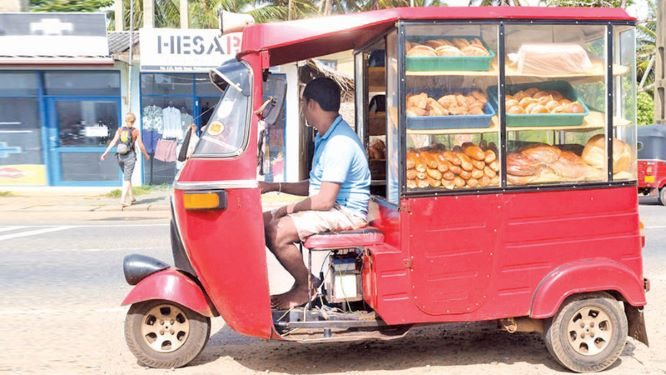
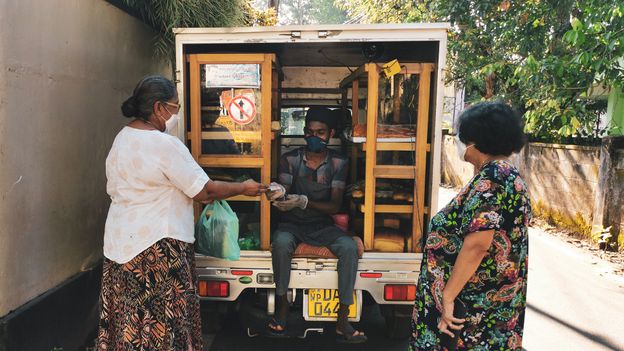
During the lockdown in Sri Lanka, the rich and the poor alike got their daily bread from the humble itinerant “choon paan” man
Street vendors and hawkers are ubiquitous part of everyday business. The secret of their survival even under stressful conditions is that they are very adaptable to changing conditions. And they have been around for a long, long time, from the era of the ‘The Jataka’ and ‘The Panchatantra’. They are also part of the modern popular culture, being shown in cartoons, animation movies and advertisements. And they are seen all over South Asia.
Rabindranath Tagore’s Bengali poem- ‘Bichitra Sadh’ (Vocation), is about the wish of a child to be a street vendor when he grows up. In Sri Lanka street hawkers are on by-cycles or auto-rickshaws tuk-tuks- peddling Lamprais, a Dutch-Lankan dish which is a mix of steamed rice, served with a curry of fish or chicken, along with other curries made with vegetables, lentils, or fruits and a spoonful of pickled fruits or vegetables, chutneys, and sambol. Other popular street vendor are those who sell Bombai Muttai, fluffy coloured candy, a candy floss as it were. Still more interesting are the ‘choon paan’ trucks- plying in the early mornings and evenings. These are the famous bread-trucks and bun combo known as choon paan” loosely translates to music bread” in Sinhala. These are driven by men, who would play a song on a CD player, blaring out of a loudspeaker. This was their unique method of advertising and this was their method of letting the neighbourhood know about their arrival.
Interestingly enough, a closer look at the methods of selling also reveals distinct traits. While the streets of Colombo had the bakers selling their products, using a CD player with a Hindi film number or more interestingly, Fur Elise the bakers at other remote regions would often have a different repertoire, where Fuer Elise would be supplemented with the traditional, mellifluous tune from a flute. I remember listening to one such ‘choon pan’ man and his arrival in the early hours of mornings and evenings during my stay at the Guest house of Eastern University in Batticaloa.
The ‘choon paan’ man and his products were in news once again recently, during the present pandemic lockdown in the country of Sri Lanka. After being marked by the government as ‘essential business’- these bakery trucks continued to ply. In fact, they also witnessed a rise in their otherwise diminishing sales. This was further confirmed by a report in BBC (June 11, 2020) and a report by Maljini Ranaraja (July 8, 2020, Asia Foundation).
Just like most street vendors, the ‘choon paan’ men and their products are not new to adaptability. One popular story about their favourite music- Fuer Elise by Beethoven on their regular hawking routes speak of particularly points to this fact. This local story goes back to the early 2000, when the plying of tuk-tuks as well as the use of cell phones became common across the country, including villages. A particular favourite ringtone that probably rang throughout the country was that of Beethoven’s Fuer Elise on all cell phones. The ‘choon paan’ men started to play this tune over a horn speaker to let residents know about their arrival and thus, Fuer Elise came to signify the arrival of fresh-baked bread, twice a day. In recent years however, Beethoven has joined hands with Hindi film music, while in specific spaces in the interior, one can still hear traditional music.
Families depend on the choon paan man for their breakfast, tea and dinner
Peddlers and street hawkers have always been an important part of the local and regional economy of South Asia. With the present global pandemic situation, the ensuing lockdowns across the world and its effects on the economy, many of the smaller industries are facing hardships. The street hawkers are among them. While many new hawkers take to the streets, the previous ones are still far from finding a solution. Noted journalist, Sikha Mukherjee, in her piece, dated April 23, 2020 in the online portal The Wire mentions the beginning of the doom for the street hawkers as a result of the cyclical effects of the lockdown. Mukherjee speaks about The National Federation of Hawkers, which says that 40 million people are engaged in the business of selling on the streets, in the metros, in small towns, in rural hubs across India. Nearly 800,000 vendors also started to face trouble as trains stopped plying at the beginning of the lockdown in India in March, 2020. Certain recovery measures were taken as well, including the one by SAAG (South Asian Association for Gastronomy).
A report by Mrityunjay Bose (Deccan Herald, July 14, 2020) mentioned SAAG’s attempts to draft a charter for initial financial help to street food vendors. SAAG is also a think tank drawn from across South Asia and has an annual platform called ‘The Food For Thought Fest’. This is the only platform in India that looks into food across South Asia and is a collective of hospitality industry professionals, food scholars and policy influencers from South Asian nations, who believe in promoting a common platform for regional unity and diversity.
With changing and challenging circumstances in the present times, it is indeed painful to see these varied attempts at survival and continuity.
KUALA LUMPUR, Sept 17 — The Kuala Lumpur High Court today dismissed a taxi driver’s legal bid to delist the now defunct Liberation Tigers of Tamil Eelam (LTTE) as a terrorist group in the country.
Malaysiakini reported Justice Mariana Yahya issuing the ruling over V. Balamurugan’s judicial review application during proceedings this morning.
Mariana had also ruled that Balamurugan had already been discharged and acquitted of an LTTE-linked court case, therefore the applicant no longer has the right or capacity to proceed with the judicial review.
It was reported that the court had set today for a decision on Balamurugan’s judicial review, which listed the Home Minister and the government as respondents.
The judicial review was dismissed, with no order to cost,” the applicant’s lawyer Omar Kutty was quoted as saying.
The judge ruled that there had been a delay in the filing of the judicial review application because any such filing should have been made within three months of the gazette in 2014.”
On whether an appeal would be lodged over today’s High Court ruling, Omar reportedly said they would first seek the full grounds of the decision, analyse it, and then decide whether to do so.
On January 8 this year, Balamurugan filed the leave application to initiate a judicial review to declare that the LTTE details in the gazette were null and void and that the listing of LTTE as a terrorist group was unlawful, among others.
Balamurugan was among 12 individuals who were detained late last year and charged over alleged support of LTTE, among others.
However on February 21 this year, then attorney general Tommy Thomas discontinued the terrorism charges against the 12 individuals.
It was reported on February 24 that after being discharged and acquitted of the LTTE-linked charges, Balamurugan chose to continue with his legal challenge to delist the LTTE as a militant group.
In the same month, then home minister and now prime minister Tan Sri Muhyiddin Yassin said LTTE is still a terrorist organisation in the Home Ministry’s books.
The person alleged to be the fugitive gangster Maddumage Lasantha Chandana Perera alias ‘Angoda Lokka’ had died of heart attack in Coimbatore and no foul play was involved in his death, a senior officer of India’s CB-CID said on Wednesday based on the findings of the post-mortem, chemical examination and histopathology reports.
https://youtu.be/XuQSIu76hTk
K. Shankar, Inspector General of Police, CB-CID, told The Hindu the three reports did not have any finding related to unnatural death. There was no finding of poisoning or other suspected aspects in the reports,” he said.
As per the initial statement given by a Sri Lankan woman named Amani Thanji, who lived with the person believed to be ‘Angoda Lokka’ in a rented house at Balaji Nagar near Cheran Ma Nagar in Coimbatore, he suffered chest pain on the night of July 03 and was declared dead by doctors of a private hospital where she took him with the help of two neighbours. The body was later shifted to the Coimbatore Medical College Hospital (CMCH).
Reportedly, ‘Angoda Lokka’ lived in Coimbatore under the assumed identity of Pradeep Sigh for around two years. He possessed an Aadhaar card in the name of Pradeep Singh which he managed to obtain with the help of two persons D. Sivakamasundari, an advocate of Madurai, and her friend S. Dyaneswaran from Erode.
Sivakamasundari, Dyaneswaran and Thanji had taken Angoda Lokka’s body to Madurai after post-mortem at CMCH on July 5 and cremated it there.
The Coimbatore City Police later found that the Aadhaar card, a copy of which was produced by Sivakamasundari at the Peelamedu police station, was obtained using forged documents. The police arrested the three persons on August 2.
The CB-CID later took over the case and registered two separate cases – one related to the death of Lokka and the other against the three on various charges, including furnishing false documents, harbouring offender, criminal conspiracy and forgery of records.
With suspected foul play in the death of the person alleged by Indian authorities to be ‘Angoda Lokka’ ruled out, CB-CID will now concentrate on the second case, added Mr. Shankar.
CB-CID investigation had also found that the ‘Angoda Lokka’had a pistol which the accused handed over to a Sri Lankan national in Madurai after his death. Efforts to trace the man are under way.
However, Sri Lankan authorities have not yet confirmed that the deceased person in question is in fact the Sri Lankan don hiding in India, ‘Angoda Lokka’.
The Presidential Commission of Inquiry probing the 2019 Easter Sunday terror attacks warned MP Harin Fernando over the impulsive behavior displayed during his testimony at the commission.
The former Sports Minster appeared before the Commission yesterday (16), to testify regarding the statement he made to the media that his father had pre-warned him of the Easter attacks.
Testifying at the Commission, Fernando said that his sister had called him when the first series of attacks happened on Easter Sunday last year, and told him that they were planning to go to the church and the Kingsbury hotel, yet, their father had asked them not to, on the previous night.
Fernando said, after relaying this information to then-Prime Minister Ranil Wickremesinghe, he visited his father who was receiving medical care at an Intensive Care Unit in Colombo to ask how he knew about the attacks. However, his father only replied to him with ‘I know a lot more than you’, said Fernando.
Witness Harin Fernando said that he suspects that an official of the Criminal Investigation Department (CID) may have warned his father of the attacks.
The Senior State Counsel, then making submissions at the Commission, stated that it has been revealed that Harin Fernando’s father had engaged in a 356-second long phone conversation with Sergeant Nandalal, attached to the CID, on the day before last year’s Easter Sunday.
The Senior State Counsel further pointed out that this is the same Sergeant Nandalal who was a part of the CID team that visited Pasikudah to arrest Zahran Hashim’s team member ‘Army Mohideen’ and to recover the explosives in Wanathawilluwa. He is also the person whose photograph was found among the contacts in the phone of the said ‘Army Mohideen’, the State Counsel added.
Speaking further, Witness Fernando told the Commission that his father had never directly warned him against going to churches and that he had only revealed to the media what his sister had told him.
Fernando alleged that, his statement –”My father is currently in the hospital. He called me last night asking me not to visit a church saying he had a tip-off. There is intelligence information. My father told me not to go to Kochchikade Church.” –, made to the media, was misused by the media to slander him politically.
The Appeal Court Judge on the Commission then questioned the MP whether the media had published anything he did not say, to which the MP replied in the negative.
However, the MP added that he had held a 45-minute press conference but the media had only used the part where he tells his father warned him of the attacks.
The Commission member then told Fernando that even if he held a 45-minute press conference, the media can only use the ‘hottest minute’ to broadcast.
Parliamentarian also said that he was greatly inconvenienced by the Cardinal’s statement ‘Our people died, Minister’s son survived’.
He further said that he does not believe that the church was not aware of the attacks in a context where many parties were pre-warned of it.
Fernando went on to say that a special investigation must be carried out to determine whether the Cardinal was aware of the attacks, because he did not hold a morning service on last year’s Easter Sunday, when the leader of the Catholic Church Council traditionally holds a morning mass on every Easter Sunday.
The President’s Counsel representing the Cardinal inquired the MP Fernando whether if he would accept it if he says that the Cardinal, as usual, conducted the midnight service at the St. Lucia’s Cathedral in Kotahena on April 20th last year, stating that the Archbishop holds the Easter service every year at midnight on the Saturday before Easter Sunday.
To which Fernando said that he was unaware of this and admitted that the above statement was made without any evidence and just because it came to his mind.
Thereafter, the President’s Counsel inquired Fernando about a nephew of the MP who is currently studying at a Catholic private school in Colombo.
He informed the Commission that the nephew in question is member of the school’s rugby team and that the team had made plans to practice at the Sugathadasa Stadium and visit the Kochchikade St. Anthony’s Church afterwards on Easter Sunday last year.
However, the President’s Counsel pointed out that, the MP’s nephew was the only person who did not attend practices that day.
MP Harin Fernando aggressively objected to President’s Counsel Shamil Perera regarding the question.
The Commission then sternly warned the MP on his impulsive behavior and stated that if he, as a witness at the Commission, treats a lawyer with disrespect, it is considered as an act of disrespect towards the Commission as well.
The 156th birth anniversary commemoration of Anagarika Dharmapala was held under the patronage of President Gotabaya Rajapaksa at the Mahabodhi Agrashravaka Maha Vihara in Maligakanda today (17).
President was received by the Chairman of Mahabodhi Society and Chief Sanghanayaka of Japan Ven. Banagala Upatissa Thero at the venue.
After paying floral tribute to the memorial of Anagarika Dharmapala, President Rajapaksa planted a sapling of Rath Handun to mark the launch of Suwa Dharani”, the traditional medicine preservation project by the Ministry of Promotion of Indigenous Medicine.
President who engaged in religious observances at Dathu Mandira at Agrashravaka Vihara paid floral tribute before the Dharmapala statue inside the main hall.
Addressing the gathering Ven. Upatissa Thero said President Rajapaksa who leads the country along a nationally recognized thinking is the only leader, he saw, to follow the path of Anagarika Dharmapala.
The Governor of the Central Bank, Prof. W. D. Lakshman presented the Dharmapala Commemorative Coin of Rs. 500 denomination to the President.
Mr. Sudhammika Hewawitharana, a relative of Srimath Anagarika Dharmapala presented a souvenir with the image of Anagarika Dharmapala to the President.
President Rajapaksa presented mementos to Bodhi Chiththa Bhikkhuni, the Head of the Vietnamese delegation and to Mr. Dilshan Jayasuriya, Secretary of the Mahabodhi Society, now in Sri Lanka to attend the Anniversary celebrations.
The President launched the Relax TV channel on Peo TV 113 which will go on air under the guidance of the Board Member of the Sri Lanka Mahabodhi Society and the Chief Incumbent of the Agrasrawaka Maha Viharaya, Ven. Monaragala Pannalankara Thero.
Ven. Upatissa Thero handed over 10 locally manufactured bicycles, donated by Managing Director of the Raleigh Bicycle Company Mr. J. Perumal to the Mahabodhi Society, to the President.
The Maha Sangha including Most Venerable Ittapane Dhammalankara Thero, Ministers Dinesh Gunawardena, G. L. Peiris, State Ministers Nalaka Godahewa, Sisira Jayakody and UNP Deputy Leader Ruwan Wijewardena were also present at the occasion.
The World Bank Group’s 2020 Human Capital Index, released today, finds that a child born in Sri Lanka today will be 60 percent as productive when she grows up as compared to if she enjoyed complete education and full health. This is higher than the average for South Asia region and lower middle-income countries.
Investments in human capital—the knowledge, skills, and health that people accumulate over their lives—are key to unlocking a child’s potential and to improving economic growth in every country.
In the wake of the COVID-19 pandemic, investing in people is more vital than ever, as it can lay the strong foundations needed for the recovery and for resilient growth,” said Faris H. Hadad-Zervos, World Bank Country Director for Maldives, Nepal and Sri Lanka.
Stunting due to chronic under-nutrition and the need for higher quality learning are the two areas of the Human Capital Index in which Sri Lanka has an opportunity to accelerate progress, especially as a country on the threshold of upper-middle income status.”
To help address these gaps, a strategic focus on improving nutrition and enhancing learning in less developed regions of the country is needed, along with consistent measurement of stunting and internationally comparable learning outcomes to inform policy development and track progress in human capital development over time.
Globally, due to the pandemic’s impact, most children – more than 1 billion – have been out of school and could lose, on average, half a year of schooling, translating into considerable monetary losses in the future. Data also shows significant disruptions to essential health services for women and children, with many children missing out on crucial vaccinations. The economic impact of the pandemic has been particularly deep for women and for the most disadvantaged families, leaving many vulnerable to food insecurity and poverty.
The 2020 Human Capital Index includes health and education data up to March 2020 for 174 countries covering 98 percent of the world’s population, providing a pre-pandemic baseline on the health and education status of children.
The analysis finds that human capital outcomes for girls are on average higher than for boys. However, this has not translated into comparable opportunities to use human capital in the labor market. On average, employment rates are 40 percentage points lower for women than for men in South Asia. Moreover, the pandemic could exacerbate risks of gender-based violence, child marriage and adolescent pregnancy, all of which further reduce opportunities for learning and empowerment for women and girls.
Sri Lanka and the World Bank have worked together for decades to invest in human capital and today these hard-won gains are at risk,” said Chiyo Kanda, Country Manager for Sri Lanka and the Maldives.
We will continue supporting Sri Lanka to expand the coverage and quality of health services in underserved areas, boost early childhood development and learning outcomes, improve higher education, and support vulnerable families with social protection measures to mitigate the impacts of the COVID-19 pandemic.”
The World Bank Group is working closely with governments all over the world to develop long-term solutions to protect and invest in people during and after the pandemic. In Sri Lanka the Bank is supporting initiatives to increase access to early childhood education and care, to improve learning in general education, and to strengthen the relevance of higher education for economic development. The Bank is also helping strengthen the efficiency of social safety nets to support vulnerable families and households. In addition, the Bank is assisting the government to strengthen health systems, including to respond to the challenges of the Covid19 pandemic.
05 suspects including a lawyer arrested by CID for forging documents to claim a property of one Easter Sunday suicide bomber, remanded until September 28
The 19th A is being replaced by the 20th
A and a new constitution is being planned.
A Committee has been appointed for the drafting of a new constitution
comprising some of the leading intellectuals in the country. That would be the
fourth new constitution for the country since independence. And there had been
19 amendments too. It is interesting to ponder why the country could not draft
a constitution that could last at least 25 years without radical changes.
Almost all the amendments had been radical. 13th A had introduced
some almost federal features. 16th A had precluded Sinhala Language
being used in the courts in the North and East provinces. 1978 constitution
brought in a hybrid system with a mixture of
parliamentary and presidential arrangements. 19th A was full
of contradiction and confusion lacking in clarity in the most important
aspects. 20th A seems to be a total rejection of the 19th
A.
This is not to say a constitution should be rigid, some
flexibility is required to bring about change when and if necessary. But these
changes need not be radical which would be the case if the constitution has
been well constructed.
This lack of lasting quality and a degree of permanency
and a semblance of consistency in constitution making in Sri Lanka is a reflection
of the complexity of the issues that need to be addressed. Some of these
complexities are due to the nature of our state and its inhabitants while some
are created by the politics within as well as without. It is prudent to take
into consideration these several factors when thinking about constitution
reforms.
Now that the people has given the new government a 2/3rd
majority it is up to the government to construct a good constitution once and
for all which could take the country to peace and prosperity with secure
sovereignty and territorial integrity. It must be said that even a 2/3rd
majority victory is possible even in a full PR system when the people are
desperate for a change including an overhaul of the constitution. The
government must respond to this phenomenon with sufficient seriousness it
deserves and not treat it frivolously as all governments do with regard to
people’s will. People’s burning problems must be addressed with commitment and
vigour and constitutional reforms is one such issue that needs to be undertaken
with people’s interest at heart and not political expedience.
Leave History aside
History of the country and its civilization have not
been clearly understood and is being very often misinterpreted for political
expedience. Extremists of both sides of the divide make claims and counter
claims about original inhabitants, superiority of language, religion and race,
homeland concepts, historical kingdoms etc. They do not, in the process,
hesitate to distort history. Recently a leading politico from the North after
taking a vow at the LTTE memorial, to fight for Tamil aspirations, claimed in
the parliament that Tamil language had been in use in Sri Lanka before the
Sinhalese language. His argument is based on the fact that Tamil is one of the
oldest languages in the world. He did not explain why there is no epigraph or
archaeological evidence that Tamil had been in use in this land prior to
Sinhalese. Similarity between Tamil spoken in the North of Sri Lanka and
Tamil Nadu is greater than the similarity between Tamil spoken in Karnataka and
Tamil Nadu proving that Tamil in the North of Sri Lanka had not been evolving
independently for a long period of time but had been imported from Tamil Nadu
comparatively recently.
Let us leave history aside for we will not get anywhere
by hanging on to dubious theories. Tamils as a minority in the country must
have their rights fulfilled irrespective of whether they were the original
inhabitants or arrived here in the 12th Century as Karthigesu Indrapala
concluded in his research. So must Muslims who were settled in the East in the
17th Century by the Kandyan Kings and any other minorities for that
matter. Their rights regarding language, religion, education, employment,
culture must be guaranteed in the constitution and all necessary institutions
and space for that purpose must be made available. They must be treated as
equal citizens in every respect and constitutional provision made for that
purpose.
Language
Language is a defining feature of a people, their
civilization and their identity and therefore needs to be given its rightful
place in the constitution that pertains to those people. Sinhalese is the
language that the people of Sri Lanka developed as part of their civilization on
this land. Epigraph and archaeological evidence show how Sinhala developed on
this land. Other languages spoken and in
use in Sri Lanka were imported from abroad. At present it is the mother tongue
of more than 70% of the people in Sri Lanka. A nation must have a language
unique to it and which facilitates its cultural development. It must contribute
to the development of national pride and patriotism which are vital for the
independence, sovereignty and economic development of a country. Therefore Sinhalese
must be made the National Language of Sri Lanka and this must be stated in the
constitution in clear terms.
Tamil is spoken by about 20% of the people though it is
a language that did not develop in the country. Tamil speaking people are
fairly well distributed in the country and their contribution to the economy
and culture are substantial. They need a language to communicate with the
government and do their business. Their language must receive state assistance
for its development. Therefore Tamil must be made an official language.
English is the lingua franca of the world and our
dependent economy must have the support of a world language. Further English
could be the link language among the different communities. English too could
be an official language in Sri Lanka.
Religion
Secularism may be suitable and necessary for some
countries but not for Sri Lanka. Buddhism has been its lifeblood from early
times and has been the font of its civilization. Buddhism has been the heart
and soul of its people and the rallying point at times of peril. The King, Sanga and the People comprised the
ancient governing system in Sri Lanka.
At present more than 70% of its people believe in Buddhism. Theravada which is
doctrinally the closest to Buddha’s original preaching has been preserved in
Sri Lanka due to the state patronage it
received through out history. Buddhism is protected by the people and
people in turn are protected by Buddhism. For these reasons Buddhism must be
made the State Religion. All other religions must be given their due place,
freedom and space for their practice and development
State
Sri Lanka has always been a unitary state in its 2500
year long history. Political power was centralized and when ever there was a
threat to that power domain people and the Sanga rallied to protect it. There
may have been provincial rulers but they
came under the rule of the central Kingship. The so called Jaffna Kingdom in the North was nothing but a
manifestation of foreign occupation by South Indian invaders.
Since those times of unitary rule nothing has happened
that could necessitate a change in the unitary nature of the State of Sri
Lanka. The war waged by terrorists was a construct of local separatists and
regional and global hegemonic powers. The political power that Tamils demand
cannot be granted at the regional level without jeopardizing the single
sovereignty and rights of other communities but could be done at the centre via
a power sharing mechanism within a unitary state. Decentralization of
administration could be achieved more efficiently at district level.
13th Amendment and Provincial Councils
Sri Lanka is too small to be divided into nine
political and administrative areas Each
area becomes too small for optimum utilization of resources for
economic development and too expensive and unnecessary
burden on the poor people even under best of conditions. Such a division along
ethnic boundaries is not possible as a large majority of the ethnic minorities
are distributed widely in the country. Neither is it desirable for it would
strengthen the ethnic consciousness and centrifugal forces instead of
facilitating reconciliation and peace among different communities. Peace cannot
be achieved by treating the majority community unfairly with regard to their
right for sovereignty over the whole island.
Several Provinces have existed without their Councils
with no breakdown of essential services to the people for more than two years
due to elections not being held. Though it is argued that not holding elections
on time is a denial of democratic rights not holding elections for redundant
institutions which in fact are a white elephant and a burden on the tax paying
poor people could be considered a blessing in disguise. PCs were created as a
solution to the so called ethnic Tamil problem but the silence of Tamil politicians
on the issue of delay in elections to the Northern PC is deafening to say the
least.
If they can do without their PC there cannot be an
ethnic problem of enormous magnitude which necessitated a protracted war of 30
years and the introduction by force of the 13th A by India. People of this
country did not ask for the 13th A, it was forced on us by a hegemonic
imperialist India partly to pacify Tamil Nadu politicians, and to prevent other
interested global powers getting into the fray for geopolitical reasons. Our
poor people have to pay for global geopolitical vagaries and local communal
dubious ‘aspirations’.
Moreover 13th A has clauses which when fully
implemented assume federal proportions eg police and land powers. Also the
danger of a North and East merger and finally a total separation is ever
present when the 13th A is in the statute. Sri Lanka and its people specially the Tamils
could do well without the burden and the potential danger of the 13th
A and PCs.
Electoral System
The electoral system is another vital matter that has
been repeatedly changed and tampered with for political needs. As a result
twice the number of members than what was intended, including the defeated, got
into local government bodies at the last elections. An electoral system that
ensures the election of a stable government and which reflects the will of the
people is required. A ‘first past the post’ system would serve this purpose.
Minority representation could be accommodated with a PR system electing a suitable
proportion of members. In this regard Dinesh Gunawardena Committee
recommendations could be adopted
Presidential powers and Independent Commissions
Democracy is enhanced with the separation of power into
the three arms of governance; the executive, the legislature and the judiciary
but if there is concentration of power in any one of these institutions the
purpose is defeated. On the other hand the president should not be bereft of
power he needs to perform the duties of the executive that the people by their
vote had wanted him to be. An executive president has to be the head of the
state, head of the government and head of the cabinet and he also must have
control over the forces and the defense
portfolio under him.
Independent commissions aim at reducing the
concentration of power but if they are to serve the purpose they have to be
truly independent which was not the case when ‘yahapalana’ was in office. This
was mainly because the opposition comprising the TNA and JVP colluded with the government
in appointing these commissions. This may not happen with the present
government.
Anyway the independent commissions have to be appointed
by the people’s representatives ie the president and the parliament. However
there is no harm having in the Constitution Council religious leaders, one from
each major religion practiced in Sri Lanka nominated by a recognized religious
body. This would further depoliticize the committees and make them more
independent. The independent commissions must have sufficient number of members
and a quorum for meetings and a system to arrive at decisions by vote rather
than 100% consensus
Why did the two JVP uprisings happen precisely
in 1971 and 1987, asked Nira Wickremasinghe. The answer is that they were both
linked to the Eelam war.
Rohan Gunaratna observed that JVP insurgency
and the Eelam Wars both started around the same time. The first JVP insurgency started in the south
in 1971 and violence in the north
started in 1972. The second JVP insurgency of 1987-89 ran parallel to Eelam War 2.
The timing of the second JVP insurrection was
significant. 1987 was the year of the Vadamarachchi campaign in Jaffna.
This campaign, set for May and June, was certain to succeed, but it was called
off by President JR Jayawardena. 1987 was also the year when JVP started its second insurgency in the south. The
1987-1989 JVP insurgencies forced the army to fight on two fronts, up in the
north against the LTTE and down in the south against JVP. This, it was hoped, would
enable the far weaker LTTE win the Eelam war.
In April 1987, JVP attacked Pallekelle Army camp
and took away a quantity of automatic
weapons. In June 1987 JVP attacked Katunayake Air Force base and
Kotelawala Defence Academy (KDA) and removed a valuable haul of weapons from
each. From KDA they got eleven T56 and
15 submachine guns.
In 1988, JVP attacked Katunayake air force
base a second time and took away weapons and
ammunition. In the same year, JVP also attacked Pannala National Air Force
training camp and the army training camp
at Kumbukke in Horana . There was also an unsuccessful attack on Panagoda army
camp.
Analysts
have shown connections between JVP and LTTE . JVP was the Sinhala twin
of the LTTE said Rohan Gunaratna. Gamini Samaranayake
said his thesis consisted of a comparison between JVP and LTTE. The JVP
insurrection of the 1987-1989 period should also be investigated, not only the
Eelam war, said Nalin de Silva.
PLOTE and the LTTE were reported to have sold weapons to the
JVP. The intention was to create a
second front against the Sri Lankan armed forces. EPRLF had provided training for JVP‘s Vikalpa
Kandayama in north east Sri Lanka and in
India. Gunaratna was told that they had received the training first and
joined JVP after.
An explosive expert from PLOTE had given JVP training in
improvised land mines in the jungles between Matale and Batticaloa, reported
Chandraprema. JVP exploded its first experimental land mine in
Kumbiyangoda in Matale. The first
landmine of JVP was the work of a PLOTE operator, said Gunaratna. A Tamil
instructor had been present, said Chandraprema.
In 1989 PLOTE was seen in Akuressa training JVP of the Matara district
in land mines. JVP carried out a
series of land mine attacks. Landmines in Weerawila and Hungama killed six
policemen.
There may have been a
transfer of explosion technology between the LTTE and JVP, as well, said A.J.
Behra. JVP had used powerful land mines
similar to those used in the north by the LITE. Intelligence reports had indicated
that JVP was receiving regular supplies of explosives from overseas, he added.
In the early 1970s JVP gave the impression
that they were champions of the Sinhala race. This
would have been done to capture Sinhala youth for the movement. After 1977 JVP
changed its stance. JVP discarded its pro Sinhala attitude. JVP recognized the
right of Tamil people for self determination and by 1980 they were supporting
the secession of Tamil areas.
During the
Eelam wars, there was collusion between LTTE and JVP.
No member of the JVP was ever harmed when the LTTE attacked Sinhalese. JVP
had established JVP cells in the
Sinhala border villages in the
east, by the end of 1987, said Gunaratna. When LTTE swooped down on a Sinhala
village they avoided going to the homes of JVP
activists in the village, said Chandraprema.
There were allegations in
1987 that JVP was in collusion with
LTTE in Trincomalee . This appears to be
correct, said Chandraprema. There was an
instance when an armed JVP contingent
had met an LTTE contingent in the
Trincomalee jungles and JVP warned the LTTE not to proceed as the army was in
that area.
There was evidence to show that JVP was
supporting the separatist Tamils, said Godahewa. There is evidence
to show that the JVP was actively collaborating with the LTTE to chase the
Sinhalese out, agreed Chandraprema.
In December 1987, JVP had entered Sinhala settlements in Aluth oya where settlers were
armed, threatened them and took away 20 shot guns. Sinhala refugees from Trincomalee ,escaping after an attack on
their village, said they were absolutely certain that their attackers were
Sinhala. One had shouted obscenities in perfect Sinhala which showed that he
was Sinhala not Tamil.
In October 1987 JVP attacked Kallar army camp in Trincomalee and after a 20 minute gun battle, took away a huge amount of weapons,
including six T56 and three LMG spare barrels. This was JVP ‘s largest haul of weapons. JVP attacked
Kallar camp at the height of the IPKF
sponsored LTTE attacks on Sinhala peasants in Trincomalee
JVP, though armed never tried to
defend the Sinhalese in the border villages.. If JVP had the ability to successfully attack the
Kallali army camp, so why could they not
defend the Sinhalese, asked Chandraprema.
However, there is not a single confirmed account of a
JVP attack on the LTTE or IPKF. JVP never killed a single Tamil or Indian
soldier, said Chandraprema. JVP
instead, used their arms on the Security forces, on the JVP’s Sinhala opponents and on ‘traitors’. JVP killed more Sinhalese than the
LTTE. ( Continued)
State Minister of Skills Development, Vocational Education, Research and Innovation
Dr.
(Mrs.) Seetha Arambepola , State Minister of Skill Development, Vocational
Education, Research and Innovations stated that scientific research should be
carried out identifying the issues encountered by the general public and aimed
at resolving such issues The Hon. Minister expressed these views recently
during an observation visit she paid to the Industrial Technology Institute at
Malabe.
She
paid special attention to the ongoing research and value added products being
developed by the institution, employing latest research technologies and
inaugurated the construction of the final phase of the Herbal Products
Laboratory being developed under the China – Sri Lanka joint bio
technology laboratory project, on the premises of the research complex.
The
Hon. Minister further expressing her views said
Scientists
at our Institutions are tirelessly engaged in scientific research with much
dedication. We have to find out the degree of contribution towards the
upliftment of the living standards of the general public and strengthening the
economy of the country. These research should provide sustainable solutions to
the issues being encountered by the general public”
Therefore
it is vital that efficient coordination between all research Institutions under
the Ministry is established ensuring close links with mutual understanding.
This makes it easy to find solutions for common issues through research. I
intend to invite a programme to have a round table discussion with all research
Institutions under the purview of the Ministry. The exchange of knowledge among
institutions is vitally important. Sometimes, research of similar nature are
carried out at various institutions. A research would commerce at a particular
institution while a research of similar nature has continued up to a certain
extent. Since this is a waste of time and money, it is my opinion that it is
more productive if such research could be continued from the point another
institution stopped it.”
The
Hon. Minister gave instructions to officials to initiate necessary measures to
utilize the knowledge gained form research to introduce new products to the
public and also to transfer such technologies to several entrepreneurs
targeting the creation of a network of industries.
Dr.
Sirimal Premakumara, Chairman of ITI, stated that since Sri Lanka is a country
rich in valuable and rare herbs, the said laboratory will be made use of to
produce herbal pills, capsules, syrups and various local medical compounds
employing high end technologies to add value to these local herbs and that a
grant of US dollars 600,000 has been received from the Chinese Government for
the purpose of setting up of this laboratory.
Prabod
Udugama
Media Secretary to theHon. State Minister of Skills Development, Vocational Education, Research
and Innovation.
Training the trainers was a key aspect of the talks between the Indian envoy and the Lankan State Minister of Skills Development.
Colombo, September 16 (Indian High Commission): The High Commissioner of India Gopal Baglay on Tuesday met the State Minister of Skills Development Dr. Seetha Arambepola, to discuss ways to deepen partnership between the two neighboring countries in areas such as capacity building and skill development.
Discussions were hinged on aspects such as training of trainers in vocational institutes in Sri Lanka, strengthening infrastructural capabilities of these institutes and generating interest among school-going children and youth in advanced space technologies.
It was decided that both sides would work towards early realization of augmenting existing capacities and creating newer ones in chosen fields in an expeditious manner.
Guided by ‘Neighborhood First’ Policy, the Government of India offers capacity building modules across a range of fields to Government Officials and other eligible Sri Lankan citizens every year. Under the Indian Technical and Economic Cooperation Programme, around 400 slots are reserved for Sri Lanka annually. Shortlisted personnel from Sri Lanka receive unique, fully-funded training programs under this rubric.
In addition, several other customized modules are also organized by the Government of India. It also provides scholarships to more than 200 Sri Lankan students each year to pursue courses spanning from under graduate to doctoral studies in various academic streams in prestigious institutes in India including IITs and NITs. To support students from disadvantaged backgrounds, financial assistance is provided to around 650 students from among Universities and Schools in Sri Lanka.
The Government of India is also committed to strengthening infrastructure in educational institutes in Sri Lanka. Accordingly, infrastructural activities in several institutes across the island are being undertaken as High Impact Community Development Projects.
He was commenting on former MP M.K. Shivajilingam’s commemorating the 33 rd anniversary of the fast-unto-death undertaken by Thileepan, a member of LTTE chief Prabhakaran’s inner circle
Colombo, September 16 (newsin.asia): Dr.Rohan Gunaratna, an international expert on terrorism who is now Honorary Professor at the Sir John Kotelawala Defense University, Sri Lanka, has called for the arrest and trial of pro-LTTE Tamil leader and former MP, M.K.Shivajilingam and others who glorify terrorists.
They should be given the maximum punishment to deter others from following their destructive path,” he told newsin.asia on Wednesday.
Dr.Gunaratna was commenting on Shivajilingam’s arrest in Kondavil in Jaffna for defying a court injunction and commemorating Thileepan’s fast-unto-death against an alleged failure of the Indian and Sri Lankan governments to implement certain provisions of the India-Sri Lanka Accord of July 1987.
Maximum punishment should be given as there is a public interest in this case. It will deter others funded by LTTE front organizations in the Tamil Diaspora from reviving the separatist agenda of the LTTE. Collective and decisive leadership is vital to restore stability and security, the foundation of ethnic and religious harmony in Sri Lanka,” Dr.Gunaratna argued.
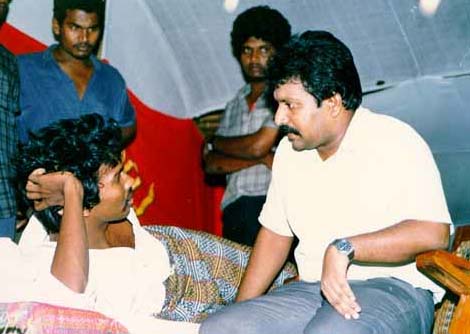
LTT supremo Prabhakaran with the fasting Thileepan
The LTTE’s propaganda and paraphernalia should remain banned forever just as Germany banned Nazi symbols and activities after World War II, he suggested, pointing out that it is LTTE propaganda that fosters an environment for LTTE plots, plans and preparation aimed at revival.
Fast-Unto-Death
Thileepan had sat on a fast-unto-death on September 11, 1987, to secure a five-point charter of demands including the setting up of an LTTE-dominated Interim Administrative Council for the Tamil dominated Northern-Eastern province as part of the India-Sri Lanka Accord to resolve the ethnic issue.
With both Colombo and New Delhi going by the letter of the agreements already entered into, and refusing to accept the LTTE’s fresh demands, Thileepan refused to give up his fast and died after 11 days on September 26, 1987.
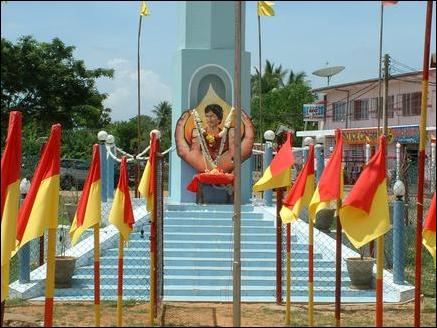
Shivajilingam, who is related to Prabhakaran, had sought permission to hold the commemoration ceremony of the fast-unto-death at the Thileepa memorial in Nallur, but the Jaffna police got a court order banning it on the grounds that a leader of a banned organization like the LTTE could not be commemorated and glorified.
The argument that the previous United National Party (UNP)-led government had allowed the commemoration, did not cut ice with the Jaffna magistrate, who acceded to the police request to ban it.
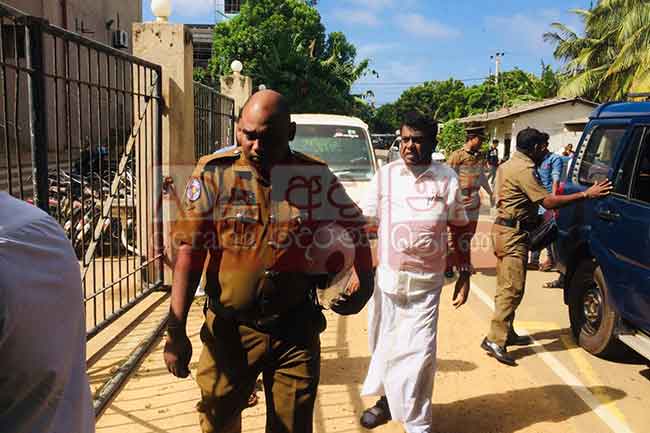
However, Shivajilingam secretly changed the venue of the commemoration to Kondavil and performed a ceremony there on Tuesday. He was arrested and was subsequently released by a court on bail.
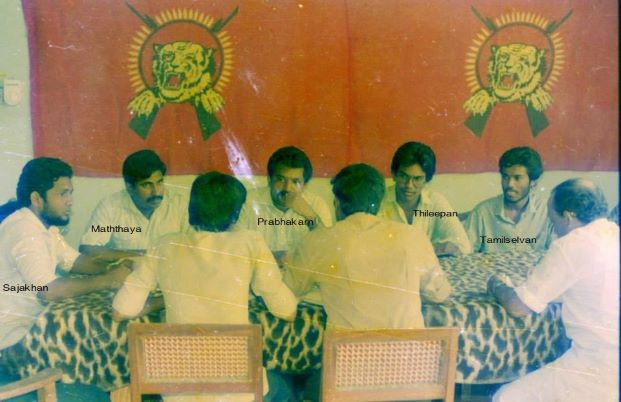
LTTE top brass in September 1987. Thileepan is on Prabhakaran’s left
How democracy is exploited
Commenting further on the incident, Dr.Gunaratna said: After the US declared victory in Afghanistan and Iraq, terrorism re-emerged because the terrorists’ support infrastructure remained intact. The tolerance of democracies revived violence.”
Therefore he recommended that the security and intelligence platform in Sri Lanka’s north and east should continue for one generation until the separatist ideology disappears.
Research demonstrates that if there is looseness (government neglect) as opposed to tightness (government vigilance), terrorist groups exploit the gaps and loopholes and come back. The groups and personalities that glorify terrorism should be identified and punished to deter future violence,” Dr.Gunaratna said.
Most terrorist groups abuse the freedom of expression to promote their vicious ideology to radicalize the youth into a culture of hate and violence, he added.
If a democracy permits display of terrorist paraphernalia and allows the dissemination of propaganda, the next step will be protests and demonstrations breaking out into violence. Like the Islamic State and al Qaeda, LTTE glorified death. If commemoration and celebration of death is permitted, it will lead to a culture of destruction.”
According to Dr.Gunaratna, there have been a dozen plots by the LTTE to revive since the end of Eelam War IV in May 2009. Most of the LTTE plots were supported by LTTE fronts overseas. The number of plots increased due to the delisting of LTTE fronts overseas by the Yahapalanaya government in 2015, he pointed out.
Thileepan memorial
Relist the Delisted Entities
Dr.Gunaratna noted that the ideology of separatism is fading but there are a few trying to revive it. Most Tamils both in Sri Lanka and overseas have left the LTTE and its erstwhile proxy the Tamil National Alliance (TNA). However, a few racist politicians continue to promote the separatist agenda,” he said.
It is essential for the government to relist the delisted LTTE fronts overseas as some of them are operating in Sri Lanka, the expert stressed
Need for economic development
Dr.Gunaratna recommended that the Northern and Eastern provinces be economically developed and the Sri Lankan identity should be promoted.
The best strategy to counter racism is for Sri Lanka to develop a proper national education policy where Sinhalese, Tamils, and Muslims study together,” he said.
He warned that without regulating the ethnic and religious space, Sri Lanka can never have social harmony, political stability and economic prosperity.
(The featured image at the top shows Shivajilingam after he was released on bail by a Jaffna magistrate)
Minister of Health Pavithra Wanniarachchi has appointed a five-member committee to look into the activities of the Sri Lanka Medical Council (SLMC).
The five-member committee comprises Specialist Dr. Hemantha Perera, former Dean of the Ragama Medical Faculty Professor Prishantha Wijesinghe, Specialist Dr. Anula Wijesundera, Specialist Dr. Maithree Chandraratne and Specialist Dr. Darshana Sirisena.
They have been advised to compile an independent report and present it to the Minister, with the latter looking to overhaul the SLMC shortly afterwards.
Speaking after appointing the committee, Wanniarachchi said, The SLMC is an independent body that has been formed through an Ordinance aimed at protecting the rights of the patients as well as rendering a quality service to the public.
The SLMC is tasked with monitoring the quality of the service rendered by medical practitioners as well as their performance.
As per the provisions contained in the Medical Ordinance, the final arbiter of all decisions taken by the SLMC is the subject Minister. I have received a spate of complaints concerning the SLMC’s conduct. One of the core issues had been regarding turning the SLMC into an independent institution and removing all obstacles placed in its path to provide a transparent service to the public.
Among other issues raised regarding the SLMC recently had been the decision taken by this body to withdraw the registration of a few internationally recognised universities, the continued delay in electing officer bearers to the SLMC, the decision taken to register certain medical practitioners who had not even met the basic qualifications of the SLMC, the continuous delay in holding examinations to register students who had obtained overseas medical degrees, and the hearing of complaints within the SLMC while overriding its own laws and regulations.
The present Government took three immediate steps to restore the economy which had been destroyed by the previous Government, and took steps to stabilize the rupee, reduce all taxes and reduce interest rates on bank loans, the Minister of State for Finance, Capital Markets and Public Enterprise Restructuring, Ajith Nivard Cabraal stated.
He stated this addressing the investors’ pavilion organized by Softlogic today (16).
The Minister further said that the present Government took these swift actions after coming to power in 2019, and despite the strong criticism in this regard, the results have proven to be successful.
According to Cabraal, the previous Government had projected revenue of Rs 2,200 billion (2.2 trillion) in 2019, but they could only get Rs 1,800 billion (1.8 trillion), even after raising all taxes and imposing burdens on the people.
The Minister said that by reducing taxes and interest rates, the Government would be able to generate additional revenue through the freedom of entrepreneurs to do business and the country’s economic growth could be achieved through this business growth.
State Minister Cabraal said that unless the economy recovers in a country where it has collapsed, tax revenue can never be expected to recover effectively, and the attractive tax rates they had hoped for could not be achieved due to the unnecessary tax burden imposed by the previous Government.
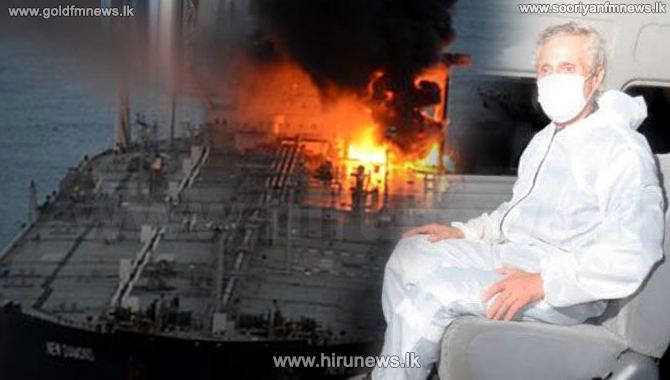
Sri Lanka will file negligence and pollution charges against the Greek skipper of an oil tanker that leaked fuel off the island nation’s coast after a week-long fire, authorities said Wednesday.
Some of the 1,700 tonnes of heavy fuel oil aboard the New Diamond poured into the Indian Ocean, prompting a large effort to contain a slick that was roughly two kilometres (1.2 miles) in length.
Its 270,000-tonne cargo of crude oil was unaffected by the fire.
“There is sufficient evidence to prosecute the skipper under the marine pollution act as well as the penal code for criminal negligence,” a spokeswoman for Attorney-General Dappula de Livera told reporters in Colombo.
Much of the slick has been cleaned up and no further fuel has leaked from the vessel since Friday. For now, there are no signs of the slick reaching the coast.
The Panamanian-registered tanker’s owners would also be slapped with a $1.88 million fire-fighting bill, de Livera said in a statement.
The vessel is owned by Liberian-registered Porto Emporios Shipping Inc and managed by Greek ship owner, New Shipping Limited, according to the Sri Lankan navy.
Compensation would also be sought from the owners for the cost of any environmental clean-up and damage, the statement added.
Sri Lanka has meanwhile asked the ship’s owners to tow the 330-metre (1,100 foot) tanker beyond its exclusive economic zone, which extends 200 nautical miles (370 kilometres) from its coast.
The nation’s environmental authorities fear a marine disaster if the tanker is allowed to transfer its oil to another ship in the country’s waters.
The stricken tanker is currently located some 70 nautical miles east off the Sri Lankan coastal town of Batticaloa.
The ship issued a distress signal in early September while en route to the northeast Indian port of Paradip when a boiler exploded killing a Filipino crewman
The vessel’s remaining 22 crew, including the captain, were rescued and are in quarantine at a hotel in the southern port city of Galle under the supervision of the navy.
The State Intelligence Service (SIS) had not been aware that National Thowheed Jamaat (NTJ) had direct links to the ISIS, by the time it received information from a foreign source warning of a possible terrorist attack on April 09, 2019, former SIS Director SDIG Nilantha Jayawardena yesterday told the PCoI probing Easter Sunday attacks.
SDIG Jayawardena made this statement while being cross-examined by Anura Meddegoda, PC, who appeared for former IGP Pujith Jayasundara.
However, the SIS had found that the NTJ had the intention to carry out a terrorist attack and stressed on the need to arrest NTJ activists, on several occasions, SDIG Jayawardena said.
A commissioner then asked SDIG Jayawardena whether it had occurred to him to ask former Defence Secretary Hemasiri Fernando to summon the National Security Council (NSC) or to contact former President Maithripala Sirisena over the intelligence warning of a suicide attack by Zahran and his associates.
SDIG Jayawardena said that he had not made such a request and had no authority to summon the Security Council. However, I informed the Defence Secretary, the CNI, the IGP, and heads of various specialist security units like the DMI, the CID, the TID, etc.”
It did not cross my mind to tell the Former Defence Secretary to summon the NSC or inform the former President. All I wanted was to stop the attacks. That was the only thing on my mind at that moment. That’s why I told officials with the necessary powers to act.”
President Gotabaya Rajapaksa has instructed the officials to complete the national programme to develop 100,000 kilometres of roads by 2024, the President’s Media Division said.
Speaking at a meeting held at the Presidential Secretariat to discuss the future plans of the State Ministry of Rural Roads and other Infrastructure Development, President Rajapaksa yesterday said each citizen has a right to obtain easy and comfortable access to roads.
He also said the programme to develop roads should be done without harming the environment.
Former Director of State Intelligence Service (SIS) SDIG Nilantha Jayawardena today rejected claims made by former President Maithripala Sirisena for not informing the National Security Council (NSC) that Zahran Hashim was a terrorist and a threat to the country’s security.
SDIG Jayawardena made this remarks while responding to a question raised by Shamil Perera PC who appeared for Archbishop Cardinal Malcolm Ranjith during the cross-examination.
In an interview conducted by a leading TV channel, former President Sirisena said that he was only told of Zahran Hashim as an extremist and not a terrorist.
Showing a video clip of the interview, Shamil Perera PC questioned the witness whether SIS Director had accepted the claims made by the former President.
Responding to the question SDIG Jayawardena said that at the NSC meetings he had clearly informed all the superiors in the country that Zahran Hashim was promoting the Islamic State (IS) ideology in the country and the so-called individual would be a grave threat to the stability of the country’s security.(Yoshitha Perera)
Sri Lanka says the comments of the UN High Commissioner for Human Rights Michelle Bachelet on the proposed 20th Amendment are unwarranted and pre-judgmental, based on presumption.
https://youtu.be/WTQckbsfPnI
This was highlighted in the statement delivered by Sri Lanka’s Acting Permanent Representative to the UN in Geneva, Dayani Mendis during the General Debate under Agenda Item 2 at the 45th Session of the UN Human Rights Council on Tuesday (15).
The High Commissioner on Monday (14) said the proposed 20th amendment to the Constitution may negatively impact on the independence of key institutions, including the National Human Rights Commission.
The draft 20th Amendment to the Constitution submitted through the Parliament will be discussed, debated, following a complete democratic process, where all stakeholders will have the opportunity to present their views, Sri Lanka noted in its statement.
Further, Sri Lanka stressed that the new government remains committed to the assurances given before this Council in February this year as the island nation withdrew from the co-sponsorship of Resolution 30/1.
Sri Lanka also hit back at the references made to false and unsubstantiated allegations leveled against senior military officials being appointed to key positions of institutions. Bachelet had stated the pardon given in March to a former Army sergeant convicted of participating in unlawful killings; appointments to key civilian roles of senior military officials allegedly involved in war crimes and crimes against humanity; and moves within the police and judiciary to thwart the investigation of such crimes, set a very negative trend.”
The full statement made by Sri Lanka during the General Debate is produced below:
Madam President,
Sri Lanka wishes to respond to the references made by the High Commissioner for Human Rights to Sri Lanka in the ‘Global Human Rights Update’ on 14 September 2020.
As this Council is aware, since February/March this year, the entire world was challenged by the COVID-19 pandemic, a health crisis of a global scale, which had impacted many aspects of governance in many countries, and Sri Lanka was no exception.
We hope that this Council would appreciate that Sri Lanka while successfully containing the spread of COVID-19 through a balanced, multi-sectoral approach, and despite this challenge, held its commitment to the democratic processes, and conducted Parliamentary elections successfully and peacefully, last month, which the EU has acknowledged.
Madam President,
Sri Lanka made it clear even as it withdrew from the co-sponsorship of Resolution 30/1, that it will remain committed to achieve reconciliation, accountability and human rights within the framework of the Sri Lankan Constitution, through a domestically designed and executed process in line with the Government’s policy framework. Sri Lanka would like to state further that the new Government which assumed office with the election of the new Parliament on 5 August remains committed to the assurances given before this Council in February this year.
The draft 20th Amendment to the Constitution submitted through the Parliament will be discussed, debated, following a complete democratic process, where all stakeholders will have the opportunity to present their views. Therefore, the GoSL is of the view that High Commissioner’s comments on the proposed 20th Amendment are unwarranted and pre-judgmental, based on presumption.
The GoSL wishes to state that the pardon to the former Army sergeant was granted in terms of the powers and provisions of the Constitution of Sri Lanka.
Madam President,
The Government rejects the references made to false and unsubstantiated allegations leveled against senior military officials being appointed to key positions of institutions. Sri Lanka has consistently refuted the credibility of these allegations and wishes to highlight that the domestic processes such as the LLRC and Paranagama Commissions that examined these allegations particularly with regard to the last stages of the conflict, have not found substantive evidence against any of the senior military officials referred to in this regard.
In the absence of any substantive proof, Sri Lanka considers that the continued arbitrary accusations on crimes or crimes against humanity made against these senior military officials are unacceptable and a violation of the principles of natural justice.
In conclusion, with regard to allegations of surveillance and intimidation, the Government has already publicly refuted these allegations, and is committed to protecting and promoting freedom of expression and civil society space, and ensure that complaints received on alleged attacks against journalists, human rights defenders and civil society are investigated and prosecuted.
The prime focus of this Government is to ensure national security, and to uphold the rule of law and order in the country for all its citizens, with the aim of creating an environment where any citizen can live freely without any fear for the safety of themselves and their families.”
In line with the above policy framework, the Government is committed to achieve the Sustainable Development Goals of the UN, with a determination to uplift the lives of all its citizens and ensure that there is no threat to peace, reconciliation or development in Sri Lanka.
The Attorney General has submitted an interim claim of Rs 340 million to the lawyers representing the owners of the ‘MT New Diamond’ oil tanker, for the costs incurred by the Sri Lankan government in the assistance rendered to the ship and other related matters.
The AG’s Coordinating Officer State Counsel Nishara Jayaratne stated that the claim was presented today (16) in writing seeking compensation for the costs related to the assistance rendered by all parties including the Sri Lanka Navy (SLN), Sri Lanka Air Force (SLAF), Sri Lanka Ports Authority (SLPA), Colombo Dockyard PLC (CDPLC), Marine Environment Protection Authority (MEPA) and Department of Coast Conservation, to extinguish the fire onboard the oil tanker, and other related matters.
She stated that the claim was submitted to the owners of the oil tanker seeking a compensation of Rs 340 million and that this estimation of costs was prepared only for the costs incurred up until yesterday (15).
Meanwhile she added that an estimate regarding the threat to the marine environment as a result of the oil leakage related to the incident will be submitted within the next couple of days after the relevant reports are received from the Marine Environment Protection Authority (MEPA).
The AG’s Coordinating Officer further stated that compensation is expected to be sought for the total amount of the costs incurred by all parties based on a complete estimate and that this estimate cannot be submitted until the oil tanker exits Sri Lankan waters.
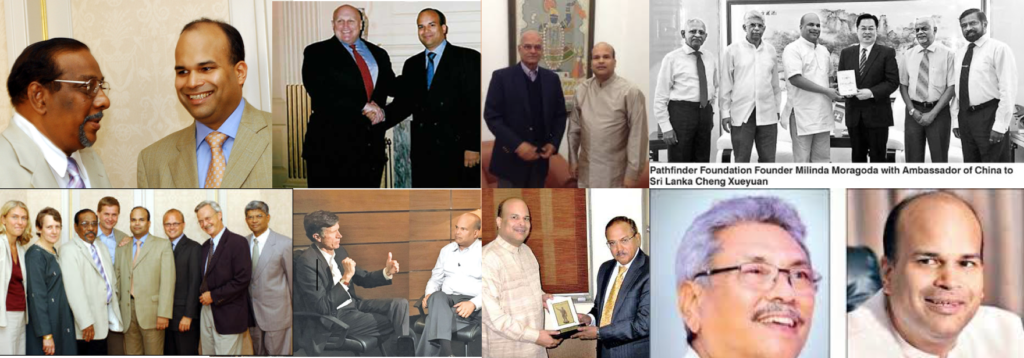
With much thought and strategy Sri Lanka has appointed Moragoda as Sri Lanka’s High Commissioner to Delhi iced with cabinet ranking, the first such fringe benefit afforded to a high commissioner. No doubt, Sri Lanka is thinking the Moragoda magic will provide much relief to Sri Lanka, given the appointment is being made against tremendous objections.
So what will Sri Lanka be expecting from Moragoda
· Will Moragoda be able to subdue America’s bullying of Sri Lanka in Geneva and shut the trap of the UNHRC Head who is following her predecessors issuing statements on Sri Lanka’s internal affairs – complete violation of UN Charter and her mandate.
· Will Moragoda be able to get America, his land of birth to withdraw UNHRC Resolutions and bring to nought all of the bogus allegations against Sri Lanka since 2012.
· Will Moragoda be able to tell America to keep its $480m ‘gift’ disbursed across 5 years as Sri Lanka’s housemaids remit more annually!
· Will Moragoda tell India to stay clear off Sri Lanka’s territorial waters and not damage the ocean bed and destroy marine life using internationally banned bottom trawlers?
· Will Moragoda politely tell Delhi to inform its Colombo mission to stop trying to rope in locals to be their eyes and ears and this same applies to the US mission in Colombo. Both nations are flouting diplomatic protocols with impunity.
· Will Moragoda get Delhi to link the Tamil Eelam quest to the Tamil Nadu self-determination quest
· Will Moragoda get Delhi to stop illegal immigration by Tamil Nadu?
· Will Moragoda get Delhi to stop Kerala ganja, illicit narcotics from being smuggled into Sri Lanka from North and Mannar coast?
· Will Moragoda get Delhi to agree to annul Indo-Lanka Accord of 1987, not protest or object to repeal 13a and the PC system?
· Will Moragoda tell Delhi that Sri Lanka does not wish to sign ECTA or CEPA and all former trade agreements require to be re-negotiated given the imbalance in trade and one-sided benefits.
· Will Moragoda also tell Delhi that it makes no sense for Sri Lanka to give ECT development to India when India is likely to shift 70% of India’s transshipment that Sri Lanka currently handles to India’s new port in Tamil Nadu.
· Will Moragoda tell India & US that since both nations objected to China’s submarines entering Sri Lanka, Sri Lanka wishes they too follow same policy!
· Will Moragoda tell Delhi that Sri Lanka will follow a National Policy of ‘Sri Lanka First’ and an international policy of ‘Friends with all & Enemy with none’.
· Can Moragoda tell both US & India that Sri Lanka does not wish to be a punching bag or a playground for quad battles and any such should be taken elsewhere as Sri Lanka agrees with Non-Aligned Movement Charter and Indian Ocean Rim countries that Indian Ocean should be a ‘Zone of Peace” not a ‘Zone ending up in Pieces’.
· Will Moragoda deliver the Rajapakse Doctrine” that encompasses the expectations of the 69lakh voters that voted for the President in November 2019.
Let’s see what the Moragoda magic can achieve, given that the powers that be are 100% certain that he is Sri Lanka’s Man Friday to deliver Sri Lanka’s wish list and he would be functioning in Sri Lanka’s interest putting ‘Sri Lanka First’ above US or India.
The leadership has nominated him inspite of opposition in a strategic appointment claiming to be in Sri Lanka’s best interest.
Only time will tell. But, Moragoda has to deliver. Deliver to no one else, but to Sri Lanka’s advantage & favor.
Moragoda has to deliver to the expectations of those that selected & appointed him but indirectly not forsaking the 69lakhs that appointed the leader who has nominated him.
The people don’t want this Government or its President to fail and those that are now carrying his baton should not disappoint him or the Nation.