Now
that the parliamentary elections are concluded, the focus of the new government
should shift to the serious business of fixing the economy. COVID-19 has hit
Sri Lanka’s economic outlook harder than expected. A gloomy prognosis suggests
a scenario of negative economic growth, high unemployment and rising foreign
debt in 2020 and 2021. Revenue from tourism, remittances and foreign investment
are all down. At all costs, one should guard against a pandemic induced
economic crisis from turning into a crisis in the financial system which would
be a double whammy for an already debellated economy. Although good weather may
help revive the agricultural sector, the economy faces a slower and longer road
to recovery from COVID-19.
The new government’s election
platform over the past few weeks put forward several useful policies to aid
economy recovery in Sri Lanka. The President’s proposal for accelerating
regional economic development through four multi-dimensional commercial cities
– Colombo, Hambantota, Jaffna and Trincomalee – will help spread the benefits
of economic development throughout Sri Lanka. The emphasis on improving
domestic agricultural production and reducing post-harvest losses will support
food security for the people in difficult times. Planned investments in
tertiary education and primary schooling will improve the quality of human
capital. Promoting digitisation and e-commerce can support dynamism in business
and government. Of course, economic recovery will be dependent on continuing
the success in combating the pandemic.
But, to ensure a sporting chance of
achieving economic success in a slower growing global economy beset by risks,
the Pathfinder Foundation recommends that three other things should be done by
the new government.
First, Sri Lanka needs to find
the resources to pay for the government’s agenda. Mobilising a large volume
of external financing is crucial to create the necessary fiscal space. So far
Sri Lanka’s fiscal stimulus has amounted to under 0.5% of GDP while the figures
in Malaysia and Thailand is between 12-15% of GDP and in advanced countries
between 15-20%. This means sorting out legacy issues which have clouded the
macroeconomy over decades. A coherent and predictable medium-term
fiscal-monetary policy framework needs to be adopted to ensure macroeconomic
stability. This has the advantage of giving confidence to investors, both
domestic and foreign; creditors; and rating agencies. Such a framework can also
serve as a basis for negotiating an agreement with the IMF. An IMF programme would
also unlock substantial multilateral and bilateral financing (possibly debt
relief as well); increase the prospects of improving the sovereign rating; and
open up the possibility of accessing international capital markets which would
be necessary to secure the debt roll-over which Sri Lanka requires until it
builds up capacity to earn and save sufficient foreign exchange to service its
debt on a sustainable basis.
Partnerships with the European
Union, India, Japan and the US should be looked at dispassionately and in
non-ideological terms. Accordingly, early decisions on bilateral agreements
with global and regional economies can provide clarity that will assist in
maximising international support and foreign direct investment for Sri Lanka’s
recovery. Furthermore, efforts to mobilise bilateral and multilateral financing
should be supported by leveraging government to government relations to attract
equity rather than debt. Public private partnerships for infrastructure
investment should be looked at seriously.
It also means stopping
haemorrhaging losses from state-owned enterprises (SOEs) and strengthening the
operations of others through better management. For instance, the cash
requirements of several hundred million US dollars for Sri Lankan Airlines is
unsustainable.
In addition, as the World Bank has
identified Sri Lanka as one of the countries that is most vulnerable to the
effects of climate change, attention should also be paid to tapping into
financing, both conventional and unconventional, to support the integration of
sustainability into the planning and budgeting processes.
Second, Sri Lanka needs to
continue to be linked to the rest of the world. As a small low
middle-income economy of only 22 million people, Sri Lanka lacks adequate domestic
demand, production capacity and home-grown technology to erect protectionist
walls and completely turn inwards for its development momentum. Doing so also
means squandering a strategic geographical location in the centre of the Indian
Ocean on the main East-West trade route. Naively opening up the economy to
foreign trade and investment may not be an answer either due to potentially
large trade adjustment costs. Instead, Sri Lanka could follow a managed opening
up strategy pioneered by China, Korea and Viet Nam other high-performing East
Asian economies. This means significantly cutting red tape affecting investors,
both local and foreign, as well as digitising all government services. It means
a joined-up approach to economic diplomacy by Sri Lanka’s overseas missions in
partnership with the EDB and the BOI. Building up trade negotiating capacity to
pursue Sri Lanka’s commercial interests in free trade agreements (FTAs) with
Asian countries like China, India and Thailand is another important area. The relaxing
of import restrictions should be calibrated to the recovery in foreign exchange
availability, business performance, and the country’s supply capacity. Economic
history suggests that gradual moves away from autarky to greater openness
provide significant economic benefits to small economies like Sri Lanka.
Third, Sri Lanka needs to set up
an inter-disciplinary group of experts to develop a recovery strategy.
These should be qualified and credible experts, with international experience,
who can provide the government with independent advice on formulating an
economic recovery strategy, monitor outcomes and suggest mid-course policy
corrections if needed. To be meaningful, discussions between these experts and
high-level policy makers should take place behind closed doors. Successful East
Asian and advanced countries continuously seek policy advice from such
independent experts to manage economic crises and formulate recovery
strategies.
The Pathfinder Foundation believes
that initial months of a new government offer the best possible opportunities
for serious policies to stabilize the economy and strengthen its growth
potential by increasing its productivity. The on-going pandemic and its impact
on the global and domestic economies constrain the options open to the new
cabinet. However, the government needs to formulate a bold package of measures
which combines the continuation of its success in containing the pandemic with
policies and programmes which focus both on stabilizing the economy and putting
in place frameworks which will stimulate sustainable and inclusive growth over
the medium term.
In April 2020, The Pathfinder
Foundation set up a study group of eminent persons from academia, research and
the private sector to examine the implications of COVID-19 for the Sri Lankan
economy. In May 2020, the Pathfinder study group presented President Gotabaya
Rajapaksa with a report containing a set of action-oriented recommendations
aimed at steering Sri Lanka into a post-COVID-19 era of economic recovery recently.
Colombo, Aug.10 (newsin.asia) — Recognizing the safety protocols introduced by the Government of Sri Lanka along with standards mandated by Sri Lanka Tourism Development Authority (SLTDA) to ensure the safety of domestic and international travelers, destination Sri Lanka was recently endowed with the World Travel and Tourism Council’s (WTTC) Safe Travels stamp.
Whilst establishing confidence among tourists looking at the island paradise as a preferred destination to travel amidst the pandemic, the Safe Travels stamp will also allow them to recognize properties and businesses that diligently follow globally streamed health and hygiene protocols aligned with the WTTC’s Safe Travels Protocols.
Having one of the world’s highest success rates in combating Covid-19, positions Sri Lanka as an exemplary destination for safe travels,” says Sri Lanka Tourism Chairperson Kimarli Fernando, highlighting that the stringent safety standards imposed coupled with the country’s laudable healthcare system has highlighted the island as a travel destination that can offer unique experiences to tourists, whilst prioritizing their health and sanitation”.
The WTTC’s Safe Travels stamp is the first of its kind, specifically designed to combat the ramifications of Covid-19 and similar outbreaks. Recognized and embraced by the United Nations World Tourism Organization (UNWTO), the stamp allows travelers to trot the globe whilst ensuring their safety.
Envisioning a future of travel that is safe, secure, seamless and authentic, whilst supporting the livelihood of millions thus sustaining economic growth of countries, the new global Safe Travel protocols issued by the WTTC is helping the sector restart and speed up recovery post Covid-19.
Sri Lanka joins the ranks of leading destinations to be stamped safe, including Indonesia, Dubai, Tanzania, Portugal, Mexican Caribbean, Barcelona, Madrid, Seville, Turkey, Bulgaria, Jamaica, Mauritius, Ontario, Saudi Arabia, Rwanda and counting, having had its protocols validated by WTTC to be in line with those devised by the global organization.
The operational guidelines implemented by SLTDA following guidance from the Ministry of Health and the World Health Organisation are put in place to minimize chances of community spreading of Covid-19 within Sri Lanka whilst avoiding unnecessary inconvenience to travelers.
The SLTDA is currently working on providing the stamp of safety to all travel and hospitality related stakeholders in the private sector following assessment of their adherence to SLTDA imposed Covid-19 safety standards which have been validated by WTTC. The safety stamp will have a two-fold benefit both as a value addition to business entities and an assurance for travelers coming to Sri Lanka in a post Covid-19 world.
According to party sources, the nomination of Samagi Janabalawegaya National List MPs will be postponed for a few more days.
It is reported that this is due to the internal discussions regarding the preparation of the list.
The Samagi Janabalawegaya won seven National List seats in this Parliamentary election.
The party leadership has already stated that the defeated candidates will not be nominated for the national list. But the conflict is based on the fact that the other parties are also asking for one National List seat each.
Former Member of Parliament Mano Ganeshan, the leader of the Tamil Progressive Alliance, said yesterday that according to the agreements reached before the election, each party should be allocated a National List seat. However, a special discussion on naming the national list is being held today among the seniors of the Samagi Janabalawegaya.
MP Ashok Abeysinghe stated that the party leadership is further considering the existing proposals.
A meeting of senior UNP members is also being held at the Sirikotha party headquarters. It is headed by its leader Ranil Wickremesinghe. A senior member of the party stated that they are trying to reach a final agreement regarding the National List seat.
The day after the general election, party leader Ranil Wickremesinghe had stated that he was not ready to enter parliament from the National List MP. It was reported that in such a background the General Secretary of the party Akila Viraj Kariyawasam would be appointed to the post.
A spokesman for the Janatha Vimukthi Peramuna (JVP) told our news team that the nomination for the National List seat held by the Jathika Jana Balavegaya will not take place today.
Apey Janabala Party announced at a press conference yesterday that it had decided to nominate Ven. Galagodaaththe Gnanasara Thero for the National List. Two other monks and a female candidate also stated that they should be given the National List seat.
However, the National Organizer of Apey Janabala Party Wasantha Keerthiratne informed the Election Commission of Ven. Gnanasara Thera’s name at a press conference held in Kurunegala today.
As soon as the election results were released, the Podu Jana Peramuna forwarded to the Election Commission the list of nominees for its 17 National List seats. The Tamil National Alliance (TNA) has already nominated its National List Member of Parliament.
Ranil Wickremesinghe decides to step down as UNP leader.
Ravi Karunanayake, Daya Gamage, Akila Viraj & Vajira Abeywardena have been nominated for the post of UNP leader according to Akila Viraj Kariyawasam – UNP General Secretary.
The final decision is to be taken in consultation in the coming week.
JR, if alive, would be a very happy man. His constitution after 42 years saw a single party win a majority without going on bended knee to minority kingmakers. This victory is special not only because it saw the majority converge again but it also saw some in the minorities take a step forward to integrate and assimilate at election. It was a welcome change & one that can & should be encouraged. With covid-19 not only Sri Lanka but globally, the citizens of the world are undergoing tremendous difficulties. None of these will subside but get worse. We need a peaceful and resilient society to deal with the issues that we will face. We also need to indigenously devise alternatives. Working overseas is temporarily an issue. Out of the box thinking is required to devise avenues for employment at home. We must secure our borders and ensure the health of our citizens matters above all else. Inspite of much odds, knowing that the country needed a powerful government the majority gave a vote that even SLPP did not expect. The trust and powers, the people have delegated, places a powerful obligation to the SLPP Government to honor the commitments & expectations of the voters.That Public Trust cannot be broken. The people expect the Government to be different to that of the previous government.Nothing treacherous or in secret should be ventured into. What differentiates the SLPP leadership from the previous government is the belief that they are no traitors to the Nation like the previous Government. They cannot prove the voters wrong.This places an enormous obligation on the SLPP to deliver what the People demand & desire.
People’s Demands
Repealing of 19amendment– cause of confusions, contradictions and chaos since its legally questionable passing in April 2015. None of the constitutional council heads are ‘independent’ and their selections have ended up sent home for abuse of office. 19a can be immediately annulled given the SLPP has the 2/3 majority needed.
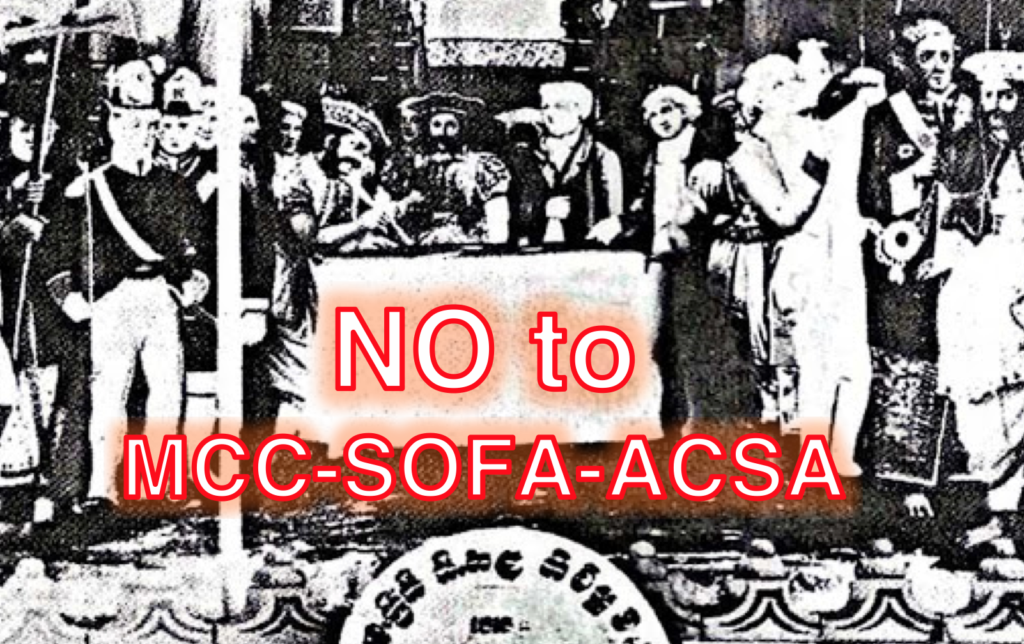
Repeal 13amendment & PC system ONLY AFTER rejecting in toto the MCC-SOFA-ACSAmilitary-economic-development agreement. 13a is the only obstacle to privatizing state land which MCC demands. MCC expects its agreement to be passed in Parliament. like 13a.
Legally prohibit any Government elected for a term from selling or bartering National Assets/Resources and Strategic areasto foreign governments/transnational companies that will impact detrimentally on the Nation & its citizens. No agreements can be signed or agreed in secret. A Govt is only custodian of People’s Power delegated by the People to them.
Pass law in Parliament to register all NGOs, hold them accountable & audit them & their heads. Present & future destabilizing exercises will be done through foreign government funded local NGOs – therefore the money channeled to them, what they do with that money, how it is spent, on what it is spent need to be audited and accounted for. The 21/4 mass murders make this demand crucial. Encourage & Createnew Patriotic Civil Society Groups.
Change Electoral voting system. ITAK obtained 327,168 votes (2.82% of island result) & secured 10 seats but UNP that obtained 249,435 votes (2.15% of island result) got no seats except 1 national list seat. This is unfair & should be corrected to bring a fair electing of candidates while raising the % of entry to original 12.5% and imposing strict fines to dissuade small groups & individuals contesting elections mostly from one or two districts when they know they will not secure votes but burdening the tax payer with the costs to arrange facilities for them.
One Law for All– wherever any law provides special legal status, it must be removed. Ex: Marriage Laws/Polygamy & No Child Marriage. If Sinhalese & Tamils can have only one spouse, the same must apply to Muslims. As free education to children must be equitably and equally be offered by the State. No marriage can be legal with anyone less than 16 years of age. No special food labeling favoring a religion. No two laws allowed (civil or criminal). No sub-laws per different religions.
No ethnic-religious-based political parties– such parties represent only their ethnic community or religion & are a source for discord and communal tensions.
Foundation for a Corrupt Free Society – Ombudsman appointed by Government to look into Public Officials, Magistrates & other State employeesabusing their office & indulging in corrupt practices to have action taken against them following complaint and investigation of their accounts etc. Also ensure that politicians do not abuse their portfolio to use State funds only for their community. This is a key grievance by the majority of citizens in Sri Lanka.
Absolve all OUR ARMED FORCES from bogus chargesframed and accepted via co-sponsored UNHRC resolutions
Take legal action against Separation of Sri Lanka (enforcing 6thamendment) and impose bans and legal action against LTTE terrorism promotionlocally & internationally via Sri Lanka Missions. In so doing, the Tamil community will find it easier to assimilate and integrate with the rest of the communities. The obstacle is the LTTE diaspora and Tamil politicians pulling Tamil people towards a bogus separate homeland. Same should be applied to radical Islamic groups.
Education National Policy – National History Compulsory subject for all – Schools, Public/Private/semi-Govt & international from pre-school to O/L (endorsed by a patriotic panel of educators/historians) & Patriotic initiatives for all citizens.Only those who are proud of the nation comes forward to defend it. Pride comes in knowing one’s history & being proud of it. This is a must as it provides a key defense when external threats increase.
Foreign service & Other public service personnel must also be briefed during State training of pre-colonial history& who the real patriots/heroes of Sri Lankaare as they are our representatives overseas.
State must continue to recognize the primordial Sinhala Buddhist identity of Sri Lanka constitutionally. The civilizational heritage/history must continue. This is non-negotiable and cannot be compromised.
Follow 70-30 representation moduleat all levels to unbiasedly represent the demographic ratio of Sri Lanka wherever State is involved.
State protection for all historical heritage/archaeological sites– ensure no incursions & land take overs.
Moratorium on construction of new places of religious worship via foreign funds– these are sources of ethnic/religious tensions and have also been source for new terrorism & radical ideologies. Stern action against Municipalities giving approvals for illegal places of worship in residential areas.
Enact Anti-Conversion Bill– again a foreign funded destabilizing initiative
National Anthem to be only in One Language– the original language in which it was written & sung by all. It must be mandatory for all citizens to speak & write basic Sinhalese. Tamil is secondary language & English is link language. State programs to teach basic conversation in Sinhala to Tamils and Tamil to Sinhalese should be launched as a fun program and not part of syllabus.
Special regulations for dual citizens/citizens marrying foreignersto ensure land ownership (title deed) does not fall into foreign hands.
Illegal immigrantsreturned to places of origin
People’s Aspirations
A compassionate society, following the guiding principle of Ahimsa that protects all living beings by passing Animal Welfare Bill and protecting natural environment, fauna & flora with punitive action against violators.
We have as President, the brother of the PM. The PM commanded the troops & brought an end to 30 years of terror. The President has commanded the troops, intel, police & public service to handle covid-19 pandemic magnificently. Both are leaders in their own right & do not hesitate to show leadership when it is needed.
With many external parties attempting to sabotage our progress, derail our development, forcing us to compromise and appease to their whims and fancies, our aspiration is that these two leaders will withstand all pressures and stand up to all these challenges knowing that their defense is us, the Citizens who will protect the leaders who defend the Nation.
Our anger at the previous government was in the light of a series of treacheries against the State and the majority Sinhala Buddhists.
The citizens will protect all leaders who protect & defend the Nation & its People.
The day, leaders forsake that Trust and Duty, the People will reject them too.
Our hope is for all the communities to be allowed to live on their terms and on their rules not that which are written on some foreign paper and to foreign formats. Let everyone not forget under the Sinhale kings who ruled for thousands of years there was no evidence of any majority-minority tiffs or riots. All the problems began after 443 years of foreign occupation as a result of their divide and rule policies which sought to pit one community against the other and divide those communities too.
Inspite of the handful of orchestrated ugly events of the past, we are all in agreement that we continue to work in the same offices, we have fun, we share our food and take part in each other’s festivities, we have our differences but its nothing that needs to be taken to a foreign embassy to complain about or to write to the UN or apply for asylum or even demand a separate state.
If differences of the nature these foreign parties speak of constitutes need for a separation – then even a home & families would be divided in time to come.
This is not the harmony we want or wish for.
Let us create our own harmony & peace together minus any extremisms, racisms or separatisms fed into the minds of the people by external parties.
In view of the landslide victory that is in the offing, it
is my humble request that you may please consider a poverty alleviation cum
employment creation programme. I enclose my report on the Divisional
Development Councils Programme implemented during Premier Sirimavo
for kind perusal. It is my fervent hope that a similar but more
comprehensive programme may please be considered as soon as possible
The Divisional Development Councils Programme(DDCP): Lessons on the eve of the 2019 Presidential Election of Sri Lanka
Posted on November 11th, 2019 in Lanka Web
Garvin Karunaratne,
PhD Michigan State University*
The DDCP was the major
development programme undertaken by the Government of Prime Minister Sirimavo
Bandaranayake during her 1970-1977 rule.
This was also the first major
islandwide development programme ever to be implemented in Sri Lanka. Earlier
there was the Rural Development Programme and the Small Industries Development
Programme which were smaller programmes aimed at rejuvenating the rural areas
with small industries and Powerlooms. However, the DDCP was far major in scope
and the Government had high hopes of great success. The Government head hunted
the most eminent economist on the island, Professor HAdeS Gunasekera the
professor of Economics at the University of Peradeniya. A new Ministry of Plan
Implementation was formed under the Prime Minister Sirimavo Bandaranayake and
Profesor Gunasekera was appointed as the Permanent Secretary to the Ministry.
The importance given to the programme was such that helicopter travel was
authorized for him.
The main aim of this DDCP was
to bring about employment for the youth. The aims, in the words of the Budget
Speech of Dr N.M.Perera, the Minister of Finance;
The main objective of this
programme is to create employment opportunities in the rural areas and through
small scale projects in agriculture, industry and the provision of
infrastructural facilities, making use of the resources available locally;
increase national production and involve the people in national development
work.”
The method was to enlist the
support of all officials and elected personnel in every Division. In
detail,” An entirely new structure for planning is being established (within
which) each local authority will be the focus for development planning and plan
implementation. Popular participation will be secured through the Divisional Development
Council in which the elected organs of the village, the cooperative society,
the cultivation committee, the village council will have a planning and
coordinating role in the overall development of their area.”.
The DDCP was a crash programme
to create employment for the youth. The target was to create 100,000 jobs in
the first year.
The Government enlisted the
services of the Government Agents to implement this programme. Even before the
Ministry of Plan Implementation recruited graduates as Development Assistants
and Planning Officers the Government Agents selected the best
officers who were working in the District and the programme was immediately
commenced. I was serving as the Government Agent of the Matara District.
There was a major set back
because of the Janata Vimukti Peramuna(JVP) Uprising on April 5th 1971. This
took on the form of an attack on all Police Stations and army units. It was an
attempt to capture power in a single day like what Fidel Castro did in Cuba.
The JVP controlled the hinterland- the rural areas and had their kangaroo
courts etc. and it took a few months for total order to be restored. The JVP
had been instrumental in working for the SLFP – for Mrs Bandaranayake at the
1970 election and the DDCP was a programme that was specially meant to provide
employment to the youth. No reasons were given for the sudden uprising
but it was found that the North Korean Embassy had spent a massive sum of money
at this time and there was some evidence of some connection with the Uprising.
The Government closed down the North Korean Embassy. This was an
unfortunate episode that delayed the implementation of the DDCP for months.
Since that day officials travelled the least possible and further all
investors- estate owners, rice millers etc.who had made rural areas their homes
left for security reasons to the cities.
The development councils were
formed in every division. The Councils comprised all officials and elected
officials of cooperatives, cultivation committees and local government
institutions. The Head of the Council was the Divisional Revenue Officer(DRO)
of the area. He was given a new designation of Assistant Government Agent.
Meetings were held and the Councils identified small scale industries and
agricultural projects- farms which were funded and commenced all over the
island.
In Matara District, in addition
to a number of agricultural farms and small craft type of industries, the
Councils suggested many industries and feasibility reports were prepared and
approval sought. It was generally difficult to get approvals a few small
industries were approved and the Ministry made an allocation of funds to buy
the machinery, put up structures and also funds to pay a stipend to the youths
till the projects were established and incomes generated.
I suggested that a Mechanized
Boatyard should be approved to be constructed at Matara on land bordering the
Nilwala River. A Feasibility Report was drafted and submitted. The Ministry
called me for a meeting where the Director of the Fisheries Department was also
present. The Ministry officials were not interested and there were objections
by the Director of Fisheries. The meeting was ultimately put off for another
discussion on another day. This was the first cooperative industry to make
seaworthy 30 foot long boats and perhaps the Ministry was worried that it could
be a failure and be a blot on the Ministry. Anyhow after a major battle, we
obtained approval and the boatyard was established. It was a great success.
The Councils were agitating for
more industrial units and we suggested that at Deniyaya we could establish a
Water Colour Industry making watercolour paint boxes. This was import
substitution in action because at that time Sri Lanka imported the bulk of our
watercolour requirements. The Ministry submitted our Feasibility Report to the
Industrial Development Board(IDB) and a meeting was held at the
Ministry. The Ministry agreed with the IDB recommendation that this
should not be approved because the Deniyaya area did not have any of the
ingredients that went into making watercolours. I argued that if Japan could
buy cotton from as far as Egypt, take it all the way to Japan, make textiles
and market the sales back in countries as far as Egypt, we too could do it. We
were at an advantage because our country itself needed the watercolour paint
boxes. I lost the battle. The Ministry was amply satisfied with the small
craft type of projects and the farms that we had got working.
However, we wanted to do
better. I suggested a Dairy Project in the Deniyaya- Mawarala area where we
will get Estate owners to plant grass on all their unused land. We could get
private farmers too to have more cows. The only proviso I insisted was that we
should have a Creamery to make butter and cheese. because it was impossible to
sell more milk. My feasibility report created problems. It was
argued that small creameries were not commercially viable and the Ministry said
that we did not have grasslands to feed the cattle. It ended up with heated arguments
at the Ministry. I did not know then that Switzerland doted on small
creameries.
It was quite evident that
the Ministry was not going to approve any new industry for our District. The
only sophisticated industry ever done in the rest of the island was a Paper
Making Industry at Kotmale. The Ministry told me to get going making
bricks and tiles if I was interested. I pointed out that in tiles and bricks
the private sector had already established factories in the District and it
would not be prudent to try to create a problem of oversupply. The
Ministry and I clashed not once but many a time. It happened because once I had
served as a Deputy Director of Small Industry and I knew more about industries
than anyone in the Ministry. The Ministry never appreciated my ideas.
Theirs was always on the beaten track.
The officers at the Katchcheri
were very innovative and we had many meetings. Finally, I summoned my Planning
Officer Vetus Fernando, a chemistry graduate of the University of Colombo, just
out of the University who did not have a day’s experience in chemistry after
graduating. I fed him all I knew about making watercolours. Once as Deputy
Director of Industries, I had approved an allocation of dyes to a watercolour
industrialist and I had seen him making watercolours. I knew the ingredients
but not the proportions and details of mixing it- temperatures etc. Vetus and I
decided to try to find the art of making crayons. The science teachers at the
school also helped us. We commenced work at the Residency in the evenings
and came to a point where we needed science equipment and it was suggested that
we should use the equipment at a school lab. I approached Mr Ariyawamsa the
Principal of Rahula College Matara and he readily agreed for us to use the
science lab after hours. The Science lab at Rahula was our domain from
around six in the evening till midnight every working day. The workers were the
science teachers and Vetus, the only scientists and we, myself, and a few staff
officers were all cheerleaders. The Cheer Leaders had to keep the
momentum going when every night we tried different methods and we failed every
day for close upon two months. Then Vetus got a brain wave. The crayons we made
were never of good texture and he said that I should approve his going to
Colombo to his university dons in chemistry and he was certain they will help.
I readily agreed and authorized him travelling and subsistence payment. I was
happy that he had thought of this method and I dreamt of success. Vetus turned
up on the fourth day and narrated in disgust that none of the professionals at
the University of Colombo was interested in helping him. He had begged of them
but was told to get lost. My staff officers and I were not going to take
things lying down to submission. We started experiments in earnest – from six till
midnight sipping black coffee with a sing-song once in a way to keep the
momentum going. In a month of experiments, we came across the method to make
crayons. Then I supervised fine-tuning the art again and again till we got to
be near the Crayola grade- then it was Reeves. We won the day.
Next came- how to establish a
small scale factory. I could not get approval from the Ministry. I was
certain that they will turn it down. I could have summoned Harischandra or an
industrialist and I knew many personally and could have told them to put up a
factory, but then it won’t be us. Finally, I decided that it should be
cooperative. The Cooperative Unions had funds but not the authority to
establish an industry. Then I thought of Sumanapala Dahanayake, the
Member of Parliament for Deniyaya, who was the President of the Morawak Korale
Coop Union because he was a maverick, a daredevil type if that was required. He
was in charge of the funds at the Coop Union. When I broached the subject to
Sumanapala he readily agreed to establish a Crayon factory. However, he had no
authority to use cooperative funds for that purpose. The Government Agent too
had no authority to direct cooperatives. However for purposes of coordination
in the case of the agricultural development programme, the G.A.had been
gazetted a Deputy Director of Cooperative Development. I usurped powers that I
did not really have based on this gazette notice and authorized Sumanapala to
spend cooperative funds and establish the Crayon Factory.
Sumanapala needed only a nod.
He got cracking with purchasing the equipment and gas burners, recruiting
youths. This was done in two days. A few rooms at the Cooperative Union at
Morawaka were cleared and the Katchcheri staff too moved in to commence making
crayons. It was a 24-hour operation, with youths working in shifts, working
under the watchful eyes of Vetus Fernando the Planning Officer. There were
Chandra Silva the DLO, Weimalaratne the AGA, Daya Paliakkara a Development
Assistant. They were all involved in the experiments at Rahula College and were
at hand went Vetus took a few hours rest. The youths had to get trained to do
every single crayon to perfection- a difficult task. It was a hand made
crayon-like most industries in China today. I broke rest on two days till
everything got off the ground. We sipped black coffee and sweetmeats brought by
Gunam Tambipillai, an estate owner who was very supportive of all our efforts
at development. Sumanapala was in his elements and in around two weeks,
Coop Crayon packets were printed and crayon packets made to fill two large
rooms.
Then I took off with Sumanapala
to meet the Minister of Industries, TB Sunbasinhe who was surprised to see the
quality of the crayons. He readily agreed to come for the opening ceremony when
we would commence sales. That was a grand occasion. With that aura
of authoritative approval, I felt safe for all I had done without any Ministry
approval.
Coop Crayon was fully
functional. The Youths managed it well. However, one major hitch was the
purchase of dyes that had to be purchased in the open market at high prices. I
approached the Ministry of Industries, the people that gave permits of foreign
exchange to industrialists- the place where I had worked two years earlier.
They said that their foreign exchange was only for the private sector
industrialists and not for cooperatives. The mandarins were not going to bend
rules. We were lost.
In a few days, a brain wave
struck us and we went to meet the Controller of Imports, Harry Guneratne, Harry
was authorizing imports and confided that he was approving foreign exchange to
import crayons. We argued that if he only gave us an allocation of a twentieth
of what he would approve for the import of crayons to import dyes, he could
cancel all imports and save the rest of the allotted foreign exchange. This had
never been done earlier but Harry was an immediate convert. However, he said
that this was the first time that such an allocation was made and wanted us to
approach his Minister and get his approval. Minister Illangaratne not
only approved it but also insisted that we should open a crayon factory at
Kolonnawa his electorate. This detail has been included to show how we can save
foreign exchange through establishing import substitution type of industries.
Coop Crayon was developed fast
by Sumanapala and he stepped it up to have island-wide sales. All the
units I had established in industries and agricultural farms were active and in
good health. Coop Crayon and the Matara Boatyard were at the top performers
in entire Sri Lanka.
In another year in April 1973,
I left the Administrative Service to proceed to the UK for further studies.
Sumanapala handled the Coop Crayon well. The other industries and employment
ventures were well looked after by Vetus and the Katchcheri staff.
Then in 1977 came the General
Election where the Government of Sirimavo Bandaranayake lost and the United
National Party under JR Jayawardena won.
Before long President
Jayawardena caved into the IMF which insisted that if he needed Financial Aid,
he had to invariably follow the IMF’s Structural Adjustment Programme. (SAP)
The main condition was that the Government could not handle any commercial
undertakings. Everything that the earlier Governments had done in the name of
commercial undertakings, to create employment etc had to be totally abolished.
The DDCP industries and farms were totally abolished and hundreds of youths
were inevitably consigned to the scrap heap of unemployment and poverty.
The political rivalry became
the order o the day. My Headquarters Assistant GA Ranjith Wimalaratne, a
kingpin in industries and who handled the Powerlooms with great efficiency was
a persona non grata and was hunted down. To save his life he had to forego
everything and run away to Canada.
A few years later, I met AT
Ariyaratne, a senior member of the Administrative Service and when I told him
that I had last served as the GA at Matara he spoke of a special assignment he
got in 1978 when he worked as a Deputy Commissioner of Cooperative Development.
He had been assigned to proceed to Morawaka to inspect Coop Crayon and somehow
find fault with Sumanapala Dahanayake the Member of Parliament who in his
capacity as the President of the Morawaka Coop union handled Coop Crayon.
Coop Crayon was at that time in full swing with islandwide sales and was easily
the flagship industry of the DDCP. The Government wanted Coop Crayon
discredited and to also find fault with Sumanapala for him to get punished.
Ariyaratne told me that he had spent days inspecting and auditing and could
only report that Coop Crayon was a very successful cooperative industry, with
all books kept in perfect order. Sumanapala was saved from a sojourn in the
gallows. Ariyaratne was not an officer who would stoop to create evidence to
put a person into trouble at the bidding of someone in authority.
In order to get foreign loans,
the UNP caved in and destroyed all that we had created to bring about youth
employment. The Matara Boatyard where youths built seaworthy inboard
motorboats- some 40 every year and earned good incomes was scrapped and the
valuable machinery was neglected, sold and also left in the scrap heap. Coop
Crayon was stopped. All other industries and agricultural farms were stopped
and a few hundred youths lost their jobs. Getting loans was the priority, and
the UNP Government did not care whether youths who earned a living were
destined to the realm of poverty. The aim was to satisfy the IMF. The IMF
barked orders to be carried out.
Let us see what economist
luminary Professor Jeffery Sachs had to say of the entry of the IMF and the
World Bank to Africa:
The IMF and the World Bank
virtually ran the economies of the debt-ridden continent recommending regimes
of budgetary belt-tightening known technically as the Structural Adjustment Programme.
These Programs had little scientific merit and produced even fewer results. By
the start of the twenty-first century, Africa was poorer than in the late 1960s
when the IMF and the World Bank had first arrived on the scene., with the
disease, population growth and environmental degradation spiralling out of
control. IMF led austerity led to riots, coups and the collapse of public
services( From The End of Poverty)
As much as Africa became poorer
with the advent of the IMF, from 1978, Sri Lanka too faced destitution.
The UNP Government of President Jayawardena played poodle to the IMF and did
everything that the IMF wanted it to do. As far as the DDCP was concerned all
industries and agricultural farms were abandoned and the thousands of youths
involved were destined to unemployment and poverty. Imagine what the youths who
were making crayons felt in Morawaka, what the youths fromMorawaka who were
selling crayons at both Alimankada and Pamankada felt and the youths that were
making boats felt at the Matara Boatyard felt when they were ordered to close
down and get lost.
A Presidential Elections is in
the hustings in a few days in Sri Lanka and it is necessary to bring about
employment for the youth and prosperity for the people. The DDCP was once the flagship
that Dr NM Perera and PrimeMinister Sirimavo doted on to bring us prosperity.
The United National Party of President Jayawardena sacrificed that at the
behest of the IMF.
It is time that we rethink our
strategies at development once again from scratch.
It is hoped that the
combination of leaders former Defense Secretary Gotabhaya and former Premier
Mahinda can effectively strategize a programme to end poverty and unemployment
in Sri Lanka. I am certain that they will be successful.
I hope to see a development
programme that is better than the DDCP in the new future and the only path to
this development lies through a victory for Gotabhaya as President. There is no
other option.
It was not long ago that they
showed us their full colours by defeating the LTTE that attacked us all over
our country for thirty long years.
That is the only hope for our
Motherland.
These words come to you from a
Sri Lankan administrator who once in 1982 and 1983 was working as the
Commonwealth FundAdvisoir to the Ministry of Labour and Manpower in Bangladesh,
who was able to obtain approval to establish a Youth Self Employment Programme,
and within two years did create the Programme and trained Bangladeshi staff to
continue it- a programme that has guided millions into self employment, which
is today the premier employment creation programme that has withstood the sands
of time.
*Garvin Karunaratne, PhD
Michigan State University
Author of How the IMF Sabotaged
Third World Development (Kindle/odages:2017)
How the IMF Ruined Sri Lanka
and Alternative Programmes of Success(Kindle/Godages:2006)
Professor George Axinn of
Michigan State University hails this book: It is hoped that this timely book
will enable international organizations to arrest the trend of failures.
… I am delighted and proud to have been one of his teachers at
Michigan State University.”
The final results of this election
will be stunning for everybody. My forecast of final results will roughly be as
follows
1The
SLPP will get around 175 out of 225 seats in the next Parliament (Eg 150-55
elected and 15 -20 national list)
2 The divided and disarrayed UNP (R+P camps
together) will settle down around 35 the most (elected + national list) I think
Sajit Camp will get few seats more than Ranil as majority of ex UNP MPP and grass root levelare with him. TNA might get
less than elected and 1 National list member considering the prevailing
disunity within The TNA and other Tamil parties in the North and East. The leader of the opposition will go to
either Sajit or Ranil depending on who gets the support of the Tamil Mpp.
3 Under this scenario it is likely that the
ranking of the main contenders will be as follows
!
SLPP 170-175 both elected and National list thus consolidating the 2/3 in
PArliament
2
Sajit+Ranil 35 -40 (Both elected and National list)
3
TNA 09+1
4
JVP will get eliminated from the political map of Sri Lanka. Most they might
get 1 from the National list
5
Others not belonging to 1 to 3 such as Ape Janabala Vegaya that might emerge as
a force to reckon with in Parliament.
(These
figures might slightly vary due to the fact there is always a margin of error in statistical calculations. But I
maintain the overall picture want be much different)
6
After 196 are elected out of 7452 7256 will go home. Of them at least 7000 will lose their
deposits.
7
Overall poling will be less than at the Presidential elections
Drop
in the voter turnout for 4 reasons. The main reason is the drop in the UNP vote
due to the ugly clash between the R &S camps. The other reasons are
internal conflicts between Maitri and Pohottuwa camps, fall in the votes of
those who came from foreign countries last time and as there is a possibility
that some voters who voted Gota last time may not do so this time due to
personal reasons
8
There is another surprising thing this time is that SLPP will win all Sinhala
majority districts including Colombo, Nuwara Eliya and Badulla
9
This election will also mark the last for Ranil as this election will mark his
exit gate from politics along with the demise of the 74 year old UNP, the trap set up by the British to destroy the
Sinhala nation and Buddhism in this country together with its glorious and
pristine civilization.
10
With this election Sajit too will join the political destiny of Anura
Bandaranayaka as there is going to be a big battle for UNP leadership even if
it tries to raise its head from the political grave
11
Majority of sitting members of all parties will get defeated. I forecast this
to be 125-130
12
The UNP, and JVP will get completely routed to be never reborn again.
13
Tamils and Muslims will be compelled to rethink about their divisive and
communalahave to rethink about their aggressive and communal strategies after
this election which they already experienced in the last Presidential El
strategies and learn to live amicably or depart to their own mother countries.
Definitely they will have to either learn to live amicably with the naïve
Sinhalese or depart as their bargaining clout of an eye to eye will be lost
forever.
14
There is a possibility of a new Tamil party gaining ground in the north as
Tamils are now fed up with TNA
15
This overall change will lead for the emergence of a new political party and a culture
and a national Sinhala Buddhist force based on Anagaraika Dharmapala, model
more aggressive and more forward looking than the SLLP, completely different
from all political parties we had from 1948 in this country I foresee this to
be the Ape Jana Bala Wegaya Under Rev Galabda ate Gnanasara and RaTna Thera
16
This election will also put an end to the Colombo centered political leadership
and lay a permanent foundation based on
the Villa Leadership centered around Sinha Buudhist majority along with the
Sinhala Catholic marking the dawn of a
new political era in this country with a political system with a new political
Economic social and moral led by the President Gothabahaya Rajapaksa heavily
backed by Prime Minister Mahinda Rajapaksa and his team
17
Ranil and will go to political
wilderness and the same thing will
happen to Sajit as well as his succeeding Rajapaksa regime in future is utterly
remote as the force that follow will definitely be a more Sinhalese Buddhist
oriented ;for eg Ape janabala Wegaya
18
The power of the yellow robe will emerge once again and get established firmly
as it had been during the days of the Sinhala Kings.
19
With the e defeat of R and S the traditional UNPer will look for a new
leadership but it want succeed. Instead it might get together with the newly
emerging Snhala Buddhist force sated above who will love the Sinhala nation the
Land and the environment in full agreement with Buddhist teachings Replica of
Dharmasoka Kingdom
20
Finally this election will herald the beginning of a fully free and
Independent, vibrant and prosperous Sinhala Buddhist Kingdom culminating once again as the miracle of
Asia, a pride to the whole world, as it had been in the ancient and medieval
world.
This in brief is the wish and the greatest expectation
the Sinhala Nation yearning for under the new Rajapaksa regime Governance they
have so painstakingly brought in to power.
The resounding victory of the Rajapaksas has sent a number of politically significant messages.
Colombo, August 7 (newsin.asia): The Sri Lankan parliamentary elections, held on August 5, the results of which were unofficially out on August 7, have sent a number of politically significant messages. These are as follows:
Getting Two Thirds Majority
The results have shown that it is possible to get two- thirds majority even under the Proportional Representation System (PRS) which facilitates the entry of a number of parties, even small ones, into parliament, preventing efforts by a big party to form a government of its own without the support of small parties.
The ruling Sri Lanka Podujana Peramuna (SLPP), led by Mahinda Rajapaksa, has got 145 seats, just five short of 150, which is the two thirds mark. But it has allies like the Eelam Peoples’ Democratic Party (2 seats); the Tamil Makkal Viduthalai Puligal (1 seat); the Sri Lanka Freedom Party (1 seat) and the National Congress led by Athaullah (1 seat) which will enable it to muster two thirds. Thus in total, the SLPP has got 150 in the House of 225 or two thirds. Few believed that two thirds was possible. Party organizer Basil Rajapaksa was himself aiming only at 135.
Boost To Majoritarian Politics
The results have shown that it is possible to win with a substantial majority or even two thirds, with the support of the Sinhalese community only. The Sinhalese are 70% of the Sri Lankan population of 21 million but have typically been divided. However in the November 2019 Presidential election, the SLPP showed that the Sinhala vote could be consolidated. The party has shown that again in August 2020.
In the poll campaign, the SLPP had taken a hardline against the Tamils’ demand for a federal constitution and also against the Muslims who it alleged were silent supporters of Islamic terrorism which showed its potential in the April 21, 2019 multiple bombings in four towns including Colombo. SLPP campaigners portrayed the demands of the Tamils and Muslims as national security threats. The West’s support for the minorities only added to such a threat perception.
In many places, the Tamils and Muslims voted for the more accommodative Samagi Jathika Balawagaya (SJB), a breakaway group of the United National Party (UNP). Where they are in substantial numbers they voted for their own sectarian parties. But Muslim support did not tilt the balance in favor of the SJB because the SJB got only 24% of the votes overall as against 60% secured by the SLPP. The Tamils, who had supported the SJB in the Presidential election of 2019, deserted it this time in favor of their ethnic parties.
Decimation of United National Party
The United National Party (UNP), Sri Lanka’s oldest party, which had formed governments many times earlier, could not elect a single member this time. And its leader for more than two decades, former Prime Minister Ranil Wickremesinghe, was also defeated. The UNP is entitled to a single nominated seat under the PR system. But it is said that leader Wickremesinghe does not want to be nominated.
The UNP began to see a steady decline under the leadership of Wickremesinghe. A party with a rural base under the D.S.Senanayake and his son Dudley Senanayake, the UNP became too urbanized, elitist, bourgeois, and pro-West under the stewardship of Wickremesinghe. This is why the party saw defections and a major split when its Deputy Leader Sajith Premadasa broke away to form the SJB ahead of the Presidential election in 2019. In the parliamentary elections, Sajith’s SJB got 54 seats while the UNP under Wickremesinghe drew a blank. The SJB’s relatively better performance shows that it had a struck a chord with the Sinhala masses to some extent. Sajith Premadasa is seen as a non-elitist leader though not in the same way as his father, President Ranasinghe Premadasa, was.
Changing Tamil Concerns
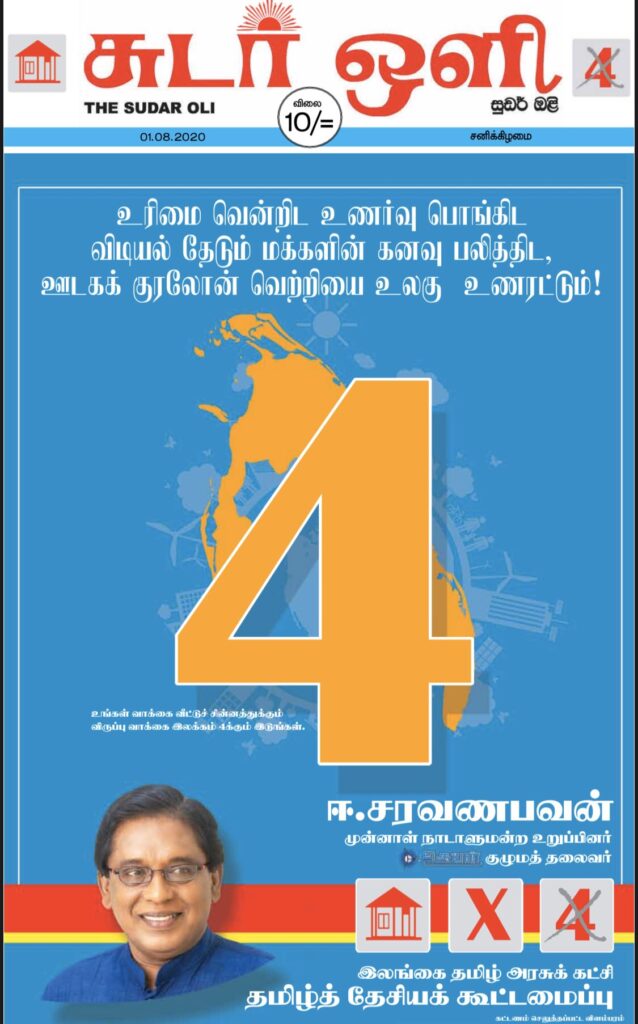
The polls in the Northern Province showed that Tamil extremism is on the wane, although some pro-LTTE radicals like Gajendrakumar Ponnambalam and C.V.Wigneswaran won. The bulk of the seats was won by the moderate Tamil National Alliance (TNA) fighting under the Ilankai Tamil Arasu Katchi’s House” symbol. The elections in the North also showed that the Tamils now want economic development, besides federalism. This is seen in the success of the pro-government EPDP (2 seats) and the SLFP (1 seat).
The Muslims have continued their tradition of supporting national parties or religious parties which would join governments. Much of the success of the SJB this time, is due to the support it got from Muslims in non-Muslim majority electorates.
Centralized Constitution
The results will definitely pave the way for a major overhaul of the Sri Lankan constitution to enable the formation of stable governments with sufficient strength in parliament. Using its two-thirds majority, the government of President Gotabaya Rajapaksa and Prime Minister Mahinda Rajapaksa will either repeal or drastically prune the 19 the. Amendment (19A) introduced by the Wickremesinghe regime in 2015.
It will also modify the election system by making it a First Past the Post System (FPS), mainly, if not fully. The FPS will enable a single party to form a government and even secure two thirds of the seats. The existing Preferential Vote system (with voters ranking their preference in a list of party candidates) may also go because the system leads to competition among the candidates of a party.
The complaint against the 19A is that it weakens the Executive Presidency in a system where the Executive President is directly elected by the entire country. The 19A takes away many of his powers and hands them over to the Prime Minister or to the non-elected Independent Commissions. There is an argument that the 19A gives the non-elected/non-political Independent Commissions too much power, making a mockery of representative government.
Because of the 19A, President Maithripala Sirisena could not sack the then Inspector General of Police, Pujith Jayasundara, for failing to prevent the April 21, 2019 blasts despite the availability of intelligence about the perpetrators days in advance. As per the 19A, the President had no power to appoint, transfer or sack any official. A head of a department could not choose his officials without the consent of the Public Service Commission.
The Rajapaksas might allow some of the Independent Commissions to remain but with clipped wings. The general tendency will clearly be towards centralization rather than decentralization.
Fate Of Provincial Councils
Given the tendency to centralize the administration, the minority Tamils fear that the 13 th. Amendment, which set up elected Provincial Councils and devolved a modicum of power to them, might be scrapped. But this is unlikely to happen, not because India has a stake in the system, having brought them about through the India-Sri Lanka Accord of 1987, but because the Sri Lankan political class has developed a tremendous stake in it.
The Provincial Councils system has created an intermediate governance stratum between the local bodies and the national parliament. The elected councils, with their Boards of Ministers with departments under them, give aspiring grassroots politicians instruments of power and a means to get to parliament at a later date. Mahinda Rajapaksa once said that if he abolished the Provincial Councils, Sinhalese politicians will themselves protest in front of his house.
Independent Foreign Policy
The election results will enable the Rajapaksas to pursue an independent foreign policy. The parliamentary backing they have will enable them to resist pressures from the West, India and even China to do their bidding. Key regional and foreign powers are wanting a share in the Lankan economic pie and also Colombo’s support for their regional and global strategic designs. In such a situation, a strong, well-backed government will be better able to hold its own against outside powers.
Both China and India are keen on acquiring strategic assets in Sri Lanka and the US is wanting Colombo to sign the controversial Millennium Challenge Corporation Compact and the Access and Cross Services Agreement. India considers Sri Lanka to be in its sphere of influence which China is trying to breach. And the US and India want Lanka to support the Quad” against China, while China considers the island to be part of its Belt and Road Initiative.
Following the United National Party’s unprecedented defeat at the 2020 parliamentary election, the senior leaders of the ‘grand old party’ convened a meeting at headquarters – Sirikotha on Friday evening (08) to discuss the election result and future course of action.
Speaking to reporters following the meeting, UNP National Organiser Daya Gamage stated that the party decided to carry out reforms and move forward.
Asked about the election result, the former minister said he believes that the people decided that the government should be from the President’s party and also that former deputy leader Sajith Premadasa destroyed the UNP and destroyed himself.
Former minister Vajira Abeywardena, responding to questions regarding Ravi Karunanayake, said that there is no need to point fingers at any person over the defeat.
When asked about the SLPP forming a government with two-thirds majority, he said that the main group responsible for that is the Sajith Premadasa faction.
He also claimed that Premadasa ruined himself and the UNP along with his political campaign. Abeywardena stated that they gave their full backing to Premadasa at the last presidential election, but he failed to win and now the 5.5 million votes have dropped to 2.6 million.
The UNP failed to win a single seat at the 2020 general election despite polling 249,435 votes (2.15%), however the party did win one National List seat.
UNP Organiser for Divulapitiya Dr. Kithsiri Manchanayake stated that a decision would be taken regarding the National List seat come Monday, along with a host of other important decisions such as the future of the party and leadership.
Responding to a question, he said that UNP leader Ranil Wickremesinghe will not enter parliament from the National List seat as he is not a person who will enter parliament after being defeated.
Meanwhile former UNP MP and ‘Samagi Jana Balawegaya’ member Nalin Bandara told reporters that the UNP leadership is still not willing to accept that the UNP has been destroyed today and kindly urged Wickremesinghe and his group to handover leadership of the party to the group backed by the people and supporters.
At least now please understand that the leader in the hearts of the UNP supporters is Sajith Premadasa and handover the party to him. Because as true UNPers, we cannot stand this present situation,” he said.
Sivanesathurai Chandrakanthan alias Pilleyan of Thamil Makkal Viduthalai Pulikal (TMVP) has secured the highest number of preferential votes in the Batticaloa District.
However, the Illankai Tamil Arasu Kachchi (ITAK) managed to claim the victory in the district after polling 79,460 votes (26.66%). The ITAK won 02 seats in the district.
The TMVP meanwhile amassed the second highest number of votes in the district with 67,692 (22.71%) and secured one seat.
The Sri Lanka Muslim Congress (SLMC) has come in third with 34,428 votes (11.55%) and won one seat.
Sri Lanka Podujana Peramuna (SLPP) received 33,424 votes (11.22%), also managing to secure a parliamentary seat.
United Peace Alliance (UPA) received 31,054 votes (10.42%) and Samagi Jana Balawegaya (SJB) 28,362 votes (9.52%).
The People have spoken & given a victory that has surprised even the SLPP. The Voice of the People put to pieces any aspirations of a weak government fishing for frogs to cross over. The People have been wise & seen the signals & stopped such. This itself is a clear indication to the new government that the People have not only spoken but have signaled very strong expectations from the government. The New Government is now bound to deliver and deliver with professionalism and patriotism the essential features that propped up and differentiated the SLPP campaign from its competition.
As results continue to pour it, for the second time the majority have shown they can must the necessary votes to create a powerful government. This was evident from the November 2019 Presidential Election and it has been repeated again this election with a slight shift in tempo. There was a significant shift in voter mentality in the North. Clearly apparent was that the bastion of separatist racism that was drummed by TNA & ITAK has fallen and SLPP can be happy that Tamils have offered a laurel and it is a good start for better relations with Col. Ratnapriya leading the way. The Central Province can be happy that Thondamon’s son has also delivered.
The voters have not forgotten how the country suffered from the 2015 foreign funded regime change – a debacle Sri Lanka has yet to come over. The treacheries agreed and signed during that tenor will forever haunt the UNP Leader who will not only return home branded as a traitor but a leader rejected by his own party & supporters. No UNP leader who held fort for 25 years would want to retire with such memories. Imagine the thought of not even securing enough votes to return to Parliament! The tragedy & irony is that the kapuwath kola green voters eventually ended up rejecting its leader & its party and thus nailing its own coffin.
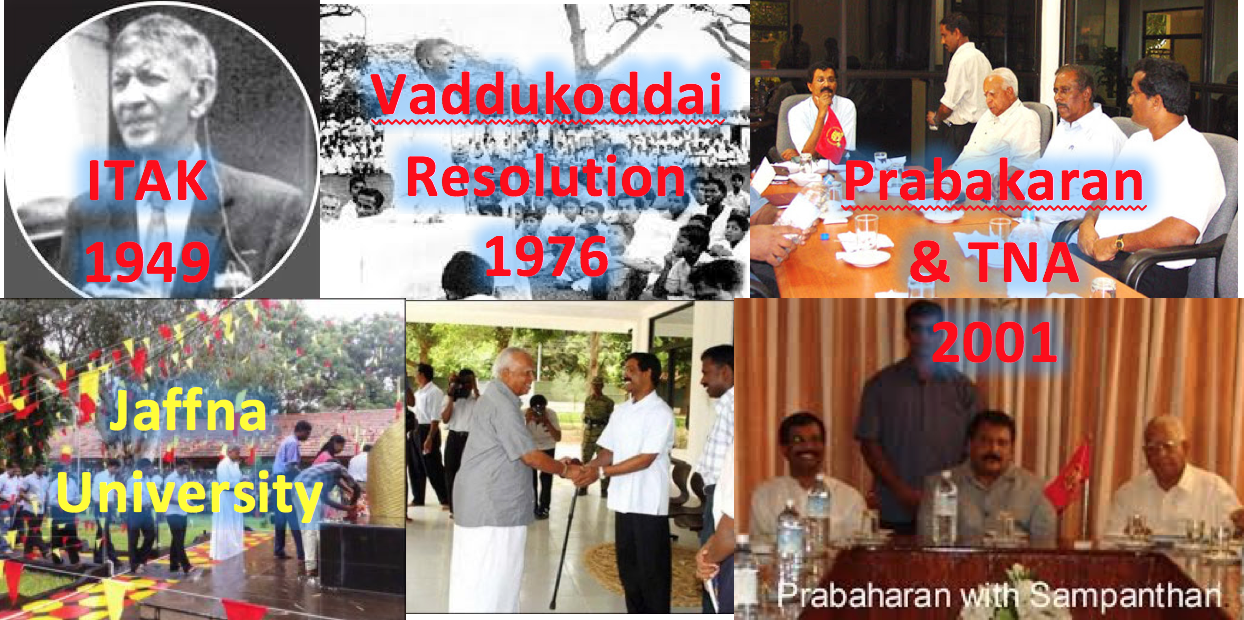
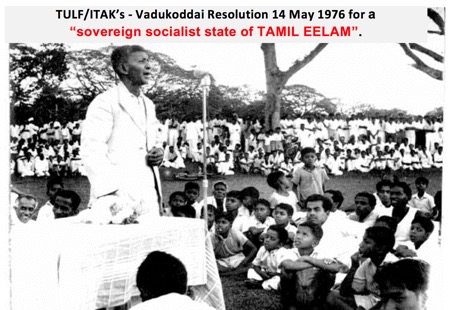
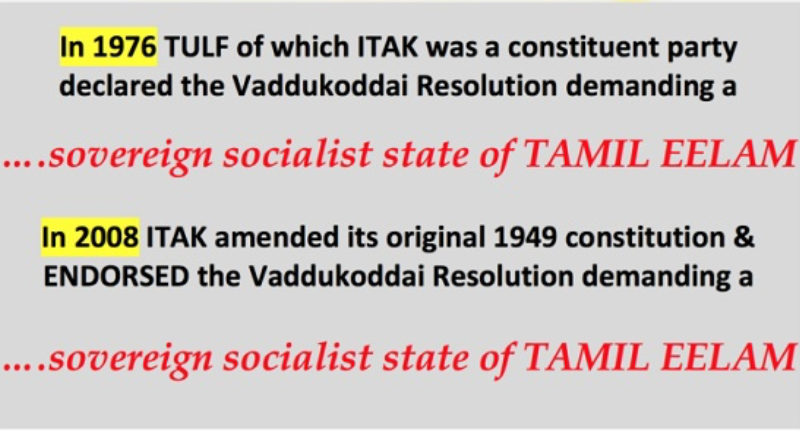
Between Sirisena and Ranil since joining a venture to destroy Sri Lanka, they have both ended up in destroying two of the oldest mainstream political parties in Sri Lanka. The SLFP and UNP are as good as buried. The results speak volumes. The two parties cannot continue unless they completely change their aims & objectives & begin afresh. TNA & ITAK that thought it was the cat’s whiskers too have been in for some surprises with the likelihood that its prominent personalities may also get rejected. There was a time when Sinhala MPs had to seek permission from Sumanthiran to speak in Parliament – such was the ridicule that the majority was subject to under a bogus yahapalana rule. It is a good time to remove the ideology for separatism via Vaddokodai Resolution legally & take legal action against promotion of LTTE under any form. With this done, the Tamil people can more forward and progress.
Every political party have been lavish in promising to the minorities but what have they really promised the majority in exchange for their vote. Coming to power with clear majority in 2019 and now in 2020 the landslide victory must give priority to the people who gave that landslide victory. The majority have never asked for a separate state, they have not sought to illegally acquire land, destroy ancient artefacts or abuse the system – what they seek is to ensure the unitary nature of Sri Lanka remains in tact, that no national assets or strategic areas are given to foreigners on whatever terms & conditions. A new constitution must deny any government voted for a term of office to make such decisions without asking the People/Citizens.
The people have shown they are ready to undergo austerity measures to help the government come out of the difficult situation aggravated from covid-19. They have undergone much hardships and sacrifices. The Western media propaganda enjoy to project the notion that only minorities are denied but throughout the election campaign we saw how in deep rural south even basic water, roads, schools and facilities are not enjoyed by the majority who despite all this came out in their numbers and voted for SLPP. Don’t neglect them this time too. They deserve better.
There are calls for the removal of 13a and 19a – certainly 19a must be removed. Not only have the Commission heads been biased but their selections have ended up removed from their positions! Another important change must be in the electoral system of how people vote and elect their MPs. That TNA who secured only 4% of island votes get 16 seats to parliament highlights the absurdity of seat allocation which must change. A Committee must be appointed to look into this as well as raise the entry vote % to Parliament.
There are some contentious topics that the People have clearly raised their voice against and the Government has the power to use the People as grounds to REJECT MCC-SOFA-ACSA and re-take Trinco Oil Tanks as well as annul any cooperation agreement with India for ECT entered into by the previous government in secret. No agreements in secret can hold water without the approval of the people. We saw the damage such agreements did in the past – Indo-Lanka Accord of 1987 & the 2002 Cease Fire Agreement are two examples. The 3rdattempt was luckily stalled by the former President stopping the privatizing of state land & the signing of MCC. This government therefore cannot proceed with these agreements that the People have openly opposed. No Pathfinder should be entertained to do so.
It has been a case of ditta dhamma for most MPs who to please the international community to appease the real racists in minority leaders that backed the Ranil-Sirisena government to power and openly ridiculed the Sinhala Buddhists, imprisoned the Buddhist theros, imprisoned the intelligence officers, were overjoyed to declare the national army as war criminals & compensate LTTE, find themselves finally rejected by the People.
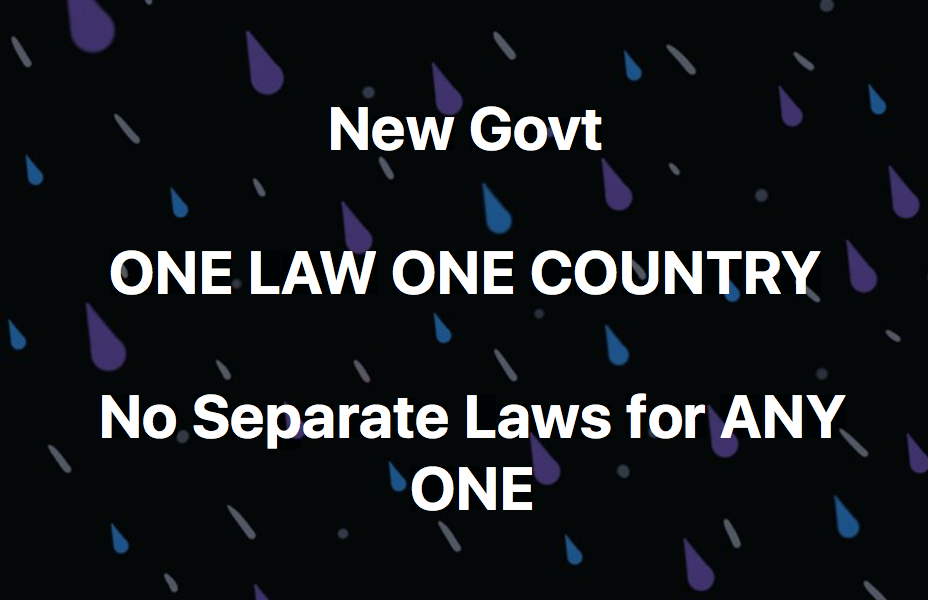
The theme that people rallied behind – One Country One Law must take shape. There can be no exclusive laws for one community. Everyone must be equal before the law and the law must be equal to all. The changes must be done.
In the end, the people waited patiently to use their once in a 5-year vote to reject MPs who had been fooling them and the country for 5 years. It’s a lesson for those who have got elected to not take that same path. People are watching. The present Commissions and Task Forces appointed must deliver and the proposals must be put into action without compromise or silenced by community funds which is often the case and cause for frictions. Heritage sites, archaeological sites & artefacts must be protected by the State and incursions of any kind must stop. Relocation of people must be not with state land but with vertical housing in inclusive communities. No ghetto areas can be allowed. No self-segregation can be tolerated and assimilation must be promoted with the Government laying emphasis to PATRIOTISM by EDUCATION starting with the true history of Sri Lanka compulsory to all.
The government must also ensure that public servants in particular secretaries and institutional heads are also kept in check and corruption from top to bottom is contained and curtailed through punitive systems without bias.
The Government must set the priorities suitable for the citizens and not to please the international community or the countries eternally breathing down Sri Lanka’s throat. The acceptance of funding that come tied to various insidious programs meant to divide and create future problems must be looked into with greater scope without simply accepting and discovering the problems tied to funding will cost more to resolve.
Asia’s oldest democracy has shown how to hold an election amidst a global covid-19 pandemic. The People have shown what peaceful elections are like. The health regulations were all followed. Now the journey is to move forward as a Nation with National Policy, upholding National Integrity & Sovereignty, Patriotism not Personal privileges and benefit Duty not Demands. No rights without Service and the need to realize that no nation can rise without the efforts of all citizens. It takes one person to change the course of destiny and it can surely take all citizens to return Sri Lanka to its glory. We have suffered as a nation enough. Let no one – internal or external impede our resolve. Let us march forward together and build our nation with patriotism.
This VOTE given by the People is to BUILD THE NATION & RAISE the level of the People not to repeat the same mistakes that cost them election defeats in the past.
The Government & Parliament must remember that the Sovereignty lies with the People & is inalienable & the People’s Power are given ONLY IN TRUST to the Government for a fixed term. They must uphold the civilizational history of the island & the primordial identity of the country embedded in the National Anthem and Deva Wassethu Kalena.
The overall results of the 2020 Parliamentary Elections have been released.
The number of votes obtained by the Sri Lanka Podu Jana Peramuna is 6,853,693.
They have won 128 seats and 17 National List seats. Therefore SLPP has 145 seats in parliament.
Samagi Jana Balawegaya has obtained 2,771,984 votes. They won 47 seats and 7 National List seats.
The total number of votes obtained by the Janatha Jathika Balavegaya in this election is 445,958. They have won 2 seats and have been allocated one national list seat Accordingly, they have 3 seats in Parliament.
The Ilankai Tamil Arasu Kachchi Party has obtained 327,168 votes and has secured 9 seats.The Ilankai Tamil Arasu Party also won one national list seat.
The United National Party has received 249435 votes. They have not been able to win any seats in the general election this time.However, the UNP, which was unable to win any seats in this election, has secured one National List seat.
Akila Ilankai Tamil Congress Party has obtained 67766 votes in this General Election and have won one seat. They have also been allocated one national list seat.
Ape Janabala Party received 67758 votes and have also won one National List seat.
Close to 70 percent of eligible Sri Lankans voted in Wednesday’s election to elect a 225-member parliament, shrugging off coronavirus fears.
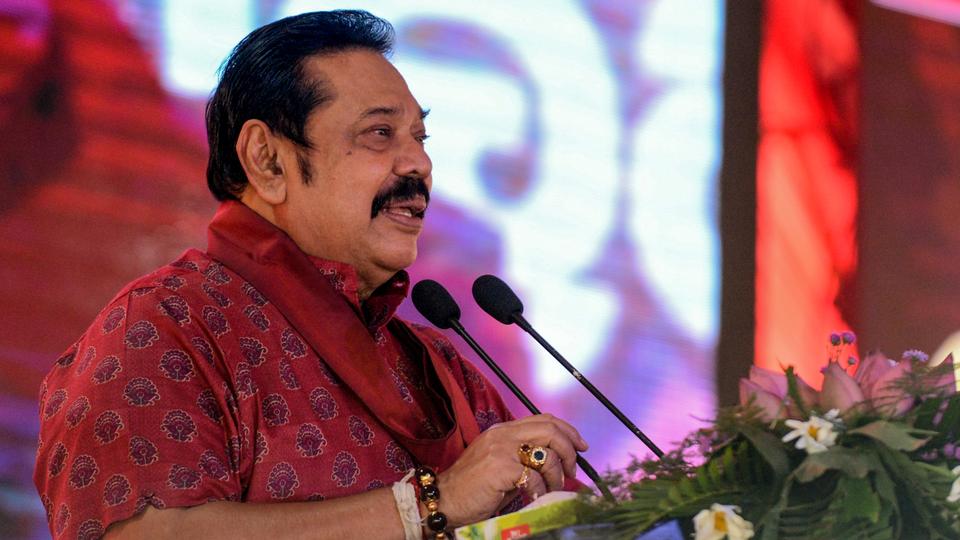
Sri Lanka’s Prime Minister Mahinda Rajapaksa speaks to supporters at a rally ahead of the upcoming parliamentary elections, near the capital Colombo on July 29, 2020 (AFP)
Sri Lanka’s ruling Rajapaksa brothers and their allies have won an unprecedented two-thirds majority in a parliamentary election, according to official results released early on Friday.
Prime Minister Mahinda Rajapaksa’s Sri Lanka Podujana Party (SLPP) won 146 on its own and could count on the support of at least five allies in the 225-member legislature, according to results released early Friday.
Rajapaksa and his brother Gotabaya, who won a presidential election in November, need a two thirds ‘super-majority’ to carry out promised constitutional changes.
The brothers want to roll back constitutional changes made by the previous administration that limit the president’s powers.
Official results showed the party received 6.8 million of the popular vote at an election twice postponed because of the coronavirus pandemic. Just over 70 percent of the 16.2 million electorate turned out to vote on Wednesday.
Even as results were coming in, Gotabaya Rajapaksa, the prime minister’s younger brother, said on Twitter that “results so far indicate an excellent victory for the SLPP.”
SLPP stalwart Udaya Gammanpila said the victory was far greater than anticipated.
“We expected a win, a spectacular win, but not this big a victory,” Gammanpila told reporters.
Indian Prime Minister Narendra Modi telephoned Mahinda Rajapaksa to congratulate him before the party even had a formal majority.
In a Twitter statement, the prime minister said he looked forward to working “closely” with Modi and added that the two countries are “friends and relations”.
Veteran Wickremesinghe out, opposition in shambles
The splintered opposition was decimated. Former prime minister Ranil Wickremesinghe, who has served as the leader of the United National Party for decades, lost his constituency and his party which had 106 seats in the outgoing parliament was reduced to just one seat.
A breakaway party from Wickremesinghe’s headed by the son of assassinated president Ranasinghe Premadasa, Sajith, got 20 percent of the vote and was a distant second with 53 seats.
The moderate Tamil National Alliance (TNA) which had 16 seats in the former parliament also suffered badly and was left with just 10 seats in the new assembly, which is due to meet on August 20.
A left party which had six seats earlier was down to three after Wednesday’s vote. Former cricket World Cup-winning skipper Arjuna Ranatunga also lost his seat.
Consolidated power
The Rajapaksa family have dominated Sri Lankan politics for the past two decades. Mahinda was president from 2005 to 2015.
Since Gotabaya won the presidential election, Sri Lankans have largely embraced the family’s populist platform again.
They have ridden a nationalist wave that followed Easter bombings in 2019 by radicals which killed 279 people.
The brothers are viewed as heroes by the country’s Sinhalese majority for orchestrating a ruthless military campaign to end a decades-long Tamil separatist war in 2009 when Mahinda was president and his brother a key figure in the military.
Huge economic challenges await the new parliament. On Wednesday, official figures showed economic growth fell 1.6 percent in the first quarter of this year while the Asian Development Bank forecast a 6.1 percent contraction of the economy this year.
Decisive parliamentary majority will allow the Rajapaksas to alter the country’s political landscape
The likely decisive parliamentary majority secured by the Sri Lanka Podujana Peramuna (SLPP, or People’s Party) in the island nation’s recent general elections is set to change its political landscape in significant ways.
The political opposition to the Rajapaksas that was in fragments prior to the poll, could be decimated, going by results released until Thursday night.
Pandemic factor
Three months after his election, President Gotabaya Rajapaksa was faced with a raging pandemic. His government, mainly its public health officials with help from the Army, contained its spread early, earning global praise and goodwill within the country.
With President Rajapaksa and Prime Minister Mahinda Rajapaksa leading the party’s campaign ahead of the August 5 polls, crafted by their brother Basil Rajapaksa — known for skilfully cracking poll arithmetic — their victory was certain. Only its extent wasn’t. But the government’s successful pandemic response, a weak and fragmented opposition, and a full-throated campaign appears to have led the party closer to its desired two-thirds majority in parliament.
Chief casualty
Meanwhile, the chief casualty of the poll appears to be the United National Party (UNP), one of Sri Lanka’s oldest parties led by former PM Ranil Wickremesinghe. The Samagi Jana Balawegaya, led by Sajith Premadasa who broke away from the UNP, had secured less than 25% of the votes as of Thursday night. With the rump of the historic Sri Lanka Freedom Party (SLFP) having merged itself with the SLPP, the Rajapaksas have an unprecedented opportunity to consolidate power.
Apparently recognising this, Prime Minister Narendra Modi was among the first world leaders to call Mr. Mahinda Rajapaksa, whose former government was widely accused of tilting towards China.
In a press statement, the Ministry of External Affairs said Mr. Modi noted that the incoming election results indicated an impressive electoral performance” by the SLPP. The two leaders stressed the significance of early progress in all spheres of bilateral cooperation, the media release said.
Further, Mr. Modi informed Mr. Rajapaksa of the establishment of an international airport in the Buddhist pilgrimage city of Kushinagar in India, and said that the city looked forward to welcoming visitors from Sri Lanka at an early date.
Tamil vote
The Tamil National Alliance suffered a setback in the north and east, particularly in Jaffna district.
Though the final tally is awaited, that it has ceded considerable space to allies of the ruling party and to the Tamil nationalist All Ceylon Tamil Congress (ACTC) was clear from early trends.
Sri Lanka follows a proportional representation system of elections where voters mark up to three preferences in candidates. The total tally of seats secured by each party will be known on Friday.
Within this
situation statically the resulting political Revolution could be stated as
follows.
1The SLPP will
get over 175 out of 225 seats in the next Parliament (Eg 155 elected and 20
national list)
2 The divided and disarrayed UNP (R+P camps
together) will settle down around 35 the most (elected + national list)
3 TNA 10 elected
and 1 National list member considering the prevailing divisions within Tamil
politicians in the North and East
4 JVP will get
eliminated from the political map of Sri Lanka
5 Others not
belonging to 1 to 3 and sometime Ape Janabala Vegaya.
(These figures
might slightly vary due to the fact there is always a margin of error in statistical calculations. But I
maintain the overall picture want be much different)
6 All
independent candidates will lose and even their deposits will be confiscated
7 The Old UNP
will disappear from the political scene in this country and this Election will
also mark the end of political carriers of many sitting politicians including
those of Ranil and Premadasa who will win this election and Champika, Rajita, Welgama, Vijitamini
Zoysa and Kiriella and many others of the old stock getting defeated. On the
overall there will be a Tsunami effect devastation on most of the old stock
politicians around the country which we will by the 7th evening.
8 The old SLFP will emerge as the only living national political Party in Sri Lanka under Mahinda Rajapaksa if he accepts its leadership, If not, SLFP will also get vaporized and SLPP will be the only surviving Sinhala National political party after the election
According to the official election results declared so far, Sri Lanka Podujana Peramuna has won a landslide victory.
It is my belief that the hope of establishing a parliament with a capacity of empowering the “Vistas of Prosperity” policies will be achieved by tomorrow, President Gotabaya Rajapaksa said this evening.
Sri Lanka’s ruling party took a clear lead Thursday in early results from parliamentary elections in which the dominant Rajapaksa family hope to strengthen their grip on power.
Counting in the island’s south showed Prime Minister Mahinda Rajapaksa’s Sri Lanka Podujana Party (SLPP) with 72 percent of the vote.
Since the prime minister’s younger brother Gotabaya won a presidential election in November, Sri Lankans have largely embraced the family’s populist platform.
The policy programme emerged from a wave of nationalist sentiment that followed Easter bombings in 2019 by Muslim radicals which killed 279 people.
The brothers are viewed as heroes by the country’s Sinhalese majority for orchestrating a ruthless military campaign to end a decades-long Tamil separatist war in 2009 under the leadership of Mahinda.
The Rajapaksa family is now seeking to expand its mandate with Wednesday’s legislative polls.
Early results on Thursday from postal ballot counts showed the main opposition SJB gleaned just 13 percent of the vote, while the leftist JJB party had eight percent and former prime minister Ranil Wickremesinghe’s United National Party (UNP) just four.
Final results for the coronavirus-delayed election were expected late Thursday.
Private surveys have projected Rajapaksa’s party will take between 130 and 135 seats in the 225-member parliament, short of a two-thirds super-majority it needs to roll back constitutional changes made by the previous administration that limit the president’s powers.
“We are confident of getting two thirds, but even if we don’t get it at the polls, there are ways of getting it through parliament,” the prime minister said Wednesday.
The party could lure rival legislators to back the changes despite an anti-defection law, political commentator Victor Ivan said.
Wednesday’s election — postponed twice due to the epidemic and held with strict social distancing measures — saw a 70 percent turnout from the 16 million-strong electorate.
Huge economic challenges await the new parliament. On Wednesday, official figures showed economic growth fell 1.6 percent in the first quarter of this year.
GoSL cannot pooh pooh the issue any longer. We have on the one hand a terrorist group continuing efforts to revive terrorism & we have another set of Tamil politicians who wish to separate Sri Lanka. The LTTE & Tamil politicians are tied by the quest for the same objective of a separate state but both deploying different tactics. LTTE used terror – Tamil politicians are attempting to do via political compromises. The GoSL has to legally stop both. If the Liberation Tigers of Tamil Eelam is banned in Sri Lanka as well as 32 other countries, that ban cannot be just on paper. Action must be taken against anyone using all insignia associated with the LTTE (emblems, flags etc) The 2020 General Election is seeing the TNA unashamedly displaying the LTTE Tamil Eelam Map. What has the Election Commission done about this? What is the GoSL going to do about this? The situation is made complicated because LTTE hijacked the demands first placed by Tamil leaders, therefore the GoSL must also take legal action against Vaddukodai Resolution, the basis for a separate Tamil state by Tamil politicians. Sri Lanka’s 6thamendment clearly negates any action by individuals or groups to separate Sri Lanka therefore no political party can espouse to separate Sri Lanka while LTTE ban clearly allows action to be taken by GoSL against anyone using LTTE insignia. The GoSL must give the Attorney General’s department a deadline to frame necessary legal action regarding LTTE promoters as well as Tamil politicians espousing separatism of Sri Lanka & promoting LTTE as well.
TAKE ACTION AGAINST TAMIL POLITICIANS
TNA parades Tamil Eelam maps and LTTE links as campaigning draws to a close
Not stopping there, the LTTE foreign communiques are asking Tamils to vote for a particular Tamil candidate – the former Supreme Court judge Wigneswaran
GoSL cannot allow promise of separatism as assurance for votes.
It was the Tamil politicians and NOT the LTTE that first promoted a separate Tamil State.
The 1976 Vaddukoddai Resolution became the first public statement. This single Resolution rallies Tamil politicians and envelopes Tamils to a cause that is alienating them from assimilating with the majority.
The Vaddukoddai Resolution was hurriedly resurrected again in 2008 (before fall of LTTE) by ITAK who was a signatory of the 1976 TULF’s Vaddokoddai Resolution. ITAK amending its 1949 original constitution by endorsing the Vaddukoddai Resolution for a ‘sovereign socialist state of Tamil Eelam’ & then replacing Shamashthi” with Innaipatchchi” in 2008. This signals that ITAK’s aim is to fulfill the TULF’s Vaddukoddai Resolution for Tamil Eelam”.
If ITAK formed in 1949 as Federal Party used ‘shamasthi’ to connote federalism, why did ITAK decide to replace ‘Shamasthi’ (Federalism) is Innaipatchchi” in 2008? The simple answer is that Innaipatchchi means confederalism/confederal/federation – but not federal. The ITAK demands since fall of LTTE has been aligned to a confederal set up of power-sharing. Sumanthiran explains the objective
Clause 17 (D) of the 1949 ITAK Constitution amended by ITAK in 2008.
The General Committee of the Illangai Tamil Arasu Kadchi decided on 24.04.2008 and 03.08.2008 to approve all resolutions and actions taken by the Tamil United Liberation Front (TULF) and the Illankai Tamil Arasu Kadchi from 14 May 1976”.
It was immediately afterwards that a flood of LTTE fronts started forming themselves when the likelihood of Prabakaran & LTTE being eliminated was clear. Just as the Tamil political lobby is connected by the Vaddukoddai Resolution, the LTTE fronts are also using same rhetoric.
Vaddukoddai Resolution
Sought a Tamil Eelam State consisting of people living in North & East,
Declared right to self-determination of Tamil Nation (which LTTE demanded in 1985 Thimpu Talks)
Demanded recognition of Tamils of Ceylon as a nation (which LTTE demanded in 1985 Thimpu Talks)
Declared Tamil Eelam Constitution is a secular state
Declared Tamil will be language of N & E in Tamil Eelam but Sinhalese living in Tamil Eelam can study in Sinhalese
Virtually appealed to youth to take up arms
When ITAK in 2008 endorses the 1976 Vaddukoddai Resolution – ITAK was promoting the same objectives.
What needs to be clearly understood is that every demand being made by Tamil militant groups/LTTE, LTTE Diaspora Fronts & Tamil parties especially TNA & ITAK are all echoing what TULF originally demanded via Vaddukoddai Resolution on 14 May 1976. This was echoed by Sambanthan in 2014 at its annual convention. The most alarming thing is that the Vaddokoddai Resolution ideology is continuing inside the academic halls of Jaffna University
What is important for GoSL and everyone interested in Sri Lanka’s conflict is to understand that Tamil militants only hijacked the objectives already being promoted by Tamil political parties & politicians earlier. The LTTE gave a terrorist touch to a separate Tamil state already drafted by the Tamil politicians. It is when conflicts resulted related to this quest that LTTE resorted to assassinating the Tamil politicians. The overall objective however, remained the same.
Given that the terror aspect of the separate state quest has also been banned, it is time for GoSL to uphold that ban by taking action against those violating the ban. If there are loopholes the GoSL must demand the AG’s department quickly address them so that prompt action can be taken against anyone using LTTE propaganda and insignia.
These include the LTTE flag considered as the Tamil Eelam National Flag adopted on 21 November 1990
The LTTE colours (Red & Yellow) / The LTTE Tamil Eelam National Anthem – Eruthu Paar, Kodi Eruthu Paar” (Look the Flag is Rising) is a Tamil song, written by Puthuvai Rathinathurai, use of Karthigaipoo (Gloriosa Lily) symbol of Maaveerar Naal alongside LTTE insignia, LTTE brigade flags/LTTE unit flags etc.
Just as UK & US terror acts have specific sections where bans deny usage of insignia and material support, Sri Lanka must frame laws to take stern action against anyone violating the ban and causing a disturbance to peace
No peace effort or reconciliation can be meaningful without taking action against the root of the malady and legally plucking the teeth of the Vaddukoddai Resolution. The GoSL must task the AG’s dept to frame legal action against the Vaddukoddai Resolution as this is the source for division and separatist propaganda. Dealing with the Vaddokoddai Resolution legally & taking legal action against anyone flouting ban on LTTE would break the umbilical cord that mentally ties the Tamil people to a dream they know they cannot achieve but are disillusioned to believe so.
By Noor Nizam, Peace and Political Activist, Political Communication Researcher, SLFP/SLPP Stalwart and Convener – The Muslim Voice”, August 6th., 2020.
The advice of
“The Muslim Voice” is that the “Mahinda Pela” should see reality
now. Though the Muslim political so-called “NEW LEADERS” and
“Old leaders” will finally crawl towards President Gotabaya, PM
Mahinda, Chamal and Basil Rajapaksa after August 7th., 2020 when the elections
results have been announced, signals are now confirmed as suggested by The
Muslim Voice” earlier that both Old Muslim leaders, especially a Muslim
political party leader from the Wanni is trying to make a deal with Basil Rajapaksa
to cross over at the appropriate moment. The Muslim Voice” thinks that former
minister Basil Rajapaksa knows much about the activities of these deceptive
Muslim leaders”, Rishad Batiudeen and Rauf Hakeem. We should therefore warn
President Gotabaya Rajapaksa, Hon. PM Mahinda Rajapaksa, Hon. Basil
Rajapaksa and Hon. Dullas Alahapperuma to be ALERT about the
MUNAAFIKK” (deceptive) Muslim politicians, who will be FLOCKING to them to gain
personal benefits trying to say they are the Muslim votes. They should
handle them carefully and make sure that they will NOT try present themselves
as “BROKERS” of the Muslim Vote bank to show a majority in parliament
on August 20th., 2020, if the need arises, which “The Muslim Voice ”
is hopefull will not be so.
When dealing
with these deceptive Muslim leaders – Hon. PM Mahinda Rajapaksa should NOT
forget those Muslims, Muslim voters and Muslim local government politicians who
stood with Mahinda pela”, Gotabaya Rajapaksa, Chamal Rajapaksa, Basil Rajapaksa
and Namal since they were defeated in January 8th., 2015. During these
times, the Beruwela, Aluthgama and Eastern province Muslims have extended their
support to President Gotabaya Rajapaksa and Mahinda Rajapaksa with a hope of
understating and trust that the New PM” will resolve their issues
democratically and listen to them after the 2020 general elections.
They are the
people/Muslim representatives who should be our VOICE in the new President
Gotabaya Rajapaksa – PM Mahinda Rajapaksa government. The Muslim Voice” hope
and pray that this message will reach all Muslims and HE. Gotabaya Rajapaksa,
Hon. Mahinda Rajapaksa who will be the new PM, Hon. Basil Rajapaksa, and Hon.
Dallas Alahapperuma who were entrusted to deal with the Muslims leaders to
support SLPP at the general elections 2015 and 2020. The fact remains NOW,
the Muslim voters “HAVE ACTED” on their own and do NOT wish to
be represented by these MUNAAFIKK and DECEPTIVE POLITICIANS” or any so-called
MUSLIM LEADERS. Those Muslims and local government Muslim members who
stood with the Mahinda pela”, Basil, Gotabaya and Namal since they were
defeated in January 8th., 2015 continued their support to win the Presidential
elections in 2019. Continuing their loyalty to the SLPP and the Rajapaksa
family, these Muslims marched “the path of political agony” created
at the hands of all the “deceptive Muslim political parties, leaders,
Civil society leaders and some of the Ulema and accomplished keeping at bay the
“FALSE” propaganda regarding “COVID19” and the
oppression of the Muslims by the Rajapaksa regime, as they attempted to show
the Muslim vote bank that they are the saviours of the Muslims in Sri
Lanka.
President
Gotabaya Rajapaksa, the New PM Mahinda Rajapaksa, Hon. Chamal Rajapaksa, Hon.
Basil Rajapaksa and Hon. Namal Rajapaksa “SHOULD NOT FORGET” the
contributions and sacrifies these loyalists had made (in their little way)
towards the great success and “VICTORY” that the SLPP has made today,
by the grace of God AllMighty. They are the political soldiers of the Muslims
who fought the vicious “yahapalana gang”, the Samagi Jana Balawegaya,
The UNP, the JVP and the TNA in the fronts where the political struggle was
going on to capture the minority votes, especially the Muslims votes and have
dilivered their best in support of the SLPP, but, like “COWARD
SOLDIERS” who took shelter and waited to score on the victories of the
longstanding and loyal Muslim political soldiers, some Muslim individuals have
been seen in the SLPP platforms claiming that they will be the New Muslim
Leadership under the new government to be formed.
This has become
the sad situation of “PART” of the Muslim vote bank that had suppoted
the SLPP in 2015 and now in 2020 general elections. WILL THE RAJAPAKSA FAMILY
NOT FORGET THESE MUSLIM POLITICAL SOLDIERS DURING THEIR GOVERNANCE DURING THE
NEXT 5 YEARS.
UNP Leader and former Prime Minister Ranil Wickremesinghe expressed hopes that today’s general elections would be the last held under the Proportional Representation (PR) system in Sri Lanka.
Hopefully this would be the last general elections held in this country under the PR system. We proposed a mixed system without preferential votes when we were in the government. I hope we could work out an agreement and bring about a change in the electoral system,” Mr. Wickremesinghe told journalists after casting his vote at College House polling station today.
Also he said the Commission of Elections had done a good job ensuring that the election is conducted under strict health guidelines. I would like to thank the Commission of Elections for ensuring that health guidelines are followed when conducting the poll,” he added.
The online campaigns which were vastly visible in this election is likely to continue,” he said.
Sri Lankans vote in large numbers despite the Covid-19 pandemic as the ruling Rajapaksa brothers sought to expand their mandate through the virus-delayed parliamentary polls.
A health official takes the temperature of election officials who arrive with ballot boxes from polling station to a counting center, after the voting ended during the country’s parliamentary election in Colombo, Sri Lanka, August 5, 2020. (Reuters)
Sri Lankans have voted to elect a new Parliament that is expected to give strong support to the powerful and popular Rajapaksa brothers.
President Gotabaya Rajapaksa was elected last November after projecting himself as the only leader who could secure the country after the Daesh-inspired bombings of churches and hotels on Easter Sunday that killed 269 people.
His older brother, charismatic former President Mahinda Rajapaksa, is seeking a majority of the 225 seats in Parliament to return as prime minister.
At least four members of the family were running in Wednesday’s parliamentary election, and strong support for the Rajapaksas’ party could add to their political dynasty.
Police spokesman Priyantha Weerasuriya said the voting, which ended at 5 p.m., was largely peaceful and that police officers were escorting the ballot boxes to the counting centers.
Counting starts on Thursday and the final results are expected on Friday.
More than 16 million people were eligible to vote to elect 196 lawmakers, with the rest being named from a national list according to the number of votes received by each party or independe nt group.
The election was originally scheduled for April but was twice postponed due to the Covid-19 pandemic.
Sri Lanka has largely contained the spread of the virus, with 2,834 confirmed cases, including 11 deaths.
Health measures were put in place at polling booths with social distancing. Voters were asked to bring their own pens to mark their ballots, or use disinfected pens provided at voting stations.
Economic woes
Even with a super-majority, the incoming administration faces challenges.
The economy had scarcely recovered from the blow of the 2019 bombings before the coronavirus epidemic struck, prompting lockdowns that have still not been fully lifted.
Still, Sri Lanka appears to have escaped the worst of the contagion.
Test result figures are considered dubious by opposition parties, but authorities have reported just 11 deaths from fewer than 3,000 cases.
“They will win by a huge margin but the economic and social problems post-Covid-19 will be huge,” said political analyst Kusal Perera.
The Asian Development Bank expects the island’s economy to shrink by an unprecedented 6.1 percent this year.
Mahinda is expected to lean heavily on China for economic assistance, as he did during a decade as president until 2015, but also increasingly on neighbouring India.
President says as the 1st South Asian country to hold General Elections amidst Covid-19, the 71% islandwide voter turnout reflects the confidence of Sri Lankans on the Government’s efforts in controlling the pandemic
The National Election Complaints Management Center and the District Election Complaints Management Centers have received 337 complaints regarding election law violations today, the Elections Commission stated.
The total number of complaints received after the announcement of the election is 8362.
Meanwhile, a 32 year old man who photographed the ballot paper at the Nawalapitiya Central College polling station was arrested and remanded till the 13th after being produced before court.
Also, a police inspector who came to the counting center at the Siyane National College of Education in Veyangoda – Pattalagedara and got into a dispute while being intoxicated has been suspended.
A woman living in the Kurukulawa area in Ragama who came to cast her vote at the polling station set up at St. Lazarus Church this afternoon was informed that her vote had been used by someone else.
Police Media Spokesman SSP Jaliya Senaratne addressing a media briefing held at the Police Headquarters this afternoon stated that seven candidates have been arrested for violating election laws.