Personal stress reduction certainly has merits in a crisis like the current one, but it can also be exploited and misused
In Buddhist teaching, mindfulness is inextricably tied to an ethical approach to life that upholds virtuous, non-violent action. Image: iStock
Calling the Covid-19 pandemic the worst crisis since World War II, one that may bring a recession with no parallel in the recent past,” United Nations Secretary General Antonio Guterres has urged world leaders to understand that humankind is at stake.”
The numbers of infections and deaths attributed to Covid-19 are increasing exponentially. Human activity has come to a halt with worldwide community lockdowns, quarantining and social isolation. The dystopian future projected in science-fiction movies seems to be here: surreal, empty airports; eerie, ghost-like city centers; a still landscape without humans.
As human interaction shifts more and more online, faith groups, psychologists, yoga and Pilates instructors and innumerable others are offering helpful services to grief-stricken, fearful and anxious people via webinars, zoom meetings and the like. One of the most popular of these offerings is mindfulness meditation, which teaches individuals to find peace and stability within themselves amid the tremendous uncertainties and frightening realities around them.
For example, a webinar by Jon Kabat-Zinn, founder of Mindfulness Based Stress Reduction (MBSR), on March 25 attracted more than 21,000 people from 115 countries and had more than 96,000 subsequent views as of this Sunday. Kabat-Zinn’s stated vision is to make the whole world an MBSR classroom.”
Indeed, mindfulness – the cultivation of present-moment awareness and equanimity by focusing on breathing and body sensations – is based on Buddhist teaching, and is a valuable tool for finding the much-needed inner solace and guidance for these challenging times. Mindfulness practice can also help develop sensitivity to the realities of impermanence, suffering and interdependence of life and cultivate compassion toward the self and others. Both have acute relevance to the Covid-19 pandemic.
Diverse schools of mindfulness meditation have become popular in the West over the last few decades, with leading advocates from corporate, media and Hollywood elites. Microsoft co-founder Bill Gates, who predicted a huge threat of a global pandemic in 2015 and conducted a simulation in late 2019 predicting up to 65 million deaths due to a coronavirus, is reportedly a dedicated if not obsessive meditator.”
Leading tech companies, consulting firms and banks including Google, Apple, Deutsche Bank and McKinsey and Co promote employee meditation to relieve stress and increase productivity. It is said that in Silicon Valley meditation is no fad, it could make your career.” Ironically, even the US military is teaching mindfulness meditation to enhance the performance and resilience of soldiers.
However, these profit- and power-focused approaches to mindfulness ignore the dangerous global and national policies that harm people and the environment, so that the core principles of interdependence and compassion become mere platitudes.
In Buddhist teaching, mindfulness is inextricably tied to an ethical approach to life that upholds virtuous, non-violent action. The corporate approach to mindfulness, on the other hand, does not offer direction or tools to understand how socio-economic forces have contributed to the emergence of the Covid-19 pandemic and to the interrelated ecological and social crises. Nor does it help explore the ethical criteria and actions needed to create sustainable and socially just development. Referred to as McMindfulness” by critics, it can be argued that this form of mindfulness actually weakens interest in social-change activism and social transformation.
Expanding mindfulness
Mindfulness practice calls for awareness of the present moment and seeing reality objectively. The Buddhist teaching also calls for an understanding of the causes of suffering, as exhibited in the current pandemic: greed, hatred and ignorance. How can we focus the awareness, wisdom and compassion provided by mindfulness to challenging the prioritization by many governments of profit and defense over universal health care, an imbalance that has left so many vulnerable to Covid-19?
India, the biggest importer of weapons in the world, spends nearly five times as much on defense as on health care. When US President Donald Trump visited India amid the spread of the coronavirus in February 2020, he signed an agreement facilitating an arms deal of $3 billion worth of weapons from the US, the world’s biggest producer of armaments. Interest in the expansion of the US-India alliance against China in the Indo-Pacific region prevailed over health and human security even after the World Health Organization had declared the coronavirus outbreak a Public Health Emergency of International Concern.”
Given the lack of basic necessities, thousands of migrant workers in Indian cities have been forced to find their way back to their villages since a lockdown was declared on March 25, often walking hundreds of kilometers without food or water. In New York and other epicenters of the disease in the US, thousands of people without health insurance or steady incomes are forced into food-service work, as home health aides and other jobs that are declared essential. Many doctors and other hospital workers in the US and elsewhere have to work without adequate access to masks and protective gear, putting their lives on the line.
The pandemic clearly shows that the health of the self cannot be separated from the health of the other. Still, corporate interests and policymakers are continuing their socially and environmentally destructive agendas, ignoring the fundamental biological and social principle of interdependence.
In this context, how can mindfulness meditators and others protest the inhumane acts of the International Monetary Fund withholding emergency loans requested by Venezuela and Iran to fight Covid-19, assumedly because of US political interests? Likewise, how can we bring awareness and compassion to the reality that energy companies like TC Energy (formerly TransCanada) are seeking to continue such controversial projects as the Keystone XL Pipeline during the Covid-19 crisis, disregarding protests by indigenous communities who would be most affected?
Post-Covid-19 world
Everyone is waiting for the vaccine, the technological fix that will presumably eliminate the virus threat and allow the world to return to normalcy.” When we eventually come out of quarantine and isolation, what kind of world will we step into? A healthy, happy, secure world for all?
No, unfortunately, it will most likely be an even more unsustainable, unequal, corrupt and repressive world than what we had in the pre-Covid-19 era. In the US alone, coronavirus-related job loss is estimated at 47 million, with an unemployment rate of 32%. While the US Senate stimulus package just passed will provide minimum support for workers, the $500 billion corporate bailout package to the airline and other industries will allow them to get back into business without environmental and social accountability.
Ecologists are saying that Covid-19 is just the tip of the iceberg, the beginning of mass pandemics caused by increasing habitat and biodiversity loss due to human encroachment and climate change. Indeed, if we don’t redress climate change and environmental collapse soon, the next coronavirus pandemics will likely make life on Earth even more precarious.
In the tradition of emergency responses eroding our social liberties, if we are not vigilant of the increased technological surveillance and state and corporate control over our lives and widespread loss of civil and democratic rights during this crisis, we may not be able to get them back.
In the midst of the pandemic, Bill Gates is calling for a digital certificate” to identify individuals receiving the upcoming Covid-19 vaccine. Backed by a massive organization called ID2020, these certificates are expected to be used to grant access to other social and economic rights and services. Mass vaccination to eradicate Covid-19 is seen as the opportunity to introduce a worldwide digital ID, and ID2020 is already testing one in Bangladesh that is biometrically linked” to fingerprints.
Reportedly, a covert way to embed the record of a vaccination directly in a patient’s skin” – called a quantum dot tattoo” – is also being researched at the Massachusetts Institute of Technology with support from the Bill and Melinda Gates Foundation.
Mindfulness and activism
In response to this unprecedented crisis, if more and more educated and relatively privileged mindfulness meditators simply turn inward, they will become a part of the problem and not a part of the solution. Sitting on a cushion and closing one’s eyes to escape the fear and horror, only turning inward, we fail to extend our awareness to these developments and their ethical, social justice and ecological implications.
We cannot let mindfulness practice drawn from the Buddha’s profound teaching become a new soma, the suppressive-escapist elixir distributed in Aldous Huxley’s Brave New World to pacify, silence and disengage people from difficult and painful social realities.
But the silence of meditation practice and the collective action of social movements need not be antithetical; in fact, they can complement each other in creative and diverse ways. We need to explore the many ways that the inner transition of awareness, compassion and resilience from mindfulness meditation – and other practices, such as communion with nature, prayer and chanting – can be applied to an outer political and economic transition in order to meet the unprecedented challenges of the Covid-19 pandemic, the economic recession and the survival of humankind.
Faced with the deranged and apocalyptic path of neoliberal post-industrialism, increasing numbers of groups are distancing themselves from agribusiness and megalithic corporations and living and working in ecological and community based ways on the land with each other. The Covid-19 crisis makes it abundantly clear that electing ethical and responsible individuals into political office, people’s representatives who can uphold environmental sustainability and human well-being over corporate profit, is both an act of ethical mindfulness and political activism.
The culturally conditioned, media-driven belief that we cannot do much to change the world is mistaken. The origin and historical evolution of the dominant trajectory of global military and economic expansion is attributable to a small elite. Understandably, most people are currently preoccupied with survival, but it is possible for some of us, including mindfulness meditators, to awaken ourselves to the larger social and ecological realities and exercise our agency, rights and responsibilities as parents, teachers, citizens and humans.
As the late cultural anthropologist Margaret Mead said, Never doubt that a small group of thoughtful, committed citizens can change the world; indeed, it’s the only thing that ever has.”
President Gotabaya Rajapaksa and Prime Minister Mahinda Rajapaksa discussed matters relating to the prevailing situation in the wake of COVID-19 spread with the representatives of Samagi Jana Balawegaya at the Presidential Secretariat today (06).
President Rajapaksa elaborated on the measures already taken by the Government to prevent the spread of the lethal virus and the future actions in this regard, stated President’s Media Division.
The responsible manner in which the Government acted following the declaration by the World Health Organization about the pandemic was explained by the President. The Government was able to take several swift actions to safeguard the citizens of this country, President said.
Every step to ensure uninterrupted day-to-day civilian life was taken. These timely measures were instrumental in controlling the spread. Actions were taken under the guidance of experts in collaboration with the health sector and security forces. Pre-testing with the assistance of medical consultants to identify the infected and those associated with them will continue. This will be helpful for the early detection of the affected, President added.
The quarantine process continues at 40 centers. Programs have been initiated with the assistance of Public Health Officers (PHIs) to mitigate the spread of COVID- 19 in areas where the infected have been identified. President lauded the service of the PHIs in detection and observation processes.
The representatives of Samagi Jana Balawegaya expressed their satisfaction over the measures taken by the Government so far. Both parties agreed that this should continue without political or any other differences.
Prime Minister Mahinda Rajapaksa stated that if there are any shortcomings in the government programs, immediate action will be taken to rectify them.
President Rajapaksa and the leader of the Samagi Jana Balawegaya, Sajith Premadasa requested the employers to attend to the needs of their employees who are engaged in various daily wage based industries including construction sector as they can get stranded and have not been able to return to their homes.
A stock of essential medicine required for daily healthcare services including medicine for non-communicable diseases is to arrive in the island from India tomorrow (07) upon the request by the government.
The President explained that after taking the current global economic and social crisis into account, plans are already underway to implement an appropriate economic model suitable to Sri Lanka. President Rajapaksa highlighted that the experts have been consulted to uplift the apparel and tourism industries which have suffered a setback and the government will take action under their instructions when the opportunity permits.
In addition to Samurdhi beneficiaries, 700,000 senior citizens, disabled persons and Kidney patients have been granted an allowance of Rs 5,000 without any discrimination. Chief of the Presidential Task Force, Basil Rajapaksa stated that if any individual had not received their allowance yet, he/she is entitled to make an appeal with their respective Grama Niladhari Officer.
Government and the Samagi Jana Balawegaya paid their attention to future plans in number fields including healthcare.
Ministers Dinesh Gunawardena, Nimal Siripala De Silva, Wimal Weerawansa, Dullas Alahapperuma, Bandula Gunawardana, and Johnston Fernando represented the government while Samagi Jana Balawegaya was represented by its leader Sajith Premadasa and General Secretary, Ranjith Maddumabandara. Secretary to the President, Dr. P.B. Jayasundara and several others were present as well.
The suspect who stabbed a Public Health Inspector (PHI) who was on COVID-19 prevention duty has been produced before the Mawanella Magistrate’s Court today (06).
Accordingly, the teenaged suspect has been ordered to be placed at the Consultation Centre of the Boys’ Detention House in Algoda, Dehiowita until the 25th of August.
A 16-year old had attacked a PHI attached to the Rambukkana Public Health Office on coronavirus prevention duty at Paththampitiya area in Rambukkana at around 3.00 pm on Saturday (04).
The assaulted PHI is currently receiving treatment at Rambukkana Hospital.
The suspect was arrested by the officers of Rambukkana Police at Heenabowa area yesterday (05).
Rambukkana Police is probing the incident further.
Minister of Health Pavithra Wanniarachchi says that Sri Lanka’s health sector has always been ahead of the South Asian countries with regard to the coronavirus eradication program.
She added that Polymerase chain reaction (PCR) tests are now being carried out in many hospitals across the island to identify COVID-19 infections.
The COVID-19 testing will be further expanded within the coming days, Wanniarachchi added.
Sri Lanka Police says that 171 individuals have been arrested for violating the curfew within the period of 06 hours ending from 12 noon today (6).
Issuing a statement, it said that 86 vehicles were also taken into custody during this period.
Accordingly, as of 12 noon today police have arrested a total of 14,966 persons for violating the curfew from across the country while 3,751 vehicles have also been taken into custody.
Sri Lanka Police has warned of strict legal action against people caught violating the countrywide curfew.
They will be immediately arrested, even without a warrant, and police bail will not be granted for them, police said.
Police also noted that none of the vehicles taken into custody will be released back to their respective owners, until the prevailing Coronavirus threat is eliminated.
The government imposed an island-wide curfew with the intention of minimizing public movement in order to contain the spread of the coronavirus (Covid-19) outbreak in the country.
A representative consortium of over 60 of Sri Lanka’s leading indigenous medical practitioners was invited to immediately explore possibilities of finding an alternative traditional medicine to cure the COVID-19 pandemic.
The meeting took place at the invitation of the Health Ministry and Head of the National Operation Centre for Prevention of COVID-19 Outbreak (NOCPCO) at Rajagiriya last afternoon (05), stated Sri Lanka Army.
The joint gesture, mooted by the Ayurvedic Medical Council (AMC) at the Ministry of Health and Indigenous Medicine, NOCPCO and General (retd) Daya Ratnayake, former Commander of the Army and Chairman, Sri Lanka Ports Authority was co-chaired by Hon Minister of Health and Indigenous Medicine Pavithra Wanniarachchi and Lieutenant General Silva, Head of the NOCPCO and Chief of Defence Staff and Commander of the Army.
General (retd) Daya Ratnayake at the outset after NOCPCO Head welcomed the Minister and the gathering told the objective of the assembly tracing historical and ancestral roots that testify to the herbal and indigenous expertise, the country has had possessed down the generations, and how it had effectively cured people using exotic herbal medicine mixtures, concoctions, etc and other healing practices.
A presentation, submitted by Ayurvedic practitioners explained how indigenous medical practices could be applied in the treatment of this deadly epidemic and other associated preventive measures, inclusive of the conduct of precautionary, curative and post-treatment phases of the indigenous practices, etc.
Those leading practitioners were unanimous in finding a permanent medical solution to the deadly pandemic and pointed out how such practices could be applied with precision.
Minister Wanniarachchi and Lieutenant General Silva towards the end of productive discussions and deliberations urged the gathering to find an alternative indigenous medicine at the earliest, identical to how China has now discovered. Lieutenant General Silva further asserted that armed forces in consultation with the Health Ministry would do everything possible to facilitate its production process if at all such attempts proved successful.
Ven Dhamma Dammissara Thero, leading Ayurvedic practitioners, Commissioner of Ayurveda, Mr Chatura Kumarathunga, State Secretary of Ministry of Health and Indigenous Medicine, Mrs Vijitha Senevirathna, Additional Secretary of Ministry of Health, Mrs H.W. M Pushpalathamenike, Deputy Director of Health Ministry, Dr T Weerarathna, Convener, National Committee for Provincial Ayurveda Commissioners, Major General (Dr) Sanjeewa Munasinghe and Senior Officers were present during the discussion.
Ancient inscriptions on rock surfaces reveal that organized herbal medical services have existed within the country for centuries and Sri Lanka claims to be the first country in the world to have established dedicated hospitals with the capability of performing surgeries even for the animals. The rock, Mihintale still has the ruins of what many believe to be the first hospital in the world. Historically, the Ayurvedic physicians enjoyed a noble position in the country’s social hierarchy due to their royal patronage.
The Government Medical Officers Association (GMOA) today urged
the health authorities to speed up the COVID-19 testing of some 42,000
personnel who have been in contact with over 160 patients tested positive for
the virus in the country.
GMOA member Dr. Naveen De Soyza said it was revealed at a
meeting held at the Presidential Secretariat yesterday that about 42,000 people
have been in contact with those tested positive. He said the current pace of
testing was not adequate to efficiently counter the spread of the virus.
“We have requested the authorities to immediately conduct the blood tests for COVID-19 instead of the usual PCR test which is time-consuming,” he said. The GMOA requested to increase the number of tests done per day to isolate infected people as much as possible.
Apparently the GMOA member Dr. Naveen De Soyza is not aware of the test facilities available for identifying coronavirus infected persons.
The blood test Dr. Naveen De Soyza is refereeing to the
antibodies test suitable for patients to check the immunity after recovering
from the infections and not suitable for those who are having the infection.
The following information is extracted BBC website.
Coronavirus: Why does testing matter?
By Rachel SchraerHealth reporter Courtesy BBC
The UK has announced new plans to boost testing
for coronavirus following widespread criticism for not increasing the number of
tests more quickly.
But why is testing important and how does the UK
compare with other countries?
What is the
test?
The main type of test to see if someone has Covid-19, is taking a swab of their nose or throat.
This is sent off to a lab to look for signs of
the virus’s genetic material.
Can I get
tested?
Testing is not yet available for most people.
At the moment, most tests are reserved for
seriously ill patients in hospital.
It means the majority of people who have
symptoms can’t find out if they are currently infected with coronavirus.
Tests are now being made available to doctors
and nurses who have symptoms, or who live in a household with someone who does.
Tests for other health and care workers will follow.
Health Secretary Matt Hancock said on Thursday
that 5,000 NHS staff had now been tested across various testing sites.
Overall, 163,100 people in the UK have been
tested since the end of January.
Why isn’t the
UK doing more tests?
The UK has not had the resources to do mass
testing.
Health Secretary Matt Hancock said on Thursday:
“We have the best scientific labs in the world but we did not have the
scale. My German counterpart for instance could call upon 100 testing labs
ready and waiting when the crisis struck.”
The government is aiming to carry out 100,000
tests a day in England by the end of April. By 2 April, daily testing had
reached around 10,200.
Some NHS trusts say they can only carry out a
limited number of tests because of shortages of swabs, testing kits and
reagents.
A reagent is the substance used to extract the
virus’s genetic material so it can be studied more easily. At the moment there
is high global demand for reagents, which is why they are hard to obtain.
At first, Public Health England was only using
its own eight laboratories. This has been expanded to 40 NHS labs – so, 48 labs
in total.
The government says it is now working to recruit
more laboratories at universities and research institutes. These will be used
to test NHS workers.
Plans have also been announced to work with
commercial partners such as Boots and Amazon, as well as with big
pharmaceutical companies to build up the UK’s diagnostic capacity.
Why is
testing important?
There are two main reasons for testing people – to
diagnose who has got the virus and who has had it.
Having this information could help the health
service plan for extra demand, including on intensive care units.
Testing could also inform decisions around
social distancing measures. For example, if large numbers of people were found
to have already been infected, then a lockdown might become less necessary.
And not testing more widely means many people
might be self-isolating for no reason, including NHS workers.
An antibody test is used
to see whether someone has already had the virus. They look for signs of
immunity in the blood by using a drop of blood on a device, a bit like a
pregnancy test.
The government has bought three-and-a-half
million antibody tests, but they are not yet available to use. The tests are
still being checked to make sure they work.
How about the
rest of the world?
South Korea, which has been able to test far
more widely than the UK has, acted very quickly to approve the production of
testing kits, allowing it to build up a stockpile.
Despite having a slightly smaller population
than the UK, it has twice as many labs and about two-and-a-half times the
weekly testing capacity.
Germany has carried out more than three times as
many tests as the UK.
By 27 March, it had tested 1,096 per 100,000
citizens, while as of 1 April, the UK had tested 348 per 100,000 of the
population.
That compares with 895 per 100,000 for Italy,
842 per 100,000 for South Korea, 348 per 100,000 for USA and 27 per 100,000 for
Japan.
The cremation/burial
drama seems to be a distraction from the real issue – Tablighi Jamaat. The
event held in New Delhi from March 13-15 by this group is the super spreader of
the Coronavirus in India. 34 had participated from Sri Lanka too.
An Introduction
quoted from senior Indian bureaucrat, diplomat and politician K Natwar Singh is
given below. He calls on the Indian government to ban the organization. Sri
Lanka must also consider banning their affiliated organisations in the island.
Alami Markaz in Nizamuddin is the headquarter of the fanatical Tablighi Jamaat. Its leader is Maulana Saad Kandhalvi. He is absconding. Many of his followers are responsible for a large number of coronavirus deaths, particularly in Tamil Nadu. These fanatics spread the pandemic in various parts of the country, by not observing the guidelines laid down by the Central government—social distancing, no shaking hands and above all stay at home”.
Unquote.
1,023 cases out of a
total of 3,030 cases in India as at 3 April 2020 have linked with Tablighi
Jamaat. That is more than one third. 39 Indian deaths are also linked to them.
It was reported that 34 from Sri Lanka attended the service too and they are in
Sri Lanka. Pakistan (a Muslim country!) has quarantined all Tablighi Jamaat
missionaries.
Quote – The Tablighi
Jamaat’s chief, Maulana Saad Kandhalvi, and other members of the group have
been booked under the Epidemic Disease Act, 1897 and relevant sections of the
Indian Penal Code for violating government orders of not organising public
gatherings and maintaining social distance to contain the spread of
coronavirus.
Sri Lanka must
also follow suit to arrest and punish the organisers of this event under the
same Act. The British introduced the same Act in both Sri Lanka and India with
only minor differences. An offence in India is also an offence in Sri Lanka
under the Act.
Pointing out these facts is not arousing racism. It is
realism. Lives and health of 21 million people must not be put to risk. There
is no bigger racism than the callous disregard of life and health of fellow
countrymen belonging to other spiritual followings. Sri Lankan government and
the military must act now as it is a military matter, not just a health issue
anymore. Don’t get sidetracked by petty cremation/burial dramatization.
A veritable caterwaul of protest has erupted from local and international NGO quarters over the presidential pardon extended to a former soldier Sunil Ratnayake, who had been convicted and sentenced to death over an incident, in 2000, when eight Tamil persons including a five-year-old child were killed in Mirusuvil in Jaffna. The Office of the UN High Commissioner for Human Rights said, in a statement, that the release of this individual was an affront to the victims who lost their lives in that incident. An Al Jazeera report on this matter explained that Sunil Ratnayake had been sentenced to death for ‘slitting the throats’ of Tamil civilians including four children. Amnesty International, Human Rights Watch, The Sri Lanka Human Rights Commission, and the International Commission of Jurists have also condemned the release of this convict. Furthermore, 22 foreign funded NGOs in Sri Lanka have issued a statement saying, among other things, that the President has given his blessing to a ‘cold-blooded killer’.
Many of those who have condemned the release of this convict have also pointed out that his conviction by a High Court Trial-at-Bar was unanimously upheld by a five-member bench of the Supreme Court. The statements issued in relation to this presidential pardon would lead one to think that it has been proven in court that the convict in question personally killed or participated in the killing of the eight victims. That is what one normally expects when talking about a murder conviction. The judgment, however, does not state anywhere that there was any evidence to show that Ratnayake personally killed any of the victims. The facts of this case which emerge from the Supreme Court judgment are as follows:
In April 2000 the LTTE overran Elephant Pass and the army had to reposition its defence lines. Due to shells falling in the vicinity, the villagers of Mirusuvil had to abandon their homes and seek refuge elsewhere.
However, they visited their abandoned properties, once in a while, to clean the places and to collect whatever produce that they could make use of. On the 18th December 2000, an army unit was deployed in the Mirusuvil area. On the 19th December, 2000, a group of villagers – Raviwarman, Thaivakulasingham, Wilvarasa Pradeepan, Wilvarasa Sinniah, Nadesu Jayachandran, K. Gnanachandran, G. Shanthan, Wilvarasa Prasad and Maheshwaran came Mirusuvil to visit their respective houses. By 4.00 in the afternoon, they were getting ready to go back when they were stopped and questioned by some soldiers. Raviwarman, who had lost his left arm in a shell explosion when he was a child, could speak some Sinhala and explained the reason for their presence in the area. The soldiers then assaulted the villagers who were with him. Maheshwaran stated that he had been blindfolded with his sarong and assaulted and he had lost consciousness. After a while, however, he regained his senses. At that point, two military men carried him and tossed him over a fence. In the process his blindfold had got entangled with the barbed wire of the fence.
He was then taken to a location where there was a cesspit. According to Maheshwaran he noticed patches of blood on the cesspit slab and also sensed some movements emanating from inside the cesspit. Fearing that the others who came with him had been harmed and that he too would face the same fate, he pushed the two soldiers who approached to blindfold him again and ran for his life through the thicket, clad only in his underwear. He spent the night at a house of one of his aunts, about a quarter of a mile away. The following morning, on his way home, he met his father who had come out looking for him and both of them returned to their temporary residence at Karaweddi. They then complained about the incident to the EPDP office in the area. Maheshwaran was subsequently admitted to hospital.
On the 22nd December he left the hospital and returned home. The following day he was visited by military personnel who had questioned him about the incident. On the same day Maheshwaran accompanied by his parents, members of the EPDP, the Gramasevaka of the area along with the Military Police officers, visited the location of the cesspit. What they found inside the pit were parts of the carcass of a goat and a reptile.
Five arrested over the incident
Major Sydney de Soyza was in charge of the military police in the Jaffna region, and he, too, had been with the group visiting scene of the incident. On making inquiries he had come to know that about 20 soldiers of an Army Special Operations Unit were occupying a building in the vicinity. The Chief Officer of that Unit Sergeant Ranasinghe, accompanied by several other soldiers, had approached the location of the cesspit and witness Maheshwaran had suddenly shouted saying that two of the soldiers who came with Sergeant Ranasinghe were the soldiers who had restrained and assaulted him. The soldiers identified by Maheshwaran were Lance Corporal Sunil Rathnayake and Private Mahinda Kumarasinghe. The two army men had become restless and had shown signs of fear. Major de Soyza had then directed Major Premalal to question the two soldiers. The duo had been very restless, so much so that Major Premalal had to tell them that there was no reason for them to be so disturbed. Major Soyza had thereupon placed under arrest five soldiers inclusive of Lance Corporal Ratnayake and Private Kumarasinghe.
Based on a statement made by Lance Corporal Ratnayake, Major Sydney de Soyza along with a team of Military Police officers, visited the area again and Lance Corporal Rathnayake pointed out a location which had loose soil covered with small branches. Then steps had been taken to inform the Police. The police arrived at the scene headed by the SSP Kankesanthurai followed by the Magistrate who ordered the police to dig the area. The bodies of the eight victims were recovered. Steps were taken to have identification parades held where a number of military personnel suspected of committing the crime, were produced (13 in all). Five of them were identified by Maheshwaran.
The Attorney General indicted the five persons, so identified on 19 Counts. Count 1 was committing an offence punishable under Section 140 of the Penal Code as a member of an unlawful assembly with the common object of causing intimidation to Raviwarman. Counts 2, 3, 4, 5, 6, 7, 8 and 9 were committing the murders of Raviwarman, Thaivakulasingham, Wilvarasa Pradeepan, Wilvarasa Sinniah, Nadesu Jayachandran, K. Gnanachandran, G. Shanthan and Wilvarasa Prasad, an offence punishable under Section 296 of the Penal Code read with section 146 of the Penal Code. Section 296 of the Penal Code states that whoever commits murder shall be punished with death. Section 140 states that members of an unlawful assembly shall be punished with imprisonment of either description for a term which may extend to six months, or with a fine, or with both and Section 146 of the Penal Code states that if an offence is committed by any member of an unlawful assembly in prosecution of the common object of that assembly, every person who, at the time of the committing of that offence, is a member of the same assembly is guilty of that offence.
Count 10 was causing hurt to Maheshwaran, an offence punishable under Section 314 of the Penal Code read with Section 146 of the Penal Code. Section 314 of the Penal Code states that whoever voluntarily causes hurt shall be punished with imprisonment of either description for a term which may extend to one year, or with fine which may extend to one thousand rupees, or with both. Counts11 to 18 are again counts of murder in respect of the persons referred to in Counts 2 to 9, however the basis of liability under the said Counts is Common Intention articulated in Section 32 of the Penal Code and Count 19 again is the corresponding charge of causing hurt, referred to in Count 10, based on Common Intention.
What Section 32 of the Penal Code states is that when a criminal act is done by several persons in furtherance of the common intention of all, each of such persons is liable for that act in the same manner as if it were done by him alone. The High Court Trial-at-Bar acquitted the 2nd, 3rd, 4th and 5th accused, but convicted the 1st Accused Lance Corporal Sunil Ratnayake on all counts referred to above. On appeal, the Supreme Court unanimously set aside the conviction of Lance Corporal Sunil Ratnayake, on Counts 1 to 10. What remained were Counts 11 to 19 which are based on the vicarious liability of common intention under Section 32 of the Penal Code. The SC also made the following observations:
· The entire prosecution case hinges on Maheshwaran’s testimony.
· This is a case where the court has to decide, mainly on circumstantial evidence.
· The acquittal of the 2nd, 3rd, 4th, and 5th Accused by the High Court Trial-At-Bar was due to the failure on the part of the prosecution to establish the identities of those Accused to the degree of proof required by law.
· However, the spontaneous identification of Lance Corporal Sunil Ratnayake by witness Maheshwaran at the scene of the crime (as recounted above) remains unassailed.
A borderline case
On the basis of the above, the SC held that Lance Corporal Ratnayake was not only liable for the acts committed by him, but also for the acts committed by others who were with him as well, according to Section 32 of the Penal Code. When the deceased were seen last, they were detained by Ratnayake and the other Army personnel who were present. It was on that basis that the SC upheld the conviction of Lance Corporal Sunil Ratnayake, on Counts 11 to 18 and on Count 19 of causing hurt to Maheshwaran. Thus it can be seen that Ratnayake was not convicted due to evidence indicating that he personally killed the eight victims but on the basis of vicarious liability for the whole incident under Section 32 of the Penal Code. The principal witness Maheswaran accused Lance Corporal Ratnayake of assault but did not say that he had seen Ratnayake killing anybody or even holding a weapon which may have been used to kill the people concerned. Because the conviction has been affirmed on the basis of Section 32 of the Penal Code, there is a borderline element in this case.
Certain international and national parties whose interests are only too well known, have rushed to condemn the release of Sunil Ratnayake. However when President Maithripala Sirisena released an LTTE suicide cadre who had been convicted of complicity in a plot to kill him, his action was welcomed as reconciliation. It is a well-known fact that the general idea prevalent among these interested parties is that members of the armed forces should be jailed and members of the LTTE released. The former for ‘accountability’ and the latter for ‘reconciliation’! This works out to be a neat arrangement whereby the local and international backers of the LTTE are able to punish those responsible for their defeat. The double standards applied to the release of convicted LTTE cadres on the one hand and convicted armed forces personnel on the other, is going to preclude the chances of success of any homegrown method of clearing up certain residual issues still remaining after the war.
On page 9 of President Gotabhaya Rajapaksa’s presidential election manifesto, it was stated that steps would be taken to either indict or release those who had been arrested on terrorism charges and had spent a long time in remand. This is a reference to the small number of hardcore LTTE cadres still in custody. The government rehabilitated and released over 11,000 LTTE cadres who had surrendered with their weapons. If the government applied the vicarious liability provision in Section 32 of the Penal Code to these cadres, the likelihood is that many of them would been convicts by now. But the government chose not to prosecute the vast majority of LTTE fighters even though quite a number of them would be responsible for atrocities far in excess of the Mirusuvil incident. If the President is to ever actually implement what was said on page 9 of his manifesto in relation to the LTTE cadres still in remand, the pardoning of individuals like Ratnayake is a sine qua non. It should be borne in mind that at the time the government defeated the LTTE, the latter had been officially designated as the deadliest terrorists in the world outranking even Al Qaeda.
It was 11,000+ terrorists with such a reputation that the government rehabilitated and released. It is doubtful whether the government of any other country would have done that. Unlike its predecessor, the present government cannot follow a stated policy of jailing armed forces personnel while freeing terrorists. If the LTTE cadres still in remand are to be released, that has to be preceded by the release of convicted or remanded armed forces personnel quite irrespective of whether they happen to be borderline cases like that of Ratnayake or not. During yahapalana rule we saw the spectacle of ex-LTTE terrorists enjoying their amnesty in peace while armed forces personnel, sometimes long after retirement were being hounded with arrests, investigations and court cases. When former LTTE cadres are released, nobody asks for a breakdown of the crimes and atrocities they are known to, or suspected of having been involved in. Yet everyone knows that these are dastardly terrorists who managed to outdo even Al Qaeda and come out at number one in world rankings. Everyone also knows what their common intent was in terms of section 32 of the Penal Code. They are nevertheless rehabilitated and released in the name of restoring normalcy to the country. The word ‘impunity’ is used by the interested parties mentioned above, only in relation to the armed forces of Sri Lanka or those who were terrorists earlier, but had later defected to the side of the government. That term is never used in relation to the LTTE. In fact, they welcome immunity granted to the LTTE, as measures aimed at promoting reconciliation. Amnesty is defined in the Encyclopedia Britannica as a sovereign act of oblivion or forgetfulness for past acts and is said to have been derived from the Greek word amnesia. The rehabilitation and release of over 11,000 ex-LTTE cadres is for all practical purposes an amnesty granted to them. If amnesties are being granted, it goes without saying that individuals on both sides of the conflict should benefit from them if there is to be any fairness in the process.
COVID 19 -a virus originated from animals is one of the unproven theories. Powerful countries accuse each other of planting an artificially generated bio virus to destabilize each others’ might economic powers
One scientist ( by the way a Sri Lankan) claims that it had arrived on the earth from another planet.
I am tempted to express a wild theory about future dangers
we may face from invisible rays which are flying around the universe
X-ray, gamma-ray, ad other radioactive rays, radar rays blue tooth rays and also the worse is broadband rays in the atmosphere which human eye cannot see
What if an alien nation or a rogue industrial country or even terrorists like ISIS spreads a dangerous ray using a broadband type of communication media?
They can use existing communication towers al per the
world
Then governments may have to request trillions of mobile
phones to be destroyed and even buried or mutilated to avoid affecting the
human race ??
Dr Sarath Obeysekera
CEO Walkers Colombo Shipyard
Colombo
Sri Lanka
DUBAI: For as long as he lived in Qatar, Antony, from Batticaloa in Sri Lanka, led a sort of double life.
By day, he was a cleaner at the gleaming offices of Qatar Foundation and Qatar National Convention Center in north Doha. By night, he was a miserable occupant of a cramped room in a derelict building in the Industrial Area, a sprawling expanse of workers’ accommodation, warehouses, vehicle-repair shops and factories, known locally as Sanaya. Looking back, Antony can be excused for believing that it was destiny that brought him back to Sri Lanka a few months ago. Many of his former dormitory mates and co-workers now find themselves in a virtual prison, sealed off inside the Industrial Area by Qatari internal security following the coronavirus outbreak in the country. Residents of Doha know there is only one way of describing what has been unfolding in the slumlike neighborhood: A man-made tragedy.
Qatar has been engaged in a damage-control exercise since March 11, when it enforced a strict lockdown of the Industrial Area after the Ministry of Public Health said that 238 new cases had been discovered among people who reside in one residential complex.”
Still, scrutiny of Qatar’s treatment of migrant workers has intensified. In an open letter to Sheikh Khalid bin Khalifa bin Abdulaziz, Qatar’s prime minister, on March 31, 16 nongovernmental organizations and trade unions jointly called for adequate protection of the workforce. The coalition, which includes Human Rights Watch, Amnesty International and Migrant Rights.org, has asked Doha to supplement steps already taken with further actions that protect public health and are consistent with fundamental human rights, including the principle of non-discrimination.” It said: Qatari authorities should, among other recommendations, ensure that all migrant workers, including undocumented workers, quarantined or otherwise, have access to testing and get appropriate medical treatment.” Until February, the world had heard little about what Qatari authorities described euphemistically as one residential complex” — an overcrowded shantytown in which most of Qatar’s workforce is housed.
The abject squalor of the Industrial Area has long been an open secret in the wealthy, gas-rich country, but its remote location meant it was safely out of the sight of journalists on all-expenses-paid Qatar tours and visiting officials of international organizations. Now, with possibly thousands of workers infected with the coronavirus and the entire district under strict lockdown, the public-health crisis has become yet another blot on Qatar’s reputation — and a stain on the Arab world’s collective conscience. A diplomatic source said: The situation (as of Friday) is under control, but not entirely. There are serious restrictions on workers’ movement.” A March 20 report in the UK’s Guardian newspaper said: No one can enter or leave, say workers who live in the area. Inside the quarantined camps, workers describe an atmosphere of fear and uncertainty.” Citing sources inside the Industrial Area, the newspaper said that some workers were being put on unpaid leave until further notice, with only food and accommodation covered. The situation is getting worse each day. Workers from camp 1 to camp 32 are in lockdown. My friends who live there are in extreme panic,” one worker from Bangladesh told the Guardian. The AFP news agency quoted a Pakistani resident, who was beginning a second week under mandatory quarantine, as saying: We’ve been in lockdown for the last eight to 10 days, and we don’t know when it will end.
The basic issue we are facing now is groceries. The government is providing us with food, but only after some days — and little things only.” There are an estimated 2 million migrant workers in Qatar, mostly from South Asia and East Africa. They account for 95 percent of the country’s working population. This segment of the population has swelled in recent years as the Gulf state pumps billions of dollars into the construction sector as the host of the FIFA World Cup in 2022. Human-rights organizations have repeatedly criticized labor practices in Qatar, particularly since it began importing armies of impoverished workers to build a new rapid transit system and a string of football stadiums among other trophy projects. Except for the few months of the year when the weather in the country is bearable, these laborers have been toiling away day and night at different project sites, most located miles from their grim bedroom community — the Industrial Area. For a long time, the entire neighborhood resembled the set of District 9,” a 2009 film about a fictional internment camp in South Africa in which a population of sick and malnourished aliens is forced to live in pathetic conditions on Earth. It was obvious that the rulers of Qatar had no shortage of funds when it came to investing in high-return diplomatic initiatives, bidding for prestigious sports events, or bankrolling fellow Islamists across the Middle East. Yet, when it came to its own backyard, namely its wretched labor camps, there seemed inexplicably to be insufficient gas wealth to make these sites merely inhabitable.
In recent years, the approach roads to the Industrial Area have become more navigable with the completion of a number of highways among other infrastructure projects. But such improvements have made little difference to the lives of the construction workers themselves. The streets have potholes so large that motorists can be excused for thinking they are not in the world’s richest country on a per capita basis, but in a strange, benighted land.
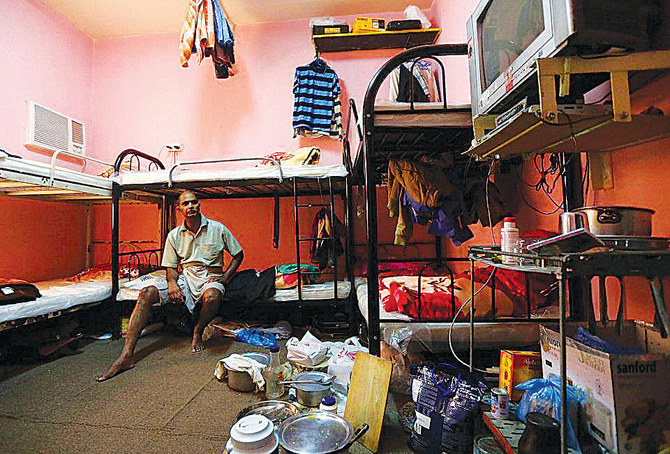
Streets are lined with shabby dormitories, where laborers live often crammed 10 to a room, and sharing kitchens and toilets in unsanitary conditions. Practices such as social distancing” and self-isolating — essential precautions to prevent the spread of any infectious disease — are impossible in such surroundings. Street lighting is so inadequate and the dust stirred up by passing vehicles so thick that venturing into the Industrial Area at night has never been for the faint of heart, especially if the visitor is from one of Doha’s upmarket neighborhoods just a few miles away — West Bay, Lusail or Pearl Qatar, the artificial island. Even before the new coronavirus appeared as a menace to the Industrial Area’s residents, unnatural death was far from a rare occurrence, especially during the Gulf state’s long, hot summer.
Migrant workers, on whom Qatar is heavily reliant, are bearing the brunt of a coronavirus outbreak. (AFP)
Hundreds of thousands of laborers have been exposed to potentially fatal levels of heat stress while working in temperatures of up to 45 C for up to 10 hours a day. Since high temperatures have an adverse effect on the cardiovascular system, medical experts believe there is a direct correlation between the abnormally high fatality rates among workers and heat stress in the summer months. Data from the Indian government showed that 1,678 of its citizens died in Qatar between 2012 and August 2018. Between 2012 and 2017, at least 1,025 Nepalis died in Qatar from cardiac arrest, respiratory failure and sickness” among other causes. According to reports, in most cases no autopsies were performed on the bodies of migrant workers, whose deaths were attributed to cardiovascular or natural” causes. Paradoxically, for all the international scrutiny that the Industrial Area’s coronavirus outbreak is drawing, repercussions of the global pandemic could leave Qatar’s migrant workers even more vulnerable in the coming days. According to International Labor Organization estimates, the predicted economic and labor crisis could increase unemployment worldwide by almost 25 million. For Antony, the one-time Industrial Area resident, returning to Sri Lanka had been a wrenching decision given the limited job prospects for an unskilled worker. But with the benefit of hindsight, he has absolutely no regrets.
Four men from Sri Lanka, who had allegedly attended the Tablighi Jamaat Markaz in Delhi’s Nizamuddin last month, tested positive for Covid-19, in the Nuh district on Sunday, said officials. Eight people have been confirmed to have Covid-19 from Nuh and seven of them had visited the congregation in Nizamuddin, held mid-March.
Virender Yadav, chief medical officer (CMO), Nuh, said: Two of the patients were found near the Palwal border on March 31while entering Nuh and the other two were traced to Umra village. They were quarantined and their samples were collected which have come positive,” he said.
Police said all those who had attended the event and those who had come in close contact with them have been identified in Nuh. All samples will be collected by Sunday night, they added.
There were 270 people who had attended the Jamaat in March, who then went to Palwal. They had started moving to Nuh after the lockdown was announced and were identified within a week,” said Yadav.
Meanwhile, the 600-bed Shaheed Hasan Khan Mewati Government Medical College at Nalhar in Mewat district has been declared an exclusive hospital for Sars-Cov-2 cases and more than 300 people have been admitted there in isolation and quarantine wards.
On Friday, three people from Kerala, who had allegedly attended the event last month, had tested positive in Nuh, said officials.
The superintendent of police of Nuh, Narender Bijarniya, on Sunday, said the four men from Sri Lanka were in touch with people from Palla and Rehna village in Nuh. We have identified all the people and most of the samples have been collected. Our priority is to choose the highest risk persons. The teams start collecting samples by 8am and the process goes on until 11.30pm. All officials, including medical teams, are working round the clock,” he said.
Nuh had received test reports of 41 cases until Sunday, out of which eight have tested positive for coronavirus, including a truck driver who had visited Gujarat last month.
Most of the villages have been sanitised and the survey was completed by Sunday afternoon, said officials.
One of the medical officers, who is part of the sample collection team, said the villagers are not cooperating and that they find it difficult to get the tests done. They have reported the matter to the police regarding a few incidents where a police team accompanied them, said an officer on condition of anonymity.
The seven people who have tested positive for coronavirus had attended the event and stayed in Palwal for nearly 10 days before starting for Nuh, said the police.
Bijrania said the situation in Nuh is under control and all suspected people are quarantined and under surveillance. Police teams are keeping a close watch on the people hospitalised and their family members to ensure that the infected persons do not come in close contact with anyone else.
By Dr Lal Jayasinghe Consultant in Communicable Disease Control UK (retired) (member Public Health Writers Collective) Courtesy The Island
Phwriters2020@gmail.com
So far, we have done very well. Let us not forget this. We were very fortunate that the govt. listened to the right people and took their advice on how to control this epidemic namely the Epidemiology Unit of the Health Department. We are also fortunate in other ways as well. We are an island which means the virus can enter Sri Lanka (legally) only via airports. We are also fortunate in having a good public health network. We are also a small country. Small is certainly beautiful when it comes to controlling an epidemic. So, let us use these advantages to the maximum, which we have done so far.
What we have to do in the situation of an epidemic is well understood by practitioners of that discipline in medicine specially trained for the purpose i.e epidemiologists. As I stated above, the govt. listened to them. In simple terms what needs to be done is to keep patients apart from healthy people. This is nothing new and has been understood for centuries. In order to do so we need to identify the patients. As we knew that apart from the Chinese lady who became ill with Covid-19, there was no Covid-19 in Sri Lanka. Basically, there was not a single corona virus in Sri Lanka. So, it had to come via the airport. Therefore, we decided to quarantine people coming into the country and successfully identified patients who we could then keep apart from others. With hindsight the mistake we made was initially to limit returnees from China, South Korea and Iran only for quarantine. We are paying heavily for that initial mistake because cases started appearing in returnees from other countries as well such as India and Pakistan etc.
In situations where we identified patients who have potentially infected others by the time we found them, we quarantined the contacts. Once again, very wisely we did not put all our eggs in one basket by only trying to catch imported cases as our one and only strategy. By declaring a curfew, closing schools etc., we made sure that if cases started to appear in the community due to leaks, there will not be uncontrolled spread.
All these strategies worked very well until we find people who came into the country from abroad and didn’t tell the authorities and therefore escaped quarantine and became ill and infected others. We will continue to keep discovering such patients and contacts. However, we haven’t panicked. And now is not the time to do so. Some people keep telling us that there are hundreds of cases out there in the community. However, this is either speculation or based on modeling. If there are such numbers, they must be asymptomatic because they don’t seem to seek treatment. In that case they are much less infectious. After all Corona is also a virus and not an alien such as you find in Hollywood films. Viruses and diseases caused by them behave in a predictable manner, even if some viruses are more infectious than others. The spread of the disease is easier from a more severe case. Also, the more severe the disease the more likely the patient will have symptoms. What this means is that if there are cases out there who are ill with Covid-19 but going about because they are not ill enough to seek treatment, then they are less likely to spread the disease. Therefore, if at this time we concentrate on identifying Covid-19 patients who seek treatment because they are ill, we will catch the more important cases.
Another feature of spread of a disease caused by viruses, especially respiratory viruses is that the closer the contact with a patient, the more likely we are to catch it. Clearly, this is common sense and not rocket science. Therefore, having made sure that we quarantine arrivals from abroad, if we test patients who show symptoms of Covid-19 in the rest of the community, we will catch most if not all Covid-19 patients in the community. As far as I am aware, there has not been any cases discovered so far, who have neither come from outside Sri Lanka, associated with a person who has come from outside or is a contact of a known patient.
The authorities have also taken measures to limit the contact of the general population with any unknown patients by closing schools Universities etc. and declaring a curfew. So, let us hold our nerve and have confidence in the measures taken by the govt.
Now I come to a possible source of danger. It is observed that the media, as it is their right, keep reporting, not false information, but different opinions on how to control the epidemic. One opinion is based on modelling. Modelling is good for academics to talk about but very dangerous to be the basis of policy. This was proved to be true in the case of the United Kingdom. At the initial stage of the outbreak in UK, the authorities rather foolishly decided to do nothing or nearly nothing and more or less to let nature take its course and for people to develop immunity or herd immunity and for the disease to peter out by itself. All this was based on modeling. Very soon saner counsel prevailed and now the policy has changed and more traditional measures like shutting down and social distancing are in place.
Mathematical models are based on reported cases from all countries. Countries have different social structures and behaviors. Therefore, it would be foolish to depend on a model to predict how the virus will spread or otherwise in a particular country.
This is what a paper from a leading American University says:
The forecasting models and data strongly suggest that the number of coronavirus cases grows exponentially in countries that do not mandate quarantines, restrictions on travel and public gatherings, and closing of schools, universities, and workplaces (Social Distancing)”
We cannot by any stretch of imagination say that our cases have grown exponentially. This may be because we practice: quarantines, restrictions on travel and public gatherings, and closing of schools, universities, and workplaces (Social Distancing)”
While most countries were suddenly hit by an “epidemic” Sri Lanka was hit by a “cluster” of cases. They were not a cluster in the usual (geographical) sense, but all cases were in a particular group of people with a common feature, namely foreigners or people with foreign associations. Because of this most of our cases were in some respects “expected”. Therefore, we are not surprised at the numbers. So, let us not panic.
A more recent argument is that we should increase testing. This advice too should be nipped in the bud. At present the only reliable test is PCR. This test is expensive and uses reagents and equipment in short supply. It is not a sort of yes or no” test in lay terms and we are told that three experts in the field check the results before declaring the results and is, I understand, carried out only in designated labs. Very wisely, private hospitals are permitted to carry out the test under very strict conditions.
For the uninitiated, lay or medical, it might seem a good idea to test as many people as possible in order to identify new patients and keep them safe. But it is not as simple as that. ALL tests have what is called false positive and false negative results. That is one of the reasons that three experts no less, have to decide whether a result is a true positive or a true negative depending on other factors as well such as the history of exposure, symptoms, other tests etc. What are the implications of false positive and false negative results? Without going into detail, a false positive will create unnecessary panic and wasted resources (not to mention the possibility of being cared among truly positive patients and therefore actually catching the disease!) while a false negative will give rise to a much more dangerous situation. A false negative result will declare that an infected person is negative and safe to mix with other people without restrictions leading to a disaster by infecting a large number of people. At the present time, a PCR is the most reliable test available. In other words, the false positive and false negative percentages are small if carried out by qualified and experienced personnel The PCR test is very expensive with the equipment and reagents in short supply. So, very prudently the authorities are using the test only on patients who are suspected to be corona positive on other grounds. And this policy in my opinion should continue at this stage of the campaign.
I have heard people speak of new tests for corona infection that are supposed be 30% successful. Perhaps they mean antibody tests to decide whether a person has had the disease or not in the past. This test is now being introduced in UK tin order to identify health workers who can “safely” go to work with Covid 19 cases because they are unlikely to catch the disease a second time. In any case what do we in Sri Lanka hope to achieve by widespread testing? If we find someone is negative, that person can acquire the disease in the very next moment after the test. Also, if positive what do we do then? Do we quarantine them? Do we quarantine the contacts? Those who are positive, although in theory they can give the disease to others they are less likely to do so if they are not showing symptoms. What this means is that it is much more efficient if, at present, with our limited resources, we confine our testing to symptomatic patients. In other countries like UK there is another reason for testing. People who have respiratory symptoms or family members with respiratory symptoms have self quarantined themselves. This has created a shortage of workers specially health workers. If more tests are performed it will be possible to release those proving negative to go back to work.
There is one other aspect that needs setting right in my opinion. At the moment, a variety of people speak on the television on the current situation. This can lead to confusion. Without a single source of official and correct information people tend to think that facts are being hidden and tend to believe in conspiracy theories which are plenty. My suggestion is that there should be an official announcement from one and the same official, either once or twice daily at a particular time. If a need arises for some reason to make a special announcement that too can be done as breaking news but from the same source or individual as the routine announcement. If this one official spokesperson is a medical person, he/she can enlighten the public about the government policy and strategy that is being currently followed and give reasons for not accepting various suggestions by numerous people, mostly doctors and politicians as for example not practicing widespread testing.
It would be churlish on my part if I didn’t mention the invaluable role that the armed forces and police play in keeping the country safe from Corona. In the usual situation of an outbreak of infectious disease or an epidemic, the job of tracing contacts is left to the Public Health Inspector. Without downplaying the key roles they play in such normal situations or the important part they play now with the present epidemic, the PHIs couldn’t have traced the large numbers of contacts now traced by the “buddhiya ansaya”. The PHIs neither have the personnel, training or authority that the forces have.
NEW DELHI, April 5: In a major breakthrough, Indian scientists have successfully developed a low-cost, paper-strip test which can detect the new coronavirus within an hour, and costs just INR 500, or LKR 1,250 (US$6.5). This will address India’s urgent need for rapid-testing.
The test uses the cutting-edge gene-editing tool- Crispr-Cas9 to target and identify the genomic sequences of the novel coronavirus in the samples of suspected individuals.
We have been working on this tool for around two years. But, in late January, when the outbreak hit its peak in China, we began testing it to see if it can work for Covid-19. It took us around two months to come up with these results,” said Dr Debjyoti Chakraborty, from the Institute of Genomic and Integrative Biology (IGIB), the premier laboratory of the government-owned Council of Scientific & Industrial Research (CSIR) in New Delhi.
The kit is similar to a portable paper-strip test used to confirm pregnancy, does not require any different specialized skill to perform, and is relatively less-sophisticated.
Unlike most rapid tests that require dedicated machinery, this can be performed using standard equipment available in every pathological laboratory, or even Mohalla Clinics in Delhi. This is important, because if the number of infections shoot up drastically, we would need tests which can be done in local facilities. We will have to bring the tests closer to the patients to reduce transmission and this is what it does,” said Dr Anurag Aggarwal, Director, CSIR-IGIB.
The team led by Dr Souvik Maiti and Dr Debjyoti Chakraborty is currently testing the kit in a patient cohort for its accuracy and sensitivity, and hopes to seek validation from a regulatory body of the Indian Council of Medical Research (ICMR) within a week.
Unlike the real time PCR test currently being used for diagnosis of Covid-19 in India, costing about ₹4500 or LKR 11,250 ($59), the paper-strip test costs less than ₹500. It also does not depend on expensive real-time PCR machines for RNA isolation, DNA conversion and amplification, which are already in limited supply.
While scientists in other countries, including Stanford University and Massachusetts Institute of Technology (MIT), have been testing this approach, it is the first such indigenous testing kit based on CRISPR technology to be developed in India.
As India heads for the exponential rise in the number of coronavirus infections, rapid-testing will be the key strategy to ensure timely isolation of the positive cases to contain the virus from spreading fast. As on Friday, the total number of positive cases has crossed 2,547 across the country with 478 new cases detected in the past 24 hours. The total death toll stood at 62.
The Chairman of Elections Commission Mahinda Deshapriya has urged action to prevent candidates from using relief activity for publicity campaign in the run-up to the election.
He mentioned this in a letter directed to Prime Minister Mahinda Rajapaksa.
Deshapriya noted that a special programme is essential for the implementation of relief measures to the people.
He also urged the Premier to coordinate relief measures solely through governors, ministerial secretaries, chief secretaries, district secretaries, divisional secretaries, local government commissioners and field officers with the assistance of security forces.
Persons who have completed the quarantine process are requested to undergo another 14 days of self-isolation, stated the Army Commander Lieutenant General Shavendra Silva.
The directive is issued for individuals who had undergone the quarantine process at the quarantine centers or at homes.
It was reported today (05) that a person from Matara who had already completed the quarantine process have contracted the COVID-19 virus.
The patient is a father of 3 from Kohugoda-Akuressa, Matara had returned from South Korea to undergo the 14-day quarantine at the Kandakadu facility. Following the quarantine, he had been allowed to return home on the 24th of March.
However, as a person who had been at the quarantine center with him had tested positive with the coronavirus, he too had been tested for the virus. Accordingly, it has been confirmed that he too has contracted COVID-19.
Meanwhile, the residents in the area told Ada Derana that the relevant person had roamed around in the area instead of undergoing the requested 14-day self-isolation period at home.
Each disaster that had hit us made us believe that we had hit rock bottom and nothing worse can happen again. Wasn’t a 33-year-old war which began with the Vadukoddai Resolution passed on May 14th 1976 and ended on May 19th 2009 enough to end all disasters? But new disasters came rolling out of nowhere to shatter the smug complacency. And then we start all over again with another peace-shattering disaster. For instance, whoever thought that millionaire Muslim terrorists, riding in Pajeros, would blast the serene joy of a Sunday morning within a decade of ending the Vadukoddai War? Whoever thought that a movement of the earth somewhere near-distant Indonesia would come sweeping across the Indian Ocean and hit our coastal belt with massive destruction, even halting Prabhakaran’s preparations for his final assault? Whoever thought that an invisible, inscrutable (like the Chinese), and irreverent microbe that escaped from its birth-place in Wuhan can dislocate the best-laid plans of presidents, prime ministers, princes and other powerful panjandrums?
Doesn’t this latest pandemic confirm the fragility and the vulnerability of our existence on this lonely blue planet? What are all our theories and punditry worth when pitted against this virus? Donald Trump has the mightiest arsenal in the world but he can’t keep this micro-bug out of his streets. New York City looks a scene from Sci-Fi film after it has been invaded by aliens. It has humbled man and made him kneel before a force mightier than all enemies since World War II. If it takes off and gallops away man will have to rewrite history questioning all the man-made values on which we have sailed so far. Does this forecast that we will end not with an Einsteinian nuclear bang but an Eliotesque whimper?
But then history records that we have come
through similar death-dealing waves before. The Black Death (1347 – 1350) is
estimated to have decimated half the population of Europe. Bocaccio (Decameron)
records that in Florence over 100,000 died between March and July of 1348.
Partifying was quite common even then among corpses piling up in the medieval
streets. People abandoned cities and withdrew into the villages. Social
distancing came automatically with parents abandoning children and vice versa,
neighbours abandoning neighbours without any government enforcing it.
All is not bleak though. Hope that springs eternal in the human heart say that this is not the end of the world. To use another cliché, there is light at the end of the tunnel. Take the case of Sri Lanka. There is a positive side to the curfew at least. House-bound husbands are seeing their wives stepping gingerly into the kitchen for the first time in their married life. High society ladies who had never seen the inside of a kitchen before, it is reported, have witnessed for the first time the stunning miracles of raw cabbage and a carrot turning into first and second courses at the dinner table. Some have even been amazed by the originality of the kitchen hands who had produced crab curry by using crabs. All these days they thought that only Sangakkara and Mahela could do the trick.
Then take the case of the UNPers. They are most delighted with social distancing. They are thanking President Gotabaya for giving them a legitimate excuse to distance Ranil Wickremesinghe from their lives, hopefully for good. Sajith Premadasa, it is said, believe that the Coronavirus can do what he can’t do. It is said that he is nursing privately the thought of enshrining this provision in the Constitution permanently to keep Ranil out of his hair. Another thought that he is supposed to entertain right now is to drop the telephone as his symbol and go for the image of the Corona microbe. The image is not attractive, true. but it is frightening enough to keep his opponents (found only in Ranil’s camp) at arm’s length.
Then there is every likelihood of the ex-judge C. V. Wigneswaran joining hands with R. Sampanthan and complaining to WHO that the Sinhala government is back to discrimination against the Tamils because the racist state is not distributing the virus equally among the Tamils. Along with the Tamil diaspora, they are ready to complain even to the UNHRC that the Sinhala state has given the bulk of Coronavirus to the Sinhala south without giving an equal share to the Tamils of the North. They argue that their dignity will be restored only if enough of the virus is given to them. They are planning to join hands with the Muslims to legalise this in the next sitting of the Parliament.
Pakiasothy Saravanamuttu and Jehan Perera have jumped in with their both their feet to boost this Tamil claim of discrimination. They have cited statistics to show that it is increasing mainly among the Sinhala-Buddhists and not among the Tamils and Muslims. In their submissions to the UN organisations and their fellow NGO-mafia, they have argued that the Sinhala-Buddhists has consistently taken the lion (no pun intended) share of everything including the Coronavirus and the American Ambassadress must issue unlimited visas to the Tamil to go to New York – the new epicentre of the virus – to remedy the imbalance.
Dayan Jayatilleke too has chipped in saying that it is wrong to blame Gramsci, the outdated Italian theorist, for the spread of the virus among the Sri Lankans in Italy. He theorises that the Italian government should have locked up all the Sri Lankans like the way Mussolini locked up Gramsci and that would have stopped the spread of the virus in Sri Lanka. According to Dayan, Gramsci’s existential experience”—apart from his theories of making a Modern Prince — would have been the ideal global solution to the virus.
Ranil Wickremesinghe has a different approach. He thinks that the Government should bring back Arjuna Mahendran and let him run his Corona-campaign from the auction room of the Central Bank with his trusted in-laws. His solution includes appointing Ravi Karunanayake to head another committee located in a penthouse. Ranil also claims credit for introducing social distancing. He says it has been his only successful life-long policy that has kept people away from the UNP and the polls.
Mangala Samaraweera has come out recommending that the best cure to the virus is to swing a kurunudu polla” – cinnamon stick with which he beat the hell out of the anti-Ranil protesters marching from Matara to Colombo. His biggest regret is that he can’t take the Coronavirus to Geneva and pass a resolution against it, accusing it of war crimes. His alternative is to kiss the cheeks of the visiting American diplomats and hold up the hem of their skirts to prevent the virus from creeping up their legs.
Last but not the least are the Western diplomats. For once their voices are silenced. They cannot recommend cures because they are in the same boat as Sri Lanka. The American Ambassador is paralysed. She cannot impose a visa ban on the Coronavirus because it is thumbing its nose at her from New York. The holier-than-thou Western diplomats are at a loss not knowing how to pose as the superior knowledgeable ones who know how to teach the natives how to conduct their lives.
The hard reality is that we are all drifting hoping that the cure will pop up sooner or later – perhaps more sooner than later. This virus has been a great leveller. We will come out of it, no doubt. But it is the cost that is frightening. Besides, we will never be the same again. It will take time to recover. But when we recover and open our eyes we may not be in the same world that we’ve known in the days gone by.
Muslim bashing is considered politically
correct in Sri Lanka.
Muslims are a minority in
this country. They comprised less than 10% of the population.
Muslims congregate in groups.
They wear garments that are specific to them. They live within closely knitted
communities. They help each other out. They give priority to their religion and
religious customs.
These characteristics have made them the envy of the Sinhalese.
There are many other reasons for enmity.
The rapid rise in the Muslim population has alarmed the Sinhalese. This has caused insecurity within the Sinhalese.
It is the Sinhalese who preached
its people to produce fewer children (‘Punchi Pavula Raththaran’). Sinhalese do
not run commerce as successfully as the Muslims (Muslims run their commerce
exceptionally well). Many Sinhalese like to patronise Muslim shops because they
receive good/friendly treatment.
The crux of the argument is that the Sinhalese have failed to
realise that Muslims have never demanded a separate state in Sri Lanka. During
the war, they provided men to our war efforts. Some of them sacrificed their lives
and limbs for the country. Upon hearing Prabhakaran’s death, Muslim homes
prepared Kiribath. They were overjoyed; sang and danced with the Sinhalese. Muslims
are willing to learn the Sinhalese language and send their children to study in
Sinhala medium schools.
Those who attack Muslims are dumbfounded about the racism
engineered by Tamils against the Sinhalese in the North and the East.
The biggest threat to Sri Lanka’s sovereignty and territorial
integrity is Tamil separatism. But, there is no discourse about this in the
country. Sinhalese conveniently ignore the racism they encounter in the hands
of the Tamils in the North and the East. This writer has written about them.
It seems that the Sinhalese have taken Tamil racism for granted. They tolerate the nonsense that the Tamil Separatists practice against them in the North and the East. It seems they have given up interest in the North and the East (1/3 of the country). Very few Sinhalese even travel to these provinces and show the areas to their children.
There is the saying that one cannot smoke out the real enemy until they truly identify them.
Again, the real enemy is the Tamil Separatists who have not given up their claim to carve out a separate nation for themselves in the North and East of Sri Lanka. That is why they constantly ill-treat the Sinhalese who live there (albeit a very few). They stop new Sinhalese from settling in the North and the East.
Since the dawn of this century (21st), periodic conflicts/tension have propped up between the Sinhalese and Muslims. Troubles have arisen due to the alleged Muslim land grabs in the East (eg Muhudu Maha Viharaya, Dheegavapiya, etc) and in Balangoda (Kuragala).
Most of these disputes could have been amicably settled, unfortunately, the recent governments have been slack. Rather than solving the problems (eg nipping them in the bud), the governments have sometimes worked to exacerbate them. The governments mollycoddled certain clergy who had spread nothing else but ethnic disharmony/ethnic hatred.
In the past two decades, the Sinhalese have started to dislike Muslims more and more. Certain Muslim activities have also contributed to this; they themselves have helped in the creation of the bad perception. Some examples include disobeying laws by Muslim youth in the East, wearing of the niqab in public by Muslim women (even after the Easter bombings). There are stories that some Muslims have been arrogant towards the Sinhalese.
In recent riots against the Muslims, their homes and shops were attacked in a systemic way. The attacks in Aluthhgama, Ginthota, Digana, Pujapitiya etc showed well organized/well-coordinated attacks. Several innocent Muslim civilians died in these riots. The tension between the two communities came to the ultimate height when in April last year a group of radical Muslim youth attacked Sri Lankan Christian churches and 5-star hotels. More than 250 innocent lives were lost including foreign tourists.
Now, accusations are being made that Muslims may be deliberately spreading Corona among the country’s masses. This is a stupid and sometimes a hilarious accusation. To spread Corona deliberately, one needs to first infect the virus themselves. Who would do that? Also, how can they only choose the Sinhalese to spread the virus?
There had been false allegations that some Muslim shops were giving Sinhalese women sweet toffees that cause them infertile. Anyone with a science knowledge knows that such methods do not work.
When the Sinhalese break curfew and misbehave, no one talks. A small misdeed by a Muslim is highlighted as a major offense. In Social media, Muslims are constantly depicted in derogatory ways. People use obscene language to attack Muslims.
The writer states that the
Muslim leaders’ demand that Muslims who die from Corona should be allowed to be
buried in accordance with the Muslim religious customs is unfair and
unreasonable. Even in Europe (eg Italy and Spain) Muslims who die from Corona are
subjected to normal cremations.
We Sinhalese have made huge accusations against the Muslims. Some of them seem reasonable. But, we being the majority need to be more sensitive and careful; we must stop continuously pushing them ‘into the corner’. We do not want them to take up arms/forming their own ‘LTTE’. The last thing we want is the Eastern radical Muslims ganging up with N/E Tamil Separatists. But this is a possibility. If that happens, it will be Sri Lanka starting another civil war. We certainly do not want that.
In Islam, a
martyr need not be buried to go to heaven. Muslims who die in the COVID-19
epidemic, for no fault of theirs, must be considered martyrs by the Muslim
community. If terrorists including suicide bombers can be treated as martyrs,
why not innocent Muslims who died from COVID-19? Therefore their dead bodies
need not be buried. Cremation is suitable. This is the only amicable way to
resolve the dispute and Muslims must extend their cooperation.
The cremation or burial debate is a needless one. Local medical professionals know the condition of local affairs and they must make decisions. The decision to allow burial is not in the hands of Amnesty International, Muslim Congress, Ulema Council or even the WHO. Local capabilities and conditions are only known to locals. Without a doubt, cremation must be compulsory for all dead who died from a communicable disease.
However,
cremation must be made compulsory even without and after the coronavirus
pandemic.
Given the extremely high population density of over 320 persons per square kilometer, Sri Lanka is fast running out of safe burial grounds. Existing burial grounds are either too expensive or too costly for the environment. The water table is polluted with burial especially in the Wet Zone and catchment areas.
All Abrahamic religions originated in deserts. Burial was less damaging to their desert environments as there are no water sources it could pollute and the land was aplenty.
This is not the case
beyond deserts. Christians and Jews around the world have wisely moved away from
desert practices into the 21st century but some Muslims
unfortunately still cling on to destructive burial practices that suit deserts.
Cremation is not
without cost. It burns fuel and emits carbon dioxide. However, it is the
cleanest way to dispose of a dead body.
Sri Lanka cannot always bend backward to appease tribal demands. The government must take into account the health, economic, environmental and public concerns of all, not just one community. Cremate all dead in Sri Lanka.
That will
lead to more people opting to donate organs at the end of life as they realize
the absurdity of clinging on to a dead body.
Sri Lankans must not tolerate selfish and outdated desert
practices that put everyone’s health in danger.
According to the Mahavamsa,
Anuradhapura was ruled by a foreign king, Elara in the period immediately before
Dutugemunu. Elara’s
origins are not known.
Dipawamsa said Elara was Uju jatiko’, meaning hailing from the ‘Uju’ tribe or from the land by that name. Mahavamsa said Elara, was a ruler of foreign origin, ‘a prince’ (Khattiyo) a ‘Damilo’ who came from the Cola country. This has been mistakenly interpreted as Chola prince. Elara could not have been a Chola prince, because the Chola dynasty did not exist at the time.
A. Denis N. Fernando, a surveyor by
profession, suggested that Elara was in fact, a Parthian trader. Historian
D.G.B. de Silva considers this quite possible.D.G.B. de Silva
says the time to which
Dutthagamani and Elara belonged [2nd C.B.C.] was contemporaneous with the rule
of mighty Persian emperors of the Parthian dynasty who succeeded to the
fortunes of the Achaemeneid [Hakamanish] emperors.
The Parthians [Aracids] like their predecessors
controlled the inland caravan routes to India and China and had penetrated into
the Indian Ocean trade which went through the Persian Gulf and the Red Sea.
Their vessels were already traversing deep into Eastern lands and their coins
were in circulation in India. One coin of Mitradates Eupator [113-6 B.C.] has
also been discovered in Sri Lanka.
The Tamil Separatist Movement had
drawn attention to the greatness of this ‘Tamil’ king, implying that it was
wrong of Dutugemunu to unseat him. However,
researchers have pointed out that the good deeds attributed to Elara, such as
the story of the Bell of Justice are not unique to Elara. They are standard
stories that appear elsewhere.
They are found in the Persian legend
of the mythical hero Anosharvan. King Kosraw I, traditionally known as Anosharavan, was
king of the Sassanian kingdom (Iran) from 531 to 579 AD. According
to legend, he is said to have had a Bell of Justice …hung to his bed chamber
with a rope attached to it and the end in the street which man, beast or bird
could pull seeking justice”.
Elara
used this Bell of Justice, in a rather unorthodox manner. His son’s chariot had
run over a calf, unintentionally. The mother cow had rung the Bell of Justice.
Elara listened to what the cow had to say and had the prince’s head struck off
by the same chariot wheel. This interpretation of ‘justice’ is questioned even
today.
D.G.B. de Silva saw another connection between the Mahavamsa description and Persian tradition. The funeral rites for Persian monarchs resembled the elaborate account given in Mahavamsa about the funeral rites accorded to King Elara. There were many similarities between the rites performed on Persian royalty and those described for Elara, said de Silva. He also pointed out that the way King Poros was treated after Alexander defeated him in a hard-fought battle was almost exactly how King Dutugemunu treated Elara, after killing him in battle.
The Tamil Separatist Movement keeps reminding us that when Dutugemunu defeated Elara in Anuradhapura, he created a monument to Elara, and ordered the public to honor the tomb when they went past the tomb.
The
Mahavamsa said. “In the city he [Dutugemunu] caused the drums to be
beaten, and when he had summoned the people from a yojana around he celebrated
the funeral rites for king Elara.” The terminology used pujam Elara rajino” means
that King Elara was honored (pujam)] said D.G.B. de Silva.
Mahavamsa said On the spot where his body had fallen he burned it with the catafalque, and there did he build a monument and ordered worship. And even to this day the princes of Lanka, when they draw near to this place, are wont to silence their music because of this worship.” The Mahavamsa tika adds that the king had ordained that princes in the future should honour the edifice by perambulating it and offering flowers and incense.
There is something suspicious about this description since Dutugemunu does not seem to have shown the same respect to his own father and mother. Also, no other king has followed this policy. Mahavamsa is full of dead kings. But there is no mention of any other tomb. Except for this reference to Elara, the chronicles are silent about the way the mortal remains of other rulers were disposed of, said DGB de Silva. This description has probably been taken from some foreign documents and added to the Mahavamsa .
In
addition to Persian influence, there was also Greek influence in the early
historic period of Sri Lanka. Mahavamsa says king Pandukabaya laid out also
four suburbs as well as the Abhaya-tank, the common cemetery, the place of
execution, and the chapel of the queens of the west, the banyan-tree of
Vessayana, and the palmyra-palm of the demon of maladies, the ground set apart for the Yonas and the house of the Great
Sacrifice; all these he laid out near the West gate.” In the original Pali, this ground is called
‘Yona-sabha-guwattu’
Mahavamsa thereafter says that in the time of Dutugemunu, several thousand ‘Yona’ Buddhist bhikkhus from ‘Alasanda’ came for the consecration of the Mahaseya. Mahavamsa mentions the ‘Yona’ five times.
Merlin Pieris, former Professor of Classics in the University of Peradeniya, said that the ‘YONA’ referred to here were the ‘IONIANS’- those from the Ionian Islands. This was the common term used by the Persians to refer to Greeks at the time.
This writer, Kamalika Pieris, found, using desk research, that there were Greek settlements in the Arabian Peninsula, during the Early Historic Period. There was also a much-used sea route from the Arabian Sea to India and Sri Lanka at that time. I think that this is how the Greeks came to Sri Lanka for the Mahathupa consecration. It was easier to come from ‘Arabia’, than from Bactria. All they had to do was to get on a ship.
These Greeks would have brought firsthand knowledge of Greek culture into Sri Lanka. The only trace of this today is in the Greek myths that appear in the Mahavamsa, said Merlin Pieris.
Merlin
Pieris says the Ummadacitta story is from the Greek myth of Danae, daughter of
the king of Argos. The story of Vijaya
is from Homer’s ‘Odyssey’. It also contains Argonautic myths. The Argonauts
were a band of heroes in Greek
mythology.
The Kelanitissa- Viharamaha Devi episode is taken from Danae and from the Andromeda story found in the legend of Perseus. The Mahavamsa account has been taken straight from the Greek one, not from any intermediate source. The flooding of Kelaniya and the marriage of Kelanitissa and Viharamaha Devi, however, are true, said Merlin.
Subha
saha Yasa story is found in Plato’s Republic”
and in the writings of Herodotus.
It is also given in a papyrus dated to 2 AD, found In Egypt, which means
the story may pre-date Herodotus.
Merlin
thinks the Mahavamsa writer may have known of the two Greek epics Odyssey” and
Iliad”. He further observes that the only history the Sinhala historians could
have obtained during this period was that of Herodotus. India had no model
history.
They
also seem to have heard of the Greek historian Xenophon (430 – 354 BC). William Knighton in his History of
Ceylon” (1845) observed that the manner in which king Kavantissa
collected his army closely resembled the account given by Xenophon in hisCyropaedia” of
the manner in which King Cyrus of Persia gathered up his army.
All this does not reduce the value of the Mahavamsa as a research tool for historians. It helps explain certain sections of the work. Mahavamsa, as it stands today, appears to be a collection of texts rather than a single, consecutive piece of writing.
Australian Prime Minister Scott Morrison urged
the WHO and the UN to act against China’s wet markets. It is suspected that COVID-19 might have originated from a wet market in Wuhan
The Coronavirus and the restrictions
imposed to help manage it are challenging to us all. However, some people in
our community, particularly those at risk due to age, isolation or illness are
finding it particularly difficult to cope.
The JVP UK Committee is offering a
COVID-19 Community Support voluntary service for anyone who needs help with
shopping, accessing healthcare, services or medications.
Some of the services that we offer:
1. If you or your family is in
isolation and have nobody to help you with essential shopping, medication or
any other necessary assistance, our volunteers could help
2. We can put you in touch with the
government and non-government organisations who provide help/services or
contact them on your behalf.
3. Our team of medical professionals
can assist and advise you if you require medical advise and guidance (please be
aware that they may be limited in terms of which service or advise that they
can offer)
4. We understand that these are
stressful times for most people, whether related to finances, health, concerns
about your loved ones or any other concerns that you may have, our team can
listen/advise/extend support assist you in anyway we can.
5. We can also extend this help to
Sri Lanka through JVP RED force team in Sri Lanka so please let us know of any
loved ones or individuals who may require assistance back home.
If you or anyone that you know needs
this type of assistance please do not hesitate to get in touch with us either
via email or call us on one of the numbers below. Please also note that we
extend this gesture to beyond the Sri Lankan community in the UK, to all our
non-Sri Lankan friends and neighbours.
Asanga:Karunadhara07904 091266
Ranjith: Siriwardhana 07984396378
thusara Dasanayake 07903707890
Darshana Hettiarachchi 07898642683
If you would like to volunteer to
join hands with us, please give us a call.