Australian Prime Minister Scott Morrison urged
the WHO and the UN to act against China’s wet markets. It is suspected that COVID-19 might have originated from a wet market in Wuhan
The Coronavirus and the restrictions
imposed to help manage it are challenging to us all. However, some people in
our community, particularly those at risk due to age, isolation or illness are
finding it particularly difficult to cope.
The JVP UK Committee is offering a
COVID-19 Community Support voluntary service for anyone who needs help with
shopping, accessing healthcare, services or medications.
Some of the services that we offer:
1. If you or your family is in
isolation and have nobody to help you with essential shopping, medication or
any other necessary assistance, our volunteers could help
2. We can put you in touch with the
government and non-government organisations who provide help/services or
contact them on your behalf.
3. Our team of medical professionals
can assist and advise you if you require medical advise and guidance (please be
aware that they may be limited in terms of which service or advise that they
can offer)
4. We understand that these are
stressful times for most people, whether related to finances, health, concerns
about your loved ones or any other concerns that you may have, our team can
listen/advise/extend support assist you in anyway we can.
5. We can also extend this help to
Sri Lanka through JVP RED force team in Sri Lanka so please let us know of any
loved ones or individuals who may require assistance back home.
If you or anyone that you know needs
this type of assistance please do not hesitate to get in touch with us either
via email or call us on one of the numbers below. Please also note that we
extend this gesture to beyond the Sri Lankan community in the UK, to all our
non-Sri Lankan friends and neighbours.
Asanga:Karunadhara07904 091266
Ranjith: Siriwardhana 07984396378
thusara Dasanayake 07903707890
Darshana Hettiarachchi 07898642683
If you would like to volunteer to
join hands with us, please give us a call.
Humans are locked down inside their homes, away from the rat race, deprived of the enjoyment of wealth, position and fame. It is undeniable that COVID-19 does not recognize what is considered important in the material world when it hits the human race wherever they are if exposed. Ironically, this is no contagion for any other beings.
Much has been written on what COVID-19 has shown to the world already. There is however a promising chance to be seized especially by those who for sure, believe their lives are not going to be the same hereafter hence the need to clarify the so-called correlations of what they hitherto learned in schools, colleges, and spiritual ashrams. This is an invitation to a probe at one’s life story from a different perspective at this time of apparent despair.
One
way or another, explicitly or otherwise, everyone including spiritual
seekers, look for something better for ‘
the subtle egoic self, in the next
moment’- both being fallacious and yet the ambitious world would embrace them
regardless of the goal being ‘ ‘whatever
success in the physical world and ‘enlightenment’
in spirituality.
Mankind has gone through these experiences from Spanish Flu to Bird Flu over the last few centuries and yet the true nature of life is overlooked, not only because we are trapped inside the mind made – four-dimensional illusion, but our reluctance to go against the ‘ common wave’ in which the humanity is defined and interpreted in many fields from engineering to business and religion to science.
COVID-19 was hardly expected in this magnitude despite there were some predictions, underpinning the uncertain and changing movement of existence. Except for the humor in social media, there is suffering across the world and yet people do not believe that there was suffering all along, that was termed in modern days as anxiety, stress, worries, depression and earlier days as anger, hatred, grief, misery caused by diseases, hunger, and poverty, etc.
The belief in the ‘free will and choice’ – the biggest delusion in human history which, the COVID -19 is revealing to some extent as an expression of the universe which calls for one response from the humanity, just one – Compassion!
Before we return to where we were prior
to the onset of the pandemic, and some may not get there, grasp the possibility
that the truth may not be what you thought it was. Is there a way out of the
character in the movie, or the dream which is real only when dreaming?
Seeing this could well be the freedom
which can hardly be expressed through the language.
When I read the above news published on a pro-government website I am at a loss to understand who should dictate the terms for the corona prevention program in the country.
Why is the GMOA which did not give a hoot about dying patients when they instigated strikes killing patients is trying to dictate terms to the country.
Anil Jasinghe and Prabha Palihawadana who lead health department should dictate guidelines
I also note the Padeniya and few other cohorts appearing in TV trying to show that they can save the country
Where were they when untimely union actions were instigated for various unrealistic demands like taking over Neville Fernando Hospital?
It is like Thonda’s union trying to run estates and Anthare
trying to run private sector
Dr. Sarath Obeysekera CEO Walkers Colombo Shipyard Colombo Sri Lanka
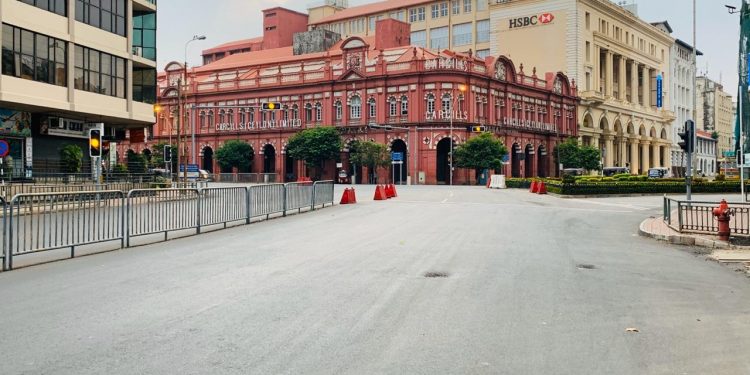
Curfew will continue in the “high risk” districts of Colombo, Gampaha, Puttalam, Jaffna and Kalutara
Colombo, April 4 (newsin.asia): The Sri Lankan government has said that there is a possibility that the curfew imposed on districts which are not in high risk of being infected by the coronavirus, could be lifted by the end of the Sinhala New Year season.
The Sinhala New Year is celebrated on April 13 and 14 but the celebratory season could extend by a week.
At a high-level meeting presided over by President Gotabaya Rajapaksa, here on Saturday, the progress of the COVID-19 prevention program was reviewed and decisions on the steps needed to be taken were made.
It was observed that except for the few districts identified as high risk zones where the most number of COVID-19 patients were found, the spread of the virus at present does not pose a threat to the other districts. Therefore, there is a possibility that the current restrictions imposed on these districts (those not in the high risk category) could be lifted by the end of the Sinhala New Year season.”
The current prevention program will continue as it is until this period. Thereafter, a decision as to the next step to be taken, will be considered after further studying the situation,” the Presidential Media Division said in a statement.
In other words, the curfew in the high risk” districts of Colombo, Gampaha, Puttalam, Kalutara and Jaffna will continue, while in the case of the other districts, which are not high risk” it is likely to be lifted after the Sinhala New Year season.
On the meeting with the President, the press statement further said: The President of Government Medical Officers Association Dr Anuruddha Padeniya analyzed the manner this virus had affected the country geographically and the government’s actions to control the epidemic. It was noted that the government’s timely actions from when this virus first entered the country helped manage to keep the situation under control,” the press release said.
It was also noted at the discussion, that the steps adapted henceforth had helped officials to correctly identify both the infected and those who had been compromised due to associating with the infected. However, it was also perceived that the danger is yet to pass.”
Not only COVID-19 positive patients, but also those suspected to have contracted the virus and those who had been in close association with these two groups will be regularly and repeatedly tested. This is in line with the procedures followed by countries that have successfully brought the spread of this virus under control.”
Rumours of Total Lockdown Denied
Meanwhile, the Lankan police spokesman, Ajith Rohana, said that rumoors spread about a compete lockdown in the country are baseless. These rumours are being investigated by the Crime Investigation Department.”
Defense Secretary Maj.Gen (rtd). Kamal Gunaratne said in a statement in the website www.defence.lk that those who are spreading the rumour that there would be a five-day total local lockdown are doing so to create a fear psychosis among the public” and added that no such decision has been taken by the government so far.”
The General asked people not to be misled by these rumours and that police will deal with these rumourmongers.
Hotlines have been set up by the Public Utilities Commission of Sri Lanka
Colombo, April 4 (newsin.asia): The Public Utilities Commission of Sri Lanka (PUCSL) together with Ceylon Electricity Board (CEB), Lanka Electricity Company Private Limited (LECO) and National Water Supply and Drainage Board (NWS&DB) to implement a special service to provide immediate solutions to the issues of electrical systems and plumbing of the households of electricity and water consumers, during the curfew period with effect from today.
Facilities have been provided to rectify the problems of electrical systems and plumbing issues in the premises of the customers through a hotline service which has already been implemented. With the new service, the consumer can seek the assistance of an electrician or a plumber near to consumers’ residential area to sort the issue.
The database has already been established containing the information of electricians and plumbers residing in every district of Sri Lanka and the PUCSL has already taken measures to provide the same information to respective Police Stations and Divisional Secretariats to maximize the service provided. This service is provided by registered electricians and plumbers in accordance with approved safety practices and guidelines required during the curfew hours.
This special service will be implemented in the Colombo, Gampaha and Kalutara Districts where the curfew is in force, as the first phase. It is expected to extend this special technical support service to other districts according to the demands of the consumers. The relevant electricians and plumbers are advised to charge a reasonable fee and issue an acceptable receipt for the service they provide.
Therefore, in case of a problem of plumbing system at your home, you can dial 1939 to obtain the services of a plumber. If you are a consumer of CEB and in a case of a problem in your electrical system at home, you can now dial 1987 to obtain the services of an electrician and if you are a consumer of LECO, you can get the same service through 1910.
Also, if you need further information regarding this service, you can connect with PUCSL via 0764271030. Once the service of an electrician or plumber is obtained, the customer’s response to the service can be communicated to the same numbers.
For more information: –
Vijitha Herath, Chairman of Ceylon Electricity Board – 071998404
Athula De Silva , Attorney-at-Law & the Chairman of Lanka Electricity Company Private Limited -0777769787
Wasantha Ilangasinghe, Additional General Manager, National Water Supply and Drainage Board -0773404140
Jayanat Herat, Director of Corporate Communication, Public Utilities Commission of Sri Lanka- 0772949193
The danger posed by the COVID-19 pandemic in Sri Lanka is yet to pass but the restrictions imposed on the ‘low risk’ districts could be lifted by the end of the Sinhala and Tamil New Year Season, the President’s Media Division (PMD) said today.
This has been observed at a meeting Presided by President Gotabaya Rajapaksa, and took place at the Presidential Secretariat to review the progress of the COVID-19 prevention program and to decide on the steps needed to take this program forward.
The PMD said President of Government Medical Officers Association (GMOA) Dr. Anuruddha Padeniya has analyzed the manner the virus had affected the country geographically and the Government’s actions to control the spread. “It was noted that the Government’s timely actions from when this virus first entered the country helped manage to keep the situation under control.
It was also noted at the discussion that the steps adopted henceforth had helped officials to correctly identify both the infected and those who had been compromised due to associating the infected. However, it was also perceived that the danger is yet to pass.
At the same time, it was observed that except for the few districts identified as high risk zones where the most number of COVID-19 patients were found, the spread of the virus at present does not pose a threat to other districts.
Therefore, there is a possibility that the current restrictions imposed on these districts could be lifted by the end of the Sinhala and Tamil New Year season.
The current prevention programmme will thus continue as it is until this period. Thereafter, a decision as to the next step to be taken will be considered after further studying the situation.
Headed by President Rajapaksa, this COVID-19 prevention programmme so far had been based on the professional advice from the health, medical, security and legal expertise.
The programme will continue to rely on these expertise until the crisis is brought under control. The on-going processes will continue to monitor the pandemic from a global context whilst studying the guidelines issued periodically by the World Health Organization. Comparing these results and recommendations with the prevailing situation in Sri Lanka, the programme will be updated as suitable and needed.
Not only COVID-19 positive patients, but also those suspected to have contracted the virus and those who had been in close association with these two groups will be regularly and repeatedly tested.
This is in line with the procedures followed by countries that have successfully brought the spread of this virus under control,” the PMD said. Advisor to the President Lalith Weeratunga, Former Western Province Governor Dr. Seetha Arambepola Secretary Defence (Rtd) Major General Kamal Gunaratna, Army Commander Lieutenant General Shavendra Silva, Acting IGP C.D. Wickramarathna, GMOA officers and the Chairman of Information and Communication Technology Agency of Sri Lanka Jayantha de Silva joined the discussion.
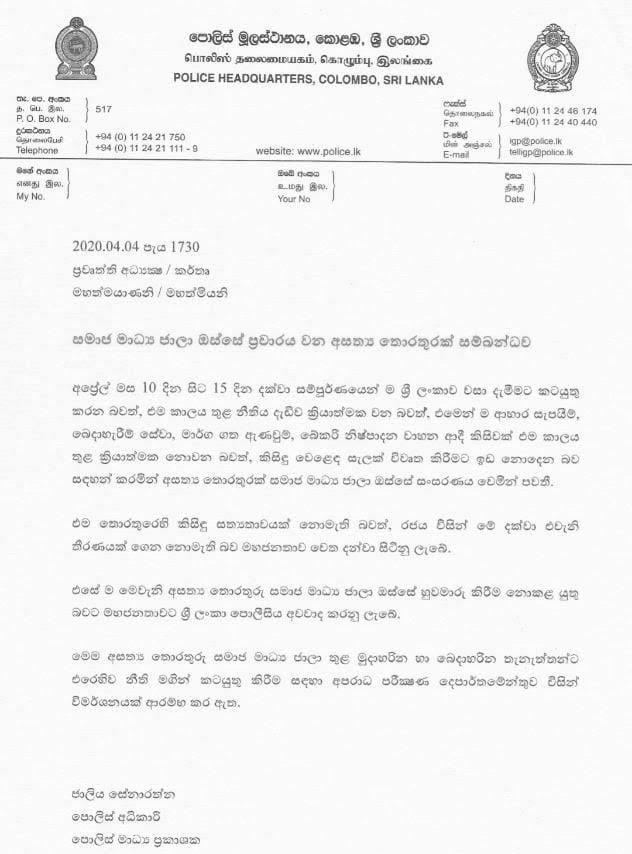
Reports circulating on social media of a complete lockdown enforced from April 10 to 15 where food supply and delivery would be suspended are completely false, Police spokesman SP Jaliya Senaratne said.
Issuing a statement SP Senaratne said the false reports indicated that during the supposed lockdown, the law will strictly be enforced, where vehicles vending products such as bakery items will not be permitted to operate while no retail operations will be allowed to be carried out.
The police spokesman denied such reports stating that the government has made no such decision thus far. The police warned against those who circulate such false reports on social media, adding that the Criminal Investigations Department has launched a probe to identify and take legal action against those who create and circulate such misleading posts.(Kalani Kumarasinghe)
Headed by President Gotabaya Rajapaksa, a discussion took place today (04) at the Presidential Secretariat to review the progress of the COVID-19 prevention program and decide on the steps needed to take the program forward.
At the meeting, President of Government Medical Officers’ Association (GMOA) Dr. Anuruddha Padeniya analyzed the manner this virus had affected the country geographically and the Government’s actions to control the spread.
It was noted that the Government’s timely actions from when this virus first entered the country helped manage to keep the situation under control. It was also noted at the discussion that the steps adopted henceforth had helped officials to correctly identify both the infected and those who had been compromised due to associating the infected. However, it was also perceived that the danger is yet to pass.
At the same time, it was observed that except for the few districts identified as high-risk zones where the most number of COVID-19 patients were found, the spread of the virus at present does not pose a threat to other districts.
Therefore, there is a possibility that the current restrictions imposed on these districts could be lifted by the end of the Sinhala New Year season, stated President’s Media Division.
Thus the current prevention program will thus continue as it is until this period. Thereafter, a decision as to the next step to be taken will be considered after further studying the situation.
Headed by President Rajapaksa this COVID-19 prevention program thus far had been based on professional advice from health, medical, security, and legal expertise. The program will continue to rely on these experts until the crisis is brought under control.
The on-going processes will continue to monitor the pandemic from a global context whilst studying the guidelines issued periodically by the World Health Organization. Comparing these results and recommendations with the prevailing situation in Sri Lanka, the program will be updated as suitable and needed.
Not only COVID-19 positive patients but also those suspected to have contracted the virus and those who had been in close association with these two groups will be regularly and repeatedly tested. This is in line with the procedures followed by countries that have successfully brought the spread of this virus under control.
Advisor to the President Lalith Weeratunga, Former Western Province Governor Dr. Seetha Arambepola Secretary Defence (Rtd) Major General Kamal Gunaratna, Commander of Sri Lanka Army Lieutenant General Shavendra Silva, Acting IGP C.D. Wickramarathna, officers from the Government Medical Officers Association the Chairman of Information and Communication Technology Agency of Sri Lanka Jayantha de Silva joined the discussion.
Under the recommendations of the special committee appointed by President Gotabaya Rajapaksa, 2,961 prison inmates have been released on bail since March 17.
President Rajapaksa appointed the committee to make recommendations on the possibility of providing legal redress for the prisoners following a request made by the inmates during an inspection tour of the Prison premises, President’s Media Division.
The Committee comprising officials of the Bar Association of Sri Lanka, the Ministry of Justice and the Department of Prisons made their recommendations to the Secretary to the President on the reliefs to be granted to the prison inmates.
Inmates who are unable to pay fines or pay for bail money or to produce personal bail, imprisoned for minor offenses and those who had completed the better part of their prison term or inmates suffering from illnesses and those who have not been granted bail have been considered under this relief scheme, Director General, Legal Affairs of the Presidential Secretariat Attorney –at – Law Harigupta Rohanadheera said.
Currently, prisons in Sri Lanka accommodate over 26,000 inmates while the total capacity does not exceed 10,000 persons. The health situation in the country had also been taken into consideration. Those who had been released are expected not to violate the terms of relief granted by the Courts.
Increasing numbers of younger people are falling seriously ill or dying with coronavirus, the World Health Organization (WHO) has warned.
Officials said they were trying to better understand” why apparently healthy patients aged under 60 ended up in intensive care units (ICU) with the disease.
There are still many unknowns at this present time,” said WHO expert, Dr Maria Van Kerkhove, at a press conference in Geneva.
Overall, most of the people who are experiencing severe disease and ending up in ICU are people of older age and are people who have underlying conditions.
But what we are seeing in some countries, individuals who are in their thirties, forties and fifties who are in ICUs and have died.
We are seeing more and more younger individuals who are experiencing severe disease.”
It comes after a 13-year-old boy with no apparent health problems died in a London hospital on Monday. His immediate family were unable to attend the funeral because they were in self-isolation.
In Korea, one in six COVID-19 deaths are among people under the age of 60, the WHO said.
And in Italy, around 10 to 15 per cent of people who ended up in intensive care units (ICU) with the virus were aged under 50.
However, Dr Van Kerkhove also urged caution in comparing death rates around the world, saying that we have some time to go before we can really understand what mortality looks like across different countries”.
Dr Mike Ryan, executive director of WHO’s emergencies programme, also stressed that the majority of people who experience severe illness tend to be older and with pre-existing health problems.
It’s not that anything has changed,” he added. It’s that we collectively have been living in a world where we have tried to convince ourselves that this disease is mild and more severe in older people.
But I think the evidence has been there all along. There is a spectrum of severity.”
Last week the mother of 21-year-old Chloe Middleton, who died of coronavirus despite having no underlying health issues, urged the public to take government advice seriously. To all the people out there that think it’s just a virus, please think again,” she said.
The US on Friday set a new record for the number of COVID-19 deaths in one day with 1,480 dead, the most of any country since the pandemic began. That topped the record set by the US the previous day with 1,169 deaths.
More than 59,000 people have died from COVID-19, and over one million infected, since it was first detected late last year.
Worse may be coming as a quarter of global infections are in the United States, where US President Donald Trump has warned of a very, very painful” first two weeks of April. The US has over 277,000 confirmed case, more than any country.
Confirmed Cases and Deaths as of 23.00GMT
Europe reached the dark milestone of 40,000 dead, with Spain on Friday reporting more than 900 deaths in the past 24 hours.
Spaniard Javier Lara survived after being put on oxygen in an overcrowded intensive care unit — a shock to a 29-year-old who was athletic and doesn’t smoke.
I was panicking that my daughter would get infected,” he said, describing facing death with an eight-week-old as the worst moment” in his life.
But there were also signs the peak may be passing in Europe.
Hardest-hit Italy recorded 766 new deaths but its infections rose by just four percent, the lowest increase yet, according to the civil protection service.
It’s true that the latest figures, as high as they are, give us a little bit of hope,” said Chancellor Angela Merkel of Germany.
But it is definitely much too early to see a clear trend in that, and it is certainly too early to think in any way about relaxing the strict rules we have given ourselves,” she added.
Prosperous countries have borne the brunt of the disease, but there are fears of an explosion among the world’s most vulnerable living in conflict zones or refugee camps.
The worst is yet to come,” UN Secretary-General Antonio Guterres said, referring to countries such as Syria, Libya and Yemen. The COVID-19 storm is now coming to all these theaters of conflict.”
The world economy has been pummeled by the virus and associated lockdowns, with the US economy shedding 701,000 jobs in March — its worst showing since March 2009 in the wake of the subprime banking crisis. Even more dire figures are expected for April.
Financial ratings agency Fitch predicted the US and eurozone economies would shrink this quarter by up to 30 percent and the Asian Development Bank warned the global economy could take a $4.1 trillion hit — equivalent to five percent of worldwide output.
Latin America is heading into a deep recession” with an expected drop of 1.8 to 4% in GDP, according to the UN economic commission for the region.
In signs that the world wants to avoid a repeat of the crisis, the African country of Gabon said it was banning the sale and consumption of bats and pangolins, the critically endangered, scaly mammals.
The novel coronavirus is believed to have come from bats, but researchers think it might have spread to humans via another mammal such as pangolins through an unsanitary meat market in Wuhan, the Chinese city where the virus first emerged.
The virus has chiefly killed the elderly and those with pre-existing medical conditions, but recent deaths among teenagers and babies have highlighted the dangers for people of all ages.
In Spain, 34-year-old Vanesa Muro gave birth with COVID-19 and has been warned not to touch her newborn without wearing gloves and masks.
It’s hard,” she told AFP. He grabs your finger, the poor little thing, and holds onto the plastic, not on to you.”
As the death toll mounted, US authorities advised all Americans on Friday to wear masks in public to protect against the virus, fearing the illness that has infected more than one million people worldwide may be spreading by normal breathing.
Trump said the government recommendation for all 330 million Americans to wear non-medical masks in places such as grocery stores would last for a period of time.”
It’s going to be really a voluntary thing,” Trump told reporters. You don’t have to do it and I’m choosing not to do it, but some people may want to do it and that’s okay.”
US Surgeon General Jerome Adams said the decision came because many people with the virus were showing no symptoms, but warned it was still vital to practice social distancing” by maintaining space between people.
The announcement came after Anthony Fauci, who is leading the government’s scientific response, backed recent scholarship that found the virus SARS-CoV-2 can be suspended in the ultra-fine mist formed when people exhale.
Research indicates the virus can actually be spread even when people just speak as opposed to coughing and sneezing,” Fauci said on Fox News.
The National Academy of Sciences sent a letter to the White House on April 1 summarizing recent research on the subject, saying it’s not yet conclusive but the results… are consistent with aerosolization of virus from normal breathing.”
Since the virus was first identified in China in late December last year, health experts have said it is primarily spread through coughing and sneezing.
The US recommendation will likely worsen an already severe shortage of masks in the United States and Europe, which both rely heavily on imports from China.
Trump urged Americans to just make something” or use scarves, saving clinical masks for health professionals and patients.
A special search operation has been kicked off to apprehend those who gather in groups at apartment complexes and other such places in Colombo and suburbs, says DIG Ajith Rohana.
He added that the police have already received information on such persons.
Taking into account the request made by farmers, curfew has been relaxed for machinery repair shops, DIG Rohana said further.
In the meantime, a total of 12,223 have been arrested island-wide for violating curfew orders, the Police Media said.
The police have arrested 1,493 persons for violating curfew orders during the 24-hour period from 6.00 am yesterday (03) until 6.00 am this morning (04).
Accordingly, the total number of curfew violators, who were placed under arrest since March 20, now stands at 12,223.
Coronavirus
does not discriminate. It treats all equally. Rich-poor-Old-young, it doesn’t care
if you live in West-East, North-South, the virus doesn’t care whether you are
Sinhalese Tamil Muslim or Burgher or whether you are Buddhist Hindu, Islam or
Christian/Catholic/Born Again. Virtually every country in the world is
affected, close to 50,000 people already dead and Sri Lanka has also seen its 4th
death and no one is certain when it will all end. This enemy is far worse than
the LTTE terrorists that plagued the nation for 30 years or the jihadi terror
attack of 21 April 2019. We do not know what this enemy looks like, when it
will enter our system and once it has entered what it has in store for us. We
do know that with precautions taken we can come out of it but without
precautions taken we are sure of fatalities. In such a scenario of uncertainty
when authorities need the support and cooperation of the citizens it is more
than selfish for a segment of people to demand only their needs be catered to
by the State. Holding placards ‘minority rights’ ‘freedoms’ ‘religious rights’ to
justify their demands at this volatile juncture is not what the Nation expects
to see from a community claiming to support National interest. This is not what
the nation expects from any community in such a fragile and vulnerable situation
the country is in. In a National crisis
support cannot come tied to bargains or threats.
Every
ethnic group or religion have their customs and rituals when it comes to death
and thus far every citizen of Sri Lanka has had no issues in carrying out these
customs/rituals.
Buddhists
have numerous rituals related to the death of a loved one. Hindus likewise also
have their own sets of rituals. Christians also have their customs while
Catholics have their own plot to bury their dead. Why is it that no Catholic is making demands to bury their covid-19 dead?
In Italy most of the early cases of covid-19 deaths were cremated and disposed
of as early as possible. Perhaps family members had no time to even come to the
hospital or chose not to come to the hospital in fear of contamination. What
Catholics are not demanding considering the larger picture why are Muslims
being so selfish for the dead ignoring the risk to the lives of the living?
In fact, before Sri Lanka’s first Muslim corona-victim was cremated the authorities had asked 2 members of the family to be present but no one came and it shows how much even the family would have feared contamination.
But,
the country is in a different situation. We are facing a pandemic hitting all
nations of the world, no one really has answers for covid-19 and everyone is
only experimenting. But the objective of everyone from the State to the health
work to the armed forces to the street cleaner is to ensure no one’s life is jeopardized.
In times of uncertainty, the State has to think of the worst case scenario
& prepare rules to protect the living. The priority is the living and not
the dead.
All
of us are carrying customs and rituals passed down over centuries but none of
us can claim to practice all in the same manner done during the cave day
periods. So if we have fine-tuned the customs then we can certainly fine-tune
our thinking into accepting what suits a national & global calamity.
Anyone
who has died from covid-19 has departed but should we create situations where
more and more people join the dead? This is not what we want to happen. If by
negligence the State acts irresponsibly without thinking of the living, the
people will turn against the State & blame the State. None of those now
demanding exclusive burial will take accountability for their actions that may
have pressurized the State to change its decision. But no state can or should
change decisions to make one community happy against the risk likely to accrue
to the rest of the communities.
The
people demanding burials of Muslims must answer
Are those making
demands willing to personally wash the body of the diseased victim?
Are those making
demands willing to jeopardize one’s own living relations to prove a point of
religious right/ritual?
Are those making
demands willing to place the entire Nation in danger just to demand apply
political correctness?
Burials & Islamic Suicide bombers
99%
of terrorist suicide bombers are Muslim. They get virtually cremated during the
suicide bombing itself. So what is the theory here? The suicide bombers who
killed themselves along with 250 others on Easter Sunday in 2019 did not get
any burial send off with Islamic rituals. Of course some would jump to say the
comparison is incorrect however what happened was the burning of the body of
the suicide bomber and many commit suicide to become martyrs of Allah.
While
a Muslim cleric Wasim Rizvi has backed precautions over faith saying ‘cremate, don’t
bury Muslim coronavirus victims’ but his comments have caused uproar.
The
Governments stand on coronavirus has nothing to do with reconciliation
programmes, National unity or National harmony. This is about a disease which
is a contagious pandemic which no one knows how to control and authorities are
now only able to curtail and contain the situation by keeping people in
isolation & quarantine.
Therefore,
when the State takes these odds & decides to cremate all dead victims of
covid-19, all citizens must comply whether they like it or not. There is no
requirement to be explaining scientific reasoning, or graphically showing the
impact of endangering water resources, flora & fauna. People should have
commonsense enough to realize the dangers of covid-19 and feel happy that the
Government has taken a decision with the interest of all citizens in mind.
The
decision by the State regarding covid-19 has nothing to do with you showing
political allegiance to the State by agreeing with the decision or opposing against
the State to show political opposition, or expecting minorities to make counter
demands just to showcase voice of the minority community. This is certainly not
the time to picking pages, clauses or lines from the country’s constitution to
prove a legal point. The decision was taken by the State considering public
health of the living (humans, animals and flora/fauna) Constitution only gives rights
& freedoms to individual not communities.
No persons’ rights or freedoms can
impede on the rights & freedoms of another – that is the golden rule!
Decisions cannot be taken on emotions
& must be taken in the best interest of Sri Lanka.
The
entire world is in shock & fear – everything has changed. Shaking hands is
just as deadly as an automatic weapon, to show one’s love we have to keep a
distance from loved ones.
Nature has reminded man again that we are only guests on this
planet & we cannot contaminate it any further.
This is why it becomes necessary to cremate the dead & kill
the virus which may remain in the body of the deceased.
Ask not
what your country can
do for you – ask what you can do for your country,”
This is not the time to be playing petty politics. Everyone is suffering some form of agony and no one’s agony is more than any others. Covid-19 should have taught us that. Every death is sad for every family, community & country but no community can demand or should demand special privileges for itself.
The most sensible and logical way for Muslims to ensure no Muslim is cremated is to abide by the covid-19 guidelines set out by the Govt – self-isolate, quarantine, social distancing and adhering to the curfew & other measures adopted. By flouting these … people are only asking for trouble and inviting dangers.
There are plenty waiting to fish in muddy waters searching for opportunities to catch a topic and run to Geneva with crocodile tears on behalf of the Muslims & their burial rites. Muslims in Sri Lanka to spite the decision regarding cremation don’t take Sri Lanka into another witch hunt and waste valuable time to rebuild Sri Lanka.
It is extremely encouraging that the Sri Lanka Administration is doing an admirable job of containing the COVID 19 virus pandemic and guiding the Nation through what appears to be dire straits and most Sri Lankans are responding through their cognitive capabilities and the coercion of Law enforcement and hopefully, the issues related to its spread and devastating repercussions will be minimized and eventually overcome.
It is a time where all leaders regardless of their political affiliations need to unite and stand as one to safeguard our Motherland where distinctions and diversities need to be done away with towards Her preservation. Towards this, standing firmly behind our President and abiding by all the requisites laid down through his dictates and those of the World Health Organization are foremost and of paramount importance.
The following information – Courtesy of Lanka Page and well compiled will hopefully be of assistance towards maintaining the well being of all Sri Lankans as well as all readers of every origin towards their own personal safety.
Blessings from every Faith and Denomination come with
this toward the safety of ALL OF HUMANITY
Quote:-
According to the world reports the COVID-19 is now in 85 countries. This is despite four countries still accounting for 97% of COVID-19 cases. The coronavirus epidemic has now forced nearly one-third of the world’s population into lockdown. It is a fight that many countries will face all the same. If not managed properly, according to research, the number of cases doubles every week. There is a general agreement that governments need to act first to save lives. The first task, therefore, is to get manpower and money into hospitals. However, reducing the adverse impact of such drastic social distancing measures on their economies is also becoming a top priority. Economists around the world are therefore looking at policy mixes and recipes to reduce the economic impact of the pandemic. While the discussion often moves towards the macroeconomic impact of this pandemic, the COVID-19-induced economic slowdown is impacting the real economy, which is made up of businesses and the people that work for them. Countries do not buy or sell goods; people do. Small companies are more likely to suffer more than others in the private sector because they are inherently vulnerable. According to the ILO, as many as 24.7 million jobs are at risk. In the Bangladeshi garment sector alone, more than $ 2.7 billion in orders have been cancelled since the start of the year, resulting in the closure of thousands of factories putting four million workers at risk. Many SMEs throughout the world are currently facing severe threats to their continued viability owing to demand shocks, labour constraints and a shortage of available cargo routes. This slowdown according to economists is not a textbook slowdown. Lower rates will ease borrowing costs and improve business sentiment. Unfortunately, in this case, no amount of cheap credit can stop people from falling ill and dying by the pandemic. This explains why many stock markets failed to revive despite the interest rate cuts. So, it may be far better to help those affected directly until the pandemic ends. For most people, the priority now is food and paying for healthcare. While for most companies, the challenge will be liquidity. Easing the burden for them as long as the epidemic lasts will avoid bankruptcies and lay-offs. The coronavirus pandemic, on the other hand, has also enabled private, online and tech-based SMEs to emerge as potential winners by responding to the new normal.
Protecting SMEs
Recovery for SMEs will only begin once the health emergency is over, and containment of people comes to an end. Economic activity is likely to see a sharp rebound after that. The duration and depth of the crisis will depend on how far and fast the virus spreads, and how effective policymakers will be in mitigating the damage to their physical and economic health and well-being. The longer the crisis lasts, the more it is likely to disrupt the supply-side of the economy through crippled production networks and squeezed profit margins. Hopes of recovery will hinge on more sustained and coordinated liquidity injections by Central Banks, more active fiscal policies and by renewed efforts to strengthen free trade and foreign investment. SMEs cannot be understated in this recovery strategy to safeguard the current and future functioning of the global economy and the livelihoods of billions of workers throughout the world. For many debt-distressed developing countries already spending up to one half of government revenue on debt servicing, an immediate moratorium and a health-related grant are highly merited when a health emergency of this scale is prevalent because, for most governments, the priority must surely be to slow down the spread and lowering the peak. None of that will be easy because the virus’s trajectory is still unknown, as is the effectiveness of containment efforts, and consumers’ and firms’ reactions.
Prime Minister Mahinda Rajapaksa yesterday said the government’s actions are invariably based on instructions of health officials, taking into consideration the wellbeing of all citizens, and added that the current situation caused by the COVID-19 pandemic could create difficulties to all, including Buddhists, Hindus, Muslims, Catholics and others.
Speaking at the all-party representatives meeting at Temple Trees, Mr. Rajapaksa said this in response to the issue raised by representatives of Muslim political parties, who wished to explore the possibility of burying the bodies of those who succumb to COVID-19 instead of cremating the bodies. Health Services Director General Dr. Anil Jasinghe stressed it has been only three months since the COVID-19 virus has been identified and no proper information is available on the exact behaviour of the virus.
“There are various ways of the spread of the virus and health officials try their best to prevent it from spreading. The entirety of Sri Lanka should be considered when cremating the dead bodies. This is a sensitive issue but our focus should be the wellbeing of the entire community,” he said.
The COVID-19 cases tally in Sri Lanka has risen to 159 as three more patients tested positive for the virus at of 10.10 pm today (03).
Accordingly, a total of 8 coronavirus patients were found in the country during the course of the day.
The Epidemiology Unit of the Health Ministry, 131 patients are currently under medical care while 24 patients were discharged after making complete recoveries.
Four COVID-19 patients have succumbed to the deadly virus in Sri Lanka.
COVID-19: Total positive cases in Sri Lanka surge to 156
Four more individuals have tested positive for COVID-19 in Sri Lanka as of 9.00 pm today (03), bringing the total number of confirmed cases to 156.
According to the Epidemiology Unit of the Health Ministry, 128 patients are currently under medical care while 24 patients were discharged after recovering completely.
Four COVID-19 patients have succumbed to the deadly virus in Sri Lanka.
Police said that 289 individuals have been arrested for violating the curfew within six hours ending at 12 noon today (03).
A total of 70 vehicles have also been taken into custody during this time period.
The Police Media Unit said that the total arrests made so far for curfew violations stands at 11,019 and that 2,727 vehicles have also been taken into custody.
Sri Lanka Police had previously warned of strict legal action against people caught violating the countrywide curfew.
They will be immediately arrested, even without a warrant, and that police bail will not be granted for them, police said.
Police also noted that none of the vehicles taken into custody will be released back to their respective owners, until the prevailing Coronavirus threat is eliminated.
The government imposed an island-wide curfew with the intention of minimizing public movement in order to contain the spread of the coronavirus (Covid-19) outbreak in the country.
The International Development Association (IDA) and the International Bank for Reconstruction and Development (IBRD) of the World Bank Group agreed to provide financing assistance amounting to United States Dollars (USD) 128.6 million to the Sri Lankan effort to battle against Covid 19 outbreak.
These funds will be mobilized through the Government Budget during the period from 2020 to 2023, the Ministry of Finance said.
Signing of the agreements of Sri Lanka COVID-19 Emergency Response and Health Systems Preparedness Project took place today (April 03) at the Ministry of Finance and Mr. S R Attygalle, Secretary to the Ministry of Finance, Economic and Policy Development and Ms. Idah Pswarayi-Riddihough, Country Director of the World Bank signed the agreements on behalf of the Government of Sri Lanka and the World Bank, respectively.
In response to the increasing COVID 19 incidence in the country, the Government of Sri Lanka has initiated urgent and effective measures to slow the spread of the virus by testing and treating patients, contact tracing of those found positive, limiting travel, mandatory quarantine for anyone coming from countries affected by COVID-19, closing borders to prevent transmission from further travellers, cancelling large gatherings and creating awareness.
The project will focus on limiting local transmission of COVID-19 by strengthening capacities of the health system for contact tracing, case finding, confirmation, reporting, and responding to surge capacity through trained and well-equipped health workers and medical officers of health and primary health doctors and equipped facilities, strengthening Surveillance and Response Systems, strengthening health care facilities capacity for emergency response, improving community engagement and risk communication and provision of social and financial support to households.
Further the project will support for the strengthening national and sub-national institutions for prevention and preparedness through strengthening the National Institute of Infectious Diseases (NIID), establishment and strengthening of subnational emergency operation centers, establishment of Bio-Safety Level (BSL) 3 laboratory facilities at the National Medical Research Institute (MRI) and strengthening laboratory facilities and information systems.
DIG Ajith Rohana has appealed to the people to remember the individuals they come into contact with when they are at a public place.
He stated this in a special statement on the spread of COVID-19 in the country.
If you proceed to a certain public place, especially in the Western Province, Puttalam, Kandy and Jaffna districts, please be aware of those who you come across.”
DIG Rohana also requested the public not to conceal information from medical officers, adding that it will help intelligence officers to trace the people who came into contact with the infected people and direct them to quarantine process.
Sky News’ Special Correspondent Stuart Ramsay travels to the heart of Europe’s coronavirus pandemic. In the city of Bergamo in Northern Italy he meets doctors fighting the illness that’s changing the entire world and witnesses the impact Covid-19 is having on people, infrastructure and the economy.
Short
term performance of Mr. Gotabaya Rajapaksa, the president of Sri Lanka has
proved that he is a capable person to launch the country to achieve the
aspirations of people. He has given
strong leadership to control coronavirus pandemic and successfully coordinated
the entire administration mechanism as a team leader of the country. This environment gives a signal that people
can trust him without political, social, ethnic and religious differences and
no point maintaining divisions or dividing the country. People need to unite with the president and
give support to him giving a two-third majority at the next election to
successfully launch the country to forward. When people watch reports in news
media it shows the nature of a reasonably developed country as they show good
buildings, houses and many other things.
However, the reality may deviate from the show-off or news reports. In this environment policymakers need to
focus a balanced growth idea throughout the country and in fact, rural
communities are suffered from economic difficulties and economic enjoyment has
gone to a limited group of people. How can change this situation?
The
balanced growth could be applied from a different point of views and when it
talks about the balanced growth it comes to our minds about theoretical
arguments began from Ragnar Nurkse in the 20th century and Nurkse
focused on the expanding the size of market and inter-industrial
relationship. When it refers to Sri
Lanka the views of Arthur Lewis may vital than extreme ideas of Nurkse as the
determinants of the size of market are not an issue except the productivity of
employees in both public and private sectors. Nurkse focused intersectoral
balance as a limited area such as industrial and agricultural sectors and from
the point of view of Sri Lanka intersectoral balance expand to geographical areas.
The real picture is uneven growth results in the country and this situation
needs to change into a reasonably even level would be a priority task of
economic policymakers.
The productivity of employees compared to the
salary and wage levels in the country seems many disparities in different
organizations as well as in different sectors and policymakers need to identify
and develop a parity to determine the expected productivity in various
industries. When there is a standard productivity level individual institution
can compare with own standards and could take management strategies to maintain
productivity level. Productivity could be identified as a management-related
problem. Many developed countries have developed productivity level for
industries and individual organizations compare with the standards in the
industry. Trade unions in Sri Lanka have
no idea about the expected productivity level and the government needs to
educate trade unions about productivity.
During
wartime (1983-2009) a considerable volume of government spending directed to
war efforts and after the recovery period also massive investments located to
Colombo and suburbs and rural areas less regarded and this situation has
created the disparity in development and growth. The government of Mahinda Rajapaksa attempted
to reduce disparity focusing investments in rural area, however, the yahapalana
regime failed to continue balance growth.
Sri
Lanka is a small country and urbanization could expand to suburbs without
harming investors’ expectations.
Expanding education in rural areas could begin balanced growth in the
country because it would support the concept of skilling the nation pushing job
opportunities in rural areas. Education
and training can change uneven growth creating an environment that encouraging
more investments in rural level and reduce the difference of social status
between rural and urban people.
When
the government policy focuses on balanced growth, the market would be broadened
as Nurkse stated and aggregate demand expands throughout the country
HIV, the virus that causes AIDS (acquired immunodeficiency syndrome), is one of the world’s most serious health and development challenges. Globally, approximately 75 million people have become infected with HIV since the start of the epidemic in 1981. Today, there are about 40 million people living with HIV, and tens of millions of people have died of AIDS-related causes. HIV remains a leading cause of death worldwide and the leading cause of death globally among women of reproductive age.
Sub-Saharan Africa (Eastern Southern, Western and Central African countries), is the hardest-hit region, with more than two-thirds of all people living with HIV globally. This is basically is a collection of Muslim countries. Here, many people living with HIV or at risk for HIV infection do not have access to prevention, treatment, and care, and there is still no cure. HIV primarily affects those in their most productive years, and it not only affects the health of individuals, but also impacts households, communities, and the development and economic growth of nations. Many of the countries hardest hit by HIV also face serious challenges due to other infectious diseases, food insecurity, and additional global health and development problems.
Eastern and
Southern Africa – 20.6 million (55% of
the global total)
(newly infected total – 800,000
Western and Central
Africa – 5 million (13% of total
global)
(newly infected total- 280,000)
The Middle East and North Africa – 240,000 (newly infected – 20,000)
(Source:
UNAIDS. AIDS info website,
2019
Two-thirds of children living with HIV (65%) are found in the Eastern and Southern African Region. The Middle East and North Africa region are one of the regions in the world where the number of AIDS-related deaths is increasing. Muslim World’s Heartless Indifference and Criminal Neglect of the plight of millions of Innocent Muslims in Africa dying of HIV-Aids. HIV-AIDS is killing people in the millions and is the greatest tragedy in the world today, especially in Africa. Millions are dying and tens of millions will die in the near future, the majority of who are Muslims. A continent is being destroyed, and where is the compassion and generosity of the rich and powerful international community who can help their fellow-being? The willful inattention of the rich international community, by the oil-rich Muslim world to what is happening to their own Muslim brothers and sisters, is amazing if not disgusting. This is heartless indifference and criminal neglect for the past decade during which time countless people have gone to their graves, people who were perhaps praying five times to Allah for a good and secure life on earth.
It is noteworthy that in Sri Lanka where
Buddhists predominate (70% of the 20 million population), the number infected
by HIV-AIDS is less than 0.1%, and the majority infected are non-Buddhists from
Colombo.