According to the latest
media reports, ethnic violence in India’s capital has left more than 40 dead
and hundreds injured after a Hindu
nationalist rampage, stoked by the rhetoric of Narendra Modi’s populist
government.
Violence has been a stain on India’s history since partition in 1947 when Pakistan was formed as a separate Muslim state and up to two million people died in the fighting and its aftermath. Riots have continued to erupt along religious lines in a country where around 14% of the population is Muslim, with an 80% Hindu majority.
When the BJP was elected to government in 2014, led by Prime Minister Modi, divisions widened. Even before he became PM, Modi’s reputation had been tainted by hatred and violence. As chief minister of Gujarat, he had been accused of encouraging sectarian riots in 2002 that left more than 1,000 people dead, 800 of them Muslims. Modi denies the charges, which resulted in him being banned from the US.
The above ethnoreligious riots are a clear indication of the failure of the Indian Prime Minister Narendra Modi to practice what he preaches to Sri Lankan leaders eloquently.
As we are aware, Indian PM has raised the issues of reconciliation, aspirations, equality, justice, peace, and dignity of the Sri Lankan Tamil community and the necessity of the implementation of the 13th Amendment to the Constitution of Sri Lanka when Prime Minister Mahinda Rajapaksa visited India last month. Indian PM raised the same ‘concerns’ with President Gotabhaya Rajapakse too when he visited India last November. The above ‘concerns’ of India appear that some quarters of the central government of India are still in confusion over its territories, despite its past misdeeds and failures.
India became the first country, since independence, to interfere with the internal affairs of Sri Lanka openly in the 1980s and the resulted Indo-Lanka Pact of 1987; IPKF, etc were nothing but gross violations of the internal affairs of Sri Lanka. India had to pay a heavy price later.
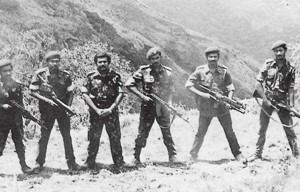
It is a well-known fact that India’s spy agency RAW provided arms, training and monetary support to six Sri Lankan Tamil terrorist groups including the LTTE and their leaders during the period 1983-87. The idea was that the Sri Lankan Tamils after being trained and armed would be sent back to northern Sri Lanka to engage the Sri Lankan troops in guerrilla warfare.
Image from left: Lingam(Prabhakaran’s bodyguard), Aruna (Batticaloa commander), Prabhakaran (LTTE chief), Pulendiran (Triconmalee commander), Victor (Mannar commander), Bottu Amman (chief of intelligence).
Karuna Amman’s declaration later that
he himself received training in India and how his training contributed to the war
in Sri Lanka is a clear indication of the perpetrators of the problem.
Those who blindly parroting the words the
implementation of the 13th Amendment” appear to have forgotten the
background against which the 13th Amendment to the Constitution, forced on us as
a result of Indo-Lanka
pact, and most of them may not be aware of what really is
in it since the Indo-Lanka pact was signed over three decades ago.
Those who promote its implementation
argue that the Amendment already exists and what is needed is implementation. The
repercussion we are experiencing today as a result of the controversial, ill-fated,
ill-defined and hastily prepared 19th Amendment to the Constitution is a minor case
in point of attempting to implement anything, just because it is in the
constitution, compared to the disastrous consequences that could be expected by
devolving power on ethnic lines as stipulated in the 13th Amendment.
The 13th Amendment to the Constitution drafted
by the Indian Civil servants, influenced by the Indian Quasi- Federal system, was
certainly ill-conceived
and hurriedly pieced together by picking bits and pieces of the Indian
Constitution in keeping with the Indo-Lanka Accord and hence was not
practicable. http://www.asiantribune.com/?q=node/18301
Prior to the signing of the 13th Amendment, there had been a belief that the ‘Official language policy” of 1956 was the root cause of the conflict. The 13th Amendment made Tamil an official language overnight as a solution but the charges against discrimination and demand for self-determination continue to be made based on those lines. If the official language is the root cause, the conflict would have resolved itself with the implementation of the 13th Amendment language policy.
Although the Indian government undertook to disarm the terrorist group in return for implementing the constitutional amendment imposed on the Sri Lanka government, India failed miserably to fulfill its obligation as per the agreement. On the other hand, Sri Lankan people had to bear the huge cost of war against terror and the cost of implementing the constitution amendment, thus imposed under the failed agreement, in addition to the loss of lives since 1987. Since it is the Sri Lankan Security forces who ultimately disarm the terrorists, the moral rights of the Indian government to ask the government of Sri Lanka to implement the 13th amendment is highly questionable.
On the other hand, the basic question we have is what it makes us believe that the 13th Amendment based on Indian devolution model is ideal for Sri Lanka when India’s quasi-federal model itself has failed to address the issues of safety, aspirations, equality, justice, peace, and dignity of its own communities.
The Parliament was to be dissolved last night to hold the General Election on 25th April. This is the first of a series of articles to highlight the ravages caused to this country during the worst period of rule that prevailed in the post-1948 Sri Lanka which was the period from 8th January 2015 to 15th November, 2019. The people of this country (the voters) have a daunting task to take all precautions to prevent the swindlers and crooks gaining power in this country and subject the country once again by falling it into the hands of western and terrorist servile rogues and getting misguided by the propaganda/smear campaign of the treacherous reactionary UNP and its bandits aided by the terrorist TNA and financed by terrorist diaspora and anti-Sri Lankan western nations.
The western powers, the 20 odd tyrant western nations (TWNs) including U.S.A., Canada, and Britain and the hegemonic India (HI) despised the Sri Lankan government of Mr. Mahinda Rajapaksa because it happened to be the fast-growing economy in Asia next only to China and hence the iron-willed leader did not bow down to their diktats.
For instance, demands made by Robert Blake, Milliband, and Koushner to halt the war against the terrorists and allow them to rescue the terrorist leadership and transport them through the sea, from Mullaitivu or Trincomalee to a western destination got rejected outright from the President Mr. Mahinda Rajapaksa.
Under this scenario, the TWNs and HI thought it was vital for those ruffians to take strong actions to topple the people friendly Rajapaksa government and replace it with a government entirely servile and docile to them. To get this objective fulfilled they adopted a two-pronged strategy of 1) creating anti-government activities through the government itself and 2) launching measures to topple the government through external sources.
Under plan no.1-A, they used the racist and pseudo-Buddhist Champika Ranawaka, a fellow belonging to the Rodiya caste (source Wikipedia – Castes of Sri Lanka) to espouse racism and create divisions between the Sinhala Buddhists and the Muslims targeting to deny Muslim votes to Mr. Rajapaksa. This racist pseudo-Buddhist former JVPer Rodiya Ranawaka launched an anti-Muslim program deploying Gnanasara Thero who contested the 2010 General Election under JHU and lost as a henchman for his mischievous plans. He was sent to Norway to get political orientation and expenses for this trip including air tickets were reportedly provided by UNP MPRavi Karunanayake (Bond Ravi). Upon the thero’s return from Norway, Champika organized a meeting against Halal” rulings under the leadership of Gnanasaara and he even made a speech in the Parliament severely criticizing Halal practices and Shariah Laws, just to antagonise Muslims against the Rajapaksa government..
In this manner, he espoused Muslim anger against the government and was also the mastermind behind the anti-Muslim riots in Aluthgama/Beruwela areas. Champika’s thugs were transported to Aluthgama/Beruwela areas and went into action of torching Muslim homes and business premises following hate speeches delivered by Gnasaara and some others in a meeting at the Aluthgama town. At that time President Mahinda Rajapaksa was not in the country and upon his return he immediately and straight away went to Aluthgama/Beruwela and instructed the security forces personnel to commence repair of damaged houses and business premises immediately and was to arrest and take legal action against Gnanasaara for instigating these troubles. Champika intervened then and threatened Mr. Rajapaksa that if he initiates legal action against Gnanasaara he would bring several thousand Buddhist monks to the streets to protest against Gnanasaara’s arrest and said that there could be a blood bath and chaos in the country which prevented the President from taking further action.
On the other hand, the cunning fox Ranil Wickremasinghe went into action to take political advantage from the situation and he made wealthy Muslim UNP stalwarts to make videotapes relating to the Aluthgama/Beruwela destructions and requested them to screen these videos on wide-screen TVs in Muslim villages which angered the Muslims and in turn, they distanced from the government and became hateful of Rajapaksa government.
Under Plam No. 1-B the bluff master Rajitha Senaratne went into action and deliberately ignored fishing rules stipulated by the European Union in order to antagonize them. Fisheries Ministry officials said that Rajitha purposely made our fishermen violate EU stipulations and hereby made them suspend GSP+ facilities to Sri Lanka. In addition to this Rajitha also made a plethora of promises to the fishing community and intentionally failed to fulfill these promises and thus distanced the fishing community from the government.
As per the Fisheries Ministry sources, these false promises made by Rajitha included that
Two mother ships will be brought from China and they would buy the catch of our boats in the sea itself and would also provide fuel and water to boats enabling them to stay in the sea for long periods;
Diesel for the fishing boats will be provided at concessionary rates;
Ice plants will be established in all fishing harbors;
Three large fishery harbors including one at Gurunagar will be established;
An insurance scheme will be introduced to cover fishermen and their boats;
GPS facilities will be provided to all boats facilitating their easy location and navigation;
Fisheries Corporation outlets will be increased and they will be made to purchase fish harvest directly from the boats;
Experts will be brought down from Vietnam to develop the Inland Fisheries Industry and our fishermen will be sent to Vietnam and Seychelles to acquire knowledge on modern fishing technology.
Fisheries Ministry sources also alleged that despite Rajitha’s false promises to the fishing community in the country, he was reported to have bought four ships and these ships are registered under the names of his family members.
In the meantime, the terrorist diaspora and the Terrorist National Alliance (TNA) were on out for action to avenge Mahinda Rajapaksa for vanquishing the terrorist military outfit from the soil of this country. Accordingly, the first salvo of the conspiracy to topple the Mahinda Rajapaksa government was fired at Singapore in August 2012 at a meeting between the UNP and the TNA facilitated by foreign servile Ranil Wickremasinghe and the anti-national Old Hag Chandrika Kumaratunge. Sumanthiran and TGTE’s Rudrakumar participated at this meeting on behalf of terrorists and Mangala Samaraweera and Jayampathy Wickremaratne attended on behalf of the reactionary conspirators. Also, present in the meeting as an observer was an unnamed representative of the despicable political outfit called MuslimCon-gross. meeting agreed to implement 10 demands presented by the Tamil group, including replacement of the existing constitution with a federal and secular constitution and after the meeting, the ferociously anti-Sri Lankan Sumanthiran expressing their delight over the decisions taken at the meeting said that Mangala Samaraweera came to the meeting like a desperate beggar ready to agree for any demand.
With this opening, a host of activities originated financed by the terrorist diaspora and guidance provided by the vicious foreign conspirators such as CIA/M 16 and India’s RAW Agency. Thre RAW Agency stationed one of their leading conspirators Atul Devol at the Indian High Commission and he acted as the main coordinator among the terrorist rump, UNP, NGOs, fringe political groups and other organizations. Terrorist funds flowed into the country in Millions and it facilitated to mushroom over 45 reactionary groups to undertake various activities against the government and these groups mainly acted as fake news originators.
These fake news syndicates launched a
hitherto never seen smear campaign with unbelievable, astonishing and phony
propaganda against the government which included:
President Mahinda Rajapaksa has swindled the wealth of the country and 18.5 Billion U.S.Dollars have been taken out of the country and deposited in a Dubai Bank;
Rajapaksa sons have brought down the world’s expensive vehicles such as Lamborghini and Aston Martin cars for their personal use;
Rajapaksa sons own golden horses and they take helicopter rides to Nuwara Eliya during weekends to learn horse riding;
Rajapaksa sons have brought down many expensive racing cars to hold car races in Kandy and in Colombo;
Rajapaksa sons have bought several palatial residences in Colombo 7 and other areas’
Gotabaya Rajapaksa received several million U.S.Dollars as commissions from Ukraine for the MIG fighter planes brought for the Air Force’
Also, he received several million dollars as commissions for arms and ammunition brought from china.
Valuable lands throughout the country have been gifted to China;
Rajapaksa family members and their cronies have received huge commissions through government contracts;
Expenditure that had been incurred for the construction of Expressways was so huge and these roads could have been built with Gold for the expenditure so incurred;
The new government will enable every family to own at least a small car ;
One million jobs will be provided within the next five years;
Foreign investors are waiting in queue to come and invest in development projects under the new government;
A Volkswagen car manufacturing factory will be established in Kuliyapit6iya’
A super tire factory for the manufacture of heavy-duty vehicle tires will be established in Horana’
The Executive Presidential System will be abolished;
People will be made rich, enjoy a leisurely life and poverty will become an enigma of the past.
The
Old Hag Chandrika who was jealous about the achievements made by Mahinda
Rajapaksawithin a short period of time undertook the task of splitting the SLFP and staging an internal coup within the government. Accordingly, she consistently and continuously persuaded Maithreepala Sirisena to leave the government and come forward as the Common Candidate with full blessings of the UNP and assured that Ranil Wickremasinghe will provide his and UNPs full backing for his candidature. Shed is closed to the media that she communicated with Sirisena using Viber technology to avoid detection of their activities by Rajapaksa agents.
Siriena kept on shrugging speculation about the possibility of his coming forward as the opposition’s common candidate and even on the night of 21st November 2014 visited the Temple Trees and had a hopper dinner with Mr. Mahinda Rajapaksa. It must be mentioned that it was Mr. Mahinda Rajapaksa who vigorously campaigned for Sirisena to get elected to the post of the General Secretary of the SLFP and he held the post for almost 11 years. Despite all this, on 22nd November this ungrateful hopper man called a media conference on November 22nd and joined by Ranil Wickremasinghe, Chandrika, and Ven. Sobhita Thero announced his coming forward as the common opposition candidate to contest against President Mahinda Rajapaksa. He also announced that the family rule will be ended, Ranil Wickremasinghe will be made the Prime Minister of the country, discriminations being encountered by Tamils will be ended, a new constitution will be enacted to devolve power to Tamils.
The JVP and the fringe Muslim parties of the two avaricious self-appointed leaders also pledged their support to Sirisena’s candidacy. The JVP gave a stern pledge to launch an extensive campaign to ensure the victory of Sirisena and usher in a new political culture.
Several UPFA MPs also defected along with Sirisena. They were Duminda Dissanayake, M. K.A.D. S. Gunawardena, Wasantha Senanayake, Rajitha Senaratne, and Rajiva Wijesinha. Subsequently, more MPs such as Navin Dissanayake, Palani Digambaran, Velusami Radhakrishnan,s, Faiszer Musthapha, Nandimithra Ekanayake, Achala Jagodage joined the Sirisena camp and the strange phenomena seen at that time was that these late joiners made a trip to Singapore before they joined Sirisena camp and speculation was ripe that a strange personality in Singapore (suspected as Arjun Mahendran) bought them for enormous sums. At that time Siriena gas made a night visit to Minister Fawzi’s residence at Bauddhaloka
Mawatha
and urged him to join with him promising to pay Rs. 200 Million each or more
for him and his son Nouser.
Sirisena
pledged to abolish the executive presidency within 100 days of being elected,
repeal the controversial eighteenth amendment, re-instate the seventeenth
amendment and appoint UNP leader Ranil Wickremasinghe as Prime Minister. On 1 December 2014 Sirisena signed a memorandum of
understanding (MOU) with 36 opposition parties/civic groups promising to
abolish the executive presidency, hold parliamentary elections, form an
all-party national government and carry out various political reforms.
Signatories
to the MOU included the UNP, Sarath Fonseka’s Democratic Party, Democratic People’s
Front, Azath Salley‘s Muslim
Tamil National Alliance, Free Media Movement, Federation of University Teachers Association as well
as dissident groups of the LSSP and Communist Party. The following day the JHU
announced that it was supporting Sirisena in the presidential election. On
30 December 2014 the Tamil National Alliance endorsed Sirisena
United National Party is in its terrible divisional junction to demise end by itself. In differences in the party outpouring to the public in different ways; as such, frustrated members, different viewpoints in the same party, dishonest answers to public, rude, ruthless comments of their own leaders. These are quite common these days to the public. They don’t know what they are doing, and what they need to do, etc. It is a visible completely unstable party without a vision and no values for the country from them, and its future is in turmoil. People in that party including Ranil Wickramasinghe; he is planning to snatch the power by infamous tactics and do more harm to our country. I want to say people around this party will not be accepted by the public of the country. If the party cannot find a solution to their own problems; the simple question is will they be able to find solutions to the country at this most important time of our era. One of the Politicians like Harsha was saying to himself that he is frustrated by himself. Obviously Mr. Harsha if you were doing your job without coming to politics, I am sure you would have been a satisfied person today. Being a professional you lied to Sri Lankan people. Being a professional what was your output to my country; I would say nothing and today you are a frustrated person because of politics. If you were under progressive leadership, you would have to be a satisfied person.
UNP members want to make Sri Lanka a country with no national security. We experienced a huge tragedy in the country as they undermine national security. None of the Sri Lankan will vote for them in the future election.
I heard the saga of bleeding the party into pieces this morning news. Definitely they need to solve this problem in a different setup. I would suggest them to divide into two groups and take some clubs into their hands and do a battle in an open ground. There will be bleeding people upon this battle, but there will be a definite winning group. They may have the right to say; that they are the UNP party. That is the only creative solution left for them at this time. This is a strong message to these cowards and power-hungry creatures has to do at this time. The people at this party I would name them. Champika, Ravi, Ranil, Navin, Akila, Ranjith Maddumabandara, and many more all the front liners are corrupted candidates to Sri Lankan people. When people review everybody’s political resume; it is corrupted, so public will ban them forever. You will never ever come to power in this country. The public has the awareness what is happening in UNP by now, and that is the same thing we saw while you guys were ruling the country using Maithreepala for the past 5 years. People do not want such dubious rulers anymore to rule this country. This country belongs to us by now, and it will belong to future sons and daughters of this country. The politician who comes to power must realize they need work for the country not plunged, and rob the country. That is the common sense of the people of this country.
Whether I am living in a foreign country I love my country. There is no such beautiful country anywhere else in this world. I am requesting from every Sri Lankan not to vote for UNP members. They will sell all assets which we have protected for the future generation and will make the country a foreign property. These people of UNP need to understand the society has changed, they need to understand there is a powerful think tank developing among the society in the country whom they are willing and want to find out true, honest, dedicated, transparent, collaborative, visionary, clean, responsible, accountable leadership and lead the country for prosperity. Those leaders expected to show up themselves and character must be a mirror image of what they say and what they do. Those who will elect through elections must be public trustees. The moment they do not show that transparency will have to pay the price. Our country has the potential to become the most economically vibrant country in the world. In order to achieve that we need strong, visionary leadership in the country. We are happy Sri Lanka has such a great leadership now. We need to start that journey towards prosperity. I must say every Sri Lankan citizen must gather around that leadership and mobilize the country towards that prosperity.
1. Scrap the wasteful 13th amendment and Provincial Councils 2. Scrap the shameful Indo Lanka Accord, which no self-respecting nation would abide by. Does Austria, or the Czech Republic abide by the Nazi imposed Anschluss to this day? 3. Scrap all unnecessary bureaucracy – a burden to the nation’s taxpayers 4. Adopt Singapore’s “Ethnic Integration Policy” (which DS Senanayake used) to settle ALL ethnicities islandwide to ensure zero ethnic ghettos 5. Ban all ethnic parties 6. Ensure one medium of instruction in English for all students in one school system and gear it toward the future skills of IT, engineering, economics and science (the STEM education model). Ensure that every child is bilingual in one mother tongue and English (e.g. Sinhala and English). 7. At any election, run with NEW people. Young people who have a vision, not the fat buffoons from before. 8. Stop pandering or focusing on India. Open to the WHOLE WORLD and become like Singapore. This country needs massive investment which China, South East Asia, etc can provide. Furthermore, scrap all Indian rubbish trains and invest in high-speed electric air-conditioned transport for all (both trains and buses from China, Japan and homemade ones here) 9. Establish ONE LAW, ONE PEOPLE, ONE NATION with an indomitable destiny of excellence on the island of Ceylon/Sinhaledeepa/Sri Lanka and make us a first-world oasis in a third world region?
Look at a picture of the 1940s/50s Ceylon and compare it to the equivalent picture of Singapore, Japan, China, South Korea, Malaysia, or even any old capital in the West. It was said by Sir Ivor Jennings that the Ceylonese spoke better English than their British counterparts and our island with its Sterling Reserves, garden cities and cultural history of over 2,500 years would blossom into an economic powerhouse and first-world oasis in a third world region.
Compare where our competitors (listed above) have gone versus ourselves thanks to inept, unambitious, Indian bootlicking, spineless and treacherous leaders we have had. Look at Japan with its bullet trains, China with its high-speed trains and futuristic cities, Singapore with its integrated housing schemes (no ethnic ghettos) and zero tolerance for corruption, the fellow Buddhist nation of Thailand with temples nationwide, South Korea exporting some of the world’s best cars, televisions, and phones. The truth is that Sri Lanka could become greater than Singapore (a great nation) in no more than 10 years. But 10 years after the destruction of the INDIAN created Tigers, and we are languishing as an Indian style kakistocracy.
So
when you vote, THINK about the above. WHO will promise these 9 BASIC things
BEFORE the election? (I would add who would rename the country Sinhale, or
Ceylon as well).
Ask
not for whom the bell tolls, it tolls for thee oh Sri Lankans/Ceylonese!
Dear Colleagues, as
some of you may recall, when I was a professor of
pathology at the University of California San Diego, I was one of the
first molecular virologists in the world to work on coronaviruses
(the 1970s). I was the first to demonstrate the number of genes the
virus contained. Since then, I have kept up with the coronavirus
field and its multiple clinical transfers into the human population
(e.g., SARS, MERS), from different animal sources.
The current projections for its expansion in The US are only
probable, due to continued insufficient worldwide data, but it is
most likely to be widespread in the US by mid to late March and April.
Here is what I have done and the precautions that I take and will
take. These are the same precautions I currently use during our
influenza seasons, except for the mask and gloves.:
1) NO HANDSHAKING! Use a fist bump, slight bow, elbow bump, etc.
2) Use ONLY your knuckle to touch light switches. elevator buttons,
etc.. Lift the gasoline dispenser with a paper towel or use a
disposable glove.
3) Open doors with your closed fist or hip – do not grasp the handle
with your hand, unless there is no other way to open the door.
Especially important on bathroom and post office/commercial doors.
4) Use disinfectant wipes at the stores when they are available,
including wiping the handle and child seat in grocery carts.
5) Wash your hands with soap for 10-20 seconds and/or use a greater
than 60% alcohol-based hand sanitizer whenever you return home from
ANY activity that involves locations where other people have been.
6) Keep a bottle of sanitizer available at each of your home’s
entrances. AND in your car for use after getting gas or touching
other contaminated objects when you can’t immediately wash your hands.
7) If possible, cough or sneeze into a disposable tissue and discard.
Use your elbow only if you have to. The clothing on your elbow will
contain infectious virus that can be passed on for up to a week or more!
What I have stocked in preparation for the pandemic spread to the US:
1) Latex or nitrile latex disposable gloves for use when going
shopping, using the gasoline pump, and all other outside activity
when you come in contact with contaminated areas.
Note: This virus is spread in large droplets by coughing and
sneezing. This means that the air will not infect you! BUT all the
surfaces where these droplets land are infectious for about a week on
average – everything that is associated with infected people will be
contaminated and potentially infectious. The virus is on surfaces and
you will not be infected unless your unprotected face is directly
coughed or sneezed upon. This virus only has cell receptors for lung
cells (it only infects your lungs) The only way for the virus to
infect you is through your nose or mouth via your hands or an
infected cough or sneeze onto or into your nose or mouth.
2) Stock up now with disposable surgical masks and use them to
prevent you from touching your nose and/or mouth (We touch our
nose/mouth 90X/day without knowing it!). This is the only way this
virus can infect you – it is lung-specific. The mask will not prevent
the virus in a direct sneeze from getting into your nose or mouth –
it is only to keep you from touching your nose or mouth.
3) Stock up now with hand sanitizers and latex/nitrile gloves (get
the appropriate sizes for your family). The hand sanitizers must be
alcohol-based and greater than 60% alcohol to be effective.
4) Stock up now with zinc lozenges. These lozenges have been proven
to be effective in blocking coronavirus (and most other viruses) from
multiplying in your throat and nasopharynx. Use as directed several
times each day when you begin to feel ANY “cold-like” symptoms
beginning. It is best to lie down and let the lozenge dissolve in the
back of your throat and nasopharynx. Cold-Eeze lozenges is one brand
available, but there are other brands available.
I, as many others do, hope that this pandemic will be reasonably
contained, BUT I personally do not think it will be. Humans have
never seen this snake-associated virus before and have no internal
defense against it. Tremendous worldwide efforts are being made to
understand the molecular and clinical virology of this virus.
Unbelievable molecular knowledge about the genomics, structure, and
virulence of this virus has already been achieved. BUT, there will be
NO drugs or vaccines available this year to protect us or limit the
infection within us. Only symptomatic support is available.
I hope these personal thoughts will be helpful during this
potentially catastrophic pandemic. You are Welcome to share this
email. Good luck to all of us! Jim
Sri
Lanka takes note of the report of Mr. Ahmed Shaheed, Special Rapporteur on
freedom of religion or belief following his visit to Sri Lanka from 15 to 26
August 2019, which has been presented to this Council today (A/HRC/43/48/Add.2).
The advanced unedited report of the Special Rapporteur (SR) was shared with Sri
Lanka, for comments, on 3 February 2020, with a deadline of 28 February 2020,
i.e. last Friday, leading to an Interactive Dialogue thereon today – Monday.
However,
within the limited time available, Sri Lanka wishes to provide some general observations
on the SR’s report. We request that our full observations, which will follow,
be published as part of the report.
Sri
Lanka received the SR in August 2019, barely 4 months after the country had
suffered a series of horrendous terrorist attacks by certain local groups inspired
by ISIS which targeted innocent civilians at worship and at hotels on Easter
Sunday, causing the death of 258, including 45 foreign holiday makers. The
facilitation of the visit, at a time of numerous national challenges, was a manifestation
of the Government’s policy of open and constructive dialogue with UN human
rights mechanisms.
The
people of Sri Lanka have lived amicably despite racial and religious
differences for centuries, and continue to do so. Having suffered the scourge
of separatist terrorism for nearly three-decades, they had been enjoying their
hard-won peace and freedom, and had embarked on the path of reconciliation and
national healing over the last decade. However, the Easter Sunday attacks
reminded us that we are fighting a common adversary in terrorism,
radicalization and extremism, which is a global threat.
In
this context, we consider it unfortunate that the SR’s report has, to a large
extent, sought to judge the space for freedom of religion or belief in Sri
Lanka through the few months that followed the Easter Sunday attacks. As may be
recalled, the scale of these attacks brought about a national emergency in Sri
Lanka which called for prompt action by the State to identify and neutralize
terrorist elements in different parts of the country in the interest of safety
and security of all communities, while maintaining the delicate balance between
national security and human rights. In the aftermath of the attacks, the
Government immediately took all possible measures to prevent any retributive
acts of civil unrest, maintain law and order, and most importantly to ensure
the safety and security of all people, particularly the Muslim community. The
constructive and reconciliatory approaches and calls made by the civil and
political leadership of the country which helped contain the situation were
widely acknowledged and appreciated. The Muslim community particularly took
proactive measures to cooperate with the security agencies in their
investigations and search operations. Suspects who were arrested were afforded
their legal safeguards and independent institutions were provided access to
monitor their situation.
The
incidents of mob violence that occurred 3 weeks after the terrorist attacks
were not communally motivated but caused by unruly elements. These mobs were
efficaciously neutralised by the Government through a number of arrests and by
bringing to justice alleged perpetrators. The country fast returned to
normalcy, reassuring the safety and security of all Sri Lankans and visitors to
the country. Through giving effect to relevant legal provisions and following necessary
legal processes, order and rule of law has been firmly re-established. The
security forces of Sri Lanka merit particular commendation for their prompt and
professional action in this regard.
Therefore,
the Government rejects the inaccurate references in the SR’s report to serious
concerns” regarding Sri Lankan security forces colluding with mobs and not
acting to prevent or stop the violence”; the lack of response from the
authorities against this violence”; and the claims that acts of violence are
indulged by the silence and inaction from the authorities”. It is regrettable
that these inaccurate accounts have been included in the report, even after they
have been fully rebutted and explained by the Government soon after the alleged
incidents.
It is also
regrettable that the report has sought to portray instances where criminal
investigations have been conducted to prevent acts of terrorism in accordance with
the law, as an endeavor to violate the freedom of religion or belief.
With
regard to references to restrictions on dress code, it is noted that the
regulation concerned was a temporary measure under the Emergency Regulations aimed
at preventing concealing of identity, in view of the imminent security threat that
existed at the time. In this regard, we wish to draw the attention of the
Council that the International Covenant on Civil and Political Rights (ICCPR)[1]
itself has permitted limitations by law to the freedom to manifest one’s
religion or beliefs for the purposes of protecting public safety, order,
health, or morals or the fundamental rights and freedoms of others.
Sri
Lanka also categorically rejects the inaccurate assertion in the report that
the ICCPR Act has not been applied to protect minorities but has become a repressive
tool” curtailing freedom of religion or belief. In this regard, we wish to
point out that since its enactment in 2007 to date, 90% of the suspects who
were arrested under the ICCPR Act have been from the majority Sinhala community.
With
regard to comments made in the report about alleged discrimination based on
supremacy” of Buddhism over other religions, we wish to highlight that Article
9 the Constitution requires the State to protect and foster the Buddha Sasana
while assuring all religions the rights granted under the Constitution. No
provision in Sri Lanka’s Constitution or national laws permits discrimination
of an individual based on religion or belief in any sphere of public life. On
the contrary, Article 12 of the Constitution prohibits discrimination based on race,
religion, language, caste, sex, political opinion, place of birth or any such
grounds.
In the
SR’s report,certain instances,
determinations of the Supreme Court have been inaccurately reflected based on
surmise. In certain other instances, the Constitutional provisions have been
inaccurately reflected, for example, the SR’s comments on the right to
proselytize and conversion which are an inaccurate reflection of the
determination of the Supreme Court.
The
report has failed to adequately discuss the drivers and root causes of
radicalization of youth from one particular religious community to the extent
of engaging in acts of terrorism, and appears to lack inputs from a broader
spectrum of Sri Lankan society, including family members of victims and suspects,
as well as other neutral groups. In describing attacks against and desecration
of places of worship, the report has failed to refer to incidents of attacks on
and vandalizing of Buddhist places of worship and instances of obstruction of Buddhist
devotes in certain areas of the country.
The report
also fails to adequately address positive measures undertaken by the Government
and the law enforcement agencies to foster religious harmony, such as addressing
extremist elements on all sides, payment of compensation through the Office for
Reparations to victims of violence, and setting up of mechanisms such as an Inter-Religious
Council. It is unfortunate that the resilience and solidarity of Sri Lankans
protecting and assisting fellow citizens of all faiths in the aftermath of
April 21, as demonstrated by Buddhists and Christians guarding Muslims at
prayer, renovation of damaged property and restoration of damaged churches by
the security forces, have not been reflected in the report. Nor has the
laudable role played by the independent institutions of Sri Lanka, such as the
Human Rights Commission, during this challenging period, received the attention
that it warrants.
The
report notes that the school curriculum should be designed to include human
rights education”, whereas human rights education is already part of the national
curriculum in schools. There are a number of co-curricular programmes and activities
being planned and delivered at various levels, including at schools, to foster
greater understanding amongst school children from different communities and
religions.
The
GoSL wishes to reiterate that the State possesses credible agencies, the capacity
and the necessary legal framework to address the issues of concern. Sri Lanka remains committed to
protecting and promoting the freedom of conscience and religion of all its
people, in accordance with the Constitution of the country.
We look forward to continuing to engage
with the Special Rapporteur and this Council in a constructive and meaningful
manner towards this end.
Weeks after the Health Ministry ordered all passengers arriving from China and South Korea to undergo a 14-day quarantine period following the outbreak of COVID-19, passengers arriving from Italy will also undergo 14-day isolation, officials from the Health Ministry told Daily Mirror yesterday.
Chief Epidemiologist Dr. Sudath Samaraweera said details of all passengers arriving from Italy would be sent to the Health Ministry which would share the information with public health officers for them to follow up on the passengers.
“We will ask them to stay at home for two weeks and PHIs will follow up with them to check if they suffer from any symptom. Some countries such as Iran that faced the outbreak of the virus were being monitored closely. A decision will be taken to quarantine passengers if the situation aggravates,” Dr. Samaraweera said.
As the death toll from COVID-19 surpassed the 3,000 mark globally yesterday, Dr. Samaraweera said passengers arriving at BIA were being medically checked and those arriving from affected cities were being advised to visit a hospital to undergo a thorough examination.
All passengers have been instructed to fill health declaration forms upon their arrival and those who have visited any affected country in recent weeks will be closely monitored.
According to the Health Ministry, till last evening, 18 suspected patients had been warded at hospitals countrywide and four out of them had been foreigners.
The Presidential Commission of Inquiry on the Easter Sunday attacks has handed over its second interim report to President Gotabaya Rajapaksa.
The report was handed over to the President at the Presidential Secretariat this evening (02).
The first interim report of the Commission was presented to the President on 20th December 2019.
The final report of the Committee will be compiled following further inquiries.
The Commission was appointed by former President Maithripala Sirisena on September 22nd, 2019 to investigate the series of attacks that took place on Easter Sunday the same year and to recommend necessary actions.
The Chairman of the Commission Court of Appeal Judge, Janak de Silva and other members –Court of Appeal Judge, Nishshanka Bandula Karunarathna, Retired High Court Judges Nihal Sunil Rajapaksa and A.L. Bandula Kumara Atapattu, former Secretary of the Ministry of Justice, W.M.M.R. Adikari and the Secretary of the Commission, H.M.P.B. Herath –were also present.
The gazette notification pertaining to the dissolution of the Parliament of Sri Lanka has been published.
Accordingly, the 8th Parliament will be dissolved with effect from midnight today (02).
The new parliament is set to convene on the 14th of May, 2020.
Meanwhile, General Election 2020 has been declared to be held on the 25th of April.
Nominations for the election will be called for from the 12th to the 19th of March.
The five-year term of the 8th Parliament began on September 1, 2015, following the parliamentary elections held on August 17, 2015, and is due to expire in August this year.
However, under the 19th Amendment, the President has been vested with the power to dissolve the parliament after four and a half years of the sitting of Parliament.
A year
ago, UN Human Rights Commissioner Michelle Bachelet made the following
observation in her report on Sri Lanka (tabled on March 8, 2019):
‘On 29
May 2018, human skeletal remains were discovered at a construction site in
Mannar (Northern Province). Excavations, concluded with the support of the
Office on Missing Persons, revealed a mass grave from which more than 300
skeletons were recovered. It was the second mass grave found in Mannar
following the discovery of a site in 2014. Given that other mass graves might
be expected to be found in the future, systematic access to grave sites by the
Office as an observer is crucial for it to fully discharge its mandate,
particularly with regard to the investigation and identification of remains.’
Pointing
out that the said mass grave has been dated back to 1499-1719 CE, as per tests
done by Beta Analytic Institute, Florida, USA, I made the following
observation:
‘Bechelet
may have not known (which indicates sloth) or knew very well (which indicates
she’s toxic) when she tabled that report. Those who were ecstatic when these
graves were discovered and may have uttered equivalents of ‘Pay dirt, baby!’
are playing ostrich right now.’
There’s
been no apologies or explanations. Not then, not since. Not about the mass
grave nor about the blatant lies and tendentious claims she dished out in her
report, clearly refuted by then Minister of Foreign Affairs, Tilak Marapana.
A year
later, Bachelet revisits. No mention of mass graves. Instead she offers a
whine. Read on:
A
contributing factor to a lack of delays in implementing human rights reform
appears to be a lack of common vision among the country’s highest leadership,
deadlock on important issues is an addition and an avoidable problem with
damaging impact on victims currently from all ethnic and religious groups and
society as a whole.
Wordy,
much.
What does
she mean by ‘common vision’? Before we answer that, there are a couple of
things we need to deal with. First, ‘leadership’. Contrary to her claim, there
doesn’t seem to be disunity. The Yahapalana regime was brought with division.
There was a maverick Minister of Foreign Affairs (before Marapana) who was like
a law unto himself, bullishly co-sponsoring an anti-Sri Lanka resolution (30/1)
on behalf of a Government led by two individuals in a coalition of two parties
that had been going hammer and tongs for more than half a century and was too
busy with petty political fights to figure out what he was up to. Indeed THAT
Government, at THAT time, had all but lost its mandate, having been routed in
the local government elections a year before. In stark contrast, the current
regime does not seem to be suffering from any vision impairment on account of
disunity with regard to these issues. ‘One Voice’ is what we have now. We can
tell her something like this: There’s no deadlock miss; ask the UNP’s
Presidential candidate Sajith Premadasa what his views are on Resolution 30/1.’
The
disunity we see comes from differences among different political
parties/coalitions. That’s natural. That’s why there’s ‘government’ and there’s
‘opposition’. It’s about having power and wanting power. However, today, the
main Opposition United National Party (UNP) doesn’t seem to have any issues
with the position that the ruling party, the SLPP (Sri Lanka Podujana Peramuna)
has taken vis-a-vis Resolution 30/1.
So when
Bachelet talks of ‘common vision’ we need to unpack ‘vision’. Whose vision? Is
she dismayed because a nation appears to be unwilling to inhabit her version of
its reality? Probably. But what’s her vision and what is it based on?
In her
elaboration on Sri Lanka, Bachelet says, ‘the recent appointment to a senior
position in the SL army of Major General Shavindra Silva implicated in alleged
serious violations of national humanitarian rights law is a worrying
development.’ Key word: ‘alleged’. Then she laments ‘lack of progress’ in
‘setting up special judicial mechanism to deal with the worst crimes committed
in the 2009 conflict.’ That’s not allegation, it’s conclusion and condemnation.
A quick shift, that.
She’s
also mentioned ‘an important next step’: ‘legislation and the establishment of
an independent truth and reconciliation commission.’ Aha! So we need to
legislate. This seems to be an acknowledgment of the frivolous and pernicious
nature of Resolution 30/1 where Sri Lanka (well, Mangala Samaraweera, actually)
pledges to violate her own Constitution! Naturally, new laws would have to be
made. Now that promise was made without any mandate for constitution-violation.
Today, Bachelet says ‘legislate!’
There has
been minimal progress on accountability, she says. True. Of the UNHRC, sections
of the UNP, the Tamil National Alliance and various I/NGOs with absolutely no
standing in civil society but whose word has been taken as biblical truth by UN
agencies, the USA and the UK. They lied. The lies were picked up and agreed
upon by the charlatans commissioned by former UN Secretary General, Ban-ki Moon
to advise him on Sri Lanka. Lies were agreed upon. Based on these very same
lines, ‘vision’ was produced. Now that the whole edifice is askew on account of
a weak foundation, people like Bachelet wail, ‘there’s no unity among leaders
in Sri Lanka!’ They use ‘allegation’ and treat it as ‘guilt’. They talk of
‘damaging impact on victims,’ interestingly ‘from ALL ethnic and religious
groups and society as a whole.’
Wow!
Has
Bachelet done a survey of some sort? And who are these ‘victims’? Yes, all
ethnic and religious groups suffered. ‘Society as a whole’ suffered too.
Happens when a rabid terrorist outfit holds country and community hostage for
decades. The victims are those who suffered have been all but discounted by the
UNHRC and people like Bachelet. Resolution 30/1 kicks them in the teeth, so to
speak simply because it infringes upon their sovereignty, makes light of their
suffering and attempts to force them to submit to someone else’s version of
what they’ve suffered.
So when
Bachelet talks of ‘deadlock,’ it is essentially disagreement between the people
of Sri Lanka and the UNHRC’s (or should I say ‘Uncle Sam’s’) notions of Sri
Lanka’s past, present and future.
Since she
talks of ‘all ethnic and religious groups and society as a whole,’ she needs to
understand that Resolution 30/1 panders to the pernicious designs of a small minority
of a single ethnic group that has been whipping communalism for decades. That’s
what legislation a la Bachelet would do.
When I
said Michelle Bachelet needs a tutor it was tongue-in-cheek. She knows stuff.
She knows stuff and knows her job. Upholding human rights is her official job,
but the United Nations being a creature of North America and Europe, that job
is framed, more or less, by the interests of the relevant nations. Sure, the
USA has called it a ‘cess pool of bias’. That’s correct. Bias in favour of the
global political formations mentioned above. Sure, the USA quit the UNHRC, but
no one’s fooling anyone. The US can operate (read, ‘arm-twist’) directly or
through proxies. And Bachelet seems to be playing her part in that game.
This must
end. Soon. Sri Lanka has been hauled over the coals by countries that have the
worst human rights records and their apologists. Sri Lanka should not be held
to ransom on account of the stupidity of an inept government utterly servile to
the designs of the USA. Sri Lanka and Sri Lankans should not be held to ransom
just because a maverick Minister suffers from a postcolonial condition that
makes victim hate him/herself and believes fervently in the ‘curative power’ of
vilifying and destroying his/her community.
Enough.
We need closure on this. Bachelet, we must not forget, is someone who refused
an audience to the victims of the US-sponsored coup that ousted the
democratically elected government of Salvadore Allende during two separate
terms as President of Chile. She can’t pretend to shed victim-tears for tears
she did not have to shed for victims in her own country.
We need
closure on spin. No tutors required for that.
With
incontrovertible evidence gleaned from unimpeachable international sources Daya
Gamage, by far the most knowledgeable analyst of America’s role in Sri Lanka –
he once worked in the American Embassy acquiring detailed insights into the
operations of the mission – has revealed that the decision to place a travel
ban on Lt. Gen. Shavendra Silva originated from the Embassy in Colombo though
the American Ambassador Alaina B. Teplitz, playing the role of Pontius Pilate,
pretended at the meeting with the Foreign Minister, Dinesh Gunawardena, that
the decision came down from Washington. Simultaneously he revealed, quoting
internal documents of the State Department, that the American Embassy in
Colombo is run by Americans who are guided by their introverted biases that
reject the ground realities. It is the innate inability of the American
diplomats to grasp the internal dynamics of the countries to which they are
posted that turns them into misguided missiles. American diplomats who
arrogantly assume that they know the right prescription to cure the ills of the
world have failed, time and again, leaving the world in a twisted mess that was
not there when they began their provocative and counter-productive
interventions. Example: Iran.
Of course, there are times when they are pushed to defend the
miscalculated politics of their leaders like planting the American embassy in
Jerusalem. But more often they rush blindly, on their own initiatives, into
places where angels fear to tread. They have a penchant for creating problems
where none existed. The latest is the travel restrictions placed on Lt. Gen.
Shavendra Silva. This decision does not reflect her impressive academic and
professional credentials. It looks more like an act of an irrational and
vindictive Kali Amma – the Hindu goddess of death and doomsday. It is a
provocative act that will not serve Lanka-American relations, peace or human
rights. Her theoretical knowledge acquired from academia and her hands-on
experience derived from serving in war-torn zones in Asia (she also served in
Kabul) should have informed her to be more cautious.
The massive backlash against her counter-productive decision
should teach her in the future to make mature and balanced decisions taking
into consideration not only the American practices of ending its horrendous
wars but also the inevitable exigencies of the battlefield. If, for instance,
in her moral conscience she had remembered the images of the Nobel Peace prize
winning President Barak Obama watching with anxious intensity his Navy Seals
raiding the den of Osama Bin Laden and massacring the millionaire terrorist,
his wife and his son she would never have had the arrogance to pass her
provocative judgment on Gen. Silva. If she had bothered to remember how the
Americans hunted the driver of Osama Bin Laden and tortured him at Guantanamo
Bay while giving permanent residency to Prabhakaran’s lawyer, Rudrakumaran, who
was a partner in the crimes of the Tamil terrorist leader, she would have had
second thoughts about rushing to impose a travel ban.
Would Teplitz ever issue a visa to Osama bin Laden’s lawyer from
Kabul? So on what moral basis does America permit Rudrakumaran to live in
America and, in the same breath, refuse to give even a visa to Gen. Silva? But
then the chicken memories of insensitive and half-baked American diplomats are
geared to serve only their perverse objectives of creating unnecessary trouble
where none exists. Diplomats are supposed to pour oil over troubled waters not
to set fire.
Above all, any judgment on the conduct of the war must take into
consideration the objectives achieved by ending the war. Since human rights
have become the prime concern of the political moralists it is only fair to
assess the conduct of Gen. Silva’s offensive in terms of how it related to
human rights. The first question that has to be asked is: Did his offensive
which ended the war put an end to the violations of human rights perpetuated by
the war? If so on what side should morality fall? In this instance the ends
justify the means because there isn’t a higher objective in a battlefield than
saving human lives and human rights. By ending the war swiftly without letting
it drag on Gen. Silva did serve human rights. His successful strategy to end
the war also ended the perpetuation of the violations of human rights that had
plagued the nation for 33 years (between 1976 when the Tamil leadership
declared war in Vadukoddai and 2009).
Teplitz’s judgment to selectively target Gen. Silva indicates
that she has brushed aside the higher moral value of saving and serving human
rights by ending a needless war that would have only perpetuated the violations
of human rights. She has gone overboard to impose her arbitrary judgment which
will neither serve human rights nor set an example to other generals engaged in
battles to end fascism and terrorism. There are limits to compliance with human
rights in the battlefield. It should not tie the hands of those fighting to
save human rights from the enemies of human rights.
However desirable and moral it may be to observe the decent
rules of engagement in the battlefield the generals will be pushed at times,
particularly when facing fascist terrorists, to the ends of their wits to be
within the prescribed norms. If they happen to violate the norms within
tolerable limits then they should not be condemned if they had achieved the
higher goal of ending the violations of human rights by ending the war.
Her knowledge of the history of wars should have also informed
her that the best means of ending violations of human rights in conflict zones
is by ending wars. Appeasing an intransigent and ruthless enemy, or postponing
the inevitable end of eliminating the blood-thirsty enemy is not an acceptable
moral or viable answer. Those hoping to save victims of violence cannot depend
on moral theories to eradicate violators of human rights. It has never worked.
For instance, she should know, with all her academic background, that World War
II was not ended by observing the highest principles of human rights but by
bombing the hell out of Hiroshima, Nagasaki and Dresden in Germany. The
ultimate command responsibility was with Truman and Churchill. Which one of
them was tried in Nuremberg for war crimes?
The Sri Lankan generals fighting the world’s deadliest
terrorist” were faced with a greater moral dilemma: How do you end the war in
its last stages and save human lives and human rights in a battlefield where
the intransigent and ruthless enemy was waging a war behind a human shield? The
immorality of throwing his own people as cannon fodder to stave off an
advancing force is not only cowardly but inhuman. This is the ultimate dignity
given by the Tamil hero to the Tamil people. He was forcing his people to fight
his futile war hoping to gain military and propaganda advantages. He was a
barbaric coward who was hoping to live by sacrificing the lives of other Tamil
people. In the battlefield how was any general to know the difference between
Tamil Tiger terrorists and the innocent Tamil victims forced to stand as a
human shield?
The issue before the Sri Lankan generals was simple: It was
either to end the war with the minimum of casualties which is what happened
according to the statistical evidence available at the British Foreign office.
Or to stop waging war altogether hoping that it would end violations of human
rights by Prabhakaran, the ”pathological killer” (James Jupp, ANU, Australia,)
who had killed more Tamils than all the others put together, as stated by Tamil
leaders.
This was never going to happen because Prabhakaran could survive
only as a leader of war and not as a democratic leader of peace. Faced with
dwindling cadres in his own ranks, his last defence line was to create a human
shield for his survival. Besides, throwing human shields to the frontline was a
deliberate tactic used to mobilise international opinion against the Sri Lankan
government to stop the war and save Prabhakaran. Using immoral tactics to
create moral dilemmas for policy-makers should be rejected as a justifiable moral
base for passing judgment on the victims of the Machiavellian tactics. The
justifiable sympathy should go to the victims of the immoral tactics that led
to the violations of human rights and not to the criminal originators who
deliberately planned the violations of human rights to gain political mileage
out of their tactics. To pass judgment on the victims of immoral tacticians is
to exonerate and justify the criminals who deliberately planned strategies to
cause violations of human rights. Any moral law should recognise first the
responsibility of those who consciously abandon the non-violent democratic
mainstream and chooses the violent path to achieve political goals.
History is not without alternatives. Non-violent paths are
always open for those who have the courage to take that path. The Tamil
leadership chose the violent path. It was the Tamil leadership that declared
war against the rest of the nation in their notorious Vadukoddai Resolution of
1976. It was they who mobilised the local and global forces to wage their war.
It was they who financed the war from Western bases.
It was they who weaponised local politics to justify their
Vadukoddai violence. It was they who urged the Tamil youth to take up arms
against the Sinhala state”. It was they who justified the forcible recruitment
of under aged Tamil children to fight their futile war. It was the Tamil
leadership that rejected national and international peace deals that could have
ended violence and human rights violations much earlier than 2009. It was the
Tamil leadership that broke all international agreements, including the UN
agreement not to recruit children and accept peace deals like the Indo-Sri
Lanka Agreement. It was the Tamil leadership that threw a human shield to
prolong and perpetuate violence and violations of human rights. The first
victim of the declaration of war in the Vadukoddai Resolution was human rights.
The criminal history of the Tamil elite to suppress and deny their own people
even the right to walk in God-given daylight was not prevalent either in the
Bible belt of America or in S. Africa. She puts a ban on the general who put an
end to all these crimes with his military strategies.
If any violations took place it was not as a result of a
deliberate policy of the state or the forces to target civilians. However, if
she was finicky about the minutest violations of human rights why has she not
taken up the issue of the IPKF forces that rushed into the Jaffna Teaching
Hospital and massacred doctors, nurses, patients and even children? Before
rushing hastily to pass judgment on those who fought to end this evil war and
restore human rights, justice and peace it was her moral and professional duty
to have acquainted herself with a sufficient degree of the ground realities. Her
unfair and arbitrary judgment passed on Gen. Silva reveals only her incapacity
to balance the hard facts with the logic that leads to a credible and fair
morality. If she knew about these historical factors would she have passed
judgment on those who ended the violations of human rights by ending the war?
Her first priority should have been to reward those who saved lives by ending
the perpetuation of the violations of human rights. Instead she sits like
Madame Defarge knitting her yarns about human rights while those who were
operating the guillotine were exonerated by her silent patronage. It was easy
for her to pontificate and pass judgment. But the people of Sri Lanka –
including the Tamils – were not saved by American pontificators. They were
saved by the generals who fought, risking their lives, to restore peace,
liberty, democracy and human rights.
Most of all, if she is the moralist that she pretends to be why
does she selectively turn a blind eye to the moral precedents set by her
revered leaders who had ended their wars by using excessive force knowing that
the enemies (Germans and Japanese) were beaten to their knees? Why does she
embrace the tactic of annihilating the enemy at any cost as moral when it is
used by her leaders and in the same breath reject it as immoral when it is used
by Sri Lanka generals with the minimum of force?
What is her valid argument to impose her holier-than-thou
morality to punish Sri Lankan generals who had saved liberty, dignity and human
rights of the Tamils kept under the boots of a Tamil tyrannical fascist? In no
way could the Sri Lankan forces / government prevented the violations of human
rights as long as Prabhakaran lived to fight another day. In punishing Gen.
Silva she is guilty of endorsing the brutal practices of Prabhakaran to
perpetuate his inhuman and irrational war that did not take the Tamil people
into depths of despair and suffering. If Teplitz has a better moral way of
saving human rights than the strategy adopted by Gen. Silva she should first
state that before condemning him.
There were two forces battling for supremacy for 33 years in Sri
Lanka. I unhesitatingly back the Sri Lankan forces, with some remorse of
course, because they served the higher morality of liberating the Tamils from
the tyranny of a Tamil megalomaniac who had killed more Tamils than all the
other forces put together, as stated by Tamil leaders. It was also a great
battle between a democracy and a fascist tyranny. With all its imperfections
Sri Lanka fought Tamil fascism within a democratic framework, even providing
protection to the most slavish agents of Prabhakaran in the TNA. As opposed to
this Teplitz should consider how her nation treated the domiciled Japanese as
enemies.
She must be quite au fait with the concentration camps erected
to imprison innocent Japanese civilians in World War II because Tojo had bombed
the American base in Pearl Harbour. The American–Japanese were imprisoned
simply because they were Japanese and not because they were guilty of
complicity with the Japanese government. Shouldn’t Teplitz place the GOSL on
the highest moral plane because they did not follow the unjust and inhumane
example of incarcerating the Tamils in concentration camps in times of war?
Last but not the least, Teplitz should answer one question: If
in the name of human rights Gen. Silva ceased his operations and allowed
Prabhakaran to pursue his violent politics what would have been the fate of
human rights? The chances are that she would come back and blame the GOSL for
not making concessions to Prabhakaran to end the war. In other words, she would
have preferred Prabhakaran to run his fascist Eelam the way he wanted in the
name of human rights.
Does she believe that human rights would be served in the last
resort by the rule of Prabhakaran or by victories of Sri Lankan generals? She
has enough sense to know that it is the victories of the Sri Lankan generals
that had saved and served human rights at its optimum level. If so why has she
rushed to impose travel bans on Gen. Silva?
America has produced
several female geniuses. Among them are my favourites Emily Dickinson, Eleanor
Roosevelt and the Nobel laureate Toni Morrison
Of all
the community leaders in Sri Lanka only the Tamil leadership has officially
declared war against another community (i.e., the Sinhalese) and led their
people to commit the crime against peace. On May 14, 1976 they collectively
passed the Vadukoddai Resolution urging the Tamil youth to take up arms and
never cease until they achieve Eelam. They unleashed the longest war in Sri
Lanka which has led to the violation of human rights on an unprecedented scale.
Having laid the foundation for the violations of human rights and perpetuated
the violations through a brutal war which the Tamil leadership never wanted to
end for 33 years, despite several peace offers, the Tamil leadership go around
the world claiming to be the victims of the violations of human rights by the
‘Sinhala State.’ Sri Lankan politics is full of ironies and this one beats them
all.
When the Tamil leadership adopted the Vadukoddai Resolution they abandoned the non-violent democratic mainstream and opted deliberately for violence which inevitably leads to violations of human rights. In endorsing Vadukoddai violence the Tamil leadership abandoned the higher principle of upholding, defending and protecting the human rights of others as well as their own Tamil people. Aggressive wars pursuing territorial gains are not launched to protect human rights. In international law, it is considered to be a crime against peace. Such war will grind its way invariably violating human rights. Only counter wars launched to end wars that violate human rights have the moral right to pursue violence in defence of human rights.
The
contradiction in declaring war against a neighbour and then proceeding to
parade as the victims of the counter violence organized to end the violations
of human rights is obvious. It is also hypocritical and hilarious, to say the
least. The Tamil leadership committed themselves to war knowing very well that
it leads to the violations of human rights. But they refuse to categorize their
violence as war crimes, or violations of human rights. They assume that their
violence has a superior moral purity / force that elevates their brutalities
above the level of crimes against humanity or war crimes. They assume that
there is nothing higher than Tamil rights and everyone else must surrender
their rights to enthrone Tamil rights as the ultimate human right. In fact, in
their political equation they believe that Tamil political rights equals human
rights. And that any other counter force — moral or military – should be
condemned as violations of human rights.
This was
demonstrated amply by Pakiasothy Saravanamuttu, the foreign-funded
multi-millionaire circulating in the American cocktail circuit with a glass of
whiskey in hand. In the dying days of the Tamil Tiger terrorists he jumped from
Western city to city posing as the great champion of human rights engaged in
saving the Tamils from the advancing Security Forces who were on the verge of
ending the war. His self-appointed mission then was to mobilise international
opinion to halt the Security Forces advancing to end the war – the only means
of saving human rights from the merciless brutalities of ‘the world’s deadliest
terrorist’ (FBI). He argued that the advance of the Security Forces would lead
to a great humanitarian disaster. It didn’t. On the contrary, it released
290,00 Tamils held forcibly by Prabhakaran to impress the world that the Tamil
people were with him. While the Tamil people were marching out of Prabhakaran’s
prison camp into the arms of the Security Forces Saravanamuttu was doing his
damnedest to stop the advance of the Security Forces bleating that stopping the
war (meaning: saving Prabhakaran) was the only way to save a humanitarian
disaster. He was operating on the premise that Prabhakaran had the moral right
to wage his war until his demands were granted and the Sri Lankan Forces had no
right to end his violence.
This
cock-and-bull story of Saravanamuttu was rejected by the triumphant events that
ended the Vadukoddai War on the banks of Nandikadal. The commonly accepted
wisdom of the day too concluded that removing Prabhakaran from the prevailing
political equation was the only way to regain peace. Keeping Prabhakaran alive
for another day would have meant the perpetuation of the violations of human
rights. Knowing this Saravanamuttu kept on chanting his mantra which like all
other NGO mantras only aided and abetted Prabhakaran to ruthlessly perpetuate
violations of human rights. Under the cover of protecting human rights
Saravanamuttu’s hidden agenda was to save Prabhakaran from annihilation. He had
tacitly accepted Prabhakaran as the defender of the Tamil rights which he had
equated with the human rights of the Tamils.
His
efforts in Western capitals was to keep Prabhakaran alive and kicking. It was
the humiliating defeat of Prabhakaran that was hawked by Saravanamuttu as
‘triumphalism’ of the Sinhala-Buddhist forces. Saravanamuttu’s theories,
strategies and policies were smashed to smithereens by the Security Forces who
restored peace, human rights and the dignity of the Tamils. After Nandikadal
Saravanamuttu was forced to live on a diet of sour grapes.
In his
political calculations the ‘Sinhala State’ was on the wrong side of human
rights even though it saved the Tamils from the Tamil Pol Pot and restored
their dignity to live as free individuals. But Prabhakaran’s one-man state was
categorised to be on the right side of human rights even though he fought his
futile war by recruiting under-aged children and liquidating Tamil dissidents
and those who posed a threat to his claim to be ‘the sole representative of the
Tamils’. Even the American policy-makers kicked into this debate. Their kind of
human rights led them to grant full citizenship to Prabhakaran’s lawyer, V.
Rudrakumaran, who was a committed and willing partner in the war crimes and the
crimes against humanity committed by his leader while denying even a visa to
Lt. Gen. Silva – the General whose military strategies led to the triumph of
democracy and the restoration of peace in Jaffna.
Even in
the last stages the NGO millionaires refused to accept that Tamil violence had
reached intolerable levels under Prabhakaran – the firstborn child of the
Vadukoddai Resolution. It was a time when the best of Tamil intellectuals could
not defend his brutalities. Unable to defend the inhuman violence of
Prabhakaran they argued that he was created by the Sinhalese. If this is a
valid argument Prabhakaran should have then targeted only the Sinhalese to get
even with the violence of the Sinhalese. But he began his violence by targeting
the Tamil leadership. What had Alfred Duraiyappah done to the Tamils to be
slaughtered by ‘Surya Devan’ (Sun God of the Tamils)? What had Appapillai
Amirthalingam and Neelan Tiruchelvam done to the Tamils to be assassinated by
the Tamil hero? Then he targeted the Muslims. What had the Muslims done to harm
the Tamils? So was Prabhakaran made by the Sinhalese or by the internal
dynamics of Jaffna which had a political culture of unmitigated violence?
It is
universally accepted that wars indiscriminately lead to violations of human
rights from both sides. The moral victory, however, should go in the end to
those who can end the violations of human rights swiftly, using the least
violence. Obviously, what is acceptable / tolerable is the side that can
successfully end violence, either through non-violent negotiations, or through
the application of minimum of violence. The side that refuses to accept
negotiations and insists on perpetuating violence to achieve its goals,
particularly when they are facing defeat, cannot be treated / accepted /
trusted as defenders of human rights. They forfeit the rights that flow from
the fundamental principles of human rights because in war human rights can be
protected only by ending the war. The Tamil leadership went the other way. They
ripped apart peace deals repeatedly insisting on grabbing what they called
their rights (mainly territory) at the expense of the others. Mulish
intransigence of the Tamil leadership had never served the goals of saving
human rights.
Incorrigible
war criminals who insist on pursuing their self-serving goals should be
condemned as the enemies of human rights. In the Vadukoddai War the Tamil
tactic has been either to disregard or underplay the violations of human rights
generated by Tamil violence or, simultaneously, to go under the cover of Tamil
rights to pursue their violence. They believe morality is on their side even
when they violate it to pursue their political goals. Morality that goes along
with this double standard will lose its credibility and viability.
War-mongering criminals can’t have it both ways. They can’t declare war and in
the same breath claim to be victims of those fighting back to end the
violations of human rights. The rights of those waging a war to end the
violations of human rights are superior to those violating human rights to
pursue their self-serving, narrow political ends. The highest morality must
necessarily serve to end the violations of human rights. It cannot serve to
perpetuate the violations of human rights. That is immoral.
It is the
failure of the Tamil leadership to stand up for the human rights of their own
people unequivocally that turn them into absolute political Judases. They
condemn the Security Forces that restored their right to walk this earth with
dignity, honour and respect. But they hero-worshipped and went on their bended
knees before their ‘Surya Devan’ (Sun God) who suppressed their rights to
exercise their basic rights. Tamil leadership must also take full
responsibility for the violence they unleashed in Vadukoddai. In passing the
Vadukoddai Resolution they not only legitimized Tamil violence as a political
tool to achieve their separatist goals but also became partners, subsequently,
in the crimes committed by the children of the Vadukoddai Resolution.
Prabhakaran and his criminal gang were the ‘boys’ who came out of the
Vadukoddai Resolution. They were urged to take up arms against the Sinhala
south by the fathers who drafted and passed the Vadukoddai Resolution.
Rajavarothiam
Sampanthan, who is now shedding crocodile tears for his people, not only was a
founding father of the Vadukoddai Resolution but went along with Prabhakaranism
without a murmur of protest. He gave his full backing to the horrendous
violence unleashed by the Vadukoddai Resolution. So what right has he and his
side-kick, Abraham Sumanthiram, to speak of the human rights of the Tamil
people when they went on their bended knees to hero worship their ‘Suriya
Devan’ (Sun God) –the political criminal who killed more Tamils than all the
others put together? In every national and international forum they never
failed to point a finger at the ‘Sinhala State.They never raised a voice
against Prabhakaran. Accusing the Sinhalese was their theme song to divert
attention from the violations of human rights committed by the Tamil
leadership. Besides, they feared the loss of political sympathy from the
international community if they revealed that Prabhakaran was a Tamil Pol Pot.
Their
failure to resist the subhuman racist violence of Prabhakaran make them
complicit partners in the crimes against humanity and the war crimes. They have
no right to point an accusing finger at the generals who restored their right
to walk this earth with dignity, respect and honour. They have survived on
their myths of victimology long enough. The most privileged community in Sri Lanka,
with the highest quality of life index, pretending to be the victims of the
majority community, is a joke. They enjoyed the best of both worlds – the north
and the south. As the old saying goes, the son shone in Colombo while the
father reaped the harvest in Jaffna. The undeniable historical fact is that the
Sinhalese had never treated the Tamils in the inhuman way the Tamil leadership
treated their own people from the time they set foot in Jaffna.
It was
their misguided politics that led the Tamil people to their miserable end in
Nandikadal. In short, the Tamil leadership played the hideous role of the Pied
Piper of Hamelin and lured their people all the way to drown in Nandikadal. The
total responsibility for the failure of Tamil violence, Tamil politics and the
subsequent violations of human rights rests solely on the war-mongering Tamil
leadership.
Quoting UK’s defence attache to Sri Lanka in 2009 Anton Gash, Lord Naseby presented a case to the British parliament on the absurdity of war crimes allegations against Sri Lanka. His reports were comprehensive and clearly annul allegations of war crimes leveled against Sri Lanka’s military. Their usefulness was harped by various patriotic groups from 2015 until 2019. Unfortunately, none of that was presented at the 2020 UNHRC sessions attended by the Minister of Foreign Affairs. This is a very disappointing development as it leaves room for UN members to vilify Sri Lanka with war crimes allegations.
Another notable deficiency at the UNHRC this year is the absence of patriotic groups that made the trip in the past few years. This brings into question their true motive. If they truly intended to promote Sri Lanka’s interests, they must have made a showdown this year as well.
Sri Lanka’s proposed resolution which intends to replace 30/1 and 40/1 does not challenge the war crimes allegation. Instead, it proposes an alternative method to arrive at the same outcome intended by 30/1 and 40/1.
It
is surprising to Sri Lankans living in the country and overseas that Mr. Dinesh
Gunawardena handled the withdrawal from the Co-Sponsorship of UNHCR
resolution. It seemed that many
countries respected the views expressed by Minister Gunawardena who showed the
nature of real Sri Lankan and educated personnel. There were different types of
foreign ministers in Sri Lanka from Mr.J.R. Jayewardene to Mr. Gunawardena. I
feel that Mr. Gunawardena has excellent knowledge and stewardship skills to
handle the ministry and complicated affairs in modern international relations.
Many cataplana supporters in the country and overseas thought that the
government has no people capable of handling foreign affairs with a good
command in English and Mr. Gunawardena showed he is excellent in both languages
Sinhala and English, which is needed to give priority in education.
The
promoting accountability and protecting human rights within the constitutional
framework are the responsibility of any government elected to the office and
there is no evidence that any government elected after the independence breach
this responsibility. The UNHRC
resolution was sponsored by the USA without proper investigation in Sri Lanka
and it was bias towards certain groups.
I
heard Mr. Gunawardena studied foreign trade at the tertiary level and he showed
the nature of an educated practical person.
I saw many Sri Lanka’s born people saying they don’t know Sinhala but
the truth is they neither know Sinhala nor English. Mr. Gunawardena is the best model to those
people.
Mr.
Gunawardena demonstrated stewardship handling the Swiss Embassy case too. He is a good strength to Mr. Gotabaya
Rajapaksa.
There
is no doubt that Mr. Gunawardena was supported by Dr. Ravinath Ariyasinghe and
his team.
Mathews claimed four wickets and denied West Indies 13 runs in the last over, restricting the tourists to 301 for nine in their chase of 308 in Pallekele.
Sri Lanka’s Angelo Mathews celebrates the dismissal of West Indies’ Fabian Allen.(AP)
Angelo Mathews held his nerve with the ball to help Sri Lanka clinch a tense six-run win over West Indies in the third one-day international and sweep the series 3-0 on Sunday.
Mathews claimed four wickets and denied West Indies 13 runs in the last over, restricting the tourists to 301 for nine in their chase of 308 in Pallekele.
Fabian Allen smashed 37 off 15 balls to close in on the West Indies target but fell to Mathews while going for a six in the second ball of the 50th over.
Mathews, who completed his quota of 10 overs after pace spearhead Nuwan Pradeep left the field injured midway into his spell, returned figures of 4-59 with his medium pace.
Angelo put his hand up in the absence of Pradeep. He used his experience which is what I was expecting,” skipper Dimuth Karunaratne said of his 32-year-old veteran allrounder.
Beating West Indies 3-0 is not easy. We did small things right. Bowlers, batters, fielders put their hands up.”
Kusal Mendis top-scored with 55 in Sri Lanka’s 307 all out after electing to bat first and then took a crucial catch at deep mid-wicket to send back Allen.
Valiant knocks from Shai Hope (72), Sunil Ambris (60), Nicholas Pooran (50) and skipper Kieron Pollard (49) also kept West Indies in the hunt till the last over.
Earlier West Indies paceman Alzarri Joseph claimed four wickets as Sri Lanka were bowled out in 50 overs.
Avishka Fernando and Karunaratne gave the hosts a brisk start with a 60-run opening stand before the West Indies struck.
Joseph got Fernando caught behind for 29, and spinner Roston Chase caught and bowled Karunaratne for 44.
Kusal Perera, who made 44, and Mendis then rebuilt the innings during their 89-run stand to take the attack to the opposition.
The in-form Mendis, who hit a century in his team’s 161-run thrashing of West Indies on Wednesday, completed his 17th ODI fifty before falling to Joseph.
Fast bowler Sheldon Cottrell bowled Mathews for 12, but the rest of the batsmen kept up the charge.
Dhananjaya De Silva, who completed his fifty in just 45 balls with a boundary off Jason Holder, and Thisara Perera put on 64 runs for the sixth wicket.
Joseph broke the stand with the wicket of De Silva and sent Perera back to the pavilion for 38, but the damage had already been done.
It’s always disappointing to lose. We fell short a bit in the field, we could’ve restricted them to 280-290, but the way the guys went out to chase a 300-plus total, it was brilliant,” said Pollard.
We look forward to playing the T20s. We have a couple of guys come back into the team, guys who’ve been around the world playing T20 cricket. Hopefully we come out on top.”
The two sides will now play two Twenty20 internationals on Wednesday and Friday in Pallekele.
Gotabaya Rajapaksa won a landslide at November presidential polls and appointed his older brother and former president Mahinda as prime minister in a move that saw the family consolidate their hold on power
Sri Lanka’s new president is set to dissolve parliament shortly and call snap a legislative election six months ahead of schedule, a state-run newspaper said Sunday.
Gotabaya Rajapaksa is expected to exercise his constitutional power to sack the assembly when it completes four-and-a-half out of its five-year term on Sunday night, the Sunday Observer said.
Rajapaksa, 70, won a landslide at November presidential polls and appointed his older brother and former president Mahinda as prime minister in a move that saw the family consolidate their hold on power.
“The Gazette Extraordinary will be issued announcing the dissolution of the present parliament at the end of the completion of four-and-a-half years in terms of the provisions of the 19th Amendment to the Constitution,” the Observer said quoting its sources at Rajapaksa’s office.
Official sources told AFP that a general election was most likely in the final week of April if the 225-member national assembly is dissolved by Monday as widely expected.
Mahinda, who had been president twice and prime minister thrice, is expected to lead the Sri Lanka Podujana Peramuna (SLPP, or People’s Front) party to a comfortable victory.
Political commentators have said it would be a formidable challenge for the opposition to prevent Rajapaksa securing a two-thirds majority which will allow him sweeping powers to govern the nation of 21 million people.
The United National Party (UNP) of former prime minister Ranil Wickremesinghe has been plagued by a debilitating internal power struggle.
The Rajapaksas are adored by the Sinhala-Buddhist majority — but loathed among minority Tamils — for spearheading the defeat of separatist militants in 2009 to end the island’s 37-year ethnic war.
Prime Minister Rajapaksa announced last month that the country was withdrawing from a UN resolution investigating alleged war crimes in 2009, a move that was seen as boosting his popularity with the Sinhalese majority.
Mahinda was president when Sri Lankan troops defeated Tamil Tiger guerrillas in 2009, but rights groups accused the army of killing at least 40,000 Tamil civilians in the final months of the conflict, a charge Colombo has denied.
The 22 university students arrested for protesting in front of the University Grants Commission (UGC) have been remanded until tomorrow (March 02).
The order was issued by the Colombo Additional Magistrate when the group of students was produced before the court.
Twenty-two university students including 2 monks have been arrested for protesting in front of the University Grants Commission (UGC) violating a court order obtained by the Police over acts of obstruction of the public.
The Inter-University Students Federation (IUSF) commenced a satyagraha in front of the UGC on Thursday (February 27) demanding the removal of the Vice-Chancellor of the University of Ruhuna.
The police have told the students to leave the area immediately as the act of protest disturbs the public.
However, if they continue to protest in the area, legal action will be taken against them, stated Deputy Inspector General of Police (DIG) Ajith Rohana when he arrived at the scene yesterday (February 29).
IUSF Convener Ratkarawwe Jinaratana Thero has also been arrested along with the students.
If the parliament of Sri Lanka is dissolved at midnight tomorrow (02) as planned, 64 parliamentarians will lose out on their pensions.
A Member of Parliament must complete a five-year tenure to receive pension rights.
Accordingly, the United National Party (UNP) parliamentarians will lose the most pension rights, with 36 MPs in total who might lose the right.
Additionally, 21 United People’s Freedom Alliance (UPFA) MPs, 6 Tamil National Alliance (TNA) MPs, and one JVP MP lose their pension rights.
The Gazette Extraordinary pertaining to the dissolution of the parliament is set to be published at midnight tomorrow, government sources told Ada Derana.
The majority of the United National Party (UNP) Working Committee has agreed to contest the upcoming general election under the election symbol ‘Elephant’.
However, the Sajith Premadasa faction has not agreed to the decision, sources told Ada Derana.
A special meeting of the UNP Working Committee was held at Sirikotha –UNP Headquarters, today (01), to arrive at a final decision on the party’s election symbol.
The meeting was chaired by Party Leader Ranil Wickremesinghe and Opposition Leader Sajith Premadasa.
The Gazette Extraordinary pertaining to the dissolution of the parliament is set to be published at midnight tomorrow (02), government sources told Ada Derana.
This is under the power vested in the President by the 19th Amendment to dissolve the parliament after four and a half years of the sitting of Parliament.
The five-year term of the 8th Parliament, which began on September 1, 2015 – including elected members of the parliamentary elections held on August 17, 2015 – is due to expire in August this year.
However, according to the 19th Amendment to the Constitution, the President has the power to dissolve the Parliament after four and a half years.
Accordingly, the President can dissolve Parliament at any given moment after 12 midnight today (01).
Further, the date of the general election should also be announced at the dissolution of Parliament. The General Election will be held on the 25th of April, according to trusted government sources.
Under-reported and nearly unnoticed was Gotabaya’s
keynote address at
the 2020 National Law Conference, held in Negombo on 14th February
this year.
The address began with Gotabaya paying banal
courtesies to the Judiciary, making that inevitable reference to Laws delays
and pontificating about ‘Separation of Powers’.
It was then that Gotabaya dropped a bomb!
Many at the gathering were caught unawares
when, throwing caution to the wind, Gotabaya cast aside his velvet gloves and
menacingly bared to everyone present a deadly iron fist.
Threatening the Judiciary, Gotabaya hissed, Considerable
harm could be caused to democracy by the judiciary needlessly interfering
in the functioning of the executive and legislative branches of the
government. It is therefore important that the judiciary does not
obstruct the development efforts undertaken by the executive to ensure the
well-being and prosperity of the people.”
These are the classic words of tinpot dictators who
have blotched the global stage of history, time and time again. Gotabaya had
the impudence to utter these words in the precincts of the legal
fraternity.
Who is coaching Gotabaya to mouth such drivel? Is it
Moragoda and his pack of Weeratunges, Goonetillekes and Colambages, whom the
Americans have unleashed to keep Gotabaya in line?
It was the Americans who portrayed Gotabe as a
dictator.
And now, are the Americans setting Gotabaya up to make
such statements, making him believe, that by making such statements, he
projects himself as a fearless leader?
Does Gotabaya not realise that by making such
statements he is augmenting the image the Americans have created for him?
Does Gotabaya not realise that such conduct makes him
extremely unpopular with the people and that he is being manoeuvered into a
dangerous collision course with the Judiciary and the people?
The legal fraternity in the audience appeared
shell-shocked.
The politicians present at the event, including front
seaters like Wickramasinghe, Karu and Siripala, seemed unfazed; indeed, visual
images of the event gave the impression that they were pleased as punch to hear
what they were hearing.
The question being asked by many is, Why is Gotabaya
being led by the nose and doing exactly what the Americans want him to
do?”
Is it that they have some ‘dirt’ on him and he is
being blackmailed to do their bidding or is he, as increasing number of people
describe him, a crypto-American, working in tandem with the Americans on the
MCC plan?
Contrary to what Gotabaya suggested by innuendo, Sri
Lanka boasts of a Judiciary which works within the framework of the
Constitution; the judiciary and the legal fraternity have, time and time again,
saved the territorial integrity of Sri Lanka and safeguarded the fundamental
Rights of the people.
However, that space is fast shrinking.
Members of the legal fraternity who had the will,
inclination and the skill to present in Courts, arguments against the MCC, have
got prestigious appointments in the Government sector. Consequently, many of
them do not have now, the time or inclination to pursue action against the MCC.
It is in the context of the MCC threat to the
integrity and sovereignty of Sri Lanka that Gotabaya’s threat to the
judiciary and the legal profession, has to be viewed.
Considerable harm could be caused to democracy
by the judiciary needlessly interfering in the functioning of the executive and
legislative branches of the government.” – G Rajapakse
From Sri Lanka’s experience, the instances of the
Judiciary interfering with the instruments of the Executive and the
Administration has been, if not never, very rare.
The corollary however is true where the Executive and
the Administration have both attempted to interfere with the workings of the
Judiciary and the Legal system
The threat issued by Gotabaya is a clear example of
the Executive attempting to interfere with the Judiciary. As Gotabaya himself
has pointed out when one arm of Government interferes with another arm of Government,
Democracy is imperiled.
There is a NEED for the Judiciary to intervene
when the Constitution is violated, when the people are being robbed of their
sovereignty and when the fundamental rights of the people are under attack.
What does Gotabaya mean by ‘Needless’ interference?
The judiciary is there to interpret the law when called upon by the people to
do so. There is nothing needless about it; interpreting the law is their
business.
There is ample and conclusive evidence to successfully
argue in a Court of law the many pitfalls in the draft MCC Agreement, some of
which are given hereunder.
The draft MCC Compact is Unconstitutional.
The draft MCC Compact contravenes the laws of the
country.
The draft MCC Compact surrenders the country’s
sovereignty
The draft MCC Compact is incompatible with
International Law.
The draft MCC Compact physically divides the country
into two.
The draft MCC Compact is the strategical plan of the
US to establish a ‘beachhead’ in Sri Lanka.
The draft MCC Compact is a trojan Horse.
The clear nexus between the draft MCC Compact, ACSA,
SOFA, the US Indo-pacific strategy, the militarisation of the Bay of
Bengal, the ‘Pivot-to-Asia’ policy of the US and the takeover of the
country by the US.
The draft MCC Compact will result in
Degradation of the environment without any
degradation assessment plan or degradation impact-plan.
A robbery of our mineral resources without any
knowledge on our part of what is being made available to the robbers.
Wiping out of historical and religious sites without
maintaining any record of what is being erased forever.
Approximately 4 million people being made landless
and homeless.
The establishment of a terrorist caliphate in the
Eastern Province which has the potential to destabilise the littoral
states and shipping, in the Bay of Bengal
Large areas of Sri Lanka being taken over and owned
by US and US allied countries.
Laws within Sri Lanka being replaced by foreign law.
Sri Lankan Courts being replaced by foreign Courts
Sri Lankan lawyers, judges and professionals being
replaced by foreign, lawyers, judges and professionals
A private company, set up by the MCC, replacing
Parliament in the control of State
Funds
And many more that will reduce the country to a
colony.
Gotabaya is
aware that the Judiciary is Sri Lanka’s only hope that could possibly save her
from the MCC menace. The draft MCC Agreement would never see the light of day
if taken to Courts.
Gotabaya’s
plan was simple; crudely attack the Judiciary and the Legal profession.
After his tirade, would the Judiciary continue to have the same courage and resolve to act independently? Would there be lawyers available to argue cases against the MCC?
Speaking to this writer, Saman, a run-of-the-mill tut-tut driver said, There is no place for the MCC in Sri Lanka. The judges and the lawyers need not worry; a 6.9 million people are a one-hundred percent behind them. The lawyers who have been given ‘positions’ by the Government must resign as a mark of protest”.
The reason for Gotabaya’s outburst is clear. The only way forward for the MCC is by attempting to influence the Courts and the lawyers.
And, Gotabaya did exactly that.
Did Gotabaya’s conduct that day in Negombo border on criminality?
It is therefore important that the judiciary does not
obstruct the development efforts undertaken by the executive to ensure the
well-being and prosperity of the people.” – G Rajapakse
What is Gotabaya attempting to convey to the
Judiciary? Is he saying, ‘Do not give an opportunity to the people to
challenge the MCC draft Agreement in Court?’ Or, is he implying, ‘Misinterpret
the Law and allow him to implement the MCC programme of the US, unchallenged?’
This coercion is being applied by one arm of the
Government – the Executive – to another arm of the Government – the Judiciary
-.
In the Republic of Sri Lanka Sovereignty lies with the
people and this sovereignty includes the powers of Government.
In the context of the Executive Power of the people,
it is exercised by the President; in the context of the Legislative Power of
the people, it is exercised by the Legislature; in the context of the Judicial
Power of the people, it is exercised by the Judiciary.
The Powers thus delegated to the Executive, the
Legislature and the Judiciary remain the Executive, Legislative and Judicial Powers
of the people.
It is highly preposterous for one arm of the
Government, ‘The Executive’ in this instance, to advice/threaten another arm of
Government, ‘The judiciary’, about what they should or should not do. Each of
the three arms of Government has got its power from the people and each arm of
Government is responsible to the people and not to each other.
It is the people who have all the right to challenge
the workings of the three arms of Government, to whom they have delegated their
power. The President has no such authority; indeed, if Gotabaya does attempt to
do so, he is culpable of abusing his power and much more.
As the temporary custodian of the Executive power of
the people, a President is required to do, during his period of office, what
the people required him to do and what he promised the people, he would do.
Any Economic plan the President, may wish to execute
on behalf of the people has to be within the framework of the Constitution and
within the framework of Sri Lanka’s laws. If such economic plan does not
conform to the Constitution or the laws of the Country, he has no right to tell
the judiciary ‘to look the other way’ or ‘do not interfere unnecessarily’.
If these so-called Economic plans transgress the
Constitution and the Country’s laws the people have delegated authority to the
Judiciary to use their power and NOT permit the Executive to execute these
Unconstitutional and illegal plans.
These checks and balances are written into our
Constitution to safeguard the rights of the people.
If the Executive has threatened the Judiciary, it is a
matter of grave concern; by so doing, he has threatened the people and the
necessary judicial measures laid out in the Constitution need to be taken
against the Executive.
Gotabaya would do well to remember that he is only a
temporary Caretaker and Protector of the Rights, Privileges and Assets of the
People. He is required, on behalf of the people to uphold and protect the
Constitution which guarantees the security of our unitary State.
A President may not therefore do anything which falls
short of that guarantee.
A President is NOT empowered to act in a manner which
exceeds the mandate given him by the people; if he breaks faith with the
sovereignty of the people, he makes himself culpable for a range of issues. His
dictatorial tendencies pose a threat to Democracy.
To expand on Alice Wells’ allegory that Sri Lanka is a
piece of real estate in the Indian Ocean, Gotabaya could be described as
being employed by the owners of the estate as the ‘hewarala’ or watcher
of this estate. The previous watcher was dishonest and sacked when it was found
that he was trying to sell the estate.
The owners were surprised when they found that the new
watcher too is dishonest; they discovered that he too is trying to sell-off the
estate to the same buyer, and vanish.
Caught red handed, the hewarala is now
threatening the owner. And, there are indications that he is ganging up with
the watcher who was sacked.