19 වන ව්‍යවස්ථා සංශෝධන පැටලෑවිල්ලේ හරි කථානායක කවුද වැරදි කතානායක කවුද?

February 9th, 2020

හර්ෂ කුමාර් සුරියආරච්චි

19  වන ව්‍යවස්ථා සංශෝධන පැටලෑවිල්ලේ හරි කථානායක කවුද වැරදි කතානායක කවුද?

තවම නීතියක් නොවූ 19 වන ව්‍යවස්ථා සංශෝධන කෙටුම්පත ඊනියා නීතියක් ලෙස පවත්වා ගෙන යෑමේ වරද කොයි කථානායකගේද?

දහනමවන ව්‍යවස්ථා සංශෝධනය අරභයා 2002 ශ්‍රේෂ්ඨාධිකරණ තීරණයෙන් ජනාධිපතිට පාර්ලිමේන්තුව විසිරවිමේ බලය වසර 3කට වඩා සිමා කිරීම 3වන ව්‍යවස්ථාව උල්ලංගනය වීමක් බව පෙන්වා ඇත. පාර්ලිමේන්තුව තුල පමණක් සම්මත වූ 19 වන ව්‍යවස්ථා සංශෝධන කෙටුම්පත මගින් 2002 ශ්‍රේෂ්ඨාධිකරණ තීරණයෙන් පෙන්වා දුන් 3 වන ව්‍යවස්ථාව උල්ලංඝනය වන කරුණ සිදු කර ඇති බව 2018 පාර්ලිමේන්තුව විසිරවිම පිලිබඳ නඩු තීන්දුවෙන් පැහැදිළි වේ.

යම් කිසි ව්‍යවස්ථා සංශෝධනයකින් 3 වන ව්‍යවස්ථාව උල්ලංඝනය වන්නේනම් එම සංශෝධනය නිතිය බවට පත්වන්නේ පාර්ලිමේන්තුවේ 2/3 ක අනුමැතියෙන් පසු ජනමතවිචාරණයකින් ජනතාව එය අනුමත කර ජනාධිපති තුමා ඒ බව සහතික කල විටය. මේ බව 83 වන ව්‍යවස්ථාවේ දක්වා ඇත. මෙවන් අවස්ථාවක, පාර්ලිමේන්තුව තුල පවත්වන චන්දයෙන් 2/3 අනුමැතිය ලැබුනහොත්,   කතානායක තුමා සිය අත්සන, මෙම පනත් කෙටුම්පත ජනමතවිචරනයකින් අනුමත වන තෙක් නිතිය බවට පත් නොවන්නේය”   යන සටහන ඇතිව තැබිය යුතුය. මේ බව 79 වන ව්‍යවස්ථාවේ දක්වා ඇත.

19 වන ව්‍යවස්ථා සංශෝධන කෙටුම්පත සම්බන්ධයෙන් කථානායකතුමා අත්සන් තබා ඇත්තේ 79 වන ව්‍යවස්ථා ප්‍රකාර නොවේ. එනම් එහිදී 79 වන ව්‍යවස්ථාවට අනුව තැබිය යුතු “මෙම පනත් කෙටුම්පත ජනමතවිචරනයකින් අනුමත වන තෙක් නිතිය බවට පත් නොවන්නේය” සටහන තබා නැත. එම නිසා කථානායකතුමාගේ අත්සන එහිදී ව්‍යවස්ථානුකුල නැත.

ව්‍යවස්ථානුකුලව සටහන් තැබිය යුතු කතානායක තුමාගේ අත්සන තැබීම, ජනමතවිචාරණයකින් ජනතාව අනුමත කිරීම සහ ජනාධිපතිතුමාගේ අත්සන තැබීම යන  පියවරයන් තවම සම්පුර්ණ කර නැති බැවින් 19 වන ව්‍යවස්ථා සංශෝධන කෙටුම්පත තවම ව්‍යවස්ථානුකුලව සම්මත වී නැත. එම නිසා  එය තවම නීතියක් නොවේ.

නමුත් ජනමතවිචාරණයකට යා යුතු නැති විශේෂ ව්‍යවස්ථා උල්ලංඝනයක් සිදු නොවන ව්‍යවස්ථා සංශෝධන කෙටුම්පතකදී නම්, මන්ත්‍රී වරුන්ගේ නියමිත අනුමැතිය ලැබුණු විට ඒ බව සටහන් කොට කථානායක තුමා අත්සන් කල විට එම කෙටුම්පත නිතිය බවට පත්වන්නේය. එවිට එය අධිකරණයකදී අභියෝග කල නොහැක.

එහෙත් කතානායක තුමා අත්සන් තැබූ විට එය ව්‍යවස්ථානුකුල නොවුවත් අධිකරණයේදී අභියෝඝ කල නොහැකියැයි මිත්‍යා මතයක් පවතී. 82 (5) හා 82 (6) අනු ව්‍යවස්ථාවන්ට අනුව ව්‍යවස්ථා සංශෝධනයක් නිතිය බවට පත් වන්නේ කතානායක තුමා අත්සන් තැබූ විට නොව “අවස්ථාවෝචිත පරිදි ජනාධිපතිවරයා හෝ කතානායකවරයා හෝ අත්සන් තැබූ විටය”.  අවස්ථාවෝචිත පරිදි යනු ජනමතවිචාරණයකට යා යුතු සංශෝධනයක් නම් එය ජනාධිපතිතුමාගේ අත්සනට පැමිණිය යුතුය. එතෙක් එය නිතිය නොවේ. නිතිය නොවන තාක් කල් අධිකරණය ඉදිරියේ අභියෝග කිරීමට ව්‍යවස්ථානුකුල බාධාවක් නැත. 83 වන ව්‍යවස්ථාව ප්‍රකාර ජනමතවිචරනයකින් ජනතාව අනුමත කල යුතු 19 වන ව්‍යවස්ථා සංශෝධනය අරභයා ජනාධිපතිතුමා අත්සන් තබා නැතිවා පමණක් නොව ඊට ප්‍රථම කතානායක තුමාගේ අත්සනද 79 ව්‍යවස්ථාවට අනුකුලව තබා නැති නිසා එම පියවරද ව්‍යවස්ථානුකුලව වලංගු නොවේ.

යහපත් කෝණයකින් බැලූ විට, 2015 දී කථානායකතුමා මෙසේ අත්සන් කලේ ඒ වන විට එතුමාගේත්, නීතිපති තුමාගේත්, පාර්ලිමේන්තුවේත් අදහසට අනුව ඒ වන විට 19 වන සංශෝධන කෙටුම්පතින් 2002 දී තිබු 3 වන ව්‍යවස්ථාව උල්ලංඝනය වීමේ තත්ත්වය ඉවත් කර ඇති යයි විශ්වාශ කිරීම නිසා විය හැක. ඒ එම කෙටුම්පතෙහි 33 (2) (c) වගන්තියෙන් ජනාධිපතිතුමාට පාර්ලිමේන්තුව විසිරවිමේ බලය නැවත ලබා දී ඇතැයි පිළිගැනීම නිසා විය හැක. එය සියලුම පාර්ලිමේන්තු මන්ත්‍රී වරුන්ගේ පිළිගනිම වූවාද විය හැක. එම පිළිගැනීම අනුව කථානායකතුමා  සිය අත්සන තැබීමේදී අවංකව කටයුතු කර ඇති බව විශ්වාශ කල හැක.

නමුත් ව්‍යවස්ථාව පිළිබද අර්ථ දැක්වීමේ බලය ඇත්තේ ශ්‍රේෂ්ඨාධිකරණයට පමණි. 2018 දී ශ්‍රේෂ්ඨාධිකරණයේ අර්ථ දැක්වීම රටට දැනගන්නට ලැබුණි. එනම් 2015 දී කථානායකතුමාත්, නීතිපති තුමාත් පාර්ලිමේන්තුවත් විස්වාශ කළා යැයි සිතිය හැකි  ආකාරයට නොව එම සංශෝධනය තුල 3 වන ව්‍යවස්ථාව උල්ලංඝනය වන කාරණය තවදුරටත් අඩංගු බවයි.

2018 දී ශ්‍රේෂ්ඨාධිකරණය එම තීන්දුව දුන් වහාම එම තීන්දුව දෙන අවස්ථාවේ සිටින කථානායකතුමා එම තීරණයට ගරු කර 19 වන සංශෝධනය අරභයා පාර්ලිමේන්තුවේ කථානායක තබා ඇති ව්‍යවස්ථානුකුල නොවන සටහන නිවැරදි කල යුතුව තිබිණි. එතුමා තව වන තුරුත් එම නිවැරදි කිරීම කර නැත.

කථානායකතුමා එම නිවැරදි කිරීම කල වහාම රටත්, ජනතාවත්, ජනතාවගේ ආයතන වන විධායකයත්, ව්‍යවස්ථාදායකයත්, අධිකරණයත් මෙම 19 වන ව්‍යවස්ථා සංශෝධන පැටලෑවිල්ලෙන් බේරෙනු ඇත. එසේ නොකරන තාක් කල් කථානායක වරු ජනතාව කෙරෙහි තම යුතුකම ඉටු නොකර පැහැර හරින්නන් බවට පත්වනු ඇත.

හර්ෂ කුමාර් සුරියආරච්චි

අදාල ව්‍යවස්ථා හා අනු ව්‍යවස්ථා

79 ව්‍යවස්ථාව

80 ව්‍යවස්ථාවේ අනු ව්‍යවස්ථා

82 ව්‍යවස්ථාවේ අනු ව්‍යවස්ථා

83 ව්‍යවස්ථාව

‘කෝටි 243 ක ගනුදෙනුවට විරුද්ධ වුණාට මට තනතුර අහිමි කළා’

February 9th, 2020

විනීතා එම් ගමගේ උපුටා ගැන්ම  ලංකාදීප

පාර්ලිමේන්තු මන්ත‍්‍රීවරුන් 58 දෙනෙකුට අධිසුඛෝපභෝගී වාහන 58ක් පෞද්ගලික සමාගමක් මගින් කුලී පදනමට ලබා ගැනීමට ආණ්ඩුව ගත් උත්සාහයට විරුද්ධ වීමෙන් තමන්ට පාර්ලිමේන්තු ප‍්‍රතිසංස්කරණ හා ජනමාධ්‍ය අමාත්‍යංශයේ ලේකම් ධූරය අහිමි කළ බව එම අමාත්‍යංශයේ හිටපු ලේකම් නිමල් බෝපගේ මහතා පවසයි.

රුපියල් කෝටි 243 ක් වටිනා එම ගනුදෙනුව නීතිවිරෝධී බව පෙන්වා දෙමින් තමන් එය අත්සන් කිරීම ප‍්‍රතික්ෂේප කළ කරුණු අනුව එය බවත් එහිදී අගමැතිවරයාගෙන් සහ මුදල් අමාත්‍යවරයාගෙන් තමන් වෙත බරපතල පීඩනයක් එල්ල වූ නමුත් තමන් සිටි ස්ථාවරය වෙනස් නොකළ බවත් ඔහු නිවේදනයක් නිකුත් කරමින් කියයි.

සාමාන්‍යයෙන් කැබිනට් තීරණයකට විරුද්ධ වීමට අමාත්‍යංශ ලේකම්වරයකුට නෛතික බලයක් නොමැති වුවත් එකී ගනුදෙනුව ගැන තමන් නිරික්ෂණය කළ අතිශය දූෂිත අරමුණ හා ක‍්‍රමවේදය තමන් දැඩිව ප‍්‍රතික්ෂේප කළ බැවින් හා එය ප‍්‍රසම්පාදන කි‍්‍රයාවලියට සම්පූර්ණයෙන්ම පටහැනි වූ බැවින් එකී පදනම ඔස්සේ තමන් ඊට විරුද්ධ වූ බව ද ඔහු පවසයි.   

මේ නිසා එවකට සිටි අගමැතිවරයා තමන් කැඳවා sign or resign යනුවෙන් තර්ජනය කළ බව ද එකී තර්ජනයකට ද තමන් කීකරු නොවූ බැවින් හා එවකට එම සිද්ධියට ලැබුණු පුළුල් ප‍්‍රචාරය හමුවේ යහපාලනයේ පිරිහීම ඇරඹුණු බැවින් ද ජනාධිපතිවරයා ඒ ගැන සෙවීමට සිව්පුද්ගල කමිටුවක් පත් කර එතෙක් එය ක‍්‍රියාත්මක කිරීම අත්හිටවූ බවත් හෙතෙම පෙන්වා දෙයි.

අවසානයේ තමන් අමාත්‍යංශ ලේකම් ධූරයෙන් ඉවත් කිරීම සඳහා තම අමාත්‍යාංශය හා මුදල් අමාත්‍යංශය හා එක් කර මුදල් අමාත්‍යංශ ලේකම්වරයාට එහි ලේකම් තනතුර පවරා තමන්ට තනතුර අහිමි කළේ යැයි ද එසේවුවද තමන්ට තනතුර අහිමි වෙද්දී රටට රුපියල් කෝටි 243 ක් ඉතිරි කළ හැකිවීම පිළිබඳව තමන් සතුටු වන බව ද එහි සඳහන් වේ.

එම නිවේදනය පහතින් දැක්වේ.

රට පාලනය වියතුන්ට පැවරීම

February 9th, 2020

පේරාදෙණිය විශ්වවිද්‍යාලයේ දේශපාලන විද්‍යාව පිළිබඳ හිටපු මහාචාර්ය එම්.ඕ.ඒ. ද සොයිසා උපුටා ගැන්ම  ලංකාදීප

රජාතන්ත්‍රවාදී ආණ්ඩුකරණයේ එක් පදනම් මූලධර්මයක්  වන්නේ ආණ්ඩුවේ බලතල හා කාර්යයන් ව්‍යවස්ථාදායක, විධායක සහ අධිකරණ වශයෙන් කොටස් තුනකට බෙදා අන්‍යොන්‍ය වශයෙන් එකිනෙකට සම්බන්ධතාවක් නොමැති ආයතන ත්‍රිත්වයක් විසින් ක්‍රියාවට නැංවීමය. මේ අනුව ව්‍යවස්ථාදායකයට පැවරී තිබෙන කාර්ය වන්නේ නීති පැනවීමය. විධායකයේ කාර්යය වන්නේ රාජ්‍ය සේවය හා පොලිස් සේවය හරහා ව්‍යවස්ථාදයකය පනවන නීති ක්‍රියාවට නැංවීමය.

අධිකරණයේ කාර්ය වන්නේ එම නීති අර්ථකථනය කරමින් පෞද්ගලික කරුණු සමග ගළපමින් යුක්තිය පසිඳලීමය. 1978 වර්ෂයේදී ස්ථාපිත කරනු ලැබූ දෙවන ජනරජ ආණ්ඩුක්‍රම ව්‍යවස්ථාව හෙවත් ජේ.ආර්. ජයවර්ධන ආණ්ඩුක්‍රම ව්‍යවස්ථාව යටතේ ක්‍රියාත්මක වන ශ්‍රී ලංකාවේ වර්තමාන ආණ්ඩුක්‍රමය ගොඩනැගී තිබෙන්නේද මෙම පදනම මතය. බලතල බෙදීමේ න්‍යායට මුළුමණින්ම අනුකූල නොවූවද එමගින්ද ආණ්ඩුවේ බලතල ව්‍යවස්ථාදායක, විධායක හා අධිකරණ වශයෙන් යම් ආකාරයකට කොටස් කර එම බලතල ක්‍රියාවට නැංවීම සඳහා ව්‍යවස්ථාදායකය, විධායකය සහ අධිකරණය වශයෙන් ආයතන ත්‍රිත්වයක් ගොඩනගා තිබේ.

මේ අනුව ව්‍යවස්ථාදායකය පාර්ලිමේන්තුව වශයෙන්ද, විධායකය ජනාධිපති වශයෙන්ද, ශ්‍රේෂ්ඨාධිකරණය මුල්කොට ගත් යුක්තිය පසිඳලීමේ ආයතන පද්ධතිය අධිකරණය වශයෙන්ද නම්කොට ඇත. ව්‍යුහාත්මක වශයෙන් බලනවිට මෙම ආයතන ත්‍රිත්වයෙන් විශාලම ආයතනය වන්නේ පාර්ලිමේන්තුවයි. එය සමන්විත වන්නේ මන්ත්‍රීවරුන් 225 දෙනෙකුගෙන්ය. මෙයින් 196 දෙනෙකු සමානුපාතික නියෝජන ක්‍රමය යටතේ දිස්ත්‍රික්ක ක්‍රමය පදනම් කරගෙන බෙදන ලද ආසන 165 කින් ජනතා ඡන්දයෙන් තෝරා පත් කරනු ලැබේ. ඉතිරි 29 දෙනා තෝරනු ලබන්නේ ජාතික ලැයිස්තු ක්‍රමය පදනම් කර ගෙනය. ආණ්ඩුක්‍රම ව්‍යවස්ථාවට අනුව පාර්ලිමේන්තුවේ නිල කාලය වසර පහකි.

ප්‍රජාතන්තවාදී පාලන ක්‍රමයක් තුළ ව්‍යවස්ථාදාකයට පැවරී තිබෙන කාර්යභාරය අතිශයින්ම පුළුල් වේ. ඒවා අතුරින් ප්‍රථම සහ වැදගත්ම කාර්ය වන්නේ නීති පැනවීමය. මෙයට අමතරව තත්කාලීනව රට තුළ පවතින මහජන මතය නියෝජනය කිරීම, විධායකය පාලනය කිරීම, සමහර තෝරා පත් කිරීමේ කාර්යයන් කිරීම, විධායකය සමග එක්ව සමහර විධායක කාර්යන් කිරීම, ආණ්ඩුක්‍රම ව්‍යවස්ථාව හා සම්බන්ධ සමහර කාර්යයන් කිරීම, විමර්ශනය කිරීමේ කාර්යයන් කිරීම, තොරතුරු රැස්කිරීමේ කාර්යයන් කිරීම, සමහර අධිකරණ කාර්යයන් කිරීම, රාජ්‍ය මූල්‍ය පාලනය හා සම්බන්ධ කාර්යයන් කිරීම, ආණ්ඩුක්‍රමයට සුජාතභාවය සැපයීම, ජනතාවගේ නිදහස හා අයිතිවාසිකම් ආරක්‍ෂා කිරීම, ජනතාවගේ දුක් ගැනවිලි සහ ප්‍රශ්න ආණ්ඩුවට ඉදිරිපත් කිරීම, රාජ්‍ය පාලනය සඳහා අනාගත නායකයන් පුරුදු පුහුණු කිරීම ව්‍යවස්ථාදාකය මගින් කළ යුතුයැයි අපේක්‍ෂා කරන අනෙක් කාර්යයන් වේ. මීට ඉහතින්ද සඳහන් කළ පරිදි නීති පැනවීම ව්‍යවස්ථාදායකයේ ප්‍රථම සහ වැදගත්ම කාර්ය වේ. නීති සලකනු ලබන්නේ ඉහළම තාර්කික බුද්ධියේ උත්තරීතර ප්‍රතිඵලය ලෙසය. සංවිධානය වූ මිනිස් සමාජයක මිනිසුන්ගේ බාහිර සමාජ හැසිරීම පාලනය කරන්නේ ව්‍යවස්ථාදායකය පනවන මෙම නීති මගින්ය.  

මෙයින් පැහැදිලි වන ඉතාම වැදගත් කරුණක් තිබේ. එනම් රටක නීති පැනවීමේ කාර්ය වියතුන් විසින් කළයුතු කාර්යයක් විනා අවියත් මෝඩයින් විසින් කළයුතු කාර්යයක් නොවන බවය.  

වෙනත් ආකාරයකට කියනවා නම් නීති පැනවීම කළ යුත්තේ දාර්ශනිකයන් විසින් පමණක් බවය. නීති පැනවීමේදී අවශ්‍යයෙන්ම තිබිය යුතුයැයි පිළිගැණෙන හොඳ-නරක අතර වෙනස තේරුම් ගැනීම, යුක්තිය-අයුක්තිය අතර වෙනස තේරුම් ගැනීම, සත්‍ය-අසත්‍ය අතර වෙනස තේරුම් ගැනීම, සදාචාරය හා නිරාචාරය අතර වෙනස තේරුම් ගැනීම යනාදී ගුණාංග සහිතව අවසාන වශයෙන් රට මුහුණ දී තිබෙන දේශපාලන, ආර්ථික හා සමාජ ප්‍රශ්න නිවැරදිව තේරුම් ගෙන එම ප්‍රශ්නවලට නිවැරදි විසඳුම් සෙවීම යනාදී දහසකුත් එකක් කාර්යයන් සාර්ථකව කළමනාකරණය කරමින් ඉතාම ඉහළ මට්ටමේ නීති පැනවිය හැක්කේ දාර්ශනික මට්ටමේ බුද්ධියක් ඇති අයට පමණක් බව පිළිගත් පොදු මතය වේ.

මෙම දාර්ශනික බුද්ධිය අයත් කරගත හැක්කේ එක් අතකින් අධ්‍යාපනය මගිනි. අනෙක් අතින් අත්දැකීම් මගිනි. වඩාත් වැදගත් වන්නේ අධ්‍යාපනයයි. හේතුව අත්දැකීම් මගින් ලබා ගන්නා ව්‍යවාහරික දැනුම වුවද අධ්‍යාපනයෙන් අයත් කර ගන්නා විද්‍යාත්මක බුද්ධිය නොමැති වූ විට නිවැරදිව ග්‍රහණය කර ගැනීමට නොහැකි වීමය.

ඉහත දැක්වූ කරුණු සමග ශ්‍රී ලංකාවේ වර්තමාන පාර්ලිමේන්තුව සලකා බලන විට දැකිය හැක්කේ අතිශයින්ම ඛේදජනක තත්ත්වයක් බව එකහෙළාම පැවසිය හැක. මාධ්‍ය වාර්තා මගින් වරින් වර පෙන්වා දී තිබෙන ආකාරයට පාර්ලිමේන්තු මන්ත්‍රීවරුන් 225 දෙනා පිළිබඳව සලකා බැලීමේ පෙනීයන්නේ ඔවුන් දාර්ශනිකයින් වීම කෙසේ වෙතත් ඔවුන්ගෙන් බහුතරයට අඩුම වශයෙන් අධ්‍යයන පොදු සහතික පත්‍ර උසස් පෙළ මට්ටමේ අධ්‍යාපන සුදුසුකමවත් නොමැති බවය. පසුගිය දිනක (03.02.2020) Manthri.lk වෙබ් අඩවියේ දක්වා තිබූ අකාරයට 2019 වසර තුළ පාර්ලිමේන්තු වාද විවාදවලට සහභාගි වූවද එක වචනයක්වත් කතා නොකළ මන්ත්‍රීවරුන්ගේ සංඛ්‍යාව 04 ක් විය. එම වෙබ් අඩවිය තවදුරටත් දක්වන ආකාරයට 2019 වර්ෂය තුළ පාර්ලිමේන්තුවේ මුළු මන්ත්‍රී සංඛ්‍යාවෙන් මන්ත්‍රීවරුන් 09 දෙනකු කතාකර තිබෙන්නේ එක් වරක් පමණි. පහත දැක්වෙන්නේ පසුගිය සතිඅන්ත පුවත්පතක ‘පාර්ලිමේන්තුව කුණු වීම’ යන මාතෘකාව යටතේ පළකරන ලද ලිපියකින් උපුටා ගත් කොටසක්ය. ‘රන්ජන්ගේ කතාව අනුව පාර්ලිමේන්තු මන්ත්‍රීන් අතර සිටින මත්පැන් බලපත්‍ර හිමි අයගේ සංඛ්‍යාව 100 කි. එතනෝල් බලපත්‍රලාභීන්ගේ සංඛ්‍යාව 04 කි. වැලි බලපත්‍රලාභීන්ගේ සංඛ්‍යාව 75 කි. රේස් බලපත්‍රලාභීන් සංඛ්‍යාව 01 කි.  

රන්ජන්ගේ සංඛ්‍යා පරිපූර්ණ නැත. මත්පැන් බලපත්‍ර එකකට වැඩි සංඛ්‍යාවක් තිබෙන මන්ත්‍රීවරු සිටිති. ගල් බලපත්‍ර තිබෙන සංඛ්‍යාව කොතෙක්ද, දැව බලපත්‍ර තිබෙන සංඛ්‍යාව කොතෙක්ද, මගී ප්‍රවාහන බලපත්‍ර තිබෙන සංඛ්‍යාව කොතෙක්ද, ආණ්ඩුවේ වතු ඉඩම් හිමිකරගෙන සිටින අයගේ සංඛ්‍යාව කොතෙක්ද, ප්‍රතිඅපනයන බලපත්‍ර හිමිකරගෙන සිටින සංඛ්‍යාව කොතෙක්ද, ඉන්ධන පිරවුම්හල් තිබෙන අයගේ සංඛ්‍යාව කොතෙක්ද යන්න හා විවිධ ආකාරවලින් ආණ්ඩුවේ කොන්ත්‍රාත් කරන්නන් ගේ සංඛ්‍යාව කොතෙක්ද යන්න හා ලංකාවේ ගුවන්විදුලි හා රූපවාහිනී බලපත්‍ර ඇති අයගේ සංඛ්‍යාව කොතෙක්ද යන්න සඳහන් වන්නේ නැත.

පාර්ලිමේන්තුවේ කුණුවීම පිළිබඳ අපට නියම චිත්‍රයක් ලබාගත හැක්කේ ඒ අඩුපාඩුකම් සපුරාගත් විටය. ඒ සියල්ල එකට ගත් විට ලංකාවේ පාර්ලිමේන්තුව නියෝජනය කරන මන්ත්‍රීවරුන්ගෙන් අතිවිශාල බහුතරයක් පාර්ලිමේන්තු මන්ත්‍රීවරුන් වශයෙන් කටයුතු කිරීමට නීතිමය වශයෙන් හා සදාචාරමය වශයෙන් අයිතියක් නැති මන්ත්‍රීවරුන්ගෙන් සමන්විත නීති විරෝධී පාර්ලිමේන්තුවක් ලෙස සැලකිය හැක’. මේ හා සමානව සමාජය තුළ කතා බහට ලක්වන තවත් කරුණක් වන්නේ මන්ත්‍රීවරුන් පාර්ලිමේන්තු සභා ගර්භය තුළ හැසිරෙන ආකාරයයි. බොහෝ මන්ත්‍රීවරුන්ගේ හැසිරීම පිළිගත් පාර්ලිමේන්තු නීතිරීති, සම්ප්‍රදායන් සහ සිරිත් විරිත්වලට පටහැනි වන අතර සැබැවින්ම එම හැසිරීම සමාජයේ දැඩි පිළිකුලට මෙන්ම අවඥාවටද ලක්වී ඇත.

ඉහත දැක්වූ කරුණු සමස්තයක් ලෙස සැලකිල්ලට ගැනීමේදී පෙනී යන්නේ අපේ රටේ පාර්ලිමේන්තුව මුහුණ දී තිබෙන අභාග්‍ය සම්පන්න තත්ත්වයයි. ‘වියතුන් විසින් රට පාලන කළ යුතුය’ යන අදහස ඉදිරියට පැමිණ තිබෙන්නේ මෙම හේතුවෙන්ය. මේ අදහස කොතරම් ජනප්‍රිය සමාජ මතයක් බවට පත්ව තිබෙනවාද යතහොත් ජනාධිපති ගෝඨාභය රාජපක්‍ෂගේ නායකත්වයෙන් පිහිටුවා තිබෙන ‘වියත්මග’ සංවිධානය මගින් පසුගිය දිනක කරන ලද ප්‍රකාශයකින් කියැවුණේ එම සංවිධානය විසින් වියතුන් සිය දෙනකු ඉදිරි පාර්ලිමේන්තු මැතිවරණය සඳහා ඉදිරිපත් කිරීමට අපේක්‍ෂා කරන බවය. මේ වනවිටත් සමහර වියතුන් මැතිවරණ දේශපාලනයේ නියැලීම ආරම්භ කර තිබෙන අතර ඔවුන් ජනතාවට ඉදිරිපත් කර තිබෙන මැතිවරණ දේශපාලනයේ ප්‍රධාන තේමාව වී තිබෙන්නේ වියතුන්ගෙන් සමන්විත අලුත් පාර්ලිමේන්තුවක් හරහා අලුත් දේශපාලනයක් නිර්මාණය කරමු යන්නය.

බුද්ධිමතුන් විසින් රට පාලනය කළ යුතුය යන අදහස කිසිවෙකුට ප්‍රතික්ෂේප කළ නොහැක. සත්‍ය වශයෙන්ම සිදුවිය යුත්තේද එයයි. එසේ වුවද බුද්ධිමතුන් විසින් පමණක් රට පාලනය කිරීම ප්‍රායෝගික යථාර්ථයක් බවට පත්කළ හැකිද යන ප්‍රශ්නය මෙහිදී මතු වේ. හේතුව මෙම කරුණ අතිශය සංකීර්ණ ප්‍රශ්න සහ ගැටළු කිහිපයක් සමග පැටලී තිබීමය. මෙයින් එකක් වන්නේ බුද්ධිමතුන් විශේෂීකරණය කොට හඳුනා ගැනීම සඳහා සම්මත පොදුවේ පිළිගත් නිර්ණායකයන් නොමැති වීමය. දෙවන ගැටළුව වන්නේ රාජ්‍ය පාලනය බුද්ධිමතුන්ගේ කාර්යයක් ලෙස පිළිගත්තද ඒ සඳහා පදනම සපයන දේශපාලනය බුද්ධිමතුන්ට පමණක් සීමා වූ දෙයක් නොවීමය. දේශපාලනය කිරීමේ අයිතිය සෑම මිනිසෙකුටම උත්පත්තියෙන්ම හිමිවන මූලික අයිතිවාසිකමක් වේ. එබැවින් මැතිවරණවලට ඉදිරිපත් වීමේ අයිතිය සෑම පුද්ගලයෙකුටම හිමිවන අයිතියක් වන අතර එම අයිතිය උගත් නූගත් මට්ටම් අනුව විශේෂීකරණය කළහැකි දෙයක් නොවේ.

මැතිවරණ දේශපාලනයේදී සමහරවිට දැකිය හැකි පොදු ලක්‍ෂණයක් වන්නේ උගතුන් පරදවා නූගතුන් ඉදිරියට ඒමය. රාජ්‍ය ඇමති ගාමිණී ලොකුගේ පසුගිය දිනක කියා තිබූ පරිදි මැතිවරණයකදී වැදගත් වන්නේ ජයග්‍රහණය කිරීමට ඇති හැකියාව මිස වියත් බව නොවේ. මෙයින් පෙනී යන්නේ ඡන්දදායකයින් තම ඡන්දය ප්‍රකාශ කිරීමේදී වියත්කම එකම නිර්ණායකය ලෙස නොසලකන බවය. තුන්වන ගැටළුව වන්නේ මැතිවරණයකදී පාර්ලිමේන්තුවට තේරී පත්වන සෑම වියතෙකුටම රාජ්‍ය පාලනයට සෘජුව සහභාගි විය හැකිද යන්නය. හේතුව රට පාලනය කිරීම විධායකයේ කාර්යක් මිස ව්‍යවස්ථාදාකයේ කාර්යක්  නොවීමය. නිදසුන් ලෙස ලංකාවේ ආණ්ඩුක්‍රම ව්‍යුහය ගතහොත් විධායකය සමන්විත වන්නේ ජනාධිපතිවරයෙකුගෙන් සහ අගමැති කෙනෙකු සහිත අමාත්‍ය මණ්ඩලයකිනි. අගමැති සහ අමාත්‍ය මණ්ඩලය සමන්විත වන්නේ පාර්ලිමේන්තුවෙන් තෝරා පත්කරන නියෝජිතයන්ගෙනි. එහි උපරිමය 30 ට සීමා කර ඇත. මෙයින් පෙනී යන්නේ පාර්ලිමේන්තුවට තේරී පත්වන 225 දෙනාම වියතුන් විය හැකි වුවද රට පාලනයට සහභාගි විය හැක්කේ එයින් 30 දෙනෙකුට පමණක් බවය. මෙහි ප්‍රතිපලය විය හැක්කේ නූගත් සිග්නල් කනුවලින් සමන්විත පාර්ලිමේන්තුව වියත් සිග්නල් කනුවලින් සමන්විත පාර්ලිමේන්තුවක් බවට පත්ව විධායකයට පාලනය කර ගැනීමට නොහැකි තත්ත්වයක් ඇති වී ආණ්ඩුක්‍රමය අර්බුදය කරා යාමය.  

ඉහත දැක්වූ කරුණුවලින් පෙනීයන්නේ වියතුන් රට පාලනයට සහභාගි කරවා ගැනීම සම්බන්ධයෙන් අහිතකර ලෙස බලපාන ව්‍යවස්ථාමය මෙන්ම ව්‍යවස්ථාමය නොවන ගැටළු රාශියක් පවතින බවය. මෙම ගැටළු යම් ප්‍රමාණයකට හෝ සමනය කරගත හැකි ක්‍රම දෙකක් තිබේ. මෙයින් එකක් වන්නේ දේශපාලන පක්‍ෂ විසින් මැතිවරණ සඳහා තරග කිරීමට වියතුන්ට වැඩි ඉඩකඩක් ලබා දීමය. දෙවැන්න වන්නේ ඡන්දදායකයින් ඡන්දය ප්‍රකාශ කිරීමේදී වියතුන්ට ප්‍රමුඛස්ථානය දීමය. රාජ්‍ය පාලනය නූගතුන් කරනවාට වඩා උගතුන් කිරීම යහපත් දෙයක් වුවද උගතුන් කෙරෙහි වුවද ප්‍රමාණය ඉක්මවා ගිය විශ්වාසයක් තැබීම සුදුසු නොවේ. හේතුව උගත් පාලකයන් වුවද දේශපාලන බලය අවභාවිත කරමින් දූෂිත වුවහොත් රාජ්‍ය පාලනය අසාර්ථක විය හැකි බැවිනි. පාලකයන් දූෂිතවන්නේ දේශපාලන බලය රාජ්‍ය දේපල සොරකම් කිරීමටත්, ගැහැණුන් සමග අයථා සම්බන්ධකම් පවත්වාගෙන යාමටත් අවභාවිත කිරීම හේතුවෙන්ය. එම නිසයි ප්ලේටෝ නමැති ග්‍රීක දේශපාලන දාර්ශනිකයා රාජ්‍ය බලය මෙහෙයවන පාලකයින්ට නිදහසේ ආර්ථික බලය සහ ලිංගික බලය හැසිරවීමට ඉඩ නොතැබිය යුතු බව කියා සිටින්නේ. මෙය වියතුන්ට රට පාලනය කිරීමට ඉඩ ලබා දිය යුතු යැයි හඬනගන වියතුන්ද අවශ්‍යයෙන්ම තේරුම් ගත යුතු බව අවසාන වශයෙන් කිව යුතුය.

Sri Lankan PM Mahinda Rajapaksa to visit Kashi Vishwanath Temple, Buddhist shrine in Sarnath today

February 9th, 2020

Courtesy DNA India

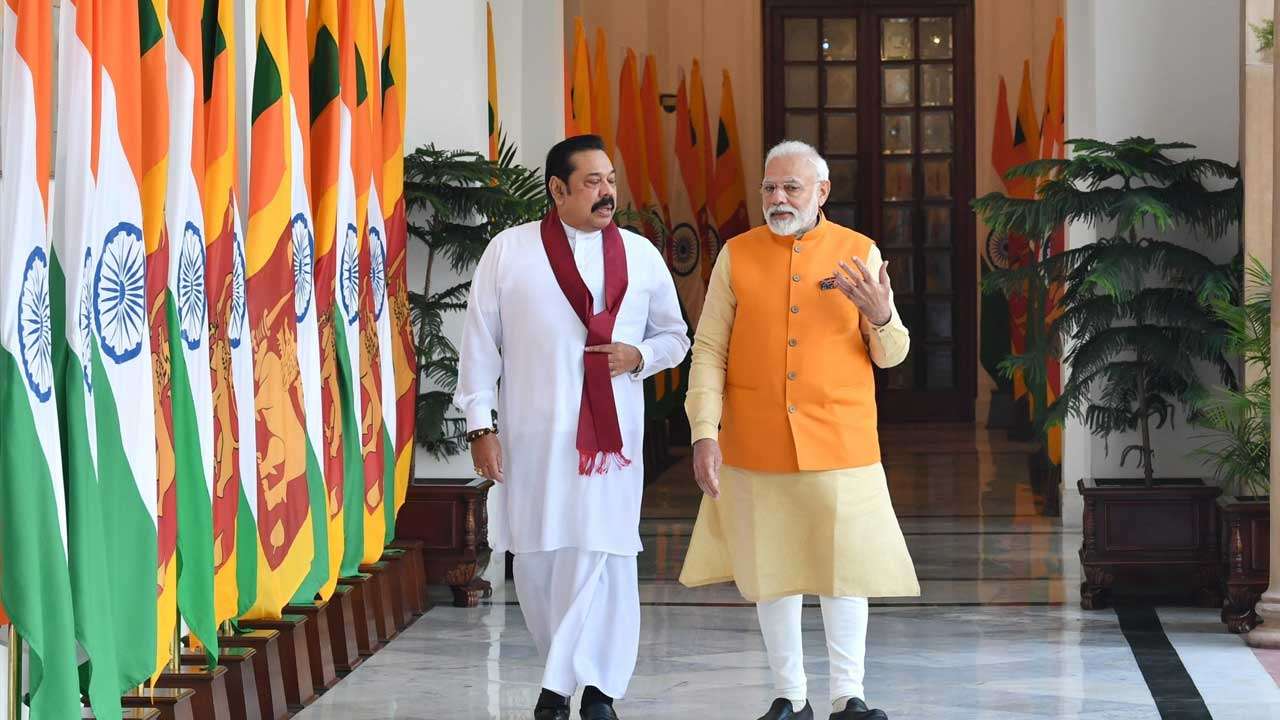
File photo: Sri Lankan premier with PM Narendra Modi | Picture courtesy: Twitter/@narendramodi

Sri Lanka Prime Minister Mahinda Rajapaksa, who is on a three-day visit to India, will pay a visit to the Kashi Vishwanath in Varanasi, followed by the Buddhist shrine in Sarnath on Sunday (February 9).

Security has been beefed up in the city ahead of his visit. 

After landing in the holy city, Rajapaksa will first offer his prayers at the temples.

“Rajapaksa will reach Sarnath, pay his obeisance at the Dhamekh Stupa, the sermon site of Tathagata. After that, he will worship Lord Buddha at the Buddhist temple at Moolgandh Kuti Vihar and take blessings from the Buddhist monks. He will also visit the Sarnath Archaeological Museum,” said K. Medhankar Thero, joint secretary of Mahabodhi Society of India.

Ahead of his visit, Kashi Vishwanath Temple has stopped the entry of common devotees from the Chhatdwar after 10 AM.

Posters showcasing strong relations between India and Sri Lanka, and welcome messages, have been put up in the convoy route of Rajapaksa.  

On Monday, Rajapaksa will visit Mahabodhi Temple at Bodh Gaya Centre and later in the day, he would emplane for Tirupati in Andhra Pradesh. He would offer his prayers at the ancient hill temple of Lord Venkateswara nearby Tirumala on Tuesday. 

The Sri Lankan PM is on a state visit to India from 8 – 11 Feb 2020 on the invitation of PM Modi. Rajapaksa is on his first overseas tour and chose India as his first destination after he was appointed the Prime Minister of his country in November last year.

On Saturday, he met Prime Minister Narendra Modi and held bilateral talks on issues ranging from trade to security.

He also met with External Affairs Minister S Jaishankar, President Ram Nath Kovind on wide-ranging issues.

Mahinda has served as the President of the island country from 2005-2015. He is credited with a military victory that ended a 26-year long separatist civil war with ethnic Tamil rebels during his presidency.

This is the first time in the history of the country that two brothers-Gotabaya Rajapaksa, Mahinda Rajapaksa-are in the positions of President and Prime Minister. 

Another revelation on Yahapalana govt’s outlay on luxury vehicles

February 9th, 2020

Courtesy Hiru News

Former Secretary to the Ministry of Parliamentary Reforms and Mass Media, Mr. Nimal Bopage has stated that towards the back end of 2016, then-Cabinet of Ministers had approved renting out of luxury vehicles for 58 parliamentarians of the government.

In a special communique on the revelation made in the Parliament yesterday, he added that he objected to the move as the government was on the verge of losing Rs 44.3 billion.

Bopage proceeded to say that he was summoned to the Cabinet committee on economic affairs, led by then-Prime Minister Ranil Wickremesinghe, and was publicly threatened to demanding him to either sign or resign”.

Yesterday, Minister Johnston Fernando, responding to a question raised during the parliamentary session, divulged that former government has spent a staggering Rs. 2.8 billion to import luxury vehicles for ministers, state ministers and deputy ministers.

Numbers revealed in the House yesterday also put former President Maithripala Sirisena on top of the list, making him the biggest spender of public finance on luxury vehicles with ha sum of Rs. 328.9 million. 

The age limit to recruit unemployed graduates increased to 45

February 9th, 2020

Courtesy Hiru News

President Gotabaya Rajapakse has decided to increase the age limit to applying for jobs under unemployed graduates’ scheme from 35 to 45 years.

The graduates must complete a degree with a first class accepted by the university grants commission or a diploma accepted by the UGC prior to December 31st 2019.

It is the policy of the government not to sell any Sri Lankan resources to another country; says Prime Minister in India

February 9th, 2020

Courtesy Hiru News

Prime Minister Mahinda Rajapakse says it is the policy of the government not to sell any Sri Lankan resources to another country.

The Premier stated this during an interview with the Hindu News paper.

Prime Minister Mahinda Rajapaksa who is currently in Indian has said that it would be great if India allows debt repayments by Colombo to be deferred for three years.

India’s THE HINDU newspaper reported that this was in order to help the country deal with its massive debt burden.

The issue was at the top of the agenda when Premier Rajapaksa met Prime Minister Narendra Modi in Delhi yesterday and discussed plans to utilise a 400 million Dollar Line of Credit extended by India.

Prime Minister Mahinda Rajapaksa said that if the Indian government takes this step, then other governments might agree to do the same thing, including China.

About 4.8 billion dollars need to be repaid this year.

Premier Rajapaksa said he had also requested further financing from India for his government’s nationwide housing project, and discussed other Indian investments planned, including an LNG port, and a joint Indo-Japanese bid for building an oil terminal in Colombo’s Eastern port.

However, he made it clear that his government would not carry forward the oil projects in the eastern Trincomalee port that had been agreed to in an MoU signed by his predecessor Ranil Wickremsinghe in April 2017, or an Indian government plan to develop Mattala airport in the south.

India and Sri Lanka discussed enhanced security cooperation and intelligence sharing, especially after the ISIS-inspired Easter Sunday terror attacks last year.

Prime Minister Mahinda Rajapaksa who said that Sri Lanka respected India’s decisions with regard to India’s internal matters also said that India was a relative while other nations were friends.

Sri Lanka’s LLRC report claims 22,247 LTTE dead – who are they?

February 9th, 2020

The Lessons Learnt & Reconciliation Commission in their November 2011 report gave some important numbers sourced from the Ministry of Defense. Poignant is the numbers of dead, injured and missing following the military intervention ordered by the President of Sri Lanka following LTTE’s closure of the Mavil Aru anicut denying water to thousands in East Sri Lanka in July 2006.

The military onslaught to defeat the LTTE eventually resulted in terminating the bogus 2002 ceasefire agreement bringing to naught and showcasing the futility of even foreign mediation and foreign monitoring missions operating in Sri Lanka since 2002 that could not prevent LTTE killing even Sri Lanka’s much loved Foreign Minister Lakshman Kadiragamar in his own residence.

The National Army was ordered by the country’s President to end LTTE militarily though more than 2 chances were given to the LTTE to lay down arms & surrender which was refused.

What is described as a non-international armed conflict, Sri Lanka was bound by customary international humanitarian law and Common Article 3 of the four Geneva Conventions.

The military operation that started off in July 2006 ended in May 2009. Terrorism that last 30 years was eventually ended in 3 years putting to rest over 300 suicide attacks by LTTE upon unarmed civilians across the island.

While certain countries chose to issue customary diplomatic statements every time LTTE committed heinous crimes, these very countries were quick to demand accountability for LTTE defeat. It was no surprise, LTTE’s ground force & leader was supported by LTTE living overseas who were raising funds and procuring the most sophisticated arms and weaponry for the LTTE.

What is poignant about the defeat of the LTTE and the LLRC which the GoSL conceded to adopt in view of the demands for accountability were figures listed under chapter Security Forces Casualties & LTTE Casualties (3.20)

This chapter deriving its details from the Ministry of Defense gives a breakdown of casualties from both the Sri Lankan Armed Forces and LTTE from the period July 2006 to May 2009

Thus,

Sri Lankan Armed Forces lost 5,556 personnel in battle

Sri Lankan Armed Forces wounded were 28,414

Sri Lankan Armed Forces Missing in Action were 169

LTTE dead 22,247

LTTE dead with names identified 11,812

So the most important question ten years after is have the remaining 10,435 been identified & named by their family members?

Is this figure of 10,435 being quoted by LTTE Diaspora or UN/UNHRC and NGOs as CIVILIAN DEAD?

There are entities regularly issuing names of LTTE dead claiming they surrendered to the armed forces in May 2009.

The MoD must take these names and see if they match the names of the identified LTTE dead (11,812) or whether these names are of the LTTE who were not identified as dead during the identification (10,435)

EU funded Sooka says 110 missing in 2015 referring to the missing from Wadduvakkal Bridge – this list are ALL LTTE combatants. So is she preparing reports on behalf of LTTE terrorists or Tamil Civilians?

https://itjpsl.com/assets/press/Statement-18-May-2015-ITJP-SL-Disappearances.pdf

The 2015 figure of 110 missing LTTE combatants suddenly shoots up to 280 missing in 2018 referring to the SAME missing from Wadduvakkal Bridge – how can this happen

http://www.asianews.it/news-en/List-of-280-missing-people-includes-28-Tamil-children-43926.html

This is important before the UNHRC Session and suggest that the MoD and Foreign Ministry address this immediately

Shenali D Waduge

Bias attitude of UNHRC and other UN-affiliated bodies towards Lanka

February 8th, 2020

By Dr. Ivan Amarasinghe courtesy The Sunday Times

On March 15, 2006, the United Nations set up the United Nations Human Rights Council (UNHRC) to promote and protect human rights around the world. It seeks the assistance and cooperation of States and non-governmental organisations (NGOs) to monitor, report, advice and contribute best practice to ensure that it’s impartial vision is untainted and objectively exercised in its global mission.

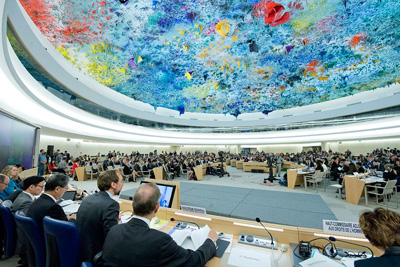
UNHRC in session at its headquarters in Geneva: Serving the interest of some powerful states

However, over the years various countries, States, ethnicities, religious and lifestyle groups have begun to accuse the UNHRC of bias and partisanship. It is also accused of serving the interests of certain powerful States and political entities. Many sources observe that these global NGOs are funded by the said agencies to serve as their advisors and attorneys.

Petitioners against UNHRC

The main accusers of bias within the UNHRC and its related organisations are global minority ethnic groups such as the Jews of Israel and their global diaspora, the Buddhists of Myanmar, Laos, Kampuchea, Vietnam, Thailand and Sri Lanka with claims to historical homelands.  Their main fears are the loss of their own fundamental human rights including the traditional lifestyles, culture and historical homelands to recent settlers brought by the almighty European adventurists of the last few centuries. They also fear that even though European imperial rule is no more, the very fundamental attitudes of former imperialists are evident within the functional arms of the UN.

The UNHRC is today accused of being a covert front to satisfy the former imperial powers to continue their global domination through proxies placed in networked nerve centres, of which the UNHRC takes priority. Therefore, global opinion today is polarised on the very functionality of the UNHRC and the path it seems to be misdirected in the name of human rights. On the one hand, countries such as Israel express deep dissatisfaction on matters such as the allocation of Country Rapporteurs who deem to have made public statements with anti-Israeli bias as well as focusing disproportionately on the longstanding Israeli-Palestinian conflict. The very purpose of the UNHRC is questioned with regard to its tangible mission achievements.

Vietnam is another example of a country attempting to reinstate its human values after being brutalised for over 20 years on a ‘scorched earth’ policy just a few decades back by military adventurists to the Indochina region.

Influence of INGOs on UNHRC

Today the INGOs are well funded, their grants and fund distribution being competitive with an increasing army of well trained and educated human resources with millions of members as a support base. This offers opportunity for patrons of diverse interests to hire the services of these personnel. There are some noteworthy giants among the global NGO community. They specialise on human rights and are directly involved with the UNHRC.

Three of the frontline NGOs that are universally mentioned in relation to global human rights at the UNHRC are (i) Amnesty International (AI), (ii) International Crisis Group (ICG) and Human Rights Watch (HRW). Each of these non-governmental organisations has considerable funds and human resources which enable them to employ thousands of human rights specialists in almost all the countries. These in turn either have their own in-country staff or are served by satellite agencies receiving funds from them. It is no secret that most INGOs and national NGOs are recipients of vast direct funding by certain governments through their International Development Funding allocations”.

The missions of NGOs receiving such funding are to ensure that the visions of the donor countries and agencies are expedited as outreach executives, see:

https://www.globalpolicy.org/ngos/introduction/31508-funding-for-ngos.html

The targeting of countries for submission to remote control measures of global powerbases through INGO and NGO funding has resulted in a gradual increase of complaints and disciplinary measures against these NGOs. Some NGOs complain that their own rights are violated to crisis point by certain countries, see:

https://www.amnesty.org/en/latest/news/2019/02/global-assault-on-ngos-reaches-crisis-point/

Influence of International media

It is a fact within democracies that freedoms and privileges of investigative journalism are unparalleled in comparison with other professions. Theirs is a licence to publish whatever they consider as of interest to the public; thus their empowerment as the Fourth Estate.

Embedded journalists within warring factions and the theatre of war have opportunities to broadcast to the world alleging violations of human rights by one party or both parties in conflict. They also have the power to sway public opinion locally, regionally and internationally. Their documentary and audio-visual records may be used as evidence not only to swing the final outcome of a war but also for post-war enquiries by global guardians of human rights, such as the UNHRC.

They may also be credible witnesses in international trials on war crimes including any signs of genocidal intents by any party in military combat. However, among these are individuals who have sincerely stood up for human rights during war. There have been classic examples such as those in the Vietnam War where Eddie Adams’s photograph of a suspected Viet Cong man being shot in public by an ARVN officer or the 1972 photo by Nick Ut of a little naked South Vietnamese girl running away from bombings, screaming in pain due to Napalm bombs of the United States. Even a single photograph of such horrors could turn the tide of national and global opinion against the most powerful countries of this planet some decades ago. Today vast progress has been made in Information Technology (IT) with a diverse range of audio-visuals supplied to members of the UN and its HRC by various agencies. They can sway opinion and the process of justice against violators of human rights anywhere.

UNHRC: Bias or misguidance?

As discussed above, there clearly are a diverse range of interested parties which petition the UN and its HRC in the name of safeguarding global human rights. There are parties who supply information and evidence which are expected to justify their seeking justice through the UNHRC with due punishment to the perpetrators of such heinous crimes. Indeed the predisposition to some wars and crimes therein is with the intention to commit genocide. Sadly bogus or concocted information and doctored audio-visuals can sway the scales of justice against innocent parties also.

The ever increasing diversity of participatory agencies as discussed above and the actors in this theatre of global inquisition and clamour for international jurisdiction necessitates an absolutely objective, impartial, cautious and conscientious roleplay by the UNHRC. Any bias or misguidance will necessitate a review of the practices at the UNHRC by the UNGA itself.

On June 20, 2018, the BBC reported: The US has pulled out of the United Nations Human Rights Council, calling it a cesspool of political bias”. Nikki Haley, the US envoy to the UN, said it was a hypocritical” body that makes a mockery of human rights”.

https://www.bbc.co.uk/news/44537372

The UN Secretary-General António Guterres responded to the US decision to quit the council by saying he would have much preferred” the US to remain a member. The UN’s human rights chief Zeid Ra’ad al-Hussein called the US withdrawal disappointing, if not really surprising, news”. Israel, meanwhile, praised the decision.”

Is there bias against Sri Lanka?

The above discussion presents a resumé of the broader yet essential rationale on potential agents and beneficiaries from a bias against any country at the UNHRC. The potential for grave dangers of disaffection leading to disharmony among the global nations if the UNHRC is seen to be biased can never be understated.  When members such as the US make such clear and defined accusations of bias within the UNHRC, it needs urgent scrutiny. The UNHRC must address the very causes of such bias if the world at large is to have confidence and respect for the UNHRC.

The Sri Lankan experience with the UNHRC so far has been not much different from similar Asian countries in the bias apparently created by powerful NGOs, their paymasters as well as the global media giants and their local in-country agents.  Whatever the origins of international partisanship towards the Tamil cause” were for decades, much false information has been corrected in the post-war decade.

Today the official missives from the High Commission in Colombo to the Foreign and Commonwealth Office in London are quoted in the Upper House of Parliament by such eminent dignitaries as Lord Naseby. He has stood up for truth to be exposed on factual basis and justice be served on the truth, the whole truth and nothing but the truth regarding the Eelam War in Sri Lanka. The false allegations and nature of alleged war crimes and casualties caused by the Sri Lankan State during the last stages of the Eelam war are thereby contradicted and challenged.  The potential vast injustice done to the government, the defence forces and the very people of Sri Lanka by diverse agents of partisanship discussed above, needs to be corrected through an unbiased approach to the overviews which led to Resolutions such as 30/1 passed by the UNHRC to Sri Lanka. Neither is it necessary to list the articles therein as it is available publicly, nor is there any need to present a discourse on the motives of bias and falsehoods underscoring such demands from Sri Lanka.

As truth emerges and false accusations are corrected, those wishing to benefit from procedures at the UNHRC presently against Sri Lanka are becoming restless and disgruntled.

In its latest report for 2020, the ICG has categorised Sri Lanka as the only Asian country to be on its Watch List. Essentially, they want Sri Lanka to be the whipping boy at the disciplinary hands of the UNHRC.

The UNHRC must ensure that it does not entrust inquiries to officials with ethnic roots or affiliations to any respondent or prosecuting parties.  The process of targeting Sri Lanka as a whipping boy for those in power began with the insistence of the Tamil South African jurist, Navi Pillay during her tenure as the UN High Commissioner for Human Rights. Instead of declaring the conflict of interests based on her ethnicity, she used her position to influence the highest destinations at the UN to the extent of recommending a private investigative team of her allies such as Yasmin Sooka to produce a factually dubious and false report termed the Darusman Report for the UN Secretary General Ban Ki Moon. The UNHRC has passed three resolutions against Sri Lanka based on this personally commissioned report. A private report never tabled at the UNGA, UNSC or even UNHRC surreptitiously leaked to the public was used by the UNHRC to pass punitive resolutions against a member country; see: https://www.lankaweb.com/news/items/2019/12/31/30-questions-for-unsg-un-human-rights-council-regarding-sri-lanka-2/.

It is now being challenged as an illegal and unwarranted exercise beyond the very charter of the United Nations.

Clearly, the UN has to inquire into these allegations. Such precautions will preserve the clear springs of impartiality and objectivity within this much needed august global guardian of human rights.

(The writer is Former Chairman of the Ocean University and former Ambassador for Sri Lanka in Vietnam)

හොඳ ළමයා හා නරක ළමයි හෙවත් බබාලා

February 8th, 2020

දෙශාඅභිමානී සුර්ය වංශ රත්න විභූෂණ පාලිත ආරියරත්න සෙන්කඩගල සිංහ ද්වාරයේ සිට

මේ අද සාර පොහොය දිනේදී මා කතා කිරීමට යන්නේ හොඳ ළමයා හා නරක ළමයි රෑනක් ගැනය. කථා පුවත සිතට ආයේ නරක මන්ත්‍රී ළමයි රෑනක් විසින් තමන්ලා ලොකු කියා පෙන්නවිමට හොඳ ළමයි ගැන හා ඒ ළමයින්ගේ ස්වරුපය මාධ්‍යය තුලින් විකට ස්වරුපයෙන් කියාපෑමට උත්සාහ ගැනීම නිසාය.  රූපවාහිනියෙන් දුටු ඒ විකට ආකාරයෙන් මිනිස්සු සිනස්වා හොඳ ළමයිට මඩගැසීමට කථා පුවතක් මැවූ නරක ළමයි මිට පෙර තිබු යහපාලන ළමා රජය ඇති කිරීමට කැනඩාවේ ටොරොන්ටෝ සිට 2015-01-04 දින අජිත් ළමයා,කරුණාරත්න ළමයා ඇතුළුව චන්දරතන,අජිත් බන්දු , ජයරත්න,කිත්සිරි, මනොරන්ජන් යන බබ්බු ද එහි සිටියේය . එම රැස්වීමේ අඩුව සිටි එකම ළමයා උයේ ඒ හොඳ ළමයිට කුඩුකේඩු කතා කියන කොළ පාට සාරියක් ඇඳි ගැහැණු ළමයා පමණි.

ඉතින් දැන් අපි පළමුවෙන්ම අප රටට වින කැටීමට අහම්බෙන් අපේ කරුමෙට පාවී ආ නරක නපුරු ළමයෙක් දෙස හැරෙමු. ඒ අත්භුත ළමයාගේ නම ලොරෙන්සෝද අල්මේදා විය ඔහු සමග තව පෘතුගීසි ළමයින්ද ප්‍රධාන වශයෙන් පැමිණි අතර රට ,ආගම, ජාතිය විනාශ කිරීම,ස්ත්‍රී දුෂණය, මංකොල්ල කැම්ද , රතු වයින් බිබී මස් කෑමද සිදුකළේය. අප රටේ සිටි විරෝධාර හොඳ ළමයි මේ අලුතින් ආ නරක ළමයින් මේ රටේන් පැන්නීමේ අදහසින් ඔවුන් සමග සටන් කිරීමට උත්සහා කරද්දී එම සම කාලයේම ඇතිවූ විජබා කොල්ලය අශ්‍රිතයෙන් පැන නැගුණු අභ්‍යන්තර ආරවුල් ප්‍රයෝජනයට ගෙන මුළු සිංහලේටම ඇගිලි ගසා විනාශ කිරීමට පටන්ගත්තේය. එතනදිත් නරක ළමයි හා හොඳ ළමයි හා රට තුල සිටි අප රට අද වාගේම පාවාදෙන ළමයි අතර නොයෙකුත් ප්‍රශ්න දික් ගැස්සි යුද්ධ පවා ඇතිවිය.

ඔය පිටින් ආ නරක ළමයින්ට පසුව ලන්දේසි ළමයින්ද , ඉංග්‍රීසි ළමයින්ද අද ලංකාව කැලි කඩා ඉල්ලන දෙමළ හා මුස්ලිම් ළමයින්ද අර කියූ සිංහලේ නිදහසේ සිටි හොඳ ළමයින්ගේ රටට ඇතුළුවිය.

මිදුම ගණන් එන්ගලන්තයේ  සිට පැමිණි ඉංගිරිසි ළමයින් ඔවුන්ගේම කලාපයන් වලින් පැමිණි ලන්දේසි ළමයින් ඉවත් කොට ක්‍රමානුකුලව අප රට අද වගේම පාවාදෙන නරක ළමයින් යොදාගෙන සිංහලේ අත් පත් කරගැනීමට පාර කපා ගත්යේය. ආගම් මාරුව හා භාෂා කුමන්ත්‍රණ ඒ කියූ ඉංග්‍රීසි හා ඔවුන්ගේ මිෂනාරි ළමයින් පටන් ගත් අතර ලක්ෂ තුනාහ මාරකට වඩා හොඳ ළමයින්ව මරා දැමු අතර හොඳ ගැහැණු ළමයින් පාරට ,කැලයට ඇද දමා ඔවුන්ගේ ඥාතින්ට පවා පෙනීමට දුෂණයට ලක්කොට සමහර විට වෙඩි තබා ඝාතනය කළේය.

අද වනවිට රුපවාහිනියේ එනම් ”තෙල දසුන” උපයෝගී කරගෙන කෙල තොල් ළමයින් මෙන් රට ආරක්ෂා කරන හොඳ ළමයින් වන ඇතැම් මන්ත්‍රී ඇමති ළමයි හා ඔවුන්ගේ නායකයන් වන ජනධිපති උතුමන්ලා හට අපහාස උපහාස කරයි. රට සාම කාමිව දේශපාලනමය වශයෙන් තිබීම හා රට අහම්බෙන් හෝ සංවර්ධනය වී දියුනුවූවහොත් හොඳ ළමයා වන නායක ළමයාගේ චන්දය වැඩි වුනොත් නපුරු ළමයින්ට පාර්ලිමේන්තු ආසන අඩුවී හෝ තම පක්ෂය අතුගැවී යාම නිසා හා කිසවක් නොදන්නා නිසා අත ලෙව කා හෝ ජිවත් වීමට බැරිවන බව දැන ( පාර්ලිමේන්තු සුපිරි ජිවිත ) ගෙන තිබීම නිසා හොඳ ළමයින් හට නපුරු ළමයි සාරි හැට්ට ඇඳගෙන හෝ නැතිව, කුහක සට කපට අදහස් ඇතුව මෝඩ බබාලාගේ චන්දය ගැනීමට උසුළු විසුළු කරයි. මේ ආකාරී කුමන්ත්‍රණ කාරී බබාලා හෙවත් නරක ළමයි ගැන බලාගෙන සිටින අපි (සිංහල බෞද්ධයන් ) සමාජය ඉදිරියටත් දැනුවත් කිරීමට ලිපි ලියන්නෙමු. නමුත් නපුරු බබාලා වැනි කැත අදහස් අපට නැත්තෙමු. ඇත්ත ඇති සැටියෙන් ලියන්නෙමු කියන්නෙමු.

අන්තවාදී නපුරු අදහස් ඇති සමහර දෙමළ නරක ළමයින් පිරිභාහරන් බබෙක් නිර්මාණය කරගෙන අවුරුදු තිහකට වඩා කාලයක් හොඳ ළමයින්ව කපා කොටා වෙඩි තබා ,ගිණි තබා ,බෝම්බ ගසා විනාශ කළේය. ඒ දුක් ගිනිදැල් , යුධ භියට යුරෝපයේ සිටින විවිධ රවල්වල සිටි හා ලොරෙන්සෝද බබාල හෙවත් ලෝක හොඳ බබාලාද අත් පොළසන් දුන්නේය. එය ඔවුන්ගේ මානව හිමිකම් යැයි කියා නොකියා කිවේය. ඒ පිට රටවල් වල සිටි ඒ නරක ළමයින් ඔවුන්ට පමණක් හොඳ ළමයි සේ පෙනෙන අප රට කැලි කැලි කැබලිවලට කඩා බිඳ දැමීමට සුදුසු මානසිකත්වයෙන් පෙලෙන රට සල්ලි කන , හිඟන ළමයින් අල්ලාගෙන ”අරේහේ යුධ වදිනවා නෙවයි මේ කැලේ යනවා ,මෙහෙ යනවා නොවෙයි අරහේ යනවා කිවේය”. හරියට රෙද්ද අස්සේ ඉන්න නයින්ව දන්නේ නැති එන්.ජි.ඕ බබාල හෙවත් සිංහල අපි ශිෂ්ටාචාර කොරන්න පැමිණි පන්සිල් පද පහවත් දන්නේ නැති. නිරිවතින් එලිමහනේ පවා අශික්කිත ලෙස , තිරිසන් සතුන් මෙන් නිරුවත්ව හැසිරෙන ලොව වෙනත් රටවල් තම වහලුන් ලෙස යොදා ගැනීමට දඟලන ඒ ඔස්සේ ඔවුන්ගේ ”කාම ලන්තය” මේ රට තුල ගොඩනගා ගැනීමට හා ඔවුන්ගේ දෙවියන්ට මේ උතුම් දේශය අවසානයේ පුජා කිරීමට නලියන වුන් දැනගත යුත්තේ ” අපි ” එනම් හොඳ ළමයින්  (සිංහල බෞද්ධයන් ) ඉන්නා තාක් කල් නරක ළමයින්ට මෙහි ”සෙල්ලම් ” දැමිමිට ඉඩ නොදෙන බවය.

ඒවගේම ඔය ඉහත කි නරක බබාල හෙවත් නරක ළමයින් අභිනවයෙන් ගෙන එන ”කුණු බිත්තර ” ,”මඩ ප්‍රහාර ”, නින්දා ,අපහාස,තාඩන පීඩන , පස්චාත් භාගයෙන් සබ්බද නගමින් පිටවෙන වාතය යෑමක් තරම් වත් ගණන් නොගන්නා බවයි. නරක ළමයින්ගේ සමහර උපකර ලද හොඳ ළමයි (සිංහල බෞද්ධයන් ) කියූ නමුත් නොඇල්ලු  හා ඔවුන් කි  දේ නැසූ හිස්බුල්ලා, රිෂාඩ්,අසාද් සාලි, සාෆි, රහක්මාන්ලා, කබීර් ලා  වැනි බබාල තම දෙවියන් වෙනුවෙන් හෝ දිව්‍ය ලෝක ගැනුණුන් සමුහයක් හම්බවිම්ට කිතුණු දේවස්ථාන හා සමහර හෝටල් බෝමබයෙන් දෙබෑ කොට ගිය නරක බබෙක් ( නරක ළමයෙක් ) වූ ” අසහරන් ” දේව දුතයෙක්ද ? ඒ අප්‍රේල් බෝම්බ ප්‍රහාරයෙන් මිය ගියේද මේ රටේ සිටි හොඳ බබාල පිරිසකි, නරක බබාල විසින් මැවූ අන්තවාදයේ කුරිරු මිනිස් බෝම්බයකට මැදිවී අසරණව ඔවුන් මිය ගියේය. එම සිද්ධිය දැක කොක් හඬලා සිනාසුනු නරක ළමයි රජ කරවීමට ඔබ හොඳ ළමයින්ගේ කිර්ති නාමයට කැළැල් සිදුකරන්නේ නැවත් මේ රට එවැනි ගණයේ මාරයන්ටම බිලිදීමට බව අප සියල්ලෝම දන්නේය.

හොඳ ළමයගේ කැරැට්ටුව හෙළි කිරීමට හා රහස් සෙවීමට රන්ජන් මන්ත්‍රී බබා ,හිරුණීකා පාර්ලිමේන්තු බබා, පියුමි නිළි බබාල (ලෝක හොඳ ළමයි කල්ලිය ) අනුන්ගේ හා තමන්ගේ පස්චාත් භාගයන් ගැන උදන් ඇනීම හා ඒවා සමහර කෘත්‍යන් කරගනීමට යොදවාගන්න ආකාරය හා ඒවා කා හට කොයි අවස්ථවේ පල ප්‍රයෝජනයට ගැනීමට දියයයුතුද යන කාරණා හා නපුන්සක හා ඝණිකා ජිවිත හොඳ ළමයින්ගේ චරිතවලට වඩා හොඳ බව පෙන්වීමට හා ඔවුන්ගේ ජඩ හා කාමුක වැඩ විවේචනය නොකට හොඳ ළමයි හා පරණ ආමි කාරයන් රට පාලනය කරන්න පුලුවන්ද කියා  හංවඩු ගැසීමෙන් ”අපි හොඳයි  වශයෙන්” පෙනී සිටින නරක ළමයින් උත්සාහ ගන්නේ අර වර්ෂ 1505 දී අපරටට ආ ඒ වනචර විදේශික නොරටෙක් වූ ඒ ආගමික ළමයා ගෙන ආ නරක පුරුදු තව දුරටත් ඒ ආකාරයෙන්ම ඉදිරියට අපරට තුල පැළ පදිංචි කරවීමටත්. ඒ අප මහා සිංහල බෞද්ධ සංස්කෘතිය හා ඒ බෞද්ධ දේශය මෙලොවින් තුරන් කරවීමටද ?

රතු තොප්පි,කහ තොප්පි.නිල් තොප්පි ,මදට පැහැය තොප්පි ,සුදු කළු ඉස්ලාම් හෝ කොටි  තොප්පි නොව සැම ළමයෙකුම පැලඳිය යුත්තේ. රටේ ආරක්ෂාව ලබාදිය හැකි උසස් හිස් වැසුමකි . එනම් බුද්ධිමත් හා සවිමත් නායකයෙකුගේ අවශ්‍යතාවයයි.

නිකරුනේ හොඳ ළමයයින්ට ගහල හරි යනවද.? ඕගොල්ලොත් එයා වගේ ‍හොඳ ළම‍යෙක් වෙන්න. සට කපට්කම් ,බක පණ්ඩිත කම් ,වාචාල කම් අතහරින්න  එයාව ආදර්ශයට ගන්න. එවිට ඔබටත් හොඳ අවස්ථාවක් ද ගෞරවය ද ලැබේවි.

ඔබ සැමට තෙරුවන් සරණයි !

දෙශාඅභිමානී සුර්ය වංශ රත්න විභූෂණ පාලිත ආරියරත්න

සෙන්කඩගල සිංහ ද්වාරයේ සිට

2020-2-8 නවම් පුර පස‍ළොස්වක පෝය දින

ශාසන ඉතිහාසයේ වැදගත් සිදුවීම් රැසක් සිදු වූ නවම් පුර පස‍ළොස්වක පෝය දිනය අදට යෙදී තිබේ.

බුදුරජාණන් වහන්සේ සැරියුත් – මුගලන් මහ රහතන් වහන්සේලාට අග්‍රශ්‍රාවක තනතුරු පිරිනැමුවේ අද වැනි දිනක ය.

සම්බුද්ධ ශාසනයේ ප්‍රථම මහා සංඝ සම්මේලනය ද අද වැනි දිනක පවත්වා තිබේ.

Is the ICJ in compelling Myanmar to recognize ‘Rohingya’ tantamount to enforcing the most sinister form of religion-cultural imperialism on a small independent nation?

February 8th, 2020

By Kanbawza Win Courtesy Asian Tribune

In a landmark verdict, the United Nation’s highest court has ruled that it has the authority to consider a genocide case against Burma and ordered the country to prevent irreparable harm from being committed again, signalling that the sensational news has vanquished the conflict resolutions.

But my research indicates otherwise, of how in the 18th century, the Colonial British in construing Burma to be part of the British Indian empire encouraged the Chittagonians labourers from India to work in the fertile fields of northern Arakan making Burma the rice bowl of Asia”.

The Origin of the Rohingyas In fact some of the Kalar (meaning dark complexion) were already there living in a large village, even before the British annexed the country in 1824. These people considered themselves to be genuine Muslims, strictly adhering to their traditional cultures and the new comers admired them and wanted to live with them. However, the old village people said Even if you speak the same language and of the same religion, you are not an authentic Muslims and we will not welcome in our village, but if you want to reside here you can stay in the outskirts of our village.” Hence those new comers reside there and were label as Ywathitthar, (in Burmese meaning people from the new village) while from the old village continue to call themselves as Ywahaughthar (people of the old village).

But as more and more Chttagonians came over, it overwhelmed the old village and everybody now called themselves as Ywahaoungtha. However, to a new Chittagonians who just arrived having little or no knowledge about Arakanese or Burmese languages heard the word of Ywahaungthar or rather the Arakanese word as Rwahaungtha, somewhat akin to the Bengali word Rohin. Hence, the name of Rohingya.

So, compelling Burma to recognize the word Rohingya tantamount to enforcing as the most sinister form of religion-cultural imperialism on a small independent nation which is bound to be resisted by every person residing in Burma, Why the tyranny of the majority?

Genocide of the Arakanese Buddhist

With the fall of Singapore in 1942, the British withdrew to India and organized all these Kales in Burma to fight the Japanese, (the Burmese were allied with the Japanese, just to gain independence from Britain).

However these Arakanese Kales taking advantage turned their guns on the locals, not only exterminating everyone, including women and children but also destroying their religious edifies, digging up Pagodas and religious shrines, only very few Arakanese managed to escape to India or to other parts of Abakan.

In Maungdaw townships alone they exterminated more than 30,000 known as Maungdaw Massacre, which were still remembered and clearly written in Burmese which can still be seen in the archives of Rangoon. Obviously, all the locals Arakanese deeply hated these Kales compelling the world to be perplexed or comprehend the raisons d’être of the hatred.

Chunk of the Motherland.

After World War II, at the prospect of Burma gaining independence (1947) these Kalar, now calling themselves as Mujtahids (meaning founder and defender of Islamic law) unable to reconcile residing under the infidels, led by its political party Jami-atoll Lemma-e Islam went over to Muhammad Ali Jinnah (founder of Pakistan) to take these three Arakanese townships of Buthidaung Maungdaw and Rathedaung which they renamed as Dar al-Islam (meaning the region under Muslim sovereignty where the Islamic law prevails), into the then East Pakistan (now Bangladesh),

Similar to what, Congressman Bradley Sherman, chairman of the Sub-committee on Asia Pacific, proposed. Rebuffed, these Mujahids fought the newly Independent Union of Burma under the civilian government of U Nu, who had no choice but to send his able commander General Smith Dun (at that time there was no Ne Win nor the now existing racist Myanmar Tatmadaw). These Mujahids were beaten and its leaders ran away to East Pakistan promising that they or their ancestors will never speak Burmese. So, when the incumbent Bangladesh Premier Sheikh Hasinavisited the Rohingya refugees she can speak in Bangali but when Daw Aung San Suu Kyi visited them she has to call the interpreter.

Bangladesh Liberation War

In 1971 Muktijuddho war when the West Pakistani Pahtans army launched an all-out war on the Bengali dominated East Pakistan, more than 10 million of Bengali crossed into Burma as refugees. But when the war was over not all of them went back. Seeing, that the inhabitants speak the same language adhering to the Bengali customs and having a fertile soil about half a million opted to remain in these three townships, so much so that Bangladesh ambassador has to admit to the British ambassador as seen in the London archives.

Burmese Socialist Programme Party

The late General Ne Win abhorred the word Burmese Junta” refer by the international media and started creating his proxy the Burmese Socialist Programme Party asking all the people to write political proposal to him. All the people responded except the Rohingya who called a conference of its own in the Burma-Bangladesh border, with the aim of another Dar al-Islam. To this Ne Win replied with Operation Dragon King” driving out the first batch of Rohingya, but later as the UN intervened, they were accepted back, but it was discovered that more came in, then went out because e.g. A Rohingya youth ran away to Bangladesh, but when he was repatriated back he came in with 30 or more people because he already had four wives (Muslims can marry four wives) and each wife was a widow with five to six children of the previous marriage. This is galling to the locals.

The Most Persecuted People of the World.

In the Bangladesh Liberation War of the 70s, these Rohingya sided with the Pakistan army of Phatans acting as scouts and spies and so when the War of liberation was over they were hated by the local Bengali and naturally Bangladesh or India nor the Arab world. It is the brain child of Bengali Diaspora residing in West.

Are they one of Burma’s ethnic nationalities?

In the 72 years (1948-2020) existence of the Union of Burma, every non-Myanmar ethnic rebelled against the central government but none of them attempted to take the chunk of the motherland to join a foreign country. Furthermore in 1976 the opposition of all the non-Myanmar ethnic group was formed at Manerplaw known as the National Democratic Front, but Rohingya refused to take part. Even when the ethnic cleansing became more intensified after the 1988 pro-democracy uprising, many of the Burmese Muslims were persecuted and fled to the Thailand-Burma border area.

Human Rights Watch reported that a disproportionately high number of Muslims joined ethnic Karen because the Burmese army had destroyed their mosques and schools while ordering them to convert to Buddhism or leave the country.” Hence the All Burma Muslim Union was formed and fought side by side with the Karen known as K’Nyaw Thoo” and yet not a single Rohingya took part. If these are the facts and figures perhaps, I am insane to hear the call, that these Bengali Kalas insisting to be a bona fide citizens of Burma with equal rights.

Evil Genius

In this crisis the marauding Myanmar army (Tatmadaw) were caught red handed, because the Rohingyas ran away under the glare of the news media proving true to the Burmese omen of when Bama shout nobody hears but when Kalar shout everybody hears.” Lamentably, the international world was unable to comprehend that Burma’s 2008 Nargis Constitution that sets apart the army from, the civilian administration, and instead blamed the civilian government of Daw Aung San Suu Kyi. The serpentine brood of Generals has clearly outwitted the international community driving the country into the arms of China, whose head just visited the country bringing in the year of the Rat infested with Wuhan virus (coronavirus) and raking away 33 projects for easy access to the Indian Ocean avoiding the Malacca strait.

Crux of the Problem

If the ICJ is not cockeye and view, that Burma is a fragile state, where power is control by the men in green, the UN solemn oath of never again” should be better served and improves the ICJ record of one out of eleven cases comply with its measures. Now it seems, that any large-scale repatriation of Rohingya is out of question. The simple logic of Demography seems to be missing when Bangladesh population is 165 million (8th largest in the world) residing in an area of only 147 thousand square miles can easily march into Burma, which has a population of only 55 million and an area of 676 sq. kilometres.

This is what every people in Burma is afraid of. As for the IOC we pray that it would be a real champion of the Muslims instead of the Organization of Interference in the internal affairs of other Countries to prevent the ever-rising Islamophobia.

Kanbawza Win, former Foreign Affairs Secretary to the Prime Minister of the then Socialist Republic of the Union of Burma is now a permanent Burmese exile.

– Asian Tribune –

ආණ්ඩුව සහ රුහුණ සිසුන් අතර සාකච්ඡුා සාර්ථකයි

February 8th, 2020

උපුටා ගැන්ම –මට කියලදෙන්න ප්‍රවෘති-

රුහුණ විශ්වවිද්‍යාලයේ මේ වන විට පවතින අර්බුදකාරී වාතාවරණය විසඳා ගැනීම වෙනුවෙන් ඉදිරිපත් වූ සිසුන් පිරිසකට අමාත්‍ය විමල් වීරවංශ මහතා මැදිහත් වී විසඳුම් ලබා දී ඇති බව වාර්තා වේ. කළමනාකරණ පීඨයේ සිසුන් නව දෙනෙකුට ජීවිතාන්තය දක්වා ලබාදී තිබූ පන්ති තහනම් ඉවත්කිරීම පිළිබඳව මෙම සාකච්ඡුා පැවති අතර ඒ අනුව එහිදී කරගන්නා ලද එකඟතා අනුව මෙම පන්ති තහනම් ඉවත් කිරීමට ඉදිරියේදී කටයුතු සිදුවනු ඇත.
සිසුන් විසින් මෙතෙක් සරසවිය තුල සිදුකළ නවකවදය හා වෙනත් වැරදි වෙනුවෙන් සිය කණගාටුව ප‍්‍රකාශ කරන අතරම මින් පසු ආණ්ඩුවේ නවකවදය නැවැත්වීමේ වැඩපිළිවෙළ වෙනුවෙන් උපරිම දායකත්වය ලබාදීමටද අදහස් පලකර තිබේ. ඒ අනුව මෙම පෙබරවාරි මස මැදදී පත්වන නව ශිෂ්‍ය සංගමය නවකවද විරෝධී ආණ්ඩුවේ ප‍්‍රතිපත්තිය වෙනුවෙන් කටයුතු කරන බවත් එහි දේශපාලන අතපෙවීම් වැනි සිදුවීම් සඳහා ඉඩක් නොදෙන බවත් අමාත්‍යවරයා හමුවේ සිසුන් අවධාරණය කර තිබුණි.

තවද වීරවංශ අමාත්‍යවරයාගේ මගපෙන්වීම යටතේ කළමනාකරණ පීඨය විසින් ඉදිරියේදී වැඩසටහන් කිහිපයක් සංවිධානය කිරීමටද කටයුතු යොදා ඇති බවටද සඳහන් වේ.

වාර කිහිපයකදීම පැවති මෙම සාකච්ඡුාවල අවසන් සාකච්ඡුාව ජනවාරි මස පළමුවන දින පැවැත්විණි. මේ සඳහා සම්බන්ධීකරණය රුහුුණ කළමනාකරණ පීඨයේ ආදි සිසුවකු වූ පාර්ලිමේන්තු මන්ත‍්‍රී නිරෝෂන් පේ‍්‍රමරත්න මහතා විසින් සිදුකර තිබේ තවද ඒ සඳහා අමාත්‍ය බන්දුල ගුණවර්ධන මහතා ද කිහිපවිටක් සම්බන්ධ විය. සිසුන්ගේ පාර්ශවයෙන් මේ සදහා සුදර්ශන බණ්ඩාර, ලහිරු මධුසංඛ හා සංජීව ගයාන් යන ශිෂ්‍ය නියෝජිතයන් ඇතුළු තවත් කිහිදෙනෙකු සම්බන්ධ වී තිබුණි.

Melting Arctic Permafrost Could Release Tons of Toxic Mercury

February 8th, 2020

By

Scientists have found large natural stores of the toxin in the Arctic. It’s not clear how much will get into food webs as the planet warms.

Scientists have uncovered another hidden threat buried in the icy frozen north—massive natural reserves of mercury, a toxic heavy metal that in some forms can build up in fish and other animals and cause serious health problems in humans.

A study published Monday in the journal Geophysical Research Letters reports that the amount of natural mercury bound up in Arctic permafrost may be 10 times greater than all the mercury humans have pumped into the atmosphere from coal-burning and other pollution sources over the last 30 years. As climate change warms the land, this thawing permafrost could release significant quantities of mercury back into the environment, potentially allowing far more of the pollutant to build up in the atmosphere and the food web.

“Prior to the start of the study, people assumed permafrost contained little to no mercury,” says study co-author Kevin Schaefer of the National Snow and Ice Data Center at the University of Colorado. “But it turns out that not only is there mercury in permafrost, it’s also the biggest pool of mercury on the planet.”

Put another way, says lead author Paul Schuster, a U.S. Geological Survey hydrologist, “This is a complete game-changer for mercury. It’s a natural source, but some of it will be released through what we’re doing with climate change.”

What’s not yet clear, however, is how much mercury could be released, or when, in a form that is toxic to humans.

A Natural Poison

Mercury is found naturally in the environment and is released by forest fires, volcanic eruptions, and the weathering of rock. But roughly two-thirds of the mercury in the air at any one time is released by humans, primarily through the burning of coal or medical waste or some types of mining. Once airborne, mercury eventually falls back to Earth, winding up in water or on land. There it’s picked up by fish and animals, accumulating in ever-higher amounts as it works its way up the food web. Today’sPopular Stories

In some forms, mercury is a powerful neurotoxin, and in children it can harm brain development, affecting cognition, memory, language and even motor and visual skills. Even in adults, excessive amounts can hamper vision, speech and muscle movements, compromise the reproductive and immune systems, and cause cardiovascular problems. That’s why there are often fish advisories for mercury near polluted rivers and streams, and why children and pregnant women are urged to avoid eating tuna or other long-lived fish such as swordfish.

Thanks to complex atmospheric and ocean processes, more mercury winds up in the high northern latitudes than anywhere else. It’s already known to build up there in birds, fish, seals, walrus, polar bears and some whales, even in areas thousands of miles from pollution sources. As a result of this long-distance pollution, indigenous people across the Arctic who rely on subsistence hunting for food have some of the highest levels of mercury in their blood.

The same winds and currents that send mercury north today have been at work for tens of thousands of years, depositing natural mercury in high concentrations across the Arctic. Since that mercury has been trapped in frozen ground for millennia, it hasn’t done damage to wildlife or humans. But now Arctic permafrost, which accounts for 24 percent of all land in the Northern Hemisphere, is thawing and threatening to release this massive store. And, until recently, we didn’t have any idea how much was there.

A Decade-long Study

At USGS Schuster has been studying mercury in the atmosphere for several decades. In the 1990s he collected ice core samples from a glacier in Wyoming’s Wind River Range and developed a record of mercury deposition dating back to before the Industrial Revolution. That work, he says, eventually played a role in convincing federal regulators that human sources of mercury had risen so much that that the U.S. should start requiring coal-burning facilities to use scrubbers to cut mercury from their emissions.

Eventually, Schuster found his way to Alaska’s Yukon River basin and realized that no one had ever attempted to quantify how much mercury might be stored in permafrost. In fact, not every expert was convinced there would be much there at all.

Between 2004 and 2012, Schuster and his team collected more than 13 ice core samples from around Alaska. They chose their sites—and spent years perfecting models—in such a way that the results from Alaska could be extrapolated to permafrost all over the Arctic.

The results show that Arctic permafrost holds roughly 15 million gallons of mercury—at least twice the amount contained in the oceans, atmosphere and all other land combined. “The concentrations were huge—a lot higher than we expected them to be,” Schuster says. “That was a big surprise.”

The big question is: What’s going to happen to that mercury?

It’s unlikely that all of it will stay sequestered in permafrost. Once the ground begins to thaw, plants will grow in it, taking up mercury, and the microbes that decompose the plants will release some amount of methylmercury, a more toxic form. Some portion of that will spread through water or air into the ecosystem and eventually into animals.

“That’s the vector, the avenue into the food chain,” Schuster says.

How Much Gets Into Food?

But determining how significant a risk that will pose is a challenge.

First off, how much temperatures warm depends on how quickly—or not—humans limit emissions of greenhouse gases. That will determine how much permafrost thaws, which will influence how much mercury gets released. But even that is only part of the equation.

“How much winds up in the food web, and where? That’s the $100,000 question,” Schuster says. “When you jump over to the food chain in this research, things get gray.”

Mercury releases initially would pose increased risks to Arctic people and wildlife, “but what happens in the Arctic doesn’t stay in the Arctic,” Schaefer says. “Eventually it would be dispersed throughout the Earth. It moves around.”

The bottom line is there will almost certainly be some impact to humans.

“We know permafrost is going to thaw and we know some portion of the mercury will be released,” Schaefer says. “At this point we don’t have specific estimates about how much or when—that’s the next phase of our research.”

‘Halt Nipah project with Indian lab’: Govt tells US health agency

February 8th, 2020

Sudhi Ranjan Sen Hindustan Times, New Delhi

CDC, America’s front line public health agency, has partnered with Manipal Centre for Virus Research (MCVR) to carry out illness surveillance across India.Hindustan Times, New Delhi

Health officials in full protective gear walk inside an isolation ward of Ernakulam Medical College in Kochi in Kerala on June 6, 2019. - MCVR carried out tests on the Nipah virus of which there was an outbreak in Kerala in 2018 and 2019, said one of the government officials cited above, asking not to be named.
Health officials in full protective gear walk inside an isolation ward of Ernakulam Medical College in Kochi in Kerala on June 6, 2019. – MCVR carried out tests on the Nipah virus of which there was an outbreak in Kerala in 2018 and 2019, said one of the government officials cited above, asking not to be named. (AFP FILE)

India has asked the United States Centre for Disease Control and Prevention (CDC) to stop funding research in India without government approval after the agency appeared to have helped an under-qualified Indian laboratory to work on the Nipah virus, a pathogen that is considered a potential bio-weapon, according to officials and government documents accessed by HT.

CDC, America’s front line public health agency, has partnered with Manipal Centre for Virus Research (MCVR) to carry out illness surveillance across India, and government officials who asked not to be named said the agency seems to have helped MCVR study the Nipah virus, a pathogen that belongs to Risk Group 4 (RG4) classification.

RG4 viruses are considered lethal and their handling is heavily controlled since they can be turned into biological weapons, requiring labs that have biological safety level 4 (BSL4) certification to study it. MCVR does not meet the criteria.

MCVR carried out tests on the Nipah virus of which there was an outbreak in Kerala in 2018 and 2019, said one of the government officials cited above, asking not to be named.

Our apprehension is that the lab was being used to map the Nipah virus, which can be used to develop a vaccine, the intellectual property right of which will not be with India. Importantly, understanding how the human body reacted to the virus will also produce a more virulent form of virus for biological warfare,” said a second government official who did not want to be named.

To be sure, MCVR was designated by the government of Kerala as one of the testing agencies for the Nipah virus during the outbreak.

The concern at present, the two officials cited above said, were related to more detailed studies of the virus and of funding that was not approved by the government.

The government has now asked both agencies to stop the disease surveillance project – technically called AFI surveillance that tracks mystery diseases in key government hospitals – and for MCVR to store only BSL-2 grade pathogen. It has also asked CDC to comply with Indian rules and ensure all funding has been approved by the government.

The ministry has taken serious view of in the entire matter, MCVR (Manipal Centre for Virus Research) directed [to store] samples of pathogens specific to BSL-2 facilities only and should immediately stop AFI surveillance undertaken by it in other states also,” said an internal government memo titled Unapproved, US-funded Indian Laboratory stored samples of Nipah Virus – a bioterrorism agent”. The memo was reviewed by Hindustan Times.

According to the first official, the action came after the coronavirus outbreak triggered a review of all research into biological weapons grade pathogens in India. Researches without prior approval have sent alarm bells across the government, the first official added.

The memo quoted above also adds that the foreigners division of the home ministry is inquiring into how CDC and MCVR were working on the virus. All foreign funding needs to be cleared by MHA. The memo adds that while the health ministry has no specific comments” on the nature of action that MHA should take under the Foreign Contribution Regulation Act

2010, but — considering the seriousness of the matter” – it said MHA may take action as seen appropriate”.

Home ministry officials did not respond to queries on what action was being contemplated.

In a separate communication to CDC, also accessed by HT, the health ministry said: It has been brought to this ministry’s notice that CDC has trained MCVR for diagnosis of Nipah virus disease in spite of the known fact that Nipah virus is BSL-4 level pathogen whereas MCVR is a BSL 2+ laboratory. Prior to this training to MCVR, CDC had not consulted any government agency as per norm.”

The note added: Since Nipah is a high-risk pathogen with a potential of being used as Agent of bio-terrorism the samples were to be handled more carefully and tested in a BSL-IV laboratory and not in MCVR… The lapse on part of MCVR in handling Nipah virus samples with active support from CDC has been viewed separately by the ministry of health and family welfare … Therefore, CDC is advised to stop all funding of MCVR/Manipal University …Similarly, funding for any other research activity in the country that is not approved by the ICMR should be stopped immediately.”

CDC country director, Dr Meghna Desai, said that the agency did not commission research on Nipah in India, and that the project was part of a multi-nation partnership. Through the Global Health Security Agenda, we provided training to strengthen laboratory systems in India which allowed for detection of Nipah virus,” she said.

Replying to whether CDC has been asked to stop all funding of ongoing research not been cleared by ICMR, Dr Desai said: CDC works closely with the ministry of health and family welfare and the Indian Council of Medical Research on projects that help address Government of India priorities in public health. CDC will continue to work with the Indian Council of Medical Research and the Ministry of Health and Family Welfare.”

MCVR denied that it had carried out research into the virus, saying it had carried out detection tests when the outbreak took place and had been asked by the health ministry to stop doing so when the outbreak was deemed over in 2018.

No virus isolation was done at MIV (Manipal Institute of Virology). Samples were sent to ICMR-NIV Pune for virus isolation work at their BSL-4 laboratory. We have observed/implemented all safety precautions while processing the samples,” said a statement from the office of the Vice Chancellor of Manipal University.

The university said that its work related to risky viruses conform to World Health Organization diagnostic protocols, which includes the pathogens being inactivated by lysis buffer” before being processed.

Experts said that labs with BSL-3 rating can carry out some tests but not advanced studies. A biosafety level-3 (BSL 3) lab is good enough for conducting polymerase chain reaction (PCR) test that is used to know the genetic material of a microorganism. Advance research such as virus isolation from living cells needs more advanced BSL-4 laboratory,” said Dr Shobha Broor, professor, department of microbiology at All India Institute of Medical Sciences, Delhi.

(With inputs from Rhythma Kaul)

හිටපු ජනපතිට කෝටි 33ක වාහන ගෙන්වලා.. දහම්ට BMW x5 ජීප්.. චතුරිකාට Lexus කාර්.. ලේඛණ හැන්සාඩ්ගත කරයි..

February 8th, 2020

උපුටා ගැන්ම ලංකාසීනිවුස්

පසුගිය යහපාලනය රජය විසින් මැතිඇමැතිවරුන් සඳහා පමණක් වාහන ගෙන්වීමට රුපියල් බිලියන 28 ක මුදලක් වැය කර ඇති බව ඊයේ පාර්ලිමේන්තුවේදී හෙළි විය.

ඇමැති ජොන්ස්ටන් ප්‍රනාන්දු මහතා විසින් සභාගත කරන ද පිළිතුරක මෙම තොරතුරු දීර්ඝ තොරතුරු දැක්වෙයි.

එමගින් වැඩිම මුදලක් වෙන්කර ඇත්තේ ජනාධිපතිවරයා ලෙස කටයුතු කළ මෛත්‍රීපාල සිරිසේන මහතා වෙනුවෙන් වාහන ගැනීමටයි.

ඔහු ගෙන්වා ඇති වාහන ගණන 09ක් වන අතර එ් සදහා වැය කර ඇති මුදල ලක්ෂ 3,289කි.

මේ අතර ජනාධිපති මෛත්‍රීපාල සිරිසේන මහතාගේ හිටපු සම්බන්ධීකරණ ලේකම් වරයෙකු වන ඔ්ෂල හේරත් විසින් තම ෆේස්බුක් ගිණුමේ සටහන් කර ඇත්තේ එම වාහන වලින් හිටපු ජනපති දියණිය චතුරිකා ලෙක්සස් වර්ගයේ මෝටර් රථයද, පුත් දහම් සිරිසේන වෙනුවෙන් BMW x5 වර්ගයේදී ජීප් රථද ගෙන්වා ඇති බවයි

හිටපු අමාත්‍යංශ ලේකම් රනිල් ඇතුළු යහපාලන ආණ්ඩුවේ රෙදි ගලවයි.. සියල්ල හෙලි කරමින් නිකුත් කල නිවේදනය මෙන්න..

February 8th, 2020

උපුටා ගැන්ම ලංකාසීනිවුස්

යහපාලන රජය සමයේ මැති ඇමතිවරුන් සඳහා ගෙන්වන ලද වාහන ප්‍රමාණය ගැන හෙළි වීමෙන් පසුව එකල ආණ්ඩුවේ පාර්ලිමේන්තු ප්‍රතිසංස්කරණ හා ජනමාධ්‍ය අමාත්‍යාංශයේ ලේකම් ලෙස කටයුතු කළ නිමල් බෝපගේ මහතා විසින් ශේෂ හෙළිදරව්වක් කර ඇත.

නිවේදනයක් නිකුත් කරමින් ඔහු සඳහන් කරන්නේ වාහන ලබා වාහන ගැනීම සම්බන්ධයෙන් වූ යෝජනාවකට තමන් විරෝධය පළ කළ විට එකල අගමැති රනිල් වික්‍රමසිංහ මහතා තමන්ට තර්ජණය කළ බවයි.

මේ බව සඳහන් කරමින් ඔවුන් විසින් නිකුත් කර ඇති සම්පූර්ණ නිවේදනය මෙසේය.

යහපාලන” ආණ්ඩුවේ වාහන මිල දී ගැනීමේ ක‍්‍රියාවලිය පිළිබඳ විශේෂ හෙළිදරව්ව

රුපියල් බිලියන 2.8ක් හෙවත් රුපියල් කෝටි 280ක වටිනාකමින් යුත් අධිසුඛෝපභෝගී වාහන 78ක් පසුගිය යහපාලන” ආණ්ඩුවේ කැබිනට්/රාජ්‍ය/නියෝජ්‍ය අමාත්‍යවරුන් වෙනුවෙන් මිල දී ගෙන ඇති බව ඊයේ පාර්ලිමේන්තුවේ දී අනාවරණය වූ අතර එය මේ වන විට ඉමහත් ආන්දෝලනයකට ලක්වෙමින් තිබේ. එහෙත් එම අනාවරණයේම දිගුවක් ලෙස ඔවුන්ගේ විශේෂ අවධානයට ලක්විය යුතුව තිබූ එවැනිම සුවිශේෂ කරුණක් ඒ මොහොතේ ඔවුන්ට මගහැරුණු බැවින් ඒ පිළිබඳව ඔවුන්ගේ ද සමස්ත රටවැසියන්ගේ ද අවධානයට යොමු කරවීම සඳහා මෙම විශේෂ මාධ්‍ය නිවේදනය නිකුත් කරමි.

එනම් 2016 වසර අගභාගයේ ආණ්ඩු පක්ෂය නියෝජනය කළ පාර්ලිමේන්තු මන්ත‍්‍රීවරුන් 58 දෙනෙකුට ඉහත ආකාරයේ අධිසුඛෝපභෝගී වාහන 58ක් පෞද්ගලික සමාගමක් මගින් මාසික කුලියට ලබාදීම සඳහා කැබිනට් මණ්ඩලය අනුමත කළ ගණුදෙනුවේ වටිනාකම ද රුපියල් බිලියන 2.43ක් හෙවත් රුපියල් කෝටි 243ක් විය. එහෙත් එම ගණුදෙනුවට අදාළ විෂයභාර අමාත්‍යංශය වූ පාර්ලිමේන්තු ප‍්‍රතිසංස්කරණ හා ජනමාධ්‍ය අමාත්‍යංශයේ ලේකම්වරයා වශයෙන් ආරම්භයේ සිටම මා ඊට විරුද්ධ විය. සාමාන්‍යයෙන් ප‍්‍රතිපත්තිමය කරුණු සම්බන්ධයෙන් කැබිනට් තීරණයකට විරුද්ධ වීමට අමාත්‍යංශ ලේකම්වරයෙකුට නෛතික බලයක් නොමැති වුවද එම ගණුදෙනුව ආරම්භයේ සිටම මට නිරීක්ෂණය වූ අතිශය දූෂිත අරමුණ හා ක‍්‍රමවේදය මා දැඩිව ප‍්‍රතික්ෂේප කළ අතර එය ප‍්‍රසම්පාදන ක‍්‍රියාවලියටද සම්පූර්ණයෙන්ම පටහැනිවූ බැවින් එකී පදනම  ඔස්සේ මා ඊට විරුද්ධ විය.

එහෙත් මාගේ එම විරෝධතාවය නොතකා කැබිනට් මණ්ඩලය එය අනුමත කළ අතර එම වාහන සපයන පෞද්ගලික සමාගම සමග අදාළ ගිවිසුමට අත්සන් කිරීමේ වගකීම මා වෙත පවරා තිබිණි. ඒ සම්බන්ධයෙන් ආණ්ඩුවේ සහ මුදල් අමාත්‍යංශ ලේකම්වරයාගේ තර්කය වූයේ කැබිනට් මණ්ඩලය අනුමත කළ කරුණක් ප‍්‍රතික්ෂේප කිරීමට අමාත්‍යංශ ලේකම්වරයෙකුට නෛතික බලයක් නොමැති බැවින් විෂයභාර අමාත්‍යංශයේ ලේකම්වරයා වශයෙන් මා ඊට වහා අත්සන් තැබිය යුතු බවයි. එහෙත් ආකාර පහකින්ම එම ගණුදෙනුව නීතියට පටහැනි බව පෙන්වා දෙමින් දිගින් දිගටම මා ඊට අත්සන් තැබීම ප‍්‍රතික්ෂේප කරමින් සිටි තත්වයක් තුළ හිටපු අග‍්‍රාමාත්‍යවරයාගෙන් සහ හිටපු මුදල් අමාත්‍යවරයාගෙන් මා වෙත එල්ල වූ බරපතල පීඩනය කොතෙක් දරාගත නොහැකි වුවද මා එම ස්ථාවරය වෙනස් කළේ නැත.

අවසානයේ හිටපු අගමැතිවරයාගේ ප‍්‍රධානත්වයෙන් එවකට ක‍්‍රියාත්මක වූ ආර්ථික හා කළමණාකරණ කැබිනට් කමිටුව” වෙත මා කැඳවා  Sign or Resign” යනුවෙන් හිටපු අගමැතිවරයා විසින් ප‍්‍රසිද්ධියේම මා හට තර්ජනය කරනු ලැබීය. කෙසේ වුවද එම තර්ජනයට ද මා කීකරු නොවූ අතර එවකට ඒ පිළිබඳව මාධ්‍ය ඔස්සේ ලැබුණු පුළුල් ප‍්‍රචාරය හමුවේ යහපාලන” ආණ්ඩුවේ පිරිහීම ආරම්භ වූ බැවින් හිටපු ජනාධිපතිවරයා විසින් එම ගණුදෙනුව යළි සමාලෝචනය කිරීම සඳහා සිව්පුද්ගල කමිටුවක් පත් කොට එතෙක් එය ක‍්‍රියාත්මක කිරීම අත්හිටවනු ලැබීය. එහෙත් ඒ වන විට විපක්ෂ මන්ත‍්‍රීවරුන්ද, පෞද්ගලික මාධ්‍ය හා සමාජ මාධ්‍ය ද ඒ සම්බන්ධයෙන් සෘජුව පෙනීසිටිම හේතුවෙන්  ආණ්ඩුවට එරෙහිව නැගී ආ බරපතළ මහජන විරෝධය හමුවේ එම ව්‍යාපෘතිය ක‍්‍රියත්මක කිරීමට නොහැකි වූ අතර එමගින් රුපියල් කෝටි 243ක් ඉතිරි කරගැනීමට හැකිවිය. එහෙත් ඒ සමගම මා එම තනතුරෙන් ඉවත් කිරීම සඳහා මුදල් අමාත්‍යංශය හා ජනමාධ්‍ය අමාත්‍යංශය ඒකාබද්ධ කරමින් නව අමාත්‍යංශයක් නිර්මාණය කොට හිටපු මුදල් අමාත්‍යංශ ලේකම්වරයා එම නව අමාත්‍යංශයේ ලේකම්වරයා ලෙස පත්කරමින් නීති විරෝධීව මාගේ තනතුර අහිමි කරනු ලැබීය. එහිදී මගේ තනතුර අහිමි වුවද රුපියල් කෝටි 243ක් රටට ඉතිරි කරදීමට මට හැකිවිය.

මේ සම්බන්ධයෙන් නව ජනාධිපතිවරයා බලයට පත් වූ සැණින් නව රජයේ ජනාධිපති ලේකම්වරයාටද එම තොරතුරු ලබා දීමට මා ක්‍රියාකළ අතර මේ කරුණ සම්බන්ධයෙන් හා පසුගිය යහපාලන” ආණ්ඩුව සමයේ රජයට වාහන මිල දී ගැනීමේ දී භාවිතා කළ මෙහෙයුම් කල්බදු ක‍්‍රමය” ආශ‍්‍රිතව සිදුකළ වාහන මිල දී ගැනීම් පිළිබඳවද විශේෂ පරීක්ෂණයක් සිදුකිරීමේ අවශ්‍යතාවයද අවධාරණය කරමි.

නීතිඥ නිමල් බෝපගේ
හිටපු ලේකම්
පාර්ලිමේන්තු ප‍්‍රතිසංස්කරණ හා ජනමාධ්‍ය අමාත්‍යංශය

Delhi talks: Modi mentions Tamil issue in media statement, Mahinda doesn’t

February 8th, 2020

Courtesy NewsIn.Asia

However, it is unlikely that either party will let the Tamil issue affect cooperation in other areas such as economic development and security.

New Delhi, February 8 (newsin.asia): In his media statement after talks with Sri Lankan Prime Minister Mahinda Rajapaksa here on Saturday, Indian Prime Minister Narendra Modi said that he is confident that the Sri Lankan government will realize the expectations of equality, justice, peace and respect of the Tamil people within a united Sri Lanka.”

But the Lankan Prime Minister did not mention the Tamil question in his media statement. Instead, he spoke of bilateral cooperation in economic, educational and skills development, and defense and intelligence gathering.

The two Prime Ministers deliberated on the entire range of bilateral ties and resolved to further deepen anti-terror cooperation and boost trade and investment.

Stability, security and prosperity in Sri Lanka is in India’s interest, but also in the interest of the entire Indian Ocean Region,” Modi said. India has been a trusted partner” in Sri Lanka’s development and will continue to assist the country in its journey towards peace and development, he added.

Referring to the fishermen issue, Modi said both sides have decided to adopt a humanitarian approach” in dealing with it.

We have decided to deepen cooperation to combat terrorism,” Modi stressed.

In his statement, Mahinda Rajapaksa said: Prime Minister Modi and I discussed several important issues this morning. Our discussions were premised on the outcome of the discussions that Prime Minister Modi held with President Gotabaya Rajapaksa during his very successful State visit to India in November of last year.”

I want to thank Prime Minister Modi for his government’s Neighborhood First policy and the priority that he attaches to relations with Sri Lanka. We agreed that our cooperation is multi-faceted, with priority given to a number of areas, including security, economic, cultural and social sectors.”

Security/Terrorism

A part of our discussions centred on co-operation in regard to the security of our two countries. India has always assisted Sri Lanka to enhance its capabilities in intelligence and counter-terrorism, and we look forward to continued support in this regard,” Mahinda Rajapaksa said.

I would like to reiterate what President Gotabaya Rajapaksa said during his State visit that since our recent experience in April last year, we have had to re-think our national security strategies and assistance from India in this regard would be much appreciated. I thanked Prime Minister Modi for visiting Sri Lanka in the aftermath of the Easter Sunday terrorist attacks. That visit provided us with immense strength to come to terms with the tragedy.”

I also appreciate Prime Minister Modi’s offer of 400 million dollars as a credit line to enhance the economy of Sri Lanka and another 50 million dollar credit line for our efforts in combating terrorism. We discussed how to follow-up on these offers that were made during President Rajapaksa’s visit in November.”

Another topic of our discussion was the progress of ongoing projects that are being implemented in Sri Lanka with Indian assistance, including housing and community-related projects. I requested Prime Minister Modi to consider further assistance to expand the housing project to all parts of the island. Doing so will provide significant benefits to many Sri Lankans living in rural parts of the country.”

Prime Minister Modi and I also discussed how Sri Lanka and India could work together in economically important matters. As India emerges to be among the world’s growing economies, I discussed with the Prime Minister how Sri Lanka could benefit out of certain economic sectors where India is strongly positioned. I requested for India’s assistance in skills development and capacity building of the civil services.”

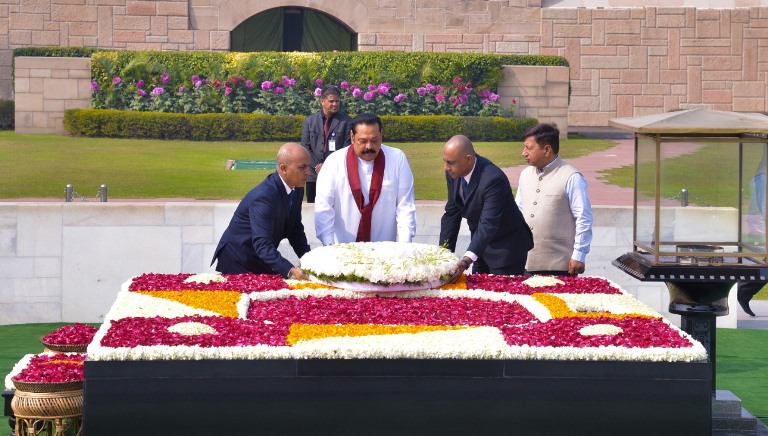
Mahinda Rajapaksa laying a wreath on the samadhi of Mahatma Gandhi.

Before I conclude, I would like to reiterated our invitation to Prime Minister Modi to visit Sri Lanka in the near future. We in Sri Lanka are looking forward to that visit.”

I am indeed happy to be here because India is our closest neighbor as well as our long-standing friend. The links of history, religion and culture between Sri Lanka and India, which date back more than two millennia, provide a solid foundation for our partnership.”

Finally, I want to express my deepest appreciation to Prime Minister Modi and the Government of India for the outstanding arrangements and gracious hospitality accorded to me and my delegation during this State Visit.”

Jaishankar-Mahinda Talks

India’s Minister of External Affairs Subrahmanyam Jaishankar called on the Lankan Prime Minister on Saturday morning. At the meeting Jaishankar said: Your visit is a very important opportunity for us to set the course for the next five years.”

The Indian and Sri Lankan delegations discussed the status of ongoing projects in Sri Lanka that are being implemented with Indian assistance. The two sides agreed to expedite a number of projects that have not seen much progress in the past few years.

There is a lot of interest in Sri Lanka in areas like tourism, Minister Jaishankar pointed out and suggested that Sri Lanka should soon send to India a team to market Sri Lanka” as a tourist destination.

Sri Lanka receives the largest number of tourists from India. In 2018, tourist arrivals from India amounted to 424,887. This reduced in 2019 as a result of the Easter Sunday terrorist attacks.

Minister Jaishankar further said that Prime Minister Narendra Modi’s visit to Sri Lanka shortly after the Easter attacks in 2019 was very intentional”. It was meant to send a message to India and the world that Sri Lanka is safe. Prime Minister Modi was the first world leader to visit Sri Lanka after the Easter attacks.

Prime Minister Rajapaksa briefed the Indian Foreign Minister on the new island-wide housing project that was initiated recently and invited India to consider providing assistance similar to the previous housing projects they have helped fund.

The two delegations also discussed the long-standing concerns of the fishing communities of both countries. Agreeing that this is a problem that benefits neither side, both countries agreed to work more closely together to find a practical solution in a way that benefits all affected fishing communities.

Mahinda getting a bronze bust of Mahatma Gandhi as a memento.

Later in the evening the Lankan Prime Minister called on the Indian President Ramnath Kovind.

Prime Minister Rajapaksa arrived in New Delhi on Friday on a five-day visit, his first overseas tour after being appointed Prime Minister in November last year. He was given an exceptionally warm welcome in New Delhi with gigantic hoardings with his picture and welcome messages in English and Sinhala dotting the road to the city. A troupe of dancers performed for the Prime Minister on his arrival at the airport.

Since Hinduism and Buddhism are both a binding force between India and Sri Lanka, the Lankan Prime Minister will be visiting the Vishwanath temple and the place where the Buddha gave his first sermon, in Varanasi in Uttar Pradesh. He will also visit Bodh Gaya in Bihar, where the Buddha attained enlightenment; and the shrine for Lord Venkateswara in Tirupathi, in Andhra Pradesh.

Rajapaksa’s visit to New Delhi assumes significance as his second tenure as Lankan President from 2010 to 2014 saw an expansion of China’s footprint in Sri Lanka, raising hackles in India. Following his defeat in the January 2015 Presidential election, Rajapaksa became cold towards India, until Prime Minister Modi visited Sri Lanka. During that visit, a line of communication between India and Rajapaksa was re-established.

However, India did not back Mahinda Rajapaksa’s brother Gotabaya Rajapaksa when the latter stood for the office of Lankan President in November 2019. New Delhi backed the United National Front (UNF) candidate Sajith Premadasa as the latte was thought to be pro-India and Gotabaya to be pro-China.

However, when Gotabaya Rajapaksa won the election convincingly, India swiftly moved to own him. Indian Foreign Minister S.Jaishankar flew to Colombo and met Gotabaya Rajapaksa and invited him to New Delhi for talks with Prime Minister Modi and got him to agree to a specific date for the visit.

The meeting was a resounding success as the two leaders struck rapport. The only issue that divided them was the Lankan Tamil question. Like his younger brother and Prime Minister Mahinda, Gotabaya did not mention reconciliation” with the Tamils in his media statement, while Modi did.

However, it is likely that neither party will let the Tamil issue affect cooperation in other areas such as economic development, and defense and security issues which are of greater importance to India. These are also issues on which Sri Lanka is willing to cooperate with India.

India followed up Gotabaya’s visit with a visit of the Lankan Foreign Minister Dinesh Gunawardena who discussed Indian aid for skills and entrepreneurial development as he is Sri Lanka’s Skills and Entrepreneurial Development Minister also.

Ties between the two countries strengthened by the Lankan leaders’visits to Delhi will be further cemented by Modi’ visit to Sri Lanka which is bound to take place given the Indian Prime Minister’s fondness for travelling to reach out to world leaders.

Sri Lankan Prime Minister Mahinda Rajapaksa seeks three-year debt repayment moratorium from India

February 8th, 2020

Courtesy NewsIn.Asia

New Delhi, February 8 (The Hindu): Sri Lankan Prime Minister Mahinda Rajapaksa told The Hindu’s Suhasini Haider in New Delhi that the problem of debt repayment is worrying and that it would be helpful if lenders, led by India, could give a three-year moratorium on repayment.

The visiting Lankan PM also said that his government will not implement the 2017 MoUs with India on projects inked by the previous government as these are not his government’s projects and that the Mattala airport, like other national assets, will not be given away to any other country.

On political issues he said that the 19th.Amendment which created confusion in the distribution of power will have to be repealed and that any discussion on devolution of power to the provinces to meet the Tamils’ demand can take place only after an election to the Northern and Eastern provincial councils throws up a leadership with which the government can talk.

Here are excerpts from an interview given by Lankan Prime Minister Mahinda Rajapaksa to Suhasini Haider of The Hindu

SH: You have had discussions at some length with Prime Minister Narendra Modi, but no agreements were announced, especially on the $400-million Line of Credit offered by India for infrastructure. Tell us about the talks.

MR.We did speak about several agreements and we have agreed to some of the projects that [the Indian side] were interested in. It was a fruitful and successful meet, for both sides, I would say. The housing project is something that is a priority area for us, and we asked for more funding for that. We have a new initiative, to cover the whole country, every village, and we should like to get some support for that. Apart from housing, there were several projects we discussed.

SH: In April 2017, the previous Sri Lankan Prime Minister Ranil Wickremesinghe had also signed a MoU on economic cooperation for infrastructure projects, including energy and oil projects in Trincomalee that India has been keen on. Were those discussed?

MR.We didn’t discuss the Trinco projects, but we did talks about the Eastern Terminal [in Colombo] which India and Japan are jointly investing in, and the LNG terminal. Whatever was signed [in 2017] was not even pursued by the last government. President [MRS Sirisena] actually rejected all the projects PM [Wickremesinghe] had signed. We are not responsible for those projects. The Mattala [airport] project is also out. Our government has a firm policy on not allowing any national resources to be given to foreign control.

SH: An additional $50 million from the LOC have been earmarked for security cooperation, especially after the Easter Sunday bombings last year. What was decided about that?

MR: We have decided that we must have more intelligence sharing now, and increase the technical assistance [from India], as well as training. On the Easter bombings, we have an ongoing investigation into the conspiracy, and a commission is looking into it. We hope that India will continue to help us on that. In addition, we want to continue our earlier [pre-2015] project for trilateral terror and security cooperation between Maldives-India- Sri Lanka. We might have the meeting for that as soon as possible, possibly in the Maldives and discuss how to take the trilateral idea forward.

SH: Your defense secretary has also spoken of security and intelligence sharing Pakistan. Won’t the balance prove difficult, given India’s concerns about terror emanating from Pakistan, which has also held up the SAARC process?

MR: Yes, but we are friendly countries and we have friendly ties with all countries in the region. We are friendly with China too. But the Indian relationship is much stronger and very important for us. I couldn’t discuss the SAARC process with [PM Modi], as I know that India is not very interested in the summit, especially since the next meeting is due to be held in Pakistan. I do believe that we have already gone a considerable distance with building SAARC and that should be continued. Now there is also the BIMSTEC grouping.

SH: Both PM Modi here and External Affairs Minister S. Jaishankar, when he visited Colombo, have made a point to convey their concerns for the Tamil population in Sri Lanka, and the expectations India has from your government. How do you respond?

MR: We have always understood these concerns. Soon after the war ended [in 2009], we had elections, and we allowed the North to select their own Chief Minister. We held those elections despite knowing we would lose them. But nothing moved after that. We are now expecting to hold our parliamentary elections this April, and after that the provincial council elections. We will appoint a team to go to Jaffna to discuss the way forward.

SH:The way forward on devolution of powers, as was promised in the 13th amendment?

MR: Well, it all has to be discussed. We want to go forward, but we need to have someone to discuss, who can take responsibility for the [Tamil] areas. So the best thing is to hold elections, and then ask for their representatives to come and discuss the future with us. At the moment the TNA (Tamil National Alliance) is not interested in talks. They are asking for things, which the majority community in Sri Lanka will not accept.

SH: President Gotabaya has prioritized development over devolution as the way forward. Is there a difference between your positions?

MR: No, no. People need development. They have suffered for 30 years without it. So first they have to develop the area.

SH: There has been a controversy over the decision to drop the National Anthem in Tamil during Sri Lanka’s national day ceremony. How can you reassure Tamils if this is the signal sent out?

MR: But if you look around the world, the national anthem is sung primarily in one language. In India, you have so many languages, yet on your national days, you sing it one language. Our structure is the same. When I go to Jaffna, to a Tamil school, they sing the anthem in Tamil. We have no objection if people want to sing it in their way. Some political figures are raising this issue; the general public is not interested in this issue.

SH: Your biggest challenge this year will be servicing the domestic and foreign debt, which totals about US$ 60 billion. How do you plan to deal with this issue?

MR: Yes, it is a worry. This is something we discussed with the Indian government as well, and have asked if we could get a moratorium on all loan repayments for three years, until we can revive the economy. If the Indian government takes this step, then other governments might agree to do the same thing, including China. The previous government took so many loans, they beggared the economy, and it is a mess. It all depends on the stand India takes.

SH: This year alone, you have to pay about $5 billion to service the debt, the highest in Sri Lankan history. Will you be able to do that?

MR: We have to do it, and we will manage somehow. We don’t want to default on our debt no matter what happens.

SH: At the same time, you have said that you want China to give back its control of Hambantota port. Is that something President Gotabaya will raise when he goes to Beijing?

MR: We are discussing it, but it is difficult, as the previous government had already completed the handover of control. I think China may agree to our request on some terms, and we will keep the negotiations going.

SH: During a visit to Colombo, Chinese Foreign Minister Wang Yi said that China will ensure that there is no outside interference in Sri Lanka…What did he mean? Was it an indication to the US, or to India or some other country?

MR: I don’t know, you will have to ask him that (laughs). We didn’t take the statement too seriously, as no one has yet tried to interfere in our matters… other than during the last elections [2015]. Then, all the countries got involved in [the elections]. But now we would like to have good relations and work with all the countries.

SH: You mentioned upcoming parliamentary elections. Assuming that you win, as the recent Presidential election results indicate, will you move forward on the 19th amendment, that shifts power from the Presidency to the PM and parliament?

MR: First of all, we have to get rid of the 19th amendment. Then we will think about how we will move forward. [Former Law Minister] G.L. Peiris is already studying it, and we will take opinions on what to do. At the moment, neither the President nor the Parliament has clear powers. So we do have to decide on the division of power. The majority of voters in Sri Lanka voted for President Gotabaya, and that means people want him to have some control of the country’s development and governance, and we must respect that.

SH: Given that the President is also your brother, could the tussle over the 19th amendment cause problems between you?

MR: No, no, no. The way the present constitution is structured and the confusion with the 19th amendment, only two brothers like Gota and I can handle this (Laughs). Otherwise no President and PM will ever agree on this issue.

SH: Finally, what does it feel like to be back here as Prime Minister, after five years, when you visited, but were out of power?

MR: Well, I am grateful to PM Modi for inviting me and receiving me both when I was out of power and now. I never felt the difference, in that sense. Whenever he is ready to visit Sri Lanka now, we are ready to welcome him.

Sri Lanka’s economy bouncing back from Easter attacks – IMF

February 8th, 2020

Courtesy Ada Derana

The economy of Sri Lanka is recovering from tragic terrorist attacks on Easter Sunday last year, says the International Monetary Fund (IMF).

The Gross Domestic Project (GDP) growth is projected to rebound to 3.7 percent in 2020, on the back of the recovery in tourism, and assuming that the Novel Coronavirus will have only limited negative effect on tourism arrivals and other economic activities, the Washington-based organization said further.

The IMF stated this in a statement released following the end of its staff visit to Sri Lanka.

A staff team from the IMF led by Manuela Goretti visited Colombo during January 29 – February 7, 2020 to meet with the new administration and discuss its policy agenda.

At the conclusion of the staff visit, Ms. Goretti issued the following statement:

The IMF staff team had constructive discussions with the Sri Lankan authorities on recent economic developments and the country’s economic reform agenda. Given the high level of public debt and refinancing needs in the country, ensuring macroeconomic stability calls for fiscal consolidation, prudent monetary policy, and sustained efforts to build international reserves. Ambitious structural and institutional reforms remain critical to raise the country’s growth potential and promote inclusiveness.

The economy is gradually recovering from the terrorist attacks last April. Real GDP growth is estimated at 2.6 percent in 2019. The recovery is supported by a solid performance of the manufacturing sector and a rebound in tourism and related services in the second half of the year. High frequency indicators continue to improve and growth is projected to rebound to 3.7 percent in 2020, on the back of the recovery in tourism, and assuming that the Novel Coronavirus will have only limited negative effect on tourism arrivals and other economic activities. Inflation is projected to remain at around 4½ percent, in line with the Central Bank of Sri Lanka (CBSL) target. After a sharp import contraction in 2019, the current account deficit is expected to widen to nearly 3 percent of GDP in 2020.

Preliminary data indicate that the primary surplus target under the program supported by the Extended Fund Facility (EFF) was missed by a sizable margin in 2019 with a recorded deficit of 0.3 percent of GDP, due to weak revenue performance and expenditure overruns. Under current policies, as discussed with the authorities during the visit, the primary deficit could widen further to 1.9 percent of GDP in 2020, due to newly implemented tax cuts and exemptions, clearance of domestic arrears, and backloaded capital spending from 2019. Given risks to debt sustainability and large refinancing needs over the medium term, renewed efforts to advance fiscal consolidation will be essential for macroeconomic stability. Measures to improve efficiency in the public administration and strengthen revenue mobilization can help reduce the high public debt, while preserving space for critical social and investment needs. Advancing relevant legislation to strengthen fiscal rules would anchor policy commitments, restore confidence, and safeguard sustainability over the medium term.

The CBSL should continue to follow a prudent and data-dependent monetary policy and stand ready to adjust rates to evolving macroeconomic conditions. Net International Reserves fell short of the end-December target under the EFF-supported program in 2019 by about $100 million amid market pressures after the Presidential elections and announced tax cuts. However, conditions have since stabilized. Renewed efforts are needed to rebuild reserve buffers to safeguard resilience to shocks, under a flexible exchange rate. Approval of the new Central Bank Law in line with international best practices is a critical step to further strengthen the independence and governance of the CBSL and support the adoption of flexible inflation targeting.

The financial system remains broadly stable, although some pockets of vulnerability remain, especially among non-bank financial institutions. Caps on lending rates and the loan repayment moratorium for small and medium enterprises should be temporary, to avoid unintended distortions and inefficiencies in financial intermediation. Modernizing the Banking Act, with a view to strengthening and harmonizing regulation, supervision, and resolution frameworks for deposit-taking financial institutions would help safeguard financial stability.

The authorities should move ahead with growth-enhancing structural reforms to fully harness Sri Lanka’s economic potential and foster greater social inclusion. The team welcomed the authorities’ plans to enhance the efficiency of state-owned enterprises, enabling them to operate on a sound commercial basis. These plans would need to be supported by a visible commitment to strengthen governance and transparency, notably in the energy sector, and renewed efforts to tackle corruption. Concerted initiatives are needed to foster the business climate, promote trade openness and investment, and strengthen infrastructure sustainably, including to respond to the challenges from climate change. Sri Lanka stands to gain from greater female labor participation, enhancements in social protection, and further investment in education and skills.”

The team met with the Secretary to the President P B Jayasundera, CBSL Governor W D Lakshman, Secretary to the Treasury S R Attygalle, Senior Deputy Governor P N Weerasinghe, other public officials, representatives of the business community, civil society, and international partners.

Former ministerial secretary reveals about the vehicles in the yahapalana government

February 8th, 2020

Courtesy Hiru News

Former secretary to the ministry of parliamentary reforms and media Nimal Bopage says that other than for the ministers efforts were made to provide vehicles to 58 MPs under contract basis during the yahapalana government.

Issuing a release he noted that former Prime Minister Ranil Wickremesinghe forced him to sign the deal worth 2.43 billion rupees.

Presidential commission receives more information about Asath salley’s influences

February 8th, 2020

Courtesy Hiru News

Retired DIG Palitha Siriwardena says that if not for the influence of former governor Asath Salley, they would have been able to succeed in the investigation into the attack on Buddha statues in Mawanella.

Presidential+commission+receives+more+information+about+Asath+salley%E2%80%99s+influences

He made this revelation while giving a statement before the presidential commission to inquire into easter Sunday attacks, yesterday.

The commission made inquiries as to whether the former governor has been questioned regarding the incident.

Responding to this the retired DIG said that the officers were reluctant to question him in this regard due to his political leverage and the connection with the state leader.

>Thereafter the commission inquired as to whether he was aware of another investigations group which was inquiring into the incident.

He responded that he was not aware of it but was later informed that a group of CID officers are carrying out an investigation under the orders of IGP Pujith Jayasundara.

The retired IGP further noted that if the CID and the provincial officers worked together they would have been able to carry out a successful investigation.

He further noted that the names which was given in connection to the easter Sunday attacks by the Indian secret service was revealed in the investigations of the Mawanella attack on Buddha statues and the wanathawilluwa training camp.

RANJANGATE SCANDAL – VOICE TAPES TABLED BY RANJAN TO BE GIVEN TO MPS AFTER REMOVING CONTENT HARMFUL TO NATIONAL SECURITY AND FALSE CLAIMS

February 8th, 2020

Courtesy Hiru News

It has been decided to give access to the voice tapes tabled by Parliamentarian Ranjan Ramanayake to Members of Parliament subsequent to removing content which are a threat to national security and false claims therein.

This decision was made at the Party Leaders’ meeting in Parliament today under the leadership of Speaker Karu Jayasuriya.

The Parliamentary Communications Department said that accordingly, it was decided on this occasion not to issue these tapes to Parliamentarians just yet

The Parliamentary Communications Department said further that subsequent to removing words that are not compatible in these tapes, the Speaker will listen to them again and table them as suitable.

RANJANGATE SCANDAL – Investigations to ascertain whether Ranjan’s weapon recovered from his residence was used for a crime

February 8th, 2020

Courtesy Hiru News

The CID informed the court today that it is conducting further investigations into whether the weapon seized from the house of MP Ranjan Ramanayake has been used to commit a crime.

The case was taken before the Nugegoda Magistrate today.

Ramanayake is in remand until February 12th in connection with allegedly influencing the functions of judges.

Meanwhile, the Government’s Analyst collected a voice sample of MP Ranjan Ramanayake today.

>At the same time, the chief inspector who made submissions to the court quoted the Government’s Analyst report as stating that the weapon they seized from Ramanayake’s house is emitting a fresh gunpowder smell.

He therefore said further investigations are continuing to ascertain whether it was used to commit a crime.

Meanwhile, the parliament has decided to table the voice clips provided by MP Ramanayake only after removing the matters threatening the National Defence and false information.

Meanwhile, the Attorney General has directed the Acting IGP to give his explanation before Monday as to why he did not comply with the instruction with regard to the Gihan Pilapitiya judicial process.

/>Earlier, the Attorney General instructed the Acting IGP to obtain a court warrant and arrest High court judge Gihan Pilapitiya in connection with Ranjan Ramanayake’s voice clip scenario.

The Attorney General has further informed the Acting IGP that his inaction to arrest High Court Judge Gihan Pilapitiya has violated the Article 12-01 and 12-02 of the Constitution

Coronavirus: Russian media hint at US conspiracy

February 8th, 2020

By BBC Monitoring Essential Media Insight

Graphic from Russia's Channel One TV
Image captionRussia’s Channel One has aired a theory linking the coronavirus to President Trump

The coronavirus outbreak in China has provided fertile ground for conspiracy theories and misinformation on the web everywhere, but in Russia they are being spread on primetime news programmes.

Russian TV is also unique in having a consistent overall thrust: that shadowy Western elites and especially the US are somehow ultimately to blame.

One of main national TV networks, Channel One, has even launched a regular slot devoted to coronavirus conspiracy theories on its main evening news programme, Vremya (“Time”).

The style of the reporting is ambiguous, appearing to debunk the theories while leaving viewers with the impression that they contain a kernel of truth.

One of the wilder ideas aired by Vremya recently is that the presence of the word “corona”, which means crown in both Latin and Russian, in the word coronavirus hints that Donald Trump is somehow involved.

Russian TV graphic showing Trump with a crown
Image captionChannel One’s Kirill Kleymyonov suggested that the theory of a US role in the outbreak could not be dismissed out of hand

Apparently, this is because he used to preside over beauty pageants, handing the winners their crowns.

In fact, scientists named the virus because of of its crown-like shape, but Vremya’s presenter warns against rejecting the idea all too soon.

“Utter nonsense, you’ll say, and I’d agree with you, if it were not for what’s in our correspondent’s report,” he says.

‘Ethnic bioweapon’

The subsequent video does admit the crown theory is a “strange construct”, but uncritically presents an expert who says that the Chinese coronavirus strain has been artificially created, and that US intelligence agencies or American pharmaceutical companies are behind it.

The report also rehashes old, false claims by Kremlin media and officials that the US ran a laboratory in Georgia where it tested a biological weapon on humans.

The Channel One correspondent then quotes online conspiracy theories that the novel coronavirus strain affects only Asians and could be some kind of “ethnic bioweapon”.

Russian TV graphic
Image captionChannel One’s coronavirus coverage has repeated unfounded allegations of a US “bio-weapon” programme

He concedes that there is clear evidence refuting this, but adds suggestively: “Even experts who are cautious in their assessments say that nothing can be ruled out.”

Coronavirus conspiracy theories have also featured heavily on Channel One’s main political talk show, Vremya Pokazhet (Time Will Tell), only more openly than on news programmes.

The gist is to suggest that various Western actors – pharmaceutical companies, the US or its agencies – are somehow involved in helping to create or spread the virus, or at least in spreading panic about it.

The aim is variously said to be – in the case of “Big Pharma” – to profit from creating a vaccine against the coronavirus or, in the case of the US, to hit the Chinese economy in order to weaken a geopolitical competitor.

Blood checks for officials

Away from the TV screens, the coronavirus outbreak appears to be causing serious concern among Russian officials.

Rail and air traffic to China have been curtailed, and Russians evacuated from China have been quarantined for two weeks in a Siberian sanatorium.

A church in Moscow has even held a service to pray for salvation from the coronavirus.

Fear or the virus appears to reach all the way to the top.

Russian daily Vedomosti reports that Kremlin has introduced temperature checks for those attending events with President Vladimir Putin, in what spokesman Dmitry Peskov has called a “precautionary measure”.

BBC Monitoring reports and analyses news from TV, radio, web and print media around the world. You can follow BBC Monitoring on Twitter and Facebook.

Russian scientist says Coronavirus is a bio-weapon created by the US

February 8th, 2020

Courtesy Hiru News

The official Chinese death toll from the coronavirus outbreak rose on Friday to 638, with the government saying total infections had climbed past 31 thousand 500.

The National Health Commission said the toll was raised by 73 new deaths from the epidemic.

As debates over the origin of the Wuhan coronavirus rage on, new voices join the discussion.

Russian media sources suggest the novel disease, provisionally known as 2019-nCoV, could be an American made bio-weapon designed to sabotage China.

The claims have had significant airtime on mainstream Russian media and could be part of Vladimir Putin’s efforts to discredit U.S interests in the region.

‘Nationalism’ disambiguated

February 7th, 2020

By Rohana R. Wasala

Like ‘secularism’, ‘nationalism’ is a much abused term in the vocabulary of the opponents of the unitary status of the Sri Lankan state. A previous article of mine (‘Why secularism is good for Sri Lanka’/Lankaweb/posted January 23, 2020) explained my opinion that the principle of secularism in governance is a good thing for Sri Lanka and that it is not against religion, although it is often attacked as anti-religion, and hence immoral. In the West, USA, UK, and Norway, for example, are accepted as secular democracies while being avowedly ‘Christian’ nations. There is no contradiction here; it only means that a secular democratic government needs to respect the dominant religious culture of the people (nation), but need not accommodate totalitarian dogmatic tenets, if any, like death for apostasy, that go against modern scientific knowledge and secular ethics. The same applies to predominantly Buddhist Sri Lanka with relevant adjustments. Considering the current besieged state of the Buddha Sasanaya, despite the age-old Buddhist civilizational  foundation of the Sri Lankan state being its cultural lynchpin, the constitutional recognition of the need to protect it is in the interest of all Sri Lankans. It does not harm the secular credentials of the unitary state.

When we adopt the term nationalism to the Sri Lankan context, it should be similarly disambiguated. While secularism is viewed as a positive principle in Western political discourse, nationalism is treated as being almost identical with racism. That is the meaning that the enemies of the unitary character of the Sri Lankan state – such as the mercenary foreign NGOs battening on the misery of millions in weaker nations, separatists among Tamil expatriates in the West , and communal political survivalists at home who have no plausible reason to justify their existence – attribute to the term. However, nationalism is implicitly accepted as a key element of a country’s development and security by the Western countries on whose deliberately equivocal definitions and double standards they rely.

The Wikipedia provides a short unclear ‘definition’: ‘Nationalism is an ideology and movement that promotes the interests of a particular nation (as in a group of people) especially with the aim of gaining and maintaining the nation’s sovereignty (self-governance) over its homeland.’ This nebulous definition seems to equate a nation to a race, or an ethnic group, which is seeking to gain sovereignty over its ‘homeland’. The homeland of a nation is the distinct native country or area where that nation developed its unique civilization with its own language,and culture (way of living, values, arts, moral and spiritual traditions,etc) and over which it can legitimately claim and exercise sovereignty. Google.com dictionary offers the following, which sounds better than the above. It defines ‘nation’ as ‘a large body of people united by common descent, history, culture, or language, inhabiting a particular country or territory’. In this sense, the Sinhalese are a nation. They have a common descent, a recorded (written and epigraphic) history of over 2500 years, a language of their own that originated in the Sihela ‘deepe’ (island) and nowhere else, a unique culture fashioned by Theravada Buddhism, and their only homeland, which is their inalienable native land (the same ‘Sihela deepe’). Sinhalese nationalism is well founded and inclusive. A few fast disappearing Tamil racists like Sampanthan and Wigneswaran, a mere handful among the sensible minority Tamils who account for about 15% of the island’s population in terms of the 2011 census (Sri Lankan Tamils 11% + 4% Indian Tamils), are pushing for a separate state by devious means in the name of a Tamil nation and an exclusively Tamil homeland in the North and the East without any scientifically verifiable historical evidence to support them. But Tamils (15%) and Muslim (9.7%)  are dignified members of the single nation that Sri Lankans are, absolutely on par with the members of the majority Sinhalese community.

Tamils’ historical homeland is Tamilnadu or Tamil Land in South India, where they originated and where their unique Tamil Hindu culture evolved. Tamils, like the Muslims, live in every part of the island, mingled with other races, though less than half of all ethnic Tamils in Sri Lanka are concentrated in the north and the east provinces. Wherever they live, it is the South Indian Hindu culture that characterises them. There were over 80 million Tamils in Tamilnadu last year (2019). There must be over 20 million more in countries around the world outside Tamilnadu. Ethnic Sinhalese in Sri Lanka and outside number just over 15 million, perhaps, and Sinhalese language speakers come only from Sri Lanka. The Sinhalese have never ever asked the minorities to depart from Sri Lanka because it is their (the Sinhalese’) original native land, and not theirs, the way Wigneswaran is demanding that the Sinhalese leave the North. They have always treated the Tamil minority with kindness, humanity, and equality except when the latter became aggressive instigated by the racist few among the sensible majority of Tamil politicians. 

Nationalists comprise all Sri Lankans irrespective of ethnicity or religious affiliation, though unsurprisingly, the majority of them are from among the Sinhalese. What they say or have been saying to dissenting Tamils is: Why talk about separate homelands? Sri Lanka is the common homeland of all of us. Let’s us remain as the one nation we are, in spite of our ethnic and other differences, occupying the same piece of land and breathing the same air above it and keeping abreast of the positive developments in the fast changing world outside. 

For the Sinhalese there is no difference between nationalism and patriotism. Generally, in the West, both terms are defined rather negatively. The Google.com definition of patriotism runs as follows: (patriotism is) ‘the quality of being patriotic; devotion to and vigorous support for one’s country’.  Among synonyms given are chauvinism and jingoism suggesting that patriotism could degenerate into such evil traits. The Wikipedia offers a more comprehensive and  a bit more positive explanation of the term: ‘Patriotism or national pride is the feeling of love, devotion and sense of attachment to a homeland and alliance with other citizens who share the same sentiment. This attachment can be a combination of many different feelings relating to one’s own homeland, including ethnic, cultural, political or historical aspects. It encompasses a set of concepts closely related to nationalism’. For the Sinhalese, from their hoary beginnings, nationalism has been identical with patriotism. They have always fought for the motherland, that is, for preserving or regaining lost sovereignty over its territory. The modern nationalist slogan consists of the evocative triad ‘rata, jaatiya, aagama’ (country, nation, religion). The patriotic Sinhala scholar Kumaratunga Munidasa (1887-1944), the founder of the still operative Sinhala language study circle known as ‘Hela Havula’, introduced  the secular ‘triple gem’ of ‘desa, basa, raesa’ (country, language, nation). Not that he neglected the Buddha Sasana; he took that for granted in his personal dedication to the study of the Sinhala language and its literature in those dark days of foreign domination. Actually, at the beginning, he studied Pali and Sanskrit in order to become a Buddhist monk; but he had to give up the idea because of lack of parental assent. The ‘country’ came first in his case, too. Even today, while a handful of racists among Tamil and Muslim politicians talk exclusively about the interests of their own Tamil and Muslim people respectively, without any friendly reference to the majority communty among whom they live without suffering discrimination, the non-racist nationalists among the Sinhalese and minority politicians speak up for the country in the name of all, irrespective of ethnic and other differences. 

The fervent nationalist sentiments – rising with growing awareness among the youth connected through the You Tube about  their inestimable historical heritage – found graphic expression in the form of wall paintings across the country soon after the inauguration of president Gotabhaya Rajapaksa in November 2019. Meanwhile, a young man named Nalaka Senadheera from Dedigama has initiated a voluntary movement for re-cultivating thousands of acres of previous paddy lands left fallow over the years in various parts of the country.  During the disastrous, nation-denying Yahapalanaya, its immoderate neoliberalist economic policies such as selling off invaluable national assets met with the passionate anger and disapproval of the nationalists. For Sri Lanka, this surge of nationalism is a very welcome development. It is independent and non-aggressive.

Not so with the Americans. Wherever they go, American leaders boast that their aim is promoting the American interest. This means they are nationalists, though they never explicitly admit they are. Instead they pretend nationalism in others to be a negative tendency. Our common experience is that their policy is exactly what the Google online dictionary definition says nationalism is, and what critics falsely accuse Sri Lankan nationalists of: ‘identification with one’s own nation and support for its interests, especially to the exclusion or detriment of the interests of other nations.’ The Sri Lanka traducers subtly imply that the Tamil minority is another ‘nation’ within island, thereby undermining the country’s communal unity. This demonstrates Americans’ double standards in respect of weaker nations like Sri Lanka that are expected to betray the interests of their own people to accommodate ‘American interests’!.

Linguist, philosopher, social critic, and political activist Noam Chomsky (‘Who Rules the World?’/Penguin Books, 2017) traces the source of the Americans’ current national security policy to the administration of president George H.W. Bush in the early 1990s. It was a new national security strategy formulated in reaction to the fall of America’s global enemy the Soviet Union. Though the threat from Russia was fast becoming a thing of the past at the time, they  wanted to maintain ‘a military establishment almost as great as the rest of the world combined and far more advanced in technical sophistication…’, as Chomsky says, to defend against the growing technological sophistication of Third World powers! Chomsky adds in an aside: ‘Disciplined intellectuals understood that it would have been improper to collapse in ridicule, so they maintained a proper silence’.

The new policy, the writer further explains, insisted on the US maintaining its defense industrial base”. The phrase is a euphemism, according to Chomsky, for high-tech industry which heavily relies on large scale state intervention for research and development, often under Pentagon cover, in what continues to be called U.S. free-market economy”. The new plans had an interesting provision that had to do with the Middle East. It stated that Washington had to maintain intervention forces focused on a region of pivotal importance where the major crises could not have been laid at the Kremlin’s door” (as quoted by Chomsky in the book named above from National Security Strategy of the United States”, White House, March 1990). On this ridiculously vulgar fumbling about for an excuse for something base, Chomsky makes this comment: ‘Contrary to fifty years of deceit, it was quietly conceded that the main concern in this region was not the Russians, but rather what is called radical nationalism”, meaning independent nationalism not under U.S. control’.  

 Sri Lanka is not in the Middle East, but in what the Americans have recently chosen to call the Indo-Pacific region. Have America’s security strategies or its attitudes towards weaker nations changed for the better over the past thirty years? Most probably not. A leopard does not change its spots, as the local saying goes, though it may change its hunting grounds. Currently emerging revelations in international media show how the narrow self interest of fiercely nationalistic  America is plaguing the whole world. The moral of Chomsky’s narrative may be applied, with necessary alterations, to Sri Lanka’s current predicament vis-a-vis the global superpower in her desperate nationalist struggle to preserve her independence and sovereignty.

පසුගිය ආණ්ඩුව ගෙන්වූ රුපියල් බිලියන 2.8 ක වාහන…

February 7th, 2020

Ada Derana

රැකියා විරහිත උපාධිධාරීන් හා ඩිප්ලෝමාධාරීන් බඳවාගැනීමේ අවුරුදු 35 උපරිම වයස් සීමාව අවුරුදු 45 දක්වා සුදුසුකම් සපුරා ඇති සියලූම රැකියා විරහිත උපාධිධාරීන් බඳවා ගැනීමට පියවර ගන්නා මෙන් ඉල්ලා සිටිමු

February 7th, 2020

ජනමාධ්‍ය නිවේදනයයි උපාධිධාරී ජාතික මධ්‍යස්ථානය.

ගරු ජනාධිපති,
ගෝඨාභය රාජපක්ෂ මැතිතුමා,
ජනාධිපති ලේකම් කාර්යාලය,
කොළඹ 01.

ගරු ජනාධිපති තුමනි,

රැකියා විරහිත උපාධිධාරීන් හා ඩිප්ලෝමාධාරීන් බඳවාගැනීමේ අවුරුදු 35 උපරිම වයස් සීමාව අවුරුදු 45 දක්වා සුදුසුකම් සපුරා ඇති සියලූම රැකියා විරහිත උපාධිධාරීන් බඳවා ගැනීමට පියවර ගන්නා මෙන් ඉල්ලා සිටිමු.


‘‘රැකියා විරහිත උපාධිධාරීන් රැකියාගත කිරීමේ වැඩසටහන 2020’’ යටතේ උපාධිධාරීන් හා ඩිප්ලෝමාධාරීන් 50 000 ක් බඳවා ගැනීමට අමාත්‍ය මණ්ඩලය තීරණය කර ඇති අතර එසේ බඳවා ගැනීමට කටයුතු කිරීම සම්බන්ධයෙන් අපි ස්තූතිවන්ත වෙමු.

විශ්ව විද්‍යාලයකින් උපාධියක් ලබා පිටවන සෑම උපාධිධාරියෙකුටම අධ්‍යාපන සුදුසුකමට සරිලන සුදුසු රැකියාවක් දිනා ගැනීම වෙනුවෙන් අපි අරගල කරන්නෙමු. රැකියාවිරහිත භාවයේ සිටින සුදුසුකම් සැපිරූ සැම රැකියාගත කිරීම රජයේ වගකීමක් වන අතර එවැනි ක‍්‍රියාමාර්ගයක් ගැනීම පිළිබඳව අගය කරමු.

මෙම නව බඳවාගැනීමට අදාළව නිකකුත් කර ඇති ඇතැම් කොන්දේසි ගැටළුකාරී වන අතර ඒ පිළිබඳව ඔබතුමාගේ අවධානය කඩිනමින් යොමු කර විසඳුමක් ලබා දෙන ලෙස ඉල්ලා සිටිමු.

02. මීට සති කීපයකට පෙර ආණ්ඩුවේ අමාත්‍යවරයෙකු වන ඩලස් අලහප්පෙරුම මැතිතුමා මාධ්‍ය මගින් උපාධිධාරීන් බඳවා ගැනීමේ දී අවුරුදු 45 දක්වා උපාධිධාරීන් බඳවාගන්නා බව ප‍්‍රකාශ කරන ලදි.

නමුත් අමාත්‍ය මණ්ඩල තීරණය අනුව හා 2020.02.06 හා 07 දින පළවූ දැන්වීම් වලට අනුව බඳවාගැනීමේ උපරිම වයස් සීමාව 35 දක්වා සීමා කර ඇත.

2015-2019 වර්ෂවල රැකියා විරහිත උපාධිධාරීන් විධිමත් බඳවාගැනීමක් සිදු නොකළ අතර එම වසර 05 තුළ අවු.35 ඉක්ම වූ උපාධිධාරීන්ට දැඩි අසාධාරණයක් සිදුවීම වැළැක්විය නොහැක. එමෙන් ම එම අසාධාරණයට ලක් වන පිරිසට යළි කිසි දිනෙක රජයේ සේවයේ රැකියාවක් ලබා ගැනීමේ අවස්ථාව ද අහිමි වේ.

03. 2020 බඳවා ගැනීමේ පවතින අනෙක් කොන්දේසි අතර 2017-2020 දක්වා කිසිඳු රැකියාවක් නොකළ උපාධිධාරීන් හා ඩිප්ලෝමාධාරීන් ඉල්ලූම් කළ යුතු යැයි ද සඳහන් කර ඇත. එම කොන්දේසිය ද අසාධාරණ වන අතර 2014 සිට උපාධිධාරී රැකියාවක් හිමි නොවූ පිරිසක් ද වෙති. අපේ රටේ රැකියාවක් ලැබීමේ අස්ථාවරත්වය මත කිසිම කෙනෙකුට තම සුදුසුකමට නිසි මොහොතේ රැකියාවක් ලැබෙනු ඇතැයි සහතිකයක් නැත. ඒ යටතේ මෙම කොන්දේසිය ද අසාධාරණ බව දන්වමු.

04. නව බඳවාගැනීම් යටතේ ඇතුළත් කරගනු ලබන උපාධිධාරීන් දිස්ත‍්‍රික් හා ප‍්‍රාදේශීය ලේකම් කාර්යාල මට්ටමින් බඳවාගෙන වසර 05ක් අනිවාර්යයෙන් එම සේවා ස්ථානවල රැකියා කිරීම කොන්දේසියක් වේ. දැනට 2005-2016 දක්වා බඳවාගෙන ඇති උපාධිධාරීන් අතර සේවා කාලය වසර 15 ඉක්ම වුවත් කොළඹ සිට සිය පදිංචියට අදාළ සේවා ස්ථානයකට ස්ථානමාරුවීම් ලබාගත නොහැකිව ඇත. ඉහත කොන්දේසිය අනුව දැනට රාජ්‍ය සේවයේ කොළඹ ආශ‍්‍රිත සේවා ස්ථානවල සිටින අවශ්‍යතාවය සහිත උපාධිධාරීන් සඳහා ස්ථානමාරුවීමක් ලබා ගැනීම තව වසර ගණනාවකින් කල් යනු ඇත. මෙවැනි කරුණු කළමණාකරණයකින් පසු විසඳිය යුතු බව පෙන්වා දෙමු.

05. නව බඳවාගැනීම් යටතේ බඳවාගන්නා උපාධිධාරීන් ආගමන විගමන දෙපාර්තමේන්තුව, තක්සේරු දෙපාර්තමේන්තුව ඇතුළු ඒ ශ්‍රේණියේ දෙපාර්තමේන්තුවෙත බඳවා ගන්නා බවත්, ඉහත කොන්දේසි අනුව වසර 05 ක් එහි සේවය කළ යුතුයි යන්න අනුව දැනට සේවයේ සිටින ස්ථීර උපාධිධාරීන්ට එම සේවා ස්ථානවල සේවය කිරීමේ අවස්ථාව අහිමි වනු ඇත.

06. 2020 නව බඳවාගැනීම් ක‍්‍රියාත්මක කරනුයේ ජනාධිපති ලේකම් කාර්යාලය හරහා ය. උපාධිධාරීන් බඳවා ගැනීමේ ව්‍යවස්ථාමය වගකීම පැවරී ඇත්තේ රාජ්‍ය පරිපාලන අමාත්‍යාංශයටය. එය නොසලකා 2018/2019 ජාතික ප‍්‍රත්පත්ති හා ආර්ථික කටයුතු අමාත්‍යාංශය මගින් වසරක පුහුණුවකට ඇතුළත් කරගත් උපාධිධාරීන් ස්ථීර කිරීමේ දී පරිපාලන දෝශ රැසක් නිර්මාණය වී ඇති බවද පෙන්වා දෙමු.

ගරු ජනාධිපති තුමනි,
මේ දක්වා උපාධිධාරීන් බඳවා ගැනීමේ උපරිම වයස් සීමාව අවු.45 දක්වා සලකා බැලූ අතර 2020 නව බඳවාගැනීමේ දී ද උපරිම වයස් සීමාව 45 දක්වා සලකා බලන ලෙසත්, රැකියා නොමැතිකම නිසා සා/පෙළ, උ/පෙළ අධ්‍යාපන සුදුසුකම් යටතේ කුමන හෝ රැකියාවක් කිරීමේ පදනම මත උපාධියට රැකියාවක් ලබා ගැනීමට ඇති අවස්ථාව අහිමි නොකරන ලෙසත් ඉහතින් දක්වා ඇති අංක 04, 05, 06 කෙරෙහි අවධානය යොමු කරන ලෙසත් ඉල්ලන අතර මෙම ගැටළු වලට කඩිනමින් විසඳුමක් ලැබෙනු ඇතැයි අපි අපේක්ෂා කරමු.

ඉහත කොන්දේසි ක‍්‍රියාත්මක වී යම් පිරිසකට අසාධාරණයක් සිදු වන්නේ නම් එම පිරිසේ අයිතිය වෙනුවෙන් අඛණ්ඩව ක‍්‍රියාකරන බවද වැඩි දුරටත් දන්වා සිටිමු.

ස්තූතියි.

මෙයට,
චන්දන සූරියආරච්චි

අධ්‍යාපනය ලද පාසලෙන් ජනපතිට උපහාර..

February 7th, 2020

Ada Derana

තොටස් ඇල්ල පිරිසිදු කිරීමේ වැඩසටහන

February 7th, 2020

පේශල පසන් කරුණාරත්න

කළුතර දිස්ත්‍රික්කයෙහි වලල්ලාවිට ප්‍රාදේශීය ලේකම් කොට්ඨාසයට අයත් 787 – සී තොටහා ග්‍රාමසේවා වසම තුල පිහිටි  තොටස් ඇල්ල සොබාදහම නිවා සනහාලන සුන්දර පරිසර පද්ධතියකි. ජෛව විවිධත්වයෙන් පොහොසත් නිවර්තන තෙත් සදාහරිත වනාන්තරයක් වන යගිරල වන රක්ෂිතය තුලින් ආරම්භ වී ගලා එන දොළ මාර්ගයෙන් ඇද හැලෙන තොටස් ඇල්ල සොබා සෞන්දර්යෙන් අනූන සංචාරකයන්ගේ ආකර්ෂණය දිනා ගෙන ඇති දියඇල්ලකි.

කෙතරම් සුන්දර පරිසර පද්ධතියක් වූවද මෙම සුන්දර දියඇල්ල හා එය පිහිටි රක්ෂිත පරිසරයේ සුන්දරත්වය විදීමට පැමිණෙන සංචාරකයන්ගේ නොහොබිනා ක්‍රියා කාරකම් හේතුවෙන් මේ සොඳුරු දිය ඇලි කොමලිය කලක පටන් දැඩිසේ දූෂණයට ලක්ව තිබුණි. පොලිතීන්, ප්ලාස්ටික්, බියර් ටින්, ආහාර දවටන ආදී නොදිරන කැලිකසල අක්‍රමවත්ව බැහැරකර වීදුරු බෝතල්, බෝතල් කටු ආදිය දිය ඇල්ල වෙත දැමීම නිසා දැඩි පරිසර දූෂණයක් ඇල්ල හා අවට පරිසරයේ සිදුව තිබුණි.

මේ විනාශකාරී ක්‍රියා හේතුවෙන් ගම්වාසීන්ට හා දියඇල්ලේ සුන්දරත්වය විදීමට පැමිණෙන සංචාරකයින් දැඩි අපහසුතා ගෙන දුන් අතර ජෛව විවිධත්වයද දැඩිසේ හායනය වෙමින් පැවතුණි.

මෙම  ක්‍රියාදාමයන් වලක්වාලමින් දියඇල්ල සහ අවට පවතින්නා වූ වටිනා පරිසර පද්ධතිය රැක ගැනීම සඳහා කඩිනම් පියවරක් ගත යුතුව තිබූ අතර ඒ සඳහා වලල්ලාවිට ප්‍රාදේශීය ලේකම් කාර්යාලය මගින් වැඩ සටහන් කිහිපයක් සූදානම් කරන ලදි. එහි පළමු අදියර වශයෙන් දියඇල්ල සහ අවට පරිසරයේ කැලි කසල ඉවත් කර පරිසර පද්ධතිය පිරිසිදු කිරීමේ වැඩසටහනක් වලල්ලාවිට ප්‍රාදේශීය ලේකම් කාර්යාලයේ නිලධාරීන් හා ස්වේඡා පරිසර ක්‍රියාකාරීන්ගේ සහභාගීත්වයෙන්   2020 පෙබරවාරි මස 06 වන බ්‍රහස්පතින්දා දින පැවැත්විය. මෙම තොටස් ඇල්ල පිරිසිදු කිරීමේ වැඩසටහන සඳහා වලල්ලාවිට ප්‍රාදේශිය ලේකම් රන්ජන් ප්‍රියශාන්ත පෙරේරා මහතා සහ සහකාර ප්‍රාදේශීය ලේකම් චතුරිකා ජයවික්‍රම මහත්මිය සමගින් ප්‍රාදේශීය ලේකම් කාර්යාලයේ තරුණ නිලධාරී මණ්ඩලය සහභාගී වූ අතර වලල්ලාවිට යෞවන සමාජ ප්‍රාදේශීය මණ්ඩලයේ සාමාජිකයන් සහ වැසිවනාන්තර සුරකින්නෝ සංවිධානය, මතුගම හරිත මිතුරෝ සංවිධානය යන පරිසර සංවිධාන වල සාමාජිකයන්ගේ දායකත්වයද මේ සඳහා ලැබී තිබුණි.

මෙම වැඩසටහන සඳහා සහභාගී වූ පිරිස විසින් දියඇල්ල සහ අවට රක්ෂිත පරිසරය තුල  අක්‍රමවත් අයුරින් තැන තැන දමා තිබූ විශාල අපද්‍රව්‍ය ප්‍රමාණයක් එකතු කර ක්‍රමවත්ව බැහැර කිරීමට කටයුතු කල අතර. ඉදිරියට මෙවැනි විනාශකාරී ක්‍රියා සිදු නොවීම සඳහා සංචාරකයින් දැනුවත් කිරීම සඳහා පුවරු සවි කිරීමටද පියවර ගන්නා ලදි. යලි මෙම සුන්දර භූමිය අපවිත්‍ර කිරීමෙන් වළක්වා ගැනීම සදහා විනාශකාරී නොහොබිනා ක්‍රියා සිදු කරන පුද්ගලයින් හට නීතීය ක්‍රියාත්මක කිරීම පිළිබඳව ඇල්ල අවට ගම්වාසීන් සමඟ සාකච්ඡා කොට ඔවුන් දැනුවත් කිරීමද සිදුකරන ලදි.

මෙම වැඩසටහන මගින් සිදු වූ වැදගත්ම කාර්ය වූයේ දියඇල්ල සහ අවට පරිසරයේ පිරිසිදු කම පිළිබඳව උනන්දුවක් නොදැක්වූ ජනතාවට ඒ පිළිබඳව සිතා බැලීමට අවස්ථාවක් උදාවීමයි. තරුණ පිරිසක් එකතු වී සිදුකරනු ලැබූ මෙම ක්‍රියාව දියඇල්ලේ සුන්දරත්වය විදීමට පැමිණ සිටි සියළු දෙනාගේම ඇගයීමට ලක්වූ අතර අක්‍රමවත් ලෙස කසල බැහැර කරමින් තමන් විසින්ම තමන්ටම සුන්දරයත් විදීමට ඇති වටිනා පරිසර පද්ධතියක් අපිරිසිදු කර ගැනීමට ක්‍රියාකිරීම  පිළිබඳව කනගාටු වන අයුරු දක්නට ලැබුණි.  ඉදිරියේදී තමන් ඒ පිළිබඳව සැලකිලිමත් විය යුතු බවත් දියඇල්ල සුන්දරව තබා ගැනීම තම වගකීමක් ලෙස සැලකිය යුතු බවත් මෙම වැඩසටහන දෙස බලා සිටි පුද්ගලයින් පැවසූ අතර පැමිණ සිටි සංචාරකයින්ද හැකි අයුරින් මෙම වැඩසටහන හා සම්බන්ධ විය.

ස්තූතියි.

පේශල පසන් කරුණාරත්න

(0710580734)


Copyright © 2026 LankaWeb.com. All Rights Reserved. Powered by Wordpress