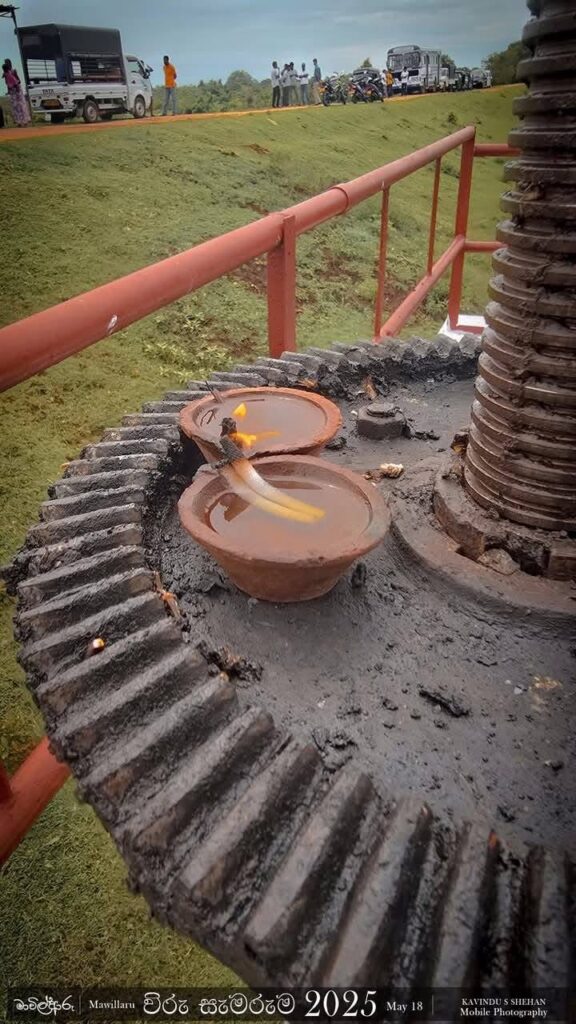
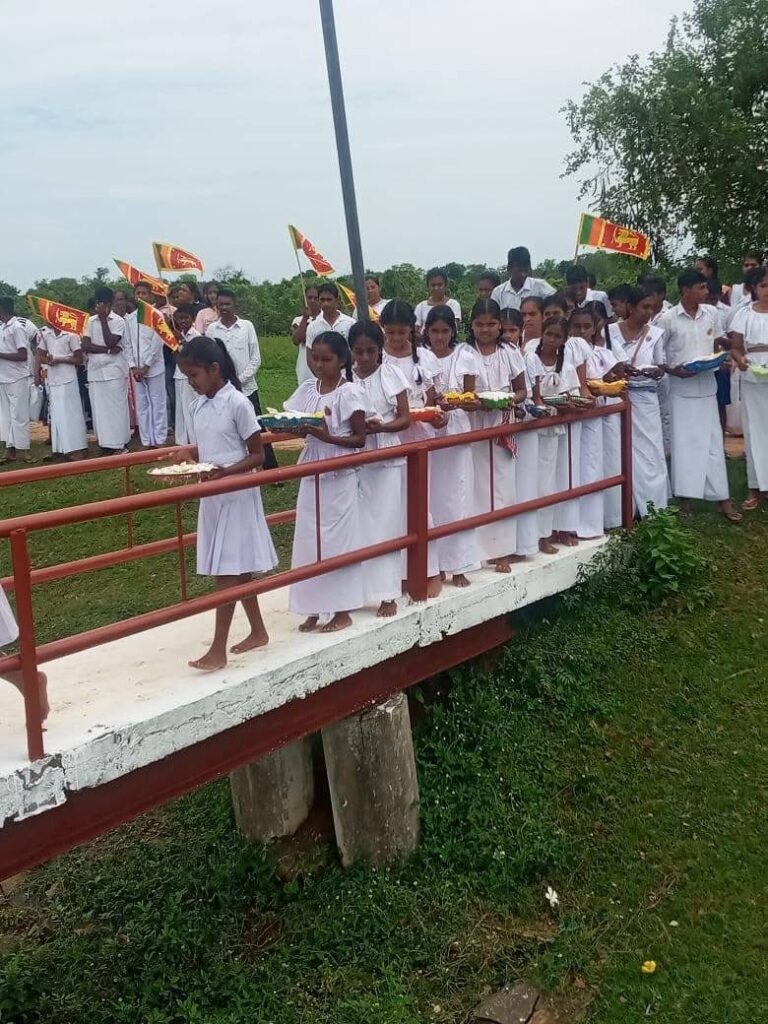
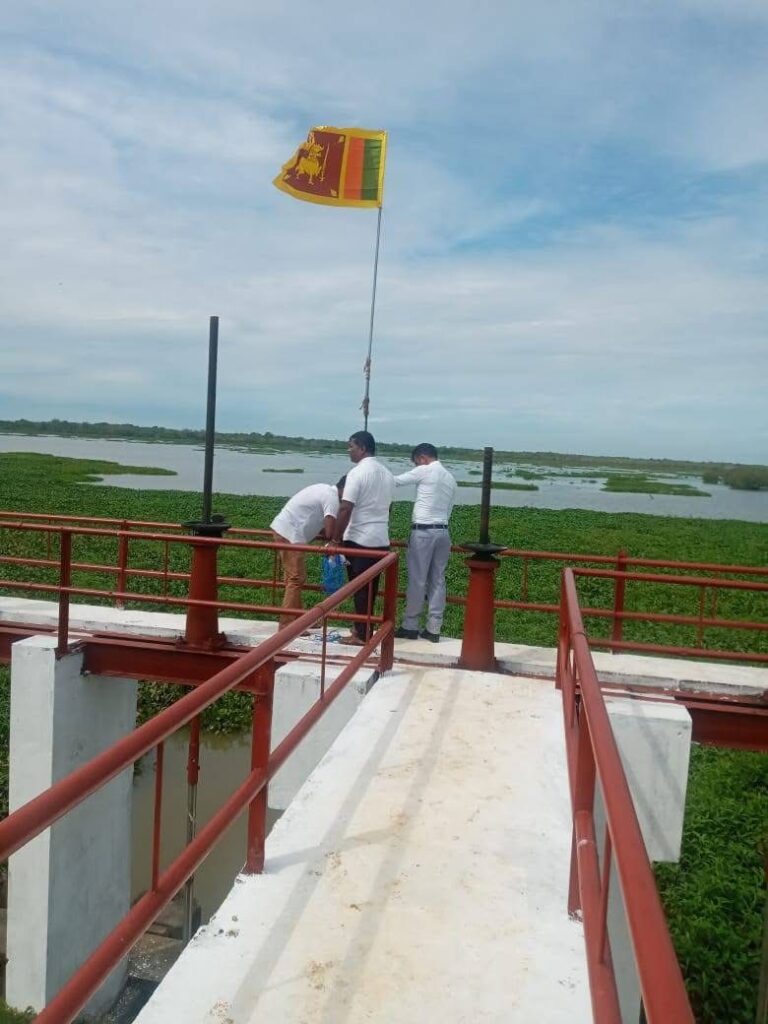
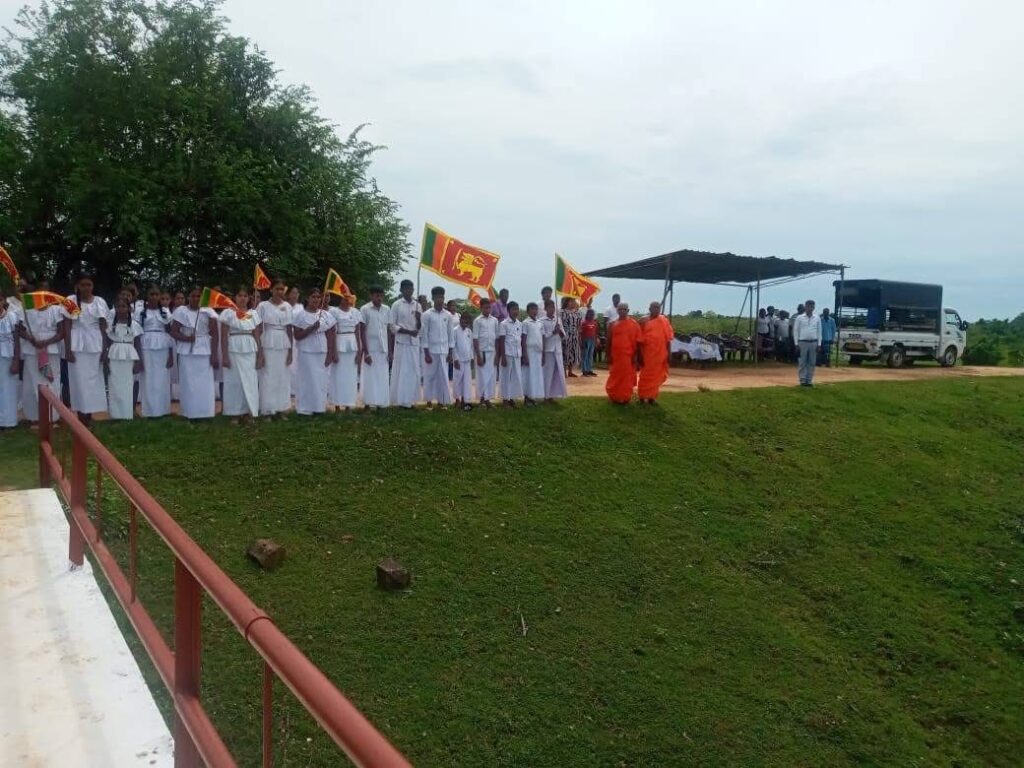
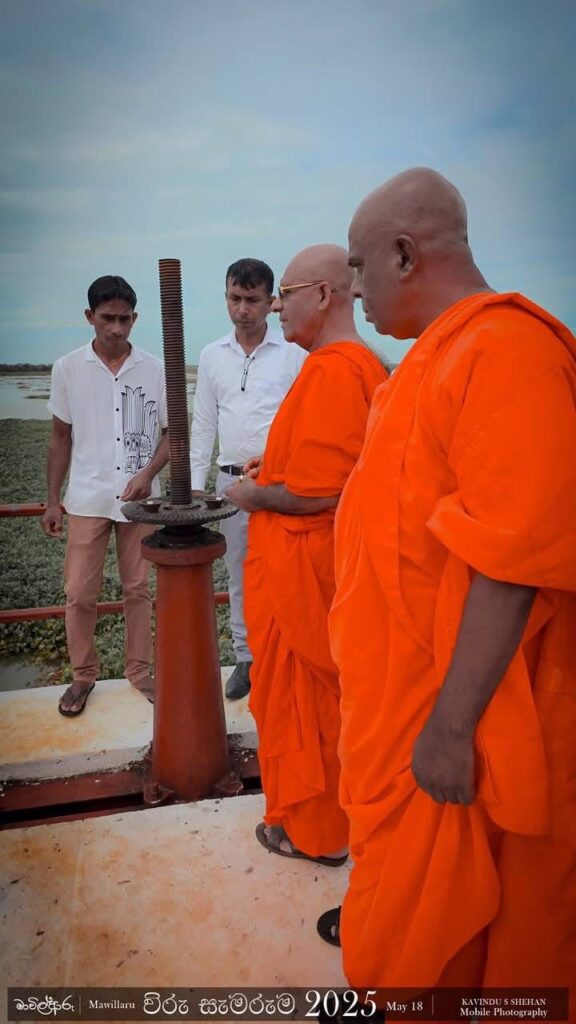
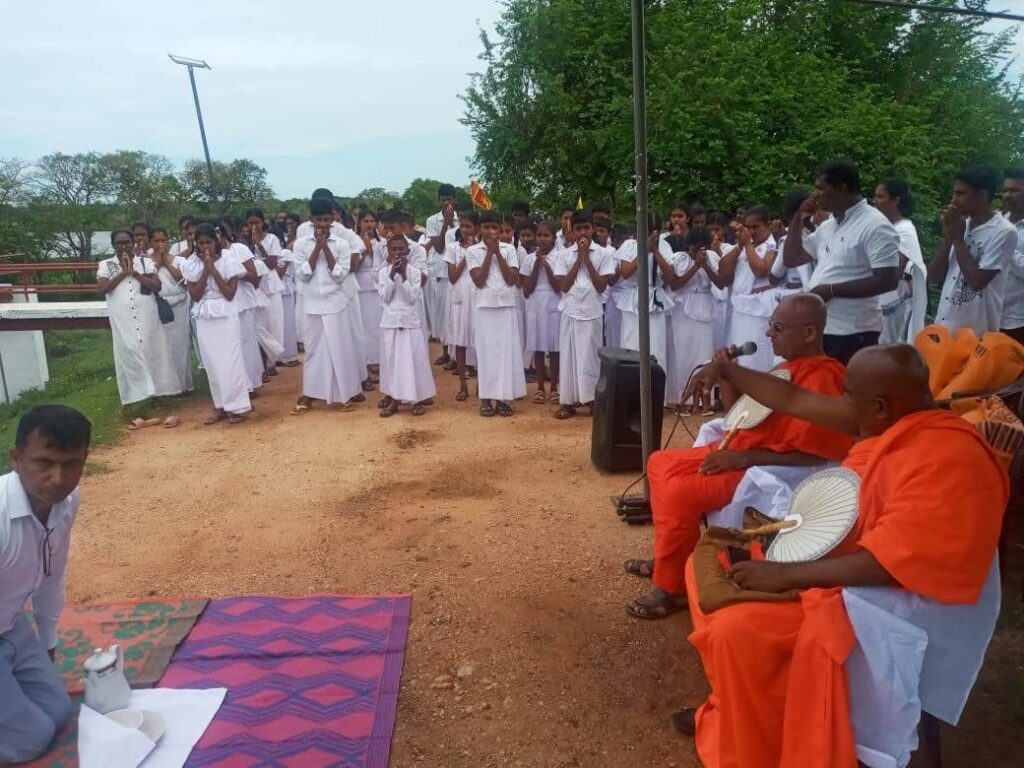
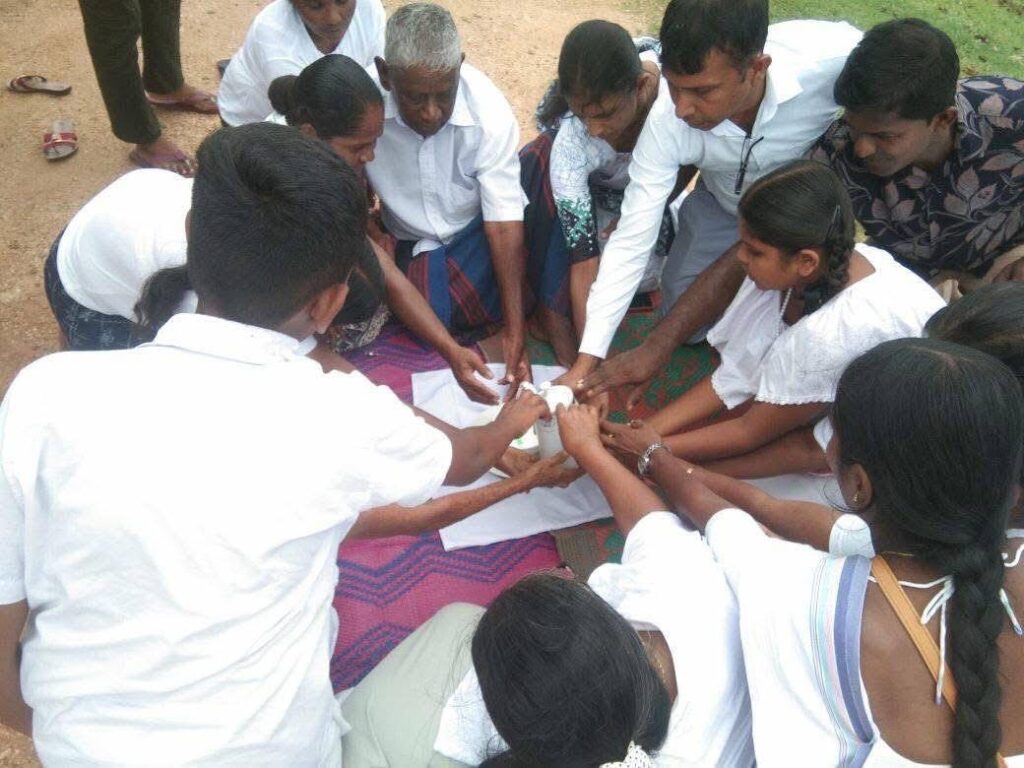
A day of honor was turned into a day of betrayal.Victory Day in Sri Lanka is not just a date on a calendar — it is a solemn tribute to the tens of thousands of brave Ranaviruwo who laid down their lives to defend the nation from one of the most brutal terrorist organizations in the world: the LTTE. It is a day meant to remember sacrifice, celebrate unity, and reaffirm our commitment to a sovereign, unitary & undivided Sri Lanka. Yet this year, the President’s Victory Day address did not honor the fallen — it diminished their sacrifice. By deliberately avoiding the term Ranaviruwo,” failing to name the LTTE as terrorists, and drawing false moral parallels between those who defended the nation and those who tried to destroy it, the President not only rewrote the past — he betrayed the very spirit of the day. This response is not about politics. It is about truth, duty, and respect. It is a call to remember who our true heroes are, and to ensure their legacy is never blurred, distorted, or forgotten in the future — especially not by those who swore to protect it.
1. Sacred Day Undermined by Political Calculations
Victory Day is not just another commemoration. It is a solemn tribute to over 28,000 war heroes who laid down their lives & an equal number who are injured for life, to protect Sri Lanka’s sovereignty from LTTE terrorism. In his speech, the President failed to even call them Ranaviruwo”—a symbolic yet crucial term. His refusal to identify the LTTE as terrorists, while omitting to mention President Mahinda Rajapakse without whose orders as Commander in Chief to militarily defeat LTTE & rescue Tamil civilians held hostage by LTTE as well as name key military leaders who led the war to victory, is viewed not as omission but calculated erasure.
2. Revising History: A Dangerous Narrative
The President’s ambiguous moral equivalence—suggesting no one takes up arms without reason”—distorts the root cause of the conflict. Tamil separatism, not economic grievance, led to war. The Vaddukoddai Resolution (1976)openly called for armed youth rebellion. Prior to that the ITAK was formed seeking a separate Tamil Nation in 1949. The LTTE only hijacked the quest of Tamil politicians after being secretly trained by India alongside other Tamil militants & initiated the war, not the State. Our forces defended civilians and national unity—not against fighters,” but against internationally designated terrorists who were even getting help & material assistance from external forces.
3. Distortion of Sacrifice
Every life lost in defense of the country holds meaning. The sacrifice of:
Total 28,589 war heroes paid the supreme sacrifice in defense of the nation
Armed Forces – 23,962 (6261 died between 2006-May 2009 last phase)
Airforce – 443
Navy – 1160
Civil Defense Force – 456
Police – 2568 (includes the 600 policemen killed brutally by LTTE in the East)
29,551 Armed Forces personnel remain wounded.
cannot be equated with those who died attacking the country (LTTE & Other militants)
To compare the grief of a mother of a soldier with that of an LTTE terrorist’s family may be politically convenient—but morally and nationally dangerous. Soldiers defend a nation. Terrorists seek to attack & destroy it.
4. A Gravest Insult: False Moral Equivalence
Sympathizing with LTTE families without any mention of their atrocities—child soldiers, suicide bombers, ethnic cleansing—offends not only war heroes but the very truth of our national struggle.
The LTTE themselves kept families of other militants below their own elite circle. Now, the State, in the name of reconciliation, allows glorification of LTTE dead while marginalizing the real protectors of peace. This is an insult. The terrorists must be laughing at us.
Our military didn’t wage war to seek abstract peace. They fought to end terrorism, restore rule of law, and free civilians held hostage by the LTTE—nearly 300,000 in 2009 alone. Peace was a result, not the mission. The mission was national survival.
However, the wrong message conveyed by the President has been carried forward by his ministers as seen by their statements in Parliament
Protection of all citizens regardless of ethnicity
What they did not die for:
Political expediency
Rewriting of history
Reconciliation” that rewards separatism
Not Everyone Can Become a Soldier
Not everyone can become a soldier — because not everyone has the strength to look death in the face and still choose to stand their ground. A soldier is more than a uniform; he is discipline in action, courage under fire, and sacrifice without applause. He is the shield between chaos and the people he has sworn to protect.
Behind every brave soldier is a mother who taught him compassion and resilience, a father who instilled honor and duty, and a family that nurtured the values that made him choose service over safety. These are not ordinary families — they are the unseen pillars of the nation’s strength.
Becoming a soldier is not a profession — it is a calling, one that only a few are willing and able to answer. It demands heart, willpower, and the ultimate readiness to pay the highest price. That is why Victory Day must remain sacred — to honor the extraordinary few who gave their all, so the rest of us could live in freedom. Their legacy is not to be distorted, compared, or diluted — because not all can be soldiers, and not all sacrifices are the same.
10. Final Verdict: A Dangerous Betrayal
This is notreconciliation. It is revisionism. It weakens the nation and emboldens those who still seek to divide it.
The real half-victory is not due to moral failure by the Armed Forces—but due to:
Political failures to tackleongoing separatism
Foreign-funded historical distortion
The President speaks of spread of racism? Who are the guilty? The Vaddamana Viharaya in the North was destroyed by Tamil racists, this is the situation outside Tissa Viaharaya in the North https://www.facebook.com/share/p/14GJVY8trkH/ all of the remaining Buddhist sacred sites are under risk by Tamil racists. Have a single Buddhist stopped Tamil praying in Hindu kovils across the South or anywhere else? The President must identify the real racists.
The State’s silence on continued desecration of Buddhist sites and illegal land grabs in the North & East. No Govt can speak for only minorities completely ignoring the rights, grievances & the wrongs being done to the majority.
A President is duty-bound to protect sovereignty, honor the military, and uphold truth—not to equate grief, promote dangerous moral ambiguities, or forfeit national memory for political gain.
Let this serve as a warning: a nation that forgets its heroes will one day struggle to find new ones. The people will remember what was not said, and they will not forget who chose silence over truth.
Sudhakaran was appearing for Sri Lankan national and former LTTE member Subaskaran alias Jeevan, who pleaded that he would face political persecution if deported to his country.
The Supreme Court on Monday refused to entertain a petition from a former LTTE member challenging his deportation to Sri Lanka, saying India was not a “dharamshala” for refugees and was battling its own problems with a 140-crore population.
Do you think India is a dharamshala to host refugees from all over the world? As it is, we are struggling with a population of 140 crore. India is not a dharamshala to entertain foreign nationals from all over the world,” Justice Dipankar Datta, heading a bench, told advocate R. Sudhakaran.
Sudhakaran was appearing for Sri Lankan national and former LTTE member Subaskaran alias Jeevan, who pleaded that he would face political persecution if deported to his country.
Subaskaran was arrested in 2015 and booked under Section 10 (penalty for being a member of an unlawful association) of the UAPA. He was convicted in 2018 and sentenced to 10 years’ rigorous imprisonment by a trial court in Tamil Nadu.
Madras High Court reduced his punishment to seven years in 2022 but directed that Subaskaran be kept in a refugee camp after completing his sentence and then deported to Sri Lanka.
Subaskaran’s counsel pleaded that the petitioner was facing threats of arrest and torture in his country and that his wife and children were already settled in India.
The bench, which also had Justice K. Vinod Chandran, rejected the plea. What is your right to settle here? Go to some other country.”
We salute the Bravery of Sri Lanka’s War Heroes and the truth they defended with their live. Each May, while large numbers pay tribute to the War Heroes who defeated terrorism in May 2009, a minor group gather to glorify the world’s most dangerous terrorist organization under the guise of mourning”. In doing so they are slapping the victims of the terrorists who comprised Sinhalese, Muslims, Foreigners & even Tamils. No liberation movement uses their own as human shields, hostages or child soldiers. It was Sri Lanka’s Armed Forces who carried out South Asia’s largest humanitarian rescue operation simultaneously as they took on the LTTE terrorists & brought to safety close to 300,000 Tamils. This truth echoes louder than any candles lit for terrorists.
The Western diplomats, the UN, INGOs know very well that the military onslaught was against terrorists & not the people. Their only angry is that their 30-year investment in terror came to an abrupt close and they wished to take revenge as it meant having to re-charter a new strategy.
They didn’t care that Sri Lanka bled from a conflict that was created in India in late 1970s to pass on India’s Tamil Nadu self-determination headache to Sri Lanka as that fitted well into India’s strategic objective of using the Tamil” card to exert influence in the strategically important North & East of Sri Lanka, which the West was also eyeing. Eventually, LTTE passed pillow from India to West with heavy influence by the Church & Western NGOs.
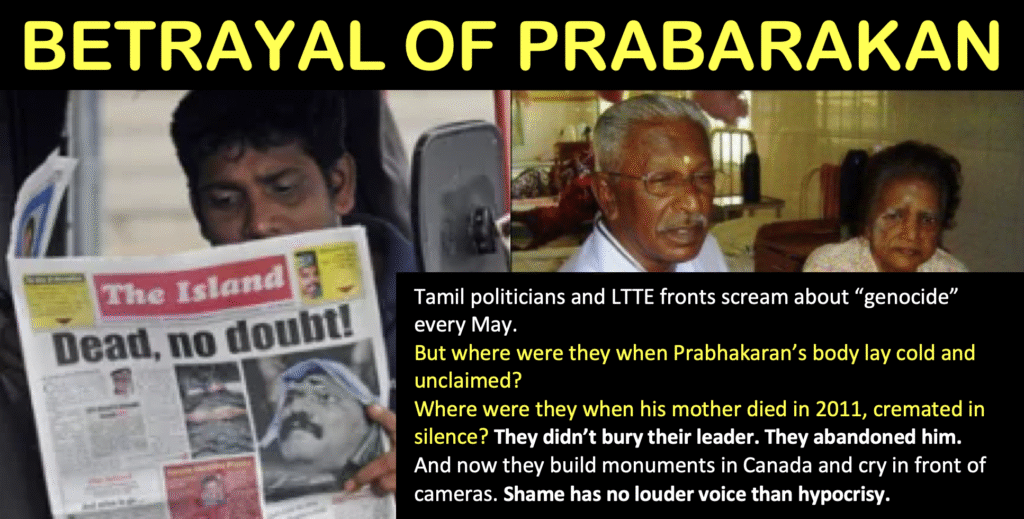
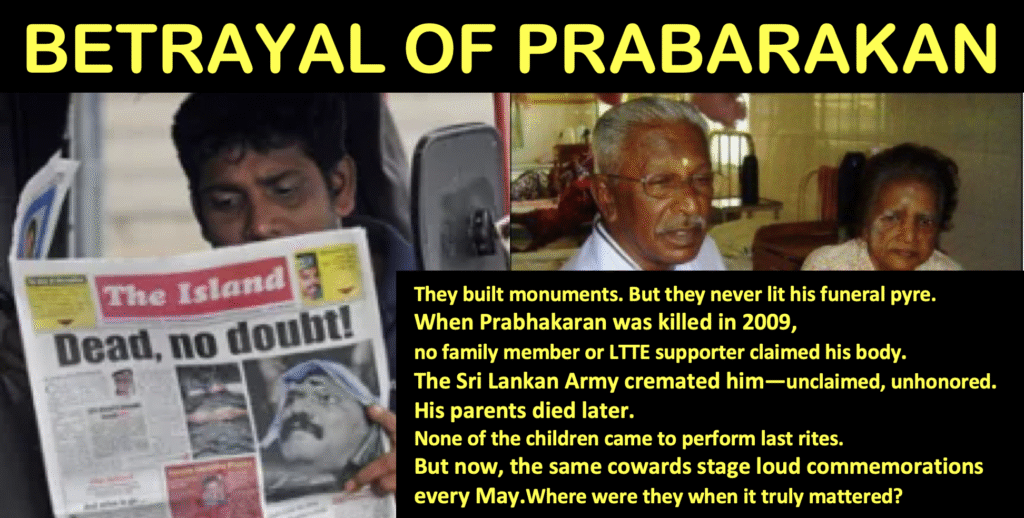
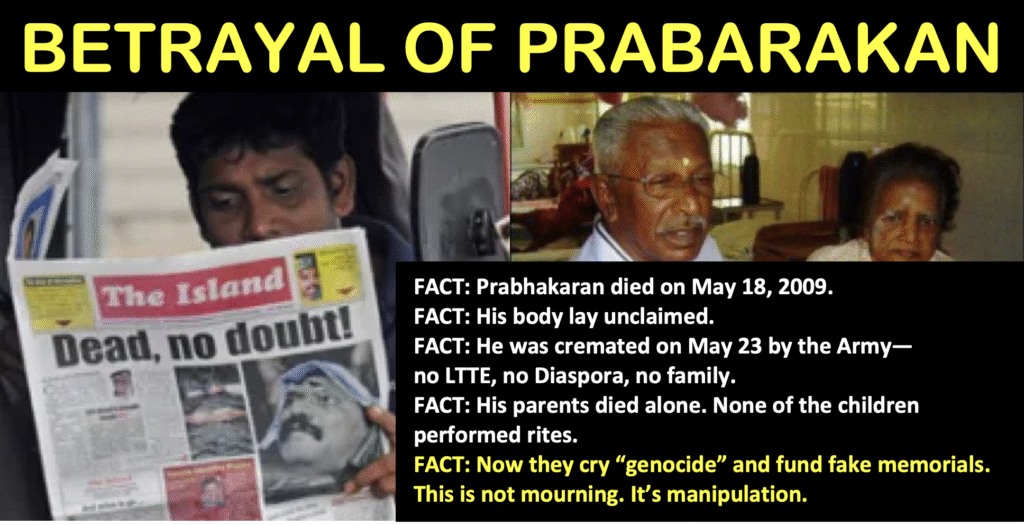
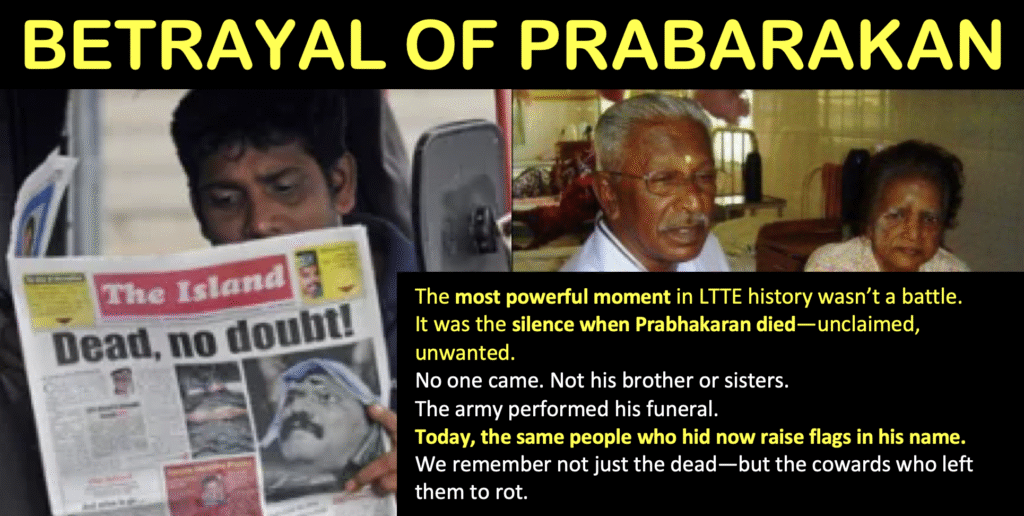
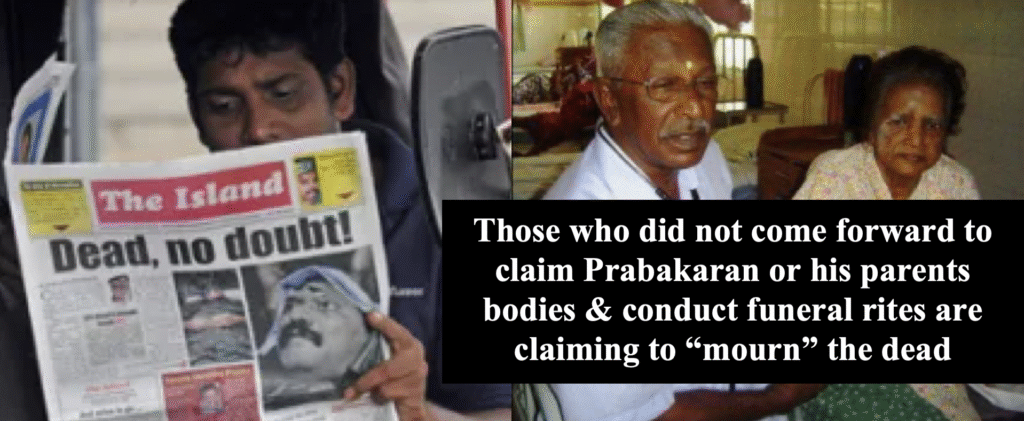
None of those who supported LTTE be they foreign or locals cared that civilians were taxed, abducted & executed, that Tamil moderates were silenced with bullets, that suicide bombings became a routine, that schools became recruitment centres & hope became hostage. Those that commemorate LTTE with full fanfare cared not how over 30 years generations of Tamil children were kidnapped & turned into child soldiers. Why should they bother, their children were safe overseas, in foreign schools & getting foreign employment! Every annual commemoration was only a means of riding on Tamils & even LTTE to secure themselves a place among their society & politically. If these fronts dared not come forward to even claim the body of Prabakaran & conduct his funeral rites, what is the point of lavish commemorations after his death!
After 30 years of terror, President Mahinda as Commander-in-Chief of the Armed Forces decided to finally bring peace to all & declared a military offensive though LTTE was given 3 occasions to surrender which they refused. It was following this declaration that the military was ordered to carry out a humanitarian rescue operation which rescued close to 300,000 Tamil civilians sacrificing over 6000 soldier lives though LTTE had shot some fleeing Tamils dead. No one wants to keep a scorecard on how many Tamils LTTE killed. No one is even bothered to count how many injured LTTE combatants LTTE put into buses & killed either.
The Largest Hostage Rescue in the Region
This achievement cannot be diluted or humiliated as the rescue was done while Sri Lankan soldiers were under fire, under pressure & under immense international scrutiny. Their duty was not only to end the terrorists but to save lives of Tamils kept as hostages & human shields by LTTE.
The Consultative Committee Meetings held every two weeks in the presence of Govt Secretaries & Military heads inviting diplomats & heads of INGOs to be present since the start of the offensive. If they had issues, they could have easily raised them at these bi-weekly meetings. However, none of the diplomats or INGOs raised a single issue about inadequacies in delivery of food, medicines etc… months later they were all parroting 40,000 dead” without an iota of proof highlighting their hypocrisy.
Let the World remember who the Real Victims are
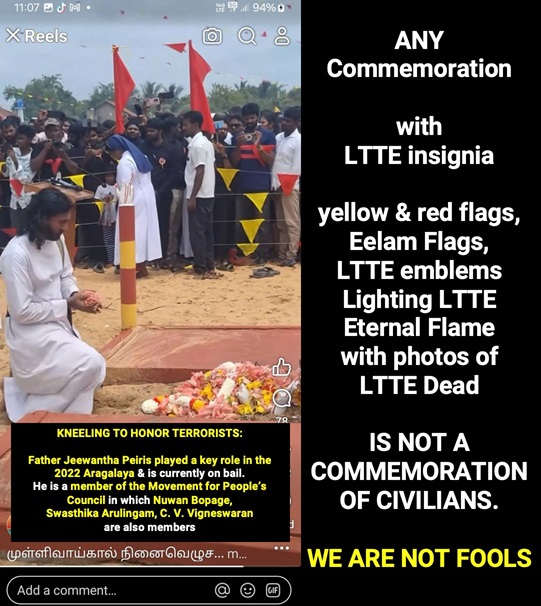
Yes, people have the right to mourn. But when they gather under LTTE flags, glorify suicide bombers, and call mass murderers freedom fighters,” they aren’t mourning. They are rewriting a fake history glorifying terrorists!
Everyone who attends these LTTE commemorations kneeling down at altars meant for LTTE dead are dishonoring the thousands of Tamil civilians & Sinhalese/Muslim & even Foreign civilians who were:
Killed by LTTE landmines
Forced into battle against their will
Used as bargaining chips in the final days of war
Assassinated & targeted for no reason
And they dishonor every nation that has suffered from terrorism by celebrating one of its most ruthless practitioners.
We Remember Differently
We don’t light candles for terrorists.
We light candles for victims.
We salute the bravery of the Sri Lankan Army — not because they were perfect, but because when faced with evil, they fought — and they saved lives.
Let the world glorify who they will.
We will continue to speak for the mothers who lost children.
For the children who lost limbs.
For the soldiers who walked into death zones with water bottles instead of grenades
For the soldiers who even gave their meal to the Tamil civilians that were starved by LTTE.
For a nation that chose peace — not by surrender, but by sacrifice.
Sri Lanka’s Final Stand wasn’t just a Military Victory — It Was a Humanitarian Triumph
To every foreign politician, activist, or misguided sympathizer who still kneels before the LTTE’s flag, ask yourself:
Would you lay flowers at a grave marked with Al-Qaeda’s emblem?
Would you excuse ISIS because they claimed to fight for someone’s rights?
Then why would you do it for the LTTE?
We can’t stop those who want to glorify terrorists.
But we will never let them own the truth.
We stand for the real victims.
We remember the real heroes.
And we will never forget the price paid for Sri Lanka’s peace & who paid that price with their lives.
Investigate monetary links of foreign individuals & politicians who glorify terrorism under the guise of human rights.
Realize that Sri Lanka’s conflict lasted 30 years because of West/India’s political & financial investment. This cost innocent lives. Sri Lanka fought not only to end LTTE terrorism but against international geopolitics too.
There can be no healing until people & the Govt especially distinguishes who the terrorists are. Allowing terrorists to hold commemorations while LTTE remains banned shows that the Govt needs to face reality & facts first.
From the moment President Mahinda Rajapakse declared decision to militarily end LTTE & rescue Tamils kept as hostages by LTTE, nationalists & patriotic citizens too joined the war effort by providing the people’s support & the moral backing for the armed force. This went along way as it provided a defense nexus against the entities & enemies though small but were powerfully positioned & were trying their utmost to prevent the defeat of LTTE.
The ploy these entities used was the slogan human rights” – agents of the West/India who wanted to continue LTTE terrorism set up the mechanism for the human rights rhetoric as a weapon to undermine Sri Lanka’s war victory. The Resolutions & the smear campaigns continue to be part of that campaign alongside the UNHRC demands that aim to take revenge against those that ended LTTE & to weaken the Sri Lankan state diluting its own administrative legal structures. All those blindly agreeing to draft new legislation, pass MOUs, allow interference, give up State land & resources are all agents of these foreign lobbies.
To mourn the death of a terrorist leader who held the Tamil people hostage under brutal conditions is a mockery. These terrorists were no martyrs; they were tyrants who imprisoned their own people. They used their own as human shields and killed those who dared to escape & destroyed the childhood of thousands of Tamil children turned into child soldiers.
The younger generation, particularly those in Sri Lanka, must be taught the truth about the LTTE, their crimes, and the heroes who fought to defend them not the bogus genocide week” being taught in Canada. This is not about creating division but about cultivating a future where violence and terror are recognized as unacceptable solutions to any political problem.
Victory Day should remain a unifying moment for all Sri Lankans.
Let May 18 be a day of Honor, not Revenge or Amnesia
As Sri Lanka reflects on the significance of May 18, the Government must ensure that all future Victory Day commemorations are marked with dignity, truth, and national gratitude — not silence, distortion, or political bias.
This appeal is to set a consistent national standard going forward — to properly honor those who sacrificed and to preserve the historical truth for future generations.
Key Demands
1. President’s Presence Is Essential
The Commander-in-Chief must attend the main ceremony in person.
Victory Day is a national duty — not optional.
2. A Statesman-like, Non-Political Speech addressed to the Nation
· Refer to all war heroes as Ranaviruwo”, not just soldiers”.
· Name and thank: the 2009 President, Defense Secretary, Tri-Service & Field Commanders.
· Tell the Truth: LTTE terrorism was defeated militarily after decades of failed peace.
· Highlight the rescue of 300,000 civilians as a humanitarian triumph.
3. Protect Victory Day from Dilution
· Do not rename, water down, or politicize May 18 with new politicized definitions
· Reiterate that it was a victory over terrorism, not Tamils.
Highlight that Sri Lanka’s Armed Forces saved & prevented Tamil children from being turned into LTTE Child Soldiers.
· This truth must be reaffirmed & repeated yearly.
4. Nationwide Participation & Media Coverage
· Schools, public institutions, and state media must formally mark the day with tributes, documentaries & stories of sacrifice
5. Respect & Recognize War Veterans (not LTTE Terrorists)
· Legally recognize Victory Day.
· Invite veterans and families of the fallen — treat them with dignity.
· Give them a voice, not a token seat.
· Ban display of ALL LTTE INSIGNIA – Mourning does not require terrorist symbols, flags or emblems
This Is Not a Celebration of War — It’s a Day of Liberation / Defeating Terrorism
Sri Lanka did not defeat a people. Sri Lanka defeated Terrorists & Terrorism. Sri Lanka saved its people, including Tamils, from tyranny.
Let no activist, foreign lobby, or politician erase that truth. Let Victory Day be remembered — with respect, truth, and unity.
To be submitted to:
The President / Ministry of Defense / Tri-Forces Leadership / National Media /
NDB Bank, in collaboration with News First, is proud to announce the commencement of applications for the Corporate Sector Competition of Sri Lanka Vanithabhimana 2025, the nation’s most distinguished platform dedicated to honouring and empowering exceptional women. Following the success of the Provincial Sector initiative, the spotlight now turns to the accomplished and trailblazing women of Sri Lanka’s corporate and professional spheres.
This year’s Corporate Sector Competition breaks new ground by welcoming applications from all elite women professionals, entrepreneurs, and leaders, without restriction. Whether you are at the helm of a business, shaping policy in the public sector, leading innovation in finance, marketing, education, healthcare, or any professional domain, Sri Lanka Vanithabhimana 2025 invites you to step into the elite circle of distinguished women who are building Sri Lanka’s future.
The application process officially opened on 30th April 2025, and NDB Bank and News First encourage all esteemed corporate heroines to submit their applications before the 2nd of June 2025. This is a unique opportunity for Sri Lanka’s most impactful women to gain national recognition for their contributions to the economy, society, and nation at large.
In parallel, NDB Bank will be launching the Vanithabhimana Women’s Entrepreneurship Support Course (Vanitha Vyawasayakathwa Athwela), a transformative three-month upskilling programme designed to equip women entrepreneurs with practical expertise in Business Administration, Human Resource Management, Accounting, Sales, and Marketing. Delivered free of charge by industry experts, this initiative underscores NDB’s commitment to fostering sustainable growth, job creation, and global competitiveness for women-led businesses.
Women who believe in the power of leadership, vision, and meaningful change are invited to take their rightful place among Sri Lanka’s most admired women. The Corporate Sector Competition is not merely about recognition—it is about celebrating influence, progress, and the unwavering spirit of professional excellence, while the upskilling programme provides the tools to turn ambition into tangible impact.
Applications can be submitted via email to vb2025@ndbbank.com and assistance is readily available through any NDB branch across the island. Entrepreneurs keen to join the upskilling programme can visit https://www.ndbbank.com/banking-on-women/vanithabhimana or contact Thishani at 0765699251.
As a bank that champions inclusive progress and sustainability, NDB remains committed to nurturing female leadership at all levels of society. Through initiatives like Vanithabhimana, we continue to pave the way for more Sri Lankan women to break barriers, lead with purpose, and inspire future generations.
Apply today and be celebrated for the legacy you are creating!
At the outset let me state that I am not a historian but a Civil and Structural Engineer with some knowledge about computer programming and IT. I have used the latter to gain advantage over others in my profession. However, the AI tools that are being sharpened almost daily in the form of Large Language Models (or Llamas) and made available via mobile phones have made it very easy for us to probe in to past. At the touch of a button these tools would scan data available to them and give info asked for as accurately as possible within a couple of seconds. In this context the Seleucid Empire has been explained on my mobile as follows:
The Seleucid Empire was a major Hellenistic state, founded by Seleucus I Nicator after the death of Alexander the Great in 312 BC. It encompassed a vast territory stretching from Aegean Sea to the Indus Valley, encompassing regions like Syria, Mesopotamia and parts of modern-day Iran and Afghanistan. The empire was characterised by its military strength, Hellenistic culture and its interactions with other Hellenistic states, particularly the Ptolemaic Empire.”
Doesn’t this explain why Ptolemy gave so much details about our country which he named as Taprobana. It must have been ‘Thambara Paany’, whatever thambara means. My thinking is that there had been a good source of clean drinking water, flowing down from the hills, supplied to mariners. This is also why we wanted to build Hambantota Port in 21st century, though it is now becoming more of a military asset for another country, due to unpatriotic and selfish behaviour of rulers we had since it was built.
The Syrian region mentioned in the description comprised of northern Arabia (all those states like Soudi Arabia, Iraq, Kuwait, Qatar etc.). This empire had lasted about 400 years. So, a significant amount of the populations may have had same culture before the advent of Islam. Seleucid Empire was conquered by Romans at the end, but at different times had deals with Arabs for protection against barbarians like north European tribes, called Norsemen. The Ionians who came to Sri Lanka since 900 BC were in control of trade in Crotone, Italy which was part of Anatolia.
Who was Seleucus Nicator?. His father and Alexander the Great’s father had been brothers and was a trusted general of the great man. He fought alongside Alexander up to India and when they got bogged down in a marshy area in north western Bharatha (present day Peshawar of Pakistan) without being able to defeat the regional king Porus (or Singha), Alexander headed back home leaving the region they acquired in the hands of Seleucus. In honour of the bravery of Porus, Seleucus’ second daughter Hellena was given in marriage to him. Hellena’s mother was a princess from Syria or Bactria as it was known then and in turn was also part of Persia. Ancient Sinhalese kings had lots of dealings with Persia even to the extent of having matrimonial connections at that time. I have mentioned in my previous write up that it was Hellena’s children who came to our country with their followers some of whom were from Mangalore region (according to a Sri Lankan researcher) and established colonies. How was it possible in Alexander the Great’s time for so many people to enter and establish settlements in another country without giving a fight. These people must have had earlier known connections and some leftovers had been here. This is what we find in the city of Anuradhapura. There had been an Ionian settlement around 900 BC in it. The rock inscriptions like the stargate in that place seems to suggest that a highly developed civilisation had existed there. The technology to make finest steel had been in this country more than 1500 years before Mohenjo Daro which ended in bronze age. The sword of Damascus and others with trade mark of swastika and similar ones in many parts of Europe is the clue to this claim. What I am trying to point out is not our connections to Europeans, but the possibility that some of them may have actually originated from this land. The findings in a lake in Horton plains covering an area of out 40 Sq.Km seem to suggest this possibility. The Buddhist stories indicate that there was a lake known as ‘Anothaptha wila’. There is a sketch of this area with surrounding hills depicted on the walls in the cave temple at Dambulla, Sri Lanka.
Lies that are capable of breaking rock (or ‘Gal Pelena Boru’ in Sinhalese):
In Sinhalese folklore there is saying as ‘gal pelena boru’, similar to the saying ‘it’s raining cats and dogs’. This seems to suggests that when people say lies loudly even the stones can break. Nobody has seen stones breaking due to sound, but I have seen fish as big as a cat, about 12 inch long, that had fallen to the land we lived when I was about five years old. In a place called Dimbulagala on top a hill which is very difficult to reach there is a rock inscription etched on a rock, that was discovered about two years ago. The belief is that the ancient people who lived circa 3rd century BC split a rock by some means and recorded a certain important event that took place at that time. The name of a son of king Porus (or a grandson) by the name Mutasiva is mentioned in the inscription which is about 50ft long and 10ft high. Incidentally the tittle of the book the Sri Lankan researcher donated to me contained ‘Mutasiva’. The researcher/author of the book was the principal of a prominent secondary school in the heart of Colombo where my wife was a teacher in late 80s. I do not know whether he is living or dead, but I know I have doing justice to him because theme in his book was this ‘Mutasiva’ and Ionian connection.
Why did those ancient people select that rock in that particular place which was difficult to reach. It seems there are no any other ruins nearby except to say that the water supply to that area (perhaps to the nearby town) was done by so and so mentioned in the inscription. Perhaps before doing the actual job of writing the text, they would have calculated what length and width is required and looked for a suitable rock. And they found the one at that difficult place. It is now known that sound waves can be amplified until it is big enough to break something. This is similar to cutting metal sheets very accurately using light, as in the case of laser cutters. What happens in laser cutter is a laser beam is sent back and forth within a small cylindrical Ruby between its faces until it gains enough strength due to resonance and burst out to cut the metal. For this to happen it is important to get the size of the ruby and the frequency of light right. So, in the same way the frequency of sound wave, its strength (amplitude) that can be gained by resonance (which is determined by the size of the rock) has to be calculated. What a ‘hightech’ solution that has been forgotten?.
It has been discovered that sound waves (in addition to chemicals) in the form of music have the ability to help us in our capacity to self-clean the brain cells that gets clogged over time, thereby enhancing memory (that is to alleviate problems like Alzheimer’s disease etc.). Maybe even ‘Pirith’ chanting by pious monks must be helping us in the process to detoxify and clear the clogged cells in our brains. Similar things must be happening in other religions too, in their localities.
Our ancients knew the effect of drumming on making clouds to deliver rain. I think the locals still practice this method, though it is debatable how effective it is today. I think some Europeans know that we have some idea about clouds and rain. When I was supervising a road project as the Resident Engineer in West Africa, one morning I was discussing with the Italian project manager whether we should go ahead with concrete work of a certain structure. We saw the sky was overcast but the shape of the clouds told me that it will not rain. Then he said, yes, you people from the east have more knowledge than us and decided to go ahead. I had similar experience with an English guy who was the project manager of another one. They were not referring to my personal experience in particular but to the knowledge of Easterners.
As usual I wind up my writing with some songs our viewers would enjoy:
It looks like that it’s not only our people who are habitual liars. Did this former nurse gave up the job because of lies and become a successful singer?:
Andrea Burg singing ‘Du hast mich tausendmal belogen…’ (you have told me thousand lies, to whom can I tell my feelings)
The next one from Fantasy duo Martin and Fredi on ‘ein weisses boot’ (a white boat)
The white colour (or waishaya warna) can hide all blemishes in a boat (like many other ugly warts in body) to give a nice appearance and blue water in the sea is inspirational. Sea water is slightly alkaline and is like a large battery storing and giving back energy in various forms. This is the reason we must not discharge acids from various industries like chip making and make it acidic:
Finally, I give a song from an all-time favourite Engelbert Humperdinck, the Chennai born singer who got poplar only after becoming an ‘Angel bird’. Please listen to his rendition of ‘Le Bicyclette de Belsize’, an absolute beauty, to my mind.
By the way, listening to songs from singers like Englebert, Elton John, Tom Johs, etc who do not have heavy accents help us to speak English with lyrics in current usage with the same rhythm. This helps us to communicate more easily with foreigners. I have seen some of our senior academics mispronouncing simple words in public meetings. I believe our Sri Lanka Broadcasting Corporation doing a great service by keeping us up to date. I was listening to their service from Central Nigeria, when I worked there.
Geneva, 19 May 2025: Press Emblem Campaign (PEC), the global media safety and rights body, expressed shock over the murder of another Indian journalist and demanded justice for the bereaved family of Dharmendra Singh Chauhan. The Haryana-based media person, who was associated with online media outlet named Fast News India, was shot at by the miscreants on 18 May and later succumbed to injuries in a Gurugram hospital in the night hours. Chauhan, who lived in Luhari village under Jhajjar district, was targeted as he went for a walk after his dinner.
We condemn the murder of Dharmendra Singh Chauhan, who becomes the 64th journalist-victim across the world to be assassinated this year till date, and demands a fair probe to nab the culprits. PEC also urges Haryana province government chief Nayab Singh Saini to take personal interest in resolving the case and extend adequate compensation to the bereaved family,” said Blaise Lempen, president of PEC (https://www.pressemblem.ch/pec-news). Meanwhile, PEC’s south and southeast Asia representative Nava Thakuria informed that India earlier lost three journalists (Mukesh Chandrakar, Raghavendra Vajpayee and Sahadev Dey) to assailants since 1 January this year.
Governments in the past – from Dudley Senanayake (1965 – 1970) to Gotabhaya Rajapaksha (2019 – 2022) introduced National Programs of gigantic nature. All of them ended in failure.
Why?
They failed to carry people with them.
One program that was successful to an extent was Mrs Sirima Bandaranaike’s ‘Grow More Food Campaign’ (1972 – 1976). That government somewhat forcibly enforced the Program on people. School children played a prominent role in it – actively growing manioc, chillies, sorghum and many crops in school yards (the playgrounds were untouched).
The upshot was that the country became self-sufficient in almost every essential food item. By the end of that government, say by 1976, the country had stopped importing all foods that can be grown locally. JR came (in 1977) and opened up the flood gates – every item from – sugar, rice to the hairpin was imported. The trend continues to this date, in very big scale. JR’s Open Market economy killed the local agriculture and industries.
JR’s Gamudawa and Mahaveli can also be considered somewhat successful National Programs but they did not require people’s active input/participation to make them successful.
On 1 January 2025 this government commenced the ‘Clean Sri Lanka’ program with a big bash. Some luminaries attended the grand function. It was an invitee only event. The Common man – ordinary mothers and fathers who are supposed to do the cleaning were absent. The opposition blamed that the government spent Rs 70 – 80 lakhs for the event.
Where are those luminaries today? In actual ‘Clean Sri Lanka’ events they are not to be seen. An article published in Lankaweb on 4 January 2025 by this writer emphasised that the President and his Ministers must actively participate in ‘Clean Sri Lanka’ events. Has this really happened? The public have witnessed many NPP Ministers and MPs leaving their traditional attire and switching to Western tie/coat, trousers. They are in no real mood to do cleaning.
Today less than 6 months after the introduction, not only the masses but the government itself seems to have lost interest in the program.
Is ‘Clean Sri Lanka‘ slowly dying down?
From the beginning the government messed up the scheme. It stated that ‘Clean Sri Lanka’ means not just cleaning of the environment but it is about almost everything that the government does.
Only a strange person would adopt such a policy. According to the government ‘Clean Sri Lanka’ encompasses government’s almost every activity – cleaning of the environment, society, economy, ethics etc. Clearly the government has mixed apples with oranges.
How can the government expect the public to actively participate in such a bizarre scheme?
Even after the recent Ramboda bus tragedy, the government stated that ‘Clean Sri Lanka’ will fix future such incidents. No, they should be fixed by the government’s road and transport policies.
Overall, Sri Lanka is an extremely unclean country. Most of our sea, beaches, internal waterways, roads/street gutters, public toilets, train/bus stations are extremely unclean.
Most public and private sector buildings need a facelift. There is too much use of plastic and polythene; also there are too many hoardings/billboards. Tuition masters are big time culprits; they pollute the environment with big cut outs/advertisements.
People dump garbage everywhere. Public spitting of betel chew must be halted immediately. Colombo’s streets and pavements are full of betel chew spit. Those who walk on them barefoot could get sick. At schools good habits/hygiene, patriotism are not taught enough.
Most private restaurants, eateries, schools, public hospitals need a good clean up and once cleanliness is established that must be maintained.
In such context, it is a fantastic idea for the government to start a National Program to mobilise people to clean up the country.
It must be a massive people’s movement. Every citizen possible must have been absorbed in to it. Also, it must be an ongoing Movement.
But, that momentum was not created from the beginning.
AKD had enormous public support and affection in January in 2025. Is it there now? Doubtful.
if AKD then called, people would have come in droves. When Gotabhaya won, thousands of young people turned up voluntarily to draw beautiful artwork on public walls. The public cheered at them. That was a spontaneous action by the populous.
True, cleaning has been done by ‘Clean Sri Lanka’. But by whom? Government servants through various Shramadanas, tri-forces personnel, Police and Civil Defence Force. For what they do, they receive wages and perks from the government (paid for by the taxpayer). ‘Clean Sri Lanka’ should be much more than this – where is people’s involvement/participation?
True, some in the private sector and NGOs/individuals have done cleaning, this is good. But, what is required is a massive scale people’s involvement/participation.
The government’s fault – the need to clean up the country and its urgency was not embedded into people’s psyche. Even now, people are unaware that they must be a part and parcel of the program. Everybody wants somebody else to do the hard yards. Sirimavo marketed her campaign well using the then available media. Thus, it succeeded.
The fact that there has not been mass scale people’s involvement in the project is the ‘Clean Sri Lanka’s biggest drawback.
Let us hope that the government realises this shortcoming and do things to rectify it. Ordinary mothers, fathers, young children must participate en mass. This must happen island wide.
In his 4 January 2025 article the writer suggested the following:
For the program to succeed, the President must declare that every first Saturday of the month is the ‘Clean Sri Lanka Community Clean Up Day’, from 8 am to 11 am. All vehicular traffic must be stopped for those 3 hours.
All Sri Lankans aged 18 to 65 must participate. Those who are medically unfit must be excused.
As people are clever at dodging, the participation of each adult must be made compulsory. Those who abscond must be subject to a severe fine.
But, if the government wants to do it purely on voluntary basis, then the mass involvement of people through ‘Shramadana’ is the best way. The late Dr A.T. Ariyarathne’s Shramadana movement of the 60s and 70s come to mind. It was so successful. This 2nd method is not good and effective as the 1st.”
It seems the government failed to heed to the writer’s suggestion.
The government went on the traditional pathway that all previous governments had done and failed – entrusting the work to the public servants, without people’s participation.
Paul Kagame has turned Rwanda into one of the cleanest countries not just in Africa but in the whole world. There, they have a monthly ‘Clean Up Rwanda Day’ where the country’s total population participates. Paul Kagame himself, his Ministers, high officials turn up on the last Saturday morning of every month to participate in the clean-up program.
But, all is not too late. As stated before, the government can still rectify and bounce back. The need to clean Sri Lanka is imminent; that cannot be compromised.
The Writer, an International Lawyer, was the Principal Barrister & Solicitor of a leading Australian law practice for a very long period of time.
NDB Bank is honoured to extend its support towards a deeply humanitarian initiative led by the Sri Lanka Amarapura & Ramanya Samagi Union to aid victims affected by the recent devastating earthquake in the Kingdom of Myanmar and parts of Thailand. This natural disaster has claimed numerous lives and left thousands displaced, including members of the monastic community and the general public, while severely damaging homes, temples, and essential infrastructure.
Recognising the urgent need for assistance, NDB Bank contributed support for this relief mission, aligning with the Bank’s strong commitment to social responsibility and compassion during times of crisis. The initiative, organized under the guidance of the Most Venerable Mahanayaka Theros, seeks to provide vital support to communities in Myanmar through the distribution of essential supplies.
Commenting on the Bank’s involvement, Kelum Edirisinghe, CEO of NDB Bank stated, As a responsible corporate citizen, we believe in standing with communities in moments of great need. Our support for the Myanmar Disaster Relief effort reflects our unwavering commitment to humanitarian causes that transcend borders. We are grateful to partner with the Sri Lanka Amarapura & Ramanya Samagi Union and applaud their compassion and diligence in leading this noble initiative.”
The relief programme includes the provision of essential items such as first aid kits, milk powder, canned food, solar lighting, generators, and temporary tents, as well as other necessary resources for rebuilding daily life. These contributions aim to alleviate the hardships faced by the affected communities and help them recover with dignity and strength.
NDB Bank remains steadfast in its mission to empower lives—not only through financial services, but also through meaningful acts of kindness and solidarity. As the Bank continues to support impactful initiatives across the region, it reaffirms its commitment to creating lasting, positive change for communities in need.
Released to Colombo Stock Exchange on: 14 May 2025
NDB pre-tax profits surge by 118% to Rs. 4.0 Bn. Marks strong start for the year.
Post-tax profitability of Rs. 1.9 Bn up by 168%
ROE of 10.03%
Total assets growth of 7% to Rs. 852.4 Bn
Healthy growth in loan book of 5% to Rs. 535.2 Bn stemming from all business sectors
CASA ratio improvement by 91 bps to 25.82%
National Development Bank PLC (NDB/the Bank) recently released its financial results for the three months ended 31 March 2025 (1Q 2025) to the Colombo Stock Exchange, reflecting solid growth in line with the revival of economic activity and rising private sector credit demand.
Commenting on the 1Q 2025 performance, Director/Chief Executive Officer Mr. Kelum Edirisinghe stated, We made a strong start to the year, following the highest-ever profit recorded in the Bank’s history in 2024. Guided by our priorities, we have devised bold, actionable plans to unlock greater potential and accelerate our strategic growth agenda for 2025 and beyond. Our aim is to make an impactful contribution to the country’s economic growth, provide superior service to our clients, deliver sustainable returns, and enhance shareholder value.
We are seeing renewed demand for credit as our customers regain financial momentum in an improving economic environment. NDB is well-positioned to serve our clientele with simpler, smarter, and more agile banking solutions, blending expert product advisory, digital convenience, and exceptional customer care to deliver a truly rewarding banking experience”, he further noted.
Income and Profitability Analysis
Total operating income of the Bank, for the three months ended 31 March 2025 (period under review) grew by 5% over the same period in 2024 (year-on-year/ YoY) to Rs. 10.6 Bn. Net interest income (NII), the majority contributor to total operating income was Rs. 8.0 Bn, which declined marginally by 1% YoY. The decline was predominantly attributable to the lower interest rates that prevailed during the period under review versus one year ago, which approximated 270 bps less on a monthly AWPR basis. Timely repricing of the deposit book, strategic focus on optimizing the asset mix to improve yields and enhancing funding efficiency enabled NII preservation, thereby reducing pressure on Net interest margin (NIM). The resultant NIM for 1Q 2025 was 3.92%. Net fee and commission income for the period was Rs. 1.8 Bn, again a marginal decline of 2% YoY. Whilst fee income from credit and debit cards slowed, income from alternative channels including electronic transactions and operational services showed positive YoY growth. All other income categories netted Rs. 842.4 Mn, a considerable growth over the comparative quarter which bolstered total operating income.
In terms of impairment, the Bank recorded a total impairment charge of Rs. 2.6 Bn, a significant reduction of 40% over the corresponding period of the last year. Additionally, the Bank recorded a reversal of Rs. 457.5 Mn related to the unwinding of the Day One Loss of debt restructuring in 1Q 2025. The impairment charge on loans and advances for 1Q 2025 saw a 22% reduction YoY. It is also encouraging to note that the staging of credit facilities has improved compared to the comparative quarter of the prior year, demonstrating the results of focused asset quality enhancement initiatives deployed by the Bank. Impaired loans (Stage 3) to Total loans ratio closed in at 5.53% (2024: 5.18%) whilst Impairment (Stage 3) to Stage 3 loans ratio was 53.26% (2024: 54.48%).
The Bank incurred total operating expenses netting Rs. 4.4 Bn for 1Q 2025 reflecting a 13% YoY increase. This increase was primarily attributed to increase in premises and establishment expenses and other operating expenses. Strong cost discipline and effective cost management have kept costs within expected levels.
The resultant Profit before tax was Rs. 4.0 Bn, an increase of 118% YoY. Taxes on financial services and income tax netted Rs. 2.1 Bn, resulting in a Profit after tax of Rs. 1.9 Bn, a YoY growth of 168%.
Balance Sheet Performance, Capital Adequacy and Liquidity
Balance sheet posted robust growth during 1Q 2025, growing by 7% from the end 2024 position (year-to-date/YTD) to Rs. 852.4 Bn. This is the highest balance sheet growth the Bank posted since consecutive quarters of growth curtailed at 2% or below, signaling robust growth for the period ahead. Gross loans grew by 5% or Rs. 25.4 Bn YTD, to Rs. 535.2 Bn reflecting broad-based momentum across all business segments. The local currency loan book grew by Rs. 16.9 Bn within this growth.
Total deposits grew by 2% or Rs. 10.6 Bn YTD to Rs. 642.3 Bn, mainly driven by volume growth of the local currency deposit book by Rs. 9.1 Bn during the three months under review. The Bank’s CASA ratio also improved by 91 bps to 25.82% at the end of first quarter of 2025 from 24.91% at the end 2024. The CASA base increased by Rs. 8.5 Bn, a 5% growth during 1Q 2025. The improving trend in the CASA ratio is a result of dedicated strategic initiatives deployed in this regard. The total equity base of the Bank was Rs. 76.8 Bn.
Denoting sound capital adequacy, Tier I and Total capital adequacy of the Bank stood at 12.16% and 16.95%, 366 bps and 445 bps above the minimum requirement respectively. Regulatory Liquidity coverage ratio (Rupee), Liquidity coverage ratio (All Currency) and Net stable funding ratio stood well above the regulatory minimum requirement of 100% at 392.64%, 341.38% and 133.22% respectively.
Investor KPIs
Return on average equity was 10.03% (2024:12.22%) whilst Earnings per share was Rs. 18.18 (2024: Rs. 21.73). Respective ratios at the Group level were 10.19% (2024: 12.46%) and Rs. 19.70 (2024: Rs.23.57). Bank pre-tax return on average assets was 1.92% (2024: 3.09%). Net asset value per share was Rs. 180.29 (2024: Rs. 186.91) and compared with a closing share price of Rs. 107.00. Group net asset value per share was Rs. 192.53 (2024: Rs. 199.13).
Outlook
As the Sri Lankan economy charts a path toward recovery, NDB remains deeply aligned with the nation’s growth ambitions, committed to unlocking prosperity for all Sri Lankans. With a legacy in development financing and a track record of standing by our citizens through every economic cycle, we are well-positioned to drive a future of smart growth. Through our robust product portfolio and strong integration of ESG principles, we aim to create sustainable value, fostering a thriving, resilient economy while delivering lasting benefits to our customers, shareholders, and communities.
US, UK sanctions effectively prevented me from travelling to other countries as well”
Former GOC of the 58 Division General Shavendra Silva yesterday (18) found fault with successive governments since 2009 for failing to counter unsubstantiated war crimes accusations. The failure on the part of them led to punitive international measures against senior officers who spearheaded the offensive against the LTTE, the Gajaba veteran said.
Appearing on Derana 24/7 with Chathura Alwis, the former Chief of Defence Staff (CDS) declared his angst at the country’s failure at political level to address the issues at hand. The most decorated soldier was commenting on the 16th anniversary of the eradication of the LTTE’s conventional military capacity.
Sri Lanka brought the war to a successful conclusion on May 18, 2009, by bringing the entire northern province under government control. LTTE leader Velupillai Prabhakaran was killed in the banks of the Nanthikadal lagoon on the following morning.
Referring to the US travel ban imposed on him, his wife and two daughters in February 2020 and the British sanctions declared in March this year, Gen. Silva said the US and British action had effectively restricted his overseas travel to south Asia.
The UK sanctioned Admiral of the Fleet Wasantha Karannagoda, former Army Commander Jagath Jayasuriya as well as former LTTE battlefield commander Vinayagamoorthy Muralitharan alias Karuna.
Gen. Silva highlighted the protests carried out by pro-LTTE activists in London in February this year targeting Yohani de Silva whose father served as the GOC of 55 Division engaged in the Vanni offensive.
The protest was organised by the Tamil Youth Organisation of the UK.
Responding to another query, Gen. Silva, in his first interview since retirement as CDS on Dec 31, 2024, said that GoCs Gen Jagath Dias (57 Division), Gen. Kamal Gunaratne (53 Division), Maj. Gen. Nandana Udawatte (59 Division), Maj. Gen. Prasanna de Silva (55 Division) and Chagie Gallage as well as those who commanded Task Forces faced punitive international action.
Gen. Silva’s retirement coincided with the abolition of the Office of CDS by the NPP government.
At the onset of the interview, Gen. Silva strongly emphasised the need to celebrate the eradication of terrorism and liberation of the people. The outspoken ex-soldier said that the armed forces and police paid a very heavy price to bring the war to an end, a war that many believed couldn’t be brought to a successful conclusion. Gen. Silva pointed out the absurdity in doing away with military celebration as Sri Lanka still marks the end of WW I and WW 11.
On behalf of all Division and Task Force commanders on the northern front, I take this opportunity to thank officers and men and families of those who paid the supreme sacrifice and the wounded.
Gen. Silva asserted that the armed forces as a whole suffered as a result of their failure to conduct post-war examination of operations undertaken by fighting formations deprived of the opportunity to correctly establish their roles. The former Army Commander said that the other countries always undertook such examinations immediately after the end of operations.
Gen. Silva said that since the end of war the country never made an honest attempt to record the events thereby setting the record straight.
The Yahapalana government co-sponsored the US accountability resolution against the war-winning armed forces in Oct 2015.
Gen. Silva explained that failure on the part of political and military leaderships to reach consensus on a common narrative contributed to the growing international pressure on the country.
Appreciating the NPP government summoning Canadian High Commissioner Eric Walsh over the recent unveiling of so-called Tamil genocide memorial in Ontario, Gen. Silva said that before his retirement he briefed President Anura Kumara Dissanayake regarding the challenges faced on the Geneva front.President Dissanayake promised to look into this matter and take appropriate measures, Gen. Silva said. I believe the President as promised will address the issues at hand.”
‘Before you study the economics, study the economists!’
e-Con e-News 11-17 May 2025
India is allegedly attempting to prevent the economic advance of Hambantota Port as a node for Sri Lanka’s industrial renaissance (see ee Random Notes). This blockading makes this ee recall SBD de Silva’s signalling of the vast difference between the ports in the settler states (USA, Canada, Australia, etc., but not only them) and in the non-settler colonies like ours. Sri Lanka’s ports are stunted, as:
‘Depots for the storage & transfer of goods
and administrative, commercial & financial
centres; they were not nodes of production’
*
In the settler states, however, such as in French-settled Algeria:
‘The differentiation in port facilities & services led to
the use of specialized equipment for the handling &
storage of minerals (petroleum, coal, etc.), of grain
elevators, wine banks connected by pipelines to the
ships, and food-packaging & food-freezing plants.’
– SBD de Silva, ThePolitical Economy of Underdevelopment
*
An allegedly besieged Denmark has hurried to Colombo, their ambassadorto Sri Lanka Rasmus Abildgaard Kristensen, who is housed in India. Apparently unperturbed about his country’s largest colony Greenland being grabbed by the USA – he flew in to sing (we’re told, see ee Business) the praises of their capitalist bootprints in Sri Lanka (eg, that horrible chemical cocktail called Sunquick – whose labels sport fake fruit to mislead drinkers) and shipping monopoly AP Moller-Maersk.
We were not told what his corporate backers or his hosts think, about last week’s opening of a modernized Vizhinjam Port in nearby Thiruvananthapuram, Kerala. Chatter about the port, only mentions the role of India’s Adani Group, but not the role played by such traditional ‘shipping’ conglomerates as P&O: England’s colonial Peninsular & Oriental Steam Navigation Company, has long controlled shipping in this country (now through their so-called ‘local’ conglomerates, Keells, etc.), and the role of sludge funders like US BlackRock (which has replaced Goldman Sachs in the anarchist pandemonium). P&O allegedly funded the relentless media attack on the port of Hambantota.
The latest attack on Hambantota is directed at Sinopec’s oil refinery project. This again recalls SBD de Silva’s thesis on the differences in the choices settler & non-settler colonies make. The strategic commodities a country chooses to prioritize & produce, can not only just enable the production of the most advanced technological methods (though certain modern products may be made in less-advanced ways). What is most important to de Silva, is how this strategic choice leads to an escalating manufacture of other commodities: ‘One Thing Leads to Another’. But first, in anticipation about what imperialism sends by post:
*
‘The US will send letters within the next 2 to 3 weeks to
trading partners setting out a tariff decision as it was not possible
to meet all the countries, President Donald Trump said.’
(see ee Economy, Letters)
*
‘Even though industrial policy may have been the more
dominant consideration for the imposition of para-tariffs
in the early years of their use, fiscal (revenue) implications
have become a key factor in the continued existence of such tariffs.’
– Anushka Wijesinha, Senith Abeynayake (see ee Economists,
Priority trade & competitiveness reforms for SL)
*
The hijacked Institute for Policy Studies (IPS)’s Wijesinha & Abeynayake are being coy. ‘Industrial policy’ has rarely been the ‘moredominant consideration’. Really? It has been sabotaged, misled, if not misunderstood. Take US President Trump’s advertized wishes to impose tariffs on our much-deified exports. One overly celebrated export is the garment fraud. There is never-ending praise for the ‘Garment’ which even became a synonym for ‘factory’ in Sinhala. We don’t know of Japan’s Mr Juki (which rhymes with quicky), but his sewing machines that filled those larger halls around the country evoked yet other epithets for the young women recruited to toil there. There was no advancement of the skills they had earlier deployed in their more-modest homes. The pins & needles, the thread & textiles, the resins & the dyes, the largely low-tech machinery, the assembly lines, the cars that transport the egos of their ‘executive’ mimic men, and the lorries that convey their goods, the ships & the planes – are not made here, and are all imported.
How much of the IPR – Intellectual Property Rights (patent, copyright, royalty) – payments in the garment fraud go to London & New York, the historical bases of the ‘rag trade’? This, we are not told. Are all these inputs and royalties calculated into Mr Trump’s AI computations of tariffs? Apparently. But sometimes. Only if these inputs come from their current friends and not their enemies.
Indeed, as SBD oft quipped, if Sri Lanka was turned into one large garment factory, one grand ‘oriental’ hotel, one big ‘ye olde’ tea plantation (named with an evocative Scottish brogue), we would not need to have schools & universities. Close them down. No need.
Yet someone has to teach the English, English. About their history, and teach Idaho, etc, too. Someone has to teach by word or by example, teach the US and European working classes that it is we (not all of us) who through 500 years of invasion and genocide have been dismembered, murdered, and most importantly ‘ripped-off’. And no amount of media erasure & bloviating by artful real-estate dealers can efface that memory. And yet they try.
*
Continuing to excerpt SBD de Silva’s exposure of the changes made in settler states, this ee Focus looks at differences in the Mahgrebin nations of Algeria, Tunisia, Morocco, and the roles of the white settlers & expatriates there. He highlights the ‘phenomenal’ input of labor per hectare in settler agriculture, vs the dire impoverishment of ‘native’ agriculture. Settlers created and focused on building their national ‘home’ markets, closely integrating industry with agriculture.
Settlers & Tariffs – Settler states also used the revenue from tariffs, not to pay salaries or play the stock market, but to invest in modern industry to upgrade the lives of white settlers. Whereas they relegated the darker ‘natives’ in their ‘dominions’ to a backward form of agriculture: plantations that were non-mechanized, and an agriculture that was non-monetized and non-commercialized.
SBD also examined the purported exceptions to his thesis on differences in development: This ee focuses on the fabulous & besieged Congo, where the entry of settlers was regulated, and there were relatively fewer white people. He then goes on to show how copper processing, unlike even iron & steel, led to phenomenal other fields:
*
‘The specific character of themining operations in the Congo
gave the economy a dynamism of its own. First, these operations,
especially the reduction of copper ore before smelting, are far
more complex than those for many other metals, including iron
& steel, and they released a long line of products which were
the basis of separate industries – eg, explosives, sulphuric acid,
ferrous & ferric sulphates, soda & pyrestrol, industrial glycerine,
Belgium, subject to a lot of propaganda about the horrors of English Victoria’s cousin Leopold, actually ended up creating an advanced African working class, who then it, along with the US, had to conspire to destroy. All this is recorded in SBD de Silva’s excerpt.
As long recalled, if any autobiography would be written about SBD (not of his personal life, but of his dedication to a finest scholarship & method, anywhere), such a book should be called, One Thing Leads to Another – his favorite phrase to describe what real industrialization means. Its coinage is attributed to the US’ Albert Hirschman, who himself attributed the idea to Canada’s Harold Innis, the first to describe the role of Canada’s fur trade & the role played by what he called ‘Staple Base Dynamism’ (SBD!) in that country’s industrial modernization: how wheat was made into flour & bread & cakes, etc, and grains into sources of energy. Yes, Staple Base Dynamism, yes, SBD! SBD de Silva, who provides a great example of ‘One Thing Leading to Another’…
*
• On 27 May 1970, led by Sirimavo Bandaranaike, a United Front government, comprising the Sri Lanka Freedom Party (SLFP), the Lanka Sama Samaja Party (LSSP) and the Communist Party of (then) Ceylon (now, CPSL), won a landslide victory. Short of just one year, on 5 April 1971, the JVP launched an ‘insurrection’. This led to not just repression, but the need for land and housing reform. That eventually led to a split in the government. This ‘split’ was certainly fueled by larger international forces such as a dramatic rise in the price of oil (blamed on OPEC – Organization of Petroleum Exporting Countries) and a food crisis that led to shortages – not to mention US-funded destabilization. The attempt to industrialize the country was undermined by a misunderstanding of the challenges involved. This included sabotage by merchants, who engaged in massive smuggling to both undermine industrial policies and accumulate vast profits.
These very same merchants who benefited from these changes (they were too shy to thank the positive policies of that government) then went on to usher in the so-called ‘Open Economy’ led by JR Jayawardena’s United National Party, that opened the country up to consumer imports and the destruction of much of any local industries. The UNP then released the remaining leadership of the JVP, and when it could not fulfil the needs of another generation for fitting employment, then graduated to annihilating the JVP, both of whom went on to dismembering and massacring, not just each other. The large corporations carried on, suffering little of the consequences they are ultimately responsible for. For they have in the meantime suborned the entire wealth of the nation, which they instead blame on sundry ‘native’ politicians wearing ‘national’. Such experiences led SBD de Silva to conclude that industrialization required not just economic and political but also military strategies. The so-called drug dealers & smugglers, after all, can inevitably be traced to the large corporations that control the entry into and egress out of the ports of the country.
Will the JVP have to relive its own past, its karumaya? Europe’s ‘Establishment’ we learn, has developed expertise in ‘domesticating’ the ‘populism’ of Lefts & Rights. Just a few weeks after the announcement of a company to produce salt – Elephant Pass Salt! What a winning name! – the Minister of Industries now declares they will import salt to deal with scarcities. The importers must have gone into high gear against the threat of a good example. Yet, did the JVP not gauge the scale of production needed? Are these merely PR pronouncements about good intentions – virtue signaling? Did they not gauge the nature of our import merchant mafioso and take active measures to prevent scarcity? These are the bittersweet lessons to be learned, not just from the ‘70-76 government, which everybody seems to have had a role in undermining.
Then there is the more recent obvious and blatant example of the Gotabhaya Rajapakse government 2019-22, of a crew and its captain apparently taken by surprise, again unaware or unable to challenge our pirate merchant overrulers and their MNC backers, who would go to any length to easily create scarcities and havoc to topple any government, frightened by the idea of a state that claims to cater to a majority. Some blame GR’s propensity to join up with largely anti-worker intellectuals – so-called professionals & experts. Yet who could have been prescient enough to foresee and challenge the effects of the nature and level of the biological warfare (2020 Corona) waged on China, simultaneous with the US war on Russia via Ukraine? Can we just keep blaming leaders for failing to see the urgency or the need for creating a strong state that would first ensure a minimum of food, fuel, pharma, finance production security, like what England enacted to maintain its power here during their World War 2?
After over 50 years of ‘struggle’ and annihilations and other lessons learned, why did the JVP not gather the dedicated workers in these salterns, pre- & post-privatization, retired and existing, and combine them with our salt scholars and security officials to ‘map’ out a strategy to outmanoeuvre and quell these merchants… Industrialization, indeed, requires a political, economic and military strategy, as SBD concluded.
*
• What exactly is corruption? Is it such a horrible crime as the media says it is? Or is corruption inevitable in a merchant society where primacy is determined by the grabbing or gaining of a state-licensed monopoly to hide the price of some national asset by buying it at one shadowy location and selling it at another for a higher price? Is commerce, ‘generally cheating’, as that US luminary, media and slave owner Benjamin Franklin concluded (and who Marx quoted in Capital. Why has not any newspaper (we can understand the Sunday Times not wishing to) seen fit to investigate the Times own ‘investigative’ journalist being given an award by a Trump government that just ‘issued an Executive Order that suspended the Foreign Corrupt Practices Act (FCPA) for 180 days, giving an all clear to US corporations to bribe officials in foreign countries to get business deals approved’? Comedy?
Then there is the revelation about the ‘publisher’ of the USA’s Organized Crime & Corruption Reporting Project (OCCRP), fearless ‘exposer’ of the names in the Panama Papers, suggesting that ‘journalism organizations’ disguise their funding by ‘sensitive donors’. Drew Sullivan told the International Journalism Festival ’25 in mafia-friendly Perugia, Italy, that ‘journalistic organizations’ should ‘launder money legally’ to protect donors’ identities!
This comes one month after OCCRP successfully sued the US government to restore its frozen USAID funding… Ahem! There’s many a social-media outrage-ifier who may not wish to get outraged by their use of OCCRP’s supposed exposures of stolen moneys. But the problem is all this deliberately avoids the larger corruption, the original sin itself – the legalized private capture of the country’s natural and living resources, which refuses to invest in employing and treating our people with dignity. This week saw the usual cover-up of the mass murder on the roads, with the murderers themselves, which includes the media, shedding copious alligator tears.
*
‘Reasons are plenty; disregard for road rules & traffic
regulations, excessive speed, driver possibly being under the
influence of alcohol/drugs, overcrowding, poor vehicle maintenance,
insanitary conditions, sexual harassment and not being on
– Daily Mirror (see ee Workers, Bus journeys that whisper death!)
Ms Bloomberger forgets to ask who sets the rhythm for such frenetic folly. English law until recently declared train & road accidents in Sri Lanka as ‘acts of god’. Hooray for Ashok Leyland! Is it their god that sets the pace, the rush to gain Rs30 from a passenger at the next bus stop before another bus gets there? Blame has been heaped on transport workers, ignoring the role of such luminaries as the World Bank & IMF ever pushing for privatization, Japan, the import lobby & the banks that invest in them, plus the officials & politicians who have enabled the horror. SBD de Silva often asked, how it is that the capitalist who may wish to have their workers full of energy when they enter the factory gates, sees more profit in tiring them out before getting them in there?
This ee also continues the jaded peek into the origins of the world’s biggest capitalist political machine, the secretive Tammany Society and its public stage, Tammany Hall. This story tracks the private capture of public power & resources in New York City (& its state government & the USA itself). The details are adapted from Gustave Myer’s History of Tammany Hall. The book reads like a detective crime novel, packed with a huge cast (a minority, really) of criminals, mainly politicians, with their power in banks, commerce or the ‘common’ people. But, are they the real criminals?
This excerpt looks at the role played by the US judiciary – judges, police, jailers – in fixing elections. A highly organized art & science it is.
Myers wrote in the tradition of the ‘muckrakers – as US President Theodore Roosevelt insulted those supposedly ‘independent’ journalists & novelists, Ida Tarbell (Rockefeller’s Standard Oil), Upton Sinclair (Chicago’s meat-packing industry), all influenced by Marx & Engels’ work and the growth of the scientific socialist movement) – who yet managed to find publishers to spread their diggings up of ‘the dirt’ on the undersides of capitalism, US-style, by focusing on one particular family or business.
Myers was an early investigator of capitalist life, in such classics as: History of Public Franchises in New York City (1900); History of the Great American Fortunes. 3 vols. (1909-36); History of the Supreme Court of the US (1912); History of Canadian Wealth (1914), ‘A Study of the Causes of Industrial Accidents,’ Journal of theAmerican Statistical Association 14 (1915), etc. He had difficulty finding publishers, eventually settling on the cooperative that first published Marx’s Capital in English in the USA.
In his 1972 introduction to the 1917 edition of A History of Canadian Wealth (1917), the Canadian Communist Stanley Brehaut Ryerson noted the shortcomings of the muckrakers’ and Myers’ analyses, in particular, what propelled Myers to becoming an open imperialist in later life. While Ryerson notes Myers’ exemplary role in investigating capitalism’s workings. Myers’ major problem was his empiricist focus on corruption (naming names & the crimes behind their fortunes) as the root of all evil, to the exclusion of deeper analyses, of the collective capitalist. Analysing production, or the gaining of fortune, by excluding production:
‘With the coming of the 19th century, ‘The dominant class…
were the mercantile & shipping merchants…’ – precursors
of the ‘trading & sundry other men of capital’ who set about
obtaining (from governments largely made up of themselves)
railway charters that conferred vast & elastic
‘privileges & powers, immunities & rights.’
*
Yet, Ryerson adds: ‘corruption and the suborning of the state for the private enrichment of elites has been the constant corollary of ‘free enterprise’ since its inception’. Ryerson quotes Friedrich Engels’ remarks, that in the bourgeois-democratic state (whether republic or constitutional monarchy):
‘Wealth exercises its power indirectly,but all the more
surely. On the one hand, in the form of the direct
corruption of officials, of which the USA provides
the classical example; on the other hand, in the form
of an alliance between government & Stock Exchange,
which becomes the easier to achieve the more the public
debt increases & the more joint-stock companies concentrate
in their hands not only transport but also production itself.’
(Engels, The Origins of Family, Private Property & the State, 1884)
*
So, it is not only the who & where but how the nation’s wealth is produced socially by millions and hijacked for private enrichment through public misery. Yes, there is a ‘corruption’ of public officials, but as we have learned so well, yet it is we who supposedly owe them an ever-increasing debt, as capitalists concentrate their monopolies not only in ‘transport but also production itself enables an alliance between government and the stock-exchange,’ which forms the ‘basis for the state monopoly capitalism that was to emerge’ in the 20th century:
Myers’s handling of the workings of this process
is marked by both the enthralling ‘detective-story’
quality of the exposures – & a theoretical weakness.
Capitalism is not corruption alone…
*
Myers’ focus on the ‘designing men and corporations that by the adroit use of corrupt politics vested in themselves huge corporate privileges and powers and enormous wealth’, overshadows ‘the role of production, of productive labour as the well-spring of wealth’. All bribery and corruption, finally depend ‘on the extraction of surplus values from living labour’. It is the productive labour of workers and peasants, that has enabled the initial accumulation of capital and its subsequent self-expansion through re-invested profits. It is not just low wages but the extraction of capitalist profit, which does not profit the producer!
Instead, aspiring politicians find it more opportune to spew out names & numbers without naming or numbering of the hourly economic processes and political diversions by which the true national wealth is squandered. Ryerson concludes, it is common to both a primitive understanding of Marxism and an ‘economism’ that excises ‘entire areas of reality’ (see ee Random Notes).
*
– ComBank first private sector bank on cusp of Rs3trillion assets milestone
– Bank of Ceylon’s (BoC) records Rs30bn pre-tax profit in 1Q
– Hatton Bank (HNB) reports growth of 49% in Group Profit
– Sampath Bank reports net up 149% in March quarter
– Nations Trust Bank reports profits up 8%
These are headlines about banks (in Colombo, we won’t call them Sri Lankan banks), who are issuing their 1st quarter statements – 1Q25, aka ‘how we did in the first 3 months of this gregorian year’. All is wonderful – ‘robust’, ‘non-performing loans (NPLs) aka ‘bad loans’ cut down. Only the now privatized and former state bank DFCC is not so good – ‘bearish’:
DFCC net down 21-pct amid higher operating expenses – EconomyNext
And yet:
DFCC Bank delivers resilient, purpose-driven performance in Q1 – Financial Times
*
We have to read EconomyNext’s DFCC story to find out more about their depression: ‘Lower gross income’. This is a rather cryptic claim for yet another state institution freed into the exciting arms of ‘free enterprise’. But don’t worry, the balance sheets of the other banks read like the latest teledrama scripts – hot, ready to be dished out to ravenous audiences everywhere, ready if unwilling, to jump on the table and gorge in the orgy. But what performances, good & bad, have they performed for Sri Lanka? Why is DFCC income low at the box office? What did they lend, and for what?
*
SL investor confidence surges amidst global trade developments
or guaranteed returns, they lure investors into ventures
that frequently result in financial loss, regulatory
complications, or complete project failure’
– Sunday Times (see ee Finance)
*
So what’s a sucker to do? Then again, volatility is the name of the game. Disturbance. Again, what is the name of the game? A million or more words are printed as ‘news’ by the media in Sri Lanka every week. Most are clearly ‘photocopied’ or ‘duplicated’ press releases, ‘cut&pastes’ of the drivel churned out by the public-relations (PR) divisions of corporations or government departments, diversionary or hagiographic.
So, who shall judge the judges? Who shall police the police? The media loves to call itself a watchdog aka nursemaid of democracy. But there is no bow-wow, no bedside take-this&call-me-in-the-morning deeper analysis of these banks’ claims. Do the banks pay taxes for paying the media to print out this uncritical gloss? Do the media declare this as income, and pay taxes on it? Or is it all, summa iri sanksthava aka under-the-table? Why is there no comment or analysis of these pronouncements?
The media in Sri Lanka (we won’t call them Sri Lankan media) won’t tell, refuses to tell, and instead reproduces fairy banking tales, verbatim, and in bold. Their tales aka narratives aka stories are concocted by their cousins to whom they are joined at the hip in the PR shenanigans (we won’t call them an industry).
This week saw the Prime Minister seemingly begging for yet more attention for her signal virtue, by awarding the media monopoly Wijeya Newspapers’ Chief Operating Officer Janaka Rathnakumara with the Asian Productivity Office (APO) National Award for Productivity Advocates.
What is productivity? The news item refuses to share. The PM was joined by National Productivity Secretariat Director JD Niranja S Jayakodi, Industry & Entrepreneurship Development Minister Sunil Handunneththi, APO Secretary-General Indra Pradana Singawinata, and Industry & Entrepreneurship Development Ministry Secretary JM Thilaka Jayasundara. That’s quite an unproductive number at yet another unproductive awards ceremony (more on awards ceremonies later). This is the first time we have heard of this Secretariat. We are also unclear how the Wijeya folk promote productivity. And again, but what do they mean by it? Who is investing in productivity, and where & how?
How has the Commercial Bank of Ceylon (no, not that BoC, but its merchant cousin) made its trillions in profits? It is partly owned by the USA’s World Bank. Does Mr Trump know? Since they call themselves capitalists, what percentage of their investments was in capital formation, in production, and productive production? We know a lot of companies spend their time giving themselves awards and producing wonderful words, like our Prime Minister, who is in no danger of being assassinated or coup d’etated by those intrepid ‘De Sarams’, their relatives & the shadowy company & companies they keep, as long as she sticks to flowery words. She must well be aware about what happened to the world’s first woman PM, who took to the larger seas beyond Mount Lavinia Hotel, and had dared to call for an ocean of peace…
Colombo, May 19 (Daily Mirror) – The United National Party (UNP) and the Samagi Jana Balawegaya (SJB) have reached an agreement to work together and administer local bodies in which the Opposition commands a majority.
The two parties have decided to work with other Opposition parties, according to a joint statement signed by SJB General Secretary Ranjith Madduma Bandara and UNP General Secretary Thalatha Athukorala today.
Colombo, May 19 (Daily Mirror)- Sanjeewa Weerawickrama, counsel for IGP Deshabandu Tennakoon today, informed the committee of inquiry probing the charges against his client that he would reveal who is behind the exercise against him.
On behalf of my client, I will reveal who is behind the removal of Deshabandu Tennakoon and who is motivating him in this exercise,” Weerawickrama said.
Counsel Weerawickrama accused Additional Solicitor General Dileepa Peiris of hiding evidence.
We need to study the evidence before we submit our objections,” he said.
Meanwhile, the committee of inquiry rejected three preliminary objections filed by counsel Weerawickrama. The objection that the committee cannot proceed with the inquiry under Standing Orders 92(F) was dismissed on the grounds that the provision applies only to Members of Parliament. The objection that Tennakoon cannot be considered the IGP due to a court-issued stay order was also rejected, as the respondent continues to receive the perks entitled to the IGP.
Requests made by Weerawickrama were also turned down. His request for a representative from the IPU and the Asian Parliamentary Association to monitor proceedings was also denied.
The committee has no mandate to bring in anyone to monitor the proceedings. The media we see today were not invited by us,” Committee Chairman Preethi Padman Surasena said.
An objection to the presence of the Additional Solicitor General was also dismissed, with the chairman stating that he was appointed by the Attorney General to assist the committee.
The Additional Solicitor General has nothing to do with the committee,” Justice Surasena said.
Colombo, May 19 (Daily Mirror) – Racism has begun to raise its ugly head again in the North and the South for the sake of power, President Anura Kumara Dissanayake said today.
Adddressing the 16th National War Heroes’ Commemoration ceremony, he said the war was not natural but it was created to aquire power and to protect and strenthen power for some people.
He said children of parents who never provoked extremism or racism had to sacrifice their lives for the power struggles of some people.
The President said the war is a tragedy and a destruction and added that the responsibility of the government is to prevent any war from emerging.
He said everone must work with firm determination for peace.
The President said Sri Lanka has not gained complete freedom even after the war victory, adding that Sri Lanka is a nation that has lost its economic freedom.
“Soverignty is not a mere word. We need to acheive economic transformation, uphold the rule of law and create a country free of crimes and drug menace to enjoy full freedom,” he said.
Where were all these LTTE fronts when Prabakaran was declared dead in May 2009, when his father died in 2010 & mother died in 2011? Not even Prabakarans siblings came to conduct his funeral or even the parent’s funeral. Sri Lanka’s Armed Forces cremated Prabakaran & threw his ashes to sea. His father’s funeral was done by TNA MP Sivajilingam who was a relative, while 3 dead dogs were thrown at the cremation site of his mother. In fact, no LTTE front even came forward to look after Prabakaran’s parents who were chased out of the refugee camp by Tamils & had to be looked after by Sri Lanka’s Armed Forces safeguarding them from attacks till their deaths. In fact, Prabakarans ailing mother was not even allowed to disembark from the plane at Chennai airport when she went to get medical treatment to India. Today, the entities that ignored Prabakaran after his death are glorifying him with concrete monuments & crocodile tears! What hypocrites!
Where Were You Then? The Deafening Silence of LTTE Fronts and Diaspora Hypocrites
In the years since the defeat of the LTTE in May 2009, a growing number of Tamil diaspora activists, LTTE fronts, and self-serving politicians have engaged in annual spectacles of performative grief—erecting monuments, lobbying Western governments, and organizing Mullivaikkal commemorations” to canonize terrorists as martyrs. Yet, behind their slogans and slogans of genocide” lies a shocking and deliberate silence.
For Hindus, funeral rites are sacred rituals that honor the dead and guide the soul (atma) on its journey toward rebirth or liberation (moksha). These rites help sever ties with the physical body, ensure peace for the departed, and fulfill religious duties to ancestors and the divine. They also provide comfort and closure for the living, reinforcing spiritual and cultural continuity.
No One Claimed Prabhakaran’s Body — Not Even His Family
On May 18, 2009, LTTE leader Velupillai Prabhakaran was killed by Sri Lankan Armed Forces near the Nanthikadal lagoon. The military found his body and confirmed his identity. Even without the dead LTTE leader, everyone knew that LTTE terrorism had ended though separatist ideology lives on.
No family member. No LTTE front. No Tamil politician. No human rights champion” came forward to claim Prabakaran – whom they had virtually worshipped for decades.
The result: Prabhakaran was cremated by the Sri Lankan Army on May 23, 2009, five days later. His ashes were scattered at sea.
For a man hailed as a Tamil national hero” by LTTE diaspora fronts, not one representative stepped forward to perform even the most basic Hindu funeral rites. Where were those who now speak his name with reverence? Hiding in comfort zones abroad, busy issuing press releases but chickened out of claiming his body to perform the last rites.
When Tamils chased away Prabakaran’s parents
On May 17, 2009, Prabhakaran’s elderly parents entered government-controlled areas and were placed in Menik Farm (Zone IV) for their protection. Ironically, it was not the Sri Lankan state but fellow Tamil civilians who attacked them, now free from LTTE oppression and resentment. The military moved them to Panagoda Army Camp for their safety & protection— a move conveniently forgotten by critics who paint the army as uniformly brutal.
Thiruvengadam Velupillai, Prabhakaran’s father, died on 6 January 2010 at age 86. His body was handed over to TNA MP and relative K. Sivajilingam. His children did not arrive to pay homage to their father. He was cremated on 10 January 2010 in Valvettithurai.
Parvathi Ammal, Prabhakaran’s mother, passed away on 20 February 2011 in Valvettithurai. She too was cremated. Her children did not arrive to pay homage to their mother either — Sadly, the cremation site was desecrated by local Tamils, with three dead dogs dumped at the scene in a gesture of disgust.
None of their children—Manoharan (Denmark), Vinothini (Canada), or Jagdeswari (Denmark)—came to visit or perform rites. None in the LTTE Diaspora arrived either.
Diaspora Fronts: Big Words, Empty Actions
Today, the same diaspora fronts who couldn’t even claim their leader’s body spend millions on:
Monuments in Canada, UK, and Europe,
Genocide campaigns,
Tamil Eelam” curriculum propaganda,
Buying politicians for sympathy votes,
Hosting gala dinners glorifying LTTE figures.
Where were these millions when Prabhakaran’s body lay unclaimed? Where was their courage when his aged parents were attacked by Tamil refugees? When his mother died, cremated in obscurity?
Their silence then was not an oversight — it was cowardice. It was convenient. And it continues today in the form of manufactured narratives, crocodile tears, and hollow symbolism.
Hypocrisy at Its Peak
How dare these fronts demand that foreign governments recognize an LTTE narrative, when they couldn’t show the most basic decency to bury their own dead?
How can they speak of justice when they turned their backs on the very people they now glorify?
How can Tamil politicians weep at staged commemorations, when they lacked the spine to even acknowledge their family ties or perform a final prayer?
No More False Martyrs
The facts are clear:
Prabhakaran died unclaimed.
His parents were chased away by their own
His parents died abandoned.
No LTTE front stepped up.
No diaspora activist offered rites.
No Tamil politician showed up.
Today, they rewrite history — not to honor the dead — but to keep separatist agendas alive. Let this be a wake-up call to the world: those who glorify terror in suits and slogans were silent when duty called.
It’s time to stop mistaking cowardice for sacrifice,
Velupillai Prabhakaran, the man who claimed to lead Tamils, died unwanted, unclaimed, and unhonored by his own family and followers (both in Sri Lanka & abroad).
And those who glorify him today? They glorify not out of loyalty, but for relevance & their own advantage & agendas. For political clout. For funding. For manipulation.
They were absent when it counted, and now, they shout from rooftops highlighting their hypocrisies.
Let’s be clear: it was the Sri Lanka military who cremated Prabakran when his own deserted him. His parents not only died in obscurity their cremation site was even desecrated.
And today? The same people who were cowards to honor their dead demand governments around the world honor them as ‘martyrs’. They want monuments built, textbooks rewritten, international courts moved – but they couldn’t be bothered to even come forward to claim the dead body of their leader with the same gusto that they make demands now.
When Prabakaran & his parent’s bodies were lying cold & unclaimed, their loudest act was their silence.
There are 90 million Tamils globally and their population grows by more than 1 million each year. Those are massive numbers and don’t in anyway indicate suffering genocide”. Therefore, Canada’s Tamil genocide monument is a joke. It ridicules actual victims of genocide including original Canadians killed in their millions. In the case of Sri Lanka, Tamil population has grown massively despite the war and hundreds of thousands leaving the country as economic refugees. At least 20,000 Tamils live in each and every district of Sri Lanka. However, Sinhalas and Muslims are not allowed to live in the districts in the Northern Province which is virtually Tamil only. In reality Sinhalas and Muslims are the victims of genocide carried out by Tamil terrorists.
Though Tamils suffered no genocide, Tamil terrorists suffered extermination in 2009. There were 13 Tamil terrorist brigades and regiments and virtually all members were exterminated in war. The 14th brigade called Makkal Padai brigade was made up of civilians up to 11,000 strong. They suffered no extermination. They were rehabilitated, trained in vocations and released back to society.
Canada seems to be rattled by the fact that the entire LTTE Tamil terrorist outfit was exterminated. That seems to be the real grief. It is celebrated in Sri Lanka annually on May 19. It is a noble achievement by Sri Lanka that continues to save 3,950 lives on average each year since 2009. So far over 63,000 Sri Lankans got to live thanks to the war victory in 2009. That is the number of Sri Lankans who would have died had the war not ended in Sri Lanka’s victory in 2009.
On the topic of genocide there are many places around the world where real genocide takes place. Canada should focus on those areas as they too produce refugees who will call Canada their home. If Tamils get genocide monuments for no genocide, a number of Canadian communities of various origins deserves their own genocide monuments for real genocide they suffered. Above all genocide monuments should be erected in Canada to commemorate and condemn the genocide of hundreds of native Canadian tribes.
At the outset let me state that I am not a historian but a Civil and Structural Engineer with some knowledge about computer programming and IT. I have used the latter to gain advantage over others in my profession. However, the AI tools that are being sharpened almost daily in the form of Large Language Models (or Llamas) and made available via mobile phones have made it very easy for us to probe in to past. At the touch of a button these tools would scan data available to them and give info asked for as accurately as possible within a couple of seconds. In this context the Seleucid Empire has been explained on my mobile as follows:
The Seleucid Empire was a major Hellenistic state, founded by Seleucus I Nicator after the death of Alexander the Great in 312 BC. It encompassed a vast territory stretching from Aegean Sea to the Indus Valley, encompassing regions like Syria, Mesopotamia and parts of modern-day Iran and Afghanistan. The empire was characterised by its military strength, Hellenistic culture and its interactions with other Hellenistic states, particularly the Ptolemaic Empire.”
Doesn’t this explain why Ptolemy gave so much details about our country which he named as Taprobana. It must have been ‘Thambara Paany’, whatever thambara means. My thinking is that it was a good source of clean drinking water source for mariners that was flowing down from the hills. This is why we wanted to build Hambantota Port, though it is now becoming more of a military asset for another country, due to unpatriotic and selfish behaviour of rulers since it was built.
The Syrian region mentioned in the description comprised of northern Arabia (all those states like Soudi Arabia, Iraq, Kuwait, Qatar etc.). This empire had lasted about 400 years. So, a significant amount of the populations may have had same culture before the advent of Islam. Seleucid Empire was conquered by Romans at the end but at different times had deals with the Arabs. The Ionians who came to Sri Lanka since 900 BC were in control of trade in Crotone, Italy which was part of Anatolia.
Who was Seleucus Nicator?. His father and Alexander the Great’s father had been brothers and was a trusted general of the great man. He fought alongside Alexander up to India and when they got bogged down in a marshy area in north western Bharatha (present day Peshawar of Pakistan) without being able to defeat the regional king Porus (or Singha), Alexander headed back home leaving the region they acquired in the hands of Seleucus. In honour of the bravery of Porus, Seleucus’ second daughter Hellena were given in marriage to him. Hellena’s mother was a princess from Syria or Bactria as it was known then and in turn was also part of Persia. Ancient Sinhalese kings had lots of dealings with Persia even to the extent of having matrimonial connections at that time. I have mentioned in my previous write up that it was Hellena’s children who came to our country with their followers some of whom were from Mangalore region (according to a Sri Lankan researcher) and established colonies. How was it possible in Alexander the Great’s time for so many people to enter and establish settlements in another country without giving a fight. These people must have had earlier known connections and some leftovers had been here. This is what we find in the city of Anuradhapura. There had been an Ionian settlement around 900 BC in it. The rock inscriptions like stargate in that place seem to suggest that a highly developed civilisation had existed there. The technology to make finest steel had been in this country more than 1500 years before Mohenjo Daro which ended in bronze age. The sword of Damascus and others with trade mark swastika in many parts of Europe is the clue to this claim. What I am trying to point out is not our connections to Europeans, but the possibility that some of them may have actually originated from this land. The findings in a lake in Horton plains covering an area of out 40 Sq.Km seem to suggest this possibility. The Buddhist stories indicate that there was a lake known as Anothaptha wila. There is a sketch of this area with surrounding hills depicted on the walls in the cave temple at Dambulla, Sri Lanka.
Lies that are capable of breaking rock (or ‘Gal Pelena Boru’ in Sinhalese):
In Sinhalese folklore there is saying as ‘gal pelena boru’, similar to the saying ‘its raining cats and dogs’. This seems to suggests that when people say lies loudly even the stones can break. Nobody has seen stones breaking due to sound, but I have seen fish as big as a cat, about 12 inch long, that had fallen to the land we lived when I was about five years old. In a place called Dimbulagala on top a hill which is very difficult to reach there is a rock inscription etched on a rock. The belief is that the ancient people who lived circa 3rd century BC split a rock by some means and recorded a certain important event that took place at that time. The name of a son of king Porus (or a grandson) by the name Mutasiva is mentioned in the inscription which is about 50ft long and 10ft high. Incidentally the tittle of the book the Sri Lankan researcher donated to me contained ‘Mutasiva’. The researcher/author of the book was the principal of a prominent secondary school in the heart of Colombo where my wife was a teacher in late 80s. I do not know whether he is living or dead, but I know I have doing justice to him.
Why did those ancient people select that rock in that particular place which was difficult to reach. It seems there are no any other ruins nearby except to say that the water supply to that area was done by so and so mentioned in the inscription. Perhaps before doing the actual job of writing the text, they would have calculated what length and width is required and looked for the rock. And they found the suitable one at that difficult place. It is now known that sound waves can be amplified until it is big enough to break something. This is similar to cutting metal sheets very accurately using light, as in the case of laser cutters. What happens in laser cutter is a laser beam is sent back and forth in a small cylindrical Ruby between its faces until it gains enough strength due to resonance and burst out to cut the metal. For this to happen its important to get the size of the ruby and the frequency of light right. So, in the same way the frequency of sound wave, its strength (amplitude) that can be gained by resonance (which is determined by the size of the rock) has to be calculated (may be bigger the lie bigger the effect as in politics of today. Maybe we can call it factual inexactitude instead of the lie). What a ‘hightech’ solution that has been forgotten?. Our ancients know the effect of drumming on making clouds to deliver rain. I think they still practice. I think the people of Italy knows that we have some idea about clouds and rain. When I was supervising a road project as the Resident Engineer in West Africa, one morning I was discussing with the Italian project manager whether we should go ahead with concrete work of a certain structure. We saw the sky was overcast but the shape of the clouds told me that it will not rain. Then he said, yes, you people from the east have more knowledge than us and decided to go ahead.
As usual I wind up my writing with some songs our viewers would enjoy:
It looks like its not only our people who are habitual liars. Did this former nurse gave up the job because of lies and became a successful singer?:
Andrea Burg singing ‘Du hast mich tausendmal belogen…’ (you have told me thousand lies, to whom can I tell my feelings)
The next one from Fantasy duo Martin and Fredi on ‘ein weisses boot’ (a white boat)
The white colour or waishaya warna can hide all blemishes in a boat (like many other ugly warts in body) to give a nice appearance and seas are inspirational. Sea water is slightly alkaline and is like a large battery storing and giving back energy in various forms:
Finally, I give a song from an all-time favourite Engelbert Humperdinck, the Chennai born singer who got poplar only after becoming an ‘Angel bird’. Please listen to his rendition of ‘Le Bicyclette de Belsize’, an absolute beauty, to my mind.
In the 1983 film War Games, a supercomputer known as WOPR (for War Operation Plan Response) is about to provoke a nuclear war between the United States and the Soviet Union, but because of the ingenuity of a teenager (played by Matthew Broderick), catastrophe is averted. In the first Terminator film, which was released a year later, a supercomputer called Skynet” decides to exterminate humanity because it’s perceived as a threat to its existence rather than to protect American nuclear weapons.
Although these films offered audiences grim scenarios of intelligent machines running amok, they were also prophetic. Artificial intelligence (AI) is so commonplace that it’s routinely applied during a simple Google search. That it is also being integrated into military strategies is hardly any surprise. It’s just that we have little understanding of the capacity of these high-tech weapons (those that are now ready for use and those in development). Nor are we prepared for systems that have the capacity to transform warfare forever.
Throughout history, it is human intelligence that uses the technology, not the technology itself, which has won or lost wars. That may change in the future when human intelligence is focused instead on creating systems that are more capable on the battlefield than those of the adversary.
An Exponential, Insurmountable Surprise”
Artificial intelligence isn’t a technology that can be easily detected, monitored, or banned, as Amir Husain, the founder and CEO of an AI company, SparkCognition, pointed out in an essay for Media News. Integrating AI elements—visual recognition, language analysis, simulation-based prediction, and advanced forms of search—with existing technologies and platforms can rapidly yield entirely new and unforeseen capabilities.” The result can create exponential, insurmountable surprise,” Hussain writes.
Advanced technology in warfare is already widespread. The use of uncrewed aerial vehicles (UAVs)—commonly known as drones—in military settings has set off warnings about killer robots.” What happens when drones are no longer controlled by humans and can execute military missions on their own? These drones aren’t limited to the air; they can operate on the ground or underwater as well. The introduction of AI, effectively giving these weapons the capacity for autonomy, isn’t far off.
Moreover, they’re cheap to produce and cheap to purchase. The Russians are buying drones from Iran for use in their war in Ukraine, and the Ukrainians have been putting together a cottage industry constructing drones of their own against the Russians. The relative ease with which a commercial drone can be converted into one with a military application also blurs the line between commercial and military enterprises. At this point, though, humans are still in charge.
A similar problem can be seen in information-gathering systems that have dual uses, including satellites, manned and unmanned aircraft, ground and undersea radars, and sensors, all of which have both commercial and military applications. AI can process vast amounts of data from all these systems and then discern meaningful patterns, identifying changes that humans might never notice. American forces were stymied to some degree in wars in Iraq and Afghanistan because they could not process large amounts of data. Even now, remotely piloted UAVs are using AI for autonomous takeoff, landing, and routine flight. All that’s left for human operators to do is concentrate on tactical decisions, such as selecting attack targets and executing attacks.
AI also allows these systems to operate rapidly, determining actions at speeds that are seldom possible if humans are part of the decision-making process. Until now, decision-making speed has been the most important aspect of warfare. If, however, AI systems go head-to-head against humans, AI will invariably come out ahead. However, the possibility that AI systems eliminate the human factor terrifies people who don’t want to see an apocalyptic scenario on celluloid come to pass in reality.
Automated Versus Autonomous
A distinction needs to be made between the term autonomous” and the term automated.” If we are controlling the drone, then the drone is automated. But if the drone is programmed to act on its own initiative, we would say it is autonomous. But does the autonomous weapon describe the actual weapon—i.e., a missile on a drone—or the drone itself? Take, for example, the Global Hawk military UAV (drone). It is automated insofar as it is controlled by an operator on the ground, and yet if it loses communication with the ground, the Golden Hawk can land on its own. Does that make it automated or autonomous? Or is it both?
The most important question is whether the system is safety-critical. Translated, that means whether it has the decision-making capacity to use a weapon against a target without intervention from its human operator. It is possible, for example, for a drone to strike a static military target on its own (such as an enemy military base) but not a human target because of the fear that innocent civilians could be injured or killed as collateral damage. Many countries have already developed drones with real-time imagery capable of acting autonomously in the former instance, but not when it comes to human targets.
Drones aren’t the only weapons that can act autonomously. Military systems are being developed by the U.S., China, and several countries in Europe that can act autonomously in the air, on the ground, in water, and underwater with varying degrees of success.
Several types of autonomous helicopters designed so that a soldier can direct them in the field with a smartphone are in development in the U.S., Europe, and China. Autonomous ground vehicles, such as tanks and transport vehicles, and autonomous underwater vehicles are also in development. In almost all cases, however, the agencies developing these technologies are struggling to make the leap from development to operational implementation.
There are many reasons for the lack of success in bringing these technologies to maturity, including cost and unforeseen technical issues, but equally problematic are organizational and cultural barriers. The U.S. has, for instance, struggled to bring autonomous UAVs to operational status, primarily due to organizational infighting and prioritization in favor of manned aircraft.
The Future Warrior
In the battleground of the future, elite soldiers may rely on a head-up displaythat feeds them a wealth of information that is collected and routed through supercomputers carried in their backpacks using an AI engine. With AI, the data is instantly analyzed, streamlined, and fed back into the head-up display. This is one of many potential scenarios presented by U.S. Defense Department officials. The Pentagon has embraced a relatively simple concept: the hyper-enabled operator.”
The objective of this concept is to give Special Forces cognitive overmatch” on the battlefield, or the ability to dominate the situation by making informed decisions faster than the opponent.” In other words, they will be able to make decisions based on the information they are receiving more rapidly than their enemy. The decision-making model for the military is called the OODA loop” for observe, orient, decide, act.” That will come about using computers that register all relevant data and distill them into actionable information through a simple interface like a head-up display.
This display will also offer a visual environment translation” system designed to convert foreign language inputs into clear English in real time. Known as VITA, the system encompasses both a visual environment translation effort and voice-to-voice translation capabilities. The translation engine will allow the operator to engage in effective conversations where it was previously impossible.”
VITA, which stands for Versatile Intelligent Translation Assistant, offers users language capabilities in Russian, Ukrainian, and Chinese, including Mandarin, a Chinese dialect. Operators could use their smartphones to scan a street in a foreign country, for example, and immediately obtain a translation of street signs in real-time.
Adversary AI Systems
Military experts divide adversarial attacks into four categories: evasion, inference, poisoning, and extraction. These types of attacks are easily accomplished and often don’t require computing skills. An enemy engaged in evasive attacks could attempt to deceive an AI weapon to avoid detection—hiding a cyberattack, for example, or convincing a sensor that a tank is a school bus. This may require the development of a new type of AI camouflage, such as strategic tape placement, that can fool AI.
Inference attacks occur when an adversary acquires information about an AI system that allows evasive techniques. Poisoning attacks target AI systems during training, interfering with access to the datasets used to train military tools—mislabeling images of vehicles to dupe targeting systems, for instance, or manipulating maintenance data designed to classify imminent system failure as a regular operation.
Extraction attacks exploit access to the AI’s interface to learn enough about the AI’s operation to create a parallel model of the system. If AI systems are not secure from unauthorized users, then an adversary’s users could predict decisions made by those systems and use those predictions to their advantage. For instance, they could predict how an AI-controlled unmanned system will respond to specific visual and electromagnetic stimuli and then proceed to alter its route and behavior.
Deceptive attacks have become increasingly common, as illustrated by cases involving image classification algorithms that are deceived into perceiving images that aren’t there, confusing the meaning of images, and mistaking a turtle for a rifle, for instance. Similarly, autonomous vehicles could be forced to swerve into the wrong lane or speed through a stop sign.
In 2019, China announced a new military strategy, Intelligentized Warfare, which utilizes AI. Officials of the Chinese People’s Liberation Army have stated that their forces can overtake the U.S. military by using AI. One of its intentions is to use this high-tech type of warfare to bring Taiwan under its control without waging conventional warfare. However, only a few of the many Chinese studies on intelligentized warfare have focused on replacing guns with AI. On the other hand, Chinese strategists have made no secret of their intention to control the enemy’s will directly.
That would include the U.S. president, members of Congress, combatant commanders, and citizens. Intelligence dominance”—also known as cognitive warfare or control of the brain”—is seen as the new battleground in intelligentized warfare, putting AI to a very different use than most American and allied discussions have envisioned. According to the Pentagon’s 2022 report on Chinese military developments, the People’s Liberation Army is being trained and equipped to use AI-enabled sensors and computer networks to rapidly identify key vulnerabilities in the U.S. operational system and then combine joint forces across domains to launch precision strikes against those vulnerabilities.”
Controlling an adversary’s mind can affect not just someone’s perceptions of their surroundings but, ultimately, their decisions. For the People’s Liberation Army, cognitive warfare is equal to the other domains of conflict, which are air, land, and sea. In that respect, social media is considered a key battlefield.
Russia has also been developing its own AI capacity. As early as 2014, the Russians inaugurated a National Defense Control Center in Moscow, a centralized command post for assessing and responding to global threats. The center was designed to collect information on enemy moves from multiple sources and provide senior officers with guidance on possible responses.
Russia has declared that it will eventually develop an AI system capable of running the world. Russians are already using AI in Ukraine to jam wireless signals connecting Ukrainian drones to the satellites they rely on for navigation, causing the machines to lose their way and plummet to Earth. The Russian Ministry of Defense (MOD) has explored ways in which AI systems can be developed for uncrewed systems for the air, maritime, and ground domains. At the same time, at least in the short term, official policy is predicated on the belief that humans must remain firmly in the loop.
Meanwhile, the Russians are trying to improve UAV capabilities with AI as a mechanism for command, control, and communications. MOD also emphasizes the use of AI for data collection and analysis as a natural evolution from the current digital” combat technology and systems development.
Raven Sentry”: AI in the U.S. War in Afghanistan
The use of AI on the battlefield by U.S. intelligence, while brief, showed promising results. Raven Sentry,” an AI tool launched in 2019 by a team of American intelligence officers (known as the nerd locker”), with help from Silicon Valley expertise, was intended to forecast insurgent attacks. The initial use of AI came at a time when U.S. bases were closing, troop numbers were falling, and intelligence resources were being diverted. Raven Sentry relied on open-source data.
We noticed an opportunity presented by the increased number of commercial satellites and the availability of news reports on the Internet, the proliferation of social media postings, and messaging apps with massive membership,” says Col. Thomas Spahr, chief of staff of the Resolute Support J2 intelligence mission in Kabul, Afghanistan, from July 2019 to July 2020.
The AI tool also drew on historical patterns based on insurgent activities in Afghanistan going back 40 years, which encompassed the Soviet occupation of the country in the 1980s. Environmental factors were also considered. Historically, insurgents attack on certain days of the year or holidays, for example, or during certain weather and illumination conditions,” Spahr notes. He adds, The beauty of the AI is that it continues to update that template. The machine would learn as it absorbed more data.” Before its demise in 2021 (with the U.S. withdrawal from Afghanistan), Raven Sentry had demonstrated its feasibility, predicting an insurgent attack with 70 percent accuracy. The AI tool predicted that attacks were more likely to occur when the temperature was above 4 degrees Celsius (or 39.2 degrees Fahrenheit), when lunar illumination was below 30 percent, and when there was no rain. Spahr was satisfied with the results: We validated that commercially produced, unclassified information can yield predictive intelligence.”
Ukraine as Testing Ground for AI
Ever since the Russian invasion, launched in 2022, Ukraine has become a testing ground for AI in warfare. Outgunned and outmanned, Ukrainian forces have resorted to improvisation, jerry-rigging off-the-shelf devices to transform them into lethal autonomous weapons. The Russian invaders, too, have employed AI, conducting cyberattacks and GPS-jamming systems.
Ukraine’s Saker Scout quadcopters can find, identify, and attack 64 types of Russian ‘military objects’ on their own.” These drones are designed to operate autonomously, and unlike other drones that Ukrainian forces have deployed, Russia cannot jam them.
By using code found online and hobbyist computers like Raspberry Pi, easily obtained from hardware stores, Ukrainians are able to construct innovative killer robots. Apart from drones, which can be operated with a smartphone, Ukrainians have built a gun turret with autonomous targeting operated with the same controller used by a PlayStation or a tablet. The gun, called Wolly because it bears a resemblance to the Pixar robot WALL-E, can auto-lock on a target up to 1,000 meters (3,280 feet) away and shift between preprogrammed positions to quickly cover a broad area.
The manufacturer is also developing a gun capable of hitting moving targets. It can automatically identify targets as they come over the horizon. The gun targets and aims automatically; all that’s left for the operator to do is press the button and shoot. Many Ukrainian drones, which look like those you can find at Walmart, are called First Person View (FPV) drones. Capable of flying 100 miles per hour, FPV drones have four propellers and a mounted camera that uses wireless to send footage of their flights back to operators. With a bomb on board, an FPV can be converted into a weapon that can take out a tank. They’re cheap, too; one manufacturer, Vyriy, charges $400 each, a small price to pay to disable a tank worth millions of dollars. Vyriy derives its name from a mythical land in Slavic folktales.
If one kamikaze drone is good, dozens of them are better insofar as the greater their number, the greater the chance there is of several reaching their targets. In nature, a swarm of ants behaves as a single living organism, whether the task is collecting food or building a nest. Analogously, a swarm of autonomous drones could act as a single organism—no humans necessary—carrying out a mission regardless of how many are disabled or crash to the ground or whether communication from the ground is disrupted or terminated.
Although humans are still in the loop,” these weapons could equally be made entirely autonomous. In other words, they could decide which targets to strike without human intervention.
It isn’t as if Ukraine has adopted AI weaponry without any tech experience. In the words of New York Times reporter Paul Mozer, Ukraine has been a bit of a back office for the global technology industry for a long time.” The country already had a substantial pool of coders and skilled experts who, under emergency conditions, were able to make the transition from civilian uses (such as a dating app) to military purposes. As Mozer reported: What they’re doing is they’re taking basic code that is around, combining it with some new data from the war, and making it into something entirely different, which is a weapon.”
The reality is, there’s a lot of cool, exciting stuff happening in the big defense primes,” says P.W. Singer, an author who writes about war and tech. There’s a lot of cool, exciting stuff happening in the big-tech Silicon Valley companies. There’s a lot of cool, exciting stuff happening in small startups.”
One of those smaller startups is Anduril. After selling the popular virtual reality headset Oculus to Facebook (now Meta), Palmer Luckey, an entrepreneur in his early thirties, went on to found an AI weapons company that is supplying drones to Ukraine. Ukraine is a very challenging environment to learn in,” he says. I’ve heard various estimates from the Ukrainians themselves that any given drone typically has a lifespan of about four weeks. The question is, Can you respond and adapt?” Anduril, named after a sword in TheLord of the Rings, has sold its devices to ten countries, including the U.S.
I had this belief that the major defense companies didn’t have the right talent or the right incentive structure to invest in things like artificial intelligence, autonomy, robotics,” says Luckey. His company’s drone, called ALTIUS, is intended to be fired out of a tube and unfold itself, extending its wings and tail; then, steering with a propeller, it acts like a plane capable of carrying a 30-pound warhead. Luckey believes that his approach will result in more AI weapons being built in less time and at a lower cost than could be achieved by traditional defense contractors like McDonnell Douglas.
Anduril, founded in 2017, is also developing the Dive-LD, a drone that will be used for surveys in littoral and deep water. It’s an autonomous underwater vehicle that is able to go very, very long distances, dive to a depth of about 6,000 meters (almost 20,000 feet), which is deep enough to go to the bottom of almost any ocean,” says Luckey. Ukraine is already making its own sea drones—essentially jet skis packed with explosives—which have inflicted severe damage on the Russian navy in the Black Sea.
As Anduril’s CEO Brian Schimpf admits, the introduction of Anduril’s drones to Ukraine has yet to produce any significant results, although he believes that will change. Once they’re launched, these drones will not require guidance from an operator on the ground, making it difficult for the Russians to destroy or disable them by jamming their signals.
The autonomy onboard is really what sets it apart,” Luckey says. It’s not a remote-controlled plane. There’s a brain on it that is able to look for targets, identify targets, and fly into those targets.” However, for every innovative weapon system the Ukrainians develop, the Russians counter it with a system that renders it useless. Technologies that worked really well even a few months ago are now constantly having to change,” says Jacquelyn Schneider, who studies military technology as a fellow at the Hoover Institution, And the big difference I do see is that software changes the rate of change.”
The War in Gaza: Lavender
In their invasion of Gaza, the Israel Defense Forces (IDF) have increasingly relied on a program supported by artificial intelligence to target Hamas operatives, with problematic consequences. According to an April 2024 reportby +972 Magazine (an Israeli-Palestinian publication) and Local Call, a Hebrew language news site, the IDF has been implementing a program known as Lavender,” whose influence on the military’s operations is so profound that intelligence officials have essentially treated the outputs of the AI machine as if it were a human decision.”
Lavender was developed by the elite Unit 8200, which is comparable to the National Security Agency in the U.S. or the Government Communications Headquarters in the UK.
The Israeli government has defended Lavender for its practicality and efficiency. The Israeli military uses AI to augment the decision-making processes of human operators. This use is in accordance with international humanitarian law, as applied by the modern Armed Forces in many asymmetric wars since September 11, 2001,” says Magda Pacholska, a researcher at the TMC Asser Institute and specialist in the intersection between disruptive technologies and military law.
The data collected to identify militants that were used to develop Lavender comes from the more than 2.3 million residents of the Gaza Strip, which was under intense surveillance prior to the Gaza invasion in 2023.
The report states that as many as 37,000 Palestinians were designated as suspected militants who were selected as potential targets. Lavender’s kill lists were prepared in advance of the invasion, launched in response to the Hamas attack of October 7, 2023, which left about 1,200 dead and about 250 hostages taken from Israel. A related AI program, which tracked the movements of individuals on the Lavender list, was called Where’s Daddy?” Sources for the +972 Magazine report said that initially, there was no requirement to thoroughly check why the machine made those choices (of targets) or to examine the raw intelligence data on which they were based.” The officials in charge, these sources said, acted as a rubber stamp” for the machine’s decisions before authorizing a bombing. One intelligence officer who spoke to +972 admitted as much: I would invest 20 seconds for each target at this stage, and do dozens of them every day. I had zero added value as a human, apart from being a stamp of approval. It saved a lot of time.”
It was already known that the Lavender program made errors in 10 percent of the cases, meaning that a fraction of the individuals selected as targets might have had no connection with Hamas or any other militant group. The strikes generally occurred at night while the targeted individuals were more likely to be at home, which posed a risk of killing or wounding their families as well.
A score was created for each individual, ranging from 1 to 100, based on how closely he was linked to the armed wing of Hamas or Islamic Jihad. Those with a high score were killed along with their families and neighbors despite the fact that officers reportedly did little to verify the potential targets identified by Lavender, citing efficiency” reasons. This is unparalleled, in my memory,” said one intelligence officer who used Lavender, adding that his colleagues had more faith in a statistical mechanism” than a grieving soldier. Everyone there, including me, lost people on October 7. The machine did it coldly. And that made it easier.”
The IDF had previously used another AI system called The Gospel,” which was described in a previous investigation by the magazine, as well as in the Israeli military’s own publications, to target buildings and structures suspected of harboring militants. The Gospel” draws on millions of items of data, producing target lists more than 50 times faster than a team of human intelligence officers ever could. It was used to strike 100 targets a day in the first two months of the Gaza fighting, roughly five times more than in a similar conflict there a decade ago. Those structures of political or military significance for Hamas are known as power targets.”
Weaknesses of AI Weapons
If an AI weapon is autonomous, it needs to have the capacity for accurate perception. That’s to say, if it mistakes a civilian car for a military target, its response rate isn’t relevant. The civilians in the car die regardless. In many cases, of course, AI systems have excelled at perception as AI-powered machines and algorithms have become refined. When, for instance, the Russian military conducted a test of 80 UAVs simultaneously flying over Syrian battlefields with unified visualization, then Russian Defense Minister Sergei Shoigu compared it to a semi-fantastic film” that revealed all potential targets.
But problems can creep in. In designing an AI weapon, developers first need access to data. Many AI systems are trained using data that has been labeled by an expert system (e.g., labeling scenes that include an air defense battery), usually a human. An AI’s image-processing capability won’t function well when given images that are different from its training set—for example, pictures produced where lighting conditions are poor, that are at an obtuse angle, or that are partially obscured. AI recognition systems don’t understand what the image is; rather, they learn textures and gradients of the image’s pixels. That means that an AI system may correctly recognize a part of an image but not its entirety, which can result in misclassification.
To better defend AI against deceptive images, engineers subject them to adversarial training.” This involves feeding a classifier adversarial images so it can identify and ignore those that aren’t going to be targeted. Research by Nicolas Papernot, a graduate student at Pennsylvania State University, shows that a system, even bolstered by adversarial training, may be ineffective if overwhelmed by the sheer number of images. Adversarial images take advantage of a feature found in many AI systems known as decision boundaries.”
These boundaries are the invisible rules that instruct a system whether it is perceiving a lion or a leopard. The objective would be to create a mental map with lions in one sector and leopards in another. The line dividing these two sectors—the border at which a lion becomes a leopard or leopard a lion—is known as the decision boundary. Jeff Clune, who has also studied adversarial training, remains dubious about such classification systems because they’re too arbitrary.All you’re doing with these networks is training them to draw lines between clusters of data rather than deeply modeling what it is to be [a] leopard or a lion.”
Large datasets are often labeled by companies that employ manual methods.Obtaining and sharing datasets is a challenge, especially for an organization that prefers to classify data and restrict access to it. A military dataset may contain images produced by thermal-imaging systems, for instance, but unless this dataset is shared with developers, an AI weapon wouldn’t be as effective. For example, AI devices that rely on chatbots limited to hundreds of words might not be able to completely replace a human with a much larger vocabulary.
AI systems are also hampered by their inability to multitask. A human can identify an enemy vehicle, decide on a weapon system to employ against it, predict its path, and then engage the target. An AI system can’t duplicate these steps. At this point, a system trained to identify a T-90 tank most likely would be unable to identify a Chinese Type 99 tank, despite the fact that they are both tanks and both tasks require image recognition. Many researchers are trying to solve this problem by working to enable systems to transfer their learning, but such systems are years away from production.
Predictably, adversaries will try to take advantage of these weaknesses by fooling image recognition engines and sensors. They may also try mounting cyberattacks to evade intrusion detection systems or feed altered data to AI systems that will supply them with false requirements.
U.S. Preparedness
The U.S. Department of Defense has been more partial to contracting for andbuilding hardware than to implementing new technologies. All the same, the Air Force, in cooperation with Boeing, General Atomics, and a company called Kratos, is developing AI-powered drones. The Air Force is also testing pilotless XQ-58A Valkyrie experimental aircraft run by artificial intelligence. This next-generation drone is a prototype for what the Air Force hopes can become a potent supplement to its fleet of traditional fighter jets. The objective is to give human pilots a swarm of highly capable robot wingmen to deploy in battle. The Valkyrie is not autonomous, however. Although it will use AI and sensors to identify and evaluate enemy threats, it will still be up to pilots to decide whether or not to strike the target.
Pentagon officials may not be deploying autonomous weapons in battle yet, but they are testing and perfecting weapons that will not rely on human intervention. One example is the Army’s Project Convergence. In a test, conducted as part of the project, held in August 2020 at the Yuma Proving Ground in Arizona, the Army used a variety of air- and ground-based sensors to track simulated enemy forces and then process that data using AI-enabled computers at a base in Washington state. Those computers, in turn, issued fire instructions to ground-based artillery at Yuma. This entire sequence was supposedly accomplished within 20 seconds,” the Congressional Research Service later reported.
In a U.S. program known as the Replicator initiative, the Pentagon said it planned to mass-produce thousands of autonomous drones. However, no official policy has condoned the use of autonomous weapons, which would allow devices to decide whether to strike a target without a human’s approval.
The Navy has an AI equivalent of Project Convergence called Project Overmatch.” In the words of Adm. Michael Gilday, chief of naval operations, this is intended to enable a Navy that swarms the sea, delivering synchronized lethal and nonlethal effects from near-and-far, every axis, and every domain.” Very little has been revealed about the project.
About 7,000 analysts employed by the National Security Agency (NSA) are trying to integrate AI into its operations, according to General Timothy Haugh, who serves as the NSA Director, U.S. Cyber Command Commander, and Chief of the Central Security Service. General Haugh has disclosed that as of 2024, the NSA is engaged in 170 AI projects, of which 10 are considered critical to national security. Those other 160, we want to create opportunities for people to experiment, leverage, and compliantly use,” he says.
At present, though, AI is still regarded as a supplement to conventional platforms. AI is also envisioned as playing four additional roles: automating planning and strategy; fusing and interpreting signals more efficiently than humans or conventional systems can do; aiding space-based systems, mainly by collecting and synthesizing information to counter hypersonics; and enabling next-generation cyber and information warfare capabilities.
Ethics of AI Use
Although the use of autonomous weapons has been a subject of debate for decades, few observers expect any international deal to establish new regulations, especially as the U.S., China, Israel, Russia, and others race to develop even more advanced weapons. The geopolitics makes it impossible,” says Alexander Kmentt, Austria’s top negotiator on autonomous weapons at the UN. These weapons will be used, and they’ll be used in the military arsenal of pretty much everybody.”
Despite such challenges, Human Rights Watch has called for the urgent negotiation and adoption of a legally binding instrument to prohibit and regulate autonomous weapons systems.” It has launched the Campaign to Stop Killer Robots, which the human rights organization says has been joined by more than 270 groups and 70 countries. Even though the controversy has centered around autonomous weapons, Brian Schimpf, CEO of AI drone manufacturer Anduril, has another perspective. He says AI weapons are not about taking humans out of the loop. I don’t think that’s the right ethical framework. This is really about how we make human decision-makers more effective and more accountable [for] their decisions.”
All the same, autonomous AI weapons are already under development. Aside from the ethics of relying on a weapon to make life-and-death decisions, there is a problem with AI itself. Errors and miscalculations are relatively common. Algorithms underlying the operations of AI systems are capable of making mistakes—hallucinations”—in which seemingly reasonable results turn out to be entirely illusory. That could have profound implications for deploying AI weapons that operate with deeply flawed instructions undetectable by human operators. In a particularly dystopian scenario, an adversary might substitute robot generals for human ones, forcing the U.S. to do the same, with the result that AI systems may be pitted against one another on the battlefield with unpredictable and possibly catastrophic consequences.
Dr. Elke Schwarz of Queen Mary University of London views the AI weapon dilemma through a theoretical framework that relies on political science and empirical investigations in her consideration of the ethical dimensions of AI in warfare. She believes that the integration of AI-enabled weapon systems facilitates the objectification of human targets, leading to heightened tolerance for collateral damage. In her view, automation can weaken moral agency among operators of AI-enabled targeting systems, diminishing their capacity for ethical decision-making.” The bias towards autonomous systems may also encourage the defense industry to rush headlong into funding military AI systems, influencing perceptions of responsible AI use in warfare.” She urges policymakers to take risks into account before it’s too late.
(T)he effect of AI is much, much more than the machine gun or plane. It is more like the shift from muscle power to machine power in the last Industrial Revolution,” says Peter Singer, a professor at Arizona State University and a strategist and senior fellow at the U.S. think tank New America, who has written extensively about AI and warfare. I believe that the advent of AI on the software side and its application into robotics on the hardware side is the equivalent of the industrial revolution when we saw mechanization.” This transformation raises new questions of right and wrong that we weren’t wrestling with before.” He advocates setting frameworks to govern the use of AI in warfare” that should apply to those people who are working on the design and use.
One of the issues Singer calls machine permissibility” is what the machine should be allowed to do apart from human control. He calls attention to a second issue that we’ve never dealt with before,” which is machine accountability.” If something happens, who do we hold responsible if it is the machine that takes the action? It’s very easy to understand that with a regular car, it’s harder to understand that with a so-called driverless car.” On the battlefield, would the machine be held responsible if the target was mistaken or if civilians were killed as a result?
At a Hybrid meeting hosted by the Pathfinder Foundation, Dr. Liu Zongyi, Senior Fellow & Director, Center for South Asia Studies at the Shanghai Institutes for International Studies (SIIS), elaborated on China’s response to evolving economic policies amidst global uncertainty and its implications for South Asia and beyond.
In his presentation, Dr. Liu at the join from the Pathfinder Foundation Headquarters at Peliyagoda and live conference open for the public via webinar link, focused on the major challenges facing the global economy and their root causes, citing geopolitical risks, the fragility of global financial markets, sovereign debt pressures, climate change and environmental issues, as well as structural challenges. Regarding geopolitical risks, he mentioned that persistent regional conflicts, such as the Russia-Ukraine war, have severely disrupted the supply and price stability of critical global commodities, including energy and food. Additionally, the resurgence of trade protectionism, exemplified by the Trump administration’s high tariffs against China and other nations, has undermined the normal functioning of global industrial and supply chains. He further noted that heightened strategic competition and friction among major powers have exacerbated uncertainties in the global economy.
Regarding the fragility of global financial markets, the speaker highlighted banking crises in the U.S. and Europe, characterised by plunging bank stock prices, inverted bond yield curves, and weakened investor confidence. He noted that weak financial regulation and insufficient oversight of institutional risk management have amplified these vulnerabilities, increasing the likelihood of financial risk accumulation and crises. Additionally, expanding debt burdens, soaring debt servicing costs, and heightened default risks in developing and emerging economies threaten global financial stability; if these issues are left unresolved, they could further destabilise global financial markets and impede worldwide economic recovery, the speaker pointed out.
As for the measures and policies adopted by the Chinese government in responding to global economic challenges, Dr. Liu highlighted specific measures including proactive fiscal policy and prudent monetary policy; expanding domestic demand; tariff countermeasures and trade diversification; industrial upgrading and technological innovation; deepening supply-side structural reforms; and strengthening international cooperation and multilateral trade.
Regarding the recently imposed tariffs by the Trump administration, the speaker expressed the view that the U.S. operates under a flawed assumption of being the indispensable core of the global economic system, which he claims has become profoundly disconnected from today’s interdependent trade landscape. The current global economy has evolved into a multipolar structure, with various trade power centres distributed worldwide, including China, the European Union (EU), ASEAN, and the Gulf Cooperation Council (GCC). The hub-and-spoke system” mindset that once dominated U.S. negotiating strategies, he said, has now been eclipsed by a decentralised new order.
In conclusion, as lessons for developing nations, Dr. Liu declared that developing countries should steadfastly support multilateralism and strengthen trade and investment cooperation with other nations. On this note, he said that China supports Sri Lanka’s application to join RCEP. He stated that developing nations should diversify their economies by building multi-sector industrial systems that encompass both manufacturing and services, thereby improving economic stability and resilience to risk. Cultivating domestic consumer markets, strengthening capacity building to provide robust human capital for economic growth, enhancing infrastructure development, improving the investment climate, and enhancing governance capabilities to create a sustainable foundation for development are critical factors in facing global economic challenges, the speaker noted.
The current interim government of Bangladesh, led by Nobel laureate Professor Muhammad Yunus, remains busy pursuing the final reports by a number of reform commissions with their proposals and subsequent discussions with the political party representatives. Even after nine months of its formation in Dhaka, the situation across the south Asian nation continues to be murky. Needless to mention that a sense of joy and expectation surfaced among nearly 170 million Bangladeshi nationals, when the caretaker government was constituted following a massive student-led uprising compelled sitting Prime Minister Sheikh Hasina to resign and flee (to India) on 5 August last year. Enjoying the overwhelming popularity, Prof Yunus also termed the July-August 2024 rebellion (popularly called as Monsoon Revolution) as the second freedom movement and the octogenarian banker turned social business preacher opined how a new Bangladesh was possible with important reforms in various sectors.
The government maintains its optimism about the exercises and lately declared that the country will go for the next general elections latest by June 2026, even though some political leaders are demanding the polls by December this year. Amid political confusions and continued deterioration of the law & order situation across the Muslim majority nation, the country recently witnessed an uproarious situation after a commission (dedicated for the welfare of women) submitted its suggestions advocating more freedom & benefits to the Bangladeshi better halves. A number of Islamist parties, which are now gaining more grounds across the densely populated country, surrounded by India, Myanmar and the Bay of Bengal, hit the streets with a massive participation of agitators.
Recently, the authorities banned all kinds of activities for Awami League (the party which was instrumental in the freedom movement giving birth to sovereign Bangladesh out of Pakistan) under a revised anti-terrorism law. Later the Bangladesh Election Commission suspended the registration of Awami League, which ruled the country since 2009 (till August 2024), making it almost clear that the deposed premier Hasina may not be able to participate in the up-coming polls. It was followed by a dramatic escape of former Bangladesh President Mohammad Abdul Hamid to Thailand to avoid legal procedures in his home country. The former lawmaker belonging to the suspended party has been co-accused in a murder case and he was under police investigation along with many Awami League top leaders.
Often controversies relating to the integrity of northeast India also surfaced in Bangladesh. The recent one involved Prof Yunus as he recently commented that there should be an ‘integrated economic plan’ for Bangladesh, Nepal, Bhutan and North-east’. He also underlined the potential of cross-border collaboration in various sectors like hydropower, healthcare, tourism and road connectivity. But his comments on the integrated economic plan invited strong reactions from various corners in India. Citing his earlier China visit, where Prof Yunus pursued Beijing for taking a position in making Bangladesh as a key regional partner for production, logistics and trades, the critics expressed annoyance that he unnecessarily brought India’s far-eastern parts under a probable economic roadmap for the advantage of Beijing.
Mentioning northeast India as ‘Seven sisters’, Prof Yunus argued that the landlocked region has ‘no way to reach out’ to the ocean bypassing Bangladesh, even though he avoided mentioning about the under-construction Kaladan multi-modal riverine project, designed to connect Sittwe port in western Myanmar with northeast India for trade related activities. Assam chief minister Himanta Biswa Sarma denounced the statement of Prof Yunus as offensive and condemnable as it endorses the vulnerability narrative for Siliguri corridor (popularly known as Chicken’s Neck) to connect North-east through the land route. Tipra Motha chief Pradyut Debbarma also criticized Prof Yunus for the provocative statement, saying that North-east is not dependent on anyone for its growth. Deputy leader of the Opposition in Lok Sabha, Gaurav Gogoi and former Manipur chief minister N Biren Singh also termed the Yunus statement as irresponsible.
Responding to the controversy, a close aide of Prof Yunus in Dhaka, clarified that he made this observation through the lens of a cross border economic perspective and it has nothing to do with politics or integrity of any nation. Prof Yunus was simply trying to make his point for creating economic opportunities for dwellers of the entire region. He emphasized that the region needs to ‘build things, produce things and market things’. If Nepal (currently supplying 40 megawatt power, whereas over 2,500 Nepali students pursuing higher education in Bangladesh) and Bhutan share adequate electricity, the country would enhance the production quality for the products meant for global markets, stated the Bangladeshi individual, adding that China can also be a useful market for those products, which are usually cheaper even after maintaining the international quality.