Voters are unforgiving. Sri Lankan voters can be quite nasty, merciless and even violent if they realize they have been taken for fools.
If a political party wins power by deceiving people through lies and false promises, depending on the severity of those lies its lifespan will be cut short. The biggest public demand before the elections in 2024 was to severely punish politicians of the former regimes. People did not ask for free bread, rice, gas or other free goods. They didn’t even ask for development or political solutions. Instead, the north, south, east, west and the centre of the country demanded punishing former national leaders and their supporters. It is a very easy deliverable but the NPP regime has failed to deliver it. NPP regime must act quickly and decisively on this and make people happy by punishing key political figures responsible for the 76-years of rot. Otherwise, the NPP regime goes home before the next national election.
2024 parliamentary election was the first and only election where the entire nation (barring just one district) voted for one political party in complete ethnic and religious unity. Most Buddhists voted for the NPP and so did most Christians, most Hindus and most Muslims. It never happened before. In doing so, they did not demand sectarian political solutions or other tribal demands. It took 100 years since elections were introduced to achieve this noble milestone in 2024. However, people in the north, south, east, west and the centre of the country had 2 demands – punish former national leaders and their henchmen severely and extract the loot they took away from countrymen. Just 2 demands. What’s better is meeting these demands dilutes the rivals of the NPP regime which is an added advantage for it. However, the NPP regime has let people down. At least so far. If they think that they could hold on to power through lies, false promises and deceit, they are mistaken. On one hand people will pull out their support extended so far to the regime exposing it to collapse. On the other hand, rival politicians and their clans will regroup and strike the government hard when and where it hurts most forcing it to relinquish power.
People know that the president and the prime minister have a soft corner for their former parliamentary colleagues but people don’t. Thus far the NPP has failed to overcome these personal affiliations of its 2 leaders which has angered the general public. Putting personal interests over public and national interest is a grave mistake of the NPP if it continues doing so.
Inexperience is not an excuse for the NPP. It must learn the tricks of the trade quickly and put them into practice. Otherwise, it must face an angry, ruthless and an unforgiving electorate. No more lies.
The theatre enthusiasts, who saw Maname in its maiden presentation in Colombo and before that at rehearsals in Peradeniya, saw its significance and artistic value. Many years later, this group wrote up their recollections for Sunday newspapers. They also provided contributions to publications issued to mark Maname anniversaries, such as the Silver Jubilee of Maname” (1981). Sarath Amunugama wrote Maname mathak vee” for Sarachchandra’s 100th birth anniversary.
These writings are informative and perceptive. They should be brought together. I have therefore added further essays to this series on Maname, in order to present extracts from these writings with a few observations of mine. There is repetition. That could not be avoided.
I was taken to see Maname at Pushpadana School hall in Kandy. My father, who had seen theatre in London in his student days, was very enthusiastic. I was intrigued by the actors going round and round in a circle, but that was all. I saw no significance in Maname. I went home and forgot about Maname.
Sarath Amunugama has also gone to the same performance. He was then an Advanced Level student at Trinity College. His reaction was different. He saw the value of Maname. Maname made a permanent impact on me, said Sarath. [1] Maname showed that we could develop a creative modern Sinhala culture.
The Pushpadana performance would have been the second performance of Maname and the first for Kandy and Peradeniya. Sarath Amunugama says there was a large audience, mainly of university academics. Their Volkswagen cars were parked in a row by the school. Kandy intelligentsia, it appears, was also informed and they too had turned up to see Maname. That is why my family was there.
Commentators have pointed out that the year in which Maname appeared was a significant one. The year was 1956. Bandaranaike’s electoral triumph of 1956 brought about a political transformation which heralded the common man’s era, the birth of linguistic nationalism and a social and cultural revival of unprecedented magnitude, said K.H.J. Wijedasa.[2]
1956 was also the year which marked the birth of three classical landmark artistic creations in the fields of Sinhala drama, cinema and fiction namely Ediriweera Sarachchandra’s ‘Maname’, Lester James Peiris’s ‘Rekhawa’ and Martin Wickremasinghe’s ‘Viragaya,’ he said.
Ralph Pieris ‘Sinhala Social Organization’ was also published in 1956. This dry academic tome was enthusiastically received and eagerly read. It was translated to Sinhala as ‘Sinhala samaja sanvidanaya’. That increased the readership for the book.
Why Maname was such a huge success sixty years ago and why is it so popular even today asked K.H.J. Wijedasa. Maname gripped the imagination of both the westernized urban audience as well as the traditionalists. It introduced a new genre to the Sinhala theatre. Its lyrics, music, choreography, costumes and make up heralded a new trend in theatre, he said. The musicality of Maname is undoubtedly a major factor in its artistic success. The new stylized dramatic medium with beautiful melodies and choreographed dances was intriguing.
Maname conjured up a special world that our audiences had not seen before. Larger than life players in unusual costumes and distinctive make-up walking the stage in a mild dance like manner (gamana) talking in an unfamiliar way and telling the story in melody, rhythm and drum, all beautifully integrated, gave the audience an uncanny feeling, concluded Wijedasa.
I remember vividly the first night performance of Maname. As the curtain rose and the rich chant of the Pothegura (narrator) filled the auditorium, I sat spellbound at what seemed to me a theatrical miracle. Sarachchandra’s total transformation of theatrical aspects he had taken from the traditional rituals and folk plays, into a sophisticated modern drama, the bare stage emblazoned with colourful costumes by the artist Siri Gunasinghe, the sheer poetry of the verse enhanced by Sarachchandra’s creative use of music and dance, left me and the audience stunned”, said Ranjini Obeyesekere, in an oration she delivered in 2014 to mark the birth centenary of Sarachchandra.[3]
Here was something new, exciting, and different from anything seen in the Sinhala theatre so far, breaking away from the western influenced fourth wall proscenium dramas and opening new directions for the Sinhala theatre. As I walked out, dazed and excited I remember meeting Regi Siriwardene, at the time the leading critic for the English newspapers, and he was equally transfixed. We talked briefly, at a loss for words to express our excitement, Ranjini concluded.
Amaradasa Gunawardena who was at the first performance, as a member of the Maname team recalled that as the concluding song ‘Mangalam suba mangalam wewa jayasiri mangalam’ came to an end, a great applause arose and continued without ceasing. There was a call for the dramatist.
Those days there was no curtain call and Sarachchandra was reluctant to appear. What need is there for the people who came to see the play to see me,” he said. Gunasena Galappatti, Arthur Silva and I pushed him on to the stage . He stood there to receive applause, which he had never expected, said Amaradasa.[4]
After this performance the cast was invited ot dinner by Somi Meegama. Somi was a well known patron of the arts. [5] Sarachchandra had other elite contacts as well. He knew Esmond Wickremesinghe and his wife Nalini, the daughter of DR Wijewardene. Nalini hadhelped to get Maname on gramophone record.[6] She had provided sponsorship through the Sinhala Institute of Culture for Sarachchandra’s plays to be performed in Colombo [7]
The first Maname cast deserves special mention. Lionel Fernando who played the role of Chief of the Foresters in the original cast[8] recalled It was around July 1956 when Sarachchandra held a couple of auditions for those who were willing to help him in this new venture. I was among those who were keen to join it. Several months of rehearsals followed.
Years later, Indrani Wijesinghe reminisces: After the annual vacation, we returned to the campus, for the second academic year, there was good news awaiting us that Dr. Sarachchandra was going to produce a drama and anyone interested could meet him at an audition. Once inside the audition room I was at completely at ease, when I discovered that all who had gathered there were in the same boat, Trilicia, Hemamali, Trixie, Swarna, Lionel,.” [9]
Hemamali tells us how she entered the world of Maname in that historic year, 1956:So one damp and drizzly Saturday afternoon, Piyaseeli Sirisena and I walked up Sangamitta Hill, past Sangamitta Hall, to the secluded B Bungalow that was the Sarachchandra residence. It is funny how little details retained in your memory suddenly spring to mind when you try to reminisce.
My most vivid image of that rather hesitant walk up to the Sarachchandra door is of a rain-drenched Thumbergia creeper, its few remaining blossoms, beaten down but bravely glistening with raindrops trembling upon the velvety petals like dew. Even with the drizzle outside, the door was open. Shaking the raindrops off our hair and clothes, we entered a world of chaos and buzzing activity”, concluded Hemamali.
I have always wondered how the University suddenly produced such fine singing undergrads , who were able to launch Maname so successfully with a few months of rehearsals. It appears that they had been performing under Sarachchandra for several years before and understood each other.
The first University departments to move to Peradeniya from Colombo in 1952 were the Oriental and Arts faculties. There was plenty of cultural activity in Peradeniya for them, all of it centered on Sarachchandra, noted Sarath Amunugama. Sarachchandra connected each year with the dozen or so talented students newly arrived into these two faculties. He had no use for the rest . He had a talent for associating with the young undergrads, said Amunugama.
There were enough good singers in each batch and Sarachchandra organized ‘singing groups.’ They sang so well that when Sarachchandra had musical evenings at his house in Sanghamitta hill, students at Sanghamitta Hall used to listen at their balconies.’
Sarachchandra also made his singers perform before an audience. Sarachchandra organized song recitals at the University . He would select the songs, roneo them and train the singers at his home. We practiced every evening.” Amaradeva and others who were visiting him also took an interest in these rehearsals, reported Amunugama. After training for 2 weeks they would give a musical evening at the Arts theatre.
Sarachchandra also started a carol group which sang bhakthi gee at Wesak. He never had to look for students for these projects. The undergrads, specially the girls, ran to join when they heard that Sarachchandra was planning a musical evening or bhakthi gee performance , said Amunugama.
Amunugama’s information can be accepted. He was close enough . He entered University in 1957 , the year after Maname and gained almost immediate access to that magic circle which surrounded Sarachchandra, noted Ajit Samaranayake..[10] Practically every evening students used to gather at Sarachchandra’s house, Amunugama recalled They included Gunadasa Amarasekera, Gunasena Galappaththy, Dayananda Gunawardena as well as visitors such as Amaradeva. This was in the 1950s, the first decade at Peradeniya . By the time I, (Kamalika Pieris), entered University, Sarachchandra had left Sanghamitta Hill. As far as I know, there were no singing groups either.1961 was spent rehearsing Sinhabahu.
We must recognize the special talents of the original cast of Maname, noted Sarath Amunugama. Those who entered Peradeniya in the 50s and 60s came from central schools. They had been taught by clever dedicated teachers and were the best products of the school.
Theycame from schools which had encouraged song, dance and music. Classical music was in the syllabus, so they could play tabla, sitar as well as sing. The music for Maname came from those who had studied at Horana Central, where they had learned to play oriental instruments. HL Seneviratne, Hemapala Wijewardene, Kithsiri Amaratunge came from Horana.Their background helped the cast to adapt to the Nadagam style and benefit from the teaching of Gunasinghe Gurunnanse.
The young undergraduates who took part in Maname were unaware that they were creating history. When we read the reminiscences of those pioneering actors and actresses we begin to feel the youthful ebullience with which they undertook the task, said Dharmadasa.
Despite the exultant praise of the very small but distinguished first audience of scholars, journalists and critics who gathered that night, it didn’t occur to any of us that we had placed our own humble footprints in a notable venture, said Shyamon Jayasinghe. [11]
Shyamon recalled, it was simply an innocent collective enjoyment that we experienced. To me and our team of actors and organizers it meant simply the culmination of a six month period of sheer fun and camaraderie in rehearsing the play, nothing more. We did it for the enjoyment.
At the auditions Sarachchandra tested their singing, not acting ability, said Shyamon.[12] We rehearsed for about five months. Sarachchandra allowed us to perform as we wished and only corrected our mistakes. He did not instruct us. cut He drew out our abilities and creativeness.
Those were, perhaps, the best of our times. The days when Maname was created and the immediate aftermath, continued Shyamon. Rehearsals in the Arts block at Peradeniya campus, the great Sarachchandra by our side, guiding us along. The venerable Charles Silva Gunasinghe Gurunnanse, Nadagam expert from Ambalangoda, teaching the dance steps.
I remember Trilicia singing “Lapa nomavan sanda se somi gunena” with a subtle erotic movement of her body. We hardly realized then we were in the process of creating history, but there was commitment all round. That was one reason for the high quality of the show, concluded Shyamon. [13]
I can remember Professor Sarachchandra rehearsing his plays again and again. It is not only the use of emotive words- words that have dhavani in them, it is the pitch and the notes in which it is sung, the poise of the actors that brings about an effect in the audience, and in this Sarachchandra is a real master, recalled Garvin Karunaratne.[14]
The play was a success because the two leading male roles were played by mature men and not by twenty year old undergrads . If the characters had been played by young undergrads, the response would have been very different. Maname would have been a flop.
Certainly, Sinhabahu (1961) was performed by undergrads, some actors were weak and the first performance was like a dress rehearsal but by then the audience knew to spot the potential in a Sarachchandra play and ignore the natural limitations of a University production.
But Maname was different. Maname was vitally important. Although he auditioned several persons to take the role of the Veddha King no one was able to sing in the tone Sarachchandra wanted the Veddha king to sing. Sarachchandra was thinking of abandoning the play. Then Edmund Wijesinghe came along.
When Edmund sang the very walls of the Junior Common Room seemed to listen in hushed silence to the rich timbre of his voice that resonated with a suppressed violence that was also right for the role of the Vedda King. In fact the very awkwardness of his stance and movements fit the image of the feral character perfectly, said KNO Dharmadasa.
Hemamali Gunasekera recalls how Edmund Wijesinghe’s voice contrasted dramatically with the mellow richness of Ben Sirimanne’s voice. Ben was Prince Maname, a mature student who had entered Peradeniya as a school-teacher and was reading for the Diploma in Education. He had some experience in singing and playing an instrument.[15] Hemamali found him mature, unflappable and gentlemanly, with his pleasant mellifluous voice and gentle ways” , putting her completely at ease during the rehearsals.
Shyamon who gave a memorable performance as Poteguru recalled that the role of Potegura was new to the Sinhala theatre of the time. Sarachchandra did not know how to present this character, neither did Shyamon.
But at the first performance as the curtain was about to rise, when he saw Hemamali and others costumed and ready, and in my opinion, probably heard the rustle of the audience, and realized this was it , Shyamon had a moment of epiphany. He saw the significance of his role. He must introduce the play in a dynamic manner. He recalled in a video interview with Boston Lanka in 2013 that his first speech got a terrific response from the audience.
Sarachchandra was always at the performance, with sitar or tempura, said Shyamon. Sarachchandra was always present at a performance, agreed Sarath Amunugama. That was probably because the actors were amateurs and not professionals. They were students with other things on their minds, tutorials to write and exams to prepare for.
Sarachchandra seems to have followed this policy for his other plays too. Pushpamala Iriyagolle who was in the chorus of Sinhabahu told me one day at Sanghamitta, ‘we sang flat yesterday, and Professor Sarachchandra was furious. He was glaring at us from the wings..” I did not know till then that Sarachchandra was present in the wings at every performance.
The Maname actors concentrated on their performances. The adults saw the potential and the national impact the play would make. At least two senior lecturers were actively helping, Ananda Kulasuriya and Siri Gunasinghe. The costumes and make up provided by Siri Gunasinghe differed for each character. The costumes of Poteguru, Maname, princess, Veddah king, veddhas, all differed in style and colour, said Amunugama .
The rest of the Department of Sinhala also knew about the play. Academics from other Departments were also supportive. Ralph Pieris I am told was also there, helping.” He was a friend of Sarachchandra. Ralph told me that he was one of the persons who had advised the reluctant Sarachchandra that the play must open at the Lionel Wendt.
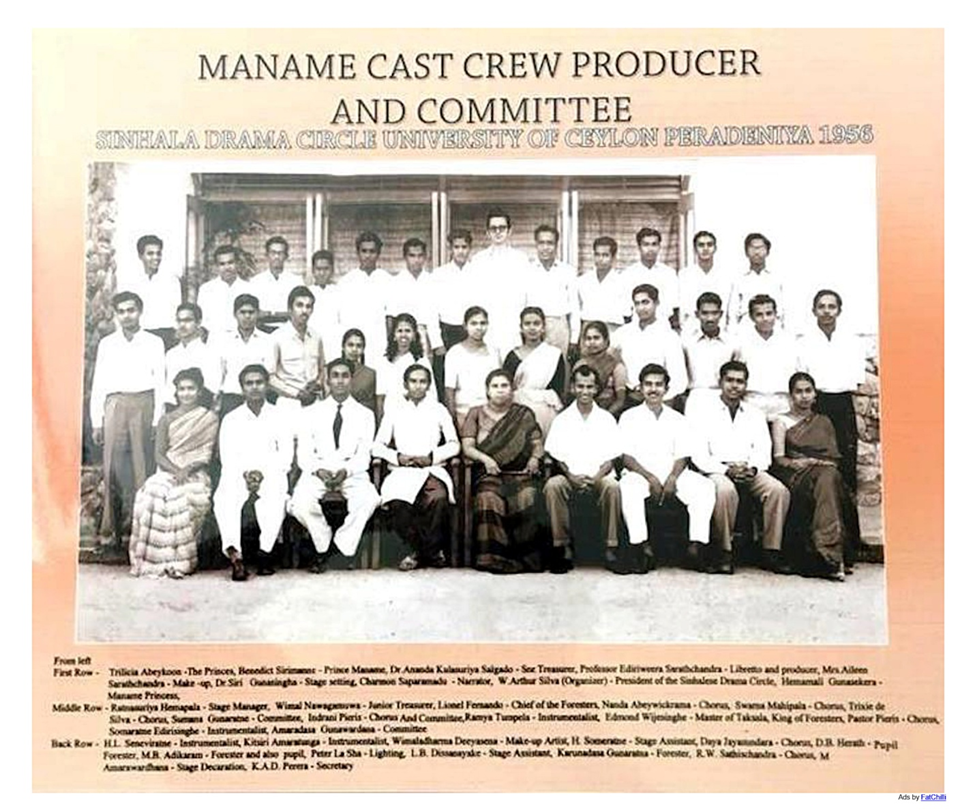
This is a photograph of the original cast, crew, producers and the association that was responsible for creating Maname, the Sinhala Drama Circle. The year would probably have been 1957. It is a formal photograph, probably framed and hung at University of Peradeniya . it is a historic photograph.
When I took my copy of the photograph to a print shop to get it enlarged and sharpened, the shop refused to accept payment, saying it took very little time and cost nothing. I think they were showing respect for Maname.
Attention should be paid to the contribution made by successive generations of Peradeniya undergrads, in the 1950s, 1960s, and thereafter, to the success of Sarachchandra’s plays. One critic spoke of Sarachchandra’s cohort of student actors and actresses who enthusiastically and devotedly participated in his plays.
The contribution of these undergraduate performers has not been sufficiently appreciated. Several generations of talented undergraduates helped to launch a string of Sarachchandra plays at Peradeniya. Rattaran”, Kada Valalu”, Maname”, Elova gihin Melova ava” and Sinhabahu,” were the first of these. I recall seeing Somalatha Subasinghe,in Elova Gihin, at the open air stage at Hilda Obeyesekera Hall . She had terrific stage presence.
There was also Vella Vehum performed by a talented set of minor employees of the University. They had asked Sarachchandra to write a play for them. I saw it at Trinity College Hall. It was good.
Sarachchandra continued to produce new plays in the years after I had left the University . Loma Hansa Natakaya” and Pemathi Jayati Soko” were , I think, first performed by Peradeniya students. This means a continuous supply of talented undergrads for about 20 years. I think the Sinhala Drama Society also functioned throughout this period.
As I pointed out earlier, there was only one University then, so all the talent ended up at Peradeniya. Some of the actors, such as Jayalath Manoratne and Somalatha Subasinghe later made their own contribution to Sinhala theatre. They became admired actors, playwrights and directors.
Maname and Sinhabahu are the two most popular Sarachchandra plays. They are shown regularly in Colombo and elsewhere year after year. These two plays are also perennials in the Sinhala theatre collection. Sinhabahu has also made it to the Guiness Record book.
Terrence and Malini Ranasinghe, who met through Sinhabahu, are listed in the Guinness Book of World Records as the two actors who have performed the same role for the longest time. Terrence and Malini have acted as Potegura and Suppa Devi in over 5,000 performances of Sinhabahu, from 1961 to 1991, a total of 30 years, said Guinness.[16] ( continued)
• ‘Garvin Karunaratne writes again today. I have read his Dahanayaka & red-onion affair several times in the Island. His telephone handling at the Marketing Department’s Tripoli HQ resembles Mountbatten’s war operations room.’”
We did use phones in a remarkable way to move veg and fruit from far away to Colombo.
It was always a hive of activity from the time I parked my Hillman Minx at eight or nine and walked in. The attempt was to see that all the produce available at the Producer fairs were purchased at a higher price. The telephones rang again and again and our lorries did move fast to bring the produce. We got so many oranges at Tripoli that we even built a makeshift grader to grade them by size.
In the outstations we had to be in the good books of the Government Agent, so that we could walk in to his office and use his special phone to get to Tripoli. He too had a few phones and one phone was special as we could dial Tripoli Market to get approval to purchase everything the producers brought to the Fairs.
Economic theory that we learned from books tell that a number of traders would compete and offer higher prices. But I had known that this never happens at the Fairs. The traders are in a group and offer low prices. As dusk sets in the producers are at their mercy as they must sell. It was the Marketing Department that did give good prices and I hope to see a Marketing Department being formed soon after the election.
It is sad that we being blessed with rain and shine cannot produce all our food. Once we did produce all the rice we needed- that was in 1956-1970, when we gave a ration of rice free to everyone. I have never heard of that being done in any other country . Mind you the MD Cannery did make Sri Lanka self sufficient in all fruit products within three years 1956 to 1958, We even exported pine apple rings and pieces- eight percent of what we made went abroad earning dollars. Tomatoe Juice was the drink that Professor Sarathchandra liked most.
Once in Matara I set up a Crayon Factory. It took three months of nocturnal experiments locked up in the science lab at Rahula College Matara for my Planning Officer to find the recipe to make crayons. Then I summoned Sumanapala Dahanayake the Member of parliament for Deniya who happened to be the President of the Moraka Cooperatives to set it up with the cooperative funds he held, I had no authority to use coop funds for that but I did authorize. Sumane purchased all the ingredients, pot and pans and burners in a day, twenty youths were found in the next day and we- myself and Vetus Fernando my Plnning Officer moved in with some six officers and working pell mell for two weeks on a 24 hour basis we trained the youths and filled two large rooms with Crayons. We showed the crayons to Minister Subasinghe and he came down to open sales the very next day and lo we did sell Coop Crayon islandwide all done at the end of the third week. In about the fifth week we approached the Controller of Imports Harry Guneratne as we got wind that he was about to authorize imports of crayons. We did convince him that he should give our Crayon Factory a small allocation of forex to import dyes. He wanted the Ministers approval. Sumane and I went to meet Minister Illangaratne who not only approved a cross allocation, never done earlier but also happily shouted to the Import Controller to ban the import of |Crayons.
Over to our President . Dear Excellency we did work fast once and allayed poverty. I am certain that you can do it better. I was only a GA. Excellency you are the President of Sri Lanka. You can do it.
The other day, while we were chatting after dinner, my friend Fasal Izzadeen asked me, Rohan, who was the best prime minister Sri Lanka ever had?” I told him I couldn’t name the best prime minister, but I could name the best prime minister Sri Lanka never had.” A bit surprised, he asked, Who is he?” Lakshman Kadirgamar (LK), The Cake That Was Baked At Home,” I said without batting an eyelid.
This remarkable patriot and intellectual of our country completed his secondary education at Trinity College, Kandy, where he excelled in academics and a variety of sports, including cricket, rugby, and athletics, earning the most prestigious award a sportsman can achieve at his alma mater, the Trinity Lion.” He then entered the University of Ceylon in 1950 and graduated with a Bachelor of Laws (LLB) degree in 1953. Afterward, he joined Ceylon Law College and passed all his examinations with flying colours. He was admitted to the Ceylon Bar in 1955. Later, he attended Balliol College at the University of Oxford for postgraduate studies, where he became president of the Oxford Union in 1959. LK obtained a Bachelor of Letters (B.Litt.) in 1960.
He was an expert in commercial, industrial, labour, property, and international law, practicing in Sri Lanka and the UK. In 1991, he was appointed as a President’s Counsel.
Achievements in the International Spear
There were two notable career achievements in the international sphere. First, he became the first-ever person to conduct a formal investigation of a country on behalf of Amnesty International when he investigated the insurgence of Buddhist-Catholic violence in Vietnam in 1973. The other is that he served as a consultant at the International Labour Organisation in Geneva and as director of the Asia-Pacific region at the World Intellectual Property Organisation.
His findings in the Vietnam affair were very interesting. He interviewed a vast cross-section of people that included Buddhist monks, Catholic priests, professors, teachers, professionals, and ordinary people both young and old. Although political and religious extremists in Ceylon sought to create the impression that a religious war between Buddhists and Catholics was fought in that country, he realised that it was not so.
The struggle was against the autocracy of a powerful family created by Ngo Dinh Diem. Diem, who was in exile, returned to the country to become the prime minister at the request of the last emperor of Vietnam, Bao Dai (Keeper of Greatness”). Dai’s government was backed by the US. Diem then ousted the emperor at a referendum and made himself president of South Vietnam in October 1955. Diem established an autocratic regime that was staffed at the highest levels by members of his own family who were Roman Catholics. His preference for fellow Roman Catholics made him unacceptable to Buddhists, who were an overwhelming majority in South Vietnam. When the National Liberation Front, or Viet Cong, from North Vietnam launched an increasingly intense guerrilla war against his government, he used heavy-handed and ineffective tactics to suppress them, which deepened the government’s unpopularity and isolation.
When forces killed several people at a rally celebrating the Buddha’s birthday, Buddhists began staging large protest rallies, and three monks and a nun immolated themselves. Those actions finally persuaded the USA to withdraw its support from Diem, and his generals assassinated him during a coup d’état. Thereafter the struggle was for unification of the country and rid of USA forces, which Vietnamese achieved in April 1975.
Leaving Ceylon
LK left Ceylon in 1971 following the JVP insurrection that year, moving to England and practising in London for three years.
LK served in 1974–6 as a consultant for the International Labour Organisation (ILO). Then in 1976, he took up an appointment with the World Intellectual Property Organisation (WIPO), in which he was appointed in 1983 to the newly created post of Director for Asia and the Pacific.
LK was the author of several scholarly articles published in international legal journals such as the Modern Law Review, South African Law Journal and Conveyancer and Property Lawyer. He served as Director, Industrial Property Division, and Director, Development Cooperation and External Relations Bureau for Asia and the Pacific at WIPO until he was overlooked for the post of Deputy Director General.
He resigned in May 1988 and moved back to Sri Lanka in the following year.
Going into Politics and becoming Minister of Foreign Affairs
In the general elections held on August 16, 1994, the People’s Alliance secured the largest number of seats in parliament, and on August 19, its leader, Chandrika Bandaranaike Kumaratunga (CBK), became prime minister.
Soon after this victory, she attempted to persuade LK to enter politics. Although LK was initially hesitant, he decided to join CBK when her mother, Mrs. Sirimavo Bandaranaike, phoned him and convinced him to join her daughter’s cabinet. LK would have realised that his knowledge and experience were crucial for navigating the country he loved through this tumultuous period.
He was appointed Minister of Foreign Affairs on August 19, 1994, the same day CBK assumed the role of Prime Minister.
CBK then achieved a landslide victory in the presidential election held on November 9, 1994, and took the oath as the fourth executive president of Sri Lanka.
LK was reappointed as Minister of Foreign Affairs on November 12, 1994. He took over the ministry during the peak of the country’s civil war between the government and the Liberation Tigers of Tamil Eelam (LTTE). Moreover, the country’s image had been significantly impacted by the riots and suppression of the JVP insurgency in the 1980s. The European Parliament alone passed 18 resolutions, along with several in the Geneva-based Human Rights Council, against Sri Lanka, influenced by LTTE lobbyists concerning her human rights record.
Assessing the situation, LK, being a professional himself, aimed to transform the Sri Lankan Foreign Service into a genuinely professional entity, similar to those in developed countries. He accomplished this to a certain extent, as noted by senior career diplomat Kalyananda Godage in his article for the Daily Mirror titled “Lakshman Kadirgamar: A brilliant lawyer, an intellectual, and above all, a principled humanist.”
LK played a key role in enhancing Sri Lanka’s relations with numerous countries and sought to establish the nation as a responsible member of the international community.
He then worked tirelessly to isolate the LTTE internationally, advocating for the group to be recognised as a terrorist organisation. His diplomatic efforts led several countries, including the United States and the European Union, to ban the LTTE, which deprived the organisation of a primary source of funding.
LK became the number one enemy of the LTTE.
When Shane Warne justified Australia’s decision not to play in Colombo during the 1996 Cricket World Cup by claiming he would be killed by a bomb while shopping, the quick-witted LK reportedly responded, “Shopping is for sissies.”
CBK’s Second Term as President
CBK won the 1999 presidential election despite being nearly killed in an LTTE assassination attempt at her final rally three days before Election Day.
She appointed her mother, Sirimavo Bandaranaike (Mrs.B), as prime minister, and LK was reappointed as Minister of Foreign Affairs. Due to her declining health, Mrs.B stepped down in August 2000 and passed away after a brief illness on October 10, 2000, at the age of 84. CBK appointed Ratnasiri Wickremanayake as the prime minister to succeed her mother.
LK’s address at the 79th session of the United Nations General Assembly, held on 23rd September 1999, was significant for Buddhists worldwide and especially for Sri Lankans.
LK at UN General Assembly
He stated: Allow me, therefore, to suggest to this august Assembly that as third millennium of human history opens it would be fitting to recall the immense contribution to the understanding of the human condition that the teachings of Buddha made two thousand five hundred years ago. I suggest further, Mr. President, that it would be appropriate to honour the Buddha by declaring that Vesak, the sacred day for the Buddhists the world over, be observed as a special day by the United Nations. Mr. President, a Resolution to this effect sponsored by a number of countries will be introduced in the General Assembly, at the current sessions of the assembly. The Government of Sri Lanka would commend this resolution to the attention of the General Assembly.”
UN then adopted its resolution A/RES/54/115 summarised as: Resolves that without cost to the UN, appropriate arrangements shall be made for international observances of the Day of Vesak at UN Headquarters and other UN offices, in consultation with the relevant UN offices and with permanent missions that also wish to be consulted.”
LK, a Tamil Christian, successfully presented the case for implementing the recommendations made at the World Buddhist Conference held in Colombo in 1998, which urged that Vesak Day be declared an International Holiday.
Recession in 2000
Many economic projects initiated by the CBK government failed, and the country was in recession by 2001.
The Gross Domestic Product (GDP) in real terms contracted by 1.4 percent. This marked the first negative growth reported since independence in 1948. The lowest growth recorded previously was 0.2 percent in 1971, a year when economic activities were crippled as a result of a youth insurrection led by the JVP.
The temporary deviation of the economy in 2001 from its long-term growth trend of approximately 5 percent per annum reflected a negative outcome from several factors that impacted both the aggregate supply and aggregate demand sides of the overall economy (Central Bank of Sri Lanka Annual Report – 2001).
At this stage, a few ministers betrayed the PA government and joined the UNP. Chandrika dissolved the government, and the general election was held on 5th December 2001. The PA lost the election. Ranil Wickramasinghe formed a government with UNP and those dissident MPs of PA, which was called UNF or United National Front.
Ranil signed a ceasefire agreement with Prabakaran, the LTTE leader, initiated by the Norwegian government in February 2002. However, Ranil made several politically unpopular strategies to resurrect the economy and put it back on track.
Ranil managed to get the help of the international community to organise a conference on the reconstruction and development of Sri Lanka in Tokyo on the 10th of June 2003. The participating donor countries and international organisations have demonstrated their willingness to extend assistance to the entire country, to a cumulative estimated amount, above US $4.5 billion over the four years, 2003-2006. However, there were conditions attached based on peace negotiations between the government and LTTE.
The JVP considered the actions of UNF as an anti-people, pro-imperialist, pro-separatist programme and had discussions with Chandrika’s SLFP to ally with a programmme based on people-friendly policies to stop the re-colonisation and division of Sri Lanka.
The former Foreign Minister Kadiragama too was very critical of the ceasefire agreement.
The SLFP and the JVP formed the United Peoples Freedom Alliance (UPFA) in January 2004.
Request by JVP to Appoint LK as Prime Minister
According to then JVP leader Somawansa Amerasinghe they requested the President Chandrika Kumaratunga to appoint Kadiragama as the Prime Minister because they considered he was a true Sri Lankan in every sense of the word.
Somawansa later wrote in an article published by Sunday Times, He was an example to those of us within our country of the model Sri Lankan embodied within himself, the characteristics of what being a Sri Lankan was all about – rising above narrow racial, religious and other divisions, but at the same time being a personification of all that is Sri Lankan – tradition and culture, tolerance, patience, and equanimity. Although he was, as most would acknowledge, the best Foreign Minister of independent Sri Lanka, we felt that the Foreign Minister’s portfolio was too small a place for a man of his stature.”
Somawansa further said, We saw in Mr. Kadirgamar a person who was proud of his origins. He was proud to be a Sri Lankan. He stood up to the international community and spoke to them as their equal.”
When an interviewer from BBC asked LK whether he was a traitor to the Tamil people he said “People who live in Sri Lanka are first and foremost Sri Lankans, then we have our race and religion, which is something given to us at birth”. “We have to live in Sri Lanka as Sri Lankans tolerating all races and religions.”
To prevent the deterioration of the country’s security, as pointed out by the JVP, President CBK dissolved parliament.
The general election was held on April 2, 2004, which was won by the UPFA. The cabinet of the new Alliance government included four members from the political bureau of the JVP.
However, Chandrika never appointed LK as Prime Minister.
The Cake Was Baked At Home
The Oxford Union unveiled a portrait of their 1958-59 president LK, on the 18th of March 2005. This was a great honour bestowed by the Oxford Union on only 15 others in its 183-year history.
He made a short speech at the ceremony where he said, “I would like to, if I may, assume that I could share the honour with the people of my country, SRI LANKA. I had my schooling there, my first university was there, I went to Law College there and by the time I came to Oxford as a postgraduate student, well, I was relatively a mature person. Oxford was the icing on the cake but the cake was baked at home.”
Then on the 18th of February 2015, LK’s portrait was unveiled at his first University, the University of Peradeniya senate room by the then Vice Chancellor of the University, Prof. Athula Senaratne.
Thus two universities in the world honoured him by unveiling his portraits.
LK was assassinated by the LTTE on August 12, 2005. An LTTE sniper shot him as he was exiting the swimming pool at his private residence in Cinnamon Gardens, Colombo 7. However, the LTTE denied responsibility for LK’s assassination.
Dr Paikiasothy Saravanamuttu, Executive Director, Centre for Policy Alternatives wrote: LTTE denials notwithstanding, the government and the police investigators have come to the clear conclusion that the LTTE is responsible for the killing. And from this stem the consequences for the peace process and ceasefire. (Refer his article published in The Morning Leader of 17 August 2005 under the title “Kadirgamar killing: Blow to Peace”)
This great patriot’s 93rd birthday falls on April 12, and this article serves as a tribute to the best Foreign Minister Sri Lanka ever had and the Best Prime Minister Sri Lanka Never Had.”
If LK had not assassinated and succeeded in bringing peace (which he probably would have achieved), the grateful Sri Lankans of all races would have elected him as their President. If that had happened, Sri Lanka wouldn’t have faced the political and economic problems she experienced in the last two decades.
‘Before you study the economics, study the economists!’
e-Con e-News 06-12 April 2025
‘There is also a military build-up going on in the US base in Diego Garcia,
including B-52 heavy bombers with a range of 10,000km.’
– MK Bhadrakumar, ‘Steve Witkoff’s Iran mission’
*
Sri Lanka is 1,925km from Diego Garcia in the Chagos Archipelago. Delhi is 4,026km from Diego Garcia. The USA’s ‘eco-friendly’ vehicles of mass destruction boast they can flatten anything over double that distance, Gaza-styleee! Unimpededly, they hope. And they may surely try. India or Sri Lanka certainly have no means to respond in kind on US real-estate. Yet there has been a deafening silence from the media in India, as in Sri Lanka, over England recently handing over that archipelago, that is not theirs, for such horrific purposes – kicking out the original inhabitants – to the US, for another 100 years, in this purportedly ‘post-colonial’ age – once prematurely tagged and effusively celebrated by our funded social-scientists – ‘post-colonial’, a trope adorning many a dollared PhD thesis.
India, after all, is said to have waged, or backed, a 30-year war of terrorism, on Sri Lanka, due to Sri Lanka’s then-President JR Jayewardene’s attempt to hand over the strategic port of Trincomalee to the US. Yet, not a word about Diego G. So what goes? Could last week’s ‘agreements’ with India lead to a division of the country, after some pretext is concocted, and include India invading the North & East of Sri Lanka, while the US invades the South?
*
• The US government is impounding countries’ gold reserves, throwing out diplomats from their country, sanctioning people & tariffing trade. They are imprisoning and deporting foreign students for criticizing the US’ foreign military policies. They are exporting migrants as purported ‘criminals’ to third countries. Rule of law, huh? Meanwhile, their so-called NGOs (multinational banks & corporations, included) fly capital in & out at will, while loudly complaining about feeling cramped. Sena Thoradeniya has been closely tracking the blatant & published interferences of US & Indian officials in the internal affairs of our country, led by a constantly going but never-departing ‘killer dwarf’ US Envoy. Thoradeniya ponders if ‘They want to make Sri Lanka a partner in their Indo-Pacific’ war games. He wonders, ‘Who amalgamated the Indian Ocean with the Pacific Ocean?’, evincing a nostalgia for his childhood cartography: ‘East of the Indian Ocean was bounded by the beaches of Western Australia was the Geography we knew!’ Alas, for map makers and sellers. One wag this week pointed out, when you buy a map of India, you get 2 maps for the price of one, for they always include Sri Lanka. Inclusive indeed!
Thoradeniya concludes, ‘President Anura Kumara is trapped by previous agreements & Ranil Wickremasinghe’s commitment to take up commanding the USA’s ‘Combined Maritime Force’s Combined Task Force 154, CMF-Bahrain.’ He speculates if the ‘Malima government would sign the SOFA (Status of Forces Agreement) which Sirisena did not sign’, while noting that the USA’s ‘ACSA (Acquisition & Cross Servicing Act) [was] extended by Sirisena in 2017 without exit clause or duration’ (see ee Focus, Departing US Envoy Julie Chung’s Interference in the Tri-Forces)
*
• ‘The second Trump administration continues to intensify a New Cold War’ and ‘Peace in the Indian Ocean is once again at stake’, reckons Shiran Illanperuma. India’s participates in ‘the Quad (consisting of the US, Australia, & Japan), which is a component of the US Indo-Pacific Strategy to contain China.’ He yet optimistically examines the strivings of Asian & African countries, led by Sri Lanka’s dynamic Sirimavo Bandaranaike and Tanzania’s Julius Nyerere, to adopt UN Resolution 2832 – the ‘Declaration of the Indian Ocean as a Zone of Peace’ (see ee Focus, Sri Lanka’s Defense Agreement with India & the Prospects for Peace in the Indian Ocean)
*
• This week saw England send their Foreign, Commonwealth & Development Office (FCDO) Deputy Chief Economist Fergus Cumming to Sri Lanka, to fish for business contracts here. You have to credit the English for their slimy crass! Then again, the FCDO’s origins lie in their ‘Secretary of State for War, for the Colonies’. The red carpet for Cumming’s visit began unrolling weeks ago with the so-called revelations by the BBC’s camel division al Jazeera, about the Batalanda abattoir, which will certainly not enable England’s fabled ’truths & reconciliations’. It is meant to only inflame divisions within the country, for the JVP (& not just them, but other ‘human rights experts’ as well) too would have to answer for their roles. The English then laid down sanctions against military officers. And now they send a businessman to fish for contracts! How’s thaaat! Craving market and visa access, this merchant oligarchy has to submit to these charades? Why can’t the nation come together to examine how the English bestowed a political economy on this country to enable such conflagrations? Former China PM Zhou Enlai once remarked: ‘The English left time-bombs in Asia.’
In 1942, England poured 10,000s of Indian, African and English troops into Sri Lanka (then colonial Ceylon) to stage a last stand against Japan, which had evicted them from Malaysia and Singapore. India’s national movement was also in full swing (see ee Focus, When England Poured Armies into Lanka). The English then temporarily withdrew, ‘granting’ an independence, strangled at birth, to ensure remote control over the polity and a continuation of the colonial import-export plantation oligarchy. Midst attempts to remove ourselves from an administration of ‘Brown Englishmen’, Sri Lanka’s oligarchy sought, albeit half-heartedly (given the country was led by another compromised ‘Brown Englishman’) to join in the Non-Aligned Movement.
*
‘Unable to overcome the pattern of colonial underdevelopment
and the imperialist onslaught of coups & counterinsurgency,
the 3rd World debt crisis ushered in a shift from a spirit of cooperation to the
law of competition. This crisis was used to divide & discipline the periphery
& reincorporate it into a global market on terms favourable to multinational capital.’
– SBD de Silva, The Political Economy of Underdevelopment
*
• The US government has declared economic war on the rest of the world, states US economist Michael Hudson. He recommends that to protect ourselves, we ‘must suspend dollar debt service’. He feels it is ‘inevitable’ that ‘countries will find themselves obliged to make their economies no longer dependent on US exports or dollar credit’, thereby ‘creating a new world economic system’.
*
‘Trump is telling the rest of the world that they must be losers –
& accept the fact graciously in payment for the military protection
that it provides the world, in case Russia might invade Europe or
China might send its army into Taiwan, Japan, or elsewhere…’
– M Hudson (ee Economists, Trump’s tariff
threats could destabilize the global economy)
*
We see such hallucinatory US projections about a bellicose Russia & China regularly planted in their compliant media in Sri Lanka. And not just in their robotic lip service, EconomyNext. Hudson also riffs on the rote diversions of economists: The oft-quoted David ‘Ricardo’s model and US neoclassical theory [are] simply an excuse for hard-line creditor policy.’ JM Keynes ‘emphasized that, if creditors want to be paid, they have to import from the debtor countries to provide them with the ability to pay’. ‘The political problem of the world’s overhang of dollar debts is that the US is acting in a way that prevents debtor countries from earning the money to pay foreign debts denominated in US dollars.’
The USA’s IMF meanwhile needs ‘more time’ to ‘gauge the impact of global shocks on Sri Lanka’s economy’! They also speak of ‘Recent external shocks and evolving developments.’ Really! The IMF can’t bring itself to say their master has been preparing these ‘shocks’ quite openly for many months! Didn’t they game this scenario? These ‘reciprocal tariffs’ have been claimed as ‘an invitation’ to create equity, but it’s actually a demand, that the world submit to joining their wars on China or whoever else. The Silicon Valley billionaires, who have financed these present gaggle of the USA’s major politicians, are also ‘extremely’ anti-China, just like their ‘Democratic Party’ predecessors. And contrary to the ‘free trade’ bible of economists here, these eggheads also openly supportmonopolies, declaring ‘competition is for losers’, and ‘monopoly is the condition of every successful business’. There you go!
*
• Meanwhile, the present imperialist economic trap we find ourselves in has been laid for over 3 decades, where colonized governments were consistently ‘told that the only way we can develop is through export-led growth’. The media’s economists, of the so-called Left & Right, have also parroted this scripture. They have never considered giving our own workers a fair deal as a good option. They see ‘wages as a cost, not as a source of our own domestic demand & market’ (see ee Quotes, Jayati Ghosh)
*
‘The Trump administration’s use of the term ‘reciprocal tariff’ is misleading.
Reciprocity implies equity, yet the kinds of goods which the US & Sri Lanka trade
can hardly be equated. While Sri Lanka exports labor-intensive products
such as apparel to the US, it imports capital-intensive products such as machinery
& pharmaceuticals. Meanwhile, unlike the US, Sri Lanka does not
have the exorbitant privilege of printing the world’s reserve currency.’
– Shiran Illanperuma, ee Economists, Trump’s tariffs could intensify SL’s debt crisis
*
The brown head of England’s Standard Chartered Bank in Colombo acts ‘surprised’ at Trump’s ‘reciprocal tariffs’, They repeatedly use this trope, and it helps us identify those economists, thinktanks & politicians who are bribed by the US, English & EU governments to mimic such economic hogwash – for ‘reciprocal’ it is definitely not! And shouldn’t such bribes be included in their calculations of imports & exports? Nope, ‘services’ are excluded. The Sunday Times’ Namini Wijedasa, a stipendiary of Japan’s NHK & England’s Economist, has been deliciously lubed with some ‘Woman of Courage’ Award by the US government for her investigative journalism on ‘corruption’, even as that US regime has yet again legalized the bribing of foreign officials! And she loves it. We doubt the Sunday Times would dare investigate that! Wijedasa too provides a ‘service’: she ‘vows to fight for system change’. Tariff that!
*
Services, servants, domestic & civil & public,
like the word serf, service has its origins, according
to that equally capricious Oxford English Dictionary (OED)
in: ‘Middle English: from Old French server,
from Latin servire, from servus ‘slave’…
*
• There is very little discussion on how multinational banks & corporations control 80% of world trade, and this includes goods & services. Very little is reported on how much of Sri Lanka’s export trade includes costs inflated by importers & exporters to pay for the foreign machineries involved. The fake garment trade (it is not an industry), yearning for US market access, imports pins, needles, machines, threads, resins & fabrics & fuel. CIC & CTC & Unilever are major importers of chemicals, many deadly. US exports services including computer software, Starlink, and Sri Lanka students also spend millions of dollars each year to study in the US, none of which are captured in the trade data… Firms such as booking.com operate in the country so far tax-free, as does Uber, McDonald’s, Burger King, Baskin-Robbins, Pizza Hut, Domino’s, etc. (see ee Economy, Sri Lanka services imports, open door for US brands should figure in tariff talks: NCE’s Marikar)
*
• This ee Focus concludes for now our look into Anglo-American tobacco monopoly Ceylon Tobacco Company in Sri Lanka. It examines the early attempt of CTC’s English- and US-owned parent British American Tobacco (BAT) and linked ‘private’ tobacco corporations in Europe to form ‘leviathans’ through one of the 3 largest mega corporations outside the USA. They wished to take advantage of the formation of the European Economic Community to enable a huge home market to set up the formation of even large monopolies (on the pretext of countering China?), heralding England’s entry into that market. Apparently beleaguered by concerns for health, It looks at their efforts to move into and monopolize agricultural supplies, packaging, production machinery, as well as scientific & technical research. Very interestingly it examines BAT (CTC’s) link to CIC (Imperial Chemical Industries – ICI), who led the recent media war against organic fertilizer.
*
• An Island article on a Nexus Research seminar turns out to be ‘creatively’ composed by AI… Some AI programs report the article is 66% AI, others insist it is 100%! How reliable are AI checkers? This is what has happened to merchant capitalist journalism. Why not? What is most interesting is that the unattributed article completely overturns what the speakers said, and instead repeats the US-IMF bible! Knowing the record of some of the Nexus speakers, we know they would never have said such things… Meanwhile, much of the Island’s online sections are embarrassingly defunct and outdated. Their ‘foreign news’ is totally the English government (BBC)’s view of the world.
The other top user of AI parading as ‘news’ is EconomyNext, which is supposed to be a Sri Lankan news site, but is a US lip-service. Every EN headline has to remind readers that it is in Sri Lanka… It then simply repeats the IMF rah-rah-rah, sometimes providing fake demurrals, as passed on to their naked Advocata & Verite & IPS choristers screeching falsettos. Their top reporter – famous for throwing softball questions to hardballed US envoys – is blacker than a black cat in a black room on a starless moonless night, but his reportage is whiter than a white cat in a blinding snowfall! (see ee Economists, Dr Kohona: developing countries should covet China model)
*
• In the end, trying to submit to imperialist whimsy is a waste of time. Has been a major waste of time. & will be… For they will keep changing their demands. The moral of the story is that the slave master has the right to change (or even lose!) their mind. And it is the brave unarmed slave who dares remind: ‘But you said this’ etc. Appealing to logic & morality & ethics etc is a Jewish slave’s tricks, according to the German ‘philosopher’ F Nietzsche. It makes ee wonder if the word ‘negation’ in dialectical materialism comes from the ‘negro’… the ‘nigger’ who say ‘No!’ And not just in the night…
The liberals claim politics and economics are separate. Yet, their elections, are the most expensive democracy that money can buy. And after robbing us for 500 years they say we owe them. The debt is now the whip, and we supposedly must agree with their computations, despite the science of mathematics and arithmetic…
‘The phrase ‘When goods don’t cross borders, soldiers will’ is often attributed to the 19th-century French economist Frédéric Bastiat. Its origins are contentious and may be traced back to another Frenchman Montesquieu, ‘emphasizing the civilizing effect of commerce’ However, Benjamin Franklin is quoted by Marx: ‘War is robbery, commerce is generally cheating.’ And the US and their media do all that very very well.
*
Meanwhile, as ee wishes our readers, supporters and critics, a very super new year, we would love to be a co-sponsor of this latest of fictional awards in our prize-giving-and-taking colonial nation:
‘The British Council and the Gratiaen Award Trust are honoured
to announce the inauguration of the John D’Oyly Award. Nominations
should be submitted each year, one month before – with winners
announced on – March 02, the day of the 1815 Kandyan Convention.
Judges will include: the English High Commissioner, the US Envoy,
CEOs from Standard Chartered Bank, Hongkong & Shanghai Bank,
Unilever and Ceylon Tobacco Co., and non-voting unofficial members
chosen from leading NGOs and English Departments across the country.
The French and German envoys will be admitted in case of disagreement
among the English. The Indian envoy will also remain on standby. Those
nominated need to exhibit distinct character traits akin to those by which,
according to the known fictions, ceded Lanka to an English colonialism
that had failed to militarily conquer the highland kingdom of Sinhale. The
award is being funded off the interest of undeclared tea and other exports.
Send your nominations to ee, we have a long list already…Again, a really happy new year awaits us, once we truly free our country by building a modern industrial society…
The Sacred Tooth Relic of Buddha enshrined in the Dalada Maligawa is revered as the legitimacy & beholder of the authority of the King (ruler) & its protection by the ruler is crucial for the stability of the Nation. The Tooth Relic which was originally enshrined at the Abhayagiri Temple in Anuradhapura during the rule of King Kithsiri Mevan. Ever since, every King has protected & guarded the Sacred Tooth Relic which is the palladium of kingship. This has been constitutionally enshrined via Article 9 and Article 16 and is binding of all.
When the capital shifted from Anuradhapura to Polonnaruwa, after liberating the country from Chola rulbe, King Vijayabahu constructed the Atadage to house the Sacred Tooth Relic. Every King who ruled the Nation has venerated the Tooth Relic, guarded & protected it with veneration because it was synonymous with his Rule & more importantly Righteous Rule. The Adhammika Suthraya explains the importance of righteous rule for when a ruler is corrupt everyone below him also becomes corrupt. The Dalada Siritha” lays out the rituals to be followed.
What is the significance of the Sacred Tooth Relic to the Governance of Sri Lanka?
The Sacred Tooth Relic is the symbol of Divine Legitimacy – it is more than a religious symbol, it is a divine endorsement of the Rulers/President’s kingship/Rule. Whoever held the Tooth Relic was seen as the legitimate ruler of the land approved by Buddha. You may recall how the colonial rulers always made attempt to steal the Tooth Relic to legitimize their invasion. Thus possession of the Tooth Relic was a claim to political power & religious authority over the State.
The Sacred Tooth Relic has been enshrined in special temples through history. Its protection was central to the Stability of the State. This is a prerequisite even in present governance.
National Unity – The Tooth Relic was the unifying force that brought people of Sri Lanka together, under one banner, with Buddhism enshrined as the dominant faith & protector of all via the Noble Buddha’s Principles & Buddha’s Jurisprudence which was the foundation for not only the legitimacy of the ruler by the foundation for a peaceful & prosperous nation.
Whether the ruler is King or the President, the Sacred Tooth Relic is a symbol of the King’s legitimacy & it is his duty to protect it & follow the established rituals coming down through history.
Protector of the Tooth Relic – by the King/President as Custodian of Buddha Sasana
Performing Rituals & Ceremonies – the King/President along with the Maha Sangha must continue all rituals with reverence as has continued
Ensuring Justice & Protection – the King/President must ensure Buddhist principles are followed within the kingdom as per Dharmishta rule which implies in line with Buddhist ethics, spiritual teachings of Buddha & Buddhist jurisprudence (Buddha Sasana Legal system)
Defending the Nation from external threats. The Sacred Tooth Relic was a symbol of the nation’s unity, if the relic was under threat, it was seen as a threat to the Nation itself. Thus, the Unitary State of Sri Lanka must be protected. There cannot be 9 Dalada Maligawa’s. There is only one & only one for whole of Sri Lanka, which implies no devolution/separation of power.
The Ruler/President requires to be
Righteous & Moral (he is called the Dharma Raja – Righteous King) – one who embodies the principles of Buddhism in his leadership. This essentially translates to mean a ruler who not only carries out ceremonial roles by mentally & physically undertakes to protect the Relic & upholds moral standards in both personal & political life.
Righteous ruler must be just, wise, compassionate & ethical in dealings with ALL PEOPLE
Righteous ruler must show devotion to Buddhism, hold deep respect for the Sacred Tooth Relic, uphold all rituals & commit to righteous rule of the Nation.
Ruler/President must rule by example – he is the moral & spiritual leader of the people. He must live by Buddhas moral codes. If not his leadership is seen as invalid & illegitimate. He is expected to personally exemplify the virtuesof generosity, morality, patience, and wisdom.
What if the Ruler/President does NOT FOLLOW the rituals & responsibilities?
If the Ruler/President fails to follow rituals or disrespects the Tooth Relic, it was a sign for the Buddhists to reject the ruler as he had by his actions lost the blessings of the Buddha. As the Relic is a symbol of Rule, failing to protect the relic symbolized the loss of divine legitimacy. When spiritual authority of the ruler is undermined it automatically impacts the governance & leads to internal strife within the kingdom. Thus, if there is internal strife within the kingdom it indicated the Rulers wavering in his duties.
When such a scenario unfolds, it leads to disastrous effects like natural calamities, droughts, famine, floods which are seen as divine punishment for the rulers/President’s failure to perform his duties. A rulers/President’s misdeeds bring other more dangerous misfortunes like external interventions, invasions, foreign military presence and eventual loss of political power.
Loss of People’s Support – People who believe their prosperity is tied to the moral integrity of the ruler/President & his adherence to Buddhist rituals would result in their loss of faith in him. This could result in rebellion, political unrest & rise of dissenting factions. To negate this belief, there are well funded campaigns to make people distanced from religion, rituals but the more people drift to immoral values the worse the situation for the nation becomes.
Exile or overthrow – the divine beings are aware of rulers/Presidents who pretend to be ceremonial custodians to those who are righteous rulers. Rulers who have failed to follow rituals & defied the Tooth Relic have been overthrown and their kingdom has been punished or living in disgrace. People can be fooled, but the Sacred Tooth Relic & the divine beings that guard it cannot be fooled.
Rulers who failed to venerate/protect the Sacred Tooth Relic & the consequences to the Nation.
King Kassapa (477-495ce) – came to power by usurping the throne by killing his father King Dhatusena & forcing brother Moggallana into exile. Thus his rule was seen as illegitimate. In order to secure his rule, he moved the Sacred Tooth Relic to Sigiriya (newly built capital) but he did not protect it as his predecessors did. King Kassapa’s reigh was marked by internal unrest, political instability, people lost faith in him & these led to his eventual downfall in 495ce when his brother returned from exile & defeated Kassapa in battle. Kassapa committed suicide.
King Rajasinghe II (1620-1645) – He too failed to protect the Tooth Relic & faced significant challenges as a result. The Portuguese captured the Sacred Tooth Relic was a severe blow. Eventually King Rajasinghe worked to resist Portuguese rule by seeking help of the Dutch but the loss of divine favor had long lasting effects on the stability of the nation because of his failure to protect the Tooth Relic.
King Bhuvanakabahu VI (1480-1513) – His reign was marked by political instability & conflict with foreign powers & collapse of centralized authority. Without the divine legitimacy symbolized by the relic, his rule was seen as illegitimate” by the People.
King Senarath (1604-1635) – He too failed to protect the Tooth Relic. The Portuguese continued to expand their influence and took control of the coast. The failure to protect the Tooth Relic resulted in the loss of spiritual protection which paved way for foreign occupation & meant the kingdom had to endure conflict.
King Vikramabahu III (1357-1374) – He too failed to protect the Tooth Relic & faced both internal & external challenges including Chola invaders.
Who were the Righteous Rulers
They ruled upholding Buddhist principles, protected the Sacred Tooth Relic, ensured prosperity & unity of the Island & were true Dharma Rajas.
King Devanampiyatissa (247-207bce) – first king to embrace Buddhism, constructed the Maha vihara (Great Monastery) in Anuradhapura & his reign marks the beginning of state-sponsored Buddhism in Sri Lanka. He governed by the Dhamma, showed compassion to all living being even wildlife. He created wildlife sanctuaries (first in the world) & established religious institutions, education & culture.
King Dutugemunu (161-137 bce) – unified Sri Lanka under one flag with intent of protecting the Buddha Sasana. Defeated Elara but also honored Elara with a monument with a decree to pay respect demonstrating Kingu Dutugemunu’s magnanimity in victory. He built the Ruwanweliseya stupa & restored many temples. He remains one of the most beloved kings in Sri Lankan history.
King Valagamba (103-89-77 bce) – lost his throne to South Indian invaders, lived in exile for 14years & regained the kingdom ruling righteously. He was responsible for the preservation of Buddhist scriptures (Tripitaka) in written form to preserve the oral tradition. He sponsored the writing of the Pali Canon at the Aluvihara Rock Cave Temple. He is revered as the king who saved the Dhamma for future generations.
King Parakramabahu (1153-1186 ce) – He is known for his motto not even a drop of water that comes from the rain must be allowed to go to the sea without being made useful to man” – He promoted agriculture, irrigation & Buddha Sasana. His famed Parakrama Samudra, temples & restoring ancient stupas, economic development & good governance is part of his legacy.
King Vijayabahu 1 (1055-1110ce) – He rescued the island from Chola invasion & restored Buddhism, brought theros from Myanmar to revive the monastic order, rebuilt Buddhist monastic community, temples & schools, established strong foreign relations especially with Buddhist nations.
King Kirti Sri Rajasinghe (1747-1782 ce) – He led a religious revival by inviting theros from Thailan (Siam) & helped re-establish the higher ordination (Upasampada) lineage of Buddhist theros. He restored temples, promoted Buddhist education & helped compile Buddhist texts. He strengthened the Siam Nikaya and actively participated in Buddhst rituals & festivals especially those involving the Sacred Tooth Relic.
King Sri Vickrama Rajasingha (1798-1815) – the last King of Sri Lanka.
Thus, the Righteous Rulers followed
Adherence to Dhamma – ruling according to the Principles of Dana” (generosity) Sila” (morality) & Karuna (compassion)
Protecting the Buddha Sasana – Contributing to the preservation, protection & propagation of Buddhism including the Sacred Tooth Relic
High Moral Governance – ruling with justice & compassion to improve lives of the people
National Unity & Cultural Identity – based on Buddhist values
As part of his royal duty & claim to legitimacy he did protect & venerate the Sacred Tooth Relic however towards the later part of his reign, his rule was marked with controversy & misrule, having become intoxicated & derelicting his duties to the Buddha Sasana. Though he belonged to the Nayakkara dynasty, he had royal lineage & he ruled as a protector of Buddhism in line with Sinhala-Buddhist traditions. He did not attempt to replace Buddhism with Hinduism. He performed the traditional rituals & participated in the Dalada Perahera & restored Dalada Maligawa but his style of leadership began to change & departed from Buddhist principles. As a result he lost the support of the Buddhist theros & even neglected duties of the Dalada Traditions which made his lose his legitimacy. This turned him into a tyrant, his own chiefs began to betray him, the Kandyan chieftans lost faith in him until the British took over & ruled Sri Lanka. Thus, ended 2300 years of Sinhalese Buddhist monarchy.
In terms of post-independence Sri Lankan leaders, given that the Sacred Tooth Relic is symbolic of Righteous Rule, every post-independence leader has to be judged based on their adhered to the following Dalada Sirith
Personal & Public veneration of the Sacred Tooth Relic
Protecting & Promoting the Buddha Sasana
Participating in Sacred Rituals of the Buddha Sasana
Ruling justly & in line with the Dhamma & Buddhist Jurisprudence
Upholding the unity & moral order of the Nation
Avoiding corruption, abuse & cruelty to even sentient beings.
Thus, the Dalada Exposition of the Sacred Tooth Relic to be held from 18 April to 28 April is directly connected to the righteous governance in Sri Lanka & cannot & should not be regarded as merely a ceremonial parade to please Buddhists or as a cultural festival.
That it is sacred reaffirms the covenant between the Rule, the People & the Dhamma. It reflects the ancient rule that sovereignty is not granted solely by the people, but sanctified through righteous rule, with the Sacred Tooth Relic as a living symbol of divine authority & moral duty.
To revere the Sri Dalada outwardly, violating the Dhamma inwardly is to break this trust of not only the citizens but also of the divine beings (devas), the protectors of the Buddha Sasana who are silently observing whether leaders uphold the virtues of generosity, truth, compassion & justice expected of them.
If a ruler or government uses the Dalada merely for pageantry, while engaging in corruption, injustice, revenge or oppression they are not only misleading the peope, they risk inviting karmic consequences foretold in our chronicles.
As history shows, leaders who fail to honor the sacred duty entrusted by the Dalada Sirith not only fall but take the nation down with them.
Therefore, this Dalada Exposition should be a sacred reminder to the State, to the People that rightful rule arises from moral integrity & not from military power or political manipulation.
In the eyes of the devas & generations to come, a leader is measured not by grandeur, not by his words but how deeply he/she embodies the Dhamma.
How far have present day rulers lived up to the Dharshmista leadership expected of them?
Thus, every step of the Perahera echoes not only through the streets of Kandy, but through the hearts of those in power as a call to return to righteous, compassionate & selfless governance – this is the true legacy of the Dalada.
The exposition of the Sacred Tooth Relic took place historically during times of disaster & strife. People participated alongside the Ruler to seek refuge in the Buddha. In times of disaster People of the Nation took salvage in the Buddha, just as the daily social contract by Buddhists in the morning & evening by reciting pansil. That the Dalada exposition is taking place in 2025 reconfirms the decision to again take refuge in the Buddha. This categorically re-establishes the grundnorm that Article 9 of Sri Lanka’s Constitution cannot be changed.
My recent visit to Maduwanwela Walawwa, a site purportedly steeped in Sri Lankan history, left me with a profound sense of disappointment and concern.
While the historical significance of the location is undeniable, its current state of disrepair and the restrictive policies in place raise serious questions about the commitment to preserving this heritage for future generations.
The lack of proper maintenance is immediately apparent upon entering the premises. Structures are visibly deteriorating, and a pervasive odor of bats, particularly noticeable on the upper floors, creates an unpleasant and frankly, concerning environment.
This neglect not only detracts from the visitor experience but also actively contributes to the further decay of the historical fabric of the building.
Adding to the frustration is the inexplicable prohibition of photography and videography within the Walawwa.
While the desire to protect artifacts is understandable, the complete ban, extending even to recording the guide’s narration, feels excessively restrictive.
This policy is further compounded by the absence of readily available, comprehensive written materials or books for visitors seeking more in-depth information.
In an age where visual documentation and personal note-taking are commonplace for learning and remembrance, this absence is a significant disservice to those genuinely interested in the site’s history and architecture.
Furthermore, the architectural style of Maduwanwela Walawwa struck me as distinctly different from typical Colonial European designs prevalent in Sri Lanka.
Instead, the construction and layout bore a noticeable resemblance to the architectural traditions of South India.
Even the attire of the individuals present evoked the imagery of priests from the Orthodox Christian churches of South India, further fueling this observation.
While I am not a scholar of architecture or history, these impressions were strong and warrant investigation by experts.
It is my firm belief that the controlling authorities must recognize the urgent need for intervention at Maduwanwela Walawwa.
The current state of neglect is alarming, and without immediate and comprehensive repairs, this historically significant site risks irreversible damage and eventual loss, echoing the fate of its previous extensions.
Maduwanwela Walawwa holds the potential to be a compelling testament to Sri Lanka’s rich past.
However, its current state of disrepair and the restrictive policies hinder its ability to educate and inspire.
I implore the relevant authorities to prioritize the preservation of this historical gem before it is too late.
Urgent repairs, coupled with a more visitor-friendly approach that encourages learning and documentation, are crucial to ensuring that Maduwanwela Walawwa endures for generations to come.
Boredom is an underexplored but significant emotional state with implications for mental health. In the modern digital age—where attention is continually stimulated and information is instantaneously accessible—the experience of boredom may be more frequent, and perhaps more distressing, than in previous generations.
Boredom is a transient affective state commonly perceived as dull or unpleasant. O’Hanlon (1981) described it as arising from monotonous tasks or limited external stimulation, while Barbalet (1999) conceptualized it as a discrete emotional experience. Typically regarded as negative (Danckert et al., 2018), boredom prompts individuals to seek novelty or escape the perceived stagnation, often resulting in mind-wandering and restlessness.
Universally, boredom is defined as the aversive state of wanting, but being unable, to engage in satisfying activity (Eastwood et al., 2012). Deng et al. (2022) associate boredom with self-dysregulation and attentional failure. It has also been linked to increased nostalgia (van Tilburg et al., 2012) and may reflect a lack of progress toward personally meaningful goals (van Hooft et al., 2018) or meaningful relationships, accompanied by diminished control over one’s life (Steele et al., 2013).
Despite its ubiquity, boredom remains understudied in the field of mental health (Bench & Lench, 2013). It is often identified as a symptom of diminished meaning or purpose (Binnema, 2004) and a precursor to impulsive behaviors (Dittmar & Drury, 2000). Associations have been found between boredom and substance misuse (Lee et al., 2006), problem gambling (Mercer et al., 2010), and reduced performance in academic and occupational settings (Li et al., 2024). Students experiencing boredom may underperform, while employees facing job boredom may suffer decreased productivity and deteriorating well-being.
Importantly, boredom has also been associated with serious psychological concerns. It is recognized as a risk factor for anxiety and depression (Olié et al., 2022) and contributes to poor psychological well-being more broadly (Weiss et al., 2022). It is closely intertwined with experiences of loneliness and social isolation (An et al., 2013) and may contribute to post-psychotic mood disturbances (Todman, 2003).
The COVID-19 pandemic further underscored the psychological impact of boredom. Prolonged social isolation and service disruptions heightened feelings of stagnation and meaninglessness. Tam et al. (2023) suggest that individuals who perceived boredom negatively experienced greater psychological vulnerability during this period.
Yet, boredom is not inherently detrimental. Emerging research reveals its adaptive potential when approached reflectively. Carroll et al. (2010) suggest that boredom can stimulate challenge-seeking, creativity, and prosocial behavior. Bench et al. (2012) argue that it encourages the pursuit of new, more fulfilling goals. When reframed as a signal for reorientation—rather than simply avoided—boredom can support resilience and psychological growth.
In summary, boredom is a complex, underappreciated emotional state with clear mental health consequences. It is associated with psychological distress, impulsivity, and diminished well-being, yet it may also motivate meaningful change and adaptive engagement. As digital environments reshape how we experience attention and engagement, understanding boredom becomes increasingly relevant. Future research and clinical practice must consider how to both mitigate its risks and cultivate its transformative potential—by encouraging rest, embracing boredom as a reflective state, and integrating boredom-tolerance into resilience-building programs.
Dr. Ransirini de Silva PhD is a Senior Lecturer in Psychology and a Clinical Psychologist. She is the Head /Psychology & Counselling Department of Psychology & Counselling, Faculty of Health Sciences, The Open University of Sri Lanka.
Dr. Ruwan M. Jayatunge M.D. PhD is a Medical Doctor and a Clinical Psychologist, also a member of the (APA) American Psychological Association. He is a guest lecturer at Sri Lankan and North American universities.
References
An, J., Payne, L. L., Lee, M., & Janke, M. C. (2023). Understanding boredom and leisure in later life: A systematic review. Innovation in Aging, 7(8), igad109. https://doi.org/10.1093/geroni/igad109
Bench, S. W., & Lench, H. C. (2013). On the function of boredom. Behavioral Sciences, 3(3), 459–472. https://doi.org/10.3390/bs3030459
Bench, S. W., & Lench, H. C. (2019). Boredom as a seeking state: Boredom prompts the pursuit of novel (even negative) experiences. Emotion, 19(2), 242–254. https://doi.org/10.1037/emo0000433.
Binnema, D. (2004). Interrelations of psychiatric patient experiences of boredom and mental health. Issues in Mental Health Nursing, 25(8), 833–842. https://doi.org/10.1080/01612840490506400.
Carroll, B. J., Parker, P., & Inkson, K. (2010). Evasion of boredom: An unexpected spur to leadership? Human Relations, 63(7), 1031–1049. https://doi.org/10.1177/0018726709349864.
Danckert, J., & Merrifield, C. (2018). Boredom, sustained attention and the default mode network. Experimental Brain Research, 236(9), 2507–2518. https://doi.org/10.1007/s00221-016-4617-5.
Deng, Y. Q., Shi, G., Zhang, B., Zheng, X., Liu, Y., Zhou, C., & Wang, X. (2022). The effect of mind wandering on cognitive flexibility is mediated by boredom. Acta Psychologica, 231, 103789. https://doi.org/10.1016/j.actpsy.2022.103789.
Eastwood, J. D., Frischen, A., Fenske, M. J., & Smilek, D. (2012). The unengaged mind: Defining boredom in terms of attention. Perspectives on Psychological Science, 7(5), 482–495. https://doi.org/10.1177/1745691612456044.
Dittmar, H., & Drury, J. (2000). Self-image – is it in the bag? A qualitative comparison between ‘ordinary’ and ‘excessive’ consumers. Journal of Economic Psychology, 21(2), 109–142. https://doi.org/10.1016/S0167-4870(00)00002-0.
Lee, C. M., Neighbors, C., & Woods, B. A. (2007). Marijuana motives: Young adults’ reasons for using marijuana. Addictive Behaviors, 32(7), 1384–1394. https://doi.org/10.1016/j.addbeh.2006.09.010.
Li, J., Kaltiainen, J., & Hakanen, J. J. (2024). Job boredom as an antecedent of four states of mental health: Life satisfaction, positive functioning, anxiety, and depression symptoms among young employees—A latent change score approach. BMC Public Health, 24(1), 907. https://doi.org/10.1186/s12889-024-18430-z.
Mercer, K. B., & Eastwood, J. D. (2010). Is boredom associated with problem gambling behaviour? It depends on what you mean by ‘boredom’. International Gambling Studies, 10(1), 91–104. https://doi.org/10.1080/14459791003754414.
Ndetei, D. M., Nyamai, P., & Mutiso, V. (2023). Boredom—Understanding the emotion and its impact on our lives: An African perspective. Frontiers in Sociology, 8, 1213190. https://doi.org/10.3389/fsoc.2023.1213190.
Olié, E., Dubois, J., Benramdane, M., Guillaume, S., & Courtet, P. (2022). Poor mental health is associated with loneliness and boredom during COVID-19-related restriction periods in patients with pre-existing depression. Journal of Affective Disorders, 319, 446–461. https://doi.org/10.1016/j.jad.2022.09.040.
Steele, R., Henderson, P., Lennon, F., & Swinden, D. (2013). Boredom among psychiatric in-patients: Does it matter? Advances in Psychiatric Treatment, 19(4), 259–267. https://doi.org/10.1192/apt.bp.112.010363.
Tam, K. Y. Y., Chan, C. S., van Tilburg, W. A. P., Lavi, I., & Lau, J. Y. F. (2023). Boredom belief moderates the mental health impact of boredom among young people: Correlational and multi-wave longitudinal evidence gathered during the COVID-19 pandemic. Journal of Personality, 91(3), 638–652. https://doi.org/10.1111/jopy.12764
van Hooft, E. A. J., & van Hooff, M. L. M. (2018). The state of boredom: Frustrating or depressing? Motivation and Emotion, 42(6), 931–946. https://doi.org/10.1007/s11031-018-9710-6.
van Tilburg, W. A., Igou, E. R., & Sedikides, C. (2013). In search of meaningfulness: Nostalgia as an antidote to boredom. Emotion, 13(3), 450–461. https://doi.org/10.1037/a0030442.
Weiss, E. R., Todman, M., Maple, E., & Bunn, R. R. (2022). Boredom in a time of uncertainty: State and trait boredom associations with psychological health during COVID-19. Behavioral Sciences, 12(8), 298. https://doi.org/10.3390/bs12080298
Leader of the ‘Sarvajana Balaya’ alliance and Member of Parliament Dilith Jayaweera challenged the government to table the recently signed defense agreement with India in Parliament.
Addressing a public meeting held in Avissawella, MP Jayaweera claimed that the government will not disclose the agreement under any circumstances.
In the past few days, the NPP government has signed seven agreements with Indian Prime Minister Modi. However, MP Vijitha Herath delivered a lengthy statement in Parliament regarding these agreements. Yet, he failed to provide any information about their actual content. Instead, he suggested that those seeking details should file a request under the Right to Information Act —and he made this suggestion in Parliament itself,” Jayaweera said.
He further stated that the government has now reached a truly regrettable position, and that no previous administration has acted in this manner.
If the content of this agreement cannot be disclosed due to diplomatic reasons, the government should at least have the backbone to admit that and explain why. They should say, ‘Yes, we signed it, but for this reason, we will not make it public,’” he expressed.
No one knows what these agreements contain—and it appears that no one will be allowed to know,” Jayaweera stressed.
The Sinhala Aluth Avurudda or the Sinhalese New Year is celebrated in the month of Bak according to the traditional lunar calendar of the Sinhalese people. The name ‘Bak’ comes from the Sanskrit word ‘bhagya’ meaning ‘fortune’. The month of ‘Bak’ corresponds to April in the Gregorian calendar, which is commonly used in Sri Lanka today as it is in other parts of the world. Although there is usually little conspicuous seasonal change experienced in the course of the year in tropical Sri Lanka except for a relatively hot August and a relatively cool December, the month of Bak is associated with a delightful vernal atmosphere, and an unusual freshness in nature enhanced by spring blossoms and azure skies despite occasional showers. This also used to be the time that the ripened paddy was gathered in, which gave rise to a pervasive sense of plenty, especially to rural Sri Lanka in days gone by.
The Bak festive season centres around a national cultural event which is unique in a number of ways. In deference to the obvious cultural kinship between the majority Buddhist Sinhalese and the majority Hindu Tamils, the British colonial rulers named it the Sinhala Hindu New Year. It is probably the only major traditional festival that is commonly observed by the largest number of Sinhalese and Tamils in the country. Its non-ethnic non-religious (secular) character is another distinctive feature. This festival cannot be described as ethnic because it is celebrated by both the Sinhalese and the Tamils, yet not by all of them either: only the Sinhalese Buddhists and the Hindu Tamils participate in it, the Christians in both communities having nothing to do with it. On the other hand, it is a non-religious celebration in that not all Buddhists nor all Hindus in the world take part in it; only the Sinhalese Buddhists and Tamil Hindus do. (I owe this description of the non-ethnic, non-religious nature of the Aluth Avurudda to Professor J.B.Dissanayake’s explanation of the subject in his booklet The April New Year Festival {Pioneer Lanka Publications. London.1993}).
In terms of traditional astrological beliefs, the sun is said to complete one circular movement across the twelve segments of the zodiac in the course of the year, taking a month to traverse each constellation. The arbitrary beginning of this circular solar progress is taken to be Aries (Mesha), which is conventionally represented by the zodiacal sign of ‘the ram’. Having travelled from Aries to Pisces (or Meena usually represented by the drawing of ‘two fish’), the sun must pass from Pisces to Aries to begin a new year. The solar new year (known as the Shaka calendar, a solar calendar that is used in astrology) is reckoned from this transit (Sanskrit ‘sankranti’, meaning transition or movement), which comes a week or two after the beginning of the new year according to the Sinhalese calendar. The Vesak Festival, which marks the dawn of the Buddhist new year, comes at least another month later. The Aluth Avurudda centres on the ‘transit’ of the sun from Pisces to Aries. It is remarkable for Sinhalese Buddhists to thus celebrate the beginning of the solar new year, rather than their own Buddhist new year. So the Aluth Avurudda appears to be in homage to the sun god, which is significant for an agrarian community. So the Aluth Avurudda is basically a harvest festival, a kind of thanksgiving to the sun, the source of all life on earth. The word ‘avurudda’ seems to have a connection with the Sinhala word for sunlight ‘avva’. The Sinhala word ‘avva’ implies both the light and heat that come from the sun. (Sunbathing for getting warm in cold weather, especially by old people, used to be referred to as ‘avva tapinawa’). Naturally, the Aluth Avurudda is also called the ‘Soorya Mangalyaya’ or the Sun Festival.
Because of the increasing popular attention that it receives in Sri Lanka nowadays, the first of January seems to eclipse the New Year in April in terms of the popular recognition it enjoys. Those of us who enjoyed the Sinhala Aluth Avurudda as the main secular festival of the year may wonder with some justification whether it is now beginning to be shelved as yet another cultural anachronism”, which received an unfortunate boost in recent years.
This is indeed a regrettable state of affairs. Institutions such as the Aluth Avurudda and the various Esala Peraheras are vitally important cultural legacies we have inherited from the past, and they help sustain and define our identity as a people. In the face of the inexorable advance of misunderstood modernism and globalization, the threat of cultural obliteration and loss of national identity is very real.
The Aluth Avurudda is a part of our rich cultural heritage, which includes among other similar treasures the historic dagabas, tanks, sculptures, paintings, and specimens of ancient literature. Who among us, the inheritors of such an ageold culture, can be indifferent to the loss of this incomparable legacy? True, we must modernize, and participate in the emerging world order so as to keep pace with the rest of the international community in science and technology, and in the advancement of the general quality of living that it makes possible; yet, it would be most unfortunate if we were so foolhardy as to throw overboard the cherished possessions from the past in the name of progress.
These things have come down to us through the ages because they are ingrained in our history and culture. For thousands of years our ancestors – the indigenous inhabitants of this island – built up a highly organized agrarian civilization based on the principles of harmonious coexistence with nature, non-violence, tolerance and peace. The Aluth Avurudda wonderfully demonstrates our national ethos with its characteristic emphasis of the renewal and reaffirmation of goodwill within families and among neighbours, and in the series of ritualistic practices and observances that are meant to revitalize an essential link between human beings and nature.
I have vivid memories of how the Aluth Avurudda festivities were held in the remote villages of the Nuwara Eliya District in the late fifties and early sixties when we were still children. The Avurudda was an event we looked forward to for a whole year through interminable months of school, and ups and downs of childish fortunes (such as exam success or failure, friendship or fighting among playmates). At this time of the year we were invariably aware of a general awakening in nature. It was the time when the paddy was harvested and the fields were left fallow for a few weeks, allowing us children to romp about and play ‘rounders’; it was the time when exotic birds with bright plumage like the ‘siwuru hora’ (golden oriole) sang from the flower-laden trees; it was the time when the humble dwellings of the peasants were cleaned and whitewashed, adding to the sunny brilliance of the surroundings. Unlike children today, we had more time to play, because tuition and cramming was almost unknown then and nature had not yet been replaced by TV and computer in engaging the aesthetic sense of the young. The impression we got from observing the multitude of Wordsworthian ‘beauteous forms’ in the environment was that even nature joined us in our joy – a very positive sort of ‘pathetic fallacy’!
The sighting of the new moon was the first of the Avurudda rites. Then came ‘bathing for the old year’ as it was called, bodily cleansing, followed by the ‘nonagathe’ period (literally, a period without auspicious times); being considered inappropriate for any form of work, this idle period was entirely devoted to religious observances and play. Cooking and partaking of milk rice, starting work for the new year, anointing oil on the head, and leaving for work were the other practices. All these rites were performed at astrologically determined auspicious moments. Although belief in astrology and other occult practices is contrary to the spirit of Buddhism, in the villages it was the Buddhist monks themselves who prepared the medicinal oils in the temples and applied these on the heads of the celebrants, young and old, while chanting ‘pirith’ so as to ensure their good health for the whole year. In this way, the Aluth Avurudda traditions touched every important aspect of life: physical wellbeing, economy, religion, and recreation.
Children and adults walked in gay abandon about the village dressed in their new clothes visiting friends and relatives amidst the cacophony of ‘raban’ playing and the sound of firecrackers set off everywhere. The aroma of savoury dishes and smell of sweetmeats arose from every household. Visitors were plied with all sorts of sweetmeats. Amidst all this visiting, playing and merrymaking everybody was careful to be at home for the observance of the rites at the astrologically appointed times.
It never occurred to us (or to our parents, I am sure) to question the necessity, or disbelieve the efficacy, of these rites. The sun was a god; the shining thing in the sky was not the god himself, though; it was only his shining chariot! We really sympathized with him over the uncertainty and anxiety he was supposed to undergo during the interregnum between the demise of the old year and the dawn of the new, i.e. the period of ‘transit’ (sankranthi). The ‘Avurudu Kumaraya’ – the New Year Prince – was as real in our imagination as the Sun God. That we didn’t see him in flesh and blood was in the nature of things, too.
Today the Aluth Avurudda means much less significant to us than it did in the past. Our response to the theme of the festival has lost much of its emotional content. Those rites, auspicious times, and astrological beliefs are nothing more than irrelevant superstitions to many. Most of those who still follow the customs associated with the Aluth Avurudda do so as a concession to tradition, out of a sense of nostalgia. Our failure to participate in the joyous experience which the Aluth Avurudda was in our childhood is a very significant loss. The mystique charm and the sense of the numinous (holy, divine) which informed the event have evaporated.
Not all is lost, though. The Sinhala Hindu New Year still remains a powerful symbol of the renewal of hope for the future and a reaffirmation of our bond with nature and our commitment to the time-honoured values of our forefathers. It is truly a celebration of life and a life affirming culture.
(The above is an updated version of an article written by the author and published in The Island in 2001.)
Talks of a land bridge between India and Sri Lanka are buzzing once again. Those who feel nostalgic about the time when there was some kind of connectivity miss the point that it was built by the British to bring down slaves from India to Sri Lanka cheaply. While it served a colonial purpose, it has no utility today unless India is looking to do a colonial move against Sri Lanka.
Though Colonial Britain officially agreed to end slavery in 1833, it never gave up that lucrative industry until after WW2. According to British records close to a million South Indians were brought into the island from 1833 to 1860. It continued well into the 1940s. For all purposes they were slaves who were forced to put their finger print on paper to denote consent to receive meagre amounts of food and were swiftly put on ships or trains and sent to their destinations. Slaves brought from India’s Malabar Coast were classified as Malabar People and slaves from the Coromandel Coast were classified as Coromandel people. In 1911 both terms disappeared from the national census and in their place emerged new ethnic groups.
This large influx of slaves from South India devastated Sri Lanka economically, environmentally, socially, politically and militarily. Instead of useful crops, scant arable land was wasted for tobacco, tea and other crops with massive devastation caused to the environment, catchment areas, native dwellers who revolted against it and to native flora and fauna. Those who came to the island from India with just the clothes on them acquired wealth at the expense of natives over the years in an island with very limited resources. The rise in the wealth of communities brought from India directly corresponds to the poverty of natives as the island nation did not have large amounts of resources for all. Had no colonial population movement occurred, the islanders would have been far better off in every aspect of their lives.
If a new land connection is built between the two nations it will not be any different – nothing good will come to Sri Lanka through it. If it goes ahead, each community will have to think for themselves and carve up their exclusive ethnicity-based nation each within the island like western Europe did just before it started to develop rapidly. That is the only way they will be safe from the next wave of colonial occupation and slavery.
Operation Colombo and Operation Condor were covert operations carried out in the 1970s in Chile and South America, primarily aimed at eliminating political dissidents and leftist groups after the US-backed Coup against Chile’s democratically elected President Salvador Allende. This operation is a stark representation of state terrorism, where government employed systematic violence and human rights violations to maintain power and suppress opposition, often through extrajudicial killings and forced disappearances.
5 Must Know Facts
Operation Colombo and Condor involved several countries, including Chile, Argentina, and Uruguay, which collaborated to track down and eliminate leftist activists who were viewed as threats to their authoritarian regimes.
The operation was known for its brutality; many victims were abducted, tortured, and killed without any legal process, embodying state-sponsored terrorism.
It is estimated that hundreds of people were killed or disappeared during Operation Colombo, highlighting the extent of human rights abuses committed under the guise of national security.
The operation was initially disguised as a crackdown on criminal activity, but it quickly became clear that the primary goal was to silence political dissent and eliminate opposition figures.
Many details of Operation Colombo were kept secret for decades, with official narratives attempting to downplay or deny the extent of the violence and repression involved.
Review
What were the main objectives of Operation Colombo and how did it exemplify state terrorism?
The main objectives of Operation Colombo were to locate, capture, and eliminate political dissidents who posed a threat to military regimes in South America. This operation exemplified state terrorism by using systematic violence and intimidation tactics against civilians to instill fear and suppress any form of opposition. The government actions during this operation were characterized by extrajudicial killings and forced disappearances, fundamentally violating human rights.
In what ways did Operation Colombo relate to the broader context of state terrorism during the Cold War era in Latin America?
Operation Colombo was part of a larger pattern of US-backed state terrorism that emerged in Latin America during the Cold War, where US-backed military governments implemented violent measures against perceived leftist threats. These actions were often supported or overlooked by foreign powers fearing communism’s spread. The collaboration among South American dictatorships during this period exemplified how geopolitical tensions influenced domestic policies, leading to widespread human rights violations under the pretext of anti-communism.
Evaluate the long-term impacts of Operation Colombo on society and human rights advocacy in South America.
The long-term impacts of Operation Colombo on society included a pervasive climate of fear and mistrust among citizens toward their governments. The operation’s legacy has fueled ongoing human rights advocacy efforts across South America as victims’ families seek justice and accountability for the atrocities committed. Additionally, it has spurred legal reforms aimed at preventing future abuses and fostering greater respect for human rights, highlighting the need for transparency and accountability in governance.
A coordinated effort among South American dictatorships in the 1970s and 1980s to target leftist opponents and dissidents across national borders, involving kidnapping, torture, and murder.
Dictatorship: A form of government characterized by the concentration of power in a single authority or a small group, often resulting in the suppression of political freedoms and civil rights.
Human Rights Violations: Actions that infringe upon the basic rights and freedoms entitled to all human beings, often perpetrated by governments against their own citizens.
(Trump is in full gallop, who knows where he’ll stop?
Reins are not in his hands, nor feet in the stirrups)
Traumatic turn the world order is taking place in the time of Trump tends not to make much sense unless, from the pandemonium one sifts out a policy statement. Vice President J.D. Vance’s chastisement of Europe at the February 14 speech at the Munich European security conference is one such statement.
Europe’s enemy’s are not Russia or China; the enemy is within” he said. Europe was scared of its own people, its voters who were turning to parties the European establishment was averse too. He made a pointed reference to leaders who had not been invited to this very important conference”.
In ample demonstration of what he meant, Vance went onto meet the leader of Alternative for Germany, the far Right anti immigrant party which, before recent elections, was advancing in the popularity stakes. All other disparate political parties come together to form a wall” against the Alternative for Germany. This is precisely the manoevre to thwart the popular surge, according to Vance. Readers may yawn because Trump has churned the universe with a thousand decisions and indecisions that his next moment will reverse. But Vance’s speech, mark my word, is a marker.
I have revisited the Munich conference with a purposes: it was not a stand-alone outburst by Vance. It was a continuation of a process started by Trump’s ideological mentors, and companions to undermine the European union, promote nationalism” in European nations and puncture the balloon of globalization which weakens the nation state and, thereby, nationalism.
Terrifying tariffs as tactics in the new order were not spelt out, per sey in Vance’s speech which was heard by a hall packed with European grandees with open mouthed wonder.
It was not an off the cuff statement. Trump’s principal philosopher and friend, never mind if he served a brief jail term, Steven Bannon had been criss crossing Europe since at least the first Trump Presidency meeting, promoting, creating a chain of far Right leaders, bringing them in line with what was to emerge in bright silhouette as Trump’s project of remaking Europe as a fulcrum for the new world.
It was all clear as daylight from the start but you did not see it because the western media, the one that the Indian media supinely follows, had switched off its cameras on the story. In 2016, it was in the thrall of Hillary Clinton, front runner against Trump. For that reason, it was a target for Russian interference” throughout the 2016 campaign. How pulpy American democracy looked when the US Deep State was seen wringing its hands on Russians effectively” interfering in elections to defeat Hillary Clinton. And the media was swallowing these yarns hook line and sinker. I watched that story close.
Around 2013, there were two maestros with parallel agendas hopping from one European capital to the other promoting competing visions of the architecture western capitalism should create.
George Soros, the philanthroper was on a contrary path. He was out to strengthen globalization, the European Union in the liberal mode. He did everything possible to block Brexit. His open society”, was not closed” and circular; it leapt out of the stage like a ballet dancer.
Brexit produced panic headlines rather like the ones after Trump’s tariffs. A calamity” screamed the New York Times. Global panic” was the more moderate headline in London.
While Soros lamented Brexit, Steve Bannon was delirious. The Right-Wing Group he had formally registered in Brussel’s in 2017 was named The Movement”, a counter point to Soros’s Open Society.
Hungary’s Victor Orban, Frances’ Marine Le Pen, Italian Mateo Salvini, UK’s Nigel Farage, Netherland’s arch Euro sceptic, Gaert Wilters and a host of others were enlisted.
Some of these leaders are a trifle hesitant because of The Movement’s” American sponsorship. They see a clear contradiction. What kind of hybrid nationalism was being promoted in which Steve Bannon, an American plays a key role. This issue is being sorted out, but the broad ideological line is consistent – anti LGBT, anti abortion, anti immigrants and, strewn around Bannon literature in very small print, anti Islamization”. This last one will be brushed up to help remove the taint of genocide which has stuck on the faces of Netanyahu and his supporters in the US and the Israeli lobby in America. The Alternative to Germany has most tenaciously latched onto this one ever since Angela Merkel, following her instincts as a Vicar’s daughter, humanely opened the door to Syrian refugees fleeing the outside imposed civil war in their country.
Trump minced no words. His high decibel MAGA chant was his anti globalization drive. Hare brained takeovers of Panama, Greenland, Canada were preceded by an even sillier plan some year ago to administer Afghanistan just as the British ran India under a Viceroy.”
Erik Prince, the founder of Blackwater, the world’s biggest supplier of mercenary soldiers, was the author of the scheme which, through Bannon, reached The White House. The Pentagon shot it down.
The hegemon is in decline; he is coming down like a falling star.” This tiresome chant was another irritant to cope against which MAGA came in handy. Before obituaries are written on the old world order Trump has decided to dig out the pitch and initiate a totally new game. There will be no reordering of the world order which, in his mind is now extinct. He is for a world in which the US is more equal than others.
From inside fortress America, its walls ever higher, Trump’s teams will got out to promote nationalism and smash regional or global groupings which are the stepping stones towards globalization. The experience with Europe has been heady.
Wait a minute. Reports suggest that Trump’s demolition work in Europe is causing the nation states to recluster and rapidly:
An India-Sri Lanka direct rail or road link needs just a 25-km-long bridge. The Pamban Bridge, recently inaugurated by PM Narendra Modi, completes a crucial part of a direct train from Chennai to Colombo. Planned by the British, and brought to the drawing table time and again, an India-Lanka rail link would boost both ties and trade.
Prime Minister Narendra Modi last week inaugurated the Pamban Bridge, which replaces the 110-year-old bridge built during British colonial rule. (PTI Image)
Board the Indo-Ceylon Express from Egmore station in Madras (now Chennai), ride through the eastern coastal plains, cross the Pamban Bridge into Rameshwaram, reach Dhanushkodi, the last Indian station, then sail across the Palk Strait to Talaimannar and catch a train straight to Colombo. That’s how most people travelled from Madras to Colombo, Sri Lanka’s capital, before 1964, the year when the Rameswaram cyclone ravaged coastal Tamil Nadu.advertisement
The cyclone of 1964 destroyed the 110-year-old Pamban Rail Bridge, Pamban island’s only link to mainland India. The cyclone bearing winds of over 150 kmph also destroyed the railway line connecting Rameshwaram and Dhanushkodi, just 24 kilometres west of Sri Lanka’s Talaimannar. Since 1964, trains have been terminating at Rameshwaram, instead of Dhanushkodi.
Some past developments, source-based reports, the recent resurgence in celebrating Ram’s heritage, and the AIADMK’s political posturing before the 2026 Tamil Nadu election, all suggest that the dice might be rolling behind closed doors, and a new bridge between India and Sri Lanka isn’t unlikely. The seamless rail connectivity to Rameshwaram offers an opportunity to lay the groundwork for a direct India–Sri Lanka rail link. And that would mean bridging the gap between Rameshwaram and Sri Lanka’s Talaimannar in Mannar Island, including another bridge or tunnel parallel to the Adam’s Bridge, also called the Rama Setu.advertisement
The 1964 cyclone didn’t just disrupt connectivity between India and Sri Lanka, it dealt a blow to a grander vision: a seamless rail link between the two nations and beyond, first envisioned by the British, later proposed by a few multilateral forums, and now, reportedly, a subject of some discussion and buzz.
The island of Pamban, which houses Rameswaram, is connected to the Indian mainland by separate rail and road bridges. Rameswaram and Dhanushkodi, 20 km apart, are connected only by road along a narrow strip of land. The rail line between the two was destroyed in 1964. From Dhanushkodi, Sri Lanka is just 25 km away. (Google Maps)
The 110-year-old bridge served as the only connection to Rameshwaram, apart from ferries, from its commissioning in 1914 until 1988, when a parallel road bridge was constructed. The old bridge has been replaced by the one inaugurated recently by PM Modi.
The 1964 cyclone didn’t just destroy the rail link to Dhanushkodi, it also shattered the dream of a rail link all the way to Sri Lanka.
by Professor Amarasiri de Silva Courtesy The Island
Globalisation can be understood as relations between countries, and it fosters a greater relationship between countries that involve the movement of goods, services, information, technology, money, and human beings between countries. These relationships transcend economic, cultural, political, and social contexts.
Globalisation in the modern world today is a significant shift from the past. Globalisation in the modern world today is a state in which the world becomes interconnected and interdependent. This change occurs due to better technology, transport, communication, and foreign trade.
Trade routes have joined areas for centuries. The Silk Road and colonial sea trade routes are the best examples. But today, nobody can match the speed and scope of globalization.
Globalisation began to modernise after World War II. During this time, countries came to understand that they had to work together. They wanted to have economic cooperation and peace so that they would not fight any more. These significant institutions united countries for political and economic purposes and advantages. They allow free movement of products, services, and capital between countries. It encourages cooperation all over the world.
The second half of the 20th century saw fabulous technological advances. These advances sped up globalisation. The internet changed everything. It changed the way people communicate, share information, and do business. Traveling became faster and more efficient. Products and humans travel from one continent to another in record time. Companies can now do business globally. They outsource jobs, get access to global markets, and use global supply chains. This was the dawn of multinational firms and a global economy.
Flow of information is one of the characteristic features of the current age of globalisation. The internet allows news, ideas, and culture to be shared in real-time. Societies are experiencing unprecedented cultural interconnectedness. This has led to controversy over cultural sameness and dissimilation of local cultures. For example, the same is observed within countries too. In countries such as Sri Lanka the language differences between districts have become a non-issue, and the western province’s language has paved the way for others to emulate. Globalisation has allowed millions of individuals to lift themselves out of poverty, especially in Asia and Latin America. It does this by creating new employment opportunities and expanding markets. It has also increased economic inequalities, though. Wealth flows to those who possess technology and capital. Poor workers and communities are unable to compete regionally or internationally. Some countries have seen political backlash. In these countries, some people feel left behind by the benefits of globalisation.
Modern globalisation has a lot to do with environmental concerns. More production, transportation, and consumption have destroyed the planet. These are pollution, deforestation, and climate change. Global issues need global solutions. That is why international cooperation is essential in solving environmental problems. The Paris Climate Agreement is one such international effort to cooperate. There are constant debates regarding justice and responsibility between poor and rich countries.
Modern-day globalisation deeply influences our daily lives in many ways. It has opened up possibilities for economic growth, innovation, and cultural exchange. However, it also carries with it dire consequences like inequality, environmental destruction, and displacement of culture. The future of globalisation will be determined by the way we handle its impact. We have to see to it that its benefits are distributed evenly across all societies.
Tariffs are globalising-era import taxes. Governments levy them to protect domestic firms from foreign competition. But employed ruthlessly and as retaliation like today, and they can trigger trade wars. Such battles, especially between big economies such as the U.S. and China, can skew trade. They can destabilise markets and challenge the new era of globalisation. Tariff wars will slow or shift globalisation but won’t bury it.
Globalisation is not just a product of dismantling trade barriers. It is the product of enormous forces like technology, communications, and economic integration in markets across the globe. Tariffs can limit trade between countries or markets. They cannot undo the fact that most economies in the world today are interdependent. Firms, consumers, and governments depend on coordination across borders. They collaborate on energy, finance, manufacturing, and information technologies.
However, the effects of tariff wars should not be downplayed. Excessive tariffs among dominant nations compromise international supply chains. This also raises the cost for consumers and creates uncertainty for investors. The 2018 U.S.–China trade war created billions of dollars’ worth of tariffs. It also lowered the two countries’ trade. Industries such as agriculture, electronics, and automotive manufacturing lost money. These wars can harm international trade confidence. They also discourage higher economic integration.
There are some nations that are facing challenges. They are, therefore, diversifying trade blocs. Others are creating domestic industries. Some are also shifting to regional economic blocks. This may result in more fragmented globalisation. Global supply chains can become short and local. The COVID-19 pandemic and tariff tensions forced countries to re-examine the use of foreign suppliers. They began to stress self-sufficiency in vital sectors. These are medicine, technology, and food production.
Despite these trends, globalisation is not robust. The global economy can withstand crises. It does so due to innovation, new trade relations, and digitalisation. E-commerce, teleworking, and online communication link people and businesses across the globe. Sometimes these links are even stronger than before. Countries need to come together in order to combat challenges like climate change, pandemics, and cybersecurity. This is happening even as economic tensions rise.
Tariff wars can disrupt trade and create tensions.
However, they will not be likely to end globalisation, but instead, they reshape it. They might change its structure, create new partnerships, and help countries find a balance between openness and security. The globalization forces are strong and complex. They can be slowed down or reorganized, but not readily undone. The future of globalisation will depend on how countries strike their economic interests. They must also recognise their interdependence on each other in our globalised world. The world economy has a tendency to change during crises.
It does this through innovating, policy reform, building strong institutions, and changing economic behavior. But they also stimulate innovative and pragmatic responses by governments, companies, and citizens. The world economy has shown that it can heal, change, and change after crises like financial downturns, pandemics, and geo-political conflicts. One of the more notable examples of economic adjustment occurred in the 2008 global financial crisis. The crisis started when the housing market in the U.S. collapsed. The big banks collapsed, and then the effects spilled over to the world. This led to recessions, very high unemployment levels, and a drop in consumer confidence. In response, central banks like the U.S. Federal Reserve and the European Central Bank acted very quickly. They cut interest rates to near zero. They also started large-scale quantitative easing. Governments spent stimulus money in their economies. They assisted in bailing out banks and introduced tax-tight financial regulations. These actions stabilised markets and ultimately restored economic growth. The crisis also led to new financial watchdog mechanisms. One example is the Financial Stability Board, which has the objective of avoiding such collapses in the future. The COVID-19 pandemic created a unique crisis.
It reached health systems and economies globally. In 2020, the world suddenly stopped. Lockdowns and supply chain disruptions followed. This led to a sharp fall in GDP in almost all countries. Sri Lanka experienced it acutely. However, the world economy has adapted at a breathtaking speed. Remote work and online shopping flourished, driven by digital technology. Firms transitioned to new formats like contactless offerings, delivery platforms, and remote platforms. Governments rolled out massive stimulus packages to businesses and employees. Central banks infused liquidity to support financial systems. International cooperation on vaccine development and distribution also helped accelerate economic recovery. By 2021 and 2022, various economies were quicker to recover than expected, though unevenly by region. Another outstanding one is the manner in which economies adapted to geostrategic struggles:
The war of 2022 between Ukraine and Russia ravaged across world markets of food and energy, with special impact on Europe and the Global South.
European nations moved swiftly to abandon Russian natural gas. European nations also looked around for other sources of energy and increased usage of renewables. While shock caused inflation as well as supply shortages to a peak first, markets began to shift ultimately. And world grain markets looked elsewhere and established new channels of commerce. Such changes show the ways that economies can change under stress, even if ancient structures are upended. Climate change is demanding long-term change in the world economy.
The climate crisis isn’t a sudden crisis, like war or pandemic. But it’s pushing nations and businesses to make big changes. Green technologies are on the rise. Electric vehicles, solar and wind power, and carbon capture are the best examples. These technologies are indicative of how economies address environment crises. Financial institutions and banks are now embracing sustainable investing guidelines. Countries are uniting in a low-carbon future under the terms of the Paris Climate Accord. Technology is leading economic resilience.
The digital economy is going stratospheric—AI, cloud computing, and e-commerce are the jetpack! These technologies enable companies to be agile and resilient. Consider the pandemic and the financial crisis, for instance. Technology businesses did not just survive; they flew like eagles. They gave us remote work tools, digital payments, and virtual conversations, allowing us to stay connected when it was most important. These innovations have irreversibly shifted the terrain of worldwide business and work. The global economy’s history is marked by crises and its capacity to adapt and transform in response. The global economy proves strong during financial crises, pandemics, conflicts, and climate issues. Resilience shines through innovation, teamwork, and strategic adjustments. Though challenges linger and vulnerabilities remain, we’re not without hope.
Learning from crises helps us fortify and adapt our systems. This adaptability signals a promising evolution for the global economy amid future uncertainties.
The current trade war, especially between the United States and China, is reshaping globalization. It may lead to a new form of it. These tensions do not terminate globalization. Instead, they push it to evolve into a more complex and regional form. The new model includes economic factors. It also includes political, technological, and security factors. This leads to a world that remains interconnected but in more cautious, selective, and fragmented ways.
Trade wars tend to begin when countries want to protect their industries.
They might want to lower trade deficits. They also respond to unfairness, including intellectual property theft or state subsidies. The ongoing trade war between China and the U.S. has seen massive tariffs, export quotas, and increasing geopolitical tensions. This is a sharp departure from the post-Cold War era, which saw more free and open trade. Now, companies and governments prepare for everything. Safety and national interests are their concerns. This change is reflective of a trend that some experts call de-risking” or strategic decoupling.” One of the most obvious signs of this new course is the reorganization of global supply chains.
Many global companies want to diversify away from relying on one country. They especially want to decouple from China for manufacturing and raw materials. They diversify production by investing in different regions. It is called China plus one.” It means relocating operations to locations like Vietnam, India, and Mexico. This relocation takes global supply chains from centralized to more regionalized and redundant networks. These networks prepare for future shocks. Moreover, technology and digital infrastructure have an increasing role in this new globalization.
Trade tensions are an indication of the strategic value of semiconductors, telecommunications, and artificial intelligence. Nations are realizing that technology is a national security issue. Therefore, they have invested in their local capabilities and restricted foreign technologies’ access. The U.S., for example, has put export restrictions on high-end microchips and blocked some Chinese technology companies from accessing its market. China and other nations have increased efforts in developing independent ecosystems for technologies. This has given rise to parallel technology realms. This could result in a bifurcated” global economy with different standards and systems. The current trade war is also strengthening the advent of regional trading blocs.
Global trade agencies like the World Trade Organization are getting weakened. This is owing to the fact that the world’s major nations are competing with one another. Hence, the nations are currently opting for regional agreements to develop economic cooperation. Discuss the Comprehensive and Progressive Agreement for Trans-Pacific Partnership (CPTPP) and the Regional Comprehensive Economic Partnership (RCEP) in Asia. And let’s not forget the United States–Mexico–Canada Agreement (USMCA). Collectively, these agreements represent a new era of globalization. It’s no longer a free-for-all; rather, it’s a strategic web spun with trusted partners and regional ambitions resulting in ‘islands’ or ‘regions’ of globalization. The new model of globalization creates greater independence and security for some but presents issues.
The countries that previously prospered from the exportation of goods and involvement in the global market may face greater challenges. As protectionism rises and competition becomes greater, customers may pay more. Economic inefficiencies are a likely reason. Additionally, the disintegration of international institutions may stop countries from agreeing on important issues. Problems like global warming, pandemics, and economic downturns can become harder to resolve. The current trade war will not end globalization, but it is reshaping it. We see a new type of globalization that is fragmented, regional, and strategic in character. Countries are still interdependent, but such economic dependency is underpinned by trust, security, and competition. Globalization is changing, so we must balance these changes with the imperatives of cooperation in our globalized world.
New types of globalization include regional trade blocs, reshaping supply chains, tech decoupling, and growing geopolitical tensions.
For Sri Lanka, the changes have far-reaching consequences.
Being a small nation strategically located, Sri Lanka relies on trade, tourism, and foreign investment. Globalization is, however, more fragmented and politicized and security-oriented. This offers opportunities and challenges for Sri Lanka. To survive, the country must reform its economic policies. It must diversify relationships and maneuver the rival interests of global powers with caution.
One of the most immediate effects of the new globalization is realigning global supply chains.
Multinationals want to wean themselves from China. They want to shift production elsewhere. Sri Lanka can be a new hub for light manufacturing, logistics, and services. Being located on key shipping routes in the Indian Ocean means that it is a vital node in global ocean trade. Sri Lanka can lure more foreign investment by improving its infrastructure, bolstering digital strength, and upgrading the regulations. This would help firms to open up business. This would create employment as well as improve export-led growth. But the shift towards regionalism in global trade also poses danger.
The rest of the countries outside these alignments might be left out as major economies create closed trading blocs. Examples include the Regional Comprehensive Economic Partnership (RCEP) and bilateral agreements like the Indo-Pacific Economic Framework. Sri Lanka is not part of most of the world’s biggest trade blocs, limiting its access to large markets and preferential trade conditions. Exclusion could make exports less competitive. It could also reduce the nation’s appeal as an international production base. To fulfill this, Sri Lanka must pursue trade agreements with regional powers like India and ASEAN nations in order to keep up with shifting trade networks. One key feature of the new era of globalization is a focus on ‘technological sovereignty’.
This includes the rise of alternative digital ecosystems, especially between China and the US. Sri Lanka must manage the tech divide wisely. Countries are closing doors to other people’s technologies and creating their own networks. Cyber security, digital infrastructure, and data governance require investments. Sri Lanka also needs to balance embracing new technology while preserving its digital sovereignty. Dependence on technology from a single country could yield dangers, as digital tools will be the main movers in the realms of governance, finance, and communication. Geopolitical competition, especially in the Indo-Pacific, also affects Sri Lanka’s economic and strategic location.
The island’s location has drawn China and India and Western nations. China’s involvement in Sri Lankan infrastructure projects, such as the Hambantota Port and the Colombo Port City, has yielded economic advantage as well as concerns regarding debt dependence and strategic control. Meanwhile, India and its allies have expressed interest in balancing Chinese power in the region. This is a sensitive balance that Sri Lanka has to exercise strategic diplomacy to reap foreign investment without being entangled in great power rivalry or compromising sovereignty. In addition, economic resilience in the face of global shocks—such as the COVID-19 pandemic, energy shocks, and food crises—has emerged as a top priority in the new era of globalization.
The recent economic slump in Sri Lanka, marked by a sovereign default, foreign exchange crises, and inflation, underscored the country’s vulnerability to global shocks. These events underscore the need for greater economic diversification, sound fiscal management, and long-term development. Sri Lanka must build stronger domestic industries, shift to clean energies, and transform regional supply systems that are less vulnerable to shocks from the outside. Generally speaking, therefore, the new patterns of globalization present Sri Lanka with a risk-laden world of possibility too.
While transforming global patterns of trade and investments creates new doors to economic growth, it steers the country towards more aggressive competition, geopolitical tensions, and internal vulnerabilities. To thrive in this fast-evolving world, Sri Lanka must adopt an assertive strategy of regional integration, technological resilience, strategic diplomacy, and inclusive economic reform. On the way, it can transform foreign uncertainty into a platform for sustainable and sovereign development.
The Communist Party (CP) of Sri Lanka yesterday (10) expressed grave concern over the NPP government’s unilateral decision to enter into a defence MOU with Quad-member India.
The CPSL urged All democratic and progressive forces to pressure the government to reveal the contents of the defence agreement with India. It also asked the NPP government to revive the Indian Ocean Peace Zone proposal at the UN and mobilise global opposition to militarisation in the region. All democratic and progressive forces had to build a United Front against a New Cold War, the CP has said.
General Secretary of CP Dr. G. Weerasinghe has issued the following statement: This decision has been taken without consultation or debate in Parliament and in the context of a New Cold War and heightened militarisation of the Indian Ocean.
During Indian Prime Minister Narendra Modi’s visit to Sri Lanka from 4-6 April, a defence MOU was exchanged between Secretary of the Ministry of Defence of Sri Lanka retired Air Vice Marshal H.S. Sampath Thuyacontha and Indian Foreign Secretary Vikram Misri.
Indian media has framed this MOU as being part of Indian strategy to counter China’s presence in the region.
President Anura Kumara Dissanayake assured Modi that Sri Lanka, will not permit its territory to be used in any manner inimical to the security of India as well as towards regional stability”. While the CPSL has no fundamental objection to this, questions remain over India’s own commitment to regional stability.
The fact is that India is a member of the Quad and has partaken in US efforts to contain China in a New Cold War. In 2024, current US Secretary of State Marco Rubio tabled a bill in congress to grant India a status on par with NATO members. During a meeting between Modi and US President Donald Trump in February, India and the US entered into a 10-year defence partnership framework to transfer technology, expand co-production of arms, and strengthen military interoperability.
By entering into defence agreements with India, there is a very real danger of Sri Lanka being dragged into the Quad through the back door as a subordinate of India. Sri Lanka could become a de facto part of the Indo-Pacific Strategy and compromise its non-aligned status. This would be antithetical to Sri Lanka’s interests as China is a major investor and trade partner for the country and has supported our sovereignty in international fora.
Sri Lanka is currently not directly embroiled in any conflict with an external actor and therefore has no need to enter into defence agreements. The last defence agreement that Sri Lanka entered into was with the UK-Ceylon Defence Pact (1947-1957), which was a neocolonial arrangement detrimental to Sri Lanka’s sovereignty and international relations.
The defence MOU with India could also be interpreted as a step towards further militarisation of the Indian Ocean, which is a violation of the UN Declaration of the Indian Ocean as a Zone of Peace which both countries supported.”
Colombo, April 11 (Daily Mirror) – The U.S. does not have the economic capacity to impose its will on the rest of the world, former President Ranil Wickremesinghe said today.
He said the following in his statement:
In 1950 the U.S. had 50% of the world’s GDP. Today it is only 25%, China has 19% and the EU 13%. These high reciprocal tariffs seeks to destroy the manufacturing capacity of Asia from East Asia to South Asia. This also affects Australia. In one blow, the faith in the Indo Pacific has been lost. It will also weaken support for Taiwan in the region.
Many low paying jobs in Asia, totaling over millions will be affected. The aspirations of joining the middle class destroyed, public support will move towards China now. China stands strong in our part of the world. This was the best time for China to hit back when the whole world was affected, so they haven’t got to be isolated. It seems to have planned a response to the US. China has to survive 18 months till the US midterm elections. President Xi has no midterm elections. Russia is also winner from the US-China rivalry unscathed by tariffs and with a weaker US handling the Ukraine peace talks already, new proposals for a World Order has come out.
ASEAN especially wants the WTO to mediate in the question of tariffs. Former Prime Minister Gordon Brown has suggested a coalition of the willing and at the same time that China has to increase its domestic consumption, providing an alternate market. The question we faced earlier was determining China’s place in a U.S. made world order. Now we have to decide the place of U.S.
Former President Ranil Wickremesinghe has indicated that he is prepared to appear before the Commission to Investigate Allegations of Bribery or Corruption (CIABOC) to record a statement about the bribery case filed against New Democratic Front MP Chamara Sampath Dassanayake.
This is in response to the letter directed by CIABOC earlier today.
The communiqué issued by the Office of the former President states it is baffling and surprising about the quick reaction by the Bribery Commission to follow up on his media statement, which was given mere 18 hours ago.
However, the communiqué states that since the summons has been issued during the New Year period, the former President and his attorneys will not be available in Colombo, and therefore, a different date will be requested to appear before the commission.
Earlier today, in a letter directed to former President Wickremesinghe, the Assistant Director General of the CIABOC, Asitha Anthony has requested him to be present before the Commission at 09.30 a.m. on Thursday (April 17) with regard to a statement the ex-president had made about the case.
According to the letter, the Assistant Director General noted that the media statement made by the former President indicates that he has more information regarding the case and by making the statement he has gotten involved in the on-going investigations.
Accordingly, former President Ranil Wickremesinghe has been requested to present any relevant information to substantiate his recent statements made pertaining to the case filed against MP Dassanayake.
According to the letter, if the former President fails to appear before the Commission without a valid reason, the commission is bound to act according to the provisions given in article 126 of the Anti-Corruption Act, No. 9 of 2023.
Yesterday (Apr 7), former president Ranil Wickremesinghe claimed that MP Chamara Sampath Dassanayake withdrew the fixed deposits belonging to the Uva provincial council, over which he is now facing corruption charges, in accordance with a circular issued during his tenure as the prime minister.
The former president questioned whether the MP’s arrest over the matter was in response to his vocal criticism of the government in parliament.
Parliamentarian Chamara Sampath Dassanayake has been remanded until 21 April by the Badulla Magistrate’s Court for allegedly misappropriating a sum of Rs. 1 million of the Uva Provincial Council in 2016.
MP Chamara Sampath Dassanayake was taken into custody on March 27, over three separate corruption-related cases.
The Colombo Magistrate’s Court previously granted bail in the cases filed against him but he remains in remand custody due to an order issued by the Badulla Magistrate’s Court.
According to the Commission to Investigate Allegations of Bribery or Corruption (CIABOC), Dassanayake had solicited funds from three state banks, claiming they were intended to provide bags for preschool children in the province.
Two banks complied, granting him Rs. 1 million and Rs. 2.5 million, which were later transferred to his personal foundation account.
However, when a third bank refused to provide funds, Dassanayake reportedly retaliated by withdrawing the Uva Provincial Council’s fixed deposits from that institution.
The Bribery Commission filed a case against the MP, citing the government incurred a financial loss of Rs. 17.3 million due to his actions.
For decades, Sri Lanka has benefited from substantial international development assistance aimed at addressing our national priorities. From education and agriculture to climate resilience initiatives, donor-funded projects have catalysed progress and innovation across the country. Yet as we navigate our economic recovery, a disturbing pattern undermines the effectiveness of this vital support—one that demands immediate national attention.
The Accountability Gap
Despite formal financing agreements between international donors and the Government of Sri Lanka, our internal oversight mechanisms remain woefully inadequate. Government ministries routinely treat donor-funded Project Management Units (PMUs) as independent entities rather than integrated extensions of their core functions. This systematic detachment creates a dangerous accountability vacuum.
When international funding agencies—bilateral, multilateral, and philanthropic—allocate resources to Sri Lanka, they do so based on trust. These funds represent not gifts but partnerships built on mutual accountability. The funds come from foreign taxpayers who expect their contributions to yield meaningful outcomes for Sri Lanka’s development.
Yet the evidence shows an alarming pattern: even with PMUs embedded within ministries and staffed by qualified professionals, government engagement remains superficial. Many ministries fully delegate responsibilities to PMUs and consultants without conducting data analysis, field verification, or performance reviews. This hands-off approach not only delays implementation but fundamentally undermines the sustainability of outcomes once projects conclude.
The Transparency Crisis
Recent assessments reveal that only approximately 40% of key information on foreign-funded projects is publicly accessible in Sri Lanka. More concerning still, procurement-related disclosures—where corruption risks are highest—hover at a mere 20%. These statistics represent more than technical shortcomings; they signal a critical transparency deficit that threatens future donor partnerships.
If Sri Lanka wishes to maintain the confidence of international partners in this competitive global funding landscape, transparency must become non-negotiable. Our public financial management systems require urgent modernization, including real-time tracking mechanisms, digital performance dashboards, and comprehensive stakeholder reporting.
The Policy Implementation Paradox
Perhaps most troubling is the recurring investment of donor funds into national policies and strategies that never transcend paper. Year after year, substantial resources support the development of sophisticated policy frameworks involving international consultants, local experts, and senior officials. Yet once these documents are finalized, implementation responsibility dissolves. No ministry claims ownership, budgets remain unallocated, and institutional responsibilities remain undefined.
This represents more than inefficiency—it constitutes a fundamental breach of trust. Several longstanding development partners have already withdrawn support from Sri Lanka due to these systemic weaknesses. Projects funded by organizations such as USAID have concluded with limited long-term impact, primarily due to the absence of national vision and political will to implement recommendations.
A Solution: Centralized Coordination and Oversight
The time has come for Sri Lanka to establish a National Donor Project Management and Oversight Unit under the direct authority of the Presidential Secretariat. This entity must be:
Legally empowered to monitor all donor-funded activities across ministries
Staffed with monitoring specialists, financial analysts, and data management experts
Required to publish quarterly performance reports accessible to Parliament and the public
Authorized to address implementation delays, inefficiencies, and budgetary issues regardless of sector
This unit would serve not to duplicate donor functions but to ensure coherence and accountability across all externally funded initiatives, providing the government with real-time insight into implementation challenges.
Proven Tools for Enhanced Governance
Sri Lanka can adopt globally proven mechanisms to strengthen implementation integrity. Integrity pacts—formal agreements among funders, government entities, and contractors to abstain from corrupt practices—have demonstrated effectiveness in countries facing similar challenges. Additionally, third-party monitoring through civil society organizations and academic institutions can provide independent verification of progress.
These approaches have yielded positive results throughout South Asia and beyond. What Sri Lanka requires is the leadership commitment to implement them systematically.
Government ministries must transition from passive observers to active stewards of donor investments. This means integrating donor-funded initiatives into national planning cycles, aligning them with sectoral strategies, and applying the same rigorous oversight used for government-funded programs.
Donor projects should function as seamless extensions of our national development agenda—implemented through ministries with clear lines of accountability to citizens, Parliament, and the wider public service.
Capacity Building as Strategic Investment
Officials often cite capacity constraints as justification for implementation shortfalls. However, capacity development cannot occur in isolation. Ministries must prioritize training in results-based management, financial reporting, and evaluation methodologies. These skills are essential not only for current project delivery but for building sustainable systems that endure beyond individual funding cycles.
Conclusion: From Symbolism to Stewardship
Sri Lanka stands at a pivotal moment. With fewer international donors active in our country and intensifying global competition for development finance, we can no longer afford to treat external assistance as supplementary funding. Every rupee must generate measurable value for our citizens—a goal achievable only through meticulous planning, oversight, and execution.
The government has a historic opportunity to redefine its relationship with the international development community. This requires taking genuine ownership of every project from conception to completion, ensuring policies translate into action, and rebuilding donor confidence at this critical juncture in our national development.
This is not merely a call for better documentation or retrospective evaluations. It is an urgent appeal for transformative leadership, coordination, and governance reform. The future of Sri Lanka’s development partnerships—and the benefits they bring to our people—depends on our actions today.
The views expressed in this article are based on extensive experience in the development sector and do not represent any organization.
Muslims should their house in Order and stop collaborating with Israel and NATO’s war machine and their Saudi Wahhabi- Salafi- ISIS Project
Explaining Arab political failure to challenge Israel through traditional analysis—such as disunity, general weakness, and a failure to prioritize Palestine—does not capture the full picture.
The idea that Israel is brutalizing Palestinians simply because the Arabs are too weak to challenge the Benjamin Netanyahu government—or any government—implies that, in theory, Arab regimes could unite around Palestine. However, this view oversimplifies the matter.
Many well-meaning pro-Palestine commentators have long urged Arab nations to unite, pressure Washington to reassess its unwavering support for Israel, and take decisive actions to lift the siege on Gaza, among other crucial steps.
While these steps may hold some value, the reality is far more complex, and such wishful thinking is unlikely to change the behavior of Arab governments. These regimes are more concerned with sustaining or returning to some form of status quo—one in which Palestine’s liberation remains a secondary priority.
Since the start of the Israeli genocide in Gaza on October 7, 2023, the Arab position on Israel has been weak at best, and treasonous at worst.
Some Arab governments even went so far as to condemn Palestinian resistance in United Nations debates. While countries like China and Russia at least attempted to contextualize the October 7 Hamas assault on Israeli occupation forces imposing a brutal siege on Gaza, countries like Bahrain placed the blame squarely on the Palestinians.
With a few exceptions, it took Arab governments weeks—or even months—to develop a relatively strong stance that condemned the Israeli offensive in any meaningful terms.
Though the rhetoric began to shift slowly, the actions did not follow. While the Ansarallah movement in Yemen, alongside other Arab non-state actors, attempted to impose some form of pressure on Israel through a blockade, Arab countries instead worked to ensure Israel could withstand the potential consequences of its isolation.
In his book War, Bob Woodward disclosed that some Arab governments told then-US Secretary of State Antony Blinken that they had no objections to Israel’s efforts to crush Palestinian resistance. However, some were concerned about the media images of mutilated Palestinian civilians, which could stir public unrest in their own countries.
That public unrest never materialized, and with time, the genocide, famine, and cries for help in Gaza were normalized as yet another tragic event, not unlike the war in Sudan or the strife in Syria.
For 15 months of relentless Israeli genocide that resulted in the killing and wounding of over 162,000 Palestinians in Gaza, official Arab political institutions remained largely irrelevant in ending the war. The US Biden administration was emboldened by such Arab inaction, continuing to push for greater normalization between Arab countries and Israel—even in the face of over 15,000 children killed in Gaza in the most brutal ways imaginable.
While the moral failures of the West, the shortcomings of international law, and the criminal actions of Biden and his administration have been widely criticized, for serving as a shield for Israel’s war crimes, the complicity of Arab governments in enabling these atrocities is often ignored.
The Arabs have, in fact, played a more significant role in the Israeli atrocities in Gaza than we often recognize. Some through their silence, and others through direct collaboration with Israel.
Throughout the war, reports surfaced indicating that some Arab countries actively lobbied in Washington on behalf of Israel, advocating against an Egyptian-Arab League proposal aimed at reconstructing Gaza without ethnically cleansing its population—an idea promoted by the Trump Administration and Israel.
The Egyptian proposal, which was unanimously accepted by Arab countries at their summit on March 4, represented the strongest and most unified stance taken by the Arab world during the war.
The proposal, which was rejected by Israel and dismissed by the US, helped shift discourse in the US around the subject of ethnic cleansing. It ultimately led to comments made on March 12 by Trump during a meeting with Irish Prime Minister Micheál Martin where he stated that No one’s expelling anyone from Gaza.”
For some Arab states o actively oppose the only relatively strong Arab position signals that the issue of Arab failures in Palestine goes beyond mere disunity or incompetence—it reflects a much darker and more cynical reality. Some Arabs align their interests with Israel, where a free Palestine isn’t just a non-issue, but a threat.
The same applies to the Palestinian Authority in Ramallah, which continues to work hand in hand with Israel to suppress any form of resistance in the West Bank. Its concern in Gaza is not about ending the genocide, but ensuring the marginalization of its Palestinian rivals, particularly Hamas.
Thus, blaming the PA for mere ‘weakness,’ for ‘not doing enough,’ or for failing to unify the Palestinian ranks is a misreading of the situation. The priorities of Mahmoud Abbas and his PA allies are far different: securing relative power over Palestinians, a power that can only be sustained through Israeli military dominance.
These are difficult, yet critical truths, as they allow us to reframe the conversation, moving away from the false assumption that Arab unity will resolve everything.
The flaw in the unity theory is that it naively assumes Arab regimes inherently reject Israeli occupation and support Palestine.
While some Arab governments are genuinely outraged by Israel’s criminal behavior and growingly frustrated by the US’ irrational policies in the region, others are driven by self-interest: their animosity toward Iran and fear of rising Arab non-state actors. They are equally concerned about instability in the region, which threatens their hold on power amid a rapidly shifting world order.
As solidarity with Palestine has increasingly expanded from the global South to the global majority, Arabs remain largely ineffective, fearing that significant political change in the region could directly challenge their own position. What they fail to understand is that their silence, or their active support for Israel, may very well lead to their own downfall.
Ramzy Baroud is a journalist and the Editor of The Palestine Chronicle. He is the author of five books. His latest is These Chains Will Be Broken: Palestinian Stories of Struggle and Defiance in Israeli Prisons” (Clarity Press, Atlanta). Dr. Baroud is a Non-resident Senior Research Fellow at the Center for Islam and Global Affairs (CIGA), Istanbul Zaim University (IZU). His website is www.ramzybaroud.net
Police investigating the 2019 Easter Sunday carnage have taken former State Minister Sivanesathurai Chandrakanthan, alias Pilleyan, into custody.
Police said that he had been arrested in Batticaloa and brought to Colombo. The CID questioned the former lawmaker on 20 November, 2024 following the accusations made by Hanzeer Azad Maulana, one time spokesperson for the Tamil Makkal Viduthalai Pulikal, led by Pilleyan, that his former leader had arranged for a meeting between a senior military intelligence officer and Muslim extremists detained at the Batticaloa Prison. Moulana made the accusation in a documentary produced by UK’s Channel 4.
By Yohan Perera and Ajith Siriwardana Courtesy The Daily Mirror
Colombo, April 10 (Daily Mirror) – This government will not lay their hands on either Mahinda Rajapaksa or Ranil Wickremesinghe though they brag about apprehending robbers, MP Chamara Samapth Dassanayake told Parliament.
“You will only catch few small fish instead of big ones. I am the only sitting MP which the present government has arrested,” MP Dassanayake added.
He said the Beragala detention camp was the most dangerous though the government is harping only on Batalanda.
India’s plan to develop a major energy hub in Trincomalee, Sri Lanka, marks a strategic move to strengthen its presence in the Indo-Pacific and counter China’s growing influence in the region. Trincomalee’s deep-water harbour, historic oil tank farm, and strategic location near India make it ideal for energy storage, supply, and transit. Partnering with the UAE brings financial muscle and technical expertise, helping ensure reliable energy access for both India and Sri Lanka. The project supports regional energy security, boosts Sri Lanka’s economy, and serves as a counterbalance to China’s debt-trap diplomacy,” especially after Beijing’s control of Sri Lanka’s Hambantota Port. Beyond energy, the initiative deepens India-Sri Lanka defence ties, including a five-year military cooperation agreement, and signals India’s broader aim to be Sri Lanka’s most dependable partner in development and security
Foreign Militaries and Mercenaries Dirty War Operations, Paramilitary terror and Torture House Training Operations a la the Jakarta Method” and Operation Colombo” to Bolster ‘Yankie Dickie’ Jayawardena against India, then allied closely with the Socialist block and Soviet Union/ Russia.
Is history repeating with the setting up of Chabad Houses all over Sri Lanka?
ISRAEL SAID TO AID SRI LANKA FORCES—New York Times Archives
Credit…The New York Times Archives
Israeli intelligence agents and former British Army commandos are training Sri Lanka’s security forces as part of a new drive by the Government to combat a violent Tamil separatist movement in the north, the country’s National Security Affairs Minister says.
The minister, Lalith Athulathmudali, said in an interview this week that the training programs were aimed at overhauling the organization of intelligence gathering, building an effective information-gathering network and training a paramilitary unit to combat the Tamil insurgents.
(In Israel, Government officials denied any role in military training aid to Sri Lanka. A Sri Lanka official on a private visit to Israel had hinted earlier at assistance from the Israelis in an antiter rorist intelligence program.)
Mr. Athulathmudali, reiterating statements made last month by the President of Sri Lanka, Junius R. Jayawardene, said Sri Lanka had turned to the Israelis as a final resort after the United States, Britain and West Germany rejected official requests for aid in improving the intellligence system and training troops in counterinsurgency. Diplomatic Ties Broken in ’70
Since June 1 Sri Lanka has allowed Israel, with which it broke diplomatic relations in 1970, to maintain a special interests section under the protection of the United States Embassy here.
”Our intelligence system was not geared to this kind of thing,” said Mr. Athulathmudali. About 10 Israeli agents have trained about 100 Ceylonese in intelligence tactics in the last two months, he said.
”They come in batches and give a course,” the minister said. ”They do not go outside the classroom.” The training is being conducted in Colombo at a site that Mr. Athulathmudali declined to identify.
The minister said that former members of Britain’s Special Air Service, now working for a private security company based in the Channel Islands off Britain, had already trained a group of paratroopers who took part in a recent antiterrorist operation. They performed ”quite well,” and ”have come back for further training,” he said. Britons’ Presence Confirmed
A British diplomat said he did not know much about the British training team although he confirmed that they were here.
The presence of the Israelis, the Security Affairs Minister said, drew a few initial protests from ambassadors of nations proclaiming nonalignment, especially from the Middle East. The displeasure eased, he said, after President Jayewardene summoned the Arab diplomats and told them this was an internal matter.
But the Moslems of Sri Lanka were offended, and there has been rioting this summer to protest Mr. Jayewardene’s announcement about Israeli assistance. ”The Moslems are still angry,” a senior Government source said, ”although they have become quieter on the issue.”
The matter has been complicated by the recent visit of a high Government official to Jerusalem, where he spoke of Arab pressure on Sri Lanka to end dealings with Israel and of how the Government had resisted it. The official is Douglas Liyanage, secretary in the Ministry of State and the chief censor of domestic news reports.
In an apparent attempt to head off a possible outburst of Arab irritation, a Government spokesman said Thursday that Mr. Liyanage had not been authorized to visit Israel and that his statements represented his private views. Israelis Deny Training Role
JERUSALEM, Aug. 25 – Israeli Government officials have denied any role in military training aid to Sri Lanka.
A Sri Lanka official on a private visit here a few days ago hinted at Israeli antiterrorist intelligence help.
Officials here, when asked about reports of help in military training, have always said there was no operative aid, suggesting Israel was not involved in current military operations against Tamil dissidents.
Last week they said the only Israeli experts in Sri Lanka were two diplomats manning the new Israeli interests office in the United States Embassy in Colombo and three agricultural experts.
Mr. Liyanage, secretary of the Sri Lanka Ministry of State, the official who was on a visit here, said his country was benefiting from Israel’s broad experience in antiterrorist intelligence and that British military experts who had served in Oman were also helping Sri Lanka.
Mr. Liyanage said in an interview in The Jerusalem Post that Israeli security experts had not been involved in sea patrols or other operational activity, but had helped improve intelligence efforts in the civil strife. Gandhi Voices Concern
NEW DELHI, Aug. 25 (Reuters) – Prime Minister Indira Gandhi said today she was deeply concerned over reports that Israeli aid was being provided to the Sri Lanka Government in its fight against Tamil separatists.
The Press Trust of India news agency quoted Mrs. Gandhi as telling the lower house of Parliament, ”We do not like the presence of foreign troops or any type of interference.” She said that British experts were also understood to be providing antiguerrilla training to Sri Lanka’s security forces.
The news agency quoted the Prime Minister as having said the Indian Government was trying to help bring an early end to the tensions in Sri Lanka.
”We are doing everything possible to try to bring people to the negotiating table, offering our good offices to Sri Lanka as a friendly neighbor,” she said.
She denied accusations by Sri Lanka that India had planned an invasion of the island republic last year after ethnic violence in which 400 people, mainly Tamils, died. ”There was no such plan,” she said.
On Sunday, the New York Times published an extensive article on US involvement in the Ukraine war entitled The Partnership: The Secret History of the War in Ukraine,” which admits that America was woven into the war far more intimately and broadly than previously understood.”
The United States” was woven into the killing of Russian soldiers on sovereign Russian soil,” the Times report asserts.
The article is an admission that the United States waged, and is waging, an undeclared, unauthorized and illegal war against Russia. It makes clear that American officers, some deployed inside Ukraine, have been selecting targets for attack and authorizing individual strikes, making them, for all intents and purposes, combatants.
The article documents how, over the course of the war, the Biden administration systematically violated its own restriction on the conduct of war, up to the point of authorizing the attacks on Russian territory, using American weapons, ordered by American commanders.
The Times report explains that American officers decided what Russian troops and civilian targets would be attacked, transmitted their coordinates to the Ukrainian military, then authorized the attacks using weapons provided by the NATO powers themselves. It reports that American and British soldiers were deployed to Ukraine to personally direct combat operations.
The article presents a picture of the Ukraine war in which the American military planned everything from large-scale strategic troop movements to every individual long-range strike. As the article explains, American and Ukrainian officers planned Kyiv’s counteroffensives. A vast American intelligence-collection effort both guided big-picture battle strategy and funneled precise targeting information down to Ukrainian soldiers in the field.”
The US command center in Wiesbaden, Germany would oversee each HIMARS [long-range missile] strike” against Russian troops. US officers would review the Ukrainians’ target lists and advise them on positioning their launchers and timing their strikes.”
So tight was the US oversight that The Ukrainians were supposed to only use coordinates the Americans provided. To fire a warhead, HIMARS [missile] operators needed a special electronic key card, which the Americans could deactivate anytime.”
As the Times account explains, Each morning, U.S. and Ukrainian military officers set targeting priorities—Russian units, pieces of equipment or infrastructure. American and coalition intelligence officers searched satellite imagery, radio emissions and intercepted communications to find Russian positions. Task Force Dragon then gave the Ukrainians the coordinates so they could shoot at them.”
As a result of this arrangement, the United States military was, in the words of one European intelligence official quoted in the article, part of the kill chain,” i.e., making decisions about which Russian troops and infrastructure would be attacked.
Among the targets provided by the US to Ukrainian troops was the Moskva, the flagship of the Black Sea fleet, which was attacked and sunk on April 14, 2022. The US also provided coordinates for a long-range missile attack on the Kerch bridge from the Russian mainland to Crimea. For the first time, the Times reports that the Ukrainian attack on the 2024 Toropets arsenal west of Moscow was directed by the Central Intelligence Agency. As the article explains, C.I.A. officers shared intelligence about the depot’s munitions and vulnerabilities, as well as Russian defense systems on the way to Toropets. They calculated how many drones the operation would require and charted their circuitous flight paths.”
The article points to the lengths to which American officers went to obfuscate their direction of the war. As the Times explains, The locations of Russian forces would be ‘points of interest.’ As one official cited in the article explained, If you ever get asked the question, ‘Did you pass a target to the Ukrainians?’ you can legitimately not be lying when you say, ‘No, I did not.’” The Times wrote that HIMARS strikes that resulted in 100 or more Russian dead or wounded came almost weekly.”
Just as importantly, the Times article also admits that an undisclosed number of active duty US troops were deployed to Ukraine. Time and again, the Biden administration authorized clandestine operations it had previously prohibited. American military advisers were dispatched to Kyiv and later allowed to travel closer to the fighting.” And the British military had placed small teams of officers in the country after the invasion.”
In addition, the article provides extensive details on the conflicts between various US and Ukrainian officials, and within the US military itself, over the direction of the war. If a single, unified theme emerges from these various conflicts and disagreements, it is the consistent pressure by the United States for Ukraine to mobilize a broader share of its population, and in particular more and more young people, to fight and die in the US-led war.
The article recounts the demand by General Christopher Cavoli, then NATO’s supreme allied commander for Europe, to get your 18-year-olds in the game.” It noted the demand by Defense Secretary Lloyd Austin to Ukrainian President Zelensky to take the bigger, bolder step and begin drafting 18-year-olds.” As one American official complained, it’s not an existential war if they won’t make their people fight.”
Indeed, it is not an existential war.” It is not a war of self-defense. It is a US-NATO war, directed and led by NATO officers, with Ukrainians doing the dying.
This report contradicts nearly everything that the Biden administration, and the New York Times itself, had told the public about the Ukraine war since it began over three years ago.
The official position of the White House throughout the Biden administration was that NATO is not involved” in the war in Ukraine, as White House spokesperson Jen Psaki stated in 2022. It is not a proxy war,” Psaki said, This is a war between Russia and Ukraine.” Those who claimed the contrary were, in the words of the White House, repeating Kremlin talking points.”
The New York Times systematically supported the Biden administration’s false claims about the degree of US involvement in the war, condemning true assertions that the United States was waging war against Russia as Russian propaganda.” As the Times wrote in March 20, 2022, Using a barrage of increasingly outlandish falsehoods, President Vladimir V. Putin has created an alternative reality, one in which Russia is at war not with Ukraine but with a larger, more pernicious enemy in the West.”
But the Times does not attempt to reconcile its own admission now that America was woven into the war far more intimately and broadly than previously understood” and its earlier statement that claims of American involvement in the war constituted an alternate reality.”
To be blunt, the New York Times deliberately lied to the American public for years.
Why did the Biden administration engage in war against Russia, without telling the American people? And why did the Times, which obviously knew all of this in real time, never tell the public?
In War, the book by journalist Bob Woodward on the Biden administration, National Security Advisor Jake Sullivan explained the Biden administration’s thinking on the Ukraine war:
Biden felt his ability to really support Ukraine fully, have their back with weapons and consequential levels of support, rested on his ability to reassure the American people that they were not going to get their country dragged into that war. The president has essentially created the necessary permission structure for sustained American support to Ukraine.
In other words, the ability of the United States to fight a war with Russia was premised on the American public not knowing that the United States was fighting a war against Russia. And the Times saw it as its duty to enable this war by covering up the real extent of US involvement.
Had the Times acknowledged the extent to which Washington was directing the war, it would have burst the propaganda bubble about Ukraine waging a defensive fight for democracy” against Putin’s unprovoked war of aggression.” The fact of the matter is that the war was and remains a US-led imperialist war aimed at subjugating Russia to the status of a semi-colony, and seizing control of key natural resources and geostrategically significant territory in a new redivision of the world.
The Times is not a newspaper in a strict sense of the term—a sort of fourth estate” independently reporting in the public interest. It is the quasi-official publication of sections of the state. As such, what it reveals, and what it lies about, are dictated by the interests of those factions.
The lies of the Times must be contrasted to the coverage of the World Socialist Web Site. Each and every one of the major points belatedly admitted by the Times was reported in real time by the WSWS. Since the 2022 invasion, the WSWS consistently referred to the war in Ukraine as the US-NATO war against Russia in Ukraine”—a characterization that is completely consistent with the latest account published in the New York Times.
The lasting legacy of the Ukraine war, beyond the countless number of Ukrainian and Russian lives lost—which collectively number in the hundreds of thousands—is the breaking of an effective prohibition, in place since the end of World War II, on a direct war against a nuclear-armed state by the United States.
Whatever the future course of the Ukraine war —which is far from certain despite the efforts of the Trump administration to refocus US resources on war with China—a precedent has been set. In the event that the Trump administration provokes a crisis over the Taiwan Strait, or anywhere else in the world, this precedent will be invoked as the basis for ever further military escalation.
We remind our readers that publication of articles on our site does not mean that we agree with what is written. Our policy is to publish anything which we consider of interest, so as to assist our readers in forming their opinions. Sometimes we even publish articles with which we totally disagree, since we believe it is important for our readers to be informed on as wide a spectrum of views as possible.
United Republican Front (URF) leader Patali Champika Ranawaka, on Monday (07), said that the signing of MoUs/agreements with India seemed to be a unilateral decision taken by President Anura Kumara Dissanayake at the expense of his government, as well as the country.
The former Minister alleged that the relevant ministers and officials hadn’t been consulted in this regard. Ranawaka was addressing a public gathering, in Batticaloa, in support of URF candidates contesting the forthcoming LG polls, under the ‘Pencil’ symbol.
The ex-lawmaker said that some of these MoUs would require passage by a two-thirds majority in Parliament, and a referendum, in case they were contrary to the Constitution.
Ranawaka said that nothing was known about the MoU on defence cooperation. The URF leader accused the NPP of betraying the country and pursuing an agenda inimical to the country’s interests. The ex-Minister asked President Dissanayake whether he would give into President Trump’s demand to station US troops here to do away with increased tariffs on Sri Lankan exports, (SF)