The
international and regional strategic landscapes becoming increasingly
constrained, only accentuates the need for the Conference on Disarmament (CD)
to get down to its substantive task of negotiating appropriate disarmament
frameworks, said Ambassador A.L.A. Azeez speaking at the CD Plenary Session in
Geneva.
Speaking
further, Sri Lanka’s envoy called for balanced and comprehensive disarmament,
that should be realized through a step by step approach, underpinned by the
adoption of legally binding frameworks and through addressing existing legal
gaps.
We
attach priority to full compliance with, and effective promotion of, the
implementation of the Treaty on the Non-Proliferation of Nuclear Weapons (NPT)
without further delay, support the preservation of all existing disarmament
architecture, remain committed to achieving a legally binding instrument on
Prevention of an Arms Race in Outer Space (PAROS), and promote the Biological
Weapons Convention and the Chemical Weapons Convention and call for their
effective and non-discriminatory implementation”.
Outlining
Sri Lanka’s position on arms control, Ambassador Azeez stressed, Sri Lanka
supports the effective implementation of the International Convention for the
Suppression of Acts of Nuclear Terrorism, calls for practical steps towards
establishing Weapons of Mass Destruction (WMD)-free zones particularly in
regions where such zones are not in place, remains committed for negotiations
on a legally binding instrument on Negative Security Assurances, and recognizes
the importance of identifying and negotiating on new and emerging issues including
Lethal Autonomous Weapons Systems”.
It is
recalled that after 22 years of stalemate in negotiations, the CD arrived at a
decision in 2018 under Sri Lanka’s Presidency, to work through an informal
process towards evolving a programme of work. The momentum, however, slackened
in the current year due to competing strategic security priorities of mostly
nuclear weapons states. In his address, Ambassador Azeez expressed Sri Lanka’s
continuous support for efforts by the CD and its Presidency towards building
consensus on a Programme of Work that would facilitate serious and committed
negotiations on core disarmament related issues on the agenda of the
Conference.
By Noor Nizam – Peace and Political Activist, Political Communication Researcher, SLFP Stalwart and Convener – The Muslim Voice,
THIS IS WHY “THE
MUSLIM VOICE” IS PRAYING SINCE JUNE 2014, THAT IT IS TIME UP A NEW
POLITICAL FORCE THAT WILL BE HONEST AND SINCERE THAT WILL PRODUCE ‘CLEAN’,
HONEST AND DILIGENT MUSLIM POLITICIANS FREE FROM ANY FORM OF CORRUPTION, WHO
COULD STAND UP TO DEFEND THE MUSLIM COMMUNITY POLITICALLY AND OTHERWISE,
ESPECIALLY FROM AMONG THE YOUTH/YOUNGER GENERATION HAS TO EMERGE FROM WITHIN
THE SRI LANKA MUSLIM COMMUNITY TO FACE ANY NEW ELECTIONS IN THE COMING FUTURE,
INSHA ALLAH.
Let Muslims who are WISE
and who REALLY CARE ABOUT THE MUSLIM UMMAH AND THEIR FUTURE GENERATIONS SHOULD
UNITE TO BRING ABOUT A CHANGE. The MUSLIMS SHOULD NOT recognize the present
MUSLIM PARTY LEADERS AND POLITICIANS who have been causing more and more harm
than good to the Sri Lanka Muslim Community.
Muslims who REALLY
CARE ABOUT THE MUSLIM UMMAH AND THEIR FUTURE GENERATIONS should also come
forward INDEPENDENTLY, form INDEPENDENT GROUPS as the “NEW POLITICAL
FORCE” and contest all elections in the future, Insha Allah. ANY OTHER
SUGGESTIONS SHOULD ALSO BE DELIBERATED. IT IS TIME UP THE MUSLIM COMMUNITY GET
PREPARED FOR THESE CHALLENGES, INSHA ALLAH.
There was a news
about Colombo Dockyard which is a BOI company which generates much needed
foreign currency ,has delivered a state of the art Cable Laying vessel for a
Japanese customer .
Managing
Director of the company stated that they are expecting an order to build a
trailing suction hopper dredger for the Sri Lanka Land Reclamation and
Development Corporation ( SLLRDC) . I am sure that the funds for the above job
need to be allocated by the government of Sri Lanka ,either by borrowing or
printing money .
51% of the profit generated by the company
will be pumped away by the Japanese Investor, and y will be taking out the
money from the coffers of the treasury.
What the
government should endeavor to do is to create a investment friendly atmosphere
in Sri Lanka ,so that foreign companies places orders with Colombo Dockyard ,so
that foreign currency flowsin to the country .
We have started a shipyard in Sri Lanka
,which is not a BOI company .has to obtain Temporary Import and Export permit (
TIEP) with much struggle going post to pillar from Ministry of Industries to
Sri Lanka customs to undertake the a job for Maldives . Even after obtaining
TIEP company has to give Bank Grantees to the Sri Lanka Customes for the
estimated value of the custom duties for the material imported .This has caused
an enormous cash flow problem for the company as the banks keeps funds in their
coffers as security .Same company imported equipment for the shipyard and paid
over 50 million. Custom duty .Company has failed to declare the value of design
of the equipment to customs during clearing ,Customs received a petition and
held an inquiry against the Company and slammed a 24 millon as penalty .
This a clear example of Sri Lankan
Government how they try to promote the Ship/Boat Building Industry in the
forefront .
Premiere keeps talking about taking the
driving seat in investment promotion ,without studying the necessity to ease
bureaucracy in Customs and Sri Lanka Treasury .
Premiere inaugurated a NES ( National
Export Strategy ) which was earmarking to earn over 28 billion US $ by 2022!
Of course it was an unexpected drawback to
NES after the Easter Sunday Attack ,but government should place themselves in a
high gear mode to provide feacilities and ease the investments by changing
current regulations in Customd and Sports so that foreign companies start
coming in .
By looking at the current affairs in
political landscape ,when HE and Premiere in a tug of war before the election ,
we should be wary of the ouctcome.
We need a dramatic change in political
weather front
If Sri Lanka does not take a stand against the Status of Forces Agreement (SOFA) and the Acquisition and Cross Services Agreement (ACSA) immediately, there will be no turning back, claimed Parliamentarian Wimal Weerawansa today (25).
He was speaking at a Media conference organised by the STOP United States of America (USA) organisation.
As we speak, the United States Military ship and Nimitz-class aircraft carrier USS John C. Stennis is anchored near the Trincomalee harbour. This vessel belongs to the US Indo-Pacific Command. This Indo-Pacific Command is responsible for Military operations in an area which encompasses 52 per cent of the Earth’s surface. We know that 26,000 of the soldiers of the Indo-Pacific Command are stationed in Japan whilst 24,000 are stationed in South Korea. Currently, Task Force 73, a US Navy task force of the US Seventh Fleet is stationed in this vessel off the Trincomalee harbour,” he claimed.
He further alleged that this Military task force was biding its time until the Sri Lankan Government signs the SOFA and the ACSA.
They’re all waiting for us to sign those Agreements. But none of these agreements have even been presented to the Parliament nor has the Government made the citizens aware of it. Even Ministers haven’t been given a proper briefing as to what these two entail,” he further claimed.
Weerawansa also said the US Government has aided in the construction of four buildings that can house up to 4,000 people in Batticaloa.
We don’t know whether this is to house people who are displaced from a disaster. But what is this disaster that only affects Batticaloa that only the US knows about?”
He also alleged that the US Company Trimble has now taken over the Survey Department of Sri Lanka, and that even the American Bar Association has asked to set up office in Sri Lanka.
China hasn’t asked us to open up an office here for their Bar Association, neither has India, so why does America want one so badly? This is to make sure that their contractors, officials and Military officers, receive immunity from Sri Lankan law. Even if they were to assault a Sri Lankan woman, they will not be taken to Court. On the one off chance that they are arrested, the American Bar Association will intervene,” claimed Weerawansa.
Meanwhile, also speaking at the Media conference, MP Udaya Gammanpila said that the time has arrived for Sri Lanka to find friends in countries that will not intervene in Sri Lanka’s internal affairs.
The time has come for us to find allies that will not intervene in our internal affairs. Even if this agreement was for a certain time period, what happens when the time period is over and if the US refuses to leave? If this was the Maldives, Bangladesh or Nepal coming into our country and refusing to leave, we can chase them out. But are we strong enough to do the same with the US?”, he said.
He further said if these Agreements are signed, even a change in Government at the next Elections will not stop the US.
If we are to stop this, we need to do it now. This is not something that can be accomplished by just politicians. All of us need to lay aside our religious or racial biases and stand together to support the movement to ‘STOP USA’,” he added.
The Government Medical Officers’ Association (GMOA) has proposed for a national-level commission to overlook the investigations carried out regarding illegal sterilization charges against Dr. Mohamed Shafi.
This proposal came as a recommendation of the committee appointed by the GMOA to inquire into the case.
The relevant committee published their report on the inquiry and findings today (25). The report further says that all parties involved in the case will be aggrieved through the investigation carried out by the Health Ministry.
Meanwhile, Dr. Shafi has filed a Fundamental Rights petition with the Supreme Court requesting to declare his arrest and detention as unlawful.
When Sinhala Buddhists speak of
existential fears, there are justifiable and valid reasons for doing so.
Historically, all of Buddhist territory in Central Asia such as e.g. Afghanistan, Gandhara, Kashmir, Bactria, Samarkand,
Bukhara, Tukharistan, Bamiyan, Kabul, Sindh, Balkh, Swat
Valley, and South Asia such as Bangladesh, Buddhist India, Maldives,
and South East Asia such as Indonesia, Malaya during the last one thousand three hundred years have been lost
to the sword and Buddhists either killed or converted. Theravada Buddhist
nations, for example, Myanmar (formerly Burma), Thailand, Cambodia, Laos, and
even Sri Lanka, today are fighting to survive under creeping incursions
shrouded by liberal, deceptive slogans such as multi – culturalism and
reconciliation, to mislead the Sinhala people.
Ethnic and Religious harmony prevailed in the country under tolerant Buddhist
Kings right through our history, until European colonial rulers beginning with
the Portuguese commenced their ‘Divide and Rule’ policies in 1505.
The historic events that lost
Buddhist territory find eerie similarities to the current wave of incursions
that are claiming Buddhist heritage sites e.g. Sri Pada, turning Buddhist
historic places e.g. Buddha Gaya in India, Maha Nuwara (Kandy), Anuradhapura,
Dambulla to multicultural sites and towns with Mosques proliferating by the day
using screaming loudspeakers disturbing the serene atmosphere in the citadels
of Buddhism, confiscating Buddhist temple lands and incrementally achieving a
globalist objective using terrorism like their ancestors did in other Asian
countries.
This strategy has been made very clear
by those that carried out Easter Sunday mass murders. Therefore, any national leader
expecting to come to power on the strength of the Buddhist Sinhala votes must
first agree to protect the majority group that built the country’s historic and
unique Buddhist civilization that has lasted for over 2000 years.
The Sinhalese have only this country
to call their own and identify themselves with. They lack the luxury and
privilege to link their ethnic and religious identity to territories (aka
traditional homelands) in the Middle East, South India or Europe.
Given these realities, we ask 15
simple questions for a future Presidential candidate to answer.
If you want to be President of Sri
Lanka ….
Will you recognize Sri Lanka as one indivisible unitary country?
Will you ensure that no ethno-religious ghetto areas exist & take steps to ensure all such areas are open for all citizens to live in, to ensure ethnic harmony?
Will you give pride of place to Sinhala Buddhists (the Bhumiputras) who built this nation and who have to be recognized and acknowledged for that singular service, by establishing a Buddhist Social Order based on Ahimsa (non – violence), Metta (loving kindness) and Karuna (compassion)for all living beings?
Will you take steps to ensure that one Law applies to all citizens in line with Article 12 of the National Constitution where every individual is equal before the law? This means that all special laws granting separate privileges to members of an ethno-religious community are repealed. There can be no parallel laws and certainly NO shariah laws (full or part)
Will you ensure that there is only one criminal law for all citizens/no parallel criminal laws? The existing provisions in the Penal Code against the offense of Bigamy must apply across the board, without excepting one individual, creed or adherents of a religion? In other words, there must be Zero tolerance of the shameful medieval practice of Polygamy.
Will you take steps to stop use of the name of a religion for trade purposes, banking, food, commercial activities, clothing, political parties, etc. that contributes to further division of the society?
Will you embark on developing a Population policy to ensure that no ethnic or religious group use the freedom to procreate in a competitive manner to steal a march over other communities and increase their numbers by stealth with a medium to long term strategy to take hold of the political power of the country? Limit the number of spouses to one and number of children to three children maximum.
Will you ensure that mechanisms are in place to stop external funds going direct to any ethno-religious group? Any bilateral ties mean countries that fund programs do so for Sri Lankan citizens and the govt has to allocate funds proportionately.
Will you place mechanisms to monitor & take actions against any community disproportionately promoting their faith across Sri Lanka? In other words, 10% of the country’s population belonging to a particular faith should be entitled to only 10% of the total number of the places of worship in the country. No group should be allowed to change the cultural and religious landscape of the country which is quint essentially Buddhist since historic times. Historic Buddhist centres and towns such as Anuradhapura, Kandy, Polonnaruwa, Dambulla, Mihintale, Mahiyangana, and the like must be protected such that the historic Buddhist character of these sites is not allowed to be rapidly changed with constructions of another religion to envelope and mask the pre – existing Buddhist sites and cultural atmosphere. There must be a moratorium on Mosque proliferation.
Will you ensure all public servants and Ministers promulgate strict regulations on public building architecture, residential architecture, new places of worship registrations, monitoring new religious cultures etc.?
Will you take steps to revive the Animal Friendly Cultural Heritage we had in the pre-colonial era and enact the Animal Welfare Bill prepared by the Law Commission without any further delay? And put a stop to the barbaric practice of Animal Sacrifice which has soiled the Buddhist image of the country.
Will you appoint a Presidential Commission of Inquiry into the conduct of the Mass Media ( Press, TV etc.) along the lines of the K.D. De Silva Press Commission (1964)– covering its role in creating disharmony, hate speech against Buddhism, and Buddhist leaders and Maha sangha, column coverage by ethnic ratio, employment policies, media ethics?
Will you appoint a Presidential Commission to evaluate the issues that have affected disharmony in order to devise a national policy commencing from Education to all other areas so that peaceful coexistence will not be subject to only words and Buddhist ethical values are upheld and applied in all areas of administration and education?
Will you take steps to ensure that the National Anthem be in one language, National Flag retains the imprint of the flag that flew at the time of the handing over of the Kingdom of Kandy to the British in 1815? And History is made a compulsory subject in all schools and Patriotic values are imbibed in children from the time of pre- school?
Will you ensure that any denigration of Buddhism, Buddhist practices, National Flag, Sinhala culture in the mainstream and social media is subject to strict curtailment?
If you assure above, you have won our vote & probably will become the NEXT PRESIDENT OF SRI LANKA.
By P.K.Balachandran/Daily Mirror Courtesy NewsIn.Asia
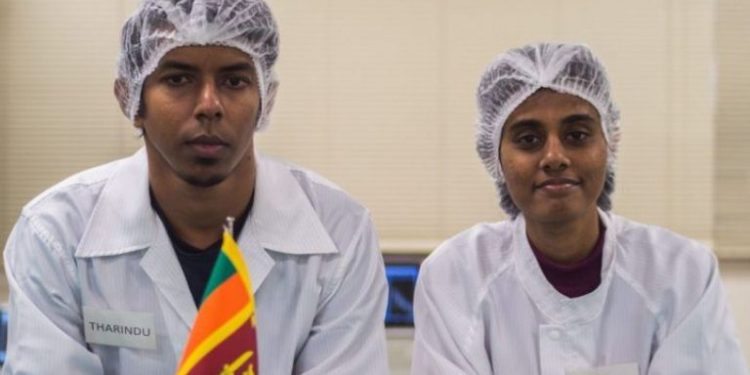
The successful launching of the first Sri Lankan-designed satellite ‘Raavana-1’ on June 17, established the capabilities of two young Lankan engineers, Tharindu Dayaratne and Dulani Chamika.
Tharindu Dayaratne is an electrical and electronics engineer of the University of Peradeniya and a research engineer at the Arthur C Clarke Institute for Modern Technologies in Sri Lanka. Dulani Chamika is a mechatronics engineer.
The satellite, which was designed and built at the Kyushu Institute of Technology in Japan, is 1000 cubic centimeters in size and weighs 1.1 kg.
Revival of Ravana
But the launching has also brought to the forefront of Sri Lankan consciousness, Ravana (or Raavana), the ancient Lankan monarch who is known to have excelled in technology, aviation, medicine, state craft and music. It was but appropriate, that the country’s first indigenously designed satellite was named Raavana-1”.
Ravana was related to the sky and flying. He is believed to have used a flying machine called Dandu Monara” to carry him to the various parts of his vast empire which stretched way beyond the island.
The Dandu Monara or Pushpaka Vimana” as it is known in India was also used to capture and whisk away Sita, Lord Rama’s consort. But as in India, in Sri Lanka also, Ravana is portrayed as a noble person who did not violate Sita’s modesty while in captivity. Again, as in India, Ravana is portrayed as an ardent Shiva worshiper and the composer of theShivathandawa Stotra.
However, unlike in India, the Ramayana is not part of the mainstream Sinhala-Buddhist tradition. In fact, in the 15 th.Century, when Shiva and Vishnu worship gained popularity among Sinhala-Buddhists, alarmed Buddhist monks carried out a campaign against it and the Ramayana too.
Prof K.N.O. Dharmadasa, Editor of the Sinhala Encyclopedia, mentioned a 15th century poet who ridiculed the Ramayana in his poems. The poet asked why Rama, a God, could not hop across to Sri Lanka like Hanuman did, and had to get a bridge constructed. Could a God’s power be so small in this world?” the poet asked in mock wonder.
Be that as it may, ancient Sinhala works like Rajavaliya and Ravanavaliya, identified Ravana as a Sinhala king and extolled him as a great one. And through the tale of Ravana, the epic Ramayana was told to the people.
Still from Lankan production Ravana Sithabhilashaya by J.B.Dissanayake and Namel Weeramuni.
History
In his bookSakvithi Ravana(first published in 1988) the Sinhala cultural nationalist Arisen Ahubudhu says that Ravana reigned over Sri Lanka from 2554 to 2517 BC. He quotesRavanavaliyato say that Ravana belonged to the Sun race” asRasignifies the sun andVanasignifies generation.
According to Ahubudu, Ravana’s ten heads represent the ten crowns he wore as a result of his being the sovereign of ten countries. Ravana’s ancestors are said to have ruled over what is now the Polonnaruwa district in North Central Sri Lanka. The name Polonnaruwa is said to be a derivative of the wordPulasthi, the name of the dynasty to which Ravana belonged.
Being a nationalist and the adherent of the Hela movement, Ahubudu trashed Valmiki Ramayana’s version that Rama invaded Sri Lanka because Ravana had kidnapped Sita. According to Ahubudu, Ravana’s step brother, Vibhishana, had invited Rama to invade Sri Lanka because he wanted to usurp the Lankan throne.
According to Prof Buddhadasa Hewavitharana, the Sinhalas disapproved of Vibhishana’s conduct. He said that in popular lore, the area to which he belonged to came to be known as the land of theDesha Shatru(betrayer of the country).
The Ramayana may not be in the mainstream of the Sinhala religious culture. But it is very much a part of Sinhala folk lore. As children were told stories from the Ramayana to illustrate ideas of good and bad, the moral and immoral,” Prof. Hewavitharana had told this writer some years ago.
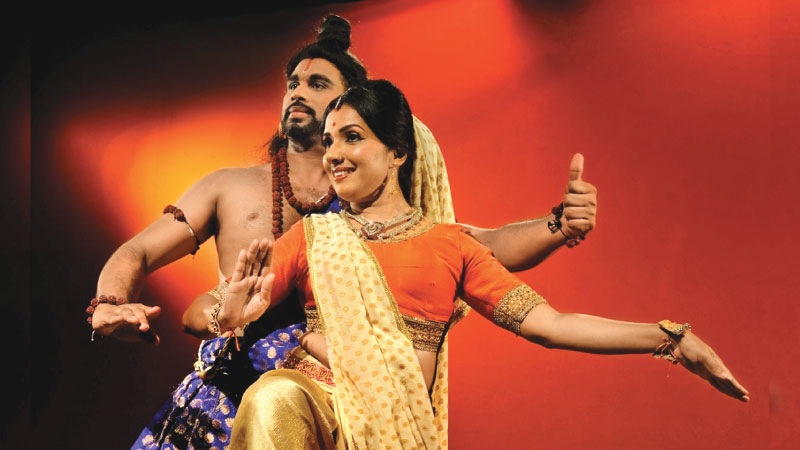
Noted playwright John de Silva had written the musical play Ramayanaya Nurthi” which was staged at the Tower Hall Theater in Colombo in the early 1930s. Prof.J.B.Dissanayake and Namel Weeramuni had scripted a play on Ravana and Seetha named Ravana Sithabhilashaya” which was popular. Recently, students of the University of Colombo staged a highly modernized and stylistically hybrid version of the Ramayana at the Nelum Pokuna which drew an appreciative audience.
Of course, in addition to all this, it is well known that there are places in Sri Lanka which are identified with the Ramayana, especially Ravana.
Sita Eliyain Nuwara Eliya district, where there is a South Indian style Hindu temple dedicated to Sita on the banks of a mountain stream, is adjacent to the place where Sita was confined by Ravana. Then there is a hill calledRavana Elle, which was supposedly the headquarters of Ravana.
Ravana’s Current Role
In modern Sri Lanka, Ravana has begun to play a role in instilling pride in the island nation’s past achievements and faith in its future, at a time when the country is beset with problems of identity and there is a decline in faith in the capability of its existing institutions.
There has been a movement to revive Ravana as a cult figure, who represents Sinhala or Sri Lankan nationalism. For example, the Ravana Balakaya, is a Sinhala Buddhist nationalist organization. It was formed by a group of politicized Buddhist monks and laymen led by Ven. Ittekande Saddhatissa Thero.
Deborah de Koning of the Department of Culture Studies, Tilburg School of Humanities and Digital Sciences, says in a paper published in 2018, that Sri Lanka is currently seeing a process of of Ravanization”. The Sri Devram Maha Viharaya in Pannipitiya near Colombo, founded by Ven.Sumangala Thero, specializes in deifying Ravana.
Indicating the Viharaya’s nationalist link, the 16 perch plot of land situated at Kotunna Road Pannipitiya on which the Devram Viharaya is built, originally belonged to Lt. Col. Sumith Dhammika Perera. But after he sacrificed his life at the battle front for the cause of Sri Lanka, the nation and Buddhism, his parents donated it to Ven.Sumangala Thero, says literature on the Viharaya.
De Koning notes that at the Viharaya, there are multiple conceptualizations of Ravana. But principally, they are Ravana as a healer and Ravana as a warrior. Conceptualizations from the broader Ravana discourse are ritualized in iconography, attributes, and sacred substances,” the sociologist says.
Two annual rituals for Ravana are organized by the Viharaya, namely, the Ravanaperahera(procession) which concentrates on Ravana’s martial side, and the Maha Ravana nanumura mangalyaya, which focuses on healing, his benevolent side.
Ravana holds a high position as a physician. According to Munidasa Kumaratunga, Ravana’s medical works were Nadi Pariksha,Arka Prakashata,Uddisa Chikitsaya,Oddiya Chikitsa,Kumara TantrayaandVatina Prakaranaya. Thesewere originally written in Sinhala and translated into Sanskrit, Kumaratunga says.
Musicianship
Dinesh Subasinghe, a young Sri Lankan musician and composer, has been trying to popularize the Ravanahatha”, a violin-like small instrument that Ravana had devised and played.
The Ravanahatha is made out of a coconut shell and bamboo, with horsehair or a natural fibre serving as the string. Goat or sheep gut and coconut wood are also used. Having been the first stringed instrument to be played with a bow, it is recognized as the world’s first violin.
Ravanahatha” or Ravana’s hand” is mentioned in the Ramayana,” Subasinghe claims. Its plaintive sound, resembling the Esraj of North India, is said to have moved Lord Shiva to grant Ravana a boon.
The Ravanahatha was picked up by Hanuman and flown to north India, where it is still played in Rajasthan and in Uttar Pradesh,” Subasinghe said.
(The featured image at the top shows young Lankan engineers Tharindu and Chamika)
Raavana, the ancient Lankan monarch who is known to have excelled in technology, aviation, medicine, state craft and music. Ravana is considered to be a descendant of Yakka clan in ancient Sri Lanka and the ancient dynasty of Sinhala people in Sri Lanka . Name “Yakka” believed to be derived from the Sinhala word yakada (Iron) since this ancient civilisation has historically mastered the technology of Iron smelting and producing steel for weaponry and household items.
Every Sri Lankan should watch this television epic which was produced successfully after a complete review of the historical evidences.
( Strongly Recommend you
to watch this on your TV through Youtube -search Ravana Episode 1
BEFORE the development of the blast
furnace, iron smelting was achieved by ore reduction at temperatures below the
melting point of the metal, forming an agglomerated ‘bloom’ of low-carbon iron
and slag. The forced-draught (bellows-operated) shaft furnace known from
archaeological studies is usually regarded as the pinnacle of this early smelting
technology1–3. Examples of
natural-draught furnaces, in which gas buoyancy in a shaft of sufficient height
induces a draught adequate to drive the smelting process4, are also known, but are generally regarded as
disappointingly inefficient by comparison5. Here I report the
discovery and excavation at Samanalawewa, Sri Lanka, of a previously unknown
furnace type. The furnaces are all situated on the western margins of hills and
ridges, where they are exposed to the strong monsoon winds. Field trials using
replica furnaces confirm that this furnace type uses a wind-based air-supply
principle that is distinct from either forced or natural draught, and show also
that it is capable of producing high-carbon steel. This technology sustained a
major industry in this area during the first millennium AD, and may have
contributed to South Asia’s early pre-eminence in steel production. https://www.nature.com/articles/379060a0
References
Simulation of ancient wind-driven iron smelting furnaces of Sri Lanka
Balangoda WIND POWER early iron production SERENDIB STEEL (Note the wind speed)
Ancient Smelter Used Wind To Make High-Grade Steel
SWORDS of super-hard Damascus steel helped Islamic armies sweep west to the doorstep of Christian Europe and fight the Crusaders to a standstill nearly a thousand years ago. While researchers have long known where the steel for these weapons came from, they weren’t sure of all the techniques used in making it.
Now evidence unearthed in Sri Lanka has shed new light on this early manufacturing process – and overturned some long-held assumptions. In particular, the findings indicate that the ancient metalworkers used unique furnaces that harnessed the mighty monsoon winds to produce high-quality steel on an industrial scale. Until now, experts have assumed that the steel would need to be refined through several steps. They had dismissed such wind-driven technology as impractical.
Moreover, these unique devices produced in one step steel that took competing technologies several steps to refine, according to archaeologist Gill Juleff, who made the discoveries and successfully tested full-scale reconstructions. The furnaces formed the basis for an iron and steel industry on the island that reached its zenith during the first millennium AD.
The ‘Panadura Vadaya’, the historic debate of 1873, was a landmark in
recent history of Buddhism in Sri Lanka owing primarily to the leadership,
initiative and actions of one of the greatest sons of our motherland –
Venerable Mohottiwatte or Migettuwaththe Gunananda Thera (1823-1890). He
defeated our nation’s adversaries and was the major force behind
re-establishing the identity and pride of Sinhala Buddhists who were subject to
undue oppression and discrimination during the colonial era. The significance
of Venerable Mohottiwatte Gunananda Thera’s can be better appreciated when one
considers the repressive colonial historical background and the appalling
conditions under which he pursued his highly risk-ridden but heroic and
courageous actions against powerful forces that had overall control over
affairs in the country.
EUROPEAN
COLONIAL POWERS *
With the arrival in 1505 of the European colonial powers for over 440
years, the Sinhala Buddhists, the dominant indigenous people of the island were
subject to severe harassment, discrimination and exploitation by the brutal
colonial masters on the one hand and their compatriots, the Catholic/Christian
missionary workers on the other. The latter virtually dominated the island with
the encouragement and assistance of the rulers to pursue their task of
converting Buddhists (and Hindu Tamils) to Christianity. People were forced to
change their traditional names and embrace Christianity if they wished to
obtain employment under their regimes. School systems that were installed were
instrumental is proselytizing Buddhists and Hindus.
VIOLATION
OF TERMS OF THE ‘UDARATA GIVISUMA’
Although the protection of Buddhism, its places of worship and the
Sangha, were guaranteed by the British, under the ‘Udarata Givisuma” or the
Kandyan Convention signed in 1815, once they had complete control over
the Kandyan kingdom, the British rulers disregarded this commitment and
resorted to actions that were aimed at undermining Buddhism and the Sangha
community. One such action was in April 1817, when they cancelled of the Poya
day holiday which the Buddhists have enjoyed since historic times, and in its
place declaring Sunday as a public holiday. The many actions taken by British
to undermine Buddhism incited the Maha-Sangha and the Sinhala people to revolt
against the British in 1818. The aim was to regain the lost rights of the
Buddhists. This national uprising was brutally suppressed by the British
killing many thousands including Buddhist monks, and causing widespread
property destruction, hardship and suffering to people.
EARLY YEARS OF HIS LIFE
Wadeehasinha Mohottiwatte Gunananda Thera was
born on February 09, 1823, five years after the ghastly event of 1818, and
throughout the early years of his life he was exposed to the severe hardships
and discrimination suffered by Buddhists in the hands of the Christian colonial
powers. He was born in the Mohottiwatte village in Balapitiya. The name given
to him at birth was Gingama Migel Mendis. In his early childhood he had a close
relationship with a Catholic priest who was residing in a nearby church. Some
reports state that his exposure to Christianity made him think of becoming a
priest later in life. However, later on, after coming into contact with
Bhikkhus of nearby temples including Gala Uda Viharaya in Dodanduwa, he was
more interested in learning Buddhism. His early education in Buddhism was at
the Subadraramaya Purana Viharaya in Balapitiya, under Balapitiye Gunarathana
Mahathera. He showed much interest in Buddhist studies and displayed
exceptional self confidence as a young boy.
When he was twelve years old, in 1835, with the blessings of his
parents, he was ordained as a Buddhist monk and the name given to him at the
ordination was Mohottiwatte Gunananda. He resided at the Balapitiye
Subadraramaya Purana Viharaya as a desciple or pupil of Thelikada Piyarathana
Tissa Thera. A few years later, with Balapitiye Gunarathana Mahathera, he moved
to Colombo, and resided with him at the Deepaduttaaraamaya in Kotahena which
was the first Buddhist Viharaya established in Kotahena Colombo in1832.
UNDERMINING
BUDDHISTS
In the early decades of the 19th century, the Christian influence was
dominant in the country, especially in Colombo. Conversion of Buddhists to
Christianity was a common practice during this period. Many converted for
personal material benefits and also adopted Christian names. The British
administration accorded greater opportunities for Christians to progress in
life, with better education and better employment opportunities.
Christian missionaries envisaged that the most effective way of
converting Buddhists was through church-based schools. The British colonial
administration encouraged and assisted this venture. The Missionaries enjoyed
absolute freedom to propagate Christianity by opening schools throughout the
country. Buddhist children attending these schools had bible lessons as a
component of their school curriculum. They were also exposed to various
Christian rituals, festivities and activities held in the church associated
with the school. Both children and their parents were exposed to the special
privileges and opportunities available for the school’s Christian children,
especially for those intending to pursue higher studies or seeking employment
in the public service. Inevitably, many Buddhist students eventually embraced Christianity
in later life.
By the third decade of the 19th century, there were more Christian
missionary schools in the country, assisted by the British administration, as
compared to Buddhist schools and pirivena schools combined which had negligible
assistance from government. There were government Sinhala medium schools which
were used primarily by the Buddhists, but none were established in the Kandyan
provinces which were almost exclusively traditional Buddhist areas.
ENGLISH
AS MEDIUM OF INSTRUCTION
In 1832, the British administration made English the medium of
instruction in all government schools which led to the closure of all
government Sinhala medium schools used by Buddhist children. They opened
English medium schools in urban centres in Colombo, Galle, Kandy, Chilaw and
Jaffna districts. At this time, the British established the Colombo
Academy or the present Royal College with the primary objective of producing
English teachers for the new schools. The establishment of Catholic and Christian
Missionary schools in the English medium also increased rapidly during this
time, with assistance from the colonial administration.
As far as opportunities for better employment, especially in the public
sector, English education was an essential requirement. Also, Christians
were accorded preferential treatment when it came to higher learning and better
employment. It is reported that owing to the establishment of English schools
and the preferential treatment accorded to those with English education and of
Christian faith, the tendency was for many thousands of Sinhala Buddhists
children who attended English medium schools to become Christians. As a counter
measure, the initiative of Buddhist scholar monks, several Buddhist schools
were started in different places in the country but they were faced with severe
challenges. It is reported that in 1870, there were only two Buddhist schools
in the country, in Panadura and Dodanduwa with an attendance of 246 children as
against 805 Christian schools with an attendance of 78,086 children.
The intensity of conversion activities was such that in 1850, James de
Alwis, Sinhala scholar, lawyer and theologian said that “before the end of
the century Buddhism would disappear from Ceylon”. The Christian churches
carried out a widespread campaign of propagating Christianity and discrediting
and humiliating Buddhist teachings. It was customary for Christian priests to
deliver public talks undermining Buddhism, which were openly insulting, abusive
and vituperative. Mohottiwatte Gunananda Thera was deeply distressed and
disturbed about the sad plight of Buddhists who were subject to discrimination
and harassment by the Christian church and the British administration. He
decided to move back to Balapitiya with Gunarathana Mahathera.
COPING
WITH PERSONAL TRAGEDIES AND RETURN TO LAY LIFE
A few years later, Balapitiya Gunarathana Mahathera passed away which
was a big loss for Mohottiwatte Gunananda Thera. A few months later, his
father died. He was faced with a serious problem of not having anyone to look
after his mother who was not in good health. This precarious situation led him to
give up robes and return to lay life in order to look after his mother.
He went back to his original name of Migel Mendis. A well known Christian
businessman in Balapitiya named Ibraham de Alwis who knew his parents, was
sympathetic to the plight of this young man and helped him financially to take
care of his mother. Although the young man was keen on being employed in order
to earn an income, Alwis the businessman objected to it because he thought that
the young man, Migel Mendis, who was a teenager by this time should be focusing
on furthering his education. He considered Mendis to be a smart and capable
individual. He introduced the young man to Peiris, a Christian teacher or
Catechist who took the initiative of admitting him to Wesley College in
Colombo. Wesley was a prominent Anglican Christian school in Colombo at this
time. Here, Mendis had the opportunity to learn English and Christianity. He
did well in his studies and won the admiration of his teachers because he was
able to memorize the bible and recite it.
In the meantime, his mother was ailing in Balapitiya and Mendis who was
in Colombo was depressed. He began to lose interest in studies and wanted
to be employed, so that he can earn an income and look after his mother.
Although he was able to find a job at the Observer Newspaper, he could not
continue with it because of the death of his mother. He was deeply depressed
and returned to Balapitiya. At this time, his uncle or his mother’s brother,
who was a Buddhist monk, known as Seenigama Deerarakkitha Thera, was living in
the Kotahena Deepaduttaaraamaya Viharaya. He assisted young Mendis who was in
his late teens at this time. Although he continued to live in Balapitiya,
on and off he visited his uncle at the Kotahena temple. During his stay in Colombo
as a student and in his visits to Kotahena he was well exposed to the plight of
Sinhala Buddhists who were subject to all forms of discrimination and
harassment by the British and their Christian compatriots and
henchmen.
RE-
ORDINATION AND SERMON AT DODANDUWA
During this period, Mendis renewed his relationship with temples and
many scholar Bhikkhus in Balapitiya and Dodanduwa. He was actively involved in
the program of writing the Thripitaka on ola palm-leaves that was taking place
at the Dodanduwa Gala Uda Viharaya. He developed great interest and skill in
this activity. After the completion of writing of the Thripitaka on the Ola
manuscript, it was the custom to ceremoniously donate it to the Chief
Prelate of the Viharaya at a grand religious festival. It was the tradition to
invite a well-known scholar Bhikkhu to give the special sermon on this day.
Mendis took a leading role in organizing this event and took the responsibility
of inviting a prominent bhikkhu to give the sermon. By this time he had made
acquaintance with many of the reputed scholar bhikkhus in the region.
A very large crowd gathered in the Viharaya for the festival. In the
evening when the festival was about to begin, young Mendis came to the Viharaya
in a most dignified manner with an ‘atapirikara’ in his hands. He walked
directly to Sonuththara Mahathera who was the Viharadhipathi (the Chief Prelate
of the temple), and respectfully handing over the atapirikara to him, requested
that he would like to be ordained again as a bhikkhu. He mentioned that he was
an orphan, with a fair exposure to Buddhism and is deeply committed to
Buddhism. He further said that during his stay in Colombo and in his
travels within the country, he has observed and realized the discrimination to
which the Buddhists were subject and how the Christian establishment was
carrying out a campaign to discredit and humiliate Buddhism. He said that he
has a deep desire to save the Buddha Sasana from being destroyed by
non-Buddhist forces. He respectfully requested that he be ordained immediately.
Deeply impressed by Mendis’s words and his courage, the Viharadhipathy
ordained this nineteen year old young man, under the same name he had before as
a bhikkhu – Mohottiwatte Gunananda.
When the time arrived for the climax of the festival to have the sermon
of a prominent scholar bhikkhu, Mohottiwatte Gunananda Thera appeared in the
bana-maduwa, in his yellow robes, in a most elegant manner, to the
surprise and utter joy of the crowd who loudly chanted ‘Saadhu Saadu”. His
well-known sermon on this day was on the Maha Mangala Sutta which thrilled the
large gathering of devotees. His sermon continued until the early hours of the
morning as was the custom at this time.
RETURN
TO KOTAHENA AND BEGINNING OF CAMPAIGN
Gunananda Thera obtained his higher ordination in 1844 when he was 21
years of age. This was at the Balapitiya Udakukkhepa Seemamalakaya. Thereafter,
he obtained further dhamma education from reputed scholar bhikkus at the time.
Subsequently, he moved to Kotahena Deepaduttaaraamaya where he established
himself permanently. At the time when Mohottiwatte Gunananda Thera, returned to
Deepadutthaaramaya in Kotahena he found that many thousands of Buddhists have
converted to Christianity in order to gain a livelihood. Knowledge of English
was essential to get ahead in life at the time and often, after learning
English, most Buddhists converted to Christianity in order to benefit by the
preferential treatment and to secure better livelihood.
The Kotahena Viharaya was at this time in the midst of an exclusively
Christian neighborhood and the Viharaya was surrounded by various Christian
establishments. This was the time when Christians, especially Christian priests
were quite active in openly conducting public talks against Buddhism and
Buddhists. These talks were directly offensive, slanderous and derogatory, and
contained information that was malicious and scornful. In fact, this
callous, insensitive and blasphemous attitude on the part of the Christian establishment
that motivated Buddhist leaders such as Mohottiwatte Gunananda Thera to
get to the forefront irrespective of the risks and challenges involved, in
order to respond to the hateful and profane material against Buddhism spread by
Christians, misleading the masses and undermining the faith and way of life of
indigenous people of the country for over 2000 years. One could argue that it
was the wrong and arrogant attitude of Christians that helped to create a
strong Buddhist force challenging the Christian dominance and influence at the
time. It was the lack of foresight on the part of the Christians that led to
extreme forms of unpleasantness and disharmony between the adherents of the two
religions, and the emergence of Buddhist leaders such as Mohottiwatte Gunananda
Thera, and finally the serious blow and setback, in actual fact the humiliating
defeat suffered by the Christians in the religious debates in late 19th century
culminating in the famous Panadura debate of 1873, which had international implications.
In 1849, when he was twenty-five years old, he held his first important
public sermon in Colombo Fort at a place called Kottambagahayata. During his
period of stay at Kotahena, Mohottiwatte Gunananda Thera travelled extensively
across the country giving pubic sermons to large gathering of Buddhists, on the
need to protect and promote Buddhism and Buddhist way of living. He emphasized
the need for Buddhists not to be victims of Christian conversion. He
highlighted the falsehoods in Christianity and argued against the criticisms
leveled against Buddhism by Christians. He showed the people the value of their
Buddhist cultural inheritance.
COUNTERING
UNJUST ACTIONS
During the latter half of the 19th century one of the cheeky and
disrespectful methods used by the British to undermine Buddhism was the cutting
down Bodhi trees and removal of Buddha statues in public places, especially at
roadside and road intersections. In the pretext of road expansion many Bodhi
trees and Buddha statues in and around Colombo city and other major urban
centres were removed or destroyed by the British. As a direct counter measure
against this unjust and reprehensible actions, Mohottiwatte
Gunananda Thera organized the Bodhiraja Committee” consisting of prominent Buddhist
leaders and began a huge campaign of replanting Bo plants and erecting Buddha
statues at places where these historic Buddhist symbols were removed by the
British. In addition, Mohottiwatte Gunananda Thera made a formal complaint in
writing to the British government in England against this unfair practice. This
led the British Administration to abandon this shameful anti-Buddhist practice.
SERMONS,
ORATORIAL SKILLS
Even as a young bhikkhu, Mohottiwatte Gunananda Thera was an indomitable
orator. He was admired by both the lay and ordained Buddhists for his
fearlessness, utmost courage and dedication to his cause of protecting and
promoting Buddhism in the face of many challenges he had to encounter in the
process. By about the middle of the 19th century, he had made over 4000 sermons
in different places in the country and was known nationwide as a Bhikkhu leader
with oratorical skills were unparalleled.
PROLIFERATION
OF PUBLICATIONS
The Christian missionaries were propagating their religion through
pamphlets and books. During the latter half of the 19th century, the Christian
establishment began a widespread campaign primarily by means of publications
strongly criticizing and undermining Buddhism and Buddhist practices. Many
books and pamphlets were produced by them. They had enormous funds and no
objections from the prevailing British administration to pursue this campaign.
They had the support of the news media which they used profusely to undermine
Buddhism.
The missionaries, who arrived in the island at the beginning of 1812,
also established printing presses in the country. The Wesleyan Press printed
and published the first Sri Lanka journal ‘Masika Thagga’ in 1832 and ‘Shathra
Nidanaya’ in 1846. The Ceylon Observer established in 1834 was the first
independent newspaper published in Ceylon. The Lakmini Pahana newspaper was
printed in 1862 at a press owned by Hendrick Perera. The first unregistered
Sinhala newspaper, Lanka Lokaya was printed in September 1860 at the
Lanka Loka Press in Galle. The first Sinhala Buddhist press was established in
July 1862 and was known as the Lankopakara Press. The establishment of this
press was a result of the Buddhist revival movement during the second half of
the nineteenth century. Bulathgama Dharmalankara Sri Sumanatissa Maha Thera,
the pioneer of the establishment of the Buddhist press, received necessary
financial assistance to establish the Press from the King of Siam (Thailand).
In 1849, Rev. D. J. Gogerly of the Wesleyan mission published ‘Christian
Pragnapthi’. e Mohottiwatte Gunananda Thera and Hikkaduwe Sri Sumangala Nayaka
Thera responded to criticisms leveled against Buddhism contained in Christian
publications, through the ‘Durlabdi Vinodimi’ and ‘Christian Vada Mardanaya’
and ‘Samyak Darshanaya’ during the period -1862-1863. Through journals like
‘Satya Margaya’, Satya Prakashanaya’, ‘Lakmini Kirula’, Christiani Wada
Vighataniya’, and ‘Reversa’ and thousands of pamphlets, the Mohottiwatte
Gunananda Thera refuted the wrong views that were held by Christians.
The Buddhists were seriously handicapped owing to lack of access to
printing facilities. Mohottiwatte Gunananda Thera rose up to the occasion and
with the support of lay devotees, soon made arrangements to purchase a printing
press. This led to a great proliferation of Buddhist publications. Many books,
magazines, newspapers and handouts were published as replies to the arguments
and criticisms leveled against Buddhism by the Christian establishment. They
also highlighted the value of the teachings of the Buddha in understanding
realities regarding life and as a path leading to the eradication of human
suffering. The basic Christian beliefs and concepts were subject to strong
criticism and questioning.
Mohottiwatte Gunananda Thera was well known for his writings and many
publications. His publication titled Bauddha Prasna” or Buddhist Questions was
exceedingly popular and at one stage over 24,000 copies were distributed. These
publications were of great appeal to the Buddhist public and the demand for
them increased rapidly. Most of these publications were made available to the
public at the sermons held countrywide by Mohottiwatte Gunananda
Thera. Among his many publications which were in great demand among the
Buddhists were Lakmini Kirula, Sathya Maargaya (journal), Riviresa, and
Bauddha Edahella. Among other popular publications were: Sathya
Prakashanaya (journal), Kristhiyaani Vigaathanaya, Bauddha Prasna,
‘Durlabdi Vinodimi’, ‘Christian Vada Mardanaya’, ‘Samyak Darshanaya’,
‘Lakmini Kirula’, Christiani Wada Vighataniya’, Lankakoka news paper,
Sarasavi-Sandaresa, Sinhala Bouddhaya, Bauddha Sahodaraya (Sinhalese Buddhist
Brotherhood) and thousands of pamphlets refuting the wrong views that were held
by the opponents of the Sinhala people and
Buddhism.
SCHOLAR
BHIKKHUS OF THE TIME
The Mid to late 19th centuries was a period that saw the rise of several
important scholar bhikkhus in Sri Lanka whose overpowering influence had much
to do with the survival and eventual revival of Buddhism in Sri Lanka. Their
impact was a definite reason for the strengthening of Buddhists as a force to
withstand and challenge the serious intimidation and threats to which Buddhists
and Buddhist education were subject during this precarious period in the
island’s history. Among the outstanding Bhikkhu leaders of this time were
the following:
Venerables –
Hikkaduwe Sri Sumangala (1827-1911) *1,
Weligama Sumangala (1825-1905) **2,
Dodanduwe Piyarathana Tissa (1826 -1904) ***3
Waskaduwe Subhuthi (1835-1917),
Walane Sri Siddartha (1811-1868)
Battaramulle Sri Subhuthi (1832 -1915)
Ratmalane Dhammaloka (1828 – 1887)
Kathaluwe Gunarathana (1832-1841)
Batapola Kalyanatissa (1810-1841)
Walpita Gunarathanatissa (1857-1920)
Bulathgama Dharmalankara Sri Sumanatissa
Koggala Sangatissa
Potuwila Indrajothi
Talhena Amaramoli
Mulleriyawe Gunaratana
Bentara Atthadassi
Randombe Dhammalankara
Walpita Sumanatissa
Mohottiwatte Gunananda (1823- 1890)
*1
Venerable Hikkaduwe Sri Sumangala Nayaka Thera, was one of the
pioneer monks of the Buddhist revivalist movement in the 19th century Sri
Lanka. The service rendered by him to the Buddhist Education is unparalleled.
He was the founder of Vidyodaya Pirivena Maligakanda. He was well versed in
Sinhala, Pali, Sanskrit, English, Buddhism, History, Arithmetic, and
Archaeology. As an erudite monk he has written many books and he started the
newspaper Lankaloka, and helped in the publication of
“Sarasavisandaresa” and “Sinhala Bauddhaya”. He was one of the
primary sources of information on Buddhism for Venerable Mohottiwatte Gunananda
his contribution meant much for the success of the Panadura debate. Col. Henry
Steele Olcott learnt Buddhism and Pali under guidance of Ven. Sumangala.
**2
Venerable Weligama Sumangala Thera was an outstanding scholar bhikkhu
with many important publications -Hitopadsesa Atthadassi, Hitopadsesa
Padarthavykanaya, Upadesa Vinischaya, Siddanta Sekaraya. His work Siddhanta
Sekharaya of 700 pages was printed at the Government Press in 1897. He
established Saugathodaya Vidyalaya at Rankoth Vihara Panadura. He was a close
associate if Sri Edwin Arnold the author of ‘Light of Asia’.
***3
Venerable Dodanduwe Piyarathana Tissa started the first Buddhist school
in Sri Lanka, under the name Jinalabdhi Vishodaka at the Saila-bimbaramaya
Temple in Dodanduwa, in spite of numerous challenges from the colonial
administrators. His intention was to spread Buddhist education in the island
and put an end to discrimination, deprivation and injustice caused to
Buddhists by colonial masters. In order to achieve this Piyarathana Thera
formed a Buddhist Society called ‘Lokartha Sadana.’ His work attracted the
attention Colonel Henry Steel Olcott several years before his arrival in the
island in1880 and the two parties communicated through letters. On the
initiative of Col. Olcott, Ven. Piyarathana Thera was conferred honorary
membership of the Theosophical Society based in the United States. They jointly
laid the initial groundwork for the revival of Buddhist education in Sri Lanka.
Olcott, on the guidance of Ven. Piyarathana Thera, formed the Buddhist
Theosophical Society in Sri Lanka.
DEBATES
SPEARHEADED BY VENERABLE GUNARATHANA
Mohottiwatte Gunananda Thera initiated and led many debates in defense
of Sinhala Buddhists. He consulted many of the scholar Bhikkhu leaders of the
time who were most forthcoming in providing Mohottiwatte Gunananda Thera with
necessary information and assisting him in various other forms. Debates were
conducted initially through exchange of articles between Buddhists and
Christians.
In 1865 was the so called Baddegama debate conducted through exchange of
articles between the two sides. What initiated this debate was a verbal
argument between Venerable Sumangala – a young Buddhist monk of a Vihara in
Baddegama and a Christian priest. The Waragoda debate followed in the same year
and in 1866 there were two debates, one at Liyanagemulla and other
Udanvita in the Satara Korale. In 1871 was the Gampola debate held with
Mohottiwatte Gunananda Thera and Pandit Batuwantudave for the Buddhists and
Rev. Charles Carter and his team for the Christians.
THE
PANADURA DEBATE
These debates culminated in the world famous debate held at Panadura
from the 26th to 28th August 1873. The occasion for the Panadura Debate was
triggered owing a highly offensive and scornful sermon delivered on the 12th of
June 1873 by the Protestant priest Rev. David Silva on the teachings of the
Buddha with reference to the human soul. This was delivered in the Wesleyan
Chapel in Panadura which is one of the first churches established by the
Wesleyan mission in the early part of the 19th century in an almost exclusively
Buddhist area, and in the immediate vicinity of the historic Galkanda or the
present Rankot Viharaya. At the time, this was a well known stronghold of
Buddhists and Buddhist leaders, both lay and ordained. The intension of Rev.
David Silva’s sermon was to disrepute and humiliate the Buddha. He criticized
the teachings of the Buddha in a most sneering and abusive manner. Both the
content of the sermon and the language used was malicious, slanderous and
scathing.
Buddhist leaders of Panadura were hurt and they decided to invite
Mohottiwatte Gunananda Thera to reply Rev. David de Silva. Mohottiwatte
Gunananda Thera came to Galkanda Viharaya (Rankoth Viharaya) on 19th June 1873
and delivered the reply speech denouncing as untrue the arguments of
Christians. However the people of either party were not satisfied with holding
speeches in separate venues and face to face formal debate was initiated by the
Christians. The enraged Protestant missions challenged Mohottiwatte
Gunananda Thera to hold an open verbal debate to establish the truth of the faith.
The monk accepted the challenge, and the dates for the historical face to
face debate was fixed with the agreement of both parties. Rules and regulations
were decided by the debating parties after consulting each other.
P. Jeromias Dias a Buddhist leader of Panadura at the time, prepared a
large stage and the pavilion in one of his lands called Dombagahawatte near
Galkanda Viharaya and the Wesleyan church. The pavilion was attractively
decorated. The Christians were represented by able men, the ablest debaters in
the island whom their church could have summoned. They included Revs.
David Silva, S. Langdon, Principal of Richmond College, S. Tab, S. Calls, C.
Jayasinghe, F. Rodrigo, the catechist Sirimanne, Mudliyar de Soysa, Dunupola
Nilame and assisted by a host of foreign and local theologians. The speakers
for the joint protestant delegation were Rev. David de Silva of the Wesleyan
mission and Rev. F. S. Sirimanne, a Catechist of the Church Missionary Society.
The Buddhist monks participating in the debate were Venerables:
Gunaratna Tissa Mahathera of Panadura, Hikkaduwe Sumangala Mahathera,
Weligama Sri Sumangala Mahathera, Ratmalane Sri Dharmaloka Mahathera, Waskaduwe
Sri Subhuthi Mahathera, Batuwanthudawa Devarakshitha Mahathera, Potuwila
Indrajoti Mahathera, Koggala Sangatissa Mahathera, Talhena Amaramoli Mahathera
and Mulleriyawe Gunaratana Mahathera. Mohottiwatte Gunananda Thera was to
lead the Buddhist side and be the sole speaker for the Buddhist delegation.
The crucial debate commenced at the appointed time of eight in the
morning each day and ended at five in the evening. The debate went on for two
days. On the first day there were over 10,000 people to hear and see the debate
from Panadura and the neighboring areas of Pasdun Korale and Raigam Korale,
including more than one hundred Buddhist monks. The debate ranged from the
nature of God, the Soul and resurrection on the one hand, to the concept of
Karma, Rebirth, Nirvana and the principle of Paticca – Sumuppada or dependent
origination.
BUDDHISTS
– THE CLEAR WINNERS
The debate took place in a peaceful manner and Mohottiwatte Gunananda
Thera delivered the closing speech in the evening of the final day, and refuted
effectively the malicious charges made against the teachings of the Buddha. At
the end of the debate, it was quite clear to everyone that that the Buddhist
side outshone others. Mohottiwatte Gunananda Thera presented the Buddhist
point of view in a most eloquent manner. His reasoning was exceptionally
powerful and his eloquence was most convincing which made the Buddhists the
clear winners of the debate. After the debate the thousands of people
left the grounds shouting “SADHU SADHU”, jubilantly expressing their
joy at the outcome of the debate.
The debate ended with a clear victory for the Buddhists. Mohottiwatte
Gunananda Thera not only replied effectively to the fallacies of the Christian
speakers, but also enlightened them on the principles and tenets of the
Buddhist doctrine. Buddhists were overjoyed with the outcome of this historic
debate. Festivities were held in every temple to mark their triumph and the
effigy of Mohottiwatte Gunananda Thera was carried in procession in every
village. This triumph became a great source of inspiration, strength and
courage for Sinhala Buddhists to work more vigorously to revive their lost
glory.
PUBLICITY
OF THE DEBATE
Newspapers such as the Lakrivikirana, the Ceylon Times and the
Ceylon Observer carried reports on the debate. The Ceylon Times which was the
leading English newspaper at the time sent a special representative to report
the proceedings of the debate. A complete report of all the speeches corrected
by the speakers themselves was published in English day by day. As arranged by
the Editor of ‘Ceylon Times’ named John Cooper, an English summary of the whole
debate was prepared by Edward Perera. This was printed in the form of a booklet
including the proceedings of the debate under the title “A full
Account of the Buddhist Controversy held at Panadura in August
1873”. Thousands of copies of this English translation were
published and distributed widely.
Dr. James Martin Peebles an American happened to be in Sri Lanka during
the time of the debate and had occasion to read the book on the debate
published by the Ceylon Times. Upon his return to USA, Dr. Peebles
published the book with an introduction explaining how the Buddhists in
Sri Lanka have shown the real position of Christianity. He gave the book the
title “Buddhists and Christianity Face to Face”. As a result
Europeans specially the intellectuals wanted to know about Buddhism and
directed their attention towards Sri Lanka.
IMPACT
OF THE PANADURA DEBATE
The aftermath and impact of the debate was extraordinary with far reaching
national and international implications. It soon became the major force behind
re-establishing the identity and pride of Sinhala Buddhists that was
diminishing rapidly under the deceitful, repressive and authoritarian practices
of the British Administration. Besides, the Panadura Debate contributed
immensely as an eye opener for the Buddhists. It helped to accelerate the
Buddhist Revival Movement.
Its international impact was equally significant providing the world
with a wealth of knowledge that greatly appealed to and appreciated by the
intelligentsia. It definitely helped to bring about increased awareness in the
western world, about the teachings of the Buddha. Colonel Henry Steel Olcott
and Madame Blawatsky were among those deeply influenced by the contents of the
book published by Peebles. After reading it Colonel Otcott become
deeply interested in Buddhism. He felt this is one of the religions he was
looking for to unearth the secret of the Universe. It was Mohottiwatte
Gunananda Thera’s eloquent presentation of the Buddhist point of view that
impressed him most. Olcott described Mohottiwatte Gunananda Thera as “the
most brilliant Polemic Orator of the Island, the terror of the missionaries,
with a very intellectual head, most brilliant and powerful champion of the
Sinhala Buddhism”.
HENRY
STEELE OLCOTT & THE BUDDHIST THEOSOPHICAL SOCIETY
Colonel Olcott came to Sri Lanka on the 17th May 1880, and joined forces
with Mohottiwatte Gunananda Thera and all prominent Bhikkhu leaders to help
accelerate the activities of the Buddhist revival movement that has gained
extraordinary momentum at the time. After he came to the island with the
support of Buddhist leaders he formed the Buddhist Theosophical Society where
he worked tirelessly for the revival of Buddhism in Sri Lanka. As a dynamic
leader of this movement, he was able to deal effectively with the colonial
rulers. The Buddhist Theosophical Society was instrumental in opening schools
to provide Buddhism- based education to the younger generation.
In 1881 full moon day of Vesak, Colonel Olcott, with the support of
prominent Bhikkhu leaders inaugurated at Kelaniya a Buddhist National Fund for
the promotion of the religious and secular education of Buddhist children and
the dissemination of Buddhist Literature. Starting in 1881 Buddhist Sunday
schools were started in several places within Colombo including Pettah,
Kotahena, Borella, Maradana, Barber Street, Messenger Street, Slave Island,
Peliyagoda and Panchikawatte. In 1886, the Sunday school in Pettah was
converted to the Pettah Buddhist English School which was soon subject to
improvement and became Ananda College. The initiative and interest taken by
Venerable Maha Theras such as Hikkaduwe Sri Sumangala, Mohottiwattte
Gunananda, Weligama Sumangala, Dodanduwe Piyarathana Tissa in furthering
Buddhist education and in the establishment of Buddhist schools received a
tremendous boost with the active involvement in this work of Colonel Olcott,
who was particularly keen in promoting Buddhist English schools. This gave much
strength to the Buddhist revival that was taking place across the country in
the late 19th century.
In 1888 there were eight Buddhist schools which increased to 99 in the
year 1898. In 1898 there were 11,577 children in Buddhist schools. The Roman
Catholics had 30,425; Wesleyans 22,808; Church of Mission 14,110. Thus
Buddhists had the fourth place in regard to the number of pupils in their
schools. In 1899 there were 134 schools in the list of Buddhist schools with an
attendance of 15,490 children. In 1900 the number of schools increased to 150
in the Buddhist Theosophical Society’s list.
By 1902 the success of Buddhist work was so alarming to the Christians
that the church missionary Society passed a resolution in that year against the
employment of Christians who had at any time served in Buddhist schools. But
this does not seem to have made much impression because in the following year
the number of Buddhist schools had risen to 174. No less than 185 schools
of the Society drew a sum of Rs. 48,502.90 from government by way of grant in
1904.
That same year the Rev. G.B.Ekanayake writing in East and West showed
a remarkable change in the attitude of the Christians church toward the
Buddhist revival. The contemptuous indifference which in the earlier stage
assigned to the revival an ephemeral existence and the violent opposition
subsequently directed against it. Ekanayaka did not hesitate to admit that the
current of Christian’s conversion had been effectually stemmed by the Buddhist
revival.
In 1907 there were 215 schools of the Society of which 186 with an
attendance of 23,975 had registered. In 1909 the number of schools increased to
224 and in 1914 to 230, and in 1915 to 249 schools. In 1917, the Buddhist
Girls’ College (now Visaka Vidyalaya) was started. The 17 Buddhist English
schools established under the Buddhist Theosophical Society with an
attendance of over 5,000 pupils with a staff of over 230 include Ananda
College, Colombo; Nalanda Vidyalaya, Colombo; Dharmaraja College, Kandy; Ananda
Sastralaya, Kotte; Olcott Vidyalaya, Colombo; Jinaraja Vidyalaya, Gampola,
Taxila Vidyalaya, Horana; Sri Pada Vidyalaya, Hatton; Rahula Vidyalaya, Katugostota;
Vijaya college, Matale; Anurudda College, Nawalapitiya; Buddhist English Mixed
School, Dodanduwa; Mahinda Vidyalaya, Anuradapura; Gamini Vidyalaya,
Bentota; and Suriya Vidyalaya, Kolonnawa. The Sinhalese schools that were
established at the time had an attendance of nearly 70,000 children.
BUDDHIST
DEFENCE COMMITTEE
On January 28, 1884, ten years after the Panadura debate, with the
initiative of Sri Sumangala Nayaka Thera, Mohottiwatte Gunananda Thera
and Colonel Olcott and the active participation of many lay Buddhist leaders,
the Buddhaarakshaka Committee or Buddhist Defense Committee was inaugurated
at a meeting held at the Vidyodaya Pirivena in Maligakande. Its primary
objective was the safeguarding Buddhist interests. Muhandiran A. P. Dharma
Gunawardana, Don Carolis Hewavitharana, H. A. Fernando, Carolis Pujitha
Gunawardana were elected as the office-bearers of the committee while Colonel
Henry Steele Olcott served as an honorary member. This Committee drew up six
demands which were submitted to the British government through Colonel Olcott
who visited England personally for the purpose in February 1884.
Subsequently a sub committee comprising Mohottiwatte Gunananda
Thera, Hikkaduwa Sri Sumangala Thera, Don Carolis Hewavitharana, A.P.
Dharma Gunawardana, William de Abrew, Carolis Pujitha Gunawardana, Charles A.
de Silva, N. S. Fernando, Peter de Abrew and William Fernando was set up to
look into the possibility of designing a prestigious symbol of identity for the
Buddhists. The blue, yellow, red, white and orange coloured flag designed by
Carolis Pujitha Gunawardana was unanimously accepted by the committee as the
most appropriate symbol of identity of the Buddhists.
The Buddhist Defense Committee was instrumental in obtaining the
approval of the British colonial government to restore the Vesak Poya holiday
enjoyed by Buddhists since historic times, which was abolished by the Dutch in
1770 and also the traditional Sinhala New Year holiday. Vesak Poya was declared
a public holiday on April 28, 1885 and a month earlier the Sinhala New
Year day was declared a public holiday. Vesak celebrations were held on a grand
scale in 1885 throughout the country.
HOISTING
OF THE BUDDHIST FLAG
The heroic Most Venerable Mohottiwatte Gunananda Thera hoisted the five
coloured Buddhist flag for the first time at the Deepaduththaramaya Temple in
Kotahena on the Vesak Full-moon Poya day of April 28, 1885. On this historic
day, the sermon given by him to thousands of Buddhists is considered as one of
his best. The flag was also hoisted at the Kelaniya Raja Maha Viharaya,
Hunupitiya Gangaramaya, Vidyodaya Pirivena and at the headquarters of the
Buddhist Theosophical Society in Colombo. Anagarika Dharmapala hoisted the
Buddhist flag at the Buddha Gaya temple on the Esala Full Moon Day in 1891.
This flag is recognized and adopted today as the Buddhist flag of the entire
international Buddhist community representing all Buddhist
traditions.
* The Portuguese Catholics were most
savage, cruel and inhuman persecutors of Buddhism and were responsible for
widespread and senseless killings and the destruction of many Buddhist temples,
monasteries and historical monuments and looting of valuable treasures. People
were subject to violence for over 150 years. They were forced to change
their traditional names and embrace the Catholic faith if they wished to obtain
positions under their regime. This state of affairs continued until they were
expelled from the island by the Dutch invaders. Among primary interests of the
Dutch was the propagation of Protestant Christianity and their policies and
actions against Buddhists were not too different to those of the Portuguese.
Embracing Christianity was necessary in order to take up employment in the
government. Christian baptism was made mandatory for the registration of birth
and no marriage was legally registered outside the church. The Parish School
system introduced by the Dutch missionaries was instrumental in proselytizing
Buddhists. They abolished the Poya holidays. This scornful period of Dutch rule
ended in 1796 when they were ousted by the British.
This
paper drew heavily from information contained in the following publications:
According
to updated data on 24 June, there are 30 more matches to be played before
semi-final. The top four teams as at present viz. England, Australia, NZ
and India have 13 games amongst themselves . There are 17 more matches
with all other teams.
NZ
and England have shown some degree of vulnerability thus far. Amongst the
current top 4 teams, England will face tough opponents of
Australia, India and NZ in their remaining encounters. NZ will face
Australia. Australia will face England and NZ. And India will face England. In
this case, England’s current standing likely to be exposed by Australia,
India and NZ.
SRI
LANKA Vs SOUTH AFRICA:
Last
time SL played ODI at Chester-Le-Street ground was way back in May 2014
against England. SL won by 157 runs. Sachitra Senanayake achieved 4
wickets. It is claimed to be a spin friendly pitch. This will be the
first time South Africa playing on this ground.
To
achieve victory, Sri Lanka must see off Imran Thahir. Kusal Janith, Kusal
Mendis, Avishkha must not try to attack Imran, instead if the players can score
15 – 20 runs off Imran without losing a wicket that will be stepping stone
towards victory. Imran is at his best at the moment.
SRI
LANKA V WEST INDIES:
West
Indies have played twice at Chester Ground in July 2000 against England
and Zimbabwe. On both occasions West Indies lost by massive 10 and
6 wickets.
SRI
LANKA V INDIA:
At
Leeds, Sri Lanka played 3 ODIs since 2006 against England, in all occasions, SL
won. In the most recently played match in June 2019 world cup against England,
substantial contributions were made by Avishkha, Kusal Mendis and Angelo with
the bat, whilst Malinga, Dananjaya and Isuru Udana excelled with the ball.
During the same period, India played 3 matches against England at this
ground, losing two and winning one match.
TEAM
PERFORMANCES:
Isuru
Udana is a better all-rounder, compared with Tissera Perera. Avishka Fernando
need to play in all three matches.
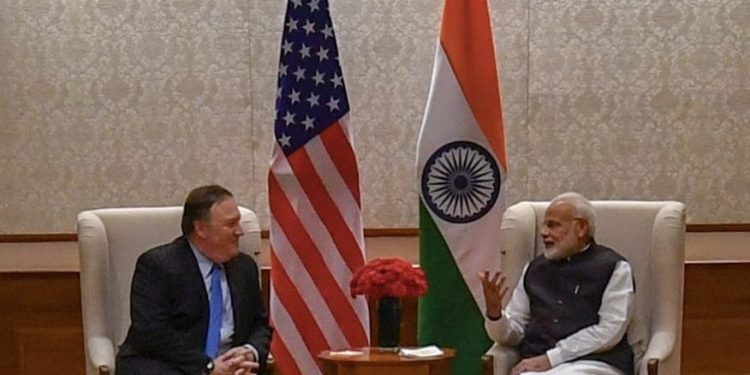
US Secretary of State Mike Pompeo will start a three-nation tour from June 24 through New Delhi, Osaka and Seoul, to advance the shared goal of a free and open Indo-Pacific” which is but a euphemism for containing expansionist China.
It may not be smooth sailing for Pompeo in New Delhi because there are grave trade issues between India and the US. American sanctions against Iran, Venezuela, and Cuba have affected India’s import of oil. Sanctions against Russia have affected weapons imports from that country.
Pompeo will be in New Delhi with a long wish list, and also offers which he hopes, will wean India away from dalliance with the Beijing and Moscow.
Indian Prime Minister Narendra Modi’s stance at the Summit of the Shanghai Cooperation Organization (SCO) in Bikshek on June 14, should worry the US as it indicated that India might lean towards China and Russia in an effort to be independent of the US.
The US policy of pressing India to fall in line with its foreign policy and its economic interests, and punishing India if it fell out of line have not gone down too well in New Delhi. India is now a different kettle of fish with Modi back in power in greater strength than before after the parliamentary elections.
Thus, Pompeo might well find Modi’s charming exterior hiding a hard interior.
Trade War
On June 5, the Trump Administration terminated India’s eligibility for a special trade status that allowed US$ 6 billion worth of Indian goods into the US duty-free. It is reported that more trade sanctions may follow as President Donald Trump pushes India to open up its medical devices, dairy products and retail markets to US companies. High Indian import duties irk US exporters. Tighter e-commerce rules, which were introduced earlier in 2019, have hurt Amazon and Walmart.
But Indians also have tales of woe to tell. The sanctions imposed by the US on Iran, Venezuela, Cuba and Russia are hurting Indian oil and arms imports. To India the US appears to be brazenly indulging in a modern version of gunboat diplomacy.
On June 16, India imposed retaliatory tariffs on 29 goods imported from the US. The 29 US goods include walnuts, apples, and some pulses. India and the US had been locking horns over the US decision to raise tariffs on Indian aluminum and steel products. The new Indian tariffs will impose a burden of US$ 220 million to US$ 290 million on the US.
However, to smoothen matters, Secretary of State Pompeo is expected to sugarcoat his demands. An indication of this was there in his speech at the US-India Business Council Ideas Summit on June 12.
Hoping to swing major concessions from Prime Minister Modi, Pompeo made extremely flattering remarks about him. Many observers were surprised by the result, but, frankly, I wasn’t. I’ve been watching closely. My team at the State Department was watching closely. And we knew – we knew that the Prime Minister was a new kind of leader for the world’s most populous democracy.”
He is the son of a tea seller who worked his way up to governing a state for 13 years and now leads one of the world’s truly emerging powers. He’s made economic development for the poorest Indians a priority. And, indeed, millions who once went without light bulbs now have electricity. And millions who lacked cooking stoves now have them,” Pompeo said.
We are eager to help India establish secure communications networks – including 5G networks,” he added, in a bid to keep the Chinese company Huawei away from the Indian market.
Pompeo also praised the new Indian Foreign Minister, S.Jaishankar, who is believed to be friendly to the US. He’s ready to cultivate a warmer relationship with America – and he knows that the feeling is mutual,” Pompeo said.
But for all the praise Pompeo heaped on the Indian leader and the Foreign Minister, there was no offer to help India build up its manufacturing sector which is lagging behind China.
Veteran Indian diplomat M.K.Bhadrakumar has pointed out that all that Pompeo might offer is shale gas at market prices and state-of-the-art fighter aircraft. To fund purchases, the US will help India raise private capital for years to come.”
Pompeo would want India to complete the Westinghouse civil nuclear project. In March, the US had agreed to build six nuclear power plants in India. But Westinghouse is in a bad way. And there is this controversial 2010 Indian law which says that in case of an accident in a nuclear plant, the provider of the technology, and not the operator, will bear the cost.
In an article written for the Observer Research Foundation in April 2019, Dr.Manoj Joshi says that the report that the US will help build six nuclear power plants in India should be taken with a pinch of salt.
When it comes to the US, inter-governmental declarations are not how business gets done. It requires working through a labyrinth of terms and conditions with companies and financial institutions. And, the nuclear-reactor business is not too healthy in the US,” Joshi writes.
He also points out that Westinghouse has just emerged from a Chapter 11 bankruptcy settlement on account of the construction of four AP1000 reactors in Georgia and South Carolina.
According to Joshi, the announcement of building six reactors in India came during Foreign Secretary Vijay Gokhale’s visit to the US and it seemed to have been aimed at pleasing Washington at a time when bilateral trade ties appeared to have hit turbulence. It was also a token genuflection towards the Indo-US nuclear deal of 2008, he remarks.
This deal, with its commitment to promote US nuclear reactor sales to India, came unstuck after India passed a stringent liability law (in 2010) that made the manufacturers, rather than the operator, primarily liable for damage in the event of an accident,” Joshi points out.
Cancelled Lankan Visit
The US has suffered a setback by cancelling Pompeo’s visit to Sri Lanka. The primary aim of Pompeo’s visit, slated for June 27, was to thrash out an agreement over some sensitive clauses in the controversial US-proposed Status of Forces Agreement (SOFA).
But SOFA is a too hot a potato for Sri Lankan politicians to hold in an election year because it is widely seen as a grave infringement of Sri Lanka’s sovereignty. Both President Maithripala Sirisena and Prime Minister Ranil Wickremesinghe are opposed to SOFA on the same grounds.
Sirisena had told Foreign Minister Tilak Marapona to make it clear to the US officials in Washington that SOFA is not acceptable, though US officials insisted that the issues were technical in nature and could be settled through further talks.
According to the Janatha Vimukthi Peramuna (JVP), SOFA would grant US military personnel, US military contractors and US military suppliers, the same perks and privileges granted to technical and administrative officers of the US Embassy.
The draft agreement also allows the above-mentioned personnel to enter the country with only a US Government Issued ID card (without a passport).
JVP MP Bimal Ratnayake, said that SOFA would take away Sri Lanka’s right to inspect any US vessels (aircraft or naval vessels) that enter Sri Lanka, adding that Sri Lanka will not be able to prosecute any of the personnel under Sri Lankan law for any offence, and that Sri Lanka would not have authority to inspect whatever they bring in or take out of the country.”
Recently, Defense Secretary, Gen.(Rtd) Shantha Kottegoda, told the Pathikada program on Sirasa TV, that SOFA should not be signed. He also said that no foreign troops are needed to protect Sri Lanka referring to provisions in SOFA in regard to the deployment of US defense personnel in the island.
Prime Minister Ranil Wickremesinghe says the National Thowheed Jamaat (NTJ) threat has been effectively neutralised and all those who had links to NTJ leader Zahran have been arrested. He assures that the country is now safe. Curiously, he is striving to have the government’s controversial Counterterrorism Bill ratified in a bid to replace the existing Prevention of Terrorism Act; he believes that the country has had to tackle the problem of international terrorism and there should be new laws. He is confident that his government has the backing of foreign powers to ward off the ISIS threat.
How can anyone be so sure that the ISIS really had a hand in the Easter carnage? The Hindu has reported that the ISIS was initially unaware of the Easter Sunday attacks though it claimed the responsibility for them, later on. If it had ordered the bombings, it would have lost no time in claiming the responsibility.
Of the seven Easter Sunday blast sites, four were in Colombo and one in a suburb—the Kochchikade Church, Kingsbury, Cinnamon Grand, Shangri-La and a guesthouse in Dehiwala. The others were in Negombo and Batticaloa. There were eight explosions including two at Shangri-La, and five of the blast sties can be connected with a line, which extends from Dehiwala to Kochchikade, skirting the Colombo Port City. Why were there two blasts at Shangri-La? Had Zahran been instructed by the person or persons who handled him to make sure that it suffered extensive damage? Was that hotel the main target?
As for the Dehiwala blast, why on earth did the terrorist on a suicide mission, the planning of which must have taken months, blow himself up in an unknown location? It is being claimed in some quarters that he was the person sent to attack Taj Samudra, but he left the place, having failed to trigger an explosion three times, and blew himself up in Dehiwala. There is no such thing as a defective suicide jacket that fails to explode thrice and then goes off. Interestingly, on 29 April, Archbishop of Colombo Malcolm Cardinal Ranjith told the media that St. Mary’s Church, Dehiwala had been among the terrorist targets, but the bomber had abandoned his plan and blown himself up elsewhere in the same area.
Meanwhile, UPFA MP Dayasiri Jayasekera has gone on record as saying that the NTJ bomber assigned to attack Taj Samudra did not carry out the blast due to the presence of some highly connected persons there. The CID and the TID have not requested MP Jayasekera to name them. What one gathers from this statement by no less a person than SLFP General Secretary Jayasekera, a trusted lieutenant of President Maithripala Sirisena, who is the Defence Minister and the Commander-in-Chief, is that information about the identities of the persons he has stopped short of naming will throw fresh light on the terror attacks.
Let it be repeated that all Easter Sunday blasts, save the one in Batticaloa, were on the littoral between Dehiwala to Negombo. China’s string of pearls is known to one and all, and the terror attacks in Colombo looked like a ‘string of blasts’ around the Port City being built by the Chinese, who are also trying to attract investors.
If the ISIS has been behind the Easter attacks, then nobody can claim that the country is safe, for it does not believe in one-off attacks; there must be more sleeper cells. Was Zahran handled by some other external outfit though the ISIS has claimed the responsibility for the blasts? Spy ops can be stranger than fiction if one goes by the confessions made by former top spies like Victor Ostrovsky, who authored ‘By way of Deception’, an explosive chronicle of his work as a secret agent.
The police ought to explain why they have chosen to ignore MP Jayasekera’s aforesaid claim.
COLOMBO (Reuters) – Sri Lanka is likely to raise $2 billion through 5-year and 10-year sovereign bonds launched on Monday, two government officials told Reuters, as the Indian Ocean island nation tapped global capital markets for the second time in three months.A man walks past a board advertising U.S. dollars at a money exchange shop in Colombo June 11, 2013. REUTERS/Dinuka Liyanawatte
The South Asian nation’s decision to capitalise on favourable market conditions comes two months after suicide bombers killed more than 250 people in attacks at churches and luxury hotels on Easter Sunday. That attack has badly dented the Sri Lankan economy, in particular deterring many thousands of foreign tourists from coming to the island.
We are planning to raise $500 million from 5-year bonds and $1.5 billion through 10-year bonds,” said a senior government official, who declined to be identified because he is not authorised to talk to media.
Both bonds have been oversubscribed three times during the day’s book building process in Asia and Europe alone. We are waiting for U.S. markets to finalise the deal.”
A senior finance ministry official also said the total size of the bond borrowing will be $2 billion.
A source who is aware of the deal said the price of 5-year bonds had tightened to near 6.4% from the initial price guidance of 6.6%, while 10-year bond price also got tightened to 7.6% from the initial price guidance of 7.8%.
The sale is part of plans to raise funds via sovereign bonds, as the government seeks new funds to repay loans that are maturing.
In March, Sri Lanka sold $1 billion in five-year bonds with a coupon of 6.85 percent and $1.4 billion in 10-year bonds with a coupon of 7.85 percent and the borrowing costs were lower than originally predicted.
The 10-year bond sold in March last traded at 7.302% and the five-year bond last traded at 6.258%, Refinitiv data showed.
BOC International, Citigroup, Deutsche Bank, HSBC, JPMorgan, SMBC Nikko and Standard Chartered Bank, who were the lead managers for the $2.4 billion borrowing in March, are the joint bookrunners for the bond sale.
The sale of new global sovereign bonds comes as Sri Lanka is struggling to repay foreign loans, with a record $5.9 billion due this year, including $2.6 billion in the first quarter and more than $1.2 billion in the second, central bank data showed.
All three major rating agencies downgraded Sri Lanka’s debt after President Maithripala Sirisena sacked his prime minister in October and replaced him with pro-China former president Mahinda Rajapaksa, though that decision was later reversed.
But the seven-week-long crisis hurt the rupee and drove sovereign bond yields higher, straining state finances.
Sri Lanka is unlikely to hit its full-year economic growth target of 3-4% following the bombings, junior finance minister Eran Wickramaratne told Reuters last month. A Reuters poll has forecast growth to slump to its lowest in nearly two decades this year.
Nine suicide bombers carried out a series of devastating blasts across three churches and three luxury hotels on Easter, killing more than 250 people.
Sri Lanka is absolutely safe. I can give you that guarantee: John Amaratunga MUMBAI:
In an effort to restore the Sri Lankan tourism following the Easter attacks in April, the country’s tourism minister John Amaratunga visited Mumbai to canvas his country as a safe destination.
Speaking on the sidelines of an event in Mumbai, Mr Amaratunga not only acknowledged Prime Minister Narendra Modi’s recent visit to Sri Lanka but also said the visit has boosted the potential for the country’s tourism sector to recover.
“That was a great deal of encouragement for Sri Lanka. It will particularly help us attract Indian tourists. He came and there was no risk in it. He also visited some of the churches that were damaged and it was very successful visit,” Mr Amaratunga said.
Nine suicide bombers carried out a series of devastating blasts across three churches and three luxury hotels on Easter, killing more than 250 people. The ISIS claimed responsibility for the attacks, but the Sri Lankan government blamed local group National Thawheed Jammath (NTJ) for the bombings.
“Sri Lanka is absolutely safe. I can give you that guarantee. I am speaking based on the reports from our military and there is absolute peace in the country,” Mr Amaratunga told NDTV.
However, Sri Lanka will report a decline in the number of tourists this year because of the terror attacks.
“If you look at incidents across the world, case studies prove that countries have taken 15 months to fully recover. If we do 2 million tourists this year it would be roughly a 30% decline in tourism and that’s not a bad number,” Kishu Gomes, chairman of Sri Lanka Tourism Promotion Board told NDTV.
Weighing his response against the doubts in the minds of tourist’s regarding visiting the Sri Lankan shores, Mr Amaratunga clarified that, “There are no problems in Sri Lanka. We have Sinhalese, Tamil and Muslims and they all live in close coordination. This attack was a singular group whose motives and activities can’t be explained. Rest of the Muslims in Sri Lanka are living in close coordination with the rest of the country. There are no problems at all.”
“The intelligence police and armed forces are confident that the situation in Sri Lanka is absolutely safe. There can be debates as it is a free country. The country is now normal and it is business as usual. There is no problem at all,” he clarified.
When asked about the deadlock between the Sri Lankan President Maithripala Sirisena and the Prime Minister Ranil Wickremesinghe, Mr Amaratunga said, “Our president and prime minister are working cordially. There may be some differences. We also have presidential elections coming up. Tourists are not interested in government. They are interested in safety and we can firmly give them that assurance.”COMMENT
“Initially there were contradictory statements by politicians but that lasted only for a few weeks. Later our military and defence secretary spoke to the global media and have assured safety. We have visited all embassies in Colombo to assure them with one consistent message and that led to relaxation of advisories within two weeks of the incident. No one needs to worry about what everyone else says, just go by what the military says,” Mr Gomes added.
Not only the ordinary British citizens, but also the Queen, the Prime Minister, and top leaders were also shocked when it was revealed that much trusted Chief of Intelligence, Sir Anthony Blunt was working as a spy for the Soviet Intelligence Service, the KGB. Blunt, a Cambridge don, was one of the most trusted public servants of Britain, until it came to light about his traitorous acts.
The revelation made in Parliament earlier this week that Former Foreign Secretary Prasad Kariyawasam, who is now an adviser to the Speaker is being paid by the United States Government sent ripples through the intellectuals as well as security circles, as such payments are highly detrimental to the national interests of Sri Lanka.
Opposition Leader Mahinda Rajapaksa said that Parliament is an independent institution, and if a senior adviser is being paid by a foreign country, the public might think Parliament is being manipulated by foreign entities. If any advisor is paid by Parliament there is no problem. But the issue here is that a person is being paid by another country and he is serving our Parliament. No one can be employed by Parliament when he is paid by another country. If his services are required, he should be paid by this Parliament,” he said.
Mahajana Eksath Peramuna (MEP) leader Dinesh Gunawardena questioned Speaker Karu Jayasuriya as to how Kariyawasam was appointed as his Foreign Affairs Advisor when such a position does not exist in Parliament. Gunawardena claimed that Kariyawasam was an individual who is being paid by the US Government, adding that they have serious concerns, that in addition to advising the Speaker, whether Kariyawasam also acts to gather critical intelligence for other Nations.”
Karunasena Hettiarachchi
Kariyawasam’s actions on behalf of the United States were disclosed by former Defence Secretary Karunasena Hettiarachchi earlier. The Defence Secretary was pressured by Kariyawasam, who was the then Foreign Secretary to rush through the defence agreement, Acquisition and Cross-Servicing Agreement (ACSA) between Sri Lanka and the United States. Media reports stated that Kariyawasam is now a US federal government employee.
MEP leader Gunawardena pointed out it was detrimental to national interests to employ a person who is paid by a foreign country. “It is unacceptable that a person paid by a foreign government is working for out Parliament. We have a right to question this. Why are you engaging a former Foreign Ministry Secretary as your advisor? There is IPU, which spends enough money on such matters. Similarly, there is the CPA, the SAARC and all of us pay for that.”
It is true that nobody has any apprehension on Speaker Karu Jayasuriya’s intentions, as he is of impeccable character, and he has national interests at heart. However, the analysts are of the view that when such intermediaries are paid exorbitant salaries by foreign governments, they are always liable to push the agenda advanced by their paymasters rather than work for national interests. Speaker Karu Jayasuriya pointed out that Prasad Kariyawasam, former Secretary to the Ministry of Foreign Affairs, is currently coordinating the parliamentary diplomacy group involving around 50-60 countries. He assists me in obtaining scholarships for parliamentarians, coordinating tours to learn about other Parliaments etc. We have no need to provide information to foreign countries,” he said.
Gunawardena said that on the Parliament list of positions, there is no such position specified. While Kariyawasam is getting paid by the US Government, how can he be appointed as your International Affairs Advisor? Moreover, how can he be paid? This gives rise to suspicion and puts the independence of Parliament in jeopardy.”
However, the Speaker insisted that there was no foreign interference and that the country’s sovereignty had not been jeopardised in any way.
Wimal Weerawansa
National Freedom Front (NFF) leader Wimal Weerawansa did not mince his words and alleged that Prasad Kariyawasam was the person responsible for pressuring the former Defence Secretary to sign the ACSA agreement. Prasad Kariyawasam’s beloved friend Maheshini Colonne was the individual responsible for pressuring the Government to sign the SOFA agreement with the United States,” Weerawansa said. When Kariyawasam was Sri Lankan High Commissioner in India, he was instrumental in getting Maheshini Colonne as Deputy High Commissioner. They both kept close connections with the US Embassy in New Delhi. Colonne later became a close confidante to then Foreign Minister Mangala Samaraweera. When Samaraweera became the Minister of Finance, Maheshini Colonne also joined the ministry.
According to the available information, Kariyawasam is employed by the US federal government-backed Agency for International Development (USAID), a federal entity. The agency’s Colombo Office has placed him as an Advisor to Parliament of Sri Lanka. USAID has been periodically helping and providing experts to help Parliamentary Oversight Committees.
The ACSA was signed on 4 August 2017. This was when the President was awaiting observations from the Commanders of the armed forces, at that time, expressing strong reservations. Defence Secretary Hettiarachchi told the President that he was pressurised by Kariyawasam to obtain Cabinet approval in a hurry. The leader of the NFF, Wimal Weerawansa stated that Kariyawasam was not being paid by the American Government to further Sri Lanka’s interests, adding that the Speaker has given refuge to American serpents” inside Parliament.
The company which was tasked with implementing a US$ 13 million, US Government programme to strengthen democratic governance and accountability was Development Alternatives Incorporated, commonly known as DAI. DAI is active in a number of regions across the world, as well as in countries including Georgia, Haiti, Iraq, Kosovo, Afghanistan, Myanmar, Nepal, Cambodia and Kenya. The functions of DAI include Legislative Strengthening, Decentralization and Local Government Management, Institutional and Policy Reform Public Administration, Civil Service Reform, and Human Resources Management, Voice and Accountability, Law and Justice, Public Financial Management and Health Governance.
The power rivalry in Asia is developing rapidly, and Sri Lanka should be wary about entering into defence pacts with foreign powers, as this Island-Nation risks becoming a battleground for the vested interests of global superpowers.
Signing SOFA
There were indications that the US would insist on signing SOFA during the visit of US Secretary of State Michael R. Pompeo to Sri Lanka on 27 June. The visit has now been cancelled, and the US Embassy announced that due to unavoidable scheduling conflicts during his upcoming visit to the Indo-Pacific region that includes accompanying President Donald J. Trump to the G20 Summit in Japan, US Secretary of State Michael R. Pompeo is unable to visit Sri Lanka as previously announced.” The announcement added that Pompeo hopes to travel to Sri Lanka at a later date to underscore our strong partnership with Sri Lanka, which is rooted in a commitment to democracy, economic growth and a free, open Indo-Pacific region.”
The postponement of Pompeo’s visit would give Sri Lanka sufficient time to study the clauses in SOFA thoroughly, and seek opinions of security forces and military experts, before finalising the agreement.
Attorney General Dappula de Livera has indicted three former LTTE members, in the Vavuniya High Court, over the killing of 26 prisoners of war.
The accused, Irasathurai Thiruwarul, Madirasan Sulakshan and Ganeshan Darshan along with another person, who has not been identified by the prosecution, have been indicted under 2(1)(a) – ‘Causing the death of persons’; 2(2)(1) – and 3(b) of the Prevention of Terrorism Act and Sections 113(b) – ‘Conspiracy’ and 102 – ‘Abetment’ of the penal code.
On 16 January 2009, the accused, Thiruwarul, Sulakshan and Darshan along with another had shot dead and set fire to 18 Navy personnel and eight Army soldiers, during the final stages of the separatist war,in the Valipuram area, a few days before the capture of Kilinochchi by the Sri Lankan Armed Forces.
When the case was taken up before the Vavuniya High Court Judge Ramanathan Kannan today (24), the prosecution sought to amend the indictment. Although the defendants objected to the amended charges 18 to 28, the High Court Judge dismissed the objections and decided to go to trial, considering the submissions by the prosecution.
The trial was postponed until tomorrow (25) and the 66th and 68th witnesses were ordered to appear in Court tomorrow.
The Attorney general has advised the Acting Inspector General of Police (IGP) to conduct a criminal investigation into the former Defense Secretary Hemasiri Fernando.
Accordingly, the former Defense Secretary will be investigated over the failure to prevent or minimize the Easter Sunday bomb attacks.
The Attorney General has given these instructions referring to recommendations of the final report of the special board of inquiry appointed to inquire about the Easter attacks, stated the Coordination Officer to the Attorney General State Counsel Nishara Jayaratne.
Previously, the AG called for criminal investigations against 9 police officials including 3 DIGs over their lapses of duty thereby failing to prevent or minimize the attacks.
The Supreme Court has ordered to consider the Fundamental Rights (FR) petition filed by Inspector General of Police Pujith Jayasundara, challenging the President’s decision to send him on compulsory leave, on July 31st.
The petition was taken up before the three-judge bench consisting of Supreme Court Justices Prasanna Jayawardene, L.T.B. Dehideniya and S. Thurairajah today (24).
Speaking on behalf of the Attorney General, Additional Solicitor General Indika Devamuni de Silva stated that the Secretary to President and the former Director of State Intelligence Service, two respondents of the petition, have raised objections against the petition through affidavits.
Attorney-at-Law Viran Corea, appearing on behalf of the IGP, told the court that he is yet to receive the copies of the affidavits.
Justice Prasanna Jayawardene then stated that the judge bench has not received the copies of the affidavits thus far.
The three-judge bench subsequently announced that the IGP Jayasundara’s FR petition would be considered on July 31st and ordered the attorneys of the respondents and the petitioner to present submissions regarding the matter on that day.
President’s Consel Anuja Premaratne spoke on behalf of former Defence Secretary Hemasiri Fernando while President’s Counsel Shanaka Ranasinghe appeared on behalf of the former Chief of National Intelligence Sisira Mendis.
Responding to a question raised by Justice Prasanna Jayawardene, Attorney-at-Law Viran Corea stated that the disciplinary authority of the IGP is the Cabinet of Ministers although he is appointed by the President on the recommendations of the Constitutional Council. He added that the National Police Commission is not the disciplinary authority of the IGP.
Justice Prasanna Jayawardene pointed out that the President serving as the Minister of Law and Order at the time when the IGP was sent on compulsory leave is main debatable point in the hearing of this FR petition.
Petitioner Pujith Jayasundara says that President Maithripala Sirisena appointed him as the Inspector General of Police as per the recommendations of the Constitutional Council in 2016.
The IGP further says, despite observing some fractions in the relations between the President and the Prime Minister, he continued to serve as an unbiased public officer.
Under the orders of the President, he was not summoned to the meetings of the National Security Council since October 2018, the IGP has pointed out through his fundamental rights petition. However, he emphasized that he had informed then Defence Secretary and the Deputy Inspectors General (DIG) of Police regarding possible terrorist attacks.
The IGP further points out that the National Intelligence Chief directly details the President on the intelligence reports.
On 29th April, Inspector General of Police (IGP) Pujith Jayasundara was handed Compulsory Leave over investigations on the Easter Day attacks.
The Speaker of Parliament, members of the Constitutional Council, the Attorney General, the acting Inspector General of Police and several others were cited as the respondents of this petition, which was filed on May 29th.
The IGP stated that he was sent on compulsory leave as per the orders of the President, however, this has violated his fundamental rights.
He has said that the decision to send him on compulsory leave is completely against the law as the President is not vested with such powers.
Accordingly, the IGP seeks the Supreme Court to hear the petition and to deliver an interim order to void the decision to send him on compulsory leave until the hearing concludes.
As
regards the topic under discussion, the revolution I forecast cannot be an
armed uprising. The servile military and armed forces of the SYSTEM will, with
the blessings of their local leaders and foreign masters, mow down the Sinhala
youth as they did in 1971 and 1989 without the least fears of charges of
genocide. Such is the value of the famous TRI-SINHALA for the foreign
exploiters of this country.
But
we vividly recall the unprecedented event which was the MARXIST led uprising of
1953. It united not only the Sinhala but the entire nation. What result did it
produce? It sent Dudley and his government scampering helter-skelter like rats
for refuge into a British warship anchored in the harbour. They had
relinquished their charge through fear for their skin. Confronted by the nation
in uprising, the army was rendered helpless.
The
Marxist initiative bore no result because the Marxist leaders the hunters, were
of the same class as the hunted, The Marxists of that time were exploiting the workers, to ensure for themselves the same
bourgeois life style as the other political party leaders. This is what
prevented them from setting themselves up on the empty vacated throne. And so
the strikers who had penetrated the empty citadel of government were
unceremoniously sent back empty handed and highly deluded.
It
was furthermore the god-less Marxist led strike that paved the way for the
downtrodden caste-less Tamils to occupy the Vishnu Kovil during the
Maviddapuram revolt. The mighty Sunderalingam who guarded the temple gun in
hand, even firing the first shot of the battle, was unceremoniously pushed
aside by people whose shadow he would not tread.
We
also know how the Buddhist monks sided with the Marxists in events leading to
Independence. The monks were accused by the powers that were joining hands with
anti-religious forces. But Buddhism is not a religion in the strict sense of
the term. They sided with what was right for the nation. The Marxists of that
period are a spent force now, but NOT the monks.
We
saw how Rathana Thero’s fast united the Sinhala population threatening an
island-wide strike and a march on Colombo, that brought this rotten Gamarala
SIRA and the even more rotten Ranil to their knees and accelerated the asked
for resignations. It is such a mass revolution that can save this country. An
outcome from within the present legal system is an unrealistic wish. It will
not work. The radical change the country needs will not be brought about from
within existing constitutional structures, so putrid, so decrepit, so reeking
with the unbearable stench of corruption and every imaginable illegality. Just
imagine a head of State who violated the constitution several times in a row
still remaining in office with impunity?
The
political powers must be brought to their knees by a rebellious country-wide
uprising that will march from all directions on Diyawanna Oya, with saffron
robed leaders at their head. The Diyawanna Oya Bastille must be stormed, not
with hammers and sickles as did the rural French, but by motivated, determined,
and unrelenting Sinhala masses led by the founders of their age old
civilization: THE MONKS.
It
is the monks who are the veritable founders of our civilization. They were the
mentors and educators of our greatest kings. They put the ones on the throne
and brought down others. We recall how Arahat Mahinda even tested the
intelligence of Devanam Piyatissa with his riddle about the mango trees. It is
Mahinda who told the political power: you are only a TRUSTEE. The trustees come
and go but the founders, the architects of our civilization, the writers of the
Mahavamsa, founders of Theravada Buddhism, compliers of the Tri-Pithaka, unshakeable
opponents of colonial rule paying with their lives for their convictions, are
the monks. They remain watching over the Sinhala nation. They will not allow
mere trustees to assume ownership of power over the nation on a foreign gifted
DEED that is this constitution.
The
monks are our saviours. Only they can save this nation from falling over the
precipice to which the rabid mad-men of the Diyawanna Oya mental hospital have
brought it. There is no time to wait and ponder. It is NOW or never. RISE you
yellow-clad guardians of the TRI-SINHALA. GALVANIZE the Sinhala, and put to
rout the enemy within who has undone all that you built over two thousand six
hundred years, falsely clothed in their FAKE Buddhist piety. This deception has
reached the end of its tether.
This article is focussed on
xenophobic, caste & religious focussed racial Sinhalese, Tamils, and
Muslims suffering from Islamophobia. Majority Kandyan Sinhalese are, caring and
loving people, except some xenophobic and racial. Let us not take this
personally and have an open mind to read and understand whether facts stated
here are true or not.
History
reveals that the war against Sinhalese by the Muslims started in 1915, which
was named the Mankollai”. A prominent Tamil had to intervene to stop the war.
Again in 1974, the racial riots between the Muslims and Sinhalese caused severe
destruction and killings. It was speculated then that swords were supplied to
the Eastern Muslims by Libya after the riots in 1974.
Analysis
If one
carefully exam the demographic and political structure since 1948 one can
understand the following:
The
first column of political disturbance gave birth in the form of terrorism in
1971 by the Sinhalese youths known as JVP” in 1971 which was mixed reaction
among the society. Therefore, terrorism and armed struggle were invented in
SriLanka by the Sinhala youths in 1971. Srimavo ordered the killing of
Sinhalese youths (JVP) indiscriminately resulting in her removal of civic
rights subsequently on some other charges.
The
second column was the LTTE commenced in 1972 formally, although it fired up
sporadically among the Tamil youths since 1970. The LTTE took the wrong path
when they bombed Sri Dalada
Maligawa and the Central Bank which in the platform of justice is
HUMAN RIGHTS VIOLATION. This is measured as a pure terrorist act like killing
their own mother. LTTE was assumed to have been theoretically eliminated in
2009, resulting in doubts raised whether Pottamman and VP are still alive in,
maybe in Italy.
The
third column was the Catholic church bombing in 2019 by the Islamic radicals
under guidance by top Muslim politicians financed by the foreign Islamic
republic to thrust their religion and Sharia Laws in SriLanka and convert
SriLanka into an Islamic state. (Everyone in SL now knows that this terrorist
act was by the ISIS). Why did the Jihadis choose Tamil Church to be bombed
killing Indian Tamils? It is a presumption that it was a conspiracy similar to
the 9/11 bombing. Still, the GOSL continues to argue and debate in parliament
without arresting the parties concerned. It is beyond any doubt that it was a
conspiracy and every top politician knew the bombing will occur. It is strongly
presumed that even top TNA members (ex. Sambanthar) knew the bombing. It is the
duty of the government to protect the minority.
The
racial issue was started by DSS by disfranchising the Indian estate workers
followed by SJVC forming the Federal Party which had naught to do with the
disfranchisement, however out of personal egoism of SJVC. This was followed by
SWRDB enacting the Sinhala only act in 1956. SJVC and Amirthalingam through
some sources managed to drive the Tamil youths to take up arms and operate as
Urban Guerrillas.
During
Srimavo as PM, she managed to brainwash Badruddin Mohamed to become the
Minister for Education and enact the standardization law which walloped the
Tamil students and retarded the progress. In Democracy one who gets the highest
votes gets elected. Strictly, those who get good score should become the top
knots Therefore, the prescription got confused by the politicians to take the
wrong path. Does it mean that those who qualified under the standardization are
second class professionals? Most of the PMs ran to the LINGAMS” to be their
advisors. Can anyone say why?
In the
early days, Tamil engineers were employed in the Irrigation, PWD, Building and
all government sectors. All government offices were managed by Tamil clerks. It
is no fault of them anyway. The North had good schools. Instead of
disfranchising and introducing Sinhala as the official language and standardization,
the GOSL could have built high-grade schools in the South.
It is
the Sinhalese who were governing SriLanka as majority since 1948, not the Tamils.
majority rules under democracy. The majority had devastated and destroyed
SriLanka over the last 71 years and brought the country to the current level as
beggars. Every foreign country is screwing SriLanka.
The
Sinhalese always state that it is Ape Anduwa” but missed the bus and
eventually the bus will be a full load of Muslims.
SL, the
guy who had 16 seats in parliament was appointed Leader of Opposition.
Sambanthar has two faces. (i) which was bought for the position of Leader of
Opposition, (ii) LOP Car facility, (iii) House, (iv) Security provision.
However, when he turns to the North, he states that he is fighting for missing
persons”, which is considered cheating”. Therefore, Sambanthar and TNA,
including CVV, can be strongly viewed as CheapMendicants”.
The
Islamic strategy is presumed to be as follows without a doubt:
Join
hands with the Sinhala government as the Muslims think that Sinhalese have a
very low perception, but large in numbers.
Increase
their demographic pattern. Quote: Components of Population Studies are: Demographic processes and events:
five major components: a) Fertility, b) Mortality, c) Migration, d) Marriage/
nuptiality e) Population structure (age and sex structure or composition)
Population dynamics. Demographic measurements and methods.
Settle
in pockets of Tamil and Sinhala areas. GOSL can see the settlers in the North
and South. East is already colonized.
Take
action to reduce the births of Tamils and increase the death of Tamils, which
the dirty Muslims are implementing in the North and East. Quote ¨https://www.jvpnews.com/srilanka/04/223921
Through
democracy capture the Northern PC. East is already in their hands.
Once
the N&E government is in their hands, then start to move into the South and
Central.
Eventually,
SL will become an Islamic state like Indonesia, Bangladesh Pakistan, etc. This
is how they are moving to make France, Brussels, and the Europe Islamic states.
The
Sinhalese people should understand their (Muslims) strategy and take corrective
action. The Sinhalese think that Tamils are their enemy cos of the 70 million
Tamils in Tamil Nadu. The real dormant enemy to the Sinhalese is the Muslims
of SriLanka. LTTE evicted Muslims from Jaffna. Maybe Prabakaran knew Muslims
strategy and did not want the takeover to occur. Maybe Prabakaran is a wise
man. The author requests leading Sinhala strategists to do analysis and study
the demographic pattern, actions, politics, history of the Muslims of SL. The
undereducated 5th/6th standard Sinhala Politicians should
get out of politics and leave room for intellects and educated qualified youths
to come forward to assume political power, not western suckers’ and
janissaries.
In a
speech, Hezbollah states that they will join hands with the Sinhalas to capture
the East.
Buddha
was a born Hindu, and Buddhism and Hinduism are blood-related philosophies. Let
the Sinhalas not hate the Tamils but accept Tamils and live in cohesion. It is
the Tamils who are the Majority in the World. It is only after the Rajapaksa
regime assumed power Tamils were able to live securely safely in SL, however, things
have now turned upside down as before under UNP regime.
Colombo, July 23 (newsin.asia): The Indian External Affairs Minister Dr.S.Jaishankar lauded the India-funded Sri Lankan Emergency Ambulance Service as it achieved all-island coverage on Sunday.
Speaking over video from New Delhi, Dr. Jaishankar spoke about his personal connection with the project since its inception, and said that the service has become a brand in itself.”
The Emergency Ambulance Service (EAS), which is being run with a grant of US$ 22. 7 million from India, became an all-island service with extension to Ampara in Eastern Sri Lanka, on Sunday.
The island-wide expansion of the Emergency Ambulance Service is complete. The service is now available in all nine Provinces of Sri Lanka,” the Indian High Commission declared in a statement
Indian envoy Taranjit Singh Sandhu flags off an ambulance in Ampara as Lankan ministers Harsha de Silva and Daya Gamage look on.
The service in Ampara was inaugurated by the Indian High Commissioner Taranjit Singh Sandhu; Minister of Primary Industries Daya Gamage; Minister of Economic Reforms Dr.Harsha de Silva; and Deputy Minister for Petroleum Resources Development Anoma Gamage.
Dr.Jaishankar
Indian Foreign Minister Dr. Jaishankar is an experienced Sri Lanka hand, having served in the Indian High Commission in Colombo from 1988 to 1990 as First Secretary and political advisor to the Indian Peace Keeping Force (IPKF.
Having visited the island nation several times, Dr.Jaishankar is very familiar with Lankan personalities across the political and ethnic spectrum and is cued into developments in the island nation.
In his long and illustrious career as a diplomat, Dr. Jaishankar has served in Sri Lanka, Russia and Japan . He was India’s Ambassador to United States of America, China, Czech Republic and High Commissioner to Singapore.
Dr.Jaishankar was responsible for implementing Prime Minister Modi’s Neighborhood First” policy and increased engagement with regional initiatives like the Bay of Bengal Multi-Sectoral Technical and Economic Cooperation (BIMSTEC).
He was also instrumental in encouraging India’s people-oriented development projects in Sri Lanka.
Indian envoy Taranjit Singh Sandhu speaks at the inauguration of the ambulance service in Ampara
Spirit of India Is Spirit of Sharing”
In his address at the inaugural, Indian High Commissioner Taranjit Singh Sandhu said that the project symbolizes the spirit of India, which is nothing but the spirit of sharing.”
He also reiterated that India will forever remain the First Responder for Sri Lanka.”
The Service
It was during the visit of Prime Minister of India Narendra Modi to Sri Lanka in March 2015, that a request was made by Prime Minister Wickremesinghe to launch a pre-hospital emergency ambulance service in Sri Lanka.
Accordingly, the 1990” Emergency Ambulance Service was launched in Southern and Western Provinces in July 2016 under an Indian grant of US$ 7.5 million. This grant covered purchase of 88 ambulances, operational expenditure of the service for one year and setting up of an emergency response center.
Given the positive impact of the project, Prime Minister Wickremesinghe requested the Prime Minister of India for extension of the Emergency Ambulance Service all across the island.
Indian envoy Taranjit Singh Sandhu and Lankan ministers being shown the well-equipped ambulance
Prime Minister Modi then announced the expansion the ambulance service island-wide under a Government of India grant assistance during his visit to Sri Lanka in May 2017.
An additional grant amount of US$ 15.02 million was provided by India to undertake island-wide expansion which covered the purchase of 209 ambulances, operational expenditure of the service for one year and training costs.
The island-wide Emergency Ambulance Service was started with the launch in Jaffna in July 2018 wherein Prime Minister of India Narendra Modi joined Prime Minister of Sri Lanka Ranil Wickremesinghe through a live video conference from New Delhi.
The service has been available in Northern Province since July 2018; in Uva since August 2018; in North Central Province since September 2018; in North Western Province since October 2018; Central Province since November 2018; and in Sabaragamuwa Province since January 2019.
The Indian High Commission said that the service has been well appreciated, given the quick response time, efficiency of operations, and employment and training involving local people.
The emergency ambulance service which can be obtained by simply dialing the toll free number: ‘1990’ on any network in Sri Lanka, is the largest Indian grant project in Sri Lanka after the Indian Housing Project.”
India remains committed to further strengthening the bilateral partnership with Sri Lanka based on Sri Lanka’s own choices and priorities and through effective implementation of people-oriented projects,” the High Commission said.
President Maithripala Sirisena states that the country will benefit only if the 18th and 19th Amendments to the Constitution are abolished.
President Sirisena on Sunday called for repealing the 19th Amendment to the Constitution which has curtailed the presidential powers, blaming it for the political instability in the country.
The 19A was the main election pledge of President Sirisena when he challenged former president Mahinda Rajapaksa as the Opposition’s common candidate in 2015. Rajapaksa in 2010 had moved the 18A which allowed him to contest the presidency any number of times by lifting the then existing two-term bar.
President Sirisena in 2015 introduced the 19A, which reduced the presidential term for five years while taking away his absolute control over the dissolution of Parliament.
The 19A has also barred two-term presidents from running for a third time.
However, the President, addressing a gathering here on Sunday, blamed the 19th Amendment for the political instability in the country.
It has been four years since we formed the government. It is time to conduct a post-mortem with only four months to go before the next election,” he said, addressing a gathering here today.
The biggest mistake of this government was the 19th Amendment. It created instability,” the President said.
People accuse us of running an unstable government. They say that me and Prime Minister (Ranil Wickremesinghe) are pulling in different directions…the reason is the 19A,” he said.
President Sirisena was made to introduce 19A as a concerted civil society action to make the presidency accountable to people. The reform process was expected to lead to a new Constitution by abolishing the presidential system — a long held demand since it was enacted in 1978.