By P.K.Balachandran/Daily Mirror Courtesy NewsIn.Asia
Colombo, June 17: Last week, there were two very important international gatherings in the Central Asian region with the involvement of a large number of Asian and Eurasian countries including Russia, China, India and Sri Lanka.
One was the summit of the Shanghai Cooperation Organization (SCO) at the Kyrgyzstan capital of Bishkek on Friday, and the other was the Conference on Interaction and Confidence Building Measures in Asia (CICA) at the Tajikistan capital of Dushanbe on Saturday.
The eight-member SCO comprises: India, Pakistan, China, Kazakhstan, Kyrgyzstan, Russia, Tajikistan and Uzbekistan. Afghanistan, Belarus, Iran and Mongolia have Observer Status. The CICA is a much larger body of 27, comprising: Afghanistan, Azerbaijan, Bahrain, Bangladesh, Cambodia, China, Egypt, India, Iran, Iraq, Israel, Jordan, Kazakhstan, Kyrgyzstan, Mongolia, Pakistan, Palestine, Qatar, Russia, South Korea, Sri Lanka, Tajikistan, Thailand, Turkey, UAE, Uzbekistan and Vietnam. The US and Japan have Observer Status in CICA.
Alternative to US
In both the SCO and CICA, the most important countries are Russia and China with India trying to catch up. The two bodies provide a non-US rallying point. The present US-centric world is being gradually replaced by a bi-or a multi-centric one. This is because all the key members have faced some problem or the other with the US and are seeking alternative support systems.
The Bishkek Declaration emphasized the need to fight the three forces of evil,” namely, separatism, terrorism and extremism. Member countries are to challenge cross-border crime” and build a multi-polar” world order (in contrast to the present US-dominated one).
CICA members are seeking a common, comprehensive, cooperative and sustainable security and are to promote development and progress based on common understandings reached so far.
They reaffirmed their commitment to effective multilateralism, with the United Nations at its core, and to maintaining and promoting peace and stability, pursuing peaceful settlement of disputes without resorting to the threat or use of force, in accordance with the UN Charter and international law.
The declaration said that the CICA will develop dialogue on a regional security architecture that is open, inclusive and based on universally recognized principles of international law and the UN Charter, and promote international relationships based on mutual respect, fairness and justice, and mutually beneficial cooperation.
The members stressed a cooperative approach to fighting terrorism and separatism. They felt that separatism is a threat to national sovereignty, unity, territorial integrity, security and stability.
They also expressed readiness to strengthen cooperation in accordance with international and respective national laws, in countering transnational organized crimes and corruption, such as drug trafficking, financial crimes, money laundering, human trafficking, trafficking in cultural property and illicit arms flows in all their forms.
The member states reiterated their unwavering support to the Iran nuclear deal, called for reviving negotiations on the Middle East peace process, and underlined that the peace and reconciliation process in Afghanistan should be inclusive, Afghan-led, and Afghan-owned.
CICA members said that inclusive and sustainable economic growth as well as elimination of poverty and illiteracy, are among the most effective measures to remove the breeding grounds of terrorism and extremism.
The leaders called for greater market access and non-discrimination in trade. They welcomed all initiatives of the member states to promote and strengthen cooperation in various fields, including economy, finance, transport and trade within the geography of the CICA at bilateral and multilateral levels.
The members stressed the importance of building an open world economy enabling all countries and all peoples to share the benefits of globalization. They remained firmly committed to a rule-based, transparent, non-discriminatory, open and inclusive multilateral trading system centering around the World Trade Organization, taking into consideration its reform process, and firmly opposed to all forms of protectionism.
Lanka’s Concerns
President Maithripala Sirisena raised the issue of powerful countries interfering in weaker countries using human rights issues as an instrument. The reference was clearly to the US and the West, but Sirisena did not name them
Though bilateral issues could not be raised in such forums, the Indian Foreign Minister S.Jaishankar spoke about the dangers of cross-border terrorism and the non-inclusive and non-transparent development aid given to countries, putting them into debt. But this was done obliquely without naming the countries concerned, namely, Pakistan and China.
With the US trying to get out of its futile and costly misadventure in Afghanistan, the SCO could take on the role of peace-builder and development promoter in that war-ravaged country.
Iran-US
While other countries couched their anger against antagonistic forces in generic terms, Iran’s President Hassan Rouhani told a receptive audience that the US has been violating all the international structures and rules and using its economic, financial and military resources, has taken an aggressive approach, and presents a serious risk to stability in the region and the world.”
In the context of the US sanctions against Iran, Rouhani revealed that a joint Iran-Russia Commission for Cooperation meeting is in the offing this week.
Turkey-Israel-US
Turkey used the CICA meeting to condemn US actions for recognizing Jerusalem as the capital of Israel. Anger against the US had to come out in these forums, given the fact that the US has a trade war going against China, has sanctioned Russia and Iran, and has taken a hostile posture vis-à-vis Turkey, for buying the S-400 air defense system from Russia.
At SCO’s Bishkek Declaration reiterated support for upholding multilateralism and developing equal partnership. It sought an effective and constructive multilateral mechanism to promote national development and prosperity. All parties pledged to enhance mutual understanding and communication through the SCO.
Terrorism And Separatism
All member states reiterated their support to the UN-centered international system. They strongly condemned terrorism of all forms, vowed to step up efforts to counter terrorism and to firmly oppose the use of counter-terrorism or counter-extremism, as an excuse to interfere in other countries’ internal affairs or profit from it.
Regarding issues related to Syria, the SCO stressed that dialogue is the only way to resolve problems, noting that collaboration within the framework of the Astana process had created necessary conditions for the implementation of UN Security Council resolution 2254. However, the US disagrees and disregards the Astana process drafted by Iran, Turkey and Russia.
On the issue of Afghanistan, SCO supports the efforts of Afghanistan and its people to rebuild peace and promote stable economic development and reaffirms its support for the Afghan-led and Afghan-owned” political reconciliation process at the bilateral level and within the SCO-Afghanistan Contact Group framework.
India’s Future
India, which is the third big player in SCO, has plans to join the connectivity projects in Central Asia. It has already established itself in the Chabahar port in Iran. But India’s economic links with Central Asia is much weaker compared to China and Russia.
India’s bilateral trade with Central Asia stands at about US$ 2 billion. But China’s trade with the same region is over US$ 50 billion. Lack of connectivity has hampered development of energy ties between India and the hydrocarbon-rich countries of Central Asia and India.
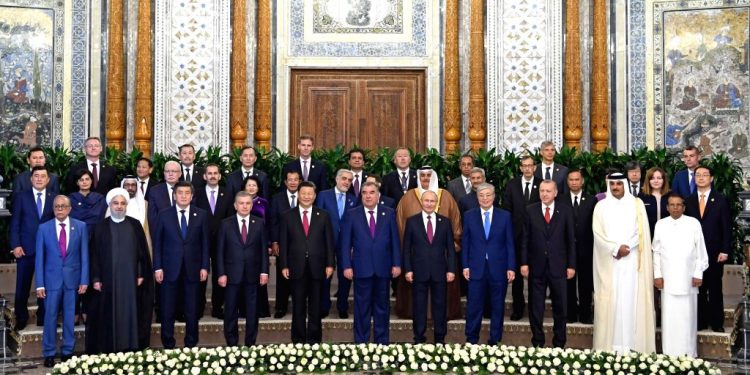
The opening of Chabahar port and entry into the Ashgabat agreement give India launching pads in the region. These should be utilized by India for having a stronger presence in Central Asia and Eurasia. The Ashgabat Agreement, instituted in April 2011, is meant to establish an international multimodal transport and transit corridor between Central Asia and the Persian Gulf.(The featured image at the top shows President-Maitrhipala Sirisena representing Sri Lanka at the CICA conference at Dushanbe in Tajikistan)
By M.K.Bhadrakumar/Indian Punchline Courtesy NewsIn.Asia
The Bishkek Declaration, issued after the summit meeting (June 14-15) of the Shanghai Cooperation Organisation devotes one sentence praising China’s Belt and Road Initiative: The Republic of Kazakhstan, the Kyrgyz Republic, the Islamic Republic of Pakistan, the Russian Federation, the Republic of Tajikistan and the Republic of Uzbekistan reaffirm their support for China’s Belt and Road Initiative and praise the results of the Second Belt and Road Forum for International Cooperation (which was held in April 26).”
India kept aloof. Any surprises here? Not, at all. In broad daylight, India had been shouting and screaming from the roof top that the BRI was no good, that it led to ‘debt trap’. India’s condemnation of the BRI was so impolite bordering on crass rudeness in the pre-Wuhan [a Xi-Modi Summit last year] era with then Foreign Secretary S. Jaishankar once even called Chinese President Xi Jinping by name at an international conference in New Delhi and counselled him as to how to go about executing his pet project.
But times have changed. Neither did India block the Bishkek Declaration nor did other member countries try to shove the Chinese project down the Indian throat. They didn’t even have to agree to disagree. The fact of the matter is that India’s condemnation of the BRI got toned down to criticism over time and incrementally mellowed to a deafening silence through the past year or so. PM Narendra Modi paid no attention to the BRI in his speech at the SCO summit.
Modi preferred instead to work on the Wuhan Spirit”, conveying to Xi Jinping at their extremely fruitful” meeting in Bishkek on June 13 that in the period since April last year, strategic communication between the two countries has improved” at all levels and in that context only some of the long-pending issues such as Masood Azhar’s designation as global terrorist could be resolved.
Curiously, when the Indian media insists that it is the ubiquitous Americans who swung the Azhar designation for India by coming down hard on Beijing, Modi gives credit to the India-China strategic communication! The winds of change are palpable. To quote the Foreign Secretary Vijay Gokhale, So we see this (Modi-Xi meeting in Bishkek) as the beginning of a process after the formation of government in India, to now deal with India-China relations from both sides in a larger context of the 21st century and of our role in the Asia-Pacific region in this regard.” (Transcript)
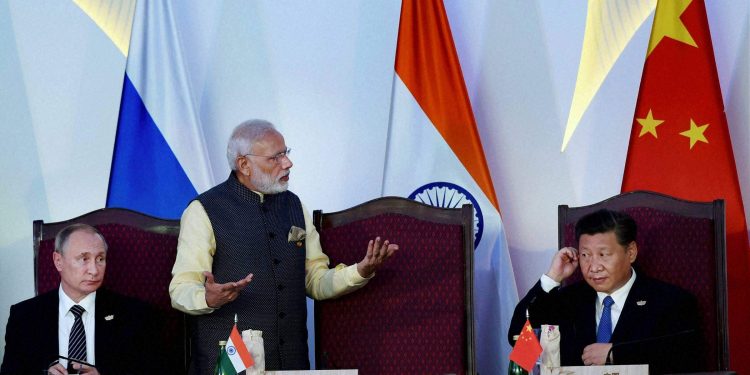
The SCO summit has been an eye-opener. Modi had two outstanding ‘bilaterals’ — with Xi Jinping and Russian President Vladimir Putin respectively and they highlight that India’s relations with these two countries have been put on a high trajectory. Modi and Xi are to meet thrice during the remaining six-month period of the year alone — plus, of course, Xi’s expected informal summit with Modi sometime in autumn (in Varanasi?).
Equally, Modi has accepted the invitation from Putin to be the Chief Guest at the Eastern Economic Forum in Vladivostok in early September and the two leaders are also to meet each other at Osaka at the G20 Summit and at the BRICS summit. Indeed, Putin is also due to visit India this year for the annual summit and there is also some talk in the air regarding another informal” summit.
Without doubt, the little-noticed vignette out of the SCO summit is that the leaderships of Russia, India and China have agreed to have a trilateral meeting within the RIC format, too, alongside their summits on the bilateral track. And, the venue will be the Osaka — on the sidelines of the G20 summit (which will be attended by President Trump and where a galaxy of western leaders is expected.)
If international diplomacy indulges in symbolism, this must be one of the most poignant ones in world politics in the recent times. The RIC has always been a red rag for the US — ever since the great Soviet strategic thinker and Kremlin statesman Yevgeny Maksimovich Primakov first proposed the tantalising idea in 1999. The profound symbolism cannot be lost on Trump that India is consorting with the two revisionist powers” on the planet (Russia and China) which, according to the US, are each working its way toward making a power grab on the world stage.
The SCO summit in Bishkek becomes defining moment in India’s foreign policy. Modi has wetted his toes in Eurasianism. His disenchantment with the defining partnership” with the US can only partly account for it. The crux of the matter is that Modi is taking Indian diplomacy away from its obsession with geopolitics and making it a handmaiden of his national policies. Both Xi and Putin sense this.
The Xinhua report on Xi’s meeting with Modi harps on geoeconomics. Equally, one of the highlights of the Putin-Modi meeting is the Russian invitation to India to get involved in cooperation in the Arctic. Now, China also happens to be a key partner country for Russia to create a Polar Silk Road” in the Arctic Sea. Beijing has announced that China would be pursuing investment across the Arctic Route to encourage commercial shipping through Russia’s Northern Sea Route as a part of the Belt and Road Initiative.
This is indeed a massive undertaking involving investment programs worth trillions of dollars, which will go toward connecting Asia and Europe by sea to promote more trade between the continents. The Wall Street Journal reported last week that China is breaking into Arctic transport through a joint venture between the country’s biggest ocean carrier, Cosco Shipping Holdings Co., and its Russian counterpart PAO Sovcomflot to move natural gas from Siberia to Western and Asian markets.”
The report adds, The new venture will ship liquefied natural gas from central northern Siberia’s gargantuan Yamal LNG project to a laundry list of destinations including Northern Europe, Japan, South Korea, and China. The initiative will begin with a fleet of a dozen ice-breaking tankers, and Cosco’s China Shipping LNG Investment Co. will reportedly operate another nine tankers.”
Foreign Secretary Gokhale disclosed at his media briefing in Bishkek that Modi has decided that India should engage with Russia in the Arctic region oil & gas and we have already began that engagement. A delegation from Ministry of Petroleum & Natural Gas has already had discussion with the Russian side last month and this is something that the leaders felt we should take forward.” The Russian Deputy Prime Minister and the Special Representative of President Putin for the Arctic region, Yury Trutnev is arriving in India on June 18 for talks in this regard. The Indian-Russian Strategic Economic Dialogue, which from our side is headed by the Vice Chairman of the NITI Aayog, will take place in July.
Suffice to say, the big picture that emerges out of all this is that Modi is connecting the dots and creating synergy between India’s strategic communication with China and Russia respectively. It is an audacious strategy but holds infinite possibilities. Consider the following.
China-Russian entente is rapidly developing into a quasi-alliance. On the other hand, India’s relations with Russia have not only recovered from the neglect of the UPA era but are blossoming into a truly strategic partnership attuned to the 21st century, thanks to the warm friendship between Modi and Putin. Succinctly put, Russia is uniquely placed to help strengthen the incipient signs of the Wuhan Spirit maturing into an enduring strategic understanding between India and China as two emerging powers with great many common interests.
The fact that Modi and Xi exuded confidence to accelerate the negotiations for a border settlement alone underscores that the Russia-India-China triangle has become very dynamic. Truly, the RIC summit in Osaka provides underpinning for the concert of the three Asian powers. To be sure, the West won’t like what is happening.
By M.K.Bhadrakumar/Indian Punchline
The Bishkek Declaration, issued after the summit meeting (June 14-15) of the Shanghai Cooperation Organisation devotes one sentence praising China’s Belt and Road Initiative: The Republic of Kazakhstan, the Kyrgyz Republic, the Islamic Republic of Pakistan, the Russian Federation, the Republic of Tajikistan and the Republic of Uzbekistan reaffirm their support for China’s Belt and Road Initiative and praise the results of the Second Belt and Road Forum for International Cooperation (which was held in April 26).”
India kept aloof. Any surprises here? Not, at all. In broad daylight, India had been shouting and screaming from the roof top that the BRI was no good, that it led to ‘debt trap’. India’s condemnation of the BRI was so impolite bordering on crass rudeness in the pre-Wuhan [a Xi-Modi Summit last year] era with then Foreign Secretary S. Jaishankar once even called Chinese President Xi Jinping by name at an international conference in New Delhi and counselled him as to how to go about executing his pet project.
But times have changed. Neither did India block the Bishkek Declaration nor did other member countries try to shove the Chinese project down the Indian throat. They didn’t even have to agree to disagree. The fact of the matter is that India’s condemnation of the BRI got toned down to criticism over time and incrementally mellowed to a deafening silence through the past year or so. PM Narendra Modi paid no attention to the BRI in his speech at the SCO summit.
Modi preferred instead to work on the Wuhan Spirit”, conveying to Xi Jinping at their extremely fruitful” meeting in Bishkek on June 13 that in the period since April last year, strategic communication between the two countries has improved” at all levels and in that context only some of the long-pending issues such as Masood Azhar’s designation as global terrorist could be resolved.
Curiously, when the Indian media insists that it is the ubiquitous Americans who swung the Azhar designation for India by coming down hard on Beijing, Modi gives credit to the India-China strategic communication! The winds of change are palpable. To quote the Foreign Secretary Vijay Gokhale, So we see this (Modi-Xi meeting in Bishkek) as the beginning of a process after the formation of government in India, to now deal with India-China relations from both sides in a larger context of the 21st century and of our role in the Asia-Pacific region in this regard.” (Transcript)
The SCO summit has been an eye-opener. Modi had two outstanding ‘bilaterals’ — with Xi Jinping and Russian President Vladimir Putin respectively and they highlight that India’s relations with these two countries have been put on a high trajectory. Modi and Xi are to meet thrice during the remaining six-month period of the year alone — plus, of course, Xi’s expected informal summit with Modi sometime in autumn (in Varanasi?).
Equally, Modi has accepted the invitation from Putin to be the Chief Guest at the Eastern Economic Forum in Vladivostok in early September and the two leaders are also to meet each other at Osaka at the G20 Summit and at the BRICS summit. Indeed, Putin is also due to visit India this year for the annual summit and there is also some talk in the air regarding another informal” summit.
Without doubt, the little-noticed vignette out of the SCO summit is that the leaderships of Russia, India and China have agreed to have a trilateral meeting within the RIC format, too, alongside their summits on the bilateral track. And, the venue will be the Osaka — on the sidelines of the G20 summit (which will be attended by President Trump and where a galaxy of western leaders is expected.)
If international diplomacy indulges in symbolism, this must be one of the most poignant ones in world politics in the recent times. The RIC has always been a red rag for the US — ever since the great Soviet strategic thinker and Kremlin statesman Yevgeny Maksimovich Primakov first proposed the tantalising idea in 1999. The profound symbolism cannot be lost on Trump that India is consorting with the two revisionist powers” on the planet (Russia and China) which, according to the US, are each working its way toward making a power grab on the world stage.
The SCO summit in Bishkek becomes defining moment in India’s foreign policy. Modi has wetted his toes in Eurasianism. His disenchantment with the defining partnership” with the US can only partly account for it. The crux of the matter is that Modi is taking Indian diplomacy away from its obsession with geopolitics and making it a handmaiden of his national policies. Both Xi and Putin sense this.
The Xinhua report on Xi’s meeting with Modi harps on geoeconomics. Equally, one of the highlights of the Putin-Modi meeting is the Russian invitation to India to get involved in cooperation in the Arctic. Now, China also happens to be a key partner country for Russia to create a Polar Silk Road” in the Arctic Sea. Beijing has announced that China would be pursuing investment across the Arctic Route to encourage commercial shipping through Russia’s Northern Sea Route as a part of the Belt and Road Initiative.
This is indeed a massive undertaking involving investment programs worth trillions of dollars, which will go toward connecting Asia and Europe by sea to promote more trade between the continents. The Wall Street Journal reported last week that China is breaking into Arctic transport through a joint venture between the country’s biggest ocean carrier, Cosco Shipping Holdings Co., and its Russian counterpart PAO Sovcomflot to move natural gas from Siberia to Western and Asian markets.”
The report adds, The new venture will ship liquefied natural gas from central northern Siberia’s gargantuan Yamal LNG project to a laundry list of destinations including Northern Europe, Japan, South Korea, and China. The initiative will begin with a fleet of a dozen ice-breaking tankers, and Cosco’s China Shipping LNG Investment Co. will reportedly operate another nine tankers.”
Foreign Secretary Gokhale disclosed at his media briefing in Bishkek that Modi has decided that India should engage with Russia in the Arctic region oil & gas and we have already began that engagement. A delegation from Ministry of Petroleum & Natural Gas has already had discussion with the Russian side last month and this is something that the leaders felt we should take forward.” The Russian Deputy Prime Minister and the Special Representative of President Putin for the Arctic region, Yury Trutnev is arriving in India on June 18 for talks in this regard. The Indian-Russian Strategic Economic Dialogue, which from our side is headed by the Vice Chairman of the NITI Aayog, will take place in July.
Suffice to say, the big picture that emerges out of all this is that Modi is connecting the dots and creating synergy between India’s strategic communication with China and Russia respectively. It is an audacious strategy but holds infinite possibilities. Consider the following.
China-Russian entente is rapidly developing into a quasi-alliance. On the other hand, India’s relations with Russia have not only recovered from the neglect of the UPA era but are blossoming into a truly strategic partnership attuned to the 21st century, thanks to the warm friendship between Modi and Putin. Succinctly put, Russia is uniquely placed to help strengthen the incipient signs of the Wuhan Spirit maturing into an enduring strategic understanding between India and China as two emerging powers with great many common interests.
The fact that Modi and Xi exuded confidence to accelerate the negotiations for a border settlement alone underscores that the Russia-India-China triangle has become very dynamic. Truly, the RIC summit in Osaka provides underpinning for the concert of the three Asian powers. To be sure, the West won’t like what is happening.
London, June 18 (www.trueactivist.com): Most of the time, when children act out by kicking and screaming expletives, it is because they do not understand what they are going through, and cannot find a better way to release their feelings. When a child acts out, know that it is most likely because they are struggling to understand complex emotions that they are feeling for the first time in their lives.
Schools in England have started to tackle this problem in a new way, and that is by teaching mindfulness and meditation in the classroom to improve the youth’s overall mental health. In 370 schools across the country, children will be taught how to meditate, techniques for muscle relaxation and breathing exercises for mindfulness. The secondary school students will also get a more hands-on education to learn about awareness and how to increase this in their everyday lives. This program is being done under the mental health study that the British government is running up until 2021.
Apart from the increasing number of young children that are showing signs of early onset depression and anxiety, National Health Service reports have also shown that 1 in 8 British children have mental disorders. Despite these facts, only 1 out of 5 children with mental issues are able to get access to treatment.
England isn’t the only country that has added mindfulness as a subject among schools. In 2016, a school in Baltimore decided to replace detention for an area where the children could go to an practice some breathing and stretching exercises instead. This is a way to keep the students calmer in order to increase their focus within the classroom.
A student that was sent to the ‘mindful moment room’ for pushing and name-calling a fellow classmate describes it to CNN as: I did some deep breathing, had a little snack, and I got myself together. Then I apologized to my class.”
The school believes this is an improved manner the problem, rather than punishing and embarrassing the child in front of their peers, which was probably the cause of the problem from the very beginning.
Teaching children how to deal with emotions will most likely be very foreign and uncomfortable, but it will reap the benefits in the end. The goal is to have the children master the habit of clearing their mind from stress and anxiety, and being present and more focused in class.
The yahapalana government is like an aircraft whose engines and landing gear have both failed in mid-air. Worse, there is a big fight in the cockpit with the pilots tightening their grip on each other’s jugular. It is on a wing and a prayer. Nothing short of a miracle can save it.
President Maithripala Sirisena is in a dilemma. His luck ran out years ago and nothing seems to go right for him. He wanted to destroy the Rajapaksa family politically. He spared no pains to achieve his goal, but his efforts came a cropper. It is said that if you can’t beat them, you have to join them. So, he joined forces with the Rajapaksas again in a bid to oust Prime Minister Ranil Wickremesinghe, but in vain. His relations with the SLPP have since turned sour, and he has fallen between two stools.
At present, with his term coming to an end, President Sirisena apparently does not seem to know what to do. It was only the other day that he indicated to a group of UNP Ministers that he was willing to consider backing the UNP provided that it fielded a young presidential candidate. His party, the SLFP, says he will seek a second term, and the general consensus is that he will. Odds, however, are stacked against him with the UNP and the SLPP planning to field their own presidential candidates. He has been blowing hot and cold about his second term bid. Maybe he thinks it is disadvantageous for him to show his hand early. Prevarication has become second nature to him.
In a dramatic turn of events, we are now told that President Sirisena is planning to hold a referendum in a bid to conduct a general election before the next presidential polls. Details of his modus operandi are not known and some political analysts have pooh-poohed the idea. The President’s Office has chosen to remain tight-lipped about the issue.
Speculation was rife, following President Sirisena’s abortive bid to hold a general election, late last year, that he would consult the people directly at a referendum whether they needed parliamentary polls. He baulked at doing so. Now that he is in a quandary over the upcoming presidential election, which is a worrisome proposition for him, he may have sought to buy time through a referendum, as claimed in some quarters. It is also possible that his camp has floated the referendum story by way of a trial balloon. It is a sure sign of sheer desperation.
Even if the people overwhelmingly endorse at a referendum a move to hold snap parliamentary polls before the next presidential election, such an outcome will be legally binding on no one. The government can carry on regardless in such an eventuality, and there is nothing anyone can do about it. Such an endorsement, however, can be used to cast the government in a bad light as an administration that stays in power against the will of the people. Most of all, a referendum might derail the arrangements the National Election Commission is making for the conduct of the presidential election in December. One cannot think of any other benefits that may accrue from a referendum to the President.
The referendum issue has stood the UNP-led government in good stead in that it has eclipsed the postponement of the Provincial Council elections. The Provincial Council system has failed. It has neither solved the problem it was intended to nor helped develop the rural areas which have been long neglected. It only serves as a refuge for some politicians who fail to enter Parliament and, therefore, it does not make any sense to maintain them at a huge cost to the public. One may not make an issue of the Provincial Councils having no elected representatives, but the problem is that the people have been denied their right to vote. The postponement of elections have on democracy the same devastating effect as terrorist attacks.
Malcolm Cardinal Malcolm Ranjith expressed the sentiments that are with most Sri Lankans today irrespective of their ethnicity or religion. At the reopening of St Anthony’s Church, Kochchikade, which was one of the two Catholic churches that were heavily damaged in the suicide bomb attacks on Easter Sunday, he said that many people in the country are living in confusion in the aftermath of the attacks and are wondering whether the country can overcome the situation. He said “What we need is a leadership that will work for the country rather than themselves. A leader with a backbone who will not protect the guilty. A leader who is not afraid to punish wrongdoers.” He added that the country needed leaders who would safeguard the rights of the people and would provide for economic upliftment. “These are the kind of leaders that the country needs today. We pray that there will be such leaders.”
As the most prominent Catholic leader in the country today, the Cardinal’s words will carry weight on their own. Sri Lanka is a country where people give deference to religious clergy who are trusted by the communities as having the people’s interests in mind rather than how to obtain their votes. The Cardinal’s words have even greater weight at the present time as he speaks as the voice of those 259 persons who are no longer on this earth, having lost their lives in the bombings that took place in two Catholic churches and four other locations, including one evangelical Christian church. Cardinal Ranjith said the Islamist extremists who staged the suicide attacks against three churches and three luxury hotels were misguided youth who will have no place in heaven. “The innocent victims who died while in church are now angels in heaven.”
The Cardinal’s words take on urgency and relevance because the 259 who lost their lives should not have died at all. There needs to be accountability on the part of all those who failed in their duty to safeguard the lives of people who depended on them for their safety. The ongoing proceedings of the Parliamentary Select Committee (PSC) into the reasons for the failure to prevent the attacks have disclosed that for several years prior to the Easter Sunday bombings, there were intelligence reports about the mobilisation of Islamist extremism in some parts of the country. Those who eventually organized the suicide bombers had been engaging in extremist party politics and befriending political leaders who wanted to get the votes to which these extremists had access. The political leaders may also have wanted to use them as instruments to weaken their local political rivals.
BASIC FAILURE
According to the basic principles of political science, the primary purpose of the state is to have a monopoly on the use of coercive force and use it to protect the people. By that standard, the responsibility for the death of the 259 will fall upon those political leaders who were, and remain, in charge of the highest offices of state. The revelations at the PSC hearings have disclosed how the supreme body vested with protecting the people’s security, the National Security Council, was virtually non-functional during the crucial period leading up to the Easter Sunday bombings and did not take up these issues. The time period includes the 52 day period of the constitutional coup, which saw President Maithripala Sirisena sack Prime Minister Ranil Wickremesinghe and his government, and appoint former President Mahinda Rajapaksa as the Prime Minister of a new government. During that period too, the National Security Council failed to take up these issues, which added to the vulnerability of national security.
Security forces personnel who served on the ground have said that post-2015 period was one that saw an escalation of militant activism by members of the radical Muslim groups, such as the National Thowheed Jamaat (NTJ in those pockets in the Eastern Province in which Muslims are a local majority. The NTJ members, or those who eventually became its members, attacked other Muslim groups. They used to fire their weapons in their training camps. The field commanders of the security forces would have routinely sent in their reports to their superiors. These incidents of militant Islamists using Sri Lankan territory to conduct their own military training would have been reported up the chain of command of the security forces but to no avail. They were not given orders to either arrest the militants or to search the areas in which they live for arms.
Unfortunately, the government has still not given its response as to how it will ensure that the terrible and terrific mistakes of the past will not be repeated. Instead, the President together with the opposition want the PSC shut down on the basis that it is letting out state secrets and undermining national security. The irony is that those who neglected national security should now make national security the reason to shut down a mechanism that is exposing how the government failed to uphold the most basic of the state’s duties to its people. As a result of this neglect, 259 people lost their lives and 500 others were injured. The primary duty of those who govern is to ensure that the rights of the people are safeguarded, and most of all their safety is assured. Unfortunately the primary task of those who currently govern Sri Lanka, or seek to govern it, appears to be to win elections at any or all costs.
FLAWED STRATEGIES
Instead of working together for accountability and justice, what is happening is a major political tussle between the different political actors who seem to show no interest in ensuring accountability of those who are responsible for dereliction of duty that facilitated the Easter Sunday attack taking place. Both President Sirisena and Prime Minister Wickremesinghe are called upon, in the midst of this current crisis, to work together to resolve the outstanding issues and put a new framework of counter-terrorism laws approved by parliament. However, the president has stated that he will not preside over cabinet meetings nor will he sign cabinet papers that will make them law. In addition, the president is threatening to continue his boycott of the cabinet meetings until the PSC in its present form is halted.
It is the country and people who will be negatively affected as a result due to the paralysis of government.
In an unfortunate indicator that partisan politics is motivating such decisions, there are reports coming in that the President is contemplating a non-binding referendum on the issue of whether or not to dissolve parliament before the presidential elections. Having created the problem of government paralysis by refusing to attend cabinet meetings and failing to come up with an action plan to prevent a recurrence of the failure of the Nations Security Council of which he is the Chairman, the president is trying to change the constitution through a non-binding referendum. However, the constitution clearly says that parliament can only be dissolved four and a half years after the elections of the new parliament. This means that the current parliament can run until February 2020.
It is strange to call a referendum to see if an existing constitutional provision may be overridden without even checking to see if a majority in parliament is in favour of this. A non-binding referendum would be meaningless in a context in which a 2/3 majority in parliament is an absolute requirement for any change of constitutional provision. An additional factor that goes against having a non-binding referendum is its cost, which will be in the region of half a billion rupees. The government could better utilise these resources to secure the future of the 259 innocent families who lost their loved ones and the 500 others who were injured as a result of government failure to discharge its most basic duty. Malcom Cardinal Ranjith’s prayer will need to be answered if Sri Lanka is to overcome the mis-governance it is being subjected to.
A large number of high- yielding milch cows, imported from Australia, in 2017, were suffering from Bovine Viral Diarrhoea (BVD), hitherto not found in Sri Lanka, and officials had failed to stop the spread of the disease, the Presidential Commission of Inquiry (PCoI) probing allegations of large scale corruption between January 15, 2015 and December 31, 2018 was informed yesterday.
Dr. Hemal Kothalawala, Veterinary Research Officer of the Livestock Ministry informed the Commission that BVD could be transmitted in several ways. “We still cannot prevent the spreading of the virus because the government failed to take timely action to send the diseased cows back to the supplier.”
After the cows were brought to Sri Lanka, they were handed over to the middle-scale dairy farmers in a number of areas around the country before the end of the quarantine period. Kothalawala added that they had found several cows with the BVD when they commenced investigations.
“A large number of cows tested positive for BVD virus during preliminary investigations and some of them had died before second stage of testing.”
Dr. M.D.N. Jayaweera, Director, Animal Health informed the PCoI that during tests they had identified that most cows were sick but the government failed to take necessary action to halt the spread of the virus across the country.
It was revealed earlier that the government had distributed 3,030 substandard imported Australian cows among 46 investors and dairy farmers had been eligible to receive high-yielding imported pregnant cows in 2017, Amal Suriyage of the Lammermoor Estate in Maskeliya
In 2017, the Ministry of Rural Economic development started to import 20,000 cows from Wellard Rural Exports Pvt. Ltd., Australia. A number of dairy farmers have complained about the quality of the imported cows.
Dr. Herath said that the Ministry of Rural Economy had informed the investors that those pregnant cows would produce 20 litres of milk a day on average and had advised some of the investors, who were already raising cows to get rid of the Sri Lankan animals that they had. The investors paid Rs. 200,000 per cow and the government contributed Rs. 265,000. A number of cows had died, while a number of calves aborted or were stillborn, Suriyage said.
Everything
in Sri Lanka is at its worst. Sri Lankan cricket is just following that trend.
They are of the same mold and model as the others. I agree with Shyamon
Jayasinghe writing in the Colombo Telegraph, that after this world cup debacle
the selection committee must resign. That demand is true for the Minister as
well. They must all GO. This is the honourable thing to do. But honour is
nowhere in the country’s vocabulary. The country is bathed in dishonour. What
honour in a shit hole?
As
far as Srilankan cricket is concerned, many in this team should never have made
the trip. The old cronies should have firmly been told to retire. Who are they?
Mathews (body all aching all the time), Malinga (the highest run yielder in
every recent format of the game), Thirimanne (block, block, block, no score),
Siriwardene (good for nothing). Lakmal (gone are the days), Jeevan Mendis (just
stand and wait), Thisara Perera (a total flop, only bulk), Jeffrey Vandersay (a
mere nothing), Pradeep (cannot hold a bat to save his soul).
These
can no more resuscitate the hope placed in them. They were going, going
going…now they must be told ‘BE-GONE’. Beaten to a pulp and dead and gone, this
team will not rise on the third day.
Considering
the sterile presence of these TEN on the field, any younger prospect in their
place would not have done worse. They would at least have given hope for the
future. The Chairman of the selection committee wrote a scathing letter to the
WC Organizers about the poor treatment meted to the SL cricket team. Let him be
reminded that ‘UNU BATH’ is not for beggars.
A common belief, bordering on paranoia, among many Sinhala Buddhists is that some time in the foreseeable future the Sri Lankan Muslims, driven by unfettered population growth, will emerge as the Majority Community in this Island Nation, thereby reducing the Sinhala Buddhists to a minority in what they often describe very emotionally as the only Country in the World that they can call their own”. The following popular perceptions of Muslims are very often mentioned as evidence of this inevitable catastrophe.
SL Muslims have the highest population growth rates
SL Muslims have large families
SL Muslims do not practice family planning
The percentage of SL Muslims in the total population is steadily increasing
SL Muslims are wealthy
Muslim Males can have four wives simultaneously
Muslims have high fertility rates
Islam is the fastest growing religion in the World
Although many Muslims have attempted to address this issue and allay such fears, it continues to persist and is made use of by various racist elements and groups to foment and aggravate anti-Muslim sentiments to achieve their own political, economic and social goals.
This article is yet another attempt to lay to rest once and for all this irrational, atavistic fear among the Sinhala Buddhists. It will examine the impact of the Muslim Population in two distinct stages – the past and the future – and will demonstrate beyond any and all doubt that there is absolutely no valid basis for any such fear on the part of the Buddhist Community.
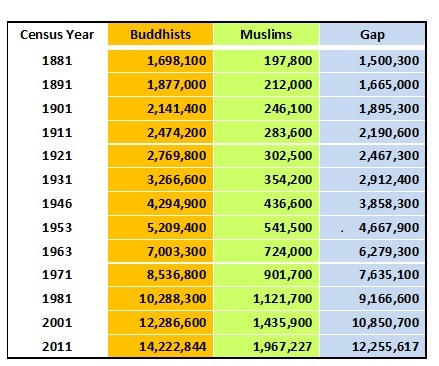
The Past Scenario : According to the data published by the Department of Census & Statistics, the Buddhist and Muslim Populations at each of the 13 Censuses conducted periodically since 1881 are as follows :
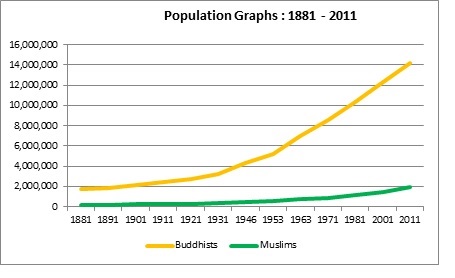
The size of the gap between the numbers of Buddhists and Muslims in Sri Lanka has continued to increase steadily since 1881. This is illustrated more clearly in the chart below.
If the Gap between the two populations is steadily increasing, then one does not need to possess an intelligence of Einsteinian proportions to conclude that the number of Muslims is not poised to exceed the number of Buddhists in the foreseeable future in Sri Lanka.
Therefore, based on official Government Population Statistics for the past 130 years, there is absolutely no reason whatsoever for the Buddhist Community to harbor even an iota of concern, apprehension or fear that they will be reduced to a minority by the Muslims in Sri Lanka.
The Future Scenario : The focus then shifts to the future – specifically the population estimates based on past trends. These estimates are of two types – ‘share-based’ and ‘growth-based’.
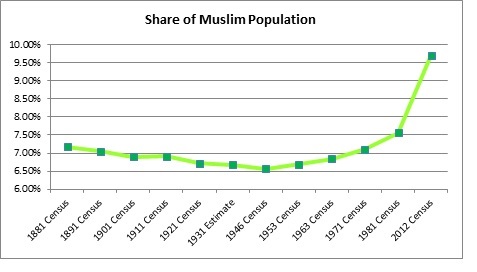
Share-based Forecasts: This refers to the oft-quoted ‘share’ of the Total Population accounted for by the Muslim Community in Sri Lanka. The relevant share for each Census Year is given in the chart below.
It is fairly common nowadays to find ‘analyses’ being performed on the population shares of the major ethnic groups in Sri Lanka over the past 100 years to justify and reinforce the fears of the Buddhist Community that sometime in the very distant future, they will swamped by the Muslims of Sri Lanka. A noteworthy feature of all these forecasts is that the unit of analysis is the seemingly harmless ‘percentage’.
In their rush to identify the date of this catastrophic event, these ‘Analysts’ appear to have forgotten the fact that a ‘Percentage’ is merely a number or ratio expressed as a fraction of 100 and is calculated on some specific base. For example, the base could be the Population of Sri Lanka in 2011 and the proportions accounted for by the Buddhist and Muslim Communities are 70.2% and 9.7% respectively. Moreover, ‘Percentages’ are used essentially to compare the status of a single variable in two or more different bases or of multiple variables in a single base. For example, Muslims accounted for 7% of the total population in 1981 and 9.7% of the total population in 2011.
Being numerically a type of index, percentages cannot be subjected to any mathematical operation (i.e. addition, subtraction, multiplication or division) unless – and only if – such percentages refer to calculations performed on the same base. It is therefore mathematically incorrect to calculate a forecast based on trend data consisting of percentages relating to different time periods for the simple reason that whatever be the model used for estimation (i.e. Linear, Exponential, Polynomial, Moving Averages or whatever), the method will involve the use of a combination of mathematical operations.
Therefore, future population estimates cannot be based on historical ‘shares’ (or percentages) data.
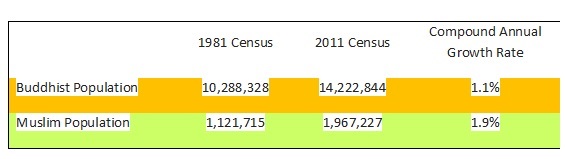
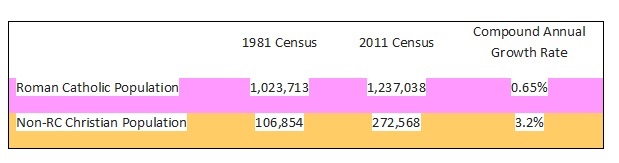
Growth-based Forecasts : This refers to the use of ‘Rates of Growth’ of the different Population Groups between any two Census Years. Proponents of this method of analysis focus on the Population data for the 1981 and 2011/2012 Census. This is given in the table below.
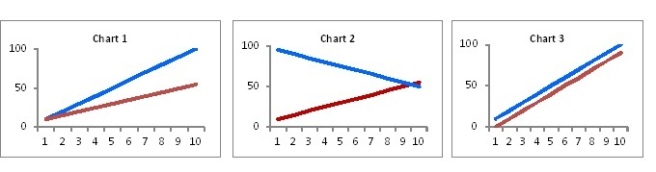
First, a word about trend lines or trend curves based on growth rates. The simple fact of the matter is that any two trend lines or curves must intersect at some point unless the lines are perfectly parallel as illustrated in the three charts below.
If the growth rate of the ‘Upper’ Trend Line is greater than that of the ‘Lower’ Trend Line, then the two lines would have intersected sometime in the past. (Chart 1)
If the growth rate of the ‘Upper’ Trend Line is less than that of the ‘‘Lower’ Trend Line, then the two lines would intersected sometime in the future. (Chart 2)
If the growth rates of the ‘‘Upper’ Trend Line and that of the ‘Lower’ Trend Line are equal, then the two lines would never intersect. (Chart 3)
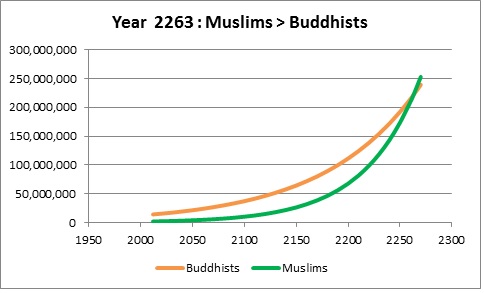
In the cases of the trend lines or curves for the Buddhist and Muslim Population data, the growth rate of the ‘Upper Buddhist Line’ (1.1%) is less than that of the ‘Lower Muslim Line’ (1.9%). Therefore the two lines must intersect sometime in the future. And at that point in time, the Muslim Population would be equal to the Buddhist Population.
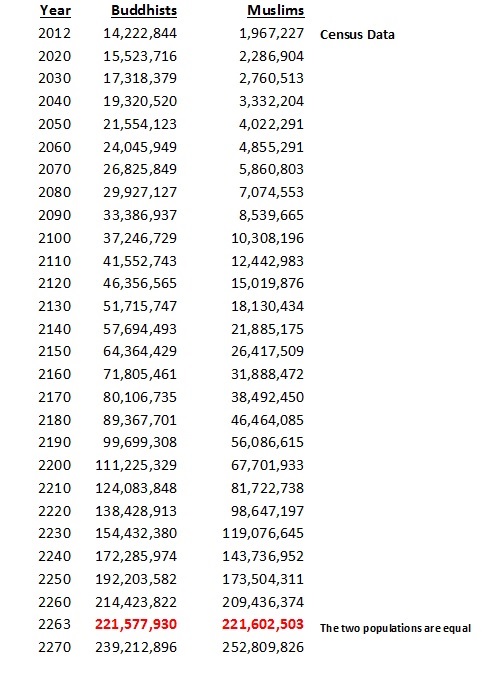
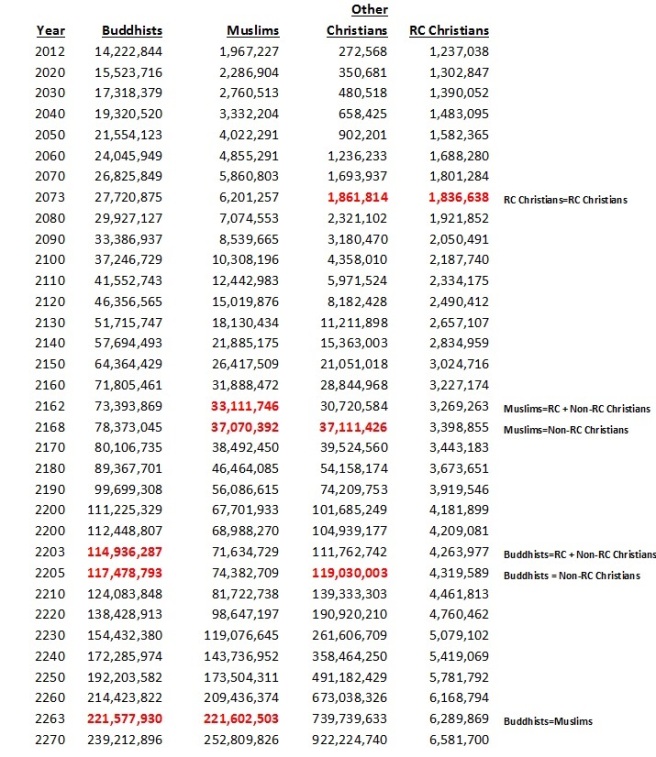
In order to determine the point in time when the two populations are equal, the two populations are extrapolated exponentially using the 2012 data as the base and the applying the corresponding growth rates annually. The detailed estimates at the end of every decade are given in the table below.
[The formula used to calculate the annual estimate is as follows :
Estimated Population for a specific year = Estimated Population for previous year x (1+r), where r is the rate of growth expressed in decimals.]
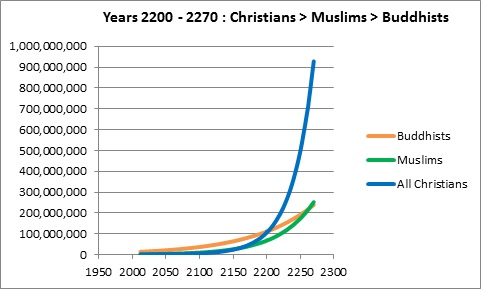
Therefore it appears to be the case that, 251 years hence, in the Year 2263, the worst fears of the Buddhist Community will be realized with the Muslim Population emerging as the Majority Community in Sri Lanka ! An underlying assumption, as in the cases of all such extrapolations , is that the political, economic, social and technological factors that existed during the 30-year period 1981 – 2011 , will continue to exist during the next 250 years too. Is this a realistic, sensible assumption?
To test the credibility of this ‘Growth-based Forecasts’, similar extrapolations of population size are also developed for two other religious groups – Roman Catholics and Non-RC Christians. The relevant basic data are as follows :
The annual estimates of population size are given below for all four religious groups.
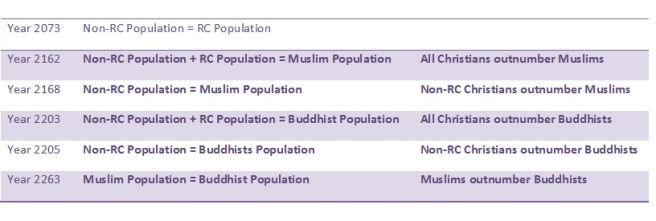
So in a nutshell, what the above extrapolation exercise, based on Census data for 1981 and 2012 tells us is that :
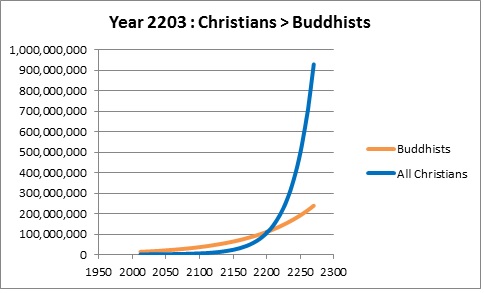
Thus, if the exponential growth Method of Extrapolation is deemed to be acceptable and accurate, then it appears to be the case that in the Year 2203, Sri Lanka will become a Majority Christian Nation pushing the Buddhists to second place in terms of population. Then a further 60 years later, in 2263, the Buddhists will be pushed to third position by the Muslim Community.
And the icing on the cake is that at this point in time (Year 2262), the Total Population of Sri Lanka will be in excess of 1.1 Billion !!! (which is the current population of India). Looks like Sri Lanka is heading for a pretty crowded future.
The very nature of such estimates reflects very strongly the crassness, stupidity and ridiculousness of estimating population sizes beyond reasonable limits of time. The purpose of introducing the two Christian Groups into the calculations was not to create problems for that Community, but merely to highlight the absurdity of using this method of estimation.
Conclusion : Based on this analysis of the Past and Future Scenarios, it is therefore concluded that the Muslim Community in no way poses a credible threat to the Majority Community of Sri Lanka with regard to population growth.
I wish to refer to the EditorialS of the
Island and recent articles by Neville Laduawahetty and Dr Wasnatha Bandra in the Island on the subject of international
agreements signed in ‘secrecy’ by the
government in handing over our
assets and our people to the foreign governments especially to the USA and
India.
As per the limited information made
available through official and unofficial channels some of the subjects covered
almost constitute selling of Sri Lanka to the interested international parties
which have the power of pressurising a poor country which is in desperation. ACSA,
SOFA the services agreement with the USA and the development’ agreement to be
signed with the Millenium Challenge Corp
of USA include some of the conditions which can make Sri Lanka dance according
to the dictates of the USA. In short the sovereignty and the national security
of the country will be left in the basket.
The agreement with the Millenium Challenge
corporation which is being discussed according to very reliable information
will convert the whole country into ‘development ‘ zones paying scant regard to
the historical , geographical and national security factors and also the native
land ownership laws.
One wonders whether Sri Lanka’s political
decision makers and some of the officials who are handling these critical
issues are deaf and blind or are they following the gravy train. According to
some reports some of the Sri Lankan officials shamelessly try to influence
decision making in favour of completion of this disastrous project soonest as
they are keen on serving their white masters before these moves are opposed.
Today, we are faced with another
diversionary tactic by the USA in greasing the palms of the decision makers by
offering GSP concessions in order to get the approval for the SOFA and
Millenium Challenge Corp agreements as quickly as possible. When the going is
tough, a forceful movement must be launched to preserve the non-aligned Sri
Lanka by ringing the hallowed bell.
We hope the civic minded leaders and masses
led by Mahanyake theros, the Cardinal and the leading church priests, the Hindu
and Muslim religious leaders who love Sri Lanka and her future generations will
show their vehement protests to SOFA , Millenium Challenge Corp agreements and
any other long term agreements to sell the country’s vital assets to foreign
countries.
Sri Lanka should not be a province of an
empire of any powerful nation
I am a
Theravada Buddhist monk who lives and works among the poor and needy villagers
of my area in Sri Lanka. I was ordained on November 5th. 1975.
I
received the higher ordination called ‘Upasampada’ in July 1981 and was
admitted into the Amarapura Niyake Sasanodaya Maha Sangha Sabha Sect and now I
am an Annunayake, or a leader of the sect in Sri Lanka.
Sri Lanka
– a Much Impoverished Population
I have
devoted much of my time since becoming a monk, to doing social work for poor
families, including taking in small monks and giving them an education in
Buddhism as well as instruction by the State school system.
Today, we
write about our need for help to do our activism
We have
two centres:
The
Sri Dhammarathna Bhikshu Training Centre, Hantana
I am
proud to say I have trained about 100 students using two temples we call
Viharas: the first and oldest is based at Hantana, Kandy
The
Sri Dhammarathna Thapuwana International, Haragama
Haragama
is near Kandy. This centre can be likened to an early learning centre or
pre-school center but for young monks in training.
The
present facilities at the Thapuwana consist of a meditation Centre where
ordained Monks and Nuns can practice the Dhamma and meditation.
We would
like to expand the facilities of this centre and there are eight acres
available for this.
At
present we have one Chinese person who has recently ordained and a Korean Lady
who is now a Nun. Several other Sri Lanka monks and nuns are also living there
and practicing the Dhamma and Meditation.
We need
help in a broad range of areas:
The
Re-Launch
Theravada
Buddhism
in the
Abandoned Villages
It must
be said that many villagers all over the country are living in abject poverty.
In Sri Lanka there are many temples closed and without a monk, therefore
villagers are leaderless. I myself, have re-opened about 38 temples and placed
my senior monks in them to bring them back into operation again in villages.
For this we need finance for renovation and building work
Now, I
feel it is important to find donors to give scholarships for the needy,
neglected children of our adopted villages: for them to go to school and get
some education. That seems to me to be so important. It also keeps them
out of jail.
We would
like these 38 temples to operate also as Social Working Centres. These
centres would be open to villagers to enroll as students of the centres and
learn about what is useful to them and, of course, Buddhism in theory and
practice.
Note that we
are strong on the requirement to put Buddhist principles into practice as much
as possible as the practice of Buddhism is noticeably lacking these days.
Summary:
In truth,
now I see the great need to re-launch Theravada Buddhism in a much enhanced way
to the whole country. I would like help to start at the Haragama Thapuwana
premises, Sri Dhammarathna Thapuwana International.
Need for
Social Workers and Volunteers from Overseas.
These are
our plans. I am one monk working with a few other monks and Sri Lankans who
agree to help me, But we need a whole team of workers in the field, and these
will need living allowances to feed themselves and also, bus fares to travel
around to the various villages. It would be really helpful if volunteers from
overseas would come and help. We also need teachers to teach useful subjects
such as English, and other subjects to both monks and villagers with the
interest to learn.
If we get
advanced notification we can meet foreign volunteers arriving at the airport
and we can provide transport to our campus. We can then arrange visas as
required.
Request
for Donations
To do all
this good work requires donations to support our mission. Please come to our
Hantana Training Centre and discuss how you can help. We ask everyone to help.
All donations, large and small are welcome at :
Chief Prelate of the Asgiriya Chapter, Most Venerable Warakagoda Sri Gnanarathana Thera said, the United National Party (UNP) Minister, who he recently met, stated that the country has been totally destroyed due to the irresponsible behavior of the UNP.
Most Venerable Gnanarathana Thera said this when presiding at a religious event held on 15 June at the Kithsirimewan Raja Maha Viharaya, Diyakelinawa in Yatinuwara.
He added that the particular politician had also said the UNP was a dying party which could not be resurrected.
The Thera further said that country’s future is in a pathetic state.
The country’s future is in a danger. After Minister Gamini Dissanayake’s period, we feel that the secure period of the country has come to an end. The UNP leaders who came to power after Dissanayake do not love this country. They don’t care about the country or the people.”
The Sinhala Buddhists in this country should be protected. That is our aim and the monks are dedicated to protect the Sinhalese. We want to protect Buddhism as well. We told that to all the political leaders we met. We did not speak to gain any publicity. We spoke about what should be done,” he added.
The Thera further said, Considering the things which have happened, it is very clear that our future generations will be helpless. Millions of our children were destroyed and some mothers said that a particular doctor should be killed, but I don’t say so. If one of our people did that to them, they would have brutally killed him. Those laws don’t fit in today and therefore we should get together as Buddhists. As Sinhalese we should not use our vote considering the colour of the person and in this situation the most suitable person should be elected. Parliament representatives who care for the country should be selected and all the Buddhists should get together to develop the country,” he elaborated.
An investigation has been launched on a case of former Minister Rishad Bathiudeen transferring state land to other parties through fake deeds.
Ven. Theeniyawala Palitha Thero had lodged this complaint at the Presidential Commission probing fraud and corruption at state institutions. As per the complaint, the former Minister had acted to transfer 3000 acres of land in Mannar to his wife and relatives.
When called for evidence on this charge, it has been revealed that Bathiudeen had taken over 3000 acres of land in Mannar from people who had left the area during the civil war.
Testimonials at the Commission has revealed that Bathiudeen had he had bought over these lands for amounts of Rs 500,000 to 1,000,000 and that he had even obtained signatures on blank documents from some persons.
Reportedly, nearly 17 persons have testified at the Presidential Commission on this matter.
A spokesman of the Commission stated that 8 more persons have been called in to provide evidence on the matter before the commission today (17).
The number of complaints filed against Dr Mohamed Shafi over alleged illegal sterilizations has amounted to 1,003.
The Kurunegala Police had arrested Dr Shafi on May 25th over alleged illegal accumulation of assets. He was later handed over to the Criminal Investigations Department for further investigations.
However, accusations started piling up against Dr Shafi alleging that he had performed illegal sterilizations on mothers during their Caesarean-section deliveries.
Subsequently, the public was asked to come forward with complaints against Dr Shafi, if there are any.
A large number of mothers had claimed that they had conceiving complications following their C-section surgery performed by Dr Shafi.
It is reported that the Kurunegala Teaching Hospital had received 839 complaints in total while Dambulla Hospital received 164 complaints against Dr Shafi.
Sources added that Ushama was picked up after it was found that he was part of a social media group consisting Hashim and the trio held from Coimbatore.
By Express News Service
MADURAI: Sleuths from the National Investigation Agency’s Kochi office conducted an inquiry with a youngster from Madurai on Saturday night for his alleged links with three suspected supporters of ISIS held from Coimbatore and with Zahran Hashim, the alleged mastermind of Sri Lankan Easter Day blasts.
Just a day back, Coimbatore police arrested persons — Y Sheik Shafi Ullah (35), A Mohammed Hussain (25) and A Shajhakhan (25) — over suspicions that they were ISIS supporters and were planning suicide attacks. Coimbatore police’s FIR says the trio, during their meeting, had praised Hashim and had shared war videos from Iraq and Syria among themselves.
Ushama Murshid, the youngster picked up for questioning from Madurai, is a native of TNHB Colony in Villapuram. He is pursuing an Islamic course from an institution in Uttar Pradesh. He was freed after an interrogation, which lasted for a few hours, said sources.
Sources added that Ushama was picked up after it was found that he was part of a social media group consisting Hashim and the trio held from Coimbatore. Ushama, sources claimed, was an active member and made many enquiries with fellow members in the group.
We suspect he could be a member of the banned outfit SIMI, but we have no proof to establish it,” said the source. Police sources have said that there was no pending cases against Murshid in Madurai city.
Nepal’s Deputy Prime Minister and Defense Minister Ishwar Pokhrel said on Sunday that the bombing attacks in Sri Lanka in April had sent a clear and strong message that a new type of terrorism threat has arrived in South Asia.
The defence minister made the remarks while addressing a seminar titled “Dialogues on Public Security: Countering Terrorism” organized by the Nepali Army in the capital on Sunday.
On April 21, multiple terror attacks struck churches and luxury hotels in Sri Lanka on the Easter holiday, killing more than 200 people and wounding hundreds.
Pokhrel said the Nepali government thinks it is very important to understand the complex phenomenon of terrorism in regional and national contexts. “We also think that we need to learn from the lessons and experiences of our friends around the world, on counter-terrorism,” he said.
The minister stressed the need for domestic, regional, and international efforts to address the problem of terrorism.
“In this century, many security threats are cross-cutting and unconventional in nature. They are neither limited by national boundaries nor dealt with by conventional warfare. The worst of these threats to challenge humanity and global security is terrorism,” the minister said.
The minister also said that the government of Nepal recently unveiled the National Security Policy to reflect the changed security environment.
“We are in the process of formulating necessary instruments and architecture to implement the National Security Policy. It will be useful for us to learn how developed countries have created institutional arrangements to counter these emerging threats. These will help us develop our own policy, plans and capacity building,” he said.
I wish to respond as follows to Prof.
A.N.I. Ekanayake to his letter to the Editor titled: What people say and what
they really mean” that appeared in ‘The Island’ of May 24, 2019.
Prof. E appears to have approached his
subject from an existential perspective. I propose to address the issue he has
raised, from a historical perspective.
Let me first deal with the problem he had
raised about the Sinhalese. Who are the Sinhalese?
My son recently took a DNA test, for the
fun of it, to trace his genealogy, he mocked! It took his ancestry to North
western India, to modern Afghanistan and finally to Europe. It incidentally
coincided with theory of, possible Indo-Aryan Migration from somewhere modern
Southern Germany through modern Iran (then Persia), modern Afghanistan and
through Hindu Kush into Northern India.
Some historians surmise that some of these
Aryan tribes from North Western and N. Eastern India migrated in ancient times
to different parts of this country. Hence I presume that such a tribe may have
landed in the Southern coast and moved inland. My known ancestry comes from a
village named Karagoda viyangoda in Kimburupitiya electorate and another
village called Nakulugamuwa in Beliattha electorate.
It appears that those original Aryan
tribes that migrated to this country mixed with the four tribes that lived
here, Yakshas- the irrigation experts, Nagas- the sea farers, Rakshas-the arts
and craft people and Devas. These people together, over the years had developed
a unique civilization based on a unique hydro engineering system, agriculture,
Art and architecture, a rich literature, health service, an education system
and also an administration system together with international trade and foreign
relationships etc. These people also evolved into a new identity adopting the
lion symbol which probably one of the tribes brought in. They also developed a
language to communicate called Sinhala, the lexicon of which is phonetic based
that is considered quite advanced even in modern times and a scientific grammar
that is easy to use.
Most older nations in the world are named
by the language they use and their countries too are known by that name. Thus,
the land of people who speak French is called France. So with China, Japan,
Vietnam, Italy, Germany, Poland and England. Similarly in the ancient times land
of the people whose language was Sinhala was known as Seehala Deepa, meaning,
island of the Sinhalese. This language also was referred to as Deepa Bhaasa in
some old texts, meaning the language of the island. The Madras University Dictionary
refers to this country as Eelaam, in Tamil is explained as Seehalaam. Thus,
Westerners called it Z/ceylan, Zeylao, Ceylon, Serendib etc. etc. It has been
known in the world from time immemorial, at least for 2600 years by these names
until it became by some quirk of fate, Sri Lanka in 1972! Is there a language
called Sri Lankan?!
The Sinhalese also have a recorded history
covering the 2600 years of existence on this earth according to a chronicle
called the Mahvansa, dated 5th century A.D. which is used in other
Buddhist Countries such as Myanmar, Laos and Cambodia as authentic history. In
later times it helped to determine the times of Emperor Asoka Indian history.
According to this chronicle, the Sinhalese
have fought many wars to fight invaders, throughout their long history, to keep
possession of their country which was finally ceded to the British Colonial
power owing to an unresolvable internal political crisis in 1815. The Sinhalese
perhaps are the people who held against the Western invaders the longest in
this region Again it regained its sovereignty initially in
1948 and finally in 1972.
The last fight to keep possession of their
land was fought for 30 years against a Terrorist group who tried to grab a
portion of the country. After prolonged bitter fighting, they managed to
vanquish the terrorists, to retain possession. They sacrificed many thousands
of life and limb in this effort. The story of Hasalaka Gamini is just one
instance of their fighting spirit among many others in their long history.
Considering this glittering history, is it
unfair if the present day Sinhala people legitimately claim that this country
belongs to them, however repugnant and unpalatable it may be to some?
Prof. E mentions the ‘Sinhala Only’
question ushered in 1956, by Prime Minister S.W.R. D. Bandaranayake. Mr.
Bandaranayake was asked by the people who voted for him to make Sinhala the
language of Administration of this country, which ceased to be so after 1815
for a period of 156 years during the British Colonial rule. Before that, this
country was administered in the Sinhala language, the language of the
Sinhalese. Was it wrong for the Sinhala people to have demanded after
Independence, to resume their language of administration as done over 2400
years in this country? Isn’t it a prescriptive right even according to the
present Roman-Dutch law?
Now the question of Sinhala Buddhists. The
Sinhalese became Buddhists 2300 years ago in the 3rd century B.C.
Since then they acquired a sapling of the Bodhi tree under shade of which their
teacher the Buddha attained Buddhahood. Many centuries later they had the
privilege of receiving the Tooth Relic of the Buddha which became the symbol of
kingship that became synonymous with Royal Power to govern the Sinhala people.
In the last war with the Terrorists, they mounted attacks on both these
institutions to destroy in vain, the ethos and the morale of the Sinhalese.
Even today the political authorities pay their formal respects at the temple of
the Tooth and their Chief monks at Kandy the last Capital of the Sinhalese.
They also make it a point to pay homage at the Sri Maha Bodhi at Anuradhapura,
their original political and religious capital. Most Sinhala Buddhist too do
this visit time to time, to re-charge their ethos, morale and religious fervor.
They are really stirred into great emotional pride when they hear the song
Danno Budunge” that speaks of the glory of Anurdhapura.
Really there were no Sinhala Buddhists in
this country for over 1500 years until the western colonial powers landed here.
For, all people here were Buddhists then other than perhaps the veddhas. The
term came into usage only because a section of the Sinhalese converted to Christianity.
Thus, there came into existence Sinhala Christians. The national leaders then
addressed the Buddhists with that name to wake them up from a deep slumber
after being reduced to politically powerlessness by the colonial administration
and Christian Missionaries empowered by the colonials. Anagarika Dharmapala
published a newspaper called ‘Sinhala Bauddhayaa’ and Piydasa Sirisena set up
another called ‘Sinhala Jathiya’ in an effort to evoke the ethos of a down
trodden community who was then rendered powerless after their rebellions of
1817/18 and 1848 which were ruthlessly crushed by the British Colonials. It was
only in 1956, nearly 150 years afterwards that the Sinhala Buddhists again
asserted their lost status.
Under the Colonial and Christian
Missionary influence the Sinhala Buddhists had become a degenerate nation, weak
Buddhists with lukewarm national pride. They had been enticed into consumption
of liquor and beef which was looked down upon in earlier times. The Eurocentric orientation given to the
middle class under Missionary education resulted in creating an inferiority
complex in themselves where they were trained to look down upon their own
culture and values and their own political thinking. Situation has become so
bad now that there are ques to pick up
their liquor quota on the day before Wesak and other Poya days!
Therefore the nationalist movement in
early 20th century had to begin primarily as a temperance movement
and debates with Christian Missionaries. They had to design a Buddhist flag and
create English schools for Buddhists in an attempt to re-orient the degenerated
Buddhists to retrieve their lost national and religious fervor. It has been
quite a gigantic task because lot of damage had been done to the national
psyche where a class of new intellectuals among the Sinhalese who are unable to
see beyond new Eurocentric ideologies like Human Rights, equality, secular
state, neo-liberal thinking etc. which have been designed by the West to ensure
continuation of their intellectual domination over their former colonies.
Prof. Ekanayake has highlighted the
‘problem’ of article 9 of the Constitution giving the place of prominence to
Buddhism. This is nothing but an extension of the condition imposed by the
Buddhist leaders in the Kandyan Convention agreed to by the British Colonials.
Quite apart from that, how has the other
religions in this country been disadvantaged owing to this ‘obnoxious’
provision or, have Buddhists gained any unfair advantage over the other
religionists? No such claims had been made to the Supreme Courts that they have
been disadvantaged owing to this provision. Despite this provision, the Sinhala
Buddhists have suffered many disadvantages like the ancient Kuragala Buddhist
monastery taken over by other religionists, land grab at Deeghavapi which had
to be retrieved only after a court order, difficulties encountered by Buddhists
at places like Mihindu Maha Viharaya and Nayaru in the Eastern province,
damages caused to Buddha images at Mavanella recently etc. etc. where no
prosecution by state have been instituted.
Sinhala Buddhists have also experienced
right to worship, live and do business in the Northern Province and denied
access to Muslim enclaves in different parts of the country whereas none of the
other religionists have suffered any obstacles to settle down, do business, run
religious and educational institutions in any part of the country. Thus, it
would appear that article 9 in the Constitution has in effect given no
advantage to the Buddhists, rather they have been subjected to bullying by
other religionists and communities. Hence we need an interpretation of the real
meaning of Buddhism being declared here as premus interpares”.
True, as pointed out by Prof. Ekanayake
that Buddhists today are degenerate, corrupt, indisciplined, dishonest etc.
etc. This is the effect of over 500 years of foreign domination and degradation
they had suffered as a result as explained above. In addition to that, they
have contend with social and new problems created by the notion of Open Economy, competition, consumerism,
information technology and other modern changes that have further confounded
their attempt to recover their lost ethos. For instance, the notion of
sallahuka wutthi” –simple livelihood mentioned in the Karaneeya Mettha Suttha,
is almost impossible except in abject poverty forced by capitalist society. It
is indeed a mind boggling challenge, to overcome overnight. It takes time. It
is only 71 years since we formally retrieved some form of independence. It
might take a long time for us to recover. However, for nation that is 2600 old
500 years is a short time. Given the time and intellectual independence the
Sinhala Buddhists may recover their greatness. They need to be helped.
Incidentally some poitican as mentioned by prof. E, is reported to have touched a raw nerve of the Sinhalese saying that this country does not belong to the Sinhalese. It is worthwhile thinking what motivated this man to say that over and over, just at this juncture. What is the outcome he wants? And why?
While the country remains mesmerized and paralysed by revelations of incredible security lapses, the failure to implement long-term plans for energy production, updating of agriculture and industry to keep pace with climate change, population growth etc.,will cause irrevocable systemic collapse causing more prolonged misery than any sudden Jihadist shocks. Many of us have written articles pointing the way forward, since many decades, but wonder if it is all futile, or if there is still room for optimism.
Surely, the biggest single expenditure faced by most nations is in meeting energy costs. The availability of cheap energy is the determining factor essential to all types of development. So the strongest effort of the government and the entrepreneur should focus on energy. When clean energies like solar and wind power were not competitive, it made sense for Sri Lanka to include coal power in its energy-mix. So the plans of the 1990s, if executed would have ensured that Sri Lanka today would not be facing a power crisis. Today Lanka would have been ready to mothball the old technologies and move to new sustainable technologies.
Instead, the government has again commissioned new coal plants. This is a keen-jerk long-term commitment to highly polluting fossil energy already undercut by cheaper, cleaner alternatives. To compound the folly, the government continues in expensive oil and gas explorations in the Palk Straits. It should note how weak but oil-rich countries have become enslaved by powerful nations who rob their oil using compliant puppet regimes to keep the people under the jack boot. Off-shore oil sources are environmentally far more damaging than land-based oil exploitation.
Apparently, Sri Lanka’s ‘Surya Bala Sangraamaya’ program, launched in 2016 is set to collapse. This is despite its great success with some 17,000 installations and a combined output of nearly 200-250 MW added to the grid. This solar energy saves emissions of noxious nitric oxides, acid rain, toxic metal residues, and some 200,000 metric tonnes of CO2 per Annum. And yet, new legislation terminates the purchase of solar power from small rooftop producers, claiming that the CEB will end up subsidizing” consumers of 60 units/month or less at Rs. 4.68 a unit. Surely, these consumers will necessarily consume more than 60 units before long. While failing to encourage solar energy, coal power and thermal stations that burn oil at great cost to the consumer and the environment are embraced.
Sri Lanka does NOT NEED fossil fuels of ANY SORT. In a previous article (Island, 6th May) I explained how, since 2009, I had advocated the installation of floating solar panel arrays on hydro-electric reservoirs; the power generated is fed to the grid or used to pump up water back to the reservoir. That is, solar power is stored as reservoir water, and no batteries are needed. Even pumping up the water can be avoided, by simply RETAINING the equivalent quantity of water instead of sending it into the hydro-turbines. The solar panels on the water saves some 30% of the evaporation by wind and sun. That is, merely floating solar arrays on ten hydro-power reservoirs adds three new hydro-power reservoirs at negligible comparative cost!
Wind power, installed around reservoirs can also be stored as water power using the same concepts.
The average life-cycle cost of solar in Sri Lanka is some 15-20 rupees/unit. Bio-energy is cheaper, and provide more employment. While hydro-energy is cleaner, biomass offsets climate change, safeguards biodiversity, pollinating insect species etc., by maintaining habitat. As Dr. Weeraratne, an agricultural scientist, had documented (Island, June 15th ) the agriculture sector and the economy are down. Tea, Rubber, coconut or even a staple like paddy are not prospering.
In my second article on the energy crisis (Island, May 23) I showed how the coconut plantation sector can be revived into an energy giant using the husk biomass for energy production. There is enough energy in the currently produced coconut husks to supply Sri Lanka’s energy needs inexpensively and healthily. At present, these husks feed a polluting fibre industry with little or no future. Its future is in the energy sector.
However, it is not just the coconut plantation sector that can re-vamped. Sri Lanka’s Rubber Industry Master Plan needs to include its bio-energy potential to further improve its prospects. It is imperative that the rubber plantations move towards greater profitability. If not, these prime lands, often with road-and-bungalow infrastructure will be rapidly converted to housing or tourist chalets, asphalt roads, concrete buildings, night clubs, casinos and bars. The enormous loss of green habitat is catastrophic to the biosphere. Although having plantations is not as good as having virgin forests, they are the next best defense against continued habitat encroachment by humans. Making rubber plantations more profitable by moving them towards bio-energy production, we are resolving the energy crisis, and also safeguarding the environment.
Seeds produced by rubber trees go waste in most plantations.
How do we convert the rubber plantations to energy-producing power-plants? Rubber does not constitute a rapid-growth biomass, but we exploit the currently wasted rubber seeds. New hybrids or bio-engineered plants with a high SEED YIELD should be planted. Existing trees will be tapped as usual for the latex since the annual world consumption of natural rubber is increasing at about 3-4% . Seeds of any kind of tree are packets of energy stored for the seed to grow. In all cases, seeds make better fuel than other biomass. That is, if the seeds are burnt, shell and all, the heat produced can be very profitably converted to electricity using high-efficiency burners which are now a standard part of bio-electricity technology.
Malaysian researchers Satyanarayana et. al. [Int. J Green Energy, vol. 7 pp. 84-90, (2010) ] found that rubber seed is a viable option for bio-diesel, and has low CO2 and nitrogen oxide outputs among potential biofuels. Here we do not examine bio-diesel production, but simply the burning of seeds in high-efficiency generators to produce electricity.
Elementary calculations show that using rubber seed to make energy is profitable and sustainable. A yield of 100-400 kg of nuts per hectare per year is typical for the south-Asian region including Sri Lanka, while China has clones which produce 1500-2000 kg/ha/year [Wei-Wei et al. China Oils Fats, vol.30, pp. 63-66, (2005)]. According to Selle et al (1983), Rubber seed has a total energy value of about 7000 kcal/kg.
Sri Lanka has some 130,000 hectares of rubber plantations. Hence assuming a yield of 300 kg of nuts/ha and a collection efficiency of 66%, the annual rubbernut output can produce some 200-250 GWh of electricity by burning the seeds, using a Carnot-Rankin efficiency of 25-30%. The use of Chinese clones with high seed yields boosts outputs to 400 GWh. In addition, rubber other biomass from the plantation can be used. Effective, safe herbicides like glypohsate have been restored to the rubber industry. Hence crops like castor can be economically inter-cropped in plantations to provide additional high-energy biomass, and hence a target of 400-500 GWh of electricity is realistic.
Since the infra-structure, raw materials, etc., are already in place, the main cost is the installation of the burner-generators which can be amortized over 10-15 years, making it cheap compared to the cheapest coal. The additional profits from a hitherto wasted resource, namely, rubber seeds should be considered in Lanka’s Master plan of the rubber industry.
The expression of oil-synthesis genes in seeds is controlled by known transcription factors like LEC1, LEC2, and WRI-1. Genetically modifying plants by including a mutation in the cgi58 gene results in the accumulation of lipid droplets even in the leaves. Converting the energy in the rubber nuts using fuel-cell technology instead of directly burning them is a method of beating the Carnot-Rankin energy loss. Then near 95% efficiency can be achieved. But such technologies are still a matter for the research labs.
What has been said here about rubber or coconut industries can also be adapted for cinnamon and other Industries. So there is no excuse for our planners to opt for fossil-fuel energies. Solar- Wind and bio-energy are unequivocally available as cheap, non-polluting, firm power implementable within a shorter time scale compared to the commissioning of coal power stations.
Our
Team must be encouraged by the quality of cricket played by them against World
Champion Australia. We did not succumb to mighty Aussies. We did not
fear their bowling attack. All commentators Mark Nicholson,
Michael Clark, Mathew Heyden agreed on the signs of reincarnation of
Sanath and Kalu days of Sri Lanka. The World best Cricketing Analyst our own
best product Kumar Sangakkara injected his articulated vocabulary to
bring his motherland to the hilt.
There
are clear signs of emergence of fighting spirit of Sri Lankan cricket once
again. Isuru Udana turned the tables. Relatively unknown ODI batsman
known as Dimuth Karunaratne flew high Sri Lankan Flag. Kusal Janith once
again rejuvenated skills of batting sending deliveries of Mitchell Starc,
Pat Cummins, Richardson to the boundary and over the boundary.
Commentator
Mark Nicolson was virtually nervous in his commentaries when Dimuth and Kusal
were batting. He indirectly hinted that a victory for Sri Lanka would
be a foregone conclusion.
Dimuth
has provided Leadership. He need to provide Motivation to bring the
taste of victory.
Dimuth
can do it and he will do it with the Team to bring back the glory of Sri Lankan
cricket to the forefront.
To all media institutions and All political leaders of Sri Lanka Freedom Party, United National Party, Sri Lanka People’s Alliance, Janatha Vimukthi Peramuna, Sri Lanka Muslim Congress, Tamil National Alliance, Sri Lanka Communist Party, Lanka Samasamaja Party
Statement Against hounding journalist Kusal Perera
We are reliably informed that the Organised Crime Division has petitioned the Colombo Magistrate Courts against journalist Kusal Perera who has written a political column in the Daily Mirror every Friday for many years. We also came to know that police officers had visited the Daily Mirror yesterday (Friday) in this regard. It is allegedthat his article on 17 May 2019 on developments after the Easter Sunday tragedy is being interpreted by a complainant as inflaming religious rivalry, therefore making him liable to be arrested under the ICCPR Act No.57 of 2007.
This is a very grave situation. Throughout his adult life, Kusal Perera has stood against all forms of racism and has written extensively against extremism and terrorism openly and fearlessly. He is internationally known for his very strong anti-racist stand. He is accepted by all as an independent political critic too. As far as we know, he is the only journalist who contributes to both mainstream Sinhala and English newspapers. He was a regular political writer for the Sunday Lakbima and was invited often by Lankadeepa to write their Thursday political analysis. International media too seek comments from him as an independent political commentator.
Therefore, it is clear that this is an attempt by someone or some group to silence Kusal Pererato serve their petty interests. Permitting this travesty would not only violate Kusal Perera’s freedom of expression but it would also curb independent views and dialogue within the broader society too. This is an extremely dangerous precedent in the making.
We therefore urge all those concerned to immediately intervene in stopping all action initiated against Kusal Perera.
We request your kind cooperation to publish this news.
Thank you. Submitted by,
Parakrama Niriella, Dramatist (0773175638) Wijayananda Jayaweera, Former Director Communication UNESCO (0773625701) Dr.Sunil Wijesiriwardena, Lecturer and Researcher (0718580074) Prof.Arjuna Parakrama, Senior Professor, Centre for study of Human rights, University, Peradeniya (0777712264) Dr.Nirmal Ranjith Devasiri, Senior Lecturer (0718016200) Prof.Liyanage Amarakeerthi, Professor, Dept of Sinhala, University of Peradeniya (0774141544) Victor Ivan, Senior Journalist (0777394959) Asoka Handagama, Film Director (0777229500) Prasanna Vithanage, Film Director (0777288984) Sudath Mahadivulwewa. Lecturer and Film Director (0767372779) Vimukthi Jayasundara, Film Director (0777578432) Ravindra Guruge, Film and TV Producer, Editor (0777728821) M.Safeer, Dramatist (0773129749) Anton Marcus, Trade Union Leader (0777281477) Kumari Welagedara, Researcher and Social Activist (0773242105) Selvaraj Leelawathy, Performing Artist (0711116658) Rasaiah Logananthan, Performing Artist (0719373542) Jeevanie Kariyawasam: Attorney-at-Law (0772181878) Rathnasiri Paranavithana, Dramatist & Writer (0723308649) Prof. Sasanka Perera – South Asian University, New Delhi (0711654476) Thiyagaraja Waradas – Senior Lecturer, University of Colombo (0715153144) Omar Rajarathnam – Communication Specialist Vishnu Vasu – Musician (0772262267) Philip Shantha – Journalist (0714419157) Damith Chandimal – Social Activist (0712341311) Dr. Chamindra Weerawardhana Aadhil Ali Sabry – Journalist (0719842732) Kalpana Ambrose – Writer (0773441810) Chameera Dewantha – Activist Anushka Indrasiri – Foreign University Student Pujika Rathnayake – Concerned Citizen (0717609136) Chamal Polwattage – Writer Ishan Jalil – Human Rights Activist (0777532381 ) Kaushalya Kumarasinghe – Writer Asela Ekanayake – Banker (0766707970) Sharni jayawardhana – Media Activist (0777393462) Kelum Shivantha, Editor – Sri Lanka Mirror (0771446533) Ashra Wickramathilaka – Researcher (0717889768) Dr. Harini amarasiriya – Lecturer – Open University Vidura Prabath Munasinghe (Attorney-at- Law) – Senior Researcher, Law & Society Sumudu Guruge – Freelance researcher / Writer / Composer / Documentary film maker (0776140599) Vinyya Ariyarathna – Medical Doctor (0773413724) Ajith Perakum Jayasinghe – Editor, Praja.lk ( 0771229191) Athula Pathirana – Director and Actor Kanishka Guluwita – Urban Planner (Australia) Maala Gabriel – Retired State Servant at UDA (0773456600) Janaka Bandara – Fashion Designer (0772632477) Dinushi Samarasekara – Architect Deva Sanjeev – Digital Marketer (0776146295) Anuradhi Perera – Independent Researcher (0716650231) Paba Deshapriya – Social Activist Priyanjan Suresh de Silva – Journalist Malith Hegoda – Film Director Rathnasiri Paranavithana, Dramatist & Writer (0723308649 ) Malaka Dewapriya – Film Maker and Artist ( 0770778008) Anusha Sivalingam – Writer Kaushalya Herath – PhD Student (0769402993) Saman Kariyakarawana – University Lecturer (0777151542) Kavindya Tennakoon, Educator / MA Candidate, Stanford (0766693562) Deanne Uyangoda – Attorney-at-Law (0773546624) Subha Wijesiriwardena (0771708704) Mohammed Infaz – Free Media Movement Suchith Abeyewickreme – Concerned Citizen (0770859676) Shanika Jayasekara -Journalist (18612978913) Viduranga Tennakoon – Concerned Citizen (0775736926) Sanjani Liyanage – Undergraduate, University of Moratuwa (0773311218) Krishan Siriwardane – Media Researcher (0779968797) Nirmani Liyanage – Senior Project Manager and Social Researcher (0778808887) Asanka Senadeera – Researcher (0715168166) Professor Sasanka Perera – South Asian University, New Delhi (0711654476) Thiagarajah handouts – Senior Lecturer , University of Colombo (0715153144) Omar Rajaratnam – Communications Specialist Vishnu Vasu – musician (0772262267) St. Philip – tsilanruoJ (0714419157) Damith Chandimal – laicoS Actives (0712341311) Lawyers life Kariyawasam (0715168166) Dr. Chamindra Weerawardhana Ādil Ali Sabri – tsilanruoJ (0719842732) Ambrose thought – writer (0773441810) Chameera Second trial – Social active Anushka Indrasara – lanretxE Foreign University Students Renowned Ratnayake trelA The Citizen (0717609136) Chamal polvattagē – Writer Jalil backside – Human Rights Action (0777532381) Kumarasingha ingenuity – Writer Asela Ekanayake – Bank Officer (0766707970) Sharni Jayawardena – media activist Kelum Shivantha – Editor , Sri Lanka Mirror (0771446533) Allied Wickramatilake – Researcher (0717889768) Dr. Harini Amarasuriya – Lecturer, Open University of Sri Lanka Counsel Vidura Prabath Munasinghe – Senior Researcher The waL and Society Trust Smooth Guruge – Independent Researcher , Writer , Musician, documentary film director (0776140599) Dr. Wing Ariyarathne (0773413724) Parakum Ajith Jayasinghe – Editor , Praja.lk (0771229191) Athula Pathirana – Director and actor Kanishka guluviṭa nabrU Designer (Australia) Gabriel series – former state employees nabrU Development Authority (0773456600) Janaka Bandara – Clothing designers (0772632477) Dinūṣi Samarasekera – Architect Let Sanjeev – latigiD Partner (0776146295) Anuradhi Perera – tnednepednI Independent research (0716650231) Paba Deshappriya – Social activist Priyanjan Suresh de Silva – Journalist (0771959076) Malith Hegoda – Film Director (0770593266) Rathnasiri Paranavithana – actor and writer (0723308649) Malaka Dewapriya – Film director and actor (0770778008) Anusha Sivalingam – Writer Kaushalya Herath – doctoral candidate (0769402993) Saman DFKariyakarawana – University Lecturer (0777151542) Kavindya Tennekone – Educator / Masters degree candidate, Stanford (0766693562) Attorney Diana nominated (0773546624) ELT Wijesiriwardane (0771708704) Mohamed Infaaz – FMM Index Abeywickreme – Citizens are concerned (0770859676) Shanika Jayasekara – Journalist (18612978913) Viduranga Tennekone – Citizens are concerned (0775736926) Saṁjāni Liyanage – Undergraduate, University of Moratuwa (0773311218) ngiseD Liyanage – Senior Project Manager and Social Researcher (0778808887) Krishan Siriwardena – noitacinummoC Researcher (0779968797) Asanka Senadeera – rehcraeseR (0715168166)
My family of 8 lived in a 40×12 feet house – it was small, but enough for us. Our days began early, around 5 AM when my mother would provide traditional forms of curing and healing to newborns and small children. Through the night my brother and I would take turns to keep the ‘chula’ going for her to use. She didn’t have the fortune of getting an education, but God was kind and she had a special way of curing ailments. Mothers would line up outside our house every morning because she was known for her healing touch.
Then, I would open my father’s tea stall at the railway station, clean up and head off to school. As soon as school ended, I would rush back to help him, but what I really looked forward to was meeting people from all over the country. I would serve them tea and listen to their stories – that’s how I learnt to speak Hindi. I would hear some traders speak about ‘Bambai’ and wonder, ‘Will I ever get to see the city of dreams?’
I was always curious – I would go to the library and read everything I could get my hands on. I was 8 when I attended my first RSS meeting, and 9 when I was a part of an effort for the betterment of the lives of others – I set up a food stall with my friends to help the victims of the floods in parts of Gujarat. I wanted to do more, but I was aware that we had little means.
Still, even at that age, I strongly believed that God has made us all alike. It didn’t matter what circumstances I was born into, I could be something more. So when you ask me, what my struggles were, I’ll tell you that I had none. I came from nothing, I knew no luxury and hadn’t seen a ‘better’ life, so in my small world…I was happy.
If the way was ever difficult, I made my own way. I had a great need to look sharp and groomed. So, even though we couldn’t afford an iron, I would heat some coal, use an old ‘lota’, wrap a cloth around it and press my clothes – the effect was the same, then why complain?
This was the beginning of everything that I am today and I didn’t even know it at the time. So if you ask the 8 year old Narendra Modi, running around serving chai and cleaning his father’s tea stall, whether he even dared to dream about becoming the Prime Minister of India, his answer would be no. Never. It was too far to even think about.
While growing up, I had a lot of curiosity but very little clarity. I would see army men in their uniforms and think that this was the the only way to serve the country. But as my conversations with the saints and sadhus at the railway station grew deeper, I realised that this too was a world worth discovering.
I was undecided, unguided and unclear — I didn’t know where I wanted to go, what I wanted to do and why I wanted to do it. But all I knew, was that I wanted to do something. So I surrendered myself to God and left for the Himalayas at the age of 17. I bid goodbye to my parents as my mother gave me a sweet dish before I left and put a tilak on my forehead to bless my journey.
I went wherever God wanted to take me — it was an undecided period of my life but still, gave me so many answers. I sought to understand the world, to understand myself. I travelled far and wide, spent time at the Ramkrishna Mission, met sadhus and saints, stayed with them and began a discovery, inwards. I moved from place to place — I had no roof above my head, but still never felt more at home.
I would wake up during Brahma Mahurat, between 3 and 3:45 am, and take a bath in the freezing waters of the Himalayas, but still feel the warmth. I learnt that peace, oneness and Dhyan can be found, even in the simple sound of a waterfall. The sadhus I lived with taught me to align myself with the rhythm of the Universe.
So that’s what I did — I aligned and experienced revelations that help me till today. I realised that we’re all tied down by our thoughts and limitations. When you surrender and stand in front of the vastness — you know that you’re a small part of a large universe. When you understand that, any trace of arrogance you have in you melts and then life truly begins.
That’s when it all changed. After two years, I returned home with clarity and a guiding force to lead the way.
After coming back from the Himalayas, I knew that I wanted my life to be one that is lived in the service of others. Within a short span of returning, I left for Ahmedabad. It was my first brush with living in a big city – the pace of life was very different. I began my time there by occasionally helping my uncle at his canteen.
Eventually, I became a full time Pracharak of the Rashtriya Swayamsevak Sangh. There, I got the opportunity to interact with people from different walks of life and do a wide range of work. We all took turns to clean the RSS office, prepare tea and food for colleagues and clean utensils.
Life was rigorous and busy. But amidst all of my duties, I was determined to not let go of my learnings from the Himalayas. To ensure that this new phase of life didn’t take over the sense of peace that I achieved there, I decided to take out some time every year and introspect. It was my way of maintaining a balanced life.
Not many people know this, but I would go away for the 5 days of Diwali. Somewhere in a jungle – a place with only clean water and no people. I would pack enough food to last for those 5 days. There would be no radio’s or newspapers, and during that time, there was no TV or internet anyway. I would reflect – and the strength that this alone time gave me still helps me to handle life and its various experiences. People often asked me, ‘Who are you going to meet?’ And I would say, ‘मैं मुझसे मिलने जा रहा हूं।’
Which is why, I always urge everyone, especially my young friends, in the midst of your fast paced life and busy schedules, take some time off…think and introspect. It will change your perception – you will understand your inner self better. You will start living in the true sense of the word. It will also make you more confident and undeterred by what others say about you. All of these things will help you in times to come. So I just want each and every one of you to remember that you are special and that you don’t have to look outside for the light…it’s already within you.
Dr. P. G. Punchihewa’s essay on Sinhala Buddhagama comes at the end of his account of Arahant Mahinda’s legacy to the people of this country, – an island named Sinhale or Lanka. It was from here that the Buddha dhamma, as explained by the Arahant and his associate bhikkus, Ishtiya, Uttiya, Shamkhala and Bhadrashaala, spread eastward to Myanmar, Lao, Thailand, Cambodia and Vietnam.
The Arahanth’s sister, the Theri Sanghamitta was entrusted with the responsibility for conveying a sapling of the Bo tree under which Gautama attained Buddhahood to the King in Anuradhapura. It was planted within the Mahameuna Uyana that he had donated to the Sangha. Known the world over as the Sri Maha Bodhiya in Anuradhapura, devotees gather there all the year round for meditation and prayer. It was such a group of devotees, mostly women, whom the terrorists of the LTTE attacked in May, 1985, killing 120 and injuring 85.
Punchihewa records, too, the role played by Therini Sanghamitta in ‘empowering’ women – to use a term in frequent use today especially in the western media that determine who should rule the world as they see it and how that should be done.
What instruction we children received on the pathways of life included the weekly Daham Paasela at or close by the village temple. Besides guidance at home, generally from their mother, the daham paasela provided pointers towards a life marked by compassion towards all living beings. One of the ‘texts’ used there was the lovaeda sangarava the 15th Century AC instructional poem by the Vidagama Mahathera. (Incidentally, afresh annotation of the poem together with a translation into English by Jinasoma Weerasuriya, the whole edited by Dr. Punchihewa, has been published recently and would serve as a companion to the book under review here, “Anubudu Mihindu Mahimi”).
In our childhood we had other ‘teachers’ as well, depending. I do not know how it was with Punchi but I was taught Pali at our village temple in Mattumagala before I was four years old. Things did not proceed as hoped, the oldest of us cousins thought to befit for the sangha taking to medicine, the next to the civil law and I – well, to public administration, coming round through those excursions to the humanities and the social sciences that, together and with much else, seem to straddle ‘religion’.
How close or far those disciplines were/are to Sinhala Buddhism I leave it to you to judge. Reference to matters somewhat close to me are made here also as demonstration that in its history Buddhism has not been treated by the Sinhalese as some exotic kind of worship.
At the daham paasela, usually on the temple premises, occasionally at the village school nearby, we learnt compassion and quietude. At Royal College, a “secular” school (to adopt the much misused current parlance that is value-loaded to obfuscate superstitions put about by the ‘western world’}, we had a reading from a text (the dhammapada, bhagavat gita, bible, koran) twice a week at senior assembly and, at General Assembly each Friday, a talk on one of them by an old boy who could relate those beliefs / injunctions in clear language and hold the attention of10 to 18 year olds for little short of an hour. Such was the “religious instruction” we received at Royal and it served us well. (The school prize for Comparative Religion – which btw I won – was named in memory of S H Mackeen: there was a question on each of the religions mentioned above with three out of four requiring an essay – I wrote on Christianity, Islam and on the Upanishads).
In later years, in the Third Form at Royal, I returned to Pali to escape from “Pol-Thel” Baptist and his lessons in the Geography of Ceylon. And I continued with Pali, taught by a later, senior colleague in the CCS, D M P B Dassanayake, in a failed attempt to dodge K C (Penguin) Fernando, who taught Sinhala Literature – though he was the compiler of an English-Pali Dictionary then in use in schools and pirivenas. (Mr. Fernando had been a classmate of my father at Ananda and felt obliged to be extra-stern in assessing such work as I managed to do: ‘corporal punishment’ was not unusual at that time and, at a rough guess, I received five times the share that, maybe, was due to me). Such were some of the circumstances under which Sinhala buddhagama came to be lodged in our consciousness. Dr. Punchihewa’s is an erudite essay in recounting the history of the Chandragupta – Asoka heritage in the spread of the doctrine developed by Prince Siddhartha Gautama over twenty-five centuries ago. It is informed by a quality of study that has become rare. I myself lack the tools of scholarship needed to evaluate the particularities in his exposition. Dr. Punchihewa has drawn on documentation that range from Lanka / Sinhale to the Asokan rock inscriptions. As for Asokahimself, Punchi quotes H G Wells (whose “Outline of History” paved the way for A J Toynbee’s 12 volume “Study of History”): Wells held that “among the thousands of kings, emperors and savants in human history the name of Asoka glitters like a lone star”.
Punchi also recounts the close association that Asoka had with the king of Lanka, Devanampiyatissa. That led to the emperor sending his son, the Arahanth Mahinda, to introduce the Buddha vacana and their import to Lanka’s king. That event and its sequel in being placed within the literary record, over 2000 years ago at Aluvihare, laid the foundation for the unique place of Sinhala Buddhist culture in the history of human society.
The notion (which Punchi quotes) that the stability of buddhagama is somehow related to the country producing a native arahanth is not one that Gautama would have seen any logic in. Be that as it may we did have the Maliyadeva rahathan vahanse, resident initially at Dimbulagala and later at Arankele, not many centuries ago. In the late 1970’s a scholar from northern Europe who was engaged in doctoral studies on mahayana Buddhism was sent to me for assistance in obtaining an extension of his resident visa here. I remarked that Mahayana is practiced mostly in and above the upper reaches of what is referred to as ‘India’ and he should perhaps conduct his researches there. He said he had spent three years in Bhutan, Sikkim, Nepal and Tibet and had been told that in Lanka there was a Theravada bhikku who had reached arahathood: he had come here in the hope of meeting him. The bhikku was named Katukele Seevali and was known to reside in the forest hermitage of Arankele. He was indeed a savant and possessed of a presence that gave support but did not overawe: he died young.
The name of this country has been distorted through the centuries, as often happens to other, much larger, spaces as well, innocently by travelers and not innocently by covetous intruders. Hence, it would seem appropriate in these times of ‘fakery’ on a global scale to provide a word or two on the genesis of the name of this sacred island and, by extension, what “Sinhala buddhagama” behooves. Following the name associated with Prince Vijaya (6thcentury B.C.), this island was known as Tambapanni in the time of Asoka (3rd Century B C) or, in the corrupt version adopted by the Greeks, as Taprobane.
By the 2nd century B C it was known as Heladiva (in old or Elu Sinhala), Sinhaladvipa in Sanskrit and Sihalamin Pali. It was known as Siar-xa-diep in China (2ndcentury A C) and by the 4th century A C as Serendiviin the Roman Empire. Wang-te-Yuan who visited Adam’s Peak in 1330 A C refers to the island as Seng-ka-la. Marco Polo, late 13th century, refers to it as Zeilan. The editor of Polo’s ‘Travels’, Thomas Wright, observes, “The name of this important island is pronounced Selan by the Persians and the people of Hindoostan (who also call it Serendib)”. Mahdi Hussain (in his edition of The Rehlat of Ibn Battuta) has it that “Siylan appears to have been connected with Sihalam the Pali name of Sarandip” Nearer in distance and time South Indian records have consistently maintained the identity of the island as Sinhala (e. g., the Ariyur Plates of Virupaksha, 1390 A C), and the Telegu composition Simhala dvipa Kathava (16th century).
The processes by which Buddhism in this island came to acquire its Sinhala-specific character could be traced by observation or in conversation with bhikkus at most viharas and at pirivenas. Pirivenas are centres of learning and also serve as repositories of large collections of palm leaf manuscripts as well as of printed documents of more recent vintage. Am slightly acquainted with the Vidyalankara pirivena, (our maternal great grandfather L Weerasinghe and his senior nephew, D B Jayatilaka, were among its dayakayas), and I had the privilege, when I served as a visiting lecturer there, of guiding its senior academic, the Venerable Kotahena Pannakitti, through Nehru’s “The Discovery of India”.
Half a century ago, besides the famous pot gula at Hanguranketha, the Mahamantinda pirivena in Matara and the Ridigama pirivena were home to invaluable libraries mostly of religious texts. I have since learnt that following the LTTE’s terrorist attack on the Dalada Maligawa, officers of the National Archives in Kandy had catalogued the holdings of the Maligawa library – a most praiseworthy action. The Government Archivist, as that office was originally designated, continues to have responsibility for preserving such palm leaf and other manuscripts for the use of scholars –bhikkus as well as ly persons.
Reports of the population of Buddhists in the world suggest that there are over 500 million worldwide. Percentage-wise Myanmar and other East Asian countries have high numbers (in Sri Lanka Buddhists have been put at 2/3rds of the total population). One supposes that Australia showing the highest ‘growth rate’ of Buddhists would excite interest in some quarters.
Persons who have been in one way or another exposed to the practice of Buddhism would have acquired some form of sympathetic understanding of it. At a kind of memorial gathering in honour of Professor S J Tambiah a couple of years ago, his colleague Professor Gananath Obeyesekere said that after his work in Thailand that resulted in his major work, World Conqueror and World Renouncer: A Study of Buddhism and Polity in Thailand against a Historical Background’, Tambi had become a crypto-Buddhist. Such a development is not unusual in social anthropology as also among those whose personal experience of a culture has provided insights that go beyond their specialist interests.
The research engineer (he designed the first air balloon that could carry passengers across continents) and novelist, Nevil Shute, went that way. Among anthropologists, I believe the Anglican Gehan Wijewardena too may have been a crypto Buddhist. Gehan carried out his field work in Thailand. He also translated a novel that explicated Thai life into English.
Closer here was Martin Southwold whose studies were in a village off Kurunegala. As he wrote to me some years later, his book ‘Buddhismin Life: The Anthropological Study of Religion and the Sinhalese Practice of Buddhism’ had drawn the ire of some colleagues at his University in Manchester. They had castigated him for becoming ‘a Sinhalese Buddhist’ – a reading he was happy to accept.
So, it would appear that Sinhala Buddhagama has had a way of spreading from here beyond the lands of eastern Asia.
Speaker of the Parliament Karu Jayasuriya says that he is willing to consider taking up presidential candidacy if he is invited by the United National Party (UNP).
However, he is will not grab the candidacy from someone else, he said.
He added that he has not discussed this with the Leader of UNP Prime Minister Ranil Wickremesinghe.
Sating that there had been instances where he had cried over the country from his heart, Jayasuriya said that there needs to be an agreement between the national policies.
He says that Sri Lanka is invaluable in terms of location, yet, it has not been properly understood.
It is not difficult to develop the country if we can gain investors’ trust through the port city, he further said.
Meanwhile, police are taking measures to file court cases against 6 parliamentarians over the incident of violent behavior within the parliament and assaulting police officers, the Speaker added.
Eyebrows have been raised as to why the five-member Ministerial Committee headed by Prime Minister Ranil Wickremasinghe, that was appointed by the Cabinet of Ministers to propose urgent remedial measure to avoid power cuts, took a decision on April 10, 2019 to announce an emergency situation in the country and gave permission to the Ceylon Electricity Board to procure emergency power, when the country was not facing an emergency situation.
All three bidders agreed to provide supplementary power at their selected sites for six months
This Ministry will take action to obtain covering approval of the cabinet to award the contracts
It’s learned that the CEB report had been submitted to the subject Minister
According to Sri Lanka Electricity Act, when the Cabinet determines that there is an emergency situation it warrants procuring of emergency power, at least cost, and allows the Ceylon Electricity Board (CEB) with the approval of the Public Utilities Commission of Sri Lanka to procure emergency power bypassing Government procurement guidelines. It is alleged that the sole reason to go for procuring emergency power is a direct consequence of the CEB and the line ministry’s failure to implement the Least Cost Long Term Generation Expansion Plan (LCLTGEP) 2015-2034. It is alleged that this decision had been taken to procure 200MW from Turkey without calling tenders at a much higher price than that of the prices the CEB is now in the process to procure 100MW from three selected companies after competitive bidding. These three companies are from the UK, Dubai and Hong Kong. According to the documents this newspaper is in possession of, these three companies have agreed to supply electricity for six months within the price range of Rs.28.43 to Rs.30.63 per kW, although the proposed plan by the good governance administration to procure 200MW from M/s Karadeniz Holdings from Turkey under an emergency situation is approximately Rs.35 per kW including government taxes.
Considering a Cabinet memo no: 19/1263/113/040-1 dated April 20, 2019, presented to the cabinet by the Ministry of Power and Energy, the Cabinet of Ministers had granted approval ( No: 19/1283/102/024-1 dated April 26, 2019), to purchase emergency power from the Turkish ship mounted power plant (Powership). Although it was decided that the maximum price that could be paid was Rs.26 per kW, the Turkish supplier has agreed to supply at a rate of Rs.24.984/kW considering the exchange rate as Rs.180/ 1 US$. However, subsequently to this decision, Minister Ravi Karunanayake has presented yet another cabinet memo, seeking cabinet’s consideration to amend paragraph 2 of the earlier cabinet decision as, the maximum net price (inclusive of taxes) per unit of electricity to Rs.26.20 provided that the taxes applicable for the import of Heavy Fuel Oil (HFO) should not be increased from the present prices and the exchange rate should not increase more than Rs.180 per 1 US$. In the said memo, a request has been made to direct the Ministry of Finance to grant exemptions of payment of applicable taxes to import HFO for the above project or authorize the CEB to pay any applicable taxes. Initially the Government wanted to show that they are procuring power at a lesser price than the prices the maximum rate the cabinet has decided on. Then it was increased to Rs.26.20 inclusive of taxes. A request had also been made to exempt other applicable taxes to import HFO or to instruct the CEB to pay the applicable taxes. If these taxes are added to the unit cost of Rs.26.20, the rate would be more than Rs.35/kW. The Cabinet of ministers would give the concession to the Turkish company but the burden of these applicable taxes has to be borne by the taxpayers,” a Senior CEB official told the Daily Mirror.
It was in 2016 the CEB for the first time purchased a capacity of 155MW emergency power also known as supplementary power to meet the then demand. As emergency power procurement in 2015 was costly, a plan was introduced to implement low –cost power plants to meet this ever-increasing power demand to which the PUCSL had given its permission. But however, Neither the CEB nor the Ministry of Power and Energy took initiatives to implement these low-cost plants and since 2016, emergency power procurement at a high cost has grown from 155MW to 720MW by 2019. According to the statistics available, 155MW had been purchased in 2016 while 180MW had been purchased in 2017, 320MW in 2018 and the latest plan is to purchase 720MW for 2019. The failure to implement the low-cost power plants under the Least Cost Long Term Generation Expansion Plan (LCLTGEP) 2015-2034 has seen a drastic increase in emergency power purchase since 2016. Had the CEB implemented this plan, we could have purchased low-cost electricity by now without burdening the power crashed national coffers,” a former Senior CEB Engineer said.
“PUCSL is facing greater difficulty to analyse and determine the gap between the exact demand and the supply”
The prices of the three bidders from the UK, Dubai and Hong Kong are -lowest bid submitted for 24MW for Pallekele Grit Sub-station for six months was M/s Aggereko International Project Ltd; of Glasgow, Scotland, the UK for Rs.30.20 per kW. 10MW for Galle Grid Substation was M/s Aggereko International Project Ltd; of Glasgow, Scotland, the UK for Rs.30.20 per kW, 10MW for Mahiyangana Grid Substation was M/s Altaaqa Alternative Solutions; of Dubai, UAE for Rs.30.58 per kW, 08 MW for Polonnaruwa Grid Substation was M/s Altaaqa Alternative Solutions; of Dubai, UAE for Rs.30.63 per kW, 24MW for Hambantota Grid Substation was M/s V Power Holdings Ltd; of Hong Kong for Rs.28.43 per kW and 24MW for Horana Grid Substation was M/s V Power Holdings Ltd; of Hong Kong for Rs.28.70 per kW It is in this backdrop, the cabinet of ministers has given the approval to procure 200MW emergency power based on an emergency situation without following procurement guidelines from Turkish ship mounted power plant (Powership) from M/s Karadeniz Holdings for six months, which will cost the country approximately a staggering Rs.15 billion. On 11 April 2019 Karadeniz Holdings has submitted a proposal for the immediate supply of 200MW power ship. On the same day, Prime Minister Wickremasinghe in a confidential note to the Cabinet requested its approval to announce a calamity situation in the country to make way for the CEB to purchase power from the Turkish Company on an emergency basis without calling tenders.
The confidential note dated April 11, 2019, to the Cabinet (Ref: PMO/NC/12/2019) under the heading- Measures to be taken to overcome the challenges in the provisions of an uninterrupted power supply and continuation, Premier Wickremesinghe states that under his chairmanship, the Ministerial Committee has decided to determine that there is an emergency situation and there is a need to procure emergency power for an uninterrupted power supply. The letter further states, ‘Reference is requested to the cabinet decision no: 19/1185/113/040 dated April 9, 2019, which appointed a Ministerial Committee under my Chairmanship to submit recommendations to the cabinet on the measures to be taken to overcome the power crisis. ‘Accordingly, the Ministerial Committee met on April 10, 2019 and decided to determine that there is an emergency situation under Section 43(4)(c)(ii) of the Sri Lanka Electricity (Amendment) Act No: 31 of 2013 which compels the Minister of Power, Energy, and Business Development to purchase emergency power. ‘The relevant Section of the Sri Lanka Electricity (Amendment) Act No: 31 of 2013 states, ‘to meet any emergency situation as determined by the cabinet of ministers during a national calamity or a long term forced outage of a major generation plant where protracted bid inviting process outweighs the potential benefit or procuring emergency capacity required to be provided by any person at least cost’.
“In 2016, the PUCSL had forecast a possible power shortage in 2018/2019, as none of the major power plants identified in the LCLTGEP except for the Norochcholai, Colombo Barge and few other hydropower plants have not even started commencing the construction work”
‘Submitting for covering approval of the Cabinet of Ministers. A copy of a letter sent by the Hon. Minister of Power and Energy and Business Development in this regard is also attached herewith. Ranil Wickremesinghe, MP, Prime Minister’. On January 11, 2019, Ministry of Power, Energy and Business Development through a Cabinet Memorandum (No: 05/2019/PB), has sought cabinet approval to procure 100MW emergency power. By cabinet decision No: 19/0173/113/001 dated January 14, 2019 approval had been granted to procure the said supplementary electric power following procurement procedure. However, Minister Ravi Karunanayake on March 6, 2019 had informed the Cabinet of Ministers that the Ministry does not intend to procure additional power although cabinet approval has been received as they were expecting to manage the country’s power situation, but had later sought permission to reactivate the tender that was called for in January in order to procure electricity due to the then prevailing power situation.
Subsequent to this move, by letter dated March 29, 2019, to the Chairman and General Manager CEB by Secretary Ministry of Power, Energy and Business Development Dr. B.M.S. Batagoda states that the Cabinet has authorised him to grant approval to award the contract to the selected bidders subject to the covering approval for the Cabinet of Ministers. The letter states: ‘Supply of 100MW of Supplementary Electrical Power to CEB on a short term basis for 6 months to mitigate the power shortage envisaged due to insufficient power generation to the system ‘This has reference to the Cabinet Memorandum No: 05/ 2019/ PE dated January 11, 2019, and the Cabinet decision No: 19/0173/113/001 dated January 14, 2019, on the above procurement.
‘The Cabinet has authorized the Secretary to the Ministry to grant approval to award the contract to the selected bidders subject to the covering approval for the cabinet of Ministers. On March 6, 2019, Hon. Minister has informed the Cabinet that the Ministry does not intend to procure additional power on short term basis as decided by the cabinet at its meeting held on January 22, 2019, expecting to manage the power situation without procuring supplementary power. ‘However, with the experience, we had during these two weeks power situation further aggravated which resulted in power cuts. The Government policy is not to allow power cuts at any cost. The people are very unhappy about the power cuts situation and criticizing the government, Ministry and the CEB. This is very bad for the power sector. Already the impact of the economy during the last few days of load shedding is very severe, particularly the loss of confidence in investors. Therefore on March 26, 2019, it was decided at the Cabinet Meeting to take all measures to avoid power cuts. The cabinet also appointed following committee- Ministers Ravi Karunanayake, Kabir Hashim, Daya Gamage and Dr. Harsha De Silva to propose urgent remedial measures to avoid power cuts. ‘Based on these decisions the Prime Minister convene a meeting with the committee on March 27, 2019, at the parliament complex with the participation of officials of the ministry and CEB.
“It is in this backdrop, the cabinet of ministers has given the approval to procure 200MW emergency power based on an emergency situation without following procurement guidelines from Turkish ship mounted power plant”
‘At this meeting, it was decided to take all possible measures as decided by the Cabinet including the reactivation of the suspended procurement of 100MW supplementary power. The Minister instructed to procure this 100MW for six months even though tenders called for one year. Since this is national importance to avoid power cuts this ministry convened a meeting on March 28, 2019, with recommended bidders to supply 100MW supplementary power. ‘All three bidders agreed to provide supplementary power at their selected sites for six months. Accordingly, you are hereby authorized to issue letters of intent and sign the power purchase agreements with the following investors for a six month period at the terms and conditions which they have agreed. ‘Since cabinet has originally authorized this ministry to award the contracts subject to the covering approvals of the Cabinet. This Ministry will take action to obtain covering approval of the cabinet to award the contracts.
‘the cabinet has approved to undertake this procurement under Section 43.4 (C)(ii) of Sri Lanka Electricity (Amended) Act No: 31 of 2013 so that there is no necessity for calling tenders. However please inform the PUCSL on this procurement which is made as an emergency power procurement. Dr. B.M.S. Batagoda. Meanwhile the CEB issuing a report dated April 11, 2019, sent it to the subject Minister on immediate power requirement and possible interconnections, for necessary actions to cater the supply shortage for the years 2019- 2021. It further states: ‘The approved Least Cost Long Term Generation Expansion Plan (LCLTGEP) 2015-2034 has identified 1x300MW natural gas operated combined cycle power plant to be commissioned by 2019. Also, the approved LCLTGEP 2018-2037 has identified the requirement of having 1x300MW natural gas operated combined cycle power plant to be commissioned by 2019 and 2021 respectively.
‘The approved LCLTGEP 2018-2037 consist of 320MW reciprocating engines in the power system. In the same plan, contingency analysis was carried out considering the simultaneous occurrence of risk events such as implementation delays, very dry hydro conditions, long outage of major power plants and high demand. The results of this analysis show that an additional capacity of 150MW is required for the year 2019. ‘However, due to the delays of implementation of 300MW LNG power plant in Kerawalapitiya by 2019 has created the requirement of 470MW in 2019 as an immediate capacity shortage. ‘Assuming that 2x300MW LNG plants commissioned by 2022, a separate contingency analysis has been conducted and following capacity requirements are identified to enable stable supply in the year 2020 and 2021. The requirement for 2019 is 470MW out of which 170MW already existing while 100MW supplementary power under procurement and balance 200MW is required. The year 2020 and 2021 requirements are 195MW and 105MW respectively’.
It’s learned that the CEB report had been submitted to the subject Minister and the Ministerial Committee’s decision to declare an emergency situation in the country had been taken following a proposal presented to the Ministry of Power and Energy by M/s Karadeniz Holdings of Turkey to supply 200MW by Turkish ship mounted power plant (Powership) with a letter of endorsement by the Turkish Ambassador to Sri Lanka in the first week of April. Meanwhile by letter dated April 22, 2019, Chairman CEB, R. Jayawardena to General Manager CEB says that after a detailed discussion at the Board Meeting, held on same date, approval had been granted to commence negotiations with M/s Karadeniz Holdings with the objective of entering into a power purchase agreement enabling CEB to procure 200MW of capacity offered by the said company in its proposal dated April 11, 2019. According to CEB Board Paper dated April 12, 2019 (Ref: AGM/TR/2/2), the tariff proposed by the Turkish company is US$ 0.1388 per kWh or LKR 24.984 per kW at which rate the estimated cost of power purchase for a period of six months will be approximately Rs.15 billion.
Forecasting a power shortage
Although the Public Utilities Commission of Sri Lanka (PUCSL), which is the regulator for the electricity industry in the country has advised the CEB since 2016 to implement the approved Least Cost Long Term Generation Expansion Plan (LCLTGEP) 2015-2034, the official documents this newspaper is in possession shows as to how the CEB has systematically delayed implementation the said plan. In 2016, the PUCSL had forecast a possible power shortage in 2018/2019, as none of the major power plants identified in the LCLTGEP except for the Norochcholai, Colombo Barge and few other hydropower plants have not even started commencing the construction work. CEB’s failure to abide by the PUCSL directives, made its Chairman Saliya Mathew to send a letter on November 18, 2016, to General Manager CEB, Y.M. Samarasinghe, to submit the reasons for the non-compliance with the least cost long term generation expansion plan 2015-2034 and that this delay would result in failure to meet the electricity demand during the 2017-2020 period.
As there was no proper response from the CEB, the PUCSL has brought this to the notice of the Sectoral Oversight Committee of the Parliament. When the PUCSL informed this to the Cabinet Committee on Economic Management by letter dated November 18, 2016, it had been referred to the Sectoral Oversight Committee. As a result, line Ministry Secretary by letter dated June 15, 2017, has requested the CEB to appoint project managers in order to carry out the stalled work but nothing happened thereafter. A Member of Parliament who is one of the members of the Sectoral Oversight Committee of the Parliament told this newspaper that the reason for the non-compliance of the LCLTGEP is solely because of a particular union in the CEB. There is a mafia in this sector. This union is powerful and work hand in glove with many companies in the power sector and they want these companies to get the power plant contracts. If these companies do not get the tenders, this union takes every possible step to hinder the projects. In this particular low-cost power plan project, the Parliament Oversight Committee has unearthed the exact reasons for non-implementation of this plan. It is high time that the Government calls explanation from these officers rather than allowing them to ‘flourish’ by granting the necessary approvals to go ahead with their goal- to procure emergency power,” the MP said. Meanwhile, questions have been raised as to why the CEB Engineers Union is accusing the PUCSL of sabotaging their plans to build new power plants and that was the reason for them to restrict power supply before the Sinhala New Year.
Highly reliable CEB official under the strict condition of anonymity told the Daily Mirror that they are not surprised as to why the Ministerial Committee on April 11, 2019, after granting permission to purchase 100MW following tender procedure decided to determine that the country is in a calamity and needs to purchase more emergency power. We are neither facing a national calamity nor a long-term forced outage of a major generation plant. The CEB in one of its reports had informed the Minister that the immediate capacity required to meet the country’s demand for the coming six month period is 470MW and need to procure this immediately to avoid power cuts. Why couldn’t the Government in January take a decision to purchase a higher capacity emergency power rather than going only for 100MW and a few months later 200MW without following a tender procedure? It is a known fact that a certain high profile group in the CEB and the Ministry do not want to implement the low-cost power plants though it is beneficial to the country’s economy and the electricity consumers, but not benefit them ‘personally’. Even the politicians know this well. In such a background, why cannot this ministerial committee call explanation from these officers who have failed to implement low-cost power plants since 2016,” sources said.
Meanwhile DGM Eng. N.S. Wettasinghe has sent an e-mail to the President CEB Engineers Union on May 3, 2019 asking what their stance is in procuring emergency power from Turkish ship on short term basis whether the union is withdrawing their TU Action with PUCSL of this procurement or accepting a procurement carried out without a proper competitive tendering procedure to which there was no response from the EU.
High cost of emergency power
Ceylon Electricity Board’s (CEB) power purchase data shows clearly how costly emergency power is, compared to the prices they could have purchased it from least-cost power generation plants. Chairman PUCSL Saliya Mathew’s letter to General Manager CEB, Y.M. Samarasinghe further states, ‘The PUCSL approved the LCLTGEP on September 15, 2016, and it is the sole responsibility of the transmission licensee to adhere to approved LCLTGEP and take immediate steps to implement it, given the criticality of the power supply during 2017-2020. ‘The Commission observes, that the transmission licensee has deviated from the approved LCLTGEP according to the letter dated November 11, 2016. Delay in implementation of the power plants from the approved LCLTGEP will result in failure to meet the electricity demand during the 2017-2020 period.
‘The Commission wishes to draw your attention to Section 24 of Sri Lanka Electricity Act No: 20 of 2009 (as amended) and condition 30 of Electricity Transmission and Bulk Supply Licence no: EL/T/09-002 issued by the Commission, in fulfilling the duties as the Transmission Licensee. ‘Therefore the Commission directs Transmission and Bulk Supply Licensee No: EL/T/09-002 to- (i) Provide reasons for the deviation from the approved LCLTGEP for each and every power plant (ii) Provide a report on the impact of the power situation during 2017-2020 due to deviation from the approved LCLTGEP (iii) Provide solutions/ proposals in meeting the electricity demand, in the event if there is an impact on continued power supply due to the deviation from the approved LCLTGEP during 2017-2020 period
(iv) Provide evidence to the Commission that Transmission Licensee is not likely to contravene Section 24 of Sri Lanka Electricity Act No: 20 of 2009 (as amended) and Condition 30 Electricity Transmission and Bulk Supply License No: EL/ T/09-002 You are hereby requested to submit the requested information on or before November 29, 2016’. According to the PUCSL data, the delay in implementation of each power plant by the CEB is as follows- The LCLTGEP 2015-2034 (Ref: PUC/LI/TL/2016/38) has been approved on September 15, 2016, and the major power plants given below were to be commissioned onthe given dates. According to CEB letter dated November 11, 2016 (Ref: AGM (CS)/ DGM (CSRA)/GEN/4) these plants were expected to be completed on the given dates.
“It is high time that the Government calls explanation from these officers rather than allowing them to ‘flourish’ by granting the necessary approvals to go ahead with their goal- to procure emergency power”
(i) 100MW furnace oil-fired power plant 1, was to be commissioned on January 2017 and expected to be completed by December 2018 (yet to implement the work). (ii) 70MW Furnace oil-fired power plant 1, was to be commissioned on January 1, 2017, and was expected to be complete by December 2018 (yet to implement the construction work). (iii) 35 MW Broadlands Hydropower plant was to be commissioned on January 1, 2018, and expected to be complete by June 2019 (yet to start the work) (v) 100MW Mannar Wind Park Phase 1 power plant, was to be commissioned on January 1, 2018, and expected to be completed by July 2019 (not yet commenced the construction) (vi) 2 x 35 MW gas turbine power plant was to be commissioned on January 1, 2018, and expected to be completed by June 2018 (yet to start the construction work). (vii) 1 x35MW gas turbine power plant, was to be commissioned on January 1, 2019, and expected to be completed by June 2019 ( yet to start the work) and (viii) 1 x 300 MW natural gas-fired combined cycle power plant, was to be commissioned on January 1, 2019, and expected to be completed by June 2020 (yet to commence the construction work).
It was at this stage, Director General PUCSL, Damitha Kumarasinghe by letter dated March 31, 2016 to Secretary Ministry of Power and Energy, Dr. B.M.S. Batagoda, states that although the CEB forecasts that the power generation is expected to grow at 5.5% per annum during 2015-2022, in addition, to expect the peak demand to grow at 4.4% per annum, as per the PUCSL’s analysis considering the low reliability of the Norochcholai coal power plant, the country could face energy and capacity shortages during 2018/2019 and beyond under drought conditions even with the planned plant additions.
National Demand Side Management Programme
It further states, ‘CEB has indicated delays in commissioning Sampur coal power plant in 2021. Hence the Commission wishes to emphasise the need for rigorous implementation of the National Demand Side Management Programme, development of planned conventional power plants on time and expedite grid integration of planned renewable energy based plants in order to evade the possible shortages in 2018/2019’. President CEB Engineers Union, Saumya Kumarawadu refuting allegations levelled against the Engineers Union on its involvement in the delay in implementing the low-cost power plants, accused the PUCSL of not granting the necessary approvals on time. PUCSL granted their approvals for the LCLTGEP 2015-2034 in 2018 although the CEB made several requests from 2016. That is the reason for the delay in implementing these power plants,” Kumarawadu told the Daily Mirror.
When brought to his notice that this paper is in possession of letters exchanged by the PUCSL and the CEB over the delay in implementing the projects, and that there was no reference by the CEB that the delay was due to PUCSL’s failure to grant the necessary approvals, but had pledged to commission the operations within a stipulated time frame, Kumarawadu said that the General Manager’s stand cannot be considered as the CEB’s stance. The GM is under pressure as he has to abide by what the politicians want him to do. Hence what the GM writes is not the CEB’s stance. When the politicians, the Power and Energy Ministry and the PUCSL is disrupting the CEB, we cannot achieve our targets. It was only after we instigated trade union action, that the PUCSL granted their approvals in 2018,” Kumarawadu said. When told that the member of the Sectoral Oversight Committee of the Parliament alleged that the EU is a mafia and does not allow any project to come up if its interested parties are not offered the tenders, Kumarawadu refuting the allegations queried as to who was behind the awarding the tender that was called to supply 50 diesel generator units, 25 step-up transformer/switchgear units and 25 diesel fuel tanks to a company that did not comply tender clauses. Was it the EU involved in it?” Kumarawadu queried.
He further said as to how members of two or three cabinet appointed tender boards had to resign when tenders were called for the Kerawalapitiya power plant as a result of political influence. These politicians wanted to offer the tender to a certain party. As a result, a few members of these tender boards that were appointed by the cabinet had to resign. It was the same with the Sampur Coal plant as well. It was to be commissioned in 2020/2021 but the Power and Energy Ministry and the PUCSL got an Environmental NGO to file legal action against the project and we had to stop it on a court order,” Kumarawadu alleged. Meanwhile, CEB Media Spokesman Sulakshana Jayawardena said that the reason for the non-implementation of the LCLTGEP 2015-2034 which is being reviewed once in two years is because of political, social and environmental issues but not the CEB’s fault. For the Sampur project, we were to float tenders in 2016 but it had to be called off due to the reasons I have given. It was the same with the LNG power plant as well. For the Moragolla Plant, the environmental organizations said that there are endangered fish species and the project had to put on hold. The Mannar wind power project had to be held due to some protests by environmental organizations. We are under tremendous pressure and that was why we could not implement the LCLTGEP 2015-2034 plan,” he added.
When asked as to why the CEB is planning to procure emergency power without calling tenders from a Turkish company under the pretext of an emergency situation when there is no such a crisis as of now, Jayawardena said that it was based on a cabinet decision. If the country faces a power crisis we have to purchase emergency power,” he said. The proposed plan to procure 200MW emergency power from Turkey for a higher rate comparing to the 100MW that is to be procured from UK, Dubai and Hong Kong, Jayawardena said that Turkey’s prices are much lesser than the prices submitted by the UK, Dubai and Hong Kong rates. The Turkey prices are Rs.26.20 per unit inclusive of taxes but the rates quoted by the other three companies are much higher than the former,” Jayawardena said. When asked whether the prices, the UK, Dubai and Hong Kong companies have quoted are including the applicable taxes, Jayawardena confirmed that the quoted rates include the applicable taxes, but he could not answer whether the given Turkish prices are including or excluding the government taxes.
“This union is powerful and work hand in glove with many companies in the power sector”
Meanwhile, Director PUCSL, Jayant Herath said that the CEB as the transmission licensee is responsible for procurement of generation plants and added that although approvals have been granted for several long-term generation plans, to date they have not been implemented for no reasons. After 2014, we have not seen a single mega plant that has been added to the national grid. Some plants have been tendered. But selections are not being finalized yet. Since 2016, CEB purchases power on a short term basis which is costly. Delay in construction of low-cost plant pave the way for high-cost short term energy purchases. CEB has to expedite the construction of plants in a timely manner,” Herath added. When asked as to whether the PUCSL will grant approval to procure emergency power from Turkish ship, Herath said that the PUCSL need to analyze the data such as current available capacity, demand, etc; to assess the requirement of the additional power
Since May 2018, the Ceylon Electricity Board has not provided any data to PUCSL. Therefore, PUCSL is facing greater difficulty to analyse and determine the gap between the exact demand and the supply. There were instances where we rejected the emergency power requirement due to non-availability of electricity shortage as such. One classic example is the emergency request in 2016. When the CEB requested to purchase 60 MW in 2016 on a short term basis, this Commission analyzed the data and sought for clarification to identify the real need. In that process, CEB accepted that the proposed short-term power purchase is not required. So, if we had required data to analyse the current situation we could have assessed and verified the said shortage without any delay and the process also will be very transparent for anyone. CEB’s power plant procurement is guided through a transparent process stipulated in the Sri Lanka Electricity Act. PUCSL, being the regulator for the industry, is responsible for ensuring that the CEB purchases power at the least cost because the cost of power purchases is borne by the poor tariff consumer at the end of the day. According to Section 43 (2) and section 43 (4) of the Electricity Act, CEB should obtain prior approval from the regulator in order to procure any power plant. As of today, we have not received a request to purchase emergency power from Turkey,” Herath stated. All attempts to contact Secretary Power, Energy and Business Development Dr. B.M. S. Batagoda for a comment failed. Although a text message was sent seeking a comment the Ministry Secretary till the paper went for publication.