The Criminal Investigations Department (CID) today informed court that an investigation is in progress into alleged negligence by officials over the prior information received regarding the Easter Sunday attacks.
Police Spokesman SP Ruwan Gunasekara, speaking at a press briefing in Colombo, said that an investigation had been launched regarding allegations of negligence on the part of officials with regard to the prior information received on the 04/21 attacks.
He said that the investigation is being carried out based on the interim report of the special committee appointed by the President Maithripala Sirisena to investigate the terror attacks.
He said that CID informed the Colombo Chief Magistrate’s Court regarding this through a ‘B Report’.
Former Mayor of Colombo A.J.M. Muzammil has been appointed as the new Governor of the Western Province.
He was sworn in before President Maithripala Sirisena, a short while ago, at the presidential secretariat in Colombo, the President’s Media Division said.
Muzammil was most recently the Chairman of the Central Environment Authority (CEA) and prior to that served as Sri Lanka’s High Commissioner to Malaysia.
Muzammil takes over from Azath Salley who tendered his resignation yesterday along with Easter Province Governor M.L.A.M. Hizbullah.
A three-member committee comprising of three senior police officials has been set up at the Police Head Quarters to receive any complaints against former governors M.L.A.M. Hizbullah and Azath Salley and MP Rishad Bathiudeen.
The committee will be in effect until the 12th June, stated the Police Media Spokesperson.
Accordingly, the general public can submit their grievances from 8 am to 4 pm from today (04) onwards.
Anyone who wishes to submit complaints should hand over their written complaints to the Police Head Quarters in person.
The public is also requested to provide the evidence needed to support their claims.
Since the government changed in Sri Lanka in January 2015, the US has significantly” strengthened its military engagement with the island nation, particularly with the Sri Lankan Navy, says the latest US Department of Defense Indo-Pacific Strategy Report (IPSR).
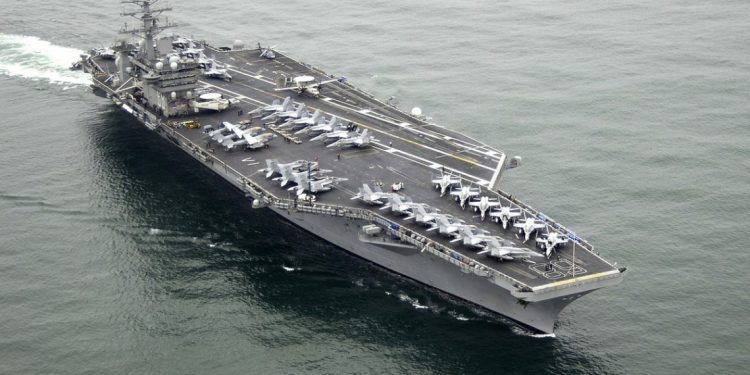
The report, dated June 1, 2019, says that 2017 saw the first port visit in 30 years by a U.S. aircraft carrier – the USS NIMITZ Carrier Strike Group – and the first ever bilateral Cooperation Afloat Readiness and Training (CARAT) exercise.
In 2019, we increased cooperation on mutual logistics arrangements in support of Indian Ocean security and disaster response,” the report said.
The report does not mention the Access and Cross Services Agreement (ACSA) renewed in 2017. Of course the on-going negotiations on the controversial Status of Forces Agreement (SOFA) do not find a place.
India Gets Unique Designation
The report, which details US Department of Defense’s relations with several countries in the Indo-Pacific Region, is effusive on India.
It says that the US and India maintain a broad-based strategic partnership, underpinned by shared interests, democratic values, and strong people-to-people ties.”
The U.S.-India strategic partnership has strengthened significantly during the past two decades, based on a convergence of strategic interests.”
The United States and India continue to use their deepening relationship to build new partnerships within and beyond the Indo-Pacific,” the DoD report says.
In June 2016, the United States designated India a Major Defense Partner, a status unique to India”. The designation seeks to elevate the U.S. defense partnership with India to a level commensurate with that of the United States’ closest allies and partners.”
The establishment of the U.S.-India 2+2 Ministerial Dialogue in September 2018 also serves as a tangible demonstration of our commitment to promoting the shared principles of a free and open Indo-Pacific.”
The United States continues to pursue a range of initiatives with India to enable cooperation, strengthen our interoperability, and establish a strong foundation for defense trade, technology sharing, industrial collaboration, and broader cooperation on defense innovation,” the report says.
Indo-US Communications Pact
Hailing the Indo-US communication pact signed in 2018, the report said that the Communications, Compatibility and Security Agreement represents a significant development in our military-to-military relationship, facilitating greater interoperability and real-time secure information-sharing.”
The Department of Defense (DOD) and the Indian Ministry of Defense are increasing the scope, complexity, and frequency of our military exercises. Later this year, the United States and India will conduct our first tri-service exercise, and we continue to collaborate on maritime security and domain awareness, HA/DR, counter-piracy, counter-terrorism, and other transnational issues.”
US$ 16 billion Military Sales to India
Since 2008, the US had sold military equipment worth US$ 16 billion to India. But this is worded as bilateral defense trade”.
As the shared interests of the US and India and security cooperation have expanded, U.S.- India bilateral defense trade and technology cooperation have also grown, with approximately US$ 16 billion in defense trade since 2008.”
Through the Defense Technology and Trade Initiative, we are increasing cooperation in defense technology, building industry-to industry ties, and identifying opportunities for the co-development and co-production of defense systems for the sustainment and modernization of military forces,” the report said.
Military Aid For Maldives
The US expanded its military ties with the Maldives after the recent democratic transition in the Maldives,” giving it US$ 7 million in aid for the modernization of its security forces and for increasing domain awareness, the report says.
The United States has begun to explore avenues to expand security cooperation, with particular emphasis on providing capacity-building opportunities to the Maldives National Defense Forces and Maldivian Coast Guard. Key areas of focus include: maritime domain awareness (MDA), to enable Maldivian forces the ability to monitor and patrol its sovereign maritime area and contribute to regional efforts to protect sea lines of communication; HA/DR readiness; and counter-terrorism capability.
An additional $7 million in FY 2018 Foreign Military Financing (FMF) will support these efforts,” the report said.
Strong Relations With Bangladesh
The United States enjoys a strong” defense relationship with Bangladesh, an important partner” for regional stability and security, the report says.
Security cooperation focuses on key areas such as maritime security and domain awareness, counterterrorism, HA/DR, peacekeeping, and border security.
The annual Bilateral Defense Dialogue between USINDOPACOM and the Bangladesh Armed Forces Division sets the strategic direction of our defense relationship. In addition, recent increases in FMF, International Military Education and Training (IMET), and the inclusion of Bangladesh in the Maritime Security Initiative (MSI) underscore not only the value the United States places on its defense partnership with Bangladesh, but also Dhaka’s contributions towards regional stability in support of upholding a rules-based international order in South Asia and the Indian Ocean Region.”
Room For Expansion in Nepal
The United States seeks to expand its defense relationship with Nepal. Cooperation is not focused on HA/DR, peacekeeping operations, defense professionalization, ground force capacity, and counter-terrorism.
Our growing defense partnership can be seen in the establishment of the U.S. Army Pacific-led Land Forces Talks in June 2018, our senior-most military dialogue with Nepal. This year has already seen several senior-level visits to Nepal by the USINDOPACOM Commander and Deputy Assistant Secretary of Defense for South and Southeast Asia to further advance our defense relationship,” the report said.
China Castigated
Expectedly, China has come in for very harsh criticism in the US report.
Today, the Indo-Pacific increasingly is confronted with a more confident and assertive China that is willing to accept friction in the pursuit of a more expansive set of political, economic, and security interests,” the report says.
It pointed out that no country has benefited more from the free and open regional and international system than China, which has witnessed the rise of hundreds of millions from poverty to growing prosperity and security.
But while the Chinese people aspire to free markets, justice, and the rule of law, the People’s Republic of China (PRC), under the leadership of the Chinese Communist Party (CCP), undermines the international system from within by exploiting its benefits while simultaneously eroding the values and principles of the rules-based order,” the report charged.
It recalls that Chinese nationals acting in association with the Chinese Ministry of State Security were recently indicted for conducting global campaigns of cyber theft that targeted intellectual property and confidential business and technological information at managed service providers.”
Militarization of Seas
The DoD said that China has continued to militarize the South China Sea by placing anti-ship cruise missiles and long-range surface-to-air missiles on the disputed Spratly Islands and employing paramilitary forces in maritime disputes vis-à-vis other claimants.
China additionally employs non-military tools coercively, including economic tools, during periods of political tensions with countries that China accuses of harming its national interests,” the report alleges.
As China continues its economic and military ascendance, it seeks Indo-Pacific regional hegemony in the near-term and, ultimately global preeminence in the long-term.”
China is investing in a broad range of military programs and weapons, including those designed to improve power projection; modernize its nuclear forces; and conduct increasingly complex operations in domains such as cyberspace, space, and electronic warfare operations.
China is also developing a wide array of anti-access/area denial (A2/AD) capabilities, which could be used to prevent countries from operating in areas near China’s periphery, including the maritime and air domains that are open to use by all countries,” the report says.
In the East China Sea, China patrols near the Japan-administered Senkaku Islands with maritime law enforcement ships and aircraft. These actions endanger the free flow of trade, threaten the sovereignty of other nations, and undermine regional stability.
Such activities are inconsistent with the principles of a free and open Indo-Pacific,” the report asserts.
Low Level Coercion
Simultaneously, China is engaged in a campaign of low-level coercion” to assert control of disputed spaces in the region, particularly in the maritime domain.
China is using a steady progression of small, incremental steps in the ‘gray zone’ between peaceful relations and overt hostilities to secure its aims, while remaining below the threshold of armed conflict,” the report alleges.
(The featured image at the top shows the USS Nimitz which visited Colombo)
Eight Muslim ministers in Sri Lanka resigned from their posts to stand on Monday in solidarity with Industry Minister Rishad Bathiudeen, who has been accused by the Opposition of supporting Islamist militants who killed 253 people in the Easter Sunday attacks in April, Reuters reported.
All Muslim Ministers – Cabinet, Non-Cabinet, State & Deputy – have decided to resign from their portfolios in the government.
Leader of the Sri Lanka Muslim Congress (SLMC) Minister Rauff Hakeem stated this at a press conference earlier today (03).
Accordingly, Minister of Industry & Commerce, Resettlement of Protracted Displaced Persons, Co-operative Development and Vocational Training & Skills Development Rishad Bathiudeen will also resign from his post.
Rishad Bathiudeen also resigned from the ministry on Monday, undercutting a planned no-confidence motion led by supporters of former President Mahinda Rajapaksa. Ten accusations were listed against the minister in the motion, including the allegation that he provided ammunition to a factory owned by one of the bombers, and pressured the Army to release suspects arrested in connection with the attacks. However, the accusers did not provide evidence against him. Bathiudeen has denied the charges.
Reportedly, the resigning Ministers will continue to serve as government parliamentarians. However, they would sit in the parliament as backbenchers.
A meeting of all Muslim Ministers representing the government was held at the Temple Trees at 3.30 pm this afternoon.
By Noor Nizam. Peace and Political Activist, Political Communication Researcher, SLFP Stalwart and Convener – The Muslim Voice – June 6th., 2019.
GOOD TIME FOR SRI LANKA MUSLIMS TO CREATE NEW POLITICAL LEADERSHIP WITHIN THE COMMUNITY IN PLACE OF DECEPTIVE POLITICIANS AND THOSE WHO RESIGNED.
The political happenings ( not the NTJ violence and the incidents
followed as a result) at present with regards to the Sri Lanka Muslim Community
has to be considered as God AllMighty Allah sent, Alhamdulillah, Insha Allah.
The resignation of all the Muslim Ministers, Deputy Ministers, Ministers
without portfolios (9 in all) and the 2 Muslim Governors has opened the way for
“NEW POLITICAL LEADERSHIP” within the Muslim political hierarchy of
Muslim political praties and the (so-called Yahapalana) coalition
government. This deceptive so-called SLMC Leader campaigns under the
SLMC Party banner, but contests under the UNP Elephant symbol. Wiping up
communal and religious themes. The ACMC does the same, but is accused of
being busy making money. These politicians finally do all they can to
become elected by the people hoodwinking the poor “PAMARAMAKKAL”, the
Muslim voters. Let the Muslims (PAMARAMAKKAL) who OWN the Muslim VOTE BANK NOT
get duped once again, Insha Allah. Muslims in Sri Lanka do NOT have a voice – a
POLITICAL VOICE for that purpose. The Muslim politicians stooging the UNP are
ONLY interested in their personal benefits. The ungrateful Muslim politicians
who benefited the most from Mahinda Rajapaksa, Basil Rajapaksa and Gotabaya
Rajapaksa are now stooging the Yahapalana government and enjoying their best
with their kith and kin and henchaiyas, by selling the VOTE BANK of the Muslims
who have been deceived lock-stock-and-barrel. The Muslim Civil Society and
Muslim Media organizations (excluding www.jaffanamuslim.com)
in Sri Lanka and their leaders will stage dramas by releasing “press
statements” because all of them have been well taken care by the
Yahapalana government and the foreign interests who are giving them large
amounts of funding to keep their mouth shut. THEY HAVE RESIGNED NOT ON BEHALF
OF THE WELFARE OF THE MUSLIM COMMUNITY, BUT TO SAVE THEIR SKIN AND TO HOODWINK
THE MUSLIM VOTERS, so that they can appeal for their votes as “SAVIOURS OF
THE COMMUNITY” in the situation we are placed.
Brother M.F.M.Fazaath – Southeastern University, Oluvil has written
a well explanatory article about the present plight of the Muslim Community in
Sri Lanka – Alhamdulillah. Fazaath makes the call that – The slumber
(sleeping) in which the Muslim Community has been should be over now. It is
time up that we should awake now”. This is the reality, Insha Allah – முஸ்லிம்கள் சிந்திக்க … – Jaffna Muslim www.jaffnamuslim.com/2016/07/blog-post_222.html
It is
true that we have allowed the affairs of our community to be taken control of
unscrupulous, dishonest, deceptive, self-motivated, selfish, corrupt and
manipulating Muslim politicians, Muslim political party leaders, traders,
businessmen, Ulema, Media personnel and government officials, that has led our
community to be considered as a 2nd., class community in Sri Lanka.
Look at a comment made by Brother Haseef
M says: 13
July 2016 at 15:41Replyhas
stated. “Our education and employment index is very low compared to
Tamil and Sinhalese .. Without employment people will do anything illegal to
make money… That is happening to our community … Most unemployed are from
our community,,. Most uneducated are from our commutiy.. So crime rate go up…
Do not we believe in next life and do not believe in Hell and Pradise we do..
We have weekly Friday reminder and yet crime is going up among us .why ??
On the eve of January 8, 2015 presidential elections, the SLMC
and the ACMC joined “Hansaya” camp as they found that the entire
Muslim Community had decided to take revenge on Mahinda Rajapaksa. The vote
that President Maithripala Sirisena (“Hansaya”) got was an
Anti-Mahinda vote, “enblock”. It was not a pro Maitripala vote,
neither was it a vote for Rishad Bathiudeen or Rauf Hakeem or Faizer Musthapa
or Mujeebu Rahuman or Marikkar or for the UNP. Even the 20% of Muslim voters
who voted Mahinda at the 2010 Presidential Elections and the general elections,
voted against Mahinda at the 2015 presidentail and general elections. The ACJU
willingly or unwillingly allows itself to be manipulated by the above Muslim
politicians and used as a front for Muslim as well as non-Muslim politicians
who seek to achieve their own ends through the ACJU. The incidents of Aluthgama
and Beruwela, blamed as violence instigated by the then government via the BBS
was to be probed by the “Yahapalana government” when it comes to
power – then 20014/2015. A presidential commission was to be set in motion.
THIS DID NOT HAPPEN UP TO NOW. The FRUSTATION and AGONY of the Muslims being
betrayed by the “Yahapalana Government”, followed by more incidents
against Muslims in Digana and other areas and attacks on a few Muslim mosques
which were smoke screened by Muslim politicians for their personal gains, may
have driven some of the the Muslim youth to gather around an EVIL force of
destruction that we saw let loose on April Good Friday in our recently
peacefull Island. Was there more to this, or was it the “THREACHERY”
that the Muslim politicians and Political leaders and ULEMA – failed of
politically serving the “ASPIRATIONS and INSPIRATIONS” of the Muslims,
especially the “YOUTH”, that drove these youth to what they have now
ended up with – that it was NOT wealth, position, elite way of living, be
politically successfull or the goodies of well-to-do-lives or “RELIGIOUS
DECEPTION” but NOT – politically serving the “ASPIRATIONS and
INSPIRATIONS” of the Muslim Community since the Muslim political leaders
started “TRADING” their vote banks with National Political
Parties/Alliances for their selfish needs since the advent of the Sri Lanka
Muslim Congress – SLMC in Kattankudy in 1981.
It is time up that a NEW POLITICAL FORCE that will be honest and
sincere that will produce “CLEAN” and diligent Muslim Politicians to
stand up and defend the Muslim Community politically and as responsible
citizens of our “MAATHRUBOOMIYA”, especially from among the YOUTH,
has to emerge from within the Sri Lanka Muslim Community to face any new
election in thecoming
future, Insha Allah.
Cardinal Malcolm Ranjith who visited MP Ven. Athuraliye Ratana Thera during his fast unto death said the problem would not have blown out of proportion today if President Maithripala Sirisena and Prime Minister Ranil Wickremesinghe had acted against those who discreetly aided and abetted the terrorist attacks.
People have given a mandate to the President, the Prime Minister and the Cabinet to govern the country for five years. They had not been given a lifetime right to be in office. They have not been given the country on freehold basis. The country belongs to people, not to its rulers. The rulers should be mindful of it. The time has come to take a decision on the President and the Prime Minister,” he said.
He said if it were the President and the Prime Minister who could appoint Minister Rishad Bathiudeen, then it was they who had the authority to remove him.
The Cardinal also said that there were no proper investigations into the Eastern Sunday attacks so far.
No one is investigating to find out about those indirectly involved in this attack. Because of that, there should be immediate investigations to find out who were behind this attack. So we call on the President and the Prime Minister to launch a proper inquiry into the attack immediately,” the Cardinal told the media.
I urged the President and the government find out the persons who were creating hatred among the communities and take necessary action against them. I believe that Ven. Rathana Thera too conducting this fast because the government had failed to do what the people want in this context,” the Cardinal said.(
Pulasthini Rajasinghe
or Sara was one of the Jihadists who blew herself in a Sri Lanka Church on Easter
Sunday. There is no valid reason for her
to have exploded that bomb and herself along with it. One does not know whether she wanted to be a
suicide bomber It may be she was forced into doing it.
Like Ahimsa who may
not even know why she should destroy the political future of a fellow Sri Lankan without even knowing
whether he was actually responsible for the death of her father.
What did Sara the
Jehadist gain from that terrible act ? She was not even there to see the
aftermath of the bloody buchery she caused to innocent men women and children doing nothing else
but celebrating the rising of Jesus from
the dead ?
Ahimsa
Wickramathunga is also to a certain extent like Sara the Jihadist who exploded the
suicide bomb. But it may be Ahimsa too
has been forced to do so, as no one
knows what Ahimsa with such a meaningful name wants .
What does Ahimso stand
to gain from filing a civil case against
Gotabhaya Rajapakse in a US District
Court in California, which in my opinion is a bomb to shatter the reputation of
an innocent man loved by a greater majority of the people in Sri Lanka ?
As Sara the Jehadist
will go down history as a murderer of innocent men and women, Ahimsa Wickramaratne will go down history as a woman who tries to murder” the hopes of lakhs of
people of Sri Lanka her motherland , or if she denies it, that of her father.
It could be called a
suicide bomb even though Ahimsa is not
physically blowing herself up, she nevertheless will have to live as a person
with a meaningless name thereafter (because Ahimsa means not harming any one)
hated by a majority of the people in Sri Lanka, and her children too will
continue here after to live with that scar of a mother’s betrayal of the Sinhala people or if she denies they
are not her people , they were at east he people of her father.
Those interesed- Ahimsa’s handlers and brain washers like
those of the Towheed Jamat are
determined to vindicate the assassination of her father ten years ago when
Ahimsa was only 16 years of age. They are certainly not doing it for any love
for Ahimsa or her father Lasantha , but for the compensation money they have
been promised by anti Sri Lanka group-the Tamil diaspora , or a political party
in Sri Lanka to who are bent on
depriving the hopes of the
majority of the people of Sri Lanka to recover the peace and security and rapid
development of their country before the 8th January,2015, under President Mahinda Rajapakse and the Defence Secretary Gotabhaya
Rajapakse.
Of course in the
latter case Ahimsa the terrorist-( to my
mind any one who without a valid reason attempts to kill the good name and reputation of an innocent man is also a
terrorist) may not blow herself, but yet she blows off her own feminity and
what she may have learnt of altruism, as a child hailing from a respected and
an educated family.
One may of course argue
that Ahimsa even if what she is preparing to do is equivalent to an action of a
terrorist suicide bomber, she may not
cause a carnage as it had been at the
Church where the Jehadist exploded herself.
But then Gotabhaya
Rajapaksa is a man loved by a large majority of the people in Sri Lanka who are
lamenting the calamity that is being
done by the present government of Ranil Wickramasinhe.
Under the Premiership
of Ranil Wickramasinghe; Sri Lanka has
lost its peace and security and is being gradually handed over to USA , the
West and the terrorist sympathising Tamil Diaspora. It is worst than the carnage on the Easter Sunday, as it is an attempt to
massacre the hopes of the suffering people of a politically mismanaged
Sri Lanka.
The other Tamil man
who has filed another action against Gotabhaya Rajapakse-the former terrorist Manojkumar Samathanan who
claims to have been tortured and claims compensation from Gotabhaya Rajapakse
is doing so for the sake of money he may gain if he wins the case.
But Ahimsa
Wickramathunga may have enough money and her interest may not be the financial
gains she has been promised, but she is nevertheless just attempting to blow up a suicide bomb to get some relief for her suffering as a daughter
whose father had been murdered by some unknown persons whom she thinks or her
handlers think was carrying out the
orders of Gotabhaya Rajapakse.
The poor girl Sara
who had joined the Jehadists did not know she was dying in vain, as she was
brain washed by Towheed Jamat. And she was obeying her handler to blow herself
in a Church. She had no alternative once
the bomb was attached to her and
commandeered to enter the Church, she had to die in blowing up the bomb,
or if she abandoned she would have been killed by her handler who was certainly
prowling behind her.
Ahimsa Wikramatunga
has also been brain washed and she obeys her handler to assassinate the
popularity of Gotabhaya Rajapakse ten years after the assassination of her
father. She was only 16 years old at the
time and her handlers write as if it is her confession that she was only 16
years of age at the time.
Ahimsa may now be
about 26 years, and forgotten all about that
sad episode or trying to forget it, but
it is her brainwashers –the handlers who
are using the fact of Ahimsa being the daughter of Lasantha Wickramatunga to
realise their dirty object of destroying Gotabhaya Rajapaakse’s political
future and thus assassinate the hope of a nation, and in adition hope to get
financial compensation.
Ahimsa you have still
time to think, whether you will be obedient to your handlers and set off the
bomb or just refuse to detonate the bomb and thus be the heroine of the countless number of people in
Sri Lanka looking for redemption from calamitous situation Sri Lanka has been
brought into by Ranil Wickramasinghe and
his government, and allow Gotabhaya
Rajapakse to be the President of Sri Lanka to bring it back to what it had been before Ranil Wickramasinghe was sworn in as
the Prime Minister on the 9th January,2015.
The number of complaints lodged against Dr. Mohamed Shafi from Kurunegala Teaching Hospital has, reportedly, exceeded 630.
Sixty-six mothers who had undergone a Caesarian surgery under Dr. Shafi had filed their complaints at Kurunegala Hospital today (03).
Accordingly, the total number of complaints received by the Kurunegala Teaching Hospital itself is 544.
Additionally, another 21 mothers had filed their grievances at the Dambulla Hospital, today; which brings up the total number of complaints received by the particular hospital to 86.
Meanwhile, the interim report of the committee appointed by the Health Ministry to inquire into activities of Dr. Shafi was handed over to the Ministry Secretary today.
It contained 04 pointers including a recommendation to broaden the 6-member investigative committee by expanding the composition and the number of members in the committee.
CCTV footage of the Easter Province Governor M. L. A. M. Hizbullah meeting several persons who could be identified as Saudi Arabian nationals at a hotel in Pasikudah has been uncovered.
The CCTV footage shows Governor Hizbullah arriving at the particular hotel on the 22nd April 2019, a day after the Easter Sunday bombings which killed nearly 350 persons.
Footage has also captured several persons coming out of the hotel building to meet the governor and him entering the hotel with them.
Subsequently, the governor comes out of the hotel with several persons who could be identified as Saudi Arabians.
Later, a van arrives at the hotel and a parcel which arrived on the van is taken towards the hotel.
At a time when leading Sinhalese politicians were not prepared
to identify themselves as Sinhala Buddhists, when the Sinhalese were divided on
party lines, when leaders were behaving like Ostriches with their heads buried
in the sands, promoting multi – culturalism and reconciliation both of which
have collapsed like a pack of cards, and when Sinhalese have realized that they
have been taken for a ride and deceived by empty slogans and were waiting for a
true leader with a back bone to call the shots in the country, you arrived at
the right moment to give voice to the Sinhalese and the people all around the
country rallied around you saying ‘ At last we have a leader with a moral back
bone’.
The result was the resignation of two of the most despised men
in the country.
This is a huge milestone in the life of the nation and in your
personal life.
You have used non – violence as a weapon and like Mahatma Gandhi
have shown its high potential to cleanse and purify society.
Go Forward O Monk.
Teach moral cowards to take pride in our ‘ Rata, Jathiya, Agama’
Never a dull moment in Sri Lankan politics! Someone or something keeps it really exciting. The unfolding political situation is like an edge-of-your-seat thriller.
The yahapalana government is afflicted with a serious autoimmune disease, so to speak. It has become its own enemy. President Maithripala Sirisena and Prime Minister Ranil Wickremesinghe are at daggers drawn. Others who helped cobble up the yahapalana coalition and bring it to power have turned against it. Its chief architect, Ven. Maduluwawe Sobitha Thera, was one of its bitterest critics at the time of his untimely demise. His successor Prof. Sarath Wijesuriya cursed himself, the other day, for having backed it.
Now, MP Rathana Thera, who led the yahapalana campaign against the Rajapaksa government, from the front, is on the warpath. He launched a fast last week, demanding the removal of Minister Rishad Bathiudeen and Governors Azath Salley and M. L. A. M. Hizbulla. The government had to give in. Salley and Hizbulla resigned, yesterday. Rathana Thera ended his fast after being given an assurance that Bathiudeen would follow suit.
If the government had refused to grant Rathana Thera’s demand, his fast would have continued and the deterioration of his health would have made the public furious. Above all, his hunger strike would have snowballed into a mass protest campaign against the government. Kandy traders closed their shops as a mark of solidarity with the fasting monk, and bus unions threatened a strike; in fact, buses stopped operating on some routes yesterday. A TNA MP also staged a fast in solidarity with Ven. Rathana, and the families with the victims of the Easter Sunday bombings travelled to Kandy in support of the Thera. Archbishop of Colombo Malcolm Cardinal Ranjith visited the rebel monk and held the latter’s hands. The message was loud and clear!
The government may have been able to prevent the people from taking to the streets, but the political storm has not blown over. It would not have been in the current predicament if it had faced the no-faith motion against Minister Rishad Bathiudeen instead of trying to open an escape route for him through a parliamentary probe into the very serious allegations against him. It may have thought that it could do anything in Parliament. Thanks to its arrogance, an issue which could have been confined to Parliament has got out of hand; even if the no-confidence motion had been taken up and the Opposition had secured its passage with some UNF MPs voting for it, Bathiudeen would have resigned himself to losing the vote. But, now, all Muslim ministers in the government have had to resign because of him.
It is reported that the Muslim MPs in the ruling coalition have decided to continue to support the government without holding ministerial and other portfolios. They have helped the government wriggle out of a difficult situation, albeit temporarily, but they are politicians thirsting for power like their counterparts in other communities. This is certainly not a situation they can come to terms with so easily. There was absolutely no need for them to resign en masse from the Cabinet because the allegations at issue were not against the Muslim ministers; they were against only Bathiudeen, and they were never under pressure to step down.
In fact, some of the Muslim ministers are known to have courageously stood up to the dangerous extremists in their community. Why they decided to get bracketed with their beleaguered ministerial colleague defies comprehension. Their resignation might prove to be counterproductive in that it can be misconstrued as an act of pledging solidarity with Bathiudeen, who stands accused of having had links to the National Thowheed Jamaath, which carried out the Easter Bombings.
We can only hope that an equal number of Sinhala ministers will also resign from the Cabinet so that a lot of public funds spent on their maintenance could be saved.
Venerable Athuraliye Rathana Thero has concluded his protest fast upon learning that Governors Azath Salley and M.L.A.M. Hizbullah had resigned from their respective posts.
Athuraliye Rathana Thero launched a protest fast in front of Sri Dalada Maligawa in Kandy on 31st May demanding the removal of Minister Rishad Bathiudeen, Eastern Province Governor M.L.A.M Hizbullah and Western Province Governor Azath Salley from their respective posts.
Rathana Thero claimed that he was prepared to sacrifice his life if need be in order to achieve his demands.
Meanwhile, Governors Azath Salley and M.L.A.M. Hizbullah handed their letter of resignation to President Maithripala Sirisena earlier today (03).
Accordingly, Central Province Governor Maithri Gunaratne informed Rathana Thero of the resignations.
Accordingly, the Thero broke fast and was taken to the hospital for treatment.
Rathana Thero stated that the President cannot remove Minister Rishad Bathiudeen from his post and that he believes that Prime Minister Ranil Wickremesinghe would take an action regarding this.
Parliamentarian Ven. Athuraliye Rathana Thero, who commenced a protest fast on Friday, has been informed that Governors Azath Salley and M.L.A.M. Hizbullah have tendered their resignations.
The Central Province Governor Maithri Gunaratne arrived at Sri Dalada Maligawa in Kandy, where Rathana Thero had been leading the protest fast, to inform him in this regard.
Eastern Province Governor M.L.A.M. Hizbullah and Western Province Governor Azath Salley had submitted their resignations to President Maithripala Sirisena a short while ago, the President’s Media Division said in a tweet.
A discussion was held at the Presidential Secretariat this morning between President Sirisena, MPs of Sri Lanka Freedom Party (SLFP) and Governors Hizbullah and Salley regarding the titles of the governors.
MP Rathana Thero stated that the protest fast would proceed until he is informed of this in writing.
Attempts to conquer
heights, be it a mountain or any other carry their own perils and risks.
Generally, glory and peril walk side by side in such endeavors, until the
former or the latter wins, in the end”.
Already eleven or twelve
climbers have perished on the slopes of the Mount Everest, in this year alone
and that is only so far. This sad news made me ponder on ‘the diverse nature of
adventure and that craving for a bit of it present in almost every human being
and the question how much or less of it in each one of us is there, longing for
those quests, some of which are unbelievably dangerous?’
Now at one end of the
scale are the minimal risk takers with hardly any love for or sense of
adventure at all, who cannot even be persuaded to climb anything higher than an
anthill or dare venture out further than to a depth around knee level in any
water body, be it a pool, a lake, a river or even the mighty ocean. They live
lives governed by the principle that as long as you keep away from everything
that has even the slightest chance of going wrong, you are safe. However, the
question is can you find such absolute and guaranteed safety in this world of
ours, where your safety depends as much on numerous external factors that are
beyond your control?
Yet our minimal risk
takers don’t get deterred or disturbed by such arguments. They would as best as
they can try to avoid anything and everything that they think may put them in
danger. And they are also firm believers in superstition so much so that they
will truly think that the little house gecko, who is going after a mosquito on
a wall suddenly abandons its stalking and decides to come up with its usual
chattering call ‘chuck, chuck, chuck’, is actually telling them that it’s a
foreboding. And one of them might even hurriedly start looking for that
handbook of ‘Huunu Sasthare’, if it happens to be at his/her home. Or what
about that innocuous looking black cat that happens to be crossing the same
patch of the road that our superstitious friend is walking along? Would his
casual thoughts as regards it be limited in extent to ‘oh a poor stray cat on
the prowl’: I doubt it.
Now at the other end of
the scale are sitting the exact opposite, who enjoy risk-taking and relish it,
going for adventures of all sorts, mostly very dangerous and doing it for the
sake of glory, sheer thrill, sense of achievement and so on and so forth.
And apart from those
extremely challenging and dangerous adventures such as mountain-climbing, there
are other equally dangerous and at the same time immensely foolish ones too
that some of our friends at the other extreme end of the scale tend to go for.
To keep it short, I will site only a couple here. But then before going any
further; ‘isn’t there a degree of foolishness attached to all extreme types of
adventure and sport, anyway?’
Poking one’s head into
the cavernous mouth lined with razor-sharp, sawtooth-like dental armour of a
fifteen-foot alligator is one, for example. This present-day descendant of
the dinosaurs that roamed the earth millions of years ago, is said to have only
a tiny brain even after all those eons that have passed by, and it’s more like
a chancy game of Russian roulette, when or whether the creature decides to shut
its snout with a human neck inside it for chewing at leisure.
And then we have some,
who, adequately emboldened by alcohol and apparently empowered by those ‘Ali
manthara’ dare challenge a wild elephant that is peacefully chomping away on a
leafy branch in a patch of jungle. In spite of being called gentle giants and
quite correctly so, they too like us the humans don’t take it lightly, when
someone tries to invade their personal space. And unfortunately, those who
dared to do so, didn’t live to tell the rest of the tale, as far as I
know.
Now, this particular form
of adventure could be more or less limited and quite unique to, Sri Lanka only.
And then I am not sure whether this kind of sheer stupidity should be
called an adventure at all, other than that it is plain suicide. However,
according to the ‘Oxford English Dictionary’ an adventure is; ‘An unusual and
exciting or daring experience, Excitement associated with danger or taking of
risks, A reckless or potentially hazardous action or enterprise’ etc. So, it,
nevertheless, is adventure too, of some kind.
Anyway, engaging in true
adventure is no doubt challenging and once accomplished, can be very
exhilarating too. To the person, who wins in the end beating all odds, I am
sure it brings a great sense of achievement and fulfillment, a magical
sensation of unburdening a weight that he/she had carried so long.
And before I leave, must
I say for myself that I am somewhere in the middle of that scale or should I
honestly admit that actually it is now far more to the left than to the right?
Yes. Years have taken their toll and they did teach me a few lessons too!
Now this brief article
wouldn’t be complete without a mention of a very special kind of an adventure,
which is the political adventure. And particularly, in our land like no other,
it is one adventure that still guarantees a victory in the end, if not glory.
Isn’t a hefty pension after just five years of idling in Diyawanna environs
along with ample real estate and other forms of wealth acquired and accumulated
during that state-paid vacation, enough, whether one wins or loses, at the end
of one’s adventurous tenure, so to speak?
After Narendra Modi took oaths on Thursday for a second time as India’s Prime Minister, having steered the BJP-led coalition to a landslide election victory, there was a string of announcements relating to diplomatic engagements involving Sri Lanka, India, China and the United States. Modi will visit Sri Lanka on 9th June, President Maithripala Sirisena told a press conference in Delhi, where he attended the Indian leader’s inauguration ceremony. Before that Modi will visit the Maldives, his first overseas trip as prime minister. The Indian media anticipates that the Indian PM will have bilateral meetings with the US and Chinese leaders in September and October, respectively.
Discussions on what the US calls its ‘Indo Pacific Strategy’ are to figure at meetings of senior US officials in Singapore for the Shangri La Dialogue, and in India – a ‘major US defence partner.’ US Assistant Secretary for Political Affairs Clarke Cooper is on a tour of Singapore, India and Sri Lanka from 29th to 6th June.
Against this backdrop, an unusual statement appeared on Friday titled “Indo-Lanka relations under the second term of Modi – In the backdrop of Chinese foothold in SL and US proposed SOFA,” on the President’s Media Division (PMD) website. It is in the nature of a commentary on Sri Lanka’s relationship with India which, it asserts, is ‘at a high now.’ The gist of it was to reassure Delhi regarding Colombo’s foreign policy moves.
Worrying about India’s possible reactions to controversial defence pacts with the US, it said “… Sri Lanka will have to be very careful not to antagonize India while shifting foreign policy decisions or entering into a new pact to replace Acquisition and Cross Services Agreement (ACSA) with the United States. … Now, the US proposes to replace ACSA with a Status of Forces Agreement (SOFA).”
Repeating the US’s misleading assurances in relation to the SOFA – that there is no need to fear the establishment of a US military base, that Sri Lanka ‘will retain all its sovereign rights’, etc. – the article asserts that “Currently, there is an acknowledgement in Washington with regard to India’s regional supremacy and its role in regional security and stability” and that “there is an understanding of the need for cooperation between India and the US to check rapidly expanding Chinese influence in this region.” Inexplicably, it adds: “Hence, it is essential to keep India informed about Sri Lanka’s intended military cooperation with any outside country, especially with a superpower such as the US.”
External pressure
Could the uncharacteristic comment posted on the PMD website be interpreted as an indirect admission that Sri Lanka has in fact agreed to sign up on the SOFA (which, till now, officials have been at pains to say, is still only ‘under discussion’)? Or is this an indirect (if somewhat clumsy) attempt to reassure India – timed to coincide with the president’s visit to Delhi for the Indian president’s oath-taking ceremony? Whatever the purpose, the sub-text of the essay suggests that political leaders are more interested in appeasing external forces and bowing to pressure from diverse quarters, than guiding policy in a manner that serves the national interest. There appears to be much external pressure being exerted to finalise this pact that gives carte blanche to US defence personnel entering the country, and threatens Sri Lanka’s sovereignty.
The SOFA is not the only agreement that the US has been pushing to conclude in Sri Lanka. The country’s pro-US-prime minister led government is working hard to conclude or implement a number of other pieces of legislation and policy at the behest of its Western patrons, against all odds. If there is a sense of urgency in these efforts, it is because time is running out. With a presidential election only six months away, and the government showing a dismal report card on its performance in most areas, its Western backers know that its days are numbered. Hence the pressure is turned up, to fast-track the desired laws and agreements. It is the US-friendly UNP leadership that will be instrumental in this process. The public will need to be on alert because once these laws are passed there is no possibility of judicial review, under the constitution.
One example is the proposed Counter Terrorism Act (CTA). From the moment the Easter Sunday attacks took place Prime Minister Ranil Wickremesinghe has been vigorously arguing that a new law is needed to curb terrorism. This is despite multiple arguments that have been made showing that there is ample provision in the country’s existing legislation, to deal with terrorism. It has been pointed out that amendments to the existing Prevention of Terrorism Act (PTA) would suffice. It is an open secret that the eagerness to have the CTA passed, stems from pressure to comply with the demands of the US-led UNHRC resolution against Sri Lanka, which calls for repeal of the PTA.
Land reform and MCC
Parallel to the defence-related agreements and arrangements sought by Western powers, such as the SOFA, a number of laws have been drafted and/or passed relating to the economy as well. Reforms that would bring the economy in line with the Western neo-liberal model, represent the ‘other side of the coin,’ of the defence agreements that advance US hegemony on the military front. Among them are the Millennium Challenge Compact (MCC), new laws that will radically transform patterns of land use and ownership such as the proposed Land Bank Act and already-gazetted State Land (Special Provisions) Bill and, according to some, the revised National Physical Plan 2050 (NPP).
The Millennium Challenge Compact (MCC) is said to be a US grant for development purposes. The MCC was developed in secrecy by a team located in the Sri Lanka prime minister’s office. A government minister in parliament even denied its existence. There has been no public discussion on it. The MCC’s approval of the $480 grant for Sri Lanka was announced by government just days after the Easter Sunday attacks – when one would imagine that Sri Lanka’s investment credentials were at an all-time low. The secrecy, the odd timing of the announcement and other aspects would suggest that the MCC is being imposed by the US for its own purposes, rather than for the benefit of Sri Lankans.
From the little that is known, the MCC relates to two projects, on Transport and Land. The goal of the Land project is said to be to ‘increase land market activity’ and the ‘tradability of land’ through ‘policy and legal reforms.’ Eighty percent of Sri Lanka’s land is owned by the state. Making such land a ‘tradable commodity’ or creating a ‘land market’ as the MCC aims to do, has long been advocated by the World Bank to bring about what it calls ‘market based land consolidation’ for the benefit of private (including foreign) investors.
Dispossession of farmers
Environmental groups and land rights activists who are aware of details of the MCC, are strongly opposed to the project. Smallholder farmers cultivate land on the basis of state grants or other forms of tenure short of outright ownership. Since farmers are chronically indebted, the reforms underway will in all likelihood lead them to sell their plots, activists have pointed out. The end result will be mass dispossession of farmers and other rural populations engaged in animal husbandry, fishing etc. These groups whose livelihoods will be destroyed, are the source of food sovereignty, says Sajeewa Chamikara from MONLAR, a grassroots land-rights organization.
The government’s moves to remove the bar on foreigners owning land, the removal of the 50-acres limit on individual ownership, the proposed ‘Land Bank’ (that will bring publicly owned land under a single hub and make it available for private investors), are inter-related.
“You need to look at all the factors to see the final outcome” explained Chamikara. One needs to ask, if the government is genuinely interested in addressing the land-related and other multiple problems faced by farmers, why doesn’t it address these issues directly, in consultation with the farmer organisations – rather than bowing to pressure from foreign ‘advisors’ who may have their own agendas?
The State Land (Special Provisions) Bill was gazetted on 27.03.19, and the National Physical Plan 2050 was recently reported to have got presidential approval. Both were strongly opposed by the president, during the November-December 2018 constitutional crisis. The land laws which he, at the time, described as ‘anti-national,’ were among reasons he cited for his move to sack the prime minister. What pressure was brought to bear on the president to make him give his assent to them later? Why did he give in? It would seem that the instability caused by in-fighting between president and prime minister has made the country particularly vulnerable at this time.
The State Land (Special Provisions) Bill, gazetted by the UNP’s Minister of Lands (and not the president), will need to be passed in parliament. Its purpose is “to grant absolute title to state lands held by citizens who are holders of grants or instruments of disposition.” Its validity is for seven years. So it would appear the government seeks to dispose of large tracts of land in a short time, to make them quickly available for investors. This again will accelerate the dispossession of smallholders.
Drastic changes
The revised National Physical Plan 2050, prepared by the National Physical Planning Department of the Megapolis and Western Development ministry, is yet to be made public, although it is said to be ‘completed.’ The NPP seeks to concentrate economic activity in four ‘Economic Corridors’ of which the Colombo–Trincomalee corridor will be its showpiece. Attracting private investment is a key objective. According to a draft summary seen by this writer, the NPP’s medium term goals include the ‘transformation of the economy from conventional industries to high tech and innovation based Industries,’ increased international trade and increased ‘attraction for investment and trade.’ The NPP expects to transform land use patterns and bring about movements of population, to achieve a ‘reversal of the rural-urban population ratio’ in 30 years. This gives a clue to the drastic nature of envisaged changes. The NPP however will not be required to be passed in parliament. According to NPP Director General Dr Jagath Munasinghe “it is a policy document, not a Bill” and so it only needs to be gazetted.
It has been observed that the districts covered in the NPP more or less overlap with those coming under the MCC. From the little available information it would appear the goals of the two projects broadly dovetail. It is unlikely that this is coincidental, they both come within the economic thrust of the UNP government that seeks to put the country’s land and other resources at the service of foreign capital. Whatever the merits of these projects, it is unconscionable that plans to bring about such far-reaching social and economic change, are not made available for public debate. The secrecy surrounding them shows that the government knows they will be unpopular. The overarching question is. whether the present government is more interested in pleasing its Western backers, than the constituencies in Sri Lanka, millions of voters, to whom it is answerable.
The wartime Rajapaksa administration, having created the post of Chief of National Intelligence (CNI) to run an efficient network involving all three services, the police and the State Intelligence Service (SIS), placed Maj. Gen. Kapila Hendavithana, in charge of the powerful Office in January, 2007.
The CNI tasks included managing local and foreign intelligence and briefing the National Security Council (NSC) chaired by the President.
Then, President Mahinda Rajapaksa, in his capacity as the Minister of Defence, Public Security and Law and Order, established the Office of CNI by way of a Cabinet Memorandum to accommodate Hendavitharana, who functioned at the Defence Ministry, as the Intelligence Advisor, following his retirement in Oct 2006.
President Rajapaksa secured cabinet approval for the appointment though an attempt was made initially to accommodate Hendavitharana on Pay and Pension scheme.
The post of the CNI was meant to be held by a senior military intelligence officer though the incumbent government replaced Hendavitharana with Sisira Mendis, retired DIG, who was in charge of the Police Narcotics Bureau (PNB) at the time of his retirement.
A Parliamentary Select Committee (PSC) probing the alleged lapses on the part of those in authority leading to the single biggest security breach in Sri Lanka’s history on April 21, last week questioned Mendis. During the proceedings opened to the media, it transpired that Mendis lacked the authority to function the way his predecessor Hendavitharana had done.
Hendavitharana was based in Thailand as ‘regional intelligence coordinator’ for several months in the wake of accusations the Military Intelligence, which he served, was undermining the Oslo-led peace process. Hendavitharana was away for about six months and returned in January 2006.
PSC member, Field Marshal Fonseka pointed out to Mendis how Hendavitharana had functioned. Mendis said Hendavitharana had the authority to act.
In addition to Mendis, Defence Secretary Maj. Gen. Shantha Kottegoda, the retired army commander, too, appeared before the PSC.
The PSC first met on May 29 under the leadership of MP Dr. Jayampathy Wickremaratne, PC, in the absence of its Chairman Ananda Kumarasiri, currently overseas on an official visit. Moneragala District MP was expected to return in the coming weekend, his family said yesterday.
MP Wickremaratne yesterday told The Island that he would chair the PSC when it meets tomorrow (4). UNP representative Dr. Rajitha Senaratne and M. A. Sumanthiran of the TNA would participate in the proceedings though they weren’t present at the inaugural session.
he PSC comprises Ananda Kumarasiri (Chairman/UNP), Field Marshal Sarath Fonseka (UNP National List), Dr. Jayampathy Wickremaratne (UNP National List), Rauff Hakeem (SLMC), Ravi Karunanayake (UNP), Prof. Arsu Marasinghe (UNP National List), Dr. Nalinda Jayatissa (JVP), M.A. Sumanthiran (TNA) and Dr. Rajitha Senaratne (UNP).
Joint Opposition (JO) lawmaker Wimal Weerawansa yesterday told The Island that their group boycotted the PSC as at the time Speaker Karu Jayasuriya named members for it, there was likelihood of the government not giving dates for debate on two-day the JO’s no-faith motion against Industry and Commerce Minister Rishad Bathiudeen.
Weerawansa said they were also concerned about the government using PSC to clear Bathiudeen, leader of the All Ceylon Makkal Congress (SCMC) accused of having clandestine links to those responsible for the Easter Sunday carnage.
Speaker Jayasuriya subsequently set June 18 and 19 for NCM.
MP Weerawansa said that the government lacked interest in maintaining intelligence services. National security was certainly not a priority for the yahapalana politicians, Weerawansa said, pointing out that the National Security Council (NSC) had last met, on Feb 19, 2019, prior to the Easter bombings. The government owed an explanation as to why it had not met for over a month, Weerawansa said. Answering another query, the MP said that it would be the responsibility of the PSC to identify the person responsible for summoning the PSC in case of an emergency.
There is uncertainty as to the current status of the Compact between the U.S. Millennium Challenge Corporation (MCC) and Sri Lanka as to whether it has been signed by the President, as the Chairman of the National Physical Planning Council, and whether it has been Gazetted or not. On August 13, 2018, the MCC is reported to have delivered to the U.S. Congress a congressional notification (CN) of its intent to negotiate a Millennium Challenge Corporation Compact with the Government of Sri Lanka. On April 25, 2019, the MCC approved a five-year Compact with Sri Lanka. However, there is uncertainty as to how the U.S. Congress would respond to the request for such a Compact.
SCOPE of the PROJECT
“What the Board of Directors of the Millennium Challenge Corporation has approved is a five-year, $480 million Compact with the Government of Sri Lanka aimed at reducing poverty, through economic growth. The Compact seeks to assist the Sri Lanka Government in addressing two of the country’s binding constraints to economic growth: (1) inadequate transport logistics infrastructure and planning; and (2) lack of access to land for agriculture, the services sector, and industrial investors”.
“The Compact will be composed of two projects: a Transport Project and a Land Project. The Transport Project ($350 M) aims to increase the relative efficiency and capacity of the road network and bus system in the Colombo Metropolitan Region and to reduce the cost of transporting passengers and goods between the central region of the country and ports and markets in the rest of the country. The goal of the Land Project is to increase the availability of information on private land and underutilized state lands or all land in Sri Lanka to which the Government is lawfully entitled or which may be disposed of by the Government (“State Lands”) in order to increase land market activity. The Land Project would increase tenure security and tradability of land for smallholders, women, and firms through policy and legal reforms” (https://www.mcc.gov/where-we-work/program/sri-lanka-compact).
“This is a grant that Sri Lanka has been applying for many years. Even during the previous government, former PM, D. M. Jayaratne’s Secretary, Sirisena Amarasekara, to discuss this among other matters, in Washington. They were unsuccessful,” an official told the Sunday Observer.
“After considering fresh applications made in December 2015, the MCC board of directors selected Sri Lanka for the threshold programme which is the lower programme of the two that is made available by MCC”.
“However, after reviewing the scorecard and observing continued improvements in performance, as measured by the MCC scorecard, the country has been selected for the Compact programme.
“Since early 2017, we have been working with the MCC collaboratively and closely, to develop a dual-sector compact programme in grant funding. This project would have ideally kicked off in December last year, however due to the constitutional instability that took place, it resulted in a major setback in the implementation of the project,” he said.
THE NATIONAL PHYSICAL PLAN
The Compact is based on a National Physical Plan prepared under the Town and Country Planning (Amendment) Act (No. 49 of 2000). The current Physical Plan (2018 – 2050) is a revision of an earlier Physical Plan (2011 – 2030) prepared in 2011. The earlier Physical Plan had followed all the procedures required by the Act. The question is whether the revised Physical Plan has followed the due process as required by the Act.
Such procedures should include preparing a Draft Physical Plan and conducting hearings with experts, professionals and general public and obtaining provisional approval of the Minister concerned after which it is Gazetted with maps and plans, etc., for inspection and scrutiny by the public for them to propose revisions to be incorporated in the Draft Plan, to mention a few. It is after following such procedures that the final version of the National Physical Plan is submitted to the National Physical Planning Council for approval. The question is: If the final Physical Plan had not followed the required procedures prior to the approval of the National Physical Planning Council, how legitimate would be the final version of the Plan, even if it was approved by the President and the Council, and consequently, the status of the Compact negotiated with MCC?
While the earlier Physical Plan addressed development over the entire territory of Sri Lanka, the revised Physical Plane has deviated from this holistic approach and focused development along “growth corridors”. This approach has resulted in carving out an economic corridor from Colombo to Trincomalee, which is reported to cover 1.2 Million acres in a manner that physically divides the territory of Sri Lanka into two distinct parts.
ADDRESSING POVERTY
Since the stated aim of the MCC is to “reduce poverty through economic growth” it is necessary to explore whether the Compact aims to benefit areas that are in fact currently classified as those that qualify for assistance on the basis of the National Poverty headcount index of 4.1, as determined by the Census and Statistics Dept. of Sri Lanka, for overcoming the poverty trap.
“Under the land administration project, preparation of parcel fabric map and inventory of state land, improvements of deeds registry, improvements in the land valuation system, land grants registration and deed conversion activities and land policy and legal governance improvement activities will be implemented in Kegalle, Kandy, Matale, Kurunegala, Anuradhapura, Polonnaruwa and Trincomalee, along the identified Colombo-Trincomalee economic corridor. Parties are currently negotiating to include the Gampaha district under the said category as well” (The Sunday Observer, May 12, 2019).
Of the eight Districts listed above, the poverty headcount index of five of them, namely, Matale (3.5), Kurunegala (2.9), Anuradhapura (3.8), Polonnaruwa (2.2) and Gampaha (2.0) are below the national headcount index of 4.1. Therefore, only three Districts, Kandy (5.5), Kegalle (7.1) and Trincomalee (10.0) qualify, since their poverty indices are high and well above the national average of 4.1.
The strategy of “growth corridors” have left out several Districts where the poverty headcount index is considerably higher than the national average, and therefore requiring of attention. For instance, Districts such as Ratnapura (6.5), Monaragala (5.8), Badulla (6.8), Batticoloa (11.3), Kilinochchi (18.2), Mullativu (12.7), Jaffna (7.7), Nuwara-Eliya (6.3) are well above the national poverty index. These Districts with higher levels of poverty than the national average are located on either side of the Colombo-Trincomalee economic corridor. Under the circumstances, it would be inevitable for existing disparities to exacerbate as a consequence of the economic growth within the corridor, thus setting in place social imbalances that could become a cause for social unrest on ethnic lines.
CONCLUSION
Commenting on the impact of the Compact within the economic corridor, Emeritus Professor Nimal Gunatilleke of the Peradeniya University states: “Some of the districts in which the MCC and the National Plan Corridor project earmarked for development are located in areas where the Mahaweli Development Project influence has been in existence for over several decades….Some sections of the proposed economic corridor seem to cross the paths of the ecological corridors established for facilitating elephant migration during the USAID funded environmental component of the Mahaweli Project” ( The Island, May 4, 2019). It is evident that the Planners of the economic corridor have shamefully ignored the ground breaking legacies left behind by their predecessors.
A National Physical Plan has to undergo certain procedures for it to be accepted as an official document. The public is uncertain as to the current status of the National Physical Plan in this process, and in particular, whether the President as the Head of the National Physical Planning Council has approved the Plan. Even if the Physical Plan had received all the required approvals, the burning question is whether the 2018 – 2050 Physical Plan could be justified on the claimed basis of reducing poverty when in fact the majority of the Districts within the economic corridor do not qualify on grounds of poverty because they are below the national poverty headcount index of 4.1 and furthermore, that a larger number of Districts with considerably higher levels of poverty are outside the proposed corridor.
This stark reality brings into serious question the real motivations for revising the National Physical Plan of 2011 – 2030 in order to create the current Plan that bifurcates Sri Lanka into two distinct parts. Since the current Plan does not address poverty in deserving Districts per se, speculation is rife that the so called economic corridor is to serve the interests of the U.S. that has upgraded the status of Sri Lanka to that of a Military Logistics Hub, to justify the grant of $ 480 Million for implementation of the Millennium Challenge Corporation Compact.
The story attributed to Rev. Desmond Tutu might be appropriate in this context:
‘When the missionaries came to Africa they had the Bible and we had the land. They said ‘Let us pray.’ We closed our eyes. When we opened them we had the Bible and they had the land’.
We should not tolerate the niqab in our public institutions, since it demeans both women and men
You don’t have to be a militant feminist to understand the inherent unfairness of the niqab. No man covers himself up in this way Photo: ALAMY
THERE IS always a conflict over the limits of freedom, even in matters of dress. We take such limits seriously. A man who ran out stark naked in the street would be sure to be apprehended more quickly than if he were breaking into a car. But the opposite extreme, covering up the body so that practically no part of it can be seen, strikes the vast majority of us as sinister and demeaning. When freedom becomes licence (and covering the entire body in public is as licentious in its way as complete nakedness), it cannot long survive.
A college in Birmingham had long forbidden students to wear the niqab (a cloth covering the face apart from the eyes) on its campus but, accused by a student of discrimination” and under pressure from an electronic petition with 9,000 signatories and the threat of a demonstration with every potential for violence of a very nasty kind, the college has paid its Danegeld and given in to the demand to reverse its ban. At more or less the same time, a court in London has allowed an accused to appear in the dock in this tent-like form of attire.
Was the college’s ban justified in the first place? Is its reversal a triumph for individual liberty and the protection of our fundamental human rights, as the organiser of the electronic petition, the constant activist Aaron Kiely, alleged? Or is it, on the contrary, the triumph of a regressive view of human existence whose adherents use the rights and protections of a liberal society to destroy those very rights and protections, with the ultimate aim of imposing an intolerant vision on the world? Is the reversal a triumph for grassroots democracy, or for intimidation and religious thuggery? Is Aaron Kiely a defender of a downtrodden religious minority or, on the contrary, the useful idiot of an aspiring totalitarianism?
Let us put aside the theological question of whether the niqab is religiously required, and suppose for the sake of argument that it is. Would this in itself mean that the college was wrong to ban the niqab in the first place and right to reverse its ban, and that the court also was right in allowing a woman to appear fully covered in the dock?
Religious freedom is not and cannot be absolute in a modern civilised society. The Aztecs believed themselves religiously required – genuinely and sincerely, as far as we know – to sacrifice immense numbers of humans to their god. No one would now justify or permit such a practice on the grounds that everyone must be allowed to practise his religion.
The question of the proper extent of religious liberty is thus not entirely abstract, and cannot be decided on a simple principle such as the right to religious freedom without reference to the social meaning of the religious practices that are to be allowed or disallowed. If the niqab were the garb of a tiny and bizarre religious sect with no universalist pretensions and absolutely no history of aggression towards others, we might be inclined to overlook it as a mere contribution to life’s rich tapestry of eccentricities: but such is not the case here.
The niqab is no doubt sometimes worn by women as a matter of choice, but they wear it often because they have little choice and are coerced. Not long ago there was a case in a medical school that illustrated the point. Four female Muslim students suddenly started to wear it and the authorities were alarmed. Luckily they found a regulation dating from a century and a half ago that was therefore free of all suspicion of religious discrimination, and that required doctors to show their faces to their patients while examining them. The students were told that they must either remove the niqab or leave the medical school, and not surprisingly they chose the former.
A little later they told the authorities that they had never wanted to wear the niqab in the first place but were intimidated and blackmailed into doing so by some male Muslim students. This was easy for them: all they had to do was inform the parents of the students that they, the students, were behaving in a loose” fashion, and the parents would withdraw them from the medical school. If in this case the principle of absolute religious freedom had prevailed the students would have been obliged to wear the niqab, perhaps forever.
It is not necessary to be a militant feminist to understand that the niqab is deeply demeaning of women. No man covers himself up in this way; and not infrequently a young woman covered in this form of dress is to be seen accompanied by a young man in full international slum costume, which is not exactly a sign of a commitment to a puritanical way of life. Indeed, such young Muslim men are often to be seen fully participating in the Sodom and Gomorrah that is Saturday night in the centre of Birmingham, with not a Muslim woman in sight.
The niqab is also deeply demeaning of men, in so far as it implies than no man is capable of controlling himself in the presence of a marginally uncovered female. Perhaps it was for this reason that Birmingham Central Library took its craven precautionary decision to put out tables for women only.
Craven also was the decision of the judge to allow a woman in the dock in the niqab. If ever there were a thin edge of the wedge this was it. The comportment and expression of the accused and witnesses in a trial has always been a vital part of the assessment of a case by the jury, with very few allowable exceptions. This woman’s religious sensibility, even if genuine, was not one of them.
Among other things, the niqab is symbolic of a strong desire not to integrate in Western society, and not only on the part of the woman wearing it. What is being demanded, as the original complaint of the student against the college’s ban illustrates, is the right not to integrate, to be able to demonstrate not only difference from the society in which one lives but implicit hostility towards it, such as the niqab undoubtedly symbolises, and to be absolved of any undesired consequences of that demonstration, such as not being allowed to attend college. This, in fact, is a typical dishonesty of our time: for example, people simultaneously demand the freedom to pierce their faces with any amount of ironmongery and that employers should take no notice of it. How long before wearers of the niqab similarly demand that employers must not discriminate against them, that they, the employers, must take a quota of women dressed in the niqab? In other words, such women want it all and believe that they can have it. In this way they mix medievalism with modernity.
There is no reason for us to tolerate the niqab in our public institutions. Among other things, how are authorities to know that the person within the covering is the person it is supposed to be? It is an invitation to the most flagrant abuses, including disguising a person’s identity in order to commit crime. This, of course, is one of its attractions for some of the men who support the right to wear it.
In
Colombo we have catholic/Christian schools such as St Bridget’s, Mehodist
.Ladies .Bishops etc. which are almost private schools
Then
we have all male schools such as St Josephs .St Peters .St Thomas .St Benedicts,
Carey etc.
.Most
of the Buddhist schools except Museus are state schools like Ananda Nalanda
.Thurstan,Isipapathana ,Mahanama etc .and all girls schools like Devi Balika
.Visaka ,Gothami ,etc .
In
Jaffna you find sought after school like Hartley College ,St Patrick.Jaffna
Central .St Johsn .St Xavior ect with Tamil being being taught in parallel with
English the tamils earmark sending the children abroad .
Mostly
Buddhist parents tend to send children to state Buddhist schools expecting them
to enter university to be doctors or engineers .
Catholic
parents prefer children studying in a religious environment in schools where
English knowledge is vastly improved Private sector hires them due to their
posh upbringing and English fluency as Executives.
Lately
we have Muslim schools called Madarasa
where the children learn Arabic and hardly any Sinhala but fluent in Tami.
In
England there are private schools for girls and boys and also grammar schools
where children can enter after an entrance exam irrespective of their color and
religion. Few schools like Eton, and Harrows Paul’s may
take only children of well to do families who aim to enter universities like
Oxford and Cambridge.
Questions is why in Sri Lanka we have such a segregation of schools? Like in India we should have schools common where every nationality has the right to gain entry .There shouldn’t be discrimination.
The motto
government is promoting now is Best schools is the closest school”
High
time that the vociferous young minister of education take this matter seriously
and change the course of Sri Lankan Education System.
Country
can monitor education System Island wide with a view to monitor the behavior pattern
of the children to prevent ideologies of extremist elements creeping into their
heads
In the petition submitted to court last week and seen by AFP Sunday, Jayasundara said the country’s premier spy agency, the State Intelligence Service (SIS), ordered him last year to stop ongoing police investigations into Islamic militants. The head of the SIS, Nilantha Jayawardena, did not take seriously the intelligence shared by neighbouring India which warned of an impending attack by the NTJ.
Sri Lanka’s suspended police chief has petitioned the Supreme Court, accusing President Maithripala Sirisena of failing to prevent the Easter bombings that killed 258 people, the AFP reported today.
In a 20-page complaint, Inspector-General Pujith Jayasundara disclosed serious communication gaps between intelligence agencies and security arms of the government, all which fall under Sirisena.
In the petition submitted to court last week and seen by AFP Sunday, Jayasundara said the country’s premier spy agency, the State Intelligence Service (SIS), ordered him last year to stop ongoing police investigations into Islamic militants.
The SIS, which reports directly to President Sirisena, wanted the police Terrorist Investigation Department to stop all inquiries into extremist Muslim factions, including the National Thowheeth Jama’ath (NTJ), which was blamed for the Easter Sunday bombings.
Jayasundara said the head of the SIS, Nilantha Jayawardena, did not take seriously the intelligence shared by neighbouring India which warned of an impending attack by the NTJ.
Jayasundara said despite the SIS not sharing information warnings with the police department, he had initiated action to alert his senior men, but he had no input from the main spy agency.
President Sirisena suspended Jayasundara after he refused to accept responsibility for the deadly attacks. The Attorney General has asked for a full bench of the apex court to decide the case.
Jayasundara said he was offered a diplomatic post if he took the fall and stepped down, but he refused as he said he was not responsible for the catastrophic intelligence failure.
He said he had been sidelined by the president since a political rift between the President and Prime Minister Ranil Wickremesinghe emerged in October.
Jayasundara’s petition came days after Sirisena publicly rebuked another intelligence official, Sisira Mendis, after he told a parliamentary panel that the Easter suicide bombings could have been avoided.
Mendis’s testimony appeared to put Sirisena in a poor light by implying he had not held National Security Council meetings to review threats such as the attacks carried out by Islamic State.
In a statement, President Sirisena denied claims by Mendis that the country’s highest security body had not met as often as it should have around the time of the attacks, which were blamed on Islamic State-backed militants.
President Sirisena, who is also defence minister, said in a statement he held NSC meetings twice a week, contradicting Mendis who told parliament the last meeting was on February 19, more than two months before the April 21 bombings targeting three churches and three luxury hotels.
President Sirisena said he met with the national police chief and his top brass 13 days before the Easter Sunday attacks and no officer raised warnings which had been relayed by India.
Sri Lanka has been under a state of emergency since the attacks, but President Sirisena announced last week that it will end in a month.(AFP)
Suspended Sri Lanka police chief Pujith Jayasundara has blamed President Maithripala Sirisena for failing to prevent the Easter bombings that killed 258 people
Sri Lanka’s suspended police chief has petitioned the Supreme Court, accusing President Maithripala Sirisena of failing to prevent the Easter bombings that killed 258 people.
In a 20-page complaint, Inspector-General Pujith Jayasundara disclosed serious communication gaps between intelligence agencies and security arms of the government, all which fall under Sirisena.
In the petition submitted to court last week and seen by AFP Sunday, Jayasundara said the country’s premier spy agency, the State Intelligence Service (SIS), ordered him last year to stop ongoing police investigations into Islamic militants.
The SIS, which reports directly to Sirisena, wanted the police Terrorist Investigation Department to stop all inquiries into extremist Muslim factions, including the National Thowheeth Jama’ath (NTJ), which was blamed for the Easter Sunday bombings.
Jayasundara said the head of the SIS, Nilantha Jayawardena, did not take seriously the intelligence shared by neighbouring India which warned of an impending attack by the NTJ.
Jayasundara said despite the SIS not sharing information warnings with the police department, he had initiated action to alert his senior men, but he had no input from the main spy agency.
Sirisena suspended Jayasundara after he refused to accept responsibility for the deadly attacks. The Attorney General has asked for a full bench of the apex court to decide the case.
Jayasundara said he was offered a diplomatic post if he took the fall and stepped down, but he refused as he said he was not responsible for the catastrophic intelligence failure.
He said he had been sidelined by the president since a political rift between the President and Prime Minister Ranil Wickremesinghe emerged in October.
Jayasundara’s petition came days after Sirisena publicly rebuked another intelligence official, Sisira Mendis, after he told a parliamentary panel that the Easter suicide bombings could have been avoided.
Mendis’s testimony appeared to put Sirisena in a poor light by implying he had not held National Security Council meetings to review threats such as the attacks carried out by Islamic State.
In a statement, Sirisena denied claims by Mendis that the country’s highest security body had not met as often as it should have around the time of the attacks, which were blamed on Islamic State-backed militants.
Sirisena, who is also defence minister, said in a statement he held NSC meetings twice a week, contradicting Mendis who told parliament the last meeting was on February 19, more than two months before the April 21 bombings targeting three churches and three luxury hotels.
Sirisena said he met with the national police chief and his top brass 13 days before the Easter Sunday attacks and no officer raised warnings which had been relayed by India.
Sri Lanka has been under a state of emergency since the attacks, but Sirisena announced last week that it will end in a month.