The Government yesterday (21) decided to appoint a Parliament Select Committee to probe the allegations against Minister Rishad Bathiudeen levelled by the Joint Opposition (JO) before assigning date to debate the JO’s No-Confidence Motion (NCM) against Bathiudeen.
This decision was taken during the Party Leaders’ Meeting held at Parliament premises. The Opposition had protested the Government’s decision. However, the Government had insisted on appointing a Select Committee as none of the allegations against Bathiudeen had been proved so far.
Accordingly, the Select Committee is set to give its report on the matter after three weeks upon the date of appointment. After that, a date for debating the JO’s NCM would be given, the Government said.
Speaker Karu Jayasuriya had said, he cannot intervene in the matter since it is the Government which gives dates for Parliamentary debates.
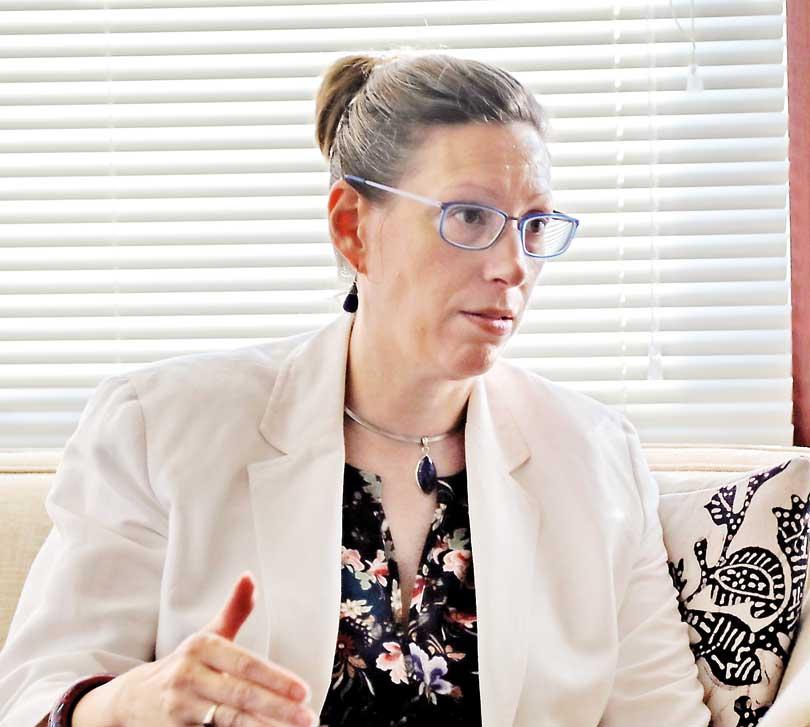
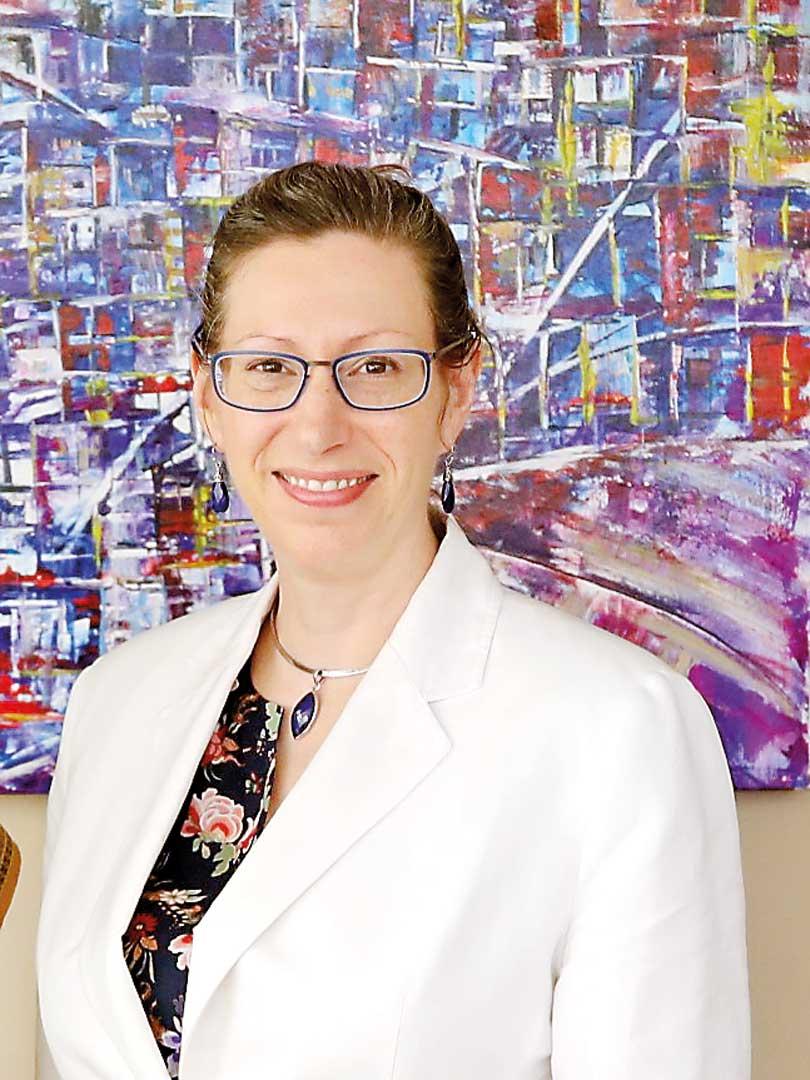
US Ambassador to Sri Lanka Alaina Teplitz in her first interview with the print media after the Easter Sunday attack exclusively told the Daily Mirror how the United States is committed to aid Sri Lanka to combat and defeat terrorism on the request of the Sri Lankan Government and how President Donald Trump offered the necessary resources in the aftermath of the Easter Sunday attacks to conduct the investigation.
Our thoughts and prayers are with the families of the victims of the attacks. These attacks were senseless, vicious and unprecedented. It was a heartbreaking moment for the whole world. I hope the investigation is going to reveal in due time the extent and nature of the relationships that this attack group may have had abroad, but it is going to be important to understand that this was a home-grown group. We are very pleased to be able to provide this assistance to a friend and partner in need through the Federal Bureau of Investigation (FBI),” she said. She further said how information-sharing is key in the face of these threats. That is a critical element of our ongoing safety and security, not just for Sri Lanka and the United States, but for our friends and partners in other nations,” she claimed.
US committed to aid Sri Lanka combat and defeat terrorism
Temporary presence of Visiting Forces at the invitation of SL Govt.
Renunciation of US citizenship an ‘administrative’ not ‘political’ process
Reinstatement of alleged white van squad leader ‘deeply disturbing’
Meanwhile, denying the allegations levelled by the media concerning a permanent US base in Sri Lanka, the US envoy said the ‘Visiting Forces Agreement’ that the US have been negotiating with the Sri Lankan Government updates an existing agreement that dates way back to 1995. I know there has been talk in the press around concern of a permanent US base in Sri Lanka. This agreement would provide for nothing of that sort. It is about visiting forces here temporarily at the request and invitation of the Sri Lankan government for the conduct of exercises,” she added.
We are proud to have made this contribution but also prouder still that the Sri Lankan navy is going to be putting this resource to such good use in the future in ensuring the sovereignty and integrity of this country
When asked on the process of relinquishing US citizenship which has recently seen wide discussion in Sri Lanka, she said that renunciation of US citizenship is an ‘administrative’ not ‘political’ process and is straightforward.
As long as you have paid your taxes and have no criminal cases, the renunciation of American citizenship moves along. But for privacy reasons I cannot comment on any specific case,” she said.
When asked whether the reinstatement of an alleged ‘white van squad leader’ would complicate the ability of the US government to provide counter-terrorism assistance to Sri Lanka, envoy Alaina Teplitz said that such appointments were ‘deeply disturbing’.
If true, this appointment is deeply disappointing in the sense that there are credible, proven allegations against this individual and this is a country and a government that has committed to addressing gross violations of human rights in the past. That means it’s not just about reconciliation, but accountability as well, which has to be respected,” she said.
Excerpts:
QTo what extent does the US believe that the Islamic State was involved in the Easter attacks in Sri Lanka and why might Sri Lanka have become a target? First let me say that these attacks were senseless. They were vicious. They were unprecedented and our thoughts and prayers have been with the families of the victims of the attacks, ever since they occurred. It was a heartbreaking moment for the whole world. In the wake of the attacks, an investigation had to be undertaken and one is underway in Sri Lanka. We are really pleased to be providing support to the government of Sri Lanka at their request to help them conduct this investigation.
The Islamic State did make public claims about having been behind this. I think, however, you have to look at the global nature of this terror threat where groups have been radicalizing, whether inspired by the Islamic State or whether they get their inspiration from somewhere else, and the fact that the perpetrators of these attacks were all Sri Lankan.
I hope the investigation is going to reveal in due time the extent and nature of the relationships that this attack group may have had abroad, but it is going to be important to understand that this was a home-grown group. As such, the government, people and communities are going to need to think differently on how to confront this threat going forward.
Q What is the role that the US played in Sri Lanka since April 21?
At the request of the government of Sri Lanka, the United States has been providing support through the Federal Bureau of Investigation (FBI) to Sri Lanka’s investigation. We are very pleased to be able to provide this assistance to a friend and partner in need. We plan to be supportive for as long as our assistance is required, doing things in the investigation like helping to process evidence. I hope there will be no need for such partnerships in the future but there can be threats out there. We look forward to maintaining a partnership in the years to come so that both of our countries can feel more secure knowing that we can work together to face those threats.
We have long been a friend and partner and we had a security partnership even before these attacks. We have been working to support Sri Lanka’s ability, for example, to better secure its maritime space, the seas around the island.
In fact, just this past weekend, in an example of that partnership, a former US coastguard cutter, now part of the Sri Lankan Navy, arrived, after sailing from Hawaii with its Sri Lankan naval crew. We are proud to have made this contribution but also prouder still that the Sri Lankan navy is going to be putting this resource to such good use in the future in ensuring the sovereignty and integrity of this country.
It must be made known to anybody who seeks to perpetrate attacks like this that they will be held accountable and that they are going to be held accountable the world over, really. We may not be the only other country that brings charges, because there were people of many nationalities who were killed and injured in these attacks
Q Did the US government send assistance unilaterally after the Easter attacks, or did the Sri Lankan government request assistance?
We came in response to the Sri Lankan government’s request. President Donald Trump offered all necessary resources or assistance to Sri Lanka. The Sri Lankan government requested, and we delivered.
I know that democracies can be successful in combatting terrorism. We can work together. Our open societies are a great defence against the kind of terror and discord and disunity that terrorists seek to create
Q What is the role that countries like Sri Lanka, who have been victims of such terrorist attacks, can play in the global effort to defeat terrorism?
The global terror threat is different to some of the threats of the past. We must all collectively think a little differently about how we are going to counter the threat. Information sharing is key in the face of this threat. All nations may have a little of the threat picture, a piece of that puzzle, if you will. We have to share those pieces in order to understand that landscape or understand that picture. That is a critical element of our ongoing safety and security, not just for Sri Lanka and the United States, but for our friends and partners in other nations. I know that democracies can be successful in combatting terrorism. We can work together. Our open societies are a great defence against the kind of terror and discord and disunity that terrorists seek to create. Going forward, in Sri Lanka, we want to be supportive of the government’s efforts to respond to the terror threat, and to do so in ways that respect democratic values here and respect civil liberties. I think that is entirely possible to do.
Q After the recent incidents, and during communal violence that took place last year, the government suspended access to American social media and messaging platforms like Facebook, WhatsApp and YouTube in order to halt the spread of fake news and prevent communal violence. How can these companies be held accountable for preventing such abuse of their platforms so that such blocking is not necessary in the future?
The government’s response in the wake of the terror threats has been prompt and effective. It was solid. That is something to acknowledge. The emergency services and then this investigation and the bringing in of the correct people into custody so that people can be safer here. With regards to the shutdown of social media, I know efforts have been underway to improve security on those platforms. Violence can go viral on these platforms. I suspect that is always going to be a challenge and I know all these companies have been working hard on that.
There is always a fine line with allowing free speech, and the calming of speech and the rejection of extremism that could take place on these platforms were they still operable. The other communication and even basic messaging that needs to happen even from just to say to your friends and family that I’m OK”, is going to be a challenge if these platforms are not functional. This is going to be an ongoing issue to discuss and work on, and I hope all the companies will remain as engaged and cooperative as they have been up to this point. It’s a key issue, and a challenging issue.
Q Several Americans were killed in the Easter attacks. What is the position of your government on prosecuting those murders in US jurisdiction? How will such investigations and criminal proceedings work in parallel with similar proceedings in Sri Lanka’s jurisdiction?
There were five Americans who lost their lives in these attacks and three were wounded. As a result, we are investigating for potentially bringing charges against any of the terror group that remain alive in US courts. However, Sri Lanka has the lead on this, and we are supporting their investigation and I am sure that the Sri Lankan government will be bringing charges against some of these people now in custody. Those cases will move forward. Our indictments in the US will be secondary to those.
The benefit to this two-track investigation, our support of the Sri Lankan investigation and a parallel effort to bring charges in the United States, is that we can bring even more resources to bear to help with that primary investigation that the government of Sri Lanka is undertaking. It must be made known to anybody who seeks to perpetrate attacks like this that they will be held accountable and that they are going to be held accountable the world over, really. We may not be the only other country that brings charges, because there were people of many nationalities who were killed and injured in these attacks.
The government’s response in the wake of the terror threats has been prompt and effective. It was solid. That is something to acknowledge
Q How soon will this process be complete?
I couldn’t speculate. The investigation is ongoing, so it is difficult to say.
Q The US government has spoken strongly about supporting Sri Lanka and preserving normalcy. But the embassy has asked non-essential personnel to leave the country. Why?
In the wake of the terror attacks, we did take the step of ordering school-age children to depart the country. Adult employees and family members were given the choice of whether they were going to depart or not. From our perspective, we wanted to ensure that our children are not placed at risk at a volatile time when much was still unknown about the scope of the attack plot and the vulnerability of institutions in Sri Lanka. We do this as a precautionary measure. It is a mechanism we have used in many other countries in times of crisis. I hope that in the near future we will be able to welcome our children back to our embassy.
Q The process of relinquishing American citizenship has recently seen wide discussion in Sri Lanka. Under American law, at what stage does the US government consider a US citizen who has sworn an oath of renunciation as no longer being a US citizen? Is it as soon as the oath is sworn or is there any other procedure that needs to be followed before a US citizen is released from citizenship by your government?
There is an administrative process you go through. Once that process is complete, the person is no longer a US citizen. There is a long process to make sure the person is of sound mind and wants to make that decision. They file paperwork and work with the consular office at the embassy, where they go through many steps. Then the persons present themselves to the embassy and they sign legal paperwork. They read the oath of renunciation aloud to the consular officer. The embassy takes that packet and sends it to Washington DC just for final review. Then they confirm that the renunciation has taken place. If it is confirmed, it will be effective on the day the person actually swore the oath to renounce US citizenship. (See box for the US Citizenship renunciation process)
Renunciation of (US) Citizenship is an administration process. It is straightforward. As long as you have paid your taxes and have no criminal cases, then it moves along
Q A US citizen was recently sued in a California court over the murder of Lasantha Wickrematunge, editor of ‘The Sunday Leader’ Newspaper. Is the US embassy and government aware of and monitoring this case?
We are aware of the case because there has been a public filing. We are not closely monitoring the case. It will follow its due course in the court system in the US. It is a civil suit brought by a private litigant.
Q If there is a civil case pending against a US citizen, does that prevent the US government from allowing such a citizen to renounce his American citizenship?
There are two issues there to address. We have a difference between civil and criminal cases that can be brought. A civil case has no bearing on a renunciation process. Separately, Renunciation of (US) Citizenship is an administration process. It is straightforward. As long as you have paid your taxes and have no criminal cases, then it moves along. For privacy reasons I cannot comment on any specific case, but it is pretty straightforward.
Q A Sri Lankan military intelligence officer, Maj. Bulathwatte, who was in charge of a team with allegations of abductions and murders of several journalists has recently been reinstated and given a special team responsible for counter-terrorism, frightening many police officers and witnesses who testified against him. Do appointments of this nature complicate the ability of the US government to provide counter-terrorism assistance to Sri Lanka?
If true, this appointment is deeply disappointing in the sense that there are credible, proven allegations against this individual and this is a country and a government that has committed to addressing gross violations of human rights in the past. That means that its not just about reconciliation, but accountability as well, which has to be respected.
I can appreciate that some people may have responded out of fear in the wake of these terror attacks and there has been some discussion in the public media about how safe people might have been in the past. That is a false confidence. This is a new threat. It requires people of integrity and it requires people with experience and a future looking focus to counter this threat. It also requires people who will respect the values of Sri Lanka, and international norms that do not support gross violations of human rights like those you have described.
We also look at other security interests in the sense of ensuring the sovereignty of nations and making sure they can patrol and maintain not only the economic space around their countries but end transnational crime like global narcotics trafficking and human trafficking
Q A Member of Parliament recently made a very serious allegation in Parliament about a US official having attempted to influence the Sri Lankan judiciary for political reasons. What is the US Government’s position? What can you say about the history and practice of judicial study tours?
I would point you to the refutation of this allegation made by the Ministry of Justice and the judges who participated in the study tour. The person who made these allegations has made baseless allegations. More broadly speaking, for the last seventy years, the US has supported professional and study exchanges between the US and Sri Lanka, and they have covered an array of subject matter including investigative journalism and looking at emergency preparation. They have covered judges and judicial issues. The list is so long I don’t know where to begin. This is just part of what we have done as friends and partners over many years. When you understand that we are doing professional exchanges of this nature, and have been for years, on a huge array of topics, that allegation begins to look rather baseless.
Q What are the geopolitical interests of the USA in Asia?
I would look at it from a slightly different perspective. Not so much what the US’ specific geopolitical interests are but as a community of nations, our more global interests regarding a free and open Indo-Pacific space, the free transit of goods both by sea and air, and making sure there are laws and norms that allow nations to trade together peaceably and to get along, and that preserves these spaces for the transit of goods, and the transit of services. Our interest is in preserving that rules-based order, ensuring we have a chance to interact with other countries to our mutual benefit. Peace and prosperity are what we are all jointly working towards as beneficial outcomes for our countries. That’s how I see our interests. It’s around what is in the mutual interests of all nations.
I know there has been talk in the press around concern of a permanent US base in Sri Lanka. This agreement would provide for nothing of that sort
Q Specifically, what is the interest of the USA in Sri Lanka’s strategic geographical position along a major sea lane?
There is no denying that Sri Lanka is in a very strategic location for exactly the reason you suggest, because the sea lanes pass by here. For hundreds of years it has become a path of trade and commerce heading between other parts of the world and the far east. So, it is very important in that regard and a lot of the economy here is linked.
Our interest in Sri Lanka as a friend and partner of this country, however, is not entirely around those sets of issues. Sri Lanka is a democracy. The US is a democracy. We partner with democracies worldwide. We have common interests around maintaining that rules-based order that can benefit all of our nations globally with free and fair playing fields. We also have interests around other issues of global stability and security, such as peacekeeping. Sri Lanka has been a troop contributing country. We have also wanted to support that effort to maintain stability in other parts of the world.
We also look at other security interests in the sense of ensuring the sovereignty of nations and making sure they can patrol and maintain not only the economic space around their countries but end transnational crime like global narcotics trafficking and human trafficking. We have common interests there. The bottom line is we have many, many more interests than Sri Lanka’s physical geographic locations. We have another common interest around human rights and dignity for all and we want to make sure that globally these values are respected.
There is an administrative process you go through. Once that process is complete, the person is no longer a US citizen. There is a long process to make sure the person is of sound mind and wants to make that decision. They file paperwork and work with the consular office at the embassy, where they go through many steps
Q Many political and military figures have spoken to the media about the proposed status of forces agreement between the Sri Lankan and US military. What is the truth about this proposed agreement? What are the benefits and drawbacks for both countries in entering into such an agreement?
The Visiting Forces Agreement that we have been negotiating with the government of Sri Lanka updates an existing agreement that dates all the way back to 1995. It will help to make it current. It is largely an administrative and logistical agreement that will iron out details relating to visiting forces engaged in exercises, for example, with the Sri Lankan military. Things like mutual recognition of professional licences, fees for professional support rendered, regulations for hiring foreign and local contractors, how US military personnel and civilian personnel can enter and exit Sri Lanka, the mutually agreeing what specific methods will be used. Given that we conduct many joint exercises throughout any given calendar year as a part of our military-to-military relationship, it would certainly help both sides avoid a lot of case-by-case negotiations as we go from one exercise to another. I know there has been talk in the press around concern of a permanent US base in Sri Lanka. This agreement would provide for nothing of that sort. It is about visiting forces here temporarily at the request and invitation of the Sri Lankan government for the conduct of exercises.
Q Is it true that the US is concerned about China’s growing influence and presence in Sri Lanka? If so, why?
The US looks at partnerships in the region including with Sri Lanka with the idea that countries need to have many options, many friends and many partners. We ourselves have a relationship with China and we would expect that other countries in the region are also going to maintain relationships. The question for me is always what is the quality of those relationships? Are they ones where there is mutual respect for sovereignty? Are the relationships mutually beneficial in the sense that countries can work together for prosperity in the future? Are they transparent relationships? Are they equal relationships? These are the questions that any country should be asking about its partnerships.
Q Do you have any other comments you would like to share with our readers?
The US remains committed to the government and people of Sri Lanka as a friend and a partner. We certainly responded in the wake of the terror attacks, but we have been a steadfast friend and partner for many years. In that sense, our relationship has not changed. These recent events give us even more reason to want to deepen that partnership to ensure our mutual security, and to look at that prosperous future that we are both hoping for. There are economic challenges the country will be facing but we want to work with Sri Lanka to overcome those. Hopefully in the future we will be courting US investment and looking at ways that we can prosper together.
A person desiring to renounce US nationality ….shall appear before a diplomatic or consular officer of the US in the manner and form prescribed by the Department. ..Renunciant must include on the form he signs, a statement that he absolutely and entirely renounces his US nationality together with all rights and privileges and all duties of allegiance and fidelity thereunto pertaining.
In response to questions relating to the procedure for a US citizen to voluntarily renounce his/her US citizenship, and at what stage citizenship is deemed to have been lost by the US government, the US Embassy in Colombo provided Daily Mirror with references to the laws and regulations of the United States pertaining to this subject.
According to these excerpts of US laws, regulations and administrative guidelines, a person loses US nationality upon an application receiving ‘approval by the Secretary of State’ after a long administrative process. Upon approval of the application, the relevant US embassy will provide the former citizen with a certificate of loss of nationality, as proof of no longer having US citizenship.
Section 349 (a)(5) of the Immigration and Nationality Act, codified at Title 8 of the United States Code, Chapter 12, Section 1481.
A person who is a national of the United States whether by birth or naturalization, shall lose his nationality by voluntarily making a formal renunciation of nationality before a diplomatic or consular officer of the United States in a foreign state, in such form as may be prescribed by the Secretary of State, with the intention of relinquishing United States nationality.
Section 358 of the Immigration and Nationality Act, codified at Title 8 of the United States Code, Chapter 12, Section 1501.
Whenever a diplomatic or consular officer of the United States has reason to believe that a person while in a foreign state has lost his United States nationality under any provision of part III of this sub chapter, or under any provision of chapter IV of the Nationality Act of 1940, as amended, he shall certify the facts upon which such belief is based to the Department of State, in writing, under regulations prescribed by the Secretary of State. If the report of the diplomatic or consular officer is approved by the Secretary of State, a copy of the certificate shall be forwarded to the Attorney General, for his information, and the diplomatic or consular office in which the report was made shall be directed to forward a copy of the certificate to the person to whom it relates. Approval by the Secretary of State of a certificate under this section shall constitute a final administrative determination of loss of United States nationality under this chapter, subject to such procedures for administrative appeal as the Secretary may prescribe by regulation, and also shall constitute a denial of a right or privilege of United States nationality for purposes of section 1503 of this title.
Title 22, Section 50.50 of the United States Code of Federal Regulations – Renunciation of Nationality
(a) A person desiring to renounce U.S. nationality under section 349(a)(5) of the Immigration and Nationality Act shall appear before a diplomatic or consular officer of the United States in the manner and form prescribed by the Department. The renunciant must include on the form he signs a statement that he absolutely and entirely renounces his U.S. nationality together with all rights and privileges and all duties of allegiance and fidelity thereunto pertaining.
(b) The diplomatic or consular officer shall forward to the Department for approval the oath of renunciation together with a certificate of loss of nationality as provided by section 358 of the Immigration and Nationality Act. If the officer’s report is approved by the Department, copies of the certificate shall be forwarded to the Immigration and Naturalization Service, Department of Justice, and to the person to whom it relates or his representative.
Leader of Opposition Mahinda Rajapaksa today (21) visited several schools in Colombo to observe the student turnout and encourage parents to send their children to schools.
Accordingly, he first arrived at the Thurstan College along with a group of parliamentarians representing the Joint Opposition and also met with the principal of the school.
The Opposition Leader also visited the Royal College, Visakha Vidyalaya as well as the Hindu College in Bambalapitiya.
Meanwhile, several other Joint Opposition MPs had visited schools in other districts to observe the student turnout.
UNP Parliamentarian Shantha Abeysekare had engaged in an observation visit at the Thambagalla Kanishta Vidyalaya in Madampe.
According to principals of schools in Galle, Hambantota, Kalutara and Kegalle said the student turnout had shown a considerable increase today (21), as the schools reopened following the Vesak celebrations.
National Freedom Front (NFF) leader MP Wimal Weerawansa today criticized his former party, the Janatha Vimukthi Peramuna, for the motion of no-confidence brought forth by them against the incumbent government.
Speaking to reporters after meeting with the Archbishop Cardinal Malcolm Ranjith in Colombo, he said that they briefed the religious leader on the no-confidence motion brought against Minister Rishad Bathiudeen.
He said that when a no-confidence motion is brought against the government at this juncture, the MPs of the ruling party will be looking at Rishad Bathiudeen with the intention of safeguarding the government.
He said that the 6-7 parliamentarians of Rishad’s party – the All Ceylon Makkal Congress (ACMC) – would be a decisive factor in a no-confidence motion against the government.
Weerawansa said that when two no-confidence motions are brought forth in this manner, Minister Rishad Bathiudeen gains a ‘bargaining power’ and that he could now tell ruling party MPs that he will not use his party’s votes to save the government if they don’t safeguard him.
He charged that by bringing a no-confidence motion against the government, the JVP has given Rishad Bathiudeen a decisive power and a bargaining power. He also accused them of thereby safeguarding a father of Wahhabi terrorism.”
One of the major reasons for the Easter Sunday attacks in Sri Lanka was the collective failure of leadership, says international terrorism expert Dr. Rohan Gunaratna.
Addressing an event held in Colombo yesterday (21), Dr. Gunaratna, who is a Professor of Security Studies at the S. Rajaratnam Centre for International Studies in Singapore, said intelligence should be constantly generated where national security is concerned.
It is a crime to have intelligence and not act [on it]. Easter Sunday attacks were not a failure of intelligence, it’s an operation failure. A failure to act. Because politicians played with national security and the security was compromised,” Dr Gunaratna emphasized.
Explaining why terrorist leader Zahran Hashim’s group and other networks that the IS had connections with could not be monitored, Dr Gunaratna said the indomitable spirit that must be inculcated in the hearts and minds of those who serve the national military sector, either military, law enforcement or intelligence, was steadfastly eroded due to certain action taken by the incumbent government.
Commenting further in this regard, he said the government had removed the roadblocks after assuming power in 2015, an action which should never have been done. Because we had 11,500 rehabilitated terrorists [in the country] but still we wanted security and intelligence platforms to remain.”
There was a grid of security that was created where every village, town and road was covered by the intelligence service, but these security and intelligence platforms were also dismantled, he said.
It was a fatal mistake to tell the military go to barracks since the interaction between the nation’s Army and the public was lost owing to this, Dr Gunaratna noted.
This may be something that the western countries had wanted, as well as minority political parties such as the Tamil National Alliance, he said further. But these were mistakes that we should never have made,” Dr Gunaratna emphasized.
A senior Muslim military officer, who had the best expertise on Zahran Hashim’s group, was also sent overseas, and the operating wing of the military intelligence, which is a very large organization of nearly 5,000 operatives, was demobilized, Dr. Gunaratana further claimed.
One month after the Sri Lanka suicide attacks that killed more than 250 people, investigators have told AFP the bombers used Mother of Satan” explosives favoured by the ISIS group that are a new sign of foreign involvement.
Detectives said the back-pack bombs used in the April 21 attacks on three churches and three hotels were manufactured by local jihadists with ISIS expertise.
They named the explosive as triacetone triperoxide, or TATP, an unstable but easily made mixture favoured by ISIS militants who call it Mother of Satan”.
It was also used in the 2015 attacks in Paris, by a suicide bomber who hit the Manchester Arena in England in 2017 and attacks on churches in Indonesia one year ago.
ISIS has claimed the Sri Lankan bombers operated as part of its franchise. But Sri Lankan and international investigators are anxious to know just how much outside help went into the attacks that left 258 dead and 500 injured.
The group had easy access to chemicals and fertiliser to get the raw materials to make TATP,” an official involved in the investigation told AFP.
Sri Lankan detectives say the National Thowheeth Jama’ath (NTJ), local militants blamed for the attacks, must have had foreign help to assemble the bombs.
Multinational militants
They would have had a face-to-face meeting to transfer this technology. This is not something you can do by watching a YouTube video,” said the official, speaking on condition of anonymity.
Investigators had initially believed that C4 explosives — a favoured weapon of Tamil Tiger rebels — were used, but forensic tests found TATP which causes more burning than C4.
Police have also confirmed that 100 kilograms (220 pounds) of explosives found in January in the island’s northwest was TATP.
They are checking the travel records of the suicide bombers as well as foreign suspects to see when and where bomb-making lessons could have been staged.
It looks like they used a cocktail of TATP and gelignite and some chemicals in the Easter attacks. They were short of the 100 kilos of raw TATP that were seized in January,” said the investigator.
Sri Lankan security forces have staged a series of raids since the bombings. Police spokesman Ruwan Gunasekera said Sunday that 89 suspects are in custody.
Army chief Mahesh Senanayake said last week that at least two suspects have been arrested in Qatar and Saudi Arabia, underscoring the international link.
On April 26, six militants, three widows of the suicide bombers and six of their children were killed at an NTJ safe house near the eastern coastal town of Kalmunai.
Police found large quantities of chemicals and fertilizer there that was probably meant to make bombs, authorities said.
The government has admitted that Indian warnings of the looming attacks in early April were ignored.
But President Maithripala Sirisena has said eight countries are helping the investigation. A US Federal Bureau of Investigation team is in Sri Lanka and Britain, Australia and India have provided forensic and technical support.
China offered a fleet of vehicles to bolster the mobility of the security forces tracking down militants.
‘Contact with Islamists’
The Sri Lankan who led the attacks, Zahran Hashim, was known to have travelled to India in the months before he became one of the suicide bombers.
Moderate Muslims had warned authorities about the radical cleric who first set off alarm bells in 2017 when he threatened non-Muslims.
He was one of two bombers who killed dozens of victims at Colombo’s Shangri-La hotel on April 21.
Army chief Senanayake said Hashim had travelled to Tamil Nadu state in southern India and been in contact with Islamists there.
Hashim, one of seven bombers who staged the attacks, also appeared in an ISIS group video that claimed responsibility for the attacks.
Another bomber who was meant to have hit a fourth hotel, has been named as Abdul Latheef Jameel who studied aviation engineering in Britain and Australia.
Authorities in the two countries are investigating whether he was radicalised whilst abroad.
Jameel blew himself up when confronted at a hideout after the attacks.
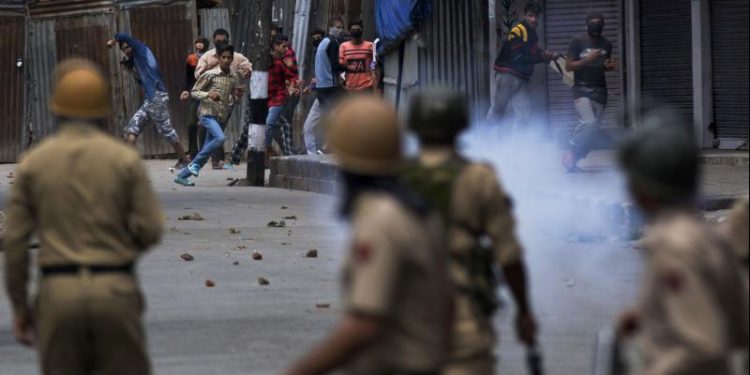
New Delhi, May 21 (The Hindu): Reacting angrily to a submission from the Geneva-based Human Rights Council (HRC) on the alleged violations in Jammu and Kashmir by the United Nations body that it will no longer entertain any communication with the HRC’s Special Rapporteurs.
The report from the UN body came at the same time a report from two NGOs in the State on the alleged cases of torture was released in Srinagar, which was endorsed by a former UN Special Rapporteur.
Queries On Action Taken
The current Special Rapporteurs on Extrajudicial Executions, Torture, and Right to Health — Agnes Callamard, Dainius Puras and Nils Melzer — had referred to a June 2018 report of the Office of the High Commissioner of Human Rights (OHCHR) and written to the government in March 2019, asking about steps taken by New Delhi to address the alleged human rights violations listed in the report.
In addition, the Special Rapporteurs had listed 13 cases of concern” from 2018 alone, in which four children were among eight civilians killed by members of the security forces.”
The report said that more than half of the 432 victims suffered some form of health complications after being tortured.
In the 432 cases studied for this report, 24 are women. Out of these 12 had been raped by Indian armed personnel,” the report says. The torture survivors have battled with psychological issues long after their physical wounds were healed.
Of the 432 victims, 44 suffered from some form of psychological difficulty after being subjected to torture,” it said.
A study published in 2015 by Doctors Without Borders (known by its French initials MSF) said that 19 percent of the population in the region suffered from Post-Traumatic Stress Disorder (PTSD).
AlthoughIndiahas been a signatory to the United Nations Convention against Torture (UNCAT) since 1997, it has not ratified the treaty to date. In all three UPRs conducted by the UNHRC in 2008, 2012 and 2017, it was recommended that India ratify the convention.
In 2010, Prevention of Torture Bill was introduced in the Indian parliament but was not passed and it lapsed in 2014.
Khurram Parvez, who is also one of the researchers for the report said that the report is a challenge to state-imposed erasure of history and memory”.
Rejecting all the claims, the Indian Permanent Mission to theUnited Nationsin Geneva replied to the OHCHR on April 23, saying that India… does not intend to engage further with these mandate-holders or any other mandate-holders on the issue,” whom it accused of individual prejudice”.
When asked, the Ministry of External Affairs clarified that India’s stand on not engaging with the Special Rapporteurs was only for those wishing to refer to the OHCHR report.
However, UN officials say that India is already in contravention of several Conventions it has committed to, including a Standing Invitation” signed in 2011 to all special rapporteurs to visit India. According to the UN records, more than 20 such visit requests, including to Jammu and Kashmir, are pending at present. UN sources also said that between 2016-2018, the OHCHR Special Rapporteurs had sent as many as 58 communications, and had received no response other than the April 23 letter on Jammu and Kashmir.
The only response so far has been to the communication relating to Jammu and Kashmir….The last visit was by the Special Rapporteur on water and sanitation, in October-November 2017,” a UN communications official said in reply to queries fromThe Hindu.
Report From NGOs
The UN submission on Jammu and Kashmir coincided with the release of an extensive 560-page report on Monday, prepared by the J&K based Association of Parents of Disappeared Persons (APDP) and the J&K Coalition of Civil Society (JKCCS). The report, entitled ‘Torture: Indian State’s Instrument of Control in J&K’, documented 432 cases of suspected human rights violations and brutality by security forces of which only 27 had been investigated by the State Human Rights Commission.
The report claimed that nearly 70% of torture victims in Jammu and Kashmir were civilians (not militants) and 11% died during or as a result of torture”. The cases included incidents of electrocution, ‘water-boarding’ and sexual torture, which the government has repeatedly denied.
This report will constitute a landmark. It is hoped it will be an example to other civil society organizations in India and in other countries as a model,” wrote Juan E. Mendez, former UN Special Rapporteur on Torture (2010-16), in the report’s preface, adding that he had been denied permission to visit India.
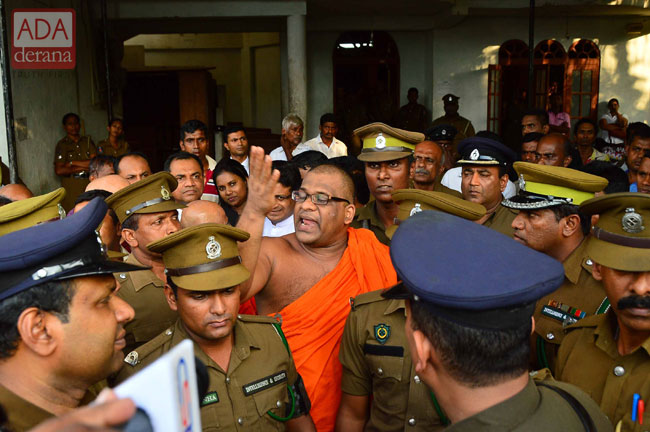
Colombo, May 20 (Daily Express): The jailed Bodu Bala Sena (BBS) General Secretary, Ven.Galagoda Aththe Gnanasara Thero might get a Presidential pardon and the controversial Muslim Minister Rishad Bathiyudeen may be asked to resign, in view of the changed political mood in the country, an informed political source said on Monday.
The source, which spoke off the record, said that President Maithipala Sirisena’s meeting with the radical Buddhist monk in the Welikade prison here on Saturday, on the sidelines of a function to pardon 734 prisoners on the occasion of the Vesak festival, definitely had political meaning.
A member of the cabinet, the source pointed to the surge in support for Gnanasara Thero among the majority Sinhala-Buddhist community and even among Catholics.
It is now realized among this section of the population that Gnanasara Thero had, for the last few years, warned about radicalization in the Muslim community, with a section lurching towards extremism if not terrorism, per se.
When asked for the source of his information, Ven. Gnanasara Thero would say that he was making the charges on the basis of complaints from Muslims themselves.
But no one in the government had taken him seriously.
However, after the April 21 suicide bombings, there have been calls for the release of Ven.Gnanasara Thero, who is currently serving a six year term for contempt of court.
There was an expectation that Ven.Gnanasara Thero would be released along with hundreds of others on Vesak day. But his name was not on the list.
However, after the President met the monk, when he went to the prison to preside over the Vesak prisoner release ceremony, there is renewed speculation that he may be pardoned.
The matter is likely to be raised in the cabinet meeting this week,” the ministerial source said.
As regards the fate of the No Confidence Motion (MCM) against Minister of Commerce Rishad Bathiyudeen, who it is alleged, had links with Islamic extremists, the source said that government will try to pre-empt the motion by requesting Bathiyudeen to resign just as Finance Minister Ravi Karunanayake was asked to quit ahead of an NCM against him.
There is a danger of government MPs supporting the motion or abstaining from the vote. If that happens, the motion might be carried. But no government will want that. The way out would be to ask Bathiyudeen to resign,” the source said.
Sinhala-Buddhist and Christian ministers and members of parliament feel that Muslim leaders including Ministers, have not done enough or have not shown willingness to do anything to curb the Lankan Muslims’ tendency to become culturally exclusive, and to weaken links with other communities. It is believed that such tendencies had prepared the ground for the growth of radicalism and terrorism,” the source said.
Non-Muslims charge that the Muslims leaders have not done precious little to assuage the deeply hurt feelings among Christians who had borne the brunt of the Easter Sunday bomb attacks, the source added.
Bathiyudeen from Mannar district in North Sri Lanka is alleged to have supported radicalization among the Muslims and had allegedly tried to intercede with Army Commander Lt.Gen.Mahesh Senanayake to release a suspect in the suicide bombing case.
Bathiyudeen refuted the charge made by Gen.Senanayake and said that he only wanted to know if the man in question was in army custody.
The
first ever persecution of Muslims in Sri Lanka occurred way back in history. It
took place in Jaffna, the birth place of hate politics against the other”,
which included even the Tamils of the low-castes. Details of Tamil hate
politics need a whole book. This essay is focused on Tamil persecution of
Muslim throughout their history. The historical records relate the bitterness
of the Tamils against the Muslim vividly and dramatically. The anti-Muslim
politics of Tamils was driven by a relentless and venomous ideology which began
with a feudal tyrant, Sankilli, and came right down, through generations, to
Velupillai Prabhakaran’s Kattankudy massacre.
The Tamils of Jaffna were also the first to deny the
identity of the Muslims. It dates back to feudal times. Quite surprisingly,
anti-Muslim hate politics is recorded in the most respected historical text of
colonial times : Yalpana Vaipava Malai.(A historical garland of
Jaffna). Yalpana Vaipava Malai (YVM) was written by
Mayilvakanm at the request of the Dutch Governor Jan Maccara, (1736). Its
translator, C. Brito (1879) wrote in his preface: The work is looked upon as
one of the great authority among the Tamils of Jaffna, and there are several
manuscript copies of it extant in the peninsula.”. YVM is quite
forthright in telling the story as it is. Mayilvakanam wrote at a time when
history was not politicised to serve political agendas. Unfortunately, the
history of Jaffna is wrapped in secrecy to this day for fear of exposing its
hate politics against the other”. The other” in the Tamil political culture
consists of Muslims, Christians, Sinhalese and even its own Tamil people who
were rejected by Tamil Vellala elite as untouchable outcasts. .
At a time like this when identity politics of Muslims
is in the spotlight again it is necessary to trace the critical Muslim
relations with the other communities to gain some perspectives on the
inter- ethnic dynamics at play. As for the origins of the hate politics
against the Muslims there isn’t a better place that records the plight of the
Muslims than the Yalpana Vaipava Malai. Historian Mayilvakanam
records what happened to the Muslims in the following paragraphs which are
quoted in full. He says: During the supremacy of the Ulanthesar (Dutch), a
colony of Sonakar (Muslims), came from Kayilpaddanam and other places and
settle in South-mirisuvil, the name of which they changed into Usan.They were
originally Tamils by race but had embraced the Muhammathu-matham by compulsion
or persuasion of one Santhach-chaiva. Their chief means of subsistence was
trade, which they carried on from fair to fair, in Savukach-cheri, Kodikumam,
Eluthu-madduval,and Muhavil. After a time they abandoned Usan, and founded a
new settlement in Nallur, on and around the site of Kantha-Suvami Koyil. The
Tamil viewed their presence with displeasure as they thought that it might be
detrimental to the cause of their religion when the time should come for the
restoration of the temple. They tempted the Sonakar to leave the place, with
money and entreaties, which when they found unavailing, they had recourse to a
plan that proved effectual. They put a quantity of pig’s flesh into the wells
of their enemy by night. When the defilement was discovered, the Sonakar were
in great distress of mind. They could neither drink the water nor cook their
means with it, and they saw themselves driven to the necessity of choosing
between starvation on one hand and emigration on the other. They chose the
latter and sold the place for whatever money could get from the Tamils and
retired to the east of Navanthurai. Before they left, they, however, had made a
compact by which they retained to themselves the right of visiting the4 spot,
at stated times, for purposes of Muhammathan worship even when a Tamil
temple should happened to be afterwards built upon it.”( p. 55 – Yalpana
Vaipava Malai, translated by C. Britto, Asian Educational
Services, 1999).
Referring to the Malays, Mayilvakanam says: : In the
reign of Vijaya Bahu (the usurper) there was a numerous army of Yavakar
(Malays) in the king’s pay. Their numbers underwent constant diminution by deadly
feuds among themselves and by the oppression of kings. The remnants of them
inhabited the villages of Savakach-cheri and Savang-kodu. But Sangkili (who had
already driven out the Sinhala-Buddhists) drove them also out of his kingdom.”
(p33-34 – Ibid).
These passages reveal the origins of the hate politics
of Tamils against the Muslims that ran deep throughout their history. On the
contrary, the relationship between the Muslims and the Sinhalese has been, on
the whole, cordial from the beginning. The Sinhalese kings not only opened
their historic al space to accommodate the Muslims persecuted by the Portuguese
and the Dutch but also facilitated their path to peaceful co-existence. There
is no record of persecution of Muslims or ethnic cleansing.
The overall harmonious inter-ethnic relations between
the Muslims and the Sinhalese has been the common thread shared by both
communities, leaving aside the occasional tensions. Most of all, they
were given refuge by the Sinhalese when the colonial masters and the Tamil
rulers persecuted them and expelled them forcibly, treating them as
untrustworthy enemies. When Prabhakaran gave the Muslims 24 hours notice to
quit Jaffna, and robbed them of their property and treasures, they didn’t
go to the Middle East or Malaysia. They were given homes and refuge in the
Sinhala South. The latest events of Digana and Aluthgama which figure
prominently in the political calculations now because it is fresh in our minds,
pales into insignificance compared to the ideological onslaughts denying the
Muslim identity, repeated massacres of Muslims, Muslim persecution and forcible
expulsion by the Tamils from what they considered to be the Tamil
homeland”..
The tragic event of anti-Muslim riots of 1911, under
British rule, was another story which has to be dealt with separately. Even
considering that as the worst point in Sinhala-Muslim relations the Muslims
never faced the horrors of ethnic hatred and persecution as under the Tamil
states. Besides, the riots of 1911 were not directed by a Sinhala state. It was
an ethno-religious clash caused by estranged community feelings and, therefore,
was confined to lower-level ethnic rivalry without hierarchical forces
directing violence for political gain. And like all inter-ethnic clashes
with the Sinhalese these sporadic events fizzled out like the soda bottle.
These inter-ethnic clashes were neither visceral nor permanent. As
opposed to this the violent acts against the Muslims by the Tamils took place
at state levels, based on predetermined political policies officially adopted,
like the Nazis eliminating the Jews. Ethnic cleansing and hate politics of the
other” has been a part of Tamil political culture ever since Sankilli turned
his wrath first against the Tamil Catholics, then against the Sinhala-Buddhist
and finally against the Tamil-speaking Muslims.
In fact, Prabhakaran, who inherited the Sankilli
culture of hating the other”, was repeating the culture of hate initiated by
Sankilli when he consistently and deliberately targeted the Muslims to cleanse
his so-called Eelam from the alien and evil Muslims. Like the Tamil kings of
the past Prabhakaran was hero-worshipped as the undeclared Tamil king of the
Vanni for carving out an ethnically cleansed quasi-state for the Tamils .
The hate culture of peninsular politics surfaced under
different reasons and labels at different times. But the underlying force of
all Tamil ideologies was hate politics of the other”. Sankilli marched down to
Mannar on the eve of Christmas 1544 and massacred 600 Tamil Christians –
children, pregnant women and the old and the feeble — because they owed
allegiance to the Christian king of Portugal. Sankilli claimed to be the sole
representative of the Tamils and he decimated all Tamils who owed allegiance to
an alien power. It is the helpless Tamils who paid for his arrogance and hate
politics.
The Vellala rulers of Jaffna, who wielded total power
during feudal times and as subalterns during colonial periods, justified their
fascist caste culture that reduced their own people to subhuman slaves as a
religious duty coming down from God. In the divinely ordained Vellala regime
the outcast Tamils, the Turumbas, could not even walk during daytime in case
they polluted the pure eyes of the Vellalas. They were not allowed to sit on
the seats of busses. They were forced to sit on the floor of the bus – a sign
of hate politics not found even in the deep south of racist America. The
Afro-American were forced to sit in the back of the bus because the front seats
were reserved for the whites. They invoked the Hindu Saivite ideology revised
by the caste fanatic Arumuka Navalar to rule the Tamil outcasts as an inferior
breed of Tamil not fit for the society of the high-caste Vellalas. .
Vellala casteist elitism assumed a sense of
superiority, ordained by God, which was not validated by any civilised or moral
code. These self-appointed supremacists despised all other Tamil-speaking
communities within the peninsula and outside it. The Saivite Jaffna Vellala
(SJV) elite were anointed by their new religious guru, Arumuka Navalar, as a
superior breed. He elevated them even above the few Brahmins of Jaffna and also
to the Batticoloa Tamils, the Indian Tamils and the Tamil-speaking Muslims.
Tamil intransigence, arrogance and the false sense of superiority intertwined
as a solid force of Tamil hate politics to keep Jaffna as an exclusive domain
for the SJV elite.
In Jaffna there was no space for non-SJV politics.
Jaffna did no embrace socialism, Marxism, Maoism, liberalism,
people-oriented humanism and not even deep-rooted Gandhism which was
superficially fashionable for a brief while. There was no other brand of
politics other than SJV-driven hate politics, derived from the San-kill-i
culture. As seen in history the San-kill-i culture came with the emphasis on
the kill” part of it. The Tamil political culture hit the lowest depths when
the Tamil branch of the Catholic Church embraced and promoted openly SJV hate
politics which morphed into Prabhakaranism. Under the Vellala suzerainty of
colonial times the Church maintain the supremacy of the Vellalas by allocating
the front pews for the Vellalas and the back seats for the low-castes.
Presumably, they must have thought that Jesus was a Vellala!
It was this brand of hate politics that came down like
a devastating juggernaut and destroyed peaceful co-existence among all
communities in the post-Independent period. It was this brand of hate politics
that was unleashed on the Muslims in full measure. The 20th century
horrors of the blood-thirsty Tamil supremacists are recorded in graphic details
by Prof. Rajan Hoole, a latter-day Mayilvakanam. He had to run away from Jaffna
and seek shelter in the Sinhala South because intrepid intellectuals like him
were hated by the Prabhakaranists, the successors to the SJV supremacists. .
His reports records in minute detail what happened to the Muslims under the Pol
Potist regime of Prabhakaran. In Report No.11 of the University Teachers for
Human Rights (Jaffna) (15th April, 1993), titled Land, Human
Rights & The Eastern Predicament, he painstakingly records the
unending atrocities faced by the Muslims. The anti-Muslim violence came from
the San-kill-i culture of hate revived and enforced ruthlessly by the Tamil Pol
Pot. The Tamil hate culture reached its barbaric peak under the iron-fist of
Prabhakaran and next to the Tamils (he killed more Tamils than all the other
forces put together – S.C. Chandrahasan, son of S. J. V. Chelvanayakam) it is
the Muslims who faced the full force of its violence and hate
In the attempt to ethnically cleanse the North and the
East the San-kill-i political leadership did not hesitate to drive the Muslims
out of Jaffna and it is estimated that 75,000 Muslims had to flee with only
their clothes on their backs. Without meaning to excuse or justify any kind of
violence, compare that to Digana and Aluthgama. In these instances, leaders of
both sides rushed to put out the fires before it could burst into an
uncontrollable conflagration. But there was no room for accommodation and flexibility
in the hate culture of the Tamils.
The Apocalyptic horrors were recorded Prof. Hoole. In
chapter after chapter of his Report 11 he documents the numerous acts of
persecution, oppression, hate, expulsion, abduction, racist taxation,
discrimination, shooting of Muslim farmers who went to cultivate their fields
in the morning and never returned home etc. The worst, of course, was the
massacre of the Muslims at the Kattankudy mosque. The following paragraph is
representative of the hate politics of the Tamils directed against the Muslims.
Quoting the report of the Federation of Muslim Mosques
and Institutions (FMMI) of Kattankudy submitted to the UNCHR he wrote: The
report gives details of loss of life and property among Muslims of Kattankudy
from 1985 to October 1991 and gives us an insight into their feelings of
alienation and anxiety: 1985 – 20 lives lost due to violence, 1986 – 10,
1987/88- 85, 1989 – 10, 1990 –222, Kurukkalmadam massacre – 72, Mosque massacre
– 104, 1991 (up to October) – 22,Isolated cases and abduction – 10. Total –
379.” (sic). (p, 49, Ibid).
He added: The 379 killed in Kattankudy (a
predominantly Muslim town) were nearly all killed by their Tamil brethren who
hope to dominate a political entity in which Muslim have to live. This is a
serious complication (pp,.49 -50, Ibid)
When the FMMI presented their report to UNCHR our
foreign-funded moralists like Pakiasothy Saravanamuttu did not jump from
Western city to city demanding that the LTTE should forthwith stop the killing
of Muslims. Nor did any moral panjandrums in USA and UK move any resolutions in
the UNCHR to bring the Tamil Pol Potists to book. Oh, no!
Applying morality on a universal scale is expensive,
especially if it is promoted by those who make a living out of
counting the corpses of the victims of their fake theories for peace and
human rights.
Media
terror is just as bad as suicide terrorism because they spread lies and
distortions and are paid for it too. Media is often a governments best friend
to steer blame from its own failures and divert blame to the easy prey. Sinhala
Buddhists maybe the majority but they don’t have the World Council of Churches
to come to their support or the Organization of Islamic Cooperation to threaten
sanctions! So Sinhala Buddhists will ever be the scapegoats. 9 rich educated
Muslims carried out suicide missions in 3 churches and 3 hotels in the name of
their religion. The targets were Catholics and Tourists to affect the tourism
industry. Catholics did not take revenge inspite of over 250 deaths and
destruction to the churches. However, 3 weeks later some mobs attack various
towns in Gampaha and North Western province and the narrative relayed across
the world is that the ‘Sinhala Buddhists’ did it even without an investigation.
The narrative has been completely changed. Forgotten is that indoctrinated
Muslims attacked Catholic churches, forgotten is the daily findings of swords,
ammunition, military uniforms, drones and satellite equipment in Muslim homes
and mosques while UN and others who didn’t issue any statement regarding these
regular findings are suddenly sending envoys for an organized mob riot?
If
the organizers of the suicide missions expected to see a violent reaction
against Muslims after Easter Sunday attack, they were no doubt disappointed.
The people were however angry when it emerged that the government was well
aware of it and people’s anger increased with every contradictory statement
coming from President, PM and even Ministers who said their daddy told them not
to go to Church! The people’s anger worsened when police and army began an
island-wide search operation based on various tip offs to discover an
unbelievable amount of arms, swords, military uniforms etc and the suspects
handed over to the police being released as a result of Muslim politicians
firing calls for their release. When the Cardinal led the attack against the
government openly accusing it of virtual criminal negligence, the government
knew that it had not only lost Muslim votes but it was likely to be losing the
Catholic votes too. So what do the brains decide to do – take the path of
communal violence. A trick that never fails.
The
media was not too willing to highlight the historical feud between Catholics
& Muslims – stories sell better when the soft target is always Buddhists
and needless to say even foreign media knowing that 3 churches were the targets
could not refrain from plugging something anti-Buddhist. No story is complete
without punching the Buddhists! Its some psychological disorder they all
suffer.
The
government had been experimenting with ban on social media for obviously this
has become a curse to its existence. Social media helped government come to
power but the same social media was now attacking the government and people
were regularly debating and highlighting wrong doings something the government
knew was a major obstacle for a future political campaign. So what does a
government that finds social media a threat do – ban it and arrest a few people
for spreading ‘fake news’ or ‘sharing’ news to scare others of repercussions.
Would that mean the entire population ends up in prison? With social media now
well in control on the guise of being the champion of good governance, the
government was now running short of time and daily it was getting exposed.
People were beginning to worry about the PM allowing undue interference of
US-UK-EU and UN into internal affairs of Sri Lanka. The US vessels, US marines
and MCC agreement with foreigners working inside Temple Trees were travelling
into village ears. The people still valued China as a friend and did not want
Sri Lanka to be in the middle of superpower clashes which they perceived the PM
encouraging. The economic corridor too was beginning to be understood more
clearly.
In
the light of all this the May 9th revelation by MP Gammanpila in
Parliament shook the country and immediately raised whether the dissolution
decision could have been influenced. This was a major blow the one of the key
pillars of democracy and the disclosure of 9 names was a shocker.
Therefore,
the government needed to plan something quick. Communal riots was the last and
best resort. The government fired the first salvo – finance Minister suddenly
emerges on the very day of the attack to say ‘Sri Lanka is not a Sinhala
Buddhist country’ and goes on to say others are not second class citizens. So
the media was preparing people to lay blame on Sinhala Buddhists.
Planning
it in the province of the Opposition Leader’s electorate was probably to score
a brownie over him! Areas under attack included Kurunegala, Kuliyapitiya,
Hettipola, Bingiriy, Rasnayakapura, Kobeigane, Dummalasuriya, Minuwangoda,
Chilaw.
With regular news emerging that Muslim businessmen were pumping money to the Islamic jihadi groups promoting extremism, no one is aware of who these businessmen are. The Muslims interviewed in the villages under attack were clear that the mobs were not from their village and this is established by the fact that many Sinhala shops were also torched and destroyed. But why are the foreign envoys, UN officials and media not highlighting this or simply putting it as an insignificant footnote, something unimportant? Is this the unbiased reporting and work ethics that they are paid for?
The
below photos establish that the mobs attacked AFTER curfew was imposed. The
only people on the roads during a curfew is the military and police and anyone
else are there with the patronage of the government. This was July 1983
repeated. In 1983 it was the Tamils in 2019 it was the Muslims. 1983 UNP ruled.
2019 UNP is ruling. In 1983 it was a politically motivated attack in 2019 too
it was a politically motivated attack with multiple objectives to be attained –
passing the controversial new anti-terror act which is really to subvert
opposition, signing MCC which undertakes to do what US wants for a payment of
which will be reduced for payments for foreign officials, for US troops to be
grounded in Sri Lanka and many more treacheries all of which are being discussed
and agreed in secret as per the ‘transparency’ promised in 2015.
Most
of the shops destroyed in Minuwangoda were Sinhala Buddhist owned. EKKO
clothing shop belonging to a Sinhalese lady was burnt. If rioters came to attack Muslim shops for
Easter Sunday, why attack the wine stores and empty the liquor – liquor is
prohibited in Islam.
Even MP Ranjan Ramanayake whose electorate is Gampaha also said Sinhala shops were attacked.
Why
are the foreign envoys, foreign media and in particular the UN officials not
questioning the government. Clearly this was an organized attack. It was no
revenge attack. If it was a revenge attack then Catholics should be attacking
the Muslims. How did Buddhists certainly become the culprits? That is because
an election is close by and this government needs to divide the Sinhala
Buddhist vote base.
In
Minuwangoda the attackers arrived around 0730p.m. on 13th May and
the army had arrived some 2 hours later. Why did the government not order
troops in earlier?
It
is totally wrong to claim 13 May 2019 was an anti-Muslim riot, rioters destroyed
many Sinhala shops too. This was an organized attack for which the government
must be held accountable. Only the Government has served to gain by it. This
can be used to fast track many of the Governments hidden agendas all of which
does not serve any benefit to the citizens. Since 2015 the country has been
going down economically, corruption has been the highest, treacheries galore,
state apparatus has been misused and abused more than any time before, spending
has been sky high with government lavishly spending on itself, no development
work done, weakening national security, vilifying Sri Lanka’s war heroes and
intelligence apparatus, releasing LTTE and imprisoning armed forces on trivial
charges without filing cases against them. Allowing foreigners free intrusion
of internal systems – we don’t know who is entering or leaving the country
because every position of importance is either held by incompetent people or
people aligned to the enemy!
There is much that Sri Lankans now need to take stock of and realize that we can no longer trust this government with the country or our lives.
Shenali D Waduge
This is what remains of EKKO a shop owned by a Sinhalese
Even the President’s Wesak pardon list of 762
prisoners did not include Galabodaatte Gnaanasara Thero who is also certainly
qualified under the list of Crimes excluded in the gazette notice.
Ven Galabodaatte
Gnanasara Thero was jailed for the following reasons on August 9th
2018 for 19 years later committed to 6 years
1For shouting at the
presiding judge and lawyers as the accused military men were refused bail.
2 For threatening the wife
of the missing journalist Sandhya Eknaligoda (who was allegedly reported in the
press living with another Arabian woman in an Arab country)
3 Asking for a
Sinhala-Buddhist rule in this country
4 For demanding the release of an Accused Intelligence
Officer who had been remanded before.
Court sentenced him to four years Rigorous
Imprisonment each for the first two counts, and six years and five years
respectively for the other two Counts, totaling 19 years Rigorous Imprisonment.
These soldiers
have only carried out their duty by the State to save their Motherland, being
the first duty of any soldier. Thereby they successfully saved the Motherland from
the LTTE terrorists who carried out a brutal and savage war for 30 years for a separate
State called EELAM. Today we all owe our lives and the protection of the
country to them. Gnanasara Thera in my opinion has only aired out his pain on
behalf of the whole nation and had done his duty as a true Buddhaputra in
accordance with the hallowed tradition of a Monk in this country. Had the court
looked at this incident from that angle I am sure the court decision would have
been much milder. Could such a noble action and just shouting at a woman whose
husband has betrayed the nation be so serious to convict even a layman for 1
year RI is a moot question that needs to be seriously looked in to at least now
by the Law enforcing authorities. I have no doubt that all those parties who
were a party to this unfortunate situation will repent their whole life for
their decision.
On the other
hand it is high time that in all cases other than criminal, the fraternity of
Sangha must be vested with the power to hear and decide without dragging them
in robes to open court houses and thereby humiliating the Sangha
Isn’t it a disgrace and a shame too that the fraternity
of monks of this country has not taken up this issue strongly with the
President.
Is it the fear
for losing the Muslim votes or International pressure or both that prevented
the President declaring clemency on this patriotic Buddhist monk? Or should he
obtain permission from Assad Sali and Hisbulla, his trusted Governors to grant
pardon to this Thera even on the Wesak Full moon day, under the prevailing
political culture in this country
Justice to be
justice must not only be done but it must also appear to be justice done in the
public eye.
Court issued
orders to the Superintendent of the Prison of Welikada, to take charge of the
Accused Respondent forthwith, and after his recovery, proceed to the
implementation of the sentence imposed on him.
Now leaving
aside the court order as a judicial decision on which we are not expected to
comment, the whole nation ask the question from the President as to why he couldn’t
give this monk a special pardon or at least include his name in this unusually
long list of 762 who may have been jailed for good reasons. Certainly people of
this country would never have found fault with him as that would never have
been so bad in the public eye as the appointment of Hisbulla and Asad Sali
as Governors and keeping them in their
positions against wide public objections on account of their well- known treacherous activities against
the State.
First I wonder whether
this country has already ceased to be a Sinhala Buddhist country, as Mangala
declared the other day. Is it being ruled by a Sinhala Buddhist President and a
Sinhala Buddhist Prime Minister, as it had been done for millennia since 307
BC, I have my serious doubts.
Second, whether
it is ruled according to the wishes and aspirations of the Sinhala Buddhists
who form 75 % of the total population in spite of nearly 500 years of Western
colonial depredations and destructions.
Third, whether
it is run by a set of puppet rulers manipulated by extremist minority Tamils
and Muslims at home and the ex-colonial powers in the West.
Fourth whether
it is ruled by a set of Thuppias who are agents of the Western colonial
invaders who ruined this country from 1505 to 1948 and still ruling this country
indirectly through the henchmen they have left behind when the y left.
Fifth, whether we
could be called an Independent sovereign State at all as it is still run by
western oriented politicians who dispense justice under the vestiges of Roman
Dutch Law and English Laws which is completely alien to us and our indigenous
legal system and culture while at the same time ironically minority Tamils and
Muslims are given special privileges under Thesavalamei and Muslim Law.
Sixth whether
the Government is only a big joke manned by a stupid set of puppet rulers
representing the old colonial masters
As for me Rev
Galaboda atte Gnanasara falls in to the category of great monks Theraputthabhaya, Wariyapola Sumangala,
Kadahapola, Mohotiwatte Gunananda and Soma Thera, who had died for the Motherland
and Sasana and who decorates the annals
of history in this country.
In addition to this blunder I may also highlight here some of the irreligious actions this Government has taken in recent times Imprisoning more than 65 Buddhist monks on flimsy issues.
Charging Buddhist monks even for keeping an elephant calf in the Temple Disregarding the advice given by the Mahanayaka Theras of the Three Nikayas and other religious dignitaries like His eminence Malcolm Ranjith Fernando Publicly and openly declaring that this is not a Sinhala Buddhist country as said by its Finance Minister and not refuting it even by the President or the Prime Minister. Minister of Justice openly criticizing the Monks at the Ranaviru Commemorating day clearly demonstrate this anti-Buddhist attitude of the Present Government.
If this is the way how the present government has given the foremost place to Buddhism as enshrined in the Constitution, then I don’t have any faith or trust in this government at all to protect the Buddha Sasana any more I believe the whole nation will agree with me on this issue and teach all these politicians a good lesson at the next general election by dumping them in to the dustbin of history.
The other day I
once again got myself into one of those contemplative moods of mine, which is a
frequent occurrence. And since of late the frequency of it happening has seen
some increase owing in particular to I suppose the terrifying events that took
place on Easter Sunday and then what followed it.
However, this time
my mind suddenly veered off the track that usually runs through the familiar
landscape of politics, politicians, government and the governed and so on and
so forth. And then I must have dozed off in the process.
Then came the
apparition. It materialized in front of me in an almost tangible form with a
suddenness that took me by surprise.
Then its voice
rang out, which is neither loud nor low or a whisper nor a yell, but a kind of
an intonation; tell me my friend, is this not how your country is run? I
couldn’t understand what he meant. So I just lay on my reclining chair
transfixed.
Here it went.
Allegation is
often confronted with a negation, which is followed by a counter-allegation.
Instigation is often accompanied by investigation, which suddenly comes to a
premature termination. Accusation is more often than not forgiven and forgotten
and the accused granted emancipation. Inaction is portrayed somehow as a timely
reaction. Coalition is sought after for the purpose of
consolidation. Corruption has now turned into a tradition.
Presumption frequently proceeds verification. Veneration is often directed to
where it doesn’t belong and so is vilification. You are happy basking in vacillation
without resolution. Duplication is often presented as innovation. Demolition is
preferred to conservation by many”.
There were many
more ‘-tions’. And on and on, it went.
It must have been
just a 30-minute or so. And when I woke up from my slumber, it however felt
like much longer. Then I thought a bit more about the whole experience and to
my consternation, I came to realize that it was about the same anyway; the same
old and hilarious ‘Yahapalanaya’ drama that I get to see during my usual wanderings
through our political landscape. The only difference is that it was a much
shorter rendition of it.
Now, you too can
add a few of your own ‘-tions’, not to be outdone by my apparition.
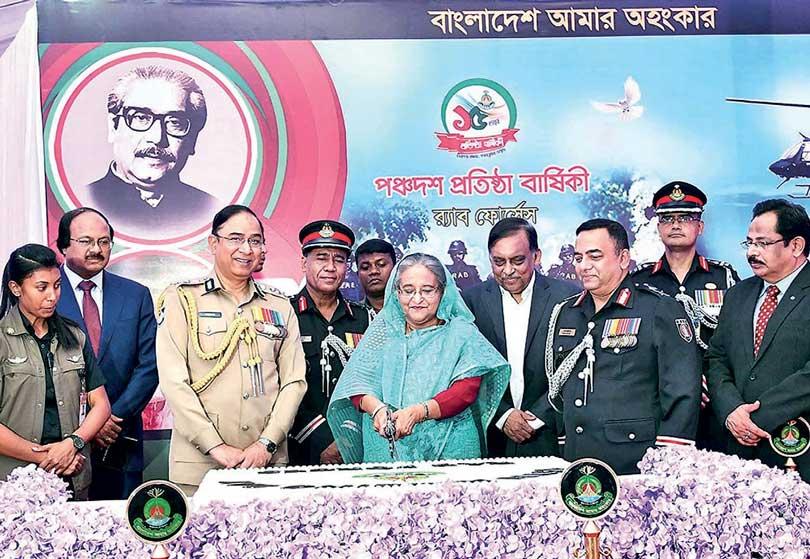
Bangladesh marks the 15th anniversary of the anti-terrorist Rapid Action Battalion
Muslim-majority Bangladesh was born out of an explicitly secular and linguistic movement spearheaded by Sheikh Mujibur Rahman. But it did not take long for the new born to show that it was Islamic” as well as Bengali”.
This was due to the failure of Bangladesh’s post-independence secular rulers to live up to their promises. With the failure of Mujib’s secular government, political Islam became the rallying point for the disgruntled.
Subsequently, unpopular military rulers seeking legitimacy strengthened political Islam by reviving and nurturing it. Pakistan also played a role in instigating and sustaining political Islam to get back Bangladesh which it lost in 1971.
Over time, political Islam became increasingly radical and terroristic. Successive governments in Dhaka were formally secular” but were bending over backwards to carry Islamist forces with them, giving them legitimacy in the process. And whenever the State asserted its modern secular character, Islamist radicals would unleash terrorism to make the government mend its ways.
The Islamists saw abjuring Islam in favour of a Bengali” ethno-linguistic identity as a mark of subservience to India which had been seeking a greater political and economic role in a country which it helped found by sending in its military in December 1971.
Over time, Islamism mixed with nationalism proved to be a potent political mix which governments found hard to fight.
Between January 2005 and December 2017, about 746 persons had fallen prey to Islamist terror and State counter-terror operations. According to a study, 91% of these ghastly incidents had taken place since 2013 when Prime Minister Sheikh Hasina of the Awami League was trying to put Bangladesh back on its original secular track.
In 1977, before Hasina came to power, the constitution replaced secularism by absolute trust and faith in almighty Allah”. Military ruler Ziaur Rahman’s Bangladesh Nationalist Party (BNP) fostered the notion that Bangladesh is Islamic. Between 1976 and 1979, Zia legalized religious political parties and allowed Islamists, who had worked with the Pakistani Army during the liberation war, to participate in government.
The Bangladesh Jamaat-e- Islami (BJeI), banned by Mujib, was able to publicly rejoin Bangladeshi politics in 1979. Gen. H.M. Ershad, the country’s second military dictator, made Islam Bangladesh’s state religion. He even gave cabinet positions to two BJeI war criminals”.
The world was unaware that a whole generation of Bangladeshis had grown up with no love for Pakistan or the Islamic movement prior to the formation of Pakistan in 1947
In 1990, democracy returned to Bangladesh. But it did not augur well for secularism. The BNP led by Gen. Zia’s widow, Begum Khaleda Zia, continued to cultivate and accommodate Islamic radicals. But this was vehemently opposed by the Awami League now led by Sheikh Mujib’s daughter Sheikh Hasina Wazed.
While the Battle of the Begums” raged, Bangladeshi militants returning from the Jihad” in Afghanistan added fuel to the fire. They teamed up with the al-Qaeda Rohingya Solidarity Organization (RSO). RSO came to Bangladesh along with the 200,000 persecuted Rohingyas from Myanmar. Pakistan’s ISI, waiting in the wings, tied up with BJeI to turn Bangladesh into a launching pad to stage attacks in neighbouring India.
BJeI and its student wing, Islami Chhatra Shibir (ICS), the Jagrato Muslim Janata Bangladesh (JMJB) and Jamatul Mujahideen Bangladesh (JMB) attacked Hindus, Ahmadiyas and Awami League workers.
The JMJB and JMB merged under the leadership of Sheikh Abdur Rahman and Siddiqur Rahman, known as Bangla Bhai” (Bengali Brothers). The Bangla Bhai became popular for providing instant justice. Mainstream politicians cultivated the Bangla Bhai” and ran protection rackets with them till the BNP government led by Prime Minister Begum Zia felt the need to control them. The Rapid Action Battalion (RAB) was set up to fight the menace.
In August 2005, the JMB set off 459 bombs simultaneously in 63 of Bangladesh’s 64 districts to push the country into adopting Sharia law. The Harkat-ul-Jihad-al Islami Bangladesh (HuJI-B), founded in 1992, issued death threats against the feminist authoress Taslima Nasreen, who had to flee from Bangladesh. It tried to assassinate Prime Minister Sheikh Hasina. The Pakistan-based Lashkar-e-Taiba (LeT) staged many attacks in Bangladesh. Many Bangladeshis resident in the UK went to Syria to fight alongside the Islamic State (IS). Adept at using sophisticated communication technologies, the IS influenced well educated and well-heeled young Bangladeshi Muslims.
The killers of 18 foreigners and two Bangladeshis in the up-market Holey Artisan Bakery in Dhaka on July 1, 2016, were well-heeled students from Dhaka’s private North-South University. In 2009, despite the wide berth given by the predecessor BNP regime to Islamic radicals, Sheikh Hasina set up a War Crimes Tribunal to try persons who had committed war crimes during the liberation struggles as auxiliaries of the Pakistani army. There had been a mass student movement since 2007 seeking the trial of war criminals.
But the Jamaat-e-Islami, the main target of the trials, and human rights groups cried foul saying that the procedures did not accord with international norms. Apart from Pakistan which passed many resolutions against the trials, Malaysian leader Mahathir Mohammad and Turkish leader Erdogan appealed for clemency. But Sheikh Hasina was undeterred. The trials continued and many were sent to the gallows.
Hasina was adept at resisting foreign pressure. When the US put tremendous pressure to get Bangladesh to let an island be used as a US base, she put her foot down.
Hasina was undeterred even by the country-wide mayhem unleashed by the Jamaat because she had the support of Bangladeshi youth, including youth from the private universities. In 2013, the broad-based Shahbad movement backed her to the hilt, demanded capital punishment and a ban on the Jamaat.
Explaining this a Bangladeshi commentator said: The world was unaware that a whole generation of Bangladeshis had grown up with no love for Pakistan or the Islamic movement prior to the formation of Pakistan in 1947. These were young students and professionals born after 1971. Hasina was cued into this generation.”
An independent minded person, Hasina resisted the temptation to go along with the Western view that the Holey Artisan Bakery attack was the handiwork of the international lslamic State and not a local group. She sensed that attempts were being made to link up the massacre with the IS so that the Western agencies could enter the investigation process and infiltrate the Bangladeshi security set up. She therefore doggedly held on to the view that the massacre was a local job.
She refused to yield to pressure from the Bangladesh elite to release some of the suspects saying that law enforcement machinery could not be fettered.
To get the ramifications of the network which carried out the July 1, 2016 attack, and to avoid harassment of the public, Hasina appealed to families to inform the police of any missing persons or anyone moving about suspiciously in their neighbourhood. This unearthed information about more than 200 persons, which helped crack the case.
Hasina knew that people were tired of terrorism and governments which tolerated and fostered radicalism and helped radicalism metamorphose into terrorism. Therefore her appeal for Help to Help You” had the desired effect. People came out with useful information.
The Prime Minister tackled the drug menace in the same way. She knew drug traffickers were terrorizing locals and forcing them to tolerate their nefarious activities. That was why, despite the international cry over extra-judicial killings, there was no local resistance or disapproval of the strong arm methods she used.
Political commentators predicted that Hasina and her Awami League would lose the last elections because of human rights violations” under her rule since 2009. But she won handsomely. The opposition BNP was in disarray and did not contest and the Jammat had gone into hiding as it had lost its base.
Hasina knew that people were tired of terrorism and governments which tolerated and fostered radicalism and helped radicalism metamorphose into terrorism
However, Hasina is not oblivious to the fact that Bangladesh is an Islamic country and the hold of religion is strong in the rural areas. Therefore she has come to an understanding with Hefazat-e-Islam which runs thousands of Qawmi Madrasahs.
The Hefazatis preferred to the Jamaat because unlike the Jamaat, the Hefazat was not against the struggle for freedom from Pakistan.
Hasina yielded to the Hefazat’s demand for recognition of their certificates for government jobs. She removed from the Supreme Court, a statue of justice showing a lady in a sari holding the scales of justice, which the Hefazat said was un-Islamic. She did not allow writer Tasleem Nasreen to come back to Bangladesh as she had ridiculed Islam. She criticized secular bloggers for going overboard in their posts.
Hasina has mastered the art of balancing secularism and Islam and has curbed radicalism and terrorism with a mixture of guile and firmness.
Is the Joint Opposition (JO) confident of punching above its weight? It has handed over to the Speaker a no-faith motion against Minister Rishad Bathiudeen. That the JO lacks a working majority in the House is only too well known. After all, that was why it failed to retain the power it grabbed from the UNP, late last year. It is only wishful thinking that the JO will be able to secure the passage of the no-faith motion under its own steam if its rivals leap to Bathiudeen’s defence. If so, why has it sought his ouster in this manner?
Both the UNP and the SLFP are eyeing what is described as Bathiudeen’s block vote. Therefore, President Maithripala Sirisena and Prime Minister Ranil Wickremesinghe are wary of ordering a probe into serious allegations against Bathiudeen.
SLFP MP and General Secretary Dayasiri Jayasekera was questioned by the police, the other day, over the recent anti-Muslim riots, in the North Western Province; he was seen transporting a group of persons who, his opponents said, had been involved in mob violence. He has denied any wrongdoing and asked the police to put the record straight. If it can be proved that he was on the wrong side of the law, he should be punished.
The police must explain why they have not probed serious allegations against Bathiudeen and Eastern Province Governor M. L. A. M. Hizbullah. Army Commander Lt. Gen. Mahesh Senanayake himself has revealed that Bathiudeen made an intervention on behalf of a terror suspect. This is a very serious issue that warrants a thorough investigation. The suspect concerned has been handed over to the Terrorism Investigation Division. The TNA has called for a probe against Hizbullah. Strangely, the government, which is at the beck and call of the TNA, has not heeded that call.
Is it that Bathiudeen and Hizbullah are ‘more equal’ than Dayasiri before the law?
The no-faith motion against Bathiudeen is a smart move by the JO. Allowing the JO to secure the passage of the motion is the last thing the UNP wants. The UNP will be compelled to vote against the motion, for two reasons. It will be dependent on Bathiudeen’s votes at the next presidential election, and cannot afford to allow the JO muster a majority in the House. If the UNP defends Bathiudeen, it will incur the opprobrium of those who are out for his scalp. The Army Commander’s revelation has aggravated the UNP’s woes. Whether its MPs representing the areas, affected by the Easter terror, will dare defend anyone accused of having links to the National Thowheed Jamaath remains to be seen.
The SLFP is also in a similar predicament. If it supports the no-faith motion against Bathiudeen, it will not be able to woo the latter at the upcoming presidential polls, and pressure will mount on it to take action against Governor Hizbullah as well. President Sirisena, who is planning to seek a second term, may be reluctant to antagonise Bathiudeen. The SLFP and the President will incur the wrath of those who are demanding action against Bathiudeen if they defend him.
The JO has failed to secure Bathiudeen’s backing, and that was the main reason why the hurriedly formed Sirisena-Rajapaksa administration collapsed, last October. Bathiudeen benefited immensely from President Mahinda Rajapaksa’s government, which gave him free rein, but he decamped before the last presidential election. The JO is also trying to settle old political scores with Bathiudeen through the no-faith motion.
If the UNP and the SLFP oppose the no-faith motion against Bathiudeen, the JO will be able to cast them in a bad light. The TNA and the SLMC will also be in a dilemma. They will have to make their position on the issue known soon.
As things stand, heads the JO wins, tails its opponents lose. Will the SLFP, the TNA and SLMC be able to extricate themselves from the no-faith trap?
A high ranking minister has said Sri Lanka is not a Sinhala Buddhist country though the majority belongs to that ethnic-religious community. He may or may not be showing his ignorance and may have been trying merely to attract the non-Sinhala Buddhist voter. Lot of piffle is uttered for political gain and we need not worry about it if not for the wrong view he creates by such foolish utterances and the damaging effect it would have on the historical importance and civilisational consciousness of our nation. Fortunately we have educated Christian priests in the calibre of Malcolm Cardinal Ranjith, who has put the matter in its correct perspective.
National identity is not a matter to be decided by one single criterion like the religion of the majority community. A Nation cannot be created overnight by putting together on a piece of land a group of people who believe in one religion or speak one language. A nation is built, nurtured and protected in history by its people resulting in the development in their mind a civilisational consciousness which provide the cohesive values of existential importance. And in this civilisation there would have been one or two driving forces which motivated, guided and moulded the people and made them distinct and identifiable as a nation. Buddhism undoubtedly was the single most important factor that created Sri Lanka. Further Sinhala was the language of communication used by the people when building their civilisation. Therefore it is nothing but right to identify Sri Lanka as a Sinhala Buddhist country.
Recent events in Poland and Iran show that religion provides the cohesive values and could play a dominant role that seem indispensable in times of social upheaval. This view is further strengthened by the findings of a study that revealed in 18 countries across Central and East Europe, an average of 66% of people had said religion is important for national identity (Pew Research Center, 2015- 2016). Religion provides values that delineate national identity. This role may not be universal but it applies to great variety of societies including secular ones. In such countries people are more likely to see religion and national identity as entwined. Nationalism that seems to be on the rise in West European countries like Britain, France, Germany, Italy etc., has religion as its cohesive force though not overtly. Though these countries apparently have secular states religion forms a strong base for their people to unite in adversity and the governments in turn support the religious institutions. Their national symbols like the anthem and the flag carry significant religious elements. Hence integrative values are essential to hold a nation together particularly less developed unstable countries like Sri Lanka.
Modernisation, which had brought in a separation of religion and state and created secular societies had not been able to prevent a recourse to religion when the state fails. In such situations it is the religion that had been made the rallying point as happened recently in Poland. That country is an industrialised modern state that had broken away from the shackles of Russian dominance and aligned with the West. Now, Poland seems to have realised that the Western shackles may be worse with globalisation and overarching EU, threatening to destroy its identity. In this crisis it seems to be their religion that holds the people and the nation together. On the other hand, in highly modernised countries like the US and Western Europe where apparently secularism is strictly adhered to, morals have declined and it is turning into a huge social problem. As cohesive values are said to be unnecessary. In these countries too it is probable that the people will have to turn to religion, and its cohesive character and move away from secularism sooner than later.
When Ven Mahinda Thera brought Buddhism to Sri Lanka he also brought the seeds for an entire civilisation. Consequently, the language, arts and crafts, literature, social values, attitude to life, etc. sprouted and grew on this land. It is the tenets and the morals of Buddhism that built the civilisation in this country. People built, nurtured and protected this civilisation for centuries and it is this civilisation that nourishes and perhaps moulds all who inhabit this land.
The Cardinal has expressed a similar viewpoint recently. This may be why Sri Lankan Christians, Hindus and Muslims may be somewhat different from their counterparts in other countries in their attitude to life and values.
Buddhism in Sri Lanka has also looked after other religious believers including those who came in search of trade. A well-known instance is the protection extended to Muslims by the Kandyan King when they were persecuted by the Portuguese. He did not do it to get their votes but out of compassion.
Though the Minister concerned says that the Buddhist majority must not forcefully burden the minorities with their dogma and view this has never happened throughout history. Espousing the truth and reality and attempting to repulse unethical advances should not be misconstrued as Sinhala Buddhist chauvinism.
Sri Lanka is a Sinhala Buddhist country which belongs to everybody who lives in it.
KYOTO – On Easter Sunday in April, the world was shocked to witness the horrific terrorist attacks in Sri Lanka, which struck two international hotels and several Christian churches around the country. The premeditated, planned, and well-coordinated attacks took the lives of 279 innocent people, including a Japanese mother, and injured hundreds more, including her family.
A couple of weeks later, before the shock of the attacks had worn off, cyclonic storm Fani approached Sri Lanka bringing heavy rain and high winds, causing flooding and extensive damage. Fortunately, no deaths were reported in the country with much experience in natural disasters and decades (in the past) of conflict.
In March, prior to the above tragedies, I had the pleasure of reuniting with some friends and colleagues from Sri Lanka, who work for the country branch office of the Asia-Pacific Alliance for Disaster Management, a six-country partnership for disaster reduction and response headquartered in Japan to which I serve as an adviser.
We were participating in an international conference in the Philippines, with the support of the Foreign Ministry.
One of the Sri Lankan participants, Yasarath Kamilsiri, a reporter specializing in disaster affairs, was also a member of a relatively new organization involved in community development called Gammadda. During the week together, he also told me about a youth group associated with the Gammadda Initiative, and shared videos of it with me and answered my many questions. Seeing the spontaneity and enthusiasm of the organization, I am hopeful about the country once wracked by a 25-year civil war and still now by natural disasters (including the 2004 Indian Ocean Tsunami).
We, those of us in Japan included, have much to learn from other countries, including the Philippines and Sri Lanka, especially in the field of disaster response and civil-military cooperation. But it is the student group and the spirit of youth volunteerism to make one’s community and country better and its implications for Japan that I would like to introduce here.
Previously known as Ceylon prior to 1972, Sri Lanka is situated directly below India in the Indian Ocean and is sometimes called the Teardrop of India.” Despite its size, Sri Lanka has one of the greatest diversity of animal species on the planet.
It is divided into nine provinces, and 25 districts, with Colombo, in the southwest, the capital and largest city. Tea is its main export, with tourism another important industry that has been affected, hopefully just temporarily, by the recent terrorist attacks.
Sri Lanka is a multiethnic country with several religions, Buddhism being the predominant one. Sri Lanka is considered Asia’s oldest democracy, and boasted the world’s first female prime minister, as early as 1960.
The country, which became independent in 1948, has a population of approximately 22 million people. More than half of the population is under 40 years old, but it also has the most rapidly aging population in the region and one of the fastest in Asia as a whole after China, Thailand, South Korea, and Japan.
Sri Lanka has one of the highest literacy rates in South Asia, 92 percent nationwide and 98 percent for its youth. However, its tertiary education remains difficult to access, with only a 5.1 percent participation rate, due in part to the limited number of public universities. Sri Lanka ranks 8th in the World Giving Index, suggesting a compassionate society in volunteering and donating, despite its not yet being a developed country. Economically, and in other areas, it is a country worth watching.
The country, however, also has numerous problems in health care, access to higher education, poverty, social problems and many areas that are not being properly or adequately addressed.
It was because of this that a news organization in Sri Lanka, Newsfirst, specifically decided to examine these problems at the local and individual level beginning in 2013, calling it Gammadda, which is Sinhalese for amid the village.” Subsequently, partnering with a local university, it conducted household-by-household surveys of the problems residents faced in 2016, 2017 and again in 2018. The United Nations recognized this initial information-gathering effort at the first-ever World Humanitarian Summit held in Istanbul in 2016.
But the Gammadda initiative was not limited to information-gathering alone. The effort transitioned into providing solutions for community development, or action out of facts.” Using the young people in the news agency, several hundred specific projects were identified, and a timeline of 100 days was assigned to complete as many as possible through partnerships with the community and other young people. Amazingly, every single community development project was accomplished.
A second 100-day challenge was launched, followed by a 1,000 project challenge.
Using the networks the media agency and its partners have developed in all areas of society, combined with the power of technology, it has been able to be quite successful in the few short years since it started.
One of the key components of this success has been the volunteer force of young people Gammadda created, who are able to access information online about activities and events. This group, appropriately, is known as Gammadda V-Force and operates under the motto The Courage to Care.”
I see great potential for such a national-level partnership between the private sector, media, universities, NGOs/NPOs, and local municipalities (particularly those that are suffering from population decline), to address problems here in Japan. I can think of a 1,000 small to medium-size projects myself that need addressing. Fortunately, today’s young people, despite what some people might think, are engaged and interested in these issues. I hope their energy, passion, and intelligence can truly be tapped.
Particularly, there are many things that need to be done, including cleaning up Tokyo’s streets, subway and train stations, and other things prior to Japan’s hosting the Olympics next summer. It would be great to involve everyone in that effort.
Currently, it appears Japan only has three sister-city relationships with Sri Lanka. If there were more, perhaps some Japanese communities would have learned about Gammadda and tried to introduce it into their communities or areas. I always encourage Japanese cities, towns, and villages I visit to pursue more sister-city relationships and often write about the need for Japan to expand such relationships as part of its public diplomacy. And this is yet another reason why it should: to expand its ability to gather information and ideas.
I hope Japan and other countries can learn from Sri Lanka’s private sector effort to address public policy issues. In doing so, it and the world can develop greater connections with the country suffering from the horror of the recent attacks and provide hope for it and for ourselves.
To learn more about Gammadda, please visit its website (www.gammadda.lk/),or better yet, create a sister city partnership with Sri Lanka and get involved that way.
Robert D. Eldridge is the North Asia director for the Global Risk Mitigation Foundation.
COLOMBO (Reuters) – After coming under fire for not acting on warnings about Easter bombings that killed more than 250 people, Sri Lankan President Maithripala Sirisena is now facing criticism over his leadership in the aftermath of the Islamist attacks.Sri Lankan President Maithripala Sirisena walks inside the Great Hall of the People in Beijing, China May 15, 2019. REUTERS/Jason Lee/Pool
On Monday last week, just as anti-Muslim riots were spreading in apparent reprisal for the attacks, Sirisena embarked on a three-day trip to key financier China, leaving some Sri Lankans feeling abandoned.
Going ahead with his son’s wedding on May 9 also struck some as an affront to families still in mourning after the April 21 bombings, claimed by Islamic State, which struck churches and hotels.
That leaves Sirisena in a weak position ahead of this year’s presidential election, voters and analysts say, potentially paving the way for former wartime defense chief Gotabaya Rajapaksa to take over.
Sirisena’s allies say he did the best he could in a volatile situation, citing measures like temporarily shutting down social media and deploying the army to stem violence in the multi-ethnic, Buddhist-majority island.
But that rings hollow to voters like 56-year-old construction worker Sunil, who voted for Sirisena in 2015 amid hopes the career politician would combat corruption but now feels the president has not focused on governing.
The president has no time for this because he is busy going all over the place,” said Sunil on a recent morning in Colombo, vowing never to vote for Sirisena again.
Sirisena’s trip to China, where he met President Xi Jinping, was pre-planned and beneficial to the nation, coordinating secretary Shiral Lakthilaka told Reuters.
Sirisena returned to Sri Lanka on Thursday and only addressed attacks on Muslim homes and shops on Friday, five days after the violence erupted.
Some disgruntled Sri Lankans were also frustrated that Sirisena’s son’s wedding went ahead. It was originally scheduled to be held in the Shangri-La, which was bombed, and ultimately celebrated at the Hilton Colombo.
Sirisena, one user identified as @sankadon tweeted, cant even postpone the extravagant wedding at least (for) the tears and blood of the people who lost their lives due to his inability”.
Spokesman Ekanayake pushed back at the criticism, saying the wedding was scaled down and that Sirisena did not attend all the festivities.
ELECTION YEAR
The criticism comes on top of accusations that government paralysis due to a feud between Sirisena and Prime Minister Ranil Wickremesinghe prevented warnings about the attacks from being disseminated.
Both men, who fell out after a political crisis in October, say they were not privy to the warnings.
Sirisena was in Singapore with family when the attackers struck. He returned to Colombo 15 hours later, appointed a panel to probe defense lapses and replaced both the police chief and the defense secretary.
There are no political polls in Sri Lanka, but analysts said Sirisena was on the back foot in elections that must be held by December.
President Sirisena does not have a fighting chance,” said Eurasia analyst Akhil Bery.
Wickremesinghe is also seen as a lame duck due to disappointment over the economy under his watch. His allies say two more popular politicians from the United National Party, Speaker Karu Jayasuriya or Housing Minister Sajith Premadasa, could run instead.
To be sure, Sirisena’s chances of re-election prior to the attack were also seen as slim, but he had been vying for an alliance with former president Mahinda Rajapaksa.
That now seems impossible, with Rajapaksa’s brother, Gotabaya, who is running for office, doubling down on criticism that the attacks happened because the government dismantled intelligence networks he built up during Sri Lanka’s 25-year civil war with Tamil rebels.
Sirisena had the idea of contesting, but there is no chance at all (of winning), especially after the attack,” said political commentator Kusal Perera.
Auto rickshaw driver Shantha, who did not provide a surname, has switched from supporting Sirisena to backing Rajapaksa.
We did not see quick decisions to bring the situation in the country back under control,” Shantha, 37, said of the government. I will vote only if Gotabaya Rajapaksa contests.”
Colombo, May 20: The Sri Lankan government has announced the proscription of three Islamic State (IS) affiliates, namely, the National Tawheed Jamaath (NTJ), the Jamaathei Millathu Ibrahimee Seylani (JIMS) and the Wilayath as Seylani (WAS).
The first two were publically identified soon after the April 21 Easter Sunday suicide attacks which resulted in 253 deaths. But the Wilayath as Seylani (WAS) was named only on recently, perhaps because it was discovered during the investigations into the multiple suicide bombings. The government is yet to give details of the Wilayat as Seylani and its operations in Sri Lanka.
However, according to Dr. Rohan Gunaratna, a co-author of The Three Pillars of Radicalization” (Oxford University Press 2019), the Islamic State’s Caliphate has not formally declared the formation of WAS though its formation is being discussed at the highest level in the organization and its establishment is very much on the cards.
The Islamic State’s plan may be to declare WAS’s formation if anti-Muslim violence continues in Sri Lanka and an excuse can be given for the formation of a separate Wilayath for Sri Lanka,” he said.
The term Wilayath refers to a province”. Since 2014, the IS has set up Wilayaths or provinces in various parts of the world. These Wilayaths are not conventional provinces but fields of IS operation. Among the IS’s Wilayaths in South Asia are Wilayath Khorasan (covering Afghnaistan and Pakistan) and Wilayath al Hind (covering India with the nerve center being located in Kashmir). To this has been added Wilayath as Seylani ( Seylan is the Arabic name for Sri Lanka).
According to Dr.Gunaratna, Mohammad Zahran, the leader of the NTJ, who carried out the suicide bombing of Shangri- La hotel in Colombo, had been wanting to set up an IS Willayath in Sri Lanka.
The Lankan government was probably aware of the discussions going on at the highest levels in the IS Caliphate about forming WAS and had banned it in anticipation.
Communal clashes, with the majority community staging mob attacks against Muslims, would have paved the way for the realization of terrorist Zahran’s dream.
It is therefore very important for the government of Sri Lanka to ensure that there are no communal clashes and that Buddhists, Christians and Muslims live harmoniously and side by side in safety and security. If need be, government should issue shoot at sight orders to quell mobs on the rampage,” Dr. Gunaratna said.
In his paper entitled Islamic State’s Financing: Sources, Methods and Utilization” in the booklet Counter terrorism- trends and analyses,” brought out in 2017 by the S.Rajaratnam School of International Studies, Singapore, Patrick Blannin says that the Islamic State is a multi-million dollar organization, which can throw money in many parts of the world to recruit, train, retain cadres and carry out its operations.
If Sri Lanka becomes a hub or a Wilayath of the IS , it would be exposed to the dangers other parts of the world with Wilayaths face now.
According Blannin, the IS is a self-sufficient organization not depending upon any State or individual for its funds. He quotes Patrick Johnson to say that in 2008, before Abu Bakr al Baghdadi became leader of the IS, the organization was financing itself by running smuggling rackets.
Looking at the financial muscle of the IS, it comes as no surprise that Zahran’s small group in Sri Lanka had as much as Rs. 7 billion worth of assets and Rs.140 million in cash.
Baghdadi’s predecessor, and IS founder, Abu Mu’sab al Zarkawi, had earned US$ 70 million to US$ 200 million annually through oil smuggling. Kidnapping for ransom got the IS another US$ 36 million. Keith Crane from RAND Corporation told a US Senate Committee that the IS made about US$ 1.2 billion in 2015 alone by various, mostly illegal, activities.
Oil Smuggling
According to a 2015 study, the IS earned money from the oil business by attacking, holding, and operating oil infrastructure facilities in Iraq, Libya, Syria and Egypt. Sale of oil and petroleum products fetched it US$ 40 million per month in 2015. IS also operated refineries.
Anyone could buy oil from the IS. It sold at a competitive rate, and therefore sales were good. According to one estimate it charged US$ 20 per barrel in 2015. One report said that it made US$ 1.5 million a day on oil sales. However, US strikes against IS oil facilities in 2016 brought down revenues from oil rackets by 33%.
Interestingly, the many anti-IS groups in the Middle East were using the same methods to earn money to carry out their anti-IS operations.
Human Smuggling
Human smuggling is another racket which the IS had been running. It ran such rackets in Nigeria, Sahel, Libya, Egypt, Iraq and Syria. Prior to Libya’s action in 2016, the IS had a free run of 260 km of the Mediterranean Coast. It is said to have taxed agents involved in the smuggling 250,000 people to Europe across the Mediterranean.
It is alleged that the IS would attack refugee camps, forcing the refugees to flee and then made them pay to get across to Europe.
Though the Salafi Islam it propagates is against idols, the IS has had no compunction about stealing and trading in idols illegally. And the business was booming when it had many parts of Iraq under its control. As many as 4500 archaeological sites including some in the UNESCO World Heritage List, were under its control enabling it to vandalize the sites and sell priceless artefacts. This raised concerns in the UN and the Security Council passed a resolution in 2015 criminalizing this activity.
Taxation Cum Extortion
Taxation is another method of making money. The IS reportedly collected not less than US$300 million annually by taxing business and levying religious taxes. The religious tax on business was as high as 20%. Agriculture too was a source of income because at one time the IS-controlled 40% of the agricultural land in Iraq.
Cyber Crime
IS’s cyber jihadis” openly advise their online supporters how to use Dark Wallet, an anonymous bitcoin transfer application, as well as how to set up an anonymous donations system to send money, using bitcoin, to the mujahedeen, says Patrick Blannin.‖
Whilst providing a communication channel with mass reach, IS online forums serve as virtual marketplaces for cybercrime tools such as malware and ransom-ware, as well as for skilled hackers, who can be hired for criminal services.”
The Internet has globalized fraudulent schemes, giving fraudsters access to millions of potential victims. British IS supporters committed a large-scale fraud by pretending to be police officers and targeting the UK pensioners for their bank details, earning more than US$1.8 million.”
Magnus Ranstorp has found that IS operatives have used fake identities and payslips to apply for funds through online applications. They have used these identities to secure soft bank loans, quick loans (SMS loans), government and private welfare schemes as well as lease motor vehicles.”
I was astonished by a news item that appeared a couple of weeks back, to the effect that the Presidential Secretariat was to appeal against the order of the Right to Information Commission that it reveals the Assets Declaration of the Prime Minister. Given what seems to be continuing bad blood between the President and Ranil, this seems odd.
Several possible explanations come to mind. One is that the hostility is an elaborate hoax, designed to fool the country and the Opposition. If Ranil is not nominated by his party for the Presidency, or if it is clear he has no chance of winning, as was the case last time round, he will ensure that Sirisena is nominated. The man is obviously more malleable than anyone else, so Ranil and his poodles, having shut out Sajith, can continue to enjoy the fruits of office for another five years.
The second is that Sirisena thinks revealing Ranil’s assets will bring Ranil credit, since he has so little. I have previously pointed out that I do not think Ranil’s declaration will reveal any ill-gotten gains, for the simple reason that Ranil’s schemes for making money are not for himself, but rather for his party. This is a simple mechanism to ensure that his less perceptive supporters continue to think of him as clean, while he enjoys the fruits of his nefarious activities (and those of his chums) because all his expenses are met by the party. After all, though luckily unlike other influential spouses, his wife does not revel in jewellery and vulgar show, she like him and his acolytes, enjoys luxurious hotels, and someone has got to fund them.
My view is that what will emerge as the paucity of Ranil’s actual assets will make it clear why he has clung so desperately to the leadership of the party, namely that without that he could not continue to enjoy the lifestyle to which he has become accustomed. But such an argument would be beyond Sirisena, so, he thinks it best to conceal what he sees as Ranil’s impressive record in not having acquired excess assets during his over 20 years in power.
Forward defence line
Related to this may be Sirisena’s view that Ranil is his best forward defence line. If Ranil’s Assets Declaration is made public, it would be even more difficult for Sirisena to hide behind his right to conceal his own assets. After all, the Commission, while registering that the Declaration of Assets and Liabilities Law does not include the position of President” noted that the increasing trend among Heads of State is to proactively disclose their assets and liabilities to foster a practice of transparency and public accountability.”
Unfortunately, the President is in a position to play games with the People’s Right to Information because the Act itself is designed to suppress information when the Government wants to be secretive, rather than fulfil the purpose of transparency for which it was conceived. A Right to Information Bill was prominently featured in the 100-day manifesto, with a commitment to introduce it on 20 February 2015 and pass it in three weeks.
Of course, nothing of the sort happened. With Ranil only anxious to take over presidential powers, and Sirisena actively subservient to him – as opposed to passively, which is the case now, except when it comes to his own position – hardly any promises were kept, and none on schedule. The draft Right to Information Bill, prepared by Ranil’s little coterie of loyalists, was circulated only in April, and there was no opportunity given to discuss it before Sirisena’s hasty dissolution of Parliament in June.
I do not think anyone else bothered to respond to the draft, but early in April I sent several suggestions to Ranil, and also copied these to Nimal Siripala de Silva, the then Leader of the Opposition. Needless to say, there was no response from either. And of course, despite the hype in the manifesto about the strengthening of Parliament, there was no question at this stage of the Bill being discussed in a parliamentary committee.
What the Prime Minister was up to, in fact, seemed clear enough, now that he had got ready to present to Parliament what was, despite the Supreme Court verdict, largely his version of the 19th Amendment. I concluded the letter I sent him about the Bill with the hope that he would not forget what the country had been promised, once he had had his way about bringing the President under his control – I hope other Members of Parliament also respond. However, it would be best, to ensure adherence to the norms of Parliament, that this draft be submitted to the relevant Consultative Committee of Parliament. It is sad that only a couple of Consultative Committees have thus far met, even though the Cabinet was constituted three months ago. Also I trust your Party will not exercise undue pressure with regard to immediate dissolution of Parliament, since it is important that this Act and the Act on strengthening accountability are passed.”
Premature dissolution of Parliament
Nothing more was heard about the Bill in the next couple of months, and Ranil got his way in June about the premature dissolution of Parliament, Sirisena breaking his promise to the UPFA Parliamentary group in soliciting their support for the 19th Amendment, that he would not dissolve Parliament until the electoral system had been changed. Obviously, the commitment in the manifesto that I guarantee the abolition of the preferential system and will ensure that every electorate will have a Member of Parliament of its own” meant nothing to him. And though earlier I thought he meant what he said, but allowed himself to be swayed by those who pressurised him, I have now realised after his antics with regard to the terrorism we have suffered from recently that he lies like a Trojan for his own benefit.
One of the basic principles I wanted incorporated in the proposed Act was that information should be a right the public enjoyed, not a privilege bestowed by those in authority. Thus, I wanted the reports that the Act enjoined every Ministry to prepare to incorporate at 8 (2) b (vii) the Declarations of Assets of Ministers, Deputy Ministers, Secretaries of Ministries, Chairs of Public Authorities and all officials responsible for contracts or expenditure over the value of Rs 1 million. Such declarations should be posted electronically. Gifts over the value of Rs 500,000 received by such individuals should also be recorded.
I had put a similar suggestion to Karu Jayasuriya, who was then the Minister for Democratic Governance as well as Public Administration, believing then that he was actually committed to transparency and the eradication of corruption. I proposed to him that:
1. The Assets Declarations of Ministers, Parliamentarians, Provincial Councillors and those heading government institutions that have entered into contracts of above a particular value should be made public. They should be uploaded on institutional websites within two weeks of laws/regulations to such effect being introduced.
I am aware that there may be some diffidence about this inasmuch as some Members of the Government may not have declared their assets as required. The law/regulation should specify that no action will be taken with regard to such, provided the declaration is made available to be made public at the due date. They will also be requested to make declarations for each of the last five years.
2. A Commission should be empowered to go into these declarations, and institute investigations if the assets of any individual have grown disproportionately in the last five years.
The Thai concept of people being ‘unusually rich’ could be brought into play. The Public should be invited to provide information if there is reason to suspect inaccuracies in the declaration of assets. Such information should be investigated, with provision that assets not declared may be frozen, and confiscated if legitimate acquisition cannot be proved.
3. Individuals who hand over assets which they cannot prove were legitimately acquired may be given an amnesty, on condition of taking no part in public life for a specific period.
It could be argued that this is a form of impunity, but we should not engage in what could be perceived as witch hunts. Regaining for the country anything that has been plundered, and debarring further such activities for a fixed period, should be enough.
4. Any information provided by the public about inflated tenders, undue costs for contracts with national and international suppliers, acceptance of shoddy construction work or equipment supplied, should be investigated.
Individuals handing over assets obtained improperly through such instances may be given an amnesty, on condition of taking no part in public life. I would urge in particular that attention be paid to the information supplied by Mr. Kodituwakku, formerly of the Customs, who had to flee the country because of threats against him arising from his outstanding integrity and efficiency.
5. Officials who felt obliged to acquiesce in abuses should be given impunity for the provision of information with regard to such matters. Provision should be made for such information to be given in confidence.
Karu did try to have a meeting with other parliamentarians he thought keen on public decency, but no one came and he gave up. He told me that his hands were tied, as the Prime Minister did not trust him. Sadly, he spent the next four years trying to win back the Prime Minister’s trust, at the expense of the country.
Chairman of the Sri Lanka Podujana Peramuna (SLPP), Professor G.L. Peiris yesterday (20) said, they would go before the Supreme Court (SC) if President Maithripala Sirisena and his supporters try to extend the President’s term in office.
Speaking at a media briefing, Prof. Peiris said, many Sri Lanka Freedom Party (SLFP) Members, including its General Secretary, Parliamentarian Dayasiri Jayasekara, had indicated that the President was considering seeking the SC’s opinion on the dates of his term of office.
Jayasekara said, the Speaker had signed the 19th Amendment to the Constitution Bill on 22 June 2015. Based on this, they argue the President’s team seems to believe that his term ends in May 2020, not January 2020. Jayasekara had said, they hoped to seek the SC opinion after 30 April.
By that time a new Chief Justice would be appointed. It seems that the SLFP is trying to check whether this new Chief Justice will extend the Presidential term. You can’t do things like that. The SC is not a place for such kind of gambling.”
Speaking further, he said that Lecturer in Public Law at the School of Law, University of Edinburgh, Dr. Asanga Welikala had said that the President has already made a reference to the SC about his term.
The SC clearly stated that President has only five years in the office, not six years. According to Dr. Welikala, seeking the opinion of the SC once again on the same matter is a waste of the time of the Court. The last thing the people need at this moment is postponing Elections. We do not need that. Therefore, if anyone tries to extend the Presidential term we would also intervene in the SC to stop that. We would also form a strong public opinion against it as well. We would do everything possible for us to stop postponing the Polls,” he observed.
Meanwhile, the National University Teachers’ Association (NUTA) said that any move to seek the Supreme Court’s opinion regarding the date on which President Sirisena’s term will expire is inappropriate and unnecessary.
Professor Channa Jayasumana, Secretary of the NUTA, has informed the President in writing, that they are aware that the President is hoping to get a renewed opinion on Article 129 of the Constitution. With regard to the tenure of the Presidency, would it terminate within the five years from 8 January 2015 after the 19th Amendment to the Constitution was passed, or five years from the date when Speaker Karu Jayasuriya signed the 19th Amendment to the Constitution into law on 15 May 2015?
Prof. Jayasumana has said that after the 19th Amendment to the Constitution, the Supreme Court gave their verdict stating that the Presidential term is not six years but limited to five. Moreover, according to the verdict given in November 2018, the de facto and de jure President before the 19th Amendment to the Constitution is President Sirisena.
General Secretary of the Sri Lanka Freedom Party, Parliamentarian Dayasiri Jayasekara has mentioned that after appointing a new Chief Justice they will again seek the Supreme Court’s opinion on the term of the President. So there is a reasonable doubt among the people about the credibility of justice,” he added.
Further, Prof. Jayasumana urged that a Presidential Election be called after the Presidential term is over and to thereby fulfil Sri Lankans right to vote.
Six persons have been arrested by the Kurunegala Police over connections to the Easter Day attacks and enabling terror acts, stated Police Media Spokesperson.
Among the arrestees, three have been remanded after being produced at the courts and the remaining 3 are currently investigated on under the custody of the Kurunegala Police.
Reportedly, Kurunegala Police had received a tip-off that a group of persons had been conducting a training camp at a coconut estate in the Alakoladeniya area, Kurunegala.
Accordingly, on 9th May, the police had arrested three persons following investigations; the owner of the coconut cultivation, the coordinator of the training programs and a lecturer at the training programs. They are currently under remand until the 24th of May.
Further investigations had led to the arrest of two more suspects on May 11, stated Police Media Spokesperson SP Ruwan Gunasekara.
An employee of the Kurunegala hospital, from Ambakote, Mawathagama has been arrested in this manner. Reportedly, a large sum of money had been deposited to this person’s bank account, from time to time. He is currently under interrogation at the Kurunegala Police.
The second suspect is also from Ambakote and the police had managed to find many bank cheques on him.
Meanwhile, the Kurunegala Police has also arrested a parliamentary official over connections with the National Thowheed Jamaath (NTJ) organization. He had been serving as a translator at the parliament for a period of 12 years.
The Defense Ministry has permitted Kurunegala Police to detain and question him for 90 days.
However, 89 persons have been arrested over various links to the Easter Sunday bomb attacks. Sixty-eight of them are under the custody of the Criminal Investigation Department (CID) while the remaining 20 are interrogated under the Terrorism Investigation Division (TID).
Easter Attack ringleader Zahran Hashim’s main organizer, ‘Kalmunai Siam’, has been arrested by officials of the State Intelligence Service.
The officials from the Ampara division of the State Intelligence Service had arrested the called ‘Kalmunai Siam’ last evening (19), based on investigations carried out by them following the Easter attacks.
Following interrogations of ‘Siam’, four more suspects were also arrested yesterday (19).
Additionally, 31 CDs have also been discovered hidden buried in the Palamunai area.
Investigations have revealed that ‘Kalmunai Siam’ had assisted the close accomplice of Zahran, Niaz, to find accommodation for Zahran’s supporters in Samanthurai, Nindavur and Sainthamarudu areas.
Officials of the State Intelligence Service have uncovered that ‘Siam’ had escorted the group including Niaz, who blasted themselves in Sainthamarudu, from Nindavur to Sainthamarudu via a coastal route.
Security forces have confirmed that ‘Kalmunai Siam’ had trained in Hambantota area and that he is a powerful member of the National Thowheed Jamaath (NTJ) organization.
United People’s Freedom Alliance (UPFA) MP Shehan Semasinghe says that he believes that the no-confidence motion brought against Minister Rishad Bathiudeen will receive the support of all those who love the country and condemn extremism and racism.
He mentioned this to the media at a press conference held yesterday (19).
He stated that the relevant no-confidence motion has been included in the agenda of the Parliament.
According to Semasinghe, party differences should not apply when voting favor of this no-confidence motion.
He further stated that, based on who would vote for this motion, one can determine who loves the country and who are friends of terrorism.
The Ministry of Defense has granted Kurunegala police permission to detain a translator at the parliament who was arrested over involvement with the National Thowheed Jamaath (NTJ).
Accordingly, the suspect will be detained for a period of 90 days for purpose of interrogation, stated Police Media Spokesperson.
Reportedly, the official has been arrested by a special team of the Kurunegala Police.
It has been revealed that the suspected translating officer at the parliament has been a longstanding member of NTJ.
He is also reported to be a key speaker in the series of lectures conducted island-wide by the NTJ.
A spokesman of the parliament stated that the relevant officer has been serving as a translator at the parliament for a period of 12 years.
By P.K.Balachandran/Daily Express Courtesy NewsIn.Asia
Colombo, May 17: There have been four very disturbing developments in Sri Lanka in the past few days, which, if not recognized and attended to immediately, could pave the way for more attacks by the local affiliates of the Islamic State (IS).
In fact, the vitiated political and communal atmosphere could be used by any group, local or foreign, wanting to destabilize Sri Lanka. Cardinal Malcolm Ranjith, the leader of the Lankan Catholic community, has warned about this eventuality.
The first disturbing factor is the spate of attacks by politicized elements of the majority-Sinhalese Buddhist community against Muslim businesses, mosques and houses in several small towns in the politically sensitive North Western Province.
The second is the alleged inaction of the army and the police in the face of mayhem, which has weakened public trust in the law enforcement and government machinery mandated to maintain peace while unravelling the network behind the unprecedented multiple suicide bombings by affiliates of the Islamic State on April 21 which claimed 253 lives.
The third is the cynical way in which the country’s political parties and individual politicians are using the April 21 terrorist attacks to expose” their rivals and destroy them politically.
These political diversions are adversely affecting the government’s capacity to concentrate on and get at the real perpetrators of the Easter Sunday carnage.
The fourth is the frightening revelation that the Islamic State has designated Sri Lanka as Wilayath as Seylani” or the Sri Lankan province of the Islamic State’s Caliphate, thereby making Sri Lanka a hub and a theatre of its grisly operations in the region.
Attacks on Muslims
All Muslim organizations from the All Ceylon Jamiyath Ulema (ACJU) downwards, and all Muslim political parties have issued strong statements condemning the suicide attacks against hotels and churches. They have said that the perpetrators did not even deserve a Muslim burial for their utterly un-Islamic act. It is a fact that the most of crucial arrests were made with tip offs provided by Muslims themselves.
But despite all this, politically motivated Sinhalese-Buddhist mobs attacked Muslim businesses, houses, factories and mosques in a number of small towns in North West Sri Lanka from May 13 onwards for about three days.
Initially, international news agencies went to town saying that the attacks were Christian-led” because Christians took the brunt of the Easter Sunday suicide bombings. The attackers’ targets were churches during Mass.
But Christian involvement was found to be untrue because the towns in which the anti-Muslim attacks took place had very few Christians. Moreover, the Christians had been quiet since April 21 following Cardinal Malcolm Ranjith’s plea for non-retaliation on the grounds that a communal clash will land Sri Lanka in a big mess.
And as Fr.Edmund Tillekaratne put it, if the Christians were seething for revenge, they would have attacked the Muslims within a day or two of the suicide attacks on churches.
The recent cases of violence took place three weeks after the suicide attacks. They are the handiwork of political elements wanting to exploit the communal situation precipitated by the terrorist act,” Tillekaratne said.
Cardinal Ranjith also said that there was no religious nuance” to the attacks. The attacks were staged by out of control political elements, ” he said while urging political parties to keep their bottom level cadres in check. He pointed out that the attackers had been plied with liquor and demanded the closure of liquor shops in the affected districts.
Among those arrested in relation to the anti-Muslim violence were Sinhala-Buddhist extremists, Amith Weerasinghe of the Mahason Balakaya organization, Dan Priyasad and Namal Kumara who were involved in previous riots.
The political reason for the anti-Muslim rioting lay in the coming elections to the Sri Lankan Presidency and parliament. While the Presidential election is due in December 2019, parliamentary elections are due in the first half of 2020.
Communal strife would help political parties which depend heavily on the majority Sinhalese-Buddhist community, like the Sri Lanka Podujana Peramuna (SLPP) led by former President Mahinda Rajapaksa and its allies in the Joint Opposition.
Though the leaders of these political parties have appealed for peace, there is no certainty that their cadres have taken their advice, which is why Cardinal Ranjith has pleaded with political parties to keep their lower rung supporters in check.
Tamil National Alliance leader M.A.Sumanthiran said that the Sinhala-Buddhist elements expected the Christians to retaliate against the Muslims but when they did not, they took the cudgels, exploiting the anti-Muslim sentiment in Sri Lanka after the April 21 terror strikes.
The anti-Muslim riots and the intensification of communal politics and communal feelings among the people, are seen as a greater danger to Sri Lanka than the terrorism the country saw on April 21.
It is easier to tackle the aftermath of a terrorist attack, than the aftermath of a communal riot,” said junior Minister Dr.Harsha de Silva. Communal riots create deep wounds and lasting memories.
Sri Lanka has almost crushed the gang which staged the April 21 terror attacks. Therefore there is no immediate danger of another such attack. But the greatest threat is from communalism with its deep and vast impact,” said Dr.Rohan Gunaratna an expert on terrorism and political violence.
The Sinhalese-Tamil conflict got exacerbated not by the LTTE’s terrorist act in 1983, but by the anti-Tamil riots in July that year. The riots prolonged the conflict, globalized it and triggered a war which lasted three decades.
Alleged Inaction of Security Forces
The Lankan government has vested a great deal of power in the Tri-forces and the police under Emergency Regulations. Army Commander Lt.Gen.Mahesh Senanayake has warned of the strongest action against law breakers. And yet there are widespread complaints that the forces were not only late in responding to calls for help, but had passively stood by as mobs went on a rampage. Reports said that mobs indulged in vandalism and arson even attacking protected mosques during curfew hours.
Although Sri Lanka has a big army, not all of that could be deployed in the North Western Province as anti-Muslim riots could take place anywhere in the island given the fact that Muslims are found all over the island. The police had only 5,500 men in the North Western Province.
Perhaps there were no firm commands from the top. According to Mano Ganeshan, while Army Commander Senanayake offered to open fire on trouble makers, Prime Minister Ranil Wickremesinghe was in favor of caution concerned as he was about the political cost of killing a member of the majority community.
Political Use of Terrorism
Political parties and politicians are muddying the waters and polluting the air by cynically using the terrorist attack on April 21 to advance their political interests. They point accusing fingers at their opponents and rivals and even link some of them with the Islamic radicals and terrorists.
The first to do so was cabinet spokesman Dr.Rajitha Senaratne who said that terrorist leader Mohammad Zahran Hashim and several other members of the National Tawheed Jamaat (NTJ) were in the payroll of the intelligence wing of the Defense Ministry when Gotabaya Rajapaksa, the opposition Presidential candidate-to-be, was Defense Secretary. Following Senaratne, the pro-government Tamil National Alliance (TNA) MP M.A.Sumanthiran said that the terror attacks could have a link to the Presidential election because soon after the attacks, Gotabaya had declared that he was a candidate and that he would give Sri Lanka a strong administration.
Sinhala-Buddhist parties and political leaders pointed accusing fingers at influential Muslim cabinet minister Rishad Bathiyudeen and Eastern Province Governor MLAM Hisbullah. They were accused of promoting Wahabism and even having links with Muslim extremists.
The opposition is going to move a motion of no-confidence against Bathiyudeen, and the so-called Shariah University” being set up by Governor Hisbullah, has been brought under the Ministry of Higher Education.
The Sirisena-Wickremesinghe government is under constant fire not only from the opposition but from the public with social media being used to make nasty comments.
Although there is unity now, when the terrorist attack took place on April 21, there was no unity. President Sirisena, who was in Singapore at that time, did not allow members of the National Security Council to meet Prime Minister Ranil Wickremesinghe who was desperately trying to meet them.
President Sirisena chose to fly to Beijing to attend a conference on Asian Civilizations, when anti-Muslim riots had broken out. This is widely criticized. It was only at the last minute that Sirisena appointed an Acting Defense Minister to be in charge while he is away. Police and the armed forces come under the Defense Ministry and the President is the Defense Minister.
Declaration of Lanka as Wilayath as Seylani
The Lankan government has proscribed the National Tawheed Jamaath, the Jamaathei Millathu Ibrahimee and the Wilayath as Seylani (WAS). The ban on WAS is significant because it means that the Islamic State has designated Sri Lanka (Seylan in Arabic) as a province” of the Caliphate of Iraq and Syria.
The naming of Sri Lanka as a province means that the island is to be a hub of IS activity and a field of its operations,” said Dr.Gunaratna, co-author of The Three Pillars of Radicalization” (Oxford University Press 2019).
According to Dr.Gunaratna, the IS has not formally announced the designation of Sri Lanka as Wilayath as Seylan”. It could do so if the anti-Muslim riots are not put down with a firm hand and if the violence spreads, he warned.
It is very clear from the media reports that there have been attempts by two VIPs of the present government to obtain the release of suspects taken in by the CID on account of the 21st April Easter Sunday bombing.
It was shocking to see one of them participating in subsequent Cabinet meetings.
Have the two leaders, and those in authority, forgotten that over 300 lives were lost and causing injuries to several hundred on account of these terror acts. There are kith & kin still in a state of shock and trying to continue life facing the numerous problems. Most of them probably have issues to continue their basic livelihoods. Some of them are parents of young children, and others bread winners of those still living.
We read with disgust the attempts being made to interfere in the police investigations, and going to the extent of obtaining bail for nine of the suspects even before any investigations are completed.
(The Army Commander has attempted to soften the situation by stating that it was a mere request).
Under these circumstances it is reasonable for the public to infer that the investigations currently taking place may not be fair.
I seriously repeat my proposal published in the papers a few days ago, which I strongly believe is the only way out for this country to take a steadier path to progress. They were:
Through a People’s Referendum place the following questions to the voters.
The rulers of both major parties since independence have failed to manage this country in a constructive manner Yes/No?
To remove the powers enjoyed by the present politicians through the parliament (in other words suspend parliament for a specific period) Yes/No?
To appoint a non-political public figure who currently enjoys all-round respect from the public as the head of the Government for a SPECIFIED PERIOD Yes/No?
Such person to be given authority to appoint a cabinet of a maximum of 15 professionals from specialized fields Yes/No?
This country, as at today, requires and overall change in the present structure and style of governance Yes or No?
The current president is allowed an extension of further three months, in order to carry out the above responsibilities Yes/No?
මේ ගිවිසුමෙන් ආවරණය වූයේ යම් අවශ්යතාවකදී දෙරට හමුදාවන් අතර බඩු භාන්ඩ හා සේවාවන් හුවමාරු කරගන්නා ක්රමවේදයයි.( The agreement is entered into the purpose of establishing covers the basic terms, conditions, and procedures to facilitate the reciprocal provision of logistic support, supplies, and services – SECTION 1 OF THE ACQUISITION AND CROSS-SERVICING AGREEMENT )