
Finally, Mahinda Yapa sets the record straight
Posted on December 13th, 2025
By Shamindra Ferdinando
Clandestine visit to Speaker’s residence:
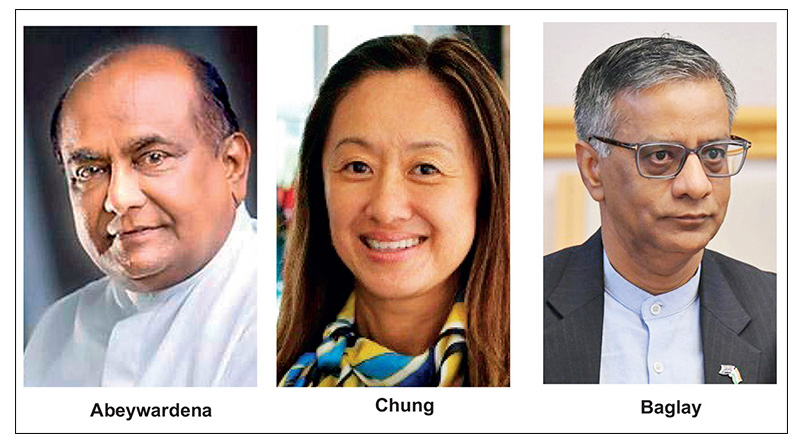
Finally, former Speaker Mahinda Yapa Abeywardena has set the record straight with regard to a controversial but never properly investigated bid to swear in him as interim President. Abeywardena has disclosed the circumstances leading to the proposal made by external powers on the morning of 13 July, 2022, amidst a large scale staged protest outside the Speaker’s official residence, situated close to Parliament.
Lastly, the former parliamentarian has revealed that it was then Indian High Commissioner, in Colombo, Gopal Baglay (May 2022 to December 2023) who asked him to accept the presidency immediately. Professor Sunanda Maddumabandara, who served as Senior Advisor (media) to President Ranil Wickremesinghe (July 2022 to September 2024), disclosed Baglay’s direct intervention in his latest work, titled ‘Aragalaye Balaya’ (Power of Aragalaya).
Prof. Maddumabandara quoted Abeywardena as having received a startling assurance that if he agreed to accept the country’s leadership, the situation would be brought under control, within 45 minutes. Baglay had assured Abeywardena that there is absolutely no harm in him succeeding President Gotabaya Rajapaksa, in view of the developing situation.
The author told the writer that only a person who had direct control over the violent protest campaign could have given such an assurance at a time when the whole country was in a flux.
One-time Vice Chancellor of the Kelaniya University, Prof. Maddumabandara, launched ‘Aragalaye Balaya’ at the Sri Lanka Foundation on 20 November. In spite of an invitation extended to former President Gotabaya Rajapaksa, the ousted leader hadn’t attended the event, though UNP leader Ranil Wickremesinghe was there. Maybe Gotabaya felt the futility of trying to expose the truth against evil forces ranged against them, who still continue to control the despicable agenda.
Obviously, the author has received the blessings of Abeywardena and Wickremesinghe to disclose a key aspect in the overall project that exploited the growing resentment of the people to engineer change of Sri Lankan leadership.
The declaration of Baglay’s intervention has contradicted claims by National Freedom Front (NFF) leader Wimal Weerawansa (Nine: The hidden story) and award-winning writer Sena Thoradeniya (Galle Face Protest: System change for anarchy) alleged that US Ambassador Julie Chung made that scandalous proposal to Speaker Abeywardena. Weerawansa and Thoradeniya launched their books on 25 April and 05 July, 2023, at the Sri Lanka Foundation and the National Library and Documentation Services Board, Independence Square, respectively. Both slipped in accusing Ambassador Chung of making an abortive bid to replace Gotabaya Rajapaksa with Mahinda Yapa Abeywardena.
Ambassador Chung categorically denied Weerawansa’s allegation soon after the launch of ‘Nine: The hidden story’ but stopped short of indicating that the proposal was made by someone else. Chung had no option but to keep quiet as she couldn’t, in response to Weerawansa’s claim, have disclosed Baglay’s intervention, under any circumstances, as India was then a full collaborator with Western designs here for its share of spoils. Weerawansa, Thoradeniya and Maddumabandara agree that Aragalaya had been a joint US-Indian project and it couldn’t have succeeded without their intervention. Let me reproduce the US Ambassador’s response to Weerawansa, who, at the time of the launch, served as an SLPP lawmaker, having contested the 2020 August parliamentary election on the SLPP ticket.
I am disappointed that an MP has made baseless allegations and spread outright lies in a book that should be labelled ‘fiction’. For 75 years, the US [and Sri Lanka] have shared commitments to democracy, sovereignty, and prosperity – a partnership and future we continue to build together,” Chung tweeted Wednesday 26 April, evening, 24 hours after Weerawansa’s book launch.
Interestingly, Gotabaya Rajapaksa has been silent on the issue in his memoirs ‘The Conspiracy to oust me from Presidency,’ launched on 07 March, 2024.
What must be noted is that our fake Marxists, now entrenched in power, were all part and parcel of Aragalaya.
A clandestine meeting
Abeywardena should receive the appreciation of all for refusing to accept the offer made by Baglay, on behalf of India and the US. He had the courage to tell Baglay that he couldn’t accept the presidency as such a move violated the Constitution. In our post-independence history, no other politician received such an offer from foreign powers. When Baglay stepped up pressure, Abeywardena explained that he wouldn’t change his decision.
Maddumabandara, based on the observations made by Abeywardena, referred to the Indian High Commissioner entering the Speaker’s Official residence, unannounced, at a time protesters blocked the road leading to the compound. The author raised the possibility of Baglay having been in direct touch with those spearheading the high profile political project.
Clearly Abeywardena hadn’t held back anything. The former Speaker appeared to have responded to those who found fault with him for not responding to allegations, directed at him, by revealing everything to Maddumabandara, whom he described in his address, at the book launch, as a friend for over five decades.
At the time, soon after Baglay’s departure from the Speaker’s official residence, alleged co-conspirators Ven. Omalpe Sobitha, accompanied by Senior Professor of the Sinhala Faculty at the Colombo University, Ven. Agalakada Sirisumana, health sector trade union leader Ravi Kumudesh, and several Catholic priests, arrived at the Speaker’s residence where they repeated the Indian High Commissioner’s offer. Abeywardena repeated his previous response despite Sobitha Thera acting in a threatening manner towards him to accept their dirty offer. Shouldn’t they all be investigated in line with a comprehensive probe?
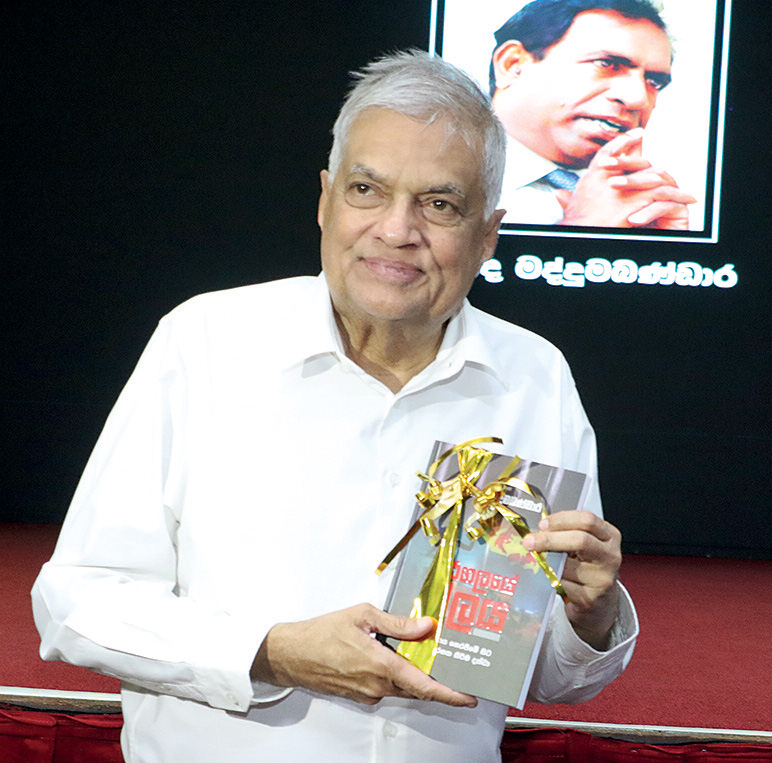
Ex-President Wickremesinghe with a copy of Aragalaye Balaya he received from its author, Prof. Professor Sunanda Maddumabandara, at the Sri Lanka Foundation recently (pic by Nishan S Priyantha)
On the basis of what Abeywardena had disclosed to him, Maddumabanadara also questioned the circumstances of the deployment of the elite Special Task Force (STF) contingent at the compound. The author asked whether that deployment, without the knowledge of the Speaker, took place with the intervention of Baglay.
Aragalaye Balaya
is a must read for those who are genuinely interested in knowing the unvarnished truth. Whatever the deficiencies and inadequacies on the part of the Gotabaya Rajapaksa administration, external powers had engineered a change of government. The writer discussed the issues that had been raised by Prof. Maddumabandara and, in response to one specific query, the author asserted that in spite of India offering support to Gotabaya Rajapaksa earlier to get Ranil Wickremesinghe elected as the President by Parliament to succeed him , the latter didn’t agree with the move. Then both the US and India agreed to bring in the Speaker as the Head of State, at least for an interim period.
If Speaker Abeywardena accepted the offer made by India, on behalf of those backing the dastardly US backed project, the country could have experienced far reaching changes and the last presidential election may not have been held in September, 2004.
After the conclusion of his extraordinary assignment in Colombo, Baglay received appointment as New Delhi’s HC in Canberra. Before Colombo, Baglay served in Indian missions in Ukraine, Russia, the United Kingdom, Nepal and Pakistan (as Deputy High Commissioner).
Baglay served in New Delhi, in the office of the Prime Minister of India, and in the Ministry of External Affairs as its spokesperson, and in various other positions related to India’s ties with her neighbours, Europe and multilateral organisations.
Wouldn’t it be interesting to examine who deceived Weerawansa and Thoradeniya who identified US Ambassador Chung as the secret visitor to the Speaker’s residence. Her high-profile role in support of the project throughout the period 31 March to end of July, 2022, obviously made her an attractive target but the fact remains it was Baglay who brought pressure on the then Speaker. Mahinda Yapa Abeywardena’s clarification has given a new twist to Aragalaya’ and India’s diabolical role.
Absence of investigations
Sri Lanka never really wanted to probe the foreign backed political plot to seize power by extra-parliamentary means. Although some incidents had been investigated, the powers that be ensured that the overall project remained uninvestigated. In fact, Baglay’s name was never mentioned regarding the developments, directly or indirectly, linked to the devious political project. If not for Prof. Maddumabandara taking trouble to deal with the contentious issue of regime change, Baglay’s role may never have come to light. Ambassador Chung would have remained the target of all those who found fault with US interventions. Let me be clear, the revelation of Baglay’s clandestine meeting with the Speaker didn’t dilute the role played by the US in Gotabaya Rajapaksa’s removal.
If Prof. Maddumabandara propagated lies, both the author and Abeywardana should be appropriately dealt with. Aragalaye Balaya failed to receive the desired or anticipated public attention. Those who issue media statements at the drop of a hat conveniently refrained from commenting on the Indian role. Even Abeywardena remained silent though he could have at least set the record straight after Ambassador Chung was accused of secretly meeting the Speaker. Abeywardena could have leaked the information through media close to him. Gotabaya Rajapaksa and Ranil Wickremesinghe, too, could have done the same but all decided against revealing the truth.
A proper investigation should cover the period beginning with the declaration made by Gotabaya Rajapaksa’s government, in April 2022, regarding the unilateral decision to suspend debt repayment. But attention should be paid to the failure on the part of the government to decide against seeking assistance from the International Monetary Fund (IMF) to overcome the crisis. Those who pushed Gotabaya Rajapaksa to adopt, what they called, a domestic solution to the crisis created the environment for the ultimate collapse that paved the way for external interventions. Quite large and generous Indian assistance provided to Sri Lanka at that time should be examined against the backdrop of a larger frightening picture. In other words, India was literally running with the sheep while hunting with the hounds. Whatever the criticism directed at India over its role in regime change operation, prompt, massive and unprecedented post-Cyclone Ditwah assistance, provided by New Delhi, saved Sri Lanka. Rapid Indian response made a huge impact on Sri Lanka’s overall response after having failed to act on a specific 12 November weather alert.
It would be pertinent to mention that all governments, and the useless Parliament, never wanted the public to know the truth regarding regime change project. Prof. Maddumabandara discussed the role played by vital sections of the armed forces, lawyers and the media in the overall project that facilitated external operations to force Gotabaya Rajapaksa out of office. The author failed to question Wickremesinghe’s failure to launch a comprehensive investigation, with the backing of the SLPP, immediately after he received appointment as the President. There seems to be a tacit understanding between Wickremesinghe and the SLPP that elected him as the President not to initiate an investigation. Ideally, political parties represented in Parliament should have formed a Special Parliamentary Select Committee (PSC) to investigate the developments during 2019 to the end of 2022. Those who had moved court against the destruction of their property, during the May 2022 violence directed at the SLPP, quietly withdrew that case on the promise of a fresh comprehensive investigation. This assurance given by the Wickremesinghe government was meant to bring an end to the judicial process.
When the writer raised the need to investigate external interventions, the Human Rights Commission of Sri Lanka (HRCSL) sidestepped the issue. Shame on the so-called independent commission, which shows it is anything but independent.
Sumanthiran’s proposal
Since the eradication of the Liberation Tigers of Tamil Eelam (LTTE) in May 2009, the now defunct Tamil National Alliance’s (TNA) priority had been convincing successive governments to withdraw the armed forces/ substantially reduce their strength in the Northern and Eastern Provinces. The Illankai Thamil Arasu Kadchi (ITAK)-led TNA, as well as other Tamil political parties, Western powers, civil society, Tamil groups, based overseas, wanted the armed forces out of the N and E regions.
Abeywardena also revealed how the then ITAK lawmaker, M.A. Sumanthiran, during a tense meeting chaired by him, in Parliament, also on 13 July, 2022, proposed the withdrawal of the armed forces from the N and E for redeployment in Colombo. The author, without hesitation, alleged that the lawmaker was taking advantage of the situation to achieve their longstanding wish. The then Speaker also disclosed that Chief Opposition Whip Lakshman Kiriella and other party leaders leaving the meeting as soon as the armed forces reported the protesters smashing the first line of defence established to protect the Parliament. However, leaders of minority parties had remained unruffled as the situation continued to deteriorate and external powers stepped up efforts to get rid of both Gotabaya Rajapaksa and Ranil Wickremesinghe to pave the way for an administration loyal and subservient to them. Foreign powers seemed to have been convinced that Speaker Abeywardena was the best person to run the country, the way they wanted, or till the Aragalaya mob captured the House.
The Author referred to the role played by the media, including social media platforms, to promote Gotabaya Rajapaksa’s successor. Maddumamabandara referred to the Hindustan Times coverage to emphasise the despicable role played by a section of the media to manipulate the rapid developments that were taking place. The author also dealt with the role played by the Janatha Vimukthi Peramuna (JVP) in the project with the focus on how that party intensified its actions immediately after Gotabaya Rajapaksa stepped down.
Disputed assessment
The Author identified Ministers Bimal Rathnayaka, Sunil Handunetti and K.D. Lal Kantha as the persons who spearheaded the JVP bid to seize control of Parliament. Maddumabanda unflinchingly compared the operation, mounted against Gotabaya Rajapaksa, with the regime change operations carried out in Iraq, Libya, Egypt and Ukraine. Asserting that governments loyal to the US-led Western block had been installed in those countries, the author seemed to have wrongly assumed that external powers failed to succeed in Sri Lanka (pages 109 and 110). That assertion is utterly wrong. Perhaps, the author for some unexplained reasons accepted what took place here. Nothing can be further from the truth than the regime change operation failed (page 110) due to the actions of Gotabaya Rajapaksa, Mahinda Yapa Abeywardana and Ranil Wickremesinghe. In case, the author goes for a second print, he should seriously consider making appropriate corrections as the current dispensation pursues an agenda in consultation with the US and India.
The signing of seven Memorandums of Understanding (MoUs) with India, including one on defence, and growing political-defence-economic ties with the US, have underscored that the JVP-led National People’s Power (NPP) may not have been the first choice of the US-India combine but it is certainly acceptable to them now.
The bottom line is that a democratically elected President, and government, had been ousted through unconstitutional means and Sri Lanka meekly accepted that situation without protest. In retrospect, the political party system here has been subverted and changed to such an extent, irreparable damage has been caused to public confidence. External powers have proved that Sri Lanka can be influenced at every level, without exception, and the 2022 ‘Aragalaya’ is a case in point. The country is in such a pathetic state, political parties represented in Parliament and those waiting for an opportunity to enter the House somehow at any cost remain vulnerable to external designs and influence.
Cyclone Ditwah has worsened the situation. The country has been further weakened with no hope of early recovery. Although the death toll is much smaller compared to that of the 2004 tsunami, economic devastation is massive and possibly irreversible and irreparable.
By Shamindra Ferdinando