
RUSSIA PREFERS LONG TERM ENERGY COOPERATION, NOT SPOT TRADE ON OIL, GAS – DEPUTY RUSSIAN FM
Posted on April 1st, 2026
Courtesy The Daily Mirror
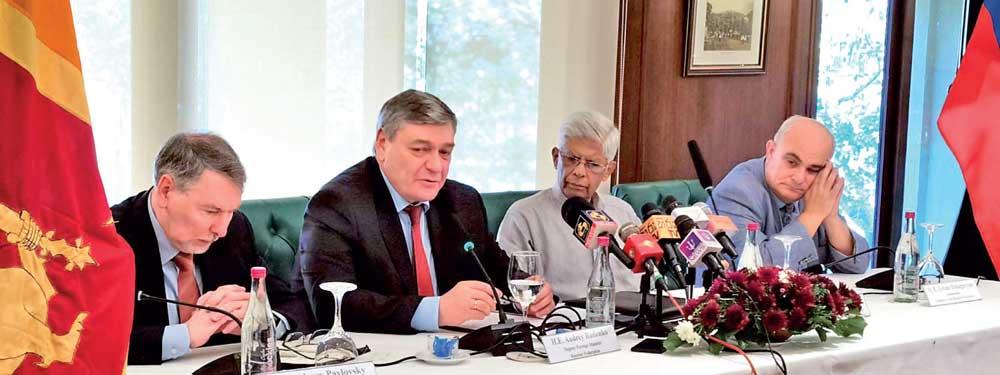
- Russian Deputy Energy Minster’s visits will provide positive results
- Russia mostly transact in national currencies instead of US dollar: if there is a will, there is a way
- Russia’s natural resources are not also unlimited,
- There is quite a line of countries who want to have access to our crude oil and energy
- Ready to start talks on nuclear power if requested
International dynamics keep changing in the present climax. The countries’ roles fast evolve. Sri Lanka is making fresh approaches in its engagements, particularly for energy security. Against the backdrop, Russian Deputy Foreign Minister Andrey Rudenko is visiting Sri Lanka for a five-day diplomatic trip. The Deputy Minister participated in a discussion organized by Pathfinder Foundation in Colombo and took questions from participants who represented the media and the think tanks. He said the situation is quite serious and unpredictable. He said the role of the global south is obviously increasing, and countries like China, India, some entities like ASEAN countries, play a much stronger role economically, politically, and in the security area, which would not let the United States or its allies to do whatever they want. Russia in this changing world positions itself as one of the key elements of the new world order. He said, Russia in this changing world positions itself as one of the key elements of the new world order. It does not pretend to be a leader of this new world. It will be ready to share all responsibilities for what is happening with other countries. But at the same time for us the matter of principle is preserving our own certainty and independence- not only political, but also security-wise, economy -wise. It is not that easy now. You see under what kind of pressure Russia is living at the moment, but our choice is deliberate, our choice is of principle, and we would not deviate from this policy. There are many aspects of our relations with other countries, with the United States, with China, with India, with the nations of South Asia,” Excerpts of the dialogue.
QMany countries in the global south are experiencing the secondary effect of the conflicts that we are facing right now, particularly in the energy markets, food security and supply chains. How does Russia see its role in mitigating these impacts, if there is an opportunity to do so, especially in relation to the partners in Asia and in particular South Asia?
I guess it’s one of the fundamental issues the world is facing- how to overcome the consequences of this unfortunate event which happened in the Middle East and affected all countries, not only in the Middle East, but beyond the region.
Russia is not affected by this conflict so far greatly, although, of course, some longer-term consequences may also take it all on us. For example, Iran is our neighbour, with whom we develop quite extensive cooperation in different areas. If there is a negative outcome of the whole thing, it will affect the Russian economy, immigration policies etc.
We are very much interested in ending this conflict as soon as possible. As far as the countries of Asia are concerned in terms of economic and energy security, of course, Russia is ready to provide its resources to all those who wish to have them. You know, we haven’t deleted our good neighbouring relations with the countries of Asia.
Our policy is of principled nature. We would be ready to deepen our cooperation in all spheres, but sometimes the countries themselves are reluctant to deepen this cooperation with Russia because of the threats of secondary sanctions imposed by the United States and the European Union. To our regret, this has caused for a while a decline in our energy cooperation. These countries are quite reluctant to be targeted by the American restrictions.
Now our situation has changed. The United States has lifted the so-called ban on the purchasing of Russian energy, first of all, of crude oil. I think it’s a good opportunity for the countries of Asia to take advantage of this moment. But of course, what will happen after this one-month term expiry. We would strongly prefer that our relations with all countries in Asia are based on the long-term context, not on spot trade of oil and gas.
QIt’s a good thing that the ban has been lifted, at least temporarily. Would the Russian Federation take payments in rubles, US dollars or Chinese Yuan?
We are not as selective as some may think, actually. Our trade now with other countries is moving fast from major currencies like the dollar or Euro to the national currencies . For example, 99 percent of our trade with China is done in Yuan or rubles.
Our trade with India is also done mostly in rupees and rubles. We actually see the clear trend of decline in the role of the dollar worldwide. For example, just a few years ago, the dollar consisted of about 67 percent of world trade. Now its share has declined up to about 40 percent, and other percentages of trade are done in the national currencies. If there is a desire, there is a will. We can find a way to address this issue. We are happy to find flexible means which will be beneficial to all of us.
QYour Deputy Prime Minister recently announced that a ban on gaso line exports will come into effect today. Could you take us through that and the potential impact of that on energy cooperation?
Yes, to tell you frankly, Russia’s natural resources are not also unlimited. There is quite a line of countries who want to have access to our crude oil and energy, for example. But I guess we will implement all contracts which were concluded in full.
We will, of course, do our best. A recent visit by Deputy Minister of Energy Roman Marshavin has shown that there will be a deal. Hopefully the follow-up of this visit will see some positive results concerning the supply of energy from Russia. The sooner we end the conflict, the better it will be for everyone.
QWhat is really stopping the proposed nuclear
power project?
I know that there is a strong interest to develop nuclear capacity in this country- nuclear capacity for peace. I’m not aware of particular parameters. But there is a strong interest from many countries of Asia, for example, from Southeast Asia, to take advantage of the Russian expertise in a small modular nuclear station.
For example, we have one project which is very attractive and could be used by other states. For example, we have a floating minor modular nuclear plant which is now providing energy to our Siberian region. It’s just a huge ship on which there is a nuclear station.
If the countries want, this ship can come closer to them and provide energy to them. Many countries want to have this facility. Russia is the only state which has this technology. It not only has this technology, but also realized it in the real projects.
If there is an interest here, of course, we can have the relevant negotiations started. It’s clear that it’s not a very cheap endeavor. But it’s very useful because such a facility has unlimited resources and power.
QHow has Russia taken note of Sri Lanka’s strategic importance at this juncture? Secondly, Russia-Sri Lanka economic cooperation remains way below the potential. So why it is way below the potential, and what are the plans for increasing them?
All these issues of bilateral cooperation will be discussed. The recent crisis and the pandemic took effect. The current crisis also contributed to this. Unfortunately, we saw a decline in bilateral trade over the last year.
But we think it’s a kind of a temporary trade which we need to revert. I’m sure it will be. Sri Lanka is a very attractive place for us, and it will continue like that, especially now when all other destinations are closed for Russian citizens. The Persian Gulf countries will be popular, but they will not remain peaceful for a while. The European Union got to close their borders for the Russian citizens. Therefore, Sri Lanka and some other countries in South Asia and Southeast Asia, are becoming even more attractive places for our citizens.
If we manage to maintain the frequency of our direct flights between the two countries, it will also contribute to an increasing number of our people coming here. If we manage to establish a reliable system of payment between our countries, our tourists can use their bank cards here in Sri Lanka- just to feel comfortable, not to bring cash with them. It will play a role.
After tourists, the real business may come here not only in trade but also in technological service investment. But again, for this, you need to know each other better now—not to limit our communications or restrict some support deals on energy when the United States allows it, but to build it on a solid legal and economic foundation.
QWhy does Russia not condemn Iran’s attacks on neighbouring countries?
On Russia and Iran, we did not join those countries who condemned Iran for shelling its neighbours. We don’t like what is happening there. But if you approach this issue, you should approach it from a world in a general context. Who started the war? It’s not Iran. Iran was attacked, clearly attacked, surprisingly, conveniently. This is implementation of its right of self-defence. Iran has warned its neighbours not to provide access to the U.S. military to the airspace and the military facilities.
If that is the case, Iran will not retaliate. However, I understand that this view is not widely supported. We participate quite actively in the deliberations on the relevant UN Security Council resolution to stop the war once again.
There is often a one-sided view and a one-sided approach to this issue. The demand is that Iran should stop fighting and stop shelling its neighbours. But why is there no demand that the United States and Israel stop bombing Iran and its infrastructure?
If you want to approach this issue properly, you need to consider it from all angles, not in the way some countries prefer. That is why we cannot support the idea that Iran is the only country to blame for what is happening there.
The conflict has quite extensive root causes that have existed for many years. It is now very difficult to determine who is responsible for what has happened. But obviously, Iran was not the country that initiated the catastrophe currently unfolding in the region.
The war must be stopped, and the shelling from either side must cease. Peace should be restored, including the right of countries to have their cargo ships pass through the Strait of Hormuz.
If the situation escalates further, and if there is a prospect of land operations, the conflict will spread and spill over into other areas that we have not seen before. That is why our position is clear. First of all the United States and Israel—should stop the aggressive war against Iran. Then the whole situation could change for the better.
Iran is interested in maintaining better relations with its neighbours, particularly the Arab countries. Over the past few years, we have seen improvements in these relations. For example, we saw the signing of the agreement between Iran and Saudi Arabia to re-establish diplomatic relations. This was an event of great significance for the region. Unfortunately, this process of maintaining peace in the Persian Gulf has now been disrupted by the current conflict.
The eventual solution must be comprehensive in nature. There are many aspects to the situation in the region — the security environment, the nuclear issue, ballistic missile concerns, and economic cooperation. For example, Russia proposed many years ago the creation of a system of collective security in the Persian Gulf. At that time, this initiative was not taken on board, but now it’s becoming more and more. So, let’s call on those perpetrators of the war to stop it.