
Evolution of Cardinal Malcolm Ranjith’s 2019 stand on the Easter Sunday Attacks – no political or electoral gain alleged until 2021
Posted on July 4th, 2026
Shenali D Waduge
To understand the competing narratives surrounding the Easter Sunday attacks in Sri Lanka inspite of Sri Lanka going through over 300 LTTE terror attacks over 30 years is indeed puzzling. Therefore, given the current twist of narrative it is critical to go back to 2019 itself and relook at the public statements attributed to one who represents the Catholic community in Sri Lanka.
Based on available 2019 public statements and reporting, Cardinal Malcolm Ranjith’s position can be summarised as follows
· Did not make any explicit allegation of a political conspiracy
· Did not state or imply that the attacks were carried out for electoral victory
· Primarily criticized the sitting government and security institutions for failure to prevent the attacks
· Focused on state negligence, intelligence coordination failure, and demanded for accountability
· Framed perpetrators as terrorist extremists influenced by jihadist ideology, without attributing political orchestration
The Easter Sunday bombings of April 21, 2019, in Sri Lanka were widely attributed to a local Islamist extremist network led by Zahran Hashim, with later ISIS ideological association and ISIS’s post-attack claim of responsibility.
In the aftermath, Cardinal Malcolm Ranjith demanded accountability from the state.
His interventions consistently focused on three pillars:
1. Condemnation of terrorism
2. Criticism of state failure and intelligence breakdown
3. Demand for truth and prevention of future attacks
Notably, across his 2019 public record, there is no confirmed statement alleging a political conspiracy or electoral engineering motive behind the attacks.
Evidence Ledger – Cardinals 2019 Statements
A. Government Responsibility / State Failure
April–June 2019 (Paraphrased from Euronews reporting, June 2019)
The Cardinal said there was a serious lack of responsibility” and failure” on the part of the government and security authorities in preventing the attacks.
(Source: Euronews reporting on Cardinal statements, June 2019)
https://www.euronews.com/2019/06/20/sri-lanka-cardinal-says-government-hiding-truth-over-easter-attacks
· Direct blame: Government leadership (Sirisena–Wickremesinghe administration)
· Institutions: Intelligence and security agencies
· Type: Negligence / failure / accountability
June 2019 (Paraphrased reporting – Sri Lanka Brief summary of statements)
He stated that intelligence warnings were not acted upon and that the tragedy could have been prevented.
This is important as Cardinal has acknowledged that prior warnings were given but were not acted upon to prevent deaths.
(Source: Sri Lanka Brief analysis of post-Easter statements, June 2019)
https://srilankabrief.org/wp-content/uploads/2019/06/SLB-Briefing-Note-No-15-June-2019-SRI-LANKA-POST-EASTER-SUNDAY-ATTACKS-EMERGING-HUMAN-RIGHTS-ISSUE.pdf
Classification:
Blame:d Intelligence coordination failure
Blame: Security apparatus breakdown
Conclusion: Preventable tragedy
B. Perpetrators / Terrorism
April 2019 (Reported statement – Breitbart summary of Cardinal response)
The Cardinal described the attacks as a great tragedy” and an insult to humanity.”
(Source: Breitbart reporting, April 2019)
https://www.breitbart.com/asia/2019/04/28/sri-lanka-easter-massacre-an-insult-to-humanity-cardinal-says/
Attack: Terrorism / massacre
Perpetrators: Extremist militants religiously inspired.
In cases involving ISIS-inspired suicide terrorism or jihadist suicide terrorism, perpetrators often operate within a martyrdom ideology framework, where religious language is used to justify self-sacrifice and frame the act as a path to religious reward.
These actors are typically not alive to provide post-event clarification of motive, which means interpretations of broader political or electoral objectives are reconstructed after the event without direct testimony from perpetrators themselves. The perpetrators are not alive to deny claims now being floated as prima facie reasons for their attacks.
However, academic and public reporting has generally assessed such attacks as being driven primarily by extremist religiously ideological narratives rather than conventional political objectives such as electoral gain or regime change strategy.
Analysis: Sri Lanka bombings directly out of the ISIS “playbook”
ISIS claims responsibility for Sri Lanka bombings (60 already in custody)
Sri Lanka missed warnings about bombers’ leader – Zaharan says all non-Muslims must be killed.
Zahran Hashim speech recorded a day before Easter Sunday attack 2019
The political motive was applicable to LTTE’s suicide terrorists.
C. International Dimension / External Influence
Mid–2019 (Paraphrased reporting across international summaries)
He referred to the possibility of an international conspiracy” or broader network involvement, without naming specific states or actors.
(Source: multiple international summaries including Saudi Gazette reporting)
https://saudigazette.com.sa/article/572599/World/Asia/Cardinal-calls-on-Sri-Lanka-govt-to-quit-over-Easter-attacks
New sentiment: Speculative framing
No named country or intelligence agency
No evidentiary attribution
D. Political Conspiracy / Electoral Motive
2019 statements by Cardinal found in:
· April–December 2019 speeches
· reported interviews
· public press statements
does not include:
· electoral manipulation claim
· election timing conspiracy claim
· political party orchestration of attack
This means in 2019 Cardinal did not make any
· Political conspiracy allegations
· Electoral motive allegations
Cardinal only highlighted the government’s failure to prevent attack despite early warnings given.
E. Accountability Demand / Institutional Criticism
Repeated 2019 position (synthesised from multiple statements)
He consistently demanded full investigation, truth disclosure, and accountability for those responsible for security failures.
Target: State institutions with officials holding positions at the time of the attacks
Focus: Investigations, transparency, systemic failure
Not ideological attribution beyond terrorism framing
Narrative Synthesis
Across 2019, Cardinal Ranjith’s position remained structurally consistent:
· The attackers were condemned as terrorist extremists influenced by jihadist ideology
· The state was held responsible for failure to prevent the attacks despite warnings
· He demanded truth and accountability for institutional breakdown
· He warned against revenge or communal backlash
· He raised the possibility of a broader or international dimension, but without naming actors or presenting evidence
Importantly, his public discourse remained focused on:
institutional failure and justice for victims rather than political orchestration theories
Based on verified 2019 public statements and reporting:
· The Cardinal did not make any explicit or verified allegation of a political conspiracy – the question then becomes, how & why did such a theory surface thereafter?
· There is no documented claim that the Easter attacks were carried out for electoral advantage or political victory – the question then becomes who floated this idea & why?
Cardinal’s criticism was directed at:
· the Sirisena–Wickremesinghe administration
· intelligence and security institutions that included CID, TID, IGP, and entities that had statutory mandate to investigate & arrest.
· systemic failure to act on warnings
· His framing of perpetrators remained within terrorism / extremist violence, not political engineering
In short, Cardinal Malcolm Ranjith’s 2019 public position focused on condemning Islamist extremist terrorism, demanding accountability for state security failures, and calling for truth and justice, without advancing any verified claim of political conspiracy or electoral motive behind the Easter Sunday attacks.
How and why did alternative interpretations of these events emerge in later public discourse, and what evidence supports or contradicts those interpretations?
Based on available verified 2019 public statements and reporting, Cardinal Malcolm Ranjith did not make any explicit allegation of political conspiracy or electoral motive behind the Easter Sunday attacks. His focus remained on condemning extremist terrorism, highlighting state and security failures, and demanding institutional accountability.
In 2020, there is no verified record of Cardinal Malcolm Ranjith advancing any allegation of political conspiracy or electoral motive in relation to the Easter Sunday attacks either.
Based on publicly available commission records and reporting, neither Cardinal Malcolm Ranjith nor Church representatives are recorded as having provided evidentiary testimony establishing a political conspiracy, electoral motive, or specific international orchestration behind the Easter Sunday attacks. Their contributions primarily focused on accountability, investigative shortcomings, and the need for full disclosure of the facts.
However, from 2021, elements of his public commentary began to reference possible political involvement and suggestions that certain actors may have benefited politically from the circumstances surrounding the attacks, representing a notable shift in framing from purely institutional failure to broader political interpretation.
The evolution of the narrative surrounding the Easter Sunday attacks, including statements made by Cardinal Malcolm and sections of the Catholic Church, has played a significant role in shaping public interpretation of events.
In early 2021— political influence / interference” (NOT conspiracy claim)
March 2021 (PCoI-related comments)
· Cardinal said there were interested parties influencing investigations”
· claimed some groups interfered in investigations
· focused on investigative obstruction / failure
Easter Sunday Attack: PCoI failed to find who influenced the course of investigation – Cardinal
institutional interference claim is made but not political conspiracy theory or electoral motive claim
APRIL 2021 — MEDIA-REPORTED political forces” framing
Some reports interpreted his remarks as:
attacks were used by political forces
perpetrators were pawns manipulated by powerful political forces”
Cardinal drops bombshell on eve of blast anniversary
AUGUST 2021 — CLEAR political advantage” LANGUAGE (MOST IMPORTANT SHIFT)
This is the first clearly documented strong framing:
government took political advantage of the Easter Sunday attack”
extremism was used for political gain”
allegations of political exploitation of tragedy
Sri Lanka Church unhappy about probe into Easter bombings
This is the first clear instance in 2021 where:
· political advantage” becomes explicit language
but still:
· no electoral engineering model
· no voting strategy claim
· no structured conspiracy proof presented
In 2021, what appears for the first time?
· March 2021 → interference in investigations (institutional claim)
· April 2021 → interpreted political framing (political forces”)
· August 2021 → explicit political advantage / political gain” language
What does NOT exist in 2021 record:
· No formal electoral conspiracy” allegation
· No claim of election-engineered attack
· No evidentiary presentation of a political plot
· No structured attribution to a specific political actor with proof
In 2021, Cardinal Ranjith’s public discourse evolved from institutional failure concerns into references to political interference and political advantage, but there is no verified statement establishing a formal electoral or structured political conspiracy theory.
The next allegation came when the departing Attorney General Dappula de Livera appearing on a private tv show on the eve of his retirement referred to a ‘grand conspiracy” behind the attacks though he did not highlight political or intelligence involvement.
Then came the most chilling allegation by Fr. Cyril Gamini in October 2021 over a zoom wherein he not only alleged Zaharan knew then Brig. Suresh Sallay but claimed to have receipts of payments made by intelligence to Zaharan.
The defamation case filed by then Maj. Gen. Suresh Sallay produces a slide show from that zoom session presented by Fr. Cyril Gamini on 23 Oct 2021.
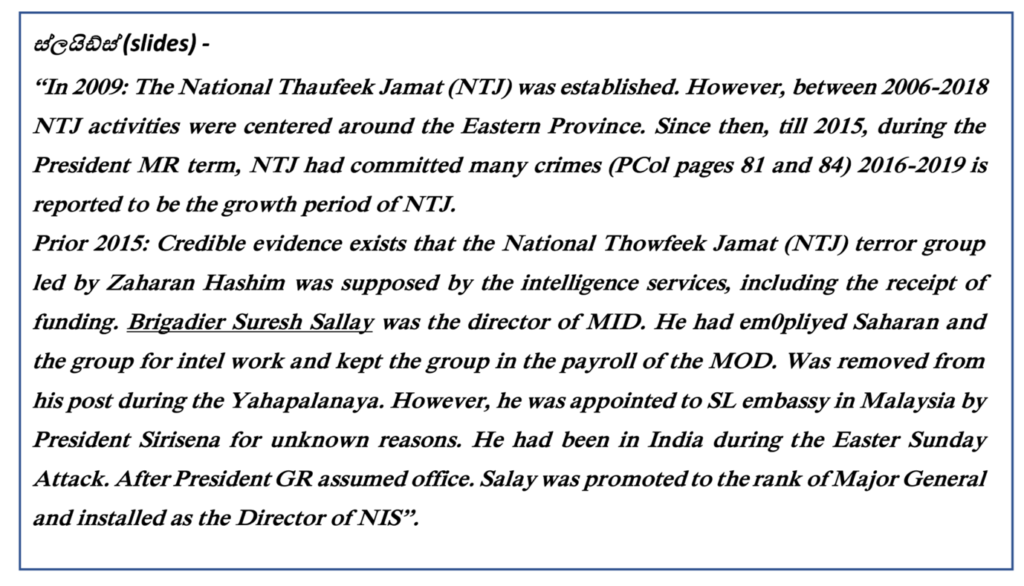
The following are mentioned in the slide:
· NTJ established in 2009 (requires reconfirming)
· 2006-2018 NTJ activities centred around Eastern Province
· Prior to 2015 NTJ supported (spelt as supposed) by intel services & includes receipt of funding (have these receipts been presented by Fr. Cyril Gamini when he filed FR to prevent his arrest following complaint made to CID by Gen. Suresh Sallay after this zoom session)
· Brig. Suresh Sallay mentioned as Director of MID (should be DMI) – clarification of when Brig Sallay served as DMI head & requirement to correspond with allegations of funding receipts & reasons
This raises important analytical questions regarding the development of public narratives, the evidentiary basis for shifts in framing, and the influence of institutional discourse on public perception.
It is a basic principle of accountability in both law and public life that those who advance allegations or demand transparency must ensure that their assertions are clear, consistent, and supported by an identifiable evidentiary basis, particularly where such statements influence public understanding of serious national security matters.
Under established legal principles, including the maxim ei incumbit probatio qui dicit, non qui negat, the burden of proof lies on the party making an assertion.
Accordingly, while investigative authorities are responsible for examining credible allegations, it is not the standard practice that shifting or retrospective claims must be treated as established fact in the absence of supporting evidence sufficient to meet even a prima facie threshold.
Therefore, any evolution in public claims or interpretive framing must be accompanied by corresponding evidentiary substantiation, rather than placing the burden on investigative authorities to retrospectively validate assertions that are not supported by disclosed material at the time they are made.
Shenali D Waduge