
Easter Sunday attacks: Much Ado About Sara Jasmine and the “Indian Connection”
Posted on July 21st, 2026
Shenali D Waduge
The name of Sara Jasmine alias Pulasthini Mahendran has become one of the most repeatedly mentioned names after the Easter Sunday attacks of 21 April 2019. What exactly is the legal relevance of Sara Jasmine to establishing who planned, directed and executed the Easter Sunday attacks?
The law requires evidence — not association, assumptions or emotional narratives.
Based on publicly available information:
· Sara Jasmine alias Pulasthini Mahendran was the wife of Mohamed Hasthun, one of the Easter Sunday suicide bombers.
· She was a Tamil converted to Islam after marriage.
· She was at the Sainthamaruthu safe house on 26 April 2019 when the explosion occurred.
· According to the Government Analyst’s third DNA examination, her remains were identified among those recovered from the explosion site.
· There is no publicly available evidence that she prepared the explosives used on 21 April, directed the attackers, or coordinated the attacks.
Therefore, one important legal distinction must be maintained:
· Being connected to a perpetrator is not the same as being a perpetrator.
Sara Jasmine and Fathima Jiffry:
Their role requires legal classification
The fact that Sara Jasmine may not have been one of the eight suicide bombers who carried out the Easter Sunday attacks does not automatically mean she had no connection to extremist activity.
The circumstances indicate that both:
Sara Jasmine (wife of Hasthun), and Fathima Ibrahim (wife of suicide bomber Mohamed Ibrahim Ilham) were linked to households where suicide bomb equipment was discovered.
The presence of suicide vests and explosive material at both locations indicates that further attacks were being planned. The presence of security personnel only advanced that plan. While there is no challenge over Fathima’s death, some are claiming Sara Jasmin who was inside the Sainamaruthu residence did not die. When security forces entered the premises Zaharan’s wife & daughter (both injured) were carried away for medical treatment. All others inside were declared dead. The premises had been surrounded by armed forces from previous evening. The forces were led by the present Deputy Minister of Defense – then Major General Aruna Jayasekara who was Commander Security Forces East.
Dematagoda – At the Ibrahim residence:
· Daughter in law of Yusuf Ibrahim,
· Fathima Ibrahim detonated explosives;
· the explosion killed her three children and three police officers who were conducting investigations.
Sainthamaruthu
At the Sainthamaruthu safe house:
· the explosion occurred on 26 April 2019 following stiff resistance with the military/police;
· multiple family members and associates died;
· suicide vests and explosive material were reportedly recovered.
Therefore, the legal question is not merely:
“Was Sara Jasmine one of the Easter Sunday attackers?”
The more precise question is:
“Was Sara Jasmine part of a wider extremist network preparing further attacks after 21 April 2019?”
That is a separate factual inquiry.
Criminal law distinction: attacker, conspirator, associate
Criminal law requires separation between different categories.
Principal attackers
The eight suicide bombers who carried out the attacks on 21 April 2019 were the direct perpetrators.
Conspirators
A person becomes legally responsible as a conspirator only if evidence proves involvement in: the 3 named by US DOJ falls into this category.
· planning,
· financing,
· organizing,
· recruiting,
· directing,
· providing material assistance,
· knowingly participating in the criminal agreement.
Associates or family members
A person does not become a criminal merely because:
· they are married to a terrorist,
· they are related to a terrorist,
· they lived in a house used by terrorists.
The prosecution must prove individual conduct.
For example – the role of the 2 suicide bombers father – was he aware of his sons suicide plans. Who else were aware that Zaharan & Co were recruiting, training and preparing for a jihad attack.
Why has Sara Jasmine become such a central issue after the attacks?
This is the central question.
Sara Jasmine did not carry out the Easter Sunday attacks.
Therefore:
Whether she:
· died in Sainthamaruthu,
· survived,
· escaped,
· or was taken elsewhere,
does not by itself answer:
· who planned Easter Sunday,
· who financed Easter Sunday,
· who directed Easter Sunday,
· who assisted the attackers.
Why is she suddenly so important – more important than Fathima Jiffry or any of the other women Zaharan had prepared for successive attacks who are still at large?
Those questions require separate evidence.
The legal concern is that Sara Jasmine’s identity has moved from being a forensic question into becoming a political and security narrative.
The burden of proof remains:
Those claiming she survived must prove survival.
Those claiming she fled to another country must prove it
Those claiming she left the Sainamaruthu suicide site must prove it too.
The DNA issue: What exactly was the third DNA examination?
Anyone challenging the third DNA examination must first understand what was actually examined.
The third DNA examination was conducted after remains were re-examined following the initial exhumation process
The final reported findings were that DNA extracted from recovered remains matched Sara Jasmine’s mother, establishing a biological relationship.
A key argument raised by critics has been:
“The first two examinations did not identify Sara Jasmine, but the third did.”
However, the explanation given by investigators was that the third examination involved previously unconfirmed human remains in the 3rd and final body bag.
In a suicide explosion:
· bodies can be fragmented;
· identifiable remains may not always be recovered immediately;
· DNA identification may depend on microscopic biological material.
Therefore, the legal challenge cannot simply be:
“The third test was different.”
The proper legal questions would be:
· Were the remains properly documented?
· Were the samples correctly linked to the Sainthamaruthu victims?
· Was the DNA methodology scientifically valid?
Those are the questions a court would examine.
If Sara Jasmine was alive — what must be proved?
A claim that Sara Jasmine survived requires proof of every link in the chain.
First:
1. Proof of survival
Evidence must establish:
· she survived the explosion;
· she escaped from the heavily secured area;
· she avoided identification by security forces.
She cannot walk out of a site subject to a major explosion unharmed & unscathed while security forces were surrounding the premises, nor is it possible to even imagine that a getaway vehicle would have been at the scene of the crime for her to walk out & get inside & speed off while entire security brigade looked on!
Thus:
· How did a person survive such an explosion with no publicly verified injuries?
· How did she leave a location surrounded by security forces?
· Who assisted her escape?
· Where is the evidence of her presence afterwards?
Only after survival is proven can the next questions arise.
2. Proof of involvement in Easter Sunday
Even if she survived, it must separately be proved:
· she participated in planning Easter Sunday;
· she assisted the attackers;
· she knew the targets;
· she contributed to the operation.
Survival does not equal guilt.
3. Proof of connection to Maj. Gen. Suresh Sallay
If allegations are made against Maj. Gen. Suresh Sallay, the legal chain must establish:
· Sara Jasmine survived.
· Someone concealed that survival.
· Maj. Gen. Sallay knew about it.
· Maj. Gen. Sallay participated in or directed concealment.
Each link requires independent evidence.
The failure of one link weakens the entire allegation.
The “India factor” – an unintended consequence or an intended narrative?
The repeated public discussion that Sara Jasmine survived and escaped to India has inevitably brought Sri Lanka’s immediate neighbour into the Easter Sunday discourse.
Sri Lanka’s Security Minister himself declared in Parliament that Sara was in India.
Whether intended or not, repeatedly linking an alleged survivor of the Easter Sunday conspiracy to India introduces an international dimension to what would otherwise be a domestic criminal investigation. Such an allegation cannot be treated lightly. It carries diplomatic, intelligence and geopolitical implications and therefore demands evidence of the highest standard.
The legal burden therefore extends beyond merely proving that Sara Jasmine survived.
Those advancing such a claim must establish:
· Who first introduced the claim that Sara Jasmine escaped to India?
· On what evidence was that assertion based?
· Was India officially informed through diplomatic or law-enforcement channels that Sara Jasmine was believed to be on Indian soil?
· Was any request for assistance or extradition ever made?
· If not, why did the “India narrative” continue to be repeated publicly?
Until then, references to India remain allegations requiring proof rather than established facts.
Narratives have consequences.
Repeatedly placing India at the centre of the Sara Jasmine story was bound to attract attention in India itself. It is therefore unsurprising that Indian commentators have now begun questioning not merely the factual basis of these claims but also the manner in which they have been advanced publicly.
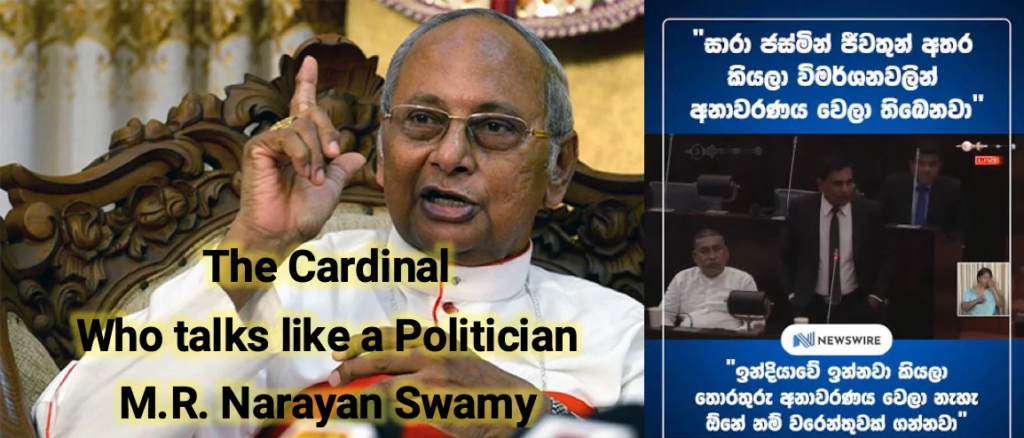
Renowned Indian journalist M.R. Narayan Swamy, writing from an Indian perspective, has openly questioned why Cardinal Malcolm Ranjith has increasingly adopted positions resembling those of a political actor rather than a religious leader.
Whether one agrees with his criticism is beside the point. The significance is that an issue originally centred on a forensic question has now evolved into one attracting regional political commentary.
Whether the repeated emphasis on Sara Jasmine was intended to sustain allegations of an India connection, or whether that became an unintended consequence is a question readers may judge for themselves.
The questions remain:
· Who first introduced the India connection and why?
· What evidence supports it?
· Was India officially informed to locate Sara Jasmin and a request for assistance made through official channels?
These are questions requiring evidence, not speculation.
The sudden departure from earlier investigative conclusions, including findings reached with the assistance of foreign investigative agencies, may also have wider implications for Sri Lanka’s credibility in international criminal cooperation. If previous conclusions are to now be rejected for political agendas, the reasons for doing so should be clearly explained and supported by evidence.
The importance of this distinction cannot be overlooked.
The allegation that Sara Jasmine survived is no longer merely a forensic issue. It has become one of the building blocks used to support a wider narrative involving alleged international dimensions to the Easter attacks and, more recently, allegations against Maj. Gen. Suresh Sallay. If one foundational allegation is relied upon to support broader allegations, that foundational allegation must itself be established by credible and admissible evidence. Otherwise, the legal and factual basis of the wider narrative becomes vulnerable.
The Asad Maulana issue
The Sara Jasmine narrative has also become connected to claims made by former LTTE cadre and ex-Chief Minister’s aide Azad Maulana in relation to the Easter attacks.
Confounding matters is this interview by Moh. Faaris – https://www.shenaliwaduge.com/english-transcript-of-tamil-interview-m-faaris/
Questions have been raised regarding:
· changes in allegations over time;
· the movement from allegations involving political figures to allegations involving security officials;
· the circumstances surrounding asylum claims.
Any such claims must ultimately be tested through:
· admissible evidence,
· witness examination,
· corroboration,
· and judicial scrutiny.
The Easter Sunday victims deserve truth and justice.
But justice requires a clear separation between:
· those who carried out the attacks,
· those who planned them,
· those who assisted them,
· and those who may only have been connected by family association.
The question is not:
“Was Sara Jasmine important?”
The correct legal question is:
“What admissible evidence proves her exact role, and how does that evidence establish responsibility for the Easter Sunday attacks?”
Every person making an allegation must meet the same standard:
Evidence. Proof. Legal responsibility.
The danger of allowing one individual to dominate the narrative is that it risks diverting attention from the central legal issues. Even if Sara Jasmine had survived, or even if she unquestionably died in Sainthamaruthu, neither fact would by itself identify the architects of the Easter Sunday attacks. Criminal liability is determined by evidence proving planning, direction, financing, assistance or participation—not by unresolved speculation about the fate of one individual. The investigation must remain focused on proving the elements of the offence rather than allowing one forensic issue to eclipse the wider conspiracy.
The Cost of an ever-expanding Narrative
The Easter Sunday attacks were not the only attacks in Sri Lanka’s history. All victims deserve justice & closure.
However, over the past several years, the focus of public discourse has progressively shifted from establishing the criminal responsibility of the perpetrators and those who should have been held responsible for direct negligence to an ever-expanding series of conspiracy theories, allegations of hidden masterminds and international intrigue.
This has become a topic to even change governments.
Much of the public momentum for alternative narratives has come from repeated statements made by Cardinal Malcolm Ranjith and members of the Catholic clergy, who have annually maintained that the full truth has yet to emerge.
Whether these concerns are ultimately vindicated or disproved is a matter for the courts and the investigative process—not public opinion.
What cannot be ignored, however, are the consequences.
Sri Lanka has found itself subjected to increasing international scrutiny and diplomatic attention over allegations that continue to evolve but remain largely untested in court.
Allegations have expanded from domestic negligence to claims involving foreign intelligence services, international actors and neighbouring States. The repeated references to Sara Jasmine and an alleged India connection while also reversing international intel findings illustrate how a domestic criminal investigation has gradually acquired regional geopolitical dimensions.
At the same time, senior officers who served during the relevant period—including decorated military and intelligence officers—have faced arrest, detention or public accusation while investigations remain ongoing.
Every citizen, regardless of rank, is subject to the law.
Equally, every person is entitled to the presumption of innocence until proven guilty in a court of law.
The recent death of former Inspector General of Police C.D. Wickramaratne, under circumstances that resulted in an open verdict, has inevitably generated further public speculation. Given his role in the post-Easter investigations, including matters relating to Sara Jasmine, his death is likely to add another layer of conjecture unless the surrounding circumstances are independently and transparently clarified.
Justice is not served by replacing one unproven narrative with another.
The credibility of Sri Lanka’s criminal justice system depends not on the volume of allegations made in public, but on the quality of the evidence presented before an independent court. Equally, where investigators depart from or seek to overturn conclusions previously reached during the joint investigation conducted with international partners, including the FBI, they owe both the courts and the public a clear explanation, supported by admissible evidence, as to what new evidence has emerged, why the earlier conclusions are no longer accepted, and on what legal and forensic basis the revised conclusions now rest. A factor CID & Attorney Generals dept & Additional Solicitor General must directly respond to.
If those now leading the investigation reject the findings they themselves helped to reach during the original investigation, the burden lies with them to explain that change.
A criminal investigation cannot simply discard previous forensic and investigative conclusions because a different narrative has gained public or political prominence. Any departure from earlier findings must be justified by credible new evidence capable of withstanding judicial scrutiny. Otherwise, confidence in the integrity, consistency and independence of the investigative process itself is placed at risk while Sri Lanka’s international image itself is at stake.
Ultimately, the issue is not whether Sara Jasmine died or survived. The issue is whether Sri Lanka’s criminal justice system will continue to be guided by admissible evidence, consistent forensic findings and the rule of law—or by narratives that evolve faster than the evidence required to sustain them.
Shenali D Waduge