
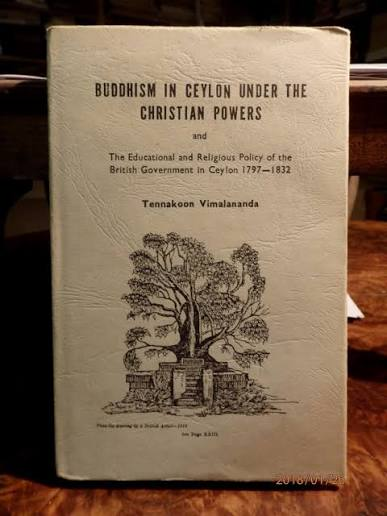
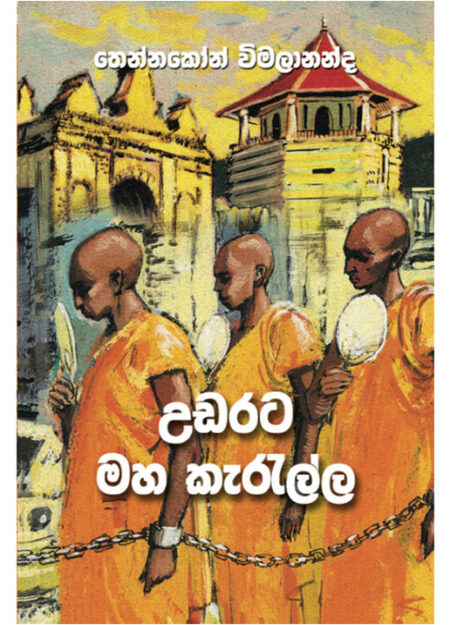
“Buddhism in Ceylon Under the Christian Powers and the Educational and Religious Policy of the British Government in Ceylon, 1797-1832” is a seminal historical study written by the prominent Sri Lankan (Buddhist Sinhalese) scholar Tennakoon Vimalananda and published in 1963.
Posted on July 27th, 2026
AI OVERVIEW
The book provides a meticulous, document-backed critique of how early British colonial administration dismantled the traditional status of Buddhism in Sri Lanka (then Ceylon) while establishing institutional dominance through Christian missions and Western education. [1, 2, 3, 4]
Core Historical Context (1797–1832)
The period covered by Vimalananda spans from the immediate aftermath of the British displacing the Dutch in the maritime provinces (1796) to the implementation of the Colebrooke-Cameron Reforms in 1832. [1, 2]
1. The Dual Policy of Treaties and Subversion
When the British captured the Kandyan Kingdom in 1815, signing the Kandyan Convention, Article 5 explicitly stated that Buddhism was declared “inviolable” and its rites, ministers, and places of worship were to be maintained and protected. However, Vimalananda details how the British government subtly and systemically violated this pledge. They viewed the close relationship between the Buddhist monastic order (the Sangha) and local governance as a threat to colonial stability. [1, 2, 3, 4, 5]
2. Education as an Instrument of Evangelization
During this era, the British government outsourced the island’s primary education system to Protestant Christian missionary bodies, including the Church Missionary Society (CMS), the Wesleyan Methodists, and the Baptists. [1, 2]
- State Patronage: Government funding and land grants were directed exclusively toward Christian parochial schools. [1, 2]
- Socio-Economic Leverage: Fluency in English and a certificate from a Christian school were made mandatory prerequisites for employment of the Buddhist Sinhalese in government offices (such as entering the rank of Mudaliyars or clerks). [1, 2, 3]
- Marginalization of Pirivenas: Traditional temple-based schools (Pirivenas) were denied funding and state recognition, forcing indigenous education into rapid decline. [1, 2, 3]
3. The Concept of “Government Christians”
Building on patterns left behind by the Dutch, the early British policy fostered a class of nominal converts, often termed “Government Christians” ( derogatorily called ‘ Rice Christians’ in both India and Sri Lanka). Local elites adopted Christian baptism and outward practices purely to preserve their ancestral land rights, legal status, and social mobility, while secretly retaining allegiance to Buddhist practices at home. [1, 2]
4. Severe Institutional Decline
By 1832, through aggressive proselytization, the printing of anti-Buddhist tracts, and systemic economic exclusion, the traditional structure of Sinhalese Buddhism was severely weakened. The book illustrates how these three decades laid the institutional groundwork that later triggered the Buddhist Revival of the late 19th century, led by figures like Migettuwatte Gunananda Thera Anagarika Dharmapala, and Colonel Henry Steel Olcott. [1, 2, 3, 4, 5]
Key Historical Themes Covered
- The Broken Promise: An evaluation of the discrepancy between official British legal proclamations (protecting Buddhism) and the actual on-the-ground support given to missionary societies. [1]
- The Weaponization of Literacy: How printing presses and English-medium curricula were utilized to systematically disparage indigenous Sinhala Buddhist culture and historical chronicles such as the Mahavamsa. [1, 2]
- Socio-Political Stratification: The creation of a deep cultural divide between the Westernized, English-educated elite and the localized, Sinhala-speaking Buddhist majority. [1, 2, 3, 4]
If you are researching a specific chapter, historical document, or individual policy from Vimalananda’s text, let me know. I can provide targeted details on archival sources used, specific colonial governors (like Frederick North or Robert Brownrigg), or how this era influenced the Colebrooke-Cameron Reforms. [1, 2]
https://share.google/aimode/zQOTFxweCpWb01Vb0
AI OVERVIEW