
Wimalasurendra Planned to Electrify Lanka’s Trains & Cities in 1918: The English Derailed His Vision – They Still Do in 2025…
July 21st, 2025e-Con e-News

blog: eesrilanka.wordpress.com
‘Before you study the economics, study the economists!’
e-Con e-News 13-19 July 2025
*
ee’s poster this week portrays the Western Province Governor (& founder of Expolanka, importer of Japanese goods) Hanif Yusoof, Tea Exporters Association Chairman Huzefa Akbarally, and Brandix CEO Ashroff Omar, all appearing hawkish-eyed & wide awake, glaring & peering, at a meeting with President AK Dissanayake on 12 July at the Presidential Secretariat. The meeting, including other named & unnamed merchants & government officials, was to formulate a response to an ever-changing US tariff policy. Could the poster be titled Wary, Warier & Wariest? Sceptical, more Sceptical & Most Sceptical’? Is this tariff business really about percentages & economics alone?
Brandix symbolizes the fraud called the ‘Apparel Industry’ aka ‘Garment Industry’, which constitutes 40% of Sri Lanka’s merchandise exports, ‘the backbone of Sri Lanka’s export sector’. Yet this boneless backbone does not make a pin, needle, thread, fabric, machine, etc. All these inputs are imported, with IPR payments for their usage going to England, EU, USA & Japan. Does the US include these in the computations of their intelligent algorithms.
The tea trade is yet another fraud, with their workers still plucking, almost 200 years later; despite claims, every now & again, to mechanization (see ee Random Notes). And is Expolanka (‘with interests in logistics, leisure, food & technology businesses’) an importer of foreign machines that are not allowed to be made here?
Neither the photographer nor the writer of the story accompanying the photo, is named in this Financial Times factoid. This very same article was reproduced faithfully in all the English media, minus the photo. So, what is the image really trying to convey and to whom? The absence of names makes us assume this ’press release’ may be from the amply-staffed President’s Media Division (PMD), yet another undeclared infocommercial. The photo too may therefore be a ‘release’ from the PMD, taken by one of their photographers, and selected by their PR agents, to frame and inspire certain optics. For whom?
The Financial Times caters to the financial ‘bookmaking’ & bookkeeping class, and like the rest of the Colombo oligarchy & wannabes, yearns to be one day taken over and overwhelmed by their North Atlantic counterpart, the ostensibly now Japanese Nikkei-owned Financial Times of London.
The President has been accused of putting on ‘media shows’ and has apparently still not named a premier deal maker to take on Trump’s algorithmic intelligence & his letter writers. ‘Alarmingly, the international trade negotiator position has remained vacant since November 2024’, trembles the Political Editor, Sunday Times, quoting the SJB’s and CTC’s economic hitman Harsha de Silva, ‘We desperately need a robust national export strategy to guide us’(see ee Economists). Really? Is this the desperate need?
The media is always drowned in stories about how exports – to countries that seek to maintain our colonial, mechanically underdeveloped, status – are absolutely indispensable. There is never mention of how our very own home market has been captured by US & English & EU & Japanese multinational corporations (MNCs). A major media meme is that the government is not doing enough to aid these exporters, and the media is full of these merchants demanding this & that. Meanwhile, workers ‘demands’ usually deemed a priori unreasonable, are only caricatured & amplified when they step out onto the streets and are met with teargas. The media is a ‘demonstration’ of capitalist demands, every second, every day. So what does this photo convey? That the President is listening earnestly to these largely ’Indian’ exporters, who oppose Sri Lanka’s relations with BRICs, or even China? And these wide-eyed & brows-furrowed ‘exporters’? Representative of their merchant tribe? Are they not happy but troubled? Yet, are they troubled really? Where exactly have they invested their billions? Or where do they park their billions? In the USA & England’s tax hideouts, in Delaware and Jersey, etc., like the tea plantation scam’s new owners (see ee Random Notes)? Can KPMG and Ernst & Young (E&Y) not tell us? Does this explain the Muslim and Christian silence on the slaughters in West Asia?
*
It is almost holy scripture in the capitalist media to claim that the 1970-77 ULF coalition government, under Sirimavo Bandaranaike, was an economic failure. Yet, the industries it set up staunched further haemorrhaging of the economy midst yet another international economic crisis, which saw fuel (OPEC) & food prices rocket. They prevented even greater losses. Yet any successes have also been ignored by the media, for it is a strategy by the merchant class to act the scorned-eminently-suitable suitor ever ready to rescue the virgin country, yet thwarted? This is epitomized in the chastisement given by the Chamber of Commerce’s Muni Kundanmal (who with other Sindhi traders like the Hirdaramanis actually profited from import-substitution policies in the 1970s). Kundanmal, at a Chamber of Commerce meeting in the early 1970s, told a businessman (who had spoken out that in fact business was doing fine under the United Front): ‘I say, men, don’t say that, it will only encourage them!’ Yet when a leading Borah businessman was questioned about his merchant predilections in the 1970s, he simply declared, ‘We go wherever the honey is.’ There has and always will be lots of honey. The question is, what they do with the honey & the bees. Export them all?
The Chamber of Commerce remains an imperialist front for the US & English multinational corporations & banks controlling Sri Lanka’s economy, even as they are careful to manicure their appearances & demands in the media. Last week, the Ceylon Chamber of Commerce, National Chamber of Commerce, Joint Apparel Association Forum & Federation of Renewable Energy Developers, all came to the defence of the US World Bank, Japan’s International Cooperation Agency (JICA), and Asian Development Bank (ADB), all of whom criticized the proposed Electricity Act, and got a ‘lashing’ by the Minister of Energy. Is it all performance?
The story of energy & electricity in this country is one long history of pure sabotage, as the story of DJ Wimalasurendra, another candidate who, like our SBD de Silva, truly qualifies for the title of founder of industrialization in Sri Lanka. So, here (ee Focus) is a story of his tireless efforts and how he was thwarted… just as every government that tried to truly represent the interests of the people of this country, have been defied.
*
This week also saw ‘ex-President’ Ranil Wickremasinghe (always quotable because his relatives largely own the media) criticize the NPP government for not pointing out that the US government is sabotaging the ability of Sri Lanka to pay back its ‘debts’ as configured by the USA’s IMF itself. The ‘ex-President’ we recall has long been named as being part of the ploy to ‘invite’ the US military’s boots to trod on the country. His partner in crime US envoy (actually en’voyeur’! & ex-Korean comfort woman) Julie Chung, whose successors keep being named, is yet to be replaced, despite the supposed ‘dramatic’ changes in US government policy.
*
‘Julie Chang is the guiding spirit behind the Aragalaya;
she is really a remarkable woman, an ambassador,
the likes of whom we have never witnessed before.
She not only gives garden parties, but also advises both
Gotabaya Rajapakse & the Aragalaya protesters.
She patronizes the JVP. She gives hope & succour to
the Red Sahodarayas in their pursuit of the armed struggle,
knowing too well that it would provide an opportunity
for Ranil Wickremasinghe to accede to the 4th request
of the CIA chief to bring in his troops to the country…’
– Gunadasa Amarasekera (see ee 17 August 2019)
*
This ee also continues our look at the charity aka political machine in New York (see ee Focus, Tammany Hall). It shows how the rulers of the USA’s largest metropolis were full supporters of slavery in the US south, as well as how US-style politics gives rise to the demagoguery, many times camouflaged, but on full display today.
*
May 24
A piss-drunk gentleman climbs
into the 3wheeler
with bread, fish & a bag of sweets.
I ask, ‘Where to, Sir?’
‘To crown myself king. Y’all are Indian
bootlickers, oi. Y’all suck us dry,
make the Bajaj company rich.
Don’t be angry, malli.
I’m a little drunk. I can’t look
at my little ones & woman
without taking a shot.
Must be because I love them too much.’
What an odd boozer! His long beard
is greying, just like his long-shot dreams.
After paying me, he leaves
a sweet for the tip.
From: Life on 3Wheels
– EMU Palitha Edirisooriya
(translation, Samodh Porawagamage)
The media is awash about the NPP government catching rogues, yet it is hunger that moves people. What matters, according to the view from the kitchen and voter, we are told, is the price of goods, the price of rice & coconuts, salt & sugar & flour. Very few intend to activate local production. Some say this is a government of 3wheeler drivers, but the 3wheeler drivers’ associations (fronts for finance companies) that are given publicity in the media, never highlight the need for manufacturing 3wheelers & their parts here. They don’t believe we are skilled enough to make the parts with precision. Yet, over 100 years ago DJ Wimalasurendra, however, was clear & wide-eyed about what needed to be done. What he wasn’t aware of, perhaps, is what he was truly up against. Truths that awaited an SBD de Silva to fully delineate. We therefore begin to serialize SBD de Silva’s classic The Political Economy of Underdevelopment beginning with his Preface, which speaks of why he wrote the book, and describes the need for a socially committed scholarship midst the big-business-ization of the social sciences (see ee Random Notes).
*
This ee Focus looks at how, in 1918, the ‘District Engineer’ from Galle, DJ Wimalasurendra described with mathematical precision, to the ‘Engineering Association of Ceylon’, his plan to harness Sri Lanka’s ‘greatest asset’ the Mahaweli Ganga, to electrify trains, cities & industrial centres in Ceylon. In 1918, the world was still shaking over the opening European bloodbaths of the 20th century, and the resulting revolution for a Union of Soviet Socialist Republics (USSR). So, it is intriguing that Wimalasurendra’s plan involved the production of our own munitions, chemicals & fertilizers, and the processing of the raw materials we then exported. The English chairman at the meeting called his speech ‘a most interesting, instructive & suggestive paper.’ Wimalasurendra’s vision was even framed within loyalty to the colonial system, asking England to learn from their experience of a Ceylon being cut off from Europe, as had just happened during their World War I.
His visionary plan to electrify trains sought to use hydroelectric power for speed, so as to minimize wear & tear (rail-less traction) and reduce the costs of labor – this was almost 50 years before the world’s first electric high-speed bullet train in Japan! Wimalasurendra also wished to reduce dependence on expensive imported coal & fuel & steel. His vision for transport, and to light up the towns & industrial centres, involved the processing at home of the national resources we still export, using storage batteries & dynamos to transfer current from down trains to up trains! We wonder if Wimalasurendra knew what was going to hit him next…
The English colonial government sabotaged his plans, including his Laxapana (‘100,000 Lights’) hydroelectric scheme, and prevented its immediate fruition. It would take Wimalasurenda another 15 years before he could publicly blame the delay ‘on the business & economic interests of the English imperialist project…’
‘In a series of speeches made at the State Council,
especially during 1933-34, Wimalasurendra identified
the broad alliance that worked against the Hydroelectric
Scheme. He used different names at times to identify this
alliance: ‘Big Business’, ‘Oil & Coal Combine’, ‘Almighty
Oil Interests’, ‘Big Business & Alien Combines’, ‘Imperialistic
Element’, ‘Big Business Element’, ‘Big Business Party’…’
– BD Witharana, Negotiating Power & Constructing
the Nation: Engineering in SL (see ee 1 Aug 2020)
*
The principal agents sabotaging Wimalasurendra’s plans included such colonial politicians as the Minister of Communications & Works (& gem merchant) knighted ‘Sir’ Muhammed Macan Markar, English colonial officials (related to English engineering firms), as well as the coal, oil & steel importing Boustead Bros, Shell Oil, and Whitehall Securities Corporation (now Pearson plc, the major textbook publisher & exam conductor, which once owned London’s Financial Times & their sermonizing The Economist).
A limited version of Laxapana would be launched only after ‘dominion’ independence, in 1950, and only completed in 1969 (over 50 years after his speech). The 1977 accelerated Mahaweli Project, which promised to export electricity to India, failed to transform our agrarian question in any way, and instead turned out to be a boondoggle for English & European engineering behemoths such as Balfour Beatty plc, who then helped get our cricketers ‘test status’, as well as promote local oligarchs who serviced their interests. We are now being subjected to the threat of being hooked into India’s grid and dependent on their whims.
Every attempt to form a national government that would inspire a modern industrial renaissance has been thwarted by the merchant & moneylender cabal who underdevelop the country. Midst news that a KPMG accountant deleted fuel distribution data, this ee (Random Notes) also reproduces an interesting letter describing why the Ceylon Petroleum Corporation (CPC) was formed, though how the CPC was sabotaged still awaits exposure. ee Focus also reproduces a revealing Daily Mirror editorial on the seeming ‘turnaround’ & recantation by the ‘Marxist’ JVP. What the Daily Mirror happily avoids, is to declare, ‘What is to be done?’ Despite their lamentations and groaning & gnashing of verbiated teeth, do this, do that, they dare not even broach the vital verbs of local modern industrial production here…
*
_________
Contents:
“THE TURNING POINT” BY WASANTHA KARANNAGODA PT 3B
July 21st, 2025KAMALIKA PIERIS
Intelligence reports indicated that the LTTE’s strategy was to demoralize the navy.[1] The more they target the navy the more the navy resolved to fight back, said Karannagoda .[2] Navy listed all the vulnerable naval targets and took precautions. [3] Despite the many precautions we took LTTE always managed to find ways to attack the navy, said Karannagoda.[4]
LTTE launched hit and run attacks from their Sea Tiger camps located on the coast line. Sea Tigers launched their attacks within 10-20 nautical miles from land, then they could return to base before Navy arrived.[5] FACs were stronger than Sea Tigers in the deep sea, where the sea was rough. Whenever a sea battle started Navy tried to lure LTTE boats towards the deep sea while the LTTE tried to do the opposite.[6]
Karannagoda was sure that LTTE would violate Ceasefire Agreement as soon as they completed training new cadres and obtained arms and ammunition.[7] LTTE attacked the Navy on 23. December 2005.[8]
The first significant attack on the navy by LTTE was on January 7, 2006, a LTTE suicide boat disguised as a fishing craft, attacked a FAC fast patrol craft on patrol covering the outer harbour at Trincomalee . [9] The suicide boat had come from one of the LTTE Sea tiger camps in Sampur area. Three officers and 15 sailors died.[10]
The incident is described in detail in the book. The officer in charge was a newly commissioned inexperienced sub lieutenant. He had not been alert and had acted irresponsibly when LTTE boat charged. He was a less than mediocre officer who should never have been put in charge of an FAC, observed Karannagoda . [11]
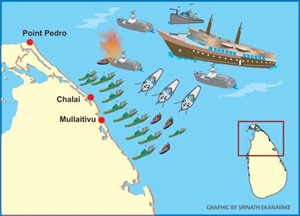
On 11 May 2006 LTTE attacked the ferry ‘Pearl Cruise’ which was used to transport army personnel to the north. This was the first sea battle, the others had been attacks on lone vessels.[12]
Navy knew that an attack was planned because of the increased traffic in messages. The navy studied the LTTE traffic in coded messages though they lacked the technology to decode the message. Heavy traffic meant LTTE was planning an attack . [13]
Ravindra Wijegunaratne recalled, our sea convoy was sailing off Chalai, a few miles south of Point Pedro, at the first light of May 12, 2006. The FAC on scout duty in front of the convoy spotted and reported fifteen sea tiger boats off of Chalai. [14]
LTTE attack craft mounted with an assortment of weapons in each of them, 23 mm and 20 mm guns, 50 calibre guns and light machine guns, were moving at high speed, some 30 to 35 knots, towards Pearl Cruise and its escort vessels. Four smaller vessels laden with explosives and guided by suicide cadres were also at the scene.[15] Pearl Cruise was ordered to alter course and move seaward.[16]FACs took up battle positions.
The Sea tiger boats launched the attack with their heavy guns . A a tense, 90-minute fierce gun battle erupted at sea.[17] Karannagoda was on the radio giving detailed directions.[18]The navy boats, led by Lt Commander ELP Edirisinghe, began sinking the LTTE Sea tiger boats one by one.
One suicide boat, of a different shape, was speeding towards the MV Pearl Cruise, This boat had been specially designed to attack vessels like Pearl Cruise.[19]it was larger in size than the usual suicide boats, had four 200 HP outboard motor engines and moved much faster.[20] It wasguided by a command boat fitted with radar. The boat was fired on by nearby FACs but withstood gunfire as it was amour plated and continued heading towards Pearl Cruise.[21]
Lieutenant Commander Edirisinghe, of FAC No P416, one of the FACs assigned to protect Pearl Cruise, rammed the suicide boat. Both boats exploded killing all.[22] Edirisinghe’s two children were waiting for their father to return home, after sea duty, to light the Vesak lanterns they had made.[23] Pearl Cruise having crossed the International Maritime Boundary Line between India and Sri Lanka during the battle [24] entered the Kankesanturai harbour just after 10 p.m. [25]
Lieutenant Commander Edirisinghe’s action was the bravest act in the entire history of the navy, said Karannagoda in his book. It prevented the deaths of 700 soldiers. Lieutenant Commander Edirisinghe was promoted to the rank of Commander posthumously and awarded the highest gallantry award Parama Veera Wickrama Vibhishana. The crew were also promoted posthumously to the next rank and were awarded gallantry medals. .[26]
LTTE attacked Galle harbor on October 18.2006. at 2.30 pm. the episode is described in detail in the book. Navy was informed before hand by a Sinhala business men who owned several fishing boats . these fishermen had reported that five boats with occupants dressed in black, were moving a high speed towards Galle. They did not look like fishermen. They had taken off from Batticaloa .[27]
The navy at Galle was ready, but the Commander deserted post and the LTTE won the battle. We could have easily turned this confrontation into a massive defeat for the LTTE if the officer had acted responsibly, said Karannagoda in his book. We knew the attack was coming we had sufficient notice. LTTE entered the harbor and succeed in firing rocket propelled grenade at various naval targets. Two naval vessels were destroyed by LTTE two suicide boats. All ten LTTE cadres died. The cowardly commander was court martialed and made to retire. [28]
In June 2007, navy fought for the first time with its Small Boats”. There was a major confrontation between navy and LTTE. LTTE launched 25 boats from Challai and Mullaitivu. Arrow boats were ready for them. There were 50 Arrow boats against 30 LTTE boats.[29] Arrow boats won the battle. LTTE withdrew having lost several boats. [30] This battle is described in the book, with much detail. This was a huge defeat for LTTE and a big victory for us, said Karannagoda. Navy in high spirits over the success of the battle.[31]
LTTE attacked the sailors on land as well as at sea. The land routes for a navy convoy were Trincomalee to Colombo via Habarana and Talaimannar to Colombo via Vavuniya. There was a considerable Tamil population on these routes. LTTE could mingle with them and launch attacks on military vehicles. [32].
LTTE attacked a Colombo bound navy convoy near Tampalagama on 11 April 2006 at 10 am. Ten junior sailors proceeding on leave after completing a course at the Naval Academy were killed in a claymore mine attack .The mine had been placed high on a tree. it had been so strong that shrapnel had penetrated the amour plates of the bus.
Thereafter, when travelling in a convoy passengers sat on the floor, wearing helmet and body armor. The convoy bus had two armor plates with sand in-between. This was too much for ordinary buses and Sri Lanka Navy started making armored personal carriers at Welisara. They produced four armored personnel carriers a month..[33]
There was a second attack at Digampatana on 16 October 2006.Two navy convoys scheduled to meet there, were attacked at Digampatana. This was the biggest LTTE attack on the navy, the navy worst disaster. 103 sailors died. This was a large number for the navy. [34]
The convoy from Trincomalee and the convoy from Colombo regularly met and handed over weapons, armour and helmets at a selected place near Habarana. Various precautions were carried out for this activity. The location changed every two days. The location was given to the two convoy commanders only when they were starting. There were other preventive measures such as snap checks and road blocks.
On this day, the two convoys were handing over weapons, when an explosive filled lorry had come at high speed and rammed into them. The lorry had come at the exact time that the exchange was taking place. This meant that they has been informed.
There were several boutiques on the other side of the road at the location and the tip off had come from there. The population there was 90% Sinhala. it was found that the informant was a Sinhalese who was a close confidant of a strong Sinhala political leader in the area.He had done it for the money. He avoided arrest due to patronage of the politician. As expected LTTE killed him. [35]
Inquiry showed that the commander of one convoy had gone off to Dambulla when he ws expected to stay with the convoy. He should have been there throughout. He had also not seen to road blocks. Those watching had observed these lapses and gave the tip off. LTTE had been observing and waiting for just such an opportunity, said the book. The officer who went to Dambulla was court martialed and dismissed from the service.
My view, (Kamalika Pieris) is that the LTTE knew the location for that particular day. LTTE would not keep an explosive filled lorry waiting every day, in the vague hope of ramming the navy convoy. Also, clearly there was support from inside. The commander was not at the scene and the usual precautions, such as check points, had not been carried out. In the Galle harbor attack too, the commander had deserted post.( continued)
[1] Karannagoda The turning point p 189
[2] Karannagoda The turning point p 213
[3] Karannagoda The turning point p 189
[4] Karannagoda The turning point p 190,191
[5] Karannagoda The turning point p 250
[6] Karannagoda The turning point p 251
[7] Karannagoda The turning point p 151
[8] Karannagoda The turning point p 181
[9] Karannagoda The turning point p 183
[10] Karannagoda The turning point p 186
[11] Karannagoda The turning point p 153
[12] Karannagoda The turning point p 191
[13] Karannagoda The turning point p 191
[14]Ravindra C Wijegunaratne, https://www.dailymirror.lk/news-features/COUNTRY-BEFORE-SELF-Extracts-from-book-
[15] https://www.sundaytimes.lk/060514/columns/sitrep.html
[16]Ravindra C Wijegunaratne, https://www.dailymirror.lk/news-features/COUNTRY-BEFORE-SELF-Extracts-from-book-
[17]Ravindra C Wijegunaratne, https://www.dailymirror.lk/news-features/COUNTRY-BEFORE-SELF-Extracts-from-book-
[18] https://www.sundaytimes.lk/060514/columns/sitrep.html
[19]Ravindra C Wijegunaratne, https://www.dailymirror.lk/news-features/COUNTRY-BEFORE-SELF-Extracts-from-book-
[20]Ravindra C Wijegunaratne, https://www.dailymirror.lk/news-features/COUNTRY-BEFORE-SELF-Extracts-from-book-
[21] Karannagoda The turning point p 198 or close to this.
[22] Karannagoda The turning point p 197
[23]Ravindra C Wijegunaratne, https://www.dailymirror.lk/news-features/COUNTRY-BEFORE-SELF-Extracts-from-book-
[24] https://www.sundaytimes.lk/060514/columns/sitrep.html
[25] https://www.sundaytimes.lk/060514/columns/sitrep.html
[26] Karannagoda The turning point p 198
[27] Karannagoda The turning point p 206
[28] Karannagoda The turning point p 211, 213
[29] Karannagoda, The Turning Point p 239
[30] Karannagoda, The Turning Point p 240
[31] Karannagoda, The Turning Point p 241-242
[32] Karannagoda, The Turning Point p 204
[33] Karannagoda, The Turning Point p 188,189
[34] Karannagoda, The Turning Point p 203,205
[35] Karannagoda, The Turning Point p 203,205
“THE TURNING POINT” BY WASANTHA KARANNAGODA PT 3C
July 21st, 2025KAMALIKA PIERIS
LTTE established small Sea Tiger bases the north- eastern and north- western coasts in lagoons opening to the sea. They were approx. 10-15 km apart along the coast. In 1994 LTTE went into the Vanni, it was pushed out of Jaffna. In Vanni, they freely used all the lagoons that opened to the sea.[1] Over 8 Sea Tiger camps were set up in the Vanni. LTTE attack boats and suicide boats were hidden in the jungle adjoining. LTTE had found a way to launch and pull back the boats, using the bull dozers and tractors kept in each base .[2]
LTTE engaged in asymmetric warfare with suicide boats and wolf pack type attacks on the navy. .this is well known. LTTE did not invent asymmetric warfare. It was there before. Asymmetric tactics at sea consisted of small, fast moving, elusive, hard hitting teams , engaging in surprise attacks,[3] using a superior knowledge of the territory.[4]
LTTE also introduced suicide divers, suicide boats, and semi-submerged submarines.[5] .Suicide boats were used successfully against the slow speed naval craft such as landing craft and merchant vessels. [6]
Suicide divers attacked two surveillance vessels, Abhita and Edithera at KKS harbor in 1990.[7] LTTE used suicide divers effectively until the last stages of the war.[8] Navy lost a FAC with its entire crew off Mullaitivu on January 2009. That was the last suicide attack.[9] LTTE also had moored mines and limpet mines. Mines were used successfully on two occasions, destroying two logistic vessels in KKS and Trincomalee [10] .
Four months after the Ceasefire Agreement was signed in 2002, LTTE found that the sea was not included in the hurriedly prepared Ceasefire Agreement. LTTE decided to rectify this omission and get their Sea Tiger camps legitimized.[11]
LTTE asked the government to transfer LTTE cadres training at Vakarai, from Vakarai to Mullaitivu and back by sea. LTTE cadres were to be taken past the Trincomalee harbour on both journeys. Karannagoda found this a strange request.LTTE had been transferring their cadres by land between LTTE and government controlled land, why seek a sea route. When the Navy objected defense ministry overruled it. LTTE obtained approval for the sea transfer from the government. [12]
The first movement took place in August 2002. Then after a few more trips, LTTE wanted the sea convoy to stop at Verugal aru, 15 miles from Trincomalee harbor and pick up LTTE from there. This was also approved , despite objections of the navy . Then LTTE got permission to pick up two LTTE from a location very close to Trincomalee harbor, Illankanthei. Navy objected but government agreed. Illankathei was next to Sampur village. LTTE was trying to establish their presence on the southern side of the Trincomalee harbor.[13]
Before 2002, the LTTE camp closest to Trincomalee was the camp at Nayaru. It was not possible to attack Trincomalee from Nayaru as naval patrols and shore based radar were in operation between Nayaru and Trincomalee . LTTE therefore needed camps closer to Trincomalee harbour. [14]
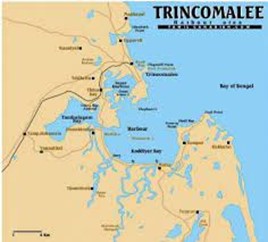
Karannagoda found in 2003 that the LTTE had established new camps surrounding the Trincomalee harbour, using the Ceasefire Agreement . LTTE already had a camp close to Morawewa. They were now converting this into a permanent camp, taking building materials secretly through the jungle.[15] Morawewa was 25 mins drive from Trincomalee.
LTTE had started a program to settle Mahaveer families” in colonies planted in Trincomalee near the harbour. Mahaveer families” were families of LTTE cadres killed in action. The houses were built by the NGO known as Tamil Rehabilitation Organization (TRO). There were 50-100 houses in each colony. [16]These colonies encircled Trincomalee harbour and Trincomalee town and LTTE could use them to mount an attack on the military bases near the harbour.[17]
Karannagoda found that LTTE had also got into the restricted area of the Naval headworks Sanctuary, which faced Tambalagam Bay. Three fourths of Naval Headworks Sanctuary is covered in thick jungle and preserved as a sanctuary while only one fourth is used for naval purposes.
In January 2003 Karannagoda as Area Commander visited the jungle area. Access was thorugh a gravel road, off the Trincomalee Colombo road, 1 km before Tambalagamuwa town, where the majority are Tamil.
500 km onwards, he found that thousands of cattle were grazing freely and 27 huts had come up with men in each hut. I had never before seen cattle and huts within the Naval Sanctuary, said Karannagoda . He was told these cattle belonged to the villagers of Tambalagamuwa. They has arriving in increasing numbers after the Ceasefire Agreement was signed. Karannagoda found that the LTTE was occupying 2 of the 27 huts and from these, they were monitoring all the naval movements in the Naval Headworks.[18] If the LTTE had free access to the sanctuary they could disrupt the water supply to all the military camps in the Trincomalee area. They could poison the water supply too.[19]
Karannagoda ordered the cattle be removed, also the huts.[20] This was a restricted area. He ordered the withdrawal of over 1000 cattle from the Naval reservation and from 18,000 hectares of jungle in Tambalagamuwa.[21] He sent additional troops to Headworks camp, together with platoons of the elite Special Boat squadron (SBS) with instruction to cover the entire jungle. He also instructed not to allow LTTE to enter naval sanctuary and to use force if necessary[22] .
The UNP and the Tamil Separatist Movement were angry with Karannagoda for this. TNA MP Sampanthan rang Karannagoda and said that his order went against the Ceasefire Agreement . The sanctuary area was a traditional grazing area for cattle, you have no right to give such order. The practice must continue and the huts must remain. Karannagoda refused and Sampanthan said he would complain to the Prez. Sampanthan reported Karannagoda to President Chandirka Kumaratunga.[23] President supported Karannagoda. [24]
Then SLMM rang. You have stopped the movement of the LTTE on Naval Sanctuary in Tambalagamuwa area. LTTE might retaliate. They might plant landmines, attack naval vehicles on the road, said SLMM. Then we will retaliate replied Karannagoda. That ended the matter.[25]
In 2000 LTTE had attacked two fast passenger carrier inside the Trincomalee arbour evne without h aving camps on the south side. By 2006 it was different, LTTE had establish several sea tiger camps and ships and craft in Trincomalee harbor were vulnerable. [26] .
LTTE had established camps at Koddiyar bay. LTTE has establish several small sea tiger coams in the estuary of Mahaweli river as it entered Koddiyar Bay, approx. 500 to 1000 upstream. The camps were completely concealed by the thick vegetation, they could not be detected even from the air.[27]
LTTE had also set up 13 new camps including five Sea Tiger camps in Sampur directly facing the Naval headquarters across Koddiyar Bay. This was a meticulously planned campaign. [28]These Sampur camps were a serous threat to the navy and Karannagoda was very concerned about them. As he expected, in August 2006 LTTE attacked the Naval dockyard, Air force camp in China Bay and the airfield using artillery from Sampur.[29]
The fishing villages facing Koddiyar bay, in the Sampur area were all Tamil except for Mutur, which was Muslim. Karannagoda wanted a navy camp at Mutur but under the Ceasefire Agreement They needed permission from the Peace secretariat .Therefore Karannagoda tried to persuade the Muslim villagers to ask for a navy camp there.
However, LTTE attacked Mutur and set fire to shops in March 2003, Minster Hakeen went on a hunger strike and demanded a naval detachment at Mutur .On the instructions of Defense Minister , Karannagoda promptly established a naval detachment near Mutur pier. Marapana also suggested, later on, in conversation, send more troops and when the order to withdraw troops comes, withdraw the excess lot, keep the rest”.[30]
Karannagoda was deeply concerned about the LTTE camps at Sampur. He informed Prime Minister Ranil Wickremesinghe , Minster for Defense, Tilak Marapana and Permanent Secretary, Defense, Austin Fernando about this Samur build upon three separate occasions , but they did not take it seriously.”[31]
In April 2003 Prime Minister had visited Trincomalee . Karannagoda told him of the new sea tiger camps in Sampur. They were a serious threat. Intelligence said that under cover of Ceasefire Agreement LTTE was training large number of new cadres. Already they had trained over 10,000 cadres. Prime Minister said Cant be, how to train so many in such a short time.” Karannagoda said that LTTE only trained recruits in the handling of weapons, not seamanship. Prime Minister then changed the subject.[32]
The Defense Minister ,the three service commanders and the IGP came to Trincomalee to discuss security in July 2033.. The army and navy made two power point presentations which tallied on the subject of Sampur. Both showed a total of 18 camps of which 13 were new camps.[33] Karannagoda had a map which showed the LTTE camps, both new ones and old. This map is given in the book.[34]
In September 2003 Mahinda Rajapaksa, then Leader of Opposition came to Trincomalee to obtain first hand information on the security situation. Karannagoda made a presentation to him as well.[35]
In August 2003 Karannagoda was asked to make a presentation to the President of Sri Lanka . regarding Sampur Lakshman Kadirgamar came instead of President. He accepted what Karannagoda said. [36]
Karannagoda then found that the UNP government was very angry with him for making a presentation to the President. Austin Fernando rang, did you meet the President, he asked.. They also wanted to see Karannagoda’s presentation. So he showed it. They queried , how did they get this information, they asked, when no one was allowed near the LTTE camps . From people living nearby, came the reply. How did you know the exact position of the LTTE new camps. By listening to their radio communications.[37]
In September 2003 Karannagoda was informed that the Commander of the 22 Division of the army based in Trincomalee had said, in an ITN broadcast, that there were no new LTTE camps in Trincomalee, the Karannagoda report was false.
Karannagoda then produced the presentation made in July 2003 by the earlier divisional commander of the 22nd Division, Brigadier John Senaweera of the army, which showed 13 new LTTE camps.[38] Karannagoda later learnt that the new Divisional Commander 22nd Division had given a false statement because a very senior official in the Defense Ministry had asked him to do so. [39] .
Karannagoda stated that he had informed the authorities on five occasions about the threat from Sampur. The information he supplied was accurate. He had set up three separate boards to report on the matter. He also had information from his operations staff and intelligence Department.[40] .
I brought the threat posed by Sampur to the notice of Prime Minister, Defense Minister and Defense secretary on five occasions in January, April and July 2003, said Karannagoda in the book. They took no notice. When the President took up the matter, these three suddenly got worked up and started slinging mud at me on ITN, a government owned TV channel. [41]
Three ITN broadcasts were made on three successive Fridays ,5,12 and 19 September attacking Karannagoda regarding Sampur. Karannagoda sued ITN for 150 million, and after two years won the case. This event is described in detail in the book. [42]
The Army Commander was also an obstacle where Sampur was concerned. Whenever he was asked to clear Sampur of the LTTE , Army Commander made excuses. The troops were insufficient and Army was not ready for a war with LTTE .Army Commander was angry with Karannagoda. Karannagoda had opposed the Army Commander’s attempts to control the navy.[43]
Karannagoda had made repeated requests to the Security Council to clear LTTE from the Sampur area, as a priority[44] After the attack on Jetliner in August 2006 it became urgently necessary to clear Sampur[45] . I silently cursed the Army Commander for not clearing the Sampur area giving silly excuses, despite my repeated requests , said Karannagoda in his book.[46]
When Mahinda Rajapaksa became President, in 2005, Karannagoda spoke to him and he ordered Army Commander to clear the Sampur area on priority basis, ignoring his excuses. Army Commander said that his army did not have the troops to hold the ground after clearing. Navy said they would do that. So Army Commander had not further excuses. He had to clear Sampur.[47]
He had earlier said that he needed to deploy around 2000 troops for the purpose, but used a much smaller number of troops for the job. When the navy moved in, they found that LTTE had only had 300-400 cadres there.[48] Once Sampur was cleared ,navy established four camps with over 1000 trained sailors. This removed the biggest threat to Trincomalee harbor and was a huge relief to the navy.[49] ( continued)
[1] Karannagoda The turning point p 21
[2] Karannagoda The turning point p 138
[3] https://www.spsnavalforces.com/story/?id=163.
[4] https://www.spsnavalforces.com/story/?id=163.
[5] Karannagoda The turning point p 127
[6] Karannagoda The turning point p 136
[7] Karannagoda The turning point p 135
[8] Karannagoda The turning point p 135
[9] Karannagoda The turning point p 135
[10] Karannagoda The turning point p 136
[11] Karannagoda The turning point p 42
[12] Karannagoda The turning point p 41
[13] Karannagoda The turning point p 41,42
[14] Wasantha Karannagoda , The turning point. P 23.
[15] Wasantha Karannagoda , The turning point. P 15.
[16] Wasantha Karannagoda , The turning point. P 19.
[17] Wasantha Karannagoda , The turning point. P 43.
[18] Wasantha Karannagoda , The turning point. P 18.
[19] Wasantha Karannagoda , The turning point. P 26.
[20] Wasantha Karannagoda , The turning point. P 26.
[21] Rohan Gunaratne .foreword to The Turning point p xvii-xvii
[22] Wasantha Karannagoda , The turning point. P 27,28.
[23] Rohan Gunaratne .foreword to The Turning point p xvii
[24] Wasantha Karannagoda , The turning point. P 25,26.
[25] Wasantha Karannagoda , The turning point. P 27.
[26] Wasantha Karannagoda , The turning point. P 252.
[27] Wasantha Karannagoda , The turning point. P 23, 52
[28] Wasantha Karannagoda , The turning point. P 19, 22.
[29] Wasantha Karannagoda , The turning point. P 56
[30] Wasantha Karannagoda , The turning point. P 51-55
[31] Wasantha Karannagoda , The turning point. P 76
[32] Wasantha Karannagoda , The turning point. P 57
[33] Wasantha Karannagoda , The turning point. P 76
[34] Wasantha Karannagoda , The turning point. P 79
[35] Wasantha Karannagoda , The turning point. P 87
[36] Wasantha Karannagoda , The turning point. P 77,79
[37] Wasantha Karannagoda , The turning point. P 82,83
[38] Wasantha Karannagoda , The turning point. P 89
[39] Wasantha Karannagoda , The turning point. P 91
[40] Wasantha Karannagoda , The turning point. P 84
[41] Wasantha Karannagoda , The turning point. P 84
[42] Wasantha Karannagoda , The turning point. P 85
[43] Wasantha Karannagoda , The turning point. P 252
[44] Wasantha Karannagoda , The turning point. P 252
[45] Wasantha Karannagoda , The turning point. P 253
[46] Wasantha Karannagoda , The turning point. P 261
[47] Wasantha Karannagoda , The turning point. P 265
[48] Wasantha Karannagoda , The turning point. P 265
[49] Wasantha Karannagoda , The turning point. P 266
An open letter to Hon. Santosh Jha Esqr. Indian High Commissioner in Sri Lanka
July 21st, 2025Dr Sudath Gunasekara
Hon. Santosh Jha Esqr, Dr Sudhath Gunasekara
Indian High Commissioner in Sri Lanka, 21 Dharsana”,Gemunu Mawatha
Colombo. Mahanuwara
081 22 32744-071 1780449
The Need to change the overall Kautilyan policy of Mathsya nyaaya and the Panikkar strategies towards its neighbors, particularly Sri Lanka, if India is to be respected and accepted as a true friend by its SAARC neighbours, all of whom are fully independent sovereign nations.
Dr. Sudath Gunasekara (SLAS) Former Secretary to Prime Minister Mrs. Sirimavo Bandaranayake and the President of the Sri Lanka Administrative Service Association. (1991-1994)
Dear Sir,
At the very outset I would like to request India, our big brother, to change the overall Kautilyan perception of Mathsya nyaaya and the Sardhar Panikkar policies towards its neighbors in the SAARC region forthwith, particularly Sri Lanka, firstly, its meddling with the migrant Malaba immigrants living in the North and Eastern coastal areas who were named Tamils in 1901 only, by the British Colonial government, having a domicile history of less than 350 years on this soil ( Pl see EELAM MYTH EXPOSED 2020, KNL Perera), Secondly, meddling with the 1.2 million south Indian state labour force, the descendants of the indentured South Indian coolie labour who were illegally given citizenship under the Rajiv /JR Accord imposed on us by force by the Indian Government, who are now claiming land rights in the central highlands saying that they have been here for 200 years under the bogus Nam 200 years” programme supported by India and the Western Colonial powers. These were the ancestral lands of the Kandyan Sinhalese and their temples, the sons of the soil from the inception of history taken over by force by the British under draconian laws after 1840 by killing all males over 16 years and causing the women to runaway to the Dry zone jungles.
The Indian Government claim that they are people of Indian origin and it consider them as it’s own citizens ad provide them with all the privileges such as housing, water supply, medical facilities, education, scholarships to Indian universities as if these people are already Indians although they live and subsist here.
This type of illegal, undiplomatic and unconventional practices on the part of the Indian Government should first end, as a prerequisite to heal the wounds it has already inflicted upon this country in the recent past, starting from the infamous Parippu invasion of Sri Lanka by Rajeev Gandhi in 1987”. This is a sine-qua-non to open a new chapter for an everlasting age of goodwill and friendship once again, between our two countries, as it had been flourishing at its peak during the Asokan period, 265–238 BC. that had its roots firmly taken in the days of The Gauthama Buddha, the Greatest human being India or any other country in the world had ever given to this world in 623 BC.
The Buddha has sanctified this Island by three visits during his life time, first to Mahiyhangana in 593 BC, then to Naagdeepa and Kelaniya and finally even at the last moment while lying on his death bed he had advised Sakka the King of Gods to protect prince Vijaya and his retinue of 700 followers as he had foreseen that his Sasana will last only on this Island for 5000 years after him.
There is also another reference to the origin of the Sinhala race. The DivYaavadhana a Sanskrit classic written about 2 centuries before Mahaavansa in the 5th century BC (the Great Chronicle of the Sinhala Nation) has said that it was the Lord Buddha who founded the Sinhala nation in his Bodhisatva time (an enlightened being” or “a being on the path to enlightenment)”. as a person called Sinhala” a son of a rich merchant from the region of the Indus civilization. Probably that may be the reason as to why he had paid such special attention to this country as stated before by visiting 3 times and making a special request to the Sakka to protect Prince Vijaya and his retinue. It also should be noted that this was the only country in the whole world where the Buddha had visited and made such a statement about the perpetuation of his dispensation.
In this great backdrop, I will be grateful to you to render your valuable advice as an eminent IFS luminary, to your government to treat this country as a free and independent sovereign state as much as the India is, as it had been from the inception of history.
However, I must clearly and honestly state here, that the enviable and brotherly good will and the cordial relationship existed between our two countries that was there in that distant past, starting in the classical days of Gautama the Buddha and Emperor Asoka and even much later during the days of Nehru – Bandaranayake period (1956-1977) are now gone for good, since the 1987 Rajiv invasion of Sri Lanka.
The infamous Rajiv/JR Accord of July 29.1987 that was forced on Sri Lanka at gun point, preceded by his shameless Parippu dropping by an Air invasion violating Sri Lankan territorial integrity, sovereignty and the independence, marks the worst invasion in its 2500-year history, as it affected the whole country against all previous foiled local South Indian invasions in history. starting in the 2nd century BC that were limited only to the northern parts of the Island. Even Rama’s invasion was confined to rescuing Sita from where she was said to have been kept in secret by Ravana only, but never had any effect on the whole country, other than Ravana’s death at the hands of Rama. But Rajeev’s invasion had an Island wide and far-reaching effect, declaring 1/3 of its sovereign territory, as the Tamil historical Homeland. That was a criminal travesty of the history of this 2500-year-old sovereign Sinhala Kingdom.
It is to be noted that even Tamilnadu with 8.39 Crores of Tamils that had been the true historical homeland of the Tamil race for millennia is not recognized as a historical Homeland of Tamils by India. Isn’t it crazy for India, therefore to have intimidated JR through Dixit at gun point and got him to accept 1/3rd of the of the traditional historical homeland of the Sinhala nation, as the Dream historical homeland of some 5 million South Indian Malabar immigrants brought here by the Dutch in the late 17th century and the British invaders until 1815 until they annexed the Kandyan Kingdom by the Kandyan Convention of march 2nd 1815 through the clever and cunning spying and maneuvering by John Doily.
The infamous Rajiv/J R Accord of 29th July 1987
1.It declared the North and East, of this country covering 1/3rd the area of this Island including and 2/3 of the coastal staring from Puttalama on the West to Kumana in the South Eastern corner of the Island, as the historical Homeland of the Tamil people who were brought in to this country only in the late 17th century (by Dutch) and by the British up to 1815, going by the fairytale of a Tamil country invented by Cleghorne minute to Governor North made in 1799 to win laurels of the British that was heavily supported by the American Wesleyan mission.
The Rajiv/JR Accord imposed on JR by force also merged the Northen and Eastern provinces and provided for the amalgamation of 2 or more provinces for less than 12 % of the migrant population of the country, probably with the idea of including the Central, Uva and Sabaragamuwa provinces and even few parts of the Southern province like Rakwana and Deniyaaya, where few Estate Tamils are resident. This is Panikkar theory in action in annexing the neibouring countries
2.DeclaringTamil also as an official Language in this country, (while it is not so, even in India where 8. 35b Crore Tamils live);
3 Granted citizenships to all Tamils in Sri Lanka, including even the illicit immigrants on the Street and villages as gypsies without fully adhering to the legal requirements regarding the registration of Citizens in any country.
4 The Accord was signed under pressure from India amid public protests all over the Island culminating with the national protest organized by the Opposition headed by the Leader of the Opposition Mrs. Sirimavo Bandaranayaka in Petta Colombo where several participants were killed due to shooting by the armed forces on the orders of the Government.
It should be noted here that Three prominent Cabinet Ministers including the Prime Minister Premadasa, Lalith Athulathamudali and Gamani Jayasuriya Boycotted the occasion in protest.
5.Signing of the Accord was followed by the 13th Amendment to the Constitution that ended the unitary character of the state, Sri Lanka that was there for 25 centuries and it laid the foundation for the division of the Island in to 9 semi-autonomous provincial Governments, thereby putting an end to the unitary state of Sri Lanka and (see below for more details)
I have identified the following main reasons as responsible for this sad and unfortunate situation.
1 Wrong attitudes and wrong policies of the Indian government towards this country, born out of fabricated information fed by Tamils in Tamilnadu, Sri Lanka and the so-called Tamil diaspora living all over the world.
2 Ignorance of the true history of this country and the history of Tamils living here and the invention of new and bogus theories.
3 Government of Indias dependence on the Tamilnadu votes to maintain political stability at the center.
4. the influence of the Colonial West
5. Ignorance or deliberate refusal on the part of the Indian Government to accept that Sinhalese are also of Indian origin who have come to this country 25 centuries before these Malaba people were brought here only in the late 17th through the 19th century by the Dutch and the British.
6. Utter disregard to accept the fact that Sri Lanka is a separate sovereign country that had never being a part of India at any time in istory7. Reluctance of India to accept this country is also an independent sovereign country of equal status although small in size.
8 Absence of patriotic and strong Sinhala political leadership who can convincingly put the record right and the weakness of the then Sri Lankan senile leadership
9 The big brother attitude of India and its reluctance to admit Sri Lanka as an independent sovereign State of a separate nation called the Sinhala nation for millennia in history.
10 Absence of patriotic Sinhala leaders who knows their own history and who have the courage to stand up against this type of Indian invasion and the incompetence of Sri Lanka politician to protect and defend their own motherland
11.The influence of Panikkar policy which India is perusing not realizing that will antagonize it’s all neighbors
EELAM concept a Western invention
It was the British colonial invaders who picked up the EELAM concept from South Indian Eelaamists and introduced this strategy in Sri Lanka with 3 main objectives
First,
To destroy the millennia old Sinhala Buddhist civilization in this island nation, to avenge the humiliating defeats they suffered in Sri Lanka from 1803 to 1848 at the hands of brave Sinhala patriots
Second,
To destroy the age old political and cultural good will that exist between two Asian twin brothers, India (the Elder) and Sri Lanka (the younger) and
Third,
To divide Sri Lanka in to two rival ethnic States, Sinhalese and Tamils (EELAM) eternally fighting against each other, as they have done all over the world.
Fourth with a hidden agenda to create a permanent Neocolonial political and strategic base in South Asia for the Westen neo colonial powers, to control the emerging Asia of the 21st century right at the center of the Indian Ocean and to stop the rise of China and India as great powers and also to stop Sri Lanka being developed as the hub of the emerging 21st century Asia.
The biggest threat to the independence of India,
Please remember, that it will be the biggest threat to the independence of India, once the age-old friend Sinhala Buddhist Sri Lanka state is no more.
In this backdrop, what I have proposed here, I think is the only way to defeat this Church backed Western neo-colonial global control strategy, harmful to both Sri Lanka and India
The first pre requisite of this master plan, I propose to defeat this vicious neocolonial game is to reinvent the age old, friendly and cordial relationship that was there between India and Sri Lanka as two independent and strong states by defeating the EELAM dream of the Kumari Kandam lobby of the Tamilnadu State and its Church allies in the neo-colonial West. It is extremely disastrous to both Sri Lanka and India as it will end up by balkanizing greater India and divide Sri Lanka also in to two separate ethnic States, eternally fighting each other. This is exactly what the Western neo-colonial world wants done. To destabilize India, Sri Lanka, and make Sri Lanka their hub to stop the emerging twenty first century world around the Indo Pacific Oceans. the QUAD that is called the Asian NATO is already actively engaged in this vicious game; by tactfully getting India and Japan to join this organization to set those two countries against other Asian countries. The chief and dominant members of the QUAD, USA and Australia, both of whom are Church backed powerful white colonial powers of colonial settlements of migrants from Europe who had established their white settlements by annihilating the native owners of those countries.
Building up of an independent and nonaligned India and Sri Lanka is a must to avoid this disaster.
The first step, rather the sine qua non in this long journey is to restore the age old friendly and strong relations between, India and Sri Lanka and create an Asian geopolitical heartland” based in Sri Lanka to realize the dream of the 21st century Asia. Sri Lanka’s geographical location on the globe at the center of the Indian Ocean, where all the world’s busiest naval and air routes meet, confirm the ancient Indian Puranic concept of Lanka as the center of the world (Bhuu madhYayei lankiiyathithi Lanka) becoming a reality in the 21st century. Its global location at the center of the world surrounded by the Indian Ocean extending from Africa in the west to Australia in the east and the Bay of Bengal in the north to Antarctica in the south, open all around to the world, with a long and rich Buddhist culture, makes Sri Lanka, a friend to all and enemy to none, the ideal global strategical heartland for this role.
With Sir Arthar Clerks prophesy in his Deep Range, that by 2050 all religions based on God centered Abrahamic teachings will disappear. Therefore, Buddhism will be the only religion that can inspire the human mind and heart” (Deep RANGE 1954) and Sri Lanka being the home and the head quarter of the Theravaadha Buddhism in the world, it is not surprising that the Church dominated Westen powers are determined to wipe out Sri Lanka from the world map to avoid this imminent disaster to them.
The close and strong millennia old relationship between Sri Lanka and India underscores this 21st century global geostrategic reality. The need to build up a mutually beneficial and closer and strong bondage between our two countries is therefore, a sine qua non to realize this dream Asia of the 21st century. The steal foundation for this Indo Sri Lanka relationship has to be based on the age-old classical and historical brotherhood that existed for millennia between our two countries. In order to realize this supreme goal, we have to build up the Indo-Sri Lanka connectivity based on the following background, described in detail below.
I don’t think for a moment, I need to elaborate to you, as a distinguished and a veteran officer of the IAS of your caliber, on the unique and close historical, political, the cultural and spiritual relationship that existed between our two countries from the time of Gautama the Buddha, the greatest human being ever given to this world by Bharath Desh. Lord Buddha ‘s first visit to this Island was in 588 BC, in the ninth month after he attained enlightenment, to Mahiyangana to settle a waring dispute between two native tribes Yakkas and Nagas. On the verge of his attaining Parinibbana, (543) he also selected Sri Lanka as the only land in which his Dhamma will last for 5000 years to come in its purest form, although Jambudviipa (Nepal(in India) was his beloved birth place and it is over 50 times the area of Sri Lanaka.
Lying on his Parirnibbana bed he requested Sakka the King of Gods at the great assembly of devas, to protect Prince Vijaya, an Aryan Sakya Prince from northern Bharath and his retinue of 700 who landed on the same day, Buddha attained Nibbana in Lanka Deepa in 543 BC. The same day, marks the Birthday of the Sinhala Buddhist nation on this Island. Thence forth this country had been named as the land of the Buddha and also the land of the Sinhala race.
It was Emperor Asoka, another great son of Bharatha who was acclaimed as the greatest Emperor the world had ever known, officially gifted the Buddha sasana to this country during the reign of his erstwhile friend King Devaanampiyatissa who was the King here at that time, at the beginning of the 4th century BC (307). Ever since the close political, religious, spiritual and cultural, ties between the two countries were made the stronger, by selecting his own son Mahinda and daughter Sangamittaa as the royal emissaries to bring the Budha’s noble message to this land of the Sinhala people, known as Lanka Deepa at that time. This close relationship between these two countries laid the foundation for a unique and unmatched human civilization on this resplendent Island. Such was the unique and remarkable level of the close relationship that existed between our two countries, from the time of Gauthama the Buddha.
This however was unfortunately marred later by the successive invasions by the South Indian non-Aryans, like Chola, Pandya and Maga from south India starting in the 2nd century BC, which culminated and ended up with the Kalinga Maga invasion in the 12th century. The Maga invasion left behind an indelible devastations done to the political , social, economic and the cultural landscape of this Island nation that resulted in the inevitable shifting of a glorious Sinhala Buddhist civilization in Anuradhapura and Polonnaruwa Kingdoms of world reputation from the dry zone, the cradle of that great Sinhala Buddhist civilization, to the hill country and the South West of the Island, converting the Rajarata in to a vast expansion of sprawling jungle that remained neglected until its reopening began again only after the British took over the governance of the whole island after entering in to a friendly Convention agreed upon between two Kingdoms of equal status, with this country on 2nd of March 1815, that is the British Empire and the Kandyan Kingdom of Sinhale, being the only Kingdom that was not captured by war in the whole British Empire. The Convention referred to here was the Kandyan Convention.
Thereafter, the cunning and the uncivilized British, having made the Kandyan Convention almost dysfunctional by the famous Royal Proclamation No. 21st of Nov 1818 by Governor Brownrigg, started a period of callous, divisive and repressive 133-year-old exploitation and brutal regime in the whole British Empire, that has gone down in world history as one of the darkest periods, referring to which, John Davy surgeon to Governor Brown Wrigg had said
The history of British rule in Ceylon after the 1818 rebellion cannot be related without shame. None of the members of the leading families (all males over 16 years) in the Kandyan country have survived. Small pox and privation has destroyed those spared by the gun and the sword”.
Meanwhile, they started a large scale Colonial Settler Colonization” program in this country with poverty stricken Malabar cooly labour gangs from South India, first, in the Islands Northern and Eastern provinces created by them in 1833, that were under dense jungle almost uninhabited, except for few sporadic settlements of native Sinhalese around the neglected Tanks, after the mass exodus of the native Sinhalese to the South West and the hill country, following the Maga devastation in the 13th century AD.
The British colonial intruders got all these Malabar cooly labourers gazette in the Nort and East as Ceylon Tamils in 1901 by intrigue having appointing a Malabar man, Ponnambalan Arunachalam, a grandson of a Dutch toilet keeper, who was made the first Ceylon Civil Servant of their Choice, as the first Registrar General of this country. That was how those Malabar labourers became Ceylon Tamils overnight in 1901, who were made aristocratic with one stroke of a Malabar descendant Ponnambalan Arunaachalam, with the hidden intention of making them the rulers of this millennia old Sinhala Kingdom.
Second, the same British, started to inundate the central hill country with the second wave of Malaba slave coolies, with the opening up of the Central hill country for largescale Coffee in 1840 s and later Tea plantation in 1870s to settle and work on these lands that were originally owned by the natives Sinhalese from the dawn of history up to 1840. In the post 1840 period, the British imported an army of South Indian Malabar indentured cooly labor nearing 1.2 million and settled them on these newly opened up plantations that were covered with primeval forest from the dawn of history. This opened up a sad period of destruction of forests, land and the rivers of the geographical Heartland (HADABIMA) of this Island followed by a prolonged period of cruel exploitation of natural resources of mother Lanka together with the sweat and blood of the poverty stricken poor South Indian labour, to fill the coffers of England.
The native Sinhalese had come to this country 26 centuries before the Malabar coolies
It is very important to be noted here that the Sinhalese also had come to this country 26 centuries before the Malabar who were brought to this country by the Western colonial invaders after 1780s with the triple objectives of a) finding cheap labour for their projects, b) destroy Sri Lanka and finally c) to create a war base in South Asia for them to control emerging future Asia.
Ironically, these immigrants are the people who are now claiming a separate kingdom on this, land found, developed, civilization established and defended and protected against 18 South Indian invasions from the 2nd century BC to 13th century AD (ancestors of the same Malabars) and three western invasions from 1505 to 1948) by the native Kandyan Sinhalese.
The British left behind these people who were British citizens until then, as an army of stateless immigrant labour high and dry on this soil, leaving behind a bone of contention and an incurable chronic headache to this country, when they left the shores of the Island in 1948, after conferring the so-called fake Independence to this country, retaining all three cardinal requirements of an independent state, namely, Legislative, Executive and Judicial powers with them.
Although countries like Burma and Uganda chased out such Indian immigrant labour gangs from their lands immediately after independence, the Sri Lankan leaders, partly being a product of a rich Buddhist culture and partly as a brain washed compradors of the west did not resort to such inhuman acts, although neither those laborers nor the present day Indian politicians have ever appreciated the benevolence conferred upon this army of immigrant labour by the Sinhalese Buddhist of this country up to date.
Sad colonial legacies
This, briefly summarizes the tragedy imposed on this Island nation by the British when they left in 1948 leaving behind their vicious cycle of colonial exploitation with more ropes all around the neck of Mother Lanka keeping the colonial reins Fastly holding in their hands tied on to all techniques of state craft such as legislative, executive and judicial , and all branches of statecraft like internal governance, foreign affairs, the Islands security ,the import export economy, the language and the machinery of Public Administration, education while keeping the dependency trap tightly held in their own hands.
It is in this back drop of sad colonial legacies inherited by us, I decided to draw your kind attention to the three articles, already NKL Justice Perera has sent to you which I consider as authoritative master pieces on the artificially created Tamil Problem in Sri Lanka, that pose an intractable and also a big headache to both Sri Lanka and India due to the prevailing ignorance on this subject.
His book EELAM exposed, is a magnum opus on this subject, which no Tamil scholar or politician has challenge up to now. I have no doubt that his valuable contribution will help us to find a lasting solution to this decades old political impasse created by the crazy Tamil politicians
These important and authentic articles compiled by an eminent lawyer, L.K.N. PERERA ( LL.B Cey) Attorney at law, and a senior Judge, based on the results of a comprehensive and painstaking study carried out by him over a long period of time that has covered wider and authentic historical sources that includes valuable, impartial and irreputable and first hand historical information on this subject, by Portuguese, Dutch and British authors, deliberately overlooked even by some acclaimed Professors of history like K.M. De Silva, (brain washed products of the colonial education) for your information, so that you will get a realistic and a rational idea as to how you may address this Tamil” issue in Sri Lanka, impartially, as a true diplomat, in your future diplomatic dealings without getting misled by false propaganda by extremist Tamils, both here and abroad, specially South India who are quarrelling for a separate state and self-determination, for a dream Thamil State called EELAM ( which also means the Land of the Sinhalese) a term coined by South Indian Dravidayan people speaking Tamil language to call this land on this land of the Sinhala nation, who had been the sole hereditary owners of this country even before the historic times began, as has been clearly proved and established beyond all reasonable doubts by the Mahavamsa and accepted by all the renowned historians of the world over, except the EELAMIST of South India, Sri Lanka and the so-called Church backed Tamil Diaspora living in the Western World.
There is No Tamil nation in this country
May I add here that, how can there could be a Tamil nation here in Sri Lanka, with less than 350 years of white man’s immigrant labour domicile history, when there is no Tamil nation or an Independent Tamil Nation even in South India which is said to be the historical Homeland of the Tamil Nation, from prehistoric times where, over 7 million Tamils live at present.
I also don’t think I need to remind you, as a senior officer of the IAS, how Jawar Lal Nehru, the great Statesman of Barath dealt with them when they demanded secession in 1963. Nehru brought in legislation making it illegal to demand secession and introduced the 16th Amendment to the Constitution of India, banning secession to protect the territorial integrity of Bharath Desh, in spite of the fact that South India had been the traditional historical homeland of the Tamils from the inception of history. Although it is now dominated by the Western Church backed elements, trying to balkanize India. Hilary Clintons visit to Chennai in 2011 is speculated by many as a part of this strategy.
But the irony to be noted here is Tamils are not recognized as a nation even in India and nor are they given the status of a separate Independent and sovereign country with special privileges like a separate law similar to Thesavalamei law enjoyed by the Malabar community living in Sri LankaBut Rajiv got this too done through the same JR who signed the Indo Lanka Accord, by getting him to amend the Constitution of this country making Tamil also an official language in this country.
You can’t have two nations and two official languages in any country. Isn’t it a big constitutional tragedy that the 16th amendment to the Constitution of Sri Lanka in 1988 opened the doors for secession at the instigation of India whereas the 16th Amendment to the Indian Constitution by the same India in 1963 prohibited Tamil secession in India.
Even though Tamil Nadu is the Indias second largest State with a strong economy, the Tamils living there don’t ask for separation at present and even equal status or things such as the right for self-determination, equality, dignity and self-respect etc, as claimed by those who live here even though they are only Malabar immigrants brought here in the late 18th century and the early 19th century, by the Colonial Dutch and British, as slave labourers to work on their tobacco farms in a foreign country, the Jaffna peninsula and other activities such as toddy tapping and public works as colonial rulers did in all colonies acquired by them to facilitate their divide and rule policy.
Here in Sri Lanka on the other hand, the Tamils in the North and East who have less than 350 years of domicile history want a separate State with everything such as right for self-determination, equality, dignity and self-respect etc. It is the Tamilnadu based Western church backed Tamils in South India who want an EELAM in Sri Lanka. Their underlying strategy here is to first find a lounging pad outside India to capture Tamilnadu so that they can start balkanizing India from there, regardless of the 16th Amendment to the Indian Constitution.
It is a big tragedy the Indian politicians and bureaucrats don’t realize this danger under their own nose at home.
In this backdrop, my question, is why doesn’t the Malabar community living with more privileges here, than in India and the world over, demand the Indian Government to first accept them at home back in India as a nation and ask India to give them a separate State in Tamilnadu, before they declare war for a separate State in some on else’s country here? After all South India is the ‘de facto and de Jure’ traditional Homeland and the cradle of Tamils civilization in the world, who were supposed to have Migrated from Sudan through North Western India in prehistoric times.
Way back in 1799 in this country, when the Secretary to Governor North, Cleghorn addressed a brief note where he gave a dead rope to North to win his credentials as a Dutch captive , saying that Sri Lanka or Ceylon as it was called by them at that time consists of two nations as Tamils and Sinhalese, (even though when there were no Tamils at that time here, as they were named as Ceylon Tamils only in 1901 by Ponnambalan Arunachalam). Please note even Cleghorn here has referred to the Tamils as Malabar people and Sinhalese as the natives of this Island. He also went on to say that this country consists of two Districts (countries) the Tamil district or Tamil country starting from Puttalam through-Jaffna-Trinco-Batticaloa to Walawe Ganga in the South. And the Sinhalese the natives on the other hand owned the rest from Walawe to Puttalam and the interior. The poor Governor North had to depend entirely on this Dutch civil servant as he was only a novice to Sri Lanka at that time.
This was a criminal fabrication of the true history of this country on the part of Cleghorne that was known to the whole world as the Sinhala Kingdom, at least from 543 BC. The Sinhala Kingdom was one of the most ancient in the whole world, that stood in par with the then giants like China, India Greece, Rome and even Egypt. This was a criminal travesty of Sri Lanka history by Cleghorne and is nothing but mere pseudo intellectual bribery made to win the laurels of the new Governor for his survival as a captive of the British.
One more important point I would like to bring to your kind notice in this regard.
I do not know whether you have seen The Sinhalese and the Aryan Theory by Sivathiratnam published around 1970 in London, as a series of letters written by a Tamil Father to his Son” probably persuaded and funded by the colonial British who started this dirty game of dividing the land of the Sinhalese, in pursuance of their dirty divide and rule policy. As you know, the British Could never capture this Island nation by war unlike other countries, including India. Therefore, they had a very big issue to settle with the Sinhalese people, more so, with those who lived in the Kandyan kingdom who defeated them in three battles in 1803 and ,1818 and 1848 killing thousands of their men. These defeats have been described as the most humiliating defeats the British ever have had anywhere in the world. As such they were determined to chase out all Kandyan Sinhalese from the central hill country and flood the entire region with South Indian Tamils to take revenge from the Kandyan Sinhalese, as you probably know as an eminent Officer of the Indian Civil Service.
Finally, it was only on the shrewd and cunning John Doylies cleverness and intrigue that enabled them to annex the Kandyan Kingdom to the British empire in 1815. But please remember even that was done on equal terms as two sovereign Kingdoms, on the 2nd of March 1815 by a mutually agreed convention, where the conditions of the Buddhist clergy finally prevailed. I am proud as a Sinhalese to say that we were never defeated in war against the invaders as an Asian nation, in spite of their superior gun power. It was these Kandyan brave and patriotic men, women and the brave and learned Buddhist clergy like Wariyapola Sumangala and Kadahapola of the Asgiriya Chapter who prevented this Island nation being another America, Australia or New Zealand, that were completely routed and colonized by these invaders after total annihilation of the natives and finally naming those countries after their British sea pirates or some colonial criminals.
In this backdrop I hope you can play a very important role as a distinguished IAS officer at least in future in dealing with the Sri Lanka-Indian issues, to educate the Indian Government as a true Indian intellectual and an eminent civil servant hailing from the great Buddhist traditions as left behind by Lord Buddha, the Greatest human being and Teacher India had given to the world as H.G. Wells has once said, in the 6th century BC, and on the foundation of whose teachings this land and the Sinhala nation was built ever since 307 BC.
It is with the greatest adoration I mention here that it was another Great son of Bharath Dhesh, King Asoka the Great, the Greatest Emperor the world had ever known, gifted the Lord’s Buddha’s teachings that laid the eternal foundation for the Sinhala Buddhist civilization of this Island Nation in 307 BC, that will last for 5000 years, as the Lord Buddha had predicted. You can see how much these two Great sons of Jambudveepa, Lord Buddha and Emperor Asoka had loved this Island when Buddha had first chosen Lanka as the land where his dispensation will last for 5000 years to come and second Asoka sent both of his own Son and Daughter, by his first Queen Maharani Devi to establish Buddhism as the state religion in this Island to King Devanampiyatissa his erstwhile friend , who was the King ruling over this Island at that time. That was the kind of close relationship that prevailed between this country and the Northern Indian Ariyan civilization of the great Bharath Dhesh or Jambudweepa as it was known then.
South Indians like Cholas, Pandyans had always been sworn invaders and enemies of this Country
However, the South Indians like Cholas, Pandyans had always been sworn invaders and enemies of this Country from 2nd century BC. They had invaded this Island nation 17 times up to the 13th Century. Kalinga Maga invasion, devastated the entire Anuradhapura and Polonnaruwa civilization and even the South Eastern part of the country. But it should be clearly noted that none of these south Indian invaders could capture the whole Kingdom of Sri Lanka. Every time they invaded, they had been defeated by the Sinhale Kings and chased out and all of them had to lick their wounds. Those who survived the war got integrated with the native Sinhalese.
The EELAM dream by Prabhakaran assisted by Rajeev Ghandhi’s government
The latest episode of this long chain of attempts to conquer this Island was the EELAM dream by Prabhakaran. He and the LTTE were heavily assisted by Rajeev Ghandhi’s government. Apart from the LTTE training camps in Tamilnadu India also provided such facilities all over India with heavy military and financial assistance for the LTTE to fight the Sri Lankan Army. As such India could never be trusted as a true friend of this country. It was on Rajeev’s open support and benevolence that Murderer Prabakaran got the courage and stamina to fight the brave Sinhalese who had never got defeated in war against any invader at any time in known history. Even in the period that followed the 1983 India never supported the Sri Lanka government. Meanwhile JR was able to increase the efficiency of the armed forces with assistance from China, Pakistan and Israel
Sri Lanka deeply wedded to Buddhist principles has never invaded another country like India.
I must also mention it here with pride that we as a Buddhist nation had never invaded another country and stayed there to capture new territory as Kautillyan has always advocated in Indian history. There were only two or three occasions where King Parakaramabahu the Great and Gajabahu had invaded South India, Burma and Siam, purely in retaliation against some wrongs they had done to our merchants. Apart from the bravery of our rulers coupled with that of the patriotic warriors, it was the blessings of the Triple Gem, Buddha, dhamma and Sangha that had protected this Island throughout history.
Prabhakaran killed Rajiv on Indian soil to take revenge for all the assistance he gave him to fight the Sri Lankan army
The whole world knows what happened at the end, to Rajeev, the benefactor of EELAM criminals, He was assassinated on his own motherland by Prabhakaran for all the help he extended to him including his own bullet proof jacket to continue the LTTE killings here just to appease the Tamilnadu electorate. The same thing will happen at the end, to anyone who tries to harm this land of the Buddha.
Finally, at the end justice prevailed over injustice and this Island nation, thrice Blessed and sanctified by the Lord Buddha, was again saved by Mahinda Rajapaksa in 2009, by defeating outright Prabhakaran and his killer outfit LTTE, known as the most dangerous terrorist organization in the world equipped with an army, a fleet of navy and even the air power openly supported by India and the Tamil diaspora the world over.
My request for you to advise the Indian Government
In this backdrop I would like you to advice the Indian politicians and the bureaucrats in particular as a veteran IAS officer to look at this Island nation as the younger brother and the best friend of Great Bharath Desh. Let them at least accept this country as the land of the Sinhala nation, as it had been so, from time immemorial and never a land of Tamils, although the South Indian Cholas and Magas have played hell here from the 2nd BC to 13 AD.
I would also like you and your government to refrain from entertaining mad ethnic lunatics like Vigneshwaran or any other ungrateful men like those of the slave trade leaders of the Thondaman clan who helped the White to tether South Indians in millions and who became rich Maharajas on the sweat and blood of those poor indentured labourers they used to be under the White exploiters. These so-called saviors of Estate Tamils made their riches here but worship Tamilnadu only (not India) like those who praise and worship the ocean after having drunk water from the well, to quench their thirst”.
In the same way, I would like to request you, to earnestly look at Indo-Lanka relationship from a pragmatic and realistic angle and not as a self-seeking and narrow-minded Indian politician or a bureaucrat of the same ilk. At the same time, I would also request you not to entertain the communal minded Sri Lankan Tamil politicians whether they come from the North, East, West or the Center and I would be thankful to you if you can ask them to settle their problems, if they have any, with the Sri Lankan government as they are only Sri Lankan citizens and not Indian citizens any more. Also, you must tell them that you are here only as the representative of the Govt of India and not as a representative of the Tamilnadu State or a representative of the Tamilnadu film idols like Vijekumar Chandrasekaram, who has publicly vouched to erase Sri Lanka from the map of the world. (Pl see Page 14 Aruna Sinhala Paper Sunday Nov 3rd) Meanwhile I also request you to advice the Modi Government firstly, to asks Vijekumar Chandrasekaram to tender an open apology to the people of this country for what he has already said and done ignoring international diplomatic norms and to stop this kind of aggressive talk and pro Tamilnadu policies at least in future. Meanwhile I must express my deepest regret that none the Parliament of this country had the guts to protest against his speech and request the Government of India to respond disowning such vituperative and insulting speech by one of its politicians.
One last word of warning about the global Tamil Forums aspiration for an Eelam on this soil, for your own safety.
I would like you to resist all Tamil attempts to create an EELAM in Sri Lanka, by which they mean a separate Tamil State on Sri Lanka soil, as the stepping stone for their World Eelam Empire whose Headquarters will be in Tamilnadu, that will finally control the whole of the Indian sub-continent. This movement will be the biggest threat for the survival of the Hindu Bharath Desh concept you people cherish so much. As such it is incumbent on the part of the Government of India not to support Tamils in Sri Lanka for a separate State as it will pave the way for EELAM headquarters in Tamilnadu which will function as the launching pad for the greater Eeelam in India, that will finally balkanize the subcontinent and draw the curtain on your cherished Mahabharata and Hindutva dream.
It is in this backdrop I request you to strongly advice your government, not to support these ungrateful Malabar people residents here not become a nuisance to the Government of this country and ask them to either integrate with the natives or go back to their historical Motherland in India, without trying to be a peg that is inimical to the long-standing friendship between our two countries, which is vital to maintain cordial and friendly relations between our two countries in future.
The EELAM Dream
The EELam concept is a dream of a South Indian Eelaamist, the founders of the Kumari Kandam concept. Their plan was first to create an EELAM in the North and East of Sri Lanka first (EELAM in fact means the land of the Sinhalese as coined by the South Indians to call it in medieval times). Then second, to capture whole of Sri Lanka and call it Tamil EELAM. Third, add Tamilnadu (the first step of balkanization of India supported by the Catholic West) which the Tamils consider as the historical home land of the Tamil Nation and then using it as the lounging pad to capture whole of Indian subcontinent as the greater EELAM to teach a lesson to Nehru and the Indian Government who proscribed separatism spearheaded by the Dravid Munnethra Kasagam movement, by the Anti-secession Amendment No.16 in 1963. Finally, to expand it to all other countries around the globe where Tamils are living, like Fiji and Malaysia and end up with the establishment of their dream World Federation of Greater Tamil EELAM including Mohenjodaro Harappa which they consider as their original center of Eelam in India, after migrating from Sudan. I have no doubt that you fully understand the greater danger of the Eelam Tiger concept paused to the territorial integrity and sovereignty of India.
It was a historical tragedy for the Indian politicians and mandarins like Dixit and Shivasankar Menan to support the cause of EELAM without realizing the greater danger that will befall on India.
It is a pity and a historical tragedy too, for the Indian politicians like Rajiv Ghandhi and mandarins like Dixit former Ambassador to Sri Lanka, the present Prime minister Modi and Foreign Minister Subrahmanyam Jaishankar who is a strong patronizer of the cause of EELAM and supporter of the Sri Lankan Tamil Community, without knowing the greater implications of this vicious Eelam movement that is going to completely balkanized the Greater Bharat at the end, unless India takes timely action to arrest this tragedy without supporting Tamils living in Sri Lanka in forming a separate State.
Rajiv was assassinated y the LTTE Tamils
Rajiv was assassinated on 21st My 1991 as he did not accept my warning I posted to him in March 1991. I wrote that letter to PM Rajiv Ghandhi in mid-March 1991 about 2 months before he was assassinated on 21st. May 1991. I also had pleaded him not to support LTTE Tigers and also warned him that in the event of his refusal to do so, it will definitely lead to his own assassination very soon. That letter was sent under the Signature of the Most Venerable Mahanaayaka Thero of the Asgiriya Chapter Sri Paliipaana Chandaananda Thero, who was one of the two most powerful national Heads of this country. Two months later as I predicted Rajiv was Assassinated on his own motherland by an agent of Prabhakaran, to whose killer gang, Rajiv had given all support, including money and special military training for the LTTE killer cadre all over India. Finally he also presented even his own bullet proof security JACKET for him to survive, to destabilize the Sri Lankan government and achieve his dream of establishing a separate state in this country without knowing what Prabhakaran was planning to do in pursuit of his vicious move in establishing his World Greater Empire of the lost Tamil Eelam (something never existed on this earth) the day dream of the inventors of Kumari Kandan, the lost Lemuria a Dravidayan dream land, that is supposed to have existed billions of years ago according to them, their fathers, grandfathers, great grandfathers and the uncles and nephews of this mad idea.
Finally, in this backdrop of such dangers to come, I suppose India will take appropriate measures to protect the disintegration and disappearance of India from the world map due to the subversive activities of the Greater World Eelam activists , I appeal to you as the Indian Ambassador to our country to refrain from paying any special attention to these Malabar Tamils living in Sri Lanka or supporting them in keeping with the highest traditions of diplomatic protocol. It is a tragedy that these eelaamists don’t know that the word EELAM was invented by the South Indians in days gone by to refer to this Island of the Sinhalese. In short precisely it means The Land of the Sinhalese.” Some of them also called it Seehalam, again meaning the Land of the Sinhalese.
Please adhere to the Geneva Convention
Also, I would like you to strictly adhere to the relevant provisions of the Geneva convention at least in future, keeping with the accepted diplomatic norms enshrined therein. We find that the Ambassadors of USA, UK and even Japan, having taken a lesson from you perhaps, also are now engaged in bilateral dealings directly with the Tamil and sometimes the Muslim community as well, violating the Geneva convention on diplomatic norms. I urge you to kindly refrain from these illegal and unconventional practices and treat this country as an independent sovereign country. That will open their eyes too, I hope.
I also request you as a seasoned officer of the IAS to please advise your government as well, that the current policy of your government of taking the side of the Tamil community living in this country and treating them as people of Indian origin and supporting them directly is unconventional, unethical, undiplomatic illegal too, when it comes to diplomatic ethics between two independent sovereign nations. I bring this to your notice as a person who loves his country just like his mother and also sadly as there is no government or a single politician or a single national leader like Mahatma Ghandi, or at Least Ranasingha Premadasain who declared David Gladstone Uk Ambassador a persona nongrata to this country, to tell those Ambassadors and their Governments to stop this kind of misbehavior or depart.
Furthermore, I also would like to bring to your kind notice following undiplomatic, unconventional and suspicious actions currently followed by your government in dealing with the Tamil Community living in this country that impinges seriously on the independence and sovereignty of this Island nation and that thereby creating a reasonable suspicion in the minds of the people of this country, that India is trying to consolidate its hold on this Island as well, as another State of India like what your country has already done in Bhutan and Nepal.
I would also like to highlight few more issues that have drawn our serios concern in this regard
1 Having three Consular Generals Offices in Jaffna, Kandy and Hambanthota as if the High Commission in Colombo is unable to cover this small Island of 25,332 sq miles.
2 Your preferential treatment to the Tamil and Malabar community resident in this country, completely ignoring that they are not citizens of your country and dealing directly with them bypassing the government of this country, by providing them with housing and many other social upliftment programmers like education,technical advice, scholarships to Tamils only, financial and political support.
4 You and your government also deal directly with Tamils instead of advising them that they have to settle all their grievances with the Government of this country so long as they remain as citizens of this country where they live and make their living.
5 You and your government also entertain Tamils living in this country to make representations against the government of this country ignoring all accepted international etiquettes and Diplomatic norms
The sum total of all these activities clearly shows a serios hidden agenda in India’s policy towards this country and also clear sings of territorial expansion behind Indian attitude and actions reminding us of the fate of Bhutan and Nepal.
Therefore, I earnestly request you to recommend the closure of the above three Consular Offices with immediate effect and stop all kind of direct dealings with all Tamils living here to better our relationships with India and also to advise the Indian government and politicians to give any preferential treatment to Tamils and treat them as full citizens of this country and stop all dealings with Tamils living here. In short, they are our citizens for all intent and purposes and definitely not yours. On the other hand, if you are so concerned about their wellbeing, very often more than those living in India, the best thing your government should do is to take all these Tamils back to India, allowing this country to deal with its own citizens.
I also would request you to perform your duties as the Indian Ambassador to Sri Lanka without going back to the days of Jyotindra Nath Dixit who behaved like the Indian viceroy in Sri Lanka during the times he was here.
And also, please request your government
6 To stop Illicit poaching by Tamilnadu fishermen in Sri Lanka waters, both in the Manar Bay and the eastern seas seriously affecting the livelihood of those fishermen living in the NWP, NP and the EP thereby violating all accepted international laws and basic human rights by violating our marine territory and robbing the livelihood of Sri Lankan fishermen.
7 To reprimand Indian citizens like Tamilnadu film idol Vijekumar Chandrasekaram, who has publicly vouched to erase Sri Lanka from the map of the world as if he can do it’ and all others of the ilk, to refrain from uttering such irresponsible and provocative statements that might lead to communal flaring up and displeasure towards India. Furthermore, we demand that he must tender an open apology to the government and the people of this country, for uttering such mischievous words and refrain from making such provocative activities impinging on the sovereignty of this country, at least in future. The dead silence on the part of Indian government on his provocative and uncivilized statement also amounts to Indian approval of his mad utterance.
8 Another very serious issue I note is the so-called mythological Ramayana Trail project which covers the whole of this Island like a huge fishing net thrown over this Island by India. That also should be stopped immediately as it amounts to a disguised Indian invasion programme like a lion wearing sheep’s clothes with an Indian expansionist political plan behind it.
Map showing the proposed Ramayana trail
Sri Lanka
It has been said that this programme is going to put up 21 New Rama Kovils all over the Island. (see above Map).
In my opinion this is even worse than Rajiv invasion 2087. I also request you to advise your government to drop this Indianization of Sri Lanka program immediately as well.
Therefore, I would like to request you, as the Ambassador of the Indian government for the need to convince the Indian Government to drop this mischievously fabricated Ramayan trail story and to treat Sri Lanka as a separate and independent sovereign country. Also please advise the Indian Government to stop forthwith all these undiplomatic tactics and interventions that amounts to naked Indian invasion of this Island nation, disregarding the Independence, sovereignty and territorial integrity of this country.
Lastly, I strongly demand that India give up all these subversive invasive strategies on all its neihgbours and let sanity and civilized diplomacy prevails in the Indian Ocean region, in place of invasive, subversive and bullying politics. It is by this strategy only, India can be the ‘Big brother of South Asia’ and definitely not by pursuing the currant aggressive politics, advocated by Panikkar.
Furthermore, my most pertinent question is as to why India, which is 50 times the size of this small Island is using all these subversive tactics of territorial expansion to annex this Island[S1] ? Is it the dictates of Kautllya and Panikkar policies, as if the size of the country and the boiling problems at home are not enough or is it the Indian pregnancy craving that had been simmering from the days of Ramayana or is it petty jealousy born out of the unique global geopolitical, strategic, economic and natural resources advantages bestowed on this Island by nature and God due to its envious location at the center of the world, as the ancient Rishis have noted by saying Bhoo madhYayei ankiiyathithi Lankaa”when they tried to explain as to why this country was called Lanka.
I guess five reasons.
The first, is to satisfy the voters in Thamilnadua to net their votes. Second, to satisfy the communal separatist Tamil community in Sri Lanka. Third, to satisfy the global EELAAM lobby. Fourth, to satisfy the Colonial West to destroy the pristine Sinhala Buddhist civilization in this country for the reasons I have already stated above. Fifth to annex this resplendent and all important strategic, political and economic hub in the Indian Ocean to satisfy the never-ending Indian mentality of territorial expansion a dream yearning from the of Ramayana days.
But I would also like to remind you here that all Indian invasions starting from the days of mythical Ramayana narrative and ending with Rajiv Ghandhi’s arrogant, childish and unethical Parippu invasion in 1987 have failed up to date, and all attempts to capture this Island nation in history have ended up in disaster. Therefore, we have no doubt that the present-day Modi’s manuring will also end up with the same fate.
So, my Dear Santosh, finally, though it looks a bit undiplomatic, I am addressing this note to you, more at a personal level, as an elder brother of our own, and a retired senior member of the Sri Lanka Administrative Service and also as the Ex Secretary to PM Sirmavo Bandaaranaayaka, who is deeply concerned about the independence, freedom and sovereignty of our own country, in the same way you do regarding your own country.
I would like to remind you of the tragic consequences that befell on your Prime Minister Rajiv Ghandhi in 1991 May 21st at Sriperumbudur for ignoring the advice given to him by me in good faith, to hand off Sri Lanka, this Land of the Gautama Budhdha, lest he is assassinated by his friend Prabhaakaran. That letter was sent under the signature of the most Venerable Mahanaayaka Thero of the Asgiriya Chapter Ven Paliipaana Chandaanandha Thera, as his personal Secretary. Had your Prime Minister listened to what I had said in March 1991 in that letter, he would have perhaps lived up to date in good health.
Today I predict, definitely the same fate will befall on all those who support the Malabar community in this country who were named as Ceylon Tamils only in 1901 by Ponnambalan Arunachachalam at the instigation of the British against the Sinha Buddhists in this country, irrespective of whether they live in the North East or the Center of this Island. The Sinhalese, the undisputed Bhumiputhras of the Island nation, were the people who had lived here from the beginning of history or even before, running in to more than 50,000 years, as you know. But Malabars living in this country have less than 350 years history in Sri Lanka as had been proved by my erstwhile friend Mr. LKN Perera, an honest judicial officer turned a patriotic historian in his retirement. If you like and if you have the time to spare, to read his Magnum opus on this subject, EELAM EXPOSED 2020” I can ask him to present a copy to you.
So in this back drop, dear Ambassador, I would like to tender my sincere advice in all good faith to you, to advise your government to change its present pro Sri Lankan Tamil mentality and give up its expansionist agenda forth with, especially towards this country and open a new chapter in Indo Sri Lanka relationships, beginning from the year 2025 and try to treat all SARC members in particular and all Asian countries in general as friendly nations of one family, The Asian Family, as your real enemies are not in Asia but they are still in the West.
As a devoted and proud descendants of the Lion race, Sinhala Buddhists, we are ever prepared to forget all the unpleasant recent past on the part of India and let us open the new door to another Lord Buddha and Asoka era or at least another Sirima Bandaranayake- Indhira Ghandhi era in our diplomatic, economic and cultural relations, in keeping with the unforgettable and historic relationships we have had, starting from the time of Lord Buddha and Asoka The Great, that laid down the steal framework for the spiritual, political, economic, social and ethical foundation of the unique Sinhala Buddhist civilization in this Island nation.
Finally, I would like request you to please advise your leaders back at home, to follow the footsteps of those two Great Sons of early India, the Lord Buddha and Asoka the Great, only a land like India could have given to this world, in solving our present day problems facing our countries that is entangled in tangles, both inner and outer tangles, arising from lust, greed, hatred and ignorance, all of which are Fastly taking the whole world and humanity to total nemesis. We as Sinhalese Buddhists will follow the teachings of Lord Buddha and you pray your own gods for the dawn of a new and golden era of friendship, prosperity and peace once again between our two countries, that had been glittering jewels in this world from the dawn of human history on this earth.
My prescription for the for this dream is very simple.
1Stop treating the Malaba community in this country as people of Indian origin and advise them to consider this country as their motherland and give up their Indian mentality
2 Let them realize that this is, and ask them to settle all their problems with the Government of this country without running to you even for call of nature as they do now.as it had been from the inception of human history, the Land of the Sinhala Nation of the Lion race and they are only recent arrivals
3.Please stop all direct assistance given to them cease to treat them as your people.
4. Treat this country as a separate, free and independent Sovereign country and never as apart pf India Please remember, the two countries had been divided by the Palk straight by nature as two separate countries from the beginning of the present world. Please remember India and Sri Lanaka are entirely two different sovereign countries and two different Nations geographically separated by the Palk straight and we have never being a suzerainty of India at any time and we shall never be so in future either.
I would appreciate it very much, if you could, as the Ambassadors to that Great civilization Bharath Dhesh, representing your governments in this country, will seriously take my advice as a brother officer of a parallel Service and act in conformity with the Geneva convents and more so as a true son of that Great Bharath Buddhist tradition will advise your Government to refrain from meddling with the internal affairs of this country while you yourself adhere to the duties of an Ambassador of that Great nation, within the covenants of the internationally accepted Geneva convention on ambassadorial duties, of cause keeping with the noble traditions given to the world by Bhagawath Geethaa and Dhammapadha.
I hope and wish you will not disagree with me when I say that the Tamils in Sri Lanka enjoy more rights and privileges than those in their own historical and traditional Homeland in India or any other country in the world. As such why this big fuss and meddling over an artificial grievance, created by the self-seeking Tamil politicians living here and in Tamilnadu, backed by Indian politicians only to bag the Tamilnadu votes and the so-called Tamil Diaspora the world over for whom it is only a big business and finally the Church backed Western colonial elements and anti-Asian organizations like the newly found QUAD, duped as The South Asian NATO’” by critics.
All Tamils in this country as well as in India and the world over and countries who support the Tamils world over to protect their domestic political interests at Home specially like the governments of Canada, UK, USA, Norway and Sweeden and above all India should accept that;
First, Sri Lanka is the historical Home Land of the Sinhala Buddhist nation as it had been so at least from 543 BC and it was the Sinhala Buddhists who had found, developed and protected its unique culture and built up its civilization, defended its territorial integrity, sovereignty and freedom from the beginning of history and protected it against all foreign invasions from the 2nd century BC up to date from South India and from Western Colonial invasions from 1505 to 1815. Even in 1815 this was the only country in the world that was added to the British Empire by an agreement mutually agreed upon between two Kingdoms on equal status and Sri Lanka had gone down in history as the only such country that was not captured by the British by war. Second, this tiny piece of 25,332 Square miles is the only land on earth, the Sinhalese have to live in, as an independent and sovereign nation, on this earth whereas Tamils have their own Motherland in South India from where they were brought by their colonial masters and Muslim practically have homelands all over the world covering about 1/3 the total area of the globe.
Present day minorities, Malabars (presently called Tamils baptized so only in 1901) and Muslims who were confined to Beruwala in the SW littoral when the Portuguese came in 1505 are only immigrant minorities in this country. The first batch of Malabars who were confined to the North and Eastern littorals were brought in to the Island by the Dutch in late 18th century and thereafter by the British in the 19th century mainly as slave labour from South India to work on their projects and toddy tapping and partly as colonial settlers. Second wave, by the British in large scale to work on the newly opened up Coffee and Tea plantations in the central hill country who were given citizenship only in 1988 under the Rajiv/JR accord of 1987 that was imposed on this country at gun point by India by invading the country.
Talking about Muslims, there are two groups of Muslims in this country. That is those who came as traders from various Muslim countries in late 13th century and those who came from India later as marakkalas and Hambayas. Present day Muslims are the descendants of these people and who survived Portuguese massacre in 1505 and migrated to the Kandyan kingdom and who were accommodated as refugees by King Senarath of Kandy. He settled them in different parts of the country, the main settlement being the Panamapattuwa in the Eastern littorals.
Accordingly, both these communities are immigrant minorities only. None of them has a right to claim nationality or citizenship in this country unless they integrate with the native Sinhalese, the Bhumiputhras of this land, agreeing in writing to abide by the laws of the land, and agree to live in one undivided country called Sri Lanka as one nation. Those who got citizenship by an affidavit under Rajiv/JR Accord of 1987 don’t fall in to this category, because none of them are legitimate citizens as yet, as they have not been duly registered under the Sri Lanka Citizenship Act. Therefore, it is necessary that all issues have to be settled within the Sri Lankan legal framework.
This, in my opinion, is the only way to restore the lost sanity, good will and friendship among the native Sinhalese, immigrant Tamil and Muslim minorities and restore peace and prosperity once again on this Paradise Island. India or any other foreign country should not get involved in internal matters of this country. It should be left for Sri Lanka alone as an independent and sovereign country to decide its own destiny.
(We all Sri Lankans demand that India should immediately close down all these 3 peripheral consular generals offices,( Kandy Jaffna and Hambanthota) to clear our minds of a planned Indian invasion)
Meanwhile I would also like you to advice your government to engage in the following exemplary pursuits immediately, for Indias own safety.
1.If India wants to be the leader of Asia or at least of South Asia or a co-leader in Asia within a collective group like China, Russia, Japan, Thailand and Sri Lanka of the 21st Century Asian Continent. But India also has to be always exemplary and above board, going by the way it has handled the SAARC since 2014.
2. Finally In this backdrop we Sri Lankans want India to withdraw immediately from pursuing any matter arising from the Rajiv /JR Accord of 30th July 1987 as we Sri Lankans have decided to abolish it as it amounts to a complete travesty of the true history of this 25 centuries old written history of this island nation and it also pave the way for the division of this country in to two separate States one Sinhala and the other Tamil leading to the end of its territorial integrity as a Sinhala Buddhist Kingdom with a 2500 years of a glorious history. As you know since India has already unilaterally violated it several times, we have no legal bar in abolishing it with a 2/3 majority in Parliament. The other curse that has to be got rid of is the 13th Amendment under which provincial councils were set up and the mechanism on ground is already laid down to divide the country in to 9 independent States. It has already completely destroyed the centuries old district administration in the Island. Therefore the 13 A also has to be abolished if this country is to remain as a Sinhala Buddhist country any more.
2. Also, please advise your government to forget about the 7 Agreements entered in to between Modi and Anura on April 5th 2025. As the citizens of this country will not allow them to be legally valid as it has been already gone before the Courts.
Overall, I am compelled to conclude with this wish.
I pray for the dawn of a new era of goodwill, friendship, trust and mutual prosperity between our two countries in all fields like political, economic, social and cultural, under your able guidance as the current High Commissioner of India to its younger Brother Sri Lanka. If you do your duty, I have no doubt that the two of us will go down in history as the two architects of the dawn of a neo- Gauthama Buddha-Asoka era for both India and Sri Lanka’s diplomatic relations. Let us hope and pray that with the blessings of all Gods ruling over our two countries the dawn of this new era of peace, prosperity and goodwill be a reality before we close our eyes.
If this attempt also fails, we are planning to organize Island wide massive public protests to defeat this ongoing Indian conspiracy, to save our motherland with its 2500 + pristine and glorious Sinhala Buddhist civilization from Indian invasion in the 21st century.
I am confident that all other SAARC countries will also join Sri Lanka in this worthy mission of the dawn of a new political, economic, social, cultural and spiritual era to the whole world and to South East Asia in particular, with Indias land size and its massive population. (1.438 billion (2023).
I also would like to call upon India to initiate and summon an urgent meeting of the SAARC members to give a new lease of life and strength to the SAARC region since we did not meet after the Eighteenth SAARC Summit, was held in Kathmandu, Nepal in 2014, that is 11 years ago. As you know the blame for not holding it is on your part. The whole world knows why SAARC is dysfunctional at the moment. Therefore, it is the bounden duty of India to call an urgent meeting, so that it can play a dignified role in strengthening the position of the SAARC region, as the big brother of South East Asia in the coming years of the 21st century Indo-Pacific brave new world led by India -China alliance as predicted by Harward Scholar Professor Samuel Huntingdon in his Clash of Civilization and Martin Jacques in his When China Rules the world”
Please let me conclude this historic letter with the following quotation from Dhammapada.
Manasa che pudhutTeina- Bhasathi vaa -karothi vaa
Thatho nan dukka manveithi- chakkanva vahathopadan’
(If one speaks or act with an impure mind-Then that will always bring sorrow -as if the wheels that fallow the bulls two hindlegs} (yamaka vagga Dhammapada 1.1)
Manasaa che pasannena -Bhaasathi vaa karothivaa
Thatho nan suka manveithi -Chaayaava anapaayini”
If one speaks or act with a pure mind and good intention, then that will always bring good, as if one’s shadow also always follows him” (yamaka vagga Dhammapada 1:2)
Hope you will bear with me for taking your precious time by writing such a long letter to you.
Yours sincerely,
Dr Sudath Gunasekara
The Sri Lankan Constitution is in a crisis due to the incorrect English translation of the Constitution.
July 21st, 2025Aruna Laksiri Unawatuna B.Sc(Col), PGDC(Col) AAL Coordinator Dr. Thilaka Padma Subasinghe Memorial Legal Educatuon Program
Will the President enforce the law against the powerful legal personalities who have alienated and deprived the sovereignty of the people by using the incorrect English translation of the Constitution?
1. The Sinhala text of Article 83(ආ) of the Constitution has not been correctly translated into English.(83.b)
2. That is, its English translation prevents a referendum from being held to reduce the presidential term or the duration of parliament to less than 6 years, but its valid Sinhala text mandates a referendum to be held to reduce or increase the presidential term or the duration of parliament from 6 years.
3. The English translation text has renounced and forfeited the people’s sovereignty of franchise exercisable at the referendum in a constitutional amendment that would reduce the presidential term or the duration of parliament from 6 years.
4. About 200 lawyers and about 100 citizens have now signed a request to the Hon. President to correct the incorrect English translation of Article 83(b) of the said Constitution.
5. The incorrectly translated English text of Article 83(b) of the Constitution has been incorrectly used/misused by several powerful legal personalities to reduce the term of office of the President and the duration of Parliament to less than 6 years.
6. Punishment should be imposed regardless of the status against those who have alienated and deprived the sovereignty of the people by misusing the incorrect English translation of the Constitution which includes the franchise through referendum, which is an element of the sovereignty of the people
7. The people who appreciate justice are paying attention to the actions the president is taking against those who have abandoned and deprived the right to franchise in referendum, which is an element of the sovereignty of the people, by abusing the incorrect English translation, after receiving the request from lawyers and citizens to correct the English translation of Article 83(b) of the Constitution.
The translation of
* වැරදි ඉංග්රීසි පරිවර්තන ආණ්ඩුක්රම ව්යවස්ථාව නිසා ශ්රී ලංකාවේ ආණ්ඩුක්රම ව්යවස්ථාව අර්බුදයක…
ආණ්ඩුක්රම ව්යවස්ථාවේ වැරදි ඉංග්රීසි භාෂා පරිවර්තනය යොදා ගෙන ජනතාවගේ පරමාධිපත්යය අත්හැරවූ, අහිමිකළ නීතියේ බලවතුන්ට එරෙහිව ජනාධිපතිතුමා නීතිය ක්රියාත්මක කරයිද?
http://neethiyalk.blogspot.com/2025/07/blog-post_18.html?m=1
http://neethiyalk.blogspot.com/2025/07/sri-lankan-constitution-is-in-crisis.html?m=1
Aruna Laksiri Unawatuna
B.Sc(Col), PGDC(Col) AAL
Coordinator Dr. Thilaka Padma Subasinghe Memorial Legal Educatuon Program
අධ්යාපන ප්රතිසංස්කරණ අගමැති අනලාලු.. ජනපති අතදාන්නෑලු…
July 21st, 2025උපුටා ගැන්ම ලංකා සී නිව්ස්
රජය යෝජනා කර ඇති නව අධ්යාපන ප්රතිසංස්කරණ ක්රියාවලිය වටා මේ වන විට උද්ගත වී ඇති අර්බුදකාරී තත්ත්වය සම්බන්ධයෙන් ජනාධිපති අනුර දිසානායක මහතාගේ සමීපතමයෙකු ලෙස සැලකෙන මාධ්යවේදී උවිදු කුරුකුලසූරිය මහතා සිය සමාජ ජාල ගිණුමේ සටහනක් තබමින් ප්රකාශ කර සිටින්නේ, ජනාධිපතිවරයා මෙම තත්ත්වයට අත නොදමන බවයි.
ඔහු සිය සටහන මඟින් අවධාරණය කර ඇත්තේ, මෙම අධ්යාපන ප්රතිසංස්කරණ පිළිබඳව මුලින්ම ධවල පත්රිකාවක් ලෙස හෝ ඉදිරිපත් කර සාකච්ඡා කළ යුතුව තිබූ බවයි.
මේ සම්බන්ධයෙන් සෝලිය මහතා සෘජුවම අග්රාමාත්ය සහ අධ්යාපන අමාත්ය හරිනි අමරසූරිය මහත්මියට චෝදනා එල්ල කර තිබේ.
නව අධ්යාපන ප්රතිසංස්කරණ රට තුළ ක්රියාත්මක කිරීමට සූදානම් වීමත් සමඟ විවිධ පාර්ශවයන් විසින් දැඩි චෝදනා සහ විරෝධතා මතු කරමින් සිටින පසුබිමක, ආණ්ඩු පාර්ශවයෙන් මෙම ප්රතිසංස්කරණ සම්බන්ධයෙන් ඉදිරිපත් කරන ප්රකාශයන්හි ද පරස්පරතා දක්නට ලැබීම මෙම අර්බුදකාරී තත්ත්වය තවදුරටත් උග්ර කර ඇත.
මෙම තත්ත්වය තුළ, ඉදිරියේදී අධ්යාපන ප්රතිසංස්කරණ ක්රියාවලිය කෙබඳු දිශානතියක් ගනීවිද යන්න පිළිබඳව බොහෝ දෙනාගේ අවධානය යොමුවී තිබේ.

Financial and administrative irregularities: COPE turns to State universities
July 21st, 2025By Maheesha Mudugamuwa Courtesy The Morning
Scrutiny over financial and administrative irregularities in Sri Lanka’s State universities has intensified in recent times, thrusting institutions like the Sabaragamuwa University into the spotlight.
The Committee on Public Enterprises (COPE) convened on 4 June to examine the Auditor General’s report for the 2023 financial year, placing the Sabaragamuwa University’s management under intense scrutiny.
Chaired by MP Dr. Nishantha Samaraweera, the session sparked widespread debate over whether parliamentary questioning of university officials would facilitate financial recovery or cause detrimental effects to the university’s functioning.
Nevertheless, following the revelations, COPE recommended establishing an independent investigation committee to probe allegations of corruption and mismanagement at the Sabaragamuwa University.
Importantly, COPE stipulated that no current university governing body member be appointed to the committee and instructed the Ministry of Education, Higher Education, and Vocational Education to ensure a swift and thorough investigation.
Sabaragamuwa University findings
The inquiry also highlighted troubling issues concerning student welfare, notably the tragic suicide of second-year student Charith Dilshan. The university’s student disciplinary officer revealed that he was not informed about a New Year festival event – approved without proper procedures – that was suspected to have contributed to the student’s death.
Despite warnings about potential risks in student hostels, the university administration appeared to have failed in oversight. COPE has called for a formal and independent investigation into the incident.
In another serious concern, COPE scrutinised a 2022 incident where the university allowed a contractor to remove 500 cubic metres of soil from university land without charge, following a request from an Imbulpe Pradeshiya Sabha member. Although the administration later deemed the approval improper, a Police complaint was filed only two years later, raising questions about the delay and accountability.
Further criticism was directed at the university’s sports complex and stadium, built in 2014 for over Rs. 123 million. The Auditor General reported poor drainage, soil erosion, and structural damage affecting usability. While the Central Engineering Consultancy Bureau rehabilitated the facility as per COPE’s earlier recommendations, ongoing maintenance was neglected.
University officials attributed the issues to the area’s topography but could not explain the lack of a permanent engineer or clear maintenance responsibility. The sports complex’s upkeep was shifted haphazardly between the cleaning and sports divisions without accountability.
The COPE session also revealed troubling financial mismanagement during university construction projects. Payments exceeding Rs. 2.6 million were allegedly made to a contractor based solely on a project engineer’s certification, without formal claims.
Additionally, a new university library project had allegedly suffered a contractor breach of agreement, resulting in a loss of over Rs. 28.8 million, as the university failed to encash the performance bond. Despite a surcharge notice, recovery remains pending.
Committee appointed to investigate
Against such a backdrop, responding to these concerns, the Ministry of Education, Higher Education, and Vocational Education announced the establishment of a four-member independent committee to investigate financial mismanagement and administrative lapses at the Sabaragamuwa University.
Convened by Ministry Secretary Nalaka Kaluwewa, the inquiry team is tasked with delivering findings within two months.
The panel is chaired by retired Justice of the Supreme Court Vijith K. Malalgoda, lending considerable legal gravitas to the proceedings. Other members include former Vice Chancellor of the University of Ruhuna Prof. Gamini Senanayake, former Additional Secretary to the Ministry of State Resources and Enterprise Development W.M.C. Bandara, and University Grants Commission (UGC) Assistant Internal Auditor Hasanthi Pathirana, who serves as Committee Convenor.
The committee will review procurement, financial reporting, staff appointments, and administrative processes, aiming to recommend reforms that enhance governance and transparency in higher education institutions.
University of Colombo audit findings
In addition to the Sabaragamuwa University, the University of Colombo also faces significant audit findings.
In 2013, a company limited by guarantee was formed by employing Faculty of Science staff without formal university approval. Despite a Memorandum of Understanding signed five years later mandating annual audited financial statements be submitted to the university’s Council, none had reportedly been provided up to the audit date.
Furthermore, the agreement had lacked provisions for royalty income to the university. Over nine years, only Rs. 1,885,690 has been contributed, with no income recorded during the year under review. The university has also lacked a system to safeguard the company’s inventions and patents under its intellectual property portfolio.
The audit has further disclosed that 13 research projects worth Rs. 8.19 million, funded between 2018 and 2020, remained incomplete beyond their scheduled deadlines. Seventeen additional projects valued at Rs. 8.82 million were abandoned. The university management has indicated funds would be redirected to other research activities, but the audit recommended timely completion of approved research.
Additionally, the university had allegedly not secured legal ownership of eight lands and four unassessed lands valued at over Rs. 25 billion. The management had attributed delays to other Government agencies but was urged to expedite the process.
The audit has also revealed that Rs. 117.9 million across 44 designated funds was left unutilised in 2023, despite total recurrent and capital expenditure exceeding Rs. 800 million. The report has urged effective use of funds for their intended purposes.
FUTA stance
Dr. Anuruddha Karunaratne of the Federation of University Teachers’ Associations (FUTA) expressed support for financial and administrative inquiries within universities, provided they were conducted with fairness and a focus on systemic improvement rather than punishment.
Speaking in the context of ongoing inquiries at Sabaragamuwa University, Dr. Karunaratne stated that FUTA had no objection to investigations into financial mismanagement or administrative shortcomings, noting that public universities were funded by taxpayer money and must uphold transparency and accountability.
We are responsible for public funds and we welcome any inquiry aimed at uncovering facts and improving governance. However, if such inquiries are used as tools to undermine the academic community or discredit the university system, we strongly oppose such moves,” he said.
Referring specifically to the case at Sabaragamuwa University, he said that the academic community was confident that there had been no intentional wrongdoing. We have allowed the process to take its course. Based on our understanding, academic staff have acted correctly in financial matters. While some administrative lapses may have occurred, these are often the result of systemic inefficiencies rather than misconduct,” Dr. Karunaratne noted.
He pointed out that university academics were trained to excel in teaching and research, not necessarily in administration. Furthermore, he raised concerns about the qualifications of university administrative officers, who, despite managing large budgets and wielding significant authority, may lack the professional training of their counterparts in the wider public service, such as ministry secretaries or Government accountants.
There may be errors in management or decision-making, but we must differentiate between systemic faults and intentional wrongdoing. We welcome dialogue and scrutiny, as long as it is aimed at strengthening the system and establishing good practices, not penalising individuals,” he emphasised.
SL’s university system
Sri Lanka’s higher education system comprises 17 State universities, all governed under the regulatory framework of the UGC, the apex body responsible for policy formulation, funding allocation, quality assurance, and overall coordination of university education.
Each university operates autonomously but adheres to regulations and standards set by the UGC and the Ministry of Education, Higher Education, and Vocational Education. Universities are typically organised into faculties (such as arts, science, engineering, medicine, law, agriculture, and management), which further divide into departments focusing on specific academic disciplines.
At the helm of each university is the vice chancellor, appointed by the Government, who oversees academic, administrative, and financial operations. Supporting the vice chancellor are various administrative officers, deans of faculties, registrars, and financial officers who collectively manage day-to-day functions.
Governing councils and senates, comprising academic staff and external members, provide oversight and strategic direction, including decisions on academic programmes, budgeting, and policies.
Despite this structured framework, universities often face challenges in maintaining efficient governance due to bureaucratic hurdles, funding limitations, and occasional overlaps in authority between the UGC, ministry officials, and university administrations.
Electoral reforms: ‘Flawed’ campaign finance law to be amended?
July 21st, 2025BY Buddhika Samaraweera Courtesy The Morning
- EC formulating amendments to 2023 Law
- As at present ‘even empty paper’ submitted by candidates as expenditure report has to be accepted
- Amendments proposed to empower EC to examine contents of expenditure reports and file suit
The Election Commission (EC) yesterday stated that it is currently preparing a report outlining the necessary amendments to the Election Expenditure Act, No. 03 of 2023.
This, as the commission claimed that they are required under the current form of the Regulation of the Act to accept even an empty piece of paper submitted by election candidates as their campaign expenditure report on the due date.
Speaking to The Daily Morning, EC Chairperson R.M.A.L. Rathnayake said that the commission is currently identifying areas that need to be corrected in the Act, which he described as flawed”. He noted that one of the main shortcomings in the Act is the absence of provisions that allow the commission to examine the contents of expenditure reports submitted by candidates, political parties, or independent groups.
According to the current form of this Act, our role is to accept the expenditure reports submitted and display them for the public. We don’t have the authority to examine the contents. Even if someone hands us a blank piece of paper on the due date, we are still required to accept it and display it. It’s up to the public to review these reports and take legal action if necessary. We can’t do that. The only time that we are allowed to lodge a complaint with the Police is when a report is not submitted on time,” he explained.
Speaking further, Rathnayake said that the EC is currently preparing a report identifying all the gaps in the Act. Once finalised, he said that it would be submitted to the Parliament for consideration. Only now are we beginning to clearly see how flawed this Act is. There are more shortcomings beyond what we have identified. We are preparing a report to present to the Parliament so that the necessary changes can be made. We are doing what we can,” EC Chair pointed out.
Under the Regulation of Election Expenditure Act, all recognised political parties, independent groups, and candidates contesting Presidential, Parliamentary General, Provincial Council, and Local Government Elections are required to submit detailed campaign expenditure reports. These reports must include the sources of funds and be submitted to the EC within 21 days after the conclusion of the election.
India Tightens Grip Over Sri Lanka with Defense Pact
July 21st, 2025Courtesy The Island
Sri Lanka’s JVP-led NPP government has made a dramatic pivot towards India, even utilizing legislative changes it once vehemently opposed.
On August 19, 2023, Anura Kumara Dissanayake, then an opposition leader, criticized a memorandum of understanding (MoU) that then-President Ranil Wickremesinghe had signed with India. We must have the freedom to freely move our hands and legs! But with this agreement, we will be in a situation where we are unable… to take any political or economic decision” independently, he said in a speech to National People’s Power (NPP) affiliated ex-military personnel.
However, a little over 18 months later, Dissanayake oversaw the signing of a series of agreements with India – including a landmark MoU on defense cooperation – during Indian Prime Minister Narendra Modi’s three-day visit to Sri Lanka from April 4 to 6. Overall Seven MoUs were signed during the visit, covering defence, energy, digitalization, healthcare, power grid connectivity, and development assistance. Once these MoUs come into effect, they will push Sri Lanka deeper into India’s orbit, restrict its foreign policy choices and expand India’s footprint in Sri Lanka drastically.
Of these, the MoU on defense cooperation has generated the most debate in Sri Lanka. This is Sri Lanka first such agreement with a foreign power, since the one signed with Great Britain in 1947, which came into effect after independence. The then United National Party (UNP) leadership signed this defense agreement with Britain, fearing that if it was not under the security umbrella of a major power, India would annex Sri Lanka. Marx once wrote history repeats itself, first as tragedy, second as farce.” Ironically, now it’s the NPP, whose main constituent is the Janatha Vimukthi Peramuna (JVP) that has always viewed India as an expansionist power, who has signed the defence pact with a country, whose involvement in Sri Lankan affairs once led it to take up arms in the 1980s.
In the late 1980s, the JVP took up arms against the Indo-Lanka Accord of 1987 and the deployment of the Indian Peace Keeping Force (IPKF). The ensuing violence led to the death of over 60,000 JVP cadres, including the JVP founder Rohana Wijeweera. The NPP signing a defence agreement with India, especially when Modi has shown no interest in resolving Indian fishermen poaching in Sri Lankan waters and the Katchatheevu controversy, marks a profound ideological U-turn.
The ideological shift is made even more starker by the NPP using laws on power and energy that it once opposed to sign an agreement to connect the grids of two countries. When the Ranil Wickremesinghe administration made changes in Sri Lanka’s power and energy laws, the NPP, then in opposition, not only opposed the changes but also challenged them in court and promised to repeal the laws if the NPP came to power. Now in power, the NPP used these very laws to sign the agreement to connect its power grid with India.
Critics argue that the DCA undermines the country’s autonomy. Sri Lanka has entered an agreement with a country that is part of the Quad, a grouping of four nations that came together to counter the rise of China. This grouping has the U.S. as a key partner. A few days before Modi’s arrival in Colombo, the U.S. stationed six B-2 bombers in Diego Garcia in preparation for a military attack on Iran, another all-weather friend of Sri Lanka. The DCA with India draws the country close to the US aligned security axis, undermining NPP’s promise to return to a nonaligned foreign policy.
While the details of the DCA have not been made public, raising concerns of transparency. Before coming into power, the NPP promised transparency in any agreement with a foreign nation. As veteran diplomat and political commentator Dayan Jayatilleka observed in a recent interview in Sundy Observer: When there are contradictions between one’s closest neighbour [India] and one’s closest friend [China], why should we tie-up militarily with either one, instead of striving for balance and equilibrium in our relationships with them, and try to contribute to an equation of equilibrium between them?”
Sri Lanka faces several security challenges that require it to work closely with regional and extra-regional powers. However, rather than enter into defense pacts with individual countries, it must meet these challenges by pushing for a regional security arrangement. This would enable it to protect its sovereignty. It would have been wiser for Sri Lanka to push for a regional security agreement, centered around the South Asian Association for Regional Cooperation (SAARC) instead of signing a security pact that makes the country seem like a satrapy of India.
Among other main agreements, a trilateral MoU was signed India, Sri Lanka, and the United Arab Emirates to develop Trincomalee as an energy hub. This involves developing a British-built oil tank farm that is already partially run by state-owned Lanka Indian Oil Corporation. The British Raj considered a foothold in Trincomalee harbor vital for Indian defence, a doctrine that the Indian republic has inherited.
The two sides also signed an MoU on Multi-sectoral Grant Assistance for Eastern Province. One of the three projects launched by Modi during the visit was the Sampur Solar Power Plant, which is a pillar of the Eastern Renewable Energy Zone being established under Sri Lanka’s Long-Term Generation Expansion Plan (LTGEP). It is being developed by Trincomalee Power Company, a joint venture between India’s NTPC Limited and the Ceylon Electricity Board (CEB).
This will give India a strong foothold in the Eastern Province, in addition to the island’s Northern Province, where India’s power is entrenched. Now India has influence over two of Sri Lanka’s most geopolitically sensitive regions.
However, long-standing bilateral issues remain unsolved. Sri Lankan waters, Sri Lanka failed to obtain a commitment from India on the long-festering dispute over Indian fishermen poaching in Sri Lankan waters. Modi also did not address Sri Lanka’s unease about claims by Indian politicians about Katchatheevu island.
Beyond these MoUs, India offered to convert 100 million dollars worth of loans into grants.
The recent agreements have significantly deepened Sri Lanka’s strategic and economic entanglement with India. By entering into a defense pact, Sri Lanka has tilted decisively towards a regional power that is itself aligned with broader anti-China coalitions. This alignment has now gone beyond being merely symbolic. The agreements span critical sectors such as energy, defense, and infrastructure, with a strong focus on the Eastern Province, raising serious concerns about sovereignty and strategic autonomy.
On the other hand, the JVP-led NPP government now faces a serious blow to its credibility. The NPP came to power on a platform of transparency, sovereignty, and resistance to foreign domination. Yet, a few months after coming into power, it is now presiding over a dramatic pivot towards India, even utilizing legislative changes it once vehemently opposed. Whether this is pragmatic foreign policy realism or ideological betrayal, it raises uncomfortable questions about the NPP’s future trajectory.
The growing Indian footprint marks a historic turning point in Sri Lanka’s regional posture. And for a party like the JVP — once defined by resistance to Indian intervention — it risks becoming the very thing it once rose up against; a facilitator of foreign entrenchment on Sri Lankan soil.
by Rathindra Kuruwita
(The Diplomat)
Education Reforms: Govt. forges ahead amidst widespread protests
July 21st, 2025Courtesy Island
The government is forging ahead with its ambitious education reform package, amidst protests by teachers’ trade unions, university teachers and other stakeholders.
Speaking at an event to raise awareness of the education reforms, among education officials, teachers and the public, at the Dakshinapaya Auditorium in Galle, on Saturday, Minister of Education and Prime Minister Dr. Harini Amarasuriya said the new policy was aimed at overhauling Sri Lanka’s education system by reducing classroom sizes, enhancing teachers’ professionalism, modernising curricula, and integrating vocational pathways into the mainstream.
It is not possible to deliver quality education in classrooms with 50 or 60 students,” the Prime Minister said. Our goal is to limit the number of students in a classroom to between 25 and 30.”
Dr. Amarasuriya emphasised that the reforms would go beyond curriculum revision, and aim to restructure administrative systems and improve infrastructure to ensure equal access to quality education for all children.
The curriculum in teacher training colleges has not changed for the past 16 years. From August onwards, we will begin training teacher trainers to deliver updated, relevant instructions,” she said.
The event was the fourth in a series of provincial awareness programmes aimed at briefing the education authorities on the reform
initiative. Southern Province Governor Bandula Harischandra, Deputy Minister of Vocational Education Nalin Hewage, NPP MP Nihal Galappaththi, Ministry of Education Secretary Nalaka Kaluwawa, and Southern Province Chief Secretary Sumith Alahakoon were among those present besides a large number of officials from the Department of Examinations, National Institute of Education (NIE), and zonal education authorities.
Deputy Minister Hewage said the government intended to align vocational training institutions with the broader reform agenda. Students will be able to pursue vocational education based on talent and interest rather than being pushed into it solely due to academic underperformance,” he said.
However, teachers’ trade unions have sharply criticised the government for implementing reforms without adequate consultation. General Secretary of the Ceylon Teachers’ Union, Joseph Stalin, has warned of countrywide protests unless the government included all stakeholders in the reform process.
Speaking to The Island, Stalin said the current reform framework was based on recommendations made several years ago by Dr. Upali Sedara and that the government’s decision to implement it wholesale was completely unacceptable.”
He also said the government’s plans to introduce the reforms to Grades 1 through 6 starting next year were hasty; no teacher training sessions had been held, and the NIE had not been officially informed of how to set about the task.
No education reform can be successful without addressing five key issues: exam structures, student admissions, university entrance competition, and vocational and skills development,” Stalin said. If the government continues to push its own agenda without addressing these concerns, we will be forced to launch widespread protests involving schools, universities, teachers, and unions.”
Prime Minister Dr. Amarasuriya has maintained that the reforms were developed in consultation with experts and based on the government’s broader policy framework. This is not for personal or political gain,” she has gone on record as saying. It is our responsibility to understand the country’s needs and act accordingly.”
’’Nilantha Jayawardene did his job’’; Dayasiri defends former SIS chief
July 21st, 2025Courtesy The Daily Mirror
Colombo, July 21 (Daily Mirror) – Former State Intelligence Service (SIS) Chief Nilantha Jayawardene has done his job as he has disseminated all information on events which led to the Easter Sunday attacks since 2015, MP Dayasiri Jayasekera said.
The former SIS Chief has informed the state authorities on the impending Easter Sunday bomb attacks from January 2019. He had frequently informed the then Secretary, Ministry of Defence Hemasiri Fernando on the impending attacks,” MP Jayasekera told the media.
It is not correct for the Police Commission to expel Jayawardene from the police given these circumstances,” he also said.
Wind Power that abounds in our hills
July 20th, 2025by Garvin Karunaratne
I enclose an earlier Paper of mine. Hope the Government of Premier Anura Kumara will read it. Though in my Nineties, if called upon I will undertake to see that all the power we need comes from the Wind Power in our hills, all done within twelve months.
It will be a far easier task than establishing the Youth Self Employment Programme for Bangladesh in nineteen months in 1982- a programme that has been developed upon to create over three million self employed youths by the members of the elite Bangladesh Civil Service. It is a continuing development programme today.
On many an occasion on my never ending irrigation inspections in Kandy and Nuwara Eliya long ago I had to cling onto trees and, creepers to avoid being blown off by the power of the wind.
I enclose what I once wrote hoping that our new Government of Anura Kumara Dissanayake will somehow read through.
Speaking from my sheer experience in handling development tasks-
Building up Coop Crayon at Morawaka in 1971, done in three months, developing it to enable Minister Illangaratne to declare that all imports of crayons should be stopped, and
again in Bangladesh, establishing the Youth Self Employment Programme in nineteen months- a programme that being implemented by members of the Bangladesh Civil Service, trained by me, has by now guided over three million youths to become self employed, I submit:
It will be easier to build a few hundred wind turbines and enable Sri Lanka to produce all its electricity.
I submit my Paper for kind reading by our new Ministers and our saviour Anura Kumara Dissanayake. Dear Excellency, It is a task that can be done within three years.
Wind Power to our rescue
Posted on February 3rd, 2020 in Lanka Web
By Garvin Karunaratne
I bequeath to my readers the Conclusion of my book: Wind Power for Sri Lanka’s Power Requirements.
It in unfortunate that our authorities in establishing wind turbines in Sri Lanka have so far ignored the mountainous areas where there is ample wind power.
My mind travels to a book by John Perkins, Confessions of an Economic Hitman, where he confesses that as an expert he had written feasibility reports with fabricated statistics which when implemented by the Government of Ecuador, became failures, with the loan as a debt to the country. Our country has been given the wrong advice. Go to Spain, to the USA the leading countries where wind power has been harnessed and they harness the wind on their mountains. It is only Sri Lanka that tries to catch the sea breeze.
In Sri Lanka we have failed to harness Wind Power which Mother Nature has bountifully provided to us.
Suffice it to state that Spain a country that was far behind in producing wind power has within two to three years spurted up the ladder to be the second country in the world. Travelling through the Pyrenees to Spain in my Motorhome I was surprised to see wind turbines perched all over even on makeshift angle iron posts, the type of things that I can myself make in a day(I am no engineer). Spain even sells power to France today.
On my last visit to venerate the Avukana Buddha, I spotted a canopy perched on very long concrete shafts constructed by the State Engineering Corporation.
It is my humble request to our excellency the President of Sri Lanka to summon the engineers who built the concrete shafts to support the canopy, and request them to design and produce the posts that can carry the wind turbines. They can easily produce these. Then import the wind turbine mechanism and set them up in our hills. We will provide employment for a few thousands. We can invite a specialist of the caliber of Paul Gipe, the mastermind of wind power in California. who actually constructed and guides the wind turbines in California today. This will provide all the power we need. I have no doubt about that. This task can be accomplished within a year at most. Considering the billions we spend to import coal and oil, we can easily make a saving.
That is the message in my book: Wind Power for Sri Lanka’s Power Requirements.
I enclose the Conclusion of my book in support for kind perusal.
10.Conclusion
I am pleased to submit the Papers I have so far written on Wind Power as a source of Energy, in a booklet in the sheer hope that someday this will be read by one of our leaders who will be convinced that Wind Power is the form of energy that Sri Lanka is blessed with in abundance and will get going all out.
In nostalgia, I can remember what did actually happen in Bangladesh in 1982, when I worked there as the Commonwealth Fund General Advisor on Youth Development to the Ministry of Labour and Manpower in Bangladesh., The Minister for Youth Abul Kasim was arrested on the charge of harbouring a criminal in his residency. A day later, the Military took over the country in a coup de etat. Immediately afterwards, the Military Government in a high powered conference chaired by Hon Aminul Islam, the Minister for Labour and Manpower assessed the programmes of the Youth Ministry. That included imparting vocational training to 40,000 youths a year. The Minister was not totally impressed with the work done. Suddenly realizing me as the only outsider, I was confronted:
”What is the contribution you can make for Bangladesh?”
I replied: It would be ideal to have a self employment programme to enable the 40,000 youths that are being trained every year to be guided to become entrepreneurs. Most of them are in the ranks of the unemployed even after training, today. ”
My reply created an uproar. The Secretary to the Treasury, the highest official in the land objected on the grounds that such a self employment creation programme can never be achieved. He added that the ILO had in the preceeding three years tried to establish a self employment programme in Tangail, Bangladesh and spent a massive amount of funds all in vain. I argued with the Secretary to the Treasury for over two hours, quoting definite instances where I had successfully established self employment projects for youths in Sri lanka. It was an intense battle between me and the Secretary with the Hon Minister intently listening. Finally the Minister stopped our battle. He immediately approved my establishing a self employment pogramme. The Secretary to the Treasury stumped with the words, that he will never be providing any funds for this wasteful task. I replied that I will find savings within approved training budgets which was approved by the Hon Minister.
I got cracking with the officials of the Youth Ministry and the Lecturers of the Vocational Training Institutes that provided the vocational training, providing them with a basic knowledge of national planning to identify areas within the economy where there was a propensity to create employment opportunities and training them in economic endeavour-structuring projects for self employment on a small scale-even with a cow or a dozen chicks and developing the enterprise. My task was to establish the self employment programme and to train the staff to continue after my two year consultancy ended. To a man the officers responded and today this Youth Self Employment Programme has by February 2011 guided over two millions to become self employed and it is an ongoing programme that trains and guides 160,00 youths a year to become self employed. Today, it is easily the premier programme of employment creation the world has known.
This experience of mine itself indicates that though wind power for the task of creating power is at an infancy today, we can easily develop it.
Let me hope that the contents of these papers which prove beyond all doubt that Wind Power can offer all the energy that Sri Lanka needs will someday find a Minister Aminul Islam” who will authorize it. I am certain that the administrators and engineers who will toil till it is a success can easily be found.
Firstly, the country will not depend on the supply of coal and oil for power plants and the country can save all the millions and billions being spent today to import oil and coal.
Secondly it will provide employment for thousands in erecting the turbine towers, in establishing the wind turbines and in the manufacture of the turbine mechanism itself at the later stages. In my travels in France, Spain and Portugal I have seen workers making the towers, blades, transporting them in long trucks, erecting the towers and maintaining them. That is no difficult task for our engineers and workers.
One of my readers happened to be an engineer, Mr Kanaga. who was involved with establishing the five wind turbines at Hambantota, the first to be built in Sri lanka. What is most interesting in his comment which I have totally enclosed in this book, is that the environmental lobby had decided that the turbines should only be erected on the coasts and not in the mountains where there is ample wind force.
It is sad that the environmentalists were silent when the entire Kotmale Valley was denuded of people and their activities all to create 200 MW of power. That could have been easily achieved with fifty wind turbines scattered within Kotmale itself and the inhabitants and the economy would have been spared extintion. The entirety of Kotmale is dead today.
Currently the Kitulgala Valley is being destroyed to build a dam to get some 38MW of power and the entire Kitulgala Valley for miles will face destruction. Why were the environmentalists silent when these two projects were approved and implemented?
Kanaga, that engineer supports my recommendation that we should use the wind in our mountain area to provide the energy we need.
To my mind it is a crime not to use the wind power available and to spend millions and billions to purchase oil and coal.
I am convinced that there is an Oil Lobby and a Coal Lobby well financed to prove that wind is not a dependable source.
Many opine that wind is undependable. To them my answer is that the wind is an utterly dependable source of energy. Spain has gone all out to build wind turbines and even sells power to France.
Thanks are due to engineer Kanaga for his comments which are immensely valuable so that I have quoted them as an attachment to my paper.
A reader of my Papers, Susantha Wijeytileke has even commented that once at Madugoda he saw a cyclist being blown off the road by the power of the wind.
I must mention that I am not alone in advocating the siting of wind turbines in the mountainous areas of Sri Lanka.
In Windfair, on line editorial journalist Trevor Sievert quotes Lakshman Guruswamy, Sri Lanka has the potential to generate 24,000 MW electricity from wind.” (http://w3.windfair.net/wind-energy/news/1q543-sri-lanka-high-wind-energy-potential) Professor Guruswamy further states that studies have shown that nearly 5000 square KM of windy areas are available for potential wind power generation in Sri Lanka.” (Dated 12/04/2018.)
In www.windpower.lk, it is stated that in wind power the potential for Sri Lanka is 20,740MW”
Wind Power in Sri Lanka,a publication by The Asia Business Office (//www.asiabiomass.jp/English/topics/1601_04.html) states that the wind potential in Sri Lanka is 20,740 MW. In its words there is strong potential for wind power in the North Western coastal regions of Northern Province, the highland areas of the Central Province, Sabaragamuwa and Uva.”
In Sri Lanka Wind farm Analysis and Site Selection Assitance, M. Young and R Vilhauer of The Global Energy Concept, Kirkland, Washington state:
Sri Lanka has considerable available land with wind resource potential sufficient for development. However, the wind power capacity expansion is limited by the electricity transmission infrastructure. CEB estimates that the grid cannot accommodate additional wind capacity more than 7% of the peak load. The CEB estimates that installing more than 20MW of wind capacity in any given region may adversely impact local grid instability and power quality.
This Study states that the windy land can provide 50,000 MW.”
It is important to note that it is not the lack of wind power that holds up the utilization of wind power to produce electricity. Instead it is the grid capacity. Tackling the grid capacity is another kettle of fish. This is an area that has to be addressed. I will not be surprised if our experts who yet think that wind turbines should be built to harness the sea breeze and not the wind power in our mountains will come up with another cock and bull story stating that a grid cannot be built.
In the construction of the wind turbines at the Senok Wind Farm in Puttlam, where four wind farms established have a capacity of 40MW, it was found that the existing port facilities in the main port of Colombo and the road network was found wanting for the import of the turbine towers and blades. Instead these had to be obtained through barges from India. The maximum height of the turbine tower is 90 meters and each blade is 50 meters in length. I have seen long towers and blades being transported by road in France and Spain. This needs special transport. In the hilly areas in Sri lanka it will be more feasible to construct the towers and blades on site. These are areas that have to be addressed in any development. Where there is a will, there is also a way.
My thanks are also due to the Editor of the Sunday Observer.lk who in Let there be Light” (Sunday Observer:06/09/2009) commented that my suggestions are very valuable. Referring tro my suggestion that the wind power in the Central Highlands should be harnessed says, This is a timely and valid proposal and the authorities should take appropriate action to locate wind turbines in areas which will enable them to reach their maximum potential.”
I am also thankful for Noor Nizam for his Wind Energy Electricity generation is a reality” (Sri Lanka Guardian:27/08/2009) In his words, Garvin should be commended for his boldness to take to task the lethargic and selfish bureaucrats on this issue of renewal energy development of electricity energy in Sri Lanka…. His message should be well taken by others too handling national planning and development strategies to assist the little island of 21 million to come out of the rut of poverty, misery, the destruction of the civil war and the dependence on foreign powers.” He adds in the affirmative, As Garvin Karunaratne wishes Wind Energy Electricity Generation will be a reality in Sri Lanka for the next generation”. It is my fervent hope that this will be realized.
The last paper states of how the new owner of the Hambantota Port has insisted on a massive payment as ground rent for the five wind turbines. The CEB has decided to dismantle the five wind turbines. This is a sad epitaph for wind power use in Sri Lanka.
However the contents of this book convinces any sane thinking person that wind power can be harnessed. We have to learn from mistakes, not make the mistakes rule us. As a country we have to find ways and means of forging ahead, heedless.
This study proves beyond all doubt that there is ample wind capacity in Sri Lanka for self sufficiency in our power requirements through harnessing the wind.. There is no question about this. However, as in any field of development, be it agriculture or industry, there are problems that have to be surmounted. As stated the national grid has to be developed to carry the power from areas where it is generated to the areas where the power is consumed. Perhaps there can be local grids to carry the power generated from a local wind farm to a local district capital. For instance if wind farms are located in Dela on the Kirigalpotta hillock, a grid can carry the power to the town of Ratnapura.
Sri Lankan engineers have in ancient times done wonders. The gradient of the Jaya Ganga that carried the waters of the Kala Weva to the tanks in Talawa and Anuradhapura has been constructed at a gradient of six inches in a mile, a gradient that baffles the irrigation engineers of today.
I am dead certain that Sri Lanka can become self sufficient in all its power requirements not for its present stage but also for its future development through using wind power. The wind power in the Central and Sabaragamuwa Hills is vast. Methods and systems have to be found to harness this energy. However as long as we build wind turbines on the coastal areas and ignore the areas where there is real wind power and satisfy ourselves with studies of the difficulties and constraints, our attempt will be like that of a squirrel trying to empty the water in the ocean , carrying a bit of water on its tail, endless.
THE END
Garvin Karunaratne Ph.D. Michigan State University
Author of How the IMF Ruined Sri Lanka & Alternative Programmes of Success(Godages:2006), How the IMF Sabotaged Third World Development(Kindle/Godages:2017)
“THE TURNING POINT” BY WASANTHA KARANNAGODA PART 1
July 20th, 2025KAMALIKA PIERIS
Wasantha Karannagoda, former Commander of the Sri Lanka navy, has written a book titled, ‘The Turning Point, the navy’s role in Sri Lanka’s war” published by Penguin India in 2025.
The book records the experiences of the Sri Lanka Navy , at two specific periods of the Eelam war, first when Karannagoda was Commander Eastern Naval Area in 2003-2005 and second when Karannagoda became Commander of the Sri Lanka navy in 2005.
Karannagoda was appointed Commander Easter Naval Area in January 2003 .At the time his rank was Rear Admiral and was he was third in order of seniority next to Navy Commander and Chief of staff . [1] This appointment therefore looked like a demotion. But Karannagoda hid his disappointment and took up duties at Trincomalee as Eastern Naval Commander.
He did so at a time when the Ceasefire Agreement was in effect and LTTE power was at its peak. Karannagoda took the view that the Ceasefire Agreement did not include the sea and proceeded to act accordingly. LTTE had forgotten to get the sea into the Ceasefire Agreement, therefore the territorial and economic sea came under the government of Sri Lanka. But there were restrictions on the actions the navy could take.( See p 39 of the book.)
Thereafter Karannagoda took over as Commander of the Navy. He succeeded Daya Sandagiri.(2001-2005).He held the position of Commander in the decisive period of 2005- 2009, when the war against the LTTE intensified and ended in victory for the government of Sri Lanka. I always believed that we could win the war against the LTTE, said Karannagoda in his book .[2]
Karannagoda took the navy away from its escort function and made it a fighting force. The navy at the time was engaged in escort duties for other ships. He improved its fighting ability, with better weapons, equipment, boats. Karannagoda revolutionized naval warfare with the introduction of small boat concept said Rohan Gunaratne in his foreword to the book. [3]
Karannagoda was instrumental in providing better conditions and standards for the sailors and officers. He saw to the welfare of the sailors under him, which increased their morale and made them eager to fight the war.
The navy was a key player in the defeat of the LTTE. The navy crushed the Sea Tiger wing by early 2008. Sea Tigers were fighting on land after that, observed Karannagoda in his book.[4] The navy’s role in destroying the floating warehouses was crucial to the defeat of the LTTE .
The events described in the book are well known, such as Sea Tigers, the LTTE suicide boats, the floating ware houses and the Small Boat concept with its Arrow and Wave Rider boats. These operations were given publicity by the media and the public know the main facts.
This book however, gives the inside story, with dates, places, even the exact time of events. It gives decisions, conversations, the sequence of events. There is an insistence on date and time. The several attacks on the navy by suicide boats in 2005 onwards, each carry the date and time.[5]The role played by other navy officers is generously noted, the officers are mentioned by name. For each encounter described, Karannagoda lists the number of dead even if it is only one death, also the number injured.
The book contains many maps, including a map of the critical LTTE build up at Sampur, shown to the authorities, indicating its huge artillery reach . Maps showing LTTE Sea Tiger camps in north- east, Sampur and further down are also shown (Map no 4, 6, 7).
There is a good description of the navy headquarters at Trincomalee , specially the Naval Dockyard, which we are told, also contains the Naval and Maritime Academy, and Navdock which was responsible for repairs and maintenance of navy ships.[6] The Dockyard area had many beaches with roads that led to them through the jungle. From the 1980s sentry points were placed every 500 meters along the beach.[7]
The book gives a positive image of the navy. There is information on the routine surveillance operations during the Eelam war, as well as the arrangements made for the protection of Trincomalee and Colombo harbors during this period and the navy’s strategy to defeat the Sea Tigers In Eelam war IV. The navy is proud of the fact that it kept the sea route to Jaffna open throughout.[8]
Karannagoda paid attention to the security of the Colombo and Trincomalee harbours.. LTTE tried to attack Colombo harbor twice, in January and June 2007. Navy destroyed the suicide boats before they got close to the harbor in the first attack and prevented underwater saboteurs from approaching the harbor in the second.[9]
The infrastructure at Trincomalee harbour was inadequate and the harbor was not safe for ships. The number of alongside berths for ships and craft was grossly inadequate. Large ships were kept at anchor, which made things difficult for logistics and crew, as well as security from LTTE attacks.[10]
Karannagoda took measures to protect the merchant and naval vessels entering Trincomalee . He stationed FACS at the southern end facing Sampur .[11] A high frequency surface wave radar was installed at Nilaweli to monitor movement of large vessels sailing 300 km from land. This provided surveillance between Point Pedro and Trincomalee .[12]
In 1999, army troops stationed north of Trincomalee were sent to Vavuniya and the navy was given the area in Trincomalee ,vacated by the army. This was very beneficial to the navy. This area was important in the defense of Trincomalee harbor. Navy set up two independent naval units there, SLNS Vijayaba and SLNS Walagamba, along the coast, with 500 men each. They were 15 km and 35 km north of Trincomalee . [13]
A naval cordon from Mullaitivu to Kokkilai [14] known as Operation Varuna Kirana has been set up in In May 2001 to prevent Tiger guerrillas from smuggling in military supplies. It had a set pattern . LTTE simply shifted their operation to the northwest .[15]
Karannagoda terminated Varuna Kirana .He did not allow a pattern to be established. He deployed craft on the basis of intelligence, and changed the areas of deployment accordingly. This gave results. Eleven large fishing trawlers of the LTTE, carrying weapons were destroyed in 2006.[16]
Karannagoda faced opposition. In April 2003 Navy HQ received information in about a LTTE arms ship. navy was getting read to ambush it. Next day newspapers reported that a LTTE vessel had arrived and that navy was getting ready to attack . LTTE did not send the ship. A very senior officer at the Navy HQ had leaked the information He had done so not to help LTTE but to prevent Karannagoda from getting the credit [17]
The same officer tried to scuttle another navy attack. In June 2003 navy was getting ready to accost a LTTE ship detected in the high seas, without informing SLMM because the navy knew that the SLMM would alert the LTTE .While navy was getting ready, an order came from Defence Ministry that if the ship was a LTTE one then SLMM must be informed immediately.[18]
There was quiet sabotage in the Eelam war. When he became Commander, Karannagoda found that Sri Lanka had placed an order with a company in Israel to provide 20 FACs with 20 and 30 mm new Oerlikon guns. [19] The navy officers who went to Israel found that they were getting refurbished old guns.[20] These guns had been removed from UK ships and were 20 years old. The firm had stopped production in 1980 and no one was manufacturing ammunition for it. Karannagoda cancelled the tender.[21] There was an inquiry which recommended disciplinary action against the three senior naval officers involved.[22]
The ferry, Pearl Cruise, which transported the army into and out of Jaffna, was quite unsuitable for the task, but no attempt was made to replace it with a better ferry.[23] Instead, the Pearl Cruise contract was extended every 3-6 months, continuously for more than two years, without going for a fresh tender.[24]
When it became necessary to install new sonar in Colombo Harbor, the Chairman, Port Authority got together with a friend and brought a fish finder which he wanted the navy to accept as sonar. He was reported and removed from the position of Chairman, recalled Karannagoda in his book.[25] ( continued)
[1] Wasantha Karannagoda , The turning point. P 4.
[2] Wasantha Karannagoda , The turning point. P 122.
[3] Rohan Gunaratne .foreword to The Turning point p xix
[4] Rohan Gunaratne .foreword to The Turning point p xx
[5] Wasantha Karannagoda , The turning point. P 181-.
[6] Wasantha Karannagoda , The turning point. P 10.
[7] Wasantha Karannagoda , The turning point. P 9.
[8] Wasantha Karannagoda , The turning point. P 22.
[9] Wasantha Karannagoda , The turning point. P 177.
[10] Wasantha Karannagoda , The turning point. P 172.
[11] Wasantha Karannagoda , The turning point. P 253.
[12] Wasantha Karannagoda , The turning point. P 177.
[13] Wasantha Karannagoda , The turning point. P 11.
[14] https://www.sundaytimes.lk/010603/sitrep.html
[15] Karannagoda The turning point p 286
[16] Karannagoda The turning point p 286
[17] Wasantha Karannagoda , The turning point. P 59,60.
[18] Wasantha Karannagoda , The turning point. P 64,65.
[19] Wasantha Karannagoda , The turning point. P 219.
[20] Wasantha Karannagoda , The turning point. P 218.
[21] Wasantha Karannagoda , The turning point. P 220.
[22] Wasantha Karannagoda , The turning point. P 230.
[23] Karannagoda The turning point p 171
[24] Karannagoda The turning point p 194
[25] Karannagoda The turning point p 271
“THE TURNING POINT” BY WASANTHA KARANNAGODA – PART 2
July 20th, 2025KAMALIKA PIERIS
In 2005, When Karannagoda became Commander of the navy, the navy was mostly engaged in escort functions for the army and merchant vessels, said Karannagoda in his book The Turning Point”.
Karannagoda turned the navy into a successful fighting force. To do so, he had to improve many aspects of the navy service. The navy’s fighting capabilities were insufficient, there was a lack of leadership and a lack of confidence in senior officers, he observed.[1] To create a fighting force, the navy needed a major shift in its operating pattern, mindset, attitude and morale.[2]
Firstly, Karannagoda succeeded in increasing the strength of the navy. Navy cadre increase from 27,000 in 2005 to 55,000 by 2009. Navy intake from 3000 personnel per year, to 9000 personnel per year.[3] Government land was obtained to establish new camps. Abandoned government buildings ‘all over the country’ were obtained to set up new training facilities. Cabinet responded positively to this, recalled Karannagoda .[4]
The Special Boat Squadron (SBS) was strengthened. Recruitment was increased by 50% in 2006. The presence of the SBS gave the rest of the navy in the camp great confidence , said Karannagoda in his book . SBS was highly trained and could face any situation at sea. They were trained in land warfare as well. One SBS sailor was as good as having 8-10 normal sailors, and SBS sailors were used to train others. Producing a fully trained SBS was not easy . The standard of physical fitness is extremely high and the drop out rate was also high.[5]
The Rapid Action Boat squadron (RABS)was created to absorb the highly motivated sailors who had to drop out of the SBS training due to their inability to meet the high fitness standards. They were given special training in small boat handling and on fighting at sea in small boats. A separate training center was set up for this squadron at Kalpitiya. The sailors were deployed on Wave Rider and Arrow boats. They helped to combat the asymmetric warfare of the LTTE . [6]A separate directorate was created for the Special Boat Squadron and the Rapid Action Boat squadron. [7]
A Volunteer navy force was created, or strengthened, I am not sure which. Those with nationalist feelings who wanted to contribute to the war effort were accepted. Undergrads from University of Moratuwa who had performed well and were awaiting final year results were recruited, specially those with an aptitude for invention .The Volunteer service was very successful, said Karannagoda . [8]
Karannagoda found the morale of the sailors very low. One reason was the shabby treatment meted out to them. They lacked accommodation and basic facilities . Junior sailors were sleeping in vehicles, buses and corridors . Sailors did not have a locker to keep their belongings safely or a bed, mattress and pillow to sleep on. Uniforms were in short supply and sailors were using their own money to buy them. The toilets for junior sailors were totally inadequate[9].
After Karannagoda took over, within a short period, a bed, locker, mattress and pillow were made available to each sailor. Uniforms were initially stitched only at one center. He increased this to four sewing centers .New accommodation for senior and junior sailors and officers were constructed in locations within 6-8 months by the newly created civil engineering group working almost round the clock.[10]
There were sufficient bunkers, in the Naval dockyard, Trincomalee ,for all personnel to take shelter during an attack. When Jetliner was attacked at Trincomalee in August 2006, sailors were killed while running to the bunkers.[11]
Karannagoda connected directly to the navy employees at all levels. This is described fully in the book. He encouraged communications upward and downward and encouraged juniors to speak during discussions. [12]He tried to provide solutions to problem of sailors within 48 hours.[13] When there was threat of an attack, the entire navy was brough to the action stations. [14]
Karannagoda enforced discipline, appreciated good work and punished negligence. Promotions were given strictly on merit. Some officers were made to retire from service. Officers were court martialed for negligence of duty , irrespective of rank . The book describes such instances.[15]
Karannagoda also increased computer literacy in navy. All officers and sailors were encouraged to own a laptop through an instalment payment scheme with no interest. Karannagoda was able to obtain a US made computer at a concessional price. The Army and Air force also started to buy through the navy as this was much cheaper.[16]
Before Karannagoda’s time, the navy was not engaged in intelligence. That was left to army and police. Karannagoda created a Navy intelligence branch .Officers were given training in intelligence by army and police. Whenever the army or police interrogated captured LTTE , navy intelligence personnel were also sent to gather information. The naval intelligence directorate, played a crucial role in the protection of the Colombo harbor and in providing location for the floating warehouse. [17]
The navy had good intelligence, regarding LTTE attacks, despite its limitations. It had reliable information on the Sea Tigers and the new LTTE naval camps in the north eastern lagoons, with boats hidden in the jungle. The navy was able therefore , to anticipate to some degree, what the LTTE would do next. Intelligence reports showed that the LTTE planned to weaken the navy and take control of Trincomalee harbor[18] and the navy was not prepared to allow this.
In addition to radio and radar, the navy had informal sources of intelligence. The Fisheries Corporation worked very closely with the navy . The navy helped to rescue fishermen in distress and bring sick fishermen back to shore.[19] In return Fisheries Corporation helped the navy by reporting suspicious ships seen at sea. Fisheries Corporationhad 20 signal offices to for communication with fishing trawlers. All multi day fishing trawlers had to call the signal offices at specified times.[20]
Navy conducted training for selected fishermen from the south on basic intelligence work, how to identify a suspicious ship, trawler, boat . Sailors also disguised themselves as fishermen to gather intelligence. The system worked well.. Navy received valuable information which helped the navy to keep a large area of the northeastern and eastern seaboard under close surveillance.[21]
The book draws attention to aspects which we did not read about in the media, such as the naval civil engineering Department . The Naval Civil Engineering Department had well qualified engineers and skilled sailors. It was under utilized. Before Karannagoda , the Department was mainly supervising the outsourced civil engineering contracts and maintenance work of buildings. Since the outside contractor never completed the work on time, awarding civil engineering contracts to private contractor was totally stopped. [22]
Instead the Department was given the work. They rose to the challenge and went on to built multi story burling piers, jetties, slipways, within a very short period. Jetties were built to accommodate Jetliner and Sayura.[23] .
The strength of the Civil Engineering Department increased almost six fold. Civil engineering sailors were encouraged to acquire knowledge, technology and expertise from foreign contractors, who were working on major work such as pier construction and jetty construction. .They were exempt from other service duties .Many incentives, including additional food, unlimited tea, coffee an soft drink were given when working at construction sites and their hard work was given due recognition.. [24]
Sailors in other branches were detailed to assist in construction work in rotation so that everybody got the feeling they were contributing to the construction of their accommodation and other facilities. [25]
Masons, carpenters, plumbers and others needed for civil engineering work were enlisted to the Volunteer Navy, with the required minimum basic education qualification . They were trained in naval discipline and handling weapons, to add strength to navy in the quickest possible time. Later they were given a normal training .[26]
It was difficult to obtain certain spare parts, due to high prices, the time needed to obtain them and the sanctions impose on their purchase by certain western countries. The spare parts section and the R&D section of the Sri Lanka Navy became important . Several new workshops with facilities for repairing navy craft, including FACS ,FGBs (Fast Gun Boat , )Arrow and Wave Rider were built at several large naval bases. These workshops could also be used for testing. [27]
The majority of those working in the Naval dockyard in Trincomalee as skilled workers were Tamils from Trincomalee town. When the war began, the navy reduced the employment of Tamil civilians, but there were still about 150 in the workshops. They were under security clearance and could not remain in the Naval Dockyard after 5 pm.[28]
The workshop best known to the public is the Welisara naval boat building yard. Its navy fiberglass workshop manufactured the Arrow and Wave Rider boats. Welisara also made armored personnel carriers using lorry chassis for the land transport of sailors. Welisara produced four armored personnel carriers a month, said the book. [29] ( continued)
[1] Karannagoda, The Turning Point p 167
[2] Karannagoda, The Turning Point p 171.
[3] Karannagoda, The Turning Point p 176.
[4] Karannagoda, The Turning Point p 176.
[5] Karannagoda, The Turning Point p 175.
[6] Karannagoda, The Turning Point p 175, 176.
[7] Karannagoda, The Turning Point p 175, 176.
[8] Karannagoda, The Turning Point p 174.
[9] Karannagoda, The Turning Point p 167
[10] Karannagoda, The Turning Point p 168, 169
[11] Karannagoda, The Turning Point p 254
[12] Karannagoda, The Turning Point p 169
[13] Karannagoda, The Turning Point p 169
[14] Karannagoda, The Turning Point p 178
[15] Karannagoda, The Turning Point p 178
[16] Karannagoda, The Turning Point p 177
[17] Karannagoda, The Turning Point p 174
[18] Rohan Gunaratne .foreword to The Turning point p xvi
[19] Wasantha Karannagoda , The turning point. P 94.
[20] Wasantha Karannagoda , The turning point. P 93.
[21] Wasantha Karannagoda , The turning point. P 175.
[22] Wasantha Karannagoda , The turning point. P 167.
[23] Wasantha Karannagoda , The turning point. P 172.
[24] Wasantha Karannagoda , The turning point. P 168.
[25] Wasantha Karannagoda , The turning point. P 168.
[26] Wasantha Karannagoda , The turning point. P 167 ,168.
[27] Wasantha Karannagoda , The turning point. P 173
[28] Wasantha Karannagoda , The turning point. P 257
[29] Karannagoda, The Turning Point p 189
“THE TURNING POINT” BY WASANTHA KARANNAGODA – PART 3A
July 20th, 2025KAMALIKA PIERIS
The book The Turning Point ’has a separate chapter titled ‘The evolution of the Sri Lanka navy and the LTTE’s Sea Tigers”. This give us much first hand information on the development of the LTTE Sea Tiger force and the measures taken by the navy to combat them.
We are told that the LTTE first used their boats to smuggle arms and ammunition from India and to send their cadres to India for training. Until the mid 1980s LTTE only had 25 HP outboard motors for their fiberglass dinghies which were 17-20 feet in length and had a speed of around 10-12 knots. [1]
Until the late 1980s the LTTE did not confront the Sri Lanka navy directly. They tried to avoid the Sri Lanka navy as much as possible.[2] The Sea Tiger wing called Kadal Pura was launched in 1985. It was the LTTE ‘ de facto’ navy. The boats had higher HP out board motors such as 40 and 75 , which gave the craft the required speed of 20 to 25 knots. The craft also had high caliber 23 mm weapons which gave greater range.[3] LTTE had a cell in Indonesia that provided war material including HP outboard motors and large fiberglass boats.[4]
To match this, navy obtained six Fast Attack Craft FAC, manufactured in Israel, by the Dvora company in 1985 and 1986. Colombo Dockyard also built the ‘Dvora’ later. They were effective but were not as powerful as the original Dvora, observed Karannagoda .[5] FACs were also bought from other countries, the book gives the details and the relative strength of the different makes.
When the FACs arrived, LTTE started to do their sea movement at night. Sea tigers started to attack around 4 pm to take advantage of darkness. The navy had difficulty in spotting the much smaller LTTE boats in the dark, though its fighting ability was greater.[6] Navy got a powerful search light called Xenon, that emit a beam that could illuminate a target at about 1 km, which was sufficient for attack at night. It also blinded the LTTE cadres in the dinghy.[7]
The FACs were divided into three squadrons, each under a commander. There was a separate training officer for the FACS.[8] Karannagoda looked into the suitability of the officers heading the FACs and found that more than 50% were not suitable. They were replaced.[9]
Women sailors and lady officers were appointed for each FAC area , to visit the families of the FAC staff and look into their welfare , such as school, health and any other matters that needed attention. This was done so that FAC personnel could concentrate on their work.[10]
The navy deployed FACs to patrol the north-east and north-west seaboard. The north-eastern seaboard, where LTTE had its sea tiger camps was patrolled round the clock by six FACS in pairs, 30 km apart, from three designated positions Challai (C) Mullaitivu ( M) and Nayaru ( N).They patrolled a coastal belt of approx. 100 km from Point Pedro to Nayaru. [11]
Karannagoda wanted to upgrade the weapons of the FAC. This is described in great detail in the book . In 1997, the navy got its first multi sensor stabilized integrated system (MSIS) with a thermal camera. The MSISs connected to a computer that calculated all aspects including ballistics, wind speed, roll and pitch of the craft, estimated speed of enemy craft an gave the firing solution to the gun, which made it very accurate. [12] This took the LTTE by surprise. Navy could now see the LTTE boats before the LTTE could see the navy boat and the navy was able to destroy many of the LTTE boats in a night.[13]
Navy had more than 30 FACS fitted with thermal cameras and stabilizing gun platforms. Guns of varying strength were fitted on to the boats. Naval firepower became very formidable and it was difficult for the LTTE to match it at the time. Therefore LTTE could not operate freely even at night. The Navy speed increased to 45 knots , caliber of weapons improved from 20 mm to 23 mm.[14]
Later, four sets of additional engines were bought for the FAC instead of more craft. FAC could now be repaired within two days .[15] There were other improvements to the fighting ability of navy craft. These are described in detail in the book.
Navy had a secure communications network within the navy, including an internal telephone system between the HQ and area commands, where the conversation was automatically encoded. [16] Satellite phones were provided for each ship and craft during Karannagoda’s time. [17]
But the Navy found it difficult to maintain communications with its own craft in certain areas in the sea. They could not receive transmission signals after a certain distance from land, particularly in the areas where LTTE had the highest number of sea tiger camps. To overcome this, five masts were constructed each over 120 m , at strategic locations, covering the entire north, north east and north west seaboard. The masts provided live pictures of battles , and of additional craft put to sea from LTTE camps. [18] These masts helped destroy the floating warehouses.[19]
On March 30, 1996, the Dvora bearing number P-458 was tasked with the duty of escorting a convoy. It was under Lieutenant Jude Wijetunge .The LTTE had sent a suicide boat to attack the convoy. It was going at full speed towards the convoy when Wijetunge’s Dvora rammed the suicide boat and both boats exploded.
Lieutenant Jude Wijetunge became the first Navy officer to be posthumously awarded the Parama Weera Vibhushana, the highest gallantry medal awarded to members of the Sri Lanka Armed Forces. He was also promoted to the rank of Lieutenant Commander.[20]
LTTE use the Ceasefire Agreement (2002-2005) to rearm and improve their fighting capability. Under the Ceasefire Agreement ,certain officials who held high position in the government helped LTTE to get down outboard motors with higher HP, fiberglass material for boat building and new communication equipment, all of which had been prohibited earlier. The items came under the pretext of helping the fishing community. Navy complained but the complaints were ignored. [21]
LTTE had strengthened itself during the Ceasefire Agreement and were able to deploy 30-40 boats with higher HP engine together with 4-5 suicide boats at any given time from their camps, to launch wolf pack type attacks on the pairs of FACs.[22] This reduced the advantage FAC has enjoyed up to 2002.[23] When LTTE attacked in 2006, only a few FACs had the speed advantage and were capable of facing the new LTTE high speed suicide boat threat. [24]
During the UNP government 2001-2004 military purchases for the armed forces were either reduced or halted totally. Instead the government favored the LTTE . Defence Ministry ordered the navy to release a number of LTTE boats with arms and ammunition, claymore mines and other material captured off the Trincomalee harbor by navy under trying conditions, in rain and scorching sun..[25] LTTE violated Ceasefire Agreement over 3000 times, but government wanted the Sri Lanka navy to exercise restraint.[26]
After the Tsunami of 2004, on the pretext of helping fishermen, LTTE got down experts from west to help them build lightweight fiberglass large attack boats and suicide boats. LTTE also got outboard motors over 200 HP, which were banned in the country. Customs inspections were relaxed and LTTE was able to receive the higher HP outboard motors by the container load without difficulty. They were also able to get fully constructed high speed boats in containers transferred to their areas undetected, said Karannagoda in his book.[27]
In 1999 and 2000 LTTE started its well known Wolf Pack attacks of around 8-12 boats at a time against the FACs who were patrolling the north eastern seaboard, where LTTE had its sea tiger camps. LTTE had radar stations in their bases and these observed the movement of the FACs and launched the attacks when they were about 10 kms from land. It was difficult to catch them as they returned to land very fast .[28]
By mid 2006 LTTE was able to launch 20-25 boats with four and five suicide boats at a time in their wolf pack type of attacks against the navy. One intelligence report stated that LTTE was conducting trials of a new very high speed suicide boat with speed of more than 45 knots and there was video footage of its trials. LTTE was planning to construct over 100 such suicide boats.[29]
Navy needed 150 FACs to combat the Wolf pack . This was out of the question. Also, FACs could not be made smaller as they had to stay a minimum period of 24 -36 hours sea continuously to monitor enemy activities. LTTE strategy was to hit and run, so LTTE boats were meant to stay 6-8 hours and return to camp.[30] .
Karannagoda started to search for a suitable small boat, slightly bigger and with better firepower than the LTTE boat. In September 2006, army liberated Sampur, and one suicide boat caught his eye, it was an imported boat. He sent the boat to Welisara navy fiberglass workshop. They copied this boat and fitted it with two 250 HP outboard motors, 2.3 mm gun in front, with two 12.5 mm guns on either side. The boat could carry five. After several changes we got the perfect boat we wanted said Karannagoda . He called it Arrow boat.[31]
Arrow boat was mass produced at Welisara boat building yard. It took 6 months to complete the first 30 Arrow boats. Welisara eventually turned out more than 8 arrow boats a month [32] totaling over 200 Arrow boats inhouse. [33] 250 HP outboard motors from Japan, 23 mm guns from Bulgaria, 14.5 mm guns from China were bought in sufficient quantities for these boats. The sailors for Arrow were trained at a camp establish specially for this at Kalpitiya. [34] 30 Arrow boats were positioned at selected locations starting with Pulmoddai and extending to Talaimannar , Delft and Kayts.[35]
A harbor was made for these boats at Point Pedro, in 5 months by the Northern Area Commander and his team ,[36] with pier, harbor, fully fledged naval camp and 120 meter mast for installation of radar, thermal camera and antennas for communications. The LTTE informants in the Tamil villages at Point Pedro would have informed the LTTE about this. [37]
In June 2007,there was a major confrontation between navy and LTTE. LTTE launched 25 boats from Challai and Mullaitivu. Arrow boats were ready for them. There were 50 Arrow boats against 30 LTTE boats.[38] Arrow boats won the battle. LTTE withdrew having lost several boats. [39] This battle is described in the book, with much detail. This was a huge defeat for LTTE and a big victory for us, said Karannagoda . Navy in high spirits over the success of the battle.[40]
After this battle, sailors complained that a command craft was lacking .[41] Navy had captured an abandoned large LTTE boat, Indumathi in 2007.[42] Indumathi has been constructed abroad .[43] At Welisara, the navy copied Indumathi and created the Wave Rider boat. Wave Rider became the command craft. There was one Wave Rider to five Arrow boats. [44]
This flotilla of small boats belonging to the Sri Lanka navy, was able to destroy attack boats and suicide boats of the LTTE in every battle at sea. This reduced the sea battles from 22 in 2006 to 11 in 2007 and three in 2008. . By the end of 2008 LTTE did not have any boats to fight at sea and the Sea Tigers were fighting on land.[45] ( continued)
[1] Karannagoda The turning point p 126
[2] Karannagoda The turning point p 129
[3] Karannagoda The turning point p 129
[4] Karannagoda The turning point p 249
[5] Karannagoda The turning point p 128
[6] Karannagoda The turning point p 195
[7] Karannagoda The turning point p 129
[8] Karannagoda The turning point p 215
[9] Karannagoda The turning point p 216
[10] Karannagoda The turning point p 217
[11] Karannagoda The turning point p 138, 231,
[12] Karannagoda The turning point p 130,
[13] Karannagoda The turning point p 130,
[14] Karannagoda The turning point p 131
[15] Karannagoda The turning point p 173
[16] Karannagoda, The Turning Point p 192
[17] Karannagoda, The Turning Point p 170
[18] Karannagoda, The Turning Point p 201
[19] Karannagoda, The Turning Point p 170
[20] https://archives1.dailynews.lk/2020/09/19/features/229140/cruising-waves-victory?views_lazy_load_disabled=true&page=12#google_vignette
[21] Karannagoda The turning point p 215
[22] Karannagoda The turning point p 232
[23] Karannagoda The turning point p 214
[24] Karannagoda The turning point p 214
[25] Karannagoda The turning point p 44
[26] Karannagoda The turning point p 149,153
[27] Karannagoda The turning point p 132
[28] Karannagoda The turning point p 138,139
[29] Karannagoda The turning point p 133
[30] Karannagoda The turning point p 217,218
[31] Karannagoda, The Turning Point p 233, 235
[32] Karannagoda, The Turning Point p 235-238
[33] Rohan Gunaratne .foreward to The Turning point p xix
[34] Karannagoda, The Turning Point p 235-238
[35] Karannagoda, The Turning Point p 242
[36] Karannagoda, The Turning Point p 241
[37] Karannagoda, The Turning Point p 238
[38] Karannagoda, The Turning Point p 239
[39] Karannagoda, The Turning Point p 240
[40] Karannagoda, The Turning Point p 241-242
[41] Karannagoda, The Turning Point p 241-242
[42] Karannagoda, The Turning Point p 240
[43] Karannagoda, The Turning Point p 241
[44] Karannagoda, The Turning Point p 241
[45] Karannagoda, The Turning Point p 242
සත්ය වසන් කර ඉතිහාසය ඉගැන්වීම
July 20th, 2025චානක බණ්ඩාරගේ
මෙයට වසර 2500 පෙර උතුරු ඉන්දියාවේ විජය කුමරා සිය පිරිවර (700) සමඟ ශ්රී ලංකාවට පැමිණීමෙන් සිංහල ජාතියේ ආරම්භය සිදුවීය.
එදා, විජයාගමනය ගැන ඉතිහාසය පොත් වල පරිච්චේද ගණනින් කරුණු සැලවිණි.
නමුත් අද මෙය ඉතිහාසය පොත්වල පාසැල් දරුවනට නොඋගැන්වේ.
අද ළමුනට උගන්වන්නේ හෝමෝ සපියන්වරු අප්රිකාවේ සිට සංක්රමණය කර ශ්රී ලංකාවේ මනුෂ්ය වාසය ආරම්භ වූ බවයි.
‘විජය කියා කුමරෙක් මෙරටට පැමිණියේය යන ජන විශ්වාශයක් මේ රටේ ඇත’ වැනි වූ තනි පේළියක් එක් ඉතිහාස පෙළ පොතක අවශේෂ ලෙස දක්වා ඇත.
විජයගෙන් රජවරුන් 4 දෙනෙකුගෙන් පසු රාජ්ය කල දේවානම් පියතිස්ස රජතුමා සමයේ, මිහිඳු හිමි මෙරටට ආගමනයෙන් මුළු රටම බෞද්ධ විය (වැද්දන් කිහිප දෙනෙක් හැර).
මුළු ලොවම විශ්මිත කරන අති ශ්රේෂ්ට සිංහල බෞද්ධ ශිෂ්ටාචාරය එමඟින් ආරම්භ විය.
මෙයට කළින්, මෙරට ශ්රේෂ්ට සිංහල ශිෂ්ටාචාරයට මුල් ගල තැබුනේ පන්ඩුකාභය රජතුමාගෙනි. ඔහු වසර 70ක් සාර්ථක ලෙස රජකම් කළේය.
පන්ඩුකාභය දෙමළ යයි එක් පුරා විද්යා මහාචාර්ය වරයෙක් කියා ඇත. මෙය බොරුවකි.
පන්ඩුකාභයගෙන් පසු මුටසීවද ඉන් අනතුරුව දේවානම් පියතිස්සද මෙහි රජ විය.
නමුත් අද ඉතිහාසය පෙළ පොත් වල ළමුන්ට ශ්රේෂ්ට සිංහල බෞද්ධ ශිෂ්ටාචාරය ගැන නොඋගන්වයි. වැව සහ දාගැබ සංකල්පය ගැන අද ඉතිහාසය පෙළ පොත් වල කිසිදු සඳහනක් නැත.
ඒ වෙනුවට පෙන්වා දෙන්න උත්සහ කරනුයේ වසර 40,000 – 50,000 පමණ එහා කාලයේත් මේ රටේ අති ශ්රේෂ්ට ශිෂ්ටාචාරයක් තිබු බවයි. එය සිංහල හෝ බෞද්ධ නොවේ. බොහෝ විට එය දෙමළ විය හැකි බවට ඉඟි ඔවුන් පළ කරත්.
මේ සඳහා සාක්ෂි වශයෙන් කළින් සඳහන් කල පුරා විද්යා මහාචාර්යවරයා බොහෝ අසත්ය කරුණු ඉදිරිපත් කර ඇත – ලොව මුළින්ම යකඩ, සහල්, බාර්ලි, ඕට්ස් සොයා ගත්තේ අපය වැනි. ඔහුගේ ඊනියා සොයාගැනීම් ලෝකයේ පිළිගත් පුරා විද්යාඥයින් පිළි ගෙන නොමැත.
මොවුන් මේ බොරුව ව්යාප්ත කරනුයේ ඇයි? දේවානම් පියතිස්ස/මිහිඳු සුසංයෝගයෙන් මේ රටේ බිහි වූ ශ්රේෂ්ට සිංහල බෞද්ධ ශිෂ්ටාචාරය අවලංගු/මොට කිරීමටය.
කොටින්ම, ශ්රී ලංකාව වනාහි සිංහල බෞද්ධ රටක් නොවේය යන්න ස්ථාපිත කිරීමටය.
මොවුනට අවශ්ය සිංහලයාට ප්රථම මේ රටේ ද්රවිඩයන් සිටිය බවත්, ඔවුන් මේ රට සමුර්ධිමත්ව රාජ්ය කල බවත් පෙන්වීමටය.
තවද, සිංහලයාගේ සම්භවය උතුරු ඉන්දියාව නොව දකුණු ඉන්දියාවේ (දෙමළ) බව පෙන්වීම සඳහාද මොවුහු අපේ ඉතිහාසය විකෘති කරති.
මෙම මහාචාර්යවාරය/පුරාවිද්යඥයා දේශන පවත්වන නාලිකාවේ වැඩ සටහන්වලට සවන් දීමේදී සිංහලයාගේ සම්භවය දකුණු ඉන්දියාව බව පෙන්වීමට ඔහු තදින් (සූක්ෂම ලෙස) උත්සහ දරන බව පෙනේ. නමුත්, සිංහලයාගේ සම්භවය විජය නිසා උතුරු ඉන්දියාව බව ඔහුට අවලංගු කල නොහැක (උතුරු ඉන්දියාවේ සිංහපුර, වංග දේශයේ, ලාට රටේ – අද, බංග්ලාදේශයට අයත්).
රාවණා නමැති ශ්රේෂ්ට රජතුමෙක් මෙහි රාජ්ය කළේය වශයෙන් දකුණු ඉන්දීය ද්රවිඩ සම්භවයක් ඇති මේ රටේ පෞද්ගලික රුපවාහිනි නාලිකා කාලයක සිට වැඩ සටහන් මෙහෙයවීය. සිංහලයෝද මේ පාරේ දිවුහ. රාවණා යනු ද්රවිඩයෙක් බවත්, ඔහු ශිව දෙවියන්ගේ අවතාරය බවත් මුළු ලොවම පිළිගෙන තිබෙන අවධියක රාවණා මෙහි වසර 5000 පෙර විරාජමාන වුවා යයි පිළිගැනීමෙන් අප සිදු කරන්නේ මේ රටේ සත්ය ලෙස බිහිවූ ලොව මවිතයට පත් කරන ශ්රේෂ්ට, සිංහල බෞද්ධ ශිෂ්ටාචාරය අවලංගු කර දැමීමයි.
මෙකී අසත්ය වැපිරීම් ප්රධාන ලෙසම කරනුයේ ඉහත කී පුරාවිද්යා මහාචාර්ය වරයායයි (රාවණා සම්බන්ධව නම් අඩුය). ඔහුගේ ‘නොනවතින ඉතිහාසය’ වැනි ආසන්න නමක් යොදා ගත් කාණ්ඩ සිය ගණනින් යුත් යු ටියුබ් වැඩසටහන ඉතාම සිංහල බෞද්ධ ගැති බවක් පෙන්වීමට කටයුතු කරයි. සිංහලයා මොහුට අසු වන්නේ මේ නිසාය. මොහුගේ ජාතිය, ආගම කුමක්දැයි අප හරිහැටි නොදනිමු.
සෙනරත් පරණවිතාන ශූරීන්ටවත් නොතිබූ තරමේ පිළිගැනීමක් මොහුට අද රටේ ඇත.
සෑම රාජ්ය නායකයෙක් වාගේම මොහුව සමීපව ආශ්රය කරයි. ඉතිහාසය පිළිබඳව කථිකාවකට ඔහු නැතිවම බැරිය.
ශ්රී ලංකාවේ ඉතිහාසය පිළිබඳව අර්ථ කථන ලබාගැනීමට සියල්ල දුව යන්නේ මොහු වෙතටයි. මොහුටම ගැලපෙන ඉතිහාසය පිළිබඳව ඔහුගේ වෙනත් ගෝල ආචාර්ය වරු මොහුට ඇත.
මොහු රජයේ විශ්ව විද්යාලයක පුරා විද්යාව පිලිබඳ මහාචාර්ය වරයාය.
හැකි සෑම විටම සිංහල බෞද්ධත්වයට හානි වන අර්ථ කථන ඉතා සුක්ෂම ලෙස ලබා දීමට මොහු සමත්ය.
විශාලතම විපත නම් ඉතිහාසය පිළිබඳව පාසැල් පෙළ පොත් සාදන සංස්කාරක මණ්ඩලයේ මොහු උසස් නිළයක් දැරීමයි. මොහු සහභාගී වී ඇති පාසැල් පෙළ පොත් සියල්ලේම වාගේ සිංහලයාට අගැතියට පත්වෙන ව්යාජ ඉතිහාසයක් මවා දක්වා ඇත.
මොහුට ස්තුතිවන්ත වෙන්න පාසැල් වල 6, 7, 10 ශ්රේණි වල පෙළ පොත් වල ඇත්තේ සිංහල බෞද්ධයා පහත හෙලන බොරු හා සමාන ඉතිහාසයකි (මොහු සම්බන්ධ නැති 8, 9 ශ්රේණි වල ඉතිහාසය පෙළ පොත් වල වැරදි ඉතිහාසය අඩුය).
‘සිංහල’, ‘බෞද්ධ’ යන වදන් පාසැල් පෙළ පොත් වලින් ඉවත් කර ඇත්තාක් මෙනි.
කළින් තිබු ඉතිහාස ග්රන්ථ මෙන් නොව, සිංහලයා පිළිබඳව ගෞරවයක්, ආඩම්බරයක්, අභිමානයක් වර්තමාන පෙළ පොත් මඟින් ළමා මනස තුල ඇති නොකරයි. ඉදින්, රට, ජාතිය ආගම ගැන ලැදි පරපුරන් පාසැල් මඟින් කෙසේ සාදනුද?
පාසැලෙන් පිටත්වන දරුවා දේශප්රේමියෙකු නොවීම පුදුමයක් නොවේද?
දෙමළ, මුස්ලිම්, බර්ගර් ජාතින් පිළිබඳවද හොඳ, යහපත් දේද දරුවන්ට ඉගැන්විය යුතුය. විශේෂයෙන්ම ඔවුන්ගේ ජාතික වීරවරයන් ගැන.
පුරාණ අතීත ශ්රී ලංකාවේ (වසර දහස් ගණනකට පෙර) සිංහලයාගේ වීර විකුම් අද සියළු දරුවන්ට ඉගැන්වීම දෙමළ, මුස්ලිම්, බර්ගර් වරුන් දෙවන පන්තියේ ලා සැලකීමක් නොවේ.
ඉතිහාසය යනු සත්යයකි. ප්රභන්ධයක් නොවේ.
සිංහලයාට ප්රථම ද්රවිඩයන් මේ දේශයේ සත්ය වශයෙන්ම වාසය කලේ නම් අප දරුවන්ට එය එලෙසින්ම ඉගැන්විය යුතුය.
නමුත්, ඉතිහාසය එසේ නොවන කල, එවැනි අදහස් ඉතා සුක්ෂම ලෙස ළමා මනසට කාවැද්දීමට ඉතිහාසය පෙළ පොත් සමත් වීම හෝ එම කරුණ ගැන ප්රශ්නාර්ථයක් ළමා මනස තුල කුළු ගැන්වීම කණගාටුවට කරුණකි.
මිහිඳු හිමි සම්ප්රාප්තවීමට කළින් බුදු දහම මේ රටේ වීය යන්න මොවුන් ගෙන එන්නේ මෙය සිංහල බෞද්ධ රටක් නොවේය යන ඔහුගේ මූළික තර්කය සාක්ෂාත් කර ගැනීමටයි. මහින්දාගමනය ඒතරම් වැදගත් නොවේය යන්න පෙන්වීමටය. එවිට, එයින් ශ්රේෂ්ඨ සිංහල බෞද්ධ සංස්කෘතියට පහර ගැසිය හැක.
මෙවැනි හානී දායක ඉතිහාසයක් නිර්මාණය කිරීමට මොහුට නිදහස ලබා දී ඇත්තේ මන්ද?
මේ රටේ සිටි රජවරුන් බොහෝ දුරට ද්රවිඩ හෝ ද්රවිඩ සම්භවයක් සහිත අය බව මොහුගේ යු ටියුබ් වැඩ සටහන් දක්වයි.
මෙවැනි විකෘති ඉතිහාසයන් රජයේ ඉතිහාස පොත් වල මීට කළින් පළවී නැත.
හෙළ කාන්තාවක් වූ කුවේණිය පවා ද්රවිඩ යයි මේ මහාචාර්ය වරයා පවසා තිබේ.
සිගිරිය කාශ්යප රජුගේ නිර්මාණයක් නොවන බවද මොහු කියා ඇත.
මොහුගේ ලොකු බොරුවක් – ශ්රී ලංකාව ඉන්දියාවෙන් වෙන් වුනේ මීට වසර 7,000 ට පෙර බව කිහිප වරක් පවසා තිබු මොහු එය අමුලික බොරුවක් බව අප පෙන්වා දුන් පසු ඒ වෙන්වීම සිදු වුයේ මීට වසර ලක්ෂ 7ට පෙර යයි දැන් පවසයි. පිළිගත් පුරා විද්යාඥයෙකුට/මහාචාර්යවරයෙකුට මෙවන් වරදක් කර ගැලවී යා හැකිද?.
මීට වසර 7,000කට පෙර ශ්රී ලංකාව ඉන්දියාවට ඇඳි තිබුණි නම් (මොහු කී පරිදී) සහ එවකට එහි ඔහු කියන අති ශ්රේෂ්ට, ලොව වෙන කොහේවත් නොතිබුනා වැනි ශිෂ්ටාචාරයක් තිබුණි නම්, එය අයත් වන්නේ ඉන්දියාවටය (එකළ, ශ්රී ලංකාව දැවැන්ත ඉන්දියාවේ කොටසක්ව, යාවී තිබු බැවින්). එසේ නම්, එවිට අපද ඉන්දියානුවෝ විය යුතුයි.
අපේ ජාතියේ ප්රධානම ග්රන්ථය වන මහාවංශය හේතු නොපෙන්වා මෙම මහාචාර්ය පුරාවිද්යඥයා බැහැර කරයි.
ප්රභාකරන්, ඇන්ටන් බාලසිංහම් විශාල ලෙස වලි කෑවේද මහාවංශය බොරු බව ප්රකාශ කිරීමටය.
සීගිරියේ සිංහ රුවේ නියපොතු සිංහයෙකුගේ නොව දෙමළ රාවණාගේ ගුරුලාගේ පාදයේ නියපොතු යයි කියන තරමට රාවණාවාදීහු බලවත් වී ඇත.
දේවානම් පියතිස්ස සිංහල නොව දෙමළ දේවානම් පියතිස්සම් බව වැනි ඉතිහාසය විකෘති කිරීම් ඇතැම් ඉතිහාසඥයින් කරන්නේ ද්රවිඩ බෙදුම්වාදීන්ගේ අවශ්යතාවයන් ඉෂ්ට කර ගැනීමේ චේතනාවෙනි.
ඉතා නිරවුල්, අසංකීර්ණවූ අපේ ලිඛිත සහ වාචික ඉතිහාසය අවුල් කිරීමට මේ පුරා විද්යාඥයා සහ නොයෙක් බෙදුම්වාදීන් කටයුතු කරත්.
බෙදුම්වාදීන්ගේ තර්කය වන්නේ පෘතුගීසින් එන විට යාපනයේ සිටියේ දෙමළ රජෙක් බවත් ඉංග්රීසින් යනවිට ඔවුන් විසින් උතුරේ දෙමළ පාලනයක් නැවත නොපිහිටුවීමත්, ඔවුනගේ දෙමළ රාජ්යයේ නොකැඩුනු පුරුක ගැලවීම සිදු කලේ යුරෝපා අධිරාජ්ය වාදීන් නිසා (1505 සිට 1948 දක්වා), එක්සත් ජාතින්ගේ සංවිධානය විසින් උතුර (සහ නැගෙනහිර) දැන් නැවතත් දෙමළ ජනයාගේ පාලනයට ලබා දිය යුතු බවයි.
නමුත් පැරණි ඉතිහාස ග්රන්ථ පවසන්නේ පෘතුගීසින් ඒමට පෙර කාලයේ උතුර සැමදා පාලනය කලේ සිංහල රජවරුන් බවයි – කෝට්ටේ හෝ මහනුවර රජවරු. යාපනයේ යම් දෙමළ පාලනයක් වී නම් (සංකිලි වැනි) ඔවුහු මෙම සිංහල රජවරුන්ගේ යුව රජුන් වූ බවයි.
ආර්ය චක්රවර්ති මෙසේ සිංහල රජුට යටත්වූ යුව රජෙක්ව සිටියාද නැද්ද යන්න පැහැදිලි නැත. එසේ විය හැක. කෙසේ වෙතත්, සිංහල සපුමල් කුමරා ඔහුව පරාජය කළේය. මේ කුමරාගේ පියා කෝට්ටේ 6වෙනි පරාක්රමබාහු රජය. මව කීරවැල්ල පරම්පරාවේ කුමරියක් බවත් ඉතිහාස ග්රන්ථ දක්වයි.
රුහුණු සරසවියේ ඉතිහාසය පිලිබඳ හිටපු මහාචාර්ය, කීර්තිමත් ඉතිහාසඥ, සිරිමල් රණවැල්ල පවසන්නේ මෙතෙක් ඉදිරිපත් කරන ලද සාක්ෂිවලින් පැහැදිලි වන්නේ අනුරාධපුර යුගයේ ආරම්භයේ සිට මහනුවර යුගයේ අවසානය දක්වා වූ දීර්ඝ ඓතිහාසික කාලපරිච්ඡේදයේ කිසිම අවස්ථාවක යාපනය අර්ධද්වීපයේ හෝ ඒ අවට ස්වාධීන ද්රවිඩ රාජ්යක් නොපැවතී බවයි.
කතරගම, දැඩිමුණ්ඩ, සමන්, අයියනායක යනු සිංහල දෙවි වරුය. එම දෙවි වරුන් අප මහත් භක්තියෙන් පුදමු. කතරගමද (හෙළ, මහසෙන් ‘රජුගේ’ පුනරුප්පත්තිය) දෙමළ දෙවි කෙනෙක් බව පෙන්වීමට බොහෝ උත්සාහයන් දරත්. මෑතක ඒ බව සනාථ කෙරෙන චිත්රපටයක්ද සෑදුනි.
පසුගියදා කතරගමට දිගින් දිගටම පහර දුන්නේ ප්රසිද්ධ සිංහල යු ටියුබ් කරුවන් දෙදෙනෙකි. ඔවුන්ගේ උත්සහයන්හි මල් පලගැන්වීමක් වස් අද කතරගම හිස්ය. වෙළදාම් අඩු වීමෙන් කතරගම බොහෝ කඩ සාප්පු වැසි යන තත්වයක් ඇත. පුජාවට බැතිමතුන් දෙන මුදල් කපු මහතා තියා ගන්නා බව සැවොම දනිත්. එය මහ ලොකු ප්රශ්නයක් නොවේ. මේ පිළිබඳව වයස 80 පසු කල ඉතා වයස්ගත කපුමහතා කපටි ලෙසින් සිය යු ටියුබ් මැදිරියට ගෙන්වා එක් යු ටියුබ් කරුවෙක් ඔහුව ඉතා අපහසු තත්ත්වයට පත්වන ලෙස ප්රශ්ණ ඇසීය. එය සදාචාර සම්පන්න නොවේ. පසුව එම කපු මහතාට තාවකාලිකව සිර බත් කෑමට පවා සිදුවූ බව අසන්න ලැබුණි. කතරගම පුද පඬුරු පිළිබඳව අදාළ යු ටියුබ්කරුවන් දෙදෙනා එම ස්ථාන ආරක්ෂා කිරීම, රැක ගැනීමේ අවශ්යතාවය ගැන නොසිතා හුදු විව්ස් ලබා ගැනීමේ අදිටනින් වැඩ සටහන් මෙහෙයවා කතරගම ‘මරා දමා’ ඇත. කතරගම යන බැතිමතුන්ගේ විශාල අඩුවක් දැන් දක්නට ලැබේ.
හින්දු, ක්රිස්තියානි, මුස්ලිම් දේවස්ථානවල එක්වෙන දැවැන්ත මුදල් කන්දරාවන් පිළිබඳව ඔවුන් යු ටියුබ් වැඩ සටහන් නොකරන්නේ, ඒවා ගැන පරීක්ෂණ නොපවත්වන්නේ, ඒවා කිරීම පිළිබඳව ඔවුන් තුල ඇති බිය නිසාද?
සිංහලයන් වශයෙන් අපගේ උරුමය අනන්යතාවය අපට ලැබී ඇත්තේ වසර 2,500කට අසන්න අපේ ප්රෞඩ ඉතිහාසයෙනි. මේ අසත්ය ඉතිහාස කථා නිසා අද එය ලෝක වාසීන්ගේ පවා සැකයට භාජනය වෙමින් පවතී.
Over 2,100 complaints filed with Bribery Commission in 2025
July 20th, 2025Courtesy Daily Mirror
Colombo, July 20 (Daily Mirror) – Corruption within Sri Lanka’s state sector remains a growing concern, prompting increased action by the Commission to Investigate Allegations of Bribery or Corruption (CIABOC).
From January to July 2025, the Commission received 2,138 complaints, carried out 44 raids, and arrested 31 public officials in connection with bribery and corruption-related offences.
Those arrested include school principals, police officers, labour officials, and employees of the Department of Motor Traffic (DMT).
The arrests were made during investigations into incidents such as accepting bribes, misuse of authority, and irregular procedures.
Last week, CIABOC arrested three officials from the Department of Motor Traffic over an illegal vehicle registration. The suspects include a former Assistant Commissioner, now serving as a Senior Assistant Secretary at the Ministry of Lands, a Development Assistant, and an Investigation Officer. They are accused of authorising and facilitating the registration of a vehicle in violation of established procedures.
In a separate operation in May, three other DMT officials — including a Deputy Commissioner — were arrested, with authorities seizing over Rs. 4.1 million in unaccounted cash.
CIABOC said these arrests send a strong message that corruption at all levels of the public service will be investigated and dealt with under the law.
The Commission has urged public officers to maintain integrity and warned that ongoing anti-corruption measures will continue under the new government.
CIABOC has also urged the public to continue reporting such incidents and assured that every complaint would be taken seriously
කන්ටේනර් ඇතුළේ තිබ්බ ඒවා අහුවෙයි / ලේසි නෑ – මෙන්න ප්රබලයාගේ නමක් ගෑවිලා
July 20th, 2025News 4
වහාම.. වහාම.. වහාම.. මේක අයින් කරගන්න..
July 20th, 2025VFM RADIO 107
A multi-dimensional approach to lift the status of the rural sector – Praja Shakthi program in context
July 19th, 2025By Raj Gonsalkorale
Currently, one in every six individuals in Sri Lanka suffers from multidimensional poverty, with 95.3% of this population residing in rural and estate areas. The continued existence of this condition negatively impacts the country’s economic and productive potential. This initiative seeks to address the situation by strengthening social protection and strategically targeting vulnerable groups through a structured and inclusive national social welfare system –Presidents Office, Presidential Secretariat
The status of the rural sector in Sri Lanka needs to be considered in context of its size, its population demography, its economic and social status, its accessibility to health and education services, its contribution to food and environment security of the entire country, and more broadly, the equity and equality of its population in comparison to their urban counter parts.
In a country that has a rural population of around 80 -82%, it must follow that a substantial component of the total land area of the country (64000 square kilometres) may be classified as rural and agricultural. The International Trade Administration ITAF says in an article published in May 2024 that agriculture sector contributes about 7 percent to the national GDP, out of which the fisheries sector contributes around 1.3 percent, and the livestock sector accounts for 0.9 percent. Over 30 percent of Sri Lankans are employed in the agricultural sector. Although Sri Lanka is a fertile tropical land with the potential for the cultivation and processing of a variety of crops, issues such as productivity and profitability hamper the growth of the sector- (https://www.trade.gov/country-commercial-guides/sri-lanka-agricultural-sector)
These statistics alone are sufficient for one to realise two key factors. Firstly, the extent of the rural population size, and to question the extent of attention given over the years to this segment to lift their economic, education, health and social standards, and secondly going by the set of statistics, whether the full potential of this segment has been realised. Judging by the fact that 95.3% of multi-dimensional poverty is in rural and estate areas, and the fact that agriculture, fisheries and livestock production contribution to the national GDP is only 7%, it does appear that a vast number amongst the rural and estate population has been virtually ignored and that its productivity has vast unrealised potential. The rural sector is or should be regarded as the effective driver of the Sri Lankan economy although from a strategic perspective, it has not been considered from this prism.
In addition to the economic statistics above that shows the extent of unrealised potential, education services, access to education and infrastructure, including teachers, facilities for learning and skills development, have fallen far short of the potential that is there to lift the status of learning in the rural sector. Besides this, the ability of parents to provide their children suitable schooling in rural areas has been highlighted by Third Space Global, in a document titled Jeewana Yathra – Bridging the education gap of students in rural Sri Lanka, (https://www.thirdspaceglobal.com/blog/jeewana-yathra). It states that while the average Sri Lankan living in urban Colombo may earn up to Rs. 80,000 to Rs. 90,000 a month and that most people living in the rural areas of the country struggle to earn just Rs. 10,000 a month and some even lack the basic day-to-day necessities like food, water and shelter and their only focus is on surviving each day as it comes. Among the many lingering challenges that the people of rural Sri Lanka face is the difficulty in providing their children with a suitable education. It is not unheard of for children from poor homes to drop out of school by the time they are in the 5th grade to find work and earn for the family. Many rural schools lack the infrastructure and resources to provide students with a suitable standard of education”
While Sri Lanka boasts of a universal healthcare system, access to quality healthcare services can be uneven, with rural areas often facing limitations in terms of infrastructure and specialized care. In a research paper titled Health in rural Sri Lanka: A cross-sectional survey of three rural districts published in the National Library of Medicine (https://pubmed.ncbi.nlm.nih.gov/32120460/), the paper illustrated a population pyramid showing an ageing population (dependency ratio of 50%). Only 39% had completed GCE (ordinary level). Unemployment rates were high (25% males, 76% females). Agriculture and related work were main occupations. Most lacked amenities (e.g. 61% households lacked a refrigerator) and practiced inappropriate methods of waste disposal (e.g. open burning by 72%).
Household illnesses were frequent: episodes of acute illness within two weeks, injuries within past year and chronic illness were reported from 35.9%, 14.9% and 48.3% households. The prevalence of chronic diseases in adults >20 years were high: diabetes 13.5%, hypertension 16.7% and overweight/obesity 28.2%. Of the males, 22.1% smoked and 12.3% took alcohol. Almost 25% adults chewed betel. Reports of snake bite, dog bites and suicide/attempted suicide were seen in 15.5%, 9.7% and 3.0% households respectively.
El Nino effect and food insecurity- The biggest threat to the country
The biggest impact on the entire country from a rural sector that comprises of 82% of the population, arises from environmental issues primarily through agricultural practices, deforestation, and waste management challenges. These activities contribute to land degradation, water pollution, and climate change, affecting both the environment and the livelihoods of rural communities, which in turn affects the entire country. The UNDP, in its Climate Change Adaptation forum, states that The last time El Niño affected Sri Lanka, between 2016 and 2017, more than 2 million people were affected—first by flooding and landslides, and then by a severe drought. 19 out of 25 districts were hit hard, decimating two harvest seasons, and creating water scarcity for agriculture, drinking and household use. El Niño currently in its development phase, is forecasted to peak towards the end of 2023 in the Asia Pacific region, and the impacts are projected to be more pronounced from January to May the following year. And if the situation continues, we must be ready to embrace a similar, if not worse, scenario that will have direct impact on communities, especially in the availability of water. See‘Effective, inclusive and sustainable multilateral actions to tackle climate change, biodiversity loss, and pollution” (https://www.adaptation-undp.org/integrated-water-resources-development-way-forward-sri-lanka-tackle-climate-crisis)
A few key areas which contribute to environment degradation, and which happen primarily in rural areas are
Deforestation and Land Degradation: Large-scale logging for timber and agricultural expansion leads to deforestation, reducing biodiversity and increasing soil erosion. This erosion can lead to sedimentation in waterways, impacting water quality and aquatic ecosystems.
Water Pollution from fertilisers, pesticides and plastic waste: Agricultural runoff containing fertilizers and pesticides contaminates water sources, affecting aquatic life and potentially human health. Improper waste management including plastic waste in rural areas also contributes to water pollution.
Coastal Erosion: Coastal areas in rural Sri Lanka face erosion due to a combination of factors including sea-level rise, deforestation, sand mining and coral mining.
All these impacts primarily on rural livelihoods, but unfortunately, the country has demonstrated a high degree illogical indifference and ignorance about the consequent collateral damage they do to the entire country. While it is true that issues like reduced Agricultural Productivity, increased vulnerability to disasters, chronic kidney disease of unknown Etiology (CKDu) arising from poor water quality, potentially linked to agricultural pollution, cited as a contributing factor to the increasing incidence of CKDu in rural areas, particularly in the Dry Zone, affects the rural communities in the main, it does impact on the food security of the entire country and therefore it is in the interest of the entire country to address these environment issues.
Addressing the Issues:
- Sustainable Agriculture:
Promoting sustainable agricultural practices, such as integrated pest management, conservation agriculture, and water-efficient irrigation, can help reduce the environmental impact of agriculture.
- Climate Change Adaptation:
Implementing climate-smart agricultural practices, developing early warning systems, and strengthening irrigation infrastructure are crucial for adapting to climate change impacts.
- Waste Management:
Improving waste management practices in rural areas, including promoting waste reduction, recycling, and proper disposal, is essential for reducing pollution.
- Community Engagement:
Engaging rural communities in environmental conservation efforts and promoting sustainable livelihoods can help build resilience and reduce their vulnerability to environmental challenges.
The status of the rural sector in Sri Lanka, comprising 80-85% of its population, what happens in this sector and the resulting impact on the entire country must be viewed from the context of the economic, education, and health standards, all of which impacts on the social standards of the rural sector, but more broadly the resulting national impact. The Praja Shakthi program announced by the government must be considered in this context. The program is mentioned as specifically seeking to ensure fair distribution of economic development outcomes and to promote targeted, inclusive development across rural areas and to reorient existing community empowerment initiatives already in operation toward a more integrated and policy-driven approach. Through this initiative, a new structural framework is to be introduced to support the identification of development needs at all levels, policy formulation, implementation and monitoring. The discussion also covered areas such as the role of provincial and local government institutions, capacity-building programmes and the establishment of Praja Shakthi Councils.” (https://www.presidentsoffice.gov.lk /praja-shakthi-national-programme-to-launch-on-july-4-under-the-patronage-of-president/#:~:text= The%20’Praja %20Shakthi’%20National%20Programme, of%20President%20Anura %20 Kumara%20Disanayake)
It is hoped that this program will consider the many factors mentioned in this article and hopefully it will also be a multi-party national program and not that of the current or any future government. The concept and intent are to strengthen people at grassroots level economically, in education, in skills development in environment protection to promote their participation and contribution to the country’s economic and social development from a bottom up rather than a top-down pathway. This is good way forward for the country and it is hoped it will receive the support and participation of all political parties and the public.
The national focus of the program is emphasised in the program’s infrastructure focus. It is not a reinvention of what is already there, but its use done more effectively in provincial, district and local government institutions through a more integrated and policy-driven approach for the benefit of the communities that are served by them. The program aims to reorient existing community empowerment initiatives towards a more integrated national policy addressed in broad parameters. The establishment of Praja Shakthi Councils” to coordinate and support the identification of development needs at all levels, engage in policy formulation, implementation and monitoring is one of the key features of the program.
In this context, this article suggests some approaches that could be considered for advancing empowerment of rural communities. In the main, it is suggested that a modular approach is taken to identify and trial this program, so that lessons may be learnt more effectively and efficiently from a few pilot projects, and to thereafter implement a model nationally that is based on experience gathered during implementation and refined as needed based on any lessons learnt. In this proposed approach, considering that infrastructure and environmental conditions, social situations, soil and water conditions, unrealized or underperforming economic situations, and also potential economic opportunities differ from area to area even within Sri Lanka, it issuggested the program is trialed in about 7 administrative areas (within provinces or districts) where they have varying and unique conditions, environmentally, geographically, in literary rates, potential economic opportunities and in demographics. These areas could be for example, one in the Northwest (Mannar), North, East, Northwestern, Central highlands (Plantation area), South and the West. The following methodology may be used to assess the status quo in the selected areas
- A survey designed and carried out to identify the criteria applicable to determine education status, literary status, poverty level, availability and access to health services, other government services and banking services, agricultural and environmental conditions (water quality, water availability), transport services, electricity and internet services etc),
- SWOT (Strengths, Weaknesses, Opportunities and Threats or challenges) analysis to identify how best the Praja Shakthi concept could be translated into action. Results of items in the first point could be part of the SWOT.
- Based on findings, a model that is appropriate for each selected area could be developed. Ideally, a model that is based on common ownership of production and marketing of the produce, a cooperative system, should be given serious consideration as it is the best way to foster and advance empowerment of the communities.
- Appoint a coordinating secretariat (Praja Shakthi Council) in each selected site which should include a committee comprising of relevant people selected from the area.
- Development of a strategic plan or commonly referred to as a long-term plan (2-3 years) that identifies the model’s vision, objectives, action plans with timelines to achieve objectives.
- A monitoring and evaluation program preferably managed by an independent entity (independent of the proposed Secretariat or Council).
- A report on progress made, shortfalls in achieving set objectives, reasons for not achieving them, and a lesson’s learnt exercise.
- Rolling out the program island wide based on a model developed upon conclusion of the pilot projects, and appropriate action taken based on lessons learnt.
Conclusion
At the end of the day, the idea of empowerment is to give opportunities for rural communities to have equality and equity along with their more urban folk. As statistics indicate, poverty, health issues, economic and social disparities are more prevalent amongst rural communities than amongst urban populations. The approach being taken via the Praja Shakthi concept that has been announced is to address this situation by lifting the rural communities to a higher social and economic platform from where they are now by empowering them and supporting them, and providing opportunities for them to participate in decision making , and not through top down approaches and programs that are implemented without any consultation with, and participation of the rural community. An important consideration for success of this program would be for it to be a non-partisan national program that will progressively grow as a people’s program irrespective of which political party or combine is in power. It is hoped that a few people in Colombo and in Sri Jayewardenepura do not become the sole adjudicator as to what is best for the rural sector and the country. Power and authority must be devolved to the rural sector and along with that, the accountability and responsibility for the decisions taken that must go with such devolution. It is also hoped that the public realizes that the rural sector is the most essential composite of the country and not a separate segment of it. In raising its platform, it raises the country’s platform.
Sri Lanka’s Higher Education Access Crisis – 2025
July 19th, 2025Jayantha Herath
In 2025, Sri Lanka faces a critical higher education access crisis. Despite 196,000 students qualifying for university admission, only 45,000 were admitted to state universities. This leaves over 75% of qualified students without access to public university education.
Key Issues Not Addressed by the New Government Reforms
– No expansion of state university seats
– No community college system
– No scaled open university options
– Inadequate financial aid
Call to Action
We urge the Sri Lankan government to prioritize higher education access by:
1. Expanding state university capacity.
2. Establishing a national community college system.
3. Scaling up open and distance learning options.
4. Increasing financial aid and scholarship programs.
Without immediate action, the country risks leaving behind a generation of capable students.
CHAPA in Open Dialogue! with Dilan, Free Education & Nirmal! JVP – NPP, July 18, 2025, Episode 325
July 19th, 2025වැරදි ඉංග්රීසි පරිවර්තන ආණ්ඩුක්රම ව්යවස්ථාව නිසා ශ්රී ලංකාවේ ආණ්ඩුක්රම ව්යවස්ථාව අර්බුදයක…
July 19th, 2025අරුණ ලක්සිරි උණවටුන B.Sc(Col), PGDC(Col) නීතීඥ,සමායෝජක, වෛද්ය තිලක පද්මා සුබසිංහ අනුස්මරණ නීති අධ්යාපන වැඩසටහන.
ආණ්ඩුක්රම ව්යවස්ථාවේ වැරදි ඉංග්රීසි භාෂා පරිවර්තනය යොදා ගෙන ජනතාවගේ පරමාධිපත්යය අත්හැරවූ, අහිමිකළ නීතියේ බලවතුන්ට එරෙහිව ජනාධිපතිතුමා නීතිය ක්රියාත්මක කරයිද?
1. ආණ්ඩුක්රම ව්යවස්ථාවේ 83වන ව්යවස්ථාවේ (ආ) ඡේදය සිංහල භාෂා පාඨය නිවැරදිව ඉංග්රීසි භාෂාවට පරිවර්තනය වී නැත. (83.b)
2. එනම් එහි ඉංග්රීසි භාෂා පරිවර්තනය මගින් ජනාධිපති ධූරකාලය හෝ පාර්ලිමේන්තුව පවත්නා කාලය වසර 6කට වඩා අඩු කිරීමට ජනමතවිචාරණයක් පැවැත්වීම වළක්වා ඇති නමුත් එහි වලංගු සිංහල භාෂා පාඨය මගින් ජනාධිපති ධූරකාලය හෝ පාර්ලිමේන්තුව පවත්නා කාලය වසර 6කට වඩා අඩු කිරීමටද හෝ වැඩිකිරීමටද ජනමතවිචාරණයක් පැවැත්වීමට නියම කර ඇත.
3. ඉංග්රීසි භාෂා පරිවර්තන පාඨය මගින් ජනාධිපති ධූරකාලය හෝ පාර්ලිමේන්තුව පවත්නා කාලය වසර 6කට වඩා අඩු කිරීමට ගෙනෙන ආණ්ඩුක්රම ව්යවස්ථා සංශෝධනයකදී ජනතාවගේ ජනමතවිචාරණ ඡන්ද බලය අත්හැරවා,
අහිමි කරවා ඇත.
4. එකී ආණ්ඩුක්රම ව්යවස්ථාවේ 83වන ව්යවස්ථාවේ (ආ) ඡේදයේ වැරදි ඉංග්රීසි භාෂා පරිවර්තනය නිවැරදි කරන ලෙස නීතීඥවරුන් 200ක් පමණ සහ පුරවැසියන් මේ වනවිට ගරු ජනාධිපතිතුමාගෙන් ඉල්ලීමට අත්සන් කර ඇත.
5. ආණ්ඩුක්රම ව්යවස්ථාවේ 83වන ව්යවස්ථාවේ (ආ) ඡේදයේ වැරදියට පරිවර්තනය කර ඇති ඉංග්රීසි භාෂා පාඨය වැරදියට යොදාගෙන/ අවභාවිත කර, ජනතාව නොමඟ යවා නීතියේ බලවතුන් කිහිප දෙනෙකු විසින් ජනාධිපති ධූර කාලය සහ පාර්ලිමේන්තුව පවත්නා කාලය වසර 6කට වඩා අඩුකරගෙන ඇත.
6. ජනතාවගේ පරමාධිපත්යයේ අංගයක් වන ජනමතවිචාරණ ඡන්ද බලය වැරදි ඉංග්රීසි පරිවර්තනය අවභාවිතා කරමින් ජනතාවගේ පරමාධිපත්යය (ජනමතවිචාරණ ඡන්ද බලය) අත්හැරවූ සහ අහිමි කළ අයට එරෙහිව තරාතිරම නොබලා නීතිය ක්රියාත්මක කර දඬුවම් කළ යුතුය.
7. ආණ්ඩුක්රම ව්යවස්ථාවේ 83වන ව්යවස්ථාවේ (ආ) ඡේදයේ ඉංග්රීසි භාෂා පරිවර්තනය නිවැරදි කරන ලෙස නීතීඥවරුන් සහ පුරවැසියන් විසින් ගරු ජනාධිපතිතුමා වෙත කරන ඉල්ලීම එතුමා වෙත ලැබීමෙන් පසු ජනතාවගේ පරමාධිපත්යයේ අංගයක් වන ජනමතවිචාරණ ඡන්ද බලය වැරදි ඉංග්රීසි පරිවර්තනය අවභාවිතා කරමින් අත්හැරවූ සහ අහිමි කළ අයට එරෙහිව එතුමා ගන්නා ක්රියාමාර්ග පිළිබඳ යුක්තිය අගයන ජනතාව අවධානයෙනි.
http://neethiyalk.blogspot.com/2025/07/blog-post_18.html?m=1
අරුණ ලක්සිරි උණවටුන
B.Sc(Col), PGDC(Col) නීතීඥ,
සමායෝජක, වෛද්ය තිලක පද්මා සුබසිංහ අනුස්මරණ නීති අධ්යාපන වැඩසටහන. දුරකථන 0712063394
(2025.07.18)
අධ්යාපන ප්රතිසංස්කරණ වැනි ලොකු වැඩ කරන්න මාලිමා ආණ්ඩුවට දැනුමක් නෑ – පාඨලී චම්පික රණවක
July 19th, 2025උපුටා ගැන්ම ලංකා ලීඩර්
ප්රතිසංස්කරණ වැනි ඉතාමත් භාර්යදූර ලොකු වැඩ කිරීමට තරම් දැනුමක් හෝ කුසලතාවක් ඇති පිරිසක් මාලිමා ආණ්ඩුවේ නැති බව ඔවුන් තේරුම්ගත යුතු යැයි එක්සත් ජනරජ පෙරමුණේ නායක පාඨලී චම්පික රණවක මහතා කොළඹදී ඊයේ (18දා) මාධ්ය හමුවක් කැඳවමින් පැවසීය.
බලයට ඒමට පෙර විශ්වකෝෂ මෙන් මේ අය පෙන්නුවට ඔවුන් කොතරම් කුඩා පිරිසක් ද යන්න දැන් සමාජයට පෙනෙනවා” යැයි ද රණවක මහතා කීවේය. ඔහු මෙසේ ද පැවසීය.
අධ්යාපන ප්රතිසංස්කරණය යටතේ සා.පෙළට ප්රධාන විෂයන් 5ක් නම් කරලා අතුරු විෂයන් දෙකක් අඳුනගන්න පුළුවන් කියලා ඉතිහාසය, දෙවන බස, කලා විෂයන් එක ගොඩකට දාල තියෙනවා. එතන තාක්ෂණික විෂයනුත් තියෙනවා. ආණ්ඩුව මේ කරලා තියෙන්නේ හොඳ පුරවැසියා බිහිකිරීමේ වගකීමෙන් නිදහස් වෙලා වෙළෙඳපොළට අවශ්ය සිසුවෙක් බිහිකිරීමයි. හොඳටම පැහැදිලියි දරුවෝ රැකියාවලට අදාළ දේවල් තෝරාගන්නවා මිසක් ඉතිහාසය වැනි විෂයන් තෝරා ගන්නේ නැති බව. ඒ නිසා තමයි ඉතිහාසය වැනි විෂයන් වෙළෙඳපොළට තීරණය කරන්න දෙන නව ලිබරල්වාදී ප්රතිපත්තියේ යන්නේ නැතිව අධ්යාපන වගකීමක් හැටියට භාරගන්න කියලා බොහෝ දෙනා ආණ්ඩුවට කියන්නේ. විදේශ ආධාර ගත්තට කමක් නැහැ අධ්යාපනය වෙනුවෙන්. නමුත් අධ්යාපනයේ හර පද්ධතීන් මේ විදියට හෑල්ලු කරන්න අනුරගේ ආණ්ඩුව ක්රියාත්මක කිරීම ඔවුන්ගේ පොරොන්දුවලටම එරෙහිවීමක්. ඒ වගේම රටේ අනාගතය සම්පූර්ණයෙන්ම විනාශ කර හරයක් නැති තාක්ෂණික රොබෝවරුන් පිරිසක් බිහිකිරීමක්.
මෙයාල තේරුම් ගන්න ඕන මෙයාලට ලොකු ව්යාපෘති කරන්න බැරි බව. ඔවුන්ගේ සීමාව ඔවුන් මතක තබාගත යුතුයි. ලුණු සංස්ථාවත් කරන්න බැරි ආණ්ඩුවක්, කුඩා කර්මාන්තයක් කරන්න බැරි ආණ්ඩුවක්, අධ්යාපන ප්රතිසංස්කරණ වගේ ලොකු වැඩ කරන්නේ කොහොමද. ඒ නිසා තමන්ට කරන්න බැරි ප්රතිසංස්කරණ කරන්නේ නැතිව අධ්යාපනයට ඔහොම ඉන්න දෙන්න. ඔයාලට මේක කරන්න බෑ. ඒක මතක තියාගන්න. ඔයාලට කරන්න පුළුවන් වැඩ තෝරගෙන කරන්න.
– දිවයින
බුද්ධ ශාසන කටයුතු අමාත්යංශයක් දැන් නෑ – ඇමැති සුනිල් කියයි..
July 19th, 2025උපුටා ගැන්ම ලංකා ලීඩර්
වර්තමාන රජය අමාත්යංශ විසි ගණනකට සීමා කිරීම නිසා බුද්ධ ශාසන කටයුතු පිළිබඳ අමාත්යංශයක් දැන් නොමැති බවත්, සංස්කෘතික අමාත්යංශය යටතේ සියල්ල පවතින බවත් බුද්ධශාසන, ආගමික සහ සංස්කෘතික කටයුතු අමාත්ය සුනිල් සෙනෙවි මහතා පවසයි.
වීඩියෝව නරඹන්න..
https://www.facebook.com/plugins/video.php?height=476&href=https%3A%2F%2Fwww.facebook.com%2FLankaLeadNews%2Fvideos%2F643086464781066%2F&show_text=false&width=219&t=0