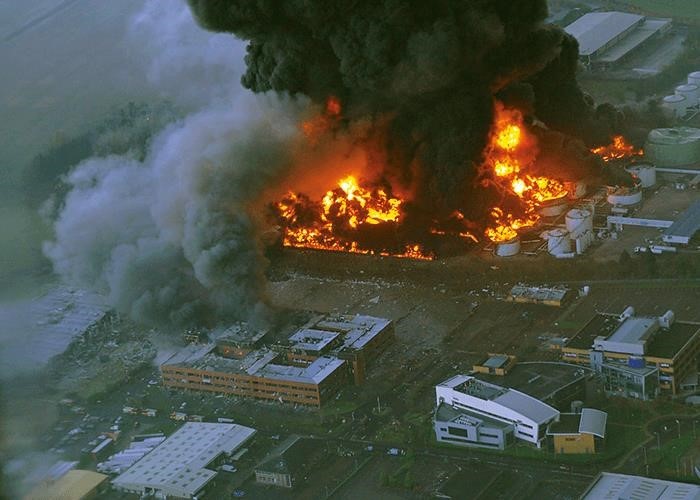
ගාළු වරායේ ටකරන් මඩුවක මහ වංචාවක්.. සෞදි සමාගමක්ද පැටලේ..

August 30th, 2018

රංජිත් විතානගේ සභාපති පාරිභෝගික අයිතීන් සුරකීමේ ජාතික ව්‍යාපාරයේ lanka C news

පාරිභෝගික අයිතීන් සුරැුකීමේ ජාතික ව්‍යාපාරය විසින් නිකුත් කර ඇති මාධ්‍ය නිවේදනයක් මෙහි දැක්වෙයි.

ගාලුවරායේ ඉදි නොවුනු නාවික යාත්‍රාඅලුත්වැඩිය කරන අංගනයේ ඇතුලු පැත්ත.

2013 මැයි මස 6 වන දින ශ්‍රී ලංකා වරාය අධිකාරිය හා සීගල්ෆ් ෂිප්යාඩ් (පුද්ගලික) සමාගම අතර ගාලු වරායේ නාවික යාත්‍රා අලුත්වැඩියා කරන අංගනයක් ස්ථාපිත කිරීම සදහා වන ගිවිසුමක් ඇති කරගන්නා ලදී. මෙම ගිවිසුමට ශ්‍රී ලංකා වරාය අධිකාරිය පාර්ශවයෙන් අත්සන් කරනු ලබන්නේ එහි හිටපු සභාපති  ප්‍රියත් බී වික්‍රම වන අතර ඊට සාක්ෂිකරු ලෙස අත්සන් කරනුයේ වර්තමානයේ වරාය අධිකාරියේ අධ්‍යක්ෂක සැළසුම් ලෙස කටයුතු කරන ඉන්ජිනේරු සුසන්ත අබේසිරිවර්ධනය. වසර 2014  පෙබරවාරි 20 වන දින පෙරවරු 10.41 ට යෙදෙන සුභ මොහොතින් අදාල නාවික යාත්‍රා අලුත්වැඩිය කරන අංගනය සදහා වන සමරු ඵලකය විවෘත කරන ලද්දේ එවකට අමාත්‍යධූර දෑරෑ රෝහිත අබේගුණවර්ධන හා නිර්මල කොතලාවල යන අමාත්‍යවරු විසින්ය. සීගල්ෆ් ෂිප්යාඩ් (පුද්ගලික) සමාගම සවුදි අරාබියට සම්බන්ධකම් කියනු ලබන සමාගමකි. එම සමාගම විසින් 2018/08/28 වන දින වන තෙක්ම ගාලුවරායෙන් එම සමාගමට ලබා දුන් ස්ථානයේ ඉදිකර ඇත්තේ ටකරන් මඩුවක් පමණි.

ගිවිසුම ප්‍රldරව අදාල සමාගම සෑම මසකම කුලී මුදලක් ශ්‍රී ලංකා වරාය අධිකාරියවෙත ගෙවිය යුතු වුවද මේ වන විට අප වෙත දැන ගැනීමට ඇති ආකාරයට සීගල්ෆ් ෂිප්යාඩ් (පුද්ගලික) සමාගම ශ්‍රී ලංකා වරාය අධිකාරියවෙත ගෙවීමට ඇති මුදල ඇමරිකානු ‌ෙඩාලර් මිලියන 75 කි.

ගාළු වරායේ ටකරන් මඩුවක මහ වංචාවක්.. සෞදි සමාගමක්ද පැටලේ..

එම මුදල ශ්‍රී ලංකා වරාය අධිකාරියවෙත ලබා ගැනීම සදහා වන කිසිදු ක්‍රියාමාර්ගයක් ශ්‍රී ලංකා වරාය අධිකාරියගෙන ඇති බවට තවම වාර්තා වී නැත. ගිවිසුමේ කොන්දේසි අනුව ගිවිසුමේ කොන්දේසි කඩකිරීමක් සම්බන්ධව 1995 අංක 11 දරණ බේරුම් කිරීමේ මධ්‍යස්ථානය වෙත යායුතු වුවද එසේ බේරුම් කිරීමේ මධ්‍යස්ථානය වෙත තවමත් ගොස් නැත.

මෙම ගිවිසුම පිටුපස සිටින්නේ ශ්‍රී ලංකා වරාය අධිකාරියේ ඉහළ තනතුරක් දeරෑ පුද්ගලයෙකු වන අචාර්යය සරත් ඔබේසේකර බවට පැහැදිලි සාක්ෂි අප වෙත ලැබී ඇත.ඔහු වර්තමානයේ වෝකර්ස් කලම්බු ඩොක්යාඩ් සමාගමේ කළමනාකාර අධ්‍යක්ෂක වරයා වන අතර ඔහු විසින් තවත් පුද්ගලයෙකු සමග ගාලු වරායට ආසන්නයේ විශාල ඉඩමක් මිලදී ගෙන ඇත. සීගල්ෆ් ෂිප්යාඩ් (පුද්ගලික) සමාගමේ කළමණාකාර අධ්‍යක්ෂකවරයා වන්නේද සරත් ඔබේසේකර වන අතර ඔහුගේ සමීපතම මිතුරා වන්නේ වර්තමානයේ වරාය අධිකාරියේ අධ්‍යක්ෂක සැළසුම් ලෙස කටයුතු කරන ඉන්ජිනේරු සුසන්ත අබේසිරිවර්ධනය.

සුසන්ත අබේසිරිවර්ධන ගාලුවරායේ නාවික නිවාඩු නිකේතනයක් සෑදීම සදහාද සැළසුම් සාදන පුද්ගලයාද වේ. අචාර්යය සරත් ඔබේසේකර ගාලුවරායේ නාවික නිවාඩු නිකේතනය සෑදීමට වන ටෙන්ඩරය පිළිබදව මාධ්‍යයට ලිපි සපයන පුද්ගලයෙක් වන අතර ඔහු පවසන්නේ ස්විස් චැලේන්ජ් ක්‍රමය යටතේ අදාල ටෙන්ඩරය කැදවා ඇති බවය. එය අමූලික බොරුවක් වන අතර ලංකාවේ වලංගු නීතියට අනුව ස්විස් චැලේන්ජ් ක්‍රමය ලංකාවේ වර්තමානයේ ක්‍රියාත්මක නොවේ.

ජනතාවගේ බෙල්ල මිරිකා බදු ලබා ගන්නා රටක රජයට අයවිය යුතු මුදල් නොසලකා කටයුතු කිරීමට එරෙහිව ජනතාව නැගී සිටිය යුතුය. ඒ වෙනුවෙන් නැගී සිටීමට අප ඉදිරිපත් වන  අතර ඉදිරියේදී මේ පිළිබදව අල්ලස් හෝ දූෂණ විමර්ශණ කොමිසම වෙත පැමිණිලි කිරීමටද අප කටයුතු සූදානම් කර ඇත.

රංජිත් විතානගේ
සභාපති
පාරිභෝගික අයිතීන් සුරකීමේ ජාතික ව්‍යාපාරයේ

2 Comments to ගාළු වරායේ ටකරන් මඩුවක මහ වංචාවක්.. සෞදි සමාගමක්ද පැටලේ..”

  1. Sarath obeyseketa says:

    All lies

  2. Sampath Perera says:

    This man Sarath Obesekera has a number of very valuable properties in UK. He had bought them using the he had made through various malpractices when he was the Chief at Ports Authority during the period of President Premadasa. He is corrupt to the core.

සීමා නිර්ණ වාර්තාව අගමැතිගේ පීල්ලට ඒකාබද්ධය පීලි පනියි

August 30th, 2018

මතුගම සෙනෙවිරුවන්

        2017 වර්ෂයේ අග භාගයේදී පැවැත්වීමට තිබූ පළාත් සභා මැතිවරණය  කල් තබා කොට්ඨාශ ක්‍රමයට පැවැත්විය යුතු යැයි යටි කූට්ටු පණතක් සම්මත කරගත් යහපාලන ආණ්ඩුව කොට්ඨාශ සීමා නිර්ණය සඳහා දහනව වන ව්‍යවස්ථා සංශෝධනය ප්‍රකාරව සීමා නිර්ණ කොමිසමක් පත් කළහ. දැන් එම කොමිසමේ වාර්තාව පළාත් සභා අමාත්‍යවරයාට භාර දී පාර්ලිමේන්තු ගත කර තිබේ. මෙම වාර්තාව පසුගිය මාර්තු 22  දින පාර්ලිමේන්තුව තුළ විවාදයට ගෙන සම්මත කර ගැනීමට තිබුණද එසේ සිදු නොවීය.2018 අගෝස්තු මාසයේ 24 වන දින පාර්ලිමේන්තුවට මෙම වාර්තාව ඉදිරපත් කරන තෙක්ම  මෙම වාර්තාව ගැන තොරතුරු ලබා ගැනීමට එය අන්තර්ජාලයේ පළ නොකළ බව සඳහන් කළ යුතුය.. මෙම වාර්තාව සකස් කිරීම පිණිස මහජන අදහස් ලබා ගැනීමට යැයි සාකච්ඡා වට මාලාවක් ලංකාව පුරා පැවැත්වුවද ඒවාට ලක්ෂ 212 ක් වැනි මුදලක් වියදම් කළද මහජන නියෝජිතයන් බහුතරයකට එයට අදහස් පළ කිරීමට හැකියාවක් නොලැබුණි.එම සාකච්ඡා වටය කලුතර දිස්ත්‍රික් ලේකම් කාර්යාලයේ පැවැත්වූ දිනයේදී ඒ බැව් කිසිම පළාත් සභා මන්ත්‍රී වරයෙකු දැන නොසිටි අතර එදින බස්නාහිර පළාත් සභාවේ අය වැය විවාදය පැවැත්වූ දිනයද වීම මතක් කළ යුතු කාරණයකි.අහම්බෙන් මෙම අවස්ථාව ගැන දැන ගැනීමට ලැබී එහි පැමිණ අදහස් පළ කළද මාගේ සාක්ෂිය ද එම වාර්තාවේ සඳහන් කර නොමැත.

          මේ සීමා නිර්ණ වාර්තාව මගින්  මා නියෝජනය කරන කලුතර දිස්ත්‍රික්කය එක් අතකින් ජාතිවාදීවද තවත් අතකින් සමාජ විකෘතියක් ඇතිවන ලෙසටද  සකස් කර ඇත. උදාහරණයක් ලෙසට මෙතෙක් බහු ආසනයක් ලෙසට තිබූ බේරුවල ආසනය තුළ සිටි සිංහල ජන සංඛ්‍යාව දෙඩන්ගොඩ නමින් යුක්ත ආසනයකට අනුයුක්ත කිරීම දැක්විය හැකිය. එවිට බේරුවල ආසනය තනි මුස්ලිම් ආසනයක් බවට පත් වේ. සමානුපාතක නියෝජනය මත සිංහල නියෝජිතයෙකු හට පත් විය හැකි නමුදු එය ජයග්‍රාහකයාගේම පක්ෂයෙන් ලැබෙන පත්වීමක් බවට පත් වේ.පළාත් පාලන මැතිවරණයේදී වැලිපැන්න කොට්ඨාශය තුළ එවැනි අවස්ථාවක් ඇති විය.

        මෙම සීමා නිර්ණ වාර්තාව අනුව පැරණි අගලවත්ත ආසනය සම්පූර්ණයෙන්ම අහෝසි වන අතර අලුතෙන් වාද්දුව නම් ආසනයක් නිර්මාණය කර ඇත. එසේම මෙතෙක් දොඩන්ගොඩ ආසනයට තිබූ තෙබුවන ග්‍රාමයද මතුගම ආසනයට කඩා දක්වා තිබේ.කලුතර දිස්ත්‍රික්කය මෙන්ම ලංකාවේ විවිධ දිස්ත්‍රික්කයන් තූළ කර ඇති විකෘති කිරීම්ද අධ්‍යනය කිරීම යෝග්‍ය වේ. මා විසින් මෙම කොමිසම වෙත ඉදිරපත් කළ යෝජනා අතර පසුගිය පළාත් පාලන සීමා නිර්ණ වලදී සිදුවූ වැරදී බෙදීම්ද ඇතුලත් විය. නිදර්ශනයක් වශයෙන් මන්නාරම මුසලි ප්‍රාදේශීය සභාව සඳහා ආසන 07 ක් ඇති කිරීමේ දී  සිදු කළ වැරදි එසේ පෙන්වා දුනිමි. රිෂාඩ් බද්යුදීන් විසින් කපා දමන ලද කල්ලාරු වනයට පවා එක් මන්ත්‍රී අසනයක් වෙන් කර තිබූ ආකාරය පෙන්වා දුනිමි.උතුරේ අවතැන් වූ සිංහලයන් වෙනුවෙන් වෙන් කළ වවුනියා දිස්ත්‍රික්කයේ බෝගස් වැව ප්‍රදේශය පළාත් පාලන සීමා නිර්ණයේදී දිස්ත්‍රික්ක දෙදකටද ප්‍රා දේශීය සභා තුනකටද කඩා වෙන් කර තිබුණි. මේ තුළින් සීමා නිර්ණ කරුවන් බලාපොරොත්තු වූයේ වවුනියා දිස්ත්‍රික්කයට සිංහල මන්ත්‍රී නියෝජනය ශූන්‍ය කිරීමටයි. විශේෂයෙන්ම ඉදිරි පාර්ලිමේන්තු මැතිවරණයකදී මෙන්ම පළාත් සභා මැතිවරණයකදී. සිංහල ජනතාව එක පොකුරුට සංවිධානය වීම මෙයින් වැලකේ.මේවා නිවැරදි කරන ලෙසට කොමිසමෙන් ඉල්ලීම් කළද ඒවා තමන්ට අයත් කාර්යයන් නොවේ යන්න ඔවුන් ගේ පිළිතුර විය.

        මෙවැනි ජාතිවාදී සමාජ විකෘතිවාදී බෙදීම් ඇති මෙම වාර්තාව සකස් කර තිබෙන්නේ කොටි ත්‍රස්තවාදීන් සඳහා අනුග්‍රහය දැක්වූ හිටුපු මිනුම්දෝරු අධිකාරිවරයෙකු වූ කේ.තවලිංගම් මහතාගේ සභාපතිත්වයෙනි. එසේම කොටි කාන්තාවන් වෙනුවෙන් ලිපි සම්පාදනය කල එන්.ජී.ඕ. ක්‍රියාකාරිණියක වූ ආචාර්ය අනිලා ඩයස් බණ්ඩාරනායකද රිෂාඩ් බද්යුදීන් ගේ උපදේශකයෙකු ව සිටි මහාචාර්ය හිස්බුල්ලා ද(ඔහු පසුගියදා මියගියේය) අනෙක් සාමාජිකයන් වෙති.ඔවුහු තමන්ගේ ස්වාමි වරුන් ගේ අරමුණ වෙනුවෙන් මෙම වාර්තාව සැකසූහ.පාර්ලිමේන්තුවට ඉදිරිපත්කර න තෙක්ම මහජනයාට මෙම වාර්තාව නිකුත් නොකරන ලද්දේ මෙම ජාතිවාදී සීම නිර්ණ සහ විකෘතිතා හෙළිදරව් වන නිසාය

        පළාත් පාලන සීමා නිර්ණයෙන් පසු පැවැත්වූ මැතිවරණයේ දී ප්‍රා දේශීය සභාවල ඇතිවූ විකෘතිතා දැන් කවුරුත් අවබෝධ කරගනෙ සිටිති. පරාජිත පක්ෂ වල නියෝජිතයන් බුරුතු පිටින් මන්ත්‍රී වරුන් බවට පත්වූ යේ  ජ.වි.පෙ. මුස්ලිම් කොන්ග්‍රසය හෙළ උරුමය සහ එ.ජා.ප.ය විසින් බලපෑම්කර සම්මත කර ගත්  සියයට හැත්තෑව සහ සියයට හතළිහේ මැතිවරණ ක්‍රමයෙනි.දැන් ඔවුන්ගේම මැදිහත් වීමෙන් සකස් කළ සියයට පණහක කේවල ක්‍රමයත් සියයට පණහක සමානුපාතික ක්‍රමයත් මගින් පළාත් සභාවන් ස්ථාපිත වුවහොත් පළාත් පාලන ආයතන වල දැනට ඇතිවී තිබෙන අර්බුදයන්ට වඩා එහා ගිය අර්බුද රැසක් නිර්මාණය වනු ඇත. එජා.ප යට දැන් තිබෙන එකම හිසරදය නම් ඉදිරි පළාත් සභා චන්දයට මුහුණ දෙන අන්දමයි.නිසැක පරාජය ඔවුන් අභිමුවේ තිබේ.එසේම දෙමළ ජාතිවාදීන් සහ මුස්ලිම් අන්තවාදීන් සතුටු කිරීමට කළ හැකි තවත් දේද ඉතිරිව තිබේ. එම තත්ත්වය තුළ රජය විසින් සිය අනුග්‍රහයෙන්ම සකස් කළ සීමා නිර්ණ වාර්තාවට විරෝධතාවයක් ගොනු කරනු ලබන්නේ මාස පහකට ආසන්න කාලයක සිටයි.කොට්ඨාශ ක්‍රමය වෙනුවට පෙර පැවති සමානුපාතික ක්‍රමයට මෙම මැතිවරණය පැවැත්වීම හොඳයයි සමාජමය මතයක් ඇති කිරීම එයින් එකකි. එසේම චන්දය කල් දමමින් ජනතා විරෝධය යටපත් කරමින් එකම දිනක පළාත් සභා මැතිවරණය පැවැත්වීමට අවශ්‍ය කල් මැරීමද මෙහි තිබේ.මෙම උගුලට ඒකාබද්ද විපක්ෂය පැහැදිලිවම අසුවී ඇත. ඔවුහු රජය සමග එකතුව සිමා නිර්ණ වාර්තවට විරුද්ධව චන්දය ලබා දුන්හ. නමුත් මාස පහක් ගත වීත් මෙම වාර්තාව විශ්ලේෂණය කොට කල එකදු මාධ්‍ය සකච්ඡාවක් හෝ රැස්වීමක්ද නොවීය. එයින් පැහැදිලි වන්නේ ඔවුහු සියල්ල අග්‍රාමාත්‍ය රනිල් වික්‍රමසිංහ මහතා උගුලකට අසුවී ඇති බවය. මන්ද අමාත්‍ය මහින්ද සමරසිංහ මහතාද මැතිවරණ කොමසාරිස් මහින්ද දේශප්‍රිය අතින්ද මේ ගැන ඉඟියක් පළවූ බැවිනි. එනම් අගමැති ගේ මූලිකත්වයෙන් පත්කරන ලද කමිටුවකින් මෙම වාර්තාව නැවත සමාලෝචනය කොට සම්මත කළ හැති බවයි.අගෝස්තු 28 වන දින කතානායක වරයා විසින් එම කමිටුව පත් කොට අවසන් කර තිබේ. එහි සාමාජිකයන් ලෙසට අගමැතිවරයා අර්.එම්.ඒ.එල්. රත්නායක පෙරියසාමි මුතුලිංගම් මහාචාර්ය බාලසුන්දරම් පිල්ලේ සහ ආචාර්ය ඒ.එස්.එම්. නවුෆල් යන මහත්වරුන් පත් කර ඇත. ඒ අතර මුස්ලිම් කොන්ග්‍රසයේ නායක රවුෆ් හකීම් සීමා නිර්ණය තුළ තම ප්‍ර දේශ වලට බහු ආසන ගණනාවක් අවශ්‍ය බව පසුගියදා ප්‍රකාශ කලේය. දැන් බළලා මල්ලනේ එළියට පැමිණ ඇත.නව කමිටුවට ඇතුලත් වන බහුතරය සිංහලයන් නොව දෙමළ හා මුස්ලිම් පුද්ගලයන්ය. එවිට ඉදිරියේදී සිදු වන්නේ මෙම වාර්තාව අගමැතිට අවශ්‍ය වන ආකාරයට ජාතිවාදීන් ගේ ඉල්ලීම අනුව සංශෝධනය කොට සම්මත කර ගැනීමයි. ඒකාබද්ධය පීලි පනින විට අගමැතිවරයා සිය ඉලක්කයන් අනුව ඊනියා යහපාලන කෝච්චිය ඉදිරියට ගෙනයමින් තිබේ.ජනතාව මේ කෝච්චිය ට බෙල්ල තබනවාද නැතිනම් පෙරලනවාද යන්න ඉතා ඉක්මනින් තීරණය කළ යුතුය.

මතුගම සෙනෙවිරුවන්

MMDA need to be implemented with or without ACJU – A REJOINDER

August 30th, 2018

Dr.Reffai Sri Lankan Association of Muslim Women & Girls

Assalamu alaikum.

I am shocked by this scathing attack on one of the oldest leading organisation of the community – namely ACJU. This article  has nothing to do with MMDA rather a vitriolic run down on ACJU.

Before responding to the accusations, though I am not a member of ACJU, I would like to ask the erudite writer where in the world  did he get this notion that “MMDA  ….. is misused/misapplied  by ulemas  to make girls victims as they are given in ‘marriage’ easily to fun-seeking  foreign ( mostly from the Gulf) men mulch older and, in some cases  married to many others back in their  countries.”  – as  much as I am familiar with the grass root level girls and  women, I have not come across a single case where any  ulema did anything of the sort. I would expect the writer to give  actual details of such cases if there are any.  Or else he is committing a grave slander against the ulemas of this country.

That being said, yes it is true ACJU is far from a perfect organisation of theologians but  it is unfair to expect it to be, since we are in a country which has various  aqeeda and anyone passing out from any madrasa, not only from  Srilanka but from  any country,  can become a member of ACJU – so it is anything but homogeneous – as it will consist of ulemas with a variety of views on any matter and usually the view of the head of the ACJU prevails or is presented.

However, the Srilankan Muslim community has no proper leadership. Politicians have miserably failed to give leadership and even organisations such as MCSL and NSC are sorely lacking in leadership due to various reasons mainly due to a lackadaisical attitude and lack of perseverance in any matter. Obviously knee jerk reactions, that too, very delayed at times, only when some problems crop up and then going into slumber back again, is not a sign of leadership.

In this back drop the only semblance of leadership we have is from the ACJU. It does have many strengths,  and is performing many meritorious acts, which I suggest Mr. Latheef to inquire from the head of ACJU and find out.  Meanwhile on matters which need absolute thorough knowledge of theology – a he calls it – which means really a knowledge of Quran and Sunna – when it comes to the MMDA,  if we are to call on every Jill, Jane and Mary to come forward to give verdicts (sic. fathwas), we certainly will be doomed.

MMDA matters are not simple matters like road traffic rules to change as and when we fancy. These will have long lasting impact on the society specially the female sector. They have to be changed, if at all,  having studied the problems properly and knowing the reality in today’s context and having the Quran and sunna as the back drop. I spoke to one of the spokes –  person in the ladies group which had a press conference regarding this matter and when asked how many  children she knows who are married younger than 18, she said  very  few but when asked how many she knows who were married at an older age and are miserable, she said many many. She did accept the fact that we have no records of any figures of the number of child marriages or how they are fairing.

Pray, I’D LIKE TO KNOW, what  the writer implies by ” If Muslim women’s views are not respected and required changes to MMDA are not made they (Women) too are likely to show their displeasure at the next polls and, as the trend goes they cannot be dictated even by their husbands about how they will vote.” – What in the world has the voting   to do with change to MMDA? WHEN DID THE HUSBANDS DICTATE  THE WIVES HOW TO VOTE? And if they did, is it a good thing we should preserve? Confusing.

What we need  is really not a total change just because some feel so. We must remember the maxim ” It is important to change when it is important to change and it is important not to change, when it is important not to change.”

First of all, what we need to do is a proper study on the situation at present; number of child marriages actually  taking place, and how they have fared in the past, what is the number of divorces among Muslims relating to marriage ages, the despicable situation of the qazis, the number of polygamy taking place and why etc. etc. With these hard facts in hand we can decide whether we do need a change or not.

More than anything, what we need to do most is to continuously educate the public specially the men, who will be the fathers and husbands of the girls, on the importance of  giving the rights of the women in their families,  as well as fulfilling their obligations according to shariah laws in order to please Allah. This can be done only  through ACJU – just castigating them and shunning them will only aggravate the situation.

On Wed, Aug 29, 2018 at 7:19 AM, Latheef Farook <almfarook19@gmail.com> wrote:

Dr.Reffai 

Almuslimaath

Sri Lankan Association of Muslim Women & Girls

YAHAPALANA AS A WAKE UP CALL Part 3B

August 30th, 2018

KAMALIKA PIERIS

The phosphate deposit at Eppawala  was discovered  in 1971 during a survey conducted by the Department of Geological Survey. It was given to a DDC for its exploration in 1974, and was later taken over by Lanka Phosphate Ltd,  (LPL) a company fully owned by the GOSL. Eppawala contains 60,000,000 metric tons of phosphates within 4 square kilometres..

In 1992 it was decided to call for proposals for the manufacture of phosphate fertilizer using Eppawala. In view of the chemical composition of this rock, such as high chlorides and high oxides of iron and aluminum causing serious corrosion of plant and equipment, as well as a reduction in filtration rate, foreign collaboration had to be sought to get over the these technological difficulties and  use this deposit for the manufacture of fertilizer for export,” said Industrial Development Minister C.V. Gooneratne.

Six proposals were received by the government in 1994 but only one, Freeport MacMoran was selected.   Reason give was that only Freeport McMoran had the required technology to process the Eppawala apatite deposit. They are also one of the leading phosphate fertilizer firms in the world

Initial discussions on the proposed project were held with Freeport MacMoran Resource Partners of USA and their agents here between 1994 and 1996. The first round of negotiations was in March 1994 under the UNP government. The second was in March 1995 and the third in December 1996.

On the conclusion of negotiations Freeport MacMoran made representations to the President saying they could not agree with some of the conditions and also ‘the language used.’ These included the Income Tax Act and the Environmental Acts. President Chandrika Kumaratunga  had then directed officials to conduct a “final round of negotiations and clear all outstanding issues along with the tests of the agreement” following a request made by McMoran.

Even the Attorney General has pointed out that this type of intervention could seriously obstruct a fair negotiating process, and is an indirect way of binding the Negotiating Team to agree to the final terms and conditions laid down by foreign companies, however disadvantageous and unfavorable they are to the people of Sri Lanka, observed Batty Weerakoon, in 2000.

A committee comprising, B. C. Perera, Secretary to the Treasury, Sarath N. Silva, attorney general, K. Austin Perera, Secretary Ministry of Industrial Development, Thilan Wijesinghe, Chairman/Director-General BOI, and Vincent Panditha, Senior Advisor, BOI and Consultant Ministry of Industrial Development  was appointed to conduct a final round of negotiations. That round of negotiations was conducted between July and August 1997, and thereafter the Agreement was initiated by the  Secretary/Ministry of Industrial Development and representatives of Freeport MacMoran.

The B.C.Perera Committee’s final round of negotiations in furtherance of the Tender ended in August 1997. The Report tendered after this round  is titled, “Report of the Negotiating Committee on the Joint-Venture Agreement with M/s Freeport McMoRan Resource Partners of USA for the manufacture of rock phosphate fertilizer for export utilizing the rock phosphate deposit at Eppawala.” The Report says that in this final round of the Negotiating Committee the drafts of the Mineral Investment Agreement and the subsidiary Agreements were agreed upon and initialled by S/Ministry of Industrial Development and representatives from Freeport McMoRan Resource Partners and IMC Agrico.

However,  Freeport McMoran is not the joint-partner in the Eppawala project, noted Batty Weerakoon, it is IMC-Agrico. Free-Port McMoran Resource Partners Ltd., had transferred all their phosphate fertilizer businesses, including the mining and sale of phosphate chemicals, to IMC-Agrico, in 1993. IMC Agrico , though a company in its own right, is no more than a front for the operations of McMoran, said Weerakoon. This meant that the successful tenderer. McMoran, had substituted another as the joint venture partner. McMoran makes the Agreement but a dummy signs it.

Sri Lanka had agreed to a 30 year deal worth $425mn  ,the Eppawala phosphate mining and Trincomalee fertiliser production joint venture” for exporting Di-Ammonium Phosphate manufactured in Sri Lanka using Eppawala rock phosphate,  a Mineral Investment Agreement was signed with    IMC Agrico and Tomen Corporation  , signing for Freeport MacMoran. Under the deal, IMC and Tomen will respectively control 65 and 25 percent of equity in the joint venture, with the balance, ten percent, going  to state-run Lanka Phosphate Ltd. Tomen is a Japanese construction company.

IMC and Tomen would  will be allowed to mine and export up to 3.6 mn metric tons of phosphate — in rock form — for the first 12 years, after 18-months and 15-months of exploration and feasibility study. Experts observed that the investors would get enough profits on rock export sales to repay bank loans and recover the bulk of their outlay. The government would be paid 5.5 percent of the phosphate’s estimated market value. The fertiliser will also be sold domestically at a reduced price of five percent off FOB.

The deal also allowed the foreign firms to explore over an area of 56km sq, and scour a buffer zone” extending to 10 kms from the Eppawala deposit boundary. This  so-called ‘buffer zone’ equals a surface area of at least 750km sq, observed critics.  The foreign investors have asked for and have been given a buffer zone of ten kilometres in radius around Eppawala. That works out to more than 700 square kilometres. This is really madness. This company is not prospecting in unexplored territory.

The government also gave the foreign partners in this joint venture a package of concessions. Among other adjusted concessions, the BOI has waived the normal 20-year tax holiday for investors, replacing it with a five percent corporate income tax that will increase to 15 percent after 12 years of operations. There is also  a clause which stipulates that a larger quantity of rock could be exported with the express authority of the Secretary to the Ministry of Industrial Development.

The agreement also called for the construction of a processing plant and deep water dock at Trincomalee, to be linked to Eppawala via a specially-built railway line. After the plant is built in an estimated three years on 450 acres of land, with an extra 300 acres of beach front kept in reserve, it will produce up to 600,000 metric tons of hi-grade Di-Ammonium Phosphate .

The government justified the project on the grounds that the country lacks the know-how, the capital, and machinery to tap into this motherlode on its own and undertake such a high-risk industry as large-scale mining,

Certainly Sri Lanka lacks the technology to exploit the Eppawala deposit by itself and make money from it, said the  experts.  Foreign investment is necessary. But the government failed to maximize on  the deal . The government has played a weak hand in the deal. . The government has virtually dealt IMC and Tomen a monopoly over Sri Lanka’s important phosphate reserves, locking out other potential foreign investors. Eppawala is a relatively low-risk venture, the government should have pressed for at least 20 percent free equity to LPL.

Australian mining industry consultant, Richard Tinsley had       told the Cabinet-Appointed Negotiating Committee to insist on LPL being paid $12.5mn for the 25mn metric tons of confirmed reserves.  In the case of rock exports during the first twelve years of running, he has advised that profits from sales abroad be split 50-50. This would have guaranteed Sri Lanka an extra $13mn in revenue.

Tinsley had also  recommended that during the first decade of operations, two percent of profits from sales should also be placed in a trust fund to compensate those who may have to be uprooted, and to guard against possible environmental degradation.The investors did not agree to this and are only giving a $500,000 bond for the first ten years.

Batty Weerakoon writing in 2000 said the contract was against the law. The Mines and Minerals Act No. 33 of 1992 law does not permit such a contract. There is provision only for a mining licence.  Therefore, McMoran  was to operate on the license issued to Lanka Phosphate Ltd. Lanka Phosphate would transfer its license for exploration and mining to a  “Project Company” known, ironically, as Sarabumi. Mining Area” was loosely defined  as the land within the exploration area which is covered by the mining licenses issued to the company by the Geological Survey and Mines Bureau.” .

B.C. Perera Report said “A serious attempt was made to get the two foreign investors to also sign the MIA [Mineral Investment Agreement]. However they did not agree and stated that they have followed the present pattern everywhere. The Project Company which will be a signatory to the Agreement will represent them”. Certainly the Project Company will represent them, said Weerakoon, but they are not liable under the Agreement.

Weerakoon pointed out that only the locally incorporated Sarabumi will  be held liable on the Agreement. For the damage that is possible as resulting from the mining operations. McMoran and IMC Agrico will not be liable. By the time the question of damaged environment comes up ,the foreign shareholders would have cleared out of the scene .

This Agreement   had to get round  the law in other sectors too. That has to be done unnoticed by the law and the law makers. To amend the law to accommodate McMoran would be  scandalous, observed Weerakoon.  Regulations which are not legal have been smuggled in to accommodate this contract. One such regulation, said “Special negotiations in the form of an Investment Agreement may be conducted by the Secretary with any private sector proponent or participant with regard to the terms and conditions of and supplementary rights and obligations under such agreement.”

There is no provision in the law for the Secretary to the Ministry of Industrial Development to enter into such an Agreement, either observed Weerakoon.  The preamble to the draft Investment Agreement states that the Secretary to the Ministry of Industrial Development enters into the Agreement representing the Government of the Republic of Sri Lanka  on the orders of the Cabinet, by virtue of the powers vested in them by the Constitution of Sri Lanka.”

This purported authority, issuing from the Regulations is meant to give to the Investment Agreement a spurious legality for the purpose of protection under the Investment Treaty. However, once an Agreement of this nature is made and signed by a Government under its own Regulations,  it cannot, according to Clause 157 of the constitution, be disowned in court, said Weerakoon.

Anil Amarasekera  drew attention to alleged human rights abuses committed by Freeport-McMoran at its gold and silver mining operations in the Indonesian-occupied West Papua (Irian Jaya). Freeport is accused of having a hand in mass-disappearances, torture, and murder  in Irian Jaya  when in 1965 Suharto took power . Freeport stayed  on for 30  years, with USA support. The events in Sri Lanka are a carbon copy of what happened in Indonesia, Freeport may have a similar sinister motive here too, coming behind a  front” company, IMC Agrico ,said Amarasekera.

Scientists strongly objected to the Agreement. In May 1998, the President of the National Academy of Sciences Prof. V. K. Samaranayake wrote to the President  saying the “project in its present form was premature as the vital data relating to the actual size and quality of the mineral deposit have not been adequately surveyed and established”.

In July 1999, a committee of 12 scientists of the National Science Foundation submitted a report drawing attention to the fact that the proposal of the U.S. Mining Company was highly disadvantageous to Sri Lanka, with highly adverse impacts on the environment  and pointed out ways of exploring the resource with long lasting benefits to the country.

The scientists declared that there were serious economic and social implications in the Agreement. McMoran was getting the exclusive privilege to export 13.6 million tonnes of raw rock phosphate during the first 8 years earning around 400 million dollars by paying only 5% of the earnings to the Sri Lanka Government. This was supposed to be for the “financial comfort “of the company The FOB value of 21.6 million tonnes mined over a 30 year period amounts to $ 673 million, but the direct income to Sri Lanka is a meager $107 million.  The established full deposit will be depleted in 25 years. Mining in 56 square kilometres will displace a large number of villagers from their traditional areas.

The National Academy of Sciences in their recommendations to the Government  said a complete geological survey is necessary. They also  recommended the manufacture of single superphosphate as a fertilizer to satisfy the local requirement,  not fertilizers such as ammonium phosphates. Peradeniya scientists have shown that using home-grown technology Eppawala apatite crystals can be made soluble. And the deposit used to supply the agricultural needs of the country.

Eppawala is not a big deposit  by world standards , but for the use as fertilizer raw material for the farmers of Sri Lanka, it is a resource which should be managed with great care and utilized wisely, the possession of a strategic mineral deposit like Eppawala requires wise resource management taking into account the long-term interests of the nation.

Environmental conservationists warned that the project will bring environmental and infrastructural degradation to Zone-H of the  Mahaveli Development Scheme. If mining takes place as proposed, up to a depth of about 100 meters, within 20 years, it is most likely that this area will become uninhabitable,” says the Environmental Foundation Ltd. Due to the possibility of irrigation and other water resources getting affected, people of this area will face a problem regarding their daily requirements of water, both for drinking and other purposes.”

Eppawala residents also spoke up.  They feared that due to the project, around  12,000 families in the area would be forced off their land and re-settled elsewhere,.We will not go. We will not leave from our village lands and homes even if we were to be forcibly chased out,” says Venerable Mahamankadawala Sri Piyaratana Thera, the North-central Province’s Deputy Sanghanayaka, and President of the Committee for the Protection of Phosphate Deposits at Eppawala.

The public went to courts against the project. An FR application was made In October 1999. seven petitions alleging infringement of fundamental rights guaranteed by Articles 12 (1); 14 (1) (g) and 14 (1) (h) were filed in the Supreme Court against the Eppawala project. They were made by seven persons of Eppawala including the Ven. Mahamankadawala Piyaratana Thera of Galkanda Purana Viharaya, Eppawala, and had the Secretary, Ministry of Industrial Development, Sarabhumi Resources (Pvt) Ltd, Geo-Resources Lanka (Pvt) Ltd. and the Attorney General among the eight respondents.

The case was against a most disastrous agreement the GOSL was to have formally entered into with a foreign company and/thro its agents in SL for the exploration etc of the mineral phosphate deposits at Eppawala, said Haris de Silva.

The petitions cited as Bulamkulame and Others v. Secretary Ministry of Industrial Development and Others (Eppawala Case) SC (FR) Application No. 884/99 was heard in the Supreme Court by a panel of three judges: Amerasinghe J., Wadugodapitiya J., and Gunasekera J.

After a lengthy trial the judgment was delivered on 2nd June 2000 by Justice A. R. B. Amerasinghe, with Justices Wadugodapitiya and Gunasekera agreeing. Immediately after the delivery of the judgment it was hailed, both locally and abroad, as a landmark judgment in the area of fundamental rights.

Following is the Order given by the Court on March and April 2000:”For the reasons set out in my judgment, I declare that an imminent infringement of the fundamental rights of the petitioners guaranteed by Articles 12 (1), 14 (1) (g) and 14 (1) (h) has been established.”There is no assurance of infallibility in what may be done; but in the national interest, every effort ought to be made to minimize guesswork and reduce margins of error. Having regard to the evidence advanced and the submissions of learned counsel for the petitioners and respondents, in terms of Article 126 (4) of the Constitution, I direct the respondents to desist from entering into any contract relating to the Eppawala phosphate deposit up to the time,”(1) a comprehensive exploration and study relating to the (a) locations, (b) quantity, moving inferred reserves into the proven category, and (c) the quality of apatite and other phosphate minerals in Sri Lanka is made by the third respondent, the Geological Survey and Mines Bureau, in consultation with The National Academy of Sciences of Sri Lanka and the National Science Foundation, and the results of such exploration and study are published and”(2) any project proponent whatsoever obtains the approval of the Central Environmental Authority according to law, including the decision of the superior Courts of record of Sri Lanka (Amerasinghe. J) This is  SC case 884/99 (FR) dated 2nd June 2000]

In 2005 a second attempt was made to get at the Eppawala deposit. Public Enterprise Reform Commission (PERC)  called for expression of interest from foreign or local agencies for the development of the Eppawala phosphate deposit on a public/private partnership basis, it commences the second attempt to dispossess this natural resource belonging to the people of Sri Lanka, observed Haris de Silva.

Haris de Silva in 2005 drew attention to the Supreme Court judgment. The very detailed judgment of the learned judge clearly shows the devious ways thro which the GOSL was trying to maneuver its way to award the contract to Freeport MacMoran for the supposed economic benefits to the Sri Lankan people, when in fact it would have ruined not only the present generation living in that area, but would cause the degradation and destruction of an entire ecosystem centered in and around Anuradhapura. In fact, the judge did not mince his words when he said ‘in my view the proposed agreement seems to circumvent the laws and in its implementation is biased in favor of the company as against the members of the public

The analysis by the judge of the various clauses in the agreement, the very inept submissions made to court by the counsel for the respondents, the uninformed statements made by the S/Ministry of Industrial Development, all in their attempt get the agreement accepted as it was,  show for whose interests the government officials were working so hard.

If the contract was awarded on the basis of that agreement, the resultant activity would have devastated Eppawala and its environs, destroying part of Jaya Ganga. But those were not to be the considerations of the government officials who were privy to the project proposal. One would not fail to see that their interests were with the private contractors and not with the present or future generations of Sri Lankans, continued Haris de Silva.

Finally, it may be asked what the necessity is to bring in foreign participation to this project, when it has been so clearly shown by our scientists of no mean repute that the resource can be most effectively managed by our own expertise to benefit the country for well around a millennium or more years. The duty of any government is to work for the public good of the country and not for private gain, concluded Haris de Silva.

The present day Yahapalana government, which is notoriously  pro America, has announced in June  2018 that it  planned to use the  Eppawala rock phosphate deposit to produce Single Super Phosphate  the initial cost , estimated to be Rs. 2 billion, would  be borne by the government, Minister for Agriculture Mahinda Amaraweera  had appointed a  committee  headed by Prof. O.A. Illeperuma of Peradeniya University to  comment on the feasibility of the project. The report was favorable

Neville Ladduwahetty, sees the implications. He has used the media to draw attention to the earlier judgment. Justice Amerasinghe’s judgment stipulated conditions that must be followed before entering into any contractual agreement on this matter, Ladduwahetty said.

Justice Amerasinghe said, I direct the respondents to desist from entering into any contract relating to the Eppawala phosphate deposit up to the time (1) a comprehensive exploration and study relating to the (a) locations, (b) quantity, moving inferred reserves into the proven category, and (c) quality of apatite and other phosphate minerals in Sri Lanka is made by the third respondent, the Geological Survey and Mines Bureau, in consultation with The National Academy of Science of Sri Lanka and the National Science Foundation, and the results of such exploration and study are published, and (2) any project proponent whomsoever obtains the approval of the Central Environmental Authority according to law, including the decisions of the superior Courts of record of Sri Lanka.”

Ladduwahetty added, It is to be noted, that any environmental inquiry has also now to take cognizance and comply with Principle 17 of the Rio de Janeiro Declaration, vide principles 6 and 7 of Stockholm and principle 15 of Rio, as stated in the judgment. Thus, it is obligatory for PERC, as the present GOSL agency handling the subject, to comply with the directives of the Supreme Court. It would also be prudent for them to inform the public, to establish transparency, as to what their modus operandi is in this instance.

They, and the GOSL, should also bear in mind that they are not the owners of the Eppawala or any other phosphate deposit in the island, but are only administrators of such resources for the time being, and all natural resources in the island belong to the people of Sri Lanka, as so ably and effectively stated in the SC judgment,

The judgment of Justice Amerasinghe, as well as the reports and representations made to the President, the number of books and monographs published on the subject, and the numerous articles that appeared in the media showing the irreparable damage that would be caused to the environment etc. by the proposed project must surely be available to the President and to the members of the PERC. They cannot be swept under the carpet, ignored and forgotten, concluded Ladduwahetty.

Prof. O. A. Illeperuma of the Peradeniya University who headed the technical committee responded. Recent decision of the Minister of Agriculture has prompted reader Neville Ladduwahetty to point out the legal ramifications arising from the Supreme Court decision on Eppawala apatite he said. The expert committee which drafted the current report was fully aware of the legal aspects which have to be considered, Illeperuma said.

This Supreme Court decision arose due to six villagers challenging the handing over of the Eppawala deposit to the McMoran Company for a song, which would have completely wiped off this deposit from Eppawala in 25 years. However, this kind of law, stifling further action is not the way to go. If there are legal obstacles LPL can petition the Supreme Court again and I am sure that in light of the earlier decision, the Supreme Court will give a favorable decision.

For the Government to “go ahead with exploitation of (the) Eppawala rock phosphate deposit” it could only mean that the Government is confident that it has fulfilled the conditions imposed by the Order of the Supreme Court. The Government has to be absolutely sure that it has met all obligations set out in the Court Order if serious consequences are to be avoided. otherwise, it would mean that the Government is not only in violation of the Order imposed by the Supreme Court, but is also in violation of the fundamental rights of the petitioners who petitioned the Court.

The BC Perera committee included none with background knowledge on this deposit, or the scientists who have toiled hard for over two decades and showed that this deposit can be developed in Sri Lanka with our own experience. Although there was a committee of subject experts which recommended that the proposed project is detrimental to the country, and that we should go for a single superphosphate plant to satisfy the needs of Sri Lankan farmers, their report was conveniently sent to the waste paper basket.

The negotiating team never considered the manufacture of single superphosphate, which at that time could have been produced at $40 a tonne while the manufacture of ammonium phosphate would have cost $232 a tonne. The negotiating team members probably did not know the difference between these two fertilizers.

In 2007, when Lanka Phosphate Ltd. (LPL) planned to commence a single superphosphate plant, due consideration was given to all these aspects and there were no objections to the proposed project from anyone, including the villagers involved in the Supreme Court case. At a meeting this writer had with Mahagalkadawala Piyaratana Thero, popularly known as Eppawala hamuduruwo, along with Prof. Chandana Udawatte, Chairman, Lanka Phosphate limited, Piyaratana thero gave blessings for the proposed project after learning all facts.

Attorney General has also  informed LPL that as per Supreme Court decision, the deposit can be used for value addition as long as LPL does the mining and satisfies all environmental regulations. Then the authorities abruptly removed the Chairman of LPL who has a Ph.D. in Eppawala apatite and was the one who initiated the project. The only logical explanation is that some politician who wanted to rake in a substantial amount of money by selling the deposit to a foreign company, wanted the Chairman removed.

The process of making single superphosphate is technologically simple and involves simple mixing of the powdered rock with sulphuric acid. From 2001-2005, LPL made nearly 20 tons of it and tested the product in all agricultural areas of the country. The results were extremely encouraging with our product giving better yields compared to imported phosphate fertilizer. This is because our product had sulphur, another essential nutrient for plant growth.

This conclusively established that we can prepare good quality fertilizer from our deposit and also that it is suitable to substitute imported fertilizer. It also rubbished the myth that we cannot make fertilizer out of our deposit because of various impurities such as chlorine, iron and aluminium, and only a giant such as McMoran has the necessary technology to make phosphate fertilizers from our Eppawala ore. To satisfy the current requirement of phosphate fertilizers, it is necessary to produce about 200,000 tons of single superphosphate per annum, requiring about 125,000 tonnes of rock phosphate. At this rate the deposit could last for 480 years.

The cost of constructing a factory to produce this fertilizer in Sri Lanka is estimated to be around Rs. 1400 million, and this is only a small fraction of the Rs. 5 billion which the Government spends now on the fertilizer subsidy. The pay-back period of this project is estimated to be 2.5 years and hence a highly profitable venture.

So now with the action of the current Minister of Agriculture, Mahinda Amaraweera, it gives a ray of hope for the long failed operation to produce phosphate fertilizers in Sri Lanka, concluded Illeperuma. (concluded)

Patriotic SLFPers  and UNPers, unite behind Pohottuwa! Away from ‘Politics as Usual’ & a practical alternative to Old UNP and Old SLFP

August 28th, 2018

Ratanapala

28 Aug 2018

Under Yahapalanaya, country has gone to dogs literally and metaphorically! All what has happened to our Motherland since the coming to power of this traitorous administration is all around us to see. After three and a half years they still keep promising new things, new projects all very ethereal and not real. There is no law and order, there is no governance, there is no justice. Even the Sky Gods are angry and all what one can see is utter devastation all over Sri Lanka year after year. All what we see is clearly the opposite of ‘good governance’ – a Jadapalanaya.

What happened to Saadharana Samajayak ?

In 2015 people went chasing a mirage called Saadharana Samajayak – a Just Society and we know where we have ended up today. Even as they were speaking of a Yahapalana Administration – A Good Governance Administration, those at the very top were planning and laying the foundations of how to rob the Central Bank and thereby rob the entire nation. For a start it is obvious that the those who were behind Regime Change in Jan 2015, were planning to destroy and pauperize Sri Lanka. The facts and prima facie evidence before us show that the foundations of stealing the Central Bank and thereby improvising the nation were laid out, and were all there, and well before Maithree Palanayak came into effect. It is now quite apparent that Maithripala Sirisena was just the cat’s paw the UNP stalwarts used so cunningly to bring about this change. He is just Karapincha now – just biding his time, not knowing whether he is coming or going – just a big bag of bad wind!

Who is responsible for the Central Bank Bond Scam and other?

This is only a miniscule of what happened thereafter. First was the direct loss, and then the repercussions of the scam. This is akin to dropping the ‘atom bomb’ and then the ‘fall out’. It is like those who suffer from Radiation Sickness and die months and years after the first bomb drop, though not injured by the first blast! The fall out from the Bond Scam paved way to increased interest rates, depreciation of the Rupee, ballooning of foreign loans and increased taxes to the entire nation and many more.

They continue to rob through Coal Tender, BMW purchases, Rice purchases after destroying the local farmers by denying their fertilizer subsidies only to name a few.

If someone, makes all the ground work for a robbery – taking the Central Bank under one’s supervision and administration, then find suitable persons to carryout the robbery – Arjun Mahendran knowing his son-in-law is a primary dealer  gives necessary instructions – change the mode of bidding from Direct Placement to Auction, change the requisite bond amount, use government’s own funds – Employees Provident Fund and Bank of Ceylon among others to facilitate the bond transactions with deleterious consequences to those funds, then certainly that someone should be the Chief Robber, culprit and the mastermind. Then why is Ranil Wickramasinghe still not indicted of a financial fraud and a crime against the nation. Are the funds thus compromised and diminished in value, public property? Isn’t defrauding public funds an unbailable offence?

National Security – Food Security – Cultural Security?

There is no progress, nor food security nor security for the person. Year on year elections are delayed, but they still talk of democracy. Relentless attack on Buddhism continues unabated with dozens of Buddhist priests behind bars on frivolous charges. However, the mastermind of the Central Band Bond Scam continues to be the Prime Minister of Sri Lanka. In any other self respecting nation, the Prime Minister would have voluntarily resigned even if not personally implicated. j

The Sri Lankan electorate must be realistic. There is no point in asking for the moon, we must be pragmatic and go for attainable goals here and now for the general welfare of the Sri Lankan people.  People of Sri Lanka should not be taking chances just in the way they stumbled in the dark and took a leap of faith in electing Sirisena. Electing a President should not be a gamble. It should be a well thought out and deliberate action. The educated, the clergy must help the nation in guiding the nation in the right direction and educating the masses on real politics not wishful thinking!

Democracy, Human Rights of Western Christian nations

Practically we must go for the least offensive political grouping who has a good chance of winning at the elections. There is no point in broad brushing all as ‘no good’ and trying to achieve the unattainable utopia advocated by crooked Yahapalana advocates, Western Powers and the NGO hordes both local and foreign. There is no country in the world where a Just Society could be found. There is no country in the world where there is Good Governance. Everywhere in the world there is corruption and they vary only in degree. The fact that the western world is crying about one percent owning the 99% is just the indication of the level of corruption and the influence peddling one finds in these countries.

We saw what happened in electing JR Jayawardene who promised a Dharmista Samajayak only to end up with capitulating to India, making Sri Lanka literally a vassal state of India  and a 30 year war – the longest war in the 20th Century!

The war crimes committed by the western countries pales into insignificance any that has been carried out by the security forces of Sri Lanka. Is there any country in the world that can rival the feats of our Armed Forces in how they carried out a humanitarian exercise that rescued over 300,000 civilians kept as human shields by the terrorist LTTE? Has anybody taken trouble to see how the victorious US treated those who were affected by the nuclear bombs on Hiroshima and Nagasaki. US doctors and other scientists came to inspect,  and observe those affected only to see the effects of radiation affected innocents and not to treat them. These are well documented. Previous to the bombing they meticulously photographed and documented these cities so that they can thereafter calculate accurately the ‘kill capacity’ of the bombs. These two cities were kept out of conventional bombing just for this purpose! The kind of thinking and morality these nations ascribed to do not equate well with what they advocate to other lesser nations as sacrosanct!

Pohottuwa – a practical alternative to Old UNP and Old SLFP

It is essential that the Sri Lanka needs a new political grouping. For me this grouping is Pohottuwa with Gotabhaya as the candidate for President with the blessings of Mahinda the former President.

Both the SLFP and the UNP are now beyond their ‘use by date’ and must be allowed to wither and die their natural death. When one looks at the parliamentarians in these two parties it is obvious to see, they have maneuvered themselves into their current positions of power only for personal gain and in doing so for the detriment of the country’s economy, security and its cultural degradation. They cared little other than to enrich themselves and their families and friends alone. Today they have painted themselves into a corner from which they cannot come out without getting soiled!

Sri Lanka is in the current plight since Independence and even before due to its weak and suicidal involvement in minority politics. Ever since the bifurcation of the Sinhala polity as a result of SWRD Bandaranaike breaking away from the UNP the country has been at the mercy of Racist Tamils and now since recently at the hands of the economically powerful fundamentalist Islamists. If this type of politics is to continue and it is going to be ‘politics as usual’ in the future too there is no light at the end of the tunnel for Sri Lanka and not definitely for the Sinhala majority who have tried their best to live and let live trying to accommodate minority wishes, demands and aspirations. For them what remains is only political hara-kiri if they are to give away what continues to be demanded. For the minorities is just as Separatist S J V Chevanayakam use to say – Little now, more later”. It is not difficult to see where these aspirations are leading the country to – they are definitely going towards total domination by Racist Tamils leading to balkanizing of Sri Lanka. This will eventuate in the North still feeding on the balance of Sri Lanka as their cash cow. Just let us say Sri Lanka gives way to Eelam and now there are two countries Eelam and Sri Lanka or what is left of it? Will there be peace thereafter? Only result will be an over 300 km border which is undefined, that bifurcates existing villages, divide waterways and other common resources and political affiliations. This will open up a hitherto non existing problems that will lead to open warfare.

What the Islamists are planning is even more sinister.  They are planning to take full control of Sri Lanka through gradual land grabbing such as is happening in  Wilpattu, Land buying in the economic centres and in the hinterland through population explosion and economic might supported with Middle East funds. Their plan for total Islamisation works like a cancer and has been proved to be extremely effective. This has happened elsewhere in Maldives, Bagladesh, Indonesia, Malysia and other. This is also the reason why Myanmar is extremely cautious about the Rohingyas and their status within Myanmar!

It is best that the old SLFP gives way to Pohottuwa so that all the bad things associated with its past can be left behind with Sirisena and Choura Ragina. Like the elephant carcass it should float away into the ocean with the last left over crows and vultures to perish and go into political oblivion. There is nothing, simply nothing that can be salvaged from those who are still clinging to Sirisena or of the Old SLFP! It has served its purpose, done more damage than good to the Sinhala people!

The reason Gotabhaya should be the candidate is, because even if possible –  a Mahinda administration still means ‘politics as usual’. For him politics is a numbers game which in fact it is.  He still has ‘old loyalties’ that are inimical to the well being of a future Sri Lanka. His gamble still is to get whoever on his side and continue with politics as usual. This is why the nation must be wary of who sides with Pohottuwa too! If it is a continuation of the old politics whereby we have no escape from minority politics of unending appeasing and gratifying the devil, then we are planning to fail.  There is another way and that is to unite the divided Sinhalese and undo what happened in 1951 and the conditions that led to the bifurcation of Sinhala Polity. What Bandaranaike did in 1956 is only to climb on Sinhala movement not very different to what Champika Ranawaka is attempting to do now – riding roughshod over others shoulders!

The solution for  Sri Lanka is for the majority of Sinhalese -those in the SLFP and the UNP to rally behind Gotabhaya for there  is no essential difference in their political outlook – be it in politics, in economic strategies or other. We need a new and young team of politicians, more educated and more patriotic than the self serving oldies left in both of these two political parties.

It is only a government dominated by the Sinhalese who can bring meaningful solutions, peace and genuine reconciliation to Sri Lanka’s peoples, Sinhalese, Tamils and Muslims.  Any dilution of this effort by the selfish demands of minorities – Racist Tamils and Islamic Fundamentalists will keep our Motherland mired forever in the quagmire of unending divisive and suicidal politics of yesteryear. Any administration that comes into power with the help and blessings of these ‘Shylocks’ is doomed for disaster and failure and will be a continuation of our sordid past.

Therefore it is of paramount importance for the majority Sinhalese to unite behind Gotabhaya to put an end forever to the internecine minority politics.  This way it is possible for Gotabhaya to get elected without agreeing to impossible concessions to minorities just for the sake of forming a government. It is these demands by never satisfied and never satisfiable minorities that devastated the Pearl of the Indian Ocean and made it the now oft spoken Tear Drop at the end of India.

 It behooves well for all – be they Sinhalese, Tamil or Muslim of whatever religious denomination to unite behind Pohottuwa and elect Gotabhaya to bring collective prosperity to Sri Lanka in the years ahead!

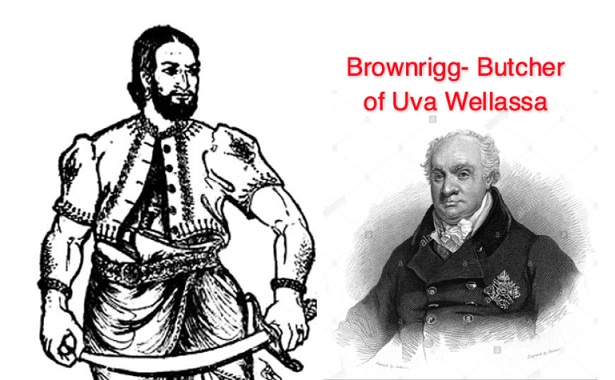
Trial in Absentia – Declare Guilty Colonial Britain & Governor Brownrigg for crimes against humanity

August 28th, 2018

Sinhale as it was called when the European colonials landed was never invaded but the island was ceded as a result of weak leadership & unpatriotic rulers & selfish advisors. Not much different from the scenario of late. Having ceded parts of the island & the whole of the island in 1815 by the Kandyan Convention, the agreement depended on the parties honouring it which the British failed to do. Reclaiming one’s own land cannot be construed as an act of crime & no invader nation has any right to declare natives as traitors. We must correct histories distortions.

The British & all other colonial imperialists have throughout their invader rule committed unimagineable war crimes & crimes against humanity. Nonetheless, they have thought fit to hold kangaroo courts & have put to death many a million. How valid are these kangaroo trials? Do these innocent victims not deserve due justice? These are a handful of thoughts that come to mind in thinking about the excellent suggestion by attorney Senaka Weeraratna who has proposed the setting up of a Tribunal against Colonial British crimes & Governor Brownrigg with the court exonerating the Sinhale natives who came forward to defend & re-claim their nation after the colonial British relegated on their commitments made in 1815 Convention & did not honor the agreement entered into. Therefore, Keppettipola & all others committed no crime & those that dishonored the agreement have no right to create their own kangaroo courts & declare these men who came to defend their nation as criminals. Keppettipola & 16 others were declared traitors by the British through their kangaroo court. They were captured by Captain O’Neil on 28 October 1818.

No school history syllabus can be complete without extolling the greatness of every Sinhale hero who fought for the freedom of the island from colonial rulers. Their heroic acts must be known by all citizens of this island & should be remembered as heroes. Their heroism is further accentuated by the fact that they rejected the pardon & chose death. They were branded as traitors by Governor Robert Brownrigg in 1818 & if it is to be removed it should be by the British. What the present government should have done was not to gain cheap publicity by claiming to clear the names of these 16 heroes but to hold a fresh trial & declare the colonials as guilty for dishonoring the agreement they promised to uphold. The Uva-Wellassa massacre applying the scorched-earth policy is just one crime that no one British & natives alike can ever be allowed to forget. It has become fashionable to say ‘let bygones be bygones’ when the truth is unpalatable but seek bitter revenge when it is to their advantage. The manner that Milosevic, Saddam Hussein & Gaddafi were eliminated are just a handful of recent crimes from which people should understand how colonial kangaroo courts would have been. Men, women & children were thrown to crocodiles, pregnant elephants were killed for sport, the supposed to be gentlemen-British ate breakfast while watching locals being hung to death!

Post-independent leaders of Sinhale–rechristened Sri Lanka should have known their history before jumping to exonerate Keppetipola & others without holding a fresh trial & revisiting all of the crimes committed that led to Keppetipola & others coming forward to defend the nation and refusing clemency as they had committed no crime. Defending one’s nation is no criminal act – why could the government of Maithripala Sirisena & advisors not understand this fact.

The moment the British dishonored the agreement they agreed to honor, the colonial British had legally breached their side of the agreement. What is important for everyone to take into consideration is that the island was never invaded by colonial rulers but was ceded as a result of a handful of selfish & unpatriotic Sinhale people. Therefore, the natives were well within their right to demand their right to regain their land. These natives committed no illegal act & therefore they cannot & should not be regarded as criminals. As Mr. Senaka Weeraratna has rightfully pointed out, Keppetipola & all others declared guilty by the colonial British kangaroo court must be exonerated from wrongful conviction.

As Mr. Weeraratna points out there is no statute of limitation to war crimes & crimes against humanity, therefore every former colony, victims of unimagineable crimes against humanity by every colonial ruler that forcibly occupied their countries, plundered their wealth, converted their natives & denationalized & de-culturalized them have a grouse & must get their day in the court of justice even 500 years after the crimes have been committed against millions of people across the continents of Americas, Africa, Asia.

No former colony can be termed truly independent if they are unable to take action against the perpetrators of crimes committed on their people by European imperialists. If these European imperialists can hold kangaroo courts throughout colonial rule & even thereafter following the end of World War 1 & 11 against the Nazis & Japanese & even the present manner that tribunals are being held through the auspices of the UN for only African & enemies of the West, why can’t the countries that were victims not take the perpetrators & hold them accountable for their crimes.

How can the West even oppose such when every diplomatic statement they deliver uses phrases & terms associated with accountability, transparency, bringing the guilty to book, fair trial etc. Why should the former European colonial rulers oppose such a trial even in absentia against the crimes they have committed.

Some countries have initiated demands for reparations & accountability

International Tribunal by Puerto Rico against US colonial crimes – https://iacenter.org/2018/08/01/international-tribunal-to-expose-u-s-colonial-crimes-in-puerto-rico/ The Caribbean countries too are uniting to seek apology & reparations.

There is even a website http://www.colonialismreparation.org/en/

No former colony can consider itself a free & ‘independent’ country without setting history’s record straight. That history has to depict every wrong that the Portuguese, Dutch & British did to our island & our people. Those that enjoy singing hosannas for these colonial rulers are doing so completely ignorant of the true past or proud to be associated with those crimes. The colonial crimes against our people were made possible by the willful assistance of a handful of unpatriotic natives for perks & privileges. The same appears to be happening even after 500 years.

Until & unless natives are able decolonize their minds & realize that being modern does not impede or prevent upholding indigenous cultures & values or forgetting their history & heritage, former colonial natives will forever be in a cesspit of living a rootless life. To be modern is certainly not to abhor or look down on one’s ancestral roots, the islands proud history & a glorious past that spans over thousands of years with many a milestone of achievements & world’s firsts to boast of. This must be digested by all.

Therefore, as Mr. Senaka Weeraratna has suggested Governor Brownrigg & all others must be put on trial in absentia and held accountable for their crimes against humanity. No one individual or an association can take up this excellent idea alone but a pool of people comprising lawyers, judges, historians, researchers, academics, media & other activists must now gather, inspired to take up this task which will not only inspire other former colonies but will definitely turn the tables on the bloc European nations that use the podium of the UN to manipulate the doctrine of R2P humanitarian intervention to once again invade & occupy nations without any international legal action being taken against them. 500 years of colonial crimes cannot be allowed to make way for centuries more of neocolonial crimes that are unaccounted, unapologised with no reparations for the damages caused.

Let us gather to set up a Tribunal against Colonial Crimes to our Sinhale nation & set the records straight & declare every man who defended the land as heroes.

Shenali D Waduge

Sri Lanka’s Presidential Elections: Western Province/Kalutara District – Voters & Demographic Influence

August 28th, 2018

By Shenali D Waduge

Western Province comprises 3 districts (Colombo, Gampaha & Kalutara)

Kalutara comprises 8 electoral polling divisions.

The analysis covers 3 main elections – Presidential, General & Provincial Councils.

Keeping to the official census statistics of 2012 the island’s population stood at 20,359,439 (20m)

  • 5,851,130 (5.8m) or 28.7% of the Islands 20m live in the Western Province.
  • Colombo District population is 2,323,826
  • Gampaha district comes second with 2,298,588 people.
  • Kalutara has an area of 4 Sq Km with a population of 1,217,260 as per 2012 census.

http://www.statistics.gov.lk/PopHouSat/CPH2011/index.php?fileName=pop42&gp=Activities&tpl=3

Kalutara District is located in the south west of Sri Lanka. Kalutara is bounded north by Colombo District, East by Rathnapura district and south by Galle district and West by the ocean.

Literacy in Kalutara is 97.8%.

Literacy in Gampaha district is the highest in Sri Lanka with 98.5%

Colombo is second with 98%.

Ethnic composition in Kalutara

Whereas both Tamils & Muslims have increased in Kalutara district the Sinhalese have declined.

  • Sinhalese in Kalutara have declined from 87% in 1982 to 86% in 2012
  • Tamils in Kalutara have increased from 1.2% in 1981 to 1.9% in 2012
  • Muslims in Kalutara have increased from 7.4% in 1981 to 9.3% in 2012

Religious composition in Kalutara

  • Buddhists in Kalutara were 84.3% in 1981 / in 2012 Buddhists have reduced to 83.4%
  • Hindus in Kalutara were 4.5% in 1981 / in 2012 Hindus have reduced to 3.2%
  • Islam in Kalutara were 7.5% in 1981 / in 2012 Islam adherents have increased to 9.4% (an increase of 1.9%)
  • Catholics in Kalutara remain 3.3% from 1981 to 2012.
  • Christians in Kalutara were 0.3% in 1981 / in 2012 Christians have increased to 0.7%

Buddhists, Hindus have reduced in Kalutara, but Islam & Christians have increased & Catholics remain the same.

PRESIDENTIAL ELECTIONS IN KALUTARA DISTRICT

Main 2 contestants at the 7 Presidential Elections held 

  1. 1982 – JR (UNP) / Hector Kobbekaduwa (SLFP)
  2. 1988 – R Premadasa (UNP) / Sirimavo Bandaranaike (SLFP)
  3. 1994 – Srima Dissanayake (UNP) / Chandrika Bandaranaike (PA)
  4. 1999 – Ranil Wikcremasinghe (UNP) / Chandrika Bandaranaike (PA)
  5. 2005 – Ranil Wikcremasinghe (UNP) / Mahinda Rajapakse (UPFA)
  6. 2010 – Sarath Fonseka Common Candidate / Mahinda Rajapakse (UPFA)
  7. 2015 – Maithripala Sirisena Common Candidate / Mahinda Rajapakse (UPFA)

7 Presidential Election Results contestants

JR = JR Jayawardena

RP = R Premadasa

HK = Hector Kobbekaduwa

SB = Sirimavo Bandaranaike

CB = Chandrika Bandaranaike

RW = Ranil Wickremasinghe

MR = Mahinda Rajapakse

SF = Sarath Fonseka

MS = Maithripala Sirisena

Kalutara District comprises 8 polling divisions

  1. Panadura
  2. Bandaragama
  3. Horana
  4. Bulathsinhala
  5. Matugama
  6. Kalutara
  7. Beruwela
  8. Agalawatte

Of the 7 Presidential Elections held in Kalutara District

  • UNP has won Once in 1982
  • UPFA/SLFP has won 6 times (1988, 1994, 1999, 2005, 2010, 2015)
  • Only Bulathsinhala & Kalutara town voted for UNP in 1988
  • Only Panadura & Beruwela voted for the Common Candidate in 2015

Of the 7 Presidential elections in Kalutara district since 1982 in the 8 polling divisions held

  • The UNP has won 10
  • The SLFP/UPFA has won 44
  • Common Candidate Fonseka won 1
  • Common Candidate Sirisena won 1
  1. 1982 – JR Jayawardena (UNP) won all 8 polling divisions
  2. 1988 – Sirimavo Bandaranaike (SLFP) won 6 out of 8 polling divisions with R Premadasa winning 2
  3. 1994 – Chandrika Bandaranaike (PA) won all 8 polling divisions
  4. 1999 – Chandrika Bandaranaike (PA) won all 8 polling divisions
  5. 2005 – Mahinda Rajapakse (UPFA) won all 8 polling divisions
  6. 2010 – Mahinda Rajapakse (UPFA) won all 8 polling divisions
  7. 2015 – Mahinda Rajapakse won 6 polling divisions with Maithripala Sirisena Common Candidate winning 2
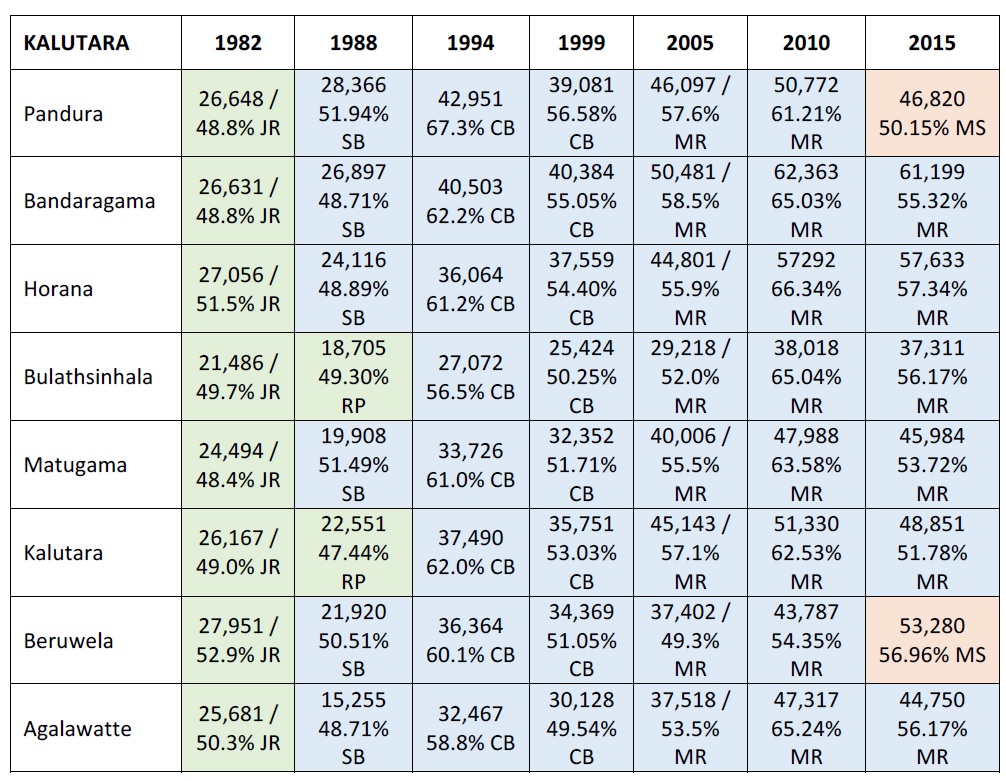
We will examine how Kalutara District has voted at

  • 7 Presidential Elections
  • 3 General Elections
  • 2 Provincial Council Elections

Election Dates

1982 Presidential Election – 20th Oct 1982
1988 Presidential Election – 19th Dec 1988
1994 Presidential Election – 9th Nov 1994
1999 Presidential Election – 21st Dec 1999
2005 Presidential Election – 17th Nov 2005
2010 Presidential Election – 26th Jan 2010
2015 Presidential Election – 8th Jan 2015

2004 General Elections – 2nd April 2004
2010 General Elections – 8th April 2010
2015 General Elections – 17th August 2010

2009 Provincial Council – 25th April 2009
2014 Provincial Council – 29th Mar 2014

Panadura Electoral Polling Division

Of the 7 presidential elections held Panadura polling division has voted 5 times for the SLFP/UPFA candidate, once for the UNP candidate & once for the Common Candidate in 2015.

Of the 3 General Elections held Panadura has voted twice for the UPFA in 2004 & 2010 & once for the UNP in 2015.

Of the 2 Provincial Elections held Panadura has voted for the UPFA in 2009 & 2014.

It is interesting that Panadura voted for the Common Candidate at the January 2015 Presidential election & continued to vote for the UNP at the August 2015 General Election.


Panadura – Presidential Elections

The lowest numbers of voters went to vote in Panadura in 1988 – 22,701 voting for UNP presidential candidate JR Jayawardena.

The highest number of voters in Panadura was cast at the 2015 Presidential elections with 46,820 50.15% voting for Maithripala Sirisena.

2005 Presidential elections saw an increase in voters to 46,097 voting for Mahinda Rajapakse & further increasing to 50,772 in 2010 but Panadura voted for Maithripala Sirisena in 2015 with 46,820 voting for him. Why did the 50,772 that voted for Mahinda Rajapakse in 2010 not vote for him in 2015? At the 2015 Presidential Election Mahinda Rajapakse secured only 45,908 votes from Panadura.

UNP vote base in Panadura has increased from 26,648 in 1982 Presidential Election to 33034 in 2005 (an increase of 6386 voters in 23 years).

The 2010 & 2015 Presidential Elections fielded Common Candidates.

SLFP/UPFA vote base in Panadura has increased from 23,861 at the 1982 Presidential Election to 45,908 at the 2015 elections. (an increase of 22047 voters in 23 years)

Panadura – General Elections

2004 – 35,687 48.03% (UPFA)

2010 – 37,818 59.59% (UPFA)

2015 – 40,809 46.62% (UPFA)

The 3 General elections held in 2004, 2010, 2015 – were won by UPFA

UNP votes in Panadura has also increased from 24,020 in 2004 to 39,190 in 2015 (an increase of 15,170 votes)

UPFA votes in Panadura has increased from 35,687 in 2004 to 40,809 in 2015 (an increase of 5122 votes)

Clearly UNP vote base has been increasing though UPFA has been overall winners in Panadura district.

While UPFA will need to look into why its votebase has not increased, UNP will look to further increase its vote base in Panadura.

Panadura – Provincial Council Elections 2009 /2014

UPFA won all 8 polling divisions in Kalutara District at the 2009 & 2014 provincial council elections.

However, UPFA votes in Kalutara district have reduced from 351,215 (14 seats) in 2009 to 337,924 in 2014 (13 seats)

In Panadura polling division,

UPFA votes has reduced from 44,923 in 2009 to 37,690 in 2014 

UNP votes have increased from 18,968 in 2009 to 21,558 in 2014

UNP voting pattern in Panadura

  • The lowest votes UNP has received from Panadura polling division was at the 2010 General Election with only 18,022 voting for UNP.
  • In the 2009 Provincial Council elections & the 2010 General Elections UNP received less than 20,000 votes from Panadura.
  • The highest votes UNP has received from Panadura poling division was at the 2005 Presidential Election with 33,034 voting for Ranil Wickremasinghe
  • At the 1982 Presidential Election, Panadura gave 26,648 votes to UNP this has increased to 39,190 at the 2015 General Elections (an increase of 12,542 votes)
  • Noteworthy is that the UNP secured 18,022 at the 2010 General Elections which increased to 39,190 five years later at the 2015 General Elections (an increase of 21,168 votes in 5 years)

SLFP/ UPFA voting pattern in Panadura

Presidential Election in 1982 saw Panadura giving 23,861 votes to Hector Kobbekaduwa. This was also the lowest votes SLFP had received from Panadura.

From 28,366 at the 1988 Presidential Election, Panadura votes for UPFA increased to 42,951 in 1994 but reduced to 39,081 in 1999.

At the 3 general elections held in 2004, 2010 & 2015 UPFA vote base has been slowly increasing.

Whereas 37,818 voters voted for UPFA in 2010 General Elections, at the 2015 General Elections it increased to 40,809 (an increase of only 2991 votes)

However, noteworthy is that in 2010 Presidential Election Panadura gave 50,772 votes to Mahinda Rajapakse which reduced to 45,908 at the 2015 Presidentia Election. Why did 4864 voters not vote for UPFA Presidential Candidate/Mahinda Rajapakse?

With registered voters in Panadura being 114,828 (as per August 2015 General Election) there is certainly scope to increase voters.

Bandaragama Electoral Polling Division

Registered electors in Bandaragama at the 2015 General Elections were 133,887
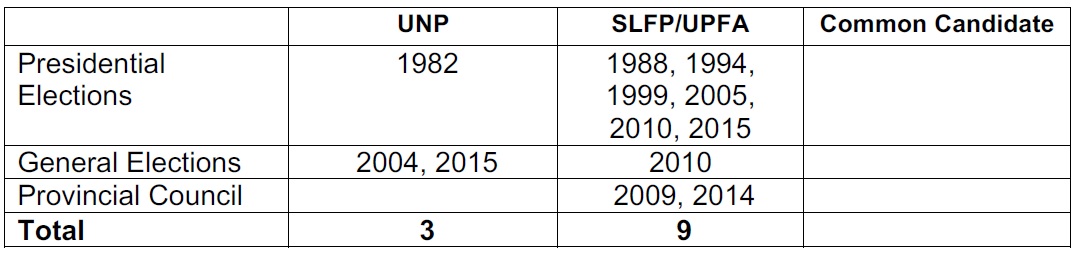
Of the 3 General Elections held, Bandaragama has voted twice for the UNP in 2004 & 2015 & once for the UPFA in 2010.Of the 7 presidential elections held, Bandaragama polling division has voted 6 times for the SLFP/UPFA candidate & once for the UNP candidate

Of the 2 Provincial Elections held, Bandaragama has voted for the UPFA in 2009 & 2014.

Noteworthy is that in January 2015 Bandaragama voted for the UPFA Presidential Candidate but 7 months later voted for the UNP at the August 2015 General Elections. UPFA must wonder why voters lost faith in the UPFA to vote for the UNP in 2015.

Bandaragama – Presidential Elections

The lowest numbers of voters went to vote in Bandaragama in 1994 – 22,701 voting for UNP presidential candidate JR Jayawardena.

The highest number of vote in Bandaragama was cast at the 2010 Presidential elections with 62,363 65.03% voting for Mahinda Rajapakse.

UNP did not see much of a vote increase in 1982, 1988 or 1994 Presidential Elections though from 23,655 votes in 1994 UNP votes increased to 34,749 votes in 2005 Presidential elections. It reduced to 32,290 at the 2010 Presidential Elections but rose to 48,469 at the 2015 Presidential Elections for the Common Candidate.

However, Bandagarama votes for Sarath Fonseka as Common Candidate was 32,290 while at the 2015 Presidential Elections, Common Candidate Maithripala Sirisena received 48,469 votes.

SLFP/UPFA has seen a steady increase in voters from 1982 to 2015 (increasing from 25,500 in 1982 to 61,199 in 2015)

With registered voters in Bandaragama being 133,887 there is scope to increase votes.

Bandaragama – General Elections

2004 – 41,850 53.38% (UPFA)

2010 – 44,927 64.06% (UPFA)

2015 – 53,314 51.91% (UPFA)

The 3 General elections held in 2004, 2010, 2015 – were won by UPFA

UNP votes in Bandaragama reduced from 27,240 in 2004 General Elections to 19,017 in 2010 General Elections but increased to 42,069 at the 2015 General Elections.

UNP has seen a 14,829 voter increase from 2004 to 2015 (11 years).

UPFA votes in Bandaragama increased from 41,850 in 2004 to 53,314 in 2015 General Elections.

UPFA has seen a 11,464 voter increase from 2004 to 2015 (11 years)

Bandaragama – Provincial Council Elections 2009 /2014

UPFA votes has reduced from 55,404 in 2009 to 54,019 in 2014 

UNP votes have reduced from 17,148 in 2009 to 16,087 in 2014

UNP voting pattern in Panadura

At the Presidential elections held in Bandaragama UNP has seen a steady increase from 1982 obtaining 26,631 votes to 2005 obtaining 34,749 votes (an increase of 8118 votes)

At the General Elections in Bandaragama, UNP has also seen a steady increase from 27,240 in 2004 to 42,069 in 2015 (an increase of 14,829 votes)

However at the Provincial Council elections UNP votes have reduced from 17,148 to 16,087 in 2014.

SLFP/ UPFA voting pattern in Bandaragama

Of the 7 Presidential Elections held UPFA has won 6.

SLFP/UPFA votes have seen an increase from 25,500 at the first Presidential Election in 1982 to 61,199 in 2015 (an increase of 35,699 voters)

There has been a slight reduction in votes from the 2010 Presidential Election to the 2015 Presidential Election with 1,164 voters voting less than they did in 2010. It would be good to survey why.

SLFP/UPFA votes have increased at the 3 General Elections held in 2004, 2010 & 2015 from 41,850 to 44,927 to 53,314.

However, SLFP/UPFA votes at the 2 Provincial Council elections in 2009 & 2014 has seen a slight reduction from 55,404 in 2009 to 54,019 in 2014.

Registered voters in Bandaragama stood at 133,887 in 2015.
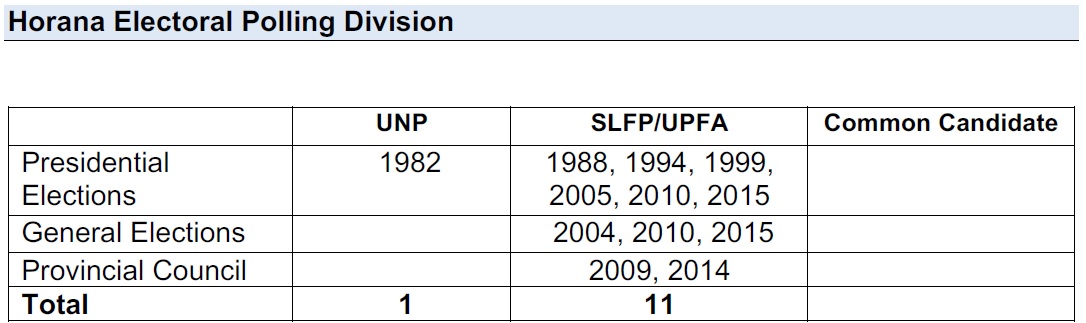
At the 3 General Elections held, Horana has voted for the UPFA (2004, 2010, 2015)Of the 7 presidential elections held, Horana polling division has voted 6 times for the SLFP/UPFA candidate & once for the UNP candidate

Of the 2 Provincial Elections held, Horana has voted for the UPFA in 2009 & 2014.

Noteworthy is that apart from voting for the UNP in 1982 Presidential Elections, Horana has voted for the SLFP/UPFA at every election held since 1988.

Horana – Presidential Elections

UNP has secured less than 28,000 votes at the 4 Presidential elections held from 1982 to 1999. But in 2005 Presidential Election, Horana gave 34,300 votes to the UNP Presidential candidate. However at the 2010 Presidential election the Common Candidate received only 27,818 votes. But at the 2015 Presidential Election the Common Candidate Sirisena received 42,065 votes (an increase of 14,247 votes.  

The UPFA votes have been increasing from 1982 Presidential Elections to 2015 rising from 23,518 to 57,633 (an increase of 34,115 votes)

With Horana registered voters being 122,511 there is potential to increase this margin.

Horana – General Elections

2004 – 38,421 52.87% (UPFA)

2010 – 44,136 67.61% (UPFA)

2015 – 50,024 54.26% (UPFA)

The 3 General elections held in 2004, 2010, 2015 – were won by UPFA

UNP votes in Horana reduced from 26,764 in 2004 General Elections to 16,613 in 2010 General Elections but increased to 36,325 at the 2015 General Elections.

UNP has seen a 9561 voter increase from 2004 to 2015 (11 years).

UPFA votes in Horana increased from 38,421 in 2004 to 50,024 in 2015 General Elections.

UPFA has seen a 11,603 voter increase from 2004 to 2015 (11 years)

Horana – Provincial Council Elections 2009 /2014

UPFA has won the Horana Provincial Council elections held in 2009 & 2014.

UPFA votes has reduced from 51,919 in 2009 to 44,988 in 2014 

UNP votes have increased from 14897 in 2009 to 14,948 in 2014

UNP voting pattern in Horana

UNP has secured above 30,000 votes at the 2005 Presidential, 2015 Presidential & 2015 General Elections.

UNP’s performance at the previous presidential elections have been less than 28,000 votes.

While UNP secured only 16,613 at the 2010 General Elections at the 2015 General Elections UNP secured 36,325 votes (an increase of 19,712 votes. However it is noteworthy that UNP gained only 14,948 votes at the Provincial Council elections held in March 2014. Within 15months UNP has managed to increase its votes by 21,377

SLFP/ UPFA voting pattern in Horana

SLFP/UPFA votes have increased from 23,518 in 1982 Presidential elections to 57,292 Presidential Elections in 2010 (an increase of 33,774 voters)

UPFA should be concerned that the 57,292 secured at the January 2010 Presidential Elections reduced to 44,136 votes at the April 2010 General Elections. Why did 13,156 decide not to vote for UPFA from Jan-April 2010? What made them change their mind in just 4 months? Noteworthy is that from the April 2010 General Election to the 2014 Provincial Council elections, UPFA managed to increase their votebase by just 852 votes to 44,988.

Nevertheless, Horana backed Mahinda Rajapakse at the January 2015 Presidential Election giving him 57,633 votes. However, that dropped to 50,024 at the August 2015 General Elections. UPFA will need to re-assess the Horana polling division & wonder why 7609 voters decided not to vote for the UPFA 7 months after voting for its Presidential candidate in 2015 January? UPFA certainly need to win back these lost voters.
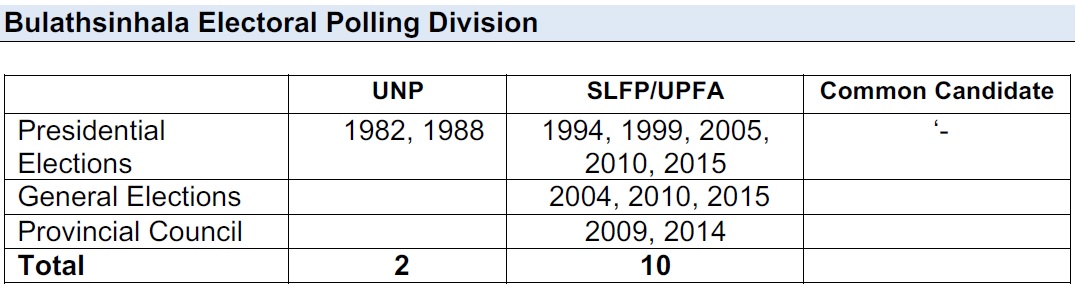
Bulathsinhala – Presidential Elections (1982, 1988, 1994, 1999, 2005, 2010, 2015)

Bulathsinhala voted for UNP at the 1982 & 1988 Presidential elections though in 1988 the UNP voter turnout reduced from 21,486 in 1982 to 18,705 in 1988. From 1994 UNP vote base in Bulathsinhala increased from 20,094 to 25,918 in 2005 but reduced to 19,073 at the 2010 Presidential Election when Common Candidate Sarath Fonseka contested.

Bulathsinhala voted for Chandrika Bandaranaike in 1994 & 1999. Voters reduced from 27,072 in 1994 to 25,424 in 1999

Bulathsinhala voted for Mahinda Rajapakse in 2005, 2010 & 2015.

Mahinda Rajapakse received 37,311 votes in 2015 – 707 votes less than he got in 2010. It would be good to ascertain why voters reduced from 38,018 in 2010 to 37,311 in 2015 for Mahinda Rajapakse.

The common candidate Sirisena received 28341 votes in 2015. In 2010 the Common Candidate Fonseka received only 19,073.

With 82,123 registered voters (2015) there is plenty of scope to increase the numbers.

Bulathsinhala – General Elections 2004/2010/2015

2004 – 25,374 49.77% (UPFA)

2010 – 29,522 68.51% (UPFA)

2015 – 31,612 52.24% (UPFA)

The 3 General elections held in 2004, 2010, 2015 – UPFA has won all 3.

UNP vote base has increased from 22,767 in 2004 to 26,254 in 2015 (an increase of 3487 votes)

UPFA vote base increased from 25,374 in 2004 to 31,612 in 2015. (an increase of 6238 votes)

Bulathsinhala – Provincial Council Elections 2009/2014

UPFA won all 8 polling divisions in Kalutara District at the 2009 & 2014 provincial council elections.

UPFA votes have reduced from 33,317 in 2009 to 33,226 in 2014

UNP votes have increased from 11,069 in 2009 to 11,357 in 2014

Bulathsinhala registered voters are 81,045
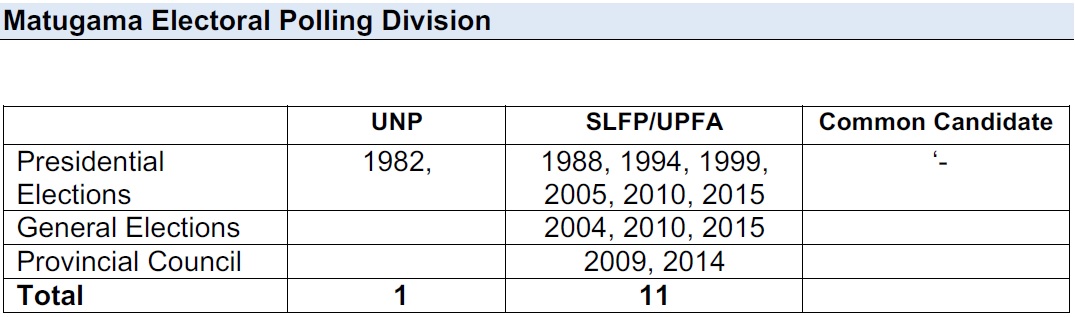
Matugama – Presidential ElectionsMatugama registered voters has increased from 61,809 in 1982 to 108,996 voters in 2015 (an increase of 47187 voters)

Matugama has voted only once in 1982 for the UNP Presidential candidate.

All 6 Presidential elections have been won by the SLFP/UPFA candidate.

A steady increase in UPFA vote base is seen.

From 19,908 in 1988, to 33,726 in 1994, to 32,352 in 1999, to 40,006 in 2005, to 47,988 in 2010 to 45,984 in 2015.

As can been seen Mahinda Rajapakse’s vote base has reduced by 2004 votes from the 2010 to 2015 election.

UNP votes in Matugama has seen increase-decrease structure with 1988 results less than 1982, 2010 results less than 2005 but a sudden increase from 26,016 in 2010 to 38,668 in 2015. Matugama votes for Common Candidate Sarath Fonseka has been less than its votes for Common Candidate Maithripala Sirisena in 2015 with 38,668 votes.
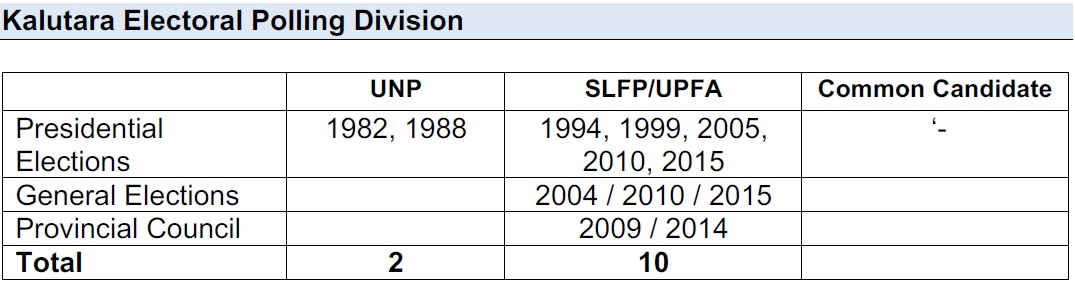
Kalutara – Presidential Elections

The highest percentage of voters cast their votes in 2010 with 62.53% voting for Mahinda Rajapakse.

Kalutara has voted for UNP twice at the Presidential Elections in 1982 & 1988.

Kalutara vote base for UPFA/SLFP has been increasing from 1988.

While 51,330 voters voted for Mahinda Rajapakse in 2010, in 2015 his vote base reduced to 48,851. Why did 2479 voters decide not to vote for Mahinda Rajapakse in 2015?

Registered voters have increased from 64,944 in 1982 to 117,931 in 2015. An increase of 52987 voters.

Kalutara – General Elections

2004 – 37,958 52.10% (UPFA)

2010 – 38,300 62.77% (UPFA)

2015 – 40,837 46.78% (UPFA)

The 3 General elections held in 2004, 2010, 2015 – UPFA has won all 3.

UNP votes reduced to 16,838 at the 2010 General Elections from 26,255 at the 2004 elections & suddenly increased to 39,525 at the 2015 General Elections. The increase of 22,687 votes.

Kalutara – Provincial Council Elections 2009/2014

UPFA won all 8 polling divisions in Kalutara District at the 2009 & 2014 provincial council elections.

UPFA votes have reduced from 42,102 in 2009 to 38,777 in 2014

UNP votes have increased from 16,637 in 2009 to 21,639 in 2014

UNP voting pattern in Kalutara

Kalutara voted for UNP at both the 1982 & 1988 Presidential Elections. UNP vote base increased to 32,916 only at the 2005 Presidential Election but 4 years later at the Provincial Council elections the UNP received only 16,637 votes. This changed the following year when UNP fielded Common Candidate Sarath Fonseka with Kalutara giving 29,719 votes in January 2010. However, the same year at the General Elections in April, the UNP received just 16,838 votes. This increased to 21,639 at the 2014 Provincial elections.

At the January 2015 Presidential Elections 44,804 voters in Kalutara voted for the Common Candidate Maithripala Sirisena which reduced to 39,525 by August 2015 at the General Elections.

SLFP/UPFA voting pattern in Kalutara

Apart from the 1982 & 1988 Presidential Elections, UPFA has won all the 5 Presidential elections, 3 General Elections & 2 provincial elections being currently analysed.

UPFA votes have been increasing from 22,992 in 1982 to 45,143 at the 2005 Presidential Elections. However, UPFA votes reduced to 42,102 at the 2009 provincial council elections but increased to 51,330 at the 2010 Presidential Elections. What UPFA will seriously need to address is how 51,330 voters in January 2010 reduced to 38,300 at the April General Elections – a reduction of 13030 voters.

This increased to 48,851 at the 2015 January Presidential Elections but again reduced to 40,837 months later at the August General Elections. UPFA will need to address why its vote base is fluctuating in Kalutara in particular why it lost 8014 voters from January to August 2015?
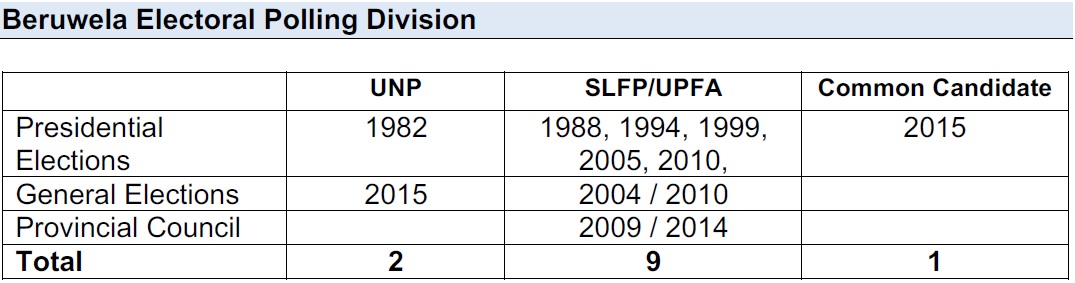
Beruwela – Presidential Elections

The highest percentage of voters cast their votes at the 2009 Provincial Council elections with 61.52% voting for UPFA. In terms of numbers the most voted in 2010 Presidential Election with 43,787 voters from Beruwela voting for UPFA Presidential Candidate Mahinda Rajapakse.

Beruwela has voted for UNP Presidential Candidate only ONCE in 1982 while the last Presidential election Beruwela voted for the Common Candidate Maithripala Sirisena in 2015.

Beruwela vote base for UPFA/SLFP has been increasing from 1982 (22,349 voters) to 1994 (36,364voters) but saw a slight decrease to 34,369 voters in 1999 which increased to 37,402 at the 2005 Presidential Election & further increased to 43,787 at the 2010 Presidential Election.

UPFA/SLFP must wonder why its vote base decreased by 4363 voters at the 2015 Presidential Elections with only 39,424 voting for Mahinda Rajapakse whereas 53,280 voters from Beruwela voted for Maithripala Sirisena the common candidate.

UNP vote base in Beruwela fluctuating. The highest votes received was for the UNF Presidential Candidate Ranil Wickremasinghe in 2005 with 37390 but it was at the 2015 Presidential Election where 53,280 voted for Maithripala Sirisena in 2015. The 2010 Presidential Election the Common Candidate Fonseka received 35,678 votes

Beruwela – General Elections

2004 – 33,583 47.38% (UFPA)

2010 – 32,709 54.10% (UPFA)

2015 – 47,987 54.94% (UNP)

The 3 General elections held in 2004, 2010, 2015 – UPFA has won the 2004 & 2010 while the 2015 General Elections were won by the UNP led UNF.

It is noteworthy that the UPFA vote base has declined from 33,583 in 2004 to 32,709 in 2010 though it increased to 33,142 in 2015.  

UNP vote base declined significantly from 30,210 in 2004 General Election to 21,737 votes at the 2010 General Elections but has seen a phenomenal increase to 47,987 at the 2015 General Elections.

Beruwela – Provincial Council Elections 2009/2014

UPFA won all 8 polling divisions in Kalutara District at the 2009 & 2014 provincial council elections.

UPFA votes have increased from 38,980 in 2009 to 39,715 votes in 2014 (an increase of just 735 votes)

UNP votes have increased from 14,253 in 2009 to 24,615 in 2014 an increase of 10,362 votes

With 114,791 registered voters as per 2014 elections department there is scope to increase
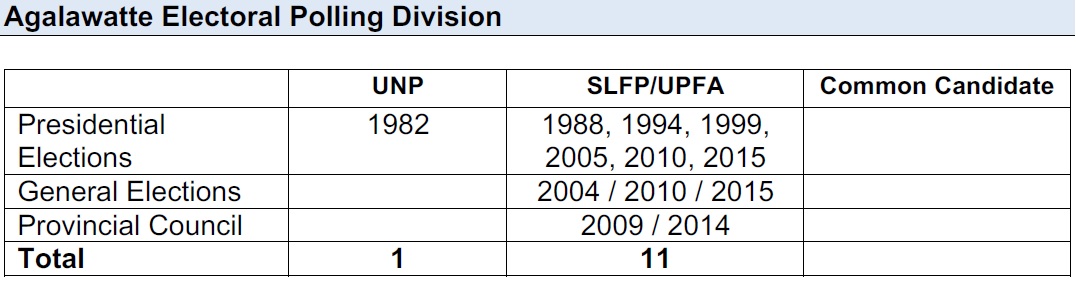
The highest percentage of voters cast their votes in 2010 with 65.24% voting for the UPFA Presidential Candidate Mahinda Rajapakse.Agalawatte  – Presidential Elections

In terms of numbers the most voted also in 2010 with 47,317 voting for Mahinda Rajapakse.

Agalawatte has voted for UNP only at the 1982 Presidential Elections.

Agalawatte vote base for UPFA/SLFP has been increasing from 1982 (21,041 voters) to 1994 (32,467 voters) but reduced to 30,128 voters in 1999 but increased to 37,518 in 2005 & further increased to 47,317 in 2010. UPFA will need to wonder why only 44,750 voted for its presidential candidate in 2015 a reduction of 2567 voters.

UNP vote base has been fluctuating in Agalawatte with lowest votes at the 1988 Presidential Elections (15,155 votes) which increased to 31,449 votes in 2005 Presidential Election but reduced to 23,717 votes in 2010 for the Common Candidate Fonseka. It would be interesting to find out how Agalawatte which gave 23,717 votes to the Common Candidate Fonseka gave 33,995 votes to the Common Candidate Sirisena – a difference of 10,278 votes.

Agalawatte – General Elections

2004 – 33,939 53.66% (UPFA)

2010 – 35,541 68.16% (UPFA)

2015 – 38,125 51.85% (UPFA)

The 3 General elections held in 2004, 2010, 2015 – UPFA has all 3 polling divisions. However, it is noteworthy that the UPFA vote base increased from 2009 to 2015 (33939 in 2009 / 35,541 in 2010 & 38,125 in 2015)

Agalawatte – Provincial Council Elections 2009/2014

UPFA won all 8 polling divisions in Kalutara District at the 2009 & 2014 provincial council elections.

UPFA votes have increased from 37,558 71.03% in 2009 to 39,488 65.09% in 2014

UNP votes have also increase slightly from 13,682 in 2009 to 14,840 in 2014. With 99,146 registered voters there is scope to increase
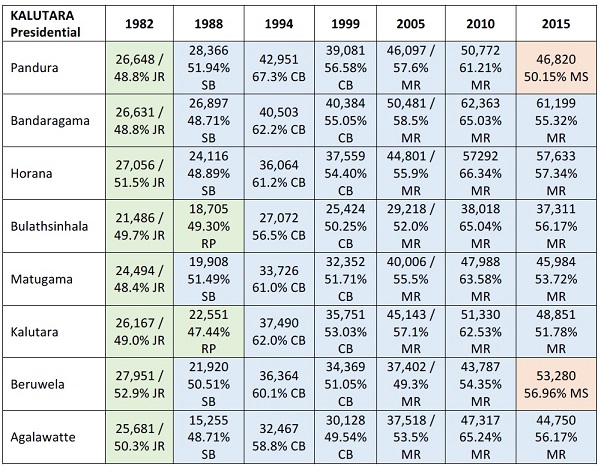
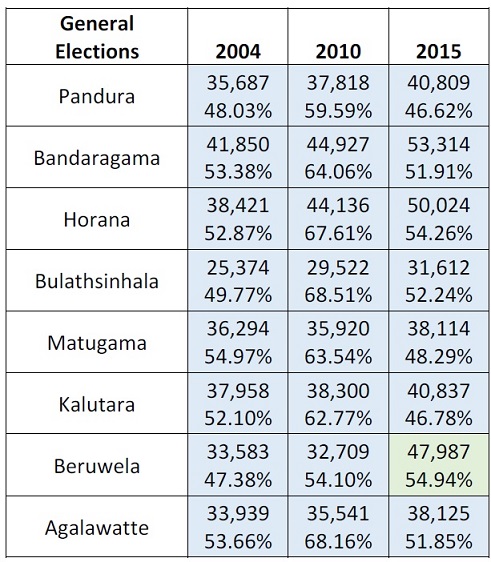
Of the 3 General Elections held in 2004, 2010 & 2015, UPFA has won all 8 polling divisions of Kalutara District except Beruwala which went to the UNP in 2015. While UPFA will need to assess its vote decline in Beruwela.

UNP voters have increased from 24,020 in 2004 to 39,190 in 2015 in Panadura, 27,240 in 2004 to 42,069 in 2015 in Bandaragama, 26,764 in 2004 to 36,325 in Horana, 17,295 in 2004 to 35,267 in 2015 in Matugama, 16,838 in 2010 to 39,525 in Kalutara , 21,737 in 2010 to 47,987 in 2015 in Beruwela which UNP won and 14,402 in 2010 in Agalawatte to 31,731 in 2015. These increases are in bigger numbers to the increases in UPFA vote base.
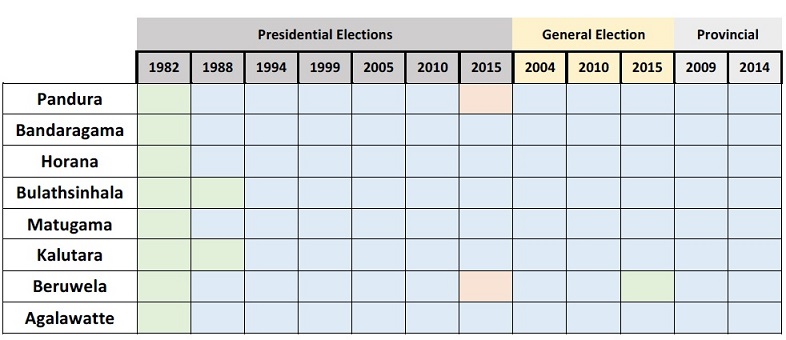
  UPFA has won 83 timesThus, of the 96 times elections have been held from 1982 to 2015 (33 years) in Kalutara District

UNP has won 11 times

Common Candidate has won 2 times

The above graph depicts the election victories of the 7 Presidential Elections, 3 General Elections & 2 Provincial Council elections. As can be seen apart from winning all 8 polling divisions at the 1982 Presidential Elections, the UNP voters in Kalutara district has voted for UNP only in Bulathsinhala & Kalutara at the 1988 Presidential elections & Beruwela at the 2015 General Electionss. However, UNP vote base is increasing inspite of UNP not winning polling divisions.

At the 2015 General Election registered voters were 897,349 with 760,365 going to vote.

Shenali D Waduge

බෙදුම්වාදී මුස්ලිම් දේශපාලනඥයන්ට අවි ආයුධ තොග රැස්කර ගැනීමට ඉඩ දීලා..

August 28th, 2018

අනුරුද්ධ බණ්ඩාර රණවාරණ මාධ්‍ය ලේකම් ජාතික නිදහස් පෙරමුණ lanka C news

බෙදුම්වාදී කොටි ත‍්‍රස්තවාදීන්ගේ ඝාතන හේතුවෙන් අවසානයේ දෙමළ සමාජයේ ඉතිරි වූයේ බෙදුම්වාදී පරඬැල් වැනි දේශපාලනඥයන් පිරිසක් බවත් දැන් තමන්ට සහයෝගය දෙන බෙදුම්වාදී මුස්ලිම් දේශපාලනඥයන්ට අවි ආයුධ තොග පිටින් රැස්කර ගැනීමට ඉඩ දීමෙන් මුස්ලිම් සමාජයටත් එකී ඛේදනීය ඉරණම උරුම කර දීමට මේ ආණ්ඩුව කටයුතු කරන බවට ජාතික නිදහස් පෙරමුණ චෝදනා කරයි.

පිටකෝට්ටේ පිහිටි ජාතික නිදහස් පෙරමුණේ ප‍්‍රධාන කාර්යාලයේදී පැවැති මාධ්‍ය හමුවකදී එහි ප‍්‍රචාරක ලේකම් මොහොමඞ් මුසම්මිල් මහතා මෙසේ චෝදනාකර සිටියේය.

බෙදුම්වාදී මුස්ලිම් දේශපාලනඥයන්ට අවි ආයුධ තොග රැස්කර ගැනීමට ඉඩ දීලා..

එහිදී වැඩිදුරටත් අදහස් දැක්වූ එ් මහතා මෙසේද සඳහන් කළේය.

‘‘පසුගියදා පුනරුත්ථාපනය වූ කොටි සාමාජිකයන් පිරිසක් කොළඹදී පැවැත් වූ මාධ්‍ය හමුවකදී අනාවරණය කළා ‘කොටි සංවිධානය සතුව තිබූ 5000කට අධික අවි ප‍්‍රමාණයක් මුස්ලිම් දේශපාලනඥයන් වන රිෂාඞ් බදුර්දීන් සහ හිස්බුල්ලා ඇතුළු පිරිසකට ලබා දී තිබෙනවා’ කියා.

මේ මාධ්‍ය හමුව පවත්වා, ඉහත කරුණුු අනාවරණය වෙලා දැනට සතියක් ඉක්ම ගොස් තිබෙනවා. එහෙත් අපරාධ පරීක්ෂණ දෙපාර්තමේන්තුව හෝ ආණ්ඩුව විසින් මේ පිළිබඳව කිසිදු විමර්ශනයක් සිදු කොට නැහැ. පිස්තෝලයක් දෙකක් පාතාලයට ලැබෙනවා වගේ නොවෙයි ආයුධ පන්දාහක් යම් පිරිසකට ලැබෙනවා කියන්නේ. එය රටේ ආරක්ෂාවට පවා බලපාන කරුණක්. මේ පිළිබඳව ආරක්ෂක ඇමැති, නීතිය හා සාමය පිළිබද ඇමැති, පොලිස්පති නිහඬව සිටින්නේ මේ නම් සඳහන් වූ දේශපාලනඥයන් ආණ්ඩුවේ රැුකවරණය යටතේ සිටින නිසා ද? නැතිනම් මේ මුස්ලිම් දේශපාලන නායකයන්ගේ රැකවරණය යටතේ මේ ආණ්ඩුව පවත්වාගෙන යන නිසා ද? ගෙවී ගිය වසර 47 තුළ මේ රටේ ලේ ගලා ගිය ගැටුම් තුනක් සිදු වුණා. 1971, 1989 ජනතා අරගල මර්දනය කිරීමේ දී ලේ ගංගා ගලා ගියා. 30 වසරක් පුරා බෙදුම්වාදී ත‍්‍රස්තවාදය පැරදවීමට ගෙන ගිය සටන නිසා මේ රටම ලේ විලක් වුණා. එ් නිසා යළිත් මේ රටේ ලේ වැකි ගැටුම් ඇති වෙනවාට, සිංහල – දෙමළ – මුස්ලිම් සාමාන්‍ය ජනතාව කිසිසේත්ම කැමැති නැහැ.

බෙදුම්වාදී පරඬැල් ටිකක් විතරයි ඉතිරි වුණේ

ජාතිවාදී දේශපාලනඥයන් ආයුධ ළං කර ගන්නේ පොලිෂ් කරමින් තබාගන්න ද? අපට මතකයි බෙදුම්වාදී ත‍්‍රස්තවාදී කොටි සංවිධානයේ නායකයා වේලූපිල්ලේ ප‍්‍රභාකරන් වැඩ පටන් ගත්තු හැටි. එදා යාපනය නගරාධිපති ඇල්ප‍්‍රඞ් දොරේඅප්පාට පිස්තෝලයකින් වෙඩි තබා ඝාතනය කරමිනුයි ම්ලේච්ඡු ත‍්‍රස්තවාදී ගමන ඇරඹුවේ. නීලන් තිරුචෙල්වම්, ලක්ෂ්මන් කදිරගාමර් වැනි ප‍්‍රජාතන්ත‍්‍රවාදය අගයන, ජාතික සමගිය වෙනුවෙන් පෙනී සිටි, ත‍්‍රස්තවාදය පිළිකෙව් කළ සියලූ දෙමළ දේශපාලන නායකයන් ගෙවී ගිය වසර 30 තුළ මේ රටට අහිමි වූවා. අවසානයේ ඉතිරි වුණේ කොටි දේශපාලන අංශ නායක තමිල් චෙල්වම්ගේ ගෝලයන් වූ සම්බන්ධන්ලා, සුමන්තිරන්ලා වැනි බෙදුම්වාදී පරඩැල් ටිකක් විතරයි. මුස්ලිම් සමාජයටත් මේ ඉරණම අත්කර දීමට ද මේ හදන්නේ ? මේ රටේ ජාතික සමගිය වෙනුවෙන් පෙනී සිටින මුස්ලිම් දේශපාලනඥයන් ආයුධ බලයෙන් යටපත් කරලා තනි බෙදුම්වාදී මතයකට මුස්ලිම් ජනතාව රැගෙන යාමට ද මේ හදන්නේ ?

ඔබ දන්නවා බහුතර මුස්ලිම් ජනතාව හිටියේ ජාතික දේශපාලන පක්ෂ සමඟයි. පසුව වාර්ගික පදනමෙන් ඇති වූ මුස්ලිම් දේශපාලන පක්ෂ සිංහල, දෙමළ සමාජය වෙතින් බෙදී යාමේ සටන්පාඨ කරේ තබාගෙන මුස්ලිම් ජනතාව වෙත ආවා. ගැටුම් හදා, බෙදී වෙන්වීමේ වුවමනාව නැගෙනහිර මුස්ලිම් ජනතාව තුළ හදන්නයි එම පක්ෂ කටයුතු කළේ. ඇඳුමේ වෙනස පවා ගැටුමකට මඟක් කර ගත්තා. එසේ තිබියදී තමයි මේ ආයුධ රැස් කිරීමේ චෝදනා එන්නේ.

ජනාධිපතිවරයා තේරවිලි කියමින්, අගමැති විකාර කියමින්, පොලිස්පති නර්තනයේ යෙදෙමින් ඉඳලා හරි යන්නෙ නැහැ. මේ ජාතික ආරක්ෂාවට බලපාන කරුණු සම්බන්ධයෙන් වහා විමර්ශනයක් සිදු කළ යුතුයි. නමුත් මේ ආණ්ඩුව කරන්නේ ජාතිවාදී, බෙදුම්වාදී දේශපාලනඥයන්ට තම ක‍්‍රියාමාර්ග රිසිසේ ගැනීමට ඉඩ දී තම දේශපාලන ප‍්‍රාණය රැක ගැනීමයි.

ආණ්ඩුවට වුවමනා පළාත් සභා ඡන්දය කුමන ක‍්‍රමයකට හෝ කල් දමන්න

පළාත් පාලන ඡන්දය දිගින් දිගටම කල් දැමූ මේ ආණ්ඩුව එම ඡුන්දය පැත්වූයේ නියමිත දිනට වසර දෙකහමාරකට පසුවයි. එහිදී ලැබුණු ප‍්‍රතිඵලය අනුව මේ අය ජනාධිපතිවරණය තෙක් කිසිදු ඡන්දයක් පවත්වන්නෙ නැහැ. පළාත් සභා මැතිවරණය ඊට කලින් පැවැත්වුවහොත් එහිදී ලැබෙන පරාජය කවරාකාර ද, කියා මේ ආණ්ඩුව දන්නවා. එ් විතරක් නොවෙයි එ් පරාජය මෙන් දෙගුණයක පරාජයක් ජනාධිපතිවරණයේ දී ලැබෙන බවත් එ් අය දැනටමත් ගණන් හදලා තිබෙනවා. එ් නිසා පළාත් සභා ඡුන්දය කුමන ක‍්‍රමයකින් හෝ කල් දමා ගැනීම අද මේ ආණ්ඩුවේ ප‍්‍රමුඛතම උවමනාවක් වී තිබෙනවා.

මාස හයක් මොකද කළේ?

දැන් බලන්න, ජනාධිපතිවරයා විසින් පත් කළ පළාත් සභා කොට්ඨාස සීමානිර්ණ කොමිසමේ සභාපතිවරයා කියනවා, ඔහු මේ වාර්තාව පළාත් සභා, පළාත් පාලන ඇමැතිවරයාට බාර දුන්නේ 2018 පෙබරවාරි 19 වැනිදා කියා. නමුත් මේ ඇමැතිවරයා එය පාර්ලිමේන්තුවට ඉදිරිපත් කළේ ඉන් මාස හයකට පසුවයි. එ් විදියට මාස හයක් යට ගහලා තබා ගත්තු වාර්තාව පසුගිය 24 වැනිදා පාර්ලිමේන්තුවට ඉදිරිපත් කරපු මේ ආණ්ඩුව ඊට විරුද්ධව ඡන්දය දුන්නා. එ් වැඩෙන් මේ ආණ්ඩුව ලෝක වාර්තාවකුත් තැබුවා.

මේ අය පළාත් සභා ඡන්ද විමසීම කල් දැමූ ආකාරය අපි විමසා බලමු. එ්ක කළේ ඉතාමත් කුඨ අකාරයකට. පළාත් සභා ඡන්ද විමසීම් පනත සංශෝධනය කිරීමට මේ අය පනත් කෙටුම්පතක් ගෙනාවා. එය ශ්‍රේෂ්ඨාධිකරණය ඉදිරියේ අභියෝගයට ලක් වුණා. ශ්‍රේෂ්ඨාධිකරණය තීන්දු කළා මෙම පනත සම්මත කිරීමට පාර්ලිමේන්තුවේ තුනෙන් දෙකක ඡන්දයක් හා ජනමතවිචාරණයක් අවශ්‍යයි කියා. කෙසේ නමුත් පළාත් සභා සඳහා කාන්තා නියෝජනය වැඩි කිරීම කියන පාඨයට මුවාවෙලා ජනතා විමුක්ති පෙරමුණත් හවුල් කරගෙන මේ ආණ්ඩුව තමන්ට උවමනා සංශෝධන සමග මේ පළාත් සභා ඡන්ද විමසීම් පනත සංශෝධනය කර ගත්තා.

බිමල් කියූ ලොකුම බොරුව

එ් අනුව නීතියේ හිල් අස්සෙන් රිංගලා, ජනමතවිචාරණයකට නොගිහින්, තමන්ට අවශ්‍ය සංශෝධන ටික කරගෙන මේ පනත සම්මත කරගත්තු ආණ්ඩුව ශ්‍රේෂ්ඨාධිකරණය තීන්දුවටත් පිටුපාලා පළාත් සභා ඡන්දය කල් දැම්මා. ජනතා විමුක්ති පෙරමුණත් මේ සියල්ලටම ආණ්ඩුව සමඟ අත එසවූවා. ඔබට මතක ඇති එ් දිනවල පාර්ලිමේන්තුවේදී වගේම ‘හිරු බලය’ වැඩසටහනේදී ජවිපෙ මන්ත‍්‍රී බිමල් රත්නායක මහතා කියූ කතාව. ‘අපි පළාත් සභා ඡන්ද විමසීම් පනත සංශෝධනය සඳහා ආණ්ඩුවට සහයෝගය දුන්නේ 2018 ජුනි 30 වැනිදාට කලින් පළාත් සභා මැතිවරණය පැවැත්වීමේ සහතිකයක් ආණ්ඩුවෙන් අරගෙන’ කියලා බිමල් රත්නායක එහිදී කීවා. අපි දැන් අහනවා, ‘බිමල් රත්නායක මහත්තයෝ ඔයාලා ආණ්ඩුවෙන් ලබාගත්තු සහතිකයට කල් ඉකුත් වෙලා මාස දෙකක් ගිහින්. මේ විදිහට ආණ්ඩුවට කඬේ ගිහින් ජනතාව රවට්ටන්න ඇයි ?’ කියලා.

ජවිපෙ ඡන්දෙ නොදී පැනලා ගියා

එ් විතරක් නොවෙයි පසුගිය අගෝස්තු 23 වැනිදා ජවිපෙ ප‍්‍රචාරක ලේකම් විජිත හේරත් මාධ්‍ය සාකච්ඡාවක් පවත්වලා කීවා, ‘නව පනතට අනුව පළාත් සභා මැතිවරණයට යාම සඳහා සීමානිර්ණ කොමිසමේ වාර්තාව පාර්ලිමේන්තුවේ සම්මත කළ යුතුයි. එයට පක්ෂව ජවිපෙ අපි ඡන්දය දෙනවා’ කියලා. නමුත් ජවිපෙ 24 වැනිදා කළේ කුමක්ද? සීමානිර්ණ කොමිසමේ වාර්තාව පිළිබඳ ඡන්ද විමසීමේ දී ඡන්දය නොදී පැනලා යාම. මේක ජවිපෙ වත්මන් ස්වභාවය තේරුම් ගන්න හොඳම උදාහරණයක්. මේ සියල්ල අනුව, මේ ආණ්ඩුවේ පළාත් සභා ඡන්දය කල් දැමීමේ පාපයෙන්, ජවිපෙට කිසිදු ගැලවීමක් නැහැ කියා පැහැදිලි වෙනවා.

රුපියල් බාල්දු වීමෙන් මුල්තැනට

ජාත්‍යන්තර මූල්‍ය පර්යේෂණ ආයතනයක් වන මූඞීස් ආයතනයේ වාර්තාවක් උපුටා දක්වමින් ‘දි ඉකොනොමික්ස්’ සඟරාව පෙන්වා දෙනවා, ‘ලෝකයේ භාවිතා වන මුදල් එ්කක අතරින් ශ්‍රී ලංකා රුපියල වේගයෙන්ම අවප‍්‍රමාණය වන මුදල් එ්කකය බවට පත්ව තිබෙනවා’ කියා. මේ තමයි 2015 බලයට ආ ආර්ථික ඔස්තාර්ලා රට ඇදවට්ටවා ඇති තරම. මේ ආණ්ඩුවට මේ විදියට යන්න දුන්නොත් ඩොලරයට ගෙවිය යුතු රුපියල් අගය 200 දක්වා ඉහළ යා හැකි බවට ආර්ථික විශේෂඥයන් අනතුරු හඟවා තිබෙනවා. මේ තත්ත්වය හමුවේ මේ ආණ්ඩුව ගෙදර යැවීමේ හැර අන් විසඳුමක් නැහැ.’’

මෙම මාධ්‍ය හමුවට කැස්බෑව නගර සභාවේ මන්තී‍්‍රවරු වන අතුල සේනානායක, රංජිත් පත්මසිරි යන මහත්වරු ද එක්ව සිටියහ.

අනුරුද්ධ බණ්ඩාර රණවාරණ
මාධ්‍ය ලේකම්
ජාතික නිදහස් පෙරමුණ

FTA AGREEMENT WITH SINGAPORE – MOST COMPREHENSIVE AGREEMENT EVER

August 28th, 2018

Sarath Wijesinghe former Ambassador to UAE and Israel

Free Trade Agreements

SLSFTA the free trade agreement entered into with Singapore – a world economic giant in a small patch of land with a small population is the talk of the town today, considering the controversial nature of the 1083 page document in terms of asymmetrical economies and trade policies of two countries in the midst of fast growth towards trade liberalism in Sri Lanka with the a liberalized state, grouping second in world ranking on liberalization of economy. Foreign and Trade policies are two sides of the same coin today intermingled and interconnected giving priority to economies over traditional diplomatic considerations. WTO is in the apex of the trade agreements, arbitrations, and world trade affairs leading Singapore as the world center on Arbitration which is a highly technical and expensive affair for a poor and less legally equipped country like Sri Lanka. Sri Lanka is a member of WTO, and GATT General Agreement on Tarff and multinational agreements in which Sri Lanka obtained membership on 1.1.1948. Trade agreements were signed by two trade Ministers of the two nations in the presence of the two leaders of the countries indicating the importance and priority being the 7th largest trading partner dealing with 4% of total trade between the two countries. Trade agreements outline certain obligations with respect of trade in goods and services and provide protection for investors and intellectual property rights by giving away rights of the host country expecting benefits from the proposed agreement expected to be ratified and implemented after rigorous scrutiny protecting the national interest. The basic thesis of FTA’s is economic integration for the participants whether bilateral or multi-lateral. Singapore is pressed for space and welcome fertile lands and ailing state enterprises to develop with their power of money and international bonds identifying Sri Lanka as an ideal candidate for their plans for expansion of the economic empire in a small community with large number of foreigners settled and citizens with combine ethnic origins. GOSL may genuinely expecting an opening to the commercial world via Singapore which a world economic giant in a tiny land in ASIAN. GOSL may be expecting to exploit ASIAN through Singapore document.

Do we have/need a Foreign/Trade policy?

Do we have a proper foreign policy or a trade policy are moot issues considered as basic foundations/requirements to be an active player in the current economic and world order whether small or big in the world family when Singapore – one of the most liberalized rules of origin in the world has a clear cut foreign and trade policy as an world economic giant despite the smallness of the minute nation with no resources except human resources properly utilized. Singapore has rated second best in Doing Business” when Sri Lankan is on 111 indicating that we have to be extremely cautious in dealing with the rest of the world in business affairs we have been cheated from 1815 with political administrative and business agreements and dealings with the rest the world. Trade agreements with India is a failure towards Sri Lanka an stalled with no progress and unable to make further progress due to political and economic mishandling due to want of the coherent and trade policy which Idea and Singapore is equipped with. It is mandatory and a requirement for a state to be we equipped with a proper foreign and a trade policy to prosper in the family of nations. Do we proper in the family of nations like Singapore well equipped with a proper and coherent foreign and trade policy?

Do we need Free Trade Agreements?

Certainly yes to be an active and productive state in the world community without isolating in the highly advanced and controversial maize of in the most competitive setup with selfish players with their state friendly temperaments however big or small. Bilateral and Multilateral agreements with states and international organizations and binding and effective in the current vibrant economic and political world order and it is better to be cautious in the interest of the future generation and the country as a whole the governance appointed as temporary trustee are responsible for. Did we have a proper dialogue and consultation with the professionals and the concerned citizens when dealing with the second fastest economy in the world with 982 billion trades in 20144 despite offers to cooperate and take part in deliberations and whether a real transparency is and consultation as in Australia, Canada and most democratic models. The discussions were fast tracked fast and one sided may be with good intentions due to pressure and time frame but hurriedly drafted and prepared with 17 chapters and 1083 pages available at (modsit.lk) as many similar legislation we are pressed on with adverse results when dealing with the second fastest economy in the world with political stability with People’s Action party balancing the rest of the world including UN with the economic power behind. Singapore a leader of the free economy has links and control over Airlines, Telecom, Engineering, Media and many strategic Ares and China having control of companies as government as a partner. UK and Europe claiming to be free economy is careful to maintain self interest in major dealing with Singapore friendly policies. We need Sri Lanka friendly foreign and trade policies for the future of the nation and the future generation awaking to take over from us with mistakes made and foundation for a bright future.

What is the practice in other countries?

Any country is careful in entering into comprehensive trade agreements with other states especially when the other party/s is asymmetrical and powerful economically and politically. Australia and Canada adequate consultation with the public and debates in Parliaments are requirements to be fulfilled before ratification and implementation. EU and the satellite countries prefer multilateral giving priority to national interest over other considerations. In Australia 20 sittings and Canada 21 sittings on the matter is required before going through such legislation prior to implementation. US has entered into trade agreements with 20 countries including Israel and Singapore with comprehensive agreements to open the economy to each other whilst SAFTA has integrated 1.6 billion SAARC as a vehicle when Sri Lanka India and Pakistan has entered into trade agreements which are still in primitive stages with many concerns to the less powerful parties. In any event the main consideration of any country is the national interest and to what extent the national interest of Sri Lanka is protected is not known to the citizen as there appear to be no transparence and consultations with the professionals or the public for reasons not known to the citizen when the other countries demand transparency and promote investment and competition. Public consultations are a requirement in other states of the world during the initial stages of trade agreement.

Effects on implementation and way forward for the future

Singapore which is the second fastest economy with 99% of goods with free access and the FTA’s with USA and economic power blocks with unlimited liberty will have free access to Sri Lanka in the implementation of other parallel agreements via Singapore. It appears the strategy of the GOSL may be to enter into as much agreement as possible to attract new investors. Will this strategy be effective and safe whilst protecting the national interest without other criteria to benefit/attract the prospective investors competing with the free trade zones of other counties with better and more attractive offers? Singapore is given access to bid for local enterprises running at a loss with valuable assets which other countries with trade links with Singapore too will behalf to bid thereby Sri Lankan assets will be for sale for the world via the Singapore Agreement. Have we gained confidence of the investor as a host country equipped with natural beauty, educated /trained lab our and good governance with peace and law and order for safety of business community. Wordings in the Singapore document is extremely carefully drafted by expert drafters including the definitions of the citizenship of Singaporean to include persons with indefinite leave and free access to the business community and the companies registers in Singapore giving free access to the business registered in Singapore which is the most liberal country/economy with free access to the business world. Sri Lanka is anticipation greater access to the business world via the agreement expecting investments businesses and prosperity of the country in the new world of business. Author could be contacted on  Sarath7@hotmail.co.uk

Sarath Wijesinghe

Vietnamese people are so united and think like one nation …

August 28th, 2018

Dr Sarath Obeysekera

වියට්නාම – ලංකා වෙළෙඳාම ඩොලර් බිලියනයක් දක්වා ඉහළ නැංවීමට අවධානය    27 08 2018  – 20:20  – 153 views  – රුවන් කාශ්‍යපශ්‍රී ලංකාව සහ වියට්නාමය අතර ද්විපාර්ශ්වික වෙළෙඳාම 2020 වන විට අමෙරිකානු ඩොලර් බිලියනයක් දක්වා ඉහළ නැංවීම සඳහා නිරන්තර සාකච්ඡා සහ සැලසුම් ක්‍රියාත්මක කිරීමේ අවශ්‍යතාවය පිළිබඳව දෙරටේ අවධානය යොමුව තිබේ.ශ්‍රී ලංකා අග්‍රාමාත්‍ය රනිල් වික්‍රමසිංහ මහතා සහ වියට්නාමයේ නියෝජ්‍ය අග්‍රාමාත්‍ය සහ විදේශ කටයුතු අමාත්‍ය ෆාම් බින් මින් මහතා අතර පැවැති සාකච්ඡාවේදී මේ පිළිබඳව අවධානය යොමුවිය.

When the Prime Minister presented the National Export Strategy ( NES) he mentioned how Vietnam overtook Sri Lanka in a short span in the field of Export Earning .

My colleague who is doing business in Vietnam tells me that permission to start a export business is so fast and efficient, He blends perfume in Vietnam and brings then to Sri Lanka as the Ethyl Alcohol is freely available and cheap .

Vietnamese do not  consume hard liquor much  hence Ethyl Alcohol is hardly used but they consume lot of beer .

( This may be the reason why Mangala wanted Sri Lankan to be beer loving nation !)

During my days in Soviet Union I was studying for a first degree in Petroleum Resources Exploration in the Moscow State University. We had so many small made Vietnamese students who were always moving together as a team .Lack of English knowledge has limited much conversation until they were fluent in Russian language. ( some spoke French as it was a French Colony)

All of them had a photo of Ho Chi Min in the room

They hardly had wild parties with Vodka like liquor-loving Sri Lankans, and also quite studious .I was living in a new apartment block on the 11th floor and right above my room, there were some Vietnamese students .

One day I kept hearing a noise from the up stair room in the night, and the noise was so irritating and disturbing.

I ran upstairs and opened their door and found that two/ three small made viet-boys were playing with a steel disc  ( from a dumb bell),rotating it on the wooden floor and let it go .The disc kept rotating spirally for few minutes generating an annoying noise and fell flat on the floor.

I shouted at them and asked them to stop the annoying action and came down cursing.

After few minutes   they started the same noise .

I was furious and ran upstairs and dashed opened the door.

Alas !!, a bucket  was kept on the top of the door ,which poured onto me as soon as  I opened the door and soaked me with ice cold water !

There were none in the room.

They say that Vietkongs were quite skilled in deceiving Americans ,who were enticed to come to war front into firing line to get executed .

After that I never bothered them.

Dr Sarath Obeysekera

Death of former Army Commander Gen. Rohan Daluwatte

August 28th, 2018

Dr Sarath Obeysekera

Former Army Commander General Rohan Daluwatte passed away yesterday at the age of 77 after a brief illness, while being treated at the Army Hospital.He was born on May 9, 1941 in Ambalangoda and is an old boy of Ananda College, Colombo. He joined the Sri Lanka Army as a Cadet Officer in 1961 and served until 1998. He received military training at the Royal Military Academy Sandhurst, United Kingdom.

I met him in 1986 in Diyathlawa cadet training camp where he was the commandant. During Athulathmudali’s time Israel sent a troop carrier to Sri Lanka with a Israeli soldier.

Colombo Dockyard was told to plan the assembly of  such bomb proof vehicles in Sri Lanka and we were asked to drive the vehicle to Diyathalwa with army escort for a trial .We were received by Brigadier Daluwatte at the camp and arranged a demonstration in Fox Hill .Vehicle had a 5mm gun mount and thick wide tyres ,Israely drive was skilled who managed to drive the vehicle almost vertical uphill.

Brigadier Daluwatte was so impressed .

He was a Gentleman and a Soldier

Vehicle was accepted by Army and we were to assemble in the dockyard .They were quite impressed with the gun mount which was quite versatile .

When it was kept in the yard and driver was away we managed to dismantle the gun mount and copied it .After that many gun mounts were built in the workshop.


Interpreting The 19th Amendment

August 28th, 2018

By Neville Ladduwahetty Courtesy The Island

The hot topic in town is whether former twice elected Presidents Chandrika Kumaratunga and Mahinda Rajapaksa are qualified to seek reelection under provisions of the 19th Amendment. Dr. Nihal Jayawickrama in a legally well analyzed article titled “Disqualifying Twice Elected Presidents – A Failed Endeavour” (Sunday Island, August 19, 2018) argues that since Parliament did not provide in the 19th Amendment, a disqualification that would apply retrospectively former twice elected Presidents are not disqualified from seeking reelection.

The disqualification referred to above is in Article 4(2) of the 19th Amendment. This Article states: “No person who has been twice elected to the Office of President by the People, shall be qualified thereafter to be elected to such office by the People”. Although the 19th Amendment was challenged in the Supreme Court and certain issues were addressed, other issues remain unconstitutional despite them being enacted into law.

In addition to the issue of Parliament failing to provide for disqualification to apply retrospectively, as raised by Dr. Jayawickrama, what is of relevance is that the guiding principle should be that provisions of the 19th Amendment should be applied only to those issues specifically addressed by the amendment, and all other provisions should remain untouched and intact as in the original 1978 Constitution and related amendments. Under these circumstances, the clear distinction between pre- and post-19th Amendment makes the disqualification applicable only to future twice elected Presidents and not to former Presidents.

The current President was elected by the People on January 8, 2015 under provisions of the 1978 Constitution and related amendments while the 19th Amendment became law on 15th May 2015. Therefore until May 14, 2015 the President was required to act under provisions of the 1978 Constitution and related amendments, and thereafter based on the principle cited above, the present President should act and function under a combination of provisions of those specified in the 19th Amendment together with the remainder of the 1978 Constitution and related amendments.

SEPARATION of POWERS

A related question that would have a cogent bearing is the role of Franchise as an integral part of the sovereignty of the People. The people of Sri Lanka used their right of Franchise and elected a President to “exercise their executive powers”. These powers are specified in the 1978 Constitution. Under the circumstances of separation of powers, Parliament does not have Legislative Powers to amend the powers of the President by any degree specified in the 1978 Constitution, without seeking the views of the People through a referendum.

This limitation arises from Article 3 which states: “In the Republic of Sri Lanka sovereignty is in the People and is inalienable. Sovereignty includes the powers of government, fundamental rights and the franchise”. Since separation of powers is the linchpin of the Constitution, one branch, e.g., the Legislature cannot tinker with another, e.g., the Executive and vice-versa, without seeking the approval of the People. In the absence of this safeguard, there is a strong possibility that a Legislature could seriously undermine the authority of the Executive, thus impacting on the sovereignty of the People. The 19th Amendment is an example of such an attempt.

This aspect was highlighted during the course of hearing the petition filed against the 19th Amendment. The Supreme Court in its determination stated: “…the Court in the Nineteenth Amendment determination came to the conclusion that the transfer, relinquishment or removal of a power attributed to one organ of government to another organ or body would be inconsistent with Article 3 read with Article 4 of the Constitution. Though Article 4 provides the form and manner of exercise of the sovereignty of the people the ultimate act or decision of this executive function must be retained by the President. So long as the President remains the head of the Executive, the exercise of his powers remain supreme or sovereign in the executive field and to others to whom such power is given must derive the authority from the President or exercise the Executive power vested in the President as a delegate of the President. The President must be in a position to monitor or to give directions to others who derive authority from the President in relation to the exercise of his Executive power. Failure to do so would lead to a prejudicial impact on the sovereignty of the People”.

The main thrust raised during the Court hearing was the attempt by the Legislature to seriously derogate the powers of the President and transfer powers to the Prime Minister and the Cabinet without a referendum. This attempt was squashed by the Court on the basis that the attempt amounted to a “transfer, relinquishment or removal of power” of the President and stated that such attempts required the approval of the People at a referendum. Although the Bill was partially amended to be in keeping with the judgment and passed with a 2/3 majority, the fact is that the powers of the President were “delegated” to other organs of the government bringing into question the constitutionality of the 19th Amendment.

For instance, Article 43 (1) of the 19th Amendment states: “The President in consultation with the Prime Minister…determine(s) the number of Ministers of the Cabinet of Ministers…”. Notwithstanding this, Article 46 (4) permits Parliament to determine by resolution the number of Cabinet Ministers etc. in the event a National Government is formed. Question: Is this provision not an intervention on the “supreme or sovereign” Executive powers of the President?

Another issue is the “transfer” of the President’s powers relating to appointments etc. to The Constitutional Council. The creation of such a Council amounts to a violation of the Constitution based on the Court’s determination that “…as long as the President remains the head of the Executive, the exercise of his powers remain supreme or sovereign in the executive field”.

THE CONSTITUTIONAL COUNCIL

Article 54 of the 1978 Constitution states: “The President shall appoint all public officers required by the Constitution or other written law to be appointed by the President, as well as the Attorney-General and the Heads of the Army, the Navy, the Air Force and the Police Force”.

Article 55 (1) states:”Subject to the provisions of the Constitution, the appointment, transfer, dismissal and disciplinary control of public officers is hereby vested in the Cabinet of Ministers and all public officers shall hold office at pleasure”.

Article 55 (2) states: “The Cabinet of Ministers shall not delegate the powers of appointment, transfer, dismissal and disciplinary control in respect of heads of Department”.

Despite all of the above, the Chapter VIIA of the 19th Amendment relates to the Constitutional Council.

Article 41B (1) states: “No person shall be appointed by the President as the Chairman or a member of any of the Commissions specified in the Schedule to this Article, except on a recommendation of the Council”.

This Article reflects a total delegation of powers of the President and the Cabinet as far as appointments are concerned. Whether it is good or bad to derogate powers of the President and the Cabinet of Ministers are concerned is not the issue. The issue is that such delegations to the Constitutional Council are not lawful in the absence of a referendum.

Another issue relates to Article 107 (1) of the 1978 Constitution. This Article states: “The Chief Justice, the President of the Court of Appeal and every other judge of the Supreme Court and Court of Appeal shall be appointed by the president of the Republic by warrant under his hand”.

In complete contrast to the above, Article 41c (1) of the 19th Amendment states: “No person shall be appointed by the President to any of the Officers specified in the schedule of this Article unless such appointment has been approved by the Council upon a recommendation made to the Council by the president”. (‘Council’ referred to being the Constitutional Council).

CONCLUSION

As for the eligibility of former twice elected Presidents, Dr. Jayawickrama has cogently argued that in the absence of any retrospective provisions in the 19th Amendment the disqualification in Article 31 (2) does not apply to former Presidents. Furthermore, this argument is strengthened by the principle that amendments apply only to those specified provisions in the 19th Amendment while all other non-specified provisions should be as per the 1978 Constitution and related amendments. Considering the multiplicity of opinions expressed on this matter it is imperative that the issue is resolved by reference to the Supreme Court

The examples cited above clearly demonstrate that the powers of the President have been either usurped by Parliament, or delegated to newly created organs of government such as The Constitutional Council, thus undermining the powers of the President as the Head of the Executive. This is in clear violation of the determination by the Supreme Court which had stated that: “… as long as the President remains the Head of the Executive, the exercise of his powers remain supreme or sovereign in the executive field…”. The Court cites an opinion by Wanasundara, J. that states: “If the Executive power of the People can be renounced in this manner, serious questions regarding the proper administration of the country could arise. At the bare minimum, legislation permitting such a renunciation must have the approval of the People at a Referendum”.

The essence of the premise on which the 19th Amendment was based was to curtail the powers of the President under the 1978 Constitution and revise/repeal related amendments and transfer Executive powers to other organs of the government without holding a referendum. The fact that the transfer or removal of such powers of the President impacts on Article 4 and therefore on Article 3 that addresses the sovereignty of the People without a referendum despite warnings by the Supreme Court that such “transfers and removals” amount to a violation of the Constitution in the absence of a referendum, is the primary cause for the multiple problems with the 19th Amendment. Since these issues cannot be resolved piecemeal, it is best that the 19th Amendment is repealed and a fresh approach explored that would reflect the future direction of the country in a way that best serves the interests of the People rather than the fancies of the politicians.

Neville Ladduwahetty

Politicians should keep hands off STF

August 28th, 2018

At a recent interview, Minister Field Marshall Fonseka stated that a group of people had gone to Wilpattu with him when he went there as Subject Minister. A media channel had accused him of keeping underworld figures as his bodyguards. The Police had since started going after the latter. He says he is certain they are not involved in criminal activities, at present.

It is strange the Field Marshall did not take action s against the media channel that made the allegation. His assertion that the people referred to were not involved in criminal activities at present is to say the least, puerile. To the police, the prisons, the judiciary and even criminologists, the criminal record matters. Fonseka, the seasoned soldier, should have known the Police know best about criminals.

article_image

Fonseka went on to state he had spoken regarding the above to the Minister of Law and Order Madduma Bandara, and the latter had got down the DIG STF MR Latheef, and on the same day Latheef had arrested one of these persons, and another a few days later. Latheef was certain that Fonseka’s men were in fact underworld criminals, or the Minister of Law and order had ordered Latheef to arrest them!

The head of the STF, whose integrity has never been challenged, and whose intrepid leadership has become legendary in the decade we live in, was not intimidated by the Field Marshall’s behavior. Had Latheef succumbed, he would have forfeited his right to command the most respected unit of the Sri Lanka Police.

Politicians of all hues, green, blue, yellow and purple have today lost their credibility. They have even lost their senses. Or else how could these imbeciles serve themselves lavishly and shamelessly from the country’s coffers, when the country is in such dire straits. Worse still, idiotic buffoons of a local body want to sit on temperature-controlled air cushioned super – luxury chairs that could titillate their fat bums; it is shocking indeed to see unpatriotic and treacherous politicians striving their utmost to bestow legitimacy on the underworld.

The STF was set up thirty-five years ago to strengthen Sri Lanka’s security. The founding fathers of the STF President J.R. Jayewardene, his competent security advisor and only son Ravi, General Sepala Attygalle and IGP Cyril Herath were men of vision. So were the early Commandants and their assistants who had excelled in their respective commands as senior officers of the Police. To mention a few that come to mind, Zerny Wijesuriya, Nimal Lewke, Lionel Karunasena, Nimal Gunatilleke, N.K. Illangakoon and Upali Sahabandu were officers of impeccable integrity endowed with knowledge and courage.

The STF of today owes much to these early leaders for the admirable standards they set. The foundation they built nearly four decades ago is so solid and firm that disruptive forces, mainly power hungry politicians, are learning the stones they hurl at the STF have begun to boomerang, to the joy of the law abiding people; deeply conscious of the role the STF continues to play in national security and law enforcement.

My personal interest in the wellbeing and progress of the STF, in my thirty third year of retirement from the Police, flows from the fact that I too may have contributed to the forming of this elite unit. Numerous were the occasions when I, as the DIG Metropolitan, sat at meetings to fine-tune this fledgling organization. A specific task entrusted to me in confidence was to monitor the security, behavior, movements and contacts of the personnel of the Keeni Meeni Services (KMS), a mercenary service of retired British Special Air Services (SAS) Commandoes that had been contracted to train the nascent STF of the Police.

The President and Ravi Jayawardena were aware of my proficiency in this aspect of security, particularly because I had been the Director of intelligence and Director of Presidential Security prior to becoming the DIG of the Metropolitan Range. I had travelled extensively in Europe, United States, India, Japan and Cuba with the President.

The factor that led to the birth of the STF is attributable to the realization in the early 80’s that the Police that was facing the brunt of terrorist attacks, culminating in the frightening attack on the Chavakachcheri Police Station on 27th Oct. 1982 were woefully ill equipped and trained to counter terrorist attacks.

At the time, police stations were equipped only with a limited number of World War II Lee Enfield .303 rifles that had a mighty recoil, and one or two short range Sterling Sub-machine guns. The enemy’s firepower was infinitely superior.

It was remarkable that this infant unit, armed with modern weapons such as assault rifles, Sub-Machine Guns, and sophisticated communications equipment, with the training received from the retired British SAS Commandoes, was by 1984 in a position to relieve the Army from their camps in Batticaloa. Resorting to its newly acquired operational strategies it was the STF that restored normalcy in Batticaloa. With less than a thousand men, the STF was able to achieve this against almost the entire might of the ruthless LTTE.

It is regrettable that in the much publicized, important post-war national commemorations of war heroes under Presidential patronage, the silent but highly commendable role played by the STF has not received the recognition it deserves. However, it can take pride and solace in the fact that due to the solid traditions of courage, fierce independence, and unparalleled standards of discipline and competence, it has today become the most respected and feared adjunct of the Sri Lanka Police.

After the war on Terrorism ended nearly a decade ago, while some ‘War heroes” as well as ‘soldiers of fortune’ are digging drains, repairing roads and levelling garbage heaps, the STF, as its primary police function, is fighting another war no less important than against Terrorism. The underworld and the Narcotics business both thriving, more often than not with the blessings of politicians, have become the most dangerous threats to the nation. Not a day passes without confrontations of the STF and underworld characters, invariably enjoying the protection of politicians, becoming newspaper headlines! These have become the most obnoxious blots in the character of the government.

Admittedly, these are not as obvious and intense as during the last regime, when for example a letter from the Prime Minister’s office led to the release by the Customs of a container that contained narcotics! Also, during this time did not the President chopper his way to the residence of a politician to console him because the police had searched his house for narcotics?

The ongoing efforts of the STF, led by its commandant Senior DIG M.R. Latheef, need to be appreciated and encouraged. Any act direct or indirect to dampen the enthusiasm of this spirited leader borders on treachery. Even the mere ‘Calling up’ to implicitly or explicitly express displeasure at a bona fide arrest made by the STF in the pursuit of duty, can be hurtful to this honest officer who is sincerely targeting the underworld, narcotics dealers, and criminal cartels, the most dangerous peacetime enemies of the country.

Admirable traits of men need to be recognized. Was not the Field Marshall admired and profoundly praised by the people when he was leading the forces to victory? The dilemma of advancing troops was succinctly described by all and sundry as “Johnny in front (referring to Johnny mines) and Fonny behind”. Unquestionably, it was Fonseka’s much needed ruthless leadership that effectively put an end to desertions and self-infliction of battle wounds that were major obstacles to the march to victory. With ample justification, Fonseka was acclaimed as one of the greatest Generals in the world.

Inasmuch as enemy cadres and would be deserters hated the guts of Fonseka; the STF Commandant has become the bane of the criminal world. Underworld figures shudder when the name “Latheef” is uttered. This is the reason why the public admires the STF today. In any tricky situation, even the government first thinks of the STF. It is unfortunate that Field Marshall Fonseka has lost his charisma totally, after a combination of circumstances dragged him into the cesspit of politics.


Once in politics, even men of honour and integrity are in keeping with the prevailing political culture, compelled to associate with and go out of the way to please rowdies, ruffians and criminals. This scum may be good at intimidating opponents and putting up election posters. They antagonize voters; and politicians lose the respect and regard of public officials. Many ministers in this regime have fallen into this predicament.

Not that this situation did not exist in the past., The police, including the STF, was indeed humbled and IGP’s and Commandants rendered idle spectators in the face of lawless behavior and unbridled arrogance by scum such as Gonawala Sunil, Soththi Upali, Baddegane Sanjiva, Chandi Malli, Wambotta etc., who had the protection of even the highest in the land!

Today, it is obvious that politicians are becoming increasingly dependent on narcotics dealers, underworld characters and crooks to fund their election campaigns. The country’s law enforcement agencies, particularly the incorruptible STF, have become the only impediments to the galloping march of corruption. The top of the political hierarchy and Party leaders have brazenly and shamelessly turned a blind eye to MPs receiving Cash Cheques from Arjun Aloysius, even after they admitted having done so! Can a prudent public expect these same leaders to act any differently, if MPs admit having accepted cash cheques, or even cash or gold, from hard-core underworld narcotics dealers presently in death row, actively carrying on the business with accomplices outside?

Politicians of this nature, and those above them who by their silence and inaction condone corrupt deals, have forfeited their moral right to be critical of law enforcement agencies; particularly the STF that is relentlessly going after the underworld criminals.

Not many moons ago, on Friday 6th April 2018 to be precise, in an article by me in the Daily News, “Keeping Police Morale High”, referring to a Senior Minister’s (Not the Field Marshall) attempt to brow beat the STF Chief I wrote: “Not many weeks ago concrete evidence emerged proving the connection of politicians to the underworld. Did not a senior minister attempt to brow beat the STF Chief for attempting to arrest a notorious underworld criminal? Perhaps the minister was unaware that the incumbent STF head is the most respected senior officer in the Police today.”

Standing on a solid foundation, for thirty-five years, the STF, consisting comparatively of a few, has done much for the Country. It is only of late when the country’s politicians have buried themselves neck deep in a cesspit of corruption that this pride of law enforcement agencies has begun to face the slings and arrows of the outrageous abuse and misuse of power. But the goodwill and reputation it has earned for its unparalleled integrity, honesty and character the nation can expect (with apologies to Tennyson):

“Ministers to come, And

Ministers to go ; But

The STF to go on for

Many more decades to come”

Field Marshall Fonseka’s latest outburst against Latheef who is doing so much for the Country keeping the underworld in check, calling him a ‘Bull in a China Shop’ is not only outrageous and offensive, but also most uncharitable. Discouraging the STF will certainly lead to the triumph of the underworld!

EDWARD GUNAWARDENA

MPs vehicle abuse case: Amended application to SC to be taken up on Aug. 31 Toyota Land Cruiser most preferred vehicle…

August 28th, 2018

By Shamindra Ferdinando Courtesy The Island

A high profile case involving members of all political parties represented in parliament, except the JVP, abusing duty free vehicle permits will be taken up in the Supreme Court on Aug. 31. The recipients included UNP and its coalition partners, SLMC, ACMC et al, SLFP, Group of 16, Joint Opposition and the four-party Tamil National Alliance (TNA)

Attorney-at-law and public interest litigation activist Nagananda Kodituwakku on Monday (Aug 27) filed an amended application in respect of the MPs’ vehicle abuse case seeking a ruling of contempt of court in accordance with Article 105 (3) of the Constitution.

Commission to Investigate Allegations of Bribery or Corruption (CIABOC), T.B. Weerasuriya, Chairman to the Commission, Lal Ranjith Silva, member of the Commission, Chandranath Neville Guruge, member of the Commission, Sarath Jayamanne, PC, Director General of the Commission, Dilrukshi Dias Wickramasingle, Deputy Solicitor General and Attorney General Jayantha Jayasuriya have been cited as the respondents.

In addition to the ruling of contempt of court for the deliberate failure on the part of the CIABOC to carrying out a proper investigation into the MPs’ vehicle abuse case, Koddituwakku prayed for the reinstatement of case against MPs and a directive to the CIABOC to conduct a thorough inquiry.

An amendment has been submitted in response to the Court directive. The Supreme Court also called for the filing of Attorney General’s submissions made on behalf of the CIABOC some time ago. The AG assured the Supreme Court that the CIABOC would conduct investigation into the original complaint received by the authority.

In the Amended application petitioner Kodituwakku said that the transfer of vehicles imported under special tax free scheme that had been made available to MPs was contrary to Excise (Special Provision) (Amendment) 8 of 1994 that dealt with the exemption of certain articles from payment of excise duty.

According to the amended petition, Kodituwakku has complained to the CIABOC on Dec 11, 2014 in the run-up to the last presidential election calling for what he called credible and independent investigation. The CIABOC has, by letter dated March 4, 2015, in the run-up to the last parliamentary polls in 2015 Aug, informed the petitioner that as the issuance of duty free permits was in line with government policy, any loss caused to the state as a result of such did not come within the scope of Section 70 of the Bribery Act.

In spite of the CIABOC refusal to initiate an inquiry, the petitioner has again complained to the same authority on Aug 26, 2016.

According to the amended petition, (a) the Sirisena-Wickremesinghe government, in its first fiscal policy statement on Nov 20, 2015 assured parliament that the duty-free permit scheme would be abolished (b) Parliamentary Reforms and Mass Media Secretary in Feb 2016 issued permits to those elected at the Aug 2015 parliamentary polls though he lacked legal authority to do and  (c) subsequently a gazette notification was issued in accordance with Section 3C of the Excise (Special Provisions) Act No 13 of 1989 (as amended by 08 of 1994) empowered the Parliamentary Reforms and Mass Media Secretary to grant total tax exemptions to MPs.

The amended petition also brought to the notice of the Supreme Court the illegality of third parties receiving tax exemptions granted to elected and appointed members under Section 3C of the Excise (Special Provisions) Act No 13 of 1989 (as amended by Act No 08 of 1994).

The petitioner also filed in court the latest entire list of members of parliament, including ministers who obtained the duty free facility, under the Right to Information (RTI) law. The list contained the names of those who had acquired the MPs’ vehicles. According to the list available with The Island, Japanese built Toyota Land Cruiser with tax exemption of over Rs 30 mn is the most preferred among MPs. In addition to that Mercedez Benz S 350, Mercedez Benz jeep and Mercedez Benz S 350 diesel.

The petitioner has calculated the loss of state revenue due to fraudulent transactions involving the duty free permits made available to the members of the current parliament amounted to approximately Rs 7 bn.

Sri Lanka’s popular clothing store ‘Cotton Collection’ divests to ODEL

August 28th, 2018

The much sought-after brand was bought by the Softlogic Group as it was the perfect fit for their well-established, diverse retail network and accelerated expansion plan,” a statement said.

Sri Lanka’s popular clothing store ‘Cotton Collection’ divests to ODEL

Niloufer Esufally Anverally, the founder and creator of the all Sri Lankan brand Cotton Collection maintains ownership of her alternate brand Leather Collection.

Having identified the core strengths of the two companies the Softlogic Group believes that the acquisition will garner greater market share for the group.

The Retail arm of the Softlogic Group has a very strong footprint in the retail sector spanning the verticals of fashion, consumer electronics and furniture.

ODEL PLC together with a strong line up of stand-alone Flagship Branded Apparel stores make Softlogic the foremost choice for fashion and lifestyle retail in the country.

Cotton Collection would be a worthy addition to this already strong and growing base.

Founder/ Managing Director of Cotton Collection, Niloufer Esufally Anverally went on to say ‘Cotton Collection is more than a brand, it’s a lifestyle.

Through a journey spanning 27 years, my team and I have built a brand that has helped shape and develop the fashion retail landscape of Sri Lanka,” Niloufer said.

She added the decision was inspired by the desire to dedicate more time to her family and grow the Leather Collection brand to be a strong contender in today’s  market.

Cotton Collection was founded by Niloufer Esufally Anverally in 1991, at a time when fashion retail in Sri Lanka was at a nascent stage. The company, today, boasts of over 15,000 square feet spread across five branches.

The 200 people-strong workforce of Cotton Collection comprises of a home-bred design team that curates bohemian, freespirited collections that has carved out a niche market share over the years.

This venture is just another step in the development of ODEL as one of the largest fashion retailers in the country that caters to the niche market segment in Sri Lanka.

Capital Alliance Partners Limited (CAL) functioned as the financial advisor to Mrs. Niloufer Esufally Anverally on the transaction which will herald in a new age for Sri Lankan fashion retail.

Sri Lanka aims to attract global investments to emerge as dynamic trading hub

August 28th, 2018

by Jamila Najmuddin Courtesy NewsIn.Asia

Colombo, Aug. 28 – Sri Lanka hoped to attract more Chinese investments under the Belt and Road Initiative and aimed to increase trade and investment ties with other global partners in order to emerge as a dynamic trading hub, a Sri Lankan minister said on Monday.

State Minister of National Policies and Economic Affairs Harsha De Silva told China’s state owned Xinhua News Agency in an interview that Sri Lanka had the potential to emerge as a trading nation due to its strategic location in the Indian Ocean and the government was committed to maintaining strong ties with its foreign partners including China.

He said the relations between China and Sri Lanka had expanded in recent years. Sri Lanka had been benefiting from the Chinese projects which were spread out across the island.

Sri Lanka aims to attract global investments to emerge as dynamic trading hub

China’s assistance to develop Sri Lanka, especially after the end of its three-decade civil war in May 2009, was appreciated by the island nation, he added.

De Silva said while there were Chinese-funded projects in the south and west, talks were also presently ongoing to expand these projects to the north and east of the country.

Chinese investments have played an important role in this country, such as the Colombo International Container Terminal which is presently ranked as the 13th best-connected port in the world,” he said.

The minister said such projects had created employment for local people, generated wealth and increased foreign exchange in the country.

While Sri Lanka had immense potential, De Silva said the island country was going to become more important in the decades to come.

No major power is going to be able to ignore us because of our location and our strategic importance on the Indian Ocean. So in that context many people have been our friends for centuries,” De Silva said.

Sri Lanka is at the center of the Indian Ocean. I do not consider Sri Lanka as a South Asian country, but instead Sri Lanka should be considered as an Indian Ocean country. It is a different paradigm,” he added.

De Silva explained that from the east coast of Africa, all the way to Australia and the Pacific, Sri Lanka was at the center of shipping and could provide resources from the west to the east and finished products from east to the west.

So given our location, we must attempt our very best to partner with all our friends to leverage our ports,” he said.

De Silva said that in terms of the Hambantota Port in the south of the island, the government together with China Merchants Port Holdings was aiming to transform it into a dynamic port.

The Sri Lanka Ports Authority and China Merchants Port Holdings signed an agreement in July last year to co-run the Hambantota Port.

In addition to the port, plans were also underway to develop an industrial zone close to the Hambantota Port premises.

De Silva said in the future, several investors from all parts of the world would set up operations in the industrial zone and use the port facilities to plug into the global production networks.

Why are the US, Japan and India making a beeline for Trincomalee?

August 28th, 2018

By P.K.Balachandran/Daily Mirror Courtesy NewsIn.Asia

Colombo, August 27:  The port town of Trincomalee in Eastern Sri Lanka is known for its scenic beauty eminently  qualified to be featured in the National Geographic Channel.

But historically, it has been noted for something very different – its strategic value as a naval base.

Trincomalee’s  military value had been grasped by world powers from the time of the Portuguese in the 17 th.Century. The Dutch, British, French, Indians, Americans, and the Japanese have eyed it in succession.

Why are the US, Japan and India making a beeline for Trincomalee?

As on date, India, US and Japan are making a beeline to Trincomalee  and trying to convince the Sri Lankan government to accept their presence in Sri Lanka’s interest,” citing a potential maritime security threat to it from expansionist China. This stems from the worry that China could threaten the present free and rule-based international maritime commerce in the Indo-Pacific region.”

In August , Trincomalee saw the USS Anchorage of the US Seventh Fleet with Marines on board drop anchor there to hold humanitarian” exercises with the Sri Lankan navy. Coinciding with the first ever visit by a Japanese Defense Minister to Sri Lanka (including Trincomalee), the Japanese sent a destroyer Ikazuchi  to berth there.

Asked why this is happening now, Sri Lanka’s leading maritime security expert, Adm.Dr.Jayanatha Colombage, said that with the Chinese exclusively ensconced in Hambantota port with a 70% stake and a 99 year lease on it, and having a container terminal at Colombo port also,  the only port of value still available in Sri Lanka is Trincomalee.

Trinco Port’s Advantages

Trincomalee port has many advantages, Adm. Colombage said. It has been universally recognized as one of the finest harbors in the world”. It was Admiral Nelson who said that for the first time in 1775 when he sailed into it from Madras as a young midshipman on board the Royal Navy frigate HMS Seahorse. Nelson was so enamored of Trincomalee that he named his last frigate Trincomalee.

Trincomalee port has a natural depth of 25 meters and does not have to be dredged. This is a huge advantage in comparison with Hambantota and Colombo ports,” Colombage said.

According to independent marine researcher, Howard Martenstyn, Trincomalee harbor with 2000 hectares, is ten times larger than Colombo harbor. During World War II, Trincomalee protected the British Seventh Fleet. This proved invaluable after the British lost their principal Asian naval base at Singapore in 1942.

Ideal for nuclear submarines

Trincomalee has immense significance in this age of nuclear weaponry and nuclear submarine-based missile systems also,  points out  Romesh Somasundaram, who has written on the strategic value of Trincomalee.  Given the depth of the harbor, nuclear submarines are able to dive low within the inner harbor,” he says.

Furthermore, Trincomalee has been functioning as naval base since colonial times. According to Martenstyn,  in the 18 th. Century, the British believed that from Trincomalee a strong naval force could secure control of India’s Coromandel Coast (the Tamil Nadu and Andhra Pradesh coastlines).

The Dutch had built a fort, and in the 20th. Century, the British built an airfield, a naval base, a naval dockyard  and also a huge oil storage facility with 101 giant oil tanks to supply both peacetime and wartime needs.

During World War II, the Japanese knew the role that Trincomalee was playing in the defense of British interests in Sri Lanka and the Bay of Bengal and bombarded it in 1942. Over 700 people were killed when carrier based Japanese aircraft struck in April 1942. Sri Lanka tasted its suicide attack when one of the Japanese bombers plunged into an oil tank setting it ablaze. The fire raged for a week melting the tank which had a one inch thick protective  steel wall.

Trincomalee is nearest to the countries on the shores of the  Bay of Bengal such as India (Southern and Eastern part of it),Bangladesh and Mynamar. Trincomalee commands the entrance to the Bay of Bengal which is now gaining economic and strategic importance with the entry of China as an economic power in Sri Lanka, Myanmar and Bangladesh, points out Adm.Colombage. Trincomalee rather than Hambantota is nearer  South East Asian ports ,he adds.

Somasundaram shows how a lot of Sri Lankan history revolved around control over Trincomalee. It was the Portuguese Admiral, Alfonso Albuquerque, who first saw the value of Trincomalee and made it part of his grand design of having bases in far flung areas to control the vast expanse of the Indian Ocean and protect Portugal’s maritime and imperial interests.

The Dutch took over Trincomalee from the Portuguese, beating the French to it though the latter had the sanction of the Kandyan King to possess Trincomalee. Subsequently, the British spent much time and energy seizing it from the Dutch.

In the 18th century, when the King of Kandy wanted to get rid of the oppressive Dutch, he sent word to the British in Madras  seeking help, and offering Trincomalee harbor as a bait.

Though the British wanted Trincomalee and sent emissary  John Pybus to the Kandyan court, they were reluctant to take on the Dutch because they were at peace with the Dutch in Europe at that time. This reticence led to bad relations between the Kandyan King and the British.

But by 1780, Britain itself was at war with Holland and also with the French. This time, every effort was made to seize Trincomalee from the Dutch.  When the British did seize Trincomalee, it became Britain’s first territorial possession in Sri Lanka.

Interestingly, Trincomalee was also the last place in the island they gave up. Although the British gave independence to Sri Lanka in 1948, they held on to the RAF base in Katunayake and the Royal Navy base in Trincomalee till 1957. The nationalist government of SWRD Bandaranaike had asked them to leave.

Japanese destroyer Ikazuchi in Trincomallee Picture: www.navy.lk

India Enters

By 1954, India was beginning to show an interest in Ceylon, albeit very tentatively. Somasundaram quotes an early Indian strategic thinker, R.R. Ramachandra Rao, as saying as early as in  1954, that India has very real interest in ensuring that no hostile power should establish itself in Ceylon (Sri Lanka)”.

More pointedly, Ramachandran Rao said: ” Foreign airstrips and naval control of Trincomalee would unbearably expose the Indian peninsula to air and sea bombardment and assault along her extensive coasts. Ceylon is within Indian defense area, at the very heart center of the Indian Ocean defense.”

In the 1980s, India feared encirclement by hostile forces. It had contradictions with China and the US, besides Pakistan. India feared that the pro-Western J.R. Jayewardene (JR) regime would soon make Sri Lanka a part of the anti-Indian Western alliance. India’s support for the minority Tamils in the island had alienated JR” from India.

To add to India’s fears, in 1985, JR  reminded British Prime Minister Margaret Thatcher that the Defense pact the British had signed with Sri Lanka in 1947 was still there, not having been abrogated formally.

These were among other reasons why India appended to the India-Sri Lanka accord of July 1987, an Exchange of Letters between President JR Jayewardene and Prime Minister Rajiv Gandhi which mentioned Trincomalee.

Through the letters, the two leaders agreed that: (1) Trincomalee or any other port of Sri Lanka, will not be made available for military use by any country in a manner prejudicial to India’s interests. (2) the work of restoring and operating the Trincomalee oil tank farm will be undertaken as a joint venture between India and Sri Lanka.

However, the tanks were handed over to India only in 2003 in exchange for supporting the Norwegian-brokered peace process in Sri Lanka to end the war with the separatist Tamil militants.

India has now been offered to chance to join Japan in developing the Trincomalee harbor and partner Singapore and Japan in developing the hinterland as an Economic Zone.

(The featured image at the top shows USS Anchorage at Trincomalee port)  

SO MANY PROBLEMS, NO SOLUTIONS!

August 28th, 2018

Voice of the voiceless Courtesy The Daily Mirror

The world is upside down, utter confusion everywhere, everything around us in chaos, devastation and destruction!!! It honestly seems like the end of the world is near!!! There isn’t a day we don’t hear of some gigantic natural disaster, California fires that have hardly abated, Kerala floods leaving 800,000 homeless, the pictures of the floods were horrendous, multiple quakes rock Indonesia, 350 families displaced in our own country in Nuwara Eliya!!! Into all this devastation and destruction ride the Sri Lankan heroes!!! First, we are told that MR cannot even remember who Keith Noyah is; perhaps MR needs a brainwash to help him remember or more correctly a magnified picture of Keith so the grey matter in MR’s brain can start functioning!!! That is if he has a brain!!!


Amidst all this devastation, we have our ‘ME ONLY’ heroes and heroines thinking only of themselves!!! Regardless of what other people in the world are going through, it is ‘ME’ and only ‘ME’ that matters!!! We cope with a train strike, a bus strike and even a prison strike of the female prisoners!!! Into this melee comes the increase in train fares!!! After 8 years they suddenly decide it is time to raise the train fares by 15%!!! Strangely, most commuters are not against it BUT they very correctly ask why the facilities that train passengers to have to contend with are also not simultaneously improved!!! The trains themselves are filthy dirty, there is absolutely no ventilation, not a fan is working and even in an emergency, the toilets are inaccessible!!! Commuters are hanging on for dear life due to lack of compartments; more often than not, a train scheduled to come in at 1:30 p.m. would likely be there 40 minutes later and that too if you are lucky!!! The commuters GRIEVANCE is there is no balance, we can accept the raise in train fares, but by the same token, give us also A PROPER SERVICE FOR THE MONEY WE ARE PAYING YOU!!! THEIR CONTENTION IS THAT BECAUSE THE DRIVERS WENT ON STRIKE TO DEMAND MORE PAY, THE POOR COMMUTERS ARE BEING ASKED TO PAY INCREASED FARE TO MEET THE DEMANDS OF THE DRIVERS!!!

Strikes are not all we have to contend with in this ‘INORDINATELY SELFISH’ country of ours!!! Instead of sparing a thought for the plight of people devastated and suffering in other countries, countries that have helped us when we were dealing with devastation and destruction; our Mayor is asking for salary increases for her minions, perhaps to divert public attention away from the fact that apart from having her toilet rebuilt, she also has 18 people working for her when her predecessor managed with 6!!! What benefits has the common man, like you and I derived from the Municipal Council to which so many taxes are paid???
Additionally, we have to pay to use a public toilet, what of the poor man on the street who cannot afford to pay??? Is this what she came decked out in all her glamorous sarees for???

Adding to all this confusion and chaos, our Minister for Transport says we have to get a new fleet of buses!!! Perhaps you and I should take a walk around ALL our Bus Depots to see THE NUMBER OF BUSES LYING THERE, MOST OF THEM WITH ONLY A SMALL REPAIR NEEDED, BUT WHO NEEDS REPAIRS WHEN THE COMMISSION ON THE NEW ONES IS GREATER, SO MUCH GREATER!!! WE ARE SO SELFISHLY CONSCIOUS OF OUR COUNTRY’S NEEDS THAT WE PUT OUR OWN GREED FOR MONEY BEFORE OUR COUNTRY!!!
 

While looking around us, let us take a little time to look at the bigger picture too!!! In the next 10 years, the earth will become 4 degrees hotter than it is now!!! Apparently, the Himalayan glaciers are melting at a rapid rate, therefore it is vital for all of us to lend a hand in the fight against global warming!!! Currently, computer simulations predict an increase in temperatures of over 3 degrees!!! Forest restoration is central to climate resilience!!! We need to plant more trees, NOT waste water, NOT use or burn plastics and have a clear understanding that no country in the world can fight global warming ALONE; we all have to contribute our share and that contribution and realization start now!!! We need forest conservation, preservation of the environment and careful use of water to help keep the sinister sceptre of global warming at bay!!!

Today, we are living in a world where everything is CHEAP, FAST AND FAKE and I would like to reproduce here (not ad verbatim) some of the thoughts sent by a friend, which are mandatory for the benefit of planet earth!!! Society is brainwashed to admire fake bodies, just to fit into the current fashion trend, instead of appreciating the bodies we have!!! We count calories instead of counting chemicals, we don’t like to be labelled as cheap, but we certainly like buying cheap food with little or no nutrition values at all to feed our bodies!!! Without our even realizing it, we continue to slowly kill ourselves and the next generation with highly processed fake fast foods!!! Our kids today only recognize apple juice or orange juice in boxes instead of freshly squeezed juice, and they grow up knowing only all the Fast Food joints instead of Fresh Farm Foods or home cooked meals.!!! We question why REAL FOOD IS EXPENSIVE INSTEAD OF ASKING WHY FAKE FOOD IS CHEAP!!! We applaud what is termed ‘COOL’ instead of recognizing the effort that farmers work hard to give us good fresh food!!! As technology gets more advanced, people keep steadily deteriorating and getting sick!!! The majority of people around the world are dying of disease today instead of old age!!! We take medicine as food instead of food as medicine!!!

When diet is wrong, medicine is of no use. And when the diet is right, there is no need for medicine!!! Spend some quality time to make a home-cooked meal; start making the right choices, practice mindful eating habits because there is no point comparing our bodies to the ones in beauty magazines, we have to start living right because each of us is unique and beautiful in our own way!!! Nutrition is the fuel and source of energy for our body!!! Don’t wait to start making changes when death is at your doorstep!!! Our body is the only temple we live in, so let’s try to make the world a better place by starting with ourselves and living healthier lives!!!

Today, we need to continuously overcome challenges in an ever-changing world; we need to readjust, to constantly redefine our own sense of values and bear in mind always the significance of contributing to saving planet earth individually and with a coordinated togetherness!!!

ඉන්දියාව රනිල් අතහරී… භාරත් රත්නම් සම්මානය මහින්දට

August 28th, 2018

Lanka Lead News

හිටපු ජනධිපති මහින්ද රාජපක්ෂ මහතා ඉන්දියාවට ආගන්තුකයෙක් නොවන බව ඉන්දීය පාර්ලිමේන්තු මන්ත්‍රී සුබ්‍රමනියම් ස්වාමි මහතා ඔහුගේ ට්විටර් ගිණුමේ සඳහන් කර ඇත.

ඉදිරි සති කිහිපය තුළිදි හිටපු ජනධිපති මහිද රාජපක්ෂ මහතා ඉන්දියාවේ දිල්ලි නුවරට පැමිණිමට නියමිත බවද එහි සඳහන් වේ.

හිටපු ජනධිපති මහිද රාජපක්ෂ මහතාගේ මඟ පෙන්වීම යටතේ එල්.ටී.ටී.ඊ ත්‍රාස්තවාදයෙන් ශ්‍රි ලාංකේය ජනතාව මෙන්ම ඉන්දියවේ ජනතාවද මුදවා ගැනිම හේතුවෙන් නෙල්සන් මැන්ඩෙලා මහතාට පිරිනැමු භාරත් රත්න සම්මානය මහිද රාජපක්ෂ මහතාටද පිරිනැමිය යුතු බවද සුබ්‍රමනියම් මහතා එම ට්විටර් පණිවුඩයේ සඳහන් කර ඇත.


සෑම ආණ්ඩුවක්ම බලය රැක ගන්න මිනී මැරුවා

August 28th, 2018

මතුගම – වසන්ත කුමාර බුලත්සිංහල – ප්‍රභාන් උපුටාගැණීම  මව්බිම

මේරටේ හැම ආණ්ඩුවක්ම තමන්ගේ බලය රැකගන්න මිනිස්සු මැරුවා. එක ආණ්ඩුවකට විතරක් ඇඟිල්ල දිගු කරන්නේ නැහැ. මේ හැම ආණ්ඩුවක්ම තමන්ගේ බලය රැකගන්න මිනිස්සු මරලා දැම්මා’ යැයි කළුතර දිස්ත්‍රික් ශ්‍රී ල.නි.ප. පාර්ලිමේන්තු මන්ත්‍රි කුමාර වෙල්ගම පසුගියදා අගලවත්තේදී කීවේය.
අගලවත්තේ පැවැති ජනහමුවක් අමතා කුමාර වෙල්ගම මේ අදහස් පළකළේය.

හෙතෙම වැඩිදුරටත් මෙසේ කීය.

විශ්වවිද්‍යාල ශිෂ්‍ය ත්‍රිමා විතාන ශිෂ්‍යයාගේ ඔළුවට පරාල ඇණ ගහලා මැරුවේ එක්සත් ජාතික පක්‍ෂ ආණ්ඩුව බව දැන් සමහර අයට අමතකයි. මේ විදියට යූ.එන්.පී. ආණ්ඩුව මිනීමැරුම් ගණනාවක් සිදු කළා. බටලන්ද වධකාගාරය අමතක නැහැ. දැන් මේවා සමහර අයට අමතක වෙලා වගෙයි කතා කරන්නේ. ඒ නිසා අපි මේවා මතක් කර දිය යුතුයි.


මම කෙළින් කතා කරන කෙනෙක්. මහින්ද රාජපක්‍ෂ මහත්තයා වැරැදි දෙයක් කිව්වොත් මම එතුමාගේ ළඟට ගිහිල්ලා ගෙදරට ගිහිල්ලා ඒක කියනවා. එතුමා හරි දෙයක් කියනකොට මම අත්දෙකම උස්සලා එතුමා සමඟ ඉන්නවා. මහින්ද රාජපක්‍ෂ වෙල්ගමගේ හැටි දන්නවා. වෙල්ගම කියන්නේ මගේ නෑදෑයෙක් කියලා මහින්ද මහත්තයයි, ගෝඨාභය මහත්තයයි කියන්නේ අන්න ඒ නිසයි. වෙල්ගම මේ දේවල් කියන්නේ මහින්ද රාජපක්‍ෂලාට තියෙන ආදරය නිසා බව එතුමන්ලා දන්නවා.

අපිට අවශ්‍ය ප්‍රජාතන්ත්‍රවාදී නායකයෙක්. ආණ්ඩුව විතරක් නෙවෙයි ජනාධිපතිව වුණත් විවේචනය කරලා ගෙදර ඇවිල්ලා බය නැතිව නිවී සැනසිල්ලේ නිදාගන්න පුළුවන් නායකයකු අපට අවශ්‍යයි. මම අවස්ථාවාදියකු නම් එදා මම ඉල්ලන ඇමැතිකමක් මෛත්‍රිපාල සිරිසේන මහත්තයාගෙන් ලබාගන්න තිබුණා. මහින්ද රාජපක්‍ෂ මැතිතුමා ඇරුණාම මෛත්‍රිපාල සිරිසේන මහත්තයාට තියෙන ලොකුම ඔළුවේ කැක්කුම මමයි.

මම කෙළින් කතා කරන මිනිහෙක්. මේ රට, ජාතිය පාවාදීලා මොනවා ලැබුණත් මට වැඩක් නැහැ.

මට මන්ත්‍රි, ඇමැති, අගමැති තනතුරු අවශ්‍ය නැහැ. මේ රටේ සෑම ජාතියකම, සෑම ආගමකම මිනිස්සුන්ට නිදහසේ ජීවත් වෙන්න නිදහස ප්‍රජාතන්ත්‍රවාදය තිබිය යුතුයි. අපේ ලොකුම ජයග්‍රහණය ඒකයි. අපේ පෞද්ගලික න්‍යාය පත්‍ර නැහැ. එහෙම අවශ්‍යතා තිබුණා නම් ඔබතුමා කියන එක හරි කියලා දේශපාලන ඩීල් දාලා ඇමැති, අගමැති තනතුරු ගන්න තිබුණා. දේශපාලනය නැතිව ගෙදර හිටියත් කුමාර වෙල්ගම ළඟ දේශපාලන ඩීල් නැහැ.

මට හොඳට දේශපාලනයේ දුරදිග පේනවා. ඒ නිසයි මම ඊළඟ ජනාධිපතිවරණයට මහින්ද රාජපක්‍ෂ මැතිතුමාට ඉදිරිපත් වෙන්න පුළුවන් කියලා කිව්වේ. 19 ව්‍යවස්ථා සංශෝධනය අනුව නීතිය ආපස්සට ගේන්න බැහැ. ඒ නිසා මහින්ද රාජපක්‍ෂ මහත්තයාට තරග කරන්න පුළුවන්. 19 වැනි සංශෝධනය අනුමත වූ දින සිට ඉදිරියටයි තියෙන්නේ. ආපස්සට ඒක බලපාන්නේ නැහැ.

ශ්‍රී ලංකා නිදහස් පක්‍ෂයේ සියලු මන්ත්‍රිවරු බිම බලාගෙන ඉන්න වෙලාවේ කුමාර වෙල්ගම නැඟිටලා මුලින්ම කිව්වා හවුල් ආණ්ඩුවට අකැමැතියි කියලා. හවුල් ආණ්ඩුවකට යන්න එපා කියලා මට කියලා දුන්නේ මට දේශපාලනය ඉගැන්වූ සිරිමාවෝ බණ්ඩාරනායක මැතිනියයි. නමුත් ඒක මෛත්‍රිපාල සිරිසේනට අමතක වෙලා ගියා.

මෛත්‍රිපාල සිරිසේන මහත්තයාටයි මටයි එකට මැතිනිය කිව්වා කවදාවත් හවුල් ආණ්ඩුවකට යන්න එපා කියලා. චන්ද්‍රිකා කුමාරතුංග මහින්ද රාජපක්‍ෂ මැතිතුමාට ජනපති අපේක්‍ෂකකම දෙන්න අකැමැති වුණා. නමුත් මම එදා එතුමියට කිව්වේ ජනාධිපති අපේක්‍ෂකයා බවට මහින්ද රාජපක්‍ෂ මහතා පත්කළ යුතු බවයි. චන්ද්‍රිකා නෝනා ඒකට මගෙත් එක්ක අමනාප වුණා. අනුර බණ්ඩාරනායක මහතා ඒ නිසා මැරෙන තුරු මා සමඟ කතා කළේ නෑ.

දැන් අපට උදාවෙලා තියෙන්නේ ඉතාම තීරණාත්මක අවස්ථාවක්. සිරිසේන මහත්තයා මට නඩු තුනක් දාලා තියෙනවා. නමුත් මම බය නැහැ. මම වැරැදි කරලා නෑ සිරගෙවල්, පොලිසි තියෙන්නේ අපට යන්න තමයි.

එදා ගෝල්ෆේස් ගියාටත් වඩා වැඩි පිරිසක් ලබන පස්වැනිදා කොළඹ ගිහිල්ලා ආණ්ඩුවට ගෙදර යන්න බල කළ යුතුයි.
මතුගම – වසන්ත කුමාර
බුලත්සිංහල – ප්‍රභාන්

DISASTERS OF FIRE INCIDENTS – ARE WE READY?

August 28th, 2018

 Nimal Tissa Wijetunga  Fellow of Institute of Fire Engineers, UK (FIFireE)

Recent fire disasters in the world have interestingly occurred primarily in developed countries that abide by Fire Engineering rules and regulations known as Codes, Standards, Data Sheets” or Engineering Standards”. These rules and regulations are statutory documents and offenders found in breach can be prosecuted.

The set of above mentioned rules and regulations prescribe Minimum Mandatory Requirements” against fire destruction of life and properties. Despite these existing standards, there have been many disastrous fire incidents recently, such as the incident at Grenfell Tower, which aroused great interest mainly due to its location in West London. This fire disaster created huge property destruction and carried an extremely high fatality rate, despite the United Kingdom being a world leader in Fire Prevention standards. More so, it is even more shocking for such an event to occur in the 21st century; a time when the United Kingdom views itself as a pioneer in advances in science, technology and engineering in fire prevention.

Before exploring details of recent fire disasters worldwide, it is important to provide a general overview of Fire Engineering.

Fire Engineering

Fire Engineering is a relatively new discipline amongst other classical engineering disciplines such as Civil, Electrical, Mechanical and Chemical. It applies technological, engineering and scientific findings developed through research on Fire Inception and Propagation by case studies, full scale fire testing and statistics. These aim to confine fire incidents to the smallest possible area, thus improving safety, reducing fatalities and minimising property losses.

Major Recent Fire Incidents

  1. Grenfell Tower

Location: West London, UK

Date of incident: 14th June 2017

Height: 67.3 metres/220 feet

No. of floors: 29

No. of apartments: 120

No. of fatalities: 80

No. of injured: 70

  1. The Address Hotel/Apartments

Location: Downtown Dubai, United Arab Emirates

Date of incident: 31st December 2015

No. of fatalities: 1

No. of injured: 20

  1. Torch Tower

Location: Dubai Marina, United Arab Emirates

Date of incident: 21st February 2015 & 5th August 2017

Height: 337 metres/1110 feet

No. of floors: 87

No. of apartments: 676

No. of fatalities: Nil

No. of injured: 10

  1. Shanghai Apartment Block

Location: Shanghai, Peoples’ Republic of China

Date of incident: 15th November 2010

Height: Not known.

No. of floors: 28

No. of apartments: 125

No. of fatalities: 58

No. of injured: 70


  1. Warehouse Building

Location: Fairfield, South Baltimore, USA

Date of incident: 25th September 2017

Floor area: 94,000 sq. feet / 9500 sq. metres

Goods stored: Goods fashioned from plastics

  1. Warehouse Building

Location: St. Louis, USA.

Date of incident: 15th November 2017

Area; app. 10,000 sq. meters.
Goods stored: Medical items and records in cardboard boxes


  1. Imperial Sugar Factory

Location: Port Wentworth, Georgia, USA

Cause of Loss: Dust Explosion and Fire

Date of incident: 7th February 2008

  1. Buncefield Oil Storage Facility

Location: Hemel Hempstead, UK

Date of Incident: 11th December 2005
Owner: Total & Texaco
Goods stored: Petrol, diesel, jet fuel

Current & Future

The skyline of Sri Lanka is rapidly changing with the increasing development of high rise buildings used for residential, hotel and office purposes. Given the country’s rapid economic development, there is likely going to be a move towards the growth of super high-rise buildings, warehouses, distribution centres, logistic facilities, factories, oil storage facilities, residential buildings and international hotels. Such infrastructure expansions are imperative for the country’s economy to keep up with the pace of local and international export demand.

In view of the above, the production processes, storage of goods in warehouses and distribution centres, activities in high rise buildings and other infrastructure facilities may increase the risk of starting a fire incident accidentally or deliberately. The most commons reasons for this is due to failure of electric systems, production processes involving combustible or flammable raw material, combustible dust emissions, hot work, cold work and inevitably, the role of human error. Unfortunately, there have been situations whereby employees and the ublic fire brigade alike have failed to control or confine fire using available fire-fighting resources, leading to devastating consequences of loss of human lives and property loss worth millions, if not billions.

What is our plan for the Readiness?

We need to understand that in the midst of the rush for development, there could be a situation where safety of people and properties may be compromised. Safety may not be prioritised by authorities involved in infrastructure development as it could slow the completion of construction and consequently, critical protocols regarding fire safety, and safety as a whole, may be missed.

Our experience and exposure suggest that such technical lapses and omissions occurred in major countries during rapid development and as a result, the above-mentioned fire incidents happened with greater devastation. It is also very important to recognise that those countries in which the above fire incidents occurred, have highly developed infrastructure for firefighting and engineering standards in place. Nevertheless, these devastating fire incidents still occurred.

In view of the above, Sri Lanka must start learning from the experiences of others and take action before disaster strikes. Being proactive and learning from previous mistakes is crucial in order to prevent the devastation and destruction that accompany fire accidents. It is imperative to understand the importance of firefighting internally & externally and the necessity to impose statutory requirements on fire prevention measures in various occupations, operations and activities. If existing protocols are found to be inadequate, remedial measures must be taken promptly and in a coordinated approach to ensure effective application.

In conclusion, this Article strongly suggests the authorities in Sri Lanka to look way beyond current infrastructure available as external fire- fighting, emergency preparedness and expertise on imposing mandatory minimum requirements to fire systems (active & passive) to be incorporated to the buildings, infra-structure etc.

Written by:

 Nimal Tissa Wijetunga

  • Fellow of Institute of Fire Engineers, UK (FIFireE)
  • Professional Member of Society of Fire Protection Engineers, USA (MSFPE)
  • Member of the Institution of Risk Management, UK (MIRM)
  • Certified Fire Protection Specialist, National Fire Protection Association, USA (CFPS)

The author of this article has over 25 years of hands on experience and exposure to Risk Engineering, Fire Engineering and Health & Safety through insurance companies, fire safety consultancies and the construction industry both in Sri Lanka and internationally. These have been involved in various occupations such as road side shops, high rise buildings, warehouses, distribution centres, logistic facilities, industrial and oil and gas facilities

He can be contacted via email (nimaltw@yahoo.com) and mobile (0094766967787)

Date: 24th August 2018.

ජනපතිට එරෙහිව ආණ්ඩුව යුද ප‍්‍රකාශ කරයි.. දවසක උදේ අගමැති රනිල්ට වෙන්න පුළුවන් දේ..[Video]

August 27th, 2018

 අනුරුද්ධ බණ්ඩාර රණවාරණ, මාධ්‍ය ලේකම්,ජාතික නිදහස් පෙරමුණ lanka C news

පසුගියදා ජනාධිපති මෛත්‍රීපාල සිරිසේන මහතාගේ උවමනාව පරිදි ගෙන ආ පළාත් සභා සීමානිර්ණය පිළිබඳ පනතට අගමැති, විෂයභාර ඇමති ඇතුළු ආණ්ඩුව විරුද්ධ වීම, ඔහුට එරෙහිව ආණ්ඩුව විසින් සිදු කළ යුද ප්‍රකාශ කිරීමක් නොවේදැයි ජානිපෙ නායක විමල් වීරවංශ මහතා ප්‍රශ්නකර සිටියි.

සීදුව රද්දොළුව ජනිත උත්සව ශාලාවේදී පැවැති ජනහමුවක් අමතමින් ඒ මහතා මෙසේ ප්‍රශ්නකර සිටියේය.

එහිදී වැඩිදුරටත් අදහස් දැක් වූ විමල් වීරවංශ මහතා මෙසේ ද සඳහන් කළේය.

‘රට වෙනුවෙන් දිවි පිදීම’

මීට වසර කිහිපයකට පෙර අපි ම්ලේච්ඡ ත්‍රස්තවාදයක ගොදුරු බවට පත්ව සිටියා. ඉන් මේ මව් පොළොව බේරා ගැනීමට දියත් වූ අවසන් සංග්‍රාමයේදී පමණක් රණවිරුවන් 27,000ක් දිවි පිදුවා. මේ සංග්‍රාමයේදී බොහෝ වීර කතා අපේ ඉතිහාසයට එක් වූවා. මේ එවැනි එක් වීරවරයකුගේ කතාවක්. අපේ හමුදා අනු ඛණ්ඩයකට සටන් බිමේ ඉදිරියට යන විට කොටින්ගේ බංකරයක් සහිත බැම්මක් හමු වෙනවා. එය කවර ලෙසකින්වත් කඩා බිඳ දමා ඉදිරියට යාමට බැරි වෙනවා. එහිදී එම අනුඛණ්ඩයේ සිටි තරුණ සොල්දාදුවෙක් කියනවා ‘මම අවිවාහකයි. අම්මා, තාත්තා මිය ගිහිල්ලා. මේ අවස්ථාවේදි මම මේ බාධකය ඉවත් කරන්නම්. රට වෙනුවෙන් මට ඒ යුතුකම ඉටු කරන්න ඉඩ දෙන්න’ කියලා. ඔහු තමන්ගේ ඉහළ නිලධාරින්ට එහෙම කියලා ඔවුන් දැනුම්වත් කරලා මරාගෙන මැරෙන ක්‍රියාන්විතයකට සූදානම් වෙනවා. අවසානයේ ඒ විරුවා ඒ බාධකය බිඳ හෙළනවා.

‘මේ රට රුදුරු ත්‍රස්තවාදයෙන් ගලවාගත යුතුයි’ කියන අධිෂ්ඨානයයි ඒ විරුවා තුළ තිබුණේ. ඔහු අද කොහේ හෝ සිට බලා සිටිනවානම් ඔහුට පෙනෙන්නේ ඔහුගේ පරිත්‍යාගය ඇඟයීමකට ලක් කළ එකක් ලෙස නොවෙයි. ඔහුට අද පෙනෙන්නේ තමන් ඇතුළු වීර වික්‍රමාන්විත සෙබළුන් දිවි පුදා මේ මව්පොළොවට ගෙන දුන් විජයග්‍රහණය ආපස්සට හරවන ජවනිකා පමණයි.

‘නව ලිබරල්වාදී න්‍යාය පත්‍රය’

අවසාන සංග්‍රාමයේදී 27,000ක් දිවි දුන්නා. තවත් 23,000ක් අතපය අහිමි කරගත්තා. ඉර පායනවා, ඉර බැස යනවා දැනෙන්නේ නැති, ඇඳේ පැත්තකට හැරෙන්නට බැරි වීර සොල්දාදුවන් දහස් ගණනක් රැකබලා ගන්නා රටකයි අපි ජීවත් වෙන්නේ. එහෙව් රට තමයි අද තීරණාත්මක සතුරු වටලෑමකට ලක් වී තිබෙන්නේ. මෙතැනින් මේ රට නොපමාව එළියට ගත යුතුයි. අගමැති රනිල් වික්‍රමසිංහ අතේ තිබෙන මේ නව ලිබරල්වාදී න්‍යාය පත්‍රයෙන් මේ රාජ්‍යය එළියට ගැනීමෙන් තොරව මේ රටට ආරක්‍ෂාවක් සැලසෙන්නේ නැහැ.

‘ලෝක ඉතිහාසයේ අරුමපුදුම පනත’

දැන් පළාත් සභා මැතිවරණය අනන්තයටම කල් දමා තිබෙනවා. පසුගිය සිකුරාදා විවාදයට ගත් ‘පළාත් සභා කොට්ඨාස සීමානිර්ණ වාර්තාව’ ලෝක ඉතිහාසයේ අරුමපුදුම පනත බව පත් වූවා. පළාත් සභා, පළාත් පාලන ඇමති ෆයිසර් මුස්තාපා ඒ පනත අගයමින් කතාවකුත් කළා. පසුව ඡන්ද විමසීමේදී ඒ ඇමතිත් ඒකට විරුද්ධව ඡන්දය දුන්නා. මේ පළාත් සභා කොට්ඨාස සීමානිර්ණයට අදාළ පනත ගෙන ආවේ ජනාධිපතිවරයාගේ උවමනාවටයි. ජනාධිපතිවරයා තමයි උපදෙස් දුන්නේ ‘මුස්තාපා මේක අරන් ගිහිල්ලා සම්මතකර ගන්න’ කියලා. අන්තිමේදී අගමැති, විෂය භාර ඇමති හා ආණ්ඩුව, ජනාධිපතිගේ පනතට විරුද්ධ වෙනවා. එතකොට මේ ජනාධිපතිතුමාට තවදුරටත් මේ ආණ්ඩුවත් සමඟ ඉන්න පුළුවන් ද? එහෙම ඉන්න ගියොත් එක දවසක උදේට අගමැති රනිල් වික්‍රමසිංහ මහත්තයා… (ඒක ඕනේ නැහැ.) එහෙම වෙන්නත් පුළුවන්.

‘ජනාධිපතිට එරෙහිව යුද ප්‍රකාශ කිරීමක්’

මේක පැහැදිලිවම ජනාධිපතිවරයාට එරෙහිව යුද ප්‍රකාශ කිරීමක් නොවෙයි ද? විපක්‍ෂයේ අපි ඒකට කොහොමත් විරුද්ධ වෙනවා. ඒක අපේ වැඩක්. නමුත් ආණ්ඩුවේ කට්ටිය විරුද්ධ වුණේ මොකද? එකෙන් පෙනෙනවා, ‘මේ ආණ්ඩුව මේ ජනාධිපතිවරයාව ගණන් ගන්නේ නැහැ’ කියලා. මහජනයා තමන් සතු විධායක බලය මේ ජනාධිපතිවරයාට ලබා දී තිබෙනවා. ඔහු ඒ විධායක බලය අමාත්‍ය මණ්ඩලය හා රාජ්‍ය සේවය හරහා ක්‍රියාවට නඟනවා. අගමැතිවරයා අතේ තිබෙන්නෙත් ඒ විධායක බලයෙන් පංගුවක් මිසක් වෙන දෙයක් නොවෙයි. දැන් ජනාධිපතිවරයාට විරුද්ධව ඇමතිලා වැඩ කරනවා, ජනාධිපතිට විධායක බලය දීපු මහජනතාව මඤ්ඤං වෙලා ඉන්නවා.

මේ වගේ ජවුසං බලන්න තියෙන්නේ කොයි රටේ ද? මේ වැඩෙත් හරියට අර මම හැමදාම කියන ‘සාජන්ට් නල්ලතම්බිගේ මරණය’ වගේ. එදා පොලීසියේ අණ නොතකා වාහනය ධාවනය කරපු නිහාල් සිල්වා (සාජන්ට් නල්ලතම්බි) රංගන ශිල්පියාට පොලීසියෙන් වෙඩි තැබුවා. ඒ වෙඩි තැබීමෙන් ඔහු මියගියා. ඔහු හිටපු ජනාධිපති රණසිංහ ප්‍රේමදාසගේ හොඳ හිතවතෙක්. ඒ නිසා පසුව රාජ්‍ය අනුග්‍රහයෙන් කරපු ඒ මරණයේ ආදාහන කටයුතුත් රාජ්‍ය අනුග්‍රහයෙන්ම සිදු කළා. ඒ වගේ අද පනත ගෙනෙන්නෙත් ආණ්ඩුව, පරද්දන්නෙත් ආණ්ඩුව විසින්මයි. හරිනම් දැන්වත් අර දූවිලිකමින් තිබෙන ජනාධිපතිගේ කඩුව මේ අගමැතිට සහ ඇමති මණ්ඩලයට විරුද්ධව පාවිච්චි විය යුතුයි. නමුත් මෙතෙක්කල් සිදුවුණු දේවල් දිහා බලනකොට අපට එහෙම වෙයි කියා හිතන්න බැහැ.

අපට මේ පුණ්‍ය භූමිය මේ ආකාරයට විනාශ වීමට ඉඩ දී නිහඬව බලා සිටීමට බැහැ. මේ පුණ්‍ය භූමිය මේ විනාශකාරී මාවතින් එළියට ගැනීම අපේ අනුල්ලංඝනීය වගකීමක් සහ යුතුකමක්. ඒ සඳහා ඡන්දයක් එනතෙක් කල් මරමින් ඉන්න බැහැ. ජනාධිපතිවරණය තෙක් බලා සිටියොත් ආපසු හැරවීමට නොහැකි මහා විනාශයන් ගණනාවක් සිදු වී තිබේවි. ඊට මෙහා කාලයේදී අපි අපේ විරෝධය ප්‍රහාරාත්මකව පෙරට ගෙන ආ යුතුයි. ඒ හැර අන් මාවතක් අපි ඉදිරියේ නිර්මාණය වී නැහැ.

ඒ ප්‍රහාරාත්මක විරෝධයේ පළමු වෙඩි මුරය තබන්න සැප්තැම්බර් 05 වැනිදා කොළඹට පැමිණෙන ලෙස මේ මව්පොළොවට ආදරය කරන සියලු දූපුතුන්ගෙන් ඉල්ලා සිටිනවා”

අනුරුද්ධ බණ්ඩාර රණවාරණ
මාධ්‍ය ලේකම්
ජාතික නිදහස් පෙරමුණ

FREE TRADE AGREEMENT BETWEEN SRI LANKA AND SINGAPORE

August 27th, 2018

Sarath Wijesinghe former Ambassador to UAE and Israel / Head West End Law Center 

 FTA International Agreements 

Free Trade Agreements are international agreements binding among and between state party or parties and international organizations generally involving commerce, trade politics and international relations among states and international organizations.

The Agreement between Sri Lanka and Singapore is mainly on the economic aspects rather than political unlike some agreements we have agreed upon with governments and international institutions.

The agreement entered into recently between the two countries is the hot topic and has become controversial based on the speed by which it is concluded, magnitude and the importance of the agreement in relation to economic, politics and future of Sri Lanka and  not necessarily Singapore because Singapore is an experienced and seasoned player in trade, business and arbitrations and appear to be the main beneficiary of the agreement when the beneficiaries and benefits for Sri Lanka is speculative with expectations in the future.

Singapore though a tiny strip of land adjoining Malaysia is an economic giant unconcerned of politics being extreme right wing ruled ruthlessly with an iron fist with a successful business and trade regime.  It is not certain who initiated this agreement and what benefits Sri Lanka will derive until it is properly implemented with serious doubts of the future vision and the knowledge on the subject by the Sri Lankan side.

By considering the speed in which it is formulated and decided indicates that it will be implemented fast as the line minister Hon.Malik Samarawickrema – novice to   parliamentary politics and the Cabinet have confessed that it is already implemented from March 2018 initiated with his signature in the presence of the leaders of two countries without proper ratification of the Cabinet or the Legislature. He speaks of advice from the Attorney General said to have been stated that the ratification of the legislature is not a requirement is incorrect as our Constitution and the worldwide practice is otherwise for which we are bound to follow and respect as a respected and a responsible member of the world family.

There are concerns and disappointments as to whether and why it is not gone through the accepted and proper channels recognized internationally as in many other countries including UK, Canada and USA where there are rules and precedents for consideration, cooling periods, deliberations, and compulsory parliamentary grilling, studying by the public   and many other requirements, pass it through the legislation which is a requirement according to local and international law.

But the excuse in Sri Lanka for rushing through is that there is no requirement, impediment or a procedure laid down in our system which should not be an excuse to rush through with no transparency without obtaining a mandate from the people and the legislation which is not a very satisfactory. President Sirisena has appointed committee of experts on economics (not conversant in international law and international trade) to revisit the agreement when it is doubtful whether any changes are feasible without going through the arduous arbitration process. 

 Over 1000 pages prepared in a hurry! 

 The Agreement consisting of over 1,000 pages and annexures appear to   have been prepared in a hurry but in a most sophisticated and legalistic way referring to international organizations which are binding on us such as WTO and GATT for which Sri Lanka is a signatory shows that it has gone thorough highly professional group conversed in international trade and agreements referring to Berna Convention” of 9 of 1886, international covenants on 2611/1961, Article 16 (2) of WTO, 16.5 and 7 of Arbitration clauses, which are binding on Sri Lanka too with legitimate doubts whether Sri Lanka was aware of the complexity and the depths of the international implications and complications ahead of the nation.

With due respect to our lawyers on other subject in Sri Lanka the reality is that this instrument may probably have been initiated and drafted by the proponent (possibly Singapore) with their wealth of knowledge and experience in the absence of experts in Sri Lanka on GATT, WTO, and International Trade law, except the knowledge acquired by the Trade Officers in the State based on their experience in trade. It is a serious matter that the instrument has not properly gone through the Cabinet nor the legislature and the proper and accepted international or local norms and the procedure including the mandate is followed is in question. Even the African and Caribbean belt is taking precautionary measures in such circumstances and attest advice from foreign experts in such situations! 

 Complicated and controversial Document 

The Agreement is so complicated and controversial that it is doubtful whether the members of the legislator is in a position to understand the subtleties, deep meanings, future implications and complications as it is available only in English (available after clamoring for few months) and also difficult to access as it could be retrieved only through the website which the professionals complain difficult to have access. Billions are spent on the expenditure of the legislature and it is difficult to understand why copies in National languages cannot be made available to the members of legislature to understand the contents with their limited educational standards to go through a proper discussion on this document which decides the future and fate of the Nation.

Even though Singapore is a small strip of land full of immigrants is a powerful business giant in the world extremely advanced in their legal system being a center for arbitrations and also dealing in multimillion transactions worldwide in par with any other major power showing how asymmetrical the power of the two countries.  Therefore it is necessary for us to be extra careful as Sri Lankans in the past have made mistake after mistake in dealing with international agreements starting with invaders such as Portuguese, Dutch and English with 1815 Conventions and on agreements with India and Indo Sri Lanka Accord the FTA and other Agreements.  Therefore, it is prudent for Sri Lanka to discuss whatever the agreements we enter into and to debate in full in the legislation as in other parts of the country where discussions on 21 days is imperative cooling off  periods, public discussions and procedures adopted as once this agreement is entered into termination is not easy.

Unfortunately, in Singapore Agreement, it appears that there is no termination clause and any changes and termination, the procedure of arbitration is as complicated and expensive as specified in this massive document consisting of over thousand pages. Do we have a proper Trade Policy is in doubt as the document that was used as trade policy has been a document prepared by an academic for his studies used as the new trade policy which is alleged to have used in the Cabinet and Legislature, touch any international trade document has to be in conformity and in accordance with the national policy when it is doubtful whether we have a trade policy at all. 

 Seminar Conduct by OPA Organization of Professionals 

 The Organization of Professionals have conducted a seminar recently on this subject by inviting experts and academics representing with  diverse views that is for and against at the Auditorium addressed by Prof. Rohan Samarajeewa supporting the agreement and others including Mr. Kanishka Witharana a leading lawyer, Mr. P.D. Fernando, a former Director of Commerce, Dr. Anuruddha Padeniya, GMOA leader , Mr. D.L. Mendis, UN Expert who are experts accepted and respected  in their own areas took different viewpoints followed by a lively discussion.

This is the second seminar that was organized at the OPA Auditorium followed by the previous seminar by the same speakers organized by the West End Law Centre Sarath Wijesingeh being the initiator and moderator. The proponents Professor Rohan Samarajeeva ably promoted and defended the Singapore agreement as a necessity in the new world/trade order to be a player in the trade arena promoting investing and international trade minimizing the concerns and allegations by the opponent to the FTA. Kanishka Witharan dealt with the dilution of sovereignty of the peoples in the constitution, whilst UN Expert D L Mendis dealt with the international law and procedure adopted in their countries including West, Caribbean and even African countries in safeguarding the national interest. Dr Anuradda Padaniya head of GMOA and P D Fernando the respects former director of Commerce and Trade dealt mainly on the national interest and the adverse effects of the document based on their experiences in their fields. 

 Aluth Parliementuwa 

 This matter was discussed partially at Aluth Parliementuwa by Derana due to lack of time   presented by popular rand able presenter  Sanka Indrajith in which many leading experts and politicians took part including Dr. Bandula Gunawardena, Hon. Mahinda Abeywardena, Prof. Ashu Marasinghe, Dr. Harsha de Silva. Therefore it is suggested that these discussions should continue as there is a lacuna, loopholes, clarifications in the implementation of terminating process especially because this agreement is linked to GATT and WTO. Subject matters on complicated international agreements and organizations are embroiled in all the chapters which is making things very complicated as we are bound by these two international agreements which we are not honestly in contrast with where Singaporeans are experts on which are not only in a symmetrical situation. Due to vast and complicated nature of the subject the discussions could not be concluded within the specified time frame thereby it was agree to continue the dialogue further.. 

 West End Law Center 

 In these circumstances the Organization of Professionals and or West End Law Centre   are planning to organize another detailed discussion inviting Prof. Rohan Samarajeewa, Dr. Bandula Gunawardena, Mr. Kanishka Vitharana and few others for deliberations and it is suggested that public must be vigilant and follow up the process while requesting  the Government to provide Sinhala and Tamil translations.  We also urge the Government to follow the procedure in full in future by not steamrolling through and  not taking arbitrary decisions as has been taken by Hon. Malik Samarawickrema by signing the Agreement  with no proper mandate and  the fact that H.E. Maithripala Sirisena, the President has appointed a committee consisting of only Economists to look into and revisit the agreement that was signed in his presence by the two Ministers with his knowledge.  

 Around 9900 items initially on traffic and customs available on the table- Way forward 

 To make matters worse the document contains over 9,900 items on tariff and custom issues and also refers to many international  agreements which are complicated  for which we have agreed upon.  It should be considered that this is our country and when we represent the country and act on behalf  legislature will have to be extremely careful on taking arbitrary decisions on behalf of the Nation, as there are ample opportunities, infrastructure, legal systems and educated group of intellectuals’ country/worldwide to assist the Nation. We take the opportunity to thank the organization of professionals associations, Derana News Channel and the media for steps taken to educate the citizen and invite media to take this to the Sinhala and Tamil medium national channels as it is a matter that the citizen and members of the legislature should be educated and conversant with. It is wise to revisit the document and explore possibilities on avenues to dilute the dangers in the draconian parts sooner without it being stable and cement with practice and passage of time. Writer could be reached on Sarath7@hotmail.co.uk 

Are we barking up the wrong tree – Part 2 – Female Qazis

August 27th, 2018

Letter to the editor:  by Dr. Mareena Thaha Reffai, Dehiwela

Another subject hotly debated in the two submissions of MMDA is the case of appointing female qazis. Back again we are missing the basic reason for the feeling that male qazis are inadequate.

The function of a  qazi  is a  sacred duty prescribed by Islam. But  in Srilanka, it  is the most despicable, neglected and mismanaged system to say the least. There are no control over the function of  qazis either in election, function, office space, shariah knowledge or abuse of their posts whatsoever. No specific qualifications are specified  for  their appointments and their utter lack  or contempt of shariah knowledge, blatant abuse of power and mishandling of cases  are legend. Theoretically they can be reported but the parties concerned are always wary of complaining, lest there will be bias in the judgement given to them.  Until all these anomalies are rectified appointing males or females is not going to make any difference in the outcome of the divorce cases. The following measures are necessary to bring about any positive changes:

  1. Selecting them on the basis of qualification in shariah and  known factors regarding their honesty and thaqwa, and their standing in the society
  2. A proper office to be allocated to  them which  should not be  their homes, for then  there is no privacy; a place for the grieved parties to be inquired privately  in seclusion from prying eyes  and an atmosphere conducive for reconciliation to the maximum
  3. Proper salary to be paid for them so that they will do the job sincerely and will not resort to be biased towards the ones who give bribes; extracting a reasonable amount of payment from the applicant for divorce may  achieve double profits – one to increase the payment of the qazi  and the other to act as a deterrent from requesting divorce for flimsy reasons
  4. Regular in –service – training given to them,  at least once a year by a knowledgeable body
  5. Monthly reporting of the cases handled by them to a higher authority which  is well known and easily accessible  to  the public.
  6. Very stern action against those who proved to have acted against shariah rules

The qazis are in a way the guardians of justice and fair play in the society,  handling one of the most important aspect, namely the family system.  Unless and until the system is rectified we will be just jumping form the frying pans into the fire  by appointing the women to be qazis.

In this case the headache certainly exists and the causes are well known. Without treating the causes, just giving Panadol instead of Aspirin is not going to solve the problem.

Sent by:

Dr. Mareena Thaha Reffai,

Dehiwela

Director of Karapitiya Hospital is “killing “ the Queen of england by trying to write letters in a lanuage which is foreign to him  !

August 27th, 2018

Dr Sarath Obeysekera

Dr Jayampathy should write these letters in his native language .People assume that he is not a member of the GMOA which does not understand any language

I could not find the word complict ( in penaltimate paragraph )   in neither oxford nor Webber

Don’t panic over Seema Malakaya rumours: Megapolis Ministry Secretary

August 27th, 2018

Dr Sarath Obeysekera 

This can be the next case for special courts after Medamulana Commemoration Museum ??

Below any sign post it is customary to write the name of the organization ???????

Responding to rumours of development around Japan-Sri Lanka Friendship Road in Sri Jayewardenepura, Kotte, the Megapolis Ministry today said that there would be no such land-filling in the Kimbulawala Lake.Megapolis Additional Secretary Madhawa Waidyaratne told the Daily Mirror that only a temporary Access Road was being constructed towards the recently built Seema Malaka in Diyawanna Oya to ease off carrying building materials to the construction site.He said the Access Road would be removed within a period of one month after the concrete structure was built.The public-funded structure, a gift to the Amarapura Maha Sangha Sabha, was originally planned to be constructed as a floating structure.A construction flaw identified in one of the four water-filled barges caused the entire structure to sink midway of the construction process, therefore it was later decided to fit bars underwater as a support structure,” he said.Mr Waidyaratne said that due to technical difficulties, the private entity that launched the project had requested the Sri Lanka Land Reclamation and Development Corporation (SLLRDC) for support.He said the Ministry, considering the project as a pioneer spiritual development need, had agreed to support the company to carry out the project.Mr Waidyaratne said SLLRDC had identified the need for a temporary access road to transport the machinery and materials to the site and had begun its work.However, he assured that there would be no landfilling or handing over lands to any individual or company via the process.He also explained that there was no impact to area’s water volume or no flood threat to the area because of the work.The Ministry request residents around the area not to panic over rumours about any threat,” her said.The Daily Mirror in a news article dated May 26 titled Section of Seema Malakaya on Diyawanna has sunk, reported that the floating structure built by a private construction company on the Diyawanna Oya for use as a Seema Malakaya by the Amarapura Maha Sangha Sabha had partially sunk because of a construction issue. (Thilanka Kankarathna)”

Analogue

Among Buddhists  a mother should be treated like Buddha.You should worship the mother when she is alive or dead .Just after the demise of Buddha people build Dagobas and statues to commemorate Buddha .

In Madamulana all the brothers may have considered that their mother should be venerated for giving birth to such a clan who are born to serve the country .They decided to build the museum with public money .May be  people will worship venerated mother like Kali Amma” .They may carry the statue in a cart right around the Medamulana area .

Likewise Mr Widyaratne ( secretary) like Gorabhaya has decided to re-build Seema Malakaya for Buddhists  with public money to please the ardent Buddhist minister .

When I pass by during the morning walk I hear people talking about the waste of public money when you see the mark of SLLRDC on the long-arm excavator trying to rebuild the seema malakaya.

Mr Wiadyatatne should be careful if and when Mr Wijesinghe  – The Audior General who has got a higher salary ( more than what he asked for) will raid SLLRDC and haul the people responsible for waste of public money .

Dr Sarath Obeysekera

Ps

It was suggested that collapsed structure should be lifted using inflatable rollers and place few steel pontoons underneath so that it can be floated, and yet wise people decided to fill the water body and move it.

විදුහල්පතිනිය දණගැස්වීමේ සිදුවීමේ මානව හිමිකම් වාර්තාව කෝ ?

August 27th, 2018

කීර්ති තෙන්නකෝන් විධායක අධ්‍යක්ෂ/ශ්‍රී ලංකා මානව හිමිකම් කේන්ද්‍ර‍ය හා කැෆේ සංවිධානය

ශ්‍රී ලංකා මානව හිමිකම් කේන්ද්‍රය විසින් ගොනු කරන ලද පැමිණිල්ලකට අනුව මීට  වසරකට වැඩි කළකට පෙර, ඌව පළාත් ප්‍රධාන අමාත්‍ය චාමර සම්පත් දසනායක විසින් බදුල්ල දෙමළ විද්‍යාලයේ විදුහල්පතිනිය දණ ගැස්සවීමේ සිද්ධිය සම්බන්ධයෙන් ශ්‍රී ලංකා මානව හිමිකම් කොමිෂන් සභාව  විසින් විමර්ශනයක් පවත්වනු ලැබීය.  

නමුත් මෙම විමර්ශනය සම්බන්ධයෙන් වන ශ්‍රී ලංකා මානව හිමිකම් කොමිසමේ විමර්ශන වාර්තාව අදාල පාර්ශව වෙත ලැබී නොමැති බැවින් එය වහා ලබා දෙන ලෙස ඉල්ලමින් ශ්‍රී ලංකා මානව හිමිකම් කේන්ද්‍රය විසින් ශ්‍රී ලංකා මානව හිමිකම් කොමිෂන් සභාව වෙත ලිපියක් යොමු කළේය.

එම ලිපිය පහත දැක්වෙන අතර ඒ සඳහා පුළුල් ප්‍රචාරයක් ලබාදෙන ලෙස ඉල්ලමු.

 27/08/2018

ආචාර්ය දීපිකා උඩුගම මහත්මිය

ගරු සභාපතිතුමිය,

ශ්‍රී ලංකා මානව හිමිකම් කොමිෂන් සභාව,

14, ආර් ඒ ද මැල් මාවත

කොළඹ  4

 ප්‍රිය සභාපතිතුමියනි,

ඌව පළාත් ප්‍ර‍ධාන අමාත්‍ය චාමර සම්පත් විසින්බදුල්ල දෙමළ මහා විද්‍යාලයේ විදුහල්පතිනිය දණ ගැස්සවීමේ සිද්ධිය සම්බන්ධයෙන් විමර්ශන සම්බන්ධයෙනි.

මෙයට වසරකට වැඩි කළකට පෙර, ඌව පළාත් ප්‍රධාන අමාත්‍ය චාමර සම්පත් දසනායක විසින් බදුල්ල දෙමළ විද්‍යාලයේ විදුහල්පතිනිය දණ ගැස්සවීමේ සිද්ධිය සම්බන්ධයෙන් ශ්‍රී ලංකා මානව හිමිකම් කොමිෂන් සභාව විසින් විමර්ශනයක් පවත්වනු ලැබීය.  මම එහි පැමිණිලිකරු ලෙස සාක්ෂි දුන් එක් සාක්ෂිකරුවෙකු සහ අදාළ විමර්ශනය සම්පූර්ණයෙන්ම නීරීක්ෂණය කළ පුද්ගයෙකු වෙමි.

මෙම විමර්ශනය සම්බන්ධයෙන් මානව හිමිකම් කොමිෂන් සභාවේ තීරණය තවමත් අදාළ පාර්ශව වෙත දැනුම් දී නැත.

මෙම සිද්ධිය රට තුළ විශාල ආන්දෝලනයක් ඇති කළ අතර, මෙයට පෙර අධ්‍යාපන කේෂ්ත්‍රයේ සිදු වූ මානව හිමිකම් කඩවීම් චෝදනා පිළිබද විමර්ශනයේ දී කොමිෂන් සභාව දැක්වූ කාර්යක්ෂම භාවය ඌව ප්‍ර‍ධාන අමාත්‍යවරයාට එරෙහි පරීක්ෂණයේ සිදුව නොමැති බව අපගේ නිරීක්ෂණය යි.

අදාළ විමර්ශනයේ වාර්තාව හැකි ඉක්මනින් අදාළ පාර්ශවයන් වෙත ලබා දෙන ලෙස ඉතා කාරුණිකව ඉල්ලමි.

මෙයට විශ්වාසී,

කීර්ති තෙන්නකෝන්

විධායක අධ්‍යක්ෂ/ශ්‍රී ලංකා මානව හිමිකම් කේන්ද්‍ර‍ය හා කැෆේ සංවිධානය

YAHAPALANA AS A WAKE UP CALL Part 4

August 26th, 2018

KAMALIKA PIERIS

Yahapalana government, under instruction from the USA, planned to crush the public into submission, as fast as possible.  But it did not work like that. Yahapalana antics have somehow led to an increase in self esteem, a self esteem based on disappointment and fury.  ‘Sri Lankans are a resilient people who sustained a sense of optimism about the potential of their country even in the darkest moments of our history,’ observed Harsha de Silva.

China was encouraging. ‘You have 65,000 kilometers of land, yet you     always say a small island country. No. Sri Lanka is a big country, it is a great country’, said China’s ambassador to Sri Lanka, at a news conference in 2016. .”You have good culture, you have long history, you have a legal system. Education is okay. You should be proud of the culture, history and your country’s conditions. So why do you call yourself a tiny island,’ he asked.

Professionals emphasized Sri Lanka’s positive achievements. ‘On this 70th anniversary of independence, it is appropriate to dwell on the economic and social achievements of the nation since regaining independence in 1948, ‘said economist Nimal Sanderatne. The structure of the economy has been transformed from a predominantly agricultural one to a more diversified one, which includes industrial and services sectors. We have reached middle income status with a substantial increase in per capita income. Attainments in health, life expectancy, literacy and education are impressive.

The British colonial period of the nineteenth century introduced plantations and neglected paddy and other food crop agriculture. This process was reversed from around the third decade of the twentieth century. Paddy and food crop production became the centre of growth in the 1950′s and 1960′s. Paddy production increased due to an area expansion and increases in yields with high yielding varieties adopted by farmers. Consequently the country has achieved self-sufficiency in rice in spite of a threefold increase in population, continued Sanderatne.

The country’s social and human development has outperformed countries with higher per capita incomes and earned the country a high position in the United Nation’s Human Development Index. Sri Lanka  ranks 99 of 177 countries in Human Development Index 2015.This ranking is above those of most countries at similar levels of income and higher than other South Asian countries said Sanderatne.

Sri Lanka‘s social and human development indicators are impressive. Mortality rates are low, life expectancy has reached 75 years, adult literacy has increased to over 90 percent and education has expanded significantly. Life expectancy in Sri Lanka is significantly higher than those of countries with similar, and even some countries with higher, per capita incomes.

Adult literacy increased from 57.8 per cent in 1945 to 93 per cent in 2016. Female literacy improved more sharply during this period from 43.8 per cent in 1945 to 92.4 percent and male literacy increasing from 70.1 per cent to 94.1 per cent in 2015. School enrolment of children between the ages of 5 – 19 years increased from 54.1 per cent in 1945 to 75.2 in 2016. However, concluded Sanderatne,  most countries in East Asia and South East Asia, such as Singapore, Malaysia and the Republic of Korea that were behind the achievements of Sri Lanka in the 1950s and 1960s, have overtaken us.

Economists also pointed out that Sri Lanka has ‘immense advantages beyond geography,’ it has ‘extraordinary vocational advantage’ for financial and other services. For one thing, Sri Lanka has a strong tradition of banking, where virtually all of the teenage and adult population is banked.  And for another, there is an output of 100,000 university graduates annually and the island ranks first among the region in producing accountants. Sri Lanka   is strategically located, ideal for a major communications center and it has Trincomalee, they added.

Yahapalana rule has functioned as a very unwelcome wake up call for politics. Sri Lanka would have preferred to stick to its cozy style of two alternating political parties, both well known and familiar, each sticking to its own line,, but due to Yahapalana’s influence on both parties, the electorate now had to look for an alternative.  They turned to   Podujana Peramuna, a new,   fledgling party, with no history behind it, except for numerous rallies all over the island. Podujana Peramuna won the Feb 2018 local government elections with a resounding majority. The established political parties, such as UNP, SLFP were rejected in favor of this utterly new, untested party.

Podujana’s sole attraction was former President Mahinda Rajapaksa, The public has shown that they now see the difference between visible development and empty promises.     Rajapaksa’s   clearly visible, positive contribution to the development of the country, is now belatedly appreciated, despite the many weaknesses and alleged corruption in his government. Also, life was better under Rajapaksa than it is now.  Rajapaksa is now back in favor and foreign governments recognize this. Podujana Peramuna continues to be popular. Mahinda Rajapaksa got a terrific welcome at the Podujana rally at Horowopotana in June 2018.

Up to now, Sri Lanka public simply accepted the political structure it was given at independence. The public are now asked to consider for the first time, what they want in a government and in a modern sovereign state. There is now a fleeting discussion on ‘the State we need.’

We want a Buddhagamen poshana wu deshapalanayak’ said one observer. The political culture of this country has been built around an adversarial confrontational politics without regard to the national interest, observed another.   Change of government in Sri Lanka means a change of policies, said a third.

The intelligentsia quickly left this difficult issue of ‘the state we need ‘and turned instead to the more attractive subject of ‘policy’. There is now a public call for a national policy”. ‘Sri Lanka has set a world record by having no national policy for anything’, said Ven. Bellanwila Wimalaratne .   There is no national plan for anything in Sri Lanka said respondents in the street poll conducted by Business Times and Research Consultancy Bureau (BT-RCB) in Colombo and Galle in October  2017. Sri Lanka lacks national policies for most sectors, said GMOA president Padeniya.   There has to be a firm single stance  for the  entire nation, as the ‘national stance’, said Capt Ranjith Weerasinghe .This national stance  should be repeated everywhere, it should be one voice in every event in the country, loud and clear.

There is an urgent need for a national economic policy, said the intelligentsia. A national agriculture policy directed towards shifting from traditional low value agriculture to modern high value agriculture is needed.

National Chamber of Commerce said it was an absolute necessity to have a national trade policy for Sri Lanka, which will govern trade agreements. Chamber of Young Lankan Entrepreneurs (COYLE) also said there is a need for a National Trade Policy and all international trade agreement should be in line with this.

In 2017, Professionals’ National Front appointed a People’s Commission to formulate a policy framework for international trade and treaties. In 2018, the United Professional Movement (UPM) submitted a comprehensive proposal on National Policy Framework and National Registration Process identifying the major legal shortcomings in the Sri Lankan legal system in terms of trade liberalization. It included large number of amendments to Acts and enactments of new acts in a wider range of areas/subjects.

We need a national trade policy which decides our policy on international trade and our SME and retail trade, said analysts. The national policy on retail trade should ensure 100 per cent ownership for national retail trade in goods and services by citizens of Sri Lanka.   This National trade policy should also be mindful of mergers and acquisitions that may ultimate lead to monopoly market positions.

Critics pointed out that tripartite agreements could benefit Sri Lanka in theory, but the present government is not geared for that.  Yahapalana government is living in a dream world where every global or regional economic conglomeration is considered wonderful. That is not so. A strong national economy is important before all international deals.

Critics   point out that industrialization means the creation of factories, where the foreign firm uses our natural resources such as water, used our land, pays low wages to the locals and sends the profits back home.  A country should try to sell what it produces best, products that have the optimum inputs at the minimum price, said analysts.

Lastly, the country   lacks a proper manpower regulatory mechanism to monitor and control the manpower needs of the country, said analysts. It also lacks a single regulatory body to monitor and control foreign investments. There was also a need for need for anti dumping legislation to control dumping of product causing severe injury to domestic industries, said critics.

The public are now wide-awake regarding the country’s national assets, primarily because they are about to lose them.   Yahapalana government is planning to hand over Sri Lanka national assets to other countries, notably India, warned critics.   This has woken up the general public. There is now a wave of concern about our ‘national assets’. A newspaper cartoon showed the island cut into three pieces, each under India, USA and China with a smiling President Sirisena and Ranil Wickremesinghe looking on.

The Sri Lanka Association of Political Economy (SLAPE) held a symposium on divestiture of strategic local resources. It identified the leasing out of Hambantota Port as only a forerunner of a series of such handing over of country’s resources to foreign companies. Yahapalana seems ready to put strategic resources of the island on sale in the near future and has given an assurance that the US and India will get their share, the symposium said.

The general public and the trade unions are against the alienation of national assets to foreign parties. National assets must remain the property of Sri Lanka and they must be exploited for the benefit of Sri Lanka. A policy framework was needed to prevent leaders and governments make arbitrary decisions with regard to national assets, said analysts.

The national assets that have come under discussion include Hambantota port, Mattala airport (described as a white elephant) Trincomalee port and the Trincomalee oil tanks. I think that Pulmoddai sands, Eppawela apatite, and our graphite will also go the same way.

Trincomalee harbour is one of Sri Lanka most valuable assets. Its deep-water harbour can accommodate a whole fleet of military ships and submarines. Tissa Vitarana said that US is working towards establishing Trincomalee as its base for its seventh fleet. Sri Lankans now visit the naval dockyard at Trincomalee in busloads, on holidays, and are alert to the implications of getting Trincomalee . Trincomalee is also promoted as a whale watching tourist destination and beach tourism.

Yahapalana‘s tilt towards the USA has forced the public to wake up and take a look at our foreign policy. Critics start by giving the history of Sri Lanka post-independence foreign policy.

From 1956, Sri Lanka’s foreign policy was one of Non-alignment, explained Kamal Wickremasinghe. The Non aligned Movement (NAM) originated in 1955 during the Bandung Conference in Indonesia. ‘Non alignment’ wanted peaceful settlement of international disputes, abstaining from joining big power alliances and opposition to military bases of world powers in foreign countries. NAM   started losing its appeal from the 1980s. Only 10 developing country leaders attended the 17th NAM Conference in Venezuela in 2017, with India a notable absentee, Wickremasinghe   said.

Sri Lanka adopted a non-aligned approach in its international relations and used it to Sri Lanka‘s advantage. This helped to keep the contending super powers at arm’s length, manage our neighbor, India and attract development assistance from both major camps said Palitha Kohona.

Sri Lanka’s foreign policy has demonstrated a maturity out of proportion to its relative size and the country has played an impressive role in international affairs said Kohona. Sri Lanka, with its non-alignment policy   exerted an influence in the international arena, disproportionate to her size,  agreed Jayantha Dhanapala.  From   the 1950s upto 1977, Sri Lanka‘s opinion was sought at UN discussions.. Sri Lanka was a country to be reckoned with at the United Nations and in multilateral affairs.

Sri Lanka played a key role in the UN Convention on the Law of the Sea (UNCLOS) and in calling for the declaration of the Indian Ocean as a Zone of Peace (IOPZ). Sri Lanka also had a reputation in the diplomatic world for unusual success in explaining and clarifying the concerns, concepts and complaints of the South, said Tissa Jayatilaka.

Sri Lanka‘s Non alignment policy was dropped by President J.R. Jayewardene in 1977. His foreign policy was tilted towards the west. He gave the US greater facilities for the Voice of America station, offered the Trincomalee Oil tank farm to USA’s Coastal Corporation  and   permitted the entry of US naval ships to Trincomalee.   The ‘carefully nurtured geopolitically balanced approach of the Bandaranaike governments’ was disrupted.

Sri Lanka returned to non-alignment under President Kumaratunga and President Rajapaksa. But something had been lost and Sri Lanka’s image was blemished, said Palitha Kohona.    Friends in the diplomatic service told me ‘the UN consulted us regularly during the government of Sirimavo Bandaranaike but after JR came, we started voting  all over the place at the UN, like in the Falklands issue, and they stopped consulting us.’

Today, Yahapalana is openly linking with the USA and generally doing as USA says. The intelligentsia is suspicious. We need to have a foreign policy that ensures our security, safeguards our territorial integrity and sovereignty, said one analyst.We need not be intimidated by the west, said another. Our foreign policy must at all time, ensure that national interest is safeguarded, including its territorial integrity and sovereignty, said Palitha Kohona

An additional factor must enter our calculations, today, said Kohona. We possess a 200-mile exclusive economic zone and, possibly, a vast area of seabed to which we have lodged a claim since 2009.  The wealth of this area could make Sri Lanka a prosperous nation. This could also be another attraction to Sri Lanka’s suitors.

Sri Lanka has always guarded its separate and distinct identity from its much bigger neighbor, India said Dayan Jayatilaka.  The Rajapaksa regime that took over in late 2005, despite its relative lack of experience, managed the relationship with India with impressive dexterity, said Palitha Kohona.

Mahinda Rajapaksa  was successful in managing his government’s foreign policy to such a degree that he could prosecute to its end the war against the LTTE overcoming all obstacles thrown in his path by the Western powers and other interested parties who were trying their best to save the LTTE, said N.A. de S Amaratunge.

USA was about to send its naval force to Sri Lanka’s Northeastern sea to rescue the cornered Prabhakaran and other LTTE leaders. Tamil Nadu was pressurizing the Indian Central Government to intervene on behalf of the LTTE and it was developing into a matter of political expedience for the Central Government to do so at that juncture.

Rajapaksa Government sent a high-powered delegation to India at that crucial moment and they managed to hold India at bay until the war was brought to a successful end on the Nandikadal beaches. Apart from the victory at war, it was a great victory in foreign policy management. Isn’t what Rajapaksa achieved an excellent example of how to manage a country’s foreign policy at its most perilous moment, asked Amaratunge.

The Indian Ocean region is likely to become a theatre of war, in the near future, said India’s Col Hariharan. There is now a military buildup in readiness for a possible World War III, with China on one side, the USA, India and Japan on the other and Sri Lanka in the middle. Sri Lanka’s location, coupled with Trincomalee port, is important for military activity, observed Tissa Jayatilaka. A cartoon showing USA, UK, India and China warships converging on Sri Lanka, appeared in the newspapers.

The Yahapalana government is openly on the side of USA.  The Sri Lanka navy is now coming under the influence of the US Pacific Command.   The intelligentsia are worried. The question today is how a small country like Sri Lanka could survive in a big pond such as the Indian Ocean in the midst of geopolitical interests of great powers, said Ladduwahetty.  Sitting in the middle of the Indian Ocean at the southern tip of India, Sri Lanka occupies an enviable strategic position. This is its bane, not its strength, said N.A. de S Amaratunga.

Sri Lanka is unlikely to be able to change the geopolitical realities of the region surrounding us. But through a pragmatic foreign policy based on avoidance of alliances with any one power bloc and maintaining friendship with all, we should be able to play a constructive role as in the past in the emerging new order, said Tissa Jayatilaka, hopefully .

But that is not all.  Yahapalana wants Sri Lanka to play a heroic role in  Indian Ocean politics. Sri Lanka is located in a strategically important position in the Indian Ocean with regard to trade, shipping and naval movement. The sea routes, from East Africa,  Middle East, Pakistan, West India,  East India, Bangladesh, Burma, Thailand, and Indonesia all converge on Sri Lanka. Sri Lanka therefore sits in the middle of one of the busiest sea-lanes in the world. They are vital sea lanes, feeding some of Asia largest and rapidly growing economics. These sea-lanes are also strategically important for international relations.

Sri Lanka must play a heroic role in looking after these sea lanes, said Yahapalana.  The most important Sea Lines of Communication (SLOC) runs past Sri Lanka making it a strategic location for the control and safety of the sea lanes and communication lines, said Prime Minister Ranil Wickremesinghe.  Sri Lanka could take the initiative  in keeping sea lanes of communication open  to ensure freedom of navigation in the Indian Ocean.. Sri Lanka could  use its location as well as its friendly relations with the key maritime nations to lessen tension in the Indian Ocean region, he  said. ( Continued)


“ඝරසර්ප” නුතනයට පුදන ආශිර්වාදය ඔබත් ලබන්න.

August 26th, 2018

චන්ද්‍රසේන පණ්ඩිතගේ විසිනි

අද දින මම ඝරසර්ප බැලීමට ගියේ, හිස් මනසකින් යුක්තවය. චිත්රපටය ආරම්භවිය. මම චිත්රපටියක් බලන්නෙක් නොව මේ සිදුවීම් මාලාව අතර අතරමංව මේ මොනවාද සිදුවෙන්නේ යන කුහුලින් යුක්තව සිදුවීම් අතර හිදිමින් සිදුවෙන දේ දකිමින් පසුවුයෙමි. මට තේරුනේ, කිසිදු හිස් බවක් නැති චිත්රයක් අතර මාත් සිටින්නාක මෙනි. විරාමය ලබන මොහොත වන විට මගේ මනසේ සනිටුවහන් වුනේ චිත්රපටය අවසන් වූ බවකි. තවත් මොනවාද කියන්න තියෙන්නේ යන සිතුවිල්ල මා තුල ජනිත වුනි. ඇත්තටම චිත්රපටිය බලා නිමවූ මට ඇතිවූ භක්තිය, මට ඇතිවූ ආකාරයටම චිත්රපටිය බැලීමට පැමිණි සියල්ලන් තුලම ආකාරයෙන්ම සනිටුහන්ව තිබුණි. චිත්රපටිය අවසන් වුවද කිසිවෙක් නැගිටීමට කිසිදු උවමනාවක් නැතිවුන් සේ සිය ආසන වලටම ඈලි සිටීම මා දුටු විශේෂිතම කරුණයි.

ජයන්ත කාන්තාරයේ අතරමංවූ සෑ පිපාසිතයින්ට පිරිත් පැන් කාලයකින් කල සංග්රහයක් සේ මට මෙය දිස්විය. ඇත්තටම මට ඇතිවූ හැගීම් සමුදාය මේ යයි මට කිසි ලෙසකින්වත් විස්තර කරදිය නොහැක. එය දැනෙන හැගෙන දෙයක් බැවින් මිනිසුන් තමන්ම ගොස් මේ චිත්රපටය නරබා වටිනා හැගීම් මාලාවේ රසාස්වාදය විදිය යුතුමය.

මට දැනෙන විදියට ජයන්ත එදා කරුණාසේන ජයලත් ගොළුහදවත ලියා තරුණ පරම්පරාව තුල ජනිත කල ආදරයේ උත්තරීතරභාවය ආකාරයෙන්ම ආදරය නොහදුනන වල්වැදී උන්මත්තකව දගලමින් සිටින වර්තමාන තරුණ පරම්පරාව තුල ජනිත කොට ඇත. එපමණක්ද නොව ජාතිවාදය තරුණ පරම්පරාව අයත් දෙයක් නොවන බවද සනිටුහන් කර ඇත. ඉතා වැදගත්ම සනිටුහන වන්නේ, අප හා දෙවියන්,අප හා යක්ෂයි හා අප හා විශ්වය අතර ඇති අන්තර් සම්බන්ධතාවය ඔපමට්ටම් කර පෙන්වීමයි. ඇත්ත වශයෙන්ම මේ චිත්රපටය මිනිසුන් උදෙසා නිර්මාණය කල චිත්රපටයක් වන අතර, මිනිස් කයක් හා වානර මනසක් උරුම නොදියුණු සත්වයින් සදහා නොවන බවද පැවසිය යුතුමය. ජයන්ත ඇතුළු මේ චිත්රපටයට දායක වූ සියලු දෙනාටම තෙරුවන් සරණ පතමු!


The nature of the State and the Presidency New draft constitution – Part 1, 2 ,3,4 & 5

August 26th, 2018

By C. A. Chandraprema Courtesy The Island

The new draft constitution prepared by a panel of experts, for the consideration of the Steering Committee of the Constitutional Assembly is now out. The panel of experts who prepared this draft comprised the following: Prof. Suri Ratnapala, N. Selvakkumaran, Prof. Navaratna Bandara, Asoka Gunawardena, Suren Fernando and Niran Anketell. Proposed Article 1 of the draft constitution describes the Sri Lankan state as follows: “Sri Lanka (Ceylon) is a free, sovereign and independent Republic which is an aekiya rajyaya / orumiththa nadu, consisting of the institutions of the Centre and of the Provinces which shall exercise power as laid down in the Constitution. In this Article aekiya rajyaya / orumiththa nadu means a State which is undivided and indivisible, and in which the power to amend the Constitution, or to repeal and replace the Constitution, shall remain with the Legislature and the People of Sri Lanka as provided in this Constitution.”

We have been assured umpteen times by the yahapalana government as well as the Tamil National Alliance that no one is encouraging separatism and the purpose of the new constitution will not be to divide the country. If that is really so, why can’t the present very simple formulation where Articles 1 and 2 of the present Constitution describes Sri Lanka (Ceylon) as ‘a Free, Sovereign, Independent and Democratic Socialist Republic’ and asserts that the Republic of Sri Lanka is ‘a Unitary State’ be allowed to remain as it is? The proposed very convoluted description of Sri Lanka as ‘an aekiya rajyaya / orumiththa nadu, consisting of ‘the institutions of the Centre and of the Provinces’ which shall exercise power as laid down in the Constitution is fraught with various implications which will become clearer as we examine other features of the proposed new constitution and is therefore bound to encounter stiff opposition.

The proposed Article 1 of the draft constitution reeks of separatism. There is no need to have Sinhala and Tamil words to interpret the English phrase ‘unitary’. The phrases aekiya rajyaya and orumiththa nadu mean different things to Sinhalese and Tamils. If passed into law, this will be a replay of the Ilangei Tamil Arasu Katchi (ITAK) being described as ‘Federal Party’ in English whereas in Tamil it means ‘Tamil State Party’. In any event, present day formal Constitutions were never evolved by either the Sinhalese or the Tamils. This is an European import and the meaning of the English phrase ‘unitary’ is what best describes the nature of the Sri Lankan state. Any change in the description of the Sri Lankan state will be a case of opening a political Pandora’s box.


Coupled to the above is the proposed Article 4 in the draft which describes the territory of Sri Lanka as ‘constituted of its geographical territory, including the Provinces as set out in the AAA Schedule of the Constitution’. However, the present Constitution describes the territory of the Republic of Sri Lanka as consisting of the twenty- five administrative districts. The switch from districts to provinces will be looked upon with extreme suspicion by the general public in Sri Lanka because the separatist cry was always based on provincial boundaries. Readers will note that even in the proposed Article 1 of the draft, there is a reference to the Sri Lankan state consisting of the institutions ‘of the Centre and of the Provinces’. In fact this switch from districts to provinces and according the province a special status runs throughout the proposed draft constitution which no doubt will arouse suspicions about the real intent behind this exercise. Our present Constitution furthermore has a proviso in Article 5 stating that parliament may subdivide or amalgamate the existing administrative districts so as to constitute different administrative districts, but this proviso is missing in the proposed draft constitution and the province is envisaged and presented as a solidified territorial unit. What the draft constitution does have instead is a provision that “No Provincial Council or other authority may declare any part of the territory of Sri Lanka to be a separate State or advocate or take steps towards the secession of any Province or part thereof, from Sri Lanka.”

Creating new friction

One gets the distinct impression that the drafters of this proposed constitution being only too well aware of the suspicions that their choice of words would evoke, have included this anti-separatist clause to assuage any suspicions that the people may naturally entertain about the intent behind this draft constitution. However in the context of what the new draft constitution actually proposes, as we will see in later installments of this analysis, this reassurance will sound quite hollow to all concerned.

According to the draft constitution, the National Anthem of Sri Lanka is to be “Sri Lanka Matha/ Sri Lanka Thaaye which means that the Sinhala and Tamil versions of the national anthem will have equal status in the constitution. Even India with its multiplicity of languages and ethnic groups and states bigger than most nation states, has only one national anthem and it is sung only in one language. It will therefore be difficult to convince the Sri Lankan public that Sri Lanka’s national anthem should be sung in two languages. If it has come to such situation that a minority that makes up about 15% of the country’s population refuses to sing the national anthem of the country in the language of the majority 75%, where is the unity in that country? The 10% of Tamil speaking Muslims have not expressed any reservations about singing the national anthem in Sinhala. Besides, more than half the Tamil population lives outside the north and east and among the majority Sinhalese. So this parity of status for the Sinhala and Tamil versions of the national anthem will in itself be a cause of friction. Would not caution require that the present provisions in our Constitution relating to the national anthem be allowed to remain as it is without further experimentation?

When it comes to Article 9 of the present Constitution which accords the foremost place to Buddhism, the draft constitution has proposed two alternatives. One is to retain the present formulation which goes as “Sri Lanka shall give to Buddhism the foremost place and accordingly it shall be the duty of the State to protect and foster the Buddha Sasana, while assuring to all religions the rights granted by Article 10 and 14(1)(e).” However there is a preference indicated for a version which goes as follows: “The Republic of Sri Lanka shall give to Buddhism the foremost place and accordingly it shall be the duty of the State to protect and foster the Buddha Sasana, while treating all religions and beliefs with honour and dignity, and without discrimination, and guaranteeing to all persons the fundamental rights guaranteed by the Constitution.” Most people in Sri Lanka including many non-Buddhists may prefer to retain the present formulation without trying to experiment with it. Even His Eminence Malcom Cardinal Ranjith has made indications to that effect.

Abolishing the executive presidency

One has to state that when it comes to abolishing the executive presidency, the present draft constitution has sought to fulfill the principal pledge given at the last presidential elections. The present executive presidency is to be replaced with a ceremonial presidency. Under the proposed draft constitution, the President will be the Head of State and the Commander-in-Chief of the Armed Forces but he will not be the head of the executive, head of the government or head of the cabinet of ministers. Under the proposed Article 18 of the draft constitution, the President is to always, except in the case of the appointment of the Prime Minister or as otherwise required by the Constitution, act on the advice of the Prime Minister. The president will also not be elected directly by the people of Sri Lanka but by Parliament on the exhaustive ballot system where if one candidate does not get an overall majority of the total number of MPs in both houses of parliament, the candidates with the lowest number of votes is eliminated from the race and a further round of voting takes place until somebody gets an overall majority. The person who is elected President can be either a member of parliament or any other individual. If he happens to be a member of parliament, he will have to relinquish his seat in parliament to take up the position of President.

Under the proposed draft constitution, during his tenure the ceremonial President should not be a member or office bearer of any political party. A president so appointed can be removed if a resolution of no-confidence against the President, is introduced by any MP and signed by at least half the total number of Members of Parliament, and this resolution of no-confidence is passed by two thirds of the whole number of members of the Second Chamber (including those not present). The first thing that the public got to hear about this new draft constitution was parliamentarian Dayasiri Jayasekera stating that under the terms of this proposed constitution the President could be removed by the Prime Minister, the Speaker and the Leader of the Opposition acting in concert.

This is a reference to the proposed Article 17(3)(c) in the draft constitution which says that the president can be removed from office ‘on a unanimous decision by a committee consisting of the Speaker, Prime Minister and Leader of the Opposition that the President is permanently incapable of discharging the functions of the office of President by reason of mental or physical infirmity’. There is no cause for MP Jayasekera to worry, because this is not a reference to the present president but to a ceremonial president appointed under the proposed new constitution which has not been passed yet. Parliamentarian Dayasiri Jayasekera seems to have panicked because Prime Minister Ranil Wickremasinghe, Speaker Karu Jayasuriya and Opposition Leader R.Sampanthan have a tendency to collude, and he would have thought that the moment the new Constitution was passed, his boss would be flung out on to the street. Besides, this provision is to kick in only in the case of mental or physical infirmity. Since the new constitution will have only a ceremonial President one would say that there is nothing seriously objectionable in the proposed Article 17(3)(c).

What is highly objectionable however is the proposed Article 17(2) of the draft constitution which goes as follows: “Any person who has been twice elected to the office of President in accordance with the provisions of this Chapter and / or in accordance with any previous Constitution, shall not be qualified thereafter to be elected to such office by Parliament.” What is the purpose of such a provision? If the position of President is merely a ceremonial post with a constitutional requirement that he always should act on the advice of the Prime Minister, why should a former executive President not be allowed to become a ceremonial President? One thing that readers should take note of is that like everything that the yahapalana government does, the draft constitution that we are discussing now is also designed around the Rajapaksas. The only purpose of proposed Article 17(2) appears to be to keep former President Mahinda Rajapaksa out of that office even after it is turned into a ceremonial position.

We pointed out last week that in terms of the Government’s proposed draft constitution, prepared by a panel of experts for the Steering Committee of the Constitutional Assembly, the executive presidency is to be abolished and the Prime Minister is to be the head of the government and the Cabinet. The President will be obliged to carry out his duties on the advice of the Prime Minister except in instances where discretion is expressly vested in the President. One of the instances when discretion is vested in the President is of course in appointing the Prime Minister. The proposed draft constitution says that the President shall appoint as Prime Minister the Member of Parliament, who in his opinion ‘enjoys the confidence of Parliament’. However, this discretion ceases to operate when a political party has obtained more than 50% of the total number of seats in Parliament, and where such party had nominated its Prime Ministerial candidate at the time of tendering of nominations. In such instances, the President is obliged appoint such person as Prime Minister without the requirement of an election by Parliament.

When Parliament meets for the first time after a general election, immediately after the election of the Speaker, Deputy Speaker and Deputy Chairman of Committees, a resolution of confidence in the Member appointed as Prime Minister shall be moved. If the vote of confidence is not passed by a majority in Parliament, the Member already appointed Prime Minister, shall cease to hold office, and Parliament shall elect one of its Members to be Prime Minister. The election of the Prime Minister by Parliament shall be on the exhaustive ballot system where if one candidate does not get an overall majority, the candidates with the lowest number of votes is eliminated from the race and a further round of voting takes place until somebody gets an overall majority. The Prime Minister will be vested with the power to appoint and remove cabinet ministers, state ministers and deputy ministers according to his will.

The total number of Cabinet Ministers is to be limited to 30; and non- Cabinet Ministers and Deputy Ministers limited to a further 30. Where Parliament passes a motion of no-confidence against the Government, by a simple majority of the whole number of Members of Parliament (including those, not present) the Cabinet of Ministers shall stand dissolved, and a new Prime Minister and Cabinet of Ministers appointed. The Secretary to the Cabinet, Secretary to the Prime Minister and the Secretaries of all Ministries will be appointed by the Prime Minister.

Limiting powers of ‘Central Legislature’

Parliament is referred to in the draft constitution as the ‘Central Legislature’ which gives one a fair picture of the general trend in these constitutional proposals. This ‘Central Legislature’ is to comprise of the Parliament and the Second Chamber. Parliament shall consist of 233 Members and its term is to be five years. The President may dissolve Parliament if Parliament requests the President to do so by a resolution passed by not less than two-thirds of the whole number of Members (including those not present), voting in its favour. In the first two years of the Parliament, if the Government is unable to secure the passage of an appropriation Bill after three attempts, the President shall dissolve Parliament. After the first two years, if the government is unable to secure the passage of an appropriation Bill after two attempts, the President shall dissolve Parliament. A proclamation dissolving Parliament will also fix the date for a general election and summon the new Parliament to meet on a date not later than three months after the date of such Proclamation.

The Second Chamber shall consist of 55 members 10 members of who are appointed by Parliament and the remaining 45 as five each by the nine provinces. The Second Chamber shall exercise oversight and other functions as may be provided by the Constitution, by law, or by the Standing Orders of Parliament. Every Bill shall he published in the Gazette at least 14 days before it is placed on the Order Paper of Parliament. Upon a Bill being tabled in Parliament, such Bill shall be referred to the Second Chamber, and placed on the Order Paper of the Second Chamber, at its next sitting. The Second Chamber shall consider such Bill, and shall return it to Parliament within one month specifying areas where reconsideration is necessary. The draft constitution states that “Prior to enacting the Bill into law, Parliament shall give due consideration to the views of the Second Chamber”. However the term ‘due consideration’ has not been defined.

The Central Legislature has exclusive power to make laws, including laws having retrospective effect, with respect to any of the matters enumerated in the National List. However, when enacting laws on subjects coming under the provincial list, each and every Provincial Council will have to agree to the enactment of such a law. If all Provincial Councils are not in agreement then such laws can be passed only with a two-thirds majority in both houses of Parliament plus a referendum. Under Article 154G(3)(b) of the present Constitution, Parliament can make any law applicable to the subjects on the Provincial Councils list with just a two-thirds majority. However the new constitution seeks to make this virtually impossible by placing three major hurdles in the way of Parliament when legislating on subjects coming under the provincial councils list. Such a law will firstly need a two-thirds majority in Parliament, then a two-thirds majority in the Second Chamber and then approval by the people at a referendum.

Even in the event that the central authorities do manage to get a law relating to a matter on the provincial councils list passed in this tortuous manner, the provincial councils will still be able to pass statutes on the same matter and the statute passed by a provincial council (with a simple majority) will always override the central authority law passed with two-thirds majorities in both houses of Parliament as well as a referendum! Thus what the new constitution seeks to do is to create a federal state in Sri Lanka with the ‘central legislature’ virtually powerless to make laws on subjects coming under the provincial councils. It is in this context that the shift in this draft constitution from administrative districts to provinces becomes all the more relevant. The province is to become the basic unit of reckoning even when electing MPs to parliament.

What is envisaged are virtually independent provincial units tied to the centre with the flimsiest of bonds that can be shaken off at will. When it comes to the concurrent list, Parliament can make laws on matters coming under the concurrent list only after such consultation with all Provincial Councils. The word ‘consultation’ has not been defined but given the tenor of the draft constitution the word undoubtedly means ‘agreement’. If even one PC does not agree, the power of Parliament to make any law on a subject coming under the concurrent list will be called into question. What this does is effect is to transfer all powers on the concurrent list to the PCs. Under Article 154G(5)(a) of the present Constitution, Parliament may make laws with respect to any matter set out in the Concurrent List after such consultation with all Provincial Councils ‘as Parliament may consider appropriate’ in the circumstances of each case. Note the phrase ‘as Parliament may consider appropriate’ which confers the authority on Parliament. Moreover, under Article 154G(6) of the present Constitution, if any provision of a statute made by a Provincial Council is inconsistent with the law made by Parliament, the provisions of the provincial statute will be void.

Judicial review of legislation

The limitation of the powers of the central legislature under the proposed draft constitution becomes even more evident when it comes to its power to determine national policies. The proposed draft constitution states that the Cabinet may formulate national policy on a subject in the provincial list only if such matter cannot be effectively dealt with by the legislation of an individual province, or the maintenance of legal or economic unity, especially the maintenance of equivalent living conditions beyond the territory of a Province necessitates it. In formulating national policy on any matter in the provincial list, the Cabinet has to adopt a participatory process with the Provincial Boards of Ministers. Even after the formulation of national policy by Cabinet on a matter in the provincial list, the respective Provinces shall continue to exercise the relevant executive or administrative powers in respect thereof. The formulation of national policy will override statutes enacted by a Provincial Council in respect of matters in the Provincial List only if the law is passed with a two-thirds majority in both houses of Parliament plus a referendum.

Parliament may by law prescribe national standards, where minimum standards are necessary to ensure the enjoyment by citizens of a reasonable minimum standard of living throughout the country; and the minimum standard of state service delivery throughout the country; or a reasonable minimum standard of environmental protection throughout the country. The power to prescribe national standards will not deprive the respective Provinces of their legislative and executive competence. The central government may also prescribe national standards by way of regulations under authority of law. However, such regulations shall not be valid unless approved by both Houses of Parliament. Furthermore, the substantive and procedural validity of such regulations may be challenged in the Constitutional Court.

Under the present Constitution, no court of law can inquire into an Act passed by Parliament. But under the proposed draft constitution, the Constitutional Court is to have the power of judicial review and they can strike down a law passed by Parliament or any of the provincial legislatures. This will be a major new development the implications of which are hard to foresee. The Constitutional Court will however not be able to call into question a Constitutional Amendment once it is passed. As in the present Constitution, the proposed draft constitution also provides that if the Cabinet has certified that any Bill is intended to be submitted for approval by the People at a Referendum, in addition to obtaining a two thirds majority in both houses of Parliament, it shall not be necessary to refer such Bill to the Constitutional Court. The new features that are to be introduced with regard to the legislature through this proposed draft Constitution will be as follows.

=A bicameral legislature instead of a unicameral legislature as at present.

=Severe restrictions on the law making powers of the central legislature and the solidifying of the powers of the provincial councils.

=Severe restrictions on the central executive and central legislature in formulating national policies and standards.

=Judicial review of all legislation except for constitutional amendments.

Under the proposed draft constitution, there will be no executive presidency and no more presidential elections. Hence the system of electing MPs to parliament becomes all important. Furthermore, changing the system of electing MPs to Parliament so as to ensure stable governments was the main precondition for abolishing the executive presidency because the present proportional representation system in 30 years of operation and seven parliamentary elections, had allowed a winning party to obtain a clear majority in Parliament only on two occasions. It is, therefore, vital to examine whether the system, proposed in the proposed draft constitution, will enable stable governments to be formed. The system of elections that the yahapalana government introduced last year at the local government and provincial council level have come in for a great deal of criticism because of the unstable administrations they give rise to.

Both the major political parties have been talking about electoral reform and it was actually the UNP government of 2001-2004 that set up the Parliamentary Select Committee on Electoral Reform under the Chairmanship of Dinesh Gunawardena. After years of deliberations, this PSC put out its interim report in 2007 outlining a system of elections which had been proposed to the PSC by Professor Sudantha Liyanage of the University of Sri Jayewardenapura.

This system was introduced at the local government level through amendments that were moved to the LG elections law in 2012 with the UNP and the UPFA both expressing agreement. The first local government election under the system thus put in place in 2012 was to be held in 2015, but the present government delayed it for three years and before they finally held the local government election, they once again changed the whole system of elections. Thereafter, they made similar changes to the provincial councils elections law as well but following the last LG elections, most of the political parties that helped pass these amendments to the LG and PC election laws are now against the system they put in place less than a year ago.

The proposed new constituency + PR based system

Under the new electoral system proposed in the draft constitution, Parliament is to have a total of 233 MPs. Of this number, 140 will be elected from constituencies on the first past the post system. A further 76 MPs will be elected from the provinces according to the proportion of votes received by each political party. The national list which will also be elected on the proportional representation system will consist of 12 MPs.

The remaining five seats in Parliament will be allocated as bonus seats for the political party that wins the most number of seats. Once every fifteen years, the President is to establish a Delimitation Commission consisting of five persons appointed on the recommendation of the Constitutional Council, for the delimitation of electoral constituencies. The first such Delimitation Commission is to be established within three months of the coming into operation of the new constitution and its task will be to divide the nine Provinces into electoral constituencies. (Note that the electoral constituencies will not be based on districts as at present but on provinces.)

In creating the electoral constituencies, ethnic and religious differences are to be taken into account, and where the Delimitation Commission considers it necessary, they may create dual-member constituencies but these would have to be kept down to a minimum. In order to arrive at the number of MPs each province is entitled to, the total number of electors whose names appear in the registers of electors of all the Provinces shall be divided by 216. The number resulting from such division is the ‘qualifying number’. The total number of voters whose names appear in the register of electors of each Province shall be divided by the qualifying number to arrive at the number of MPs that each province is entitled to. If after division, the total number of members to be returned by all the Provinces ascertained by reference to the qualifying number turns out to be less than 216 members, the Province having the highest number of balance electors will be entitled to return one more member and so on until the total number of members to be returned comes to 216.

Political parties contesting in any electoral district (meaning province) will submit one nomination paper setting out the names of each candidate nominated in respect of each electoral constituency, and the names of additional candidates to be elected on the proportional representation quota in respect of such Province as is equivalent to the number of additional members to be elected from such Province increased by three. In order to ascertain the number of MPs each party is entitled to after a poll, the total valid votes cast in each province will be divided by the total number of members to be elected for that Province to obtain the ‘resulting number’. The total number of votes polled by each recognized political party and independent group within the Province, shall then be divided by the resulting number to arrive at the number of MPs each party is entitled to. If after this division, there are still one or more seats to be allocated, the party having the highest number of residual votes will be declared to be entitled to elect a member and so on until all vacancies are filled.

Another pure proportional representation system

The candidate nominated by the party that polls the highest number of votes in any electoral constituency shall be declared elected as the Member of Parliament elected from such constituency. In the case of dual member electoral constituencies, the two candidates who poll the highest number of votes, shall be declared elected. The number of MPs each province is entitled to return on the proportional representation quota will be determined by subtracting the total number of MPs elected from the constituencies from the total number of seats each province is entitled to.

The balance number of MPs to which each party is entitled to in each province on the proportional representation system shall be declared elected by the Elections Commission in the numerical order in which such names appear in the list furnished by the political party concerned. If any party by virtue of winning more electoral constituencies, has obtained more seats than the number of seats it would be entitled to according to the proportion of votes it got, that party shall be deemed to have been allocated such number of seats as is equal to the number of electoral constituencies it has won, and shall not be allocated any further seats out of the proportional representation quota.

After 216 MPs have been declared elected in the manner outlined above, the Election Commission will apportion the 12 national list seats in the following manner – the total valid votes polled in all Provinces by all parties shall be divided by 228 to arrive at the ‘resulting number’.

The total number of votes polled by each party within all Provinces, shall then be divided by the resulting number and the Election Commission shall declare the number of Members entitled to be elected nationwide from each such recognized political party and independent group. If any party has obtained more seats than its entitlement due to winning more constituency seats than its proportion of votes would entitle it to, the total amount of seats it has received in all Provinces shall be recorded as the amount of seats such party is entitled to.

In the eventuality mentioned above, the entitlement of the respective parties will be recalculated as follows – the total valid votes polled in all provinces by all parties shall be divided by 228 reduced by a number corresponding to the number by which any party had received seats in excess to their entitlement to arrive at the resulting number. The total number of votes polled by each party within all provinces, shall then be divided by the resulting number and the Election Commission shall declare the number of Members entitled to be elected nationwide from each such party.

The Elections Commission shall declare that each such political party or independent group is entitled to return an additional number of Members equivalent to the total number of Members calculated as stated herein, less the number of Members already declared elected from the lists of such party or group in the provinces.

After the declaration of the election of such number of members, if there are one or more seats yet to be allocated, such seats shall be allocated by reference to the residual votes to the credit of each party as well as the votes polled by any party not having any of its candidates entitled to be declared elected under this allocation. The party having the highest number of votes will be declared to be entitled to elect an MP and so on until all vacancies are filled. The Elections Commission shall declare elected Members corresponding to the number specified here, from the national list furnished by each party in the numerical order in which names appear in the list.

The party which secures the highest number of valid votes throughout the country shall be entitled to the remaining five seats as bonus seats.

The Elections Commission shall declare elected the five bonus Members from the national list furnished by such party in the numerical order in which such names appear in the said list, after accounting for any Members already declared elected from such list.

What we see from the above is that the new system of electing MPs to Parliament proposed in the draft constitution is a pure proportional representation system in all but name and not actually a hybrid ‘first past the post/proportional representation’ system as was proposed by the Dinesh Gunawardene led PSC in 2007 and introduced to the local government elections law in 2012. When the yahapalana government changed the local government and provincial council elections laws last year, what it did was to introduce a pure proportional representation system in place of the hybrid first past the post/ proportional representation system that everyone was hoping for. What would confuse most ordinary people is that the yahapalana government’s pure proportional representation systems are all dressed up to look like hybrid first past the post/proportional representation systems. Under the yahapalana elections system, there are territorial constituencies which elect representatives on the first past the post system. But thereafter, the proportion of votes the various parties obtain nationwide are calculated and the party that has won more constituencies is penalized by being deprived of seats on the PR system. In other words, the party that gets to the top of the greasy pole is pulled right back down.

Penalising the winner

What the system proposed by the Dinesh Gunawardene led PSC and introduced to the local government elections law in 2012 was a hybrid system where those who get to the top of the greasy pole by winning in the constituencies are allowed to retain their winnings while the others are ensured adequate representation through the proportional representation quota. How those who won more seats in the constituencies were allowed to retain their winnings was by subtracting the votes received by all those who win seats in the constituencies from the votes received by their respective parties when calculating the seats to be allocated on the proportional representation quota. From this it follows that the party that wins a lot of constituencies will have a lot of votes subtracted and will therefore get less seats on the PR quota. However the parties that lose in the constituencies will have all their votes counted when the PR quota seats are allocated.

In the system proposed by the Dinesh Gunawardene led PSC, pride of place was given to the constituencies and the PR quota was restricted to 30% of the total number of seats so as to ensure stable governments. However in the changes introduced to the local government elections law by the yahapalana government, the proportional representation quota has been increased to 40% and in the changes to the PC elections law to 50% – a situation that guarantees instability.

This is why so many political parties including those in the government are clamouring for the upcoming PC elections to be held according to the old PR system on the grounds that the old system despite all its faults, was more capable of providing for a stable administration. From our experience so far in relation to the changes wrought by the yahapalana government in the local government elections law, the PC elections law as well as the latest proposals made in the draft constitution, it becomes obvious that the only way out of this impasse is to go back to the system proposed by the Dinesh Gunawardene PSC.

In this regard the light at the end of the tunnel is that the UPFA and the UNP does have a history of having cooperated to introduce the Dinesh Gunawardene PSC’s proposals to the local government level in 2012. If this country is to have a system of election that guarantees stable governments, there will have to be an understanding between the two main political parties on this matter and they will have to disregard the unreasonable demands being made by the JVP and other small parties.

Radical changes in the Judiciary

A completely new feature of the proposed draft constitution is the 55 member-second chamber of Parliament. Each of the nine Provincial Councils will nominate five of its members to sit in this second chamber. Other than the Chief Minister who will be an ex officio member of the second chamber, the other four nominees of the provincial council should not be members of the provincial board of ministers. These nominees of the provincial councils will hold office for the duration of their Provincial Council. The PCs also have the power of recall over their nominees to the second chamber. The remaining ten members of the second chamber will be nominated by Parliament from among persons of ‘eminence and integrity’ who have distinguished themselves in public or professional life.

Another new feature envisaged in the draft constitution is the restoration of by-elections. If the seat of a Member elected from a constituency falls vacant, a by-election will have to be held. In the event of a vacancy occurring in a provincial or national list seat, the next person on the respective list submitted by the relevant party will be declared appointed to Parliament by the Elections Commission. While the 19th Amendment prohibited dual citizens from contesting elections, the proposed draft constitution seeks to take this one step further by bringin in the additional requirement that a dual citizen wishing to contest an election in Sri Lanka will have to relinquish his foreign citizenship at least 12 months prior to tendering nominations for an election! It is only too plain that this is an attempt to prevent either Gotabhaya Rajapaksa or Basil Rajapaksa from contesting the 2019 Presidential election or the 2020 Parliamentary election.

Another novel feature in this draft constitution is that a candidate at a parliamentary election will be able to contest an electoral constituency while also appearing on the provincial PR list as well as the National List submitted by a party. The present government has a tendency to tailor the constitution to suit the needs of individuals in the government or to keep individuals in the opposition out of the running and it is obvious that this particular provision allowing candidates to appear as candidates in constituencies as well as on the PR list and the national list has been brought in with a view to bringing the favourites of the party leader into Parliament by any means available. Such provisions only goes to show the real motives behind this entire constitution making process.

Supreme Court supreme no more

The judiciary is to undergo some radical changes according to the provisions of the proposed draft constitution. A Constitutional Court is to be established to exercise the Constitutional jurisdiction exercised at present by the Supreme Court. The proposed Constitutional Court is to have a President and six other members who will be appointed by the President on the recommendation of the Constitutional Council. Those appointed to the proposed Constitutional Court are to be persons who have distinguished themselves in the judiciary, legal practice or legal education with specialized knowledge or experience in constitutional law. Members of the Constitutional Court are to be appointed for a term of five years and will be eligible for reappointment. The Constitutional Court is to exercise jurisdiction over interpretation of the Constitution, the Judicial Review of Bills; Judicial Review of Laws & Statutes and Jurisdiction regarding disputes between the Central Government and Provinces. Whenever any question arises in proceedings in any other court on a matter coming under the jurisdiction of the Constitutional court, it will have to be referred to the Constitutional Court. The Constitutional Court is to have sole jurisdiction to determine whether any provision of a Bill requires to be approved by the People at a Referendum.

The jurisdiction of the Constitutional Court to determine any such question may be invoked by any citizen by a petition addressed to the Court and there will be no time limit within which such a reference has to be made. We pointed out in a previous article that one of the new features that the draft constitution proposes to introduce is the judicial review of legislation. The age of retirement of Judges of the Supreme Court and Court of Appeal shall be sixty-five years. Like many other things in the present government’s constitution making process, this Constitutional Court also seems to be tailored to suit certain individuals.

There is no age limit for those sitting on the Constitutional Court. They are to be appointed for a five year term and can be reappointed. Furthermore, members of the Constitutional Court need not be members of the judiciary. Those who have been in ‘legal practice’ or ‘legal education’ with ‘specialized knowledge or experience in constitutional law’ can also be appointed to the Constitutional Court. One gets the distinct impression that some of those involved in drafting the new constitution are trying to create sinecures for themselves to spend their retirement. If such doubts are to be dispelled, there should be a transitional provision in the new constitution which says that nobody even remotely connected with the present constitutional reform process will be eligible for appointment to the Constitutional Court.

The process for the removal of judges of the superior courts is also to be changed. Under the provisions of the draft Constitution, it is the Constitutional Council that will have the power to entertain complaints regarding any judge of the Constitutional Court, Supreme Court or Court of Appeal. If the Constitutional Council finds a prima facie case to have been established against the judge concerned, the Constitutional Council shall refer the allegations to a Panel of three former Judges of the Constitutional Court, Supreme Court or Court of Appeal appointed by the Constitutional Council for that purpose, who shall inquire into the allegations. In the case of an inquiry into the President of the Constitutional Court or the Chief Justice, the Panel shall comprise sitting or former Judges of the highest court in any other Commonwealth state. This Panel will inquire into the allegations and report to the Constitutional Council.

Where a finding of misconduct, incapacity or intentional violation of the Constitution is arrived at, the Panel shall communicate such finding to the Constitutional Council with a recommendation that the Judge be removed. Where the Panel recommends removal of the judge, the Constitutional Council shall refer such case to Parliament and Parliament may thereafter, by a resolution passed by a simple majority of the whole number of Members of Parliament request the President to remove the Judge. Upon receipt of such a resolution the President shall remove such Judge. The requirement that when the conduct of the President of the Constitutional Court or the Chief Justice is being inquired into, the Panel will have to be made up of retired or serving judges from foreign countries will be widely questioned. No self-respecting nation will place an impeachment process under a panel of judges from foreign countries.

Foreigners to decide on dismissing top judges

Promoters of the present constitution may say that when Sirima Bandaranaike appointed a Commission of Inquiry to look into the assassination of her husband, she appointed two foreign judges from Egypt and Ghana to serve on it. But that was only a fact finding commission, not a panel tasked with recommending the removal of the highest ranking judge and the second highest ranking judge from office. Since the President of a Court of law is only a first among equals, one would think that a Panel appointed from among retired Supreme Court judges by the Constitutional Council would suffice for the purpose as the case of other judges of the same courts. Those who drafted these proposals seem to even mistrust the Constitutional Council they advocate so ardently when it comes to the removal of the two highest ranking judges. In this case, the mistrust is such that decision making power is to be given to complete foreigners. This is a country that does not allow good Sri Lankans who have obtained dual citizenship even to contest elections. Yet the removal of our two highest judicial officers is to be entrusted to complete foreigners who may never have set foot in Sri Lanka earlier!

No retired Judge of the Supreme Court or Court of Appeal may accept any paid or unpaid function in the State sector within two years of his retirement or resignation as a Judge, other than in the training of other Judges or academia. It is interesting to note that the Judges of the Constitutional Court are not burdened with this restriction which means that a judge after serving his five year term on the Constitutional Court, can accept a state sector position – a sure way of ensuring that the judges of the Constitutional Court will always be looking for ways to ingratiate themselves with the government of the day for them to obtain a sinecure after completing their tenure in the Constitutional Court. As we pointed out earlier, one of the purposes of the draft constitution seems to be to provide well paid retirement jobs for its promoters.

After the creation of the Constitutional Court, the Supreme Court will continue to have final appellate jurisdiction in civil and criminal matters, but it will no longer be the highest Court in the land because it will be subject to the jurisdiction of the Constitutional Court. Another major change proposed is that the fundamental rights jurisdiction currently exercised by the Supreme Court will be transferred to the Court of Appeal. It has further been proposed that the composition of the Judicial Services Commission which at present comprises of the Chief Justice and two other judges of the Supreme Court be changed to comprise of the Chief Justice, one other judge of the Supreme Court and the President of the Court of Appeal. The Judicial Services Commission is tasked with the appointment, transfer, dismissal and disciplinary control of judicial officers of the High Court downwards, and of public officers serving as Registrars and other senior officers of the Courts system. Given the change in the status of the Supreme Court that is envisaged in the draft constitution, in a way, there seems to be nothing wrong in the President of the Court of Appeal sitting on the Judicial Services Commission.

There is a provision in the draft constitution which says that in making recommendations for appointments to the office of President of the Constitutional Court, the Chief Justice, President of the Court of Appeal and every other Judge of the Constitutional Court, Supreme Court and Court of Appeal, the Constitutional Council shall consult judges of the superior courts including the judge being replaced, the Attorney General, the President of the Bar Association and any other relevant person. Even when the President was the sole authority in making appointments to high judicial office informal consultations were always made. The very persons who were thus consulted by former Presidents would have been people like sitting and former judges of the Supreme Court, the AG and President of the BASL. However by introducing a constitutional provision to the effect that the Constitutional Council is mandatorily required to consult such individuals before making recommendations for high judicial office, patron-client relationships may be built up over a period of time between those being consulted and the appointees to high judicial office. Since the President of the BASL will have a say in appointing the very judges that he will be appearing before, there will also be an inbuilt conflict of interest in this matter. A more suitable course of action may be to allow the Constitutional Council to make informal inquiries at their own discretion as they obviously do at present.

Statehood without the name, for Provincial Councils

At present, seven of the ten members of the Constitutional Council are Members of Parliament with only three being outsiders. The task of the Constitutional Council is to recommend appointees to important commissions such as the Public Service Commission, Elections Commission, the National Police Commission and to high state positions such as the Attorney General, IGP, Chief Justice etc. The Speaker of Parliament is the ex – officio Chairman of the Constitutional Council. Under the proposed draft constitution, the number in the CC is to go up to 11 with the addition of the Speaker of the second chamber of Parliament. Most significantly, there will be a radical change in the composition of the CC with the number of parliamentarians on it being reduced to four and the number of outsiders to seven. Under the draft constitution the CC is to comprise the following: the Prime Minister; Speaker of Parliament; Leader of the Opposition; the Speaker of the Second Chamber; one person appointed by the President; five persons nominated by both the Prime Minister and the Leader of the Opposition; and one person nominated by agreement among the majority of MPs belonging to political parties that are not the parties to which the Prime Minister or the Leader of the Opposition belongs.

Even though the draft constitution stipulates that the seven non-parliamentarians in the CC are to be persons of ‘eminence and integrity’ who have ‘distinguished themselves’ in public or professional life and who are not members of any political party, it also says that in appointing these five members, the Prime Minister and the Leader of the opposition have to consult the leaders of political parties represented in Parliament so as to ensure that the Constitutional Council reflects the ‘pluralistic character’ and ‘social diversity’ of Sri Lankan society. This is essentially a revival of one of the most negative aspects of the old 17th Amendment where the nominees appointed by the PM and the Opposition leader were actually stooges and cronies of the various political parties in Parliament. It is quite clear that the five members elected by the PM and the Opposition leader and the person appointed by the President and the person appointed by the smaller political parties in Parliament will all be political party nominees with the last one being appointed in rotation among themselves by the smaller parties.

Despite the negative experience that we had with this arrangement under the old 17th Amendment, the drafters of the new constitution have irrationally included this again in the new draft constitution as well. If the theory is that the people’s representatives elected to Parliament cannot be trusted to make proper appointments to the independent commissions and high state positions, how is the appointment of various hangers on of political parties to do the same job going to improve the situation? It is quite clear that this fixation with appointing non-parliamentarians to the Constitutional Council is due to an inability get over a certain frame of mind – however plain the evidence that such schemes will not work.

Changes in the Provincial Councils system

One of the most contentious aspects of the proposed draft constitution will be the provision made for two or three adjoining Provinces to form one administrative unit with one elected Provincial Council, one Governor, one Chief Minister and one Board of Ministers. Such an arrangement is to be subject to a referendum in each of the Provinces concerned. This is a carry forward from the 1980s when the separatist lobby wanted the Northern and Eastern Provinces merged. At that time too, the merger was to take place on the basis of a referendum in the Eastern Province. Given the ethnic composition of the Eastern Province the possibility of the merger being approved at a referendum was remote even in the 1980s. Today, without the LTTE to terrorise voters and stuff ballot boxes, it’s an impossibility. Yet the drafters of the proposed new constitution continue to pay pooja to this ideological shibboleth of the Tamil separatist lobby. This also reveals the driving force behind the constitution making process.

Probably due to the realization that the merger is a dream that will never be fulfilled, the drafters of the new constitution have added Section 190 which goes as follows: “Two or more Provincial Councils may co-operate with each other in implementing their executive functions.” No one knows what that sentence means and how two or more PCs can cooperate with one another in the manner envisaged. The proposals in the draft constitution taken as a whole, seek to confer virtual statehood on the provinces, going far beyond the status of the Indian states. In India, on whose model our provincial councils system is based, the President appoints the State Governors and they hold office during the pleasure of the President. There is no provision for states to be able to remove a Governor under any circumstances. In Sri Lanka, under Article 154B(1) of the present Constitution, if it is proven that the Governor has intentionally violated the Constitution or is guilty of misconduct, corruption, abuse of power, bribery or moral turpitude, the Provincial Council may pass a resolution with a two thirds majority calling for the removal of the Governor.

The proposed draft constitution seeks to take this to a radical new level by enabling a Provincial Council to simply dismiss a Governor at will, by passing a resolution with a two thirds majority upon which the President will have to remove the Governor from office.

Enabling a province to remove a Governor at will in that manner vitiates the very purpose for which Governors are appointed to the provinces. The proposed draft constitution in fact expressly seeks to achieve that end by stipulating that the executive power of the Province shall be exercised by the Chief Minister and the Board of Ministers. In contrast to this, the Indian Constitution clearly states that the executive power of the State shall be vested in the Governor.

There is also a clause in the proposed draft constitution which states that the exercise of power by the Governor shall be on the advice of the Chief Minister and the Board of Ministers. When the power of the Governor is vitiated in this manner, the hold of the centre on the periphery ceases to exist and this obviously is one of the main objectives of the proposed draft constitution.

Under Article 154H of our present Constitution, when statutes passed by the Provincial Councils are presented to the Governor for his assent, he can either assent to the statute or return it to the Provincial Council for reconsideration. If the statue is passed again by the PC with or without amendments, and sent to the Governor, he can either assent to it or reserve it for reference by the President to the Supreme Court. If the Supreme Court determines that the statute is consistent with the Constitution, the Governor is mandatorily required to assent the statute. In Sri Lanka even under the present Constitution, we see that the President is just a post box through which statutes passed by the PCs are sent to the Supreme Court.In India however, the President has much wider powers with regard to the statutes passed by the states. Under Articles 200 and 201 of the Indian constitution, when a Bill passed by a state legislature is presented to the Governor, he can either assent to it or refer it to the President. The Indian President, can if he so wishes, simply withhold assent without having to explain his decision to anybody.

It should be noted that in India, granting or not granting assent to statutes is purely an affair of the executive with the judiciary having no role in it. Thus we see that even under the present Constitution, we are in a much weaker position than the Indian President and Governors when it comes to discretion in granting assent to legislation passed by the provinces. What the proposed draft constitution seeks to do is to remove even the limited power that the centre has over statutes passed by the provinces. Under the draft constitution, even the post box role that the President has under the present Constitution has been eliminated and only the Governor (who is to be constitutionally subordinated to the Chief Minister) will have anything to do with the statutes passed by the PCs. When a Statute enacted by a Provincial Council is referred to the Governor for assent, he can either assent to it or return it to the provincial council for re-consideration within a period of fourteen days.

If the Governor fails to assent to or return it for re-consideration within that two week period, the Statute shall be deemed to have been assented to. If the Governor returns the Statute for reconsideration, and the Provincial Council enacts the statute, with or without amendments, the Governor shall assent to same within fourteen days of the Statute being referred to him again, or he shall refer the Statute (directly, without having to go through the President as at present) to the Constitutional Court for consideration of its constitutionality. If the Governor has failed to assent to the statute or refer it to the Constitutional Court, the Statute shall be deemed to have been assented to at the end of fourteen days. Thus even the limited powers the Sri Lankan centre had over statutes passed by the Provinces is to be eliminated.

Imprimatur of the Chief Minister under the proposed draft constitution, the Governor of a Province shall have the power to grant pardon to any person convicted of an offence under a Statute made by the Provincial Council of that Province or a law made by Parliament on a matter in respect of which the Provincial Council has power to make Statutes. This should be looked at in the context of the envisaged transfer of all substantive police powers to the provinces so that most offences except a few stipulated ones like international crimes and fraud involving currency will be allocated to the centre. If all other offences come under the purview of the province and the Governor becomes a creature of the Chief Minister as is envisaged in the draft constitution, it follows that the Chief Minister of the province will in effect be exercising the power of pardon over virtually all crimes. According to Article 161 Of the Indian Constitution too, the Governor of a State shall have the power to grant pardons, reprieves, respites or remissions of punishment or to suspend, remit or commute the sentence of any person convicted of any offence against any law relating to a matter coming under the state government.

However the way this differs from what has been proposed in the draft constitution is that in Sri Lanka, the Governor is to be turned into a subordinate of the Chief Minister whereas in India, the Governor is the representative of the very powerful Indian President and when an Indian Governor acts, it’s on the imprimatur of the centre. However under the proposed draft constitution in Sri Lanka, the Governor will be granting pardons under the imprimatur of the Provincial Chief Minister. The result of such an arrangement in the North and East, and indeed in the rest of the country as well, given the kind of Chief Ministers we have, can only be imagined.

Under the proposed Constitution the number of Ministers in the provinces other than the Chief Minister is to be increased from four at present to six. The Provincial Councils are also to be accorded a privilege not available to the Parliament. The Provincial Councils will be able to dissolve themselves, if more than one-half of the Members of the Provincial Council (including those not present) resolve that the Provincial Council be dissolved. However Parliament cannot dissolve itself without a two thirds majority under the present 19th Amendment and also the provisions of the proposed draft constitution. Clearly the drafters of the new constitution seem to feel that democracy is more important at the provincial level than at the national level. Why else would there be a difference in the manner provincial and national legislative bodies dissolve themselves? A new feature in the draft constitution is the proposal to carve out a ‘Capital Territory’ from the Western Province which will function independently of the Western Provincial administration.

(To be continued)


Copyright © 2026 LankaWeb.com. All Rights Reserved. Powered by Wordpress