
UNHRC must apologize & retract all Reports & Resolutions against Sri Lanka (2009-present)
June 25th, 2025Shenali D Waduge
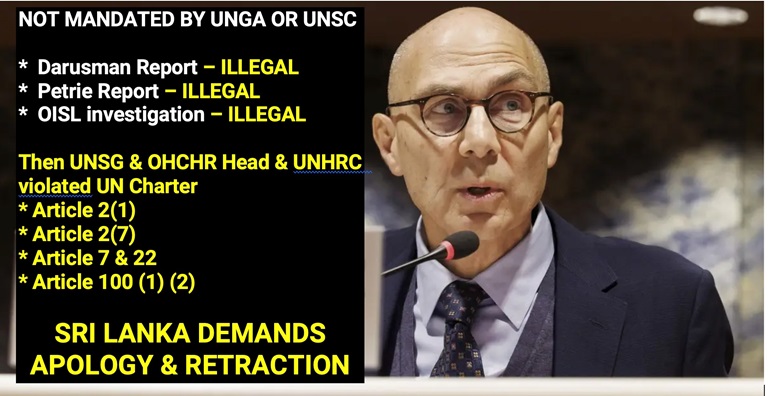
Sri Lanka’s conflict ended in May 2009. The UN that silently watched 30 years of LTTE terror & mayhem did little to prevent civilian killings. Yet when Sri Lankan Government authorized counter-terrorism action against LTTE & eventually LTTE was eliminated, the UN jumps into action calling for accountability! Not stopping there, 3 critical reports became the foundation of a witch hunt against a sovereign UN member state. The so-called international community must look at the breaches of protocol & UN Charter in the 3 reports against Sri Lanka that have clearly no UN mandate. This challenges the legal validity, procedural integrity & evidentiary basis of the 2011 Darusman Report, 2012 Petrie Report & 2015 OISL investigation – all three done under authorization of only then serving UN Secretary General Ban Ki Moon.
Legal Violations of UN Charter by the UNHRC and OHCHR Actions
- Violation of Article 2(1)
- Violation of Article 2(7)
- Violation of Article 7
- Violation of Article 22
- Violation of Article 100 (1) & (2)
- Violations of the UN Charter
1. Article 2(1) – Sovereign Equality
- Selective treatment of Sri Lanka violates the foundational principle of equal sovereignty of states.
- The UN has not imposed similar scrutiny on other states involved in comparable or more devastating conflicts (e.g., India, Afghanistan, Gaza).
- The first unilateral unmandated report after a conflict had ended creating a precedent.
The Organization is based on the principle of the sovereign equality of all its Members.”— Charter of the United Nations, Article 2, Paragraph
Sovereign equality” means All states, regardless of size, power, wealth, or geopolitical alignment, have equal legal standing and rights in the UN system. No state may be subject to differential treatment, politicized targeting, or selective accountability that is not equally applied to others in similar situations.
- Article 2(7) – Non-Interference in Domestic Jurisdiction
Nothing contained in the present Charter shall authorize the United Nations to intervene in matters which are essentially within the domestic jurisdiction of any state…”— Charter of the United Nations, Article 2, Paragraph 7
This provision is a bedrock principle of international law, protecting the sovereignty and internal affairs of states from unilateral or coercive interference by UN organs or other member states. It:
- Restrains the UN from taking action on matters of internal law, governance, and security unless authorized by the Security Council under Chapter VII.
- Preserves a state’s right to manage non-international armed conflictswithout foreign political or institutional intrusion.
The UNHRC and OHCHR acted ultra vires by intervening in Sri Lanka’s domestic affairs without Security Council or General Assembly mandate.
Sri Lanka’s internal armed conflict (1980s–2009) was a non-international armed conflict (NIAC) under international law.
UNHRC Resolutions: Repeatedly called for domestic legal reforms, foreign judges, and hybrid courts — all matters within Sri Lanka’s internal constitutional framework.
UNHRC/OHCHR exceeded their mandate by intervening in Sri Lanka’s domestic legal affairs:
- Darusman Panel was appointed without intergovernmental approval.
- Petrie Report internal unprecedented report
- OISL proceeded without Sri Lanka’s consent.
- Resolutions called for foreign judges, hybrid courts—matters internal to Sri Lanka’s constitution.
These actions amount to unlawful interference in Sri Lanka’s domestic jurisdiction, in direct violation of Article 2(7). No comparable measures were imposed on states with ongoing or recent internal conflicts (e.g., India, Ethiopia, Myanmar, Colombia).
- Articles 7 & 22 – Legal Basis for creating UN bodies
Such subsidiary organs as may be found necessary may be established in accordance with the present Charter.”— UN Charter, Article 7(2)
The General Assembly may establish such subsidiary organs as it deems necessary for the performance of its functions.”— UN Charter, Article 22
These two articles form the exclusive legal basis for establishing:
- Fact-finding missions
- Investigatory panels
- Subsidiary mechanisms
Only the General Assembly or Security Council may law fully authorize a commission, panel, or inquiry with investigatory powers or official status.
However,
- The Darusman Panel was appointed unilaterally by the Secretary-General without GA or SC authority, rendering it ultra vires. Who funded this Panel?
- As per Articles 7 & 22 only the UNGA or UNSC have the exclusive legal authority to establish UN bodies.
- OISL (2015): Investigated wartime conduct and governance policies without host state consent, effectively overriding Sri Lanka’s legal autonomy.
- Article 100 (1) (2) – Secretariat Neutrality (Impartiality)
- The Secretary-General breached his duty of neutrality by initiating politically motivated actions lacking intergovernmental oversight.
- Appointing panels lacking intergovernmental oversight.
- Citing reports that were unauthorized, leaked, and methodologically flawed.
- Ignoring evidence from independent Tamil groups and families of missing soldiers.
Article 100 (1) – UN Charter – In the performance of their duties the Secretary-General and the staff shall not seek or receive instructions from any government or from any other authority external to the Organization. They shall refrain from any action which might reflect on their position as international officials responsible only to the Organization”
Article 100 (2) – UN Charter – Each Member of the United Nations undertakes to respect the exclusively international character of the responsibilities of the Secretary-General and the staff and not to seek to influence them in the discharge of their responsibilities.”
Article 100 is meant to:
- Guarantee the objectivity and neutrality of the UN Secretariat.
- Prohibit political influence or pressure from powerful states or lobbying blocs.
- Ensure that UN staff act only under the legal framework and authority of UN bodies, not under activist or political agendas.
Timeline of UNHRC Actions vs. Sri Lanka (2009–2025)
How the Darusman Panel Report (2010–2011) violated the UN Charter
How has Petrie Report (2012) violated the above Charters:
How has OISL (2015) violated the above Charters:
- 19 May 2009: End of war
- 15 May 2010: Sri Lanka appoints LLRC internal investigation
- 22 June 2010: Darusman Panel appointed (unauthorized)
- 2011: Report published
- 2012: Petrie Report released
- 2015: OISL launched by OHCHR without consent
- 2012–2024: Multiple biased UNHRC resolutions based on flawed reports
How the Darusman Panel Report (2010–2011) violated the UN Charter
Timeline of Appointment
- 22 June 2010: Secretary-General Ban Ki-moon announces the formation of a Panel of Experts to advise him on the issue of accountability” during the final stages of Sri Lanka’s conflict. Created unilaterally by Secretary-General Ban Ki-moonin 2010, following pressure from:
- Certain Western member states
- Diaspora lobby groups
- UN-affiliated activists
- Absence of UNGeneral Assembly or UNSecurity Council Endorsement
- No General Assembly resolution or Security Council mandate authorized the Panel.
- The Panel wasnot a subsidiary organ under Article 22 of the Charter.
- Its creation bypassed intergovernmental review, violating Articles 7 and 22 – lacked binding procedural standards
- March 2011: The Panel submits its report.
- April 2011: Report is leaked to the public and becomes the unofficial basis for UNHRC Resolution 19/2 (2012).
- Anonymous testimonies sealed for 20 years.
- Violated ICCPR Article 14 (no right of reply).
- Office of Legal Affairs (2011) clarified it was not an official UN investigation – yet it was used to justify formal action.
- UNHRC cited it repeatedly, making resolutions from 2012 onwards legally voidable.
- Yet, who funded this Panel that the UNSG unilaterally appointed?
- How was it quoted by UNHRC/OHCHR Head after it was leaked
- The action has set a dangerous precedent to allow the UNSG’s secretariat to function without intergovernmental approval.
This is not a fact-finding mission but an advisory panel. However, it is part of my initiative to ensure accountability.”- Darusman Report, Introduction
Statement by the UN Office of Legal Affairs (2011) on the Darusman Panel –The Secretary-General established the Panel of Experts under his own authority, not as an investigative or fact-finding body. The Panel was not a subsidiary organ of the General Assembly or the Security Council, and its findings do not carry the status of official United Nations investigations.” — , in correspondence and internal clarification to Member States (2011), upon queries from delegations regarding the status of the Panel.
This formal statement confirms that the Panel’s authority is extra-legal under the Charter
How has Petrie Report (2012) violated the above Charters:
- Framed as a review of internal UN failures during the final phase of the conflict, it too was leaked and became a vehicle for publicly shaming Sri Lanka — again led by Secretariat staff without intergovernmental oversight.
- Leaked and used to shame Sri Lanka publicly.
- No procedural transparency; no intergovernmental oversight.
- Showed bias by selectively targeting the state and ignoring LTTE atrocities.
- Acted as a quasi-judicial condemnation, not an internal review.
- Internal review repurposed as a quasi-judicial indictment.
- Selective citation of facts and institutional bias.
A continued reluctance to stand up for the rights of people led to a grave failure of the UN during the final stages of the conflict in Sri Lanka.” — Charles Petrie, Panel Chair
Sri Lanka was the only nation to defeat an internationally banned terrorist movement.
Sri Lanka was well within its right to take counter-terrorist action.
Sri Lankan forces rescued close to 300,000 civilians in the world’s largest humanitarian rescue operation while simultaneously engaging the LTTE terrorists in hostilities.
Brief Summary: Violations of UN Internal Protocols & Charter by the Petrie Report
- Unauthorized Investigation:The Petrie Report was produced without formal approval from the UN General Assembly or Security Council, breaching UN procedural protocols and the authority structures established by the UN Charter.
- Impartiality and Independence Compromised:By selectively targeting the Sri Lankan government and ignoring other parties’ actions (like the LTTE), the report violates UN principles of neutrality and fairness outlined in the Charter and internal guidelines.
- Procedural Irregularities:The report relies heavily on anonymous and unverified sources, violating established UN protocols on evidence verification, transparency, and due process.
- Sovereignty and Non-Interference:Conducting investigations without the host country’s consent breaches the UN Charter’s respect for state sovereignty and non-intervention.
- Lack of Transparency and Accountability:The report’s opaque methodology and failure to disclose investigative procedures contravene UN standards for accountability and transparency.
- It was leaked to the public like the Darusman Report.
These violations undermine the legitimacy of the Petrie Report and contravene fundamental UN Charter principles and internal protocols governing investigations.
How has OISL (2015) violated the above Charters:
- Initiated by the OHCHR, which falls under the Secretariat, without:
- Sri Lanka’s consent
- UNGA or UNSC authorization
- Relied on anonymous testimonies kept confidential for 20 years
- The OHCHR:
- Accepted anonymous evidence
- Consulted pro-LTTE advocacy groups
- Ignored independent Tamil testimonies (e.g., UTHR, Tamil dissidents, survivors of LTTE torture)
- Ignored 5000 missing Sri Lankan soldier family testimonies seeking justice
- No right to cross-examine or respond.
- Methodology lacked transparency.
- Biased in conclusions: Overemphasized state culpability; downplayed LTTE terror.
- Misused human rights mechanisms.
Witnesses will remain anonymous for 20 years” — OISL Methodology Note
Violations of International Law
- ICCPR Article 14: Right to fair hearing was denied.
- Principle of Equal Application: Sri Lanka was singled out despite comparative or worse conflicts receiving less scrutiny (Gaza, Iraq, Afghanistan).
- Customary international law: No state may be investigated without consent in non-international conflicts.
OISL Violations of UN Protocols, Procedures, Treaty Law, and the UN Charter
- Lack of Proper Authorization & Mandate Overreach
- The OISL investigation was established without explicit endorsement from the UN General Assembly or Security Council, violating UN procedural norms.
- Its mandate exceeded the scope allowed under the UN Charter and relevant treaties by conducting a politically charged inquiry rather than a neutral fact-finding mission.
- Breach of Sovereignty and Non-Interference
- The OISL operated without the full consent or cooperation of the Sri Lankan government, breaching the UN Charter’s core principle of respect for national sovereignty (Article 2.7).
- Such unilateral investigations violate customary international law and treaty obligations that require state consent for jurisdiction.
- Violation of Due Process and Fair Trial Principles
- The OISL relied on anonymous, uncorroborated testimonies and hearsay, ignoring the standards of evidence required by international treaty law and UN investigatory protocols.
- It failed to provide affected parties the opportunity to respond or challenge allegations, breaching principles of fairness and natural justice.
- Lack of Impartiality and Objectivity
- The investigation showed clear bias by disproportionately blaming Sri Lankan government forces while minimizing LTTE atrocities, violating UN principles of neutrality and impartiality.
- Such partiality contravenes the spirit of the Universal Declaration of Human Rights and international humanitarian law obligations.
- Failure to Comply with UN Internal Procedures
- The OISL did not ensure transparency in methodology or allow for independent verification, violating UN procedural guidelines.
- It circumvented regular UN investigatory channels and accountability mechanisms outlined in the UN Charter and internal regulations.
- Misuse of Human Rights Mechanisms
- By politicizing the investigation, the OISL undermined the integrity of UN human rights systems, violating treaty commitments to uphold the rule of law and peaceful dispute resolution.
The OISL investigation into Sri Lanka violated multiple UN protocols, internal procedures, treaty law, and foundational principles of the UN Charter—particularly regarding sovereignty, due process, impartiality, and procedural legitimacy—calling into question its credibility and legitimacy.
Procedural Breaches
- No opportunity for Sri Lanka to cross-examine witnesses.
- No independent audit or peer review of reports.
- Bypassing of traditional UN fact-finding mechanisms.
- Evidence from groups such as UTHR, ICRC, and survivors of LTTE atrocities consistently ignored.
Comparative Chart of UN Responses to Global Conflicts (2006–2009)
| Conflict | UNSG Panel? | OHCHR Inquiry? | UNSC Mandate? | Host State Consent? |
| Sri Lanka | Darusman (no mandate) | OISL (no consent) | ||
| Gaza | Goldstone (with HRC vote) | |||
| Sudan/Darfur | ICC Referral | |||
| Afghanistan | NATO/UN Missions |
Ignored Documentation from Independent Sources
- UTHR Reports(Prof. Rajan Hoole)
- ICRC statementson LTTE use of civilians
- UNICEF dataon child soldiers
- US. State Department reportson LTTE war crimes
Timeline of UNHRC Actions vs. Sri Lanka (2009–2025)
| Date | Event |
| May 2009 | End of armed conflict with defeat of LTTE. |
| May 2009 | UN Secretary-General Ban Ki-moon visits Sri Lanka and issues joint statement on accountability. |
| June 2010 | SG Ban Ki-moon appoints the Darusman Panel without GA/SC mandate. |
| March 2011 | Darusman Panel submits report. |
| April 2011 | Report is published and widely cited in UNHRC and media. |
| November 2011 | Sri Lanka releases LLRC Report (Lessons Learnt and Reconciliation Commission). |
| March 2012 | UNHRC Resolution 19/2 adopted (24–15–8) — based primarily on the Darusman Report. |
| March 2013 | Resolution 22/1 adopted (25–13–8). |
| March 2014 | Resolution 25/1 adopted (23–12–12) — calls for international investigation. |
| March 2014 | OHCHR initiates OISL investigation, without Sri Lanka’s consent. |
| September 2015 | OISL Report released with significant reliance on anonymous testimonies. |
| October 2015 | Resolution 30/1 adopted by consensus — Sri Lanka co-sponsors under new government. |
| March 2017 | Resolution 34/1 adopted (renewal of 30/1). |
| March 2019 | Resolution 40/1 adopted by consensus (further time extension). |
| February 2020 | Sri Lanka formally withdraws co-sponsorship of 30/1. |
| March 2021 | Resolution 46/1 adopted (22–11–14) — increase in OHCHR evidence-gathering powers. |
| October 2022 | Resolution 51/1 adopted (20–7–20) — broadens accountability scope. |
| July 2023 | Resolution 53/25 adopted (31–3–13), further operationalizing evidence collection. |
| October 2024 | Resolution 57/1 adopted by consensus — latest continuation. |
| June 2025 | UN High Commissioner Volker Türk visits Sri Lanka. Survivors of LTTE atrocities request meeting. |
This timeline demonstrates how unverified, unofficial, and unauthorized reports were used to generate a chain of political pressure and legally questionable resolutions — in defiance of Sri Lanka’s sovereignty and the spirit of the UN Charter.
Breakdown of UNHRC Country Votes on Sri Lanka Resolutions (2012–2024)
| Year | Resolution No. | Yes Votes | No Votes | Abstentions | Key Supporters | Notable Opposers |
| 2012 | 19/2 | 24 | 15 | 8 | USA, UK, India | Russia, China, Cuba |
| 2013 | 22/1 | 25 | 13 | 8 | USA, Germany, Switzerland | Venezuela, Pakistan |
| 2014 | 25/1 | 23 | 12 | 12 | UK, Macedonia, Romania | China, Saudi Arabia |
| 2015 | 30/1 | Consensus | — | — | Sri Lanka co-sponsored | — |
| 2017 | 34/1 | Consensus | — | — | UK, Canada | — |
| 2019 | 40/1 | Not tabled | — | — | — | — |
| 2021 | 46/1 | 22 | 11 | 14 | UK, Germany, Malawi | Pakistan, Bangladesh |
| 2022 | 51/1 | 20 | 7 | 20 | USA, France, Mexico | China, Russia |
| 2023 | 54/1 | 21 | 12 | 14 | Germany, Finland | India (abstained) |
This breakdown shows the continued reliance on politicized alliances rather than consensus, undermining the impartiality of resolutions against Sri Lanka.
Domestic Investigative Mechanisms ignored:
LLRC (2010) Lessons Learned Reconciliation Commission
- Conducted public hearings across the country
- Recommended wide-ranging reforms
Paranagama Commission
- Inquired into IHL and HR violations by all parties
- Examined victim testimonies and forensic evidence
Criminal Investigations & Prosecutions
- Ongoing cases against LTTE cadres and some security personnel
- Judicial action taken, despite resource and witness protection challenges
Summary of Domestic Legal & Investigative Mechanisms
- Lessons Learnt and Reconciliation Commission (LLRC)
- Established in 2010 by the Sri Lankan government to investigate the final stages of the civil conflict and recommend measures for reconciliation and accountability.
- Conducted extensive hearings and gathered testimonies from diverse stakeholders.
- Produced a comprehensive report acknowledging wartime challenges, recommending political, social, and institutional reforms, including improving human rights protections and addressing grievances.
- Recognized limitations of wartime conduct while emphasizing the necessity of defeating terrorism.
- Paranagama Commission (Presidential Commission of Inquiry)
- Formed to investigate alleged violations of international humanitarian law and human rights by all parties during the conflict.
- Conducted public and closed hearings with broad mandate to scrutinize evidence and testimonies.
- Submitted detailed findings to the government, emphasizing the need for lawful conduct during armed conflict and due process.
- Recommendations included strengthening domestic accountability frameworks and improving law enforcement capacities.
- Criminal Investigations and Prosecution Statistics
- Sri Lanka’s law enforcement agencies have actively investigated and prosecuted cases related to conflict-era crimes.
- Numerous cases filed involving alleged violations by both state security forces and LTTE operatives.
- Domestic courts have adjudicated several high-profile cases, demonstrating commitment to the rule of law.
- Statistics reflect ongoing efforts to address accountability within the country’s judicial system, though challenges in witness protection and evidence collection remain.
Comparative UN Response: Global Conflict Standards
| Conflict | UNSG Panel? | OHCHR Inquiry? | UNSC Mandate? | Host Consent? |
| Sri Lanka | Yes (No mandate) | Yes (No consent) | No | No |
| Gaza | No | Yes (HRC vote) | No | Partial |
| Darfur | No | No | Yes (ICC Referral) | N/A |
| Afghanistan | No | No | NATO Mandate | Yes |
Ignored Evidence
- UTHR Reports (Rajan Hoole)
- ICRC documentation on civilian protection
- UNICEF: Child recruitment by LTTE
- U.S. State Dept. reports on LTTE atrocities
Breakdown of UNHRC Votes on Sri Lanka Resolutions
| Year | Resolution | Yes | No | Abstain | Supporters | Opposers |
| 2012 | 19/2 | 24 | 15 | 8 | USA, UK | Russia, China |
| 2013 | 22/1 | 25 | 13 | 8 | Germany, India | Venezuela |
| 2014 | 25/1 | 23 | 12 | 12 | Macedonia | Saudi Arabia |
| 2015 | 30/1 | Consensus | – | – | Sri Lanka (co-sponsored) | – |
| 2021 | 46/1 | 22 | 11 | 14 | Germany, UK | Pakistan, Bangladesh |
| 2023 | 54/1 | 21 | 12 | 14 | Finland | India (abstained) |
Final Statement
The UN’s credibility depends on respect for its own Charter. Selective justice, political coercion, and unlawful procedures undermine not only the rights of member states like Sri Lanka, but the legitimacy of international law itself. We urge the United Nations to uphold the law without fear or favour.
Demands for Legal Rectification
- Immediate UNGA-led legal review of all Sri Lanka-related UNHRC reports and resolutions.
- Retraction or amendment of the Darusman, Petrie and OISL reports.
- Investigation into procedural abuse by the OHCHR and relevant officials.
- Establishment of a new balanced inquiry into all war-time violations, including those committed by the LTTE and foreign actors.
We call on the United Nations to restore balance, legality, and fairness in its approach to Sri Lanka and similarly affected nations.
Shenali D Waduge
Raiding wild elephants and barking village dogs – II
June 25th, 2025By Rohana R. Wasala
Continued from June 21st, 2025
My rough English version of what General Ratnayake uttered in Sinhala does not at all do justice to his smart observation. I’ll explain this in a while. Let’s first take a look at the background to the event (namely, Charles Thomas’s ‘Sihinaya’ programme at the Padeniya Purana Rajamaha Viharaya held on May 17, 2025). The Mahanayake Thera’s letter mentioned above was sent to the Viharadhipati of the said Rajamaha Viharaya, Ven. Katumuluwe Sumanaratana Thera, just over a month previously. Let’s wind back a little.
The Most Venerable Tibbatuwawe Sri Siddhartha Sumangala Thera, the Mahanayake of the Malwatte Chapter of the Siyam Maha Nikaya in Kandy, directed an official letter, a formal injunction, to Venerable Katumuluwe Sri Sumanaratana Nayake Thera of the Padeniya Purana Rajamaha Viharaya at Padeniya about this programme scheduled to be conducted there on May 17, 2025. Now, what did the Mahanayake Thera write to the chief incumbent of the Padeniya Purana Rajamaha Viharaya? The following is my translation of the Mahanayake Thera’s letter dated April 15, 2025 (a photocopy of which was published in ‘ලංකා ලීඩර්’ Lanka Leader on May 27, 2025):
It has been brought to our notice that preparations are being made for a special programme to be conducted, in this holy month of Vesak that commemorates the Three Cardinal Events of the life of the Sammasambuddha, by a person named Charles Thomas at the Padeniya Purana Rajamaha Viharastanaya, which belongs to the Malwatte Chapter and which is at present under your incumbency. This person Charles Thomas has been accused of unethical conversion of Buddhists. We have also been made aware that the local Buddhist public have expressed strong displeasure at this event.
Therefore, we hereby notify you to call off the proposed programme, and to refrain, in the future, from organizing similar events with this person that are likely to cause public agitation.”
Signed/Sri Siddhartha Sumangala Thera
The Mahanayake/Malwatte Chapter of the Siyam Maha Nikaya
(Please note the use of the ‘royal We’ in this document, which is normal in official communications issued by the Mahanayake Thera; ‘We’ in this context is used not to show plurality, but authority.)
The Mahanayake Thera issued another official letter suspending Katumuluwe Sumanarathana Thera as Chief Judicial Sangha Nayake of Devamedi Hathpaththuwa on May 18, 2025 on learning that the latter had gone ahead with the scheduled event disobeying his explicit instructions. In the letter the Mahanayake stated the reasons for the particular decision (to suspend the Viharadhipathi as Chief Judicial Sangha Nayake) taken by the Karaka Sangha Sabha of the Maha Viharaya under his imprimatur:
First, although Sumanaratana Thera had claimed, by a letter to the Mahanayake Thera dated May 14, 2025, that all the Nayake monks of the region (of Devamedi Hathpaththuwa) had expressed their approval of the programme in question, they later informed the Mahanayake Thera that they had not been made aware of his letter of restraint (issued on April 15, 2025), implying that they would not have given their consent, had they known about it beforehand. Second, the Commissioner General of Buddhist Affairs had, by his letter dated May 16, 2025, in response to many complaints received from various sections of the Buddhist public, asked for a postponement of the programme. The Commissioner General had asked for this until a final decision could be taken, considering the fact that the programme could lead to social disharmony. And, finally, in spite of all these alerts, Katumuluwe Sumanaratana Thera had flouted established conventions in holding the event (on May 17). The Mahanayake Thera expressed strong displeasure at this and went on to suspend Sumanarathana Thera as the Chief Judicial Sangha Nayake of Devamedi Hathpaththuwa.
Let’s with due respect and reverence leave it to the discretion of the Most Venerable Mahanayake Thera of the Siyam Maha Nikaya to take appropriate further action to deal with this obvious case of cynical insubordination on the part of the said monk.
Be that as it may, it is clear that the incumbent monk allowed the disputed event to be held in non-compliance with the Mahanayake Thera’s express instructions against doing so. General Daya Ratnayake’s words should be interpreted in that context. His implicit rejection of what he had been invited to add value to by his graceful presence, he conveyed to the audience through the undisguised sarcasm of:
‘වන අලින් ගම වදින විට බල්ලන් බිරුවාට අලියා කලබල නොවී වගාව කා දමන බව’ ‘When wild elephants raid villages, dogs bark; but they eat up the crops unperturbed’,
where there is no explicit or implicit reference to the Mahanayake Thera. Dogs are small and weak opponents of the elephants, but they do their duty by warning off the elephants and alerting the villagers. The elephants are big and strong and are taking what is not theirs, which is wrong. The subversive forces suspected to be behind Charles Thomas who was, as alleged, hosted by the errant monk are powerful; they are doing what they want (that is, proselytisation/cultural subversion of the Buddhists in this instance) through their agent ignoring the divided and weakened opposition that he happens to encounter.
It must be emphasized at this point that my criticism is actually directed at Katumuluwe Sumanarathana Thera, who should know better than to get a Catholic guest to preach to his Buddhist congregation consisting of his dayaka (donor) upasaka upasikas on whose alms he sustains himself. I don’t at all think that mainstream Christians and Catholics have anything to do with what Charles Thomas is doing or that he is authorized by HH the Cardinal to perform at Buddhist Viharas. So, I sincerely assure them that I am not targeting the Christian/Catholic community or their spiritual leaders. Many a time have I wished the Mahanayake Theras took a leaf out of the Cardinal’s book in looking after the legitimate interests of monks and lay Buddhists by fearlessly asserting their spiritual authority before the rulers.
To General Ratnayake I would like to say this: I am only offering my arbitrary interpretation of your words, as a personal opinion. You might have meant an entirely different thing; but I am sure it could be anything but defamatory of the Maha Sangha, least of all, of the Mahanayake Theras.
The currently operative Republican Constitution with its institution of the executive presidency was promulgated in 1978. However, it was based on the original Republican Constitution of 1972, according to which that post was only a nominal one (that is, the president was a figurehead) and the prime minister (an elected Member of Parliament) exercised executive power. An AI summary of the important Article 9 of the 1978 constitution (about the place given to Buddhism therein) reads as follows: ‘The State is mandated to protect and foster the Buddha Sasana (Buddhist teachings), while also ensuring the rights granted by Articles 10 and 14(1)(e) to all religions. These rights include freedom of thought, conscience, and religion, ensuring the protection of other religious beliefs alongside Buddhism.’
However, the literal translation of Buddha Sasana as ‘Buddhist teachings’ does not adequately match how the term ‘Buddha Sasana’ is actually interpreted in the Constitution, where it encompasses not only the Buddhist ‘religion’ (Buddhana sasanam = teaching of the Buddhas), but also everything material and institutional that is vitally associated with it like Buddhist shrines, monasteries, pirivenas (bhikkhu educational centres), Buddha images, stupas, Bodhi trees, Buddhist archaeological sites, and the rest. To safeguard the Buddha’s teachings, those objects and institutions must be protected, too. The problem of the increasingly threatened state of the Buddha Sasanaya (especially since 2015 to date) remains to be addressed. Such activities as encroachment on the Buddhist religious space in the form of unethical or coerced conversions, building unwanted prayer halls in Buddhist majority places, need to be stopped peacefully.
What was witnessed at Padeniya Purana Rajamaha Viharaya on May 17, 2025 was an instance of the spirit of Article 9 (its basic purpose) being violated. Even more brazenly intrusive Jerome Fernando’s activities belong to the same category, and are not likely to make for peaceful coexistence or mutually beneficial interactions between Buddhists and Christians/Catholics, the major reason for this being the fundamental differences between Buddhism and Christianity in terms of their doctrines, spiritual concepts and practices. Buddhists may find proselytising irritating at best, and aggressive and discriminatory at worst. The same can be said about Hindus, who are similarly vulnerable to coercive conversion schemes. Both groups face the problem of proselytisation.
But isn’t proselytisation of ‘infidels’ a religious duty of the Christian faithful? This
is paralleled by the principle of da’wah (inviting non-Muslims to Islam) among Muslims.I think that both these concepts come within the purview of freedom of religion enshrined in the Constitution. Even this can be easily accommodated in a Buddhist, as well as Hindu, religious environment if the approach adopted is non-coercive, non-aggressive, peaceful, and most important, based on rational conviction. It should also be recognised that Hinduism and Buddhism which are quasi-religions are not protected by such intrinsic safety devices used by real religions as apostasy and blasphemy laws.
Having said that, I for one feel that it is no longer realistic for the Sinhalese Buddhist majority community to look to the government of the day for protecting the Buddha Sasanaya under the prevailing circumstances dominated by highly politicised fundamentalist religious ideologies which are at loggerheads with each other. That heavy responsibility must be borne by the ‘sivvanak pirisa’ (the fourfold community of bhikkhu bhikshuni upasaka upasika/male and female members of the Buddhist clergy and laity respectively). Given that Buddhism is a non-religious religion (a quasi religion) that is most compatible with the principles of secular democratic governance, a well run secular democracy is the best guarantor of the protection of the Buddha Sasanaya.
But there is a serious challenge before them. An inner collapse has been triggered in the Buddhist religious cultural establishment and within the Buddhist community (sivvanak pirisa) due to external pressures from diverse sources: religious, political, economic, social, etc. This is compounded by entrenched corruption within monastic walls in some cases including the palladium of Buddhism in Sri Lanka, the Sri Dalada Maligawa, the Temple of the Tooth Relic. (This is a closely related subject that needs to be dealt with in a separate future essay.)
Let me conclude this present opinion piece with a suggestion drawn from Episode 119 of Lanka Leaders YouTube Channel uploaded a little over a month ago by Abheetha Edirisinghe, a YouTuber who produces well researched videos about subjects of national interest, concerning so-called Brother Charles Thomas’s ‘Sihinaya’ programme held at the Padeniya Purana Rajamaha Viharaya on May 17. According to him, on a previous occasion, the Ministry of Education was reported to have officially asked teachers and schoolchildren to participate in a ‘Sihinaya’ programme that Brother Charles was conducting in a school in Dompe, which suggested that it received ministerial patronage. Edirisinghe feels that Katumuluwe Sumanarathana Thera could have acted the way he did under similar government pressure, in which case, merely suspending Katumuluwe Sumanarathana Thera as Adhikarana Sangha Nayake would not settle the issue. He appeals that the Mahanaya Thera hold a thorough investigation to find out the real nature of the motivation behind the monk’s questionable conduct in hosting that unauthorised event.
Concluded
Will the UNHRC Head meet Tamil Victims of LTTE Terror or only Tamils who defend LTTE?.
June 25th, 2025Shenali D Waduge
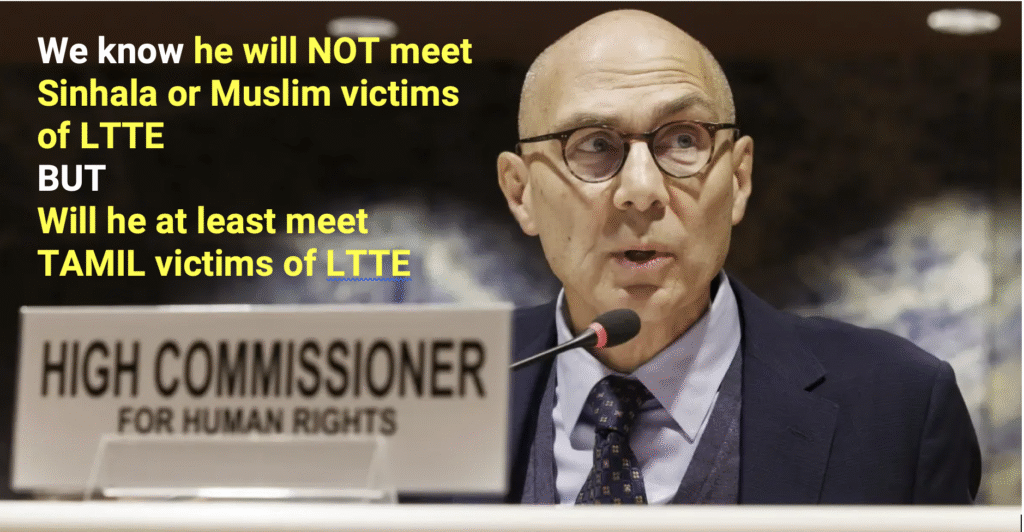
The UN High Commissioner for Human Rights Volker Türk is currently in Sri Lanka inspite of the devastation taking place in Israel, Iran & Gaza. He is scheduled to tour the Northern Province. His visit will put him to the test. Will he meet Tamil families who lost their loved ones to LTTE cruelty or will he like all previous UNHRC Heads give audience only to those who promote the same narratives the LTTE used to justify mass murder?
Thunukkai: The Camp of Horror the UN refused to see
While UN & its entities continue to desperately defend the narrative of 40,000” dead which it is being challenged to prove, the UN is happy to ignore the sites of torture, detention & even executions committed by LTTE.
According to multiple testimonies, backed by research from University Teachers for Human Rights (UTHR-Jaffna):
- The LTTE operated a brutal torture and detention facility in Thunukkai, Mullaitivu.
- Between 3,000 and 6,000 Tamil civilians were abducted and held without trial.
- Many were executed, others died under torture, and the rest were never seen again.
- Child soldiers, forcibly conscripted, were made to guard and torture their own community.
- Victims included:
- Tamil youth who resisted recruitment
- Journalists, teachers, clergy
- Ordinary civilians accused of being traitors”
So much for claiming to carve a separate state for their own”.
UTHR’s reports describe underground bunkers, hidden camps, and systematic torture run by LTTE’s intelligence wing (Kittu/Thuraiappa Group).
These reports were available to the UN from the early 1990s. What did the UN do about them?
https://www.uthr.org/SpecialReports/spreport34part8.htm
https://www.colombotelegraph.com/index.php/a-monstrosity/?tztc=1 (write up on Thunnukkai LTTE detention camp by Prof. Hoole)
https://www.facebook.com/share/p/16hz4inEA5/?mibextid=wwXIfr (Arun Siddharth)
LTTE killed my beloved father” – Arun Siddarths wife Thangathurai Thayani’s heartbreaking story https://www.lankaweb.com/news/items/2023/02/23/ltte-killed-my-beloved-father-arun-siddarths-wife-thangathurai-thayanis-heartbreaking-story/
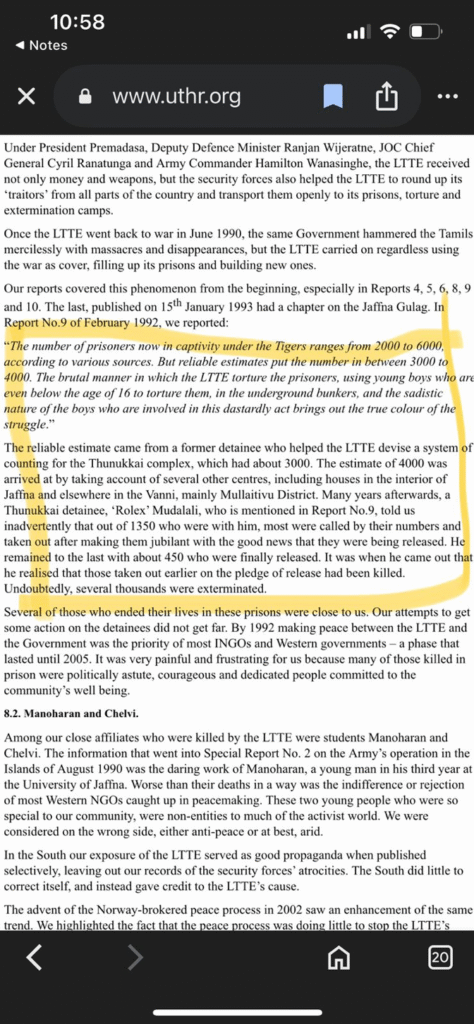
Yet not a single OHCHR report—including the Darusman, OISL, or Petrie reports—has cited UTHR’s primary Tamil testimony on these crimes committed by LTTE. Why the omission?
Families Plead for a Meeting — Will Volker Türk Give them a hearing?
The Jaffna Civil Society Center (JCSC) has sent a formal request to Mr. Türk’s delegation:
- Survivors of Thunukkai are alive.
- Families of those tortured and killed are ready to testify.
- Documents have been compiled.
- They have waited 16 years for the UN to acknowledge their pain.
They are not state agents. They are not Sinhalese. They are not Muslims. They are Tamils, wrongfully branded traitors” by the LTTE, and then forgotten by the world.
We know the UN is little bothered about Sinhalese or Muslim victims of LTTE. But why omit Tamil victims of LTTE too?
Questions to the UNHRC to Answer
- Will the High Commissioner meet these Tamil survivors of LTTE atrocities?
- Why has no UN report mentioned Thunukkai, despite UTHR and other Tamil sources providing credible documentation?
- Why are only LTTE-aligned or diaspora-linked groups invited to speak at UNHRC sessions?
- How can justice be served when half the victims — those killed by the LTTE — are erased from UN records?
- What kind of human rights system refuses to even meet the victims of terrorism, while legitimising the grievances of its perpetrators?
Truth, silenced by the UN
UTHR’s reports confirm:
- LTTE ran secret prison networks across the Vanni.
- Thunukkai, Kilinochchi, and Visvamadu housed thousands of civilians.
- Mass killings of Tamil dissenters occurred as early as the late 1980s.
- Civilians who tried to escape LTTE areas were shot, sometimes in front of their families.
These are well-documented, Tamil-sourced, and independent.
So why did the OHCHR ignore UTHR in every war crimes narrative it built & happy to accuse the Sri Lanka Armed Forces of war crimes” instead?
Selecting victims” is not justice
Volker Türk’s itinerary, so far, reportedly excludes meetings with Sinhalese and Muslim victims of LTTE terror. That is understandable & nothing to be surprised about. It was a foregone conclusion. However, why is the itinerary ignoring a segment of Tamils who were victims of LTTE?
If that is politically convenient, it would be morally indefensible if he ignores Tamil victims of the LTTE — especially those with documented evidence, survivor testimony, and decades of silence behind them.
A Tamil Mother’s Appeal
They took my son in 2005. We found his name in a UTHR report.
No one came to ask us. Not the media. Not the UN.
We are Tamil too. Why won’t Mr. Türk speak to us?”
We saw how speeches only spoke of LTTE mothers bewailing their dead terror sons/daughters. It’s a pity the victims of LTTE get shoddy treatment.
Time to be Heard.
The Tamil people were not all with the LTTE. That’s why we have continued to say All Tamils are not LTTE though ALL LTTE were Tamils”.
Many Tamils were LTTE’s first victims.
Alfred Duraiappah – the Tamil Mayor of Jaffna.
Tamil Policemen on duty in Jaffna – all killed by LTTE before they turned guns on Sinhalese.
If the UNHRC Head is in Sri Lanka for truth, it must face all of it.
If Mr. Volker Türk refuses to meet these survivors, his visit will be remembered as another performance — not a step toward justice.
The ball is in Volker Turks court – we are all watching
Shenali D Waduge
NDB Bank Empowers Sri Lankan Industry to Go Green with E-Friends II Refinance Loan Scheme
June 25th, 2025National Development Bank PLC
In line with its commitment to economic empowerment and environmental conservation NDB Bank has collaborated with the Ministry of Industries to introduce the E-Friends II” Refinance Loan Scheme, a purpose-driven financial facility designed to support industrialists in transforming their operations through sustainable and environmentally responsible practices.
As the nation moves toward a greener future, the demand for responsible manufacturing and cleaner industrial practices has never been greater. In response, the E-Friends II Refinance Loan Scheme offers affordable financial assistance at an attractive annual interest rate of just 6.5%, enabling entrepreneurs to invest in sustainable technologies and practices that reduce pollution, enhance resource efficiency, and promote long-term environmental stewardship.
Eligible entrepreneurs can access loan amounts of up to Rs. 30 million, with a generous repayment period of up to 10 years, giving businesses the flexibility and time required to implement impactful, eco-friendly changes. Whether you’re planning to make your business greener, improve production methods, or invest in energy-saving equipment, this scheme offers the ideal financial support to help protect the environment while advancing your business goals.
The E-Friends II Refinance Loan Scheme supports a wide range of environmentally focused initiatives, including:
- Reducing industrial pollution and harmful emissions
- Introducing cleaner production technologies and processes
- Managing waste more effectively and promoting resource efficiency
- Saving energy and adopting renewable energy solutions
- Encouraging circular economy principles and sustainable production
Speaking on the launch of the scheme, Indika Ranaweera, Vice President – SME, Middle Markets and Business Banking at NDB Bank stated, “Through this facility, we are enabling Sri Lankan businesses to become not just more competitive, but also more responsible. The E-Friends II Refinance Loan Scheme provides a tangible way for industrialists to contribute to national environmental goals while future-proofing their operations. At NDB, we’re proud to serve as a financial partner that prioritizes both economic growth and sustainability.”
In line with its customer-centric approach, NDB Bank offers expert advisory services and end-to-end support throughout the loan process, from application to disbursement. The Bank’s extensive branch network and dedicated officers ensure that business owners across the island receive timely assistance to realize their sustainability ambitions.
Entrepreneurs interested in applying for the E-Friends II Refinance Loan Scheme are encouraged to visit their nearest NDB branch or speak to their Relationship Manager to learn more about how they can take the next step toward a cleaner, greener, and more resilient future.
Everything you need to know about the Iran-Israel war
June 25th, 2025By Mona Hojat Ansari Courtesy Teheran Times
TEHRAN – The war between Iran and Israel appeared to grind to a halt on Tuesday, after a dizzying 12 days in which the world watched President Donald Trump demand the evacuation of Tehran’s 10 million residents, threaten to assassinate Iran’s Leader, advocate for “regime change,” launch strikes on Iranian nuclear sites, and then claim he harbored no beef with the Iranian government and even wish for God to “bless Iran.”
Iran and Israel haven’t signed a ceasefire deal, but have only agreed to halt fighting, according to Iranian Foreign Minister Seyyed Abbas Araghchi. He stated on X that Iran will hold back from striking Israel as long as the regime refrains from further aggression.
This war brought the region to the edge of a full-scale conflict, especially after American forces directly joined the fight and faced retaliatory strikes from Iran. Regional leaders watched with anxiety, fearing that the flames ignited by Trump would engulf them as well. For now, it seems the region might be safe. However, given the well-documented history of Israel and Washington breaking their word and even violating official ceasefire agreements, the threat of renewed conflict remains a very real possibility for every country in West Asia.
Meanwhile, Western media outlets have been working overtime to paint Iran as defeated, censor the grim reality unfolding in Israel, and conveniently ignore the elephant in the room: Israel and the U.S. not only failed to achieve their objectives, but faced unexpected and unprecedented consequences.
Below, we examine some key aspects of this conflict.
How did the war break out?
The war ignited in the early hours of June 13 when Israel, with U.S. backing, initiated bombings of residential buildings in Tehran, nuclear facilities in Natanz and Esfahan, and military sites throughout Iran. The regime also assassinated several of Iran’s top military generals and nuclear scientists on that day.
These attacks caught Iranians off guard, as they were preparing to attend a sixth round of nuclear negotiations with the United States in a matter of days.
Iran launched its retaliatory strikes on the night of June 13, carrying out 22 waves of missile and drone attacks against the occupied territories. The last round was fired just minutes before the fighting was supposed to cease on June 24.
Initially, American officials claimed they had no involvement in the Israeli assaults, but on June 22, they directly intervened by striking nuclear sites in Natanz, Esfahan, and Fordow.
For full Reort
Everything you need to know about the Iran-Israel war – Tehran Times
Trump pushes back after leaked report suggests Iran strikes had limited impact
June 25th, 2025Courtesy The Daily Mirror
BBC – Donald Trump and his top officials have pushed back on a leaked intelligence report that said US strikes on Iran only set its nuclear programme back by a few months.
Speaking at a Nato summit in The Hague on Wednesday, Trump said the strikes led to the “virtual obliteration” of Iran’s nuclear capabilities and set its atomic programme back “by decades”.
Defence Secretary Pete Hegseth, who was also at the summit, said the preliminary Pentagon assessment was made with “low confidence” and the FBI was investigating the leak.
On Tuesday, sources familiar with the initial report into Saturday’s bombings told the BBC’s US partner CBS that Iran’s stockpile of enriched uranium was not eliminated.
They added that the strikes had only set the country’s nuclear programme back by a few months – an assessment the White House swiftly described as “flat-out wrong”.
According to the report, strikes on the heavily fortified enrichment facilities at Fordo and Natanz had sealed off entrances but failed to destroy underground structures.
Officials familiar with the leaked Defense Intelligence Agency evaluation warned it was an early assessment that could change as more information becomes available about the sites.
The Defense Intelligence Agency is the Pentagon’s own agency which specialises in military intelligence to support operations. It collects large amounts of technical intelligence, but is distinct from other agencies like the CIA.
The US has 18 intelligence agencies, which sometimes produce conflicting reports based on their mission and area of expertise. For example, the American intelligence community is still not in agreement over the origins of Covid-19.
On Wednesday, while sitting alongside Nato Chief Mark Rutte, Trump initially acknowledged some uncertainty, saying the intelligence on the attack was “very inconclusive”.
But he then went further in his assessment, saying “it was very severe, it was [an] obliteration”.
When asked if the US would strike again should Iran resume its nuclear activities, Trump said: “Sure, but I’m not going to have to worry about that. It’s gone for years.”
Trump later likened the strikes to America’s atomic bombing of Hiroshima at the end of World War Two.
“I don’t want to use an example of Hiroshima, I don’t want to use an example of Nagasaki, but that was essentially the same thing – that ended a war,” he said.
The US president was flanked by Secretary of State Marco Rubio and Secretary of Defence Pete Hegseth, who both echoed his scepticism about the leaked intelligence.
Hegseth said the leak was politically motivated and insisted the bombs landed “precisely where they were supposed to”.
He added: “Any assessment that tells you it was something otherwise is speculating with other motives.” He characterised the leak as “completely false”.
Rubio also cast doubt on the leaked report’s credibility, suggesting the contents had been distorted in the media and labelling the leakers as “professional stabbers”.
The preliminary assessment also indicated that some of Iran’s enriched uranium stockpile had been moved prior to the attack.
According to sources familiar with it, Iran’s centrifuges remain largely “intact” with the destruction limited to aboveground buildings.
Entrances to two nuclear facilities were blocked and some infrastructure was damaged, they said, but much of the deeper installations survived the blasts.
In US intelligence terminology, “low confidence” typically indicates that the information is either poorly sourced, fragmented, or uncertain – making it less reliable than assessments graded with “moderate” or “high confidence”.
Hegseth’s reference to the report being “low confidence” suggest it is tentative and its findings may change as more detail emerges.
The US struck three nuclear sites in Iran on Saturday – Fordo, Natanz, and Isfahan – using “bunker buster” bombs designed to penetrate hardened underground targets.
While the specific munitions used in the attack have not been confirmed, the 30,000lb (14,000kg) Massive Ordnance Penetrator (MOP), was thought to be the only weapon capable of destroying Iran’s underground enrichment facilities.
Tehran has always said its nuclear programme is for peaceful purposes.
In the hours that followed Saturday’s strikes, Gen Dan Caine, chairman of the joint chiefs of staff, told reporters that it would take time to assess the damage to the facilities.
But he added that “all three sites sustained extremely severe damage and destruction”. Satellite images showed six fresh craters clustered around two entry points at the Fordo nuclear sites, as well as grey dust and debris.
It is unclear from the latest satellite images, however, how much damage the sites sustained below the surface.
Hassan Abedini, the deputy political director of Iran’s state broadcaster, said the three sites targeted by the US had been evacuated a “while ago”, and that Iran “didn’t suffer a major blow because the materials had already been taken out”.
Both US and Israeli officials, meanwhile, have hailed the mission as a success.
Deputy Minister accused of influencing police in assault case of UNP CMC member
June 25th, 2025Courtesy Daily Mirror
Colombo, June 25 (Daily Mirror) – United National Party (UNP) General Secretary Talatha Athukorala has alleged that a Deputy Minister attempted to influence police regarding the recent assault on Colombo Municipal Council (CMC) member Sandamali Uluwitage.
“We are aware that this Deputy Minister contacted the Grandpass Police to inquire about the incident. One has to wonder why a government official would take such an unusual interest in a police investigation,” Athukorala remarked during a press briefing yesterday.
She accused the government of undermining democratic norms. “It appears that democracy has been sidelined by this administration,” she said.
Athukorala alleged that the National People’s Power (NPP) exerted pressure on six CMC members who had initially pledged their support to the opposition, causing them to reverse their stance at the last minute.
Speaking about the assault, Ms. Uluwitage claimed she was nearly strangled by her attackers. “They warned me, saying, ‘Be aware that we, the NPP, have secured the CMC. Watch your step,'” she recounted.
She also accused the police of manipulating evidence related to the attack.
බෞද්ධ නායකයින්ට ආයාචනයක්
June 24th, 2025නහී වේරේන වේරානී, සම්මන්තීධ කුදාචනං. අවේරේනච සම්පත්තී, ඒස ධම්මෝ සනන්තනෝ…. *** වෛරයෙන් වෛරය නොසංසිඳේ, අවෛරයෙන්ම වෛරය සංසිඳේ. මෙය ලෝක ධර්මතාවයකි ·
මේ ලෝකයේ වෛරයෙන් වෛරය කිසිදා සංසිඳෙන්නේ නැත. වෛර නොකිරීමෙන් පමණක් වෛරය සංසිඳේ. මෙය සදාකාලික සත්යයකි. – ගෞතම බුදුන්වහන්සේ
බුදු දහම, “ලෝක ආගම්” අතර අහිංසා (අවිහිංසාව) සහ සාමය පිළිබඳ දීර්ඝ හා ශ්රේෂ්ඨ සම්ප්රදායක් ඇති ආගමකි. මේ අවස්ථාවේදී, ලෝකය 3 වන ලෝක යුද්ධයේ අද්දර සිටී.
බෞද්ධයන් විසින් මැද පෙරදිග අර්බුදය සඳහා සමබර හා සාකච්ඡා මගින් ගැටුම් විසඳීම සඳහා ත් ලෝක සාමය සඳහාත් ගෝලීය ආයාචනයක් ඉදිරිපත් කිරීමේ හදිසි අවශ්යතාවයක් මතුව ඇත. එම කලාපයේ යුද්ධ, ඒකදේවවාදී යුදෙව්-ක්රිස්තියානි ආගම එක් අතකින් සහ ඉස්ලාමීය සංයුතීන් ඇතුළත් වේදිකාගත “ශිෂ්ටාචාර ගැටුමකට” ඇතුළත් වී තිබේ. නිවැරදි දැක්ම (සම්මාදෘෂ්ටි ) සහ නිවැරදි අවබෝධය මත පදනම් වූ විවේචනාත්මක චින්තනයේ බෞද්ධ සම්ප්රදාය තුළ පවත්නා තමා විසින් ම කරුණු සහ සිදුවීම් විමර්ශනය කිරීම සහ විශ්ලේෂණය කිරීම තුළින් විසඳුම් සෙවීමට මඟ පෙන්වන ආකාරය මෙම අවස්ථාවේදී සිහිපත් කළ හැකිය.
තනි තනිව අපට දුර්වල බවක් සහ බොහෝ දේ කළ නොහැකි බවක් දැනිය හැකි වුවද, විෂයයක් හෝ ගැටලුවක් අධ්යයනය කිරීමෙන් සහ නිවැරදි විඥානය වර්ධනය කිරීමෙන්, දේශීය හෝ ගෝලීය වේවා, තත්වයක් සමනය කිරීම සඳහා නිවැරදි කථනය සහ නිවැරදි ක්රියාමාර්ග සඳහා උපාය මාර්ගයක් කරා මෙම ගෝලීය හදිසි අවස්ථාවේදී සාමූහිකව ළඟා විය හැකිය,
බුදුන්ගේ අහිංසා හෙවත් අවිහිංසාව පිළිබඳ පණිවිඩය
මැදපෙරදිග ගැටුම හේතුවෙන් “ලෝකය න්යෂ්ටික ව්යසනයක අද්දර යනුවෙන් රුසියාව අනතුරු අඟවා තිබේ. ජාත්යන්තර නීතියට අනුව නීති විරෝධී ලෙස ඉරානයට එරෙහිව එල්ල කරන ලද එක්සත් ජනපද ප්රහාර සහ එහි සහාය ලත් ඊශ්රායලය විසින් සිදු කරන ප්රහාර සහ ඉරානයේ ප්රතිප්රහාර හේතුවෙන් දැනටමත් න්යෂ්ටික කාන්දුවක් සහ පාරිසරික හානියක් සිදුවී ඇත.
බුද්ධන්ගේ අහිංසා පණිවිඩය සහ ‘වෛරය කිසි විටෙකත් වෛරයෙන් සංසිඳුවන්නේ නැත. වෛරය සංසිඳෙන්නේ මෛත්රිය මගින්ය’ යන ප්රකාශය දැන් කවරදාටත් වඩා අදාළ වේ. කණගාටුවට කරුණක් නම්, ඊනියා “දියුණු” කාර්මික සහ ශිෂ්ටාචාරගත ඇන්ග්ලෝ-යුරෝපීය ලෝකය විසින් පසුගිය වසර 2 තුළ ගාසා තීරයේ ඊශ්රායල ආරක්ෂක හමුදා විසින් සිදු කරන ලද ජන සංහාරයට සහ පලස්තීන ජනතාව මුහුණ දෙන අතිශය මානව දුක් වේදනාවලට සහාය දීමයි.
මේ අවස්ථාවේදී එක්සත් ජනපද ජනාධිපති ට්රම්ප් ඉරානයේ න්යෂ්ටික මධ්යස්ථානවලට බෝම්බ හෙලා ඇති අතර තවත් හානියක් කිරීමට තර්ජනය කරයි. ඉරානයට බෝම්බ හෙලීම සඳහා එක්සත් ජනපදය ඉන්දියානු සාගරයේ ශ්රී ලංකාව අසල පිහිටි චාගෝස් දූපත් වල පිහිටි ඩියාගෝ ගාර්ෂියා හමුදා කඳවුර භාවිතා කළේය.
මැදපෙරදිග සහ ඉන්දියානු සාගරය ගෝලීය කේන්ද්රස්ථානයයි බලශක්ති සැපයුම සහ කලාපයේ තුන්වන ලෝක යුද්ධයක් ආරම්භ වීම උතුම් අෂ්ටාංගික මාර්ගය පරිපූර්ණ කර ඉගැන්වූ බුදුන්ගේ ඉගැන්වීම්වල ඓතිහාසික වශයෙන් සුරැකී ඇති ශ්රී ලංකාව ඇතුළුව ගෝලීය දකුණේ ණය උගුලක සිරවී සිටින බොහෝ රටවලට බලපෑ හැකිය.
බුද්ධාගම සහ සමාජ යුක්තිය
බුද්ධාගමට සමාජ සාධාරණත්වය සමඟ සාමය ඇති කිරීමේ දිගු සම්ප්රදායක් ඇත. සමාජ යුක්තිය නොමැතිව සාමය ඇති කිරීම තිරසාර නොවන අතර සැබෑ ගැටුම් නිරාකරණයට වඩා ‘ජනගහනය නිෂ්ක්රීය කිරීම’කට සමාන වේ. සමාජ යුක්තිය නොමැතිව දෙන ලබන විසඳුම් සැබෑ ගැටළුව යටපත් කරන නමුත් එය පසුව නැවත මතු වේ. අරමුණු විසින් ක්රියාමාර්ග සාධාරණීකරණය නොකරයි.
බ්රිතාන්ය යටත් විජිත ඉන්දියාව අවසන් කිරීමට මහත්මා ගාන්ධිගේ අවිහිංසාවාදී ප්රතිරෝධය බුද්ධාගමෙන් ආභාෂය ලැබීය. එසේම, එම රටේ වර්ණභේදවාදය අවසන් කිරීම සඳහා අවිහිංසාවාදී අරගලයට නායකත්වය දුන් දකුණු අප්රිකාවේ නෙල්සන් මැන්ඩෙලා ද බුද්ධාගමෙන් ආභාෂය ලැබීය.
ලෝකය පෙර නොවූ විරූ ව්යසනයක අද්දර සිටින විට, ලොව පුරා බෞද්ධ නායකයින් සහ එක්රැස්වීම් / සභාවන් පලස්තීන ජනතාවට යුක්තිය සහ ඇමරිකානු සහ ඊශ්රායල් ආක්රමණ අවසන් කරමින් සාමය ඉල්ලා සිටීමට මේ කාලය නොවේද?
ඔන්ලයින් ආගමික ප්රචාර
සීතල යුද්ධය අතරතුර සහ අතරමැදි වසරවලදී අන්තවාදී ආගමික-සංස්කෘතික ජාල පිහිටුවීම සහ භාවිතය මෑත කාලයේ දී උත්සන්න වී ඇති අතර, ඓතිහාසිකව බහුත්ව සහ බහු සංස්කෘතික සමාජයන් බෙදීමට සහ කැබලි කිරීමට සංස්කෘතික යුද්ධ වේදිකාගත කිරීම හරහා ද උත්සන්න වී ඇත.
යුද්ධ ප්රවර්ධනය කරන සහ ආයුධ විකුණන සහ ණය උගුල් ඇති අටවන රටවල් විසින්ම ලෝක ආගම් ආයුධ බවට පත්කිරීම සිදු කර ඇත.
ඒ සමඟම, ගෝලීය ආගමික සාමයේ සම්ප්රදායන්ගේ නීත්යානුකූලභාවය ඛාදනය වී ඇත. මෑත කාලයේ දී, ඊශ්රායල ජාලයන් ශ්රී ලංකාවේ සියොන්වාදී චබාද් යාඥා නිවාස පිහිටුවා ඇත. නමුත් ශ්රී ලංකාවේ කිසිදා යුදෙව් ප්රජාවක් තිබුණේ නැත.
ආගම් සහ අන්තවාදී ආගමික සංවිධාන සහ කණ්ඩායම් සඳහා අරමුදල් සැපයීම සහ භාවිතා කිරීම හරහා, ඓතිහාසිකව බහු සංස්කෘතික සහ බහු ආගමික රටක් අස්ථාවර කිරීමට, පුරවැසියන් බෙදීමට සහ අවධානය වෙනතකට යොමු කිරීමට උත්සාහ කරමින් පවතී.
මෙය ඉහළම මට්ටමේ ජාතික ආරක්ෂක තර්ජනයක් වන අතර, විශේෂයෙන් ඉස්ලාමීය රාජ්යයේ (ISIS) ඉතිහාසය සැලකිල්ලට ගන්නා විට ත්රස්තවාදී අනතුරක තත්ත්වය මතුව තිබේ. 2019 පාස්කු ඉරිදා ප්රහාර මගින් බහු ආගමික ශ්රී ලංකාව තුළ “ප්රචණ්ඩ රැල්ලක් ” අවුලුවාලීමට වේදිකා ගත කරන ලදී.
මෙම ගැටලුව විසඳීම සඳහා මෙම අවස්ථාවේදී, ගැටලුවේ සංකීර්ණත්වය සහ භූ දේශපාලනික ආර්ථික මානයන් පිළිබඳ නිවැරදි අවබෝධය සහ නිවැරදි අවබෝධය මත පදනම්ව නිවැරදි ක්රියාමාර්ග ගැනීම අවශ්ය වේ. “නපුර නොපෙනේ, නපුර අසන්නේ නැත, නපුර ගැන කතා කරන්නේ නැත” යනුවෙන් පැවසීම සහ වැල්ලේ හිස වළලා දැමීම හොඳ විකල්පයක් නොවේ.
නිවැරදි අවබෝධය සහිත සාමූහික සහ ප්රජා පාදක විසඳුම්
නීති විරෝධී ලෙස න්යෂ්ටික අවිවලින් සන්නද්ධව එක්සත් ජනපදයේ සහාය ලබන ඊශ්රායලය ඊශ්රායලය විසින් අවුලුවන ලද ආගමික යටි අරමුණු සහිත තවත් ලෝක යුද්ධයක් ගෝලීය පාරිසරික ව්යසනයක් බවට පත්වනු ඇත. එක්සත් ජනපදය සහ නේටෝ සංවිධානයට යුද්ධ කිරීම සඳහා ලොව පුරා හමුදා කඳවුරු 750 ක් ඇත. ඉන්දියානු සාගරය හමුදාකරණයෙන් නිදහස් කිරීමේ අවශ්යතාවයක් පවතින අතර, නොබැඳි ජාතීන්ගේ ව්යාපාරය ඉල්ලා සිටි පරිදි, එය න්යෂ්ටික අවි වලින් තොර ‘සාම කලාපයක්’ ලෙස නම් කළ යුතුය.
ඇත්ත වශයෙන්ම, ලොව පුරා ඇති සියලුම විදේශීය හමුදා කඳවුරු වසා දැමිය යුත්තේ ඒවා රටවල් සහ කලාප අස්ථාවර කරන බැවින් සහ හමුදා ව්යාපාර කර්මාන්තය පරිසර දූෂණයේ විශාලතම මූලාශ්රය වන බැවිනි.
අපට තනි තනිව අපට දේවල් වෙනස් කිරීමට බලයක් නොමැති බව හැඟිය හැකි වුවද (අපට සාමූහිකව බොහෝ දේ වෙනස් කළ හැකිය). කනගාටුවට කරුණක් නම්, ආසියානු ප්රජා සංස්කෘතිය සහ සාමූහික විසඳුම් සෙවීමේ සම්ප්රදාය විනාශ කරමින් ජනතාව පුද්ගලවාදය සහ පශ්චාත් කොවිඩ්-19 ඩිජිටල් සිරකුටි තුළ වැඩි වැඩියෙන් අඩපණ කර පරමාණුකරණය කර ඇත. මෙහිදී, ‘ජනගහනය උදාසීන කිරීමේ’ ආකාරයක් ලෙස ක්රියාත්මකවන ඔන්ලයින් ඩිජිටල් ආගමිකත්වය ප්රවර්ධනය කිරීමමගින් අපව නිෂ්ක්රීය කර දමා තිබේ.
සමාජය අධික ලෙස මනෝවිද්යාත්මකකරණයකට ගොදුරු කරගනිමින් පවතින අතර එය මෙහෙයවන්නේ බටහිර පුද්ගලවාදී ප්රවේශයක් තුළය.
එයට ප්රතිපක්ෂව අප විසින් සමාජීය සහ සාමූහික ගැටළු සඳහා සියල්ලන්ගේ සහභාගිත්වය සහිත සහ සාමූහික ක්රියාමාර්ග සහ විසඳුම් ඉදිරිපත් කෙරෙන වැඩ පිළිවෙලක් පෙරට ගත යුතුව තිබේ. ආසියානු බෞද්ධ සමාජය යනු පුද්ගලවාදයට වඩා සාමුහිකත්වය ක්රියාවට නංවන ලද ඓතිහාසික ප්රජාවකි. .
බුදු දහමේ ඉගැන්වෙන පරිදි නිවැරදි දැක්ම සහ නිවැරදි අවබෝධය මත පදනම් වූ නිවැරදි ක්රියාමාර්ගය ක් මේ අවස්ථාවේ අවශ්ය වේ. අප තනි තනිව දුර්වල විය හැකි නමුත්, එක්ව, සාමූහිකව කටයුතු කරන විට වෙනසක් කිරීමට නැතහොත් දේවල් යහපත් අතට හැරවීමට අවශ්ය බලයඅප සතුවනු ඇත.
මැද පෙරදිග සහ 3 වන ලෝක යුද්ධයේ ගැටුම් උත්සන්න වීම වළක්වා ගැනීම සඳහා බෞද්ධ දෘෂ්ටිකෝණයකින් නිවැරදි අවබෝධය සහ නිවැරදි ක්රියාමාර්ග මත පදනම් වූ අවිහිංසාවාදී ගෝලීය විරෝධතා ව්යාපාරයක් අවශ්ය වේ.
A Buddhist call for World Peace
June 24th, 2025Buddhist Leaders and Upasakas call for Peace
Hatred is never appeased by hatred in this world. By non-hatred alone is hatred appeased. This is an eternal law.” – Gautama Buddha
Buddhism, has a long and great tradition of Ahimsa (non-violence), and peace among world religions. At this time, on the world is on the brink of World War 3. There is an urgent need for Buddhists to lead a Global call for Peace– through balanced and negotiated conflict resolution in the Middle East. The conflict in that region is embedded in a staged Clash of Civilizations”, involving monotheistic Judeo-Christianity on the one hand and Islamic formations on the other.
The Buddhist tradition of Critical Thinking, based on Cultivation of Right View (sammadithi) and Right Understanding; through investigation and analysis of the facts and events for oneself may be recalled at this time.
Through study of a subject or problem and development of Right Understanding and Consciousness a strategy for Right Speech and Right Action to ameliorate a situation, whether local or global, may be arrived at, collectively, at this time of global emergency, although individually we may feel weak and unable to do much.
The Buddha’s message of Ahimsa or Non-Violence in a time of War-talk
The world is ‘millimeters’ way from nuclear catastrophe” in the Middle East, Russia has warned. Israel’s United States-backed illegal attacks on Iran under international law, and counter-attacks by Iran, have already caused nuclear leakage and environmental harm in the past week. This escalation has also distracted from Israel’s genocide in Gaza against the Palestinian people.
At this time US President Trump is considering Striking Iran within two weeks– after moving troops to safety from America’s Middle East military bases. The Middle East is the center of global energy supply and another world war starting in the region could affect many debt-trapped countries in the Global South, including Sri Lanka—which is the historical repository of the teachings of the Enlightened One who perfected and taught the Nobel Eightfold Path.
Buddhism has a long tradition of peace-making with Social Justice. Peace-making without social justice is not sustainable and amounts to ‘passification of populations’ rather than genuine conflict resolution. It buries the problem, which resurfaces later. The ends do no justify the means.
Mahatma Gandhi’s non-violent resistance to end British Colonial Occupation of India was inspired by Buddhism. So too, South Africa’s Nelson Mandela who led non-violent resistance to end Apartheid in that country was strongly influenced by Buddhism.
With the world on the brink of unprecedented catastrophe is it not time for Buddhist leaders and assemblies / congregations (Upasakas and Upasikas) around the world to call for Peace?
Online Religiosity and Zionist Chabad Networks in Sri Lanka
The setting up and use of extremist religio-cultural networks during the Cold War and intervening years has escalated in recent times through digital religiosity and online social media platforms. Simultaneously, the staging of Culture Wars has enabled dividing and fragmenting historically plural and multicultural societies with shared traditions of community and co-existence.
The weaponization of world religion/s and use of extremist pseudo-religious organizations and networks like the Zionist Chabad Houses, as a strategy of warfare has been conducted by the same forces that promote wars and sell weapons and debt trap countries. The links of Chabad movement to US and Israel’s intelligence agency Mossad are well documented. Simultaneously, the legitimacy of global religious traditions of peace have been eroded.
In recent times, Israeli networks have set up Zionist Chabad Prayer Houses in Sri Lanka although there never was and is no Jewish community in the county. There are on-going attempts to convert people, once again escalate and weaponize religion/s, also through funding and using extremist organizations and groups to de-stabilize a historically multicultural and multi-religious county, and divide and distract citizens.
This constitutes a National Security Threat, especially given in the history of Islamic State (ISIS), claimed terror attacks at Easter Sunday in 2019 which were staged to trigger cascades of violence” and destroy the multi-faith social fabric of Sri Lanka.
Here, Right Understanding of the complexity and geopolitical economic dimensions of the problem and taking Right Action based on Right Understanding is required at this time to address this issue. Burying one’s head in the sand and saying that we see no evil, hear no evil and speak no evil’ may not be a wise option even if understandable given the magnitude of the problem.
Another world war with religious under-tones triggered by nuclear-armed Israel backed by the United States would constitute a global environmental catastrophe. The United States and NATO has 750 military bases around the world to stage war.
Collective and Community-based Solutions based on Right Understanding
While we may feel that individually we have little or no power to change things collectively we may be able to make a difference. Or at least try. Sadly, the emphasis on community and the collective in Asian cultures, and the search for collective solutions have been undermined and atomized in recent times by advanced individualism and consumerism. People are increasingly in their post-Covid-19 digital bubbles in the wake of Lockdowns and masking of truth.
Here, the promotion of on-line digital religiosity as a form of ‘passification of populations’ may give us pause. Simultaneously, there has been an over-psychologisation and perhaps a Western individualist approach to fundamentally Social and Collective problems that are shared by all and warrant collective action and solutions. Asian Buddhist Societies have historically valued community over individualism.
Right Action based on Right View and Right Understanding of What the Buddha Taught is needed at this time. We may be individually weak, but together, collectively, we may have the power to make a difference, if not change things for the better. Avoiding escalation of conflict in the Middle East and World War 3 would require non-violent global resistance based on Right Speech and Right Action arising from Right View and Right Consciousness – from a Buddhist Perspective- drawing on What the Buddha Taught.
SRI LANKA MEDIA COLLECTIVE Setting the narrative straight
June 24th, 2025Press Briefing
To: The President, Government & People of Sri Lanka
Date: June 2025
Subject: Sri Lanka’s Position at the UNHRC & the Non-Binding Nature of Its Resolutions
The Sri Lanka Media Collective issues this urgent clarification in light of continuing pressure
and politically motivated resolutions against Sri Lanka at the UN Human Rights Council
(UNHRC).
Key Facts:
- Sri Lanka is NOT A MEMBER of the UNHRC (2025):
- Sri Lanka currently holds observer status only.
- We have no voting power and cannot block resolutions.
- We are more vulnerable to external political targeting by powerful member states.
- UNHRC Resolutions are NOT LEGALLY BINDING
- The UNHRC is not a judicial body.
- It cannot enforce resolutions, impose criminal liability, or override national
sovereignty. - Resolutions carry no legal force unless Sri Lanka voluntarily accepts them.
- UNHRC Is overstepping its Mandate
- Resolutions have been based on unauthorized reports like the Darusman Report,
Petrie Report & OISL (which had no UNGA or UNSC approval) and on anonymous,
unverifiable testimonies. - This violates Article 2(7) of the UN Charter, which prohibits intervention in domestic
matters.
- Since Sri Lanka is NOT A UNHRC Member
- Sri Lanka is not forced to vote on global conflicts.
- We are free to speak, expose bias, and build diplomatic counter-narratives without
being bound by Council procedure.
Sri Lanka Media Collective calls on the Government of Sri Lanka to: - Publicly affirm that UNHRC resolutions are non-binding.
- Reject all resolutions based on flawed reports like Darusman, Petrie and OISL.
- Strengthen regional and diplomatic alliances to resist international overreach.
Let us stand united in protecting our national dignity, institutions, and sovereign decisionmaking
from global politicization.
in solidarity,
Sri Lanka Media Collective
[SPECIAL] Prof. Jeffrey Sachs : Is the US Subordinated to Israel?
June 24th, 2025Judge Napolitano – Judging Freedom
Mohammad Marandi: Iran SMASHES Tel Aviv Before Ceasefire, Israel Just LOST
June 24th, 2025Danny Haiphong
Sri Lankan Civil Rights Lawyer Appeals to UNHRC Over Judicial Injustice
June 24th, 2025by Sunil Wimalawansa, Professor of Medicine

Colombo, June 24th 2025 — A prominent civil rights lawyer and public interest litigation activist, Nagananda Kodituwakku, has called upon the United Nations Human Rights Council (UNHRC) to intervene in what he describes as a deeply flawed and politically motivated” Supreme Court rulings that permanently disbarred him from practicing law in Sri Lanka.
Kodituwakku, a Solicitor (England & Wales), has spent over a decade fighting corruption across all three branches of the Sri Lankan government—executive, legislative, and judicial. Despite his commitment to exposing abuse of power and filing over 45 pro bono public interest lawsuits, he now finds himself silenced and barred from the courtroom, stripped of his professional standing, and denied due legal process.
This week, he formally submitted an appeal to the UNHRC, alleging that the Supreme Court of Sri Lanka violated his constitutional and international human rights, particularly those protected under the International Covenant on Civil and Political Rights (ICCPR), to which Sri Lanka is a signatory. The appeal outlines systemic failures in due process, lack of judicial impartiality, and suppression of anti-corruption legal activism.
The Heart of the Dispute
In February 2024, the Supreme Court delivered a ruling in case SC/Rule/3/2017, banning Kodituwakku for life from practicing law and filing public interest litigation. The ruling stemmed from a 2015 affidavit he filed requesting a fuller bench—excluding then-Chief Justice K. Sripavan—to hear a constitutional case concerning election fraud. Although this request was subsequently withdrawn with the Chief Justice’s approval in 2016, the disciplinary charge unexpectedly resurfaced in 2018 under new judicial leadership.
The bench that ultimately decided his fate consisted of three judges—Justice Priyantha Jayawardena, Justice Padman Surasena, and Justice S. Thurairaja—whom Kodituwakku had earlier named in judicial corruption complaints filed in the Supreme Court. Despite multiple formal motions requesting a new, independent panel, all were rejected, demonstrating abuse of power.
Kodituwakku states that the hearing was conducted without the basic tenets of natural justice: he was denied the opportunity to cross-examine witnesses or present a defense. He was not even notified of the date of the final ruling. Nevertheless, the judgment falsely claimed it was delivered in his presence.
Broad Impact on Justice and Civil Rights
Beyond personal injustice, the consequences of the Supreme Court’s decision are far-reaching. More than 45 public interest lawsuits that he had filed—ranging from large-scale financial fraud and environmental destruction to gas explosion fatalities and homes, and electoral violations—have been stalled or dismissed.
The ruling has effectively created a chilling effect within the legal community, discouraging future public interest litigators from pursuing cases that challenge political or judicial corruption; thus, indirectly encouraging corruption. Critics argue that this decision sets a dangerous precedent and weakens the judiciary’s role as an independent check on power.
What makes Kodituwakku’s appeal even more urgent and important for the country is the silence from the Bar Association of Sri Lanka (BASL), which has failed to publicly condemn or question the legality or implications of the ruling.
Kodituwakku’s Core Allegations
In his appeal to the UNHRC, Kodituwakku lists several fundamental rights violations:
- Denial of due process and legal representation
- Judicial conflict of interest, as judges involved were previous respondents in corruption cases he filed
- Delivery of judgment without his knowledge, falsely stating he was present
- Prohibition from continuing public interest litigation
- Media-driven public character assassination aimed at discrediting him and his organization, the Vinivida Foundation
He also noted in his appeal that the ruling used the charge of malpractice” under the Judicature Act, which he contends is legally inapplicable to his procedural request for a fuller bench’ in 2015.
What the Appeal Seeks
Kodituwakku is not just asking for personal redress. His appeal urges the UNHRC to pressure Sri Lankan authorities to:
- Reinstate his right to practice law and file public interest cases
- Reopen his pending Revision Application filed on October 1, 2024
- Restore due process and judicial integrity in Sri Lanka
- Safeguard legal professionals and civil rights advocates from political retribution
He argues that without UN intervention, Sri Lanka’s judicial independence and constitutional democracy remain under threat.
The Electoral Manipulation Controversy
Another major point in the appeal concerns Kodituwakku’s legal battle surrounding the postponement of Provincial Council elections in 2017. In a letter dated September 20, 2017, then-Attorney General Jayantha Jayasuriya advised the Speaker of Parliament that amendments to the Provincial Councils Elections (Amendment) Bill could be made at the committee stage—so long as they adhered to constitutional requirements. However, his opinion controversially suggested that these changes could override an earlier Supreme Court ruling that elections should not be delayed.
Kodituwakku initiated legal proceedings, accusing the Attorney General of contempt of court for allegedly undermining judicial authority and facilitating constitutional manipulation. He believes this triggered further backlash and contributed to the judicial persecution he now faces.
What the Public Should Know
- Kodituwakku has dedicated his career to fighting corruption in Sri Lanka’s public institutions.
- He was permanently disbarred by a Supreme Court bench he previously accused of misconduct.
- His disbarment halted more than 45 ongoing public interest cases.
- He was not allowed to present a defense and was not present when the judgment was delivered.
- His appeal to the UNHRC aims to restore justice, transparency, and civil rights.
Why This Matters: Important to the country and the Public?
Sri Lanka’s standing in the global community is closely tied to its adherence to international human rights agreements. The case of Nagananda Kodituwakku presents a litmus test for the country’s commitment to judicial integrity, freedom of expression, and the rule of law.
As a legal professional who ventured to challenge systemic corruption, his case symbolizes both the risks borne by whistleblowers and the urgent need for institutional reform. His call for UNHRC intervention is not just about individual justice—it is about restoring public trust in a judicial system that many now view as compromised. The contents here is based on the information presented in the UNHRC Appeal.
By spotlighting this issue, Kodituwakku hopes not only to regain his right to practice law but to ensure that future generations of Sri Lankans can rely on an independent judiciary to defend their rights and uphold democratic principles.
Sri Lanka: Women’s Wing of Ahmadiyya Muslim Community (Lajna Imaillah) – Annual Exhibition – 2025.
June 24th, 2025by A. Abdul Aziz Press Secretary, AMJSL.
Annual Exhibition organized by Lajna Imaillah, Sri Lanka (Women’s Wing of Ahmadiyya Muslim Community) was held on 15 June 2025 at Baithul Hamd, Colombo.
This daylong event was inaugurated by the President of Organization followed by silent prayer.
The exhibition featured a wide display of handwork and creative crafts by Nasirats (Ahmadi girls between the age of 7 to 15) and other ladies (Lajnas). Beautiful and imaginative handicrafts made by Ahmadiyya Montessori children were also on display, drawing much admiration.
Variety of displays was in many fold compared with the previous year. Waqf-e-Nau children (the children who are dedicated for the faith) took part in numbers and exhibited their talent and skills which attracted the visitors. The students of Ahmadiyya Montessori also participated and displayed their handicrafts.
The art, poster and calligraphy competitions were held in age groups. Ahmadi girls and ladies enthusiastically participated, showing their creativity and talent.
The Book Stall offered free Islamic literature, including the book: The Life of Muhammad and ‘World Crisis and the Pathway to Peace’—both were available in Sinhala. Leaflets on the life of the Holy Prophet (PBUH)) and the message of peace were also distributed to all visitors.
There was a display titled: Mehendi Corner, where free Mehendi was applied for all attendees and visitors bringing joy to many. (Mehendi – a design made on someone’s hands with henna ( a reddish-brown dye)
A total of 16 special guests, including non-Muslims and non-Ahmadis, attended the event. Many of them showed sincere interest in learning about Islam and Ahmadiyya Muslim Community, asking thoughtful questions about the teachings of Islam and the Ahmadiyya Muslim Community.
Lajna Ima’illah – (committee for the maids of Allah) is the women’s auxiliary organization of the Ahmadiyya Muslim Community. It is for women above the age of 15. The organization was established in 1922 by Mirza Bashiruddin Mahmood Ahmad, the second Khalifa (Caliph) of the Community to give women a voice in the administrative affairs of the Community and a degree of independence. It is the largest of the auxiliary organizations within the Community.
Motto
No nation can progress without educating their women.
Aims and Objectives
This Axillary organization places a particular emphasis upon education and the moral upbringing of children. Among its aims are:
- To improve and enhance knowledge, whilst being focused on achieving high morals and spirituality.
- To serve the Community using pre-existing skills, including fundraising for local charities.
- To focus on upbringing of children, training and preparing them to spend their lives in accordance with the teachings of Islam.
- To promote unity and work together with patience and forbearance, overlooking each other’s shortcomings.
- To strive hard in the face of difficulties and challenges with fortitude and bravery.
- To plan to help the poor in a practical manner.
IOM & NAHTTF Launch Islandwide Anti-Trafficking Media Drive with Japan’s Support
June 24th, 2025Ministry of Defence – Media Centre
The National Anti-Human Trafficking Task Force (NAHTTF) in collaboration with the International Organization for Migration (IOM) launched an island-wide television and radio campaign today (Jun 24) to raise awareness on trafficking-in-persons. Implemented with funding support from the Government of Japan, the initiative highlights the dangers of human trafficking and encourages reporting suspected cases of trafficking-in-persons.
The chair of the NAHTTF, Defence Secretary Air Vice Marshal Sampath Thuyacontha (Retd) remarked, “As the NAHTTF, we are committed to safeguarding the dignity and security of all individuals and this media campaign underscores our collective responsibility to combat trafficking-in-persons. By raising awareness and fostering collaboration across sectors, we aim to build a Sri Lanka where exploitation has no place, perpetrators are brought to justice and survivors receive the support they deserve.”
The campaign aims to educate communities on the different forms of trafficking, including trafficking for forced labour, sexual exploitation, child labour and forced criminality in cyber scamming compounds and underscores the urgent need to combat trafficking and protect vulnerable individuals from exploitation.
This multi-platform media campaign will air across prominent TV and radio channels, featuring stories inspired by real-life experiences of survivors of trafficking. The campaign will be further amplified via billboards in targeted districts for wider outreach.
The campaign will also direct viewers and listeners to the national hotline operated by the NAHTTF, where they can report trafficking cases or seek assistance. It is part of a broader effort to strengthen the country’s response to human trafficking in alignment with the National Strategic Action Plan to Monitor and Combat Human Trafficking (2021-2025).
Trafficking-in-persons remains a heinous crime and awareness is the key in effectively addressing this issue. By leveraging the power of media, we aim to educate the public and ensure that all Sri Lankans are aware of the pre-emptory signs of trafficking and the means of action available to them.
This media campaign is a beacon of hope for those silenced by human trafficking. It is a call to action for us all to stand together, raise our voices and ensure that every survivor is heard, supported and empowered to rebuild their lives. Together, we can create a future where exploitation has no place and dignity prevails, in alignment with IOM’s strategic objective of saving lives and protecting people on the move,” noted Ms Kristin Parco, Chief of Mission for Sri Lanka and Maldives of the International Organization for Migration.
Japan has embraced the concept of human security as a central pillar of its foreign policy and remains deeply committed to international efforts to combat trafficking in persons. In Sri Lanka, Japan has partnered with international organizations such as IOM to prevent forced labour, support migrant workers, promote vocational training and assist in the rescue and reintegration of trafficking survivors. Recognizing that effectively addressing human trafficking requires a whole-of-society approach, Japan advocates for reducing vulnerabilities through targeted outreach and awareness campaigns. The launch of this national media campaign is a vital component of the broader project, reflecting the importance of proactive public engagement. Japan reaffirms its unwavering commitment to advancing global efforts to eradicate trafficking in persons.” H.E ISOMATA Akio, Ambassador of Japan noted.
IOM and the NAHTTF Sri Lanka urge the public to stay informed and report suspicious incidents of trafficking-in-persons via the NAHHTF hotline: 0768 447 700
For more information, please contact:
Minoli Don – Head of Protection Unit, IOM Sri Lanka, 0094 777 409 409; Email – mdon@iom.int
Asel Kularatne – Communications Officer, IOM Sri Lanka – akularatne@iom.int
IOM is the United Nations Migration Entity and a leading intergovernmental organization in the field of migration that works closely with governmental, intergovernmental and non-governmental partners. IOM works to help ensure the orderly and humane management of migration to promote international cooperation on migration issues, to assist in the search for practical solutions to migration problems and to provide humanitarian assistance to migrants in need, including refugees and internally displaced people.
NDB Leasing Makes the Perodua Axia G More Accessible than Ever with a monthly rental of Rs. 69,999/-
June 24th, 2025National Development Bank PLC,
NDB Leasing is making it easier than ever for Sri Lankans to get behind the wheel of a brand-new Perodua Axia G, with a special leasing offer designed to put affordable vehicle ownership within reach. Through this exclusive partnership with Unimo Enterprises Ltd., the authorised distributor of the Perodua Axia G in Sri Lanka and a fully owned subsidiary of United Motors Lanka PLC, for a limited time, customers can drive away with manageable monthly installments of Rs. 69,999/-, making this compact and reliable vehicle an ideal choice for everyday life.
This special offer is tailored for a wide range of individuals who keep the country moving, from schoolteachers and tuition providers to public sector employees, private sector professionals, and small business owners. NDB Leasing understands their dedication and is proud to support their mobility needs with a solution that’s both practical and cost-effective.
The Perodua Axia G’s reputation for efficiency on fuel, ease of use, and stylish design makes it a smart option for personal or professional use. And with NDB’s quick approvals, flexible payment plans, and straightforward documentation process, reliable import and after-sales service customers can enjoy a smooth journey from application to delivery and even driving home in just one day.
This initiative is yet another example of NDB Leasing’s ongoing commitment to helping Sri Lankans achieve their goals. Whether you’re upgrading your vehicle or investing in your livelihood, NDB stands ready to support your journey with trusted financial guidance and tailored leasing options.
To learn more or to apply, visit your nearest NDB branch or visit https://www.ndbbank.com/leasing
An open letter to UNHRC: Take corrective action
June 24th, 2025Ranjith Soysa Spokesperson, Society for Peace, Unity and Human Rights for Sri Lanka
To: The President of the United Nations Human Rights Council (UNHRC)
• The United Nations High Commissioner for Human Rights (OHCHR)
• The Secretary-General of the United Nations (UNSG)
• Member States of the United Nations
Dear Respected Officials,
We, the undersigned concerned citizens, legal scholars, and members of civil society in Sri Lanka and abroad, write to express our strongest objection to the continued reference to and reliance upon the so-called Darusman Report — a document that lacks legal standing, was produced without proper authorization, and has since been used to undermine Sri Lanka’s
sovereignty, distort its history, and weaponize the United Nations’ human rights mechanisms for political ends.
Our Concerns
1. Lack of legal mandate and transparency
The Darusman Report was personally commissioned by former UN Secretary-General Ban Ki-moon, without any formal mandate from the UN General Assembly or the UN Security Council. As such, it constitutes a private, extrajudicial, and unilateral inquiry, devoid of institutional legitimacy. Compiled using anonymous and unverifiable sources, the process denied the Government of Sri Lanka any opportunity to be notified, participate, respond to allegations, or cross-examine witnesses — violating the UN’s own principles of natural justice and fairness. These omissions amount to serious breaches of the principles of natural justice, due process, and state sovereignty, and they violate key provisions of international law.
2. Violation of due process and fair hearing rights and the denial of the right to a fair hearing contradicts:
• Article 10 of the Universal Declaration of Human Rights (UDHR), which guarantees the right to a fair and public hearing by an independent tribunal;
• Article 14 of the International Covenant on Civil and Political Rights (ICCPR), affirming rights to a fair trial, to examine evidence, and to defend oneself.
3. Violation of State Sovereignty
According to Article 2(7) of the United Nations Charter, the UN must respect the sovereignty of member states and refrain from intervening in matters within their domestic jurisdiction. The Darusman Report undermines Sri Lanka’s sovereignty by circumventing legal and diplomatic protocols.
4. Procedural and Evidentiary Irregularities Key evidence, including testimonies, remains sealed for 30 years, deliberately preventing verification, rebuttal, and due scrutiny — a gross violation of principles of transparency and justice. The Darusman Report and subsequent UNHRC/OHCHR
narratives rely on one-sided, uncorroborated accounts, while entirely ignoring that the conduct of armed conflict must be assessed under international humanitarian law (IHL), not human rights law. The persistent focus by OHCHR and UNHRC on how the LTTE died and the unverified claim of 40,000 civilian deaths blatantly disregards the paradoxical reality that the Sri Lankan Armed Forces rescued close to 300,000 Tamil civilians from LTTE captivity. These civilians were provided with food, shelter, medical care, and were shielded from further harm — actions for which Sri Lankan soldiers have been praised by international humanitarian agencies on the ground.
Shockingly, none of these life-saving efforts are given serious recognition in any UN statements; where mentioned, they are only noted in passing, undermining both the spirit of impartiality and the UN’s own declared standards of fact-based reporting.
5. Geopolitical and historical Hypocrisy
The United States, which initially championed the UNHRC resolutions based on the Darusman Report, has since withdrawn its active role and passed leadership of the Core Group overseeing Sri Lanka to the United Kingdom. We call upon the UK, as the
current head of this Core Group, to first address and account for over 100 years of colonial crimes, exploitation, violence, and subjugation in Sri Lanka before demanding accountability from a sovereign nation striving to heal and rebuild.
Our Demands
1. Immediate Withdrawal and Disavowal of the Darusman Report
We call on the UNHRC, OHCHR, and the UN Secretary-General to officially withdraw the Darusman Report from all UN records and public discourse, recognizing its lack of legitimacy
2. Institutional Accountability and Review
3. We demand a system-wide review of the procedures and mandates governing UN
investigative bodies to ensure compliance with international law, fairness, and respect for state sovereignty.
4. A New Transparent Investigation
Any future investigations related to Sri Lanka must be conducted transparently, with full participation of the Sri Lankan government, respecting due process and evidentiary standards.
5. Respect for International Legal Norms and Historical Context
We urge the UN system to uphold its obligations under the UDHR, ICCPR, and UN Charter, and to consider the broader historical and geopolitical context — including the colonial legacy of the UK — in its dealings with Sri Lanka.
We acknowledge that this appeal is directed in part to bodies whose conduct is in question. We do so not out of hostility, but out of commitment to justice. If the UN is to remain a credible defender of human rights, it must demonstrate the courage to reflect, to correct, and to uphold the same standards it demands of others.
The continued use of the Darusman Report compromises the legitimacy of the UN’s human rights mechanisms.
We therefore urge you to take swift corrective action in the interest of truth, law, and the dignity of the international system.
Ranjith Soysa
Spokesperson, Society for Peace, Unity and Human Rights for Sri Lanka
22 SOUTHEASTERN UNIVERSITY STUDENTS SUSPENDED OVER RAGGING ALLEGATIONS
June 24th, 2025Courtesy Hiru News
Professor S.M. Junaideen, Vice-Chancellor of the South Eastern University of Sri Lanka, has suspended 22 students for allegedly subjecting a group of first-year students to severe ragging.
M.I. Naufer, Registrar of the South Eastern University, stated that an internal investigation into the incident is being conducted by a committee comprising university lecturers.
The alleged ragging incident involved second-year students of the Engineering Faculty targeting first-year students.
The university administration initiated the internal inquiry after a video related to the incident circulated on social media.
Additionally, Akkaraipattu Police have also commenced an independent investigation into the matter.
ජ’පුර රෝහල් වෛද්යවරියගේ නඩුවේදී එළියට ආ කරුණු (වීඩියෝ)
June 24th, 2025උපුටා ගැන්ම හිරු පුවත්
ස්නායු ශල්ය උපකරණ බාහිර පාර්ශ්වයන්ගෙන් ලබා ගැනීමට සැලැස්වීම තුළින් අල්ලස් පනත යටතේ වරදක් සිදුකළ බවට චෝදනා ගොනු කර රක්ෂිත බන්ධනාගාරගත කර සිටි ශ්රී ජයවර්ධනපුර රෝහලේ ස්නායු ශල්ය විශේෂඥ වෛද්යවරිය ඇතුළු සැකකරුවන් තිදෙනාගේ ඇප ඉල්ලීම් කොළඹ ප්රධාන මහේස්ත්රාත් අධිකරණය ප්රතික්ෂේප කර තිබෙනවා.
ඒ අනුව එම සැකකරුවන් ලබන 08 වනදා දක්වා තවදුරටත් රක්ෂිත බන්ධනාගාර ගත කරන ලෙසයි අධිකරණය නියෝග කළේ.
ස්නායු ශල්ය උපකරණ බාහිර පාර්ශ්වයන්ගෙන් ලබා ගැනීමට සැලැස්වීම තුළින් අල්ලස් පනත යටතේ වරදක් කළ බවට චෝදනා ගොනු කර රක්ෂිත බන්ධනාගාරගත කර සිටි ශ්රී ජයවර්ධනපුර රෝහලේ ස්නායු ශල්ය විශේෂඥ වෛද්ය මහේෂි විජේරත්න ඇතුළු සැකකරුවන් තිදෙනා අද (24) අධිකරණයට ඉදිරිපත් කළා.
මෙහිදී අල්ලස් කොමිසම වෙනුවෙන් පෙනීසිටි නිලධාරියා අධිකරණය හමුවේ කරුණු දැක්වුවා.
“ස්වාමීනී, මෙම ඊ.වී.ඩී නමැති ශල්ය උපකරණය ජයවර්ධනපුර රෝහලේ රුපියල් 17,500/- ක මුදලකට ලබා ගැනීමට හැකියාවක් තිබෙනවා. නමුත් මේ සැකකාර වෛද්යවරිය මෙම උපකරණය මිලදී ගැනීම සඳහා රෝගීන්ව පෞද්ගලික ආයතනයකට යොමු කරනවා. මෙම ආයතනය පිළිබඳ විමර්ශනය කිරීමේදී අපට අනාවරණ වුණා එහි හිමිකරු යුශාන්ත මනෝජ් ද සිල්වා නමැත්තෙකු බව. පසුව මෙම පුද්ගලයාගෙන් ප්රශ්න කිරීමේදී අනාවරණ වුණා සැකකාර වෛද්යවරියගේ සැමියා වන නයිජල් නමැත්තාගේ අවශ්යතාවය මත මෙම සමාගම ආරම්භ කළ බව. 2010 වසරේ නයිජල් නමැති මෙම සැකකාරියගේ සැමියා මියයාමෙන් පසුව එම සමාගමට අදාළ සියලු ලේඛන සැකකාර වෛද්යවරියට භාරදී තමන් ඉන් ඉවත් වූ බවත් එම පුද්ගලයා ප්රකාශ කර තිබෙනවා.”
ඒ අනුව රුපියල් 17,500/- ක මුදලකට රෝහලින් මිලදී ගත හැකි මෙම ශල්ය උපකරණය රුපියල් 150,000/- සිට 250,000/- දක්වා මුදලකට සැකකාර වෛද්යවරියගේ පෞද්ගලික ආයතනය හරහා අලෙවි කර තිබෙන බව අනාවරණය වී තිබෙන බවයි අල්ලස් කොමිසමේ නිලධාරීයා අධිකරණය හමුවේ පෙන්වා දුන්නේ.
අනතුරුව සැකකාර වෛද්යවරිය වෙනුවෙන් පෙනී සිටි ජනාධිපති නීතිඥ සාලිය පිරිස් අධිකරණය හමුවේ කරුණු දක්වා සිටියේ,
“ස්වාමීනී මෙම සැකකාර වෛද්යවරිය සිදු කරන්නේ ඉතාම සියුම් සැත්කම්. පිටතින් ශල්ය උපකරණ මිලදී ගැනීම කියන්නේ අලුත් දෙයක් නෙවෙයි. ජයවර්ධනපුර රෝහල කියන්නේ මුදල් අය කරලා ශල්යකර්ම කරන ආයතනයක්. එහි සිදු කරන ශල්යකර්ම සඳහා ඕනෑතරම් පිටතින් උපකරණ රැගෙන තිබෙනවා. මේක පළවෙනි අවස්ථාව නෙවෙයි. රජයේ ප්රසම්පාදන ක්රියාවලිය යටතේ මිලදී ගන්නා ශල්ය උපකරණ ප්රශස්ත මට්ටමේ ඒවා නෙවෙයි. ඒ නිසා තමයි වඩාත් ගුණාත්මක උපකරණ පිටතින් මිලදී ගැනීමට රෝගීන්ට සිදුවෙලා තිබෙන්නේ. මේ නඩුකරයට අදාළ විමර්ශනය ආරම්භ වුණේ 2023 වසරේ. එතැන් පටන් මේ දක්වා විමර්ශන සිදුවෙනවා. මගේ සේවාදායිකාව කිසිදු පුද්ගලයෙකුට තර්ජනය කර නැහැ.ඒ අනුව ඇයගේ ඇප ඉල්ලීම ප්රතික්ෂේප කිරීමට තරම් සාධාරණ කරුණු අධිකරණයට ඉදිරිපත් වී නොමැති නිසා ඇය ඇප මත මුදාහරින්න.”
මෙහිදී නඩුවේ සැකකරුවෙකු වන රෝහල් ලිපිකරු වෙනුවෙන් පෙනී සිටි ජනාධිපති නීතිඥ අනූජ ප්රේමරත්න අධිකරණය හමුවේ කරුණු දැක්වුවා.
“සෞඛ්ය නියෝජ්ය අමාත්ය හංසක විජයමුණි මහතා ප්රකාශ කරලා තිබුණා පිටතින් ඖෂධ හා උපකරණ මිලදී ගැනීම වරදක් නැහැ කියලා. ඒක සෞඛ්ය අමාත්යංශයට කරන උදව්වක් ලෙසත් ඔහු ප්රකාශ කර තිබුණා.”
මෙහිදී අල්ලස් කොමිසමේ නිලධාරියා පැවසුවේ වැඩි මිලට ශල්ය උපකරණ විකිණීම සම්බන්ධයෙන් චාමර අබේවර්ධන නමැත්තෙකු පැමිණිලි කිරීමෙන් පසුව “කාරියවසම්” නමැති නීතිඥවරයෙකු ඔහු කැඳවා රුපියල් ලක්ෂ දෙකක මුදලක් ලබා දී එම ආරවුල සමථයට පත් කර තිබෙන බව විමර්ශනවලදී අනාවරණය වී තිබෙන බවයි.
සැකකාර වෛද්යවරියට ඇප ලබා දුනහොත් විමර්ශනවලට බාධා සිදුවිය හැකි බවත් අල්ලස් කොමිසම මෙහිදී පෙන්වා දුන්නා.
දෙපාර්ශ්වය විසින් ඉදිරිපත් කළ කරුණු සලකා බැලූ මහේස්ත්රාත්වරිය අනතුරුව සැකකරුවන්ගේ ඇප ඉල්ලීම් ප්රතික්ෂේප කරමින් ඔවුන් තිදෙනාම ලබන 08 වනදා දක්වා යළි රක්ෂිත බන්ධනාගාරගත කිරීමට නියෝග කළා.
බෞද්ධ නායකයින්ට ඉල්ලීමක්
June 23rd, 2025බුදුන් වහන්සේගේ අවිහිංසාව පිලිබද පණිවිඩය.
වෛරය වෛරයෙන් නොසන්සිදේ. වෛරය සන්සිදෙන්නේ අවෛරයෙන් පමණකි. මෙය සනාතන ධර්මයකි – ගෞතම බුදුන් වහන්සේ
ලොවෙහි පවතින ආගම් සලකා බලන විට බුදු ධහමෙහි අවිහිංසාව හා සාමය පිළිබඳ දීර්ඝ සහ උතුම් ඉතිහාසයක් ඇත. මේ මොහොතේ අප ලෝකය 3 වන ලෝක සංග්රාමයක් අභියස ඇත. සාමය අවශ්යය යැයි ඉල්ලා සිටින හඩෙහි නායකත්වය බෞද්ධයන් ගත යතුමයැයි හදිසි අවශ්යතාවයක් ඇත. මෙය සිදුවිය යුත්තේ මැද පෙරදිගේ එහි තුලනාත්මක සහ , සකචිචාමය ගැටුම් සමතයකට පත් කරණා විසදුමක් තුලිනි. එම ප්රදේශයේ යුධ ගැටුම් වල රග දැක්වීම් වල මුල් බැසුනු සාධක ඒක ආගමික එනම් යුදෙව්- ක්රිසිතියානි හා ඉස්ලාමීය යන ප්රති විරෝධී පක්ෂ අතර වේ.
සාමූහික සහ ප්රජා මූලික විසදුම්
ඉන්දියන් සාගරය අවි ශුන්ය පෙදෙසක් බවට නොඛැදි සමුළුවේ ඉල්ලූ පරිදි පත්වී එය සාම කලාපයක් ලෙසද න්යශ්ටික අවි වලින් නිදහස් වී තිබිය යුතුවේ. ඩියාගෝ ගාසියා සහ තවත් ලොව වටා ඇති යුද සන්නද්ධ විදේශික පර්යන්ත වසා දැමිය යුතුය. මේවා රටවල් හා කලාප අස්ථායි කරත අතර තුර සන්නද්ධ වියාපාරය සිදූ කරන පරිසර විනාශය ඇති විශාලය.
ඛෞද්ධ ශිෂ්ටාචාරයේ අඩංගු යහ දැකීම මත පදනම්වූ තර්කානුකූල විමර්ශණය සහ යහපත් අවබෝධය : සත්යයන් හා සිදුවීම් තමන් ව්සින්ම විමර්ශණය හා විශ්ලේශණය කරීම හරහා ; යන කරුණු මේ අවස්ථාවේ සිහියට නගාගත හැකිවේ.
විශයක් හෝ ප්රශ්නයක් හදාරා එය පිළිබද යහ සිහියක් වැඩීමෙන් අර්බුදය සමතයකට පත් කිරීමට අවශ්ය යහ වදන් හා යහ ක්රියාවන් ඇතුලත් උපාය මාර්ගයක් සොයාගත හැක. එය ගෝලීය හෝ ප්රාදේශීය විය හැක. එය සාමූහිකව එල්බ වූවක්ද විය හැක. එහෙත් අපට තනි තනිව කල හැකි වැඩි දෙයක් නැතැයි දැනෙනු ඇත.
බුදුන් වහන්සේගේ අවිහිංසාව පිලිබද පණිවිඩය.
ලොව න්යශ්ටික ඛේදවාචකයකට මිලි මීටර් කීපයක් පමණකි දුරින් ඇත්තේ. මැදපෙරදිග හා රුසියාව අනතුරු ඇගවීමක් දී තිබෙන්නේ ඇමරිකාව උදව් දෙන, ඊශ්රායෙලීය ඉරානයට සිදු කරන ප්රහාර ( මේවා අන්තර්ජාතික නීති කඩ කරමින් සිදුවේ) හා ඉරානයේ ප්රති ප්රහාර හේතුවෙන් දැනටමත් න්යශ්ටික ශක්තිය අපතේ කාන්දු වීමෙන් පරිසරයට අහිතකර ලෙස බලපා ඇති බවය.
බුදුන් වහන්සේගේ අවිහිංසාව පිළිබඳ පණිවිඩය වන: ‘වෛරය වෛරයෙන් නොසන්සිදේ. වෛරය සන්සිදෙන්නේ අවෛරයෙන් පමණකි’ යන්න වෙන කවරදාටත් වඩා දැන් අදාල වේ.
Defending Nationalism Against Political Manipulation & Globalist Agendas
June 23rd, 2025Palitha Ariyarathna
Throughout Sri Lanka’s history, Sinhala Buddhists have maintained and protected their identity, sovereignty, and religious heritage through centuries of resistance against external forces. However, in modern political discourse, nationalism is being redefined and misrepresented, framing it as a negative force rather than the foundation upon which Sri Lanka was built. There has never been a single instance where Sinhala Buddhist nationalism has been the cause of war in Sri Lanka. Every major historical conflict, from Dutugemunu to Parakramabahu to the more recent colonial struggles, arose from external invasions, not from internal nationalist movements. Today, however, political forces and external agendas attempt to erase nationalism, seeking laws to criminalize patriotism and weaken Sinhala Buddhist identity under the guise of promoting inclusivity.
There is a clear effort to dilute Sri Lanka’s national identity, often presenting nationalism as divisive or extremist. Some political movements frame nationalism as dangerous, using globalist rhetoric to weaken the nation’s ability to protect its heritage. Sinhala Buddhist identity, however, is not a political tool—it is the foundation of Sri Lanka’s civilization. Attempts to remove or restrict national identity must be critically examined, as they often serve external ideological interests rather than the well-being of Sri Lanka’s citizens. Sinhala Buddhists have sustained the nation through Dharma, historical governance, and cultural preservation—none of which can be disregarded in shaping the country’s future.
Sri Lanka’s history is marked by wars fought not to conquer others but to defend its sovereignty and Buddhism. Sinhala Buddhists have always resisted external invasions, protecting their land, traditions, and Dharma. Over 21 major wars in Sri Lanka’s history were fought against foreign invaders, not internal nationalist movements. From King Dutugemunu’s reclamation of Anuradhapura to King Senerath’s resistance against Portuguese occupation, Sinhala Buddhist rulers have upheld the nation’s independence, ensuring Buddhism thrives within its native homeland.
King Dutugemunu (161–137 BC) led the campaign to restore Buddhist governance in Anuradhapura, defeating the Foreign invader immigrant Elara. His victory was not about ethnic conflict but about reclaiming sovereignty and ensuring Buddhism thrived. His contribution to Sri Lankan heritage is immortalized through the construction of Ruwanwelisaya, reinforcing that Sinhala Buddhist governance is tied to Dharma, not oppression. Similarly, King Vijayabahu I (1055–1110 AD) liberated Sri Lanka from Chola rule, restoring Sinhala Buddhist governance. His reign emphasized reviving Buddhist traditions by inviting monks from Burma, reaffirming the necessity of nationalism in protecting cultural and religious heritage.
King Parakramabahu I (1153–1186 AD) expanded Sri Lanka’s influence while ensuring Buddhism remained central to governance, proving that national identity strengthens prosperity. He built massive irrigation systems, demonstrating how Sinhala Buddhist leadership fosters progress, not division. The last major resistance against colonial rule was led by King Senerath (1604–1635 AD) reclaimed Nagadeepa (Yapane/Jaffna) from the Portuguese, and was welcomed by local communities—affirming Sinhala Buddhist rule as a rightful continuation of the island’s sovereignty.
A Jathiya (ethnic nation) can only exist within a single sovereign country, meaning a people must share a distinct homeland, continuous civilization, unique language, and exclusive traditions to be recognized as an ethnic nation. Sinhala Buddhists are the only ethnic nation in Sri Lanka with a continuous civilization, distinct language, customs, and historical sovereignty. Tamil and Tamil-speaking Muslim communities, while ethnic groups, were introduced under colonial rule, making them cultural subgroups, not separate ethnic nations.
The British brought Tamil laborers from India to work on Sri Lanka’s plantations, forming an expatriate workforce that was not indigenous to the island. Over time, both Tamils and Tamil-speaking Muslims maintained cultural ties to Tamil Nadu, and in some cases, consciously aligned with religious identities rooted in external Islamic traditions—further reinforcing a sense of foreignness within Sri Lanka. Despite being the civilizational foundation of the island, Sinhala Buddhists were politically compelled to accept a broader national identity that diluted their historical centrality. Even today, many within Tamil and Muslim communities primarily identify by ethnicity or religion rather than as Sri Lankans, suggesting that communal identity often outweighs a unified national consciousness.
Adding to this imbalance is the troubling reality that only Sinhala Buddhists are expected to suppress their identity for the sake of national unity. There is no distinct or developed language called Sri Lankan”—nations across the world define themselves through their mother tongue, and in Sri Lanka, that language is Sinhala. Likewise, Buddhism has been the spiritual backbone of the nation for over two millennia. Therefore, if a person identifies as Sinhala Buddhist and affirms that this is their historic homeland, such an expression should never be labeled as Sinhala Jathiawadi Deshapalanaya” (ethno-nationalist politics). On the contrary, efforts are underway to ensure that future legislation protects this right—safeguarding cultural integrity while preventing malicious accusations from undermining rightful identity.
In recent times, certain self-styled reformers and political actors—posing as defenders of pluralism—have attempted to weaponize constitutional and judicial mechanisms to silence those who affirm Sinhala Buddhist heritage. They claim to uphold justice, yet seek to criminalize traditional expressions, branding them as extremist or intolerant. This is a distortion of both law and truth.
Under the International Covenant on Civil and Political Rights (ICCPR), to which Sri Lanka is a signatory, every individual has the right to cultural expression, religious belief, and freedom of opinion—so long as it does not incite violence or hatred. Affirming one’s identity as a Sinhala Buddhist and defending the historical guardianship of the island is not a violation of human rights—it is the exercise of them.
Attempts to defame or dismantle sacred chronicles like the Pujavaliya or Rajavaliya, or to erase the Yuga Parampara (civilizational lineage), are not acts of reform—they are efforts to fracture the cultural and spiritual continuity of the nation. Sinhala Buddhists have a state duty and a moral obligation to protect the Buddha Sasana, as enshrined in both ancient practice and modern constitutional spirit.
Weakening nationalism opens the door for globalist control, reducing Sri Lanka’s self-determination and exposing it to external ideological influence. Sinhala Buddhists will lose their ability to resist cultural dilution and foreign political control. This policy will not bring peace—it will erase national identity, replacing it with controlled governance that prioritizes external interests over national preservation.
Some academics, especially those promoting anti-Buddhist or universalist frameworks, attempt to misuse Samuel Huntington’s The Clash of Civilizations to discredit Sinhala Buddhist nationalism. But this is either a shallow misreading—or a deliberate distortion.
> In the post–Cold War world, the most important distinctions among peoples are not ideological, political, or economic. They are cultural.” > — Samuel P. Huntington, Chapter 1
While Huntington’s thesis on civilizational identity is a modern academic recognition, Sinhala Buddhists understood and lived this principle long before such theories were articulated in the West. Anyone who truly studies the history of Ceylon can easily recognize that cultural identity was never an abstract idea for our nation—it was the lived foundation of governance, social conduct, and Dharma.
Unlike cultures that define themselves through legal structures or political regimes, the Sinhala Buddhist civilization is deeply aligned with natural phenomena and spiritual principles. Culture, to us, is not just a way of life—it is a path toward liberation. The foundation of our civilizational identity is the ability of individuals to attain Nibbāna through the Four Noble Truths, the Noble Eightfold Path, and other teachings of the Buddha. What Huntington writes as theory, we have practiced as ancestral wisdom for over two millennia.
According to the Buddha Dhamma, civilization” cannot be measured merely by external culture or broad identity groupings. The defining feature of the human being is not race or religion, but the presence of a mind capable of moral elevation or decline. Every human being is born with this potential—but it is the mental tendencies (gati lakkhana) cultivated through actions that determine whether one sinks further into saṁsāra or rises toward vimutti-sukha (the bliss of liberation).
The Buddha classified beings not by geographic civilization, but by the quality of their minds and karmic disposition. Human birth itself is a rare opportunity, yet within that human state, there exist five subtle mental classes:
Nerayika humans – driven by hellish tendencies
Preta humans – consumed by craving and spiritual hunger
Thirachchāna humans – governed by ignorance and instinct
True humans – ethically upright and mentally refined
Deva-like humans – approaching divine purity and wisdom
Thus, in the Buddha’s teaching, true civilization is not a political or cultural designation—it is the refinement of mind and moral discipline, culminating in the ability to attain Nibbāna.
People define themselves in terms of ancestry, religion, language, history, values, customs, and institutions.” — Huntington, Chapter 1
Huntington’s view that people define themselves in terms of culture, ancestry, or faith traditions fails to grasp the core of Sinhala Buddhist civilization. We are not defined” by culture—we are entrusted with Dhamma.
In Sinhala Buddhist understanding, there is no concept of religion” as a salvation system ruled by a supernatural authority. We follow neither divine command nor dogma—but only the path revealed by the Buddha, the Noble Eightfold Path, rooted in the Four Noble Truths.
We don’t follow prapañca (fabricated conceptual proliferation); we protect what is real, what is timeless. That is why our civilization does not merely preserve a cultural identity—it guards the transmission of Dhamma for the benefit of future beings yet to be born, who may arise in far future eras to rediscover what we have preserved.
The Abhidhamma, the highest strata of wisdom, refined through countless generations, has been preserved through the Four Buddha eras—unbroken in intention, even if hidden in form. Our land has held many names: Oja Dīpa (Island of Vitality), Vara Dīpa (Blessed Isle), Mandā Dīpa (Gentle Isle), Sīhala Dīpa (Island of the Lion Race)—each a reflection of its karmic role as protector of the Sasana.
Sri Lanka’s Constitution upholds Buddhism as the foremost religion, as outlined in Article 9, which mandates the state’s responsibility to protect and sustain Buddhism. This responsibility is inherited through Sinhala Buddhist families, monks (bhikkhu), nuns (bhikkhuni), and lay disciples (upāsaka/upāsikā), all of whom contribute to sustaining Buddhist traditions. Sinhala Buddhists have dedicated their lives to safeguarding the Dharma, practicing Dana, Pana, Mal Puja, and making sacrifices to attain Nirvana.
Any political attempt to undermine Buddhism or Sinhala nationalism must be challenged under constitutional law, as leaders have sworn an oath to protect the Buddhist state—not to establish a multi-ethnic or multi-religious state at its expense. If any political party seeks to weaken Sinhala Buddhist nationalism, its actions should be reviewed under Article 9 to ensure that no hidden agenda compromises the foundation of the nation’s identity. Many external forces have long attempted to dismantle Sinhala Buddhist nationalism, benefiting financially or politically from Sri Lanka’s fragmentation and loss of sovereignty.
The ideological forces attempting to weaken the Sinhala Buddhist state are not isolated incidents but part of a long-term, well-funded agenda backed by hidden financial networks and globalist interests. These efforts are linked to the same ideological factions that once sought to end Sri Lanka’s war with LTTE, not through genuine peace but by reshaping national identity to fit their broader agenda.
This movement, which emerged in the 1980s, seeks to erase ethnic and cultural identity under the pretext of human rights, feminism, environmentalism, and cosmopolitanism. Sinhala Buddhists must remain vigilant, especially against deceptive political strategies disguised as reforms—such as altering the national flag or anthem, revising Article 9, and redefining citizenship laws in a way that undermines inherited rights.
These efforts are linked to the same ideological factions that once sought to end Sri Lanka’s war with LTTE but now push similar narratives under the guise of a ‘new world order.’ The Sinhala Buddhist community recognizes these influences as external threats, knowing that such movements master anti-Buddhist rhetoric to infiltrate political spaces. Shockingly, those who advocate these changes often present themselves as the saviors of the nation, manipulating Sinhala Buddhist youth for their own electoral gains while celebrating multiculturalism and erasing the sacrifices made by patriots who defended the nation for over 550 years in recent history.
The struggle for identity and sovereignty must never be forgotten, for it is the foundation upon which generations of Sinhala Buddhists have built their legacy.
Each nation has the right to uphold its culture. Sinhala Buddhist identity must be protected in Sri Lanka just as other nations safeguard their own heritage. Political actors misusing ‘equal rights’ must be challenged, because real equality does not mean erasing native identity in favor of globalist ideals. Article 9 of the Sri Lankan Constitution clearly establishes the state’s duty to protect and foster Buddhasasana, making it a fundamental legal pillar that must be upheld. It is the duty of the government and any person who visits, stays, or is born in this country to never forget their constitutional responsibility while upholding their own agenda in daily life.
— Palitha Ariyarathna
To my beloved mother, and to the nation she loved. On this day—her birthday—I offer this work as a reflection of her unwavering guidance. She taught me never to fear the truth, never to bend to injustice, and always to defend one’s country through wisdom, not hostility. Her words echo eternally: Defend your nation not through hatred, but through civilizational guardianship rooted in truth.”
This work also honors all mothers of true civilization—those who raise their children not to conquer others in the name of God or power, but to uplift their own people through compassion, dignity, and fearless honesty.
May this article be worthy of her memory and strengthen the spirit of the nation she upheld.
Reference:
- Huntington, Samuel P. The Clash of Civilizations and the Remaking of World Order. Simon & Schuster, 1996. → Quoted and critically examined regarding civilizational theory.
- Constitution of the Democratic Socialist Republic of Sri Lanka (as amended). → Cited for Article 9—the constitutional duty to protect and foster the Buddha Sasana. Available at: https://www.parliament.lk
- Mahānāma Thera. The Mahāvaṃsa: The Great Chronicle of Ceylon. Translated by Wilhelm Geiger. Ceylon Government Press, 1912. → Referenced for historical continuity of Sinhala Buddhist sovereignty and governance.
- Waduge, Shenali. The Historical Role of Buddhism and Significance of Article 9 in Sri Lanka’s Constitution.” OnLanka, 2013. Available at: https://www.onlanka.com/news/the-historical-role-of-buddhism-and-significance-of-article-9-in-sri-lankas-constitution.html
- Indika Shabandu & Ariyarathna, Palitha. Response to AUKUS.” Ceylon Diary Podcasts Radio, 26 September 2021. → Dialogue on sovereignty, MCC, and cultural resistance. Listen at: https://podbay.fm/p/ceylon-diary-podcasts-radio/e/1632658461
- Col. Asoka Alles. Commentary on National Integrity and Strategic Leadership.” Ceylon Watch, 2024. → Cited for insights on preserving constitutional integrity and resisting ideological dilution.
- Buddhist Canonical Teachings. → Terms such as gati lakkhana, vimutti-sukha, and the classification of beings are drawn from the Abhidhamma Piṭaka and relevant sutta sources. Translation fidelity maintained.
- Historical Role of Buddhism & Article 9 – Analysis of how Buddhism shaped Sri Lanka’s governance structure and constitutional duty.
- Why Sri Lanka Must Remain a Sinhala Buddhist Nation – Advocacy for the preservation of Sri Lanka’s Buddhist heritage.
- Not for Nothing That We Have Article 9 – A historical perspective on the constitutional protection of the Buddha Sasana.
NDB Applauds Dedication and Excellence at the 2024 Retail Banking Awards
June 23rd, 2025National Development Bank PLC
NDB Bank recently hosted its prestigious Retail Banking Awards 2024, honouring the exceptional achievements and unwavering commitment of its employees across the island. This annual celebration stands as a proud tradition within the Bank, recognising the passion, performance, and dedication of staff who continue to push boundaries and drive NDB forward.
This year’s ceremony was held under the theme Quantum 2024: A Leap in Banking Excellence”, reflecting the Bank’s renewed commitment to transformation, growth, and purpose-driven leadership. The event brought together teams from across the country to celebrate milestones reached and new standards set across NDB’s retail network. From frontline officers to support staff, every award highlighted the collective effort behind the Bank’s mission to deliver impactful, customer-focused financial solutions to Sri Lankans from all walks of life.
Among the highly anticipated accolades of the night was the Best National Branch Award, which saw the Moratuwa Branch claim the title of Champion for 2024, followed by the Dambulla Branch as First Runner-Up and the Ambalantota Branch as Second Runner-Up. Their achievements reflected strong leadership, consistent performance, and outstanding teamwork in meeting the evolving needs of their communities.
The evening also recognised high performers across a wide array of business verticals, including savings, current and fixed deposits, home loans, leasing, pawning, Aachara, SME banking, digital banking, cards, bancassurance, trade finance, and overall service excellence. Special accolades were awarded in areas such as operational excellence, Bank2U, PRV officers, recoveries, project finance, and more, underscoring the depth and diversity of talent within the organisation.
Adding to the celebratory atmosphere, the Central Region was honoured with the Best Region of 2024 Award, in recognition of its remarkable contribution and year-round performance across key indicators.
Speaking at the event, CEO of NDB Bank, Kelum Edirisinghe, stated, shared his reflections on the journey so far and the road ahead: Excellence is not a destination; it is a discipline. What we are witnessing here tonight is the result of relentless effort, a shared vision, and a culture rooted in accountability and purpose. As we leap forward into a new era of banking, our people remain the most powerful force driving that transformation. Let this recognition be a moment of pride, but also a call to keep raising the bar for our customers.”
Echoing these sentiments, Sanjaya Perera, Senior Vice President – Personal Banking and Customer Experience, noted, Behind every number, every milestone, is a person and a team that chose to show up, adapt, and deliver. These awards are not just a celebration of performance but also a recognition of character, consistency, and commitment. I am proud of the culture we’ve built, one that thrives on results, yes, but more importantly, on people who lead with purpose.”
The NDB Retail Banking Awards are more than a celebration of performance; they are a tribute to the people who make excellence possible every day. In a year that presented challenges and opportunities, NDB’s employees remained focused, their impact meaningful, and their dedication unmatched.
As NDB continues its journey of transformation, the Retail Banking Awards 2024 serve as a reminder that behind every milestone stands a team and a Bank committed to leaping boldly into the future of banking excellence.
TRUMP BOMBS IRAN! w/ Scott Ritter and Judge Napolitano
June 23rd, 2025Trump bombs Iran: Huge escalation of war, making nuclear weapons more likely
June 23rd, 2025
Donald Trump ordered direct US airstrikes on Iran, after helping Israel start a war of aggression. Tehran already said it would retaliate against US targets. There are more than 40,000 US troops in West Asia (the Middle East), and dozens of military bases, which could be hit. US intelligence agencies previously said Iran was not developing nuclear weapons, but this US war will now actually make them likely. Ben Norton explains.
Col. Jacques Baud: America Bombs Iran’s Nuclear Facilities
June 23rd, 2025Glenn Diesen
Colonel Jacques Baud is a former military intelligence analyst in the Swiss Army and the author of many books. Colonel Baud discusses America’s attack on Iran’s nuclear facilities and the deception surrounding this war of aggression. International law, treaties and institutions are all undermined in the effort to destroy Iran and restore American hegemony.
US Escalates War on Asia from the Indian Ocean
June 22nd, 2025e-Con e-News

blog: eesrilanka.wordpress.com
‘Before you study the economics, study the economists!’
e-Con e-News 15-21 June 2025
‘The declaration of war against Iran (Persia) by England
or rather by the East India Company is the reproduction of one
of those cunning & reckless tricks of Anglo-Asiatic diplomacy,
by virtue of which England has extended her possessions
on that continent. So soon as the Company casts a greedy
look on any of the independent sovereigns, or on any region
whose political & commercial resources or whose gold &
jewels are valued, the victim is accused of having violated this
or that ideal or actual convention, transgressed an imaginary
promise or restriction, committed some nebulous outrage, & then
war is declared, & the eternity of wrong, the perennial force of the
fable of the wolf & the lamb, is again incarnadined in history.’
– Karl Marx, on the Anglo-Persian war, 1856-57
Replace England with the USA, and East India Company with Exxon Inc (aka Aramco, Mobile, Caltex, Chevron, etc). Replace 1856 with 2025: And here we are today, as yesterday, as in the 1953 US coup against the Iranian government of Mohammad Mosaddegh. That coup led to the installation of a puppet regime under the Shah of Iran, which itself was overthrown in 1979 (see ee 16 July 2022). The destabilization of our countries continues… And Sri Lanka, whose economy & political life is still dominated by Europe & now the USA, will be thrown into further disarray by the latest white recklessness…or, provided yet another opportunity to break our chains…
The Concert of Europe – All of white Europe & its genocidal & settler colonial outposts, still stand behind the threat to annihilate Iran, with nuclear weapons if needed. And they keep threatening to further divide our country (see ee Who’s Who, ReMining Mullaitivu). Over these longest of days in the northern hemisphere’s summer solstice, the capitalist core countries (G7) were also plotting last week in Canada’s Rockies (for Ottawa’s role in the latest genocides, see ee Random Notes). US President Don Trump then dramatically left early, to presumably direct US warships out of the South China Sea towards the Malacca Straits to sail past Sri Lanka to reach the North Arabian & Red Seas, directing their war machinery from the Atlantic & Europe towards the eastern Mediterranean & to Palestine – so as to attack Iran, with massive bombers launched from Diego Garcia in the Chagos Archipelago southwest of Sri Lanka.
Meanwhile, the secretive Bilderberg Group of top economic & state leaders met in Sweden this week, to see how it could hobble if not topple China (see ee Quotes). A NATO summit is still scheduled for the Hague next week. Imperialism hopes to turn Iran into the USA’s southern front against Russia; and as China is still seen as the USA’s main enemy, the US should be expected to turn their guns towards the rest of Asia, including, sooner or later, Sri Lanka again…
*
After SWRD Bandaranaike removed the English military bases from Sri Lanka in 1957, he was consequently assassinated in 1959. England then reinforced its military bases in Diego Garcia, after evicting its residents. This inspired Sirimavo Bandaranaike to join Tanzania’s Julius Nyerere, in proposing UN Resolution 2832 – the ‘Declaration of the Indian Ocean as a Zone of Peace’ in 1964. This led to the destabilization of her government that very year (see ee 12 April 2025). Her next government, from 1970-77, would also meet the same fate – so much for ‘women’s rights’! Further attempts at establishing national governments were met by imperialist-sponsored terrorist wars, waged south and north. With all this US machinery of death again assembled in the region, it is a matter of time before this government here, too, would be destabilized to enable their attempt at further colonizing Asia, hoping they can also bring a swiftly rising China to heel…
*
• Boiling over the Indian Ocean – While there is much media fog as to their actual flight path and the number of aircraft involved, the USA’s 4 B-2 Spirit stealth bombers that dropped the 13,600kg GBU-57 bombs on Iran, were joined by 6 F-15 multirole warplanes to supposedly protect the Diego Garcia airbase from Iran drone or cruise missile attack. 6 KC-135 tankers were also positioned to refuel aircraft on the approach to Iran.
England recently signed a deal to return the Chagos Islands to Mauritius, with an agreement to lease Diego Garcia for £101million each year for the next 99 years. The Diego Garcia base is nominally an English Overseas Territory (BIOT), but Washington and London signed a 50-year agreement in 1966, which provided for a 20-year extension to 2036 as long as neither party gave notice of termination for 2 years beginning in December 2014. ‘Tamil refugees’ were somehow allowed to enter and stay in the heavily fortified US base in English-colonized Diego Garcia! Still, the media is refusing to state if England gave the US ‘permission’ to attack Iran from there. English Prime Minister Keir Starmer held an emergency ‘Cobra’ meeting after returning from the G7 summit. US forces apparently now refer to Diego Garcia as Dodge.”
John Sawers, former head of MI6, on Thursday told the Chatham House thinktank’s London Conference with England’s long-term lease to the US for a base there, ‘the whole purpose of Diego Garcia is so the US can use it when they need to use it’.
The B-52s each carried 20 cruise missiles, for launching from a distance. The media claims the B-2s supposedly had to fly all the way from their Whiteman air force base in Missouri direct to the site near Qom – a distance of 11, 200km. They received air-to-air refueling from tankers stationed in West Asia & Europe. With the ever-widening movement of US warplanes into the region, over 30 air-to-air refueling tankers crossed the Atlantic to be stationed at airbases across Europe & West Asia, joined by squadrons of F-22 & F-35 stealth fighters. The U.S. aerial refueling tankers accompanying aircraft from the Midwest to the Pacific, were a decoy, and not part of the mission. There will now be 2 US aircraft carriers in the region, once the soon-to-be-decommissioned USS Nimitz (used as decoy in this episode) sails past Sri Lanka and arrives from the South China Sea.
None of their media covered the report of the detailed US plans for this weekend strike on Iran, published 3 days ago by Seymour Hersh (the journalist who has been used as a conduit, so they can claim media freedom, to expose US killings, from Vietnam’s MyLai to Iran’s Qassem Soleiman, etc.) There’s a long hidden history to this foggery by the media, which is more than ‘free’ and in fact very expensive!
*
• 150 Years of Massive Media Fog – In 1869, England’s Reuters (now Thomson-Reuter), France’s Havas (now Agence France Presse, AFP) & Wolff (Deutsche Presse-Agentur, DPA) divided up the world of news. Then with increased ‘intervention’ by England in Iran, numerous concessions were ‘granted’ to foreign-owned businesses in 1872: Iran’s Nasaer-al-Din Shah ‘granted’ England’s (German Jewish) Baron Julius de Reuter, a ‘concession’, which covered the entire territory of Iran (Persia), giving him the exclusive rights & monopoly, for 70 years, to exploit all mineral resources including, but not limited to, coal, iron, copper, lead, & petroleum, and to construct & operate roads, railways, telegraph lines, water canals, irrigation systems, and customs services. (Nearly 60% of the world’s known oil reserves today are in southwestern Iran, the Arabian Peninsula, and Egypt.)
Thus, the history of Iranian oil agreements began with this unprecedented 1872 ‘concession ‘which caused widespread revolts. The 1872 concession initiated the era of ‘big oil’ in West Asia, and Persia itself (or Iran, from 1935) would emerge into prominence on the world oil stage. Lord Curzon, Viceroy of India, who described Persia (Iran) as one of ‘the pieces on a chessboard upon which is being played out a game for the domination of the world,’ said de Reuter’s concession:
‘Literally took away the breath of Europe…
The most complete & extraordinary surrender
of the entire industrial resources of a kingdom
into foreign hands that has probably ever been
dreamt of, much less accomplished, in history.’
The violent opposition of Persians eventually forced the cancellation of the oil concession. But Reuters has never accepted the cancellation, and repeatedly filed claims for compensation. So, they will now try again…
*
Despite all the fog about ending ‘forever wars’, the usual ‘liberal’ media took to, as usual, acting as if the wars on Palestine & Russia are not US/European wars. They call the US President, a madman, when he is just another white man, and there’s a method to such whiteness. As far as they, and those who urge him on, are concerned, whiteness is the success story: having annihilated other peoples and stolen their best lands wholesale on several continents. Trump has already invoked the genocidal spirits of Andrew Jackson (who invaded the native lands of the North American southeast and southwest) and William McKinley (who invaded Cuba, the Philippines, etc). The Atlantic’s (NATO’s) boundaries are fluid, and are already meeting the Pacific Ocean, washing up ashore in Sri Lanka itself.
This ee Focus continues our look at the 19th century roots of the US political system, of the US Capitalist Party (there really is only one party in these countries, despite the ‘loyal opposition’ hoopla) midst their mass-scale genocide & robbery of original American land, chattel slavery & imperialism. We learn how New York’s leading bankers & merchants, have ensured that various administrations deposit their city funds and buy their city goods. We see the fixing of primary elections, packing nominating conventions, repeating (the same person voting over & over again) & breaking up of meetings. How the USA became a modern model of democracy, delivering sermons to the world, is more a tribute to their historical & powerful propaganda machineries than any reality (see ee Focus).
*
• In his ‘Tale of 2 Dams & Destruction of a National Asset’, Sunil Abhayawardhana describes the dubious motivations behind so-called ‘development projects’ that have failed to build local ability & capacity in the country. He describes the ecologically destructive scandal of the USA’s Gal Oya Scheme, modeled on a Tennessee Valley Authority blueprint. He then compares them to the relative success of the local industrial projects undertaken by Sri Lanka with such socialist countries as Czechoslovakia. Yet,after 1977, the sabotage of productive national assets galloped apace & JR’s accelerated Mahaweli Scheme was pursued to ‘please the Japanese & beg for more aid’. – Whatever that ‘aid’ was actually invested in, we are certainly now living the consequences… For no matter, how much ‘aid’ or ‘investment’ is proclaimed, no class in Sri Lanka is yet allowed to, or will, invest in capital goods aka capital accumulation, or sovereign, economically productive modernization… (see ee Focus)
*
• This ee Focus also concludes SBD de Silva’s look at how only the total separation of the settler economies from the ‘metropolitan centres’, as in the genocidal ‘white dominions’ provided the requisite ‘impulses for growth’. He compared the English & French settler colonies, and examines the weakness of the Algerian settler bourgeoisie compared to those in South Africa, Rhodesia or even Kenya. In such settler colonies, unlike in the genocidal of the USA & Canada, the settlers were however not an ‘adequate substitute for an indigenous bourgeoisie’. The politics underpinning their development required racialized discrimination & inequality. Economically dysfunctional, their wage costs & products were more expensive than similar goods made elsewhere. Despite a higher level of progress, the ‘irrationalities & contradictions of a system utilizing modern technology but based on a quasi-Fascist ideology for maintaining the privileges, purity & status of a white minority’ could only lead to an ‘explosion’… (see ee Focus)
*
_________
Contents:
Diego Garcia – Role in Middle Eastern War
June 22nd, 2025Dr. Itay Gal in Jerusalem Post, in Jerusalem Post, June 2025
What is Diego Garcia? The US military base that will be key to operations against Iran ….? What is there, what aircraft operate from it, and why could it become a critical link in any future conflict in the Middle East?

US B2 Spirit stealth bomberAs President Donald Trump weighs up striking Iranian nuclear enrichment facilities, this rarely mentioned US military base will become key to any possible US operations against Iran.Located in the heart of the Indian Ocean, surrounded by water on all sides, out of sight but very close to global conflict zones, lies one of the United States’ best-known secrets, and a prime operational asset, especially when looking west toward Iran: the Diego Garcia military base.What is there, what aircraft operate from it, and why could it become a critical link in any future conflict in the Middle East?The strategic military base has dominated the media this week, but it has long held a presence on the Pentagon’s operational maps. Amid rising tensions with countries like Iran, Diego Garcia has transformed from a forgotten island into a critical strategic jumping-off point, especially for stealth aircraft such as the B-2 Spirit and the B-1 Lancer, which are capable of reaching directly into the heart of Iran and returning without requiring aerial refueling.
For Full Report
Letters to Israel and Iran in 2012 from the World Head of the Ahmadiyya Muslim Community.
June 22nd, 2025By A. Abdul Aziz. Source: Press Ahmadiyya
In 2012, as the world faced rising conflicts and tensions His Holiness Hazrat Mirza Masroor Ahmad sent letters to major world leaders, exhorting them towards peace and justice to resolve their disputes.
Those letters are just as pertinent today as they were back then. With the Iran and Israel war unfolding, we present some extracts from the letters to he leaders of these two nations.
Letter To:
Benjamin Netanyahu
Prime Minister of Israel
26 February 2012
We hear reports in the news nowadays that you are preparing to attack Iran. Yet the horrific outcome of a World War is right before you. In the last World War whilst millions of other people were killed, the lives of hundreds of thousands of Jewish persons were also wasted. As the Prime Minister, it is your duty to protect the life of your nation. The current circumstances of the world indicate that a World War will not be fought between only two countries rather blocs will come into formation. The threat of a World War breaking out is a very serious one. The life of Muslims, Christians and Jews are all at peril from it. If such a war occurs, it will result in a chain reaction of human destruction. The effects of this catastrophe will be felt future generations, who will either be born disabled or crippled. This is because undoubtedly, such a war will involve atomic warfare.
Hence, it is my request to you that instead of leading the world into the grip of a World War, make maximum efforts to save the world from a global catastrophe. Instead of resolving disputes with force, you should try to resolve them through dialogue.
Thus, world leaders, and particularly you should terminate the nation of governance by force and should refrain from oppressing the weak. Instead strive to spread and promote justice and peace. By doing so, you will remain in peace yourselves, you will gain strength and world peace will will also be established.
MIRZA MASROOR AHMAD
Khalifatul Masih V
Head of the Worldwide Ahmadiyya Muslim Community
Letter To:
Ayatollah Syed Ali Hosseini Khamenei Supreme Leader of the Islamic Republic of Iran
14 May 2012
As Muslims, we should endeavor to teach the world to live in peace, love and harmony. In particular, Muslims leaders need to urgently pay heed to this. For this reason, it is my request to you to draw the attention of your Government towards its responsibilities to establishing peace in the world.
If Iran is attacked it has the right to defend itself to save the country, however it should not instigate aggression and take the first step forward into any conflict. Instead, an effort should be made to leave aside religious differences and to try and unite upon common values. It is this very approach that we find was adopted in the history of Islam.
As the spiritual leader of a large Islamic nation, I hope that you will come to agree that if the entire Muslim Ummah unites and work together, world peace can be established. We should not pointlessly add fuels to enemies and grudges, rather, we should search for opportunities to establish peace and tranquility. Further, even enmity or opposition against others should not be devoid of justice.
May Allah enable the entire Muslim Ummah and all Muslim governments to understand my message so that they prepare themselves to play their respective roles in an effort to establish peace in the world.
MIRZA MASROOR AHMAD
Khalifatul Masih V
Head of the Worldwide Ahmadiyya Muslim Community