Avigdor Lieberman said Israeli forces, under prime minister’s orders, are giving weapons to ‘crime families’ in Palestinian enclave
Jun 5, 2025 Israeli opposition leader Avigdor Lieberman has accused Israeli forces, under the approval of Prime Minister Benjamin Netanyahu, of arming crime families” in Gaza.
The accusations add weight to the claim that Israel has used Palestinian gangs to disrupt the distribution of aid in the besieged enclave.
Israel has provided assault rifles and light weapons to crime families in Gaza, on Netanyahu’s orders,” Lieberman, the head of the Yisrael Beiteinu party and a former finance minister and deputy prime minister, told Israeli public broadcaster Kan on Thursday.
The weapons are being transferred to criminals and offenders and are being directed at Israel.
In my opinion, it did not pass cabinet approval. The head of the Shin Bet knows, I’m not sure the chief of staff knows. We’re talking about the equivalent of Isis in Gaza,” he added, referencing the Islamic State group.
He added that no one can guarantee that these weapons will not be directed at Israel. We have no way of monitoring or tracking them.”
In response, Netanyahu’s office said: Israel is working to defeat Hamas in various ways, on the recommendation of all heads of the security establishment.”
There have been several reports in recent months of Israel allegedly backing, or turning a blind eye to, armed gangs looting aid and food warehouses in Gaza.
Several Israeli news websites reported on Thursday that the armed gang is led by Yasser Abu Shabab, a member of a large clan in southern Gaza.
Read also:
Eight killed as Israel bombs, bulldozes Jenin refugee camp
Citing unnamed defense sources, the Times of Israel reported that the weapons Israel provided Abu Shabab’s gang included some that Israeli forces seized from Hamas during the war.
Hamas officials told Reuters that Abu Shabab was wanted for collaborating with the occupation against his people”. The officials said Hamas fighters had killed at least two dozen of Abu Shabab’s men before January, after they had allegedly looted aid trucks. Al Jazeera Arabic’s Anas al-Sharif reported in early May that Israeli forces attacked shopowners and local Gaza security teams who were attempting to protect shops from looting and chaos.
Asaad al-Kafarna, a police officer in Gaza, was killed by Israeli forces near a restaurant on 2 May after pursuing armed looters accused of collaborating with Israel’s military.
In response to such looting by gangs, a number of influential families in Gaza published statements denouncing the scenes. These gangs act in alignment with the goals of the occupation,” the Madhoun family wrote at the time.
In November, an internal UN memo obtained by the Washington Post revealed that gangs may be benefiting from a passive if not active benevolence” or protection” from Israeli troops.
One such gang leader, according to the memo, established a military-like compound” in an area restricted, controlled and patrolled” by Israel’s military. Commentators have suggested that by backing criminal gangs and targeting members of Gaza’s civil administration, Israel was attempting to create a power vacuum and lawlessness.
Massacres of aid seekers A CNN investigation published on Thursday concluded that the Israeli military was behind a deadly shooting of civilians seeking aid near Rafah in southern Gaza over the weekend, which killed more than 30 people.
Read also:
Israel’s Deepening Involvement with Syria’s Rebels
More than a dozen eyewitnesses, including those wounded in the attack, said Israeli troops shot at crowds in volleys of gunfire that occurred sporadically through the early hours of Sunday morning, the investigation said.
Multiple videos geolocated by CNN placed the gunfire near a roundabout where hundreds of Palestinians had gathered about half a mile (800 metres) away from the militarised aid site.
The Israeli military has denied its troops fired on civilians in or around the centre, and both it and the aid centre’s administrator accused Hamas of sowing false rumours. The controversial US-backed initiative to distribute aid, the Gaza Humanitarian Foundation (GHF), said on Thursday it would not hand out any food to starving Palestinians for a second day, saying operations will only restart when maintenance and repair work at its distribution sites are complete.
The suspension of the GHF’s aid distribution system comes after more than 100 Palestinians were gunned down near its sites in less than a week.
Earlier this week, eyewitnesses and local officials told Middle East Eye that Israeli troops opened fire directly on civilians, with many of the fatalities receiving gunshot wounds to their head or chest.
We remind our readers that publication of articles on our site does not mean that we agree with what is written. Our policy is to publish anything which we consider of interest, so as to assist our readers in forming their opinions. Sometimes we even publish articles with which we totally disagree, since we believe it is important for our readers to be informed on as wide a spectrum of views as possible.
Even though India gives shelter to nearly 20 million undocumented people from neighbouring countries like Pakistan, Nepal, Tibet, Sri Lanka, Myanmar and Bangladesh, the Union government in New Delhi always remains aggressive towards the illegal migrants (termed infiltrators, asylum seekers or refugees) from Pakistan since the days of independence. But lately, both the government and people of the south Asian nation have taken an united stand against the Bangladeshi nationals and Rohingya people from western Myanmar too, projecting them as security threat and instigators of demographic changes as well as social unrest. The dramatic change took place soon after the Pahalgam terror attack in the Kashmir valley, where 26 innocent civilians were brutally killed by the Islamists with suspected backing from the Pakistani regime in Islamabad.
Soon after the 22 April Pahalgam incident, a massive wave of public outrages was observed across India demanding a decisive retaliation against Pakistan. It followed an escalation of armed conflicts between the two neighbours and New Delhi launched Operation Sindoor targeting the terrorist hideouts inside the Pakistan-occupied Kashmir and mainland Pakistan. A bilateral understanding for cessation of armed conflicts was accepted on 10 May, but enormous furies against the enemy nation continues among the majority of Indians. Even the Supreme Court came out heavily against the government for taking a longer time to deport the illegal migrants. The apex court also recently rejected a plea to stop the process of deportation involving Rohingya Muslim migrants. It also refused to hear a petition on alleged dumping of 38 Rohingya people in Andaman Sea near to the Myanmar coast, terming it a ‘very beautifully crafted story’.
The particular petition claimed that New Delhi deported those Rohingyas even after possessing identity cards from the United Nations High Commissioner for Refugees (UNHCR). They were reportedly brought to Sri Vijaya Puram (earlier Port Blair), headquarter of the Andaman and Nicobar Islands in the Bay of Bengal, from Delhi in the first week of May and abandoned them on a ship with life jackets in the Myanmar coast with assurances that someone would rescue them. A civil society group named People’s Union for Civil Liberties (PUCL) even condemned the alleged deportation of Rohingyas describing it inhumane and illegal under domestic and international guidelines.
The new found Rohingya menace prompts New Delhi and other province governments to take visible actions against the individuals either entering India illegally or staying after the expiry of their visa periods. The Rohingyas to the tune of 40,000 are staying in Telangana, Rajasthan, Uttar Pradesh, Punjab, Haryana, Delhi, Jammu & Kashmir with other localities. Those Muslim residents from Rakhine (Arakan) province of Myanmar faced brutal military crackdowns in 2016 and 2017, following which over 700,000 Rohingyas fled to neighbouring Bangladesh. Their return became challenging following the military coup in February 2021 and subsequent armed conflicts between the Myanmar military junta and ethnic armed outfits including the Arakan Army.
The Border Guards Bangladesh (BGB) alleged that India had sent over 2000 individuals into Bangladesh since 1 May with no official intimation. BGB director general Ashrafuzzaman Siddiqui claimed that many Bengali speaking Indian Muslims were also pushed in through the borders of West Bengal, Assam and Tripura. The political leaders, security experts and general population expressed serious concern over the incidents of pushing people through land borders and terming the process illogical and illegal. They questioned the deportation of Rohingyas to Bangladesh, as they are not citizens of the country, but Myanmar. The BGB officials detained at least five United Nations High Commissioner for Refugees (UNHCR) recognized Rohingya refugees, who were pushed by the Indian agencies.
Dhaka made it clear that it would accept individuals only after the confirmation as Bangladeshi citizens and repatriated through official channels. The Bangladeshis demanded to stop the practice, levelling it as a threat to their sovereignty, even though the Rohingyas entered India from their territory only.
Meanwhile on 23 May, the UNHCR issued a media statement from Geneva, where it expressed concern over two reported boat tragedies leading to the death of over 400 Rohingya refugees at Myanmar coast. The UN refugee agency stated that around 514 Rohingyas travelled on two separate boats, where one carried around 267 people. Over half of them probably departed from Rohingya refugee camps in Cox’s Bazar of south Bangladesh and the rest left Rakhine province of Myanmar. The boat sank on 9 May, where only 66 survived. Another boat carrying 247 Rohingyas (gathered from both Cox’s Bazar camp and Rakhine localities) capsized on 10 May, where only 21 survived.
The dire humanitarian situation, exacerbated by funding cuts, is having a devastating impact on the lives of Rohingya, with more and more resorting to dangerous journeys to seek safety, protection and a dignified life for themselves and their families,” said Hai Kyung Jun, regional director of UNHCR, adding that the ‘latest tragedy is a chilling reminder that access to meaningful protection, especially in countries of first asylum, as well as responsibility sharing and collective efforts along sea routes, are essential to saving lives’.
UNHCR also called on the international community to stand in solidarity with the countries in the region which are hosting Rohingya refugees. Until the situation in Rakhine becomes peaceful and conducive to safe and voluntary return, the international community must continue to support efforts to provide life-saving assistance to Rohingya refugees. The UN agency reportedly requires $ 383.1 million in 2025 to stabilize the lives of refugees and their host communities across Bangladesh, India, Indonesia, Malaysia, Thailand and those displaced inside Myanmar. So far, only 30 percent of this amount has been received, it added.
IF OTHER LAWS EXISTED TO PROTECT CHILDREN THERE WAS NEVER A NEED TO HAVE 365 OR 365A OR FOR THE GOVT TO STRENGTHEN IT IN 1995 & 2006.
THIS IS THE ONLY 2 SECTIONS THAT SPECIFY SAME-SEX SEXUAL ABUSE & PROTECTS MINORS – IT IS SHAMEFUL THAT ADULTS ACTUALLY WANT TO PUT CHILDRENS LIVES IN JEOPARDY NOT UNDERSTAND THE REAL SITUATION ….
When ‘Discrimination’ demands Freedom to have Sex (carnal intercourse) against the Order of Nature in Public: A Critical Look at LGBTQIA Demands on Penal Code 365 & 365A. Are LGBTQIA Rights Truly Being Denied? Advocates of rights” and freedoms” for the LGBTQIA community frequently claim they face discrimination under Sri Lanka’s existing laws—particularly Penal Code Sections 365 and 365A, which pertain to carnal intercourse against the order of nature and gross indecency. However, these accusations are rarely backed by concrete evidence. The claims are emotional, vague, and often fail to define what specific rights are being denied.
Let us ask plainly:
What constitutional or civil rights are LGBTQIA individuals denied that are not denied to anyone else?
Are they refused education, employment, healthcare, or the right to vote?
In reality, LGBTQIA individuals in Sri Lanka have held, and continue to hold, positions of prominence and influence. Many have served as Presidents, Prime Ministers, First Ladies, Foreign Minister, Ministers, MPs and have excelled as business owners, entrepreneurs, bankers, retailers, educationists, entertainers and human rights activists. They participate fully in society—socially, economically, and politically. This does not reflect systemic exclusion or persecution. They have become who they are with the existence of Penal Code 365 & 365A. There is no tangible evidence to prove that Sections 365 and 365A have resulted in systemic persecution or exclusion.
So, what is the real grievance?
If the only complaint is that the law prohibits specific sexual acts—acts which apply to all individuals regardless of identity, including heterosexuals—then the argument is not about rights at all. It is about seeking legal permission for behaviors that most societies, especially in the East, deem immoral or unacceptable.
Such demands cannot be dressed up as human rights claims, because they are not about access to basic needs or protections. They are about redefining morality, eroding child protection, and legitimizing sexual conduct as identity politics—with no clear social benefit to the wider population.
International Definitions and Interpretations
Carnal Intercourse Against the Order of Nature
General Meaning:
The phrase carnal intercourse against the order of nature” is a legal term traditionally used in many Commonwealth countries’ penal codes to criminalize sexual acts deemed unnatural or immoral by historical or cultural standards. This typically includes anal or oral sex and bestiality (sex with animals)
Legal Origins:
The phrase is largely derived from British law, particularly from the Offences Against the Person Act 1861 and the Criminal Law Amendment Act 1885, which criminalized unnatural offences.” Many former British colonies retained similar language in their penal codes.
Gross Indecency
General Meaning: Gross indecency” is a broader and more vague legal term historically used to criminalize sexual acts that are considered immoral or indecent but may not fall under specific categories like rape or sodomy.
Legal Origins:
This term was notably used in British law, for example in the Labouchere Amendment (1885) which criminalized gross indecency” between men, used to prosecute Oscar Wilde.
The term was intended to capture sexual acts that fell short of sodomy but were deemed immoral, including acts committed in private or public.
International Legal Context:
While the United Nations Human Rights Committee and the UN Working Group on Arbitrary Detention have increasingly advocated for the decriminalization of consensual same-sex sexual acts—framing criminalization as a violation of international human rights, including the right to privacy and freedom from discrimination—these positions primarily reflect Western liberal ideals. Such calls often lack concrete grounding when viewed through the lens of diverse cultural, religious, and social values, particularly in Eastern societies. They tend to focus narrowly on sexual activity itself, disregarding the rich heritage, moral frameworks, and community norms that have strengthened & improved Penal Code Sections 365 and 365A. This raises critical questions about the imposition of universal standards without adequate respect for cultural sovereignty and local societal values.
Understanding Real Discrimination vs. Misusing the Term for Immoral Demands
The public must be able to differentiate between actual discrimination and manipulative misuse of the term. Discrimination is when a woman is denied a job because she is a divorcee. It is when a person with a physical disability is refused employment. It is when a rape victim is shamed and ostracized by society. These are real, tangible forms of injustice that affect an individual’s dignity, survival, and basic human participation.
But demanding the right to engage in public sex, to legalize carnal intercourse against the order of nature, or to challenge laws that protect minors from sexual abuse—as currently covered under Penal Code Sections 365 and 365A—cannot and must not be equated to discrimination. Such demands have nothing to do with denial of access to education, employment, housing, or public services. Rather, they seek legal permission to normalize sexual behaviors that the vast majority of societies—especially in Eastern cultures—deem immoral, indecent, and socially harmful.
Equating laws that uphold public morality and child protection with discrimination” is a dangerous distortion. It not only devalues the struggles of those who face real oppression, but it also opens the door to undermining legal safeguards against indecency, exploitation, and sexualization of society—including children.
Interpretation Variability:
Different countries interpret carnal intercourse against the order of nature” differently. In some jurisdictions, it may apply broadly to all non-penile-vaginal sexual acts, while others specify acts like anal sex or bestiality.
Despite no verifiable evidence of discrimination, there is a concerted push by advocacy groups to demand the rewriting of Penal Code Section 365 and the complete repeal of Section 365A. Yet, both these sections do not deal with discrimination; they specifically address carnal intercourse against the order of nature and gross indecency.
Are we to accept that consensual acts labeled as carnal intercourse against the order of nature” are themselves discrimination against the LGBTQIA community?
Are we to presume that acts deemed grossly indecent” fall under discrimination claims?
If so, where do we draw the line between private conduct and public order?
Penal Code Sections 365 and 365A exist not to target any community, but to protect public morality and vulnerable groups—especially children. These laws are designed to prohibit carnal intercourse deemed unnatural and acts of gross indecency, particularly where they could involve or be committed in the presence of minors.
So, we must ask:
Are we now to believe that protecting children from exposure to or involvement in same-sex carnal acts or gross indecency is a form of discrimination” against the LGBTQIA community? How can legal safeguards intended to shield minors from sexual exploitation be reframed as an infringement on adult sexual freedoms?
This inversion of logic leads us to a disturbing reality: The real discrimination is being committed against Sri Lanka’s 6.1 million children.
Does the Human Rights Commission & the many children’s activists who were intervening petitioners in favor of repealing 365A care about the child?
By attempting to repeal or weaken Sections 365 and 365A under the guise of promoting rights,” these advocacy campaigns are in fact dismantling critical legal protections that exist to prevent same-sex sexual abuse of minors. This is not progress—it is regression wrapped in a human rights slogan.
Child protection is not negotiable. No advocacy—no matter how global, well-funded, or politically supported or threatened with denying loans/aid or trade concessions—should be allowed to compromise the safety, dignity, and future of children. If the demand for so-called rights” comes at the cost of a child’s protection, it ceases to be a right—it becomes a threat.
If these sections are repealed or rewritten, does that imply permission or acceptance of public sexual acts or indecent behavior in public spaces? Should society tolerate sexual acts—consensual or otherwise—in public areas simply because a particular community demands it and a bunch of diplomats, foreign funded organizations & individuals & media are promoting it? What about the impact on families, children, and the general public who expect laws to uphold decency & morals?
Are these legal provisions being mischaracterized by advocacy groups as discriminatory, when in reality they regulate behavior deemed unacceptable by societal standards? Could the real issue be about redefining morality & spreading immorality & destroying our society & individuals rather than addressing discrimination?
Furthermore, can we deduce that some demands from within this community effectively push for normalization of sexual acts with minors, considering the language of these sections?
In the 1980s, Sri Lanka became infamous as a beach boys’ paradise” where young boys were exploited by foreign pedophiles. Has the country forgotten this shameful chapter? Are we prepared to repeat history by removing the very legal protections that were strengthened in the 1990s and 2006 to prevent such abuse?
Repealing these laws under international pressure:
Invites paedophilia under the cloak of consensual behavior.”
Normalizes public sex actsand gross indecency in spaces shared by families, children, and religious communities.
Undermines Sri Lanka’s moral fabric, cultural values, and legal sovereignty.
Final Questions for Society
Should laws protecting children and public morality be repealed because a few NGOs, foreign diplomats, or funded media campaigns demand it?
Are we willing to tolerate public sexual acts or paedophilic interpretations of freedom” simply because they are masked as rights?
Who speaks for the majority? Who defends the child?
Any attempt to rewrite or repeal Penal Code Sections 365 and 365A must begin with a fundamental question: Are we protecting human dignity, or undermining it?
If the cost of legal reform is the erosion of morality, decency, and child protection, then it is not reform at all—it is societal sabotage. Let us not trade our children’s innocence for Western-imposed ideologies cloaked in the language of rights. Let us not call immorality progress.”
In conclusion, before repealing or amending laws, it is vital to thoroughly examine the actual nature of the claims, the evidence presented, and the broader societal consequences. Without clear distinctions between legitimate rights and conduct regulations, the debate risks endorsing actions that undermine both social order and child protection.
We call upon lawmakers, civil society, religious heads and every concerned citizen to stand firm in defense of Sri Lanka’s moral values, legal sovereignty, and child protection. Let us not bow to ideological coercion. Let us protect what truly matters.”
The proposed $3.7 million oil refinery to be built by China’s Sinopec in Sri Lanka’s Hambantota port is facing significant delays over multiple issues like dispute over equity structure, tax concessions, market access, and allocation of land for the project.
The inland port is built in a natural harbour near the town of Hambantota in the district of the same name on the southeastern coast of Sri Lanka, located 250 kilometres from Colombo. Unable to repay its debt, Sri Lanka gave China a controlling equity stake and a 99-year lease for Hambantota port, which it handed over in December 2017.
In the pact signed on January 16, 2025, during the visit of Sri Lankan President Anura Kumara Dissanayake to Beijing from January 14 to 17 following his visit to India in December 2024, China Petroleum and Chemical Corporation, or Sinopec, the world’s biggest refinery, agreed to expand its economic and energy footprints by building a massive oil refinery in Hambantota.
The agreement promised a facility capable of processing 2,00,000 barrels of crude oil per day. Incidentally, the Sri Lankan government had originally envisioned a 1,00,000 barrels per day refinery when Expressions of Interest (EoI) were called. While hailed by Sri Lankan officials as a landmark foreign investment, the deal had raised deep concerns about sovereignty, environmental integrity, and long-term economic independence.
This expansion had raised red flags with China controlling a major deep-water port and a potential mega refinery. However, the project in Sri Lanka is considered a top priority at Sinopec. The refinery is planned adjacent to the Hambantota port that China Merchant Port Holdings controls, on a 99-year lease.
The refinery project in Sri Lanka is a move by the top Chinese and global refiner to secure more markets overseas. The Sinopec investment was cleared in November 2023 during the term of Dissanayake’s predecessor, Ranil Wickremesinghe. Under debt-trap diplomacy, China woos foreign leaders and signs deals, which are dual-use in nature.
The original Request for Proposal (RFP) had stipulated foreign equity to be capped at 20 per cent and mandated 80 per cent of the projected output per day to be earmarked for exports. However, Sinopec is seeking a larger equity share and dilution of the 80 per cent export obligation to enable it to gain wider access to the domestic market in Sri Lanka.
Sri Lanka authorities have, till now, ruled out any changes in the RFP. Separately, the Ceylon Petroleum Corporation (CPC) has raised concerns that unrestricted market access for Sinopec could severely disrupt the petroleum sector in Sri Lanka and adversely affect energy security.
The Sri Lankan government had initially offered 500 acres of land for the project in Arabokka, Hambantota, and Sinopec subsequently requested an additional 200 acres of land just 3.5 kilometres from the Chinese-controlled port.
The authorities concerned are yet to decide on the quantum of land to be allocated, and there is also the related issue of lease duration for the land to be allocated. Hence, no formal agreement has been reached in this regard. Meanwhile, the Central Environment Authority (CEA) had issued the terms of reference to Sinopec to carry out an environmental impact study and submit the report to it.
The President’s Media Division (PMD) has issued an official statement highlighting a serious procedural irregularity involving the release of a prisoner from Anuradhapura Prison, who was not approved under the presidential pardon granted for the 2025 Vesak festival.
According to the PMD, W.H. Athula Thilakaratne, an inmate serving a sentence for financial fraud, was released despite not being included in the list of prisoners approved by the President for a general pardon.
The PMD clarified that under Article 34(1) of the Constitution, the President has the authority to grant pardons to convicted prisoners.
Accordingly, a list of prisoners selected by the Prison Superintendents is forwarded to the Ministry of Justice.
The list is examined by the Ministry of Justice and then sent to the Presidential Secretariat. With the approval of the President, those prisoners are granted a general pardon, the PMD stated.
In this instance, the official list—submitted by the Commissioner General of Prisons on May 6, 2025—included 388 names.
However, the name of the individual imprisoned at Anuradhapura Prison in connection with financial fraud was not included in that list.
This individual was not included in the list of 388 prisoners granted a presidential pardon,” the PMD stated.
In light of this development, the Presidential Secretariat lodged a formal complaint with the Criminal Investigation Department (CID) yesterday (June 6), under the title Release of a Prisoner without Presidential Approval under the Presidential Pardon.”
The PMD further confirmed that a formal investigation has been launched, and disciplinary measures will be taken against any officials found responsible for the irregular release.
The realms of quantum physics and spirituality, though seemingly disparate, have intrigued thinkers, scientists, and spiritual leaders alike due to their overlapping inquiries into the nature of reality. Quantum physics, the science of the very small, delves into the fundamental particles and forces that compose the universe, uncovering phenomena that challenge our traditional understanding of matter and existence. Spirituality, on the other hand, seeks to understand the nature of consciousness, existence, and our place within the universe. We will explore the relationship between quantum physics and spirituality, highlighting how each can inform and enhance the other.
Quantum Physics: A Brief Overview
Quantum physics is a branch of science that describes the behavior of matter and energy at the quantum level, including atoms, photons, and subatomic particles. Key principles include:
Wave-Particle Duality: Particles such as electrons exhibit both wave-like and particle-like properties, challenging classical notions of distinct particles.
Superposition: Particles can exist in multiple states simultaneously until observed, as demonstrated by Schrödinger’s cat thought experiment, which presents a scenario where a cat is both alive and dead until observed.
Entanglement: Particles can become entangled, meaning the state of one particle is instantly connected to the state of another, regardless of distance. This phenomenon, famously termed spooky action at a distance” by Albert Einstein, suggests non-locality in quantum mechanics.
Uncertainty Principle: Formulated by Werner Heisenberg, this principle states that certain pairs of physical properties, like position and momentum, cannot both be measured precisely at the same time.
These concepts fundamentally challenge our classical understanding of reality, suggesting a universe that is interconnected and probabilistic at its core.
Spirituality: A Brief Overview
Spirituality is a broad and multifaceted concept that involves seeking meaning, purpose, and connection beyond the material world. Key elements include:
Interconnectedness: A belief in the interconnectedness of all things, often encompassing a sense of unity with the universe, nature, or a higher power.
Transcendence: The pursuit of experiences that transcend ordinary life, leading to higher states of consciousness and understanding.
Inner Peace and Awareness: Practices like meditation and mindfulness are central to spirituality, promoting self-awareness, inner peace, and a deeper connection with oneself and others.
Search for Meaning: Spirituality involves exploring existential questions and seeking deeper meaning and purpose in life.
The Relationship Between Quantum Physics and Spirituality
Interconnectedness and Non-Locality
Quantum entanglement suggests that particles can be instantaneously connected across vast distances, defying classical notions of separateness. This idea resonates with spiritual beliefs in the interconnectedness of all things, where the universe is seen as a web of interconnected relationships. Spiritual traditions emphasize the unity of all life and the universe, reflecting the non-local connections found in quantum physics.
The role of the observer in quantum mechanics, where measurement affects the state of a particle, raises questions about the nature of consciousness and reality. This aligns with spiritual views that consciousness plays a fundamental role in shaping our perception of reality. Some spiritual philosophies suggest that consciousness is a primary aspect of existence, a concept that finds intriguing parallels in the observer effect of quantum physics.
Both quantum physics and spirituality explore the unknown and the mysterious. Quantum physics describes a universe ruled by probabilities and uncertainties, challenging traditional, deterministic views. Similarly, spirituality often embraces the mysteries of existence, encouraging exploration and acceptance of the unknown as part of the journey toward enlightenment and understanding. Combining these two fields could lead to an altered state of mind, representing a new level of evolution where humanity and technology merge. We are already more than halfway there. Just walk down the street or ride the subway, and observe how many people are so engrossed in their smartphones that they barely notice the world around them.
Quantum physics and spirituality both promote holistic approaches to understanding reality. Quantum theory suggests that particles are interconnected and part of a larger system, while spirituality emphasizes the holistic nature of existence, where everything is interconnected and interdependent. This holistic perspective encourages a more integrated view of science and spirituality, where each can inform and enrich the other.
How Quantum Physics Can Enhance Spirituality
Quantum physics offers a framework for understanding the universe that aligns with many spiritual principles. By highlighting the interconnectedness of all things and the role of consciousness, quantum physics can provide a scientific foundation for spiritual beliefs. This integration can deepen spiritual practices, encouraging a more profound sense of connection with the universe and a greater appreciation for the mysteries of existence.
How Spirituality Can Enhance Quantum Physics
Spirituality can offer quantum physics a broader context for understanding the implications of its discoveries. By emphasizing interconnectedness, consciousness, and the search for meaning, spirituality can inspire new ways of thinking about quantum phenomena and their implications for humanity. This interdisciplinary dialogue can foster a more comprehensive understanding of reality, bridging the gap between science and spirituality.
The intersection of quantum physics and spirituality offers a rich and transformative perspective on the nature of reality. By exploring their shared themes of interconnectedness, consciousness, and mystery, we can develop a more holistic understanding of the universe and our place within it. This synthesis of science and spirituality not only deepens our appreciation for the complexity and beauty of existence but also inspires new pathways for personal growth, discovery, and enlightenment. As we continue to explore this intersection, we may uncover new insights that illuminate both the material and spiritual dimensions of life.
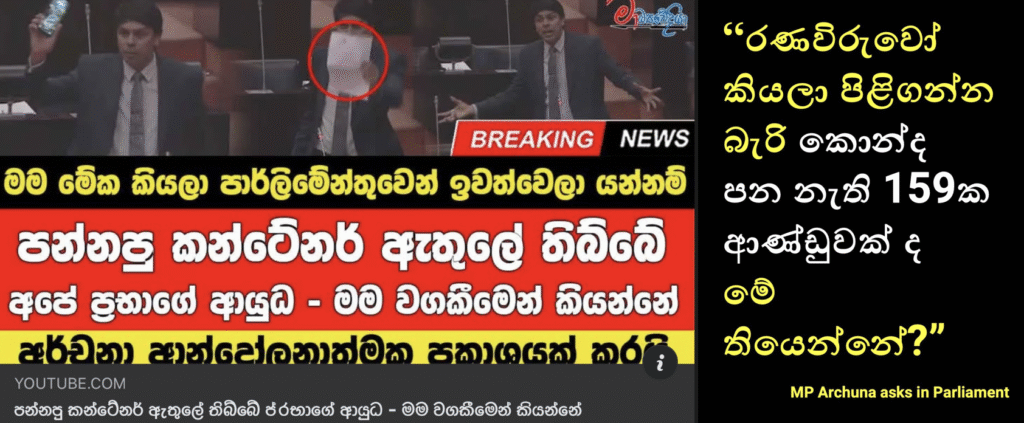
Sri Lanka is once again standing at the edge of a political and national security precipice. A bold and disturbing statement made by Member of Parliament Archuna inside Parliament has triggered ripples far beyond the chamber’s walls. Facing death threats and legal retaliation, he stood firm and declared truths the nation can no longer afford to ignore.
A Bombshell in Parliament
MP Archuna, under threat and likely political expulsion, dropped a bombshell:
323 containers of arms and weapons—originally assembled in Thailand for Prabhakaran in 2009—have now reached Sri Lanka through KP.”
He admits he cannot yet provide documentary proof, but he asserts full responsibility for the claim, placing accountability for his words on the record.
More alarmingly, he revealed:
The President’s pre-election trip to Germany involved meetings with LTTE-linked diaspora groups.
Assurances were given that could not be delivered, causing undisclosed tensions.
A second visit to Germany is imminent, and Archuna alleges it is tied to funding provided by these same diaspora networks.
The Government’s Reaction: Silence and Suppression
Instead of investigating these serious allegations, the Government appears focused on silencing the messenger. Archuna has been summoned to court on 26 June, with efforts reportedly underway to remove him from Parliament.
The Deputy Speaker forced him to publicly reaffirm accountability, but the issue has not been probed further. What does the Government plan to do?
LTTE Glorification vs. Silence for the True Heroes
Archuna claimed that Tamils continue to annually honor LTTE heroes” on November 27, while the backbones govt is refusing to even utter the word Ranaviruwo” in respect to Sri Lanka’s war heroes.
Those in uniform tell me I am at least speaking the truth. But the Government they voted for doesn’t even respect them,” Archuna stated.
This silence is not accidental—it is political appeasement.
Unmasking the Bigger Picture: A Pattern of Betrayal
Sri Lanka has seen this playbook before 1970s–80s: Indian Intelligence trained Tamil militants in secret camps across India.
1983: Carefully choreographed Black July manipulated the world into seeing a Sinhala-Tamil ethnic war, when in truth, many Sinhalese sheltered Tamils. The incident was weaponized to justify armed militancy.
2002: Over 50 military intel officers exposed and killed after Millennium City betrayal under a UNF government.
2009: President Mahinda Rajapaksa ended 30 years of terrorism in just 3 years.
2015: Regime change & ouster of President Mahinda Rajapakse weakened the military:
Intel officers arrested, camps closed.
Military sidelined, demoralized.
Islamist networks ignored, leading to the Easter Sunday massacre in 2019.
Two suicide bombers were sons of a man on the JVP national list—a connection that has never been thoroughly investigated.
A New Wave of Violence: A Diversion?
In the wake of MP Archuna’s revelations, the country is witnessing a disturbing rise in underworld killings and public shootings. This pattern eerily mirrors past efforts to distract the public, create fear, and redirect scrutiny away from political scandals.
Are we, once again, being steered into a choreographed crisis? Is the resurgence of chaos just a smokescreen to bury deeper truths?
The Nation must now Demand Answers
The public, civil society, and opposition must rise above political divides to ask critical, urgent questions:
Are 323 containers of arms truly in Sri Lanka?
If yes, where are they?
Who authorized their entry & who released them & why?
What exactly transpired in the President’s meetings with the LTTE diaspora?
Was there foreign campaign financing – what was promised?
Why is a sitting MP being persecuted for raising national security concerns?
Is Parliament no longer a place of free speech?
Why does the Government remain silent about military demoralization?
Why are those who ended terrorism treated with such contempt?
Why are past incidents like Easter 2019 still unresolved?
Who dismantled the intelligence networks that could have stopped it?
Sri Lanka must choose between Truth and Repetition
If what MP Archuna has said is even partially true, Sri Lanka faces a renewed internal threat, one far more dangerous than open war—a betrayal from within. The cost of silence is once again being measured in lives, fear, and sovereignty.
We cannot walk into another 30 years of bloodshed!
This is not the time for silence. This is the time for accountability, courage, and national unity. Let the truth come out—whatever it may be.
Sri Lankans deserve answers. And the world must stop pretending that terrorism ended in 2009 just because the battlefield fell silent. The terrorists & separatists continue their agenda in different disguises.
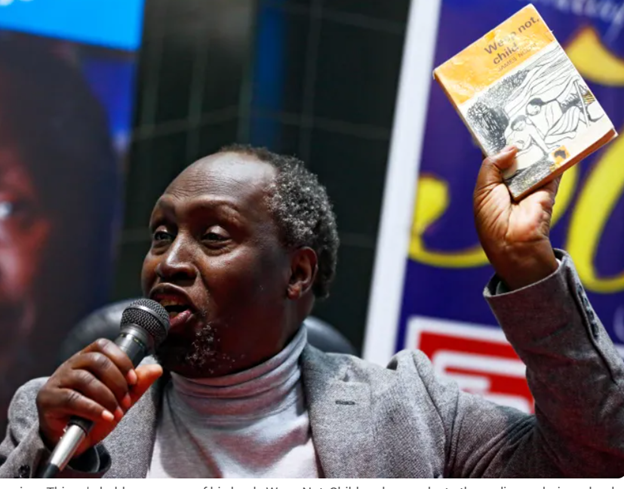
The death of Ngugi wa Thing’o on 28 May 2025, the great Kenyan writer and the greatest among the East African writers, towering giant in African Literature brings a profound personal grief to me. Reasons are many. I have translated Ngugi’s classic, AGrain of Wheat” (first published in 1967) into Sinhala in 1999 (Revised second print in 2020) with a lengthy introduction running for 42 pages titled, Uhuru Flame” and some of his short stories including Money Galore” in 2008 (title story of the anthology of translated African short stories). My translation of Ngugi’s epic novel Petals of Blood” (1977) remained unfinished due to some practical problems.
Furthermore, in many of my writings and literary discussions I have elucidated Ngugi’s contributions as an academic, a writer and a revolutionary thinker, who used his novels, theatre and other writings to critique British colonialism and post-colonial Kenyan politicians and politics whom he described as Black Imperialists” and the death of hopes, the death of dreams and the death of beauty” respectively.
It is deeply regretted that no media outlet in Sri Lanka -electronic or print- has reported his passing not even with a brief obituary even after a week has passed. They were completely absorbed in a beauty pageant held in Thailand, creating an illusion for gullible viewers and readers that crowning country’s contestant was a moment of national triumph. Unfortunately, she was not even among the top forty despite the congratulatory messages from the President and other top politicians who attempted to make it a political issue. When a Thai beauty was crowned our TV anchors had no shame in declaring it as a triumph of a Theravada Buddhist country!
It should be noted that in those days we obtained information about African Literature in the most challenging way importing books, critical essays and literary journals from various publishing houses in London utilizing our own funds. It was only from the 1990s the worldwide web made the internet accessible to the general public when websites and browsers have become common.
In the introduction of the revised edition of the translation of AGrain of Wheat”I am happy to state that I was able to discuss Ngugi’s new works of non-fiction and autobiographical works such as Something Torn and New: An AfricanRenaissance” (2009), ”Globelectics: Theory and the Position of Knowing” (2012), In the Name of the Mother, Reflections on Writers and Empire” (2013) and Dreams in a Time of War: A Childhood Memoire” (2012), (describing his school days during colonialism, Mau Mau and Emergency), In the House of theInterpreter: a Memoire” (2012), (his Alliance High School days), Birth of a Dream Weaver:A Writer’s Awakening” (2016), (his Makarere University College days) and Wrestling With the Devil” (his prison life) respectively.
The massive novel he wrote after a lapse of fourteen years Wizard of the Crow” (2007) depicts Africa’s present tragedy, set in thefictional Free Republic of Aburiria”, recognizable as modern Africa. This was also a translation from his native Gikuyu language translated by the author himself. In 2020 Ngugi published his poetic narrative, ThePerfect Nine: The Epic of Gikuyu and Mumbi”, that narrates the story of Gikuyu and Mumbi, the founders of the Gikuyu tribe who sought noble suitors for their ten beautiful daughters. It is a mix of myth, folklore and Kenyan traditional lyrical literature, which reminds us a Buddhist Jataka Tale.
The first article on Ngugi in Sinhala was written by the late Susil Sirivardena in Mawatha (No. 6) when Ngugi was imprisoned by the Jomo Kenyatta government in 1978. It was a historical travesty the person who fought for Kenya’s independence from British colonialists, who himself was a creative writer (I have translated his TheGentlemen of the Jungle” into Sinhala, a scathing denunciation of British, French, Portuguese, German and Belgian colonialism), author of Facing MountKenya”, the first treatise on African culture considered as a text of cultural nationalism”, independent Kenya’s first Prime Minister (1963-1964) and then the President (1964-1978), lauded as the Burning Spear” of the freedom struggle, Father of the Nation”, imprisoning a literary giant like Ngugi.
Ngugi’s few short stories were translated into Sinhala and appeared in a periodical. Bobby B. Boteju included translations of two short stories written by Ngugi in his collection of African short stories titled Nisa Geethaya” (1992). This writer was invited to deliver the keynote speech at its launch.
Ngugi’s epic drama jointly written with Micere Githae Mugo, The Trial ofDedanKimathi” was produced and staged by the late Somalatha Subasinghe in 1977. Its Sinhala version was staged as Yadam”. This play brings back to life the murdered Mau Mau (Kenya Land and Freedom Army) freedom fighter Dedan Kimathi. But after the initial performances they failed to sustain audience attention perhaps due to lack of audience interest, production challenges and mainly political content of the play. Unfortunately, it failed to capture the revolutionary heroism of the protagonist. Being a versatile actress and a playwright are not enough to stage a powerful political play such asDedan Kimathi”.
Its songs were entirely in Gikuyu language. After the show the audience joined in the final triumphant dance and went in marching along the streets of Nairobi singing songs featured in the play. This play was staged in Lagos in 1977 at the Second World Black and African Festival of Arts and Culture” (FESTAC).
Although Ngugi published his first novel Weep Not Child” in 1964, the first Sinhala translation of Ngugi’s novels appeared only in 1993 with Matigari”, his sixth novel, which was originally written in Gikuyu, translated by the author himself into English and published in 1986. Naravila Patrick was its translator.P.B. Jayasekeratranslated into Sinhala in 1997, Weep Not Child”and Ngugi’s fifth novel Devil on the Cross” the first novel Ngugi wrote in Gikuyu, translated by the author himself into English and published in 1982. The translation of Ngugi’s first novel, The River Between” (published in 1965) translated by Sunanda Mahendra was serialized in Irida Divaina” in 1984.
This shows a lacuna in Sinhala translation works. Many of the translators of African Literature undertook their translations without having an overall knowledge of the writers and their works, how a writer’s creative abilities, thinking and his/her worldview evolved from his/her formative years. Translators were induced by others who provided the text to them. Otherwise Matigari” cannot be the first Sinhala translation of Ngugi’s novels.
In 1984 I had a tussle with a Sri Lankan professor as he wrote introducing James Ngugi as a Nigerian writer who had worked at the Nigerian Radio. When I corrected this error, he replied to me complete with academic arrogance that although Ngugi was born in Kenya he was a Nigerian writer and as he was his friend, he likes to call him James Ngugi! I only knew that the Nigerian writer Achebe working at the Nigerian Radio. It’s true that Ngugi was baptized as James Ngugi and all his earlier works carry that name.
But in March 1970 when Ngugi was addressing the fifth congress of the East African Presbyterian Society saying that he was neither a man of the Church nor a Christian, an old man raising his walking stick warned him to confess for the abomination and pray to the Lord that the speaker was a Christian and his name James bear testimony to it. Ngugi until that time did not realise that his personal name presents a contradiction, is tainted bystigma and undermines everything he professes. Ngugi took his father’s name Thiong‘o Wa, published his Homecoming: Essays on African and Caribbean Literature, Culture and Politics”under the new name Ngugi wa Thiong’o in 1972. It’s very strange that his Sri Lankan friend” was unaware of Ngugi’s name change even after fourteen years!
Not to be outsmarted he even sent a photocopy of a book cover carrying the name James Ngugi to the press! This overenthusiastic friend” miswriting Mau Mau, as Mao Mao said that Ngugi was a staunch member of Mau Mau, which was totally incorrect. Ngugi was a student when the liberation struggle broke out in 1952. Although some students had helped Mau Mau fighters as scouts and movement of military supplies and provisions Ngugi had regretted that he did not get such an opportunity to support the forest fighters. His half-brother was involved in Mau Mau and killed, hismother tortured by the home guards, his house reduced to ashes. But he never forgot his peasant roots. He worked in pyrethrum fields owned by the European settlers. Petals of Blood” is the story of the pyrethrum cultivators, its white petals turning red!
In 1998, a Sanatorium Writer” in the USSR days writing to a Sinhala daily said that British book publishers and book sellers induced African writers likeAchebe and James Ngugi rewarding them and turning their creations into a form of esoteric merchandise. Again, I had to intervene in defense of Ngugi and Achebe. A funny part of these dialogues was a Peradeniya academic pointing out Swahili as a language spoken in Nigeria! Swahili is a language most commonly spoken in East Africa. There can be Swahili speaking people coming to Nigeria for business!
The first and the most comprehensive critical perspective on Ngugi was written by his former professor at the Makarere University College (later university) Uganda, David Cook in 1982. Can we Sri Lankans imagine a university professor writing a book about a student except a blurb in a back cover of a book?
Ngugi was not only a writer. He was a literary and a cultural critic, a theoretician in literature and culture. The only other African revolutionary writers who can be compared with him were Sembene Ousmane of Senegal (referred to as the father of African cinema”) and to a lesser degree Alex La Guma of South Africa. At the demise of Ousmane in 2007 I wrote an article illustrating his literary and cinematic career describing him as the African writer who gave a voice to those which have been struggling over centuries of colonial yoke to regain their voices and their languages. Writer of nearly a dozen of novels in French at one stage, like Ngugi he stopped writing in French and turned into his native Wolof instead. The Ugandan poet Okot p’ Bitek first wrote his major poem Song of Lavino” in Luo language; he later translated it into English.
Until the emergence of Ngugi what was considered as African Literature was the literature produced in West Africa, especially in Cameroon and Nigeria and Ghana written in French and English languages respectively. Within a short period, he became a towering figure in African Literature and received worldwide acclaim. He became the most talked about writer and critic in African Literature because of his ideas regarding what language African Literature be written in. African Literatures were written in the languages of the colonialists English, French and Portuguese respectively.
We have discussed this aspect in four articles published in The Island” in February-March 2020 participating in a dialogue on Cross-Writing initiated by our friend Prof. Wimal Dissanayakeciting Ngugi’s seminal work Decolonising the Mind: The Politics of Language in African Literature”.
Influenced by the writings of Marx and Frantz Fanon, the ideology Ngugi expressed in his literary works and critical essays was vastly different from that of other African writers. As a person who translated some masterpieces of Chinua Achebe, Wole Soyinka, Mariama Ba and some other African writers into Sinhala I am very clear about this. His writings reflected his leftist, revolutionary ideals. His voice most often was for the emancipation of the Kenyan, African and Black people in general, a voice denouncing keeping masses in bondage, against exploitation and oppression, a clarion call for returning land expropriated from Kenyan peasants. His voice was anti-colonialist, anti-imperialist and a voice against Black Elites” who usurped power after gaining nominal independence from the British, French, Belgian and Portuguese colonialists respectively.
The political solution he envisioned was a peasant revolution, to replace black capitalists and capitalism with African Socialism. These ideas were expressed vividly in his epic novel Petalsof Blood” which narrates Kenya’s historical development from feudalism to capitalism and the beginning of neo-colonial honeymoon. Ignominious plunder of capitalism, theft, corruption, treachery, accumulation of new wealth, in short plunderers gathering the fruits of Uhuru” (freedom) tree are brilliantly depicted in Devil on the Cross”. Its culmination was portrayed in Matigari”, the story of a fictitious freedom fighter of Mau Mau fame emerging from the forests and roaming in the countryside in disguise; an allegory that a man has arisen to give life to the liberation struggle; for freedom arms that were fallen from the hands of old militants must be grabbed by the present generation.
People were searching for a man called Matigari”whom they thoughta returnee Mau Mau freedom fighter from the jungles. People gathered in motor parks, beer shops and other public places to hear both novels Devil on the Cross”and Matigari”read in parts.Kenyan police hearing that a person called Matigari”was roaming in the countryside organizing the peasantry and people were talking about him, deployed an extensive search to track down and capture him. Later after discovering that Matigari”was a fictitious character they raided all book stores and seized books available for sale and banned its sale in Kenya.
Thus, as Chinua Achebe, Ngugi had compiled a chronological account of his country’s modern history. The other noteworthy aspect of his writings was exploring Mau Mau as his central theme. In AGrain of Wheat”, a Mau Maudetainee Gikonyo returns to his village to find his wife Mumbi raped by a home guard and carrying a child. Central theme of this novel is finding the betrayer of Kihika, the leader of village freedom fighters.
Origins our own Goni Billas” in 1988-89 can be traced to Special Branch agents who helped the British forces in the screening and capturing ofMau Mausympathisers. They were dressed in huge hoods with eye-holes who were known as Little Sacks” or Gakunia”.
To understand Ngugi’s vision, militancy, and his views about the use of languagein African literature, Africannationalism, culture and liberation a treasure houseis open with his critical writings, Detained: A Writer’s Prison Diary”, Writers in Politics”, Barrel of a Pen”, Homecoming: Essays on African and Caribbean Literature, Culture and Politics”, Decolonising the Mind: the Politics of Language in African Literature”.
InMoving the Centre: The Struggle for Cultural Freedoms”, Ngugi emphasizes the emancipating culture from Euro-centrism. He elaborated the need to move the centre from its assumed location in the West to a multiplicity of centres of the world, in short freeing culture from Eurocentrism.
All hell broke loose with the staging of the play I Will Marry When I Want” jointly written in Gikuyu in 1977 by Ngugi and Ngugi wa Mirii. To expose the corrupt regime and neo-colonial exploitation, disillusion of people, Ngugi went in search of a new audience. That was the reason he chose his native language instead of writing in English. This play was written with the inputs given by peasant masses. Old Mau Mau fighters and villagers participated in the writing and revising the text, adding songs and dances, refining the language and changing metaphors and similes. It was said that its traditional opera songs were written with the help of an illiterate peasant woman who choreographed the dances to the songs. Ngugi wrote later that he understood the power of collective work and its creativeness with this play. Mingling with the people he got the feeling of a new man, emancipating himself from decades of alienation caused by colonial education.
It contained songs of Mau Mau fighters and their Oaths. Theatergoers went back to their homes singing songs of the play as in a demonstration. The government banned the play. The playhouse was attacked and burnt. Ngugi was imprisoned without a trial on December 31 1977. First draft of Devil on the Cross”was written while he was in prison, ironically on toilet paper. Ngugi wrote later that for prisoners to add injuryto their punishment a course toilet paper was provided. He was released in December 1978 by Kenyatta’s successor Daniel Arap Moi, a Home Guard who collaborated with the British Army in the suppression of Mau Mau fighters, their sympathizers and kith and kin. Ngugi was removed as the professor of English at the Nairobi University. Then began his self-exile, first to England and then to America. His co-writer Ngugi wa Mirri died in exile in Zimbabwe.
This brings to the fore the question of which language should be used for creative writing to serve the masses. Ngugi disliked calling literature written in thelanguages of the colonialists English, French and Portuguese by African writers as African Literature. He was convinced as far back in 1969 that writing in English had no value. He said that using colonialists’ languages what African writers have created was a Euro-African or an Afro-European literature.
In an interview given in 1969 Ngugi said that I have reached a point of crisis. I don’t know whether it is any longer writing in English. The problem is that I know whom I write about. But whom do I write for ? The problem he had to resolve was the problem of audience, for whomhe was writing. With the beginning of writing in his native Gikuyu he found who were his actual audience. At the time of writing Petals of Blood” he became more and more disillusioned with the use of a foreign language to express Kenya’s soul and the social conditions in Kenya”. He said that people should express their national aspirations and their national history in the various national languages of Kenya, like Gikuyu, Luo, Girima, Kambi and Masai, all part and parcel of Kenya’s national culture.
Although Ngugi’s novel Petals of Blood” written in English, considered as a proletarian novel, an uncompromising, merciless denunciation of the ruling class and its cronies, blistering condemnation and exposure of their sellout, it did not provoke them and they did not take any action against him. But rulers became panic only after he began to write in Gikuyu.
As stated earlier the first novel Ngugi wrote in Gikuyu was Devil on the Cross”. That was also the first novel written in Gikuyu. It was a big challenge for him to use a language which did not have a modern novel. He wrote later that he learnt his language anew; while writing the novel, rediscovered its creative essence and the power of collective word. Switching into Gikuyu was not an easy task although it was enriched with traditional or oral literature as any other African language.
Critics said that the use of Gikuyu has released previously untapped aspects of Ngugi’s creative talent and he has achieved remarkable success in two languages writing in Gikuyu and translating the same into English.
He told in 1980, one of the greatest tragedies of Africa is a complete disconnection of the elite from their linguistic base”. In reality because of language what happens is that the messenger who is sent by the community to go and fetch knowledge from wherever they can get it becomes a prisoner. He never returns, so to speak metaphorically because he stays within the language of his captivity”.
A cynic may argue that these are old grannies’ tales that we Sri Lankans have passed that age in the 30s or 40s. But no one can deny that at present thanks to our education system Sri Lanka producing hordes of alienated young people who do not have any knowledge of our native languages, history, literature and culture. Future belongs to them, including politics!
The most notable struggle Ngugi was involved in the academic field culminated in renaming the English Department as the Department of Literature in 1968. Making Africa the focal point shedding dominancy of Euro-centric culture and literature was its aim.
Most of the African writerscontinue to write in acquired languages English, French and Portuguese respectively despite the argument that African Literatures should be written in African languages. Writing in their native languages is a big risk as they cannot reach a wider audience across Africa and beyond. Roughly 750 languages are identified in Africa. The most populous state in Africa, Nigeria has about 400 languages. Not all writers have the luxury of translating their own works as Ngugi to a language of the colonialists.
The most prestigious and the oldest international journal of African Literature founded in 1968, African Literature Today” had to dedicate its No 41 issue (2023) titled African Literature in African Languages Today” to explore African Literature in African languages. It says the dominance of African Literature written in European languages over those in indigenous languages continues to be an issue. It reexamines the often-asked question what is the state of African Literature written in African languages”.
Isn’t it a supreme irony that illiterate peasants portrayed in African novels who do not either speak or understand the oppressors’ languages speaking in English, French or Portuguese?
An academic in Dar Es Salam University, Tanzania used the term Translingualism to discuss Ngugi writing in his native language and translating them into English, addressing the relationship between translation and minor languages.
Did anyone of our English writers stop writing in English and start writing in either Sinhala or Tamil? Instead there are many failures who tried to pose as English writers. Did any academic in Sri Lanka champion linguistic decolonization and cultural authenticity?
African literature cannot be understood properly merely reading a novel of Chinua Achebe or a novel written by a writer of younger generation, may be of 3G, such as Chimamanda Ngozi Adichi or a crude and vulgar Sinhala translation of Achebe.
Announcing the death of Ngugi, his daughter Wanjiku wa Ngugi in a Facebook note said, he lived a full life, fought a good fight”.
e–Con e-News wrote that our English Departments appear to know very little of Ngugi. A contributor to the same web journal wrote that I had the honour to meet him, (we felt we were in the shade of a giant tree), at a commemoration he organized for the Ugandan poet Okot p’ Bitek whose work I have shared before. Kenya is just across the seas from Sri Lanka and links with that great country should not be left to traders, nor should African countries be used as synonyms for failure as our English-colonized media (AI or not) led by BBC continually do. The Dynamite and Missile Makers refused Ngugi their Nobel prize which he deserved, not once but several times, if that is a measure of quality, but luckily it isn’t. Our artists continually fail us for they fail to plumb the depths of our past to understand the challenges to build a modern future.”
Two university dons at Peradeniya writing articles on Soyinka’s A Play of Giants” and Achebe’s Anthills of the Savannah” respectively was a big news to be included in an article titled, The English Department and the University” (in More Open Than Usual? (1992)). One wag questioned who cares a writer who has written more than 50 articles on African Literature in both Sinhala and English.
What would be the position of Ngugi if he were born in Sri Lanka? In addition to state repression he would be hounded by the academia and the NGO aristocracy as a racist, Gikuyu-athiest supremacist influenced by Victorian morality” and Protestant-Buddhism”, a Gothrikaya” (tribalist), who attempts to take back Sri Lanka to the stone age; a person who deprives others of good things in civilization, literature or other aspects of culture, a censor, a cultural policeman, having learned Shakespeare and Conrad himself!
“Free” critical thinking, in a philosophical sense, refers to the ability to think independently, without being unduly influenced by external pressures or internal biases. It involves questioning assumptions, analysing information objectively, and forming reasoned judgments based on evidence and logic. Essentially, it’s about thinking critically for oneself, rather than passively accepting information or opinions.
Keeping in line with the ethos of what Venerable Rahula stood for all his life, his guiding beliefs, ideals and practice of what he believed in, primarily the freedom to think critically and look at what Buddha taught from the prism of Bahujana Hithaya, Bahujana Sukaya (for the good of the many, for the happiness of the many”), a commemorative event was held to celebrate the 118th birth anniversary of Venerable Walpola Rahula on the 24th of May at the Sri Lanka Foundation in the presence of a large and distinguished gathering. The event witnessed a renaissance of those ideals and beliefs so eloquently expressed by the keynote speaker at the event Professor Nirmal Ranjit Devasiri, from the department of History Faculty of Arts University of Colombo, specialising in social transformation in agrarian societies, history and ideology, European colonialism in Asia, post-colonial state-building, and ethno-nationalism.
A panel discussion that followed, with eminent panellists that included Venerable Galkande Dhammananda, head of the Walpola Rahula Institute, Chulananda Samaranayake, one of the major translators of internationally acclaimed literary books, a poet of four anthologies of poetry and an author of a book of short stories, Dr Sunil Wijesiriwardena, literary critic, academic, researcher, civil activist, university lecturer, poet, writer, author, playwright, and Professor Prabha Manuratne, the discussion moderator who is engaged in interdisciplinary research focusing on violence and representations of violence, and with expertise in English Studies, Film Studies, and Cultural Studies. She is also an activist who works on women’s rights and education rights in Sri Lanka
The general opinion at the end of the evening’s proceedings was that the intellectually enriching, and ideologically incisive dialogue and discussions at the event should be continued by the Walpola Rahula Institute as a fitting tribute to a person who was an embodiment of free and critical thinking, Venerable Walpola Rahula. In keeping with the Buddhist framework of the Walpola Rahula Institute, and the ongoing project of the Walpola Rahula Institute, Heta Bhikshuwa (tomorrows Monk) it was felt that a broader discussion based on the Bhikshuwage Urumaya (Heritage of the Buddhist Monk) authored by Ven Walpola Rahula who encouraged free critical thinking by individuals to consider information and arguments without being swayed by personal biases, emotions, or external pressures, questioning assumptions, examining the logic of underlying arguments, openness to diverse viewpoints and a willingness to consider alternative interpretations of information, would be most appropriate.
Some critical issues were raised during the event. The near dogmatic adherence to traditional Buddhist conventions without consideration of their historical context, and the practice of contemporary conventions introduced and spearheaded by institutionalised Buddhism, as well as the governing status quo, both, misinterpreting and misrepresenting the historical context and also basing contemporary conventions on narrow avenues of thought by a few, rather than through a broad-based consultative approach. Free and critical thought was an anathema to those responsible for promoting dogmatic adherence and for those misrepresenting and misinterpreting historical context, as well as the governance status quo dominated by a few.
Another issue raised was the need to consider why institutions such as the education system as it is understood today, came into being with education catering to economic, social and political dictates rather than for the acquisition of knowledge.
Within the space of time available, Professor Devasiri, in his presentation titled Struggle for free education, Bhikkhu politics in the 1940s and in contemporary Sri Lanka”, elaborated on the seeds as it were, and the growth of the movement for free education led by radical thinking persons both within the Bhikkhu order and amongst lay persons. Free education was seen as a means of upward social mobility, especially for the middle class of the country and the upper layers of the lower middle class, all of whom probably lived a life without much hope for them and their future generations. It was also viewed by many within the upper middle class and sections of the ruling elite as a threat to their influence and their way of life sustained by the existing way of governance.
Reportedly, a rhetorical question had been posed to the chairman of the education commission at the time, C W W Kannangara, by a senior government political figure as to who would pluck coconuts if there was upward social mobility of the masses as a consequence of free education!
Paradoxically, even some within the Buddhist Monk establishment had issues with free education as it was seen as challenging the status quo relating to traditions and the traditional education ethos, which formed the power and influence base of some senior Monks in the hierarchy of the Buddhist establishment.
However, as pointed out by Professor Devasiri, the extensive support primarily from the lower strata of society, as well as some liberal minded individuals from the upper middle class, and of course a large number of Monks from the Buddhist establishment had provided an unstoppable impetus towards free education.
It was seen as a means of resisting colonial dictates supporting the exclusiveness of education to a select few and instead broad basing it as a means of unshackling them from social impediments the masses were facing. Venerable Rahula’s active association with the Vidyalankara Bhikkhu movement, which was seen as a departure from the historical traditional mindset and towards a more active participation of Bhikkhus in social and political issues in keeping with Buddha’s Rigveda based dictum of for the happiness of many and for the benefit of many”
Professor Devasisri also pointed out that historically, even going back to the Anuradhapura period, the Buddhist Monks had been the real power and influence amongst the people, and the effective unifying force eclipsing the power of Royalty in the country. Rejuvenation of this power, which had its ups and downs over decades, had begun consequent to the advent of colonialism in the country, especially British colonialism, and it gathered serious momentum during the struggle for free education. In the context of the enormous influence exerted by the Buddhist monk’s establishment, it was incumbent on them to use this influence and power wisely for the benefit of the people. A yet unsolved contradiction however appears to be there in so far as how this influence should be used by Buddhist Monks to address the contemporary situation of the country, which was different from the historical, tradition bound Sinhala Buddhist country which they took as the natural ruling order of the country.
The panel discussion further elaborated and examined the principal issues presented by Professor Devasiri. While Venerable Dhammananda, who had been the closest to Ven Rahula for decades presented a few anecdotes to illustrate Venerable Rahula, the human being, others raised issues like the rigidity of the education system which focussed on a stereotyped, discipline-based approach rather than acquisition of knowledge and with little room for free thinking. The narrowness of the relatively contemporary concept of dependent arising (Patticca Samuppadaya) was also highlighted. While Buddha’s concept behind dependent origination had been the inter dependency of many realities and circumstances which impacted and then resulted in a reaction or palaya, it was argued that it would be misleading to assign a narrowness to reason or the cause, which had a particular reaction or the palaya. This narrowness had originated from the more modernistic (scientific) view that every action was a linear development as the result of a cause taken in a very narrow sense. More thought provoking views on the role of Buddhist Monks, whether they should be divided into a monastic tradition and a social upliftment tradition or as it existed during Buddha’s time, whether both traditions should be a combined, single tradition, and looking at existence or samsara from a multi-faceted approach and questioning the why” and not limiting oneself to examining the how” as being important to humanity were presented.
As emphasised by all speakers, Ven Rahula espoused critical thinking as an attempt to understand rather than challenge or dispute the Buddhist doctrine. Buddha himself had maintained the dictum, come and see” or ehi passiko, meaning, question even the Dhamma and what the Buddha said in order to understand the Dhamma. The doctrine taught by the Buddha some two thousand six hundred years ago was carried on to many generations through an oral tradition after his death in 480 BCE, until it was written down in 25 BCE in Sri Lanka. While it is not a conclusive or definitive statement, it is natural that passage of time could influence the oral tradition and include interpretations of Buddha’s teachings. In this backdrop, a critical and questioning look at the Dhamma should be viewed as a logical exercise although it must be noted and understood that it should be done through the practice of the basic tenants of the Dhamma rather that doing it as an academic exercise, in order to fully understand and appreciate the Dhamma.
The full program of the event maybe viewed by following the link below.
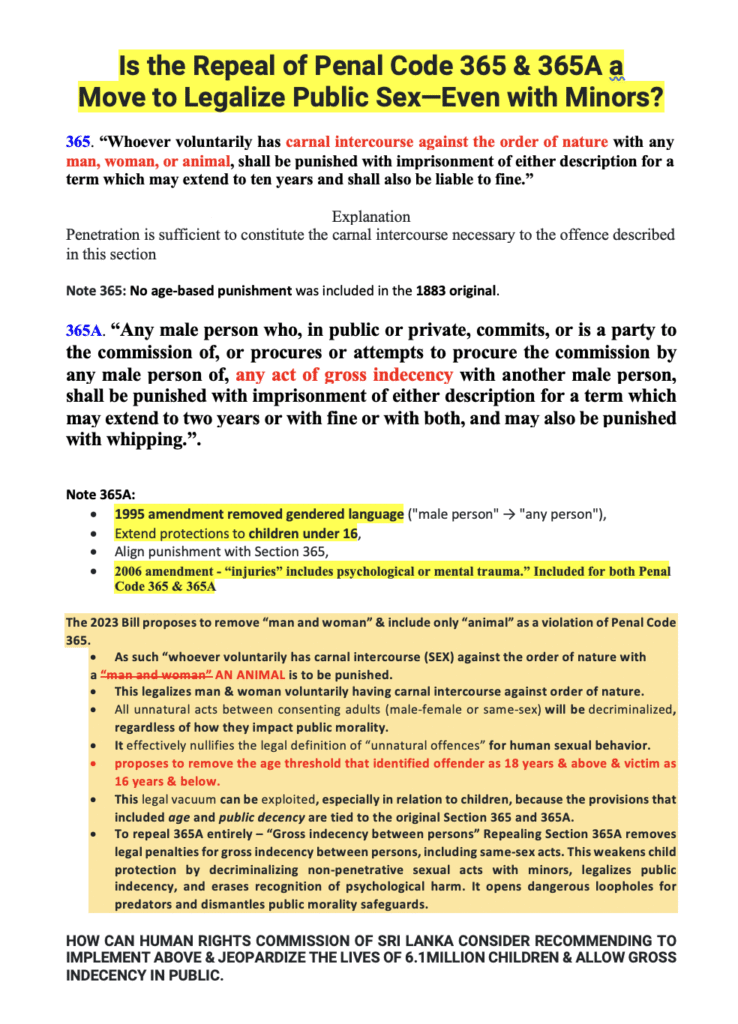
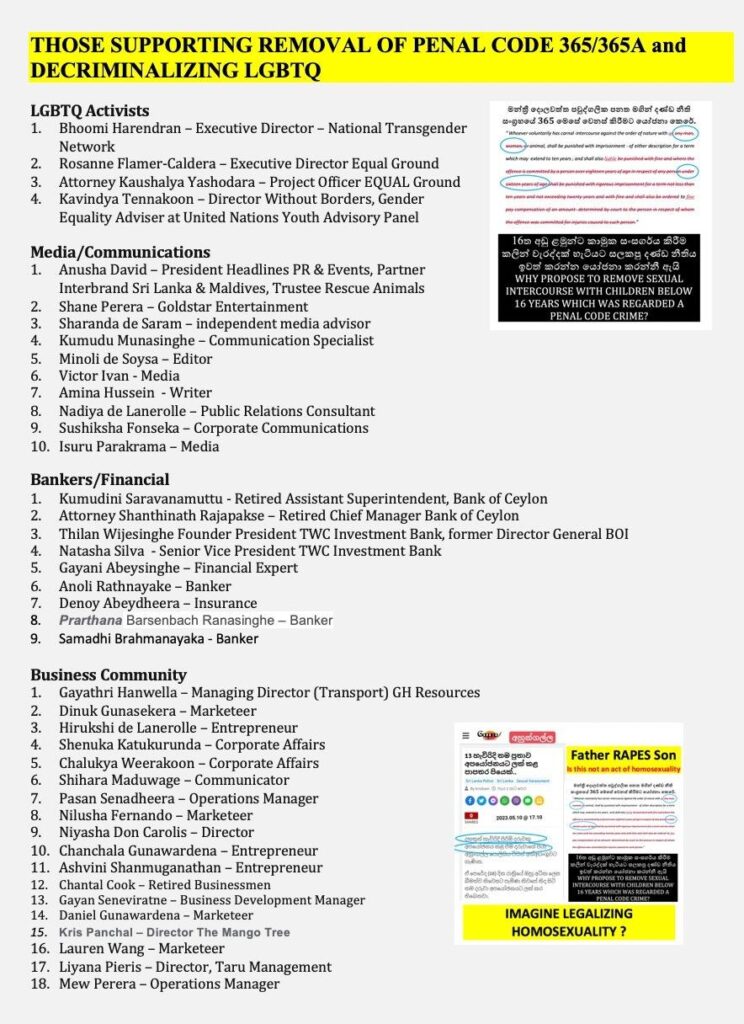
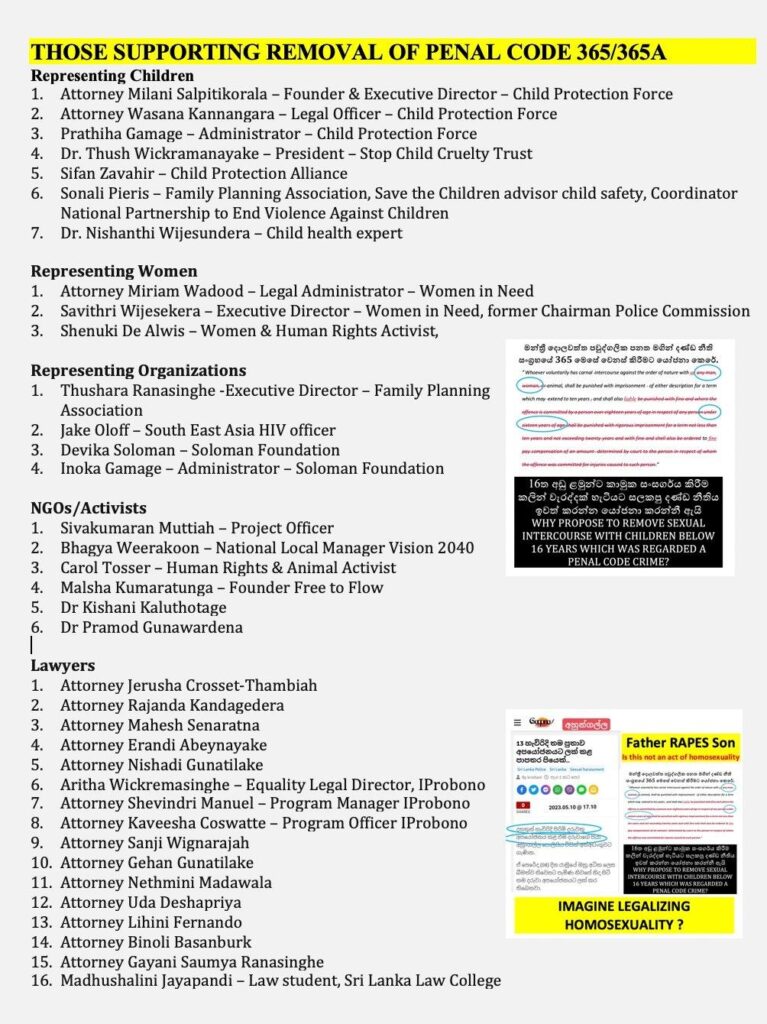
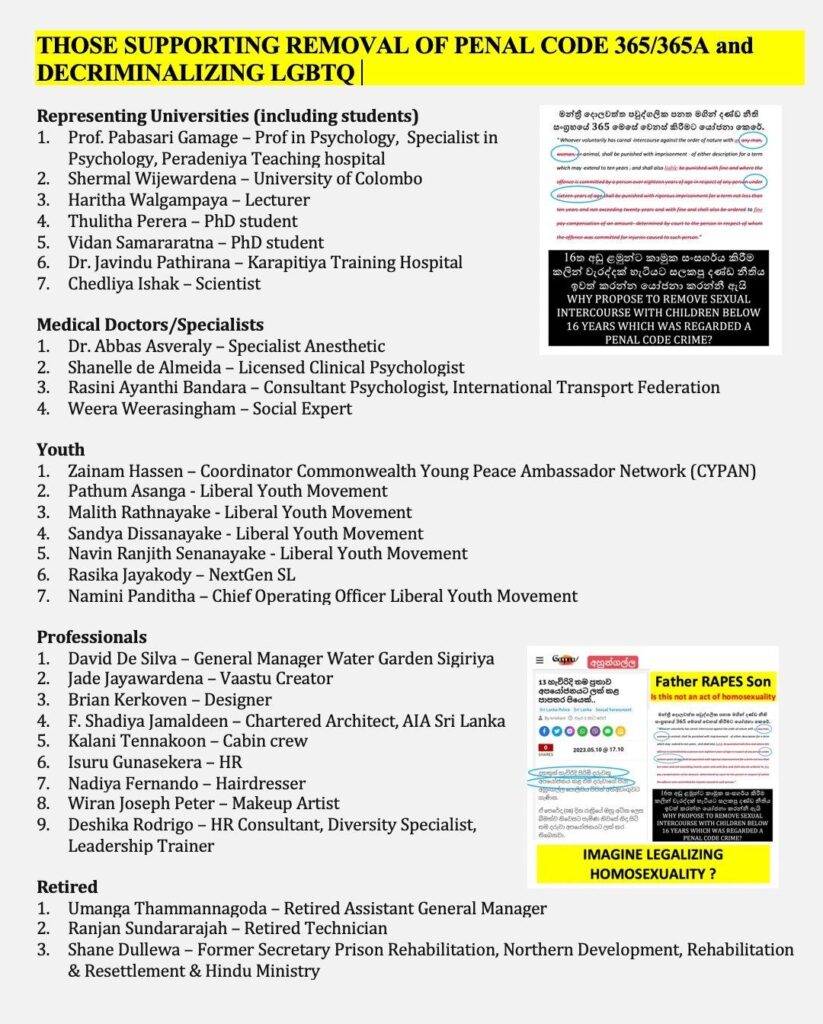
Sri Lanka’s Sections 365 and 365A, enacted during colonial times and strengthened in 1995 and 2006, protect children from sexual exploitation, including same-sex abuse. Private consensual acts, where adults are involved, are not the issue—those can remain private as has been done over centuries. The real concern is the push by some groups to legalize and normalize public displays of same-sex behavior, which violate long-held public ethical standards and expose impressionable children to inappropriate content. This raises troubling questions: Do these advocates truly care about the welfare of children and society? Or is their agenda at odds with protecting future generations? This article unpacks the history, the current threats, and the urgent need to uphold these laws for the sake of child safety, moral values, and national integrity.
1. Origin and Purpose of Sections 365 & 365A (Colonial Era)
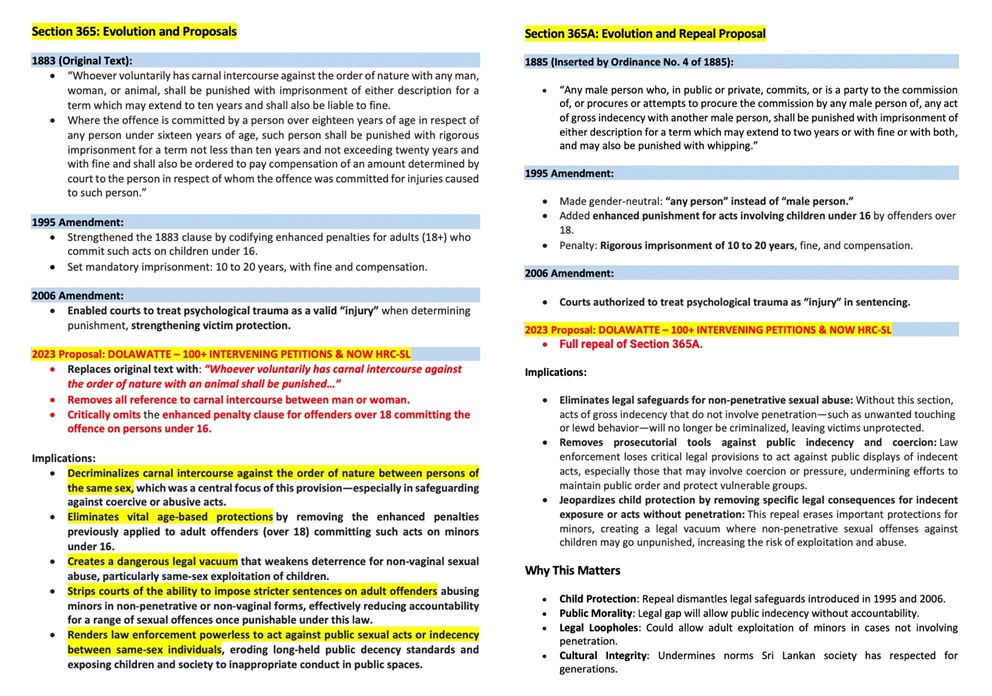
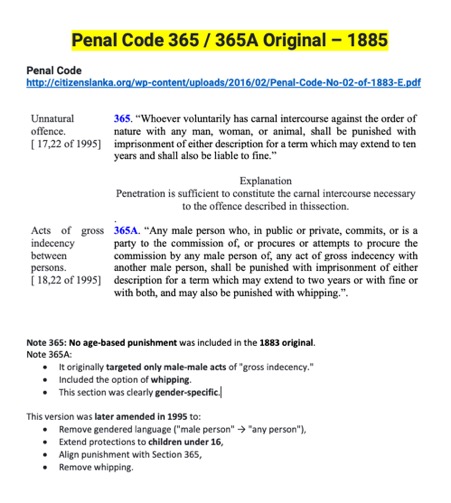
Sections 365 and 365A were introduced into the Sri Lankan Penal Code during British colonial rule through Ordinance No. 2 of 1883 (effective from 1885).
Criminalized carnal intercourse against the order of nature” with any man, woman, or animal.
Covered homosexual acts, bestiality, and certain heterosexual acts considered unnatural.”
Importantly, the original Penal Code did include an age threshold:sexual acts against the order of nature committed by an adult with a child under 16 were punishable with enhanced penalties, recognizing the need to protect minors.
Section 365A: Acts of Gross Indecency”
Criminalized acts of gross indecency between persons, whether in public or private.
Broadly targeted same-sex behavior, especially in public, but without referring to age or coercion.
Original Purpose:
To protect public morality and enforce moral codes.
To discourage public sexual acts considered indecent or disruptive to social values.
To criminalize acts thought to be against the natural order.”
To criminalize sexual abuse of minors, specifically under the age of 16, even in same-sex contexts.
2. 1995 Amendments (Act No. 22 of 1995): Introduction of Child Protection Measures
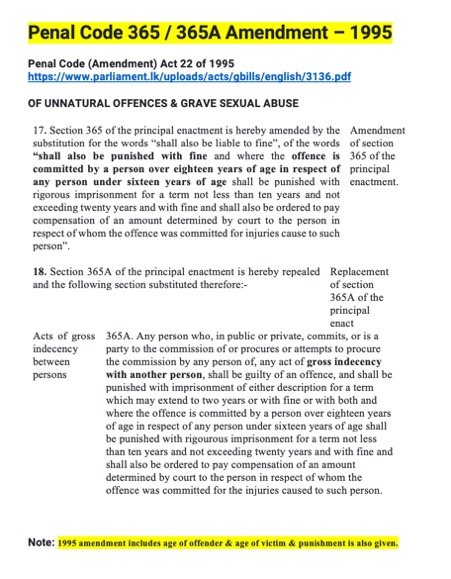
In response to rising global and national concerns over child sexual exploitation, Sri Lanka’s Parliament strengthened Sections 365 and 365A through Act No. 22 of 1995.
Key Changes:
Introducedstrict age protections:
If an offender is over 18 and the victim is under 16, the punishment became:
Rigorous imprisonment between 10 and 20 years
Mandatory fines
Compensation to the victim
This created legal safeguards for minors and treated child sexual abuse — regardless of sexual orientation — as a serious criminal offence.
This was not a relaxation but a reinforcement of the colonial-era Penal Code, recognizing that the existing legal framework lacked specific safeguards for minors—especially in cases of same-sex or coercive acts, which were otherwise unaddressed under separate child protection laws at the time.
Why this Amendment Matters:
Itclosed a critical legal loophole that left children vulnerable to abuse under the guise of private, consensual acts.
It appliedequally to all forms of carnal abuse, but explicitly recognized that same-sex sexual acts involving children needed targeted criminal penalties.
Importantly, the amendment retained the original scope of unnatural offences” butexpanded it to ensure child protection and public morality.
Public Understanding is Key:
Most citizens are unaware that this is the only section in Sri Lankan criminal law that directly criminalizes same-sex acts involving minors or adults. Its repeal or weakening would leave a dangerous legal vacuum, removing the only clause that:
Addressessame-sex crimes involving children,
Enforcesstrict age-of-consent protections,
Treatsnon-heterosexual child abuse with the seriousness it deserves.
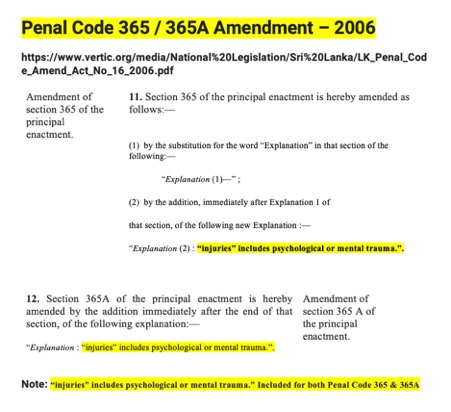
Added legalrecognition of psychological trauma as a form of injury under Sections 365 and 365A.
Clarified thatmental and emotional harm could be compensated in court.
This reflected a growing understanding that sexual abuse causes deep psychological damage, not just physical harm.
4. What the Proposed Repeal Seeks to Do
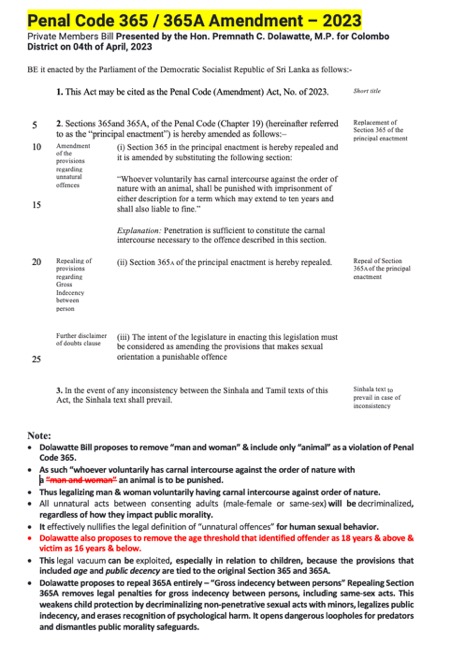
The 2023/2024 draft Private Member’s Bill by MP P. Dolawatte seeks to:
Amend Section 365, replacing it with a clause that only criminalizes bestiality (sex with animals).
The proposal wishes to remove reference to unnatural acts between men and women. Meaning that unnatural acts between men & women are to be legal & not criminal.
Repeals Section 365A entirely, which criminalizes gross indecency, including same-sex acts — in public or private — and removes age-based penalties currently in place.
Dangers:
Removes protections for children under 16when engaged in same-sex acts with adults over 18.
Normalizes all same-sex behavior, even inpublic settings, regardless of public decency norms.
Reduces the state’s abilityto regulate sexual conduct harmful to public morals and child welfare.
If acts once regarded by law and society as ‘gross indecency’ were criminalized for violating public morals and protecting the vulnerable, what has changed today that warrants reclassifying them as decent or harmless?”
5. Who benefits from the Proposal, who is at risk?
Advantaged:
Advocacy groups seeking tonormalize same-sex relations in law and public life.
International agencies promotingDEI (Diversity, Equity & Inclusion) tied to LGBTQIA+ agendas.
Adults engaging in sexual relationships with minors, particularly in same-sex contexts — who would facelesser or no legal risk if age protections are removed. Paedophilia is virtually legalized.
Disadvantaged:
Children, especially those under 16, who would lose a vital legal protection from sexual exploitation from same-sex sexual abuse.
Parents and communitiestrying to preserve moral boundaries and protect childhood innocence.
Society at large, as legal and cultural lines between adult behavior and child safeguarding blur.
Why these Laws should be Preserved and Strengthened
The1995 and 2006 amendments show that Sri Lanka recognized the need to protect children and reinforce moral order. Private conduct was never criminalized then or now.
Repealing these sections entirely, as currently proposed, would:
Remove age protectionsfor minors.
Decriminalize public indecencytied to same-sex behavior.
Allowfuture normalization of acts that many cultures, including religious traditions, deem harmful.
Who Are the People Calling to Remove Legal Safeguards for Children?
It is critical that the Sri Lankan public and judiciary understand who is advocating to repeal or amend Sections 365 and 365A of the Penal Code — laws that were strengthened in 1995 and 2006 to protect children from sexual abuse, not to discriminate.
Why would anyone want to repeal clauses that protect children from adult predators?
Well, look no further than the list of intervening petitioners in 2023— a coalition of activists, NGOs, donor-linked professionals, gender ideologues, media influencers, foreign-funded lobbyists, and even a few claiming to work in child protection.
These Are Not Innocent Reforms — This is Legal Sabotage
Many of these petitioners hold positions as:
Child rights officers
Women’s rights activists
Public health advocates
Academics
LGBTQ+ lobbyists
Media & business figures
Yet none of them have explained why they support removing:
Theage threshold that punishes adults (18+) who commit sexual acts on minors (under 16),
The inclusion ofpsychological trauma” as a form of injury,
The right of child victims tocompensation under the law.
And not a single one of them has acknowledged that these protections were not part of the colonial version, but were added deliberately by the 1995 and 2006 Amendments to:
Fill a legal gap for protectingchildren from all forms of sexual abuse (not just penetrative),
Recognize mental trauma as real and compensable,
Impose deterrent sentencing on adult offenders —regardless of sexual orientation.
Disturbing Questions that must Be Asked:
If someone represents a child protection organization, why advocate removing clauses punishing child sexual abuse more severely for same-sex crimes?
If they are a women’s rights lawyer, why seek to decriminalize adult same-sex sexual acts—including male-male and female-female—with same sex boys or girls under 16?”
If a UN-backed gender advisor, is their role to protect victims or push global ideologies at the expense of national sovereignty and child safety?
The 1995 & 2006 Amendments Were Not About Discrimination — They Were About Protection
Let us be clear:
The laws today are not colonial leftovers. They have been modernized to punish adult exploitation of children. Removing them is not reform” — it is dismantling child protection.
The 100+ intervening petitioners must be held morally and legally accountable for supporting a move that:
Weakens child protection laws in particular related to same-sex sexual abuse,
Normalizes adult-child sexual conduct in same-sex contexts,
Eliminates legal recognition of mental trauma for same-sex sexual crime,
Undermines Sri Lanka’s cultural values under the guise of human rights.
Protecting Children and Respecting Cultural Values
Sri Lanka’s laws must balance private freedoms with public morality and cultural norms. While consensual acts between adults in private should remain unaffected, public displays of sexual behavior—especially those impressionable to children—must be carefully regulated to preserve childhood innocence and social ethics.
Safeguarding Against Exploitation
Repealing legal protections tied to sexual conduct risks creating loopholes that predators could exploit, endangering minors. Age-of-consent laws and child protection measures are essential to prevent abuse, regardless of sexual orientation.
Parents play a vital role in guiding children’s moral and emotional growth.
Scientific studies indicate that early exposure to sexual content, especially outside a stable family environment, can negatively impact mental health and emotional development. Research also shows a significantly higher percentage of individuals identifying as homosexual come from broken or disrupted family backgrounds compared to the general population, highlighting the importance of strong family structures in healthy child development.
Distinguishing Adult Rights from Child Protection
Advocating for adult private freedoms should not come at the expense of removing laws that protect minors from exploitation and harm. These protections are critical and non-negotiable.
Transparency and Accountability
The push to repeal these laws is often driven by foreign-funded groups and ideological agendas that may overlook Sri Lanka’s social priorities. Those advocating for change must be transparent and accountable, especially when children’s safety is at risk.
Lessons from the West: The Cost of Normalizing LGBTQIA Public Advocacy
Experience from Western countries shows that the widespread promotion and normalization of LGBTQIA lifestyles, especially when introduced early in schools and public spaces, has led to concerning increases in mental health issues, including anxiety, depression, and suicide rates among youth. Studies reveal that such early exposure can confuse children about identity before they are emotionally ready, often causing lasting psychological harm. As a result President Trump is now reversing the legislative changes made. This reality underscores why Sri Lanka’s 2006 amendments to the Penal Code, which recognize psychological trauma as a serious injury and protects children from premature exposure to sexual content, are crucial safeguards for the mental and physical well-being of minors.
Human Rights Commission Sri Lanka’s Push for Repeal: A Risk to Child Protection
Fully aware of all these ground realities on May 22, 2025, the Human Rights Commission of Sri Lanka (HRCSL) sent a formal letter to Justice Minister Harshana Nanayakkara, recommending the repeal of Sections 365 and 365A of the Penal Code. The Commission argued that these provisions, which criminalize same-sex relations, violate international human rights obligations, particularly the International Covenant on Civil and Political Rights (ICCPR). However, this recommendation raises concerns about the potential weakening of legal protections for minors. The 2006 amendment to these sections specifically enhanced penalties for sexual offenses involving individuals under 16, recognizing the severe psychological harm such acts can cause. Repealing these sections without careful consideration could inadvertently remove critical safeguards designed to protect 5.1million children from sexual exploitation and abuse. Why has the HRCSL completely disregarded the Human Rights of 5.1m children & the HR of majority of Sri Lankans who wish to continue 365/365A?
In conclusion when laws are weakened to accommodate identity politics, it is children who are sacrificed first.
To the petitioners and advocates pushing this repeal: Why do you support removing protections that no child has asked to lose?
Indian Defence Secretary Mr. Rajesh Kumar Singh, leading a high-level delegation, held separate meetings today (Jun 05) with Sri Lanka’s Deputy Minister of Defence Major General Aruna Jayasekara and Defence Secretary Air Vice Marshal Sampath Thuyacontha (Retd).
The meetings were also attended by the High Commissioner of India to Sri Lanka, H.E. Santosh Jha, reflecting the importance accorded to strengthening bilateral defence relations.
Discussions focused on key areas of mutual interest, including, bilateral defence cooperation, military exchanges and joint training opportunities, capacity building, collaboration in disaster management and humanitarian assistance.
During the meeting the Deputy Minister of Defence, recalled the close and long-standing friendship between neighbouring India and Sri Lanka, and expressed gratitude to the people and government of India for the support they have extended in the past, especially in times of need.
When the Indian delegation met the Sri Lankan Defence Secretary at the Ministry of Defence premises, Defence Secretary Thuyacontha (Retd.) expressed gratitude to the Government of India for the continued cooperation in strengthening Sri Lanka’s defence capabilities.
In response, his Indian counterpart reiterated India’s commitment to maintaining close and friendly relationship with Sri Lanka and expressed firm resolve to further enhance defence and security cooperation, contributing to peace, stability, and prosperity in the region.
Both sides agreed to continue regular high-level engagements and to explore new avenues for cooperation, particularly in maritime security, counter-terrorism, and capacity development.
The Sri Lanka – India Defence Dialogue was held today (Jun 05) at the Defence Headquarters Complex at Sri Jayawardanapura, Kotte. The Sri Lankan delegation was led by Defence Secretary Air Vice Marshal Sampath Thuyacontha (Retd), while the visiting Indian Defence Secretary Mr. Rajesh Kumar Singh led the Indian delegation.
The high-level dialogue focused on strengthening bilateral defence cooperation, enhancing maritime security, and exploring new avenues for collaboration in training and strategic engagement.
Senior officials from both sides participated in the discussions, reaffirming the longstanding defence partnership between Sri Lanka and India.
The Indian Defence Secretary also met the Deputy Minister of Defence, Major General Aruna Jayasekara (Retd) and Defence Secretary Air Vice Marshal Sampath Thuyacontha (Retd) today.
Media Release by Asian Geopolitical Strategic Affairs Forum
Asian Geopolitical Strategic Affairs Council (AGSAC), a regional initiative aimed at monitoring geopolitical developments in the region, enhancing democratic values through the promotion of ethical governance and ethical media practices, is being established by a group of distinguished experts in international relations, economics, political science and media institutions in Sri Lanka and Asian region. AGSAF will be guided by a team of leading experts, academics and professional media-personnel as Members of the Board of Directors. Deshamanya Prof. Mohan Munasinghe will be the President and Mr. Sugeeswara P. Senadhira, media, research, and diplomacy veteran, will serve as the Secretary General of AGSAC. Its overseas members include Mr Tarun Basu, Secretary General Society for Policy Studies, New Delhi, Dr Nishchal Pandey, Convenor, Consortium of South Asian Think Tanks (COSATT), Kathmandu, Prof Shahab E Khan, Executive Director, Bangladesh Center for Indo-Pacific Affairs, Dhaka, Eng. Sloan Liu Yang, Director, Global Initiative Implementation Alliance, Chongqing and Prof Moonis Ahmar, Department of International Relations, University of Karachi.
Sri Lanka, though enjoying adult franchise since 1931, nevertheless continue to grapple with limited openness to broader democratic engagement in addition to differences of race, religion, caste, class and region. The complexity has further increased due to the presence of fragmented political party environment, complex preferential voting system, at times, hindering effective debate on important local, regional and international matters. The mass media are increasingly recognized as playing a crucial role in free and democratic elections. In most of democratic countries, media institutions, individual journalists and the media in general have adopted codes of conduct, or ethical and professional standards, either voluntarily or through laws, governing the behaviour of political parties and candidates in elections.
Moreover, Sri Lanka’s failure in foreign policy to strategically engage with shifting geopolitical dynamics in the region and beyond has had tangible repercussions across multiple sectors including but not limited to foreign direct investment, export-led industries, strategic partnership and environmental initiatives. Similarly, educational and research collaborations that could have been fostered bilateral and multilateral channels have not been adequately pursued.
In recognition of these challenges, AGSAC seeks to contribute to the cultivation of more informed legislative institutions and responsible mass media sector. In the recent local government elections in Sri Lanka, more than 8,000 people’s representatives were elected to 340 local government bodies such as Municipal Councils, Urban Councils and Pradesheeya Sabhas (Village level institution). In light of this background, AGSAC’s first initiative will be to organize a strategic-engagement sessions for the elected people’s representatives on democratic governing practices, constitutional provisions and norms and ethics of governance.
Through these efforts, AGSAC aim to serve as a vital platform for democratic innovation, regional cooperation and leading geopolitical discussion in Sri Lanka.
Signed by
Dr. Shameera Kithmini,
Senior Assistant Secretary & Media Spokesperson +94702759179
That was an annual event to commemorate the birth anniversary of Devarshi Narad, the world’s first journalist, where the learned audience listened to an intriguing speech delivered by nationally acclaimed journalist Harshvardhan Tripathi. Addressing the Narad Jayanti function, organized by Vishwa Samvad Kendra Assam at Sudarshanalaya in Guwahati on 1 June 2025, the Delhi-based political commentator observed that Narad Muni did not have a palatial bungalow and did not practice journalism with the royal patronage even though he had access to all Gods and Goddess. But the present trend of journalism depicts a dark picture, while some are running behind the government sponsorship and others are pursuing anti-national policies, stated Tripathi, adding that when the global information warfare, politicized narratives, and ideological polarization are redefining media discourses, Indian journalists must reconnect with its civilizational roots and moral compass to navigate modern challenges with clarity and courage.
Devarshi Narad, a celestial sage and divine messenger for Devatas, Asuras and human beings on Earth, is worshipped by the Hindus for his wisdom. Manasaputra of the Lord Brahma, Devarshi Narad was a revered devotee of Lord Vishnu and his famous quotes are popular as ‘Narayan Narayan’ in Assamese literature since time immemorial. Blessed with immortality, Narad gets mentions in Ramayana, Mahabharata and also Puranas indicating him as an institution and not an individual. The celestial journalist is usually adored on Pratipada Tithi of Krishna Paksha in the month of Jyeshtha (Jeth). Delivering the keynote address in the function, served as a tribute to Narad Muni (and also a platform for deeper reflection on the current state of Indian media), Tripathi criticized the ideological drift and moral ambiguity in sections of Indian media.
Devarshi always stood for truth, courage, and dharma. Today, instead of being inspired by such ideals, journalism is increasingly trapped in a Colonial and Leftist mindset, commented the progressive thinker, adding that instead of confronting real issues lie terrorism, national security, and cultural identity, many in the Indian media choose selective silence or distortion, driven by ideological biases. Tripathi cited the Pahalgam killings, where victims were targeted based on religion, as a stark example of media reluctance to label acts of violence truthfully. Why is it so difficult to call an act of Islamic terrorism by its name, asked Tripathi raising questions over the media’s moral courage and integrity.
He also criticized the historic disdain shown towards indigenous defence technologies, many of which have now proven their efficacy on the battlefield. The same Indian defence systems, once ridiculed by many motivated elements, have outperformed Pakistan’s imported American, Turkish, and Chinese weapons and mechanisms in the recent conflict against Pakistan and subsequent Operation Sindoor, he noted. Criticizing the journalists, who often stand behind the defeated candidates in a recognized election with an aim to declare them winners, Tripathi termed them nuisance makers instigating anarchy in the society.
Reflecting on internal challenges, Tripathi highlighted how so-called ‘equality politics’ of the Left has created cultural alienation and division in our society. The journalists should look to Devarshi Narad’s ideal of fearless, impartial, and morally grounded communication. He also added that fact-checking in its current politicized form, has turned into another tool of narrative control rather than truth-seeking. Tripathi also asserted that a professional journalist’s personal life should reflect the same values they expect from others – simplicity, honesty, and patriotism. The outspoken editor-journalist reminded the media persons that they do not have more rights than a common Indian.
Prominent Assamese children’s writer and editor of ‘Mouchak’ and ‘Natun Aabiskar’, Shantanu Tamuli (origin name Pramod Tamuli) was presented the annual Devarshi Narad Jayanti Award. Receiving the award for the year 2025, carrying an Assamese Cheleng Chadar, a momentum, a citation and a cheque for Rs 50,000 along with a collection of books, Tamuli offered his gratitude to the organizers and the readers of both the Assamese magazines, he continues to edit. Three city-based working journalists namely Himanshu Pathak (associated with Asomiya Khabar), Diganta Saharia (Prag News) and Khanin Deka (Niyomiya Barta) were also felicitated with a Gamosa and a portrait of Bharat Mata on the occasion.
VSK Assam secretary Kishor Shivam welcomed the audience, where its president Gauranga Sharma, vice-president Guruprasad Medhi along with Rashtriya Swayamsevak Sangh’s Asom Kshetra Prachar Pramukh Sunil Mahanty, Assam Publication Board secretary Pramod Kalita, distinguished personalities including Diganta Biswa Sarma, Ramen Sarma, Jagadindra Raichoudhury, Rupam Barua with others were present. The program began with the lighting of a ceremonial lamp in front of Bharat Mata’s figurine, followed by an invocation of the Narad Stotra performed by artiste Sharat Rag and it was moderated by Naba Bujarbarua.
By Ajith Siriwardana and Yohan Perera Courtesy The Daily Mirror
Colombo, June 5 (Daily Mirror) – It was noticed during the traditional water canon salute that the wipers of the new airbus are not functioning, SJB MP Nalin Bandara said today.
He told Parliament that the government proudly displayed to the country a leased out 14 year-old airbus of the Garuda Airlines which is of low standard than SriLankan Airlines.
The MP questioned the stance of the government on debt-ridden SriLankan Airlines.
“Is the government going to burden the people with SriLankan Airlines,” he asked.
Depression is a mood disorder that can affect adults as well as children. In general terms, depression is an overwhelming feeling of hopelessness, sadness, and lack of self-worth. It is more than a sad feeling. Depression is common among adults. Unlike adults, childhood depression is difficult to distinguish. They often express their feelings through behavior. Depression affects a child’s overall energy, mood, expressions of emotion, and behavior.
According to the British experts, at least two percent of children under 12 struggle with significant depression, and by teenage years this has risen to five percent. Following the geopolitical and economic conditions in Sri Lanka a significant number of children are affected by childhood depression. Most of these cases are undiagnosed and not receiving adequate treatment.
Depressed children have prolonged anhedonia (the inability to experience pleasure), hopelessness, and failure to experience an increase in mood in response to positive events and sometimes have inattentive features similar to Attention Deficit Hyperactivity Disorder or aggressive behavior similar to Conduct Disorder. The affected children are mostly alienated and they often have learning difficulties due to difficulty in concentrating and impaired memory.
Reasons for Depression in Children
Genetic factor: the family history of depression
Adverse life events (maternal or paternal deprivation, death of a close family member)
Excessive social demands (exam stress, academic failure)
Physical illnesses (depressive episodes in post-viral fever, thyroid hormonal imbalance)
Symptoms and Behaviors Associated with Depression in Children
Crying, feeling sad, helpless, or hopeless
Feeling discouraged or worthless
Loss of interest or pleasure in others or most activities
Fatigue and loss of energy nearly every day
Bad temper, irritable, easily annoyed
Fearful, tense, anxious
Repeated rejection by other children
Drop in school performance
Inability to sit still, fidgeting, or pacing
Repeated emotional outbursts, shouting, or complaining
Doesn’t talk to other children
Repeated physical complaints without medical cause (headaches, stomachaches, aching arms or legs)
Significant increase or decrease in appetite
Change in sleep habits
Suicidal thoughts, feelings, or self-harming behavior in children
As a result of childhood depression, serious and critical symptoms such as suicidal ideation and deliberate self-harm can be seen among the affected children. According to the International Journal of Adolescent Medicine and Health (2008), the summarized report findings from 13 nations indicate that there may be a link between bullying and suicidal ideation in children and adolescents. Depressed children have a risk of committing suicide.
Risk Factors for Development of Childhood Depression
There are a number of risk factors associated with childhood depression.
Personality traits—characteristics that influence reactivity to stress—play a major role in the development of depression. Children who lack social skills, problem solving skills are often shattered by life stress and easily go into depression. Lack of family cohesion, expressiveness, and organization too negatively affect the child’s overall mental health. Parental life philosophy, too, plays a major role. Negative views of self, the world, and one’s future; devaluation of the child’s abilities; and excessive criticism can lead to depressive feelings in a child. Repeated physical, emotional, or verbal abuse at home or school could be a vital risk factor.
Treatments for Childhood Depression
Medication and psychotherapy are foremost treatment modes in depression. Many physicians use SSRIs (selective serotonin reuptake inhibitors) to treat childhood depression. Frequently medication is combined with psychotherapy. A variety of psychotherapeutic techniques have been shown to be effective in childhood depression. CBT, or cognitive behavior therapy, helps to correct negative thought patterns and erroneous negative assumptions. CBT encourages the child to use positive coping behaviors.
Social skills training is important in childhood depression since the affected children lack social skills. The children are thought initiating conversations, responding to others, and transforming into a positive communication style. Some therapists use Interpersonal Therapy which is focused on relationships, social adjustment, and mastery of social roles.
The recent research in the USA and Europe indicates that EMDR (Eye Movement Desensitization and Reprocessing) is effective in treating childhood depression. EMDR (Eye Movement Desensitization and Reprocessing) is a much easier and less painful process than traditional therapy for resolving depression and trauma. EMDR is an information processing psychotherapy that was developed to resolve symptoms resulting from disturbing and unresolved life experiences. It uses a structured approach to address past, present, and future aspects of disturbing memories.
Colombo, June 5 (Daily Mirror) – Sri Lanka is among a few South Asian countries identified with a temperature level that is considered too hot for people to be able to work safely outdoors for an average of six hours a day, according to a report compiled by the World Bank.
India, Pakistan and Bangladesh are the other three countries in the category.
The World, in its book titled ‘From Risk to Resilience: Helping People and Firms Adapt in South Asia’ says this is expected to rise to eight to nine hours a day by 2050.
South Asia is facing a sharp rise in extreme weather, with nearly 90 percent of the population expected to be exposed to intense heat and more than one in five people at risk of severe flooding by 2030. With public budgets under pressure, much of the adaptation effort will need to come from the private sector. A new World Bank report lays out policy reforms that would help households and firms adapt to increasingly frequent and damaging weather events, according to the World Bank.
Quoting the Notre Dame Global Adaptation Initiative, the World Bank’s latest report, South Asia is the most vulnerable of the emerging market and developing economies (EMDEs).
It has the highest frequency of floods and high temperature events in the last two decades, which is becoming more common.
Since 2015, 67 million people per year, on average, have been affected by natural disasters in South Asia. Although there has been a decline in the number of deaths caused by floods over the past decade, deaths from extreme temperatures have risen, the book says.
The report also highlights a major risk to Agricultural systems from climate change. Climate change poses substantial risks to the region’s farming systems, including rising temperatures, water scarcity, changing rainfall patterns, and extreme weather events such as droughts and floods,” it says.
Colombo, June 4 (Daily Mirror) – Parliament witnessed heated exchanges yesterday after MP Chamara Sampath Dassanayake alleged that several ministers in the current government would face jail time under a future opposition-led administration.
Speaking during the session, Dassanayake claimed that public funds had been grossly misused by some ministers and vowed that they would be held accountable.
We will make the Minister of Agriculture wear a jumper for spending over Rs. 100 million on a monkey census,” he said.Minister Sunil Handunnetti will also face consequences for his involvement in the sugar scam. We will ensure justice is served.” the MP said.
Dassanayake also took aim at Minister Wasantha Samarasinghe, accusing him of being involved in a fraudulent real estate transaction.
Minister Samarasinghe is among the most corrupt in the current government. He is referred to as ‘Deal Wasantha’ by some protesters,” Dassanayake claimed.A house valued at Rs. 500 million was allegedly purchased for just Rs. 5 million. These are not baseless accusations – I am quoting MP Ramanathan Archuna, who tabled a document in Parliament regarding this very scam.”
The accusations sparked a commotion in the House, prompting an immediate and defiant response from Minister Samarasinghe.
I challenge the MP. Send me to jail if he can,” the Minister declared.
The Sri Lanka Navy has been instructed to conduct a thorough investigation into the incident that occurred in the sea area off Kuchchaveli in Trincomalee, and to submit a detailed report as soon as possible, according to the Fisheries Ministry.
This directive was issued by the Minister of Fisheries, Aquatic Resources, and Marine Environment, Ramalingam Chandrasekar.
According to the Minister, appropriate conclusions and further actions will be based on the findings of this report, a statement said.
The incident in question took place on June 3, 2025, when a fisherman was reportedly injured in a shooting allegedly carried out by navy personnel. The individual was said to have been engaged in illegal fishing activities in the Kuchchaveli coastal waters at the time.
Minister Chandrasekar stated that he has taken note of the incident and has formally requested a full report from the Sri Lanka Navy.
Speaking on the matter, the Minister said:
Illegal fishing practices are detrimental to both the marine environment and the national interest. While a few may profit from such activities, the livelihoods of many law-abiding fishermen are put at risk.
Therefore, the Navy has been tasked with curbing illegal fishing to protect our marine resources and ensure fairness in the industry.
In the case of the Trincomalee incident, it has been alleged that illegal fishing was involved. However, the full truth will only emerge following a proper investigation.
Let me be clear—illegal fishing is wrong, the use of firearms in such situations is also wrong, and allowing such an environment to exist is equally wrong. Appropriate action will be taken once the investigation report is received.”
Tense situation reported between navy and several fishermen in Trinco seas
A heated situation has been reported between Sri Lanka Navy personnel and a group of fishermen in 11 vessels during a special operation conducted on June 3 (Tuesday) to apprehend those engaged in illegal poaching activities in seas off Kuchchaveli in Trincomalee.
Reportedly, a group had then surrounded a vessel belonging to the Sri Lanka Navy and attempted to escape from the scene.
A scuffle had taken place between the group and the Navy personnel, during which the Navy had attempted to defuse the situation.
Later, when an attempt was made to seize the firearms of the Navy personnel, they had taken steps to control the situation by firing into the air.
As the group continued to behave provocatively, a firearm belonging to one of the Navy personnel had discharged unintentionally, injuring a person.
The injured individual, a 23-year-old man, has been admitted to the Trincomalee District General Hospital and is receiving treatment.
The Sri Lanka Navy is conducting further investigation into the incident.
Meanwhile, it has been reported that fishermen have staged a protest in Kuchchaveli in response to the incident.
Achieving economic success alone is not sufficient for a nation’s development, President Anura Kumara Dissanayake emphasized today (04), highlighting that economic progress must be accompanied by social development and a transformation in political culture.
The President made these remarks during a discussion held at the Ministry of Finance with senior officials of the Treasury, the President’s Media Division (PMD) said.
He stated that countries such as China, South Korea and Vietnam achieved significant economic transformation through decades of collective effort alongside the people, the PMD added.
The President emphasized that the responsibility of developing a country rests with individuals collectively and that everyone must work together in a united effort to achieve national goals.
President Dissanayake stressed that as a political leader, he does not intend to impose his views on officials but rather reach necessary decisions through structured dialogue between experts in the public service and political leadership. He recalled that several past projects in Sri Lanka had failed due to arbitrary political interference.
The President instructed Treasury officials to implement structural reforms in key institutions based on core government policy, while maintaining strategically important sectors under state oversight. He urged the officials to act swiftly in this regard.
He also drew attention to key external factors likely to impact Sri Lanka’s economy, including the International Monetary Fund’s Extended Fund Facility programme, newly imposed tariffs from the United States, and the upcoming expiration of the GSP+ concessions in 2027, according to the PMD.
Minister of Labour and Deputy Minister of Economic Development Dr. Anil Jayantha Fernando, Deputy Minister of Finance and Planning Harshana Suriyapperuma, Secretary to the Finance Ministry Mahinda Siriwardana and several senior Treasury officials were present at the discussion.