
දැන් එයාට මානසික ලෙඩෙක් කියයිද දන්නෑ…
June 4th, 2025Buddhism, Law, and Governance in Sri Lanka: Ethics Must Guide the State: Continue Penal Code 365/365A
June 3rd, 2025Shenali Waduge
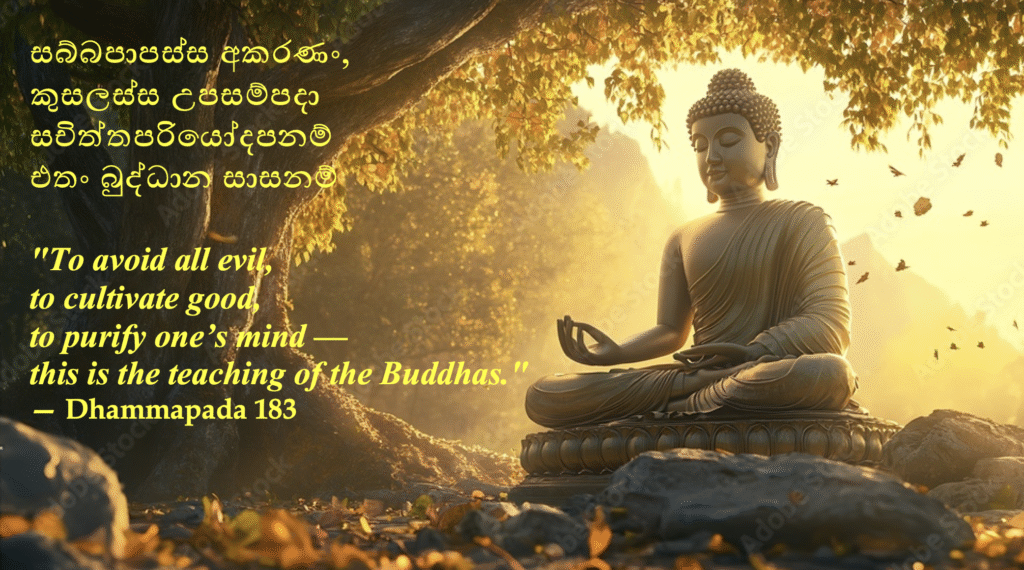
Sri Lanka, is a nation morally anchored in the teachings of the Buddha. From the Constitution to the Penal Code though the latter is colonial, Sri Lanka’s legal foundations echo Buddhist ethical values such as non-harming, truth, justice, and restraint. These Buddhist values shape law, governance, and public accountability. How this applies to the present attempts to repeal Sections 365 and 365A of the Penal Code — colonial laws used to criminalize same-sex relations which were amended & strengthened in 1995 & 2006 making 365/365A a modernized penal code which however, cannot shirk its links to Buddhist jurisprudence embedded in Article 9 & Article 16 of Sri Lanka’s Constitution.
Buddha’s Teachings: The Moral Blueprint for Governance
Buddhism, particularly in the Theravāda tradition practiced in Sri Lanka, sets out clear ethical principles for personal and public life. For rulers and officials, the Buddha articulated the Dasa Rāja Dharma — Ten Duties of a Righteous Ruler. These served as religious guidance & a moral standard for politicians, public servants & law makers. How many actually govern as per these duties today? Is it not the failure to follow these righteous duties that is reason for the decline in morals & ethics at all levels today?
Buddhist Ethics in the Law: Reflected in the Penal Code
While Sri Lanka’s Penal Code (1883) is based on British colonial law, it mirrors many Buddhist precepts, including:
| Buddhist Precept | Penal Code Equivalent |
| No killing | 294–298 (Murder, homicide) |
| No stealing | 366–399 (Theft, robbery) |
| No sexual misconduct | 363–365A,B (Rape, abuse, gross indecency, exploitation) |
| No lying or defamation | 190–198, 500–504 |
| No intoxicants (social order) | Excise Ordinance, Motor Traffic Act, etc. |
| Moral living | 365/365A against unnatural offences & gross indecency |
Sections 365 and 365A – Against Unnatural Offences & Gross Indecency
Buddhist Principle:
- TheThird Precept (Kāmesu micchācāra) urges abstinence from sexual misconduct. This includes unnatural sexual acts, which ancient Buddhist commentaries (like Visuddhimagga) interpret to include same-sex acts, anal sex, and other forms of indulgent sexual behavior that defy nature.
Penal Code Alignment: Sections 365 and 365A criminalize:
- Carnal intercourse against the order of nature.
- Acts of gross indecency, particularly same-sex acts.
Moral Basis:
- These laws mirror theBuddhist view that sexuality should be restrained, natural, and directed toward moral purposes—not craving or indulgence.
Section 363 – Rape
Buddhist Principle:
- Sexual exploitation or forced intercourse is considered a severe form ofsexual misconduct. The Buddha emphasized consensual and moral sexual relations, bound within ethical limits.
Penal Code Alignment:
- Section 363 criminalizesnon-consensual sexual activity, which protects women and children and upholds saddhamma (righteous conduct).
Sections 364 & 364A – Statutory Rape and Incest
Buddhist Principle:
- The Buddha severely condemned exploitation, particularly of the vulnerable (e.g., children, relatives). These acts violateboth moral precepts and karmic laws.
Penal Code Alignment:
- These sections protect family purity and prohibit immoral relations—preserving social and familialorder, which is a Buddhist value.
Sections 291A & 291B – Insult to Religion
Buddhist Principle:
- Buddhism promotestolerance, but also respect for religious sanctity. Promoting acts that undermine Buddhism or insult its doctrines (e.g., by mocking morality or sacred teachings) is a form of adhamma.
Penal Code Alignment:
- These sections prohibit deliberate insult or disturbance to religious feelings—helping protect theBuddha Sāsana from moral erosion.
Sections 365B & 286 – Grave Sexual Abuse & Indecent Exposure
Buddhist Principle:
- The Buddha upheldmodesty, restraint, and protection of others from harm. Public indecency, sexual abuse, or moral corruption breaks the foundation of right conduct (sammā-kammanta).
Penal Code Alignment:
- These laws restrict public immorality and abuse, in line with Buddhistethical restraint.
- These laws aim to prevent harm, uphold justice, and preserve public decency— all key Buddhist principles.
The Controversy: Sections 365 & 365A
What do these laws say?
- Section 365: Criminalizes carnal intercourse against the order of nature” — a phrase historically used on same-sex relations (especially male-male anal sex).These committed on children constitute a crime.
- Section 365A: Criminalizes acts of gross indecency” between persons — in public or private.
Why is repeal being called for?
Human rights groups, handful of legal experts argue that these laws:
- Violate privacy and dignity of same-sex persons
- Are used to harass and blackmail LGBTQ+ citizens
- Are inconsistent with Sri Lanka’s obligations under international human rights law
What Does Buddhism Say About Same-Sex Relations?
For laypeople:
- Buddhism teaches restraint from sexual misconduct,
- What matters is whether a relationship is ethical, consensual, and respectful
Strongest Theravāda Argument Against Lay Same-Sex Relations
1. The Third Precept: Sexual Misconduct
Interpretation from the Commentaries:
The Visuddhimagga and other commentaries by Buddhaghosa classify sexual misconduct as:
- Adultery
- Coercive or deceitful sex
- Sex with underage or protected persons (e.g. those under guardianship)
- Sex that leads to social disorderor violates norms
Same-sex relations are micchācāra” (misconduct) as they violate:
- Violate social norms
- Are non-procreative
- often frowned upon culturally in ancient Buddhist societies
Sources:
- Visuddhimagga(Path of Purification) by Buddhaghosa
- Aṅguttara Nikāya 5.87– discusses five types of misconduct, including sexual, though not homosexual per se
Jātaka Tales and Cultural Attitudes
Several Jātaka tales (e.g., Kāma Jātaka, Sama Jātaka) refer to ideal lay conduct including heterosexual marriage, family duty, and procreation. This has been used traditionally to imply that same-sex unions are outside Buddhist lay ideals.
Reference:
- Jātaka Tales– moral narratives shaping lay conduct
- Cultural interpretations embedded in Sinhalese and Buddhism
Anumāna from Monastic Discipline
The strict prohibitions against same-sex acts in the Vinaya show that the Buddha viewed non-heteronormative conduct as spiritually regressive, and that such principles should also inspire lay morality since the final destination for both laypersons & theros is Nirvana.
Traditional Theravāda Societal Codes
In Theravāda-majority countries (Sri Lanka, Myanmar, Thailand):
- Traditional temple teachingsand village ethics have historically condemned homosexuality as misconduct.”
- Monks often advised against it from a moral puritystandpoint
Examples:
- Writings by Myanmar’s Sayadaws and Sri Lankan forest monks
- Local Banasermons transmitted through oral tradition
For monks:
In the Theravāda Vinaya, any form of sexual intercourse, whether with a woman, man, or non-binary individual, constitutes a Pārājika offense (the gravest of monastic sins), leading to:
- Immediate expulsion from the monastic Sangha
- Permanent loss of monkhood
- No opportunity for reinstatement
This applies regardless of gender, and is uniformly strict (Bhikkhus & Bhikkhunis)
Citation:
- Vinaya Piṭaka – Pārājika 1 (Sexual Intercourse)
- Reference: Bhikkhu Pātimokkha Rules
Rejection of Paṇḍakas from Ordination
Theravāda texts also bar paṇḍakas” (interpreted traditionally to include effeminate men, homosexuals, and other gender non-conforming individuals) from ordination.
This reflects:
- A concern that such individuals would disrupt celibacy and discipline.
- A traditional belief that they are sexually deviant” or unfit” for monastic life.
Citation:
- Cullavagga V, Vinaya Piṭaka (Theravāda Canon)
- Contemporary Analysis: The Conversation, Traditional Buddhist teachings exclude LGBTQ people…”
The Buddha’s View of Marriage: A Moral Union Between Man and Woman
The Buddha acknowledged it as a natural institution within lay life, meant to uphold social stability, virtue, and mutual respect. His guidance, especially in the Sigalovada Sutta (DN 31), explicitly refers to the marriage bond between a man and a woman, outlining distinct duties for each. These are not arbitrary roles—they reflect the natural order (Dhammaniyāma), essential to personal discipline and societal balance.
Male-Female Complementarity in Marriage (Sigalovada Sutta):
The husband is expected to:
- Honor his wife
- Be faithful
- Provide for her
- Share authority
- Treat her with respect
The wife is expected to:
- Be faithful
- Manage household duties
- Welcome relatives
- Protect family wealth
- Be industrious and wise
This framework clearly assumes biological and moral complementarity—a male and a female, fulfilling natural and ethical roles that support not only each other but the wider family and community.
Why This Opposes Same-Sex Unions:
Moral Disruption:
Same-sex relations lack the complementary moral duties and natural alignment outlined by the Buddha. There is no Dhamma-based precedent for redefining marriage around desire, identity, or preference.
Violation of Sīla (Moral Discipline):
The Third Precept—to abstain from sexual misconduct—demands that sexuality be morally restrained, purposeful, and in harmony with Dhamma. Same-sex acts, driven by sensual craving (kāma-taṇhā), are incompatible with this path.
No Procreative or Generational Role:
Buddhist marriage supports stewardship of life—protecting and nurturing future generations. Same-sex unions cannot fulfill this role and therefore depart from the moral utility of marriage.
Social Confusion:
Promoting same-sex marriage” undercuts the Buddha’s clear roles for husband and wife and invites moral ambiguity, not the clarity the Dhamma offers.
The Buddha’s teachings on marriage provide a moral, natural, and disciplined framework—clearly designed for a union between man and woman. This sacred structure, rooted in duty and self-restraint, is incompatible with the promotion of same-sex relationships. Buddhist society must therefore defend the sanctity of this moral model and resist attempts to redefine it through ideologies alien to the Dhamma. To reach Nirvana, laypersons must cultivate right conduct—not celebrate cravings disguised as rights.
Theravāda Buddhism upholds moral discipline (sīla) as the essential foundation for any practitioner aspiring toward Nirvana. The Buddha emphasized the importance of right conduct, self-restraint, and ethical living—not only to avoid karmic consequences but to purify the mind for higher spiritual progress. Therefore, under Theravāda doctrine and cultural application, same-sex conduct is neither spiritually beneficial nor morally justifiable—and should be discouraged for both laypersons and monastics.
The Constitution: A Legal Duty to Uphold Buddhism and Justice
Article 9:
The Republic of Sri Lanka shall give to Buddhism the foremost place and accordingly it shall be the duty of the State to protect and foster the Buddha Sasana…”
This makes it a constitutional duty for the government to protect Buddhist values.
Articles 27–28:
- Require the State to establish a just, moral, and equitable society
- Public servants must respect human dignity and preserve public trust
Government, Politicians, and Public Servants: Bound by Law and Morality
Public officials are entrusted with both:
- Legal power— under the Constitution and Penal Code
- Moral responsibility— under the values of the Dhamma
They must:
- Act with honesty and restraint(Ājjava, Tapa)
- Avoid corruption and abuse (Pariccāga)
- Promote justice and tolerance(Avirodhana, Khanti)
Sri Lanka is a civilizational trust grounded in the Dhamma. The Buddha did not speak of rights divorced from duties, or liberty without restraint. He spoke of discipline, morality, and self-control as the foundation of personal freedom and national harmony.
To repeal Sections 365 and 365A in the name of rights” is to violate the moral and legal duty of the State to protect the Buddha Sāsana, as mandated by Article 9 of the Constitution. It is to substitute discipline with desire, ethics with ideology, and Dhamma with imported dogma.
Let us be clear:
This is not about hatred — Buddhism teaches karuṇā (compassion) and mettā (loving-kindness).
But true compassion does not celebrate craving (taṇhā); it guides individuals away from it.
True tolerance is not silence in the face of adhamma (immorality), but active defense of what is right.
Same-sex acts and ideologies that normalize them contradict the Third Precept, disrupt natural family roles, and undermine the moral clarity provided in texts like the Sigalovada Sutta and the Vinaya Piṭaka.
Upholding 365/365A is not about punishing people — it is about preserving the moral spine of a Buddhist nation.
The State has a choice: It can stand with the Dhamma, uphold the Constitution, and protect the moral foundations of society.
Or it can capitulate to foreign-funded agendas, strip the law of its ethical core, and plunge the next generation into confusion, hedonism, and social decay.
Let this be a call to every citizen, monk, official, and leader:
To protect Sri Lanka is to protect its moral order.
To protect its moral order is to defend the Buddha Sāsana.
To defend the Buddha Sāsana is to defend all beings from suffering.
Reject the repeal of Sections 365 and 365A.
Not out of hate — but to uphold truth, dignity, and Dharma.
Shenali Waduge
How the English Still Prevent Modern Industrial Education in Sri Lanka
June 3rd, 2025e-Con e-News

blog: eesrilanka.wordpress.com
‘Before you study the economics, study the economists!’
e-Con e-News 25-31 May 2025
*
‘In my own surveying parties I never permitted a native
to touch a theodolite or make an original computation,
on the principle that the triangulation or scientific work
was the prerogative of the highly paid Europeans.’
– Surveyor-General of India, quoted in SBD de Silva’s
The Political Economy of Underdevelopment, 1982
*
Sri Lanka is also the 2nd largest market
for England’s ‘transnational education’ fraud!
They have directly benefited from the undermining
of Sri Lanka’s supposed free-education system
*
Allowing ‘the natives’ access into the technical aspects of European ‘culture & its scientific spirit would have undermined the monopoly of administrative, technological & scientific skills’, writes SBD de Silva. He describes instead, how in non-settler colonies like Sri Lanka, where ‘educational opportunities were much better than in the settler colonies’, ‘education was largely of a non-utilitarian nature, biased in favour of literary & academic attainments‘. Gratiaen Awards, anyone? Missed the shortlist by the short hairs, you say, old chap? Tut! Tut! A Maharajah Superstar, you may wannabe indeed!
It wouldn’t matter. ‘Skills & technical know-how’ are made irrelevant by the particular role that colonies were expected to play in the world economy – as primary producers & markets for manufactured goods.
The media in Sri Lanka constantly treats people to sermons about our lack of ‘marketable’ skills. They are happy to omit ‘the role played by the colonial state in stifling the overall propagation of skills, capabilities & industrial habits’. This continues to this day.
SBD de Silva suggests it was the presence of a white working class in settler colonies that created pressures for advanced employment opportunities – their governments were compelled to recognize, that for political and social reasons ‘it could not countenance the existence of distress among unemployed white settlers’ living amidst a ‘native’ population.
De Silva recounts in detail how, ‘Apart from the notorious ‘civilised labour’ policy, designed to exclusively benefit white workers, there was a conscious policy of industrial development through protective tariffs and state industrial monopolies. The fiscal protection given to domestic manufacturers had as its primary goal the promotion of regular employment.’ And no, the English never complained about paying them higher wages than the natives. And now we have US Vice President JD Vance calling for the prevention of Asian and African access to a modern industrial education. For SBD de Silva it was not the skill of settlers or their lack of peasant prejudices but their severance from metropolitan ties, which we have still been unable to accomplish (see ee Focus, Republic).
*
• An apparent expert on, and sympathizer of, terrorist acts, if not a planner of such terrorism himself, the Republic of Poland’s Minister of Foreign Affairs Radosław Sikorski visited Sri Lanka’s President Anura Kumara Disanayake on May 29 afternoon, accompanied by EU Ambassador to Sri Lanka Carmen Moreno. The visit is purportedly due to Poland’s Presidency of the Council of the European Union,
After ‘some mysterious someone’ blew up on 26 September 2022 the NordStream pipelines supplying Russian gas to Germany, this funny fellow Sikorski infamously tweeted with an aerial photo of gas billowing to the Baltic Sea surface with a simple Thank you, USA.” Hours later he followed up with a tweet that Ukraine & the Baltic states had opposed NordStream’s construction for 20 years. A few days further on, Poland cut off the Yamal-Europe pipeline which transits across Poland and was meant to supply large quantities of natural gas to Europe. Sikorski, considered a well-trained English agent & poodle, was accused of trying to divert from England’s role in the terrorist bombing of the pipeline, by blaming the USA alone. Then again, the USA is the grand conductor of the war on Russia through Ukraine, just as it is the frenzied baton-wielder of the Israeli genocide of Palestine. In a context of India hoping to build severable pipelines to Sri Lanka, and the white attempt to block off China from West Asia and Africa via the Indian Ocean as well, one wonders about the type of expertise Sikorski has to offer (other than putting his boot in his mouth!).
*
The US attempt to assassinate Russia President V Putin on May 20 was silenced just as volubly, by the English media hailing ‘breakthroughs’ in peace talks over the NATO war on Ukraine. Such are the typical white tactics for those who know the history of the Americas – the treachery involved in the building of empire, ‘how the West was lost’, etc, let alone English subterfuge across the world. Not just English history, the kidnapping and murder of Haiti’s famous liberator Toussaint L’Overture took place after he was invited to talk peace on a French ship. This is the art of strategic ambiguity, of multiple messaging, so your enemies hear one thing, and your purported friends something else. The murder of Russian President VV Putin would then have been hailed as a bit of smart warfare, just like the murder of Iranian General Qassem Soleimani, who had been also lured on the basis of peace talks.
*
Meanwhile, England’s Lord John Hannett of Everton, England’s Trade Envoy to Sri Lanka, is said to have avoided the Katunayake Free Trade Zone (FTZ), where the English company Next is trying to illegally sack almost 2,000 factory workers, while claiming the workers are too violent to directly negotiate with. Next was just recently listed as a success story of established English businesses in Sri Lanka, along with ‘HSBC, Standard Chartered, the London Stock Exchange Group, De La Rue Currency, Unilever, M&S, and Tesco’. Hannett’s diplomatic gang instead visited MAS Holdings’ Silueta facility in Biyagama. Meanwhile, Wijeya Group’s Financial Times columnist Ajith Perera accused the FTZ trade union of being in league with Next shareholders in London. England’s Next fiasco in Katunayake does indeed brings up curious workers’ issues: Why are the rag-trade unions in England, the EU & the US so interested in the right of garment workers in Sri Lanka, as opposed to their own workers? Also, do they fund unions here to break away from larger worker and political movements in the country? The complaint about the low productivity of the workers is also a joke, when England has never shown any interest in increasing productivity in such labour-intensive ventures in Sri Lanka. The plantations, where women have been plucking leaves with specific pectoral, deltoid and rotator cuff muscles, unenhanced by machinery, for the last 150 years at least, stand as a monument to English piffle about productivity.
The English Trade Envoy’s inaugural visit to Sri Lanka was preceded by the arrest of a female English drug mule, offering a certain irony to the International Trade Centre (ITC), and Sri Lanka’s Export Development Board (EDB), and the envoy, launching their SheTrades Sri Lanka Hub webpage, under the English government-funded SheTrades Commonwealth project ‘to empower women-led businesses & integrate them into global trade’. Traders alright!
The trade envoy also arrives with the typical threats and fake laments of being victims, such as: ‘Last year’s assault incident of travel-vlogger resurfaces’about some English social-media businessman getting beaten up for possibly intruding on local people’s private affairs, with the alleged assailant being arrested that very day. Sri Lanka is also the 2nd largest market for England’s transnational education fraud! They have directly benefited from the destruction of Sri Lanka’s supposed free-education system. We will not be taught how England’s Pearson plc, now the biggest and most expensive publisher of educational texts and examinations in the ‘free’ world, is linked to the forces that sabotaged the attempts (by DJ Wimalasurendra, et al) to achieve energy security. As SBD de Silva said, it would have been better to give free fertilizer to cultivators than miseducating Colombo’s wannabes. Meanwhile, our accountants (certified in England and exported in droves). still don’t know how to count, for every news item about the envoy, claims, ‘Sri Lanka is a valuable trading partner for England, with bilateral trade worth approximately £1.6billion’. Never forgetting to add that ‘the trade balance is skewed in Sri Lanka’s favour with England as Sri Lanka’s 2nd largest export market’. Exporting what? Natural materials that an industrial England then makes more profit off through processing & refining. English Tea indeed!
*
• So why has Sri Lanka’s May 22 Republic Day been increasingly ignored? From France to the USA to India – such days are cause for ritual celebrations. But not here. In this ee Focus Shiran Illanperuma spoke about this at a recent Communist Party of Sri Lanka celebration on May 22. He, however, does not refer to The Proposals for Conferring on Ceylon Fully Responsible Status within the British Commonwealth of Nations”, as authored by one chap named Herwald Ramsbotham, who as Chairman of the Soulbury Commission 1944-45 laid out the path for Ceylon to gain ‘Dominion Status’, granting it internal self-government within the ‘British Commonwealth’.
‘Soulbury has come to bury your soul!‘, cried out Indian Marxist Bankim Mukherjee, to condemn the ‘bargain’ at a socialist rally on Galle Face Green. Mukherjee was the first member of the Communist Party of India to be elected to legislature. Yet what time-bombs did Ramsbotham plant, to keep Ceylon in check, after reigning as Governor-General of Ceylon, 1949-54, for this Baron to be promoted as a Viscount Soulbury in the County of Buckingham? What contracts and privileges did accrue?
Illanperuma highlights how & why in 1948, our ‘political independence’ still stood incomplete, with our economic independence being slowly eroded, with a US citizen devising and installing the Central Bank of Ceylon in 1950, binding us to the IMF & World Bank’s prognoses. To fatten a compliant class, these forces promoted a culture of consumption, rather than an ethos of modern production. Even this so-called political independence was conditional on the English being allowed to keep their military here and control our foreign policy. The 11 November 1947 White Paper, ‘Proposals for conferring on Ceylon fully responsible status within the British Commonwealth Nations’, had the UK-Ceylon Defence Agreement as its first appendix, was signed by DS Senanayake. Two days later, on 13 Nov 1947, a Ceylon Independence Bill was rolled out before the English Parliament, and adopted. ‘1948 was a bargain struck by comprador rulers’ – indeed, Illanperuma then lists out the promises of the 1972 ‘Republican’ constitution, and notes the importance of modern production, of machines making machines. He even recalls Guinea-Bissau’s Amilcar Cabral who saw the link between industrialization & freedom. Midst the valorization & demonization of the armed forces, Illanperuma could have added Cabral’s famed bon mots, that ‘the duty of the man with the weapon is to protect the man with the tool’.
*
Throughout the country the belief prevailed that
the politicians of the metropolis deserved no respect,
merit or consideration; & that they were ‘purchasable
& transferable like any stock on Wall Street’.
*
• ee continues recalling the US science of political manipulation and corruption thru Gustavus Myer’s history of the Tammany Society. Myers take on capitalism is, however, primitive – like our famed aragalists – for he doesn’t place the ‘corruption’ being upheld by the hourly exploitation of labour, or the private capture of public goods aided by the state – a private-public partnership indeed is what it’s all about, no doubt.
A ‘charitable & benevolent corporation’ it was, by law, but Tammany was in reality, a secretive political machine run to benefit the banks & their businesses, industries & railroads, etc. They learned the political art of deploying petty criminals, ‘boisterous roughs of the river edge’, immigrants, industrious mechanics & laborers, & businessmen, so they could enjoy the ‘spoils’ of office, the disbursement of municipal finances, the selection to minor state offices. Tammany adopted the ‘convention system of nominating’, to control the election of delegates to conventions, and to eliminate ‘the risk of having prearranged nominations overruled by an influx of gangs‘ at large popular meetings. Under the guise of pro- & anti-slavery, under the guise of imperialism, one faction opposed ‘the extension of slavery to free territory’, to prevent an influx of Africans, the other promoted the enslaving south. But when threatened by outside forces, they joined together. For there were fortunes to be made, by plundering the city and State. They disdained ‘the conduct of the agents and actual performers in this wholesale brigandage – the lobbyists, Legislators and Aldermen – even as their employers stood before the world as the representatives of virtue and respectability”.’
The US news media hyped the uncovering of gold in California and Australia creating in all classes a feverish desire for wealth. Vessel after vessel was arriving in the harbor with millions of dollars’ worth of gold dust”. Glowing accounts described how poor men got rich quick: ‘all means of ‘getting ahead’ came to be considered legitimate. Politicians, trafficking in nominations and political influence, found it a most auspicious time.’ With the new wealth pouring in, old trade-unions were rapidly strengthened and new ones formed. They demanded ‘more pay and shorter hours of work. ‘Between the Spring of 1850 & the Spring of 1853 nearly every trade in the city engaged in one or more strikes, with almost invariable success.’ He did not mention how, once the settlers found no fortunes in gold, they turned on and stole the farms of the Chinese who had turned California into an abundant food basket.
Meanwhile, a million or more immigrants ‘driven by famine and oppression from Ireland, Germany and other European countries’, poured through the port of New York alone, 1847-52. The ‘thrifty and honest’, the ‘ignorant and vicious’ filled the pauper and criminal classes of the metropolis. ‘The sharper-witted among them soon mended their poverty by making a livelihood of politics’. To them political rights meant obtaining money or the receiving jobs from the city, State or national government, in return for delivering voters at the polls. The political lawbreaker was immune from punishment, as Aldermen sat as Justices in the Mayor’s Court, The police were appointed by politicians exclusively on political grounds. The policeman’s livelihood depended on gaining money or receiving jobs under the city, State or national government, in return for the marshaling of voters at the polls. ‘They bothered little, and knew less’ about the issues involved (see ee Focus).
*
• The merchant media appears to be slowly but inexorably turning on the NPP-JVP government whose path they greased to power. All the crimes of the past and the present will now be dumped on their heads, just as it was dumped on skulls previous. It is now their turn. It’s just a matter of time. The merchant media’s purpose is to undermine the popular support for socialist and nationalist forces that have dominated the Sri Lankan polity (see Republic in ee Focus, on the polls regarding attitudes towards socialism).
Those who have been elected promising to be clean, will soon find out that it is only the dominant merchant system that can afford them the cash & contracts to keep their sympathizers loyal; allow them to run again & again and win, so as not to be accused of being corrupt and being jailed themselves, by selectively providing them the ‘sunlight’ to be clean, in the media at least. Then there are those who claim that it is only politicians of the past who have been corrupt, and if such corruption persists, they resort to citing the secular version of the Christian axiom of original sin: that people are primordially bad by nature. All we can say is, the future will soon take care of us all… for better and for worse.
Bus accidents are blamed on drivers, rather than how the banks have choreographed these disasters; ragging is blamed on the venality of rural rubes, rather than on the role of the education system in reproducing the class structure shaped by a merchant economy; and the closure of factories, is blamed on boisterous workers and wild unions, but not on the strategies of multinational corporations seeking ‘labor arbitrage’ (the lowest wage costs) around the world.
The problem with talking so narrowly about this corruption business, of course, is that the merchant media utters not a word about how the private sector monopolizes the public resources of the country, and refuses to employ people with dignity. Nor will their sponsors allow any talk about how this corruption is built on the true original sin: the private appropriation of the social surplus via the exploitation of workers, inherent to capitalism itself, which is mother, father, grandpa, grandpa of all such crimes.
*
_________
Contents:
ක්රි.පූ. 307 පොසොන් දෙපෝ දිනයේ උපත ලැබූ මේ සින්හල බෞද්ධ රටේ ජාතික දිනය වශයෙන් දැන්වත් පොසොන් දෙපෝ දිනය ප්රකාශ කළ යුතුය
June 3rd, 2025දේශමාන්ය ආචාර්ය සුදත් ගුණසේකර. අග්රාමාත්ය සිරිමාවෝ බන්ඩාරනායක මැතිනියගේ හිටපු ස්ථිර ලේකම් සහ ශ්රී ලන්කා පරිපාලන සේවා සන්ගමයේ සභාපති (1991-1994)
සින්හල බෞද්ධ ජාතියේ උපත සිදුවූයේ ක්රි. පූ. 307 වන සියවසේ පොසොන්පෝය දිනයේ දී සිදුවූ ඒ අසිරිමත් මහින්දාගමනයත් සමඟය. එබැවින් අනිවාර්යෙන්ම මේ රටේ ජාතික දිනය විය යුත්තේ පොසොන්පෝය දිනය මිස වෙනත් කිසිම දිනයක් නොවේ. එමනිසා පොසොන්පෝ දිනය දැන්වත් මේ සින්හල බෞද්ධ රටේ ජාතික දිනය වශයෙන් ප්රකාශකොට එය ව්යවස්ථාගත කළ යුතුය.ඒ සමඟම මේ රටේ හෝ සින්හල ජාතියේ ආරම්භයට කිසිදු සම්භන්ධයක් නැති පෙබරවාරි 04 ජාතික දිනය වශයෙන් ප්රකාශකොට ඇති 1978 ව්යවස්ථාවේ 8 වන වගන්තිය නමැති කුණුහරුපයද වහාම පරිච්චින්න කළ යුතුය.
ඒ සමඟම ඉන්පසු සින්හල බෞද්ධ ජාතියේ සැබෑ ජාතික දිනය වශයෙන් පොසොන්පෝය දිනය වසරක් පාසා රාජ්ය අනුග්රහය ඇතිව රට පුරා සැමරිය යුතුය. එසේම ජාතික වැඩපිළිවෙලක් වශයෙන් රට පුරා සියලුම පාසැල් සහ පන්සල්වලද සියළුම විශ්වවිද්යාල වලද මෙදිනට මෙම සැමරීම අනිවාර්ය කළයුතුය.එසේම රටපුරා නිවසක් නිවසක් ගානේ ධජ කොඩි නන්වා එය සැමරිය යුතුය.එවිට ඒ තුලින් මේ රටේ සමස්ථ ජනතාව මෙන්ම බාල පරම්පරාව තුලද කුඩාකළ සිටම ජාතිකානුරාගය වර්ධනය වීමෙන් ජාතියානුරාගය සහ දේශාභිමානයෙන් සන්නද්ධවූ ජනතාවක් හා ජාතියක් රට්තුල බිහිවණු ඇත. ඒ තුලින් මේ රටේ නවතම ජාතික පුනරුදයක් ඇතිවී මරනින්දේ පසුවන මේ සින්හල ජාතිය යළි කේශර සින්හයින් මෙන් අවදිවී යලිත් නැගීසිටිණු ඒකාන්තය.
මේ රටේ හා ජාතියේ ආරම්භයේ සිටම අඛණ්ඩව පවත්වාගෙන එන ජාතික සම්ප්රදායන් අනුව සිදුකෙරෙන ශ්රී දළදා හිමියන් ආරක්ශාකිරීම, බුද්ධ ශාශනය සුරක්ෂිතකොට පෝෂනය කීරීම මෙන්ම මෙම ජාතික දිනය වාර්ෂිකව සැමරීමද රාජ්ය නායකයාගේ සහ රජයේ පරම වගකීමක් වන බවටද ව්යවස්ථාගතකළ යුතුය.
මහාවන්ශයේ සඳහන් වන පරිදි සිංහල ජාතියේ උපත සිදුවූයේ ක්රිස්තු. පූ. 543 දී සිදුවූ විජයාගමනයත් සමඟය.”එසේම සිංහල බෞද්ධ ජාතියේ මෙන්ම සිංහල බෞද්ධ ශිෂ්ඨාචාරයේ” උපත මෙන්ම ආරම්භයද සිදුවූයේ කි.පූ. 307 දී සිදුවූ ඒ අසිරිමත් මහින්දාගමනයත් සමඟය.
ඒ අනුව අනිවාර්යෙන්ම වසර 2332 දෙකක දීර්ඝ ඉතිහාශයක් ඇති මේ සිංහල බෞද්ධ රටේ සැබෑ ජාතික දිනය වියයුත්තේ ඇත්තවශයෙන්ම ජාතිය උපන් දිනය වන පොසොන්පෝය දින මිස වෙනත් කිසිම දිනයක් නොවේ. එම නිසා සින්හල බෞද්ධ ජාතියේ ජාතික දිනය වියයුත්තේද ඒ අසිරිමත් පොසොන්පෝය දිනයම නොවේද?
මේ අනුව ක්රි.පූ.307 සිට මෙදා දක්වා වසර 2332 ක් පුරාම පැවති සින්හල ජාතියේ උපන් දිනය වන, ඒ අසිරිමත් පොසොන්පෝය මිස වෙන කිසිම දිනයක් සින්හල බෞද්ධ ජාතියේ ජාතික දිනය වශයෙන් කිසිවෙකුට ප්රකාශකළ නොහැක. එම කරුණ නිසාම 1978 ජනරජ ව්යවස්ථාවේ 8 වන වගන්තියෙන් මේ රටේ ජාතික දිනය පෙබ් 4 වශයෙන් ව්යවස්ථාගත කිරීම මේ රට හෝ ජාතිය ගැන මළපොතේ අකුරක් නොදන්නා, එසේම තවමත් යටත්විජිත මානසිකතවයේ පසුවන, ජාතිය ගැන හෝ රට පිලිබඳ හෝ කිසිදු ආදරයක් නැති ජාති ද්රෝහී, දේස්ද්රෝහී පුද්ගලයෙකුගේ අමණ ක්රියාවකි.
එමනිසා දැන්වත් අධිරාජ්යවාදී වහල් මානසිකත්වයෙන් මිදී ඒ ශ්රේෂ්ඨ සින්හල බෞද්ධ ජාතියේ මෙන්ම සින්හල බෞද්ධ ශිෂ්ඨාචාරයේ උපත සිදුවූ ක්රි පූ. 307 දී සිදුවූ ඒ අසිරිමත් මහින්දාගමන දිනය වූ පොසොන්පෝදා මේ සින්හල බෞද්ධ ජාතියේ සැබෑ ජාතික දිනය වශයෙන් වහාම ප්රකාශ කළ යුතුය. එසේම ඉරහඳ පවතිනාතුරුම එහි පැවැත්ම ස්ථාපිත කිරීම සඳහා ඒ බව ශ්රී ලන්කා ජනරජ ව්ය්වස්ථාවේද ව්යවස්ථාගතකළ යුතුය. එසේකොට මහින්දාගමනයෙන් වසර 2332 පිරෙන මෙම අවස්ථාවේදි හෝ දැන්වත් මේ රටේ ජාතික දිනය වශයෙන් මිහින්තලා පින්කෙතට ඉහලින් අහසේ පුන්සඳ පායා ලක්දෙරණ ඒකාලෝක කරවන පොසොන්පෝ දිනය මේ රටේ සැබෑ ජාතික දිනය වශයෙන් ප්රකාශකොට සින්හල ජාතියේ සහ මේ රටේ නවෝදයක් උදාකරමු.
මා සිතන හැටියට මෙය සිදුකළයුතුව තිබුණේ 1948 දී අධිරාජ්යවාදී ග්රහණයෙන් මිදුණු දිනදීමය. එසේ කළේ නම් නව සින්හල බෞද්ධ ජාතියක මෙන්ම නව නවසින්හල බෞද්ධ පුනරුදයක ඇරැඹුම එදා සිටම මේ රටේ ආරම්භවීමට ඉඩ තිබිණ.
1972 දී බණ්ඩාරනායක මැතිනිය විසින් ජනරජ ව්යවස්ථාවෙන් පූර්ණ ව්යවස්ථාදයක,විධායක සහ අධිකරණ බලතල සහිට පූර්ණ නිදහස්, නිවහල්, ස්වඉරී රාජ්යක් බවට මේ රට පත්කළද පොසොන් පෝය දිනය මේ රටේ ජාතික දිනය වශයෙන් නම්කිරීමට එතුමියට උපදෙස් දීමට කිසිවෙකු නොසිටි බව පෙනේ.
ජනාධිපති ජේ. ආ.ර් ජයවර්ධනගේ 1978 ව්යවස්ථාවේ අන්ක 8 යටතේ
ශ්රී ලන්කා ජනරජයේ ජාතික දිනය පෙබරවාරි මස 04 වන දිනය වන්නේය”
යනුවෙන් මේ රටේ ජාතික දිනය පෙබ 4 බව ව්යවස්ථාගතකොට මේ රට යටත් විජිතවාදී මානසිකත්වය කරා යළිත් ආපසු ගෙන ගියේය.
මේ ශ්රී ලන්කාවේ වසර 2500 කට වැඩි කාලයක් සින්හලයින්ගේ රට වශයෙන් අඛණ්ඩව පැවති මේ රටේ ජාතික දිනය පෙබරවාරි 04 වශයෙන් සැලකිමට සහ එය ව්යවස්ථාවෙන්ම නීතිගත කිරීමට ජේ ආර්ගේ යටත්විත වහල් මානසිකත්වය හැර එම දිනයෙහි ඇති ජාතික හෝ සන්ස්කෘතික වටිනාකම කුමක්දැයි මම ප්රස්න කරමි.
මා හිතන අන්දමට ඔහු පෙබ 4 ජාතික දිනය වශයෙන් සඳන් කොට ඇත්තේ 1948 දී මේ රටට බ්රතාන්යයින්ගෙන් ලැබුනායයි කියන “නිදහස නැමැති සුද්දන්ගේ ප්රෝඩාව” මැරෙන තුරුම ජේ. ආර්ට තේරුම් ගැනීමට තරම් ජාතික හැඟීමක් හෝ ජතිකාභිමානයක් ඔහු තුල නොතිබුණ නිසා විය හැක.
ඔහු එසේ කිරීමට පෙළඹවූයේ සෝල්බරී ව්යවස්ථාව ලිවූ ජෙනින්ග්ස්ගේ බිරිඳගේ උපන්දිනය මෝඩ සින්හලයින් ලවා 1948 සිට 1972 දක්වා ජාතියේ නිදහස් දිනය වශයෙන් සැළකූ පෙබ 04 ආභාෂය විය හැකියයි මම සිතමි. වසර 2500 කට අධික කාලයක් පුරා මේ රටේ ජාතික දිනය වසයෙන් සැලකීමට එම දිනයේ ඇති ජාතික වටිනා කම කුමක්දැයි ඇසීමට දැන් ඔහු ජීවතුන් අතර නැත.
එමනිසා දැන්වත් පොසොන්පෝය මේ සින්හල බෞද්ධ රටේ ජාතික දිනය වශයෙන් ප්රකාශකොට පොසොන්පෝය මේ රටේ සහ ජාතියේ ජාතික දිනය වශයෙන් නම්කොට ව්යවස්ථා ගතකරණ මෙන් ජනතා උද්ඝෝෂනයක් කරණ මෙන් මම යෝජනා කර සිටිමි.
මා එසේ ඉල්ලා සිටිණුයේ මේ රටේ සින්හල බෞද්ධ ජාතියේ” උපත සිදුවූයේ, කිතු වසින් පෙර 307 වන වසරේ පොසොන් පෝය දින නිසාය.
Sri Lanka-Australia Bilateral Talks Bolster Defence Cooperation
June 3rd, 2025Ministry of Defence – Media Centre
An Australian delegation led by the Deputy Prime Minister and Minister of Defence of Australia, Hon. Richard Marles, held bilateral discussions with Sri Lanka’s Deputy Minister of Defence, Major General Aruna Jayasekara (Retd), today (03 June) at the Deputy Minister’s Office in Colombo. Australian High Commissioner in Colombo H.E. Paul Stephens also joined the discussions.
The meeting focused on strengthening the longstanding bilateral relationship between Australia and Sri Lanka, encompassing political, economic and defence cooperation. Both parties engaged in a productive dialogue aimed at expanding existing partnerships, fostering regional security and exploring new avenues for collaboration in areas such as maritime security, maritime domain awareness, capacity building and training.
During the discussions, Minister Marles commended Sri Lanka’s strategic role in ensuring stability in the Indian Ocean Region and reaffirmed Australia’s commitment to working closely with Sri Lankan defence counterparts, particularly in enhancing Maritime Domain Awareness (MDA).
In response, Deputy Minister acknowledged the enduring and cordial defence relations between the two nations and emphasized the importance of sustained engagement and mutual support. Additionally, he expressed gratitude to the Australian Government for its substantial assistance, including a multi-million-dollar fuel grant to the Sri Lanka Navy (SLN) and Sri Lanka Air Force (SLAF) since 2022.
The deputy Minister also appreciated the donation of a KA-350 Beechcraft to the SLAF and a state-of-the-art Shallow Water Multi-Beam Echo Sounder (SWMBES) to the SLN Hydrographic Service, significantly enhancing their surveillance capabilities.
The visit underscores the shared commitment of both countries to promoting peace, stability and security in the Indo-Pacific region through enhanced defence cooperation and strategic dialogue.
letter to HON HUGH MCDERMOTT on Sri Lanka’s war to defeat 25 years of terrorism.
June 3rd, 2025SOCIETY FOR PEACE UNITY AND HUMAN RIGHTS IN SRI LANKA -VICTORIA & NSW
SOCIETY FOR PEACE UNITY AND HUMAN RIGHTS IN SRI LANKA -VICTORIA
SOCIETY FOR PEACE UNITY AND HUMAN RIGHTS IN SRI LANKA-NSW
PO BOX 2664 ROWILLE VIC 3178
Dr Hugh MCDERMOTT, MP
NSW Member of the Legislative Assembly for Prospect
Parliamentary Secretary to the Attorney General
Member of the Australian Labor
Dear Sir,
Ref: Your speech on Sri Lanka’s war against the LTTE, UN proscribed terrorist organization was an attempt to whitewash the HR violations of the intransigent Tamil Tiger while criticising unfairly the humanitarian war conducted to protect sovereign Sri Lanka and her civilians, including Tamils who were held forcibly by the LTTE as a human shield.
The racist wing of the Tamil Politicians formed a political party in 1949 .soon after Sri Lanka became an
independent nation. The party was known as Ilanki Tamil arsu kachchi (Tamil State Party) which became the Federal Party who always promoted federal state in the North and the East of Sri Lanka whereas the Sinhalese ethnic group consisted of74.9 % of the total population in the country. Tamil population was 15.2 % and Moors was 9.2%
The following is a brief history of the violent terrorism of the separatist Tamil politics in Sri Lanka, and you
are kindly requested NOT to endorse violence as a parliamentarian in Australia, as terrorism has to be
countered for the growth of democracy.
Adoption of Vadukoddai Resolution by Tamil leaders in 1976.
The violence in Sri Lanka raged for 33 years, starting from the declaration of war on May 14, 1976 at
Vadukoddai by the Tamil leadership and ending in Nandikadal on May 18, 2009 when Velupillai
Prabhakaran’s body was found floating in the murky waters of the Lagoon. This war has been described in
different ways, depending on the political orientation of the describer. It was, however, commonly described as an ethnic conflict between the Sinhalese and the Tamils. But the unravelling events questioned this description.
The decision to go for a military solution, stated unequivocally in the Vadukoddai Resolution, was ratified by the Tamil leadership led by S. J. V. Chelvanayakam, the man who claimed that his ambition was to be a father to the Tamils. Led by Chelvanayakam, the Tamil leadership agreed at Vadukoddai that the military solution was better than the non-violent parliamentary process and decided to wage a war against the Sinhalese who were identified as the enemy of the Tamils.The distorted history, the generalised accusations and the main political thrust of the Vadukoddai Resolution were designed to demonise the Sinhala community and generate hate politics of the extreme kind against the Sinhalese.
Accordingly, the hate politics inscribed in the Vadukoddai Resolution and picked up by Prabhakaran should have led Tamil violence to target only the Sinhala community as there was no other enemy identified in the Vadukoddai Resolution. But Velupillai Prabhakaran, the anointed proxy of the Vellahla leadership which urged the Tamil youth to take up arms, targeted the Muslims and the Tamils indiscriminately. Why? What had the Muslims done to the Tamils to massacre them? And, above all, what had the Tamils done to Prabhakaran for him to target the Tamils? Prabhakaran first turned his guns on the Tamils and killed more Tamils than all the others put together.
No other leader had pursued hate politics to insatiable extremes as Prabhakaran. His hate politics that led to the killing of anyone whom he perceived to be his enemy was totally irrational and counterproductive.”
We produce below HRW report issued on 15 December 2008 for you to understand how the Tamil Tigers
violated HR of the civilians in Sri Lanka including the Tamils.
HUMAN RIGHTS WATCH -15 DECEMBER 2008
Trapped and Mistreated
LTTE Abuses against Civilians in the Vanni
https://www.hrw.org/report/2008/12/15/trapped-and-mistreated/ltte-abuses-against-civilians-vanni
I trust that you will have the time to go through the attached as a widely read senior politician and reach a reasonable conclusion as to the Sri Lanka’s war against the terrorist Tamil Tigers who killed most of the senior Tamil politicians and many Tamil civilians apart from the Sinhala and the Muslim persons.
Thanking you,
SPUR VICTORIA
SPUR NEW SOUTH WALES
28 May- 2025
LIVE | Derana 360 | ආචාර්ය අනිල් ජයන්ත – කම්කරු අමාත්ය සහ ආර්ථික නියෝජ්ය අමාත්ය
June 3rd, 2025Courtesy Derana
Issues Related to Pensions of Retired War Veterans and Widows and Orphans Pension for War Hero Families Brought to the Attention of Defence Secretary
June 2nd, 2025Ministry of Defence – Media Centre
A special discussion to resolve issues related to the pensions of retired war veterans and the payment of Widows and Orphans Pension (W&OP) to families of fallen war heroes was held on May 30 at the Ministry of Defence under the patronage of Defence Secretary Air Vice Marshal Sampath Thuyacontha (Retd).
Discussions centered on a number of relevant issues including concerns related to the recruitment of Sri Lankan retired war veterans on payment basis for the Russo-Ukrainian war. Information on injured and killed Sri Lankan veterans was taken up and it was also discussed on possible future steps concerning the payment of pensions or widows and orphans contributions to retired war veterans and affected families.
Accordingly, the Defence Secretary instructed relevant officials to take necessary action to obtain accurate information on Sri Lankan military personnel involved in the Russian-Ukrainian conflict—those who went missing, died during the hostilities, or are currently being held as prisoners of war by both sides. He also requested the Director General of the Pensions Department to explore the possibility of establishing a pension scheme or other financial assistance program for these individuals, based on the information thus obtained.
In addition, the issues raised by retired war veterans and their families regarding the payment of pensions and widows and orphans contributions were also discussed during the Public Day Programme held at the Ministry of Defence on May 28 and 30. The Defence Secretary also instructed relevant officials to continue providing support and to take prompt action to resolve issues faced by retired and disabled war veterans.
The meeting was attended by Director General of the Pensions Department, senior Defence Ministry officials, tri-forces officers and several family members of Sri Lankans believed to have gone missing during the Russian-Ukrainian conflict.
National Border Management Committee (NBMC) Assembles After a Six-Year Pause
June 2nd, 2025Ministry of Defence – Media Centre
After a six-year interval, the National Border Management Committee (NBMC) of Sri Lanka reconvened for its 9th session on 30 May 2025 at the Ministry of Defence marking a significant step towards strengthening Sri Lanka’s border security framework amidst evolving global and regional security dynamics. The meeting was held under the guidance of Defence Secretary Air Vice Marshal Sampath Thuyacontha.
The NBMC was initially established under the leadership of the Defence Secretary as part of the Integrated Border Management Strategy (IBMS) – an initiative introduced over a decade ago with the support of the International Organization for Migration (IOM) and the governments of Australia and Canada. This strategy aimed to address emerging threats posed through national borders, with particular focus on irregular migration. Since its inception, eight NBMC sessions were held prior to a long pause since 2021. During this time, only the Border Risk Assessment Centre (BRAC), created under the IBM strategy, remained operational under the purview of the Ministry of Defence.
Recognizing the increasing importance of structured border management in the context of shifting geopolitical and security landscapes globally and particularly in the region, the Ministry of Defence took proactive measures to reactivate the NBMC.
The Committee’s recent session brought together senior representatives from key stakeholders including the Ministry of Foreign Affairs, Ministry of Public Security, Department of Immigration and Emigration, Civil Aviation Authority, Sri Lanka Customs, Sri Lanka Navy, Sri Lanka Police, and the Department of Coast Guard, among others. Several critical decisions and consensus points were reached during the session.
Defence Secretary Air Vice Marshal Thuyacontha emphasized the pivotal role that a robust national security plays in achieving sustainable economic growth, especially through promoting tourism, and attracting foreign investments. He emphasised that border security is a fundamental pillar of national security, and called for the active involvement and accountability of all relevant institutions.
During the meeting in-depth discussions were held on emerging threats such as irregular migration, cross- border trafficking of humans, narcotics, and contraband, movement of extremists and terrorists, and evasion of law by organized criminals escaping through international borders.
The Defence of Secretary highlighted the pressing need for swift and coordinated responses to these threats and reiterated Sri Lanka’s commitment to regional and international obligations regarding border protection. He also acknowledged and appreciated the continued support extended by the governments of Australia, Canada, and the IOM, while expressing hope for their continued collaboration in future initiatives.
The Defence of Secretary also extended his gratitude to the Ministry staff and all participating officials for their contribution in revitalizing the NBMC after a long pause. He issued clear directives to ensure the committee operates as a dynamic and adaptive body, evolving in line with emerging threats while remaining aligned with its foundational strategic objectives.
letter to HON HUGH MCDERMOTT on Sri Lanka’s war to defeat 25 years of terrorism
June 2nd, 2025SOCIETY FOR PEACE. UNITY AND HUMAN RIGHTS IN SRI LANKA
Dear Hon Mcdermott
Kindly have a look at the letter sent herewith and the report of abuses against the civilians caused by the LTTE which was the cause of the war and political stand of the Sri Lankan govt to uphold democratic system of governance and protect the people and the country.
We trust that you will have the time to pursue the issues covered in the letter and the report as a democratically elected member of the Parliament
Thanking you
SOCIETY FOR PEACE. UNITY AND HUMAN RIGHTS IN SRI LANKA-VIC
SOCIETY FOR PEACE, UNITY AND HUMAN RIGHTS IN SRI LANKA -NSW
Save Sri Lanka which is in grave danger
June 2nd, 2025Courtesy The Morning
23 May 2025 | BY Prof. Tissa Vitarana
The world is in a state of economic, social and political crisis. There are those who predict the end of the world, which includes some religious leaders and their followers. But, all the leaders of the great religions did not live in a capitalist society; it was feudal, slave or tribal.
To understand what is happening today, a scientific understanding of the capitalist system is required and this was provided by Karl Marx. Marxists scientifically showed that it was conflicts due to exploitation of the vast majority of humanity by a small elite minority, the super-rich, that led to the collapse of the great slave and feudal civilisations of the past. They showed that the capitalist system too would collapse, and that for humanity to survive, the only hope was to live in harmony in a socialist society. This would be a stable system as it would be free of exploitation of humans by humans, and without divisions based on classes into elitists and those who are poor. The Lanka Sama Samaja Party (LSSP) has adopted gradual regime change to save Sri Lanka and a beautiful life on it, as best we can.
Since its formation in 1935, it was the LSSP that led the fight against the malaria epidemic, and for complete independence from colonial rule under British Imperialism. The LSSP alone was banned and its leaders like Dr. N.M. Perera and Dr. Colvin R. de Silva were jailed. While the capitalist and feudal political leaders were satisfied with the limited independence gained in 1948, the LSSP continued the fight for complete independence which would include sovereignty, which still remained with the British ruler. This was finally achieved only 24 years later when Dr. de Silva became the Minister of Constitutional Affairs in the 1970 Coalition Government and he drafted the 1972 Republican Constitution that was passed in the Parliament. Only then did we get full independence (India led by M.K. Gandhi, J. Nehru and B.R. Ambedkar took only three years to gain sovereignty). This is a good indication of who were the real nationalists in both the countries, and the real anti-imperialists. When the United National Party Government placed the burden of the food crisis on the poor by raising the price of rice by three times, it was the LSSP that organised the hartal, the nation-wide protest against it, losing nine of our cadres, led by D. Edwin Weerasinghe Gunasekera.
In 1935, the LSSP made 22 demands which included free education and health, and complete trade union rights for all employees, which they won, through general strikes and other struggles. The LSSP built up a strong trade union movement in the Government sector (the Government Workers Trade Union Federation) and also in the private sector (the Ceylon Federation of Labour). They led strikes and protest marches in support of their demands for living wages and other workers rights. These are now enshrined in the labour laws of the land which the employers have to observe mandatorily. It was in the 1970 Coalition Government, where the LSSP had 19 Parliamentarians out of a total of 95, that the British-owned plantation sector was nationalised when Dr. de Silva became the Minister of Plantation Affairs and established the State Plantation Corporation. R.A. Leslie H. Gunawardana of the LSSP became the Minister of Transport and with the help of Anil Moonesinghe formed the Ceylon Transport Board and the state bus service, ending the monopoly by the private Bus companies whose main interest was to make money without properly serving the passengers. Dr. Perera, as the Finance Minister, produced a balanced budget, and not a deficit budget, like all others including the present Janatha Vimukthi Peramuna/National People’s Power (JVP/NPP) Finance Minister (Rs.2.2 billion for this year [2025]). The latter has continued to resort to foreign borrowing and our debt has increased to United States (US) Dollars ($) 84 billion. Dr. Perera reduced borrowing to the lowest level in our history. Together with Hector S.R.B. Kobbekaduwa, using household waste, he achieved a considerable level of food self-sufficiency. By discouraging imports, he promoted the national economy by increasing local food production and value added industries. Dr. Perera developed a scheme to ensure that no one went hungry, and that prices were kept low by linking producer and consumer cooperatives through an official identity card, preventing exploitation by middlemen. His economic policies helped Sri Lanka to emerge from the periodic severe capitalist economic crises, which were made several times worse by the Organisation of the Petroleum Exporting Countries fossil fuel crisis of 1972/1973, when oil prices increased seven times, by burdening only the exploiting super-rich. There were no indirect taxes like Value Added Tax (VAT) on the people, which the NPP/JVP is continuing at present.
Inspired by the LSSP leaders, as the Minister of Science and Technology, I established 263 Vidatha Centres, one in every then available Division, and I am informed that over 30,000 small and medium entrepreneurs have arisen country-wide and more than 1,000 of them are successful exporters. To become a developed country without poverty, we must develop a hi-tech industry that can compete abroad as well, and I set up a Nanotechnology Centre at Homagama, the only one in South Asia.
As true socialists, we have no blood on our hands and have never damaged public or private property. No elected LSSP member has been guilty of stealing or the misuse of public property or their power. As true scientific socialists, with the necessary knowhow and experience, it is the LSSP that can make the system change that will enable Sri Lanka to minimise exploitation and poverty and mobilise the people to make our country a sustainable developed country.
Issues and problems: LSSP solutions
Climate change impact on agriculture:
Excessive drought and rain and at wrong times destroying crops, especially rice. The cause: carbon dioxide gas from fossil fuel (petrol, diesel, gas and coal) used for energy here and abroad. Global warmth together with unpredictable weather can lead to food shortages and starvation.
Replacing fossil fuels for energy by renewables like solar is an urgent global need though the international fora is continuing for its implementation globally, mainly in industrial states. US President Donald J. Trump does not accept this possibility, and, by shifting industries back to the US, a major threat can arise globally. Stop the Trump threat.
Hunger:
The income of 70% of families in Sri Lanka is below the poverty line. They cannot have three meals a day. Many parents have one meal a day and children two. The rice gives energy to work and play. But, growing children need protein, vitamins and minerals. When this is absent, especially in the first five years of life, physical and mental development drops and this can eventually result in mentally subnormal dwarfs. The malnutrition level which was 14.3% has doubled. Present and future generations will suffer permanently.
Properly identify families in need, by the public health service (Public Health Inspectors, Public Health Nurses). The LSSP will ensure that an honest committee of members and officials execute and use the funds.
Poverty:
Poverty is increasing worldwide, and so is the gap between the super-rich and the poor. This is both within countries and between countries and is leading to political instability and social unrest, and localised wars. Even the middle class is badly affected. So long as the economic exploitation of the vast majority of humans, like the workers, by a handful of super-rich capitalists, the hegemonists, continues to increase, poverty will grow. This is being made worse in Sri Lanka as the JVP/NPP Government is continuing to place the burden of the crisis on the poor, working and middle classes by levying VAT and other indirect taxes. By reducing the liability for direct taxation from Rs. 400,000 to Rs. 150,000, the middle class has been badly hit. This is directly felt by the Government servants (the Pay As You Earn system). Why no increase of the super-rich tax?
Introduce the LSSP’s ‘solidarity economic system’, that is now widely practiced in capitalist Europe and developing economies like India. The ownership of an enterprise is vested in the employees at all levels, and not in a company or a capitalist. Employee councils manage the enterprise. Besides their salaries, the employees get equal shares of the profit. State banks provide low interest credit. This has led to high yields and all waste and stealing has stopped (tea land in India).
Agriculture, Govt. and private debt:
Foreign and local debt has reached colossal levels. The foreign debt which stood at $ 52 billion has risen to $ 84 billion and the country was declared to be bankrupt. The President Ranil Wickremesinghe Government agreed to implement the International Monetary Fund conditionalities and obtained further loans, adding to our debt. He obtained a five year moratorium (delay in repaying the loans and interest) which the present JVP/NPP Government is taking advantage of to obtain further loans, adding to our debt. It is the next Government that will have to repay the debt with interest. Farmers and their wives are deeply in debt to traders and mill owners. Suicides go unreported.
For all types of agriculture, there is a separate fund in the Central Bank. At a low interest of 7% and without any security, this can be obtained by farmers and farmer organisations at the time of cultivation, from rural banks. The repayment can be made after the sale of the harvest. LSSP representatives will ensure that all farmer organisations are informed so that the loans could be obtained in time. For rural enterprises, if they are submitted through the Vidatha Centres, low interest loans without security will be made available from the People’s Bank. There must be a gradual shift away from chemical agriculture to organic farming (swabha daham govithena) with the maximal use of domestic waste. End exploitation by the mill owner mafia, by supporting the small miller-farmer link.
Acute shortage of medicines in govt. hospitals:
The lack of medicines in Government hospitals and clinics forces poor patients to buy these medicines from private pharmacies. They cannot pay the very high price and without the medicine, they fall ill and die prematurely. These go unreported, but estimates are that thousands die monthly.
When the LSSP was in the Coalition Government of 1970/1975 and Dr. Perera was the Finance Minister, he got the Prof. Senaka Bibile Medicinal Drug Policy properly implemented. The result was that medicines were available for practically every illness at all government hospitals free of charge. The Osu Sala was established in Colombo. Franchise Osusalas were established in other areas to compete with the private sector to reduce the price and ensure quality. The LSSP Health Department Unions and the Government Medical Officers Association gave full support.
Direct American threat to SL:
The US is in desperate need to make Sri Lanka its main military base in the Indian Ocean to service nearly 100 military ships. Its base in the Diego Garcia island which belongs to Mauritius, had to be returned to it by the end of 2024 on a decision by the International Court of Justice. Wickremesinghe agreed to sign the Status of Forces Agreement (SOFA) with the US to allow Sri Lanka to be used as a US base, but, as he had no mandate from the people at a General Parliamentary Election, he could not. The JVP/NPP Government must under no circumstances sign the SOFA which allows the US to bring in any arms without Customs inspection and use all our ports. For any crime, US soldiers commit, the Sri Lankan law does not apply, only the American law. Like in Okinawa, Japan, the US soldiers can get away with rape and even murder. The Millennium Challenge Corporation Agreement allows the US multinational corporations to control the Sri Lankan private economy. Sri Lanka will become a colony once again.
Under no circumstances should Sri Lanka sign these two Agreements, or even get into a position that it can be forced upon us to do so.
Danger from India:
The immature JVP/NPP Government is mishandling the relationship between our two Governments at all levels. The 1970 Sirima R.D. Bandaranaike-led Sri Lanka Freedom Party/LSSP-led left-centre Coalition Government dealt with the Indian Government on equal terms. The sovereignty of Sri Lanka was respected at all levels of activity. It would appear that since then it has declined and reached the lowest level with this JVP/NPP Government. No discussion as it would appear, occurred at both the Cabinet of Ministers and Parliamentary levels, and after signing the Agreements, the public has not been informed. What has appeared in the print media is alarming. For instance, the purchase of medicines is to be given to one Indian pharma company. All digitalising is to be done by one Indian company which would have all our data. India would gain control of the Sri Lankan power grid. The Defence Pact – terms unknown. The JVP/NPP is betraying Sri Lanka’s sovereignty, and probably its independence, to India.
The JVP/NPP should not have signed any agreement with India on the lines mentioned in the media. If it has signed it, then it should be made public and also moved in the Parliament. It could then be brought up in the Supreme Court. There, it should be rejected as it violates the Constitution. This can then be conveyed to the Indian Government as being null and void. The JVP/NPP Government should resign forthwith and a fresh General Election held by the Election Commission. It is becoming clear that the JVP/NPP is not capable of governing the country, and the quicker it quits the better for the country and the people!
(The writer is the Leader of the LSSP)
NDB Bank Launches Up-skilling Programme to Empower Women Entrepreneurs to Reach Global Markets
June 2nd, 2025National Development Bank PLC
Taking a bold and future-focused step in the journey of empowering Sri Lankan women, NDB Bank, together with News 1st, is proud to unveil the next phase of the Sri Lanka Vanithabhimana initiative, a long-term sustainability model aimed at nurturing and advancing women entrepreneurs. Building on the remarkable success of the Sri Lanka Vanithabhimana Awards, this new chapter is designed not only to celebrate women’s achievements but also to catalyse meaningful economic transformation through structured support and upskilling.
The launch event held on the 29th of May 2025, was graced by distinguished guests and media representatives. “As part of our sustainable efforts through Vanithabhimana, we are proud to launch this programme that will equip women entrepreneurs with critical skills for business growth,” stated Kelum Edirisinghe, the CEO of NDB Bank during the ceremony. “With over 140 women entrepreneurs already registered since opening applications, this initiative demonstrates the strong demand for structured entrepreneurial development in Sri Lanka.”
This sustainable model has been carefully developed with a five-year vision, aligning with the nation’s critical priorities such as job creation, foreign exchange earnings, and enabling women to scale their businesses to international standards.
As the inaugural phase of this programme, NDB Bank will launch the Women’s Entrepreneurship Support Course (Vanitha Vyawasayakathva Athwela), a three-month programme meticulously designed to provide practical knowledge and real-world insights to aspiring and existing women entrepreneurs. This course will be conducted free of charge and will cover a range of key areas, including Business Administration, Human Resource Management, Accounting, Sales, and Marketing, delivered by experienced professionals and industry experts.
Through this initiative, participants will not only gain vital business acumen but also access a supportive ecosystem that encourages resilience, innovation, and growth. The course will be available to any enthusiastic women entrepreneurs eager to elevate their business.
NDB Bank invites women from across Sri Lanka to take part in this transformative journey. By participating in the Vanithabhimana upskilling programme, women will be equipped with the tools needed to become strong contributors to the national economy and respected leaders in their fields.
The Vanithabhimana up-skilling programme cements NDB’s role not just as a banking partner but as a nation-building institution devoted to creating lasting, positive impact through empowerment and inclusion. For more details visit https://www.ndbbank.com/banking-on-women/vanithabhimana or contact Thishani at 0765699251.
NDB Bank is the fourth-largest listed commercial bank in Sri Lanka. NDB was named Sri Lanka’s Best Bank for Corporates at Euromoney Awards for Excellence 2024 and was awarded Domestic Retail Bank of the Year – Sri Lanka and Sri Lanka Domestic Project Finance Bank of the Year by Asian Banking and Finance Magazine (Singapore) Awards 2024. NDB is the parent company of the NDB Group, comprising capital market subsidiary companies, together forming a unique banking and capital market services group. The Bank is committed to empowering the nation and its people through meaningful financial and advisory services powered by digital banking solutions.
EMERGING TRENDS IN DRUG TRAFFICKING IN THE SOUTH ASIAN REGION: A SRI LANKAN PERSPECTIVE
June 2nd, 2025‘PATHFINDER NATIONAL SECURITY BRIEF
INTRODUCTION
Over time, the illicit drug trade has evolved into one of the most lucrative global industries, its tendrils now extending across multiple regions and presenting a profound challenge to global peace and stability. Drug trafficking is a transnational illegal commerce involving cultivators, manufacturers, transporters, suppliers, and distributors, all operating in defiance of drug prohibition laws. According to the Global Financial Integrity report published by the Washington-based think tank in March 2017, the global business of transnational crime is estimated to generate between $1.6 trillion and $2.2 trillion annually. This study, The Pathfinder Foundation team, which assessed the criminal market across 11 categories, revealed that drug trafficking accounted for the second-highest value, ranging between $426 billion and $526 billion in 2014 alone, constituting approximately 1% of total global trade in that year. The United Nations Office on Drugs and Crime (UNODC) World Drug Report 2022 highlighted that in 2020, an estimated 284 million individuals aged 15-64 globally used drugs within that year, with 209 million consuming cannabis, 61 million using opioids, and 31 million engaging with amphetamines, reflecting a 20% increase over the decade. Furthermore, the report highlights that in 2022, approximately 7 million people were in formal contact with the police for drug-related offences, and over 1.6 million people were convicted globally.
Transnational criminal syndicates traffic a range of drugs, including cannabis, cocaine, heroin, and synthetic substances, across various regions, generating substantial financial gains and perpetuating violence and criminality within societies. Drug trafficking is an enterprise primarily driven by monetary incentives, serving as a significant revenue source for organised criminal factions. Many of these syndicates are also involved in other heinous activities, such as arms and human trafficking, money laundering, immigration offences, and they are even implicated in the financing of terrorism. The trade in illicit drugs has the most harmful societal, political, and economic consequences, threatening the very fabric of societies through addiction, criminality, and the spread of disease. Technological advancements, liberal economic policies, poverty, endemic corruption, and, notably, the lack of robust national legislative frameworks capable of addressing the evolving dynamics of drug trafficking, have become key contributors to the proliferation of this illicit trade, thereby jeopardising global security structures.
AIM
In this context, The Pathfinder Foundation in this study aims to investigate the interconnected roles of cultivators, producers, transporters, suppliers, and dealers within the drug trafficking network and to identify the potential threats and security challenges posed to the South Asian region, particularly from a Sri Lankan perspective.
OVERVIEW OF DRUG TRAFFICKING IN SOUTH ASIA
The South Asian region has increasingly become a significant conduit for illicit drugs destined for the international market, with the “Golden Crescent,” covering the mountainous peripheries of Afghanistan and Pakistan, extending into eastern Iran and known to be the largest supplier of narcotic substances globally. Additionally, the “Golden Triangle,” a mountainous region bordering Thailand, Myanmar, and Laos, has been identified as one of the world’s foremost areas for the production of synthetic drugs, alongside traditional opium cultivation. The opium production originating from these two regions, located at the crossroads of Central, South, and West Asia, accounts for approximately 90% of the global illicit drug trade. Opium production in Central and West Asian countries is transported via the Arabian Sea towards the final destinations in the West and the East. Consequently, India, Sri Lanka, and the Maldives have become key transit points in the eastern maritime path known as the Southern route.”
Indicative Afghan Heroin Trafficking Routes
Source: UNDOC Research publication in June 2015. UNODC elaboration is based on seizure data from the Drug Monitoring Platform, Individual Drug Seizures, and Annual Report Questionnaires, supplemented by national and other official reports.
OVERVIEW OF DRUG TRAFFICKING IN INDIA
India’s strategic proximity to both the “Golden Crescent” and the “Golden Triangle,” along with its extensive pharmaceutical industry, has made the country vulnerable as both a destination and transit point in the global drug trade. According to the Narcotic Control Bureau (NCB), approximately 70% of the illegal drugs entering India are smuggled via sea routes from the Bay of Bengal and the Arabian Sea. The World Drug Report 2022 states that India ranks fourth in the volume of opium seized in 2020, with 5.2 tons confiscated, and third in the amount of morphine seized, totalling 0.7 tons in the same year. The Indian coastal belt, which stretches across the Bay of Bengal and the Arabian Sea, along with neighbouring countries such as Sri Lanka, Bangladesh, Pakistan, and the Maldives, is particularly vulnerable to maritime trafficking, given their exposure to trafficking routes across the Indian Ocean.
OVERVIEW OF DRUG TRAFFICKING IN SRI LANKA
Sri Lanka’s geographic location has invariably positioned the country as a pivotal conduit in the international drug supply chain, linking the East to the West. In Sri Lanka, most illicit drugs, originating overseas, are trafficked into the country via the Arabian Sea. The trafficking operations are notably complex, involving multiple actors: growers, producers, transporters, dealers, and local distributors. Often, the dealers are of Sri Lankan origin who reside in the Gulf region. The suppliers originate from tribal areas in Pakistan, and the transporters or smugglers, typically of Iranian origin, operate across the Indian Ocean. The local distributors, often based along Sri Lanka’s coastal belt, are directly linked to criminal syndicate leaders in the Middle East. In addition to maritime routes, trafficking occurs via container shipping, airline passengers, and postal services, including fast parcels.
The National Dangerous Drug Control Board (NDDCB) is the principal national institution mandated with the prevention and control of drug abuse in Sri Lanka. Established in 1984, its primary objective is to eradicate the drug menace from the country. According to a 2024 research publication by the NDDCB, the total number of drug-related arrests in 2023 reached 162,088. Of these arrests, 66,142 (40.8%) were related to heroin, 68,845 (42.2%) to cannabis, and 26,096 (16.1%) to methamphetamine. This marks a 90% increase in drug-related arrests from the 89,321 recorded in 2019. The same report highlights a steady rise in the quantity of drugs seized between 2019 and 2022, with cannabis seizures more than doubling and methamphetamine seizures increasing significantly during that period. Correspondingly, arrests for drug-related offences have also risen in line with the increase in drug seizures during the same timeframe.
Drug Related Arrests in Sri Lanka (2019-2023)
Source: The National Dangerous Drug Control Board (NDDCB) publication on Drug Related Statistics, Arrests & Treatment January – December 2023
Quantity of Drug Seized in Sri Lanka (2019-2023)
Source: The National Dangerous Drug Control Board (NDDCB) publication on Drug Related Statistics, Arrests & Treatment, January – December 2023
Recent studies conducted by the NDDCB on illicit drug use in Sri Lanka indicate a significant shift in consumption patterns. Initially, cannabis was the predominant drug consumed, particularly by those residing in urban townships. However, over time, there has been a marked transition towards methamphetamine use. Several studies, undertaken by both government and non-government research institutions in the region, have further corroborated this alarming trend, highlighting a sharp rise in the use of synthetic drugs. While the timeframes for these shifts may vary across different destinations due to a range of factors, the overall trend underscores the growing prevalence of artificial drugs within the region.
EMERGING TRENDS AND CHALLENGES
A report released by the Research and Trend Analysis Branch of the United Nations Office on Drugs and Crime (UNODC), based on a survey of opium cultivation and production in Afghanistan, following the ban imposed by the de facto authorities in Afghanistan (DfA) on poppy cultivation and all narcotic substances in April 2022, reveals a dramatic 95% decline in cultivation in 2023. Notably, however, the same research found that, in contrast to opiates, methamphetamine trafficking continues to surge within the region. An analysis of emerging trends and evolving patterns in drug trafficking indicates a significant shift from traditional narcotics to synthetic drugs, such as amphetamine-type stimulants and chemical precursors. In the long term, these developments may result in a change of heroin purity coming into the market, an increase in addiction, particularly among youth and potential demand for opiate treatment facilities, etc.
The centralisation of command structures, the use of advanced technology, and the decentralisation of distribution networks, in response to increased demand, have generated larger profits for criminal syndicates and facilitated the expansion of trafficking networks across regions. The evolution of digital communication platforms has introduced a novel dimension to both the demand and distribution of illicit drugs. With rapid technological advancements, drug traffickers are leveraging online platforms to identify, market, and deliver their products to end users at competitive rates while minimising risk for both suppliers and recipients. Moreover, access to these illicit substances has become easier than ever, resulting not only in an increase in demand but also in a significant potential threat to the social fabric of societies.
PATHFINDER WAY FORWARD
Development and Implementation of an Effective National Drug Control Strategy: The South Asian region is characterised by a mix of post-conflict, least-developed, and middle-income states, each facing common and unique challenges. Regional cooperation is essential for an effective and coordinated response to the drug problem. A reformed, coordinated, and concentrated effort involving all stakeholders, including government agencies, civil society, academia, and other relevant segments, is imperative for the development and implementation of an effective strategy in combating drug trafficking in the region.
International Cooperation, Collaboration, and Coordination: International cooperation remains fundamental in developing a comprehensive solution to the drug trafficking threat. Sharing data, knowledge, and expertise with international partners will enable the identification of new trends and facilitate the design of programmatic responses to address these emerging issues. Creating a common regional information-sharing platform to share intelligence and real-time information would further strengthen cooperation, collaboration, and coordination among inter- and intra-regional agencies to disrupt drug trafficking in the region.
Incorporation of UN Drug Control Conventions into Domestic Legal Frameworks: Although almost all nations are currently parties to the UN International Drug Control Conventions of 1961, 1971, and 1988, their provisions are not fully incorporated into domestic legal frameworks. Therefore, it is vital to include the said provisions into local legislations and policies in compliance with international drug control conventions, as this would significantly contribute to combating drug trafficking.
Research and Survey: Understanding the intricate connections between cultivators, producers, transporters, suppliers, dealers, and the complex web of individuals and criminal syndicates involved in drug trafficking and consumption presents significant challenges. The effectiveness of current global and regional anti-narcotic measures further adds to the uncertainty in predicting the threats posed by drug trafficking. Therefore, continuous research and surveys are essential. These efforts not only assist in combating drug trafficking but also help nations identify emerging trends, assess potential threats to national security, and develop strategies to mitigate their impact.
Enhancement of Capacity and Capabilities of all Stakeholders: It is of paramount importance to enhance the capacity and capabilities of relevant government agencies, civil society, academia, and other relevant segments, particularly through the provision of financial and technical assistance aimed at combating organised crime, corruption, and terrorism.
This is the First in the series of ‘PATHFINDER NATIONAL SECURITY BRIEF issued by the Pathfinder Foundation. Readers’ comments via email to pm@pathfinderfoundation.org are welcome.
Devarshi Narad Jayanti Award-2025 conferred on Shantanu Tamuli
June 2nd, 2025Nava Thakuria
Personal integrity essential for a professional journalist: Tripathi
Devarshi Narad Jayanti Award-2025 conferred on Shantanu Tamuli
Guwahati: The world’s first journalist Devarshi Narad did not have a palatial bungalow and he did not practice journalism with the royal patronage even though he had access to all Gods. But the present trend of journalism depicts a dark picture while some are running behind the government sponsorship and others are pursuing anti-national policies, observed nationally acclaimed journalist and political commentator Harshvardhan Tripathi, while delivering the keynote address in Narad Jayanti program held at Sudarshanalaya in the city on Sunday (1 June 2025). Asserting that the role of opposition parties and a section of media groups remain disappointing, while India is relentlessly waging a war against terrorism, Tripathi asserted that many scribes have not acquired the courage to report the Pahalgam terror attack with a correct perspective.
Many of them once made fun out of India-made arms and ammunition, but those weapons developed with indigenous technologies succeeded against Pakistan, which hired defence equipment from the USA, China and Turkey. The journalism in India continues to be directionless when it becomes necessary to report from the ground. To report any complex situation, the present day media fraternity needs the inspiration from Devarshi Narad, who was fearless, focused and with no greed. When the journalists deal with fake news and fake checking arrangements, they need to be more honest and morally correct, observed Tripathi.
Appreciating the initiative of Vishwa Samvad Kendra, Assam for organising the annual event to commemorate the birth anniversary of Devarshi Narad, the outspoken editor-journalist reminded the media persons that they do not have more rights than a common Indian and how to live as simple as possible with the high integrity and honesty was shown by Narad Muni. Criticizing the journalists, who often stand behind the defeated candidates in a recognized election with an aim to declare them winners, Tripathi termed them nuisance makers instigating anarchy in the society.
Prominent Assamese children’s writer and editor of ‘Mouchak’ and ‘Natun Aabiskar’, Shantanu Tamuli (origin name Pramod Tamuli) was presented the annual Devarshi Narad Jayanti Award. Receiving the award for the year 2025, carrying a Cheleng Chadar, a momentum, a citation and a cheque for Rs 50,000 along with a collection of books, Tamuli offered his gratitude to the organizers and the readers of both the Assamese magazines, he continues to edit. Three city-based working journalists namely Himanshu Pathak (Asomiya Khabar), Diganta Saharia (Prag News) and Khanin Deka (Niyomiya Barta) were also felicitated on the occasion.
VSK Assam secretary Kishor Shivam welcomed the audience, where its president Gauranga Sharma, vice-president Guru Prasad Medhi along with Rashtriya Swayamsevak Sangh’s Asom Khetra Prachar Pramukh Sunil Mahanty, Assam Publication Board secretary Pramod Kalita and many other dignitaries were present. The program, began with the lighting of a sacred lamp in front of Bharat Mata’s figurine, was enriched by Sharat Rag’s Narad Strotra and it was moderated by Naba Bujarbarua.
Questionnaire on the impact of justice delays, and the ways to overcome these problems
June 2nd, 2025The Asian Human Rights Commission (AHRC)
This questionnaire is designed with the view to make a realistic assessment of the problem of court delays with the view to develop a report which could be used in discussions for dealing with this problem.
The Asian Legal Resource Centre (ALRC) is a sister organization of the Asian Human Rights Commission (AHRC). AHRC and ALRC have worked on the issues related to justice and human rights for over 30 years. In the course of this work, the AHRC and ALRC and their partner organizations have collected enormous amounts of information and data on the problems related to Sri Lanka’s System of Administration of Justice. All such data and information has been well documented over this entire period. This documentation is available in print by way of many books and other publications produced by the AHRC and ALRC. Most of these materials are made available on the internet. Besides books, other materials have been published through other forms of publications, such as electronic and internet publications.
(For previous publications, please see: http://www.humanrights.asia/resources/)
The questionnaire
(All information provided by you will be treated with confidence and any personal details will be published only with the permission of the sender.)
- The Name:
- Address and any other contact details such as email or telephone numbers:
- What is the nature of the cases you have direct knowledge of?
As
- Complainant
- Accused
- Witness
- Or a third party involved in the case.
- The nature of the case:
- A criminal case
- A civil Case
- A constitutional issue
- A fundamental rights case
- Any other case
1. The case number/s:
a. Name of the particular Court,
b. Details; when the Report was filed?
c. When a charge sheet or an indictment was filed?
d. When did the trial begin?
e. How many visits have you made to the courts to attend the court sessions (if possible provide the list of such dates)?
f. How long has the case taken?
g. What is the stage of the case at this time?
- Do you think that there had been an undue delay in the adjudication of this case?
- Was there a delay:
- At the stage of taking down complaints by the police.
- At the stage of the investigation.
- Delays after the case has been filed in the court.
- What are the causes of delays as you pursue them?
- Do you think that these delays were justified?
- If these delays were not justified what do you think were the reasons for these undue delays?
- How do you think these delays can be avoided?
- Do you have any suggestions or recommendations for changes or reforms that could bring such delays under control and gradually eliminate such delays?
If you wish to give any details about your experience on such delays you may add a write up about your experience as well as your observations.
We hope to receive the responses to these questions as early as possible and hope to develop a substantive report on this matter as early as possible and hopefully within the coming three months. The report will also include recommendations of how to bring about improvement in achieving the objective of speedy justice.
Send your responses to:
You may kindly send your responses to the following email address or the postal address.
Email: court.delays@ahrc.asia
Address: Rule of Law Forum (RLF, Sri Lanka)
KDU’s MBBS exclusion challenged in SC
June 2nd, 2025BY Buddhika Samaraweera Courtesy The Morning
- A/L students file FR citing discrimination, violation of rights, fair admin. practice
A group of students has filed a fundamental rights (FR) petition before the Supreme Court (SC), challenging the recent decision to exclude local students who sat for their General Certificate of Education (GCE) Advanced Level (A/L) or equivalent exams in Sri Lanka from applying to the Bachelor of Medicine, Bachelor of Surgery (MBBS) degree programme at the General Sir John Kotelawala Defence University (KDU).
In the petition, the petitioners — all Sri Lankan citizens who either applied or were planning to apply for the 2025/2026 MBBS intake — say that the sudden change in eligibility criteria is unfair, discriminatory, and violates their constitutional rights under Article 12(1), which guarantees equality before the law.
The students argue that this restriction, which was only introduced after the application process had already begun and applications had been accepted, applies solely to the MBBS programme, and that all other degree programmes at the KDU remain open to local civilian students as before.
They also point out that students with similar foreign qualifications obtained outside Sri Lanka — even if they are Sri Lankan citizens — are still allowed to apply for the MBBS programme as foreign students”. This, the petitioners say, results in the unequal treatment of students who are otherwise in the same position.
They further said that the policy shift was officially announced in the Parliament on 22 May by the fourth respondent in the case — the Deputy Defence Minister, Major General Aruna Jayasekara (Retd.). However, the petition notes that no explanation was provided at the time or since, either in the Parliament or to the affected students and the general public. The complete lack of reasoning, they claimed, makes the decision arbitrary and contrary to principles of natural justice and fair administrative practice.
The students are accordingly asking the SC to declare that their FRs have been violated by this decision; to nullify the new eligibility rule that bars local students from applying to the MBBS programme, to direct the KDU and the relevant authorities to consider the already-submitted applications and allow prospective applicants to submit new ones based on the original eligibility criteria, to issue interim orders to halt the implementation of the decision and to ensure that applications from local students are accepted until the case is heard.
On 22 May, Jayasekara announced in the Parliament that starting from this year, admission to the KDU Medical Faculty would be limited to cadet officers and foreign students.
රණවිරු දඩයමට සියල්ල සූදානම්.. – ආණ්ඩුව අභිචෝදක කාර්යාලයක් පිහිටුවීම හරහා සිදුකරන මහා පාවාදීම ගැන වෛද්ය වසන්ත බණ්ඩාරගෙන් අනාවරණයක්.. (වීඩියෝ)
June 2nd, 2025Lanka Leader
පසුගිය රණවිරු සැමරුම සම්බන්ධයෙන් ආණ්ඩුව ක්රියාකළ ආකාරය පිළිබඳව ජනතාවගේ සැකසංකා වර්ධනය වීමක් පෙන්නුම් කරන පසුබිමක ආණ්ඩුව විසින් අභිචෝදක කාර්යාලයක් පිහිටුවීමේ ක්රියාදාමය කරළියට පැමිණ ඇති බවත්, අධිකරණ පද්ධතියේ ඇති කාර්යක්ෂමතාව වැඩි කිරීම සඳහා ගෙනෙන දෙයක් ලෙස මතුපිටින් පෙන්නුවද මෙම අභිචෝදක කාර්යාලය ගෙන ඒමේ ඇත්ත අරමුණ එය නොවන බවත් දේශහිතෛෂී ජාතික ව්යාපාරයේ මහලේකම් වෛද්ය වසන්ත බණ්ඩාර මහතා පවසයි.
අන්තර්ජාල නාලිකාවක් සමග පැවති සාකච්ඡාවක දී ඒ මහතා පවසන්නේ මෙවැනි කාර්යාලයක් පිහිටුවිය යුතු බවට අවදාරණය කර ඇත්තේ 2024 දී එක්සත් ජාතීන්ගේ මානව හිමිකම් කවුන්සිලයේ මහ කොමසාරිස්වරිය බවත්, මෙය බාහිරින් පැමිණි ඇනවුමක් අනුව සිදුවුනු කටයුත්තක් බව පැහැදිලි බවත් ය.
දෙමළ ඩයස්පෝරාව සමග මේ ආණ්ඩුව ඇතිකරගෙන ඇති එකඟතා මොනවාද යන්න තවමත් හෙළිදරව් වී නැතත් මෙම අභිචෝදක කාර්යාලය පිහිටුවීම සම්බන්ධයෙන් එක්සත් ජාතීන්ගේ මානව හිමිකම් කොමිසමට යෝජනාව පැමිණෙන්නේද යම් පිරිසක් විසින් ඉතා සූක්ෂම ආකාරයෙන් එහි පිටුපස සිට මෙහෙයවීමෙන් බව පැහැදිලි වන බවද ඒ මහතා පවසයි.
දැන් ඔවුන් තවත් පියවරක් ඉදිරයට ගොස් පනත ගෙන ඒමට සූදානම් වන බවත් පවසන වසන්ත බණ්ඩාර මහතා මෙය හුදෙකලා සිදුවීමක් නොව මහා මාර්ග සිතියමක අවසන් සැතපුම බවත් හෙළිකරයි.
මෙම කාර්යාලය පිහිටුවීමෙන් පසු රණවිරුවන් දඩයම සඳහා අවශ්ය සියල්ල සම්පූර්ණ වන බවත් වසන්ත බණ්ඩාර මහතා අනාවරණය කරයි.
සවිස්තරාත්මක වීඩියෝව නරඹන්න..
If Sri Lanka is desirous of joining BRICS, it must take practical steps: Russian envoy
June 2nd, 2025Courtesy The Island

Levan
Russian Ambassador Levan S. Dzhagaryan said on Saturday that if Sri Lanka was interested in joining the BRICS alliance, it must take practical steps.Speaking during an event at the Bandaranaike International Centre for International Studies in Colombo, Ambassador Dzhagaryan said Russia and China have been offering support to Sri Lanka, but he has not seen adequate interests from the Sri Lankan side.
Responding to a question raised by a journalist about Sri Lanka joining BRICS, the Russian Ambassador to Sri Lanka said, he has been questioned about the matter on several occasions.
Ambassador Dzhagaryan said, Last October, on the 1st, I met with President Anura Kumar Dissanayake and brought with me an invitation letter from the President of Russia, inviting Sri Lanka to participate in the BRICS summit. I spoke with a language interpreter, but I don’t know if the translation was accurate.
The President told me that due to the upcoming general elections, he wouldn’t be able to visit Russia. If Sri Lanka is to join BRICS, it’s not just a matter of Russia; all the member countries need to agree, and there are several steps to take before that happens.”
Ambassador Dzhagaryan stated that he has not seen much interest at the moment and therefore requested Sri Lanka to take some practical steps, if it is serious about joining BRICS.
Govt. loses over Rs. 200Mn in NCP vehicle sales: MP Jayasekera
June 2nd, 2025YOHAN PERERA Courtesy Daily Mirror
Colombo, June 2 (Daily Mirror) – Samagi Jana Balawegaya (SJB) Parliamentarian Dayasiri Jayasekera alleged that the government suffered a loss exceeding Rs. 200 million from the recent sale of vehicles belonging to the North Central Provincial Council (NCP).
Speaking to the media, MP Jayasekera said that the government earned only Rs. 28 million from the sale of 12 vehicles, which included a BMW and several Toyota Prado SUVs.
A BMW alone is valued at Rs. 35 million, while a Prado is worth Rs. 20.5 million on the market. The total value of the fleet could have been around Rs. 310 million if sold at market prices. However, the actual proceeds amounted to just Rs. 28 million,” he said.
Jayasekera attributed the significant shortfall to the government’s decision to base the sale prices on depreciated book values, rather than factoring in insurance valuations and import duties, which he argued would more accurately reflect current market values.
The core issue is that the government treated the depreciated value as the actual value. In reality, they should have calculated the price based on the insurance value and added the applicable vehicle duties. Had this approach been followed, the revenue could have reached Rs. 310 million,” he said.
The MP warned that similar financial losses could occur if the current pricing method continues to be applied when disposing of vehicles from other state institutions.
Furthermore, Jayasekera pointed out a procedural inconsistency, noting that while authorities previously stated that excess government vehicles would be disposed of via auctions, these vehicles were in fact sold through a tender process.
Digital Colonialism: A New Way to Enslave South Asia
June 1st, 2025An Analysis by Dr. Darini Rajasingham-Senanayake with Pascal Lottaz at Neutrality Studies
See full interview here: https://www.youtube.com/watch?v=Kkre0dQCJRw
In a recent discussion, Dr. Darini Rajasingham-Senanayake, a social and medical anthropologist with a focus on international development and political economy, provided an in-depth analysis of the current situation in Sri Lanka. She also discussed ongoing crises in South Asia, highlighting the impacts of digital colonialism in regime change operations and the role of international financial institutions like the IMF.
She discusses the recent face-off between nuclear armed India and Pakistan that started during the visit of US Vice President J.D Vance and his Indian Diaspora wife Usha and their children to India, when attacks were staged by Islamist terrorists in Kashmir’s Pahalgam on April 22.
She argues that Sri Lanka’s economic struggles are tied to a broader geopolitical conflict and the New Cold War between the United States and China. This is manifest in the form of hybrid economic proxy war in the South Asia Region. Stating that the geostrategic county’s Eurobond Debt trap is due to the predatory nature of private creditors, she calls for a reevaluation of the country’s debt situation and its foreign policy and flags the need for Odious Debt Cancellation in Global South countries.
The Current State of Sri Lanka
Dr. Rajasingham-Senanayake describes the situation in Sri Lanka as relatively calm, but warns that this calm may be the “calm before the storm.” The country is currently trapped in a cycle of debt, particularly with US dollar and euro bond obligations, which are set to come due in the next few years. This looming financial crisis is compounded by discussions of establishing a US spaceport and maritime security hub in Sri Lanka, given its strategic location in the Indian Ocean.
During the previous Cold War between the US and Soviet Union/ Russia, Sri Lanka had sought to steer a Non-Aligned Foreign Policy, but steering a middle course is increasingly difficult in the current era of Digital Colonialism, cyberwar operations and Debt Data manipulation by interested external and internal parties. National Data Security is a huge concern in a context of Data wipes of the Sri Lanka Government Cloud Storage system. She contends that the geostrategic country is experiencing hybrid economic and cyber operations amid International Financial Law fare.
Geostrategic Importance: Submarine Date Cable Routes in Seas of Sri Lanka
Sri Lanka’s position at the center of Indian Ocean energy, trade and Submarine Data Cable routes makes it a focal point for international interests and three-way competition between the United States, India and China at this time. Almost 50% of global container traffic passes through its waters, leading to increased foreign interest and potential military presence. The country has effectively lost its economic sovereignty and policy autonomy to the International Monetary Fund (IMF) and the Washington consensus following the Staged Default of 2022.
Discussions regarding a Space Port are to be contextualized alongside the Eurobond debt trap as US has always sought to establish military bases in Sri Lanka which is at the Center of the Indian Ocean. US bases have proliferated and already ring both the Eastern Indian Ocean region including the South China Sea and the Western Indian Ocean, including the Persian Gulf
Currently the US and UK have the huge Diego Garcia military base due Southwest of Sri Lanka.
The Regime Change and Its Implications
The regime change in Sri Lanka, which saw the ousting of the Rajapaksa family, was part of a broader pattern of political upheaval in South Asia. Dr. Rajasingham-Senanayake notes that the protests leading to this change and the Staged Default were funded by external entities, including the US Agency for International Development (USAID), National Endowment for Democracy (NED) and the Soros Foundation. The new government, led by President Anura Kumara Dissanayaka continued to pursue policies that align with IMF directives, despite the previous administration’s corruption.
The ruling NPP government led by President Anura Kumara Dissanayaka failed to do Due Diligence and review agreements drafted with Bondholders, other private creditors, the largest being BlackRock, and the IMF by the previous US-backed Ranil Wickramasinghe government that it had accused of corruption.
The Role of External Forces
The discussion highlights the interconnectedness of regional politics, particularly the simultaneous regime change in Pakistan, where Prime Minister Imran Khan was ousted and later imprisoned amid allegations of US involvement. Prime Minister Khan named Donald Lu, then US Under-Secretary for South and Central Asia. Similarly, Bangladesh last year saw a regime change. This pattern suggests a coordinated effort to reshape political landscapes in South Asia, often at the expense of local governance and sovereignty.
India the regional hegemon now appears to have a policy of ‘beggar thy Neightbourhood First” while capitalizing on Over the Horizon regime change operations and militarizing the Indian Ocean which was declared a ‘Zone of Peace’ free of nuclear weapons during the Cold War.
BlackRock and Adani Group which are is close to the regime in Delhi have profited from Sri Lanka’s staged default in 2022. Meanwhile in the wake of staged Islamist Terror attacks in Kashmir’s Pahalgam, India is metering out collective punishment to impoverished farmers in Pakistan by withholding Indus River waters and threatening Pakistan’s food security.
However, as the example of ASEAN in contrast to SAARC shows, no county can develop when its neighbourhood is in crisis and India may be digging its own grave, while trying to profit maximize in South Asia.
Economic Crisis, Donor Darling, and Debt Dynamics
Dr. Rajasingham-Senanayake challenges the narrative that Sri Lanka is bankrupt, arguing that it is one of the wealthiest countries in South Asia by all relevant metrics, including Purchasing Power Parity, GDP per capita, human development, social development. Physical Quality of Life Index, infrastructure, etc. However, Sri Lanka was deemed bankrupt simply because of a purported lack of ‘exorbitantly privileged’ US dollars to buy oil and gas.
Sri Lanka is a lush and fertile tropical island, with extensive fisheries and marine resources, and blessed with Mother Nature’s largess. This includes two monsoons for crop rotation and plentiful harvests, and renewable energy. Arguably, the country suffers from a geostrategic ‘resource curse”. Rather, than being bankrupt, because of its strategic location it has been a Donor Darling” which has generated a culture of Foreign Aid and Experts induced Dutch Disease. The colonial mentality of the political and business elites has ensued a dependent economy without industrialization and diversification of markets.
Stating that the Sovereign Default in 2022 was staged also with a blockade on oil and gas reaching the country in 2022 causing supply chain disruption, queues and scarcities, she questions the adequacy of the US dollar to measure the real Wealth of Nations. Indeed, the status the dollar as the global reserve currency is increasingly challenged by the BRICS countries.
Staged Disaster and Lawfare ‘Make the Economy Scream’
The geostrategic country’s first ever Sovereign Default was CORODINATED and STAGED with international and internal actors and networks, amid distracting Arab-spring style, Aragalaya protests and regime change. The shadowy off-shore Hamilton Reserve Bank’s court case in New York and coordinated Rating Agency downgrades of the Sri Lanka rupee leading to rapid depreciation were part of a pattern of International Financial Lawfare.
A series of Staged disasters to Make the Economy Scream”, including Islamic State (ISIS), claimed terror attacks on Tourist Hotels and Churches to damage economy and society in 2019, followed by two years of WHO-sanctioned economically devastating Coivd-19 Lockdowns caused the county which had been listed as upper Middle Income Country (MIC) by the World Bank in 2019 to borrow from Predatory Private Creditors when the disasters occurred and Default in 2022.
Pumping and Dumping Countries into and out of Poverty: Economic Shocks, Data and Indices manipulation
The World Bank’s Upper MIC listing meant that Sri Lanka could not access concessionary borrowings that are available to Less Developed Countries. Rather, it was forced to borrow from private creditors at predatory interest rates when the disasters struck. This caused an Odious debt pile up.
The crisis is largely due to the predatory practices of private creditors which constitute the Supply-side of Odious Debt” and the IMF’s restructuring practices, which prioritize payments to these creditors over the needs of the Sri Lankan people.
The IMF’s Role: Mission Creep turns Illiquidity into Insolvency
A liquidity crisis was turned into insolvency as the IMF does not recognize the difference between illiquidity and insolvency. Meanwhile, the IMF’s EFF and mission and mandate creep into Domestic Debt Restructure has enabled turning an illiquidity crisis into a insolvency as part of a wider disinformation game and psychological operation to claim that the country is ‘Bankrupt” an There is NO alternative to the IMF.
Moreover, the IMF’s involvement and mission and mandate creep into Domestic Debt Restructure and appropriation of retirement funds to pay bond holders, while claiming to rescue local banks has been criticized as a mechanism that reinforces colonial structures rather than alleviating economic distress. So too the privatization of the Central Bank, the austerity measures, high taxation and sell off of strategic infrastructure would shrink the economy and retard growth.
Dr. Pascal Lottaz likened the situation to a drug addiction, where Sri Lanka is compelled to seek more US dollars from the Predatory Hedge Funds (the largest being BlackRock), private creditors and International Sovereign Bondholders (ISB) to pay off existing ISB debts, perpetuating a cycle of dependency and economic hardship.
The IMF overseen ISB debt restructure seems like a corruption racket also given the beneficiary bondholders names are secret.
The Need for Alternative Solutions
The discussion raises critical questions about the future of Sri Lanka’s economic policy and the need for reform of the international financial system and IMF, as well as the need to De-dollarize to de-colonize. There are after all 56 other Global South countries in Eurobond debt traps and the IMF’s bailout business.
Dr. Rajasingham-Senanayake suggests that the country should explore alternatives to the IMF, such as engaging with China for currency swaps or seeking support from the BRICS nations and the New Development Bank. However, she notes that Sri Lanka’s historical ties to the West and colonial mentality may hinder such initiatives.
Meanwhile, Sri Lanka must look East and diversify its markets and products, especially industrialize its fisheries and Rare Earth Minerals Sector including Graphite, Titanium and Zircon.
The Geopolitical Landscape
The geopolitical dynamics in South Asia are complex, with India, China, and the US vying for influence. Dr. Rajasingham-Senanayake warns that Sri Lanka’s attempts to maintain a neutral stance may be undermined by external pressures, particularly from the West, which has a history of intervening in the region.
There is an ongoing power and wealth shift from the Global North to the Global South; from the West to the East, and the current hybrid economic proxy wars which are part of the new Cold War waged by the US on China are causing the current turbulence in South Asia.
Conclusion
In an era of Digital Colonialism and cyberwar operations, Sri Lanka’s Debt Data manipulation by interested parties and Data Security is a huge concern in a context of Data wipes and manipulation of the Sri Lanka Government Cloud Storage system at this time.
Dr. Darini Rajasingham-Senanayake’s analysis of Sri Lanka’s current crisis underscores the intricate interplay of local politics, international finance, and geopolitical strategy. As the country navigates these challenges, the need for a reevaluation of its foreign policy and economic strategies becomes increasingly urgent. The discussion serves as a reminder of the broader implications of digital colonialism, through the Digital Economy and Surveillance for Full Spectrum Dominance of countries and populations and the importance of sovereignty in the face of external pressure.
See full interview here: https://www.youtube.com/watch?v=Kkre0dQCJRw
Letter from the Citizens of Sri Lanka to the Government and People of Canada: Erect monument for Canada’s Genocide against Indigenous Peoples
June 1st, 2025Shenali D Waduge
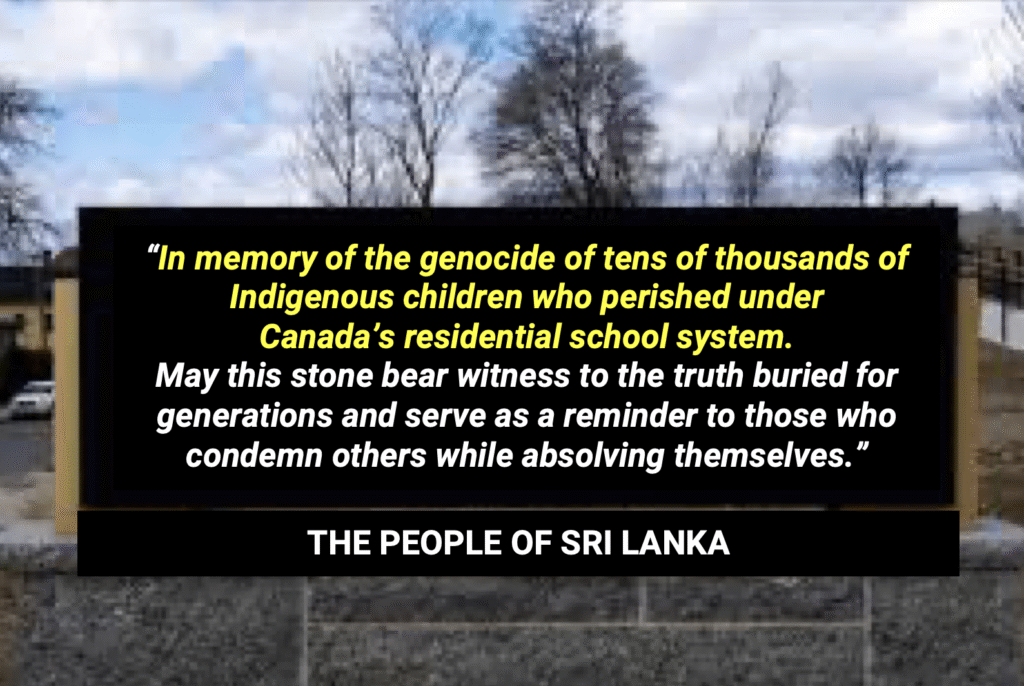
To the Prime Minister and Members of the Canadian Parliament,
We, the citizens of Sri Lanka, write to express deep concern over the growing political narrative emerging from Canada that seeks to label Sri Lanka with charges of genocide—without credible legal basis, independent verification, or contextual understanding. These allegations are largely promoted by LTTE-affiliated diaspora groups and run counter to global counterterrorism designations of the LTTE as one of the world’s most brutal terrorist organizations.
We respectfully ask: How can a country with an unresolved history of its own genocide—against its First Nations, Métis, and Inuit peoples—sit in judgment of others without first reconciling its own past and present injustices?
Canada’s Indigenous Genocide: A Documented and Ongoing Crime
- Colonial Seizure: Canada is a settler-colonial state. Indigenous peoples have lived in what is now called Canada for over12,000 years. European colonization began in the late 1400s, with permanent French and British settlement from the early 1600s. Over centuries, Indigenous land was systematically seized, cultures suppressed, and treaties violated. Euro-Christian settler institutions were imposed without consent, undermining native governance and sovereignty.
- Residential Schools (1880s–1996): More than150,000 Indigenous children were forcibly removed from their families and placed in church-run residential schools aimed at cultural erasure. Over 6,000 children are believed to have died from abuse, starvation, neglect, or disease. The Truth and Reconciliation Commission (2015) labelled this a form of cultural genocide—recent mass graves only confirm its horror.
- Indian Act (1876–Present): This colonial-era legislation still exists. It strips Indigenous autonomy, imposes federally controlled councils, governs land rights, and defines legal status” in a way that sustains systemic marginalization.
- Poverty, Incarceration, and Water Crises: Indigenous people compriseover 30% of Canada’s prison population, despite making up less than 5% of the total. Dozens of First Nations communities still lack access to clean water, proper housing, and health services—shocking in a G7 democracy.
- MMIWG Genocide Declaration: A 2019 National Inquiry officially declared thatCanada’s treatment of Indigenous women and girls constitutes genocide, citing systemic neglect, racism, and failure of justice institutions.
Sri Lanka’s Record: A Contrast in Democratic Maturity
- Universal Franchise Since 1931: Sri Lanka (then Ceylon) granted universal suffrage to all adults—men and women—regardless of ethnicity, decades before Canada (1940 for women, 1960 for status Indians).
- No Apartheid Laws: Sri Lanka has no equivalent to Canada’s Indian Act. Tamils have held the nation’s highest offices, including Chief Justice, Central Bank Governor, Foreign Minister, and Leader of the Opposition.
- Victory Over Terrorism: The Sri Lankan military defeated theLTTE, not the Tamil people. The LTTE was globally banned for suicide bombings, use of child soldiers, and civilian massacres. Over 300,000 Tamil civilians were rescued, not killed. Did these LTTE affiliated groups prevent a single Tamil child being turned into a child soldier by LTTE over 3 decades?
Hypocrisy in Canada’s Foreign Policy
Is Canada’s vocal support for LTTE-aligned narratives rooted in human rights—or vote-bank politics in Tamil diaspora-heavy electorates like Ontario and British Columbia?
Consider Patrick Brown, disqualified from the 2022 Canadian Conservative leadership race amid finance irregularities tied to promises of Tamil jobs and recognition of Tamil genocide.” As Brampton Mayor, he funded the Tamil Genocide Memorial, promoting a biased narrative that aligns with pro-LTTE groups—not human rights principles.
The same diaspora circles support both the Khalistan separatist movement and LTTE commemorations—an alarming convergence of radical ideologies Canada allows on its soil.
Tamil Genocide Education Week – Indoctrination, Not Education
In 2021, the Ontario Legislative Assembly passed a bill institutionalizing Tamil Genocide Education Week, which mandates teaching children an unverified, politicized narrative as historical fact. This initiative:
- Whitewashes LTTE terrorism.
- Rewrites history through a distorted lens.
- Pressures educators and students to conform to a diaspora-driven myth, not historical reality.
No credible international tribunal has declared a genocide in Sri Lanka. Teaching this narrative in schools violates educational neutrality and truth.
Double Standards in Sanctions Policy
Canada has placed unjust sanctions on decorated Sri Lankan military leaders—individuals who led the humanitarian rescue of civilians from a ruthless terror group. These are war heroes, not war criminals.
Meanwhile, Canadian institutions that oversaw the systematic abuse, death, and cultural destruction of Indigenous children remain largely unpunished.
This double standard reveals that Canada’s moral posturing is not rooted in justice—but in diaspora appeasement and geopolitical expedience.
A Call for Reflection and Honesty
Before Canada lectures others on reconciliation and justice, we urge your government to:
- Acknowledge your genocide as genocide (not only is there evidence of past atrocities, there is also evidence of ongoing atrocities & discriminations against Canada
- Uplift Indigenous communities beyond symbolic gestures.
- Cease endorsing diaspora-driven propaganda that distorts Sri Lanka’s history.
- End sanctions on Sri Lanka’s war heroes and restore foreign policy integrity.
Until then, moral credibility must be earned—not assumed.
Instead of erecting monuments for terrorists, Canada must honor the actual victims of its own genocide—the Indigenous children and communities who were stripped of life, language, land, and dignity. In the absence of this, we would like to propose:
Shenali D Waduge
On behalf of Concerned Citizens of Sri Lanka
පුරාණයේ ශාක්ය ආරයන් රාමගෝණ කුමරු විසින් පිහිටුවන ලද ගඟ ඉවුර නිධන් රන් පොකුණ.
June 1st, 2025ජර්මානු වෛද්ය විද්යාලයේ මහාචාර්ය නිශාන් සී විජේසිංහගේ
සෙම්බුමලේ සෑයට නැගෙනහිර දෙසින් බඹරගල වන සෙනසුන, උතුරු දෙසින් දෙඹරගල වන සෙනසුන, බටහිර දිසාවෙන් වසන්වැව චෛත්යය, ඊසාන දිසාවෙන් තිරියාය සහ රංගිරි උල්පත නමැති ඓතිහාසික බොදු බිම් මේ පුදබිම වටා ඇති සිද්ධස්ථානවලින් කිහිපයකි.
“විඩුඩබ” කියන කුමාරයා ශාක්ය වංශිකයන්ව සමූල ඝාතනය කරන්නට යන අවස්ථාවේ භාග්යවතුන් වහන්සේ විසින් සෘධියෙන් ඔවුන්ගේ රථ මේ ගලේ එරෙන්නට සල්ස්වපු වෙලාවේ ඇතිවූ ලකුණුයි.
ශාක්ය වංශිකයන් තරම් මානය නිසා හිස උදුම්මාගත් තවත් ජන කොටසක් බුදුරදුන් දිවමන් කළ ඉන්දියාවේ නොසිsටි තරම්ය. බුද්ධ කාලයේ දඹදිව රාජ්යයන් 16 කට බෙදී තිබුණ අතර ශාක්ය වංශිකයන්ගේ පාලනය යටතේ පැවතියේ කුඩා ජනපදය නැතහොත් කුඩා රාජ්යයන්ය. එසේ වුවද, ඔවුන්ගේ කුල අභිමානය නම් කිසිසේත් සුළු පටු එකක් නොවූයේය.
නිසැක ලෙසම අතට පත් විය යුතුව තිබූ සක්විති රජකමත් තවුසකුව වෙසෙන කළ මහා රජවරු දෙපාමුල ප්රදානය කළ ඒ ඒ මහා රාජ්ය පදවියත් පා ගැටුණු දුහුවිල්ලක් තරම් නොසළකා පිළිකෙව් කළ ගෞතම තාපසයන් වූද ලෝක සත්යය අවබෝධ කර තුන්ලෝකාග්ර තත්ත්වයට පත් සම්මා සම්බුදු රජාණන් වූද ශාක්ය සිංහයාණන් වහන්සේට යමා මහ පෙළහර දක්වන්නට සිදුවූයේද මේ ශාක්යයන් තුළ තිබූ පුහුමානය නිසාවෙනි.
පසේනදී රජු බුදුරජාණන් වහන්සේට බොහෝ ගෞරව කළ මහරජකු විය. ඒ නිසාම බුදුරදුන්ගේ වංශය වූ ශාක්ය වංශයෙන් කුමරියක් විවාහ කර ගැනීම ප්රසේනජිත් රජුගේ අපේක්ෂාව විය. එසේ වුවද කුල මානයෙන් ඉදිමුණ ශාක්යයෝ පසේනදී රජු අයත් කෝසල කුලය පහත් එක්ක යෑයි සලකන ලදී. නමුදු පසේනදී රජු බලවත් වූ බැවිනුත් තම තමන්ගේ රාජ්යයන් වලින් පසේනදී රජුට කප්පම් ගෙවූ බැවිනුත් රජුගේ අපේක්ෂාව එකහෙළාම ප්රතික්ෂේප කිරීමට ශාක්යයන්ට කොහෙත්ම ශක්තියක් නොවීය.
අවසානයේ සියලු ශාක්ය ප්රධානීන් එක්ව එක් කූටෝපායයක් යොදනු ලැබීය. එනම් මහානාම ශාක්යයා නිසා දාසියකගේ කුසින් උපන් වාසභ ඛත්තියා නම් කුමරිය තමන්ගේම දුවක් ලෙස හඳුන්වා රජුට සරණ පාවා දීමය. පසේනදී රජුගේ අමාත්යයෝ ද වාසභඛත්තියාට කැමැති වූ අතර ඇය මහානාම රජු සමග එකට හිඳ ආහාර අනුභව කරනු දුටු බැවින් රජුගේ දියණියක බවත් විශ්වාස කළහ. ප්රතිඵලය වූයේ පසේනදී කෝසල හා වාසභ ඛත්තියා අතර විවාහය සිදුවීම වූ අතර රජු විසින් වාසභ ඛත්තියාට අග මෙහෙසිය තනතුර ප්රදානය කරන ලදී.
කලක් ගත විය. වාසභඛත්තියා බිසවගේ පුත් විඩුඩභ දැන් සොළොස් වියෑතිය. දිනක් ඒ කුමරා පිරිවරද සමග තමන්ගේ සීයා (ශාක්යයන්) දකින්නට ගියේය. පුරහලේදී විඩුඩභ කුමරු පිළිගෙන නිසි සැලකිලි දැක්වූ ශාක්යයෝ ඔහු පිටව ගිය පසු කුමරා හිඳගත් ආසනය ජලයෙන් සෝදා හැරියහ. ඉක්මනින්ම මේ පුවත විඩුඩභ කණ වැකුණු අතර කරුණු සොයා බැලීමේදී තමන් දාසියකගේ පුතකු බවද වැටහී ගියේය. බලවත් රජ කුමරකු වූ තමා හිඳගත් ආසනය ජලයෙන් සෝදා පවිත්ර කිරීම ගැන නයකු සේ කිපුණේය. පළි ගැනීමේ වෛරයෙන් පිරී ගියේය.
විඩුඩභ මුලින්ම කළේ නිසි වයස් එළැඹි කල කෝසළ රාජ්යය බලෙන්ම සියතට ගෙන මහලු ප්රසේනජිත් රජු සැවැත් නුවරින් පිට මං කිරීමය. වෙස් වලාගෙන තම බෑණා වූ අජාසත් වෙත ගමන් ඇරඹූ පසේනදී රජු නොයෙක් දුක් ගැහැට විඳ අතරමග විශ්රාම ශාලාවකදී මරණයට පත් විය.
පියාගේ මරණයෙන් පසු තම රාජ්ය බලය තවත් තහවුරු කරගත් විඩුඩභ හිතයට දැවෙමින් තිබූ පලිය ගැනීමට ශාක්ය සංහාරය පිණිස යාමට සැරසුණද දෙවරක්ම තිලෝගුරු බුදු පියාණන්ගේ මැදිහත්වීම මත එය වැළකී ගියේය. තෙවන වර බුදුරදුන්ටද කිසිවක් කිරීමට ඉඩ නොතැබූ හෙතෙම තම අදහස වහා ක්රියාත්මක කළේය.
විඩුඩභගේ මේ ප්රහාරය කොතෙක් දරුණු වීද යත් පලාගිය හා යටත්ව පිහිට පැතූ ස්වල්ප දෙනා හැරුණවිට ළමා ළපටීන් ඇතුළු සියලු ශාක්යයෝ සමූල ඝාතනය කිරීමට විඩුඩභ සමත් විය. ශාක්යයන්ගේ ලේ ගෙන තම ආසනය සේදූ විඩුඩභ එතෙක් තමා තුළ පැසවමින් තිබූ වෛරයේ පලිය ගත්තේය.
ජයග්රාහී විඩුඩභ මහත් තේජසින් යුතුව ආපසු පිරිවර සහිතව තම රාජ්යය කරා යාමට පැමිණ රෑ බෝවුණ බැවින් අචිරවතී ගංගාව අසබඩ කඳවුර බැන්දේ පසුදා ගඟ තරණය කර විජයග්රාහකයකු ලෙස තම රාජ්යයට යාම පිණිසය. එහෙත් සිතු දේ නොම විය නොසිතූදේම සිදුවිය. එදා රෑ හිටි ගමන් මේඝ ගර්ජනා අකුණු ගැසීම් හා චණ්ඩ මාරුතය සහිත මහා අකල් වර්ෂාවක් වහින්න පටන් ගත්තේය. ඒ මහා අකල් වැස්සෙන් අචිරවතී ගඟ දෙගොඩ තලා ගැලීය සැඬ පහර දරුණු විය. බිහිසුණු ඒ රැයේ ගඟ අසබඩ කඳවුරු ලා සිටි විඩුඩභ රජු සිය සියලු පිරිවරත් සමග ගඟ දියට හසු වී ජීවිතක්ෂයට පත් වීය.
රන් පොකුණ ආරක්ෂා කිරීමට ජීවය දෙන ජලය සපයන වැවෙන් යන බෝක්කුව බහිරව ආරක්ෂාවට පවරනලදි.
ලන්දේසීන් සහ බ්රිතාන්යයන් මෙම නිධන් සොයා ගැනීමට අසමත් විය. ඒ නිසා ඔවුන් සම්බාධක ගෙනාවේ මේ බෞද්ධ ජාතියේ බෞද්ධ උරුමය සහ නැගීම වළක්වන්නයි.
එබැවින් අධ්යාත්මික ඥානය දුන් ගංජා ශාකය තහනම් විය.
ජර්මානු වෛද්ය විද්යාලයේ මහාචාර්යවරයෙකු ලෙස මම කිව යුත්තේ “ගංජා ශාකයේ කිසිදු නිකොටින් ද්රව්යයක් අඩංගු නොවන අතර එය කිසිදු ඔපියොයිඩ් වර්ගයකට අයත් නොවන බවයි.
මෙම ශාකය අපගේ බෞද්ධ ජාතීන්ගේ අධ්යාත්මික ඥානාලෝකයේ බලය විය.
Flamingo Franchise offers a Residence & Work Permit in Finland.
June 1st, 2025Prof.Hudson McLean
Flamingo Franchise offers a Residence & Work Permit in Finland.
To Investors seeking Residence & Work Permit!
Flamingo Spicy Snax® Fast Food Truck!
Italian & British Spicy Sausage
wrapped with Garnishes in Flatbread.
Serious Enquiries only to-;
Email: stephenlowefinland@yahoo.com
ඉහළම වීර සම්මානයෙන් පිදුම් ලැබූ ලක් මෑණියන්ගේ වීර පුතුන් තිස්දෙදෙනා | PWV | Army | Navy | Air Force
June 1st, 2025නැණස NENASA 🇱🇰
වීරත්වය කුමක්දැයි ලොවට කියා දුන් අපේ කාලයේ විරුවන් පිළිඹඳ ඔබ කිසිදා නෑසූ කථා එකතුව පරම වීර විභූෂණයෙන් පුදලද විරුවන්ගේ අවසන් මෙහෙයුම් පිළිඹඳව අප විසින් මෙතෙක් ඉදිරිපත් කර ඇති වීඩියෝ සියල්ල මෙතැනින්: “වීරත්වයේ පළමු පාඩම” – අපි කවුරුත් පසුබහින්නෙ නෑ, සේරම ඉවර වෙන්න උඩින් බෝම්බ දාන්න | Kokavil (1990) • “වීරත්වයේ පළමු පාඩම” – අපි කවුරුත් පසුබහින… අලිමංකඩ රැකගන්නට මහමුහුදෙන් පැමිණ දියත්කළ වික්රමය | Operation Balavegaya 1991 (සජීවී දසුන් සමඟින්) • අලිමංකඩ රැකගන්නට මහමුහුදෙන් පැමිණ දියත්කළ … පුනරීන් වැලිකතර රුධිරයෙන් ගිනියම් කළ මාරාන්තික සටන | Battle of Pooneryn (1993) • පුනරීන් වැලිකතර රුධිරයෙන් ගිනියම් කළ මාරාන… සහෝදර සෙබළුන්ගේ දිවි බේරන්නට මහ සයුරට බිලිවූ නාවික විරුවන්ගේ කතාව | Heroics Over Chalai (1996) • සහෝදර සෙබළුන්ගේ දිවි බේරන්නට මහ සයුරට බිලි… විශේෂ බලකා මහවිරු ලෆීර්ගේ අවසන් මෙහෙයුම – The last attempt to save Besieged Mullativu Camp (1996) • විශේෂ බලකා මහවිරු ලෆීර්ගේ අවසන් මෙහෙයුම – … කමාන්ඩෝ විරුවන්ට අවාසනාව කැන්දූ ජයසිකුරු මෙහෙයුමේ මන්නකුලම් සටන | Worst Ever Commando Debacle (1997) • කමාන්ඩෝ විරුවන්ට අවාසනාව කැන්දූ ජයසිකුරු ම…
Birth of Bangladesh, inspired Balochs refugee-burden on Assam, etc
June 1st, 2025Nava Thakuria
In the decisive war against Pakistan in 1971, India won and a new nation was born, but a small State in eastern part of Bharat had to pay a heavy price with millions of East Pakistan refugees, for which Assam still cries but nobody cares. With an absorbent border with Bangladesh and unconvincing political will from the government, augmented by continued callous attitude of majority Asomiya people, the situation remains grim even today. New Delhi supported the Mukti Bahini (the freedom aspiring Bengalis of East Pakistan) in their movement against West Pakistan and finally the atrocious Pakistan forces had to surrender on 16 December 1971. But the newly born sovereign country was not approached to return back its millions of refugees and migrants from the eastern Indian localities.
The situation turned so complicated that when a kind of accord was signed in 1985 to address the historic Assam agitation, the cut-off year for detecting illegal migrants in the State had to be compromised (slipping to 25 March 1971 from the national base year). The argument was that the Bangladesh government in Dhaka was not ready to accept East Pakistani nationals. Hence it was not possible to deport those illegal migrants (mostly Muslims) from India. Pressure was mounted on the young agitators to accept all those illegal migrants as Indians. But the question remains why the agitators (members of All Assam Students Union and Asom Gana Sangram Parishad) did not ask the then Prime Minister Rajiv Gandhi (who was present on the occasion) to sign the memorandum of settlement (drifted as Assam Accord). Nobody in Assam questioned the central government why Assam was dumped with all the migrants (logically turned Indians) and no other States were asked to share the burden.
As any Union minister did not sign the so-called accord, it was not necessary to debate in the Parliament. No Parliamentarian even raised the issue, why a tiny State was left to accept nearly 2.5 millions of new-found Indians. Precisely little was written in the mainstream media and also the intellectuals avoided talking about the injustice to the Asomiya community by imposing the huge burden. Probably it was not realized, if all the refugees/migrants were dumped in Assam, its negative implications would surface some day for the entire nation. Not to blame others, the very Assamese political analysts, journalist-writers and social activists did not highlight the menace properly at that time and almost everybody turned ‘happier than ever’ with a new government of Asom Gana Parishad (led by mostly former AASU leaders) in Dispur.
You can say everyone emerged a ‘winner in the anti-foreigner movement and post-agitation era’ except the common dwellers of Assam, who continued crying for justice. The water in Brahmaputra kept flowing and soon the menace of demographic changes hit the State severely to wake up those ‘happy’ individuals. Not only Assam, many other parts of the country also faced the music of hazardous illegal Bangladeshi migrants in recent times. Strong observations by the apex court and subsequent actions (may not be sufficient) by the government become now visible. The growing anti-Pakistani wave among the countrymen after the Pahalgam terror attack in the Kashmir valley made the situation more charged and suddenly the illegal migrants from Bangladesh became a national concern (even though it should/could have taken place a few decades back).
The issue of India’s role in Bangladesh Liberation War came alive with a commanding message from Assam chief minister Himanta Biswa Sarma, where he categorically stated that the then Congress government led by Indira Gandhi lost a historic opportunity in the process. India’s military victory was decisive and historic that broke Pakistan in two parts (creating Bangladesh), but it was only a part of the primary goal. The soldiers delivered a stunning battlefield success, however India’s political leadership failed to secure lasting strategic gains out of the situation, asserted the saffron leader. What could have been a new regional order was reduced to a one-sided act of generosity, said CM Sarma, adding, had Mrs Gandhi been alive today, the nation would have questioned her for mishandling the decisive military victory materialized by the Indian armed forces!
The Bharatiya Janata Party leader pointed out that no agreement was signed with Dhaka for sending back those illegal migrants and as a result Assam as well as other north-eastern States and West Bengal have to face unchecked population pressure instigating political instability and social unrest. Moreover, India supported a secular Bangladesh, but in 1988 Islam was declared their state religion, and now the political Islam thrives in the populous country undermining the very values New Delhi fought to protect, stated Sarma, adding that Hindus, once over 20% of Bangladesh’s population have currently dwindled to below 8% ‘due to systematic discrimination and violence’.
Reacting to the recent Congress outbursts over the ‘abrupt ceasefire’ of aggression against Pakistan (generated after the 22 April 2025 Pahalgam massacre of 26 innocent civilians by the Pakistan sponsored Islamist terrorists), where it was tried to establish that Prime Minister Narendra Modi turned soft unlike his predecessor Mrs Gandhi during the Bangladesh Mukti Juddho, the outspoken Assamese politician reiterated that New Delhi lost an opportunity to negotiate on Siliguri corridor (Chicken’s Neck, the narrow strip of land connecting North-east with the rest of India). Sarma also questioned why the Gandhi-led government did not secure access to the strategic Chittagong port in Bangladesh and also reclaim the Pakistan-occupied Kashmir (PoK).
Mentionable is that the opposition Congress, which made a hue and cry after the government agreed to cease the military escalation against Pakistan, opined that the former premier defeated Pakistani forces led by General Amir Abdullah Khan Niazi in Bangladesh to divide the Islamic Republic. The country’s oldest political party also raised a serious question, if PM Modi accepted the ceasefire proposal from Islamabad on 10 May following the direction of US President Donald J. Trump, who incidentally made a series of astonishing comments on social media about the de-escalation between the two neighbouring nuclear-armed south Asian nations taking some credits for himself over the resolution.
Lately, a large number of Indians come out wishing to divide Pakistan again (repeating Bangladesh episode in Balochistan) and indirectly expressed unhappiness over the cessation of armed confrontations against Islamabad even though they admit Operation Sindoor and follow-up aggressions achieved success. Meanwhile, the Baloch community of India came asking New Delhi to extend support to their causes by raising the issue of Balochistan at the national and international levels. They also appealed to the lawmakers for adopting a resolution in the Parliament recognizing the legitimate freedom struggle of Balochs and facilitate entry of Baloch political activists in exile granting asylum. Under the banner of Baloch Welfare Association, they sought permission to establish a Balochistan Representative Office (or Embassy) in India. They also pleaded to
The Baloch people have lived in India for centuries. We proudly call this land our home. Our ancestors stood shoulder to shoulder with Indian revolutionaries, sacrificing their lives in the fight for independence from British colonialism. Our Love for India is not recent, but inherited, lived, and cherished through generations,” said a letter of Baloch Welfare Association to the PMO, adding that ‘a free and democratic Balochistan will not only bring peace to Balochs but also serve India’s long-term strategic, security, and geopolitical interest in south Asia. The people of Balochistan always look for India with hope and the Indian Balochs wish to see this historic connection transformed into a reality. Days back, Free Balochistan Movement chief Hyrbyair Marri requested New Delhi to hand over Jinnah’s House in Mumbai to the Baloch people. From the iconic bungalow, where Pakistan’s founder Muhammad Ali Jinnah made plans to divide Bharat, the Balochs should be allowed to plan for the independence of Balochistan, stated Marri.
New Delhi remains silent on supporting the independence of Balochistan, even though the Baloch freedom fighters mentioned about the birth of Bangladesh with the help of Indian armed forces. The Baloch leaders based in different parts of the globe continue urging New Delhi for the necessary support and recognition for Balochistan. However it will be a matter of observation, if New Delhi gives consent to their wish, as the development will disappoint the Communist regime of China, which has launched a series of economic activities in Pakistan comprising the Balochistan localities. Even Iran and Afghanistan will get entangled with the independence of Balochistan, as both the neighboring countries support a sizable Baloch population in their territories.
Nonetheless, the emergence of Balochistan may hardly affect any Indian State as the prerequisite (primarily no border sharing) is missing here unlike that of Bangladesh.
FCID ප්රධානී මාව දූෂණය කරන්න හැදුවේ. රවී! ඔය කොස් ඇට මීයගෙන්ද මට ##න්න හදන්නේ.@TruthwithChamuditha
June 1st, 2025Truth with Chamuditha
චාමලී මදනායක සමග චමුදිත සමරවික්රම. Chamali Madanayake On Truth with Chamuditha
MEDICAL EXPERT WARNS OF RISING CASES OF INFLUENZA, CHIKUNGUNYA, AND DENGUE AMONG CHILDREN
June 1st, 2025Courtesy Hiru News
Dr. Deepal Perera, a specialist at the Lady Ridgeway Children’s Hospital, has warned of an increase in cases of influenza, chikungunya, and dengue among children.
The specialist noted that the rise in dengue and chikungunya cases is attributable to the recent rains brought by adverse weather conditions.
Dr. Perera stressed the importance of focusing on destroying mosquito breeding sites, as dengue can be fatal, and chikungunya can cause prolonged joint pain for many months after recovery.
Pregnant mothers and the elderly are at risk of severe illness if they contract chikungunya.
The doctor also pointed out that this condition could affect children born to pregnant mothers.
Meanwhile, there is also a current increase in influenza cases.
Specialist Dr. Deepal Perera urged the public to pay close attention to this disease as it can spread rapidly among children.
ජනපති පුටින්ගේ ආරාධනයට ජනපති අනුර බෑ කිවුවා..- කොළඹ රුසියා තානාපති
June 1st, 2025lanka C news
රුසියාවේ පැවැති බ්රික්ස් සමුළුවට සහභාගී වන ලෙස ජනාධිපති අනුර දිසානායක මහතාට තමන් පසුගිය ඔක්තොම්බර් මාසයේදී ආරාධනා කළ බව කොළඹ සිටින ශ්රී ලංකාවේ රුසියා තානාපති ලෙවන් ජගර්යන් මහතා සඳහන් කරයි.
රුසියානු ජනාධිපති වැල්දීමීට් පුටීන්ගේ ආරාධනාව ලිඛිතව තමන් ජනාධිපති අනුර දිසානායක මහතාට භාර දුන් බවත් නමුත් ඉදිරි මැතිවරණය පැවැත්වෙන නිසා තමන්ට ඊට සහභාගි වීමට නොහැකි වනු ඇතැයි අනුර දිසානායක ජනාධිපතිවරයා දැන්වූ බවත් හෙතෙම සඳහන් කළේය.
‘ජාත්යන්තර නීතිය තුළ බලය භාවිත කිරීම රුසියනු දෘෂ්ටිකෝණ’ මැයෙන් කොළඹ පැවති සමුළුවකදී ඔහු මෙම අදහස් පල කලේය.#
මම පසුගේ වසරේ ඔක්තොම්බර් පළමුවෙනිදා ඔබේ අභිනව ජනපති අනුර කුමාර රිසානායක මහතා හමුවීමට ගියා. එහිදී මම රුසියා ජනාධිපතිතුමාගේ ආරාධනා පත්රය භාර දෙන්නු ලැබුවා
එහි තිබුණේ රුසියාවේ පැවැත්වෙන බ්රික්ස් සමුළුවට පැමිණෙන ලෙසට කළ ආරාධනයයි.
අපි සාකච්ඡාව පැවැත්තුවේ භාෂා පරිවර්තකයෙක් මාර්ගයෙන්. මම හිතනවා භාෂා පරිවර්තකයා නිවැරදි ලෙස ප්රකාශ කළ දේ සන්නිවේදනය කරන්න ඇති කියලා
එහෙදී ජනපති ප්රකාශ කළා ඔහුට ඉදිරි පැවැත්වෙන මහමැතිවරණය නිසා පැමිණීමට නොහැකි බව.
පළමුව රටක් බ්රික්ස් සමඟ එක්වෙනවා නම් ඊට අනුගමනය කළ යුතු පියවරයන් තිබෙනවා.
සාමාජිකත්වය ඇතුළු අනෙකුත් පියවරයන් සඳහා අනෙකුත් සාමාජික රටවල අනුමතියද අවශ්යයි.
රුෂියාවෙන් පමණක් බැහැ. රුසියාව චීනය ශ්රී ලංකාවට සහය ලබා දෙනවා.
ඔබ මේ සඳහා උනන්දුවක් දක්වනවා. ඔබ මේ සඳහා උනන්දුයිද. නමුත් මට ඒ ගැන නම් හැඟින්නේ නැහැ.
නමුත් ඔබ මේ සඳහා දැන් එහි වත්මන් සභාපති දරන බ්රසීලය සමග සාකච්ඡා කළ යුතුයි.ඒ ඔබේ රජය විසින් තීරණය කළ යුතු දෙයක්”
China donates 5 int’l-standard dragon boats to Sri Lanka
June 1st, 2025Courtesy Xinhua
People take part in the 2025 Dragon Boat Festival China-Sri Lanka Friendship Cup Dragon Boat Championship in Kotte, Sri Lanka, on May 31, 2025. In a gesture of sports diplomacy and cultural exchange, the Chinese Embassy in Sri Lanka has donated five 12-person international-standard dragon boats to Sri Lanka’s Ministry of Youth Affairs and Sports. The donation was formally made on Saturday at the 2025 Dragon Boat Festival China-Sri Lanka Friendship Cup Dragon Boat Championship.(Photo by Ajith Perera/Xinhua)
COLOMBO, June 1 (Xinhua) — In a gesture of sports diplomacy and cultural exchange, the Chinese Embassy in Sri Lanka has donated five 12-person international-standard dragon boats to Sri Lanka’s Ministry of Youth Affairs and Sports.
The donation was formally made on Saturday at the 2025 Dragon Boat Festival China-Sri Lanka Friendship Cup Dragon Boat Championship.
The championship, held at the Diyawanna Oya Amateur Rowing Association of Sri Lanka (ARASL) Rowing Center in Kotte, a suburb of Colombo, featured a diverse field, including school and university teams, the Sri Lankan Armed Forces, and five teams from Jaffna comprising 75 young athletes, a significant representation for northern regional participation. Altogether 22 teams from Sri Lanka, featuring over 310 athletes, and two from China took part.
Speaking to Xinhua, Minister of Youth Affairs and Sports, S.K. Gamage, expressed gratitude for China’s support.
Gamage emphasized that events like the Dragon Boat Festival are crucial for deepening the longstanding friendship between Sri Lanka and China. “We have a long history of friendship with China. We want to improve and continue it,” he said.
Addressing the gathering, Gamage added, “This is not merely a sports event, it is a powerful symbol of friendship, culture, and cooperation between our two nations.”
Chinese Ambassador to Sri Lanka Qi Zhenhong spoke of the global significance of the Dragon Boat Festival and the values it embodies.
“Dragon boat racing is one of the oldest and most culturally significant traditions of the festival. It symbolizes teamwork, perseverance, and the collective pursuit of universal values such as peace, development, and justice,” he said.
Qi described this championship as “a new starting point to further deepen sports and cultural exchanges between China and Sri Lanka and to enhance mutual understanding and friendship between our peoples.”
Rear Admiral HNS Perera, president of the National Association for Canoeing and Kayaking in Sri Lanka, described the event as a bridge between tradition and modernity.
“This is more than a sporting event; it is a celebration of culture, heritage, and most importantly, friendship,” he said, adding that the boats donated by China would greatly assist the development of water sports in Sri Lanka, particularly for youth in under-resourced regions like Jaffna. ■

People take part in the 2025 Dragon Boat Festival China-Sri Lanka Friendship Cup Dragon Boat Championship in Kotte, Sri Lanka, on May 31, 2025. In a gesture of sports diplomacy and cultural exchange, the Chinese Embassy in Sri Lanka has donated five 12-person international-standard dragon boats to Sri Lanka’s Ministry of Youth Affairs and Sports.
The donation was formally made on Saturday at the 2025 Dragon Boat Festival China-Sri Lanka Friendship Cup Dragon Boat Championship.(Photo by Ajith Perera/Xinhua)
People take part in the 2025 Dragon Boat Festival China-Sri Lanka Friendship Cup Dragon Boat Championship in Kotte, Sri Lanka, on May 31, 2025. In a gesture of sports diplomacy and cultural exchange, the Chinese Embassy in Sri Lanka has donated five 12-person international-standard dragon boats to Sri Lanka’s Ministry of Youth Affairs and Sports.
The donation was formally made on Saturday at the 2025 Dragon Boat Festival China-Sri Lanka Friendship Cup Dragon Boat Championship.(Photo by Ajith Perera/Xinhua)