The government is taking significant steps to address salary disparities in the education sector and elevate five key education services, including teachers and principals, to be among the 10 highest-paid professions in the country, Deputy Minister of Labour Mahinda Jayasinghe said.
Speaking at an event held in Maharagama, the Deputy Minister outlined the government’s commitment to improving remuneration and addressing long-standing salary issues in the education sector.
We will present the first budget next month, and there will be an increase in the salaries of public servants in that budget. Do not have any doubts about that,” said Jayasinghe, emphasizing the government’s efforts to prioritize public sector wage reforms.
He also acknowledged the persistent concerns about salary disparities in the education sector. Many people are asking about the two-thirds salary disparity for teachers. We are already conducting the necessary preliminary discussions to resolve this issue,” he added.
Highlighting the government’s plans for educators, the Deputy Minister noted that five services—teachers, principals, educational administrators, teacher educators, and teacher advisors—are being considered for inclusion among the top 10 salary scales.
Discussions are currently underway to not only address the salary scales but also to improve the quality of these services. Our goal is to enhance the standards of education through appropriate salary adjustments,” he stated
In my previous article published in Sunday Observer of 3rd November, 2024 entitled Digital Transformation: Avoid paving the cow path”, we discussed about the general benefits of the Digital Transformation to the economy as a whole. One of the very important sectors of this overall digital transformation effort is the Digital Transformation in Education. Digital transformation in education uses the technology to improve teaching and learning. Artificial Intelligence (AI) is a key part of this transformation. This article attempts to discuss the benefits, challenges and the way forward on the use of Artificial Intelligence (AI) in the digital transformation in education. While AI can revolutionize learning by making it more accessible and tailored, concerns about misuse and ethical implications do remain. The question remains: Is AI a cheater that undermines learning or a tutor that enhances it? Let us examine the circumstances that the use of AI in education exemplifies the role of cheater and tutor and how best we could balance these two roles for the best advantage of the learners.
AI as a Tutor: Transforming Education Positively
AI’s role as a tutor is demonstrated through its ability to provide personalize education in more efficient and student-centered manner. The AI-based tools can monitor the student’s rate of progress and tailor the learning experience to best suit the student’s ability and level of competence through Intelligent Tutoring Systems, etc. Such learning systems are highly adaptive and can adjust content delivered in real-time to suit the individual student’s demonstrated ability and to keep the students engaged and motivated.
Further, AI can bridge the student’s knowledge gaps by offering scalable learning opportunities. Students who do not have access to quality teachers or appropriate resources can make use of the AI tools to avail 24/7 learning assistance from anywhere. AI chatbots can serve as virtual tutors which on demand will answer questions and provide explanations. This democratization of education allows students from underserved areas to benefit from personalized support which otherwise is impossible or very expensive to receive.
AI can also alleviate teachers’ administrative burdens. AI-powered grading systems streamline evaluation processes, lesson planning, etc., enabling educators to focus on teaching rather than spending time on routine and laborious tasks. Further, the analytics from the AI tools can help teachers identify trends in student performance. This makes it easier for teachers to address learning gaps proactively and design suitable learning materials.
AI as a Cheater: Ethical Concerns and Academic Dishonesty
While AI holds immense potential, its misuse raises serious concerns. The rise of AI-powered tools with the capability of generating essays and predicting answers, has made it easier for students to plagiarize and submit work they did not create. Platforms like ChatGPT, Gemini, etc. can generate essays and assignments with simple prompts by the user, and even provide answers to exam questions, allowing students to bypass the real learning process altogether.
The consequences of the above misuses are very serious. The learning outcomes such as ability to apply gained knowledge, ability to summarize, analyze, evaluate, etc., critical thinking, problem-solving skills, and ability to synthesize acquired knowledge and create new work – core competencies that education seeks to develop among learners – are undermined by the overreliance on AI. When students use AI to complete their assignments without having to go through the cognitive processes needed to complete them as learners, it disrupts the long-term learning outcomes that learners need to achieve in the progression of their studies and devalues the integrity of education.
Moreover, distinguishing between genuine student work and AI-generated content is challenging. Even with plagiarism detection tools, AI outputs can often pass as original work, creating a dilemma for educators. This increases the need for stricter academic integrity policies and a re-evaluation of traditional assessment methods.
Striking a Balance in AI’s Role in Education
Considering the benefits and risks in using AI in education, it is not possible to label the use of AI, simply, as a Cheater or Tutor. To determine whether AI is a cheater or tutor, it is essential to strike a balance between harnessing its benefits and addressing its risks.
Educational institutions must focus on fostering a culture of ethical AI use by setting clear guidelines and expectations. Students should be taught how to use AI tools as supplements to learning rather than shortcuts.
Educators can use the AI’s capabilities to develop students as the ones who can think critically rather than being rote learners, who are taught to learn by memorizing the information by mere repetition. The use of AI as a tutor needs a great deal of effort and dedication by the educators. Educators can leverage AI’s capabilities to create assessments that prioritize understanding and critical thinking over rote memorization. For instance, oral presentations, project-based learning, and open-ended assignments are less susceptible to AI misuse and encourage genuine student engagement.
Furthermore, AI literacy should become part of the curriculum. Teaching students about AI’s capabilities, limitations, and ethical considerations can empower them to use these tools responsibly. When used effectively, AI can complement human instruction, fostering a collaborative and innovative learning environment. AI’s ability to serve as a tutor anytime, anywhere solves the problem of one to one tutor support for those who are in need but cannot afford. This could be used to alleviate the issues that comes from the understaffing of schools in certain geographical locations and perhaps need for private tuition.
Way Forward
AI in education is neither inherently a cheater nor a tutor; it is a tool whose impact depends on how it is used. While it holds the potential to revolutionize learning by making education more personalized and accessible, its misuse poses ethical and academic challenges. Striking a balance requires educators, policymakers, and students to collaborate in developing guidelines that promote ethical and responsible AI use. If harnessed correctly, AI can serve as a powerful tutor, enhancing education and preparing students for a technologically advanced future.
(Dr. Gamini Padmaperuma is a Chartered Professional Engineer, Honorary Fellow Member of the IESL, former Director, Academic Affairs at Saegis Campus and Senior Lecturer at OUSL. He holds a PhD in Instructional Design for Computer-Based Learning from the University of Canterbury, New Zealand and can be contacted at gamini_pad@hotmail.com)
The construction of a colossal hydropower project by China in Tibet has emerged as a matter of grave concern for India, especially for those residing in its eastern regions including Bangladesh. These areas now face a perpetual threat akin to living under a water bomb, controlled by a foreign power governed by a Communist regime that lacks credible bilateral relations with India, the world’s largest democracy. The recent earthquake in the Tibetan plateau, which claimed over 125 lives and injured numerous others, has exacerbated these fears. The disaster has underscored the seismic vulnerabilities of the region, further alarming those downstream who depend on the Brahmaputra river system.
Often referred to as the Earth’s third pole, the Tibetan plateau experienced a powerful earthquake on 7 January 2025, registering a magnitude of 7.1 on the Richter scale. The tremors, which were felt in neighbouring Nepal, Bhutan, and India’s eastern states, also led to aftershocks that intensified the destruction. More than 3,500 homes were damaged in this high-altitude Himalayan region, which maintains an average elevation exceeding 4,000 metres. Over 400 individuals were rescued, and nearly 30,000 people were relocated due to the disaster. The epicentre of the quake, located approximately 80 kilometres from Mount Everest, highlights the region’s vulnerability to seismic activity. With Beijing’s stringent internet restrictions in Tibet, the full extent of the devastation remains unknown, but it has already heightened anxieties about the safety of China’s hydropower infrastructure in the region.
China’s planned dam on the Yarlung Zangbo River, which becomes the Brahmaputra downstream, has further amplified these concerns. The hydropower project, estimated to cost USD 137 billion, is touted to generate 300 billion kilowatt-hours of electricity annually, making it the world’s largest such venture. Situated in the Shigatse region of Tibet, a mere 22 kilometres from the Arunachal Pradesh border, the dam’s proximity and potential risks are alarming. While Chinese officials argue that the dam will have minimal impact on downstream areas, experts and local organisations in India have expressed serious doubts about these assurances.
All Assam Engineer’s Association (AAEA), a prominent forum of graduate engineers, has raised concerns about the devastating impact a high-intensity earthquake near the dam could have on the Brahmaputra River basin. They have urged the Union government to address the issue firmly with Beijing, emphasising the potential havoc a dam failure could wreak across eastern India and northern Bangladesh. Adding to these concerns, the Chief Ministers of Arunachal Pradesh and Assam have also voiced their apprehensions. Arunachal CM Pema Khandu has highlighted the issue to New Delhi, while Assam CM Himanta Biswa Sarma has warned that mismanagement of the dam could disrupt the entire ecosystem of the lower riparian areas. Sarma further noted that the fertile regions of eastern India could be left solely reliant on rainfall from Bhutan and Arunachal Pradesh if the dam’s operations go awry.
In a proactive measure to mitigate potential fallout, India has initiated the Siang Upper Multipurpose Project in Arunachal Pradesh. Unlike typical hydropower projects, this dam is designed not only to generate electricity but also to regulate the Brahmaputra’s flow throughout the year, counteracting any sudden water releases from China’s dam upstream. However, this project has not been without controversy. Local communities and human rights groups have opposed the Siang dam, citing concerns about the fragile ecosystem and the displacement of thousands of indigenous families living near the project site.
The broader issue remains the lack of a formal water-sharing agreement between India and China. New Delhi has called upon Beijing to respect the principles outlined in the United Nations Convention on the Law of the Non-Navigational Uses of International Watercourses (1997). These guidelines advocate for fair and sustainable use of transboundary rivers. Despite this, Beijing has shown little willingness to adhere to these principles for rivers originating in Tibet, including the Brahmaputra, Irrawaddy, and Mekong.
The absence of such an agreement leaves India vulnerable to unilateral decisions by China, which could have catastrophic consequences for millions living downstream. As the international community continues to grapple with water resource management and cross-border cooperation, India must intensify diplomatic efforts to pressure Beijing into adopting and respecting global water-sharing norms. Until then, the threat of potential disasters caused by China’s mega dam in Tibet will remain a looming shadow over the lives of those dependent on the Brahmaputra basin.
In the 8th century Middle East, a new dynasty seized control of one of the world’s greatest empires – the Islamic Caliphate. Though little remembered in the west today, the Abbasids reigned for five centuries. They oversaw an era of Islamic military dominance… city-building… brilliant scholarship, and technological innovation. It has come to be remembered as Islam’s ‘golden age’. This is the rise and fall of the Abbasid Caliphate.
TACC, a wholly owned subsidiary of HEG has entered into a Non-Binding Memorandum of Understanding (MOU) with Ceylon Graphene Technologies (CGT) with regard to advancing graphene technology and unlocking its vast potential for diverse applications.
CGT, a LOLC company based in Sri Lanka, is a global expert in graphene production. Leaveraging Sri Lanka’s premium vein graphite, renowned for its purity and backed by its expertise in material science, CGT is at the forefront of delivering innovative and high-quality graphene products.
This MoU establishes a strategic collaboration between TACC and CGT to jointly explore the manufacturing of graphene and its derivates, leveraging Sri Lanka’s premium vein graphite and TACC’s synthetic graphite expertise.
The facility will enable large-scale production, ensuring the delivery of sustainable and innovative graphene solutions to global markets, HEG says in regulatory filing
TACC Ltd, a wholly-owned subsidiary of HEG Ltd, has entered into a partnership with Ceylon Graphene Technologies/CGT (a joint venture between LOLC Advance Technologies and Sri Lanka Institute of Nanotechnology) to establish a state-of-the-art graphene manufacturing facility at TACC’s premises in India.
The partnership comes in the wake of TACC Ltd entering into a non-binding Memorandum of Understanding (MOU) with CGT to advance graphene technology and unlock its vast potential for diverse applications, per a regulatory filing by HEG (LNJ Bhilwara group). HEG is a graphite electrode manufacturer.
The proposed graphene manufacturing facility will enable large-scale production, ensuring the delivery of sustainable and innovative graphene solutions to global markets, said the regulatory filing. The company did not disclose the investment being made to set up the facility.
This MoU establishes a strategic collaboration between TACC and CGT to jointly explore the manufacturing of graphene and its derivatives, leveraging Sri Lanka’s premium vein graphite and TACC’s synthetic graphite expertise. Together, the two companies aim to develop high quality graphene materials and solutions…,” per HEG’s regulatory filing.
Graphene is a revolutionary material made of a single layer of carbon atoms arranged in a hexagonal lattice, known for its exceptional strength, conductivity, and lightweight nature. It is widely regarded as a game-changer across industries, enabling advanced applications in electronics, energy storage, coatings, composites, construction material, textiles and more.
On 6 January, Vijitha Herath, Minister of Foreign Affairs, launched the initiative as part of the digitisation process initiated by Dissanayake. A pilot project is active in seven embassies, including Japan, Qatar and Kuwait. Jasintha Subasinghe, Sinhalese in Italy: ‘Visits to the homeland were races for documents’. Cases of abuse of power by officials in some countries.
Colombo (AsiaNews) – ‘This online system is very valuable for us who are abroad. We are very grateful to benefit from such an effective measure. Until now we had to rush and waste time. We are facilitated because we only go on holiday to our homeland for a short period of time’.
AsiaNews gathered the views of some Sinhalese living abroad on the 6 January launch of the digital platform that allows overseas citizens to quickly obtain birth, marriage and death certificates through their respective embassies, without any delay.
The initiative is part of the ambitious digitisation programme initiated by President Anura Kumara Dissanayake. In this context, on Monday, Foreign Minister Vijitha Herath inaugurated the new platform: a website managed by the Ministry of Foreign Affairs, Foreign Employment and Tourism.
The pilot project is being implemented in seven embassies in Sri Lanka, Japan, Qatar, Kuwait, as well as in Milan, Toronto, Melbourne and Dubai. The project aims to cover all embassies in the future.
‘This opportunity for Sri Lankans abroad is the result of dedicated efforts over the past two months by officials of the presidential secretariat,’ said Minister Herath.
‘Although the officials could have implemented it earlier, they did not have the necessary leadership. However, with the new political leadership, the officials managed to turn it into reality within two months. This is the first successful initiative of the President’s digitisation process’. For Herath, the new service would also support the economy: Sri Lankans abroad can obtain documents for a fee of about USD 22.
The minister also announced that a tender had been issued for the printing of new passports. ‘In this way, we intend to get the quantities of passports quickly and provide the same technology for renewing and obtaining new documents,’ he added. ‘With over three million Sinhalese currently living abroad, this is a critical step.’
Lester Jans, who lives in Los Angeles, California, US, told AsiaNews that the system needs to be set up as soon as possible to allow Sri Lankans living abroad to obtain documentation online. Even in his case, visits to Sri Lanka turned into office runs.
‘The short time we have to spend with our relatives back home, we have to spend on getting these documents. So, my friends and I appreciate these new measures. We abroad are very grateful to the new government for making this progress,’ Jasintha Subasinghe, who represents herself and her friends living in Breccia (Como), Italy, told AsiaNews .
Philippe Ratnayake, a resident of Brussels, Belgium, sees this step by the government with two perspectives. ‘Firstly, we congratulate the government for taking a step forward towards Sri Lankan citizens abroad. Because some had to wait a long time to get the necessary certificates through embassies and offices in their respective countries,’ he told AsiaNews.
Then, he says he is aware of cases where officials in some countries have extorted money from people by claiming to provide those documents quickly.
He explained that ‘when we go to make requests for documents we are given a yellow sheet. That yellow sheet indicates that we are Sri Lankan citizens and the officials try to trick us and get money by saying that it is a long process. There have been friends of ours who have faced similar situations’.
Another thing Philip explained is that only migrant workers or people who have a visa can be involved in this process, but people staying abroad under political protection cannot be involved in the new process. Everyone said that this new step will have to be kept under control to avoid any drift, because it is still a pilot project.
Eight Indian fishermen were arrested on charges of fishing in Sri Lanka’s territorial waters, the Sri Lankan Navy said. So far, 18 fishermen have been arrested this year.
The Sri Lankan Navy on Sunday said it has arrested eight Indian fishermen for allegedly fishing in the island nation’s territorial waters and seized two fishing trawlers.
The arrests took place on Saturday night “during a special operation conducted in the sea area north of Mannar”, it said in a press statement.
With this arrest, so far, this year, 18 Indian fishermen have been arrested and three trawlers confiscated, the statement said.
The Sri Lanka Vehicle Importers’ Association has raised concerns about the potential hike in vehicle import taxes, which are currently at approximately 300%. According to the association, taxes could climb to 400%, 500%, or even 600% for certain vehicles.
The president of the association, Prasad Manage explained that the sharp increase in taxes is due to multiple layers of taxation.
There is a special import tax based on the vehicle’s value. Additionally, there’s a luxury tax, and all three are added to the CIF value. On top of that, an 18% VAT is applied. This results in four types of taxes determining the final cost of a vehicle,” he said.
The association predicts that taxes on some vehicles will increase significantly. For instance:
Taxes on a Wagon R could rise from Rs. 1.6 million to over Rs. 1.8 million.
Taxes on a Vitz could jump from Rs. 2 million to approximately Rs. 2.4 million.
Taxes on vehicles like the Toyota Aqua, Corolla, and Axio, previously Rs. 5.7 million to Rs. 6.6 million, could now exceed Rs. 6.6 million.
While the cost of importing vehicles will rise sharply, the association noted that the prices of vehicles already in the local market are likely to see only a slight increase.
Despite the rising taxes, the association urged the public not to panic. Mr. Manage encouraged potential buyers to wait until new vehicles arrive in Sri Lanka, as the supply situation may stabilize.
Sri Lanka imposed strict restrictions on vehicle imports in 2020 during the severe economic downturn. However, with the implementation of the International Monetary Fund’s (IMF) Extended Fund Facility (EFF) program and the recovery of foreign reserves, optimism about vehicle imports returned.
In September 2024, the Cabinet approved the phased import of motor vehicles and wheeled items under 304 Harmonized System (HS) Codes, effective from February 2025.
However, a recent gazette notification issued by the President introduced new excise duty amendments on vehicle imports. These adjustments increase excise duties on both fuel-powered and electric vehicles, depending on cylinder capacity and vehicle age.
‘Before you study the economics, study the economists!’
e-Con e-News 05-11 January 2025
As the northeast winds and rains bend, our President alights on China. As we enter the 2nd quarter of the 21st century, much of the world around us is still colonized. Most times in all but name. Our economy continues to be held hostage, bound hand and foot, to the US Treasury – fronting for Wall Street and London & Euro bondholders wrapped in Rating-Agency flags – determining who and how our coin – our labor, really – is to be valued and invested.
If we are honest, we will admit: We may be trainers and exporters of accountants, numerary and literary clerks, around the world. But we ourselves are immaculately illiterate and innumerate about our true priorities, let alone ignorant of our true history, our best interests. There is no end to the lessons we could learn from China, on how to organize and rule an independent modern industrial country. However, we have to navigate and manoeuvre the still-active colonial timebombs on land and sea, as we fill in the curious blanks of history – bomb craters, really – of 500 years and more, to build a better country… to share in a better world.
*
Was it Sinhala monks as envoys who informed the Roman Empire about China? China (Zhongguo, the Middle Kingdom) has historically called Sri Lanka – Shiziguo – the Kingdom of the Lion. And they once called India – Tian Xi (Western Heaven). And what is in those scriptures of ours, that made the Chinese trek over the Himalayas to study at our early University-Monasteries? The largest foreign ships in China were also once from Lanka. So much to remember… (see ee Focus)
The 500 years and more of China’s abstention from the Lakdiva Sea is yet to be fully rectified, the ocean made finally and truly ‘post-colonial’. That post-colonial branding turns out to be have been a heavily funded now-defunded tenure posting. For, yes, so-called World War 2 never ended. Simply, frozen, we’re told… 260 US military bases still adorn colonized Japan and Korea, alone, and hundreds of bases more litter other isles and seas. All offering lessons on ‘democracy’.
Anglo-Yankee nervousness about Sri Lanka’s relationship with China, though expected, is to be pitied, if not cause for a titter or two. It is understandable. The US and their agents in the Central Bank of Ceylon opposed Sri Lanka’s most enduring treaty, the Rubber-Rice Pact. And as for our even more ancient and abundant cultural and economic ties, little is divulged in English. And even then it is via the nosey BBC. The tsunami of fake news and mudslinging is relentless. Thus, the Anglo-US alliance seeks to militarily and economically stunt Sri Lanka’s view of itself in the real world, and its possibilities and futures…
This widespread nervousness is exhibited in the continuing attempt to sow discord between Sri Lanka & Myanmar, with the orchestrated arrivals of ‘refugees’ from those shores, where hot war is being waged. The annual wintry season’s usual flus are relentlessly headlined and spread in scaremongering social media as somehow heralding mysterious new pandemics in the land of the panda. There is even talk broadcast in India of coups, crafted by the CIA and ‘disgruntled’ Sinhala Buddhist nationalist elements, while AKD is at Tiananmen. They wish! Other ‘liberal’ media join in chorus: ‘Setback in Sino-Indian relations due to fresh territorial and water disputes.’ Well, what else is new? Then you have the Bajaj and Ashok Leyland lenders growing restless… All this to stop the time….
*
‘Note the pent-up demand for motor vehicles & the pressure it has
created from that lobby for the removal of all restrictions on vehicle
import restrictions. That a sizeable urban group of Sri Lankans are willing
to pay 200-300% mark-upsthrough taxation on a depreciating asset, is an
undeniable sign of inverted incentives & imbalances in an economy.’
– Kusum Wijetilleke (see ee Economists, Austerity & Oligarchy)
*
The Island’s editors shed kimbula tears that even ‘the non-parliamentary oppositional groups’ have no alternative to the IMF’s final solutions: ‘The Frontline Socialist Party has sought to belittle the increase in Sri Lanka’s foreign currency reserves… It is also demanding an immediate end to the IMF program.’ But our supine media does not even dare explore alternatives, let alone provide space, oxygen to air for such views. This ee reproduces an Island interview with the FSP’s Education Secretary Pubudu Jagoda. Jagoda warns that the inability of the JVP to resolve the country’s economic challenges may result in ‘sudden collapse’ and give rise to ‘authoritarian’ rule.
‘The government is a patchwork of ideological contradictions’, and this ‘diversity’ prevents ‘a cohesive strategy… to formulate practical solutions for the people’s problems.’ Relying heavily on ‘rhetoric around anti-corruption initiatives’ – ‘There are limits to how far you can go with slogans about changing the political culture. These initiatives cannot put food on people’s tables.’
So, does the FSP offer more practical solutions to the country’s disorders? They speak of ‘public welfare’, of child malnutrition, and their proposals for the budget (see last ee), but again they fail to clearly spell out a positive program to achieve a modern industrial society, which alone can carry the weight of their often-romantic ‘welfare’ dreams. Why the shyness? Is it studied indifference or plain ignorance?
*
• Privatized companies perform worse than when they were public. But that’s supposed to be a secret, and Sri Lanka’s merchant media is not allowed to shed any such ‘sunlight’. Sunlight is a brand, after all, and a Unilever IPR-protected brand, perhaps why such sunlight can never set. Only dissolve and pollute the drains. At least until their patent runs out. Privatization is a big racket, indispensable to such luminaries as the big 4 ‘accountancy’ firms operating in Colombo: Deloitte, PWC (PriceWaterhouseCoopers), KPMG, and EY (Ernst & Young). Now what is the main role of these tax magicians? – To avoid taxes, misreport profits, fix the books, etc, for the multinational corporations (MNCs). Their major consultancy expertise involves the business of transfer pricing, one of the main means by which MNCs like Unilever, Exxon, CTC, etc, avoid paying their due to the country, while pointing fingers at local individuals and families.
If we stamped the label ‘importer’ in front of every company listed on the stock exchange or in the media, we will learn how a long ‘value’ chain of ye olde mercantile agency houses strangle the economy.
So imagine our surprise, sorry, sheer delight, when US tax magicians Ernst & Young (EY) announces this week, their appointment of Talal Rafi as ‘Director, Business Consulting’. Rafi may deny he possesses astrological powers, yet he promises ‘future-ready solutions to clients in a rapidly changing world’. Our radar picked up Rafi’s drone rising in the Arabian Sea when his name started to author several boring columns in the Wijeya Group’s Financial Times.
Then in June 2024, SJB party leader Sajith Premadasa appointed Rafi as his policy advisor. So what does it matter? Rafi admits the IMF & World Bank & International Sovereign Bond (ISB) owners are all creatures of the USA. He says Premadasa has only known him for a couple of years. Besides, Premadasa has more economically sharp advisors from the casinos. But what makes a boring story more compelling is when we find out he is being welcomed to Ernst & Young by their Sri Lanka & Maldives Country Managing Partner Duminda Hulangamuwa, who is ‘excited to welcome Talal…’
Ceylon Chamber of Commerce Chairman Duminda Hulangamuwa is also senioradvisor to the incumbent President of the country. Rafi & Hulang however are no strangers to the global glug-glug. This perhaps is how Rafi plans to fathom the shifting ‘future’ to offer ‘ready’ solutions.
Rafi was first coyly named as ‘an economic policy consultant to [an unnamed] multilateral development bank’. Also, as a ‘regular contributor for the International Monetary Fund’s Expert Forum on Public Finance’ and ‘a member of the expert network of the World Economic Forum’ and ‘of the Deloitte Global Economist Network’. Wait! Deloitte was named as a ‘transaction advisor’ for privatizing several strategic national enterprises like SriLankan Airlines, SLTelecom, Litro & SL Insurance, etc. And, Rafi is no stranger to this world’s most rapacious milieu… EY… Deloitte… shapeshifters…
*
‘CBSL Governor & Deloitte’s Talal Rafi to speak at Oxford Global Society Panel’, reported one headline in late 2023. They were joined by ‘Member of SL Presidential Advisory Group & former IMF Director Sharmini Coorey’. Rafi’s credentials included ‘visiting lecturer at the Centre for Banking Studies, Central Bank of Sri Lanka’, having toiled on ‘projects by the World Bank, Asian Development Bank & USAID’ and been recognized as a fellow predator by the NASDAQ Centre, S&P Global, the World Bank, IMF, ADB, World Economic Forum, Chatham House London, London School of Economics, & Forbes. He was even on the board of the hijacked Lakshman Kadirgamar Institute, ‘Sri Lanka’s state foreign policy thinktank’, and on the board of ‘Almas Holdings, one of Sri Lanka’s largest asset management firms,’ owned by Imtiaz Buhardeen and linked to importer Sierra Cables and LOLC Browns, etc. Rafi also co-chairs another Rockefeller Exxon front – the Global Plastic Innovation Network Action Group of the World Economic Forum!
Transfer pricing involves rules and methods for pricing transactions within and between MNCs under common ownership or control. Cross-border controlled transactions can distort taxable income, through under- and over- invoicing etc. Ernst & Young has been sued by former partner Sayantani Ghose – an expert in transfer pricing who worked at EY for 16 years – who says she was forced out of her job for refusing to sign off on client transactions that violated tax and securities laws. EY has already paid tens of millions of dollars in fines and settlements over its auditors’ alleged misconduct in recent years. New York-based EY has faced numerous claims over the past decade that it encouraged or tolerated misconduct by auditors, including approving unlawful accounting practices in order to win or keep clients…
*
On 11 January 2025, Ernst & Young Director Talal Rafi and University of Buckingham Lecturer in Accounting Business & Finance Cathrine Weerakkody moderate a webinar on ‘IMF Agenda: Opportunities & Challenges for SL post 2025’, sponsored by Daily FT, ACCA and the International Chamber of Commerce SL together with WIM, Cornucopia, CIMA, AGXA, and Global Greenwich Colombo. ‘Sri Lankan experts’ such as ‘Advocata Institute Chairman Murtaza Jafferjee and Georgetown University’s Edmund A Walsh School of Foreign Service Professor of the Practice of International Development Shantayanan Devaraja will strike the keynotes, while a choir of well-credentialed wailers feature Department of Economics Senior Prof Sirimal Abeyratne, OPA Vice President; Sri Lanka Economic Association VP & Ministry of Plan Implementation Former Secretary Chandrasena Maliyadde, Senior Economic Advisor to the Former President RHS Samaratunga, ETIS Lanka COO Bram Nicholas, Deloitte Director & Lead Economist Rumki Majumdar, BRI Sinologist, Visiting Faculty Peace & Conflict Samitha Hettige, and Former Joint Secretary Government of India Jitendra Kumar.
Wijeya Group’s FT columnist Abeyratne by the way was appointed Executive Director this week of the German-funded Centre for Poverty Analysis (CEPA). SBD de Silva often wondered why there was no Centre for Wealth Analysis? He wished the so-generous Germans and others would tell us how they got ‘wealthy’, or at least tell us how their agents in Sri Lanka got wealthy by importing and retailing those 300 branded industrial German goods, which they prevent us from making here. Mein gott! (see ee Random Notes)
*
• When Singh Sang a Southern Song – This ee Focus reproduces Usvatte-aratchi (Ua)’s name-dropping recall of Manmohan Singh & Amiya Bagchi and the rest of an Indian shoal of eminent economists. The US embassy must have given permission to these columnists to only praise Manmohan Singh’s supposed repudiation of India’s Nehruvian and supposedly ‘socialist’ ways! We disagree with much of Ua’s understanding of India’s and China’s economy. But Ua’s obeisance is not complete. Ua at least remembers Bagchi, who Ua invited to speak at the Central Bank school, uneasy though his reception there was. We of course also recall Singh’s running of the South Commission under Tanzania’s Julius Nyerere in the 1980s. Singh apparently began to understand the grip that the colonial system still had over countries, and tried to examine how in adverse conditions, the South could break from this stranglehold.
The South Commission was established in 1987 by Non-Aligned countries in Harare, Zimbabwe. Chaired by Julius Nyerere, with Manmohan Singh as Secretary General, the Commission analyzed the economies of the South. In 1990 it produced ‘The Challenge to the South’, responding in part to the failure of the 1983 Willie Brandt Commission report on ‘international development issues’. The Commission led to the establishment of the South Centre – an international thinktank headquartered in Geneva – in 1995.
Singh, we’re told, was very proud of his work in but apparently refused to answer a journalist’s query on how he moved from the strong arguments of the South Commission in August 1990 to oversee India’s abject surrender to IMF dictat in Bangkok in July 1991. India’s deal was poorly executed, there was no mandatory technology & science transfer for liberalization, perhaps due to the strategic withdrawal of the USSR at that time… And so it turns out that the ‘thoroughly secular’ Singh was also ‘largely responsible for introducing the neoliberal ‘reforms’ in the country’. (see ee Economists, Patnaik, GDP-Nationalism)
*
This ee Focus, midst the President’s voyage to the People’s Republic of China, also attempts to depict Sri Lanka’s long and ‘enchanting’ historical engagements with China. In China to this day, Sri Lankans are treated as ‘lao pengyou’ (old friends), unlike Indians who the English have used as troops & auxiliaries, then as now, to undermine and invade that country. Sri Lanka, earlier known in China as Shilan (Ceylon), is now Si-li Lanka. We resurrect such sources as RALH Gunawardena’s work on navigational history,which are placed within Senake Bandaranayake’s useful and concise (tho problematic) periodization of Sri Lanka’s history into 12 parts, beginning with: ‘Sri Lanka – Period 1, Prehistoric Period, ~120,000 BC onwards toM19thC. (1815/1848 AD) onwards: Modern Transitional Era. Total Colonial Occupation. Underdevelopment.
For our purposes, we begin with Sri Lanka’s Period 5…which provides ample evidence of early contact, recalling Early Anuradhapura Period and Unified All-Country Kingdom… Urbanization. Continuing Trade Phase 2. Major Irrigation & Architectural Complexes. Colossal stupas. Centrifugal tendencies dominant. These long-distance relationships were enabled by the surpluses accumulated through advanced ancient irrigation systems, as were not to be found in ‘ancient Mesopotamia, Tigris, Euphrates or Indian river valleys’: but came to be only ‘seen in Ceylon’ where ‘the fusion of Egyptian and Babylonian patterns achieved the most complete and subtlest forms’ (Needham). At this moment, where all manner of panaceas are being offered to bring down the price of rice, few mention the need for replenishing the irrigation and industrializing the countryside.
*
• Mental Wards & Awards – We would scratch ours heads if we still had our heads on. We have already scratched our heads into bald stumps of nothingness. So, we have taken our heads off for a moment. So many absurdities. So much magic. Not a day passes, or should we say not a chandeliered hotel afternoon dissolves into perfumed darkness, nor glittering evenings shut down in silence, without the import merchants of Colombo, agents of multinationals, not giving themselves even more awards! Sporting suits & saris & what not in AC-ed rooms. Giving & receiving awards for all kinds of things. Awards for this & that. And eerily, telling us about it. Then there’s the de-rigueur photo op with the US Envoy. Tap open any media ‘Business’ section. Awards. Awards. Awards. Is this a carryover from the old-boy/ old-girl culture derived from the English private schools, where prize giving is a major blazered business? Awards for being more ‘equalizing’ or virtuous than the darker ‘natives’. Click. Justice. Rule of Law. Click. We keep scratching…
This week saw the media give themselves awards, instead of the usual reporting on others giving themselves and each other awards. Does the Sri Lanka Press Institute (SLPI) still hand out awards to students who never attended their classes but were still able to deliver the valedictorian?
Does this award-giving&taking exhibit a decadent narcissistic streaking? To make them believe otherwise. That their apocalypticme-first (& why not!) impetuosity, devil-may-care fatuity, enabled by the capitalist anarchy, only revives itself, again for another maimed generation at least, only through it seems greater & greater destruction…
We notice that many of these awards are for certain categories under their ‘diversity, inclusivity, equality’ nameboards – or for saving some rare animal, they declare is on the edge of extinction, or equality. Each virtue they signal has an airy tax shelter attached like air-conditioned outdoor plumbing. But here’s the exhaust. What they are awarding themselves for is their continued prevention of a modern industrial society, their blocking of investment of money into industrial capital. If there is a thing called corruption, then this is it. But it’s more like, plain robbery.
Enter then the accountants & associated number crunchers, who have us by the nuts & bolts… We are trainers & exporters of accountants. Yet none of them appear to be able to count on our behalf. None dare stand up and declare, it is they who owe us and here is how & why! If proofs are needed. And chartered, indeed, but with a compass oriented in which direction?! None can say, it is modern industry that counts.
It is no ironic historical farce we are having 2 English literary festivals, one sponsored by the tourist rentiers fattening upon that ‘boutique’ Fort in Galle, where locals are being systematically chased out, and another funded by ye olde English opium dealer HSBC – Hongkong & Shanghai Bank – who hath occupied the iconic Colombo Public Library…
Would they ever feature such a novelist as Amitav Ghosh who has mined deep the archives in India, England and China, starring so bright in his 2023 opus Smoke and Ashes on his research into his trilogy Sea of Poppies about the role India’s merchant and moneylending minorities, so dominant in Sri Lanka too, have played in the monstrous and ignored English opium wars on China…. wars that continue in other ways to this day…
This endeavour goes beyond merely cleaning up the environment. It aspires to restore the deeply eroded and deteriorated social and environmental fabric of our motherland. We aim to create cleanliness and rejuvenation across all sectors of society – President Anura Kumara Dissanayake unveiling the Clean Sri Lanka initiative on the 1st of January 2025
President Anura Kumara Dissanayake’s three step plan for 2025 is an initiative that presents an opportunity for the entire country to rally round and contribute to the success of the plan. The President has placed good governance and anti-corruption at center stage and if one can borrow from ph.pintrest.com, the following graphic illustrates broadly the substance of the speech that the President made on the 1st of January heralding 2025 and setting the tone and direction for his government.
This article is not an attempt to expand on the speech or provide interpretations of the speech as President Dissanayake was very clear, concise and substantive in his well-presented speech. This article is about the physical cleansing of the country’s environment, the degradation of it which those with eyes, ears and noses cannot miss once they step outside their homes. Physical cleanliness is very much a mechanical exercise if the hearts and minds of people are not there to feel that environment cleanliness is very much part of who we are, and that uncleanliness reflects who we should not be. In this context, physical cleanliness is very much part of the ethos of the Clean Sri Lanka effort which aims to transform the mindset of people to usher in a value-based, internally and externally clean society.
The focus of this article is to highlight one serious contributor to environment degradation, pollution, arising from plastic waste, and to present a point of view that such physical pollution is reflective of minds that are polluted and the lack of concern for other living beings around every individual.
Glimpse at the global situation
Plastic pollution is a global problem. Every year 19-23 million tonnes of plastic waste leaks into aquatic ecosystems, polluting lakes, rivers and seas. Plastic pollution can alter habitats and natural processes, reducing ecosystems’ ability to adapt to climate change, directly affecting millions of people’s livelihoods, food production capabilities and social well-being. The United Nations Environment Program (UNEP)’s body of work demonstrates that the problem of plastic pollution doesn’t exist in a vacuum. The environmental, social, economic and health risks of plastics need to be assessed alongside other environmental stressors, like climate change, ecosystem degradation and resource use.(https://www.unep.org/plastic-pollution#:~:text=Plastic%20pollution %20can%20alter%20habitats, capabilities %20and%20social%20well%2Dbeing).
Over 460 million metric tonsof plastic are produced every year for use in a wide variety of applications.
An estimated 20 million metric tons of plastic litter end up in the environment every year. That amount is expected to increase significantly by 2040.
Plastic pollution affects all land, freshwater, and marine ecosystems. It is a major driver of biodiversity loss and ecosystem degradation and contributes to climate change.
As plastic pollution is a transboundary issue, a global plastics treaty is needed to ambitiously reduce plastic production, phase out harmful subsidies, eliminate products and chemicals of concern, and adopt strong national plans and rigorous reporting and compliance mechanisms.
A project of the Institute for the study of human knowledge, the Human Journey, under the paragraph captioned Death by Garbage” states that Turtles, Seabirds, Marine Animals eat plastic — instead of food – and then starve to death. Plastic debris makes its way from the land into the ocean because most of it is littered or thrown into landfills without adequate safeguards. The amount of plastic waste we dump into the environment in a single day is almost unimaginable. In the time it takes you read this sentence, about one hundred thousand plastic bottles will have been thrown away. Such bottles make up about one-third of all plastic trash. Another third is plastic bags and food wrappers. Other food-related items – lids, straws, cups, plastic utensils and plates – make up the largest share of the rest” https://humanjourney.us/sustainability/our-plastic-earth/the-plastic-in-our-life/? gad_source=1
A glimpse at the Sri Lankan situation
The National Plastic Waste Inventory for Sri Lanka: A Material Flow Approach document of the Ministry of Environment released in February, 2024 provides readers with disturbing statistics on plastic pollution in the country (https://www.env.gov.lk/web/images/pdf/divisions/PollutionControl/Publications/National_plastic_waste_inventory_for_Sri_Lanka_-_MFA_FEB_2024_Final_0509.pdf)
Specifically, attention is drawn to the following.
Widespread plastic pollution
The widespread plastic pollution problem that affects the entire country, including remote areas. The issue is having a significant impact on the environment and biodiversity and is contributing to climate change.
Waste generation
Sri Lanka generates around 250,000 tonnes (or 250,000,000 Kilograms, or 250 million kilograms!) of plastic waste each year, with the majority coming from rural areas. Based on this statistic, with a population of around 22 million people, each person generates about 11 kilograms of plastic waste every year.
Waste collection
Around 73% of plastic waste is collected, but only a small portion of plastic, only 11% in mixed waste is recycled.
Waste disposal
About 44% of uncollected plastic waste is burned openly, and 24% is disposed of in waterways and on land.
Plastic in the ocean
Sri Lanka was ranked fifth in the world for releasing plastic and polythene waste into the ocean in 2017.
Plastic in coastal seas
The Marine Environment Protection Authority (MEPA) estimates that 1,500 metric tonnes of plastic garbage enter Sri Lanka’s coastal seas each year.
Chemicals
As plastics biodegrade, they release chemicals like phthalates and Bisphenol A (BPA). These chemicals have been linked to hormone damage and dermatitis.
Although the Ministry of Environment report says 73% of plastic waste is collected, what one sees when travelling around the country does not seem to be consistent with this statistic. Plastic bags and bottles litter roads, waterways (rivers, canals), wetlands, drains, beaches, parks etc signifying that the public generally appear to be oblivious to plastic waste.
Sri Lanka developed a National Action Plan on Plastic Waste Management (NAPPWM) in 2021 to address the issue (https://ccet.jp/sites/default/files/2021-08/srilanka_report_web_fin_pw.pdf)
The plan is based on the government’s national policies and the waste hierarchy, and it is a comprehensive plan with goals assigned to the reduction, reuse, recycling, and final disposal of plastic waste. Very importantly it has identified goals for several important cross cutting issues as shown in the illustration below,
While the national action plan and all its goals are commendable and the document identifies a pathway towards reducing plastic waste, its success obviously rest on how well it is implemented and monitored. Perhaps the most significant goal that will determine the success or failure of the plan, besides the commitment and funding from the government for implementation of the plan, is community participation and goal number 16. Unless the community at large are educated on the perils of plastic waste, unless they take ownership of the effort to reduce plastic waste, and they collectively become the voice to prevent littering of plastic anywhere and everywhere, and they become active advocates of organised plastic waste collection, disposal and recycling, it is unlikely that the national action plan will be successful and sustainable. In this context, managing plastic waste, reducing waste and recycling waste is more than a physical cleansing effort and it is an effort that must come from the inner self of people. It is therefore very much consistent with the overall goals in the Clean Sri Lanka initiative of the government.
The general public in their individual capacities and through community organisations, workplaces, voluntary organisations, religious institutions etc, should spearhead the drive to battle plastic waste by better managing waste and making better reuse of plastic waste. Besides this, the government should give serious consideration to link programs like Samurdhi, Aswasuma and recipients to be integral in assisting with efforts being made specifically with programs like the National Action Plan on Plastic Waste Management, and more generally with efforts relating to environment arrest environment degradation.
Overall, Clean Sri Lanka is not any one entities or individual’s project. It is essentially a people’s project that must be based on a mindset change that must involve everyone. Not just the government and public officials, but the entire society. Politicians, business leaders, teachers, civil society leaders and religious leaders have a major role to play in influencing and changing the mindset of the people and they must take the lead to effect this change. However, at the end of the day if the general public’s mindset does not change, the country will have more of the same and continue to live in an unclean, corrupt society with no values such as ethical and moral practices.
The famous quotation by Jalāl al-Dīn Muḥammad Rūmī, or simply Rumi , the 13th-century poet, jurist, Islamic scholar and Sufimystic, illustrates this point so well yesterday I was clever, so I wanted to change the world, today I am wise, so I am changing myself”.
Sri Lankans, its leaders and the public, can choose whether they wish to change their mindset and look at a cleaner country from a broader context of good governance and interdependency. They must consider safeguarding the environment as an insurance for the well-being of current and future generations of all living beings in the country. Perhaps the broader context needs to be introduced in schools so that it becomes part of the formative phase of children, and they grow into adulthood with their mindsets already changed. The concept of a clean Sri Lanka should not be a political football and hopefully embraced as a necessity by all political parties and the civil society.
Media reports that the Sri Lanka Gem and Jewellery Association (SLGJA) has called for urgent policy reforms to accelerate growth and restore global competitiveness within the sector, aiming to once again establish Sri Lanka as ‘Ratnadeepa’ – the Island of Gems – the Jewel of Asia.
In this context it is relevant to reflect on how Sri Lanka lost its eminence as Ratnadeepa to Thailand.
At the very inception of the EDB it had selected the Gems and Jewellery sector to be given high priority in export development. The EDB resuscitated the Blue Diamonds Ltd giving a boost to the diamond cutting industry. Heat treating machines were imported to support the value addtion to geuda stones. A gem cutting center was established to improve the gem cutting technology. There were two critical problems that the gems and jewelry industry faced at the time.
One was the severe competition that the local industrialists had from Thai nationals who had established themselves strongly in the gem mining centers and buying up the uncut gems and specially geuda. These were then exported legally and more illegally to Thailand where uncut stones were cut and geudas burned and converted to sapphires. The Thais had the financial strength to buy up massive stocks of geuda and uncut gems. The local industrialist did not have the financial strength to stock the raw material. At a meeting where the Governor of the Central Bank was present the EDB explained this problem and proposed that the Central Bank should establish a special refinance scheme of Rs 500 million to meet this need. The Governor said that will increase the money supply in the country leading to inflation and other problems. In response the EDB offered to freeze that amount of funds which was held by the EDB in Bank deposits to prevent an increase in money supply. The Governor rejected the proposal. The outcome was that Sri Lanka lost the opportunity to become a gems and jewelry center, and our gems helped Thailand to become a premier center for gems and jewelry.
The second problem with our industry was the restrictions on gold import for manufacture of jewelry. When the problem was taken up with the Cabinet President JR h directed to undertake a study of the Gold Trade in a few East Asian countries. The.
The Hong Kong Chinese are reputed to be very conservative investors. They do not trust very much paper currency which have had many fluctuations in value. But gold is a solid investment, and the Chinese were willing to forgo the interest on Bank deposits, which was very small, and preferred to hold their investment in gold in the banks which were prepared to hold the gold on behalf of the investors. The investor had the right to get the gold back at any time. It was a win-win situation. It was the safest investment. Gold did not depreciate but appreciated against paper currencies. As proof of the gold deposit the investor was given a paper certificate and hence the gold in the Bank was called “Paper Gold”. The paper was also transferrable. Under this system gold was freely available in the country for the Jewellery industry.
It was also mentioned that it was encouraged by the government as paper gold mops up excess currency in the economy and reduces inflation. It was an efficient and transparent system.
The President JR had liked the idea of paper gold, but the Central Bank had objected to the idea on the grounds that gold is bullion and cannot be made a subject of any other agency.
EDB had from its inception been debating with the Central Bank to make import of gold free for the jewelry industry. Other than this irrelevant statutory restriction the Central Bank had an obnoxious objection which was not openly disclosed, that India will not like it as it will encourage smuggling of gold to India. EDB responded in jest that if gold smuggling to India was done on a fair scale there would have been less terrorism in the North.
It was the short-sighted attitude of the Central Bank that deprived Sri Lanka from reestablishing again as ‘Ratnadeepa- the Island of Gems – the Jewel of Asia.”
The so-called ethnic issue is a product of the 19th century British colonial Administration. There were no ethnic issues in this country prior to that, although there were few Malabars (Tamils) and Muslims even prior to 1815 there was only one nation called Sinhala in this country. All others were migrants. The country was known as Sinhale, meaning the land of the Sinhala people (see The Kandyan Convention of 2nd March 1815) minority communities coexisted within the Sinhala Buddhist society without any problem. Most Muslims even got the Sinhala ge names like mudiyanseilage and vidanelaage etc. Accordingly gradual social integration with the native Sinhalese was taking place smoothy. In the olden days any one who wanted to be a citizen of this country had to get fully integrated with the native Sinha Buddhist society. That was made law by royal decree.
Thus, the ethnic problem in this country as it exists is therefore only an artificial and savage post-colonial conspiracy created by the colonial invaders and injected in to the heads of minority communities, as an inherent part of the mechanism in their divide and rule policy. The minorities were also given special privileges over the native Sinhalese. It was the British Colonial invaders who introduced South Indian Malabar colonial settlers in pursuance of this vicious colonial policy in the 19th century to this country, in two stages. Those who were brought prior to 1840 formed three categories. That was those who were brought as sepoys to crush the native Sinhalese who rose up against the invader in 1818 and 1848. Next there were those who were brought as cooly slave labour to work on their projects like road building and toddy taping. finally, those who were brough to be settled in the north and east under their long term vicious colonial settler policy to change the demographic constitution of the country, to weaken the powers of the natives. The second phase includes those who were brought to work on their newly opened up plantations on the central hill country, reaching nearly 1.2 million. The long-term colonial policy behind all those packages was to divide and destroy this Sinhala Buddhist civilization in this country that was their envy, to take revenge from the Sinhala Buddhists for the worst defeat and humiliation they had to face in 1803 in the whole British Empire, in the Danthure and Wagolla battles. The blood thirsty British were never satisfied with the mass massacre and annihilations they committed in 1818 Uva Wellassa and 1848 Matale in retaliation, which John Davy has described in the following words. ’The history of British rule in Sri Lanka after the 1818 rebellion cannot be related without shame. None of the members of the leading families in the Kandyan country have survived. Small pox and deprivations have destroyed those spared by the gun and the sword”. That was whythe imperial British adopted the above long-term large-scale colonial settler programe in the whole country.
In this essay first, I would like to draw the attention of my readers to the following excellent article by Prof. N.A.de S. Amaratunga DSc, posted on January 4th, 2025 in the Lanka web on this subject. It is based on his valuable findings on a global scale.
Thereafter, I propose to present my comments on his article, without prejudice, to increase the value of his contribution to all important and timely issues facing our motherland on the following four aspects
2. Second, to highlight the cancerous external intervention and the political headache promoted by the Church fueled West to destroy the Sinhala Buddhist identity in this country, the envy and the eyesore of the Western colonial powers, while instigating India as well to follow the same policy, which has now reached an extremely a dangerous level.
xxxx
Solving Ethnic Issues without the financial burden of PCs
Posted on January 4th, 2025
Prof. N.A.de S. Amaratunga DSc
Tamils and also Muslims to a degree in the North, East, Centre and Colombo voted for this government rejecting their own ethnic political parties which helped the government to get more than two thirds majority. The significance of this change of heart, if it is that, should be understood by the government as well as all political leaders of the country. It could mean that what they want is apart from solving of the problems common to all communities such as the economic, education, employment, health issues etc., a different approach to the ethnic problem which had been all these years exploited by their politicians for their own political survival. Moreover, they may have realized the inadequacy of benefits of Provincial Councils when the huge expenditure they entail is considered. They may have experienced the ills of PCs when the Northern PC was run by their own politicians
The Provincial Councils do not serve any useful purpose. One cannot see a single project or beneficial outcome that has resulted from PC activity anywhere in the country. Instead, it is another bureaucratic barrier to the people that increase the red tape, inconvenience, waste of time, money and energy of the people. Further it has increased the number of corrupt politicians that people have to bribe to get any official work done. The devolution of power via these PCs is totally redundant as shown by the inability of the Northern PC, which was formed for the very purpose of solving the Tamil problem? Or to meet the Indian aspirations ?, to make use of the opportunity to serve the people. The work done by these PCs could easily be carried out by the GA and the kachcheri system we had previously without the involvement of politicians. Similarly administrative power could be devolved to the North through the local government institutions.
Total revenue from PCs in 2020 was Rs.331 billion and the expenditure was a similar amount. Financially there was no gain for the country and there is nothing to show as benefits. This revenue could have anyway accrued via other existing institutions like the katcheri system, local government etc and Tax Department and more revenue to the Treasury. By this means the expenditure would have been cut down to a minimum while retaining the revenue. These PCs have functioned under the Govenor and the seceretary without the politicians for the last three to four years showing that this tier of political rulers are redundant and a burden to the poor people.
Further, several authoritative worldwide surveys have shown that power-sharing measures as a solution to ethnic conflict have not been successful. There had been 78 countries in Asia, Africa, Middle East, Eastern Europe, former USSR and the Caribbean which were in intense ethnic conflict during 1980 to 2010. Of these only 20 managed to conclude inter-ethnic power sharing arrangements, many failed, some experienced genocide eg. Rwanda in 1993 and others ended with secession eg. Sudan in 2005. Only 4 to 6 achieved stable arrangements but even these have serious political instability (Horowitz D, 2014).
Following are few extracts from these research works; The core reason why power-sharing cannot resolve ethnic conflict is that it is voluntaristic; it requires conscious decisions by elites to cooperate to avoid ethnic strife. Under conditions of hypernationalist mobilisation and real security threats, group leaders are unlikely to be receptive to compromise and even if they are they cannot act without being discredited and replaced by harder-line rivals” (Kaufmann, 1997). Proposals for devolution abound, but more often than not devolution agreements are difficult to reach and once reached soon abort” (Horowitz, 1985).
That Sri Lanka provides ample evidence in support of the above research findings could easily be seen in its experience with its own Provincial Councils. Of the nine PCs the worst failure was seen in relation to the previous Northern PC where it was supposed to be essential for the solution of the ethnic conflict. Its Chief Minister after willingly contesting for the post, made use of the opportunity to loudly engage in secessionist rhetoric and propaganda. He did not make use of the government grants for the development of the North.
In consideration of the above what would be more suitable for Sri Lanka is a power-sharing mechanism at the centre which would suit its geography of ethnicity
where in most areas there is a mixture of ethnic groups and 50% of minorities live outside the North and the East. If all possibility of discrimination of majority or minority communities is avoided and people are allowed to learn to respect each other’s different cultures there would develop common feelings and thinking about national issues which would be the national integration that has eluded us all these years.
The Tamils who voted for this government and a majority of them did so, may prefer such a system of power sharing at the centre which may make them feel integrated and belonging to their country more than the PC system which make them more separate and parochial in their own country. A new group of Tamil politicians may emerge who would like to be responsible for the whole country rather than an enclave in the far North.
The government has a two thirds majority and could bring in the necessary constitutional changes without a hassle to eliminate the presidential system? get rid of the 13th Amendment and establish an institution for power sharing at the centre. > mad no power sharing on an ethnic basis. Governance should one for the whole country.be If the minorities agree India will not mind the removal of the 13th A which they forced on us as they see no need for it.. It is significant that no mention of the full implementation of the 13th A was made in the joint statement issued by the Indian and Sri lankan leaders during the latter’s recent visit to India, an issue which was always taken up by the Indian side whenever the leaders of the two countries met in the past. Now may be the opportunity to solve the ethnic problem to the satisfaction of everybody and
My comments
However, at the same time, while thanking him for sharing his valuable experience, I would like to make few pertinent comments on some of the conclusions he has arrived at, by giving my personal experience as a senior public servant who has personally seen and experienced it on ground. The author has not dealt fully with the unprecedent and irreparable political and administrative damages done the 13th A to this country as a free, independent and sovereign state form 1987 up to date. First by this Indian imposition on this Island nation which had remained as a unitary State for the past 2566 years, defended and protected it from all South Indian invasions from the 2nd century BC up to the 13th century AD and thereafter from Western Colonial invasions starting with the Portuguese 1505, Dutch 1665 and the British from 1797-1948. His conclusion that the PCC have messed up the whole District Administration system making it almost redundant is very correct. But it would have been better if he had given in detail as to how it had been done. For example, the resulting exponential increase in a useless second tire political power base, like Governors Ministers and Secretaries, increase in cadre, waste and corruption, centralization and duplication making the delivery of services to the people utterly ineffective, inefficient and extremely slow. I would also disagree with his proposed power sharing on an ethnic basis as it leads to a breakdown in the unitary status of the State. The power of the State in a unitary State should lie with the center to preserve and protect its territorial integrity.
Finally, I would have preferred the author, with his global experience to have strongly recommended the complete abolition of the 13th A together with the Rajiv/JR Accord that was imposed on this country by India by force to facilitate the establishment of the Eelam, a separate Tamils State covering 1/3 of the country immediately a with a projected coup to make it almost 2/3 at the end after annexing a number of other provinces like the central Uva and Sabaragamuwa where a substantial number of Indian Tamils live and finally making this Island the 29th State of India as Panikkar dreamt.
The only acceptable solution to the native Sinhala Buddhist in this country is one country and one nation. The country being Sri Lanka as it had been now accepted both locally and internationally as decreed by the Republican Constitution 1972. It must also be stated here for record purposes that Sinhala race is the only legitimate nation on this country as they are the people who founded this country, built up its glorious Sinhala Buddhist Civilization a form 543 BC and defended it against and protected it from all South Indian invasion numbering nearly 18 from the second century BC and from all Western invasions from 1505 up to date. All others are only others immigrant ethnic entities some com eon their own in search of green pastures and other, especially the army of Malabar people brought by the Dutch and British in the 19th century only. As South Indian slaves as a labour force to work on their projects, to fill the Banks of England and to realize their vicious divide and rule policy and destroy the millennia old unique Sinhala Buddhist Civilization on this planet, that had been thorn in their eyes and an eternal object of envy in their hearts.
Air University of the US Air Force, AF 2025 Final Report
World Meteorological Organization, Executive Summary of the WMO Statement on Weather Modification,” WMO Documents on Weather Modification Approved by the Commission for Atmospheric Sciences Management Group, Second Session, Oslo, Norway, 24-26 September 2007. CAS-MG2/Doc 4.4.1, Appendix C.
The arrival of the above group of people in Sri Lanka presents a big challenge to the Navy and our border protection services as any positive signal emanating from the Government in accepting them as refugees will open Sri Lanka to the influx of boat people which will be extremely difficult to control.
At present, there are over 1 million Rohingyas mainly in the Cox Bazar region of Bangladesh which is considered as the world’s largest refugee camp. There are thousands of Rohingyas who fled Myanmar and are now living as refugees in Malaysia and Indonesia too.
The organized arrival of refugees in search of greener pastures is a common problem in many parts of the world. The people smugglers who are well organized await the favourable signals such as the recognition of refugees and acceptance of illegal arrivals by the governments and NGOs in the receiving countries and will contribute to swell the arrival numbers creating an unenviable situation both for the country’s economic and social structures and to the illegal refugees by way of accidental deaths. The tragic stories of deaths and disappearance of hundreds of ‘refugees’ in the Mexican/ US border and European border areas make anyone open his eyes.
Australia planned well in countering the manoeuvres of human smugglers by adopting a firm policy of establishing offshore refugee camps and joint action in arresting possible sources of illegal migrants and establishing strong border operations. They also took action to deport the illegal travellers to their original arrival points, Sri Lanka, perhaps should plan such steps before becoming a greener pasture for possible influx of illegal arrivals.
The multitudes who trekked the tricky path for the Alaska Gold Rush mostly came a cropper. What fate awaits the punters who have made a beeline for the Syrian casino will become a wee bit clearer when President Trump ascends the Washington gaddi on January 20. The US, Israel, Tukey, HTS, a stream of European countries have their hats in the ring. Iran, Iraq, Lebanon are relatively passive.
Some unexpected names are in circulation again – Eric Prince, the founder of Blackwater, the world’s biggest contractor for mercenary armies. In 2017, during Trump’s first term, Prince had submitted a lengthy project report to privatize” the military management of Afghanistan.
At the very outset, the project should have been turfed out of hand as moronic, but the lamentable fact is that the document did find traction upto the White House, through the agency of Trump’s close adviser Steve Bannon before he was shown the door. The Pentagon ultimately put the project through the shredders.
The Afghanistan project may not have taken off. This does not mean that Prince has been grounded. He now lives in the UAE, has been active in disturbed places like Libya. How could Syria not be a magnet for a businessman filled with the Spirit of adventure and faith in American capitalism?
We have the testimony of the Wall Street journal that the Trump team is already in touch with Prince on a matter concerning Ukraine. Prince is being nudged to buy Motor Sich, a Ukrainian aircraft engine manufacturer to prevent a group of Chinese companies from acquiring all the sensitive goodies that go with Motor Sich.
American adventurers being asked to buy up Ukrainian assets? Is the loot on? The incoming President has already gone public: he wants to own the Panama Canal, Greenland and Canada. Why not add Syria to the list?
Who sired Hayat Tehrir al Sham?
Defence Secretary Lloyd Austin and Eric Prince may have known Abu Mohammad al Julani who mutated into Ahmed al Sharaa and is now the leader of Hayat Tehrir al Sham. HTS itself an amalgamation of various Sunni, Takfiri groups once Jabhat al Nusra which was in guerrilla combat with the official Syrian Army eversince the civil war broke out in 2011 just when the Arab Spring gathered pace in the Arab world.
The late King Abdullah of Saudi Arabia, coming out of convalescence from a German clinic, was stunned to find his friends Hosni Mubarak of Egypt and Zine El Abidine Ben Ali of Tunisia ousted by their people. To stave off popular resentment against his regime, he showered $136 billion on his people in cash payments and welfare schemes.
He then went about lobbying for a coalition for dismantling the Shia arc – Iran, Syria, Hezbollah (Southern Lebanon) and Hamas in Gaza, all under US auspices. Israel, the spider in all West Asian webs, is by western custom, never mentioned when plots are revealed.
There was a difficulty in the Shia arc from the beginning. It was a misnomer. Yes, Iran is Shia, but Syria is predominantly Sunni with a variant of Shias, the Alawis, a minority elite group who control military power. Islam in Syria and Iraq was tempered by Baath socialism founded in 1947 by Michel Aflaq (a Christian), Salah al-Din al-Bitar (Sunni) and Zaki al Arsuzi (Alawi/Shia). It was at core Arab nationalism, tied to socialism and anti Imperialism.
In 1952, Gamal Abdel Nasser’s Egypt was similarly structured. This concert of Arab nationalism and socialism with an anti imperialist slant was always going to be hugely inconvenient to a theocratic, Zionist state plus America.
The Israel national security state required a solid enemy, not socialism and nationalism but something more like rampaging Islamism, potential of terrorism built into it. 9/11 should be made out to be a credible possibility, the stuff that makes propaganda copy writers salivate.
Nasser with his secularism made way for Anwar Sadat, with his Muslim Brotherhood background. That became the perfect counterpoint – one theocracy in conversation with another. Sadat’s visit to Jerusalem was the seed from which sprouted the idea of Abrahamic accords.
From Sadat’s Islam, reared in the ranks of the Akhwan, to Ahmed al Sharaa who mutated from Abu Mohammad Ali Julani and who was a true blue terrorist until the other day, Israel is now surrounded by every possible variety of Islam.
The world opens up for Mercenaries.
Yes, to revert to mercenary supremo, Eric Prince who may well have monitored the career of a star mercenary like Sharaa. When Ashton Carter was the Secretary of Defence, he had assigned Lloyd Austin to train and equip Syrian militants to strengthen the opposition to Bashar al Assad. Could Sharaa be one of the youth he trained? The $500 million project flopped so badly that Lloyd Austin was severely grilled by a Senate Committee on Foreign Affairs. How many of those you trained are still fighting in Syria?” a Senator asked him. Austin was tongue tied. On persistence questioning, he opened up. Four or five may still be fighting.”
During the chaotic American involvement in the Syrian civil war, troops trained by the US walked away with military hardware and joined Jabhat al Nusra, the brutal terrorist group. The clip of the Senate hearing was on e-span as was Defence Secretary Carter’s Press Conference.
Another chapter with Afghanistan?
Foreign Secretary Vikram Misri broke his duck with Afghanistan at the right moment by meeting Amir Khan Muttaqi Afghanistan’s Foreign Minister in the neutral turf of Dubai. Indians did not quite clamber onto the same helicopter which ferried ousted President Ashraf Ghani to Dubai but the Indian embassy staff fled in double quick time. Without the US and Ghani crutches, Indians felt unsafe among Afghans.
When President Obama announced phasing out of troops, the argument against the move offered by General Stanley McCrystal says something of our standing among Afghans. India’s socio economic development creates problems. It detracts Pakistan from helping our war on terror.” That was a decade ago. But New Delhi was not convinced even then.
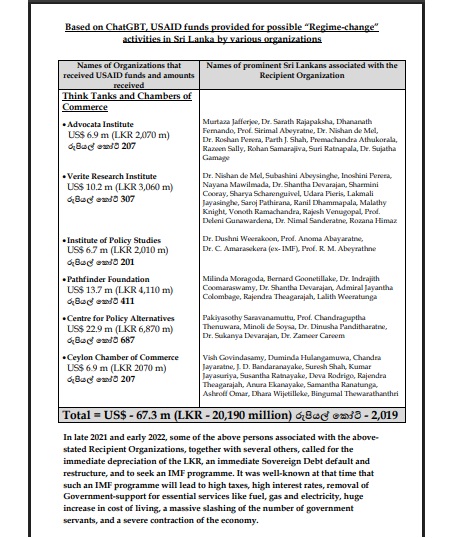
Milinda Moragoda, founder of the Pathfinder Foundation, met with Chinese Ambassador Qi Zhenghong to discuss bilateral relations between the People’s Republic of China and Sri Lanka.
The luncheon discussion covered various subjects on relations between the two countries in the context of the Pathfinder China-Sri Lanka Cooperation Studies Centre (CSLCSC), inaugurated in 2015, which saw numerous Chinese Think Tanks and academic institutions focusing on the South Asian region. One of the areas of interest was to host Chinese academics and subject specialists focusing on China-Sri Lanka relations at the CSLCSC for extended periods as it had done before the COVID-19 pandemic. Another area was to examine the possibilities of translating historical Chinese books covering China–Sri Lanka relations in all aspects. The Foundation made a significant contribution in 2020 by translating a Chinese publication on ‘Prevention and Control of Covid-19’, authored by Professor Wenhong Zhang, into Sinhala and Tamil languages for distribution among the public free of charge.
The visit to the Chinese Embassy was part of the Pathfinder Foundation’s ongoing engagement with China. Both countries have enjoyed an uninterrupted close relationship since historical times, particularly in the modern period. The Chinese Ambassador visited ‘River Point’ in October 2024, where the Foundation functions. Since then, several Chinese delegations have visited the Pathfinder Foundation to exchange views on the bilateral relationship between the two countries, the last being a delegation from the Academy of Military Sciences (AMS) representing the Institute of Military Legal Systems Studies (IMLSS) based in Beijing.
Bernard Goonetilleke, Chairman of the Pathfinder Foundation and Jin Enze from the Embassy participated in the discussion.