At the Women’s Forum titled ‘A programme for Progress’ held at the Galle Face Hotel yesterday (13), President Ranil Wickremesinghe presented a transformative vision for Sri Lanka’s future. His focus was on modernizing the economy, empowering women, and implementing social justice reforms. He emphasized moving beyond outdated political systems and embracing an export-driven, digital, and green economy. In addition, he addressed key social issues such as gender equality and overcoming class and caste biases.
President Wickremesinghe’s remarks come at a critical time as Sri Lanka recovers from economic and political crises exacerbated by the COVID-19 pandemic. Speaking to entrepreneurs and small business owners, he laid out a framework for significant changes, focusing on women’s empowerment and social justice, while urging public support for his initiatives, symbolized by the gas cylinder in the upcoming vote on September 21.
Addressing the forum, the President said: It’s an interesting time, certainly listening to your concerns, which also showed me that many of you are involved in self-employment, as well as in small and medium-sized enterprises. That’s good. Now we have to see how we can encourage you to move forward after resolving the issues that have arisen from the recent economic crisis. COVID-19 itself has been a problem for many people involved in small and medium enterprises, and in our case, it was made worse by the economic crisis. The economic and political crises that followed, due to the inability of any leaders to assume responsibility for governing the country, showed a complete breakdown. We now need to put the social structures back in place.”
President Wickremesinghe also highlighted his commitment to women’s empowerment, starting with the Women’s Empowerment Act and the Gender Equality Bill. He noted the importance of expanding women’s participation in business, management, and various levels of leadership, along with establishing a Social Justice Commission to promote equality across class and caste lines.
State Minister Dr. Seetha Arambepola expressed her support for the President’s leadership, emphasizing the positive changes brought about in the last two years. She noted the success of relief programs like “Aswesuma””” and “Urumaya” and efforts to address violence against women through dedicated police units and female officers.
Former Minister Thalatha Athukorala and other prominent figures, including Professor Maithree Wickramasinghe and Rosy Senanayake, were also present, commending President Wickremesinghe’s long-standing commitment to advancing gender equity in Sri Lanka.
The International Monetary Fund (IMF) says that the timing of Sri Lanka’s Third Review under the Extended Fund Facility will be discussed with the government following the elections and that they will move forward with program discussions after the country’s presidential election.
Responding to questions during the weekly press briefing, the Director of the IMF’s Communications Department, Julie Kozack stated that the IMF Executive Board completed the 2024 Article IV Consultation and the Second Review of the EFF program on June 12, 2024.
She stated that this provided the country with access of about $336 million U.S. dollars. ”Program performance remains strong. Reform efforts are bearing fruit. Economic growth is starting to revive. Inflation is coming down. Reserves, international reserves are increasing, and revenue mobilization is improving.”
Nonetheless, she stated that important vulnerabilities do remain, and that sustaining reform momentum is going to be essential.
In response to specific questions regarding the island nation’s presidential election, slated to be held on September 21, the spokesman said that it’s very important to note that for the upcoming elections, it is really for the people of Sri Lanka to decide”.
Kozack noted that achieving the program’s objectives is a key priority to give Sri Lanka a chance to emerge from one of its worst crises in history. As I’ve already noted, a lot of progress has been made, but the country is not out of the woods yet, and it is important to safeguard those hard won gains,” she said.
Responding to a query with respect to debt restructuring, the spokesman said that the IMF does not take part in the negotiations. ”In the debt restructuring negotiations and discussions, those negotiations are between the member country and its creditors, with the IMF making an overall assessment of debt sustainability.”
Kozack was also asked about the statements by Sri Lanka’s opposition factions that the debt sustainability assessment (DSA), with regard to the EFF program, will be renegotiated or revisited after the presidential election.
First, with respect to the upcoming presidential elections, this is for the people of Sri Lanka to decide.”
From the IMF’s position, what we see is a program that has made significant achievements, but that it is important to safeguard these achievements to enable the country to fully emerge from one of its worst crises,” she said.
The IMF spokesman pointed out that the timing of the Third Review of Sri Lanka’s EFF program will be discussed with the government following the elections.
So, we will move forward with program discussions after the presidential elections take place and a new government, or the outcome based on the choice of the people, we will be ready to go with that,” she said.
Opposition leader and presidential candidate Sajith Premadasa, representing the Samagi Jana Sandhanaya led by the Samagi Jana Balaveegaya, has pledged to combat the influence of the National People’s Party.
Speaking at a public rally in Tissamaharama on September 13, Premadasa declared that he would not allow the fascists of the National People’s Party to instigate terror in the country. He emphasized his commitment to standing up for the people.
President Ranil Wickremesinghe stated that even after three days, he has yet to receive a response to his inquiry about whether the economic policy of the Malimawa, led by Anura Kumara Dissanayake, promotes an import or export-driven economy. The President also criticized former Agriculture Minister Anura Kumara, accusing him of working towards destabilizing the country’s economy by ousting former President Gotabaya Rajapaksa. He emphasized that he will not allow anyone to undermine the hard-earned economic progress of the nation.
President Wickremesinghe made these remarks during the “Ranil ta Puluwan” (Ranil Can) victory rally held this afternoon (13) at Beruwala Beach Stadium. The rally, which drew a large crowd, was organized in support of his candidacy in the upcoming presidential election.
During the event, a proposal to provide pensions and social security benefits for pre-school teachers was also submitted to the President.
He further stressed that, just as he presents factual statistics, the Malimawa must also present a clear, data-backed explanation of its budget to the public. He urged citizens not to be misled, encouraging them to support the government’s ongoing efforts to rebuild the nation based on a genuine understanding of the country’s economic situation.
Addressing the public rally, President Ranil Wickremesinghe stated:
“When the people of this country were without food, medicine, fuel, and gas, I stepped in to meet those needs. When your workplaces were closed, I made sure they reopened. I restored hope when there seemed to be none. I never backed down, nor did I refuse to take responsibility for the people. Even when my own house was burned, I continued to work for the country. My genuine aim was to end the suffering of the people and to restore their hopes. I have successfully completed this program over the past two years.
Looking ahead, we will implement further measures to rebuild the economy and provide more relief to the public. By next year, the burden on people’s lives will be significantly reduced. Today, we made two important decisions. With the improvement in the country’s foreign exchange reserves, we have lifted the ban on vehicle imports. Starting next year, vehicles can once again be imported into Sri Lanka. Additionally, we raised the basic income tax threshold from 500,000 to 720,000 rupees, reducing the tax burden for many as their incomes rise. This will provide relief to everyone.
We have made real progress, and I will not allow this success to be undone. We have begun the journey to develop this country, and we must safeguard this program for the future.
Today, Malimawa is making promises to the public that cannot be fulfilled. Their proposed budget is one that will bring the country’s economy to its knees. They are attempting to destabilize the economy just as they did by ousting former President Gotabaya Rajapaksa. If their economic policies are implemented, we will lose the support of the International Monetary Fund (IMF), and the dollar could rise to 500 rupees, further increasing the cost of living for the people.
If the proposals of Malimawa are implemented, I must say that the country will face an even worse situation than in May 2022. When I point this out, I am often accused of slandering them. This is not slander; it is a matter of the people’s survival. My goal is to bring the dollar exchange rate down to Rs. 275. If former Agriculture Minister Anura Kumara can do that, I have no objections. However, just as I present facts and figures, they too must present a plan to the public on how they will protect the rupee.
Recently, a group of young people came to meet with me, including some who said they supported the Malimawa. I asked them why they supported Malimawa, and they said, “Sir, we gave the UNP a chance, we gave Mahinda Rajapaksa a chance, and now we feel we should give Malimawa a chance too.”
I then asked them if they were willing to gamble their own future on giving Malimawa a chance. They replied, “No, Sir, we want a stable future.” I told them that giving Malimawa a chance would lead the country into an even deeper crisis than what we faced in May 2022. At that point, they admitted, “We hadn’t thought of it that way, Sir. If Malimawa gets a chance, we lose.”
I know that the people of this country are not willing to risk their future by giving Malimawa a chance that could lead to the collapse of the nation’s economy once again.
Are you prepared to make Anura president and pay an even higher price for the dollar? If so, you’ll find yourself in a situation more extreme than the Wessantara story. When I questioned Malima’s economic policy, Anura responded with an argument. I told him I was ready for a debate, but first, he must clarify whether his economic policy favours an import-driven economy or an export-driven one. I also asked him to resolve the differences between Sunil Handunnetti and Anura Kumara and get back to me. It’s been three days since I posed the question, and I still haven’t received an answer.
We shouldn’t waste time calling each other thieves; instead, we need to focus on meaningful discussions—like how to generate revenue and protect the economy. The future of the country cannot be entrusted to a group that lacks clear direction on such critical issues.
This country cannot be handed over to those who evade responsibility during an economic crisis and attempt to derail the economy. Therefore, I urge everyone to vote for the gas cylinder on September 21 and safeguard the program that will secure the future of our country.”
Engr. Kanthar BalanathanDipEE (UK), GradCert (RelEng-Monash), DipBus&Adm (Finance-Massey), C.Eng., MIEE, Associate of the Australian Institute of PhysicsFormer Director of Power Engineering Solutions Pty Ltd, Consulting Electrical EngineersLeading Engineer of the World 2006, UK Authority Award
Email: pengsol@bigpond.net.au
The Presidential election is getting a bit rough and creating enmity between the people. No one is perfect in Sri Lanka. Sri Lanka is full of developed racism, discrimination and oppression among people. Tamils of course are like FOX, standing firm on caste oppression and thinking that only the elites have brains and knowledge. My knowledge over the last 81 years proves that Tamils in the North are racists and saturated with caste issues. SJVC Chelvanayagam formed the FP because he was not given a minister post, but GGP was given. The personal ego of people developed and directed towards racism toward the Sinhala people. Ponnambalam Ramanathan is another coward married to a white woman who turned a blind eye to the developing merging of the three kingdoms. Politicians and elites are only eager to get into power for wealth.
Let us know the black marks stamped on the present politicians.
Rajapaksas – (Namal) No one needs to prove that the Rajapaksas pushed the country to poverty and zero dollars. The Rajapaksas practised nepotism, bribery and corruption very heavily, however, with power and silently. Every corporation, and government sector was manned by a Rajapaksa which resulted in loss and inefficiency. The Rajapaksa, not anyone in their family could govern Sri Lanka. Gotabaya was a complete terror and incompetent person. Namal R should be defeated by the people.
Anura K Dissanayake – Everyone knows that JVP launched a terrorist attack in 1971, just before SL was preparing to become Republic in 1972. Lots of lives were lost and assets were destroyed. The main question is: who prompted and activated this attack? Where did all the cadres go to live? Further, JVP has a Communistic and Socialist policy which is not at all suitable for SL. The majority of the people in SL are capitalistic and industrious mind. The government has practised socialist policies of helping the people with health and education since independence. British is the key country which is socialist. With due respect, I would like to state that Anura is weak in communication with the people and the external world. AKD has never been in the cabinet or held a ministerial position. It will be a severe threat to the nation if people want to bring AKD as the leader.
Hon Ranil Wickremasinghe (RW) – Yes, do we know that RW solved the economic issue permanently? NO! The economic issue was never solved. Still, RW allows the import of luxury cars to people on political grounds. The parity of the state of the currency rate has increased. RW has become, possibly a slave to India. What are the black marks on RW?
CFA -Cease Fire Agreement in 2002. This was a detrimental disaster to the nation thereafter. Major heavy weapons, aircrafts, and military ancillaries were transported to the Mullivaykal. The military was silenced. Most of the LTTE cadres escaped to foreign countries.
Karuna Issue. This was another disaster in the peace process. LTTE commenced manufacturing heavy weapons in Mullivaykal. Millions of dollars were lost in SL.
Central Bank BOND issue. -This was never solved. This led the country to a downfall in economic perspectives.
RW was never elected as the President. RW became the acting President and was subsequently elected as the 9th President of Sri Lanka by Parliament on 20 July 2022. He took office the following day.He did contest the presidential elections a couple of times and lost.
Is RW still importing luxury cars for his mates?
Yes, he did get loans. LOANS? Yes, anyone can get loans if they can communicate.
RW is back on board to the bridge building between Talai Mannar and Rameswaram. There are flights from Tamil Nadu to Jaffna and ships ploughing to KKS. Who will bear the cost? Do we need the bridge between India and SL? Indians, historically waged war on SL and plundered the wealth in SL. They built temples and plundered wealth. Did they develop SL?
India was responsible for the terrorist attacks on SL and the destruction of assets in SL. Indira Gandhi, MGR, and Tamil Nadu were responsible for the destruction and appreciation of the LTTE and other groups. Indirectly India is responsible for the destruction of the Cement factory and other assets.
SL is not a colony of India. India preaches RSS. Why does Jai Shanker plough to SL like a seagull? India has problems in their East, West, and the North. The Indian PM is not the SL governor.
Has RW become a slave to India?
RW has a significant number of black marks on him to rule SL.
Sajith Premadasa (SP) – So far SP has not been stamped with any black marks on him to my knowledge. He may be a suitable candidate for the Presidential Position. SP has the courage, patriotism and dedication to rule SL. SP can converse with foreign politicians quite well. SP is a non-racial person. We all know the late Hon. R. Premadasa.
ALL Sri Lankans shall consider assessing each candidate and not fall for lies and bloating but vote for Sajith Premadasa.
Presidential candidates as usual make promises that they as well as the voters know can never be fulfilled in this country under the present circumstances. One of them said he will make Trincomalee a surapurak”, a city fit for the gods! Why didn’t they do all this when they were in power? Their promises are absurd and sound hollow. Yet they go on making fools of themselves. Only a very few has spoken meaningfully and come out with a plan that has a semblance of feasibility. When will this foolishness stop.
Most of these politicians, even those who promise a change, seem to be bereft of original ideas for solving the burning problems the country is faced with. It is impossible to discern what the change they propose is. It is easy to say they will stop corruption which is entrenched from top to bottom in this country but they must tell how it could be done. They say prices of essential goods including fuel would be brought down but wouldn’t say how. Some say they will renegotiate the terms and conditions of the programme that has been agreed upon with the IMF but no alternative scheme has been presented. They say there will be no poverty under their watch but how poverty could be alleviated is not shown.
The underlying cause of most of the problems they say they will solve is linked to the economy of the country. These problems cannot be solved without substantially improving the economy. The economic ills cannot be treated by following the same policies that we have adopted since 1977. The essence of the economic model we have adopted since 1977 is we spend more than we earn and take loans to meet the deficit. Our habit of taking loans has been so bad that at present the total debt amounts to more than 100 % of the GDP. Only the very rich countries like the US have such high debt rates. During 2023 the total foreign loans rose from USD 53 billion to USD 55 billion. None of the presidential candidates has a clear policy on foreign debt and they have not spoken about how the debt burden could be reduced. They must tell us how they would improve the economy in clear terms and not just say they will do it.
Another urgent problem that needs a clear policy is in the health secter. At present the government hospitals cannot cater to the needs of the people. Medicines and materials available are woefully inadequate. Corruption is rampent. The ministry of health is ill from head to toe and needs urgent treatment which none of the candidates seem to have dealt with.
Education secter has deteriorated to such an extent that school dropouts are rising by the day. Free education is a myth with tuition classes doing the bulk of the teaching from year one to year twelve. The syllabuses of these classes are too heavy and full of unnecessary stuff. By the time a student reaches year twelve he/she is burnt out and often a nervous wreck. How these problems will be sorted out must be shown in clear terms.
I would like to propose that the presidential candidates pay attention to the following;
Achieve self sufficiency in all essential goods that could be produced locally
By this means 40 – 50 % of foreign exchange could be saved and the unemployment problem would be solved to a significant degree
Debt burden would be gradually reduced to a manageable degree.
Focus on poverty alleviation and nutrition of the less affluent.
Focus on education of the less affluent
Free education and free health should be available only to those who cannot afford to pay for it.
Stop import of luxary items until the country reaches developed status.
Do away with some of the political institutions which are a huge drain on the economy which do not serve any purpose.
Instead of devolution of political power to the periphery have a system of power-sharing at the centre. Administration could be decentralized at district level.
Scrap presidential system and transfer executive powers to the parliament
Holy Grail as defined by Oxford Languages dictionaries have two meanings:
The first being the cup or platter Jesus Christ supposed to have used in his last supper, in the upper room of the building with his disciples. The second being the eagerly sought after medical cure for all holy grail”.
The second one was explained by me in this forum and can be reached here:
(Incidentally our medics, specialist included, seem to have no idea what happens in MRI machines. I came to know this when a specialist told me about it the other day. So, the medical council please take note.)
However there seems to be another, which was sought after by the Hiler’s Nazis according to link given below:
It seems this is something connected with German folklore and they believe that who ever that poses it will rule the world. My proposition here is that the ‘’holy grail” that they are looking for is right here in this land in the form of ‘Sakwala Chakra’ or Stargate in Ranmusu Uyana in Anuradhapura, Sri Lanka.
Come to think of it: All the colonial powers that controlled Ceylon (or Ceylao) virtually controlled the world at their zenith of power. The Brits were the last, but they are the ones who effectively controlled us via a bunch of Colombo centred people until today. And they appear to be losing that control to our big brother, next door.
During the World War II, they had their headquarters in Rosemead Place (not in India) called Eastern Command and they won over Japan, the aggressor. Since their influence is waning now many big powers are falling over each other using their financial (and minority) clout to grab it.
Shouldn’t our folks be mindful about the design of various power to avert another calamity like what we had for thirty years when voting in about a week’s time?.
As usual let me end this with the German version of a song, Marina by the Italian singer Rocco Granata (the guy who started the Eurovision song contest), that came around 1960 which I heard for the first time in the Arts theatre of Peradeniya university, kind curtesy of our Kultur group who used to control the affairs in it during early 60s. That university had been ‘open more than usual’ for everybody since then, including fellows from distant villages like mine.
For those who can afford time to indulge, here are some irresistible (unwiderstehlich) ones from the same Austrian guy:
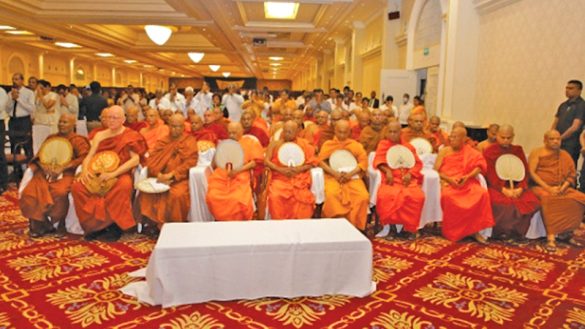
The 100th anniversary of the Berlin Buddhist Vihara, Frohnau, Germany was held at Temple Trees recently.
Prime Minister Dinesh Gunawardena was
the Chief Guest, while German Ambassador to Sri Lanka Dr. Felix Neumann was the Guest of Honour. Speaker MahindaYapa Abeywardana was also present. Ambassador of China Qi Zhenhong, Ambassador of Europe Carmen Moreno, High Commissioner of New Zealand David Gregory Pine, Deputy High Commissioner, India, Dr. Satyanjal Pandey and chargé d’affaires of Vietnam Le Van Huong and other members also participated.
Ven. Panadure Chandaratana Thera of Mithirigala Nissarana Vanaya delivered the Anusasana. The speech on Berlin Vihara was delivered by Ven. Olande Ananda Thera. The Prime Minister and German Ambassador also delivered the guest speeches. The German Ambassador addressed the meeting on 100 years of cultural harmony between two countries.
Several videos on Buddhism in Germany and the Berlin temple were shown on the occasion. A short drama was also played. The book titled 100 Years Das Buddhistische Haus” coauthored by Senaka Weeraratna was launched at the meeting.
He delivered a speech on the book. A first day cover and Rs. 25 stamp issued by the Postal Department was presented to the Prime Minister by the Postmaster General. The vote of thanks was delivered by the President of the German Dharmaduta Society (GDS), which governs the Berlin Temple, Major General Sardha Abeyratne.
The Pathfinder Foundation, an independent research and advocacy organization, has published two significant policy documents were presented to presidential candidates, including President Ranil Wickremesinghe, SJB Leader Sajith Premadasa, Namal Rajapaksa representing SLPP, Dr. Nihal Abeysinghe, General Secretary of NPP, and Dilith Jayaweera, ‘Sarvajana Balaya’ Alliance. Pathfinder Foundation hopes these reports will provide policy choices available to the next administration, ensuring a path forward for Sri Lanka that combines immediate economic recovery with long-term resilience and growth.
Known for its non-partisan approach, the Foundation consistently produces policy briefs on critical national and regional issues. In line with its tradition of providing recommendations to aspiring candidates during elections, these reports address the pressing challenges facing Sri Lanka.
The first report, titled “Economic Crisis in Sri Lanka: Policy Challenges for the New Government,” comprehensively analyses the country’s economic turmoil. Compiled in consultation with local experts, the report is structured into three key sections.
The report begins with an in-depth assessment of the root causes of Sri Lanka’s economic crisis and its far-reaching consequences on the population. The second section focuses on the strategies for economic recovery and ensuring stability while adhering to the International Monetary Fund (IMF) programme. Finally, the report emphasises that progress must extend beyond recovery and urges the next government to develop a long-term strategy with broader economic reforms, including the removal of anti-export bias in the economy to facilitate trade expansion, State-Owned Enterprise (SOE) reforms, agricultural modernisation, and greater digitisation.
The report stresses that while the immediate goal is economic recovery, the broader objective must be sustainable economic growth to generate employment and eliminate poverty. It concludes that Sri Lanka should not be a repeated client of the IMF and urges future political leadership to adopt a forward-looking vision for long-term prosperity.
The second document, titled “Bridging Borders: Enhancing Connectivity between India and Sri Lanka,” shifts focus to regional integration. It argues for stronger cooperation between the two neighbours, particularly in developing the transportation and energy infrastructure sectors. The report highlights that investing in roads, seaports, airports, and energy systems could substantially boost economic growth and productivity. However, it also points out the challenges Sri Lanka faces in attracting the necessary investments, urging closer collaboration with India to improve maritime, air, and energy links. The documents can read of the Pathfinder Foundation Web https://pathfinderfoundation.org/publications
Colombo, September 12 (Daily Mirror)- Rebuffing President Ranil Wickremesinghe’s proposal to invite the IMF for the debate, NPP Presidential candidate Anura Kumara Dissanayake today made a fresh challenge to the President for a face-to-face debate on the economic policies.
Speaking at a rally in Ambalantota, he said the debate could be arranged on a popular television channel and any matter regarding the economic policies of the two parties could be debated.
“President Wickremesinghe keeps on posing questions to me on the stage. So, I challenged him for an open debate. Then, he said he would come with the IMF. Is the IMF contesting the election? Ranil is making irresponsible statements,” he said.
Dissanayake said the Opposition camp is perturbed about the NPP’s victory and said they have started to spread various false news to mislead the people.
“They are now saying the NPP government will change the national flag. We will not change the national flag but only the corrupt and fraudulent politics. The Opposition camp is also saying that there will be unrest and violence after the NPP’s victory. We want a peaceful election. This election is a definite win for us. Only the losing camp wants unrest, clashes and instability in society. We request the security forces to maintain law and order in the country before, after and on the election day,” he said.
He said some people claim that the economy will collapse after the NPP comes to power and said the economy is already collapsed, adding that the NPP will take over the country to revive the economy which collapsed due to failed policies for the last 76 years.
Colombo, September 12 (Daily Mirror) – I decided to contest for the presidency only to stabilize the economy and not to focus on religion or ethnicity, President Ranil Wickremesinghe told a public rally in the East.
“My focus is to focus on trade and agriculture and to stabilize the economy based on those sectors and not religion or ethnicity,” Wickremesinghe told a rally in Sainthamaruthu and Kokavil.
He said he has been able to mete out justice to Muslims of this country by assuring their right to bury their dead.” We will ensure the right to burial by the law, he said in this regard.
Whilst highlighting that presidential candidates such as Sajith Premadasa who offers everything free of charge won’t have a chance, Mr. Wickremesinghe said he will create a better future for the people through a scientific plan to stabilize the nation.
He assured that Sri Lankans will be enjoying a better lifestyle in another year’s time. “We have already managed to bring in some stability. The devaluation of the rupee is controlled now,” he said.
“I remember visiting these areas in the East during the tsunami period. The area is much developed now compared to those days. We hope to develop the East further,” he said.
We cover 360-degree needs from birth to death, education to aviation. Ours (manifesto) is philosophical, practical and deadline -drivenWe are motivating human capital to unleash the potential of physical resourcesThere is a mismatch between their (presidential candidates) lifestyles and incomes declared Anura Kumara Dissanayake completely lives off the people of this countryAll the politicians are part of the black economy Whoever lives outside the tax net is part of the black economy
Regrets playing a role in bringing Gota to power
Sarvajana Balaya’ Presidential Elections candidate Dilith Jayaweera, in an interview with Daily Mirror, outlined his vision for a entrepreneurial Sri Lanka. Jayaweera said that only wealth creation according to a time-bound action plan could salvage the country, but not ad hoc measures.
Excerpts
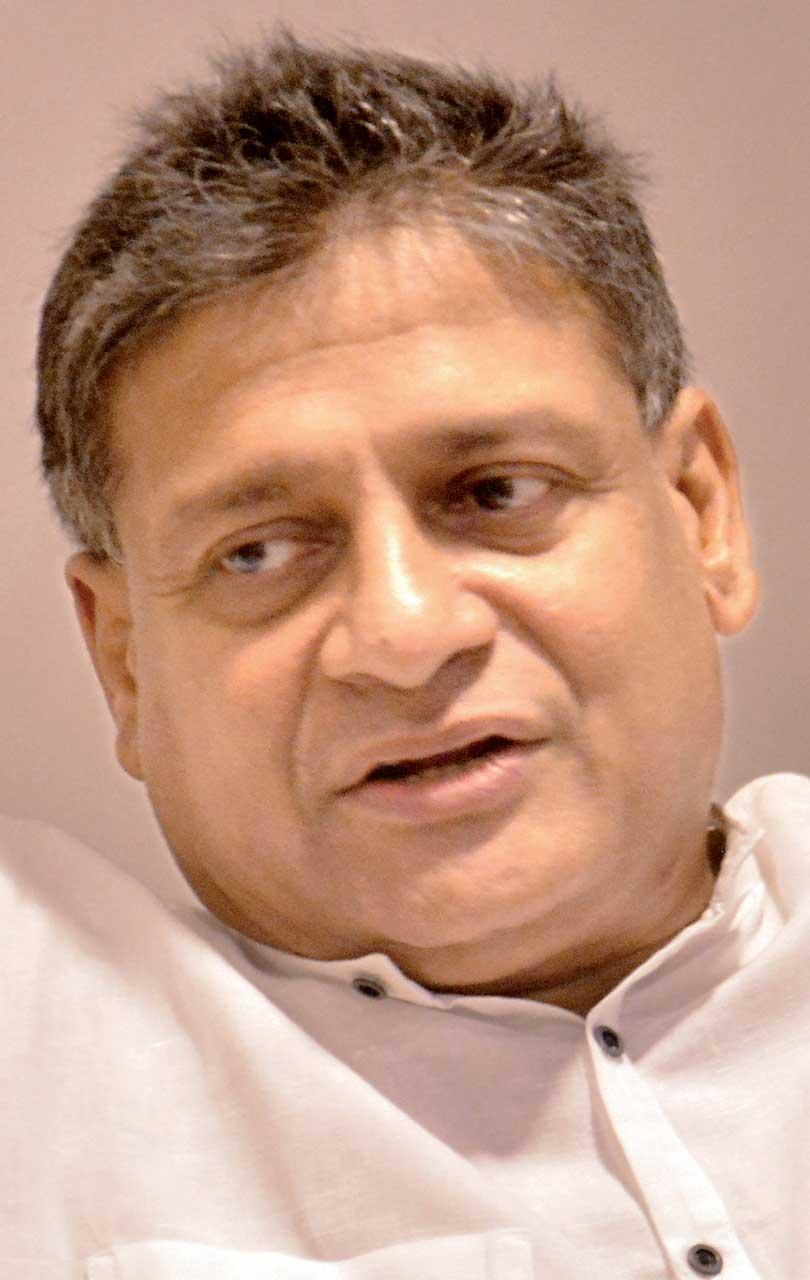
Without entrepreneurship, the country cannot move forward”-Dilith Jayaweera(pic by Huzefa Aliasger)
Despite being a successful businessman, why did you decide to contest for the presidency?
It is because of the vacuum that got created in its own. There was the rhetoric of people, particularly of the youth for a change. They wanted a change in conventional political thinking. I was convinced that we cannot move forward like this. Conventional politicians come up with the same conventional nonsense. People have no support towards them. In my case, I have been supporting these conventional forces expecting that something would happen. It did not really happen in the way it was expected to be. With that serious thought, I entered politics.
The Gotabaya Rajapaksa government incurs a black mark for the current economic crisis. Critics point at you too for being instrumental in bringing him to power. What have you got to say?
Yes, I did play a role. In fact now I quite regret it; not for the same reasons, but for the reasons that I can explain. That is another reason for me to sacrifice my otherwise peaceful life. I had that guilt.
What went wrong with the Gotabaya Rajapaksa government?
It is nothing, but the family involvement. The family never wanted him to be in power, to begin with. Both Mr. Basil Rajapaksa and Mr. Namal Rajapaksa never wanted him to be the President. They wanted Mr. Mahinda Rajapaksa to be the President. Constitutional restrictions stopped them from bringing him (Mahinda) back. This was not their choice. Though unwilling, they helped bring Gotabaya. They did not have the same bond with him.
Sri Lanka, in the post-independence era, never had a plan. People came to power on ad hoc basis. They never came with a sort of a plan. Sri Lanka didn’t join the world which was heading in an entrepreneurial mindset. All the states had a change in their mindsets for development -from conventional welfare systems to entrepreneurial systems. It happened in Russia, China, Singapore and India. We didn’t understand the value of entrepreneurship
Both Namal and Basil wanted to control Gotabaya. That is why they immediately brought P.B. Jayasundara- their point man- as the Secretary to the President. Gotabaya told me that it was not his choice. The Secretary to the President is a powerful position. He was the former Treasury Secretary too. I used to call him the economic hit man in my language. This man was brought in to control Gotabaya only. Gotabaya was quite successful during his first nine months in office when he did not have a parliamentary majority. When Basil took control of Parliament, he directly controlled Gotabaya.
You talk about an entrepreneurial Sri Lanka. What is the reason for Sri Lanka to lack entrepreneurship?
Sri Lanka, in the post-independence era, never had a plan. People came to power on ad hoc basis. They never came with a sort of a plan. Sri Lanka didn’t join the world which was heading in an entrepreneurial mindset. All the states had a change in their mindsets for development -from conventional welfare systems to entrepreneurial systems. It happened in Russia, China, Singapore and India. We did not understand the value of entrepreneurship. That is why, we have all the subjects in our curriculum except entrepreneurship. Without entrepreneurship, the country cannot move forward. We should have an entrepreneurial state to start with.
There is a perception that left-leaning political thinking discouraged entrepreneurship. What is your view?
Yes. That could have been one reason. That is not the only reason, though. We didn’t give serious mind to it. If you don’t know the concept of entrepreneurship, how do you even think of entrepreneurship? From Grade 1 to 11, we know all the subjects including geometry. We don’t know entrepreneurship.
They themselves call their ones manifestoes. We clearly say that ours is a strategic plan. We talk about what, how, when and if not. We talk about concepts. They talk about conventional welfare- how much they are willing to give. Everybody is competing with each other to dole out. All three manifestoes lack philosophy
How does your programme differ from those of other main candidates?
They themselves call their ones manifestoes. We clearly say that ours is a strategic plan. We talk about what, how, when and if not. We talk about concepts. They talk about conventional welfare- how much they are willing to give. Everybody is competing with each other to dole out. All three manifestoes lack philosophy. Without philosophy and strategy, how can a country move forward? Again, they bring it down to ad hoc steps. It is not a master plan. It does not cover 360- degree needs of Sri Lanka. We cover 360 -degree needs from birth to death, education to aviation. Ours is philosophical, practical and deadline -driven.
How do you define your economic policy in traditional terminologies- socialism, social market economy, capitalism etc?
I don’t like it. In the modern world, these are all archaic words. The world is moving away from these archaic words- left wing, right wing etc. We are putting forward a progressive economic plan with a reasonable percentage on welfare, massive percentage on our culture and civilization. Human capital is the centre of it. We are motivating human capital to unleash the potential of physical resources.
All successful nations in the world have worked on the strengths of their civilizations. That is inherent in us. We are different to citizens of any other country because of our historical reasons. Historical reasons cover from our biology to moral beliefs. You cannot suddenly become someone else. Sri Lankan Muslim is different to a Muslim in an Arab country. A Sri Lankan Catholic is different a Catholic in Rome. We have to capture that in motivating the nation
You mentioned about civilization to be looked at for insights. How are you going to do it?
All successful nations in the world have worked on the strengths of their civilizations. That is inherent in us. We are different to citizens of any other country because of our historical reasons. Historical reasons cover from our biology to moral beliefs. You cannot suddenly become someone else. Sri Lankan Muslim is different to a Muslim in an Arab country. A Sri Lankan is different to an American. A Sri Lankan Catholic is different a Catholic in Rome. We have to capture that in motivating the nation.
Historically, we have been influenced by Buddhism as a philosophy. That influence has made ourselves different from other nations. We are a nation without a God. When there is no God, there is no messenger. Predominant civilizations have no Gods. Then there is no book like Bible or Quran. We are a nation with free thinking with so much energy attached to it.
Recently, you talked about ‘black economy’. How big is that?
Whoever who lives outside the tax net is part of the black economy. All the politicians are part of the black economy. They don’t partake in paying taxes. If you cannot justify your living style with income, you are part of it.
How big is this black economy?
I think three to four times the size of actual economy.
If you look at the presidential candidates, all the main candidates have given affidavits lying to the nation. How can they justify? Who are they trying to lie? What kind of a joke is this? That is why we cannot put this in order. The developed world captures this through the digital network. In the developed world, there are single entry platforms. Even in India, they have introduced this single-entry platform for 1. 3 billion people
Where lies the fault?
If you look at the presidential candidates, all the main candidates have given affidavits lying to the nation. How can they justify? Who are they trying to lie? What kind of a joke is this? That is why we cannot put this in order. The developed world captures this through the digital network. In the developed world, there are single entry platforms. This is what I have been saying. Even in India, they have introduced this single-entry platform for 1. 3 billion people.
Anura Kumara Dissanayake completely lives off the people of this country, taxpayers’ money under the pretext of running a political organization. Paying zero taxes, he travels business class. He travels in the best of the best vehicles. He has a massive mansion built in Battaramulla.
Among the candidates, if I go by asset declaration forms, you are the richest?
I am not the richest. I am the most honest.
Are you trying to say that others are richer than you actually?
It is hundred percent. I am forced to assume. They declare Rs.300,000 as their income. Look at the way they live and compare it with what they have declared! You can imagine how big the black economy is.
The Election Commission has declared Rs.109 as the expenditure ceiling per voter by any candidate. Will you stick to that?
I will be spending much lower than that because I don’t spend black money. I spend reasonable money. I don’t think that such a reasonable claim can be made by other candidates. If each of them can have three rallies a day. In my opinion, it costs around Rs.75 million.
They can spend big sums of money across the country. They have mentioned something in asset declarations. But the actual value is much bigger than that.
Will they exceed the campaign expenditure ceilings?
I think they would.
Is the expenditure ceiling announced by the Election Commission for the current campaign enough?
It is a joke. Our General Secretary said that it should be made Rs.300 per voter. Otherwise it is such a joke.
The election authorities in Anuradhapura barred a dinner party you were supposed to host. What happened actually?
I didn’t. It was a private party organised by entrepreneurs in Anuradhapura. The first part of the party was my speech. They did not serve liquor, food or anything. They were to continue with the party after my speech and I left. However, there was my banner in the background. They did not serve even a glass of orange juice during my speech. But officials came and went into the kitchen.
Who has instigated it?
I told my entrepreneurs in Anuradhapura to invite even those with opposite views including the JVP guys. It looks like that they took pictures and sent them to the relevant authorities. We did not serve food. The buffet was not even laid. The food was in the kitchen. On the same day, President Ranil Wickremesinghe had a bigger party for lawyers in Colombo. There was nothing to be investigated. It was an ugly incident as far as I am concerned.
What is your view on the IMF (International Monetary Fund) programme?
All three main candidates talked about crossing Wel Palama (suspension bridge). Ranil is the master of loans. He works like the accountant of a company. Loans are supposed to be managed by a financial controller or an accountant. He diverted national discussion from wealth creation to loan management. That should not be the discussion. None of these candidates talks about wealth creation. They are talking about managing debt. Managing debt is one small portion of running a country. What is important is to motivate people to be involved in making more money for the country. Once enough money is made, we can service debts.
But the country is now halfway through the programme. Can we reverse it?
There is no need to reverse. If you have taken a loan, you have to manage it. If you cannot pay, you have to get a moratorium. You cannot ask the IMF to fly a kite. You have to manage it from the country’s well-being point of view. First of all, we have to have wealth with us. Then only we can negotiate with anyone from a strong position.



 Despite being a successful businessman, why did you decide to contest for the presidency?
 The Gotabaya Rajapaksa government incurs a black mark for the current economic crisis. Critics point at you too for being instrumental in bringing him to power. What have you got to say?
 What went wrong with the Gotabaya Rajapaksa government?
 You talk about an entrepreneurial Sri Lanka. What is the reason for Sri Lanka to lack entrepreneurship?
  There is a perception that left-leaning political thinking discouraged entrepreneurship. What is your view?
 How does your programme differ from those of other main candidates?
 You mentioned about civilization to be looked at for insights. How are you going to do it?
 Recently, you talked about ‘black economy’. How big is that?
 How big is this black economy?
 Where lies the fault?
 Among the candidates, if I go by asset declaration forms, you are the richest?
 Are you trying to say that others are richer than you actually?
 The Election Commission has declared Rs.109 as the expenditure ceiling per voter by any candidate. Will you stick to that?
 Will they exceed the campaign expenditure ceilings?
 Is the expenditure ceiling announced by the Election Commission for the current campaign enough?
 The election authorities in Anuradhapura barred a dinner party you were supposed to host. What happened actually?
 Who has instigated it?
 What is your view on the IMF (International Monetary Fund) programme?
 But the country is now halfway through the programme. Can we reverse it?