Monks driven from pillar to post with Mahanayakes pandering to politicians
July 26th, 2024By Rohana R. Wasala
A four-member delegation of seemingly frustrated Buddhist monk activists led by Ven. Itthekande Saddhatissa Thera, General Secretary of the Ravana Balaya Organization, called on the two Most Venerable Mahanayake Theras of the Siyam Nikaya in Kandy in their respective viharas (monasteries), as reported on a Colombo Today YouTube video dated June 30, 2024. The monk delegates were doing so to draw the attention of the two Mahanayakes to what they thought was the president’s failure to heed, or his indifference towards granting, the written request of the four Mahanayakes of the Three Nikayas for a presidential pardon for Ven. (Galaboda-aththe) Gnanasara Thera. When these monks visited Kandy, Bhikkhu Gnanasara was serving a rigorous four-year jail term, having been convicted on two counts in a case of defaming a different faith filed against him in 2015. (At the time of writing, July 22, 2024, however, he was conditionally released from prison by the Colombo High Court, as he had been granted bail by the the Court of Appeal the previous day.)
The four visiting monks thought that Gnanasara Thera (who had earned popularity as a strong defender of the allegedly threatened rights of the majority Sinhalese Buddhist community, and who had been championing his cause without prejudice to the other communities) must be at liberty, particularly at this critical time (with the constitutionally mandatory presidential and parliamentary elections just around the corner). As an unexpected consequence of his dedicated activism, he has become the accused in some twenty cases pending against him, according to the monks.
They told the Mahanayake of the Malwatte Chapter of the Siyam Nikaya, Ven. Thibbatuwawe Sri Siddhartha Sumangala Thera, whom they saw first, that they had already had a meeting with the president about the same subject, but that the president showed no indication of any readiness on his part to accommodate the Mahanayake Theras of the Three Nikayas’ request regarding Gnanasara Thera; the president’s excuse was that several such recent presidential pardons had been reversed by the supreme court. The leading monk commented, with apparent displeasure, that they didn’t know that the president called on the Mahanayake Theras the day following their own meeting with him.
So, common sense must have told the monk delegates that the Mahanayake Theras had already decided on their respective responses to their supplication before their arrival. At the end of the audiences with the Mahanayake Theras that they were given, it was obvious that the two Mahanayakes were not of the same opinion regarding the presidential pardon they sought on behalf of the jailed Gnanasara Thera. The Mahanayake Thera of the Malwatte Chapter didn’t seem to share the activist monks’ anxious concern. Instead, he took pains to defend the president’s negative reaction to the monks’ appeal. He said that the president was cautious probably because the former president, Sirisena, fell into trouble (by pardoning a convicted prisoner). The confidently complacent prelate said that it was too early to ask for such a pardon for the imprisoned monk. We’ll have to wait at least a year (before a pardon might be considered)”, was his opinion. The monks pointed out that Gnanasara Thera had not committed any murder, theft or other serious crime; a pardon granted to him was not likely to be challenged. Besides, there were two recent instances where the persons charged with insulting the Buddha were pardoned. They complained about what they thought was an instance of discrimination against Buddhist monks. Perhaps the government thought that if Gnanasara Thera was set free, it might cost them Muslim votes, the monks surmised. The supplicant monks’ arguments didn’t seem to have any effect on the Malwatte Mahanayae’s pro-president stance.
When they next met the Asgiriya Mahanayake Thera, Ven. Warakagoda Sri Gnanarathana Thera, whose glum faced response to their plaints consisted of barely audible non-committal grunts, they stressed that the question of getting a pardon for Gnanasara Thera should not be politicised, though such appeared to be the reality. Possible government worries about having to risk the alienation of Muslim voters by releasing Gnanasara Thera were unfounded, the monks claimed; actually, Saddhatissa Thera added, Gnanasara Thera had a following even among Muslims; they know how he spoke up in support of their demand for the burial of their dead during the Covid 19 pandemic (although it ran against the then government’s mandatory cremation policy that had been prescribed by the duly appointed competent authorities of the health department purportedly based on science). GnanasaraThera sympathised with the innocent bereaved Muslim faithful on that occasion, the monks pointed out to the Mahanayake. (Of course, this was not what the biased media had the people believe at the time about Gnanasara Thera’s attitude towards the burial/cremation issue.)
Having had their audiences with the Mahanayakes, the monks explained to the media the purpose of their mission that day (which the writer has already clarified). When they pressed their case, they said, they were asked (by whom they didn’t mention) to get a letter from the plaintiffs in the case, Azad Sally and Mujibur Rahman MP. But when the monks met the duo about this, they told them that the president had the power to give a pardon (to Gnanasara Thera) without having to get a letter from them. In any case, they said, they could not issue such a letter without the permission of the authorities of the All Ceylon Jamiyyathul Ulama. At the end of the press briefing subsequent to their meeting with the Mahanayakes, the monks said they asked for an appointment with the ACJU (requesting permission for Azad Sally and Mujibur Rahman to issue the letter they wanted).
Though the Asgiriya prelate, like his Malwatte counterpart, had no helpful words to offer the visiting monks, he didn’t hesitate to break his silence when it came to politics. According to online Daily FT.LK (July 9, 2024), Prof. G.L. Peiris MP, member of Freedom People’s Congress, called on him on July 8. The senior monk ‘warned him that any attempt to change election dates may lead to turmoil in the country’. The Mahanayake stressed that there was no need to postpone the elections. At this point, G.L. Peiris MP pointed out to the prelate that the Constitution clearly states that a president’s term of office is five years; it is a principle affirmed in two earlier rulings by the Supreme Court. He asserted that the government should let the Election Commission fulfill its assigned duty.
The Registrar of the Asgiriya Chapter, Ven. Medagama Dhammananda Thera was more forthright when he addressed G.L. Peiris and the others gathered there. He blamed politicians for frequently instigating numerous crises, subjecting people to immense pressure and causing them to live in despair. Instead of doing what they can to lighten people’s burdens and optimise their standards of living, they engage in attacking each other in a struggle to gain or retain power. Dhammananda Thera also highlighted the importance of holding elections as required by the Constitution and demanded by the people. He underscored the importance of conducting elections as mandated by the constitution and as desired by the people.
Postscript:
The writer believes, now that Gnanasara Thera has been released on bail pending the hearing of his appeal, further unnecessary humiliation of the concerned monks being driven from pillar to post is, hopefully, not likely.
By the way, he finds it very important to stress that he hates to be thought to be associated with the so-called Ravana Balaya Organisation or as a purveyor of the absurd Ravana myth, or as a sympathiser of Ven. Gnanasara’s unwise belligerent approach.
To be continued
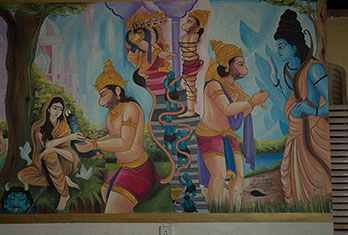
 The life of Ravana, one of the most powerful beings ever to roam the universe, if Hindu legends are to be believed, had unfolded in the small island Sri Lanka, where he ruled with mighty power over gods, humans and demons. Valmiki’s Ramayana paint Ravana as a tyrant of mighty power who was holding the gods at ransom, and he continues to be treated as a blackguard in India even today. In the classic text, he is found kidnapping Rama’s wife Sita, to claim vengeance on Rama and his brother Lakshmana for having cut off the nose of his sister Surpanakha. Yet Ravana of Sri Lanka is portrayed to be a different king and a human. He is described as a devout follower of the god Shiva, a great scholar, a capable ruler and a maestro of aveena, known as the ravanhattha. The story goes that Ravana in order to please his mother had decided to bring the mountain Kailash to Sri Lanka. As he lifted up the mountain, God Shiva was angered by his arrogance and pushed it back down, trapping Ravana. The King of Lanka had torn off one of his own arms and made a musical instrument, ripping out sinews to form the strings. He used the newly invented ravanhattha to sing the praises of Shiva, creating music of such beauty that Shiva wept and forgave him. According to Hindu mythology Ravana was born to a great sage Vishrava and his wife, princess Kaikesi. He was born in the Devagana, as his grandfather, the sage Pulastya, was one of the ten Prajapatis or mind-born sons of Brahma and one of the Saptarishi or the Seven Great Sages during the age of Manu.Ravana’s siblings include Vibhishana, Kumbhakarna and Ahiravana and a step brother Kubera, from whom he usurped the Kingdom of Lanka.
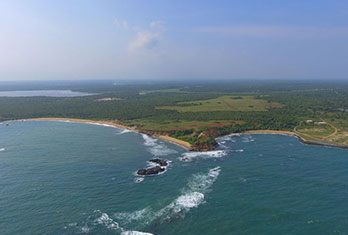
 Some even go as far as to insist that Ravana was a Buddhist king and holds him to be the creator of monasteries found in Sri Lanka like Kuragala and Rahalgala. The country is filled with locations which are linked to the Ravana legend like SitaElisa in NumaraElisa, which is believed to be a prison of Princess Sita while Wariyapola and Horton Plains are considered to be the landing sites of his flying machine. Rumassala, a mountain peak by the Southern oceans of Sri Lanka is too linked to the Ravana legend and is held to be a part of the Himalaya Mountain. The mountain filled with medicinal plants was allegedly brought to Sri Lanka to treat the injured of the Rama-Ravana war was left in the country and is still filled with herbs of rare medicinal value. Adam’s Bridge, a chain of limestone shoals, between Rameswaram Island, off the south eastern coast of Tamil Nadu, India, and Mannar Island, off the north western coast of Sri Lanka too is connected to the legend of Ravana. Also known as Rama-Sethu or Rama’s bridge the land mass is believed to be a bridge built by monkeys interconnecting India and Sri Lanka and enabling the crossing of Rama’s army. Investigations conducted by Indian National Remote Sensing Agency had suggested that the land connection could be a manmade structure built 5000 to 3500 years ago. Yet Sri Lankan Ravana fans contradict its origin and its builder. Sri Lankan historians believe that the bridge was built by Ravana and was a floating structure connecting Lanka with lands in India.
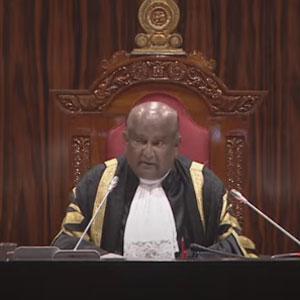 Parliament, July 26 (Daily Mirror)- The Speaker and Chairman of the Constitutional Council (CC) said today that removing the IGP requires a special procedure and the situation with regard to the IGP cannot be resolved by the President, and the matter must be sorted out in court if necessary.