The Ministry of Defence has learned that a number of retired war veterans who had immensely devoted their lives to defend the country during the 30 – year long terrorist war have got caught to a scheme by some illegal foreign job agents and have sent to the Russian-Ukrainian war front as members of mercenary groups.
It is also revealed that a significant number of war veterans have died and sustained injuries at the battlefield. It is regrettable that such war veterans who have served and retired with honour in the armed forces of Sri Lanka are acting as mercenaries in foreign countries. These war veterans have left to the Russian-Ukrainian war front as mercenaries after being duped by these human traffickers who had promised them opportunity to join the foreign army, handsome salary, citizenship in those countries and other benefits. However, neither the serving nor the injured had received any salaries or benefits and these traffickers have not even given any sort of compensation to the families of those injured or the dead. Further, they have failed to provide any information of the whereabouts of those war veterans to their families as well.
The Ministry of Defence and the Ministry of Foreign Affairs are making great efforts to obtain factual information about the war veterans and casualties at the Russian-Ukrainian war front.
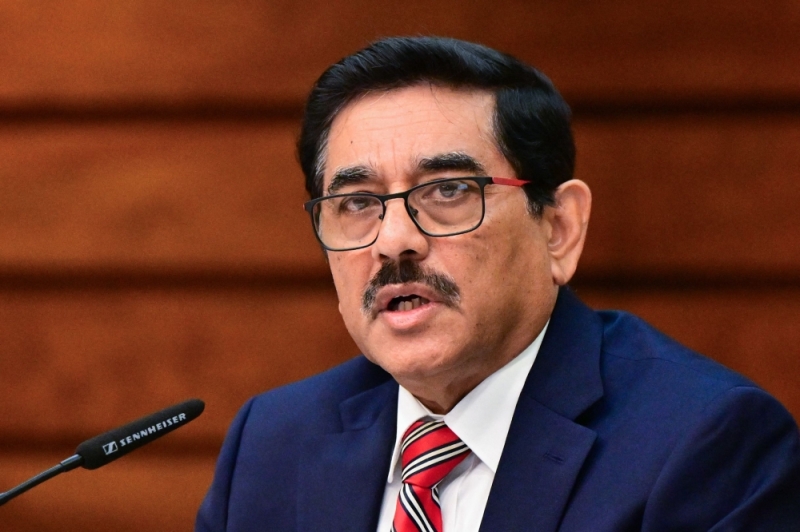
The Defence Secretary has made a special request to the war veterans not to be caught to such illegal schemes and put their lives at risk by joining foreign mercenary groups and also think of the plight of their families before doing so.
The Criminal Investigation Department (CID), Police and Intelligence agencies have launched extensive operations to arrest such illegal human traffickers and several people involved in it have already been taken into custody.
While emphasizing that these war veterans who are Sri Lankan citizens cannot be allowed to be used as mercenaries in foreign land and put their lives at risk, the Defence Secretary further states that the law will be strictly enforced against the illegal human smugglers, establishments and others involved in these illegal activities.
May 8 (AdaDerana) – Sri Lanka has shown a significant drop in annual birth rate while the number of annual deaths has increased since 2020, the Registrar General’s Department revealed.
The Senior Deputy Registrar General, Attorney-at-Law Lakshika Ganepola stated that the number of annual births which was around 325,000 before 2020 has now decreased to 280,000.
Meanwhile, the number of annual deaths has increased to around 180,000, which was 140,000 before 2020, as per reports.
The Registrar General’s Department points out that this situation will adversely affect Sri Lanka’s population growth.
In another survey, Professor Wasantha Athukorala, who participated in the survey from the Department of Economics and Statistics of the University of Peradeniya, revealed that Sri Lanka’s population dropped by 144,000 in 2023 compared to 2022. That is a 0.6% decrease.
The survey data suggests a combination of factors contributing to this decline.
These include an increase in the death rate, a decrease in the birth rate, and a rise in emigration.
Compared to the previous year, the number of births in 2023 fell by 27,421. The number of deaths has gone up by 8%.
The report also indicates a decrease of 19,784 marriages.
Former CEO of the National Medicines Regulatory Authority (NMRA) Dr. Vijith Gunasekara, has been arrested by the Criminal Investigation Department (CID) on Wednesday (08).
He has been questioned for more than 10 hours following the arrest.
Dr. Gunasekara was apprehended by the CID in connection with the procurement of substandard human intravenous immunoglobulin (IVIG) vials.
The Supreme Court on Wednesday (May 08) declared that State Minister Diana Gamage is not legally qualified to hold a parliamentary seat.
Accordingly, delivering its verdict today, the three-judge Supreme Court bench decided that State Minister Diana Gamage is not eligible to hold the position of Member of Parliament.
The court had concluded the hearing of an appeal filed challenging the Appeals Court’s dismissal of a petition against State Minister Diana Gamage’s parliamentary membership. Upon concluding the proceedings on February 13, the judge bench decided to defer its verdict indefinitely.
Social activist Oshala Herath had put forward the appeals two weeks after the petition he had filed against the State Minister’s parliamentary seat and citizenship was dismissed by the Appeals Court.
Naming Gamage and several others as the respondents of his appeal, Herath said he had previously filed a petition alleging that the lawmaker is unqualified to hold the position of a member of parliament in Sri Lanka, as she also holds dual citizenship.
May day has come and gone leaving a few significant lessons for the major political parties. First lesson is that the NPP has shown that they are a force to reckon with. They were able to muster massive crowds not only at the main venue in Colombo but assemble similar numberss in three outstations simultaneously. They were oozing with confidence. But head counts have to be converted to votes. A good example are the mammoth crowds that the JVP mustered by the JVP on Galle Face before the 2019 Presidential elections. But JVP was not able to exceed 4 % of the votes at the Presidnential elections and the subsequent Parliamentary elections.
That is history of politics in SL which has become irrellevant today. It has has changed radically during the last few years. The shock of Corvid 19 and the catharsis of the economic debacle has changed the very basis of the belief in Parliamentay democracy. The present blooming emergence of the NPP will lead to serious brainstorming on the best way to meet the looming threat. It will be desperate maneurvers for survival where some will have to make sacrifices. New strategies will be adopted. New alliances will be made. A likely coalition will be for the old UNP parties to forge together. They have no major policy differences other than the Sajith’s ego which can be assuaged making him number two and be the chief in the next round. With many of Sajith’s group joining Ranil it will be difficult for Sajith to get up to 50 percent plus.
The present strength of the SLPP has not been tested. They seem to still depend on the leadership of Mahinda Rajapaksa. The presence of Basil has supresed the emergence of Namal as a leader. Basil is a drag on the party but the backing of US. SLPP also has the support of the conservative left. They also have the advantage of the force of inertia which will be there with the 6.9 million people who voted with the SLPP. They have to do some soul searching before they change their previous stand. Ranil may prefer to work with Basil rather than with Sajith who has a grievance against him.
This being the Presidential election the candidate matters as much as the perfomance and policies of his party. Ranil has already played two trump cards which the opposition has not callenged. His Aswesuma is another temporary handout which has little lasting impact. It would have been much better if at least half of the Aswesuma is used to create productive employment. Give fishing rods rather than some fish. His second trump card is the issue of land grants to LDO permit holders. Making peasant lands a marketable commodity will result in fragmentation, litigation and transfer of land to mudalalis and foreigners. The most recent trump he has pulled out is the wage increase of Plantaion workers against the wishes of the Plantation owners. The outcome is that the Minister threatens to renationalize the plantations. It is a contradictory situation where profit making state enterprises are privatized and loss makin plantions are nationalised. His immmediate bugbear is the settlement of the ISB payments which was his own making under the Yahapalanaya.
A new progressive force is emerging with the rise of the MJP of whih the strength is th presidential candidate. This dark horse candidate has no past baggage and is a tested out professional but his new pary MJP is still not visible although Derana has done plenty of ground work which wiil be of immense use. A strong left force can be molded if MJP joins the CP, Wimal and Gammanpila combinations. They have the most compelling indictments on Ranil and his politics. The more they condemn Ranil the NPP will also benefit from it.
At the moment the NPP apperars to be moving towards the crest of a wave in popularity. They have only to maintain the momentum and not do any stupid thing, for which they have a popensity, to be on top in the next few months.
They allow you to explore the world, now and back through the years. Which nations are spending how much money on militaries? Which are spending how much per capita? Which are exporting weapons? Which are importing weapons from the dominant weapons exporter (hint: it’s also the self-appointed captain of the Rules Based Order)?
Which nations have wars? Is there any overlap with those producing weapons? Which nations possess which horrible weapons?
What is the shape of the U.S.-NATO global empire: where are the bases? how many troops are there? For more details on bases, you can also click through to this source, also newly updated: https://worldbeyondwar.org/no-bases
Which nations are supporting peaceful initiatives, treaties, and institutions that might reduce the slaughter of war? And which still need to be urged to do so?
We make these resources available to the world for the betterment of the peace movements of the world, even while struggling to pay our bills and uncertain of our future because of it. Please share them widely.
In Washington-Speak, Palestinian State” Means Fried Chicken”
The fact that the Israel-Palestine conflict grinds on without resolution might appear to be rather strange. For many of the world’s conflicts, it is difficult even to conjure up a feasible settlement. In this case, it is not only possible, but there is near universal agreement on its basic contours: a two-state settlement along the internationally recognized (pre-June 1967) borders — with minor and mutual modifications,” to adopt official U.S. terminology before Washington departed from the international community in the mid-1970s.
The basic principles have been accepted by virtually the entire world, including the Arab states (who go on to call for full normalization of relations), the Organization of Islamic States (including Iran), and relevant non-state actors (including Hamas). A settlement along these lines was first proposed at the U.N. Security Council in January 1976 by the major Arab states. Israel refused to attend the session. The U.S. vetoed the resolution, and did so again in 1980. The record at the General Assembly since is similar.
There was one important and revealing break in U.S.-Israeli rejectionism. After the failed Camp David agreements in 2000, President Clinton recognized that the terms he and Israel had proposed were unacceptable to any Palestinians. That December, he proposed his parameters”: imprecise, but more forthcoming. He then stated that both sides had accepted the parameters, while expressing reservations.
Israeli and Palestinian negotiators met in Taba, Egypt, in January 2001 to resolve the differences and were making considerable progress. In their final press conference, they reported that, with a little more time, they could probably have reached full agreement. Israel called off the negotiations prematurely, however, and official progress then terminated, though informal discussions at a high level continued leading to the Geneva Accord, rejected by Israel and ignored by the U.S.
A good deal has happened since, but a settlement along those lines is still not out of reach — if, of course, Washington is once again willing to accept it. Unfortunately, there is little sign of that.
Substantial mythology has been created about the entire record, but the basic facts are clear enough and quite well documented.
The U.S. and Israel have been acting in tandem to extend and deepen the occupation. In 2005, recognizing that it was pointless to subsidize a few thousand Israeli settlers in Gaza, who were appropriating substantial resources and protected by a large part of the Israeli army, the government of Ariel Sharon decided to move them to the much more valuable West Bank and Golan Heights.
Instead of carrying out the operation straightforwardly, as would have been easy enough, the government decided to stage a national trauma,” which virtually duplicated the farce accompanying the withdrawal from the Sinai desert after the Camp David agreements of 1978-79. In each case, the withdrawal permitted the cry of Never Again,” which meant in practice: we cannot abandon an inch of the Palestinian territories that we want to take in violation of international law. This farce played very well in the West, though it was ridiculed by more astute Israeli commentators, among them that country’s prominent sociologist the late Baruch Kimmerling.
After its formal withdrawal from the Gaza Strip, Israel never actually relinquished its total control over the territory, often described realistically as the world’s largest prison.” In January 2006, a few months after the withdrawal, Palestine had an election that was recognized as free and fair by international observers. Palestinians, however, voted the wrong way,” electing Hamas. Instantly, the U.S. and Israel intensified their assault against Gazans as punishment for this misdeed. The facts and the reasoning were not concealed; rather, they were openly published alongside reverential commentary on Washington’s sincere dedication to democracy. The U.S.-backed Israeli assault against the Gazans has only been intensified since, thanks to violence and economic strangulation, increasingly savage.
Meanwhile in the West Bank, always with firm U.S. backing, Israel has been carrying forward longstanding programs to take the valuable land and resources of the Palestinians and leave them in unviable cantons, mostly out of sight. Israeli commentators frankly refer to these goals as neocolonial.” Ariel Sharon, the main architect of the settlement programs, called these cantons Bantustans,” though the term is misleading: South Africa needed the majority black workforce, while Israel would be happy if the Palestinians disappeared, and its policies are directed to that end.
Blockading Gaza by Land and Sea
One step towards cantonization and the undermining of hopes for Palestinian national survival is the separation of Gaza from the West Bank. These hopes have been almost entirely consigned to oblivion, an atrocity to which we should not contribute by tacit consent. Israeli journalist Amira Hass, one of the leading specialists on Gaza, writes that
the restrictions on Palestinian movement that Israel introduced in January 1991 reversed a process that had been initiated in June 1967. Back then, and for the first time since 1948, a large portion of the Palestinian people again lived in the open territory of a single country — to be sure, one that was occupied, but was nevertheless whole.… The total separation of the Gaza Strip from the West Bank is one of the greatest achievements of Israeli politics, whose overarching objective is to prevent a solution based on international decisions and understandings and instead dictate an arrangement based on Israel’s military superiority.…
Since January 1991, Israel has bureaucratically and logistically merely perfected the split and the separation: not only between Palestinians in the occupied territories and their brothers in Israel, but also between the Palestinian residents of Jerusalem and those in the rest of the territories and between Gazans and West Bankers/Jerusalemites. Jews live in this same piece of land within a superior and separate system of privileges, laws, services, physical infrastructure and freedom of movement.”
The leading academic specialist on Gaza, Harvard scholar Sara Roy, adds:
Gaza is an example of a society that has been deliberately reduced to a state of abject destitution, its once productive population transformed into one of aid-dependent paupers.… Gaza’s subjection began long before Israel’s recent war against it [December 2008]. The Israeli occupation — now largely forgotten or denied by the international community — has devastated Gaza’s economy and people, especially since 2006…. After Israel’s December [2008] assault, Gaza’s already compromised conditions have become virtually unlivable. Livelihoods, homes, and public infrastructure have been damaged or destroyed on a scale that even the Israel Defense Forces admitted was indefensible.
In Gaza today, there is no private sector to speak of and no industry. 80 percent of Gaza’s agricultural crops were destroyed and Israel continues to snipe at farmers attempting to plant and tend fields near the well-fenced and patrolled border. Most productive activity has been extinguished.… Today, 96 percent of Gaza’s population of 1.4 million is dependent on humanitarian aid for basic needs. According to the World Food Programme, the Gaza Strip requires a minimum of 400 trucks of food every day just to meet the basic nutritional needs of the population. Yet, despite a March [22, 2009] decision by the Israeli cabinet to lift all restrictions on foodstuffs entering Gaza, only 653 trucks of food and other supplies were allowed entry during the week of May 10, at best meeting 23 percent of required need. Israel now allows only 30 to 40 commercial items to enter Gaza compared to 4,000 approved products prior to June 2006.”
It cannot be too often stressed that Israel had no credible pretext for its 2008–9 attack on Gaza, with full U.S. support and illegally using U.S. weapons. Near-universal opinion asserts the contrary, claiming that Israel was acting in self-defense. That is utterly unsustainable, in light of Israel’s flat rejection of peaceful means that were readily available, as Israel and its U.S. partner in crime knew very well. That aside, Israel’s siege of Gaza is itself an act of war, as Israel of all countries certainly recognizes, having repeatedly justified launching major wars on grounds of partial restrictions on its access to the outside world, though nothing remotely like what it has long imposed on Gaza.
One crucial element of Israel’s criminal siege, little reported, is the naval blockade. Peter Beaumont reports from Gaza that, on its coastal littoral, Gaza’s limitations are marked by a different fence where the bars are Israeli gunboats with their huge wakes, scurrying beyond the Palestinian fishing boats and preventing them from going outside a zone imposed by the warships.” According to reports from the scene, the naval siege has been tightened steadily since 2000. Fishing boats have been driven steadily out of Gaza’s territorial waters and toward the shore by Israeli gunboats, often violently without warning and with many casualties. As a result of these naval actions, Gaza’s fishing industry has virtually collapsed; fishing is impossible near shore because of the contamination caused by Israel’s regular attacks, including the destruction of power plants and sewage facilities.
These Israeli naval attacks began shortly after the discovery by the BG (British Gas) Group of what appear to be quite sizeable natural gas fields in Gaza’s territorial waters. Industry journals report that Israel is already appropriating these Gazan resources for its own use, part of its commitment to shift its economy to natural gas. The standard industry source reports:
Israel’s finance ministry has given the Israel Electric Corp. (IEC) approval to purchase larger quantities of natural gas from BG than originally agreed upon, according to Israeli government sources [which] said the state-owned utility would be able to negotiate for as much as 1.5 billion cubic meters of natural gas from the Marine field located off the Mediterranean coast of the Palestinian controlled Gaza Strip.
Last year the Israeli government approved the purchase of 800 million cubic meters of gas from the field by the IEC…. Recently the Israeli government changed its policy and decided the state-owned utility could buy the entire quantity of gas from the Gaza Marine field. Previously the government had said the IEC could buy half the total amount and the remainder would be bought by private power producers.”
The pillage of what could become a major source of income for Gaza is surely known to U.S. authorities. It is only reasonable to suppose that the intention to appropriate these limited resources, either by Israel alone or together with the collaborationist Palestinian Authority, is the motive for preventing Gazan fishing boats from entering Gaza’s territorial waters.
There are some instructive precedents. In 1989, Australian foreign minister Gareth Evans signed a treaty with his Indonesian counterpart Ali Alatas granting Australia rights to the substantial oil reserves in the Indonesian Province of East Timor.” The Indonesia-Australia Timor Gap Treaty, which offered not a crumb to the people whose oil was being stolen, is the only legal agreement anywhere in the world that effectively recognises Indonesia’s right to rule East Timor,” the Australian press reported.
Asked about his willingness to recognize the Indonesian conquest and to rob the sole resource of the conquered territory, which had been subjected to near-genocidal slaughter by the Indonesian invader with the strong support of Australia (along with the U.S., the U.K., and some others), Evans explained that there is no binding legal obligation not to recognise the acquisition of territory that was acquired by force,” adding that the world is a pretty unfair place, littered with examples of acquisition by force.”
It should, then, be unproblematic for Israel to follow suit in Gaza.
A few years later, Evans became the leading figure in the campaign to introduce the concept responsibility to protect” — known as R2P — into international law. R2P is intended to establish an international obligation to protect populations from grave crimes. Evans is the author of a major book on the subject and was co-chair of the International Commission on Intervention and State Sovereignty, which issued what is considered the basic document on R2P.
In an article devoted to this idealistic effort to establish a new humanitarian principle,” the London Economist featured Evans and his bold but passionate claim on behalf of a three-word expression which (in quite large part thanks to his efforts) now belongs to the language of diplomacy: the ‘responsibility to protect.’” The article is accompanied by a picture of Evans with the caption Evans: a lifelong passion to protect.” His hand is pressed to his forehead in despair over the difficulties faced by his idealistic effort. The journal chose not to run a different photo that circulates in Australia, depicting Evans and Alatas exuberantly clasping their hands together as they toast the Timor Gap Treaty that they had just signed.
Though a protected population” under international law, Gazans do not fall under the jurisdiction of the responsibility to protect,” joining other unfortunates, in accord with the maxim of Thucydides — that the strong do as they wish, and the weak suffer as they must — which holds with its customary precision.
Obama and the Settlements
The kinds of restrictions on movement used to destroy Gaza have long been in force in the West Bank as well, less cruelly but with grim effects on life and the economy. The World Bank reports that Israel has established a complex closure regime that restricts Palestinian access to large areas of the West Bank… The Palestinian economy has remained stagnant, largely because of the sharp downturn in Gaza and Israel’s continued restrictions on Palestinian trade and movement in the West Bank.”
The World Bank cited Israeli roadblocks and checkpoints hindering trade and travel, as well as restrictions on Palestinian building in the West Bank, where the Western-backed government of Palestinian president Mahmoud Abbas holds sway.” Israel does permit — indeed encourage — a privileged existence for elites in Ramallah and sometimes elsewhere, largely relying on European funding, a traditional feature of colonial and neocolonial practice.
All of this constitutes what Israeli activist Jeff Halper calls a matrix of control” to subdue the colonized population. These systematic programs over more than 40 years aim to establish Defense Minister Moshe Dayan’s recommendation to his colleagues shortly after Israel’s 1967 conquests that we must tell the Palestinians in the territories: We have no solution, you shall continue to live like dogs, and whoever wishes may leave, and we will see where this process leads.”
Turning to the second bone of contention, settlements, there is indeed a confrontation, but it is rather less dramatic than portrayed. Washington’s position was presented most strongly in Secretary of State Hillary Clinton’s much-quoted statement rejecting natural growth exceptions” to the policy opposing new settlements. Prime Minister Benjamin Netanyahu, along with President Shimon Peres and, in fact, virtually the whole Israeli political spectrum, insists on permitting natural growth” within the areas that Israel intends to annex, complaining that the United States is backing down on George W. Bush’s authorization of such expansion within his vision” of a Palestinian state.
Senior Netanyahu cabinet members have gone further. Transportation Minister Yisrael Katz announced that the current Israeli government will not accept in any way the freezing of legal settlement activity in Judea and Samaria.” The term legal” in U.S.-Israeli parlance means illegal, but authorized by the government of Israel with a wink from Washington.” In this usage, unauthorized outposts are termed illegal,” though apart from the dictates of the powerful, they are no more illegal than the settlements granted to Israel under Bush’s vision” and Obama’s scrupulous omission.
The Obama-Clinton hardball” formulation is not new. It repeats the wording of the Bush administration draft of the 2003 Road Map, which stipulates that in Phase I, Israel freezes all settlement activity (including natural growth of settlements).” All sides formally accept the Road Map (modified to drop the phrase natural growth”) — consistently overlooking the fact that Israel, with U.S. support, at once added 14 reservations” that render it inoperable.
If Obama were at all serious about opposing settlement expansion, he could easily proceed with concrete measures by, for example, reducing U.S. aid by the amount devoted to this purpose. That would hardly be a radical or courageous move. The Bush I administration did so (reducing loan guarantees), but after the Oslo accord in 1993, President Clinton left calculations to the government of Israel. Unsurprisingly, there was no change in the expenditures flowing to the settlements,” the Israeli press reported. [Prime Minister] Rabin will continue not to dry out the settlements,” the report concludes. And the Americans? They will understand.”
Obama administration officials informed the press that the Bush I measures are not under discussion,” and that pressures will be largely symbolic.” In short, Obama understands, just as Clinton and Bush II did.
American Visionaries
At best, settlement expansion is a side issue, rather like the issue of illegal outposts” — namely those that the government of Israel has not authorized. Concentration on these issues diverts attention from the fact that there are no legal outposts” and that it is the existing settlements that are the primary problem to be faced.
The U.S. press reports that a partial freeze has been in place for several years, but settlers have found ways around the strictures… [C]onstruction in the settlements has slowed but never stopped, continuing at an annual rate of about 1,500 to 2,000 units over the past three years. If building continues at the 2008 rate, the 46,500 units already approved will be completed in about 20 years.… If Israel built all the housing units already approved in the nation’s overall master plan for settlements, it would almost double the number of settler homes in the West Bank.” Peace Now, which monitors settlement activities, estimates further that the two largest settlements would double in size: Ariel and Ma’aleh Adumim, built mainly during the Oslo years in the salients that subdivide the West Bank into cantons.
Natural population growth” is largely a myth, Israel’s leading diplomatic correspondent, Akiva Eldar, points out, citing demographic studies by Colonel (res.) Shaul Arieli, deputy military secretary to former prime minister and incumbent defense minister Ehud Barak. Settlement growth consists largely of Israeli immigrants in violation of the Geneva Conventions, assisted with generous subsidies. Much of it is in direct violation of formal government decisions, but carried out with the authorization of the government, specifically Barak, considered a dove in the Israeli spectrum.
Correspondent Jackson Diehl derides the long-dormant Palestinian fantasy,” revived by President Abbas, that the United States will simply force Israel to make critical concessions, whether or not its democratic government agrees.” He does not explain why refusal to participate in Israel’s illegal expansion — which, if serious, would force Israel to make critical concessions” — would be improper interference in Israel’s democracy.
Returning to reality, all of these discussions about settlement expansion evade the most crucial issue about settlements: what the United States and Israel have already established in the West Bank. The evasion tacitly concedes that the illegal settlement programs already in place are somehow acceptable (putting aside the Golan Heights, annexed in violation of Security Council orders) — though the Bush vision,” apparently accepted by Obama, moves from tacit to explicit support for these violations of law. What is in place already suffices to ensure that there can be no viable Palestinian self-determination. Hence, there is every indication that even on the unlikely assumption that natural growth” will be ended, U.S.-Israeli rejectionism will persist, blocking the international consensus as before.
Subsequently, Prime Minister Netanyahu declared a 10-month suspension of new construction, with many exemptions, and entirely excluding Greater Jerusalem, where expropriation in Arab areas and construction for Jewish settlers continues at a rapid pace. Hillary Clinton praised these unprecedented” concessions on (illegal) construction, eliciting anger and ridicule in much of the world.
It might be different if a legitimate land swap” were under consideration, a solution approached at Taba and spelled out more fully in the Geneva Accord reached in informal high-level Israel-Palestine negotiations. The accord was presented in Geneva in October 2003, welcomed by much of the world, rejected by Israel, and ignored by the United States.
Washington’s Evenhandedness”
Barack Obama’s June 4, 2009, Cairo address to the Muslim world kept pretty much to his well-honed blank slate” style — with little of substance, but presented in a personable manner that allows listeners to write on the slate what they want to hear. CNN captured its spirit in headlining a report Obama Looks to Reach the Soul of the Muslim World.” Obama had announced the goals of his address in an interview with New York Times columnist Thomas Friedman. ‘We have a joke around the White House,’ the president said. ‘We’re just going to keep on telling the truth until it stops working and nowhere is truth-telling more important than the Middle East.’” The White House commitment is most welcome, but it is useful to see how it translates into practice.
Obama admonished his audience that it is easy to point fingers… but if we see this conflict only from one side or the other, then we will be blind to the truth: the only resolution is for the aspirations of both sides to be met through two states, where Israelis and Palestinians each live in peace and security.”
Turning from Obama-Friedman Truth to truth, there is a third side, with a decisive role throughout: the United States. But that participant in the conflict Obama omitted. The omission is understood to be normal and appropriate, hence unmentioned: Friedman’s column is headlined Obama Speech Aimed at Both Arabs and Israelis.” The front-page Wall Street Journal report on Obama’s speech appears under the heading Obama Chides Israel, Arabs in His Overture to Muslims.” Other reports are the same.
The convention is understandable on the doctrinal principle that though the U.S. government sometimes makes mistakes, its intentions are by definition benign, even noble. In the world of attractive imagery, Washington has always sought desperately to be an honest broker, yearning to advance peace and justice. The doctrine trumps truth, of which there is little hint in the speech or the mainstream coverage of it.
Obama once again echoed Bush’s vision” of two states, without saying what he meant by the phrase Palestinian state.” His intentions were clarified not only by the crucial omissions already discussed, but also by his one explicit criticism of Israel: The United States does not accept the legitimacy of continued Israeli settlements. This construction violates previous agreements and undermines efforts to achieve peace. It is time for these settlements to stop.” That is, Israel should live up to Phase I of the 2003 Road Map, rejected at once by Israel with tacit U.S. support, as noted — though the truth is that Obama has ruled out even steps of the Bush I variety to withdraw from participation in these crimes.
The operative words are legitimacy” and continued.” By omission, Obama indicates that he accepts Bush’s vision: the vast existing settlement and infrastructure projects are legitimate,” thus ensuring that the phrase Palestinian state” means fried chicken.”
Always even-handed, Obama also had an admonition for the Arab states: they must recognize that the Arab Peace Initiative was an important beginning, but not the end of their responsibilities.” Plainly, however, it cannot be a meaningful beginning” if Obama continues to reject its core principles: implementation of the international consensus. To do so, however, is evidently not Washington’s responsibility” in Obama’s vision; no explanation given, no notice taken.
On democracy, Obama said that we would not presume to pick the outcome of a peaceful election” — as in January 2006, when Washington picked the outcome with a vengeance, turning at once to severe punishment of the Palestinians because it did not like the outcome of a peaceful election, all with Obama’s apparent approval judging by his words before, and actions since, taking office.
Obama politely refrained from comment about his host, President Mubarak, one of the most brutal dictators in the region, though he has had some illuminating words about him. As he was about to board a plane to Saudi Arabia and Egypt, the two moderate” Arab states, Mr. Obama signaled that while he would mention American concerns about human rights in Egypt, he would not challenge Mr. Mubarak too sharply, because he is a ‘force for stability and good’ in the Middle East… Mr. Obama said he did not regard Mr. Mubarak as an authoritarian leader. ‘No, I tend not to use labels for folks,’ Mr. Obama said. The president noted that there had been criticism ‘of the manner in which politics operates in Egypt,’ but he also said that Mr. Mubarak had been ‘a stalwart ally, in many respects, to the United States.’”
When a politician uses the word folks,” we should brace ourselves for the deceit, or worse, that is coming. Outside of this context, there are people,” or often villains,” and using labels for them is highly meritorious. Obama is right, however, not to have used the word authoritarian,” which is far too mild a label for his friend.
Just as in the past, support for democracy, and for human rights as well, keeps to the pattern that scholarship has repeatedly discovered, correlating closely with strategic and economic objectives. There should be little difficulty in understanding why those whose eyes are not closed tight shut by rigid doctrine dismiss Obama’s yearning for human rights and democracy as a joke in bad taste.
[Note: All material in this piece is sourced and footnoted in Noam Chomsky’s new book Hopes and Prospects.]
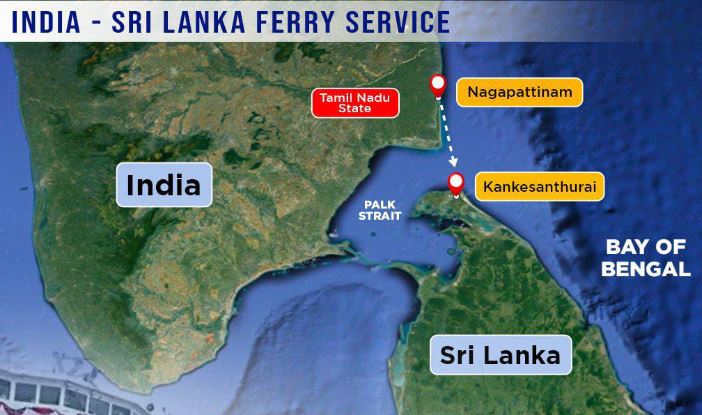
Colombo, May 7: The passenger ferry service between Nagapattinam in Tami Nadu and Kankesanthurai (KKS) near Jaffna, which was launched in October 2023, will resume on May 13, the Indian High Commission in Colombo has said.
Sri Lankan Buddhists would be interested to know that Nagapattinam was among the first and the last centres of Buddhism in South India. Even now, there are places like Sangamangalam, Buddhamangalam and Putthakkudy around Nagapattinam, as a reminder of the region’s Buddhist past.
ADVERTISEMENT
Nagapattinam was a major port city of the medieval Chola kingdom (9 th. to the 13 th.Century AD) with maritime trade links with many East Asian countries. Stone and clay statues of the Buddha from the 2nd Century AD and the remains of monasteries were found in Poompuhar, a nearby town.
According to www.medium.com the Pallava king Narasimhavarman II (7th to 8th AD) built a Buddha Vihara at Nagapattinam. The Chudamani Vihara in Nagapattinam was constructed by the Srivijayan king Sri Mara Vijayattungavarman of the Sailendra dynasty with the help of Rajaraja Chola I.
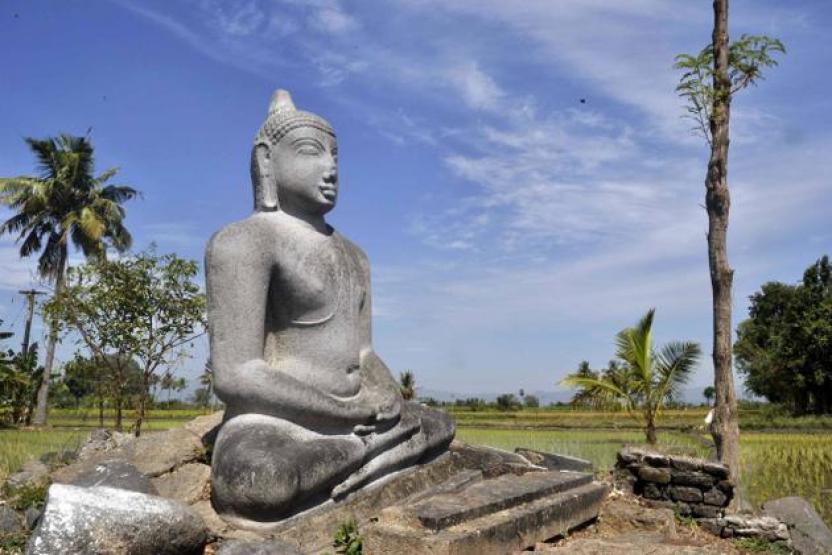
About 350 bronze statues have been unearthed in Nagapattinam. The bronze statues found in Nagapattinam belong to various periods between 9th and the 17th Century AD. Around Nagapattinam, there are also many ancient stone statues of the Buddha (dated between 8th and 10th Century AD) in places such as Pushpavanam, Peruncheri, Buddhamangalam etc. From these names it can be inferred that Mahayana Buddhism thrived in Nagapattinam till 17th Century AD,” www.medium.com says.
Before the ascendance of Saivism and Vaishnavism in Tamil Nadu, Buddhism and Jainism prevailed there. Nagapattinam and Kanchipuram were the main centres of these religions.
At that time, artisans of Nagapattinam produced metal figures of Buddhist and Jain deities besides Hindu gods. This was so till the 13th century. Transient merchants and pilgrims from Sri Lanka, Southeast Asia, and China patronised the religious and artistic activities in Nagapattinam. Portable bronze figures of the Buddha were carried by these itinerant communities to South East and East Asia.
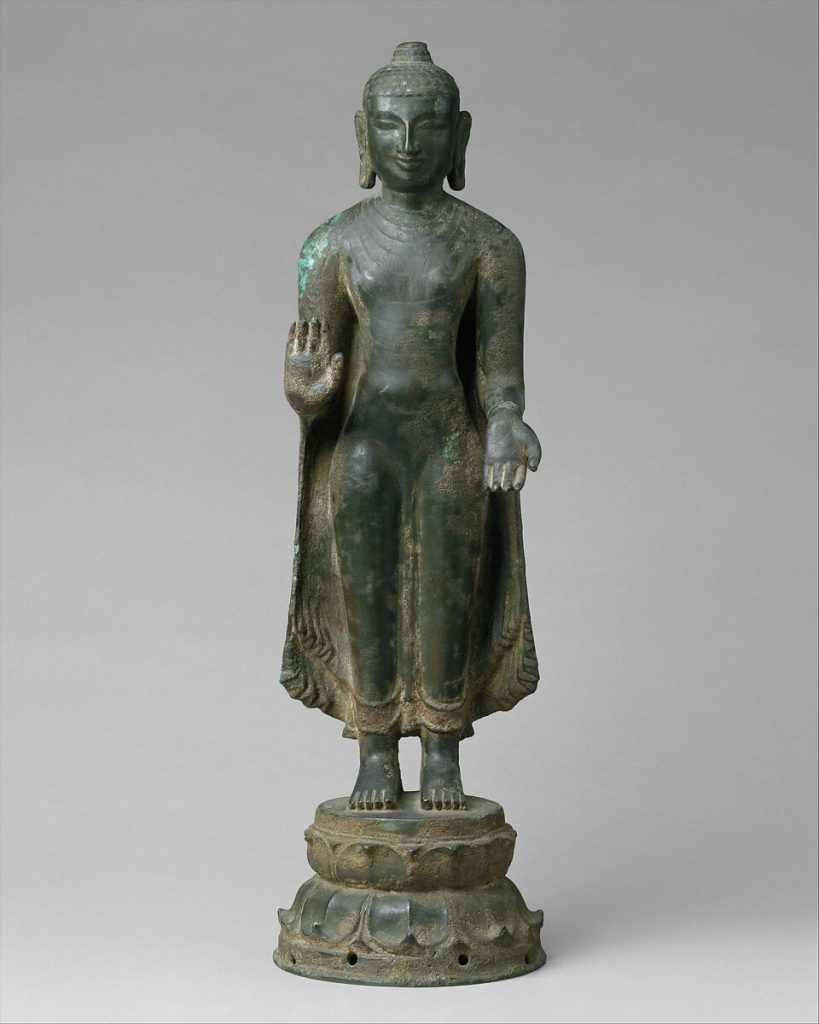
In an article in The Hindu, T.S.Subramanian described some of the masterpieces found in Nagapattinam. There is a Buddha sculpture in metal only 52 cm tall. It is a masterpiece in the detail it contains. The Buddha is seated on a throne, his right hand in the upadesa mudra and an umbrella high above his head. An ushnisha (flame of knowledge) is prominent on his head and the creepers around the umbrella signify the Bodhi tree.”
Buddha offering protection. Nagapattinam
Around the Buddha, in the outer row, is a full orchestra” — several men are playing the lute and other stringed instruments, a couple of them are playing percussion instruments like the mridangam and there is also a rasika with his hand stretched out and enjoying the music.”
Buddhism came to South India in the Second Century BC, before the third Sangam period (Third Century BC to Third Century AD). Dr. Nirmala Chandrahasan quotes from Hisselle Dharmaratana Maha Thera’s Buddhism in South India to say that there is evidence that Ven. Mahinda Thera, Emperor Asoka’s son, had spread Buddhism in Tamil Nadu.
Dharmaratna Maha Thera says: Although the chronicles say he arrived through his supernatural powers, scholars are of the opinion that he travelled by sea and called at Kaveripattinam on the east coast of Tamil Nadu on his way to Sri Lanka.”
Dr.Shu Hikosaka, Director Professor of Buddhism, Institute of Asian Studies in Madras, in his book Buddhism in Tamil Nadu a new perspective’ shares Dharmartna Thera’s view.
Hsuan Tsang, the 7th Century Chinese Buddhist monk and traveller, mentions that in the Pandyan kingdom at Madurai, there was a monastery built by Mahinda Thera. He also mentions a stupa built by King Asoka in Kanchipuram. Stone inscriptions of Emperor Asoka (Rock Edict no 3) refer to the Dhamma being spread in the Chola and Pandya country in Tamil Nadu besides Sri Lanka.
Dr. Chandrahasan says that Buddhism flourished in Tamil Nadu in two phases, firstly in the early years of the Pallava rule (400 AD to 650 AD), and secondly in the Chola period mid-9th to the early 14th century AD. There were many centres of Buddhism in Tamil Nadu. Among them were Nagapattinam, Kanchipuram, Kaveripattinam and Uraiyur.
Hsuan Tsang describes Kanchipuram near Chennai as a flourishing city and states that most of its population was Buddhist. He also says that there were over 100 Buddhist monasteries and over a thousand Buddhist monks there. He mentions the presence of 300 monks from Sri Lanka in the monastery in the Southern part of Kanchipuram.
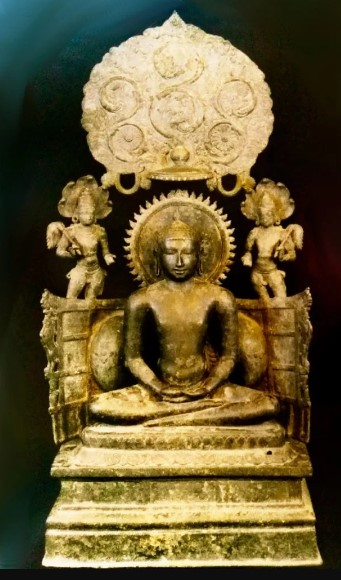
Buddha in meditation, Nagapattinam
The Pallava king Mahendra Varman in his Sanskrit work MattavilasaPrahasana refers to the existence of many Buddhist Viharas, chief of which was the Raja Vihara in his domain.
The interaction between Tamil Nadu monks and Sri Lankan monks is mentioned in the Manimakalai, the 6th Century Tamil literary epic written by Sattanar,” Dr. Chandrahsan points out.
Among the other Tamil literary epics which show the influence of Buddhism are the Silappadhihkaram’ ‘Valaiyapathi Kundalakesi’ and ‘Jivaka Cintamani.
Dr. Hikosaka points out that during the Pallava period Tamil Nadu (275 AD to 897 AD) there were outstanding Tamil Buddhist monks who made remarkable contributions to Buddhist thought and learning. Dr.Chandrahasan mentions Buddhadatte Thera who authored many books. In the Abhidhammaratana, he gives a glowing account of Kaveripattinam and Kanchipuram and the Mahavihara in Sri Lanka.
When Buddhadatta Thera was in Sri Lanka, he composed many Buddhist works such as Uttara Viniccaya, Ruparupa Vibhaga and Jinalankara.
Another famous Tamil monk Dr,Chandrahasan mentions, is Buddhaghosha, a contemporary of Bhuddhadatta. He made a remarkable contribution to Buddhism in Sri Lanka. He stayed and studied Buddhist precepts at the Maha Vihara at Anuradhapura.
KKS-Nagapattinam map
The Visuddimagga was the first work of Buddhaghosha while in Sri Lanka. While staying at the Granthakara Pirivena at Anuradhapura, he rendered Sinhalese commentaries of the Tripitakas into Pali.”
Dhammapala was another Tamil monk mentioned by Dr. Hikosaka. The study of the three monks shows that Tamil Nadu Buddhists were closely associated with Sri Lankan Buddhists. It will be noticed that the monks used the Pali language in their treatises just as in Europe in the middle ages, the Christian monks used Latin,” Dr.Hikosaka points out.
Dr. Chandrahasan argues that since Tamil Nadu was largely Buddhist, one could easily conclude that the Tamil population in the North and East of Sri Lanka was also largely Buddhist. The Tamil Buddhists who followed Theravada Buddhism shared common places of worship with the Sinhalese.
There were also Tamil Buddhists who were followers of Mahayana Buddhism, and these had their own Mahayana temples, she adds.
Colombo, May 4: The 2024 May Day saw-according to some newspapers-41 May Day rallies, meetings or seminars being held throughout the country. Other newspapers lowered the number to 22. Pride of place was given to Colombo where the UNP, JVP/NPP, SLPP and SJB held their rallies. All four parties had big crowds but the attendance was highest at the JVP rally. Furthermore the JVP rallies in Matara and Anuradhapura also had large crowds. Compared to the Thun Sinhala” rallies the JVP rally in Jaffna was a poor show.
The Ceylon Workers Congress (CWC) which is the largest trade union representing plantation workers of Indian descent held its rally in Kotagala. The CWC is a constituent of the Government headed by President Ranil Wickremesinghe. CWC General Secretary Jeevan Thondaman is a Cabinet Minister in the Government. Ranil Wickremesinghe was the chief guest at the huge CWC rally.
ADVERTISEMENT
President Wickremesinghe brought glad tidings of great joy” to the workers gathered in Kotagala. He announced to a wildly cheering audience that the daily wage of plantation workers had been raised from Rs. 1,000 to Rs. 1,700. The 700 rupee increase amounted to a 70% pay rise. The president displayed a copy of the Gazette proclamation to the people. The plight of the plantation workers has prompted many to describe them as the wretched of the up-country earth”. The daily wage increase would no doubt provide a degree of economic relief to them.
Ranil Wickremesinghe also addressed the UNP rally at Maradana in Colombo. There were no grand announcements as in the case of the Kotagala rally. President Wickremesinghe spoke about the difficult situation in which he took over as President and of the economic progress achieved so far. Ranil repeated his appeal to the main Opposition parties to cooperate with the Government in uplifting the country economically. He urged the SJB and JVP to work with him in implementing the agreement with the International Monetary Fund (IMF) once again, Ranil made no pointed reference to the forthcoming presidential election or about his plans to contest polls.
Both the SJB and UNP May Day Rallies were disappointments in another sense. Prior to May Day there was much speculation in the media that a number of MPs from the Sri Lanka Podujana Peramuna (SLPP) would climb the SJB stage on May Day thereby indicating they had defected from the SLPP. Likewise there was speculation that some SJB Parliamentarians would mount the UNP stage on May 1st. Neither of these anticipated crossovers took place.
No SJB Crossovers
I do not know why the much-touted appearance of SLPP Parliamentarians on the SJB stage did not happen. Despite the speculation, I had not written anything about it as I felt it was highly improbable. However, I did refer to the possibility of some SJB parliamentarians mounting the UNP stage on May Day in the second part of this article published last week. As such I probed the nonappearance of the Telephone Party MPs and learn the reasons for the non -event.
Apparently arrangements had been made for fourteen MPs from the Samagi Jana Balawegaya (SJB) to cross over to the Government side by appearing on the UNP stage on May Day. Ten of these were persons who had been Cabinet ministers, state ministers and deputy ministers in the Good Governance” Government headed by President Sirisena and Prime Minister Wickremesinghe from 2015 to 2019. The SJB hierarchy had suspicions about this. Some SJB Bigwigs were engaged in sweet and sour” talks with the potential dissidents to prevent them from pole vaulting.
In an unexpected turn of events the crossover did not take place. This was not because of pressure by the SJB high command. It was due to the intervention of President Ranil Wickremesinghe himself. When Ranil got to know about the crossover plan hatched by his UNP colleagues, he had vetoed it. The UNP leader had communicated with his party deputies involved in the exercise and told them to call it off. He had also got in touch with some of the SJB parliamentarians concerned and asked them to delay their defection plans.
Wickremesinghe had explained the reasons as to why he did not want a SJB crossover at this point of time to both party leaders as well as potential SJB defectors. Ranil said that he was planning to contest the Presidential election as an independent non -party candidate backed by an assorted alliance of parties, groups and individuals. He would declare his candidacy in June or early July. When that happened Ranil wanted everyone including SJB MPs to support him by joining the alliance backing him. As such he did not want crossovers at this juncture.
Vadivel Suresh
This was why the SJB Parliamentarians did not appear on the UNP platform as expected. Nevertheless some top SJB figures were conspicuous by their absence on the SJB party stage on May Day. As far as the UNP Mayday was concerned only one MP elected on the SJB ticket in 2020 was present on the UNP stage. This was Badulla district MP Vadivel Suresh.
The outspoken Vadivel Suresh has been estranged from Sajith Premadasa for several months. Suresh had organized a meeting of Tamil plantation workers in the Badulla district. Sajith was scheduled to address it. Thousands of worker had forfeited their half-day pay in order to attend the event. Sajith had backed out at the last minute saying he was ill. To Suresh’s chagrin, the Badulla district MP discovered that Premadasa had lied to him about being sick. The leader of the Opposition had gone to a meeting with Sinhala people in the Moneragala district.
Angry over this deception and the shabby treatment meted out to the Badulla district Tamil plantation workers, Suresh demanded that Premadasa apologize to the workers. Sajith agreed but did not do as he promised. Suresh therefore began functioning independently. He has been voting with the Government in Parliament. More importantly Suresh is the General Secretary of the influential Lanka Jathika Estate Workers Union (LJEWU). This has now been brought back under the aegis of the UNP. Hence Suresh’s appearance on the UNP stage was no surprise but not much notice was taken of it.
Gayashan Nawananda
There was however another surprise. Though MPs elected on the SJB ticket did not cross, a single MP elected on the SLPP ticket did cross over on May Day. Moneragala district MP Gayashan Nawananda mounted the UNP stage on May Day. Moreover he brought 800 supporters along with him for the UNP rally. Nawananda, a nominee of Vasudeva Nanayakkara on the SLPP List in 2020 has declared himself an independent after the Aragalaya”.
Nawananda’s presence with 800 supporters was indeed a pleasant surprise to the UNP. Since President Wickremesinghe did not want defections or crossovers at this juncture, Nawananda was not lionised as he ought to have been at the UNP rally. Speaking to reporters the Moneragala MP said it was President Ranil Wickremesinghe who can steer the country forward during these trying times. The MP said his support for President Ranil Wickremesinghe should be considered as his support for the country.
Ranil’s Strategy
Ranil’s decisive action in stopping or postponing the SJB MP crossover at this point in time is due to his evolving strategy in facing the 2024 presidential poll. As stated in the second part of this article last week, Ranil Wickremesinghe intends to project himself on a personal level as a presidential candidate because he regards himself as the best choice. He does not want to be a party nominee. Ranil told Party members that this election would not be a party vs party election. It would be more of a clash between personalities.
Therefore, Wickremesinghe would not have a party label. Instead, he would be an independent non-party common candidate (Nirpakshika Podu Apekshaya) backed by a group of parties, organizations and key individuals. He would come forward as a national candidate” backed by people from all ethnicities, religions, regions and all walks of life. In short, Wickremesinghe would be an independent candidate backed by a coalition or alliance. He will have the backing of the alliance but will not be an alliance candidate.
What is noteworthy is that Ranil will be an independent, non-party candidate and not a nominee of the coalition or alliance. This coalition or alliance would not be a collection of political parties alone. It would be an assortment of parties, segments of parties and party individuals. People may join forces cutting across party lines or political alignments. Party members and groups would De-align” from earlier stances and Re-align” in support of Wickremesinghe.
There was a time when Ranil was toying with the idea of getting some MPs of the SJB to join his Government. He interpreted that move as a re-unification of the UNP rather than the fragmenting of the SJB. Most MPs of the SJB were from the UNP or aligned with the UNP who had split with the grand old party and hitched their wagons to the Sajith Premadasa star only because they wanted to win elections. Very few of them were hostile or opposed to Wickremesinghe.
Basil Rajapaksa
Ranil’s attempts to get back some SJB parliamentarians were proving successful when Basil Rajapaksa threw a spanner in the works. The SLPP insisted that if an SJB MP was brought into the Government and made a minister, it must be evenly matched by an SLPP MP also being appointed a minister. Earlier Ranil had resisted all attempts by Basil to get some SLPP stalwarts inducted into the Cabinet. Among these was Kalutara MP Rohitha Ratharang” Abeygunawardena.
When SJB Kalutara MP Dr.Rajitha Senaratne was about to join the Government, Ratharang” demanded that he too should be made a minister. Appointing Ratharan as a minister was disfavoured by Ranil. So Rajitha’s crossover was put on hold.
Ranil was dependent on SLPP votes in Parliament but he wanted to have the ministers he preferred in Cabinet. Basil Rajapaksa wanted to keep Ranil dependent on the SLPP. He did not want Wickremesinghe to strengthen himself by getting MPs from the SJB or elsewhere. In this tricky situation Ranil chose not to bring in new ministers. Thus even the UNP’s solitary MP Wajira Abeywardana was not made a minister.
Waves not Ripples
With the Presidential election drawing near Ranil’s evolving strategy to win the presidency too began changing. Instead of getting MPs from other parties to break away and support him as individuals or in groups, Ranil wanted them to do so en masse. Instead of garnering support in trickles, he wants a flood. Instead of creating ripples, Ranil wants a wave. What Ranil wants to implement is a wave strategy to win. He wants a Ranil Ralla or pro-Ranil wave of support from multiple parties and MPs. He wants to ride the crest of this wave to win the 2024 Presidency.
It must be noted that Ranil has not openly declared his candidacy so far. When questioned, he sidesteps or diverts. As Bill Clinton famously said It’s the economy stupid”, Ranil too emphasises that reviving the economy is of paramount importance. So when asked about the presidency, he talks about the need to repair the economy and emerge as a non-bankrupt nation first. That is his vision and mission. Contesting the presidency is to continue with that mission. Thus it is open knowledge that Ranil Wickremesinghe will throw his hat into the presidential stakes ring when he is satisfied that a milepost in economic progress has been reached.
Alliance/Coalition
It appears therefore that Ranil will proclaim his presidential candidacy in June or early July. This will be followed by the formation of an alliance or coalition of parties, groups and individuals supporting his candidacy. The spadework would have been done already. Therefore the alliance would be active almost immediately. Thereafter parties and persons can join it or associate themselves with it.
This is where Wickremesinghe’s envisaged wave strategy comes in. The UNP, Dinesh Gunawardene’s MEP, Thondaman’s CWC, Devananda’s EPDP, Athaulla’s NC, Pillaiyan’s TMVP who are all part of the Government will join the alliance and declare support.
On another level the group of SLPP cabinet ministers, state ministers and deputy ministers led by Prasanna Ranatunga would declare support. The independent” group of SLPP dissidents led by Anura Priyadarshana Yapa and SLPP Backbencher group led by Nimal Lanza will also follow suit.
Ranil’s main target however is the UNP break-away SJB and the Tamil and its Muslim party allies. According to UNP circles talks have been almost finalised in this regard. A large number of MPs from the SJB will start joining the pro-Ranil alliance in groups and as individuals. Thereafter the Tamil and Muslim parties aligned with the SJB like the Rishad Bathiudeen led ACMC, Rauff Hakeem led SLMC and Mano Ganesan led TPA are also expected to join the alliance.
Ranil Ralla”
This process by itself would be akin to a wave of support for Wickremesinghe who hopes to ride the crest of this winning wave. He does not want trickles or ripples . He wants a wave or a Ranil Ralla”.
There are however some key questions. Will all the parties and groups back this pro-Ranil alliance as expected? Will there be splits in some parties due to this? What will the Tamil nationalist parties representing the North -Eastern Tamils do? Above all, how will the Rajapaksa led SLPP respond to this? Finally what are the chances of the Wickremesinghe Wave-Ranil Ralla strategy succeeding? These questions will be delved into in greater detail in the fourth and final part of this article.
D.B.S.Jeyaraj can be reached at dbsjeyaraj@yahoo.com
Indian has agreed to provide grant of US$ 61.5 million to fully develop Port of Kankesanthurai (KKS).
Slated for implementation under Indian credit facility, the project faced setbacks due to higher-than-expected costs estimated by consulting service agencies.
Consequently, discussions were initiated with India to explore alternative funding options.
Indian has committed to provide a grant of US$61.5 million for the comprehensive development of Sri Lanka’s Port of Kankesanthurai (KKS).
The decision was ratified during a cabinet meeting, sanctioning acceptance of India’s financial assistance to revamp the KKS Port in Jaffna.
This is as per media reports, which added initially intended to be funded through an Indian credit facility, the project encountered obstacles due to higher-than-anticipated costs assessed by consulting services.
Consequently, discussions ensued with the Indian government to explore alternative funding avenues.
Minister Bandula Gunawardena, serving as cabinet co-spokesman, disclosed that India, recognising the project’s importance, generously consented to cover the entire estimated renovation expenses for the KKS port.
Considering the project’s challenges, further talks were held with India to explore the potential of executing it through a public-private partnership (PPP) model.
The decision follows a communication from Sri Lanka’s Ports, Shipping, and Aviation Ministry in March, announcing India’s commitment to provide a $61.5 million grant for the full-scale development of the KKS port.
This pledge was conveyed during a meeting between Indian high commissioner Santosh Jha and Sri Lanka’s Ports, Shipping, and Aviation minister Nimal Siripala De Silva.
The development project entails the construction of a new breakwater and dredging the port up to a depth of 30 meters to accommodate deep-draft vessels.
Originally approved on May 2, 2017, under Indian loan funds, the KKS port renovation project received subsequent approval for Project Management Consultant Services on December 18, 2019.
In discussions between Nimal Siripala De Silva and Santosh Jha, it was revealed that India also aims to enhance regional cooperation between the two nations and extend full support to attract more Indian tourists to Sri Lanka.
Sri Lanka’s Central Bank governor P. Nandalal Weerasinghe speaks during the Central Bank of Sri Lanka Annual Report 2023 press conference in Colombo May 7, 2024. — AFP pic
COLOMBO, May 7 — Sri Lanka’s tentative recovery from its worst economic crisis could be stalled by presidential elections due later this year, the island nation’s central bank chief warned today.
Months-long shortages of food, fuel and medicines culminated in Sri Lanka defaulting on its foreign debt in 2022 and angry protests that led to the ouster of then-president Gotabaya Rajapaksa.
His successor Ranil Wickremesinghe has introduced austerity measures including sharp tax hikes, and cracked down hard on anti-government demonstrations.
ADVERTISEMENT
Nandalal Weerasinghe said the crisis-hit economy had stabilised thanks to tough reforms prompted by an International Monetary Fund rescue package, but the country was not completely out of the woods.
Domestically, what I see as the challenge is to continue the same policies going forward irrespective of the administration,” Weerasinghe said. That is an important one.”
Wickremesinghe’s party has indicated that he will seek a fresh term at the elections due in September or October.
His two main rivals have said they wants to renegotiate terms of the IMF bailout, reduce taxes and increase food and energy subsidies.
Last month, the Asian Development Bank also warned that Sri Lanka’s recovery could be stalled by abrupt policy changes after elections if the outcome weakened the government’s commitment to austerity measures.
Foreign lenders have also warned that any delay in restructuring Sri Lanka’s foreign debt could impact the economy.
Sri Lanka had expected a deal with foreign lenders — including China, its single biggest bilateral creditor — by the end of March, but so far, no accord has been announced. — AFP
Referring to the policy of the Government of Canada permitting the activities of those who are demanding and carrying out campaigns for independent states in other countries (for example the similar demands of the LTTE the Khalistan in Sri Lanka and India, respectively), India’s Foreign Minister reminded the Canadian government about Newton’s Third Law of Motion.
Newton’s Third Law states that for every action, there is an equal and opposite reaction. This refers to a scenario that if Object A exerts a force on Object B, then Object B exerts an equal amount of force on Object A in the opposite direction.
The Canadian government is freely allowing the activities of such separatist forces, which are creating serious problems for other countries like India and Sri Lanka. Obviously, such aa policy approach of the Canadian government clearly gives an impression that it is totally unconcerned about the problems caused to other countries due to its policy of permitting the activities of separatists in Canada.
The Canadian government seems to be justifying such a policy approach, by claiming what it calls as the free speech policy of the government”. However, it is not concerned about the harmful impact of the free speech and free action policy of the government on other countries. As for the affected countries that are concerned, this is a serious matter and they would be justified in concluding that Canada, which permits the activities of separatists, is a hostile country.
Sri Lanka suffered enormously due to the ethnic war caused by the LTTE separatists, who largely operated from Canada, with that country’s government closing its eyes on the activities of the LTTE on Canadian soil. A prolonged internal war took place in Sri Lanka, for which the Canadian government is largely responsible indirectly, by providing free territorial space to the LTTE separatists in Canada. While a few other countries in Europe have also done this, Canada is the foremost country to have permitted the LTTE separatists.
When India’s Foreign Minister referred to Newton’s Third Law, he obviously meant that India cannot remain as a silent spectator, when the anti-Indian Khalistani separatist movement is being organised on Canadian soil and particularly with the Canadian government irresponsibly keeping its eyes closed. India has to necessarily protect its territorial integrity.
When LTTE waged ethnic war in Sri Lanka with a considerable base in Canada, Sri Lanka could do nothing about it, as it was a small country facing local difficult situation. But, such would not be the scenario in the case of India, which is a large country with considerable muscle power to defend its territorial integrity and sovereignty.
In the past, Canada had the image of a large, prosperous and under-populated country. The Government of Canada adopted an open arms policy to refugees and migrants from all over the world, perhaps with minimum checks and controls. While such apolicy approach contributed and continues to contribute to a demographic imbalance in the country, Canada also has become a fertile country for separatists from other countries to establish their bases and operate freely against other countries.
There is bound to be a negative impact on the social and political climate in Canada due to such a policy, which is suicidal. There is already some evidence to indicate such a trend. Recently, there have been number of incidents of ethnic clashes and hate mongering in Canada. It is unfortunate that the Government of Canada gives the impression that it is not able to read the writing on the wall.
In several European countries also such liberal migrant / refugee policies have caused havoc, with several cities in Europe including London, Brussels, having a population mix with migrants close to outnumbering the natives. The recent decision of the UK government to send asylum seekers back to Rwanda indicates the level of concern in European countries.
The Canadian government should derive the right lesson from the present predicament of European countries. It should also understand that if it continues to facilitate separatists in Canada to harm other countries, then Canada cannot escape from the consequence of Newton’s Third Law of Motion then becoming applicable to Canada.
CBSL envisages exports to increase by 8.4 per cent this year in aftermath of decline in 2023.
This projection is indicated in the CBSL’s Annual Economic Review of 2023 released recently.
Last year exports were down by 9 per cent to $11.9 billion from $13.1 billion in 2022.
Imports expected to recover to $20 billion from $16.8 billion last year.
The Central Bank of Sri Lanka (CBSL) predicts an 8.4 per cent increase in exports to $12.9 billion in 2024, following a decline in the previous year.
This projection was outlined in the CBSL’s 2023 Annual Economic Review, released recently.
Exports dropped by 9 per cent to $11.9 billion in 2023 from $13.1 billion in 2022, while imports are anticipated to rebound to $20 billion from $16.8 billion in 2023, a decrease from $18.3 billion in 2022.
In the initial two months of 2024, exports totalled $2 billion, up by 3.6 per cent compared to the same period in 2023, while imports surged by 18 per cent to $2.89 billion.
The CBSL commentary suggests sustained external demand for domestic services, particularly in tourism, and a potential resurgence in export demand given ongoing initiatives to strengthen exports amidst improved growth prospects for Sri Lanka’s key trading partners.
Despite a projected moderate growth in export earnings, the merchandise trade deficit is expected to widen in 2024 due to increased import demand, driven by eased import restrictions and enhanced economic activity.
The services account surplus is predicted to expand, propelled by higher tourism earnings and increased competitiveness in service exports.
The CBSL anticipates a strengthening services account surplus, supported by increased activity in transport services and robust growth in the Information Technology and Business Process Outsourcing (IT/BPO) services subsector.
The medium-term current account deficit is forecast to remain sustainable, aided by restored debt sustainability and favourable policies for the tradable sector.
Reflecting on 2023, the CBSL notes a significant decline in the merchandise trade deficit, primarily due to reduced import expenditure relative to export earnings. Industrial exports, particularly garment exports, experienced a notable contraction, while certain sectors, such as tea, spices, and unmanufactured tobacco, saw marginal declines in agricultural exports.
Imports saw a substantial contraction, driven by restrictions on non-essential imports and subdued economic activity even as declines were observed in intermediate and investment goods imports, while consumer goods imports increased, notably medical and pharmaceutical products.
Sri Lanka’s official reserve assets increased by 9.6% to USD 5.43 billion in April 2024, compared to USD 4.96 billion in March 2024, according to the Central Bank of Sri Lanka (CBSL).
However, this includes proceeds from the swap with People’s Bank of China (PBoC) equivalent to around USD 1.4 billion, which is subject to conditionalities on usability.
Is it not curious that the so-called youth promoting the Eelam ideology are all living overseas, holding foreign passports, studying in foreign schools or universities and probably cannot speak a word of Tamil or Tamil with heavy foreign accents. Why is it that you do not see Tamil youth/children in Sri Lanka voicing the same sentiments? This is because these youth know very well what their parents had to go through & in their hearts they do not wish to return to that era of murder & mayhem. It’s all well & fine to be delivering eloquent speeches, making maximum use of technology to drum up graphic presentations & use the power of social media to transcend a message across the world and it may reach out to many, but what good is a false version & who does it really serve?
How many of these foreign living Tamil youth are aware that till 1957 their own low caste Tamils could not even enter a school to gain education. Their caste denounced their own people to enter restaurants or even a kovil. Even to this day the upper castes will not share a tea cup with their fellow Tamil low castes. Take out the calculator and see how many Tamils are marginalized by their own before pointing fingers.
Why mention 1957 – well it was in 1957 that the then PM – SWRD Bandaranaike brought the Social Disabilities Act to enable low caste Tamils to enter schools. How did the Tamils react? Well the Tamil politicians who didn’t take to sea when the Official Language Act was passed in 1956, sailed all the way to UK to appeal to the UK Privy Council to annul the bill. Now, isn’t this a topic the Tamil teens to pluck out from the past? Tamil politicians actually sailed to the UK to ask the British not to allow low caste Tamils to enter schools. Doesn’t this qualify as discrimination?
Fast forward to the university entrance issue – here too, the high castes and classes of not only Tamils but Sinhalese were against the quota system because the quota they were enjoying exclusively was to be divided amongst the poorer and less privileged classes who would for the first time be able to enter university. So the youth plucking issues of the past & cosmetically attempting to fan racist sentiments need to first put facts in proper perspective.
There is much reference to Sri Lanka having a civil” war” – both words are unsuited for what took place. There was no war. There was an armed conflict which is classified as non-international between a non-state actor & the national army that was defending the nation. Tamils were not fighting the Sinhalese. The national army was not only Sinhalese. The LTTE were of course only Tamils but it did not mean all Tamils were LTTE. If these teens doing tiktoks were to take out the list of Tamils killed by LTTE, they would think twice about presenting notion that LTTE stood for Tamils.
Another factor that is oft left out of the discussion table is the type of cadres that made up the LTTE. Was there one single high caste Tamil politician or rich Tamil’s child fighting for the LTTE as a child soldier or a female/male suicide cadre? Nope. LTTE’s child soldiers were all from rural villages, from the poorest of poor Tamils & from low castes.
It is also interesting to return to the July 1983 riots. Unfortunately, this incident too has given injustice to the Sinhalese blaming them for an incident they did not do & not rectifying the truth that the Sinhalese gave shelter to the many Tamils who were attacked by UNP good squads. Ironically, Tamils have forgiven the UNP & do not hesitate to vote for UNP but Tamils do not want to correct the wrong notion that Sinhalese attacked them. Be that as it may, the incident is important because in most cases, it was not the people who were attacked who went to as refugees overseas but people who were well to do – middle class Tamils who made use of the opportunity to seek asylum overseas. Having seen the loopholes in the systems overseas, these avenues continue to be flogged to gain asylum annually & this is why the stories become juicier with each year. So we are not surprised by genocide, mass murder or whatever other shocking terms that can be plucked out of the dictionary if it serves a purpose.
The Tamil teens on tiktok hesitate to question why LTTE chose to take 300,000 Tamils with them as they retreated. These Tamil teens are not bothered that the Tamils they took were to be used as hostages & human shields. To those overseas, these 300,000 Tamils were marketing tools. Together with the LTTE media unit – all types of lies were spread. Little was asked as to why LTTE did not release children, the elder, the feeble or the injured. No Tamil teen questioned the many incidents of poor Tamils who attempted to flee being shot & killed. These stories were quickly credited to the Sri Lankan army. No Tamil teen bothered to spare a minute for the pleading Tamils who were begging for food & water – because they were all low caste & poor Tamils. They were only good to be used for the bigger cause. No Tamil tiktok teen bothered to even question the injured LTTE cadres put inside several buses and blown up by the LTTE as they did not want to leave them behind & have them captured to be questioned. No Tamil tiktok teen want to cover stories of the rehabilitated former child soldiers who were given education they never had, who were given vocational training so they could start a livelihood of their own. We can go on about what these foreign living Tamil teens have overlooked.
But we can well understand – the LTTE kitty in its heyday was some $300m strong, without having to spend on LTTE troops & with the collections continuing as are the LTTE illegal and legal money generating channels, the LTTE families living overseas are living the high life. Understandably, they do not wish to give that up & they need to keep the LTTE separatist ideology alive as well as fine tune it to suit the modern needs and give it some face lift to make it internationally relevant. They are certainly doing a great job, but the Tamils back home are now more informed and having gone through a horrid past, they are enjoying a life while aware of the life they would have had to lead if LTTE remained ruling the areas that they can now roam freely. None of the tiktok Tamil teens can imagine the fear the families from whom LTTE took children suffered mentally & physically. Look at Northern Sri Lanka today & look at what the North looked under the LTTE. The Tamils overseas can never understand what Tamils in the North are feeling now & what they felt under the LTTE. Only the LTTE families thrived in the North – everyone against the LTTE suffered.
If Tamil teens overseas continue to claim ‘genocide’ – they must first present the names of the dead, they must also present the names of Tamils killed by LTTE when they attempted to flee. All the deaths cannot be credited to the army!
When two sides are engaged in hostilities – they are not exchanging roses, therefore there is casualties, but it was LTTE who kept Tamils with them & refused to release them. So it is totally the fault of the LTTE for keeping Tamils in harms way & firing at Tamils who attempted to flee. The suicide bombing in one of the reception centres kept ready for those who fled LTTE is a good example of the type of gruesome actions LTTE is capable of. When 12,000 LTTE all dressed in civilians were able to surrender and all of them are alive and underwent rehabilitation the made up figures and stories are unsuited for even the fiction corner.
These teens may need to swallow their pride & come to terms with the reality that the Sri Lankan army looked after the Tamil civilians who were threatened by the LTTE. What more when even Prabakaran’s parents had to seek the solace and safety of the armed forces when the Tamil people began to attack the two elderly couple after LTTE’s reign of terror ended.
Therefore, enough of the lies. The Tamil youth in Sri Lanka need time to get on with their lives. The Tamils overseas are not helping them by drilling their minds with lies and innuendos that cater to a narrative that is advantageous to the pro-LTTE Tamils overseas. The Tamils in Sri Lanka (sans those linked to LTTE or fanning separatist ideas) are getting on with their lives and should be left alone to do so. They have gone through enough and so have the rest of the country. None of these youth overseas can imagine what life was like to have LTTE despatching suicide bombers, carrying out bombings in public places and public transport or assassinating people.
COLOMBO (Reuters) — Sri Lanka and Japan agreed on Saturday to work to resume stalled bilateral projects including a $1.5 billion Japanese-funded light railway.
The two nations announced the agreement during a visit to Sri Lanka by Japanese Foreign Minister Yoko Kamikawa.
Sri Lanka is working to restructure its foreign debt as part of a $2.9 billion bailout from the International Monetary Fund (IMF), after its worst financial crisis in more than seven decades in 2022 triggered a foreign debt default.
Japan expects the early signing of a memorandum of understanding between Sri Lanka and the official creditor committee appointed to assist in restructuring Sri Lanka’s bilateral debt, which Japan co-chairs, Kamikawa said.
“I also conveyed Japan’s intention to further support Sri Lanka’s development by swiftly resuming yen loan projects once the MoU on debt restructuring is signed and the Sri Lanka government’s intention to swiftly conclude a bilateral agreement is confirmed,” she told reporters in Colombo.
Sri Lanka pulled out of the rail project in 2020, when it was moving closer to China under the then-president.
The Sri Lankan cabinet in July gave approval for President Ranil Wickremesinghe to decide on the appropriate time frame to reactivate projects with Japan.
Japan is Sri Lanka’s biggest bilateral lender after China, with about $2.7 billion in outstanding loans, according to finance ministry data. India is the third key creditor.
Sri Lanka is confident of concluding the necessary agreements in time to complete the next IMF review, Sri Lanka Foreign Minister Ali Sabry said.
Minister of Public Security Tiran Alles says that action will be taken against the person who had caused a disturbance recently in the visa issuance section at the Bandaranaike International Airport (BIA) in Katunayake.
The minister said that action will also be taken against the officers who had recorded the incident in question.
Minister Alles revealed this during a special press conference held today (06) in relation to the recent controversial issue concerning the issuance of On-Arrival Visas at the BIA in Katunayake.
The Minister explained that the proposal regarding the new visa system was unanimously passed in Parliament without a debate on November 23, 2023.
He stated that the issue of visa fees was also part of the adopted proposal, and that even though it was passed in November, it was not possible to implement the change through the Electronic Travel Authorization (ETA) system and therefore they had to wait until April 17 to implement it through the VFS system.
The Minister further stated that due to the issues with ETA system, they had proceeded with changing the system.
He further said: The talk was only about the USD 75, which means a 6-month visa, a double entry visa. But there was a small mistake on our end. Our 50-day visa was USD 30. Once we passed this, we couldn’t include it in the system, and therefore we had to go back to the Parliament. We cannot publish a gazette without approving it in the parliament. Before leaving the country, I passed the 50-day visa along with the resident visa. It will be in the system from tomorrow onwards. For 30 days single entry visa is USD 50.”
We had received a proposal regarding the VFS. Everyone who travels overseas knows what VFS is. It is a company used by 67 governments, at around 3,300 centres in 151 countries. There is no one to compete with that service. They are the world’s number one in that. Every country in the world uses VFS.
One accusation that was made is that this is an Indian company and that Indians were handling the visa counters. I looked into this. VFS is not an Indian company. ‘Black Stone’ is their major shareholder. VFS will issue a statement today mentioning who they are and what they are doing in Sri Lanka. This issue started on May 01. On that day, only Sri Lankans were in the counter and there were no Indians. I have the list of names with me. Thirteen of them are Sri Lankans. The person who was shouting claims they are Indians. VFS cannot issue visas nor can they reject them. Only the Department of Immigration and Emigration can do that. What VFS does is only check the documents.”
VFS Global, the company at the center of controversy surrounding the issuance of on arrival visa at the Bandaranaike International Airport (BIA), has issued a statement today in response to accusations and to clarify certain concerns which have been raised.
VFS Global said it has been operating in Sri Lanka since 2004 and has been facilitating the visa application process for 23 governments including the UK, Australia, Canada, New Zealand, and Schengen countries such as France, Germany, Switzerland, Italy, Norway, Austria, Latvia, Hungary, Croatia, Malta, and Greece.
VFS Global said it operates six visa centres located in Colombo and Jaffna and employs over 123 Sri Lankan nationals. Since 2004, VFS Global Sri Lanka has processed over 3.2 million applications, it said.
The Department of Immigration & Emigration (DI&E) signed a tripartite contract with GBS Technology Services & IVS Global FZCO being the prime contractor and VFS Global being the technology partner for the Sri Lanka government’s new E-Visa solution. www.srilankaevisa.lk.
VFS Global said it manages non-judgmental and administrative tasks related to the application process only. The decision to grant or reject the visa is at the sole discretion of the Department of Immigration and Emigration, it pointed out.
It currently employs a total of 66 Sri Lankan nationals and the number is expected to increase to over 100 Sri Lankan nationals shortly.
VFS Global says it has experience offering its digital E-Visa platform to 12 governments including Thailand, Dubai, Equatorial Guinea, Azerbaijan, and Suriname, amongst others.
As part of the digital transformation and modernisation of the visa system, the government of Sri Lanka decided to adopt VFS Global’s digital platform for its E-Visa and Visa-on-Arrival process. The objective is to make the process seamless to aid increased tourism and investment opportunities.
Travellers (visa applicants) can choose from 17 non-resident visa categories ranging from one month to 10 years. The process is online, which brings convenience to applicants. Additionally, travellers can use the dedicated contact centre that provides 24/7 support in five languages namely English, Tamil, Russian, Mandarin/Cantonese and German. This will be expanded to other languages based on the requirement, it said.
The solution is offered through a user-pay model, at no cost to the government. All investments related to technology, infrastructure and staff are borne by the company.”
The total service fee approved by the Cabinet is US$ 18.50 across all visa categories. Payment processing charges and applicable local taxes are in addition to the service fee.”
The government benefits from increased efficiencies and transparency in managing the complete process and improved resource utilization,” the statement added.
On May 6th, it was decided to maintain the current USD 50 fee for a 30-day visa for foreign visitors to Sri Lanka. Additionally, the free visa service extended to citizens of seven countries – India, China, Russia, Japan, Malaysia, Thailand, and Indonesia – will persist. However, the responsibility for visa issuance will be solely managed by the Department of Immigration and Emigration.
This decision highlights the government’s commitment to facilitating tourism while ensuring streamlined visa procedures. By maintaining the existing visa fees and extending free visa services to select countries, Sri Lanka aims to attract tourists and foster international relations.
The decision to centralize visa issuance under the Department of Immigration and Emigration reaffirms the government’s focus on efficiency and accountability in visa processing. This centralized approach is expected to enhance oversight and streamline visa services for both visitors and officials.
As Sri Lanka navigates its tourism strategy amidst global challenges, maintaining competitive visa policies is crucial for attracting visitors and bolstering the tourism sector’s contribution to the economy.
In a special press conference convened by the Ministry of Public Security, Minister Tiran Alles addressed the controversy surrounding the visa issuance process at Katunayake International Airport involving VFS.
Minister Alles emphasized that VFS is not an Indian institution but rather an international company predominantly owned by the Black Stone Group, with Cooney Company of Germany as another shareholder.
Highlighting VFS’s statement regarding the situation, Minister Alles reiterated that the company’s operations are not limited to India. Contrary to claims made in a contentious video, Minister Alles revealed that 13 Sri Lankans were employed at the visa counters during the incident in question, emphasizing the diverse workforce of VFS.
Minister Alles clarified that VFS does not have the authority to approve or reject visa applications, highlighting that such decisions are solely within the jurisdiction of Sri Lanka’s Immigration Department. Despite protests that arose around May 1 last year, Minister Alles clarified that VFS commenced operations at the airport premises on April 17.
He highlighted VFS’s global reputation and emphasized that their role is limited to document verification, with the Department of Immigration and Emigration retaining authority over visa issuance and rejection.
Furthermore, Minister Alles disclosed that the proposal for establishing such an institution at Katunayake Bandaranaike International Airport was presented to the Cabinet of Ministers four years ago. The Minister’s remarks aimed to provide clarity and dispel misconceptions surrounding the involvement of VFS in visa issuance at the airport.
Providing context to the controversial issue concerning On-Arrival Visas at the BIA, Minister Alles explained that the proposal for a new visa system was unanimously passed in Parliament on November 23, 2023. This proposal included adjustments to visa fees, which were initially intended to be implemented through the Electronic Travel Authorization (ETA) system. However, due to technical constraints, the changes were delayed until April 17, when they were implemented through the VFS system.
‘Before you study the economics, study the economists!’
e-Con e-News 28 April – 04 May 2024
• Mathematics Professor Nalin de Silva’s last column in his popular blog kalaya.org pointed to the fingers of India’s National Security Adviser Ajit Doval in the April 2019 terror. ‘Today India is a world power’, he observed, concluding, ‘If our intelligence agencies do not work wisely, we will be dragged down India’s Ramayana Trail…’
This ee is dedicated to Nalin de Silva who passed away on 02 May 2024. There are many, including so-called nationalists & ‘socialists’, who breathed a sigh of relief when he passed. We are not among them. We looked forward to his daily writings, and enjoyed his iconoclasm especially his smithereening of the most sacred so-called scientific shibboleths of the white world. We wish him a bullet-train ride to Nirvana, for he taught us to be questioning, even while not always agreeing with the good doctor’s diagnoses & prognoses.
De Silva was dismissed as being opposed to science, and both praised & insulted for his almost impudent & imprudent adherence to mysticism, yet his assertion that ‘Physics is all about finding out whether something works or not’ is most certainly scientific.
Such a practical definition may be anathema to our scholars – our engineers make no engines; our artists, slaves to an imported science and consumer technology. While constantly blaming politicians, they excel in not making anything that works – for the people of this country, at least. And while de Silva opposed Marxism (he rarely mentioned Leninism, though never forgot his old Trotskyist opposition to Stalin), his statement on physics recalls:
The sporadic use of machinery in the 17th century was of the greatest importance,
because it supplied the great mathematicians of that time with
a practical basis & stimulant to the creation of the science of mechanics
– Karl Marx, Capital, Vol. 1, Chapter 14
*
‘National liberation exists only when the national productive forces
have been completely freed from every kind of foreign domination’
– Amilcar Cabral, The Weapon of Theory, 1966.
*
Our so-called ‘nationalists’, and those opposed to nationalism & the nation-state, have no sense of the modern machine-making industrialization & culture that alone can nourish & undergird demands for ‘freedom’ etc. The multifaceted kamikaze attacks on the economy and the political culture escalated in the last few years to make us vassals of the USA & its poodles, India & Japan, have left both nationalists & socialists bedazzled and bewildered.
With our government constantly denying it is importing cars (rather than the machines to make them), yet promising to ‘free trade’ (an old English con-job while invading the world), Japan’s Toyota this week took out advertisements to sell new HiAce passenger vans! And the US envoy joined with Justice Minister Wijeyadasa Rajapakshe (who now wishes to be President) to ‘pledge assistance to enhance the effectiveness of Sri Lanka’s judicial processes!’ The US Constitution still enables ‘slavery’ (read its 13th Amendment fully) so know well what justice they wish to enhance!
*
• ‘Ethnonationalist state!’ ‘Ethnocentric parochial Lankans’! ‘Sinhalization & Buddhisization! ‘Ethnoreligious supremacy’! ‘Virulent Sinhala nationalism pursuing cultural purity!’ This ee also examines the penchant of our university pundits & NGO-funded artists to throw out epithets and make idealistic demands, without examining our capacity to materially lift those heavy imported weights.
This ee Focus reproduces Kanishka Hevavisenthi’s Academics, Art Historians & Ethereal Aesthetes: Know Your Money, Materials, Machines & Machinations! which examines the real aim (to prevent modern industrialization!) behind: ‘The constant attack on Sinhala Buddhism & a united culture by the academic gangs & their artistic cavalcades riding imported cars funded by imperialism…’
*
• ‘To be sure, Sri Lankan apparel has made a distinctive contribution to the nation’s economy since the late 1970s, with local industrialists (MAS, Brandix, Hirdramani Group, eg) growing from strength to strength’, effuses a group of Sri Lankan professors & PhD seekers employed in imperialist countries (see ee Focus). They’re responding to the assertion – also in the Financial Times, by a ‘self-funded PhD student’, researching ‘delusional disorders’ (how apt!) –that some union leaders cause disruptions within factories to acquire better funding and position, disrupting productivity.
However, both sides do not point to the elephant in the factory: that much of Sri Lanka’s ‘industry’ is not ‘modern industry’ but assembly & manufacture, based on labor-intensive production. In plantations, garments, tourism, etc, even a slight change in wages can cause a large loss of profits, even as the enormous profits these thieves do make, have never been invested in labor-saving technology, raising the skills of workers, in a sector where not a pin, needle, thread or textile are made in Sri Lanka. As SBD de Silva always said: ‘If our country was turned into one big garment factory, one big plantation, one big hotel, we would not need schools & universities anymore!’
*
• This ee examines the various pamphlets & demands made around May Day – the international workers’ day celebrated around the planet (in China it’s a 5-day holiday). These pamphlets & essays are by political parties, academics & NGOs (see ee Random Notes, & Focus) The capitalist media’s role (while lamenting ‘poor’ workers’ manipulation by politicians) is to of course downplay and distort its significance, in a world dominated by capitalism led by the USA, where many multinational corporations (MNCs) are more powerful than nation-states.
One NGO pamphlet on May Day prioritizes LGBTQ rights higher on its lists of demands than the ‘fight against child malnutrition, the economic & social structure for their future’, ‘the environment for future generations’ and the ‘ethno-national question’. Interesting, how the demands prioritized by the funding provided, to privileged white males & females & in-betweens, snake their way into local discourse.
Then there is a much-media-advertised promise to raise the daily wages of (tea and rubber) estate workers, midst the avowed opposition by the Planters’ Association (the real rulers of this country, who park their billions outside the country, refusing to invest in modern production) turns out to be a media stratagem to buy votes….
Meanwhile, plans to sell off the country’s national assets continue apace. This week on the 50th anniversary of Portugal’s so-called ‘revolution’, which saw it flee its colonies in Africa (while promoting horrific genocides to prevent their economic & political advance) – Portugal’s government rejected ‘paying reparations for colonial, slavery legacy!’
Indeed, why should still-imperialist Portugal pay? And if it tries to do so, how would it do so? There are no stated programs & plans by our own leaders & countries as to exactly how they would invest such.
The USA, Portugal and South Africa (aka England South) inflicted horrific genocides on Southern Africa throughout the 1980s for their impudence in chasing out the Portuguese colonialists. Amilcar Cabral (quoted above) was assassinated by Portugal’s secret police, 8 months before Guinea-Bissau’s declaration of independence.
Europe is now a colony of the USA. And the USA – plus its colonial poodles India & Japan – now openly flaunting their colonial power in Sri Lanka, will steal any reparations right back! Or even better, the import-export colonial plantation oligarchy will sell it right back.
And yet…. everyone is looking deep into imported devices for answers that are better shaped and held by our own hands…
It was inevitable that the Global North governments’ full-throated support for Israel’s genocide against Palestinians would result in furious retribution from their citizenry. That this retribution began in the United States is also not a surprise, given the ongoing cycle of protests that, since October 2023, have contested the US government’s blank cheque to the Israeli government. The US bankrolling of Israel’s extermination campaign against Palestinians includes over one hundred weapons shipments to Israel since 7 October and billions of dollars of aid.
For a long time now, young people in the United States – as in other countries of the Global North – have felt the demise of promise from their society. Permanent precarious work awaits them, even those with higher degrees, and a more precious hold on morality has developed within them due to their own experiments to become better humans in the world. Cruelties of austerity and of patriarchal norms have forced them to turn against their ruling classes. They want something better. The assault against Palestinians has spurred a rupture. How much further these young people will go is yet to be seen.
Across the United States, students have built encampments on over a hundred of university campuses, including the country’s most prestigious institutions such as Columbia, Massachusetts Institute of Technology, Stanford, Emory, Washington University in St. Louis, Vanderbilt, and Yale. The students are part of a range of local campus groups as well as national organisations, among them Students for Justice in Palestine, the Palestinian Youth Movement, Jewish Voice for Peace, CodePink, the Democratic Socialists of America, and the Party for Socialism and Liberation. At these encampments, students sing and study, pray and discuss. These universities have invested their vast endowments in funds that are entangled with the weapons industry and Israeli companies, with the total endowments at US institutions of higher education reaching roughly $840 billion. Seeing their ever-expanding tuition payments go towards institutions that are complicit in and profiting from this genocide is far too much for these students. Hence their determination to resist with their bodies.
Democracy is corroded when basic civil actions such as this are met with the full force of the state’s repressive apparatus. College administrators and local urban authorities have sent in heavily armed police forces to use any means necessary to remove the encampments, further reinforced by placing snipers on campus rooftops at multiple universities. Scenes of sensitive students and faculty members being ripped away from their campuses, tased, brutalised, and arrested by police in riot gear are scattered across social media. But rather than demoralise the youth, these violent measures have simply sparked the creation of new encampments at colleges not only in the United States, but in countries as far afield as Australia, Canada, France, Italy, and the United Kingdom. Excuses such as the tents being a fire hazard might stiffen the resolve of the administrators, but they make no sense to the students, the faculty members who came out to defend them, or concerned people around the world. The images of this violence are reminiscent of the photographs of the massacres against US students protesting the Vietnam War and of police dogs being unleashed on young Black children during the US civil rights movement.
This is not the first time that young people, particularly college students, have tried to impose clarity upon a world encrusted by compromises. In the United States, earlier generations fought to get their colleges to divest from apartheid South Africa and from the ugly US-driven wars in Southeast Asia and Central America. In 1968, young people from France to India, from the United States to Japan, erupted in anger at the imperialist wars in Algeria, Palestine, and Vietnam, their eyes firmly set on Paris, Tel Aviv, and Washington for their murderous culture. Their attitude was captured by the Pakistani poet Habib Jalib, who sang at Lahore’s Mochi Gate kyun darate ho zindan ki divar se (why do you scare me with the prison’s gate?), and then zulm ki baat ko jahl ki raat ko, main nahin manta main nahin jaanta (oppression’s words, ignorance’s night, I refuse to acknowledge, I refuse to accept).
Since we are at the start of May, it might be valuable to recall the brave young people of China who took to the streets on 4 May 1919 to condemn the humiliations forced upon the Chinese people during the Paris Peace Conference (which resulted in the Treaty of Versailles). During the conference, the imperialist powers decided to give Japan a large part of the Shandong Province, which Germany had seized from China in 1898. In this transfer of power, Chinese youth saw the weakness of China’s republic, which had been set up in 1911. Over four thousand students from thirteen universities in Beijing took to the streets under a banner that read ‘Strive for sovereignty externally, eliminate national traitors internally’. They were angry both at the imperialist powers and their own sixty-member delegation to the Paris conference, led by Minister of Foreign Affairs Lu Zhengxiang. Liang Qichao, a member of the delegation, was so frustrated with the treaty that he sent a bulletin back to China on 2 May, which was published and spurred on the Chinese students. The student protests pressured the Chinese government to dismiss pro-Japanese officials such as Cao Rulin, Zhang Zongxiang, and Lu Zongyu. On 28 June, the Chinese delegation in Paris refused to sign the treaty.
The actions of the Chinese students were powerful and far-reaching, with their May Fourth Movement not only protesting the Treaty of Versailles but unfolding a broader critique of the rot in China’s elite republican culture. The students wanted more, their patriotism finding shelter in currents of left-wing thought such as anarchism but more profoundly in Marxism. Just two years later, several of the important young male intellectuals that were shaped by this uprising, such as Li Dazhao, Chen Duxiu, and Mao Zedong, founded the Communist Party of China in 1921. Women leaders founded organisations that brought millions of women into political and intellectual life, later becoming core elements of the Communist Party. For instance, Cheng Junying founded the Beijing Women’s Academic Federation; Xu Zonghan established the Shanghai Women’s Federation; Guo Longzhen, Liu Qingyang, Deng Yingchao, and Zhang Ruoming created the Tianjin Women’s Patriotic Comrades Association; and Ding Ling became one of the leading storytellers of China’s countryside. Thirty years after the May Fourth Movement, many of these men and women displaced their rotten political system and established the People’s Republic of China.
Who knows where the refusals of students in the Global North today will go. The students’ refusal to acknowledge the excuses of their ruling class and accept its policies are dug deeper into their soil than their tents. The police can arrest them, brutalise them, and displace their encampments, but this will only make radicalisation harder to disrupt.
In the midst of the white heat of the May Fourth Movement, the poet Zhu Ziqing (1898–1948) wrote ‘Brightness’. His words rush from 1919 to our own time, from one generation of students to another:
In the deep and stormy night, Ahead lies a barren wilderness. Once past the barren wilderness, There lies the path of the people. Ah! In the darkness, countless paths, How should I tread correctly? God! Quickly give me some light, Let me run forward! God quickly replies, Light? I have none to find for you. You want light? You must create it yourself!
That is what young people are doing: they are creating this light, and, even as many of their elders try to dim it, the brightness of their souls continues to illuminate the wretchedness of our system – at its heart the ugliness of Israel’s war – and the promise of humanity.
Every political party in Sri Lanka has an Indian specialist. Managing India is crucially important for all political parties in the island. SLPP has Basil, UNP has Sagala, TNA, SLMC, CWC have a few of them, JVP has Vijitha and SJB has its own.
Compared to all of them, SJB’s India expert is way more educated, has contacts around the world, experienced and has a good understanding of how diplomacy works. When compared to him others are dwarfs when it comes to managing India.
However, he is facing a major dilemma because India under Modi is a different thing compared to India before Modi. Unlike past Indian PMs, Modi is an ultra-nationalist and an extremist Hindu communalist. Modi’s anti-Muslim rantings, past and current action are well known and loathed in Muslim countries. Arabic and other Muslim majority countries shun Modi for this reason. On the other hand, SJB’s India expert has cultivated excellent relations with all Muslim countries”. They came to help Sri Lanka at the UNHRC although that didn’t quite help defeat UNHRC resolutions against Sri Lanka. SJB’s India expert has to either lose Modi (India) or his friends in Muslim countries”. Further, this expert also made friends in many leftist regimes around the world. They too shun Modi for his tribalistic views. Additionally, his few liberal friends around the world also shun Modi and his band of extremists. He cannot see eye to eye with his old friends on the Modi debacle. It makes him unsuitable to be the India expert of the SJB.
This adds more pressure on the SJB India expert to quit or suppress his conscience.
Due to all these reasons, his worth to the party has seriously eroded. SJB needs another India expert who has no such old and excess baggage and who can work with today’s India which is Modi’s India.
As Sri Lanka heads to polls and parties scramble to put forward manifestoes carefully crafted to be acceptable to India, a reshuffle of their Indian affairs experts is expected. Having been a close friend of SJB leader’s fathers simply doesn’t cut it. Where will this expert end up next? Or will he bury his conscience?