ETCA, Indo-US strategy detrimental to Lanka’s independence – Wimal

February 15th, 2024

By Shamindra Ferdinando Courtesy The Island

Wimal Weerawansa

National Freedom Front (NFF) leader Wimal Weerawansa says the proposed Economic and Technology Co-operation Agreement (ETCA) with India should be examined in the context of India’s geopolitical strategy in respect of Sri Lanka.

Referring to a recent declaration by SLPP MP Rear Admiral (retd.) Sarath Weerasekera that the government parliamentary group hadn’t been consulted on the proposed agreement discussed at any level though Cabinet spokesman Bandula Gunawardena announced finalisation of the ETCA by March this year, dissident SLPP MP Weerawansa alleged that New Delhi was tightening its grip on Sri Lanka.

In a brief interview with The Island, following JVP leader Anura Kumara Dissanayake’s visit to India, Weerawansa discussed a range of issues, including the IMF’s intervention, US-India strategy pertaining to post-war Sri Lanka and what he called a murderous tax regime meant to heap further burden on those struggling to make ends meet.

Pointing out that the ETCA would be an extension of the Free Trade Agreement (FTA) the two countries signed during President Chandrika Bandaranaike Kumaratunga’s tenure, MP Weerawansa warned of unprecedented catastrophe if President Ranil Wickremesinghe was allowed to go ahead with his agenda.

MP Weerawansa asked whether bankrupt Sri Lanka struggling to cope with rising unemployment could open the service sector to India, thereby further aggravating the problems here. The NFF parliamentary group consists of six MPs, including National List member Mohammed Muzammil.

Acknowledging the financial assistance to the tune of USD four billion provided in the wake of the economic-political-social crisis in 2022, MP Weerawansa questioned whether India was taking advantage of the situation here to rapidly advance its expansionist policy.

Responding to another query, MP Weerawansa said that the Wickremesinghe-Rajapaksa government should be held responsible for facilitating the Indian project.

Alleging that the Indian take-over of Sri Lanka was being blatantly carried out in the name of the much-touted India’s ‘Neighbourhood First’ policy and her maritime vision SAGAR (Security and Growth for All in the Region), the former minister urged political parties to examine and compare the situation here and the developing situation in the Maldives following the election of China-backed Mohamed Muizzu as the new Maldivian President in last September.

Indian-backed Ibrahim Mohamed Solih suffered defeat at the presidential poll, thereby dealing a significant blow to the overall New Delhi’s strategy there, MP Weerawansa said, adding that some Sri Lankans had been deceived, perhaps willingly by Indian declaration that Indians should choose Sri Lanka as their next travel destination. Indian action was meant to undermine the tourism industry in the Maldives, MP Weerawansa said, New Delhi should never be allowed to pursue such corrosive strategies.

Commenting on the recent launch of Unified Payment Interface (UPI) services in Sri Lanka and Mauritius, the NFF leader alleged that in the name of strengthening financial connectivity India was taking over the smaller economy. If the incumbent government went ahead with ETCA, the consequences would be far reaching and the damage to the country’s independence, cherished for over two millennia, irreparable.

The former minister said that the IMF remedies wouldn’t help the country to regain economic stability though the government depicted the USD 2.9 bn bailout package as the panacea for all our ills. As a result of steep increase in electricity tariffs and unbearable tax regime the local industries couldn’t compete with foreign companies, MP Weerawansa said. The President backed by the SLPP seemed bent on undermining the national economy.

One-time JVP propaganda secretary said that the current JVP leadership contributed to the developing strategy. Their recent high profile visit to India close on the heels of their US tour late last year revealed the ugly truth. Those ex-members of the military and police who had pledged their support to the JVP should be mindful of the developments taking place on the political front as India sought to consolidate its regional supremacy.

Referring to an Indian submarine visiting Colombo port on the day before Independence Day this year, MP Weerawansa said that a section of the influential India media declared that it was a huge diplomatic victory for India over China in Sri Lanka as it happened in the aftermath of Sri Lanka imposing one-year moratorium on Chinese research vessels visiting her ports.

In spite of continuing turmoil in every sector, the government sought to protect the interests of the affluent. Quoting a recent UNDP survey, MP Weerawansa pointed out that just 10% of the rich shared 64% of the gross national income. According to the UNDP, 50% of the population, struggling to make ends meet, shared just four percent of the gross national income.

It would be a grave mistake on the part of the down-trodden to believe the ruling class, having learnt a bitter lesson in the wake of unconstitutional change of power in 2022, was likely to look at issues at hand in a humane manner.

The ex-minister also dealt with issuing of freehold titles to farmers by an utterly irresponsible and scheming government. Alleging that a significant number of farmers would mortgage their land because of wide scale poverty/indebtedness, MP Weerawansa said that the rising cost in paddy production also due to VAT (Value-Added Tax) on tools and other essentials would cause farmers to give up cultivation.

We would end up importing rice to meet the growing paddy shortfall,” MP Weerawansa said, adding that a strategic rethinking was necessary to identify challenges and reach consensus on a common programme to stabilize the country. The IMF package wouldn’t save us, the NFF leader said, reminding Sri Lanka sought such interventions on 16 previous occasions.

The former firebrand JVPer said that Speaker Mahinda Yapa Abeywardena was yet to respond to his specific allegation that US Ambassador Julie Chung, during the violent protest campaign in Colombo on July 09, 2022, asked him to take over the presidency, regardless of Constitutional provision that deemed the Premier should be the successor.

PENTAGON’S OWN MAP OF U.S. BASES IN AFRICA CONTRADICTS ITS CLAIM OF “LIGHT” FOOTPRINT

February 15th, 2024

Nick Turse courtesy The Intercept

A formerly secret map from AFRICOM shows a network of 29 U.S. military bases that stretch from one side of Africa to another.

Nick Turse

FILE - In this Jan. 27, 2020, file photo, Secretary of Defense Mark Esper speak during a news conference at the Pentagon in Washington. The Army, for the first time, will send soldiers from one of it's new training brigades to Africa in the coming weeks, expanding the use of the new specialized units as the Pentagon looks at possible troop cuts on the continent. (AP Photo/Jose Luis Magana, File)

LAST MONTH, ABOUT a dozen al-Shabab fighters infiltrated the perimeter of a military base in Manda Bay, Kenya. One of them took aim with a rocket-propelled grenade, firing at a U.S. surveillance plane and touching off an hourslong firefight. When it was all over, the two American pilots of that plane and a U.S. soldier were dead, two other U.S. military personnel were wounded, six surveillance aircraft and helicopters were destroyed, and parts of the airfield were in flames.

Where there are U.S. bases, there is the potential for such attacks, because bases are not just launching pads for offensive military operations, but targets for them too. Since 9/11, the U.S. military has built a sprawling network of outposts in more than a dozen African countries. The Intercept has obtained U.S. military documents and a set of accompanying maps that provide the locations of these African bases in 2019, including the one at Manda Bay. These formerly secret documents, created by the Pentagon’s Africa Command and obtained via the Freedom of Information Act, offer an exclusive window into the footprint of American military operations in Africa.

enduring-1582752829
non-1-1582752831

Maps of U.S. Enduring” and Non-Enduring” bases in Africa. The Pentagon defines enduring” bases as providing strategic access and use to support United States security interests for the foreseeable future.” Non-Enduring” outposts — also known as contingency locations” — are defined as supporting and sustaining operations during contingencies or other operations.” Contingency locations can be categorized as initial, temporary, or semipermanent. Images: U.S. Africa Command

During testimony before the Senate Armed Services Committee late last month, Stephen Townsend, the commander of AFRICOM, echoed a line favored by his predecessors that AFRICOM maintains a light and relatively low-cost footprint” on the continent. This light” footprint consists of a constellation of more than two dozen outposts that stretch from one side of Africa to the other. The 2019 planning documents provide locations for 29 bases located in 15 different countries or territories, with the highest concentrations in the Sahelian states on the west side of the continent, as well as the Horn of Africa in the east. Since the plans were created, according to AFRICOM spokesperson John Manley, two bases have been shuttered, leaving the U.S. with an archipelago of 15 enduring locations” and 12 less-permanent contingency locations.” The documents note, however, that AFRICOM is actively seeking to enhance its presence and is primed for expansion in the future.

ENDURING FOOTPRINT 2019NON-ENDURING FOOTPRINT 2019
Chebelley, DjiboutiBizerte, Tunisia
Camp Lemonnier, DjiboutiArlit, Niger
Entebbe, UgandaDirkou, Niger
Mombassa, KenyaDiffa, Niger
Manda Bay, KenyaOuallam, Niger
Liberville, GabonBamako, Mali
St. Helena, Ascension IslandGaroua, Cameroon
Accra, GhanaMaroua, Cameroon
Ouagadougou, Burkina FasoMisrata, Libya
Dakar, SenegalTripoli, Libya
Agadez, NigerBaledogle, Somalia
Niamey, NigerBosasso, Somalia
N’Djamena, ChadGalcayo, Somalia
Kismayo, Somalia
Mogadishu, Somalia
Wajir, Kenya

U.S. Africa Command’s Enduring Footprint” and Non-Enduring Footprint” in 2019.

Violent extremism and insecurity on the continent has increased exponentially during the very years that the U.S. has been building up its network of bases, providing billions of dollars in security assistance to local partners, conducting persistent counterterrorism operations that include commando raids, combat by U.S. Special Operations forces in at least 13 African countries between 2013 and 2017, and a record number of U.S. airstrikes in Somalia (just over one attack per week in 2019). There are now roughly 25 active militant Islamist groups operating in Africa, up from just five in 2010 — a jump of 400 percent — according to the Defense Department’s Africa Center for Strategic Studies. Militant Islamist activity also hit record levels in 2019. There were 3,471 reported violent events linked to these groups last year, a 1,105 percent increase since 2009. Reported fatalities resulting from African militant Islamist group activity also increased by 7 percent over last year, to an estimated 10,460 deaths. The situation has become so grim that U.S. military aims in West Africa have recently been scaled back from a strategy of degrading the strength and reach of terror groups to nothing more than containment.”

THE CURRENT ARCHIPELAGO of U.S. outposts in Africa represents a decrease of seven sites from the 34 bases detailed in a set of briefing documents by AFRICOM science adviser Peter Teil that were published by The Intercept in 2018. The new 2019 AFRICOM planning documents provide information on five bases slated for closure, including a longtime enduring” site in Gaborone, Botswana, and four contingency locations, or CLs, in Faya Largeau, Chad; Lakipia, Kenya; Benina, Libya; and Gao, Mali. Shuttering the CLs, according to the documents, is part of an effort to seek efficiencies by consolidating … functions at a reduced number of posture locations,” while the removal of Gabrone was chalked up to a lack of DoD [Department of Defense] property or routine DoD presence” and the fact that Botswana does not acknowledge or desire any formal DoD access at the international airport.”

Manley refused to say which two additional bases were dropped from the 2019 list. The fluctuation in the number is not related to Misrata and Tripoli,” he told The Intercept in response to a question about whether the Libyan outposts were the others closed. But it is worth noting that since the 2019 base posture document was produced, the U.S. pulled its forces out of the North African nation. Due to increased unrest in Libya, a contingent of U.S. forces supporting U.S. Africa Command temporarily relocated from the country in response to security conditions on the ground,” AFRICOM announced last April as the Libyan civil war flared up. Those troops have never returned, according to Manley, and a recent inspector general’s report states that they won’t be redeployed until there is a ceasefire in Libya’s civil war.

It’s also worth noting the documents state that U.S. Army Africa uses space at host nation facilities” in Theis, Senegal, and Singo, Uganda, even though the bases are not listed on AFRICOM’s maps. While these cooperative training locations” are not officially considered outposts by the command, they raise the question of whether 29 bases is actually a more accurate count. Whatever the real number of bases, the recent alteration of AFRICOM’s footprint in 2019 appears to be a strategic consolidation as the command fortifies its presence in some of the continent’s hottest hotspots. Of the 6,000 or more U.S. personnel deployed in Africa, about 1,200, according to Manley, are in West Africa, with a significant percentage in Niger, which has become the key American hub on that side of the continent. Around 500 Special Operations forces are reportedly deployed on the other side of the continent in Somalia, the site of America’s most intense and longest-running undeclared war in Africa.

https://o.prod.theintercept.com/checkout/template/cacheableShow?aid=hsZyoAWmIE&templateId=OTEXERHVRCE9&templateVariantId=OTV276VWLQNA2&offerId=fakeOfferId&experienceId=EX3LBE28N473&iframeId=offer_bf057b9fbed721f7d387-0&displayMode=inline&pianoIdUrl=https%3A%2F%2Fid.tinypass.com%2Fid%2F&widget=template&url=https%3A%2F%2Ftheintercept.com&customVariables=%7B%22countryCode%22%3A%22GB%22%2C%22privacyEnhanced%22%3A%22false%22%2C%22referrer_post_id%22%3A%22291343%22%2C%22sawInPastHour%22%3A%22true%22%2C%22sawInPastDay%22%3A%22true%22%2C%22subscribed%22%3A%22false%22%7D

While the five U.S. outposts in Somalia rank second only to the six in Niger when it comes to America’s footprint on the continent, AFRICOM is actively seeking to expand its presence in the Horn of Africa. Additional posture and/or capacity is required in East Africa to more efficiently employ limited aviation resources in support of U.S. activities in southern Somalia,” according to the formerly secret files, which also mention the potential establishment of one or more [contingency locations] in Somalia to support Somali National Security Force development.” The 2019 planning documents also state that five contingency locations” were recommended to be upgraded to semi-permanent” status: Baledogle, Kismayo, and Mogadishu in Somalia, and Arlit and Diffa in Niger.

What are the forces at these bases doing there? In Diffa, according to a recent inspector general’s report, a small unit of U.S. Special Forces has been providing advice and assistance to Niger’s 51st Special Intervention Battalion, which conducts operations in the Lake Chad region. Another Special Forces detachment has been engaged in train, advise, and assist activities with a local counterterrorism force in Arlit, Niger.

The presence of U.S. commandos at Diffa and Arlit first came to widespread notice in the wake of the October 2017 ambush by Islamic State militants in Tongo Tongo, Niger, that killed four U.S. soldiers. The U.S. base at Baledogle received attention last September when it was attacked by the Somali terrorist group, al-Shabab. Manda Bay, Kenya, where al-Shabab killed the American soldier and U.S. pilots, is still another enduring” location from AFRICOM’s 2019 list. In the wake of the attack last month, its defenses were also hardened and its troop strength markedly increased.

I think it’s self-obvious we were not as prepared there in Manda Bay as we needed to be,” AFRICOM’s Townsend told the Senate Armed Services Committee on January 30. Al-Shabab managed to penetrate onto that airfield. A lot of people don’t know, but the base where our troops live is not where the airfield is. But they were able to get access to that airfield, kill three Americans and destroy six aircraft there. … There’s about 120 infantrymen there on the ground now who are securing that place, and they’ve been working hard since 6 January to put in the appropriate level of defenses. So I am confident that by the time they are done, Manda Bay will be much more properly defended.”

Secretary of Defense Mark Esper speaks during a news conference at the Pentagon in Washington on Jan. 27, 2020. The Army, for the first time, will send soldiers from one of its new training brigades to Africa to expand the use of the new specialized units as the Pentagon looks at possible troop cuts on the continent. Photo: Jose Luis Magana/AP

The attack in Kenya came at a time when Defense Secretary Mark Esper was already considering proposals for a major drawdown of U.S. forces on the other side of the continent, in West Africa, including the possible abandonment of a recently built $110 million drone base in Agadez, Niger. According to Manley, the Pentagon’s so-called Blank Slate Review process is still ongoing, and there has been no change to U.S. force posture” in Africa as of yet. I haven’t made any decisions yet on West Africa or East Africa,” Esper said recently, while at the same time calling on European nations to step up in Africa.”

Talk of scaling back U.S. posture and presence in Africa has prompted fierce pushback in Congress. These personnel and installations are critical in combatting the ever-increasing number of violent extremist groups throughout the region that pose an immediate threat to our partners and allies,” wrote U.S. Sens. Lindsey Graham, R-S.C., and Chris Coons, D-Del., in a January 15 letter to Esper. The senators argued that any withdrawal or reduction would likely result in a surge in violent extremist attacks on the continent and beyond as well as increase the geopolitical influence of competitors like Russia and China.” James Inhofe, chair of the Senate Armed Services Committee echoed these concerns. Today, more than a dozen terrorist groups with ties to Al Qaida and ISIS are operating across Africa,” he said late last month. Many of these groups have ambition to attack Americans and our partners. Without sustained pressure, the threat posed by these groups will.”

But in the face of deteriorating security and gloomy Pentagon assessments, some experts question this rationale. The current, overly militarized approach to fighting terrorism in Africa is not working,” said William Hartung, the director of the arms and security project at the Center for International Policy, or CIP. As the U.S. military footprint and military activities have increased, terrorist violence has grown and terrorist groups have proliferated.”

His colleague, Temi Ibirogba, a program and research associate with the Africa Program at CIP, noted that the rise of violent extremism in Africa in the face of persistent U.S. military engagement since 9/11 should be cause for skepticism of the more is better” strategy. The U.S. military should be considering alternative approaches like better coordination with African regional and continental organizations and encouraging African governments to consider negotiations in certain cases,” she told The Intercept.

In recent years, the U.S. military has carried out no fewer than 36 named operations and activities in Africa, including at least eight 127-echo” programs, which are named for the budgetary authority that allows U.S. Special Operations forces to use host-nation military units as proxies in missions aimed at violent extremist organizations, or VEOs. Run by Joint Special Operations Command, the secretive organization that controls the Navy’s SEAL Team 6 and the Army’s Delta Force, or by theater special operations forces, these 80- to 120-person units, operating with the assistance of U.S. commandos, are primarily engaged in counterterrorism operations, especially ones aimed at high-value targets.

The 2019 AFRICOM planning document notes that U.S. forces will continue to conduct counter-VEO-focused activities” from 16 separate bases. Even discounting the two counter-VEO bases in Libya that appear to have been closed since the map was created by AFRICOM, this leaves one each in Kenya, Mali, and Tunisia, as well as five in Somalia, four in Niger, and two in Cameroon at Garoua and Maroua. The site in Garoua is a drone base that was profiled by The Intercept in 2016. In 2017, the Intercept revealed that while the U.S. military fortified its base in Maroua, known as Camp Salak, the outpost also served as a scene of illegal imprisonment, torture, and even killings.

Facing a potential drawdown of forces, AFRICOM has been making the case that its bases and the missions run from them are integral to U.S. interests. Strategic access to Africa, its airspace, and its surrounding waters is vital to U.S. national security,” Townsend told the Senate Armed Services Committee late last month. He and others have argued for what they contend is AFRICOM’s supposed bang for the buck. What U.S. Africa Command accomplishes with relatively few people and few dollars, on a continent three-and-a-half times the size of the continental United States, is a bargain for the American taxpayer,” Manley told The Intercept.

But a recent inspector general’s report, examining U.S. counterterrorism efforts in Africa, raises serious questions about the utility of billions of tax dollars spent on U.S. bases, operations, and assistance to local partners. Even after a decade-plus spent fighting militants in Somalia, the threat posed by al Shabaab and ISIS-Somalia in East Africa remains ‘high,’ despite continued U.S. airstrikes and training of Somali security forces,” the Defense Intelligence Agency told the Defense Department’s Inspector General. The DoDIG further noted that al-Shabab not only remains a potent threat” due to its ability to conduct high-profile attacks, recruit fighters, and finance ongoing operations,” but that the group appears to be a growing threat to U.S. personnel and interests in the region.”

The DoDIG’s assessment of West Africa was even more dire. VEO violence in West Africa grew rapidly over the past 2 years; in Burkina Faso, Mali, and Western Niger, VEO violence increased by 250 percent since 2018,” according to the report. AFRICOM told the DoDIG that security in West Africa continued to deteriorate during the final quarter of 2019 as terrorist groups launched a growing number of offensive attacks against military facilities and troops … often resulting in large numbers of casualties” to U.S.-allied armed forces. VEOs in West Africa are not degraded nor contained to the Sahel and Lake Chad region,” the command admitted.

Given the current state of affairs, the Center for International Policy’s Hartung believes that the United States needs to reevaluate its approach. It’s time for an honest reassessment of U.S. anti-terror strategy in Africa, including greater transparency about the size and scope of U.S. military operations there,” he told The Intercept. The underlying drivers of terrorism, including poverty, corruption, and repression, do not have military solutions.”

Exposition of Deegawapiya Sacred Relics in ‘Ethugalpura’

February 15th, 2024

Ministry of Defence  – Media Centre

•           The procession of the Sacred Omniscient Relics of Deegawapiya Stupa and the Crest-Gem to the Buddhist shrines in ancient Ethugalpura.

The island-wide public veneration of the Sacred Omniscient Relics of Deegawapiya Stupa unearthed from the Deegawapiya site during the excavations and the Crest-Gem commenced from Kelaniya Raja Maha Viharaya on August 30, 2023 to provide the devotees with an opportunity to pay their homage is continuing further.

Accordingly, these revered articles will be exhibited at the Monaragala Rajamaha Viharaya, Rideegama on February 20 and 21, at the Walauwatta Subadrarama Viharaya, Ibbagamuwa on 22 and 23, at the Kasagala Rajamaha Viharaya, Kumbukgete on 24 and 25 and at the Sri Gunarathanarama Viharaya, Hiripitiya on 26 and 27. Eventually, arrangements have been made for the exposition of these revered articles at Sri Sumangala Pirivena, Wariyapola starting on February 28.

Hence, the devotees have the opportunity to worship the Sacred Omniscient Relics and Crest-Gem of the Deegawapiya Stupa and support this meritorious act by making financial contributions to the restoration project.

Institute of National Security Studies Webinar on “SOUTH ASIAN GEOPOLITICS IN 2024: LESSONS FOR SRI LANKA”

February 15th, 2024

Ministry of Defence  – Media Centre

Post -event Press Release

The Institute of National Security Studies (INSS), the Ministry of Defence’s premier think tank on national security, hosted a close door webinar on South Asian Geopolitics in 2024: Lessons for Sri Lanka” on Thursday, February 15, 2024, from 1000hrs to 1200hrs (IST) via Zoom. The Guest Speaker for the event was, Lieutenant General Vinod G. Khandare PVSM, AVSM, SM (Retd.), Principal Adviser, Ministry of Defence, India. Colonel Nalin Herath RSP, Overlooking Director General, and Acting Director (Research) of INSS was the moderator of the event. The audience consisted of ministry officials, academics, researchers, policymakers, representatives from Sri Lanka Armed Forces and Coast Guard. The moderator commenced the proceedings by explaining on the need of Sri Lanka to lead the way in working with South Asian Region.

Subsequent to the introduction given, the speaker, Lt. Gen. Vinod G. Khandare commenced his vocal presentation with the motion Avoid conflict and grow together” by outlining the geopolitical aspect of economics and trade. With examples from history, he emphasized on the impact on the dynamics of trade and economy that has been influenced on the region by other states. In addition, he brought into account the impact of radicalization that leads to terrorism and separatism caused, and on anticipated disruptions to the global context. Moreover, he stated that India is concerned about maritime activity that occurs in a Sri Lankan context. Thereafter, he expressed the importance of emphasizing acting together as a close-knit” region to face challenges posed by misinformation and disinformation because these things are here to stay”. Threats by Artificial Intelligence and communication on governance, banking and health were also pointed out, that should be focused in the current situation.

Following up, several timely questions under the discussed topic of concern were posed by the audience in the Q and A segment, which were directed at the guest speaker, which showed much enthusiasm. The speaker responded constructively along with adequate facts as well as realistic concerns of the current context, in which he clearly mentioned that India doesn’t believe in dominating any other state. He further added insight on cognitive warfare and its implications, and the importance of focusing on safeguarding digital realms and facing issues relating to the quest for power on economics and human capital in the region.

Sri Lanka, a centre of gravity for economic growth – JICA President

February 15th, 2024

Prime Minister’s Media Division

JICA to commence new development projects in Sri Lanka
President of Japan International Cooperation Agency (JICA), Dr. Tanaka Akihito, described Sri Lanka as a centre of gravity of global economic development and JICA would continuously assist development and reforms agenda of Sri Lanka. He said this during a discussion with Prime Minister Dinesh Gunawardena at the Temple Trees in Colombo on today (February 14).
The Prime Minister thanked Dr Akihito for the support extended to Sri Lanka for decades since JICA became a member of Sri Lanka Aid Consortium in 1968. He urged JICA to consider new projects for rural development, rural road construction, empowerment of small and medium sector farmers and entrepreneurs.
Dr Akihito said JICA would provide a grant for a new renewable energy programme which will include establishment of solar energy units at hospitals in Sri Lanka. He said that JICA has completed Safe Water Supply Project in Anuradhapura and he would attend its opening ceremony tomorrow (February 15) in the ancient capital. The Prime Minister thanked Japan for the project and said it would be benefit the Anuradhapura, a district affected by kidney disease due to impure water.
JICA President praised the government for quick recovery made after a severe economic crisis and said country is now back on track for rapid growth. The global growth has shifted to Asia Pacific region and in this Sri Lanka is a centre of gravity in world economic growth,” he said and added that JICA would continue to be a partner in this process.
He stress the need for speeding up the Katunayake International Airport expansion project as it would help the country to attract more tourists and also for Sri Lanka to be an important aviation hub.
JICA implements a wide range of projects across the country. They include infrastructure development, expanding social services, developing human resources and rural communities, enhancing small and medium scale enterprises, disaster management and climate change.
JICA President is on a visit to Sri Lanka to ascertain the development requirements to plan future assistance programmes and projects. He added that JICA focuses its assistance on uplifting the agriculture and rural industries, developing rural communities and expanding social services related to education and health and assured continuous project support to Sri Lanka.
Ambassador of Japan Mizukoshi Hideki, Director General (South Asia), Office of JICA, Ito Teruyuki, Deputy Chief Secretary Takeshita Mastake, Chief Representative JICA Sri Lanka Office, Tetsuya Yamada, Additional Secretary to the Prime Minister, Harsha Wijewardane and Acting Secretary of Ministry of Public Administration Gammanpila took part in the discussion.

ෆොනීට රිටර්න් එකක් ! – සජිත් කලකිරිලා | එන්න එපා කිව්වට – රනිල් ආවා කැලණියට !

February 15th, 2024

The Leader TV

Ceylon Petroleum Storage Terminals Ltd (CPSTL) audit exposes data deletion and ‘massive losses’ in stock holding

February 15th, 2024

Courtesy Adaderana

Minister of Power and Energy Kanchana Wijesekara says he has received an audit report from KPMG and CPSTL audit investigation officials saying they have found that more than 1.3 million entries on SAP data have been changed or deleted since 2010 and that most have occurred in 2022 during the height of Sri Lanka’s fuel crisis.

In a post on ‘X’, formerly known as Twitter, the minister said that the major findings of the forensic audit conducted by KPMG on the sales and distribution of petroleum products from Ceylon Petroleum Storage Terminals Ltd (CPSTL) was briefed to him this afternoon (15).  

Wijesekara stated that the forensic audit was initiated based on a complaint that he made to the CID in August 2022 on irregularities at CPSTL and the Ceylon petroleum Corporation (CPC). 

He stated that the Criminal Investigations Department (CID), after their initial investigations, had advised the Ministry of Power and Energy to conduct a full forensic audit to further investigate. 

The minister said KPMG and CPSTL audit investigation officials briefed him on the following findings:

1. More than 1.3 Million entries on SAP data has been changed or deleted since 2010 and most has occurred in 2022 during the height of the fuel crisis. 

2. After the complaint was lodged in August 2022, the number has significantly reduced in 2023. 

3. Massive losses has been recorded from stock holding in 2022 amounting to Rs. 28 billion and after the complaint was lodged it has come down to Rs. 4 billion in 2023.

4. Use of outdated circulars and procedures and no adequate data available or kept to determine certain irregularities. 

Minister Kanchana further said that the full report will be handed over by KPMG next week and that he will hand over the complete report to the CID for further investigations and to take appropriate legal steps. 

It will also be shared with the Cabinet of Ministers, the Parliament, the Audited General and the Attorney General’s Department to pursue the next steps, he said in the tweet.

Sri Lanka’s inflation expected to hit 5% in medium term, report says

February 15th, 2024

Courtesy Adaderana

Sri Lanka’s spike in inflation is expected to be short-lived and will return to the targeted 5% in the medium term, a monetary policy report released by the central bank said on Thursday as the island nation’s economy stabilises from a crippling financial crisis.

Sri Lanka’s economy is seeing glimmers of recovery, helped by a $2.9 billion International Monetary Fund (IMF) programme, after it went into freefall in 2022 due to a severe foreign exchange shortage.

At the start of 2024, Sri Lanka raised its value added tax (VAT) to 18% from 15% to meet revenue targets under the IMF programme, sparking a renewed rise in its key inflation rate, which rose to 6.4% at the end of last month from 4% in December.

The Central Bank of Sri Lanka (CBSL), which committed to maintaining inflation at 5% under a new law introduced last year, said price increases from the tax hike in January were unlikely to persist due to subdued demand and the economy operating below its full capacity.

The central bank slashed interest rates by 650 basis points last year to help Sri Lanka’s economy recover from soaring inflation, currency depreciation, and low reserves.

The World Bank expects Sri Lanka’s economy to grow by 1.7% this year after contracting 3.8% in 2023.

However, reforms mandated under the IMF programme would need to be speeded up to keep the recovery on track, the report said.

Source: Reuters

–Agencies

ඉන්දියාව ගෝඨාභය බය කළ හැටි… “මට ගෝඨාභය පාවා දෙන්න බෑ”

February 14th, 2024

Asoka Weeraratna’s Visit to Hamburg in March 1953

February 14th, 2024

Senaka Weeraratna

In 1953, Asoka Weeraratna, Founder and Honorary Secretary of the Lanka Dhammaduta Society, paid a second visit to Germany and surveyed Buddhist activities in that country. On this trip Asoka travelled widely all over Germany, i.e. Hamburg, Munich, Berlin, Stuttgart, Bremen, Frankfurt, Bonn, and Cologne among others, meeting leaders of Buddhist organizations in various German cities > and enlisting their support for the cause of establishing the Buddha Sasana in Germany. He was also asked to inspect a suitable site for a  Buddhist Centre and Vihara, and a Settlement for lay Buddhists and Upasakas. 

In Hamburg, he met Dr. Helmut Palmie, President of the Hamburg Buddhist Society. Dr. Palmie was a Pali Scholar and an ardent Buddhist. Dr. Palmie convened a special meeting of the Hamburg  Buddhist Society on 10th March 1953, at the Belvedere Hotel, Warburgstrasse, Hamburg, on the occasion of Asoka’s visit. About 200 German Buddhists and friends of Buddhism attended the meeting which Asoka addressed. speaking on the aims of the Lanka Dhammaduta Society in propagating Buddhism in Germany and his talk in English was translated into German by Friedrich Muller (later to be known as Ven. Polgasduwe Nyanawimala). Asoka presented an ola-leaf book on the Buddha Dhamma to Dr. Palmie as a token of goodwill from the Lanka Dhammaduta Society( later renamed the German Dharmaduta Society). At this meeting, a German Buddhist named Herr Severloh-Mohr administered Pansil and gave a talk on Satipattana. Dr. Helmut Palmie followed with a talk on the fundamentals of the Dhamma. Friedrich Muller, later travelled to Ceylon on a plane ticket given by Asoka Weeraratna, arriving on June 05, 1953, at the Ratmalana Airport, on the condition that Muller would become a member of the first Dharmaduta Mission from Ceylon to Germany, planned for the Buddha Jayanthi in 1956. Friedrich Muller became a disciple (the last disciple ) of Ven. Nyanatiloka Maha Thera. He was ordained by Ven. Madihe Pannasiha Nayake Thera at the Vajiraramaya, under the name Nyanawimala. Muller wanted more time to study Buddhism and therefore he was not able to join the first Buddhist mission from Sri Lanka to Germany which comprised Ven. Soma, Ven. Kheminda and Ven. Vinita, all of whom were selected from the Vajiraramaya, Bamabalapitiya, Colombo 04. 

Asoka Weeraratna joined the Mission in Frankfurt and together they flew from Frankfurt to Berlin. On the same day i.e. July 02, > 1957, the Mission took up residence at Das Buddhistische Haus in Berlin – Frohnau. The Mission was sponsored by the German Dharmaduta Society. The World of Buddhism Magazine (April 1953) provides more details of Asoka Weeraratna’s visit to Hamburg in March 1953. It says as follows: ‘Several questions were asked by the audience and the meeting received good press” It adds: ” The Lanka Dhammaduta Society which sponsored this project under the inspiration of Mr. Weeraratna has provided funds for the printing of Buddhist pamphlets in German and for the regular free supply of two German Buddhist Magazines to the principal public and university libraries of Germany, Austria and Switzerland “. 

Asoka Weeraratna in a Report entitled ‘ Buddhism in Germany’ published in the form of a booklet, soon after his return to Sri Lanka in May 1953 comments on the Hamburg Buddhist Society as follows: ” I was greatly struck by the keen enthusiasm they all showed in Buddhism. The Hamburg Buddhist Society holds its meetings every Friday of the week at which lectures and discussions are conducted. The average attendance is between 30 to 40 persons”. 

Senaka Weeraratna

ශ්‍රීමත් ඩී. බී. ජයතිලක පිළිරුව නිරාවරණය කිරීම

February 14th, 2024

අග්‍රාමාත්‍ය මාධ්‍ය අංශය

• අද භුක්ති විදින්නේ අපේ ජාතික වීරවරයන් කැපිකිරීම් මතින් දිනාගත් නිදහසයි…
• ඩී. බී. ජයතිලක කියන්නේ ගවේෂණය කළ යුතු චරිතයක්…
– අග්‍රාමාත්‍ය දිනේෂ් ගුණවර්ධන මහතා
අග්‍රාමාත්‍යවරයා මේ බව සඳහන් කළේ  2024.02.13 දින කැලණිය වරාගොඩ  පැවැති ජාතික වීරවර ශ්‍රීමත් ඩී. බී. ජයතිලක පිළිරුව නිරාවරණය කිරීමේ අවස්ථාවට එක්වෙමිණි.
ජාතික වීරවර ශ්‍රීමත් දොන් බාරොන් ජයතිලක එකසිය පනස් හයවෙනි ජන්ම සංවත්සරය නිමිත්තෙන් ඒ මහතා උපන් කැලණිය වරාගොඩ පෙදෙසේ ඉදිකළ මෙම පිළිරුව අග්‍රාමාත්‍ය  දිනෙෂ් ගුණවර්ධන මහතාගේ සුරතින්  නිරාවරණය කළේය.
එහිදී වැඩිදුරටත් අදහස් දැක්වූ අග්‍රාමාත්‍යවරයා
අප රටේ සුවිශේෂ ජාතික වීරවරයෙක් වූ ඩි. බී ජයතිලක මැතිතුමාගේ පිළිරුවක් එතුමා උපන් ගමේ ඉදිකොට විවෘත කරන අවස්ථාවට, අග්‍රාමාත්‍යවරයා හැටියට රජය වෙනුවෙන් සහභාගී වන්නට ලැබීම පිළිබද සතුටු වෙනවා. ජාතියක පැවැත්මට භාෂාව මෙන්ම සංස්කෘතිය, ආගමික ලැදියාවන්  මෙන්ම අපේ මුතුන් මිත්තන් ඒ ඒ කාලපරිච්ඡේදයන් වල ඇති කළ සදාකාලික නිර්මාණයන් දායක වෙනවා. ජාතියේ පැවැත්ම සිදුවන්නේ ඒවා ආරක්ෂා කරමින් ඉදිරියට ගෙනයාම තුළින්. ඩී.බී. ජයතිලක මැතිතුමා උපන් බිමට එවැනි මග පෙන්වීමක් කළ අසමසම ජාතික වීරවරයෙක්.
සිංහල බසට, සංස්කෘතික බසට, බුදු දහමට එතුමාගෙන් අනගිබවනීය සේවයක් සිදුවුණා. ඒ දායාදයන් පරම්පරාවෙන් පරම්පරාවට පවතින දෙයක් බවට පරිවර්තනය කරන්නට එතුමා කටයුතු කළා. අපේ විද්‍යාලංකාර පිරිවෙන ආරම්භයේ සිට එය ගොඩනැගීමට නායකත්වය දුන් මහා සඟරුවනට ඉතාම හිතාදර විශ්වාසනීය දායකයා බවට පත්වුණේ එතුමායි. තමන් සතු දැනුම වර්ධනය කර ගැනීමෙන් පමණක් නොනැවතී තම දැනුම තවත් දරු පරපුරක්  වෙනුවෙන් ලබා දීමේ මහා පින්කමට ඩී.බී ජයතිලක මැතිතුමා පුරෝගාමියෙක් වුණා.
විශේෂයෙන් ශ්‍රී ලංකාවේ බෞද්ධ අධ්‍යාපනික පුනරුදයේ වගකීමට නායකත්වය දුන් එතුමා විසින් බෞද්ධ විද්‍යාල අඛණ්ඩව පවත්වාගෙන යාමට හැකි වන ලෙස පදනම සකස් කළා. කොළඹ ආනන්දය, මහනුවර ධර්මරාජය හා තවත් විද්‍යාල රාශියක අඛණ්ඩ පැවැත්මට අවැසි වැඩපිළිවෙළක් සකස් කළා.

නිදහස් සටනට උරදුන් ජාතික සංගමයේ පළවෙනි සභාපතිවරයාත්, පරම විඥ්ඤානාර්ථ සංගමයේ පළවෙනි ක්‍රියාකාරී නායකයාත් එතුමායි.  එමගින් බෞද්ධ පාසල් විශාල ගණනක් ඇරඹුණා. ඒ කාලේ ගොඩනැගිලි තිබුණේ නැහැ. අපේ ගැමි නායකයෝ පරිත්‍යාග කළ තමන්ගේ ඉඩම්වල, කණු සිටවා සකස්කළ මඩුවල, පොල් අතු වහලයක් යට තමයි පාසල් ඇරඹුණේ. ඒ විදියට බෞද්ධ අධ්‍යාපනය ගොඩනගපු නිසා අපේ රට විශාල ඉදිරියකට පරිවර්තනය කළ හැකි ඥානවන්තයින් බිහිවුණා.  බ්‍රිතාන්‍ය පාලන කාලයේදී ඒ පරිවර්තනය කරන්නට එතුමා දුන් මග පෙන්වීම හා  කළ කැපවීම සුවිශේෂයි.
අදත් ඔප්පු නැති මිනිස්සු ඉන්නවා. ලංකාවේ පාර්ලිමේන්තු කීයක් මේ ප්‍රශ්නයට විසඳුමක් දුන්නේ නැද්ද. මේ මහා පරිත්‍යාගය නැමැති පුණ්‍ය කර්මය බොහෝ දෙනෙකුට තේරුම් ගන්න බැරි වුණා.  ශ්‍රී ලංකාවේ ගැමි ජනතා නායකයන් ඒ පරිත්‍යාග කළේ අනාගත රටේ නායකයන් ගොඩනැගීම වෙනුවෙන්. රටේ පැවැත්ම වෙනුවෙන් හා ශාසනයේ පැවැත්ම වෙනුවෙන්.
සිංහල භාෂාව,  සංස්කෘතික බස ඇතුළු භාෂා රාශියකට පුදුමාකාර නිපුණත්වයක් ඩී.බී ජයතිලක මැතිතුමාට තිබුණ බව අප අසා, කියවා තිබෙනවා. ඒ පිළිබදව අපේ ගෞරවය පුද කරනවා. ඉන්දිය ජනාධිපතිවරයෙකු වූ රාධා ක්‍රිෂ්ණන් මැතිතුමා විද්‍යාලංකාරයට පැමිණි අවස්ථාවේදී  යක්කඩුවේ පඤ්ඤාරාම නායක ස්වාමීන් වහන්සේ සමග සංස්කෘතික බසින් කතා කළ බව අපි අසා තිබෙනවා.  ඒ සදහා සවිය ලැබුනේ විද්‍යාලංකාරයෙන්. මේ සිද්ධිය විද්‍යාලංකාරයේ සදා නොමැකෙන සටහනක් ලෙස ලක් ඉතිහාසයේ වගේම ඉන්දියානු ඉතිහාසයේත් රාජ්‍ය පාලනය සම්බන්ධයෙන් ලියැවෙන්නක්. එවැනි තත්ත්වයකට රට ගොඩනගන්නට ඩී.බී ජයතිලක මැතිතුමා තුළ වූ නිර්මාණ ශක්තිය හා කැපවීම වගේම පරිත්‍යාගය අපි කෘතවේදීත්ව සිහිපත් කරනවා.
රුවන්වැලි මහා සෑය චෛත්‍ය රාජයා තැන්පත් කරන කොට, එය නිරාවරණය කරන්න සුදුසුකම ලැබුවේ ඩී.බී. ජයතිලක ශ්‍රීමතානන්. එදා රටේ රජු ලෙසයි ජනතාවත්, මහා සඟරුවනත් එතුමාට සැලකුවේ. අපේ රටේ පැවැත්ම සංස්කෘතිය හා රටේ අඛණ්ඩ පැවැත්මට අවශ්‍ය කොඳුනාරටිය වූ බෞද්ධ සංස්කෘතිය ආරක්ෂා කර සුරක්ෂිත කර දිය හැකි තේජාන්විත නායකත්වය එතුමා සතු වුණා.
රටේ අග්‍රාමාත්‍යවරයා හැටියට මේ අවස්ථාවට එක්වුණ මම ඩී බී ජයතිලක ශ්‍රීමතානන්ගේ පිළිරුවට යළිත් හිස නමා ආචාර කරන්නේ ඔහුට මගේ ආදරණීය පියාණන් හා ඇති බැඳියාව  නිසයි. අපේ රටේ නිදහස තහවුරු කිරීම සඳහා රාජ්‍ය මන්ත්‍රණ සභාවේදී එතුමා කළ මග පෙන්වීම අදත් ගවේෂණය කළ යුතුයි. අපි ගවේෂණය කිරීම අත්නොහැරිය යුතුයි. ඩී.බී ජයතිලක මැතිතුමා පිළිබඳව කරන පර්යේෂණ ශ්‍රී ලංකාවේ අනන්‍යතාවය වගේම භාෂාවේ අනන්‍යතාවය, ආරක්ෂාව, දියුණුව හා අපේ රටේ පැවැත්ම පිළිබඳ තිබෙන සුවිශේෂ අවස්ථාවකට කෙරෙන ගවේෂණයක් බව පත්වෙනවා ඇති. මේ අවස්ථාවේ අමාත්‍ය මණ්ඩලය වෙනුවෙන් ඊට අවශ්‍ය කටයුතු කරගෙන යාමට සහයෝගය ලබාදෙන බව රජය වෙනුවෙන් පොරොන්දු වෙනවා. අපි සියලු දේ නැති වුණු ජාතියක් නොවෙයි. බඩගින්නේ හිටියත් අපේ භාෂාව අතහැරියේ නෑ. අපේ සංස්කෘතිය අතහැරියේ නෑ. අපේ භාෂාව සංස්කෘතිය අපේ ජාතියේ අනන්‍යතාවයයි. ඩි. බී ජයතිලක මැතිතුමා රටේ නිදහස් සටනේ වීරවරයෙක් හැටියට ඇති කළ ඒ අත්තිවාරම එලෙසම අපි ආරක්ෂා කරමු.

අද ලෝකයේ විවිධ ජාතීන් සමඟ අප එකමුතුව ජීවත් වෙනවා. ඒ ඩී.බී ජයතිලක රාජ්‍ය සම්බන්ධතා ශක්තිමත් කිරීම වෙනුවෙන් එදා පෙනි සිටීමින් කළ මග පෙන්වීම නිසයි.  ඒ උතුම් චරිතය අනුගමනය කිරීම හා අවබෝධයට ලක් කර ගැනීම සඳහා අඛණ්ඩව කටයුතු කරනවා.
හිටපු කතානායක කරූ ජයසූරිය, රාජ්‍ය අමාත්‍ය සිසිර ජයකොඩි, ප්‍රසන්න රණවීර, පාර්ලිමේන්තු මන්ත්‍රී හර්ෂන රාජකරුණා, යදාමිණී ගුණවර්ධන පිළිරුවට පුෂ්පෝපහාර දැක්වීය.
සබරගමුව විශ්ව විද්‍යාලයේ කුලපති   මහාචාර්ය කඹුරුගමුවේ වජිර හිමි,  පෑලියගොඩ විද්‍යාලංකාර පරිවේනාධිපති  වැලමිටියාවේ කීර්ති ශ්‍රී ඤාණරතන හිමි, මහා භාරකාර ගනේෂ් ධර්මවර්ධන, වෛද්‍ය හාරිත ජය තිලක ඇතුළු  ශ්‍රීමත් ඩී.බී ජයතිලක මහතාගේ පවුලේ ඥාතීන් පිරිසක් මෙම අවස්ථාවට සහභාගි වූහ.  

අග්‍රාමාත්‍ය මාධ්‍ය අංශය

Lankan economists and Indian traders stress benefits of Indo-Lanka land bridge

February 14th, 2024

By P.K.Balachandran/Daily News

Lankan economists and Indian traders stress benefits of Indo-Lanka land bridge

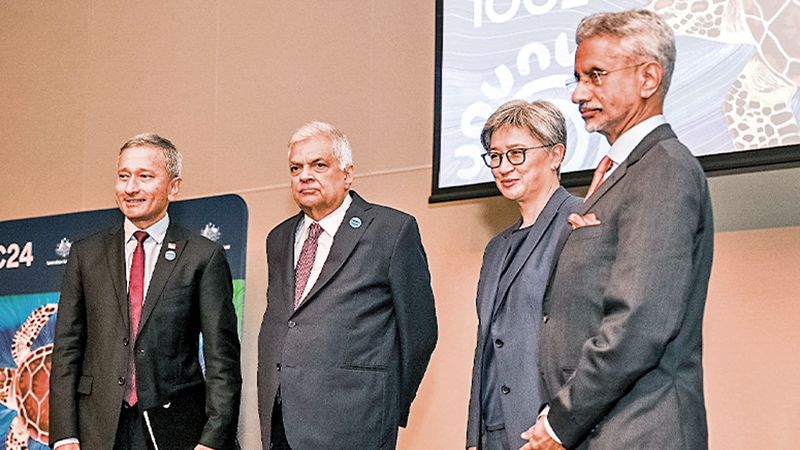
President Wickremesinghe with Vivian Balakrishnan, Penny Wong and S.Jaishankar at Perth Indian Ocean conference

Colombo, February 13: In his speech at the seventh Indian Ocean Conference (IOC) in Perth, Australia on February 10, Sri Lankan President Ranil Wickremesinghe reiterated the plan to build a land bridge between Sri Lanka and India to boost trade and economic integration between the two countries.  

He had proposed a bridge across the Palk Strait when he was Prime Minister between 2002 and 2004 and named it the Hanuman Bridge”. Since then, Wickremesinghe has been advocating economic links between Sri Lanka and the South Indian States particularly, because these are not only nearer Sri Lanka but are growth centres in India.

He would highlight the fact that, collectively, the four South Indian States of Tamil Nadu, Kerala, Karnataka and Andhra Pradesh have a GDP of US$ 500 billion. Sri Lanka could link up with these growing regional economies.

However, despite the favourable conclusion of a feasibility study on a land bridge in the early 2000s, the idea fell by the way side due to political opposition in Sri Lanka and Tamil Nadu.

When Wickremesinghe was on visit to India in Jul 2023, he again proposed a land connection between India and the ports of Colombo and Trincomalee. The Indian Prime Minister Narendra Modi endorsed the idea and the two countries decided to conduct a feasibility study at an early date, the Vision Statement issued in New Delhi said.

Since then, there have been several indications that both countries are keen to go ahead with the project. Such a bridge will facilitate trade and people-to-people contact,” Wickremesinghe said at the Perth conference which was organized by the India Foundation in collaboration with India’s Ministry of External Affairs and the Australian Government, with support from the S. Rajaratnam School of International Studies, Singapore, and the Perth-US Asia Centre.

Land connectivity will help India’s Southern States as well ports on India’s Eastern seaboard like Vishakhapatnam, Kolkata and Chennai. Ships from these ports now have to go around Sri Lanka to reach Colombo, the only major commercial port in Sri Lanka. But if a land link is established with a bridge across the Palk Strait, traders can use road/and rail transport which are cheaper and less time-consuming.  

In 2002-2004 Sri Lanka envisaged a four-lane highway with a parallel single rail track that was estimated to cost US$ 1 billion. The Sri Lanka Institution of Engineers and the Indian Institution of Engineers (Tamil Nadu Centre) prepared a Concept Paper which supported the plan. But as stated earlier, it did not get political support from both the Tamil Nadu and the Sri Lankan side.

In June 2015, the Indian Road Transport Minister Nitin Gadkari proposed building the 23 km bridge with ADB assistance of US$ 2.8 billion as part of the Asian highways project. But Wickremesinghe, who was Prime Minister then, was non-committal. Vasudeva Nanayakkara, a leftist politician, said that if the bridge was built the 60 million Tamils from Tamil Nadu would swamp Lanka.

However, Wickremesinghe now feels that the political climate in Sri Lanka is conducive for closer ties with India, given the significant role India has played in rescuing Sri Lanka from an economic abyss. Till now, no voices have been raised against the proposed ‘land link’.

Support of Experts

Wickremesinghe’s plan has the support from Lankan development experts Gayasha Samarakoon, Muttukrishna Sarvananthan and Prof. Rohan Samarajiva. Samarakoon and Sarvananthan said in a paper published by Routledge, that a land bridge would bring down the transport cost in India-Sri Lanka trade by 50%.

It will also save on time. According to them, the 23 km bridge could be traversed in less than an hour. And from the arrival point at Talaimannar, it would take another 7–8 hours to reach Colombo by road (roughly 367 km). The total travel time between India and Colombo would be 9 hours with a few more hours to accommodate Customs requirements.

They further said the waiting time for Customs clearance and other formalities could also be significantly reduced if the land route was used because the land route would involve only exports/imports to/from India, whereas the Colombo Harbour would be handling trade to and from all over the world.

Lower transport costs would bring down prices of goods in Sri Lanka. An uptick in trade would also create thousands of direct and indirect jobs. The road link with Colombo and Trincomalee would also contribute to the economic development of backward provinces like the Northern Province, the North Central Province and the Eastern Province.

The business communities in the Northern and North Central Provinces have long complained about their inability to directly engage in international trade. Presently, businesspersons in the Northern and North Central Provinces can engage in export/ import trade only through exporters/importers in Colombo. The proposed bridge would boost direct international trade between the Northern, North-Central, and Eastern regions of Sri Lanka and India, particularly Southern India,” Samarakoon and Sarvananthan said.

Presently, only a small fraction of Indian tourists visits the Northern, North Central, and Eastern Provinces of Sri Lanka due to the long distance from Colombo, where the only international airport is located. The proposed bridge would boost tourist traffic to these marginalised provinces.

However, the successful realization of this grand vision necessitates concerted efforts to enhance the domestic road networks in Sri Lanka, the authors emphasised. There is a crying need to develop the coastal route from Talaimannar to Colombo through the Wilpattu wildlife sanctuary.

Writing in DailyFT, Rohan Samarajiva ,the founding Chair and CEO of LIRNEasia, an ICT policy and regulation think tank in Colombo, pointed out that Global Production Networks (GPNs) have become increasingly significant in world trade, encompassing developing as well as developed economies. The process of producing goods (and services), from raw materials to finished products is increasingly carried out wherever the necessary skills and materials are available at competitive cost and quality. Sri Lanka should join such networks through Indian hubs. Sri Lankan firms could join the auto agglomerate, electronic components or iPhone industry in Chennai.

Lower transport costs and the time factor that are associated with proximity are a strong influence especially for trade. The fact that this has not happened so far suggests that there may be merit in looking at ways to reduce transportation costs through a bridge connecting Talaimannar and Rameswaram, Samarajiva said.

However, a road link with India to tie up with industries in Tamil Nadu will require the development of the Northern and North Western provinces, he added.

If Sri Lanka is to fully realise the benefits of integration with automotive, electronic or other supply chains, it may be necessary to create export processing zones with good access to the bridge in the Northern and North Central Provinces. Such zones require access to pools of human resources and the amenities to support the workers and their families,” he said. All this will lead to the development of these areas. 

Traders’ Voice

Representatives of Indian companies who exhibited their products at the Jaffna International Trade Fair in January 2017 were unanimously of the view that for the development and trade and investment between India and the Northern Province of Sri Lanka, the construction of a road linking Rameswaram in Tamil Nadu with Thalaiamannar in North Sri Lanka is a must.

Having to land our goods at Colombo in the south, we take another eight hours to reach Jaffna in the far North. The long journey puts investors and traders off. It will help if we are able to go by road from Rameswaram to Thalaimannar across Palk Strait and thence to Jaffna,” explained Amandeep Azad of Azad Engineering Company based in Ghaziabad near Delhi.

The other advantage in having a direct road link with India is that it will eliminate the Colombo-based middle men. This will bring down prices in the Jaffna market,” Azad added.

According to Jaffna trade sources, more than 40% of the goods sold in the Jaffna market are from South India. These will be cheaper of there is a road link, they said.

END

රතු සහෝදරයන්ට ඉන්දියාවෙන් කෝටි 300ක් අතට සල්ලි..

February 14th, 2024

උපුටා ගැන්ම ලංකා සී නිව්ස්

මෑතකදී ඉන්දියානු සංචාරයක ගිය රතු සහෝදරයන්ට රුපියල් කෝටි 300ක මුදලක් ලබා දී ඇති බවට තොරතුරු ලැබී ඇතැයි මිහින්තලා රාජමහා විහාරාධිපති පූජ්‍ය වලවා හැංගුන වැවේ ධම්මරතන හිමියෝ පවසති.

මැතිවරණයට වියදම් කිරීමට මෙම මුදල ලැබුනු බවට තොරතුරු තමන් වහන්සේට ලැබී ඇති බවද උන් වහන්සේ පැවසූහ.

මෙහි සත්‍ය අදහස් අසත්‍යතාවය රතු සහෝදරයන් විසින්ම හෙළි කළ යුතුව ඇතැයි ද එහිමියෝ කියා සිටියහ.

උත්සව සභාවක් අමතමින් උන්වහන්සේ මෙම අදහස් පළ කළහ

RTI reveals… Budget allocated to conduct one election in 2024

February 14th, 2024

Courtesy The Daily Mirror


It seems like President Ranil Wickremesinghe had already begun his campaign, defections among key figures in major political parties indicate that an election is likely in the offing

  • Whether a General Election could be held with Rs. 250,000,000 remains doubtful, according to critics in the political scene
  • NPP Leader Anura Kumara Dissanayake said that it is no secret that the incumbent President has delayed elections 

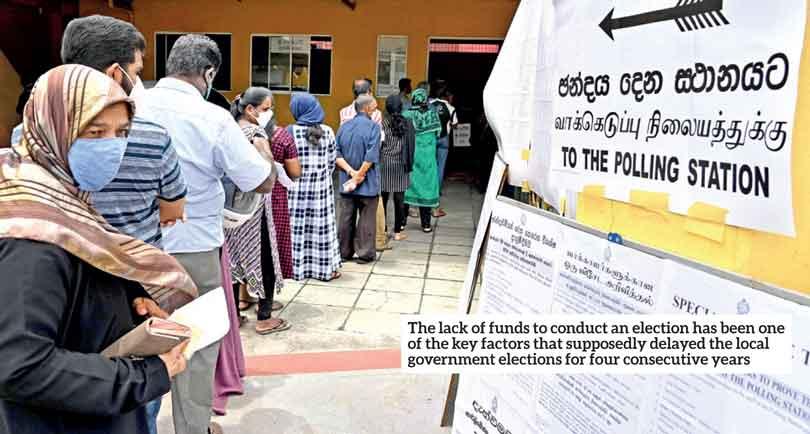
The Presidential and General elections are two much anticipated events in Sri Lanka’s political calendar this year (2024). The lack of funds to conduct an election has been one of the key factors that supposedly delayed the local government elections for four consecutive years. While it seems like President Ranil Wickremesinghe had already begun his campaign, defections among key figures in major political parties indicate that an election is likely in the offing. Speaking to the media after returning from his recent visit to India, NPP Leader Anura Kumara Dissanayake said that it is no secret that the incumbent President has delayed elections. He further said that a Presidential Election will be held this year and that the elections scheduled to be held in October will be a turning point for Sri Lanka’s political landscape.


Limited funds again?


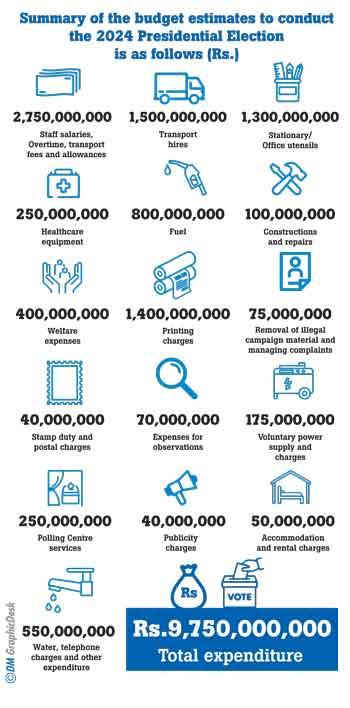
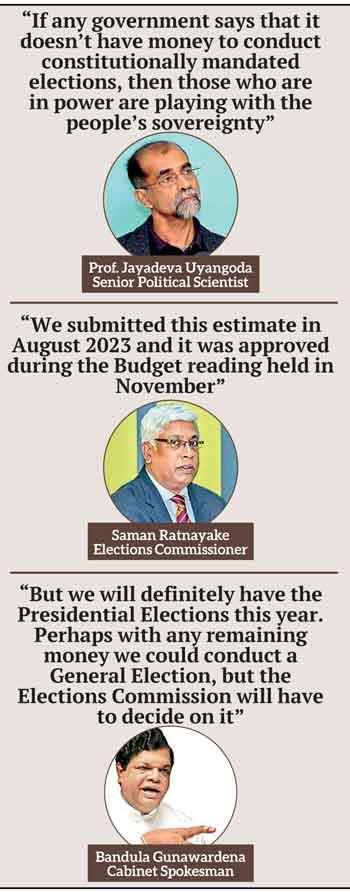
However at a recent cabinet briefing Cabinet Spokesman Bandula Gunawardena said Rs. 10 billion had been allocated to conduct a Presidential and a General Election this year and allocations to conduct a provincial councils and a local government election will be provided from the 2025 Budget. 
But, the numbers speak otherwise. 


The cost of an election


In response to a Right to Information request filed to the Elections Commission to inquire about the expenditure to conduct an election, the Elections Commission revealed that a sum of Rs. 10 billion had been allocated to conduct ONE election in 2024. 
Speaking to the Daily Mirror, Elections Commissioner Saman Ratnayake said that it is the Parliament that should be managing the country’s finances. We submitted this estimate in August 2023 and it was approved during the Budget reading held in November. A similar amount is required to conduct a General Election,” said Ratnayake. 


Contradictory statements?


When inquired about the figures, Gunawardena told the Daily Mirror that the government in fact has limited funds to conduct two elections in 2024. But we will definitely have the Presidential Elections this year. Perhaps with any remaining money we could conduct a General Election, but the Elections Commission will have to decide on it. In any case the Provincial Councils and Local Government elections will be held next year,” said Gunawardena. 
However, according to the estimate given, whether a General Election could be held with Rs. 250,000,000 remains doubtful, according to critics in the political scene. 


Govt. under scrutiny 


Even though possible dates were announced to conduct a Local Government Election in 2023, no such event saw the light of day. But with many party leaders launching their campaigns, it does seem like everybody is prepping for a heated election this year. Conducting free and fair elections as mandated by the Constitution is one key feature of a democratic society. 
The government has a tendency to consider elections as unimportant,” said Senior Political Scientist Prof. Jayadeva Uyangoda. If the government says that it doesn’t have money to conduct an election it is an outright false claim. This could be a pretext to postpone elections. If any government says that it doesn’t have money to conduct constitutionally mandated elections, then those who are in power are playing with the people’s sovereignty. It is in fact a tragic development,” said Prof. Jayadeva Uyangoda. 


State Minister reveals plans to establish three international universities in Sri Lanka

February 14th, 2024

Courtesy Adaderana

State Minister of Higher Education Dr. Suren Raghavan has announced plans to offer multiple degrees through state universities, in a bid to enhance the educational landscape in Sri Lanka. 

Drawing from insights of international education experts, Dr. Raghavan explained that plans are also afoot to establish three international universities within Sri Lanka, adding that that two of these universities are currently in the establishment phase, with the third scheduled to commence operations by May of this year.

Notably, the Indian Institute of Technology is to be opened in Kandy, while the other two universities will have branches affiliated with the United States and the United Kingdom, with anticipated memorandum of understanding signings, the President’s Media Division (PMD) reported.

The State Minister made these remarks at a press briefing held at the Presidential Media Center today (14 Feb.) under the theme of Collective Path to a Stable Country”.

Meanwhile, discussions are also underway to establish the new Higher Education Development Commission, integrating findings from the Wijedasa Rajapaksa Committee and the Committee Report of the University Grants Commission. Former Chief Justice K. Sri Pawan has been appointed to chair this committee, with a focus on deliberating the relevant legal framework and presenting the draft to Parliament.

Discussions are also underway to provide multiple degrees in the state universities, the State Minister said, adding that the Australian Higher Education Minister has been invited to Sri Lanka through the Australian Embassy. With him, the chancellors of Melbourne, Sydney University and 10 other universities are going to come to Sri Lanka, and are expected to discuss the next steps to be taken after observing our educational situation.

Lastly, while emphasising the need to regulate the private higher education sector, Dr. Raghavan assured that there are no preparations for commercializing education.

State Minister of Higher Education Dr. Suren Raghavan said that after the observation of experts with international experience in education, they have focused on providing multiple degrees through state universities. Regulation of the private higher education sector is deemed necessary. However, it’s important to clarify that there are no intentions to commercialize education, the PMD said.

කියන තරම් හොරකම් කළාද ? එංගලන්තයට – නවසීලන්තයට වුණුදේ…

February 13th, 2024

We should become the ‘Hong Kong of India’ – this is not to state that Sri Lanka should become a satellite state of India

February 13th, 2024

Chanaka Bandarage, International Lawyer (chanakab@hotmail.com)

No one would disagree that Hong Kong rode to its prosperity on the back of China (after the Chinese Revolution, Hong Kong underwent a rapid and successful process of industrialization, from the late 1940s, and became a rich ‘state’).

After the liberalisation of China’s trade (Chairman Deng’s Open Door Policy’ in the late 1970s), Hong Kong grabbed the opportunity and increased its trade with China by tenfold.  Within few years, the tiny Hong Kong’s exports to China surpassed its imports from China.

When it comes to India, Sri Lanka is today placed in a similar position as that of Hong Kong.

India is a significant global player and it is estimated that economically it could  surpass China (given China’s fast ageing population and the gender imbalance), and India has the ability to become the world’s 2nd biggest economy (after the US).

Unlike how Hong Kong prospered thanks to China (Hong Kong is located in very close proximity to China); Sri Lanka (located in very close proximity to India), has thus far been unable to grab the opportunity and capitalise on India’s growth.

India had somewhat closer to a double digit GDP growth in the past 15 years, but, as stated before, Sri Lanka failed to capitalise on this.

In the past twenty years Sri Lanka ‘put all its eggs only in the China basket’.  After the war, under M Rajapaksa, Sri Lanka sadly developed a relationship of mistrust and annoyance with India (true, Thamilnadu created the problem over the fake Chanel 4 videos, but, Sri Lanka diplomatically failed to secure New Delhi’s support).

Sri Lanka failed to realise that it cannot rise to prosperity solely on the back of China, but, it could comfortably do so on the back of India.

Indeed, China is an excellent friend for Sri Lanka. This has been the case historically. Sri Lanka should be ever grateful for China’s help afforded to Sri Lanka during many difficult times. It is China who gave us rice when the country was almost ‘starving’ without rice in 1962.

In 1952 we signed the China – Ceylon Rice Rubber Pact. This was very much in favour of Sri Lanka.

But, China is too far away from Sri Lanka and it is very different from Sri Lanka.  On the other hand, Sri Lanka and India are very similar when it comes to many things such as culture, food, attire, language (English is well spoken in both countries; also, Sinhala (a Sanskrit) and Tamil, an Indian language), sports (cricket), religion (Buddhism/Hinduism), values, traditions and physical characteristics of the people.  The fact that Sri Lanka’s first King (Prince Vijaya) was an Indian (from Bengal) and that Sri Lanka’s third King, Panduwasdewa, was married to a blood relative of Lord Buddha (Princess Bhaddha Kachchayana of the ‘Shakya Wangsha’), are notable and significant features of the relationship.

Furthermore, Sri Lanka and India are separated only by a short stretch of the sea and apart from few/minor recent calamities/conflicts, excellent, brotherly relations have existed between the two nations from time immemorial (of course, there had been serious animosities between Sri Lanka and South India in the olden age – Chola, Pandya, Magha, Elara invasions). 

Northern India has never invaded Sri Lanka in a war like manner.  Sri Lanka’s Anagarika Dharmapala was a person who recently brought the two countries closer.  Another was Mrs Sirimavo Bandaranaike. Sanath Jayasuriya, Mahela Jayawardane, Amaradeva, Jacqueline Fernandez, Yohani De Silva  have also contributed to the current excellent relationship between the two nations.

In the past two decades, India’s exports to Sri Lanka almost trebled or quadrupled.  Sri Lanka failed to keep pace with the growth of its exports to India.

The recent Sri Lankan governments (in the past 25 years), rather than building a manufacturing and productivity-based economy, focused on a service-based economy (it was the ‘easy way out’).  Thus, such unproductive and non-manufacturing ventures like communication centres, beauty palours, trishaw taxis, illegal importation and distribution of dangerous drugs (with the governments’ blessing) such as heroin, cocaine, ice and ecstasy, betting centres, lottery sales centres, small-scale casinos, massage/sex parlours in the guise of Ayurveda centres, private tuition centres (even Sinhala, Buddhism and History are taught for school children therein, and Tamil/Hinduism are taught for Tamil school children), variety of international schools and tourism based ventures like hotels/motels – they are good, mushroomed the country.

These ventures became the hallmark of the country’s economy. They created jobs, but generated less GDP.

Through this useless economy, the country only generated Sri Lankan rupees; there was hardly any US dollars or other currency.

Foolish governments by trying to reduce the country’s unemployment, gave public sector jobs to thousands of people; that was also not based on merit – to those who supported them during elections. Hence, a very corrupt/lethargic public service has emerged. Public servants received two Rs 10,000 a month salary increments within a short spell of time, but their productivity did not improve. Very seldom that a telephone call to a government office is properly/politely answered.

In the middle of a serious economic crisis Gota gave new public service jobs to over a lakh of people. He unnecessarily reduced the VAT significantly.

The governments believe that by increasing public sector wages the cost of living will come down. They seem less concerned about the plight of the private sector employees, the self-employed and the unemployed.

The governments not knowing how to create employment for the citizens (both skilled and unskilled workers) encourage them to leave the country in search of greener pastures.  Lots of our women ended up working as domestic maids in Middle Eastern countries (we know stories where some of them have been treated like slaves). Lots of youth were dspatched to South Korea, Japan, Israel etc. This was in order to develop those countries at our expense.

There is a huge scarcity of qualified tradespeople here – masons, carpenters, plumbers, electricians, electronic technicians, welders, IT workers,  hairdressers, chefs, medial/laboratory technicians, radiologists, pharmacists, nurses, agriculturalists etc. The governments have absolutely no solution to address this problem.

We have 17 or more state universities now (most of them produce BA, Business Administration/Management Studies graduates),  They all seek professional, white collar jobs. Then, a considerable number of private universities.

The country only has a handful of good, high standard technical colleges. They produce few  technologists/technicians a year. As soon as these diploma/certificate holders are passed out, they leave for overseas.

The current government wants to set up further 4 or 5 universities.  It has invited the private sector to set up universities also. SLIT has been promised the newly built (by public funds), modern Presidential House in KKS to set up a private university there.

What about the urgent need of establishing new technical colleges for the country?

Governments have been unconcerned in paying attention to the adverse socio, cultural and psychological effects of the family members that were left in the country owing to the mass temporary migration of workers.  Drastic stories have been heard about the plight of the children and elderly who had been left behind in Sri Lanka by those workers.

Governments like the idea of its citizens leaving shores as their remittance become the biggest source of revenue for them.  In the last 45 years, the rulers plundered and mismanaged the public wealth from left, right and the centre.

Why did the Central Bank in January 2022 settle a debt of US$500 to a group of mysterious sovereign bond holders when the country was facing imminent bankruptcy? Who were those beneficiaries?

Especially in the past 20 years the governments borrowed unbelievably heavily.  The injection of some of such monies to the economy (ie, the unplundered money) created somewhat an artificial growth in the GDP (of 6%).

But, today, Sri Lanka is a hugely debt-ridden country and is also bankrupt. Our foreign debt alone has exceeded US$90 billion (?), which is far too high for a country of our size.  The country owes money to other sources too, including local banks and various employee trust funds. We have failed to successfully negotiate with lenders on the settlement of outstanding loans.

When will the Volcano erupt?

Unlike in the 1960s and 70s, where governments helped to build a strong manufacturing/productivity base economy, in the last 35+ years, large numbers of small factories, textile mills and small businesses were compelled to be closed down.  Local businesses were unable to compete with the influx of cheap Chinese, Taiwanese and Indian exports to the country.  Unlike few third world countries in the past 20 years, Sri Lanka failed to become a newly developed country.

Corruption, mismanagement, maladministration, incompetency, stupidity, lethargy, complacency, waste, nepotism, cronyism,  30-years of civil war, attacks on innocent Muslims, the Easter Sunday attack,  Corona and the failed Gota regime are some of the reasons for us to become a failed state.

Today we basically import everything – from needle to the motor car.

The government boasts that we will become self-sufficient in rice this year. If this is true, full kudos to the government – a remarkable achievement.  There was a very low rice harvest in 2022, owing to lack of fertilizer.

We must build a strong productivity/manufacturing base. Sadly, the country is producing very few things. During the past 45 years we almost destroyed everything what we built after the independence – during the 50s to 70s.

There is a lot of potential in Sri Lanka to build, rebuild and improve, and to ‘take off’ to become the ‘Hong Kong of India’. The biggest asset we have is our workforce.

Basically Sri Lanka today has very few items available to export to India (or to any other country); except things like fish harvested from the sea, some agricultural/horticultural products, readymade garments, and a few value-added items imported from other countries for the sole purpose of re-export. 

The irony is that this is a country that once produced fine electrical and electronic items, textile, furniture, handicraft, confectionary, tyres, bicycles, batteries, razor blades, perfumes and even motor cars.

The land master tractor was our invention (by Mr Ray Wijewardane), but, Japan has taken the credit for it.

The total bilateral trade between India and Sri Lanka is earmarked to reach $10 billion in the near future; the trade balance will continue to be very much in India’s favour, say in the range of 8:2.

Since of late, India has been pressurising Sri Lanka to sign a new trade agreement with them in addition to the current ISFTA (India – Sri Lanka Economic and Trade Engagement) signed in 1998. They want something similar to the failed CEPA (Comprehensive Economic Partnership Agreement) of 2014. 

No doubt that such a new agreement would provide Sri Lanka preferential access to the very large Indian market, but it was feared that due to the old (discarded) CEPA, the country would be flooded with cheap Indian exports.  False alarms were raised that even Indian hairdressers, cobblers and lawyers would land here in droves.

True, we have to be very careful. A bad agreement could destroy the remaining, very small production/manufacturing economy that we have. 

The writer does not say that Sri Lanka should flatly say ‘No’ to a new CEPA; he states Sri Lanka should use the new CEPA as a bargaining tool to obtain more favourable trade advantages from India – we should try to improve the current  ISFTA to our utmost advantage.  

Two examples:

  1. We can demand that we should be given export access to the entire Indian market, with zero tariffs.

If we are successful, this means the ability to cater to 1.3 billion people! 

If this could be achieved (a difficult task, but a possibility), it will be a goldmine opportunity for us.

In that case, Sri Lanka should sign the new CEPA type trade agreement with India.

Again, it should be well scrutinized by our legal luminaries (we rarely do proper due diligence before signing international trade agreements).

2. Sri Lanka should seriously ask India to stop poaching on our waters. This causes at least US$1 billion loss to us per year (this could be a pre-condition to signing the new CEPA type agreement).

Prior to signing any new trade agreement with any country, Sri Lanka should ensure adequate measures to protect our local industries from the possible massive scale intrusion especially by giants like India, China, Russia and the US.

Only an intelligent and a tactful Sri Lankan leadership could achieve best outcomes for Sri Lanka. If their minds are filled with bribery, corruption. jealousy, vengeance, deception, power hungriness, stupidity etc, we will not achieve anything.

It will be the innocent public who will pay the ultimate price for the huge misdeeds and blunders of the politicians and bureaucrats.

If Sri Lanka foolishly enters into trade agreements, international contracts etc with overseas countries/companies (including that of India), without obtaining competent legal counsel (some of the past foolish examples are the Hedging deal, Air Lanka agreement, Cairns oil contract, Shell gas deal, IOC deal, Kerawalapitiya liquid gas deal, New Diamond/ X-Press Pearl deals, Adani deals, Chinese fertilizer deal (the list is endless), the country will doom.

The lawyers that the country would engage apart from being fully qualified, must be 100% patriotic. Foreigners may not work in the best interests of Sri Lanka. True, some have provided yeoman services.

The few examples cited above brought forth billions of dollars of losses to Sri Lanka.

Now that the Sri Lankan government has a fairly good relationship with India, the JVP leaders’ successful visit there, and Mr Modi extending a true hand of friendship to Sri Lanka, if wise and intelligent, we should grab the opportunity and try to become the ‘Hong Kong of India’ (note the remarkable turnaround in the relationship between the two nations – in 2013 India even boycotted CHOGM held in Sri Lanka; the year prior to that they co-sponsored (with the US) a resolution against Sri Lanka at the UNHRC in Geneva).

If Sri Lanka (a chronic third world country) wants to become rich  capitalising on India’s massive economic growth (the Indian middle class alone is more than 350 million, by 2030, this number is likely to increase to 500 million); before signing the new CEPA type or any agreement, we must evaluate what goods and services we will be able to produce/provide for the Indian market. 

For example, if properly planned, Sri Lanka can be a large-scale food and agro business supplier for India (notably, things like tea, spices, fresh fruits, vegetables and flowers, betel leaves, arecanuts.  

True India is the world’s largest tea producer, but, there is a scarcity of tea in India, and there is the tremendous potential to introduce ‘Ceylon Tea’ (the world’s finest) in India, in a big scale.

If Sri Lanka is to sign a new CEPA type trade agreement with India, we should ask as a precondition that India should assist Sri Lanka in every way to become the logistic hub to various production chains in India.  Few industry examples that come to mind are automobile, IT components, manufacturing of pharmaceutical products, electrical machinery and parts and food processing products.

In this regard, the Sri Lankan government must work hard in creating opportunities for Sri Lankan companies, without favouratism and involvement in corruption. 

Creating new economic zones solely for the purpose of manufacturing products for India is a good idea.  Since land is in scarcity here and Sri Lanka is closely located to India, such economic zones can be established (with Indian aid) in the North, South and East of Sri Lanka (for example, in Kilinochchi, Puttalam, Biyagama, KKS and Trincomalee). Sri Lankans must be given the foremost priority to work in these ventures.

It should be stated that even without signing a new CEPA type agreement, we should still be able to become the ‘Hong Kong of India’.

India has spent money on Sri Lanka’s Railway projects, massive scale housing developments in the North and the Centre, it is a pity that we stated ‘No’ to the Sampur Coal Power plant project. India has offered billions of dollars as lines of credit to Sri Lanka, especially when we were in very dire strait. India has also offered us very fair  currency swap arrangements, these are now in in place.

Sri Lanka should accept India (and other countries’) gifts with gratitude. But, we cannot go round the world with a begging bowl forever. This bad mentality was introduced by Ronnie De Mel.

What is most important is India’s private sector involvement in Sri Lanka. There are Indian companies ready to invest millions of dollars in Sri Lanka including in the tourism sector.

India is Sri Lanka’s largest source of foreign tourists.

Rather than working on securing foreign investment, our governments are keen on selling off our valuable assets to foreign companies. That has also been to paltry amounts. This shows the foolishness of our leaders.

It is rumored that India’s Amul will only pay US$ 35 to purchase Milco (about 5 milk factories and hundreds of milk chilling centres + almost the whole of NLDB Farms).

Some say it will be a lease out; the writer is unaware of the intricacies.  

In any case, US$35 is too small. Amul should pay us about 20 times more.

Leasing out assets to foreign companies is different than selling.

Leasing may be ok, but not on too long-term leases like for 99 years.

Even on leases, we should not be afraid to demand good money. There are always other interested parties.

The amount we received from China (US$ 1 Billion) for leasing out the Hambanthota port for 99 years is too little. We should have demanded US$6. China would have still paid.

Rather than selling our precious assets, what the governments must do is to secure foreign capital. This means facilitating foreign companies to start their own businesses here or for them to enter into joint ventures with local companies.

This is how Unilever, Whitalls, Browns, Carsons, Ceylon Tobacco, Rowlands, Hayleys, Walkers, Walker & Greig, JL Morison Son & Jones, Mackwoods, BCC, United Motors, George Steuart, Bata (the list is very long) established here in the 40s and  50s. They brought in foreign capital here (US$, Pound Sterlings etc). The country never sold its assets to them, perhaps provided them with land to set up factories/offices.

Those who oppose foreign investments at any cost must realise that in order to develop our country we must attract foreign capital. This rationale applies to any country in the world (especially the 3rd world).

Without foreign funds (eg US$, Aus$, CNY, INR), we will not go anywhere. We will be in eternal poverty – say, for the next 100 years.

It is refreshing that the JVP has realilsed this.

Let’s hope that the Peratugamis will too realise.

It is not sensible for Sri Lanka to say ‘Yes’ to the rail and road link that India wants to build at its own cost over the Palk Strait from Dhanushkodi to Talaimannar. Naturally, due to Thamilnadu hostility, people in Sri Lanka have a strong reservation about this proposed mega-project; despite the fact that it could bring huge and unprecedented level of economic benefits to Sri Lanka, including a tenfold increase in tourist numbers, especially thousands of new European/Australian, NZ and US tourists that will travel from India to Sri Lanka by rail or road (overland). Sri Lanka having fought a bitter civil war where India offered support to the terrorists in the 80s, people are fearful that a rail/road bridge will be harmful to Sri Lanka. Above everything else, our Sovereignty, Territorial Integrity and National Security are important. 

PS


I am aware that this article will be subject to criticism.

I am not at all suggesting that Sri Lanka should become a satellite state of India. What I outline is purely an economic arrangement – supplying goods and services to the huge Indian market of 1.3 billion people. This is creating a Win/Win situation for both countries, the benefits to Sri Lanka will be huge.

We cannot continue to live in 3rd world conditions, especially now we are under bankruptcy.

It is time that we become a rich nation. This can be achieved soon, within our own lifetime.

This Indian opportunity that I am proposing is the best available one at the moment.

It is a shortcut to prosperity.

I believe all 3 major political parties – SJB, JVP, UNP think in this line.

If we miss the ‘bus’ (again), there may be no other bus to catch. Either Nepal or Bangladesh can become the ‘Hong Kong of India’; so. again, we should not let this golden opportunities go by.

We have to do this in friendship and co-operation with India (that is how Hong Kong did it with China, especially during China’s ‘Open Policy’ period). And now is the best time to do it. India is ready, why aren’t we?

Our  President should visit India more often, so should Sajith. The JVP visit was very good, it was a groundbreaking visit.

Emphasis added – I am not proposing that Sri Lanka should stop trading with other nations like China, Russia, US, Japan etc. We should trade with the whole world. I am stating it is only for India that we can become a hub to export goods and services. There is no other country available (proximity is the key).

One can say hundreds of negative things about India, but, they will not take us anywhere. India today is vastly different to what it was 35 years ago.

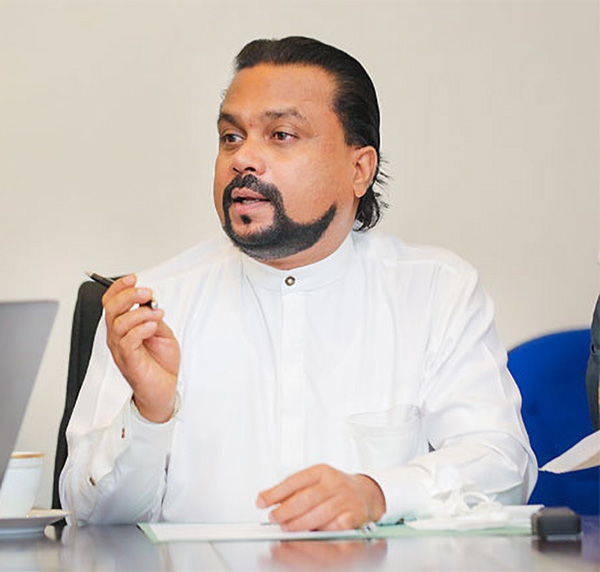
නිවනේ ඇති පලය කුමක්ද? නිවන් දකින්නේ කුමටද? – 1 වන කොටස

February 13th, 2024

තිස්ස ගුණතිලක

මාගේ මිතුරන්ද ඇතුඵව බොහෝ දෙනෙකු නගන ප්‍රශ්ණයක් නම් මෙතරම් වීරියක්, උත්සාහයක් ගෙන නිවන් දකින්නේ කුමටද?  එහි පලය කුමක්ද? අප වැනි වයෝවෘධ බොහෝ දෙනෙක් ජීවත් වන සුළු කාලයකට මෙතරම් වීරියක් වඩා ලබන නිවනේ පලය කුමක්ද? එහි ඇති සුවය කුමක්ද? ජීවිතයේ ඉතිරි ටිකත් මෙහෙමම යමුයි සිත සකස්කරගත් කීදෙනෙක් අපට හමුවී ඇතිද? මෙවැනි විචිකිච්චාවක සිරවී, ප්‍රශ්ණ නගන බොහෝ දෙනා නිවන් සුවය කුමක් දැයි නොදැන නිවන අවතක්සේරුවකට භාජනය කර ඇති සැටියක් පෙනේ. 

ඇත්තටම නිවන යනු කුමක්ද? එහි ඇති ප්‍රතිලාභය කුමක්ද? මෙම ලිපියේ අරමුණ මෙම කරුණ සාකච්චා කිරීමයි, පහදා දීමයි.

ධර්මය සොයන තවත් පිරිසක් නැවත ඉපදීමක් ඇති නොවන රිසියෙන් නිවන සොයයි. මෙයද දෘෂ්ඨියකි. බුදුන්වහන්සේ දේශනා කලේ අනාත්ම දහමකි. එනම් කෙනෙක්, මමෙක් නැති, කිසිවක් කරන්නෙක් හමුනොවන දහමකි. අනුරාධ සූත්‍ර දේශනාවේ බූදුන්වහන්සේ පෙන්වා දෙන්නේ ‘දැනුත් කෙනෙක් නැති (නොපවතින) විට සම්මත මරණයෙන් පසුව උපදින්නේ කවුද?’ මේ නිසා ඉහත සඳහන්‍ නිවන කුමකටද යන පැනයට පිලිතුර පෙර-පසු භව නැති (නැවත ඉපදීමක් නැති) පිලිගැනීමක්, සංදර්භයක් තුල සෙවීය යුතුය.

තවද එක්තරා පිරිසක් ඹවුන් දැනුදු ‘දුකක්’ නොවිඳිනා,  නොදැනෙනා බැවින්, නිවන් දැකීමෙන් නැතිවන දුකක් ගැන එතරම් තැකීමක් නොකරයි. ඹවුන්ගේ දැනුමට අනුව සියළු දෙනාම (රහතන්වහන්සේද ඇතුළුව) වේදනාවට, ව්‍යාධියට හා මරණයට පත්වෙයි. නිවන තුල මෙම අවස්තාවන්ට හා තත්වයන්ට විසදුමක් නැතිබව ඹවුන්ගේ පිලිගැනීමයි. ඒ නිසා නිවන කුමටද? ඉතිරි ටිකත් ඔහොමම යමු යන ආකල්පය තුල බොහෝ දෙනෙක් සිරවී සිටියි.

ස්වභාව ධර්මය හා එහි නිර්නායක – Nature and governing principles

පලමුවෙන්ම මේ මුළු ලෝකයේම නැතහොත් විශ්වයේම පවතින්නේ ස්වභාවධර්මය (nature) පමනක් බවත්, ඹබ දකින අසන දැනෙන (දිට්ඨ සුත මුත) සියළුම දේ එම ස්වභාවධර්මය (nature) නොවන බවත් දත යුතුය. ඹබ දකින අසන දැනෙන සියල්ලම ආකාරායෙන්ම ස්වභාවධර්මය (nature) තුල නොපවතියි.

බුදුන්වහන්සේ දේශනා කල ‘තිලක්ෂණයේ’ අර්ථ දැක්වීමට (definition) හා නියාමන පහකට (five principles of governance) අනුකූලව ස්වභාවධර්මය (nature) පවතියි. ඉර-හඳ යට පවතින සියළුම දේ (සංකාරා) මෙම තිලක්ෂණයට හා නියාමන පහට යටත්ය. මෙයින් පිට ස්වභාවධර්මයක්‍ නොපවතියි.

ස්වභාවධර්මයේ ස්වභාවය (definition)

ස්වභාවධර්මයේ ස්වභාවය එනම් තිලක්ෂණය, ධර්මයේ එන අනෙකුත් සෑම කරුනක් මෙන්ම, ධර්මයට ගලපා, තිපරිවට්ටයට බහා තේරුම්ගත යුතුය. එනම් තිලක්ෂණය පලමුව දැනුමක් (සත්‍ය ඤාණය – ජානතෝ) ලෙසත්, දෙවනුව අවබෝධයක් ලෙසත් (කෘත ඤාණය – පස්සතෝ) හා තෙවනුව ප්‍රත්‍යක්ෂයක් (කෘත්‍ය ඤාණය) ලෙසත් ග්‍රහනය කරගත යුතුවෙයි. 

තිලක්ෂණය ප්‍රත්‍යක්ෂයක් වන තැනම නිවන හමුවෙයි.

  1. සබ්බේ සංකාරා අනිච්චාති ….  ~ ස්වභාවධර්මය තුල එනම් ඉර-හඳ යට පවතින සියළුම දේ (සංකාරා – සංකාර නොවේ) ගින්නක් (නන්දියක්) එනම් ඇලීමක් ගැටීමක් (රාග ද්වේශ සහගත තත්වයක්) ඇති නොවන (තෘෂ්ණාවක් ඇති නොවන) ස්වභාවයෙන් පවතියි. ස්වභාවධර්ම තුල පවතින කිසිවක් නන්දිරාග සහගත තෘෂ්ණාවක් ඇති නොකරයි.   මේ නිසා ස්වභාවධර්මය තුල පවතින සියල්ලම අනාත්මීය‘  (අනිච්ච) ස්වභාවයක පවතින්නේ යයි කියමු. (please note: අනිච්ච යනු අනිත්‍ය නොවේ. අනිච්ච යනු අනිත්‍ය ලෙස ගතහොත් ‘ධර්මය – දෙයක් යමක් කෙනෙක් නැති අනාත්මීය ස්වභාවය’ හා ගැලපීමක් නැත). ස්වභාවධර්මය තුල අනාත්මීයව පවතින දේ නන්දිරාග සහගත (ගින්නක් ඇති) ආත්මීය ස්වභාවයකට පෙරලන්නේ විඤ්ඤාණ මායාවයි. තෘෂ්ණාවක් ඇතිකර ස්වභාවධර්මය තුල අනාත්මීයව පවතින සියල්ලම ‘දෙයක් යමක් කෙනෙක්’ බවට පෙරලන්නේත් ඒ නිසාම භවය සකස්කරමින් ‘මම’ ඇතිකරමින් සත්වයා දුකට පත්කරන්නේත් විඤ්ඤාණ මායාවයි. (ධම්මචක්කපවත්තන සූත්‍රය – සමුදය සත්‍යය පැහැදිලි කරන්නේ මෙම ක්‍රියාවලියයි: යායං තණ්හා පොනොබ්භවිකා නන්දිරාගසහගතා තත්‍රතත්‍රාභිනන්දිනී,).
  1. සබ්බෙ සඞ්ඛාරා දුක්ඛා’ති……. මෙහි දුක්ඛ යනු දෙයක් යමක් කෙනෙක් නැති අනාත්මීය, අනිච්ච ස්වභාවය තුල පවතින ‘හිස් බවයි’.  ඉර-හඳ යට පවතින සියල්ලම රාග ද්වේශ ඇති නොකරන ආලීමක් හෝ ගැටීමක් ඇති නොවන ගින්නක් ඇති නොවන ස්වාභාවය බුදුන්වහන්සේ හැදින්වූයේ ‘හිස්බව නැතහොත් ශුණ්‍යතාවය’ ලෙසය.
  1. සබ්බෙ ධම්මා අනත්තා’ති,…… ස්වභාවධර්මය තුල පවතින සියල්ලම ධර්මතාවයන්වන අතර ඒවා කරන්නෙක් නැති ස්වභාවයක් තුල ක්‍රියාත්මකයි.

බුදුන්වහන්සේ ඉහත තිලක්ෂණයෙන් පැහැදිලි කලේ (defined) ස්වභාවධර්මයේ (nature) යථා ස්වාභාවයයි.

විඤ්ඤාණ මායාව යනු ස්කන්ධය සංකාර වීම තුල ඇතිවන පටිච්චසමුප්පාද ක්‍රියාවලියයි නැතහොත් රැවටීමයි. භාහිරයේ පවතින සියළුම දේ ගින්නක් ඇති ස්වභාවයකට පෙරලන්නේ මෙම ක්‍රියාවලියයි. පටිච්චසමුප්පාද ක්‍රියාවලිය හරහා භාහිර ස්වභාවධර්මය තුල පවතින දෑ සංකාරවී ගින්නක් ඇතිකරන ස්වභාවයකට පත්වන බැවින් විඤ්ඤාණ මායාව තුල සකස්‍වන ලෝකය (මගේ ලෝකය) ‘සංඛත’ ලෝකයක් යයි කියමු. තවද ස්වභාවධර්මය තුල අනාත්මීයව පවතින ලෝකය මේ නිසා ‘අසංඛත’ ලෝකය (යතාර්ථය) යයි කියමු. නිවන ‘අසංඛත’ යයි අපි අසා ඇත්තෙමු. එසේනම් නිවන යනු අසංඛතවූ, අනාත්මීයවූ ස්වභාවධර්මය මැයි. නිවන් දැකීම යනු අනාත්මීයවූ ස්වභාවධර්මය ඇති සැටියටම දැකීමයි. තවද නිවනට පැමිනීම යනු (අනාත්මීය) ස්වභාවධර්මය හා බද්ධ වීමයි නැතහොත් (ඔබ) ස්වභාවධර්මයම වීමයි, ස්වභාවධර්ම ගතවීම නිවනයි.

දැන් ඔබට නිවන යනු කුමක්දැයිද, කුමන තත්වයක් දැයි වැටහී ඇතැයි සිතමි. මෙම දැනුම තුල දැන් අපට ‘නිවන කුමටද?’ යන පැනයට පිලිතුරත් නිවනේ ප්‍ර‍තිලාභත් ඊලඟ ලිපියෙන් සාකච්චා කල හැකියි.

ඔබට තෙරුවන් සරණයි

තිස්ස ගුණතිලක

eMail:  tgunite@tpg.com.au 2024 පෙබරවාරි මස 14 වනදා

Sri Lanka (GDP Per Capita $4,013) Has Nothing to Gain from India(GDP Per Capita $2,256)

February 13th, 2024

Dilrook Kannangara

Despite years of economic downturn, Sri Lanka is 77% more developed than India economically as can be seen from the two countries’ nominal GDP per capita. India is a large world economy only due to the sheer size of its poor population. For instance, a family of 15 in Bangladesh would have a larger rice pot than a family of 4 in Japan. But that does not mean Bangladesh is more developed than Japan. When individual portion sizes are compared a Bangladeshi would only have a fraction of what a Japanese individual would have. Mixing up these two is unwise. Any closer economic tie-up with India will lead to comparatively richer Sri Lanka losing economic resources and opportunities to comparatively poorer India.

Sri Lanka’s exports to India is around $1 billion but Indian exports to Sri Lanka is over 4 times that! In other words, although Sri Lanka has an economic opportunity for India to exploit, the converse is not true (India is no economic opportunity for Sri Lanka). In fact, India is an economic burden as Sri Lankan industries, professionals and services will be out-bidden by cheap and desperate Indian companies, professionals and service providers. The very large (77%) GDP per capita gap is the reason.

Indian tourists are the largest Sri Lanka gets but this is misleading. Most Indians arriving in Sri Lanka are not genuine tourists. Most come to Sri Lanka to work, trade, earn and repatriate their local earnings converted to US dollars back to India. This is a bane on the island nation’s dollar reserves. Some other Indian travelers take out gold and gem stones illegally from Sri Lanka which is also a huge drain on Sri Lanka’s foreign reserves. This is well known. Passenger terminals for outbound Indian passengers are thoroughly checked for smuggled gold. With ferry service between the two nations starting soon, the amount of gold and gem stones smuggled out of Sri Lanka will increase which will worsen Sri Lanka’s foreign currency crisis, debt crisis and economic crisis.

Indian investments in Sri Lanka have not added any value to the Sri Lankan economy. Instead, Indian investments have reduced value of local industries. A case in point is the Indian Oil Company. Instead of investing in a local refinery, IOC operates profitable fuel distribution which is also done by locals. We don’t need Indian investments to open up petrol sheds and transport systems. All profit, management charges, purchase price margins, senior management salaries are repatriated to India. Sri Lanka loses it in dollars. Indian investments are not needed in dairy industry. India produces a large quantity of milk due to its near-slavery labour conditions backed by caste discrimination (very low salaries), vast grasslands (Sri Lanka has a higher population density than India and lower shanty dwellers as a percentage) and the large Indian local market. Sri Lanka has none of these economies of scale and Sri Lanka needs the New Zealand model (not their cows) for dairy industry. By allowing Indian milk companies to invest in Sri Lanka, the island nation will lose large swaths of productive land to Indians, lose the dairy industry to Indians and will never produce sufficient quantities of milk for locals.

Despite opening its economy in 1977 Sri Lanka did not sign a genuine Free Trade Agreement with India until 1998 when it was imposed on the island nation. That marked the beginning of economic downturn. In 2001 Sri Lanka recorded a negative economic growth rate after rapid decline in economic growth rate since 1998. Trade between the two countries peaked in the late 2010s leading to rapid economic collapse of the Sri Lankan economy.

Conversely, Sri Lankan economy did very well when it shunned India and these golden years include 1977 to 1997 despite the war (India sponsored anti-Sri Lanka Tamil terrorists) and an insurrection.

The Indian Decade” was from 2010 to 2019 when the Indian economic growth rate was the highest in the world. However, since then it has fallen and India is desperately looking to export its poverty, unemployment (especially skilled unemployment), environmentally disastrous industries, exploitative labour practices and other nasties. All regional countries have rejected India for this reason (Maldives is the latest)! Sri Lanka is digging its own grave by cultivating closer economic ties with India.

The large Indian market is useless for Sri Lanka as Indians can source almost everything they need from Sri Lanka from within India and through smuggling.

Hoping India would help Sri Lanka develop its IT sector is rather foolish. India will never do it as the IT sector is the highest dollar earning sector of India. Instead, India will guard it as desperately as possible and destroy Sri Lankan IT companies to avoid competition. Any Indian IT work that will be outsourced to Sri Lanka will be fraud (call) centres and counterfeit centres. Indian fraud call centres and counterfeit centres are responsible for most scams in the developed world and India is under pressure to discontinue it. But the total industry is worth $200 billion a year and India will not abandon the hen that lays golden eggs. Instead, India will pass these to Sri Lanka! Ultimately Sri Lanka will be censured for fraud while India earns all the dollars.

Nothing good ever came or will ever come from India to Sri Lanka. (For the record the Asokan Empire was not India as it excluded Tamil Nadu which was conducive for antient Lankans to embrace it. Humans originated in Africa and not India.)

Closer economic, political, geopolitical and social ties with India are political gimmicks played by local bankrupt politicians to appease India at the expense of the Sri Lankan national economy. Such closer ties with India bring only economic destruction, poverty and hopelessness.

Presidential Election on schedule, General Election set for next year: PMD

February 13th, 2024

Courtesy The Daily Mirror

Colombo, Feb 13 (Daily Mirror) – The President’s Media Division (PMD) confirmed that the Presidential Election will be held within the mandated period and will adhere to the current timeline.

According to the PMD, the General Election is will be held next year with financial provisions to be provided for in the 2025 budget.

The Election Commission is responsible for conducting the elections and the Government will communicate with the Commission as and when required, the PMD further said.

Japan to provide anti-corruption policy support for SL to promote economic governance

February 13th, 2024

Courtesy Adaderana

A new project was launched in Sri Lanka to bolster its anti-corruption ecosystem, in tandem with the Government of Japan and the United Nations Development Programme (UNDP).

The new project will work towards strengthening the anti-corruption ecosystem in Sri Lanka, through time-bound national policy reform, inter-stakeholder collaboration, and enhanced institutional capacity to deliver a necessary roadmap for the country to emerge from fragility towards a resilient economy and a trusted democracy.

Ambassador of Japan to Sri Lanka, Hideaki Mizukoshi and Resident Representative of UNDP Sri Lanka, Ms. Azusa Kubota marked the launch of the new project titled ‘The Project for Promoting Economic Governance through Anti-corruption Policy Support’, through an official signing that took place in Colombo today (Feb.13) with the participation of senior government officials.

Sri Lanka’s ongoing socio-economic crisis has reversed development gains achieved, with deep rooted transparency and accountability gaps identified as a key contributor to the economic crisis of the country.

‘The Project for Promoting Economic Governance through Anti-Corruption Policy Support’ is supported by the Government of Japan through the Japanese Supplementary Budget (JSB) of 137 million JPY (approximately 931,000 USD) will be implemented by the Government of Sri Lanka and UNDP in Sri Lanka. The proposed action seeks to (1) strengthen legal and policy frameworks; (2) improve coordination among key institutions combating financial and tax crimes; and (3) enhance strategic institutional and individual skills and capacities around combating anticorruption through strategic action under three main outcomes.  

Highlighting Japan’s commitment to support the people of Sri Lanka, Hideaki Mizukoshi, Ambassador of Japan to Sri Lanka noted, Anti-corruption measures are conducive for more business friendly environment for foreign investors. Japan would like to support improvement in this sense and expect to see expansion of our business relationship. I would like to affirm once again that the Government of Japan remains dedicated to supporting to promote Sri Lanka’s fairer economic governance and anti-corruption initiatives and we eagerly anticipate witnessing the tangible impact of our collective efforts.”

Targeted, time-bound, capacity development within the anti-corruption ecosystem will assist Sri Lanka to ensure a comprehensive approach to combatting corruption through prevention, investigation, and prosecution. This will contribute towards efficient and predictable public service delivery, upholding the rule of law that serves as a bulwark against corruption and encourage foreign direct investment which is critical to Sri Lanka’s recovery from the socio-economic crisis.  

Commenting on the role of UNDP, Ms. Azusa Kubota, Resident Representative for UNDP in Sri Lanka highlighted, It’s become evident that for Sri Lanka to effectively implement required reforms and restore its economy, accountable and transparent systems and institutions are absolutely essential. This partnership with Japan complements our ongoing and planned activities in support of strengthening economic governance and will promote a holistic approach that empowers institutions to collaborate seamlessly. The JSB support will serve as a catalyst, enhancing not only their individual capacities but, most crucially, their collective ability to unite in the fight against corruption. We in UDNP are deeply grateful to the Government of Japan for this opportunity”.  

The interventions envisaged under the project will contribute significantly to the achievement of Goal 16 of the Sustainable Development Goals (SDG16), by promoting peaceful and inclusive societies for sustainable development, providing access to justice for all and building effective, accountable and inclusive institutions at all levels.

Sri Lanka developing Ramayana Trail to boost tourism from India – Tourism Minister

February 13th, 2024

Courtesy Adaderana

Sri Lanka developing Ramayana Trail to boost tourism from India – Tourism Minister

Sri Lanka developing Ramayana Trail to boost tourism from India – Tourism Minister

Tourists from India topped the list of countries visiting Sri Lanka in January 2023 and the island nation was positive about surge in religious tourism with consecration of Ram Temple in Ayodhya. Sri Lanka was also working on Ramayana trail as there is huge interest in places mentioned in the Ramayana to attract more tourists to the country, Sri Lankan Tourism Minister Harin Fernando said in Mumbai, India.

Speaking to the Free Press Journal on the sidelines of the recently concluded travel and trade show – OTM 2024, Fernando said Lanka government was also working with Thai government in developing a Buddhist circuit with places of interest in India and Sri Lanka.

He said that though India has 80 flights a week to various destinations in Sri Lanka, the island country was also keen on starting flights from Ahmedabad and were in talks with couple of Indian operators. He said that the government was also working with few ashrams in southern India and also in Ayodhya. The minister said they have signed an agreement with the local administration in this regard.

He said that India and Sri Lanka are not two countries but one. History also shows us that both the countries were connected and that is reflected in our people, culture and food habits. Fernando also appreciated India’s support to Sri Lanka when the country was facing crisis and the continuous support to our various projects like green energy. He said the country aims to be totally green as far as hotel industry is concerned and will also promote green vehicles.

IPL to Promote Tourism

Fernando said that Sri Lanka has also proposed Sri Lanka will be hosting three IPL 2024 matches as part of Indian government’s initiative to promote tourism in Sri Lanka. Sri Lankan government has requested BCCI secretary Jay Shah in this regard and a final decision in this regard will be taken shortly, Sri Lanka Sports Minister Harin Fernando told Free Press Journal on the sidelines of travel and trade show – OTM 2024.

Fernando said that holding IPL matches in Sri Lanka would give a big boost tourism in the island nation. The country has seen huge interest in tourists from India after pandemic and arrivals from India topped the visitors chart in January 2024.

He said that the government was also in talks with Indian cricketers to engage them as a brand ambassador. The minister said during his stay in Mumbai he is scheduled to meet representatives to discuss their role.

He said cricket is big in both Sri Lanka and India and an Indian cricketer promoting Sri Lanka as a tourist destination will appeal to a bigger audience segment.

As part of their efforts to make the country more industry friendly, the Sri Lankan government has also reduced the number of permission required to shoot a film in Sri Lanka. Fernando said the government was keen on making Sri Lanka a lucrative destination for the film makers and the changes were in that direction.

The minister said while south Indian films are regularly shot in Sri Lanka, fewer Hindi films have been shot. On Sri Lankan companies setting up their businesses in India, the minister said more companies will open their offices/manufacturing units and use India as export hub.

Source: The Free Press Journal

–Agencies

Sri Lanka issues travel documents for Rajiv Gandhi assassination convict to return home, TN govt tells court

February 13th, 2024

Courtesy Adaderana

Sri Lanka issues travel documents for Rajiv Gandhi assassination convict to return home, TN govt tells court

Tamil Nadu government informed the Madras High Court on Tuesday that the Sri Lankan government has issued travel documents for one of the convicts in the former Prime Minister Rajiv Gandhi assassination, Santhan alias T Suthenthiraraja, who was released along with others in 2022 following a Supreme Court order.

Additional Public Prosecutor R Muniapparaj made the submission before a division bench of Justices R Suresh Kumar and K Kumaresh Babu during a petition filed by Santhan seeking orders to facilitate his return to his native country. He is currently detained at the high-security detention camp for foreigners in Tiruchy.

The Sri Lanka deputy high commission has sent the travel documents to the Tamil Nadu government to pave the way for Santhan to return,” Muniapparaj told the court. He added that the state government has forwarded these travel documents to the Centre for issuing necessary orders to allow him to get back to his country.

Additional Solicitor General (ASG) AR L Sundaresan, representing the Ministry of External Affairs, stated that no documents were received so far by the department and informed that he would forward the documents received through the court to the concerned authorities. Necessary orders may be passed in a week’s time, he promised.

Directing the Centre to file a report on the matter, the bench adjourned the case to Feb. 29 for further hearing.

The Supreme Court, on Nov 11, 2022, ordered the release of all six convicts – Nalini, her husband Murugan alias Sriharan, Ravichandran, Santhan, Jayakumar, and Robert Payas – from the prisons where they had been incarcerated for more than three decades.

Of them, Murugan, Santhan, Robert Payas, and Jayakumar were detained at the high-security foreigners detention camp in Tiruchy. Santhan filed the petition in the court seeking orders to allow him to return to Sri Lanka to take care of his ailing mother.

Source: The New Indian Express
–Agencies

Is Israel the effective superpower of the world?

February 12th, 2024

By Raj Gonsalkorale

Prime Minister Netanyahu: “We can’t finish the war without eliminating Hamas leadership”

(https://www.i24news.tv/en/news/israel/politics/1707129128-gantz-denies-plan-to-replace-netanyahu-through-likud-report). US President Joe Biden told Israel’s prime minister a military operation in Rafah should not happen without measures to ensure the safety of civilians, the White House has said. In a call with Benjamin Netanyahu, Mr Biden said Israel needed a “credible and executable plan” to protect the more than a million people in the city (https://www.bbc.com/news/world-middle-east-68269957)

It appears that US President Joe Biden is supporting the Rafah invasion plan provided Israel produces a credible and executable plan” to protect the more than a million people in the city. Mr Biden is also tacitly endorsing the plan or is powerless to stop the Israeli action although he knows and the world knows that however credible and executable a plan is, the Israeli invasion will result in countless number of deaths of innocent civilians, more homelessness, and destruction of whatever is left in that area. Who exercises real power is a valid question to be asked here as the US appears unable or unwilling to stop Israel from doing what they want.

Besides this, the broader question is and should be, what right Israel has got to invade Rafah and subject so many innocent Palestinians to a life of misery should they be fortunate enough not to be killed by Israeli soldiers. Palestinians do not appear to have any rights.

Already 30,000 Palestinians have been killed by the Israel forces so far. Gaza has been more or less decimated and reports from several international agencies and international media agencies, including the UN has said that there’s hardly any food to eat, or even water to drink, and hospitals too have faced the brunt of Israeli attacks. Whatever is standing has hardly any medicines or the facilities to treat casualties. Gaza is portrayed rightly as a living hell. Despite this, no country in the world, the rich and powerful including the USA, China, India, Russia, the Arab countries with all their wealth, the Western world, the UN and other international agencies have not been able to prevent Israel doing whatever they have chosen to do. The imminent Israeli ground attack on Rafah, where the EU foreign policy chief Josep Borrell says would lead to unspeakable human catastrophe”, has not moved the so called rich and powerful of the world to take any positive concrete action. It is impotency at its worst.

Mr Netanyahu appears to be saying that killing nearly 30,000 Palestinians (so far) and more if required, is the price the Palestinians have to pay until he achieves his goal.

Al Jazeera’s Tareq Abu Azzoum reporting from Rafah says no choices remain” for Palestinians as 1.9 million of them sheltering in densely populated Rafah receive evacuation orders.

A lone voice in the US, a man who has guts and a genuine concern for the Palestinians, and humanity in general, Senator Bernie Sanders says military aid for Israel is ‘unacceptable’ amid fears of this predicted Rafah catastrophe. He has criticised the emperor without clothes, the US Congress, for considering sending $14bn in military aid to Israel as it prepares to launch the assault on Rafah, which the world is fully aware will lead to a humanitarian catastrophe. Sanders said it was quite unbelievable” that the US was planning to provide more military aid to Benjamin Netanyahu’s government given the enormous death toll and destruction in Gaza. In impassioned remarks to the US Senate Senator Sanders said does the United States Congress really want to provide more military aid to Netanyahu so that he can annihilate thousands and thousands more men, women, and children? Do we really want to reward Netanyahu he asks even while he ignores virtually everything the president of the United States is asking him to do?

While the world’s media keeps reporting that Israel is facing growing international warnings over its planned offensive in Rafah – the city in southern Gaza crammed with Palestinian refugees, such warnings are and have been as hollow as the brains of some of the world leaders who are issuing such ineffective warnings. They have fallen on the deaf ears of Israel’s leadership who have paid scant regard to such warnings.

UK Foreign Secretary David Cameron says “over half of Gaza’s population are sheltering in Rafah, while Dutch FM Hanke Bruins Slot said there could be “many civilian casualties”. Saudi Arabia warned of “very serious repercussions” if Rafah was stormed.

What repercussions? Gaza is already a mass of rubble, nearly 30,000 killed, hundreds and thousands homeless, many children have become orphans. Why have there been no repercussions so far? Is Saudi Arabia waiting for Rafah to become a graveyard and all of Gaza to be raised to the ground? Gaza’s Hamas rulers says there could “tens of thousands” of casualties if Rafah is attacked. Maybe this is what the world wants to see happening before they ask Israel very lamely, to agree to a ceasefire.

Surely Israel must realise that more and more militant Palestinians will emerge from this catastrophe, and that they could be even more extremist than the alleged Hamas fighters who invaded Israel on October 7th. Israeli’s may not be safe from such militant Palestinians irrespective where they are, even outside Israel. Violence begets violence and Israel has shown how violent and uncaring they can be. If the common-sense law prevails, they may face the consequences of their violence with even more ferocious violence.

The current campaign led by Netanyahu can only be stopped by Israeli’s themselves. If not for any other reason, in their own interest. They could disregard the plight of the Palestinians if they chose to, but they could rise against Netanyahu to prevent their own catastrophe in the hands of militant Palestinians. Israel needs a long term, sustainable solution to the Palestinians issue and what Netanyahu and his extremist supporters are doing is not a solution, long or even short term, but creating even a bigger problem. Israel is already a corralled within their boundaries with high walls and barbed wire and other security apparatus. They must ask themselves what other measures are needed to strengthen their isolation and future attacks by militant Palestinians if the current hostilities continue.

Instead, shouldn’t they ask about measures that will give them peace of mind and the freedom to move around within their own country without fear, and also amongst Palestinians as well? As stated earlier, at least in their own interest, shouldn’t they promote a Palestinian State where Palestinians could live without fear, without being decimated by Israeli forces and where Palestinians in Gaza, the West Bank and in refugee camps in several countries could live in a place they could call home?

The United Nations Relief and Works Agency for Palestine Refugees in the Near East (UNRWA) estimates there are about 5.9 million Palestinians who meet their definition of a refugee and who are eligible for UNRWA services. Palestine refugees are defined as persons whose normal place of residence was Palestine during the period 1 June 1946 to 15 May 1948, and who lost both home and means of livelihood as a result of the 1948 conflict.”  (https://www.unrwa.org/palestine-refugees)

The Israeli policies pertaining to the Palestinian issue has been extremely short sighted and they have impacted negatively on the people of Israel, most of whom are no doubt very reasonable human beings. The extremist right virtually rules Israel while the moderates who could have taken the leadership to move the country away from its current trajectory, have been ineffective and by implication, supportive of the extremist’s agenda. The people of Israel may have to pay a steep price if they do not rise against the plight their current leadership is heaping on innocent Palestinians.

The Britannica defines a superpower as a state that possesses military or economic might, or both, and general influence vastly superior to that of other states”. Readers could come to their own conclusions as to which country is the effective super power considering the impotency of the worlds power centres like the USA, China, India, Russia and rich nations like Saudi Arabia.

Inaugurating a new political culture with the Uma Oya project

February 12th, 2024

MEDIA RELEASE Sri Lanka Podujana Peramuna 

12 February 2024

The 120 MW hydro power plant of the Uma Oya project is to become operational this month. It will be one of the largest hydro power plants in the country after the Victoria, Kotmale and Upper-Kotmale power stations and will provide Sri Lanka with a badly needed source of low-cost electricity. The construction of this project to divert water from the central highlands to the south-eastern dry zone commenced in March 2010. When infrastructure projects that had been discussed and planned over many decades but no government had been able to actually implement, began to be built during my tenure as President, envious individuals denigrated these achievements by saying that the cost estimates of these projects had been inflated by members of my government in order to make money.

Even though evidence of such malpractices have never been placed before the public, an entire generation has grown up believing that anybody who inaugurates a large scale project is a thief.  When such propaganda gains traction, those with the capacity to do something for the country get labelled as villains while those with no capacity to do anything except to talk, criticize and lie, become heroes. If there is evidence of corruption in project implementation, having that evidence examined is one thing, but making politically motivated accusations without any evidence, works against the national interest by demotivating governments and leaders from initiating even essential large scale projects.

It was fortunate that during my nine year tenure from 2006 to 2014, I was able to clear a decades long backlog of planned but unimplemented projects for highways, power generation, irrigation etc., that successive governments had been dreaming of since the 1950s. My government also carpeted the roads, built and improved hospitals and schools, and built new housing for the urban poor. So the work done at that time would last some years. However, this is now the tenth year since I ceased to be President, and new investment is needed especially in areas like low cost electricity generation to meet industrial and service sector needs.

The operationalization of the Uma Oya project offers Sri Lanka a unique opportunity to inaugurate a new political culture in this country – one that welcomes and appreciates the contribution made by major infrastructure projects for the wellbeing of the people. The two main political parties that have ruled the country since 1948 have made their contributions to the development of the existing infrastructure of the country over several decades. However, the Uma Oya project is the only major infrastructure project to which even the anti-establishment Janatha Vimukthi Peramuna has contributed positively.

Before my government commenced the construction of the Uma Oya project, it had been under discussion for more than fifty years under various governments. The diversion of the Uma Oya was first mooted in 1959 in a study carried out by the United States Operations Mission and the Canadian Hunting Survey Corporation. It also featured in the UNDP/FAO Master Plan for the Mahaweli project during the Dudley Senanayake Government and was the subject of further studies carried out under the Ranasinghe Premadasa and Chandrika Kumaratunga governments. The decision to implement the Uma Oya project was taken when Messrs. Karu Jayasuriya and Jayawickrema Perera held the portfolios of power and energy and irrigation during the UNP government of 2001-2004.

Despite all this, when my government began constructing this project which had been on the drawing boards for more than half a century, my political opponents alleged that I had started the Uma Oya project to divert water to Hambantota to irrigate land in my village. After the project got off the ground, the Janatha Vimukthi Peramuna became the most outspoken critic of the Uma Oya project, and spearheaded opposition to it at the ground level with its leader stating in Parliament that this project had been initiated to divert water to the Hambantota port and airport to realize the dreams of the Rajapaksas. This was a part of a blind and unthinking effort to deny the government led by me any political credit for successes achieved.

Yet in January 2005, it was the present leader of the JVP as the then Minister of Agriculture, Livestock, Land and Irrigation who obtained Cabinet approval to commence the Uma Oya project. His Cabinet Paper No: 05/0036/039/002 of 4 January 2005 stated among other things that in the absence of a reliable source of water in the south east dry zone in Sri Lanka, there is no alternative but to divert water from Uma Oya to that area. Former Minister Chamal Rajapaksa played a key role in getting this project off the ground.

Since this is the only major infrastructure project to which even the anti-establishment JVP has contributed positively, the operationalization of the Uma Oya project presents us with a unique opportunity to reset the political culture of this country by firstly, acknowledging and celebrating the benefit to the country from such projects and secondly, by giving due recognition and appreciation to the government that actually manages to turn such plans into a reality by obtaining the funding and constructing the project.

Mahinda Rajapaksa M.P.

Leader

Sri Lanka Podujana Peramuna 

NGOs SPEND BILLIONS UNCHECKED –NEW LAW SOON TO MONITOR THEM

February 12th, 2024

Kelum Bandara Courtesy Daily Mirror

Colombo, Feb 10 (Daily Mirror) – In the wake of reports that as much as over half of funds received by various NGOs are spent without any monitoring, the government is in the final stage of evolving a new law that provides for compulsory registration of all such organizations with the National NGO Secretariat, an official said.
The final draft of the new law titled ‘Non-governmental Organizations (Registration and Supervision) Bill is now ready. It has now been circulated among the NGOs and individual activists for their views before being presented to the Cabinet for approval. They have been given a period of three weeks for submission of their views, if any, to be incorporated in the bill before enactment.
Director General of the Secretariat for Sanjeewa Wimalagunarathna told Daily Mirror yesterday that the bill, once enacted, would provide for compulsory registration of the NGOs for operation. Currently, there are numerous organizations operating without any supervision as they have not been registered with the Secretariat.
Last year, the NGOs registered with the Secretariat received as much as Rs.33 billion in foreign funding for their projects in the country. However, there are many unregistered NGOs operating in the country. Altogether, we believe as much as Rs.100 billion is received in funding annually. It means a large amount of NGO funds is spent without any monitoring by the government,” he said.

Responding to a question about the NGOs raising concerns and asking for another three months to submit their proposals, he said these organizations had been given ample time to do so, and he was not in a position to extend the current three-week period granted them again.
They submitted their proposals for the last time on January 31, 2023. Now we have drafted the bill incorporating them. In the past, there were two draft bills –one worked out in 2017 and the other in 2020. We have taken into account the content of these two past bills and worked out the latest versions while accommodating the views of the NGOs. Therefore, we cannot grant any further time,” he said.
He stressed the need to enact such a law to contain money laundering and terrorist financing in the guise of NGO activities.
It is a requirement stipulated by the International Monetary Fund (IMF) to have laws to deal with money laundering and terrorist financing. Therefore, we have to enact this bill. It will be done in two months’ time,” he said.
At the moment, there are 1,786 registered NGOs operating at national level, 1,636 at district levels and 38,524 at divisional levels.

ANOTHER MISCONCEIVED CHOICE BY SRI LANKA CRICKET

February 12th, 2024

Top Spin by Sunny for LankaWeb

Feb.9th 2024

As the cricket world turns in Sri Lanka there is another misconceived choice which has surfaced where the Sports Minister Harin Fernando has promoted the entry of another unknown entity in international cricket who has never played for his country which is not only eyebrow-raising but mind-boggling.

In another circumspect scenario of events taking place in Sri Lanka Cricket already criticized heavily by the ICC, two of the best country’s white balls spinners Wanindu Hasaranga and Mahesh Theekshana are due to take lessons from a  relatively unknown Australian by the name of Craig Howard who never played for his country and whom most followers in the Island have never heard of. So what is this decision one wonders? Some speculative venture by the cash-strapped SLC who just recently had a suspension by the ICC lifted for political interference and mismanagement. Is this some kind of recompense for this, one wonders albeit unlikely as misguided ventures seem part and parcel of the SLC lately which has reduced the organization to a shambles. The sad stats are there to prove it.

The news that Howard has been contracted for a two-year period from February 1, 2024 and coaching the world’s third and fourth-best ranked spin bowlers Theekshana and Hasaranga how to bowl seems a joke considering how efficient the two bowlers are but strangely enough, the one off Test against Afghanistan conluded recently was an immense success with another bowler Prabath Jayasuriya taking the main honours with no Howard waving him on – case in point!.

A curious item in a recent news report which suggests that  “Sri Lanka Cricket thinks Howard is just the man that the team needs at a time two of the world’s best two spin bowlers  Muttiah Muralidaran and Rangana Herath who beleaguered and bamboozed practically every batsman in the world have been grabbed by other countries much to their liking rather than linger to work for what has become the world’s most internally politicized cricket administration” says it all and a poor reflection of the state of affairs within Sri Lanka Cricket and the desperation some of its policy makers seem to be in.

Despite Howard’s credentials as a level 3 coach in Australia the necessity or justification to hire him as spin coach for already accomplished players such as Hasaranga and Theekshana among the rest of them like Wellalage, another accomplished player while in all probabilities coughing up a huge amount of money from the SLC coffers as salary seems like a truly wasted effort and a ludicrous decision where the money could have been put to better use and spared Sri Lanka Cricket the ignominy of being classified as a  disoriented setup reaching for desperate measure and an organization clutching at straws  to right her ship which has been mismanaged over the years and continues to do so.

Government Releases List Of Countries Where UPI Payments Are Accepted

February 12th, 2024

Courtesy NDTV

UPI is an instant real-time payment system to facilitate inter-bank transactions through mobile phones.

Government Releases List Of Countries Where UPI Payments Are Accepted

India has been proactive in extending the reach of UPI globally

Payments through India’s Unified Payments Interface (UPI) will now be accepted in seven countries after its launch in Sri Lanka and Mauritius on Monday. After the announcement, MyGovIndia, a citizen engagement platform of the Government of India, shared a world map, highlighting the countries where Indians can use UPI to make payments. France, UAE, Mauritius, Sri Lanka, Singapore, Bhutan, and Nepal are the countries that accept UPI payments, according to the government. 

”UPI goes Global! India’s Unified Payments Interface goes International with launches in Sri Lanka and Mauritius!  An instant, one-stop payment interface showcases ‘Make in India, Make for the World,” the tweet read. 

India has been proactive in extending the reach of UPI globally. Last year, India also showcased the UPI system at the G20 meetings, enabling the delegates to experience real-time transactions over the phone.

On Monday, UPI services were rolled out in Sri Lanka and Mauritius, with Prime Minister Narendra Modi describing it as linking historic ties with modern digital technology. In his remarks, PM Modi hoped the new fintech services would help the two nations and said the UPI is implementing “new responsibilities of uniting partners with India”.

Before that, the payment system was formally launched at the Eiffel Tower in Paris, on February 2. Notably, Bhutan was the first country to enable UPI transactions through the BHIM app. The UPI digital payment app was virtually launched on July 13, 2021, by Finance Minister Nirmala Sitharaman and her Bhutanese counterpart Lyonpo Namgay Tshering. 

Last year, a report suggested that Japan might also join India’s UPI payment system and promote cooperation on the digital identity system.

Developed by the National Payments Corporation of India (NPCI), UPI is an instant real-time payment system to facilitate inter-bank transactions through mobile phones. It powers multiple bank accounts into a single mobile application (of any participating bank), merging several banking features, seamless fund routing, and merchant payments into one hood.

USA’s Secret Base in Kollupitiya & Julie’s Media Scriptures

February 11th, 2024

e-Con e-News

blog: eesrilanka.wordpress.com

Before you study the economics, study the economists!

e-Con e-News 04-10 February 2024

If you wish to learn in advance the headlined news of tomorrow & next week & the weeks after, in this media called Sri Lankan, read the USA’s Integrated Country Strategy (ICS). The ICS makes clear exactly how ‘our’ media – colonized, Colombo-based, corporate, and state – are fed their incessant priority ‘talking points’. The ICS is a ‘for public release’ document, so we can assume it is a squid’s ink to fog their real imperialist designs (see ee Focus).

     The ICS highlights Sri Lanka as the center of economic & security competition in the geopolitically significant Indian Ocean Region. It claims their primary security risk is: ‘a narrative could return that the USA has plans for a secret base’ in Sri Lanka. Yet they already have one!: look at the size of that beach-side Kollupitiya edifice, through which the internet and all media and all green cards must enter and exit, spying on the Indian High Commission next door, who also spies on them and us all. You can understand why their Aragalaya (Porattam) skipped these addresses and sped to Galle Face instead.

     The US confesses they have been the main sugar-daddy of so-called civil society NGOs (‘The US government has long been the lead donor strengthening civil society organizations’ – ICS, p15) ICS breezily proclaims the US seeks to reshape Sri Lanka’s security forces, while applying US law (ICS: 2). Really! Slavery is still legal in the USA! (see ee Economists, The Evolution of US Slavery). So, what exactly does reshape mean? Teach us to sing Mississippi Goddamn?

     Yet they are worried that Sri Lanka will backslide, despite all their efforts to impose ‘good governance’. Backslide is a patronizing slur, repeated in the ICS report. It suggests that, minus plantation justice, the village – Leonard Woolf-style – would slip back into jungle, or that slave master-style, and minus the whip (made of Exxon polyester no doubt!), the nigras would regress to their old freedomways. So, what exactly does backslide mean? Let England’s Oxford Dictionary tell us:

‘Backslide [bakslīd] verb (past backslid; past participle backslid

or past participle archaic backslidden ) [no object]

relapse into bad ways or error…’

     Here’s the first instance: ‘While President Gotabaya Rajapaksa’s tenure did not see a return of the most egregious violations committed during the 2005-15 era, there was backsliding on democratic governance and human rights, including majoritarian rhetoric and policies that pose a threat to the rights and inclusion of minority communities, some erosion of civil society space, an increase in impunity for past and current abuses, and the weakening of independent institutions that provide a check on the presidency.’ (ICS: 11)

     They next use ‘backslide’ when worrying they have been throwing overvalued USDollars at Colombo’s fattened white-Black spawn: ‘While Sri Lanka has a long history of a free press and strong civil society organizations, their reach outside Colombo remains limited and the operating environment is subject to backsliding’ (ICS: 15). This is again an old colonial trope (the Yankees have learned well from the Anglo-Saxon elders) worrying that our rural rubes and rustics cannot be trusted. They again note:

     ‘Risks associated with not achieving this objective include a stagnant or weakened civil society and media environment that gives room to misinformation and self-censorship, disinformation, and backsliding on human rights (ICS: 16). So why then is their ban-yeogjeog-in (Korean for traitorous) US Envoy & Facebuck whimpering about the Online Safety Bill? Fake oppositions.

     However, their real worry is not just military and political but also economic. Here we can see how and why their media economists constantly yammer against ‘import substitution’:

     ‘Although Sri Lanka has shown its potential for economic growth, the business climate is hampered by corruption, import substitution policies exacerbated during the pandemic, high tariffs, non-tariff barriers, and opaque procurement practices. These factors increase Sri Lanka’s susceptibility to pernicious foreign interference’ (ICS: 17). Wow! Pernicious! Is it because socialist countries (‘malign influence countries’ ICS calls them) helped set up the only real (steel, etc) industries, post-1948, which their Yankee Dicky went on to dismantle after 1977. Perhaps they recall, ‘import substitution’ is what really advanced their countries, including their own (why’d they throw that tea overboard in 1773?). And here they go yet again:

     ‘Objective 3.3 Risks | The success of this objective could be impacted by trade barriers placed on US companies by the Sri Lankan government. Policies focused on import substitution & self-reliance may prevent the Sri Lankan Government from adhering to economic reforms in line with international best practices. Sri Lanka’s debt situation and fiscal position may limit the government’s financial space… The Embassy will engage with the government, including through renewed Trade & Investment Framework Agreement talks in 2022, to remove existing barriers & refrain from import substitution practices. The Embassy will also leverage US Export Import Bank & US International Development Finance, and other funding sources to overcome Sri Lanka’s financial limitations.’ What if these limitations have been imposed by preventing industrialization?

     So-called Development Financial Institutions (DFIs) set up by imperialist countries, promote their own industries & sabotage our own industrialization. Foreign DFIs ‘invest’ in local banks & financial institutions, mainly to promote sales of their own industrial goods: machinery, vehicles, etc. The most famous DFI is the World Bank’s International Finance Corporation (IFC), investing in Brandix, Commercial Bank etc. Sri Lankan banks complained that foreign DFIs were not only withholding funding and demanding immediate upfront payment. Local Sri Lankan banks were not just being held hostage by DFIs. DFIs are on the verge of taking them over (see ee 14 May 2022).

*

• ‘We must cease to think of English as a colonial language,’ claims ‘celebrity’ Colombo novelist Ashok Ferry promoting a literary festival funded by English opium-bank HSBC, British Council, Goethe Institute, etc. (see ee Media). Meanwhile, British Council is being accused of high fraud for robbing the EU’s 7million Euros (~Rs2.5bn), for a project to strengthen local mediation boards (see ee Random Notes).

     Apparently, the British Council, an English-state-promoted NGO, which doesn’t pay taxes, is seen more as a teflon-no-stick Bermuda Triangle, where funds slither off and simply disappear without trace. They provide absolutely little accountability, even as their English media like to point fingers at how corrupt our elected representatives are.

*

‘If persons who were committed to contributing towards the betterment

of the society and its growth, are being discarded and disregarded

when they grow old, it only speaks of signs of an uncivilized society…

A trend of pushing children who have lost the protection of their parents

or guardians into children’s homes, or cast into positions where

their wellbeing is completely disregarded has been observed in our country’

– CPSL: Social Welfare Program (see ee Focus)

Welfare is the penance the rich pay for refusing to industrialize the economy. The local oligarchy also refuse to employ the people of this country with dignified skilled work, even as they monopolize the resources of the country, preferring to sell them off to the highest foreign bidders.

     This ee continues reproducing the Communist Party of Sri Lanka’s Alternative Program – The Way Forward – focusing on Social Welfare: While the US’ IMF is throwing even able workers into the dump heaps; and Samurdhi – downgraded and relabelled yet again, to Aswesuma – is typically reported as a fraud. It is a fraud in a way, as it doesn’t really resurrect people, but not in the manner labelled by the true welfare-recipients: such as US-Dollared Advocata, etc., which one economist called a non-state sector thinktank!! Ha! Is the USA a non-state? They also forget that this country has survived through the hells of the last 500 years and more, largely through its Buddhist ethos.

*

 Any name of a person or an institution usually repeated by English media more than once in a day or a week is usually an agent of imperialism, funded by their agencies, banks and multinationals (see ee Industry, for the extended coverage of Rividhanavi, a consortium of Lakdhanavi, Windforce & the Blue Circle of Singapore).

     Take for instance, the media trope that the IMF and India has helped us out of a bad situation. These ‘friends’ staged this default themselves, even as they constantly point fingers at our leaders.

     India’s Upcountry Minister in Sri Lanka, S Thondaman reminds us how close we are to India, yet forgets to ask why, eg, this week, ‘In a tea garden in North Bengal, a 58-year-old Adivasi worker died of alleged starvation after he was unable to obtain food from government sources.’ Or that there is no money in India’s Budget for unorganised workers, who constitute more than 90% of India’s workers and contribute more than 50% of that country’s GDP.

     And yet, they say we are an ungrateful lot. The media tells us, Wall Steet’s bondholders are ‘frustrated’ with us, and India’s Adani is ‘angered’ with us, for not simply handing over Mannar (& Trincomalee), and they are all mad that we do not hand over (‘summa iri’) the enormous landholdings of Telecom and Cement Corporation lands, overriding their hallowed transparency, which only shows their imperialism has no clothes.

     The USA is telling the world in real-time a-la Palestine, ‘All resistance is futile’. Their economic dictat adds: ‘There is no alternative’ to the IMF’s panaceas etc. And yet, if there is no alternative, why does the IMF and the Central Bank have to actually impose the demand of the US Senate Foreign Relations Committee (whose chief Bob Menendez was recently indicted for conspiracy) to impose the new Central Bank Act that makes it dependent on Wall Street vulture funds? – as an Institute of Political Economy (IPE) webinar this week pointed out. And why then has Bill Gates & Co microsoftly-softly crept into the President’s office? (see ee Random Notes)

*

________

Contents:

The TRUTH About MOSES That Nobody Will Tell You | MythVision Documentary

February 11th, 2024

In the annals of history, few figures command as much reverence and mystique as Moses, the prophet who, according to tradition, liberated the Israelites from Egyptian bondage and received the Ten Commandments atop Mount Sinai. But what if the tales surrounding this monumental figure were not entirely rooted in reality? Dive deep with us as we embark on a compelling journey to separate fact from fiction, unraveling age-old stories, ancient texts, and the latest archaeological findings. From the heart of Egypt to the windswept deserts of Sinai, we will explore the origins, influences, and cultural syncretisms that might have given birth to the legend of Moses. This isn’t just about debunking myths; it’s about understanding how myths are born and the profound impact they have on human history and spirituality. Join us in this epic quest for truth, and discover the intricate tapestry of tales that have culminated in the enduring myth of Moses. Thanks to the hard work of Jonathan MS Pearce & Dr. Aaron Adair with this documentary script.


Copyright © 2026 LankaWeb.com. All Rights Reserved. Powered by Wordpress